WO2018179336A1 - 硬化性樹脂組成物、ガラス部材、表示装置及び携帯端末 - Google Patents
硬化性樹脂組成物、ガラス部材、表示装置及び携帯端末 Download PDFInfo
- Publication number
- WO2018179336A1 WO2018179336A1 PCT/JP2017/013601 JP2017013601W WO2018179336A1 WO 2018179336 A1 WO2018179336 A1 WO 2018179336A1 JP 2017013601 W JP2017013601 W JP 2017013601W WO 2018179336 A1 WO2018179336 A1 WO 2018179336A1
- Authority
- WO
- WIPO (PCT)
- Prior art keywords
- meth
- acrylate
- mass
- resin composition
- curable resin
- Prior art date
- Legal status (The legal status is an assumption and is not a legal conclusion. Google has not performed a legal analysis and makes no representation as to the accuracy of the status listed.)
- Ceased
Links
Images


Classifications
-
- C—CHEMISTRY; METALLURGY
- C08—ORGANIC MACROMOLECULAR COMPOUNDS; THEIR PREPARATION OR CHEMICAL WORKING-UP; COMPOSITIONS BASED THEREON
- C08L—COMPOSITIONS OF MACROMOLECULAR COMPOUNDS
- C08L33/00—Compositions of homopolymers or copolymers of compounds having one or more unsaturated aliphatic radicals, each having only one carbon-to-carbon double bond, and only one being terminated by only one carboxyl radical, or of salts, anhydrides, esters, amides, imides or nitriles thereof; Compositions of derivatives of such polymers
- C08L33/04—Homopolymers or copolymers of esters
-
- C—CHEMISTRY; METALLURGY
- C03—GLASS; MINERAL OR SLAG WOOL
- C03C—CHEMICAL COMPOSITION OF GLASSES, GLAZES OR VITREOUS ENAMELS; SURFACE TREATMENT OF GLASS; SURFACE TREATMENT OF FIBRES OR FILAMENTS MADE FROM GLASS, MINERALS OR SLAGS; JOINING GLASS TO GLASS OR OTHER MATERIALS
- C03C17/00—Surface treatment of glass, not in the form of fibres or filaments, by coating
- C03C17/28—Surface treatment of glass, not in the form of fibres or filaments, by coating with organic material
- C03C17/32—Surface treatment of glass, not in the form of fibres or filaments, by coating with organic material with synthetic or natural resins
-
- C—CHEMISTRY; METALLURGY
- C08—ORGANIC MACROMOLECULAR COMPOUNDS; THEIR PREPARATION OR CHEMICAL WORKING-UP; COMPOSITIONS BASED THEREON
- C08F—MACROMOLECULAR COMPOUNDS OBTAINED BY REACTIONS ONLY INVOLVING CARBON-TO-CARBON UNSATURATED BONDS
- C08F2/00—Processes of polymerisation
-
- C—CHEMISTRY; METALLURGY
- C08—ORGANIC MACROMOLECULAR COMPOUNDS; THEIR PREPARATION OR CHEMICAL WORKING-UP; COMPOSITIONS BASED THEREON
- C08K—Use of inorganic or non-macromolecular organic substances as compounding ingredients
- C08K5/00—Use of organic ingredients
- C08K5/49—Phosphorus-containing compounds
- C08K5/51—Phosphorus bound to oxygen
- C08K5/52—Phosphorus bound to oxygen only
- C08K5/521—Esters of phosphoric acids, e.g. of H3PO4
Definitions
- the present invention relates to a curable resin composition, a glass member, a display device, and a mobile terminal.
- a curable resin composition that can be applied from the viewpoint of productivity and process ease.
- a general UV curable resin composition used for paints and the like it is difficult to provide a cured product that can withstand repeated impacts on the glass surface.
- a cured product placed in a high-temperature environment tends to have a low adhesive force to glass and lacks a function of protecting the glass.
- This invention is made
- the curable resin composition which can form the hardened
- the present inventors have found that a radical polymerization compound having a specific structure is blended in a specific amount into a radical polymerization resin composition, even in a high temperature environment.
- the present inventors have found that a cured product that can sufficiently maintain the adhesion to glass can be formed, and have completed the present invention.
- the present invention is a curable resin composition containing a first radical polymerizable compound, a second radical polymerizable compound having a phosphate ester structure, and a radical initiator,
- the content of the radical polymerizable compound is 0.05 to 5 parts by mass with respect to a total of 100 parts by mass of the first radical polymerizable compound to form a cured product that protects the edge of the glass substrate.
- a curable resin composition for use in the present invention is provided.
- curable resin composition of the present invention it is possible to form a cured product that can maintain sufficient adhesion to glass even in a high temperature environment by having the above-described configuration.
- the content of the second radical polymerizable compound is 0.05 to 1.5 parts by mass with respect to 100 parts by mass in total of the first radical polymerizable compound. preferable. In this case, even in a high humidity environment, a cured product that can sufficiently maintain the adhesion to glass can be formed.
- the content of the second radical polymerizable compound is preferably 0.05 to 0.5 parts by mass with respect to 100 parts by mass in total of the first radical polymerizable compound. In this case, even in a high temperature environment or a high humidity environment, it is possible to form a cured product that can sufficiently maintain the adhesion to glass over a long period of time.
- the curable resin composition of the present invention may be UV curable.
- the present invention also provides a glass member comprising a glass substrate and a cured product of the curable resin composition according to the present invention provided on at least a part of the end of the glass substrate.
- the glass member of the present invention can be excellent in crack resistance because the end is protected by the cured product of the curable resin composition according to the present invention. Moreover, the glass member of the present invention can have sufficient crack resistance even under a high temperature environment.
- the present invention also provides a display device comprising the glass member according to the present invention.
- the present invention also provides a portable terminal comprising the glass member according to the present invention.
- the curable resin composition which can form hardened
- FIG.1 (a) is a top view which shows one Embodiment of the glass member based on this invention
- FIG.1 (b) is a schematic cross section which shows the cross section of the glass member shown by Fig.1 (a).
- FIG. 2 is a view showing an enlarged photograph of an end portion of the glass member according to the present invention.
- 1 is a schematic cross-sectional view showing an embodiment of a display device according to the present invention.
- (meth) acrylic acid means acrylic acid or methacrylic acid
- (meth) acrylate means acrylate or a corresponding methacrylate.
- a or B only needs to include one of A and B, or may include both.
- the term “layer” includes a structure formed in a part in addition to a structure formed in the entire surface when observed as a plan view.
- the term “process” is not limited to an independent process, and even if it cannot be clearly distinguished from other processes, the term “process” is used as long as the intended action of the process is achieved. included.
- the numerical range indicated by using “to” indicates a range including the numerical values described before and after “to” as the minimum value and the maximum value, respectively.
- each component in the composition is the sum of the plurality of substances present in the composition unless there is a specific indication when there are a plurality of substances corresponding to each component in the composition. Means quantity.
- the exemplary materials may be used alone or in combination of two or more unless otherwise specified.
- the upper limit value or lower limit value of a numerical range of a certain step may be replaced with the upper limit value or lower limit value of the numerical range of another step.
- the upper limit value or the lower limit value of the numerical range may be replaced with the values shown in the examples.
- the curable resin composition of the present embodiment includes (A) a first radical polymerizable compound (hereinafter sometimes referred to as component (A)) and (B) a second radical polymerizable compound having a phosphate ester structure.
- the curable resin composition of the present embodiment can be used to form a cured product that protects the edge of the glass substrate.
- the curable resin composition of the present embodiment may be photocurable, thermosetting, moisture curable, or two-component reaction curable. From the viewpoint of productivity, stability, and takt time, it is preferably photocurable, and more preferably ultraviolet (UV) curable.
- UV ultraviolet
- ultraviolet rays are preferably used for curing.
- the light source used is not particularly limited, and examples thereof include LED lamps, mercury lamps (low pressure, high pressure, ultrahigh pressure, etc.), metal halide lamps, excimer lamps, xenon lamps, etc., preferably LED lamps, mercury lamps, Metal halide lamps and the like.
- thermosetting resin composition In the case of a thermosetting resin composition, a high temperature reactor is preferably used for curing.
- (A) First radical polymerizable compound) (A) As a component, the compound which has a radically polymerizable group is mentioned.
- the radical polymerizable group include carbon-carbon double bonds such as vinyl group (ethenyl group), ethynyl group, allyl group, (meth) acryloyl group, (meth) acryloyloxy group, (meth) acryloylamino group and the like. Group which has.
- the component (A) preferably contains a compound having a (meth) acryloyloxy group from the viewpoint of physical properties after curing (for example, curing shrinkage, surface curability, curing speed, appearance).
- Examples of the compound having a radical polymerizable group include (meth) acrylic acid ester monomers (hereinafter sometimes referred to as (A-1) component), (meth) acrylamide monomers (hereinafter referred to as (A). -2) component), (meth) acrylate compounds having a urethane bond (hereinafter also referred to as component (A-3)), and the like.
- component (A) a compound different from the second radical polymerizable compound (B) having a phosphate structure described later is used.
- Examples of the monofunctional (meth) acrylic acid ester monomer include methyl (meth) acrylate, ethyl (meth) acrylate, butyl (meth) acrylate, isobutyl (meth) acrylate, tert-butyl (meth) acrylate, Butoxyethyl (meth) acrylate, isoamyl (meth) acrylate, hexyl (meth) acrylate, 2-ethylhexyl (meth) acrylate, heptyl (meth) acrylate, octyl (meth) acrylate, nonyl (meth) acrylate, decyl (meth) acrylate , Undecyl (meth) acrylate, lauryl (meth) acrylate, tridecyl (meth) acrylate, tetradecyl (meth) acrylate, pentadecyl (meth) acrylate,
- bifunctional (meth) acrylic acid ester monomer examples include ethylene glycol di (meth) acrylate, diethylene glycol di (meth) acrylate, triethylene glycol di (meth) acrylate, and tetraethylene glycol di (meth) acrylate.
- trifunctional or higher functional (meth) acrylic acid ester monomers examples include trimethylolpropane tri (meth) acrylate, ethoxylated trimethylolpropane tri (meth) acrylate, propoxylated trimethylolpropane tri (meth) acrylate, Ethoxylated propoxylated trimethylolpropane tri (meth) acrylate, pentaerythritol tri (meth) acrylate, ethoxylated pentaerythritol tri (meth) acrylate, propoxylated pentaerythritol tri (meth) acrylate, ethoxylated propoxylated pentaerythritol tri (meth) ) Acrylate, pentaerythritol tetra (meth) acrylate, ethoxylated pentaerythritol tetra (meth) acrylate, propoxylated pentaerythrito
- component (A-1) a monofunctional (meth) acrylic acid ester-based monomer from the viewpoint of compatibility with the later-described component (A-3) and other additive components and hardness characteristics at the time of curing It is preferable to use a monofunctional alicyclic (meth) acrylate, and it is more preferable to use isobornyl (meth) acrylate.
- (Meth) acrylamide monomers include (meth) acrylamide, methyl (meth) acrylamide, dimethyl (meth) acrylamide, ethyl (meth) acrylamide, diethyl (meth) acrylamide, n-propyl (meth) acrylamide, di- n-propyl (meth) acrylamide, isopropyl (meth) acrylamide, diisopropyl (meth) acrylamide, n-butyl (meth) acrylamide, di-n-butyl (meth) acrylamide, isobutyl (meth) acrylamide, diisobutyl (meth) acrylamide, tert-butyl (meth) acrylamide, di-tert-butyl (meth) acrylamide, n-pentyl (meth) acrylamide, di-n-pentyl (meth) acrylamide, n-hexyl (meth) actyl Rua
- component (A-2) it is preferable to use (meth) acryloylmorpholine from the viewpoints of compatibility with the later-described component (A-3) and other additive components, hardness properties at the time of curing, and the like.
- the (meth) acrylate compound having a urethane bond can have at least one (meth) acryloyl group or (meth) acryloyloxy group.
- Examples of the (meth) acrylate compound having a urethane bond include (meth) acrylic acid monomers having an OH group at the ⁇ -position, isophorone diisocyanate, 2,6-toluene diisocyanate, 2,4-toluene diisocyanate, 1,6- Reaction products with diisocyanate compounds such as hexamethylene diisocyanate, tris ((meth) acryloxytetraethylene glycol isocyanate) hexamethylene isocyanurate, EO modified urethane di (meth) acrylate, PO modified urethane di (meth) acrylate, EO and PO modified urethane di (Meth) acrylate, carboxyl group-containing urethane (meth) acrylate and the like can be mentioned.
- a urethane oligomer is also preferably used as the (meth) acrylate compound having a urethane bond.
- the weight average molecular weight of the component (A-3) is preferably 800 or more in view of physical properties such as coatability in liquid state, handling properties, cure shrinkage after curing, surface curability, hardness, and elongation. More preferably, it is 2,000 or more, More preferably, it is 4,000 or more. Further, from the same viewpoint, the weight average molecular weight of the component (A-3) is preferably 10,000 or less, more preferably 9,000 or less, and still more preferably 7,000 or less. The weight average molecular weight is measured by gel permeation chromatography (GPC), and a value converted to standard polystyrene is used.
- GPC gel permeation chromatography
- Examples of commercially available products include “Art Resin UN-904” and “Art Resin UN-6060S” manufactured by Negami Kogyo Co., Ltd.
- the components (A) described above are preferably used in combination, and the monofunctional (meth) acrylate ester-based monomer as the component (A-1) More preferably, the body and the component (A-2) are used in combination.
- the total content of the component (A-1) and the component (A-2) is from the viewpoint of physical properties such as coatability in liquid state, handling properties, cure shrinkage after curing, surface curability, hardness, and elongation. Based on the total mass of the curable resin composition, 20% by mass or more is preferable, 30% by mass or more is more preferable, and 40% by mass or more is more preferable. Further, the total content of the component (A-1) and the component (A-2) depends on physical properties such as coating property in liquid state, handling property, curing shrinkage after curing, surface curing property, hardness, elongation and the like. From the viewpoint, 90% by mass or less is preferable, 70% by mass or less is more preferable, and 50% by mass or less is more preferable based on the total mass of the curable resin composition.
- the content of the component (A-3) is the total amount of the curable resin composition from the viewpoint of physical properties such as coating properties in liquid state, handling properties, cure shrinkage after curing, surface curability, hardness, and elongation. 10 mass% or more is preferable on the basis of mass, 30 mass% or more is more preferable, and 50 mass% or more is still more preferable.
- the content of the component (A-3) is a curable resin composition from the viewpoint of physical properties such as coatability in liquid state, handling properties, cure shrinkage after curing, surface curability, hardness, and elongation. 80% by mass or less is preferred, 70% by mass or less is more preferred, and 60% by mass or less is still more preferred.
- radical polymerizable compound having a phosphate ester structure examples include compounds having at least one selected from a phosphate group and a phosphate ester group and at least one radical polymerizable group.
- radical polymerizable group examples include carbon-carbon double bonds such as vinyl group (ethenyl group), ethynyl group, allyl group, (meth) acryloyl group, (meth) acryloyloxy group, (meth) acryloylamino group and the like. Group which has.
- the component (B) preferably contains a (meth) acryloyloxy group and a compound having a phosphate structure.
- Examples of the component (B) include acid phosphooxyethyl (meth) acrylate, acid phosphooxypropyl (meth) acrylate, acid phosphooxybutyl (meth) acrylate, acid phosphooxypentyl (meth) acrylate, and acid phosphooxypolyoxy.
- Examples include compounds represented by the following general formula (1) such as ethylene glycol monomethacrylate and acid phosphooxypolyoxypropylene glycol monomethacrylate.
- R 1 represents hydrogen or a methyl group
- R 2 represents a linear, branched, or cyclic alkyl group
- n represents a number of 1 or more
- m represents a number of 1 to 3.
- the carbon number of the alkyl group is preferably 1 to 12, more preferably 1 to 9, and further preferably 1 to 6.
- n is preferably 1 to 12, more preferably 1 to 6, and still more preferably 1 to 3.
- m is preferably 1 to 2, and more preferably 1.
- examples of the component (B) include compounds represented by the following general formula (2).
- R 3 represents hydrogen or a methyl group
- R 4 and R 5 each independently represents a linear, branched, or cyclic alkyl group
- x represents a number of 1 to 3.
- the carbon number of the alkyl group of R 4 and R 5 is preferably 2 to 12.
- component (B) 3-chloro-2-acid phosphooxypropyl (meth) acrylate, phenyl (2- (meth) acryloyloxyethyl) phosphate, diphenyl (2- (meth) acryloyloxyethyl) phosphate, ( And (meth) acryloyloxy-2-hydroxypropyl acid phosphate, (meth) acryloyloxy-3-hydroxypropyl acid phosphate, (meth) acryloyloxy-3-chloro-2-hydroxypropyl acid phosphate, allyl alcohol acid phosphate, etc. .
- component (B) may be a salt of the above-described compound such as a monomethanolamine salt or a monoethanolamine salt.
- the component (B) is preferably a compound represented by the formula (2), more preferably, in the formula (2), R 3 is a methyl group, R 4 is —CH 2 CH 2 —, and R 5 is —CH 2 CH 2 CH 2 CH 2 CH 2 —, and x is 1.5.
- the content of the component (B) is preferably 0.05 to 5 parts by mass with respect to a total of 100 parts by mass of the component (A) from the viewpoint of obtaining good adhesion to the glass substrate.
- the content of the component (B) is within this range, a cured product that can maintain sufficient adhesion to glass even under a high temperature environment can be formed.
- the content of the component (B) is 0.05 to 1.% relative to a total of 100 parts by mass of the component (A) from the viewpoint of obtaining good adhesion to the glass substrate in a high humidity environment. It is preferably 5 parts by mass. In this case, even in a high humidity environment, a cured product that can sufficiently maintain the adhesion to glass can be formed.
- the content of the component (B) is 0.05 to 0.5 parts by mass with respect to a total of 100 parts by mass of the component (A) from the viewpoint of obtaining a higher level of adhesion to the glass substrate.
- a photoinitiator When making a curable resin composition into a photocurable resin composition, a photoinitiator can be used as a radical initiator.
- the photopolymerization initiator also includes what is called a sensitizer.
- a thermal polymerization initiator When the curable resin composition is a thermosetting resin composition, a thermal polymerization initiator can be used as the radical initiator.
- photopolymerization initiator examples include acridine; acridine compounds having at least one acridinyl group in the molecule; benzophenone; N, N such as N, N′-tetramethyl-4,4′-diaminobenzophenone (Michler ketone).
- the component (C) in the photocurable resin composition preferably contains an aromatic ketone from the viewpoint of the balance between the deep-part curable property and the surface curable property, and the physical properties of the cured product, and (1-hydroxycyclohexyl) phenyl More preferably, it contains methanone and / or 2-methyl-1- (4-methylthiophenyl) -2-morpholinopropan-1-one.
- thermal polymerization initiator examples include benzoyl peroxide, tert-butyl perbenzoate, cumene hydroperoxide, diisopropyl peroxydicarbonate, di-n-propyl peroxydicarbonate, di (2-ethoxyethyl) peroxy Organics such as dicarbonate, tert-butyl peroxyneodecanoate, t-butyl peroxypivalate, (3,5,5-trimethylhexanoyl) peroxide, dipropionyl peroxide, diacetyl peroxide, didodecyl peroxide Peroxides: 2,2′-azobisisobutyronitrile, 2,2′-azobis (2-methylbutyronitrile), 1,1′-azobis (cyclohexane-1-carbonitrile), 2.2 ′ -Azobis (2,4-dimethylvaleronitrile), 2,2 -Azobis (2,4-dimethyl-4-meth
- the content of the component (C) is sufficient to cure the curable resin composition, and from the viewpoint of physical properties such as curing shrinkage, surface curability, hardness, and elongation of the cured product, the component (A) and the component (B) 0.1 mass part or more is preferable with respect to a total of 100 mass parts of a component, 1 mass part or more is more preferable, and 5 mass parts or more is still more preferable.
- content of (C) component is 100 mass parts in total of (A) component and (B) component from a viewpoint of physical characteristics, such as hardening shrinkage
- the curable resin composition of the present embodiment may contain various additives as necessary.
- additives include adhesion improvers such as colorants and coupling agents, polymerization inhibitors, light stabilizers, antifoaming agents, fillers, antioxidants, chain transfer agents, thixotropic agents, plasticizers, and flame retardants. , Mold release agents, surfactants, lubricants, antistatic agents and the like.
- adhesion improvers such as colorants and coupling agents, polymerization inhibitors, light stabilizers, antifoaming agents, fillers, antioxidants, chain transfer agents, thixotropic agents, plasticizers, and flame retardants.
- Mold release agents surfactants, lubricants, antistatic agents and the like.
- additives can be used as these additives.
- Coloring agents include dyes and pigments.
- the formed cured product can function not only as a protective layer but also as a light shielding layer or a design layer.
- a colorant that dissolves in the component (A) and the component (B) may be selected.
- the colorant is dissolved in the monomer component.
- the average visible light transmittance of the colorant may be 50% or less, 45% or less, or 40% or less.
- the average transmittance of visible light refers to the average transmittance of light having a wavelength of 400 to 700 nm.
- the average visible light transmittance is obtained by measuring the light transmittance of a colorant solution composed of 100 parts by mass of a solvent in which the colorant is dissolved and 0.1 part by mass of the colorant with a spectrocolorimeter (for example, manufactured by Konica Minolta, Inc.). “CM-3700A”) can be measured every 1 nm in the range of 400 to 700 nm, an average value of the obtained measurement values can be obtained, and the average transmittance can be obtained.
- the dissolution of the colorant in the solvent can be confirmed by the same method as that described above for “the colorant dissolves in the monomer component”.
- the colorant transmits light at the peak wavelength of light (active energy rays) irradiated to advance the curing reaction.
- the rate (hereinafter also referred to as “irradiation transmittance”) may be 10% or more, 20% or more, 30% or more higher than the average transmittance of visible light.
- the irradiation light transmittance may be 60% or more, 65% or more, or 70% or more.
- the irradiation light transmittance of the colorant is determined by the light (active energy ray) irradiated to advance the curing reaction of the colorant solution consisting of 100 parts by mass of the solvent in which the colorant is dissolved and 0.1 part by mass of the colorant.
- the light transmittance of the colorant at the peak wavelength of) can be determined by a method of measuring the decomposition wavelength under the condition of 1 nm.
- a visible ultraviolet spectrophotometer for example, “UV-2400PC” manufactured by Shimadzu Corporation
- the measurement range is set to 300 to 780 nm, for example.
- the colorant may include, for example, at least one selected from the group consisting of phthalocyanine blue, phthalocyanine green, iodine green, diazo yellow, aniline black, perylene black, and fluoran.
- the content of the colorant is 0.1% by mass or more, 0.3% by mass or more, or 0.5% by mass or more with respect to the total amount of the curable resin composition from the viewpoint of obtaining an effect of shielding visible light. It may be 10 mass% or less, 7.5 mass% or less, or 5 mass% or less.
- titanate coupling agents for example, titanate coupling agents, silane coupling agents and the like can be used.
- a titanate coupling agent a titanate coupling agent having an alkylate group having at least 1 to 60 carbon atoms, a titanate coupling agent having an alkyl phosphite group, a titanate coupling agent having an alkyl phosphate group, an alkyl pyrone Examples thereof include a titanate coupling agent having a phosphate group.
- Silane coupling agents include amino silane coupling agents, ureido silane coupling agents, vinyl silane coupling agents, methacrylic silane coupling agents, epoxy silane coupling agents, mercapto silane coupling agents, and isocyanates. And silane coupling agents.
- polymerization inhibitor examples include hydroquinone, hydroquinone monomethyl ether, benzoquinone, p-tert-butylcatechol, 2,6-di-tert-butyl-4-methylphenol, and quinones such as pyrogallol.
- antifoaming agent examples include silicone oil, fluorine oil, and polycarboxylic acid polymer.
- the curable resin composition can be produced by mixing the (A) component, the (B) component, the (C) component, and, if necessary, the above-described additives by stirring. Stirring may be performed by a known method using a stirring bar, a stirring blade, or the like. The temperature at the time of stirring can be set to 20 to 80 ° C., for example.
- FIG.1 (a) is a top view which shows one Embodiment of the glass member based on this invention
- FIG.1 (b) is a schematic cross section which shows the cross section of the glass member shown by Fig.1 (a).
- the glass member 100 of the present embodiment includes the glass substrate 1 and a cured product 10 of the curable resin composition according to the present embodiment provided on at least a part of the end of the glass substrate.
- the edge part of a glass substrate means the part containing the at least side surface (end surface) of a glass substrate, and is a part including the edge of not only the side surface of a glass substrate but one or both surfaces of a glass substrate, Also good.
- cured material 10 is provided in the end surface 2 of the glass base material.
- the material of the glass substrate is not particularly limited.
- the glass include alkali-free glass, low alkali glass, alkali glass, and quartz glass. It may be a glass substrate chemically strengthened by an ion exchange method.
- the size and thickness of the glass substrate are not particularly limited, and can be appropriately determined according to the application.
- the size is about 60 mm ⁇ 120 mm and the thickness is about 0.55 mm.
- the glass member of the present embodiment can be excellent in crack resistance because the end is protected by the cured product of the curable resin composition according to the present invention. Moreover, the glass member of this embodiment can have sufficient crack resistance even in a high temperature environment.
- the cured product 10 is formed by applying the curable resin composition of the present embodiment to the end surface 2 of the glass substrate 1, forming a coating layer, curing the coating layer by irradiating light or heating. can do.
- Application methods include methods such as potting, dipping, spraying, and roll coating. You may use dispensers, such as a syringe-type dispenser and a jet-type dispenser, for application
- coating may be used.
- the above light source can be used for light irradiation, and the above heat source can be used for heating.
- FIG. 2 is a view showing an enlarged photograph of the end portion of the glass member according to the present invention.
- the surface of the cured product is preferably curved from the viewpoint of improving the crack resistance, design and handling properties of the glass.
- the ratio t / D of the maximum thickness t of the cured product to the thickness D of the glass substrate is preferably 0.05 to 1.5, and more preferably 0.2 to 0.7.
- the distance t between the surface 20 along the end surface of the glass substrate and the point where the perpendicular 22 of the surface 20 intersects the surface of the cured product is shown as the maximum thickness of the cured product.
- the glass substrate on which the cured product is provided may have another member.
- cured material 10 may be provided in the circumference
- the glass member of this embodiment can be used for the display part of a display apparatus. That is, the display device according to the present invention can include the glass member of the present embodiment.
- the display device include a flat panel display (FPD). Specifically, a liquid crystal display (LCD), a plasma display panel (PDP), an organic electroluminescence panel (OELP), a field emission display (FED), a cathode ray. A tube (CRT), electronic paper, etc. are mentioned.
- the glass member of this embodiment can be used for a portable terminal.
- a glass member is used for the display part of a portable terminal.
- the portable terminal include a mobile phone, a smartphone, a personal computer, an electronic dictionary, a calculator, and a game machine.
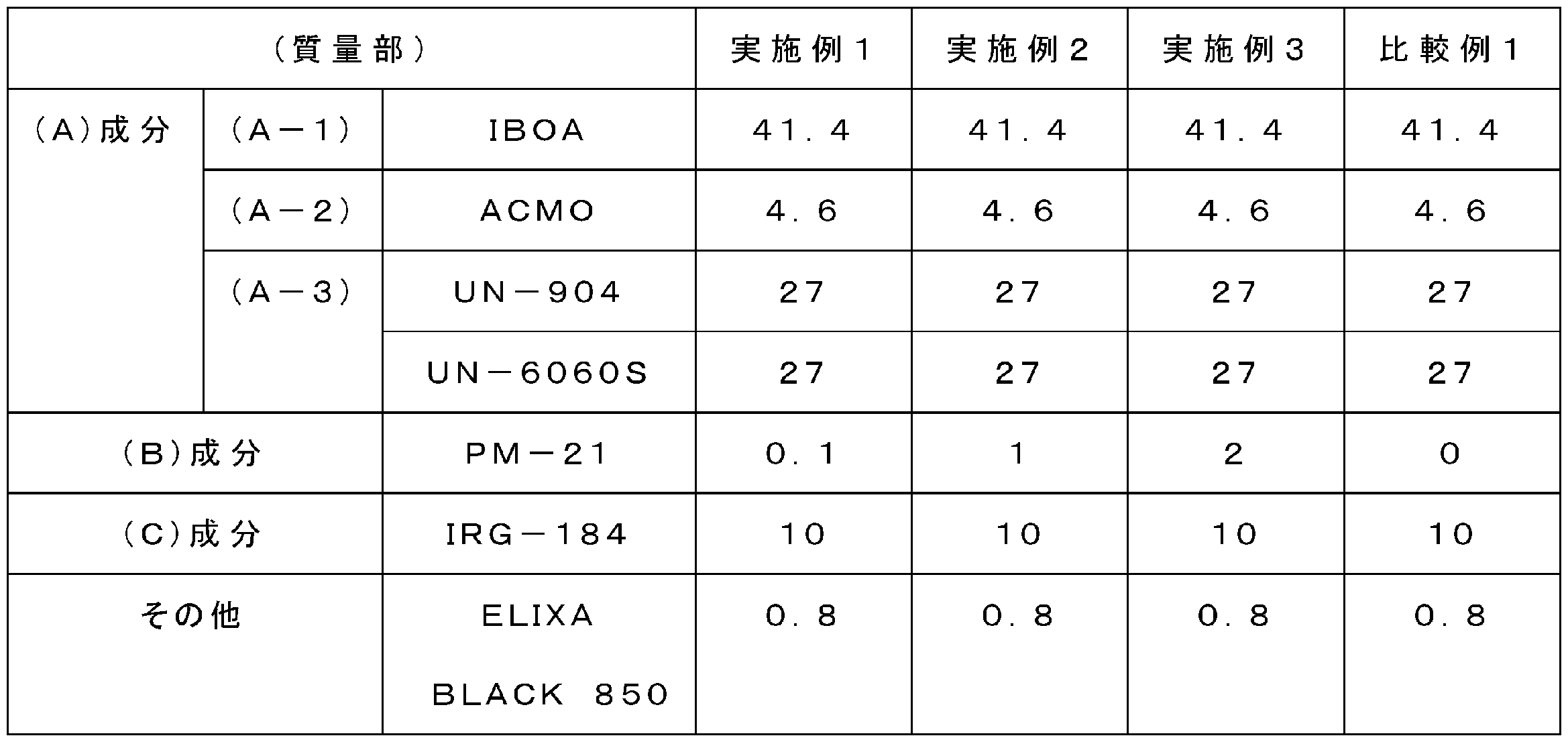
- Example 1 As component (A-1), 41.4 parts by mass of isobornyl acrylate, as component (A-2), 4.6 parts by mass of acryloylmorpholine, and as component (A-3) “UN-904” (manufactured by Negami Kogyo Co., Ltd.) , Product name, urethane acrylate compound) 27 parts by mass and “UN-6060S” (manufactured by Negami Kogyo Co., Ltd., product name, urethane acrylate compound) 27 parts by mass, (B) component “PM-21” (Nipponization) Yakuhin Co., Ltd., product name “KAYAMER PM-21”, phosphate ester) 0.1 part by mass, (C) component “IRG-184” (manufactured by BASF, product name “Irgacure 184”) 10 parts by mass, and , 0.8 parts by mass of “ELIXA BLACK 850” (manufactured by Orient Chemical Co
- Example 1 A curable resin composition was obtained in the same manner as in Example 1 except that the composition was changed to the composition shown in Table 1.
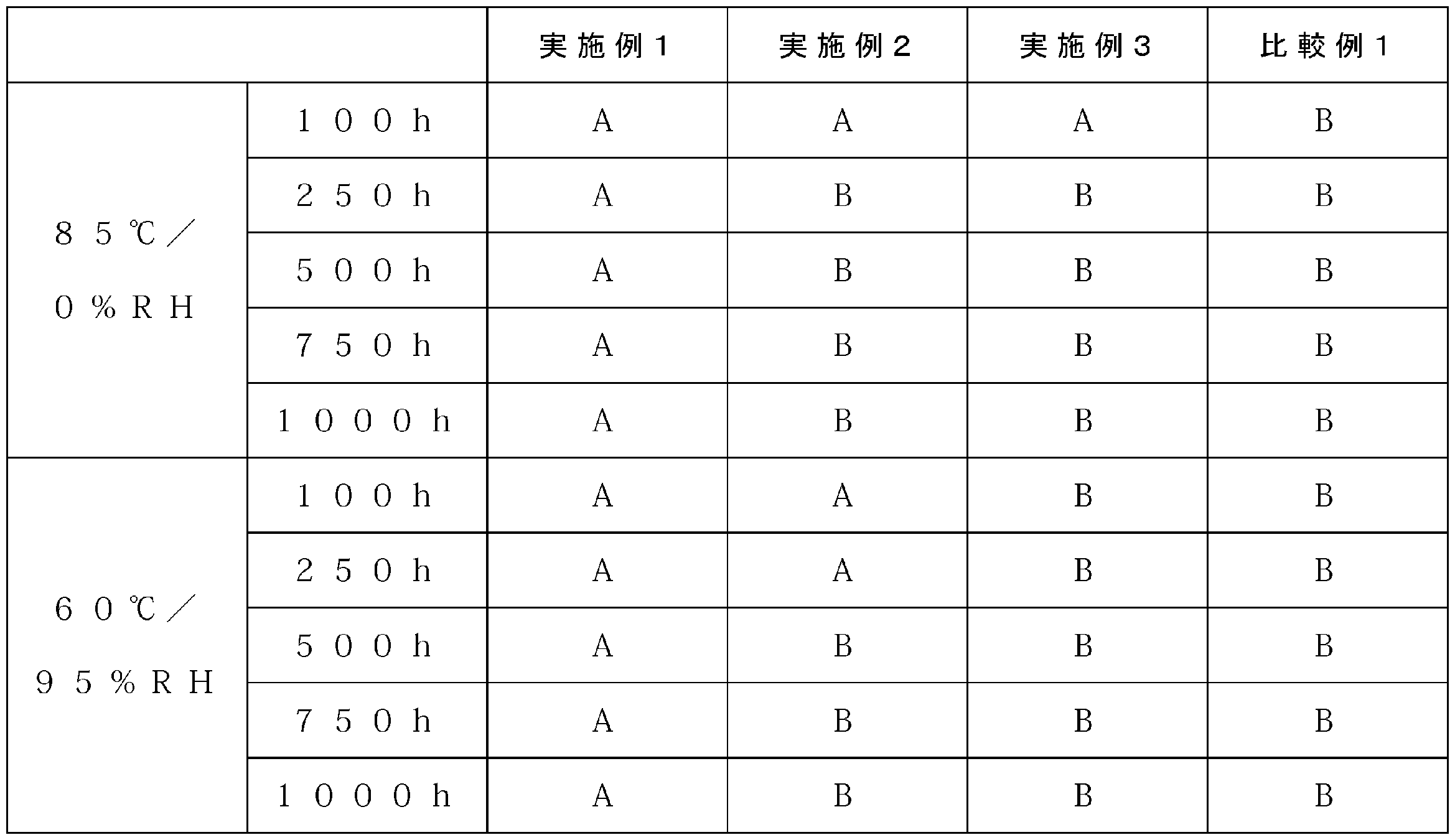
- the prepared sample was put into an ESPEC constant temperature bath “SH-661” and stored under the following conditions. 85 ° C./0% RH: 100 hours, 250 hours, 500 hours, 750 hours, 1000 hours 60 ° C./95% RH: 100 hours, 250 hours, 500 hours, 750 hours, 1000 hours
Landscapes
- Chemical & Material Sciences (AREA)
- Chemical Kinetics & Catalysis (AREA)
- Organic Chemistry (AREA)
- Health & Medical Sciences (AREA)
- Medicinal Chemistry (AREA)
- Polymers & Plastics (AREA)
- General Chemical & Material Sciences (AREA)
- Engineering & Computer Science (AREA)
- Life Sciences & Earth Sciences (AREA)
- Geochemistry & Mineralogy (AREA)
- Materials Engineering (AREA)
- Macromonomer-Based Addition Polymer (AREA)
- Polymerisation Methods In General (AREA)
- Devices For Indicating Variable Information By Combining Individual Elements (AREA)
- Liquid Crystal (AREA)
- Surface Treatment Of Glass (AREA)
Abstract
Description
本実施形態の硬化性樹脂組成物は、(A)第1のラジカル重合性化合物(以下、(A)成分という場合もある)と、(B)リン酸エステル構造を有する第2のラジカル重合性化合物(以下、(B)成分という場合もある)と、(C)ラジカル開始剤(以下、(C)成分という場合もある)とを含有する。
(A)成分としては、ラジカル重合性基を有する化合物が挙げられる。ラジカル重合性基としては、例えば、ビニル基(エテニル基)、エチニル基、アリル基、(メタ)アクリロイル基、(メタ)アクリロイルオキシ基、(メタ)アクリロイルアミノ基等の炭素-炭素二重結合を有する基が挙げられる。(A)成分は、硬化後の物理特性(例えば硬化収縮率、表面硬化性、硬化速度、外観)の観点から、(メタ)アクリロイルオキシ基を有する化合物を含むことが好ましい。
リン酸エステル構造を有するラジカル重合性化合物としては、リン酸基及びリン酸エステル基から選択されるいずれか少なくとも1種と、少なくとも1種のラジカル重合性基とを有する化合物が挙げられる。ラジカル重合性基としては、例えば、ビニル基(エテニル基)、エチニル基、アリル基、(メタ)アクリロイル基、(メタ)アクリロイルオキシ基、(メタ)アクリロイルアミノ基等の炭素-炭素二重結合を有する基が挙げられる。(B)成分は、(メタ)アクリロイルオキシ基と、リン酸エステル構造を有する化合物を含むことが好ましい。


硬化性樹脂組成物を光硬化性樹脂組成物とする場合には、ラジカル開始剤として光重合開始剤を用いることができる。光重合開始剤には、増感剤と呼ばれるものも包含される。硬化性樹脂組成物を熱硬化性樹脂組成物とする場合には、ラジカル開始剤として熱重合開始剤を用いることができる。
本実施形態の硬化性樹脂組成物は、必要に応じて様々な添加剤を含有してもよい。添加剤として、例えば、着色剤、カップリング剤等の密着性向上剤、重合禁止剤、光安定剤、消泡剤、フィラー、酸化防止剤、連鎖移動剤、チキソトロピー付与剤、可塑剤、難燃剤、離型剤、界面活性剤、滑剤、帯電防止剤などが挙げられる。これらの添加剤として、公知の添加剤を使用できる。
硬化性樹脂組成物は、(A)成分、(B)成分、及び(C)成分、並びに、必要に応じて上述した添加剤を、撹拌により混合することによって製造できる。撹拌は、撹拌子、撹拌羽根等を用いた公知の方法により行えばよい。撹拌時の温度は、例えば、20~80℃とすることができる。
図1(a)は、本発明に係るガラス部材の一実施形態を示す上面図であり、図1(b)は、図1(a)に示されるガラス部材の断面を示す模式断面図である。本実施形態のガラス部材100は、ガラス基材1と、該ガラス基材の端部の少なくとも一部に設けられた上記本実施形態に係る硬化性樹脂組成物の硬化物10とを備える。
ガラス基材の材質は特に限定されない。ガラスとしては、無アルカリガラス、低アルカリガラス、アルカリガラス、石英ガラスなどが挙げられる。イオン交換法により、化学強化されたガラス基材であってもよい。
本実施形態のガラス部材は表示装置の表示部に用いることができる。すなわち、本発明に係る表示装置は本実施形態のガラス部材を備えることができる。表示装置として、例えば、フラットパネルディスプレイ(FPD)が挙げられ、具体的には、液晶ディスプレイ(LCD)、プラズマディスプレイパネル(PDP)、有機エレクトロルミネッセンスパネル(OELP)、フィールドエミッションディスプレイ(FED)、陰極線管(CRT)、電子ペーパー等が挙げられる。
本実施形態のガラス部材は携帯端末に用いることができる。例えば、ガラス部材は、携帯端末の表示部に用いられる。携帯端末としては、携帯電話機、スマートフォン、パソコン、電子辞書、電卓、ゲーム機等が挙げられる。
(A-1)成分
IBOA:イソボルニルアクリレート(株式会社日本触媒製製)
(A-2)成分
ACMO:アクリロイルモルホリン(株式会社興人製)
(A-3)成分
UN-904:根上工業株式会社製、製品名「アートレジンUN-904」、ウレタンアクリレート系化合物
UN-6060S:根上工業株式会社製、製品名「アートレジンUN-6060S」、ウレタンアクリレート系化合物
PM-21:日本化薬株式会社製、製品名「KAYAMER PM-21」、リン酸エステル
IRG-184:BASF製、製品名「Irgacure 184」
(その他)
ELIXA BLACK 850:オリヱント化学工業株式会社製、黒色着色剤
(実施例1)
(A-1)成分としてイソボルニルアクリレート41.4質量部、(A-2)成分としてアクリロイルモルホリン4.6質量部、(A-3)成分として「UN-904」(根上工業株式会社製、製品名、ウレタンアクリレート系化合物)27質量部及び「UN-6060S」(根上工業株式会社製、製品名、ウレタンアクリレート系化合物)27質量部、(B)成分として「PM-21」(日本化薬株式会社製、製品名「KAYAMER PM-21」、リン酸エステル)0.1質量部、(C)成分として「IRG-184」(BASF製、製品名「Irgacure 184」)10質量部、及び、着色剤として「ELIXA BLACK 850」(オリヱント化学工業株式会社製、黒色着色剤)0.8質量部を、60℃で加熱しながら撹拌し、硬化性樹脂組成物を得た。
表1に示される組成に変更したこと以外は実施例1と同様にして、硬化性樹脂組成物をそれぞれ得た。
ガラス基材(松浪ガラス工業株式会社製、マイクロスライドガラス「S9213」)上に、上記で得られた硬化性樹脂組成物を滴下し、スキージングにて塗膜を得た。塗膜をパナソニック製UV-LEDランプ(3000mW/cm2、5000mJ/cm2)にて硬化し、試験用サンプルとした。
85℃/0%RH:100時間、250時間、500時間、750時間、1000時間
60℃/95%RH:100時間、250時間、500時間、750時間、1000時間
Claims (7)
- 第1のラジカル重合性化合物と、リン酸エステル構造を有する第2のラジカル重合性化合物と、ラジカル開始剤と、を含有する、硬化性樹脂組成物であって、
前記第2のラジカル重合性化合物の含有量が、前記第1のラジカル重合性化合物の合計100質量部に対して0.05~5質量部であり、
ガラス基材の端部を保護する硬化物を形成するために用いられる、硬化性樹脂組成物。 - 前記第2のラジカル重合性化合物の含有量が、前記第1のラジカル重合性化合物の合計100質量部に対して0.05~1.5質量部である、請求項1に記載の硬化性樹脂組成物。
- 前記第2のラジカル重合性化合物の含有量が、前記第1のラジカル重合性化合物の合計100質量部に対して0.05~0.5質量部である、請求項1に記載の硬化性樹脂組成物。
- UV硬化性である、請求項1~3のいずれか一項に記載の硬化性樹脂組成物。
- ガラス基材と、該ガラス基材の端部の少なくとも一部に設けられた、請求項1~4のいずれか一項に記載の硬化性樹脂組成物の硬化物と、を備える、ガラス部材。
- 請求項5に記載のガラス部材を備える、表示装置。
- 請求項5に記載のガラス部材を備える、携帯端末。
Priority Applications (4)
| Application Number | Priority Date | Filing Date | Title |
|---|---|---|---|
| KR1020197031707A KR102275382B1 (ko) | 2017-03-31 | 2017-03-31 | 경화성 수지 조성물, 유리 부재, 표시 장치 및 휴대 단말기 |
| PCT/JP2017/013601 WO2018179336A1 (ja) | 2017-03-31 | 2017-03-31 | 硬化性樹脂組成物、ガラス部材、表示装置及び携帯端末 |
| JP2019508108A JP6988884B2 (ja) | 2017-03-31 | 2017-03-31 | 硬化性樹脂組成物、ガラス部材、表示装置及び携帯端末 |
| CN201780091248.5A CN110678487B (zh) | 2017-03-31 | 2017-03-31 | 固化性树脂组合物、玻璃构件、显示装置和便携终端 |
Applications Claiming Priority (1)
| Application Number | Priority Date | Filing Date | Title |
|---|---|---|---|
| PCT/JP2017/013601 WO2018179336A1 (ja) | 2017-03-31 | 2017-03-31 | 硬化性樹脂組成物、ガラス部材、表示装置及び携帯端末 |
Publications (1)
| Publication Number | Publication Date |
|---|---|
| WO2018179336A1 true WO2018179336A1 (ja) | 2018-10-04 |
Family
ID=63674712
Family Applications (1)
| Application Number | Title | Priority Date | Filing Date |
|---|---|---|---|
| PCT/JP2017/013601 Ceased WO2018179336A1 (ja) | 2017-03-31 | 2017-03-31 | 硬化性樹脂組成物、ガラス部材、表示装置及び携帯端末 |
Country Status (4)
| Country | Link |
|---|---|
| JP (1) | JP6988884B2 (ja) |
| KR (1) | KR102275382B1 (ja) |
| CN (1) | CN110678487B (ja) |
| WO (1) | WO2018179336A1 (ja) |
Cited By (2)
| Publication number | Priority date | Publication date | Assignee | Title |
|---|---|---|---|---|
| US20210397088A1 (en) * | 2020-06-19 | 2021-12-23 | Canon Kabushiki Kaisha | Photo-curable composition and methods for preparing cured film, optical component, circuit substrate, electrical component and replica mold using the same |
| WO2025169845A1 (ja) * | 2024-02-05 | 2025-08-14 | Agc株式会社 | 強化ガラス物品 |
Citations (7)
| Publication number | Priority date | Publication date | Assignee | Title |
|---|---|---|---|---|
| JPH1095636A (ja) * | 1996-09-17 | 1998-04-14 | Nippon Sheet Glass Co Ltd | 耐衝撃ガラス |
| JP2002542971A (ja) * | 1999-04-30 | 2002-12-17 | ショット・ディスプレイ・グラース・ゲーエムベーハー | ポリマーコーティングされたガラス薄膜基板 |
| JP2009155470A (ja) * | 2007-12-26 | 2009-07-16 | Sanyo Chem Ind Ltd | 活性エネルギー線硬化型樹脂組成物 |
| JP2012527399A (ja) * | 2009-05-21 | 2012-11-08 | コーニング インコーポレイテッド | 機械的耐久性エッジを有する薄型基材 |
| JP2015129074A (ja) * | 2014-01-09 | 2015-07-16 | 昭和電工株式会社 | ガラス端面補強用組成物、ガラス板材、ガラス板材の製造方法 |
| JP2016003160A (ja) * | 2014-06-17 | 2016-01-12 | 日産化学工業株式会社 | ガラス保護膜形成用組成物及びガラス保護膜 |
| JP2016117870A (ja) * | 2014-12-24 | 2016-06-30 | 日立化成株式会社 | 光硬化性樹脂組成物及びそれを用いたガラス板保護用樹脂 |
Family Cites Families (4)
| Publication number | Priority date | Publication date | Assignee | Title |
|---|---|---|---|---|
| CN101070329A (zh) * | 2007-06-11 | 2007-11-14 | 扬州雅致达板饰有限公司 | 磷酸酯类丙烯酸酯及其合成方法、用途 |
| CN102478727B (zh) | 2010-11-28 | 2016-04-06 | 宸鸿科技(厦门)有限公司 | 触控显示装置的制造方法与显示装置、触控显示装置 |
| TWI782900B (zh) * | 2015-12-22 | 2022-11-11 | 日商昭和電工材料股份有限公司 | 光硬化性樹脂組成物、遮光用塗料及硬化物、硬化物及其製造方法、玻璃基材、顯示裝置、移動終端及遮光的玻璃基材的製造方法 |
| JP7001051B2 (ja) * | 2016-05-09 | 2022-01-19 | 昭和電工マテリアルズ株式会社 | 光硬化性樹脂組成物、光硬化性塗料、及び硬化物 |
-
2017
- 2017-03-31 CN CN201780091248.5A patent/CN110678487B/zh active Active
- 2017-03-31 WO PCT/JP2017/013601 patent/WO2018179336A1/ja not_active Ceased
- 2017-03-31 JP JP2019508108A patent/JP6988884B2/ja active Active
- 2017-03-31 KR KR1020197031707A patent/KR102275382B1/ko active Active
Patent Citations (7)
| Publication number | Priority date | Publication date | Assignee | Title |
|---|---|---|---|---|
| JPH1095636A (ja) * | 1996-09-17 | 1998-04-14 | Nippon Sheet Glass Co Ltd | 耐衝撃ガラス |
| JP2002542971A (ja) * | 1999-04-30 | 2002-12-17 | ショット・ディスプレイ・グラース・ゲーエムベーハー | ポリマーコーティングされたガラス薄膜基板 |
| JP2009155470A (ja) * | 2007-12-26 | 2009-07-16 | Sanyo Chem Ind Ltd | 活性エネルギー線硬化型樹脂組成物 |
| JP2012527399A (ja) * | 2009-05-21 | 2012-11-08 | コーニング インコーポレイテッド | 機械的耐久性エッジを有する薄型基材 |
| JP2015129074A (ja) * | 2014-01-09 | 2015-07-16 | 昭和電工株式会社 | ガラス端面補強用組成物、ガラス板材、ガラス板材の製造方法 |
| JP2016003160A (ja) * | 2014-06-17 | 2016-01-12 | 日産化学工業株式会社 | ガラス保護膜形成用組成物及びガラス保護膜 |
| JP2016117870A (ja) * | 2014-12-24 | 2016-06-30 | 日立化成株式会社 | 光硬化性樹脂組成物及びそれを用いたガラス板保護用樹脂 |
Cited By (4)
| Publication number | Priority date | Publication date | Assignee | Title |
|---|---|---|---|---|
| US20210397088A1 (en) * | 2020-06-19 | 2021-12-23 | Canon Kabushiki Kaisha | Photo-curable composition and methods for preparing cured film, optical component, circuit substrate, electrical component and replica mold using the same |
| US11835858B2 (en) * | 2020-06-19 | 2023-12-05 | Canon Kabushiki Kaisha | Photo-curable composition and methods for preparing cured film, optical component, circuit substrate, electrical component and replica mold using the same |
| US12189289B2 (en) | 2020-06-19 | 2025-01-07 | Canon Kabushiki Kaisha | Photo-curable composition and methods for preparing cured film, optical component, circuit substrate, electrical component and replica mold using the same |
| WO2025169845A1 (ja) * | 2024-02-05 | 2025-08-14 | Agc株式会社 | 強化ガラス物品 |
Also Published As
| Publication number | Publication date |
|---|---|
| JP6988884B2 (ja) | 2022-01-05 |
| KR102275382B1 (ko) | 2021-07-08 |
| KR20190130005A (ko) | 2019-11-20 |
| CN110678487B (zh) | 2021-10-15 |
| CN110678487A (zh) | 2020-01-10 |
| JPWO2018179336A1 (ja) | 2020-02-06 |
Similar Documents
| Publication | Publication Date | Title |
|---|---|---|
| TWI671375B (zh) | 光硬化型接著組成物 | |
| JP5556766B2 (ja) | 活性エネルギー線硬化型光学材料用組成物 | |
| JP2010144000A (ja) | 光硬化性樹脂組成物、電子ペーパー用の光硬化性防湿シール材、電子ペーパー及びその製造方法 | |
| JP7022033B2 (ja) | 硬化性組成物及びその硬化物 | |
| JP6500399B2 (ja) | 硬化性樹脂組成物、硬化物、光学部材、レンズ及びカメラモジュール | |
| JP6833211B2 (ja) | インプリント成型用光硬化性樹脂組成物 | |
| JP4457960B2 (ja) | 活性エネルギー線硬化型光学部材用組成物 | |
| JP7001051B2 (ja) | 光硬化性樹脂組成物、光硬化性塗料、及び硬化物 | |
| JP6988884B2 (ja) | 硬化性樹脂組成物、ガラス部材、表示装置及び携帯端末 | |
| JP2017214475A (ja) | 光学部材用硬化性樹脂組成物、光学部材用樹脂、光学部材、レンズ及びカメラモジュール | |
| JP6523167B2 (ja) | 液晶滴下工法用シール剤、上下導通材料、及び、液晶表示素子 | |
| JP6597060B2 (ja) | 硬化性樹脂組成物、硬化物、光学部材、レンズ及びカメラモジュール | |
| KR102642394B1 (ko) | 광경화성 수지 조성물, 차광용 도료, 및 경화물 | |
| JP7152183B2 (ja) | 硬化性組成物及び硬化物 | |
| JP2010265402A (ja) | 光及び熱硬化併用型樹脂組成物、電子ペーパー用の光及び熱硬化併用型防湿シール材、電子ペーパー及びその製造方法 | |
| JP5212368B2 (ja) | 活性エネルギー線硬化型組成物及び光学材料 | |
| JP2017043652A (ja) | 透明光学部材用硬化性樹脂組成物、硬化物、透明光学部材、レンズ及びカメラモジュール | |
| WO2017061343A1 (ja) | 樹脂組成物及び硬化物シート | |
| WO2018037516A1 (ja) | 硬化性樹脂組成物、画像表示装置及び画像表示装置の製造方法 | |
| JP2018173486A (ja) | 接合体、接合体の製造方法、液晶ディスプレイ及び画像表示装置 | |
| JP2016117870A (ja) | 光硬化性樹脂組成物及びそれを用いたガラス板保護用樹脂 | |
| WO2015125518A1 (ja) | 光硬化性組成物 | |
| JP2019206719A (ja) | ガラス板保護用樹脂 | |
| WO2018038222A1 (ja) | 硬化性樹脂組成物、画像表示装置及び画像表示装置の製造方法 | |
| JP2018009073A (ja) | 光硬化性防湿絶縁塗料及び電子部品の製造方法 |
Legal Events
| Date | Code | Title | Description |
|---|---|---|---|
| 121 | Ep: the epo has been informed by wipo that ep was designated in this application |
Ref document number: 17903800 Country of ref document: EP Kind code of ref document: A1 |
|
| ENP | Entry into the national phase |
Ref document number: 2019508108 Country of ref document: JP Kind code of ref document: A |
|
| NENP | Non-entry into the national phase |
Ref country code: DE |
|
| ENP | Entry into the national phase |
Ref document number: 20197031707 Country of ref document: KR Kind code of ref document: A |
|
| 122 | Ep: pct application non-entry in european phase |
Ref document number: 17903800 Country of ref document: EP Kind code of ref document: A1 |