WO2018168947A1 - 樹脂組成物、成形体、積層体、ガスバリア材、コーティング材及び接着剤 - Google Patents
樹脂組成物、成形体、積層体、ガスバリア材、コーティング材及び接着剤 Download PDFInfo
- Publication number
- WO2018168947A1 WO2018168947A1 PCT/JP2018/010023 JP2018010023W WO2018168947A1 WO 2018168947 A1 WO2018168947 A1 WO 2018168947A1 JP 2018010023 W JP2018010023 W JP 2018010023W WO 2018168947 A1 WO2018168947 A1 WO 2018168947A1
- Authority
- WO
- WIPO (PCT)
- Prior art keywords
- resin composition
- vinyl
- meth
- resin
- group
- Prior art date
- Legal status (The legal status is an assumption and is not a legal conclusion. Google has not performed a legal analysis and makes no representation as to the accuracy of the status listed.)
- Ceased
Links
Classifications
-
- C—CHEMISTRY; METALLURGY
- C08—ORGANIC MACROMOLECULAR COMPOUNDS; THEIR PREPARATION OR CHEMICAL WORKING-UP; COMPOSITIONS BASED THEREON
- C08L—COMPOSITIONS OF MACROMOLECULAR COMPOUNDS
- C08L57/00—Compositions of unspecified polymers obtained by reactions only involving carbon-to-carbon unsaturated bonds
- C08L57/06—Homopolymers or copolymers containing elements other than carbon and hydrogen
- C08L57/10—Homopolymers or copolymers containing elements other than carbon and hydrogen containing oxygen atoms
-
- C—CHEMISTRY; METALLURGY
- C08—ORGANIC MACROMOLECULAR COMPOUNDS; THEIR PREPARATION OR CHEMICAL WORKING-UP; COMPOSITIONS BASED THEREON
- C08K—Use of inorganic or non-macromolecular organic substances as compounding ingredients
- C08K3/00—Use of inorganic substances as compounding ingredients
- C08K3/34—Silicon-containing compounds
- C08K3/346—Clay
-
- C—CHEMISTRY; METALLURGY
- C08—ORGANIC MACROMOLECULAR COMPOUNDS; THEIR PREPARATION OR CHEMICAL WORKING-UP; COMPOSITIONS BASED THEREON
- C08K—Use of inorganic or non-macromolecular organic substances as compounding ingredients
- C08K9/00—Use of pretreated ingredients
- C08K9/02—Ingredients treated with inorganic substances
-
- C—CHEMISTRY; METALLURGY
- C09—DYES; PAINTS; POLISHES; NATURAL RESINS; ADHESIVES; COMPOSITIONS NOT OTHERWISE PROVIDED FOR; APPLICATIONS OF MATERIALS NOT OTHERWISE PROVIDED FOR
- C09D—COATING COMPOSITIONS, e.g. PAINTS, VARNISHES OR LACQUERS; FILLING PASTES; CHEMICAL PAINT OR INK REMOVERS; INKS; CORRECTING FLUIDS; WOODSTAINS; PASTES OR SOLIDS FOR COLOURING OR PRINTING; USE OF MATERIALS THEREFOR
- C09D129/00—Coating compositions based on homopolymers or copolymers of compounds having one or more unsaturated aliphatic radicals, each having only one carbon-to-carbon double bond, and at least one being terminated by an alcohol, ether, aldehydo, ketonic, acetal, or ketal radical; Coating compositions based on hydrolysed polymers of esters of unsaturated alcohols with saturated carboxylic acids; Coating compositions based on derivatives of such polymers
- C09D129/02—Homopolymers or copolymers of unsaturated alcohols
-
- C—CHEMISTRY; METALLURGY
- C09—DYES; PAINTS; POLISHES; NATURAL RESINS; ADHESIVES; COMPOSITIONS NOT OTHERWISE PROVIDED FOR; APPLICATIONS OF MATERIALS NOT OTHERWISE PROVIDED FOR
- C09D—COATING COMPOSITIONS, e.g. PAINTS, VARNISHES OR LACQUERS; FILLING PASTES; CHEMICAL PAINT OR INK REMOVERS; INKS; CORRECTING FLUIDS; WOODSTAINS; PASTES OR SOLIDS FOR COLOURING OR PRINTING; USE OF MATERIALS THEREFOR
- C09D7/00—Features of coating compositions, not provided for in group C09D5/00; Processes for incorporating ingredients in coating compositions
- C09D7/40—Additives
-
- C—CHEMISTRY; METALLURGY
- C09—DYES; PAINTS; POLISHES; NATURAL RESINS; ADHESIVES; COMPOSITIONS NOT OTHERWISE PROVIDED FOR; APPLICATIONS OF MATERIALS NOT OTHERWISE PROVIDED FOR
- C09J—ADHESIVES; NON-MECHANICAL ASPECTS OF ADHESIVE PROCESSES IN GENERAL; ADHESIVE PROCESSES NOT PROVIDED FOR ELSEWHERE; USE OF MATERIALS AS ADHESIVES
- C09J11/00—Features of adhesives not provided for in group C09J9/00, e.g. additives
- C09J11/02—Non-macromolecular additives
- C09J11/04—Non-macromolecular additives inorganic
-
- C—CHEMISTRY; METALLURGY
- C09—DYES; PAINTS; POLISHES; NATURAL RESINS; ADHESIVES; COMPOSITIONS NOT OTHERWISE PROVIDED FOR; APPLICATIONS OF MATERIALS NOT OTHERWISE PROVIDED FOR
- C09J—ADHESIVES; NON-MECHANICAL ASPECTS OF ADHESIVE PROCESSES IN GENERAL; ADHESIVE PROCESSES NOT PROVIDED FOR ELSEWHERE; USE OF MATERIALS AS ADHESIVES
- C09J129/00—Adhesives based on homopolymers or copolymers of compounds having one or more unsaturated aliphatic radicals, each having only one carbon-to-carbon double bond, and at least one being terminated by an alcohol, ether, aldehydo, ketonic, acetal, or ketal radical; Adhesives based on hydrolysed polymers of esters of unsaturated alcohols with saturated carboxylic acids; Adhesives based on derivatives of such polymers
- C09J129/02—Homopolymers or copolymers of unsaturated alcohols
-
- C—CHEMISTRY; METALLURGY
- C08—ORGANIC MACROMOLECULAR COMPOUNDS; THEIR PREPARATION OR CHEMICAL WORKING-UP; COMPOSITIONS BASED THEREON
- C08F—MACROMOLECULAR COMPOUNDS OBTAINED BY REACTIONS ONLY INVOLVING CARBON-TO-CARBON UNSATURATED BONDS
- C08F216/00—Copolymers of compounds having one or more unsaturated aliphatic radicals, each having only one carbon-to-carbon double bond, and at least one being terminated by an alcohol, ether, aldehydo, ketonic, acetal or ketal radical
- C08F216/02—Copolymers of compounds having one or more unsaturated aliphatic radicals, each having only one carbon-to-carbon double bond, and at least one being terminated by an alcohol, ether, aldehydo, ketonic, acetal or ketal radical by an alcohol radical
- C08F216/04—Acyclic compounds
-
- C—CHEMISTRY; METALLURGY
- C08—ORGANIC MACROMOLECULAR COMPOUNDS; THEIR PREPARATION OR CHEMICAL WORKING-UP; COMPOSITIONS BASED THEREON
- C08F—MACROMOLECULAR COMPOUNDS OBTAINED BY REACTIONS ONLY INVOLVING CARBON-TO-CARBON UNSATURATED BONDS
- C08F218/00—Copolymers of compounds having one or more unsaturated aliphatic radicals, each having only one carbon-to-carbon double bond, and at least one being terminated by an acyloxy radical of a saturated carboxylic acid, of carbonic acid or of a haloformic acid
- C08F218/02—Esters of monocarboxylic acids
-
- C—CHEMISTRY; METALLURGY
- C08—ORGANIC MACROMOLECULAR COMPOUNDS; THEIR PREPARATION OR CHEMICAL WORKING-UP; COMPOSITIONS BASED THEREON
- C08L—COMPOSITIONS OF MACROMOLECULAR COMPOUNDS
- C08L2201/00—Properties
- C08L2201/14—Gas barrier composition
-
- C—CHEMISTRY; METALLURGY
- C08—ORGANIC MACROMOLECULAR COMPOUNDS; THEIR PREPARATION OR CHEMICAL WORKING-UP; COMPOSITIONS BASED THEREON
- C08L—COMPOSITIONS OF MACROMOLECULAR COMPOUNDS
- C08L2203/00—Applications
- C08L2203/16—Applications used for films
-
- C—CHEMISTRY; METALLURGY
- C08—ORGANIC MACROMOLECULAR COMPOUNDS; THEIR PREPARATION OR CHEMICAL WORKING-UP; COMPOSITIONS BASED THEREON
- C08L—COMPOSITIONS OF MACROMOLECULAR COMPOUNDS
- C08L2203/00—Applications
- C08L2203/20—Applications use in electrical or conductive gadgets
-
- C—CHEMISTRY; METALLURGY
- C09—DYES; PAINTS; POLISHES; NATURAL RESINS; ADHESIVES; COMPOSITIONS NOT OTHERWISE PROVIDED FOR; APPLICATIONS OF MATERIALS NOT OTHERWISE PROVIDED FOR
- C09D—COATING COMPOSITIONS, e.g. PAINTS, VARNISHES OR LACQUERS; FILLING PASTES; CHEMICAL PAINT OR INK REMOVERS; INKS; CORRECTING FLUIDS; WOODSTAINS; PASTES OR SOLIDS FOR COLOURING OR PRINTING; USE OF MATERIALS THEREFOR
- C09D157/00—Coating compositions based on unspecified polymers obtained by reactions only involving carbon-to-carbon unsaturated bonds
- C09D157/06—Homopolymers or copolymers containing elements other than carbon and hydrogen
- C09D157/10—Homopolymers or copolymers containing elements other than carbon and hydrogen containing oxygen atoms
-
- C—CHEMISTRY; METALLURGY
- C09—DYES; PAINTS; POLISHES; NATURAL RESINS; ADHESIVES; COMPOSITIONS NOT OTHERWISE PROVIDED FOR; APPLICATIONS OF MATERIALS NOT OTHERWISE PROVIDED FOR
- C09J—ADHESIVES; NON-MECHANICAL ASPECTS OF ADHESIVE PROCESSES IN GENERAL; ADHESIVE PROCESSES NOT PROVIDED FOR ELSEWHERE; USE OF MATERIALS AS ADHESIVES
- C09J157/00—Adhesives based on unspecified polymers obtained by reactions only involving carbon-to-carbon unsaturated bonds
- C09J157/06—Homopolymers or copolymers containing elements other than carbon and hydrogen
- C09J157/10—Homopolymers or copolymers containing elements other than carbon and hydrogen containing oxygen atoms
Definitions
- the present invention relates to a resin composition, a molded body, a laminate, a gas barrier material, a coating material, and an adhesive.
- Packaging materials used for packaging foods and the like are required to have functions such as content protection, retort resistance, heat resistance, transparency and processability. In order to maintain the quality of the contents, gas barrier properties are particularly important. Recently, not only packaging materials but also materials used for electronic materials such as solar cells and semiconductors are required to have high gas barrier properties.
- Patent Document 1 describes that characteristics such as gas barrier properties are improved by combining a resin having a hydroxyl group and an isocyanate compound with a plate-like inorganic compound such as clay mineral and a light blocking agent.
- Patent Document 2 describes a material having modified clay as a main constituent component, and using modified clay, using an additive as necessary, orienting the modified clay crystal, and densely laminating, It is said that a film material having mechanical strength, gas barrier property, water resistance, thermal stability and flexibility that can be used as a self-supporting film is obtained.
- the plate-like inorganic compound as described in Patent Document 1 is bulky and it is difficult to obtain good affinity with the resin. Therefore, there is a limit to the amount added and dispersibility. Therefore, it is difficult to obtain a higher gas barrier property by increasing the addition amount. Even if the addition amount of the filler can be increased, sufficient dispersibility cannot be obtained, and sufficient gas barrier property can be obtained. Absent.
- the clay film described in Patent Document 2 is a self-supporting film that is heated after film formation, it is very high for a base material (for example, a resin base material) on which a viscosity film is formed. Heat resistance is required. For this reason, the viscosity film described in Patent Document 2 can be used only for a base material (for example, a resin base material) having very high heat resistance, and there is a problem that the intended use is limited.
- the self-supporting film described in Patent Document 2 contains a large amount of filler in order to exhibit high gas barrier properties. However, if the amount of the filler is too large, the flexibility of the composition is impaired. For example, when used for a flexible packaging film, there is a problem that the flexibility of the film is insufficient. Therefore, there is still a need for a resin composition that can exhibit high barrier properties even when the filler is highly filled or low.
- an object of the present invention is to provide a resin composition that is further excellent in gas barrier properties, particularly water vapor barrier properties and oxygen barrier properties, as compared with conventional resin compositions.
- the inventors of the present invention have a lithium partially fixed smectite obtained by heat treatment in advance, which has an effect of improving the dispersibility of the resin, can suppress deterioration of the resin, and has a wide range of adaptable resins. For the reason, it discovered that it could be used suitably as a filler of the resin composition which is excellent in gas barrier property as a result. Furthermore, it has been found that an excellent gas barrier property can be obtained by combining this lithium partially fixed smectite and a vinyl resin, and the present invention has been completed.
- the resin composition of one aspect of the present invention contains a vinyl resin and a lithium partially fixed smectite. According to this resin composition, since the lithium partially fixed smectite is combined with the vinyl resin, a resin film having excellent gas barrier properties such as water vapor barrier properties and oxygen barrier properties (for example, oxygen barrier properties under high humidity) is obtained. It is done.
- the vinyl resin may contain at least one selected from the group consisting of a hydroxyl group and a carboxyl group, and preferably has a structural unit represented by the following formula (1).
- R represents an alkyl group having 1 to 2 carbon atoms
- Q 1 represents a hydroxyl group or a carboxyl group
- m represents 0 or 1
- * represents a bond.
- the cation exchange capacity of the lithium partially fixed smectite is preferably 1 to 70 meq / 100 g. As a result, the water vapor barrier property and the oxygen barrier property are further improved.
- the content of the lithium partially fixed smectite is preferably 3 to 50% by mass with respect to the total nonvolatile content of the resin composition. By setting it as such content, while being excellent in water vapor
- the resin composition according to one aspect of the present invention is excellent in water vapor barrier property and oxygen barrier property, and therefore can be suitably used as a gas barrier resin composition.
- the present invention further provides a molded body of the above-described resin composition, and a laminate including the molded body on the substrate (a laminate including the substrate and a molded body provided on the substrate). .
- the resin composition according to one aspect of the present invention has excellent water vapor barrier properties and oxygen barrier properties, it can be suitably used for applications such as coating materials, gas barrier materials, and adhesives.
- the resin composition of one embodiment contains a vinyl resin and a lithium partially fixed smectite.
- Smectite is a kind of phyllosilicate mineral (layered clay mineral) having a layer structure.
- smectite structures such as montmorillonite, beidellite, saponite, hectorite, stevensite, and soconite are known.
- the structure of the clay material is preferably at least one structure selected from the group consisting of montmorillonite and stevensite.
- These structures have isomorphous substitution with a low-valent metal element, defects, and the like in part of the metal element of the octahedral sheet. Therefore, the octahedral sheet is negatively charged.
- these structures have vacant sites in the octahedron sheet, and in the smectite having these structures, lithium ions can exist stably after movement as described later.
- lithium-type smectite Smectite whose cation is lithium ion is referred to as lithium-type smectite (however, in this specification, lithium partially fixed smectite described later is excluded).
- a method for exchanging cations of smectite with lithium ions for example, there is a method in which a lithium salt such as lithium hydroxide or lithium chloride is added to a natural sodium type smectite dispersion (dispersion slurry) to exchange cations. Can be mentioned. By adjusting the amount of lithium added to the dispersion, the amount of lithium ions in the amount of leaching cations of the obtained lithium smectite can be appropriately adjusted.
- Lithium smectite can also be obtained by a column method or a batch method using a resin obtained by ion exchange of a cation exchange resin with lithium ions.
- the lithium partially fixed smectite refers to a smectite in which a part of lithium ions in the lithium smectite is fixed to an empty site of the octahedral sheet.
- Lithium partially fixed smectite can be obtained, for example, by fixing lithium ions between layers at an empty site of an octahedral sheet by heat treatment of lithium smectite. By fixing lithium ions, smectite is water-resistant.
- the temperature condition of the heat treatment for partially fixing lithium is not particularly limited as long as lithium ions can be fixed.
- the cation exchange capacity CEC: Cation Exchange Capacity
- the temperature of the heat treatment is more preferably 150 to 600 ° C., further preferably 180 to 600 ° C., particularly preferably 200 to 500 ° C., and most preferably 250 to 500 ° C.
- the heat treatment is preferably performed in an open electric furnace.
- the relative humidity during heating is 5% or less
- the pressure is normal pressure.
- the time for the heat treatment is not particularly limited as long as lithium can be partially fixed. However, from the viewpoint of production efficiency, it is preferably 0.5 to 48 hours, and more preferably 1 to 24 hours. .
- XPS X-ray photoelectron spectroscopy
- XPS X-ray photoelectron spectroscopy
- XPS X-ray photoelectron spectroscopy
- the cation exchange capacity of the lithium partially fixed smectite is preferably 70 meq / 100 g or less, more preferably 60 meq / from the viewpoint of further excellent water vapor barrier properties and oxygen barrier properties (for example, oxygen barrier properties under high humidity). 100 g or less.
- the cation exchange capacity of the lithium partially fixed smectite is 1 meq / 100 g or more, more preferably 5 meq / 100 g or more from the viewpoint of further excellent water vapor barrier properties and oxygen barrier properties (for example, oxygen barrier properties under high humidity). More preferably, it is 10 meq / 100 g or more.
- the cation exchange capacity of the lithium partially fixed smectite is 1 to 70 meq / 100 g, more preferably 5 to 70 meq / 100 g, and still more preferably 10 to 60 meq / 100 g.
- the ion exchange capacity is usually about 80 to 150 meq / 100 g, but it can be 5 to 70 meq / 100 g by performing partial immobilization treatment.
- the cation exchange capacity of the lithium partially fixed smectite may be less than 60 meq / 100 g or 50 meq / 100 g or less.
- the cation exchange capacity of the lithium partially fixed smectite may be 1 meq / 100 g or more and less than 60 meq / 100 g, may be 5 meq / 100 g or more and less than 60 meq / 100 g, and may be 10 meq / 100 g or more and less than 60 meq / 100 g. It's okay.
- the cation exchange capacity of smectite can be measured by a method according to the Schollenberger method (Clay Handbook 3rd edition, edited by the Japan Clay Society, May 2009, p. 453-454). More specifically, it can be measured by the method described in Japan Bentonite Industry Association Standard Test Method JBAS-106-77.
- the amount of smectite leaching cation was determined by leaching the smectite interlayer cation with 0.5 mL of smectite using 100 mL of 1 M ammonium acetate aqueous solution over 4 hours, and the concentration of various cations in the resulting solution. It can be measured and calculated by ICP emission analysis, atomic absorption analysis or the like.
- the content of the lithium partially fixed smectite is preferably 3% by mass or more with respect to the total nonvolatile content in the resin composition.
- the content of the lithium partially fixed smectite is 3% by mass or more with respect to the total nonvolatile content, the water vapor barrier property and the oxygen barrier property (for example, the oxygen barrier property under high humidity) are further improved.
- the content of the lithium partially fixed smectite is 5% by mass, 7% by mass, 9% by mass, 10% by mass, 15% by mass or more with respect to the total nonvolatile content in the resin composition. 18 mass% or more, 20 mass% or more, 25 mass% or more, or 30 mass% or more.
- the content of the lithium partially fixed smectite is preferably 70% by mass or less with respect to the total nonvolatile content in the resin composition.
- the content of the lithium partially fixed smectite is 70% by mass or less, the moldability of the resin composition is further improved, and the adhesion to the substrate is improved. Moreover, higher oxygen barrier properties can be obtained under high humidity.
- the content of the lithium partially fixed smectite is 50% by mass or less, 45% by mass or less, 40% by mass or less, 35% by mass or less, and 30% by mass or less with respect to the total nonvolatile content in the resin composition. It may be.
- the above upper limit value and lower limit value can be arbitrarily combined.
- the content of the lithium partially fixed smectite is, for example, 3 to 70% by mass, 3 to 50% by mass, 3 to 35% by mass, 5 to 35% by mass, 5% to 5% by mass with respect to the total nonvolatile content in the resin composition. It may be 30% by mass, 7-30% by mass, 9-30% by mass, 10-30% by mass, and the like. Also in the same description in this specification, the individually described upper limit value and lower limit value can be arbitrarily combined.
- the non-volatile content refers to the mass excluding the mass of the diluent solvent and the mass of volatile components contained in the vinyl resin, the modifier, and various additives from the total mass of the resin composition.
- the resin composition of the embodiment contains a vinyl resin.
- a vinyl resin is a polymer or copolymer of vinyl monomers.
- the weight average molecular weight in terms of polystyrene by GPC (gel permeation chromatography) is not particularly limited, but is preferably 500 to 1,000,000.
- the vinyl monomer only needs to have at least one vinyl group.
- the vinyl monomer includes a monomer having a (meth) allyl group or a (meth) acryloyl group in addition to a monomer having a vinyl group.
- the (meth) allyl group means an allyl group or a methallyl group.
- the (meth) acryloyl group means an acryloyl group or a methacryloyl group.
- vinyl monomers include olefins such as ethylene, propylene, isobutylene, butadiene, and isoprene; halogenated olefins such as dichloroethylene and vinyl chloride; (meth) acrylic acid; (meth) acrylic acid ester; vinyl ester; maleic acid diester; Acid diester; itaconic acid diester; (meth) acrylamide; styrene and derivatives thereof; vinyl ether; vinyl ketone; maleimide; allyl compound; (meth) acrylonitrile; And compounds having a heterocyclic group substituted with a vinyl group; vinylamides such as N-vinylformamide and N-vinylacetamide;
- (meth) acrylic acid esters examples include methyl (meth) acrylate, ethyl (meth) acrylate, n-propyl (meth) acrylate, isopropyl (meth) acrylate, n-butyl (meth) acrylate, Isobutyl (meth) acrylate, t-butyl (meth) acrylate, amyl (meth) acrylate, n-hexyl (meth) acrylate, cyclohexyl (meth) acrylate, t-butylcyclohexyl (meth) acrylate, ( 2-ethylhexyl (meth) acrylate, t-octyl (meth) acrylate, dodecyl (meth) acrylate, octadecyl (meth) acrylate, acetoxyethyl (meth) acrylate, phenyl (meth) acrylate
- vinyl esters examples include vinyl acetate, vinyl chloroacetate, vinyl propionate, vinyl butyrate, vinyl methoxyacetate, vinyl benzoate and the like.
- maleic acid diesters examples include dimethyl maleate, diethyl maleate, and dibutyl maleate.
- fumaric acid diester examples include dimethyl fumarate, diethyl fumarate, dibutyl fumarate and the like.
- itaconic acid diesters examples include dimethyl itaconate, diethyl itaconate, dibutyl itaconate and the like.
- Examples of (meth) acrylamide include (meth) acrylamide, N-methyl (meth) acrylamide, N-ethyl (meth) acrylamide, N-propyl (meth) acrylamide, N-isopropyl (meth) acrylamide, Nn- Butylacrylic (meth) amide, Nt-butyl (meth) acrylamide, N-cyclohexyl (meth) acrylamide, N- (2-methoxyethyl) (meth) acrylamide, N, N-dimethyl (meth) acrylamide, N, N-diethyl (meth) acrylamide, N-phenyl (meth) acrylamide, N-nitrophenyl acrylamide, N-ethyl-N-phenyl acrylamide, N-benzyl (meth) acrylamide, (meth) acryloylmorpholine, diacetone acrylamide, N -Mechi Lumpur acrylamide, N- hydroxy
- styrene derivatives include methyl styrene, dimethyl styrene, trimethyl styrene, ethyl styrene, isopropyl styrene, butyl styrene, hydroxy styrene, methoxy styrene, butoxy styrene, acetoxy styrene, chloro styrene, dichloro styrene, bromo styrene, chloromethyl styrene, Examples include ⁇ -methylstyrene.
- vinyl ethers include methyl vinyl ether, ethyl vinyl ether, 2-chloroethyl vinyl ether, hydroxyethyl vinyl ether, propyl vinyl ether, butyl vinyl ether, hexyl vinyl ether, octyl vinyl ether, methoxyethyl vinyl ether, phenyl vinyl ether and the like.
- vinyl ketones examples include methyl vinyl ketone, ethyl vinyl ketone, propyl vinyl ketone, and phenyl vinyl ketone.
- maleimides examples include maleimide, butyl maleimide, cyclohexyl maleimide, and phenyl maleimide.
- allyl compounds include allyl acetate, allyl alcohol, allylamine, N-allylaniline, allyl chloride, allyl bromide and the like.
- the vinyl resin may contain at least one hydrophilic functional group selected from the group consisting of a hydroxyl group and a carboxyl group from the viewpoint of further improving the affinity with the lithium partially fixed smectite.
- the vinyl resin preferably has either a hydroxyl group or a carboxyl group, but may have both a hydroxyl group and a carboxyl group.
- the hydrophilic functional group is preferably a hydroxyl group.
- hydrophilic functional group into a vinyl resin by polymerizing a vinyl monomer having a hydrophilic functional group.
- the hydrophilic functional group is a hydroxyl group
- the hydroxyl group can be introduced as the hydrophilic functional group by polymerizing an alcohol ester compound having a polymerizable double bond and then saponifying the polymer.
- the vinyl monomer having a hydrophilic functional group a known and usual monomer may be used.
- the hydrophilic functional group is a hydroxyl group
- the vinyl monomer having a hydroxyl group includes (meth) allyl alcohol, vinyl alcohol, and alkenes having 4 to 12 carbon atoms such as 1-buten-3-ol.
- the carboxyl group can be introduced into the vinyl resin, for example, by polymerizing a vinyl monomer having a carboxyl group. Moreover, after polymerizing the vinyl monomer which has a hydroxyl group, a carboxyl group can be introduce
- Examples of the vinyl monomer having a carboxyl group include (meth) acrylic acid, allyloxyacetic acid, 2- (meth) acryloylpropanoic acid, 3- (meth) acryloylbutanoic acid, 4-vinylbenzoic acid and the like. Examples thereof include carboxyl group-containing vinyl monomers.
- the amount of the hydrophilic functional group in the vinyl resin is not particularly limited.
- the vinyl resin preferably contains a hydrophilic functional group so that the total value of the hydroxyl value and acid value of the vinyl resin is in the range of 1 to 2000 mgKOH / g.
- the total value of the hydroxyl value and acid value of the vinyl resin is more preferably 300 to 1500 mgKOH / g, and still more preferably 600 to 1200 mgKOH / g.
- the hydroxyl value can be measured by the hydroxyl value measuring method described in JIS-K0070, and the acid value can be measured by the acid value measuring method described in JIS-K0070. Further, when a vinyl resin is synthesized and used, the total value of the hydroxyl value and the acid value can be calculated from the monomer composition used.
- the vinyl resin is preferably a vinyl resin having a structural unit A (also referred to as partial structure A) represented by the following formula (1) (hereinafter also referred to as “vinyl resin A”).
- the vinyl resin A has a hydrophilic functional group (Q 1 )
- Q 1 hydrophilic functional group
- the affinity with the lithium partially fixed smectite is increased, and therefore, even higher gas barrier properties are exhibited.
- the water resistance can be imparted to the resin composition due to the effect of R in the structural unit A in the vinyl resin A, improvement in water vapor barrier properties and oxygen barrier properties under high humidity can be expected.
- R represents an alkyl group having 1 to 2 carbon atoms
- Q 1 represents a hydroxyl group or a carboxyl group
- m represents 0 or 1
- * represents a bond.
- R is specifically a methyl group or an ethyl group, preferably a methyl group (an alkyl group having 1 carbon atom).
- Q 1 is preferably a hydroxyl group.
- m is preferably 0.
- the content of the structural unit A is preferably 1 mol% with respect to the molar amount of the entire hydrophilic functional group in the vinyl resin (total molar amount of hydroxyl group and carboxyl group; the same shall apply hereinafter). More preferably, it is 5 mol% or more, more preferably 10 mol% or more, particularly preferably 30 mol% or more, 50 mol% or more, or 65 mol% or more, most preferably 75 mol% or more.
- the content of the structural unit A is preferably 99 with respect to the molar amount of the entire hydrophilic functional group in the vinyl resin, from the viewpoint of excellent film formability, film strength, and adhesiveness of the composition when formed into a molded body.
- the mol% or less more preferably 95 mol% or less, still more preferably 90 mol% or less.
- the content of the structural unit A is preferably 1 mol% or more and 99 mol% or less, more preferably 5 mol% or more and 95% or less, and still more preferably with respect to the molar amount of the entire hydrophilic functional group in the vinyl resin. It is 10 mol% or more and 90 mol% or less, and particularly preferably 30 mol% or more and 90 mol% or less.
- the content of the structural unit A in which R is a methyl group is preferably in the above range
- the content of the structural unit A in which Q 1 is a hydroxyl group is preferably in the above range
- m is 0.
- the content of the unit A is preferably in the above range, more preferably, the content of the structural unit A in which R is a methyl group, Q 1 is a hydroxyl group, and m is 0 is in the above range. .
- the vinyl resin may contain a structural unit (hydrophilic structural unit) having a hydrophilic functional group other than the structural unit A.
- the hydrophilic structural unit may be, for example, a structural unit B (also referred to as a partial structure B) represented by the following formula (2).
- the vinyl resin contains the structural unit A and preferably further contains the structural unit B. In one embodiment, the vinyl resin may consist of only the structural unit A and the structural unit B. When the vinyl resin contains the structural unit B, the film formability, film strength, and adhesiveness of the resin composition are further improved when formed into a molded body.
- Q 2 represents a hydroxyl group or a carboxyl group
- n represents 0 or 1
- * represents a bond.
- Q 2 is preferably a hydroxyl group.
- n is preferably 0.
- the content of the structural unit B is preferably 1 mol% or more, more preferably 5 mol% or more, and still more preferably based on the molar amount of the entire hydrophilic functional group in the vinyl resin. Is 10 mol% or more, preferably 99 mol% or less, more preferably 95 mol% or less, still more preferably 90 mol% or less, and particularly preferably 60 mol% or less.
- the content of the structural unit B is preferably 5 mol% or more and 95 mol%, more preferably 10 mol% or more and 90 mol% or less, and still more preferably 10 mol based on the total molar amount of the hydrophilic functional group in the vinyl resin.
- the content of the structural unit B in which Q 2 is a hydroxyl group is preferably in the above range, the content of the structural unit B in which n is 0 is preferably in the above range, Q 2 is a hydroxyl group, The content of the structural unit B where n is 0 is more preferably in the above range.
- the mol% (A / (A + B) ⁇ 100) of the content of the structural unit A with respect to the total content of the structural unit A and the structural unit B has a further gas barrier property. From the viewpoint of improvement, it may be 1 mol% or more, 5 mol% or more, 10 mol% or more, 30 mol% or more, 50 mol% or more, 65 mol% or more, 75 mol% or more, 99 mol% or less, 95 It may be not more than mol%, or not more than 90 mol%.
- the vinyl resin which has the structural unit A and / or the structural unit B It does not specifically limit as a manufacturing method of the vinyl resin which has the structural unit A and / or the structural unit B, It can manufacture by a well-known and usual method.
- the hydrophilic functional group (Q 1 or Q 2 ) of the structural unit A or B is a hydroxyl group, for example, an esterified product of a hydroxyl group-containing vinyl monomer corresponding to the structural unit A or B is polymerized and then saponified.
- a vinyl resin having a hydroxyl group as a hydrophilic functional group can be produced.
- Examples of the hydroxyl group-containing vinyl monomer corresponding to the structural unit A include isopropenyl alcohol, methallyl alcohol, and isobutenyl alcohol.
- Esters in the esterified product of a hydroxyl group-containing vinyl monomer corresponding to the structural unit A are acetate ester, propanoate ester, butanoate ester, 2-methylpropanoate ester, pentanoate ester, 3-methylbutanoate ester, 2,2- Examples thereof include dimethyl propanoic acid ester, hexanoic acid ester, cyclohexyl carboxylic acid ester, and benzoic acid ester.
- esterified products of the hydroxyl group-containing vinyl monomer corresponding to the structural unit A isopropenyl acetate, methallyl acetate or isobutenyl acetate which are acetates are preferable. These may be used individually by 1 type and may use 2 or more types together.
- Examples of the hydroxyl group-containing vinyl monomer corresponding to the structural unit B include vinyl alcohol, allyl alcohol, crotyl alcohol and the like.
- the ester in the esterified product of the hydroxyl group-containing vinyl monomer corresponding to the structural unit B may be an ester as exemplified above.
- the esterified products of the hydroxyl group-containing vinyl monomer corresponding to the structural unit B vinyl acetate, allyl acetate and crotyl acetate which are acetates are preferable. These may be used alone or in combination of two or more.
- the hydrophilic functional group (Q 1 or Q 2 ) of the structural unit A or B is a carboxyl group
- a carboxyl group-containing vinyl monomer corresponding to the structural unit A or B is polymerized to form a carboxyl group as the hydrophilic functional group.
- the carboxyl group-containing vinyl monomer corresponding to the structural unit A include methacrylic acid and 3-methyl-3-butenoic acid.
- Examples of the carboxyl group-containing vinyl monomer corresponding to the structural unit B include acrylic acid and 3-butenoic acid.
- the vinyl resin may be a homopolymer obtained by polymerizing a single monomer or a copolymer obtained by copolymerizing a plurality of types of monomers.
- a vinyl monomer you may use combining the monomer which has each of a vinyl group, a (meth) allyl group, and a (meth) acryloyl group.
- the vinyl resin can be obtained by polymerizing a vinyl monomer by radical polymerization, anionic polymerization, cationic polymerization or the like.
- a polymerization initiator may be used in the polymerization. Examples of the polymerization initiator include a thermal radical polymerization initiator, a photo radical polymerization initiator, an anionic polymerization initiator, and a cationic polymerization initiator.
- Thermal radical polymerization initiators include peroxides such as t-butyl peroxybenzoate, di-t-butyl peroxide, cumene perhydroxide, acetyl peroxide, benzoyl peroxide, lauroyl peroxide; azobisisobutylnitrile, And azo compounds such as azobis-2,4-dimethylvaleronitrile and azobiscyclohexanecarbonitrile.
- photo radical polymerization initiator examples include 1-hydroxy-cyclohexyl-phenyl-ketone, 2-hydroxy-2-methyl-1-phenyl-propan-1-one, 2,2-dimethoxy-1,2-diphenylethane- Examples include 1-one, 2-methyl-1- (4-methylthiophenyl) -2-morpholinopropan-1-one, and 2,4,6-trimethylbenzoyl-diphenyl-phosphine oxide.
- Anionic polymerization initiators include organic alkali metals such as methyllithium, n-butyllithium, sec-butyllithium, and t-butyllithium; organic alkaline earth metals such as methylmagnesium chloride and methylmagnesium bromide; lithium, sodium, and potassium Alkali metals such as
- cationic polymerization initiators include proton acids such as hydrochloric acid, sulfuric acid, perchloric acid, trifluoroacetic acid, methanesulfonic acid, trifluoromethanesulfonic acid, chlorosulfonic acid, and fluorosulfonic acid; boron trifluoride, aluminum chloride, tetrachloride Examples thereof include Lewis acids such as titanium, stannic chloride, and ferric chloride.
- one kind of vinyl resin may be used alone, or a plurality of vinyl resins may be used in combination.
- the vinyl resin may be a linear polymer or a branched polymer. When the vinyl resin is a branched polymer, it may be a comb or a star.
- the content of the vinyl resin may be 50 to 97% by mass, 70 to 93% by mass, or 80 to 95% by mass with respect to the total nonvolatile content in the resin composition.
- the content of the vinyl resin is 50% by mass or more, the water vapor barrier property and the oxygen barrier property are further improved.
- the content of the vinyl resin is 97% by mass or less, the moldability of the resin composition is further improved.
- the resin composition may be obtained by synthesizing a vinyl resin and mixing the synthesized vinyl resin and a lithium partially fixed smectite, and after blending the vinyl monomer and the lithium partially fixed smectite. Or obtained by polymerizing a vinyl monomer. In any case, the above polymerization initiator may be used.
- the resin composition may further contain a modifier.
- the modifier include a coupling agent, a silane compound, and an acid anhydride.
- a modifier may be used individually by 1 type and may be used in combination of multiple types.
- the coupling agent examples include a silane coupling agent, a titanium coupling agent, a zirconium coupling agent, and an aluminum coupling agent.
- silane coupling agent examples include an epoxy group-containing silane coupling agent, an amino group-containing silane coupling agent, a (meth) acryl group-containing silane coupling agent, and an isocyanate group-containing silane coupling agent.
- the epoxy group-containing silane coupling agent examples include 3-glycidoxypropyltrimethoxysilane, 3-glycidoxypropyltriethoxysilane, 3-glycidoxypropylmethyldiethoxysilane, and 2- (3,4 epoxycyclohexyl). ) Ethyltrimethoxysilane and the like.
- amino group-containing silane coupling agents examples include 3-aminopropyltrimethoxysilane, N-2- (aminoethyl) -3-aminopropylmethyldimethoxysilane, 3-triethoxysilyl-N- (1,3-dimethyl). Butylidene) propylamine, N-phenyl- ⁇ -aminopropyltrimethoxysilane and the like.
- the (meth) acrylic group-containing silane coupling agent examples include 3-acryloxypropyltrimethoxysilane, 3-methacryloxypropyltrimethoxysilane, and 3-methacryloxypropyltriethoxysilane.
- isocyanate group-containing silane coupling agent examples include 3-isocyanatopropyltriethoxysilane.
- titanium coupling agent examples include isopropyl triisostearoyl titanate, isopropyl trioctanoyl titanate, isopropyl dimethacrylisostearoyl titanate, isopropyl isostearoyl diacryl titanate, isopropyl tris (dioctylpyrophosphate) titanate, tetraoctyl bis (ditridecyl).
- Examples thereof include phosphite) titanate, tetra (2,2-diallyloxymethyl-1-butyl) bis (ditridecyl) phosphite titanate, bis (dioctylpyrophosphate) oxyacetate titanate, and bis (dioctylpyrophosphate) ethylene titanate.
- zirconium coupling agent examples include zirconium acetate, zirconium carbonate ammonium, zirconium fluoride and the like.
- aluminum coupling agent examples include acetoalkoxy aluminum diisopropylate, aluminum diisopropoxy monoethyl acetoacetate, aluminum trisethyl acetoacetate, aluminum trisacetylacetonate and the like.
- silane compound examples include alkoxysilane, silazane, siloxane and the like.
- Alkoxysilanes include methyltrimethoxysilane, dimethyldimethoxysilane, phenyltrimethoxysilane, methyltriethoxysilane, dimethyldiethoxysilane, phenyltriethoxysilane, n-propyltrimethoxysilane, n-propyltriethoxysilane, hexyltri Examples include methoxysilane, hexyltriethoxysilane, octyltriethoxysilane, decyltrimethoxysilane, 1,6-bis (trimethoxysilyl) hexane, trifluoropropyltrimethoxysilane, and the like.
- Examples of silazane include hexamethyldisilazane.
- siloxane examples include hydrolyzable group-containing
- Acid anhydrides include succinic anhydride, maleic anhydride, phthalic anhydride, trimellitic anhydride, pyromellitic anhydride, tetrahydrophthalic anhydride, methyltetrahydrophthalic anhydride, methyl nadic anhydride, hexahydrophthalic anhydride, methyl Hexahydrophthalic anhydride alkenyl succinic anhydride and the like.
- the blending amount of the modifying agent is preferably 0.1 to 50% by mass with respect to the total amount of the lithium partially fixed smectite.
- the blending amount of the modifier is 0.1% by mass or more, the dispersibility of the lithium partially fixed smectite in the resin composition becomes better.
- the compounding quantity of a modifier is 50 mass% or less, the influence on the mechanical physical property of the modifier with respect to a resin composition can be suppressed more.
- the blending amount of the modifier is preferably 0.3 to 30% by mass, more preferably 0.5 to 15% by mass.
- the resin composition may contain a solvent depending on the intended use.
- the solvent include organic solvents such as methyl ethyl ketone, acetone, ethyl acetate, butyl acetate, toluene, dimethylformamide, acetonitrile, methyl isobutyl ketone, methanol, ethanol, propanol, methoxypropanol, cyclohexanone, methyl cellosolve, ethyl diglycol acetate, Examples include propylene glycol monomethyl ether acetate. What is necessary is just to select the kind and usage-amount of a solvent suitably according to a use application.
- the resin composition may contain various additives (excluding compounds corresponding to vinyl resins, lithium partially fixed smectites, modifiers, and solvents) as long as the effects of the present invention are not impaired.
- additives include organic fillers, inorganic fillers, stabilizers (antioxidants, heat stabilizers, UV absorbers, etc.), plasticizers, antistatic agents, lubricants, antiblocking agents, colorants, crystal nucleating agents, Examples thereof include oxygen scavengers (compounds having an oxygen scavenging function) and tackifiers. These various additives are used alone or in combination of two or more.
- examples of the inorganic filler include inorganic substances such as metals, metal oxides, resins and minerals, and composites thereof.
- Specific examples of the inorganic filler include silica, alumina, titanium, zirconia, copper, iron, silver, mica, talc, aluminum flake, glass flake, clay mineral and the like.
- swellable inorganic layered compound examples include hydrous silicates (phyllosilicate minerals, etc.), kaolinite group clay minerals (such as halloysite), smectite group clay minerals (montmorillonite, beidellite, nontronite, saponite, hectorite, Sauconite, Stevensite, etc.), vermiculite group clay minerals (vermiculite, etc.). These minerals may be natural clay minerals or synthetic clay minerals.
- Examples of the compound having an oxygen scavenging function include hindered phenol compounds, vitamin C, vitamin E, organophosphorus compounds, gallic acid, pyrogallol and other low molecular organic compounds which react with oxygen, cobalt, manganese, nickel, iron And transition metal compounds such as copper.
- tackifier examples include xylene resin, terpene resin, phenol resin, rosin resin and the like. By adding a tackifier, the adhesiveness to various film materials immediately after coating can be improved.
- the addition amount of the tackifier is preferably 0.01 to 5 parts by mass with respect to 100 parts by mass of the total amount of the resin composition.
- the molded body of the embodiment can be obtained by molding the above-described resin composition.
- the molded body may be made of a resin composition or a cured product of the resin composition.
- the molding method is arbitrary and may be selected as appropriate depending on the application. There is no restriction
- the resin composition is molded using, for example, an extrusion molding method, a plane press, a modified extrusion molding method, a blow molding method, a compression molding method, a vacuum molding method, an injection molding method, etc.
- the method of doing is mentioned.
- melt extrusion method, solution casting method, inflation film molding, cast molding, extrusion lamination molding, calendar molding, sheet molding, fiber molding, blow molding, injection molding, rotational molding examples include coating molding.
- the resin composition is cured with heat or active energy rays, the resin composition may be molded using various curing methods using heat or active energy rays.
- the resin composition When the resin composition is liquid, it may be formed by coating. Coating methods include spray method, spin coating method, dipping method, roll coating method, blade coating method, doctor roll method, doctor blade method, curtain coating method, slit coating method, screen printing method, ink jet method, dispensing method, etc. Is mentioned.
- the laminated body of embodiment is provided with a base material and the molded object mentioned above on the base material.
- the laminate may have a two-layer structure or a three-layer structure or more.
- the material of the base material is not particularly limited and may be appropriately selected depending on the application. Examples thereof include wood, metal, plastic, paper, silicon, modified silicon, and the like, which are obtained by joining different materials. There may be. There is no restriction
- the laminated body can be obtained by laminating the above-described molded body on the base material.
- the molded body laminated on the base material may be formed by direct coating or direct molding on the base material, or a molded body of the resin composition may be laminated.
- the coating method is not particularly limited, spray method, spin coating method, dip method, roll coating method, blade coating method, doctor roll method, doctor blade method, curtain coating method, slit coating method, A screen printing method, an inkjet method, etc. are mentioned.
- direct molding in-mold molding, insert molding, vacuum molding, extrusion lamination molding, press molding and the like can be mentioned.
- an uncured or semi-cured resin composition layer may be laminated on a substrate and then cured, or a cured product layer obtained by completely curing the resin composition May be laminated on the substrate.
- the laminate may be obtained by applying a substrate precursor to a cured product of the resin composition and curing it, and the substrate precursor or the resin composition is uncured or semi-cured. You may obtain by making it harden
- the resin composition is excellent in water vapor barrier properties and oxygen barrier properties, it can be suitably used as a gas barrier material.
- the gas barrier material should just contain the resin composition mentioned above.
- the resin composition can be suitably used as a coating material.
- the coating material should just contain the resin composition mentioned above.
- the coating method of the coating material is not particularly limited. Specific examples of the coating method include various coating methods such as roll coating and gravure coating. Also, the coating apparatus is not particularly limited. Since the resin composition has a high gas barrier property, it can be suitably used as a coating material for gas barrier.
- the resin composition is excellent in adhesiveness, it can be suitably used as an adhesive.
- the form of the adhesive is not particularly limited, and may be a liquid or paste adhesive, or a solid adhesive. Since the resin composition has high gas barrier properties, this adhesive can be suitably used as an adhesive for gas barrier.
- the method of use is not particularly limited, but it may be bonded and cured after application to the adhesive surface or after injection at the interface of the adhesive surface.
- an adhesive formed into a powder, chip, or sheet may be installed at the interface of the adhesive surface, and thermally bonded to be cured and cured.
- lithium partially fixed smectite or smectite that is not lithium partially fixed was used as the filler to be included in the resin composition.
- the lithium partially fixed smectite montmorillonite dispersed slurry (trade name: RCEC-W, cation exchange capacity 39.0 meq / 100 g) manufactured by Kunimine Kogyo Co., Ltd. was used.
- the lithium partially fixed smectite content (w / w%) in the dispersion slurry was 20 w / w%.
- KBM503 3-methacryloylpropyltrimethoxysilane
- the molar ratio (A / B) of the structural unit A to the structural unit B was 7/3. That is, the content of the structural unit A was 70 mol% and the content of the structural unit B was 30 mol% with respect to the molar amount of the entire hydrophilic functional group (hydroxyl group) in the vinyl resin.
- the molar ratio (A / B) of the structural unit A to the structural unit B was 8/2. That is, the content of the structural unit A was 80 mol% and the content of the structural unit B was 20 mol% with respect to the molar amount of the entire hydrophilic functional group (hydroxyl group) in the vinyl resin.
- the vinyl resin polyacrylic acid (molecular weight 25000) manufactured by Wako Pure Chemical Industries, Ltd. was used.
- the content of the structural unit B was 100 mol% with respect to the molar amount of the entire hydrophilic functional group (carboxyl group) in the vinyl resin.
- the content of the structural unit B was 100 mol% with respect to the molar amount of the entire hydrophilic functional group (carboxyl group) in the vinyl resin.
- Example 1 To 100 parts by mass of the vinyl resin obtained in Production Example 1, 110 parts by mass of the RCEC-W, 110 parts by mass of acetonitrile, 266 parts by mass of ethanol, and 35.9 parts by mass of the modifier solution were added and stirred for 18 hours. Thereby, the resin composition of Example 1 was obtained. This was designated coating solution 1.
- the coating liquid 1 was coated with a bar coater # 10 on the corona-treated surface of a PET film “E5100 # 12” manufactured by Toyobo Co., Ltd.
- the coated PET film was heat-treated for 30 seconds in a dryer at 80 ° C. immediately after coating, and then heat-treated in a dryer at 130 ° C. for 2 hours. Thereby, the molded body of the resin composition was formed on the PET film, and the laminated film of Example 1 was obtained.
- the content (filler amount) of the lithium partially fixed smectite is 18% by mass with respect to the total nonvolatile content, and the blending amount of the modifier (modifier amount) is It was 11 mass% with respect to lithium partial fixed type smectite whole quantity.
- Examples 2 to 10 and Comparative Examples 1 to 2 In the same manner as in Example 1, each resin composition having the composition (unit: part by mass) shown in Table 1 or Table 2 was obtained. Except that each coating liquid thus obtained was used in place of the coating liquid 1, a molded body of the resin composition was formed on the PET film in the same manner as in Example 1, and Examples 2 to 10 and Comparative Examples 1 and 2 were obtained.
- the filler content content of lithium partially fixed smectite or natural montmorillonite with respect to the total nonvolatile content is shown in Table 1 or Table 2. It was as follows.
- the amount of hydrophilic functional groups (total value of hydroxyl value and acid value) in the vinyl resin was as shown in Table 1 or Table 2.
- the oxygen permeability was measured in accordance with JIS-K7126 (isobaric method) using an oxygen permeability measuring device OX-TRAN1 / 50 manufactured by Mocon in an atmosphere at a temperature of 23 ° C. and 90% RH. RH represents relative humidity.
- the resin composition of the present invention is excellent in gas barrier properties, particularly water vapor barrier properties and oxygen barrier properties, it can be suitably used in various fields such as packaging materials, electronic materials, and building materials.
Landscapes
- Chemical & Material Sciences (AREA)
- Organic Chemistry (AREA)
- Chemical Kinetics & Catalysis (AREA)
- Polymers & Plastics (AREA)
- Medicinal Chemistry (AREA)
- Health & Medical Sciences (AREA)
- Dispersion Chemistry (AREA)
- Wood Science & Technology (AREA)
- Life Sciences & Earth Sciences (AREA)
- Materials Engineering (AREA)
- Engineering & Computer Science (AREA)
- Inorganic Chemistry (AREA)
- Compositions Of Macromolecular Compounds (AREA)
- Laminated Bodies (AREA)
- Adhesives Or Adhesive Processes (AREA)
- Paints Or Removers (AREA)
Abstract
本発明は、一側面において、ビニル樹脂と、リチウム部分固定型スメクタイトとを含有する樹脂組成物を提供する。
Description
本発明は、樹脂組成物、成形体、積層体、ガスバリア材、コーティング材及び接着剤に関する。
食品等の包装に用いられる包装材料には、内容物の保護、耐レトルト性、耐熱性、透明性、加工性等の機能が要求される。内容物の品質保持のためには、特にガスバリア性が重要となる。最近では、包装材料だけでなく、太陽電池、半導体等の電子材料に用いられる材料についても、高いガスバリア性が要求されるようになっている。
特許文献1には、水酸基を有する樹脂及びイソシアネート化合物を、粘土鉱物等の板状無機化合物及び光遮断剤と組み合わせることで、ガスバリア性等の特性が向上することが記載されている。
また、特許文献2には変性粘土を主要構成成分とする材料が記載されており、変性粘土を用い、必要に応じて添加剤を用い、変性粘土結晶を配向させ、緻密に積層させることにより、自立膜として利用可能な機械的強度、ガスバリア性、耐水性、熱安定性及びフレキシビリティーを備えた膜材が得られるとされる。
特許文献1に記載されているような板状無機化合物は嵩高く、また樹脂との良好な親和性を得ることが困難である。そのため、添加量及び分散性に限界がある。したがって添加量を増加させることにより更に高いガスバリア性を得ることは困難であり、仮にフィラーの添加量を増やすことができたとしても、十分な分散性が得られず、十分なガスバリア性が得られない。
また、特許文献2に記載されている粘土膜は、成膜後に加熱することによって自立膜としているものであるため、粘度膜が成膜される基材(例えば樹脂基材)には非常に高い耐熱性が要求される。そのため、特許文献2に記載の粘度膜は、耐熱性が非常に高い基材(例えば樹脂基材)にしか用いることができず、使用用途が限られてしまうという課題がある。さらに、特許文献2に記載の自立膜は高いガスバリア性を発揮するためにフィラーを多く配合している。しかし、フィラー量が多すぎると組成物の柔軟性が損なわれるため、例えば軟包装用のフィルム用途等に用いた場合には、フィルムの柔軟性が不足するという課題がある。そのため、フィラーが高充填された場合であっても低充填された場合であっても高いバリア性を発揮できる樹脂組成物が依然として求められている。
そこで、本発明の目的は、従来の樹脂組成物に比較して、ガスバリア性、特に水蒸気バリア性及び酸素バリア性が更に優れた樹脂組成物を提供することにある。
本発明者らは、事前に加熱処理されて得たリチウム部分固定型スメクタイトが、樹脂に対する分散性の向上効果を奏し、また、樹脂の劣化を抑制できること、適応可能樹脂の範囲が広いこと等の理由から、結果としてガスバリア性に優れる樹脂組成物のフィラーとして好適に用いることができることを見出した。さらに、このリチウム部分固定型スメクタイトとビニル樹脂とを組み合わせることで、優れたガスバリア性が得られることを見出し、本発明を完成するに至った。
すなわち、本発明の一側面の樹脂組成物は、ビニル樹脂と、リチウム部分固定型スメクタイトとを含有する。この樹脂組成物によれば、ビニル樹脂にリチウム部分固定型スメクタイトを組み合わせたことから、水蒸気バリア性、酸素バリア性(例えば高湿度下での酸素バリア性)等のガスバリア性に優れる樹脂膜が得られる。
ビニル樹脂は、水酸基及びカルボキシル基からなる群より選択される少なくとも1種を含んでいてよく、下記式(1)で表される構造単位を有することが好ましい。

[式(1)中、Rは、炭素数1~2のアルキル基を表し、Q1は、水酸基又はカルボキシル基を表し、mは、0又は1を表し、*は、結合手を表す。]
リチウム部分固定型スメクタイトの陽イオン交換容量は1~70meq/100gであることが好ましい。これにより、水蒸気バリア性及び酸素バリア性がより一層優れたものとなる。
リチウム部分固定型スメクタイトの含有量は、樹脂組成物の不揮発分全量に対し、3~50質量%であることが好ましい。このような含有量にすることで、水蒸気バリア性及び酸素バリア性に優れるとともに成形性がより一層優れたものとなる。
本発明の一側面の樹脂組成物は、水蒸気バリア性及び酸素バリア性に優れているため、ガスバリア用樹脂組成物として好適に用いることができる。
本発明は更に、上述した樹脂組成物の成形体、及びこの成形体を基材上に備える積層体(基材と、基材上に設けられた成形体と、を備える積層体)を提供する。
本発明の一側面の樹脂組成物は、水蒸気バリア性及び酸素バリア性が優れているため、コーティング材、ガスバリア材、接着剤等の用途に好適に利用可能である。
本発明によれば、ガスバリア性、特に水蒸気バリア性及び酸素バリア性が更に優れた樹脂組成物の提供が可能となる。
以下、本発明の好適な実施形態について詳細に説明する。ただし、本発明は以下の実施形態に限定されるものではない。
<樹脂組成物>
一実施形態の樹脂組成物は、ビニル樹脂と、リチウム部分固定型スメクタイトとを含有する。
一実施形態の樹脂組成物は、ビニル樹脂と、リチウム部分固定型スメクタイトとを含有する。
(リチウム部分固定型スメクタイト)
スメクタイトとは、層構造を有するフィロケイ酸塩鉱物(層状粘土鉱物)の一種である。スメクタイトの具体的な構造としては、モンモリロナイト、バイデライト、サポナイト、ヘクトライト、スティーブンサイト、ソーコナイト等の構造が知られている。これらのうち、粘土材料の構造としてはモンモリロナイト及びスティーブンサイトからなる群より選択される少なくとも一種の構造が好ましい。これらの構造は、八面体シートの金属元素の一部に、低原子価金属元素との同型置換、欠陥等を有する。そのため、八面体シートが負に帯電している。その結果、これらの構造は八面体シートに空きサイトを有しており、これらの構造を有するスメクタイトでは、後述するようにリチウムイオンが移動後に安定して存在できる。
スメクタイトとは、層構造を有するフィロケイ酸塩鉱物(層状粘土鉱物)の一種である。スメクタイトの具体的な構造としては、モンモリロナイト、バイデライト、サポナイト、ヘクトライト、スティーブンサイト、ソーコナイト等の構造が知られている。これらのうち、粘土材料の構造としてはモンモリロナイト及びスティーブンサイトからなる群より選択される少なくとも一種の構造が好ましい。これらの構造は、八面体シートの金属元素の一部に、低原子価金属元素との同型置換、欠陥等を有する。そのため、八面体シートが負に帯電している。その結果、これらの構造は八面体シートに空きサイトを有しており、これらの構造を有するスメクタイトでは、後述するようにリチウムイオンが移動後に安定して存在できる。
保有する陽イオンがリチウムイオンであるスメクタイトをリチウム型スメクタイトという(但し、本明細書において、後述するリチウム部分固定型スメクタイトは除く。)。スメクタイトの有する陽イオンをリチウムイオンに交換する方法としては、例えば天然のナトリウム型スメクタイトの分散液(分散スラリー)に、水酸化リチウム、塩化リチウム等のリチウム塩を添加し、陽イオン交換させる方法が挙げられる。分散液中に添加するリチウムの量を調節することで、得られるリチウム型スメクタイトの浸出陽イオン量に占めるリチウムイオンの量を適宜に調節することができる。また、リチウム型スメクタイトは、陽イオン交換樹脂をリチウムイオンにイオン交換した樹脂を用いたカラム法、又はバッチ法によっても得ることができる。
実施形態において、リチウム部分固定型スメクタイトとは、リチウム型スメクタイトにおけるリチウムイオンの一部が八面体シートの空きサイトに固定化されたスメクタイトのことをいう。リチウム部分固定型スメクタイトは、例えばリチウム型スメクタイトの加熱処理により、層間のリチウムイオンが八面体シートの空きサイトに固定化されることで得られる。リチウムイオンが固定化されることで、スメクタイトが耐水化される。
リチウムを部分固定する加熱処理の温度条件は、リチウムイオンを固定化できれば特に制限はない。後述するように、陽イオン交換容量(CEC:Cation Exchange Capacity)が小さい場合、リチウム部分固定型スメクタイトを配合した樹脂組成物の水蒸気バリア性及び酸素バリア性がより向上する。そこで、リチウムイオンを効率的に固定化し、陽イオン交換容量を大きく低下させる観点から、150℃以上で加熱することが好ましい。上記加熱処理の温度は、より好ましくは150~600℃であり、更に好ましくは180~600℃であり、特に好ましくは200~500℃であり、最も好ましくは250~500℃である。上記温度で加熱することにより、陽イオン交換容量をより効率的に低下させることができると同時に、スメクタイト中の水酸基の脱水反応等を抑えることができる。上記加熱処理は開放系の電気炉で実施することが好ましい。この場合、加熱時の相対湿度は5%以下となり、圧力は常圧となる。上記加熱処理の時間は、リチウムを部分的に固定できれば特に制限はないが、生産の効率性の観点から、0.5~48時間とすることが好ましく、1~24時間とすることがより好ましい。
リチウム部分固定型スメクタイトであるか否かは、X線光電子分光(XPS:X-ray Photoelectron Spectroscopy)分析によって判断できる。具体的には、XPS分析によって測定されるXPSスペクトルにおける、Liイオン由来の結合エネルギーのピーク位置を確認する。例えば、スメクタイトがモンモリロナイトである場合、リチウム型スメクタイトを加熱処理等によりリチウム部分固定型スメクタイトとすることで、XPSスぺクトルにおけるLiイオン由来の結合エネルギーのピーク位置が57.0evから55.4evへシフトする。したがって、スメクタイトがモンモリロナイトである場合、55.4evの結合エネルギーピークを有するか否かによって部分固定型であるか否かを判断できる。
リチウム部分固定型スメクタイトの陽イオン交換容量は、水蒸気バリア性及び酸素バリア性(例えば高湿度下での酸素バリア性)により一層優れる観点から、好ましくは70meq/100g以下であり、より好ましくは60meq/100g以下である。リチウム部分固定型スメクタイトの陽イオン交換容量は、水蒸気バリア性及び酸素バリア性(例えば高湿度下での酸素バリア性)により一層優れる観点から、1meq/100g以上であり、より好ましくは5meq/100g以上であり、更に好ましくは10meq/100g以上である。これらの観点から、リチウム部分固定型スメクタイトの陽イオン交換容量は、1~70meq/100gであり、より好ましくは5~70meq/100gであり、更に好ましくは10~60meq/100gである。例えば、スメクタイトがモンモリロナイトの場合、通常、イオン交換容量は80~150meq/100g程度であるが、部分固定化処理を行うことで5~70meq/100gとすることができる。リチウム部分固定型スメクタイトの陽イオン交換容量は、60meq/100g未満であってよく、50meq/100g以下であってもよい。例えば、リチウム部分固定型スメクタイトの陽イオン交換容量は、1meq/100g以上60meq/100g未満であってよく、5meq/100g以上60meq/100g未満であってよく、10meq/100g以上60meq/100g未満であってよい。
スメクタイトの陽イオン交換容量は、Schollenberger法(粘土ハンドブック第三版、日本粘土学会編、2009年5月、p.453-454)に準じた方法で測定することができる。より具体的には、日本ベントナイト工業会標準試験方法JBAS-106-77に記載の方法で測定することができる。
スメクタイトの浸出陽イオン量は、スメクタイトの層間陽イオンをスメクタイト0.5gに対して100mLの1M酢酸アンモニウム水溶液を用いて4時間以上かけて浸出させ、得られた溶液中の各種陽イオンの濃度を、ICP発光分析、原子吸光分析等により測定し、算出することができる。
リチウム部分固定型スメクタイトの含有量は、樹脂組成物中の不揮発分全量に対し、好ましくは3質量%以上である。リチウム部分固定型スメクタイトの含有量が不揮発分全量に対し3質量%以上である場合、水蒸気バリア性及び酸素バリア性(例えば高湿度下での酸素バリア性)がより一層優れたものとなる。同様の観点から、リチウム部分固定型スメクタイトの含有量は、樹脂組成物中の不揮発分全量に対し、5質量%以上、7質量%以上、9質量%以上、10質量%以上、15質量%以上、18質量%以上、20質量%以上、25質量%以上又は30質量%以上であってよい。リチウム部分固定型スメクタイトの含有量は、好ましくは、樹脂組成物中の不揮発分全量に対し、70質量%以下である。リチウム部分固定型スメクタイトの含有量が70質量%以下である場合、樹脂組成物の成形性がより一層優れたものとなり、かつ、基材への密着性が向上する。また、高湿度下においてより高い酸素バリア性が得られる。同様の観点から、リチウム部分固定型スメクタイトの含有量は、樹脂組成物中の不揮発分全量に対し、50質量%以下、45質量%以下、40質量%以下、35質量%以下、30質量%以下であってよい。上述の上限値及び下限値は、任意に組み合わせることができる。すなわち、リチウム部分固定型スメクタイトの含有量は、例えば、樹脂組成物中の不揮発分全量に対し、3~70質量%、3~50質量%、3~35質量%、5~35質量%、5~30質量%、7~30質量%、9~30質量%、10~30質量%等であってよい。本明細書中の同様の記載においても、個別に記載した上限値及び下限値は任意に組み合わせ可能である。なお、不揮発分とは、樹脂組成物全質量から、希釈溶剤質量、並びに、ビニル樹脂、修飾剤及び各種添加剤に含まれる揮発成分質量を除く質量とする。
(ビニル樹脂)
実施形態の樹脂組成物は、ビニル樹脂を含有する。ビニル樹脂とはビニルモノマーの重合体又は共重合体である。GPC(ゲルパーミエーションクロマトグラフィー)によるポリスチレン換算の重量平均分子量は、特に限定されないが、500~1000000であることが好ましい。ビニルモノマーは、少なくとも一つのビニル基を有していればよい。ビニルモノマーには、ビニル基を有するモノマー以外に(メタ)アリル基、又は(メタ)アクリロイル基を有するモノマーも含まれる。(メタ)アリル基とは、アリル基又はメタリル基を意味する。(メタ)アクリロイル基とは、アクリロイル基又はメタクリロイル基を意味する。
実施形態の樹脂組成物は、ビニル樹脂を含有する。ビニル樹脂とはビニルモノマーの重合体又は共重合体である。GPC(ゲルパーミエーションクロマトグラフィー)によるポリスチレン換算の重量平均分子量は、特に限定されないが、500~1000000であることが好ましい。ビニルモノマーは、少なくとも一つのビニル基を有していればよい。ビニルモノマーには、ビニル基を有するモノマー以外に(メタ)アリル基、又は(メタ)アクリロイル基を有するモノマーも含まれる。(メタ)アリル基とは、アリル基又はメタリル基を意味する。(メタ)アクリロイル基とは、アクリロイル基又はメタクリロイル基を意味する。
ビニルモノマーとしては、エチレン、プロピレン、イソブチレン、ブタジエン、イソプレン等のオレフィン;ジクロロエチレン、塩化ビニル、等のハロゲン化オレフィン;(メタ)アクリル酸;(メタ)アクリル酸エステル;ビニルエステル;マレイン酸ジエステル;フマル酸ジエステル;イタコン酸ジエステル;(メタ)アクリルアミド;スチレン及びその誘導体;ビニルエーテル;ビニルケトン;マレイミド;アリル化合物;(メタ)アクリロニトリル;ビニルピリジン、N-ビニルピロリドン、ビニルカルバゾール、N-ビニルイミダゾール、ビニルカプロラクトン等のビニル基が置換した複素環式基を有する化合物;N-ビニルホルムアミド、N-ビニルアセトアミド等のビニルアミドなどが挙げられる。
(メタ)アクリル酸エステルの例としては、(メタ)アクリル酸メチル、(メタ)アクリル酸エチル、(メタ)アクリル酸n-プロピル、(メタ)アクリル酸イソプロピル、(メタ)アクリル酸n-ブチル、(メタ)アクリル酸イソブチル、(メタ)アクリル酸t-ブチル、(メタ)アクリル酸アミル、(メタ)アクリル酸n-ヘキシル、(メタ)アクリル酸シクロヘキシル、(メタ)アクリル酸t-ブチルシクロヘキシル、(メタ)アクリル酸2-エチルヘキシル、(メタ)アクリル酸t-オクチル、(メタ)アクリル酸ドデシル、(メタ)アクリル酸オクタデシル、(メタ)アクリル酸アセトキシエチル、(メタ)アクリル酸フェニル、(メタ)アクリル酸2-ヒドロキシエチル、(メタ)アクリル酸-2-ヒドロキシプロピル、(メタ)アクリル酸-3-ヒドロキシプロピル、(メタ)アクリル酸-4-ヒドロキシブチル、(メタ)アクリル酸2-メトキシエチル、(メタ)アクリル酸2-エトキシエチル、(メタ)アクリル酸2-(2-メトキシエトキシ)エチル、(メタ)アクリル酸3-フェノキシ-2-ヒドロキシプロピル、(メタ)アクリル酸-2-クロロエチル、(メタ)アクリル酸グリシジル、(メタ)アクリル酸-3,4-エポキシシクロヘキシルメチル、(メタ)アクリル酸ビニル、(メタ)アクリル酸-2-フェニルビニル、(メタ)アクリル酸-1-プロペニル、(メタ)アクリル酸アリル、(メタ)アクリル酸-2-アリロキシエチル、(メタ)アクリル酸プロパルギル、(メタ)アクリル酸ベンジル、(メタ)アクリル酸ジエチレングリコールモノメチルエーテル、(メタ)アクリル酸ジエチレングリコールモノエチルエーテル、(メタ)アクリル酸トリエチレングリコールモノメチルエーテル、(メタ)アクリル酸トリエチレングリコールモノエチルエーテル、(メタ)アクリル酸ポリエチレングリコールモノメチルエーテル、(メタ)アクリル酸ポリエチレングリコールモノエチルエーテル、(メタ)アクリル酸β-フェノキシエトキシエチル、(メタ)アクリル酸ノニルフェノキシポリエチレングリコール、(メタ)アクリル酸ジシクロペンテニル、(メタ)アクリル酸ジシクロペンテニルオキシエチル、(メタ)アクリル酸トリフロロエチル、(メタ)アクリル酸オクタフロロペンチル、(メタ)アクリル酸パーフロロオクチルエチル、(メタ)アクリル酸ジシクロペンタニル、(メタ)アクリル酸トリブロモフェニル、(メタ)アクリル酸トリブロモフェニルオキシエチル、(メタ)アクリル酸-γ-ブチロラクトン等が挙げられる。
ビニルエステルの例としては、ビニルアセテート、ビニルクロロアセテート、ビニルプロピオネート、ビニルブチレート、ビニルメトキシアセテート、安息香酸ビニル等が挙げられる。
マレイン酸ジエステルの例としては、マレイン酸ジメチル、マレイン酸ジエチル、及びマレイン酸ジブチル等が挙げられる。
フマル酸ジエステルの例としては、フマル酸ジメチル、フマル酸ジエチル、フマル酸ジブチル等が挙げられる。
イタコン酸ジエステルの例としては、イタコン酸ジメチル、イタコン酸ジエチル、イタコン酸ジブチル等が挙げられる。
(メタ)アクリルアミドの例としては、(メタ)アクリルアミド、N-メチル(メタ)アクリルアミド、N-エチル(メタ)アクリルアミド、N-プロピル(メタ)アクリルアミド、N-イソプロピル(メタ)アクリルアミド、N-n-ブチルアクリル(メタ)アミド、N-t-ブチル(メタ)アクリルアミド、N-シクロヘキシル(メタ)アクリルアミド、N-(2-メトキシエチル)(メタ)アクリルアミド、N,N-ジメチル(メタ)アクリルアミド、N,N-ジエチル(メタ)アクリルアミド、N-フェニル(メタ)アクリルアミド、N-ニトロフェニルアクリルアミド、N-エチル-N-フェニルアクリルアミド、N-ベンジル(メタ)アクリルアミド、(メタ)アクリロイルモルホリン、ジアセトンアクリルアミド、N-メチロールアクリルアミド、N-ヒドロキシエチルアクリルアミド、ビニル(メタ)アクリルアミド、N,N-ジアリル(メタ)アクリルアミド、N-アリル(メタ)アクリルアミド等が挙げられる。
スチレン誘導体の例としては、メチルスチレン、ジメチルスチレン、トリメチルスチレン、エチルスチレン、イソプロピルスチレン、ブチルスチレン、ヒドロキシスチレン、メトキシスチレン、ブトキシスチレン、アセトキシスチレン、クロロスチレン、ジクロロスチレン、ブロモスチレン、クロロメチルスチレン、α-メチルスチレン等が挙げられる。
ビニルエーテルの例としては、メチルビニルエーテル、エチルビニルエーテル、2-クロロエチルビニルエーテル、ヒドロキシエチルビニルエーテル、プロピルビニルエーテル、ブチルビニルエーテル、ヘキシルビニルエーテル、オクチルビニルエーテル、メトキシエチルビニルエーテル、フェニルビニルエーテル等が挙げられる。
ビニルケトンの例としては、メチルビニルケトン、エチルビニルケトン、プロピルビニルケトン、フェニルビニルケトン等が挙げられる。
マレイミドの例としては、マレイミド、ブチルマレイミド、シクロヘキシルマレイミド、フェニルマレイミドなどが挙げられる。
アリル化合物の例としては、酢酸アリル、アリルアルコール、アリルアミン、N-アリルアニリン、塩化アリル、臭化アリル等が挙げられる。
ビニル樹脂は、リチウム部分固定型スメクタイトとの親和性がより向上する観点から、水酸基及びカルボキシル基からなる群より選択される少なくとも1種の親水性官能基を含んでいてよい。ビニル樹脂は、水酸基及びカルボキシル基のどちらか一方を有していることが好ましいが、水酸基及びカルボキシル基の両方を有していてもよい。親水性官能基は、好ましくは水酸基である。
親水性官能基を有するビニルモノマーを重合することで、ビニル樹脂に親水性官能基を導入することができる。親水性官能基が水酸基の場合は、重合性二重結合を有するアルコールのエステル化合物を重合した後、けん化処理をすることでも親水性官能基として水酸基を導入することができる。
親水性官能基を有するビニルモノマーとしては、公知慣用のモノマーを用いればよい。例えば、親水性官能基が水酸基の場合、水酸基を有するビニルモノマー(水酸基含有モノマー)としては、(メタ)アリルアルコール、ビニルアルコール、;1-ブテン-3-オール等の炭素数4~12のアルケンモノオール又はアルケンジオール;2-ヒドロキシエチルプロペニルエーテル等の末端に重合性二重結合を有するアルケニルエーテル;ヒドロキシスチレン;(メタ)アクリル酸ヒドロキシエチル、(メタ)アクリル酸2-ヒドロキシプロピル、(メタ)アクリル酸3-ヒドロキシプロピル、(メタ)アクリル酸2-ヒドロキシブチル、(メタ)アクリル酸3-ヒドロキシブチル、(メタ)アクリル酸4-ヒドロキシブチル;ε-カプロラクトンを開環重合した化合物と(メタ)アクリル酸のモノエステル化物;等の水酸基含有ビニルモノマーが挙げられる。
親水性官能基がカルボキシル基の場合は、例えばカルボキシル基を有するビニルモノマーを重合することで、ビニル樹脂にカルボキシル基を導入することができる。また、水酸基を有するビニルモノマーを重合した後に、多価カルボン酸またはその無水物との脱水縮合をすることによりカルボキシル基を導入することができる。
カルボキシル基を有するビニルモノマー(カルボキシル基含有モノマー)としては、例えば(メタ)アクリル酸、アリロキシ酢酸、2-(メタ)アクリロイルプロパン酸、3-(メタ)アクリロイルブタン酸、4-ビニル安息香酸等のカルボキシル基含有ビニルモノマーが挙げられる。
ビニル樹脂における親水性官能基の量は、特に限定されない。例えば、ビニル樹脂は、ビニル樹脂の水酸基価と酸価の合計値が、1~2000mgKOH/gの範囲となるように、親水性官能基を含んでいることが好ましい。ビニル樹脂の水酸基価と酸価の合計値は、より好ましくは300~1500mgKOH/g、更に好ましくは600~1200mgKOH/gである。水酸基価はJIS-K0070に記載の水酸基価測定方法にて、酸価はJIS-K0070に記載の酸価測定法にて測定することができる。また、ビニル樹脂を合成して用いる場合には、使用するモノマー組成から水酸基価と酸価の合計値を算出することも可能である。
ビニル樹脂は、下記式(1)で表される構造単位A(部分構造Aともいう。)を有するビニル樹脂(以下、「ビニル樹脂A」ともいう。)であることが好ましい。この場合、ビニル樹脂Aが親水性官能基(Q1)を有することから、リチウム部分固定型スメクタイトとの親和性が高くなり、それゆえより一層高いガスバリア性を発揮することとなる。また、ビニル樹脂Aにおける構造単位A中のRの効果により、樹脂組成物に耐水性を付与できることから、水蒸気バリア性や高湿度下での酸素バリア性の向上が期待できる。

式(1)中、Rは、炭素数1~2のアルキル基を表し、Q1は、水酸基又はカルボキシル基を表し、mは、0又は1を表し、*は、結合手を表す。
Rは、具体的には、メチル基又はエチル基であり、好ましくはメチル基(炭素数1のアルキル基)である。Q1は、好ましくは水酸基である。mは、好ましくは0である。
構造単位Aの含有量は、耐水性に優れる観点から、ビニル樹脂中の親水性官能基全体のモル量(水酸基及びカルボキシル基の合計のモル量。以下同様。)に対し、好ましくは1モル%以上、より好ましくは5モル%以上、更に好ましくは10モル%以上、特に好ましくは30モル%以上、50モル%以上、又は65モル%以上、最も好ましくは75モル%以上である。構造単位Aの含有量は、成形体としたときの成膜性、膜強度、組成物の接着性等に優れる観点から、ビニル樹脂中の親水性官能基全体のモル量に対し、好ましくは99モル%以下、より好ましくは95モル%以下、更に好ましくは90モル%以下である。構造単位Aの含有量は、ビニル樹脂中の親水性官能基全体のモル量に対し、好ましくは1モル%以上99モル%以下、より好ましくは5モル%以上95%以下であり、更に好ましくは10モル%以上90モル%以下、特に好ましくは30モル%以上90モル%以下である。Rがメチル基である構造単位Aの含有量が上記の範囲であることが好ましく、Q1が水酸基である構造単位Aの含有量が上記の範囲であることが好ましく、mが0である構造単位Aの含有量が上記の範囲であることが好ましく、Rがメチル基であり、Q1が水酸基であり、mが0である構造単位Aの含有量が上記の範囲であることがより好ましい。
ビニル樹脂は、構造単位A以外の親水性官能基を有する構造単位(親水性構造単位)を含んでいてもよい。親水性構造単位は、例えば、下記式(2)で表される構造単位B(部分構造Bともいう。)であってよい。ビニル樹脂は、構造単位Aを含み、更に、構造単位Bを含むことが好ましい。一実施形態において、ビニル樹脂は、構造単位A及び構造単位Bのみからなっていてもよい。ビニル樹脂が構造単位Bを含有することで、成形体としたときの成膜性、膜強度、及び樹脂組成物の接着性がより一層向上する。

式(2)中、Q2は、水酸基又はカルボキシル基を表し、nは、0又は1を表し、*は、結合手を表す。Q2は、好ましくは水酸基である。nは、好ましくは0である。
ビニル樹脂が構造単位Bを含む場合、構造単位Bの含有量は、ビニル樹脂中の親水性官能基全体のモル量に対し、好ましくは1モル%以上、より好ましくは5モル%以上、更に好ましくは10モル%以上であり、好ましくは99モル%以下、より好ましくは95モル%以下、更に好ましくは90モル%以下、特に好ましくは60モル%以下である。構造単位Bの含有量は、ビニル樹脂中の親水性官能基全体のモル量に対し、好ましくは5モル%以上95モル%、より好ましくは10モル%以上90モル%以下、更に好ましくは10モル%以上60モル%以下である。Q2が水酸基である構造単位Bの含有量が上記の範囲であることが好ましく、nが0である構造単位Bの含有量が上記の範囲であることが好ましく、Q2が水酸基であり、nが0である構造単位Bの含有量が上記の範囲であることがより好ましい。
ビニル樹脂が構造単位A及びBを含む場合、構造単位Aと構造単位Bの含有量の合計に対する構造単位Aの含有量のモル%(A/(A+B)×100)は、ガスバリア性がより一層向上する観点から、1モル%以上、5モル%以上、10モル%以上、30モル%以上、50モル%以上、65モル%以上、75モル%以上であってよく、99モル%以下、95モル%以下、又は90モル%以下であってよい。
構造単位A及び/又は構造単位Bを有するビニル樹脂の製造方法としては特に限定されず、公知慣用の方法で製造することができる。例えば、構造単位A又はBの親水性官能基(Q1又はQ2)が水酸基の場合、例えば、構造単位A又はBに対応する水酸基含有ビニルモノマーのエステル化物を重合した後、けん化処理をすることにより、親水性官能基として水酸基を有するビニル樹脂を製造することができる。
構造単位Aに対応する水酸基含有ビニルモノマーとしては、イソプロペニルアルコール、メタリルアルコール、イソブテニルアルコール等が挙げられる。構造単位Aに対応する水酸基含有ビニルモノマーのエステル化物におけるエステルとは、酢酸エステル、プロパン酸エステル、ブタン酸エステル、2-メチルプロパン酸エステル、ペンタン酸エステル、3-メチルブタン酸エステル、2,2-ジメチルプロパン酸エステル、ヘキサン酸エステル、シクロヘキシルカルボン酸エステル、安息香酸エステル等が挙げられる。構造単位Aに対応する水酸基含有ビニルモノマーのエステル化物の中でも好ましくは、酢酸エステルである酢酸イソプロペニル、酢酸メタリル、又は酢酸イソブテニルである。これらは1種類単独で使用してもよいし、2種以上を併用してもかまわない。
構造単位Bに対応する水酸基含有ビニルモノマーとしては、ビニルアルコール、アリルアルコール、クロチルアルコール等が挙げられる。構造単位Bに対応する水酸基含有ビニルモノマーのエステル化物におけるエステルとは、上記例示したとおりのエステルであってよい。構造単位Bに対応する水酸基含有ビニルモノマーのエステル化物の中でも好ましくは、酢酸エステルである酢酸ビニル、酢酸アリル、酢酸クロチルである。これらは1種類を使用してもよいし、2種以上を併用してもかまわない。
構造単位A又はBの親水性官能基(Q1又はQ2)がカルボキシル基の場合、構造単位A又はBに対応するカルボキシル基含有ビニルモノマーを重合することにより、親水性官能基としてカルボキシル基を有するビニル樹脂を製造することができる。構造単位Aに対応するカルボキシル基含有ビニルモノマーとしては、メタクリル酸、3-メチル-3-ブテン酸等が挙げられる。
構造単位Bに対応するカルボキシル基含有ビニルモノマーとしては、アクリル酸、3-ブテン酸等が挙げられる。
ビニル樹脂は、単一のモノマーを重合させて得られるホモポリマーであってもよく、複数種のモノマーを共重合させて得られるコポリマーであっても構わない。このとき、ビニルモノマーとして、ビニル基、(メタ)アリル基、(メタ)アクリロイル基のそれぞれを有するモノマーを組み合わせて用いても構わない。
ビニル樹脂は、ビニルモノマーをラジカル重合、アニオン重合、カチオン重合等により重合することによって得られる。重合の際には重合開始剤を用いてもよい。重合開始剤としては、熱ラジカル重合開始剤、光ラジカル重合開始剤、アニオン重合開始剤及びカチオン重合開始剤が挙げられる。
熱ラジカル重合開始剤としては、t-ブチルパーオキシベンゾエート、ジ-t-ブチルパーオキシド、クメンパーヒドロキシド、アセチルパーオキシド、ベンゾイルパーオキシド、ラウロイルパーオキシド等の過酸化物;アゾビスイソブチルニトリル、アゾビス-2,4-ジメチルバレロニトリル、アゾビスシクロヘキサンカルボニトリル等のアゾ化合物などが挙げられる。
光ラジカル重合開始剤としては、例えば1-ヒドロキシ-シクロヘキシル-フェニル-ケトン、2-ヒドロキシ-2-メチル-1-フェニル-プロパン-1-オン、2,2-ジメトキシ-1,2-ジフェニルエタン-1-オン、2-メチル-1-(4-メチルチオフェニル)-2-モルフォリノプロパン-1-オン、2,4,6-トリメチルベンゾイル-ジフェニル-フォスフィンオキサイドなどが挙げられる。
アニオン重合開始剤としては、メチルリチウム、n-ブチルリチウム、sec-ブチルリチウム、t-ブチルリチウム等の有機アルカリ金属;メチルマグネシウムクロリド、メチルマグネシウムブロミド等の有機アルカリ土類金属;リチウム、ナトリウム、カリウム等のアルカリ金属などが挙げられる。
カチオン重合開始剤としては、塩酸、硫酸、過塩素酸、トリフルオロ酢酸、メタンスルホン酸、トリフルオロメタンスルホン酸、クロロスルホン酸、フルオロスルホン酸等のプロトン酸;三フッ化ホウ素、塩化アルミニウム、四塩化チタン、塩化第二スズ、塩化第二鉄等のルイス酸などが挙げられる。
実施形態では、1種のビニル樹脂を単独で用いてよく、複数のビニル樹脂を組み合わせて用いてもよい。ビニル樹脂は、直鎖型ポリマーであってよく、分岐型ポリマーであってもよい。ビニル樹脂が分岐型ポリマーである場合、くし型であってよく、星型であってもよい。
ビニル樹脂の含有量は、樹脂組成物中の不揮発分全量に対し、50~97質量%であってよく、70~93質量%であってもよく、80~95質量%であってもよい。ビニル樹脂の含有量が50質量%以上である場合、水蒸気バリア性及び酸素バリア性がより一層優れたものとなる。また、ビニル樹脂の含有量が97質量%以下である場合、樹脂組成物の成形性がより一層優れたものとなる。
樹脂組成物は、ビニル樹脂を合成し、合成されたビニル樹脂とリチウム部分固定型スメクタイトとを混合して得られたものであってもよく、ビニルモノマーとリチウム部分固定型スメクタイトとを配合したのち、ビニルモノマーを重合させることで得られたものであってもよい。いずれの場合においても、上述の重合開始剤を用いてもよい。
(その他の成分)
樹脂組成物は、更に修飾剤を含有してもよい。修飾剤としては、カップリング剤、シラン化合物、酸無水物等が挙げられる。樹脂組成物がこれらの修飾剤を含有する場合、リチウム部分固定型スメクタイトの濡れ性が向上し、樹脂組成物への分散性が向上する。修飾剤は、1種を単独で用いてよく、複数種を組み合わせて用いてもよい。
樹脂組成物は、更に修飾剤を含有してもよい。修飾剤としては、カップリング剤、シラン化合物、酸無水物等が挙げられる。樹脂組成物がこれらの修飾剤を含有する場合、リチウム部分固定型スメクタイトの濡れ性が向上し、樹脂組成物への分散性が向上する。修飾剤は、1種を単独で用いてよく、複数種を組み合わせて用いてもよい。
カップリング剤としては、例えばシランカップリング剤、チタンカップリング剤、ジルコニウムカップリング剤、アルミカップリング剤等が挙げられる。
シランカップリング剤としては、例えばエポキシ基含有シランカップリング剤、アミノ基含有シランカップリング剤、(メタ)アクリル基含有シランカップリング剤、イソシアネート基含有シランカップリング剤等が挙げられる。エポキシ基含有シランカップリング剤としては、例えば3-グリシドキシプロピルトリメトキシシラン、3-グリシドキシプロピルトリエトキシシラン、3-グリシドキシプロピルメチルジエトキシシラン、2-(3,4エポキシシクロヘキシル)エチルトリメトキシシラン等が挙げられる。アミノ基含有シランカップリング剤としては、例えば3-アミノプロピルトリメトキシシラン、N-2-(アミノエチル)-3-アミノプロピルメチルジメトキシシラン、3-トリエトキシシリル-N-(1,3-ジメチルブチリデン)プロピルアミン、N-フェニル-γ-アミノプロピルトリメトキシシラン等が挙げられる。(メタ)アクリル基含有シランカップリング剤としては、例えば3-アクリロキシプロピルトリメトキシシラン、3-メタクリロキシプロピルトリメトキシシラン、3-メタクリロキシプロピルトリエトキシシラン等が挙げられる。イソシアネート基含有シランカップリング剤としては、例えば3-イソシアネートプロピルトリエトキシシラン等が挙げられる。
チタンカップリング剤としては、例えば、イソプロピルトリイソステアロイルチタネート、イソプロピルトリオクタノイルチタネート、イソプロピルジメタクリルイソステアロイルチタネート、イソプロピルイソステアロイルジアクリルチタネート、イソプロピルトリス(ジオクチルパイロホスフェート)チタネート、テトラオクチルビス(ジトリデシルホスファイト)チタネート、テトラ(2,2-ジアリルオキシメチル-1-ブチル)ビス(ジトリデシル)ホスファイトチタネート、ビス(ジオクチルパイロホスフェート)オキシアセテートチタネート、ビス(ジオクチルパイロホスフェート)エチレンチタネート等が挙げられる。
ジルコニウムカップリング剤としては、例えば、酢酸ジルコニウム、炭酸ジルコニウムアンモニウム、フッ化ジルコニウム等が挙げられる。
アルミカップリング剤としては、アセトアルコキシアルミニウムジイソプロピレート、アルミニウムジイソプロポキシモノエチルアセトアセテート、アルミニウムトリスエチルアセトアセテート、アルミニウムトリスアセチルアセトネート等が挙げられる。
シラン化合物としては、アルコキシシラン、シラザン、シロキサン等が挙げられる。アルコキシシランとしては、メチルトリメトキシシラン、ジメチルジメトキシシラン、フェニルトリメトキシシラン、メチルトリエトキシシラン、ジメチルジエトキシシラン、フェニルトリエトキシシラン、n-プロピルトリメトキシシラン、n-プロピルトリエトキシシラン、ヘキシルトリメトキシシラン、ヘキシルトリエトキシシラン、オクチルトリエトキシシラン、デシルトリメトキシシラン、1,6-ビス(トリメトキシシリル)ヘキサン、トリフルオロプロピルトリメトキシシラン等が挙げられる。シラザンとしてはヘキサメチルジシラザン等が挙げられる。シロキサンとしては加水分解性基含有シロキサン等が挙げられる。
酸無水物としては、無水コハク酸、無水マレイン酸、無水フタル酸、無水トリメリット酸、無水ピロメリット酸、テトラヒドロ無水フタル酸、メチルテトラヒドロ無水フタル酸、無水メチルナジック酸、ヘキサヒドロ無水フタル酸、メチルヘキサヒドロ無水フタル酸アルケニル無水コハク酸等が挙げられる。
修飾剤の配合量としては、リチウム部分固定型スメクタイト全量に対し、0.1~50質量%であることが好ましい。修飾剤の配合量は、0.1質量%以上であればリチウム部分固定型スメクタイトの樹脂組成物への分散性がより良好なものとなる。また、修飾剤の配合量は、50質量%以下であれば樹脂組成物に対する修飾剤の機械物性への影響をより抑えることができる。修飾剤の配合量は、好ましくは0.3~30質量%であり、より好ましくは0.5~15質量%である。
樹脂組成物は、使用用途に応じて溶剤を含有してもよい。溶剤としては有機溶剤が挙げられ、例えばメチルエチルケトン、アセトン、酢酸エチル、酢酸ブチル、トルエン、ジメチルホルムアミド、アセトニトリル、メチルイソブチルケトン、メタノール、エタノール、プロパノール、メトキシプロパノール、シクロヘキサノン、メチルセロソルブ、エチルジグリコールアセテート、プロピレングリコールモノメチルエーテルアセテート等が挙げられる。溶剤の種類及び使用量は使用用途によって適宜選択すればよい。
樹脂組成物は、本発明の効果を損なわない範囲で、各種の添加剤(ビニル樹脂、リチウム部分固定型スメクタイト、修飾剤及び溶剤に該当する化合物は除く)を含有してもよい。添加剤としては、例えば、有機フィラー、無機フィラー、安定剤(酸化防止剤、熱安定剤、紫外線吸収剤等)、可塑剤、帯電防止剤、滑剤、ブロッキング防止剤、着色剤、結晶核剤、酸素捕捉剤(酸素捕捉機能を有する化合物)、粘着付与剤等が例示できる。これらの各種添加剤は、単独で又は二種以上組み合わせて使用される。
添加剤のうち、無機フィラーとしては、金属、金属酸化物、樹脂、鉱物等の無機物及びこれらの複合物が挙げられる。無機フィラーの具体例としては、シリカ、アルミナ、チタン、ジルコニア、銅、鉄、銀、マイカ、タルク、アルミニウムフレーク、ガラスフレーク、粘土鉱物等が挙げられる。これらの中でも、ガスバリア性を向上させる目的で、粘土鉱物を使用することが好ましく、粘土鉱物の中でも膨潤性無機層状化合物を使用することがより好ましい。
膨潤性無機層状化合物としては、例えば、含水ケイ酸塩(フィロケイ酸塩鉱物等)、カオリナイト族粘土鉱物(ハロイサイト等)、スメクタイト族粘土鉱物(モンモリロナイト、バイデライト、ノントロナイト、サポナイト、ヘクトライト、ソーコナイト、スティーブンサイト等)、バーミキュライト族粘土鉱物(バーミキュライト等)などが挙げられる。これらの鉱物は天然粘土鉱物であっても合成粘土鉱物であってもよい。
酸素捕捉機能を有する化合物としては、例えば、ヒンダードフェノール系化合物、ビタミンC、ビタミンE、有機燐化合物、没食子酸、ピロガロール等の酸素と反応する低分子有機化合物や、コバルト、マンガン、ニッケル、鉄、銅等の遷移金属化合物等が挙げられる。
粘着付与剤としては、キシレン樹脂、テルペン樹脂、フェノール樹脂、ロジン樹脂等が挙げられる。粘着付与剤を添加することで塗布直後の各種フィルム材料に対する粘着性を向上させることができる。粘着性付与剤の添加量は樹脂組成物全量100質量部に対して0.01~5質量部であることが好ましい。
<成形体>
実施形態の成形体は、上述した樹脂組成物を成形して得ることができる。成形体は、樹脂組成物からなっていてよく、樹脂組成物の硬化物からなっていてもよい。成形方法は任意であり、用途によって適時選択すればよい。成形体の形状に制限はなく、板状、シート状、又はフィルム状であってもよく、立体形状を有していてもよく、基材に塗布されたものであってもよく、基材と基材の間に存在する形で成形されたものであってもよい。
実施形態の成形体は、上述した樹脂組成物を成形して得ることができる。成形体は、樹脂組成物からなっていてよく、樹脂組成物の硬化物からなっていてもよい。成形方法は任意であり、用途によって適時選択すればよい。成形体の形状に制限はなく、板状、シート状、又はフィルム状であってもよく、立体形状を有していてもよく、基材に塗布されたものであってもよく、基材と基材の間に存在する形で成形されたものであってもよい。
板状、シート状の成形体を製造する場合、例えば押し出し成形法、平面プレス、異形押し出し成形法、ブロー成形法、圧縮成形法、真空成形法、射出成形法等を用いて樹脂組成物を成形する方法が挙げられる。また、フィルム状の成形体を製造する場合、例えば溶融押出法、溶液キャスト法、インフレーションフィルム成形、キャスト成形、押出ラミネーション成形、カレンダー成形、シート成形、繊維成形、ブロー成形、射出成形、回転成形、被覆成形が挙げられる。熱又は活性エネルギー線で硬化する樹脂組成物である場合、熱又は活性エネルギー線を用いた各種硬化方法を用いて樹脂組成物を成形してもよい。
樹脂組成物が液状である場合、塗工により成形してもよい。塗工方法としては、スプレー法、スピンコート法、ディップ法、ロールコート法、ブレードコート法、ドクターロール法、ドクターブレード法、カーテンコート法、スリットコート法、スクリーン印刷法、インクジェット法、ディスペンス法等が挙げられる。
<積層体>
実施形態の積層体は、基材と、基材上に上述した成形体とを備えるものである。積層体は2層構造であってもよく、3層構造以上であってもよい。
実施形態の積層体は、基材と、基材上に上述した成形体とを備えるものである。積層体は2層構造であってもよく、3層構造以上であってもよい。
基材の材質は特に限定はなく、用途に応じて適宜選択すればよく、例えば木材、金属、プラスチック、紙、シリコン又は変性シリコン等が挙げられ、異なる素材を接合して得られた基材であってもよい。基材の形状は特に制限はなく、平板、シート状、又は3次元形状全面に、若しくは一部に、曲率を有するもの等目的に応じた任意の形状であってよい。また、基材の硬度、厚さ等にも制限はない。
積層体は、基材上に上述した成形体を積層することで得ることができる。基材上に積層する成形体は、基材に対し直接塗工又は直接成形により形成してもよく、樹脂組成物の成形体を積層してもよい。直接塗工する場合、塗工方法としては特に限定はなく、スプレー法、スピンコート法、ディップ法、ロールコート法、ブレードコート法、ドクターロール法、ドクターブレード法、カーテンコート法、スリットコート法、スクリーン印刷法、インクジェット法等が挙げられる。直接成形する場合は、インモールド成形、インサート成形、真空成形、押出ラミネート成形、プレス成形等が挙げられる。樹脂組成物の硬化物からなる成形体を積層する場合、未硬化又は半硬化の樹脂組成物層を基材上に積層してから硬化させてもよく、樹脂組成物を完全硬化した硬化物層を基材上に積層してもよい。
また、積層体は、樹脂組成物の硬化物に対して基材の前駆体を塗工して硬化させることで得てもよく、基材の前駆体又は樹脂組成物が未硬化若しくは半硬化の状態で接着させた後に硬化させることで得てもよい。基材の前駆体としては特に限定はなく、各種硬化性樹脂組成物等が挙げられる。また、実施形態の樹脂組成物を接着剤として用いることで積層体を作成してもよい。
<ガスバリア材>
樹脂組成物は、水蒸気バリア性及び酸素バリア性が優れているため、ガスバリア材として好適に用いることができる。ガスバリア材は、上述した樹脂組成物を含むものであればよい。
樹脂組成物は、水蒸気バリア性及び酸素バリア性が優れているため、ガスバリア材として好適に用いることができる。ガスバリア材は、上述した樹脂組成物を含むものであればよい。
<コーティング材>
樹脂組成物は、コーティング材として好適に用いることができる。コーティング材は、上述した樹脂組成物を含むものであればよい。コーティング材のコーティング方法は特に限定されない。具体的な方法としては、ロールコート、グラビアコート等の各種コーティング方法を例示することができる。また、コーティング装置についても特に限定されない。樹脂組成物は、高いガスバリア性を有することから、ガスバリア用コーティング材として好適に利用可能である。
樹脂組成物は、コーティング材として好適に用いることができる。コーティング材は、上述した樹脂組成物を含むものであればよい。コーティング材のコーティング方法は特に限定されない。具体的な方法としては、ロールコート、グラビアコート等の各種コーティング方法を例示することができる。また、コーティング装置についても特に限定されない。樹脂組成物は、高いガスバリア性を有することから、ガスバリア用コーティング材として好適に利用可能である。
<接着剤>
樹脂組成物は、接着性に優れるため、接着剤として好適に用いることができる。接着剤の形態には特に限定はなく、液状又はペースト状の接着剤としてもよく、固形状の接着剤としてもよい。樹脂組成物は、高いガスバリア性を有することから、この接着剤はガスバリア用接着剤として好適に利用可能である。
樹脂組成物は、接着性に優れるため、接着剤として好適に用いることができる。接着剤の形態には特に限定はなく、液状又はペースト状の接着剤としてもよく、固形状の接着剤としてもよい。樹脂組成物は、高いガスバリア性を有することから、この接着剤はガスバリア用接着剤として好適に利用可能である。
液状又はペースト状の接着剤の場合は、使用方法としては特に限定はないが、接着面に塗布後又は接着面の界面に注入後、接着し、硬化させてよい。
固形状の接着剤の場合は、粉末状、チップ状、又はシート状に成形した接着剤を、接着面の界面に設置し、熱溶解させることで接着し、硬化させてよい。
以下、実施例により、本発明を更に具体的に説明するが、本発明はこれに限定されるものではない。
樹脂組成物に含有させるフィラーとしてはリチウム部分固定型スメクタイト又はリチウム部分固定でないスメクタイトを用いた。リチウム部分固定型スメクタイトは、クニミネ工業株式会社製のモンモリロナイト分散スラリー(商品名:RCEC-W、陽イオン交換容量39.0meq/100g)を用いた。この分散スラリー中のリチウム部分固定型スメクタイトの含有量(w/w%)は20w/w%であった。また、リチウム部分固定でないスメクタイトは天然モンモリロナイト(商品名:クニピアF、陽イオン交換容量108meq/100g、クニミネ工業株式会社製、クニピアは登録商標)を用いた。
また、修飾剤は、信越化学工業株式会社製シランカップリング剤である3-メタクリロイルプロピルトリメトキシシラン「KBM503」を用いた。なお、修飾剤溶液は、質量部比で、KBM503:水:2-プロパノール:0.1mol/lの塩酸=2.4:0.5:32:1となるように混合し、2時間撹拌することにより調製した。
<ビニル樹脂の調製>
(製造例1)
撹拌装置、温度計、冷却管、及び滴下装置を備えたSUS製フラスコに、酢酸ビニル51.6質量部、酢酸イソプロペニル140質量部、及び開始剤としてパーブチル(登録商標)O4.32質量部を仕込み、窒素気流下にて攪拌し、75℃に昇温した。30時間攪拌した後、50℃まで温度を下げてから、メタノールを450質量部仕込み、50℃で攪拌した。そこに、水酸化ナトリウム15gとメタノール80gからなる溶液を滴下し、5時間攪拌しけん化を行った。その後、室温まで冷却し水で洗浄した後真空乾燥し、イソプロペニルアルコールに由来する構造単位(Rがメチル基であり、Q1が水酸基であり、mが0である構造単位A)及びビニルアルコールそれぞれに由来する構造単位(Q2が水酸基であり、nが0である構造単位B)を含むビニル樹脂1を得た。構造単位Bに対する当該構造単位Aのモル比(A/B)は、7/3であった。すなわち、ビニル樹脂中の親水性官能基(水酸基)全体のモル量に対して、構造単位Aの含有量が70モル%、構造単位Bの含有量が30モル%であった。
(製造例1)
撹拌装置、温度計、冷却管、及び滴下装置を備えたSUS製フラスコに、酢酸ビニル51.6質量部、酢酸イソプロペニル140質量部、及び開始剤としてパーブチル(登録商標)O4.32質量部を仕込み、窒素気流下にて攪拌し、75℃に昇温した。30時間攪拌した後、50℃まで温度を下げてから、メタノールを450質量部仕込み、50℃で攪拌した。そこに、水酸化ナトリウム15gとメタノール80gからなる溶液を滴下し、5時間攪拌しけん化を行った。その後、室温まで冷却し水で洗浄した後真空乾燥し、イソプロペニルアルコールに由来する構造単位(Rがメチル基であり、Q1が水酸基であり、mが0である構造単位A)及びビニルアルコールそれぞれに由来する構造単位(Q2が水酸基であり、nが0である構造単位B)を含むビニル樹脂1を得た。構造単位Bに対する当該構造単位Aのモル比(A/B)は、7/3であった。すなわち、ビニル樹脂中の親水性官能基(水酸基)全体のモル量に対して、構造単位Aの含有量が70モル%、構造単位Bの含有量が30モル%であった。
(製造例2)
撹拌装置、温度計、冷却管、及び滴下装置を備えたSUS製フラスコに、酢酸ビニル34.4質量部、酢酸イソプロペニル160質量部、及び開始剤としてパーブチル(登録商標)O4.37質量部を仕込み、窒素気流下にて攪拌し、75℃に昇温した。30時間攪拌した後、50℃まで温度を下げてから、メタノールを450質量部仕込み、50℃で攪拌した。そこに、水酸化ナトリウム15gとメタノール80gからなる溶液を滴下し、5時間攪拌しけん化を行った。その後、室温まで冷却し水で洗浄した後真空乾燥し、イソプロペニルアルコールに由来する構造単位(Rがメチル基であり、Q1が水酸基であり、mが0である構造単位A)及びビニルアルコールそれぞれに由来する構造単位(Q2が水酸基であり、nが0である構造単位B)を含むビニル樹脂2を得た。構造単位Bに対する当該構造単位Aのモル比(A/B)は、8/2であった。すなわち、ビニル樹脂中の親水性官能基(水酸基)全体のモル量に対して、構造単位Aの含有量が80モル%、構造単位Bの含有量が20モル%であった。
撹拌装置、温度計、冷却管、及び滴下装置を備えたSUS製フラスコに、酢酸ビニル34.4質量部、酢酸イソプロペニル160質量部、及び開始剤としてパーブチル(登録商標)O4.37質量部を仕込み、窒素気流下にて攪拌し、75℃に昇温した。30時間攪拌した後、50℃まで温度を下げてから、メタノールを450質量部仕込み、50℃で攪拌した。そこに、水酸化ナトリウム15gとメタノール80gからなる溶液を滴下し、5時間攪拌しけん化を行った。その後、室温まで冷却し水で洗浄した後真空乾燥し、イソプロペニルアルコールに由来する構造単位(Rがメチル基であり、Q1が水酸基であり、mが0である構造単位A)及びビニルアルコールそれぞれに由来する構造単位(Q2が水酸基であり、nが0である構造単位B)を含むビニル樹脂2を得た。構造単位Bに対する当該構造単位Aのモル比(A/B)は、8/2であった。すなわち、ビニル樹脂中の親水性官能基(水酸基)全体のモル量に対して、構造単位Aの含有量が80モル%、構造単位Bの含有量が20モル%であった。
ビニル樹脂3として、和光純薬工業株式会社製のポリアクリル酸(分子量25000)を用いた。ビニル樹脂中の親水性官能基(カルボキシル基)全体のモル量に対して、構造単位Bの含有量は、100モル%であった。
(製造例3)
撹拌装置、温度計、冷却管、及び滴下装置を備えたSUS製フラスコに、溶剤としてメチルエチルケトン1042質量部を仕込み、窒素気流下にて80℃に昇温した。そこにアクリル酸200質量部、メチルメタクリレート300質量部、及び開始剤としてパーブチル(登録商標)O125質量部を滴下し20時間還流しながら攪拌した後、開始剤としてパーブチル(登録商標)O2.5質量部を添加し、5時間還流しながら攪拌した。その後、室温まで冷却し精製後真空乾燥を行い、目的のアクリル酸とメタクリル酸メチルとの共重合体(ビニル樹脂4)を得た。ビニル樹脂中の親水性官能基(カルボキシル基)全体のモル量に対して、構造単位Bの含有量は、100モル%であった。
撹拌装置、温度計、冷却管、及び滴下装置を備えたSUS製フラスコに、溶剤としてメチルエチルケトン1042質量部を仕込み、窒素気流下にて80℃に昇温した。そこにアクリル酸200質量部、メチルメタクリレート300質量部、及び開始剤としてパーブチル(登録商標)O125質量部を滴下し20時間還流しながら攪拌した後、開始剤としてパーブチル(登録商標)O2.5質量部を添加し、5時間還流しながら攪拌した。その後、室温まで冷却し精製後真空乾燥を行い、目的のアクリル酸とメタクリル酸メチルとの共重合体(ビニル樹脂4)を得た。ビニル樹脂中の親水性官能基(カルボキシル基)全体のモル量に対して、構造単位Bの含有量は、100モル%であった。
(製造例4)
撹拌装置、温度計、冷却管、及び滴下装置を備えたSUS製フラスコに、溶剤としてメチルエチルケトン1042質量部を仕込み、窒素気流下にて80℃に昇温した。そこにメチルメタクリレート500質量部、及び開始剤としてパーブチル(登録商標)O125質量部を滴下し20時間還流しながら攪拌した後、開始剤としてパーブチル(登録商標)O2.5質量部を添加し、5時間還流しながら攪拌した。その後、室温まで冷却し精製後、真空乾燥を行い、目的のポリメタクリル酸メチル(ビニル樹脂5)を得た。
撹拌装置、温度計、冷却管、及び滴下装置を備えたSUS製フラスコに、溶剤としてメチルエチルケトン1042質量部を仕込み、窒素気流下にて80℃に昇温した。そこにメチルメタクリレート500質量部、及び開始剤としてパーブチル(登録商標)O125質量部を滴下し20時間還流しながら攪拌した後、開始剤としてパーブチル(登録商標)O2.5質量部を添加し、5時間還流しながら攪拌した。その後、室温まで冷却し精製後、真空乾燥を行い、目的のポリメタクリル酸メチル(ビニル樹脂5)を得た。
<評価用の積層フィルムの調製>
(実施例1)
製造例1で得たビニル樹脂100質量部に対して、上記RCEC-W110質量部、アセトニトリル110質量部、エタノール266質量部、及び修飾剤溶液35.9質量部を加え、18時間撹拌保持した。これにより、実施例1の樹脂組成物を得た。これを塗工液1とした。
(実施例1)
製造例1で得たビニル樹脂100質量部に対して、上記RCEC-W110質量部、アセトニトリル110質量部、エタノール266質量部、及び修飾剤溶液35.9質量部を加え、18時間撹拌保持した。これにより、実施例1の樹脂組成物を得た。これを塗工液1とした。
東洋紡株式会社製PETフィルム「E5100#12」のコロナ処理面に、塗工液1をバーコータ#10で塗工した。塗工後のPETフィルムを、塗工後直ぐに80℃の乾燥機中で30秒加熱処理し、その後、130℃の乾燥機中で2時間加熱処理した。これにより、PETフィルム上に樹脂組成物の成形体を形成し、実施例1の積層フィルムを得た。
実施例1の樹脂組成物及びその成形体において、リチウム部分固定型スメクタイトの含有量(フィラー量)は不揮発分全量に対して18質量%であり、修飾剤の配合量(修飾剤量)は、リチウム部分固定型スメクタイト全量に対して11質量%であった。
(実施例2~10及び比較例1~2)
実施例1と同様にして、表1又は表2に示す組成(単位:質量部)の各樹脂組成物を得た。これにより得られた各塗工液を、塗工液1に代えて用いたこと以外は、実施例1と同様にして、PETフィルム上に樹脂組成物の成形体を形成し、実施例2~10及び比較例1~2の積層フィルムを得た。
実施例1と同様にして、表1又は表2に示す組成(単位:質量部)の各樹脂組成物を得た。これにより得られた各塗工液を、塗工液1に代えて用いたこと以外は、実施例1と同様にして、PETフィルム上に樹脂組成物の成形体を形成し、実施例2~10及び比較例1~2の積層フィルムを得た。
実施例2~10及び比較例1~2の樹脂組成物及びその成形体において、不揮発分全量に対するフィラー含有量(リチウム部分固定型スメクタイト又は天然モンモリロナイトの含有量)は、表1又は表2に示すとおりであった。
実施例及び比較例の樹脂組成物において、ビニル樹脂中の親水性官能基の量(水酸基価及び酸価の合計値)は、表1又は表2に示すとおりであった。
<評価>
実施例及び比較例の積層フィルムについて、成膜性、酸素透過性及び水蒸気透過性を評価した。評価結果を表1及び2に示す。なお、成膜性、酸素透過性及び水蒸気透過性の評価は以下の方法で実施した。
実施例及び比較例の積層フィルムについて、成膜性、酸素透過性及び水蒸気透過性を評価した。評価結果を表1及び2に示す。なお、成膜性、酸素透過性及び水蒸気透過性の評価は以下の方法で実施した。
(酸素透過率の測定)
酸素透過率の測定は、JIS-K7126(等圧法)に準じ、モコン社製酸素透過率測定装置OX-TRAN1/50を用いて、温度23℃、及び90%RHの雰囲気下で実施した。なお、RHとは相対湿度を表す。
酸素透過率の測定は、JIS-K7126(等圧法)に準じ、モコン社製酸素透過率測定装置OX-TRAN1/50を用いて、温度23℃、及び90%RHの雰囲気下で実施した。なお、RHとは相対湿度を表す。
(水蒸気透過率の測定)
水蒸気透過率の測定は、実施例で得られたコーティングフィルムのPETフィルムを高湿度側に配置し、JIS-K 0208(カップ法)に準じ、温度40℃、90%RHの雰囲気下で実施した。
水蒸気透過率の測定は、実施例で得られたコーティングフィルムのPETフィルムを高湿度側に配置し、JIS-K 0208(カップ法)に準じ、温度40℃、90%RHの雰囲気下で実施した。
(成膜性)
積層フィルムの塗工面が平滑である場合は「A」、塗工面が平滑でない場合は「B」と評価した。
積層フィルムの塗工面が平滑である場合は「A」、塗工面が平滑でない場合は「B」と評価した。

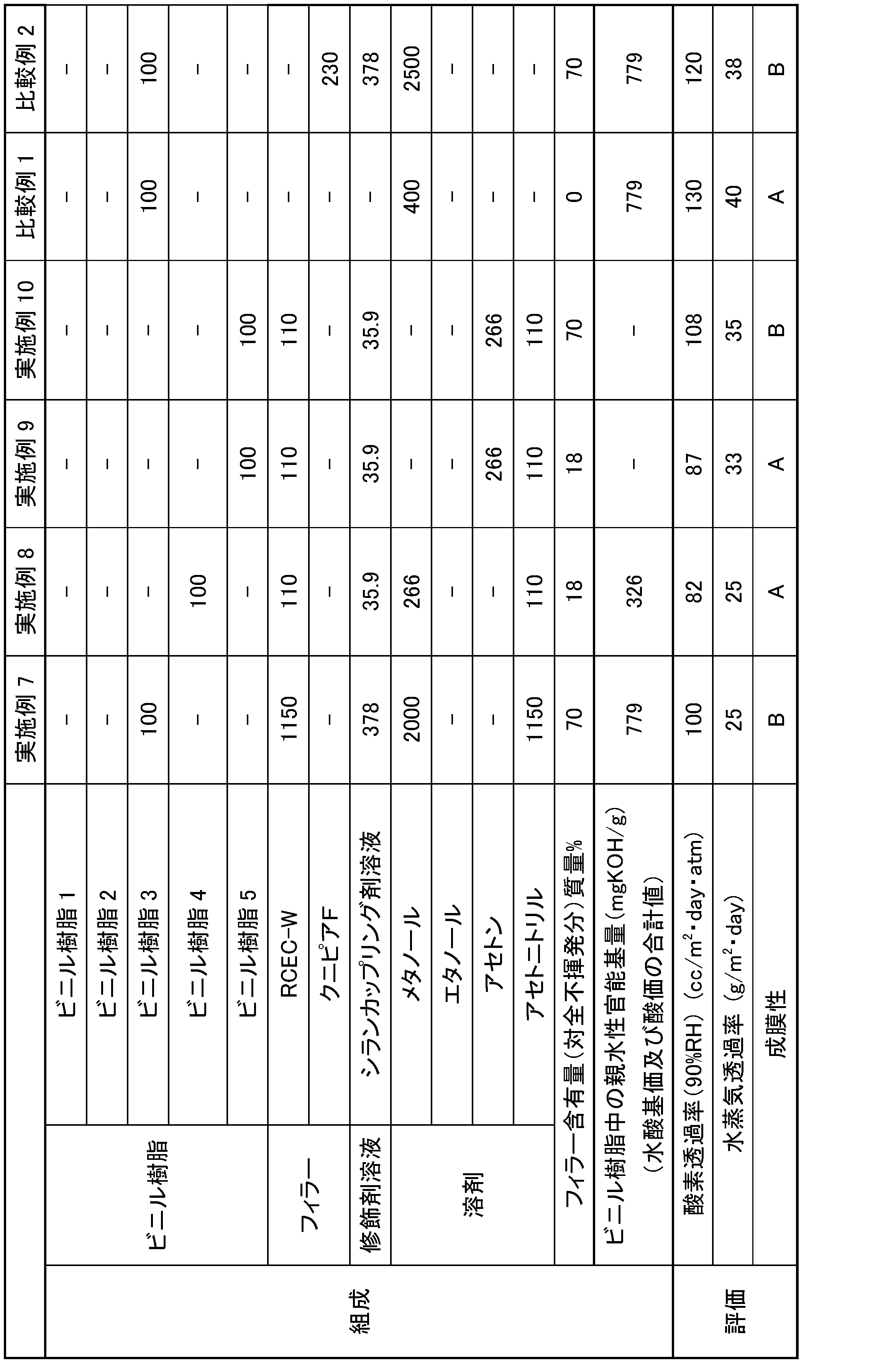
本発明の樹脂組成物は、ガスバリア性、特に水蒸気バリア性及び酸素バリア性に優れることから、包装材料を始め、電子材料、建築材料等、様々な分野に好適に使用可能である。
Claims (10)
- ビニル樹脂と、リチウム部分固定型スメクタイトとを含有する、樹脂組成物。
- 前記ビニル樹脂が、水酸基及びカルボキシル基からなる群より選択される少なくとも1種を含む、請求項1に記載の樹脂組成物。
- 前記ビニル樹脂が、下記式(1)で表される構造単位を有する、請求項1又は2に記載の樹脂組成物。

- 前記リチウム部分固定型スメクタイトの陽イオン交換容量が1~70meq/100gである、請求項1~3のいずれか一項に記載の樹脂組成物。
- 前記リチウム部分固定型スメクタイトの含有量は、前記樹脂組成物の不揮発分全量に対し、3~50質量%である、請求項1~4のいずれか一項に記載の樹脂組成物。
- 請求項1~5のいずれか一項に記載の樹脂組成物を含むガスバリア材。
- 請求項1~5のいずれか一項に記載の樹脂組成物の成形体。
- 基材と、該基材上に設けられた請求項7に記載の成形体と、を備える積層体。
- 請求項1~5のいずれか一項に記載の樹脂組成物を含むコーティング材。
- 請求項1~5のいずれか一項に記載の樹脂組成物を含む接着剤。
Priority Applications (3)
| Application Number | Priority Date | Filing Date | Title |
|---|---|---|---|
| US16/489,796 US11286384B2 (en) | 2017-03-14 | 2018-03-14 | Resin composition, molded article, laminate, gas barrier material, coating material, and adhesive |
| JP2018568991A JP6545407B2 (ja) | 2017-03-14 | 2018-03-14 | 樹脂組成物、成形体、積層体、ガスバリア材、コーティング材及び接着剤 |
| CN201880008171.5A CN110249000B (zh) | 2017-03-14 | 2018-03-14 | 树脂组合物、成形体、层叠体、阻气材料、涂布材料及粘接剂 |
Applications Claiming Priority (2)
| Application Number | Priority Date | Filing Date | Title |
|---|---|---|---|
| JP2017048866 | 2017-03-14 | ||
| JP2017-048866 | 2017-03-14 |
Publications (1)
| Publication Number | Publication Date |
|---|---|
| WO2018168947A1 true WO2018168947A1 (ja) | 2018-09-20 |
Family
ID=63523222
Family Applications (1)
| Application Number | Title | Priority Date | Filing Date |
|---|---|---|---|
| PCT/JP2018/010023 Ceased WO2018168947A1 (ja) | 2017-03-14 | 2018-03-14 | 樹脂組成物、成形体、積層体、ガスバリア材、コーティング材及び接着剤 |
Country Status (4)
| Country | Link |
|---|---|
| US (1) | US11286384B2 (ja) |
| JP (1) | JP6545407B2 (ja) |
| CN (1) | CN110249000B (ja) |
| WO (1) | WO2018168947A1 (ja) |
Cited By (8)
| Publication number | Priority date | Publication date | Assignee | Title |
|---|---|---|---|---|
| JP2019026676A (ja) * | 2017-07-26 | 2019-02-21 | Dic株式会社 | 樹脂組成物、成形体、積層体、ガスバリア材、コーティング材及び接着剤 |
| JP2019026813A (ja) * | 2017-08-03 | 2019-02-21 | Dic株式会社 | 樹脂組成物、成形体、積層体、ガスバリア材、コーティング材及び接着剤 |
| WO2019221194A1 (ja) * | 2018-05-16 | 2019-11-21 | Dic株式会社 | パターン形成材料及び硬化膜、並びに硬化パターンの製造方法 |
| JPWO2020218125A1 (ja) * | 2019-04-25 | 2020-10-29 | ||
| WO2020218118A1 (ja) * | 2019-04-25 | 2020-10-29 | Dic株式会社 | コーティング剤及び積層体 |
| WO2020218124A1 (ja) * | 2019-04-25 | 2020-10-29 | Dic株式会社 | コーティング剤及び積層体 |
| JPWO2020218119A1 (ja) * | 2019-04-25 | 2020-10-29 | ||
| JP2021059488A (ja) * | 2019-10-09 | 2021-04-15 | Dic株式会社 | ガスバリア性組成物、ガスバリア材、及び積層体 |
Citations (7)
| Publication number | Priority date | Publication date | Assignee | Title |
|---|---|---|---|---|
| JP2004059768A (ja) * | 2002-07-30 | 2004-02-26 | Rengo Co Ltd | ガスバリア性樹脂組成物 |
| JP2007277078A (ja) * | 2006-03-11 | 2007-10-25 | National Institute Of Advanced Industrial & Technology | 変性粘土を用いた膜 |
| WO2010147147A1 (ja) * | 2009-06-19 | 2010-12-23 | 独立行政法人産業技術総合研究所 | 電子デバイス用防湿フィルム |
| JP2012121777A (ja) * | 2010-12-09 | 2012-06-28 | National Institute Of Advanced Industrial Science & Technology | もみ殻灰を用いた合成粘土及び粘土膜の製造方法 |
| JP2012148946A (ja) * | 2011-01-21 | 2012-08-09 | Hitachi Chemical Co Ltd | 合成スメクタイトペースト、合成スメクタイト自立膜、合成スメクタイト膜及び合成スメクタイト膜の製造方法 |
| JP2017031015A (ja) * | 2015-08-03 | 2017-02-09 | クニミネ工業株式会社 | リチウム固定型有機修飾モンモリロナイトの製造方法 |
| JP2017105991A (ja) * | 2015-11-27 | 2017-06-15 | 国立研究開発法人産業技術総合研究所 | 耐熱ガスバリアフィルムおよびその製造方法 |
Family Cites Families (3)
| Publication number | Priority date | Publication date | Assignee | Title |
|---|---|---|---|---|
| US3671190A (en) * | 1970-11-10 | 1972-06-20 | Laporte Industries Ltd | Synthetic clay-like minerals of the smectite type and method of preparation |
| BRPI0901987A2 (pt) * | 2009-06-30 | 2011-03-09 | Bentonisa Bentonita Do Nordeste Sa | compósito, processo para a produção de um compósito e de um mineral modificado, produto e uso dos mesmos |
| JP5440892B2 (ja) | 2011-08-24 | 2014-03-12 | Dic株式会社 | 板状無機化合物を含有する接着剤用樹脂組成物、および接着剤 |
-
2018
- 2018-03-14 JP JP2018568991A patent/JP6545407B2/ja active Active
- 2018-03-14 WO PCT/JP2018/010023 patent/WO2018168947A1/ja not_active Ceased
- 2018-03-14 US US16/489,796 patent/US11286384B2/en active Active
- 2018-03-14 CN CN201880008171.5A patent/CN110249000B/zh active Active
Patent Citations (7)
| Publication number | Priority date | Publication date | Assignee | Title |
|---|---|---|---|---|
| JP2004059768A (ja) * | 2002-07-30 | 2004-02-26 | Rengo Co Ltd | ガスバリア性樹脂組成物 |
| JP2007277078A (ja) * | 2006-03-11 | 2007-10-25 | National Institute Of Advanced Industrial & Technology | 変性粘土を用いた膜 |
| WO2010147147A1 (ja) * | 2009-06-19 | 2010-12-23 | 独立行政法人産業技術総合研究所 | 電子デバイス用防湿フィルム |
| JP2012121777A (ja) * | 2010-12-09 | 2012-06-28 | National Institute Of Advanced Industrial Science & Technology | もみ殻灰を用いた合成粘土及び粘土膜の製造方法 |
| JP2012148946A (ja) * | 2011-01-21 | 2012-08-09 | Hitachi Chemical Co Ltd | 合成スメクタイトペースト、合成スメクタイト自立膜、合成スメクタイト膜及び合成スメクタイト膜の製造方法 |
| JP2017031015A (ja) * | 2015-08-03 | 2017-02-09 | クニミネ工業株式会社 | リチウム固定型有機修飾モンモリロナイトの製造方法 |
| JP2017105991A (ja) * | 2015-11-27 | 2017-06-15 | 国立研究開発法人産業技術総合研究所 | 耐熱ガスバリアフィルムおよびその製造方法 |
Cited By (13)
| Publication number | Priority date | Publication date | Assignee | Title |
|---|---|---|---|---|
| JP2019026676A (ja) * | 2017-07-26 | 2019-02-21 | Dic株式会社 | 樹脂組成物、成形体、積層体、ガスバリア材、コーティング材及び接着剤 |
| JP2019026813A (ja) * | 2017-08-03 | 2019-02-21 | Dic株式会社 | 樹脂組成物、成形体、積層体、ガスバリア材、コーティング材及び接着剤 |
| CN112105991A (zh) * | 2018-05-16 | 2020-12-18 | Dic株式会社 | 图案形成材料及固化膜、及固化图案的制造方法 |
| WO2019221194A1 (ja) * | 2018-05-16 | 2019-11-21 | Dic株式会社 | パターン形成材料及び硬化膜、並びに硬化パターンの製造方法 |
| CN112105991B (zh) * | 2018-05-16 | 2024-05-28 | Dic株式会社 | 图案形成材料及固化膜、及固化图案的制造方法 |
| JPWO2020218125A1 (ja) * | 2019-04-25 | 2020-10-29 | ||
| WO2020218124A1 (ja) * | 2019-04-25 | 2020-10-29 | Dic株式会社 | コーティング剤及び積層体 |
| JPWO2020218119A1 (ja) * | 2019-04-25 | 2020-10-29 | ||
| WO2020218119A1 (ja) * | 2019-04-25 | 2020-10-29 | Dic株式会社 | 樹脂組成物 |
| WO2020218118A1 (ja) * | 2019-04-25 | 2020-10-29 | Dic株式会社 | コーティング剤及び積層体 |
| WO2020218125A1 (ja) * | 2019-04-25 | 2020-10-29 | Dic株式会社 | 樹脂組成物 |
| JP7506370B2 (ja) | 2019-04-25 | 2024-06-26 | Dic株式会社 | 樹脂組成物 |
| JP2021059488A (ja) * | 2019-10-09 | 2021-04-15 | Dic株式会社 | ガスバリア性組成物、ガスバリア材、及び積層体 |
Also Published As
| Publication number | Publication date |
|---|---|
| US20200002527A1 (en) | 2020-01-02 |
| JPWO2018168947A1 (ja) | 2019-06-27 |
| CN110249000B (zh) | 2022-07-08 |
| US11286384B2 (en) | 2022-03-29 |
| JP6545407B2 (ja) | 2019-07-17 |
| CN110249000A (zh) | 2019-09-17 |
Similar Documents
| Publication | Publication Date | Title |
|---|---|---|
| JP6545407B2 (ja) | 樹脂組成物、成形体、積層体、ガスバリア材、コーティング材及び接着剤 | |
| CN103314063B (zh) | 含有有机无机复合物的涂布材料、有机无机复合膜和防反射部件 | |
| JP6093744B2 (ja) | 有機無機複合体及びその製造方法、有機無機複合膜及びその製造方法、フォトニック結晶、コーティング材、熱可塑性組成物、微細構造体、光学材料、反射防止部材、並びに、光学レンズ | |
| JP6814454B2 (ja) | 組成物、ガスバリア材、コーティング材、接着剤、成形体、積層体及び成形体の製造方法 | |
| JP2013151133A (ja) | 熱成形用ハードコートフィルム | |
| JP2019218531A (ja) | エポキシ樹脂組成物、接着剤、成形材料及び硬化物 | |
| JP2021169574A (ja) | 樹脂組成物、ガスバリア材、コーティング剤および積層体 | |
| JP2016023225A (ja) | 高分子エポキシ樹脂を含む光学シート状接着剤用樹脂組成物、該組成物よりなる光学シート用接着剤、及びその硬化物、並びに、前記組成物に使用する高分子エポキシ樹脂の製造方法 | |
| JP2022092075A (ja) | コーティング剤及び積層体 | |
| TW202231801A (zh) | 組成物、硬化性組成物、及硬化物 | |
| JP7123336B2 (ja) | 樹脂組成物、成形体、積層体、コーティング材及び接着剤 | |
| JP2009185149A (ja) | 塗料組成物の製造方法および塗料組成物 | |
| JP7506370B2 (ja) | 樹脂組成物 | |
| JP2013086279A (ja) | 熱成形用フィルム向け硬化性樹脂組成物とこの樹脂組成物を積層した熱成形用フィルム | |
| JP5896717B2 (ja) | 樹脂組成物およびそれからなる成形体 | |
| KR101231021B1 (ko) | 내열성 및 내식성이 우수한 유/무기 복합 에멀젼 수지, 그 제조 방법, 이를 이용한 절연 코팅제 및 그 코팅제가 코팅된 무방향성 전기 강판 | |
| JP5703847B2 (ja) | 超低粘度塗剤を用いたグラビアコーティング方法およびこの方法により製造されたガスバリア性フィルム | |
| WO2020218125A1 (ja) | 樹脂組成物 | |
| JP6901086B2 (ja) | 樹脂組成物、成形体、積層体、ガスバリア材、コーティング材及び接着剤 | |
| JP2022092074A (ja) | コーティング剤及び積層体 | |
| JP7127771B2 (ja) | 樹脂組成物、成形体、積層体、ガスバリア材、コーティング材及び接着剤 | |
| JP2014043527A (ja) | 樹脂組成物及び防湿フィルム | |
| JPWO2010110407A1 (ja) | 透明複合材料 | |
| TW202330271A (zh) | 氣體阻隔膜、及包裝材料 | |
| JP2024086158A (ja) | 塗料用樹脂エマルション |
Legal Events
| Date | Code | Title | Description |
|---|---|---|---|
| 121 | Ep: the epo has been informed by wipo that ep was designated in this application |
Ref document number: 18766880 Country of ref document: EP Kind code of ref document: A1 |
|
| ENP | Entry into the national phase |
Ref document number: 2018568991 Country of ref document: JP Kind code of ref document: A |
|
| NENP | Non-entry into the national phase |
Ref country code: DE |
|
| 122 | Ep: pct application non-entry in european phase |
Ref document number: 18766880 Country of ref document: EP Kind code of ref document: A1 |