WO2018159733A1 - 液晶配向剤、液晶配向膜及び液晶表示素子 - Google Patents
液晶配向剤、液晶配向膜及び液晶表示素子 Download PDFInfo
- Publication number
- WO2018159733A1 WO2018159733A1 PCT/JP2018/007686 JP2018007686W WO2018159733A1 WO 2018159733 A1 WO2018159733 A1 WO 2018159733A1 JP 2018007686 W JP2018007686 W JP 2018007686W WO 2018159733 A1 WO2018159733 A1 WO 2018159733A1
- Authority
- WO
- WIPO (PCT)
- Prior art keywords
- liquid crystal
- group
- ppm
- formula
- carbon atoms
- Prior art date
- Legal status (The legal status is an assumption and is not a legal conclusion. Google has not performed a legal analysis and makes no representation as to the accuracy of the status listed.)
- Ceased
Links
- 0 CC(CC1)CCC1c(cc1)ccc1OCc(cc(cc1)N)c1-c1ccc(*)cc1COc1ccc(C(CC2)CCC2S)cc1 Chemical compound CC(CC1)CCC1c(cc1)ccc1OCc(cc(cc1)N)c1-c1ccc(*)cc1COc1ccc(C(CC2)CCC2S)cc1 0.000 description 16
- XIAHSJTUQAWUAW-UHFFFAOYSA-N CC(C)(c1ccc(C)cc1)c1ccc(C)cc1 Chemical compound CC(C)(c1ccc(C)cc1)c1ccc(C)cc1 XIAHSJTUQAWUAW-UHFFFAOYSA-N 0.000 description 1
- SPSDGQUJOUVDNR-PTNKZYCTSA-N CC(C)CCC[C@@H](C)[C@@H](CC1)[C@@](C)(CC2)[C@@H]1[C@H]1[C@H]2C(C)(CCC(C2)OC(c3cc(N)ccc3-c(ccc(N)c3)c3C(OC3CC4=CC[C@@H]([C@H](CC5)C(C)(CC6)C5[C@H](C)CCCC(C)C)[C@H]6C4(C)CC3)=O)=O)C2=CC1 Chemical compound CC(C)CCC[C@@H](C)[C@@H](CC1)[C@@](C)(CC2)[C@@H]1[C@H]1[C@H]2C(C)(CCC(C2)OC(c3cc(N)ccc3-c(ccc(N)c3)c3C(OC3CC4=CC[C@@H]([C@H](CC5)C(C)(CC6)C5[C@H](C)CCCC(C)C)[C@H]6C4(C)CC3)=O)=O)C2=CC1 SPSDGQUJOUVDNR-PTNKZYCTSA-N 0.000 description 1
- FMHUVUBCMCLATJ-UHFFFAOYSA-N CC(CC1)CCC1c(cc1)ccc1OC(c1cc(N)ccc1-c(ccc(N)c1)c1C(Oc1ccc(C2CCC(C)CC2)cc1)=O)=O Chemical compound CC(CC1)CCC1c(cc1)ccc1OC(c1cc(N)ccc1-c(ccc(N)c1)c1C(Oc1ccc(C2CCC(C)CC2)cc1)=O)=O FMHUVUBCMCLATJ-UHFFFAOYSA-N 0.000 description 1
- WEAYCYAIVOIUMG-UHFFFAOYSA-N Cc(cc1)ccc1S(c1ccc(C)cc1)(=O)=O Chemical compound Cc(cc1)ccc1S(c1ccc(C)cc1)(=O)=O WEAYCYAIVOIUMG-UHFFFAOYSA-N 0.000 description 1
- GLFKFHJEFMLTOB-UHFFFAOYSA-N Cc1c(C)cc(C(C(F)(F)F)(C(F)(F)F)c2cc(C)c(C)cc2)cc1 Chemical compound Cc1c(C)cc(C(C(F)(F)F)(C(F)(F)F)c2cc(C)c(C)cc2)cc1 GLFKFHJEFMLTOB-UHFFFAOYSA-N 0.000 description 1
- XZRHNAFEYMSXRG-UHFFFAOYSA-N Cc1cc(C(O)=O)c(C)cc1 Chemical compound Cc1cc(C(O)=O)c(C)cc1 XZRHNAFEYMSXRG-UHFFFAOYSA-N 0.000 description 1
- UMVOQQDNEYOJOK-UHFFFAOYSA-N Cc1cc(C(O)=O)cc(C)c1 Chemical compound Cc1cc(C(O)=O)cc(C)c1 UMVOQQDNEYOJOK-UHFFFAOYSA-N 0.000 description 1
- XUCYJGMIICONES-UHFFFAOYSA-N Cc1cc([N+]([O-])=O)ccc1F Chemical compound Cc1cc([N+]([O-])=O)ccc1F XUCYJGMIICONES-UHFFFAOYSA-N 0.000 description 1
- OWEIAGSMFHSSES-UHFFFAOYSA-N Cc1ccc(C(C(F)(F)F)(C(F)(F)F)c2ccc(C)cc2)cc1 Chemical compound Cc1ccc(C(C(F)(F)F)(C(F)(F)F)c2ccc(C)cc2)cc1 OWEIAGSMFHSSES-UHFFFAOYSA-N 0.000 description 1
- UCEDBFHGRARVAJ-UHFFFAOYSA-N Cc1cccc(C(c2c3cccc2C)=O)c1C3=O Chemical compound Cc1cccc(C(c2c3cccc2C)=O)c1C3=O UCEDBFHGRARVAJ-UHFFFAOYSA-N 0.000 description 1
- NZOSGGNRVDMIHW-UHFFFAOYSA-N Cc1cccc(S(c2cccc(C)c2)(=O)=O)c1 Chemical compound Cc1cccc(S(c2cccc(C)c2)(=O)=O)c1 NZOSGGNRVDMIHW-UHFFFAOYSA-N 0.000 description 1
- CDYUHLLQUAYYHD-UHFFFAOYSA-N [O-][N+](c(cc1)cc(C(O)=O)c1-c(c(C(O)=O)c1)ccc1[N+]([O-])=O)=O Chemical compound [O-][N+](c(cc1)cc(C(O)=O)c1-c(c(C(O)=O)c1)ccc1[N+]([O-])=O)=O CDYUHLLQUAYYHD-UHFFFAOYSA-N 0.000 description 1
- OBNKVJQOVDCFGT-UHFFFAOYSA-N [O-][N+](c(cc1CBr)ccc1OCCCOc(cc1)c(CBr)cc1[N+]([O-])=O)=O Chemical compound [O-][N+](c(cc1CBr)ccc1OCCCOc(cc1)c(CBr)cc1[N+]([O-])=O)=O OBNKVJQOVDCFGT-UHFFFAOYSA-N 0.000 description 1
Classifications
-
- C—CHEMISTRY; METALLURGY
- C07—ORGANIC CHEMISTRY
- C07C—ACYCLIC OR CARBOCYCLIC COMPOUNDS
- C07C217/00—Compounds containing amino and etherified hydroxy groups bound to the same carbon skeleton
- C07C217/76—Compounds containing amino and etherified hydroxy groups bound to the same carbon skeleton having amino groups bound to carbon atoms of six-membered aromatic rings and etherified hydroxy groups bound to acyclic carbon atoms or to carbon atoms of rings other than six-membered aromatic rings of the same carbon skeleton
-
- C—CHEMISTRY; METALLURGY
- C07—ORGANIC CHEMISTRY
- C07C—ACYCLIC OR CARBOCYCLIC COMPOUNDS
- C07C217/00—Compounds containing amino and etherified hydroxy groups bound to the same carbon skeleton
- C07C217/78—Compounds containing amino and etherified hydroxy groups bound to the same carbon skeleton having amino groups and etherified hydroxy groups bound to carbon atoms of six-membered aromatic rings of the same carbon skeleton
- C07C217/80—Compounds containing amino and etherified hydroxy groups bound to the same carbon skeleton having amino groups and etherified hydroxy groups bound to carbon atoms of six-membered aromatic rings of the same carbon skeleton having amino groups and etherified hydroxy groups bound to carbon atoms of non-condensed six-membered aromatic rings
- C07C217/82—Compounds containing amino and etherified hydroxy groups bound to the same carbon skeleton having amino groups and etherified hydroxy groups bound to carbon atoms of six-membered aromatic rings of the same carbon skeleton having amino groups and etherified hydroxy groups bound to carbon atoms of non-condensed six-membered aromatic rings of the same non-condensed six-membered aromatic ring
- C07C217/90—Compounds containing amino and etherified hydroxy groups bound to the same carbon skeleton having amino groups and etherified hydroxy groups bound to carbon atoms of six-membered aromatic rings of the same carbon skeleton having amino groups and etherified hydroxy groups bound to carbon atoms of non-condensed six-membered aromatic rings of the same non-condensed six-membered aromatic ring the oxygen atom of at least one of the etherified hydroxy groups being further bound to a carbon atom of a six-membered aromatic ring, e.g. amino-diphenylethers
-
- C—CHEMISTRY; METALLURGY
- C07—ORGANIC CHEMISTRY
- C07C—ACYCLIC OR CARBOCYCLIC COMPOUNDS
- C07C219/00—Compounds containing amino and esterified hydroxy groups bound to the same carbon skeleton
- C07C219/32—Compounds containing amino and esterified hydroxy groups bound to the same carbon skeleton having amino groups bound to carbon atoms of six-membered aromatic rings and esterified hydroxy groups bound to acyclic carbon atoms or to carbon atoms of rings other than six-membered aromatic rings of the same carbon skeleton
-
- C—CHEMISTRY; METALLURGY
- C07—ORGANIC CHEMISTRY
- C07C—ACYCLIC OR CARBOCYCLIC COMPOUNDS
- C07C229/00—Compounds containing amino and carboxyl groups bound to the same carbon skeleton
- C07C229/52—Compounds containing amino and carboxyl groups bound to the same carbon skeleton having amino and carboxyl groups bound to carbon atoms of six-membered aromatic rings of the same carbon skeleton
- C07C229/54—Compounds containing amino and carboxyl groups bound to the same carbon skeleton having amino and carboxyl groups bound to carbon atoms of six-membered aromatic rings of the same carbon skeleton with amino and carboxyl groups bound to carbon atoms of the same non-condensed six-membered aromatic ring
- C07C229/62—Compounds containing amino and carboxyl groups bound to the same carbon skeleton having amino and carboxyl groups bound to carbon atoms of six-membered aromatic rings of the same carbon skeleton with amino and carboxyl groups bound to carbon atoms of the same non-condensed six-membered aromatic ring with amino groups and at least two carboxyl groups bound to carbon atoms of the same six-membered aromatic ring
-
- C—CHEMISTRY; METALLURGY
- C07—ORGANIC CHEMISTRY
- C07C—ACYCLIC OR CARBOCYCLIC COMPOUNDS
- C07C237/00—Carboxylic acid amides, the carbon skeleton of the acid part being further substituted by amino groups
- C07C237/28—Carboxylic acid amides, the carbon skeleton of the acid part being further substituted by amino groups having the carbon atom of at least one of the carboxamide groups bound to a carbon atom of a non-condensed six-membered aromatic ring of the carbon skeleton
- C07C237/40—Carboxylic acid amides, the carbon skeleton of the acid part being further substituted by amino groups having the carbon atom of at least one of the carboxamide groups bound to a carbon atom of a non-condensed six-membered aromatic ring of the carbon skeleton having the nitrogen atom of the carboxamide group bound to a carbon atom of a six-membered aromatic ring
-
- C—CHEMISTRY; METALLURGY
- C07—ORGANIC CHEMISTRY
- C07J—STEROIDS
- C07J41/00—Normal steroids containing one or more nitrogen atoms not belonging to a hetero ring
- C07J41/0033—Normal steroids containing one or more nitrogen atoms not belonging to a hetero ring not covered by C07J41/0005
- C07J41/0088—Normal steroids containing one or more nitrogen atoms not belonging to a hetero ring not covered by C07J41/0005 containing unsubstituted amino radicals
-
- C—CHEMISTRY; METALLURGY
- C08—ORGANIC MACROMOLECULAR COMPOUNDS; THEIR PREPARATION OR CHEMICAL WORKING-UP; COMPOSITIONS BASED THEREON
- C08G—MACROMOLECULAR COMPOUNDS OBTAINED OTHERWISE THAN BY REACTIONS ONLY INVOLVING UNSATURATED CARBON-TO-CARBON BONDS
- C08G73/00—Macromolecular compounds obtained by reactions forming a linkage containing nitrogen with or without oxygen or carbon in the main chain of the macromolecule, not provided for in groups C08G12/00 - C08G71/00
- C08G73/06—Polycondensates having nitrogen-containing heterocyclic rings in the main chain of the macromolecule
- C08G73/10—Polyimides; Polyester-imides; Polyamide-imides; Polyamide acids or similar polyimide precursors
- C08G73/1003—Preparatory processes
- C08G73/1007—Preparatory processes from tetracarboxylic acids or derivatives and diamines
-
- C—CHEMISTRY; METALLURGY
- C08—ORGANIC MACROMOLECULAR COMPOUNDS; THEIR PREPARATION OR CHEMICAL WORKING-UP; COMPOSITIONS BASED THEREON
- C08L—COMPOSITIONS OF MACROMOLECULAR COMPOUNDS
- C08L79/00—Compositions of macromolecular compounds obtained by reactions forming in the main chain of the macromolecule a linkage containing nitrogen with or without oxygen or carbon only, not provided for in groups C08L61/00 - C08L77/00
- C08L79/04—Polycondensates having nitrogen-containing heterocyclic rings in the main chain; Polyhydrazides; Polyamide acids or similar polyimide precursors
- C08L79/08—Polyimides; Polyester-imides; Polyamide-imides; Polyamide acids or similar polyimide precursors
-
- C—CHEMISTRY; METALLURGY
- C09—DYES; PAINTS; POLISHES; NATURAL RESINS; ADHESIVES; COMPOSITIONS NOT OTHERWISE PROVIDED FOR; APPLICATIONS OF MATERIALS NOT OTHERWISE PROVIDED FOR
- C09K—MATERIALS FOR MISCELLANEOUS APPLICATIONS, NOT PROVIDED FOR ELSEWHERE
- C09K19/00—Liquid crystal materials
- C09K19/52—Liquid crystal materials characterised by components which are not liquid crystals, e.g. additives with special physical aspect: solvents, solid particles
- C09K19/54—Additives having no specific mesophase characterised by their chemical composition
- C09K19/56—Aligning agents
-
- G—PHYSICS
- G02—OPTICS
- G02F—OPTICAL DEVICES OR ARRANGEMENTS FOR THE CONTROL OF LIGHT BY MODIFICATION OF THE OPTICAL PROPERTIES OF THE MEDIA OF THE ELEMENTS INVOLVED THEREIN; NON-LINEAR OPTICS; FREQUENCY-CHANGING OF LIGHT; OPTICAL LOGIC ELEMENTS; OPTICAL ANALOGUE/DIGITAL CONVERTERS
- G02F1/00—Devices or arrangements for the control of the intensity, colour, phase, polarisation or direction of light arriving from an independent light source, e.g. switching, gating or modulating; Non-linear optics
- G02F1/01—Devices or arrangements for the control of the intensity, colour, phase, polarisation or direction of light arriving from an independent light source, e.g. switching, gating or modulating; Non-linear optics for the control of the intensity, phase, polarisation or colour
- G02F1/13—Devices or arrangements for the control of the intensity, colour, phase, polarisation or direction of light arriving from an independent light source, e.g. switching, gating or modulating; Non-linear optics for the control of the intensity, phase, polarisation or colour based on liquid crystals, e.g. single liquid crystal display cells
- G02F1/133—Constructional arrangements; Operation of liquid crystal cells; Circuit arrangements
- G02F1/1333—Constructional arrangements; Manufacturing methods
- G02F1/1337—Surface-induced orientation of the liquid crystal molecules, e.g. by alignment layers
-
- C—CHEMISTRY; METALLURGY
- C07—ORGANIC CHEMISTRY
- C07B—GENERAL METHODS OF ORGANIC CHEMISTRY; APPARATUS THEREFOR
- C07B2200/00—Indexing scheme relating to specific properties of organic compounds
- C07B2200/07—Optical isomers
-
- C—CHEMISTRY; METALLURGY
- C07—ORGANIC CHEMISTRY
- C07C—ACYCLIC OR CARBOCYCLIC COMPOUNDS
- C07C2601/00—Systems containing only non-condensed rings
- C07C2601/12—Systems containing only non-condensed rings with a six-membered ring
- C07C2601/14—The ring being saturated
Definitions
- the present invention relates to a liquid crystal aligning agent, a liquid crystal alignment film, and a liquid crystal display element, which are excellent in the ability to align liquid crystal vertically.
- a liquid crystal display element of a method in which liquid crystal molecules aligned perpendicular to the substrate respond by an electric field also referred to as a vertical alignment (VA) method
- VA vertical alignment
- a photopolymerizable compound is previously added to the liquid crystal composition, and a polyimide-based vertical alignment film is used, and ultraviolet rays are applied while applying a voltage to the liquid crystal cell. Therefore, a technique for increasing the response speed of liquid crystal (PSA (Polymer Sustained Alignment) type element, for example, see Patent Document 1 and Non-Patent Document 1) is known.
- PSA Polymer Sustained Alignment
- the alignment film has a problem in that the ability to align the liquid crystal vertically decreases, and as a result, the obtained liquid crystal display element partially causes a display defect.
- the liquid crystal alignment film and the column spacer come into contact with each other, and the liquid crystal alignment film is damaged, so that an alignment defect (bright spot) is generated in that portion.
- a liquid crystal aligning agent having the following constitution, and completed the present invention. That is, the configuration of the present invention is as follows. 1. A liquid crystal containing at least one polymer selected from a polyimide precursor which is a reaction product of a diamine component containing a diamine represented by the following formula [1] and a tetracarboxylic acid component and a polyimide which is an imidized product thereof. Alignment agent.
- X represents a single bond, —O—, —C (CH 3 ) 2 —, —NH—, —CO—, —NHCO—, —COO—, — (CH 2 ) m —, — It represents a divalent organic group composed of SO 2 — and any combination thereof, and m represents an integer of 1 to 8.
- Y independently represents a structure of the following formula [1-1].
- Y 1 and Y 3 each independently represent a single bond, — (CH 2 ) a — (a is an integer of 1 to 15), —O—, —CH 2 O— , -CONH-, -NHCO-, -COO-, and -OCO-.
- Y 2 represents a single bond or — (CH 2 ) b — (b is an integer of 1 to 15) (provided that Y 1 or Y 3 is a single bond, — (CH 2 ) a — 2 is a single bond, and Y 1 is at least one selected from the group consisting of —O—, —CH 2 O—, —CONH—, —NHCO—, —COO—, and —OCO—, and / or Or when Y 3 is at least one selected from the group consisting of —O—, —CH 2 O—, —CONH—, —NHCO—, —COO— and —OCO—, Y 2 is a single bond or — ( CH 2 ) b — (provided that when Y 1 is —CONH—, they are Y 2 and Y 3 single bonds)).
- Y 4 represents at least one divalent cyclic group selected from the group consisting of a benzene ring, a cyclohexane ring and a heterocyclic ring, or a divalent organic group having 17 to 51 carbon atoms having a steroid skeleton and a tocophenol skeleton
- the optional hydrogen atom on the cyclic group includes an alkyl group having 1 to 3 carbon atoms, an alkoxy group having 1 to 3 carbon atoms, a fluorine-containing alkyl group having 1 to 3 carbon atoms, and a fluorine-containing alkoxy group having 1 to 3 carbon atoms. Alternatively, it may be substituted with a fluorine atom.
- Y 5 represents at least one cyclic group selected from the group consisting of a benzene ring, a cyclohexane ring, and a heterocyclic ring, and an arbitrary hydrogen atom on these cyclic groups is an alkyl group having 1 to 3 carbon atoms, a carbon number of 1 It may be substituted with 1 to 3 alkoxy groups, 1 to 3 fluorine-containing alkyl groups, 1 to 3 fluorine-containing alkoxy groups or fluorine atoms.
- Y 6 represents a hydrogen atom, an alkyl group having 1 to 18 carbon atoms, an alkenyl group having 2 to 18 carbon atoms, a fluorine-containing alkyl group having 1 to 18 carbon atoms, an alkoxy group having 1 to 18 carbon atoms, and 1 to 18 carbon atoms. And at least one selected from the group consisting of fluorine-containing alkoxy groups.
- n represents an integer of 0 to 4.
- a liquid crystal aligning agent capable of obtaining a liquid crystal alignment film that does not deteriorate the ability to align liquid crystals vertically even when exposed to excessive heating.
- a liquid crystal aligning agent capable of obtaining a liquid crystal alignment film that does not deteriorate the ability to align liquid crystal vertically even when some foreign matter comes into contact with the film and is damaged.
- a liquid crystal alignment film obtained from the liquid crystal alignment agent and a method for obtaining a liquid crystal alignment film using the liquid crystal alignment agent can be provided.
- the liquid crystal aligning agent of the present invention contains a diamine represented by the above formula [1] (hereinafter, the “diamine represented by the above formula [1]” may be abbreviated as “specific diamine”). And at least one polymer selected from a polyimide precursor that is a reaction product with a tetracarboxylic acid component and a polyimide that is an imidized product thereof (hereinafter sometimes abbreviated as “specific polymer”).
- the specific polymer contains a specific diamine, but may have a diamine other than the specific diamine.
- the amount of the specific diamine and other diamines is such that the specific diamine is 5 mol% to 70 mol%, preferably 10 mol% to 50 mol%, more preferably 10 mol% to 40 mol% in the specific polymer. It is good.
- the liquid crystal aligning agent of this invention may contain "polyimide which is a polyimide precursor and / or its imidized substance" other than a specific polymer.
- specific diamine will be described, and then diamines other than “specific diamine” will be described.
- X represents a single bond, —O—, —C (CH 3 ) 2 —, —NH—, —CO—, —NHCO—, —COO—, — (CH 2 ) m —, — It represents a divalent organic group composed of SO 2 — and any combination thereof, and m represents an integer of 1 to 8.
- X is preferably a single bond, —O—, —NH—, —O— (CH 2 ) m —O—.
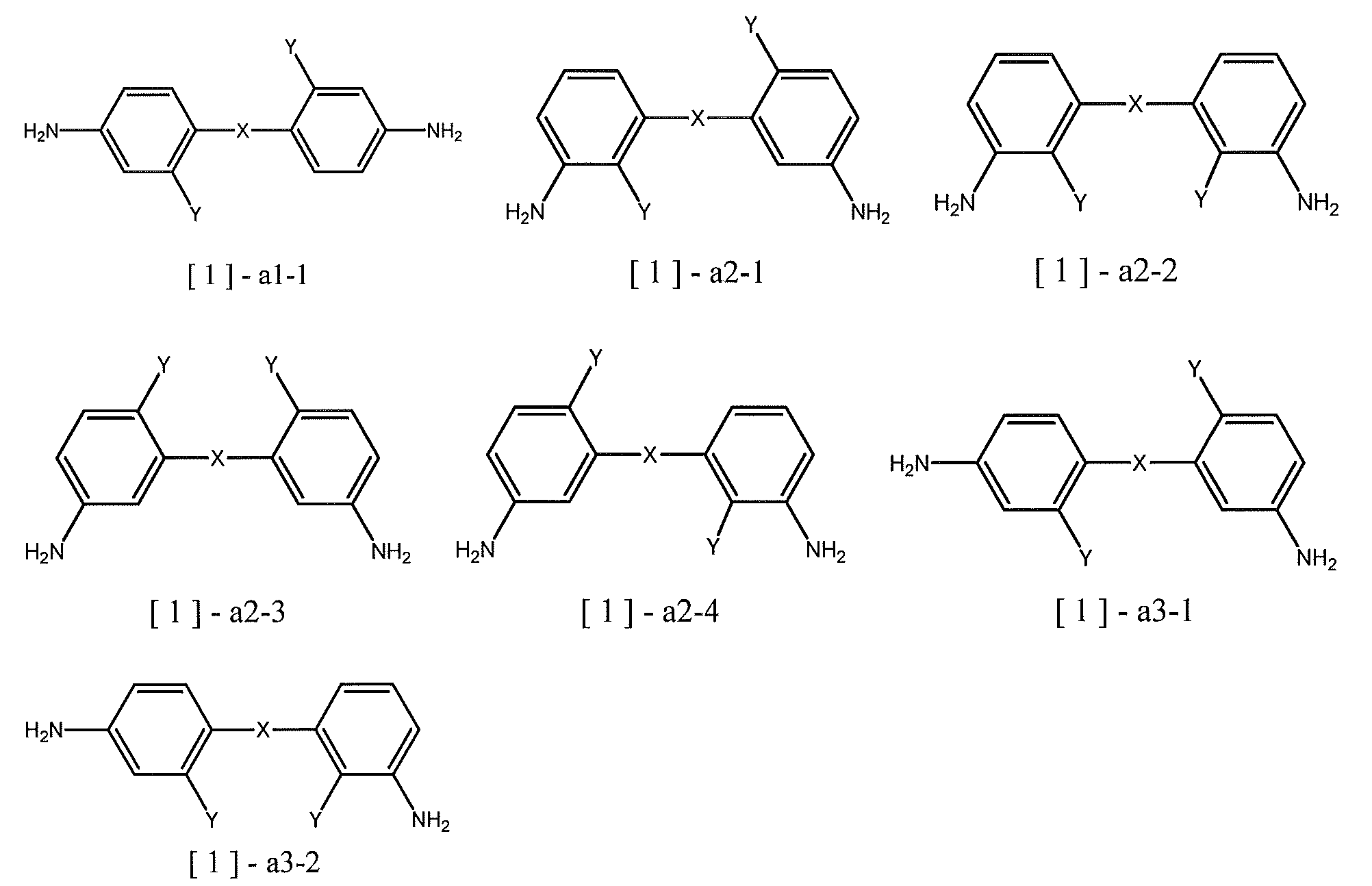
- Y may be in the meta position or in the ortho position from the position of X, but is preferably in the ortho position. That is, the formula [1] is preferably the following formula [1 ′].
- the position of “—NH 2 ” in the above formula [1] may be any position as shown in formula [1], but preferably the following formula [1] -a1, [1] -a2, [ 1] -a3 is preferable, and [1] -a1 is more preferable.
- the above formula [1] may be any structure selected from the following formulas, preferably the formula [1] ] -A1-1 is preferable.
- Y independently represents the structure of the following formula [1-1].
- Y 1 and Y 3 each independently represent a single bond, — (CH 2 ) a — (a is an integer of 1 to 15), —O—, —CH 2 O— , -CONH-, -NHCO-, -COO-, and -OCO-.
- Y 2 represents a single bond or — (CH 2 ) b — (b is an integer of 1 to 15) (provided that Y 1 or Y 3 is a single bond, — (CH 2 ) a — 2 is a single bond, and Y 1 is at least one selected from the group consisting of —O—, —CH 2 O—, —CONH—, —NHCO—, —COO—, and —OCO—, and / or Or when Y 3 is at least one selected from the group consisting of —O—, —CH 2 O—, —CONH—, —NHCO—, —COO— and —OCO—, Y 2 is a single bond or — ( CH 2 ) b — (provided that when Y 1 is —CONH—, they are Y 2 and Y 3 single bonds)).
- Y 4 represents at least one divalent cyclic group selected from the group consisting of a benzene ring, a cyclohexane ring and a heterocyclic ring, or a divalent organic group having 17 to 51 carbon atoms having a steroid skeleton and a tocophenol skeleton
- the optional hydrogen atom on the cyclic group includes an alkyl group having 1 to 3 carbon atoms, an alkoxy group having 1 to 3 carbon atoms, a fluorine-containing alkyl group having 1 to 3 carbon atoms, and a fluorine-containing alkoxy group having 1 to 3 carbon atoms. Alternatively, it may be substituted with a fluorine atom.
- Y 5 represents at least one cyclic group selected from the group consisting of a benzene ring, a cyclohexane ring, and a heterocyclic ring, and an arbitrary hydrogen atom on these cyclic groups is an alkyl group having 1 to 3 carbon atoms, a carbon number of 1 It may be substituted with 1 to 3 alkoxy groups, 1 to 3 fluorine-containing alkyl groups, 1 to 3 fluorine-containing alkoxy groups or fluorine atoms.
- Y 6 represents a hydrogen atom, an alkyl group having 1 to 18 carbon atoms, an alkenyl group having 2 to 18 carbon atoms, a fluorine-containing alkyl group having 1 to 18 carbon atoms, an alkoxy group having 1 to 18 carbon atoms, and 1 to 18 carbon atoms. And at least one selected from the group consisting of fluorine-containing alkoxy groups.
- n represents an integer of 0 to 4.
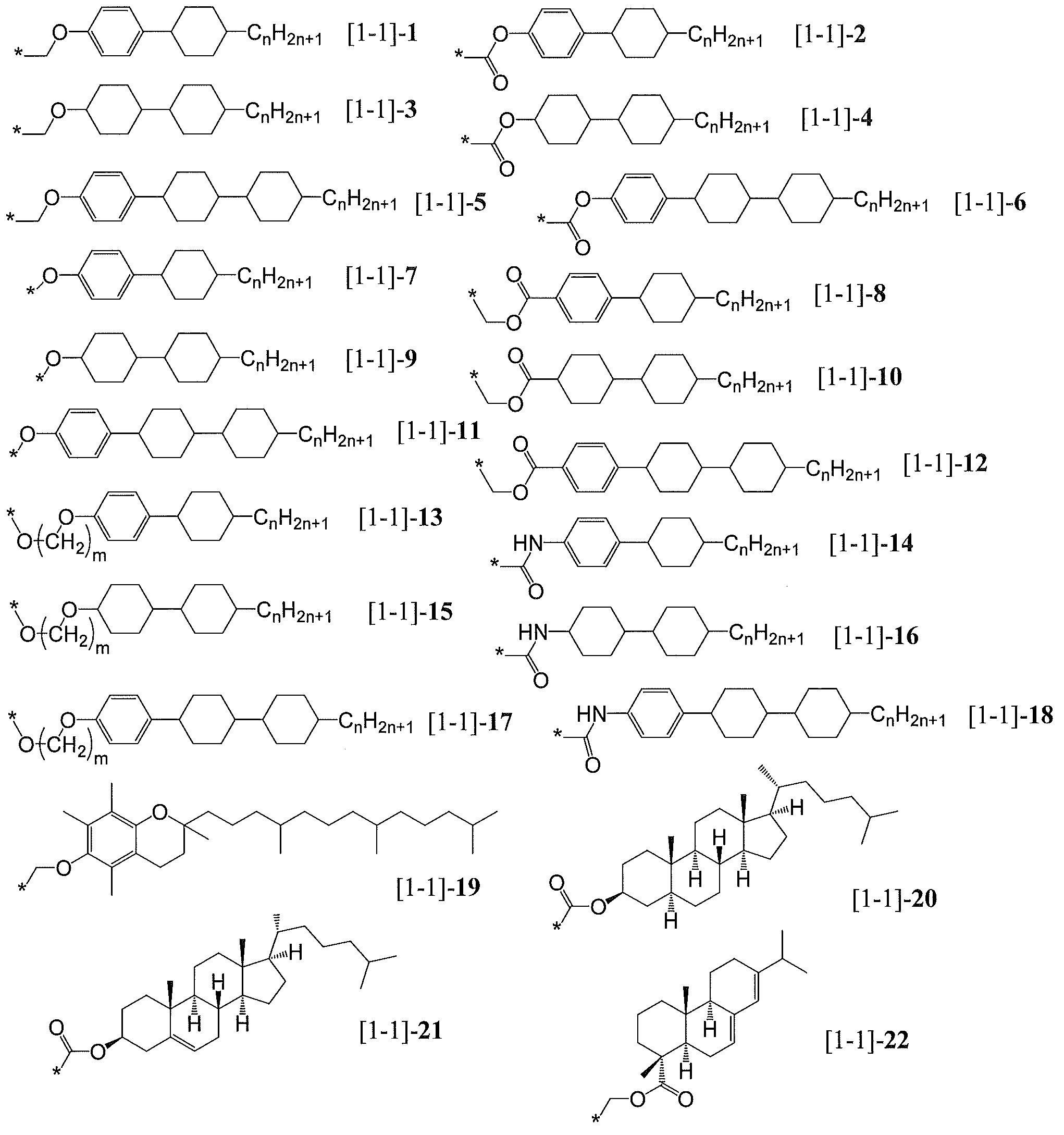
- Examples of the group represented by the above formula [1-1] include, but are not limited to, the following groups [1-1] -1 to [1-1] -22. Of these, [1-1] -1 to [1-1] -4, [1-1] -8, and [1-1] -10 are preferable. Note that * indicates the position of bonding with the phenyl group in the above formula [1], the above formula [1 '], the above formula [1] -a1 to the above formula [1] -a3. m represents an integer of 1 to 15, and n represents an integer of 0 to 18.
- the polymer contained in the liquid crystal aligning agent of the present invention may have a photoreactive side chain.
- the photoreactive side chain is possessed by “polyimide precursor and / or imidized product thereof” which is a polymer other than “specific polymer”, even if “specific polymer” has. May be.
- ⁇ Diamine containing photoreactive side chain> In order to introduce a photoreactive side chain into a polymer other than the “specific polymer” and / or “specific polymer”, a diamine having a photoreactive side chain is used as a part of the diamine component. Good. Examples of the diamine having a photoreactive side chain include, but are not limited to, a diamine having a side chain represented by Formula [VIII] or Formula [IX].
- the bonding positions of the two amino groups (—NH 2 ) in Formula [VIII] and Formula [IX] are not limited. Specifically, with respect to the linking group of the side chain, 2, 3 position, 2, 4 position, 2, 5 position, 2, 6 position, 3, 4 position on the benzene ring, 3, 4 position, 5 positions. Among these, from the viewpoint of reactivity when synthesizing a polyamic acid, positions 2, 4, 2, 5, or 3, 5 are preferable. Considering the ease in synthesizing the diamine, the positions 2, 4 or 3, 5 are more preferable.
- R 8 , R 9 and R 10 in formula [VIII] are as follows. That is, R 8 is a single bond, —CH 2 —, —O—, —COO—, —OCO—, —NHCO—, —CONH—, —NH—, —CH 2 O—, —N (CH 3 ). —, —CON (CH 3 ) —, or —N (CH 3 ) CO— is represented.
- R 8 is preferably a single bond, —O—, —COO—, —NHCO—, or —CONH—.
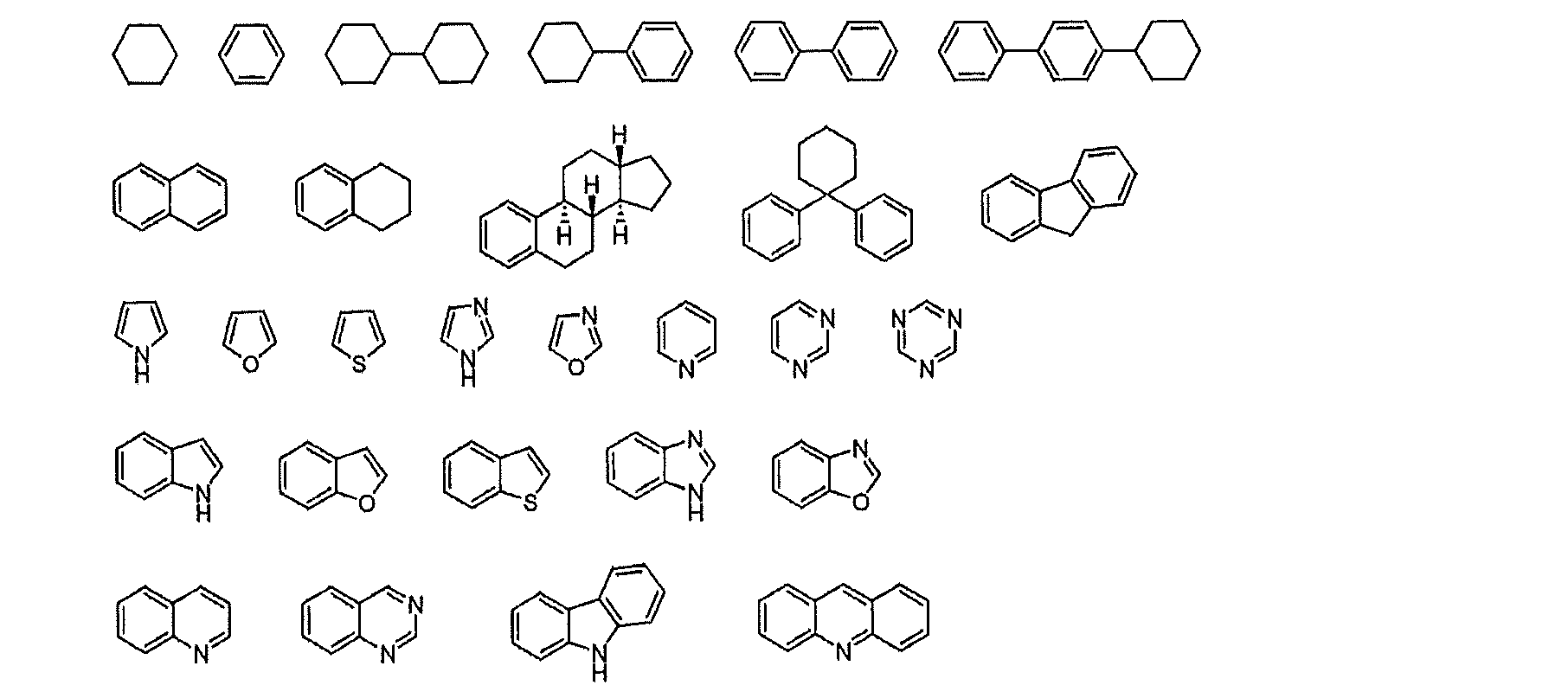
- R 9 represents a single bond or an alkylene group having 1 to 20 carbon atoms which may be substituted with a fluorine atom, and —CH 2 — in the alkylene group is optionally substituted with —CF 2 — or —CH ⁇ CH—. If any of the following groups are not adjacent to each other, these groups may be substituted; —O—, —COO—, —OCO—, —NHCO—, —CONH—, — NH-, divalent carbocyclic or heterocyclic ring. Specific examples of the divalent carbocycle or heterocycle include, but are not limited to, the following.
- R 9 can be formed by a general organic synthetic method, but a single bond or an alkylene group having 1 to 12 carbon atoms is preferable from the viewpoint of ease of synthesis.
- R 10 represents a photoreactive group selected from the following formulae.
- R 10 is preferably a methacryl group, an acryl group or a vinyl group from the viewpoint of photoreactivity.
- Y 1 represents —CH 2 —, —O—, —CONH—, —NHCO—, —COO—, —OCO—, —NH—, or —CO—.
- Y 2 is an alkylene group having 1 to 30 carbon atoms, a divalent carbocycle or a heterocycle, and one or more hydrogen atoms of the alkylene group, divalent carbocycle or heterocycle are fluorine atoms or organic It may be substituted with a group.
- Y 2 when the following groups are not adjacent to each other, —CH 2 — may be substituted with these groups; —O—, —NHCO—, —CONH—, —COO—, —OCO—, —NH—, —NHCONH—, —CO—.
- Y 3 represents —CH 2 —, —O—, —CONH—, —NHCO—, —COO—, —OCO—, —NH—, —CO—, or a single bond.
- Y 4 represents a cinnamoyl group.
- Y 5 is a single bond, an alkylene group having 1 to 30 carbon atoms, a divalent carbocycle or a heterocycle, and one or more hydrogen atoms of the alkylene group, divalent carbocycle or heterocycle are fluorine atoms Alternatively, it may be substituted with an organic group.
- —CH 2 — may be substituted with these groups; —O—, —NHCO—, —CONH—, —COO—, —OCO—, —NH—, —NHCONH—, —CO—.
- Y 6 represents a photopolymerizable group which is an acrylic group or a methacryl group.
- X 9 and X 10 are each independently a single bond, a bonding group that is —O—, —COO—, —NHCO—, or —NH—, and Y may be substituted with a fluorine atom Represents an alkylene group having 1 to 20 carbon atoms.
- examples of the diamine having a photoreactive side chain include a diamine having a group causing a photodimerization reaction and a group causing a photopolymerization reaction represented by the following formula in the side chain.
- Y 1 to Y 6 are the same as defined above.
- the diamine having a photoreactive side chain depends on the liquid crystal alignment property when it is used as a liquid crystal alignment film, the pretilt angle, the voltage holding property, the characteristics such as accumulated charge, the response speed of the liquid crystal when it is used as a liquid crystal display device, etc. 1 type or 2 types or more can be mixed and used.
- the diamine having a photoreactive side chain is preferably used in an amount of 10 to 70 mol%, more preferably 20 to 60 mol%, particularly preferably 30 to 50 mol% of the diamine component used for the synthesis of the polyamic acid. It is.
- the diamine having a photoreactive side chain include a diamine having a side chain having a site having a radical generating structure that is decomposed by ultraviolet irradiation to generate radicals.
- Ar, R 1 , R 2 , T 1 , T 2 , S and Q in the above formula (1) have the following definitions. That is, Ar represents an aromatic hydrocarbon group selected from phenylene, naphthylene, and biphenylene, in which an organic group may be substituted, and a hydrogen atom may be substituted with a halogen atom.
- R 1 and R 2 are each independently an alkyl or alkoxy group having 1 to 10 carbon atoms.
- T1 and T2 are each independently a single bond or —O—, —COO—, —OCO—, —NHCO—, —CONH—, —NH—, —CH 2 O—, —N (CH 3 ) —, It is a bonding group of —CON (CH 3 ) — and —N (CH 3 ) CO—.
- S is a single bond, unsubstituted or an alkylene group having 1 to 20 carbon atoms substituted by a fluorine atom.
- the alkylene group —CH 2 — or —CF 2 — may be optionally replaced with —CH ⁇ CH—, and when any of the following groups is not adjacent to each other, these groups are replaced with these groups: -O-, -COO-, -OCO-, -NHCO-, -CONH-, -NH-, a divalent carbocycle, and a divalent heterocycle.
- Q is a structure selected from the following (in the structural formula, R represents water, an elementary atom, or an alkyl group having 1 to 4 carbon atoms, and R 3 represents —CH 2 —, —NR—, —O—, or —S Represents-).
- Ar to which carbonyl is bonded is involved in the absorption wavelength of ultraviolet rays. Therefore, when the wavelength is increased, a structure having a long conjugate length such as naphthylene or biphenylene is preferable.
- Ar may be substituted with a substituent, and the substituent is preferably an electron-donating organic group such as an alkyl group, a hydroxyl group, an alkoxy group, and an amino group.
- R 1 and R 2 are each independently an alkyl group having 1 to 10 carbon atoms, an alkoxy group, a benzyl group, or a phenethyl group. In the case of an alkyl group or an alkoxy group, R 1 and R 2 are May be formed.
- Q is preferably an electron donating organic group, and the above group is preferable.
- Q is an amino derivative
- the diaminobenzene in the formula (1) may have any structure of o-phenylenediamine, m-phenylenediamine, or p-phenylenediamine. However, in terms of reactivity with acid dianhydride, m-phenylenediamine, or p-Phenylenediamine is preferred.
- n is an integer of 2 to 8.
- a diamine other than the specific diamine represented by the formula [1] (hereinafter also referred to as other diamine) may be contained.
- Such a diamine is represented by the following general formula [2].
- Other diamines may be used alone or in combination of two or more.
- a 1 and A 2 are each independently a hydrogen atom, an alkyl group having 1 to 5 carbon atoms, an alkenyl group having 2 to 5 carbon atoms, or an alkynyl group having 2 to 5 carbon atoms. It is. From the viewpoint of monomer reactivity, A 1 and A 2 are preferably a hydrogen atom or a methyl group.
- An example of the structure of Y 1 is as follows.
- n is an integer of 1 to 6 unless otherwise specified.
- Boc represents a tert-butoxycarbonyl group.
- diamine components used in the liquid crystal aligning agent of the present invention are not particularly limited, but (Y-7), (Y-8), from the viewpoints of coatability, voltage holding ratio characteristics, residual DC voltage characteristics, and the like.
- (Y-16), (Y-17), (Y-21), (Y-22), (Y-28), (Y-37), (Y-38), (Y-60), (Y -67), (Y-68), (Y-71) to (Y-73), and (Y-160) to (Y-180) are particularly preferably selected and used in combination.
- tetracarboxylic acid component examples include tetracarboxylic acid, tetracarboxylic dianhydride, tetracarboxylic acid dihalide, tetracarboxylic acid dialkyl ester, and tetracarboxylic acid dialkyl ester dihalide. Then, these are also collectively referred to as a tetracarboxylic acid component.
- tetracarboxylic acid component examples include tetracarboxylic dianhydride and its derivatives, tetracarboxylic acid, tetracarboxylic acid dihalide, tetracarboxylic acid dialkyl ester, and tetracarboxylic acid dialkyl ester dihalide (collectively, 1 tetracarboxylic acid component).
- tetracarboxylic dianhydrides include aliphatic tetracarboxylic dianhydrides, alicyclic tetracarboxylic dianhydrides, and aromatic tetracarboxylic dianhydrides. Specific examples of these include the following groups [1] to [5].
- aliphatic tetracarboxylic dianhydride for example, 1,2,3,4-butanetetracarboxylic dianhydride;
- Examples of alicyclic tetracarboxylic dianhydrides include acid dianhydrides such as the following formulas (X1-1) to (X1-13),
- R 3 to R 23 are each independently a hydrogen atom, a halogen atom, an alkyl group having 1 to 6 carbon atoms, an alkenyl group having 2 to 6 carbon atoms, carbon An alkynyl group having 2 to 6 carbon atoms, a monovalent organic group having 1 to 6 carbon atoms containing a fluorine atom, or a phenyl group, which may be the same or different,
- R M represents a hydrogen atom or a methyl group
- Xa is a tetravalent organic group represented by the following formulas (Xa-1) to (Xa-7).
- aromatic tetracarboxylic dianhydrides for example, pyromellitic anhydride, 4,4 ′-(hexafluoroisopropylidene) diphthalic anhydride, 3,3 ′, 4,4′-diphenylsulfonetetracarboxylic Acid dianhydrides, acid dianhydrides represented by the following formulas (Xb-1) to (Xb-10), and the like, and
- the said tetracarboxylic dianhydride can be used individually by 1 type or in combination of 2 or more types.
- the tetracarboxylic dianhydride component used in the liquid crystal aligning agent of the present invention is not particularly limited, but from the viewpoints of coatability, voltage holding ratio characteristics, residual DC voltage characteristics, etc., (X1-1), (X1- 2), (X1-3), (X1-6), (X1-7), (X1-8), (X1-9), (Xa-2), pyromellitic anhydride, 3,3 ′, It is preferable to select and use a tetracarboxylic dianhydride selected from 4,4′-diphenylsulfonetetracarboxylic dianhydride, (Xb-6) and (Xb-9).
- the method for producing these polymers is usually obtained by reacting a diamine component and a tetracarboxylic acid component.
- a polyamic acid is obtained by reacting at least one tetracarboxylic acid component selected from the group consisting of a tetracarboxylic dianhydride and a derivative of the tetracarboxylic acid and a diamine component composed of one or more diamines.
- a method is mentioned. Specifically, a method is used in which polycarboxylic acid is obtained by polycondensation of tetracarboxylic dianhydride and primary or secondary diamine.
- a method of polycondensing a tetracarboxylic acid obtained by dialkyl esterifying a carboxylic acid group with a primary or secondary diamine, a tetracarboxylic acid dihalide obtained by halogenating a carboxylic acid group and a primary a method of polycondensation with a secondary diamine or a method of converting a carboxy group of a polyamic acid into an ester is used.
- polyimide a method is used in which the polyamic acid or polyamic acid alkyl ester is cyclized to form polyimide.
- the reaction of the diamine component and the tetracarboxylic acid component is usually performed in a solvent.
- the solvent used at that time is not particularly limited as long as the produced polyimide precursor is soluble. Although the specific example of the solvent used for reaction below is given, it is not limited to these examples. Examples include N-methyl-2-pyrrolidone, N-ethyl-2-pyrrolidone or ⁇ -butyrolactone, N, N-dimethylformamide, N, N-dimethylacetamide, dimethyl sulfoxide or 1,3-dimethyl-imidazolidinone. It is done.
- the solvent solubility of the polyimide precursor is high, it is represented by methyl ethyl ketone, cyclohexanone, cyclopentanone, 4-hydroxy-4-methyl-2-pentanone, or the following formulas [D-1] to [D-3]. Can be used.
- D 1 represents an alkyl group having 1 to 3 carbon atoms
- D 2 represents an alkyl group having 1 to 3 carbon atoms
- D-3 represents an alkyl group having 1 to 4 carbon atoms.
- solvents may be used alone or in combination. Furthermore, even if it is a solvent which does not dissolve a polyimide precursor, you may mix and use it for the said solvent in the range which the produced
- diamine components or tetracarboxylic acid components when reacting using a plurality of diamine components or tetracarboxylic acid components, they may be reacted in a premixed state, individually or sequentially, or further individually reacted low molecular weight substances. May be mixed and reacted to form a polymer.
- the temperature for polycondensation of the diamine component and the tetracarboxylic acid component can be selected from -20 to 150 ° C., but is preferably in the range of ⁇ 5 to 100 ° C.
- the reaction can be carried out at any concentration, but if the concentration is too low, it is difficult to obtain a high molecular weight polymer, and if the concentration is too high, the viscosity of the reaction solution becomes too high and uniform stirring becomes difficult. . Therefore, it is preferably 1 to 50% by mass, more preferably 5 to 30% by mass.
- the initial reaction is carried out at a high concentration, and then a solvent can be added.
- the ratio of the total number of moles of the diamine component to the total number of moles of the tetracarboxylic acid component is preferably 0.8 to 1.2. Similar to a normal polycondensation reaction, the molecular weight of the polyimide precursor formed increases as the molar ratio approaches 1.0.
- Polyimide is a polyimide obtained by ring closure of the polyimide precursor, and in this polyimide, the ring closure rate (also referred to as imidation rate) of the amic acid group is not necessarily 100%. It can be adjusted as desired.
- the method for imidizing the polyimide precursor include thermal imidization in which the polyimide precursor solution is heated as it is, or catalytic imidization in which a catalyst is added to the polyimide precursor solution.
- the temperature when the polyimide precursor is thermally imidized in a solution is 100 to 400 ° C., preferably 120 to 250 ° C., and a method of removing water generated by the imidation reaction from the system is preferable.
- the catalytic imidation of the polyimide precursor can be carried out by adding a basic catalyst and an acid anhydride to the polyimide precursor solution and stirring at -20 to 250 ° C, preferably 0 to 180 ° C.
- the amount of the basic catalyst is 0.5 to 30 mol times, preferably 2 to 20 mol times the amidic acid group, and the amount of the acid anhydride is 1 to 50 mol times, preferably 3 to 30 mol times the amido group. 30 mole times.
- the basic catalyst include pyridine, triethylamine, trimethylamine, tributylamine, trioctylamine and the like. Of these, pyridine is preferable because it has a basicity suitable for advancing the reaction.
- the acid anhydride include acetic anhydride, trimellitic anhydride, pyromellitic anhydride, and the like. In particular, it is preferable to use acetic anhydride because purification after completion of the reaction is easy.
- the imidization rate by catalytic imidation can be controlled by adjusting the amount of catalyst, reaction temperature, and reaction time.
- the reaction solution may be poured into a solvent and precipitated.
- the solvent used for precipitation include methanol, ethanol, isopropyl alcohol, acetone, hexane, butyl cellosolve, heptane, methyl ethyl ketone, methyl isobutyl ketone, toluene, benzene, and water.
- the polymer precipitated in the solvent can be recovered by filtration, and then dried at normal temperature or under reduced pressure at room temperature or by heating.
- the solvent at this time include alcohols, ketones, hydrocarbons and the like. It is preferable to use three or more kinds of solvents selected from these, since the purification efficiency is further increased.
- More specific methods for producing the polyamic acid alkyl ester of the present invention are shown in the following (1) to (3).
- (1) Method of producing by polyamic acid esterification reaction Polyamic acid is produced from a diamine component and a tetracarboxylic acid component, and the carboxy group (COOH group) is subjected to a chemical reaction, that is, an esterification reaction.
- This is a method for producing an alkyl ester.
- the esterification reaction is a method in which a polyamic acid and an esterifying agent are reacted at ⁇ 20 to 150 ° C. (preferably 0 to 50 ° C.) for 30 minutes to 24 hours (preferably 1 to 4 hours) in the presence of a solvent. is there.
- the esterifying agent is preferably one that can be easily removed after the esterification reaction.
- N N-dimethylformamide dimethyl acetal, N, N-dimethylformamide diethyl acetal, N, N-dimethylformamide dipropyl acetal, N, N-dimethylformamide dineopentyl butyl acetal, N, N-dimethylformamide di-t-butyl acetal, 1-methyl-3-p-tolyltriazene, 1-ethyl-3-p-tolyltriazene, 1-propyl -3-p-tolyltriazene, 4- (4,6-dimethoxy-1,3,5-triazin-2-yl) -4-methylmorpholinium chloride and the like.
- the amount of the esterifying agent used is preferably 2 to 6 molar equivalents per 1 mol of the polyamic acid repeating unit. Of these, 2 to 4 molar equivalents are preferred.
- the solvent used for the esterification reaction examples include a solvent used for the reaction of the diamine component and the tetracarboxylic acid component from the viewpoint of solubility of the polyamic acid in the solvent.
- a solvent used for the reaction of the diamine component and the tetracarboxylic acid component from the viewpoint of solubility of the polyamic acid in the solvent.
- N, N-dimethylformamide, N-methyl-2-pyrrolidone, N-ethyl-2-pyrrolidone or ⁇ -butyrolactone is preferable.
- These solvents may be used alone or in combination of two or more.
- the concentration of the polyamic acid in the solvent in the esterification reaction is preferably 1 to 30% by mass from the viewpoint that the polyamic acid does not easily precipitate. Among these, 5 to 20% by mass is preferable.
- the diamine component and tetracarboxylic acid diester dichloride are ⁇ 20 to 150 ° C. (preferably in the presence of a base and a solvent) (0 to 50 ° C.) for 30 minutes to 24 hours (preferably 1 to 4 hours).
- a base pyridine, triethylamine, 4-dimethylaminopyridine and the like can be used. Of these, pyridine is preferable because the reaction proceeds gently.
- the amount of the base used is preferably an amount that can be easily removed after the reaction, and is preferably 2 to 4 moles relative to the tetracarboxylic acid diester dichloride. Of these, 2 to 3 moles are more preferred.
- the solvent examples include a solvent used for the reaction of the diamine component and the tetracarboxylic acid component from the viewpoint of solubility of the obtained polymer, that is, the polyamic acid alkyl ester in the solvent.
- a solvent used for the reaction of the diamine component and the tetracarboxylic acid component from the viewpoint of solubility of the obtained polymer, that is, the polyamic acid alkyl ester in the solvent.
- N, N-dimethylformamide, N-methyl-2-pyrrolidone, N-ethyl-2-pyrrolidone or ⁇ -butyrolactone is preferable.
- These solvents may be used alone or in combination of two or more.
- the concentration of the polyamic acid alkyl ester in the solvent in the reaction is preferably 1 to 30% by mass from the viewpoint that precipitation of the polyamic acid alkyl ester hardly occurs. Among these, 5 to 20% by mass is preferable.
- the solvent used for preparing the polyamic acid alkyl ester is dehydrated as much as possible. Furthermore, the reaction is preferably performed in a nitrogen atmosphere to prevent outside air from being mixed.
- Condensation agents include triphenyl phosphite, dicyclohexylcarbodiimide, 1-ethyl-3- (3-dimethylaminopropyl) carbodiimide hydrochloride, N, N′-carbonyldiimidazole, dimethoxy-1,3,5-triazinyl Methylmorpholinium, O- (benzotriazol-1-yl) -N, N, N ′, N′-tetramethyluronium tetrafluoroborate, O- (benzotriazol-1-yl) -N, N, N ′, N′-tetramethyluronium hexafluorophosphate, (2,3-dihydro-2-thioxo-3-benzoxazolyl) phosphonate diphenyl, and the like can be used.
- the amount of the condensing agent used is preferably 2 to 3 moles, and more preferably 2 to 2.5 moles, based on
- tertiary amines such as pyridine and triethylamine can be used.
- the amount of the base used is preferably an amount that can be easily removed after the polycondensation reaction, preferably 2 to 4 times by mole, more preferably 2 to 3 times by mole with respect to the diamine component.
- the solvent used for the polycondensation reaction include a solvent used for the reaction of the diamine component and the tetracarboxylic acid component from the viewpoint of the solubility of the resulting polymer, that is, the polyamic acid alkyl ester, in the solvent.
- N, N-dimethylformamide, N-methyl-2-pyrrolidone, N-ethyl-2-pyrrolidone or ⁇ -butyrolactone is preferable.
- These solvents may be used alone or in combination of two or more.
- the reaction proceeds efficiently by adding Lewis acid as an additive.
- Lewis acid lithium halides such as lithium chloride and lithium bromide are preferable.
- the amount of Lewis acid used is preferably 0.1 to 10 times the mole of the diamine component. Among these, 2.0 to 3.0 moles are preferable.
- the reaction solution may be poured into a solvent and precipitated.
- the solvent used for precipitation include water, methanol, ethanol, 2-propanol, hexane, butyl cellosolve, acetone, toluene and the like.
- the polymer deposited in the solvent is preferably washed with the solvent several times for the purpose of removing the additives and catalysts used above. After washing, filtration and recovery, the polymer can be dried at normal temperature or reduced pressure at room temperature or with heating.
- the impurities in the polymer can be reduced by re-dissolving the polymer recovered by precipitation in a solvent and repeating the operation of re-precipitation recovery 2 to 10 times.
- the production method of (2) or (3) above is preferable for the polyamic acid alkyl ester.
- the liquid crystal aligning agent of this invention contains the above-mentioned specific polymer, Preferably it is a solution for forming a liquid crystal aligning film.
- the content of the polymer in the liquid crystal aligning agent is preferably 2 to 10% by mass and more preferably 3 to 8% by mass in the liquid crystal aligning agent.
- All the polymer components in the liquid crystal aligning agent of the present invention may all be the specific polymer of the present invention, or other polymers may be mixed.
- examples of other polymers include cellulose polymers, acrylic polymers, methacrylic polymers, polystyrenes, polyamides, polysiloxanes, etc., in addition to polyimides and polyimide precursors.
- the content of the other polymer is preferably 1 to 90% by mass and more preferably 30 to 80% by mass in the resin component contained in the liquid crystal aligning agent.
- the good solvent used for the liquid crystal aligning agent of this invention will not be specifically limited if the specific polymer of this invention melt
- the specific example of the solvent used for a liquid crystal aligning agent below is given, it is not limited to these examples. Examples include N-methyl-2-pyrrolidone, N-ethyl-2-pyrrolidone or ⁇ -butyrolactone, N, N-dimethylformamide, N, N-dimethylacetamide, dimethyl sulfoxide or 1,3-dimethyl-imidazolidinone. It is done.
- the solvent solubility of the polyimide precursor is high, it is represented by methyl ethyl ketone, cyclohexanone, cyclopentanone, 4-hydroxy-4-methyl-2-pentanone or the above formula [D-1] to formula [D-3].
- the solvent used can also be used.
- the said good solvent may be used by 1 type, and may be used by the combination and ratio which are more suitable according to the application
- the good solvent in the liquid crystal aligning agent of the present invention is preferably 20 to 99% by mass of the whole solvent contained in the liquid crystal aligning agent. Of these, 20 to 90% by mass is preferable. More preferred is 30 to 80% by mass.
- the liquid crystal aligning agent of this invention can use the solvent (it is also called a poor solvent) which improves the coating property and surface smoothness of a liquid crystal aligning film at the time of apply
- the solvent it is also called a poor solvent
- Specific examples are given below.
- ethanol isopropyl alcohol, 1-butanol, 2-butanol, isobutyl alcohol, tert-butyl alcohol, 1-pentanol, 2-pentanol, 3-pentanol, 2-methyl-1-butanol, isopentyl alcohol, tert-pentyl alcohol, 3-methyl-2-butanol, neopentyl alcohol, 1-hexanol, 2-methyl-1-pentanol, 2-methyl-2-pentanol, 2-ethyl-1-butanol, 1-heptanol 2-heptanol, 3-heptanol, 1-octan
- preferred solvent combinations include N-methyl-2-pyrrolidone and ethylene glycol monobutyl ether, N-methyl-2-pyrrolidone, ⁇ -butyrolactone and ethylene glycol monobutyl ether, N-methyl-2-pyrrolidone and ⁇ - Butyrolactone and propylene glycol monobutyl ether, N-ethyl-2-pyrrolidone and propylene glycol monobutyl ether, N-methyl-2-pyrrolidone, ⁇ -butyrolactone, 4-hydroxy-4-methyl-2-pentanone and diethylene glycol diethyl ether, N- Methyl-2-pyrrolidone, ⁇ -butyrolactone, propylene glycol monobutyl ether, 2,6-dimethyl-4-heptanone, N-methyl-2-pyrrolidone, ⁇ -butyrolactone, and propylene glycol Monobutyl ether and diisopropyl ether, N-methyl
- These poor solvents are preferably 1 to 80% by mass, more preferably 10 to 80% by mass, and particularly preferably 20 to 70% by mass with respect to the total solvent contained in the liquid crystal aligning agent.
- the kind and content of such a solvent are appropriately selected according to the application device, application conditions, application environment, and the like of the liquid crystal aligning agent.
- the liquid crystal aligning agent of the present invention includes a polymer other than the polymer described in the present invention, a dielectric for the purpose of changing electrical properties such as dielectric constant and conductivity of the liquid crystal aligning film, Silane coupling agent for the purpose of improving adhesion to the substrate, crosslinkable compound for the purpose of increasing the hardness and density of the liquid crystal alignment film, and heating of the polyimide precursor when the coating film is baked
- a dielectric for the purpose of changing electrical properties such as dielectric constant and conductivity of the liquid crystal aligning film
- Silane coupling agent for the purpose of improving adhesion to the substrate
- crosslinkable compound for the purpose of increasing the hardness and density of the liquid crystal alignment film
- An imidization accelerator for the purpose of efficiently proceeding imidization by the above may be contained.
- Examples of the compound that improves the adhesion between the liquid crystal alignment film and the substrate include a functional silane-containing compound and an epoxy group-containing compound, such as 3-aminopropyltrimethoxysilane, 3-aminopropyltriethoxysilane, 3- Glycidoxypropyltriethoxysilane, 3-glycidoxypropyltrimethoxysilane, 3-glycidoxypropylmethyldiethoxysilane, 2-aminopropyltrimethoxysilane, 2-aminopropyltriethoxysilane, N- (2- Aminoethyl) -3-aminopropyltrimethoxysilane, N- (2-aminoethyl) -3-aminopropylmethyldimethoxysilane, 3-ureidopropyltrimethoxysilane, 3-ureidopropyltriethoxysilane, N-ethoxycarbonyl- 3-aminopropyl
- additives may be added to the liquid crystal aligning agent of the present invention in order to increase the mechanical strength of the liquid crystal aligning film.
- the above-mentioned additive is preferably 0.1 to 30 parts by mass with respect to 100 parts by mass of the polymer component contained in the liquid crystal aligning agent. If the amount is less than 0.1 parts by mass, the effect cannot be expected. If the amount exceeds 30 parts by mass, the orientation of the liquid crystal is lowered.
- the liquid crystal alignment film of the present invention can be formed by applying the liquid crystal aligning agent of the present invention on a substrate and baking it.
- the cured film obtained by baking can also be used as a liquid crystal aligning film as it is.
- the cured film is rubbed, irradiated with polarized light or light of a specific wavelength, or treated with an ion beam, or a voltage is applied to the liquid crystal display element after filling the liquid crystal as a PSA alignment film It is also possible to irradiate with UV. In particular, it is useful to use as an alignment film for PSA.
- the substrate to be used is not particularly limited as long as it is a highly transparent substrate.
- Glass plate polycarbonate, poly (meth) acrylate, polyethersulfone, polyarylate, polyurethane, polysulfone, polyether, polyetherketone ,
- Plastic substrates such as trimethylpentene, polyolefin, polyethylene terephthalate, (meth) acrylonitrile, triacetyl cellulose, diacetyl cellulose, and acetate butyrate cellulose can be used.
- a substrate on which an ITO electrode or the like for driving liquid crystal is formed from the viewpoint of simplifying the process.
- an opaque material such as a silicon wafer can be used as long as the substrate is only on one side, and in this case, a material that reflects light such as aluminum can be used.
- the method for applying the liquid crystal aligning agent is not particularly limited, and examples thereof include printing methods such as screen printing, offset printing, flexographic printing, ink jet method, spray method, roll coating method, dip, roll coater, slit coater, and spinner. From the standpoint of productivity, the transfer printing method is widely used industrially, and is preferably used in the present invention.
- the coating film formed by applying the liquid crystal aligning agent by the above method can be baked to obtain a cured film.
- the drying process after applying the liquid crystal aligning agent is not necessarily required, but if the time from application to baking is not constant for each substrate, or if baking is not performed immediately after application, the drying process is performed. It is preferable.
- the drying is not particularly limited as long as the solvent is removed to such an extent that the shape of the coating film is not deformed by transporting the substrate or the like. For example, a method of drying on a hot plate at a temperature of 40 ° C. to 150 ° C., preferably 60 ° C. to 100 ° C., for 0.5 minutes to 30 minutes, preferably 1 minute to 5 minutes.
- the baking temperature of the coating film formed by applying the liquid crystal aligning agent is not limited, and is, for example, 100 to 350 ° C, preferably 120 to 350 ° C, and more preferably 150 ° C to 330 ° C.
- the firing time is 5 minutes to 240 minutes, preferably 10 minutes to 90 minutes, and more preferably 10 minutes to 30 minutes. Heating can be performed by a generally known method such as a hot plate, a hot air circulating furnace, an infrared furnace, or the like.
- the thickness of the liquid crystal alignment film obtained by firing is not particularly limited, but is preferably 5 to 300 nm, more preferably 20 to 200 nm.
- the liquid crystal display element can produce a liquid crystal cell by a known method after forming a liquid crystal alignment film on a substrate by the above method.
- the two substrates disposed so as to face each other, the liquid crystal layer provided between the substrates, and the liquid crystal alignment agent provided between the substrate and the liquid crystal layer are formed by the above-described liquid crystal display element.
- the polymerizable compound contained in the liquid crystal is reacted by irradiating ultraviolet rays while applying a voltage to the liquid crystal alignment film and the liquid crystal layer.
- a PSA type liquid crystal display element having a remarkably excellent vertical alignment ability is obtained.
- the substrate of the liquid crystal display element is not particularly limited as long as it is a highly transparent substrate, but is usually a substrate in which a transparent electrode for driving liquid crystal is formed on the substrate.
- a substrate provided with a conventional electrode pattern or protrusion pattern may be used.
- the liquid crystal aligning agent containing the polyimide polymer of the present invention is used. It is possible to operate even in a structure in which a line / slit electrode pattern of 1 to 10 ⁇ m is formed and no slit pattern or protrusion pattern is formed on the counter substrate.
- the liquid crystal display element of this structure simplifies the manufacturing process. And high transmittance can be obtained.
- a high-performance element such as a TFT type element
- an element in which an element such as a transistor is formed between an electrode for driving a liquid crystal and a substrate is used.
- a transmissive liquid crystal display element it is common to use a substrate as described above.
- an opaque substrate such as a silicon wafer may be used. Is possible.
- a material such as aluminum that reflects light may be used for the electrode formed on the substrate.
- the liquid crystal material constituting the liquid crystal layer of the liquid crystal display element is not particularly limited, and the liquid crystal material used in the conventional vertical alignment method, for example, negative types such as MLC-6608, MLC-6609, MLC-3023 manufactured by Merck The liquid crystal can be used.
- the PSA type liquid crystal display element for example, a polymerizable compound-containing liquid crystal represented by the following formula can be used.
- a known method can be exemplified. For example, a pair of substrates on which a liquid crystal alignment film is formed is prepared, and spacers such as beads are dispersed on the liquid crystal alignment film on one substrate so that the surface on which the liquid crystal alignment film is formed is on the inside. Then, the other substrate is bonded, and liquid crystal is injected under reduced pressure to seal.
- a liquid crystal cell can also be produced by a method in which the other substrate is bonded to each other so as to be inside, and sealing is performed.
- the thickness of the spacer is preferably 1 to 30 ⁇ m, more preferably 2 to 10 ⁇ m.
- the step of producing a liquid crystal cell by irradiating ultraviolet rays while applying a voltage to the liquid crystal alignment film and the liquid crystal layer includes, for example, applying an electric field between the electrodes installed on the substrate to apply an electric field to the liquid crystal alignment film and the liquid crystal layer. And applying ultraviolet rays while maintaining this electric field.
- the voltage applied between the electrodes is, for example, 5 to 30 Vp-p, preferably 5 to 20 Vp-p.
- the irradiation amount of ultraviolet rays is, for example, 1 to 60 J, preferably 40 J or less, and the smaller the irradiation amount of ultraviolet rays, the lowering of reliability caused by the destruction of the members constituting the liquid crystal display element can be suppressed, and the irradiation time of ultraviolet rays can be reduced. This is preferable because the manufacturing efficiency is increased.
- the polymerizable compound when ultraviolet rays are irradiated while applying a voltage to the liquid crystal alignment film and the liquid crystal layer, the polymerizable compound reacts to form a polymer, and the direction in which the liquid crystal molecules are tilted is stored by this polymer.
- the response speed of the obtained liquid crystal display element can be increased.
- a polyimide precursor having a side chain for vertically aligning liquid crystal and a photoreactive side chain when irradiated with ultraviolet rays while applying a voltage to the liquid crystal alignment film and the liquid crystal layer, and the polyimide precursor as an imide Since the photoreactive side chains of at least one polymer selected from the polyimide obtained by the reaction or the photoreactive side chains of the polymer react with the polymerizable compound, the liquid crystal display element obtained The response speed can be increased.
- W-A1 Compound W-A2 represented by the formula [W-A1]: Compound W-A3 represented by the formula [W-A2]: Compound W-A4 represented by the formula [W-A3]: Formula Compound W-A5 represented by [W-A4]: Compound W-A6 represented by formula [W-A5]: Compound W-A7 represented by formula [W-A6]: Formula [W-A7]
- A1 Compound represented by Formula [A1]
- A2 Compound represented by Formula [A2]
- A3 Compound represented by Formula [A3]
- (Tetracarboxylic acid component) D1: 1,2,3,4-cyclobutanetetracarboxylic dianhydride
- D2 bicyclo [3,3,0] octane-2,4,6,8-tetracarboxylic dianhydride
- D3 pyromellitic dianhydride
- D4 2,3,5-tricarboxycyclopentyl acetic acid dianhydride
- D5 3,3 ′, 4,4′-diphenylsulfone tetracarboxylic dianhydride
- the molecular weight of the polyimide precursor and polyimide is as follows using a normal temperature gel permeation chromatography (GPC) apparatus (GPC-101) (manufactured by Showa Denko KK) and a column (KD-803, KD-805) (manufactured by Shodex). It measured as follows.
- the imidation rate is determined based on protons derived from structures that do not change before and after imidation as reference protons, and the peak integrated value of these protons and proton peaks derived from NH groups of amic acid appearing in the vicinity of 9.5 to 10.0 ppm. It calculated
- Imidization rate (%) (1 ⁇ ⁇ x / y) ⁇ 100
- x is a proton peak integrated value derived from NH group of amic acid
- y is a peak integrated value of reference proton
- ⁇ is one NH group proton of amic acid in the case of polyamic acid (imidation rate is 0%) Is the number ratio of the reference proton to.
- the viscosity of the polyimide polymer is an E-type viscometer TVE-22H (manufactured by Toki Sangyo Co., Ltd.), a sample amount of 1.1 mL, a cone rotor TE-1 (1 ° 34 ′, R24), measured at a temperature of 25 ° C.
- W-A1 to W-A3 and W-A4 to W-A10 are novel compounds that have not been disclosed yet, and the synthesis method will be described in detail below.
- the products described in Synthesis Examples 1 to 3 and Synthesis Examples 4 to 10 were identified by 1 H-NMR analysis (analysis conditions are as follows).
- activated carbon brand: special white birch, 2.27 g
- the obtained filtrate was concentrated under reduced pressure to obtain an oily compound.
- the oily compound was dispersed in hexane (100 g), crystals were precipitated under dry ice / ethanol cooling conditions, filtered and dried to obtain compound [8] (yield: 27.5 g, 101 mmol, yield: 75%).
- the obtained concentrate was crystallized from ethyl acetate (346 g) and hexane (395 g) and filtered to collect crystals. Further, the filtrate was concentrated, recrystallized and filtered again with chloroform (223 g) and hexane (434 g), and dried to obtain a crude product of compound [16] (crude yield: 21.3 g, crude yield). : 37%).
- NMP (28.2 g) was added to the polyimide powder (1) (3.00 g) obtained in Synthesis Example 1, and dissolved by stirring at 70 ° C. for 24 hours.
- NMP (g) and BCS (18.8 g) were added to this solution, and the mixture was stirred at room temperature for 5 hours to obtain a liquid crystal aligning agent (V-1).
- This liquid crystal aligning agent was confirmed to be a uniform solution without any abnormality such as turbidity or precipitation.
- Example 2> and ⁇ Example 3> In Example 1, using the polyimide powders (2) and (3) in place of the polyimide powder (1), the liquid crystal aligning agents (V-2) and (V-3) were prepared in the same procedure as in Example 1. Got. This liquid crystal aligning agent was confirmed to be a uniform solution without any abnormality such as turbidity or precipitation.
- Example 1 In Example 1, using the polyimide powder (4) obtained in Control Synthesis Example 1 instead of the polyimide powder (1), the liquid crystal aligning agent (V-4) was obtained by the same procedure as in Example 1. It was. This liquid crystal aligning agent was confirmed to be a uniform solution without any abnormality such as turbidity or precipitation.
- Example 4 3.0 g of the liquid crystal aligning agent (V-1) obtained from Example 1 was mixed as the first component, and 7.0 g of the liquid crystal aligning agent (V-4) obtained in Control 1 was mixed as the second component.
- the liquid crystal aligning agent (V-5) was obtained by stirring for 1 hour.
- Example 4 using the liquid crystal aligning agent (V-2) or (V-3) instead of the liquid crystal aligning agent (V-1) as the first component, respectively, by the same procedure as in Example 4, respectively. Liquid crystal aligning agents (V-6) and (V-7) were obtained.
- NMP (22.0 g) was added to the polyimide powder (5) (3.00 g) obtained in Synthesis Example 5, and dissolved by stirring at 70 ° C. for 24 hours.
- 3.0 g of E2 (1 wt% NMP solution) and BCS (20.0 g) were added and stirred at room temperature for 5 hours to obtain a liquid crystal aligning agent (V-8).
- This liquid crystal aligning agent was confirmed to be a uniform solution without any abnormalities such as turbidity and precipitation.
- NEP (22.0 g) was added to the polyimide powder (12) (3.00 g) obtained in Synthesis Example 12, and dissolved by stirring at 70 ° C. for 24 hours.
- NEP (3.0 g) and BCS (20.0 g) were added to this solution, and the mixture was stirred at room temperature for 5 hours to obtain a liquid crystal aligning agent (V-15).
- This liquid crystal aligning agent was confirmed to be a uniform solution without any abnormalities such as turbidity and precipitation.
- Example 18 For the polyimide powder (16) obtained in Synthesis Example 16, the same operation as in Example 14 was performed to obtain a liquid crystal alignment film treating agent (V-19).
- Example 21 > 3.0 g of the liquid crystal aligning agent (V-15) obtained from Example 14 as the first component, 7.0 g of the liquid crystal aligning agent (V-19) obtained in Example 18 as the second component, The cross-linking agent E1 was mixed at 5% by weight with respect to the resin component in the liquid crystal alignment film agent, and stirred for 1 hour to obtain a liquid crystal aligning agent (W-2).
- Example 22 to 24 Liquid crystal alignment agents (W-3) to (W-5) were obtained in the same manner as in Example 21 for the liquid crystal alignment agents (V-16) to (V-21) obtained in Examples 15 to 20. It was.
- liquid crystal aligning agent obtained in the examples Using the liquid crystal aligning agent obtained in the examples and the liquid crystal aligning agent obtained in the comparative example, production of a liquid crystal display element, evaluation of vertical alignment, scratch test, evaluation of pretilt angle, evaluation of voltage holding ratio Afterimage characteristics were evaluated.
- the liquid crystal aligning agent obtained in the examples and the liquid crystal aligning agent obtained in the comparative example were subjected to pressure filtration with a membrane filter having a pore diameter of 1 ⁇ m.
- the obtained solution was spin-coated on an ITO surface of a 40 mm ⁇ 30 mm ITO electrode glass substrate (length: 40 mm, width: 30 mm, thickness: 1.1 mm) washed with pure water and IPA (isopropyl alcohol), Heat treatment was performed on a hot plate at 70 ° C. for 90 seconds and in a heat circulation type clean oven at 230 ° C. for 30 minutes to obtain an ITO substrate with a liquid crystal alignment film having a film thickness of 100 nm.
- Liquid crystal MLC-3023 (trade name, manufactured by Merck & Co., Inc.) was injected into this empty cell by a reduced pressure injection method to prepare a liquid crystal cell. After that, in the state where a DC voltage of 15 V was applied to the obtained liquid crystal cell, ultraviolet light passing through a band pass filter with a wavelength of 365 nm was irradiated at 15 J / cm 2 using an ultraviolet irradiation device using a high pressure mercury lamp as a light source. Thus, a vertically aligned liquid crystal display element was obtained. The UV irradiation amount was measured by connecting a UV-35 light receiver to UV-M03A manufactured by ORC.
- the liquid crystal aligning agent obtained in the examples was filtered under pressure through a membrane filter having a pore diameter of 1 ⁇ m.
- the obtained solution was washed with pure water and IPA (isopropyl alcohol), and an ITO electrode substrate (vertical: 35 mm, horizontal: 30 mm) on which an ITO electrode pattern having a pixel size of 200 ⁇ m ⁇ 600 ⁇ m and a line / space of 3 ⁇ m was formed.
- Thickness 0.7 mm
- ITO electrode substrate on which the ITO electrode pattern is formed is divided into four in a cross checker (checkered) pattern, and can be driven separately for each of the four areas.
- the periphery was coated with a sealant (XN-1500T manufactured by Mitsui Chemicals).
- a sealant XN-1500T manufactured by Mitsui Chemicals.
- Liquid crystal MLC-3023 (trade name, manufactured by Merck & Co., Inc.) was injected into this empty cell by a reduced pressure injection method to prepare a liquid crystal cell. Thereafter, a DC voltage of 15 V was applied to the obtained liquid crystal cell, and all the pixel areas were driven and passed through a band-pass filter having a wavelength of 365 nm using an ultraviolet irradiation device using a high-pressure mercury lamp as a light source.
- a vertical alignment type liquid crystal display device was obtained by irradiation with ultraviolet rays at 10 J / cm 2 .
- a UV-35 light receiver was connected to UV-M03A manufactured by ORC for measurement of the amount of ultraviolet irradiation.
- vertical alignment was performed under the same conditions as described above except that the liquid crystal alignment film was formed under severe conditions by heating at 230 ° C. for 120 minutes.
- Type liquid crystal display element was prepared.
- Afterimage characteristics Using the afterimage evaluation liquid crystal display element produced above, 60 Hz, 20 Vp-p AC voltage was applied to two diagonal areas of the four pixel areas, and the device was driven at a temperature of 23 ° C. for 168 hours. Thereafter, all four pixel areas were driven with an AC voltage of 5 Vp-p, and the luminance difference of the pixels was visually observed. A state in which almost no difference in luminance was confirmed was considered good.
- the evaluation results are shown in Table 3.
- a scratch test was performed on the alignment film surface of the substrate with the polyimide coating film obtained in the example using UMT-2 (Bruker AXS Co., Ltd.). FVL was selected as the UMT-2 sensor, and a 1.6 mm sapphire sphere was attached to the tip of the scratch part.
- a scratch test was conducted by changing the load from 1 mN to 20 mN over 100 seconds in a range of 0.5 mm in width and 2.0 mm in length with the tip of the scratch part in contact with the surface of the liquid crystal alignment film at a load of 1 mN. At this time, the moving direction of the tip of the scratch part was reciprocating to the side, and the moving speed was 5.0 mm / sec.
- the scratch area was moved in the vertical direction by moving the substrate with the liquid crystal alignment film in the vertical direction at 20 ⁇ m / second.
- MLC-3022 (a negative type liquid crystal manufactured by Merck & Co., Inc.) was dropped onto the liquid crystal alignment film surface that had been scratch-tested.
- another substrate with a liquid crystal alignment film obtained in Example 1 and a 4 ⁇ m spacer dispersed thereon was superimposed so that the liquid crystal alignment film surfaces face each other, and the dropped MLC-3022 was sandwiched.
- the liquid crystal display element using the liquid crystal alignment film obtained from the liquid crystal alignment treatment agent of the present invention is It was found that the pretilt angle was not changed even under severe conditions, and the liquid crystal orientation was good. Further, as shown in Table 5, it was found that in Example 4 to Example 6 in which the liquid crystal aligning agent (V-4) was mixed, the afterimage characteristics were satisfactory. Furthermore, from this example, it was found that the liquid crystal alignment film obtained using a specific side chain diamine was excellent in pretilt angle stability even when baked under severe conditions. It was also confirmed that even when there was physical contact with the liquid crystal alignment film as in the scratch test, good vertical alignment could be maintained with little damage to the alignment film.
- a liquid crystal display element using a liquid crystal alignment film obtained from the liquid crystal alignment treatment agent of the present invention can be suitably used for a liquid crystal display element. These elements are also useful in liquid crystal displays for display purposes, and in light control windows and optical shutters for controlling transmission and blocking of light.
Landscapes
- Chemical & Material Sciences (AREA)
- Organic Chemistry (AREA)
- Physics & Mathematics (AREA)
- Nonlinear Science (AREA)
- Health & Medical Sciences (AREA)
- Crystallography & Structural Chemistry (AREA)
- Chemical Kinetics & Catalysis (AREA)
- Medicinal Chemistry (AREA)
- Polymers & Plastics (AREA)
- Optics & Photonics (AREA)
- General Physics & Mathematics (AREA)
- Mathematical Physics (AREA)
- Spectroscopy & Molecular Physics (AREA)
- Engineering & Computer Science (AREA)
- Materials Engineering (AREA)
- General Health & Medical Sciences (AREA)
- Macromolecular Compounds Obtained By Forming Nitrogen-Containing Linkages In General (AREA)
- Liquid Crystal (AREA)
Abstract
Description
また、液晶パネル製造工程において、液晶配向膜とカラムスペーサーが接触し、液晶配向膜に傷がついてしまうことで、その部分に配向欠陥(輝点)が生じることも問題である。
また、膜に何らかの異物が接触し、傷ついた際も、液晶を垂直に配向させる能力が低下しない液晶配向膜を得られる液晶配向剤を提供することにある。
即ち、本発明の構成は以下の通りである。
1.下記式[1]で表されるジアミンを含有するジアミン成分と、テトラカルボン酸成分との反応物であるポリイミド前駆体及びそのイミド化物であるポリイミドから選ばれる少なくとも1種の重合体を含有する液晶配向剤。
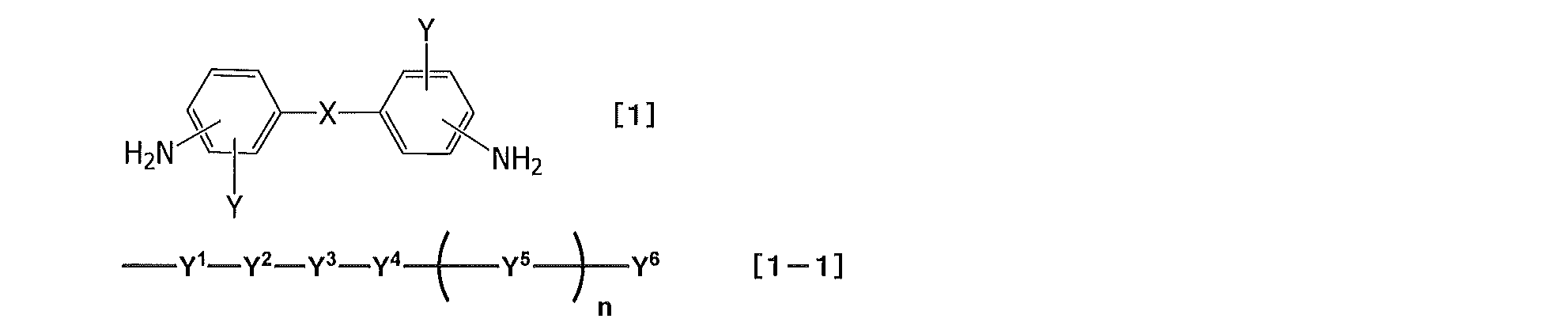
Yはそれぞれ独立して下記式[1-1]の構造を表す。
Y2は単結合又は-(CH2)b-(bは1~15の整数である)を示す(ただし、Y1又はY3が単結合、-(CH2)a-である場合、Y2は単結合であり、Y1が-O-、-CH2O-、-CONH-、-NHCO-、-COO-及び-OCO-からなる群から選ばれる少なくとも1種であるか、及び/又はY3が-O-、-CH2O-、-CONH-、-NHCO-、-COO-及び-OCO-からなる群から選ばれる少なくとも1種である場合、Y2は単結合又は-(CH2)b-である(ただし、Y1が-CONH-である場合、Y2及びY3単結合である))。
Y4はベンゼン環、シクロヘキサン環及び複素環からなる群から選ばれる少なくとも1種の2価の環状基、又はステロイド骨格およびトコフェノール骨格を有する炭素数17~51の2価の有機基を示し、前記環状基上の任意の水素原子は、炭素数1~3のアルキル基、炭素数1~3のアルコキシ基、炭素数1~3のフッ素含有アルキル基、炭素数1~3のフッ素含有アルコキシ基又はフッ素原子で置換されていてもよい。
Y5はベンゼン環、シクロヘキサン環及び複素環からなる群から選ばれる少なくとも1種の環状基を示し、これらの環状基上の任意の水素原子は、炭素数1~3のアルキル基、炭素数1~3のアルコキシ基、炭素数1~3のフッ素含有アルキル基、炭素数1~3のフッ素含有アルコキシ基又はフッ素原子で置換されていてもよい。
Y6は、水素原子、炭素数1~18のアルキル基、炭素数2~18のアルケニル基、炭素数1~18のフッ素含有アルキル基、炭素数1~18のアルコキシ基及び炭素数1~18のフッ素含有アルコキシ基からなる群から選ばれる少なくとも1種を示す。nは0~4の整数を示す。
また、本発明により、上記効果に加えて、又は上記効果以外に、膜に何らかの異物が接触し、傷ついた際も、液晶を垂直に配向させる能力が低下しない液晶配向膜を得られる液晶配向剤を提供することができる。
さらに、本発明により、上記液晶配向剤から得られる液晶配向膜、上記液晶配向剤を用いて液晶配向膜を得る方法を提供することができる。
特定ジアミンとそれ以外のジアミンとの量は、特定重合体中、特定ジアミンが5mol%~70mol%、好ましくは10mol%~50mol%、より好ましくは10mol%~40mol%となる量で特定ジアミンを有するのがよい。
また、本発明の液晶配向剤は、特定重合体以外の「ポリイミド前駆体及び/又はそのイミド化物であるポリイミド」を含有してもよい。
以下、「特定ジアミン」について述べ、次いで「特定ジアミン」以外のジアミンについて述べる。
本発明の液晶配向剤に用いられる特定ジアミンは、下記式[1]で表される。

「それらの任意の組み合わせ」として、-O-(CH2)m-O-、-O-C(CH3)2-、-CO-(CH2)m-、-NH-(CH2)m-、-SO2-(CH2)m-、-CONH-(CH2)m-、-CONH-(CH2)m-NHCO-、-COO-(CH2)m-OCO-などを挙げることができるがこれらに限定されない。
Xは、好ましくは、単結合、-O-、-NH-、-O-(CH2)m-O-であるのがよい。



Y2は単結合又は-(CH2)b-(bは1~15の整数である)を示す(ただし、Y1又はY3が単結合、-(CH2)a-である場合、Y2は単結合であり、Y1が-O-、-CH2O-、-CONH-、-NHCO-、-COO-及び-OCO-からなる群から選ばれる少なくとも1種であるか、及び/又はY3が-O-、-CH2O-、-CONH-、-NHCO-、-COO-及び-OCO-からなる群から選ばれる少なくとも1種である場合、Y2は単結合又は-(CH2)b-である(ただし、Y1が-CONH-である場合、Y2及びY3単結合である))。
Y4はベンゼン環、シクロヘキサン環及び複素環からなる群から選ばれる少なくとも1種の2価の環状基、又はステロイド骨格およびトコフェノール骨格を有する炭素数17~51の2価の有機基を示し、前記環状基上の任意の水素原子は、炭素数1~3のアルキル基、炭素数1~3のアルコキシ基、炭素数1~3のフッ素含有アルキル基、炭素数1~3のフッ素含有アルコキシ基又はフッ素原子で置換されていてもよい。
Y5はベンゼン環、シクロヘキサン環及び複素環からなる群から選ばれる少なくとも1種の環状基を示し、これらの環状基上の任意の水素原子は、炭素数1~3のアルキル基、炭素数1~3のアルコキシ基、炭素数1~3のフッ素含有アルキル基、炭素数1~3のフッ素含有アルコキシ基又はフッ素原子で置換されていてもよい。
Y6は、水素原子、炭素数1~18のアルキル基、炭素数2~18のアルケニル基、炭素数1~18のフッ素含有アルキル基、炭素数1~18のアルコキシ基及び炭素数1~18のフッ素含有アルコキシ基からなる群から選ばれる少なくとも1種を示す。nは0~4の整数を示す。
本発明の液晶配向剤に含有される重合体は、光反応性の側鎖を有していてもよい。
該光反応性の側鎖は、「特定重合体」が有していても、「特定重合体」以外の重合体である「ポリイミド前駆体及び/又はそのイミド化物であるポリイミド」が有していてもよい。
<光反応性側鎖を含有するジアミン>
光反応性を有する側鎖を「特定重合体」及び/又は「特定重合体」以外の重合体に導入するには、光反応性の側鎖を有するジアミンをジアミン成分の一部に用いるのがよい。光反応性の側鎖を有するジアミンとしては、式[VIII]、又は式[IX]で表される側鎖を有するジアミンを挙げることができるがこれらに限定されない。

即ち、R8は、単結合、-CH2-、-O-、-COO-、-OCO-、-NHCO-、-CONH-、-NH-、-CH2O-、-N(CH3)-、-CON(CH3)-、又は-N(CH3)CO-を表す。特に、R8は、単結合、-O-、-COO-、-NHCO-、又は-CONH-であるのが好ましい。
R9は、単結合、フッ素原子で置換されていてもよい炭素数1~20のアルキレン基を表し、アルキレン基の-CH2-は-CF2-又は-CH=CH-で任意に置換されていてもよく、次のいずれかの基が互いに隣り合わない場合、これらの基に置換されていてもよい;-O-、-COO-、-OCO-、-NHCO-、-CONH-、-NH-、二価の炭素環若しくは複素環。
なお、上記二価の炭素環若しくは複素環は、具体的には以下のものを例示することができるが、これらに限定されない。
R10は、下記式から選択される光反応性基を表す。

即ち、Y1は-CH2-、-O-、-CONH-、-NHCO-、-COO-、-OCO-、-NH-、又は-CO-を表す。
Y2は、炭素数1~30のアルキレン基、二価の炭素環若しくは複素環であり、このアルキレン基、二価の炭素環若しくは複素環の1つ又は複数の水素原子は、フッ素原子若しくは有機基で置換されていてもよい。Y2は、次の基が互いに隣り合わない場合、-CH2-がこれらの基に置換されていてもよい;-O-、-NHCO-、-CONH-、-COO-、-OCO-、-NH-、-NHCONH-、-CO-。
Y3は、-CH2-、-O-、-CONH-、-NHCO-、-COO-、-OCO-、-NH-、-CO-、又は単結合を表す。
Y4はシンナモイル基を表す。 Y5は単結合、炭素数1~30のアルキレン基、二価の炭素環若しくは複素環であり、このアルキレン基、二価の炭素環若しくは複素環の1つ又は複数の水素原子は、フッ素原子若しくは有機基で置換されていてもよい。
Y5は、次の基が互いに隣り合わない場合、-CH2-がこれらの基に置換されていてもよい;-O-、-NHCO-、-CONH-、-COO-、-OCO-、-NH-、-NHCONH-、-CO-。
Y6はアクリル基又はメタクリル基である光重合性基を示す。


上記光反応性の側鎖を有するジアミンは、液晶配向膜とした際の液晶配向性、プレチルト角、電圧保持特性、蓄積電荷などの特性、液晶表示素子とした際の液晶の応答速度などに応じて、1種類又は2種類以上を混合して使用できる。
また、光反応性の側鎖を有するジアミンとしては、紫外線照射により分解しラジカルが発生するラジカル発生構造を有する部位を側鎖に有するジアミンも挙げられる。

即ち、Arはフェニレン、ナフチレン、及びビフェニレンから選ばれる芳香族炭化水素基を示し、それらには有機基が置換していても良く、水素原子はハロゲン原子に置換していても良い。
R1、R2はそれぞれ独立して炭素原子数1~10のアルキル基もしくはアルコキシ基である。
T1、T2はそれぞれ独立して、単結合又は-O-、-COO-、-OCO-、-NHCO-、-CONH-、-NH-、-CH2O-、-N(CH3)-、-CON(CH3)-、-N(CH3)CO-の結合基である。
Sは単結合もしくは非置換もしくはフッ素原子によって置換されている炭素原子数1~20のアルキレン基。ただしアルキレン基の-CH2-または-CF2-は-CH=CH-で任意に置き換えられていてもよく、次に挙げるいずれかの基が互いに隣り合わない場合において、これらの基に置き換えられていてもよい;-O-、-COO-、-OCO-、-NHCO-、-CONH-、-NH-、二価の炭素環、二価の複素環。
Qは下記から選ばれる構造(構造式中、Rは水、素原子又は炭素原子数1~4のアルキル基を表し、R3は-CH2-、-NR-、-O-、又は-S-を表す。)を表す。

Qがアミノ誘導体の場合、ポリイミドの前駆体であるポリアミック酸の重合の際に、発生するカルボン酸基とアミノ基が塩を形成するなどの不具合が生じる可能性があるため、より好ましくはヒドロキシル基又はアルコキシル基である。
特定重合体を得るためのその他のジアミン成分としては、上記[1]式で表される特定ジアミン以外のジアミン(以下、その他のジアミンとも言う)を含有しても良い。そのようなジアミンは、以下の一般式[2]で表される。その他ジアミンは1種又は2種以上を併用することもできる。

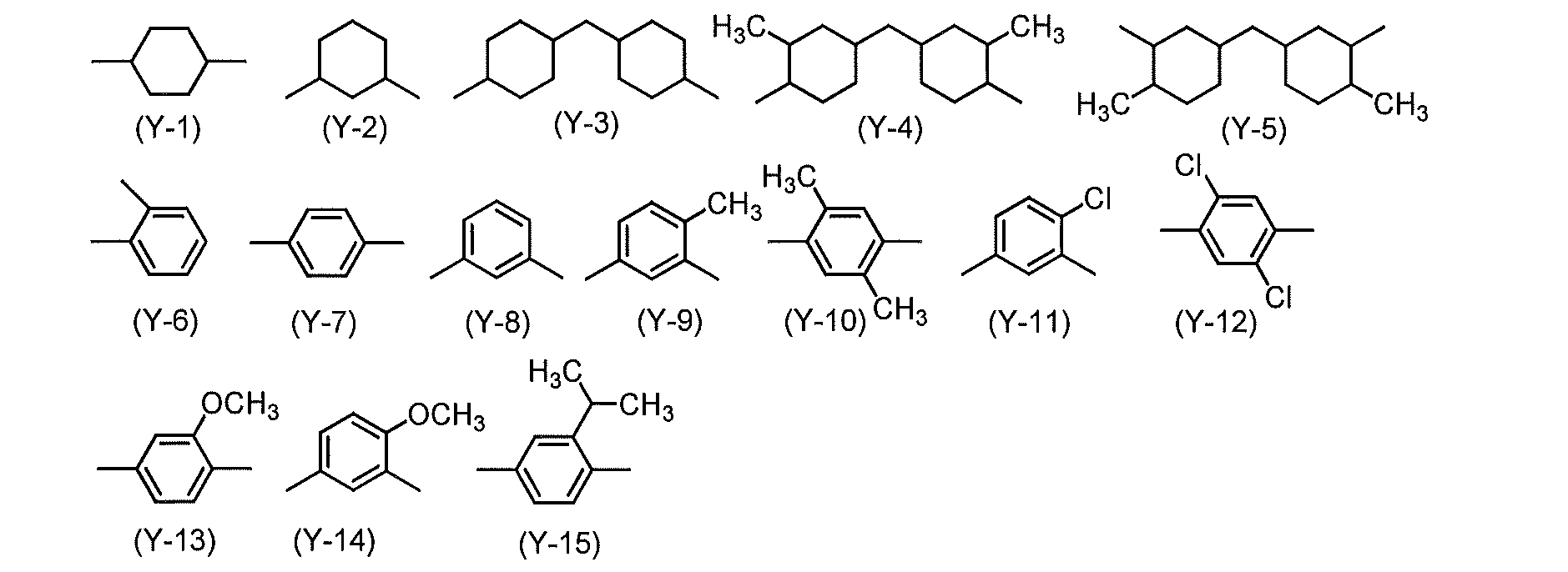
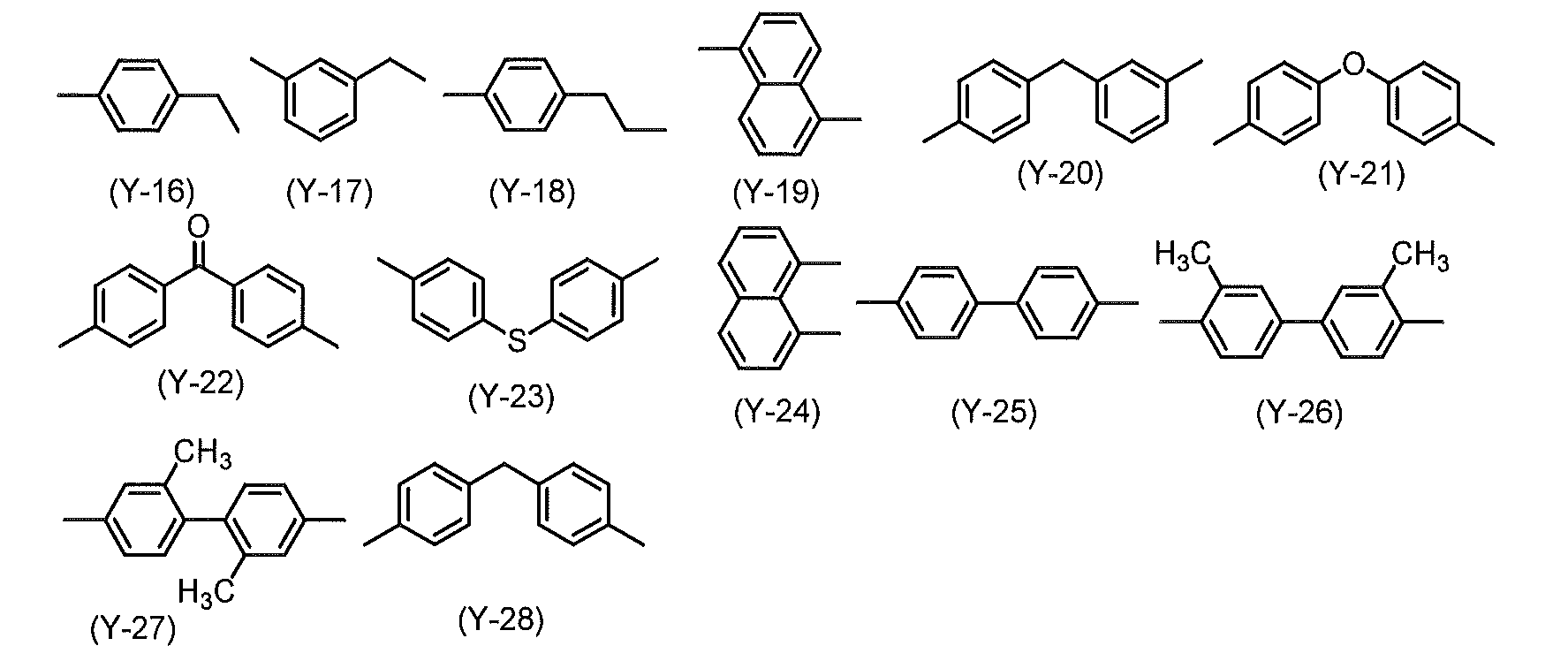



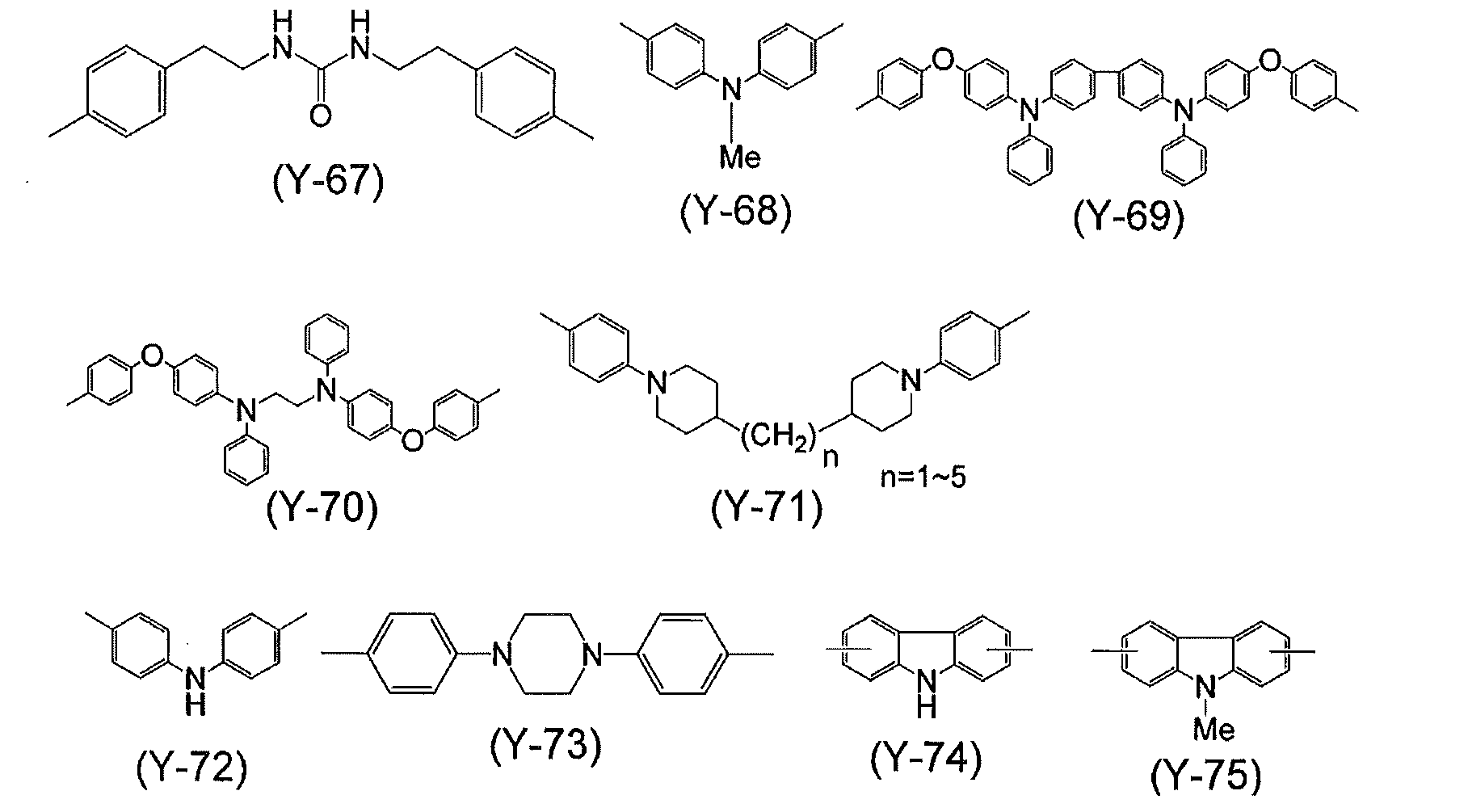

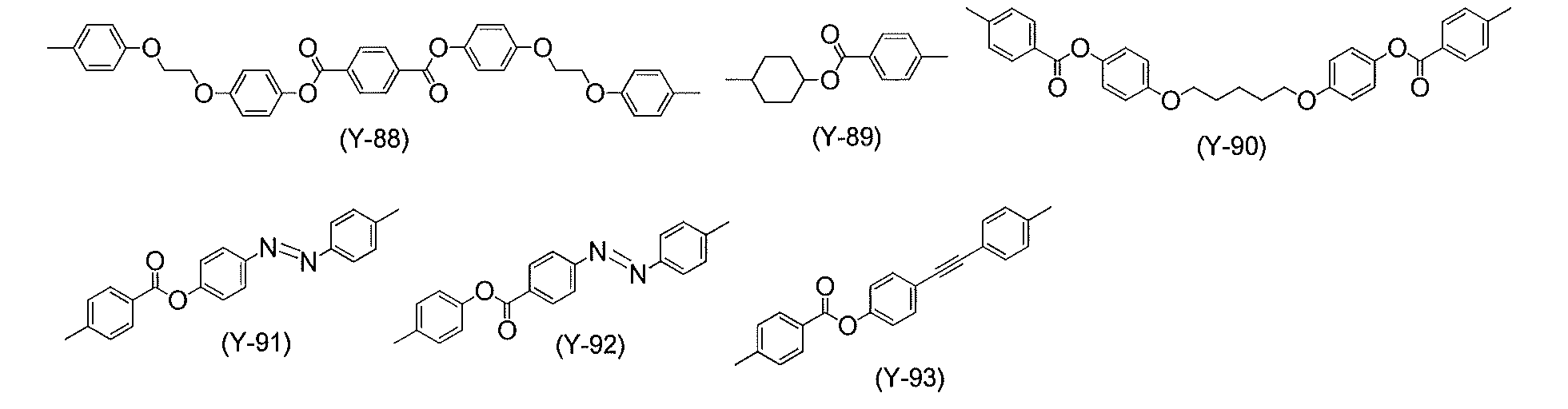
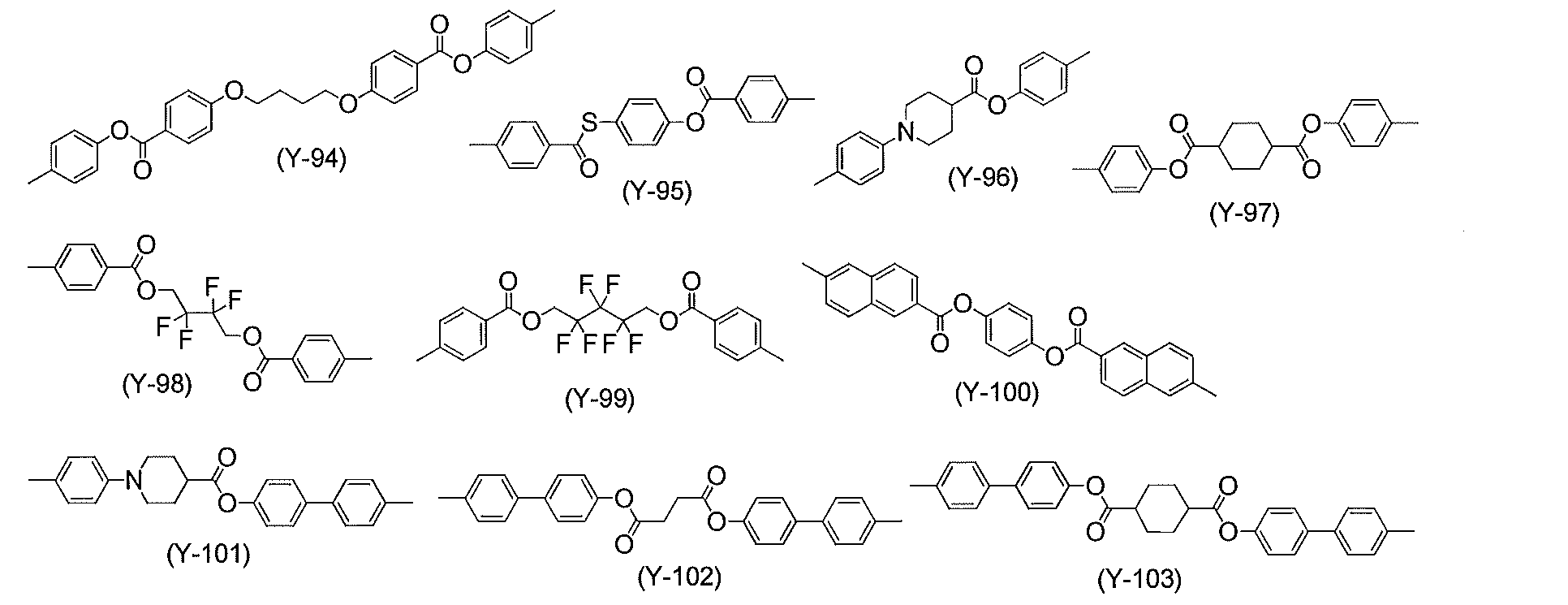
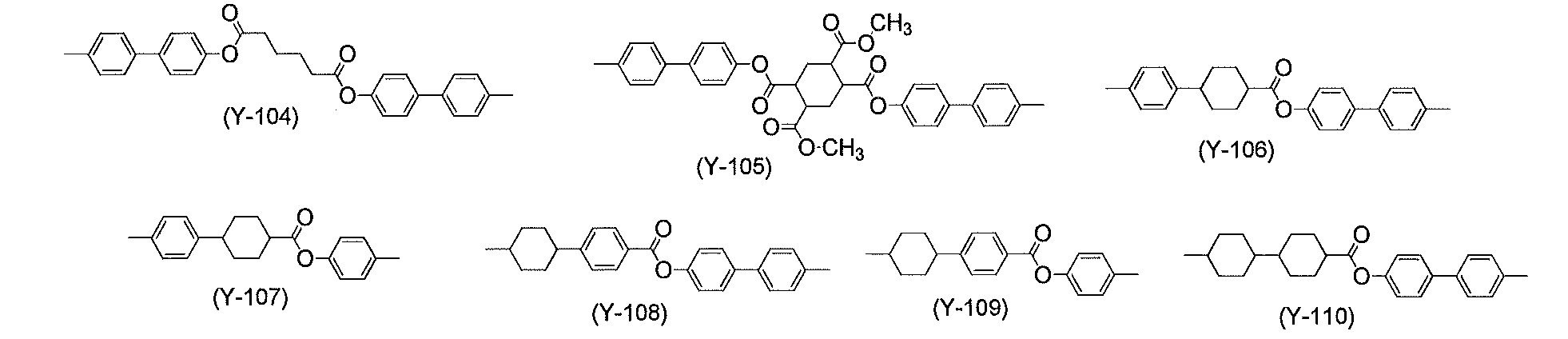
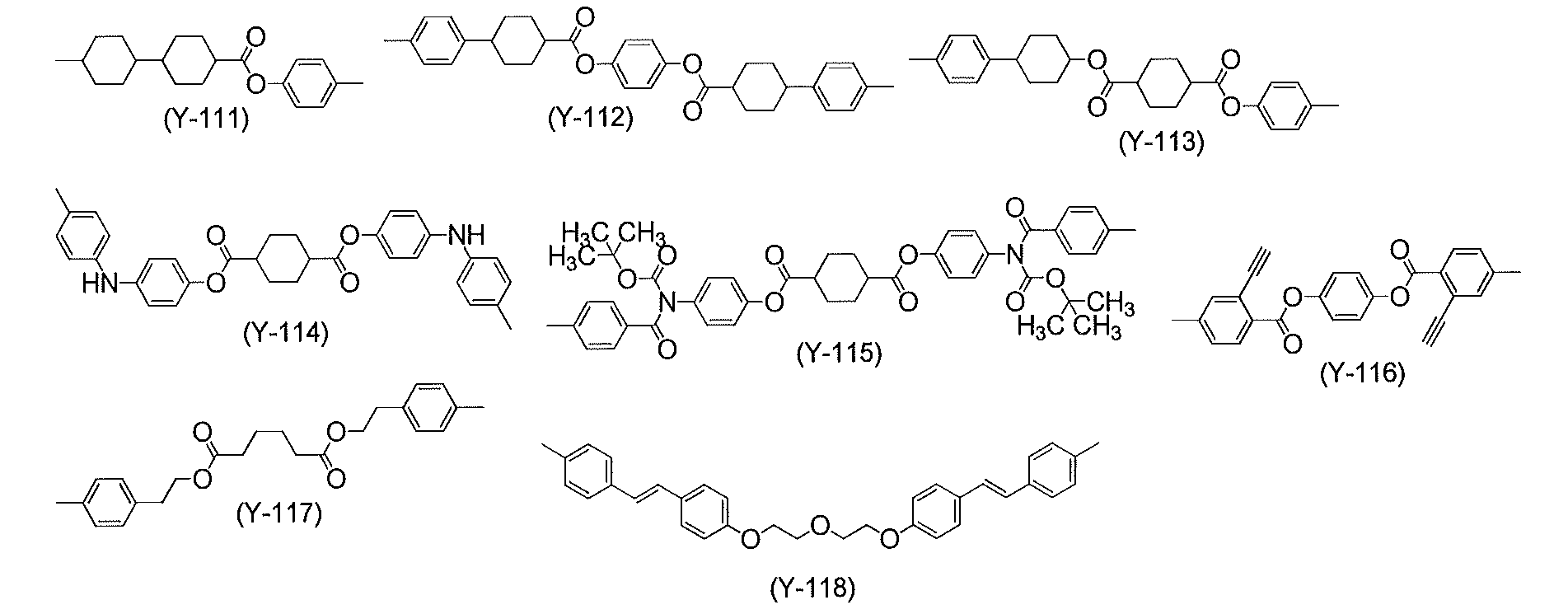


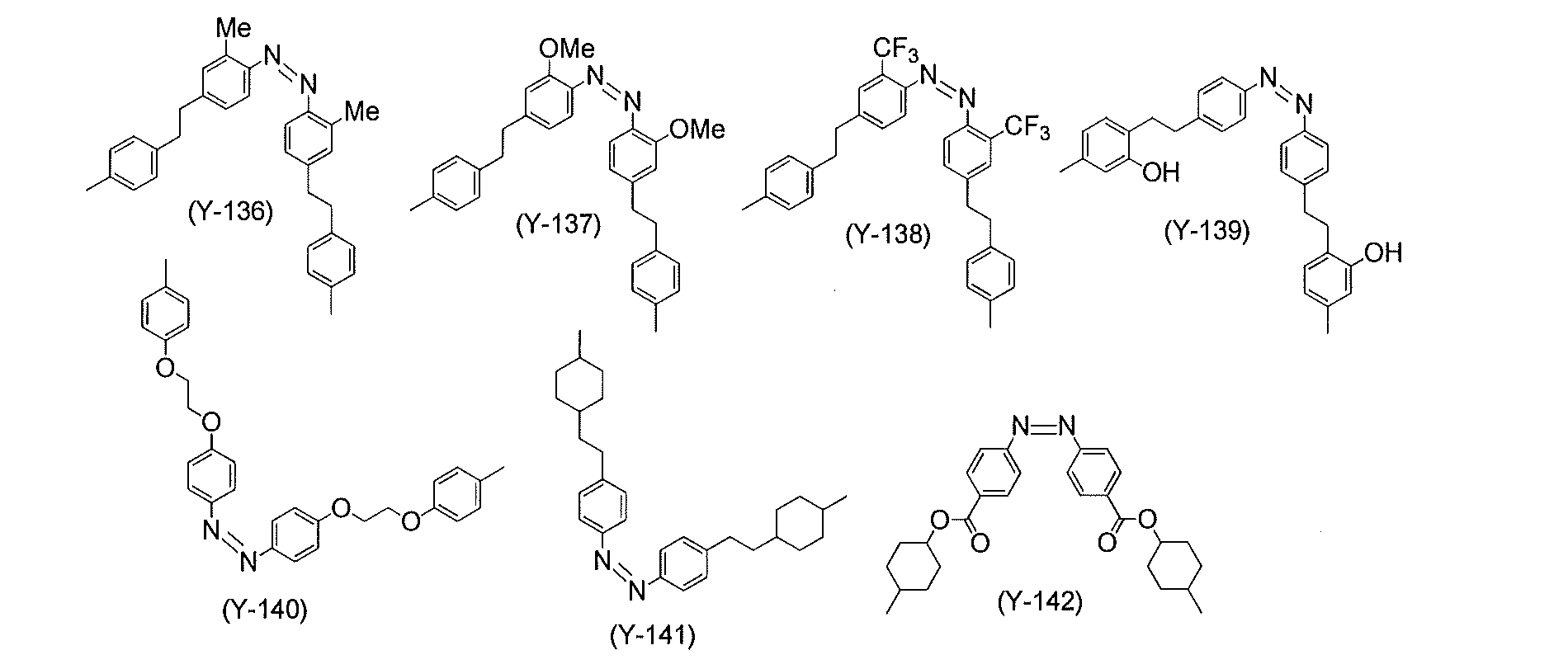


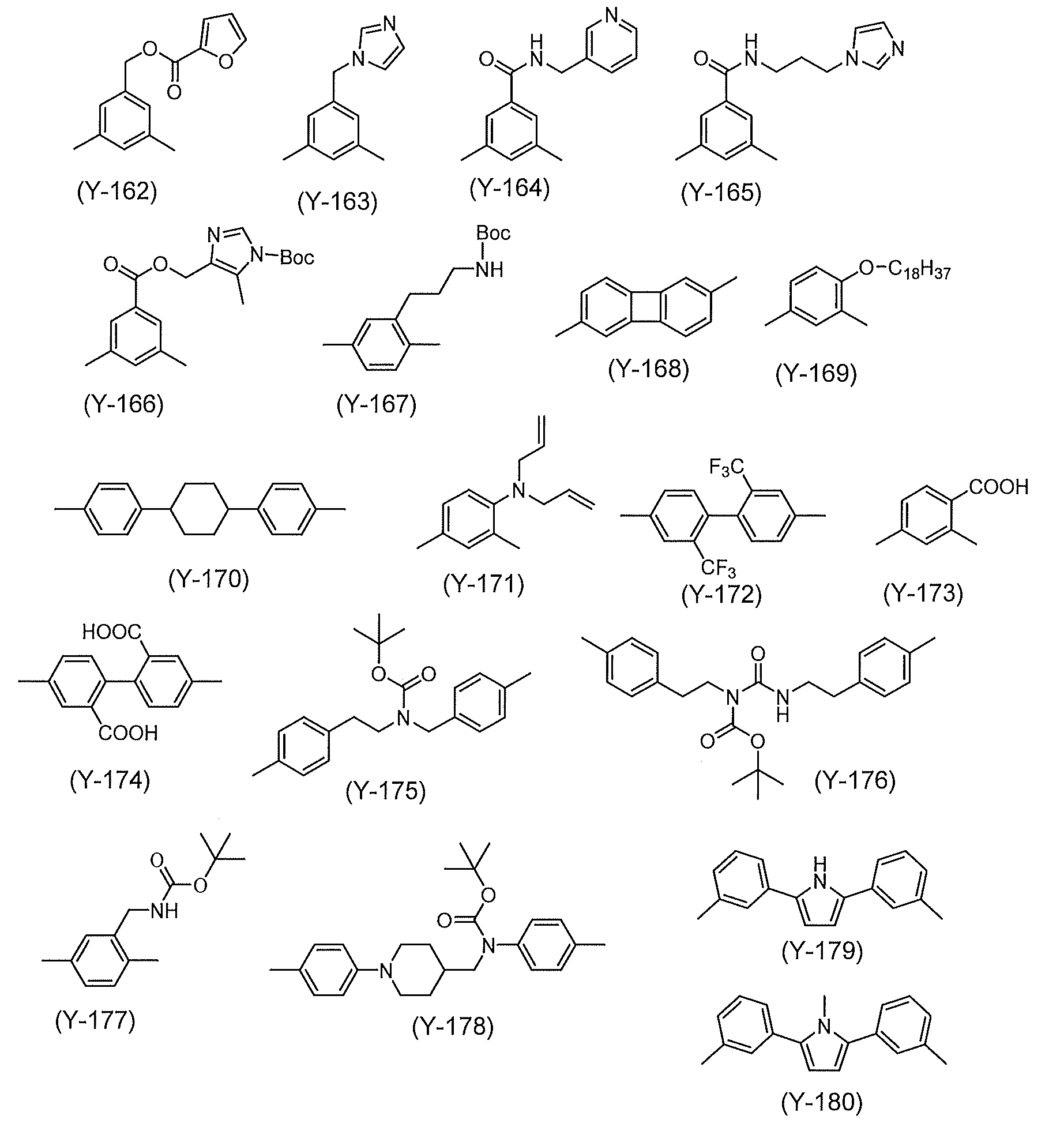
特定重合体を得るためのテトラカルボン酸成分としては、テトラカルボン酸、テトラカルボン酸二無水物、テトラカルボン酸ジハライド、テトラカルボン酸ジアルキルエステル、又はテトラカルボン酸ジアルキルエステルジハライドが挙げられ、本発明では、これらを総称してテトラカルボン酸成分ともいう。
テトラカルボン酸成分としては、テトラカルボン酸二無水物、その誘導体である、テトラカルボン酸、テトラカルボン酸ジハライド、テトラカルボン酸ジアルキルエステル、又はテトラカルボン酸ジアルキルエステルジハライド(これらを総称して、第1のテトラカルボン酸成分という。)を用いることもできる。
テトラカルボン酸二無水物としては、例えば脂肪族テトラカルボン酸二無水物、脂環式テトラカルボン酸二無水物、芳香族テトラカルボン酸二無水物などを挙げることができる。 これらの具体例としては、以下の[1]~[5]の群のものなどをそれぞれ挙げることができる。
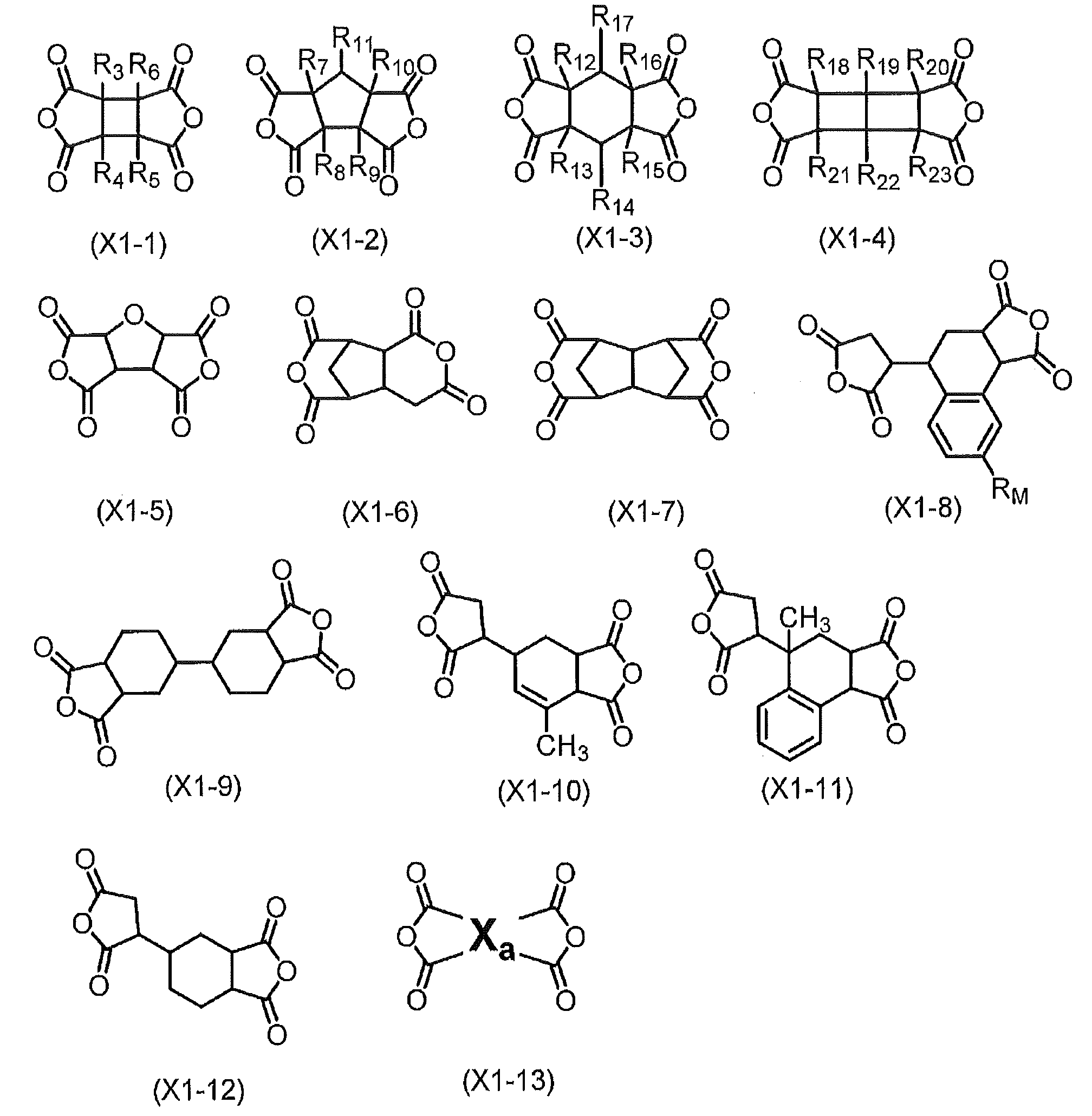
前記式中、RMは水素原子、又はメチル基であり、
Xa、は下記式(Xa-1)~(Xa-7)で表される4価の有機基である。
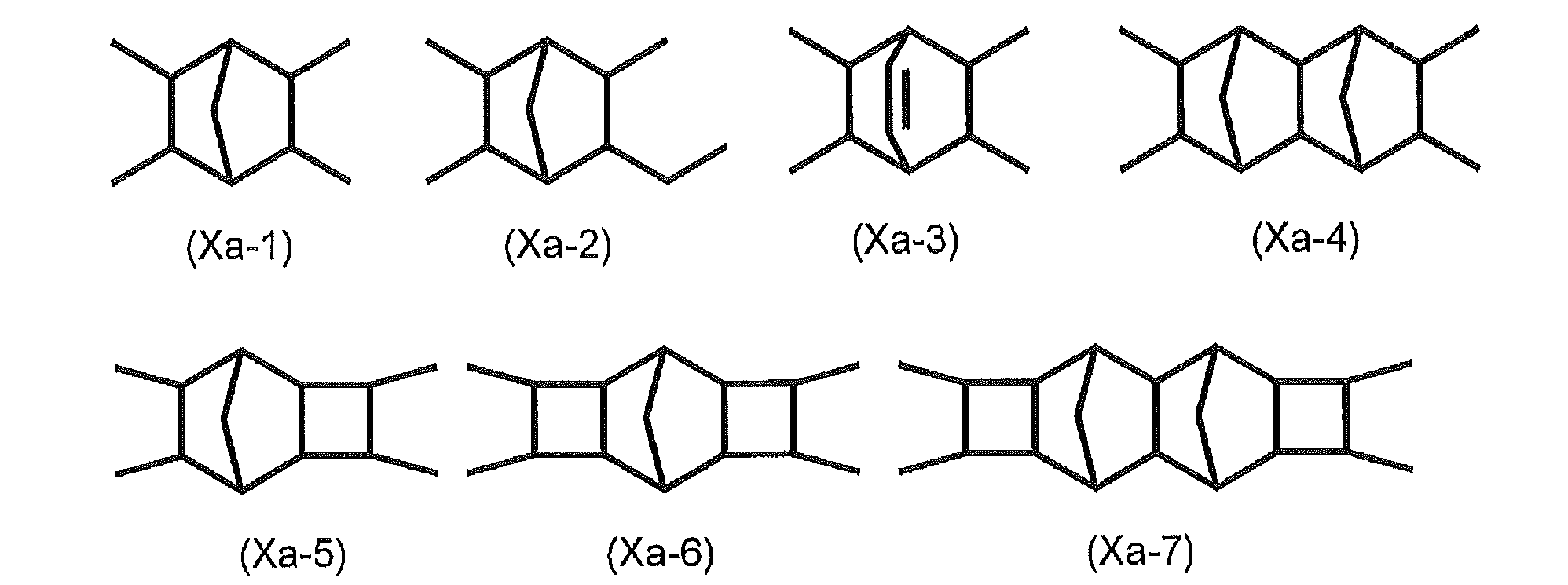
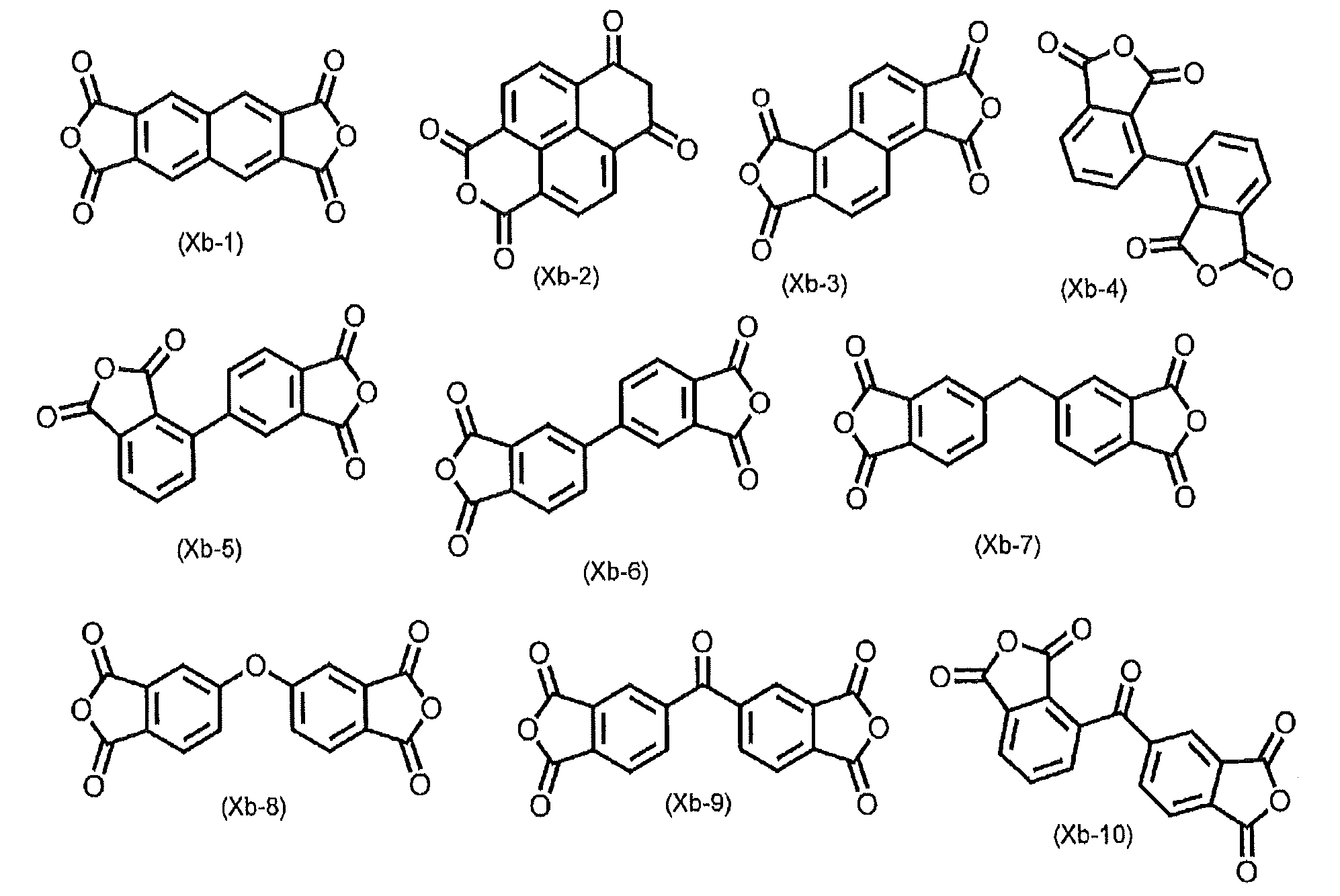

本発明の液晶配向剤に使用されるテトラカルボン酸二無水物成分は、特に限定されないが、塗布性、電圧保持率特性、残留DC電圧特性などの観点から、(X1-1)、(X1-2)、(X1-3)、(X1-6)、(X1-7)、(X1-8)、(X1-9)、(Xa-2)、ピロメリット酸無水物、3,3’,4,4’-ジフェニルスルホンテトラカルボン酸二無水物、(Xb-6)、(Xb-9)から選ばれるテトラカルボン酸二無水物を選定し用いることが好ましい。
これらの重合体を製造する方法は、通常、ジアミン成分とテトラカルボン酸成分とを反応させて得られる。テトラカルボン酸二無水物及びそのテトラカルボン酸の誘導体からなる群から選ばれる少なくとも1種のテトラカルボン酸成分と、1種又は複数種のジアミンからなるジアミン成分とを反応させて、ポリアミド酸を得る方法が挙げられる。具体的には、テトラカルボン酸二無水物と1級又は2級のジアミンとを重縮合させてポリアミック酸を得る方法が用いられる。
ポリイミドを得るには、前記のポリアミド酸又はポリアミド酸アルキルエステルを閉環させてポリイミドとする方法が用いられる。
例えば、N-メチル-2-ピロリドン、N-エチル-2-ピロリドン又はγ-ブチロラクトン、N,N-ジメチルホルムアミド、N,N-ジメチルアセトアミド、ジメチルスルホキシド又は1,3-ジメチル-イミダゾリジノンが挙げられる。また、ポリイミド前駆体の溶媒溶解性が高い場合は、メチルエチルケトン、シクロヘキサノン、シクロペンタノン、4-ヒドロキシ-4-メチル-2-ペンタノン又は下記式[D-1]~式[D-3]で表される溶媒を用いることができる。

ポリイミド前駆体の重合反応においては、ジアミン成分の合計モル数とテトラカルボン酸成分の合計モル数の比は0.8~1.2であることが好ましい。通常の重縮合反応と同様に、このモル比が1.0に近いほど生成するポリイミド前駆体の分子量は大きくなる。
ポリイミド前駆体をイミド化させる方法としては、ポリイミド前駆体の溶液をそのまま加熱する熱イミド化、又はポリイミド前駆体の溶液に触媒を添加する触媒イミド化が挙げられる。
塩基性触媒としてはピリジン、トリエチルアミン、トリメチルアミン、トリブチルアミン、トリオクチルアミン等を挙げることができる。なかでも、ピリジンは反応を進行させるのに適度な塩基性を持つので好ましい。
酸無水物としては、無水酢酸、無水トリメリット酸、無水ピロメリット酸等を挙げることができる。特に、無水酢酸を用いると反応終了後の精製が容易となるので好ましい。
触媒イミド化によるイミド化率は、触媒量と反応温度、反応時間を調節することにより制御することができる。
(1)ポリアミド酸のエステル化反応で製造する方法
ジアミン成分とテトラカルボン酸成分とからポリアミド酸を製造し、そのカルボキシ基(COOH基)に、化学反応、すなわち、エステル化反応を行い、ポリアミド酸アルキルエステルを製造する方法である。
エステル化反応は、ポリアミド酸とエステル化剤を溶媒の存在下で、-20~150℃(好ましくは0~50℃)において、30分~24時間(好ましくは1~4時間)反応させる方法である。
前記エステル化反応における溶媒中のポリアミド酸の濃度は、ポリアミド酸の析出が起こりにくい点から、1~30質量%が好ましい。なかでも、5~20質量%が好ましい。
具体的には、ジアミン成分とテトラカルボン酸ジエステルジクロリドとを、塩基と溶媒の存在下で、-20~150℃(好ましくは0~50℃)において、30分~24時間(好ましくは1~4時間)反応させる方法である。
塩基は、ピリジン、トリエチルアミン、4-ジメチルアミノピリジン等を用いることができる。なかでも、反応が穏和に進行するため、ピリジンが好ましい。塩基の使用量は、反応後に、容易に除去できる量が好ましく、テトラカルボン酸ジエステルジクロリドに対して、2~4倍モルであることが好ましい。なかでも、2~3倍モルがより好ましい。
反応における溶媒中のポリアミド酸アルキルエステルの濃度は、ポリアミド酸アルキルエステルの析出が起こりにくい点から、1~30質量%が好ましい。なかでも、5~20質量%が好ましい。また、テトラカルボン酸ジエステルジクロリドの加水分解を防ぐため、ポリアミド酸アルキルエステルの作製に用いる溶媒は、できるだけ脱水されていることが好ましい。更に、反応は窒素雰囲気中で行い、外気の混入を防ぐのが好ましい。
具体的には、ジアミン成分とテトラカルボン酸ジエステルとを、縮合剤、塩基及び溶媒の存在下で、0~150℃(好ましくは0~100℃)において、30分~24時間(好ましくは3~15時間)重縮合反応させる方法である。
重縮合反応に用いる溶媒は、得られる重合体、すなわち、ポリアミド酸アルキルエステルの溶媒への溶解性の点から、前記ジアミン成分とテトラカルボン酸成分との反応に用いる溶媒が挙げられる。なかでも、N,N-ジメチルホルムアミド、N-メチル-2-ピロリドン、N-エチル-2-ピロリドン又はγ-ブチロラクトンが好ましい。これら溶媒は、1種又は2種以上用いてもよい。
ポリアミド酸アルキルエステルは、前記(2)又は(3)の製造方法が好ましい。
本発明の液晶配向剤は、上述の特定重合体を含有し、好ましくは液晶配向膜を形成するための溶液であるのがよい。液晶配向剤における重合体の含有量は、液晶配向剤中、2~10質量%が好ましく、3~8質量%がより好ましい。
例えば、N-メチル-2-ピロリドン、N-エチル-2-ピロリドン又はγ-ブチロラクトン、N,N-ジメチルホルムアミド、N,N-ジメチルアセトアミド、ジメチルスルホキシド又は1,3-ジメチル-イミダゾリジノンが挙げられる。
また、ポリイミド前駆体の溶媒溶解性が高い場合は、メチルエチルケトン、シクロヘキサノン、シクロペンタノン、4-ヒドロキシ-4-メチル-2-ペンタノン又は上記式[D-1]~式[D-3]で表される溶媒を用いることもできる。
上記良溶媒は1種類で使用してもよいし、塗布方法などに合わせてより適する組み合わせ、および比率で使用してもよい。
本発明の液晶配向剤における良溶媒は、液晶配向剤に含まれる溶媒全体の20~99質量%であることが好ましい。なかでも、20~90質量%が好ましい。より好ましいのは、30~80質量%である。
例えば、エタノール、イソプロピルアルコール、1-ブタノール、2-ブタノール、イソブチルアルコール、tert-ブチルアルコール、1-ペンタノール、2-ペンタノール、3-ペンタノール、2-メチル-1-ブタノール、イソペンチルアルコール、tert-ペンチルアルコール、3-メチル-2-ブタノール、ネオペンチルアルコール、1-ヘキサノール、2-メチル-1-ペンタノール、2-メチル-2-ペンタノール、2-エチル-1-ブタノール、1-ヘプタノール、2-ヘプタノール、3-ヘプタノール、1-オクタノール、2-オクタノール、2-エチル-1-ヘキサノール、シクロヘキサノール、1-メチルシクロヘキサノール、2-メチルシクロヘキサノール、3-メチルシクロヘキサノール、2,6-ジメチル-4-ヘプタノール、1,2-エタンジオール、1,2-プロパンジオール、1,3-プロパンジオール、1,2-ブタンジオール、1,3-ブタンジオール、1,4-ブタンジオール、2,3-ブタンジオール、1,5-ペンタンジオール、2-メチル-2,4-ペンタンジオール、2-エチル-1,3-ヘキサンジオール、ジイソプロピルエーテル、ジプロピルエーテル、ジブチルエーテル、ジヘキシルエーテル、ジオキサン、エチレングリコールジメチルエーテル、エチレングリコールジエチルエーテル、エチレングリコールジブチルエーテル、1,2-ブトキシエタン、ジエチレングリコールジメチルエーテル、ジエチレングリコールジエチルエーテル、4-ヒドロキシ-4-メチル-2-ペンタノン、ジエチレングリコールメチルエチルエーテル、ジエチレングリコールジブチルエーテル、2-ペンタノン、3-ペンタノン、2-ヘキサノン、2-ヘプタノン、4-ヘプタノン、2,6-ジメチル-4-ヘプタノン、4,6-ジメチル-2-ヘプタノン、3-エトキシブチルアセタート、1-メチルペンチルアセタート、2-エチルブチルアセタート、2-エチルヘキシルアセタート、エチレングリコールモノアセタート、エチレングリコールジアセタート、プロピレンカーボネート、エチレンカーボネート、2-(メトキシメトキシ)エタノール、エチレングリコールモノブチルエーテル、エチレングリコールモノイソアミルエーテル、エチレングリコールモノヘキシルエーテル、2-(ヘキシルオキシ)エタノール、フルフリルアルコール、ジエチレングリコール、プロピレングリコール、プロピレングリコールモノブチルエーテル、1-(ブトキシエトキシ)プロパノール、プロピレングリコールモノメチルエーテルアセタート、ジプロピレングリコール、ジエチレングリコールモノエチルエーテル、ジエチレングリコールモノメチルエーテル、ジプロピレングリコールモノメチルエーテル、ジプロピレングリコールモノエチルエーテル、ジプロピレングリコールジメチルエーテル、トリプロピレングリコールモノメチルエーテル、エチレングリコールモノメチルエーテルアセタート、エチレングリコールモノエチルエーテルアセタート、エチレングリコールモノブチルエーテルアセタート、エチレングリコールモノアセタート、エチレングリコールジアセタート、ジエチレングリコールモノエチルエーテルアセタート、ジエチレングリコールモノブチルエーテルアセタート、2-(2-エトキシエトキシ)エチルアセタート、ジエチレングリコールアセタート、トリエチレングリコール、トリエチレングリコールモノメチルエーテル、トリエチレングリコールモノエチルエーテル、乳酸メチル、乳酸エチル、酢酸メチル、酢酸エチル、酢酸n-ブチル、酢酸プロピレングリコールモノエチルエーテル、ピルビン酸メチル、ピルビン酸エチル、3-メトキシプロピオン酸メチル、3-エトキシプロピオン酸エチル、3-エトキシプロピオン酸メチルエチル、3-メトキシプロピオン酸エチル、3-エトキシプロピオン酸、3-メトキシプロピオン酸、3-メトキシプロピオン酸プロピル、3-メトキシプロピオン酸ブチル、乳酸メチルエステル、乳酸エチルエステル、乳酸n-プロピルエステル、乳酸n-ブチルエステル、乳酸イソアミルエステル、前記式[D-1]~[D-3]で表される溶媒等を挙げることができる。
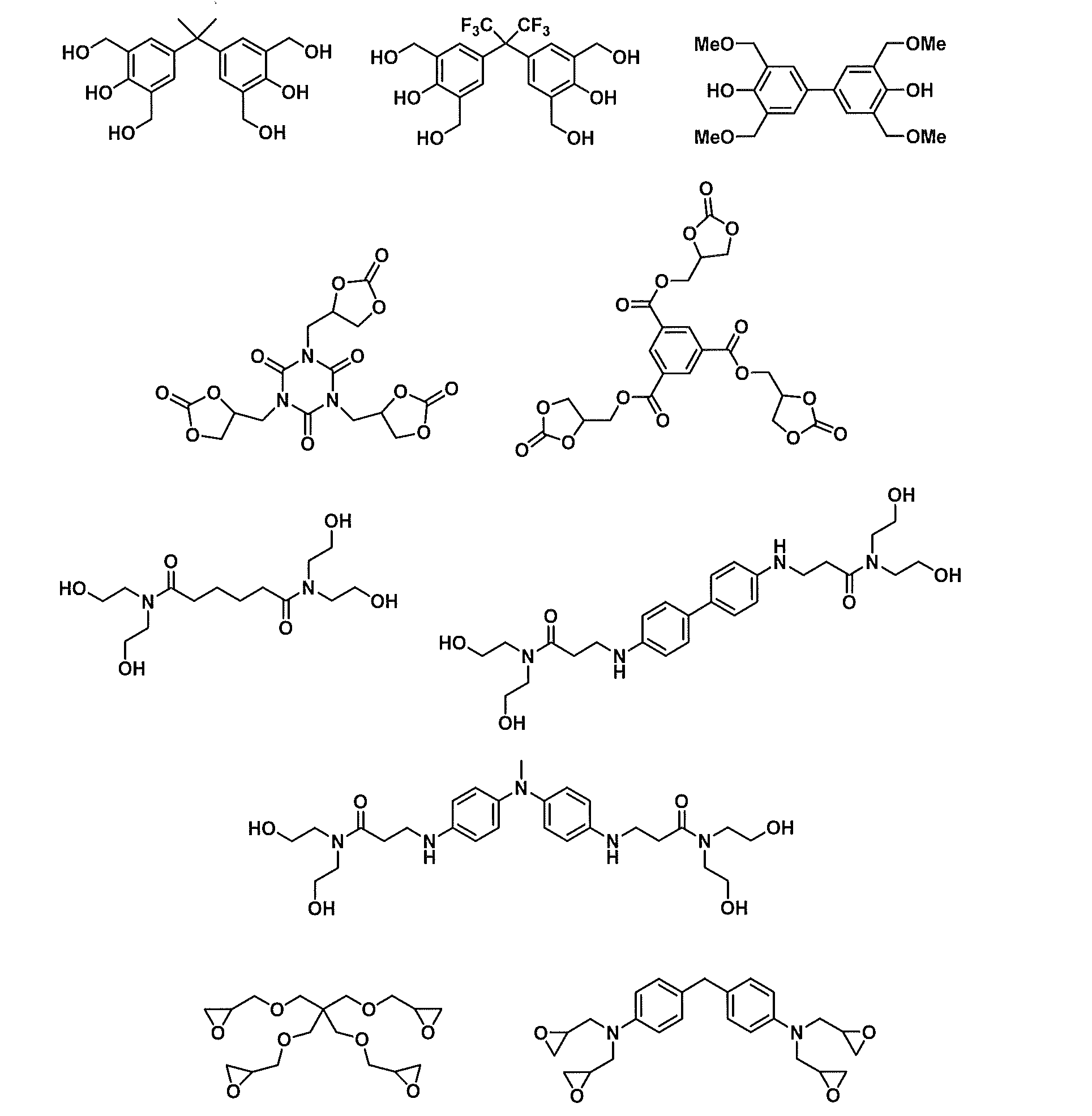
本発明の液晶配向膜は、本発明の液晶配向剤を基板上に塗布して焼成することにより形成できる。
例えば、本発明の液晶配向剤を、基板に塗布した後、必要に応じて乾燥し、焼成を行うことで得られる硬化膜を、そのまま液晶配向膜として用いることもできる。また、この硬化膜をラビングしたり、偏光又は特定の波長の光等を照射したり、イオンビーム等の処理をしたり、PSA用配向膜として液晶充填後の液晶表示素子に電圧を印加した状態でUVを照射することも可能である。特に、PSA用配向膜として使用することが有用である。
透過型の液晶表示素子の場合は、上記の如き基板を用いることが一般的であるが、反射型の液晶表示素子では、片側の基板のみにならばシリコンウエハー等の不透明な基板も用いることが可能である。その際、基板に形成された電極には、光を反射するアルミニウムの如き材料を用いることもできる。

(液晶)
MLC-3023(メルク社製、ネガ型重合性化合物含有液晶)
W-A1:式[W-A1]で表される化合物
W-A2:式[W-A2]で表される化合物
W-A3:式[W-A3]で表される化合物
W-A4:式[W-A4]で表される化合物
W-A5:式[W-A5]で表される化合物
W-A6:式[W-A6]で表される化合物
W-A7:式[W-A7]で表される化合物
W-A8:式[W-A8]で表される化合物
W-A9:式[W-A9]で表される化合物
W-A10:式[W-A10]で表される化合物

A1:式[A1]で表される化合物
A2:式[A2]で表される化合物
A3:式[A3]で表される化合物
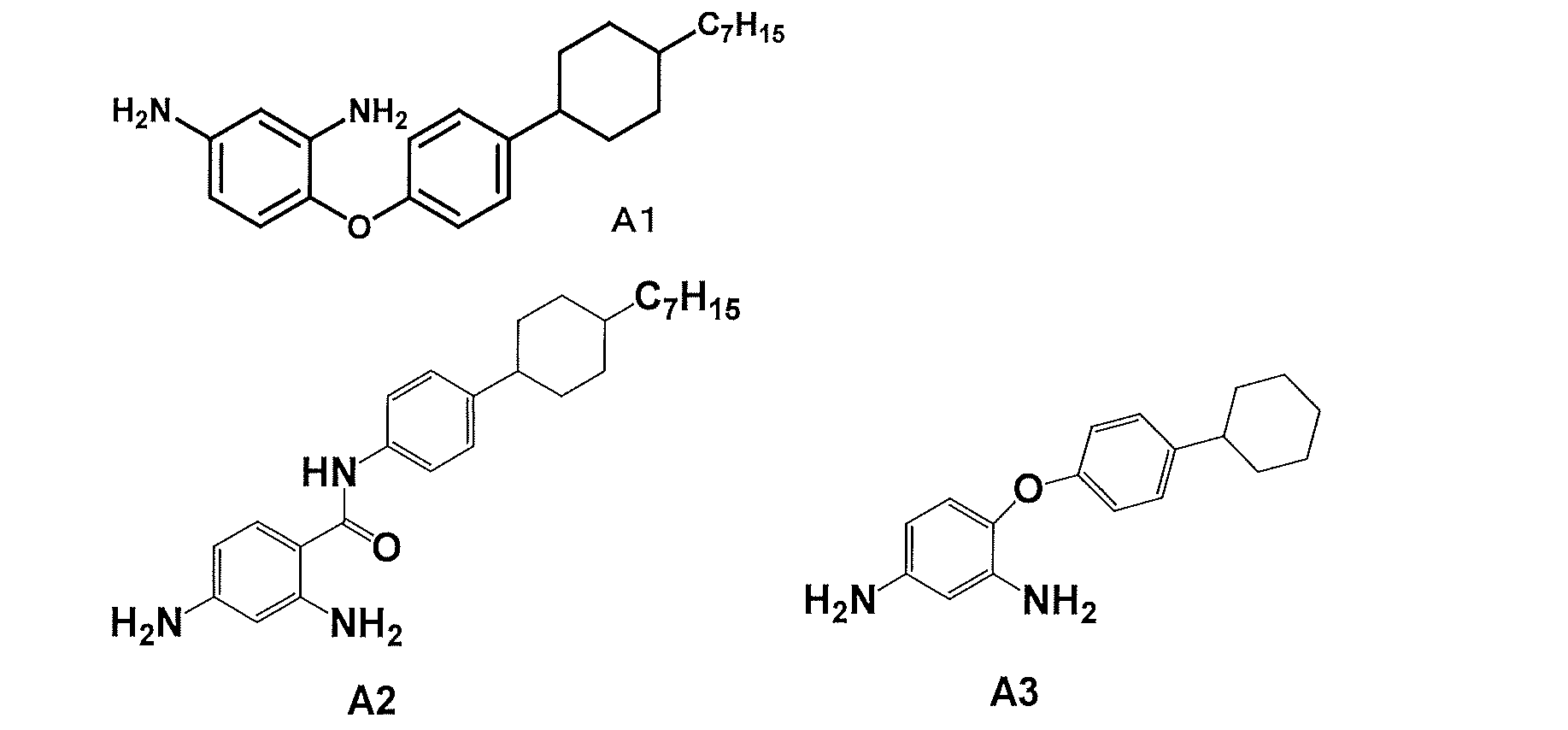
C1:式[C1]で表される化合物
C2:式[C2]で表される化合物
C3:式[C3]で表される化合物
C4:式[C4]で表される化合物
C5:式[C5]で表される化合物
C6:式[C6]で表される化合物
C7:式[C7]で表される化合物
C8:式[C8]で表される化合物
C9:式[C9]で表される化合物
C10:式[C10]で表される化合物

D1:1,2,3,4-シクロブタンテトラカルボン酸二無水物
D2:ビシクロ[3,3,0]オクタン-2,4,6,8-テトラカルボン酸二無水物
D3:ピロメリット酸二無水物
D4:2,3,5‐トリカルボキシシクロペンチル酢酸二無水物
D5:3,3’,4,4’-ジフェニルスルホンテトラカルボン酸二無水物
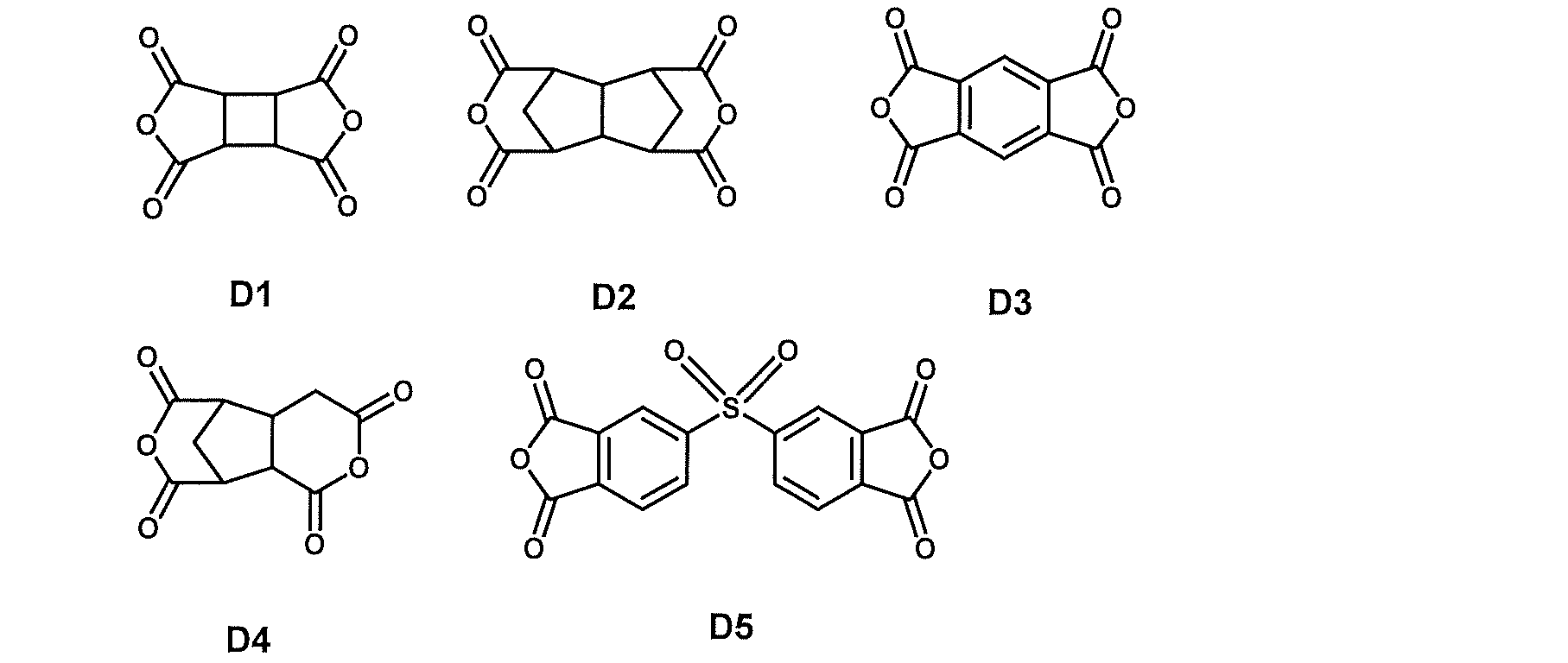
NMP:N-メチル-2-ピロリドン
BCS:エチレングリコールモノブチルエーテル
NEP:N-エチル-2-ピロリドン
(架橋剤)
E1:下記式(E1)であらわされる架橋剤
(添加剤)
E2:3-ピコリルアミン

ポリイミド前駆体及びポリイミドの分子量は、常温ゲル浸透クロマトグラフィー(GPC)装置(GPC-101)(昭和電工社製)、カラム(KD-803,KD-805)(Shodex社製)を用いて、以下のようにして測定した。
カラム温度:50℃
溶離液:N,N’-ジメチルホルムアミド(添加剤として、臭化リチウム-水和物(LiBr・H2O)が30mmol/L(リットル)、リン酸・無水結晶(o-リン酸)が30mmol/L、テトラヒドロフラン(THF)が10ml/L)
流速:1.0ml/分
検量線作成用標準サンプル:TSK 標準ポリエチレンオキサイド(分子量;約900,000、150,000、100,000及び30,000)(東ソー社製)及びポリエチレングリコール(分子量;約12,000、4,000及び1,000)(ポリマーラボラトリー社製)。
ポリイミド粉末20mgをNMR(核磁気共鳴)サンプル管(NMRサンプリングチューブスタンダード,φ5(草野科学社製))に入れ、重水素化ジメチルスルホキシド(DMSO-d6,0.05質量%TMS(テトラメチルシラン)混合品)(0.53ml)を添加し、超音波をかけて完全に溶解させた。この溶液をNMR測定機(JNW-ECA500)(日本電子データム社製)にて、500MHzのプロトンNMRを測定した。イミド化率は、イミド化前後で変化しない構造に由来するプロトンを基準プロトンとして決め、このプロトンのピーク積算値と、9.5~10.0ppm付近に現れるアミド酸のNH基に由来するプロトンピーク積算値とを用い以下の式によって求めた。
イミド化率(%)=(1-α・x/y)×100
上記式において、xはアミド酸のNH基由来のプロトンピーク積算値、yは基準プロトンのピーク積算値、αはポリアミド酸(イミド化率が0%)の場合におけるアミド酸のNH基プロトン1個に対する基準プロトンの個数割合である。
合成例または比較合成例において、ポリイミド系重合体の粘度はE型粘度計TVE-22H(東機産業株式会社製)を用い、サンプル量1.1mL、コーンロータTE-1(1°34’、R24)、温度25℃で測定した。
下記合成例1~3及び合成例4~10に記載の生成物は1H-NMR分析により同定した(分析条件は下記の通り)。
装置:Varian NMR System 400 NB (400 MHz)。
測定溶媒:CDCl3、DMSO-d6。
基準物質:テトラメチルシラン(TMS)(δ0.0 ppm for 1H)。

テトラヒドロフラン(165.6g)中、4,4’-ジニトロ-1,1’-ビフェニル-2,2’-ジメタノール(41.1g、135mmol)とトリエチルアミン(31.5g)を仕込み、窒素雰囲気氷冷条件にてメタンスルホニルクロリド(33.2g)を滴下し、1時間反応させることで化合物[1]を得た。続いて、テトラヒドロフラン(246.6g)に溶解させたp-(trans-4-ヘプチルシクロヘキシル)フェノール(77.8g)を加え、40℃で1時間撹拌後、純水(233g)に溶解させた水酸化カリウム(41.0g)を同温度にて加え、21時間反応させた。反応終了後、1.0M塩酸水溶液(311ml)及び純水(1050g)を加えて粗物を析出させ、ろ過により粗物を回収した。得られた粗物をテトラヒドロフラン(574g)に50℃加熱溶解させ、メタノール(328g)を加えて結晶を析出させ、ろ過、乾燥することで化合物[2]を得た(収量:97.9g、収率:89%)。
1H-NMR(400MHz) in CDCl3:0.87-0.90ppm(m,6H), 0.96-1.05ppm(m,4H), 1.19-1.39ppm(m,30H), 1.80-1.85ppm(m,8H), 2.33-2.40ppm(m,2H), 4.77ppm(s,4H), 6.66-6.70ppm(m,4H), 7.02-7.06ppm(m,4H),7.40ppm(d,2H,8.4), 8.25ppm(dd,2H,J=2.4Hz,J=8.4Hz), 8.54ppm(d,2H,J=2.4Hz).
テトラヒドロフラン(1783g)中、化合物[2](74.3g,90.9mmol)と3%プラチナカーボン(5.94g)を仕込み、水素雰囲気室温条件で反応させた。反応終了後、反応混合物をろ過し、ろ液を減圧濃縮することで内部総重量を145gとした。続いて、濃縮溶液にメタノール(297g)を加え、氷冷撹拌し、ろ過、乾燥することでW-A1を得た(収量:59.2g、収率:86%)。
1H-NMR(400MHz) in CDCl3:0.87-0.90ppm(m,6H), 0.96-1.05ppm(m,4H), 1.19-1.40ppm(m,30H), 1.81-1.84ppm(m,8H), 2.32-2.38ppm(m,2H), 3.67ppm(s,4H),4.69ppm(d,2H,J=12.0Hz), 4.74ppm(d,2H,J=11.6Hz), 6.62ppm(dd,2H,J=2.4Hz,J=8.0Hz), 6.70-6.75ppm(m,4H), 6.91ppm(d,2H,J=2.4Hz), 6.97-7.03ppm(m,6H).

テトラヒドロフラン(327.2g)中、4,4’-ジニトロ-2,2’-ジフェン酸(40.9g、123mmol)とp-(trans-4-ヘプチルシクロヘキシル)フェノール(72.1g)、4-ジメチルアミノピリジン(1.50g)を仕込み、窒素雰囲気室温条件下で1-(3-ジメチルアミノプロピル)-3-エチルカルボジイミド塩酸塩(56.6g)を投入し、3時間反応させた。反応終了後、純水(1226g)中に反応液を注ぎ込み、粗物を析出させ、ろ過により回収した。続いて、粗物をメタノール(245g)でスラリー洗浄後、ろ過し、得られた粗物をテトラヒドロフラン(245g)に60℃加熱溶解させた。ろ過により不溶物を除去後、減圧濃縮により内部総重量を232gとした後に、メタノール(163g)を加えて結晶を析出させ、氷冷条件下で撹拌後、ろ過、乾燥することで化合物[3]を得た(収量:73.9g、収率:71%)。
1H-NMR(400MHz) in CDCl3: 0.87-0.90ppm(m,6H), 0.98-1.06ppm(m,4H), 1.18-1.43ppm(m,30H), 1.83-1.86ppm(m,8H), 2.41-2.47ppm(m,2H), 6.89-6.92ppm(m,4H), 7.17-7.20ppm(m,4H), 7.48ppm(d,2H,8.4), 8.49ppm(dd,2H,J=2.4Hz,J=8.4Hz), 9.11ppm(d,2H,J=2.4Hz).
テトラヒドロフラン(443g)及びメタノール(73.9g)中、化合物[3](73.9g、87.4mmol)と5%パラジウムカーボン(8.80g)を仕込み、水素雰囲気室温条件で反応させた。反応終了後、ろ過によりパラジウムカーボンを除去し、減圧濃縮により内部総重量を171gとした。続いて、濃縮溶液にメタノール(222g)を加えて結晶を析出させ、氷冷撹拌し、ろ過、乾燥することでW-A2を得た(収量:66.6g、収率:97%)。
1H-NMR(400MHz) in CDCl3: 0.87-0.90ppm(m,6H), 0.96-1.05ppm(m,4H), 1.17-1.42ppm(m,30H),1.82-1.85ppm(m,8H), 2.38-2.44ppm(m,2H), 3.77ppm(s,4H), 6.80-6.87ppm(m,6H),7.08-7.13ppm(m,6H), 7.41ppm(d,2H,J=2.4Hz).

トルエン(366g)中、4-(trans-4-ヘプチルシクロヘキシル)-安息香酸(73.1g、242mmol)とN,N-ジメチルホルムアミド(0.73g)を仕込み、窒素雰囲気50℃条件下で塩化チオニル(35.9g)を滴下した。滴下後、同温度で1時間反応させた後、反応溶液を減圧濃縮することで化合物[4]を得た。続いて、テトラヒドロフラン(210g)中、4,4’-ジニトロ-1,1’-ビフェニル-2,2’-ジメタノール(35.0g、115mmol)とトリエチルアミン(26.8g)を仕込み、窒素雰囲気氷冷条件下にて、テトラヒドロフラン(73.1g)に溶解させた化合物[4]を滴下した。滴下終了後、反応温度を室温にして18時間反応させた。反応終了後、ろ過によりトリエチルアミン塩酸塩を除去後、減圧濃縮によりオイル状化合物を得た。得られたオイル状化合物を純水(1015g)中に加えることで結晶を析出させ、ろ過により粗物を回収した。続いて、得られた粗物をメタノール(291g)で室温スラリー洗浄、酢酸エチル(175g)で室温スラリー洗浄し、ろ過、乾燥することで化合物[5]を得た(収量:92.7g、 収率:92%)。
1H-NMR(400MHz) in CDCl3: 0.89-0.91ppm(m,6H), 0.99-1.09ppm(m,4H), 1.20-1.47ppm(m,30H),1.85-1.88ppm(m,8H), 2.46-2.52ppm(m,2H), 5.14ppm(s,4H), 7.23-7.26ppm(m,4H),7.45ppm(d,2H,J=8.4Hz),7.83-7.86ppm(m,4H),8.27ppm(dd,2H,J=2.4Hz,J=8.4Hz), 8.47ppm(d,2H,J=2.4Hz).
テトラヒドロフラン(484g)及びメタノール(161g)中、化合物[5](80.5g、92.2mmol)と3%プラチナカーボン(6.44g)を仕込み、水素雰囲気室温条件下で反応させた。反応終了後、ろ過によりプラチナカーボンを除去し、減圧濃縮により溶媒を除去することで内部総重量を96.6gとした。続いて、濃縮溶液にメタノール(322g)を加えて結晶を析出させ、氷冷撹拌し、ろ過することで粗物を得た。続いて、得られた粗物を酢酸エチル(322g)で60℃加熱溶解させ、メタノール(700g)を加え、氷冷条件下で結晶を析出させ、ろ過、乾燥することでW-A3を得た(収量:67.9g、収率:91%)。
1H-NMR(400MHz) in CDCl3: 0.87-0.91ppm(m,6H), 0.98-1.08ppm(m,4H), 1.19-1.47ppm(m,30H),1.84-1.87ppm(m,8H), 2.44-2.51ppm(m,2H), 3.71ppm(s,4H), 5.02ppm(d,2H,J=12.8Hz), 5.09ppm(d,2H,J=12.4Hz),6.66ppm(dd,2H,J=2.4Hz,J=8.0Hz),6.84ppm(d,2H,J=2.4Hz),7.03ppm(d,2H,J=8.0Hz),7.19-7.25ppm(m,4H),7.89-7.92ppm(m,4H).

トルエン(134g)中、trans, trans-4’-アミルビシクロヘキシル-4-カルボン酸(26.7g、95.1mmol)とN,N-ジメチルホルムアミド(0.401g)を仕込み、窒素雰囲気50℃条件下で塩化チオニル(13.6g、114mmol)を滴下した。滴下後、同温度で1時間反応させた後、反応溶液を減圧濃縮することで化合物[6]を得た。続いて、テトラヒドロフラン(63.0g)中、4,4’-ジニトロ-1,1’-ビフェニル-2,2’-ジメタノール(12.6g、41.4mmol)とトリエチルアミン(10.9g、108mmol)を仕込み、窒素雰囲気氷冷条件下にて、テトラヒドロフラン(12.6g)に溶解させた化合物[6]を滴下した。滴下終了後、反応温度を室温にして17時間反応させた。反応終了後、純水(731g)中に反応液を加える事で結晶を析出させ、ろ過、純水洗浄、メタノール洗浄した後に粗物を回収した。続いて、得られた粗物をトルエン(56.0g)に加熱溶解させ、ヘキサン(112g)を加えて結晶を析出させ、室温条件下で撹拌後、ろ過、乾燥することで化合物[7]を得た(収量:17.0g、20.6mmol、収率:50%)。
1H-NMR(400MHz) in CDCl3:0.82―1.38ppm(m,44H), 1.67-1.81ppm(m,12H), 1.90-1.98ppm(m,4H), 2.19-2.25ppm(m,2H), 4.82ppm(d,2H,J=13.6Hz), 4.88ppm(d,2H,J=13.6Hz), 7.39ppm(d,2H,J=8.4Hz), 8.26ppm(dd,2H,J=2.4Hz,J=8.4Hz), 8.38ppm(d,2H,J=2.0Hz)
テトラヒドロフラン(136g)及びメタノール(34.0g)中、化合物[7](17.0g、20.6mmol)と3%プラチナカーボン(1.36g)を仕込み、水素雰囲気室温条件下で約41時間反応させた。反応終了後、ろ過、減圧濃縮により内部総重量を40gとした。続いて、メタノール(68.0g)を加えて結晶を析出させ、ろ過、乾燥する事でW-A4を得た(収量:15.2g、19.9mmol、収率:97%)。
1H-NMR(400MHz) in CDCl3:0.81-1.39ppm(m,44H), 1.67-1.78ppm(m,12H), 1.90-1.97ppm(m,4H), 2.14-2.20ppm(m,2H), 3.71ppm(br,4H), 4.73ppm(d,2H,J=12.4Hz), 4.78ppm(d,2H,J=12.4Hz), 6.62ppm(dd,2H,J=2.4Hz,J=8.0Hz), 6.73ppm(d,2H,J=2.8Hz), 6.94ppm(d,2H,J=8.0Hz)
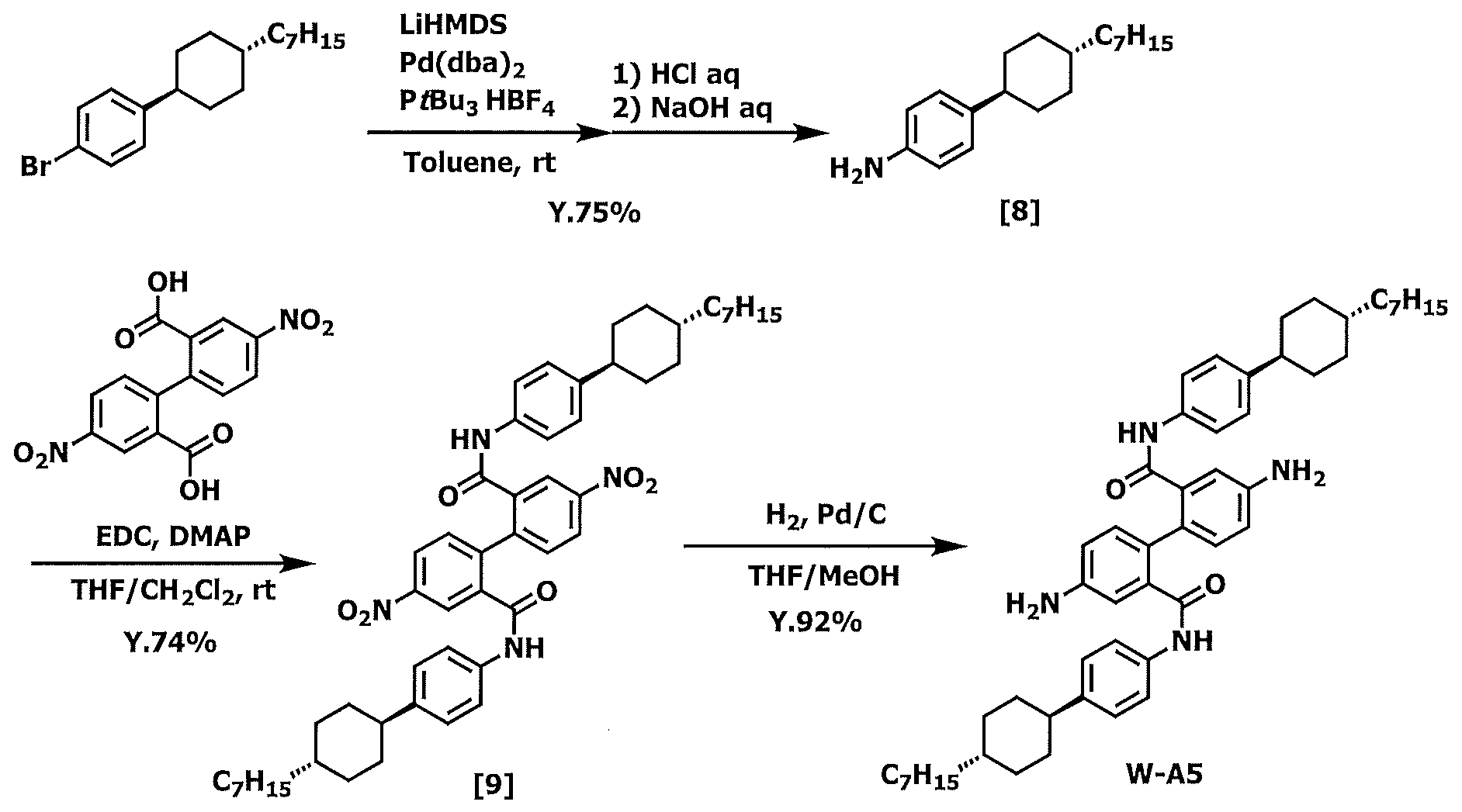
トルエン(227g)中、trans-1-ブロモ-4-(4-ヘプチルシクロヘキシル)ベンゼン(45.4g、135mmol)とリチウムビス(トリメチルシリル)アミド (約26%テトラヒドロフラン溶液、 約1.30mol/L、218mL) 、トリ-tert-ブチルホスホニウムテトラフルオロボラート(1.58g、5.44mmol)、ビス(ジベンジリデンアセトン)パラジウム(0)(3.14g、5.46mmol)を仕込み、窒素雰囲気室温条件下で17時間反応させた。反応終了後、5.7mol/L塩酸水溶液(80.0mL)を加えて結晶を析出させ、ろ過により化合物[8]の塩酸塩を回収した。得られた塩酸塩をトルエン(300g)及び酢酸エチル(200g)、テトラヒドロフラン(100g)混合溶液に分散させ、3.0 mol/L水酸化ナトリウム水溶液(200g)で分液し、更に有機相を飽和食塩水で洗浄した。続いて、有機相に活性炭(銘柄:特製白鷺、2.27g)を加えて撹拌した後、ろ過により活性炭を除去した。得られたろ液を減圧濃縮する事でオイル状化合物を得た。オイル状化合物をヘキサン(100g)に分散させ、ドライアイス/エタノール冷却条件下で結晶を析出させ、ろ過、乾燥する事で化合物[8]を得た(収量:27.5g、101mmol、収率:75%)。
1H-NMR(400MHz) in CDCl3:0.87-1.43ppm(m,20H), 1.83-1.85ppm(m,4H), 2.31-2.38ppm(m,1H), 3.54ppm(br,2H), 6.62-6.65ppm(m,2H), 6.99-7.02ppm(m,2H)
テトラヒドロフラン(120g)及び塩化メチレン(60.0g)中、4,4’-ジニトロ-2,2’-ジフェン酸(14.9g、45.0mmol)と化合物[8](25.8g、94.3mmol)、4-ジメチルアミノピリジン(0.550g、4.50mmol)、1-(3-ジメチルアミノプロピル)-3-エチルカルボジイミド塩酸塩(20.0g、104mmol)を仕込み、窒素雰囲気室温条件下で14時間反応させた。反応終了後、酢酸エチル(375g)で希釈し、純水(149g)で有機相を3回洗浄後、得られた有機相を硫酸マグネシウム脱水処理した。続いて、有機相を減圧濃縮し、内部総重量を112gとした後にメタノール(120g)を加えて結晶を析出させ、ろ過、乾燥する事で化合物[9]を得た(収量:28.0g、33.2mmol、収率:74%)
1H-NMR(400MHz) in CDCl3:0.87-1.43ppm(m,40H), 1.82-1.84ppm(m,8H), 2.37-2.44ppm(m,2H), 7.10ppm(d,4H,J=8.8Hz), 7.26-7.30ppm(m,4H), 7.40ppm(d,2H,J=8.4Hz), 8.27ppm(dd,2H,J=2.4Hz,J=8.4Hz), 8.53ppm(d,2H,J=2.4Hz), 9.10ppm(s,2H)
テトラヒドロフラン(140g)及びメタノール(56.0g)中、化合物[9](28.0g、33.2mmol)と5%パラジウムカーボン(2.10g)を仕込み、水素雰囲気室温条件下で約3日間反応させた。反応終了後、ろ過することでパラジウムカーボンを除去し、減圧濃縮する事で内部総重量を122gとした。得られた溶液にメタノール(168g)を加えて結晶を析出させ、ろ過、乾燥する事でW-A5を得た(収量:23.8g、30.4mmol、収率:92%)。
1H-NMR(400MHz) in CDCl3:0.87-1.42ppm(m,40H), 1.81-1.84ppm(m,8H), 2.36-2.42ppm(m,2H), 3.73ppm(br,4H), 6.58-6.60ppm(m,2H), 6.88-6.90ppm(m,4H), 7.07-7.09ppm(m,4H), 7.34-7.36ppm(m,4H), 8.85ppm(s,2H)
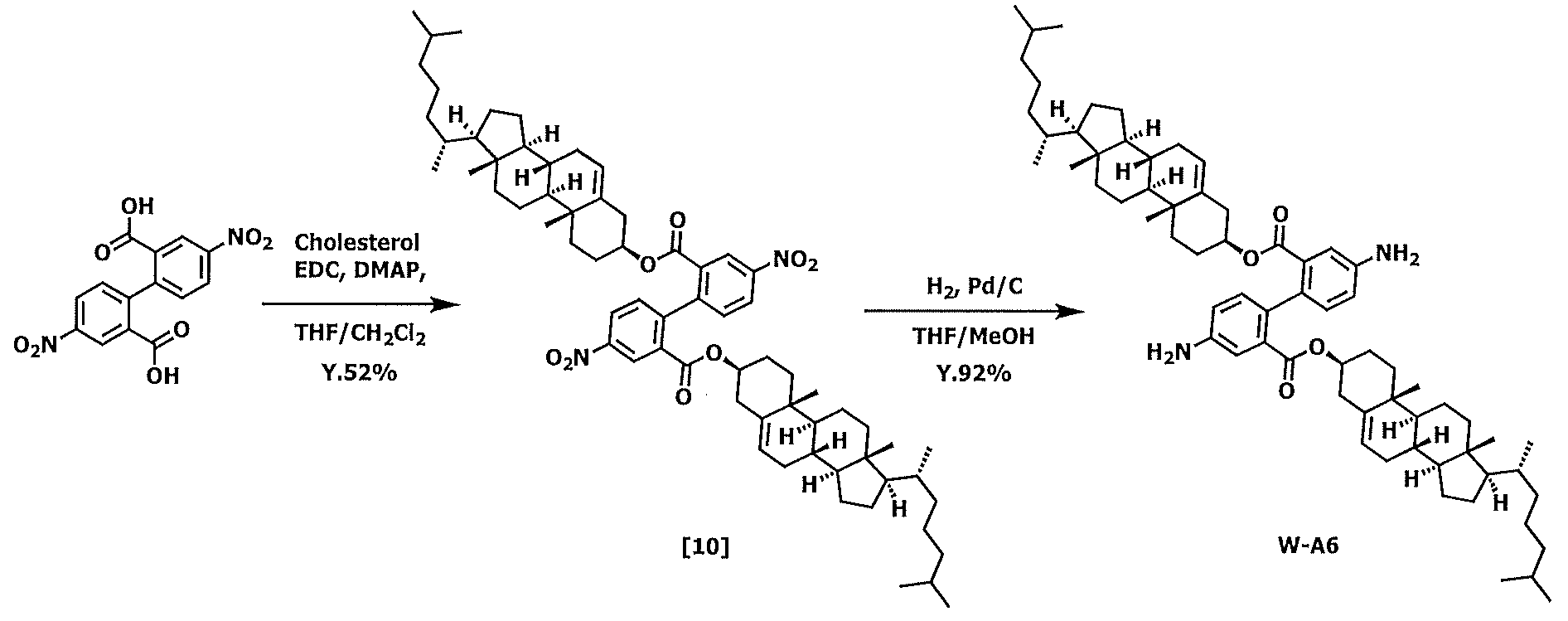
テトラヒドロフラン(113g)及び塩化メチレン(113g)中、4,4’-ジニトロ-2,2’-ジフェン酸(25.0g、75.4mmol)とコレステロール(61.7g、160mmol)、4-ジメチルアミノピリジン(0.919g、7.54mmol)、1-(3-ジメチルアミノプロピル)-3-エチルカルボジイミド塩酸塩(33.6g、175mmol)を仕込み、窒素雰囲気室温条件下で18時間反応させた。反応終了後、反応溶液に塩化メチレン(375g)を加え、有機相を飽和食塩水(200g)で3回洗浄後、有機相を硫酸マグネシウム脱水処理した。続いて、得られた溶液を減圧濃縮することで褐色オイル状化合物とし、酢酸エチル(200g)及びイソプロピルアルコール(200g)混合溶液を加えて結晶を析出させ、ろ過する事で粗物を得た。得られた粗物をクロロホルム(500g)及びメタノール(600g)混合溶液で2度再結晶し、ろ過、乾燥する事で化合物[10]を得た(収量:41.8g、39.1mmol、収率:52%)。
1H-NMR(400MHz) in CDCl3:0.67-2.21ppm(m,86H), 4.58-4.63ppm(m,2H), 5.31-5.33ppm(m,2H), 7.37-7.39ppm(m,2H), 8.42-8.44ppm(m,2H), 8.93ppm(m,2H)
テトラヒドロフラン(320g)及びメタノール(80.8g)中、化合物[10](40.4g、37.8mmol)と5%パラジウムカーボン(3.03g)を仕込み、水素雰囲気室温条件下で約3日間反応させた。反応終了後、ろ過することでパラジウムカーボンを除去し、減圧濃縮する事で内部総重量を112gとした。得られた溶液にメタノール(160g)を加えて結晶を析出させ、ろ過、乾燥する事でW-A6を得た(収量:35.0g、34.7mmol、収率:92%)。
1H-NMR(400MHz) in CDCl3:0.66-2.17ppm(m,86H), 3.74ppm(br,4H), 4.50-4.56ppm(m,2H), 5.28ppm(m,2H), 6.78-6.80ppm(m,2H), 6.95-6.97ppm(m,2H), 7.26-7.28ppm(m,2H)
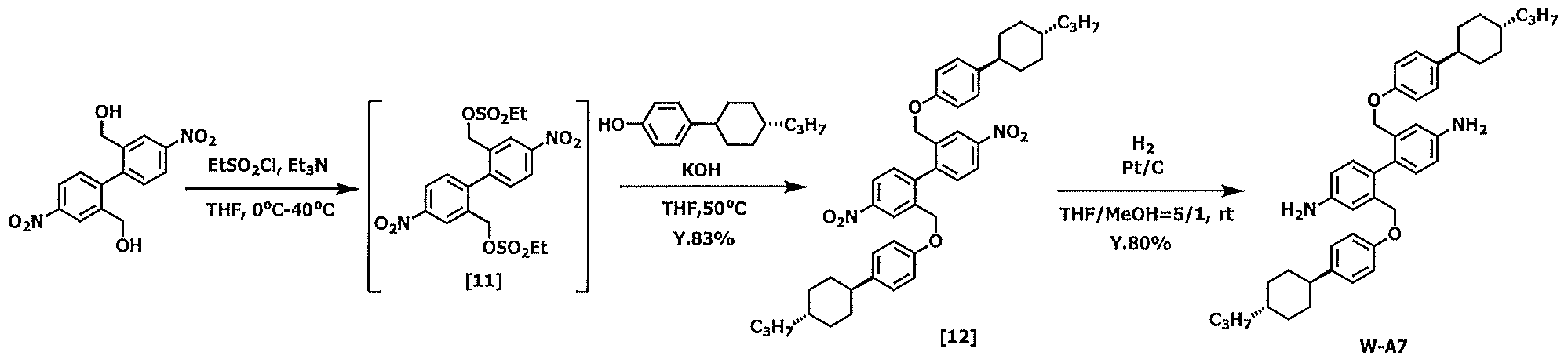
テトラヒドロフラン(152g)中、4,4’-ジニトロ-1,1’-ビフェニル-2,2’-ジメタノール(40.0g、132mmol)とトリエチルアミン(36.6g、362mmol)を仕込み、窒素雰囲気下氷冷条件にてエタンスルホニルクロリド(44.4g、 345mmol)を滴下した。滴下終了後、反応温度を40℃で3時間撹拌する事で化合物[11]を得た。続いて、テトラヒドロフラン(240g)に溶解させたp-(trans-4-プロピルシクロヘキシル)フェノール(63.1g、289mmol)と純水(228g)に溶解させた水酸化カリウム(85.0%品、45.1g、683mmol)を化合物[11]の反応溶液に加え、50℃に加熱し39時間反応させた。反応終了後、純水(1500g)中に反応液を注ぎ込み、粗物を析出させ、濾過および純水洗浄を行った。続いて、純水(378g)及びメタノール(378g)混合溶液でスラリー洗浄を行い、再度濾過およびメタノールで洗浄した。得られた結晶粗物をテトラヒドロフラン(600g)に60℃加熱溶解させ、メタノール(400g)を加えて結晶を析出させ、室温条件下で撹拌後、濾過、乾燥する事で化合物[12]を得た(収量:77.7g、110mmol、収率:83%)。
1H-NMR(400MHz) in CDCl3:0.87-0.97ppm(m,6H), 0.97-1.05ppm(m,4H), 1.12-1.62ppm(m,14H), 1.81-1.87ppm(m,8H), 2.34-2.40ppm(m,2H), 4.77ppm(s,4H),6.67-6.69ppm(m,4H), 7.00-7.05ppm(m,4H), 7.40ppm(d,2H,J=8.0Hz), 8.25ppm(dd,2H,J=2.0Hz,J=8.4Hz), 8.54ppm(s,2H).
テトラヒドロフラン(741g)及びメタノール(155g)中、化合物[12](77.7g、110mmol)と3%プラチナカーボン(6.22g)を仕込み、水素雰囲気下室温条件で約2日間反応させた。反応終了後、濾過することでプラチナカーボンを除去し、濾液を減圧濃縮した。得られた濃縮粗物にテトラヒドロフラン(122g)を加えて60℃加熱溶解させ、アセトニトリル(159g)を加えて結晶を析出させ、室温条件下で撹拌後、濾過、乾燥する事でW-A7を得た(収量:58.6g、88.1mmol、収率:80%)。
1H-NMR(400MHz) in CDCl3:0.86-0.91ppm(m,6H), 0.96-1.06ppm(m,4H), 1.12-1.44ppm(m,14H), 1.81-1.84ppm(m,8H), 2.32-2.34ppm(m,2H), 3.71-3.75ppm(br,4H), 4.67-4.76ppm(q,4H,J=10.0Hz), 6.61-6.64ppm(m,2H), 6.71-6.75ppm(m,4H), 6.91-6.92ppm(m,2H), 6.97-7.03ppm(m,6H).
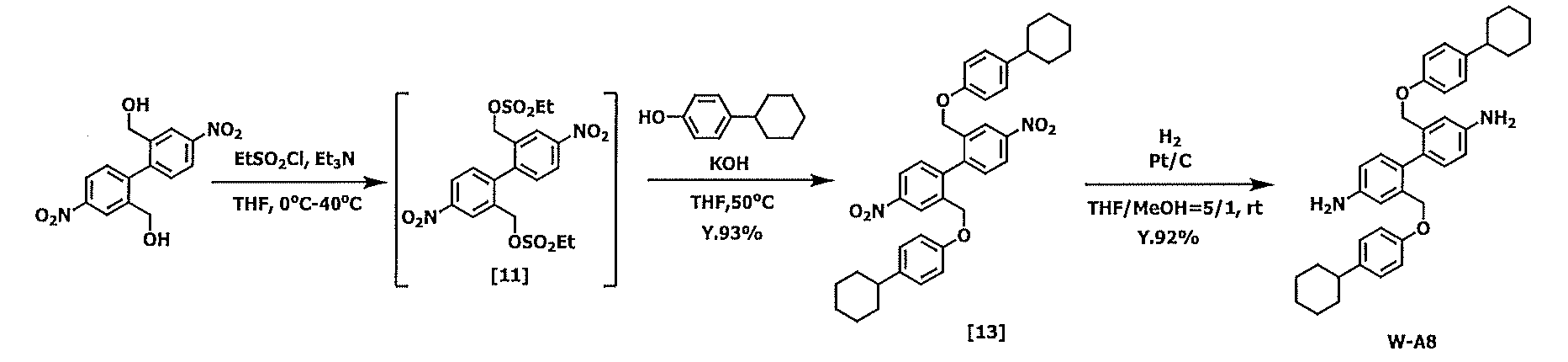
テトラヒドロフラン(156g)中、4,4’-ジニトロ-1,1’-ビフェニル-2,2’-ジメタノール(39.2g、129mmol)とトリエチルアミン(35.0g、346mmol)を仕込み、窒素雰囲気下氷冷条件にてエタンスルホニルクロリド(34.8g、 271mmol)を滴下した。滴下後、反応温度を40℃で3時間撹拌する事で化合物[11]を得た。続いて、テトラヒドロフラン(230g)に溶解させた4-シクロヘキシルフェノール(50.0g、284mmol)と純水(231g)に溶解させた水酸化カリウム(85.0%品、47.1g、714mmol)を化合物[11]の反応溶液に加え、50℃に加熱し39時間反応させた。反応終了後、純水(660g)中に反応液を注ぎ込み、クロロホルム(588g×4回)で分液抽出した。回収した有機相を減圧濃縮し、粗物をテトラヒドロフラン(118g)に60℃加熱溶解させ、メタノール(235g)を加えて結晶を析出させ、室温条件で撹拌後、濾過した。結晶を純水/メタノール=1/1混合溶媒(118g)、メタノール(118g×2回)でケーキ洗浄し、乾燥する事で化合物[13]を得た(収量:67.6g、120mmol、収率:93%)。
1H-NMR(400MHz) in CDCl3:1.18-1.30ppm(m,2H), 1.31-1.38ppm(m,8H), 1.71-1.75ppm(m,2H), 1.80-1.82ppm(m,8H), 2.36-2.44ppm(m,2H), 4.77ppm(s,4H),6.67-6.70ppm(m,4H), 7.03-7.06ppm(m,4H), 7.40ppm(d,2H,J=8.4Hz), 8.24ppm(d,1H,J=2.0Hz), 8.26ppm(d,1H,J=2.0Hz), 8.54ppm(d,2H,J=2.0Hz).
テトラヒドロフラン(325g)及びメタノール(65.0g)中、化合物[13](65.0g、105mmol)と3%プラチナカーボン(5.20g)を仕込み、水素雰囲気下室温条件で約2日間反応させた。反応終了後、濾過することでプラチナカーボンを除去し、減圧濃縮した。粗物をテトラヒドロフラン(70.4g)に60℃加熱溶解させ、メタノール(130g)を加えて結晶を析出させ、室温条件下で撹拌後、濾過した。結晶をメタノール(130g×2回)でケーキ洗浄し、乾燥する事でW-A8を得た(収量:54.2g、96.7mmol、収率:92%)。
1H-NMR(400MHz) in CDCl3:1.19-1.28ppm(m,2H), 1.31-1.41ppm(m,8H), 1.70-1.73ppm(m,2H), 1.79-1.87ppm(m,8H), 1.87-2.39ppm(m,2H), 3.60-3.79ppm(br,4H), 4.67-4.76ppm(q,4H,J=9.6Hz), 6.61-6.64ppm(m,2H), 6.72-6.75ppm(m,4H), 6.91-6.92ppm(d,2H,J=2.4Hz), 6.97-7.03ppm(m,6H).

テトラヒドロフラン(83.6g)中、4,4’-ジニトロ-1,1’-ビフェニル-2,2’-ジメタノール(20.9g,68.7mmol)とトリエチルアミン(15.3g、151mmol)を仕込み、窒素雰囲気氷冷条件にてエタンスルホニルクロリド(18.6g、145mmol)を滴下した。滴下後、反応温度を40℃で3時間撹拌する事で化合物[11]を得た。続いて、テトラヒドロフラン(188g)に溶解させた4-[(trans, trans)-4‘-ペンチル[1,1’-ビシクロヘキシル]-4-イル]フェノール(48.6g、149mmol)と純水(119.2g)に溶解させた水酸化カリウム(85.0%品、20.9g、317mmol)を化合物[11]の反応溶液に加え、20時間反応させた。反応終了後、純水(800g)中に反応液を注ぎ込み、粗物を析出させ、ろ過、純水洗浄を行った。続いて、純水(100g)及びメタノール(100g)混合溶液でスラリー洗浄を行い、再度ろ過、純水及びメタノールで洗浄した。粗物をテトラヒドロフラン(400g)に60℃加熱溶解させ、メタノール(100g)を加えて結晶を析出させ、室温条件下で撹拌後、ろ過、乾燥する事で化合物[14]を得た(収量:49.7g、53.9mmol、収率:78%)。
1H-NMR(400MHz) in CDCl3:0.83-1.34ppm(m,44H), 1.71-1.85ppm(m,16H), 2.29-2.36ppm(m,2H), 4.77ppm(s,4H), 6.66-6.68ppm(m,4H), 7.01-7.03ppm(m,4H), 7.39ppm(d,2H,J=8.0Hz), 8.24ppm(dd,2H,J=2.0Hz,J=8.4Hz), 8.54ppm(d,2H,J=2.4Hz)
テトラヒドロフラン(361g)及びメタノール(90.2g)中、化合物[14](45.1g、48.7mmol)と3%プラチナカーボン(3.60g)を仕込み、0.4MPa水素圧雰囲気40℃条件下で約9時間反応させた。反応終了後、ろ過、減圧濃縮により溶媒を除去し、メタノール(135g)を加えてスラリー洗浄を実施した。続いて、ろ過により得られた粗物をテトラヒドロフラン(180g)に60℃加熱溶解させ、酢酸エチル(120g)を加え、室温条件下で撹拌する事で結晶を析出させ、ろ過、乾燥する事でW-A9を得た(収量:17.8g、20.7mmol、収率:43%)。
1H-NMR(400MHz) in CDCl3:0.88-1.34ppm(m,44H), 1.71-1.86ppm(m,16H), 2.29-2.36ppm(m,2H), 3.69ppm(br,4H), 4.70ppm(d,2H,J=12.4Hz), 4.76ppm(d,2H,J=12.4Hz), 6.62ppm(dd,2H,J=2.4Hz,J=8.0Hz), 6.71-6.73ppm(m,4H), 6.91ppm(d,2H,J=2.4Hz), 6.96-6.99ppm(m,6H)
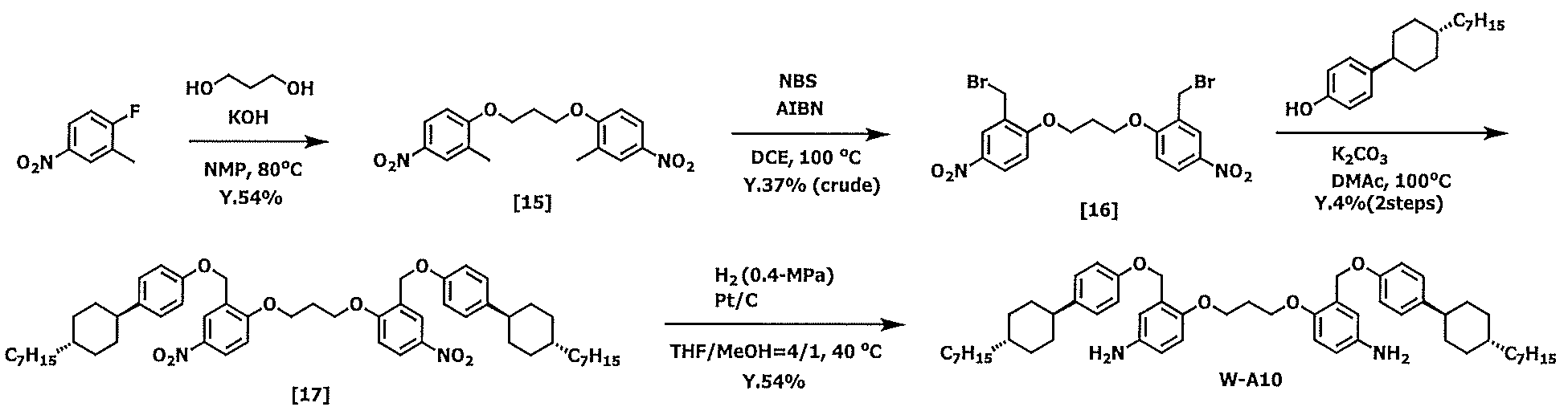
N-メチルピロリドン(540g)中、2-フルオロ-5-ニトロトルエン(91.0g、587mmol)、1,3-プロパンジオール(22.3g、291mmol)、水酸化カリウム(85.0%品、71.6g、1.08mol)を仕込み、窒素雰囲気下80℃で20時間撹拌した。反応終了後、純水(1440g)を加えて水割り晶析を行い、濾過後、結晶を純水(540g×3回)、メタノール(360g×2回)でそれぞれケーキ洗浄し、乾燥する事で化合物[15]を得た(収量:57.2g、165mmol、収率:54%)。
1,2-ジクロロエタン(540g)中、化合物[15](40.0g、116mmol)、N-ブロモスクシンイミド(45.2g、254mmol)、2,2’-アゾビス(イソブチロニトリル)(3.79g、23.1mmol)を仕込み、窒素置換した後100℃で約7日間撹拌した。反応液を濾過し不溶のコハク酸イミドを除去後、濾液に酢酸エチル(250g)を加え、純水(250g×3回)で分液抽出および洗浄を行い、有機相を回収して濃縮した。得られた濃縮物に対し酢酸エチル(346g)およびヘキサン(395g)で晶析および濾過し、結晶を回収した。さらに、濾液を濃縮し、クロロホルム(223g)およびヘキサン(434g)で再度晶析および濾過し、それぞれ乾燥する事で化合物[16]の粗物を得た(粗収量:21.3g,粗収率:37%)。
N,N-ジメチルアセトアミド(96.0g)中、p-(trans-4-ヘプチルシクロヘキシル)フェノール(24.0g、87.5mmol)、炭酸カリウム(12.1g、87.5mmol)を仕込み100℃で撹拌した。N,N-ジメチルアセトアミド(54.0g)に溶解させた化合物[16]粗物(20.0g)を滴下し、24時間反応させた。反応液から析出した結晶を濾過で分離し、メタノール(66.0g)、純水(67.0g)でそれぞれスラリー洗浄した後再度濾過、乾燥する事で化合物[17]を得た(収量:4.23g、4.75mmol、収率:4.1%(仕込み化合物[15]を基準とした収率))。
1H-NMR(400MHz) in CDCl3:0.89ppm(t,6H,J=6.8Hz), 0.99-1.07ppm(m,4H), 1.19-1.43ppm(m,30H), 1.84-1.87ppm(m,8H), 2.36-2.44ppm(m,4H), 4.29ppm(t,4H,J=6.0Hz), 5.04ppm(s,4H), 6.84-6.90ppm(m,6H), 7.10-7.13ppm(m,4H), 8.17ppm(dd,2H,J=3.2Hz,9.0Hz), 8.38ppm(d,2H,J=2.8Hz).
テトラヒドロフラン(28.8g)及びメタノール(7.5g)中、化合物[17](3.60g、4.04mmol)と3%プラチナカーボン(0.290g)を仕込み、水素雰囲気0.4MPa加圧条件下、40℃で3時間撹拌した。反応終了後、濾過することでプラチナカーボンを除去し、減圧濃縮した。粗物を酢酸エチルおよびメタノールを加えて結晶を析出させ、室温条件下で撹拌後、濾過し、乾燥する事でW-A10を得た(収量:2.05g、2.47mmol、収率:54%)。
1H-NMR(400MHz) in CDCl3:0.89ppm(t,6H,J=6.8Hz), 0.98-1.06ppm(m,4H), 1.18-1.44ppm(m,30H), 1.83-1.86ppm(m,8H), 2.15-2.21ppm(m,2H), 2.36-2.42ppm(m,2H), 3.42ppm(br,4H), 4.09ppm(t,4H,J=6.0Hz), 5.00ppm(s,4H), 6.55-6.57ppm(m,2H), 6.70ppm(d,2H,J=8.8Hz), 6.82-6.89ppm(m,6H), 7.07-7.10ppm(m,4H).
[合成例1]
D2(2.50g,10.0mmol)、W-A1(3.03g,4.00mmol)、C1(1.73g,16.0mmol)をNMP(36.2g)中で混合し、60℃で3時間反応させた後、D1(1.78g,9.10mmol)を加え、40℃で3時間反応させ、樹脂固形分濃度20質量%のポリアミド酸溶液を得た。このポリアミド酸溶液の粘度を測定したところ、840mPa・sであった。
得られたポリアミド酸溶液(20.0g)に、NMPを加え6.5質量%に希釈した後、イミド化触媒として無水酢酸(4.43g)及びピリジン(1.37g)を加え、80℃で3時間反応させた。この反応溶液をメタノール(382ml)中に投入し、得られた沈殿物を濾別した。この沈殿物をメタノールで洗浄し、100℃で減圧乾燥しポリイミド粉末(1)を得た。このポリイミドのイミド化率は76.4%であり、数平均分子量は16,165であり、重量平均分子量は49,988であった。
D2(2.50g,10.0mmol)、W-A2(3.14g,4.00mmol)、C1(1.84g,16.0mmol)をNMP(36.9g)中で混合し、60℃で3時間反応させた後、D1(1.84g,9.38mmol)を加え、40℃で3時間反応させ、樹脂固形分濃度20質量%のポリアミド酸溶液を得た。このポリアミド酸溶液の粘度を測定したところ、658mPa・sであった。
得られたポリアミド酸溶液(20.0g)に、NMPを加え6.5質量%に希釈した後、イミド化触媒として無水酢酸(4.38g)及びピリジン(1.36g)を加え、80℃で3時間反応させた。この反応溶液をメタノール(382ml)中に投入し、得られた沈殿物を濾別した。この沈殿物をメタノールで洗浄し、100℃で減圧乾燥しポリイミド粉末(2)を得た。このポリイミドのイミド化率は75.8%であり、数平均分子量は15,430であり、重量平均分子量は45,756であった。
D2(2.50g,10.0mmol)、W-A3(3.25g,4.00mmol)、C1(1.73g,16.0mmol)をNMP(37.3g)中で混合し、60℃で3時間反応させた後、D1(1.84g,9.38mmol)を加え、40℃で3時間反応させ、樹脂固形分濃度20質量%のポリアミド酸溶液を得た。このポリアミド酸溶液の粘度を測定したところ、656mPa・sであった。
得られたポリアミド酸溶液(20.0g)に、NMPを加え6.5質量%に希釈した後、イミド化触媒として無水酢酸(4.32g)及びピリジン(1.34g)を加え、80℃で3時間反応させた。この反応溶液をメタノール(382ml)中に投入し、得られた沈殿物を濾別した。この沈殿物をメタノールで洗浄し、100℃で減圧乾燥しポリイミド粉末(3)を得た。このポリイミドのイミド化率は74.7%であり、数平均分子量は13,340であり、重量平均分子量は41,948であった。
D2(1.50g、 6.0mmol)、C2(1.83g、12.0mmol)、C3(2.18g、9.0mmol)、A1(3.43g、9.0mmol)をNMP(41.1g)中で溶解し、60℃で3時間反応させたのち、D3(1.31g、6.0mmol)、続いてD1(3.47g、17.7mmol)とNMP(13.71g)を加え、25℃で10時間反応させポリアミック酸溶液を得た。
このポリアミック酸溶液(50g)にNMPを加え6.5質量%に希釈した後、イミド化触媒として無水酢酸(11.1g)、およびピリジン(3.4g)を加え、60℃で3時間反応させた。この反応溶液をメタノール(700ml)に投入し、得られた沈殿物を濾別した。この沈殿物をメタノールで洗浄し、100℃で減圧乾燥しポリイミド粉末(4)を得た。このポリイミドのイミド化率は79%であり、数平均分子量は11000、重量平均分子量は24000であった。
D2(2.88g,11.5mmol)、A1(3.50g,9.20mmol)、C1(1.49g,13.8mmol)をNMP(40.2g)中で混合し、60℃で3時間反応させた後、D1(2.19g,11.2mmol)を加え、40℃で3時間反応させ、樹脂固形分濃度20質量%のポリアミド酸溶液を得た。このポリアミド酸溶液の粘度を測定したところ、680mPa・sであった。
得られたポリアミド酸溶液(20.0g)に、NMPを加え6.5質量%に希釈した後、イミド化触媒として無水酢酸(4.64g)及びピリジン(1.44g)を加え、80℃で3時間反応させた。この反応溶液をメタノール(382ml)中に投入し、得られた沈殿物を濾別した。この沈殿物をメタノールで洗浄し、100℃で減圧乾燥しポリイミド粉末(R1)を得た。このポリイミドのイミド化率は75.1%であり、数平均分子量は15,322であり、重量平均分子量は45,800であった。
D2(2.50g,10.0mmol)、W-A4(4.62g,6.00mmol)、C1(1.51g,14.0mmol)をNMP(24.5g)中で混合し、60℃で3時間反応させた後、D1(1.92g,9.80mmol)を加え、40℃で3時間反応させ、樹脂固形分濃度20質量%のポリアミド酸溶液を得た。このポリアミド酸溶液の粘度を測定したところ、783mPa・sであった。
得られたポリアミド酸溶液(20.0g)に、NMPを加え6.5質量%に希釈した後、イミド化触媒として無水酢酸(3.86g)及びピリジン(1.20g)を加え、80℃で3時間反応させた。この反応溶液をメタノール(233ml)中に投入し、得られた沈殿物を濾別した。この沈殿物をメタノールで洗浄し、100℃で減圧乾燥しポリイミド粉末(5)を得た。このポリイミドのイミド化率は76.7%であり、数平均分子量は14,399であり、重量平均分子量は38,573であった。
D2(2.50g,10.0mmol)、W-A5(4.70g,6.00mmol)、C1(1.51g,14.0mmol)をNMP(24.9g)中で混合し、60℃で3時間反応させた後、D1(1.92g,9.80mmol)を加え、40℃で3時間反応させ、樹脂固形分濃度20質量%のポリアミド酸溶液を得た。このポリアミド酸溶液の粘度を測定したところ、769mPa・sであった。
得られたポリアミド酸溶液(20.0g)に、NMPを加え6.5質量%に希釈した後、イミド化触媒として無水酢酸(3.83g)及びピリジン(1.19g)を加え、80℃で3時間反応させた。この反応溶液をメタノール(232ml)中に投入し、得られた沈殿物を濾別した。この沈殿物をメタノールで洗浄し、100℃で減圧乾燥しポリイミド粉末(6)を得た。このポリイミドのイミド化率は73.4%であり、数平均分子量は13,841であり、重量平均分子量は37,284であった。
D2(6.26g,25.0mmol)、W-A6(5.05g,5.00mmol)、C1(4.87g,45.0mmol)をNMP(62.0g)中で混合し、60℃で3時間反応させた後、D1(4.51g,23.0mmol)を加え、40℃で3時間反応させ、樹脂固形分濃度20質量%のポリアミド酸溶液を得た。このポリアミド酸溶液の粘度を測定したところ、658mPa・sであった。
得られたポリアミド酸溶液(75.0g)に、NMPを加え6.5質量%に希釈した後、イミド化触媒として無水酢酸(18.2g)及びピリジン(5.6g)を加え、80℃で3時間反応させた。この反応溶液をメタノール(1000ml)中に投入し、得られた沈殿物を濾別した。この沈殿物をメタノールで洗浄し、100℃で減圧乾燥しポリイミド粉末(7)を得た。このポリイミドのイミド化率は72.9%であり、数平均分子量は13,362であり、重量平均分子量は38,725であった。
D2(6.26g,25.0mmol)、W-A7(8.06g,12.5mmol)、C1(4.06g,37.5mmol)をNMP(69.2g)中で混合し、60℃で3時間反応させた後、D1(4.71g,24.0mmol)を加え、40℃で3時間反応させ、樹脂固形分濃度20質量%のポリアミド酸溶液を得た。このポリアミド酸溶液の粘度を測定したところ、725mPa・sであった。
得られたポリアミド酸溶液(75.0g)に、NMPを加え6.5質量%に希釈した後、イミド化触媒として無水酢酸(16.5g)及びピリジン(5.1g)を加え、80℃で3時間反応させた。この反応溶液をメタノール(1000ml)中に投入し、得られた沈殿物を濾別した。この沈殿物をメタノールで洗浄し、100℃で減圧乾燥しポリイミド粉末(8)を得た。このポリイミドのイミド化率は73.1%であり、数平均分子量は13,628であり、重量平均分子量は39,937であった。
D2(6.26g,25.0mmol)、W-A8(7.01g,12.5mmol)、C1(4.06g,37.5mmol)をNMP(66.1g)中で混合し、60℃で3時間反応させた後、D1(4.71g,24.0mmol)を加え、40℃で3時間反応させ、樹脂固形分濃度20質量%のポリアミド酸溶液を得た。このポリアミド酸溶液の粘度を測定したところ、674mPa・sであった。
得られたポリアミド酸溶液(75.0g)に、NMPを加え6.5質量%に希釈した後、イミド化触媒として無水酢酸(17.2g)及びピリジン(5.3g)を加え、80℃で3時間反応させた。この反応溶液をメタノール(1000ml)中に投入し、得られた沈殿物を濾別した。この沈殿物をメタノールで洗浄し、100℃で減圧乾燥しポリイミド粉末(9)を得た。このポリイミドのイミド化率は73.2%であり、数平均分子量は10,425であり、重量平均分子量は37,759であった。
D2(6.26g,25.0mmol)、W-A9(2.16g,2.5mmol)、C1(5.14g,47.5mmol)をNMP(54.8g)中で混合し、60℃で3時間反応させた後、D1(4.71g,24.0mmol)を加え、40℃で3時間反応させ、樹脂固形分濃度20質量%のポリアミド酸溶液を得た。このポリアミド酸溶液の粘度を測定したところ、823mPa・sであった。
得られたポリアミド酸溶液(75.0g)に、NMPを加え6.5質量%に希釈した後、イミド化触媒として無水酢酸(20.7g)及びピリジン(6.4g)を加え、80℃で3時間反応させた。この反応溶液をメタノール(1000ml)中に投入し、得られた沈殿物を濾別した。この沈殿物をメタノールで洗浄し、100℃で減圧乾燥しポリイミド粉末(10)を得た。このポリイミドのイミド化率は71.5%であり、数平均分子量は13,732であり、重量平均分子量は38,921であった。
D2(2.50g,10.0mmol)、W-A10(3.31g,4.00mmol)、C1(1.73g,16.0mmol)をNMP(30.2g)中で混合し、60℃で3時間反応させた後、D1(1.84g,9.40mmol)を加え、40℃で3時間反応させ、樹脂固形分濃度20質量%のポリアミド酸溶液を得た。このポリアミド酸溶液の粘度を測定したところ、695mPa・sであった。
得られたポリアミド酸溶液(20.0g)に、NMPを加え6.5質量%に希釈した後、イミド化触媒として無水酢酸(4.35g)及びピリジン(1.35g)を加え、80℃で3時間反応させた。この反応溶液をメタノール(235ml)中に投入し、得られた沈殿物を濾別した。この沈殿物をメタノールで洗浄し、100℃で減圧乾燥しポリイミド粉末(11)を得た。このポリイミドのイミド化率は76.1%であり、数平均分子量は12,913であり、重量平均分子量は39,182であった。
D2(25.0g,100mmol)、W-A1(37.9g,50.0mmol)、C3(12.1g,50.0mmol)、C8(33.0g,100mmol)をNMP(432g)中で混合し、60℃で3時間反応させた後、D1(18.8g,96.0mmol)を加え、40℃で3時間反応させ、樹脂固形分濃度20質量%のポリアミド酸溶液を得た。このポリアミド酸溶液の粘度を測定したところ、721mPa・sであった。
得られたポリアミド酸溶液(100g)に、NMPを加え6.5質量%に希釈した後、イミド化触媒として無水酢酸(16.0g)及びピリジン(4.96g)を加え、80℃で3時間反応させた。この反応溶液をメタノール(1150ml)中に投入し、得られた沈殿物を濾別した。この沈殿物をメタノールで洗浄し、100℃で減圧乾燥しポリイミド粉末(12)を得た。このポリイミドのイミド化率は75.1%であり、数平均分子量は14,736、重量平均分子量は39,645であった。
D2(25.0g,100mmol)、W-A1(37.9g,50.0mmol)、C6(20.5g,60.0mmol)、C8(6.61g,20,0mmol)、C7(27.9g,70,0mmol)をNMP(471g)中で混合し、60℃で3時間反応させた後、D1(18.8g,96.0mmol)を加え、40℃で3時間反応させ、樹脂固形分濃度20質量%のポリアミド酸溶液を得た。このポリアミド酸溶液の粘度を測定したところ、771mPa・sであった。
得られたポリアミド酸溶液(100g)に、NMPを加え6.5質量%に希釈した後、イミド化触媒として無水酢酸(14.9g)及びピリジン(4.63g)を加え、80℃で3時間反応させた。この反応溶液をメタノール(1150ml)中に投入し、得られた沈殿物を濾別した。この沈殿物をメタノールで洗浄し、60℃で減圧乾燥しポリイミド粉末(13)を得た。このポリイミドのイミド化率は76.2%であり、数平均分子量は15,835、重量平均分子量は39,145であった。
D2(25.0g,100mmol)、W-A1(37.9g,50.0mmol)、C6(17.0g,50.0mmol)、C8(16.5g,50.0mmol)、C3(12.1g,50.0mmol)をNMP(434g)中で混合し、60℃で3時間反応させた後、D1(18.8g,96.0mmol)を加え、40℃で3時間反応させ、樹脂固形分濃度20質量%のポリアミド酸溶液を得た。このポリアミド酸溶液の粘度を測定したところ、701mPa・sであった。
得られたポリアミド酸溶液(100g)に、NMPを加え6.5質量%に希釈した後、イミド化触媒として無水酢酸(16.0g)及びピリジン(4.97g)を加え、80℃で3時間反応させた。この反応溶液をメタノール(1150ml)中に投入し、得られた沈殿物を濾別した。この沈殿物をメタノールで洗浄し、60℃で減圧乾燥しポリイミド粉末(14)を得た。このポリイミドのイミド化率は74.8%であり、数平均分子量は17,635、重量平均分子量は41,647であった。
D4(43.9g,196mmol)、W-A1(30.3g,40.0mmol)、C4(13.9g,70.0mmol)、C8(16.5g,50.0mmol)、C5(7.59g,40.0mmol)をNMP(455g)中で混合し、60℃で15時間反応させ、樹脂固形分濃度20質量%のポリアミド酸溶液を得た。このポリアミド酸溶液の粘度を測定したところ、662mPa・sであった。
得られたポリアミド酸溶液(100g)に、NMPを加え6.5質量%に希釈した後、イミド化触媒として無水酢酸(17.9g)及びピリジン(5.55g)を加え、100℃で3時間反応させた。この反応溶液をメタノール(1160ml)中に投入し、得られた沈殿物を濾別した。この沈殿物をメタノールで洗浄し、60℃で減圧乾燥しポリイミド粉末(15)を得た。このポリイミドのイミド化率は71.7%であり、数平均分子量は13,329、重量平均分子量は40,527であった。
D2(25.0g、100mmol)、C2(21.3g、140mmol)、C10(24.6g、60.0mmol)をNMP(284g)中で溶解し、60℃で3時間反応させたのち、D5(14.3g、40.0mmol)、続いてD1(11.0g、56.0mmol)とNMP(100g)を加え、25℃で10時間反応させポリアミック酸溶液を得た。
このポリアミック酸溶液(100g)にNMPを加え6.5質量%に希釈した後、イミド化触媒として無水酢酸(21.0g)、およびピリジン(6.52g)を加え、80℃で3時間反応させた。この反応溶液をメタノール(1170ml)に投入し、得られた沈殿物を濾別した。この沈殿物をメタノールで洗浄し、100℃で減圧乾燥しポリイミド粉末(16)を得た。このポリイミドのイミド化率は75.8%であり、数平均分子量は14679、重量平均分子量は35747であった。
D2(25.0g、100mmol)、C6(50.0g、120mmol)、C9(15.1g、60.0mmol)、W-A1(15.1g、20.0mmol)をNMP(385g)中で溶解し、60℃で3時間反応させたのち、D1(18.8g、96.0mmol)とNMP(75.3g)を加え、40℃で3時間反応させ、樹脂固形分濃度20質量%のポリアミド酸溶液を得た。このポリアミド酸溶液の粘度を測定したところ、753mPa・sであった。
このポリアミック酸溶液(100g)にNMPを加え6.5質量%に希釈した後、イミド化触媒として無水酢酸(17.6g)、およびピリジン(5.47g)を加え、80℃で3時間反応させた。この反応溶液をメタノール(1160ml)に投入し、得られた沈殿物を濾別した。この沈殿物をメタノールで洗浄し、60℃で減圧乾燥しポリイミド粉末(17)を得た。このポリイミドのイミド化率は71.1%であり、数平均分子量は17635、重量平均分子量は38427であった。
D2(6.26g,25.0mmol)、A2(12.23g,30.0mmol)、C1(2.16g,20.0mmol)をNMP(76.7g)中で混合し、80℃で5時間反応させた後、D1(4.90g,25.0mmol)を加え、40℃で12時間反応させ、樹脂固形分濃度20質量%のポリアミド酸溶液を得た。このポリアミド酸溶液の粘度を測定したところ、338mPa・sであった。
得られたポリアミド酸溶液(75.0g)に、NMPを加え6.5質量%に希釈した後、イミド化触媒として無水酢酸(15.0g)及びピリジン(4.6g)を加え、80℃で3時間反応させた。この反応溶液をメタノール(1000ml)中に投入し、得られた沈殿物を濾別した。この沈殿物をメタノールで洗浄し、100℃で減圧乾燥しポリイミド粉末(R2)を得た。このポリイミドのイミド化率は73.0%であり、数平均分子量は10,175であり、重量平均分子量は23,642であった。
D2(6.26g,25.0mmol)、A3(7.06g,25.0mmol)、C1(2.70g,25.0mmol)をNMP(62.8g)中で混合し、80℃で5時間反応させた後、D1(4.90g,25.0mmol)を加え、40℃で12時間反応させ、樹脂固形分濃度20質量%のポリアミド酸溶液を得た。このポリアミド酸溶液の粘度を測定したところ、446mPa・sであった。
得られたポリアミド酸溶液(75.0g)に、NMPを加え6.5質量%に希釈した後、イミド化触媒として無水酢酸(18.3g)及びピリジン(5.7g)を加え、80℃で3時間反応させた。この反応溶液をメタノール(1000ml)中に投入し、得られた沈殿物を濾別した。この沈殿物をメタノールで洗浄し、100℃で減圧乾燥しポリイミド粉末(R3)を得た。このポリイミドのイミド化率は72.2%であり、数平均分子量は11,636であり、重量平均分子量は24,624であった。
合成例および比較合成例にて得られたポリイミド粉末の組成を表1にまとめる。
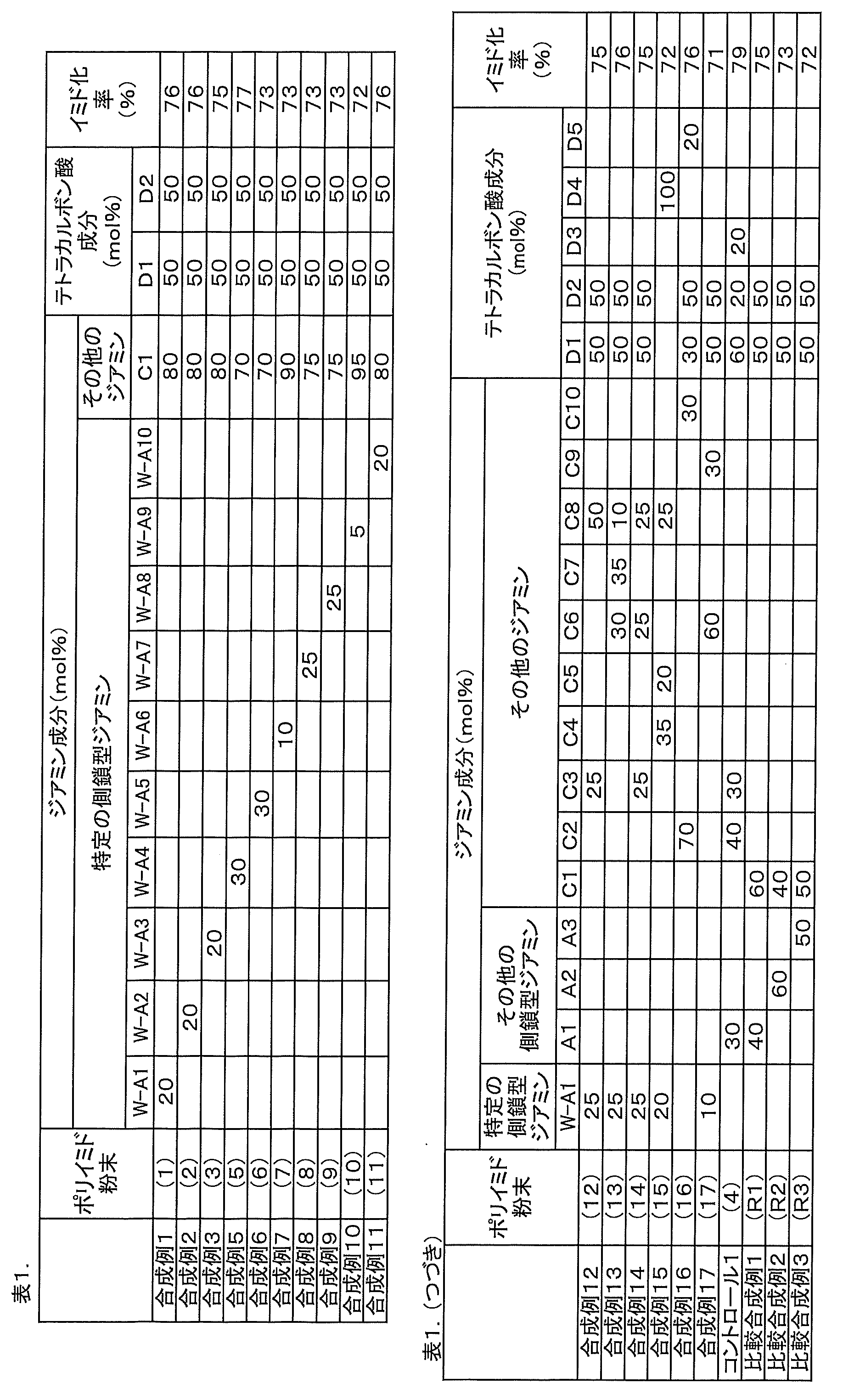
実施例及び比較例では、液晶配向処理剤の調製例を記載する。実施例及び比較例で得られた液晶配向処理剤を用い、液晶表示素子の作製、及び各種評価を行った。
合成例1で得られたポリイミド粉末(1)(3.00g)に、NMP(28.2g)を加え70℃にて24時間撹拌して溶解させた。この溶液に、NMP(g)、BCS(18.8g)を加え、室温で5時間攪拌して、液晶配向処理剤(V-1)を得た。この液晶配向処理剤に、濁りや析出などの異常は見られず、均一な溶液であることが確認された。
実施例1において、ポリイミド粉末(1)の代わりにポリイミド粉末(2)及び(3)を用いて、実施例1と同様の手順により、液晶配向処理剤(V-2)及び(V-3)を得た。この液晶配向処理剤に、濁りや析出などの異常は見られず、均一な溶液であることが確認された。
実施例1において、ポリイミド粉末(1)の代わりに、コントロール合成例1で得たポリイミド粉末(4)を用いて、実施例1と同様の手順により、液晶配向処理剤(V-4)を得た。この液晶配向処理剤に、濁りや析出などの異常は見られず、均一な溶液であることが確認された。
実施例1から得られた液晶配向処理剤(V-1)を第一成分として3.0g、コントロール1で得られた液晶配向処理剤(V-4)を第2成分として7.0g混合し、1時間撹拌することにより液晶配向処理剤(V-5)を得た。
実施例4において、第一成分として液晶配向処理剤(V-1)の代わりに液晶配向処理剤(V-2)又は(V-3)を用いて、実施例4と同様の手順により、それぞれ液晶配向処理剤(V-6)及び(V-7)を得た。
比較合成例1で得られたポリイミド粉末(R1)(3.00g)に、NMP(28.2g)及びBCS(18.8g)を加え、70℃で24時間攪拌して、液晶配向処理剤(R-V1)を得た。この液晶配向処理剤に、濁りや析出などの異常は見られず、均一な溶液であることが確認された。
得られた液晶配向処理剤(R-V1)を用いて、液晶表示素子の作製、垂直配向性の評価、プレチルト角の評価、電圧保持率の評価、残像特性の評価を行った。
合成例5で得られたポリイミド粉末(5)(3.00g)に、NMP(22.0g)を加え70℃にて24時間撹拌して溶解させた。この溶液に、E2 (1wt%NMP溶液)3.0g、BCS(20.0g)を加え、室温で5時間攪拌して、液晶配向処理剤(V-8)を得た。この液晶配向処理剤に、濁りや析出などの異常は見られず、均一な溶液であることを確認した。
実施例7と同様の操作で合成例6~11、13~15、17、比較合成例1~3、コントロール合成例1で得られたポリイミド粉末(6)~(11)、(13)~(15)、(17)、(R1~R3)、(4)を用いて液晶配向処理剤(V-9~V-21)、(R-V2~R-V4)を調製した。
合成例12で得られたポリイミド粉末(12)(3.00g)に、NEP(22.0g)を加え70℃にて24時間撹拌して溶解させた。この溶液に、NEP(3.0g)、BCS(20.0g)を加え、室温で5時間攪拌して、液晶配向処理剤(V-15)を得た。この液晶配向処理剤に、濁りや析出などの異常は見られず、均一な溶液であることを確認した。
合成例16で得られたポリイミド粉末(16)についても実施例14と同様の操作を行い、液晶配向膜処理剤(V-19)を得た。

実施例14から得られた液晶配向処理剤(V-15)を第一成分として3.0g、実施例18で得られた液晶配向処理剤(V-19)を第2成分として7.0g、架橋剤E1を液晶配向膜剤中の樹脂成分に対し5重量%となるように混合し、1時間撹拌することで液晶配向処理剤(W-2)を得た。
実施例15~20で得られた液晶配向処理剤(V-16)~(V-21)について実施例21と同様の操作で液晶配向処理剤(W-3)~(W-5)を得た。
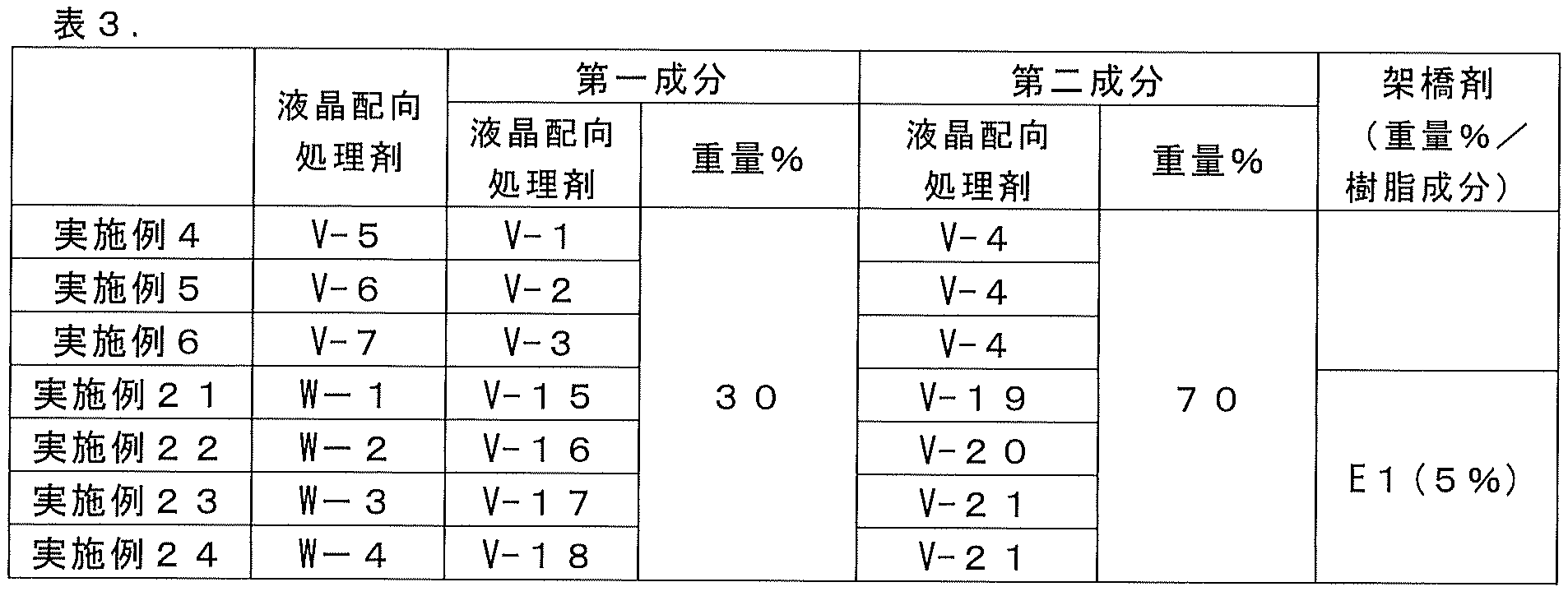
実施例で得られた液晶配向処理剤及び比較例で得られた液晶配向処理剤を、細孔径1μmのメンブランフィルタで加圧濾過した。得られた溶液を純水及びIPA(イソプロピルアルコール)で洗浄した40mm×30mmのITO電極付きガラス基板(縦:40mm、横:30mm、厚さ:1.1mm)のITO面上にスピンコートし、ホットプレート上にて70℃で90秒間、熱循環型クリーンオーブンにて230℃で30分間の加熱処理をして、膜厚が100nmの液晶配向膜付きのITO基板を得た。得られた液晶配向膜付きのITO基板を2枚用意し、その一方の基板の液晶配向膜面に、直径4μmのビーズスペーサー(日揮触媒化成社製、真絲球、SW-D1)を塗布した。
次に、シール剤(三井化学製XN-1500T)で周囲を塗布した。次いで、もう一方の基板の液晶配向膜が形成された側の面を内側にして、先の基板と張り合わせた後、シール材を硬化させて空セルを作成した。この空セルに液晶MLC-3023(メルク社製商品名)を減圧注入法によって注入し、液晶セルを作成した。
その後、得られた液晶セルに15Vの直流電圧を印加した状態で、光源に高圧水銀ランプを使用した紫外線照射装置を用いて、波長365nmのバンドパスフィルターを通した紫外線を15J/cm2照射して、垂直配向型液晶表示素子を得た。なお、紫外線照射量の測定にはORC社製UV-M03AにUV-35の受光器を接続し用いた。
実施例で得られた液晶配向処理剤を、細孔径1μmのメンブランフィルタで加圧濾過した。得られた溶液を純水及びIPA(イソプロピルアルコール)で洗浄した、画素サイズが200μm×600μmでライン/スペースがそれぞれ3μmのITO電極パターンが形成されているITO電極基板(縦:35mm、横:30mm、厚さ:0.7mm)と、高さ3.2μmのフォトスペーサーがパターニングされているITO電極付きガラス基板(縦:35mm、横:30mm、厚さ:0.7mm)のITO面上にそれぞれスピンコートし、ホットプレート上にて70℃で90秒間、熱循環型クリーンオーブンにて230℃で30分間の加熱処理をして、膜厚が100nmの液晶配向膜付きのITO基板を得た。
なお、このITO電極パターンが形成されているITO電極基板は、クロスチェッカー(市松)模様に4分割されており4つのエリアごとで別々に駆動ができるようになっている。
次に、シール剤(三井化学製XN-1500T)で周囲を塗布した。次いで、もう一方の基板の液晶配向膜が形成された側の面を内側にして、先の基板と張り合わせた後、シール材を硬化させて空セルを作成した。この空セルに液晶MLC-3023(メルク社製商品名)を減圧注入法によって注入し、液晶セルを作成した。
その後、得られた液晶セルに15Vの直流電圧を印加し、全ての画素エリアが駆動した状態で、光源に高圧水銀ランプを使用した紫外線照射装置を用いて、波長365nmのバンドパスフィルターを通した紫外線を10J/cm2照射して、垂直配向型液晶表示素子を得た。紫外線照射量の測定にはORC社製UV-M03AにUV-35の受光器を接続し用いた。
更に、実施例1~3、比較例1では、上記の標準条件に加えて、過酷条件として、加熱処理を230℃で120分間として液晶配向膜を形成した以外は、上記と同条件で垂直配向型液晶表示素子を作成した。
(垂直配向性)
液晶表示素子の液晶配向性は、偏光顕微鏡(ECLIPSE E600WPOL)(ニコン社製)で観察し、液晶が垂直に配向しているかどうかを確認した。具体的には、液晶の流動による不良や配向欠陥による輝点が見られていないものを、良好とした。評価結果を、表2に示す。
上記で作製した電圧保持率評価用の液晶表示素子に、1Vの電圧を60マイクロ秒の印加時間、1667ミリ秒の間隔で印加した後、印加解除から1667ミリ秒後の電圧保持率(%)を測定した。測定装置は東陽テクニカ製VHR-1を使用した。評価結果を、表2に示す。
LCDアナライザー(名菱テクニカ社製LCA-LUV42A)を使用して、上記で作製したプレチルト角評価用の液晶表示素子の内、液晶の流動による不良が見られていない液晶表示素子について測定を行った。評価結果を表2に示す。
上記で作製した残像評価用液晶表示素子を用いて、4つの画素エリアのうち対角線の2つのエリアに60Hz、20Vp-pの交流電圧を印加し、23℃の温度下で168時間駆動させた。その後、4つの画素エリアすべてを5Vp-pの交流電圧で駆動させ、画素の輝度差を目視で観察した。輝度差がほぼ確認できない状態を良好とした。評価結果を表3に示す。
実施例で得たポリイミド塗膜付き基板の配向膜面に対して、UMT-2(ブルカー・エイエックスエス株式会社製)を用いてスクラッチ試験を行った。
UMT-2のセンサーにはFVLを選択し、スクラッチ部先端には1.6mmのサファイア球を取り付けた。
スクラッチ部先端を液晶配向膜表面に荷重1mNで接触させた状態で、横0.5mm、縦2.0mmの範囲を、100秒間かけて1mNから20mNまで荷重を変化させスクラッチ試験をおこなった。この時スクラッチ部先端の移動方向は横への往復とし、移動速度は5.0mm/秒で行った。スクラッチエリアの縦方向への移動は、液晶配向膜付きの基板を縦方向に20μm/秒で移動させ行った。
スクラッチ試験後、MLC-3022(メルク社製ネガ型液晶)をスクラッチ試験済の液晶配向膜面へ滴下した。そこへ実施例1で得たもう1枚の液晶配向膜付き基板に4μmのスペーサーを散布したものを、互いの液晶配向膜面が向かい合うように重ね合わせ、滴下したMLC-3022を挟み込んだ。
偏光顕微鏡(ECLIPSE E600WPOL)(ニコン社製)の上下の偏光板の偏光軸が90°(クロスニコル)となるようにした状態で、スクラッチ試験を行った箇所を観察し、光が透過するかを観察した。スクラッチ試験を行った箇所について、輝点や光抜けが全く見られない状態を○、僅かな輝点や光抜けが見られる状態を△、スクラッチした箇所全体が光抜けとなった状態を×として表6に示す。

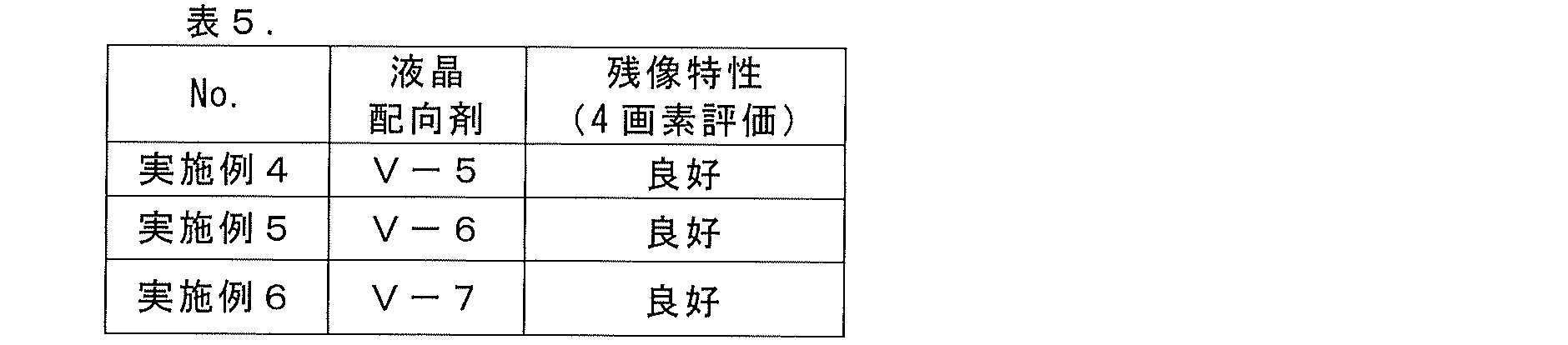

また、表5に示すように液晶配向処理剤(V-4)を混合した実施例4~実施例6では残像特性は良好な結果になることがわかった。
さらに、本実施例から、特定の側鎖型ジアミンを用いて得られる液晶配向膜は過酷な条件で焼成された場合でもプレチルト角の安定性に優れることがわかった。また、スクラッチ試験のように液晶配向膜へ物理的接触があった場合でも、配向膜へのダメージが少なく良好な垂直配向性を維持できることも確認された。
Claims (9)
- 下記式[1]で表されるジアミンを含有するジアミン成分と、テトラカルボン酸成分との反応物であるポリイミド前駆体及びそのイミド化物であるポリイミドから選ばれる少なくとも1種の重合体を含有する液晶配向剤:
式[1]中、Xは、単結合、-O-、-C(CH3)2-、-NH-、-CO-、-(CH2)m-、-SO2-、及びそれらの任意の組み合わせからなる2価の有機基を表し、mは1~8の整数を表し、Yはそれぞれ独立して下記式[1-1]の構造を表す;
式[1-1]中、Y1及びY3はそれぞれ独立して、単結合、-(CH2)a-(aは1~15の整数である)、-O-、-CH2O-、-CONH-、-NHCO-、-COO-及び-OCO-からなる群から選ばれる少なくとも1種を示す;
Y2は単結合又は-(CH2)b-(bは1~15の整数である)を示す(ただし、Y1又はY3が単結合、-(CH2)a-である場合、Y2は単結合であり、Y1が-O-、-CH2O-、-CONH-、-NHCO-、-COO-及び-OCO-からなる群から選ばれる少なくとも1種であるか、及び/又はY3が-O-、-CH2O-、-CONH-、-NHCO-、-COO-及び-OCO-からなる群から選ばれる少なくとも1種である場合、Y2は単結合又は-(CH2)b-である(ただし、Y1が-CONH-である場合、Y2及びY3単結合である));
Y4はベンゼン環、シクロヘキサン環及び複素環からなる群から選ばれる少なくとも1種の2価の環状基、又はステロイド骨格およびトコフェノール骨格を有する炭素数17~51の2価の有機基を示し、前記環状基上の任意の水素原子は、炭素数1~3のアルキル基、炭素数1~3のアルコキシ基、炭素数1~3のフッ素含有アルキル基、炭素数1~3のフッ素含有アルコキシ基又はフッ素原子で置換されていてもよい;
Y5はベンゼン環、シクロヘキサン環及び複素環からなる群から選ばれる少なくとも1種の環状基を示し、これらの環状基上の任意の水素原子は、炭素数1~3のアルキル基、炭素数1~3のアルコキシ基、炭素数1~3のフッ素含有アルキル基、炭素数1~3のフッ素含有アルコキシ基又はフッ素原子で置換されていてもよい;
Y6は炭素数1~18のアルキル基、炭素数2~18のアルケニル基、炭素数1~18のフッ素含有アルキル基、炭素数1~18のアルコキシ基及び炭素数1~18のフッ素含有アルコキシ基からなる群から選ばれる少なくとも1種を示す;
nは0~4の整数を示す。
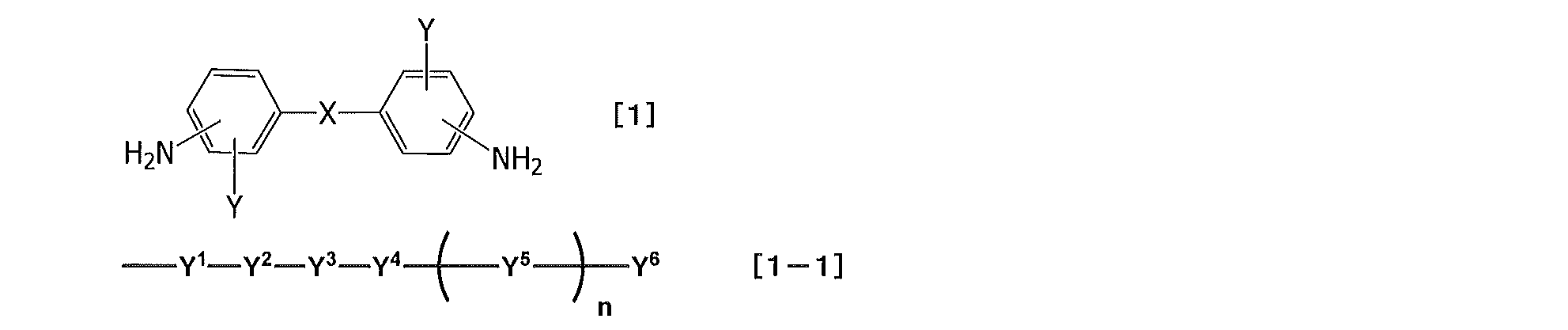
- 前記式[1]で表されるジアミンが、下記式[1’]で表される請求項1に記載の液晶配向剤。

- 前記式[1]で表されるジアミンが、下記式[1]-a1、下記式[1]-a2、又は下記式[1]-a3で表される請求項1又は請求項2に記載の液晶配向剤。

- 前記式[1]で表されるジアミンが、下記式[1]-a1-1、下記式[1]-a2-1~下記式[1]-a2-4、下記式[1]-a3-1又は下記式[1]-a3-2で表される請求項1~3のいずれか一項に記載の液晶配向剤。
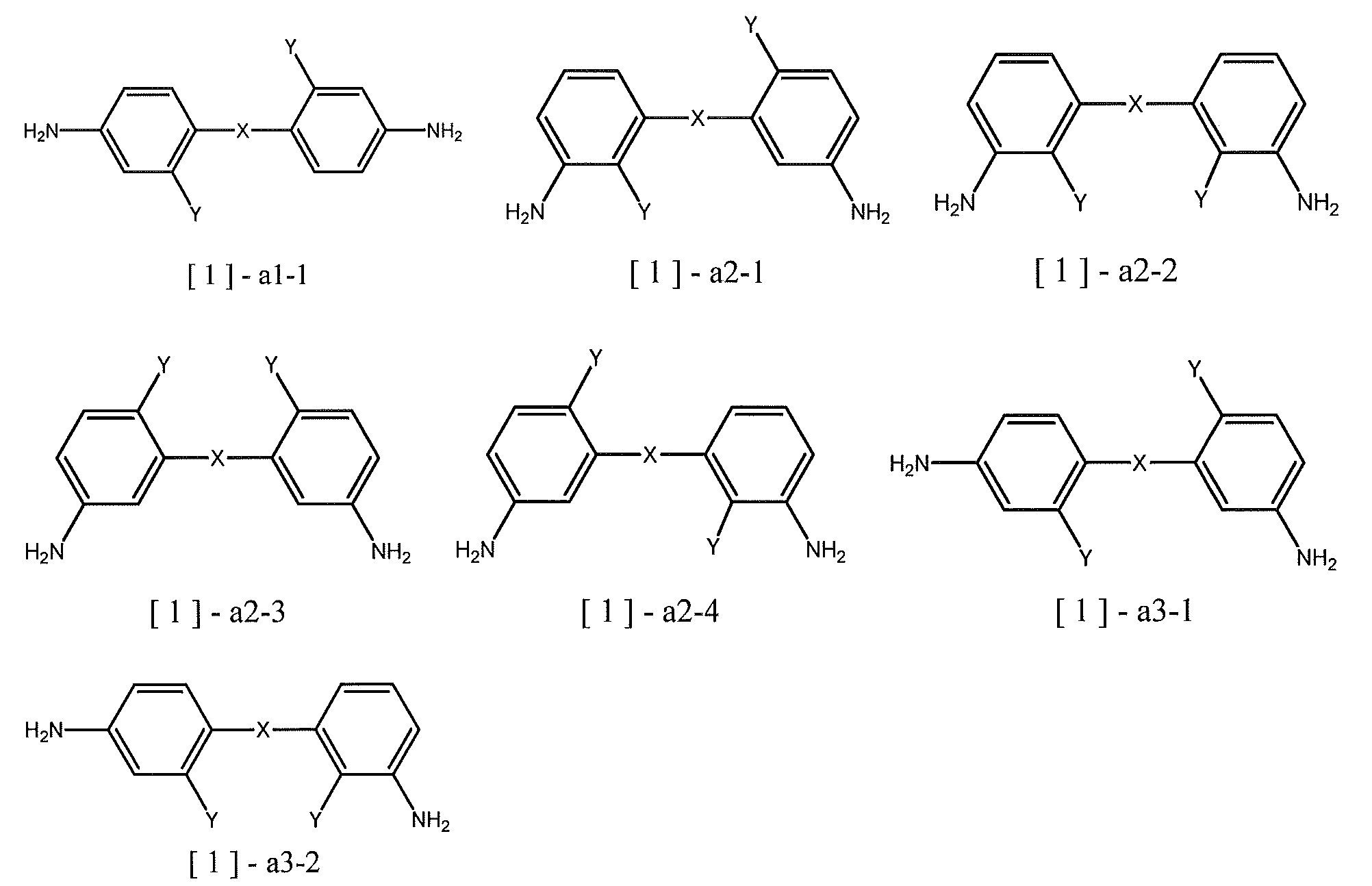
- 前記式[1-1]の構造で表されるYが、下記式[1-1]-1~[1-1]-22(式中、*は、前記式[1]、前記式[1’]、前記式[1]-a1~前記式[1]-a3におけるフェニル基との結合している位置を示す;mは1~15の整数を示し、nは0~18の整数を示す)のいずれかで表される請求項1~4のいずれか一項に記載の液晶配向剤。
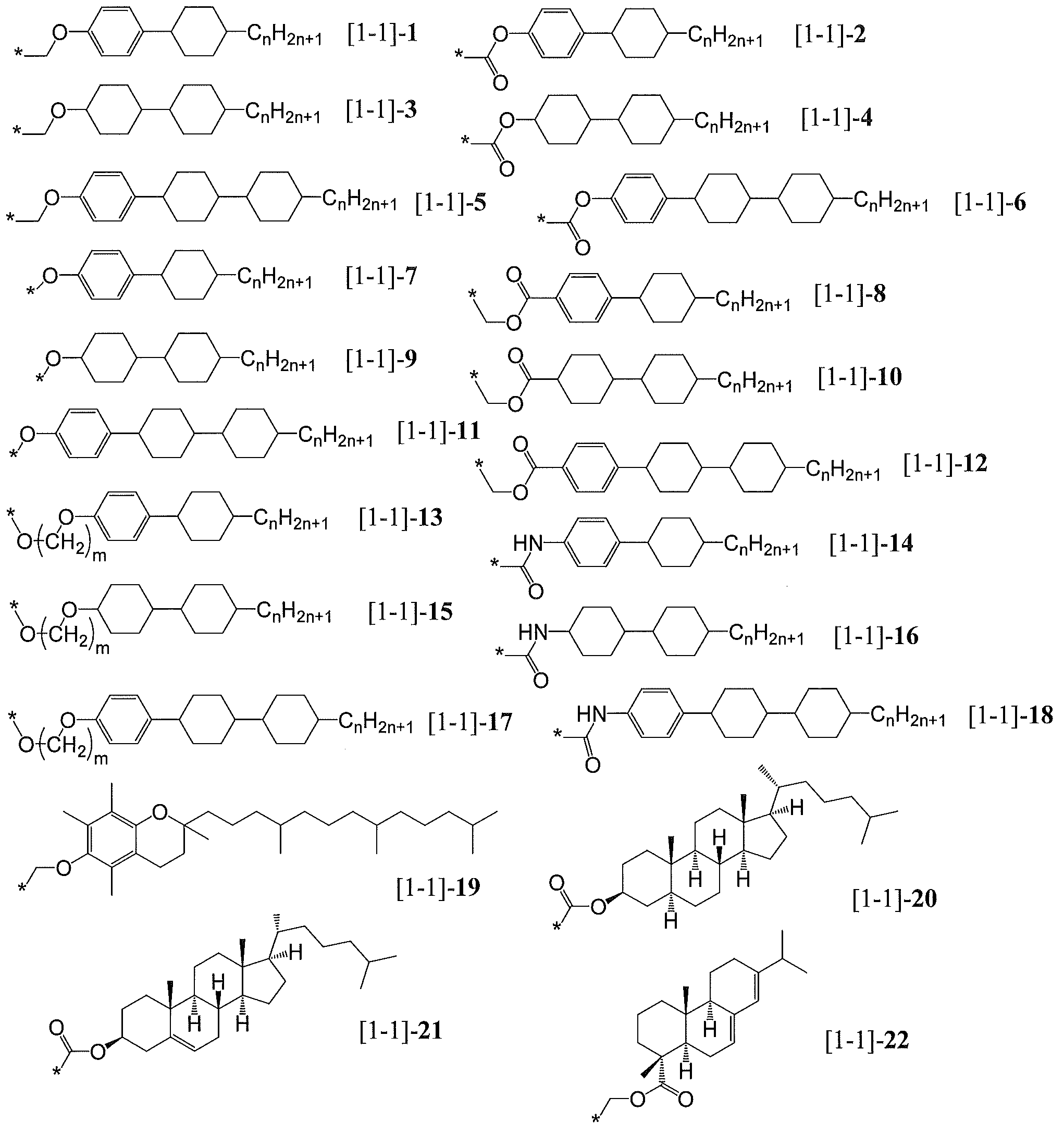
- 前記ジアミン成分が、下記式[2]で表されるジアミンをさらに含有する
(式[2]中、A1及びA2は、それぞれ独立して、水素原子又は、炭素数1~5のアルキル基、炭素数2~5のアルケニル基、又は炭素数2~5のアルキニル基を表す;
Y1は、2価の有機基を表す。)
請求項1~5のいずれか一項に記載の液晶配向剤。

- 請求項1~6のいずれか一項に記載の液晶配向剤を用いて形成された液晶配向膜。
- 請求項1~6のいずれか一項に記載の液晶配向剤を基板上に塗布して塗膜を形成する工程;
前記塗膜を焼成する工程;及び
焼成して得られた膜を配向処理する工程;
を有することにより、液晶配向膜を形成する、液晶配向膜の製造方法。 - 請求項7に記載の液晶配向膜;又は請求項8に記載の製造方法により得られた液晶配向膜;を具備する液晶表示素子。
Priority Applications (5)
| Application Number | Priority Date | Filing Date | Title |
|---|---|---|---|
| JP2019503096A JP7096534B2 (ja) | 2017-03-02 | 2018-03-01 | 液晶配向剤、液晶配向膜及び液晶表示素子 |
| CN201880028793.4A CN110573952B (zh) | 2017-03-02 | 2018-03-01 | 液晶取向剂、液晶取向膜以及液晶表示元件 |
| KR1020197027969A KR102588036B1 (ko) | 2017-03-02 | 2018-03-01 | 액정 배향제, 액정 배향막 및 액정 표시 소자 |
| CN202210301600.6A CN114609830B (zh) | 2017-03-02 | 2018-03-01 | 液晶取向剂、液晶取向膜以及液晶表示元件 |
| JP2022090434A JP7409431B2 (ja) | 2017-03-02 | 2022-06-02 | 液晶配向剤、液晶配向膜及び液晶表示素子 |
Applications Claiming Priority (2)
| Application Number | Priority Date | Filing Date | Title |
|---|---|---|---|
| JP2017-039880 | 2017-03-02 | ||
| JP2017039880 | 2017-03-02 |
Publications (1)
| Publication Number | Publication Date |
|---|---|
| WO2018159733A1 true WO2018159733A1 (ja) | 2018-09-07 |
Family
ID=63370317
Family Applications (1)
| Application Number | Title | Priority Date | Filing Date |
|---|---|---|---|
| PCT/JP2018/007686 Ceased WO2018159733A1 (ja) | 2017-03-02 | 2018-03-01 | 液晶配向剤、液晶配向膜及び液晶表示素子 |
Country Status (5)
| Country | Link |
|---|---|
| JP (2) | JP7096534B2 (ja) |
| KR (1) | KR102588036B1 (ja) |
| CN (2) | CN110573952B (ja) |
| TW (2) | TWI767870B (ja) |
| WO (1) | WO2018159733A1 (ja) |
Cited By (6)
| Publication number | Priority date | Publication date | Assignee | Title |
|---|---|---|---|---|
| JP2019026848A (ja) * | 2017-08-02 | 2019-02-21 | 三星電子株式会社Samsung Electronics Co.,Ltd. | モノマー、重合体、補償フィルム、光学フィルムおよび表示装置 |
| WO2020105561A1 (ja) * | 2018-11-19 | 2020-05-28 | 日産化学株式会社 | 液晶配向剤、液晶配向膜、及び液晶表示素子 |
| WO2020203110A1 (ja) * | 2019-03-29 | 2020-10-08 | 日産化学株式会社 | 液晶配向剤、液晶配向膜、液晶表示素子及びジアミン |
| WO2021261281A1 (ja) * | 2020-06-26 | 2021-12-30 | 日産化学株式会社 | 液晶配向剤、液晶配向膜、及び液晶表示素子 |
| US11518734B2 (en) | 2017-08-02 | 2022-12-06 | Samsung Electronics Co., Ltd. | Monomer and polymer, compensation film, optical film, and display device |
| WO2025105278A1 (ja) * | 2023-11-15 | 2025-05-22 | 日産化学株式会社 | 液晶配向剤、液晶配向膜及び液晶表示素子 |
Families Citing this family (5)
| Publication number | Priority date | Publication date | Assignee | Title |
|---|---|---|---|---|
| KR102785435B1 (ko) * | 2018-12-10 | 2025-03-21 | 닛산 가가쿠 가부시키가이샤 | 액정 배향제, 액정 배향막 및 액정 표시 소자 |
| KR20220151604A (ko) * | 2020-03-06 | 2022-11-15 | 닛산 가가쿠 가부시키가이샤 | 액정 배향제, 액정 배향막, 및 액정 표시 소자 |
| WO2021206003A1 (ja) * | 2020-04-10 | 2021-10-14 | 日産化学株式会社 | 液晶配向剤、液晶配向膜及び液晶表示素子 |
| KR20230038512A (ko) * | 2020-07-17 | 2023-03-20 | 닛산 가가쿠 가부시키가이샤 | 액정 배향제, 액정 배향막, 및 액정 표시 소자 |
| CN114545668B (zh) * | 2022-02-23 | 2024-04-23 | 深圳市尊绅投资有限公司 | 屏幕杂质的处理方法、装置、系统和电子设备 |
Citations (2)
| Publication number | Priority date | Publication date | Assignee | Title |
|---|---|---|---|---|
| JPH11322927A (ja) * | 1998-05-11 | 1999-11-26 | Mitsui Toatsu Chem Inc | ポリアミド酸共重合体及びポリイミド共重合体、ならびに耐熱性接着剤 |
| WO2003034102A2 (en) * | 2001-10-16 | 2003-04-24 | Lightwave Microsystems Corporation | Waveplate and optical circuit formed from mesogen-containing polymer |
Family Cites Families (11)
| Publication number | Priority date | Publication date | Assignee | Title |
|---|---|---|---|---|
| DE3117152A1 (de) * | 1981-04-30 | 1982-11-18 | Merck Patent Gmbh, 6100 Darmstadt | "fluorhaltige 4,4'-bis-(cyclohexyl)-biphenylderivate, diese enthaltende dielektrika und elektrooptisches anzeigeelement" |
| JP4175826B2 (ja) | 2002-04-16 | 2008-11-05 | シャープ株式会社 | 液晶表示装置 |
| CN101057178B (zh) | 2004-12-28 | 2010-06-02 | 日产化学工业株式会社 | 垂直定向用液晶定向剂、液晶定向膜及使用了该液晶定向膜的液晶显示元件 |
| JP4788896B2 (ja) * | 2006-02-22 | 2011-10-05 | Jsr株式会社 | 垂直配向型液晶配向剤および垂直配向型液晶表示素子 |
| JP2010101999A (ja) * | 2008-10-22 | 2010-05-06 | Chisso Corp | 液晶配向膜、液晶配向剤および液晶表示素子 |
| JP2013011755A (ja) * | 2011-06-29 | 2013-01-17 | Sony Corp | 液晶表示装置及びその製造方法 |
| KR102000316B1 (ko) * | 2011-11-30 | 2019-07-15 | 닛산 가가쿠 가부시키가이샤 | 액정 배향막, 액정 배향막의 제조 방법 및 액정 표시 소자 |
| JP6561834B2 (ja) * | 2013-09-03 | 2019-08-21 | 日産化学株式会社 | 液晶配向処理剤、液晶配向膜及び液晶表示素子 |
| KR102241786B1 (ko) * | 2013-10-23 | 2021-04-16 | 닛산 가가쿠 가부시키가이샤 | 열 탈리성기를 갖는 폴리이미드 전구체 및/또는 폴리이미드를 함유하는 액정 배향제 |
| JP6635272B2 (ja) * | 2015-03-04 | 2020-01-22 | 日産化学株式会社 | 液晶配向剤、液晶配向膜及び液晶表示素子 |
| CN110023826B (zh) * | 2016-09-29 | 2022-10-25 | 日产化学株式会社 | 液晶取向剂、液晶取向膜和液晶表示元件 |
-
2018
- 2018-03-01 WO PCT/JP2018/007686 patent/WO2018159733A1/ja not_active Ceased
- 2018-03-01 TW TW110145145A patent/TWI767870B/zh active
- 2018-03-01 KR KR1020197027969A patent/KR102588036B1/ko active Active
- 2018-03-01 JP JP2019503096A patent/JP7096534B2/ja active Active
- 2018-03-01 CN CN201880028793.4A patent/CN110573952B/zh active Active
- 2018-03-01 TW TW107106732A patent/TWI752177B/zh active
- 2018-03-01 CN CN202210301600.6A patent/CN114609830B/zh active Active
-
2022
- 2022-06-02 JP JP2022090434A patent/JP7409431B2/ja active Active
Patent Citations (2)
| Publication number | Priority date | Publication date | Assignee | Title |
|---|---|---|---|---|
| JPH11322927A (ja) * | 1998-05-11 | 1999-11-26 | Mitsui Toatsu Chem Inc | ポリアミド酸共重合体及びポリイミド共重合体、ならびに耐熱性接着剤 |
| WO2003034102A2 (en) * | 2001-10-16 | 2003-04-24 | Lightwave Microsystems Corporation | Waveplate and optical circuit formed from mesogen-containing polymer |
Cited By (23)
| Publication number | Priority date | Publication date | Assignee | Title |
|---|---|---|---|---|
| US11518734B2 (en) | 2017-08-02 | 2022-12-06 | Samsung Electronics Co., Ltd. | Monomer and polymer, compensation film, optical film, and display device |
| US12037304B2 (en) | 2017-08-02 | 2024-07-16 | Samsung Electronics Co., Ltd. | Monomer and polymer, compensation film, optical film, and display device |
| JP2019026848A (ja) * | 2017-08-02 | 2019-02-21 | 三星電子株式会社Samsung Electronics Co.,Ltd. | モノマー、重合体、補償フィルム、光学フィルムおよび表示装置 |
| JP7187203B2 (ja) | 2017-08-02 | 2022-12-12 | 三星電子株式会社 | モノマー、重合体、補償フィルム、光学フィルムおよび表示装置 |
| JP7414006B2 (ja) | 2018-11-19 | 2024-01-16 | 日産化学株式会社 | 液晶配向剤、液晶配向膜、及び液晶表示素子 |
| WO2020105561A1 (ja) * | 2018-11-19 | 2020-05-28 | 日産化学株式会社 | 液晶配向剤、液晶配向膜、及び液晶表示素子 |
| JPWO2020105561A1 (ja) * | 2018-11-19 | 2021-10-07 | 日産化学株式会社 | 液晶配向剤、液晶配向膜、及び液晶表示素子 |
| KR20210092194A (ko) * | 2018-11-19 | 2021-07-23 | 닛산 가가쿠 가부시키가이샤 | 액정 배향제, 액정 배향막, 및 액정 표시 소자 |
| CN113168052A (zh) * | 2018-11-19 | 2021-07-23 | 日产化学株式会社 | 液晶取向剂、液晶取向膜、及液晶表示元件 |
| KR102775262B1 (ko) | 2018-11-19 | 2025-02-28 | 닛산 가가쿠 가부시키가이샤 | 액정 배향제, 액정 배향막, 및 액정 표시 소자 |
| TWI816939B (zh) * | 2018-11-19 | 2023-10-01 | 日商日產化學股份有限公司 | 液晶配向劑、液晶配向膜及液晶顯示元件 |
| CN113711117A (zh) * | 2019-03-29 | 2021-11-26 | 日产化学株式会社 | 液晶取向剂、液晶取向膜、液晶显示元件以及二胺 |
| KR20210145744A (ko) * | 2019-03-29 | 2021-12-02 | 닛산 가가쿠 가부시키가이샤 | 액정 배향제, 액정 배향막, 액정 표시 소자 및 디아민 |
| KR102815610B1 (ko) | 2019-03-29 | 2025-05-30 | 닛산 가가쿠 가부시키가이샤 | 액정 배향제, 액정 배향막, 액정 표시 소자 및 디아민 |
| JPWO2020203110A1 (ja) * | 2019-03-29 | 2020-10-08 | ||
| WO2020203110A1 (ja) * | 2019-03-29 | 2020-10-08 | 日産化学株式会社 | 液晶配向剤、液晶配向膜、液晶表示素子及びジアミン |
| JP7428177B2 (ja) | 2019-03-29 | 2024-02-06 | 日産化学株式会社 | 液晶配向剤、液晶配向膜、液晶表示素子及びジアミン |
| WO2021261281A1 (ja) * | 2020-06-26 | 2021-12-30 | 日産化学株式会社 | 液晶配向剤、液晶配向膜、及び液晶表示素子 |
| JP7622744B2 (ja) | 2020-06-26 | 2025-01-28 | 日産化学株式会社 | 液晶配向剤、液晶配向膜、及び液晶表示素子 |
| KR20230027062A (ko) * | 2020-06-26 | 2023-02-27 | 닛산 가가쿠 가부시키가이샤 | 액정 배향제, 액정 배향막, 및 액정 표시 소자 |
| JPWO2021261281A1 (ja) * | 2020-06-26 | 2021-12-30 | ||
| KR102925366B1 (ko) | 2020-06-26 | 2026-02-09 | 닛산 가가쿠 가부시키가이샤 | 액정 배향제, 액정 배향막, 및 액정 표시 소자 |
| WO2025105278A1 (ja) * | 2023-11-15 | 2025-05-22 | 日産化学株式会社 | 液晶配向剤、液晶配向膜及び液晶表示素子 |
Also Published As
| Publication number | Publication date |
|---|---|
| CN114609830A (zh) | 2022-06-10 |
| KR102588036B1 (ko) | 2023-10-11 |
| JP7096534B2 (ja) | 2022-07-06 |
| TWI767870B (zh) | 2022-06-11 |
| CN110573952A (zh) | 2019-12-13 |
| TW202214749A (zh) | 2022-04-16 |
| CN114609830B (zh) | 2025-02-21 |
| TW201842172A (zh) | 2018-12-01 |
| JP2022113743A (ja) | 2022-08-04 |
| JPWO2018159733A1 (ja) | 2019-12-26 |
| JP7409431B2 (ja) | 2024-01-09 |
| CN110573952B (zh) | 2022-03-22 |
| KR20190125992A (ko) | 2019-11-07 |
| TWI752177B (zh) | 2022-01-11 |
Similar Documents
| Publication | Publication Date | Title |
|---|---|---|
| JP7409431B2 (ja) | 液晶配向剤、液晶配向膜及び液晶表示素子 | |
| TW201700538A (zh) | 液晶配向劑、液晶配向膜及液晶顯示元件 | |
| CN110869842B (zh) | 液晶取向剂、液晶取向膜及使用其的液晶表示元件 | |
| JP7409375B2 (ja) | 液晶配向剤、液晶配向膜及びそれを用いた液晶表示素子 | |
| CN114466882B (zh) | 液晶取向剂、液晶取向膜、液晶显示元件、聚合物以及二胺 | |
| JP7428145B2 (ja) | 液晶配向剤、液晶配向膜及びそれを用いた液晶表示素子 | |
| JP6795074B2 (ja) | 液晶配向剤、液晶配向膜、及び液晶表示素子 | |
| JP7315106B2 (ja) | 液晶配向剤、液晶配向膜及び液晶表示素子 | |
| JP7348597B2 (ja) | 液晶配向剤、液晶配向膜及び液晶表示素子 | |
| JP7694561B2 (ja) | 新規ジアミン、重合体、液晶配向剤、液晶配向膜、及びそれを用いた液晶表示素子 | |
| TWI890820B (zh) | 液晶配向劑、液晶配向膜以及液晶顯示元件 | |
| JP7161147B2 (ja) | 液晶配向剤、液晶配向膜及びそれを用いた液晶表示素子並びに該液晶配向膜の製造方法 | |
| TW202534154A (zh) | 光配向法用的液晶配向劑、液晶配向膜及液晶顯示元件 |
Legal Events
| Date | Code | Title | Description |
|---|---|---|---|
| 121 | Ep: the epo has been informed by wipo that ep was designated in this application |
Ref document number: 18761330 Country of ref document: EP Kind code of ref document: A1 |
|
| ENP | Entry into the national phase |
Ref document number: 2019503096 Country of ref document: JP Kind code of ref document: A |
|
| NENP | Non-entry into the national phase |
Ref country code: DE |
|
| ENP | Entry into the national phase |
Ref document number: 20197027969 Country of ref document: KR Kind code of ref document: A |
|
| 122 | Ep: pct application non-entry in european phase |
Ref document number: 18761330 Country of ref document: EP Kind code of ref document: A1 |