WO2018155320A1 - 円すいころ軸受 - Google Patents
円すいころ軸受 Download PDFInfo
- Publication number
- WO2018155320A1 WO2018155320A1 PCT/JP2018/005397 JP2018005397W WO2018155320A1 WO 2018155320 A1 WO2018155320 A1 WO 2018155320A1 JP 2018005397 W JP2018005397 W JP 2018005397W WO 2018155320 A1 WO2018155320 A1 WO 2018155320A1
- Authority
- WO
- WIPO (PCT)
- Prior art keywords
- roughness
- tapered roller
- roller bearing
- roughness curve
- rku
- Prior art date
- Legal status (The legal status is an assumption and is not a legal conclusion. Google has not performed a legal analysis and makes no representation as to the accuracy of the status listed.)
- Ceased
Links
Images






Classifications
-
- F—MECHANICAL ENGINEERING; LIGHTING; HEATING; WEAPONS; BLASTING
- F16—ENGINEERING ELEMENTS AND UNITS; GENERAL MEASURES FOR PRODUCING AND MAINTAINING EFFECTIVE FUNCTIONING OF MACHINES OR INSTALLATIONS; THERMAL INSULATION IN GENERAL
- F16C—SHAFTS; FLEXIBLE SHAFTS; ELEMENTS OR CRANKSHAFT MECHANISMS; ROTARY BODIES OTHER THAN GEARING ELEMENTS; BEARINGS
- F16C19/00—Bearings with rolling contact, for exclusively rotary movement
- F16C19/22—Bearings with rolling contact, for exclusively rotary movement with bearing rollers essentially of the same size in one or more circular rows, e.g. needle bearings
- F16C19/34—Bearings with rolling contact, for exclusively rotary movement with bearing rollers essentially of the same size in one or more circular rows, e.g. needle bearings for both radial and axial load
- F16C19/36—Bearings with rolling contact, for exclusively rotary movement with bearing rollers essentially of the same size in one or more circular rows, e.g. needle bearings for both radial and axial load with a single row of rollers
- F16C19/364—Bearings with rolling contact, for exclusively rotary movement with bearing rollers essentially of the same size in one or more circular rows, e.g. needle bearings for both radial and axial load with a single row of rollers with tapered rollers, i.e. rollers having essentially the shape of a truncated cone
-
- F—MECHANICAL ENGINEERING; LIGHTING; HEATING; WEAPONS; BLASTING
- F16—ENGINEERING ELEMENTS AND UNITS; GENERAL MEASURES FOR PRODUCING AND MAINTAINING EFFECTIVE FUNCTIONING OF MACHINES OR INSTALLATIONS; THERMAL INSULATION IN GENERAL
- F16C—SHAFTS; FLEXIBLE SHAFTS; ELEMENTS OR CRANKSHAFT MECHANISMS; ROTARY BODIES OTHER THAN GEARING ELEMENTS; BEARINGS
- F16C33/00—Parts of bearings; Special methods for making bearings or parts thereof
- F16C33/30—Parts of ball or roller bearings
- F16C33/34—Rollers; Needles
- F16C33/36—Rollers; Needles with bearing-surfaces other than cylindrical, e.g. tapered; with grooves in the bearing surfaces
- F16C33/366—Tapered rollers, i.e. rollers generally shaped as truncated cones
-
- F—MECHANICAL ENGINEERING; LIGHTING; HEATING; WEAPONS; BLASTING
- F16—ENGINEERING ELEMENTS AND UNITS; GENERAL MEASURES FOR PRODUCING AND MAINTAINING EFFECTIVE FUNCTIONING OF MACHINES OR INSTALLATIONS; THERMAL INSULATION IN GENERAL
- F16C—SHAFTS; FLEXIBLE SHAFTS; ELEMENTS OR CRANKSHAFT MECHANISMS; ROTARY BODIES OTHER THAN GEARING ELEMENTS; BEARINGS
- F16C33/00—Parts of bearings; Special methods for making bearings or parts thereof
- F16C33/30—Parts of ball or roller bearings
- F16C33/58—Raceways; Race rings
- F16C33/583—Details of specific parts of races
- F16C33/585—Details of specific parts of races of raceways, e.g. ribs to guide the rollers
-
- F—MECHANICAL ENGINEERING; LIGHTING; HEATING; WEAPONS; BLASTING
- F16—ENGINEERING ELEMENTS AND UNITS; GENERAL MEASURES FOR PRODUCING AND MAINTAINING EFFECTIVE FUNCTIONING OF MACHINES OR INSTALLATIONS; THERMAL INSULATION IN GENERAL
- F16C—SHAFTS; FLEXIBLE SHAFTS; ELEMENTS OR CRANKSHAFT MECHANISMS; ROTARY BODIES OTHER THAN GEARING ELEMENTS; BEARINGS
- F16C2240/00—Specified values or numerical ranges of parameters; Relations between them
- F16C2240/40—Linear dimensions, e.g. length, radius, thickness, gap
- F16C2240/54—Surface roughness
Definitions
- This invention relates to a tapered roller bearing.
- the roller large end surface of the tapered roller and the large collar surface of the inner ring make sliding contact.
- a preload is applied for the purpose of improving the rigidity and rotational accuracy of the tapered roller bearing.
- the rotational torque is measured in a state where it is rotated at a low speed (usually 100 r / min or less) for the convenience of the incorporation process into the counterpart device.
- the tapered roller bearing disclosed in Patent Document 1 below has a surface roughness Ra of 0.05 mm to maintain a proper lubrication state between the large collar surface of the inner ring and the large roller end surface of the tapered roller. It is formed in a range of ⁇ 0.20 ⁇ m.
- the lubrication state between the large collar surface of the inner ring and the roller large end surface of the tapered roller during mixed-in operation is a mixed lubrication of fluid lubrication and boundary lubrication.
- the friction coefficient fluctuates greatly, the variation in the measured rotational torque increases, and the preload management accuracy deteriorates.
- the surface roughness Ra of the large collar surface is 0.05 ⁇ m or more, the lubrication state becomes boundary lubrication, the friction coefficient is stabilized, and the preload can be managed with high accuracy.
- the tapered roller bearing disclosed in Patent Document 2 below has a tapered roller having a roller large end surface with a surface roughness Ra of 0.1 ⁇ m or less, and an inner ring having a large flange surface with a surface roughness Ra of 0.2 ⁇ m.
- JP 2000-170774 A (particularly paragraphs 0021 to 0023 of the specification)
- JP 2002-139055 A (particularly paragraph 0021 of the specification)
- the tapered roller bearings of Patent Documents 1 and 2 define the range of the surface roughness Ra of the large collar surface of the inner ring in order to stabilize the rotational torque during low-speed rotation when preload is set.
- the bearing also includes a super-finished roughness range (for example, Ra is 0.08 ⁇ m or less). At super-finished roughness, the rotational torque may become unstable.
- the surface roughness Ra of the large collar surface of the inner ring is made rougher than the roughness range of the superfinishing level, it is considered that the rotational torque during low-speed rotation can be stabilized.
- the seizure resistance is inferior to the range.
- the problem to be solved by the present invention is to achieve both the stability of rotational torque during low-speed rotation and the seizure resistance between the large flange surface and the large end surface in a tapered roller bearing. .
- the present invention provides a tapered roller bearing comprising a tapered roller having a roller large end surface and an inner ring having a large collar surface in sliding contact with the roller large end surface, the arithmetic average of the large collar surface
- the roughness Ra is 0.1 ⁇ m ⁇ Ra ⁇ 0.2 ⁇ m
- the skewness Rsk of the roughness surface of the large ridge surface is ⁇ 1.0 ⁇ Rsk ⁇ ⁇ 0.3
- the roughness curve of the large ridge surface is The configuration of the kurtosis Rku of 3.0 ⁇ Rku ⁇ 5.0 was adopted.
- the arithmetic average roughness Ra in the present invention refers to the arithmetic average roughness Ra defined by Japanese Industrial Standard (JIS) B0601: 2013.
- the skewness Rsk of the roughness curve in the present invention refers to the skewness Rsk of the roughness curve defined by Japanese Industrial Standard (JIS) B0601: 2013.
- the kurtosis Rku of the roughness curve in the present invention refers to the kurtosis Rku of the roughness curve defined by Japanese Industrial Standard (JIS) B0601: 2013.
- the tapered roller bearing is rotated at a low speed: in the range of 0 to 200 (r / min).
- This is a characteristic suitable for stabilizing the rotational torque at.
- This alone will cause the seizure resistance to be inferior to the roughness of the superfinishing level, and therefore the present invention further defines the surface texture characteristics of the roughness curve of the large surface. That is, when the skewness Rsk ⁇ 0 of the roughness curve, the characteristic is biased to the upper side with respect to the average line. Therefore, by setting the Rsk of the large surface to a negative numerical range, the large surface has a flat surface.
- the skewness Rsk of the roughness curve of the large ridge surface is set to -1.0 to -0.3. Further, when the kurtosis Rku of the roughness curve is smaller than 3, the shape of the surface unevenness distribution is crushed, but a roughness protrusion is also required to stabilize the rotational torque. Therefore, the kurtosis Rku of the roughness curve of the large ridge surface is set to 3.0 to 5.0. If the characteristic balance in the range of Ra, Rsk, and Rku described above is used, the stability of rotational torque during low-speed rotation and the seizure resistance between the large flange surface and the large end surface can be realized. Can do.
- the arithmetic average roughness Ra of the roller large end face may be 0.1 ⁇ m or less. Since the surface roughness of the roller large end face has less influence on the function than the surface roughness of the large collar surface of the inner ring, it is not necessary to further define the skewness Rsk and kurtosis Rku, and can be managed simply by the calculated average roughness Ra. Good.
- the large ridge surface may be a shape defined by a straight bus bar or a bus bar having a central recess or convexity of 1 ⁇ m or less.
- the roller large end face and the large collar surface can realize particularly good seizure resistance when the spherical surface and the flat surface are in a contact relationship.
- the bus bar shape of the large ridge surface is a substantially linear shape to the extent that it can be obtained with industrial products.
- the large corrugated surface has a generatrix shape that is concave or convex, if the amount of the concave or convex portion exceeds 1 ⁇ m, a good lubricating oil wedge effect cannot be obtained.
- the tapered roller bearing according to the present invention is suitable for those incorporated in a power transmission device of an automobile.
- An automobile power transmission device is an element that constitutes a path for transmitting power from a driving source of an automobile to wheels, and includes, for example, a differential, a transmission, and the like.
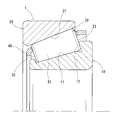
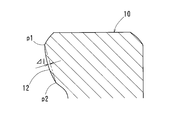
- Partial sectional view showing a tapered roller bearing according to an embodiment of the present invention Enlarged view of the area near the surface of Figure 1
- the fragmentary sectional view which shows another bus-bar shape of the large collar surface of FIG. Conceptual diagram illustrating the effect of the roughness curve skewness RSk on the surface properties
- Conceptual diagram illustrating the influence of the value of the kurtosis RKu of the roughness curve on the surface properties The graph which shows the relationship between the rotational speed and rotational torque of an Example and a comparative example
- the tapered roller bearing 1 includes an inner ring 10, an outer ring 20, a plurality of tapered rollers 30, and a cage 40 that holds these tapered rollers 30.
- the inner ring 10, the outer ring 20, and the tapered roller 30 are each made of steel.
- the inner ring 10 and the outer ring 20 are annular bearing parts arranged coaxially.
- the inner ring 10 has a track 11 and a large collar surface 12 on the outside.
- the outer ring 20 has a track 21 inside.
- the tracks 11 and 21 are each formed in a conical surface shape.
- the tapered roller 30 includes a tapered rolling surface 31, a small roller end surface 32, and a large roller end surface 33.
- the rolling surface 31 is interposed between the track 11 of the inner ring 10 and the track 21 of the outer ring 20.
- the roller small end surface 32 is a side surface on the small diameter side of the tapered roller 30.
- the roller large end surface 33 is a side surface on the large diameter side of the tapered roller 30.
- the roller large end face 33 has a spherical shape.
- the surface roughness of the roller large end surface 33 has less influence on functions such as seizure resistance than the roughness of the large collar surface 12 of the inner ring 10. For this reason, what is necessary is just to manage the surface roughness of the roller large end surface 33 by arithmetic mean roughness Ra simply.
- the arithmetic average roughness Ra of the roller large end face 33 may be 0.1 ⁇ m or less.
- the arithmetic average roughness Ra is the arithmetic average roughness Ra defined in 4.2.1 of Japanese Industrial Standard (JIS) B0601: 2013.
- the unit of arithmetic average roughness Ra is ⁇ m.
- the large collar surface 12 of the inner ring 10 is in sliding contact with the roller large end surface 33 of the tapered roller 30. That is, the large collar surface 12 is an inner ring surface portion that can come into sliding contact with the roller large end surface 33 during bearing rotation.
- the large collar surface 12 is formed in a shape (that is, a conical surface shape) defined by a straight generatrix.
- the large ridge surface 12 may have a shape defined by a bus bar having a center recess of 1 ⁇ m or less, or may have a shape defined by a bus bar having a center projection of 1 ⁇ m or less as shown in FIG. 4. .
- the center concave is from p1 and p2 toward the center of the reference straight line. The shape gradually dented away from the roller large end face 33.
- middle convex means a shape that gradually bulges toward the center of the reference straight line from the aforementioned p1 and p2 toward the roller large end face 33.
- the phrase “middle concave or middle convex is within 1 ⁇ m” means that the maximum concave amount or bulging amount ⁇ l from the reference straight line is within 1 ⁇ m.
- the large collar surface 12 has a straight busbar (see FIG. 2), or a center recess (see FIG. 3) or a center convexity (see FIG. 4) defined by a bus within 1 ⁇ m, the large roller end face 33 and the large end surface 33 are large. Since the flange surface 12 has a contact relationship between the spherical surface and the flat surface or a contact relationship similar to this, a good wedge effect of the lubricating oil can be realized between the roller large end surface 33 and the large flange surface 12. .
- the arithmetic average roughness Ra of the large surface 12 is 0.1 ⁇ m ⁇ Ra ⁇ 0.2 ⁇ m.
- the large flange surface 12 is rotated at a low speed of the tapered roller bearing 1 shown in FIG. 1: 0 to 200 (r / min) In this range, the characteristics are suitable for stabilizing the rotational torque.
- the skewness Rsk of the roughness curve of the large surface 12 is ⁇ 1.0 ⁇ Rsk ⁇ ⁇ 0.3.
- the skewness Rsk of the roughness curve is the skewness Rsk of the roughness curve defined in 4.2.3 of Japanese Industrial Standard (JIS) B0601: 2013.
- the skewness Rsk of the roughness curve is defined by the following equation (1).
- the skewness Rsk of the roughness curve is the cube average of Z (x) at the reference length made dimensionless by the cube of the root mean square roughness Rq of the cross-sectional curve, as shown in Equation (1).
- the skewness Rsk of the roughness curve is a numerical value indicating the degree of asymmetry of the probability density function of the contour curve, and is a parameter that is strongly influenced by the protruding peaks or valleys.
- FIG. 5 illustrates a roughness curve satisfying the skewness Rsk> 0 and a roughness curve satisfying the skewness Rsk ⁇ 0.
- the kurtosis Rku of the roughness curve of the large ridge surface 12 is 3.0 ⁇ Rku ⁇ 5.0.
- the kurtosis Rku of the roughness curve refers to the kurtosis Rku of the roughness curve defined in Japanese Industrial Standards (JIS) B0601: 2013 4.2.4.
- the kurtosis Rku of the roughness curve is defined by the following equation (2).
- the kurtosis Rku of the roughness curve is the root mean square of Z (x) at the reference length made dimensionless by the square of the root mean square roughness Rq of the cross section curve, as shown in Equation (2).
- the kurtosis Rku of the roughness curve is a numerical value indicating the degree of sharpness (sharpness) of the probability density function of the contour curve, and is a parameter that is strongly influenced by protruding peaks or valleys.
- FIG. 6 illustrates a roughness curve satisfying Kurtosis Rku> 3 and a roughness curve satisfying Kurtosis Rku ⁇ 3.
- Arithmetic mean roughness Ra, roughness curve skewness Rsk, and roughness curve kurtosis Rku can all be measured by a surface roughness measuring machine.
- This tapered roller bearing 1 has an arithmetic average roughness Ra: 0.1 to 0.2 ⁇ m, a roughness curve skewness Rsk: ⁇ 1.0 to ⁇ 0.3, and a roughness curve kurtosis Rku: 3.0 to Since the large collar surface 12 having a characteristic balance in the range of 5.0 is adopted, both the stability of the rotational torque at the time of low speed rotation and the seizure resistance between the large collar surface 12 and the large end surface 33 are achieved. Can do.
- the seizure resistance is inferior to the case where the arithmetic average roughness Ra of the large collar surface 12 is less than 0.1 ⁇ m.
- the large flange surface 12 having the above-mentioned characteristic balance is ground, the roughness regulation range is too fine and the processing resistance is too large, which may cause grinding burn.
- Surface roughness Ra In order to achieve a roughness level of 0.1 to 0.2 ⁇ m by grinding, grinding using a grindstone with a coarser surface is required compared to super-finishing, resulting in high machining resistance. It is over. Therefore, since the large flange surface 12 is difficult to finish by grinding, it may be processed so as to have the above-mentioned property balance by utilizing super finishing. For example, the above-mentioned characteristic balance can be realized by performing superfinishing on the large collar surface 12 in a very short time (0.5 second to 2 seconds).
- Examples and Comparative Examples 1 and 2 are all tapered roller bearings of model number 30307D.
- the example belongs to the above-described embodiment, and the arithmetic average roughness Ra of the large corrugated surface is 0.149 ⁇ m, the skewness Rsk of the roughness curve of the large corrugated surface is ⁇ 0.96, and the large corrugated surface is The kurtosis Rku of the roughness curve is 4.005.
- the arithmetic average roughness Ra of the large surface is 0.2 ⁇ m.
- Comparative Example 2 is one in which the arithmetic mean roughness Ra of the large corrugated surface is 0.08 ⁇ m, that is, the large corrugated surface is a super-finished level.
- the skewness Rsk of the roughness curve of the large ridge surface of Comparative Example 1 is ⁇ 1.053, and the kurtosis Rku of the roughness curve of the large ridge surface of Comparative Example 1 is 2.563.
- the skewness Rsk of the roughness curve of the large ridge surface of Comparative Example 2 is ⁇ 1.298, and the kurtosis Rku of the roughness curve of the large ridge surface of Comparative Example 2 is 5.103.
- roller large end surfaces of Examples and Comparative Examples 1 and 2 have the same arithmetic average roughness Ra and 0.1 ⁇ m or less.
- the conditions of the rotational torque test performed in the example and comparative examples 1 and 2 are common.
- the number of revolutions per minute (r / min) is in the range of 0 to 200.
- the lubrication conditions of the rust preventive oil applied to the bearing are a kinematic viscosity at 40 ° C. of 16.5 mm 2 / s and a kinematic viscosity at 100 ° C. of 3.5 mm 2 / s.
- Fig. 7 shows the results of the rotational torque test.
- the example has substantially the same stability as that of comparative example 1 in which the arithmetic mean roughness Ra of the large surface is 0.2 ⁇ m. Torque characteristics are shown. This is because the wedge effect of the lubricating oil between the large flange surface and the large end surface is small in the low-speed rotation region of the embodiment, the oil film between these both surfaces is thin, and boundary lubrication between these both surfaces reaches 200 r / min (mixed) Therefore, it is considered that the example has a stable torque characteristic.
- Example and Comparative Examples 1 and 2 used for the temperature rise test are of the same production lot as the rotational torque test.
- the conditions of the temperature increase test performed in the examples and comparative examples 1 and 2 are common.
- a radial load of 17 kN and an axial load of 1.5 kN were applied to the bearing.
- the lubricating conditions were turbine oil VG56 and an axial center oil bath.
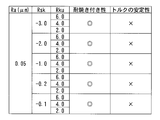
- the temperature increase test was confirmed by measuring the outer ring temperature at a predetermined bearing rotation speed. In the measurement, when it was 120 ° C. or lower, the evaluation was “ ⁇ ”, when it was higher than 120 ° C. and lower than 150 ° C., the evaluation was “ ⁇ ”, and when it was 150 ° C. or higher, the evaluation was Was marked “x”. Table 1 shows the results of the temperature increase test.
- FIG. 8 to FIG. 11 show the results of evaluation according to the above-described temperature rise test and rotational torque test in various combinations of the arithmetic average roughness Ra, the roughness curve skewness Rsk, and the roughness curve kurtosis Rku.
- the large ridge surface is finished with a particularly smooth surface property, and therefore the skewness Rsk of the roughness curve on the large ridge surface is Regardless of whether it is in the range of ⁇ 1.0 ⁇ Rsk ⁇ ⁇ 0.3, and whether or not the kurtosis Rku of the roughness curve is in the range of 3.0 ⁇ Rku ⁇ 5.0. It can be seen that the seizure resistance is particularly good while the torque stability is particularly poor.
- the large ridge surface has a particularly rough surface property, and the skewness Rsk of the roughness curve on the large ridge surface is ⁇ 1.0 ⁇ Regardless of whether or not Rsk ⁇ ⁇ 0.3, and whether the roughness curve kurtosis Rku is within the range of 3.0 ⁇ Rku ⁇ 5.0, the seizure resistance is high. It can be seen that the torque stability is particularly improved while it is particularly worse.
- the tapered roller bearing according to the present invention is suitable for an application for supporting a shaft provided in a power transmission device of an automobile, for example, a differential, a transmission, or the like. This is because a low speed rotation habituation operation is performed in a state where a preload is applied to the tapered roller bearing supporting the shaft.
- An example of the tapered roller bearing according to the above-described embodiment incorporated in the power transmission path of the automobile is shown in FIG.
- FIG. 12 is an example of a differential that is a component of a power transmission path of an automobile.
- the differential includes a drive pinion 104 rotatably supported by two tapered roller bearings 102 and 103 with respect to the housing 101, a ring gear 105 that meshes with the drive pinion 104, and a pair of tapered rollers to which the ring gear 105 is attached.
- a differential gear case 107 rotatably supported with respect to the housing 101 by a bearing 106, a pinion 108 disposed in the differential gear case 107, and a pair of side gears 109 meshing with the pinion 108; These are accommodated in a housing 101 in which gear oil is enclosed.
- This gear oil also serves as a lubricating oil for the tapered roller bearings 102, 103 and 106.
- Each tapered roller bearing 102, 103, 106 corresponds to the above-described embodiment.
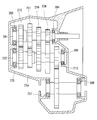
- FIG. 13 shows another example of the tapered roller bearing according to the above-described embodiment incorporated in the power transmission path of the automobile.
- FIG. 13 is an example of a transmission that is a component of a power transmission path of an automobile.
- the transmission shown in FIG. 13 is a multi-stage transmission that changes the gear ratio step by step.
- the rolling bearings 203 to 208 that rotatably support the rotation shafts (for example, the input shaft 201 and the output shaft 202) are described above.
- the tapered roller bearing according to the embodiment is provided.
- the illustrated transmission includes an input shaft 201 to which engine rotation is input, an output shaft 202 provided in parallel with the input shaft 201, and a plurality of gear trains 209 to 212 that transmit the rotation from the input shaft 201 to the output shaft 202. And a clutch (not shown) incorporated between each of the gear trains 209 to 212 and the input shaft 201 or the output shaft 202.
- the transmission switches the gear trains 209 to 212 to be used by selectively engaging the clutch, and changes the transmission gear ratio transmitted from the input shaft 201 to the output shaft 202.
- the rotation of the output shaft 202 is output to the output gear 213, and the rotation of the output gear 213 is transmitted to a differential gear or the like.
- the input shaft 201 and the output shaft 202 are rotatably supported by corresponding tapered roller bearings 203 and 204 or tapered roller bearings 205 and 206, respectively.
- the transmission is splashed or sprayed by lubricating oil splashed with the rotation of a gear or by spraying lubricating oil from a nozzle (not shown) provided inside the housing 214. Is applied to the side surface of each tapered roller bearing 203-208.
Landscapes
- Engineering & Computer Science (AREA)
- General Engineering & Computer Science (AREA)
- Mechanical Engineering (AREA)
- Rolling Contact Bearings (AREA)
Priority Applications (3)
| Application Number | Priority Date | Filing Date | Title |
|---|---|---|---|
| US16/486,886 US10968947B2 (en) | 2017-02-21 | 2018-02-16 | Tapered roller bearing |
| EP18757785.3A EP3587847B1 (en) | 2017-02-21 | 2018-02-16 | Conical roller bearing |
| CN201880012353.XA CN110312875A (zh) | 2017-02-21 | 2018-02-16 | 圆锥滚子轴承 |
Applications Claiming Priority (2)
| Application Number | Priority Date | Filing Date | Title |
|---|---|---|---|
| JP2017-029745 | 2017-02-21 | ||
| JP2017029745A JP6934728B2 (ja) | 2017-02-21 | 2017-02-21 | 円すいころ軸受 |
Publications (1)
| Publication Number | Publication Date |
|---|---|
| WO2018155320A1 true WO2018155320A1 (ja) | 2018-08-30 |
Family
ID=63253807
Family Applications (1)
| Application Number | Title | Priority Date | Filing Date |
|---|---|---|---|
| PCT/JP2018/005397 Ceased WO2018155320A1 (ja) | 2017-02-21 | 2018-02-16 | 円すいころ軸受 |
Country Status (5)
| Country | Link |
|---|---|
| US (1) | US10968947B2 (https=) |
| EP (1) | EP3587847B1 (https=) |
| JP (1) | JP6934728B2 (https=) |
| CN (1) | CN110312875A (https=) |
| WO (1) | WO2018155320A1 (https=) |
Cited By (2)
| Publication number | Priority date | Publication date | Assignee | Title |
|---|---|---|---|---|
| CN110753799A (zh) * | 2017-06-21 | 2020-02-04 | 舍弗勒技术股份两合公司 | 噪音和磨损被优化的用于支承轴的滚动轴承 |
| CN111425525A (zh) * | 2019-01-09 | 2020-07-17 | 斯凯孚公司 | 具有改进性能的滚动接触轴承 |
Families Citing this family (2)
| Publication number | Priority date | Publication date | Assignee | Title |
|---|---|---|---|---|
| CN112262521B (zh) * | 2018-06-11 | 2023-09-12 | 爱康有限公司 | 提高了耐久性的线性致动器 |
| CN111188832A (zh) * | 2020-03-12 | 2020-05-22 | 洛阳Lyc轴承有限公司 | 一种能效型圆锥滚子轴承 |
Citations (4)
| Publication number | Priority date | Publication date | Assignee | Title |
|---|---|---|---|---|
| JP2000170774A (ja) | 1998-12-01 | 2000-06-20 | Ntn Corp | 円錐ころ軸受および車両用歯車軸支持装置 |
| JP2002139055A (ja) | 2000-08-25 | 2002-05-17 | Ntn Corp | 円錐ころ軸受およびその予圧設定方法 |
| JP2004324670A (ja) * | 2003-04-21 | 2004-11-18 | Fuji Heavy Ind Ltd | ころ軸受 |
| JP2012241805A (ja) * | 2011-05-19 | 2012-12-10 | Nsk Ltd | 円すいころ軸受及びその製造方法 |
Family Cites Families (9)
| Publication number | Priority date | Publication date | Assignee | Title |
|---|---|---|---|---|
| US6328477B1 (en) | 1998-11-27 | 2001-12-11 | Ntn Corporation | Tapered roller bearings and gear shaft support devices |
| JP4029574B2 (ja) * | 2001-01-26 | 2008-01-09 | 株式会社ジェイテクト | 円錐ころ軸受 |
| DE60217941T2 (de) * | 2001-05-16 | 2007-10-18 | Jtekt Corp., Osaka | Wälzlager mit strichförmigen Schleifspuren auf den Walzenendflächen und auf die Flanschfürungsfläche |
| JP2011196543A (ja) | 2010-02-23 | 2011-10-06 | Nsk Ltd | ころ軸受およびその製造方法 |
| US20130170780A1 (en) * | 2010-02-23 | 2013-07-04 | Nsk Ltd. | Roller Bearing and Method for Manufacturing the Same |
| JP5920221B2 (ja) * | 2010-11-12 | 2016-05-18 | 日本精工株式会社 | 作動装置の製造方法 |
| JP5927960B2 (ja) * | 2011-05-30 | 2016-06-01 | 日本精工株式会社 | ころ軸受 |
| JP5831131B2 (ja) | 2011-10-24 | 2015-12-09 | 日本精工株式会社 | ころ軸受およびその製造方法 |
| JP6492646B2 (ja) * | 2014-12-26 | 2019-04-03 | 株式会社ジェイテクト | 円すいころ軸受 |
-
2017
- 2017-02-21 JP JP2017029745A patent/JP6934728B2/ja not_active Expired - Fee Related
-
2018
- 2018-02-16 EP EP18757785.3A patent/EP3587847B1/en not_active Not-in-force
- 2018-02-16 WO PCT/JP2018/005397 patent/WO2018155320A1/ja not_active Ceased
- 2018-02-16 US US16/486,886 patent/US10968947B2/en not_active Expired - Fee Related
- 2018-02-16 CN CN201880012353.XA patent/CN110312875A/zh active Pending
Patent Citations (4)
| Publication number | Priority date | Publication date | Assignee | Title |
|---|---|---|---|---|
| JP2000170774A (ja) | 1998-12-01 | 2000-06-20 | Ntn Corp | 円錐ころ軸受および車両用歯車軸支持装置 |
| JP2002139055A (ja) | 2000-08-25 | 2002-05-17 | Ntn Corp | 円錐ころ軸受およびその予圧設定方法 |
| JP2004324670A (ja) * | 2003-04-21 | 2004-11-18 | Fuji Heavy Ind Ltd | ころ軸受 |
| JP2012241805A (ja) * | 2011-05-19 | 2012-12-10 | Nsk Ltd | 円すいころ軸受及びその製造方法 |
Non-Patent Citations (1)
| Title |
|---|
| See also references of EP3587847A4 |
Cited By (2)
| Publication number | Priority date | Publication date | Assignee | Title |
|---|---|---|---|---|
| CN110753799A (zh) * | 2017-06-21 | 2020-02-04 | 舍弗勒技术股份两合公司 | 噪音和磨损被优化的用于支承轴的滚动轴承 |
| CN111425525A (zh) * | 2019-01-09 | 2020-07-17 | 斯凯孚公司 | 具有改进性能的滚动接触轴承 |
Also Published As
| Publication number | Publication date |
|---|---|
| US10968947B2 (en) | 2021-04-06 |
| EP3587847B1 (en) | 2021-11-10 |
| JP6934728B2 (ja) | 2021-09-15 |
| EP3587847A1 (en) | 2020-01-01 |
| CN110312875A (zh) | 2019-10-08 |
| JP2018135921A (ja) | 2018-08-30 |
| US20200011375A1 (en) | 2020-01-09 |
| EP3587847A4 (en) | 2020-02-12 |
Similar Documents
| Publication | Publication Date | Title |
|---|---|---|
| WO2018155320A1 (ja) | 円すいころ軸受 | |
| CN110325748A (zh) | 圆锥滚子轴承 | |
| JP2007051702A (ja) | 円錐ころ軸受、及びこれを用いた車両用ピニオン軸支持装置 | |
| JP7504270B2 (ja) | 円すいころ軸受 | |
| US7540665B2 (en) | Tapered roller bearing | |
| JP2005106234A (ja) | 円錐ころ軸受と円錐ころ加工方法 | |
| US20220154767A1 (en) | Tapered roller bearing | |
| JP2007051703A (ja) | 円錐ころ軸受、及びこれを用いたトランスミッション用軸受装置 | |
| JP6739968B2 (ja) | 円すいころ軸受 | |
| JP7394939B2 (ja) | 円すいころ軸受 | |
| US10197094B2 (en) | Double-row spherical roller bearing | |
| JP6965007B2 (ja) | 円錐ころ軸受 | |
| CN114555959B (zh) | 圆锥滚子轴承 | |
| JP4206715B2 (ja) | 円すいころ軸受 | |
| WO2021054279A1 (ja) | 円すいころ軸受 | |
| JP6858051B2 (ja) | 円錐ころ軸受 | |
| JP7679270B2 (ja) | 円すいころ軸受 | |
| JP2021046914A (ja) | 円すいころ軸受 | |
| JP2010156425A (ja) | 自動調心ころ軸受 | |
| JP7405544B2 (ja) | 円すいころ軸受 | |
| JP4492101B2 (ja) | 自動調心ころ軸受 | |
| JP2002070874A (ja) | 回転支持装置 | |
| JPH087145Y2 (ja) | 車両ホイール用ころ軸受 | |
| JP2008019965A (ja) | 遊星歯車装置及び転がり軸受 | |
| JP2023102524A (ja) | 複列円すいころ軸受 |
Legal Events
| Date | Code | Title | Description |
|---|---|---|---|
| 121 | Ep: the epo has been informed by wipo that ep was designated in this application |
Ref document number: 18757785 Country of ref document: EP Kind code of ref document: A1 |
|
| NENP | Non-entry into the national phase |
Ref country code: DE |
|
| ENP | Entry into the national phase |
Ref document number: 2018757785 Country of ref document: EP Effective date: 20190923 |