WO2018103518A1 - 一种中性锌铁液流电池 - Google Patents
一种中性锌铁液流电池 Download PDFInfo
- Publication number
- WO2018103518A1 WO2018103518A1 PCT/CN2017/111225 CN2017111225W WO2018103518A1 WO 2018103518 A1 WO2018103518 A1 WO 2018103518A1 CN 2017111225 W CN2017111225 W CN 2017111225W WO 2018103518 A1 WO2018103518 A1 WO 2018103518A1
- Authority
- WO
- WIPO (PCT)
- Prior art keywords
- electrode electrolyte
- zinc
- positive electrode
- electrolyte
- positive
- Prior art date
- Legal status (The legal status is an assumption and is not a legal conclusion. Google has not performed a legal analysis and makes no representation as to the accuracy of the status listed.)
- Ceased
Links
Images
Classifications
-
- H—ELECTRICITY
- H01—ELECTRIC ELEMENTS
- H01M—PROCESSES OR MEANS, e.g. BATTERIES, FOR THE DIRECT CONVERSION OF CHEMICAL ENERGY INTO ELECTRICAL ENERGY
- H01M8/00—Fuel cells; Manufacture thereof
- H01M8/18—Regenerative fuel cells, e.g. redox flow batteries or secondary fuel cells
- H01M8/184—Regeneration by electrochemical means
- H01M8/188—Regeneration by electrochemical means by recharging of redox couples containing fluids; Redox flow type batteries
-
- H—ELECTRICITY
- H01—ELECTRIC ELEMENTS
- H01M—PROCESSES OR MEANS, e.g. BATTERIES, FOR THE DIRECT CONVERSION OF CHEMICAL ENERGY INTO ELECTRICAL ENERGY
- H01M8/00—Fuel cells; Manufacture thereof
- H01M8/18—Regenerative fuel cells, e.g. redox flow batteries or secondary fuel cells
-
- Y—GENERAL TAGGING OF NEW TECHNOLOGICAL DEVELOPMENTS; GENERAL TAGGING OF CROSS-SECTIONAL TECHNOLOGIES SPANNING OVER SEVERAL SECTIONS OF THE IPC; TECHNICAL SUBJECTS COVERED BY FORMER USPC CROSS-REFERENCE ART COLLECTIONS [XRACs] AND DIGESTS
- Y02—TECHNOLOGIES OR APPLICATIONS FOR MITIGATION OR ADAPTATION AGAINST CLIMATE CHANGE
- Y02E—REDUCTION OF GREENHOUSE GAS [GHG] EMISSIONS, RELATED TO ENERGY GENERATION, TRANSMISSION OR DISTRIBUTION
- Y02E60/00—Enabling technologies; Technologies with a potential or indirect contribution to GHG emissions mitigation
- Y02E60/30—Hydrogen technology
- Y02E60/50—Fuel cells
Definitions
- the invention relates to the field of flow batteries, in particular to the field of zinc-iron flow batteries.
- the flow battery is a new electrochemical energy storage technology. Compared with other energy storage technologies, it has flexible system design, large storage capacity, free site selection, high energy conversion efficiency, deep discharge, safety and environmental protection, and low maintenance cost. Other advantages, can be widely used in wind energy, solar energy and other renewable energy power generation, emergency power systems, backup power stations and power system peaking and valley filling.
- VFB Vanadium flow battery
- the more mature flow batteries are mainly zinc-bromine flow batteries, sodium polysulfide bromine and zinc-nickel battery systems.
- the zinc bromine flow battery and the sodium sulfide bromine battery cause environmental pollution due to the formation of bromine element during charging of the positive electrode side electrolyte, which restricts its large-scale application; and the electrolyte of the zinc-nickel battery system needs 10 to 14 mol/
- the strong base of L acts as a supporting electrolyte, and this high concentration of alkali solution is severely corroded to the equipment.
- Zinc-iron liquid flow battery has a good application prospect in large-scale liquid flow batteries because of its low electrolyte cost.
- the research on the zinc-iron flow battery has been carried out using an aqueous solution of potassium ferricyanide, the negative electrode using an alkaline solution of zinc oxide, and the separator using an ion exchange membrane, since the strong alkaline electrolyte system has a battery for the battery. Strong corrosiveness, while the solubility of ferricyanide is low, the energy density of the battery is not high. In the current alkaline zinc-iron flow battery, the solubility of ferrocyanide is only 0.6mol/L, and the energy density is less than 15wh/L. .
- Neutral system zinc-iron flow battery can effectively solve the problem of battery corrosion, but in the neutral electrolyte system, iron ions are easily hydrolyzed, and the dissociated iron ions are replaced with ion exchange groups in the ion exchange membrane, resulting in membrane Serious pollution leads to a significant drop in battery efficiency and poor cycle stability. In the current neutral zinc-iron flow battery, the cycle life is mostly less than 50 times, which seriously hinders the popularization of neutral zinc-iron flow batteries.
- the present invention adopts a porous membrane containing no ion exchange group for the first time in a neutral zinc-iron liquid flow battery, which fundamentally solves the problem of contamination of the membrane by iron ions, and at the same time, introduces an additive into the positive electrode electrolyte.
- the complexation of the additive with iron inhibits the hydrolysis of iron ions, and the complex of iron and the additive forms a large size, which greatly improves the selectivity of the porous membrane.
- the system is based on a combination of all of the above factors, which greatly improves the performance and reliability of the zinc-iron flow battery.
- a neutral zinc-iron liquid flow battery comprises a single battery or a stack composed of two or more single cells, and the single battery includes a positive electrode, a separator and a negative electrode, and a positive electrode electrolyte is introduced between the positive electrode and the separator, and the negative electrode and the separator are A negative electrode electrolyte is introduced between them, the positive electrode electrolyte contains a positive electrode electrolyte and an additive, the positive electrode electrolyte is a ferrous salt, and the additive is one or more of aminoacetic acid, lysine, EDTA, DMSO, and the negative electrode electrolyte
- the negative electrode electrolyte is a neutral zinc salt, the positive and negative electrode electrolyte solvents are all water; the positive electrode electrolyte and/or the negative electrode electrolyte further contain a supporting electrolyte; and the separator is a porous film containing no ion exchange groups.
- the negative electrode electrolyte contains a supporting electrolyte, More preferably, the
- the ferrous salt is one or more of ferrous sulfate, ferrous chloride and ferrous bromide, and the concentration of the ferrous salt in the positive electrode electrolyte is 0.8 to 3 mol/L, preferably ferrous chloride. Preferably, the concentration is 1.0 to 3 mol/L.
- the neutral zinc salt is one or more of zinc chloride, zinc bromide, zinc sulfate, and zinc nitrate, and the concentration of the neutral zinc salt in the negative electrode electrolyte is 0.2 to 3 mol/L. Preferably, the concentration is from 0.4 to 1.5 mol/L, and preferably the zinc salt is zinc chloride or zinc bromide.
- the positive electrode electrolyte or the negative electrode electrolyte further contains a supporting electrolyte, and the concentration of the supporting electrolyte in the positive electrode or the negative electrode electrolyte is 2 to 4 mol/L.
- the supporting electrolyte is one or more of KCl, K 2 SO 4 , KNO 3 , NH 4 Cl, and (NH 4 ) 2 SO 4 .
- the supporting electrolyte is KCl.
- the concentration of the additive in the positive electrode electrolyte is 1.6-6 mol/L, and the additive is preferably aminoacetic acid.
- the porous membrane material containing no ion exchange group is one or more of a polyolefin or a polyaromatic hydrocarbon, the film thickness is 10 to 100 ⁇ m, the porosity of the porous membrane is 10-80%, and the pore diameter ranges from 0.5 to 10 nm. .
- the positive and negative electrodes used are carbon felt, graphite plate, metal plate or carbon cloth, preferably carbon felt.
- the separator is a porous membrane containing no ion exchange groups, and the material is one or more of polyolefin or polyaromatic hydrocarbon, the film thickness is 10 to 100 um, the porosity of the porous membrane is 10-80%, and the pore diameter is 0.5- 10nm.
- the electrodes used were carbon felt, graphite plate, metal plate or carbon cloth.
- the positive and negative electrolytes enter the positive and negative electrodes from the positive and negative electrolyte storage tanks through the pipeline through the pipeline.
- the positive active material Fe 2+ is oxidized to form Fe 3+
- the negative active material Zn 2+ occurs.
- the reduction reaction produces Zn; during the discharge, the positive Fe 3+ undergoes a reduction reaction to form Fe 2+ , and the anode elemental zinc oxidizes to form Zn 2+ .
- the invention adopts a porous membrane containing no ion exchange group, which fundamentally solves the problem of contamination of the membrane by iron ions; introducing an additive into the positive electrolyte, the additive used will cooperate with iron to inhibit iron ions
- the porous membrane used can well block the transmission of iron ions and greatly improve the selectivity of the porous membrane.
- the positive electrode adopts ferrous salt as the positive electrode electrolyte with high solubility, the energy density of the battery is greatly improved, the solubility can reach more than 2M, the utilization rate of electrolyte at 80mA/cm 2 is greater than 95%, and the energy density is greater than 66Wh/L;
- the positive electrode uses a ferrous salt as an active material. Neutral systems have minimal damage to the diaphragm and electrodes and can greatly increase battery life.
- Example 2 is a graph showing the cycle performance of the battery in Example 9.
- Figure 3 is a graph showing the cycle performance of the battery of Comparative Example 3;
- Figure 5 is a graph showing the cycle performance of the battery of Comparative Example 5;
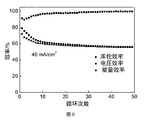
- Figure 6 is a graph showing the cycle performance of a neutral zinc-iron flow battery assembled in Comparative Example 6.
- the electrolyte is prepared as follows:
- the structure of the single battery includes: end plates, positive and negative electrodes, diaphragms, liquid flow frames, bipolar plates, positive and negative storage tanks and pumps, and pipelines.
- the flow rate of the electrolyte in the battery was 10 ml/min, the charging current was 80 mA/cm2, the charge cut-off voltage was 1.8 V, the discharge cut-off voltage was 0.1 V, and the charge amount was 30 AH/L.
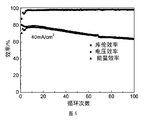
- the cycle performance chart is shown in Figure 1.
- the present invention uses a porous membrane containing no ion exchange groups, and the use of an ion transport membrane in Comparative Examples 2, 3, and 5, the coulombic efficiency is remarkably improved, and the iron ion is fundamentally solved.
- the positive electrode of the invention adopts ferrous salt as the positive electrode electrolyte, has high solubility, the energy density of the battery is greatly improved, the solubility can reach more than 2M, the utilization rate of the electrolyte at 80 mA/cm 2 is greater than 95%, and the energy density is greater than 56 Wh/L;
- the ratio 6 positive electrode electrolyte uses KFe(CN) 6 and the battery energy density is greater than 19 Wh/L.
Landscapes
- Life Sciences & Earth Sciences (AREA)
- Engineering & Computer Science (AREA)
- Manufacturing & Machinery (AREA)
- Sustainable Development (AREA)
- Sustainable Energy (AREA)
- Chemical & Material Sciences (AREA)
- Chemical Kinetics & Catalysis (AREA)
- Electrochemistry (AREA)
- General Chemical & Material Sciences (AREA)
- Hybrid Cells (AREA)
- Fuel Cell (AREA)
Abstract
一种中性锌铁液流电池,包括单电池或者由2个以上单电池组成的电堆,单电池包括正极、隔膜、负极,于正极和隔膜之间通入正极电解液,于负极和隔膜之间通入负极电解液,正极电解液中的正极电解质为亚铁盐;负极电解液中的负极电解质为中性锌盐,溶剂为水。正负极电解质溶液均为中性,克服了传统液流电池强酸强碱电解质的腐蚀性问题,同时电池正负极之间的多孔膜,起到阻止正负极活性物质混合并且导通支持电解质的作用。
Description
本发明涉及液流电池领域,特别是锌铁液流电池领域。
液流电池是一种电化学储能新技术,与其它储能技术相比,具有系统设计灵活、蓄电容量大、选址自由、能量转换效率高、可深度放电、安全环保、维护费用低等优点,可以广泛应用于风能、太阳能等可再生能源发电储能、应急电源系统、备用电站和电力系统削峰填谷等方面。
全钒液流电池(Vanadium flow battery,VFB)由于安全性高、稳定性好、效率高、寿命长(寿命>15年)、成本低等优点,被认为具有良好的应用前景,但VFB的电解质溶液价格较贵,这在一定程度上限制了其大规模应用。因此开发性能优异,成本低廉的电化学储能电池对可再生能源普及应用非常重要。
除了全钒液流电池以外,目前发展较为成熟的液流电池主要还有锌溴液流电池、多硫化钠溴和锌镍电池体系。其中锌溴液流电池和多硫化钠溴电池由于正极侧电解液在充电时会生成溴单质而造成环境污染,制约了其大规模应用;而锌镍电池体系的电解液需用10~14mol/L的强碱作为支持电解质,这种高浓度的碱溶液对设备腐蚀严重。
锌铁液流电池由于具有电解液成本低的优势,在大规模液流电池中具有较好的应用前景。目前报道的锌铁液流电池的研究正极均使用的是铁氰化钾的水溶液,负极使用的是氧化锌的碱溶液,隔膜均采用离子交换膜,由于这种强碱电解液体系对电池具有强腐蚀性,同时铁氰化物的溶解度较低导致电池的能量密度不高,目前的碱性锌铁液流电池中,亚铁氰化物的溶解度只有0.6mol/L,能量密度只有不足15wh/L。中性体系锌铁液流电池可以有效解决电池腐蚀性问题,但是在中性电解质体系下铁离子极易水解,解离后的铁离子与离子交换膜中的离子交换基团发生置换,造成膜污染严重,导致电池效率大幅度下降,循环稳定性差,目前所报道中性锌铁液流电池中,循环寿命大多低于50次,这些都严重阻碍了中性锌铁液流电池的普及应用。
发明内容
本发明为了解决上述技术问题,在中性锌铁液流电池中首次采用不含离子交换基团多孔膜,从根本上解决了铁离子对膜的污染问题,同时,在正极电解液中引入添加剂,添加剂与铁发生络合作用抑制了铁离子水解,同时铁与添加剂形成的络合物尺寸较大,大幅度提高了多孔膜的选择性。该体系基于以上所有因素的组合,从而大幅度提高了锌铁液流电池性能和可靠性。
为实现上述目的,本发明采用的具体技术方案如下:
一种中性锌铁液流电池,包括单电池或者由2个以上单电池组成的电堆,单电池包括正极、隔膜、负极,于正极和隔膜之间通入正极电解液,于负极和隔膜之间通入负极电解液,正极电解液中包含正极电解质和添加剂,正极电解质为亚铁盐,添加剂为氨基乙酸、赖氨酸、EDTA、DMSO的一种或者二种以上,负极电解液中的负极电解质为中性锌盐,正、负极电解液溶剂均为水;正极电解液和/或负极电解液中还含有支持电解质;隔膜为不含离子交换基团的多孔膜。优选负极电解液中含有支持电解质,
更优选正负极电解液中均含有支持电解质。
亚铁盐为硫酸亚铁、氯化亚铁、溴化亚铁中的一种或二种以上,其于正极电解液中的亚铁盐的浓度是0.8~3mol/L,优选氯化亚铁,优选浓度1.0~3mol/L。
中性锌盐为氯化锌、溴化锌、硫酸锌、硝酸锌中的一种或二种以上,中性锌盐在负极电解液中的浓度是0.2~3mol/L。优选浓度0.4-1.5mol/L,优选锌盐为氯化锌,溴化锌。
正极电解液或负极电解液中还含有支持电解质,支持电解质在正极或负极电解液中的浓度为2~4mol/L。
支持电解质为KCl、K2SO4、KNO3、NH4Cl、(NH4)2SO4的一种或二种以上。优选支持电解质为KCl。
添加剂于正极电解液中的浓度是1.6~6mol/L,添加剂优选氨基乙酸.
所述不含离子交换基团的多孔膜材料为聚烯烃或聚芳烃类中的一种或二种以上,膜厚在10~100um,多孔膜的孔隙率10-80%,孔径范围0.5-10nm。
所使用的正、负极为碳毡、石墨板、金属板或者碳布,优选碳毡。
隔膜为不含离子交换基团的多孔膜,材料为聚烯烃或聚芳烃类中的一种或二种以上,膜厚在10~100um,多孔膜的孔隙率10-80%,孔径范围0.5-10nm。
所使用的电极为碳毡、石墨板、金属板或者碳布。
充电时,正、负极电解质从正、负极电解液储罐中由泵经由管路进入正、负极,充电时,正极活性物质Fe2+发生氧化反应生成Fe3+,负极活性物质Zn2+发生还原反应生成Zn;放电时正极Fe3+发生还原反应生成Fe2+,负极单质锌发生氧化反应生成Zn2+。
本发明的有益效果:
1)本发明采用不含离子交换基团多孔膜,从根本上解决了铁离子对膜的污染问题;在正极电解液中引入添加剂,使用的添加剂会与铁发生络合作用,从而抑制铁离子的水解,同时铁与添加剂形成的络合物尺寸较大,使用的多孔隔膜可以很好的起到阻隔铁离子的透过,大幅度提高了多孔膜的选择性。
2)正极采用亚铁盐作为正极电解质具有溶解度高,电池的能量密度得到大幅度提高,溶解度可以达到2M以上,在80mA/cm2电解质的利用率大于95%,能量密度大于66Wh/L;
3)正极使用亚铁盐作为活性物质。中性体系对于隔膜和电极的伤害很小,可以大大提高电池的使用寿命。
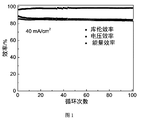
图1为实施例3中性锌铁液流电池的循环性能图;
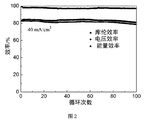
图2为实施例9中电池的循环性能图。
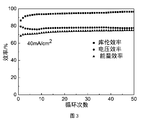
图3为对比例3的电池循环性能图;
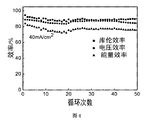
图4为对比例4的电池循环性能图;
图5为对比例5的电池循环性能图;
图6为对比例6组装的中性锌铁液流电池循环性能图。
电解质的配制如下表:
单电池的组装:
单电池的结构包括:端板,正负极,隔膜,液流框,双极板,正负极储罐和泵以及管路组成。
电池性能的测试:
电池中电解质的流速为10ml/min,充电电流为80mA/cm2,充电截止电压为1.8V,放电截止电压为0.1V,充电电量为30AH/L。循环性能图见图1。
从实施例和对比例电池性能可以看出,本发明采用不含离子交换基团多孔膜相对于对比例2、3、5中使用离子传导膜,库伦效率明显提高,从根本上解决了铁离子对膜的污染问题;在正极电解液中引入添加剂与对比例4正极电解液不含添加剂相比,实施例的电压效率CE明显提高,这是由于使用的添加剂会与铁发生络合作用,从而抑制铁离子的水解,同时铁与添加剂形成的络合物尺寸较大,使用的多孔隔膜可以很好的起到阻隔铁离子的透过,大幅度提高了多孔膜的选择性。本发明正极采用亚铁盐作为正极电解质具有溶解度高,电池的能量密度得到大幅度提高,溶解度可以达到2M以上,在80mA/cm2电解质的利用率大于95%,能量密度大于56Wh/L;对比例6正极电解液使用KFe(CN)6,电池能量密度大于19Wh/L。


Claims (10)
- 一种中性锌铁液流电池,包括单电池、或者由2个以上单电池串和/或并联组成的电堆,单电池包括正极、隔膜、负极,于正极和隔膜之间通入正极电解液,于负极和隔膜之间通入负极电解液,其特征在于,正极电解液中包含正极电解质和添加剂,正极电解质为亚铁盐,添加剂为氨基乙酸、赖氨酸、EDTA、DMSO的一种或者二种以上,负极电解液中的负极电解质为中性锌盐,正、负极电解液溶剂均为水;正极电解液和/或负极电解液中还含有支持电解质;隔膜为不含离子交换基团的多孔膜。
- 根据权利要求1所述中性锌铁液流电池,其特征在于:亚铁盐为硫酸亚铁、氯化亚铁、溴化亚铁中的一种或二种以上,其于正极电解液中的亚铁盐的浓度是0.8~3mol/L。
- 根据权利要求1所述中性锌铁液流电池,其特征在于:中性锌盐为氯化锌、溴化锌、硫酸锌、硝酸锌中的一种或二种以上,中性锌盐在负极电解液中的浓度是0.8~3mol/L。
- 根据权利要求1、2或3所述中性锌铁液流电池,其特征在于:正极电解液中正极电解质浓度:负极电解液中负极电解质浓度比2:1。
- 根据权利要求1所述中性锌铁液流电池,其特征在于:支持电解质在正极和/或负极电解液中的浓度为2~4mol/L。
- 根据权利要求1或5所述中性锌铁液流电池,其特征在于:支持电解质为KCl、K2SO4、KNO3、NH4Cl、(NH4)2SO4的一种或二种以上。
- 根据权利要求1所述中性锌铁液流电池,其特征在于:添加剂于正极电解液中的浓度是1~5mol/L。
- 根据权利要求1所述中性锌铁液流电池,其特征在于:所述不含离子交换基团的 多孔膜材料为聚烯烃或聚芳烃类中的一种或二种以上,膜厚在10~100um,多孔膜的孔隙率10-80%,孔径范围0.5-10nm。
- 根据权利要求1所述中性锌铁液流电池,其特征在于:所使用的正、负极分别为碳毡、石墨板、金属板或者碳布,优选碳毡。
- 根据权利要求8所述中性锌铁液流电池,其特征在于:聚烯烃类包括PE、PP、PAN聚合物中的一种或二种以上,聚芳烃类包括SPEEK、PES、PS、PBI聚合物中的一种或二种以上。
Applications Claiming Priority (2)
| Application Number | Priority Date | Filing Date | Title |
|---|---|---|---|
| CN201611133505.0A CN108232265A (zh) | 2016-12-10 | 2016-12-10 | 一种中性锌铁液流电池 |
| CN201611133505.0 | 2016-12-10 |
Publications (1)
| Publication Number | Publication Date |
|---|---|
| WO2018103518A1 true WO2018103518A1 (zh) | 2018-06-14 |
Family
ID=62490787
Family Applications (1)
| Application Number | Title | Priority Date | Filing Date |
|---|---|---|---|
| PCT/CN2017/111225 Ceased WO2018103518A1 (zh) | 2016-12-10 | 2017-11-16 | 一种中性锌铁液流电池 |
Country Status (2)
| Country | Link |
|---|---|
| CN (1) | CN108232265A (zh) |
| WO (1) | WO2018103518A1 (zh) |
Cited By (3)
| Publication number | Priority date | Publication date | Assignee | Title |
|---|---|---|---|---|
| CN112635860A (zh) * | 2021-01-08 | 2021-04-09 | 浙江大学 | 一种水系锌离子电池电解液添加剂 |
| CN113437340A (zh) * | 2021-05-10 | 2021-09-24 | 中国科学院金属研究所 | 一种用于锌锰液流电池的正极电解液 |
| CN119601710A (zh) * | 2023-09-08 | 2025-03-11 | 中国科学院大连化学物理研究所 | 一种碱性锌铁液流电池电解液恢复方法 |
Families Citing this family (5)
| Publication number | Priority date | Publication date | Assignee | Title |
|---|---|---|---|---|
| CN111193033B (zh) * | 2018-11-15 | 2021-06-08 | 中国科学院大连化学物理研究所 | 一种碱性锌铁单液流电池 |
| CN110224157B (zh) * | 2019-04-30 | 2022-12-06 | 钱志刚 | 非循环流动的液流电池 |
| CN112952173B (zh) * | 2019-12-10 | 2023-01-24 | 中国科学院大连化学物理研究所 | 一种食品级电解液的中性锌铁液流电池 |
| CN113903963B (zh) | 2020-07-06 | 2023-06-16 | 国家能源投资集团有限责任公司 | 中性锌铁液流电池及其应用 |
| CN114551954B (zh) * | 2022-01-11 | 2023-10-10 | 中国科学院金属研究所 | 一种锌铁液流电池用负极电解液 |
Citations (4)
| Publication number | Priority date | Publication date | Assignee | Title |
|---|---|---|---|---|
| CN103682407A (zh) * | 2012-08-30 | 2014-03-26 | 中国科学院大连化学物理研究所 | 一种锌铁单液流电池 |
| CN103748709A (zh) * | 2011-06-01 | 2014-04-23 | 凯斯西储大学 | 基于铁的液流电池 |
| CN104716374A (zh) * | 2013-12-15 | 2015-06-17 | 中国科学院大连化学物理研究所 | 一种中性锌铁双液流电池 |
| CN105336971A (zh) * | 2015-09-25 | 2016-02-17 | 中国人民解放军63971部队 | 一种水系锌锰单液流电池 |
Family Cites Families (1)
| Publication number | Priority date | Publication date | Assignee | Title |
|---|---|---|---|---|
| CN105474446B (zh) * | 2013-08-07 | 2018-07-03 | 住友电气工业株式会社 | 氧化还原液流电池 |
-
2016
- 2016-12-10 CN CN201611133505.0A patent/CN108232265A/zh active Pending
-
2017
- 2017-11-16 WO PCT/CN2017/111225 patent/WO2018103518A1/zh not_active Ceased
Patent Citations (4)
| Publication number | Priority date | Publication date | Assignee | Title |
|---|---|---|---|---|
| CN103748709A (zh) * | 2011-06-01 | 2014-04-23 | 凯斯西储大学 | 基于铁的液流电池 |
| CN103682407A (zh) * | 2012-08-30 | 2014-03-26 | 中国科学院大连化学物理研究所 | 一种锌铁单液流电池 |
| CN104716374A (zh) * | 2013-12-15 | 2015-06-17 | 中国科学院大连化学物理研究所 | 一种中性锌铁双液流电池 |
| CN105336971A (zh) * | 2015-09-25 | 2016-02-17 | 中国人民解放军63971部队 | 一种水系锌锰单液流电池 |
Cited By (4)
| Publication number | Priority date | Publication date | Assignee | Title |
|---|---|---|---|---|
| CN112635860A (zh) * | 2021-01-08 | 2021-04-09 | 浙江大学 | 一种水系锌离子电池电解液添加剂 |
| CN112635860B (zh) * | 2021-01-08 | 2022-07-12 | 浙江大学 | 一种水系锌离子电池电解液添加剂 |
| CN113437340A (zh) * | 2021-05-10 | 2021-09-24 | 中国科学院金属研究所 | 一种用于锌锰液流电池的正极电解液 |
| CN119601710A (zh) * | 2023-09-08 | 2025-03-11 | 中国科学院大连化学物理研究所 | 一种碱性锌铁液流电池电解液恢复方法 |
Also Published As
| Publication number | Publication date |
|---|---|
| CN108232265A (zh) | 2018-06-29 |
Similar Documents
| Publication | Publication Date | Title |
|---|---|---|
| CN111244518B (zh) | 一种水系中性有机液流电池 | |
| WO2018103518A1 (zh) | 一种中性锌铁液流电池 | |
| US11605824B2 (en) | Zinc iodine flow battery | |
| CN104716374B (zh) | 一种中性锌铁双液流电池 | |
| CN109509901B (zh) | 一种碱性锌铁液流电池 | |
| CN112786938B (zh) | 具有双溶解沉积反应的酸碱混合高电压水系锌电池和锌液流电池 | |
| CN109755604B (zh) | 一种中性锌碘液流电池 | |
| WO2016078491A1 (zh) | 一种长寿命锌溴液流电池 | |
| CN108615921A (zh) | 一种中性锌铁液流电池用电解液 | |
| CN109755620A (zh) | 一种锌碘液流电池 | |
| CN112687930A (zh) | 一种添加剂在锌溴液流电池电解液中的应用 | |
| WO2023082842A1 (zh) | 一种碱性负极电解液及其组装的碱性锌铁液流电池 | |
| JP2017517101A (ja) | キノンポリハライドフロー電池 | |
| CN113013460B (zh) | 一种碱性锌铁液流电池用负极电解液及锌铁液流电池 | |
| CN114824369B (zh) | 一种全铁液流电池的电解液再平衡方法 | |
| CN113903963B (zh) | 中性锌铁液流电池及其应用 | |
| CN116259808A (zh) | 近中性低电位锌络合电解液及其在液流电池中的应用 | |
| CN119324241B (zh) | 一种新型铕铈液流电池电解液及制备方法 | |
| CN106129443B (zh) | 一种新型的keggin型钴钨酸液流电池 | |
| CN119725653A (zh) | 一种溴铬液流电池系统 | |
| CN114614038A (zh) | 一种锌溴液流电池电解液及其在锌溴液流电池中的应用 | |
| CN119650782A (zh) | 一种基于溴基盐酸基的全钒液流电池电解液及其应用 | |
| CN117766831A (zh) | 一种锌锰液流电池用正极电解液 | |
| CN112993355B (zh) | 一种有机液流电池 | |
| WO2023103312A1 (zh) | 一种胺溴双电子液流电池电解液及其应用和液流电池 |
Legal Events
| Date | Code | Title | Description |
|---|---|---|---|
| 121 | Ep: the epo has been informed by wipo that ep was designated in this application |
Ref document number: 17878734 Country of ref document: EP Kind code of ref document: A1 |
|
| NENP | Non-entry into the national phase |
Ref country code: DE |
|
| 122 | Ep: pct application non-entry in european phase |
Ref document number: 17878734 Country of ref document: EP Kind code of ref document: A1 |