WO2018096868A1 - 水系エポキシ樹脂用硬化剤、水系エポキシ樹脂組成物及びその硬化物 - Google Patents
水系エポキシ樹脂用硬化剤、水系エポキシ樹脂組成物及びその硬化物 Download PDFInfo
- Publication number
- WO2018096868A1 WO2018096868A1 PCT/JP2017/038651 JP2017038651W WO2018096868A1 WO 2018096868 A1 WO2018096868 A1 WO 2018096868A1 JP 2017038651 W JP2017038651 W JP 2017038651W WO 2018096868 A1 WO2018096868 A1 WO 2018096868A1
- Authority
- WO
- WIPO (PCT)
- Prior art keywords
- epoxy resin
- curing agent
- water
- reaction
- mass
- Prior art date
- Legal status (The legal status is an assumption and is not a legal conclusion. Google has not performed a legal analysis and makes no representation as to the accuracy of the status listed.)
- Ceased
Links
Classifications
-
- C—CHEMISTRY; METALLURGY
- C08—ORGANIC MACROMOLECULAR COMPOUNDS; THEIR PREPARATION OR CHEMICAL WORKING-UP; COMPOSITIONS BASED THEREON
- C08G—MACROMOLECULAR COMPOUNDS OBTAINED OTHERWISE THAN BY REACTIONS ONLY INVOLVING UNSATURATED CARBON-TO-CARBON BONDS
- C08G59/00—Polycondensates containing more than one epoxy group per molecule; Macromolecules obtained by polymerising compounds containing more than one epoxy group per molecule using curing agents or catalysts which react with the epoxy groups
- C08G59/18—Macromolecules obtained by polymerising compounds containing more than one epoxy group per molecule using curing agents or catalysts which react with the epoxy groups ; e.g. general methods of curing
- C08G59/40—Macromolecules obtained by polymerising compounds containing more than one epoxy group per molecule using curing agents or catalysts which react with the epoxy groups ; e.g. general methods of curing characterised by the curing agents used
- C08G59/50—Amines
- C08G59/5006—Amines aliphatic
-
- C—CHEMISTRY; METALLURGY
- C08—ORGANIC MACROMOLECULAR COMPOUNDS; THEIR PREPARATION OR CHEMICAL WORKING-UP; COMPOSITIONS BASED THEREON
- C08G—MACROMOLECULAR COMPOUNDS OBTAINED OTHERWISE THAN BY REACTIONS ONLY INVOLVING UNSATURATED CARBON-TO-CARBON BONDS
- C08G59/00—Polycondensates containing more than one epoxy group per molecule; Macromolecules obtained by polymerising compounds containing more than one epoxy group per molecule using curing agents or catalysts which react with the epoxy groups
- C08G59/18—Macromolecules obtained by polymerising compounds containing more than one epoxy group per molecule using curing agents or catalysts which react with the epoxy groups ; e.g. general methods of curing
- C08G59/40—Macromolecules obtained by polymerising compounds containing more than one epoxy group per molecule using curing agents or catalysts which react with the epoxy groups ; e.g. general methods of curing characterised by the curing agents used
- C08G59/50—Amines
- C08G59/5033—Amines aromatic
-
- C—CHEMISTRY; METALLURGY
- C07—ORGANIC CHEMISTRY
- C07C—ACYCLIC OR CARBOCYCLIC COMPOUNDS
- C07C211/00—Compounds containing amino groups bound to a carbon skeleton
- C07C211/01—Compounds containing amino groups bound to a carbon skeleton having amino groups bound to acyclic carbon atoms
- C07C211/26—Compounds containing amino groups bound to a carbon skeleton having amino groups bound to acyclic carbon atoms of an unsaturated carbon skeleton containing at least one six-membered aromatic ring
- C07C211/27—Compounds containing amino groups bound to a carbon skeleton having amino groups bound to acyclic carbon atoms of an unsaturated carbon skeleton containing at least one six-membered aromatic ring having amino groups linked to the six-membered aromatic ring by saturated carbon chains
-
- C—CHEMISTRY; METALLURGY
- C08—ORGANIC MACROMOLECULAR COMPOUNDS; THEIR PREPARATION OR CHEMICAL WORKING-UP; COMPOSITIONS BASED THEREON
- C08G—MACROMOLECULAR COMPOUNDS OBTAINED OTHERWISE THAN BY REACTIONS ONLY INVOLVING UNSATURATED CARBON-TO-CARBON BONDS
- C08G59/00—Polycondensates containing more than one epoxy group per molecule; Macromolecules obtained by polymerising compounds containing more than one epoxy group per molecule using curing agents or catalysts which react with the epoxy groups
- C08G59/18—Macromolecules obtained by polymerising compounds containing more than one epoxy group per molecule using curing agents or catalysts which react with the epoxy groups ; e.g. general methods of curing
- C08G59/40—Macromolecules obtained by polymerising compounds containing more than one epoxy group per molecule using curing agents or catalysts which react with the epoxy groups ; e.g. general methods of curing characterised by the curing agents used
- C08G59/62—Alcohols or phenols
Definitions
- the present invention relates to an aqueous epoxy resin curing agent, an aqueous epoxy resin composition, and a cured product thereof.
- Epoxy resin compositions using these epoxy resin curing agents are used in coatings such as anticorrosion coatings for ships, bridges, land and sea iron structures, lining, reinforcement, crack repair materials, sealing materials, injection materials, and primers for concrete structures. ⁇ Screed, top coat, FRP reinforcement, building flooring, water and sewage lining, paving materials, civil engineering and construction fields such as adhesives, die attach materials, insulating sealants and other electrical and electronic fields, fiber reinforced plastics Widely used in the field.
- the water-based epoxy resin coating is, for example, using a water-based epoxy resin emulsified by adding an emulsifier and water to the epoxy resin as a main agent.
- Patent Document 1 discloses an epichlorohydrin-metaxylylenediamine reaction product substantially free of metaxylylenediamine and at least one liquid hydroxyl group selected from the group comprising a plasticizer alcohol and an aqueous alcohol solvent—
- An epoxy curing reagent composition comprising a liquid hydroxyl-functional melting point depressant and the use of the epoxy curing reagent composition in combination with an epoxy resin aqueous dispersion are disclosed.
- Patent Document 2 discloses an aqueous primer composition comprising at least one thermosetting self-emulsifying epoxy resin composition, at least one thermosetting non-self-emulsifying epoxy resin composition, water, and at least one curing agent.
- a nitrogen-containing compound having at least two amine functional groups as the curing agent examples of preferable nitrogen-containing compounds include compounds obtained by the reaction of xylylenediamine and epichlorohydrin.
- a highly hydrophilic curing agent has been used as an epoxy resin curing agent used in combination with a water-based epoxy resin.
- a cured coating film of an aqueous epoxy resin composition using an aqueous epoxy resin as a main ingredient and an epichlorohydrin-metaxylylenediamine reaction product as a curing agent has coating performance such as water resistance, hardness, and appearance. It was not enough.
- the problem to be solved by the present invention is a water-based epoxy resin composition which does not contain a solvent and is suitable in terms of environment and safety, has good curability, and is excellent in coating performance such as water resistance, hardness and appearance. And a cured product thereof, and a curing agent for an aqueous epoxy resin used in the aqueous epoxy resin composition.
- the present inventor has found that an epoxy resin curing agent containing a curing agent component having a predetermined structure can solve the above-mentioned problems.
- the present invention relates to the following [1] to [14].
- A represents a 1,2-phenylene group, a 1,3-phenylene group, or a 1,4-phenylene group.
- A represents a 1,2-phenylene group, a 1,3-phenylene group, or a 1,4-phenylene group.
- A contains 10% by mass or more of a compound represented by the following general formula (2).
- A is the same as above.
- [3] The curing agent according to [1] or [2] above, wherein A is a 1,3-phenylene group.
- N is a number from 1 to 12.
- the curing agent according to [5], wherein the reaction composition is a reaction composition (C) including a reaction product of a compound having at least two epoxy groups in the molecule and a polyamine compound.
- a water-based epoxy resin composition comprising the curing agent according to any one of [1] to [8] above and a water-based epoxy resin.
- the aqueous epoxy resin composition according to [9], wherein the aqueous epoxy resin is an epoxy resin emulsion containing an epoxy resin, an emulsifier, and water.
- water-based epoxy resin of the present invention By using the curing agent for water-based epoxy resin of the present invention, it is suitable for environmental and safety aspects without containing a solvent, has good curability, and is excellent in coating film performance such as water resistance, hardness and appearance.
- An epoxy resin composition can be provided.
- the water-based epoxy resin composition gives good cured material properties, in addition to use in concrete materials, various paints such as anticorrosion paints, adhesives, flooring materials, sealants, polymer cement mortars, gas barrier coatings, primers, It is also suitably used for screeds, top coats, sealing materials, crack repair materials, road paving materials and the like.
- the curing agent of the present invention is a curing agent for water-based epoxy resins, and includes a reaction composition (A) containing a reaction product of styrene and an amine compound represented by the following general formula (1) (hereinafter simply referred to as “reaction composition (A ) ”)). H 2 N—CH 2 —A—CH 2 —NH 2 (1) (In the formula (1), A represents a 1,2-phenylene group, a 1,3-phenylene group, or a 1,4-phenylene group.)
- the “aqueous epoxy resin” refers to a water-soluble epoxy resin or an epoxy resin used in the form of an aqueous dispersion (emulsion).
- an epoxy resin emulsion is preferable as the water-based epoxy resin used in the present invention.
- curing agent of this invention is demonstrated.
- curing agent of this invention contains the reaction composition (A) containing the reaction material of styrene and the amine compound shown by the said General formula (1).
- the cured coating film of the water-based epoxy resin composition using the curing agent containing the reaction composition (A) has good water resistance, hardness and appearance.
- A is preferably a 1,3-phenylene group or a 1,4-phenylene group, and more preferably a 1,3-phenylene group.
- the amine compound represented by the general formula (1) is derived from o-xylylenediamine, m-xylylenediamine (metaxylylenediamine; MXDA), and p-xylylenediamine (paraxylylenediamine; PXDA).
- MXDA metaxylylenediamine
- PXDA paraxylylenediamine
- 1 or more xylylenediamine selected from the group consisting of 1 or more selected from the group consisting of metaxylylenediamine and paraxylylenediamine, and more preferably metaxylylenediamine.
- the reaction composition (A) is a reaction product of styrene and an amine compound represented by the general formula (1). Is preferably 95% by mass or more, more preferably 98% by mass or more, and still more preferably 99% by mass or more. The upper limit is 100% by mass.
- the reaction composition (A) preferably contains 10% by mass or more of the compound represented by the following general formula (2).
- the reaction product of styrene and the amine compound represented by the general formula (1) (hereinafter also referred to as “raw diamine”), the compound represented by the general formula (2) includes 1 mole of styrene and 1 mole of the raw material diamine. Is a reaction product (hereinafter also referred to as “1: 1 adduct”).
- the reaction composition (A) is a 2: 1 adduct of styrene and the raw material diamine.
- the adduct may contain multiple adducts such as a 4: 1 adduct, but among the adducts, a 1: 1 adduct of styrene and a raw material diamine has the lowest active hydrogen equivalent.
- the active hydrogen equivalent (hereinafter also referred to as “AHEW”) is a molecular weight per equivalent of active hydrogen that can react with the epoxy resin that is the main component of the epoxy resin composition. Therefore, the curing agent for water-based epoxy resin using the reaction composition (A) containing the compound represented by the general formula (2) as a main component can be cured well even if the blending amount in the water-based epoxy resin composition is small. Performance can be expressed.
- the content of the compound represented by the general formula (2) in the reaction composition (A) is more preferably 20% by mass or more, further preferably 30% by mass or more, and still more preferably. It is 45 mass% or more. The upper limit is 100% by mass.
- the content of the compound represented by the general formula (2) in the reaction composition (A) can be determined by gas chromatography (GC) analysis.
- the active hydrogen equivalent (AHEW) of the reaction composition (A) is preferably 130 or less, more preferably 120 or less, still more preferably 110 or less.
- the AHEW of the reaction composition (A) is preferably 80 or more, more preferably 90 or more, from the viewpoint of ease of production.
- AHEW of the reaction composition (A) can be determined, for example, by a titration method.
- the content of the amine compound represented by the general formula (1) in the reaction composition (A) is preferably 5% by mass or less, more preferably 2% by mass or less, and more preferably 1% by mass or less. More preferably.
- the reaction composition (A) can be obtained by addition reaction of styrene and the diamine represented by the general formula (1).
- the addition reaction of styrene and the raw material diamine can be performed by a known method, and the method is not particularly limited, but is preferably performed in the presence of a basic catalyst from the viewpoint of reaction efficiency.
- the basic catalyst include alkali metals, alkali metal amides (represented by the general formula MNRR ′, M is an alkali metal, N is nitrogen, R and R ′ are each independently hydrogen or an alkyl group), alkylation.
- An alkali metal etc. are mentioned, Preferably it is an alkali metal amide.
- lithium amide (LiNH 2 ) is preferable as the basic catalyst.
- the basic catalyst is preferably used in an amount of 0.1 to 20 mol%, more preferably 0, when the total amount of the raw material diamine and styrene used is 100 mol%. 0.5 to 15 mol%, more preferably 1.0 to 12 mol%, and still more preferably 1.5 to 10 mol%. If the amount of the basic catalyst used is 0.1 mol% or more, the addition reaction rate is good, and if it is 20 mol% or less, it is economically advantageous.
- the amount of styrene and raw material diamine used in the addition reaction is such that the molar ratio of styrene to 1 mole of raw material diamine is preferably 0.1 to 5. from the viewpoint of obtaining the compound represented by the general formula (2) with high selectivity.
- the range is 0 mol, more preferably 0.4 to 3.0 mol, still more preferably 0.5 to 1.5 mol, and still more preferably 0.8 to 1.2 mol.
- the addition reaction between styrene and the raw material diamine is preferably performed by bringing the raw material diamine and the basic catalyst into contact with each other in advance to perform a preliminary reaction, and then adding styrene.
- the preliminary reaction of the raw material diamine and the basic catalyst can be carried out, for example, by charging the raw material diamine and the basic catalyst in a reactor and heating them with stirring in an inert atmosphere such as nitrogen gas.
- the temperature during the preliminary reaction between the raw material diamine and the basic catalyst is preferably 50 to 140 ° C., more preferably 70 to 100 ° C. If the temperature during the preliminary reaction is 50 ° C. or higher, the raw material diamine is sufficiently activated, and the subsequent addition reaction proceeds efficiently. Moreover, if the temperature at the time of preliminary reaction is 140 degrees C or less, the heat deterioration of raw material diamine etc. can be avoided.
- the prereaction time is preferably 20 to 360 minutes, more preferably 30 to 120 minutes. When the preliminary reaction time is 20 minutes or more, the raw material diamine is sufficiently activated, and the subsequent addition reaction proceeds efficiently. Moreover, if it is 360 minutes or less, it is advantageous at the point of productivity.
- styrene is added thereto to carry out an addition reaction with the raw material diamine.
- the addition method of styrene there is no restriction
- the split addition method include a method of adding styrene into the reactor using a dropping funnel or a liquid feed pump.
- the temperature during the addition of styrene and during the addition reaction is preferably 50 to 120 ° C, more preferably 70 to 100 ° C. If reaction temperature is 50 degreeC or more, the addition reaction of styrene and raw material diamine will advance efficiently.
- the reaction liquid is sampled during the addition reaction, and unreacted styrene is quantified by gas chromatography, liquid chromatography, or the like, and the time until the unreacted styrene becomes 1% by mass or less can be determined.
- the addition reaction time is usually preferably 10 to 180 minutes, more preferably 20 to 120 minutes after completion of the addition of styrene. If the addition reaction time is 10 minutes or longer, there is little remaining unreacted raw material, and if it is 180 minutes or shorter, it is advantageous in terms of productivity.
- the obtained reaction solution contains a reaction product of styrene and raw material diamine and a basic catalyst. Moreover, unreacted raw material diamine and unreacted styrene may further be contained.
- the basic catalyst can be removed by filtration, washing with water, adsorption or the like depending on the type. For example, if the basic catalyst is an alkali metal amide, add an acid such as hydrochloric acid, hydrogen chloride gas, acetic acid, an alcohol such as methanol or ethanol, or water to change the alkali metal amide into a salt that can be easily removed. It is possible to filter. For example, when water is used, the alkali metal amide becomes a hydroxide, which facilitates filtration.
- reaction composition (A) After removing the basic catalyst from the reaction solution as described above, unreacted raw material diamine and unreacted styrene are removed by distillation to obtain a reaction composition (A).
- the content of the amine compound (raw material diamine) represented by the general formula (1) in the reaction composition (A) can be preferably 1% by mass or less.
- curing agent of this invention is 30 mass% or more, More preferably, it is 50 mass% or more, Furthermore Preferably it is 70 mass% or more, More preferably, it is 85 mass% or more.
- the upper limit is 100% by mass.
- the curing agent of the present invention may further contain other curing agent components other than the reaction composition (A).
- the “other curing agent component” include a modified polyamine compound and a polyamine compound other than the amine compound (raw material diamine) represented by the general formula (1).
- a polyamine compound refers to a compound having at least two amino groups in the molecule. From the viewpoint of obtaining a water-based epoxy resin composition having excellent coating performance such as water resistance, hardness and appearance, the “other curing agent component” is a modified polyamine compound or a reaction composition containing the modified product. Is preferred.
- reaction composition containing the reaction material of the compound which has at least 1 epoxy group in a molecule
- reaction composition (B) a reaction composition containing a reaction product of epichlorohydrin and the amine compound represented by the general formula (1)
- reaction composition (C) A reaction composition (C) containing a reaction product of a compound having at least two epoxy groups and a polyamine compound (hereinafter also simply referred to as “reaction composition (C)”) is preferable.
- reaction composition (B) The curing agent of the present invention further includes a reaction product of epichlorohydrin and an amine compound represented by the general formula (1) as a curing agent component other than the reaction composition (A). (B) may be contained.
- the curing agent further containing the reaction composition (B) is used as a curing agent for an aqueous epoxy resin, the touch drying speed and curing speed of the coating film of the aqueous epoxy resin composition are improved.
- the amine compound represented by the general formula (1) in the reaction composition (B) and preferred embodiments thereof are the same as those described in the reaction composition (A).
- the reaction composition (B) preferably contains a compound represented by the following general formula (3) as a main component.
- the “main component” as used herein refers to a component having a content of 50% by mass or more when all the constituent components in the reaction composition (B) are 100% by mass.
- A is the same as described above.
- N is a number from 1 to 12.
- the content of the compound represented by the general formula (3) in the reaction composition (B) is preferably 60% by mass or more, more preferably 70% by mass or more, further preferably 75% by mass or more, and still more preferably. It is 85 mass% or more.
- the upper limit is 100% by mass.
- the content of the compound represented by the general formula (3) in the reaction composition (B) and the composition of the compound represented by the general formula (3) are determined by GC analysis and gel filtration chromatography (GPC) analysis. be able to.
- the active hydrogen equivalent (AHEW) of the reaction composition (B) is preferably 100 or less, more preferably 90 or less, and even more preferably 80 or less. When the AHEW of the reaction composition (B) is 100 or less, high curability is exhibited even if the blending amount in the aqueous epoxy resin composition is small.
- the AHEW of the reaction composition (B) is preferably 45 or more, more preferably 50 or more, still more preferably 60 or more, from the viewpoint of ease of production.
- the AHEW of the reaction composition (B) is determined by the same method as described above.
- the content of the amine compound represented by the general formula (1) in the reaction composition (B) is preferably 35% by mass or less, more preferably 28% by mass or less, and 5% by mass or less. More preferably, it is more preferably 1% by mass or less.
- the reaction composition (B) is obtained by addition reaction of epichlorohydrin and the diamine (raw material diamine) represented by the general formula (1).
- the addition reaction of epichlorohydrin and raw material diamine can be performed by a known method, and the method is not particularly limited, but is preferably performed in the presence of a basic catalyst from the viewpoint of reaction efficiency.
- the basic catalyst is preferably an alkali metal hydroxide, more preferably one or more selected from the group consisting of potassium hydroxide and sodium hydroxide, more preferably sodium hydroxide.
- the alkali metal hydroxide may be used in a solid state or in an aqueous solution state, but is more preferably used in an aqueous solution state.
- the concentration of the alkali metal hydroxide aqueous solution is preferably in the range of 30 to 55% by mass.
- the amount of the basic catalyst used is preferably about equimolar with epichlorohydrin, and preferably 0.7 to 1 mol of epichlorohydrin used.
- the amount is 2.0 mol, more preferably 0.8 to 1.5 mol, still more preferably 0.9 to 1.2 mol.
- the addition reaction of epichlorohydrin and raw material diamine is preferably performed by mixing raw material diamine and a basic catalyst in advance and then adding epichlorohydrin to react.
- a raw material diamine and a basic catalyst are charged into a reactor, heated under stirring in an inert atmosphere such as nitrogen gas, and epichlorohydrin is added thereto for reaction.
- an inert atmosphere such as nitrogen gas
- epichlorohydrin is added thereto for reaction.
- the temperature at the time of adding epichlorohydrin is preferably 40 to 100 ° C., more preferably 50 to 80 ° C.
- the reaction temperature may be raised to improve the reaction efficiency.
- the temperature during the addition reaction is preferably 55 to 120 ° C. If reaction temperature is 55 degreeC or more, the addition reaction of epichlorohydrin and raw material diamine will advance efficiently.
- the addition reaction time is not particularly limited, and is usually 10 minutes to 6 hours, more preferably 20 minutes to 4 hours after the addition of epichlorohydrin is completed. If the addition reaction time is 10 minutes or longer, there is little remaining unreacted raw material, and if it is 6 hours or less, it is advantageous in terms of productivity.
- the resulting reaction solution contains a reaction product of epichlorohydrin and raw material diamine, unreacted raw material diamine, basic catalyst, and water and salt generated by the above addition reaction.
- the salt forms an alkali metal chloride.
- the basic catalyst can be removed by filtration, washing with water, adsorption or the like depending on the type.
- the water generated by the addition reaction can be removed under reduced pressure at a temperature of 100 ° C. or lower, for example.
- generated by the said addition reaction can be removed by filtration etc.
- reaction composition (B) As described above, the basic catalyst, water and salt are removed from the reaction solution to obtain a reaction composition (B). Furthermore, you may perform operation which removes unreacted raw material diamine as needed. By this operation, the content of the amine compound (raw material diamine) represented by the general formula (1) in the reaction composition (B) can be reduced.
- reaction composition (B) When the hardening
- the content of the reaction composition (B) in the curing agent of the present invention is preferably 70% by mass from the viewpoint of obtaining water resistance and hardness of the cured coating film of the water-based epoxy resin composition and from the viewpoint of reducing the viscosity. Hereinafter, it is more preferably 50% by mass or less, and further preferably 30% by mass or less.
- reaction composition (C) The curing agent of the present invention further includes a reaction composition (C) containing a reaction product of a compound having at least two epoxy groups in the molecule and a polyamine compound as another curing agent component other than the reaction composition (A). ) May be contained.
- a reaction composition (C) containing a reaction product of a compound having at least two epoxy groups in the molecule and a polyamine compound as another curing agent component other than the reaction composition (A).
- the curing agent further containing the reaction composition (C) is used as a curing agent for an aqueous epoxy resin, the touch drying speed and water resistance of the coating film of the aqueous epoxy resin composition are improved.
- raw material epoxy compound examples include butyl diglycidyl ether, neopentyl glycol diglycidyl ether, 1,3-propanediol diglycidyl ether, 1 , 4-butanediol diglycidyl ether, 1,6-hexanediol diglycidyl ether, biphenol diglycidyl ether, dihydroxynaphthalene diglycidyl ether, dihydroxyanthracene diglycidyl ether, triglycidyl isocyanurate, tetraglycidyl glycoluril, metaxylylenediamine
- the “polyfunctional epoxy resin” refers to an epoxy resin having two or more epoxy groups in the molecule. From the viewpoint of the touch drying speed and water resistance of the coating film of the resulting aqueous epoxy resin composition, the raw material epoxy compound is more preferably a compound containing an aromatic ring or alicyclic structure in the molecule, and the aromatic ring in the molecule. Is more preferable, and a polyfunctional epoxy resin having a glycidyloxy group derived from bisphenol A is still more preferable.
- the polyamine compound used for the production of the reaction composition (C) is not particularly limited as long as it is a compound having at least two amino groups in the molecule.
- Examples include tricyclodecane, ethylenediamine, diethylenetriamine, triethylenetetramine, tetraethylenepentamine, pentaethylenehexamine, poly
- 1,2-bis (aminomethyl) cyclohexane is used as a polyamine compound for producing the reaction composition (C) from the viewpoint of improving the touch-drying speed and water resistance of the coating film of the water-based epoxy resin composition.
- the reaction composition (C) is a reaction product of a compound having at least two epoxy groups in the molecule and a polyamine compound. Preferably it is 30 mass% or more, More preferably, it is 40 mass% or more, More preferably, it contains 45 mass% or more. The upper limit is 100% by mass.
- the reaction composition (C) may contain a raw material epoxy compound and an unreacted polyamine compound in addition to the reactant.
- the active hydrogen equivalent (AHEW) of the reaction composition (C) is preferably 200 or less, more preferably 125 or less, and even more preferably 115 or less. When the AHEW of the reaction composition (C) is 200 or less, high curability is exhibited even if the blending amount in the aqueous epoxy resin composition is small.
- the AHEW of the reaction composition (C) is preferably 30 or more, more preferably 60 or more, from the viewpoint of ease of production.
- the AHEW of the reaction composition (C) is determined by the same method as described above.
- the reaction composition (C) is obtained by addition reaction of a compound having at least two epoxy groups in the molecule (raw material epoxy compound) and a polyamine compound.
- the addition reaction can be performed by a known method, and the method is not particularly limited.
- a polyamine compound is charged in a reactor, and raw material epoxy compounds are added all at once or dividedly by dropping or the like.
- the method of heating and making it react is mentioned.
- the addition reaction is preferably performed in an inert atmosphere such as nitrogen gas.
- reaction composition (C) exhibits an action as a curing agent for an epoxy resin
- reaction composition (C) If it is the said range, the viscosity of reaction composition (C) will not become high too much, but it will be excellent in handling property, and the sclerosis
- the temperature and reaction time during the addition reaction can be appropriately selected according to the type of raw material epoxy compound and polyamine compound used. From the viewpoint of preventing the reaction rate and productivity and the decomposition of the raw materials, the temperature during the addition reaction is preferably 50 to 150 ° C, more preferably 70 to 120 ° C. The reaction time is preferably 0.5 to 12 hours, more preferably 1 to 6 hours after the addition of the raw material epoxy compound is completed.
- reaction composition (C) When the hardening
- a known curing accelerator, non-reactive diluent, mercaptan-based curing agent and the like may be further blended as long as the effects of the present invention are not impaired.
- the curing accelerator include tris (dimethylaminomethyl) phenol, benzyl alcohol, salicylic acid, triphenyl phosphite, styrenated phenol, bisphenol A, N, N′-bis (3- (dimethylamino) propyl) urea, And mercaptan-terminated polysulfide compounds such as “Thiocol LP-3” (manufactured by Toray Fine Chemical Co., Ltd.).
- the total content of the curing agent components (reaction composition (A) and other curing agent components such as reaction compositions (B) and (C)) in the curing agent of the present invention is the effect of the present invention. From the viewpoint of obtaining the above, it is preferably 70% by mass or more, more preferably 80% by mass or more, and further preferably 90% by mass or more. The upper limit is 100% by mass. Moreover, from the viewpoint of improving the water resistance and appearance of the cured coating film of the water-based epoxy resin composition, it is preferable that the content of the diamine represented by the general formula (1) in the curing agent of the present invention is small. The content is preferably 20% by mass or less, more preferably 5% by mass or less, and still more preferably 2% by mass or less.
- the active hydrogen equivalent (AHEW) of the curing agent of the present invention is preferably 130 or less, more preferably 120 or less, and even more preferably 110 or less.
- curing agent is 130 or less, even if there are few compounding quantities to an epoxy resin composition, high curability will be expressed.
- the AHEW of the curing agent is preferably 65 or more, and more preferably 70 or more, from the viewpoint of obtaining excellent coating performance such as water resistance, hardness and appearance.
- the viscosity at 25 ° C. of the curing agent of the present invention is preferably lower from the viewpoint of handling properties, preferably 2,500 mPa ⁇ s or less, more preferably 1,000 mPa ⁇ s or less, and still more preferably 500 mPa ⁇ s or less. More preferably, it is 300 mPa ⁇ s or less.
- a viscosity in 25 degreeC Preferably it is 10 mPa * s or more.
- the viscosity of the curing agent can be measured with an E-type viscometer, and specifically can be measured by the method of the example.
- the aqueous epoxy resin composition of the present invention contains the above-described curing agent for aqueous epoxy resins of the present invention and an aqueous epoxy resin.
- an epoxy resin emulsion as the water-based epoxy resin.
- the epoxy resin emulsion include those obtained by emulsifying and dispersing an epoxy resin in water.
- the epoxy resin either a self-emulsifying epoxy resin or a non-self-emulsifying epoxy resin can be used.
- an epoxy resin emulsion can be prepared by dispersing the non-self-emulsifying epoxy resin in water in the presence of an emulsifier.
- the aqueous epoxy resin used in the present invention is more preferably an epoxy resin emulsion containing an epoxy resin, an emulsifier, and water.
- the epoxy resin used for the epoxy resin emulsion any epoxy resin having a glycidyl group that reacts with the active hydrogen of the curing agent of the present invention and capable of being emulsified and dispersed in water can be used. From the viewpoint of water resistance and hardness of the cured coating film of the aqueous epoxy resin composition, an epoxy resin containing an aromatic ring or alicyclic structure in the molecule is preferable.
- epoxy resin used in the epoxy resin emulsion examples include an epoxy resin having a glycidylamino group derived from metaxylylenediamine, and an epoxy having a glycidylamino group derived from 1,3-bis (aminomethyl) cyclohexane.
- epoxy resin having glycidylamino group derived from diaminodiphenylmethane epoxy resin having glycidylamino group derived from paraaminophenol, epoxy resin having glycidyloxy group derived from paraaminophenol, derived from bisphenol A
- the epoxy resin used in the epoxy resin emulsion is derived from bisphenol A, an epoxy resin having a glycidylamino group derived from metaxylylenediamine. More preferably, the main component is one or more selected from the group consisting of an epoxy resin having a glycidyloxy group derived and an epoxy resin having a glycidyloxy group derived from bisphenol F, and derived from bisphenol A.
- the main component is one or more selected from the group consisting of an epoxy resin having a glycidyloxy group and an epoxy resin having a glycidyloxy group derived from bisphenol F, and a glycidyloxy group derived from bisphenol A
- the term “main component” as used herein means that other components can be included without departing from the gist of the present invention, preferably 50 to 100% by mass, more preferably 70 to 100% by mass, and more preferably Preferably, it means 90 to 100% by mass.
- the epoxy resin used for the epoxy resin emulsion may be either a solid epoxy resin or a liquid epoxy resin.
- solid epoxy resin means an epoxy resin that is solid at room temperature (25 ° C.)
- liquid epoxy resin means an epoxy resin that is liquid at room temperature (25 ° C.).
- the epoxy equivalent of the epoxy resin used for the epoxy resin emulsion is preferably 150 g / equivalent or more from the viewpoint of the coating performance of the resulting aqueous epoxy resin composition, and the low viscosity and curability viewpoint of the aqueous epoxy resin composition. Therefore, it is preferably 1000 g / equivalent or less, more preferably 800 g / equivalent or less.
- the epoxy equivalent of the component (solid content) obtained by removing the dispersion medium from the emulsion is also preferably within the above range.
- the epoxy resin used for an epoxy resin emulsion may be used individually by 1 type, and may use 2 or more types together.
- the epoxy equivalent in the epoxy resin emulsion state is preferably 150 g / equivalent or more, more preferably 200 g / equivalent or more, further preferably 300 g / equivalent or more, from the viewpoint of the coating performance of the resulting aqueous epoxy resin composition. More preferably, it is 500 g / equivalent or more, and preferably 1500 g / equivalent or less from the viewpoint of low viscosity and curability of the water-based epoxy resin composition.
- the concentration of the epoxy resin in the epoxy resin emulsion is not particularly limited, but is preferably 40% by mass or more, more preferably 50% by mass or more, and usually 80% by mass or less.
- the emulsifier used in the epoxy resin emulsion has an HLB defined by the Griffin method of preferably 8.0 to 20.0, more preferably 10.0 to 20.0, and even more preferably 12.0 to 20.0. is there.
- HLB hydrophilic-lipophile balance
- HLB 20 ⁇ [(molecular weight of hydrophilic group contained in emulsifier) / (molecular weight of emulsifier)]
- any of a nonionic emulsifier, an anionic emulsifier, a cationic emulsifier, an amphoteric emulsifier, and a reactive group-containing emulsifier having a reactive group can be used.
- One or more selected from the group consisting of a nonionic emulsifier, an anionic emulsifier, and a reactive group-containing emulsifier is preferable, and a nonionic emulsifier is more preferable from the viewpoint that the selection range of the curing agent is wide.
- nonionic emulsifiers include polyether compounds, ester compounds, alkanolamide compounds, and the like.
- Nonionic compounds having a polyoxyalkylene structure include polyalkylene glycols or polyalkylene glycol copolymers such as polyethylene glycol, polypropylene glycol, polyoxyethylene polyoxypropylene glycol; polyoxyethylene myristyl ether, polyoxyethylene octyldodecyl ether Polyoxyalkylene alkyl ethers such as polyoxyethylene phenyl ether, polyoxyethylene styrenated phenyl ether, polyoxyethylene naphthyl ether, polyoxyethylene bisphenol A ether and polyoxyethylene bisphenol F ether; Oxyethylene benzyl ether, polyoxyethylene dodecyl phenyl ether And the like; polyoxyalkylene alkyl aryl ether and the like.
- polyoxyalkylene aryl ether is easy to emulsify the epoxy resin in water, and from the viewpoint of improving the coating performance such as water resistance, hardness and appearance of the cured coating film of the resulting aqueous epoxy resin composition.
- at least one selected from the group consisting of polyoxyalkylene alkyl aryl ethers more preferably at least one selected from the group consisting of polyoxyethylene aryl ethers and polyoxyethylene alkyl aryl ethers, More preferred is polyoxyethylene styrenated phenyl ether, even more preferred.
- nonionic emulsifiers examples include commercially available products such as the Neugen series, Epan series manufactured by Daiichi Kogyo Seiyaku Co., Ltd., and the BLAUNON series manufactured by Aoki Yushi Kogyo Co., Ltd. .
- anionic emulsifier examples include alkyl sulfates such as sodium lauryl sulfate; polyoxyethylene alkyl ether sulfates such as sodium polyoxyethylene lauryl ether sulfate; alkylaryl sulfonates such as alkylbenzene sulfonates; alkane sulfonates.
- Fatty acid salts such as sodium laurate; polyoxyethylene alkyl ether carboxylates such as polyoxyethylene alkyl ether acetate; sulfosuccinates such as dialkyl sulfosuccinate; and the like.
- Examples of the cationic emulsifier include alkylamine salts and alkyl quaternary ammonium salts.
- Examples of amphoteric emulsifiers include alkylbetaine compounds such as alkyldimethylaminoacetic acid betaine, fatty acid amidopropyl betaine, and alkylhydroxysulfobetaine.
- Examples of the reactive group in the reactive group-containing emulsifier include an epoxy group and a vinyl group. From the viewpoint of improving the coating properties such as water resistance, hardness and appearance of the cured coating film of the resulting aqueous epoxy resin composition, an epoxy group-containing emulsifier is preferred as the reactive group-containing emulsifier used in the present invention.
- Preferred examples of the epoxy group-containing emulsifier include epoxy group-containing polymers such as an acrylic polymer having an epoxy group and an acrylic-styrene polymer having an epoxy group.
- the epoxy equivalent of the epoxy group-containing emulsifier is preferably 150 to 4,000 g / equivalent, more preferably 300 to 2,000 g / equivalent, and still more preferably 300 to 1,500 g / equivalent.
- Preferred epoxy group-containing emulsifiers that can be used in epoxy resin emulsions include the Marproof series manufactured by NOF Corporation, the Alpha Resin series “W-10”, “W-12” manufactured by Alpha Kaken Co., Ltd. A commercial item can be mentioned.
- An emulsifier may be used individually by 1 type and may use 2 or more types together.
- one or more selected from the group consisting of polyoxyalkylene aryl ethers and polyoxyalkylene alkyl aryl ethers having an HLB defined by the Griffin method of 12.0 to 20.0 are preferable, and the HLB is 12.
- polyoxyethylene aryl ether and polyoxyethylene alkyl aryl ether are more preferable, and polyoxyethylene aryl ether having an HLB of 12.0 to 20.0 is more preferable. More preferred is polyoxyethylene styrenated phenyl ether having an HLB of 12.0 to 20.0.
- the content of the emulsifier in the epoxy resin emulsion is preferably 0.1 to 40 parts by mass, more preferably 0.5 to 30 parts by mass, and further preferably 1 to 20 parts by mass with respect to 100 parts by mass of the epoxy resin. . If the emulsifier is 0.1 parts by mass or more with respect to 100 parts by mass of the epoxy resin, the emulsion stability of the epoxy resin is good, and if it is 40 parts by mass or less, the cured coating film of the resulting aqueous epoxy resin composition Water resistance, hardness, appearance, etc. can be maintained well.
- the epoxy resin emulsion that is a water-based epoxy resin may contain components other than the epoxy resin, the emulsifier, and water, but the total content of the epoxy resin, the emulsifier, and water is preferably 70% by mass or more, more preferably It is 80 mass% or more, More preferably, it is 90 mass% or more, and an upper limit is 100 mass%.
- epoxy resin emulsions that can be used as water-based epoxy resins
- the content of the curing agent in the aqueous epoxy resin composition of the present invention is such that the ratio of the number of active hydrogens in the curing agent to the number of epoxy groups in the aqueous epoxy resin is preferably 1 / 0.8 to 1. /1.2, more preferably 1 / 0.9 to 1 / 1.1, and still more preferably 1/1.
- the water-based epoxy resin composition of the present invention may further include other components such as fillers, modifying agents such as plasticizers, flow control components such as thixotropic agents, pigments, leveling agents, and tackifiers depending on the application. May be included.
- modifying agents such as plasticizers
- flow control components such as thixotropic agents, pigments, leveling agents, and tackifiers depending on the application. May be included.
- an epoxy resin emulsion containing an epoxy resin, an emulsifier, and water is used as the water-based epoxy resin
- the epoxy resin and the emulsifier which are raw materials of the epoxy resin emulsion, and the curing agent are mixed and mixed, and then water is added.
- a water-based epoxy resin composition may be prepared by adding in portions and mixing. By this operation, an aqueous epoxy resin composition can be prepared simultaneously with emulsifying and dispersing the epoxy resin in water, and a composition having a good dispersion state of the epoxy resin can be obtained.
- the water content in the aqueous epoxy resin composition of the present invention is 10% by mass or more, preferably 15% by mass or more, and more preferably 20% by mass or more.
- the upper limit of water content can be suitably adjusted with the density
- the water-based epoxy resin composition of this invention does not contain an organic solvent, The content becomes like this.
- it is 10 mass% or less, More preferably, it is 5 mass% or less, More preferably, it is 2 mass% or less.
- the curing agent mixture for aqueous epoxy resins of the present invention contains the above-described curing agent for aqueous epoxy resins of the present invention and an emulsifier.
- An aqueous epoxy resin composition containing an epoxy resin emulsified and dispersed in water and an aqueous epoxy resin curing agent is easily prepared by blending and mixing the curing agent mixture, an epoxy resin, and water. can do.
- the emulsifier used in the curing agent mixture is not particularly limited as long as the epoxy resin to be used can be emulsified and dispersed in water, and the same emulsifiers as those used in the epoxy resin emulsion described above can be used.
- the mass ratio of the curing agent for the water-based epoxy resin and the emulsifier in the curing agent mixture is not particularly limited and can be selected according to the AHEW of the curing agent, the type of the emulsifier, etc. Is in the range of 5/95 to 99.9 / 0.1, preferably 10/90 to 99/1.
- the curing agent mixture may contain components other than the curing agent for water-based epoxy resin and the emulsifier of the present invention, but the total content of the curing agent and the emulsifier is preferably 70% by mass or more, more preferably 80% by mass or more. More preferably, it is 90% by mass or more, and the upper limit is 100% by mass.
- the water-based epoxy resin composition of the present invention can exhibit excellent coating properties such as water resistance, hardness, and appearance, in addition to use for concrete materials, various paints such as anticorrosion paints, adhesives, flooring materials , Sealant, polymer cement mortar, gas barrier coating, primer, screed, top coat, sealing material, crack repair material, road paving material, etc.
- the cured product of the aqueous epoxy resin composition of the present invention (hereinafter also simply referred to as “cured product of the present invention”) is obtained by curing the above-described aqueous epoxy resin composition of the present invention by a known method.
- the curing conditions for the water-based epoxy resin composition are appropriately selected depending on the application and form, and are not particularly limited.
- the form of the cured product of the present invention is not particularly limited, and can be selected according to the application.
- the cured product of the water-based epoxy resin composition is usually a film-like cured product. It is preferable that the cured product of the present invention is a film-like cured product in that excellent coating film performance can be exhibited.
- AHEW active hydrogen equivalent
- Viscosity measurement The viscosity at 25 ° C. of the curing agent for water-based epoxy resin (or curing agent solution) was measured using an E type viscometer “TVE-22H type viscometer cone plate type” (manufactured by Toki Sangyo Co., Ltd.).
- Test condition 1 Base material: Zinc phosphate-treated iron plate (manufactured by Partec Co., Ltd .; SPCC-SD PB-N144 0.8 ⁇ 70 ⁇ 150 mm) Film thickness immediately after application: 200 ⁇ m [Test condition 2] Base material: Fiber reinforced cement board (JIS A5430: 2013) Film thickness immediately after application: 100 ⁇ m Test condition 1 is a stricter evaluation condition than test condition 2. Test condition 2 is because the coating film thickness is thinner than that of test condition 1 and the drainage of the substrate is good, so that the water in the coating film tend
- reaction composition solution (C-1) The AHEW of the reaction composition solution (C-1) was 113.
- Example 1 (Production of water-based epoxy resin composition) Aqueous emulsion of liquid epoxy resin having glycidyloxy group derived from bisphenol A ("W2821R70" manufactured by Mitsubishi Chemical Corporation), epoxy equivalent in emulsion state: 334 g / equivalent, epoxy resin concentration: 60% by mass, water content : 30% by mass, content of other components (emulsifier, etc.): 10% by mass, viscosity (25 ° C.): 700 mPa ⁇ s) as the main agent, and styrene and metaxylylenediamine (curing agent for aqueous epoxy resin) (A-1) Gaskamine 240 (manufactured by Mitsubishi Gas Chemical Co., Inc., AHEW: 103), which is a reaction composition containing a reaction product with MXDA), was used.
- A-1 Gaskamine 240 (manufactured by Mitsubishi Gas Chemical Co., Inc., AHEW: 103), which is a reaction composition containing a reaction product
- the curing agent With respect to 100 parts by mass of the main agent, the curing agent is blended at a ratio shown in Table 1 so that the number of active hydrogens in the curing agent and the number of epoxy groups in the aqueous epoxy resin are equimolar, and stirred. An aqueous epoxy resin composition was obtained. The said evaluation was performed using the obtained water-system epoxy resin composition. The results are shown in Table 1.
- Example 2 A mass ratio of (A-1) Gaskamine 240 and (B-1) Gaskamine 328 (manufactured by Mitsubishi Gas Chemical Co., Ltd., AHEW: 55) which is a reaction composition containing a reaction product of epichlorohydrin and MXDA.
- a curing agent for aqueous epoxy resin was prepared by mixing at a ratio of 80:20.
- a water-based epoxy resin composition was prepared in the same manner as in Example 1 using this curing agent, and the evaluation was performed. The results are shown in Table 1.
- Example 3 In Example 2, a reaction composition containing a reaction product of epichlorohydrin and MXDA instead of (B-1) (B-2) Gascamine 328S (manufactured by Mitsubishi Gas Chemical Company, AHEW: 70) A curing agent for aqueous epoxy resin and an aqueous epoxy resin composition were prepared in the same manner as in Example 2 except that was used, and the evaluation was performed. The results are shown in Table 1.
- Example 4 (A-1) The gas composition 240 and the reaction composition solution (C-1) obtained in Production Example 1 were mixed at a mass ratio of 50:50 ((A-1) and the reaction composition obtained in Production Example 1). A curing ratio for water-based epoxy resin was prepared by mixing at a mass ratio of ((C) component) of 64:36). Using this curing agent, a water-based epoxy resin composition was prepared in the same manner as in Example 1, and the evaluation was performed. The results are shown in Table 1.
- Example 5 the aqueous epoxy resin was treated in the same manner as in Example 2 except that the mass ratio of (A-1) to (B-1) in the aqueous epoxy resin curing agent was changed to 50:50. Curing agent and water-based epoxy resin composition were prepared and evaluated. The results are shown in Table 1.
- Example 6 In Example 3, the aqueous epoxy resin was treated in the same manner as in Example 3 except that the mass ratio of (A-1) and (B-2) in the aqueous epoxy resin curing agent was changed to 50:50. Curing agent and water-based epoxy resin composition were prepared and evaluated. The results are shown in Table 1.
- Example 1 an aqueous epoxy resin composition was prepared in the same manner as in Example 1 except that an 80% by mass aqueous solution of (B-1) was used instead of (A-1) as the curing agent for aqueous epoxy resin. Prepared and evaluated. The results are shown in Table 1.
- Example 2 an aqueous epoxy resin composition was prepared in the same manner as in Example 1 except that an 80% by mass aqueous solution of (B-2) was used instead of (A-1) as the curing agent for aqueous epoxy resin. Prepared and evaluated. The results are shown in Table 1.
- Example 1 instead of (A-1) as a curing agent for aqueous epoxy resin, a commercially available curing agent for polyamideamine aqueous epoxy resin (“WD11M60” manufactured by Mitsubishi Chemical Corporation, solid content concentration: 60% by mass ( A water-based epoxy resin composition was prepared in the same manner as in Example 1 except that the butyl cellosolve solution) and AHEW: 732) were used, and the evaluation was performed. The results are shown in Table 1.
- the aqueous epoxy of Comparative Examples 1 and 2 As shown in Table 1, compared with the aqueous epoxy resin compositions of Examples 1 to 6 having good curability and excellent coating performance such as water resistance, hardness and appearance, the aqueous epoxy of Comparative Examples 1 and 2 The resin composition resulted in inferior touch drying, water spot resistance, pencil hardness, and coating film appearance in both test conditions 1 and 2. Moreover, in the water-based epoxy resin composition of Comparative Example 1, carbonate precipitated on the coating film surface during the evaluation of the curing rate. This is a product of MXDA carbonate because of the high MXDA content in the curing agent.
- Example 7 In Example 1, an aqueous emulsion of a solid epoxy resin having a glycidyloxy group derived from bisphenol A instead of W2821R70 as the main agent (“W1155R55” manufactured by Mitsubishi Chemical Corporation), epoxy equivalent in emulsion state: 1020 g / equivalent Example, except that epoxy resin concentration: 50% by mass, water content: 45% by mass, content of other components (emulsifier, etc.): 5% by mass, viscosity (25 ° C.): 500 mPa ⁇ s) A water-based epoxy resin composition was prepared by the same method as in Example 1, and the evaluation was performed. The results are shown in Table 2.
- Example 8 (A-1) Gaskamine 240 and a reaction composition containing a reaction product of epichlorohydrin and MXDA (B-1) Gaskamine 328 (manufactured by Mitsubishi Gas Chemical Co., Inc.) with a mass ratio of 80:20
- the curing agent for water-based epoxy resin was prepared by mixing at a ratio.
- a water-based epoxy resin composition was prepared in the same manner as in Example 7 using this curing agent, and the evaluation was performed. The results are shown in Table 2.
- Example 9 In Example 8, (B-2) Gascamine 328S (manufactured by Mitsubishi Gas Chemical Co., Inc.), which is a reaction composition containing a reaction product of epichlorohydrin and MXDA, was used instead of (B-1). Except for the above, a curing agent for aqueous epoxy resin and an aqueous epoxy resin composition were prepared in the same manner as in Example 8, and the evaluation was performed. The results are shown in Table 2.
- Example 10 (A-1) The gas composition 240 and the reaction composition solution (C-1) obtained in Production Example 1 were mixed at a mass ratio of 50:50 ((A-1) and the reaction composition obtained in Production Example 1). A curing ratio for water-based epoxy resin was prepared by mixing at a mass ratio of ((C) component) of 64:36). Using this curing agent, a water-based epoxy resin composition was prepared in the same manner as in Example 7, and the evaluation was performed. The results are shown in Table 2.
- Example 7 an aqueous epoxy resin composition was prepared in the same manner as in Example 7, except that an 80% by mass aqueous solution of (B-1) was used instead of (A-1) as the curing agent for aqueous epoxy resin. Prepared and evaluated. The results are shown in Table 2.
- Example 7 an aqueous epoxy resin composition was prepared in the same manner as in Example 7 except that an 80% by mass aqueous solution of (B-2) was used instead of (A-1) as a curing agent for aqueous epoxy resin. Prepared and evaluated. The results are shown in Table 2.
- Example 7 instead of (A-1) as a curing agent for aqueous epoxy resin, a commercially available curing agent for polyamide amine aqueous epoxy resin (“WD11M60” manufactured by Mitsubishi Chemical Corporation, solid content concentration: 60% by mass ( A water-based epoxy resin composition was prepared in the same manner as in Example 7 except that butyl cellosolve solution) and AHEW: 732) were used, and the evaluation was performed. The results are shown in Table 2.
- the aqueous epoxy of Comparative Examples 4 and 5 In the resin composition, the water spot resistance of the coating film and the coating film appearance were deteriorated in both test conditions 1 and 2.
- the pencil hardness of the coating film decreased in both test conditions 1 and 2, and the pencil hardness in test condition 1 in particular decreased.
- W2821R70 Aqueous emulsion of liquid epoxy resin having glycidyloxy group derived from bisphenol A (Mitsubishi Chemical Corporation, epoxy equivalent in emulsion state: 334 g / equivalent, epoxy resin concentration: 60 mass%, water content: 30 mass) %, Content of other components (emulsifier, etc.): 10% by mass, viscosity (25 ° C.): 700 mPa ⁇ s)
- W1155R55 Aqueous emulsion of solid epoxy resin having a glycidyloxy group derived from bisphenol A (Mitsubishi Chemical Corporation, epoxy equivalent in emulsion state: 1020 g / equivalent, epoxy resin concentration: 50 mass%, water content: 45 mass) %, Content of other components (emulsifier, etc.): 5 mass%, viscosity (25 ° C.): 500 mPa ⁇ s)
- A-1 Gaskamine 240 (reaction composition containing a reaction product of styrene and MXDA, manufactured by Mitsubishi Gas Chemical Co., Inc., reaction product content of styrene and MXDA:> 99% by mass, MXDA content: ⁇ 1% by mass, the following formula Content of compound represented by (2-1): 49% by mass, AHEW: 103)
- (B-1): Gaskamine 328 (a reaction composition containing a reaction product of epichlorohydrin and MXDA, manufactured by Mitsubishi Gas Chemical Co., Inc., MXDA content: 26.7% by mass, containing a compound represented by the following formula (3-1) Amount: 73.3% by mass (n is a number from 1 to 12, and the content of the compound with n 1 is 20.9% by mass in (B-1)), AHEW: 55)
- (B-2): Gascamine 328S (a reaction composition containing a reaction product of epichlorohydrin and MXDA, manufactured by Mitsubishi Gas Chemical Co., Inc., MXDA content: 0.9 mass%, containing the compound represented by the formula (3-1)) Amount: 99.1% by mass (n is a number from 1 to 12, and the content of the compound with n 1 is 29.3% by mass in (B-2)), AHEW: 70)
- reaction composition solution containing a reaction product of a polyfunctional epoxy resin having a glycidyloxy group derived from bisphenol A and isophoronediamine obtained in Production Example 1 (reaction composition concentration: 56% by mass, benzyl alcohol solution, AHEW of reaction composition solution: 113)
- WD11M60 Curing agent for polyamidoamine water-based epoxy resin (Mitsubishi Chemical Corporation, solid concentration: 60% by mass (butyl cellosolve solution), AHEW: 732)
- Example 11 (Production of water-based epoxy resin composition)
- Polyfunctional liquid epoxy resin “jER828” (Mitsubishi Chemical Corporation, epoxy equivalent: 186 g / equivalent) having a glycidyloxy group derived from bisphenol A as an epoxy resin, polyoxyethylene styrenated phenyl ether “Neugen” as an emulsifier EA-207D ”(Daiichi Kogyo Seiyaku Co., Ltd., HLB: 12.7), and a reaction composition containing a reaction product of styrene and metaxylylenediamine (MXDA) as a curing agent for an aqueous epoxy resin.
- MXDA metaxylylenediamine
- a certain (A-1) Gascamine 240 (manufactured by Mitsubishi Gas Chemical Co., Inc., AHEW: 103) was used.
- 28 g of epoxy resin jER828, 2.8 g of the above-mentioned emulsifier and 15.5 g of curing agent for water-based epoxy resin (A-1) were blended, and the rotational speed was 500 rpm with Disper (Primix Co., Ltd., Homo Disper 2.5 type). And stirred for 1 minute.
- An operation of adding 2 g of pure water and stirring with a disper at a rotation speed of 500 rpm for 1 minute was performed 10 times, and a total of 20 g of pure water was added to obtain an aqueous epoxy resin composition.
- the evaluation under Test Condition 1 was performed. The results are shown in Table 3.
- Example 12 polyoxyethylene styrenated phenyl ether “BLAUNON KTSP-16” (manufactured by Aoki Oil & Fat Co., Ltd., HLB: 18.7) was used in place of “Neugen EA-207D” as an emulsifier.
- a water-based epoxy resin composition was prepared in the same manner as in Example 11 and evaluated under Test Condition 1. The results are shown in Table 3.
- Example 13 In Example 11, instead of “Neugen EA-207D” as an emulsifier, a polymer emulsifier containing a epoxy group and a hydrophilic group “Malproof GP-013023 (manufactured by NOF Corporation, epoxy equivalent: 535 g / equivalent, HLB: 10.9) 28 g of epoxy resin jER828, 2.8 g of emulsifier, and 16.0 g of curing agent for water based epoxy resin (A-1) were blended and stirred with a disper at a rotation speed of 500 rpm for 1 minute.
- Example 14 Manufacture of hardener mixture for aqueous epoxy resin
- Polyoxyethylene styrenated phenyl ether “Neugen EA-207D” manufactured by Daiichi Kogyo Seiyaku Co., Ltd., HLB: 12.7 as an emulsifier
- MXDA styrene and metaxylylenediamine
- A-1 Gaskamine 240 (manufactured by Mitsubishi Gas Chemical Co., Inc., AHEW: 103), which is a reaction composition containing the above reaction product, was used.
- the water-based epoxy resin compositions of Examples 11 to 14 also have good curability and excellent coating performance such as water resistance, hardness and appearance.
- water-based epoxy resin of the present invention By using the curing agent for water-based epoxy resin of the present invention, it is suitable for environmental and safety aspects without containing a solvent, has good curability, and is excellent in coating film performance such as water resistance, hardness and appearance.
- An epoxy resin composition can be provided.
- the water-based epoxy resin composition gives good cured material properties, in addition to use in concrete materials, various paints such as anticorrosion paints, adhesives, flooring materials, sealants, polymer cement mortars, gas barrier coatings, primers, It is also suitably used for screeds, top coats, sealing materials, crack repair materials, road paving materials and the like.
Landscapes
- Chemical & Material Sciences (AREA)
- Organic Chemistry (AREA)
- Health & Medical Sciences (AREA)
- Chemical Kinetics & Catalysis (AREA)
- Medicinal Chemistry (AREA)
- Polymers & Plastics (AREA)
- Epoxy Resins (AREA)
- Organic Low-Molecular-Weight Compounds And Preparation Thereof (AREA)
- Paints Or Removers (AREA)
Abstract
スチレンと下記一般式(1)で示されるアミン化合物との反応物を含む反応組成物(A)を含有する水系エポキシ樹脂用硬化剤、これを含有する水系エポキシ樹脂組成物及びその硬化物である。 H2N-CH2-A-CH2-NH2 (1) (式(1)中、Aは1,2-フェニレン基、1,3-フェニレン基、又は1,4-フェニレン基である。)
Description
本発明は水系エポキシ樹脂用硬化剤、水系エポキシ樹脂組成物及びその硬化物に関する。
ポリアミン、並びに、ポリアミンとアルケニル化合物やエポキシ化合物等との付加反応により得られる化合物は、エポキシ樹脂硬化剤として有用であることが知られている。これらのエポキシ樹脂硬化剤を利用したエポキシ樹脂組成物は、船舶・橋梁・陸海上鉄構築物用防食塗料等の塗料分野、コンクリート構造物のライニング・補強・クラック補修材・シーリング材・注入材・プライマー・スクリード・トップコート・FRP補強、建築物の床材、上下水道のライニング、舗装材、接着剤等の土木・建築分野、ダイアタッチ材、絶縁封止剤等の電気・電子分野、繊維強化プラスチック分野に広く利用されている。
塗料分野においては近年、環境面、安全面から溶剤規制が強化されており、塗料の水系化の検討が進められている。エポキシ樹脂系塗料の水系化とは、例えばエポキシ樹脂に乳化剤と水を添加してエマルジョン化した水系エポキシ樹脂を主剤として使用するというものである。
特許文献1には、実質的にメタキシリレンジアミンを含まないエピクロロヒドリン-メタキシリレンジアミン反応生成物と、可塑剤アルコール及び水性アルコール溶媒を含むグループから選択された少なくとも1つの液状水酸基-官能性融点降下剤(liquid hydroxyl-functional melting point depressant)とを含むエポキシ硬化試薬組成物、並びに、該エポキシ硬化試薬組成物をエポキシ樹脂水分散体と組み合わせて用いることが開示されている。
特許文献2には、少なくとも1つの熱硬化性自己乳化型エポキシ樹脂組成物、少なくとも1つの熱硬化性非自己乳化型エポキシ樹脂組成物、水、及び少なくとも1つの硬化剤を含んでなる水性プライマー組成物が開示され、該硬化剤として、少なくとも2つのアミン官能基を有する窒素含有化合物が開示されている。また、好ましい窒素含有化合物の1つとして、キシリレンジアミンとエピクロロヒドリンとの反応により得られる化合物などが例示されている。
特許文献2には、少なくとも1つの熱硬化性自己乳化型エポキシ樹脂組成物、少なくとも1つの熱硬化性非自己乳化型エポキシ樹脂組成物、水、及び少なくとも1つの硬化剤を含んでなる水性プライマー組成物が開示され、該硬化剤として、少なくとも2つのアミン官能基を有する窒素含有化合物が開示されている。また、好ましい窒素含有化合物の1つとして、キシリレンジアミンとエピクロロヒドリンとの反応により得られる化合物などが例示されている。
特許文献1,2に開示されているように、通常、水系エポキシ樹脂と組み合わせて用いるエポキシ樹脂硬化剤としては親水性の高い硬化剤が使用されていた。しかしながら、水系エポキシ樹脂を主剤とし、エピクロロヒドリン-メタキシリレンジアミン反応生成物を硬化剤として使用した水系エポキシ樹脂組成物の硬化塗膜は、耐水性や硬度、外観等の塗膜性能が十分なものではなかった。
本発明が解決しようとする課題は、溶剤を含まず環境面や安全面においても好適であり、硬化性が良好で、耐水性や硬度、外観等の塗膜性能にも優れる水系エポキシ樹脂組成物及びその硬化物、並びに当該水系エポキシ樹脂組成物に用いる水系エポキシ樹脂用硬化剤を提供することにある。
本発明が解決しようとする課題は、溶剤を含まず環境面や安全面においても好適であり、硬化性が良好で、耐水性や硬度、外観等の塗膜性能にも優れる水系エポキシ樹脂組成物及びその硬化物、並びに当該水系エポキシ樹脂組成物に用いる水系エポキシ樹脂用硬化剤を提供することにある。
本発明者は所定の構造を有する硬化剤成分を含有するエポキシ樹脂用硬化剤が上記課題を解決できることを見出した。
本発明は、下記[1]~[14]に関する。
[1]スチレンと下記一般式(1)で示されるアミン化合物との反応物を含む反応組成物(A)を含有する、水系エポキシ樹脂用硬化剤。
H2N-CH2-A-CH2-NH2 (1)
(式(1)中、Aは1,2-フェニレン基、1,3-フェニレン基、又は1,4-フェニレン基である。)
[2]前記反応組成物(A)が下記一般式(2)で示される化合物を10質量%以上含む、上記[1]に記載の硬化剤。

(式(2)中、Aは前記と同じである。)
[3]前記Aが1,3-フェニレン基である、上記[1]又は[2]に記載の硬化剤。
[4]前記硬化剤中の前記反応組成物(A)の含有量が30質量%以上である、上記[1]~[3]のいずれか1項に記載の硬化剤。
[5]さらに、分子中に少なくとも1つのエポキシ基を有する化合物とポリアミン化合物との反応物を含む反応組成物を含有する、上記[1]~[4]のいずれか1項に記載の硬化剤。
[6]前記反応組成物が、エピクロロヒドリンと前記一般式(1)で示されるアミン化合物との反応物を含む反応組成物(B)である、上記[5]に記載の硬化剤。
[7]前記反応組成物(B)が下記一般式(3)で示される化合物を主成分として含む、上記[6]に記載の硬化剤。

(式(3)中、Aは前記と同じである。nは1~12の数である。)
[8]前記反応組成物が、分子中に少なくとも2つのエポキシ基を有する化合物とポリアミン化合物との反応物を含む反応組成物(C)である、上記[5]に記載の硬化剤。
[9]上記[1]~[8]のいずれか1項に記載の硬化剤と、水系エポキシ樹脂とを含有する水系エポキシ樹脂組成物。
[10]前記水系エポキシ樹脂が、エポキシ樹脂、乳化剤、及び水を含有するエポキシ樹脂エマルジョンである、上記[9]に記載の水系エポキシ樹脂組成物。
[11]前記乳化剤のグリフィン法で定義されるHLBが8.0~20.0である、上記[10]に記載の水系エポキシ樹脂組成物。
[12]前記乳化剤がポリオキシアルキレンアリールエーテル及びポリオキシアルキレンアルキルアリールエーテルからなる群から選ばれる1種以上である、上記[10]又は[11]に記載の水系エポキシ樹脂組成物。
[13]上記[9]~[12]のいずれか1項に記載の水系エポキシ樹脂組成物の硬化物。
[14]上記[1]~[8]のいずれか1項に記載の硬化剤と、乳化剤とを含有する水系エポキシ樹脂用硬化剤混合物。
本発明は、下記[1]~[14]に関する。
[1]スチレンと下記一般式(1)で示されるアミン化合物との反応物を含む反応組成物(A)を含有する、水系エポキシ樹脂用硬化剤。
H2N-CH2-A-CH2-NH2 (1)
(式(1)中、Aは1,2-フェニレン基、1,3-フェニレン基、又は1,4-フェニレン基である。)
[2]前記反応組成物(A)が下記一般式(2)で示される化合物を10質量%以上含む、上記[1]に記載の硬化剤。
(式(2)中、Aは前記と同じである。)
[3]前記Aが1,3-フェニレン基である、上記[1]又は[2]に記載の硬化剤。
[4]前記硬化剤中の前記反応組成物(A)の含有量が30質量%以上である、上記[1]~[3]のいずれか1項に記載の硬化剤。
[5]さらに、分子中に少なくとも1つのエポキシ基を有する化合物とポリアミン化合物との反応物を含む反応組成物を含有する、上記[1]~[4]のいずれか1項に記載の硬化剤。
[6]前記反応組成物が、エピクロロヒドリンと前記一般式(1)で示されるアミン化合物との反応物を含む反応組成物(B)である、上記[5]に記載の硬化剤。
[7]前記反応組成物(B)が下記一般式(3)で示される化合物を主成分として含む、上記[6]に記載の硬化剤。
(式(3)中、Aは前記と同じである。nは1~12の数である。)
[8]前記反応組成物が、分子中に少なくとも2つのエポキシ基を有する化合物とポリアミン化合物との反応物を含む反応組成物(C)である、上記[5]に記載の硬化剤。
[9]上記[1]~[8]のいずれか1項に記載の硬化剤と、水系エポキシ樹脂とを含有する水系エポキシ樹脂組成物。
[10]前記水系エポキシ樹脂が、エポキシ樹脂、乳化剤、及び水を含有するエポキシ樹脂エマルジョンである、上記[9]に記載の水系エポキシ樹脂組成物。
[11]前記乳化剤のグリフィン法で定義されるHLBが8.0~20.0である、上記[10]に記載の水系エポキシ樹脂組成物。
[12]前記乳化剤がポリオキシアルキレンアリールエーテル及びポリオキシアルキレンアルキルアリールエーテルからなる群から選ばれる1種以上である、上記[10]又は[11]に記載の水系エポキシ樹脂組成物。
[13]上記[9]~[12]のいずれか1項に記載の水系エポキシ樹脂組成物の硬化物。
[14]上記[1]~[8]のいずれか1項に記載の硬化剤と、乳化剤とを含有する水系エポキシ樹脂用硬化剤混合物。
本発明の水系エポキシ樹脂用硬化剤を用いることにより、溶剤を含まず環境面や安全面においても好適であり、硬化性が良好で、耐水性や硬度、外観等の塗膜性能にも優れる水系エポキシ樹脂組成物を提供することができる。該水系エポキシ樹脂組成物は良好な硬化物物性を与え、コンクリート材への使用のほか、防食用塗料等の各種塗料、接着剤、床材、封止剤、ポリマーセメントモルタル、ガスバリアコーティング、プライマー、スクリード、トップコート、シーリング材、クラック補修材、道路の舗装材等にも好適に用いられる。
[水系エポキシ樹脂用硬化剤]
本発明の硬化剤は水系エポキシ樹脂用硬化剤であり、スチレンと下記一般式(1)で示されるアミン化合物との反応物を含む反応組成物(A)(以下、単に「反応組成物(A)」ともいう)を含有することを特徴とする。
H2N-CH2-A-CH2-NH2 (1)
(式(1)中、Aは1,2-フェニレン基、1,3-フェニレン基、又は1,4-フェニレン基である。)
本明細書において「水系エポキシ樹脂」とは、水溶性エポキシ樹脂、又は、水分散液(エマルジョン)の状態で用いられるエポキシ樹脂をいう。
水系エポキシ樹脂については後述するが、本発明に用いられる水系エポキシ樹脂としてはエポキシ樹脂エマルジョンが好ましい。
以下、本発明の硬化剤を構成する各成分について説明する。
<反応組成物(A)>
本発明の硬化剤は、スチレンと前記一般式(1)で示されるアミン化合物との反応物を含む反応組成物(A)を含有する。当該反応組成物(A)を含有する硬化剤を用いた水系エポキシ樹脂組成物の硬化塗膜は耐水性、硬度及び外観が良好になる。
前記式(1)中、Aは1,3-フェニレン基又は1,4-フェニレン基であることが好ましく、1,3-フェニレン基であることがより好ましい。すなわち、前記一般式(1)で示されるアミン化合物は、o-キシリレンジアミン、m-キシリレンジアミン(メタキシリレンジアミン;MXDA)、及びp-キシリレンジアミン(パラキシリレンジアミン;PXDA)からなる群から選ばれる1種以上のキシリレンジアミンであり、メタキシリレンジアミン及びパラキシリレンジアミンからなる群から選ばれる1種以上が好ましく、メタキシリレンジアミンがより好ましい。
得られる水系エポキシ樹脂組成物の硬化塗膜の耐水性、硬度及び外観を良好にする観点から、反応組成物(A)は、スチレンと前記一般式(1)で示されるアミン化合物との反応物を、好ましくは95質量%以上、より好ましくは98質量%以上、さらに好ましくは99質量%以上含む。上限は100質量%である。
中でも反応組成物(A)は、下記一般式(2)で示される化合物を10質量%以上含むことが好ましい。

(式(2)中、Aは前記と同じである。)
上記一般式(2)で示される化合物は、スチレンと前記一般式(1)で示されるアミン化合物(以下「原料ジアミン」ともいう)との反応物のうち、スチレン1モルと原料ジアミン1モルとが付加した反応物(以下「1:1付加体」ともいう)である。
反応組成物(A)は、上記一般式(2)で示される化合物であるスチレンと原料ジアミンとの1:1付加体のほかに、スチレンと原料ジアミンとの2:1付加体、3:1付加体、4:1付加体などの多付加体を含有していてもよいが、上記付加体の中ではスチレンと原料ジアミンとの1:1付加体が最も活性水素当量が低い。活性水素当量(以下「AHEW」ともいう)とは、エポキシ樹脂組成物の主剤であるエポキシ樹脂と反応し得る活性水素1当量あたりの分子量である。そのため、上記一般式(2)で示される化合物を主成分として含む反応組成物(A)を用いた水系エポキシ樹脂用硬化剤は、水系エポキシ樹脂組成物への配合量が少なくても良好な硬化性能を発現できる。
中でも反応組成物(A)は、下記一般式(2)で示される化合物を10質量%以上含むことが好ましい。
(式(2)中、Aは前記と同じである。)
上記一般式(2)で示される化合物は、スチレンと前記一般式(1)で示されるアミン化合物(以下「原料ジアミン」ともいう)との反応物のうち、スチレン1モルと原料ジアミン1モルとが付加した反応物(以下「1:1付加体」ともいう)である。
反応組成物(A)は、上記一般式(2)で示される化合物であるスチレンと原料ジアミンとの1:1付加体のほかに、スチレンと原料ジアミンとの2:1付加体、3:1付加体、4:1付加体などの多付加体を含有していてもよいが、上記付加体の中ではスチレンと原料ジアミンとの1:1付加体が最も活性水素当量が低い。活性水素当量(以下「AHEW」ともいう)とは、エポキシ樹脂組成物の主剤であるエポキシ樹脂と反応し得る活性水素1当量あたりの分子量である。そのため、上記一般式(2)で示される化合物を主成分として含む反応組成物(A)を用いた水系エポキシ樹脂用硬化剤は、水系エポキシ樹脂組成物への配合量が少なくても良好な硬化性能を発現できる。
上記効果を得る観点から、反応組成物(A)中の上記一般式(2)で示される化合物の含有量は、より好ましくは20質量%以上、さらに好ましくは30質量%以上、よりさらに好ましくは45質量%以上である。また、上限は100質量%である。
反応組成物(A)中の上記一般式(2)で示される化合物の含有量は、ガスクロマトグラフィー(GC)分析により求めることができる。
反応組成物(A)中の上記一般式(2)で示される化合物の含有量は、ガスクロマトグラフィー(GC)分析により求めることができる。
反応組成物(A)の活性水素当量(AHEW)は、好ましくは130以下であり、より好ましくは120以下、さらに好ましくは110以下である。反応組成物(A)のAHEWが130以下であると、水系エポキシ樹脂用硬化剤に使用した際に、水系エポキシ樹脂組成物への配合量が少なくても良好な硬化性能を発現する。反応組成物(A)のAHEWは、製造容易性などの観点から、好ましくは80以上であり、より好ましくは90以上である。
反応組成物(A)のAHEWは、例えば滴定法により求めることができる。
反応組成物(A)のAHEWは、例えば滴定法により求めることができる。
また、反応組成物(A)中の前記一般式(1)で示されるアミン化合物の含有量は5質量%以下であることが好ましく、2質量%以下であることがより好ましく、1質量%以下であることがさらに好ましい。反応組成物(A)中の前記一般式(1)で示されるアミン化合物(原料ジアミン)の含有量が少ない方が、当該反応組成物(A)を含有する硬化剤を用いて得られる水系エポキシ樹脂組成物の硬化塗膜の耐水性や外観性が良好になる。
反応組成物(A)はスチレンと前記一般式(1)で示されるジアミンとを付加反応させることにより得られる。
スチレンと原料ジアミンとの付加反応は公知の方法で行うことができ、その方法は特に制限されないが、反応効率の観点から、塩基性触媒の存在下で行われることが好ましい。塩基性触媒としては、例えばアルカリ金属、アルカリ金属アミド(一般式MNRR’で表され、Mはアルカリ金属、Nは窒素、R及びR’はそれぞれ独立に水素又はアルキル基である。)、アルキル化アルカリ金属等が挙げられ、好ましくはアルカリ金属アミドである。中でも、塩基性触媒としてはリチウムアミド(LiNH2)が好ましい。
スチレンと原料ジアミンとの付加反応は公知の方法で行うことができ、その方法は特に制限されないが、反応効率の観点から、塩基性触媒の存在下で行われることが好ましい。塩基性触媒としては、例えばアルカリ金属、アルカリ金属アミド(一般式MNRR’で表され、Mはアルカリ金属、Nは窒素、R及びR’はそれぞれ独立に水素又はアルキル基である。)、アルキル化アルカリ金属等が挙げられ、好ましくはアルカリ金属アミドである。中でも、塩基性触媒としてはリチウムアミド(LiNH2)が好ましい。
スチレンと原料ジアミンとの付加反応において、塩基性触媒の使用量は、使用する原料ジアミンとスチレンとの合計量を100モル%とした場合、好ましくは0.1~20モル%、より好ましくは0.5~15モル%、さらに好ましくは1.0~12モル%、よりさらに好ましくは1.5~10モル%である。塩基性触媒の使用量が0.1モル%以上であれば付加反応速度が良好であり、20モル%以下であれば経済的に有利である。
付加反応におけるスチレンと原料ジアミンの使用量は、前記一般式(2)で示される化合物を高選択率で得る観点から、原料ジアミン1モルに対するスチレンのモル比が、好ましくは0.1~5.0モル、より好ましくは0.4~3.0モル、さらに好ましくは0.5~1.5モル、よりさらに好ましくは0.8~1.2モルとなる範囲である。
スチレンと原料ジアミンとの付加反応は、あらかじめ原料ジアミンと塩基性触媒とを接触させて予備反応を行ってから、スチレンを添加して反応させることが好ましい。予備反応を行うことにより、原料ジアミンの活性が高くなり、スチレンとの付加反応が効率よく進行する。原料ジアミンと塩基性触媒との予備反応は、例えば反応器内に原料ジアミンと塩基性触媒とを仕込み、窒素ガス等の不活性雰囲気下で、攪拌しながら加熱することにより行うことができる。
原料ジアミンと塩基性触媒との予備反応時の温度は、好ましくは50~140℃であり、より好ましくは70~100℃である。予備反応時の温度が50℃以上であれば、原料ジアミンが十分に活性化され、その後の付加反応が効率よく進行する。また予備反応時温度が140℃以下であれば、原料ジアミンの熱劣化等を回避できる。
予備反応時間は、好ましくは20~360分、より好ましくは30~120分である。予備反応時間が20分以上であれば、原料ジアミンが十分に活性化され、その後の付加反応が効率よく進行する。また360分以下であれば、生産性の点で有利である。
予備反応時間は、好ましくは20~360分、より好ましくは30~120分である。予備反応時間が20分以上であれば、原料ジアミンが十分に活性化され、その後の付加反応が効率よく進行する。また360分以下であれば、生産性の点で有利である。
原料ジアミンと塩基性触媒との予備反応を行った後、ここにスチレンを添加して原料ジアミンとの付加反応を行う。スチレンの添加方法には特に制限はないが、スチレンの重合物の生成を抑制する観点からは分割添加することが好ましい。分割添加方法としては、例えば、反応器内に滴下漏斗や送液ポンプを使用してスチレンを添加する方法等が挙げられる。
スチレンの添加時、及び付加反応時の温度は、好ましくは50~120℃、より好ましくは70~100℃である。反応温度が50℃以上であれば、スチレンと原料ジアミンとの付加反応が効率よく進行する。また120℃以下であれば、副生成物であるスチレンの重合物の生成を抑制することができる。
また、付加反応時間には特に制限はなく、使用する触媒の種類や反応条件等に応じて適宜選択できる。例えば、付加反応中に反応液のサンプリングを行い、ガスクロマトグラフィーや液体クロマトグラフィー等で未反応スチレンの定量を行い、未反応スチレンが1質量%以下になるまでの時間とすることができる。付加反応時間は、通常、スチレンの添加が終了してから、好ましくは10~180分、より好ましくは20~120分である。上記付加反応時間が10分以上であれば未反応原料の残存が少なく、180分以下であれば生産性の点で有利である。
得られた反応液中には、スチレンと原料ジアミンとの反応物と塩基性触媒が含まれる。また、未反応の原料ジアミン、未反応スチレンがさらに含まれることがある。
塩基性触媒は、その種類に応じて、濾過、水洗、吸着等により除去することができる。例えば塩基性触媒がアルカリ金属アミドである場合は、塩酸、塩化水素ガス、酢酸などの酸、メタノール、エタノール等のアルコール、あるいは水等を加えてアルカリ金属アミドを除去容易な塩等に変えてから濾過することが可能である。例えば水を用いた場合には、アルカリ金属アミドが水酸化物となり、濾過が容易になる。
塩基性触媒は、その種類に応じて、濾過、水洗、吸着等により除去することができる。例えば塩基性触媒がアルカリ金属アミドである場合は、塩酸、塩化水素ガス、酢酸などの酸、メタノール、エタノール等のアルコール、あるいは水等を加えてアルカリ金属アミドを除去容易な塩等に変えてから濾過することが可能である。例えば水を用いた場合には、アルカリ金属アミドが水酸化物となり、濾過が容易になる。
上記のようにして反応液から塩基性触媒を除去した後、未反応の原料ジアミン及び未反応スチレンを蒸留により除去して、反応組成物(A)が得られる。この操作により、反応組成物(A)中の前記一般式(1)で示されるアミン化合物(原料ジアミン)の含有量を好ましくは1質量%以下とすることができる。
本発明の硬化剤中の反応組成物(A)の含有量には特に制限はないが、本発明の効果を得る観点からは、好ましくは30質量%以上、より好ましくは50質量%以上、さらに好ましくは70質量%以上、よりさらに好ましくは85質量%以上である。また、上限は100質量%である。本発明の硬化剤中の反応組成物(A)の含有量が30質量%以上であると、当該硬化剤を用いた水系エポキシ樹脂組成物の硬化塗膜の耐水性、外観性、及び硬度が良好になる。
<反応組成物(A)以外の他の硬化剤成分>
本発明の硬化剤は、さらに、上記反応組成物(A)以外の他の硬化剤成分を含有してもよい。当該「他の硬化剤成分」としては、ポリアミン化合物の変性体や、前記一般式(1)で示されるアミン化合物(原料ジアミン)以外のポリアミン化合物が好ましい成分として挙げられる。ポリアミン化合物とは、分子中に少なくとも2つのアミノ基を有する化合物をいう。
耐水性や硬度、外観等の塗膜性能に優れる水系エポキシ樹脂組成物を得る観点からは、当該「他の硬化剤成分」はポリアミン化合物の変性体又は当該変性体を含む反応組成物であることが好ましい。例えば、分子中に少なくとも1つのエポキシ基を有する化合物とポリアミン化合物との反応物を含む反応組成物が挙げられる。中でも、エピクロロヒドリンと前記一般式(1)で示されるアミン化合物との反応物を含む反応組成物(B)(以下、単に「反応組成物(B)」ともいう)や、分子中に少なくとも2つのエポキシ基を有する化合物とポリアミン化合物との反応物を含む反応組成物(C)(以下、単に「反応組成物(C)」ともいう)が好ましい。
(反応組成物(B))
本発明の硬化剤は、前記反応組成物(A)以外の他の硬化剤成分として、さらに、エピクロロヒドリンと前記一般式(1)で示されるアミン化合物との反応物を含む反応組成物(B)を含有してもよい。当該反応組成物(B)をさらに含有する硬化剤を水系エポキシ樹脂用の硬化剤として用いると、水系エポキシ樹脂組成物の塗膜の指触乾燥速度や硬化速度が向上する。
反応組成物(B)における前記一般式(1)で示されるアミン化合物、及びその好ましい態様は前記反応組成物(A)に記載のものと同じである。
本発明の硬化剤は、前記反応組成物(A)以外の他の硬化剤成分として、さらに、エピクロロヒドリンと前記一般式(1)で示されるアミン化合物との反応物を含む反応組成物(B)を含有してもよい。当該反応組成物(B)をさらに含有する硬化剤を水系エポキシ樹脂用の硬化剤として用いると、水系エポキシ樹脂組成物の塗膜の指触乾燥速度や硬化速度が向上する。
反応組成物(B)における前記一般式(1)で示されるアミン化合物、及びその好ましい態様は前記反応組成物(A)に記載のものと同じである。
反応組成物(B)は、下記一般式(3)で示される化合物を主成分として含むことが好ましい。ここでいう「主成分」とは、反応組成物(B)中の全構成成分を100質量%とした場合、その含有量が50質量%以上である成分をいう。

(式(3)中、Aは前記と同じである。nは1~12の数である。)
反応組成物(B)中の上記一般式(3)で示される化合物の含有量は、好ましくは60質量%以上、より好ましくは70質量%以上、さらに好ましくは75質量%以上、よりさらに好ましくは85質量%以上である。また、上限は100質量%である。
また、硬化剤としての良好な硬化性能を得る観点からは、上記一般式(3)で示される化合物の中でも、n=1の化合物が占める割合が高いことが好ましい。反応組成物(B)中の、上記一般式(3)で示されるn=1の化合物の含有量としては、好ましくは15質量%以上、より好ましくは20質量%以上、さらに好ましくは25質量%以上である。
反応組成物(B)中の上記一般式(3)で示される化合物の含有量、及び上記一般式(3)で示される化合物の組成は、GC分析及びゲルろ過クロマトグラフィー(GPC)分析により求めることができる。
反応組成物(B)の活性水素当量(AHEW)は、好ましくは100以下であり、より好ましくは90以下、さらに好ましくは80以下である。反応組成物(B)のAHEWが100以下であると、水系エポキシ樹脂組成物への配合量が少なくても高い硬化性を発現する。反応組成物(B)のAHEWは、製造容易性などの観点から、好ましくは45以上であり、より好ましくは50以上、さらに好ましくは60以上である。反応組成物(B)のAHEWは前記と同様の方法で求められる。
また、反応組成物(B)中の前記一般式(1)で示されるアミン化合物の含有量は35質量%以下であることが好ましく、28質量%以下であることがより好ましく、5質量%以下であることがさらに好ましく、1質量%以下であることがよりさらに好ましい。反応組成物(B)中の前記一般式(1)で示されるアミン化合物(原料ジアミン)の含有量が少ない方が、当該反応組成物(B)を含有する硬化剤を用いて得られる水系エポキシ樹脂組成物の硬化塗膜の耐水性や外観が良好になる。
反応組成物(B)はエピクロロヒドリンと前記一般式(1)で示されるジアミン(原料ジアミン)とを付加反応させることにより得られる。
エピクロロヒドリンと原料ジアミンとの付加反応は公知の方法で行うことができ、その方法は特に制限されないが、反応効率の観点から、塩基性触媒の存在下で行われることが好ましい。塩基性触媒としてはアルカリ金属水酸化物が好ましく、水酸化カリウム及び水酸化ナトリウムからなる群から選ばれる1種以上がより好ましく、水酸化ナトリウムがさらに好ましい。アルカリ金属水酸化物は固体状態で用いても、水溶液の状態で用いてもよいが、水溶液の状態で用いることがより好ましい。アルカリ金属水酸化物水溶液の濃度は、好ましくは30~55質量%の範囲である。
エピクロロヒドリンと原料ジアミンとの付加反応は公知の方法で行うことができ、その方法は特に制限されないが、反応効率の観点から、塩基性触媒の存在下で行われることが好ましい。塩基性触媒としてはアルカリ金属水酸化物が好ましく、水酸化カリウム及び水酸化ナトリウムからなる群から選ばれる1種以上がより好ましく、水酸化ナトリウムがさらに好ましい。アルカリ金属水酸化物は固体状態で用いても、水溶液の状態で用いてもよいが、水溶液の状態で用いることがより好ましい。アルカリ金属水酸化物水溶液の濃度は、好ましくは30~55質量%の範囲である。
エピクロロヒドリンと原料ジアミンとの付加反応において、塩基性触媒の使用量はエピクロロヒドリンと等モル程度であることが好ましく、使用するエピクロロヒドリン1モルに対し好ましくは0.7~2.0モル、より好ましくは0.8~1.5モル、さらに好ましくは0.9~1.2モルである。
付加反応におけるエピクロロヒドリンと原料ジアミンの使用量は、前記一般式(3)で示される化合物のうちn=1の化合物を高選択率で得る観点から、エピクロロヒドリン1モルに対する原料ジアミンのモル比が、好ましくは1.5~12モル、より好ましくは1.5~6.0モル、さらに好ましくは1.8~3.0モルとなる範囲である。
エピクロロヒドリンと原料ジアミンとの付加反応は、あらかじめ原料ジアミンと塩基性触媒とを混合し、次いでエピクロロヒドリンを添加して反応させることが好ましい。例えば反応器内に原料ジアミンと塩基性触媒とを仕込み、窒素ガス等の不活性雰囲気下で攪拌しながら加熱して、ここにエピクロロヒドリンを添加して反応させる。エピクロロヒドリンの添加方法には特に制限はないが、例えば、反応器内に滴下漏斗や送液ポンプを使用してエピクロロヒドリンを添加する方法等が挙げられる。
エピクロロヒドリンの添加時の温度は、好ましくは40~100℃、より好ましくは50~80℃である。エピクロロヒドリンの添加終了後、反応効率向上のために反応温度を上げてもよく、付加反応時の温度は、好ましくは55~120℃である。反応温度が55℃以上であれば、エピクロロヒドリンと原料ジアミンとの付加反応が効率よく進行する。
付加反応時間には特に制限はなく、通常、エピクロロヒドリンの添加が終了してから、好ましくは10分~6時間、より好ましくは20分~4時間である。上記付加反応時間が10分以上であれば未反応原料の残存が少なく、6時間以下であれば生産性の点で有利である。
エピクロロヒドリンの添加時の温度は、好ましくは40~100℃、より好ましくは50~80℃である。エピクロロヒドリンの添加終了後、反応効率向上のために反応温度を上げてもよく、付加反応時の温度は、好ましくは55~120℃である。反応温度が55℃以上であれば、エピクロロヒドリンと原料ジアミンとの付加反応が効率よく進行する。
付加反応時間には特に制限はなく、通常、エピクロロヒドリンの添加が終了してから、好ましくは10分~6時間、より好ましくは20分~4時間である。上記付加反応時間が10分以上であれば未反応原料の残存が少なく、6時間以下であれば生産性の点で有利である。
反応終了後、得られた反応液中には、エピクロロヒドリンと原料ジアミンとの反応物、未反応の原料ジアミン、塩基性触媒、並びに、上記付加反応により生成した水と塩とが含まれる。当該塩は、例えば塩基性触媒としてアルカリ金属水酸化物を用いた場合にはアルカリ金属塩化物が生成する。
塩基性触媒は、その種類に応じて、濾過、水洗、吸着等により除去することができる。上記付加反応により生成した水の除去は、例えば100℃以下の温度において減圧条件下で行うことができる。また、上記付加反応により生成した塩は濾過等により除去することができる。
塩基性触媒は、その種類に応じて、濾過、水洗、吸着等により除去することができる。上記付加反応により生成した水の除去は、例えば100℃以下の温度において減圧条件下で行うことができる。また、上記付加反応により生成した塩は濾過等により除去することができる。
上記のようにして反応液から塩基性触媒、水及び塩を除去し、反応組成物(B)が得られる。さらに、必要に応じ未反応の原料ジアミンを除去する操作を行ってもよい。この操作により、反応組成物(B)中の前記一般式(1)で示されるアミン化合物(原料ジアミン)の含有量を低減することができる。
本発明の硬化剤が反応組成物(B)を含有する場合、その含有量は、好ましくは1質量%以上、より好ましくは5質量%以上、さらに好ましくは10質量%以上、よりさらに好ましくは15質量%以上である。上記含有量範囲であれば、反応組成物(B)の添加効果を得ることができる。また、水系エポキシ樹脂組成物の硬化塗膜の耐水性及び硬度を得る観点、及び低粘度化の観点から、本発明の硬化剤中の反応組成物(B)の含有量は好ましくは70質量%以下、より好ましくは50質量%以下、さらに好ましくは30質量%以下である。
(反応組成物(C))
本発明の硬化剤は、前記反応組成物(A)以外の他の硬化剤成分として、さらに、分子中に少なくとも2つのエポキシ基を有する化合物とポリアミン化合物との反応物を含む反応組成物(C)を含有してもよい。当該反応組成物(C)をさらに含有する硬化剤を水系エポキシ樹脂用の硬化剤として用いると、水系エポキシ樹脂組成物の塗膜の指触乾燥速度や耐水性が良好になる。
本発明の硬化剤は、前記反応組成物(A)以外の他の硬化剤成分として、さらに、分子中に少なくとも2つのエポキシ基を有する化合物とポリアミン化合物との反応物を含む反応組成物(C)を含有してもよい。当該反応組成物(C)をさらに含有する硬化剤を水系エポキシ樹脂用の硬化剤として用いると、水系エポキシ樹脂組成物の塗膜の指触乾燥速度や耐水性が良好になる。
分子中に少なくとも2つのエポキシ基を有する化合物(以下「原料エポキシ化合物」ともいう)の具体例としては、ブチルジグリシジルエーテル、ネオペンチルグリコールジグリシジルエーテル、1,3-プロパンジオールジグリシジルエーテル、1,4-ブタンジオールジグリシジルエーテル、1,6-ヘキサンジオールジグリシジルエーテル、ビフェノールジグリシジルエーテル、ジヒドロキシナフタレンジグリシジルエーテル、ジヒドロキシアントラセンジグリシジルエーテル、トリグリシジルイソシアヌレート、テトラグリシジルグリコールウリル、メタキシリレンジアミンから誘導されたグリシジルアミノ基を有する多官能エポキシ樹脂、1,3-ビス(アミノメチル)シクロヘキサンから誘導されたグリシジルアミノ基を有する多官能エポキシ樹脂、ジアミノジフェニルメタンから誘導されたグリシジルアミノ基を有する多官能エポキシ樹脂、パラアミノフェノールから誘導されたグリシジルアミノ基を有する多官能エポキシ樹脂、パラアミノフェノールから誘導されたグリシジルオキシ基を有する多官能エポキシ樹脂、ビスフェノールAから誘導されたグリシジルオキシ基を有する多官能エポキシ樹脂、ビスフェノールFから誘導されたグリシジルオキシ基を有する多官能エポキシ樹脂、フェノールノボラックから誘導されたグリシジルオキシ基を有する多官能エポキシ樹脂、及びレゾルシノールから誘導されたグリシジルオキシ基を2つ以上有する多官能エポキシ樹脂等が挙げられる。これらは1種を単独で、又は2種以上を組み合わせて用いることができる。なお「多官能エポキシ樹脂」とは、分子中にエポキシ基を2つ以上有するエポキシ樹脂をいう。
得られる水系エポキシ樹脂組成物の塗膜の指触乾燥速度や耐水性の点からは、原料エポキシ化合物としては分子中に芳香環又は脂環式構造を含む化合物がより好ましく、分子中に芳香環を含む化合物がさらに好ましく、ビスフェノールAから誘導されたグリシジルオキシ基を有する多官能エポキシ樹脂がよりさらに好ましい。
得られる水系エポキシ樹脂組成物の塗膜の指触乾燥速度や耐水性の点からは、原料エポキシ化合物としては分子中に芳香環又は脂環式構造を含む化合物がより好ましく、分子中に芳香環を含む化合物がさらに好ましく、ビスフェノールAから誘導されたグリシジルオキシ基を有する多官能エポキシ樹脂がよりさらに好ましい。
反応組成物(C)の製造に用いるポリアミン化合物としては、分子中に少なくとも2つのアミノ基を有する化合物であれば特に制限されない。例えば、1,2-ビス(アミノメチル)シクロヘキサン、1,3-ビス(アミノメチル)シクロヘキサン、1,4-ビス(アミノメチル)シクロヘキサン、o-キシリレンジアミン、m-キシリレンジアミン(MXDA)、p-キシリレンジアミン(PXDA)、メンセンジアミン、イソホロンジアミン(IPDA)、ジアミノジシクロヘキシルメタン、ビス(4-アミノ-3-メチルシクロヘキシル)メタン、N-アミノメチルピペラジン、ノルボルナンジアミン、ビス(アミノメチル)トリシクロデカン、エチレンジアミン、ジエチレントリアミン、トリエチレンテトラミン、テトラエチレンペンタミン、ペンタエチレンヘキサミン、ポリオキシアルキレンジアミン、ポリオキシアルキレントリアミン等が挙げられる。これらは1種を単独で、又は2種以上を組み合わせて用いることができる。
上記の中でも、水系エポキシ樹脂組成物の塗膜の指触乾燥速度や耐水性を向上させる観点から、反応組成物(C)の製造に用いるポリアミン化合物としては1,2-ビス(アミノメチル)シクロヘキサン、1,3-ビス(アミノメチル)シクロヘキサン、1,4-ビス(アミノメチル)シクロヘキサン、o-キシリレンジアミン、m-キシリレンジアミン(MXDA)、p-キシリレンジアミン(PXDA)、メンセンジアミン、及びイソホロンジアミン(IPDA)からなる群から選ばれる少なくとも1種が好ましく、イソホロンジアミンがより好ましい。
上記の中でも、水系エポキシ樹脂組成物の塗膜の指触乾燥速度や耐水性を向上させる観点から、反応組成物(C)の製造に用いるポリアミン化合物としては1,2-ビス(アミノメチル)シクロヘキサン、1,3-ビス(アミノメチル)シクロヘキサン、1,4-ビス(アミノメチル)シクロヘキサン、o-キシリレンジアミン、m-キシリレンジアミン(MXDA)、p-キシリレンジアミン(PXDA)、メンセンジアミン、及びイソホロンジアミン(IPDA)からなる群から選ばれる少なくとも1種が好ましく、イソホロンジアミンがより好ましい。
水系エポキシ樹脂組成物の塗膜の指触乾燥速度や耐水性を向上させる観点から、反応組成物(C)は、分子中に少なくとも2つのエポキシ基を有する化合物とポリアミン化合物との反応物を、好ましくは30質量%以上、より好ましくは40質量%以上、さらに好ましくは45質量%以上含む。上限は100質量%である。反応組成物(C)には、当該反応物以外に原料エポキシ化合物や未反応のポリアミン化合物が含まれていてもよい。
反応組成物(C)の活性水素当量(AHEW)は、好ましくは200以下であり、より好ましくは125以下、さらに好ましくは115以下である。反応組成物(C)のAHEWが200以下であると、水系エポキシ樹脂組成物への配合量が少なくても高い硬化性を発現する。反応組成物(C)のAHEWは、製造容易性などの観点から、好ましくは30以上であり、より好ましくは60以上である。反応組成物(C)のAHEWは前記と同様の方法で求められる。
反応組成物(C)は分子中に少なくとも2つのエポキシ基を有する化合物(原料エポキシ化合物)とポリアミン化合物とを付加反応させることにより得られる。当該付加反応は公知の方法で行うことができ、その方法は特に制限されないが、例えば、反応器内にポリアミン化合物を仕込み、ここに、原料エポキシ化合物を一括添加、又は滴下等により分割添加して加熱し、反応させる方法が挙げられる。該付加反応は窒素ガス等の不活性雰囲気下で行うことが好ましい。
反応組成物(C)がエポキシ樹脂用硬化剤としての作用を発現する観点から、当該付加反応においては、原料エポキシ化合物のエポキシ当量に対して過剰量のポリアミン化合物を用いることが好ましい。具体的には、[D]/[G]=50~4、より好ましくは[D]/[G]=20~8(ここで、[D]はポリアミン化合物の活性水素数を表し、[G]は原料エポキシ化合物のエポキシ基数を表す)となるように原料エポキシ化合物とポリアミン化合物とを使用する。上記範囲であれば、反応組成物(C)の粘度が高くなりすぎずハンドリング性に優れ、かつ、得られる水系エポキシ樹脂組成物の硬化性及び硬化塗膜の性能も良好になる。
付加反応時の温度及び反応時間は、使用する原料エポキシ化合物及びポリアミン化合物の種類等に応じて適宜選択することができる。反応速度及び生産性、並びに原料の分解等を防止する観点からは、付加反応時の温度は好ましくは50~150℃、より好ましくは70~120℃である。また反応時間は、原料エポキシ化合物の添加が終了してから、好ましくは0.5~12時間、より好ましくは1~6時間である。
本発明の硬化剤が反応組成物(C)を含有する場合、その含有量は、好ましくは1質量%以上、より好ましくは5質量%以上、さらに好ましくは10質量%以上、よりさらに好ましくは20質量%以上である。上記含有量範囲であれば、反応組成物(C)の添加効果を得ることができる。また、硬化剤及び水系エポキシ樹脂組成物の低粘度化の観点から、本発明の硬化剤中の反応組成物(C)の含有量は好ましくは95質量%以下、より好ましくは90質量%以下、さらに好ましくは60質量%以下である。
本発明の硬化剤には、本発明の効果を損なわない範囲で、さらに公知の硬化促進剤、非反応性希釈剤、メルカプタン系硬化剤等を配合してもよい。硬化促進剤としては、例えばトリス(ジメチルアミノメチル)フェノール、ベンジルアルコール、サリチル酸、亜リン酸トリフェニル、スチレン化フェノール、ビスフェノールA、N,N’-ビス(3-(ジメチルアミノ)プロピル)ウレア、及び、「チオコールLP-3」(東レ・ファインケミカル(株)製)等のメルカプタン末端ポリサルファイド化合物が挙げられる。
但し、本発明の硬化剤中の硬化剤成分(反応組成物(A)、及び、反応組成物(B)、(C)等の他の硬化剤成分)の合計含有量は、本発明の効果を得る観点から、好ましくは70質量%以上、より好ましくは80質量%以上、さらに好ましくは90質量%以上である。また、上限は100質量%である。
また、水系エポキシ樹脂組成物の硬化塗膜の耐水性や外観を良好にする観点から、本発明の硬化剤中の前記一般式(1)で示されるジアミンの含有量は少ない方が好ましい。当該含有量は、好ましくは20質量%以下、より好ましくは5質量%以下、さらに好ましくは2質量%以下である。
但し、本発明の硬化剤中の硬化剤成分(反応組成物(A)、及び、反応組成物(B)、(C)等の他の硬化剤成分)の合計含有量は、本発明の効果を得る観点から、好ましくは70質量%以上、より好ましくは80質量%以上、さらに好ましくは90質量%以上である。また、上限は100質量%である。
また、水系エポキシ樹脂組成物の硬化塗膜の耐水性や外観を良好にする観点から、本発明の硬化剤中の前記一般式(1)で示されるジアミンの含有量は少ない方が好ましい。当該含有量は、好ましくは20質量%以下、より好ましくは5質量%以下、さらに好ましくは2質量%以下である。
本発明の硬化剤の活性水素当量(AHEW)は、好ましくは130以下であり、より好ましくは120以下、さらに好ましくは110以下である。当該硬化剤のAHEWが130以下であると、エポキシ樹脂組成物への配合量が少なくても高い硬化性を発現する。一方で優れた耐水性や硬度、外観等の塗膜性能を得る観点から、当該硬化剤のAHEWは、好ましくは65以上であり、より好ましくは70以上である。
本発明の硬化剤の25℃における粘度は、ハンドリング性の観点から低い方が好ましく、好ましくは2,500mPa・s以下、より好ましくは1,000mPa・s以下、さらに好ましくは500mPa・s以下、よりさらに好ましくは300mPa・s以下である。粘度の下限値には特に制限はないが、エポキシ樹脂との混和性の観点から、25℃における粘度として、好ましくは10mPa・s以上である。硬化剤の粘度はE型粘度計により測定することができ、具体的には実施例の方法により測定できる。
[水系エポキシ樹脂組成物]
本発明の水系エポキシ樹脂組成物は、前述した本発明の水系エポキシ樹脂用硬化剤と、水系エポキシ樹脂とを含有するものである。前述したように、水系エポキシ樹脂としてはエポキシ樹脂エマルジョンを用いることが好ましい。
エポキシ樹脂エマルジョンは、例えば、エポキシ樹脂を水中に乳化分散したものが挙げられる。当該エポキシ樹脂としては、自己乳化型エポキシ樹脂、非自己乳化型エポキシ樹脂のいずれも用いることができる。
非自己乳化型エポキシ樹脂を用いる場合は、例えば、非自己乳化型エポキシ樹脂を乳化剤の存在下で水中に分散させてエポキシ樹脂エマルジョンを調製することができる。
本発明の水系エポキシ樹脂組成物は、前述した本発明の水系エポキシ樹脂用硬化剤と、水系エポキシ樹脂とを含有するものである。前述したように、水系エポキシ樹脂としてはエポキシ樹脂エマルジョンを用いることが好ましい。
エポキシ樹脂エマルジョンは、例えば、エポキシ樹脂を水中に乳化分散したものが挙げられる。当該エポキシ樹脂としては、自己乳化型エポキシ樹脂、非自己乳化型エポキシ樹脂のいずれも用いることができる。
非自己乳化型エポキシ樹脂を用いる場合は、例えば、非自己乳化型エポキシ樹脂を乳化剤の存在下で水中に分散させてエポキシ樹脂エマルジョンを調製することができる。
本発明に用いる水系エポキシ樹脂は、エポキシ樹脂、乳化剤、及び水を含有するエポキシ樹脂エマルジョンであることがより好ましい。
エポキシ樹脂エマルジョンに用いられるエポキシ樹脂は、本発明の硬化剤の活性水素と反応するグリシジル基を有し、かつ水中に乳化分散することが可能なエポキシ樹脂であればいずれも使用することができる。水系エポキシ樹脂組成物の硬化塗膜の耐水性や硬度の観点からは、分子内に芳香環又は脂環式構造を含むエポキシ樹脂であることが好ましい。
エポキシ樹脂エマルジョンに用いられるエポキシ樹脂の具体例としては、メタキシリレンジアミンから誘導されたグリシジルアミノ基を有するエポキシ樹脂、1,3-ビス(アミノメチル)シクロヘキサンから誘導されたグリシジルアミノ基を有するエポキシ樹脂、ジアミノジフェニルメタンから誘導されたグリシジルアミノ基を有するエポキシ樹脂、パラアミノフェノールから誘導されたグリシジルアミノ基を有するエポキシ樹脂、パラアミノフェノールから誘導されたグリシジルオキシ基を有するエポキシ樹脂、ビスフェノールAから誘導されたグリシジルオキシ基を有するエポキシ樹脂、ビスフェノールFから誘導されたグリシジルオキシ基を有するエポキシ樹脂、フェノールノボラックから誘導されたグリシジルオキシ基を有するエポキシ樹脂、及びレゾルシノールから誘導されたグリシジルオキシ基を有するエポキシ樹脂からなる群から選ばれる1種以上の樹脂が挙げられる。
この中でも、水系エポキシ樹脂組成物の硬化塗膜の耐水性や硬度の観点から、エポキシ樹脂エマルジョンに用いられるエポキシ樹脂は、メタキシリレンジアミンから誘導されたグリシジルアミノ基を有するエポキシ樹脂、ビスフェノールAから誘導されたグリシジルオキシ基を有するエポキシ樹脂、及びビスフェノールFから誘導されたグリシジルオキシ基を有するエポキシ樹脂からなる群から選ばれる1種以上を主成分とするものがより好ましく、ビスフェノールAから誘導されたグリシジルオキシ基を有するエポキシ樹脂及びビスフェノールFから誘導されたグリシジルオキシ基を有するエポキシ樹脂からなる群から選ばれる1種以上を主成分とするものがさらに好ましく、ビスフェノールAから誘導されたグリシジルオキシ基を有するエポキシ樹脂を主成分とするものがよりさらに好ましい。ここでいう「主成分」とは、本発明の趣旨を逸脱しない範囲で他の成分を含みうることを意味し、好ましくは全体の50~100質量%、より好ましくは70~100質量%、さらに好ましくは90~100質量%を意味する。
エポキシ樹脂エマルジョンに用いるエポキシ樹脂は、固体エポキシ樹脂、液状エポキシ樹脂のいずれでもよい。本発明において「固体エポキシ樹脂」とは、室温(25℃)で固体のエポキシ樹脂を意味し、「液状エポキシ樹脂」とは、室温(25℃)で液状のエポキシ樹脂を意味する。
エポキシ樹脂エマルジョンに用いるエポキシ樹脂のエポキシ当量は、得られる水系エポキシ樹脂組成物の塗膜性能の観点から、好ましくは150g/当量以上であり、水系エポキシ樹脂組成物の低粘度性や硬化性の観点から、好ましくは1000g/当量以下、より好ましくは800g/当量以下である。
エポキシ樹脂を乳化剤の存在下で水中に分散させたエポキシ樹脂エマルジョンの場合、当該エマルジョンから分散媒を除いた成分(固形分)のエポキシ当量も上記範囲であることが好ましい。
エポキシ樹脂エマルジョンに用いるエポキシ樹脂は、1種を単独で使用してもよいし、2種以上を併用してもよい。
エポキシ樹脂を乳化剤の存在下で水中に分散させたエポキシ樹脂エマルジョンの場合、当該エマルジョンから分散媒を除いた成分(固形分)のエポキシ当量も上記範囲であることが好ましい。
エポキシ樹脂エマルジョンに用いるエポキシ樹脂は、1種を単独で使用してもよいし、2種以上を併用してもよい。
また、エポキシ樹脂エマルジョン状態でのエポキシ当量は、得られる水系エポキシ樹脂組成物の塗膜性能の観点から、好ましくは150g/当量以上、より好ましくは200g/当量以上、さらに好ましくは300g/当量以上、よりさらに好ましくは500g/当量以上であり、水系エポキシ樹脂組成物の低粘度性や硬化性の観点から、好ましくは1500g/当量以下である。
エポキシ樹脂エマルジョンにおけるエポキシ樹脂の濃度は特に制限されないが、好ましくは40質量%以上、より好ましくは50質量%以上であり、通常、80質量%以下である。
エポキシ樹脂エマルジョンに用いられる乳化剤は、グリフィン法で定義されるHLBが、好ましくは8.0~20.0、より好ましくは10.0~20.0、さらに好ましくは12.0~20.0である。乳化剤のHLBが上記範囲であると、水中でエポキシ樹脂をエマルジョン化しやすく、かつ、得られる水系エポキシ樹脂組成物の硬化塗膜が耐水性や硬度、外観等の塗膜性能に優れるものとなる。
ここでHLB(親水性親油性バランス;Hydrophile-Lypophile Balance)は、乳化剤の水及び油への親和性を示す値であり、グリフィン法により次式から求めることができる。
HLB=20×[(乳化剤中に含まれる親水基の分子量)/(乳化剤の分子量)]
ここでHLB(親水性親油性バランス;Hydrophile-Lypophile Balance)は、乳化剤の水及び油への親和性を示す値であり、グリフィン法により次式から求めることができる。
HLB=20×[(乳化剤中に含まれる親水基の分子量)/(乳化剤の分子量)]
エポキシ樹脂エマルジョンに用いられる乳化剤は、ノニオン性乳化剤、アニオン性乳化剤、カチオン性乳化剤、両性乳化剤、及び反応性基を有する反応性基含有乳化剤のいずれも用いることができる。硬化剤の選択幅が広いという点からはノニオン性乳化剤、アニオン性乳化剤、及び反応性基含有乳化剤からなる群から選ばれる1種以上が好ましく、ノニオン性乳化剤がより好ましい。
ノニオン性乳化剤としては、例えば、ポリエーテル系化合物、エステル系化合物、アルカノールアミド系化合物等を挙げることができる。これらの中でもポリエーテル系化合物が好ましく、ポリオキシアルキレン構造を有するノニオン性化合物がより好ましい。
ポリオキシアルキレン構造を有するノニオン性化合物としては、ポリエチレングリコール、ポリプロピレングリコール、ポリオキシエチレンポリオキシプロピレングリコール等のポリアルキレングリコール又はポリアルキレングリコール共重合体;ポリオキシエチレンミリスチルエーテル、ポリオキシエチレンオクチルドデシルエーテル等のポリオキシアルキレンアルキルエーテル;ポリオキシエチレンフェニルエーテル、ポリオキシエチレンスチレン化フェニルエーテル、ポリオキシエチレンナフチルエーテル、ポリオキシエチレンビスフェノールAエーテル、ポリオキシエチレンビスフェノールFエーテル等のポリオキシアルキレンアリールエーテル;ポリオキシエチレンベンジルエーテル、ポリオキシエチレンドデシルフェニルエーテル等のポリオキシアルキレンアルキルアリールエーテル;等が挙げられる。
上記の中でも、水中でエポキシ樹脂をエマルジョン化しやすく、かつ、得られる水系エポキシ樹脂組成物の硬化塗膜の耐水性や硬度、外観等の塗膜性能を良好にする観点から、ポリオキシアルキレンアリールエーテル及びポリオキシアルキレンアルキルアリールエーテルからなる群から選ばれる1種以上が好ましく、ポリオキシエチレンアリールエーテル及びポリオキシエチレンアルキルアリールエーテルからなる群から選ばれる1種以上がより好ましく、ポリオキシエチレンアリールエーテルがさらに好ましく、ポリオキシエチレンスチレン化フェニルエーテルがよりさらに好ましい。
エポキシ樹脂エマルジョンに用いることができる好ましいノニオン性乳化剤として、第一工業製薬(株)製のノイゲンシリーズ、エパンシリーズ、青木油脂工業(株)製のBLAUNONシリーズ等の市販品を挙げることができる。
アニオン性乳化剤としては、例えば、ラウリル硫酸ナトリウム等のアルキル硫酸塩;ポリオキシエチレンラウリルエーテル硫酸ナトリウム等のポリオキシエチレンアルキルエーテル硫酸塩;アルキルベンゼンスルホン酸塩等のアルキルアリールスルホン酸塩;アルカンスルホン酸塩;ラウリン酸ナトリウム等の脂肪酸塩;ポリオキシエチレンアルキルエーテル酢酸塩等のポリオキシエチレンアルキルエーテルカルボン酸塩、ジアルキルスルホコハク酸塩等のスルホコハク酸塩;等が挙げられる。
カチオン性乳化剤としては、例えば、アルキルアミン塩、アルキル第4級アンモニウム塩等が挙げられる。また、両性乳化剤としては、例えば、アルキルジメチルアミノ酢酸ベタイン、脂肪酸アミドプロピルベタイン、アルキルヒドロキシスルホベタイン等のアルキルベタイン系化合物等が挙げられる。
カチオン性乳化剤としては、例えば、アルキルアミン塩、アルキル第4級アンモニウム塩等が挙げられる。また、両性乳化剤としては、例えば、アルキルジメチルアミノ酢酸ベタイン、脂肪酸アミドプロピルベタイン、アルキルヒドロキシスルホベタイン等のアルキルベタイン系化合物等が挙げられる。
反応性基含有乳化剤における反応性基としては、例えば、エポキシ基、ビニル基等が挙げられる。得られる水系エポキシ樹脂組成物の硬化塗膜の耐水性や硬度、外観等の塗膜性能を良好にする観点からは、本発明に用いる反応性基含有乳化剤としてはエポキシ基含有乳化剤が好ましい。
エポキシ基含有乳化剤としては、例えば、エポキシ基を有するアクリル系ポリマー、エポキシ基を有するアクリル-スチレン系ポリマー等のエポキシ基含有ポリマーが好ましいものとして挙げられる。
エポキシ基含有乳化剤のエポキシ当量は、好ましくは150~4,000g/当量、より好ましくは300~2,000g/当量、さらに好ましくは300~1,500g/当量である。
エポキシ樹脂エマルジョンに用いることができる好ましいエポキシ基含有乳化剤として、日油(株)製のマープルーフシリーズ、アルファ化研(株)製のアルファレジンシリーズ「W-10」、「W-12」等の市販品を挙げることができる。
乳化剤は、1種を単独で使用してもよいし、2種以上を併用してもよい。
以上の乳化剤の中でも、グリフィン法で定義されるHLBが12.0~20.0のポリオキシアルキレンアリールエーテル及びポリオキシアルキレンアルキルアリールエーテルからなる群から選ばれる1種以上が好ましく、HLBが12.0~20.0のポリオキシエチレンアリールエーテル及びポリオキシエチレンアルキルアリールエーテルからなる群から選ばれる1種以上がより好ましく、HLBが12.0~20.0のポリオキシエチレンアリールエーテルがさらに好ましく、HLBが12.0~20.0のポリオキシエチレンスチレン化フェニルエーテルがよりさらに好ましい。
エポキシ樹脂エマルジョン中の乳化剤の含有量は、エポキシ樹脂100質量部に対し、好ましくは0.1~40質量部、より好ましくは0.5~30質量部、さらに好ましくは1~20質量部である。エポキシ樹脂100質量部に対し、乳化剤が0.1質量部以上であればエポキシ樹脂の乳化安定性が良好であり、40質量部以下であれば、得られる水系エポキシ樹脂組成物の硬化塗膜の耐水性や硬度、外観等を良好に維持することができる。
水系エポキシ樹脂であるエポキシ樹脂エマルジョンはエポキシ樹脂、乳化剤、及び水以外の成分を含有していてもよいが、エポキシ樹脂、乳化剤、及び水の合計含有量が好ましくは70質量%以上、より好ましくは80質量%以上、さらに好ましくは90質量%以上であり、上限は100質量%である。
水系エポキシ樹脂として用いることができる市販のエポキシ樹脂エマルジョンとして、三菱化学(株)製のjERシリーズ「W2801」、「W2821R70」、「W3435R67」、「W8735R70」、「W1155R55」、「W5654R45」、(株)ADEKA製の「EM-101-50」、DIC(株)製の「EPICLON EXA-8610」、Huntsman Advanced Materials製のAralditeシリーズ「PZ 3901」「PZ 3921」「PZ 3961-1」、Olin製の「DER 915」、「DER917」、Hexion製のEPIREZシリーズ「Resin 3520-WY-55」「Resin 6520-WH-53」等の市販品を挙げることができる。
本発明の水系エポキシ樹脂組成物中の硬化剤の含有量は、該硬化剤中の活性水素数と、水系エポキシ樹脂中のエポキシ基の数との比率が、好ましくは1/0.8~1/1.2、より好ましくは1/0.9~1/1.1、さらに好ましくは1/1となる量である。
本発明の水系エポキシ樹脂組成物には、さらに、充填材、可塑剤などの改質成分、揺変剤などの流動調整成分、顔料、レベリング剤、粘着付与剤などのその他の成分を用途に応じて含有させてもよい。
本発明の水系エポキシ樹脂組成物の製造方法には特に制限はなく、前記硬化剤、水系エポキシ樹脂、及び必要に応じ他の成分を公知の方法及び装置を用いて混合し、製造することができる。
水系エポキシ樹脂としてエポキシ樹脂、乳化剤、及び水を含有するエポキシ樹脂エマルジョンを用いる場合、まず、エポキシ樹脂エマルジョンの原料となるエポキシ樹脂及び乳化剤と前記硬化剤とを配合して混合し、次いで、水を分割添加して混合することにより水系エポキシ樹脂組成物を調製してもよい。この操作により、エポキシ樹脂を水中に乳化分散するのと同時に水系エポキシ樹脂組成物を調製することができ、エポキシ樹脂の分散状態が良好な組成物を得ることができる。
本発明の水系エポキシ樹脂組成物中の水の含有量は10質量%以上、好ましくは15質量%以上、より好ましくは20質量%以上である。水の含有量の上限値は水系エポキシ樹脂組成物の濃度により適宜調整できるが、通常は80質量%以下であり、好ましくは60質量%以下である。
また、本発明の水系エポキシ樹脂組成物は有機溶剤を含まないことが好ましく、その含有量は、好ましくは10質量%以下、より好ましくは5質量%以下、さらに好ましくは2質量%以下である。
また、本発明の水系エポキシ樹脂組成物は有機溶剤を含まないことが好ましく、その含有量は、好ましくは10質量%以下、より好ましくは5質量%以下、さらに好ましくは2質量%以下である。
[水系エポキシ樹脂用硬化剤混合物]
本発明の水系エポキシ樹脂用硬化剤混合物(以下、単に「硬化剤混合物」ともいう)は、前述した本発明の水系エポキシ樹脂用硬化剤と、乳化剤とを含有するものである。当該硬化剤混合物と、エポキシ樹脂と、水とを配合して混合することにより、水中に乳化分散されたエポキシ樹脂と、水系エポキシ樹脂用硬化剤とを含有する水系エポキシ樹脂組成物を容易に調製することができる。
硬化剤混合物に用いる乳化剤としては、使用するエポキシ樹脂を水中に乳化分散できるものであれば特に制限なく用いられ、前述したエポキシ樹脂エマルジョンに用いられる乳化剤と同様のものを用いることができる。
硬化剤混合物中の水系エポキシ樹脂用硬化剤と乳化剤との質量比も特に制限されず、硬化剤のAHEW、乳化剤の種類等に応じて選択できるが、通常は水系エポキシ樹脂用硬化剤と乳化剤との質量比が5/95~99.9/0.1、好ましくは10/90~99/1の範囲である。
硬化剤混合物は本発明の水系エポキシ樹脂用硬化剤及び乳化剤以外の成分を含有していてもよいが、硬化剤及び乳化剤の合計含有量が好ましくは70質量%以上、より好ましくは80質量%以上、さらに好ましくは90質量%以上であり、上限は100質量%である。
<用途>
本発明の水系エポキシ樹脂組成物は優れた耐水性や硬度、外観等の塗膜性能を発現しうることから、コンクリート材への使用のほか、防食用塗料等の各種塗料、接着剤、床材、封止剤、ポリマーセメントモルタル、ガスバリアコーティング、プライマー、スクリード、トップコート、シーリング材、クラック補修材、道路の舗装材等に好適に用いられる。
本発明の水系エポキシ樹脂組成物は優れた耐水性や硬度、外観等の塗膜性能を発現しうることから、コンクリート材への使用のほか、防食用塗料等の各種塗料、接着剤、床材、封止剤、ポリマーセメントモルタル、ガスバリアコーティング、プライマー、スクリード、トップコート、シーリング材、クラック補修材、道路の舗装材等に好適に用いられる。
[硬化物]
本発明の水系エポキシ樹脂組成物の硬化物(以下、単に「本発明の硬化物」ともいう)は、上述した本発明の水系エポキシ樹脂組成物を公知の方法で硬化させたものである。水系エポキシ樹脂組成物の硬化条件は用途、形態に応じて適宜選択され、特に限定されない。
本発明の硬化物の形態も特に限定されず、用途に応じて選択することができる。例えば水系エポキシ樹脂組成物がコンクリート材のトップコートやプライマー、又は各種塗料用途である場合、当該水系エポキシ樹脂組成物の硬化物は通常、膜状の硬化物である。本発明の硬化物が膜状の硬化物であると、優れた塗膜性能を発揮できる点で好ましい。
本発明の水系エポキシ樹脂組成物の硬化物(以下、単に「本発明の硬化物」ともいう)は、上述した本発明の水系エポキシ樹脂組成物を公知の方法で硬化させたものである。水系エポキシ樹脂組成物の硬化条件は用途、形態に応じて適宜選択され、特に限定されない。
本発明の硬化物の形態も特に限定されず、用途に応じて選択することができる。例えば水系エポキシ樹脂組成物がコンクリート材のトップコートやプライマー、又は各種塗料用途である場合、当該水系エポキシ樹脂組成物の硬化物は通常、膜状の硬化物である。本発明の硬化物が膜状の硬化物であると、優れた塗膜性能を発揮できる点で好ましい。
以下に実施例及び比較例を挙げて本発明を詳細に説明するが、本発明は下記実施例に限定されるものではない。なお、水系エポキシ樹脂用硬化剤及び水系エポキシ樹脂組成物の評価は以下の方法により行った。
(活性水素当量(AHEW)の算出)
各例の水系エポキシ樹脂用硬化剤のうち、2種の硬化剤成分(反応組成物)からなる硬化剤の活性水素当量(AHEW)は、以下に記載する計算式により算出した。
AHEWがXである反応組成物と、AHEWがYである反応組成物を質量比A:Bで混合して得られる硬化剤のAHEWをZとすると、
Z=[(A+B)XY]/(AY+BX)である。
各例の水系エポキシ樹脂用硬化剤のうち、2種の硬化剤成分(反応組成物)からなる硬化剤の活性水素当量(AHEW)は、以下に記載する計算式により算出した。
AHEWがXである反応組成物と、AHEWがYである反応組成物を質量比A:Bで混合して得られる硬化剤のAHEWをZとすると、
Z=[(A+B)XY]/(AY+BX)である。
(メタキシリレンジアミン含有量)
水系エポキシ樹脂用硬化剤(又は硬化剤溶液)及びその構成成分中のメタキシリレンジアミン含有量は、ガスクロマトグラフィーにより測定した。
水系エポキシ樹脂用硬化剤(又は硬化剤溶液)及びその構成成分中のメタキシリレンジアミン含有量は、ガスクロマトグラフィーにより測定した。
(粘度測定)
水系エポキシ樹脂用硬化剤(又は硬化剤溶液)の25℃における粘度は、E型粘度計「TVE-22H型粘度計 コーンプレートタイプ」(東機産業(株)製)を用いて測定した。
水系エポキシ樹脂用硬化剤(又は硬化剤溶液)の25℃における粘度は、E型粘度計「TVE-22H型粘度計 コーンプレートタイプ」(東機産業(株)製)を用いて測定した。
(硬化速度)
ガラス板(太佑機材(株)製 25×348×2.0mm)上に、23℃、50%R.H.条件下、各例の水系エポキシ樹脂組成物を76μmのアプリケーターを用いて塗布し、塗膜を形成した。塗膜を形成したガラス板を塗料乾燥時間測定器(太佑機材(株)製)にセットし、測定器の針が塗膜表面を引っかいた際の条痕を観察して、各乾燥段階(Set to Touch、Dust Free、Dry Through)への到達時間を以下の基準で測定した。時間が短い方が、硬化速度が速いことを示す。
Set to Touch:ガラス板状に針の跡が残り始める時間
Dust Free:針が塗膜の中から塗膜表面上に浮き出てくる時間
Dry Through:塗膜上の針の跡が残らなくなる時間
(指触乾燥)
下記の試験条件1及び2に従い、基材上に各例の水系エポキシ樹脂組成物をアプリケーターを用いて塗布して塗膜を形成した。この塗膜を23℃、50%R.H.条件下で保存し、1、2、7日経過後に指触により以下の基準で評価した。
Ex:優秀(50Nの力で親指を押し付けた際も塗膜のべたつきがなく、指紋の残存もなし)
G:良好(50Nの力で親指を押し付けた際に塗膜のべたつきはないが、指触後の指紋の残存あり)
F:可(50Nの力で親指を押し付けた際に塗膜のべたつきあり)
P:不良(5Nの力で親指を押し付けた際に塗膜のべたつきあり)
[試験条件1]
基材:リン酸亜鉛処理鉄板(パルテック(株)製;SPCC-SD PB-N144 0.8×70×150mm)
塗布直後の塗膜厚み:200μm
[試験条件2]
基材:繊維強化セメント板(JIS A5430:2013)
塗布直後の塗膜厚み:100μm
なお、試験条件1は試験条件2よりも厳しい評価条件である。試験条件2は、試験条件1と比較して塗膜厚みが薄くかつ基材の水はけがよいので、塗膜中の水が揮発しやすいためである。
(耐水スポット試験)
前記試験条件1及び2に従い、基材上に各例の水系エポキシ樹脂組成物をアプリケーターを用いて塗布して塗膜を形成した。この塗膜を23℃、50%R.H.条件下で保存し、1、2、7日経過後に塗膜表面にスポイトで純水を2~3滴滴下し、その箇所を50mLスクリュー管瓶で蓋をした。24時間経過後に水を拭き取り、外観を目視観察して、以下の基準で評価した。
Ex:優秀(全く変化なし)
G:良好(わずかに変化はあるが、使用上問題なし)
F:可(やや白化あり)
P:不良(白化)
前記試験条件1及び2に従い、基材上に各例の水系エポキシ樹脂組成物をアプリケーターを用いて塗布して塗膜を形成した。この塗膜を23℃、50%R.H.条件下で保存し、1、2、7日経過後に塗膜表面にスポイトで純水を2~3滴滴下し、その箇所を50mLスクリュー管瓶で蓋をした。24時間経過後に水を拭き取り、外観を目視観察して、以下の基準で評価した。
Ex:優秀(全く変化なし)
G:良好(わずかに変化はあるが、使用上問題なし)
F:可(やや白化あり)
P:不良(白化)
(鉛筆硬度)
前記試験条件1及び2に従い、基材上に各例の水系エポキシ樹脂組成物をアプリケーターを用いて塗布して塗膜を形成した。この塗膜を23℃、50%R.H.条件下で保存し、1、2、7日経過後にJIS K5600-5-4:1999に準拠して鉛筆硬度を測定した。
前記試験条件1及び2に従い、基材上に各例の水系エポキシ樹脂組成物をアプリケーターを用いて塗布して塗膜を形成した。この塗膜を23℃、50%R.H.条件下で保存し、1、2、7日経過後にJIS K5600-5-4:1999に準拠して鉛筆硬度を測定した。
(塗膜外観)
前記試験条件1に従い、23℃、50%R.H.条件下、各例の水系エポキシ樹脂組成物をアプリケーターを用いて塗布し、塗膜を形成した。塗装1週間後に得られた塗膜の外観を目視観察して、光沢性、透明性、及び平滑性を以下の基準で評価した。
<光沢性>
Ex:優秀(光沢あり)
G:良好(やや光沢が劣るが、使用上問題なし)
F:可(光沢が少ない)
P:不良(光沢なし)
<透明性>
Ex:優秀(濁りなし)
G:良好(わずかに濁りがあるが、使用上問題なし)
F:可(やや白濁あり)
P:不良(白濁)
<平滑性>
Ex:優秀(凹凸がない)
G:良好(わずかに凹凸があるが、使用上問題なし)
F:可(一部に凹凸がある)
P:不良(ハジキがある、又は全面に凹凸がある)
製造例1(ビスフェノールAから誘導されたグリシジルオキシ基を有する多官能液状エポキシ樹脂とイソホロンジアミンとの反応物を含む反応組成物溶液(C-1)の製造)
攪拌装置、温度計、窒素導入管、滴下漏斗及び冷却管を備えた内容積2リットルのセパラブルフラスコに、イソホロンジアミン(IPDA)1022g(6.0モル)を仕込み、窒素気流下、攪拌しながら80℃に昇温した。80℃に保ちながら、ビスフェノールAから誘導されたグリシジルオキシ基を有する多官能液状エポキシ樹脂(「jER828」、三菱化学(株)製)372g(1.0モル)を2時間かけて滴下した。滴下終了後、100℃に昇温して2時間反応を行い、前記エポキシ樹脂とイソホロンジアミンとの反応物を含む反応組成物を得た。この反応組成物に、当該反応組成物の濃度が56質量%となるようにベンジルアルコールを添加して希釈し、反応組成物溶液(C-1)を得た。反応組成物溶液(C-1)のAHEWは113であった。
攪拌装置、温度計、窒素導入管、滴下漏斗及び冷却管を備えた内容積2リットルのセパラブルフラスコに、イソホロンジアミン(IPDA)1022g(6.0モル)を仕込み、窒素気流下、攪拌しながら80℃に昇温した。80℃に保ちながら、ビスフェノールAから誘導されたグリシジルオキシ基を有する多官能液状エポキシ樹脂(「jER828」、三菱化学(株)製)372g(1.0モル)を2時間かけて滴下した。滴下終了後、100℃に昇温して2時間反応を行い、前記エポキシ樹脂とイソホロンジアミンとの反応物を含む反応組成物を得た。この反応組成物に、当該反応組成物の濃度が56質量%となるようにベンジルアルコールを添加して希釈し、反応組成物溶液(C-1)を得た。反応組成物溶液(C-1)のAHEWは113であった。
実施例1(水系エポキシ樹脂組成物の製造)
ビスフェノールAから誘導されたグリシジルオキシ基を有する液状エポキシ樹脂の水系エマルジョン(三菱化学(株)製「W2821R70」、エマルジョン状態でのエポキシ当量:334g/当量、エポキシ樹脂濃度:60質量%、水含有量:30質量%、その他の成分(乳化剤等)の含有量:10質量%、粘度(25℃):700mPa・s)を主剤として使用し、水系エポキシ樹脂用硬化剤としてスチレンとメタキシリレンジアミン(MXDA)との反応物を含む反応組成物である(A-1)Gaskamine 240(三菱瓦斯化学(株)製、AHEW:103)を使用した。主剤100質量部に対し、上記硬化剤を、該硬化剤中の活性水素数と、水系エポキシ樹脂中のエポキシ基の数が等モルとなるよう表1に示す割合で配合し、攪拌して、水系エポキシ樹脂組成物を得た。
得られた水系エポキシ樹脂組成物を用いて、前記評価を行った。結果を表1に示す。
実施例2
(A-1)Gaskamine 240と、エピクロロヒドリンとMXDAとの反応物を含む反応組成物である(B-1)Gaskamine 328(三菱瓦斯化学(株)製、AHEW:55)とを質量比80:20の割合で混合して水系エポキシ樹脂用硬化剤を調製した。この硬化剤を用いて実施例1と同様の方法で水系エポキシ樹脂組成物を調製し、前記評価を行った。結果を表1に示す。
(A-1)Gaskamine 240と、エピクロロヒドリンとMXDAとの反応物を含む反応組成物である(B-1)Gaskamine 328(三菱瓦斯化学(株)製、AHEW:55)とを質量比80:20の割合で混合して水系エポキシ樹脂用硬化剤を調製した。この硬化剤を用いて実施例1と同様の方法で水系エポキシ樹脂組成物を調製し、前記評価を行った。結果を表1に示す。
実施例3
実施例2において、(B-1)に代えてエピクロロヒドリンとMXDAとの反応物を含む反応組成物である(B-2)Gaskamine 328S(三菱瓦斯化学(株)製、AHEW:70)を用いたこと以外は、実施例2と同様の方法で水系エポキシ樹脂用硬化剤及び水系エポキシ樹脂組成物を調製し、前記評価を行った。結果を表1に示す。
実施例2において、(B-1)に代えてエピクロロヒドリンとMXDAとの反応物を含む反応組成物である(B-2)Gaskamine 328S(三菱瓦斯化学(株)製、AHEW:70)を用いたこと以外は、実施例2と同様の方法で水系エポキシ樹脂用硬化剤及び水系エポキシ樹脂組成物を調製し、前記評価を行った。結果を表1に示す。
実施例4
(A-1)Gaskamine 240と、製造例1で得られた反応組成物溶液(C-1)とを質量比50:50((A-1)と、製造例1で得られた反応組成物((C)成分)との質量比は64:36)の割合で混合して水系エポキシ樹脂用硬化剤を調製した。この硬化剤を用いて、実施例1と同様の方法で水系エポキシ樹脂組成物を調製し、前記評価を行った。結果を表1に示す。
(A-1)Gaskamine 240と、製造例1で得られた反応組成物溶液(C-1)とを質量比50:50((A-1)と、製造例1で得られた反応組成物((C)成分)との質量比は64:36)の割合で混合して水系エポキシ樹脂用硬化剤を調製した。この硬化剤を用いて、実施例1と同様の方法で水系エポキシ樹脂組成物を調製し、前記評価を行った。結果を表1に示す。
実施例5
実施例2において、水系エポキシ樹脂用硬化剤中の(A-1)と(B-1)との質量比を50:50に変更したこと以外は、実施例2と同様の方法で水系エポキシ樹脂用硬化剤及び水系エポキシ樹脂組成物を調製し、前記評価を行った。結果を表1に示す。
実施例2において、水系エポキシ樹脂用硬化剤中の(A-1)と(B-1)との質量比を50:50に変更したこと以外は、実施例2と同様の方法で水系エポキシ樹脂用硬化剤及び水系エポキシ樹脂組成物を調製し、前記評価を行った。結果を表1に示す。
実施例6
実施例3において、水系エポキシ樹脂用硬化剤中の(A-1)と(B-2)との質量比を50:50に変更したこと以外は、実施例3と同様の方法で水系エポキシ樹脂用硬化剤及び水系エポキシ樹脂組成物を調製し、前記評価を行った。結果を表1に示す。
実施例3において、水系エポキシ樹脂用硬化剤中の(A-1)と(B-2)との質量比を50:50に変更したこと以外は、実施例3と同様の方法で水系エポキシ樹脂用硬化剤及び水系エポキシ樹脂組成物を調製し、前記評価を行った。結果を表1に示す。
比較例1
実施例1において、水系エポキシ樹脂用硬化剤として(A-1)に代えて(B-1)の80質量%水溶液を用いたこと以外は実施例1と同様の方法で水系エポキシ樹脂組成物を調製し、前記評価を行った。結果を表1に示す。
実施例1において、水系エポキシ樹脂用硬化剤として(A-1)に代えて(B-1)の80質量%水溶液を用いたこと以外は実施例1と同様の方法で水系エポキシ樹脂組成物を調製し、前記評価を行った。結果を表1に示す。
比較例2
実施例1において、水系エポキシ樹脂用硬化剤として(A-1)に代えて(B-2)の80質量%水溶液を用いたこと以外は実施例1と同様の方法で水系エポキシ樹脂組成物を調製し、前記評価を行った。結果を表1に示す。
実施例1において、水系エポキシ樹脂用硬化剤として(A-1)に代えて(B-2)の80質量%水溶液を用いたこと以外は実施例1と同様の方法で水系エポキシ樹脂組成物を調製し、前記評価を行った。結果を表1に示す。
比較例3
実施例1において、水系エポキシ樹脂用硬化剤として(A-1)に代えて市販のポリアミドアミン系水系エポキシ樹脂用硬化剤(三菱化学(株)製「WD11M60」、固形分濃度:60質量%(ブチルセロソルブ溶液)、AHEW:732)を用いたこと以外は実施例1と同様の方法で水系エポキシ樹脂組成物を調製し、前記評価を行った。結果を表1に示す。
実施例1において、水系エポキシ樹脂用硬化剤として(A-1)に代えて市販のポリアミドアミン系水系エポキシ樹脂用硬化剤(三菱化学(株)製「WD11M60」、固形分濃度:60質量%(ブチルセロソルブ溶液)、AHEW:732)を用いたこと以外は実施例1と同様の方法で水系エポキシ樹脂組成物を調製し、前記評価を行った。結果を表1に示す。
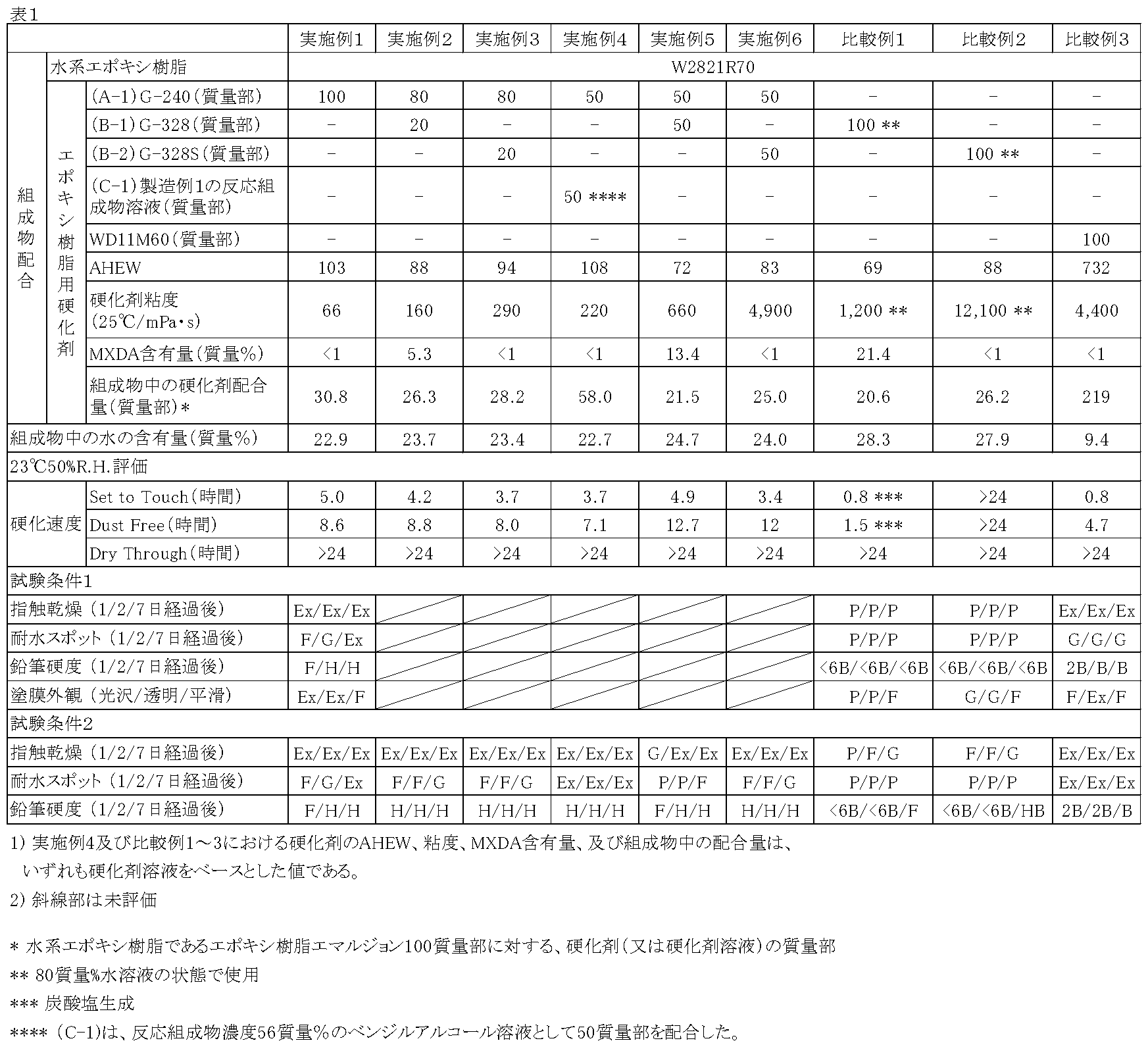
表1に示すように、硬化性が良好で、耐水性や硬度、外観等の塗膜性能に優れる実施例1~6の水系エポキシ樹脂組成物と比較して、比較例1、2の水系エポキシ樹脂組成物は試験条件1,2のいずれにおいても指触乾燥、耐水スポット性、鉛筆硬度、塗膜外観に劣る結果となった。また比較例1の水系エポキシ樹脂組成物では、硬化速度の評価中に塗膜表面に炭酸塩が析出した。これは硬化剤中のMXDA含有量が多いため、MXDAの炭酸塩が生成したものである。
比較例3の水系エポキシ樹脂用硬化剤を含有する水系エポキシ樹脂組成物では硬化速度、指触乾燥、耐水スポット性、塗膜外観は良好であるが、塗膜の鉛筆硬度が低下した。また、比較例3の硬化剤は有機溶剤を含有するため、環境への影響や安全性が懸念されることがある。
比較例3の水系エポキシ樹脂用硬化剤を含有する水系エポキシ樹脂組成物では硬化速度、指触乾燥、耐水スポット性、塗膜外観は良好であるが、塗膜の鉛筆硬度が低下した。また、比較例3の硬化剤は有機溶剤を含有するため、環境への影響や安全性が懸念されることがある。
実施例7
実施例1において、主剤として、W2821R70に代えてビスフェノールAから誘導されたグリシジルオキシ基を有する固体エポキシ樹脂の水系エマルジョン(三菱化学(株)製「W1155R55」、エマルジョン状態でのエポキシ当量:1020g/当量、エポキシ樹脂濃度:50質量%、水含有量:45質量%、その他の成分(乳化剤等)の含有量:5質量%、粘度(25℃):500mPa・s)を用いたこと以外は実施例1と同様の方法で水系エポキシ樹脂組成物を調製し、前記評価を行った。結果を表2に示す。
実施例1において、主剤として、W2821R70に代えてビスフェノールAから誘導されたグリシジルオキシ基を有する固体エポキシ樹脂の水系エマルジョン(三菱化学(株)製「W1155R55」、エマルジョン状態でのエポキシ当量:1020g/当量、エポキシ樹脂濃度:50質量%、水含有量:45質量%、その他の成分(乳化剤等)の含有量:5質量%、粘度(25℃):500mPa・s)を用いたこと以外は実施例1と同様の方法で水系エポキシ樹脂組成物を調製し、前記評価を行った。結果を表2に示す。
実施例8
(A-1)Gaskamine 240と、エピクロロヒドリンとMXDAとの反応物を含む反応組成物である(B-1)Gaskamine 328(三菱瓦斯化学(株)製)とを質量比80:20の割合で混合して水系エポキシ樹脂用硬化剤を調製した。この硬化剤を用いて実施例7と同様の方法で水系エポキシ樹脂組成物を調製し、前記評価を行った。結果を表2に示す。
(A-1)Gaskamine 240と、エピクロロヒドリンとMXDAとの反応物を含む反応組成物である(B-1)Gaskamine 328(三菱瓦斯化学(株)製)とを質量比80:20の割合で混合して水系エポキシ樹脂用硬化剤を調製した。この硬化剤を用いて実施例7と同様の方法で水系エポキシ樹脂組成物を調製し、前記評価を行った。結果を表2に示す。
実施例9
実施例8において、(B-1)に代えてエピクロロヒドリンとMXDAとの反応物を含む反応組成物である(B-2)Gaskamine 328S(三菱瓦斯化学(株)製)を用いたこと以外は、実施例8と同様の方法で水系エポキシ樹脂用硬化剤及び水系エポキシ樹脂組成物を調製し、前記評価を行った。結果を表2に示す。
実施例8において、(B-1)に代えてエピクロロヒドリンとMXDAとの反応物を含む反応組成物である(B-2)Gaskamine 328S(三菱瓦斯化学(株)製)を用いたこと以外は、実施例8と同様の方法で水系エポキシ樹脂用硬化剤及び水系エポキシ樹脂組成物を調製し、前記評価を行った。結果を表2に示す。
実施例10
(A-1)Gaskamine 240と、製造例1で得られた反応組成物溶液(C-1)とを質量比50:50((A-1)と、製造例1で得られた反応組成物((C)成分)との質量比は64:36)の割合で混合して水系エポキシ樹脂用硬化剤を調製した。この硬化剤を用いて、実施例7と同様の方法で水系エポキシ樹脂組成物を調製し、前記評価を行った。結果を表2に示す。
(A-1)Gaskamine 240と、製造例1で得られた反応組成物溶液(C-1)とを質量比50:50((A-1)と、製造例1で得られた反応組成物((C)成分)との質量比は64:36)の割合で混合して水系エポキシ樹脂用硬化剤を調製した。この硬化剤を用いて、実施例7と同様の方法で水系エポキシ樹脂組成物を調製し、前記評価を行った。結果を表2に示す。
比較例4
実施例7において、水系エポキシ樹脂用硬化剤として(A-1)に代えて(B-1)の80質量%水溶液を用いたこと以外は実施例7と同様の方法で水系エポキシ樹脂組成物を調製し、前記評価を行った。結果を表2に示す。
実施例7において、水系エポキシ樹脂用硬化剤として(A-1)に代えて(B-1)の80質量%水溶液を用いたこと以外は実施例7と同様の方法で水系エポキシ樹脂組成物を調製し、前記評価を行った。結果を表2に示す。
比較例5
実施例7において、水系エポキシ樹脂用硬化剤として(A-1)に代えて(B-2)の80質量%水溶液を用いたこと以外は実施例7と同様の方法で水系エポキシ樹脂組成物を調製し、前記評価を行った。結果を表2に示す。
実施例7において、水系エポキシ樹脂用硬化剤として(A-1)に代えて(B-2)の80質量%水溶液を用いたこと以外は実施例7と同様の方法で水系エポキシ樹脂組成物を調製し、前記評価を行った。結果を表2に示す。
比較例6
実施例7において、水系エポキシ樹脂用硬化剤として(A-1)に代えて市販のポリアミドアミン系水系エポキシ樹脂用硬化剤(三菱化学(株)製「WD11M60」、固形分濃度:60質量%(ブチルセロソルブ溶液)、AHEW:732)を用いたこと以外は実施例7と同様の方法で水系エポキシ樹脂組成物を調製し、前記評価を行った。結果を表2に示す。
実施例7において、水系エポキシ樹脂用硬化剤として(A-1)に代えて市販のポリアミドアミン系水系エポキシ樹脂用硬化剤(三菱化学(株)製「WD11M60」、固形分濃度:60質量%(ブチルセロソルブ溶液)、AHEW:732)を用いたこと以外は実施例7と同様の方法で水系エポキシ樹脂組成物を調製し、前記評価を行った。結果を表2に示す。
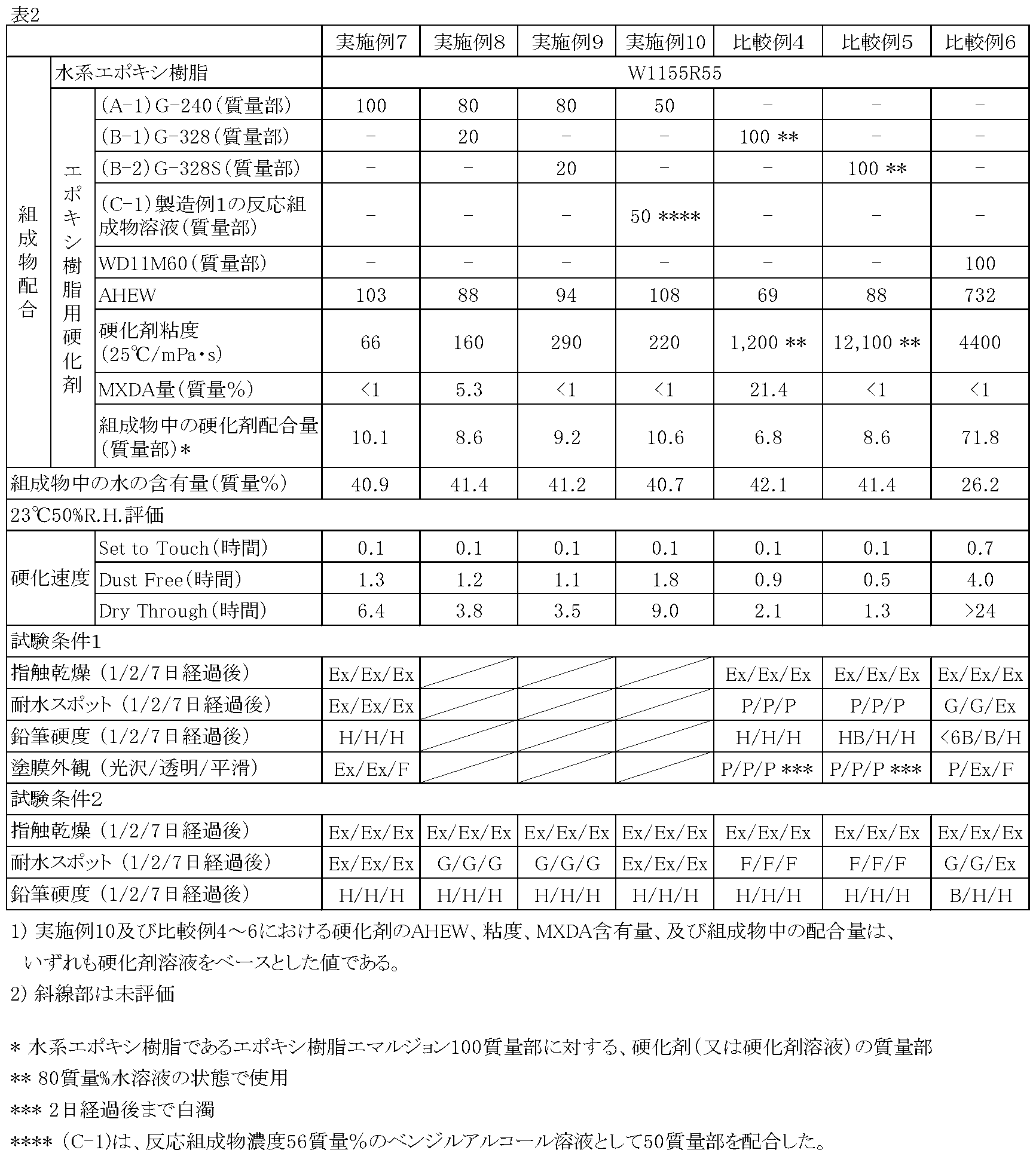
表2に示すように、硬化性が良好で、耐水性や硬度、外観等の塗膜性能に優れる実施例7~10の水系エポキシ樹脂組成物と比較して、比較例4,5の水系エポキシ樹脂組成物は試験条件1,2のいずれにおいても塗膜の耐水スポット性、塗膜外観が低下した。比較例6の水系エポキシ樹脂用硬化剤を含有する水系エポキシ樹脂組成物では試験条件1,2のいずれにおいても塗膜の鉛筆硬度が低下し、特に試験条件1における鉛筆硬度が低下した。
表1及び表2において使用した成分を以下に示す。
<水系エポキシ樹脂>
W2821R70:
ビスフェノールAから誘導されたグリシジルオキシ基を有する液状エポキシ樹脂の水系エマルジョン(三菱化学(株)製、エマルジョン状態でのエポキシ当量:334g/当量、エポキシ樹脂濃度:60質量%、水含有量:30質量%、その他の成分(乳化剤等)の含有量:10質量%、粘度(25℃):700mPa・s)
W1155R55:
ビスフェノールAから誘導されたグリシジルオキシ基を有する固体エポキシ樹脂の水系エマルジョン(三菱化学(株)製、エマルジョン状態でのエポキシ当量:1020g/当量、エポキシ樹脂濃度:50質量%、水含有量:45質量%、その他の成分(乳化剤等)の含有量:5質量%、粘度(25℃):500mPa・s)
<水系エポキシ樹脂用硬化剤成分>
(A-1):
Gaskamine 240(スチレンとMXDAとの反応物を含む反応組成物、三菱瓦斯化学(株)製、スチレンとMXDAとの反応物含有量:>99質量%、MXDA含有量:<1質量%、下記式(2-1)で示される化合物の含有量:49質量%、AHEW:103)
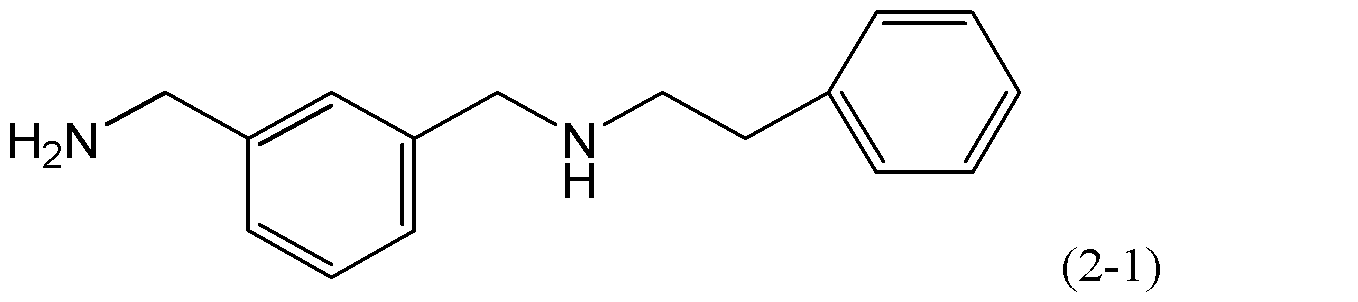
(A-1):
Gaskamine 240(スチレンとMXDAとの反応物を含む反応組成物、三菱瓦斯化学(株)製、スチレンとMXDAとの反応物含有量:>99質量%、MXDA含有量:<1質量%、下記式(2-1)で示される化合物の含有量:49質量%、AHEW:103)
(B-1):
Gaskamine 328(エピクロロヒドリンとMXDAとの反応物を含む反応組成物、三菱瓦斯化学(株)製、MXDA含有量:26.7質量%、下記式(3-1)で示される化合物の含有量:73.3質量%(nは1~12の数であり、n=1の化合物の含有量は(B-1)中の20.9質量%である)、AHEW:55)

Gaskamine 328(エピクロロヒドリンとMXDAとの反応物を含む反応組成物、三菱瓦斯化学(株)製、MXDA含有量:26.7質量%、下記式(3-1)で示される化合物の含有量:73.3質量%(nは1~12の数であり、n=1の化合物の含有量は(B-1)中の20.9質量%である)、AHEW:55)
(B-2):
Gaskamine 328S(エピクロロヒドリンとMXDAとの反応物を含む反応組成物、三菱瓦斯化学(株)製、MXDA含有量:0.9質量%、前記式(3-1)で示される化合物の含有量:99.1質量%(nは1~12の数であり、n=1の化合物の含有量は(B-2)中の29.3質量%である)、AHEW:70)
Gaskamine 328S(エピクロロヒドリンとMXDAとの反応物を含む反応組成物、三菱瓦斯化学(株)製、MXDA含有量:0.9質量%、前記式(3-1)で示される化合物の含有量:99.1質量%(nは1~12の数であり、n=1の化合物の含有量は(B-2)中の29.3質量%である)、AHEW:70)
(C-1):
製造例1で得られた、ビスフェノールAから誘導されたグリシジルオキシ基を有する多官能エポキシ樹脂とイソホロンジアミンとの反応物を含む反応組成物溶液(反応組成物濃度:56質量%、ベンジルアルコール溶液、反応組成物溶液のAHEW:113)
製造例1で得られた、ビスフェノールAから誘導されたグリシジルオキシ基を有する多官能エポキシ樹脂とイソホロンジアミンとの反応物を含む反応組成物溶液(反応組成物濃度:56質量%、ベンジルアルコール溶液、反応組成物溶液のAHEW:113)
WD11M60:
ポリアミドアミン系水系エポキシ樹脂用硬化剤(三菱化学(株)製、固形分濃度:60質量%(ブチルセロソルブ溶液)、AHEW:732)
ポリアミドアミン系水系エポキシ樹脂用硬化剤(三菱化学(株)製、固形分濃度:60質量%(ブチルセロソルブ溶液)、AHEW:732)
実施例11(水系エポキシ樹脂組成物の製造)
エポキシ樹脂として、ビスフェノールAから誘導されたグリシジルオキシ基を有する多官能液状エポキシ樹脂「jER828」(三菱化学(株)製、エポキシ当量:186g/当量)、乳化剤としてポリオキシエチレンスチレン化フェニルエーテル「ノイゲン EA-207D」(第一工業製薬(株)製、HLB:12.7)、及び、水系エポキシ樹脂用硬化剤として、スチレンとメタキシリレンジアミン(MXDA)との反応物を含む反応組成物である(A-1)Gaskamine 240(三菱瓦斯化学(株)製、AHEW:103)を使用した。
エポキシ樹脂jER828 28g、上記乳化剤2.8g、及び水系エポキシ樹脂用硬化剤(A-1)15.5gを配合し、ディスパー(プライミクス(株)製、ホモディスパー2.5型)で回転速度500rpmにて1分間攪拌した。ここに純水2gを添加してディスパーで回転速度500rpmにて1分間攪拌する操作を10回行い、純水を合計20g添加して、水系エポキシ樹脂組成物を得た。この水系エポキシ樹脂組成物を用いて、前記試験条件1における評価を行った。結果を表3に示す。
実施例12
実施例11において、乳化剤として「ノイゲン EA-207D」に代えてポリオキシエチレンスチレン化フェニルエーテル「BLAUNON KTSP-16」(青木油脂工業(株)製、HLB:18.7)を用いたこと以外は、実施例11と同様の方法で水系エポキシ樹脂組成物を調製し、前記試験条件1における評価を行った。結果を表3に示す。
実施例11において、乳化剤として「ノイゲン EA-207D」に代えてポリオキシエチレンスチレン化フェニルエーテル「BLAUNON KTSP-16」(青木油脂工業(株)製、HLB:18.7)を用いたこと以外は、実施例11と同様の方法で水系エポキシ樹脂組成物を調製し、前記試験条件1における評価を行った。結果を表3に示す。
実施例13
実施例11において、乳化剤として「ノイゲン EA-207D」に代えてエポキシ基及び親水性基を含有するポリマー乳化剤「マープルーフGP-013023(日油(株)製、エポキシ当量:535g/当量、HLB:10.9)を用いた。エポキシ樹脂jER828 28g、乳化剤2.8g、及び水系エポキシ樹脂用硬化剤(A-1)16.0gを配合し、ディスパーで回転速度500rpmにて1分間攪拌した。ここに純水2gを添加してディスパーで回転速度500rpmにて1分間攪拌する操作を10回行い、純水を合計20g添加して、水系エポキシ樹脂組成物を得た。この水系エポキシ樹脂組成物を用いて、前記試験条件1における評価を行った。結果を表3に示す。
実施例11において、乳化剤として「ノイゲン EA-207D」に代えてエポキシ基及び親水性基を含有するポリマー乳化剤「マープルーフGP-013023(日油(株)製、エポキシ当量:535g/当量、HLB:10.9)を用いた。エポキシ樹脂jER828 28g、乳化剤2.8g、及び水系エポキシ樹脂用硬化剤(A-1)16.0gを配合し、ディスパーで回転速度500rpmにて1分間攪拌した。ここに純水2gを添加してディスパーで回転速度500rpmにて1分間攪拌する操作を10回行い、純水を合計20g添加して、水系エポキシ樹脂組成物を得た。この水系エポキシ樹脂組成物を用いて、前記試験条件1における評価を行った。結果を表3に示す。
実施例14
(水系エポキシ樹脂用硬化剤混合物の製造)
乳化剤としてポリオキシエチレンスチレン化フェニルエーテル「ノイゲン EA-207D」(第一工業製薬(株)製、HLB:12.7)、水系エポキシ樹脂用硬化剤として、スチレンとメタキシリレンジアミン(MXDA)との反応物を含む反応組成物である(A-1)Gaskamine 240(三菱瓦斯化学(株)製、AHEW:103)を使用した。
上記乳化剤2.8g、及び水系エポキシ樹脂用硬化剤(A-1)15.5gを配合し、ディスパーで回転速度500rpmにて1分間攪拌して、水系エポキシ樹脂用硬化剤混合物を得た。
(水系エポキシ樹脂用硬化剤混合物の製造)
乳化剤としてポリオキシエチレンスチレン化フェニルエーテル「ノイゲン EA-207D」(第一工業製薬(株)製、HLB:12.7)、水系エポキシ樹脂用硬化剤として、スチレンとメタキシリレンジアミン(MXDA)との反応物を含む反応組成物である(A-1)Gaskamine 240(三菱瓦斯化学(株)製、AHEW:103)を使用した。
上記乳化剤2.8g、及び水系エポキシ樹脂用硬化剤(A-1)15.5gを配合し、ディスパーで回転速度500rpmにて1分間攪拌して、水系エポキシ樹脂用硬化剤混合物を得た。
(水系エポキシ樹脂組成物の製造)
上記水系エポキシ樹脂用硬化剤混合物に対し、エポキシ樹脂「jER828」(液状エポキシ樹脂、三菱化学(株)製)28gを配合し、ディスパー(プライミクス(株)製、ホモディスパー2.5型)で回転速度500rpmにて1分間攪拌した。ここに純水2gを添加してディスパーで回転速度500rpmにて1分間攪拌する操作を10回行い、純水を合計20g添加して、水系エポキシ樹脂組成物を得た。この水系エポキシ樹脂組成物を用いて、前記試験条件1における評価を行った。結果を表3に示す。
上記水系エポキシ樹脂用硬化剤混合物に対し、エポキシ樹脂「jER828」(液状エポキシ樹脂、三菱化学(株)製)28gを配合し、ディスパー(プライミクス(株)製、ホモディスパー2.5型)で回転速度500rpmにて1分間攪拌した。ここに純水2gを添加してディスパーで回転速度500rpmにて1分間攪拌する操作を10回行い、純水を合計20g添加して、水系エポキシ樹脂組成物を得た。この水系エポキシ樹脂組成物を用いて、前記試験条件1における評価を行った。結果を表3に示す。

表3において使用した成分を以下に示す。
<水系エポキシ樹脂成分>
〔エポキシ樹脂〕
jER828:
ビスフェノールAから誘導されたグリシジルオキシ基を有する多官能液状エポキシ樹脂(三菱化学(株)製、エポキシ当量:186g/当量)
〔乳化剤〕
ノイゲン EA-207D:
ポリオキシエチレンスチレン化フェニルエーテル(第一工業製薬(株)製、HLB:18.7)
BLAUNON KTSP-16:
ポリオキシエチレンスチレン化フェニルエーテル(青木油脂工業(株)製、HLB:12.7)
マープルーフGP-013023:
エポキシ基及び親水性基を含有するポリマー乳化剤(日油(株)製、エポキシ当量:535g/当量、HLB:10.9)
<水系エポキシ樹脂用硬化剤成分>
(A-1):
Gaskamine 240(スチレンとMXDAとの反応物を含む反応組成物、三菱瓦斯化学(株)製、スチレンとMXDAとの反応物含有量:>99質量%、MXDA含有量:<1質量%、前記式(2-1)で示される化合物の含有量:49質量%、AHEW:103)
表3に示すように、実施例11~14の水系エポキシ樹脂組成物も硬化性が良好であり、耐水性や硬度、外観等の塗膜性能に優れる。
本発明の水系エポキシ樹脂用硬化剤を用いることにより、溶剤を含まず環境面や安全面においても好適であり、硬化性が良好で、耐水性や硬度、外観等の塗膜性能にも優れる水系エポキシ樹脂組成物を提供することができる。該水系エポキシ樹脂組成物は良好な硬化物物性を与え、コンクリート材への使用のほか、防食用塗料等の各種塗料、接着剤、床材、封止剤、ポリマーセメントモルタル、ガスバリアコーティング、プライマー、スクリード、トップコート、シーリング材、クラック補修材、道路の舗装材等にも好適に用いられる。
Claims (14)
- スチレンと下記一般式(1)で示されるアミン化合物との反応物を含む反応組成物(A)を含有する、水系エポキシ樹脂用硬化剤。
H2N-CH2-A-CH2-NH2 (1)
(式(1)中、Aは1,2-フェニレン基、1,3-フェニレン基、又は1,4-フェニレン基である。) - 前記反応組成物(A)が下記一般式(2)で示される化合物を10質量%以上含む、請求項1に記載の硬化剤。

(式(2)中、Aは前記と同じである。) - 前記Aが1,3-フェニレン基である、請求項1又は2に記載の硬化剤。
- 前記硬化剤中の前記反応組成物(A)の含有量が30質量%以上である、請求項1~3のいずれか1項に記載の硬化剤。
- さらに、分子中に少なくとも1つのエポキシ基を有する化合物とポリアミン化合物との反応物を含む反応組成物を含有する、請求項1~4のいずれか1項に記載の硬化剤。
- 前記反応組成物が、エピクロロヒドリンと前記一般式(1)で示されるアミン化合物との反応物を含む反応組成物(B)である、請求項5に記載の硬化剤。
- 前記反応組成物(B)が下記一般式(3)で示される化合物を主成分として含む、請求項6に記載の硬化剤。

(式(3)中、Aは前記と同じである。nは1~12の数である。) - 前記反応組成物が、分子中に少なくとも2つのエポキシ基を有する化合物とポリアミン化合物との反応物を含む反応組成物(C)である、請求項5に記載の硬化剤。
- 請求項1~8のいずれか1項に記載の硬化剤と、水系エポキシ樹脂とを含有する水系エポキシ樹脂組成物。
- 前記水系エポキシ樹脂が、エポキシ樹脂、乳化剤、及び水を含有するエポキシ樹脂エマルジョンである、請求項9に記載の水系エポキシ樹脂組成物。
- 前記乳化剤のグリフィン法で定義されるHLBが8.0~20.0である、請求項10に記載の水系エポキシ樹脂組成物。
- 前記乳化剤がポリオキシアルキレンアリールエーテル及びポリオキシアルキレンアルキルアリールエーテルからなる群から選ばれる1種以上である、請求項10又は11に記載の水系エポキシ樹脂組成物。
- 請求項9~12のいずれか1項に記載の水系エポキシ樹脂組成物の硬化物。
- 請求項1~8のいずれか1項に記載の硬化剤と、乳化剤とを含有する水系エポキシ樹脂用硬化剤混合物。
Priority Applications (4)
| Application Number | Priority Date | Filing Date | Title |
|---|---|---|---|
| US16/343,325 US11319405B2 (en) | 2016-11-24 | 2017-10-26 | Curing agent for water-based epoxy resin, water-based epoxy resin composition, and cured product thereof |
| CN201780063624.XA CN109843969B (zh) | 2016-11-24 | 2017-10-26 | 水系环氧树脂用固化剂、水系环氧树脂组合物和其固化物 |
| EP17874530.3A EP3546494B1 (en) | 2016-11-24 | 2017-10-26 | Curing agent for water-based epoxy resin, water-based epoxy resin composition, and cured product thereof |
| JP2018552478A JP7028188B2 (ja) | 2016-11-24 | 2017-10-26 | 水系エポキシ樹脂用硬化剤、水系エポキシ樹脂組成物及びその硬化物 |
Applications Claiming Priority (2)
| Application Number | Priority Date | Filing Date | Title |
|---|---|---|---|
| JP2016-228364 | 2016-11-24 | ||
| JP2016228364 | 2016-11-24 |
Publications (1)
| Publication Number | Publication Date |
|---|---|
| WO2018096868A1 true WO2018096868A1 (ja) | 2018-05-31 |
Family
ID=62195815
Family Applications (1)
| Application Number | Title | Priority Date | Filing Date |
|---|---|---|---|
| PCT/JP2017/038651 Ceased WO2018096868A1 (ja) | 2016-11-24 | 2017-10-26 | 水系エポキシ樹脂用硬化剤、水系エポキシ樹脂組成物及びその硬化物 |
Country Status (6)
| Country | Link |
|---|---|
| US (1) | US11319405B2 (ja) |
| EP (1) | EP3546494B1 (ja) |
| JP (1) | JP7028188B2 (ja) |
| CN (1) | CN109843969B (ja) |
| TW (1) | TWI746679B (ja) |
| WO (1) | WO2018096868A1 (ja) |
Cited By (9)
| Publication number | Priority date | Publication date | Assignee | Title |
|---|---|---|---|---|
| WO2020110601A1 (ja) | 2018-11-26 | 2020-06-04 | 三菱瓦斯化学株式会社 | 水系エポキシ樹脂組成物及びその硬化物 |
| WO2022054897A1 (ja) * | 2020-09-14 | 2022-03-17 | 株式会社Adeka | エポキシ樹脂用硬化剤組成物、エポキシ樹脂組成物及び塗料 |
| JP2022114932A (ja) * | 2021-01-27 | 2022-08-08 | 三菱瓦斯化学株式会社 | エポキシ樹脂硬化剤、エポキシ樹脂組成物、及び塗料 |
| WO2023084913A1 (ja) * | 2021-11-09 | 2023-05-19 | 三菱瓦斯化学株式会社 | 乳化型エポキシ樹脂組成物、その製造方法、及び塗料 |
| WO2024202566A1 (ja) * | 2023-03-27 | 2024-10-03 | 三菱瓦斯化学株式会社 | 舗装材用組成物及び構造物 |
| WO2024202567A1 (ja) * | 2023-03-27 | 2024-10-03 | 三菱瓦斯化学株式会社 | 舗装材用組成物及び構造物 |
| WO2025263120A1 (ja) * | 2024-06-19 | 2025-12-26 | 三菱瓦斯化学株式会社 | エマルジョン型エポキシ樹脂硬化剤組成物及び水系エポキシ樹脂組成物 |
| WO2025263121A1 (ja) * | 2024-06-19 | 2025-12-26 | 三菱瓦斯化学株式会社 | エマルジョン型エポキシ樹脂硬化剤組成物及び水系エポキシ樹脂組成物 |
| WO2026018683A1 (ja) * | 2024-07-19 | 2026-01-22 | 三菱瓦斯化学株式会社 | 水系エポキシ樹脂組成物、該水系エポキシ樹脂組成物の硬化物、及び該水系エポキシ樹脂組成物の製造方法 |
Families Citing this family (4)
| Publication number | Priority date | Publication date | Assignee | Title |
|---|---|---|---|---|
| CN112119106B (zh) * | 2018-05-24 | 2023-10-10 | 三菱瓦斯化学株式会社 | 水系环氧树脂用固化剂、水系环氧树脂组合物及其固化物 |
| EP4230677A4 (en) * | 2020-10-15 | 2024-03-20 | Mitsubishi Gas Chemical Company, Inc. | EPOXY RESIN CURING AGENT, EPOXY RESIN COMPOSITION, PAINT AND ADHESIVE |
| US12404363B2 (en) | 2022-04-25 | 2025-09-02 | Mitsubishi Gas Chemical Company, Inc. | Epoxy resin composition and cured product of same |
| CN122146213A (zh) * | 2026-03-27 | 2026-06-05 | 上海沪正实业有限公司 | 风电级cfrp加强筋用风电叶片结构胶及其制备方法 |
Citations (11)
| Publication number | Priority date | Publication date | Assignee | Title |
|---|---|---|---|---|
| JPS60168729A (ja) * | 1984-02-08 | 1985-09-02 | Toray Ind Inc | エポキシ系微粒子およびその製造方法 |
| JPH04293953A (ja) * | 1990-12-17 | 1992-10-19 | Dow Chem Co:The | 水に乳化可能なエポキシ樹脂組成物 |
| JPH08127637A (ja) * | 1994-10-28 | 1996-05-21 | Mitsubishi Gas Chem Co Inc | 水系自己乳化型エポキシ樹脂硬化剤 |
| JP2002161076A (ja) * | 2000-09-12 | 2002-06-04 | Mitsubishi Gas Chem Co Inc | アミノ化合物およびその製造方法 |
| JP2002361785A (ja) * | 2001-04-03 | 2002-12-18 | Mitsubishi Gas Chem Co Inc | ガスバリア性積層体 |
| JP2005028835A (ja) * | 2003-07-11 | 2005-02-03 | Mitsubishi Gas Chem Co Inc | ガスバリア性コートフィルム |
| JP2007197702A (ja) * | 2005-12-28 | 2007-08-09 | Mitsubishi Gas Chem Co Inc | エポキシ樹脂硬化剤およびエポキシ樹脂組成物 |
| JP2007197701A (ja) * | 2005-12-28 | 2007-08-09 | Mitsubishi Gas Chem Co Inc | エポキシ樹脂硬化剤およびエポキシ樹脂組成物 |
| JP2008503627A (ja) * | 2004-06-21 | 2008-02-07 | ハンツマン・アドヴァンスト・マテリアルズ・(スイッツランド)・ゲーエムベーハー | エポキシ樹脂用硬化剤 |
| JP2008280382A (ja) * | 2007-05-08 | 2008-11-20 | Aica Kogyo Co Ltd | エポキシ樹脂組成物 |
| JP2012153857A (ja) * | 2011-01-28 | 2012-08-16 | Mitsubishi Gas Chemical Co Inc | エポキシ樹脂硬化剤の製造方法 |
Family Cites Families (7)
| Publication number | Priority date | Publication date | Assignee | Title |
|---|---|---|---|---|
| US5344856A (en) * | 1990-12-17 | 1994-09-06 | The Dow Chemical Company | Water-emulsifiable epoxy resin composition |
| US5798398A (en) * | 1996-10-18 | 1998-08-25 | Henkel Corporation | Epoxy curing agent comprising a metaxylylenediamine-epichlorohydrin adduct |
| US7396902B2 (en) * | 2003-02-13 | 2008-07-08 | Mitsubishi Gas Chemical Company, Inc. | Epoxy resin curing agent of aliphatic diamine/styrene addition product |
| WO2009036790A1 (en) | 2007-09-21 | 2009-03-26 | Henkel Ag & Co. Kgaa | Primer compositions for adhesive bonding systems and coatings |
| AU2013229697B2 (en) * | 2012-03-09 | 2015-12-17 | Construction Research & Technology Gmbh | Amine curable epoxy resin composition |
| EP2851353A1 (de) * | 2013-07-16 | 2015-03-25 | Sika Technology AG | Kombination von ternären Bindemitteln mit wässrigem Epoxidharz-System |
| WO2017175740A1 (ja) | 2016-04-06 | 2017-10-12 | 三菱瓦斯化学株式会社 | アミン化合物、アミン組成物、及びエポキシ樹脂硬化剤 |
-
2017
- 2017-10-26 WO PCT/JP2017/038651 patent/WO2018096868A1/ja not_active Ceased
- 2017-10-26 US US16/343,325 patent/US11319405B2/en active Active
- 2017-10-26 EP EP17874530.3A patent/EP3546494B1/en active Active
- 2017-10-26 CN CN201780063624.XA patent/CN109843969B/zh active Active
- 2017-10-26 JP JP2018552478A patent/JP7028188B2/ja active Active
- 2017-10-31 TW TW106137483A patent/TWI746679B/zh active
Patent Citations (11)
| Publication number | Priority date | Publication date | Assignee | Title |
|---|---|---|---|---|
| JPS60168729A (ja) * | 1984-02-08 | 1985-09-02 | Toray Ind Inc | エポキシ系微粒子およびその製造方法 |
| JPH04293953A (ja) * | 1990-12-17 | 1992-10-19 | Dow Chem Co:The | 水に乳化可能なエポキシ樹脂組成物 |
| JPH08127637A (ja) * | 1994-10-28 | 1996-05-21 | Mitsubishi Gas Chem Co Inc | 水系自己乳化型エポキシ樹脂硬化剤 |
| JP2002161076A (ja) * | 2000-09-12 | 2002-06-04 | Mitsubishi Gas Chem Co Inc | アミノ化合物およびその製造方法 |
| JP2002361785A (ja) * | 2001-04-03 | 2002-12-18 | Mitsubishi Gas Chem Co Inc | ガスバリア性積層体 |
| JP2005028835A (ja) * | 2003-07-11 | 2005-02-03 | Mitsubishi Gas Chem Co Inc | ガスバリア性コートフィルム |
| JP2008503627A (ja) * | 2004-06-21 | 2008-02-07 | ハンツマン・アドヴァンスト・マテリアルズ・(スイッツランド)・ゲーエムベーハー | エポキシ樹脂用硬化剤 |
| JP2007197702A (ja) * | 2005-12-28 | 2007-08-09 | Mitsubishi Gas Chem Co Inc | エポキシ樹脂硬化剤およびエポキシ樹脂組成物 |
| JP2007197701A (ja) * | 2005-12-28 | 2007-08-09 | Mitsubishi Gas Chem Co Inc | エポキシ樹脂硬化剤およびエポキシ樹脂組成物 |
| JP2008280382A (ja) * | 2007-05-08 | 2008-11-20 | Aica Kogyo Co Ltd | エポキシ樹脂組成物 |
| JP2012153857A (ja) * | 2011-01-28 | 2012-08-16 | Mitsubishi Gas Chemical Co Inc | エポキシ樹脂硬化剤の製造方法 |
Non-Patent Citations (2)
| Title |
|---|
| GASKAMINE, vol. 240, no. 02061H, February 2003 (2003-02-01) * |
| See also references of EP3546494A4 * |
Cited By (21)
| Publication number | Priority date | Publication date | Assignee | Title |
|---|---|---|---|---|
| CN112771096A (zh) * | 2018-11-26 | 2021-05-07 | 三菱瓦斯化学株式会社 | 水系环氧树脂组合物和其固化物 |
| KR20210095618A (ko) | 2018-11-26 | 2021-08-02 | 미쯔비시 가스 케미칼 컴파니, 인코포레이티드 | 수계 에폭시 수지 조성물 및 그의 경화물 |
| JPWO2020110601A1 (ja) * | 2018-11-26 | 2021-10-14 | 三菱瓦斯化学株式会社 | 水系エポキシ樹脂組成物及びその硬化物 |
| KR102928572B1 (ko) * | 2018-11-26 | 2026-02-20 | 미쯔비시 가스 케미칼 컴파니, 인코포레이티드 | 수계 에폭시 수지 조성물 및 그의 경화물 |
| US12209161B2 (en) | 2018-11-26 | 2025-01-28 | Mitsubishi Gas Chemical Company, Inc. | Aqueous epoxy resin composition and cured product of same |
| CN112771096B (zh) * | 2018-11-26 | 2023-06-13 | 三菱瓦斯化学株式会社 | 水系环氧树脂组合物和其固化物 |
| JP7363810B2 (ja) | 2018-11-26 | 2023-10-18 | 三菱瓦斯化学株式会社 | 水系エポキシ樹脂組成物及びその硬化物 |
| WO2020110601A1 (ja) | 2018-11-26 | 2020-06-04 | 三菱瓦斯化学株式会社 | 水系エポキシ樹脂組成物及びその硬化物 |
| WO2022054897A1 (ja) * | 2020-09-14 | 2022-03-17 | 株式会社Adeka | エポキシ樹脂用硬化剤組成物、エポキシ樹脂組成物及び塗料 |
| JP7608847B2 (ja) | 2021-01-27 | 2025-01-07 | 三菱瓦斯化学株式会社 | エポキシ樹脂硬化剤、エポキシ樹脂組成物、及び塗料 |
| JP2022114932A (ja) * | 2021-01-27 | 2022-08-08 | 三菱瓦斯化学株式会社 | エポキシ樹脂硬化剤、エポキシ樹脂組成物、及び塗料 |
| KR20240095233A (ko) | 2021-11-09 | 2024-06-25 | 미쯔비시 가스 케미칼 컴파니, 인코포레이티드 | 유화형 에폭시 수지 조성물, 그의 제조방법, 및 도료 |
| JPWO2023084913A1 (ja) * | 2021-11-09 | 2023-05-19 | ||
| WO2023084913A1 (ja) * | 2021-11-09 | 2023-05-19 | 三菱瓦斯化学株式会社 | 乳化型エポキシ樹脂組成物、その製造方法、及び塗料 |
| WO2024202567A1 (ja) * | 2023-03-27 | 2024-10-03 | 三菱瓦斯化学株式会社 | 舗装材用組成物及び構造物 |
| WO2024202566A1 (ja) * | 2023-03-27 | 2024-10-03 | 三菱瓦斯化学株式会社 | 舗装材用組成物及び構造物 |
| WO2025263120A1 (ja) * | 2024-06-19 | 2025-12-26 | 三菱瓦斯化学株式会社 | エマルジョン型エポキシ樹脂硬化剤組成物及び水系エポキシ樹脂組成物 |
| WO2025263121A1 (ja) * | 2024-06-19 | 2025-12-26 | 三菱瓦斯化学株式会社 | エマルジョン型エポキシ樹脂硬化剤組成物及び水系エポキシ樹脂組成物 |
| JPWO2025263120A1 (ja) * | 2024-06-19 | 2025-12-26 | ||
| JP7865468B2 (ja) | 2024-06-19 | 2026-05-26 | 三菱瓦斯化学株式会社 | エマルジョン型エポキシ樹脂硬化剤組成物及び水系エポキシ樹脂組成物 |
| WO2026018683A1 (ja) * | 2024-07-19 | 2026-01-22 | 三菱瓦斯化学株式会社 | 水系エポキシ樹脂組成物、該水系エポキシ樹脂組成物の硬化物、及び該水系エポキシ樹脂組成物の製造方法 |
Also Published As
| Publication number | Publication date |
|---|---|
| JPWO2018096868A1 (ja) | 2019-10-17 |
| US20190256645A1 (en) | 2019-08-22 |
| TWI746679B (zh) | 2021-11-21 |
| EP3546494B1 (en) | 2021-11-24 |
| US11319405B2 (en) | 2022-05-03 |
| TW201829531A (zh) | 2018-08-16 |
| CN109843969B (zh) | 2022-03-22 |
| EP3546494A4 (en) | 2019-11-20 |
| EP3546494A1 (en) | 2019-10-02 |
| CN109843969A (zh) | 2019-06-04 |
| JP7028188B2 (ja) | 2022-03-02 |
Similar Documents
| Publication | Publication Date | Title |
|---|---|---|
| JP7028188B2 (ja) | 水系エポキシ樹脂用硬化剤、水系エポキシ樹脂組成物及びその硬化物 | |
| JP6881436B2 (ja) | アミン化合物、アミン組成物、及びエポキシ樹脂硬化剤 | |
| JP7276331B2 (ja) | 水系エポキシ樹脂用硬化剤、水系エポキシ樹脂組成物及びその硬化物 | |
| JP7363810B2 (ja) | 水系エポキシ樹脂組成物及びその硬化物 | |
| JP7177580B2 (ja) | エポキシ樹脂硬化剤、エポキシ樹脂組成物及びその硬化物 | |
| JP5320674B2 (ja) | エポキシ樹脂硬化剤及びエポキシ樹脂組成物 | |
| JP4858149B2 (ja) | エポキシ樹脂用硬化剤組成物及びエポキシ樹脂組成物 | |
| JP2020172634A (ja) | エポキシ樹脂組成物及びその硬化物 | |
| WO2023084904A1 (ja) | 水中硬化型エポキシ樹脂組成物、水中硬化型塗料、これらの硬化物、並びに水中硬化型エポキシ樹脂硬化剤混合物 | |
| CN104718232A (zh) | 加合物固化剂 | |
| WO2022215494A1 (ja) | エポキシ樹脂硬化剤、エポキシ樹脂組成物及び塗料 | |
| JP2007197702A (ja) | エポキシ樹脂硬化剤およびエポキシ樹脂組成物 | |
| KR20250127075A (ko) | 에폭시 수지 경화제, 에폭시 수지 조성물 및 도료 | |
| WO2016053641A1 (en) | Adduct composition | |
| WO2026028670A1 (ja) | 水系エポキシ樹脂用硬化剤、水系エポキシ樹脂組成物及びその硬化物 | |
| JP2023180850A (ja) | エポキシ樹脂硬化剤、エポキシ樹脂組成物及び塗料 |
Legal Events
| Date | Code | Title | Description |
|---|---|---|---|
| 121 | Ep: the epo has been informed by wipo that ep was designated in this application |
Ref document number: 17874530 Country of ref document: EP Kind code of ref document: A1 |
|
| ENP | Entry into the national phase |
Ref document number: 2018552478 Country of ref document: JP Kind code of ref document: A |
|
| NENP | Non-entry into the national phase |
Ref country code: DE |
|
| ENP | Entry into the national phase |
Ref document number: 2017874530 Country of ref document: EP Effective date: 20190624 |