WO2018074494A1 - ガラス板 - Google Patents
ガラス板 Download PDFInfo
- Publication number
- WO2018074494A1 WO2018074494A1 PCT/JP2017/037605 JP2017037605W WO2018074494A1 WO 2018074494 A1 WO2018074494 A1 WO 2018074494A1 JP 2017037605 W JP2017037605 W JP 2017037605W WO 2018074494 A1 WO2018074494 A1 WO 2018074494A1
- Authority
- WO
- WIPO (PCT)
- Prior art keywords
- glass plate
- main surface
- rsm
- less
- glass
- Prior art date
- Legal status (The legal status is an assumption and is not a legal conclusion. Google has not performed a legal analysis and makes no representation as to the accuracy of the status listed.)
- Ceased
Links
Classifications
-
- C—CHEMISTRY; METALLURGY
- C03—GLASS; MINERAL OR SLAG WOOL
- C03C—CHEMICAL COMPOSITION OF GLASSES, GLAZES OR VITREOUS ENAMELS; SURFACE TREATMENT OF GLASS; SURFACE TREATMENT OF FIBRES OR FILAMENTS MADE FROM GLASS, MINERALS OR SLAGS; JOINING GLASS TO GLASS OR OTHER MATERIALS
- C03C15/00—Surface treatment of glass, not in the form of fibres or filaments, by etching
-
- C—CHEMISTRY; METALLURGY
- C03—GLASS; MINERAL OR SLAG WOOL
- C03C—CHEMICAL COMPOSITION OF GLASSES, GLAZES OR VITREOUS ENAMELS; SURFACE TREATMENT OF GLASS; SURFACE TREATMENT OF FIBRES OR FILAMENTS MADE FROM GLASS, MINERALS OR SLAGS; JOINING GLASS TO GLASS OR OTHER MATERIALS
- C03C19/00—Surface treatment of glass, not in the form of fibres or filaments, by mechanical means
-
- C—CHEMISTRY; METALLURGY
- C03—GLASS; MINERAL OR SLAG WOOL
- C03C—CHEMICAL COMPOSITION OF GLASSES, GLAZES OR VITREOUS ENAMELS; SURFACE TREATMENT OF GLASS; SURFACE TREATMENT OF FIBRES OR FILAMENTS MADE FROM GLASS, MINERALS OR SLAGS; JOINING GLASS TO GLASS OR OTHER MATERIALS
- C03C21/00—Treatment of glass, not in the form of fibres or filaments, by diffusing ions or metals in the surface
-
- G—PHYSICS
- G02—OPTICS
- G02F—OPTICAL DEVICES OR ARRANGEMENTS FOR THE CONTROL OF LIGHT BY MODIFICATION OF THE OPTICAL PROPERTIES OF THE MEDIA OF THE ELEMENTS INVOLVED THEREIN; NON-LINEAR OPTICS; FREQUENCY-CHANGING OF LIGHT; OPTICAL LOGIC ELEMENTS; OPTICAL ANALOGUE/DIGITAL CONVERTERS
- G02F1/00—Devices or arrangements for the control of the intensity, colour, phase, polarisation or direction of light arriving from an independent light source, e.g. switching, gating or modulating; Non-linear optics
- G02F1/01—Devices or arrangements for the control of the intensity, colour, phase, polarisation or direction of light arriving from an independent light source, e.g. switching, gating or modulating; Non-linear optics for the control of the intensity, phase, polarisation or colour
- G02F1/13—Devices or arrangements for the control of the intensity, colour, phase, polarisation or direction of light arriving from an independent light source, e.g. switching, gating or modulating; Non-linear optics for the control of the intensity, phase, polarisation or colour based on liquid crystals, e.g. single liquid crystal display cells
- G02F1/133—Constructional arrangements; Operation of liquid crystal cells; Circuit arrangements
- G02F1/1333—Constructional arrangements; Manufacturing methods
-
- G—PHYSICS
- G06—COMPUTING OR CALCULATING; COUNTING
- G06F—ELECTRIC DIGITAL DATA PROCESSING
- G06F3/00—Input arrangements for transferring data to be processed into a form capable of being handled by the computer; Output arrangements for transferring data from processing unit to output unit, e.g. interface arrangements
- G06F3/01—Input arrangements or combined input and output arrangements for interaction between user and computer
- G06F3/03—Arrangements for converting the position or the displacement of a member into a coded form
- G06F3/041—Digitisers, e.g. for touch screens or touch pads, characterised by the transducing means
Definitions
- the present invention relates to a glass plate. More specifically, the present invention relates to a glass plate having a good touch feeling when used as a cover glass for an image display device, a casing of a mobile device, a home appliance, an exterior of a kitchen, or the like.
- a thin plate-like cover glass is placed on the front surface of the image display surface for the purpose of protecting the image display surface and improving aesthetics.
- mobile devices such as smartphones and mobile phones, home appliances such as refrigerators and microwave ovens, exteriors around kitchens such as glass tops and partitions (hereinafter referred to as “mobile device housings”). Glass ”is used for“ the exterior of the body ”.
- the image display surface may be used as a touch panel.
- it is desirable that the touch feeling of the cover glass that the user directly touches with a finger is good as well as optical characteristics (Patent Document 1).
- it is desirable that the touch feeling is good also in the case of a glass plate used as an exterior of a mobile device casing or the like.
- An object of the present invention is to provide a glass plate that is suitable for use as an exterior of a cover glass for an image display device or a casing of a mobile device and has a good touch feeling.
- the present invention provides a glass plate in which at least one main surface satisfies the following (1) and (2).
- the ratio (Ra / RSm) between the arithmetic average surface roughness (Ra) of the principal surface and the average length (RSm) of the elements of the roughness curve exceeds 0.009.
- the RSm of the main surface is less than 30 ⁇ m.
- the present invention also provides a glass plate in which at least one main surface satisfies the following (3) to (7).
- (4) The RSm of the main surface is less than 50 ⁇ m.
- the maximum cross-sectional roughness (Rt) of the main surface is more than 1 ⁇ m and less than 4 ⁇ m.
- the arithmetic mean curvature (Spc) of the peak of the main surface is over 800 mm ⁇ 1 .
- the coefficient of static friction of the main surface is less than 1.4.
- the glass plate of the present invention Since the glass plate of the present invention has an improved touch feeling on at least one main surface, the glass plate of the present invention is used as an exterior of a cover glass for an image display device or a casing of a mobile device with the main surface as an exposed surface. It is suitable for.
- the touch feeling in the present invention is a feeling that is felt when swiping the surface of the cover glass or the surface of the casing with a finger, and is accompanied by a rough feeling that feels the uneven shape of the surface, a resistance feeling against the movement of the finger, and a swipe. Refers to the generated rubbing noise.
- the glass plate of this invention has parameters affecting the feeling of touch, that is, the average length (RSm) of the elements of the roughness curve, the ratio of the arithmetic average surface roughness Ra and the average length RSm of the elements of the roughness curve.
- RSm average length
- Ra maximum cross-sectional roughness
- Spc arithmetic mean curvature
- the glass plate of the present invention is used for exteriors such as a cover glass for an image display device and a casing of a mobile device.
- each parameter will be described.
- RSm Average length (RSm) of roughness curve elements> RSm is the uneven pitch in the roughness curve.
- RSm is less than 50 ⁇ m, it is possible to reduce the feeling of roughness that is felt when swiping with a finger. This is considered to be because the radius of curvature of the fingerprint exceeds the radius of curvature of the unevenness, and the contact area between the fingerprint and the unevenness is reduced.
- the RSm is less than 30 ⁇ m, it is more preferable that the rubbing noise can be almost eliminated, and it is more preferable that the RSm is less than 25 ⁇ m.
- Ra / RSm is a ratio of the unevenness depth Ra to the unevenness pitch RSm in the roughness curve. When this ratio is more than 0.008, when the main surface is swiped with a finger, it becomes difficult for the fingerprint to enter the depth of the unevenness, and only the peak of the unevenness is traced, so the resistance can be reduced. .
- Ra / RSm is more preferably greater than 0.009 and even more preferably greater than 0.018.
- the maximum cross-sectional roughness (Rt) is the maximum value of the unevenness in the roughness curve. If this value is larger than 1 ⁇ m, the unevenness is large, so that the contact area when swiping a finger is reduced, and slipping becomes easy. Also, it is preferable that this value is less than 4 ⁇ m because the fingerprint is less likely to get caught by unevenness when the surface is swiped with a finger, the rough feeling is reduced, and the rubbing noise is reduced. Therefore, Rt is preferably more than 1 ⁇ m and less than 4 ⁇ m, and more preferably 1.5 ⁇ m or more and less than 3 ⁇ m.
- the arithmetic mean curvature (Spc) at the top of the mountain> The arithmetic average curvature (Spc) of the peak apex indicates the curvature of the peak apex on the main surface. If the value of Spc is small, the radius of curvature at the peak of the mountain is large and rounded. When the numerical value of Spc is large, the curvature radius of the peak of the mountain is small and sharp. When the Spc is over 800 mm ⁇ 1 , the peak of the mountain becomes sharp and the contact area of the contact object with the main surface becomes small. Therefore, when the main surface is touched with a finger, it becomes slippery and resistance can be reduced.
- Spc is more preferably greater than 1000 mm ⁇ 1 , further preferably greater than 1200 mm ⁇ 1 , and particularly preferably greater than 1500 mm ⁇ 1 .
- the coefficient of static friction of the main surface is related to the slipperiness of movement when the main surface is touched with a finger.
- the coefficient of static friction of the main surface is preferably less than 1.4. If the coefficient of static friction of the main surface is less than 1.4, the movement when the main surface is touched with a finger becomes slippery, and resistance at the time of work that moves especially frequently can be reduced.
- the coefficient of static friction of the main surface is more preferably less than 1.2, and still more preferably less than 1.0.
- the static friction coefficient of the main surface is a value measured after removing the coating film by a sputtering method using plasma.
- the dynamic friction coefficient of the main surface is related to slipperiness when the main surface is moved by touching with a finger.
- the dynamic friction coefficient of the main surface is preferably less than 0.5. If the dynamic friction coefficient of the main surface is less than 0.5, it becomes slippery when the main surface is touched and moved by a finger, and especially the resistance of a large cover glass or a case such as a tablet can be reduced. .
- the dynamic friction coefficient of the main surface is more preferably less than 0.4.
- the dynamic friction coefficient of the main surface is a value measured after the coating film is removed by a sputtering method using plasma.
- Ra, RSm, Rt and Spc can be measured according to ISO25178.
- the static friction coefficient and the dynamic friction coefficient can be measured according to ISO8295.
- the glass plate of the present invention preferably has a fracture stress value of 900 MPa or more on the principal surface measured under the following conditions by a ring-on-ring (ROR) test.
- ROR ring-on-ring
- a glass plate having a main surface with RSm of less than 30 ⁇ m and Ra / RSm of more than 0.009 has a fracture stress value of 900 MPa or more, even if tensile stress is concentrated in the concave and convex portions, Since the glass plate is difficult to break, it can have a good feel and strength.
- Ring-on-ring test conditions The glass plate is disposed on a lower ring made of stainless steel having a diameter of 30 mm and a rounded contact portion having a curvature radius of 2.5 mm so that the main surface is on the lower side. With the glass plate in contact with an upper ring made of stainless steel having a diameter of 10 mm and a contact portion having a radius of curvature of 2.5 mm, the glass plate is loaded under the static load condition at the center of the upper ring. The pushing speed of the upper ring is 1.0 mm / min.
- the breaking load (N) when the glass plate is broken is converted into a breaking stress (MPa) in consideration of the plate thickness and the break starting position.
- One glass plate of the present invention achieves a good hand feeling when the values of RSm and (Ra / RSm) are in a particularly preferable range. That is, in one glass plate of the present invention, at least one main surface satisfies the following (1) and (2).
- the ratio (Ra / RSm) between the arithmetic average surface roughness (Ra) of the principal surface and the average length (RSm) of the elements of the roughness curve exceeds 0.009.
- the RSm of the main surface is less than 30 ⁇ m.
- the other glass plate of this invention has achieved the favorable touch feeling because all of RSm, (Ra / RSm), Rt, Spc, and a static friction coefficient exist in a suitable range. That is, in the other glass plate of the present invention, at least one main surface satisfies the following (3) to (7).
- the RSm of the main surface is less than 50 ⁇ m.
- the maximum cross-sectional roughness (Rt) of the main surface is more than 1 ⁇ m and less than 4 ⁇ m.
- the arithmetic mean curvature (Spc) of the peak of the main surface is over 800 mm ⁇ 1 .
- the coefficient of static friction of the main surface is less than 1.4.
- At least one main surface may be surface-treated so as to satisfy all of the above (1) and (2) or (3) to (7).
- the surface treatment performed for this purpose is exemplified below.
- a molten salt containing at least one selected from the group consisting of BaCO 3 , MgCO 3 , K 2 CO 3 , Na 2 CO 3 , KHCO 3 and NaHCO 3 is provided on at least one main surface of the glass plate.
- the carbonate or hydrogen carbonate has a property of cutting a glass network represented by Si—O—Si bond.
- the composition of the glass plate to which the surface treatment 1 is applied is not particularly limited, and can be applied to both alkali-containing glass and alkali-free glass.
- the alkali-containing glass refers to a glass containing alkali ions in its composition, and examples thereof include soda lime silicate glass, aluminosilicate glass, and borosilicate glass.
- the alkali-free glass refers to a glass that substantially does not contain alkali ions except for inevitable impurities.
- the molten salt used in the surface treatment 1 preferably contains a large amount of moisture for the following reason.
- carbonate ions forming the molten salt react with water, hydrogen carbonate ions and hydroxide ions are generated as shown in the following formula.
- hydroxide ions are ions that promote cutting of the glass network, the production of more hydroxide ions promotes the action of forming fine irregularities on the main surface of the glass plate. Conceivable.
- the dew point temperature of the atmosphere in which the surface treatment 1 is performed (hereinafter referred to as “dew point”) is used.
- the dew point of the atmosphere in which the surface treatment 1 is performed is preferably 39 ° C. or higher, preferably 50 ° C. or higher, more preferably 60 ° C. or higher, and further preferably 70 ° C. or higher.
- the dew point is sufficient if the dew point at least near the interface of the molten salt is within the above range, and the vicinity of the interface means an atmosphere in an area of 200 mm or less from the interface of the molten salt.
- the chemical strengthening treatment can be performed by the surface treatment 1.
- Mobile devices such as smartphones and mobile phones are often subjected to impacts and heavy loads caused by collisions with objects, and in particular, it is necessary to take into account dropping on the ground or the like. Therefore, when using the glass plate of this invention as a cover glass for mobile devices, or a housing
- the strengthening parameter can be appropriately adjusted within the following range.
- Surface compressive stress CS 200 MPa or more (more preferably 500 MPa or more)
- Internal tensile stress 70 MPa or less (more preferably 60 MPa or less)
- Surface compressive stress layer thickness 10 to 150 ⁇ m (more preferably 20 to 130 ⁇ m)
- the alkali ions 1 contained in the alkali-containing glass are ion-exchanged with other alkali ions 2 having an ion radius larger than that of the alkali ions 1, and at least near one main surface.
- a compressive stress layer is formed together with the surface modification layer.
- the glass plate contains sodium ions as alkali ions 1
- ion exchange is performed with potassium ions having an ion radius larger than that of sodium ions as alkali ions 2 to form a compressive stress layer together with the surface modification layer.
- the molten salt used in the surface treatment 1 may be one containing an inorganic salt containing alkali ions 2 in addition to the above-mentioned carbonates and bicarbonates.
- the alkali ion 1 is Na ion
- an inorganic salt containing potassium ion can be used as the inorganic salt containing potassium ions.
- an inorganic salt containing potassium ions an inorganic salt containing KNO 3 is preferable.
- the treatment for bringing the inorganic salt into contact with the main surface of the glass plate is preferably performed in an atmosphere having a dew point temperature of 39 ° C. or higher.
- the dew point temperature is preferably 50 ° C. or higher, more preferably 60 ° C. or higher, and even more preferably 70 ° C. or higher.
- an upper limit shall be below the temperature of the inorganic salt (molten salt) made to contact the main surface of a glass plate.
- water is introduced into the molten salt, or water vapor is introduced into the atmosphere near the interface of the molten salt. Should be introduced. Specifically, water vapor or a gas containing water vapor is bubbled directly into the molten salt. Alternatively, water vapor or a gas containing water vapor may be introduced into the space above the molten salt.
- a molten salt containing an inorganic salt containing alkali ions 2 is used as the main component of the glass plate.
- an acid with the main surface.
- Fine irregularities are formed on the main surface of the glass plate.
- alkali ions 1 and 2 in the glass can be replaced with H.
- fine irregularities formed in the previous procedure grow, which is preferable for satisfying all of the above (1) and (2) or (3) to (7).
- the acid brought into contact with the main surface of the glass plate is not particularly limited, and may be a weak acid or a strong acid.
- Preferred acids are hydrochloric acid, nitric acid, sulfuric acid, phosphoric acid, acetic acid, oxalic acid, carbonic acid and citric acid. These acids may be used alone or in combination.
- the temperature at which the acid is brought into contact with the main surface of the glass plate varies depending on the type, concentration, and time of the acid used, but is preferably 100 ° C. or lower.
- the time for bringing the acid into contact with the main surface of the glass plate varies depending on the kind, concentration and temperature of the acid used, but is preferably 10 seconds to 5 hours from the viewpoint of productivity, and more preferably 1 minute to 2 hours.
- the concentration of the acid brought into contact with the main surface of the glass plate varies depending on the type, time, and temperature of the acid to be used, but is preferably a concentration at which there is little concern about container corrosion, and specifically 0.1 to 20% by weight is preferable. .
- the main surface cleaning liquid can be used as the main surface cleaning liquid. Use the treated water if necessary. Of these, ion-exchanged water is preferred.
- the temperature at which the main surface of the glass plate is cleaned varies depending on the cleaning liquid used, but when ion-exchanged water is used, it is preferably cleaned at 0 to 100 ° C.
- the surface strength of the main surface can be increased by bringing an acid into contact with the main surface of the glass plate and then bringing the base into contact with the main surface. This is because the surface glass is removed by contacting with a base, and cracks and latent scratches existing on the main surface are removed.
- a base is brought into contact with the main surface, the fine irregularities formed on the main surface in the previous procedure are also eroded, so that the main surface of the glass plate is the above (1) and (2) or (3 ) To (7) are not preferable. Therefore, the contact of the base with the main surface is appropriately selected in view of the required characteristics of the glass plate of the present invention, that is, the improvement of the touch feeling and the strength.
- the base to be brought into contact with the main surface of the glass plate is not particularly limited, and a weak base or a strong base may be used.
- Preferred bases are sodium hydroxide, potassium hydroxide, potassium carbonate, sodium carbonate and the like. These bases may be used alone or in combination.
- the temperature at which the base is brought into contact with the main surface of the glass plate varies depending on the type, concentration and time of the base used, but is preferably 0 to 100 ° C., more preferably 10 to 80 ° C., and particularly preferably 20 to 60 ° C. If it is this temperature range, there is no possibility that glass will corrode and it is preferable.
- the time for contacting the base with the main surface of the glass varies depending on the type, concentration and temperature of the base used, but is preferably 10 seconds to 5 hours from the viewpoint of productivity, and more preferably 1 minute to 2 hours.
- the concentration of the base brought into contact with the main surface of the glass varies depending on the type of base used, the time, and the temperature, but is preferably 0.1% by weight to 20% by weight from the viewpoint of glass surface removability.
- Industrial water, ion-exchanged water, or the like can be used as the main surface cleaning liquid. Use the treated water if necessary. Of these, ion-exchanged water is preferred.
- the temperature at which the main surface of the glass plate is cleaned varies depending on the cleaning liquid used, but when ion-exchanged water is used, it is preferably cleaned at 0 to 100 ° C.
- ⁇ Surface treatment 2> When the glass plate is alkali-free glass, at least one main surface is surface-treated so as to satisfy all of the above (1) and (2) or (3) to (7) by the surface treatment 2 described below. be able to.
- At least one main surface of the glass plate is sandblasted, and then the sandblasted surface is etched.
- abrasive grains used in the sandblasting process performed in the surface treatment it is necessary to use abrasive grains having a count of # 3000 or more.
- the material for the abrasive grains is not particularly limited, however, for example, abrasive grains such as silicon carbide and alumina can be preferably used.
- the projection pressure of the abrasive grains is not particularly limited, but is preferably 0.1 MPa or more.
- a chemical solution having an etching action on glass is used.
- the chemical solution used for this purpose include hydrofluoric acid or a mixed acid of hydrofluoric acid and hydrochloric acid.
- the etching conditions for the sandblasted surface are not particularly limited, but the etching amount is preferably 2 ⁇ m or more and 60 ⁇ m or less, more preferably 10 ⁇ m or more and 30 ⁇ m or less.
- the main surface of the glass plate after the surface treatment 2 may be subjected to a tempering treatment.
- a tempering treatment either physical strengthening treatment or chemical strengthening treatment may be performed.
- the glass plate of the present invention uses at least a surface treatment method other than the surface treatment 1 and surface treatment 2 described above, so that at least all of the above (1) and (2) or (3) to (7) are satisfied.
- One main surface may be surface-treated.
- the surface treatment method used for this purpose is a surface treatment method capable of forming fine irregularities on the main surface of the glass plate.
- a thermoelectric method such as that described in Japanese Patent Publication No. 2016-500633 (Voltage application etching method).
- the breaking load (N) when the glass plate is broken is converted into a breaking stress (MPa) in consideration of the plate thickness and the break starting position.
- MPa breaking stress
- an approximate conversion formula by a finite element method simulation is used for the conversion from the fracture load (N) to the fracture stress (MPa).
- the average value at the time of measuring 20 times is employ
- the measured value of the breaking load (N) when the breaking start position of the glass plate is outside the pushing position of the upper ring is not used for calculating the average value.
- the rough feeling means the surface irregularity feeling when swiping the target surface with a finger, and the sensory evaluation is x that shows an unpleasant unevenness feeling when touching the target surface with a finger, Slightly rough feeling was marked with ⁇ , and little rough feeling was marked with ⁇ .
- the sense of resistance refers to the slipperiness of the surface that is felt when swiping the target surface with a finger. Those that were not of concern were marked with ⁇ , and those that felt almost no resistance were marked with ⁇ .
- Example 1 A soda lime glass plate (50 mm ⁇ 50 mm ⁇ 0.7 mm) containing SiO 2 : 70% by mass or more, Al 2 O 3 : 1% by mass or more, and Na 2 O: 12% by mass or more was prepared. After preheating the soda lime glass plate at 350 to 400 ° C., one main surface thereof was contacted with a molten salt containing 450 ° C. containing KNO 3 , K 2 CO 3 , and NaNO 3 for 1.5 hours. . At this time, 0.5 mg / min or more of H 2 O was supplied per 1 cm 3 of the molten salt, and the dew point near the interface of the molten salt was set to 80 ° C. or more. Then, after cooling a soda-lime glass plate to room temperature vicinity, the surface made to contact with molten salt was washed with water, and the glass plate of Example 1 was obtained.
- Example 2 An aluminosilicate glass plate containing SiO 2 : 60% by mass or more, Al 2 O 3 : 18% by mass or more, Na 2 O: 3% by mass or more, and further containing B 2 O 3 instead of the soda lime glass plate.
- the contact of the molten salt and the subsequent washing with water were carried out in the same procedure as in Example 1.
- a 6.0 wt% nitric acid aqueous solution whose temperature was adjusted to 40 ° C. was brought into contact with the surface of the aluminosilicate glass plate in contact with the molten salt for 120 seconds, and then the surface in contact with the nitric acid aqueous solution was washed with water.
- a 4.0% by weight aqueous sodium hydroxide solution adjusted to 40 ° C. was brought into contact with the surface of the aluminosilicate glass plate in contact with the nitric acid aqueous solution for 120 seconds, and then the surface contacted with the aqueous sodium hydroxide solution.
- Example 3 Using an aluminosilicate glass plate containing SiO 2 : 63% by mass or more, Al 2 O 3 : 15% by mass or more, Na 2 O: 12% by mass or more, contact of molten salt in the same procedure as in Example 2, A glass plate of Example 3 was obtained by performing contact with a nitric acid aqueous solution, contact with a sodium hydroxide aqueous solution, and washing with water between the treatments.
- Example 4 One blast of the same soda lime glass plate as in Example 1 was sandblasted at a projection pressure of 0.2 MPa using white alumina with a count of # 3000, and then etched using hydrofluoric acid as an etchant and etched by 16 ⁇ m. Thus, a glass plate of Example 4 was obtained.
- Example 5 Etching with sandblasting and hydrofluoric acid was carried out in the same procedure as in Example 4 except that the sandblasting projection pressure was set to 0.5 MPa, to obtain a glass plate of Example 5.
- Comparative Example 1 is a glass plate obtained by performing sand blasting on one main surface of the same soda lime glass plate as in Example 1 and then etching. Asahi Glass Co., Ltd. sells mainly for building materials. Frosted glass (product code: FGFL5S9672).
- Comparative Example 2 is a glass plate obtained by performing sand blasting on one main surface of the same soda lime glass plate as in Example 1 and then etching. Asahi Glass Co., Ltd. sells mainly for building materials. Frosted glass (product code: FGFL59672).
- Comparative Example 3 One main surface of the same soda lime glass plate as in Example 1 was coarsely polished using # 1500 silicon carbide as abrasive grains, and then 5% by mass of hydrofluoric acid and 5% by mass of hydrochloric acid were used as etching solutions. Etching was performed with mixed acid at 170 ⁇ m to obtain a glass plate of Comparative Example 3.
- Comparative Example 4 One main surface of the same soda lime glass plate as in Example 1 was coarsely polished using # 2000 silicon carbide as abrasive grains, and then mixed with 5% by mass hydrofluoric acid and 5% by mass hydrochloric acid as an etchant. The glass plate of Comparative Example 4 was obtained by etching at 120 ⁇ m.
- Comparative Example 5 is a glass plate obtained by etching one main surface of the same soda lime glass plate as in Example 1. As one of Matbel (registered trademark) from AGC Glass Europe, mainly, It is sold for picture display and picture frames.
- Matbel registered trademark
- Comparative Example 6 is a glass plate etched with respect to one main surface of the same soda lime glass plate as in Example 1, and is sold mainly for building materials as one of Matobel (registered trademark) from AGC Glass Europe. Has been.
- Table 1 shows the evaluation of Rsm, (Ra / Rsm), Rt, Spc, static friction coefficient, dynamic friction coefficient, and rough feeling of Examples 1 to 5 and Comparative Examples 1 to 6.
- the main surface RSm is less than 50 ⁇ m
- the ratio of the main surface Ra to RSm (Ra / RSm) is more than 0.008
- the main surface Rt is more than 1 ⁇ m and less than 4 ⁇ m
- the Spc was over 800 mm ⁇ 1
- the coefficient of static friction of the main surface was less than 1.4
- the result of the sensory evaluation of the rough feeling was also good.
- Comparative Examples 1 to 6 did not satisfy the following conditions, respectively, and the sensory evaluation results of the rough feeling were ⁇ (Comparative Examples 1, 3, 4, 5) and ⁇ (Comparative Examples 2 and 6).
- Comparative Examples 1 and 2 RSm of the main surface is 50 ⁇ m or more, Rt of the main surface is 4 ⁇ m or more
- Comparative Example 3 RSm of the main surface is 50 ⁇ m or more, and the ratio of Ra and RSm of the main surface (Ra / RSm) is 0 .008 or less, Spc of the main surface is 800 mm ⁇ 1 or less, and the coefficient of static friction of the main surface is 1.4 or more.
- Comparative Example 4 RSm of the main surface is 50 ⁇ m or more, and the ratio of Ra to RSm of the main surface (Ra / RSm ) Is 0.008 or less, Spc of the main surface is 800 mm ⁇ 1 or less
- Comparative Examples 5 and 6 RSm of the main surface is 50 ⁇ m or more, and the ratio of Ra to RSm of the main surface (Ra / RSm) is 0.008 or less.
- the Spc of the main surface is 800 mm ⁇ 1 or less, and the static friction coefficient of the main surface is 1.4 or more.
- Example 6 ⁇ Glass plate (Examples 6 to 18, Comparative Examples 7 to 13)> (Example 6)
- the following chemical strengthening A, acid cleaning A, and alkali cleaning A was applied to obtain the glass plate of Example 6.
- Example 7 In the chemical strengthening A, the glass plate obtained in the same manner as in Example 6 except that the contact time with the molten salt was 5 hours and the dew point near the interface of the molten salt was 65 to 75 ° C. Chemical strengthening B was applied to obtain a glass plate of Example 7. [Chemical Strengthening B] The glass plate was heated at 525 ° C. for 3 hours, and then contacted with a molten salt at 425 ° C. containing KNO 3 and NaNO 3 for 0.5 hour. Thereafter, the aluminosilicate glass plate was cooled to near room temperature, and then the surface brought into contact with the molten salt was washed with water.
- Example 8 to 10 glass plates of Examples 8 to 10 were obtained in the same manner as in Example 6 except that the contact time with the molten salt and the dew point near the interface of the molten salt were changed as shown in Table 2.
- Example 11 The glass plate of Example 11 in the same manner as in Example 7, except that the composition of the glass plate, the time of contact with the molten salt in chemical strengthening A, and the dew point near the interface of the molten salt were changed as shown in Table 2. Got.
- Example 12 A glass plate containing SiO 2 : 68 mass% or more, Al 2 O 3 : 11 mass% or more, Na 2 O: 5 mass% or more, Li 2 O: 3 mass% or more is used. Reinforced. Thereafter, chemical strengthening A, acid cleaning A, and alkali cleaning A were performed in the same manner as in Example 6 except that the temperature of the molten salt contacted in chemical strengthening A was 450 ° C. and the time of contact with the molten salt was 6 hours. The glass plate of Example 12 was obtained. [Preliminary strengthening] The glass plate was preheated to 350 to 400 ° C., and then contacted with 450 ° C. molten salt containing NaNO 3 for 2 hours. Then, after cooling a glass plate to room temperature vicinity, the surface made to contact with molten salt was washed with water.
- Example 13 The chemical strengthening A was applied to the glass plate having the composition shown in Table 2 in the same manner as in Example 6 except that the contact time with the molten salt was 4 hours. Thereafter, the following acid cleaning B and alkali cleaning B were performed to obtain a glass plate of Example 13.
- acid cleaning B A 6 mass% nitric acid aqueous solution whose temperature was adjusted to 60 ° C. was brought into contact with the surface of the glass plate in contact with the molten salt for 10 minutes, and then the surface in contact with the nitric acid aqueous solution was washed with water.
- Alkali cleaning B Next, a 5% by mass sodium hydroxide aqueous solution whose temperature was adjusted to 60 ° C. was brought into contact with the surface of the glass plate in contact with the nitric acid aqueous solution for 10 minutes, and then the surface in contact with the sodium hydroxide aqueous solution was washed with water.
- Comparative Example 7 A glass plate of Comparative Example 7 was obtained in the same manner as in Example 6 except that the temperature of the molten salt brought into contact with the chemical strengthening A and the dew point near the interface of the molten salt were changed as shown in Table 2.
- Table 2 summarizes the compositions and treatment methods of the glass plates of Examples 6 to 13 and Comparative Example 7.
- Example 14 A glass plate similar to that of Example 11 was subjected to sand blasting with white alumina having a count of # 3000 as abrasive grains and a projection pressure of 0.1 MPa, and then etched with 8 ⁇ m using an aqueous hydrofluoric acid solution as an etching solution. Then, the following chemical strengthening C was given and the glass plate of Example 14 was obtained. [Chemical Strengthening C] The glass plate was dipped in 100% potassium nitrate at 425 ° C. for 4 hours, and then the glass plate was cooled to near room temperature, and then the surface brought into contact with the molten salt was washed with water.
- Examples 15 to 18 are the same as Example 14 except that the composition of the glass plate, the count of white alumina abrasive grains, the projection pressure of the sandblast treatment, and the etching depth are changed as shown in Table 3. And the glass plates of Comparative Examples 8 to 13 were obtained. In Comparative Examples 8 to 10, no sandblast treatment was performed, and in Examples 17 and 18 and Comparative Examples 8 to 10 and 13, no chemical strengthening C was performed.
- Table 3 summarizes the compositions and processing methods of the glass plates of Examples 14 to 18 and Comparative Examples 8 to 13.
- Table 4 shows the surface shape, the thickness of the compressive stress layer, the static friction coefficient, the dynamic friction coefficient, the evaluation of touch feeling, and the fracture stress values of the glass plates of Examples 6 to 18 and Comparative Examples 7 to 13.
- “-” means not measured.
- the glass plates of Examples 6 to 18 having a main surface with an RSm of less than 30 ⁇ m and an Ra / RSm of more than 0.009 were excellent in all touch feelings.
- the glass plates of Comparative Examples 7 and 8 having a main surface with Ra / RSm of 0.009 or less were inferior in resistance.
- the glass plates of Comparative Examples 11 to 13 having a main surface with an RSm of 30 ⁇ m or more were inferior to the rough feeling and rubbing sound.
- the glass plate of Comparative Example 9 having a main surface with an RSm of 30 ⁇ m or more and an Ra / RSm of 0.009 or less was slightly inferior in roughness and inferior in resistance.
- the glass plate of the comparative example 10 which has a main surface whose RSm is 30 micrometers or more and whose Ra / RSm is 0.009 or less was inferior to a sense of resistance.
- the glass plate described in this specification for a cover glass for a display device, it is possible to realize a touch panel display having a good touch feeling during operation. Moreover, it is more preferable to use it for a housing of a mobile device that is held by the user's hand because it is possible to improve the beauty and ease of holding the user. In addition, it is more preferable to use it for exteriors of home appliances and the like because it can improve the aesthetics and the touch feeling during operation.
Landscapes
- Engineering & Computer Science (AREA)
- Chemical & Material Sciences (AREA)
- Physics & Mathematics (AREA)
- Geochemistry & Mineralogy (AREA)
- Chemical Kinetics & Catalysis (AREA)
- Life Sciences & Earth Sciences (AREA)
- Materials Engineering (AREA)
- Organic Chemistry (AREA)
- General Chemical & Material Sciences (AREA)
- Theoretical Computer Science (AREA)
- General Physics & Mathematics (AREA)
- General Engineering & Computer Science (AREA)
- Nonlinear Science (AREA)
- Human Computer Interaction (AREA)
- Mechanical Engineering (AREA)
- Mathematical Physics (AREA)
- Crystallography & Structural Chemistry (AREA)
- Optics & Photonics (AREA)
- Surface Treatment Of Glass (AREA)
- Liquid Crystal (AREA)
- Telephone Set Structure (AREA)
Abstract
本発明は、画像表示装置用カバーガラスや、モバイル機器の筐体等の外装として使用した場合に、手触り感が良好なガラス板の提供を目的とする。本発明の一態様は、少なくとも一方の主面が下記(1)及び(2)を満たすガラス板に関する。
(1)主面の算術平均表面粗さ(Ra)と、粗さ曲線の要素の平均長さ(RSm)と、の比(Ra/RSm)が0.009超。
(2)主面のRSmが30μm未満。
Description
本発明は、ガラス板に関する。より具体的には、画像表示装置用カバーガラスや、モバイル機器の筐体や家電、キッチン周り等の外装として使用した場合に、手触り感が良好なガラス板に関する。
電子黒板、テレビ、パーソナルコンピュータ、スマートフォン、携帯電話等の画像表示装置では、画像表示面の保護、および、美感の向上を目的として、薄い板状のカバーガラスを、該画像表示面の前面に配置することが行われている。
一方、美感の向上を目的として、スマートフォン、携帯電話等のモバイル機器の筐体や、冷蔵庫、電子レンジ等の家電の外装、ガラストップ、パーティション等のキッチン周りの外装(以下、「モバイル機器の筐体等の外装」と記載する。)などにガラスが使用されている。
一方、美感の向上を目的として、スマートフォン、携帯電話等のモバイル機器の筐体や、冷蔵庫、電子レンジ等の家電の外装、ガラストップ、パーティション等のキッチン周りの外装(以下、「モバイル機器の筐体等の外装」と記載する。)などにガラスが使用されている。
上記した画像表示装置では、画像表示面をタッチパネルとして使用する場合がある。この場合、光学特性もさることながら、ユーザが直接指で触るカバーガラスの手触り感が良好であることが望ましい(特許文献1)。
また、モバイル機器の筐体等の外装として使用されるガラス板の場合も手触り感が良好であることが望ましい。
また、モバイル機器の筐体等の外装として使用されるガラス板の場合も手触り感が良好であることが望ましい。
本発明は、画像表示装置用カバーガラスや、モバイル機器の筐体等の外装としての使用に好適な、手触り感が良好なガラス板の提供を目的とする。
上述した目的を達成するため、本発明は、少なくとも一方の主面が下記(1)及び(2)を満たすガラス板を提供する。
(1)主面の算術平均表面粗さ(Ra)と、粗さ曲線の要素の平均長さ(RSm)と、の比(Ra/RSm)が0.009超。
(2)主面のRSmが30μm未満。
(1)主面の算術平均表面粗さ(Ra)と、粗さ曲線の要素の平均長さ(RSm)と、の比(Ra/RSm)が0.009超。
(2)主面のRSmが30μm未満。
また、上述した目的を達成するため、本発明は、少なくとも一方の主面が下記(3)~(7)を満たすガラス板も提供する。
(3)主面の算術平均表面粗さ(Ra)と、粗さ曲線の要素の平均長さ(RSm)と、の比(Ra/RSm)が0.008超。
(4)主面のRSmが50μm未満。
(5)主面の最大断面粗さ(Rt)が1μm超かつ4μm未満。
(6)主面の山頂点の算術平均曲率(Spc)が800mm-1超。
(7)主面の静摩擦係数が1.4未満。
(3)主面の算術平均表面粗さ(Ra)と、粗さ曲線の要素の平均長さ(RSm)と、の比(Ra/RSm)が0.008超。
(4)主面のRSmが50μm未満。
(5)主面の最大断面粗さ(Rt)が1μm超かつ4μm未満。
(6)主面の山頂点の算術平均曲率(Spc)が800mm-1超。
(7)主面の静摩擦係数が1.4未満。
本発明のガラス板は、少なくとも一方の主面の手触り感が向上しているため、当該主面を露出面とする、画像表示装置用カバーガラスや、モバイル機器の筐体等の外装としての使用に好適である。
なお、本発明における手触り感とは、カバーガラスの表面や筐体の表面を指でスワイプする際に感じる感触であり、表面の凹凸形状を感じるザラザラ感、指の動きに対する抵抗感及びスワイプに伴い発生する擦り音などを指す。
なお、本発明における手触り感とは、カバーガラスの表面や筐体の表面を指でスワイプする際に感じる感触であり、表面の凹凸形状を感じるザラザラ感、指の動きに対する抵抗感及びスワイプに伴い発生する擦り音などを指す。
以下、本発明のガラス板について説明する。
本発明のガラス板は、手触り感に影響を及ぼすパラメータ、即ち、粗さ曲線の要素の平均長さ(RSm)、算術平均表面粗さRaと粗さ曲線の要素の平均長さRSmとの比(Ra/RSm)、最大断面粗さ(Rt)、山頂点の算術平均曲率(Spc)、静摩擦係数及び動摩擦係数を、少なくとも一方の主面において適宜調整することにより、当該主面における手触り感を向上させたものである。
上述したように、本発明のガラス板の用途は、画像表示装置用カバーガラスや、モバイル機器の筐体等の外装である。以下に、各パラメータについて説明する。
本発明のガラス板は、手触り感に影響を及ぼすパラメータ、即ち、粗さ曲線の要素の平均長さ(RSm)、算術平均表面粗さRaと粗さ曲線の要素の平均長さRSmとの比(Ra/RSm)、最大断面粗さ(Rt)、山頂点の算術平均曲率(Spc)、静摩擦係数及び動摩擦係数を、少なくとも一方の主面において適宜調整することにより、当該主面における手触り感を向上させたものである。
上述したように、本発明のガラス板の用途は、画像表示装置用カバーガラスや、モバイル機器の筐体等の外装である。以下に、各パラメータについて説明する。
<粗さ曲線の要素の平均長さ(RSm)>
RSmは、粗さ曲線における凹凸ピッチである。RSmが50μm未満であると、指でスワイプしたときに感じるザラザラ感を低減することができる。これは、指紋の曲率半径が凹凸の曲率半径を上回り、指紋と凹凸との接触面積が低減するためであると考えられる。さらに、RSmが30μm未満であると擦り音をほとんどなくすことができるため、より好ましく、25μm未満であることがさらに好ましい。
RSmは、粗さ曲線における凹凸ピッチである。RSmが50μm未満であると、指でスワイプしたときに感じるザラザラ感を低減することができる。これは、指紋の曲率半径が凹凸の曲率半径を上回り、指紋と凹凸との接触面積が低減するためであると考えられる。さらに、RSmが30μm未満であると擦り音をほとんどなくすことができるため、より好ましく、25μm未満であることがさらに好ましい。
<算術平均表面粗さRaと、粗さ曲線の要素の平均長さRSmとの比(Ra/RSm)>
Ra/RSmは、粗さ曲線における、凹凸深さRaの、凹凸ピッチRSmに対する比である。この比が0.008超であると、主面を指でスワイプした際に、指紋が凹凸の奥まで入りづらくなり、凹凸の山頂点のみをなぞることになるため、抵抗感を減らすことができる。Ra/RSmは0.009超であることがより好ましく、0.018超であることがさらに好ましい。
Ra/RSmは、粗さ曲線における、凹凸深さRaの、凹凸ピッチRSmに対する比である。この比が0.008超であると、主面を指でスワイプした際に、指紋が凹凸の奥まで入りづらくなり、凹凸の山頂点のみをなぞることになるため、抵抗感を減らすことができる。Ra/RSmは0.009超であることがより好ましく、0.018超であることがさらに好ましい。
<最大断面粗さ(Rt)>
最大断面粗さ(Rt)は、粗さ曲線における凹凸の最大値である。この数値が1μmより大きいと、凹凸が大きいため、指をスワイプするときの接触面積が減少し、滑りやすくなる。また、この数値が4μm未満だと、面を指でスワイプした際に指紋が凹凸にひっかかりにくくなり、ザラザラ感が減少し、さらに、擦り音が小さくなるために好ましい。そのため、Rtは1μm超、4μm未満であることが好ましく、1.5μm以上、3μm未満であることがより好ましい。
最大断面粗さ(Rt)は、粗さ曲線における凹凸の最大値である。この数値が1μmより大きいと、凹凸が大きいため、指をスワイプするときの接触面積が減少し、滑りやすくなる。また、この数値が4μm未満だと、面を指でスワイプした際に指紋が凹凸にひっかかりにくくなり、ザラザラ感が減少し、さらに、擦り音が小さくなるために好ましい。そのため、Rtは1μm超、4μm未満であることが好ましく、1.5μm以上、3μm未満であることがより好ましい。
<山頂点の算術平均曲率(Spc)>
山頂点の算術平均曲率(Spc)は、主面における山頂点の曲率を示している。Spcの数値が小さいと山頂点の曲率半径が大きく、丸みを帯びている。Spcの数値が大きいと山頂点の曲率半径が小さく、尖っている。Spcが800mm-1超だと、山頂点が鋭くなり、主面への接触物の接触面積が小さくなるため、主面を指で触った際に滑りやすくなり、抵抗感を減らすことができるので好ましい。Spcは1000mm-1超であることがより好ましく、1200mm-1超であることがさらに好ましく、1500mm-1超であることが特に好ましい。
山頂点の算術平均曲率(Spc)は、主面における山頂点の曲率を示している。Spcの数値が小さいと山頂点の曲率半径が大きく、丸みを帯びている。Spcの数値が大きいと山頂点の曲率半径が小さく、尖っている。Spcが800mm-1超だと、山頂点が鋭くなり、主面への接触物の接触面積が小さくなるため、主面を指で触った際に滑りやすくなり、抵抗感を減らすことができるので好ましい。Spcは1000mm-1超であることがより好ましく、1200mm-1超であることがさらに好ましく、1500mm-1超であることが特に好ましい。
<静摩擦係数>
主面の静摩擦係数は、主面を指で触った際の動きだしの滑りやすさに関連する。主面の静摩擦係数は、1.4未満であることが好ましい。主面の静摩擦係数が1.4未満であれば、主面を指で触った際の動きだしが滑りやすくなり、特にこまめに動かすような作業時の抵抗感を減らすことができる。主面の静摩擦係数は、1.2未満であることがより好ましく、1.0未満であることがさらに好ましい。なお、本発明において、ガラス板の表面に滑り性に影響を与える塗膜がある場合、主面の静摩擦係数は、該塗膜をプラズマによるスパッタリング法により除去した後に測定した値である。
主面の静摩擦係数は、主面を指で触った際の動きだしの滑りやすさに関連する。主面の静摩擦係数は、1.4未満であることが好ましい。主面の静摩擦係数が1.4未満であれば、主面を指で触った際の動きだしが滑りやすくなり、特にこまめに動かすような作業時の抵抗感を減らすことができる。主面の静摩擦係数は、1.2未満であることがより好ましく、1.0未満であることがさらに好ましい。なお、本発明において、ガラス板の表面に滑り性に影響を与える塗膜がある場合、主面の静摩擦係数は、該塗膜をプラズマによるスパッタリング法により除去した後に測定した値である。
<動摩擦係数>
主面の動摩擦係数は、主面を指で触って動かしているときの滑りやすさに関連する。主面の動摩擦係数は、0.5未満であることが好ましい。主面の動摩擦係数が0.5未満であれば、主面を指で触って動かしているときに滑りやすくなり、特にタブレットなどの大きなサイズのカバーガラスや筐体の抵抗感を減らすことができる。主面の動摩擦係数は、0.4未満であることがより好ましい。なお、本発明において、ガラス板の表面に滑り性に影響を与える塗膜がある場合、主面の動摩擦係数は、該塗膜をプラズマによるスパッタリング法により除去した後に測定した値である。
主面の動摩擦係数は、主面を指で触って動かしているときの滑りやすさに関連する。主面の動摩擦係数は、0.5未満であることが好ましい。主面の動摩擦係数が0.5未満であれば、主面を指で触って動かしているときに滑りやすくなり、特にタブレットなどの大きなサイズのカバーガラスや筐体の抵抗感を減らすことができる。主面の動摩擦係数は、0.4未満であることがより好ましい。なお、本発明において、ガラス板の表面に滑り性に影響を与える塗膜がある場合、主面の動摩擦係数は、該塗膜をプラズマによるスパッタリング法により除去した後に測定した値である。
Ra、RSm、Rt及びSpcは、ISO25178に準拠して測定することができる。静摩擦係数、及び動摩擦係数は、ISO8295に準拠して測定することができる。
<破壊応力値>
本発明のガラス板は、リングオンリング(ROR)試験により下記条件で測定した主面の破壊応力値が900MPa以上であることが好ましい。特に、RSmが30μm未満であり、Ra/RSmが0.009超である主面を有するガラス板が、900MPa以上の破壊応力値を有すると、凹凸形状の凹部に引張応力が集中しても、ガラス板が割れにくくなるため、良好な手触り感と強度とを有することができる。
リングオンリング試験条件:
直径が30mmで、接触部が曲率半径2.5mmの丸みを持つステンレスからなる下リング上に、前記ガラス板を、前記主面が下側になるように配置する。前記ガラス板に、直径が10mmで、接触部が曲率半径2.5mmの丸みを持つステンレスからなる上リングを接触させた状態で、前記上リングの中心に静的荷重条件下で荷重する。上リングの押し込み速度は、1.0mm/minとする。前記ガラス板が破壊された際の破壊荷重(N)を、板厚及び破壊起点位置を勘案して破壊応力(MPa)に換算する。破壊荷重(N)から破壊応力(MPa)への換算は、有限要素法シミュレーションによる近似換算式を使用する。なお、破壊荷重(N)は、20回測定した際の平均値を採用する。但し、ガラス板の破壊起点位置が、上リングの押し込み位置より外側にある場合の破壊荷重(N)の測定値は、平均値の算出に使用しない。
本発明のガラス板は、リングオンリング(ROR)試験により下記条件で測定した主面の破壊応力値が900MPa以上であることが好ましい。特に、RSmが30μm未満であり、Ra/RSmが0.009超である主面を有するガラス板が、900MPa以上の破壊応力値を有すると、凹凸形状の凹部に引張応力が集中しても、ガラス板が割れにくくなるため、良好な手触り感と強度とを有することができる。
リングオンリング試験条件:
直径が30mmで、接触部が曲率半径2.5mmの丸みを持つステンレスからなる下リング上に、前記ガラス板を、前記主面が下側になるように配置する。前記ガラス板に、直径が10mmで、接触部が曲率半径2.5mmの丸みを持つステンレスからなる上リングを接触させた状態で、前記上リングの中心に静的荷重条件下で荷重する。上リングの押し込み速度は、1.0mm/minとする。前記ガラス板が破壊された際の破壊荷重(N)を、板厚及び破壊起点位置を勘案して破壊応力(MPa)に換算する。破壊荷重(N)から破壊応力(MPa)への換算は、有限要素法シミュレーションによる近似換算式を使用する。なお、破壊荷重(N)は、20回測定した際の平均値を採用する。但し、ガラス板の破壊起点位置が、上リングの押し込み位置より外側にある場合の破壊荷重(N)の測定値は、平均値の算出に使用しない。
本発明の一のガラス板は、RSm、および(Ra/RSm)の値が特に好適な範囲内にあることにより、良好な手触り感を達成したものである。すなわち、本発明の一のガラス板は、少なくとも一方の主面が下記(1)及び(2)を満たす。
(1)主面の算術平均表面粗さ(Ra)と、粗さ曲線の要素の平均長さ(RSm)と、の比(Ra/RSm)が0.009超。
(2)主面のRSmが30μm未満。
(1)主面の算術平均表面粗さ(Ra)と、粗さ曲線の要素の平均長さ(RSm)と、の比(Ra/RSm)が0.009超。
(2)主面のRSmが30μm未満。
また、本発明の他のガラス板は、RSm、(Ra/RSm)、Rt、Spc、静摩擦係数の全てが好適な範囲内にあることにより、良好な手触り感を達成したものである。すなわち、本発明の他のガラス板は、少なくとも一方の主面が下記(3)~(7)を満たす。
(3)主面の算術平均表面粗さ(Ra)と、粗さ曲線の要素の平均長さ(RSm)と、の比(Ra/RSm)が0.008超。
(4)主面のRSmが50μm未満。
(5)主面の最大断面粗さ(Rt)が1μm超かつ4μm未満。
(6)主面の山頂点の算術平均曲率(Spc)が800mm-1超。
(7)主面の静摩擦係数が1.4未満。
(3)主面の算術平均表面粗さ(Ra)と、粗さ曲線の要素の平均長さ(RSm)と、の比(Ra/RSm)が0.008超。
(4)主面のRSmが50μm未満。
(5)主面の最大断面粗さ(Rt)が1μm超かつ4μm未満。
(6)主面の山頂点の算術平均曲率(Spc)が800mm-1超。
(7)主面の静摩擦係数が1.4未満。
上記のような本発明のガラス板を得るためには、上記(1)及び(2)、または(3)~(7)の全てを満たすように、少なくとも一方の主面を表面処理すればよい。この目的で実施する表面処理を以下に例示する。
<表面処理1>
表面処理1では、ガラス板の少なくとも一方の主面に、BaCO3、MgCO3、K2CO3、Na2CO3、KHCO3およびNaHCO3からなる群より選ばれる少なくとも一種を含有する溶融塩を接触させる。
上記の炭酸塩若しくは炭酸水素塩は、Si-O-Si結合に代表されるガラスのネットワークを切断する性質を有する。上記の炭酸塩若しくは炭酸水素塩を含有する溶融塩を接触させると、溶融塩を接触させた部位でSi-O間の共有結合が適度に切断され、当該ガラス板の主面に微細な凹凸を有する表面改質層が形成される。
ガラス板の主面への微細な凹凸の形成により、ガラス板の主面が上記(1)及び(2)、又は(3)~(7)の全てを満たすようになる。
表面処理1では、ガラス板の少なくとも一方の主面に、BaCO3、MgCO3、K2CO3、Na2CO3、KHCO3およびNaHCO3からなる群より選ばれる少なくとも一種を含有する溶融塩を接触させる。
上記の炭酸塩若しくは炭酸水素塩は、Si-O-Si結合に代表されるガラスのネットワークを切断する性質を有する。上記の炭酸塩若しくは炭酸水素塩を含有する溶融塩を接触させると、溶融塩を接触させた部位でSi-O間の共有結合が適度に切断され、当該ガラス板の主面に微細な凹凸を有する表面改質層が形成される。
ガラス板の主面への微細な凹凸の形成により、ガラス板の主面が上記(1)及び(2)、又は(3)~(7)の全てを満たすようになる。
表面処理1を適用するガラス板の組成は特に限定されず、アルカリ含有ガラス、無アルカリガラスのいずれにも適用できる。
アルカリ含有ガラスとは、その組成中にアルカリイオンを含有するガラスを指し、例えば、ソーダライムシリケートガラス、アルミノシリケートガラス、ボロシリケートガラスがこれに該当する。
無アルカリガラスとは、不可避不純物を除いてアルカリイオンを実質的に含有しないガラスを指す。
アルカリ含有ガラスとは、その組成中にアルカリイオンを含有するガラスを指し、例えば、ソーダライムシリケートガラス、アルミノシリケートガラス、ボロシリケートガラスがこれに該当する。
無アルカリガラスとは、不可避不純物を除いてアルカリイオンを実質的に含有しないガラスを指す。
表面処理1で使用する溶融塩は、水分を多く含むことが、以下に示す理由から好ましい。
溶融塩を形成する炭酸イオンは水と反応すると、下記式に示すように炭酸水素イオンと水酸化物イオンが生成する。
溶融塩を形成する炭酸イオンは水と反応すると、下記式に示すように炭酸水素イオンと水酸化物イオンが生成する。

ここで、溶融塩中の水分含有量が多いと、上記式における平衡が右に傾き、炭酸水素イオンと水酸化物イオンが多く生成する。水酸化物イオンはガラスネットワークの切断を促進するイオンであることから、より多くの水酸化物イオンが生成することで、ガラス板の主面に微細な凹凸を形成する作用が促進されるものと考えられる。
表面処理1で使用する溶融塩の水分含有量の指標には、表面処理1を実施する雰囲気の露点温度(以下、本明細書において、「露点」と記載する。)を用いる。表面処理1を実施する雰囲気の露点は39℃以上が好ましく、50℃以上が好ましく、60℃以上がより好ましく、70℃以上がさらに好ましい。
なお、露点は、溶融塩の少なくとも界面近傍における露点が上記範囲内であればよく、界面近傍とは、溶融塩の界面から200mm以下の領域の雰囲気を意味する。
なお、露点は、溶融塩の少なくとも界面近傍における露点が上記範囲内であればよく、界面近傍とは、溶融塩の界面から200mm以下の領域の雰囲気を意味する。
表面処理1を適用するガラス板がアルカリ含有ガラスである場合、表面処理1により化学強化処理を施すこともできる。
スマートフォン、携帯電話等のモバイル機器は、物がぶつかることによる衝撃や大きな負荷がかかる機会も多く、特に地面等への落下を考慮に入れる必要がある。そのため、モバイル機器用のカバーガラスやモバイル機器の筐体として本発明のガラス板を使用する場合、化学強化処理を施すことが好ましい。
スマートフォン、携帯電話等のモバイル機器は、物がぶつかることによる衝撃や大きな負荷がかかる機会も多く、特に地面等への落下を考慮に入れる必要がある。そのため、モバイル機器用のカバーガラスやモバイル機器の筐体として本発明のガラス板を使用する場合、化学強化処理を施すことが好ましい。
モバイル機器用のカバーガラスに着目した場合、破損の仕方はそれぞれの状況で異なるが、次の4つに分類できる。
<1>カバーガラスの表面側周縁
この現象は、カバーガラスの周縁が小さな物に衝突することで発生しやすい。
<2>カバーガラスの裏面側周縁
この現象は、カバーガラスの周縁が大きな物に衝突することで発生しやすい。
<3>カバーガラスの表面側主面
この現象は、カバーガラスの主面が鋭利な物に衝突することで発生しやすい。
<4>カバーガラスの裏面側主面
この現象は、カバーガラスの主面が曲率半径の大きな概略球面状の物体に衝突することで発生しやすい。
カバーガラスが配置される形状により、それぞれのどの割れモードを重要視するかは異なってくるため、化学強化処理を施す場合、強化パラメータを以下の範囲で適宜調整することができる。
表面圧縮応力CS:200MPa以上(より好ましくは500MPa以上)
内部引張応力:70MPa以下(より好ましくは60MPa以下)
表面圧縮応力層の厚さ:10~150μm(より好ましくは20~130μm)
<1>カバーガラスの表面側周縁
この現象は、カバーガラスの周縁が小さな物に衝突することで発生しやすい。
<2>カバーガラスの裏面側周縁
この現象は、カバーガラスの周縁が大きな物に衝突することで発生しやすい。
<3>カバーガラスの表面側主面
この現象は、カバーガラスの主面が鋭利な物に衝突することで発生しやすい。
<4>カバーガラスの裏面側主面
この現象は、カバーガラスの主面が曲率半径の大きな概略球面状の物体に衝突することで発生しやすい。
カバーガラスが配置される形状により、それぞれのどの割れモードを重要視するかは異なってくるため、化学強化処理を施す場合、強化パラメータを以下の範囲で適宜調整することができる。
表面圧縮応力CS:200MPa以上(より好ましくは500MPa以上)
内部引張応力:70MPa以下(より好ましくは60MPa以下)
表面圧縮応力層の厚さ:10~150μm(より好ましくは20~130μm)
表面処理1により化学強化処理を施す場合、アルカリ含有ガラスに含まれるアルカリイオン1を、当該アルカリイオン1よりもイオン半径が大きい他のアルカリイオン2でイオン交換をして、少なくとも一方の主面近傍に上記表面改質層とともに圧縮応力層を形成する。例えば、ガラス板がアルカリイオン1として、ナトリウムイオンを含有する場合、アルカリイオン2として、ナトリウムイオンよりイオン半径が大きいカリウムイオンでイオン交換して上記表面改質層とともに圧縮応力層を形成する。
上記のイオン交換を実施するには、表面処理1で使用する溶融塩として、上述した炭酸塩、炭酸水素塩に加えて、アルカリイオン2を含む無機塩を含有するものを用いればよい。
アルカリイオン1がNaイオンである場合、アルカリイオン2を含む無機塩としては、カリウムイオンを含む無機塩を用いることができる。カリウムイオンを含む無機塩としては、KNO3を含有する無機塩が好ましい。
アルカリイオン1がNaイオンである場合、アルカリイオン2を含む無機塩としては、カリウムイオンを含む無機塩を用いることができる。カリウムイオンを含む無機塩としては、KNO3を含有する無機塩が好ましい。
上記のイオン交換の実施後、ガラス板の主面に対し、酸処理、あるいは、それに続くアルカリ処理を施す場合、ガラス板の主面に接触させる無機塩中の水分含有量を高めることが好ましい。
ガラス板の主面に接触させる無機塩中の水分含有量を高めるためには、ガラス板の主面に無機塩を接触させる処理を、露点温度39℃以上の雰囲気中で実施することが好ましい。露点温度は50℃以上が好ましく、60℃以上がより好ましく、70℃以上がさらに好ましい。また上限は、ガラス板の主面に接触させる無機塩(溶融塩)の温度以下とすることが好ましい。
なお、ガラス板の主面に無機塩を接触させる処理を露点温度39℃以上の雰囲気中で実施するためには、溶融塩中に水分を導入、若しくは、溶融塩の界面近傍の雰囲気中に水蒸気を導入すればよい。具体的には、溶融塩に直接水蒸気そのものや、水蒸気を含む気体をバブリングする。若しくは、溶融塩上部の空間に水蒸気や水蒸気を含む気体を導入してもよい。
ガラス板の主面に接触させる無機塩中の水分含有量を高めるためには、ガラス板の主面に無機塩を接触させる処理を、露点温度39℃以上の雰囲気中で実施することが好ましい。露点温度は50℃以上が好ましく、60℃以上がより好ましく、70℃以上がさらに好ましい。また上限は、ガラス板の主面に接触させる無機塩(溶融塩)の温度以下とすることが好ましい。
なお、ガラス板の主面に無機塩を接触させる処理を露点温度39℃以上の雰囲気中で実施するためには、溶融塩中に水分を導入、若しくは、溶融塩の界面近傍の雰囲気中に水蒸気を導入すればよい。具体的には、溶融塩に直接水蒸気そのものや、水蒸気を含む気体をバブリングする。若しくは、溶融塩上部の空間に水蒸気や水蒸気を含む気体を導入してもよい。
表面処理1では、上記炭酸塩または炭酸水素塩を含有する溶融塩、化学強化処理を施す場合は、これらの塩に加えて、アルカリイオン2を含む無機塩を含有する溶融塩をガラス板の主面に接触させた後、当該主面に対し、さらに、酸を接触させることが好ましい。当該ガラス板の主面に微細な凹凸が形成される。
ガラス板の主面に酸を接触させることにより、ガラス中のアルカリイオン1、2をHに置換することができる。これにより、先の手順で形成された微細な凹凸が成長するため、ガラス板の主面が上記(1)及び(2)、又は(3)~(7)の全てを満たすうえで好ましい。
ガラス板の主面に酸を接触させることにより、ガラス中のアルカリイオン1、2をHに置換することができる。これにより、先の手順で形成された微細な凹凸が成長するため、ガラス板の主面が上記(1)及び(2)、又は(3)~(7)の全てを満たすうえで好ましい。
ガラス板の主面に接触させる酸は特に限定されず、弱酸であっても強酸であってもよい。好ましい酸は、塩酸、硝酸、硫酸、リン酸、酢酸、シュウ酸、炭酸及びクエン酸等である。これらの酸は単独で用いても、複数を組み合わせて用いてもよい。
ガラス板の主面に酸を接触させる温度は、用いる酸の種類や濃度、時間によっても異なるが、100℃以下で行うことが好ましい。
ガラス板の主面に酸を接触させる時間は、用いる酸の種類や濃度、温度によっても異なるものの、10秒~5時間が生産性の点から好ましく、1分~2時間がより好ましい。
ガラス板の主面に接触させる酸の濃度は、用いる酸の種類や時間、温度によって異なるものの、容器腐食の懸念が少ない濃度が好ましく、具体的には0.1重量%~20重量%が好ましい。
ガラス板の主面に酸を接触させる温度は、用いる酸の種類や濃度、時間によっても異なるが、100℃以下で行うことが好ましい。
ガラス板の主面に酸を接触させる時間は、用いる酸の種類や濃度、温度によっても異なるものの、10秒~5時間が生産性の点から好ましく、1分~2時間がより好ましい。
ガラス板の主面に接触させる酸の濃度は、用いる酸の種類や時間、温度によって異なるものの、容器腐食の懸念が少ない濃度が好ましく、具体的には0.1重量%~20重量%が好ましい。
ガラス板の主面に溶融塩を接触させた後、当該主面に酸を接触させる前に、当該主面を洗浄して当該主面に付着した塩を除去することが好ましい。主面の洗浄液には工水、イオン交換水等を用いることができる。工水は必要に応じて処理したものを用いる。中でもイオン交換水が好ましい。
ガラス板の主面を洗浄する温度は、使用する洗浄液によっても異なるが、イオン交換水を用いる場合には0~100℃で洗浄することが好ましい。
ガラス板の主面を洗浄する温度は、使用する洗浄液によっても異なるが、イオン交換水を用いる場合には0~100℃で洗浄することが好ましい。
表面処理1で化学強化処理を施す場合、ガラス板の主面に酸を接触させた後、当該主面に塩基を接触させることにより、当該主面の面強度を高めることができる。塩基に接触させることにより、表層のガラスが除去され、当該主面に存在していたクラックや潜傷が除去されるためである。
但し、当該主面に塩基を接触させると、先の手順で当該主面に形成された微細な凹凸も侵食されるため、ガラス板の主面が上記(1)及び(2)、又は(3)~(7)の全てを満たすうえでは好ましくない。
そのため、当該主面への塩基の接触は、本発明のガラス板の要求特性、すなわち、手触り感の向上と、強度との兼ね合いで適宜選択する。
但し、当該主面に塩基を接触させると、先の手順で当該主面に形成された微細な凹凸も侵食されるため、ガラス板の主面が上記(1)及び(2)、又は(3)~(7)の全てを満たすうえでは好ましくない。
そのため、当該主面への塩基の接触は、本発明のガラス板の要求特性、すなわち、手触り感の向上と、強度との兼ね合いで適宜選択する。
ガラス板の主面に接触させる塩基は特に限定されず、弱塩基を用いても強塩基を用いてもよい。
好ましい塩基は、水酸化ナトリウム、水酸化カリウム、炭酸カリウム、炭酸ナトリウム等である。
これらの塩基は単独で用いても、複数を組み合わせて用いてもよい。
好ましい塩基は、水酸化ナトリウム、水酸化カリウム、炭酸カリウム、炭酸ナトリウム等である。
これらの塩基は単独で用いても、複数を組み合わせて用いてもよい。
ガラス板の主面に塩基を接触させる温度は、用いる塩基の種類や濃度、時間によっても異なるが、0~100℃が好ましく、10~80℃がより好ましく、20~60℃が特に好ましい。かかる温度範囲であればガラスが腐食するおそれがなく好ましい。
ガラスの主面に塩基を接触させる時間は、用いる塩基の種類や濃度、温度によっても異なるものの、10秒間~5時間が生産性の点から好ましく、1分間~2時間がより好ましい。
ガラスの主面に接触させる塩基の濃度は、用いる塩基の種類や時間、温度によって異なるものの、ガラス表面除去性の観点から0.1重量%~20重量%が好ましい。
なお、ガラス板の主面に酸を接触させた後、当該主面に塩基を接触させる前に、当該主面を洗浄することが好ましい。主面の洗浄液には工水、イオン交換水等を用いることができる。工水は必要に応じて処理したものを用いる。中でもイオン交換水が好ましい。
ガラス板の主面を洗浄する温度は、使用する洗浄液によっても異なるが、イオン交換水を用いる場合には0~100℃で洗浄することが好ましい。
ガラスの主面に塩基を接触させる時間は、用いる塩基の種類や濃度、温度によっても異なるものの、10秒間~5時間が生産性の点から好ましく、1分間~2時間がより好ましい。
ガラスの主面に接触させる塩基の濃度は、用いる塩基の種類や時間、温度によって異なるものの、ガラス表面除去性の観点から0.1重量%~20重量%が好ましい。
なお、ガラス板の主面に酸を接触させた後、当該主面に塩基を接触させる前に、当該主面を洗浄することが好ましい。主面の洗浄液には工水、イオン交換水等を用いることができる。工水は必要に応じて処理したものを用いる。中でもイオン交換水が好ましい。
ガラス板の主面を洗浄する温度は、使用する洗浄液によっても異なるが、イオン交換水を用いる場合には0~100℃で洗浄することが好ましい。
<表面処理2>
ガラス板が無アルカリガラスである場合、以下に述べる表面処理2により、上記(1)及び(2)、又は(3)~(7)の全てを満たすように少なくとも一方の主面を表面処理することができる。
ガラス板が無アルカリガラスである場合、以下に述べる表面処理2により、上記(1)及び(2)、又は(3)~(7)の全てを満たすように少なくとも一方の主面を表面処理することができる。
表面処理2では、ガラス板の少なくとも一方の主面をサンドブラスト処理し、その後、サンドブラスト処理面をエッチング処理する。
表面処理2で実施するサンドブラスト処理時に使用する砥粒は、番手が#3000以上の砥粒を用いる必要がある。
砥粒の材料についても特に限定されるものではないが、例えばシリコンカーバイトやアルミナ等の砥粒を好ましく用いることができる。
砥粒の投射圧力は特に限定されないが、0.1MPa以上とすることが好ましい。
砥粒の材料についても特に限定されるものではないが、例えばシリコンカーバイトやアルミナ等の砥粒を好ましく用いることができる。
砥粒の投射圧力は特に限定されないが、0.1MPa以上とすることが好ましい。
サンドブラスト処理面のエッチング処理には、ガラスに対しエッチング作用のある薬液を用いる。この目的で使用する薬液としては、フッ酸、あるいは、フッ酸と塩酸との混酸が挙げられる。
サンドブラスト処理面のエッチング処理条件は特に限定されないが、エッチング量が2μm以上、60μm以下であることが好ましく、10μm以上、30μm以下であることがより好ましい。
表面処理2後のガラス板の主面に対し、必要に応じて強化処理を施してもよい。この場合、物理強化処理、化学強化処理のいずれを実施してもよい。
本発明のガラス板は、上述した表面処理1、表面処理2以外の表面処理方法を用いて、上記(1)及び(2)、又は(3)~(7)の全てを満たすように、少なくとも一方の主面を表面処理してもよい。この目的で使用する表面処理方法は、ガラス板の主面に微細な凹凸を形成可能な表面処理方法であり、例えば、日本国特表2016-500643号公報に記載されているもののような熱電法(電圧印加エッチング法)が挙げられる。
以下に、実施例を用いて本発明を詳細に説明する。ただし、本発明はこれに限定されるものではない。
<評価方法>
まず、本実施例における各種パラメータの測定、及び各種評価の方法について説明する。
まず、本実施例における各種パラメータの測定、及び各種評価の方法について説明する。
(Ra、RSm、Rt)
Keyence社製3Dレーザー顕微鏡VK-X120を用いて、対象面の273μm×205μmのエリアをZ方向0.01μmピッチで測定し、長さ273μmの断面形状曲線を21本取得し、その平均値を出力値とした。
Keyence社製3Dレーザー顕微鏡VK-X120を用いて、対象面の273μm×205μmのエリアをZ方向0.01μmピッチで測定し、長さ273μmの断面形状曲線を21本取得し、その平均値を出力値とした。
(Spc)
Keyence社製3Dレーザー顕微鏡VK-X120を用いて、対象面の273μm×205μmのエリアをZ方向0.01μmピッチで形状測定を行い、λs=0.8μm、λc=800μmのバンドパスフィルターをかけてノイズとうねり成分を除いてから測定した。
Keyence社製3Dレーザー顕微鏡VK-X120を用いて、対象面の273μm×205μmのエリアをZ方向0.01μmピッチで形状測定を行い、λs=0.8μm、λc=800μmのバンドパスフィルターをかけてノイズとうねり成分を除いてから測定した。
(静摩擦係数)
対象面上で指の形状を模した株式会社トリニティーラボ製の触覚接触子を10mm/sの速度で滑らせたときの静摩擦係数を、株式会社トリニティーラボ製静・動摩擦測定機TL201Tsを用いて測定した。測定は、温度23℃±2℃、湿度50%±10%の環境下で、走査距離40mmで片道1回、荷重は30gで行った。サンプルごとに測定は3回場所を変えて実施し、3回の測定結果の平均値を静摩擦係数とした。測定前後にはリファレンスとしてフロート素板の静摩擦係数も測定し、その値が4以上7以下のときに試験を行った。
対象面上で指の形状を模した株式会社トリニティーラボ製の触覚接触子を10mm/sの速度で滑らせたときの静摩擦係数を、株式会社トリニティーラボ製静・動摩擦測定機TL201Tsを用いて測定した。測定は、温度23℃±2℃、湿度50%±10%の環境下で、走査距離40mmで片道1回、荷重は30gで行った。サンプルごとに測定は3回場所を変えて実施し、3回の測定結果の平均値を静摩擦係数とした。測定前後にはリファレンスとしてフロート素板の静摩擦係数も測定し、その値が4以上7以下のときに試験を行った。
(動摩擦係数)
対象面上で指の形状を模した株式会社トリニティーラボ製の触覚接触子を100mm/sの速度で滑らせたときの動摩擦係数を、株式会社トリニティーラボ製静・動摩擦測定機TL201Tsを用いて測定した。測定は、温度23℃±2℃、湿度50%±10%の環境下で、走査距離40mmで片道1回、荷重は30gで行った。動きだした位置を0mmとしたとき、15mmから35mmまでの摩擦係数の平均を動摩擦係数とした。サンプルごとに測定は3回場所を変えて実施し、3回の測定結果の平均値を動摩擦係数とした。測定前後にはリファレンスとしてフロート素板の動摩擦係数も測定し、その値が3以上6以下のときに試験を行った。
対象面上で指の形状を模した株式会社トリニティーラボ製の触覚接触子を100mm/sの速度で滑らせたときの動摩擦係数を、株式会社トリニティーラボ製静・動摩擦測定機TL201Tsを用いて測定した。測定は、温度23℃±2℃、湿度50%±10%の環境下で、走査距離40mmで片道1回、荷重は30gで行った。動きだした位置を0mmとしたとき、15mmから35mmまでの摩擦係数の平均を動摩擦係数とした。サンプルごとに測定は3回場所を変えて実施し、3回の測定結果の平均値を動摩擦係数とした。測定前後にはリファレンスとしてフロート素板の動摩擦係数も測定し、その値が3以上6以下のときに試験を行った。
(リングオンリング試験により測定される破壊応力値)
オートグラフAGS-10kNX(島津製作所製)を用い、直径が30mmで、接触部が曲率半径2.5mmの丸みを持つステンレスからなる下リング上に、前記ガラス板を、前記主面が下側になるように配置する。前記ガラス板に、直径が10mmで、接触部が曲率半径2.5mmの丸みを持つステンレスからなる上リングを接触させた状態で、前記上リングの中心に静的荷重条件下で荷重する。上リングの押し込み速度は、1.0mm/minとする。前記ガラス板が破壊された際の破壊荷重(N)を、板厚及び破壊起点位置を勘案して破壊応力(MPa)に換算する。破壊荷重(N)から破壊応力(MPa)への換算は、有限要素法シミュレーションによる近似換算式を使用する。なお、破壊荷重(N)は、20回測定した際の平均値を採用する。但し、ガラス板の破壊起点位置が、上リングの押し込み位置より外側にある場合の破壊荷重(N)の測定値は、平均値の算出に使用しない。
オートグラフAGS-10kNX(島津製作所製)を用い、直径が30mmで、接触部が曲率半径2.5mmの丸みを持つステンレスからなる下リング上に、前記ガラス板を、前記主面が下側になるように配置する。前記ガラス板に、直径が10mmで、接触部が曲率半径2.5mmの丸みを持つステンレスからなる上リングを接触させた状態で、前記上リングの中心に静的荷重条件下で荷重する。上リングの押し込み速度は、1.0mm/minとする。前記ガラス板が破壊された際の破壊荷重(N)を、板厚及び破壊起点位置を勘案して破壊応力(MPa)に換算する。破壊荷重(N)から破壊応力(MPa)への換算は、有限要素法シミュレーションによる近似換算式を使用する。なお、破壊荷重(N)は、20回測定した際の平均値を採用する。但し、ガラス板の破壊起点位置が、上リングの押し込み位置より外側にある場合の破壊荷重(N)の測定値は、平均値の算出に使用しない。
(ザラザラ感)
ザラザラ感は、対象面を指でスワイプする際に感じる表面の凹凸感を意味しており、官能評価は、対象面を指で触った際に不快な凸凹感を顕著に感じたものを×、わずかにザラザラ感を感じたものを△、ほとんどザラザラ感を感じなかったものを○とした。
ザラザラ感は、対象面を指でスワイプする際に感じる表面の凹凸感を意味しており、官能評価は、対象面を指で触った際に不快な凸凹感を顕著に感じたものを×、わずかにザラザラ感を感じたものを△、ほとんどザラザラ感を感じなかったものを○とした。
(抵抗感)
抵抗感は、対象面を指でスワイプする際に感じる表面の滑り性を意味しており、対象面を指で触った際に抵抗感を顕著に感じたものを×、わずかに抵抗感を感じたものの気にならないレベルであったものを○、ほとんど抵抗感を感じなかったものを◎とした。
抵抗感は、対象面を指でスワイプする際に感じる表面の滑り性を意味しており、対象面を指で触った際に抵抗感を顕著に感じたものを×、わずかに抵抗感を感じたものの気にならないレベルであったものを○、ほとんど抵抗感を感じなかったものを◎とした。
(擦り音)
擦り音は、対象面を指でスワイプした際に、シャッシャッという音が耳触りなほど強く発生した場合を×、シャッシャッという音が弱く発生した場合又はほとんど発生しなかった場合を○とした。
擦り音は、対象面を指でスワイプした際に、シャッシャッという音が耳触りなほど強く発生した場合を×、シャッシャッという音が弱く発生した場合又はほとんど発生しなかった場合を○とした。
<ガラス板(実施例1~5、比較例1~6)>
次に、各実施例、比較例のガラス板について説明する。
次に、各実施例、比較例のガラス板について説明する。
(実施例1)
SiO2:70質量%以上、Al2O3:1質量%以上、Na2O:12質量%以上を含有するソーダライムガラス板(50mm×50mm×0.7mm)を用意した。このソーダライムガラス板を350~400℃に予熱した後、その一方の主面に、KNO3、K2CO3、および、NaNO3を含有する450℃の溶融塩を1.5時間接触させた。この時、溶融塩1cm3当たりH2Oを0.5mg/min以上供給して、溶融塩の界面近傍の露点を80℃以上とした。
その後、ソーダライムガラス板を室温付近まで冷却した後、溶融塩と接触させた面を水洗いして実施例1のガラス板を得た。
SiO2:70質量%以上、Al2O3:1質量%以上、Na2O:12質量%以上を含有するソーダライムガラス板(50mm×50mm×0.7mm)を用意した。このソーダライムガラス板を350~400℃に予熱した後、その一方の主面に、KNO3、K2CO3、および、NaNO3を含有する450℃の溶融塩を1.5時間接触させた。この時、溶融塩1cm3当たりH2Oを0.5mg/min以上供給して、溶融塩の界面近傍の露点を80℃以上とした。
その後、ソーダライムガラス板を室温付近まで冷却した後、溶融塩と接触させた面を水洗いして実施例1のガラス板を得た。
(実施例2)
ソーダライムガラス板の代わりに、SiO2:60質量%以上、Al2O3:18質量%以上、Na2O:3質量%以上を含有し、さらにB2O3を含有するアルミノシリケートガラス板を使用し、実施例1と同様の手順で溶融塩の接触とその後の水洗いを実施した。
次に、40℃に温度調整した6.0重量%の硝酸水溶液を、アルミノシリケートガラス板の溶融塩と接触させた面に120秒間接触させ、その後、硝酸水溶液と接触させた面を水洗いした。
次に、40℃に温度調整した4.0重量%の水酸化ナトリウム水溶液を、アルミノシリケートガラス板の硝酸水溶液と接触させた面に120秒間接触させ、その後、水酸化ナトリウム水溶液と接触させた面を水洗いして実施例2のガラス板を得た。
ソーダライムガラス板の代わりに、SiO2:60質量%以上、Al2O3:18質量%以上、Na2O:3質量%以上を含有し、さらにB2O3を含有するアルミノシリケートガラス板を使用し、実施例1と同様の手順で溶融塩の接触とその後の水洗いを実施した。
次に、40℃に温度調整した6.0重量%の硝酸水溶液を、アルミノシリケートガラス板の溶融塩と接触させた面に120秒間接触させ、その後、硝酸水溶液と接触させた面を水洗いした。
次に、40℃に温度調整した4.0重量%の水酸化ナトリウム水溶液を、アルミノシリケートガラス板の硝酸水溶液と接触させた面に120秒間接触させ、その後、水酸化ナトリウム水溶液と接触させた面を水洗いして実施例2のガラス板を得た。
(実施例3)
SiO2:63質量%以上、Al2O3:15質量%以上、Na2O:12質量%以上を含有するアルミノシリケートガラス板を使用し、実施例2と同様の手順で溶融塩の接触、硝酸水溶液の接触、水酸化ナトリウム水溶液の接触、および、各処理間の水洗いを実施して実施例3のガラス板を得た。
SiO2:63質量%以上、Al2O3:15質量%以上、Na2O:12質量%以上を含有するアルミノシリケートガラス板を使用し、実施例2と同様の手順で溶融塩の接触、硝酸水溶液の接触、水酸化ナトリウム水溶液の接触、および、各処理間の水洗いを実施して実施例3のガラス板を得た。
(実施例4)
実施例1と同じソーダライムガラス板の一方の主面に対し、番手が#3000のホワイトアルミナを砥粒として、投射圧0.2MPaでサンドブラストをした後、エッチング液としてフッ酸を使用し16μmエッチングして実施例4のガラス板を得た。
実施例1と同じソーダライムガラス板の一方の主面に対し、番手が#3000のホワイトアルミナを砥粒として、投射圧0.2MPaでサンドブラストをした後、エッチング液としてフッ酸を使用し16μmエッチングして実施例4のガラス板を得た。
(実施例5)
サンドブラストの投射圧を0.5MPaとした以外は実施例4と同様の手順で、サンドブラスト、および、フッ酸によるエッチングを実施して実施例5のガラス板を得た。
サンドブラストの投射圧を0.5MPaとした以外は実施例4と同様の手順で、サンドブラスト、および、フッ酸によるエッチングを実施して実施例5のガラス板を得た。
(比較例1)
比較例1は、実施例1と同じソーダライムガラス板の一方の主面に対し、サンドブラストをした後、エッチングをして得られたガラス板であり、旭硝子株式会社が主に建材向けに販売しているフロストグラス(製品コード:FGFL5S9672)である。
比較例1は、実施例1と同じソーダライムガラス板の一方の主面に対し、サンドブラストをした後、エッチングをして得られたガラス板であり、旭硝子株式会社が主に建材向けに販売しているフロストグラス(製品コード:FGFL5S9672)である。
(比較例2)
比較例2は、実施例1と同じソーダライムガラス板の一方の主面に対し、サンドブラストをした後、エッチングをして得られたガラス板であり、旭硝子株式会社が主に建材向けに販売しているフロストグラス(製品コード:FGFL59672)である。
比較例2は、実施例1と同じソーダライムガラス板の一方の主面に対し、サンドブラストをした後、エッチングをして得られたガラス板であり、旭硝子株式会社が主に建材向けに販売しているフロストグラス(製品コード:FGFL59672)である。
(比較例3)
実施例1と同じソーダライムガラス板の一方の主面に対し、番手が#1500の炭化ケイ素を砥粒として粗研磨をした後、エッチング液として5質量%のフッ酸および5質量%の塩酸の混酸で170μmエッチングして比較例3のガラス板を得た。
実施例1と同じソーダライムガラス板の一方の主面に対し、番手が#1500の炭化ケイ素を砥粒として粗研磨をした後、エッチング液として5質量%のフッ酸および5質量%の塩酸の混酸で170μmエッチングして比較例3のガラス板を得た。
(比較例4)
実施例1と同じソーダライムガラス板の一方の主面に対し、番手が#2000の炭化ケイ素を砥粒として粗研磨をした後、エッチング液として5質量%のフッ酸および5質量%塩酸の混酸で120μmエッチングして比較例4のガラス板を得た。
実施例1と同じソーダライムガラス板の一方の主面に対し、番手が#2000の炭化ケイ素を砥粒として粗研磨をした後、エッチング液として5質量%のフッ酸および5質量%塩酸の混酸で120μmエッチングして比較例4のガラス板を得た。
(比較例5)
比較例5は、実施例1と同じソーダライムガラス板の一方の主面に対し、エッチングをして得られたガラス板であり、AGC Glass EuropeからMatobel(登録商標)の1つとして、主に画像表示や絵画の額縁向けに販売されている。
比較例5は、実施例1と同じソーダライムガラス板の一方の主面に対し、エッチングをして得られたガラス板であり、AGC Glass EuropeからMatobel(登録商標)の1つとして、主に画像表示や絵画の額縁向けに販売されている。
(比較例6)
比較例6は、実施例1と同じソーダライムガラス板の一方の主面に対し、エッチングされたガラス板であり、AGC Glass EuropeからMatobel(登録商標)の1つとして、主に建材向けに販売されている。
比較例6は、実施例1と同じソーダライムガラス板の一方の主面に対し、エッチングされたガラス板であり、AGC Glass EuropeからMatobel(登録商標)の1つとして、主に建材向けに販売されている。
上記の実施例1~5、及び比較例1~6のRsm、(Ra/Rsm)、Rt、Spc、静摩擦係数、動摩擦係数、ザラザラ感の評価を表1に示す。
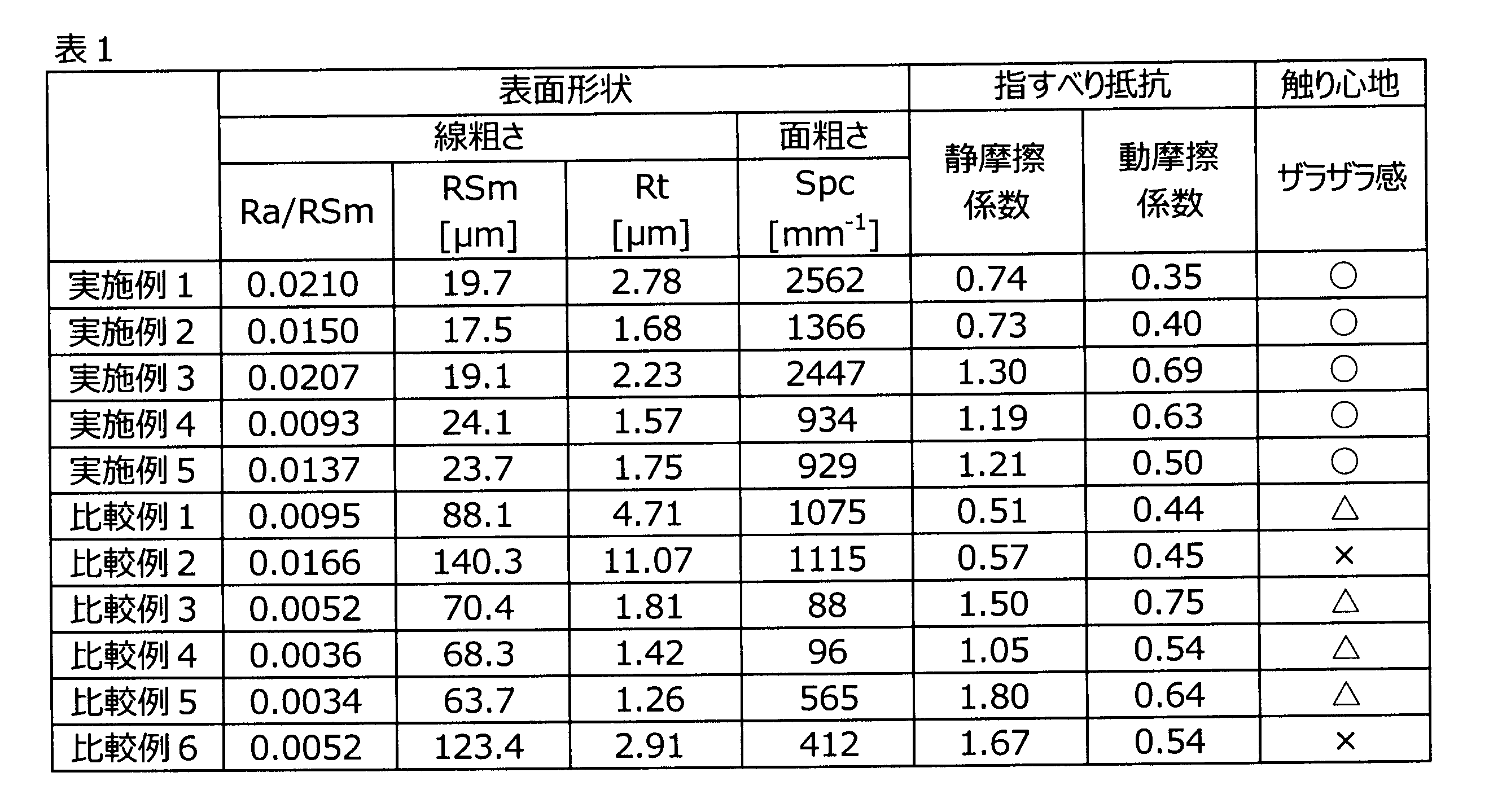
実施例1~5は、主面のRSmが50μm未満、主面のRaと、RSmとの比(Ra/RSm)が0.008超、主面のRtが1μm超かつ4μm未満、主面のSpcが800mm-1超、主面の静摩擦係数が1.4未満であり、ザラザラ感の官能評価の結果も○であった。
比較例1~6は、それぞれ以下の条件を満たしておらず、ザラザラ感の官能評価結果が△(比較例1、3、4、5)、×(比較例2、6)であった。
比較例1、2:主面のRSmが50μm以上、主面のRtが4μm以上
比較例3:主面のRSmが50μm以上、主面のRaと、RSmとの比(Ra/RSm)が0.008以下、主面のSpcが800mm-1以下、主面の静摩擦係数が1.4以上
比較例4:主面のRSmが50μm以上、主面のRaと、RSmとの比(Ra/RSm)が0.008以下、主面のSpcが800mm-1以下
比較例5、6:主面のRSmが50μm以上、主面のRaと、RSmとの比(Ra/RSm)が0.008以下、主面のSpcが800mm-1以下、主面の静摩擦係数が1.4以上
比較例1~6は、それぞれ以下の条件を満たしておらず、ザラザラ感の官能評価結果が△(比較例1、3、4、5)、×(比較例2、6)であった。
比較例1、2:主面のRSmが50μm以上、主面のRtが4μm以上
比較例3:主面のRSmが50μm以上、主面のRaと、RSmとの比(Ra/RSm)が0.008以下、主面のSpcが800mm-1以下、主面の静摩擦係数が1.4以上
比較例4:主面のRSmが50μm以上、主面のRaと、RSmとの比(Ra/RSm)が0.008以下、主面のSpcが800mm-1以下
比較例5、6:主面のRSmが50μm以上、主面のRaと、RSmとの比(Ra/RSm)が0.008以下、主面のSpcが800mm-1以下、主面の静摩擦係数が1.4以上
<ガラス板(実施例6~18、比較例7~13)>
(実施例6)
SiO2:58質量%以上、Al2O3:15質量%以上、Na2O:14質量%以上を含有するアルミノシリケートガラス板に対して、下記の化学強化A、酸洗浄A、及びアルカリ洗浄Aを施して、実施例6のガラス板を得た。
[化学強化A]
ガラス板を350~400℃に予熱した後、KNO3、K2CO3及びNaNO3を含有する475℃の溶融塩に1.5時間接触させた。この時、H2Oを溶融塩1cm3当たり0.4mg/min以上供給して、溶融塩の界面近傍の露点を90℃以上とした。その後、アルミノシリケートガラス板を室温付近まで冷却した後、溶融塩と接触させた面を水洗いした。
[酸洗浄A]
次に40℃に温度調整した6質量%の硝酸水溶液を、アルミノシリケートガラス板の溶融塩と接触させた面に2分間接触させ、その後、硝酸水溶液と接触させた面を水洗いした。
[アルカリ洗浄A]
さらに、40℃に温度調整した5質量%の水酸化ナトリウム水溶液を、アルミノシリケートガラス板の硝酸水溶液と接触させた面に2分間接触させ、その後、水酸化ナトリウム水溶液と接触させた面を水洗いした。
(実施例6)
SiO2:58質量%以上、Al2O3:15質量%以上、Na2O:14質量%以上を含有するアルミノシリケートガラス板に対して、下記の化学強化A、酸洗浄A、及びアルカリ洗浄Aを施して、実施例6のガラス板を得た。
[化学強化A]
ガラス板を350~400℃に予熱した後、KNO3、K2CO3及びNaNO3を含有する475℃の溶融塩に1.5時間接触させた。この時、H2Oを溶融塩1cm3当たり0.4mg/min以上供給して、溶融塩の界面近傍の露点を90℃以上とした。その後、アルミノシリケートガラス板を室温付近まで冷却した後、溶融塩と接触させた面を水洗いした。
[酸洗浄A]
次に40℃に温度調整した6質量%の硝酸水溶液を、アルミノシリケートガラス板の溶融塩と接触させた面に2分間接触させ、その後、硝酸水溶液と接触させた面を水洗いした。
[アルカリ洗浄A]
さらに、40℃に温度調整した5質量%の水酸化ナトリウム水溶液を、アルミノシリケートガラス板の硝酸水溶液と接触させた面に2分間接触させ、その後、水酸化ナトリウム水溶液と接触させた面を水洗いした。
(実施例7)
化学強化Aにおいて溶融塩に接触させる時間を5時間、溶融塩の界面近傍の露点を65~75℃としたこと以外は実施例6と同様にして得られたガラス板に対して、さらに下記の化学強化Bを施して、実施例7のガラス板を得た。
[化学強化B]
ガラス板を525℃で3時間加熱した後、KNO3及びNaNO3を含有する425℃の溶融塩に0.5時間接触させた。その後、アルミノシリケートガラス板を室温付近まで冷却した後、溶融塩と接触させた面を水洗いした。
化学強化Aにおいて溶融塩に接触させる時間を5時間、溶融塩の界面近傍の露点を65~75℃としたこと以外は実施例6と同様にして得られたガラス板に対して、さらに下記の化学強化Bを施して、実施例7のガラス板を得た。
[化学強化B]
ガラス板を525℃で3時間加熱した後、KNO3及びNaNO3を含有する425℃の溶融塩に0.5時間接触させた。その後、アルミノシリケートガラス板を室温付近まで冷却した後、溶融塩と接触させた面を水洗いした。
(実施例8~10)
化学強化Aにおいて溶融塩に接触させる時間、及び溶融塩の界面近傍の露点を表2に示すよう変更したこと以外は実施例6と同様にして、実施例8~10のガラス板を得た。
化学強化Aにおいて溶融塩に接触させる時間、及び溶融塩の界面近傍の露点を表2に示すよう変更したこと以外は実施例6と同様にして、実施例8~10のガラス板を得た。
(実施例11)
ガラス板の組成、化学強化Aにおいて溶融塩に接触させる時間、及び溶融塩の界面近傍の露点を表2に示すよう変更したこと以外は、実施例7と同様にして、実施例11のガラス板を得た。
ガラス板の組成、化学強化Aにおいて溶融塩に接触させる時間、及び溶融塩の界面近傍の露点を表2に示すよう変更したこと以外は、実施例7と同様にして、実施例11のガラス板を得た。
(実施例12)
SiO2:68質量%以上、Al2O3:11質量%以上、Na2O:5質量%以上、Li2O:3質量%以上を含有するガラス板を使用し、このガラス板に下記予備強化を施した。その後、化学強化Aにおいて接触させる溶融塩の温度を450℃、溶融塩に接触させる時間を6時間としたこと以外は実施例6と同様に化学強化A、酸洗浄A、アルカリ洗浄Aを施して、実施例12のガラス板を得た。
[予備強化]
ガラス板を350~400℃に予熱した後、NaNO3を含有する450℃の溶融塩に2時間接触させた。その後、ガラス板を室温付近まで冷却した後、溶融塩と接触させた面を水洗いした。
SiO2:68質量%以上、Al2O3:11質量%以上、Na2O:5質量%以上、Li2O:3質量%以上を含有するガラス板を使用し、このガラス板に下記予備強化を施した。その後、化学強化Aにおいて接触させる溶融塩の温度を450℃、溶融塩に接触させる時間を6時間としたこと以外は実施例6と同様に化学強化A、酸洗浄A、アルカリ洗浄Aを施して、実施例12のガラス板を得た。
[予備強化]
ガラス板を350~400℃に予熱した後、NaNO3を含有する450℃の溶融塩に2時間接触させた。その後、ガラス板を室温付近まで冷却した後、溶融塩と接触させた面を水洗いした。
(実施例13)
表2に示す組成のガラス板に対し、溶融塩に接触させる時間を4時間としたこと以外は実施例6と同様に化学強化Aを施した。その後、下記の酸洗浄B、及びアルカリ洗浄Bを施して、実施例13のガラス板を得た。
[酸洗浄B]
60℃に温度調整した6質量%の硝酸水溶液を、ガラス板の溶融塩と接触させた面に10分間接触させ、その後、硝酸水溶液と接触させた面を水洗いした。
[アルカリ洗浄B]
次に、60℃に温度調整した5質量%の水酸化ナトリウム水溶液を、ガラス板の硝酸水溶液と接触させた面に10分間接触させ、その後、水酸化ナトリウム水溶液と接触させた面を水洗いした。
表2に示す組成のガラス板に対し、溶融塩に接触させる時間を4時間としたこと以外は実施例6と同様に化学強化Aを施した。その後、下記の酸洗浄B、及びアルカリ洗浄Bを施して、実施例13のガラス板を得た。
[酸洗浄B]
60℃に温度調整した6質量%の硝酸水溶液を、ガラス板の溶融塩と接触させた面に10分間接触させ、その後、硝酸水溶液と接触させた面を水洗いした。
[アルカリ洗浄B]
次に、60℃に温度調整した5質量%の水酸化ナトリウム水溶液を、ガラス板の硝酸水溶液と接触させた面に10分間接触させ、その後、水酸化ナトリウム水溶液と接触させた面を水洗いした。
(比較例7)
化学強化Aにおいて接触させる溶融塩の温度、及び溶融塩の界面近傍の露点を表2に示すよう変更したこと以外は実施例6と同様にして、比較例7のガラス板を得た。
化学強化Aにおいて接触させる溶融塩の温度、及び溶融塩の界面近傍の露点を表2に示すよう変更したこと以外は実施例6と同様にして、比較例7のガラス板を得た。
表2に実施例6~13、及び比較例7のガラス板の組成及び処理方法をまとめて示す。

(実施例14)
実施例11と同様のガラス板に対し、番手が#3000のホワイトアルミナを砥粒として、投射圧0.1MPaでサンドブラスト処理をした後、エッチング液としてフッ酸水溶液を使用し、8μmエッチングした。その後、下記の化学強化Cを施して実施例14のガラス板を得た。
[化学強化C]
ガラス板を425℃の100%硝酸カリウム塩に4時間浸漬し、その後ガラス板を室温付近まで冷却した後、溶融塩と接触させた面を水洗いした。
実施例11と同様のガラス板に対し、番手が#3000のホワイトアルミナを砥粒として、投射圧0.1MPaでサンドブラスト処理をした後、エッチング液としてフッ酸水溶液を使用し、8μmエッチングした。その後、下記の化学強化Cを施して実施例14のガラス板を得た。
[化学強化C]
ガラス板を425℃の100%硝酸カリウム塩に4時間浸漬し、その後ガラス板を室温付近まで冷却した後、溶融塩と接触させた面を水洗いした。
(実施例15~18、比較例8~13)
実施例14において、ガラス板の組成、ホワイトアルミナ砥粒の番手、サンドブラスト処理の投射圧、エッチング深さを表3に示すよう変更した以外は、実施例14と同様にして、実施例15~18、及び比較例8~13のガラス板を得た。なお、比較例8~10ではサンドブラスト処理は行っておらず、実施例17、18、比較例8~10、13では化学強化Cは行っていない。
実施例14において、ガラス板の組成、ホワイトアルミナ砥粒の番手、サンドブラスト処理の投射圧、エッチング深さを表3に示すよう変更した以外は、実施例14と同様にして、実施例15~18、及び比較例8~13のガラス板を得た。なお、比較例8~10ではサンドブラスト処理は行っておらず、実施例17、18、比較例8~10、13では化学強化Cは行っていない。
表3に実施例14~18、及び比較例8~13のガラス板の組成及び処理方法をまとめて示す。

実施例6~18、比較例7~13のガラス板の、表面形状、圧縮応力層の厚さ、静摩擦係数、動摩擦係数、手触り感の評価、及び破壊応力値を表4に示す。なお、表中の「-」は未測定を意味する。
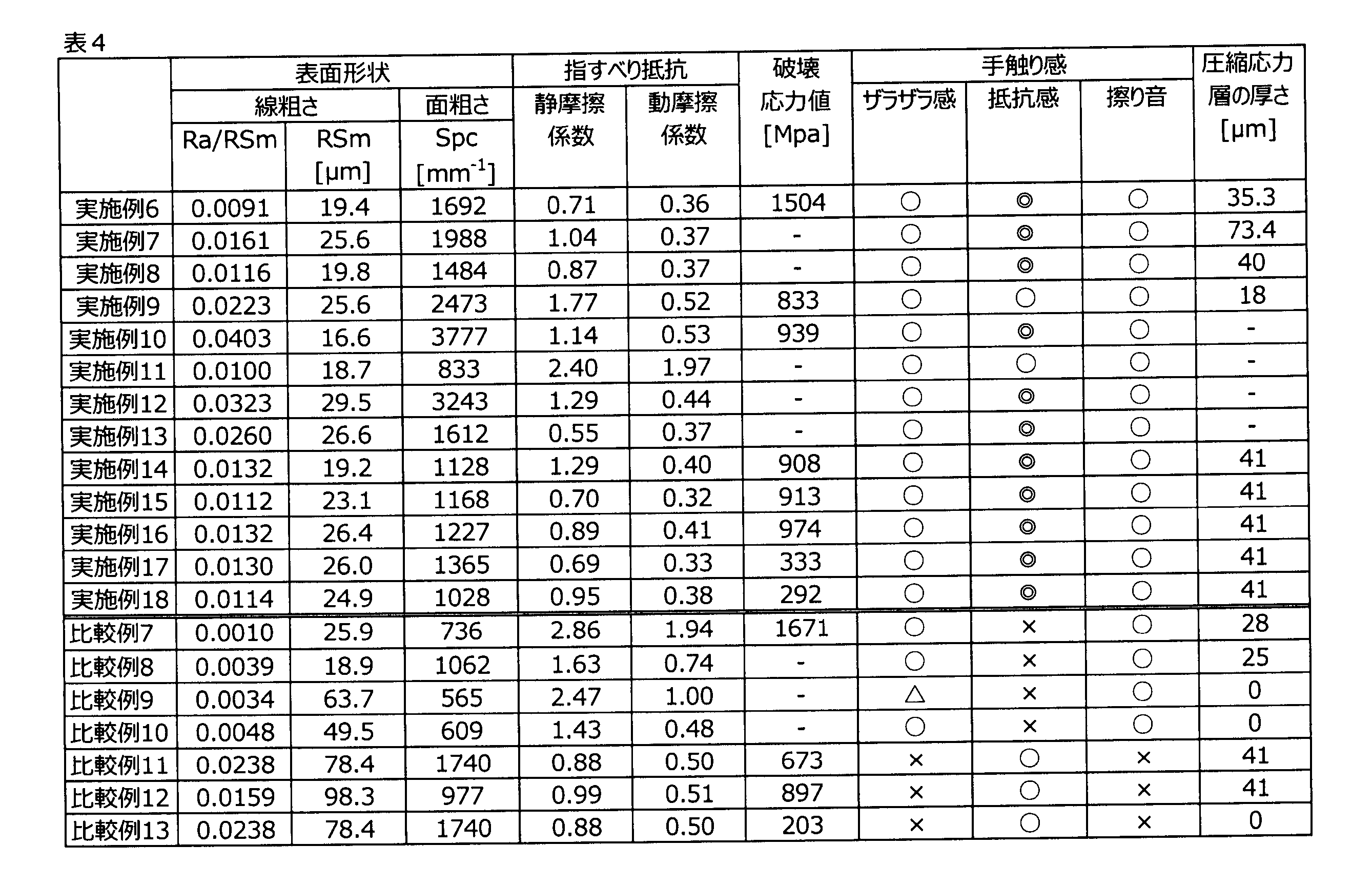
RSmが30μm未満であり、Ra/RSmが0.009超である主面を有する実施例6~18のガラス板は、全ての手触り感に優れていた。
一方、Ra/RSmが0.009以下である主面を有する比較例7及び8のガラス板は、抵抗感に劣っていた。RSmが30μm以上である主面を有する比較例11~13のガラス板は、ザラザラ感及び擦り音に劣っていた。RSmが30μm以上であり、Ra/RSmが0.009以下である主面を有する比較例9のガラス板は、ザラザラ感にやや劣っていた上に、抵抗感にも劣っていた。また、RSmが30μm以上であり、Ra/RSmが0.009以下である主面を有する比較例10のガラス板は、抵抗感に劣っていた。
本明細書に記載のガラス板を表示装置用カバーガラスに用いることで、操作時に手触り感が良好なタッチパネルディスプレイを実現することができる。また、ユーザが手で保持するモバイル機器の筐体に用いることで、美観の向上とともにユーザの保持しやすさを実現することが出来るためより好ましい。加えて、家電等の外装に用いることで、美観の向上とともに操作時の手触り感を向上させることができるためより好ましい。
本発明を特定の態様を参照して詳細に説明したが、本発明の精神と範囲を離れることなく様々な変更および修正が可能であることは、当業者にとって明らかである。なお、本出願は、2016年10月20日付けで出願された日本特許出願(特願2016-205873)に基づいており、その全体が引用により援用される。また、ここに引用されるすべての参照は全体として取り込まれる。
Claims (5)
- 少なくとも一方の主面が下記(1)及び(2)を満たすガラス板。
(1)主面の算術平均表面粗さ(Ra)と、粗さ曲線の要素の平均長さ(RSm)と、の比(Ra/RSm)が0.009超。
(2)主面のRSmが30μm未満。 - 前記(1)及び(2)を満たす主面の山頂点の算術平均曲率(Spc)が1000mm-1超である、請求項1に記載のガラス板。
- 前記(1)及び(2)を満たす主面の静摩擦係数が1.2未満であり、前記主面の動摩擦係数が0.5未満である、請求項1又は2に記載のガラス板。
- 前記(1)及び(2)を満たす主面の、リングオンリング(ROR)試験により下記条件で測定した破壊応力値が900MPa以上である、請求項1~3のいずれか1項に記載のガラス板。
リングオンリング試験条件:
直径が30mmで、接触部が曲率半径2.5mmの丸みを持つステンレスからなる下リング上に、前記ガラス板を、前記主面が下側になるように配置する。前記ガラス板に、直径が10mmで、接触部が曲率半径2.5mmの丸みを持つステンレスからなる上リングを接触させた状態で、前記上リングの中心に静的荷重条件下で荷重する。上リングの押し込み速度は、1.0mm/minとする。前記ガラス板が破壊された際の破壊荷重(N)を、板厚及び破壊起点位置を勘案して破壊応力(MPa)に換算する。破壊荷重(N)から破壊応力(MPa)への換算は、有限要素法シミュレーションによる近似換算式を使用する。なお、破壊荷重(N)は、20回測定した際の平均値を採用する。但し、ガラス板の破壊起点位置が、上リングの押し込み位置より外側にある場合の破壊荷重(N)の測定値は、平均値の算出に使用しない。 - 少なくとも一方の主面が下記(3)~(7)を満たすガラス板。
(3)主面の算術平均表面粗さ(Ra)と、粗さ曲線の要素の平均長さ(RSm)と、の比(Ra/RSm)が0.008超。
(4)主面のRSmが50μm未満。
(5)主面の最大断面粗さ(Rt)が1μm超かつ4μm未満。
(6)主面の山頂点の算術平均曲率(Spc)が800mm-1超。
(7)主面の静摩擦係数が1.4未満。
Applications Claiming Priority (2)
| Application Number | Priority Date | Filing Date | Title |
|---|---|---|---|
| JP2016205873A JP2019218217A (ja) | 2016-10-20 | 2016-10-20 | ガラス板 |
| JP2016-205873 | 2016-10-20 |
Publications (1)
| Publication Number | Publication Date |
|---|---|
| WO2018074494A1 true WO2018074494A1 (ja) | 2018-04-26 |
Family
ID=62019525
Family Applications (1)
| Application Number | Title | Priority Date | Filing Date |
|---|---|---|---|
| PCT/JP2017/037605 Ceased WO2018074494A1 (ja) | 2016-10-20 | 2017-10-17 | ガラス板 |
Country Status (2)
| Country | Link |
|---|---|
| JP (1) | JP2019218217A (ja) |
| WO (1) | WO2018074494A1 (ja) |
Cited By (2)
| Publication number | Priority date | Publication date | Assignee | Title |
|---|---|---|---|---|
| JP2021014272A (ja) * | 2019-07-10 | 2021-02-12 | 雪印メグミルク株式会社 | ゲーブルトップ型容器およびゲーブルトップ型容器の製造方法 |
| WO2023210463A1 (ja) | 2022-04-28 | 2023-11-02 | Agc株式会社 | ガラス板およびガラス板の製造方法 |
Families Citing this family (2)
| Publication number | Priority date | Publication date | Assignee | Title |
|---|---|---|---|---|
| JP7511105B2 (ja) * | 2021-03-26 | 2024-07-05 | Agc株式会社 | 化学強化ガラス及び化学強化ガラスの製造方法 |
| JP7734061B2 (ja) * | 2021-12-06 | 2025-09-04 | Jfe建材株式会社 | チョークボード |
Citations (6)
| Publication number | Priority date | Publication date | Assignee | Title |
|---|---|---|---|---|
| JP2007169138A (ja) * | 2005-12-26 | 2007-07-05 | Nippon Electric Glass Co Ltd | フラットディスプレイ用ガラス基板 |
| JP2010070445A (ja) * | 2008-08-18 | 2010-04-02 | Nippon Electric Glass Co Ltd | タッチパネル用ガラスの製造方法 |
| WO2016005216A1 (en) * | 2014-07-09 | 2016-01-14 | Agc Glass Europe | Low sparkle glass sheet |
| JP2016126077A (ja) * | 2014-12-26 | 2016-07-11 | 旭硝子株式会社 | 表示装置 |
| JP2016136232A (ja) * | 2015-01-14 | 2016-07-28 | セントラル硝子株式会社 | 表示装置用の防眩性ガラス板物品及びその製法 |
| JP2016153914A (ja) * | 2014-03-14 | 2016-08-25 | 日本電気硝子株式会社 | ディスプレイのカバー部材及びその製造方法 |
-
2016
- 2016-10-20 JP JP2016205873A patent/JP2019218217A/ja active Pending
-
2017
- 2017-10-17 WO PCT/JP2017/037605 patent/WO2018074494A1/ja not_active Ceased
Patent Citations (6)
| Publication number | Priority date | Publication date | Assignee | Title |
|---|---|---|---|---|
| JP2007169138A (ja) * | 2005-12-26 | 2007-07-05 | Nippon Electric Glass Co Ltd | フラットディスプレイ用ガラス基板 |
| JP2010070445A (ja) * | 2008-08-18 | 2010-04-02 | Nippon Electric Glass Co Ltd | タッチパネル用ガラスの製造方法 |
| JP2016153914A (ja) * | 2014-03-14 | 2016-08-25 | 日本電気硝子株式会社 | ディスプレイのカバー部材及びその製造方法 |
| WO2016005216A1 (en) * | 2014-07-09 | 2016-01-14 | Agc Glass Europe | Low sparkle glass sheet |
| JP2016126077A (ja) * | 2014-12-26 | 2016-07-11 | 旭硝子株式会社 | 表示装置 |
| JP2016136232A (ja) * | 2015-01-14 | 2016-07-28 | セントラル硝子株式会社 | 表示装置用の防眩性ガラス板物品及びその製法 |
Cited By (2)
| Publication number | Priority date | Publication date | Assignee | Title |
|---|---|---|---|---|
| JP2021014272A (ja) * | 2019-07-10 | 2021-02-12 | 雪印メグミルク株式会社 | ゲーブルトップ型容器およびゲーブルトップ型容器の製造方法 |
| WO2023210463A1 (ja) | 2022-04-28 | 2023-11-02 | Agc株式会社 | ガラス板およびガラス板の製造方法 |
Also Published As
| Publication number | Publication date |
|---|---|
| JP2019218217A (ja) | 2019-12-26 |
Similar Documents
| Publication | Publication Date | Title |
|---|---|---|
| JP6312722B2 (ja) | 耐衝撃損傷性ガラス板の製造方法 | |
| JP5555289B2 (ja) | 携帯端末装置のカバーガラス用のガラス基材 | |
| KR101889667B1 (ko) | 커버 유리 | |
| JP6075435B2 (ja) | 防汚膜付き透明基体 | |
| JP2017529305A (ja) | コーティングされた化学強化された薄型フレキシブルガラス | |
| US20150175478A1 (en) | Textured glass surface and methods of making | |
| JP7276372B2 (ja) | 化学強化ガラス | |
| JP2017528411A (ja) | コーティングされた、化学強化された、耐指紋特性を有するガラス基板を製造する方法及びこの製造されたガラス基板 | |
| JP5757278B2 (ja) | タッチパネル用ガラスの製造方法 | |
| TWI613167B (zh) | 一種抗眩光強化抗菌及抗指紋之玻璃面板製作方法 | |
| US11254605B2 (en) | Methods of reducing the thickness of textured glass, glass-ceramic, and ceramic articles with high concentration alkali hydroxide at elevated temperature | |
| JPWO2015008766A1 (ja) | 化学強化ガラス | |
| JPWO2016080432A1 (ja) | 透明板、タッチパッド、およびタッチパネル | |
| JPWO2014045809A1 (ja) | 化学強化ガラスの製造方法 | |
| JP2016504260A (ja) | 反射低減ガラス物品ならびにその製造方法および使用方法 | |
| JPWO2016117474A1 (ja) | 化学強化ガラス及び化学強化ガラスの製造方法 | |
| JP2019199393A (ja) | 化学強化ガラスの製造方法および化学強化ガラス | |
| JP6852678B2 (ja) | ガラス板、タッチパッド、およびタッチパネル | |
| JP2019006615A (ja) | 化学強化ガラスの製造方法 | |
| JP2019218217A (ja) | ガラス板 | |
| JP2016216295A (ja) | 化学強化ガラスの製造方法 | |
| JP2017137235A (ja) | カバーガラス及びガラス積層体 | |
| TW201904904A (zh) | 經化學強化的防眩玻璃以及防眩處理用的玻璃 | |
| WO2018062141A1 (ja) | 化学強化ガラスの製造方法 | |
| JPWO2014112446A1 (ja) | 白色ガラスを含む筐体、白色ガラスを含む筐体の製造方法およびポータブル電子装置 |
Legal Events
| Date | Code | Title | Description |
|---|---|---|---|
| 121 | Ep: the epo has been informed by wipo that ep was designated in this application |
Ref document number: 17862676 Country of ref document: EP Kind code of ref document: A1 |
|
| NENP | Non-entry into the national phase |
Ref country code: DE |
|
| 122 | Ep: pct application non-entry in european phase |
Ref document number: 17862676 Country of ref document: EP Kind code of ref document: A1 |
|
| NENP | Non-entry into the national phase |
Ref country code: JP |