WO2018070256A1 - 光学物品用活性エネルギー線硬化型樹脂組成物、硬化物及び光学シート - Google Patents
光学物品用活性エネルギー線硬化型樹脂組成物、硬化物及び光学シート Download PDFInfo
- Publication number
- WO2018070256A1 WO2018070256A1 PCT/JP2017/035173 JP2017035173W WO2018070256A1 WO 2018070256 A1 WO2018070256 A1 WO 2018070256A1 JP 2017035173 W JP2017035173 W JP 2017035173W WO 2018070256 A1 WO2018070256 A1 WO 2018070256A1
- Authority
- WO
- WIPO (PCT)
- Prior art keywords
- active energy
- energy ray
- acrylate
- meth
- resin composition
- Prior art date
- Legal status (The legal status is an assumption and is not a legal conclusion. Google has not performed a legal analysis and makes no representation as to the accuracy of the status listed.)
- Ceased
Links
Classifications
-
- C—CHEMISTRY; METALLURGY
- C08—ORGANIC MACROMOLECULAR COMPOUNDS; THEIR PREPARATION OR CHEMICAL WORKING-UP; COMPOSITIONS BASED THEREON
- C08F—MACROMOLECULAR COMPOUNDS OBTAINED BY REACTIONS ONLY INVOLVING CARBON-TO-CARBON UNSATURATED BONDS
- C08F220/00—Copolymers of compounds having one or more unsaturated aliphatic radicals, each having only one carbon-to-carbon double bond, and only one being terminated by only one carboxyl radical or a salt, anhydride ester, amide, imide or nitrile thereof
- C08F220/02—Monocarboxylic acids having less than ten carbon atoms; Derivatives thereof
- C08F220/10—Esters
- C08F220/26—Esters containing oxygen in addition to the carboxy oxygen
- C08F220/30—Esters containing oxygen in addition to the carboxy oxygen containing aromatic rings in the alcohol moiety
-
- C—CHEMISTRY; METALLURGY
- C08—ORGANIC MACROMOLECULAR COMPOUNDS; THEIR PREPARATION OR CHEMICAL WORKING-UP; COMPOSITIONS BASED THEREON
- C08F—MACROMOLECULAR COMPOUNDS OBTAINED BY REACTIONS ONLY INVOLVING CARBON-TO-CARBON UNSATURATED BONDS
- C08F2/00—Processes of polymerisation
- C08F2/46—Polymerisation initiated by wave energy or particle radiation
- C08F2/48—Polymerisation initiated by wave energy or particle radiation by ultraviolet or visible light
- C08F2/50—Polymerisation initiated by wave energy or particle radiation by ultraviolet or visible light with sensitising agents
-
- C—CHEMISTRY; METALLURGY
- C08—ORGANIC MACROMOLECULAR COMPOUNDS; THEIR PREPARATION OR CHEMICAL WORKING-UP; COMPOSITIONS BASED THEREON
- C08F—MACROMOLECULAR COMPOUNDS OBTAINED BY REACTIONS ONLY INVOLVING CARBON-TO-CARBON UNSATURATED BONDS
- C08F220/00—Copolymers of compounds having one or more unsaturated aliphatic radicals, each having only one carbon-to-carbon double bond, and only one being terminated by only one carboxyl radical or a salt, anhydride ester, amide, imide or nitrile thereof
- C08F220/02—Monocarboxylic acids having less than ten carbon atoms; Derivatives thereof
- C08F220/10—Esters
- C08F220/26—Esters containing oxygen in addition to the carboxy oxygen
- C08F220/30—Esters containing oxygen in addition to the carboxy oxygen containing aromatic rings in the alcohol moiety
- C08F220/301—Esters containing oxygen in addition to the carboxy oxygen containing aromatic rings in the alcohol moiety and one oxygen in the alcohol moiety
-
- C—CHEMISTRY; METALLURGY
- C08—ORGANIC MACROMOLECULAR COMPOUNDS; THEIR PREPARATION OR CHEMICAL WORKING-UP; COMPOSITIONS BASED THEREON
- C08F—MACROMOLECULAR COMPOUNDS OBTAINED BY REACTIONS ONLY INVOLVING CARBON-TO-CARBON UNSATURATED BONDS
- C08F222/00—Copolymers of compounds having one or more unsaturated aliphatic radicals, each having only one carbon-to-carbon double bond, and at least one being terminated by a carboxyl radical and containing at least one other carboxyl radical in the molecule; Salts, anhydrides, esters, amides, imides, or nitriles thereof
- C08F222/10—Esters
- C08F222/1006—Esters of polyhydric alcohols or polyhydric phenols
- C08F222/102—Esters of polyhydric alcohols or polyhydric phenols of dialcohols, e.g. ethylene glycol di(meth)acrylate or 1,4-butanediol dimethacrylate
- C08F222/1025—Esters of polyhydric alcohols or polyhydric phenols of dialcohols, e.g. ethylene glycol di(meth)acrylate or 1,4-butanediol dimethacrylate of aromatic dialcohols
-
- C—CHEMISTRY; METALLURGY
- C08—ORGANIC MACROMOLECULAR COMPOUNDS; THEIR PREPARATION OR CHEMICAL WORKING-UP; COMPOSITIONS BASED THEREON
- C08F—MACROMOLECULAR COMPOUNDS OBTAINED BY REACTIONS ONLY INVOLVING CARBON-TO-CARBON UNSATURATED BONDS
- C08F290/00—Macromolecular compounds obtained by polymerising monomers on to polymers modified by introduction of aliphatic unsaturated end or side groups
- C08F290/02—Macromolecular compounds obtained by polymerising monomers on to polymers modified by introduction of aliphatic unsaturated end or side groups on to polymers modified by introduction of unsaturated end groups
- C08F290/06—Polymers provided for in subclass C08G
-
- C—CHEMISTRY; METALLURGY
- C08—ORGANIC MACROMOLECULAR COMPOUNDS; THEIR PREPARATION OR CHEMICAL WORKING-UP; COMPOSITIONS BASED THEREON
- C08J—WORKING-UP; GENERAL PROCESSES OF COMPOUNDING; AFTER-TREATMENT NOT COVERED BY SUBCLASSES C08B, C08C, C08F, C08G or C08H
- C08J5/00—Manufacture of articles or shaped materials containing macromolecular substances
- C08J5/18—Manufacture of films or sheets
-
- G—PHYSICS
- G02—OPTICS
- G02B—OPTICAL ELEMENTS, SYSTEMS OR APPARATUS
- G02B1/00—Optical elements characterised by the material of which they are made; Optical coatings for optical elements
- G02B1/04—Optical elements characterised by the material of which they are made; Optical coatings for optical elements made of organic materials, e.g. plastics
Definitions
- the present invention relates to an active energy ray-curable resin composition used for an optical article, a cured product obtained by curing the composition, and an optical sheet composed of the cured product.
- Prism sheets used for displays such as liquid crystal display devices, lenticular lens sheets used for stereoscopic photographs and projection screens, Fresnel lens sheets used for condenser lenses for overhead projectors, diffraction gratings used for color filters, etc.
- various active energy ray-curable resin compositions are used. These optical sheets are required to have characteristics according to their applications. For example, prism sheets are required to have a high refractive index in order to improve display brightness.
- a (meth) acrylate having a fluorene skeleton As a material having a high refractive index in an optical material application, a (meth) acrylate having a fluorene skeleton is known. For example, a polyfunctional (meth) acrylate having a fluorene skeleton with an increased number of oxyalkylene groups added and And a curable composition containing phenoxybenzyl (meth) acrylate (see Patent Document 1).
- the curable composition can achieve both a high refractive index and scratch resistance by increasing the number of oxyalkylene groups added to the (meth) acrylate having a fluorene skeleton.
- the prism sheet since the light collecting ability is lowered when the film is damaged when it is overlapped with another film or the like constituting the display, further improvement in scratch resistance and self-healing property has been demanded. In addition to these characteristics, realization of high adhesion in a moist heat environment has also been demanded.
- An object of the present invention is to form an optical article having a high refractive index, excellent scratch resistance, suitable self-healing even when scratched, and excellent wet heat adhesion.
- the object is to provide an active energy ray-curable resin composition.
- the present invention is an active energy ray-curable composition for optical articles containing an active energy ray-polymerizable compound (A) and a photopolymerization initiator (B), wherein the active energy ray-polymerizable compound (A) has the following formula:
- An active energy ray-curable composition for optical articles comprising a compound represented by (1) and a compound represented by the following formula (2) is provided.
- R 1 and R 2 each independently represent a hydrogen atom or a methyl group
- X 1 and X 2 each independently represent a C 2 or 3 alkylene group
- m and n are Independently represents an integer of 0 or more, and m + n is 20 or more.
- the active energy ray-curable composition for optical articles of the present invention ensures wet heat adhesion and scratch resistance by using a fluorene-based (meth) acrylate having a long alkylene oxide chain and phenoxybenzyl acrylate.
- a high refractive index and a suitable self-healing property can be realized.
- the cured product obtained by curing the composition has a high refractive index, is excellent in scratch resistance, has a suitable self-healing property even when scratched, and has excellent wet heat adhesion.
- prism sheets used for displays such as liquid crystal display devices, lenticular lens sheets used for stereoscopic photographs and projection screens, Fresnel lens sheets used for condenser lenses of overhead projectors, It can be suitably applied to various optical sheets such as diffraction gratings used for color filters and the like.
- the active energy ray-curable composition for optical articles of the present invention contains a compound represented by the following formula (1) as the active energy ray-polymerizable compound (A).
- cured material obtained by containing the compound represented by following formula (1) can be made high, and suitable scratch resistance and self-healing property are realizable.
- R 1 and R 2 each independently represent a hydrogen atom or a methyl group
- X 1 and X 2 each independently represent a C 2 or 3 alkylene group
- m and n are Independently represents an integer of 0 or more, and m + n is 20 or more.
- m and n each independently represent an integer of 0 or more, and m + n is 20 or more.
- m + n is preferably 20 to 30, and more preferably 20 to 25.
- the compound represented by the above formula (1) used in the present invention preferably has a refractive index of 1.50 or more, and more preferably 1.53 or more. Moreover, the viscosity is preferably 5000 mPa ⁇ s or less, and more preferably 3000 mPa ⁇ s or less.
- the self-curing of the cured product can be achieved without significantly lowering the refractive index of the obtained cured product.
- the curability can be increased.
- the content of the compound represented by the formula (1) in the active energy ray-polymerizable compound (A) contained in the composition is 10 to 50 masses. %, And more preferably 20 to 40% by mass.
- the compound represented by the formula (1) can realize a high refractive index, suitable flexibility and self-healing property. Furthermore, by setting the content of the compound represented by the formula (1) to the upper limit or less, the cured product does not become too soft, and it becomes easy to suppress water absorption. It becomes easy to obtain suitable adhesion (long-term reliability). Moreover, it becomes easy to ensure a high refractive index by making content of the said compound below the said minimum.
- the content of the compound represented by the formula (2) in the active energy ray polymerizable compound (A) is preferably 10 to 70% by mass, more preferably 20 to 60% by mass, More preferably, it is ⁇ 50 mass%.
- the compound represented by the formula (2) has a low polymer Tg, can impart a suitable flexibility to the cured product, and the content of the compound represented by the formula (2) is within the above range, the flexibility It is easy to realize suitable strength of the cured product and good adhesion to the base material while having suitable self-healing property.
- the total content of the compound represented by the formula (1) and the compound represented by the formula (2) is preferably 40 to 90% by mass, and more preferably 50 to 80% by mass. .
- the active energy ray-curable composition for optical articles of the present invention may contain other active energy ray-polymerizable compounds other than the compounds represented by the above formulas (1) and (2).
- the other active energy ray-polymerizable compound a monofunctional compound having one active energy ray-polymerizable group and a polyfunctional compound having two or more polymerizable groups can be appropriately used.
- Examples of monofunctional compounds include n-butyl (meth) acrylate, isobutyl (meth) acrylate, tert-butyl (meth) acrylate, n-pentyl (meth) acrylate, n-hexyl (meth) acrylate, and n-octyl.
- the monofunctional compound used in the present invention a compound having a viscosity at 25 ° C. of 300 mPa ⁇ s or less is preferably used, and a compound having a viscosity of 200 mPa ⁇ s or less is more preferable.
- the refractive index is preferably 1.4 or more at 25 ° C. and 589 nm, more preferably 1.5 or more, and further preferably 1.55 or more.
- the ethylene oxide-modified acrylate of o-phenylphenol represented by the following formula (3) improves the refractive index of the resulting cured product while suitably maintaining the viscosity of the composition. It is preferable because it is easy.
- the compound represented by Formula (3) When using the compound represented by Formula (3), it is represented by Formula (3) in the active energy ray-polymerizable compound (A) contained in the active energy ray-curable composition for optical articles of the present invention.
- the content of the compound is preferably 5 to 30% by mass, more preferably 15 to 25% by mass.
- phenylbenzyl acrylate represented by the following formula (4) is preferable because it easily improves the refractive index of the obtained cured product while suitably maintaining the viscosity of the composition.
- the compound represented by Formula (4) When using the compound represented by Formula (4), it is represented by Formula (4) in the active energy ray-polymerizable compound (A) contained in the active energy ray-curable composition for optical articles of the present invention.
- the content of the compound is preferably 5 to 30% by mass, more preferably 10 to 20% by mass.
- polyfunctional compound examples include ethylene glycol di (meth) acrylate, diethylene glycol di (meth) acrylate, triethylene glycol di (meth) acrylate, polyethylene glycol di (meth) acrylate, propylene glycol di (meth) acrylate, di Propylene glycol di (meth) acrylate, tripropylene glycol di (meth) acrylate, butylene glycol di (meth) acrylate, tetrabutylene glycol di (meth) acrylate, 1,4-butanediol di (meth) acrylate, 1,6- Hexanediol di (meth) acrylate, 1,9-nonanediol di (meth) acrylate, neopentyl glycol di (meth) acrylate, Di (meth) acrylate of bisphenol A ethylene oxide adduct, di (meth) acrylate of propylene oxide adduct of bisphenol A, di
- the polyfunctional oligomer which has acryloyl groups such as urethane (meth) acrylate, polyester (meth) acrylate, an epoxy (meth) acrylate, is also contained, for example. These may use 1 type, or may use multiple types.
- a (meth) acrylate having m + n of less than 20 in the structure represented by the above formula (1) may be used in combination.
- the said (meth) acrylate it is preferable to use at 20 mass% or less in an active energy ray polymeric compound, and it is preferable to use at 10 mass% or less.
- a compound having an active energy ray-polymerizable group other than the above (meth) acrylate can be used.
- compounds other than these (meth) acrylates it is preferable to use at 20 mass% or less in an active energy ray polymeric compound, and it is more preferable to use at 10 mass% or less.
- photopolymerization initiator As the photopolymerization initiator used in the present invention, various initiators used in the active energy ray-curable resin composition can be used. For example, 1-hydroxycyclohexyl phenyl ketone, 2-hydroxy-2-methyl-1-phenylpropane -1-one, 1- [4- (2-hydroxyethoxy) phenyl] -2-hydroxy-2-methyl-1-propan-1-one, thioxanthone and thioxanthone derivatives, 2,2′-dimethoxy-1,2 -Diphenylethane-1-one, 2,4,6-trimethylbenzoyldiphenylphosphine oxide, bis (2,4,6-trimethylbenzoyl) phenylphosphine oxide, 2-methyl-1- [4- (methylthio) phenyl]- 2-morpholino-1-propanone, 2-benzyl-2-dimethylamino-1- (4-morpho Linophenyl) -butan-1-one
- the amount is preferably 0.05 to 20 parts by weight, particularly preferably 0.1 to 10 parts by weight, based on 100 parts by weight of the active energy ray polymerizable compound in the composition.
- the active energy ray-curable resin composition for an optical article of the present invention is represented by a fluorene skeleton (meth) acrylate having an oxyalkylene group having a long chain length represented by the above formula (1) and the formula (2).
- a fluorene skeleton (meth) acrylate having an oxyalkylene group having a long chain length represented by the above formula (1) and the formula (2).
- the viscosity at 25 ° C. should be 50 to 5000 mPa ⁇ s. It is preferably 100 to 2000 mPa ⁇ s.
- the line speed can be increased
- It is preferably 50 to 500 mPa ⁇ s.
- the active energy ray-curable resin composition of the present invention may contain components other than the active energy ray polymerizable compound.
- a resin or the like is used in combination for the purpose of improving viscosity or adhesion to a transparent substrate. May be.
- the resin include acrylic resins such as methyl methacrylate resin and methyl methacrylate copolymer; polystyrene, methyl methacrylate-styrene copolymer; polyester resin; polyurethane resin; polybutadiene and butadiene-acrylonitrile copolymer. Polybutadiene resin; bisphenol type epoxy resin, epoxy resin such as phenoxy resin and novolac type epoxy resin, and the like.
- components other than these active energy ray polymerizable compounds it is preferably used at 20 parts by mass or less, preferably at 10 parts by mass or less, relative to 100 parts by mass of the active energy ray polymerizable compound. .
- inorganic filler In this invention, it is possible to mix
- the inorganic nanoparticles having a high refractive index include alumina, zirconia, titania, compounds thereof, mixed oxides thereof, and metal oxides thereof.
- These inorganic nanoparticles (fillers) are effective as a means of increasing the refractive index of cured products because they have a higher refractive index than general organic materials, but considering the balance between the strength of the molded product and adhesion to the substrate.
- a range in which the inorganic nanoparticles are 20 to 60% by mass with respect to the total amount of the active energy ray polymerizable compound (A) and the inorganic nanoparticles is practical.
- 30-50% by mass is more preferable in order to have both a high refractive index and self-healing properties.
- additives in the active energy ray-curable resin composition of the present invention, various additives may be used.
- the additive include an ultraviolet absorber, an antioxidant, a silicon-based additive, a fluorine-based additive, a rheology control agent, a defoaming agent, a release agent, a silane coupling agent, an antistatic agent, and an antifogging agent.
- coloring agents are preferably 0.05 to 20 parts by mass, and 0.1 to 10 parts by mass with respect to 100 parts by mass of the active energy ray-polymerizable compound in the active energy ray-curable resin composition for optical articles. It is particularly preferred that
- the active energy ray-curable resin composition for optical articles of the present invention may contain a solvent as necessary, but the active energy ray-curable type for optical articles is less likely to contaminate the working environment if the solvent content is lower. It is preferable because a resin composition is obtained.
- the solvent content in the active energy ray-curable resin composition for optical articles of the present invention is preferably 1% by mass or less, and is preferably not substantially contained.
- the active energy ray-curable resin composition of the present invention can be made into a cured product by irradiating with active energy rays after application to a substrate or molding according to the intended use.
- active energy rays include electron beams, ultraviolet rays, and visible rays.
- an electron beam is used as the active energy beam, a Cochloft Walton type accelerator, a bandegraph type electron accelerator, a resonant transformer type accelerator, an insulated core transformer type, a dynamitron type, a linear filament type, a high frequency type, etc.
- the curable composition of the present invention can be cured using a generator.
- ultraviolet rays when used as active energy rays, they should be cured by irradiation with mercury lamps such as ultra high pressure mercury lamps, high pressure mercury lamps, low pressure mercury lamps, xenon lamps, carbon arcs, metal height lamps, high output LED-UV lamps, etc. Can do.
- mercury lamps such as ultra high pressure mercury lamps, high pressure mercury lamps, low pressure mercury lamps, xenon lamps, carbon arcs, metal height lamps, high output LED-UV lamps, etc. Can do.
- the cured product of the active energy ray-curable resin composition of the present invention preferably has a refractive index of 1.5 or more, and more preferably 1.54 or more. Since the cured product has a high refractive index and suitable scratch resistance, it can be suitably applied to various optical articles.
- the hardness of the cured product of the present invention may be appropriately designed according to various uses.
- the elastic modulus at 25 ° C. is preferably 5 to 500 MPa. More preferably, it is 100 MPa. By setting the elastic modulus within this range, the balance between mechanical strength and toughness (elongation) is improved, and the restoring force necessary for self-healing is easily expressed.
- the elastic modulus is measured by dynamic viscoelasticity measurement using “RSAII” manufactured by Rheometric Scientific as a viscoelasticity measuring device, with a temperature rising speed of 3 ° C./Min and a frequency of 3.5 Hz. Value obtained.
- the glass transition temperature Tg of the cured product is preferably 40 ° C. or lower, more preferably 30 ° C. or lower, and particularly preferably 25 ° C. or lower.
- the lower limit of Tg is not particularly limited, but is preferably 5 ° C or higher, more preferably 10 ° C or higher, and particularly preferably 15 ° C or higher.
- the said glass transition temperature is the value which read the temperature of the peak position of tan-delta represented by ratio of the storage elastic modulus E 'obtained by viscoelasticity measurement, and the complex elastic modulus E "as Tg.
- the optical sheet of the present invention is an optical sheet having a layer made of a cured product of the active energy ray-curable resin composition for optical articles.
- the optical sheet is an optical sheet in which a prism or lens made of the cured product is laminated on a transparent resin film.
- a prism sheet used for a display such as a liquid crystal display device, a stereoscopic photograph
- Examples thereof include lenticular lens sheets used for projection screens, Fresnel lens sheets used for condenser lenses for overhead projectors, and optical sheets such as diffraction gratings used for color filters.
- the active energy ray-curable resin composition for optical articles is filled on a matrix having a fine shape required for various uses, and then the resin composition is filled.
- the substrate is continuously brought into close contact with the filled resin composition so that air does not enter, and ultraviolet rays are emitted from the substrate side.
- a continuous production method in which the resin composition is cured by irradiating active energy rays such as a mold and then released from a roll-shaped mother die, and the like.
- a film-like, sheet-like, or plate-like transparent substrate can be used as the substrate used for forming the optical sheet.
- the material of the base material may be appropriately selected according to the use, for example, polyester resin such as polyethylene terephthalate (PET) or polyethylene naphthalate (PEN), triacetyl cellulose, polycarbonate resin, methyl methacrylate copolymer, etc.
- Polyester resin such as polyethylene terephthalate (PET) or polyethylene naphthalate (PEN)
- triacetyl cellulose polycarbonate resin, methyl methacrylate copolymer, etc.
- an inorganic base material such as a glass base material can be used in the same manner.
- the active energy ray-curable resin composition for optical articles of the present invention can be suitably applied to prism sheets used for various displays among various optical sheets.
- the prism sheet has a plurality of fine prism-shaped portions on one side of a sheet-like molded body, and is usually arranged on the back surface (light source side) of the liquid crystal display element so that the prism surface faces the element side. Is done.
- the prism sheet is a sheet having a prism layer made of a cured product of the active energy ray-curable resin composition for optical articles on a transparent film.
- the prism layer has a prism apex angle ⁇ of 70 to 70. 110 ° is preferable from the viewpoint of excellent light-collecting properties and improved luminance, more preferably 75 to 100 °, and particularly preferably 80 to 95 °.
- the prism pitch is preferably 100 ⁇ m or less, and particularly preferably 70 ⁇ m or less from the viewpoint of preventing the generation of moire patterns on the screen and further improving the definition of the screen.
- the height of the projections and depressions of the prism is determined by the prism apex angle ⁇ and the prism pitch value, but is preferably 50 ⁇ m or less.
- the sheet thickness of the prism lens is preferably thick from the viewpoint of strength, but is optically preferably thin in order to suppress light absorption, and is preferably 50 ⁇ m to 1000 ⁇ m from the viewpoint of these balances.
- Viscosity measurement> The viscosity at 25 ° C. of the resin compositions prepared in Examples and Comparative Examples was measured using an E-type viscometer (DV-II + VISCOMETER) manufactured by BROOKFIELD.
- ⁇ Scratch resistance> A 1.5 cm square polarizing film (44% Pol) was placed on an 8 cm ⁇ 12.5 cm prism sheet obtained in the same manner as described above, a load was applied to the polarizing film, and a distance of 5 cm width was 10 cm. The surface was scratched and visually observed. The load was increased by 50 g, and the maximum load at which no damage was observed was taken as the measurement value.
- an abrasion resistance tester IMC-15FA type manufactured by Imoto Seisakusho Co., Ltd. was used.
- ⁇ Adhesion> The prism sheet obtained in the same manner as described above was allowed to stand for 100 hours under conditions of a temperature of 60 ° C. and a humidity of 90% RH, and then a 10 ⁇ 10 cross cut was performed with a cutter knife, and the cross cut portion was used as an adhesive tape. A cross-cut test was performed. With respect to the square 100, the number of residual masses after the adhesive tape was peeled was measured.
- Examples 1 to 6 Comparative Examples 1 to 5
- the compound was melt-mixed with the formulation shown in Table 1 below to prepare a resin composition.
- the above-mentioned evaluation was performed about the obtained resin composition.
- surface is the mass%.
- BPA (EO-modified) diacrylate: ethylene oxide-modified bisphenol A dimethacrylate (ethylene oxide-modified amount 20 mol)
- BPA type epoxy acrylate Epoxy acrylate having bisphenol A skeleton o-phenylphenol
- EO-modified acrylate o-phenylphenol ethylene oxide-modified (n ⁇ 1) acrylate (Kyoeisha Chemical Co., Ltd. Light acrylate POB-A)
- the resin composition of the present invention has a high refractive index, but has a suitable scratch resistance excellent in self-healing property and scratch resistance, and also has excellent adhesion. there were.
Landscapes
- Chemical & Material Sciences (AREA)
- Health & Medical Sciences (AREA)
- Chemical Kinetics & Catalysis (AREA)
- Medicinal Chemistry (AREA)
- Polymers & Plastics (AREA)
- Organic Chemistry (AREA)
- Physics & Mathematics (AREA)
- Manufacturing & Machinery (AREA)
- Engineering & Computer Science (AREA)
- General Physics & Mathematics (AREA)
- Optics & Photonics (AREA)
- Materials Engineering (AREA)
- Addition Polymer Or Copolymer, Post-Treatments, Or Chemical Modifications (AREA)
- Macromonomer-Based Addition Polymer (AREA)
- Optical Elements Other Than Lenses (AREA)
Abstract
Description
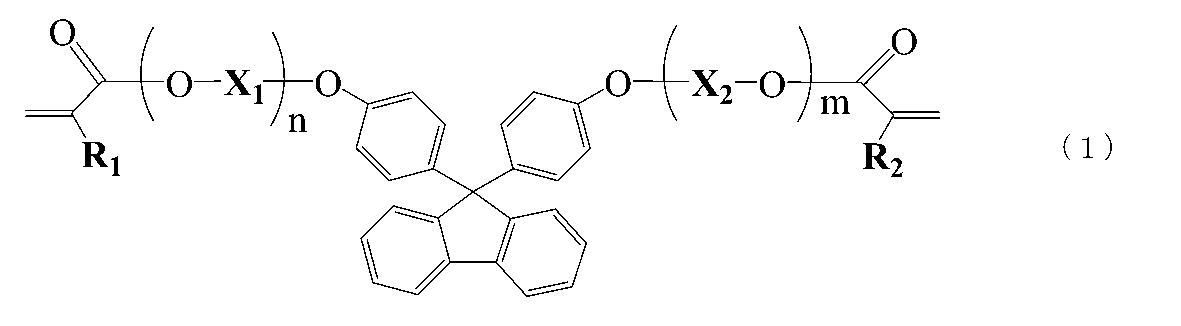

本発明の光学物品用活性エネルギー線硬化性組成物は、活性エネルギー線重合性化合物(A)として下記式(1)で表される化合物を含有する。本発明においては、下記式(1)で表される化合物を含有することで、得られる硬化物の屈折率を高くでき、また、好適な耐スクラッチ性や自己治癒性を実現できる。


ビスフェノールAのエチレンオキサイド付加物のジ(メタ)アクリレート、ビスフェノールAのプロピレンオキサイド付加物のジ(メタ)アクリレート、ビスフェノールFのエチレンオキサイド付加物のジ(メタ)アクリレート、ビスフェノールFのプロピレンオキサイド付加物のジ(メタ)アクリレート、ジシクロペンタニルジ(メタ)アクリレート、グリセロールジ(メタ)アクリレート、ネオペンチルグリコールヒドロキシピバリン酸エステルジ(メタ)アクリレート、カプロラクトン変性ヒドロキシピバリン酸ネオペンチルグリコールジ(メタ)アクリレート、テトラブロモビスフェノールAジ(メタ)アクリレート、ヒドロピバルアルデヒド変性トリメチロールプロパンジ(メタ)アクリレート、1,4-シクロヘキサンジメタノールジ(メタ)アクリレート、トリメチロールプロパントリ(メタ)アクリレート、トリメチロールプロパンのエチレンオキサイド付加物のトリ(メタ)アクリレート、トリメチロールプロパンのプロピレンオキサイド付加物のトリ(メタ)アクリレート、ペンタエリスリトールトリ(メタ)アクリレート、グリセロールトリ(メタ)アクリレート、アルキル変性したジペンタエリスリトールのトリ(メタ)アクリレート、ジトリメチロールプロパンテトラ(メタ)アクリレート、ジトリメチロールプロパンのエチレンオキサイド付加物のテトラ(メタ)アクリレート、ジトリメチロールプロパンのプロピレンオキサイド付加物のテトラ(メタ)アクリレート等の多官能(メタ)アクリレートを例示できる。
また、多官能(メタ)アクリレートとしては、例えばウレタン(メタ)アクリレート、ポリエステル(メタ)アクリレート、エポキシ(メタ)アクリレートなどのアクリロイル基を有する多官能オリゴマーも含まれる。
これらは、一種を使用しても複数種を使用してもよい。
本発明に使用する光重合開始剤は、活性エネルギー線硬化型樹脂組成物に用いられる各種開始剤を使用でき、例えば、1-ヒドロキシシクロヘキシルフェニルケトン、2-ヒドロキシ-2-メチル-1-フェニルプロパン-1-オン、1-〔4-(2-ヒドロキシエトキシ)フェニル〕-2-ヒドロキシ-2-メチル-1-プロパン-1-オン、チオキサントン及びチオキサントン誘導体、2,2’-ジメトキシ-1,2-ジフェニルエタン-1-オン、2,4,6-トリメチルベンゾイルジフェニルホスフィンオキシド、ビス(2,4,6-トリメチルベンゾイル)フェニルホスフィンオキシド、2-メチル-1-[4-(メチルチオ)フェニル]-2-モルホリノ-1-プロパノン、2-ベンジル-2-ジメチルアミノ-1-(4-モルホリノフェニル)-ブタン-1-オン等を好ましく使用できる。これら開始剤は一種のみを使用しても二種以上を混合して使用してもよい。
本発明の光学物品用活性エネルギー線硬化型樹脂組成物は、上記式(1)で表される鎖長の長いオキシアルキレン基を有するフルオレン骨格の(メタ)アクリレートと、式(2)で表されるポリマーTgが低く比較的屈折率の高いフェノキシベンジルアクリレートとを含有することで、高屈折率と共に、好適な自己治癒性や機械強度を実現でき、かつ良好な湿熱密着性を兼備できる。
本発明においては、必要に応じて無機材料(ナノ粒子)を配合することが可能である。
屈折率の高い無機ナノ粒子としては、アルミナ、ジルコニア、チタニア、それらの化合物、若しくはそれらの混合酸化物を含むか、又はそれらの金属酸化物が挙げられる。これら無機ナノ粒子(フィラー)は、一般的な有機材料よりも屈折率が高いので硬化物の屈折率を上げる手段としては有効であるが、成型物の強度や基材密着性とのバランスを考慮する必要があり、配合量としては、活性エネルギー線重合性化合物(A)と無機ナノ粒子の合計量に対して、無機ナノ粒子が20~60質量%となる範囲が実用的である。また、その中でも、更に高屈折率と自己治癒性を兼備するためには、30~50質量%がより好ましい。
また、本発明の活性エネルギー線硬化型樹脂組成物においては、各種添加剤を使用してもよい。当該添加剤としては、例えば、紫外線吸収剤、酸化防止剤、シリコン系添加剤、フッ素系添加剤、レオロジーコントロール剤、脱泡剤、離型剤、シランカップリング剤、帯電防止剤、防曇剤、着色剤等が挙げられる。これら添加剤は、光学物品用活性エネルギー線硬化型樹脂組成物中の活性エネルギー線重合性化合物100質量部に対して0.05~20質量部であることが好ましく、0.1~10質量部であることが特に好ましい。
本発明の活性エネルギー線硬化型樹脂組成物は、目的用途に応じて基材への塗布や、成型した後、活性エネルギー線を照射して硬化物とすることができる。活性エネルギー線としては、電子線、紫外線、可視光線等が挙げられる。活性エネルギー線として、電子線を用いる場合には、コックロフトワルトン型加速器、バンデグラフ型電子加速器、共振変圧器型加速器、絶縁コア変圧器型、ダイナミトロン型、リニアフィラメント型および高周波型などの電子線発生装置を用いて本発明の硬化性組成物を硬化させることができる。また、活性エネルギー線として紫外線を用いる場合は、超高圧水銀灯、高圧水銀灯、低圧水銀灯等の水銀灯、キセノンランプ、カーボンアーク、メタルハイトランプ、高出力のLED-UVランプ等により照射し、硬化させることができる。
本発明の光学シートは、上記光学物品用活性エネルギー線硬化型樹脂組成物の硬化物からなる層を有する光学シートである。当該光学シートは、透明な樹脂フィルム上に、上記硬化物からなるプリズムやレンズが積層された光学シートであり、具体的には、液晶表示装置等のディスプレイに使用されるプリズムシート、立体写真や投影スクリーン等に使用されるレンチキュラーレンズシート、オーバーヘッドプロジェクターのコンデンサーレンズ等に使用されるフレネルレンズシート、カラーフィルタ等に用いられる回折格子等の光学シートが例示できる。
実施例及び比較例にて調製した樹脂組成物の屈折率を、ATAGO社製多波長アッベ屈折率計(DR-M2)を用いて、基準波長(589nm)にて測定した。表の数値は、配合組成物の屈折率を示した。
実施例及び比較例にて調製した樹脂組成物の25℃における粘度を、BROOKFIELD社製E型粘度計(DV-II+VISCOMETER)を用いて測定した。
プリズムのピッチ間隔50μm、プリズム高さ25μmのプリズム母型に、実施例及び比較例にて調製した樹脂組成物を充填し、120μmのPETフィルムを重ね合わせ、ローラーで圧力をかけながら貼り合わせた後、PETフィルム側からメタルハライドランプにて積算光量1000mJ/cm2の照射量にて、樹脂組成物を硬化させ、プリズムシートを作成した。
得られたプリズムシートを千枚通しで約3cm引掻き、その時に出来た傷(線)が消えるまでの時間を目視にて観察した。
評価基準は下記のとおり。
5:瞬時に復元(傷消失)
4:10秒以内に復元(傷消失)
3:1分以内に復元(傷消失)
2:5分以内に復元(傷消失)
1:15分以上で復元(傷消失)
0:復元せず
上記と同様にして得られた 8cm×12.5cmのプリズムシート上に、1.5cm角の偏光フィルム(44%Pol)を載置し、偏光フィルムに荷重をかけて、5cm幅の距離を10cm/秒擦って、表面の傷付きを目視にて観察した。荷重を50gづつ増加していき、傷付きの観察されない最大荷重を測定値とした。試験機は、株式会社井元製作所製の耐磨耗試験機(IMC-15FA型)を使用した。
上記と同様にして得られたプリズムシートを温度60℃、湿度90%RHの条件下に100時間静置した後、カッターナイフにて10×10のクロスカットを行い、クロスカット部を粘着テープにて剥離する碁盤目試験を行った。マス目100に対して、粘着テープ剥離後の残存マス数を測定した。
下表1に示した配合で化合物を溶融混合し、樹脂組成物を調整した。得られた樹脂組成物につき、上記評価を行った。なお、表中の組成物配合量の数値は質量%である。
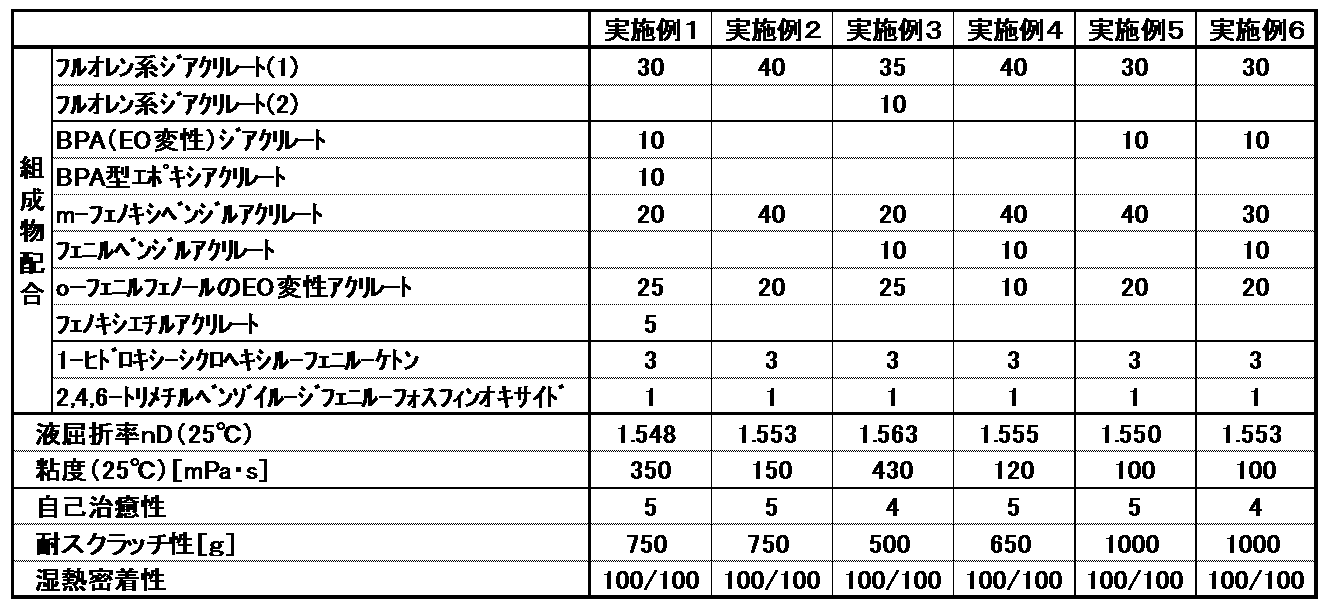

フルオレン系ジアクリレート(1):前記式(1)中のR1及びR2が水素原子、X1及びX2がエチレン基、m+n=20の化合物。(MIWON製 Miramer HR-6200)
フルオレン系ジアクリレート(2):前記式(1)中のR1及びR2が水素原子、X1及びX2がエチレン基、m+n=2の化合物。(MIWON製 Miramer HR-6
042)
フルオレン系ジアクリレート(3):前記式(1)中のR1及びR2が水素原子、X1及びX2がエチレン基、m+n=10の化合物。(MIWON製 Miramer HR-6100)
BPA(EO変性)ジアクリレート:エチレンオキサイド変性ビスフェノールAジメタクリレート(エチレンオキサイド変性量20モル)(MIWON製 Miramer M-2200)
BPA型エポキシアクリレート:ビスフェノールA骨格を有するエポキシアクリレート
o-フェニルフェノールのEO変性アクリレート:o-フェニルフェノールのエチレンオキサイド変性(n≒1)アクリレート(共栄社化学製 ライトアクリレート POB-A)
Claims (8)
- 活性エネルギー線重合性化合物(A)及び光重合開始剤(B)を含有する光学物品用活性エネルギー線硬化性組成物であって、活性エネルギー線重合性化合物(A)として下記式(1)で表される化合物及び下記式(2)で表される化合物を含有することを特徴とする光学物品用活性エネルギー線硬化性組成物。


- 活性エネルギー線重合性化合物(A)中の式(1)で表される化合物の比率が10~50質量%、且つ式(2)で表される化合物の比率が10~70質量%の範囲であり、更に式(1)で表される化合物及び式(2)で表される化合物の合計が40~90質量%である請求項1に記載の光学物品用活性エネルギー線硬化性組成物。
- 活性エネルギー線重合性化合物(A)として下記式(3)で表される化合物を含有する請求項1又は2に記載の光学物品用活性エネルギー線硬化性組成物。

- 活性エネルギー線重合性化合物(A)中の式(3)で表される化合物の比率が5~50質量%である請求項3に記載の光学物品用活性エネルギー線硬化性組成物。
- 活性エネルギー線重合性化合物(A)として下記式(4)で表される化合物を含有する請求項1~4のいずれかに記載の光学物品用活性エネルギー線硬化性組成物。

- 活性エネルギー線重合性化合物(A)中の式(4)で表される化合物の比率が5~30質量%である請求項5に記載の光学物品用活性エネルギー線硬化性組成物。
- 請求項1~6のいずれかに記載の光学物品用活性エネルギー線硬化性組成物の硬化物であり、屈折率が1.54以上であることを特徴とする硬化物。
- 請求項7に記載の硬化物からなる層を有する光学シート。
Priority Applications (3)
| Application Number | Priority Date | Filing Date | Title |
|---|---|---|---|
| JP2018541243A JP6485601B2 (ja) | 2016-10-11 | 2017-09-28 | 光学物品用活性エネルギー線硬化型樹脂組成物、硬化物及び光学シート |
| CN201780063031.3A CN109890860B (zh) | 2016-10-11 | 2017-09-28 | 光学物品用活性能量射线固化型树脂组合物、固化物及光学片 |
| KR1020197008666A KR102321823B1 (ko) | 2016-10-11 | 2017-09-28 | 광학물품용 활성 에너지선 경화형 수지 조성물, 경화물 및 광학 시트 |
Applications Claiming Priority (2)
| Application Number | Priority Date | Filing Date | Title |
|---|---|---|---|
| JP2016200122 | 2016-10-11 | ||
| JP2016-200122 | 2016-10-11 |
Publications (1)
| Publication Number | Publication Date |
|---|---|
| WO2018070256A1 true WO2018070256A1 (ja) | 2018-04-19 |
Family
ID=61905391
Family Applications (1)
| Application Number | Title | Priority Date | Filing Date |
|---|---|---|---|
| PCT/JP2017/035173 Ceased WO2018070256A1 (ja) | 2016-10-11 | 2017-09-28 | 光学物品用活性エネルギー線硬化型樹脂組成物、硬化物及び光学シート |
Country Status (5)
| Country | Link |
|---|---|
| JP (1) | JP6485601B2 (ja) |
| KR (1) | KR102321823B1 (ja) |
| CN (1) | CN109890860B (ja) |
| TW (1) | TWI752090B (ja) |
| WO (1) | WO2018070256A1 (ja) |
Cited By (3)
| Publication number | Priority date | Publication date | Assignee | Title |
|---|---|---|---|---|
| JP2018127528A (ja) * | 2017-02-07 | 2018-08-16 | アイカ工業株式会社 | 高屈折率光硬化性樹脂組成物 |
| CN109438672A (zh) * | 2018-09-29 | 2019-03-08 | 张家港康得新光电材料有限公司 | 聚氨酯丙烯酸酯及其制备方法 |
| JP2023013069A (ja) * | 2021-07-15 | 2023-01-26 | Dic株式会社 | 活性エネルギー線硬化型樹脂組成物、硬化物及び光学シート |
Families Citing this family (3)
| Publication number | Priority date | Publication date | Assignee | Title |
|---|---|---|---|---|
| CN111435220B (zh) * | 2019-01-15 | 2024-02-27 | 新应材股份有限公司 | 感光性树脂组合物、光学膜及其制造方法 |
| TWI704193B (zh) * | 2019-01-15 | 2020-09-11 | 新應材股份有限公司 | 感光性樹脂組成物、光學膜及其製造方法 |
| KR102865281B1 (ko) * | 2025-05-28 | 2025-09-26 | 주식회사 넷폼알앤디 | 초저점도 아크릴계 방수 시스템을 이용한 균열 방지 및 수분 차단 성능 극대화를 위한 고성능 방수 공법 |
Citations (4)
| Publication number | Priority date | Publication date | Assignee | Title |
|---|---|---|---|---|
| JP2013053310A (ja) * | 2011-08-11 | 2013-03-21 | Osaka Gas Chem Kk | フルオレン骨格を有する多官能性(メタ)アクリレートを含む硬化性組成物およびその硬化物 |
| WO2014069266A1 (ja) * | 2012-10-29 | 2014-05-08 | 第一工業製薬株式会社 | 硬化性樹脂組成物、その硬化物、及びプラスチックレンズ |
| JP2014185337A (ja) * | 2013-02-25 | 2014-10-02 | Osaka Gas Chem Kk | 硬化性組成物およびその硬化物 |
| WO2015105050A1 (en) * | 2014-01-07 | 2015-07-16 | Toyo Gosei Co., Ltd. | A composition and a method for manufacturing a component |
Family Cites Families (6)
| Publication number | Priority date | Publication date | Assignee | Title |
|---|---|---|---|---|
| JP2007277467A (ja) * | 2006-04-10 | 2007-10-25 | Sony Chemical & Information Device Corp | 硬化性樹脂組成物 |
| CN101367893B (zh) * | 2008-09-01 | 2011-11-23 | 长兴化学工业股份有限公司 | 一种可聚合组合物及其用途 |
| JP5241023B2 (ja) * | 2009-05-13 | 2013-07-17 | 日本化薬株式会社 | 光学レンズシート用エネルギー線硬化型樹脂組成物及びその硬化物 |
| KR101374368B1 (ko) * | 2010-12-31 | 2014-03-17 | 제일모직주식회사 | 광경화형 수지 조성물 및 이를 이용한 광학필름 제조 방법 |
| WO2013022065A1 (ja) * | 2011-08-11 | 2013-02-14 | 大阪ガスケミカル株式会社 | フルオレン骨格を有する多官能性(メタ)アクリレートおよびその硬化性組成物 |
| WO2015079728A1 (ja) * | 2013-11-29 | 2015-06-04 | Dic株式会社 | 光硬化性光学接着剤組成物、その硬化物、及び液晶表示装置 |
-
2017
- 2017-09-28 JP JP2018541243A patent/JP6485601B2/ja active Active
- 2017-09-28 WO PCT/JP2017/035173 patent/WO2018070256A1/ja not_active Ceased
- 2017-09-28 KR KR1020197008666A patent/KR102321823B1/ko active Active
- 2017-09-28 CN CN201780063031.3A patent/CN109890860B/zh active Active
- 2017-09-28 TW TW106133287A patent/TWI752090B/zh active
Patent Citations (4)
| Publication number | Priority date | Publication date | Assignee | Title |
|---|---|---|---|---|
| JP2013053310A (ja) * | 2011-08-11 | 2013-03-21 | Osaka Gas Chem Kk | フルオレン骨格を有する多官能性(メタ)アクリレートを含む硬化性組成物およびその硬化物 |
| WO2014069266A1 (ja) * | 2012-10-29 | 2014-05-08 | 第一工業製薬株式会社 | 硬化性樹脂組成物、その硬化物、及びプラスチックレンズ |
| JP2014185337A (ja) * | 2013-02-25 | 2014-10-02 | Osaka Gas Chem Kk | 硬化性組成物およびその硬化物 |
| WO2015105050A1 (en) * | 2014-01-07 | 2015-07-16 | Toyo Gosei Co., Ltd. | A composition and a method for manufacturing a component |
Cited By (4)
| Publication number | Priority date | Publication date | Assignee | Title |
|---|---|---|---|---|
| JP2018127528A (ja) * | 2017-02-07 | 2018-08-16 | アイカ工業株式会社 | 高屈折率光硬化性樹脂組成物 |
| CN109438672A (zh) * | 2018-09-29 | 2019-03-08 | 张家港康得新光电材料有限公司 | 聚氨酯丙烯酸酯及其制备方法 |
| JP2023013069A (ja) * | 2021-07-15 | 2023-01-26 | Dic株式会社 | 活性エネルギー線硬化型樹脂組成物、硬化物及び光学シート |
| JP7679716B2 (ja) | 2021-07-15 | 2025-05-20 | Dic株式会社 | 活性エネルギー線硬化型樹脂組成物、硬化物及び光学シート |
Also Published As
| Publication number | Publication date |
|---|---|
| CN109890860A (zh) | 2019-06-14 |
| CN109890860B (zh) | 2022-07-12 |
| JP6485601B2 (ja) | 2019-03-20 |
| TW201821522A (zh) | 2018-06-16 |
| KR102321823B1 (ko) | 2021-11-05 |
| TWI752090B (zh) | 2022-01-11 |
| JPWO2018070256A1 (ja) | 2018-12-20 |
| KR20190067776A (ko) | 2019-06-17 |
Similar Documents
| Publication | Publication Date | Title |
|---|---|---|
| JP6485601B2 (ja) | 光学物品用活性エネルギー線硬化型樹脂組成物、硬化物及び光学シート | |
| JP5696890B2 (ja) | 光学材料用高屈折組成物、及びその硬化物 | |
| TWI488910B (zh) | 光硬化性樹脂組成物、使用其的光學膜的製造方法及含有其的光學膜 | |
| JP5168608B2 (ja) | ラジカル重合性組成物、硬化物及びプラスチックレンズ | |
| JP4124991B2 (ja) | フレネルレンズ用活性エネルギー線硬化型樹脂組成物及びフレネルレンズシート | |
| JP2008094987A (ja) | 光学材料用高屈折率樹脂組成物およびその硬化物 | |
| JP6075514B2 (ja) | ウレタン(メタ)アクリレート樹脂、硬化性樹脂組成物、その硬化物、及びプラスチックレンズ | |
| KR101508761B1 (ko) | 광학 필름용 조성물 및 이로부터 제조된 광학 필름 | |
| JP2013228729A (ja) | 光学部品用活性エネルギー線硬化性組成物 | |
| JP5760367B2 (ja) | 重合性組成物、アクリルフィルム及び光学部材 | |
| JP6365917B1 (ja) | インクジェットインク組成物 | |
| CN115612382B (zh) | 活性能量线硬化型树脂组合物、硬化物及光学片材 | |
| JP6442973B2 (ja) | 微細構造形成用光硬化型組成物及びその硬化物 | |
| JP7401035B1 (ja) | プリズムシート及びプリズムシート用活性エネルギー線硬化性組成物 | |
| WO2025164088A1 (ja) | 活性エネルギー線硬化性組成物とその硬化物 | |
| JP6390817B2 (ja) | 光学物品用活性エネルギー線硬化型樹脂組成物、硬化物及び光学シート | |
| JP7740582B2 (ja) | 活性エネルギー線硬化性組成物およびその硬化物 | |
| JP2015071683A (ja) | 活性エネルギー線硬化性樹脂及びそれを含有する活性エネルギー線硬化性樹脂組成物 | |
| JP2024064679A (ja) | 活性エネルギー線硬化型樹脂組成物、硬化塗膜及びレンズ | |
| JP2011105804A (ja) | (メタ)アクリル系硬化性組成物、(メタ)アクリル系複合シート、ならびに(メタ)アクリル系硬化物およびその製造方法 | |
| KR20140000636A (ko) | 광중합성 조성물 및 이로부터 형성된 수지 경화층을 포함하는 광학시트 | |
| JP2024064678A (ja) | 活性エネルギー線硬化型樹脂組成物、硬化塗膜及びレンズ | |
| WO2013191516A1 (ko) | 광중합성 조성물 및 이로부터 형성된 수지 경화층을 포함하는 광학시트 | |
| JP2018090792A (ja) | 活性エネルギー線硬化性組成物 | |
| KR20130034517A (ko) | 광중합성 조성물 및 이로부터 형성된 수지 경화층을 포함하는 광학 시트 |
Legal Events
| Date | Code | Title | Description |
|---|---|---|---|
| WWE | Wipo information: entry into national phase |
Ref document number: 2018541243 Country of ref document: JP |
|
| 121 | Ep: the epo has been informed by wipo that ep was designated in this application |
Ref document number: 17861157 Country of ref document: EP Kind code of ref document: A1 |
|
| ENP | Entry into the national phase |
Ref document number: 20197008666 Country of ref document: KR Kind code of ref document: A |
|
| NENP | Non-entry into the national phase |
Ref country code: DE |
|
| 122 | Ep: pct application non-entry in european phase |
Ref document number: 17861157 Country of ref document: EP Kind code of ref document: A1 |