WO2018055985A1 - 研磨用組成物、ならびにこれを用いた研磨方法および半導体基板の製造方法 - Google Patents
研磨用組成物、ならびにこれを用いた研磨方法および半導体基板の製造方法 Download PDFInfo
- Publication number
- WO2018055985A1 WO2018055985A1 PCT/JP2017/030786 JP2017030786W WO2018055985A1 WO 2018055985 A1 WO2018055985 A1 WO 2018055985A1 JP 2017030786 W JP2017030786 W JP 2017030786W WO 2018055985 A1 WO2018055985 A1 WO 2018055985A1
- Authority
- WO
- WIPO (PCT)
- Prior art keywords
- polishing
- polishing composition
- acid
- accelerator
- abrasive grains
- Prior art date
- Legal status (The legal status is an assumption and is not a legal conclusion. Google has not performed a legal analysis and makes no representation as to the accuracy of the status listed.)
- Ceased
Links
Classifications
-
- B—PERFORMING OPERATIONS; TRANSPORTING
- B24—GRINDING; POLISHING
- B24B—MACHINES, DEVICES, OR PROCESSES FOR GRINDING OR POLISHING; DRESSING OR CONDITIONING OF ABRADING SURFACES; FEEDING OF GRINDING, POLISHING, OR LAPPING AGENTS
- B24B37/00—Lapping machines or devices; Accessories
-
- C—CHEMISTRY; METALLURGY
- C09—DYES; PAINTS; POLISHES; NATURAL RESINS; ADHESIVES; COMPOSITIONS NOT OTHERWISE PROVIDED FOR; APPLICATIONS OF MATERIALS NOT OTHERWISE PROVIDED FOR
- C09G—POLISHING COMPOSITIONS; SKI WAXES
- C09G1/00—Polishing compositions
- C09G1/02—Polishing compositions containing abrasives or grinding agents
-
- C—CHEMISTRY; METALLURGY
- C09—DYES; PAINTS; POLISHES; NATURAL RESINS; ADHESIVES; COMPOSITIONS NOT OTHERWISE PROVIDED FOR; APPLICATIONS OF MATERIALS NOT OTHERWISE PROVIDED FOR
- C09K—MATERIALS FOR MISCELLANEOUS APPLICATIONS, NOT PROVIDED FOR ELSEWHERE
- C09K3/00—Materials not provided for elsewhere
- C09K3/14—Anti-slip materials; Abrasives
-
- H—ELECTRICITY
- H10—SEMICONDUCTOR DEVICES; ELECTRIC SOLID-STATE DEVICES NOT OTHERWISE PROVIDED FOR
- H10P—GENERIC PROCESSES OR APPARATUS FOR THE MANUFACTURE OR TREATMENT OF DEVICES COVERED BY CLASS H10
- H10P52/00—Grinding, lapping or polishing of wafers, substrates or parts of devices
Definitions
- the present invention relates to a polishing composition, a polishing method using the same, and a method for manufacturing a semiconductor substrate.
- the present invention mainly relates to a polishing composition preferably used for polishing a semiconductor substrate such as a silicon wafer, a polishing method using the same, and a method for manufacturing a semiconductor substrate.
- CMP chemical mechanical polishing
- Precise polishing using a polishing liquid is performed on the surface of materials such as metal, metalloid, nonmetal, and oxides thereof.
- the surface of a silicon wafer used as a component of a semiconductor product is generally finished to a high-quality mirror surface through a lapping process (rough polishing process) and a polishing process (precision polishing process).
- the polishing process typically includes a preliminary polishing process (preliminary polishing process) and a final polishing process (final polishing process).
- a polishing composition used in polishing a silicon wafer generally contains abrasive grains and a polishing accelerator such as an alkali compound.
- a polishing composition used for polishing a silicon wafer Patent Document 1 discloses a polishing composition for a silicon wafer containing water, silica particles, an alkali compound, a water-soluble polymer compound, and polyethylene glycol. ing.
- the present invention has been made in view of the above problems, and an object thereof is to provide a polishing composition that can effectively improve the polishing rate of an object to be polished.
- the present inventor has conducted intensive research to solve the above problems. As a result, it was found that the above problems can be solved by using a polishing composition containing abrasive grains, a polishing accelerator having a nucleophilic parameter of 14.5 to 30 and water, and completed the present invention. It was.
- the nucleophilic parameter is represented by the following formula (1).
- a polishing composition capable of effectively improving the polishing rate of an object to be polished.
- the polishing composition of the present invention contains abrasive grains, a polishing accelerator having a nucleophilic parameter represented by the following formula (1) of 14.5 to 30 and water.
- the polishing rate of an object to be polished can be effectively improved.
- the mechanism for obtaining such an effect is considered as follows. However, the following mechanism is just a guess, and the scope of the present invention is not limited thereby.
- the object to be polished is a silicon wafer
- Si (OH) x generated by nucleophilic reaction between silicon atoms and hydroxide ions (OH ⁇ ) and further hydrolysis by protons is generated. It is considered that the removal proceeds by scraping by mechanical action of abrasive grains or the like, or by dissolution by reaction with OH ⁇ . From this, it is considered that an important chemical reaction in polishing of an object to be polished is a nucleophilic reaction.
- the present inventor has found that a polishing composition containing a polishing accelerator having a nucleophilic parameter represented by the above (1) in a specific range is a polishing object.
- the present inventors have found that the polishing rate can be effectively improved.
- the polishing accelerator having a nucleophilic parameter represented by the above formula (1) of 14.5 or more and 30 or less is a compound exhibiting nucleophilicity, and the polishing accelerator interacts with the surface of the object to be polished. It is considered that the covalent bond distance between atoms on the surface of the polishing object can be extended and the covalent bond can be weakened. Accordingly, it is considered that the polishing of the object to be polished is facilitated by the scraping by the mechanical action of the abrasive grains and the removal by the dissolution, and the polishing rate is improved.
- the polishing composition of the present invention using a compound having a nucleophilic parameter in the range of 14.5 or more and 30 or less as a polishing accelerator can effectively improve the polishing rate of an object to be polished.
- the polishing composition of the present invention contains abrasive grains, a polishing accelerator having a nucleophilic parameter represented by the above formula (1) of 14.5 or more and 30 or less, and water.
- a polishing accelerator having a nucleophilic parameter represented by the above formula (1) of 14.5 or more and 30 or less and water.
- the polishing composition of the present invention essentially contains abrasive grains.
- the abrasive grains contained in the polishing composition have an action of mechanically polishing the object to be polished.
- the abrasive used may be any of inorganic particles, organic particles, and organic-inorganic composite particles.
- the inorganic particles include particles made of metal oxides such as silica, alumina, ceria, titania, silicon nitride particles, silicon carbide particles, and boron nitride particles.
- Specific examples of the organic particles include polymethyl methacrylate (PMMA) particles.
- PMMA polymethyl methacrylate
- silica is preferable, and colloidal silica is particularly preferable.
- Abrasive grains may be surface-modified. Since ordinary colloidal silica has a zeta potential value close to zero under acidic conditions, silica particles are not electrically repelled with each other under acidic conditions and are likely to agglomerate. In contrast, abrasive grains whose surfaces are modified so that the zeta potential has a relatively large negative value even under acidic conditions are strongly repelled from each other and dispersed well even under acidic conditions. As a result, the storage stability of the polishing composition can be improved.
- Such surface-modified abrasive grains can be obtained, for example, by mixing a metal such as aluminum, titanium or zirconium or an oxide thereof with the abrasive grains and doping the surface of the abrasive grains. Further, the surface-modified abrasive grains may be colloidal silica obtained by chemically bonding a functional group of an organic acid to the surface of the abrasive grains and fixing an organic acid.
- the lower limit of the average primary particle diameter of the abrasive grains is preferably 10 nm or more, more preferably 15 nm or more, and further preferably 20 nm or more.
- the upper limit of the average primary particle diameter of the abrasive grains is preferably 200 nm or less, more preferably 150 nm or less, and further preferably 100 nm or less.
- the polishing rate of the object to be polished by the polishing composition is further improved, and the occurrence of defects on the surface of the object to be polished after polishing with the polishing composition is further suppressed. be able to.
- the average primary particle diameter of an abrasive grain is calculated based on the specific surface area of the abrasive grain measured by BET method, for example.
- the lower limit of the average secondary particle diameter of the abrasive grains is preferably 15 nm or more, more preferably 20 nm or more, and further preferably 30 nm or more.
- the upper limit of the average secondary particle diameter of the abrasive grains is preferably 300 nm or less, more preferably 260 nm or less, and further preferably 220 nm or less.
- the secondary particles referred to here are particles formed by association of abrasive grains in the polishing composition, and the average secondary particle diameter of the secondary particles is measured by, for example, a dynamic light scattering method. be able to.
- the lower limit of the content of the abrasive grains in the polishing composition is preferably 0.1% by mass or more, more preferably 0.3% by mass or more, and 0.5% by mass or more. Further preferred. Further, the upper limit of the content of the abrasive grains in the polishing composition is preferably 50% by mass or less, more preferably 20% by mass or less, and further preferably 5% by mass or less. Within such a range, the polishing rate of the polishing object can be further improved, the cost of the polishing composition can be reduced, and the surface of the polishing object after polishing with the polishing composition can be reduced. It is possible to further suppress the occurrence of defects.
- the polishing composition according to one embodiment of the present invention essentially contains water as a dispersion medium (solvent) in order to disperse or dissolve each component.
- the dispersion medium may be a mixed solvent of water and an organic solvent for dispersing or dissolving each component.
- organic solvent examples include acetone, acetonitrile, ethanol, methanol, isopropanol, glycerin, ethylene glycol, propylene glycol and the like, which are organic solvents miscible with water.
- these organic solvents may be used without being mixed with water, and each component may be dispersed or dissolved and then mixed with water. These organic solvents can be used alone or in combination of two or more.
- water does not contain impurities as much as possible from the viewpoint of inhibiting the contamination of the object to be cleaned and the action of other components.
- water for example, water having a total content of transition metal ions of 100 ppb or less is preferable.
- the purity of water can be increased by operations such as removal of impurity ions using an ion exchange resin, removal of foreign matters by a filter, distillation, and the like.
- deionized water ion exchange water
- pure water ultrapure water, distilled water, or the like is preferably used as the water.
- the polishing composition of the present invention contains a polishing accelerator (hereinafter also simply referred to as a polishing accelerator) having a nucleophilic parameter represented by the following formula (1) of 14.5 or more and 30 or less.
- the nucleophilic parameter is a parameter used as an index indicating the strength of nucleophilicity of a compound. From the test of amine reactivity with several benzhydryl derivatives having known electrophilicity, Calculated by equation (1). Moreover, since the polishing composition of the present invention essentially contains water, the nucleophilic parameter in the present invention is a value in water. In the present specification, the value of the nucleophilic parameter is specifically described in the reactivity parameter database (Mayr's Database of Reactivity Parameters) of Dr. Herbert Mayr of Ludwig-Maximilians-Universitat Munchen. (URL: http://www.cup.lmu.de/oc/mayr/reactionsdatebank2/). The value of the nucleophilic slope parameter is also described in the database.
- the polishing accelerator used in the polishing composition of the present invention has a nucleophilic parameter of 14.5 or more and 30 or less.
- Such a polishing accelerator is thought to be capable of extending the covalent bond distance between atoms on the surface of the polishing object and weakening the covalent bond by interacting with the surface of the polishing object. Therefore, it is considered that the polishing of the object to be polished is facilitated by the scraping by the mechanical action of the abrasive grains and the removal by the above-described dissolution, and the polishing rate is improved.
- the nucleophilic parameter is preferably 16.5 or more, more preferably 17.0 or more, and even more preferably 17.5 or more, 18.2 The above is particularly preferable.
- the nucleophilic parameter is preferably 24.0 or less, and more preferably 23.0 or less.
- the nucleophilic parameter is preferably 14.5 or more and 24.0 or less, more preferably 14.5 or more and 23.0 or less, and 18.2 or more. More preferably, it is 23.0 or less.
- the type of the polishing accelerator used in the polishing composition of the present invention is not particularly limited as long as the nucleophilic parameter is 14.5 or more and 30 or less.
- it may be a compound such as an inorganic acid, an organic acid, an amine, or an amino acid, or a salt thereof.
- the inorganic acid or salt thereof having a nucleophilic parameter of 14.5 or more and 30 or less include sulfurous acid and sodium sulfite.
- Examples of the organic acid having a nucleophilic parameter of 14.5 or more and 30 or less include mercaptocarboxylic acid. Among mercaptocarboxylic acids, mercaptoacetic acid is preferable.
- Examples of the amine having a nucleophilic parameter of 14.5 or more and 30 or less include dimethylamine, monomethylhydrazine, or cyclic amines such as piperazine, piperidine, hexamethyleneimine, and the like.
- a cyclic amine having 7 to 10 ring members is preferable, and hexamethyleneimine is more preferable.
- amino acids having a nucleophilic parameter of 14.5 or more and 30 or less include cysteine, proline and the like.
- a polishing accelerator may be used independently and may use multiple types together.
- the polishing accelerator used in the polishing composition of the present invention is at least one selected from the group consisting of cyclic amines having 7 to 10 ring members and mercaptocarboxylic acid.
- the cyclic amine is hexamethyleneimine.
- Hexamethyleneimine exhibits high stability in neutral to alkaline environments, and since hexamethyleneimine is difficult to adsorb on abrasive grains, each component in the polishing composition containing hexamethyleneimine is further stabilized. Thus, the polishing rate can be kept constant at a high level.
- the mercaptocarboxylic acid is mercaptoacetic acid.
- mercaptoacetic acid exhibits high stability in a neutral to alkaline environment, and since mercaptoacetic acid is difficult to adsorb to abrasive grains, each component in the polishing composition containing mercaptoacetic acid Is more stabilized and the polishing rate can be kept constant at a high level.
- the content of the polishing accelerator contained in the polishing composition is not particularly limited, but is preferably 0.1% by mass or more with respect to the entire polishing composition. From the viewpoint of further effectively improving the polishing rate, the content of the polishing accelerator is more preferably 0.3% by mass or more, and further preferably 0.5% by mass or more.
- the upper limit of the content of the polishing accelerator contained in the polishing composition is not particularly limited, but is preferably 5.0% by mass or less from the viewpoint of maintaining the surface quality of the object to be polished. The content is more preferably at most mass%, further preferably at most 1.0 mass%.
- the content of the polishing accelerator refers to the kind of content when a kind of polishing accelerator is used alone. When two or more kinds of polishing accelerators are used in combination, it means the total content of two or more kinds of polishing accelerators.
- the polishing composition of the present invention essentially contains abrasive grains, a polishing accelerator having a nucleophilic parameter represented by the above formula (1) of 14.5 to 30 and water, but in addition to the above components And may contain other additives. Here, it does not restrict
- the polishing composition of the present invention can further contain a pH adjuster.
- the pH can be adjusted by adding an appropriate amount of a pH adjusting agent.
- the pH adjuster used as necessary to adjust the pH of the polishing composition to a desired value may be either acid or alkali, and may be either an inorganic compound or an organic compound. Good.
- the acid include, for example, inorganic acids such as sulfuric acid, nitric acid, boric acid, carbonic acid, hypophosphorous acid, phosphorous acid and phosphoric acid; formic acid, acetic acid, propionic acid, butyric acid, valeric acid, 2-methylbutyric acid , N-hexanoic acid, 3,3-dimethylbutyric acid, 2-ethylbutyric acid, 4-methylpentanoic acid, n-heptanoic acid, 2-methylhexanoic acid, n-octanoic acid, 2-ethylhexanoic acid, benzoic acid, glycol Acids, salicylic acid, glyceric acid, oxalic acid, malonic acid, succinic acid, glutaric acid, adipic acid, pimelic acid, maleic acid, phthalic acid, malic acid, tartaric acid, citric acid and lactic acid and other carboxylic acids, and methanesulf
- alkali examples include alkali metal hydroxides or salts thereof such as sodium hydroxide, potassium hydroxide, sodium carbonate, potassium carbonate, ammonia, amines, quaternary ammonium salts and the like. These pH regulators can be used alone or in combination of two or more.
- the pH of the polishing composition according to one embodiment of the present invention is preferably 7.0 or more from the viewpoint of further improving the polishing rate of the object to be polished.
- the pH of the polishing composition according to the present invention is more preferably 9.0 or more, and further preferably 10.0 or more.
- the upper limit of the pH of the polishing composition of the present invention is not particularly limited, but is preferably 12.0 or less from the viewpoint of economy and handling safety of the polishing composition, and preferably 11.0 or less. More preferably.
- pH of polishing composition uses the pH meter (For example, Horiba, Ltd.
- LAQUA (trademark)
- standard buffer solution phthalate pH buffer solution [pH: 4.01 (25)] ° C)
- neutral phosphate pH buffer [pH: 6.86 (25 ° C)
- carbonate pH buffer [pH: 10.01 (25 ° C)]
- antiseptics and fungicides that may be included in the polishing composition if necessary include, for example, 2-methyl-4-isothiazolin-3-one and 5-chloro-2-methyl-4-isothiazoline-3 -Isothiazoline preservatives such as ON, paraoxybenzoates, phenoxyethanol and the like. These antiseptics and fungicides may be used alone or in combination of two or more.
- the polishing composition of the present invention may be a one-component type or a multi-component type including a two-component type.
- the polishing composition of the present invention may be prepared by diluting the stock solution of the polishing composition, for example, 10 times or more using a diluent such as water.
- the polishing object to be polished using the polishing composition according to one embodiment of the present invention is not particularly limited, and examples include polishing objects having various materials and shapes.
- the material of the object to be polished is, for example, silicon material, aluminum, nickel, tungsten, steel, tantalum, titanium, stainless steel or other metal or semimetal, or alloys thereof; quartz glass, aluminosilicate glass, glassy carbon Glass materials such as; ceramic materials such as alumina, silica, sapphire, silicon nitride, tantalum nitride, titanium carbide; compound semiconductor substrate materials such as silicon carbide, gallium nitride, gallium arsenide; resin materials such as polyimide resin; Can be mentioned.
- polishing target object may be comprised with several material among the said materials.
- a polishing object containing a silicon material is preferable. That is, it is preferable that the polishing composition according to one embodiment of the present invention is used for polishing a polishing object including a silicon material.
- the silicon material preferably includes at least one material selected from the group consisting of silicon single crystal, amorphous silicon, and polysilicon.
- the silicon material is more preferably a silicon single crystal or polysilicon, and particularly preferably a silicon single crystal, from the viewpoint that the effects of the present invention can be obtained more remarkably. That is, in one embodiment of the present invention, the polishing object is preferably a polishing object including single crystal silicon, and more preferably a single crystal silicon substrate (silicon wafer).
- the shape of the object to be polished is not particularly limited.
- the polishing composition according to the present invention can be preferably applied to polishing a polishing object having a flat surface such as a plate shape or a polyhedron shape.
- the method for producing the polishing composition of the present invention is not particularly limited, and can be obtained, for example, by stirring and mixing abrasive grains, a polishing accelerator and, if necessary, other additives in water as a dispersion medium. it can. Moreover, when adding the pH adjuster containing a dispersion medium (water), an abrasive grain, a polishing accelerator, and other additives as needed are stirred and mixed in the pH adjuster containing a dispersion medium (water). A method may be adopted.
- the temperature at which the abrasive grains and each component are mixed is not particularly limited, but is preferably 10 to 40 ° C. and may be heated to increase the dissolution rate. Further, the mixing time is not particularly limited as long as uniform mixing can be performed.
- the polishing composition of the present invention is suitably used for polishing a polishing object containing single crystal silicon, particularly a single crystal silicon substrate (silicon wafer). That is, in one embodiment of the present invention, there is provided a polishing composition used for polishing a polishing object containing single crystal silicon. In another embodiment, a polishing composition used for polishing a single crystal silicon substrate (silicon wafer) is provided.
- the present invention also provides a polishing method for polishing an object to be polished containing single crystal silicon using the polishing composition of the present invention.
- a polishing method for polishing a single crystal silicon substrate using the polishing composition of the present invention is also provided.
- the present invention also provides a method for manufacturing a semiconductor substrate including a step of polishing an object to be polished containing single crystal silicon by the polishing method.
- a method of manufacturing a semiconductor substrate including a step of polishing a single crystal silicon substrate by the polishing method is also provided.
- the polishing step in the polishing method according to the present invention is not particularly limited as long as it is a step of polishing a single crystal silicon substrate, but is preferably a chemical mechanical polishing (CMP) step.
- the polishing step may be a polishing step consisting of a single step or a polishing step consisting of a plurality of steps.
- a polishing process consisting of a plurality of processes for example, a process of performing a final polishing process after a preliminary polishing process (rough polishing process), a secondary polishing process of one or more times after a primary polishing process, The process etc. which perform a final polishing process after that are mentioned.
- polishing apparatus used in the polishing method according to the present invention, a polishing surface plate on which a holder for holding a semiconductor substrate and the like, a motor capable of changing the number of rotations, and the like are attached and a polishing pad (polishing cloth) can be attached.
- a general polishing apparatus having the following can be used.
- the polishing apparatus any of a small table polishing machine, a single-side polishing apparatus, or a double-side polishing apparatus may be used.
- polishing pad a general nonwoven fabric, polyurethane, porous fluororesin, or the like can be used without particular limitation. It is preferable that the polishing pad is grooved so that the polishing liquid accumulates.
- the polishing conditions are not particularly limited.
- the rotational speed of the polishing platen (platen) is preferably 10 to 500 rpm.
- the rotational speed of the head (carrier) is preferably 10 to 500 rpm.
- the pressure applied to the substrate having the object to be polished is preferably 0.5 to 10 psi.
- the method of supplying the polishing composition to the polishing pad is not particularly limited, and for example, a method of continuously supplying with a pump or the like is employed. Although there is no restriction
- the polishing time is not particularly limited, it is preferably 5 seconds or more and 180 seconds or less for the step using the polishing composition.
- the substrate After completion of polishing, the substrate is washed in running water, and water droplets adhering to the substrate are removed by a spin dryer or the like, and dried to obtain a semiconductor substrate.
- the average secondary particle size of the abrasive grains was measured using a dynamic light scattering type particle size / particle size distribution measuring device (manufactured by Nikkiso Co., Ltd., model number: UPA UT-151). First, abrasive grains were dispersed in pure water to prepare a dispersion having a loading index (laser scattering intensity) of 0.01. Next, using this dispersion, the value of the volume average particle diameter Mv (value of D50) in the UT mode was measured, and the obtained value was defined as the average secondary particle diameter.
- polishing composition [Example 1] (Preparation of polishing composition (A-1)) Colloidal silica (average primary particle size 35 nm, average secondary particle size 63 nm) 0.5% by mass in water, sodium sulfite 0.05 mol / L as polishing accelerator, potassium hydroxide as pH adjuster Were added in an amount of pH 10.5 and mixed to prepare a polishing composition (A-1).
- Example 2 to 6 and Comparative Examples 1 to 5 Preparation of polishing compositions (A-2) to (A-6) and (C-1) to (C-5)) Each polishing composition was prepared in the same manner as in Example 1 except that the type of polishing accelerator and the type of pH adjuster were changed as shown in Table 1 below (mixing temperature: about 25 ° C. , Mixing time: about 10 minutes).
- nucleophilic parameters of polishing accelerator The nucleophilic parameter of each polishing accelerator is expressed by the following formula (1).
- Polishing device small table polishing machine (Eng 380IN, manufactured by Nippon Engis Co., Ltd.) Polishing pad: Rigid polyurethane pad (Nitta Haas, IC1000) Platen rotation speed: 60 [rpm] Head (carrier) rotation speed: 60 [rpm] Polishing pressure: 3.0 [psi] Polishing composition (slurry) flow rate: 100 [ml / min] Polishing time: 1 [min] (3) Measurement of polishing rate The polishing rate was measured by the following procedure.
- the thickness change ⁇ d Si (m) of the object to be polished before and after polishing was divided by the polishing time t (min), and the unit was further converted to ( ⁇ / min). This value was defined as the polishing rate v Si ( ⁇ / min).
- Adsorption of polishing accelerator to silica (abrasive grains) was measured by the following method. Specifically, first, a polishing accelerator was added to a 1% by mass silica (abrasive) aqueous solution so as to be 0.05 mol / L. Thereafter, the adsorption reaction was promoted by storing at 80 ° C. in an air bath. One week later, after taking out and cooling, the solid-liquid was separated with a centrifuge (16,000 rpm for 1 hour), and only the supernatant was collected. The collected supernatant was measured for the residual amount of the polishing accelerator with a total carbon measuring device (TOC-5000A, manufactured by Shimadzu Corporation). The results are summarized in Table 1. Those with a residual amount of 80% or more are marked with ⁇ , and those with a residual amount of less than 80% are marked with ⁇ .
- TOC-5000A total carbon measuring device
Landscapes
- Chemical & Material Sciences (AREA)
- Engineering & Computer Science (AREA)
- Organic Chemistry (AREA)
- Materials Engineering (AREA)
- Mechanical Engineering (AREA)
- Mechanical Treatment Of Semiconductor (AREA)
- Finish Polishing, Edge Sharpening, And Grinding By Specific Grinding Devices (AREA)
Abstract
【課題】研磨対象物の研磨速度を効果的に向上させることができる研磨用組成物を提供する。 【解決手段】砥粒、下記式(1)で表される求核性パラメータが14.5以上30以下の研磨促進剤、および水を含有する研磨用組成物。
Description
本発明は研磨用組成物、ならびにこれを用いた研磨方法および半導体基板の製造方法に関する。詳しくは、主にシリコンウェハ等の半導体基板の研磨に好ましく用いられる研磨用組成物、ならびにこれを用いた研磨方法および半導体基板の製造方法に関する。
近年、LSI製造プロセスの微細化がもたらす高集積化によって、コンピューターをはじめとした電子機器は、小型化、多機能化、高速化等の高性能化を果たしてきた。このようなLSIの高集積化に伴う新たな微細加工技術において、化学機械研磨(CMP)法が使用される。CMP法は、LSI製造工程、特に多層配線形成工程における層間絶縁膜の平坦化、金属プラグ形成、埋め込み配線(ダマシン配線)形成において頻繁に利用される技術である。
金属や半金属、非金属、その酸化物等の材料表面に対して研磨液を用いた精密研磨が行われている。例えば、半導体製品の構成要素等として用いられるシリコンウェハの表面は、一般に、ラッピング工程(粗研磨工程)とポリシング工程(精密研磨工程)とを経て高品位の鏡面に仕上げられる。上記ポリシング工程は、典型的には、予備ポリシング工程(予備研磨工程)とファイナルポリシング工程(最終研磨工程)とを含む。
シリコンウェハ等の半導体基板その他の基板について、上記のような高集積化の技術動向から、より高品位の表面が要求されるようになってきている。特に、生産性やコスト等への配慮から、高品位の表面を得るとともに、ポリシング工程に要するトータルの研磨時間(合計研磨時間)を減らすことが望まれている。そのための一手法として、ポリシング工程に含まれる研磨工程について、該研磨工程における研磨レートを向上させることができれば有益である。
従来、シリコンウェハの研磨において使用される研磨用組成物は、砥粒と、アルカリ化合物などの研磨促進剤を含むことが一般的である。例えば、シリコンウェハの研磨に用いられる研磨用組成物として、特許文献1には、水、シリカ粒子、アルカリ化合物、水溶性高分子化合物、およびポリエチレングリコールを含むシリコンウェハ用研磨液組成物が開示されている。
しかしながら、特許文献1の研磨液組成物を使用した場合、研磨速度の促進効果は未だ不十分であり、良好な生産性が担保される研磨速度を実現できていないという問題があった。
したがって、本発明は、上記課題を鑑みてなされたものであり、研磨対象物の研磨速度を効果的に向上させることができる研磨用組成物を提供することを目的とする。
本発明者は、上記課題を解決すべく、鋭意研究を行った。その結果、砥粒、求核性パラメータが14.5以上30以下の研磨促進剤、および水を含有する研磨用組成物を使用することによって、上記課題を解決できることを見出し、本発明を完成させた。
なお、前記求核性パラメータは、下記式(1)で表される。

本発明によれば、研磨対象物の研磨速度を効果的に向上させることができる研磨用組成物が提供される。
本発明の研磨用組成物は、砥粒、下記式(1)で表される求核性パラメータが14.5以上30以下の研磨促進剤、および水を含有する。

本発明の研磨用組成物によれば、研磨対象物の研磨速度を効果的に向上させることができる。このような効果が得られるメカニズムは、以下の通りであると考えられる。ただし、下記メカニズムはあくまで推測であり、これによって本発明の範囲が限定されるものではない。
一例として、研磨対象物がシリコンウェハである場合の研磨は、シリコン原子と水酸化物イオン(OH-)とが求核反応し、さらにプロトンによって加水分解することで生成したSi(OH)xを、砥粒等の機械的作用による掻き取りや、OH-との反応による溶解により除去することで進行すると考えられている。このことから、研磨対象物の研磨における重要な化学反応は、求核反応であると考えられる。本発明者は、研磨対象物の研磨について種々検討を行った結果、上記(1)で表される求核性パラメータが特定の範囲にある研磨促進剤を含む研磨用組成物が、研磨対象物の研磨速度を効果的に向上させることを見出した。上記式(1)で表される求核性パラメータが14.5以上30以下の研磨促進剤は、求核性を示す化合物であり、該研磨促進剤が研磨対象物表面と相互作用することにより、研磨対象物表面の原子間の共有結合距離を伸張し、共有結合をより弱めることができると考えられる。したがって、上記の砥粒の機械的作用による掻き取りや上記の溶解による除去により、研磨対象物の研磨が進行しやすくなり、研磨速度が向上すると考えられる。
したがって、求核性パラメータが14.5以上30以下の範囲である化合物を研磨促進剤として用いた本発明の研磨用組成物は、研磨対象物の研磨速度を効果的に向上させることができる。
以下、本発明の実施の形態を説明する。なお、本発明は、以下の実施の形態のみには限定されない。
また、本明細書において、特記しない限り、操作および物性等の測定は室温(20~25℃)/相対湿度40~50%RHの条件で行う。
[研磨用組成物]
本発明の研磨用組成物は、砥粒、上記式(1)で表される求核性パラメータが14.5以上30以下である研磨促進剤、および水を含有する。以下、本発明の研磨用組成物の構成を説明する。
本発明の研磨用組成物は、砥粒、上記式(1)で表される求核性パラメータが14.5以上30以下である研磨促進剤、および水を含有する。以下、本発明の研磨用組成物の構成を説明する。
<砥粒>
本発明の研磨用組成物は、砥粒を必須に含む。研磨用組成物中に含まれる砥粒は、研磨対象物を機械的に研磨する作用を有する。
本発明の研磨用組成物は、砥粒を必須に含む。研磨用組成物中に含まれる砥粒は、研磨対象物を機械的に研磨する作用を有する。
使用される砥粒は、無機粒子、有機粒子、および有機無機複合粒子のいずれであってもよい。無機粒子の具体例としては、例えば、シリカ、アルミナ、セリア、チタニア等の金属酸化物からなる粒子、窒化ケイ素粒子、炭化ケイ素粒子、窒化ホウ素粒子が挙げられる。有機粒子の具体例としては、例えば、ポリメタクリル酸メチル(PMMA)粒子が挙げられる。該砥粒は、単独でもまたは2種以上混合して用いてもよい。また、該砥粒は、市販品を用いてもよいし合成品を用いてもよい。
これら砥粒の中でも、シリカが好ましく、特に好ましいのはコロイダルシリカである。
砥粒は表面修飾されていてもよい。通常のコロイダルシリカは、酸性条件下でゼータ電位の値がゼロに近いために、酸性条件下ではシリカ粒子同士が互いに電気的に反発せず凝集を起こしやすい。これに対し、酸性条件でもゼータ電位が比較的大きな負の値を有するように表面修飾された砥粒は、酸性条件下においても互いに強く反発して良好に分散する。その結果、研磨用組成物の保存安定性を向上できる。このような表面修飾砥粒は、例えば、アルミニウム、チタンまたはジルコニウムなどの金属あるいはそれらの酸化物を砥粒と混合して砥粒の表面にドープさせることにより得ることができる。また、表面修飾砥粒は、砥粒の表面に有機酸の官能基を化学的に結合させて得られる、有機酸を固定化したコロイダルシリカであってもよい。
砥粒の平均一次粒子径の下限は、10nm以上であることが好ましく、15nm以上であることがより好ましく、20nm以上であることがさらに好ましい。また、砥粒の平均一次粒子径の上限は、200nm以下であることが好ましく、150nm以下であることがより好ましく、100nm以下であることがさらに好ましい。このような範囲であれば、研磨用組成物による研磨対象物の研磨速度はより向上し、また、研磨用組成物を用いて研磨した後の研磨対象物の表面に欠陥が生じるのをより抑えることができる。なお、砥粒の平均一次粒子径は、例えば、BET法で測定される砥粒の比表面積に基づいて算出される。
砥粒の平均二次粒子径の下限は、15nm以上であることが好ましく、20nm以上であることがより好ましく、30nm以上であることがさらに好ましい。また、砥粒の平均二次粒子径の上限は、300nm以下であることが好ましく、260nm以下であることがより好ましく、220nm以下であることがさらに好ましい。このような範囲であれば、研磨用組成物による研磨対象物の研磨速度はより向上し、また、研磨用組成物を用いて研磨した後の研磨対象物の表面に欠陥が生じるのをより抑えることができる。なお、ここでいう二次粒子とは、砥粒が研磨用組成物中で会合して形成する粒子をいい、この二次粒子の平均二次粒子径は、例えば動的光散乱法により測定することができる。
研磨用組成物中の砥粒の含有量の下限は、0.1質量%以上であることが好ましく、0.3質量%以上であることがより好ましく、0.5質量%以上であることがさらに好ましい。また、研磨用組成物中の砥粒の含有量の上限は、50質量%以下であることが好ましく、20質量%以下であることがより好ましく、5質量%以下であることがさらに好ましい。このような範囲であれば、研磨対象物の研磨速度がより向上し、また、研磨用組成物のコストを抑えることができ、研磨用組成物を用いて研磨した後の研磨対象物の表面に欠陥が生じるのをより抑えることができる。
<水>
本発明の一実施形態に係る研磨用組成物は、各成分を分散または溶解するために分散媒(溶媒)として水を必須に含む。
本発明の一実施形態に係る研磨用組成物は、各成分を分散または溶解するために分散媒(溶媒)として水を必須に含む。
分散媒は、各成分の分散または溶解のために、水と有機溶媒との混合溶媒であってもよい。この場合、用いられる有機溶媒としては、水と混和する有機溶媒であるアセトン、アセトニトリル、エタノール、メタノール、イソプロパノール、グリセリン、エチレングリコール、プロピレングリコール等が挙げられる。また、これらの有機溶媒を水と混合せずに用いて、各成分を分散または溶解した後に、水と混合してもよい。これら有機溶媒は、単独でもまたは2種以上組み合わせても用いることができる。
水は、洗浄対象物の汚染や他の成分の作用を阻害するという観点から、不純物をできる限り含有しないことが好ましい。このような水としては、例えば、遷移金属イオンの合計含有量が100ppb以下である水が好ましい。ここで、水の純度は、例えば、イオン交換樹脂を用いる不純物イオンの除去、フィルタによる異物の除去、蒸留等の操作によって高めることができる。具体的には、水としては、例えば、脱イオン水(イオン交換水)、純水、超純水、蒸留水などを用いることが好ましい。
<研磨促進剤>
本発明の研磨用組成物は、下記式(1)で表される求核性パラメータが14.5以上30以下である研磨促進剤(以下、単に研磨促進剤とも称する)を含有する。
本発明の研磨用組成物は、下記式(1)で表される求核性パラメータが14.5以上30以下である研磨促進剤(以下、単に研磨促進剤とも称する)を含有する。

求核性パラメータとは、化合物の求核性の強さを示す指標として用いられるパラメータであり、求電子性度が既知であるベンズヒドリリウム誘導体数種とのアミンの反応性の試験から、上記式(1)によって算出される。また、本発明の研磨用組成物は水を必須に含むため、本発明における求核性パラメータは水中における値である。本明細書において、この求核性パラメータの値は、具体的には、Ludwig-Maximilians-Universitat MunchenのHerbert Mayr博士らの反応性パラメータデータベース(Mayr‘s Database of Reactivity Parameters)に記載の値を採用するものとする(URL:http://www.cup.lmu.de/oc/mayr/reaktionsdatenbank2/)。また、求核性傾きパラメータの値についても、前記データーベースに記載されている。
本発明の研磨用組成物に用いられる研磨促進剤は、求核性パラメータが14.5以上30以下である。かような研磨促進剤は、研磨対象物表面と相互作用することにより、研磨対象物表面の原子間の共有結合距離を伸張し、共有結合をより弱めることができると考えられる。したがって、砥粒の機械的作用による掻き取りや上記の溶解による除去により、研磨対象物の研磨が進行しやすくなり、研磨速度が向上すると考えられる。
該求核性パラメータが14.5以上の化合物を用いた場合、求核的相互作用が十分になり、共有結合を十分に弱めることができ、研磨速度を向上することができる。研磨速度を向上するという観点から、前記求核性パラメータは16.5以上であることが好ましく、17.0以上であることがより好ましく、17.5以上であることがさら好ましく、18.2以上であることが特に好ましい。
一方、求核性パラメータが30を超える化合物は、入手または取扱いが困難である。入手または取扱いし易いという観点から、前記求核性パラメータは24.0以下であることが好ましく、23.0以下であることがより好ましい。
すなわち、本発明の一実施形態において、該求核性パラメータは、14.5以上24.0以下であることが好ましく、14.5以上23.0以下であることがより好ましく、18.2以上23.0以下であることがさらに好ましい。
本発明の研磨用組成物に用いられる研磨促進剤は、求核性パラメータが14.5以上30以下のものであれば、その種類は特に制限されない。例えば、無機酸、有機酸、アミン、またはアミノ酸等の化合物またはそれらの塩であり得る。求核性パラメータが14.5以上30以下の無機酸またはその塩としては、亜硫酸、亜硫酸ナトリウム等が挙げられる。求核性パラメータが14.5以上30以下の有機酸としては、メルカプトカルボン酸等が挙げられ、メルカプトカルボン酸の中でも、メルカプト酢酸が好ましい。求核性パラメータが14.5以上30以下のアミンとして、ジメチルアミン、モノメチルヒドラジン、またはピペラジン、ピペリジン、ヘキサメチレンイミン等の環状アミン等が挙げられ、環状アミンの中でも、中性~アルカリ性環境下での安定性やスラリーへの吸着性の観点から、環員数7~10の環状アミンが好ましく、ヘキサメチレンイミンがより好ましい。求核性パラメータが14.5以上30以下のアミノ酸としては、システイン、プロリン等が挙げられる。研磨促進剤は、単独で使用してもよいし、複数種を併用してもよい。
すなわち、本発明の一実施形態において、本発明の研磨用組成物に用いられる研磨促進剤は、環員数7~10の環状アミンおよびメルカプトカルボン酸からなる群より選ばれる少なくとも1種である。
一実施形態において、前記環状アミンは、ヘキサメチレンイミンである。ヘキサメチレンイミンは中性~アルカリ性環境下で高い安定性を示し、また、ヘキサメチレンイミンは砥粒へ吸着しにくいことから、ヘキサメチレンイミンを含む研磨用組成物中の各成分はより安定化されて、研磨速度を高い水準で一定に維持することができる。
他の一実施形態において、前記メルカプトカルボン酸は、メルカプト酢酸である。上記ヘキサメチレンイミンと同様に、メルカプト酢酸は中性~アルカリ性環境下で高い安定性を示し、また、メルカプト酢酸は砥粒へ吸着しにくいことから、メルカプト酢酸を含む研磨用組成物中の各成分はより安定化されて、研磨速度を高い水準で一定に維持することができる。
研磨用組成物に含まれる研磨促進剤の含有量は、特に限定されないが、研磨用組成物全体に対して0.1質量%以上であることが好ましい。研磨速度をさらに効果的に向上させる観点から、研磨促進剤の含有量は0.3質量%以上であることがより好ましく、0.5質量%以上であることがさらに好ましい。研磨用組成物に含まれる研磨促進剤の含有量の上限は、特に限定されないが、研磨対象物の表面品質を維持するという観点から、5.0質量%以下であることが好ましく、2.0質量%以下であることがより好ましく、1.0質量%以下であることがさらに好ましい。
研磨促進剤の含有量は、一種の研磨促進剤を単独で使用する場合では、その一種の含有量を指す。2種以上の研磨促進剤を併用する場合では、2種以上の研磨促進剤の合計含有量を意味する。
<その他>
本発明の研磨用組成物は、砥粒、上記式(1)で表される求核性パラメータが14.5以上30以下である研磨促進剤、および水を必須に含むが、上記成分に加えて他の添加剤を含んでもよい。ここで、他の添加剤としては、特に制限されず、研磨用組成物に通常に添加される添加剤が使用できる。具体的には、pH調整剤、錯化剤、金属防食剤、防腐剤、防カビ剤、還元剤、水溶性高分子、難溶性の有機物を溶解するための有機溶媒等が挙げられる。
本発明の研磨用組成物は、砥粒、上記式(1)で表される求核性パラメータが14.5以上30以下である研磨促進剤、および水を必須に含むが、上記成分に加えて他の添加剤を含んでもよい。ここで、他の添加剤としては、特に制限されず、研磨用組成物に通常に添加される添加剤が使用できる。具体的には、pH調整剤、錯化剤、金属防食剤、防腐剤、防カビ剤、還元剤、水溶性高分子、難溶性の有機物を溶解するための有機溶媒等が挙げられる。
以下、上記他の添加剤のうち、pH調整剤、防腐剤、および防カビ剤について説明する。
<pH調整剤>
本発明の研磨用組成物は、pH調整剤をさらに含むことができる。pHは、pH調節剤を適量添加することにより、調整することができる。研磨用組成物のpHを所望の値に調整するために必要に応じて使用されるpH調整剤は酸およびアルカリのいずれであってもよく、また、無機化合物および有機化合物のいずれであってもよい。酸の具体例としては、例えば、硫酸、硝酸、ホウ酸、炭酸、次亜リン酸、亜リン酸およびリン酸等の無機酸;ギ酸、酢酸、プロピオン酸、酪酸、吉草酸、2-メチル酪酸、n-ヘキサン酸、3,3-ジメチル酪酸、2-エチル酪酸、4-メチルペンタン酸、n-ヘプタン酸、2-メチルヘキサン酸、n-オクタン酸、2-エチルヘキサン酸、安息香酸、グリコール酸、サリチル酸、グリセリン酸、シュウ酸、マロン酸、コハク酸、グルタル酸、アジピン酸、ピメリン酸、マレイン酸、フタル酸、リンゴ酸、酒石酸、クエン酸および乳酸などのカルボン酸、ならびにメタンスルホン酸、エタンスルホン酸およびイセチオン酸等の有機硫酸等の有機酸等が挙げられる。アルカリの具体例としては、例えば、水酸化ナトリウム、水酸化カリウム、炭酸ナトリウム、炭酸カリウム等のアルカリ金属の水酸化物又はその塩、アンモニア、アミン、第4級アンモニウム塩等が挙げられる。これらpH調節剤は、単独でもまたは2種以上混合しても用いることができる。
本発明の研磨用組成物は、pH調整剤をさらに含むことができる。pHは、pH調節剤を適量添加することにより、調整することができる。研磨用組成物のpHを所望の値に調整するために必要に応じて使用されるpH調整剤は酸およびアルカリのいずれであってもよく、また、無機化合物および有機化合物のいずれであってもよい。酸の具体例としては、例えば、硫酸、硝酸、ホウ酸、炭酸、次亜リン酸、亜リン酸およびリン酸等の無機酸;ギ酸、酢酸、プロピオン酸、酪酸、吉草酸、2-メチル酪酸、n-ヘキサン酸、3,3-ジメチル酪酸、2-エチル酪酸、4-メチルペンタン酸、n-ヘプタン酸、2-メチルヘキサン酸、n-オクタン酸、2-エチルヘキサン酸、安息香酸、グリコール酸、サリチル酸、グリセリン酸、シュウ酸、マロン酸、コハク酸、グルタル酸、アジピン酸、ピメリン酸、マレイン酸、フタル酸、リンゴ酸、酒石酸、クエン酸および乳酸などのカルボン酸、ならびにメタンスルホン酸、エタンスルホン酸およびイセチオン酸等の有機硫酸等の有機酸等が挙げられる。アルカリの具体例としては、例えば、水酸化ナトリウム、水酸化カリウム、炭酸ナトリウム、炭酸カリウム等のアルカリ金属の水酸化物又はその塩、アンモニア、アミン、第4級アンモニウム塩等が挙げられる。これらpH調節剤は、単独でもまたは2種以上混合しても用いることができる。
本発明の一実施形態に係る研磨用組成物のpHは、研磨対象物の研磨速度をより向上させるという観点から、7.0以上であることが好ましい。本発明に係る研磨用組成物のpHは、9.0以上であることがより好ましく、10.0以上であることがさらに好ましい。また、本発明の研磨用組成物のpHの上限値は特に制限されないが、経済性および研磨用組成物の取扱安全性の観点から、12.0以下であることが好ましく、11.0以下であることがより好ましい。なお、研磨用組成物のpHは、pHメータ(例えば、株式会社堀場製作所製 型番:LAQUA(登録商標))を使用し、標準緩衝液(フタル酸塩pH緩衝液〔pH:4.01(25℃)〕、中性リン酸塩pH緩衝液〔pH:6.86(25℃)〕、炭酸塩pH緩衝液〔pH:10.01(25℃)〕)を用いて3点校正した後で、ガラス電極を研磨用組成物に入れ、2分以上経過して安定した後の値を測定することにより得ることができる。
<防腐剤および防カビ剤>
さらに、研磨用組成物に必要であれば含まれうる防腐剤および防カビ剤としては、例えば、2-メチル-4-イソチアゾリン-3-オンや5-クロロ-2-メチル-4-イソチアゾリン-3-オン等のイソチアゾリン系防腐剤、パラオキシ安息香酸エステル類、およびフェノキシエタノール等が挙げられる。これら防腐剤および防カビ剤は、単独でもまたは2種以上混合して用いてもよい。
さらに、研磨用組成物に必要であれば含まれうる防腐剤および防カビ剤としては、例えば、2-メチル-4-イソチアゾリン-3-オンや5-クロロ-2-メチル-4-イソチアゾリン-3-オン等のイソチアゾリン系防腐剤、パラオキシ安息香酸エステル類、およびフェノキシエタノール等が挙げられる。これら防腐剤および防カビ剤は、単独でもまたは2種以上混合して用いてもよい。
本発明の研磨用組成物は一液型であってもよいし、二液型をはじめとする多液型であってもよい。また、本発明の研磨用組成物は、研磨用組成物の原液を水などの希釈液を使って、例えば10倍以上に希釈することによって調製されてもよい。
[研磨対象物]
本発明の一形態に係る研磨用組成物を用いて研磨する研磨対象物は、特に制限されず、種々の材質および形状を有する研磨対象物が挙げられる。研磨対象物の材料は、例えば、シリコン材料、アルミニウム、ニッケル、タングステン、鋼、タンタル、チタン、ステンレス鋼等の金属もしくは半金属、またはこれらの合金;石英ガラス、アルミノシリケー卜ガラス、ガラス状カーボン等のガラス状物質;アルミナ、シリカ、サファイア、窒化ケイ素、窒化タンタル、炭化チタン等のセラミック材料;炭化ケイ素、窒化ガリウム、ヒ化ガリウム等の化合物半導体基板材料;ポリイミド樹脂等の樹脂材料;等が挙げられる。また、研磨対象物は、上記材料のうち、複数の材料により構成されていてもよい。
本発明の一形態に係る研磨用組成物を用いて研磨する研磨対象物は、特に制限されず、種々の材質および形状を有する研磨対象物が挙げられる。研磨対象物の材料は、例えば、シリコン材料、アルミニウム、ニッケル、タングステン、鋼、タンタル、チタン、ステンレス鋼等の金属もしくは半金属、またはこれらの合金;石英ガラス、アルミノシリケー卜ガラス、ガラス状カーボン等のガラス状物質;アルミナ、シリカ、サファイア、窒化ケイ素、窒化タンタル、炭化チタン等のセラミック材料;炭化ケイ素、窒化ガリウム、ヒ化ガリウム等の化合物半導体基板材料;ポリイミド樹脂等の樹脂材料;等が挙げられる。また、研磨対象物は、上記材料のうち、複数の材料により構成されていてもよい。
これらの中でも、本発明に係る研磨用組成物の効果がより顕著に得られることから、シリコン材料を含む研磨対象物であることが好ましい。すなわち、本発明の一形態に係る研磨用組成物が、シリコン材料を含む研磨対象物の研磨に用いられることが好ましい。
また、前記シリコン材料は、シリコン単結晶、アモルファスシリコンおよびポリシリコンからなる群より選択される少なくとも一種の材料を含むことが好ましい。シリコン材料としては、本発明の効果をより顕著に得ることができるとの観点から、シリコン単結晶またはポリシリコンであることがより好ましく、シリコン単結晶であることが特に好ましい。すなわち、本発明の一実施形態において、研磨対象物は、単結晶シリコンを含む研磨対象物であることが好ましく、単結晶シリコン基板(シリコンウェハ)であることがより好ましい。
さらに、研磨対象物の形状は特に制限されない。本発明に係る研磨用組成物は、例えば、板状や多面体状等の、平面を有する研磨対象物の研磨に好ましく適用され得る。
[研磨用組成物の製造方法]
本発明の研磨用組成物の製造方法は、特に制限されず、例えば、砥粒、研磨促進剤および必要に応じて他の添加剤を、分散媒である水中で攪拌混合することにより得ることができる。また、分散媒(水)を含むpH調整剤を添加する場合は、砥粒、研磨促進剤および必要に応じて他の添加剤を、分散媒(水)を含むpH調整剤中で攪拌混合する方法を採用してもよい。砥粒、各成分を混合する際の温度は特に制限されないが、10~40℃が好ましく、溶解速度を上げるために加熱してもよい。また、混合時間も、均一混合できれば特に制限されない。
本発明の研磨用組成物の製造方法は、特に制限されず、例えば、砥粒、研磨促進剤および必要に応じて他の添加剤を、分散媒である水中で攪拌混合することにより得ることができる。また、分散媒(水)を含むpH調整剤を添加する場合は、砥粒、研磨促進剤および必要に応じて他の添加剤を、分散媒(水)を含むpH調整剤中で攪拌混合する方法を採用してもよい。砥粒、各成分を混合する際の温度は特に制限されないが、10~40℃が好ましく、溶解速度を上げるために加熱してもよい。また、混合時間も、均一混合できれば特に制限されない。
[研磨方法および半導体基板の製造方法]
上述のように、本発明の研磨用組成物は、単結晶シリコンを含む研磨対象物、特に単結晶シリコン基板(シリコンウェハ)の研磨に好適に用いられる。すなわち、本発明の一実施形態では、単結晶シリコンを含む研磨対象物の研磨に用いられる、研磨用組成物を提供する。他の一実施形態では、単結晶シリコン基板(シリコンウェハ)の研磨に用いられる、研磨用組成物を提供する。
上述のように、本発明の研磨用組成物は、単結晶シリコンを含む研磨対象物、特に単結晶シリコン基板(シリコンウェハ)の研磨に好適に用いられる。すなわち、本発明の一実施形態では、単結晶シリコンを含む研磨対象物の研磨に用いられる、研磨用組成物を提供する。他の一実施形態では、単結晶シリコン基板(シリコンウェハ)の研磨に用いられる、研磨用組成物を提供する。
また、本発明は、本発明の研磨用組成物を用いて単結晶シリコンを含む研磨対象物を研磨する研磨方法も提供する。他の一実施形態では、本発明の研磨用組成物を用いて単結晶シリコン基板を研磨する研磨方法も提供する。
さらに、本発明は、単結晶シリコンを含む研磨対象物を前記研磨方法で研磨する工程を含む半導体基板の製造方法も提供する。他の一実施形態では、単結晶シリコン基板を前記研磨方法で研磨する工程を含む半導体基板の製造方法も提供する。
本発明に係る研磨方法における研磨工程は、単結晶シリコン基板を研磨する工程であれば特に制限されないが、化学機械研磨(CMP)工程であることが好ましい。また、研磨工程は、単一の工程からなる研磨工程であっても複数の工程からなる研磨工程であってもよい。複数の工程からなる研磨工程としては、例えば、予備研磨工程(粗研磨工程)の後に仕上げ研磨工程を行う工程や、1次研磨工程の後に1回または2回以上の2次研磨工程を行い、その後に仕上げ研磨工程を行う工程等が挙げられる。
本発明に係る研磨方法に用いられる研磨装置としては、半導体基板等を保持するホルダーと回転数を変更可能なモータ等とが取り付けてあり、研磨パッド(研磨布)を貼り付け可能な研磨定盤を有する一般的な研磨装置を使用することができる。研磨装置としては、小型卓上研磨機、片面研磨装置または両面研磨装置のいずれを用いてもよい。
前記研磨パッドとしては、一般的な不織布、ポリウレタン、および多孔質フッ素樹脂等を特に制限なく使用することができる。研磨パッドには、研磨液が溜まるような溝加工が施されていることが好ましい。
研磨条件にも特に制限はなく、例えば、研磨定盤(プラテン)の回転速度は、10~500rpmが好ましい。ヘッド(キャリア)回転数は、10~500rpmが好ましい。研磨対象物を有する基板にかける圧力(研磨圧力)は、0.5~10psiが好ましい。研磨パッドに研磨用組成物を供給する方法も特に制限されず、例えば、ポンプ等で連続的に供給する方法が採用される。この供給量に制限はないが、研磨パッドの表面が常に研磨用組成物で覆われていることが好ましく、例えば、10ml/分以上5000ml/分以下であることが好ましい。研磨時間も特に制限されないが、研磨用組成物を用いる工程については5秒間以上180秒間以下であることが好ましい。
研磨終了後、基板を流水中で洗浄し、スピンドライヤ等により基板上に付着した水滴を払い落として乾燥させることにより、半導体基板が得られる。
本発明を、以下の実施例および比較例を用いてさらに詳細に説明する。ただし、本発明の技術的範囲が以下の実施例のみに制限されるわけではない。なお、特記しない限り、「%」および「部」は、それぞれ、「質量%」および「質量部」を意味する。また、下記実施例において、特記しない限り、操作は室温(25℃)/相対湿度40~50%RHの条件下で行われた。
なお、砥粒の平均二次粒子径は、動的光散乱式 粒子径・粒度分布測定装置(日機装株式会社製 型番:UPA UT-151)を用いて測定した。まず、砥粒を純水中へ分散させ、ローディングインデックス(レーザーの散乱強度)が0.01である分散液を調製した。次いで、この分散液を用いて、UTモードでの体積平均粒子径Mvの値(D50の値)を測定し、得られた値を平均二次粒子径とした。
(1)研磨用組成物の調製
[実施例1]
(研磨用組成物(A-1)の調製)
水に、砥粒としてのコロイダルシリカ(平均一次粒子径35nm、平均二次粒子径63nm)0.5質量%、研磨促進剤としての亜硫酸ナトリウム0.05mol/L、pH調整剤としての水酸化カリウムをpH10.5となる量でそれぞれ加えて混合し、研磨用組成物(A-1)を調製した。
[実施例1]
(研磨用組成物(A-1)の調製)
水に、砥粒としてのコロイダルシリカ(平均一次粒子径35nm、平均二次粒子径63nm)0.5質量%、研磨促進剤としての亜硫酸ナトリウム0.05mol/L、pH調整剤としての水酸化カリウムをpH10.5となる量でそれぞれ加えて混合し、研磨用組成物(A-1)を調製した。
[実施例2~6、および比較例1~5]
(研磨用組成物(A-2)~(A-6)、および(C-1)~(C-5)の調製)
研磨促進剤の種類およびpH調整剤の種類を、下記表1のように変更したこと以外は、実施例1と同様に操作して、各研磨用組成物を調製した(混合温度:約25℃、混合時間:約10分)。
(研磨用組成物(A-2)~(A-6)、および(C-1)~(C-5)の調製)
研磨促進剤の種類およびpH調整剤の種類を、下記表1のように変更したこと以外は、実施例1と同様に操作して、各研磨用組成物を調製した(混合温度:約25℃、混合時間:約10分)。
(研磨用組成物のpHの測定)
各研磨用組成物(液温:25℃)のpHは、pHメータ(株式会社堀場製作所製 型番:LAQUA(登録商標))により確認した。
各研磨用組成物(液温:25℃)のpHは、pHメータ(株式会社堀場製作所製 型番:LAQUA(登録商標))により確認した。
(研磨促進剤の求核性パラメータ)
各研磨促進剤の求核性パラメータは下記式(1)で表される。
各研磨促進剤の求核性パラメータは下記式(1)で表される。

この求核性パラメータの値は、Ludwig-Maximilians-Universitat MunchenのHerbert Mayr博士らの反応性パラメータデータベース(Mayr‘s Database of Reactivity Parameters)に記載の値を採用した(URL:http://www.cup.lmu.de/oc/mayr/reaktionsdatenbank2/)。各研磨促進剤の求核性パラメータの値を、下記表1に示す。
(2)研磨
上記で得られた各研磨用組成物を用い、8インチ単結晶シリコン基板を以下の研磨条件で研磨した。
上記で得られた各研磨用組成物を用い、8インチ単結晶シリコン基板を以下の研磨条件で研磨した。
<研磨条件>
研磨装置:小型卓上研磨機(日本エンギス株式会社製、EJ380IN)
研磨パッド:硬質ポリウレタン製パッド(ニッタ・ハース株式会社製、IC1000)
プラテン(定盤)回転速度:60[rpm]
ヘッド(キャリア)回転速度:60[rpm]
研磨圧力:3.0[psi]
研磨用組成物(スラリー)の流量:100[ml/min]
研磨時間:1[min]
(3)研磨速度の測定
研磨速度は、以下の手順で測定された。
研磨装置:小型卓上研磨機(日本エンギス株式会社製、EJ380IN)
研磨パッド:硬質ポリウレタン製パッド(ニッタ・ハース株式会社製、IC1000)
プラテン(定盤)回転速度:60[rpm]
ヘッド(キャリア)回転速度:60[rpm]
研磨圧力:3.0[psi]
研磨用組成物(スラリー)の流量:100[ml/min]
研磨時間:1[min]
(3)研磨速度の測定
研磨速度は、以下の手順で測定された。
1.電子天秤GH-202(株式会社エー・アンド・デイ製)を用いて、研磨前後の研磨対象物(単結晶シリコン基板)の質量を測定して、これらの差分から、研磨前後の研磨対象物の質量変化量ΔMSi(kg)を算出した。
2.研磨前後の研磨対象物の質量変化量ΔMSi(kg)をシリコンの比重2.33×10³(kg/m3)で除することで、研磨前後の研磨対象物の体積変化量ΔVSi(m3)を算出した。
3.研磨前後の研磨対象物の体積変化量ΔVSi(m3)を研磨対象物の研磨面の面積SSi(m2)で除することで、研磨前後の研磨対象物の厚み変化量ΔdSi(m)を算出した。
4.研磨前後の研磨対象物の厚み変化量ΔdSi(m)を研磨時間t(min)で除し、さらに単位を(Å/min)へと換算した。この値を研磨速度vSi(Å/min)とした。
各研磨用組成物を用いて研磨した結果を表1にまとめた。
(4)研磨促進剤のアルカリ性環境下での安定性について
表1中、アルカリ性環境下での安定性評価について、△は、研磨促進剤であるシステインが微量の重金属とアルカリとで空気酸化してシスチンになる恐れがあるため、アルカリ性環境下での使用の際、取扱に注意が必要であることを示す。
表1中、アルカリ性環境下での安定性評価について、△は、研磨促進剤であるシステインが微量の重金属とアルカリとで空気酸化してシスチンになる恐れがあるため、アルカリ性環境下での使用の際、取扱に注意が必要であることを示す。
(5)研磨促進剤の砥粒への吸着性
研磨促進剤のシリカ(砥粒)への吸着性は、下記方法によって測定した。詳細には、まず、1質量%のシリカ(砥粒)水溶液に0.05mol/Lになるように研磨促進剤を加えた。その後、エアバスにて80℃で保管して吸着反応を促進させた。1週間後、取り出して冷却した後、遠心分離機(26,000rpmで1時間)で固液を分離し、上澄みのみを採集した。採集された上澄みは全炭素測定装置(株式会社島津製作所製 TOC-5000A)で、研磨促進剤の残留量を測定した。その結果を表1にまとめた。残留量が80%以上のものは○、80%未満のものは△とする。
研磨促進剤のシリカ(砥粒)への吸着性は、下記方法によって測定した。詳細には、まず、1質量%のシリカ(砥粒)水溶液に0.05mol/Lになるように研磨促進剤を加えた。その後、エアバスにて80℃で保管して吸着反応を促進させた。1週間後、取り出して冷却した後、遠心分離機(26,000rpmで1時間)で固液を分離し、上澄みのみを採集した。採集された上澄みは全炭素測定装置(株式会社島津製作所製 TOC-5000A)で、研磨促進剤の残留量を測定した。その結果を表1にまとめた。残留量が80%以上のものは○、80%未満のものは△とする。
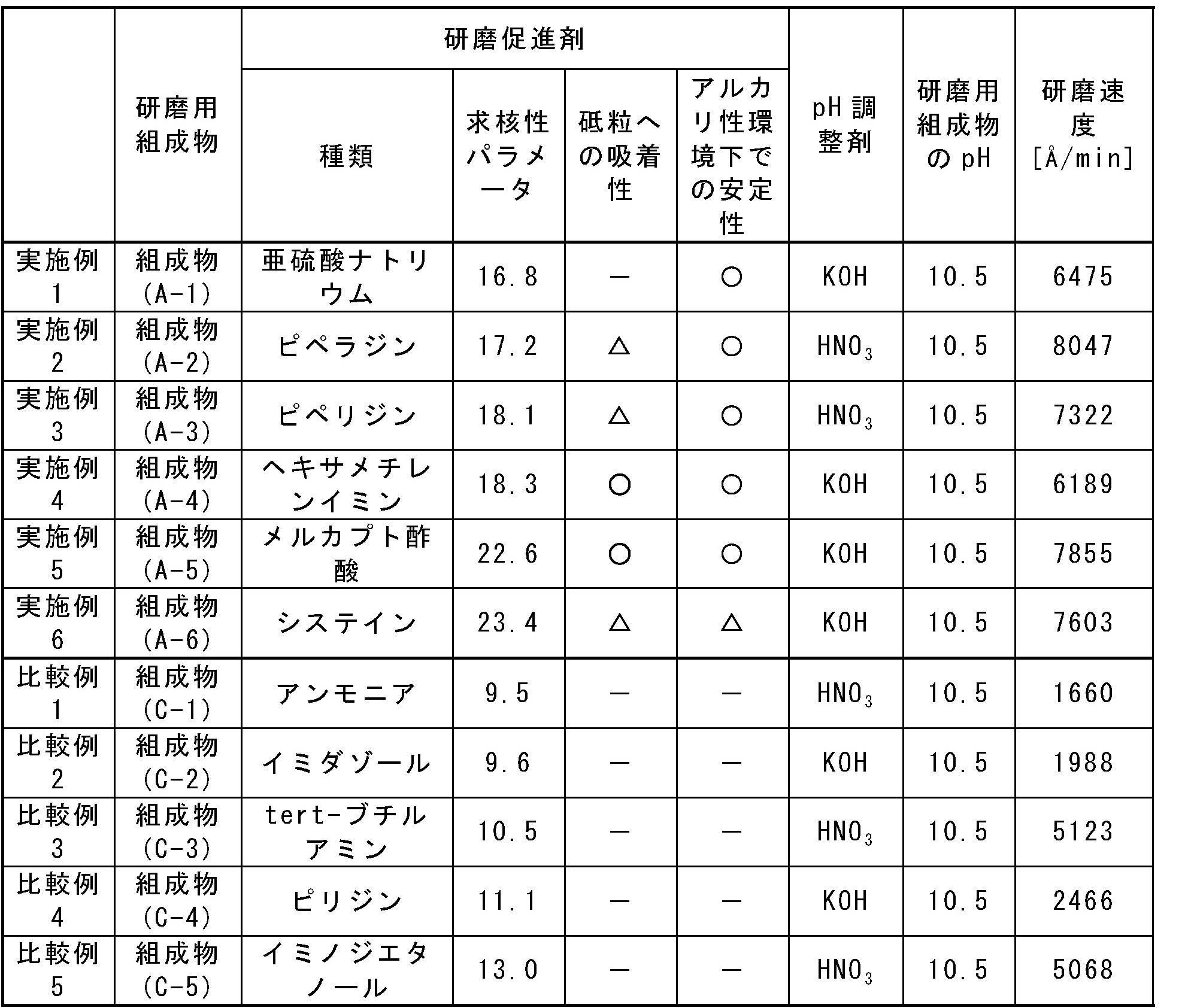
上記表1中の「-」は未測定であることを表す。
上記表1に示す結果から、実施例に係る研磨用組成物は、比較例の研磨用組成物と比較して、優れた研磨速度の向上効果が得られることが確認された。
Claims (8)
- 砥粒、下記式(1)で表される求核性パラメータが14.5以上30以下の研磨促進剤、および水を含有する研磨用組成物。

- 前記研磨促進剤が、環員数7以上10以下の環状アミンおよびメルカプトカルボン酸からなる群より選ばれる少なくとも1種である、請求項1に記載の研磨用組成物。
- 前記環状アミンが、ヘキサメチレンイミンである、請求項2に記載の研磨用組成物。
- 前記メルカプトカルボン酸が、メルカプト酢酸である、請求項2または3に記載の研磨用組成物。
- pHが7.0以上である、請求項1~4のいずれか1項に記載の研磨用組成物。
- 単結晶シリコン基板の研磨に用いられる、請求項1~5のいずれか1項に記載の研磨用組成物。
- 請求項1~6のいずれか1項に記載の研磨用組成物を用いて単結晶シリコン基板を研磨する、研磨方法。
- 請求項7に記載の研磨方法によって単結晶シリコン基板を研磨する工程を含む、半導体基板の製造方法。
Priority Applications (1)
| Application Number | Priority Date | Filing Date | Title |
|---|---|---|---|
| JP2018540930A JP6916192B2 (ja) | 2016-09-23 | 2017-08-28 | 研磨用組成物、ならびにこれを用いた研磨方法および半導体基板の製造方法 |
Applications Claiming Priority (2)
| Application Number | Priority Date | Filing Date | Title |
|---|---|---|---|
| JP2016-185781 | 2016-09-23 | ||
| JP2016185781 | 2016-09-23 |
Publications (1)
| Publication Number | Publication Date |
|---|---|
| WO2018055985A1 true WO2018055985A1 (ja) | 2018-03-29 |
Family
ID=61689913
Family Applications (1)
| Application Number | Title | Priority Date | Filing Date |
|---|---|---|---|
| PCT/JP2017/030786 Ceased WO2018055985A1 (ja) | 2016-09-23 | 2017-08-28 | 研磨用組成物、ならびにこれを用いた研磨方法および半導体基板の製造方法 |
Country Status (3)
| Country | Link |
|---|---|
| JP (1) | JP6916192B2 (ja) |
| TW (1) | TW201816061A (ja) |
| WO (1) | WO2018055985A1 (ja) |
Cited By (2)
| Publication number | Priority date | Publication date | Assignee | Title |
|---|---|---|---|---|
| JP2022108907A (ja) * | 2021-01-14 | 2022-07-27 | 株式会社フジミインコーポレーテッド | 研磨用組成物、研磨用組成物の製造方法、研磨方法、基板の製造方法 |
| CN115873507A (zh) * | 2022-12-06 | 2023-03-31 | 万华化学集团电子材料有限公司 | 一种钨化学机械抛光液及其应用 |
Citations (10)
| Publication number | Priority date | Publication date | Assignee | Title |
|---|---|---|---|---|
| JPS52112192A (en) * | 1976-03-16 | 1977-09-20 | Nakano Kiyoshi | Grinding agent for metals |
| JPH09137155A (ja) * | 1995-11-16 | 1997-05-27 | Tokyo Ohka Kogyo Co Ltd | 研磨用組成物および研磨方法 |
| JP2002030276A (ja) * | 2000-05-12 | 2002-01-31 | Kao Corp | 研磨液組成物 |
| JP2003507895A (ja) * | 1999-08-13 | 2003-02-25 | キャボット マイクロエレクトロニクス コーポレイション | 停止化合物を伴う化学機械的研磨系及びその使用方法 |
| JP2006156825A (ja) * | 2004-11-30 | 2006-06-15 | Kao Corp | 半導体基板用研磨液組成物 |
| JP2008147651A (ja) * | 2006-12-05 | 2008-06-26 | Cheil Industries Inc | シリコンウエハの最終研磨用スラリー組成物、及びそれを用いたシリコンウエハの最終研磨方法 |
| WO2009025383A1 (ja) * | 2007-08-23 | 2009-02-26 | Nitta Haas Incorporated | 研磨組成物 |
| WO2009096495A1 (ja) * | 2008-02-01 | 2009-08-06 | Fujimi Incorporated | 研磨用組成物及びそれを用いた研磨方法 |
| WO2012005289A1 (ja) * | 2010-07-08 | 2012-01-12 | 株式会社Sumco | シリコンウェーハの研磨方法およびその研磨液 |
| WO2012141145A1 (ja) * | 2011-04-13 | 2012-10-18 | 株式会社 フジミインコーポレーテッド | 基板のエッジ研磨用組成物及びそれを用いた基板のエッジ研磨方法 |
-
2017
- 2017-08-28 WO PCT/JP2017/030786 patent/WO2018055985A1/ja not_active Ceased
- 2017-08-28 JP JP2018540930A patent/JP6916192B2/ja active Active
- 2017-09-05 TW TW106130279A patent/TW201816061A/zh unknown
Patent Citations (10)
| Publication number | Priority date | Publication date | Assignee | Title |
|---|---|---|---|---|
| JPS52112192A (en) * | 1976-03-16 | 1977-09-20 | Nakano Kiyoshi | Grinding agent for metals |
| JPH09137155A (ja) * | 1995-11-16 | 1997-05-27 | Tokyo Ohka Kogyo Co Ltd | 研磨用組成物および研磨方法 |
| JP2003507895A (ja) * | 1999-08-13 | 2003-02-25 | キャボット マイクロエレクトロニクス コーポレイション | 停止化合物を伴う化学機械的研磨系及びその使用方法 |
| JP2002030276A (ja) * | 2000-05-12 | 2002-01-31 | Kao Corp | 研磨液組成物 |
| JP2006156825A (ja) * | 2004-11-30 | 2006-06-15 | Kao Corp | 半導体基板用研磨液組成物 |
| JP2008147651A (ja) * | 2006-12-05 | 2008-06-26 | Cheil Industries Inc | シリコンウエハの最終研磨用スラリー組成物、及びそれを用いたシリコンウエハの最終研磨方法 |
| WO2009025383A1 (ja) * | 2007-08-23 | 2009-02-26 | Nitta Haas Incorporated | 研磨組成物 |
| WO2009096495A1 (ja) * | 2008-02-01 | 2009-08-06 | Fujimi Incorporated | 研磨用組成物及びそれを用いた研磨方法 |
| WO2012005289A1 (ja) * | 2010-07-08 | 2012-01-12 | 株式会社Sumco | シリコンウェーハの研磨方法およびその研磨液 |
| WO2012141145A1 (ja) * | 2011-04-13 | 2012-10-18 | 株式会社 フジミインコーポレーテッド | 基板のエッジ研磨用組成物及びそれを用いた基板のエッジ研磨方法 |
Cited By (3)
| Publication number | Priority date | Publication date | Assignee | Title |
|---|---|---|---|---|
| JP2022108907A (ja) * | 2021-01-14 | 2022-07-27 | 株式会社フジミインコーポレーテッド | 研磨用組成物、研磨用組成物の製造方法、研磨方法、基板の製造方法 |
| JP7681402B2 (ja) | 2021-01-14 | 2025-05-22 | 株式会社フジミインコーポレーテッド | 研磨用組成物、研磨用組成物の製造方法、研磨方法、基板の製造方法 |
| CN115873507A (zh) * | 2022-12-06 | 2023-03-31 | 万华化学集团电子材料有限公司 | 一种钨化学机械抛光液及其应用 |
Also Published As
| Publication number | Publication date |
|---|---|
| TW201816061A (zh) | 2018-05-01 |
| JPWO2018055985A1 (ja) | 2019-07-11 |
| JP6916192B2 (ja) | 2021-08-11 |
Similar Documents
| Publication | Publication Date | Title |
|---|---|---|
| JP6762390B2 (ja) | 研磨用組成物、研磨方法および基板の製造方法 | |
| JP3457144B2 (ja) | 研磨用組成物 | |
| TWI736623B (zh) | 化學機械研磨用漿料組合物 | |
| TWI889651B (zh) | 研磨用組成物 | |
| TWI828727B (zh) | 研磨用組合物及研磨系統 | |
| KR20210031822A (ko) | 연마용 조성물, 연마용 조성물의 제조 방법, 연마 방법 및 반도체 기판의 제조 방법 | |
| WO2011093153A1 (ja) | 化学機械研磨用水系分散体およびそれを用いた化学機械研磨方法 | |
| CN101126012A (zh) | 半导体晶片研磨用组合物、其制造方法和研磨加工方法 | |
| TW201831642A (zh) | 研磨用組合物 | |
| US10414019B2 (en) | Polishing composition | |
| WO2018012176A1 (ja) | 研磨用組成物、研磨用組成物の製造方法および研磨方法 | |
| KR20190064319A (ko) | 연마용 슬러리 조성물 및 고단차 반도체 박막의 연마 방법 | |
| JP2019057635A (ja) | 研磨用組成物の製造方法 | |
| JP6916192B2 (ja) | 研磨用組成物、ならびにこれを用いた研磨方法および半導体基板の製造方法 | |
| JPH10172937A (ja) | 研磨用組成物 | |
| JP7697788B2 (ja) | 二酸化ケイ素膜及び窒化ケイ素膜研磨用の研磨用組成物、二酸化ケイ素膜及び窒化ケイ素膜研磨用の研磨用組成物の製造方法、研磨方法 | |
| TWI819067B (zh) | 研磨用組成物及研磨系統 | |
| JPH10172936A (ja) | 研磨用組成物 | |
| JPH10172934A (ja) | 研磨用組成物 | |
| WO2018012175A1 (ja) | 研磨用組成物の製造方法および研磨方法 | |
| TW201610127A (zh) | Cmp用研磨液及使用其的研磨方法 | |
| JPH10172935A (ja) | 研磨用組成物 | |
| JP2015074737A (ja) | 化学機械研磨用水系分散体および化学機械研磨方法 | |
| JP5373250B2 (ja) | 半導体ウエハ研磨用組成物の製造方法 | |
| JP2004111416A (ja) | シリコンウェハー研磨用粒子および研磨材 |
Legal Events
| Date | Code | Title | Description |
|---|---|---|---|
| 121 | Ep: the epo has been informed by wipo that ep was designated in this application |
Ref document number: 17852764 Country of ref document: EP Kind code of ref document: A1 |
|
| ENP | Entry into the national phase |
Ref document number: 2018540930 Country of ref document: JP Kind code of ref document: A |
|
| NENP | Non-entry into the national phase |
Ref country code: DE |
|
| 122 | Ep: pct application non-entry in european phase |
Ref document number: 17852764 Country of ref document: EP Kind code of ref document: A1 |