WO2017208695A1 - 電子写真機器用導電性ロール - Google Patents
電子写真機器用導電性ロール Download PDFInfo
- Publication number
- WO2017208695A1 WO2017208695A1 PCT/JP2017/016685 JP2017016685W WO2017208695A1 WO 2017208695 A1 WO2017208695 A1 WO 2017208695A1 JP 2017016685 W JP2017016685 W JP 2017016685W WO 2017208695 A1 WO2017208695 A1 WO 2017208695A1
- Authority
- WO
- WIPO (PCT)
- Prior art keywords
- surface layer
- roll
- conductive
- layer
- fluorine
- Prior art date
- Legal status (The legal status is an assumption and is not a legal conclusion. Google has not performed a legal analysis and makes no representation as to the accuracy of the status listed.)
- Ceased
Links
Images
Classifications
-
- G—PHYSICS
- G03—PHOTOGRAPHY; CINEMATOGRAPHY; ANALOGOUS TECHNIQUES USING WAVES OTHER THAN OPTICAL WAVES; ELECTROGRAPHY; HOLOGRAPHY
- G03G—ELECTROGRAPHY; ELECTROPHOTOGRAPHY; MAGNETOGRAPHY
- G03G15/00—Apparatus for electrographic processes using a charge pattern
- G03G15/02—Apparatus for electrographic processes using a charge pattern for laying down a uniform charge, e.g. for sensitising; Corona discharge devices
- G03G15/0208—Apparatus for electrographic processes using a charge pattern for laying down a uniform charge, e.g. for sensitising; Corona discharge devices by contact, friction or induction, e.g. liquid charging apparatus
- G03G15/0216—Apparatus for electrographic processes using a charge pattern for laying down a uniform charge, e.g. for sensitising; Corona discharge devices by contact, friction or induction, e.g. liquid charging apparatus by bringing a charging member into contact with the member to be charged, e.g. roller, brush chargers
- G03G15/0233—Structure, details of the charging member, e.g. chemical composition, surface properties
-
- G—PHYSICS
- G03—PHOTOGRAPHY; CINEMATOGRAPHY; ANALOGOUS TECHNIQUES USING WAVES OTHER THAN OPTICAL WAVES; ELECTROGRAPHY; HOLOGRAPHY
- G03G—ELECTROGRAPHY; ELECTROPHOTOGRAPHY; MAGNETOGRAPHY
- G03G15/00—Apparatus for electrographic processes using a charge pattern
- G03G15/14—Apparatus for electrographic processes using a charge pattern for transferring a pattern to a second base
- G03G15/16—Apparatus for electrographic processes using a charge pattern for transferring a pattern to a second base of a toner pattern, e.g. a powder pattern, e.g. magnetic transfer
-
- C—CHEMISTRY; METALLURGY
- C08—ORGANIC MACROMOLECULAR COMPOUNDS; THEIR PREPARATION OR CHEMICAL WORKING-UP; COMPOSITIONS BASED THEREON
- C08K—Use of inorganic or non-macromolecular organic substances as compounding ingredients
- C08K2201/00—Specific properties of additives
- C08K2201/002—Physical properties
- C08K2201/003—Additives being defined by their diameter
-
- C—CHEMISTRY; METALLURGY
- C08—ORGANIC MACROMOLECULAR COMPOUNDS; THEIR PREPARATION OR CHEMICAL WORKING-UP; COMPOSITIONS BASED THEREON
- C08K—Use of inorganic or non-macromolecular organic substances as compounding ingredients
- C08K3/00—Use of inorganic substances as compounding ingredients
- C08K3/02—Elements
- C08K3/04—Carbon
-
- C—CHEMISTRY; METALLURGY
- C08—ORGANIC MACROMOLECULAR COMPOUNDS; THEIR PREPARATION OR CHEMICAL WORKING-UP; COMPOSITIONS BASED THEREON
- C08K—Use of inorganic or non-macromolecular organic substances as compounding ingredients
- C08K5/00—Use of organic ingredients
- C08K5/16—Nitrogen-containing compounds
- C08K5/34—Heterocyclic compounds having nitrogen in the ring
- C08K5/3467—Heterocyclic compounds having nitrogen in the ring having more than two nitrogen atoms in the ring
- C08K5/3477—Six-membered rings
- C08K5/3495—Six-membered rings condensed with carbocyclic rings
-
- C—CHEMISTRY; METALLURGY
- C08—ORGANIC MACROMOLECULAR COMPOUNDS; THEIR PREPARATION OR CHEMICAL WORKING-UP; COMPOSITIONS BASED THEREON
- C08K—Use of inorganic or non-macromolecular organic substances as compounding ingredients
- C08K5/00—Use of organic ingredients
- C08K5/36—Sulfur-, selenium-, or tellurium-containing compounds
- C08K5/41—Compounds containing sulfur bound to oxygen
- C08K5/42—Sulfonic acids; Derivatives thereof
Definitions
- the present invention relates to a conductive roll for electrophotographic equipment that is suitably used in electrophotographic equipment such as copiers, printers, and facsimiles that employ an electrophotographic system.
- conductive rolls such as a charging roll, a developing roll, a transfer roll, and a toner supply roll are used.
- Patent Document 1 proposes a fluororesin in the outermost layer of the conductive roll in order to reduce the fluctuation in resistance value due to the environment and prevent toner adhesion in the conductive roll.
- Patent Document 2 In order to satisfy the uniform resistance by controlling the dispersion of conductive particles such as carbon black in the charging roll, a polyurethane resin is used as a binder for the coating layer, and the phthalocyanine compound and acrylic polymer are used for the conductive fine particles. It has been proposed to use a molecular dispersant (Patent Document 2).
- the surface layer that is the outermost layer of a conductive roll such as a charging roll or a developing roll is required to have releasability, resistance uniformity, surface uniformity and the like.
- a paint in which a conductive agent such as carbon black is highly dispersed by a bead mill or the like is often used by coating a resin such as a urethane resin or an acrylic resin.
- the binder resin on the surface layer is a urethane resin or an acrylic resin, for example, when the conductive roll is left standing for a long time in a state where it is assembled in the cartridge, the base layer component under the surface layer bleeds to the surface of the surface layer and becomes conductive.
- the photosensitive member or the like in contact with the conductive roll may be contaminated.
- a fluororesin is used as the binder resin for the surface layer, compatibility with a conductive agent such as carbon black is poor, dispersibility is deteriorated, and uniform resistance is difficult to obtain.
- the technique described in Patent Document 2 uses a polyurethane resin as a binder resin for the surface layer, and is a technique for controlling the dispersion of conductive particles such as carbon black in relation to the polyurethane resin.
- the problem to be solved by the present invention is to provide a conductive roll for an electrophotographic apparatus having a surface layer capable of suppressing the bleeding of the base layer component and improving the dispersibility of the conductive agent to obtain a uniform resistance.
- a conductive roll for electrophotographic equipment includes a shaft, an elastic layer formed on the outer periphery of the shaft, a surface layer formed on the outer periphery of the elastic layer, And the surface layer contains the following (A) to (D).
- the (D) is preferably a phthalocyanine compound having a sulfonic acid group.
- the (C) preferably has a carboxylic acid group or an amide group.
- the (A) is preferably 50% by mass or more based on the entire binder resin of the surface layer.
- the particle size of (B) is preferably in the range of 0.01 to 5 ⁇ m.
- the surface layer may further contain an acrylic resin in addition to (A).
- the (A) is preferably soluble in a solvent.
- the conductive roll for electrophotographic equipment since one or more kinds of resins selected from a fluorine resin and a fluorine-modified acrylic resin are used as the binder resin for the surface layer, the barrier property is high, and the base layer component Bleed can be suppressed. And since the polymer dispersing agent is used with respect to carbon black, aggregation of carbon black can be suppressed by the steric hindrance.
- an ester polymer dispersion by using a sulfonic acid dispersant that has the same potential as that of a fluorine resin or fluorine-modified acrylic resin that tends to be negative potential, and using an ester polymer dispersant as the polymer dispersant, an ester polymer dispersion
- the agent, the fluororesin, and the fluorine-modified acrylic resin can be compatibilized, and as a result, carbon black can be highly dispersed in the fluororesin and the fluorine-modified acrylic resin. Thereby, uniform resistance is obtained.
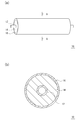
- FIG. 1A is a schematic external view of a conductive roll for electrophotographic equipment according to a first embodiment of the present invention
- FIG. 1A is a schematic external view of a conductive roll for electrophotographic equipment according to a first embodiment of the present invention
- FIG. 1A is a schematic external view of a conductive roll for electrophotographic equipment according to the first embodiment of the present invention
- FIG. 1A is a schematic external view of a conductive roll for electrophotographic equipment according to the first embodiment of the present invention
- the conductive roll 10 includes a shaft body 12, an elastic body layer 14 formed on the outer periphery of the shaft body 12, and a surface layer 16 formed on the outer periphery of the elastic body layer 14.
- the elastic body layer 14 is a layer (base layer) serving as a base of the conductive roll 10.
- the surface layer 16 is a layer (outermost layer) that appears on the surface of the conductive roll 10.
- the surface layer 16 contains the following (A) to (D).
- (A) One or more resins selected from fluorine resins and fluorine-modified acrylic resins (B) Carbon black (C) Ester polymer dispersants (D) Sulfonic acid dispersants
- (A) is a binder resin in the surface layer 16.
- the fluorine resin and the fluorine-modified acrylic resin are resins containing a fluorine group. These have high barrier properties and can suppress bleeding of the base layer component. Further, the antifouling property is excellent, and adhesion of toner, toner external additives and the like to the surface layer 16 can be suppressed.
- fluororesins examples include polytetrafluoroethylene (PTFE), polychlorotrifluoroethylene (PCTFE), polyvinylidene fluoride (PVDF), polyvinyl fluoride (PVF), and tetrafluoroethylene-perfluoroalkyl vinyl ether copolymer (PFA).
- PTFE polytetrafluoroethylene
- PCTFE polychlorotrifluoroethylene
- PVDF polyvinylidene fluoride
- PVF polyvinyl fluoride
- PFA tetrafluoroethylene-perfluoroalkyl vinyl ether copolymer
- Tetrafluoroethylene-hexafluoropropylene copolymer FEP
- ETFE ethylene-tetrafluoroethylene copolymer
- ECTFE ethylene-chlorotrifluoroethylene copolymer
- tetrafluoroethylene-hexafluoropropylene-fluoride examples include vinylidene copolymer (THV), tetrafluoroethylene-vinylidene fluoride copolymer, hexafluoropropylene-vinylidene fluoride copolymer, and the like.
- the fluorine-modified acrylic resin is a resin having a fluorinated organic group in the polymer side chain of the acrylate resin.
- the fluorinated organic group include a perfluoroalkyl group and a partially fluorinated alkyl group.
- the carbon number of the fluorinated organic group is not particularly limited, but one having 1 to 20 carbon atoms is preferred.
- Fluorine-modified acrylic resin is, for example, one or more polymers of fluorinated (meth) acrylate consisting of acrylic esters such as perfluoroalkyl (meth) acrylate and partially fluorinated alkyl (meth) acrylate, or fluorinated Examples thereof include polymers of one or more (meth) acrylates and one or more (meth) acrylates that are not fluorine-modified.
- the (meth) acrylate not modified with fluorine may contain a polysiloxane group-containing (meth) acrylate, if necessary.
- the antifouling property of the fluorine-modified acrylic resin can be further enhanced.
- the fluorine-modified acrylic resin is disclosed in JP-A-7-228820.
- the above (A) is preferably soluble in a solvent from the viewpoint that the surface layer 16 can be formed as a uniform layer by coating.
- a solvent either water or an organic solvent may be used.
- the organic solvent include MEK, MIBK, hexane, toluene, ethyl acetate, butyl acetate, THF, DMF, and NMP. What is necessary is just to adjust the solid content concentration of a coating material in the range of 3-50 mass%, for example.
- Fluorine resins such as hexafluoropropylene / vinylidene fluoride copolymer (THV) and fluorine-modified acrylic resins are preferred.
- Said (B) is mix
- the volume resistivity of the surface layer 16 may be set as appropriate in the range of 10 5 to 10 11 ⁇ ⁇ cm, 10 8 to 10 10 ⁇ ⁇ cm, etc. depending on the application.
- the blending amount of the above (B) is preferably within a range of 3.0 to 80 parts by mass with respect to 100 parts by mass of the binder resin. More preferably, it is in the range of 7 to 70 parts by mass.
- the above (B) preferably has a particle diameter (dispersion diameter) in the range of 0.01 to 5.0 ⁇ m from the viewpoint of improving dispersibility. More preferably, it is in the range of 0.1 to 1 ⁇ m.
- the particle diameter of the above (B) can be within the above range.
- the particle diameter of the above (B) can be measured by UPA manufactured by Microtrack.
- the dispersion diameter is the particle diameter (B) in the preparation liquid containing the solvent or the particle diameter (B) in the surface layer. There is no change in the dispersion diameter in the preparation liquid and the dispersion diameter in the surface layer.
- the primary particle diameter of the carbon black used is preferably in the range of 5 to 100 nm. More preferably, it is in the range of 10 to 50 nm.
- Examples of the (C) ester-based polymer dispersant include dispersants composed of higher fatty acid esters and dispersants composed of polyester.
- the molecular weight of the higher fatty acid ester is preferably from 1,000 to 150,000 from the viewpoint that the (B) carbon black adheres to the surface of the (B) carbon black and easily suppresses the aggregation of the (B) carbon black due to physical steric hindrance. More preferably, it is 5000 to 100,000.
- the molecular weight (weight average molecular weight) of the polyester is not particularly limited, but it is easy to suppress the aggregation of the (B) carbon black due to physical steric hindrance attached to the surface of the (B) carbon black. From the viewpoint, 1000 to 150,000 is preferable.
- the (C) ester polymer dispersant may have a carboxylic acid group or an amide group. Thereby, there exists an advantage that compatibility with the said (D) sulfonic acid type dispersing agent improves more.
- (C) ester polymer dispersant examples include, for example, “DISPERBYK-130”, “DISPERBYK-161”, “DISPERBYK-162”, “DISPERBYK-163”, and “DISPERBYK-170” manufactured by BYK Chemie.
- the blending amount of the (C) ester polymer dispersant is not particularly limited, but from the viewpoint of being excellent in the effect of suppressing the aggregation of the (B) carbon black, the (B) 100 mass of the carbon black.
- the amount is preferably in the range of 1 to 100 parts by mass with respect to parts. More preferably, it is in the range of 5 to 40 parts by mass.
- the (D) sulfonic acid-based dispersant is a dispersant having a sulfonic acid group.
- Sulfonic acid groups include both sulfonic acid (—SO 3 H) and sulfonate (—SO 3 M).
- M represents a monovalent or higher metal or amine. Since the (D) sulfonic acid-based dispersant has a sulfonic acid group, it has the same potential as a fluororesin or fluorine-modified acrylic resin that tends to have a negative potential. And the ester polymer dispersant (C) are compatible with each other. As a result, carbon black can be highly dispersed in the fluororesin or the fluoro-modified acrylic resin. Thereby, uniform resistance is obtained.
- the (D) sulfonic acid-based dispersant is preferably a phthalocyanine compound having a sulfonic acid group from the viewpoint of compatibility between CB and a polymer dispersant and fluorine.
- the phthalocyanine compound having a sulfonic acid group include metal phthalocyanines having a sulfonic acid group such as copper phthalocyanine having a sulfonic acid group.
- the binder resin in the surface layer 16 may be composed only of the above (A), and in addition to the above (A), another resin used as a binder resin for the surface layer is used within a range where at least the barrier property is ensured. May be.
- the above (A) is preferably 50% by mass or more based on the whole binder resin. More preferably, it is 60 mass% or more.
- acrylic resins, ester resins, carbonate resins, phenol resins, melamine resins, polyurethane resins, and the like are preferable.
- the acrylic resin used in addition to the above (A) may be either a modified acrylic resin or a non-modified acrylic resin, but is an acrylic resin that is not at least fluorine-modified.
- acrylic resins include acrylic acid or methacrylic acid alkyl esters, hydroxyalkyl esters, and glycidyl esters.
- alkyl ester alkyl include methyl, ethyl, butyl, octyl, dodecyl and the like.
- hydroxyalkyl of the hydroxyalkyl ester include hydroxyethyl and hydroxybutyl.
- the surface layer 16 may or may not contain additives in addition to the above (A) to (D).
- the additive include a leveling agent, a coupling agent, a conductive agent, a stabilizer, an ultraviolet absorber, a lubricant, a release agent, a dye, a pigment, and a flame retardant.
- the conductive agent include ionic conductive agents (quaternary ammonium salts, borates, surfactants, etc.) and electronic conductive agents (graphite, c-TiO 2 , c-ZnO, c-SnO 2 (c- ) Etc.).
- the thickness of the surface layer 16 is not particularly limited, and may be set as appropriate within a range of 10 to 30 ⁇ m according to the application.
- the surface layer 16 can be formed by using a composition for forming a surface layer containing the above (A) to (D), applying this to the outer peripheral surface of the elastic layer 14, and appropriately performing a drying treatment.
- the composition for forming a surface layer can be prepared using a solvent in which the above (A) to (D) are dissolved or dispersed.
- the solvent either water or an organic solvent may be used.
- the organic solvent include MEK, MIBK, hexane, toluene, ethyl acetate, butyl acetate, THF, DMF, and NMP. What is necessary is just to adjust the solid content concentration of a coating material in the range of 3-50 mass%, for example.
- the elastic body layer 14 contains a crosslinked rubber.
- the elastic body layer 14 is formed of a conductive rubber composition containing uncrosslinked rubber.
- the crosslinked rubber is obtained by crosslinking uncrosslinked rubber.
- the uncrosslinked rubber may be a polar rubber or a nonpolar rubber. From the viewpoint of excellent conductivity, the uncrosslinked rubber is more preferably a polar rubber.
- the polar rubber is a rubber having a polar group, and examples of the polar group include a chloro group, a nitrile group, a carboxyl group, and an epoxy group.
- Specific examples of polar rubber include hydrin rubber, nitrile rubber (NBR), urethane rubber (U), acrylic rubber (a copolymer of acrylic ester and 2-chloroethyl vinyl ether, ACM), and chloroprene rubber (CR). And epoxidized natural rubber (ENR).
- polar rubbers hydrin rubber and nitrile rubber (NBR) are more preferable from the viewpoint that the volume resistivity tends to be particularly low.
- hydrin rubber examples include epichlorohydrin homopolymer (CO), epichlorohydrin-ethylene oxide binary copolymer (ECO), epichlorohydrin-allyl glycidyl ether binary copolymer (GCO), epichlorohydrin-ethylene oxide-allyl glycidyl ether ternary.
- a copolymer (GECO) etc. can be mentioned.
- the urethane rubber examples include a polyether type urethane rubber having an ether bond in the molecule.
- a polyether type urethane rubber can be produced by a reaction between a polyether having hydroxyl groups at both ends and a diisocyanate.
- the polyether is not particularly limited, and examples thereof include polyethylene glycol and polypropylene glycol. Although it does not specifically limit as diisocyanate, Tolylene diisocyanate, diphenylmethane diisocyanate, etc. can be mentioned.
- nonpolar rubbers examples include isoprene rubber (IR), natural rubber (NR), styrene butadiene rubber (SBR), and butadiene rubber (BR).
- crosslinking agent examples include a sulfur crosslinking agent, a peroxide crosslinking agent, and a dechlorination crosslinking agent. These crosslinking agents may be used alone or in combination of two or more.
- sulfur crosslinking agent examples include conventionally known sulfur crosslinking agents such as powdered sulfur, precipitated sulfur, colloidal sulfur, surface-treated sulfur, insoluble sulfur, sulfur chloride, thiuram vulcanization accelerator, and polymer polysulfide. it can.
- peroxide crosslinking agents include conventionally known peroxide crosslinking agents such as peroxyketals, dialkyl peroxides, peroxyesters, ketone peroxides, peroxydicarbonates, diacyl peroxides and hydroperoxides. Can do.
- dechlorination crosslinking agents include dithiocarbonate compounds. More specifically, quinoxaline-2,3-dithiocarbonate, 6-methylquinoxaline-2,3-dithiocarbonate, 6-isopropylquinoxaline-2,3-dithiocarbonate, 5,8-dimethylquinoxaline-2,3- A dithiocarbonate etc. can be mentioned.
- the blending amount of the crosslinking agent is preferably within a range of 0.1 to 2 parts by mass, more preferably 0.3 to 1.8 parts by mass with respect to 100 parts by mass of the uncrosslinked rubber from the viewpoint of difficulty in bleeding. In the range of parts, more preferably in the range of 0.5 to 1.5 parts by weight.
- a dechlorination crosslinking accelerator When a dechlorination crosslinking agent is used as the crosslinking agent, a dechlorination crosslinking accelerator may be used in combination.
- the dechlorination crosslinking accelerator include 1,8-diazabicyclo (5,4,0) undecene-7 (hereinafter abbreviated as DBU) or a weak acid salt thereof.
- DBU 1,8-diazabicyclo
- the dechlorination crosslinking accelerator may be used in the form of DBU, it is preferably used in the form of its weak acid salt from the viewpoint of handling.
- DBU weak acid salts include carbonate, stearate, 2-ethylhexylate, benzoate, salicylate, 3-hydroxy-2-naphthoate, phenol resin salt, 2-mercaptobenzothiazole salt, 2- Examples include mercaptobenzimidazole salts.
- the content of the dechlorination crosslinking accelerator is preferably in the range of 0.1 to 2 parts by mass with respect to 100 parts by mass of the uncrosslinked rubber from the viewpoint of difficulty in bleeding. More preferably, it is within the range of 0.3 to 1.8 parts by mass, and even more preferably within the range of 0.5 to 1.5 parts by mass.
- the elastic layer 14 has carbon black, graphite, c-TiO 2 , c-ZnO, c-SnO 2 (c- means conductivity), an ionic conductive agent (quaternary) for imparting conductivity.
- conductive agents such as ammonium salts, borates, surfactants, etc.
- Additives include lubricants, vulcanization accelerators, anti-aging agents, light stabilizers, viscosity modifiers, processing aids, flame retardants, plasticizers, foaming agents, fillers, dispersants, antifoaming agents, pigments, release agents. Examples include molds.
- the elastic body layer 14 can be adjusted to a predetermined volume resistivity by the kind of the crosslinked rubber, the blending amount of the ionic conductive agent, the blending of the electronic conductive agent, and the like.
- the volume resistivity of the elastic layer 14 may be appropriately set in the range of 10 2 to 10 10 ⁇ ⁇ cm, 10 3 to 10 9 ⁇ ⁇ cm, 10 4 to 10 8 ⁇ ⁇ cm, and the like according to the application. .
- the thickness of the elastic layer 14 is not particularly limited, and may be set as appropriate within a range of 0.1 to 10 mm according to the application.
- the elastic body layer 14 can be manufactured as follows, for example. First, the shaft body 12 is coaxially installed in the hollow part of the roll molding die, injected with an uncrosslinked conductive rubber composition, heated and cured (crosslinked), and then demolded, or The elastic body layer 14 is formed on the outer periphery of the shaft body 12 by, for example, extruding an uncrosslinked conductive rubber composition on the surface of the shaft body 12.
- the shaft body 12 is not particularly limited as long as it has conductivity. Specific examples include solid bodies made of metal such as iron, stainless steel, and aluminum, and a cored bar made of a hollow body. You may apply
- one or more kinds of resins selected from a fluororesin and a fluorine-modified acrylic resin are used as the binder resin for the surface layer 16, so that the elastic body has a high barrier property and is a base layer. Bleeding of the components of the layer 14 can be suppressed. And since the polymer dispersing agent is used with respect to carbon black, aggregation of carbon black can be suppressed by the steric hindrance.
- an ester polymer dispersion by using a sulfonic acid dispersant that has the same potential as that of a fluorine resin or fluorine-modified acrylic resin that tends to be negative potential, and using an ester polymer dispersant as the polymer dispersant, an ester polymer dispersion
- the agent, the fluororesin, and the fluorine-modified acrylic resin can be compatibilized, and as a result, carbon black can be highly dispersed in the fluororesin and the fluorine-modified acrylic resin. Thereby, uniform resistance is obtained.
- the conductive roll 10 shown in FIG. 1 may have a configuration in which another elastic body layer is provided between the shaft body 12 and the elastic body layer 14.
- the other elastic body layer is a layer serving as a base of the conductive roll
- the elastic body layer 14 functions as a resistance adjustment layer for adjusting the resistance of the conductive roll.
- Another elastic body layer can be comprised by either of the materials mentioned as a material which comprises the elastic body layer 14, for example.
- the conductive roll 10 shown in FIG. 1 may have a configuration in which another elastic layer is provided between the elastic layer 14 and the surface layer 16.
- the elastic body layer 14 is a layer serving as a base of the conductive roll
- the other elastic body layers function as a resistance adjustment layer for adjusting the resistance of the conductive roll.
- ⁇ Preparation of elastic layer> Set a core metal (shaft body, diameter 6 mm) in the molding die, inject the conductive rubber composition described above, heat at 170 ° C. for 30 minutes, cool and demold, and thicken the outer periphery of the core metal A 1.5 mm elastic layer was formed.
- a binder resin, carbon black, dispersants 1 and 2 and a solvent (MEK) were mixed in the formulation composition shown in Table 1 so that the solid content concentration was 15% by mass to prepare a surface layer forming composition.
- the surface layer-forming composition thus prepared was roll-coated on the surface of the elastic layer, and heated at 100 ° C. for 30 minutes to remove the solvent, thereby forming a surface layer having a thickness of 2.5 ⁇ m on the outer periphery of the elastic layer. . This produced the electroconductive roll.
- the materials used are as follows.
- Comparative Example 1 since the binder resin is a urethane resin, the occurrence of bleeding is not suppressed.
- the binder resin is a fluororesin and no dispersant is used, or the dispersant is only one of an ester-based polymer dispersant and a sulfonic acid-based dispersant. The shading unevenness and resistance unevenness are not suppressed.
- Comparative Example 5 since the dispersant used together with the ester polymer dispersant is a polyether phosphate ester and not a sulfonic acid dispersant, the dispersion of carbon black is poor, and density unevenness and resistance unevenness are suppressed. Absent.
- Comparative Example 6 since the dispersant used together with the sulfonic acid-based dispersant is not an ester-based polymer dispersant but an ether-based polymer dispersant, the dispersion of carbon black is poor, and density unevenness and resistance unevenness are suppressed. Not.
- Comparative Example 7 since the dispersant is a combination of an ether-based polymer dispersant and a polyether phosphate ester, carbon black is poorly dispersed, and uneven density and uneven resistance are not suppressed.
- the dispersant is a combination of an acrylic polymer dispersant and a phthalocyanine compound (containing a sulfonic acid group). However, since the binder resin is a fluororesin, the dispersion of carbon black is poor, and uneven density and uneven resistance are present. Is not suppressed.
- the example includes a fluorine resin or a fluorine-modified acrylic resin as a binder resin, and combines such a binder resin and carbon black with an ester polymer dispersant and a sulfonic acid dispersant as a dispersant.
- a fluorine resin or a fluorine-modified acrylic resin as a binder resin
- combines such a binder resin and carbon black with an ester polymer dispersant and a sulfonic acid dispersant as a dispersant As a result, the occurrence of bleed is suppressed, the carbon black is well dispersed, and the density unevenness and resistance unevenness are suppressed.
Landscapes
- Physics & Mathematics (AREA)
- General Physics & Mathematics (AREA)
- Engineering & Computer Science (AREA)
- Plasma & Fusion (AREA)
- Electrostatic Charge, Transfer And Separation In Electrography (AREA)
- Electrophotography Configuration And Component (AREA)
- Compositions Of Macromolecular Compounds (AREA)
- Rolls And Other Rotary Bodies (AREA)
Abstract
基層成分のブリードを抑えるとともに導電剤の分散性を向上させて均一な抵抗が得られる表層を備えた電子写真機器用導電性ロールを提供する。 軸体12と、軸体12の外周に形成された弾性体層14と、弾性体層14の外周に形成された表層16と、を備え、表層16が、下記の(A)~(D)を含有する電子写真機器用導電性ロール10とする。 (A)フッ素樹脂およびフッ素変性アクリル樹脂から選択される1種以上の樹脂 (B)カーボンブラック (C)エステル系高分子分散剤 (D)スルホン酸系分散剤
Description
本発明は、電子写真方式を採用する複写機、プリンター、ファクシミリなどの電子写真機器において好適に用いられる電子写真機器用導電性ロールに関するものである。
電子写真方式を採用する複写機、プリンター、ファクシミリなどの電子写真機器では、帯電ロール、現像ロール、転写ロール、トナー供給ロールなどの導電性ロールが用いられている。
従来、導電性ロールにおいて、環境による抵抗値の変動を小さくするとともにトナーの付着を防止するために、導電性ロールの最外層にフッ素樹脂を用いることが提案されている(特許文献1)。
また、帯電ロールにおいて、カーボンブラック等の導電性粒子の分散を制御して均一抵抗性を満足するために、被覆層のバインダーとしてポリウレタン樹脂を用いるとともに導電性微粒子に対してフタロシアニン化合物およびアクリル系高分子分散剤を用いることが提案されている(特許文献2)。
帯電ロールや現像ロールなどの導電性ロールの最外層となる表層には、離型性、抵抗均一性、表面均一性などが求められる。このため、表層の材料としては、ウレタン樹脂やアクリル樹脂のような樹脂にカーボンブラックのような導電剤をビーズミル等で高分散させた塗料をコーティングして用いることが多い。しかし、表層のバインダー樹脂がウレタン樹脂やアクリル樹脂であると、例えばカートリッジに組み付けられた状態で導電性ロールが長期間放置されたときに、表層下の基層成分が表層の表面までブリードし、導電性ロールに接する感光体等を汚染することがある。また、表層のバインダー樹脂としてフッ素樹脂を用いると、カーボンブラックのような導電剤との相性が悪く、分散性が悪化し、均一な抵抗が得られにくい。特許文献2に記載の技術は、ポリウレタン樹脂を表層のバインダー樹脂としたものであり、ポリウレタン樹脂との関係においてカーボンブラック等の導電性粒子の分散を制御する技術である。フッ素樹脂を表層のバインダー樹脂としたときには、フタロシアニン化合物およびアクリル系高分子分散剤を用いても、カーボンブラック等の導電性粒子の分散性は不十分であり、均一な抵抗が得られにくい。
本発明が解決しようとする課題は、基層成分のブリードを抑えるとともに導電剤の分散性を向上させて均一な抵抗が得られる表層を備えた電子写真機器用導電性ロールを提供することにある。
上記課題を解決するため本発明に係る電子写真機器用導電性ロールは、軸体と、前記軸体の外周に形成された弾性体層と、前記弾性体層の外周に形成された表層と、を備え、前記表層が、下記の(A)~(D)を含有することを要旨とするものである。
(A)フッ素樹脂およびフッ素変性アクリル樹脂から選択される1種以上の樹脂
(B)カーボンブラック
(C)エステル系高分子分散剤
(D)スルホン酸系分散剤
(A)フッ素樹脂およびフッ素変性アクリル樹脂から選択される1種以上の樹脂
(B)カーボンブラック
(C)エステル系高分子分散剤
(D)スルホン酸系分散剤
前記(D)は、スルホン酸基を有するフタロシアニン化合物であることが好ましい。前記(C)は、カルボン酸基またはアミド基を有することが好ましい。前記表層のバインダー樹脂全体に対し、前記(A)が50質量%以上であることが好ましい。前記(B)の粒子径は0.01~5μmの範囲内であることが好ましい。前記表層は、前記(A)に加えて、さらにアクリル樹脂を含有してもよい。前記(C)と前記(D)の質量割合は、(C):(D)=1:1~4:1の範囲内であることが好ましい。前記(A)は、溶媒に可溶性を有することが好ましい。
本発明に係る電子写真機器用導電性ロールによれば、表層のバインダー樹脂としてフッ素樹脂およびフッ素変性アクリル樹脂から選択される1種以上の樹脂を用いたことから、バリア性が高く、基層成分のブリードを抑えることができる。そして、カーボンブラックに対し高分子分散剤を用いているので、その立体障害によりカーボンブラックの凝集を抑えることができる。さらに、マイナス電位になりやすいフッ素樹脂やフッ素変性アクリル樹脂と同電位となるスルホン酸系分散剤を用いるとともに上記高分子分散剤としてエステル系高分子分散剤を用いたことで、エステル系高分子分散剤とフッ素樹脂、フッ素変性アクリル樹脂とが相溶化することができ、その結果、フッ素樹脂やフッ素変性アクリル樹脂中にカーボンブラックを高分散させることができる。これにより、均一な抵抗が得られる。
本発明に係る電子写真機器用導電性ロール(以下、単に導電性ロールということがある。)について詳細に説明する。図1は、本発明の第一実施形態に係る電子写真機器用導電性ロールの外観模式図(a)と、そのA-A線断面図(b)である。
導電性ロール10は、軸体12と、軸体12の外周に形成された弾性体層14と、弾性体層14の外周に形成された表層16と、を備える。弾性体層14は、導電性ロール10のベースとなる層(基層)である。表層16は、導電性ロール10の表面に現れる層(最外層)となっている。
表層16は、下記の(A)~(D)を含有する。
(A)フッ素樹脂およびフッ素変性アクリル樹脂から選択される1種以上の樹脂
(B)カーボンブラック
(C)エステル系高分子分散剤
(D)スルホン酸系分散剤
(A)フッ素樹脂およびフッ素変性アクリル樹脂から選択される1種以上の樹脂
(B)カーボンブラック
(C)エステル系高分子分散剤
(D)スルホン酸系分散剤
上記(A)は、表層16におけるバインダー樹脂である。フッ素樹脂およびフッ素変性アクリル樹脂は、フッ素基を含む樹脂である。これらは、バリア性が高く、基層成分のブリードを抑えることができる。また、防汚性に優れ、表層16に対し、トナーやトナー外添剤などの付着を抑えることができる。
フッ素樹脂としては、ポリテトラフルオロエチレン(PTFE)、ポリクロロトリフルオロエチレン(PCTFE)、ポリフッ化ビニリデン(PVDF)、ポリフッ化ビニル(PVF)、テトラフルオロエチレン-パーフルオロアルキルビニルエーテル共重合体(PFA)、テトラフルオロエチレン-ヘキサフルオロプロピレン共重合体(FEP)、エチレン-テトラフルオロエチレン共重合体(ETFE)、エチレン・クロロトリフルオロエチレン共重合体(ECTFE)、テトラフルオロエチレン-ヘキサフルオロプロピレン-フッ化ビニリデン共重合体(THV)、テトラフルオロエチレン-フッ化ビニリデン共重合体、ヘキサフルオロプロピレン-フッ化ビニリデン共重合体などが挙げられる。
フッ素変性アクリル樹脂は、アクリレート樹脂のポリマー側鎖にフッ素化有機基を有する樹脂である。フッ素化有機基としては、パーフルオロアルキル基、部分フッ素化アルキル基などが挙げられる。フッ素化有機基の炭素数は特に限定されるものではないが、1~20の炭素数のものが好適である。フッ素変性アクリル樹脂は、例えば、パーフルオロアルキル(メタ)アクリレート、部分フッ素化アルキル(メタ)アクリレートなどのアクリルエステルからなるフッ素化(メタ)アクリレートの1種または2種以上の重合体、またはフッ素化(メタ)アクリレートの1種または2種以上とフッ素変性されていない(メタ)アクリレートの1種または2種以上との重合体が挙げられる。フッ素変性されていない(メタ)アクリレートには、必要に応じて、ポリシロキサン基含有(メタ)アクリレートが含まれていてもよい。ポリシロキサン基含有(メタ)アクリレートの共重合によって、フッ素変性アクリル樹脂の防汚性をさらに高めることができる。なお、フッ素変性アクリル樹脂は、特開平7-228820号公報に示されている。
上記(A)は、表層16を塗工により均一な層として形成することができるなどの観点から、溶媒に可溶性を有することが好ましい。溶媒としては、水、有機溶媒のいずれでもよい。有機溶媒としては、MEK、MIBK、ヘキサン、トルエン、酢酸エチル、酢酸ブチル、THF、DMF、NMPなどが挙げられる。塗料の固形分濃度は、例えば3~50質量%の範囲に調整すればよい。溶媒に可溶性を有する観点から、上記(A)の樹脂としては、ポリフッ化ビニリデン(PVDF)、ポリフッ化ビニリデン・四フッ化エチレン共重合体、ポリフッ化ビニリデン・六フッ化プロピレン、四フッ化エチレン・六フッ化プロピレン・フッ化ビニリデン共重合体(THV)などのフッ素樹脂や、フッ素変性アクリル樹脂が好ましい。
上記(B)は、導電剤(電子導電剤)として配合されるものである。表層16の体積抵抗率を所望の範囲とするべく配合される。表層16の体積抵抗率は、用途などに応じて105~1011Ω・cm、108~1010Ω・cmの範囲などに適宜設定すればよい。表層16の体積抵抗率を好適範囲に設定するなどの観点から、上記(B)の配合量は、バインダー樹脂100質量部に対し、3.0~80質量部の範囲内であることが好ましい。より好ましくは7~70質量部の範囲内である。
上記(B)は、分散性の向上の観点から、その粒子径(分散径)が0.01~5.0μmの範囲内であることが好ましい。より好ましくは0.1~1μmの範囲内である。上記(C)を用いることで、上記(B)の粒子径を上記範囲内にすることができる。上記(B)の粒子径は、マイクロトラック社製 UPAにより測定することができる。分散径は、溶媒を含む調製液中の上記(B)の粒子径や、表層中の上記(B)の粒子径である。分散剤で覆われている状態にあり、調製液中の分散径と表層中の分散径に変化はない。使用するカーボンブラックの1次粒子径は、5~100nmの範囲であることが好ましい。より好ましくは10~50nmの範囲内である。
上記(C)エステル系高分子分散剤は、高級脂肪酸エステルからなる分散剤やポリエステルからなる分散剤などが挙げられる。上記(B)カーボンブラックの表面に付着して物理的な立体障害によって上記(B)カーボンブラックの凝集を抑えやすいなどの観点から、高級脂肪酸エステルの分子量は、1000~15万が好ましい。より好ましくは5000~10万である。ポリエステルの分子量(重量平均分子量)は、特に限定されるものではないが、上記(B)カーボンブラックの表面に付着して物理的な立体障害によって上記(B)カーボンブラックの凝集を抑えやすいなどの観点から1000~15万が好ましい。より好ましくは5000~10万である。上記(C)エステル系高分子分散剤は、カルボン酸基またはアミド基を有するものであってもよい。これにより、上記(D)スルホン酸系分散剤との相溶性がより向上するという利点がある。
上記(C)エステル系高分子分散剤としては、具体的には、例えばビックケミー社の「DISPERBYK-130」、「DISPERBYK-161」、「DISPERBYK-162」、「DISPERBYK-163」、「DISPERBYK-170」、「DISPERBYK-171」、「DISPERBYK-174」、「DISPERBYK-180」、「DISPERBYK-182」、「DISPERBYK-183」、「DISPERBYK-184」、「DISPERBYK-185」、「DISPERBYK-2000」、「DISPERBYK-2001」、「DISPERBYK-2020」、「DISPERBYK-2050」、「DISPERBYK-2070」、「DISPERBYK-2096」、「DISPERBYK-2150」、チバスペシャルティーケミカルズ社の「EFKA1503」、「EFKA4010」、「EFKA4020」、「EFKA4300」、「EFKA4330」、「EFKA4340」、「EFKA4520」、「EFKA4530」、「EFKA5054」、「EFKA7411」、「EFKA7422」、「EFKA7431」、「EFKA7441」、「EFKA7461」、「EFKA7496」、「EFKA7497」、ルーブリゾール社の「ソルスパース3000」、「ソルスパース9000」、「ソルスパース13240」、「ソルスパース13650」、「ソルスパース13940」、「ソルスパース17000」、「ソルスパース18000」、「ソルスパース20000」、「ソルスパース21000」、「ソルスパース20000」、「ソルスパース24000」、「ソルスパース26000」、「ソルスパース27000」、「ソルスパース28000」、「ソルスパース32000」、「ソルスパース36000」、「ソルスパース37000」、「ソルスパース38000」、「ソルスパース41000」、「ソルスパース42000」、「ソルスパース43000」、「ソルスパース46000」、「ソルスパース54000」、「ソルスパース71000」、味の素ファインテクノ社のアジスパー「PB-711」、「アジスパーPB-821」、「アジスパーPB-822」、「アジスパーPB-814」、「アジスパーPB-824」などを用いることが可能である。
上記(C)エステル系高分子分散剤の配合量は、特に限定されるものではないが、上記(B)カーボンブラックの凝集を抑える効果に優れるなどの観点から、上記(B)カーボンブラック100質量部に対し、1~100質量部の範囲内であることが好ましい。より好ましくは5~40質量部の範囲内である。
上記(D)スルホン酸系分散剤は、スルホン酸基を有する分散剤である。スルホン酸基は、スルホン酸(-SO3H)およびスルホン酸塩(-SO3M)の両方を含む。Mは、1価以上の金属もしくはアミンを表す。上記(D)スルホン酸系分散剤は、スルホン酸基を有することで、マイナス電位になりやすいフッ素樹脂やフッ素変性アクリル樹脂と同電位となるため、上記(A)のフッ素樹脂、フッ素変性アクリル樹脂と上記(C)のエステル系高分子分散剤とを相溶化させる効果があり、その結果、フッ素樹脂やフッ素変性アクリル樹脂中にカーボンブラックを高分散させることができる。これにより、均一な抵抗が得られる。
上記(D)スルホン酸系分散剤としては、CBと高分子分散剤、フッ素との相溶性の観点から、スルホン酸基を有するフタロシアニン化合物が好ましい。スルホン酸基を有するフタロシアニン化合物としては、スルホン酸基を有する銅フタロシアニンなどのスルホン酸基を有する金属フタロシアニンなどが挙げられる。
上記(D)スルホン酸系分散剤の配合量は、特に限定されるものではないが、前記(C)と前記(D)の質量割合は、(C):(D)=1:1~4:1の範囲内であることが好ましい。より好ましくは、(C):(D)=1.5:1~3:1の範囲内である。
表層16におけるバインダー樹脂は、上記(A)のみで構成されていてもよいし、上記(A)に加え、表層のバインダー樹脂として用いられる他の樹脂を少なくとも上記バリア性が確保される範囲で用いてもよい。このためには、バインダー樹脂全体に対し、上記(A)は50質量%以上であることが好ましい。より好ましくは60質量%以上である。他の樹脂としては、アクリル樹脂、エステル樹脂、カーボネート樹脂、フェノール樹脂、メラミン樹脂、ポリウレタン樹脂などが好適なものとして挙げられる。上記(A)に加えて用いられるアクリル樹脂は、変性アクリル樹脂、非変性アクリル樹脂のいずれであってもよいが、少なくともフッ素変性されていないアクリル樹脂である。このようなアクリル樹脂としては、具体的には、アクリル酸若しくはメタクリル酸のアルキルエステル、ヒドロキシアルキルエステル、グリシジルエステルなどが挙げられる。アルキルエステルのアルキルとしては、メチル、エチル、ブチル、オクチル、ドデシルなどが挙げられる。ヒドロキシアルキルエステルのヒドロキシアルキルとしては、ヒドロキシエチル、ヒドロキシブチルなどが挙げられる。
表層16は、上記(A)~(D)に加えて、添加剤を含んでいてもよいし、含んでいなくてもよい。添加剤としては、レベリング剤、カップリング剤、導電剤、安定剤、紫外線吸収剤、滑剤、離型剤、染料、顔料、難燃剤などが挙げられる。導電剤としては、イオン導電剤(4級アンモニウム塩、ホウ酸塩、界面活性剤など)や電子導電剤(グラファイト、c-TiO2、c-ZnO、c-SnO2(c-は、導電性を意味する。)など)が挙げられる。
表層16の厚みは、特に限定されるものではなく、用途などに応じて10~30μmの範囲内などで適宜設定すればよい。
表層16は、上記(A)~(D)を含む表層形成用組成物を用い、これを弾性体層14の外周面に塗工し、乾燥処理を適宜行うことにより形成することができる。表層形成用組成物は、上記(A)~(D)を溶解あるいは分散させる溶媒を用いて調製することができる。溶媒としては、水、有機溶媒のいずれでもよい。有機溶媒としては、MEK、MIBK、ヘキサン、トルエン、酢酸エチル、酢酸ブチル、THF、DMF、NMPなどが挙げられる。塗料の固形分濃度は、例えば3~50質量%の範囲に調整すればよい。
弾性体層14は、架橋ゴムを含有する。弾性体層14は、未架橋ゴムを含有する導電性ゴム組成物により形成される。架橋ゴムは、未架橋ゴムを架橋することにより得られる。未架橋ゴムは、極性ゴムであってもよいし、非極性ゴムであってもよい。導電性に優れるなどの観点から、未架橋ゴムは極性ゴムがより好ましい。
極性ゴムは、極性基を有するゴムであり、極性基としては、クロロ基、ニトリル基、カルボキシル基、エポキシ基などを挙げることができる。極性ゴムとしては、具体的には、ヒドリンゴム、ニトリルゴム(NBR)、ウレタンゴム(U)、アクリルゴム(アクリル酸エステルと2-クロロエチルビニルエーテルとの共重合体、ACM)、クロロプレンゴム(CR)、エポキシ化天然ゴム(ENR)などを挙げることができる。極性ゴムのうちでは、体積抵抗率が特に低くなりやすいなどの観点から、ヒドリンゴム、ニトリルゴム(NBR)がより好ましい。
ヒドリンゴムとしては、エピクロルヒドリンの単独重合体(CO)、エピクロルヒドリン-エチレンオキサイド二元共重合体(ECO)、エピクロルヒドリン-アリルグリシジルエーテル二元共重合体(GCO)、エピクロルヒドリン-エチレンオキサイド-アリルグリシジルエーテル三元共重合体(GECO)などを挙げることができる。
ウレタンゴムとしては、分子内にエーテル結合を有するポリエーテル型のウレタンゴムを挙げることができる。ポリエーテル型のウレタンゴムは、両末端にヒドロキシル基を有するポリエーテルとジイソシアネートとの反応により製造できる。ポリエーテルとしては、特に限定されるものではないが、ポリエチレングリコール、ポリプロピレングリコールなどを挙げることができる。ジイソシアネートとしては、特に限定されるものではないが、トリレンジイソシアネート、ジフェニルメタンジイソシアネートなどを挙げることができる。
非極性ゴムとしては、イソプレンゴム(IR)、天然ゴム(NR)、スチレンブタジエンゴム(SBR)、ブタジエンゴム(BR)などが挙げられる。
架橋剤としては、硫黄架橋剤、過酸化物架橋剤、脱塩素架橋剤を挙げることができる。これらの架橋剤は、単独で用いても良いし、2種以上組み合わせて用いても良い。
硫黄架橋剤としては、粉末硫黄、沈降硫黄、コロイド硫黄、表面処理硫黄、不溶性硫黄、塩化硫黄、チウラム系加硫促進剤、高分子多硫化物などの従来より公知の硫黄架橋剤を挙げることができる。
過酸化物架橋剤としては、パーオキシケタール、ジアルキルパーオキサイド、パーオキシエステル、ケトンパーオキサイド、パーオキシジカーボネート、ジアシルパーオキサイド、ハイドロパーオキサイドなどの従来より公知の過酸化物架橋剤を挙げることができる。
脱塩素架橋剤としては、ジチオカーボネート化合物を挙げることができる。より具体的には、キノキサリン-2,3-ジチオカーボネート、6-メチルキノキサリン-2,3-ジチオカーボネート、6-イソプロピルキノキサリン-2,3-ジチオカーボネート、5,8-ジメチルキノキサリン-2,3-ジチオカーボネートなどを挙げることができる。
架橋剤の配合量としては、ブリードしにくいなどの観点から、未架橋ゴム100質量部に対して、好ましくは0.1~2質量部の範囲内、より好ましくは0.3~1.8質量部の範囲内、さらに好ましくは0.5~1.5質量部の範囲内である。
架橋剤として脱塩素架橋剤を用いる場合には、脱塩素架橋促進剤を併用しても良い。脱塩素架橋促進剤としては、1,8-ジアザビシクロ(5,4,0)ウンデセン-7(以下、DBUと略称する。)もしくはその弱酸塩を挙げることができる。脱塩素架橋促進剤は、DBUの形態として用いても良いが、その取り扱い面から、その弱酸塩の形態として用いることが好ましい。DBUの弱酸塩としては、炭酸塩、ステアリン酸塩、2-エチルヘキシル酸塩、安息香酸塩、サリチル酸塩、3-ヒドロキシ-2-ナフトエ酸塩、フェノール樹脂塩、2-メルカプトベンゾチアゾール塩、2-メルカプトベンズイミダゾール塩などを挙げることができる。
脱塩素架橋促進剤の含有量としては、ブリードしにくいなどの観点から、未架橋ゴム100質量部に対して、0.1~2質量部の範囲内であることが好ましい。より好ましくは0.3~1.8質量部の範囲内、さらに好ましくは0.5~1.5質量部の範囲内である。
弾性体層14には、導電性付与のため、カーボンブラック、グラファイト、c-TiO2、c-ZnO、c-SnO2(c-は、導電性を意味する。)、イオン導電剤(4級アンモニウム塩、ホウ酸塩、界面活性剤など)などの従来より公知の導電剤を適宜添加することができる。また、必要に応じて、各種添加剤を適宜添加しても良い。添加剤としては、滑剤、加硫促進剤、老化防止剤、光安定剤、粘度調整剤、加工助剤、難燃剤、可塑剤、発泡剤、充填剤、分散剤、消泡剤、顔料、離型剤などを挙げることができる。
弾性体層14は、架橋ゴムの種類、イオン導電剤の配合量、電子導電剤の配合などにより、所定の体積抵抗率に調整することができる。弾性体層14の体積抵抗率は、用途などに応じて102~1010Ω・cm、103~109Ω・cm、104~108Ω・cmの範囲などに適宜設定すればよい。
弾性体層14の厚みは、特に限定されるものではなく、用途などに応じて0.1~10mmの範囲内などで適宜設定すればよい。
弾性体層14は、例えば、次のようにして製造することができる。まず、軸体12をロール成形金型の中空部に同軸的に設置し、未架橋の導電性ゴム組成物を注入して、加熱・硬化(架橋)させた後、脱型するか、あるいは、軸体12の表面に未架橋の導電性ゴム組成物を押出成形するなどにより、軸体12の外周に弾性体層14を形成する。
軸体12は、導電性を有するものであれば特に限定されない。具体的には、鉄、ステンレス、アルミニウムなどの金属製の中実体、中空体からなる芯金などを例示することができる。軸体12の表面には、必要に応じて、接着剤、プライマーなどを塗布しても良い。つまり、弾性体層14は、接着剤層(プライマー層)を介して軸体12に接着されていてもよい。接着剤、プライマーなどには、必要に応じて導電化を行なっても良い。
以上の構成の導電性ロール10によれば、表層16のバインダー樹脂としてフッ素樹脂およびフッ素変性アクリル樹脂から選択される1種以上の樹脂を用いたことから、バリア性が高く、基層である弾性体層14の成分のブリードを抑えることができる。そして、カーボンブラックに対し高分子分散剤を用いているので、その立体障害によりカーボンブラックの凝集を抑えることができる。さらに、マイナス電位になりやすいフッ素樹脂やフッ素変性アクリル樹脂と同電位となるスルホン酸系分散剤を用いるとともに上記高分子分散剤としてエステル系高分子分散剤を用いたことで、エステル系高分子分散剤とフッ素樹脂、フッ素変性アクリル樹脂とが相溶化することができ、その結果、フッ素樹脂やフッ素変性アクリル樹脂中にカーボンブラックを高分散させることができる。これにより、均一な抵抗が得られる。
本発明に係る導電性ロールの構成としては、図1に示す構成に限定されるものではない。例えば、図1に示す導電性ロール10において、軸体12と弾性体層14との間に他の弾性体層を備えた構成であってもよい。この場合、他の弾性体層は、導電性ロールのベースとなる層であり、弾性体層14が導電性ロールの抵抗調整を行う抵抗調整層などとして機能する。他の弾性体層は、例えば、弾性体層14を構成する材料として挙げられた材料のいずれかにより構成することができる。また、例えば、図1に示す導電性ロール10において、弾性体層14と表層16との間に他の弾性体層を備えた構成であってもよい。この場合、弾性体層14が導電性ロールのベースとなる層であり、他の弾性体層は、導電性ロールの抵抗調整を行う抵抗調整層などとして機能する。
以下、実施例および比較例を用いて本発明を詳細に説明する。
(実施例1~6、比較例1~8)
<導電性ゴム組成物の調製>
ヒドリンゴム(ECO、ダイソー製「エピクロマーCG102」)100質量部に対し、加硫助剤(酸化亜鉛、三井金属製「酸化亜鉛2種」)を5質量部、カーボン(ケッチェンブラックインターナショナル製「ケッチェンブラックEC300J」)を10質量部、加硫促進剤(2-メルカプトベンゾチアゾール、大内新興化学工業社製「ノクセラーM-P」)を0.5質量部、硫黄(鶴見化学工業社製、「サルファックスPTC」)を2質量部、充填剤(炭酸カルシウム、白石工業製「白艶華CC」)を50質量部添加し、これらを攪拌機により撹拌、混合して導電性ゴム組成物を調製した。
<導電性ゴム組成物の調製>
ヒドリンゴム(ECO、ダイソー製「エピクロマーCG102」)100質量部に対し、加硫助剤(酸化亜鉛、三井金属製「酸化亜鉛2種」)を5質量部、カーボン(ケッチェンブラックインターナショナル製「ケッチェンブラックEC300J」)を10質量部、加硫促進剤(2-メルカプトベンゾチアゾール、大内新興化学工業社製「ノクセラーM-P」)を0.5質量部、硫黄(鶴見化学工業社製、「サルファックスPTC」)を2質量部、充填剤(炭酸カルシウム、白石工業製「白艶華CC」)を50質量部添加し、これらを攪拌機により撹拌、混合して導電性ゴム組成物を調製した。
<弾性体層の作製>
成形金型に芯金(軸体、直径6mm)をセットし、上記の導電性ゴム組成物を注入し、170℃で30分加熱した後、冷却、脱型して、芯金の外周に厚み1.5mmの弾性体層を形成した。
成形金型に芯金(軸体、直径6mm)をセットし、上記の導電性ゴム組成物を注入し、170℃で30分加熱した後、冷却、脱型して、芯金の外周に厚み1.5mmの弾性体層を形成した。
<表層の作製>
固形分濃度が15質量%となるように表1に記載の配合組成にてバインダー樹脂、カーボンブラック、分散剤1,2、溶媒(MEK)を混合し、表層形成用組成物を調製した。次いで、調製した表層形成用組成物を弾性体層の表面にロールコートし、100℃で30分加熱して溶媒を除去することにより、弾性体層の外周に厚み2.5μmの表層を形成した。これにより、導電性ロールを作製した。なお、用いた材料は以下の通りである。
固形分濃度が15質量%となるように表1に記載の配合組成にてバインダー樹脂、カーボンブラック、分散剤1,2、溶媒(MEK)を混合し、表層形成用組成物を調製した。次いで、調製した表層形成用組成物を弾性体層の表面にロールコートし、100℃で30分加熱して溶媒を除去することにより、弾性体層の外周に厚み2.5μmの表層を形成した。これにより、導電性ロールを作製した。なお、用いた材料は以下の通りである。
(バインダー樹脂)
・フッ素樹脂:テトラフルオロエチレン-ヘキサフルオロプロピレン-フッ化ビニリデン共重合体(THV)、3M製「ダイニオンTHV221AZ」
・フッ素変性アクリル樹脂:東亜合成製「GF150」
・アクリル樹脂:根上工業製「ハイパールM4501」(非フッ素変性)
・ウレタン樹脂:東ソー製「ミラクトランE380PNAT」
(カーボンブラック)
・ケッチェンブラックインターナショナル製「ケッチェンブラックEC300J」
(分散剤1)
・高級脂肪酸エステル(エステル系高分子分散剤):味の素ファインテクノ製「アジスパーPN411」
・櫛形高分子エステル(エステル系高分子分散剤):日本ルーブリゾール製「ソルスパースS32000」、多価カルボン酸部分アミド含有
・櫛形高分子エーテル(エーテル系高分子分散剤):ビックケミージャパン製「DISPERBYK-182」
・アクリル系高分子分散剤:BASFジャパン製「EFKA-4406」
(分散剤2)
・スルホン酸基含有銅フタロシアニン(スルホン酸系分散剤):日本ルーブリゾール製「ソルスパースS12000」
・ポリスチレンスルホン酸Na(スルホン酸系分散剤):東ソー製「ポリナス」
・ポリエーテルリン酸エステル:楠本化成製「ディスパロンDA375」
・フッ素樹脂:テトラフルオロエチレン-ヘキサフルオロプロピレン-フッ化ビニリデン共重合体(THV)、3M製「ダイニオンTHV221AZ」
・フッ素変性アクリル樹脂:東亜合成製「GF150」
・アクリル樹脂:根上工業製「ハイパールM4501」(非フッ素変性)
・ウレタン樹脂:東ソー製「ミラクトランE380PNAT」
(カーボンブラック)
・ケッチェンブラックインターナショナル製「ケッチェンブラックEC300J」
(分散剤1)
・高級脂肪酸エステル(エステル系高分子分散剤):味の素ファインテクノ製「アジスパーPN411」
・櫛形高分子エステル(エステル系高分子分散剤):日本ルーブリゾール製「ソルスパースS32000」、多価カルボン酸部分アミド含有
・櫛形高分子エーテル(エーテル系高分子分散剤):ビックケミージャパン製「DISPERBYK-182」
・アクリル系高分子分散剤:BASFジャパン製「EFKA-4406」
(分散剤2)
・スルホン酸基含有銅フタロシアニン(スルホン酸系分散剤):日本ルーブリゾール製「ソルスパースS12000」
・ポリスチレンスルホン酸Na(スルホン酸系分散剤):東ソー製「ポリナス」
・ポリエーテルリン酸エステル:楠本化成製「ディスパロンDA375」
作製した各導電性ロールについて、画像評価(濃淡ムラ)、抵抗評価(抵抗ムラ)、ブリード評価を行った。評価結果および表層形成用組成物の配合組成を以下の表に示す。
(画像評価)
作製した導電性ロールを実機(HP製「CLJ4525dn」)のカートリッジに取り付け、15℃×10%RH環境下にて画出しを行った。ロールピッチの濃淡ムラが発生した場合を不良「×」とし、濃淡ムラが発生しなかった場合を良好「○」とし、濃淡ムラが無く、画像のガサつきもない物を最良好「◎」とした。
作製した導電性ロールを実機(HP製「CLJ4525dn」)のカートリッジに取り付け、15℃×10%RH環境下にて画出しを行った。ロールピッチの濃淡ムラが発生した場合を不良「×」とし、濃淡ムラが発生しなかった場合を良好「○」とし、濃淡ムラが無く、画像のガサつきもない物を最良好「◎」とした。
(抵抗評価)
NN環境下(23℃50%RH)において、金属棒上(φ30mm)に導電性ロールを線接触させ、軸体の両端に各々300gの荷重をかけた状態で金属棒を回転駆動し、30rpmで導電性ロールをつれ回り回転させ、軸体の端部より200Vの直流電圧を印加した場合の電流値を測定した。この際、電流値の最大値と最小値の比(最大/最小)を算出し、その比が2.0を超える場合を抵抗ムラが大きい「×」とし、その比が2.0以下の場合を抵抗ムラが小さい「○」とし、その比が1.3以下の場合を抵抗ムラが極小の「◎」とした。
NN環境下(23℃50%RH)において、金属棒上(φ30mm)に導電性ロールを線接触させ、軸体の両端に各々300gの荷重をかけた状態で金属棒を回転駆動し、30rpmで導電性ロールをつれ回り回転させ、軸体の端部より200Vの直流電圧を印加した場合の電流値を測定した。この際、電流値の最大値と最小値の比(最大/最小)を算出し、その比が2.0を超える場合を抵抗ムラが大きい「×」とし、その比が2.0以下の場合を抵抗ムラが小さい「○」とし、その比が1.3以下の場合を抵抗ムラが極小の「◎」とした。
(ブリード評価)
作製した導電性ロールを実機(HP製「CLJ4525dn」)のカートリッジに取り付け、40℃×95%RH環境下にて30日放置した後、ロール表面を顕微鏡で観察した。ロール表面にブリード物が発生していることが確認された場合を「×」、確認されなかった場合を「○」とした。
作製した導電性ロールを実機(HP製「CLJ4525dn」)のカートリッジに取り付け、40℃×95%RH環境下にて30日放置した後、ロール表面を顕微鏡で観察した。ロール表面にブリード物が発生していることが確認された場合を「×」、確認されなかった場合を「○」とした。

比較例1は、バインダー樹脂がウレタン樹脂であるため、ブリードの発生が抑えられていない。比較例2~4は、バインダー樹脂がフッ素樹脂であり、分散剤を用いていないか、分散剤がエステル系高分子分散剤およびスルホン酸系分散剤のいずれか一方のみであり、カーボンブラックの分散が悪く、濃淡ムラ、抵抗ムラが抑えられていない。比較例5は、エステル系高分子分散剤とともに用いている分散剤がポリエーテルリン酸エステルでありスルホン酸系分散剤ではないため、カーボンブラックの分散が悪く、濃淡ムラ、抵抗ムラが抑えられていない。比較例6は、スルホン酸系分散剤とともに用いている分散剤がエステル系高分子分散剤ではなくエーテル系高分子分散剤であるため、カーボンブラックの分散が悪く、濃淡ムラ、抵抗ムラが抑えられていない。比較例7は、分散剤がエーテル系高分子分散剤とポリエーテルリン酸エステルの組み合わせであるため、カーボンブラックの分散が悪く、濃淡ムラ、抵抗ムラが抑えられていない。比較例8は、分散剤がアクリル系高分子分散剤とフタロシアニン化合物(スルホン酸基含有)の組み合わせであるが、バインダー樹脂がフッ素樹脂であるため、カーボンブラックの分散が悪く、濃淡ムラ、抵抗ムラが抑えられていない。
比較例に対し、実施例は、バインダー樹脂としてフッ素樹脂またはフッ素変性アクリル樹脂を含み、このようなバインダー樹脂とカーボンブラックに対し分散剤としてエステル系高分子分散剤とスルホン酸系分散剤を組み合わせて用いているため、ブリードの発生が抑えられているとともに、カーボンブラックの分散良好で、濃淡ムラ、抵抗ムラが抑えられている。
以上、本発明の実施形態・実施例について説明したが、本発明は上記実施形態・実施例に何ら限定されるものではなく、本発明の趣旨を逸脱しない範囲内で種々の改変が可能である。
Claims (8)
- 軸体と、前記軸体の外周に形成された弾性体層と、前記弾性体層の外周に形成された表層と、を備え、
前記表層が、下記の(A)~(D)を含有することを特徴とする電子写真機器用導電性ロール。
(A)フッ素樹脂およびフッ素変性アクリル樹脂から選択される1種以上の樹脂
(B)カーボンブラック
(C)エステル系高分子分散剤
(D)スルホン酸系分散剤 - 前記(D)が、スルホン酸基を有するフタロシアニン化合物であることを特徴とする請求項1に記載の電子写真機器用導電性ロール。
- 前記(C)が、カルボン酸基またはアミド基を有することを特徴とする請求項1または2に記載の電子写真機器用導電性ロール。
- 前記表層のバインダー樹脂全体に対し、前記(A)が50質量%以上であることを特徴とする請求項1から3のいずれか1項に記載の電子写真機器用導電性ロール。
- 前記(B)の粒子径が0.01~5μmの範囲内であることを特徴とする請求項1から4のいずれか1項に記載の電子写真機器用導電性ロール。
- 前記表層が、前記(A)に加えて、さらにアクリル樹脂を含有することを特徴とする請求項1から5のいずれか1項に記載の電子写真機器用導電性ロール。
- 前記(C)と前記(D)の質量割合が、(C):(D)=1:1~4:1の範囲内であることを特徴とする請求項1から6のいずれか1項に記載の電子写真機器用導電性ロール。
- 前記(A)が、溶媒に可溶性を有することを特徴とする請求項1から7のいずれか1項に記載の電子写真機器用導電性ロール。
Priority Applications (2)
| Application Number | Priority Date | Filing Date | Title |
|---|---|---|---|
| CN201780011450.2A CN109496282B (zh) | 2016-05-30 | 2017-04-27 | 电子照相设备用导电性辊 |
| US16/032,083 US10203626B2 (en) | 2016-05-30 | 2018-07-11 | Charging roll for electrophotographic apparatus |
Applications Claiming Priority (2)
| Application Number | Priority Date | Filing Date | Title |
|---|---|---|---|
| JP2016-107138 | 2016-05-30 | ||
| JP2016107138A JP6343631B2 (ja) | 2016-05-30 | 2016-05-30 | 電子写真機器用導電性ロール |
Related Child Applications (1)
| Application Number | Title | Priority Date | Filing Date |
|---|---|---|---|
| US16/032,083 Continuation US10203626B2 (en) | 2016-05-30 | 2018-07-11 | Charging roll for electrophotographic apparatus |
Publications (1)
| Publication Number | Publication Date |
|---|---|
| WO2017208695A1 true WO2017208695A1 (ja) | 2017-12-07 |
Family
ID=60478261
Family Applications (1)
| Application Number | Title | Priority Date | Filing Date |
|---|---|---|---|
| PCT/JP2017/016685 Ceased WO2017208695A1 (ja) | 2016-05-30 | 2017-04-27 | 電子写真機器用導電性ロール |
Country Status (4)
| Country | Link |
|---|---|
| US (1) | US10203626B2 (ja) |
| JP (1) | JP6343631B2 (ja) |
| CN (1) | CN109496282B (ja) |
| WO (1) | WO2017208695A1 (ja) |
Families Citing this family (3)
| Publication number | Priority date | Publication date | Assignee | Title |
|---|---|---|---|---|
| JP2019197164A (ja) * | 2018-05-10 | 2019-11-14 | キヤノン株式会社 | 帯電ローラ、カートリッジ及び画像形成装置 |
| JP7132883B2 (ja) * | 2019-04-25 | 2022-09-07 | 住友理工株式会社 | 電子写真機器用導電性ロール |
| JP7655835B2 (ja) * | 2021-10-29 | 2025-04-02 | 住友理工株式会社 | 電子写真機器用帯電ロールおよび電子写真機器用帯電ロールの製造方法 |
Citations (6)
| Publication number | Priority date | Publication date | Assignee | Title |
|---|---|---|---|---|
| JP2007072200A (ja) * | 2005-09-07 | 2007-03-22 | Tokai Rubber Ind Ltd | 帯電ロール |
| JP2011184664A (ja) * | 2010-03-11 | 2011-09-22 | Toyo Ink Sc Holdings Co Ltd | カーボンブラック分散液 |
| JP2011232380A (ja) * | 2010-04-23 | 2011-11-17 | Canon Chemicals Inc | 電子写真用帯電ローラ |
| JP2012102222A (ja) * | 2010-11-09 | 2012-05-31 | Nippon Shokubai Co Ltd | フッ素樹脂含有傾斜膜、その製造方法及びフッ素樹脂含有傾斜膜形成用樹脂組成物 |
| JP2012242433A (ja) * | 2011-05-16 | 2012-12-10 | Fuji Xerox Co Ltd | 無端状環状体および画像形成装置 |
| JP2014142529A (ja) * | 2013-01-25 | 2014-08-07 | Tokai Rubber Ind Ltd | 電子写真機器用導電性組成物および電子写真機器用導電性部材 |
Family Cites Families (11)
| Publication number | Priority date | Publication date | Assignee | Title |
|---|---|---|---|---|
| JP3586900B2 (ja) | 1993-12-21 | 2004-11-10 | 大日本インキ化学工業株式会社 | 被覆用防汚性組成物 |
| JP3598718B2 (ja) | 1997-03-25 | 2004-12-08 | 東海ゴム工業株式会社 | 半導電性ロール |
| TWI224120B (en) * | 2001-09-11 | 2004-11-21 | Daicel Polymer Ltd | Process for manufacturing plated resin molded article |
| KR100996727B1 (ko) * | 2002-11-15 | 2010-11-25 | 스미토모 고무 고교 가부시키가이샤 | 도전성 롤러 및 상기 도전성 롤러를 구비한 화상 형성 장치 |
| JP4396917B2 (ja) * | 2003-09-09 | 2010-01-13 | 日本カーリット株式会社 | 導電性付与剤及び導電性材料 |
| JP4920953B2 (ja) * | 2005-11-10 | 2012-04-18 | キヤノン株式会社 | 画像形成方法 |
| JP2007321115A (ja) * | 2006-06-05 | 2007-12-13 | Japan Carlit Co Ltd:The | 導電性付与剤及び導電性樹脂組成物 |
| KR101223873B1 (ko) * | 2011-02-16 | 2013-01-17 | 이무균 | 도전성 발포시트 제조방법 |
| JP5970850B2 (ja) * | 2012-02-21 | 2016-08-17 | 富士ゼロックス株式会社 | 転写ロール、画像形成装置、及びプロセスカートリッジ |
| JP5954040B2 (ja) * | 2012-08-10 | 2016-07-20 | 富士ゼロックス株式会社 | 電子写真感光体、プロセスカートリッジ、及び画像形成装置 |
| JP6587418B2 (ja) * | 2014-05-15 | 2019-10-09 | キヤノン株式会社 | 電子写真用部材、プロセスカートリッジ及び電子写真装置 |
-
2016
- 2016-05-30 JP JP2016107138A patent/JP6343631B2/ja active Active
-
2017
- 2017-04-27 CN CN201780011450.2A patent/CN109496282B/zh active Active
- 2017-04-27 WO PCT/JP2017/016685 patent/WO2017208695A1/ja not_active Ceased
-
2018
- 2018-07-11 US US16/032,083 patent/US10203626B2/en active Active
Patent Citations (6)
| Publication number | Priority date | Publication date | Assignee | Title |
|---|---|---|---|---|
| JP2007072200A (ja) * | 2005-09-07 | 2007-03-22 | Tokai Rubber Ind Ltd | 帯電ロール |
| JP2011184664A (ja) * | 2010-03-11 | 2011-09-22 | Toyo Ink Sc Holdings Co Ltd | カーボンブラック分散液 |
| JP2011232380A (ja) * | 2010-04-23 | 2011-11-17 | Canon Chemicals Inc | 電子写真用帯電ローラ |
| JP2012102222A (ja) * | 2010-11-09 | 2012-05-31 | Nippon Shokubai Co Ltd | フッ素樹脂含有傾斜膜、その製造方法及びフッ素樹脂含有傾斜膜形成用樹脂組成物 |
| JP2012242433A (ja) * | 2011-05-16 | 2012-12-10 | Fuji Xerox Co Ltd | 無端状環状体および画像形成装置 |
| JP2014142529A (ja) * | 2013-01-25 | 2014-08-07 | Tokai Rubber Ind Ltd | 電子写真機器用導電性組成物および電子写真機器用導電性部材 |
Also Published As
| Publication number | Publication date |
|---|---|
| US10203626B2 (en) | 2019-02-12 |
| JP2017215358A (ja) | 2017-12-07 |
| JP6343631B2 (ja) | 2018-06-13 |
| US20180321609A1 (en) | 2018-11-08 |
| CN109496282B (zh) | 2021-07-20 |
| CN109496282A (zh) | 2019-03-19 |
Similar Documents
| Publication | Publication Date | Title |
|---|---|---|
| CN109952540B (zh) | 电子照相设备用带电辊 | |
| CN109923481B (zh) | 电子照相设备用带电构件以及电子照相设备用带电构件的制造方法 | |
| JP2012108376A (ja) | 転写部材 | |
| JP6343631B2 (ja) | 電子写真機器用導電性ロール | |
| WO2016158813A1 (ja) | 電子写真機器用導電性部材 | |
| JP6576709B2 (ja) | 電子写真機器用導電性部材 | |
| JP4160613B2 (ja) | 発泡ゴムロール | |
| JP2009244464A (ja) | 電子写真機器用導電性ベルトおよびその製造方法 | |
| JP2021096377A (ja) | 電子写真機器用導電性ロール | |
| CN110178091B (zh) | 电子照相设备用显影辊 | |
| WO2017073221A1 (ja) | 電子写真機器用帯電ロール | |
| CN110753883B (zh) | 电子照相设备用带电构件 | |
| JP6850094B2 (ja) | 電子写真機器用導電性ロール | |
| WO2018061441A1 (ja) | 電子写真機器用帯電ロール | |
| WO2022138202A1 (ja) | 電子写真機器用帯電ロール | |
| JP2018017943A (ja) | 電子写真機器用導電性ロール | |
| JP2017156396A (ja) | 電子写真機器用帯電ロール | |
| JP7655835B2 (ja) | 電子写真機器用帯電ロールおよび電子写真機器用帯電ロールの製造方法 | |
| JP7132883B2 (ja) | 電子写真機器用導電性ロール | |
| WO2019106929A1 (ja) | 電子写真機器用帯電部材 | |
| JP7258708B2 (ja) | 電子写真機器用帯電ロール | |
| CN112771277B (zh) | 电子照相设备用带电辊 | |
| JP7079719B2 (ja) | 電子写真機器用導電性部材 | |
| WO2025204529A1 (ja) | 電子写真機器用帯電ロール | |
| CN118202307A (zh) | 电子照相设备用带电辊以及电子照相设备用带电辊的制造方法 |
Legal Events
| Date | Code | Title | Description |
|---|---|---|---|
| 121 | Ep: the epo has been informed by wipo that ep was designated in this application |
Ref document number: 17806254 Country of ref document: EP Kind code of ref document: A1 |
|
| NENP | Non-entry into the national phase |
Ref country code: DE |
|
| 122 | Ep: pct application non-entry in european phase |
Ref document number: 17806254 Country of ref document: EP Kind code of ref document: A1 |