WO2017170916A1 - 金属錯体、組成物及び発光素子 - Google Patents
金属錯体、組成物及び発光素子 Download PDFInfo
- Publication number
- WO2017170916A1 WO2017170916A1 PCT/JP2017/013374 JP2017013374W WO2017170916A1 WO 2017170916 A1 WO2017170916 A1 WO 2017170916A1 JP 2017013374 W JP2017013374 W JP 2017013374W WO 2017170916 A1 WO2017170916 A1 WO 2017170916A1
- Authority
- WO
- WIPO (PCT)
- Prior art keywords
- group
- metal complex
- formula
- substituent
- atom
- Prior art date
- Legal status (The legal status is an assumption and is not a legal conclusion. Google has not performed a legal analysis and makes no representation as to the accuracy of the status listed.)
- Ceased
Links
- 0 CCC1C(*)=C(*)C(*)C=C2*(C)(C3C)[C@@](*)C(C)=CC(C)C(*)C(C)(*)C3C(C(*)*C)*12 Chemical compound CCC1C(*)=C(*)C(*)C=C2*(C)(C3C)[C@@](*)C(C)=CC(C)C(*)C(C)(*)C3C(C(*)*C)*12 0.000 description 6
- BYXRHMOHHZLMQA-UHFFFAOYSA-N CCCCC(C)(C)C(N(C(c1ccc(C)c(-c2ccccc2)c1)=N)c1c(C)cc(C)cc1)=[Ne] Chemical compound CCCCC(C)(C)C(N(C(c1ccc(C)c(-c2ccccc2)c1)=N)c1c(C)cc(C)cc1)=[Ne] BYXRHMOHHZLMQA-UHFFFAOYSA-N 0.000 description 1
Classifications
-
- C—CHEMISTRY; METALLURGY
- C07—ORGANIC CHEMISTRY
- C07F—ACYCLIC, CARBOCYCLIC OR HETEROCYCLIC COMPOUNDS CONTAINING ELEMENTS OTHER THAN CARBON, HYDROGEN, HALOGEN, OXYGEN, NITROGEN, SULFUR, SELENIUM OR TELLURIUM
- C07F15/00—Compounds containing elements of Groups 8, 9, 10 or 18 of the Periodic Table
- C07F15/0006—Compounds containing elements of Groups 8, 9, 10 or 18 of the Periodic Table compounds of the platinum group
- C07F15/0033—Iridium compounds
-
- C—CHEMISTRY; METALLURGY
- C07—ORGANIC CHEMISTRY
- C07F—ACYCLIC, CARBOCYCLIC OR HETEROCYCLIC COMPOUNDS CONTAINING ELEMENTS OTHER THAN CARBON, HYDROGEN, HALOGEN, OXYGEN, NITROGEN, SULFUR, SELENIUM OR TELLURIUM
- C07F15/00—Compounds containing elements of Groups 8, 9, 10 or 18 of the Periodic Table
- C07F15/0006—Compounds containing elements of Groups 8, 9, 10 or 18 of the Periodic Table compounds of the platinum group
- C07F15/0086—Platinum compounds
-
- C—CHEMISTRY; METALLURGY
- C09—DYES; PAINTS; POLISHES; NATURAL RESINS; ADHESIVES; COMPOSITIONS NOT OTHERWISE PROVIDED FOR; APPLICATIONS OF MATERIALS NOT OTHERWISE PROVIDED FOR
- C09K—MATERIALS FOR MISCELLANEOUS APPLICATIONS, NOT PROVIDED FOR ELSEWHERE
- C09K11/00—Luminescent materials, e.g. electroluminescent or chemiluminescent
- C09K11/06—Luminescent materials, e.g. electroluminescent or chemiluminescent containing organic luminescent materials
-
- H—ELECTRICITY
- H10—SEMICONDUCTOR DEVICES; ELECTRIC SOLID-STATE DEVICES NOT OTHERWISE PROVIDED FOR
- H10K—ORGANIC ELECTRIC SOLID-STATE DEVICES
- H10K50/00—Organic light-emitting devices
-
- H—ELECTRICITY
- H10—SEMICONDUCTOR DEVICES; ELECTRIC SOLID-STATE DEVICES NOT OTHERWISE PROVIDED FOR
- H10K—ORGANIC ELECTRIC SOLID-STATE DEVICES
- H10K50/00—Organic light-emitting devices
- H10K50/10—OLEDs or polymer light-emitting diodes [PLED]
- H10K50/11—OLEDs or polymer light-emitting diodes [PLED] characterised by the electroluminescent [EL] layers
- H10K50/12—OLEDs or polymer light-emitting diodes [PLED] characterised by the electroluminescent [EL] layers comprising dopants
-
- H—ELECTRICITY
- H10—SEMICONDUCTOR DEVICES; ELECTRIC SOLID-STATE DEVICES NOT OTHERWISE PROVIDED FOR
- H10K—ORGANIC ELECTRIC SOLID-STATE DEVICES
- H10K50/00—Organic light-emitting devices
- H10K50/10—OLEDs or polymer light-emitting diodes [PLED]
- H10K50/14—Carrier transporting layers
- H10K50/15—Hole transporting layers
-
- H—ELECTRICITY
- H10—SEMICONDUCTOR DEVICES; ELECTRIC SOLID-STATE DEVICES NOT OTHERWISE PROVIDED FOR
- H10K—ORGANIC ELECTRIC SOLID-STATE DEVICES
- H10K50/00—Organic light-emitting devices
- H10K50/10—OLEDs or polymer light-emitting diodes [PLED]
- H10K50/14—Carrier transporting layers
- H10K50/16—Electron transporting layers
-
- H—ELECTRICITY
- H10—SEMICONDUCTOR DEVICES; ELECTRIC SOLID-STATE DEVICES NOT OTHERWISE PROVIDED FOR
- H10K—ORGANIC ELECTRIC SOLID-STATE DEVICES
- H10K50/00—Organic light-emitting devices
- H10K50/10—OLEDs or polymer light-emitting diodes [PLED]
- H10K50/17—Carrier injection layers
-
- H—ELECTRICITY
- H10—SEMICONDUCTOR DEVICES; ELECTRIC SOLID-STATE DEVICES NOT OTHERWISE PROVIDED FOR
- H10K—ORGANIC ELECTRIC SOLID-STATE DEVICES
- H10K50/00—Organic light-emitting devices
- H10K50/10—OLEDs or polymer light-emitting diodes [PLED]
- H10K50/17—Carrier injection layers
- H10K50/171—Electron injection layers
-
- H—ELECTRICITY
- H10—SEMICONDUCTOR DEVICES; ELECTRIC SOLID-STATE DEVICES NOT OTHERWISE PROVIDED FOR
- H10K—ORGANIC ELECTRIC SOLID-STATE DEVICES
- H10K85/00—Organic materials used in the body or electrodes of devices covered by this subclass
- H10K85/10—Organic polymers or oligomers
-
- H—ELECTRICITY
- H10—SEMICONDUCTOR DEVICES; ELECTRIC SOLID-STATE DEVICES NOT OTHERWISE PROVIDED FOR
- H10K—ORGANIC ELECTRIC SOLID-STATE DEVICES
- H10K85/00—Organic materials used in the body or electrodes of devices covered by this subclass
- H10K85/30—Coordination compounds
- H10K85/341—Transition metal complexes, e.g. Ru(II)polypyridine complexes
- H10K85/342—Transition metal complexes, e.g. Ru(II)polypyridine complexes comprising iridium
-
- H—ELECTRICITY
- H10—SEMICONDUCTOR DEVICES; ELECTRIC SOLID-STATE DEVICES NOT OTHERWISE PROVIDED FOR
- H10K—ORGANIC ELECTRIC SOLID-STATE DEVICES
- H10K85/00—Organic materials used in the body or electrodes of devices covered by this subclass
- H10K85/30—Coordination compounds
- H10K85/341—Transition metal complexes, e.g. Ru(II)polypyridine complexes
- H10K85/346—Transition metal complexes, e.g. Ru(II)polypyridine complexes comprising platinum
-
- C—CHEMISTRY; METALLURGY
- C09—DYES; PAINTS; POLISHES; NATURAL RESINS; ADHESIVES; COMPOSITIONS NOT OTHERWISE PROVIDED FOR; APPLICATIONS OF MATERIALS NOT OTHERWISE PROVIDED FOR
- C09K—MATERIALS FOR MISCELLANEOUS APPLICATIONS, NOT PROVIDED FOR ELSEWHERE
- C09K2211/00—Chemical nature of organic luminescent or tenebrescent compounds
- C09K2211/18—Metal complexes
- C09K2211/185—Metal complexes of the platinum group, i.e. Os, Ir, Pt, Ru, Rh or Pd
-
- H—ELECTRICITY
- H10—SEMICONDUCTOR DEVICES; ELECTRIC SOLID-STATE DEVICES NOT OTHERWISE PROVIDED FOR
- H10K—ORGANIC ELECTRIC SOLID-STATE DEVICES
- H10K50/00—Organic light-emitting devices
- H10K50/10—OLEDs or polymer light-emitting diodes [PLED]
- H10K50/11—OLEDs or polymer light-emitting diodes [PLED] characterised by the electroluminescent [EL] layers
Definitions
- the present invention relates to a metal complex, a composition containing the metal complex, and a light-emitting element containing the metal complex.
- Patent Document 1 and Patent Document 2 disclose iridium complexes in which a ligand has a 1,2,4-triazole structure.
- the above-mentioned metal complex has insufficient luminescence stability.
- an object of the present invention is to provide a metal complex having excellent light emission stability. Another object of the present invention is to provide a composition, a film and a light emitting device containing the metal complex.
- a metal complex represented by the formula (1) [Where: X represents a nitrogen atom or a group represented by ⁇ C (R X ) —.
- R X represents a hydrogen atom, an alkyl group, a cycloalkyl group, an alkoxy group, a cycloalkoxy group, an aryl group, an aryloxy group, a monovalent heterocyclic group, a substituted amino group, or a halogen atom, and these groups represent a substituent. You may have. When two or more X exists, they may be the same or different.
- R 1 represents an alkyl group having 4 or more carbon atoms, and the group may have a substituent.
- R 1 When a plurality of R 1 are present, they may be the same or different.
- R 2 represents an alkyl group, a cycloalkyl group, an alkoxy group, a cycloalkoxy group, an aryl group, an aryloxy group, a monovalent heterocyclic group, a substituted amino group, or a halogen atom, and these groups have a substituent. May be.
- Ring A and ring B each independently represent an aromatic hydrocarbon ring or an aromatic heterocyclic ring, and these rings may have a substituent.
- substituents When a plurality of such substituents are present, they may be the same or different, and may be bonded to each other to form a ring together with the atoms to which they are bonded. When there are a plurality of rings A and rings B, they may be the same or different.
- M represents a rhodium atom, a palladium atom, an iridium atom or a platinum atom.
- n 1 represents an integer of 1 or more
- n 2 represents an integer of 0 or more
- n 1 + n 2 is 2 or 3.
- a 1 -G 1 -A 2 represents an anionic bidentate ligand.
- a 1 and A 2 each independently represent a carbon atom, an oxygen atom or a nitrogen atom, and these atoms may be atoms constituting a ring.
- G 1 represents a single bond or an atomic group constituting a bidentate ligand together with A 1 and A 2 .
- a 1 -G 1 -A 2 When a plurality of A 1 -G 1 -A 2 are present, they may be the same or different.
- R 3 , R 4 , R 5 and R 6 are each independently a hydrogen atom, alkyl group, cycloalkyl group, alkoxy group, cycloalkoxy group, aryl group, aryloxy group, monovalent heterocyclic group, substituted amino group Represents a group or a halogen atom, and these groups optionally have a substituent.
- R 3 , R 4 , R 5 and R 6 may be the same or different.
- R 3 and R 4 , R 4 and R 5 , and R 5 and R 6 may be bonded to each other to form a ring together with the carbon atoms to which they are bonded.
- R 7 , R 8 and R 9 When a plurality of R 7 , R 8 and R 9 are present, they may be the same or different. R 7 and R 8 , R 8 and R 9 may be bonded to each other to form a ring together with the carbon atoms to which they are bonded.
- R 7 and R 8 , R 8 and R 9 may be bonded to each other to form a ring together with the carbon atoms to which they are bonded.
- R 7 and R 8 , R 8 and R 9 may be bonded to each other to form a ring together with the carbon atoms to which they are bonded.
- R 7 and R 8 , R 8 and R 9 may be bonded to each other to form a ring together with the carbon atoms to which they are bonded.
- R 7 and R 8 , R 8 and R 9 may be bonded to each other to form a ring together with the carbon atoms to which they are bonded.
- R 1 is a group represented by the formula (2).
- R 12 represents a cycloalkyl group, an alkoxy group, a cycloalkoxy group, an aryl group, an aryloxy group, a monovalent heterocyclic group, a substituted amino group, or a halogen atom, and these groups optionally have a substituent. .
- n 3 represents an integer of 1 to 3
- n 4 represents an integer of 0 to 2
- n 5 represents 0 or 1
- n 3 + n 4 + n 5 represents 3.
- [6] The metal complex according to [5], wherein n 5 is 0.
- [7] The metal complex according to [5] or [6], wherein n 4 is 0.
- [12] The metal complex according to any one of [1] to [11], At least one selected from the group consisting of a compound represented by formula (H-1) and a polymer compound containing a structural unit represented by formula (Y);
- a composition comprising: [Where: Ar H1 and Ar H2 each independently represent an aryl group or a monovalent heterocyclic group, and these groups optionally have a substituent.
- n H1 and n H2 each independently represent 0 or 1. When a plurality of n H1 are present, they may be the same or different.
- a plurality of n H2 may be the same or different.
- n H3 represents an integer of 0 or more.
- L H1 represents an arylene group, a divalent heterocyclic group, or a group represented by — [C (R H11 ) 2 ] n H11 —, and these groups optionally have a substituent. When a plurality of L H1 are present, they may be the same or different.
- n H11 represents an integer of 1 or more and 10 or less.
- R H11 represents a hydrogen atom, an alkyl group, a cycloalkyl group, an alkoxy group, a cycloalkoxy group, an aryl group, or a monovalent heterocyclic group, and these groups may have a substituent.
- a plurality of R H11 may be the same or different, and may be bonded to each other to form a ring together with the carbon atom to which each is bonded.
- L H2 represents a group represented by —N (—L H21 —R H21 ) —. When a plurality of L H2 are present, they may be the same or different.
- L H21 represents a single bond, an arylene group or a divalent heterocyclic group, and these groups may have a substituent.
- R H21 represents a hydrogen atom, an alkyl group, a cycloalkyl group, an aryl group, or a monovalent heterocyclic group, and these groups optionally have a substituent.
- Ar Y1 represents an arylene group, a divalent heterocyclic group, or a divalent group in which at least one arylene group and at least one divalent heterocyclic group are directly bonded; The group may have a substituent.
- the metal complex according to any one of [1] to [11] At least one material selected from the group consisting of a hole transport material, a hole injection material, an electron transport material, an electron injection material, a light emitting material, an antioxidant, and a solvent; A composition comprising: [14] A film containing the metal complex according to any one of [1] to [11]. [15] A light emitting device comprising the metal complex according to any one of [1] to [11].
- a metal complex having excellent emission stability can be provided.
- membrane, and light emitting element containing this metal complex can be provided.
- Me represents a methyl group
- Et represents an ethyl group
- Bu represents a butyl group
- i-Pr represents an isopropyl group
- t-Bu represents a tert-butyl group
- Ph represents a phenyl group.
- the hydrogen atom (also expressed as “H”) may be a deuterium atom or a light hydrogen atom.
- the solid line representing the bond with the central metal means a covalent bond or a coordinate bond.
- the “polymer compound” means a polymer having a molecular weight distribution and having a polystyrene-equivalent number average molecular weight of 1 ⁇ 10 3 or more (for example, 1 ⁇ 10 3 to 1 ⁇ 10 8 ).
- the polymer compound may be any of a block copolymer, a random copolymer, an alternating copolymer, and a graft copolymer, or other embodiments.
- the terminal group of the polymer compound is preferably a stable group because if the polymerization active group remains as it is, there is a possibility that the light emission characteristics or the luminance life may be lowered when the polymer compound is used for the production of a light emitting device. It is.
- the terminal group is preferably a group conjugated to the main chain, and examples thereof include a group bonded to an aryl group or a monovalent heterocyclic group via a carbon-carbon bond.
- “Structural unit” means one or more units present in a polymer compound.
- Low molecular weight compound means a compound having no molecular weight distribution and a molecular weight of 1 ⁇ 10 4 or less.
- the “alkyl group” may be linear or branched.
- the number of carbon atoms of the linear alkyl group is usually 1 to 50, preferably 1 to 10, more preferably 1 to 6, not including the carbon atoms of the substituent.
- the number of carbon atoms of the branched alkyl group is usually 3 to 50, preferably 3 to 12, more preferably 4 to 8, not including the carbon atoms of the substituent.
- the alkyl group may have a substituent.
- alkyl group examples include methyl group, ethyl group, propyl group, isopropyl group, butyl group, 2-butyl group, isobutyl group, tert-butyl group, pentyl group, isoamyl group, 2-ethylbutyl group, hexyl group, heptyl.
- the alkyl group may be a group in which some or all of the hydrogen atoms in these groups are substituted with a cycloalkyl group, an alkoxy group, a cycloalkoxy group, an aryl group, a fluorine atom, or the like.
- alkyl groups include trifluoromethyl group, pentafluoroethyl group, perfluorobutyl group, perfluorohexyl group, perfluorooctyl group, 3-phenylpropyl group, and 3- (4-methylphenyl) propyl.
- the number of carbon atoms of the “cycloalkyl group” is usually 3 to 50, preferably 3 to 30, more preferably 4 to 20, excluding the number of carbon atoms of the substituent.
- the cycloalkyl group may have a substituent. Examples of the cycloalkyl group include a cyclohexyl group, a cyclohexylmethyl group, and a cyclohexylethyl group.
- Aryl group means an atomic group remaining after removing one hydrogen atom directly bonded to a carbon atom constituting a ring from an aromatic hydrocarbon.
- the number of carbon atoms of the aryl group is usually 6 to 60, preferably 6 to 20, more preferably 6 to 10, not including the number of carbon atoms of the substituent.
- the aryl group may have a substituent.
- Examples of the aryl group include a phenyl group, 1-naphthyl group, 2-naphthyl group, 1-anthracenyl group, 2-anthracenyl group, 9-anthracenyl group, 1-pyrenyl group, 2-pyrenyl group, 4-pyrenyl group, Examples include 2-fluorenyl group, 3-fluorenyl group, 4-fluorenyl group, 2-phenylphenyl group, 3-phenylphenyl group, 4-phenylphenyl group and the like.
- the aryl group may be a group in which some or all of the hydrogen atoms in these groups are substituted with an alkyl group, a cycloalkyl group, an alkoxy group, a cycloalkoxy group, an aryl group, a fluorine atom, or the like.
- the “alkoxy group” may be linear or branched.
- the number of carbon atoms of the straight-chain alkoxy group is usually 1 to 40, preferably 4 to 10, excluding the number of carbon atoms of the substituent.
- the number of carbon atoms of the branched alkoxy group is usually 3 to 40, preferably 4 to 10, excluding the number of carbon atoms of the substituent.
- the alkoxy group may have a substituent.
- alkoxy group examples include methoxy group, ethoxy group, propyloxy group, isopropyloxy group, butyloxy group, isobutyloxy group, tert-butyloxy group, pentyloxy group, hexyloxy group, heptyloxy group, octyloxy group, 2 -Ethylhexyloxy group, nonyloxy group, decyloxy group, 3,7-dimethyloctyloxy group, lauryloxy group and the like.
- the alkoxy group may be a group in which part or all of the hydrogen atoms in these groups are substituted with a cycloalkyl group, an alkoxy group, a cycloalkoxy group, an aryl group, a fluorine atom, or the like.
- the number of carbon atoms of the “cycloalkoxy group” is usually 3 to 40, preferably 4 to 10, not including the number of carbon atoms of the substituent.
- the cycloalkoxy group may have a substituent. Examples of the cycloalkoxy group include a cyclohexyloxy group.
- the number of carbon atoms of the “aryloxy group” is usually 6 to 60, preferably 6 to 48, not including the number of carbon atoms of the substituent.
- the aryloxy group may have a substituent. Examples of the aryloxy group include phenoxy group, 1-naphthyloxy group, 2-naphthyloxy group, 1-anthracenyloxy group, 9-anthracenyloxy group, 1-pyrenyloxy group and the like.
- the aryloxy group may be a group in which some or all of the hydrogen atoms in these groups are substituted with an alkyl group, a cycloalkyl group, an alkoxy group, a cycloalkoxy group, a fluorine atom, or the like.
- the “p-valent heterocyclic group” (p represents an integer of 1 or more) is p of hydrogen atoms directly bonded to a carbon atom or a hetero atom constituting a ring from a heterocyclic compound. This means the remaining atomic group excluding the hydrogen atom. Among the p-valent heterocyclic groups, it is the remaining atomic group obtained by removing p hydrogen atoms from the hydrogen atoms directly bonded to the carbon atoms or heteroatoms constituting the ring from the aromatic heterocyclic compound. A “p-valent aromatic heterocyclic group” is preferable.
- Aromatic heterocyclic compounds '' are oxadiazole, thiadiazole, thiazole, oxazole, thiophene, pyrrole, phosphole, furan, pyridine, pyrazine, pyrimidine, triazine, pyridazine, quinoline, isoquinoline, carbazole, dibenzophosphole, etc.
- a compound in which the ring itself exhibits aromaticity, and a heterocyclic ring such as phenoxazine, phenothiazine, dibenzoborol, dibenzosilol, benzopyran itself does not exhibit aromaticity, but the aromatic ring is condensed to the heterocyclic ring Means a compound.
- the number of carbon atoms of the p-valent heterocyclic group is usually 2 to 60, preferably 3 to 20, and more preferably 4 to 20, excluding the number of carbon atoms of the substituent.
- the p-valent heterocyclic group may have a substituent.
- examples of the monovalent heterocyclic group include thienyl group, pyrrolyl group, furyl group, pyridinyl group, piperidinyl group, quinolinyl group, isoquinolinyl group, pyrimidinyl group, and triazinyl group. .
- the monovalent heterocyclic group may be a group in which some or all of the hydrogen atoms in these groups are substituted with an alkyl group, a cycloalkyl group, an alkoxy group, a cycloalkoxy group, or the like.
- Halogen atom means a fluorine atom, a chlorine atom, a bromine atom or an iodine atom.
- the “amino group” may have a substituent, and a substituted amino group is preferable.
- a substituent which an amino group has an alkyl group, a cycloalkyl group, an aryl group, or a monovalent heterocyclic group is preferable.
- the substituted amino group a disubstituted amino group is preferable. Examples of the disubstituted amino group include a dialkylamino group, a dicycloalkylamino group, and a diarylamino group.
- disubstituted amino group examples include dimethylamino group, diethylamino group, diphenylamino group, bis (4-methylphenyl) amino group, bis (4-tert-butylphenyl) amino group, bis (3,5-di-). tert-butylphenyl) amino group.
- the “alkenyl group” may be linear or branched.
- the number of carbon atoms of the straight chain alkenyl group is usually 2 to 30, preferably 3 to 20, not including the carbon atoms of the substituent.
- the number of carbon atoms of the branched alkenyl group is usually 3 to 30, preferably 4 to 20, not including the carbon atoms of the substituent.
- the number of carbon atoms in the “cycloalkenyl group” is usually 3 to 30, preferably 4 to 20, not including the carbon atoms of the substituent.
- the alkenyl group and the cycloalkenyl group may have a substituent.
- alkenyl group examples include a vinyl group, 1-propenyl group, 2-propenyl group, 2-butenyl group, 3-butenyl group, 3-pentenyl group, 4-pentenyl group, 1-hexenyl group, 5-hexenyl group, Examples include 7-octenyl groups and groups in which some or all of the hydrogen atoms in these groups have been substituted with substituents.
- cycloalkenyl group include a cyclohexenyl group and a 2-norbornylenyl group.
- the “alkynyl group” may be linear or branched.
- the number of carbon atoms of the alkynyl group is usually 2 to 20, preferably 3 to 20, not including the carbon atom of the substituent.
- the number of carbon atoms of the branched alkynyl group is usually from 4 to 30, and preferably from 4 to 20, not including the carbon atom of the substituent.
- the number of carbon atoms of the “cycloalkynyl group” is usually 4 to 30, preferably 4 to 20, not including the carbon atom of the substituent.
- the alkynyl group and the cycloalkynyl group may have a substituent.
- alkynyl group examples include ethynyl group, 1-propynyl group, 2-propynyl group, 2-butynyl group, 3-butynyl group, 3-pentynyl group, 4-pentynyl group, 1-hexynyl group, 5-hexynyl group, And the group by which one part or all part of the hydrogen atom in these groups was substituted by the substituent is mentioned.
- the “arylene group” means an atomic group remaining after removing two hydrogen atoms directly bonded to a carbon atom constituting a ring from an aromatic hydrocarbon.
- the number of carbon atoms of the arylene group is usually 6 to 60, preferably 6 to 30, and more preferably 6 to 18, excluding the number of carbon atoms of the substituent.
- the arylene group may have a substituent.
- Examples of the arylene group include a phenylene group, a naphthalenediyl group, an anthracenediyl group, a phenanthenediyl group, a dihydrophenanthenediyl group, a naphthacenediyl group, a fluorenediyl group, a pyrenediyl group, a perylenediyl group, a chrysenediyl group, and these groups. Examples include a group in which part or all of the hydrogen atoms are substituted with a substituent.
- the arylene group is preferably a group represented by formula (A-1) to formula (A-20).
- the arylene group includes a group in which a plurality of these groups are bonded.
- R and R a each independently represent a hydrogen atom, an alkyl group, a cycloalkyl group, an aryl group, or a monovalent heterocyclic group.
- R and R a there are a plurality each may be the same or different, bonded R a each other to each other, may form a ring together with the atoms bonded thereto.
- the number of carbon atoms of the divalent heterocyclic group is usually 2 to 60, preferably 3 to 20, and more preferably 4 to 15 excluding the number of carbon atoms of the substituent.
- the divalent heterocyclic group may have a substituent.
- Examples of the divalent heterocyclic group include pyridine, diazabenzene, triazine, azanaphthalene, diazanaphthalene, carbazole, dibenzofuran, dibenzothiophene, dibenzosilole, phenoxazine, phenothiazine, acridine, dihydroacridine, furan, thiophene, azole, A divalent group obtained by removing two hydrogen atoms out of diazole and triazole from hydrogen atoms directly bonded to carbon atoms or heteroatoms constituting the ring, and a part or all of hydrogen atoms in these groups Is a group substituted with a substituent.
- R and R a represent the same meaning as described above.
- the “crosslinking group” is a group capable of generating a new bond by being subjected to heating, ultraviolet irradiation, near ultraviolet irradiation, visible light irradiation, infrared irradiation, radical reaction, and the like.
- the crosslinking group is preferably a group represented by any one of formulas (B-1) to (B-17). These groups may have a substituent.
- “Substituent” means a halogen atom, cyano group, alkyl group, cycloalkyl group, aryl group, monovalent heterocyclic group, alkoxy group, cycloalkoxy group, aryloxy group, amino group, substituted amino group, alkenyl group. Represents a cycloalkenyl group, an alkynyl group or a cycloalkynyl group.
- the substituent may be a crosslinking group.
- a metal complex having excellent emission stability means a metal complex when the metal complex is continuously excited under certain excitation conditions. This means that the emission luminance from the triplet excited state is difficult to decrease.
- Examples of the method for exciting the metal complex include photoexcitation and current excitation. Since the metal complex according to the present embodiment is excellent in light emission stability, the light emission stability of the composition, film, and light emitting device containing the metal complex according to the present embodiment is also excellent.
- the aryl group, monovalent heterocyclic group or substituted amino group may be a dendron.
- Dendrimer means a group having a regular dendritic branch structure (ie, a dendrimer structure) having an atom or ring as a branch point.
- dendrimer examples include, for example, International Publication No. 2002/066733, Japanese Patent Application Laid-Open No. 2003-231692, International Publication No. 2003/079736, International Publication No. 2006/097717. And the structure described in the literature.
- the dendron is preferably a group represented by the formula (DA) or (DB).
- m DA1 , m DA2 and m DA3 each independently represent an integer of 0 or more.
- G DA represents a nitrogen atom, an aromatic hydrocarbon group or a heterocyclic group, and these groups optionally have a substituent.
- Ar DA1 , Ar DA2 and Ar DA3 each independently represent an arylene group or a divalent heterocyclic group, and these groups optionally have a substituent.
- T DA represents an aryl group or a monovalent heterocyclic group, and these groups optionally have a substituent.
- a plurality of TDAs may be the same or different.
- m DA1 , m DA2 , m DA3 , m DA4 , m DA5 , m DA6 and m DA7 each independently represent an integer of 0 or more.
- G DA represents a nitrogen atom, an aromatic hydrocarbon group or a heterocyclic group, and these groups optionally have a substituent.
- a plurality of GDAs may be the same or different.
- Ar DA1 , Ar DA2 , Ar DA3 , Ar DA4 , Ar DA5 , Ar DA6 and Ar DA7 each independently represent an arylene group or a divalent heterocyclic group, and these groups may have a substituent. Good.
- T DA represents an aryl group or a monovalent heterocyclic group, and these groups optionally have a substituent.
- a plurality of TDAs may be the same or different.
- m DA1 , m DA2 , m DA3 , m DA4 , m DA5 , m DA6 and m DA7 are usually an integer of 10 or less, preferably an integer of 5 or less, more preferably 0 or 1.
- m DA2 , m DA3 , m DA4 , m DA5 , m DA6 and m DA7 are preferably the same integer, and m DA1 , m DA2 , m DA3 , m DA4 , m DA5 , m DA6 and m DA7 are More preferably, they are the same integer, and m DA1 , m DA2 , m DA3 , m DA4 , m DA5 , m DA6 and m DA7 are all more preferably 0.
- G DA is preferably a group represented by the formulas (GDA-11) to (GDA-15), and these groups may have a substituent.
- *** is, Ar DA3 in the formula (D-A), Ar DA3 in the formula (D-B), Ar DA5 in the formula (D-B), or, the bond between Ar DA7 in the formula (D-B) To express.
- R DA represents a hydrogen atom, an alkyl group, a cycloalkyl group, an alkoxy group, a cycloalkoxy group, an aryl group or a monovalent heterocyclic group, and these groups may further have a substituent. When a plurality of RDA are present, they may be the same or different.
- R DA is preferably a hydrogen atom, an alkyl group, a cycloalkyl group, an alkoxy group or a cycloalkoxy group, more preferably a hydrogen atom, an alkyl group or a cycloalkyl group, and these groups have a substituent. May be.
- Ar DA1 , Ar DA2 , Ar DA3 , Ar DA4 , Ar DA5 , Ar DA6 and Ar DA7 are preferably groups represented by the formulas (ArDA-1) to (ArDA-3).
- R DA represents the same meaning as described above.
- R DB represents a hydrogen atom, an alkyl group, a cycloalkyl group, an aryl group, or a monovalent heterocyclic group, and these groups optionally have a substituent. When two or more RDB exists, they may be the same or different.
- R DB is preferably an alkyl group, a cycloalkyl group, an aryl group or a monovalent heterocyclic group, more preferably an aryl group or a monovalent heterocyclic group, and still more preferably an aryl group.
- the group may have a substituent.
- T DA is preferably a group represented by the formulas (TDA-1) to (TDA-3).
- R DA and R DB represent the same meaning as described above.
- the group represented by the formula (DA) is preferably a group represented by the formulas (DA1) to (DA3).
- R p1 , R p2 and R p3 each independently represents an alkyl group, a cycloalkyl group, an alkoxy group, a cycloalkoxy group or a halogen atom.
- R p1 and R p2 may be the same or different.
- np1 represents an integer of 0 to 5
- np2 represents an integer of 0 to 3
- np3 represents 0 or 1.
- a plurality of np1 may be the same or different.
- the group represented by the formula (DB) is preferably a group represented by the formulas (DB1) to (DB3).
- R p1 , R p2 and R p3 each independently represents an alkyl group, a cycloalkyl group, an alkoxy group, a cycloalkoxy group or a halogen atom.
- R p1 and R p2 may be the same or different.
- np1 represents an integer of 0 to 5
- np2 represents an integer of 0 to 3
- np3 represents 0 or 1.
- np1 and np2 may be the same or different.
- Np1 is preferably an integer of 0 to 3, more preferably an integer of 1 to 3, and still more preferably 1.
- np2 is preferably 0 or 1, more preferably 0.
- np3 is preferably 0.
- R p1 , R p2 and R p3 are preferably an alkyl group or a cycloalkyl group.
- the metal complex according to this embodiment is represented by the formula (1).
- R X in the group represented by ⁇ C (R X ) — represented by X is preferably a hydrogen atom, an alkyl group, a cycloalkyl group, an aryl group, a monovalent heterocyclic group or a substituted amino group, It is more preferably an atom, an alkyl group or an aryl group, and further preferably a hydrogen atom or an alkyl group.
- X is preferably a nitrogen atom.
- the metal complex represented by the formula (1) includes M (rhodium atom, palladium atom, iridium atom or platinum atom), a ligand whose number is defined by the subscript n 1 , and the subscript n 2 The number of the ligands is defined.
- M is preferably a platinum atom or an iridium atom, and more preferably an iridium atom, because the light emission stability of the metal complex is excellent.
- n 1 is preferably 2 or 3, and more preferably 3, when M is a rhodium atom or an iridium atom.
- N 1 is preferably 2 when M is a palladium atom or a platinum atom.
- the number of carbon atoms of the alkyl group represented by R 1 is preferably 5 or more, more preferably 7 or more, not including the number of carbon atoms of the substituent, since the light emission stability of the metal complex is excellent. preferable.
- the number of carbon atoms of the alkyl group represented by R 1 is easy to synthesize, it is preferably 20 or less, more preferably 15 or less, and even more preferably 10 or less, not including the number of carbon atoms of the substituent.
- the number of carbon atoms of the alkyl group represented by R 1 is excellent in the light emission stability of the metal complex and easy to synthesize, so that it does not include the number of carbon atoms of the substituent. It is preferably 4 or more and 15 or less, more preferably 4 or more and 10 or less, particularly preferably 5 or more and 10 or less, and particularly preferably 7 or more and 10 or less.
- the substituent that R 1 may have is an alkoxy group, a cycloalkyl group, a cycloalkoxy group, an aryl group, a monovalent heterocyclic group, a substituted amino group, or a halogen atom because the emission stability of the metal complex is excellent. It is preferably a cycloalkyl group, an aryl group, a monovalent heterocyclic group or a substituted amino group, more preferably a cycloalkyl group or an aryl group, and particularly preferably a cycloalkyl group. Preferably, these groups may further have a substituent.
- R 1 is preferably an alkyl group having no substituent.
- the positional relationship in which the ring A and the triazole ring are twisted due to the steric hindrance between R 1 and R 2 is considered to contribute to the excellent light emission stability of the metal complex.
- the emission stability of the metal complex is excellent, the number of hydrogen atoms with the carbon atom directly attached to the triazole ring is preferably 0 or 1, more preferably 0.
- R 1 is preferably a secondary alkyl group or a tertiary alkyl group because the light emission stability of the metal complex is excellent, and these groups may have a substituent and be a tertiary alkyl group. Is more preferable.
- the secondary alkyl group include groups in which n 3 in formula (2) described later is 2 and n 5 is 1.
- the tertiary alkyl group include a group in which n 3 in formula (2) described later is 3.
- R 1 is excellent in light emission stability of the metal complex, it is preferable that at least one R 1 is a group represented by the formula (2).
- R 1 is an alkyl group having 4 or more carbon atoms
- n 3 1, the number of carbon atoms of the alkyl group represented by R 11 is 3 or more, not including the number of carbon atoms of the substituent. It is.
- n 3 2, the total number of carbon atoms of the two alkyl groups represented by R 11 is 3 or more, not including the number of carbon atoms of the substituent.
- n 3 3 is 3, the total number of carbon atoms of the three alkyl groups represented by R 11 is 3 or more, not including the number of carbon atoms of the substituent.
- the substituent that R 11 may have is preferably an alkoxy group, a cycloalkyl group, a cycloalkoxy group, an aryl group, a monovalent heterocyclic group, a substituted amino group, or the like, because the emission stability of the metal complex is excellent.
- a halogen atom more preferably a cycloalkyl group, an aryl group, a monovalent heterocyclic group or a substituted amino group, still more preferably a cycloalkyl group or an aryl group, particularly preferably a cycloalkyl group.
- These groups may further have a substituent.
- R 11 is particularly preferably an alkyl group having no substituent.
- R 12 is preferably a cycloalkyl group, an aryl group, a monovalent heterocyclic group or a substituted amino group, more preferably a cycloalkyl group or an aryl group, since the light emission stability of the metal complex is excellent. It is more preferable that it is a cycloalkyl group, and these groups may have a substituent.
- R 12 may have is preferably an alkyl group, a cycloalkyl group, an alkoxy group, a cycloalkoxy group, an aryl group, a monovalent heterocyclic group, a substituted amino group, or a halogen atom, More preferred are an alkyl group, a cycloalkyl group, an aryl group, a monovalent heterocyclic group or a substituted amino group, still more preferred are an alkyl group, a cycloalkyl group or an aryl group, and particularly preferred is an alkyl group or a cycloalkyl group. These are alkyl groups, and these groups may further have a substituent.
- n 3 is preferably 2 or 3, and more preferably 3, since the light emission stability of the metal complex is excellent.
- n 4 is preferably 0 or 1, and preferably 0, because the light emission stability of the metal complex is excellent.
- n 5 is preferably 0 because the emission stability of the metal complex is excellent.
- Preferable examples of the group represented by the formula (2) include groups represented by the formulas (I-02) to (I-21).
- formula (I-08), formula (I-09), formula (I-10), formula (I-12), formula (I-13) A group represented by formula (I-14), formula (I-15), formula (I-20) or formula (I-21) is preferred, and is represented by formula (I-12), formula (I-14) or A group represented by formula (I-15) is more preferred.
- R 2 is preferably an alkyl group, a cycloalkyl group, an alkoxy group, a cycloalkoxy group, an aryl group, a monovalent heterocyclic group, or a substituted amino group, more preferably, because the light emission stability of the metal complex is excellent.
- R 2 is particularly preferably an alkyl group having no substituent.
- Examples and preferred ranges of the substituent that R 2 may have are the same as examples and preferred ranges of the substituent that R 12 may have.
- R 1 is a tertiary alkyl group
- the emission wavelength of the metal complex becomes short
- R 2 is preferably an alkyl group, a cycloalkyl group or an aryl group, and these groups have a substituent. You may do it.
- R 1 is a secondary alkyl group
- the emission wavelength of the metal complex is short
- R 2 is preferably an alkyl group, a cycloalkyl group or an aryl group, a secondary alkyl group, a tertiary alkyl group. It is more preferably a group, a cycloalkyl group or an aryl group, and these groups may have a substituent.
- the number of carbon atoms of the alkyl group represented by R 2 is easy to synthesize, it is preferably 6 or less, more preferably 4 or less, not including the number of carbon atoms of the substituent.
- R 1 is a tertiary alkyl group
- the number of carbon atoms of the alkyl group represented by R 2 may be 1 or more, not including the number of carbon atoms of the substituent.
- R 1 is a secondary alkyl group
- the number of carbon atoms of the alkyl group represented by R 2 is preferably 3 or more, not including the number of carbon atoms of the substituent.
- the number of carbon atoms of the cycloalkyl group represented by R 2 is preferably 5 or more, more preferably 6 or more, not including the number of carbon atoms of the substituent. Further, the number of carbon atoms of the cycloalkyl group represented by R 2 is preferably 10 or less, not including the number of carbon atoms of the substituent.
- the number of carbon atoms of the aryl group represented by R 2 is preferably 6 or more, not including the number of carbon atoms of the substituent.
- the aryl group represented by R 2 is particularly preferably a phenyl group which may have a substituent.
- R 2 include groups represented by formulas (II-01) to (II-14).
- R 2 includes, among the above, formula (II-01), formula (II-02), formula (II-03), formula (II-04), formula (II-05), formula (II-06) A group represented by formula (II-07), formula (II-08) or formula (II-10) is preferred, and is represented by formula (II-01), formula (II-02), formula (II-04), A group represented by the formula (II-06) or the formula (II-10) is more preferable. In the formula (II-01), the formula (II-02), the formula (II-04) or the formula (II-06), The group represented is more preferred.
- the ring having R 2 as a substituent is preferably a 6-membered aromatic hydrocarbon ring or a 6-membered aromatic heterocyclic ring, more preferably a 6-membered aromatic hydrocarbon ring, These rings may have a substituent.
- Ring A is preferably a monocyclic aromatic hydrocarbon ring, an aromatic hydrocarbon ring having a condensed ring, a monocyclic aromatic heterocyclic ring, or an aromatic heterocyclic ring having a condensed ring. More preferably, it is an aromatic hydrocarbon ring, an aromatic hydrocarbon ring having a condensed ring, or an aromatic heterocyclic ring having a condensed ring, and a monocyclic aromatic hydrocarbon ring or an aromatic having a condensed ring It is more preferably a hydrocarbon ring, particularly preferably a monocyclic aromatic hydrocarbon ring, and these rings may have a substituent.
- the monocyclic aromatic hydrocarbon ring represented by ring A is preferably a benzene ring which may have a substituent.
- a naphthalene ring, a fluorene ring, an indene ring and a phenanthrene ring are preferable, a fluorene ring and a phenanthrene ring are more preferable, and a fluorene ring is more preferable. It may have a substituent.
- the monocyclic aromatic heterocycle represented by ring A is preferably a pyridine ring, a diazabenzene ring, or a triazine ring, and these rings may have a substituent.
- the aromatic heterocycle of the condensed ring represented by ring A is preferably a dibenzofuran ring, a dibenzothiophene ring or a carbazole ring, and these rings may have a substituent.
- the substituent other than R 2 that the ring A may have is an alkyl group, a cycloalkyl group, an aryl group, a monovalent heterocyclic group, or a substituted amino group because the emission stability of the metal complex is more excellent. It is preferably an alkyl group, a cycloalkyl group, an aryl group or a monovalent heterocyclic group, more preferably an alkyl group, a cycloalkyl group or an aryl group, and an alkyl group or an aryl group. Are particularly preferred, and these groups may further have a substituent.
- Examples of ring A include structures represented by formulas (L-1) to (L-16).
- structures represented by formulas (L-1) to (L-10) are preferable, structures represented by formulas (L-1) to (L-6) are more preferable, A structure represented by the formula (L-1) or (L-2) is particularly preferable.
- the bond represents a bond with an adjacent nitrogen atom.
- R L4 represents a hydrogen atom, an alkyl group, a cycloalkyl group, an aryl group, a monovalent heterocyclic group, or a substituted amino group, and these groups may have a substituent.
- a plurality of R L4 may be the same or different, and adjacent R L4 may be bonded to each other to form a ring together with the carbon atom to which each is bonded.
- R L5 represents an alkyl group, a cycloalkyl group, an aryl group, a monovalent heterocyclic group or a substituted amino group, and these groups optionally have a substituent.
- a plurality of R L5 may be the same or different, and may be bonded to each other to form a ring together with the carbon atom to which each is bonded.
- R L4 is preferably a hydrogen atom, an alkyl group, a cycloalkyl group, an aryl group or a monovalent heterocyclic group, preferably a hydrogen atom, an alkyl group, a cycloalkyl group or an aryl group, It is preferably an alkyl group or a cycloalkyl group, and these groups may have a substituent.
- R L4 groups represented by formulas (III-01) to (III-10) are preferable.
- R L5 is preferably an alkyl group, a cycloalkyl group, an aryl group or a monovalent heterocyclic group, more preferably an alkyl group, a cycloalkyl group or an aryl group, and still more preferably an aryl group. These groups may have a substituent.
- R L5 groups represented by formulas (IV-01) to (IV-09) are preferable.
- the ring directly bonded to M is preferably a 6-membered aromatic hydrocarbon ring or a 6-membered aromatic heterocyclic ring, more preferably a 6-membered aromatic hydrocarbon ring, These rings may have a substituent.
- Ring B is preferably a monocyclic aromatic hydrocarbon ring, an aromatic hydrocarbon ring having a condensed ring, a monocyclic aromatic heterocyclic ring, or an aromatic heterocyclic ring having a condensed ring. More preferably, it is an aromatic hydrocarbon ring, an aromatic hydrocarbon ring having a condensed ring, or an aromatic heterocyclic ring having a condensed ring, and a monocyclic aromatic hydrocarbon ring or an aromatic having a condensed ring It is more preferably a hydrocarbon ring, particularly preferably a monocyclic aromatic hydrocarbon ring, and these rings may have a substituent.
- Examples of the ring B include a benzene ring, a naphthalene ring, a fluorene ring, an indene ring, a phenanthrene ring, a dibenzofuran ring, a dibenzothiophene ring, a carbazole ring, a pyridine ring, a diazabenzene ring, and a triazine ring.
- Ring B is preferably a benzene ring, a fluorene ring, an indene ring, a phenanthrene ring, a dibenzofuran ring, a dibenzothiophene ring, a carbazole ring, a pyridine ring, a diazabenzene ring or a triazine ring, and a benzene ring, a fluorene ring, a phenanthrene ring, a dibenzofuran ring.
- a benzene ring, a fluorene ring, a dibenzofuran ring or a dibenzothiophene ring is particularly preferable, and a benzene ring is particularly preferable.
- These rings may have a substituent.
- the substituent that ring B may have is an alkyl group, a cycloalkyl group, an aryl group, a monovalent heterocyclic group, a substituted amino group, or a halogen atom because the emission stability of the metal complex is more excellent.
- it is an alkyl group, a cycloalkyl group, an aryl group, a monovalent heterocyclic group or a substituted amino group, more preferably an alkyl group, a cycloalkyl group, an aryl group or a monovalent heterocyclic group.
- An alkyl group, a cycloalkyl group or an aryl group is particularly preferable, an alkyl group or an aryl group is particularly preferable, and these groups may further have a substituent.
- the metal complex represented by the formula (1) is preferably a metal complex represented by the formula (1a) since the emission stability of the metal complex is excellent.
- R 3 and R 6 are preferably a hydrogen atom, an alkyl group, a cycloalkyl group, an aryl group, a monovalent heterocyclic group, a substituted amino group, or a halogen atom because the metal complex can be easily synthesized. It is more preferably an atom, an alkyl group, a cycloalkyl group, an aryl group or a monovalent heterocyclic group, further preferably a hydrogen atom, an alkyl group or an aryl group, particularly preferably a hydrogen atom. This group may have a substituent.
- R 4 and R 5 are preferably a hydrogen atom, an alkyl group, a cycloalkyl group, an aryl group, a monovalent heterocyclic group, a substituted amino group, or a halogen atom because the metal complex can be easily synthesized. More preferably an atom, an alkyl group, a cycloalkyl group, an aryl group, a monovalent heterocyclic group or a substituted amino group, a hydrogen atom, an alkyl group, a cycloalkyl group, an aryl group, or a monovalent heterocyclic group.
- it is particularly preferably a hydrogen atom, an alkyl group, a cycloalkyl group or an aryl group, particularly preferably a hydrogen atom, an alkyl group or an aryl group, and these groups have a substituent. Also good.
- R 4 is preferably an aryl group, a monovalent heterocyclic group or a substituted amino group, more preferably an aryl group or a monovalent heterocyclic group, It is more preferable that it is an aryl group, and these groups may have a substituent.
- R 4 is an aryl group which may have a substituent
- R 5 has a hydrogen atom or a substituent. It is preferable that it is an alkyl group.
- R 4 and R 5 include groups represented by formulas (II-01) to (II-17), groups represented by formula (DA), and formula (DB) The group represented by these is mentioned.
- R 4 and R 5 preferred examples of the group represented by the formula (DA) or (DB) include groups represented by the formulas (II-18) to (II-25). Can be mentioned.
- R 4 and R 5 include, among the above, formula (II-01), formula (II-02), formula (II-04), formula (II-06), formula (II-10), formula (II -11), formula (II-12), formula (II-15), formula (II-16), formula (II-17), formula (II-18), formula (II-19), formula (II- 21), a group represented by the formula (II-24) or the formula (II-25) is more preferable, and the formula (II-01), the formula (II-02), the formula (II-04), the formula (II- 10) a group represented by formula (II-15), formula (II-16), formula (II-17), formula (II-18), formula (II-24) or formula (II-25) Particularly preferred.
- R 3 , R 5 and R 6 may be a hydrogen atom.
- R 4 may be a hydrogen atom or a group other than a hydrogen atom.
- R 5 may be an alkyl group and R 4 may be an aryl group.
- R 3 and R 6 may be a hydrogen atom or a group other than a hydrogen atom.
- the metal complex represented by the formula (1) is preferably a metal complex represented by the formula (1b) because the emission stability of the metal complex is excellent.
- R 7 , R 8 and R 9 are each preferably a hydrogen atom, an alkyl group, a cycloalkyl group, an aryl group, a monovalent heterocyclic group or a substituted amino group, because the emission stability of the metal complex is more excellent. It is more preferably a hydrogen atom, an alkyl group, a cycloalkyl group, an aryl group or a monovalent heterocyclic group, and further preferably a hydrogen atom, an alkyl group or an aryl group, and these groups have a substituent. It may be.
- R 7 , R 8 and R 9 include groups represented by formulas (II-01) to (II-17), groups represented by formula (DA), and formula (D And the group represented by -B).
- R 7 , R 8 and R 9 preferred examples of the group represented by the formula (DA) or (DB) include those represented by the formulas (II-18) to (II-25), for example. Group.
- R 7 , R 8 and R 9 are, among the above, formula (II-01), formula (II-02), formula (II-06), formula (II-10), formula (II-11), A group represented by the formula (II-14), the formula (II-15), the formula (II-24) or the formula (II-25) is more preferable, and the formula (II-01), the formula (II-02), A group represented by formula (II-06), formula (II-10), formula (II-15), formula (II-24) or formula (II-25) is particularly preferred.
- R 7 may be a hydrogen atom.
- R 8 and R 9 may be a hydrogen atom or a group other than a hydrogen atom.
- R 7 and R 9 may be a hydrogen atom.
- R 8 may be a hydrogen atom or a group other than a hydrogen atom (preferably an alkyl group which may have a substituent or an aryl group which may have a substituent). Also good.
- Examples of the anionic bidentate ligand represented by A 1 -G 1 -A 2 include a ligand represented by the following formula.
- * indicates a site that binds to M.
- the anionic bidentate ligand represented by A 1 -G 1 -A 2 may be a ligand represented by the following formula. However, the anionic bidentate ligand represented by A 1 -G 1 -A 2 is different from the ligand whose number is defined by the subscript n 1 .
- R L1 represents a hydrogen atom, an alkyl group, a cycloalkyl group, an aryl group, a monovalent heterocyclic group, or a halogen atom, and these groups optionally have a substituent.
- a plurality of R L1 may be the same or different.
- R L2 represents an alkyl group, a cycloalkyl group, an aryl group, a monovalent heterocyclic group, or a halogen atom, and these groups optionally have a substituent.
- Examples of the metal complex represented by the formula (1) (X is a nitrogen atom) include a metal complex represented by the following formula.
- Examples of the metal complex represented by the formula (1) (X is a group represented by ⁇ C (R X ) —) include metal complexes represented by the following formula.
- Examples of the metal complex represented by the formula (1) include a metal complex having two ligands possessed by one metal complex and one ligand possessed by another metal complex.
- the metal complex represented by the formula (1) one ligand included in one metal complex, one ligand included in another metal complex, and a combination included in another metal complex are included.
- a metal complex having one ligand is also exemplified.
- metal complex represented by the formula (1) a metal complex in which Ir in the above metal complex is replaced with Rh can be similarly exemplified.
- metal complex represented by Formula (1) the metal complex which two ligands which said metal complex has coordinated to Pt or Pd can be illustrated similarly.
- Examples of the above metal complexes include ring A, ring B, X, R 1 , R 2 , R 3 , R 4 , R 5 , R 6 , R 7 , R 8 , R 9 and A 1 -G 1. It can be said that it represents a preferable form of -A 2 , and ring A, ring B, X, R 1 , R 2 , R 3 , R 4 , R 5 , R 6 , R 7 , R 8 , R 9 As preferable examples of A 1 -G 1 -A 2 , groups in the above examples of metal complexes can be exemplified.
- a metal complex in which A 2 is arbitrarily combined can also be exemplified as a suitable metal complex.
- the metal complex represented by the formula (1) has a plurality of isomers derived from the twist of the ring A and the triazole ring due to the steric hindrance of R 1 and R 2 and the absolute configuration around the metal atom (M). Can exist.
- the metal complex may be one kind of a plurality of isomers or a mixture of two or more kinds.
- a facial isomer and a meridional isomer may exist as geometrical isomers.
- the ratio of the facial isomer is excellent in light emission stability, it is preferably 80 mol% or more, more preferably 90 mol% or more, still more preferably 99 mol% or more, particularly preferably 100, based on the entire metal complex. Mol%.
- the metal complex represented by the formula (1) includes, as geometric isomers, atropisomers generated by steric hindrance of R 1 and R 2 , and isomers derived from absolute configurations around metal atoms (delta isomers and Lambda form) may be present, and a combination of these may include a plurality of enantiomers and diastereomers.
- the metal complex may be one of these isomers or a mixture of two or more.
- the metal complex which concerns on this embodiment can be manufactured by the method (manufacturing method 1) of making the compound used as a ligand and a metal compound react, for example. You may perform the functional group conversion reaction of the ligand of a metal complex as needed.
- One form of production method 1 includes a step A in which a compound represented by the formula (M-1) is reacted with a metal compound or a hydrate thereof to obtain a metal complex intermediate (1), and a metal complex intermediate Comprising reacting the compound (1) with a compound represented by the formula (M-1) or a precursor of a ligand represented by A 1 -G 1 -A 2 , Good.
- M, n 1 , n 2 , R 1 , R 2 , ring A, ring B, X and A 1 -G 1 -A 2 represent the same meaning as described above.
- examples of the metal compound include iridium chloride, tris (acetylacetonato) iridium (III), chloro (cyclooctadiene) iridium (I) dimer, iridium acetate (III) and the like; chloroplatinic acid Platinum compounds such as potassium; palladium compounds such as palladium chloride and palladium acetate; and rhodium compounds such as rhodium chloride.
- examples of hydrates of metal compounds include iridium chloride trihydrate and rhodium chloride trihydrate.
- Examples of the metal complex intermediate (1) include a metal complex represented by the formula (M-2).
- n 6 represents 1 or 2.
- M is a rhodium atom or an iridium atom
- n 6 is 2.
- M is a palladium atom or a platinum atom
- n 6 is 1.
- step A the amount of the compound represented by the formula (M-1) is usually 2 to 20 mol per 1 mol of the metal compound or hydrate thereof.
- Step B the amount of the compound represented by the formula (M-1) or the precursor of the ligand represented by A 1 -G 1 -A 2 is 1 mol of the metal complex intermediate (1) Usually, it is 1 to 100 mol.
- Another embodiment of the production method 1 may be a method including the step F of obtaining a metal complex by reacting a compound represented by the formula (M-1) with a metal compound or a hydrate thereof.
- the compound represented by the formula (M-7) which is one of the embodiments of the metal complex according to the present embodiment includes a compound represented by the formula (M-1), an iridium compound or a hydrate thereof. Can be obtained by reaction.
- examples of the metal compound include iridium chloride, tris (acetylacetonato) iridium (III), chloro (cyclooctadiene) iridium (I) dimer, iridium acetate (III), and other iridium compounds;
- examples of the hydrate include iridium chloride trihydrate.
- step F the amount of the compound represented by the formula (M-1) is usually 2 to 20 mol with respect to 1 mol of the metal compound or hydrate thereof.
- the metal complex according to the present embodiment may be produced, for example, by a functional group conversion reaction of a ligand of the metal complex (Production Method 2).
- the functional group conversion reaction includes a known coupling reaction using a transition metal catalyst such as a Suzuki reaction, a Buchwald reaction, a Stille reaction, a Negishi reaction, and a Kumada reaction.
- a transition metal catalyst such as a Suzuki reaction, a Buchwald reaction, a Stille reaction, a Negishi reaction, and a Kumada reaction.
- Examples of the production method 2 include a method including a step C in which a metal complex represented by the formula (M-3) and a compound represented by the formula (M-4) are subjected to a coupling reaction.
- n W1 represents an integer of 1 or more and 10 or less.
- Z 1 represents an alkyl group, a cycloalkyl group, an aryl group, or a monovalent heterocyclic group, and these groups may have a substituent.
- W 1 and W 2 represents a halogen atom selected from the group consisting of a chlorine atom, a bromine atom and an iodine atom, and the other represents a group selected from the substituent group B.
- R C2 is Groups which may be the same or different and may be linked to each other to form a ring structure together with the oxygen atoms to which they are bonded;
- a group represented by BF 3 Q ′ (wherein Q ′ represents Li, Na, K, Rb or Cs); -A group represented by MgY '(wherein Y' represents a chlorine atom, a bromine atom or an iodine atom);
- a group represented by —ZnY ′′ (wherein Y ′′ represents a chlorine atom, a bromine atom or an iodine atom);
- -Sn (R C3) 3 wherein, R C3 represents a hydrogen atom, an alkyl group, a cycloalkyl group or an aryl group, these groups may have a substituent.
- More existing R C3 is The groups may be the same or different, and may be linked to each other to form a ring structure together with the tin atoms to which they are
- Examples of the group represented by —B (OR C2 ) 2 include groups represented by formulas (W-1) to (W-10).
- n W1 is preferably an integer of 1 to 5, more preferably 1 or 2, and still more preferably 1.
- Z 1 is preferably an aryl group or a monovalent heterocyclic group, more preferably an aryl group, and these groups may have a substituent.
- Examples and preferred ranges of the substituent that Z 1 may have are the same as examples and preferred ranges of the substituent that R 3 , R 4 , R 5, and R 6 may have.
- the halogen atom in W 1 and W 2 is preferably a bromine atom or an iodine atom because the coupling reaction proceeds easily.
- the group selected from the substituent group B in W 1 and W 2 is preferably a group represented by —B (OR C2 ) 2 , more preferably a group represented by the formula (W-7).
- W 1 may be a halogen atom and W 2 may be a group selected from the substituent group B.
- a catalyst such as a palladium catalyst may be used to accelerate the reaction.
- the palladium catalyst include palladium acetate, bis (triphenylphosphine) palladium (II) dichloride, tetrakis (triphenylphosphine) palladium (0), [1,1′-bis (diphenylphosphino) ferrocene] dichloropalladium ( II), tris (dibenzylideneacetone) dipalladium (0).
- the palladium catalyst may be used in combination with a phosphorus compound such as triphenylphosphine, tri (o-tolyl) phosphine, tri (tert-butyl) phosphine, tricyclohexylphosphine, 1,1′-bis (diphenylphosphino) ferrocene. .
- a phosphorus compound such as triphenylphosphine, tri (o-tolyl) phosphine, tri (tert-butyl) phosphine, tricyclohexylphosphine, 1,1′-bis (diphenylphosphino) ferrocene. .
- the amount thereof is usually an effective amount with respect to 1 mol of the compound represented by the formula (M-3), preferably 0.00001 in terms of palladium element. ⁇ 10 moles.
- a palladium catalyst and a base may be used in combination.
- One embodiment of the metal complex represented by the formula (M-3) is a metal complex represented by the formula (M-3a) and a metal complex represented by the formula (M-3b), for example, And can be synthesized from a metal complex represented by the formula (M-5).
- M, R 1 , R 2 , R 3 , R 5 , R 6 , ring A, n 1 , n 2 , X and A 1 -G 1 -A 2 represent the same meaning as described above.
- the metal complex represented by the formula (M-3a) is, for example, a step D in which a metal complex represented by the formula (M-5) and N-bromosuccinimide are reacted in an organic solvent. Can be synthesized.
- the metal complex represented by the formula (M-3b) is synthesized by, for example, the step E in which the metal complex represented by the formula (M-3a) and bis (pinacolato) diboron are reacted in an organic solvent. can do.
- Step D the amount of N-bromosuccinimide is usually 1 to 50 mol with respect to 1 mol of the compound represented by the formula (M-5).
- step E the amount of bis (pinacolato) diboron is usually 1 to 50 mol with respect to 1 mol of the compound represented by the formula (M-3a).
- a catalyst such as a palladium catalyst may be used to accelerate the reaction.
- Examples of the palladium catalyst are the same as described above.
- the palladium catalyst is used in combination with a phosphorus compound such as triphenylphosphine, tri (o-tolyl) phosphine, tri (tert-butyl) phosphine, tricyclohexylphosphine, 1,1′-bis (diphenylphosphino) ferrocene. May be.
- a phosphorus compound such as triphenylphosphine, tri (o-tolyl) phosphine, tri (tert-butyl) phosphine, tricyclohexylphosphine, 1,1′-bis (diphenylphosphino) ferrocene. May be.
- the amount thereof is usually an effective amount with respect to 1 mol of the compound represented by the formula (M-3a), preferably 0.00001 to 10 moles.
- step E if necessary, a palladium catalyst and a base are used in combination.
- Solvents include alcohol solvents such as methanol, ethanol, propanol, ethylene glycol, glycerin, 2-methoxyethanol and 2-ethoxyethanol; ether solvents such as diethyl ether, tetrahydrofuran (THF), dioxane, cyclopentyl methyl ether and diglyme Halogen compounds such as methylene chloride and chloroform; nitrile solvents such as acetonitrile and benzonitrile; hydrocarbon solvents such as hexane, decalin, pentadecane, toluene, xylene and mesitylene; N, N-dimethylformamide, N, N- Amide solvents such as dimethylacetamide; acetone, dimethyl sulfoxide, water and the like.
- alcohol solvents such as methanol, ethanol, propanol, ethylene glycol, glycerin, 2-methoxyethanol and 2-ethoxyethanol
- ether solvents
- Step A, Step B, Step C, Step D, Step E and Step F the reaction time is usually 30 minutes to 200 hours, and the reaction temperature is usually from the melting point of the solvent present in the reaction system to the boiling point. Between.
- the compound represented by formula (M-1) (X is a nitrogen atom) includes, for example, an aryl hydrazide compound represented by formula (M-6), an arylamide compound represented by formula (M-7), and Can be synthesized by a method of condensation in the presence of a base and an acid anhydride.
- R 1 , R 2 , ring A and ring B represent the same meaning as described above.
- Solvents include alcohol solvents such as methanol, ethanol, propanol, ethylene glycol, glycerin, 2-methoxyethanol and 2-ethoxyethanol; ether solvents such as diethyl ether, tetrahydrofuran (THF), dioxane, cyclopentyl methyl ether and diglyme Halogen solvents such as methylene chloride, chloroform, chlorobenzene, dichlorobenzene and chlorobutane; nitrile solvents such as acetonitrile and benzonitrile; hydrocarbon solvents such as hexane, decalin, toluene, xylene and mesitylene; N, N-dimethylformamide Amide solvents such as N, N-dimethylacetamide; acetone, dimethyl sulfoxide, water and the like.
- Alcohol solvents such as methanol, ethanol, propanol, ethylene glycol, glycerin, 2-methoxy
- the reaction time of this reaction is usually 30 minutes to 200 hours, and the reaction temperature is usually between the melting point and boiling point of the solvent present in the reaction system.
- the amount of the compound represented by the formula (M-6) is usually 0.05 to 20 mol with respect to 1 mol of the compound represented by the formula (M-7).
- the compound represented by the formula (M-6) is, for example, “European Journal of Medicinal Chemistry, 96, 330-339; 2015”, “Tetrahedron Letters, 54 (26), 3353-3358; 2013”. It can synthesize
- the compound represented by the formula (M-6) may be a salt such as hydrochloride.
- the compound represented by the formula (M-7) is, for example, “Journal of the American Chemical Society, 130 (49), 16474-16475; 2008”, “Catalysis Science & Technology, 5 (2), 1181-1186; 2015”. It can synthesize
- the compound represented by the formula (M-1) (X is a group represented by ⁇ C (R X ) —) can be synthesized, for example, by the following method.
- a carboximide chloride represented by the formula (M-9) is synthesized by reacting an arylamide compound represented by the formula (M-8) with a chlorinating agent.
- the dihydroimidazole compound represented by the formula (M-11) is reacted with the carboximide chloride represented by the formula (M-9) and the arylamine compound represented by the formula (M-10). Is synthesized.
- the compound represented by the formula (M-1) can be synthesized by reacting the dihydroimidazole compound represented by the formula (M-11) with an oxidizing agent.
- R 1 , R 2 , R X , ring A and ring B have the same meaning as described above.
- Solvents include alcohol solvents such as methanol, ethanol, propanol, ethylene glycol, glycerin, 2-methoxyethanol and 2-ethoxyethanol; ether solvents such as diethyl ether, tetrahydrofuran (THF), dioxane, cyclopentyl methyl ether and diglyme Halogen solvents such as methylene chloride, chloroform, chlorobenzene, dichlorobenzene and chlorobutane; nitrile solvents such as acetonitrile and benzonitrile; hydrocarbon solvents such as hexane, decalin, toluene, xylene and mesitylene; N, N-dimethylformamide Amide solvents such as N, N-dimethylacetamide; acetone, dimethyl sulfoxide, water and the like.
- Alcohol solvents such as methanol, ethanol, propanol, ethylene glycol, glycerin, 2-methoxy
- the reaction time of these reactions is usually 30 minutes to 200 hours, and the reaction temperature is usually between the melting point and boiling point of the solvent present in the reaction system.
- the amount of the compound represented by the formula (M-9) is usually 0.05 to 20 mol with respect to 1 mol of the compound represented by the formula (M-10).
- the compound represented by the formula (M-8) can be synthesized, for example, by condensing a corresponding carboxylic acid compound and a primary amine compound.
- the compound represented by the formula (M-10) is, for example, “Chemical Engineering & Technology, 39 (10), 1933-1938; 2016”, “Organic & Biomolecular Chemistry, 14 (38), 9046-9054; 2016”. It can synthesize
- the compound represented by the formula (M-10) may be a salt such as hydrochloride.
- the compounds, catalysts, and solvents used in each reaction described in ⁇ Method for producing metal complex> may be used singly or in combination of two or more.
- the metal complex according to this embodiment can be suitably used as a material used for a light-emitting element.
- the metal complex according to the present embodiment can be suitably used as a light emitting material used for a light emitting layer of a light emitting element.
- composition according to the present embodiment contains a metal complex represented by the formula (1).
- the composition according to this embodiment includes a hole transport material, a hole injection material, an electron transport material, an electron injection material, and a light emitting material (in the formula (1) Different from the metal complex represented), and may further contain at least one material selected from the group consisting of an antioxidant and a solvent.
- composition according to the present embodiment may contain one type of metal complex represented by the formula (1) or may contain two or more types.
- the composition has at least one function selected from the group consisting of the metal complex represented by the formula (1) and a hole injection property, a hole transport property, an electron injection property, and an electron transport property.
- the host material may be contained. Such a composition is suitably used for a light emitting layer of a light emitting device. The host material may be contained singly or in combination of two or more.
- the content of the metal complex represented by the formula (1) is usually 0.05 to 80 parts by mass, preferably 100 to parts by mass, preferably the total of the metal complex and the host material.
- the amount is 0.1 to 50 parts by mass, and more preferably 0.5 to 40 parts by mass.
- T 1 of the metal complex represented by the formula (1) An equivalent energy level or a higher energy level is preferable.
- a light-emitting element obtained using the composition of this embodiment can be manufactured by a solution coating process. Therefore, the host material has solubility in a solvent capable of dissolving the metal complex represented by the formula (1). It is preferable that it is shown.
- the host material is classified into a low molecular compound and a high molecular compound, and a low molecular compound is preferable.
- Low molecular host The low molecular weight compound (hereinafter referred to as “low molecular weight host”) preferable as the host material will be described.
- the low molecular host is preferably a compound represented by the formula (H-1).
- Ar H1 and Ar H2 are phenyl group, fluorenyl group, spirobifluorenyl group, pyridyl group, pyrimidinyl group, triazinyl group, quinolinyl group, isoquinolinyl group, thienyl group, benzothienyl group, dibenzothienyl group, furyl group, benzofuryl Group, dibenzofuryl group, pyrrolyl group, indolyl group, azaindolyl group, carbazolyl group, azacarbazolyl group, diazacarbazolyl group, phenoxazinyl group or phenothiazinyl group, phenyl group, spirobifluorenyl group, A pyridyl group, pyrimidinyl group, triazinyl group, dibenzothienyl group, dibenzofuryl group, carbazolyl group or azacarbazolyl group is more prefer
- Ar H1 and Ar H2 may have, a halogen atom, an alkyl group, a cycloalkyl group, an alkoxy group, a cycloalkoxy group, an aryl group, or a monovalent heterocyclic group is preferable, and an alkyl group, a cyclo An alkyl group, an alkoxy group or a cycloalkoxy group is more preferable, an alkyl group or a cycloalkyl group is further preferable, and these groups may further have a substituent.
- n H1 is preferably 1.
- n H2 is preferably 0.
- n H3 is generally an integer of 0 or more and 10 or less, preferably an integer of 0 or more and 5 or less, more preferably an integer of 1 or more and 3 or less, and particularly preferably 1.
- n H11 is preferably an integer of 1 or more and 5 or less, more preferably an integer of 1 or more and 3 or less, and even more preferably 1.
- R H11 is preferably a hydrogen atom, an alkyl group, a cycloalkyl group, an aryl group or a monovalent heterocyclic group, more preferably a hydrogen atom, an alkyl group or a cycloalkyl group, and a hydrogen atom or an alkyl group. It is more preferable that these groups may have a substituent.
- L H1 is preferably an arylene group or a divalent heterocyclic group.
- L H1 is represented by formulas (A-1) to (A-3), (A-8) to (A-10), (AA-1) to (AA-6), (AA-10) to (AA— 21) or a group represented by (AA-24) to (AA-34), preferably represented by formulas (A-1), (A-2), (A-8), (A-9), A group represented by (AA-1) to (AA-4), (AA-10) to (AA-15) or (AA-29) to (AA-34) is more preferable.
- L H1 may have, a halogen atom, an alkyl group, a cycloalkyl group, an alkoxy group, a cycloalkoxy group, an aryl group, or a monovalent heterocyclic group is preferable, and an alkyl group, an alkoxy group, an aryl group is preferable.
- a group or a monovalent heterocyclic group is more preferable, an alkyl group, an aryl group or a monovalent heterocyclic group is further preferable, and these groups may further have a substituent.
- L H21 is preferably a single bond or an arylene group, more preferably a single bond, and this arylene group may have a substituent.
- the definition and examples of the arylene group or divalent heterocyclic group represented by L H21 are the same as the definitions and examples of the arylene group or divalent heterocyclic group represented by L H1 .
- R H21 is preferably an aryl group or a monovalent heterocyclic group, and these groups optionally have a substituent.
- R H21 The definitions and examples of the aryl group and monovalent heterocyclic group represented by R H21 are the same as the definitions and examples of the aryl group and monovalent heterocyclic group represented by Ar H1 and Ar H2 .
- the compound represented by the formula (H-1) is preferably a compound represented by the formula (H-2).
- Ar H1 , Ar H2 , n H3 and L H1 represent the same meaning as described above.
- Examples of the compound represented by the formula (H-1) include compounds represented by the formulas (H-101) to (H-118).
- Polymer host A polymer compound preferable as the host compound (hereinafter referred to as “polymer host”) will be described.
- the polymer host is preferably a polymer compound containing a structural unit represented by the formula (Y).
- the arylene group represented by Ar Y1 is represented by the formula (A-1), (A-2), (A-6) to (A-10), (A-19) or (A-20) More preferably a group represented by the formula (A-1), (A-2), (A-7), (A-9) or the formula (A-19). These groups may have a substituent.
- the divalent heterocyclic group represented by Ar Y1 is represented by the formulas (AA-1) to (AA-4), (AA-10) to (AA-15), (AA-18) to (AA AA-21), a group represented by (AA-33) or (AA-34), and more preferably a group represented by the formula (AA-4), (AA-10), (AA-12), (AA- 14) or (AA-33), and these groups optionally have a substituent.
- the ranges are the same as the more preferable ranges and further preferable ranges of the arylene group and divalent heterocyclic group represented by Ar Y1 described above.
- divalent group in which at least one arylene group and at least one divalent heterocyclic group are directly bonded examples include groups represented by the following formulas, which have a substituent. You may do it.
- R XX represents a hydrogen atom, an alkyl group, a cycloalkyl group, an aryl group, or a monovalent heterocyclic group, and these groups may have a substituent.
- R XX is preferably an alkyl group, a cycloalkyl group, or an aryl group, and these groups optionally have a substituent.
- the substituent that the group represented by Ar Y1 may have is preferably an alkyl group, a cycloalkyl group, or an aryl group, and these groups may further have a substituent.
- Examples of the structural unit represented by the formula (Y) include structural units represented by the formulas (Y-1) to (Y-10), including a polymer host and a metal represented by the formula (1).
- a light-emitting element using a composition containing a complex is preferably a structural unit represented by the formulas (Y-1) to (Y-3) from the viewpoint of luminance lifetime, and from the viewpoint of electron transport properties.
- R Y1 represents a hydrogen atom, an alkyl group, a cycloalkyl group, an alkoxy group, a cycloalkoxy group, an aryl group, or a monovalent heterocyclic group, and these groups may have a substituent.
- a plurality of R Y1 may be the same or different, and adjacent R Y1 may be bonded to each other to form a ring together with the carbon atom to which each is bonded.
- R Y1 is preferably a hydrogen atom, an alkyl group, a cycloalkyl group, or an aryl group, and these groups optionally have a substituent.
- the structural unit represented by the formula (Y-1) is preferably a structural unit represented by the formula (Y-1 ′).
- R Y11 represents an alkyl group, a cycloalkyl group, an alkoxy group, a cycloalkoxy group, an aryl group, or a monovalent heterocyclic group, and these groups may have a substituent.
- a plurality of R Y11 may be the same or different.
- R Y11 is preferably an alkyl group, a cycloalkyl group, or an aryl group, more preferably an alkyl group or a cycloalkyl group, and these groups optionally have a substituent.
- R Y1 represents the same meaning as described above.
- X Y1 is, -C (R Y2) 2 -
- R Y2 represents a hydrogen atom, an alkyl group, a cycloalkyl group, an alkoxy group, a cycloalkoxy group, an aryl group, or a monovalent heterocyclic group, and these groups may have a substituent.
- a plurality of R Y2 may be the same or different, and R Y2 may be bonded to each other to form a ring together with the carbon atom to which each is bonded.
- R Y2 is preferably an alkyl group, a cycloalkyl group, an aryl group or a monovalent heterocyclic group, more preferably an alkyl group, a cycloalkyl group or an aryl group, and these groups have a substituent. You may do it.
- the combination of two R Y2 in the group represented by —C (R Y2 ) 2 — is preferably such that both are alkyl groups or cycloalkyl groups, both are aryl groups, and both are monovalent complex A cyclic group, or one is an alkyl group or a cycloalkyl group and the other is an aryl group or a monovalent heterocyclic group, more preferably one is an alkyl group or a cycloalkyl group and the other is an aryl group. May have a substituent.
- Two R Y2 may be bonded to each other to form a ring together with the atoms to which each is bonded.
- R Y2 forms a ring
- the group represented by —C (R Y2 ) 2 — is Preferably a group represented by formulas (Y-A1) to (Y-A5), more preferably a group represented by formula (Y-A4), and these groups have a substituent. May be.
- the combination of two R Y2 in the group represented by —C (R Y2 ) ⁇ C (R Y2 ) — is preferably both an alkyl group or a cycloalkyl group, or one of which is an alkyl group Alternatively, a cycloalkyl group and the other is an aryl group, and these groups optionally have a substituent.
- R Y2 in the group represented by —C (R Y2 ) 2 —C (R Y2 ) 2 — are preferably an alkyl group or a cycloalkyl group which may have a substituent. It is. A plurality of R Y2 may be bonded to each other to form a ring together with the atoms to which each is bonded.
- —C (R Y2 ) 2 —C (R Y2 ) 2 — are preferably groups represented by the formulas (Y-B1) to (Y-B5), more preferably groups represented by the formula (Y-B3). These groups are It may have a substituent.
- R Y2 represents the same meaning as described above.
- the structural unit represented by the formula (Y-2) is preferably a structural unit represented by the formula (Y-2 ′).
- R Y1 and X Y1 represent the same meaning as described above.
- R Y1 and X Y1 represent the same meaning as described above.
- the structural unit represented by the formula (Y-3) is preferably a structural unit represented by the formula (Y-3 ′).
- R Y1 and X Y1 represent the same meaning as described above.
- R Y1 represents the same meaning as described above.
- R Y3 represents a hydrogen atom, an alkyl group, a cycloalkyl group, an alkoxy group, a cycloalkoxy group, an aryl group, or a monovalent heterocyclic group, and these groups may have a substituent.
- R Y3 is preferably an alkyl group, a cycloalkyl group, an alkoxy group, a cycloalkoxy group, an aryl group or a monovalent heterocyclic group, more preferably an aryl group, and these groups have a substituent. May be.
- the structural unit represented by the formula (Y-4) is preferably a structural unit represented by the formula (Y-4 ′), and the structural unit represented by the formula (Y-6) is represented by the formula (Y-4).
- the structural unit represented by ⁇ 6 ′) is preferred.
- R Y1 and R Y3 represent the same meaning as described above.
- R Y1 represents the same meaning as described above.
- R Y4 represents a hydrogen atom, an alkyl group, a cycloalkyl group, an alkoxy group, a cycloalkoxy group, an aryl group, or a monovalent heterocyclic group, and these groups optionally have a substituent.
- R Y4 is preferably an alkyl group, a cycloalkyl group, an alkoxy group, a cycloalkoxy group, an aryl group or a monovalent heterocyclic group, more preferably an aryl group, and these groups have a substituent. May be.
- Examples of the structural unit represented by the formula (Y) include structural units composed of an arylene group represented by the formulas (Y-101) to (Y-121), and the formulas (Y-201) to (Y-206).
- the structural unit that is a group of is a group of structural units contained in the polymer compound because the charge transporting property of the light-emitting element using the composition containing the polymer host and the metal complex represented by the formula (1) is excellent.
- the amount is preferably 0.5 to 30 mol%, more preferably 3 to 20 mol%, based on the total amount.
- the polymer host is excellent in hole transportability, it is preferable that the polymer host further includes a structural unit represented by the formula (X).
- a X1 and a X2 each independently represent an integer of 0 or more.
- Ar X1 and Ar X3 each independently represent an arylene group or a divalent heterocyclic group, and these groups optionally have a substituent.
- Ar X2 and Ar X4 each independently represent an arylene group, a divalent heterocyclic group, or a divalent group in which at least one arylene group and at least one divalent heterocyclic group are directly bonded to each other. And these groups may have a substituent.
- Ar X2 and Ar X4 When a plurality of Ar X2 and Ar X4 are present, they may be the same or different.
- R X1 , R X2 and R X3 each independently represent a hydrogen atom, an alkyl group, a cycloalkyl group, an aryl group or a monovalent heterocyclic group, and these groups may have a substituent.
- R X2 and R X3 may be the same or different.
- a X1 is preferably 2 or less, more preferably 1, because the luminance life of a light-emitting device using a composition containing a polymer host and a metal complex represented by the formula (1) is excellent.
- a X2 is preferably 2 or less, more preferably 0, because the luminance life of a light-emitting device using a composition containing a polymer host and the metal complex represented by the formula (1) is excellent.
- R X1 , R X2 and R X3 are preferably an alkyl group, a cycloalkyl group, an aryl group or a monovalent heterocyclic group, more preferably an aryl group, and these groups have a substituent. Also good.
- the arylene group represented by Ar X1 and Ar X3 is more preferably a group represented by the formula (A-1) or (A-9), and more preferably a group represented by the formula (A-1). And these groups may have a substituent.
- the divalent heterocyclic group represented by Ar X1 and Ar X3 is more preferably a group represented by the formula (AA-1), (AA-2) or (AA-7) to (AA-26). Yes, these groups may have a substituent.
- Ar X1 and Ar X3 are preferably an arylene group which may have a substituent.
- the arylene group represented by Ar X2 and Ar X4 is represented by the formula (A-1), (A-6), (A-7), (A-9) to (A-11) or (A- 19), and these groups may have a substituent.
- the more preferable range of the divalent heterocyclic group represented by Ar X2 and Ar X4 is the same as the more preferable range of the divalent heterocyclic group represented by Ar X1 and Ar X3 .
- Further preferred ranges are the same as the more preferred ranges and further preferred ranges of the arylene group and divalent heterocyclic group represented by Ar X1 and Ar X3 , respectively.
- At least one arylene group represented by Ar X2 and Ar X4 and at least one divalent heterocyclic group are directly bonded
- at least represented by Ar Y1 in the formula (Y) examples thereof include the same divalent groups in which one kind of arylene group and at least one kind of divalent heterocyclic group are directly bonded.
- Ar X2 and Ar X4 are preferably an arylene group which may have a substituent.
- the substituents that the groups represented by Ar X1 to Ar X4 and R X1 to R X3 may have are preferably an alkyl group, a cycloalkyl group, or an aryl group, and these groups further have a substituent. It may be.
- the structural unit represented by the formula (X) is preferably a structural unit represented by the formulas (X-1) to (X-7), more preferably the formulas (X-1) to (X-6). And more preferably the structural units represented by the formulas (X-3) to (X-6).
- R X4 and R X5 each independently represent a hydrogen atom, an alkyl group, a cycloalkyl group, an alkoxy group, a cycloalkoxy group, an aryl group, an aryloxy group, a halogen atom, a monovalent heterocyclic group or a cyano group, These groups may have a substituent.
- a plurality of R X4 may be the same or different.
- a plurality of R X5 may be the same or different, and adjacent R X5 may be bonded to each other to form a ring together with the carbon atom to which each is bonded.
- the content of the structural unit represented by the formula (X) is preferably 0.1 to 50 mol% with respect to the total amount of the structural units contained in the polymer compound because of excellent hole transportability. More preferably, it is 1 to 40 mol%, and still more preferably 5 to 30 mol%.
- Examples of the structural unit represented by the formula (X) include structural units represented by the formulas (X1-1) to (X1-11), preferably the formulas (X1-3) to (X1-10). ).
- polymer host examples include polymer compounds (P-1) to (P-6) shown in Table 1.
- the “other” structural unit means a structural unit other than the structural unit represented by the formula (Y) and the structural unit represented by the formula (X).
- p, q, r, s, and t represent the molar ratio of each structural unit.
- p + q + r + s + t 100 and 100 ⁇ p + q + r + s ⁇ 70.
- the polymer host may be any of a block copolymer, a random copolymer, an alternating copolymer, and a graft copolymer, or may be in another mode.
- the polymer host is preferably a copolymer obtained by copolymerizing a plurality of types of raw material monomers, for example.
- the polymer host can be produced by a known polymerization method described in Chemical Review (Chem. Rev.), Vol. 109, pages 897-1091 (2009).
- Examples of the method for producing a polymer host include a polymerization method by a coupling reaction using a transition metal catalyst such as a Suzuki reaction, a Yamamoto reaction, a Buchwald reaction, a Stille reaction, a Negishi reaction, and a Kumada reaction.
- a method of charging the monomer a method in which the entire amount of the monomer is charged all at once into the reaction system, after a part of the monomer is charged and reacted, the remaining monomers are batched, Examples thereof include a method of charging continuously or divided, a method of charging monomer continuously or divided, and the like.
- transition metal catalysts examples include palladium catalysts and nickel catalysts.
- Post-treatment of the polymerization reaction is a known method, for example, a method of removing water-soluble impurities by liquid separation, adding the reaction solution after polymerization reaction to a lower alcohol such as methanol, filtering the deposited precipitate, and then drying. These methods are performed alone or in combination.
- a lower alcohol such as methanol
- filtering the deposited precipitate and then drying.
- These methods are performed alone or in combination.
- the purity of the polymer host is low, it can be purified by usual methods such as crystallization, reprecipitation, continuous extraction with a Soxhlet extractor, column chromatography, and the like.
- the composition according to the present embodiment may be a liquid composition (also referred to as ink) containing a metal complex represented by the formula (1) and a solvent.
- a liquid composition also referred to as ink
- Such an ink is suitable for manufacturing a light-emitting element using a printing method such as an inkjet printing method or a nozzle printing method.
- the viscosity of the ink may be adjusted according to the type of printing method, but when a solution such as an ink jet printing method is applied to a printing method that passes through a discharge device, clogging and flight bending at the time of discharge are less likely to occur.
- the pressure is preferably 1 to 20 mPa ⁇ s at 25 ° C.
- the solvent contained in the ink is preferably a solvent that can dissolve or uniformly disperse the solid content in the ink.
- the solvent include chlorine solvents such as 1,2-dichloroethane, 1,1,2-trichloroethane, chlorobenzene and o-dichlorobenzene; ether solvents such as THF, dioxane, anisole and 4-methylanisole; Aromatic hydrocarbon solvents such as xylene, mesitylene, ethylbenzene, hexylbenzene, cyclohexylbenzene; aliphatic hydrocarbon solvents such as cyclohexane, methylcyclohexane, pentane, hexane, heptane, octane, nonane, decane, dodecane, and bicyclohexyl Ketone solvents such as acetone, methyl ethyl ketone, cyclohexanone and acetophenone
- the compounding amount of the solvent is usually 1000 to 100000 parts by mass, preferably 2000 to 20000 parts by mass with respect to 100 parts by mass of the metal complex represented by the formula (1).
- the hole transport material is classified into a low molecular compound and a high molecular compound, preferably a high molecular compound, and more preferably a high molecular compound having a crosslinking group.
- Examples of the low molecular weight compound include triphenylamine and derivatives thereof, N, N′-di-1-naphthyl-N, N′-diphenylbenzidine ( ⁇ -NPD), and N, N′-diphenyl-N,
- An aromatic amine compound such as N′-di (m-tolyl) benzidine (TPD) can be mentioned.
- polymer compound examples include polyvinyl carbazole and derivatives thereof; polyarylene having an aromatic amine structure in the side chain or main chain and derivatives thereof.
- the polymer compound may be a compound to which an electron accepting site is bonded. Examples of the electron accepting site include fullerene, tetrafluorotetracyanoquinodimethane, tetracyanoethylene, trinitrofluorenone, and fullerene is preferable.
- the compounding amount of the hole transport material is usually 1 to 400 parts by mass, preferably 5 to 150 parts by mass with respect to 100 parts by mass of the metal complex represented by the formula (1). Part by mass.
- the hole transport material may be used alone or in combination of two or more.
- Electron transport materials are classified into low molecular compounds and high molecular compounds.
- the electron transport material may have a crosslinking group.
- low molecular weight compound examples include metal complexes having 8-hydroxyquinoline as a ligand, oxadiazole, anthraquinodimethane, benzoquinone, naphthoquinone, anthraquinone, tetracyanoanthraquinodimethane, fluorenone, diphenyldicyanoethylene, and diphenoquinone. As well as these derivatives.
- polymer compound examples include polyphenylene, polyfluorene, and derivatives thereof.
- the polymer compound may be doped with a metal.
- the compounding amount of the electron transport material is usually 1 to 400 parts by mass, preferably 5 to 150 parts by mass with respect to 100 parts by mass of the metal complex represented by the formula (1). Part.
- the electron transport material may be used alone or in combination of two or more.
- the hole injection material and the electron injection material are classified into a low molecular compound and a high molecular compound, respectively.
- the hole injection material and the electron injection material may have a crosslinking group.
- low molecular weight compounds include metal phthalocyanines such as copper phthalocyanine; carbon; metal oxides such as molybdenum and tungsten; and metal fluorides such as lithium fluoride, sodium fluoride, cesium fluoride, and potassium fluoride.
- metal phthalocyanines such as copper phthalocyanine
- carbon such as carbon
- metal oxides such as molybdenum and tungsten
- metal fluorides such as lithium fluoride, sodium fluoride, cesium fluoride, and potassium fluoride.
- polymer compound examples include polyaniline, polythiophene, polypyrrole, polyphenylene vinylene, polythienylene vinylene, polyquinoline and polyquinoxaline, and derivatives thereof; conductive polymers such as polymers containing an aromatic amine structure in the main chain or side chain. A functional polymer.
- the compounding amounts of the hole injection material and the electron injection material are each usually 1 to 400 parts by mass with respect to 100 parts by mass of the metal complex represented by the formula (1).
- the amount is preferably 5 to 150 parts by mass.
- the hole injection material and the electron injection material may be used alone or in combination of two or more.
- the electrical conductivity of the conductive polymer is preferably 1 ⁇ 10 ⁇ 5 S / cm to 1 ⁇ 10 3 S / cm.
- the conductive polymer can be doped with an appropriate amount of ions.
- the kind of ions to be doped is an anion for a hole injection material and a cation for an electron injection material.
- the anion include polystyrene sulfonate ion, alkylbenzene sulfonate ion, and camphor sulfonate ion.
- the cation include lithium ion, sodium ion, potassium ion, and tetrabutylammonium ion.
- the ions to be doped may be used alone or in combination of two or more.
- Luminescent materials (different from the metal complex represented by the formula (1)) are classified into low molecular compounds and high molecular compounds.
- the light emitting material may have a crosslinking group.
- low molecular weight compound examples include naphthalene and derivatives thereof, anthracene and derivatives thereof, perylene and derivatives thereof, and triplet light-emitting complexes having iridium, platinum, or europium as a central metal.
- polymer compound examples include phenylene group, naphthalenediyl group, fluorenediyl group, phenanthrene diyl group, dihydrophenanthrene diyl group, group represented by the formula (X), carbazole diyl group, phenoxazine diyl group, phenothiazine diyl And polymer compounds containing a group, an anthracenediyl group, a pyrenediyl group, and the like.
- the light emitting material preferably contains a triplet light emitting complex and / or a polymer compound.
- triplet light-emitting complex examples include the metal complexes shown below.
- the content of the luminescent material is usually 0.1 to 400 parts by mass with respect to 100 parts by mass of the metal complex represented by the formula (1).
- the antioxidant is preferably a compound that is soluble in the same solvent as the metal complex represented by the formula (1) and does not inhibit light emission and charge transport.
- examples of the antioxidant include a phenolic antioxidant and a phosphorus antioxidant.
- the blending amount of the antioxidant is usually 0.001 to 10 parts by mass with respect to 100 parts by mass of the metal complex represented by the formula (1).
- Antioxidants may be used alone or in combination of two or more.
- membrane which concerns on this embodiment contains the metal complex represented by Formula (1).
- the film according to the present embodiment is suitable as a light emitting layer in a light emitting element, for example.
- the film according to the present embodiment uses ink, for example, spin coating method, casting method, micro gravure coating method, gravure coating method, bar coating method, roll coating method, wire bar coating method, dip coating method, spray coating. It can be produced by a method, a screen printing method, a flexographic printing method, an offset printing method, an ink jet printing method, a capillary coating method, or a nozzle coating method.
- the thickness of the film is usually 1 nm to 10 ⁇ m.
- the light emitting device contains a metal complex represented by the formula (1).
- the light emitting device may include, for example, an electrode composed of an anode and a cathode, and a layer containing a metal complex represented by the formula (1) provided between the electrodes.
- the layer containing the metal complex represented by the formula (1) is usually one or more layers of a light emitting layer, a hole transport layer, a hole injection layer, an electron transport layer, and an electron injection layer, It is a light emitting layer.
- Each of these layers includes a light emitting material, a hole transport material, a hole injection material, an electron transport material, and an electron injection material.
- Each of these layers can be formed by dissolving the material of each layer in the above-described solvent to prepare an ink, and using the same method as the above-described film production.
- the light emitting device may have a light emitting layer between the anode and the cathode.
- the light emitting device according to the present embodiment preferably has at least one layer of a hole injection layer and a hole transport layer between the anode and the light emitting layer from the viewpoint of hole injection property and hole transport property. From the viewpoint of electron injecting property and electron transporting property, it is preferable to have at least one of an electron injecting layer and an electron transporting layer between the cathode and the light emitting layer.
- hole transport layer As materials for the hole transport layer, electron transport layer, light emitting layer, hole injection layer, and electron injection layer, in addition to the metal complex represented by the formula (1), the above-described hole transport material and electron transport material described above, respectively. , A light emitting material, a hole injection material, an electron injection material, and the like.
- the material of the hole transport layer, the material of the electron transport layer, and the material of the light emitting layer may have a crosslinking group, and after forming each layer using a material having a crosslinking group, by crosslinking the material, The layer may be insolubilized. Thereby, it can avoid that the material of each layer melt
- each layer such as a light emitting layer, a hole transport layer, an electron transport layer, a hole injection layer, and an electron injection layer
- a low molecular weight compound for example, from powder
- the method include a vacuum deposition method and a method of forming a film from a solution or a molten state.
- a polymer compound for example, a method of forming a film from a solution or a molten state is used.
- the order, number and thickness of the layers to be laminated are adjusted in consideration of the external quantum efficiency and the luminance lifetime.
- the substrate in the light-emitting element is preferably a substrate that can form electrodes and does not change chemically when the organic layer is formed.
- the substrate may be a substrate made of a material such as glass, plastic, or silicon.
- the substrate is preferably transparent or translucent, and in the case of an opaque substrate, the electrode farthest from the substrate is preferably transparent or translucent.
- Examples of the material for the anode include conductive metal oxides and translucent metals, preferably indium oxide, zinc oxide, tin oxide; indium tin oxide (ITO), indium zinc oxide, etc.
- conductive metal oxides and translucent metals preferably indium oxide, zinc oxide, tin oxide; indium tin oxide (ITO), indium zinc oxide, etc.
- ITO indium tin oxide
- Examples of the material of the cathode include metals such as lithium, sodium, potassium, rubidium, cesium, beryllium, magnesium, calcium, strontium, barium, aluminum, zinc, indium; two or more kinds of alloys thereof; Alloys of at least one species and at least one of silver, copper, manganese, titanium, cobalt, nickel, tungsten, and tin; and graphite and graphite intercalation compounds.
- Examples of the alloy include a magnesium-silver alloy, a magnesium-indium alloy, a magnesium-aluminum alloy, an indium-silver alloy, a lithium-aluminum alloy, a lithium-magnesium alloy, a lithium-indium alloy, and a calcium-aluminum alloy.
- the anode and the cathode may each have a laminated structure of two or more layers.
- the planar anode and the cathode may be arranged so as to overlap each other.
- a method of forming an anode or a cathode, or both electrodes in a pattern is a method.
- a segment type display device capable of displaying numbers, characters, and the like can be obtained.
- both the anode and the cathode may be formed in stripes and arranged orthogonally. Partial color display and multicolor display are possible by a method of separately coating a plurality of types of polymer compounds having different emission colors, or a method using a color filter or a fluorescence conversion filter.
- the dot matrix display device can be driven passively or can be driven actively in combination with TFTs. These display devices can be used for displays of computers, televisions, portable terminals and the like.
- the planar light emitting element can be suitably used as a planar light source for backlight of a liquid crystal display device or a planar illumination light source. If a flexible substrate is used, it can be used as a curved light source and display device.
- LC-MS was measured by the following method.
- the measurement sample was dissolved in chloroform or tetrahydrofuran to a concentration of about 2 mg / mL, and about 1 ⁇ L was injected into LC-MS (manufactured by Agilent, trade name: 1100LCMSD).
- the mobile phase of LC-MS was used while changing the ratio of acetonitrile and tetrahydrofuran, and was allowed to flow at a flow rate of 0.2 mL / min.
- the column used was L-column 2 ODS (3 ⁇ m) (manufactured by Chemicals Evaluation and Research Institute, inner diameter: 2.1 mm, length: 100 mm, particle size: 3 ⁇ m).
- NMR NMR was measured by the following method. About 5 to 10 mg of a measurement sample, about 0.5 mL of heavy chloroform (CDCl 3 ), heavy tetrahydrofuran, heavy dimethyl sulfoxide, heavy acetone, heavy N, N-dimethylformamide, heavy toluene, heavy methanol, heavy ethanol, heavy 2-propanol Or it was made to melt
- HPLC high performance liquid chromatography
- Kaseisorb LC ODS 2000 manufactured by Tokyo Chemical Industry
- ODS column As the column, Kaseisorb LC ODS 2000 (manufactured by Tokyo Chemical Industry) or an ODS column having equivalent performance was used.
- the detector a photodiode array detector (manufactured by Shimadzu Corporation, trade name: SPD-M20A) was used.
- GC area percentage was used as an indicator of the purity of the compound. Unless otherwise specified, this value is a value in GC (manufactured by Agilent, trade name: Agilent 7820).
- the compound to be measured was dissolved in tetrahydrofuran or chloroform so that the concentration was 0.01 to 0.2% by mass, and 1 to 10 ⁇ L was injected into the GC depending on the concentration.
- the carrier was helium and flowed at a flow rate of 1.0 mL / min.
- the column oven was used while changing from 50 ° C to 300 ° C.
- the heater temperature was 280 ° C at the inlet and 320 ° C at the detector.
- BPX-5 (30 m ⁇ 0.25 mm ⁇ 0.25 ⁇ m) manufactured by SGE was used.
- TLC-MS was measured by the following method. A measurement sample is dissolved in any solvent of toluene, tetrahydrofuran or chloroform at an arbitrary concentration, and applied on a TLC plate for DART (trade name: YSK5-100, manufactured by Techno Applications), and TLC-MS (JEOL Ltd.) (Trade name: JMS-T100TD (The AccuTOF TLC)). The helium gas temperature during measurement was adjusted in the range of 200 to 400 ° C.
- the obtained washing liquid was separated, and the obtained organic layer was dried over magnesium sulfate and filtered. After the obtained filtrate was concentrated, heptane was added, and the mixture was stirred for 1 hour. The obtained solid was filtered and dried under reduced pressure at 40 ° C. to obtain Compound 1b (164 g, white solid).
- the HPLC area percentage value of Compound 1b was 99.5% or more.
- the obtained solid was purified by silica gel column chromatography (a mixed solvent of chloroform and tetrahydrofuran), and then recrystallized using a mixed solvent of 2-propanol and heptane.
- the obtained solid was dried under reduced pressure at 50 ° C. to obtain Compound 1c (70 g, yield 80%) as a white solid.
- the HPLC area percentage value of Compound 1c was 99.5% or more.
- Metal Complex 1 The obtained solution was concentrated under reduced pressure to obtain a solid, and then the resulting solid was separated and purified by silica gel column chromatography (a mixed solvent of toluene and ethyl acetate) to obtain Metal Complex 1.
- silica gel column chromatography a mixed solvent of toluene and ethyl acetate
- the obtained isomer 1 was further recrystallized using a mixed solvent of toluene and acetonitrile. The obtained solid was dried at 50 ° C. under reduced pressure to obtain a yellow solid (0.18 g, yield 8%). The HPLC area percentage value of Isomer 1 was 99.4%.
- the obtained isomer 2 was further recrystallized using a mixed solvent of toluene and acetonitrile.
- the obtained solid was dried at 50 ° C. under reduced pressure to obtain a yellow solid (0.40 g, yield 18%).
- the HPLC area percentage value of Isomer 2 was 99.3%.
- the mixture of isomers 3 and 4 was further purified by silica gel column chromatography (mixed solvent of toluene and ethyl acetate), and then recrystallized using a mixed solvent of toluene and acetonitrile. The obtained solid was dried at 50 ° C. under reduced pressure to give a yellow solid (0.62 g, yield 28%).
- the HPLC area percentage value of the mixture of isomers 3 and 4 was 24% for isomer 3 and 75% for isomer 4.
- reaction vessel was filled with an argon gas atmosphere, then compound 2b (40 g), monochlorobenzene (320 mL), 2-fluoropyridine (14 mL) and trifluoromethanesulfonic anhydride (27 mL) were added, and the mixture was stirred at room temperature for 30 minutes. . Thereafter, 3-bromobenzhydrazide (35 g) was added thereto, and the mixture was stirred at 90 ° C. for 7 hours. Thereafter, a 2 mol / L sodium hydrogen carbonate aqueous solution (160 mL) was added thereto and stirred, and then the organic layer was extracted, and the obtained organic layer was washed with ion-exchanged water.
- the obtained organic layer was concentrated under reduced pressure to obtain an oily substance.
- the obtained oil was purified by silica gel column chromatography (a mixed solvent of chloroform and ethanol), and then recrystallized using heptane.
- the obtained solid was dried at 50 ° C. under reduced pressure to obtain Compound 2c (48 g, yield 77%) as a white solid.
- the HPLC area percentage value of Compound 2c was 99.5% or more.
- the obtained organic layer was washed with ion-exchanged water, dried over anhydrous magnesium sulfate, filtered through a filter with silica gel and celite, and the obtained filtrate was concentrated under reduced pressure to obtain a solid.
- the obtained solid was purified by silica gel column chromatography (a mixed solvent of chloroform and ethanol), and then recrystallized using heptane.
- the obtained solid was dried under reduced pressure at 50 ° C. to obtain compound 2d (2.2 g, yield 85%) as a white solid.
- the HPLC area percentage value of Compound 2d was 99.5% or more.
- the obtained solution was concentrated under reduced pressure to obtain a solid, and then the obtained solid was washed with acetonitrile and heptane and purified by silica gel column chromatography (a mixed solvent of toluene and ethyl acetate).
- the obtained solid was recrystallized using a mixed solvent of toluene and acetonitrile, and then the obtained solid was dried at 50 ° C. under reduced pressure to obtain metal complex 2 (1.0 g) as a yellow solid.
- the HPLC area percentage value of Metal Complex 2 was 98.8%.
- the obtained oil was purified by silica gel column chromatography (mixed solvent of chloroform and ethanol), and the obtained solid was recrystallized using heptane.
- the obtained solid was dried under reduced pressure at 50 ° C. to obtain Compound 3a (5.5 g) as a white solid.
- the HPLC area percentage value of compound 3a was 99.5% or more.
- the obtained solid was recrystallized using a mixed solvent of ethyl acetate and heptane, and the obtained solid was dried at 50 ° C. under reduced pressure to obtain Metal Complex 3 (2.4 g) as a yellow solid.
- the HPLC area percentage value of Metal Complex 3 was 92.6%.
- the obtained reaction mixture was cooled to room temperature and then separated, and the obtained organic layer was washed with ion-exchanged water.
- the obtained washing solution was separated, the obtained organic layer was dried over magnesium sulfate, filtered, and the obtained filtrate was concentrated.
- tetrahydrofuran and activated clay were added thereto, and the mixture was stirred at room temperature for 30 minutes and then filtered through a filter with celite.
- the obtained filtrate was concentrated under reduced pressure, toluene and activated carbon were added, and the mixture was stirred at room temperature for 30 minutes.
- the filtrate was filtered through a filter with celite, and the obtained filtrate was concentrated.
- reaction vessel After making the inside of the reaction vessel a nitrogen gas atmosphere, compound 4a (92 g) and cyclopentyl methyl ether (214 mL) were added and stirred. Thereafter, the reaction vessel was cooled using an ice bath, a 16 mass% hydrogen chloride cyclopentyl methyl ether solution (114 g) was added dropwise, and then heptane (649 mL) was added dropwise. After the dropping, stirring was continued at room temperature for 1 hour, the precipitated solid was filtered, and the obtained solid was washed with heptane and acetone.
- reaction vessel was cooled using an ice bath, and 2,2′-dimethylhexanoyl chloride prepared above was added dropwise thereto. After dropping, stirring was continued for 2 hours at room temperature, and then a saturated aqueous sodium carbonate solution (300 mL) was added and stirred at room temperature. The obtained mixture was separated, and the obtained organic layer was washed with a saturated aqueous sodium carbonate solution and ion-exchanged water. The obtained washing liquid was separated, and the obtained organic layer was dried over magnesium sulfate and filtered.
- the obtained filtrate was concentrated under reduced pressure, and then fractionated and purified by silica gel column chromatography (mixed solvent of hexane and ethyl acetate) to obtain an oily compound. Hexane is added to the obtained oily compound, the reaction vessel is stirred in an acetone bath with dry ice added for 1 hour while cooling, the obtained solid is filtered, and the obtained solid is dried at 50 ° C. under reduced pressure. Gave compound 4c (40 g, white solid). The HPLC area percentage value of Compound 4c was 99.5% or more.
- the obtained washing liquid was separated, and the obtained organic layer was washed with ion-exchanged water.
- the obtained washing liquid was separated, and the obtained organic layer was dried over magnesium sulfate and filtered.
- Activated carbon was added to the obtained filtrate, and the mixture was stirred at room temperature for 30 minutes, and then filtered through a filter with celite.
- the obtained filtrate was concentrated under reduced pressure, hexane was added, and the resulting solid was filtered.
- the obtained solid was recrystallized several times using hexane and 2-propanol, and the obtained solid was dried at 50 ° C. under reduced pressure to obtain Compound 4e (9 g, white solid).
- the HPLC area percentage value of Compound 4e was 99.5% or more.
- the obtained solution was concentrated under reduced pressure to obtain a solid, and then the obtained solid was purified by silica gel column chromatography (a mixed solvent of toluene and ethyl acetate) to obtain a solid.
- the obtained solid was recrystallized with a mixed solvent of toluene and acetonitrile, and recrystallized with a mixed solvent of toluene and hexane, respectively, several times.
- the obtained solid was dried at 50 ° C. under reduced pressure to obtain Metal Complex 4 (1.7 g, yellow solid).
- the HPLC area percentage value of Metal Complex 4 was 98.3%.
- the obtained washing liquid was separated, and the obtained organic layer was washed with ion-exchanged water.
- the obtained washing liquid was separated, and the obtained organic layer was dried over magnesium sulfate and filtered.
- Activated carbon was added to the obtained filtrate, and the mixture was stirred at room temperature for 30 minutes, and then filtered through a filter with celite.
- the obtained filtrate was concentrated under reduced pressure, hexane was added, and the resulting solid was filtered.
- the obtained solid was recrystallized several times using hexane and 2-propanol, and then the obtained solid was dried under reduced pressure at 50 ° C. to obtain Compound 5a (6.3 g, white solid).
- the HPLC area percentage value of compound 5a was 99.5% or more.
- the obtained solution was concentrated under reduced pressure to obtain a solid, and then the obtained solid was separated and purified by silica gel column chromatography (a mixed solvent of toluene and ethyl acetate) to obtain a solid.
- the obtained solid was recrystallized using a mixed solvent of toluene and acetonitrile and recrystallized using a mixed solvent of toluene and hexane, respectively, several times.
- the obtained solid was dried under reduced pressure at 50 ° C. to obtain Metal Complex 5 (1.8 g, yellow solid).
- the HPLC area percentage value of Metal Complex 5 was 98.6%.
- a reaction vessel having a nitrogen gas atmosphere was prepared, methanol (2391 g) was added, cooled in an ice bath and stirred, and then the reaction mixture obtained above was added thereto. Thereafter, activated clay (336 g) was added thereto, and the mixture was stirred for 30 minutes and then filtered with a filter. The resulting solution was concentrated to obtain a solid. The obtained solid was separated and purified by silica gel column chromatography (a mixed solvent of toluene and hexane), the obtained solid was recrystallized using acetonitrile, and the obtained solid was dried at 50 ° C. under reduced pressure to give a compound. 8a (165 g, white solid) was obtained.
- the obtained organic layer was washed with ion exchange water (91.0 g).
- the obtained washing liquid was separated, and the obtained organic layer was washed with ion-exchanged water (91.0 g).
- the obtained washing liquid was separated, and the obtained organic layer was dried over magnesium sulfate and filtered.
- Activated carbon (1.6 g) was added to the obtained filtrate, and the mixture was stirred at room temperature for 1 hour, and then filtered through a filter with celite. The obtained filtrate was concentrated under reduced pressure to obtain a toluene solution.
- the obtained organic layer was washed with ion exchange water.
- the obtained washing liquid was separated, and the obtained organic layer was washed with ion-exchanged water.
- the obtained washing liquid was separated, and the obtained organic layer was dried over magnesium sulfate and filtered.
- Activated carbon was added to the obtained filtrate, and the mixture was stirred at room temperature for 1 hour, and then filtered through a filter with celite.
- the obtained filtrate was concentrated, heptane was added, and the mixture was stirred for 1 hour and filtered to obtain a solid.
- the obtained solid was recrystallized with a mixed solvent of toluene and heptane, and the obtained solid was dried at 50 ° C. under reduced pressure to obtain Compound 8b (6.2 g, white solid).
- the HPLC area percentage value of Compound 8b was 99.5% or more.
- the obtained solution was concentrated under reduced pressure to obtain a solid, and then the obtained solid was separated and purified by silica gel column chromatography (a mixed solvent of toluene and ethyl acetate) to obtain a solid.
- the obtained solid was recrystallized from toluene and acetonitrile, and the obtained solid was dried under reduced pressure at 50 ° C. to obtain a metal complex 8 (3.2 g, yellow solid).
- the HPLC area percentage value of the metal complex 8 was 99.1%.
- the obtained organic layer was washed with ion-exchanged water (50 mL).
- the obtained washing liquid was separated, and the obtained organic layer was washed with ion-exchanged water (50 mL).
- the obtained washing liquid was separated, and the obtained organic layer was dried over magnesium sulfate and filtered.
- Activated carbon (5.0 g) was added to the obtained filtrate, and the mixture was stirred at room temperature for 1 hour, and then filtered through a filter with celite.
- the obtained filtrate was concentrated, the obtained solid was purified by silica gel column chromatography (mixed solvent of chloroform and tetrahydrofuran, and chloroform) several times and purified, and the resulting solid was dried at 50 ° C. under reduced pressure. 9a (4.7 g, white solid) was obtained.
- the HPLC area percentage value of compound 9a was 99.5% or more.
- the obtained solid was separated and purified by silica gel column chromatography (mixed solvent of dichloromethane and toluene), the obtained solid was recrystallized from toluene and acetonitrile, and the obtained solid was dried at 50 ° C. under reduced pressure to give a metal.
- Complex 9 (1.7 g, yellow solid) was obtained.
- the HPLC area percentage value of the metal complex 9 was 99.5% or more.
- the obtained organic layer was dried over magnesium sulfate and then filtered, the obtained filtrate was concentrated under reduced pressure, and the obtained solid was washed with hexane.
- the obtained solid was recrystallized using acetonitrile, and the obtained solid was dried at 50 ° C. under reduced pressure to obtain Compound 10a (37.8 g) as a white solid.
- the HPLC area percentage value of Compound 10a was 99.5% or more.
- reaction vessel was filled with an argon gas atmosphere, then compound 10a (35.0 g), 2,4-dimethylphenylboronic acid (26.0 g), toluene (700 mL), tris (dibenzylideneacetone) dipalladium (2.3 g) ) And 2-dicyclohexylphosphino-2 ′, 4 ′, 6′-triisopropylbiphenyl (2.8 g) were added, and the mixture was heated and stirred at 90 ° C. Then, 40 mass% tetrabutylammonium hydroxide aqueous solution (409 mL) was added there, and it stirred at 90 degreeC for 9 hours.
- the reaction vessel was cooled to room temperature, and the resulting mixture was separated.
- the obtained organic layer was washed with ion-exchanged water (150 mL).
- the obtained washing liquid was separated, and the obtained organic layer was washed with ion-exchanged water (150 mL).
- the obtained washing liquid was separated, and the obtained organic layer was dried over magnesium sulfate and filtered.
- Activated carbon (4.0 g) was added to the obtained filtrate, and the mixture was stirred at room temperature for 1 hour, and then filtered through a filter with celite.
- the obtained filtrate was concentrated under reduced pressure and fractionated by silica gel column chromatography (a mixed solvent of hexane and ethyl acetate) to obtain an oil.
- the reaction vessel was cooled to room temperature, and the resulting mixture was separated.
- the obtained organic layer was washed with ion-exchanged water (150 mL).
- the obtained washing liquid was separated, and the obtained organic layer was washed with ion-exchanged water (150 mL).
- the obtained washing liquid was separated, and the obtained organic layer was dried over magnesium sulfate and filtered.
- Activated carbon (4.0 g) was added to the obtained filtrate, and the mixture was stirred at room temperature for 1 hour, and then filtered through a filter with celite. The obtained filtrate was concentrated to obtain a reddish brown oily substance.
- the obtained reddish brown oily product is separated and purified by reverse phase silica gel column chromatography (acetonitrile), and then the obtained oily product is separated and purified by silica gel column chromatography (mixed solvent of chloroform and ethanol).
- the obtained oily matter was separated and purified by recycle GPC.
- the obtained solid was dried under reduced pressure at 50 ° C. to obtain Compound 10b (2.2 g, colorless transparent oil).
- the HPLC area percentage value of compound 10b was 99.5% or more.
- the obtained solution was concentrated under reduced pressure, and the obtained oil was separated and purified by silica gel column chromatography (a mixed solvent of toluene and ethyl acetate), and then the obtained solid was subjected to reverse phase silica gel column chromatography (acetonitrile and A solid was obtained by preparative purification using a mixed solvent of ethyl acetate.
- the obtained solid was recrystallized with a mixed solvent of toluene and ethanol, and the obtained solid was dried under reduced pressure at 50 ° C. to obtain a metal complex 10 (0.6 g, yellow solid).
- the HPLC area percentage value of the metal complex 10 was 99.5% or more.
- reaction vessel was placed in an argon gas atmosphere, and then compound 11b (25.2 g), 2-fluoropyridine (10.8 g), chlorobenzene (202 mL) and trifluoroacetic anhydride (31.3 g) were added and stirred. Thereafter, the reaction vessel was cooled using a water bath, and 2-bromo-3-methylbenzoylhydrazine (25.4 g) was added thereto, followed by stirring at room temperature for 10 minutes. A small amount of the obtained reaction solution was taken out and diluted with chloroform, and then HPLC measurement was performed. After confirming that the residual amount of compound 6b was less than 2%, the mixture was stirred at 90 ° C. for 7 hours.
- the obtained solid was recrystallized using a mixed solvent of toluene and heptane.
- the obtained solid was dried under reduced pressure at 50 ° C. to obtain Compound 11c (36.2 g, yield 81%) as a white solid.
- the HPLC area percentage value of compound 11c was 99.5% or more.
- the obtained washing liquid was separated, and the obtained organic layer was washed with ion-exchanged water (50 mL).
- the obtained washing liquid was separated, and the obtained organic layer was dried over magnesium sulfate and then filtered.
- the obtained filtrate was concentrated under reduced pressure.
- Toluene and activated carbon (1.4 g) were added to the obtained solid, and the mixture was stirred at room temperature for 1 hour, and then filtered through a filter with celite.
- the obtained filtrate was concentrated to obtain a white solid.
- the obtained white solid was recrystallized using toluene and acetonitrile and dried under reduced pressure at 50 ° C. to obtain Compound 11d (4.5 g, white solid).
- the obtained organic layer was washed with ion-exchanged water (27.0 g).
- the obtained washing liquid was separated, and the obtained organic layer was washed with ion-exchanged water (27.0 g).
- the obtained washing liquid was separated, and the obtained organic layer was dried over magnesium sulfate and filtered.
- Activated carbon (0.5 g) was added to the obtained filtrate, and the mixture was stirred at room temperature for 1 hour, and then filtered through a filter with celite.
- the obtained filtrate was concentrated under reduced pressure to obtain a solid.
- the obtained solid was separated and purified by silica gel column chromatography (a mixed solvent of hexane and ethyl acetate) to obtain a solid.
- the obtained solid was recrystallized several times with a mixed solvent of toluene and heptane and a mixed solvent of toluene and acetonitrile, and the obtained solid was dried at 50 ° C. under reduced pressure.
- Compound 11e (2.6 g, white solid) was obtained by repeating the above series of operations.
- the HPLC area percentage value of Compound 11e was 99.5% or more.
- the obtained solution was concentrated under reduced pressure to obtain a solid, and then the obtained solid was separated and purified by silica gel column chromatography (a mixed solvent of toluene and ethyl acetate) to obtain a solid.
- the obtained solid was recrystallized from toluene and acetonitrile, and the obtained solid was dried at 50 ° C. under reduced pressure to obtain a metal complex 11 (0.7 g, yellow solid).
- the HPLC area percentage value of the metal complex 11 was 99.0%.
- reaction vessel was filled with an argon gas atmosphere, then compound 11c (15.0 g), phenylboric acid (4.4 g), bis (di-tert-butyl (4-dimethylaminobiphenyl) phosphine) dichloropalladium (0.1 g) And toluene (75 mL) were added, and the mixture was stirred at 80 ° C. Then, 40 mass% tetrabutylammonium hydroxide aqueous solution (55 mL) was added there, and it stirred at 80 degreeC for 40 hours. Thereafter, the reaction vessel was cooled to room temperature, and the resulting mixture was separated. The obtained organic layer was washed with ion-exchanged water (75 mL).
- cleaning liquid was liquid-separated and the obtained organic layer was wash
- the obtained washing liquid was separated, and the obtained organic layer was dried over magnesium sulfate.
- activated carbon (15.0 g) was added thereto, and the mixture was stirred at room temperature for 1 hour, and then filtered through a filter with celite.
- the obtained filtrate was concentrated under reduced pressure to obtain an oily substance.
- the obtained oil was separated and purified by silica gel column chromatography (a mixed solvent of chloroform and ethanol), and the obtained solid was recrystallized with a mixed solvent of heptane and 2-propanol.
- the obtained solid was dried at 50 ° C. under reduced pressure to obtain Compound 12a (4.0 g, white solid).
- the HPLC area percentage value of Compound 12a was 99.5% or more.
- the obtained solution was concentrated under reduced pressure to obtain a solid, and then the obtained solid was separated and purified by silica gel column chromatography (a mixed solvent of toluene and ethyl acetate), and the obtained solid was washed with ethanol. Further, the obtained solid was separated and purified by reverse phase silica gel column chromatography (mixed solvent of methylene chloride and acetonitrile). The obtained solid was washed with acetonitrile and recrystallized with a mixed solvent of toluene and ethanol. The obtained solid was dried at 50 ° C. under reduced pressure to obtain metal complex 12 (1.5 g, yellow solid). The HPLC area percentage value of the metal complex 12 was 99.4%.
- the obtained organic layer was washed with an aqueous sodium carbonate solution (200 mL), and then the obtained organic layer was washed with ion-exchanged water (200 mL).
- the obtained organic layer was dried over magnesium sulfate, and then filtered through a filter covered with celite and silica gel.
- the obtained filtrate was concentrated under reduced pressure to obtain an oily substance.
- the obtained oil was dried under reduced pressure at 50 ° C. to obtain compound 13a (39.4 g, yellow oil).
- the HPLC area percentage value of Compound 13a was 99.0%.
- the necessary amount of compound 13a was secured by repeating the above series of operations.
- reaction vessel was placed under an argon atmosphere, and then compound 4c (22.0 g), monochlorobenzene (220 mL), 2-fluoropyridine (6.7 mL) and trifluoromethanesulfonic anhydride (12.8 mL) were added at room temperature. Stir. Thereafter, compound 13b (17.7 g) was added thereto, and the mixture was stirred at 85 ° C. for 3 hours. After cooling the reaction vessel to room temperature, an aqueous sodium hydrogen carbonate solution (78 mL) was added, and the organic layer was extracted. The obtained organic layer was washed with ion exchange water (88 mL). The obtained organic layer was dried over magnesium sulfate and then filtered.
- the obtained filtrate was concentrated under reduced pressure, and the resulting solid was washed with hexane.
- the obtained solid was recrystallized using acetonitrile and then dried under reduced pressure at 50 ° C. to obtain Compound 13c (28.2 g, white solid).
- the HPLC area percentage value of Compound 13c was 99.5% or more.
- the obtained solution was concentrated under reduced pressure, and the obtained solid was separated and purified by silica gel column chromatography (a mixed solvent of toluene and ethyl acetate) to obtain a solid.
- the obtained solid was recrystallized using a mixed solvent of toluene and ethanol, and then dried under reduced pressure at 50 ° C. to obtain a metal complex 13 (7.0 g, yellow solid).
- the HPLC area percentage value of the metal complex 13 was 99.5% or more.
- the resulting solution was washed with ion-exchanged water, a 10% by mass aqueous sodium hydrogen carbonate solution, and saturated saline.
- the obtained organic layer was dried over sodium sulfate and then filtered, and the obtained filtrate was concentrated under reduced pressure.
- the obtained solid was separated and purified by silica gel column chromatography (a mixed solvent of hexane and ethyl acetate) to obtain a solid.
- the obtained solid was recrystallized using N, N-dimethylformamide and water, and the obtained solid was dried at 50 ° C. under reduced pressure to obtain Compound 6b (70 g, white solid).
- the HPLC area percentage value of compound 6b was 99.2%.
- the obtained organic layer was dried over magnesium sulfate and filtered, and the obtained filtrate was concentrated under reduced pressure to obtain a brown oil.
- the obtained brown oil was purified by silica gel column chromatography (mixed solvent of heptane and ethyl acetate and acetonitrile and tetrahydrofuran) multiple times to obtain Compound 7c (1.3 g, white solid).
- the HPLC area percentage value of Compound 7c was 99.5% or more. The required amount was secured by repeating the above operation.
- Excitation light was irradiated from the glass substrate side of the measurement sample, which will be described later, by an evaluation device for light emission stability, and the organic layer contained in the measurement sample was caused to emit light.
- As the excitation light source Lightningcur LC-L1V3 (wavelength 385 nm) manufactured by Hamamatsu Photonics was used.
- BM-9 manufactured by Topcon Co., Ltd. which is a light emission luminance measuring device, was used.
- a short wavelength impervious filter was installed at the photometric entrance of the emission luminance measuring device so that light with a wavelength of 400 nm or less was not measured.
- Equation (11), Equation (12), Equation (13-1), Equation (13-2), Equation (14), Equation (15), Formula (16), and Formula (17) were used.
- Equation (11) the number of photons emitted from the measurement sample was calculated from Equation (11).
- Int PL ( ⁇ ) representing the emission spectrum intensity was measured using a FP-6500 manufactured by JASCO Corporation using a sample in which an organic layer contained in a measurement sample described later was formed on a quartz substrate.
- N PL is .Ramuda representing the number of photons of the light emitting [piece]
- .int PL representing the wavelength [nm] (lambda) represents the emission spectrum intensity [W].
- N PL representing the number of photons emitting calculated from equation (11), rewriting the equation (12).
- N PL represents the same meaning as described above.
- K int represents a proportional coefficient.
- N nrm-PL represents the number of normalized photons.
- N nrm-PL representing the normalized number of photons in equation (12) was calculated from equation (13-1).
- ⁇ and n nrm-PL represent the same meaning as described above.
- Int nrm-PL ( ⁇ ) represents a normalized emission spectrum.
- I ntnrm-PL ( ⁇ ) representing the normalized emission spectrum in the formula (13-1) was calculated from the formula (13-2). (Here, ⁇ , Int nrm-PL ( ⁇ ) and Int PL ( ⁇ ) have the same meaning as described above.)
- emission luminance was calculated from Equation (15) using l nrm representing normalized luminance.
- L PL represents emission luminance [cd / m 2 ].
- ⁇ , Int PL ( ⁇ ), Lf ( ⁇ ), K int , Int nrm-PL ( ⁇ ), and l nrm are the same as above. Represents meaning.
- Equation (16) the condition of the same number of photons for light emission was calculated from Equation (16) using Equation (12) and Equation (15).
- Equation (16) it is possible to calculate the emission luminance of each measurement sample that satisfies the condition that the number of photons emitted from each measurement sample is the same.
- N PL , K int and nnrm-PL have the same meaning as described above.
- L eqv represents emission luminance [cd / m 2 ].
- L nrm , n nrm-PL, and K int have the same meaning as described above.
- emission intensity of the sample B such as the number of photons of the light emitting is same as the sample A
- the normalized number of photons and the normalized luminance of Sample A and Sample B It can be calculated from the following equation (17).
- L A is .L B representing the light emission luminance of the sample A [cd / m 2] is .n A nrm-PL representing the light emission luminance of the sample B [cd / m 2] is the sample A N B nrm-PL represents the normalized photon number of sample B. l A nrm represents the normalized luminance of sample A. l B nrm represents the normalized luminance of sample B. To express.)
- the toluene solution obtained above is formed on a glass substrate with a thickness of 75 nm by spin coating, and heated at 130 ° C. for 10 minutes in a nitrogen gas atmosphere (oxygen concentration 10 ppm or less, moisture concentration 10 ppm or less). Thus, an organic layer was formed.
- measurement sample FL-1 was produced by sealing with a glass substrate in a nitrogen gas atmosphere (oxygen concentration 10 ppm or less, moisture concentration 10 ppm or less).
- the excitation light intensity of the excitation light source was adjusted so that the emission luminance of the measurement sample FL-1 was 2736 cd / m 2 .
- the emission spectrum peak of emission observed from the measurement sample FL-1 is 468 nm, the chromaticity CIE (x, y) is (0.177, 0.324), and the emission is derived from the metal complex 1. It was luminescence.
- the measurement sample FL-1 is continuously emitted while the adjusted excitation light intensity is kept constant, and the time until the emission luminance becomes 85% of the emission luminance at the start of measurement (hereinafter referred to as “LT85”). Measured). As a result of the measurement, LT85 was 50.1 hours.
- Example 2 Measurement of Luminescence Stability A measurement sample was obtained in the same manner as Example 1 except that the isomer 1 of the metal complex 1 was used instead of the mixture of the isomers 3 and 4 of the metal complex 1. FL-2 was prepared and the light emission stability was measured.
- the emission luminance of the measurement sample FL-2 which is the same as the number of photons emitted from the measurement sample FL-1, was calculated to be 2652 cd / m 2 .
- the excitation light intensity of the excitation light source was adjusted so that the emission luminance of the measurement sample FL-2 was 2652 cd / m 2 .
- the emission spectrum peak of emission observed from the measurement sample FL-2 is 467 nm, the chromaticity CIE (x, y) is (0.195, 0.311), and the emission is derived from the metal complex 1. It was luminescence. Thereafter, the measured sample FL-2 was continuously emitted while the adjusted excitation light intensity was kept constant, and LT85 was measured. As a result of the measurement, LT85 was 46.2 hours.
- Example 3 Measurement of Luminescence Stability A measurement sample was obtained in the same manner as Example 1 except that the isomer 2 of the metal complex 1 was used instead of the mixture of the isomers 3 and 4 of the metal complex 1. FL-3 was prepared and the light emission stability was measured.
- the emission luminance of the measurement sample FL-3 that is the same as the number of photons emitted from the measurement sample FL-1 was calculated to be 2695 cd / m 2 .
- the excitation light intensity of the excitation light source was adjusted so that the emission luminance of the measurement sample FL-3 was 2695 cd / m 2 .
- the emission spectrum peak of emission observed from the measurement sample FL-3 is 467 nm, the chromaticity CIE (x, y) is (0.184, 0.318), and the emission is derived from the metal complex 1. It was luminescence. Thereafter, the measured sample FL-3 was continuously emitted while the adjusted excitation light intensity was kept constant, and LT85 was measured. As a result of the measurement, LT85 was 40.6 hours.
- Example 4 Measurement of Luminescence Stability
- a measurement sample FL-4 was prepared in the same manner as Example 1 except that the metal complex 2 was used instead of the mixture of the isomers 3 and 4 of the metal complex 1. Fabricated and measured for light emission stability.
- the emission luminance of the measurement sample FL-4 which is the same as the number of photons emitted from the measurement sample FL-1, was calculated to be 3007 cd / m 2 .
- the excitation light intensity of the excitation light source was adjusted so that the emission luminance of the measurement sample FL-4 was 3007 cd / m 2 .
- the emission spectrum peak of the emission observed from the measurement sample FL-5 is 479 nm, the chromaticity CIE (x, y) is (0.173, 0.402), and the emission derived from the metal complex 2 Met.
- the measurement sample FL-5 was continuously emitted while the adjusted excitation light intensity was kept constant, and LT85 was measured. As a result of the measurement, LT85 was 83.3 hours.
- the measurement sample FL-5 was prepared in the same manner as in the measurement example 1 except that the metal complex 3 was used instead of the mixture of the isomers 3 and 4 of the metal complex 1. Fabricated and measured for light emission stability.
- the emission luminance of the measurement sample FL-5 which is the same as the number of photons emitted from the measurement sample FL-1, was calculated to be 3225 cd / m 2 .
- the excitation light intensity of the excitation light source was adjusted so that the emission luminance of the measurement sample FL-5 was 3225 cd / m 2 .
- the emission spectrum peak of emission observed from the measurement sample FL-6 is 477 nm, the chromaticity CIE (x, y) is (0.187, 0.425), and the emission derived from the metal complex 3 Met.
- the measurement sample FL-5 was continuously emitted while the adjusted excitation light intensity was kept constant, and LT85 was measured. As a result of the measurement, LT85 was 45.8 hours.
- the measurement sample FL-6 was prepared in the same manner as in the measurement example 1 except that the metal complex 4 was used instead of the mixture of the isomers 3 and 4 of the metal complex 1. Fabricated and measured for light emission stability.
- the emission luminance of the measurement sample FL-6 which is the same as the number of photons emitted from the measurement sample FL-1, was calculated to be 3004 cd / m 2 .
- the excitation light intensity of the excitation light source was adjusted so that the emission luminance of the measurement sample FL-6 was 3004 cd / m 2 .
- the emission spectrum peak of emission observed from the measurement sample FL-7 is 479 nm, the chromaticity CIE (x, y) is (0.170, 0.404), and the emission derived from the metal complex 4 Met.
- the measurement sample FL-6 was continuously emitted while the adjusted excitation light intensity was kept constant, and LT85 was measured. As a result of the measurement, LT85 was 69.6 hours.
- Example 7 Measurement of Luminescence Stability
- a measurement sample FL-7 was prepared in the same manner as Example 1 except that the metal complex 5 was used instead of the mixture of the isomers 3 and 4 of the metal complex 1. Fabricated and measured for light emission stability.
- the emission luminance of the measurement sample FL-7 which is the same as the number of photons emitted from the measurement sample FL-1, was calculated to be 2895 cd / m 2 .
- the excitation light intensity of the excitation light source was adjusted so that the emission luminance of the measurement sample FL-7 was 2895 cd / m 2 .
- the emission spectrum peak of emission observed from the measurement sample FL-7 is 477 nm, the chromaticity CIE (x, y) is (0.168, 0.380), and the emission derived from the metal complex 5 Met.
- the measurement sample FL-7 was continuously emitted while the adjusted excitation light intensity was kept constant, and LT85 was measured. As a result of the measurement, LT85 was 54.1 hours.
- the measurement sample FL-8 was prepared in the same manner as in the measurement example 1 except that the metal complex 8 was used instead of the mixture of the isomers 3 and 4 of the metal complex 1. Fabricated and measured for light emission stability.
- the emission luminance of the measurement sample FL-8 which is the same as the number of photons emitted from the measurement sample FL-1, was calculated to be 3063 cd / m 2 .
- the excitation light intensity of the excitation light source was adjusted so that the emission luminance of the measurement sample FL-8 was 3063 cd / m 2 .
- the emission spectrum peak of the emission observed from the measurement sample FL-8 is 480 nm
- the chromaticity CIE (x, y) is (0.178, 0.415)
- the emission derived from the metal complex 8 Met is a result of the measurement.
- Example 9 Measurement of Luminescence Stability
- a measurement sample FL-9 was prepared in the same manner as Example 1 except that the metal complex 9 was used instead of the mixture of isomers 3 and 4 of the metal complex 1. Fabricated and measured for light emission stability.
- the emission luminance of the measurement sample FL-9 which is the same as the number of photons emitted from the measurement sample FL-1, was calculated to be 3085 cd / m 2 .
- the excitation light intensity of the excitation light source was adjusted so that the emission luminance of the measurement sample FL-9 was 3085 cd / m 2 .
- the emission spectrum peak of the emission observed from the measurement sample FL-9 is 480 nm
- the chromaticity CIE (x, y) is (0.197, 0.412)
- the emission derived from the metal complex 9 Met is a result of the measurement.
- Example 10 Measurement of Luminescence Stability
- a measurement sample FL-10 was prepared in the same manner as Example 1 except that the metal complex 10 was used instead of the mixture of the isomers 3 and 4 of the metal complex 1. Fabricated and measured for light emission stability.
- the emission luminance of the measurement sample FL-10 which is the same as the number of photons emitted from the measurement sample FL-1, was calculated to be 3503 cd / m 2 .
- the excitation light intensity of the excitation light source was adjusted so that the emission luminance of the measurement sample FL-10 was 3503 cd / m 2 .
- the emission spectrum peak of emission observed from the measurement sample FL-10 is 485 nm, the chromaticity CIE (x, y) is (0.214, 0.477), and the emission derived from the metal complex 10 Met.
- the measurement sample FL-10 was continuously emitted while the adjusted excitation light intensity was kept constant, and LT85 was measured. As a result of the measurement, LT85 was 44.1 hours.
- the measurement sample FL-11 was prepared in the same manner as in the measurement example 1 except that the metal complex 11 was used instead of the mixture of the isomers 3 and 4 of the metal complex 1. Fabricated and measured for light emission stability.
- the emission luminance of the measurement sample FL-11 which is the same as the number of photons emitted from the measurement sample FL-1, was calculated to be 2649 cd / m 2 .
- the excitation light intensity of the excitation light source was adjusted so that the emission luminance of the measurement sample FL-11 was 2649 cd / m 2 .
- the emission spectrum peak of the emission observed from the measurement sample FL-11 is 469 nm
- the chromaticity CIE (x, y) is (0.173, 0.317)
- the emission derived from the metal complex 11 Met Thereafter, the measurement sample FL-11 was continuously emitted while the adjusted excitation light intensity was kept constant, and LT85 was measured. As a result of the measurement, LT85 was 41.2 hours.
- Example 12 Measurement of Luminescence Stability
- a measurement sample FL-12 was prepared in the same manner as in Example 1 except that the metal complex 12 was used instead of the mixture of isomers 3 and 4 of the metal complex 1. Fabricated and measured for light emission stability.
- the emission luminance of the measurement sample FL-12 which is the same as the number of photons emitted from the measurement sample FL-1, was calculated to be 2679 cd / m 2 .
- the excitation light intensity of the excitation light source was adjusted so that the emission luminance of the measurement sample FL-12 was 2679 cd / m 2 .
- the emission spectrum peak of emission observed from the measurement sample FL-12 is 469 nm
- the chromaticity CIE (x, y) is (0.175, 0.319)
- the emission derived from the metal complex 12 Met Thereafter, the measurement sample FL-12 was continuously emitted while the adjusted excitation light intensity was kept constant, and LT85 was measured. As a result of the measurement, LT85 was 45.6 hours.
- the metal complex 13 was used in place of the mixture of the isomers 3 and 4 of the metal complex 1, and the following formula (H-103) was used instead of the compound H-113.
- Compound H-103 Luminescence Technology, LT-E107. Fabricated and measured for light emission stability.
- the emission luminance of the measurement sample FL-13 which is the same as the number of photons emitted from the measurement sample FL-1, was calculated to be 1941 cd / m 2 .
- the excitation light intensity of the excitation light source was adjusted so that the emission luminance of the measurement sample FL-13 was 1941 cd / m 2 .
- the emission spectrum peak of light emission observed from the measurement sample FL-13 is 453 nm
- the chromaticity CIE (x, y) is (0.149, 0.196)
- the light emission is caused by the metal complex 13. It was derived luminescence.
- the measurement sample FL-13 was continuously emitted while the adjusted excitation light intensity was kept constant, and LT85 was measured. As a result of the measurement, LT85 was 44.5 hours.
- the metal complex 3 was used in place of the mixture of the isomers 3 and 4 of the metal complex 1, and the compound H-103 was used in place of the compound H-113.
- a measurement sample FL-14 was prepared in the same manner as Example 1 except that the emission stability was measured.
- the emission luminance of the measurement sample FL-14 which is the same as the number of photons emitted from the measurement sample FL-1, was calculated to be 3178 cd / m 2 .
- the excitation light intensity of the excitation light source was adjusted so that the emission luminance of the measurement sample FL-14 was 3178 cd / m 2 .
- the emission spectrum peak of the emission observed from the measurement sample FL-14 is 477 nm, the chromaticity CIE (x, y) is (0.186, 0.419), and the emission is caused by the metal complex 3. It was derived luminescence.
- the measured sample FL-14 was continuously emitted while the adjusted excitation light intensity was kept constant, and LT85 was measured. As a result of the measurement, LT85 was 53.5 hours.
- the metal complex 4 was used in place of the mixture of isomers 3 and 4 of the metal complex 1, and the compound H-103 was used in place of the compound H-113. Except for the above, a measurement sample FL-15 was prepared in the same manner as in Working Example 1, and the light emission stability was measured.
- the emission luminance of the measurement sample FL-15 that is the same as the number of photons emitted from the measurement sample FL-1 was calculated to be 2965 cd / m 2 .
- the excitation light intensity of the excitation light source was adjusted so that the emission luminance of the measurement sample FL-15 was 2965 cd / m 2 .
- the emission spectrum peak of emission observed from the measurement sample FL-15 is 479 nm, the chromaticity CIE (x, y) is (0.164, 0.400), and the emission is caused by the metal complex 4. It was derived luminescence.
- the measurement sample FL-15 was continuously emitted while the adjusted excitation light intensity was kept constant, and LT85 was measured. As a result of the measurement, LT85 was 103.7 hours.
- Example 1 Measurement of Luminescence Stability
- a measurement sample CFL-1 was prepared in the same manner as in Example 1 except that the metal complex 6 was used instead of the mixture of isomers 3 and 4 of the metal complex 1. Fabricated and measured for light emission stability.
- the emission luminance of the measurement sample CFL-1 that is the same as the number of photons emitted from the measurement sample FL-1 was calculated to be 2595 cd / m 2 .
- the excitation light intensity of the excitation light source was adjusted so that the emission luminance of the measurement sample CFL-1 was 2595 cd / m 2 .
- the emission spectrum peak of emission observed from the measurement sample CFL-1 is 467 nm, the chromaticity CIE (x, y) is (0.161, 0.304), and the emission is derived from the metal complex 6. It was luminescence. Thereafter, the measurement sample CFL-1 was continuously emitted while the adjusted excitation light intensity was kept constant, and LT85 was measured. As a result of the measurement, LT85 was 1.97 hours.
- Example 2 Measurement of Luminescence Stability
- a measurement sample CFL-2 was prepared in the same manner as in Example 1 except that the metal complex 7 was used instead of the mixture of isomers 3 and 4 of the metal complex 1. Fabricated and measured for light emission stability.
- the emission luminance of the measurement sample CFL-2 which is the same as the number of photons emitted from the measurement sample FL-1, was calculated to be 2631 cd / m 2 .
- the excitation light intensity of the excitation light source was adjusted so that the emission luminance of the measurement sample CFL-2 was 1195 cd / m 2 , which was lower than the above. Note that the emission spectrum peak of the emission observed from the measurement sample CFL-2 is 470 nm, the chromaticity CIE (x, y) is (0.164, 0.324), and the emission is derived from the metal complex 7. It was luminescence. Thereafter, the measurement sample CFL-2 was continuously emitted while the adjusted excitation light intensity was kept constant, and LT85 was measured. As a result of the measurement, LT85 was 1.17 hours.
- metal complexes 1 to 5 and 8 to 12 are superior in light emission stability. Further, the metal complexes 13, 3 and 4 are equally excellent in light emission stability.
- a metal complex having excellent emission stability can be provided.
- membrane, and light emitting element containing this metal complex can be provided.
Landscapes
- Chemical & Material Sciences (AREA)
- Organic Chemistry (AREA)
- Engineering & Computer Science (AREA)
- Materials Engineering (AREA)
- Physics & Mathematics (AREA)
- Optics & Photonics (AREA)
- Crystallography & Structural Chemistry (AREA)
- Inorganic Chemistry (AREA)
- Electroluminescent Light Sources (AREA)
Abstract
Description
[1]式(1)で表される金属錯体。
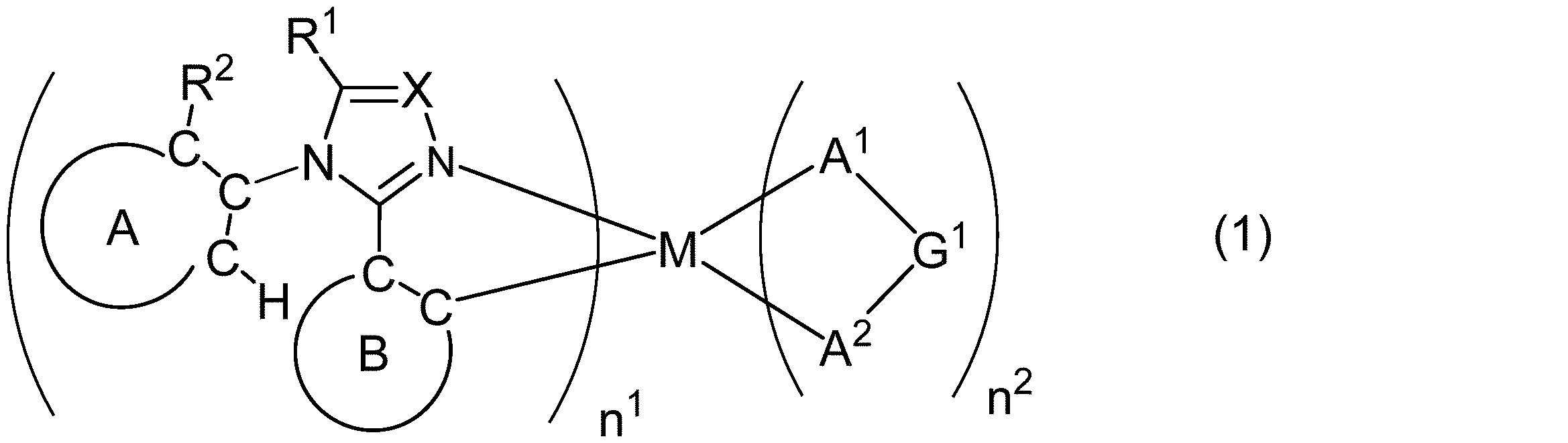
Xは窒素原子又は=C(RX)-で表される基を表す。RXは水素原子、アルキル基、シクロアルキル基、アルコキシ基、シクロアルコキシ基、アリール基、アリールオキシ基、1価の複素環基、置換アミノ基又はハロゲン原子を表し、これらの基は置換基を有していてもよい。Xが複数存在する場合、それらは同一であっても異なっていてもよい。
R1は炭素原子数4以上のアルキル基を表し、該基は置換基を有していてもよい。R1が複数存在する場合、それらは同一であっても異なっていてもよい。
R2はアルキル基、シクロアルキル基、アルコキシ基、シクロアルコキシ基、アリール基、アリールオキシ基、1価の複素環基、置換アミノ基又はハロゲン原子を表し、これらの基は置換基を有していてもよい。R2が複数存在する場合、それらは同一であっても異なっていてもよい。
環A及び環Bは、それぞれ独立に、芳香族炭化水素環又は芳香族複素環を表し、これらの環は置換基を有していてもよい。該置換基が複数存在する場合、それらは同一であっても異なっていてもよく、互いに結合して、それぞれが結合する原子とともに環を形成していてもよい。環A及び環Bが複数存在する場合、それらはそれぞれ同一であっても異なっていてもよい。
Mはロジウム原子、パラジウム原子、イリジウム原子又は白金原子を表す。
n1は1以上の整数を表し、n2は0以上の整数を表し、n1+n2は2又は3である。
Mがロジウム原子又はイリジウム原子の場合、n1+n2は3であり、Mがパラジウム原子又は白金原子の場合、n1+n2は2である。
A1-G1-A2は、アニオン性の2座配位子を表す。A1及びA2は、それぞれ独立に、炭素原子、酸素原子又は窒素原子を表し、これらの原子は環を構成する原子であってもよい。G1は、単結合、又は、A1及びA2とともに2座配位子を構成する原子団を表す。A1-G1-A2が複数存在する場合、それらは同一であっても異なっていてもよい。]
[2]環Bが、ベンゼン環、フルオレン環、ジベンゾフラン環又はジベンゾチオフェン環である、[1]に記載の金属錯体。
[3]式(1a)で表される、[2]に記載の金属錯体。

M、n1、n2、R1、R2、環A、X及びA1-G1-A2は、前記と同じ意味を表す。
R3、R4、R5及びR6は、それぞれ独立に、水素原子、アルキル基、シクロアルキル基、アルコキシ基、シクロアルコキシ基、アリール基、アリールオキシ基、1価の複素環基、置換アミノ基又はハロゲン原子を表し、これらの基は置換基を有していてもよい。
R3、R4、R5及びR6が複数存在する場合、それらはそれぞれ同一であっても異なっていてもよい。R3とR4、R4とR5、及び、R5とR6は、それぞれ結合して、それぞれが結合する炭素原子とともに環を形成していてもよい。]
[4]式(1b)で表される、[3]に記載の金属錯体。
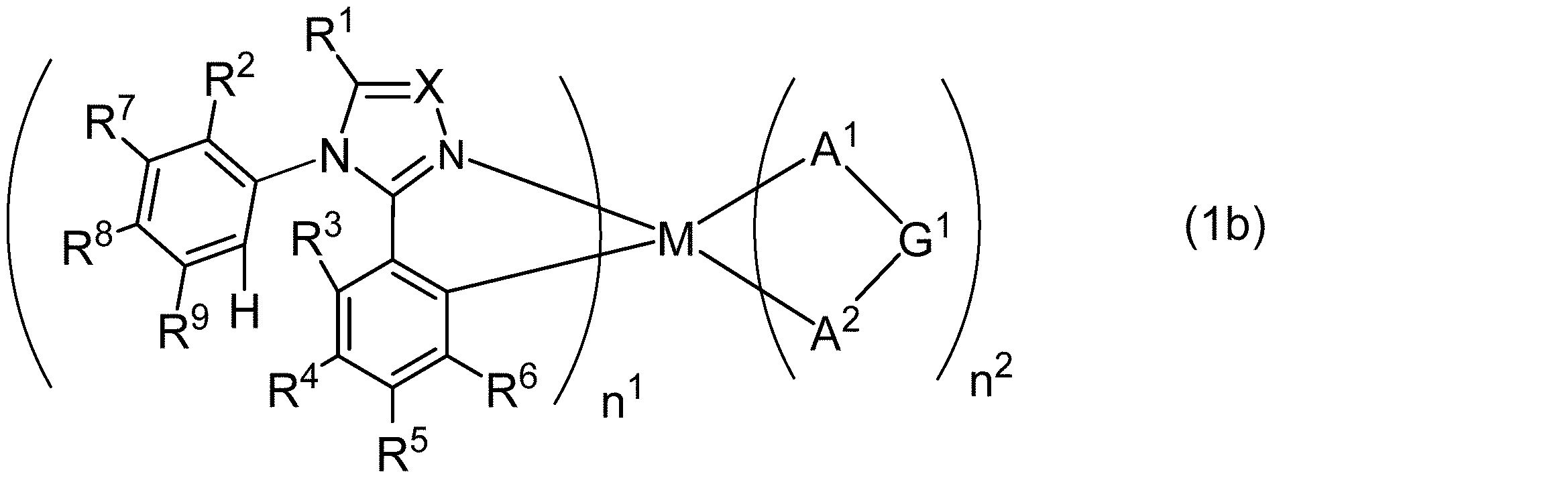
M、n1、n2、R1、R2、R3、R4、R5、R6、X及びA1-G1-A2は、前記と同じ意味を表す。
R7、R8及びR9は、それぞれ独立に、水素原子、アルキル基、シクロアルキル基、アルコキシ基、シクロアルコキシ基、アリール基、アリールオキシ基、1価の複素環基、置換アミノ基又はハロゲン原子を表し、これらの基は置換基を有していてもよい。R7、R8及びR9が複数存在する場合、それらはそれぞれ同一であっても異なっていてもよい。R7とR8、R8とR9は、それぞれが結合して、それぞれが結合する炭素原子とともに環を形成していてもよい。]
[5]少なくとも一つのR1が、式(2)で表される基である、[1]~[4]のいずれかに記載の金属錯体。
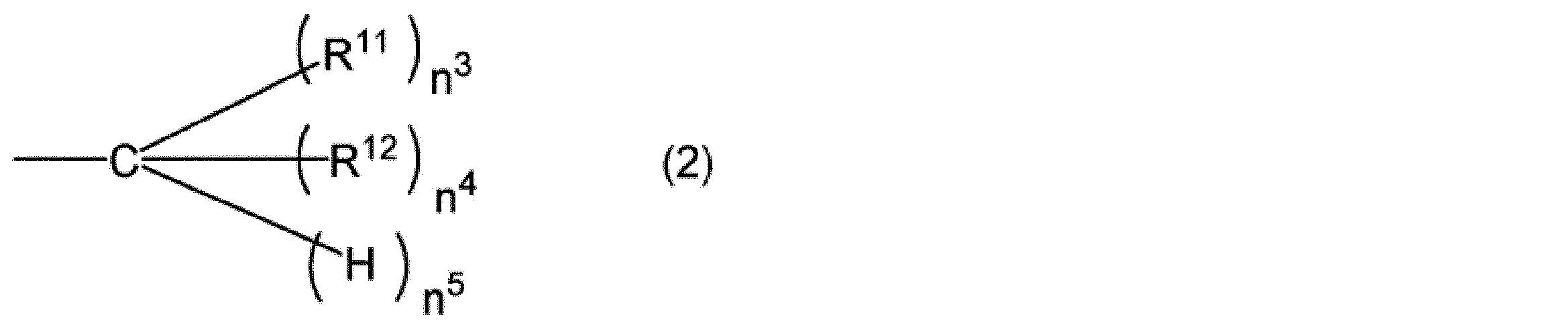
R11はアルキル基を表し、該基は置換基を有していてもよい。R11が複数存在する場合、それらは同一であっても異なっていてもよい。
R12はシクロアルキル基、アルコキシ基、シクロアルコキシ基、アリール基、アリールオキシ基、1価の複素環基、置換アミノ基又はハロゲン原子を表し、これらの基は置換基を有していてもよい。R12が複数存在する場合、それらは同一であっても異なっていてもよい。
n3は1~3の整数を表し、n4は0~2の整数を表し、n5は0又は1を表し、n3+n4+n5は3である。]
[6]n5が0である、[5]に記載の金属錯体。
[7]n4が0である、[5]又は[6]に記載の金属錯体。
[8]R2が置換基を有していてもよいアルキル基である、[1]~[7]のいずれかに記載の金属錯体。
[9]Mが白金原子又はイリジウム原子である、[1]~[8]のいずれかに記載の金属錯体。
[10]n2が0である、[1]~[9]のいずれかに記載の金属錯体。
[11]Xが窒素原子である、[1]~[10]のいずれかに記載の金属錯体。
[12][1]~[11]のいずれかに記載の金属錯体と、
式(H-1)で表される化合物及び式(Y)で表される構成単位を含む高分子化合物からなる群より選択される少なくとも一種と、
を含有する、組成物。

ArH1及びArH2は、それぞれ独立に、アリール基又は1価の複素環基を表し、これらの基は置換基を有していてもよい。
nH1及びnH2は、それぞれ独立に、0又は1を表す。nH1が複数存在する場合、それらは同一であっても異なっていてもよい。複数存在するnH2は、同一であっても異なっていてもよい。
nH3は、0以上の整数を表す。
LH1は、アリーレン基、2価の複素環基、又は、-[C(RH11)2]nH11-で表される基を表し、これらの基は置換基を有していてもよい。LH1が複数存在する場合、それらは同一であっても異なっていてもよい。
nH11は、1以上10以下の整数を表す。RH11は、水素原子、アルキル基、シクロアルキル基、アルコキシ基、シクロアルコキシ基、アリール基又は1価の複素環基を表し、これらの基は置換基を有していてもよい。複数存在するRH11は、同一であっても異なっていてもよく、互いに結合して、それぞれが結合する炭素原子とともに環を形成していてもよい。
LH2は、-N(-LH21-RH21)-で表される基を表す。LH2が複数存在する場合、それらは同一であっても異なっていてもよい。
LH21は、単結合、アリーレン基又は2価の複素環基を表し、これらの基は置換基を有していてもよい。RH21は、水素原子、アルキル基、シクロアルキル基、アリール基又は1価の複素環基を表し、これらの基は置換基を有していてもよい。]

[13][1]~[11]のいずれかに記載の金属錯体と、
正孔輸送材料、正孔注入材料、電子輸送材料、電子注入材料、発光材料、酸化防止剤及び溶媒からなる群より選ばれる少なくとも1種の材料と、
を含有する、組成物。
[14][1]~[11]のいずれかに記載の金属錯体を含有する、膜。
[15][1]~[11]のいずれかに記載の金属錯体を含有する、発光素子。
本明細書で共通して用いられる用語は、特記しない限り、以下の意味である。
アルキル基は、置換基を有していてもよい。アルキル基としては、例えば、メチル基、エチル基、プロピル基、イソプロピル基、ブチル基、2-ブチル基、イソブチル基、tert-ブチル基、ペンチル基、イソアミル基、2-エチルブチル基、ヘキシル基、ヘプチル基、オクチル基、2-エチルヘキシル基、3-プロピルヘプチル基、デシル基、3,7-ジメチルオクチル基、2-エチルオクチル基、2-ヘキシルデシル基、ドデシル基等が挙げられる。また、アルキル基は、これらの基における水素原子の一部又は全部が、シクロアルキル基、アルコキシ基、シクロアルコキシ基、アリール基、フッ素原子等で置換された基であってもよい。このようなアルキル基としては、例えば、トリフルオロメチル基、ペンタフルオロエチル基、パーフルオロブチル基、パーフルオロヘキシル基、パーフルオロオクチル基、3-フェニルプロピル基、3-(4-メチルフェニル)プロピル基、3-(3,5-ジ-ヘキシルフェニル)プロピル基、6-エチルオキシヘキシル基が挙げられる。
「シクロアルキル基」の炭素原子数は、置換基の炭素原子数を含めないで、通常3~50であり、好ましくは3~30であり、より好ましくは4~20である。
シクロアルキル基は、置換基を有していてもよい。シクロアルキル基としては、例えば、シクロヘキシル基、シクロヘキシルメチル基、シクロヘキシルエチル基が挙げられる。
アリール基は、置換基を有していてもよい。アリール基としては、例えば、フェニル基、1-ナフチル基、2-ナフチル基、1-アントラセニル基、2-アントラセニル基、9-アントラセニル基、1-ピレニル基、2-ピレニル基、4-ピレニル基、2-フルオレニル基、3-フルオレニル基、4-フルオレニル基、2-フェニルフェニル基、3-フェニルフェニル基、4-フェニルフェニル基等が挙げられる。また、アリール基は、これらの基における水素原子の一部又は全部が、アルキル基、シクロアルキル基、アルコキシ基、シクロアルコキシ基、アリール基、フッ素原子等で置換された基であってもよい。
アルコキシ基は、置換基を有していてもよい。アルコキシ基としては、例えば、メトキシ基、エトキシ基、プロピルオキシ基、イソプロピルオキシ基、ブチルオキシ基、イソブチルオキシ基、tert-ブチルオキシ基、ペンチルオキシ基、ヘキシルオキシ基、ヘプチルオキシ基、オクチルオキシ基、2-エチルヘキシルオキシ基、ノニルオキシ基、デシルオキシ基、3,7-ジメチルオクチルオキシ基、ラウリルオキシ基等が挙げられる。また、アルコキシ基は、これらの基における水素原子の一部又は全部が、シクロアルキル基、アルコキシ基、シクロアルコキシ基、アリール基、フッ素原子等で置換された基であってもよい。
「シクロアルコキシ基」の炭素原子数は、置換基の炭素原子数を含めないで、通常3~40であり、好ましくは4~10である。
シクロアルコキシ基は、置換基を有していてもよい。シクロアルコキシ基としては、例えば、シクロヘキシルオキシ基が挙げられる。
アリールオキシ基は、置換基を有していてもよい。アリールオキシ基としては、例えば、フェノキシ基、1-ナフチルオキシ基、2-ナフチルオキシ基、1-アントラセニルオキシ基、9-アントラセニルオキシ基、1-ピレニルオキシ基等が挙げられる。また、アリールオキシ基は、これらの基における水素原子の一部又は全部が、アルキル基、シクロアルキル基、アルコキシ基、シクロアルコキシ基、フッ素原子等で置換された基であってもよい。
「芳香族複素環式化合物」は、オキサジアゾール、チアジアゾール、チアゾール、オキサゾール、チオフェン、ピロール、ホスホール、フラン、ピリジン、ピラジン、ピリミジン、トリアジン、ピリダジン、キノリン、イソキノリン、カルバゾール、ジベンゾホスホール等の複素環自体が芳香族性を示す化合物、及び、フェノキサジン、フェノチアジン、ジベンゾボロール、ジベンゾシロール、ベンゾピラン等の複素環自体は芳香族性を示さなくとも、複素環に芳香環が縮環されている化合物を意味する。
p価の複素環基は、置換基を有していてもよい。p価の複素環基のうち、1価の複素環基としては、例えば、チエニル基、ピロリル基、フリル基、ピリジニル基、ピペリジニル基、キノリニル基、イソキノリニル基、ピリミジニル基、トリアジニル基等が挙げられる。また、1価の複素環基は、これらの基における水素原子の一部又は全部が、アルキル基、シクロアルキル基、アルコキシ基、シクロアルコキシ基等で置換された基であってもよい。
置換アミノ基としては、二置換アミノ基が好ましい。二置換アミノ基としては、例えば、ジアルキルアミノ基、ジシクロアルキルアミノ基及びジアリールアミノ基が挙げられる。
二置換アミノ基としては、例えば、ジメチルアミノ基、ジエチルアミノ基、ジフェニルアミノ基、ビス(4-メチルフェニル)アミノ基、ビス(4-tert-ブチルフェニル)アミノ基、ビス(3,5-ジ-tert-ブチルフェニル)アミノ基が挙げられる。
「シクロアルケニル基」の炭素原子数は、置換基の炭素原子数を含めないで、通常3~30であり、好ましくは4~20である。
アルケニル基及びシクロアルケニル基は、置換基を有していてもよい。アルケニル基としては、例えば、ビニル基、1-プロペニル基、2-プロペニル基、2-ブテニル基、3-ブテニル基、3-ペンテニル基、4-ペンテニル基、1-ヘキセニル基、5-ヘキセニル基、7-オクテニル基、及び、これらの基における水素原子の一部又は全部が置換基で置換された基が挙げられる。シクロアルケニル基としては、例えば、シクロヘキセニル基、2-ノルボルニレニル基が挙げられる。
「シクロアルキニル基」の炭素原子数は、置換基の炭素原子を含めないで、通常4~30であり、好ましくは4~20である。
アルキニル基及びシクロアルキニル基は、置換基を有していてもよい。アルキニル基としては、例えば、エチニル基、1-プロピニル基、2-プロピニル基、2-ブチニル基、3-ブチニル基、3-ペンチニル基、4-ペンチニル基、1-ヘキシニル基、5-ヘキシニル基、及び、これらの基における水素原子の一部又は全部が置換基で置換された基が挙げられる。
アリーレン基は、置換基を有していてもよい。アリーレン基としては、例えば、フェニレン基、ナフタレンジイル基、アントラセンジイル基、フェナントレンジイル基、ジヒドロフェナントレンジイル基、ナフタセンジイル基、フルオレンジイル基、ピレンジイル基、ペリレンジイル基、クリセンジイル基、及び、これらの基における水素原子の一部又は全部が置換基で置換された基が挙げられる。アリーレン基は、好ましくは、式(A-1)~式(A-20)で表される基である。アリーレン基は、これらの基が複数結合した基を含む。
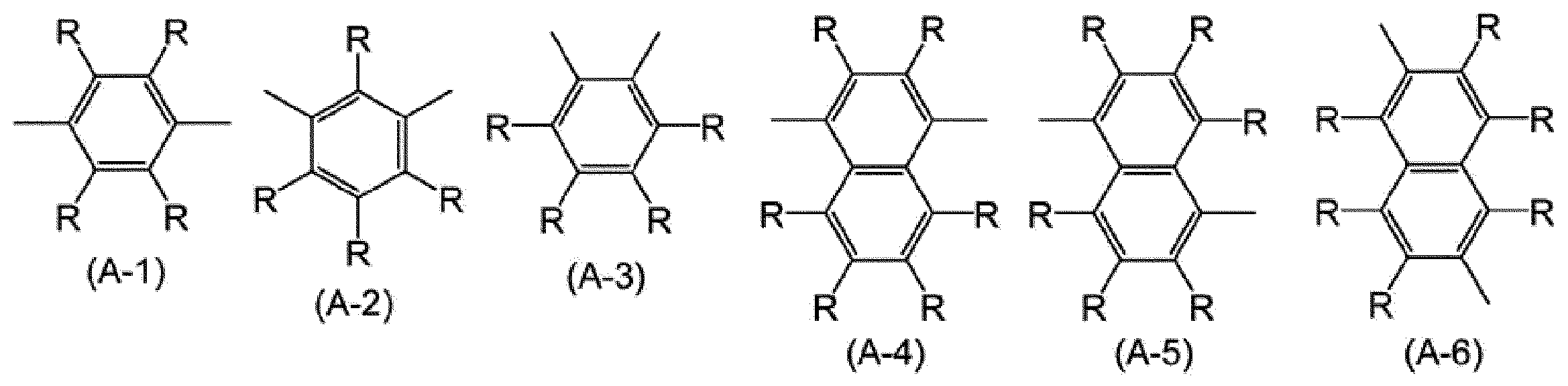


2価の複素環基は、置換基を有していてもよい。2価の複素環基としては、例えば、ピリジン、ジアザベンゼン、トリアジン、アザナフタレン、ジアザナフタレン、カルバゾール、ジベンゾフラン、ジベンゾチオフェン、ジベンゾシロール、フェノキサジン、フェノチアジン、アクリジン、ジヒドロアクリジン、フラン、チオフェン、アゾール、ジアゾール、トリアゾールから、環を構成する炭素原子又はヘテロ原子に直接結合している水素原子のうち2個の水素原子を除いた2価の基、及び、これらの基における水素原子の一部又は全部が置換基で置換された基が挙げられる。2価の複素環基は、好ましくは、式(AA-1)~式(AA-34)で表される基である。2価の複素環基は、これらの基が複数結合した基を含む。


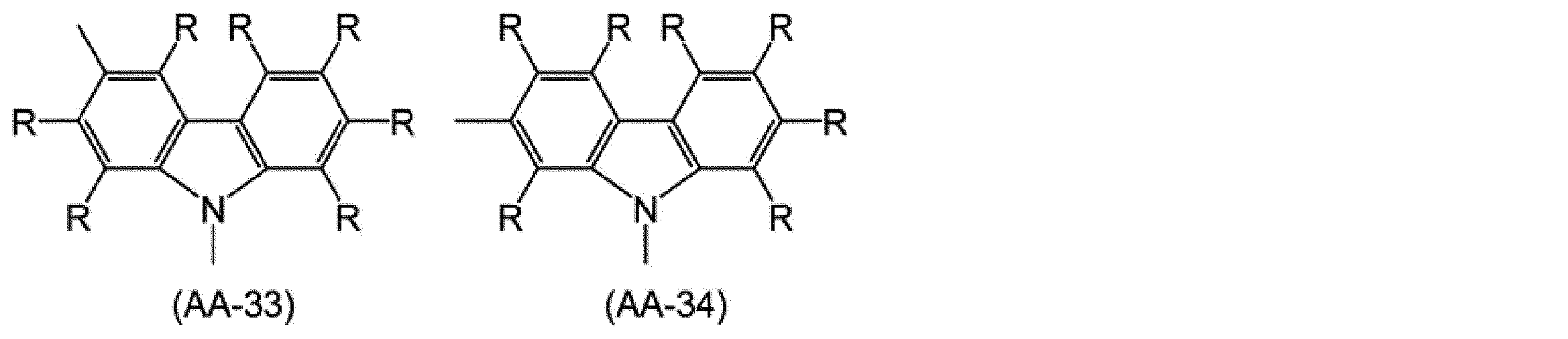
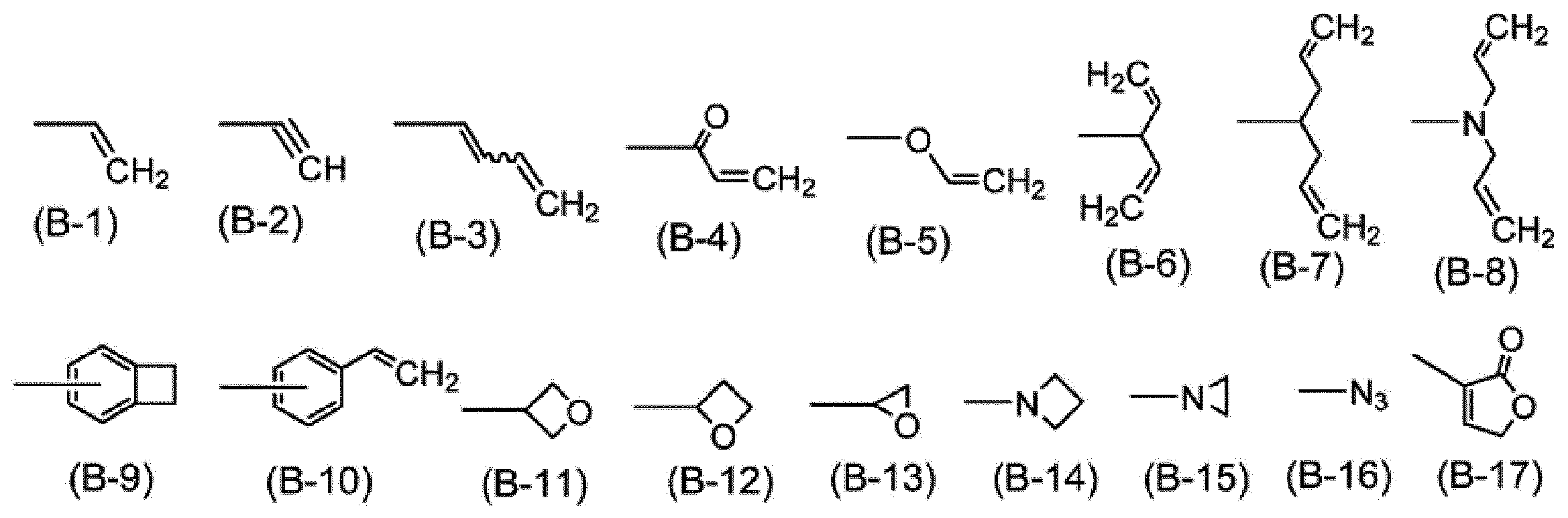
本実施形態に係る金属錯体は、発光安定性が優れるので、本実施形態に係る金属錯体を含有する組成物、膜及び発光素子の発光安定性も優れたものとなる。

mDA1、mDA2及びmDA3は、それぞれ独立に、0以上の整数を表す。
GDAは、窒素原子、芳香族炭化水素基又は複素環基を表し、これらの基は置換基を有していてもよい。
ArDA1、ArDA2及びArDA3は、それぞれ独立に、アリーレン基又は2価の複素環基を表し、これらの基は置換基を有していてもよい。ArDA1、ArDA2及びArDA3が複数存在する場合、それらはそれぞれ同一であっても異なっていてもよい。
TDAは、アリール基又は1価の複素環基を表し、これらの基は置換基を有していてもよい。複数存在するTDAは、同一であっても異なっていてもよい。

mDA1、mDA2、mDA3、mDA4、mDA5、mDA6及びmDA7は、それぞれ独立に、0以上の整数を表す。
GDAは、窒素原子、芳香族炭化水素基又は複素環基を表し、これらの基は置換基を有していてもよい。複数存在するGDAは、同一であっても異なっていてもよい。
ArDA1、ArDA2、ArDA3、ArDA4、ArDA5、ArDA6及びArDA7は、それぞれ独立に、アリーレン基又は2価の複素環基を表し、これらの基は置換基を有していてもよい。ArDA1、ArDA2、ArDA3、ArDA4、ArDA5、ArDA6及びArDA7が複数存在する場合、それらはそれぞれ同一であっても異なっていてもよい。
TDAは、アリール基又は1価の複素環基を表し、これらの基は置換基を有していてもよい。複数存在するTDAは、同一であっても異なっていてもよい。

*は、式(D-A)におけるArDA1、式(D-B)におけるArDA1、式(D-B)におけるArDA2、又は、式(D-B)におけるArDA3との結合を表す。
**は、式(D-A)におけるArDA2、式(D-B)におけるArDA2、式(D-B)におけるArDA4、又は、式(D-B)におけるArDA6との結合を表す。
***は、式(D-A)におけるArDA3、式(D-B)におけるArDA3、式(D-B)におけるArDA5、又は、式(D-B)におけるArDA7との結合を表す。
RDAは、水素原子、アルキル基、シクロアルキル基、アルコキシ基、シクロアルコキシ基、アリール基又は1価の複素環基を表し、これらの基は更に置換基を有していてもよい。RDAが複数存在する場合、それらは同一であっても異なっていてもよい。
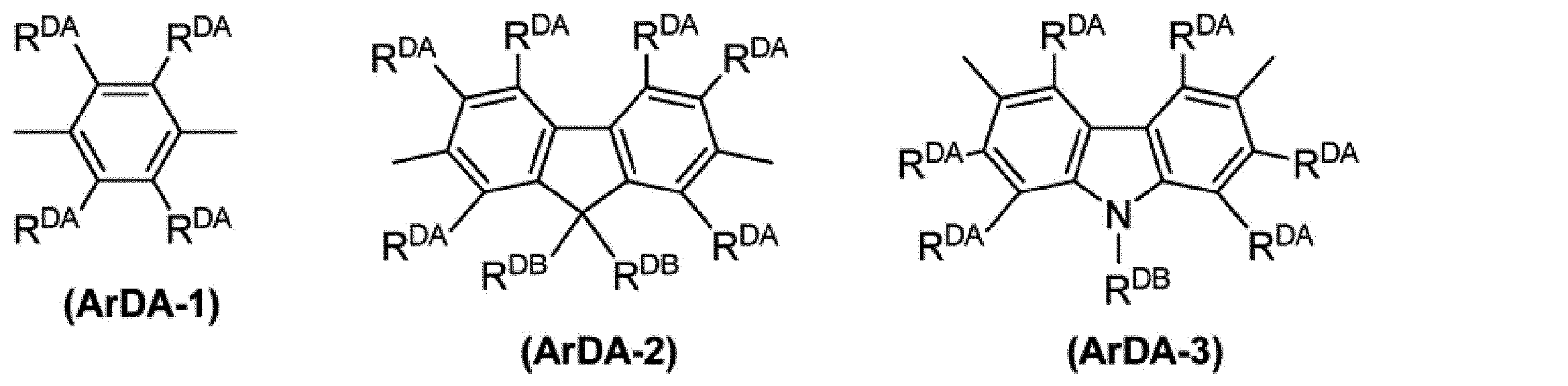
RDAは上記と同じ意味を表す。
RDBは、水素原子、アルキル基、シクロアルキル基、アリール基又は1価の複素環基を表し、これらの基は置換基を有していてもよい。RDBが複数存在する場合、それらは同一であっても異なっていてもよい。
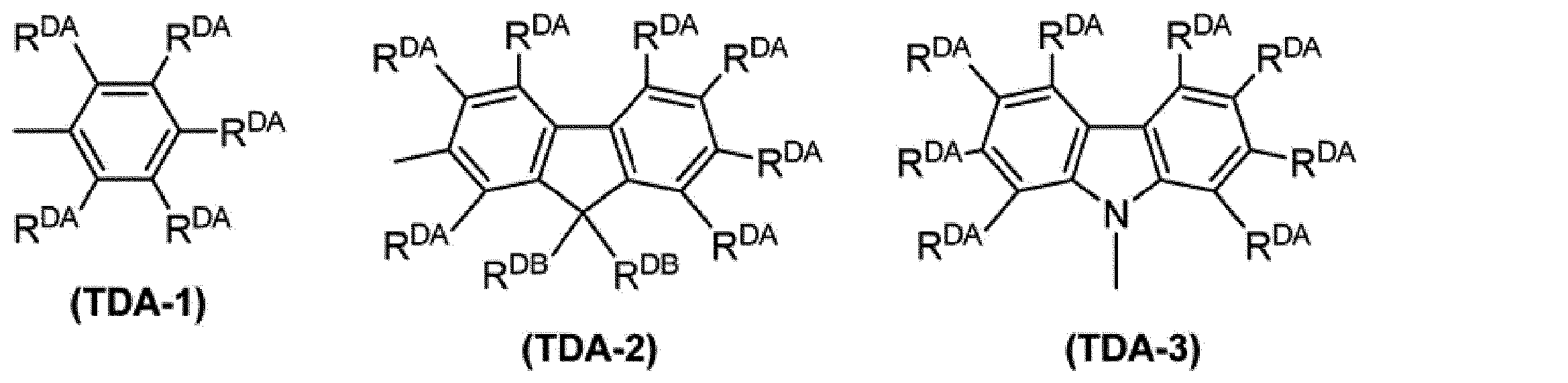

Rp1、Rp2及びRp3は、それぞれ独立に、アルキル基、シクロアルキル基、アルコキシ基、シクロアルコキシ基又はハロゲン原子を表す。Rp1及びRp2が複数存在する場合、それらはそれぞれ同一であっても異なっていてもよい。
np1は、0~5の整数を表し、np2は0~3の整数を表し、np3は0又は1を表す。複数存在するnp1は、同一であっても異なっていてもよい。

Rp1、Rp2及びRp3は、それぞれ独立に、アルキル基、シクロアルキル基、アルコキシ基、シクロアルコキシ基又はハロゲン原子を表す。Rp1及びRp2が複数存在する場合、それらはそれぞれ同一であっても異なっていてもよい。
np1は0~5の整数を表し、np2は0~3の整数を表し、np3は0又は1を表す。np1及びnp2が複数存在する場合、それらはそれぞれ同一であっても異なっていてもよい。
次に、本実施形態に係る金属錯体について説明する。本実施形態に係る金属錯体は、式(1)で表される。
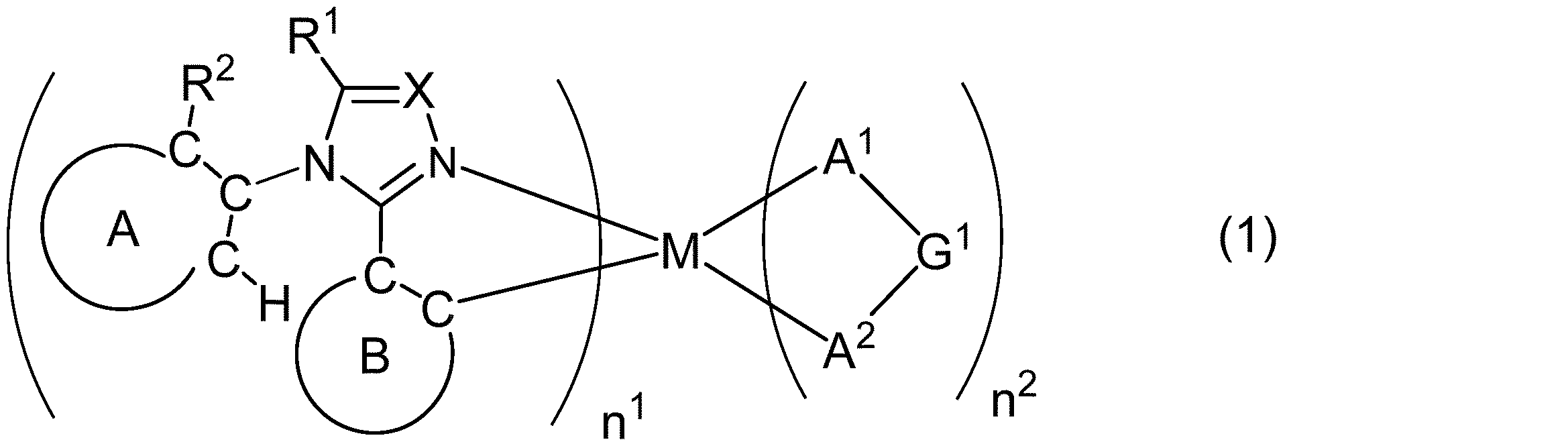

n5は、金属錯体の発光安定性が優れるので、0であることが好ましい。
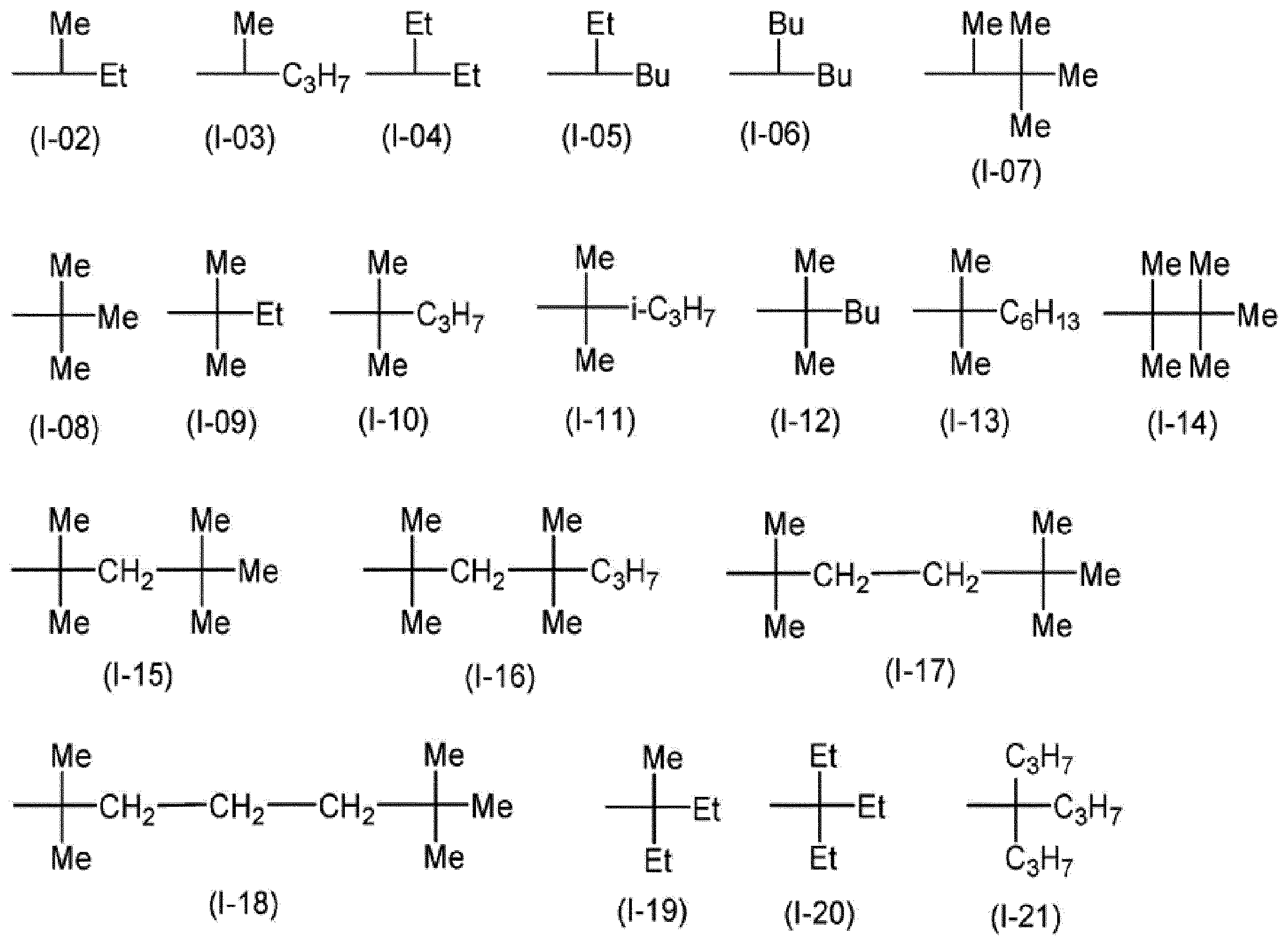

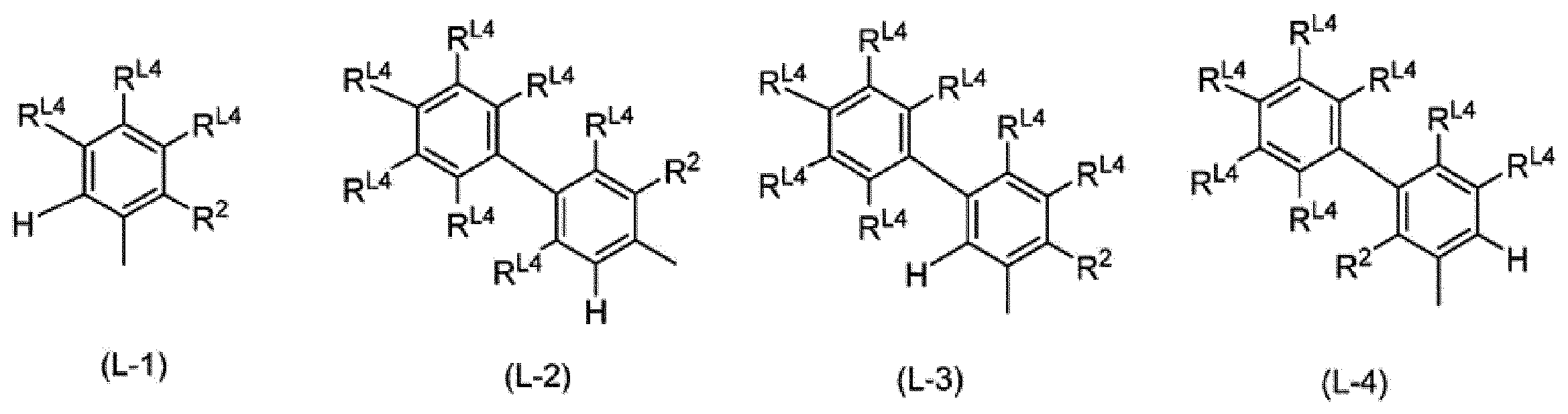
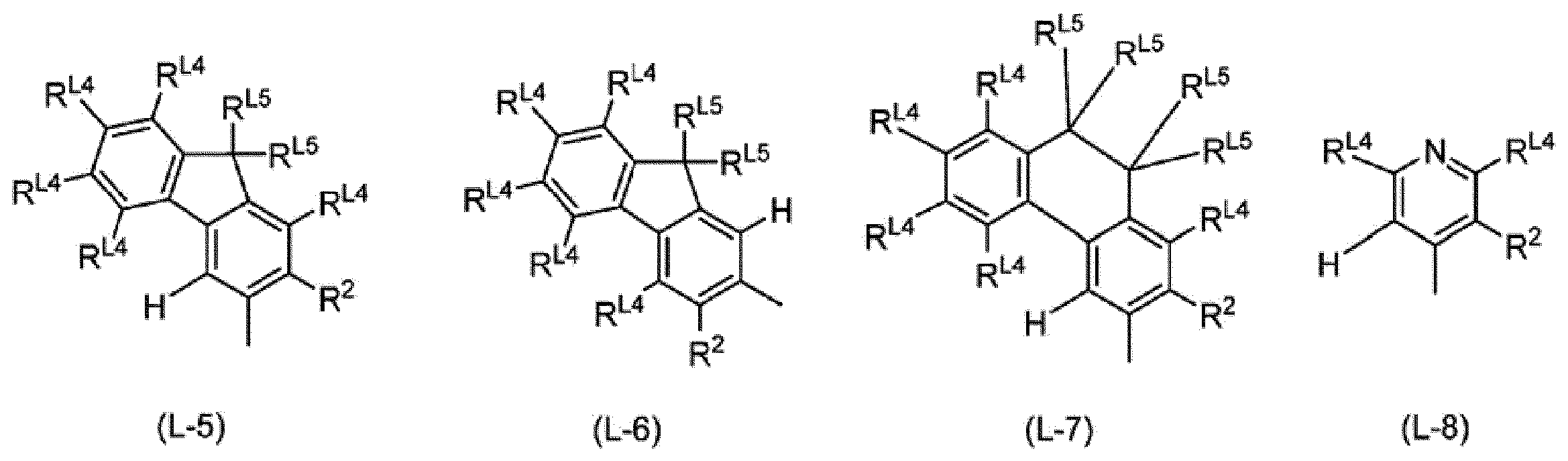
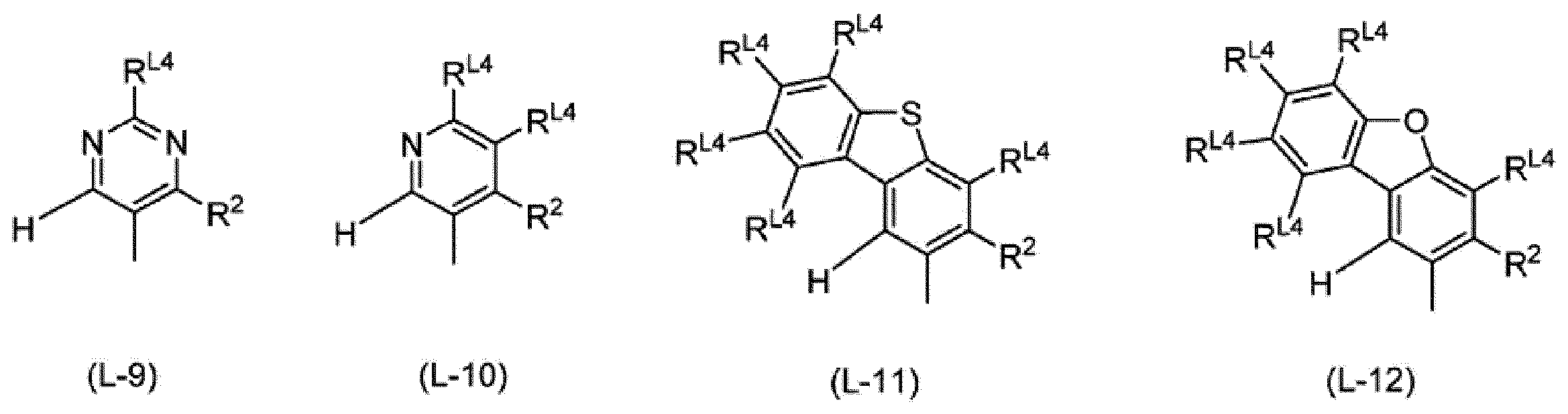

RL4は、水素原子、アルキル基、シクロアルキル基、アリール基、1価の複素環基又は置換アミノ基を表し、これらの基は置換基を有していてもよい。複数存在するRL4は、同一であっても異なっていてもよく、隣接するRL4同士は互いに結合して、それぞれが結合する炭素原子とともに環を形成していてもよい。
RL5は、アルキル基、シクロアルキル基、アリール基、1価の複素環基又は置換アミノ基を表し、これらの基は置換基を有していてもよい。複数存在するRL5は、同一であっても異なっていてもよく、互いに結合して、それぞれが結合する炭素原子とともに環を形成していてもよい。


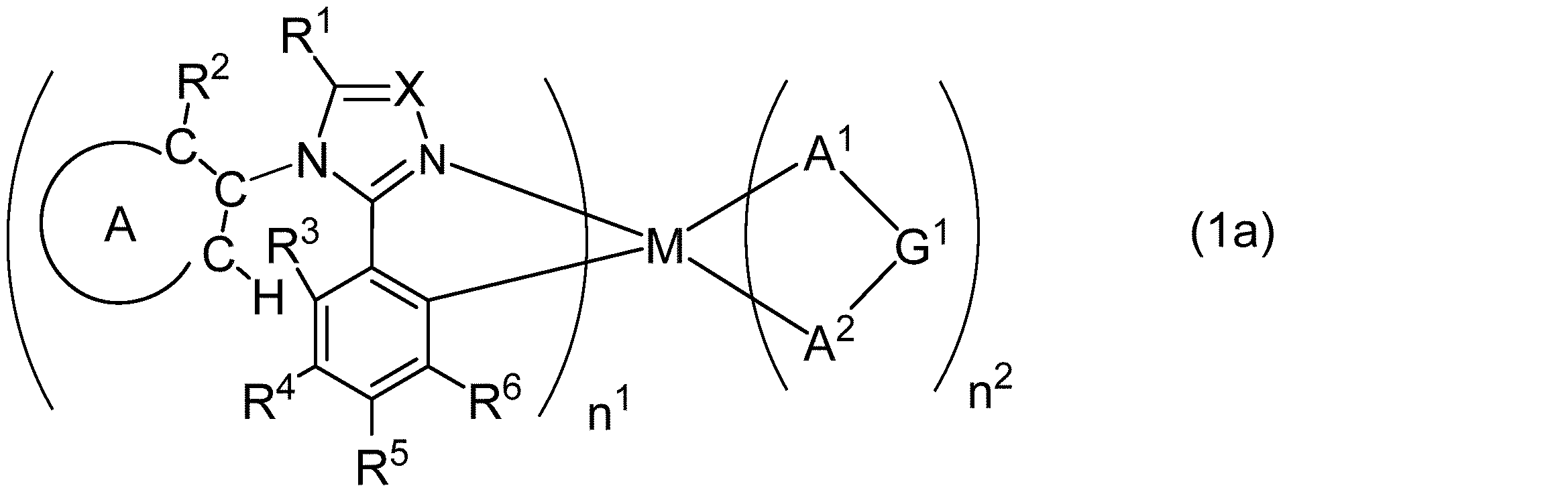

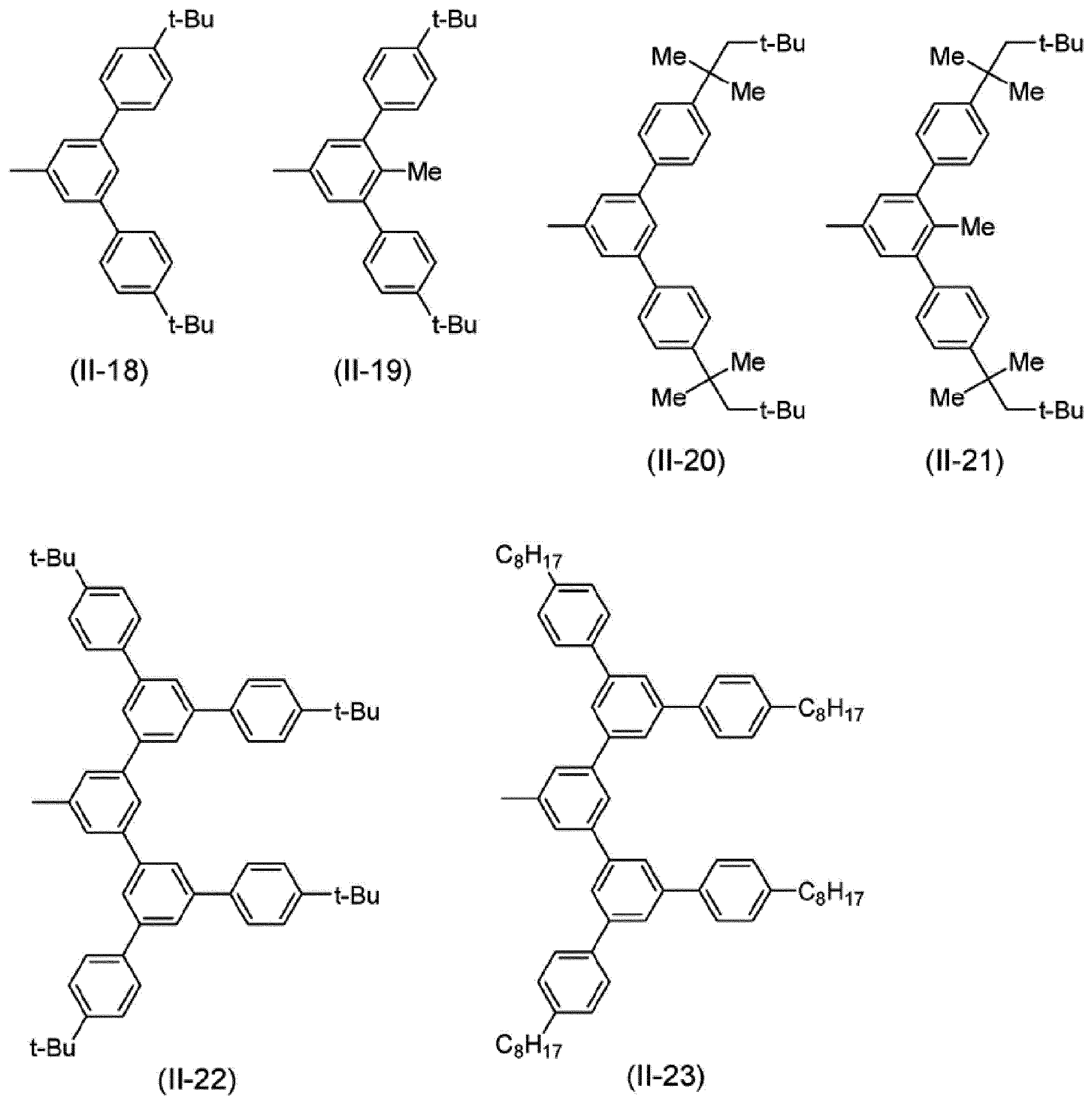


好適な一態様において、R7及びR9は水素原子であってよい。このとき、R8は、水素原子であっても、水素原子以外の基(好ましくは、置換基を有していてもよいアルキル基又は置換基を有していてもよいアリール基)であってもよい。
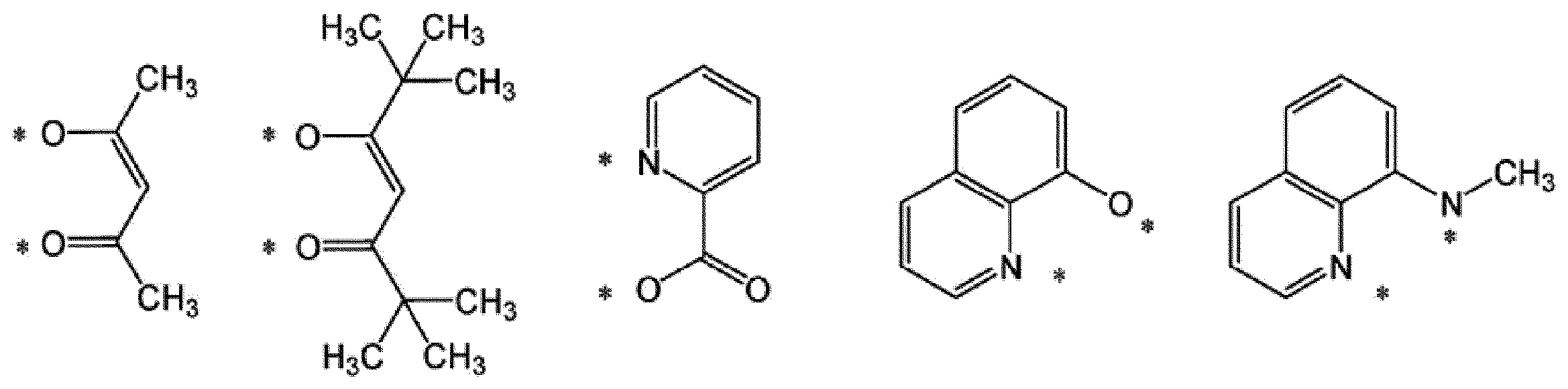
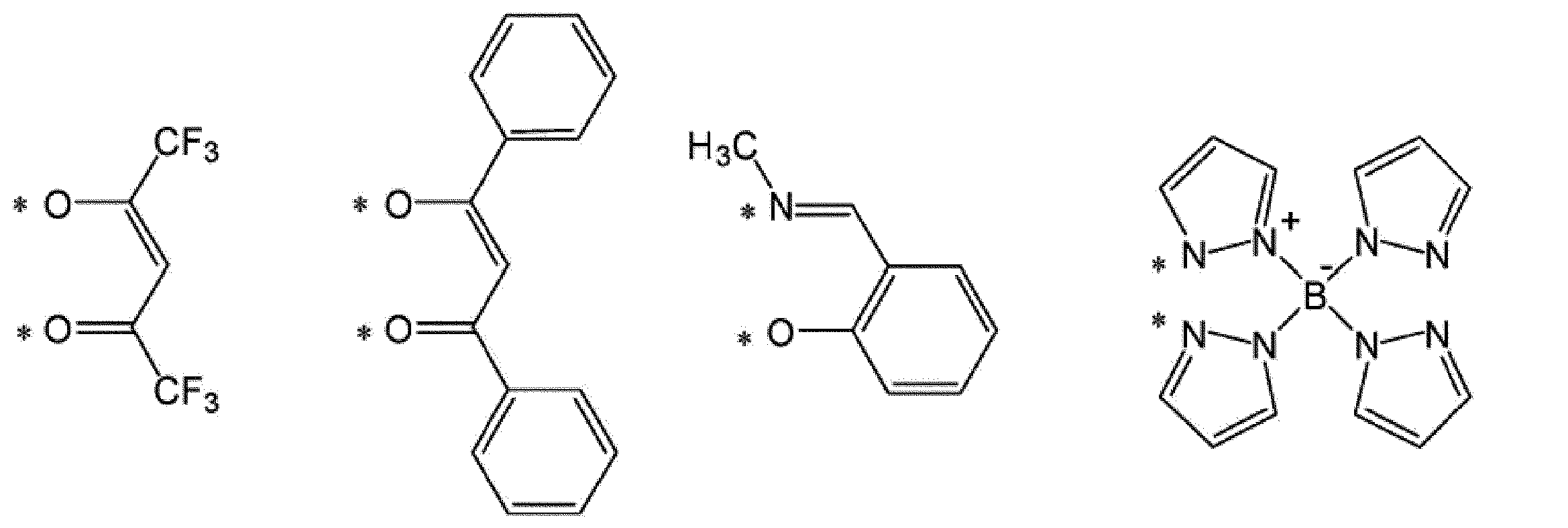

RL1は、水素原子、アルキル基、シクロアルキル基、アリール基、1価の複素環基又はハロゲン原子を表し、これらの基は置換基を有していてもよい。複数存在するRL1は、同一であっても異なっていてもよい。
RL2は、アルキル基、シクロアルキル基、アリール基、1価の複素環基又はハロゲン原子を表し、これらの基は置換基を有していてもよい。
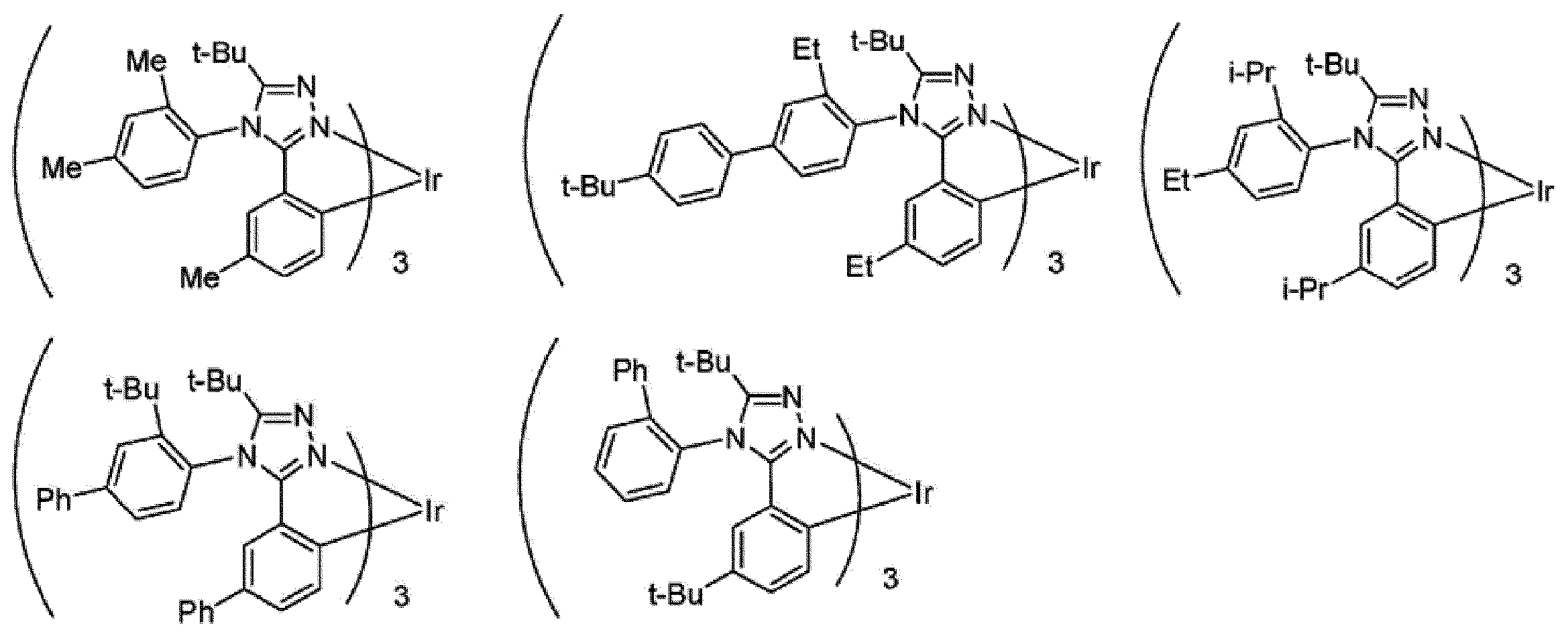

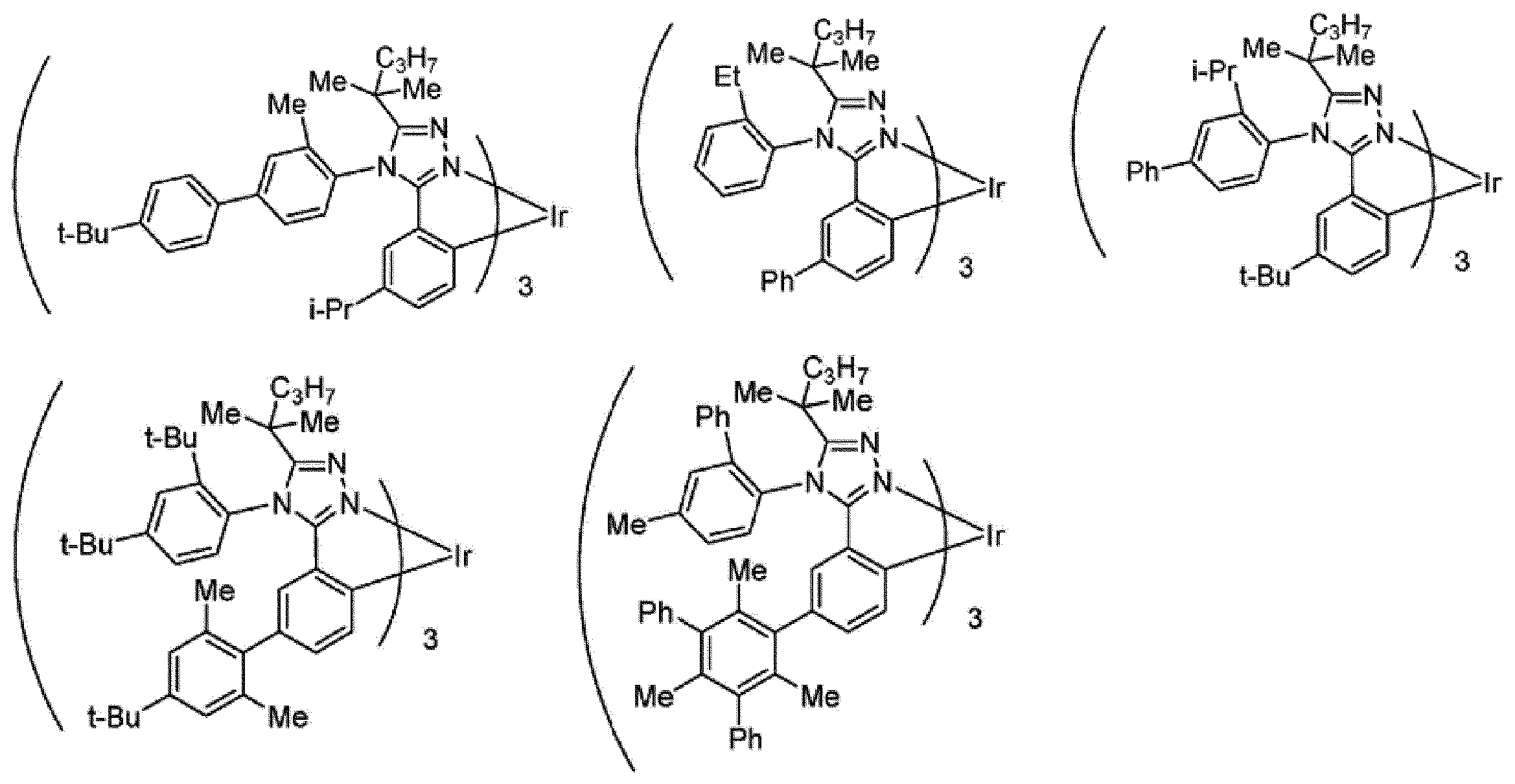


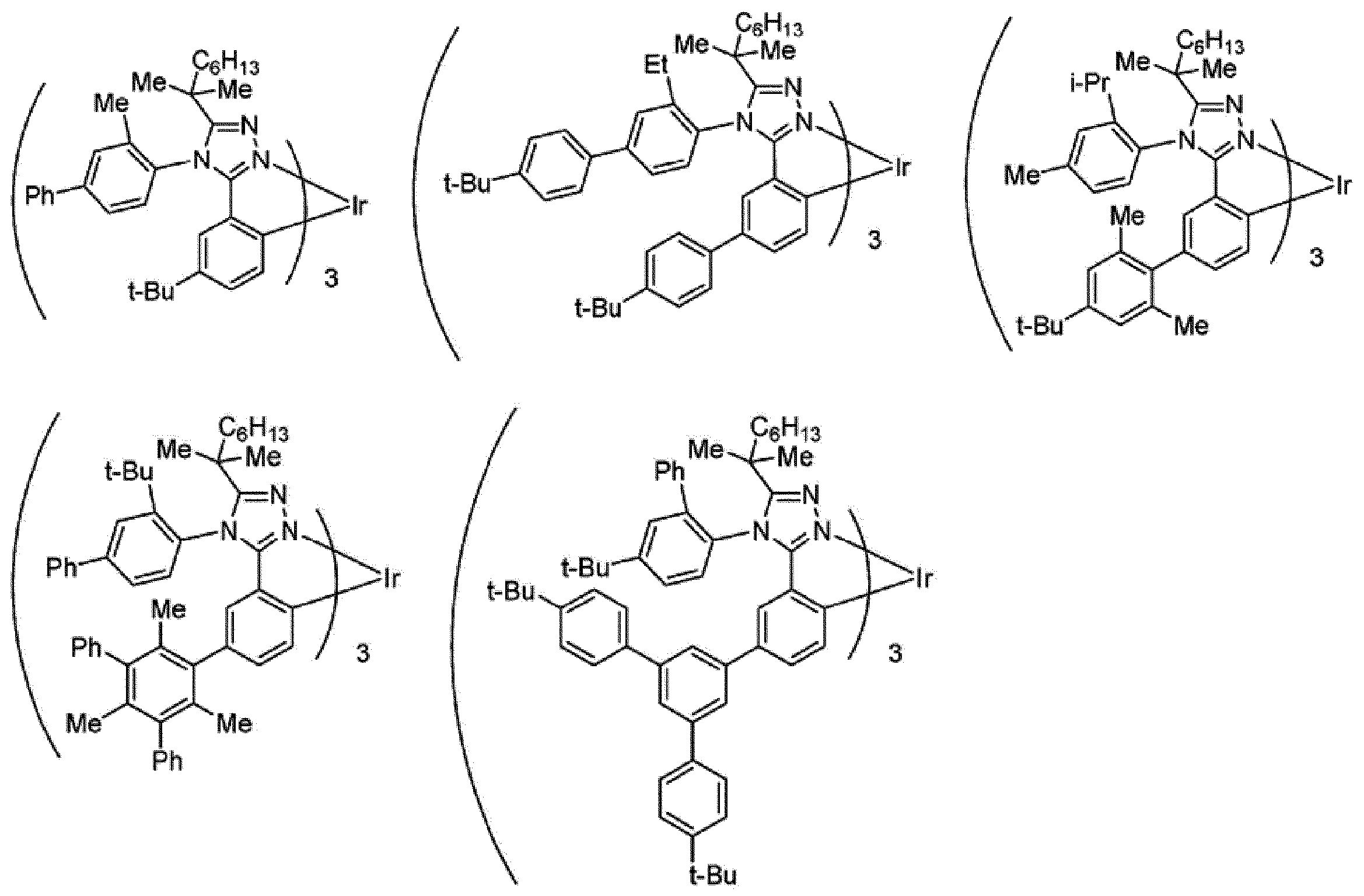
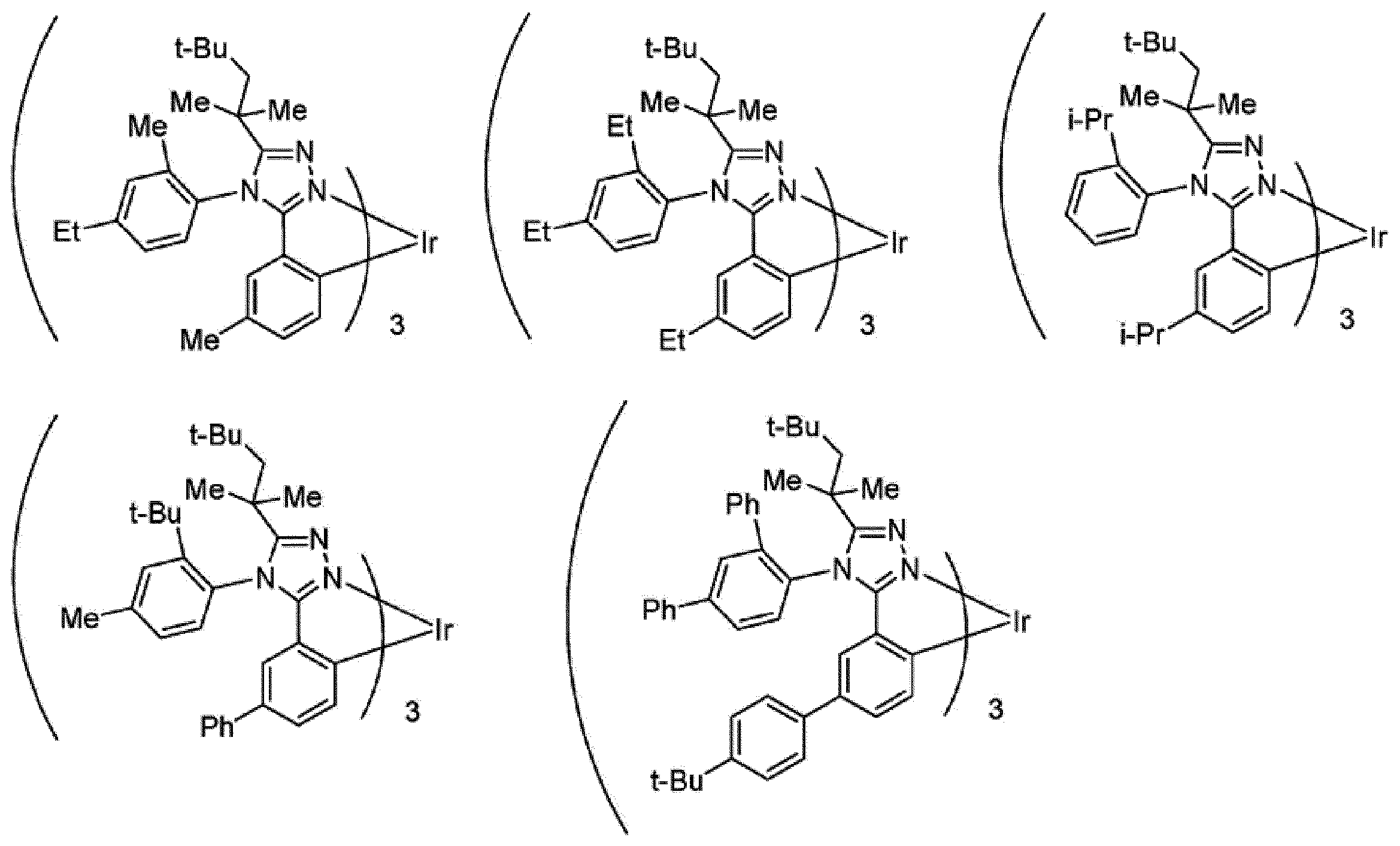
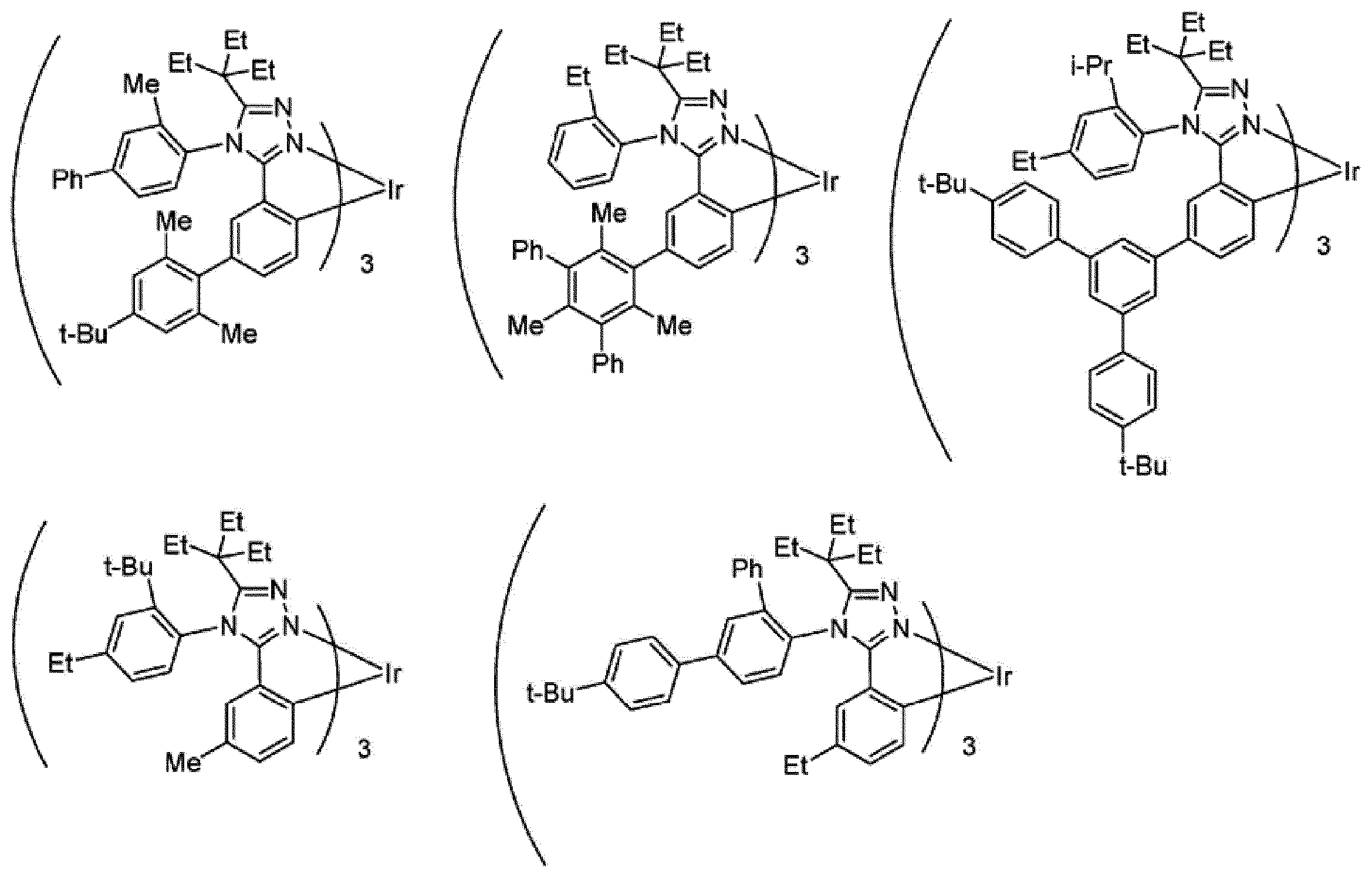
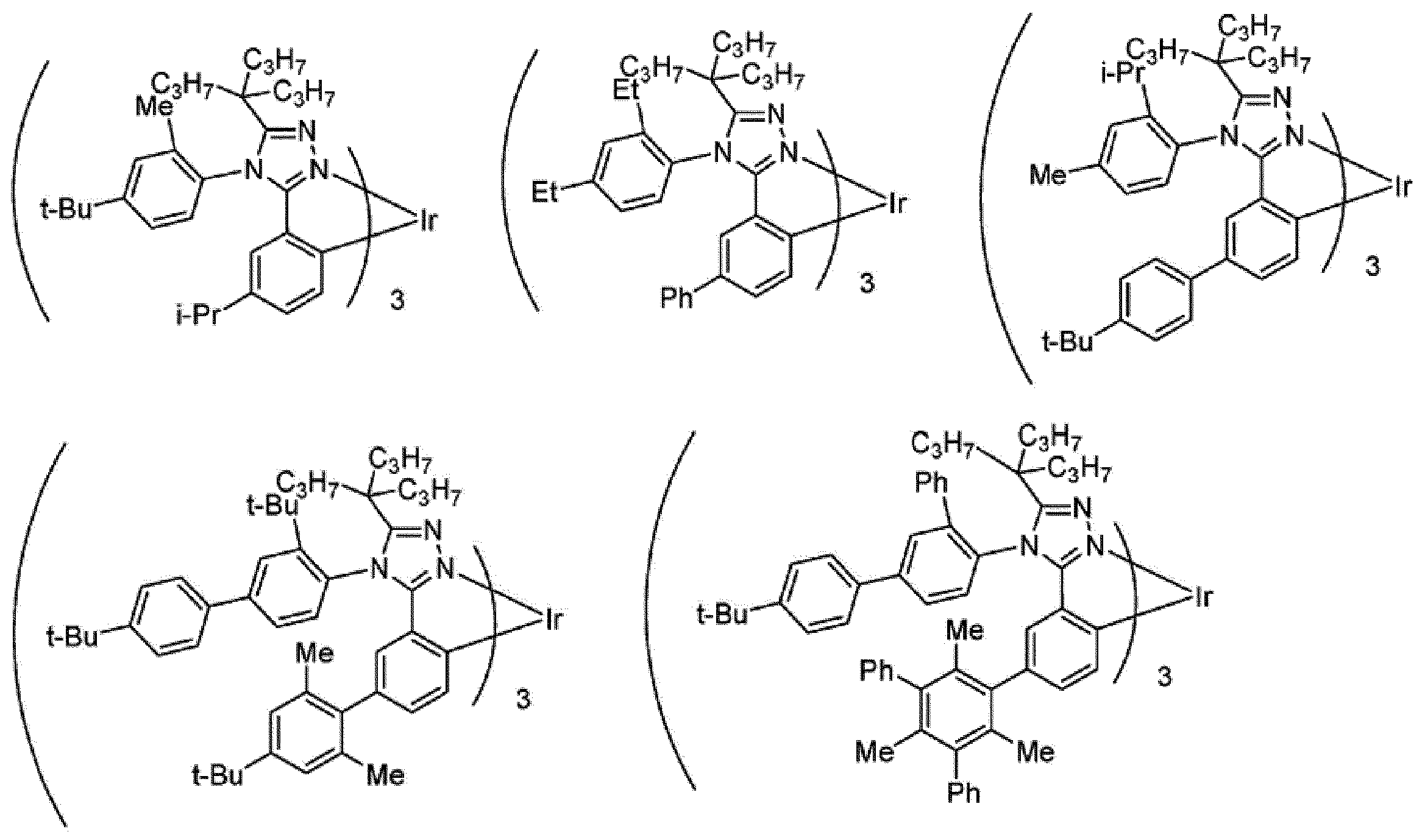

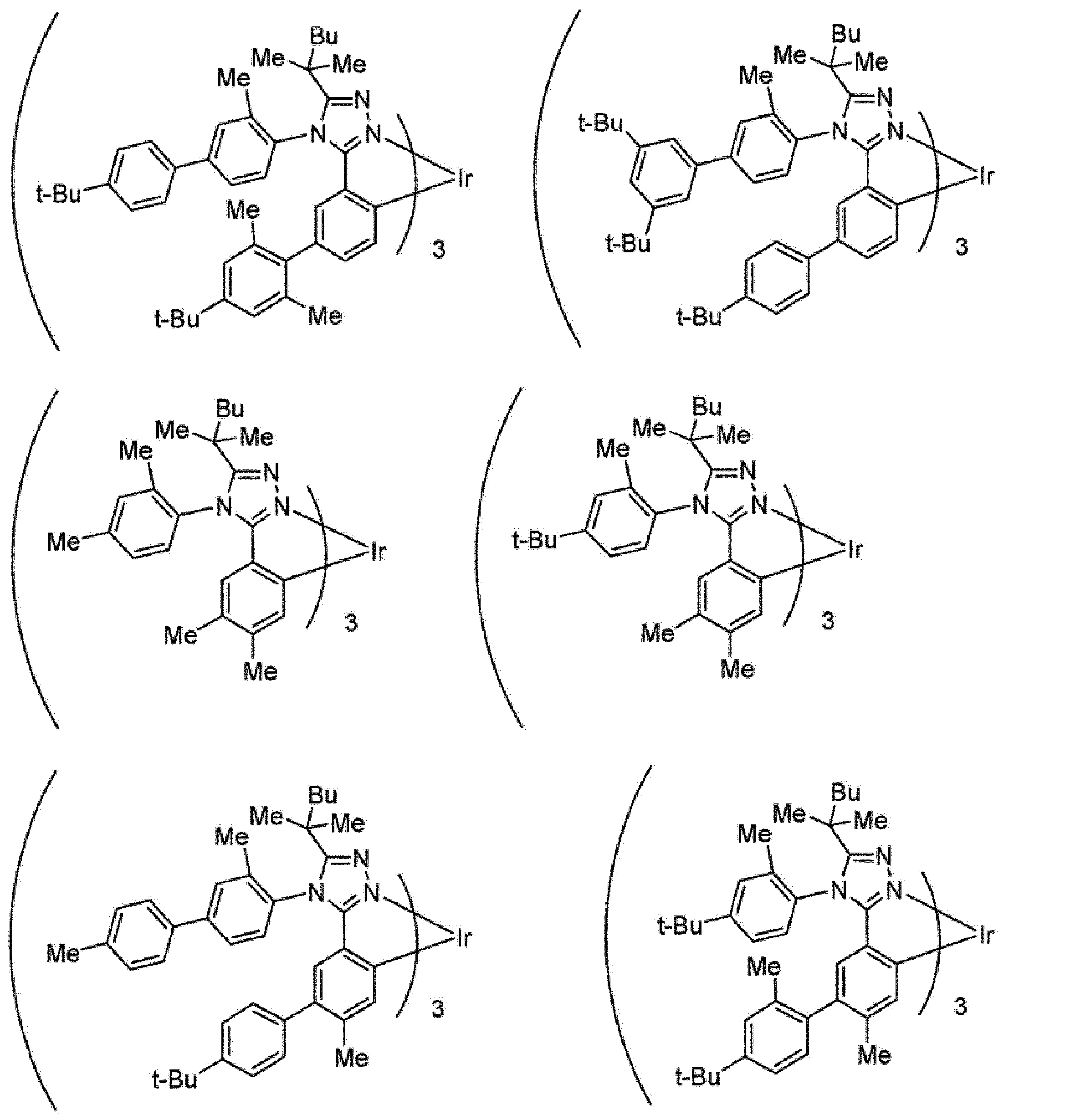

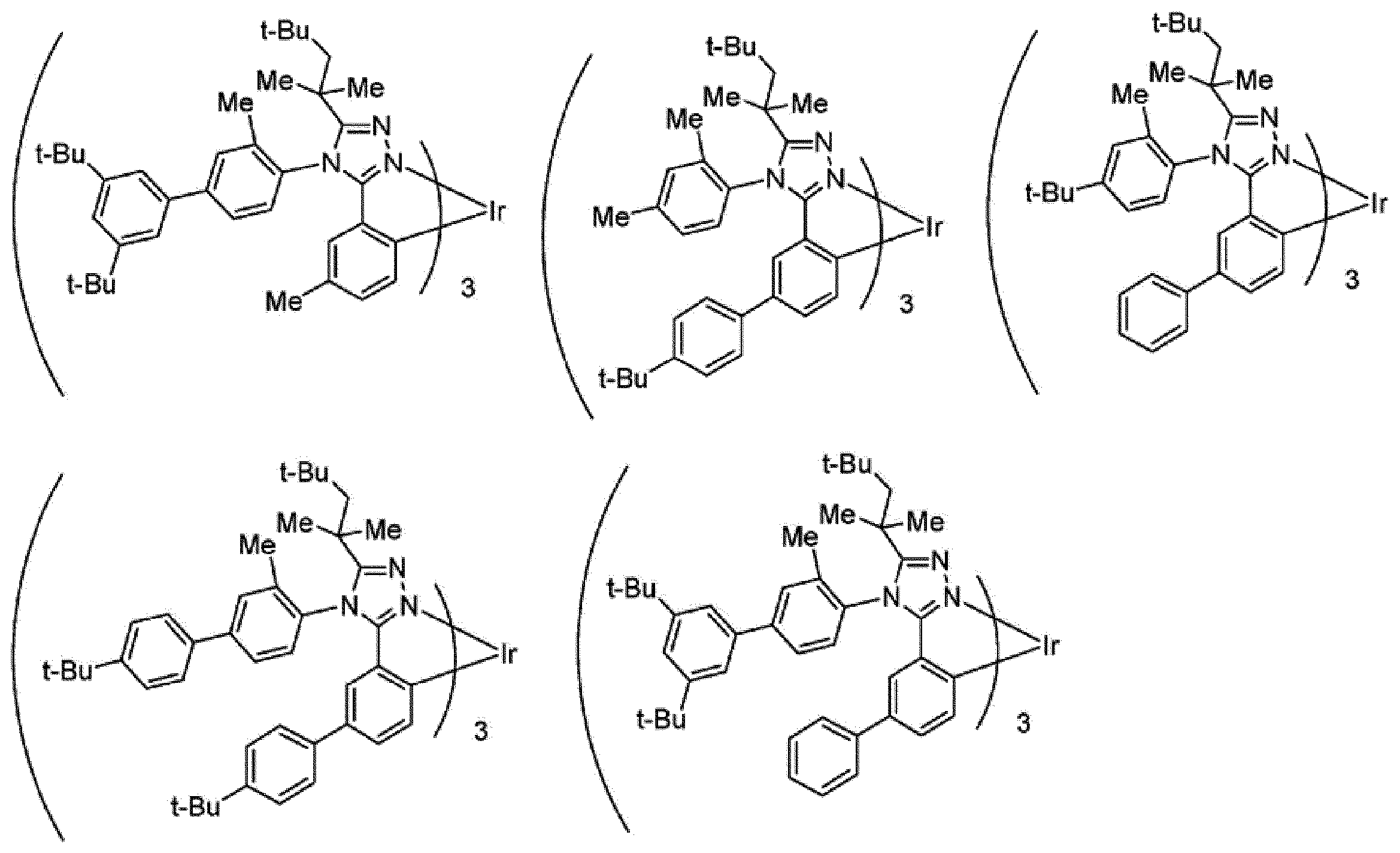
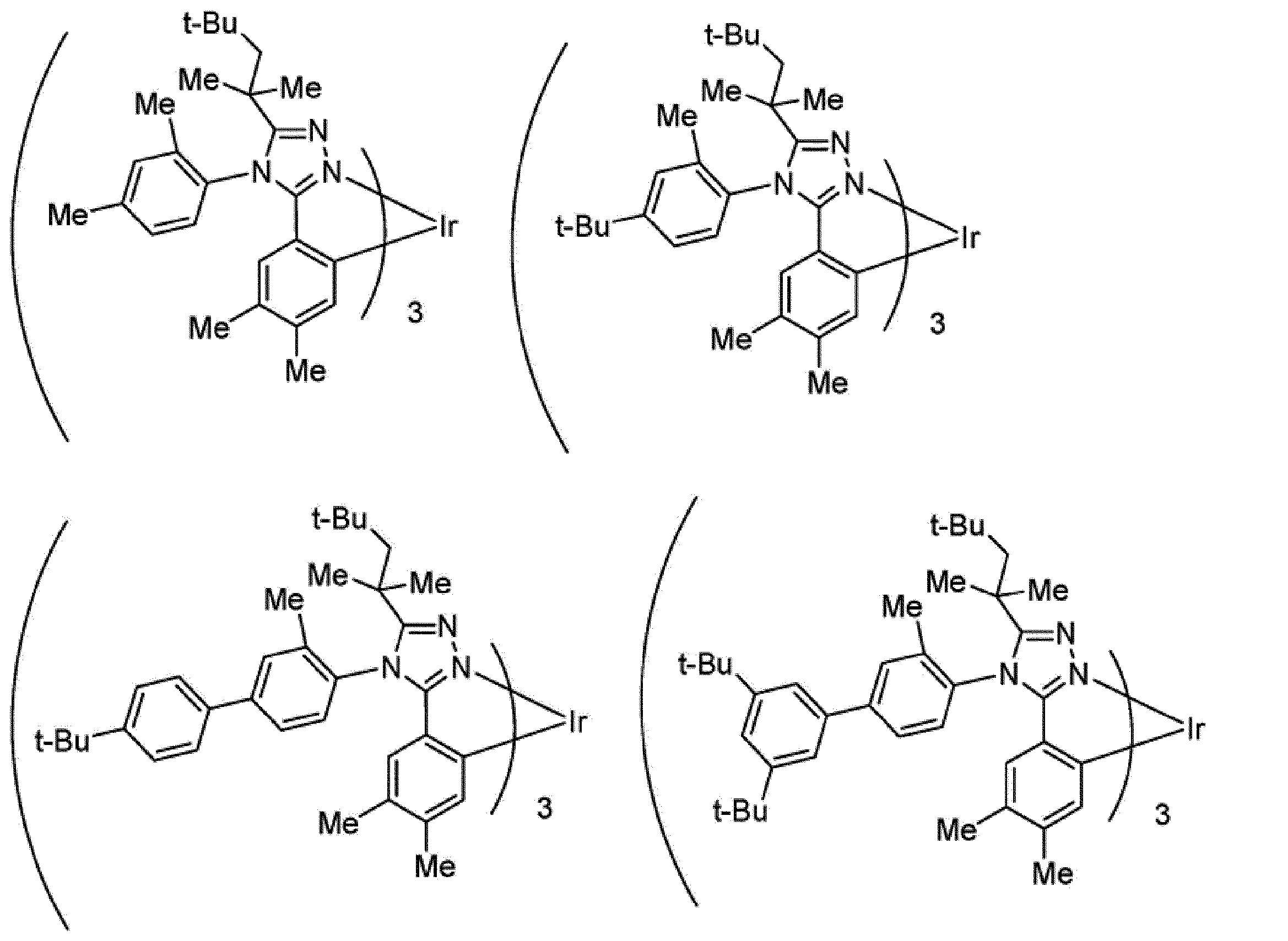
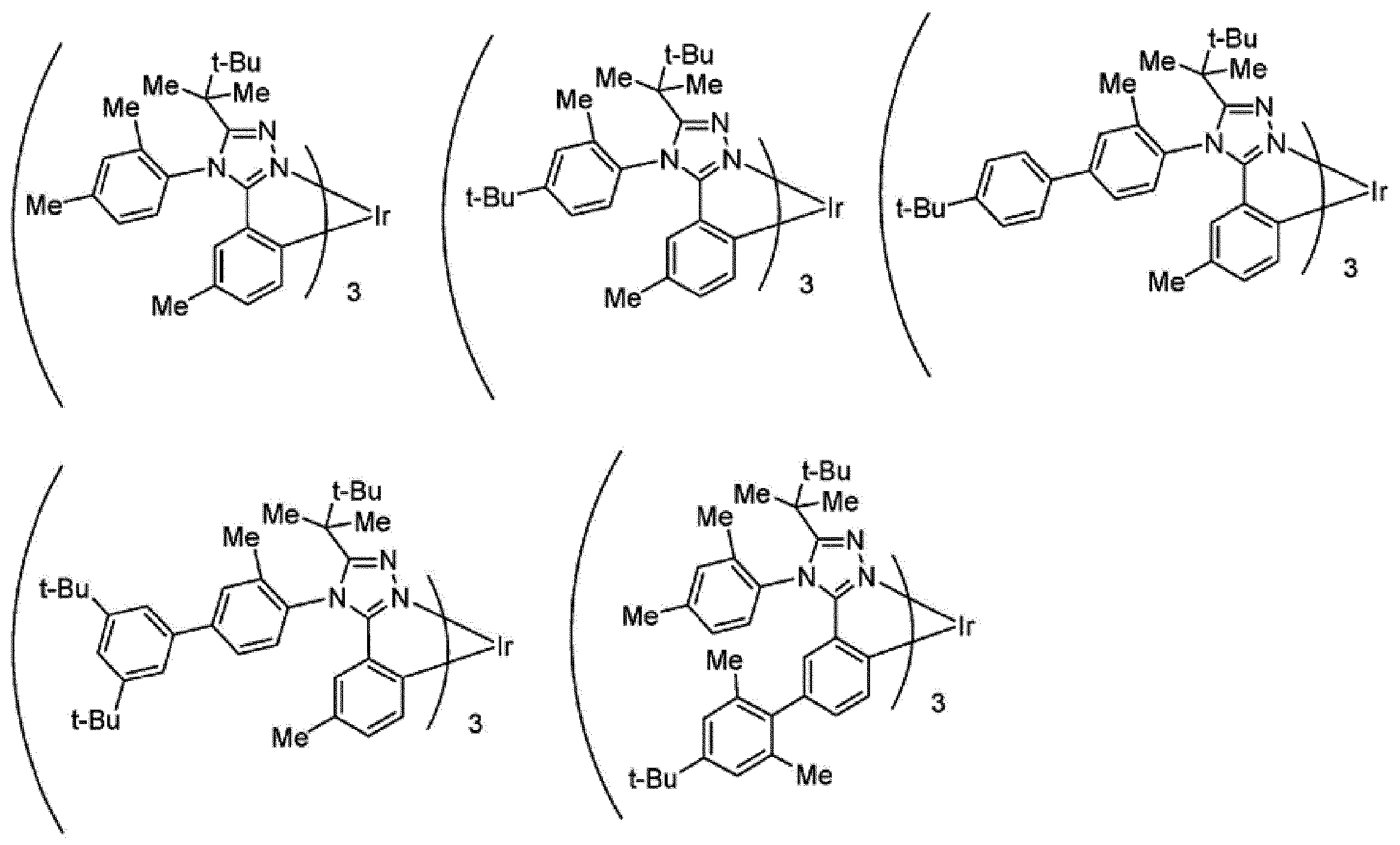
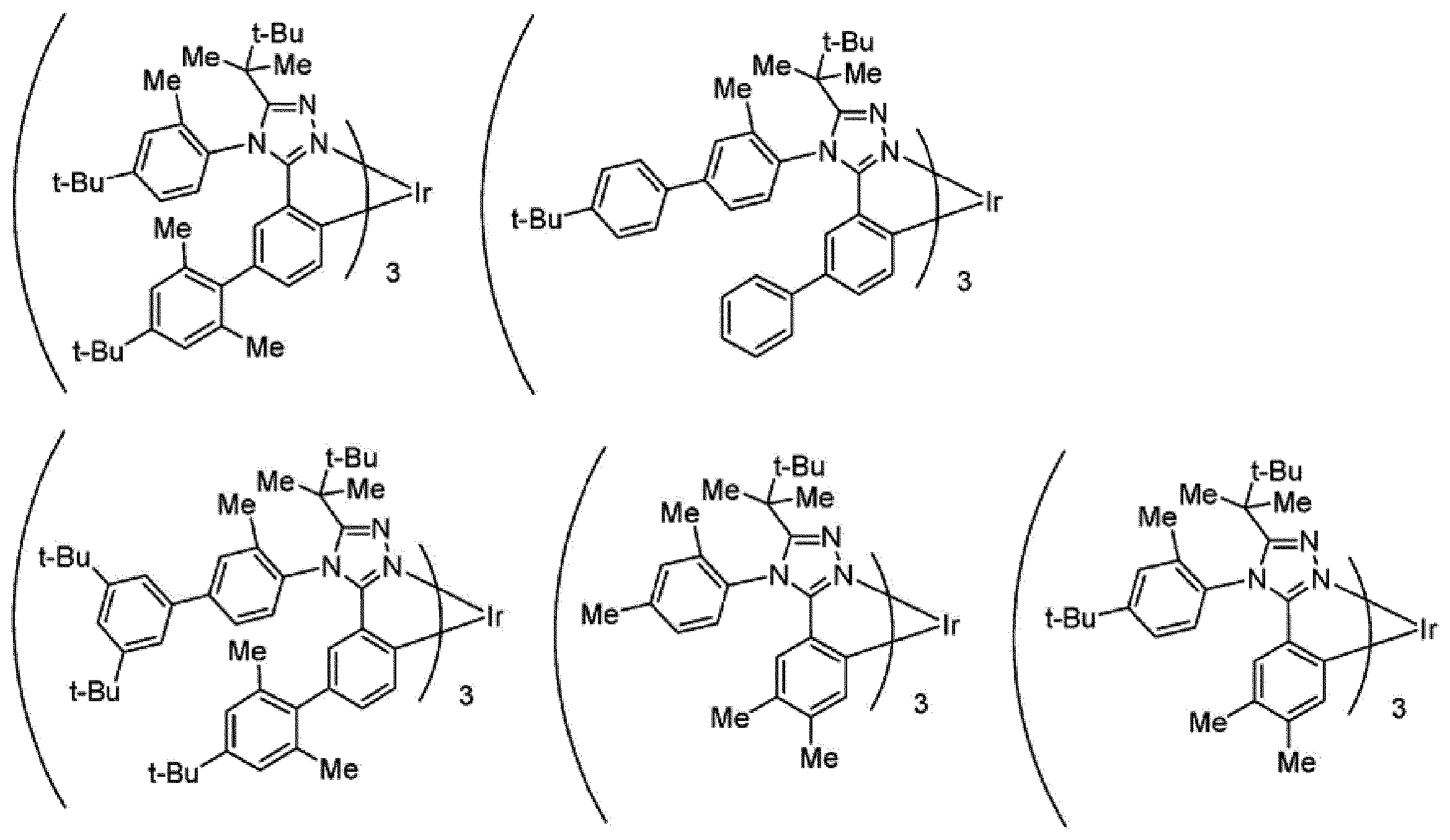


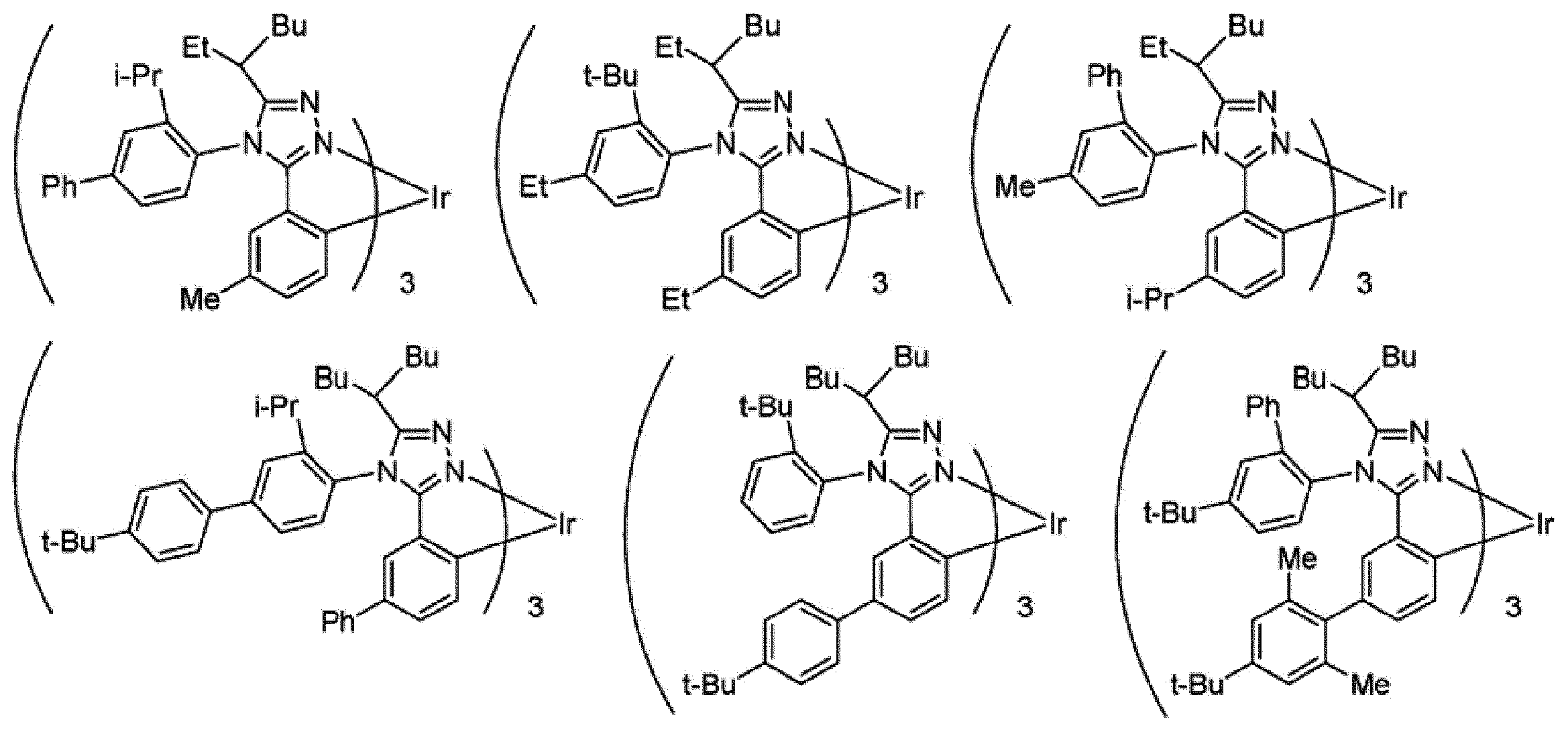
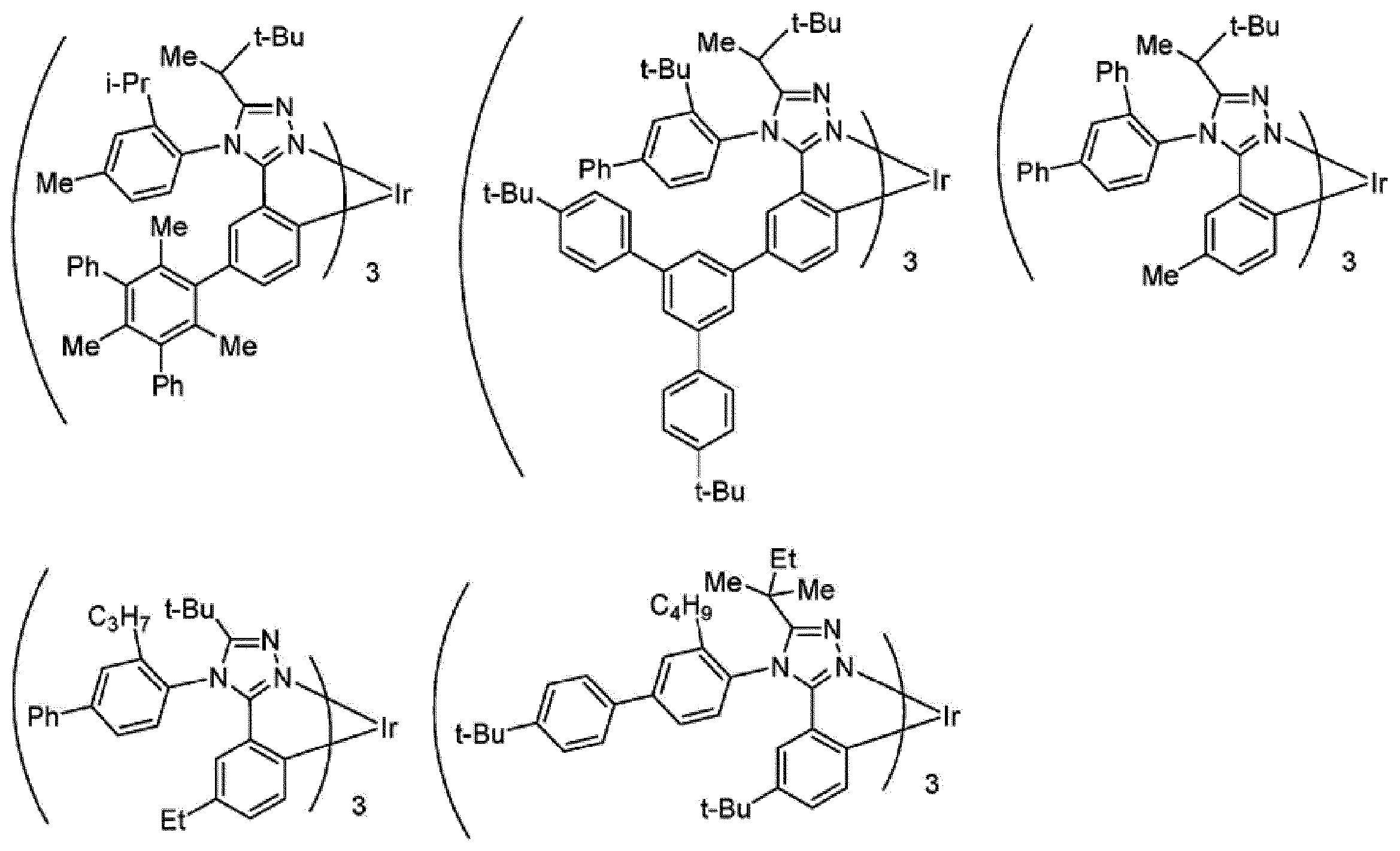
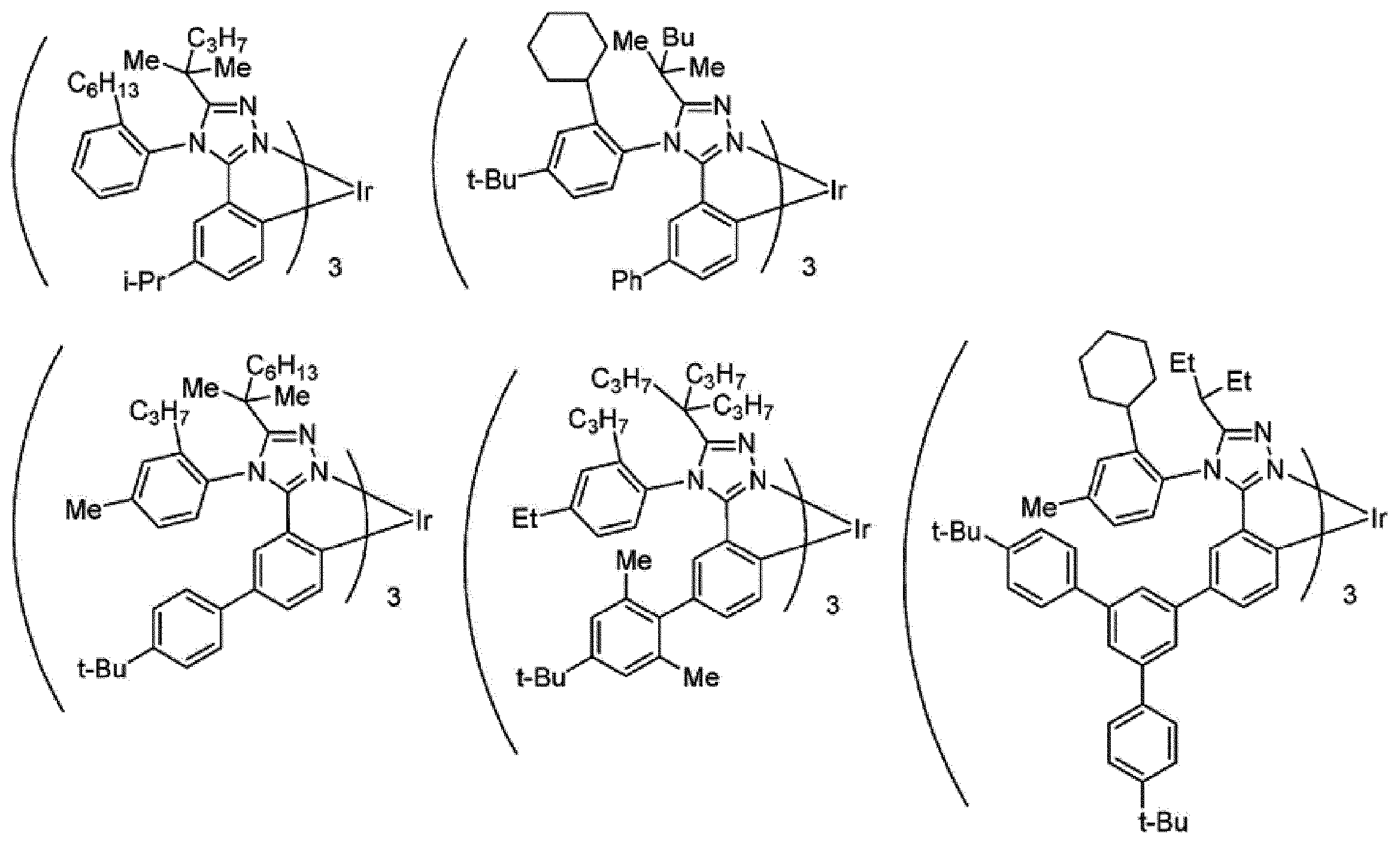
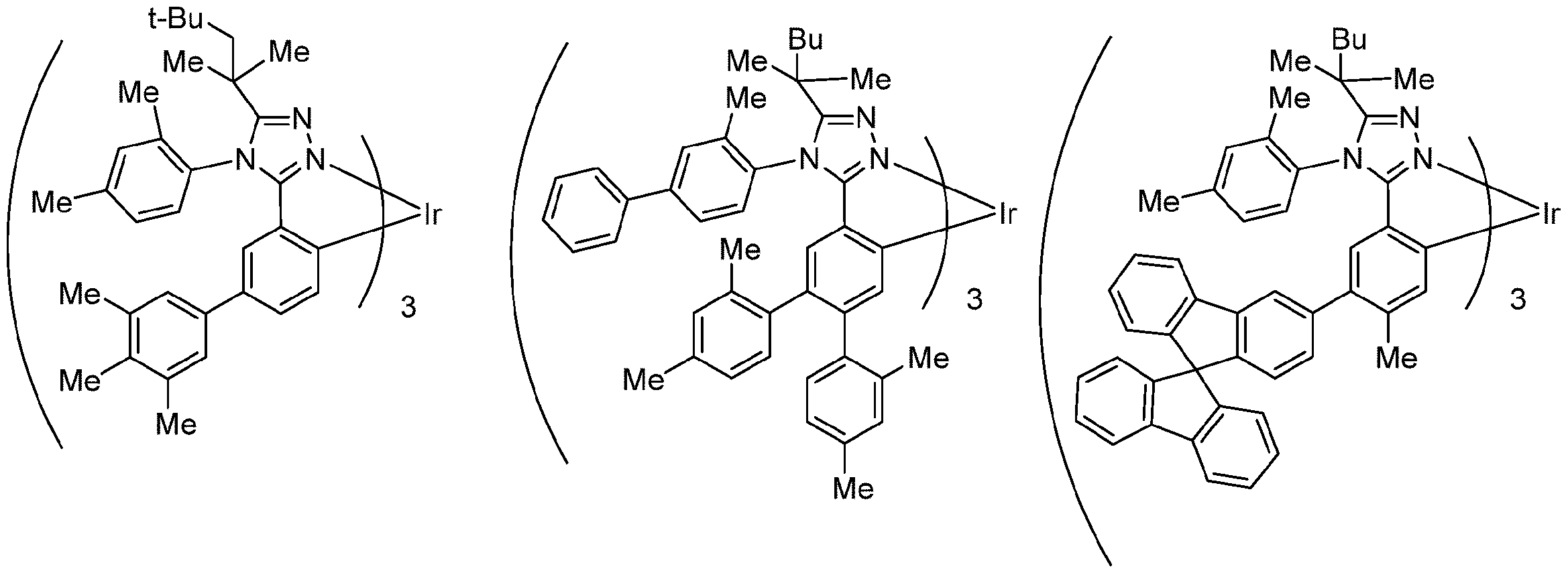


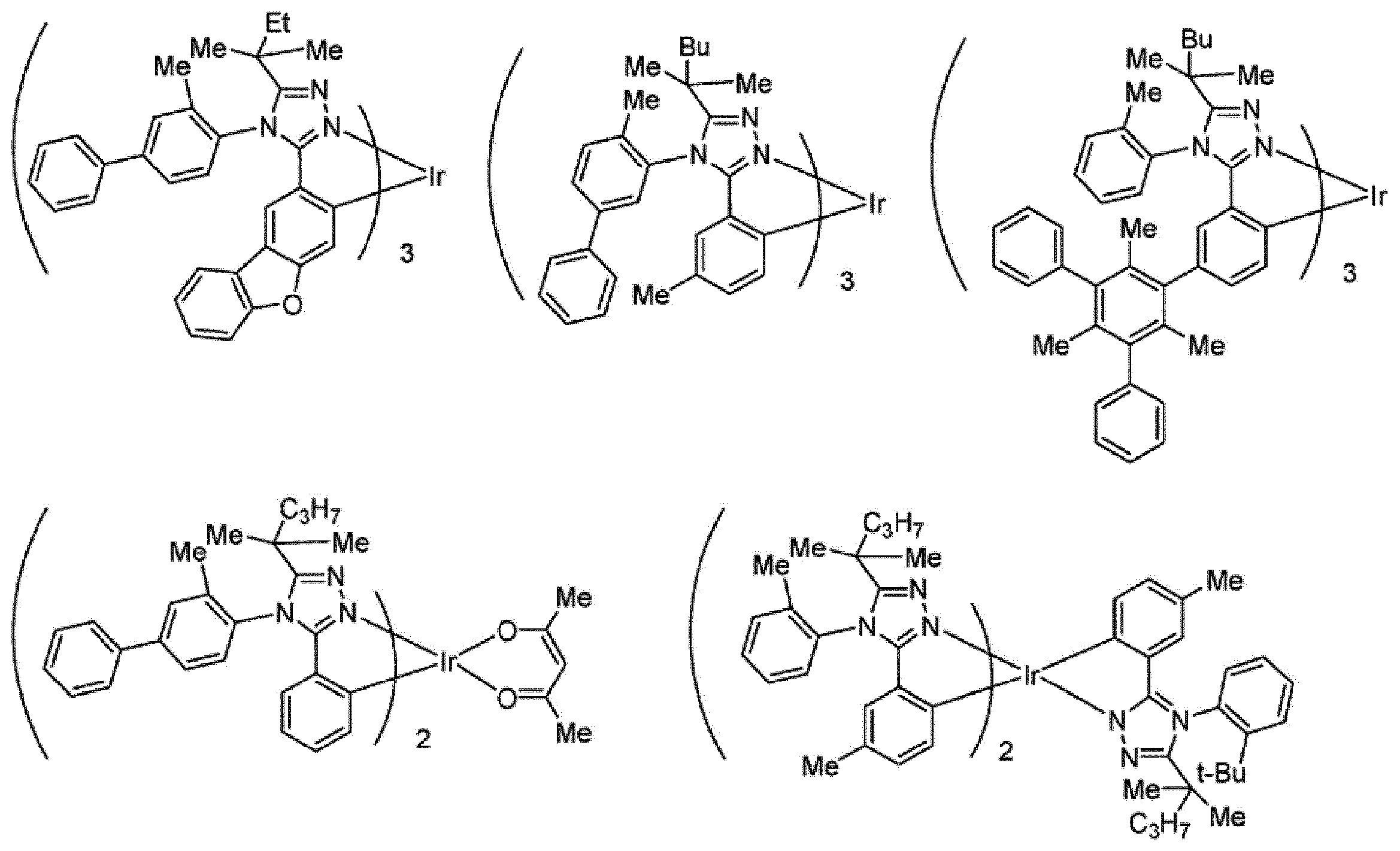
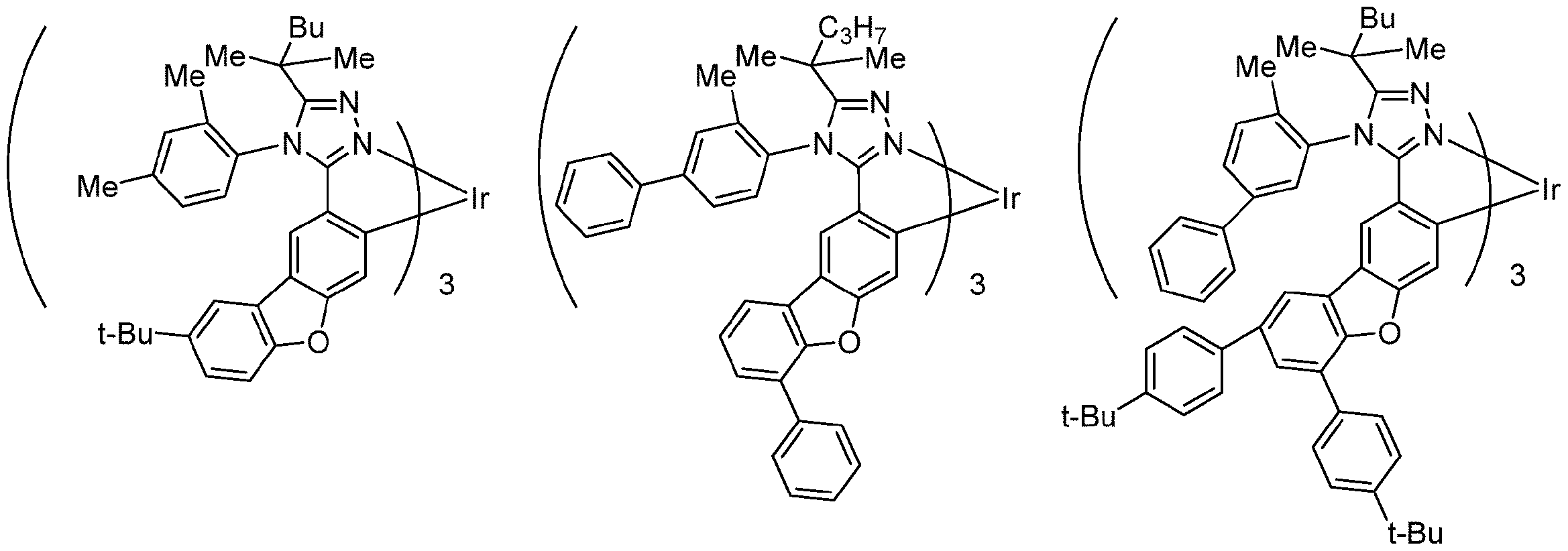
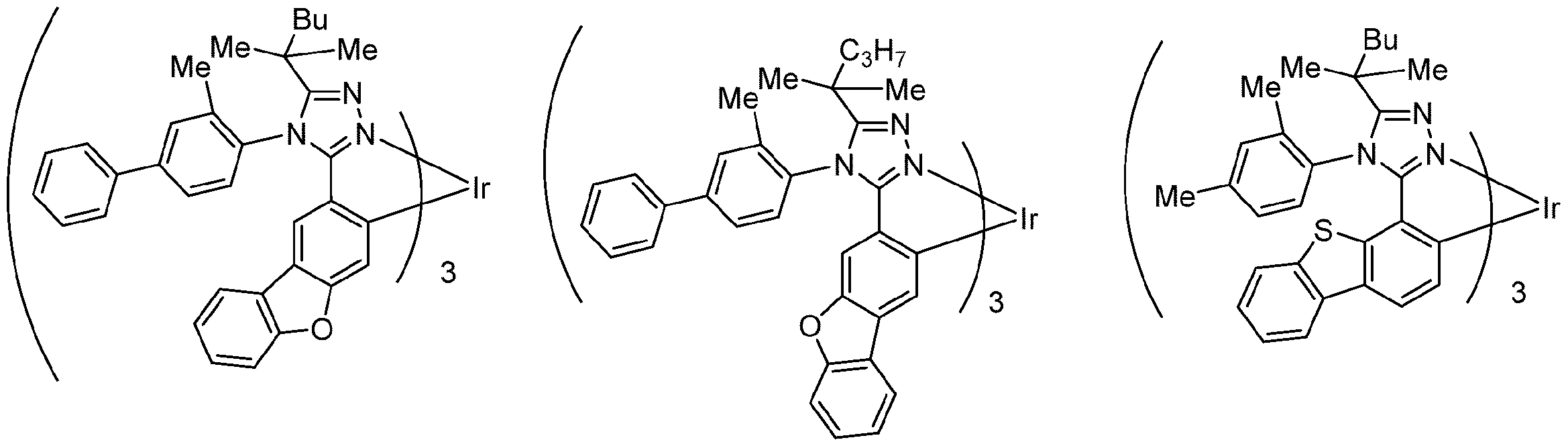
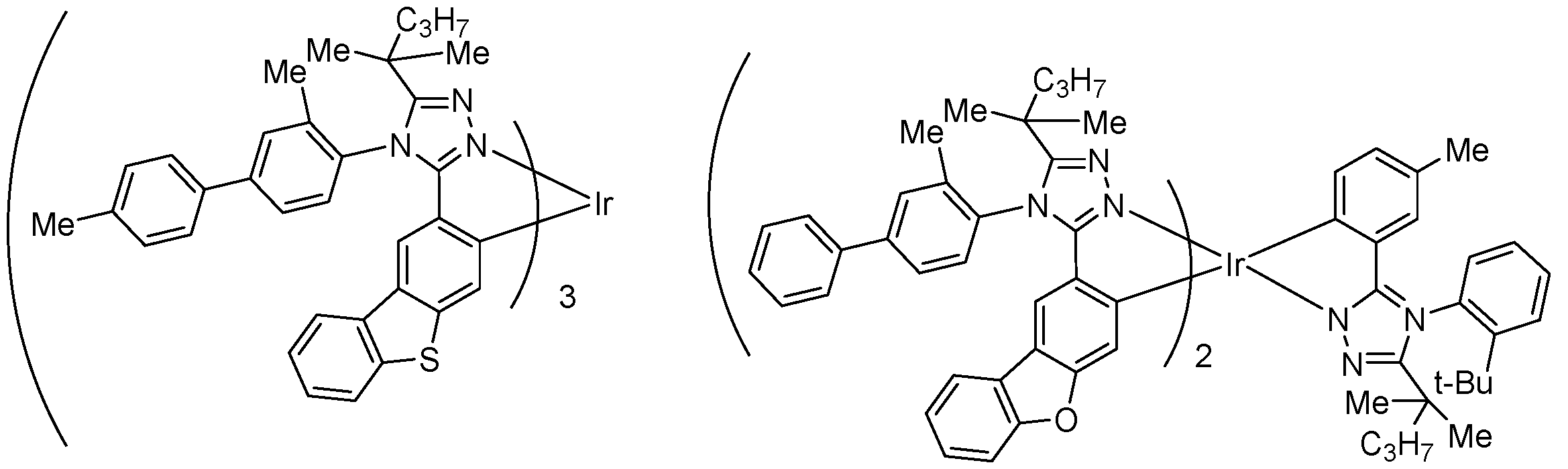


・製造方法1
本実施形態に係る金属錯体は、例えば、配位子となる化合物と金属化合物とを反応させる方法(製造方法1)により製造することができる。必要に応じて、金属錯体の配位子の官能基変換反応を行ってもよい。
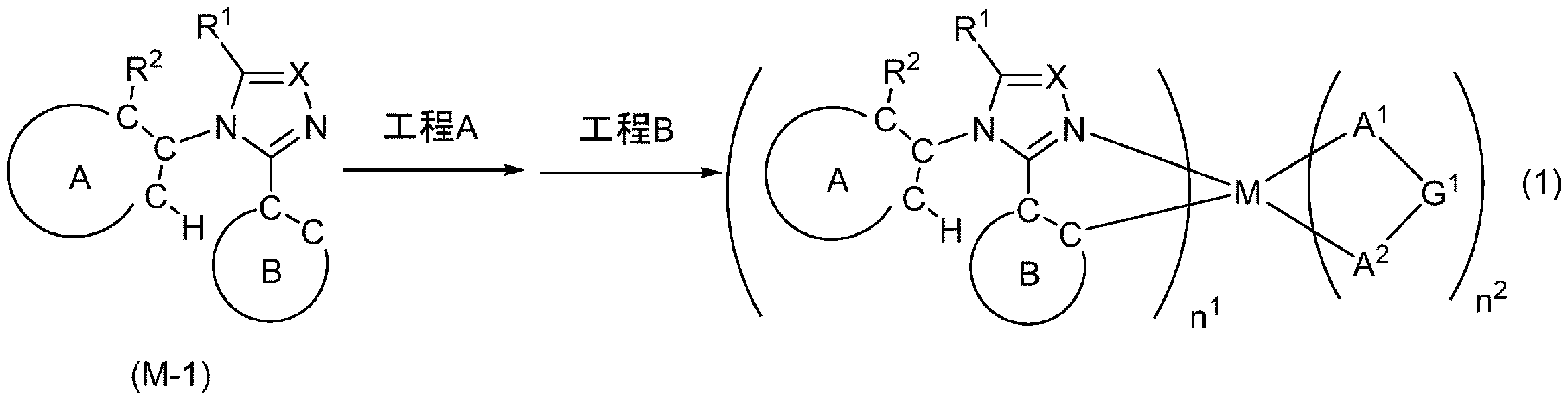

n6は、1又は2を表す。Mがロジウム原子又はイリジウム原子の場合、n6は2であり、Mがパラジウム原子又は白金原子の場合、n6は1である。
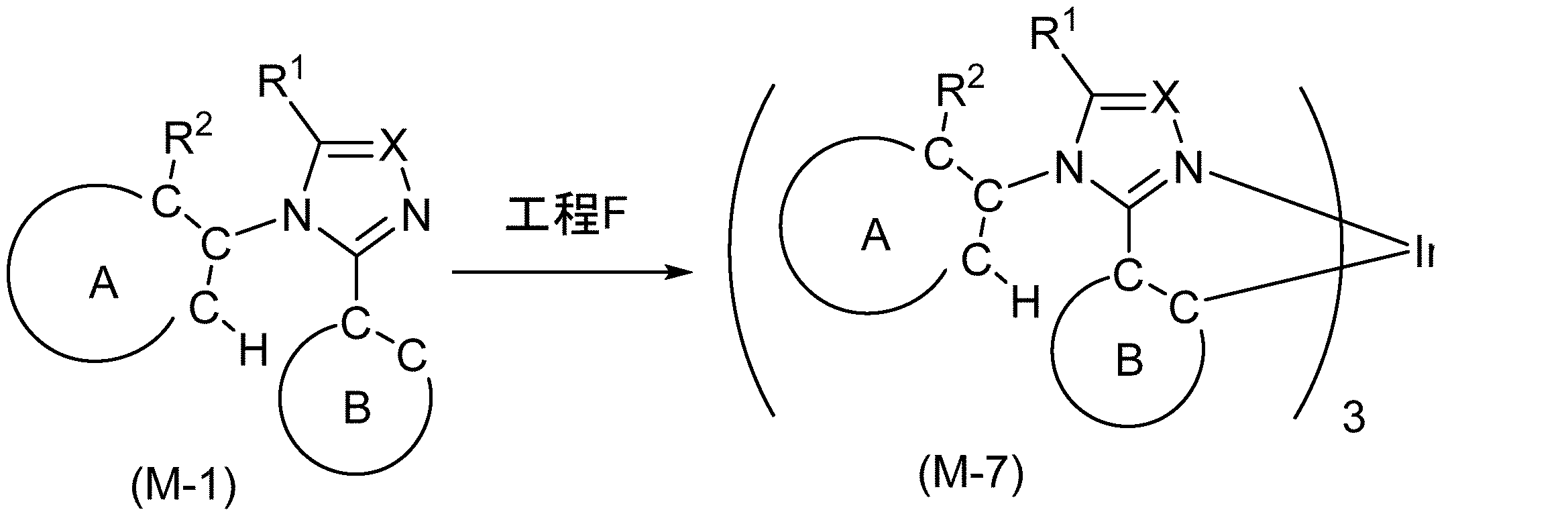
本実施形態に係る金属錯体は、例えば、金属錯体の配位子の官能基変換反応により製造してもよい(製造方法2)。

M、n1、n2、環A、環B、R1、R2、X及びA1-G1-A2は、上記と同じ意味を表す。
nW1は、1以上10以下の整数を表す。
Z1は、アルキル基、シクロアルキル基、アリール基又は1価の複素環基を表し、これらの基は置換基を有していてもよい。
W1及びW2は、一方が塩素原子、臭素原子及びヨウ素原子からなる群より選択されるハロゲン原子を表し、他方が置換基B群から選ばれる基を表す。
-B(ORC2)2(式中、RC2は、水素原子、アルキル基、シクロアルキル基又はアリール基を表し、これらの基は置換基を有していてもよい。複数存在するRC2は同一であっても異なっていてもよく、互いに連結して、それぞれが結合する酸素原子とともに環構造を形成していてもよい。)で表される基;
-BF3Q’(式中、Q’は、Li、Na、K、Rb又はCsを表す。)で表される基;
-MgY’(式中、Y’は、塩素原子、臭素原子又はヨウ素原子を表す。)で表される基;
-ZnY’’(式中、Y’’は、塩素原子、臭素原子又はヨウ素原子を表す。)で表される基;及び、
-Sn(RC3)3(式中、RC3は、水素原子、アルキル基、シクロアルキル基又はアリール基を表し、これらの基は置換基を有していてもよい。複数存在するRC3は同一であっても異なっていてもよく、互いに連結して、それぞれが結合するスズ原子とともに環構造を形成していてもよい。)で表される基。


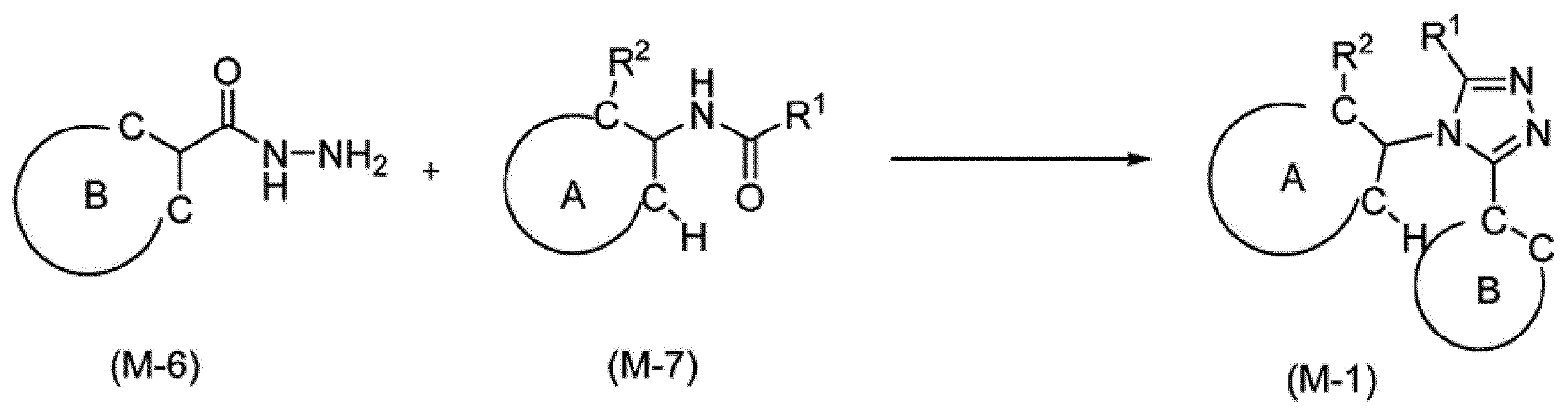
「European Journal of Medicinal Chemistry, 96, 330-339; 2015」、「Tetrahedron Letters, 54(26), 3353-3358; 2013」
等の文献に記載の方法に従って合成することができる。式(M-6)で表される化合物は、塩酸塩等の塩であってもよい。
「Journal of the American Chemical Society, 130(49), 16474-16475; 2008」、「Catalysis Science & Technology, 5(2), 1181-1186; 2015」
等の文献に記載の方法に従って合成することができる。

「Chemical Engineering & Technology, 39(10), 1933-1938; 2016」、「Organic & Biomolecular Chemistry, 14(38), 9046-9054; 2016」
等の文献に記載の方法に従って合成することができる。式(M-10)で表される化合物は、塩酸塩等の塩であってもよい。
本実施形態に係る組成物は、式(1)で表される金属錯体を含有する。
ホスト材料として好ましい低分子化合物(以下、「低分子ホスト」と言う。)に関して説明する。


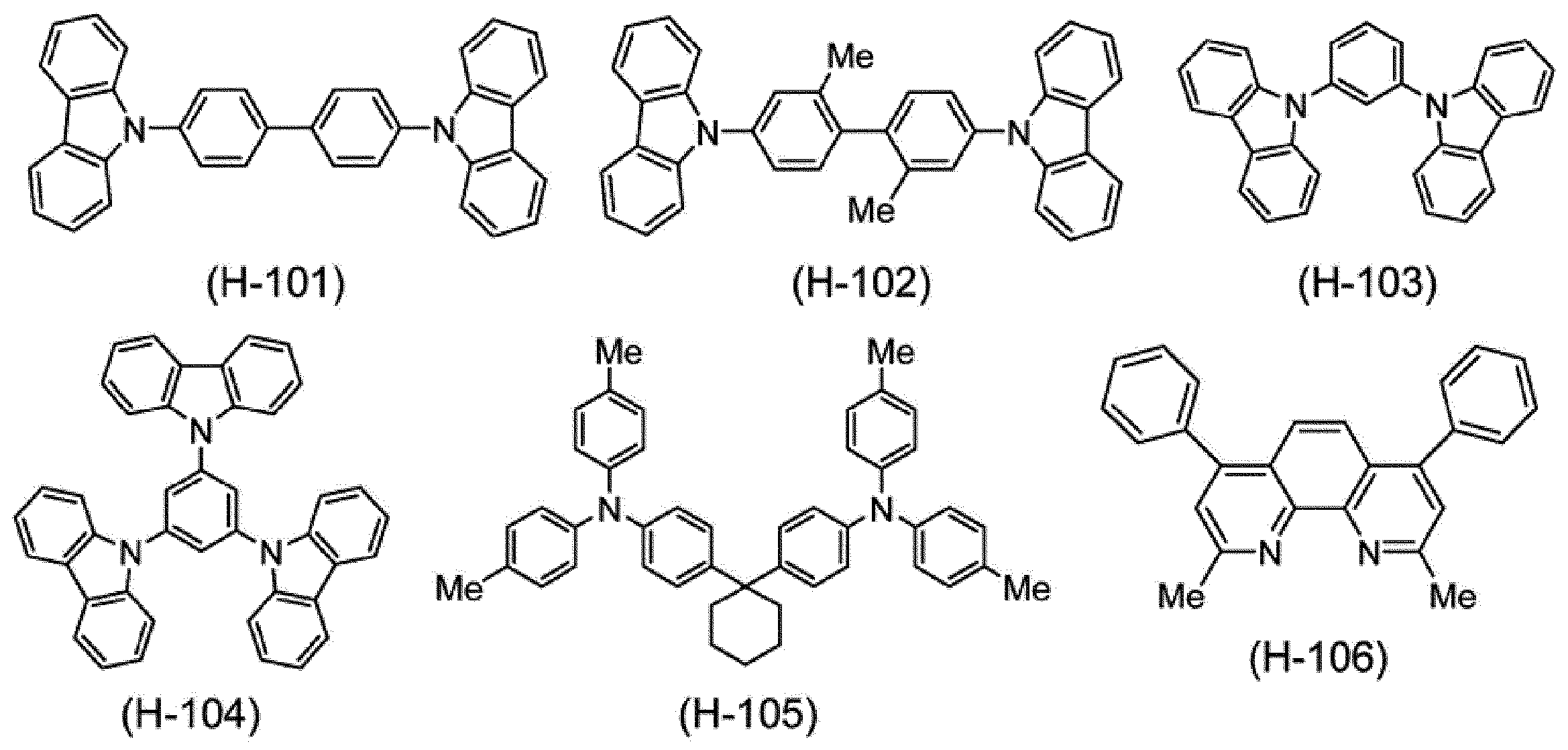
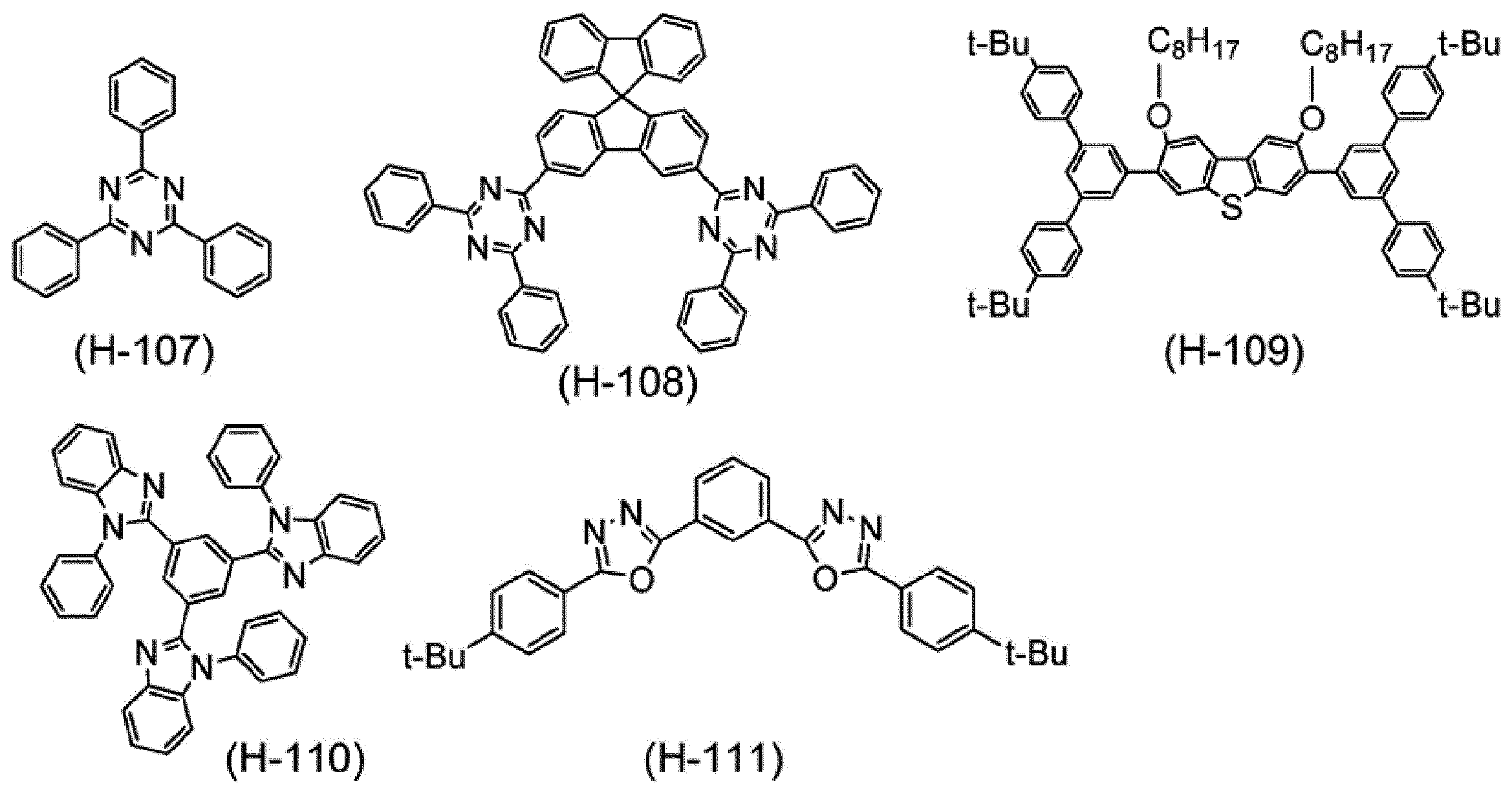
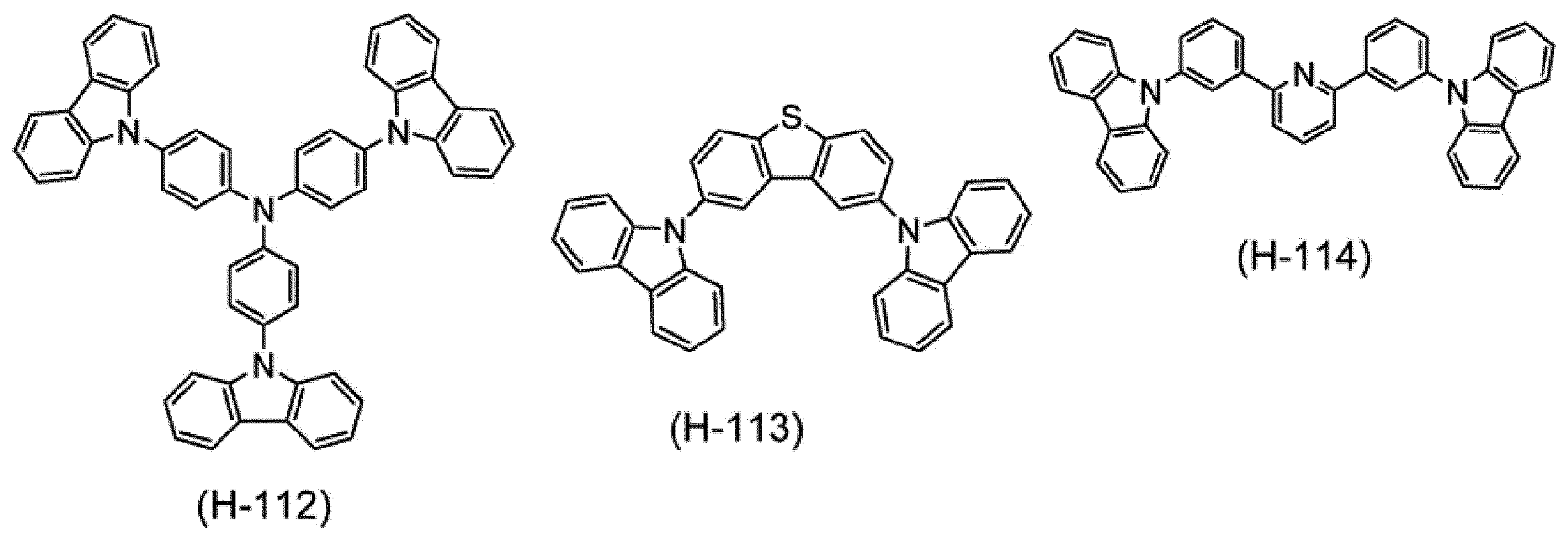
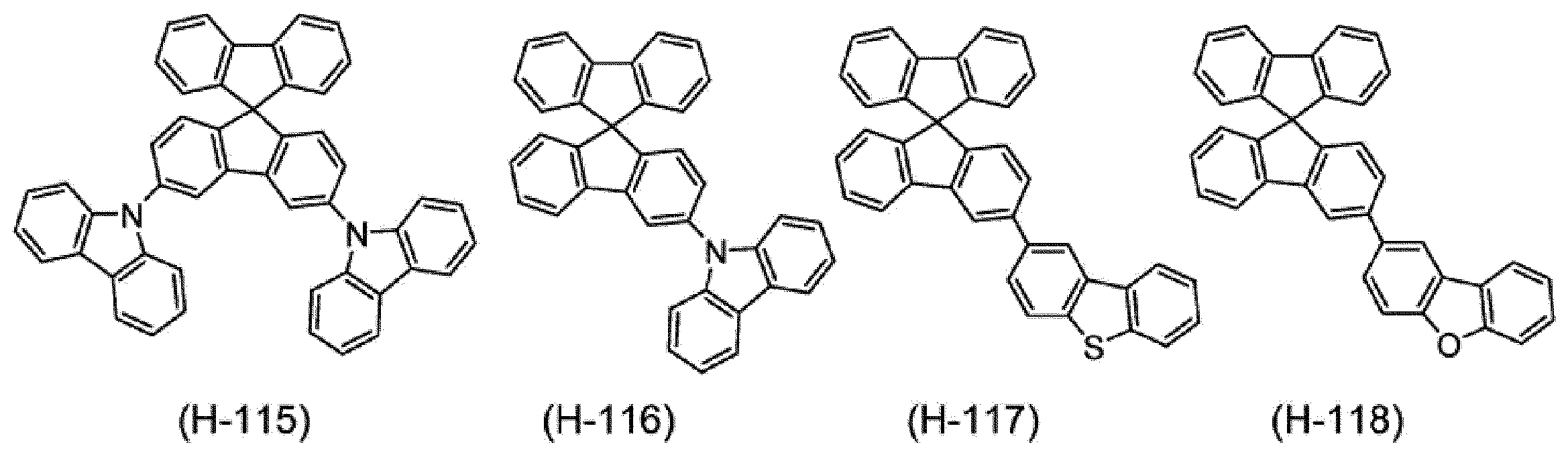
ホスト化合物として好ましい高分子化合物(以下、「高分子ホスト」と言う。)に関して説明する。


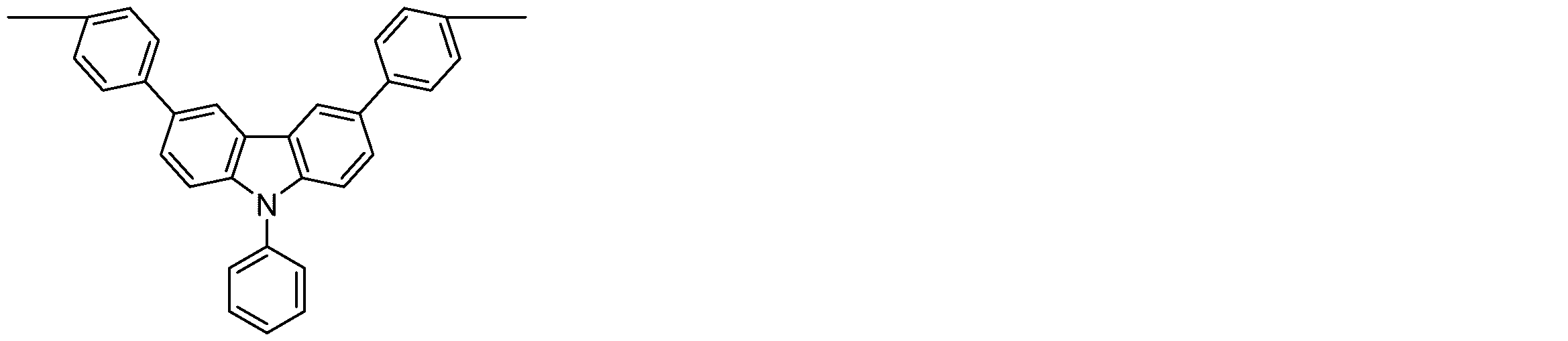



RY1は上記と同じ意味を表す。
XY1は、-C(RY2)2-、-C(RY2)=C(RY2)-又は-C(RY2)2-C(RY2)2-で表される基を表す。RY2は、水素原子、アルキル基、シクロアルキル基、アルコキシ基、シクロアルコキシ基、アリール基又は1価の複素環基を表し、これらの基は置換基を有していてもよい。複数存在するRY2は、同一であっても異なっていてもよく、RY2同士は互いに結合して、それぞれが結合する炭素原子と共に環を形成していてもよい。





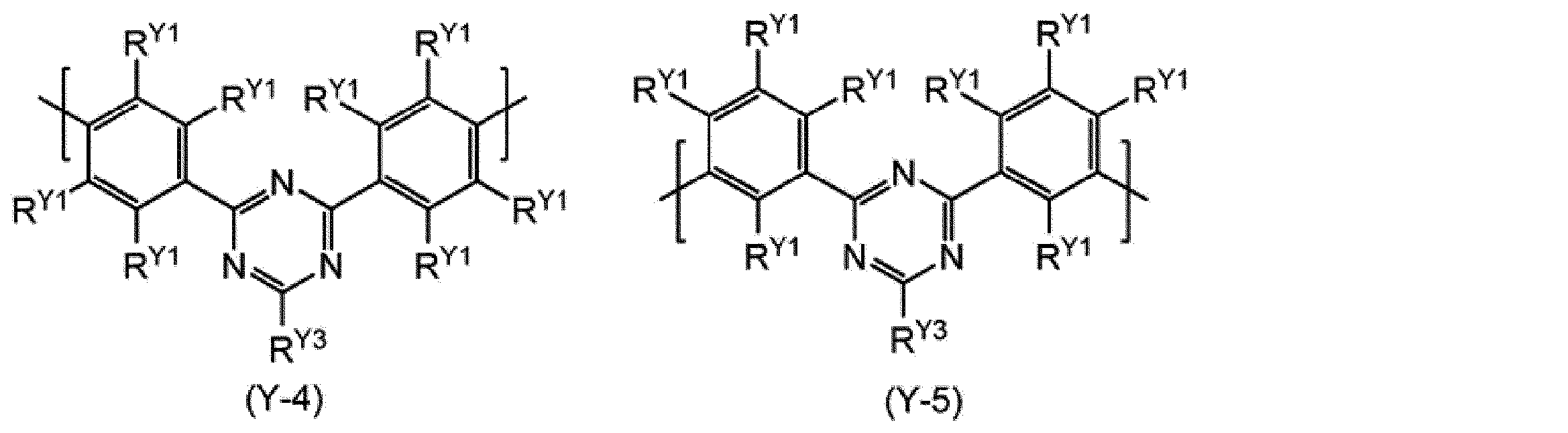
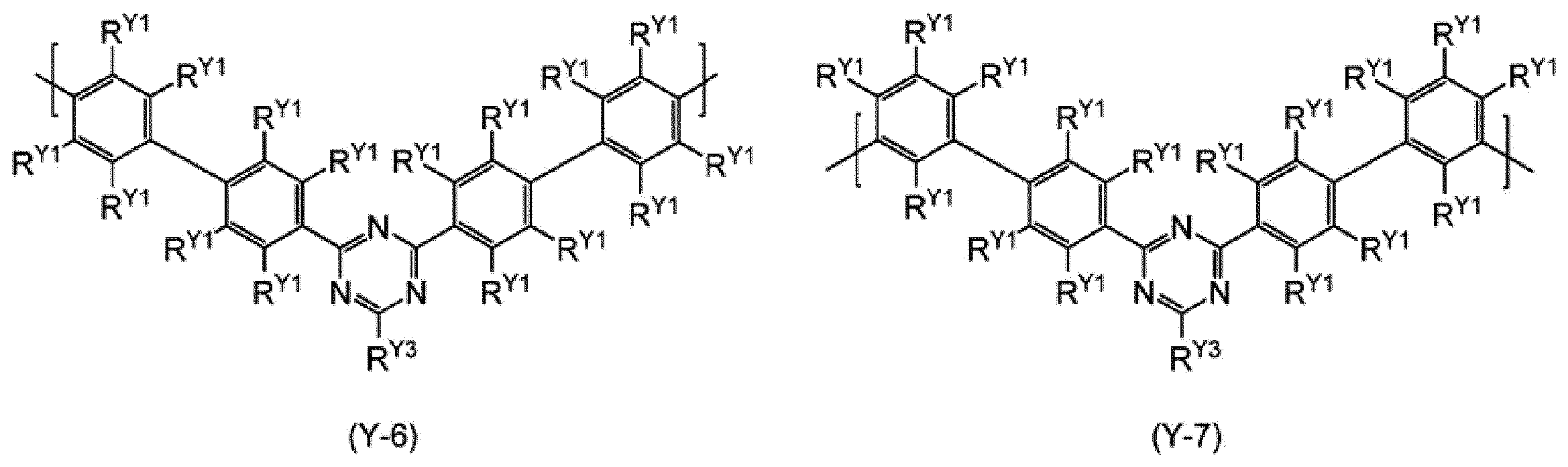
RY1は上記と同じ意味を表す。
RY3は、水素原子、アルキル基、シクロアルキル基、アルコキシ基、シクロアルコキシ基、アリール基又は1価の複素環基を表し、これらの基は置換基を有していてもよい。


RY1は上記を同じ意味を表す。
RY4は、水素原子、アルキル基、シクロアルキル基、アルコキシ基、シクロアルコキシ基、アリール基又は1価の複素環基を表し、これらの基は置換基を有していてもよい。
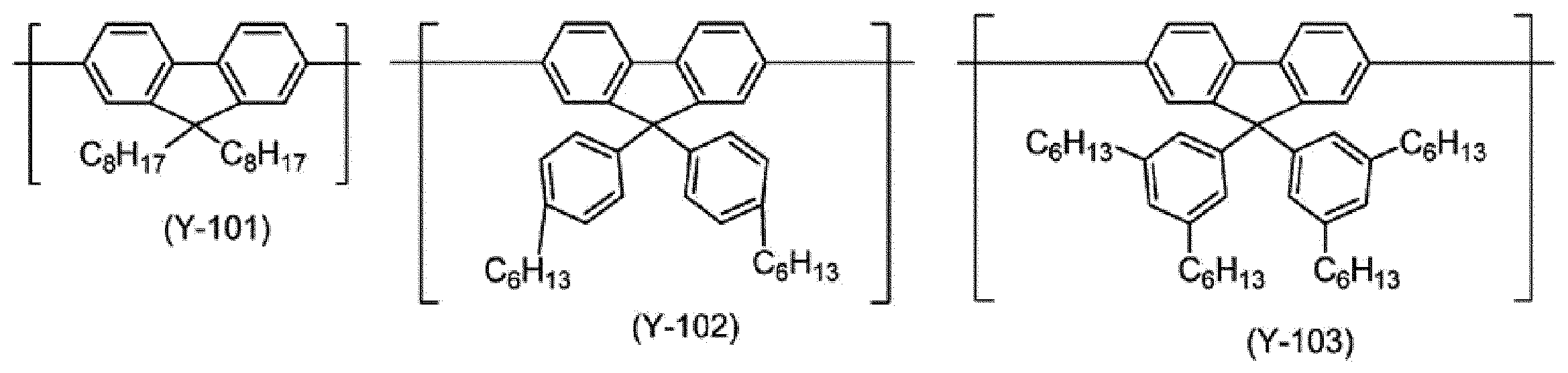
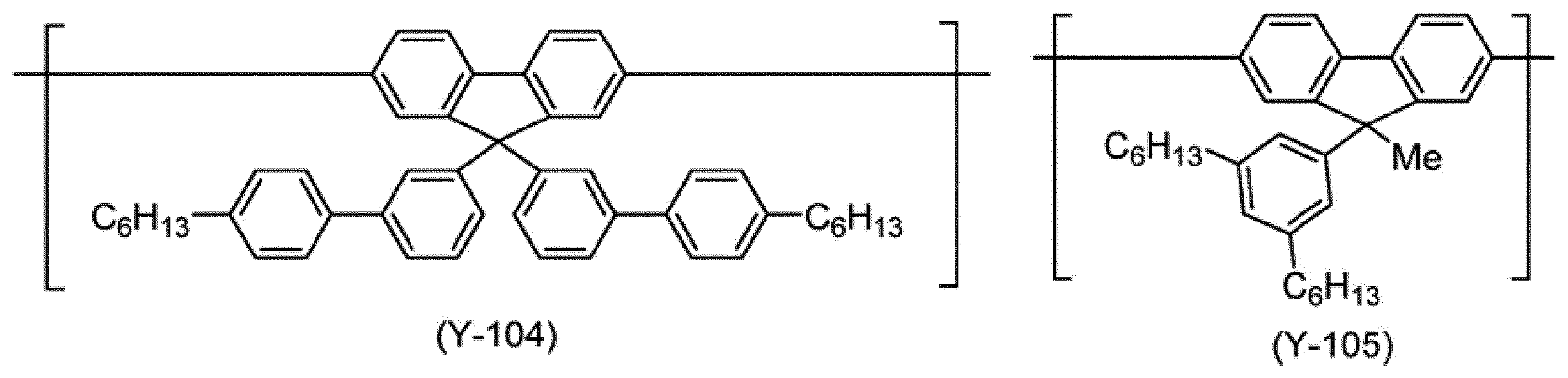
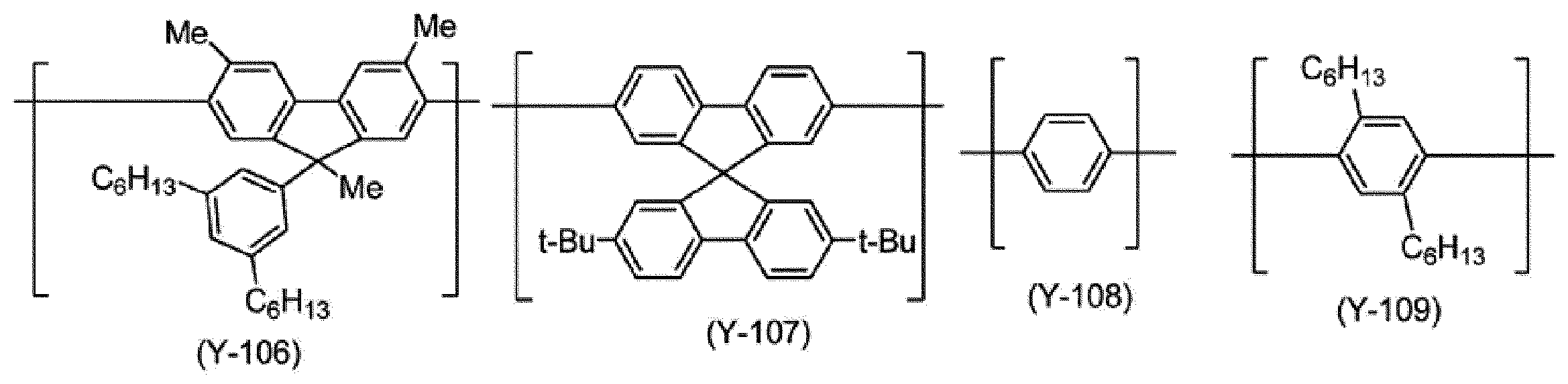
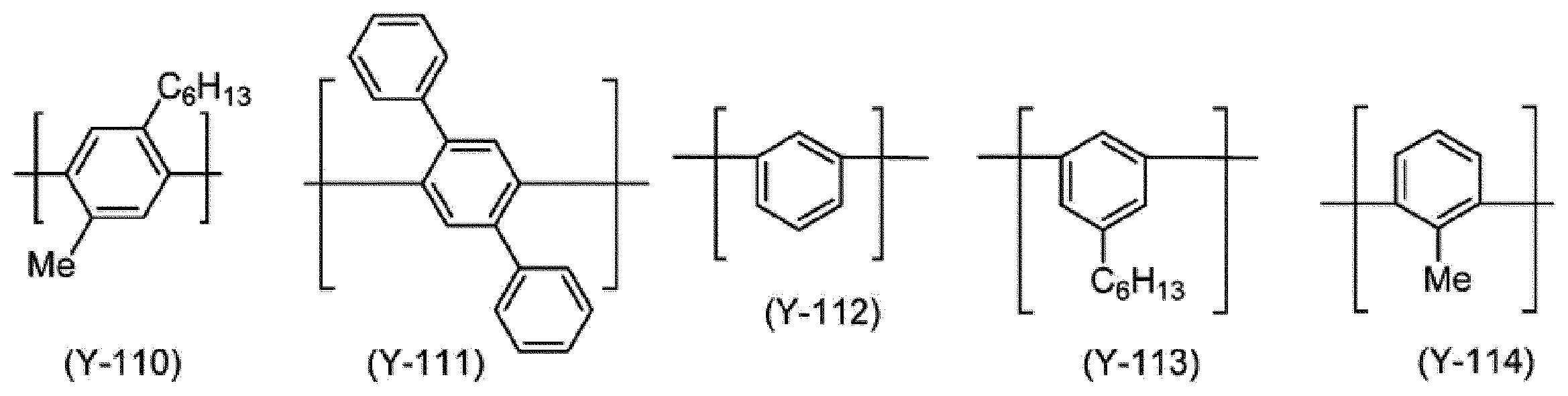
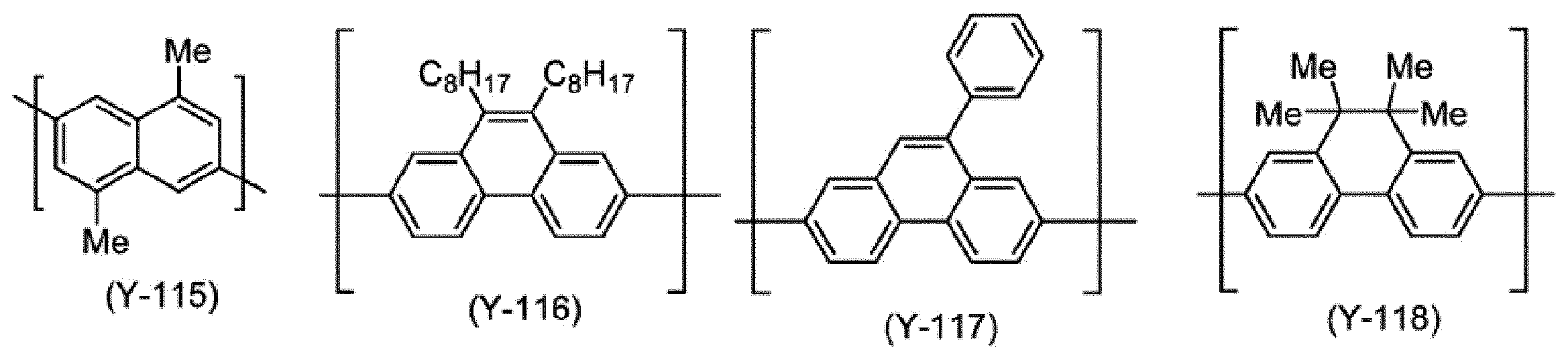


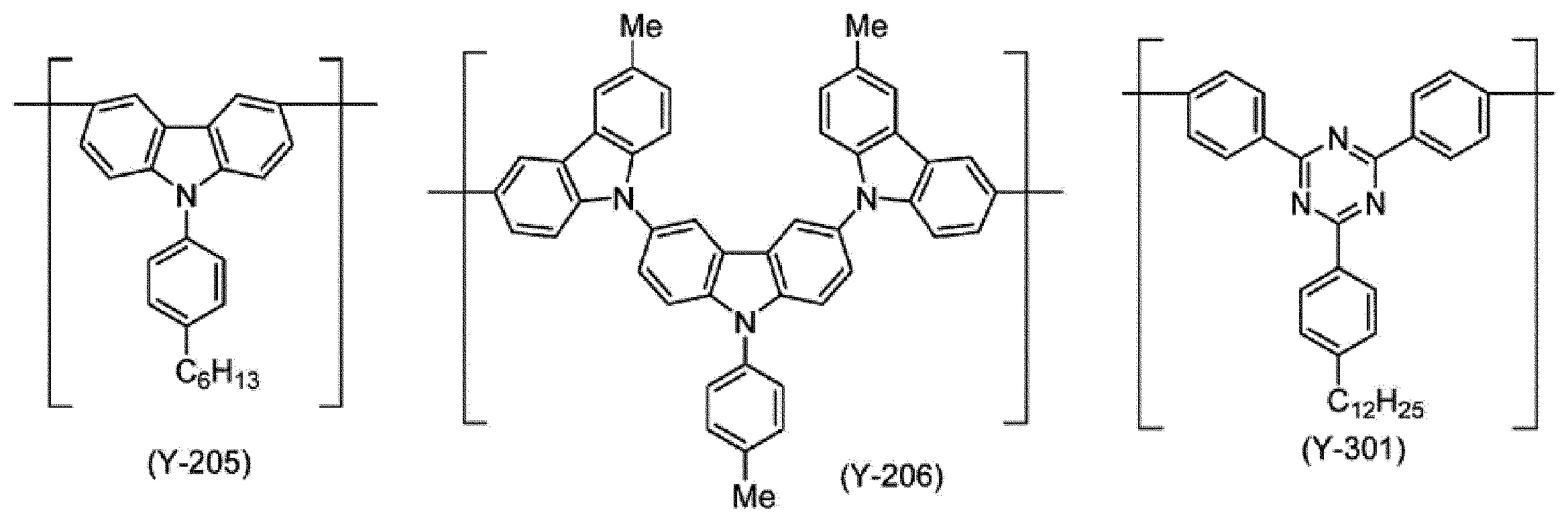
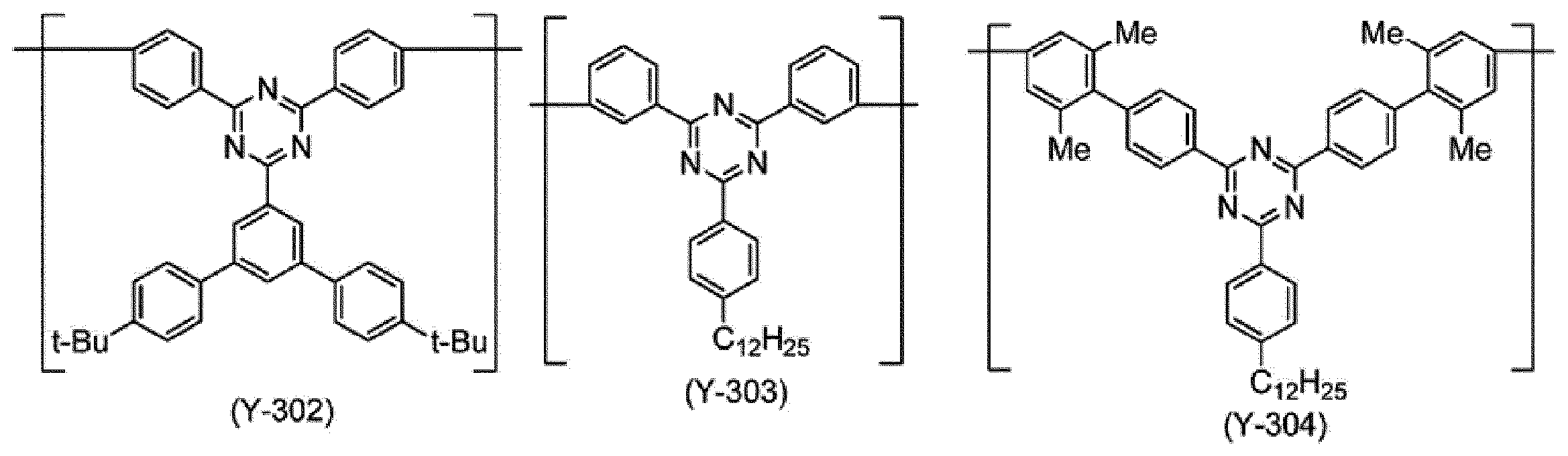
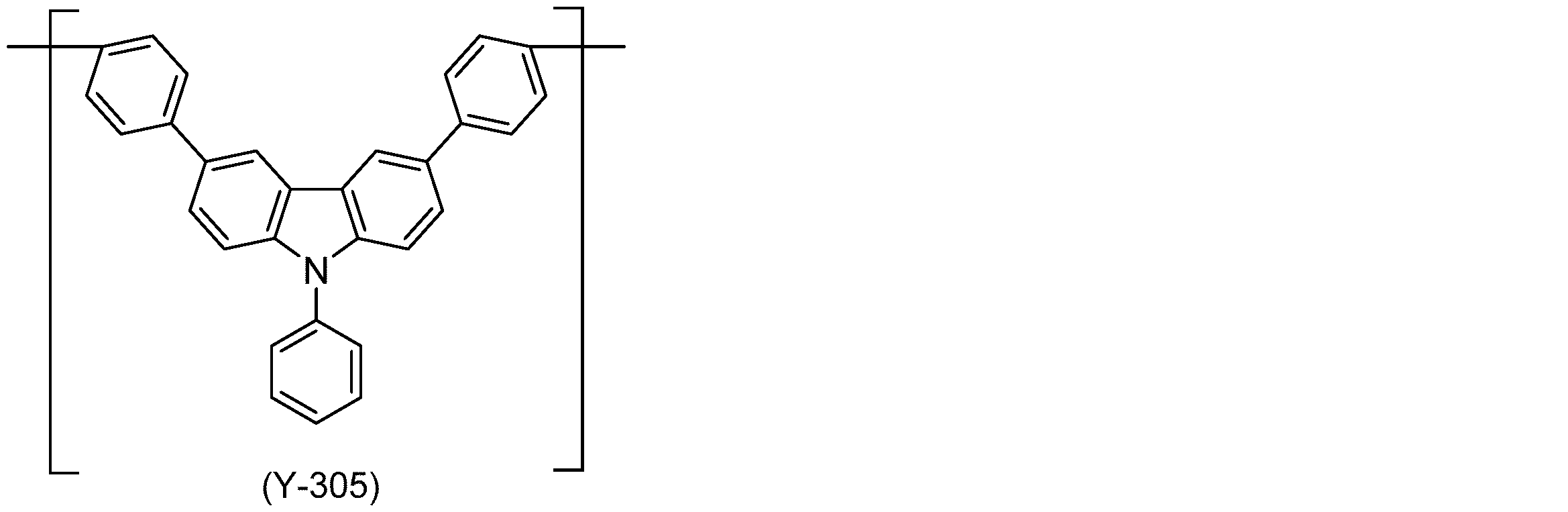
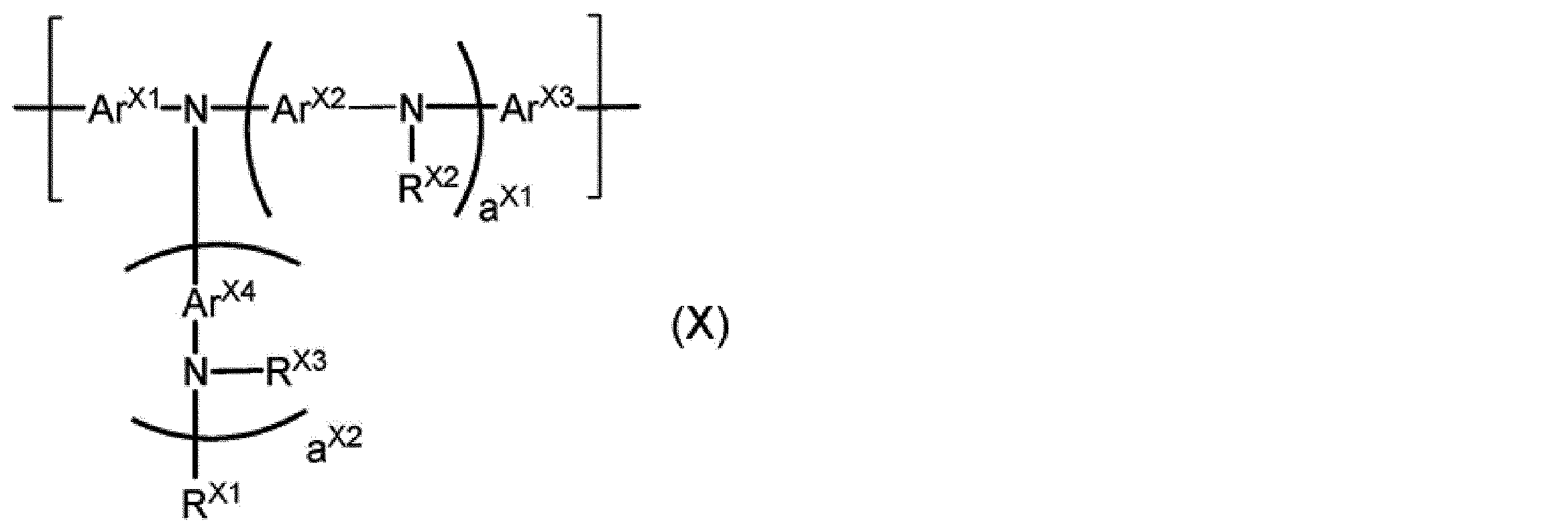
aX1及びaX2は、それぞれ独立に、0以上の整数を表す。
ArX1及びArX3は、それぞれ独立に、アリーレン基又は2価の複素環基を表し、これらの基は置換基を有していてもよい。
ArX2及びArX4は、それぞれ独立に、アリーレン基、2価の複素環基、又は、少なくとも1種のアリーレン基と少なくとも1種の2価の複素環基とが直接結合した2価の基を表し、これらの基は置換基を有していてもよい。ArX2及びArX4が複数存在する場合、それらは同一であっても異なっていてもよい。
RX1、RX2及びRX3は、それぞれ独立に、水素原子、アルキル基、シクロアルキル基、アリール基又は1価の複素環基を表し、これらの基は置換基を有していてもよい。
RX2及びRX3が複数存在する場合、それらは同一であっても異なっていてもよい。
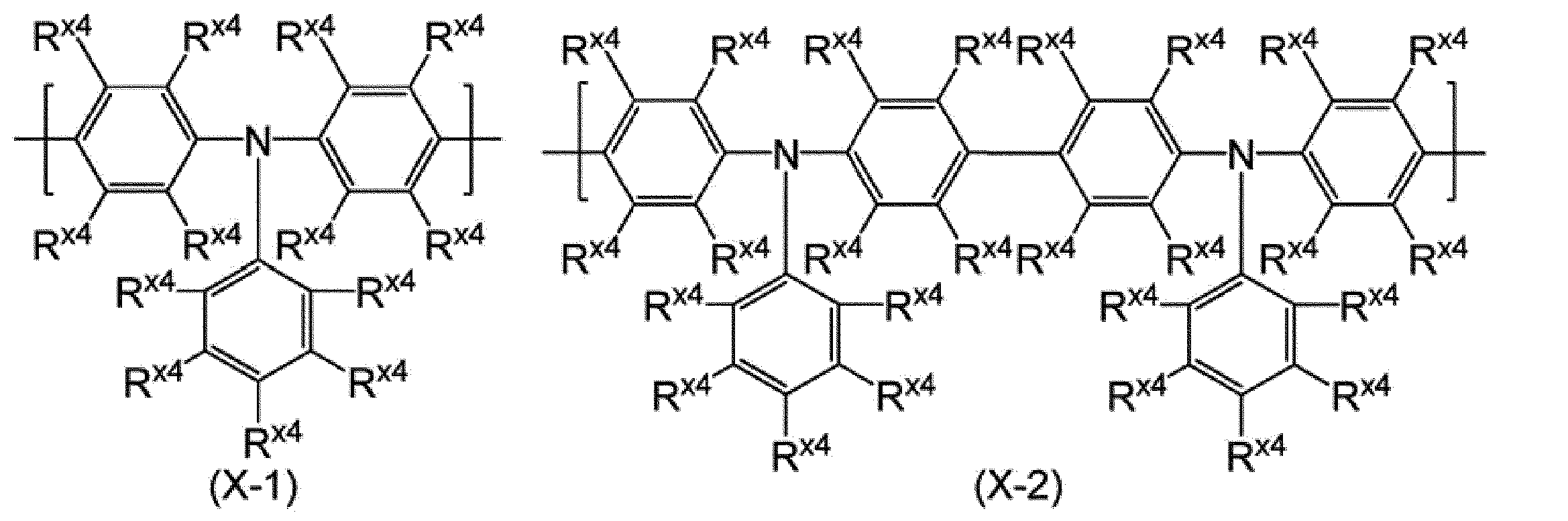

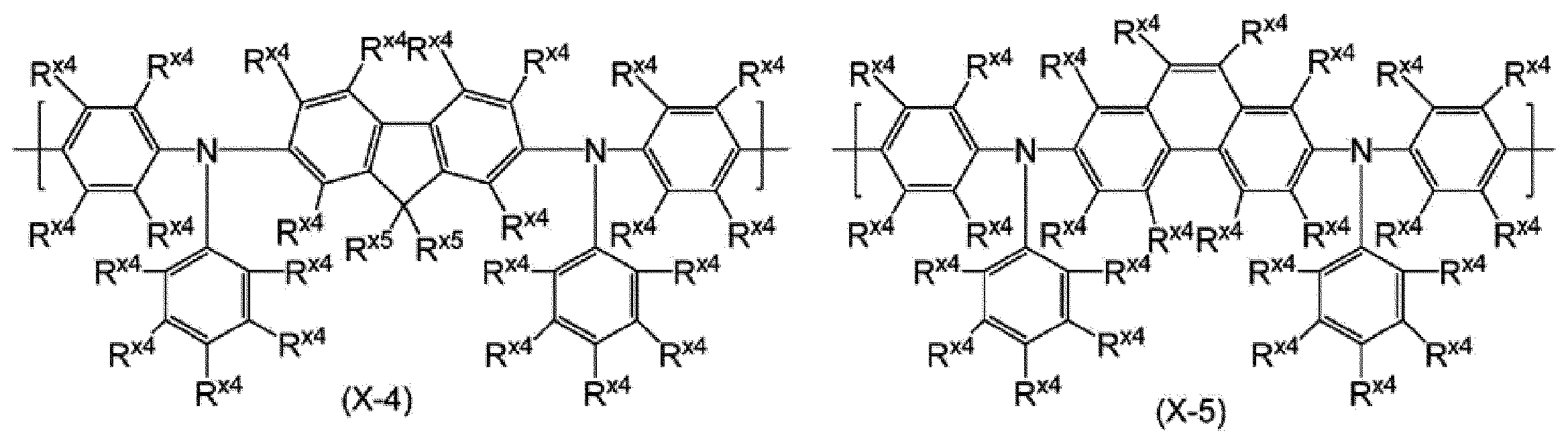

RX4及びRX5は、それぞれ独立に、水素原子、アルキル基、シクロアルキル基、アルコキシ基、シクロアルコキシ基、アリール基、アリールオキシ基、ハロゲン原子、1価の複素環基又はシアノ基を表し、これらの基は置換基を有していてもよい。複数存在するRX4は、同一であっても異なっていてもよい。複数存在するRX5は、同一であっても異なっていてもよく、隣接するRX5同士は互いに結合して、それぞれが結合する炭素原子と共に環を形成していてもよい。

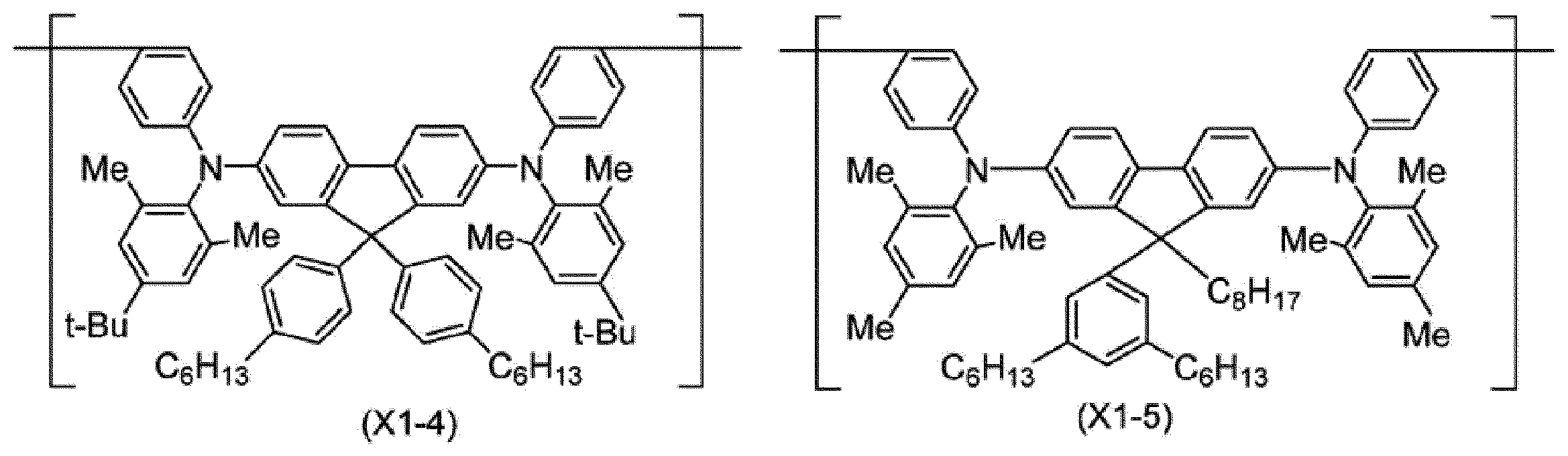


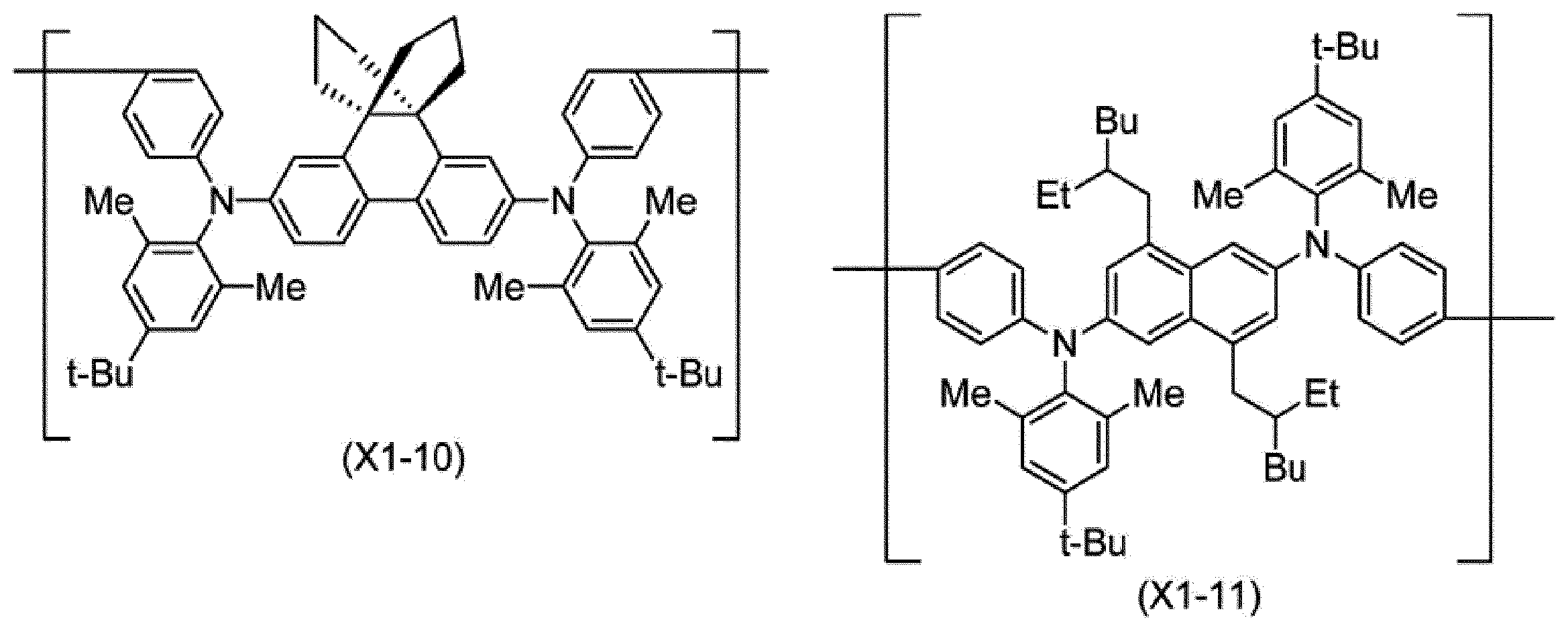
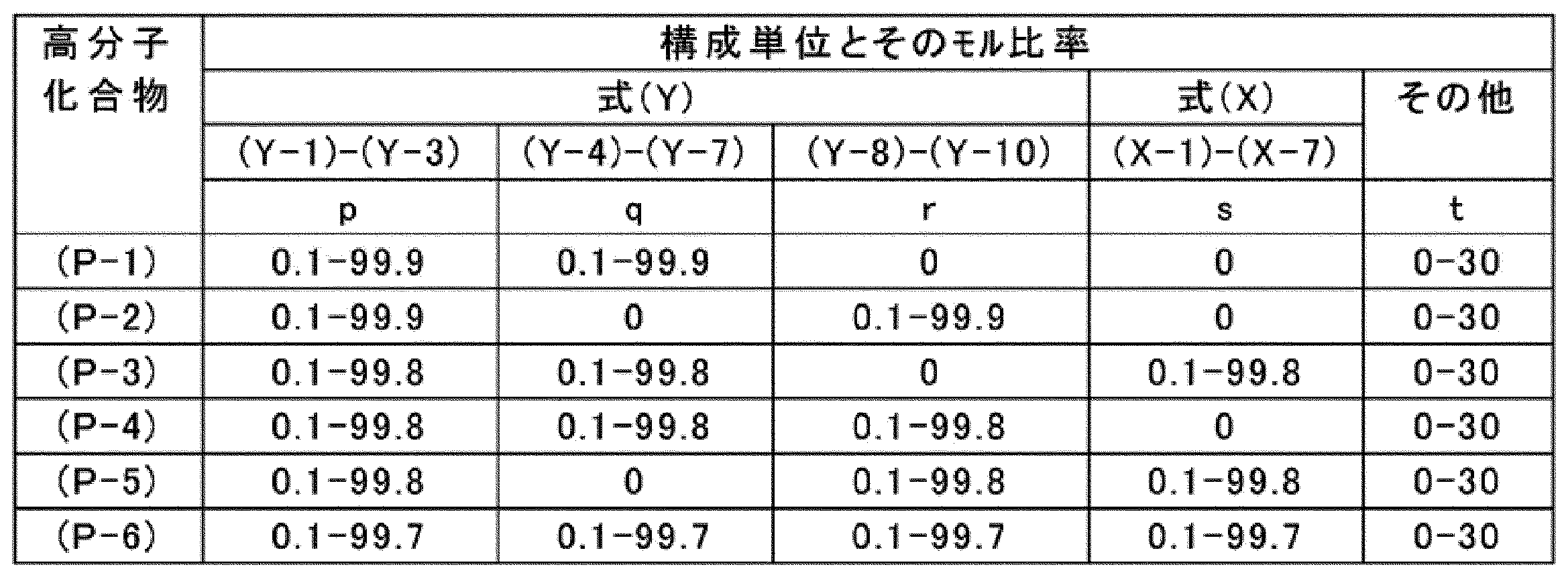
高分子ホストは、ケミカルレビュー(Chem. Rev.),第109巻,897-1091頁(2009年)等に記載の公知の重合方法を用いて製造することができる。高分子ホストの製造方法としては、Suzuki反応、Yamamoto反応、Buchwald反応、Stille反応、Negishi反応及びKumada反応等の遷移金属触媒を用いるカップリング反応により重合させる方法が例示される。
本実施形態に係る組成物は、式(1)で表される金属錯体と溶媒とを含有する液状組成物(インクともいう。)であってよい。このようなインクは、インクジェットプリント法、ノズルプリント法等の印刷法を用いた発光素子の作製に好適である。
正孔輸送材料は、低分子化合物と高分子化合物とに分類され、好ましくは高分子化合物であり、より好ましくは架橋基を有する高分子化合物である。
電子輸送材料は、低分子化合物と高分子化合物とに分類される。電子輸送材料は、架橋基を有していてもよい。
正孔注入材料及び電子注入材料は、各々、低分子化合物と高分子化合物とに分類される。正孔注入材料及び電子注入材料は、架橋基を有していてもよい。
正孔注入材料又は電子注入材料が導電性高分子を含む場合、導電性高分子の電気伝導度は、好ましくは、1×10⁻⁵S/cm~1×103S/cmである。導電性高分子の電気伝導度をかかる範囲とするために、導電性高分子に適量のイオンをドープすることができる。
発光材料(式(1)で表される金属錯体とは異なる。)は、低分子化合物と高分子化合物とに分類される。発光材料は、架橋基を有していてもよい。
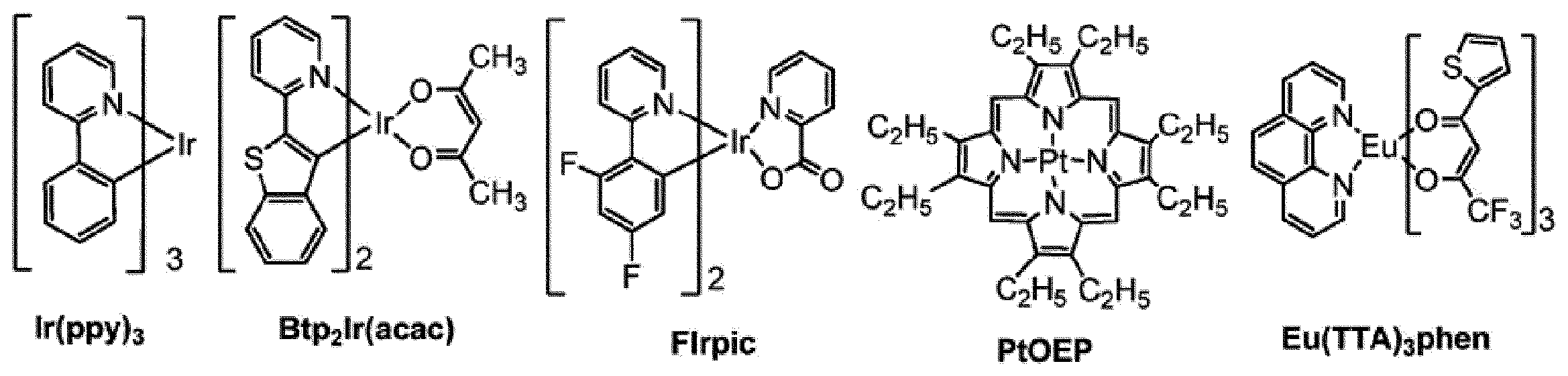

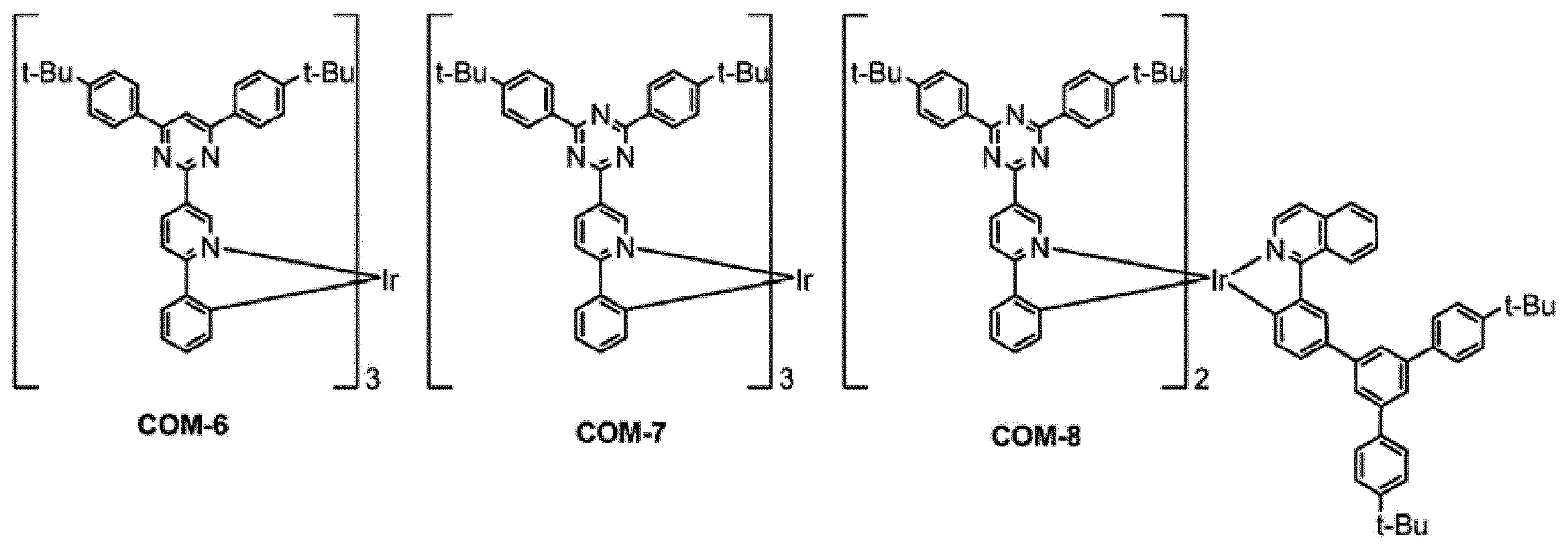
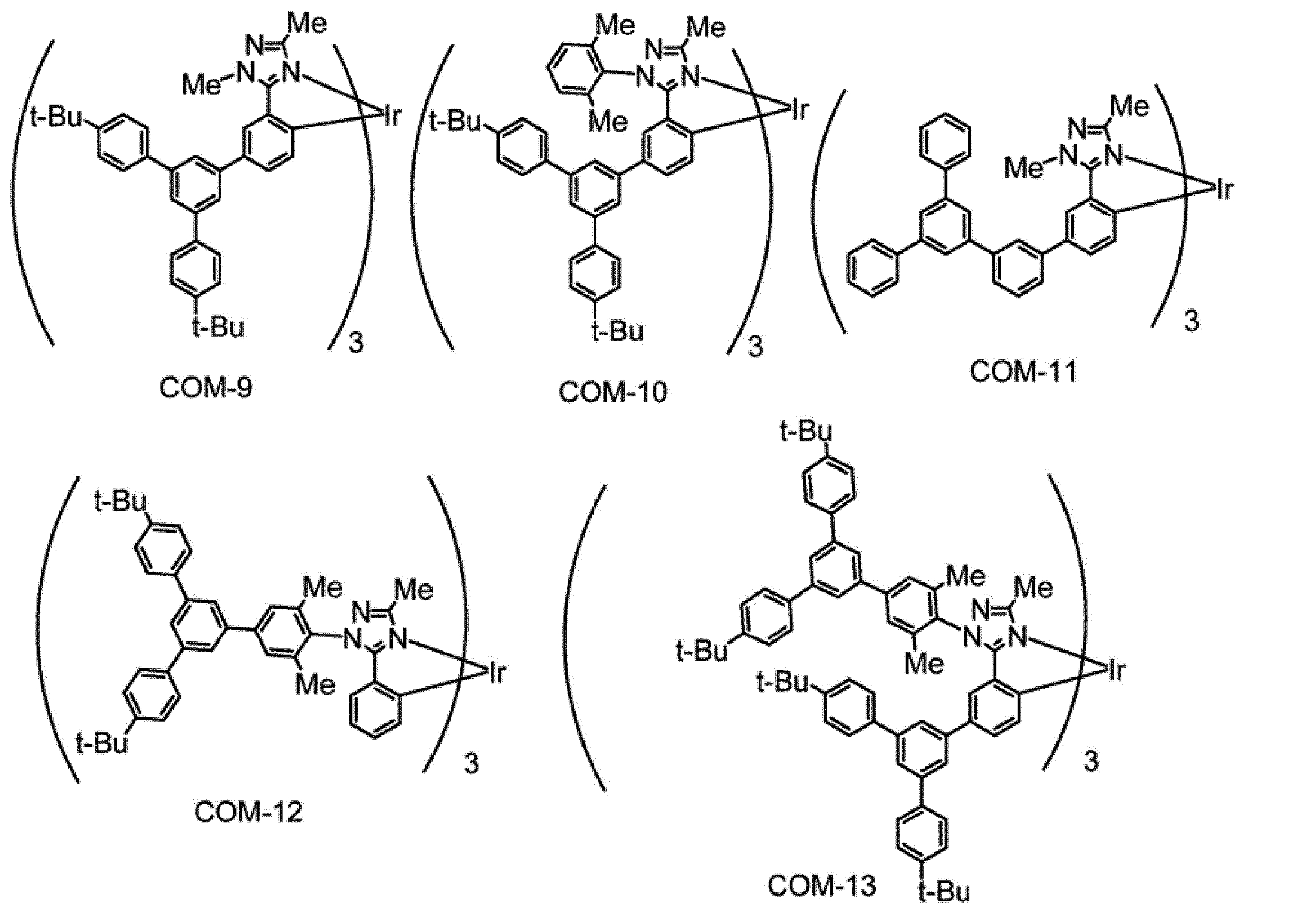

酸化防止剤は、式(1)で表される金属錯体と同じ溶媒に可溶であり、発光及び電荷輸送を阻害しない化合物であることが好ましい。酸化防止剤としては、例えば、フェノール系酸化防止剤、リン系酸化防止剤が挙げられる。
本実施形態に係る膜は、式(1)で表される金属錯体を含有する。本実施形態に係る膜は、例えば、発光素子における発光層として好適である。
本実施形態に係る発光素子は、式(1)で表される金属錯体を含有する。
式(1)で表される金属錯体を含有する層は、通常、発光層、正孔輸送層、正孔注入層、電子輸送層、電子注入層の1種以上の層であり、好ましくは、発光層である。これらの層は、各々、発光材料、正孔輸送材料、正孔注入材料、電子輸送材料、電子注入材料を含む。これらの層は、各々、各層の材料を、上述した溶媒に溶解させてインクを調製し、上述した膜の作製と同じ方法を用いて形成することができる。
発光素子における基板は、電極を形成することができ、かつ、有機層を形成する際に化学的に変化しない基板が好ましい。基板は、例えば、ガラス、プラスチック、シリコン等の材料からなる基板であってよい。基板は透明又は半透明であることが好ましく、不透明な基板の場合には、基板から最も遠くにある電極が透明又は半透明であることが好ましい。
発光素子を用いて面状の発光を得るためには、面状の陽極と陰極が重なり合うように配置すればよい。パターン状の発光を得るためには、面状の発光素子の表面にパターン状の窓を設けたマスクを設置する方法、非発光部にしたい層を極端に厚く形成し実質的に非発光とする方法、陽極若しくは陰極、又は、両方の電極をパターン状に形成する方法がある。これらのいずれかの方法でパターンを形成し、いくつかの電極を独立にON/OFFできるように配置することにより、数字、文字等を表示できるセグメントタイプの表示装置が得られる。ドットマトリックス表示装置とするためには、陽極と陰極を共にストライプ状に形成して直交するように配置すればよい。複数の種類の発光色の異なる高分子化合物を塗り分ける方法、カラーフィルター又は蛍光変換フィルターを用いる方法により、部分カラー表示、マルチカラー表示が可能となる。ドットマトリックス表示装置は、パッシブ駆動も可能であるし、TFT等と組み合わせてアクティブ駆動も可能である。これらの表示装置は、コンピュータ、テレビ、携帯端末等のディスプレイに用いることができる。面状の発光素子は、液晶表示装置のバックライト用の面状光源、又は、面状の照明用光源として好適に用いることができる。フレキシブルな基板を用いれば、曲面状の光源及び表示装置としても使用できる。
測定試料を約2mg/mLの濃度になるようにクロロホルム又はテトラヒドロフランに溶解させ、LC-MS(Agilent製、商品名:1100LCMSD)に約1μL注入した。LC-MSの移動相には、アセトニトリル及びテトラヒドロフランの比率を変化させながら用い、0.2mL/分の流量で流した。カラムは、L-column 2 ODS(3μm)(化学物質評価研究機構製、内径:2.1mm、長さ:100mm、粒径3μm)を用いた。
5~10mgの測定試料を約0.5mLの重クロロホルム(CDCl3)、重テトラヒドロフラン、重ジメチルスルホキシド、重アセトン、重N,N-ジメチルホルムアミド、重トルエン、重メタノール、重エタノール、重2-プロパノール又は重塩化メチレンに溶解させ、NMR装置(Agilent製、商品名:INOVA300又はMERCURY 400VX、JEOL社製、商品名:ECZ400S)を用いて測定した。
測定試料をトルエン、テトラヒドロフラン又はクロロホルムのいずれかの溶媒に任意の濃度で溶解させ、DART用TLCプレート(テクノアプリケーションズ社製、商品名:YSK5-100)上に塗布し、TLC-MS(日本電子社製、商品名:JMS-T100TD(The AccuTOF TLC))を用いて測定した。測定時のヘリウムガス温度は、200~400℃の範囲で調節した。
下記の方法で、金属錯体1を合成した。
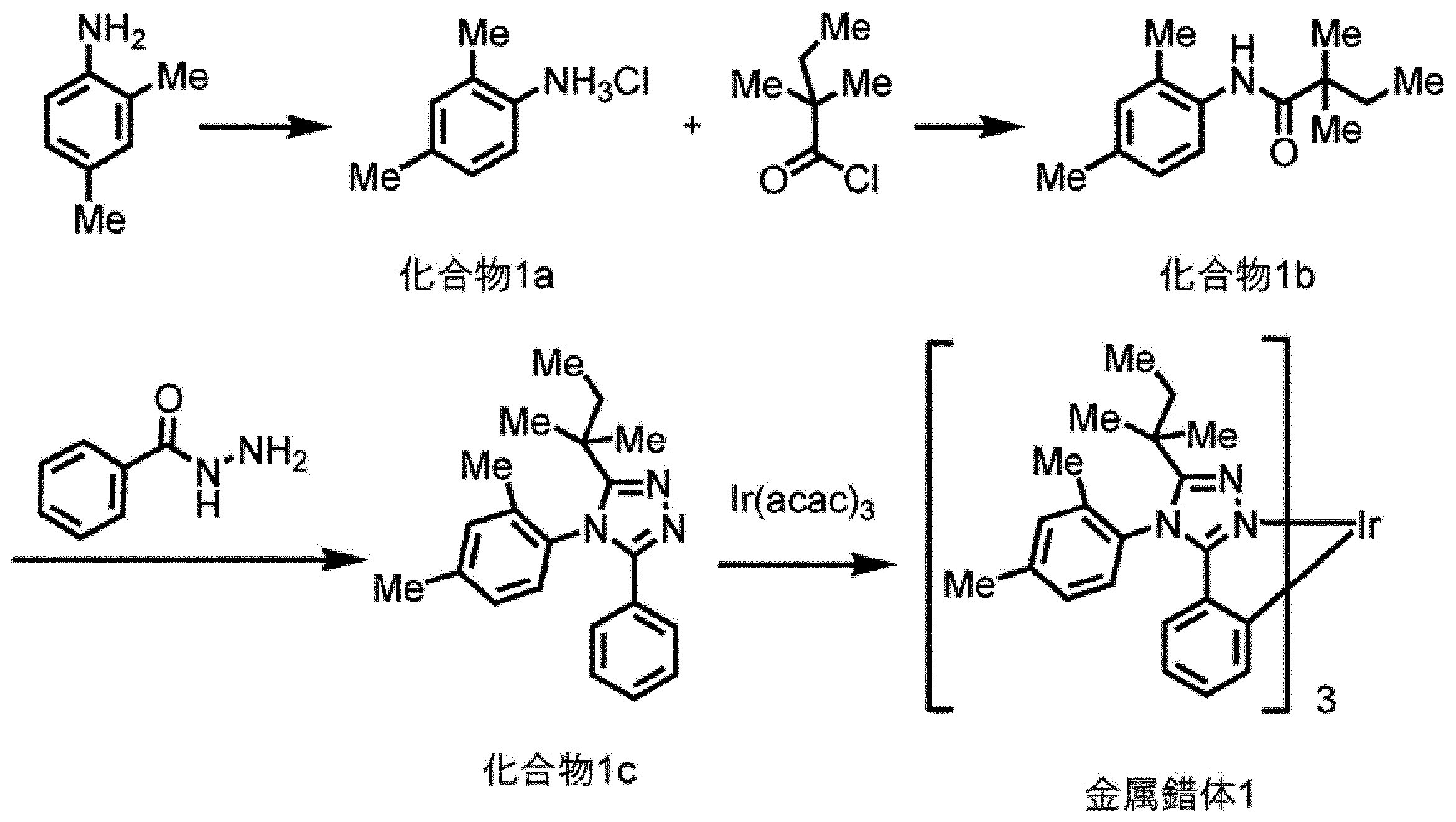
1H-NMR(CDCl3,400MHz) δ(ppm):0.94(3H,t),1.29(6H,s),1.67(2H,q),2.21(3H,s),2.28(3H,s),6.99(1H,s),7.00(1H,d),7.12(1H,br),7.65(1H,d).
LC-MS(APCI,positive):m/z=320[M+H]+
1H-NMR(600MHz、CD2Cl2) δ(ppm):7.42-7.37(m,2H),7.35-7.31(m,2H),7.29-7.25(m,2H),7.19(d,1H),7.07(s,1H),2.40(s,3H),1.79-1.72(m,4H),1.57-1.45(m,1H),1.34(s,3H),1.15(s,3H),0.89(t,3H).
LC-MS(APCI,positive):m/z=1149[M+H]+
1H-NMR(400MHz、CD2Cl2)δ(ppm)=7.29(d,3H),7.21-7.14(m,6H),7.04(d,3H),7.65(t,3H),7.41(t,3H),5.91(d,3H),2.43(s,9H),2.03(s,9H),1.66-1.56(m,3H),1.43-1.31(m,3H),1.17-1.07(m,18H),0.87(t,9H).
LC-MS(APCI,positive):m/z=1149[M+H]+
1H-NMR(400MHz、CD2Cl2)δ(ppm)=7.27-7.13(m,9H),6.83(d,1H),6.75-6.67(m,2H),6.63-6.53(m,3H),6.46-6.33(m,3H),5.99-5.86(m,3H),2.47-2.40(m,9H),2.05(s,6H),1.78(s,3H),1.59-1.43(m,4H),1.42-1.27(m,2H),1.23(s,3H),1.20-1.16(m,6H),1.14(s,3H),1.10(s,3H),1.03(s,3H),0.78(t,3H),0.72-0.62(m,6H).
LC-MS(APCI,positive):m/z=1149[M+H]+
1H-NMR(400MHz、CD2Cl2)δ(ppm)=7.29(t,9H),7.23-7.10(m,27H),6.67-6.48(m,24H),6.46-6.34(m,12H),5.98-5.86(m,12H),2.45(s,9H),2.44-2.40(m,27H),2.08(s,9H),1.83(s,9H),1.80-1.74(m,18H),1.73-1.62(m,6H),1.57-1.40(m,9H),1.39-1.27(m,18H),1.24(s,9H),1.22-1.14(m,27H),1.08(s,9H),1.05(s,18H),0.79(t,9H),0.69(t,9H),0.64(t,18H).
下記の方法で、金属錯体2を合成した。

別途用意した反応容器内をアルゴンガス雰囲気とした後、化合物1a(41.5g)、クロロホルム(400mL)及びトリエチルアミン(75mL)を加え、反応容器を氷浴に設置して冷却した。その後、そこへ、上記で得られた化合物2,2’-ジメチルヘキサノイルクロライドを含む反応液を滴下した。滴下後、室温で1時間撹拌を継続し、その後、2mol/L炭酸ナトリウム水溶液(280mL)を加え、室温で撹拌した。得られた混合物を分液し、有機層を得た。得られた有機層をイオン交換水(280mL)で洗浄した。得られた有機層を無水硫酸マグネシウムで乾燥した後、減圧濃縮することにより、化合物2b(60g、収率88%)を薄黄色の油状物として得た。化合物2bのHPLC面積百分率値は99.5%以上であった。
化合物2bのTLC-MSの測定結果は、以下のとおりであった。
TLC-MS(DART,positive):m/z=248[M+H]+
LC-MS(APPI,positive):m/z=426[M+H]+
1H-NMR(400MHz、CD2Cl2) δ(ppm)=7.60-7.55(m,1H),7.41(d,1H),7.25(d,1H),7.21-7.13(m,2H),7.09-7.03(m,2H),2.36(s,3H),1.76-1.59(m,4H),1.43-1.07(m,11H),0.84(t,3H).
LC-MS(APPI,positive):m/z=480[M+H]+
1H-NMR(400MHz、CD2Cl2)δ(ppm)=7.53-7.48(m,1H),7.46-7.39(m,2H),7.40-7.37(m,2H),7.34-7.29(m,2H),7.26-7.19(m,3H),7.07(s,1H),2.40(s,3H),1.74(s,3H),1.70-1.61(m,1H),1.47-1.36(m,1H),1.34-1.30(m,12H),1.29-1.14(m,4H),1.12(s,3H),0.86(t,3H)
LC-MS(APCI,positive):m/z=1629[M+H]+
1H-NMR(400MHz、CD2Cl2)δ(ppm)=7.41-7.16(m,15H),7.10-6.64(m,12H),6.19-6.04(m,3H),2.54-2.43(m,9H),2.16-1.67(m,9H),1.62-1.03(m,63H),0.85-0.63(m,9H).
下記の方法で、金属錯体3を合成した。
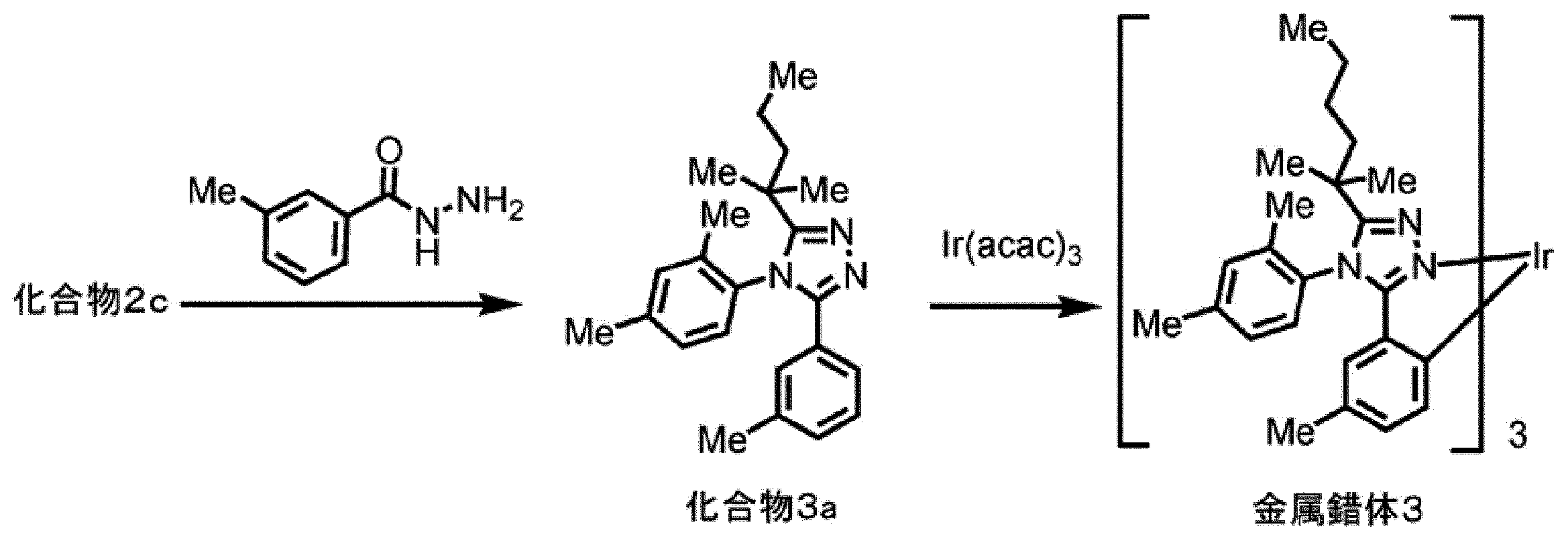
LC-MS(APPI,positive):m/z=362[M+H]+
1H-NMR(400MHz、CD2Cl2)δ(ppm)=7.28-7.22(m,2H),7.16-6.95(m,5H),2.34(s,3H),2.22(s,3H),1.71(s,3H),1.68-1.57(m,1H),1.43-1.33(m,1H),1.32-1.07(m,10H),0.86(t,3H).
LC-MS(APCI,positive):m/z=1629[M+H]+
1H-NMR(400MHz、CD2Cl2)δ(ppm)=7.33-7.01(m,9H),6.75-6.31(m,6H),5.80-5.59(m,3H),2.50-2.39(m,9H),2.13-1.72(m,18H),1.61-0.90(m,36H),0.85-0.62(m,9H).
下記の方法で、金属錯体4を合成した。


1H-NMR(400MHz、CDCl3)δ(ppm)=7.33-7.65(8H,m),4.85(3H,s),2.46(3H,s).
別途用意した反応容器内を窒素ガス雰囲気とした後、化合物4b(39g)、クロロホルム(290mL)及びトリエチルアミン(47mL)を加え、撹拌した。その後、反応容器を氷浴を用いて冷却し、そこに上記で調製した2,2’-ジメチルヘキサノイルクロライドを滴下した。滴下後、室温で2時間撹拌を継続し、その後、飽和炭酸ナトリウム水溶液(300mL)を加え室温で撹拌した。得られた混合物を分液し、得られた有機層を飽和炭酸ナトリウム水溶液及びイオン交換水で洗浄した。得られた洗浄液を分液し、得られた有機層を硫酸マグネシウムで乾燥させた後、ろ過した。得られたろ液を減圧濃縮した後、シリカゲルカラムクロマトグラフィー(ヘキサン及び酢酸エチルの混合溶媒)で分取精製することにより、油状化合物を得た。得られた油状化合物にヘキサンを加え、反応容器をドライアイスを加えたアセトンバス中で冷却しながら1時間撹拌し、得られた固体を濾過し、得られた固体を50℃で減圧乾燥させることで化合物4c(40g、白色固体)を得た。化合物4cのHPLC面積百分率値は99.5%以上であった。
1H-NMR(400MHz、CDCl3)δ(ppm)=7.98(1H,d),7.55(1H,d),7.42(1H,t),7.41(4H,m),7.31(1H,t),2.32(3H,s),1.62(2H,s),1.35(10H,s),0.91(3H,s).
LC-MS(APCI,positive):m/z=488[M+H]+
1H-NMR(400MHz、CDCl3)δ(ppm)=7.57-7.64(m,4H),7.38-7.49(m,6H),7.28-7.30(d,1H),7.07(t,1H),1.85(3H,s),1.67-1.74(2H,m),1.42-1.50(1H,m),1.39(3H,s),1.14-1.36(3H,m),1.17(3H,s),0.88(3H,t).
LC-MS(APCI,positive):m/z=542[M+H]+
1H-NMR(400MHz、CDCl3)δ(ppm)=7.63-7.68(m,4H),7.31-7.52(m,8H),7.25(d,2H),7.15-7.17(d,2H),1.88(s,3H),1.43(s,3H),1.28(s,9H),1.21(s,3H),1.45-1.78(m,1H),1.17-1.39(m,5H),0.88(3H,t)
1H-NMR(400MHz、CD2Cl2)δ(ppm)=7.42-7.73(24H,m),6.97-7.11(18H,m),6.13-6.26(3H,m),2.23-2.27(4H,m),2.01(1H,s)1.94(1H,s),0.97-1.89(34H,m),1.88(2H,d),1.56(3H,s),1.20(27H,s),0.70-0.84(9H,m)
下記の方法で、金属錯体5を合成した。

LC-MS(APCI,positive):m/z=486[M+H]+
1H-NMR(400MHz、CDCl3)δ(ppm)=7.61-7.66(m,4H),7.41-7.52(m,7H),7.34(t,1H),7.21-7.29(m,5H),1.88(3H,s),1.58-1.78(2H,m),1.45-1.52(1H,m),1.42(3H,s),1.17-1.39(3H,m),1.21(3H,s),0.88(3H,t)
1H-NMR(400MHz、CD2Cl2)δ(ppm)=7.43-7.73(24H,m),6.76-7.11(21H,m),6.21-6.30(3H,m),2.26(6H,q),1.91-2.02(4H,m),1.56(3H,s),0.91-1.82(32H,m),0.67-0.83(9H,m).
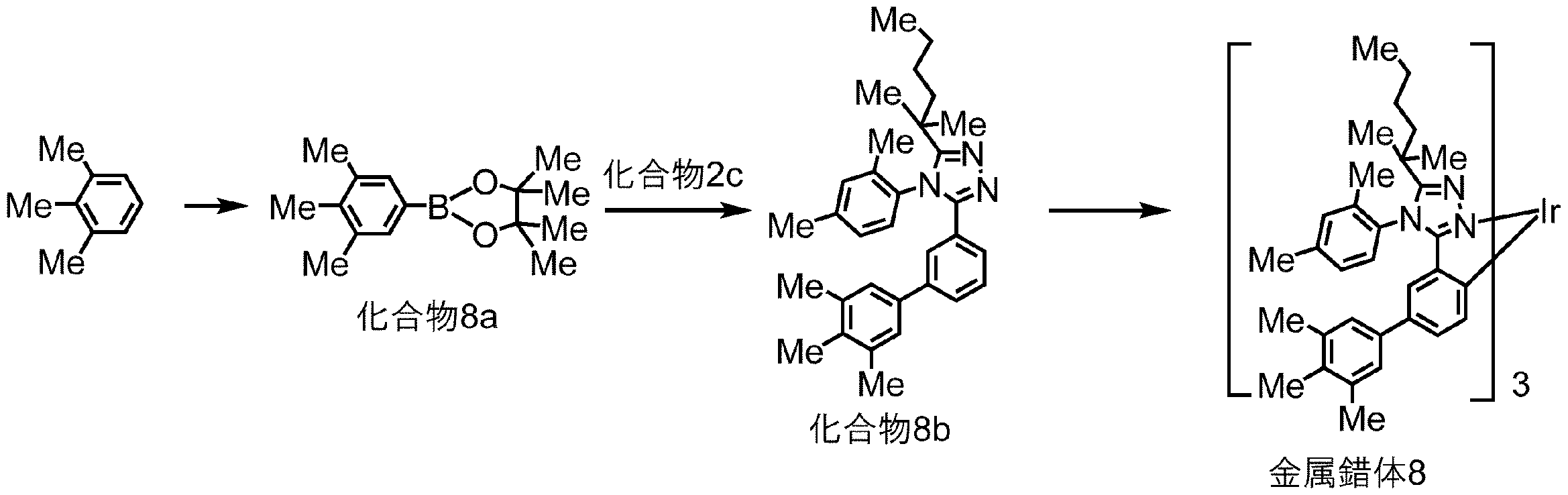
1H-NMR(400MHz、CDCl3)δ(ppm)=7.46(s,2H),2.29(s,6H),2.19(s,3H),1.34(s,12H).
反応容器内をアルゴンガス雰囲気とした後、上記で得られたトルエン溶液(49.9g)、化合物8a(5.2g)、40質量%テトラブチルアンモニウムヒドロキシド水溶液(32.9g)、イオン交換水(32.9g)及びトルエン(108.0g)を加え、室温で撹拌した。その後、そこへ、ビス(ジ-tert-ブチル(2-ブテニル)ホスフィン)ジクロロパラジウム(0.2g)を加え、80℃で27時間撹拌した。その後、反応容器を室温まで冷却し、得られた混合物を分液した。得られた有機層をイオン交換水で洗浄した。得られた洗浄液を分液し、得られた有機層をイオン交換水で洗浄した。得られた洗浄液を分液し、得られた有機層を硫酸マグネシウムで乾燥させた後、ろ過した。得られたろ液に活性炭を加え、室温で1時間撹拌した後、セライトを敷いたろ過器でろ過した。得られたろ液を濃縮した後、ヘプタンを加え、1時間撹拌し、濾過し固体を得た。得られた固体をトルエン及びヘプタンの混合溶媒で再結晶し、得られた固体を50℃で減圧乾燥させることで化合物8b(6.2g、白色固体)を得た。化合物8bのHPLC面積百分率値は99.5%以上であった。
LC-MS(APCI,positive):m/z=466[M+H]+
1H-NMR(CD2Cl2,400MHz):δ(ppm)=7.51-7.45(m,2H),7.40(t,1H),7.35-7.28(m,2H),7.24-7.19(m,1H),7.09-7.06(m,1H),6.91(s,2H),2.40(s,3H),2.28(s,6H),2.16(s,3H),1.75(s,3H),1.70-1.61(m,1H),1.45-1.35(m,1H),1.33(s,3H),1.30-1.16(m,4H),1.11(s,3H),0.89-0.83(m,3H).
LC-MS(APCI,positive):m/z=1585[M+H]+
1H-NMR(CD2Cl2,400MHz):δ(ppm)=7.42-7.16(m,9H),6.99-6.62(m,12H),6.31-6.12(m,3H),2.53-2.41(m,9H),2.31-2.00(m,36H),1.86-1.77(m,3H),1.44-0.98(m,33H),0.85-0.62(m,9H).

1H-NMR(400MHz、CD2Cl2)δ(ppm)=7.74-7.33(m,25H),1.92-1.83(s,3H),1.77-1.56(m,2H),1.50-1.14(m,10H),0.86(t,3H).
LC-MS(APCI,positive):m/z=2104[M+H]+
1H-NMR(400MHz、CD2Cl2)δ(ppm)=7.66-6.96(m,69H),6.73-6.54(m,3H),2.39-2.22(m,7H),2.12-1.94(m,2H),1.64-1.05(m,36H),0.87-0.67(m,9H).

1H-NMR(400MHz、CDCl3)δ(ppm)=0.86(t,3H),1.04-1.50(m,11H),1.58-1.90(m,4H),2.40(s,3H),6.98-7.36(m,5H),7.50(s,1H).
反応容器内をアルゴンガス雰囲気とした後、上記で得られた油状物(30.0g)、2,4-ジメチルフェニルボロン酸(2.2g)、トルエン(450mL)、トリス(ジベンジリデンアセトン)ジパラジウム(1.0g)及び2-ジシクロヘキシルホスフィノ-2’,4’,6’-トリイソプロピルビフェニル(1.2g)を加え、90℃で加熱撹拌した。その後、そこへ、40質量%テトラブチルアンモニウムヒドロキシド水溶液(234mL)を加え、90℃で5時間撹拌した。その後、反応容器を室温まで冷却し、得られた混合物を分液した。得られた有機層をイオン交換水(150mL)で洗浄した。得られた洗浄液を分液し、得られた有機層をイオン交換水(150mL)で洗浄した。得られた洗浄液を分液し、得られた有機層を硫酸マグネシウムで乾燥させた後、ろ過した。得られたろ液に活性炭(4.0g)を加え、室温で1時間撹拌した後、セライトを敷いたろ過器でろ過した。得られたろ液を濃縮し、赤茶色油状物を得た。得られた赤茶色油状物を逆相シリカゲルカラムクロマトグラフィー(アセトニトリル)で分取精製し、次いで、得られた油状物をシリカゲルカラムクロマトグラフィー(クロロホルム及びエタノールの混合溶媒)で分取精製し、次いで、得られた油状物をリサイクルGPCにより分取精製した。得られた固体を50℃で減圧乾燥させることで化合物10b(2.2g、無色透明油状物)を得た。化合物10bのHPLC面積百分率値は99.5%以上であった。
LC-MS(APCI,positive):m/z=556[M+H]+
1H-NMR(400MHz、CD2Cl3)δ(ppm)=0.86(t,3H),1.12-1.44(m,11H),1.58-2.04(m,10H),2.20(s,6H),2.37(s,3H),6.46-7.25(m,12H).
LC-MS(APCI,positive):m/z=1858[M+H]+
1H-NMR(400MHz、CDCl3)δ(ppm)=0.82-2.30(m,99H),5.69-7.27(m,33H)
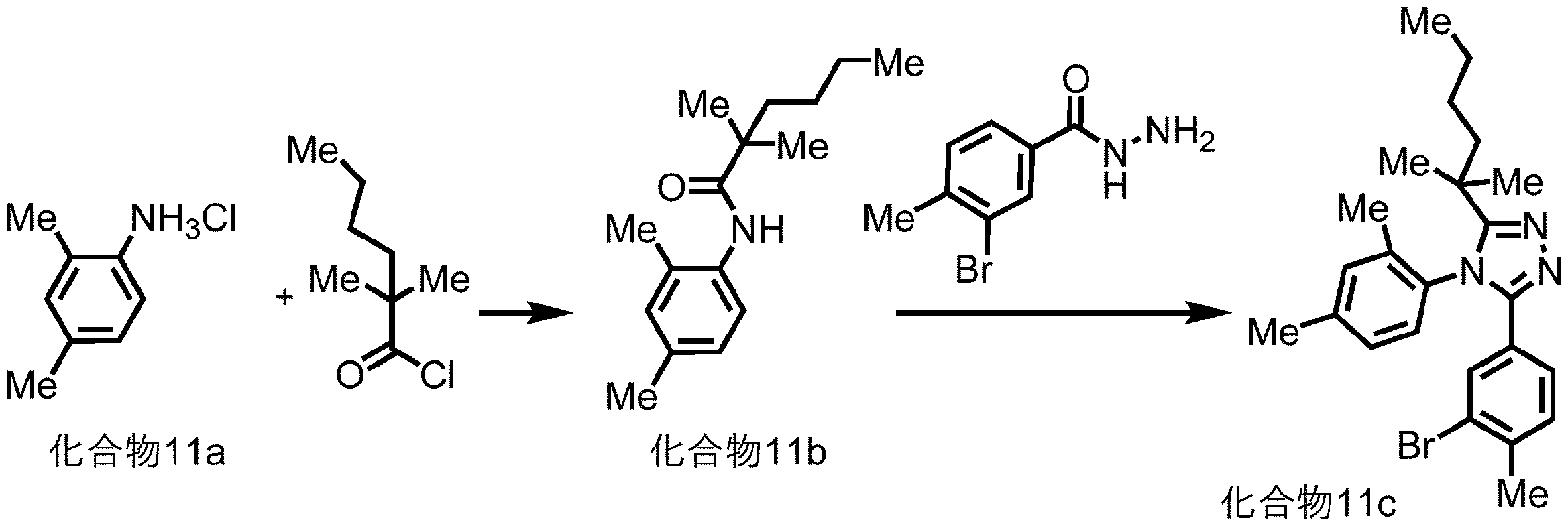

別途用意した反応容器内をアルゴンガス雰囲気とした後、化合物11a(41.5g)、クロロホルム(400mL)及びトリエチルアミン(75mL)を加え、反応容器を氷浴に設置して冷却した。その後、そこへ、上記で得られた2,2’-ジメチルヘキサノイルクロライドを含む反応液を滴下した。滴下後、室温で1時間撹拌を継続した。その後、そこへ、2mol/L炭酸ナトリウム水溶液(280mL)を加え、室温で撹拌した。得られた混合物を分液し、有機層を得た。得られた有機層をイオン交換水(280mL)で洗浄した。得られた有機層を無水硫酸マグネシウムで乾燥した後、減圧濃縮することにより、化合物6b(60g、収率88%)を薄黄色の油状物として得た。化合物11bのHPLC面積百分率値は99.5%以上であった。
TLC-MS(DART,positive):m/z=248[M+H]+
1H-NMR(400MHz、CD2Cl2-d2)δ(ppm)=7.61-7.53(m,1H),7.28-7.21(m,1H),7.21-7.12(m,1H),7.12-7.01(m,3H),2.34(s,3H),2.30(s,3H),1.75-1.60(m,5H),1.42-1.08(m,10H),85(t,3H).
1H-NMR(CD2Cl2、400MHz):δ(ppm)=1.33(12H,m),6.64(4H,m),7.06-7.23(3H,m),7.35(3H,t),7.51(1H,d),7.86(2H,d),7.91(1H,d),8.26(1H,s).
上記の一連の操作を繰り返すことにより化合物11e(2.6g、白色固体)を得た。化合物11eのHPLC面積百分率値は99.5%以上であった。
1H-NMR(CD2Cl2,400MHz):δ(ppm)=7.89-7.85(m,2H),7.84-7.80(m,1H),7.60-7.57(m,1H),7.40-7.35(m,3H),7.30-7.26(m,2H),7.23(d,1H),7.18-7.08(m,5H),7.05(br,1H),6.82(dd,1H),6.74-6.63(m,4H),2.32(s,3H),2.27(s,3H),1.76(s,3H),1.69-1.59(m,1H),1.44-1.37(m,1H),1.32(s,3H),1.29-1.15(m,4H),1.09(s,3H),0.85(t,3H).
LC-MS(APCI,positive):m/z=2218[M+H]+
1H-NMR(CD2Cl2,400MHz):δ(ppm)=7.90-7.82(m,9H),7.51-7.34(m,15H),7.27-7.09(m,15H),6.90-6.78(m,3H),6.75-6.59(m,12H),6.57-6.51(m,3H),5.88-5.78(m,3H),2.25-2.05(m,27H),2.01-1.83(m,6H),1.47-1.06(m,30H),0.89-0.72(m,9H).

1H-NMR(400MHz、CD2Cl2)δ(ppm)=7.40-6.94(m,11H),2.42-2.34(m,3H),2.23-2.15(m,3H),1.78-1.48(m,6H),1.42-1.16(m,6H),1.13-1.06(m,3H),0.92-0.77(m,3H).
1H-NMR(400MHz、CD2Cl2)δ(ppm)=7.33-7.08(m,18H),7.02-6.93(m,6H),6.73-6.48(m,3H),5.81-5.71(m,3H),2.43-2.32(m,9H),2.16-1.97(m,15H),1.91-1.79(m,3H),1.58-1.03(m,36H),0.84-0.67(m,9H).

上記の一連の操作を繰り返すことにより、化合物13aの必要量を確保した。
1H-NMR(400MHz、CD2Cl2)δ(ppm)=1.40(3H,t),4.39(2H,q),7.38(1H,dt),7.50(1H,dt),7.59(2H,d),8.02(1H,dd),8.16(1H,dd),8.67(1H,d).
1H-NMR(400MHz、CD3OD)δ(ppm)=4.84(2H,s),7.39(1H,dt),7.52(1H,dt),7.60(1H,dd),7.64(1H,d),7.93(1H,dd),8.07(1H,dd),8.48(1H,d).
1H-NMR(400MHz、CD2Cl2)δ(ppm)=0.89(3H,t),1.18(3H,s),1.20-1.35(3H,m),1.46(1H,dt),1.66-1.75(1H,m),1.83(3H,s),7.29(1H,dt),7.34-7.66(12H,m),7.80(1H,dd),8.02(1H,d).
LC-MS(APCI,positive):m/z=1689[M+H]+
1H-NMR(400MHz、CD2Cl2)δ(ppm)=0.49-0.86(10H,m),0.94-1.70(35H,m),1.81-1.91(4H,m),2.23-2.32(5H,m),6.51-6.59(3H,m),6.78-7.27(15H,m),7.43-7.81(24H,m).
下記の方法で、金属錯体6を合成した。

LC-MS(APCI,positive):m/z=179[M+H]+
1H-NMR(300MHz、DMSO-d6)δ(ppm)=10.26(br,s,1H),9.86(br,s,1H),7.83-7.86(m,2H),7.45-7.56(m,3H),1.90(s,3H).
LC-MS(APCI,positive):m/z=320[M+H]+
1H-NMR(400MHz、CDCl3)δ(ppm)=7.53- 7.58 (m, 1H),7.48(d,2H),7.33(d,2H),7.28-7.30(m,1H),7.21-7.25(m,2H),2.39(q,2H),2.26(s,3H),1.14(d,6H),0.87(d,6H).
1H-NMR(600MHz、THF-d8)δ(ppm)=7.56(t,3H),7.42(dd,3H),7.40(dd,3H),6.87(dd,3H),6.52(td,3H),6.35(td,3H),6.17(dd,3H),2.83(hept,3H),2.34(hept,3H),2.10(s,9H),1.23(d,9H),0.98(d,9H),0.96(d,9H),0.92(d,9H).
下記の方法で、金属錯体7を合成した。
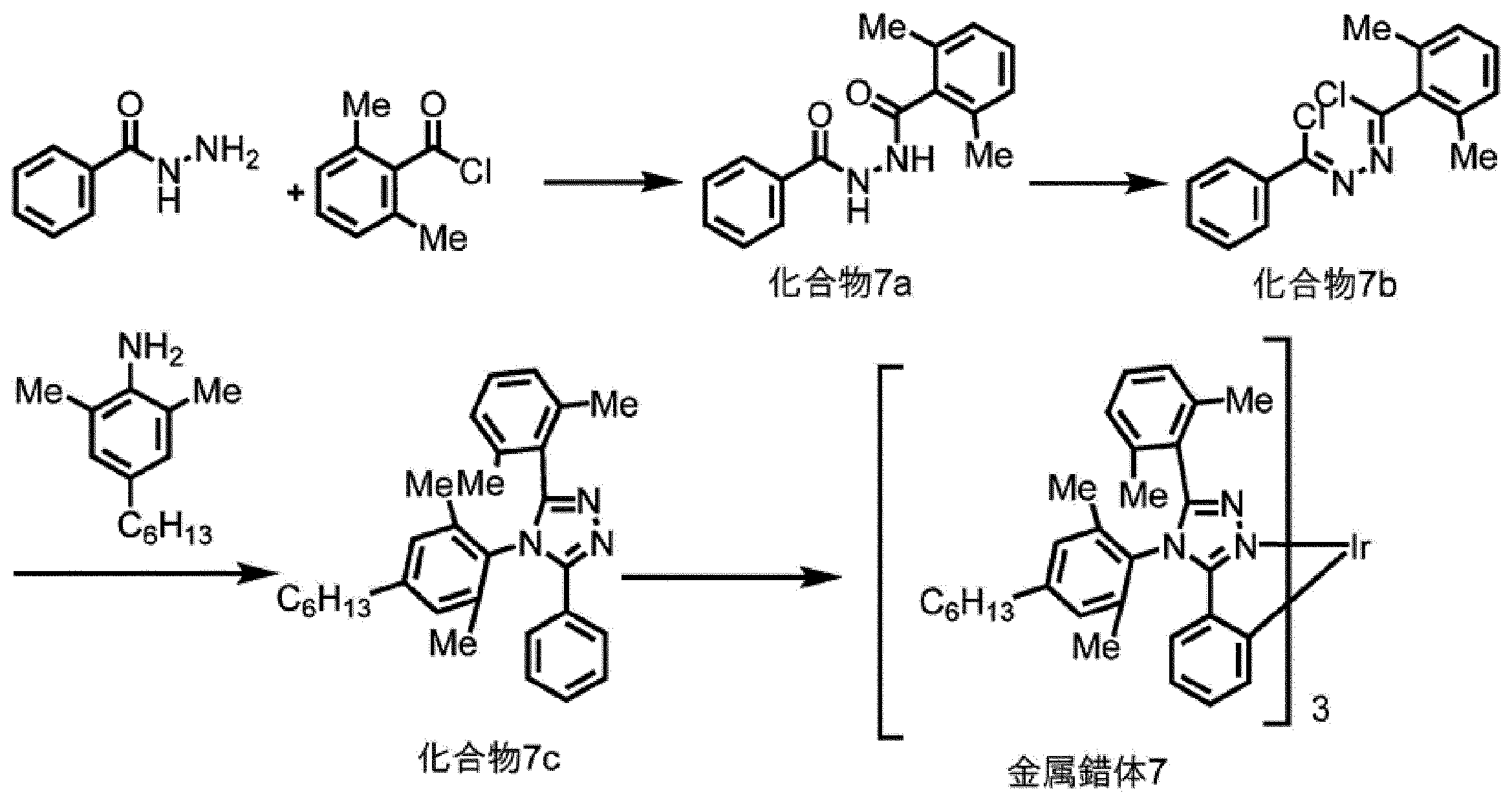
1H-NMR(600MHz、CDCl3)δ(ppm)=9.64(br,1H),8.90(br,1H),7.86(d,2H),7.56(t,1H),7.45(t,2H),7.02-7.08(m,3H),2.41(s,6H).
反応容器を窒素雰囲気とした後、化合物7b(40g)、2,6-ジメチル4-ヘキシルアニリン(32g)及びキシレン(800mL)を加え、室温で撹拌した。その後、そこへ、パラトルエンスルホン酸(3g)を加え、120℃で116時間撹拌した。その後、反応容器を室温まで冷却し、そこにイオン交換水(800mL)を加え、室温で1時間撹拌した。得られた混合物を分液し、得られた有機層を5%炭酸水素ナトリウム水溶液で洗浄した。得られた有機層を硫酸マグネシウムで乾燥させた後、ろ過し、得られたろ液を減圧濃縮することにより、茶色油状物を得た。得られた茶色油状物をシリカゲルカラムクロマトグラフィー(ヘプタン及び酢酸エチルの混合溶媒、並びに、アセトニトリル及びテトラヒドロフラン)で複数回分取精製することにより、化合物7c(1.3g、白色固体)を得た。化合物7cのHPLC面積百分率値は99.5%以上であった。上記操作を繰り返すことにより、必要量を確保した。
1H-NMR(600MHz、THF-d8)δ(ppm)=7.42 (d,2H),7.30 (t,1H),7.24(t,2H),7.15(t,1H),6.98(d,2H),6.85(s,2H),2.51(t,2H),2.07(s,6H),1.81(s,6H),1.56(m,2H),1.26-1.32(m,6H),0.88(t,3H).
1H-NMR(600MHz、THF-d8)δ(ppm)=7.04-7.08 (m, 6H),6.93(s,3H),6.92(s,3H),6.88(d,3H),6.84(d,3H),6.61(t,3H),6.43(t,3H),6.29(d,3H),2.57(t,6H),2.12(s,9H),1.95(s,9H),1.82(s,9H),1.70(s,9H),1.62(m,6H),1.28-1.36(m,18H),0.89(t,9H).
[発光安定性の評価装置]
発光安定性の評価装置により、後述する測定試料のガラス基板側から励起光を照射し、測定試料に含まれる有機層を発光させた。励起光源には、浜松ホトニクス社製のLightningcure LC-L1V3(波長385nm)を用いた。測定試料からの発光の測定には、発光輝度測定装置である株式会社トプコン製のBM-9を用いた。発光輝度測定装置の測光入射口には、短波長不透過フィルターを設置して、波長400nm以下の光が測光されないようにした。
発光安定性の評価では、後述する各測定試料からの発光のフォトン数が同数となるように、励起光源の励起光強度を調整した。









金属錯体1(異性体3及び4の混合物)と、式(H-113)で表される化合物(以下、「化合物H-113」ともいう。)(Luminescence Technology社製、LT-N4013)とを、2.0質量%の濃度で溶解させたトルエン溶液(金属錯体1:化合物H-113=25質量%:75質量%)を調製した。

金属錯体1の異性体3及び4の混合物に代えて、金属錯体1の異性体1を用いた以外は、実施測定例1と同様にして、測定試料FL-2を作製し、発光安定性を測定した。
金属錯体1の異性体3及び4の混合物に代えて、金属錯体1の異性体2を用いた以外は、実施測定例1と同様にして、測定試料FL-3を作製し、発光安定性を測定した。
金属錯体1の異性体3及び4の混合物に代えて、金属錯体2を用いた以外は、実施測定例1と同様にして、測定試料FL-4を作製し、発光安定性を測定した。
金属錯体1の異性体3及び4の混合物に代えて、金属錯体3を用いた以外は、実施測定例1と同様にして、測定試料FL-5を作製し、発光安定性を測定した。
金属錯体1の異性体3及び4の混合物に代えて、金属錯体4を用いた以外は、実施測定例1と同様にして、測定試料FL-6を作製し、発光安定性を測定した。
金属錯体1の異性体3及び4の混合物に代えて、金属錯体5を用いた以外は、実施測定例1と同様にして、測定試料FL-7を作製し、発光安定性を測定した。
金属錯体1の異性体3及び4の混合物に代えて、金属錯体8を用いた以外は、実施測定例1と同様にして、測定試料FL-8を作製し、発光安定性を測定した。
金属錯体1の異性体3及び4の混合物に代えて、金属錯体9を用いた以外は、実施測定例1と同様にして、測定試料FL-9を作製し、発光安定性を測定した。
金属錯体1の異性体3及び4の混合物に代えて、金属錯体10を用いた以外は、実施測定例1と同様にして、測定試料FL-10を作製し、発光安定性を測定した。
金属錯体1の異性体3及び4の混合物に代えて、金属錯体11を用いた以外は、実施測定例1と同様にして、測定試料FL-11を作製し、発光安定性を測定した。
金属錯体1の異性体3及び4の混合物に代えて、金属錯体12を用いた以外は、実施測定例1と同様にして、測定試料FL-12を作製し、発光安定性を測定した。
金属錯体1の異性体3及び4の混合物に代えて、金属錯体13を用いたこと、並びに、化合物H-113に代えて、下記式(H-103)で表される化合物(以下、「化合物H-103」ともいう。)(Luminescence Technology社製、LT-E107)を用いた以外は、実施測定例1と同様にして、測定試料FL-13を作製し、発光安定性を測定した。
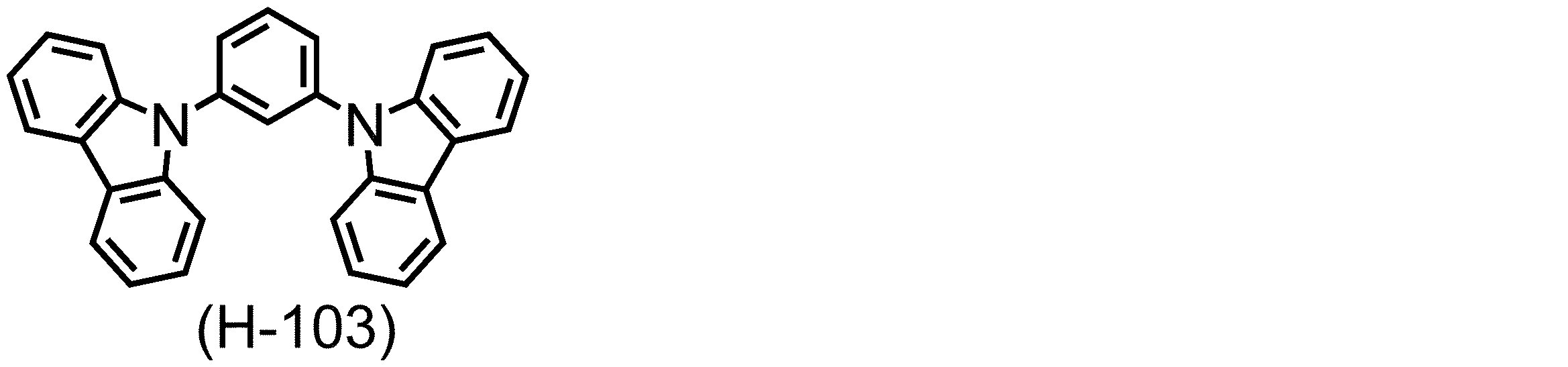
金属錯体1の異性体3及び4の混合物に代えて、金属錯体3を用いたこと、並びに、化合物H-113に代えて、化合物H-103を用いた以外は、実施測定例1と同様にして、測定試料FL-14を作製し、発光安定性を測定した。
金属錯体1の異性体3及び4の混合物に代えて、金属錯体4を用いたこと、並びに、化合物H-113に代えて、化合物H-103を用いた以外は、実施測定例1と同様にして、測定試料FL-15を作製し、発光安定性を測定した。
金属錯体1の異性体3及び4の混合物に代えて、金属錯体6を用いた以外は、実施測定例1と同様にして、測定試料CFL-1を作製し、発光安定性を測定した。
金属錯体1の異性体3及び4の混合物に代えて、金属錯体7を用いた以外は、実施測定例1と同様にして、測定試料CFL-2を作製し、発光安定性を測定した。

Claims (15)
- 式(1)で表される金属錯体。

Xは窒素原子又は=C(RX)-で表される基を表す。RXは水素原子、アルキル基、シクロアルキル基、アルコキシ基、シクロアルコキシ基、アリール基、アリールオキシ基、1価の複素環基、置換アミノ基又はハロゲン原子を表し、これらの基は置換基を有していてもよい。Xが複数存在する場合、それらは同一であっても異なっていてもよい。
R1は炭素原子数4以上のアルキル基を表し、該基は置換基を有していてもよい。R1が複数存在する場合、それらは同一であっても異なっていてもよい。
R2はアルキル基、シクロアルキル基、アルコキシ基、シクロアルコキシ基、アリール基、アリールオキシ基、1価の複素環基、置換アミノ基又はハロゲン原子を表し、これらの基は置換基を有していてもよい。R2が複数存在する場合、それらは同一であっても異なっていてもよい。
環A及び環Bは、それぞれ独立に、芳香族炭化水素環又は芳香族複素環を表し、これらの環は置換基を有していてもよい。該置換基が複数存在する場合、それらは同一であっても異なっていてもよく、互いに結合して、それぞれが結合する原子とともに環を形成していてもよい。環A及び環Bが複数存在する場合、それらはそれぞれ同一であっても異なっていてもよい。
Mはロジウム原子、パラジウム原子、イリジウム原子又は白金原子を表す。
n1は1以上の整数を表し、n2は0以上の整数を表し、n1+n2は2又は3である。
Mがロジウム原子又はイリジウム原子の場合、n1+n2は3であり、Mがパラジウム原子又は白金原子の場合、n1+n2は2である。
A1-G1-A2は、アニオン性の2座配位子を表す。A1及びA2は、それぞれ独立に、炭素原子、酸素原子又は窒素原子を表し、これらの原子は環を構成する原子であってもよい。G1は、単結合、又は、A1及びA2とともに2座配位子を構成する原子団を表す。A1-G1-A2が複数存在する場合、それらは同一であっても異なっていてもよい。] - 環Bが、ベンゼン環、フルオレン環、ジベンゾフラン環又はジベンゾチオフェン環である、請求項1に記載の金属錯体。
- 式(1a)で表される、請求項2に記載の金属錯体。
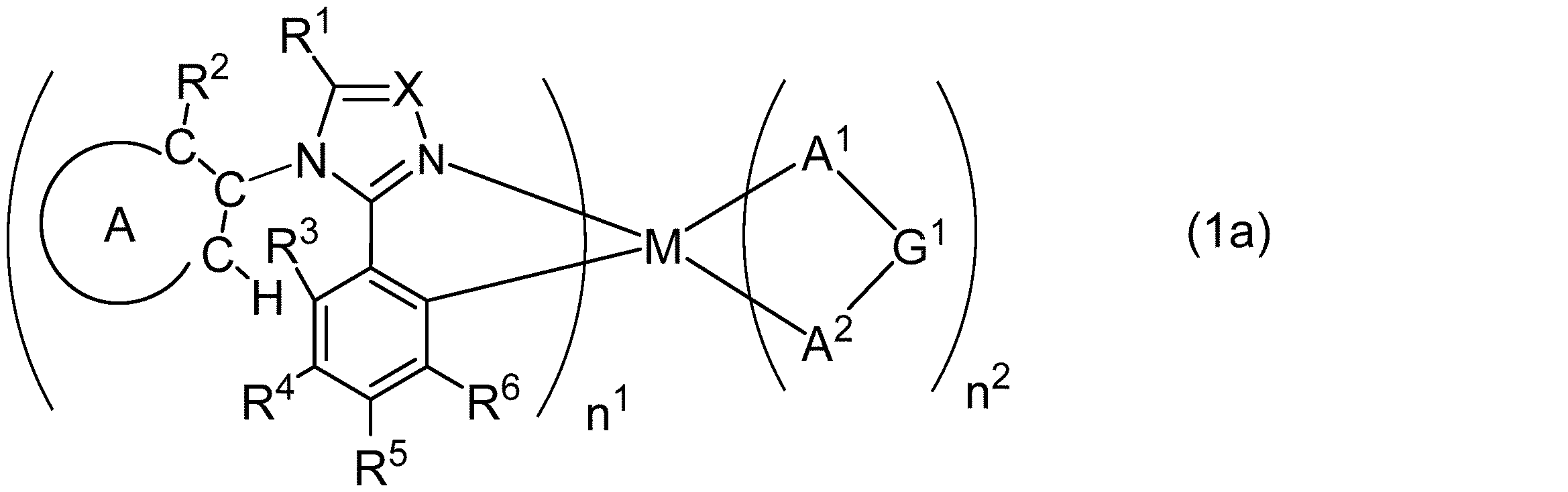
M、n1、n2、R1、R2、環A、X及びA1-G1-A2は、前記と同じ意味を表す。
R3、R4、R5及びR6は、それぞれ独立に、水素原子、アルキル基、シクロアルキル基、アルコキシ基、シクロアルコキシ基、アリール基、アリールオキシ基、1価の複素環基、置換アミノ基又はハロゲン原子を表し、これらの基は置換基を有していてもよい。
R3、R4、R5及びR6が複数存在する場合、それらはそれぞれ同一であっても異なっていてもよい。R3とR4、R4とR5、及び、R5とR6は、それぞれ結合して、それぞれが結合する炭素原子とともに環を形成していてもよい。] - 式(1b)で表される、請求項3に記載の金属錯体。
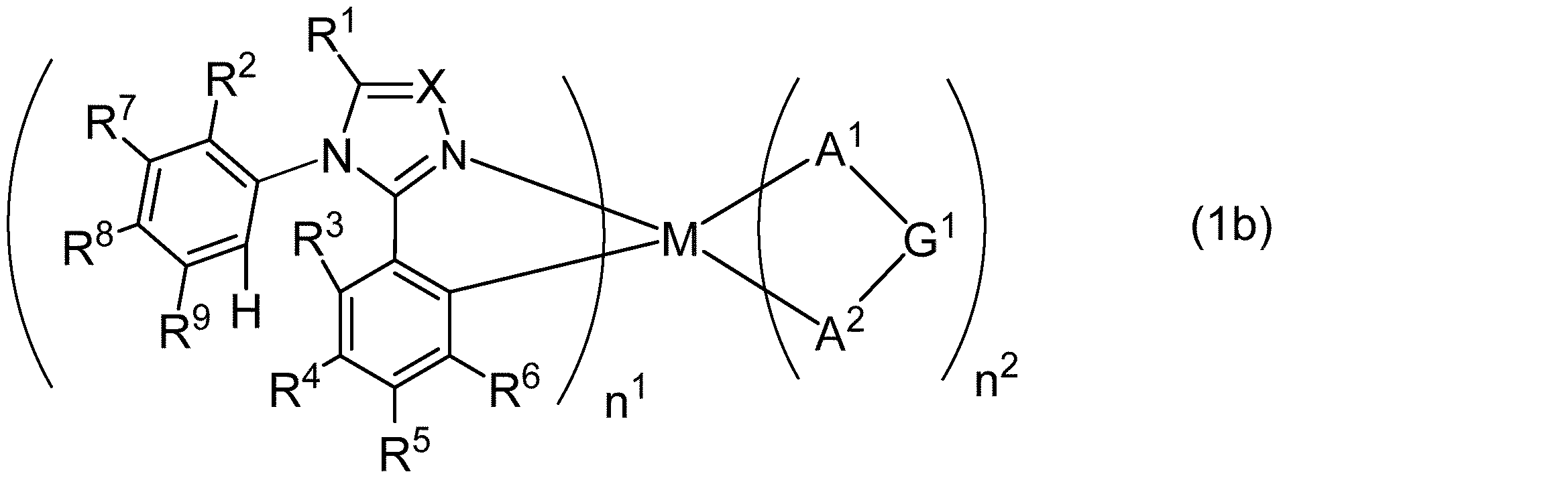
M、n1、n2、R1、R2、R3、R4、R5、R6、X及びA1-G1-A2は、前記と同じ意味を表す。
R7、R8及びR9は、それぞれ独立に、水素原子、アルキル基、シクロアルキル基、アルコキシ基、シクロアルコキシ基、アリール基、アリールオキシ基、1価の複素環基、置換アミノ基又はハロゲン原子を表し、これらの基は置換基を有していてもよい。R7、R8及びR9が複数存在する場合、それらはそれぞれ同一であっても異なっていてもよい。R7とR8、R8とR9は、それぞれが結合して、それぞれが結合する炭素原子とともに環を形成していてもよい。] - 少なくとも一つのR1が、式(2)で表される基である、請求項1~4のいずれか一項に記載の金属錯体。
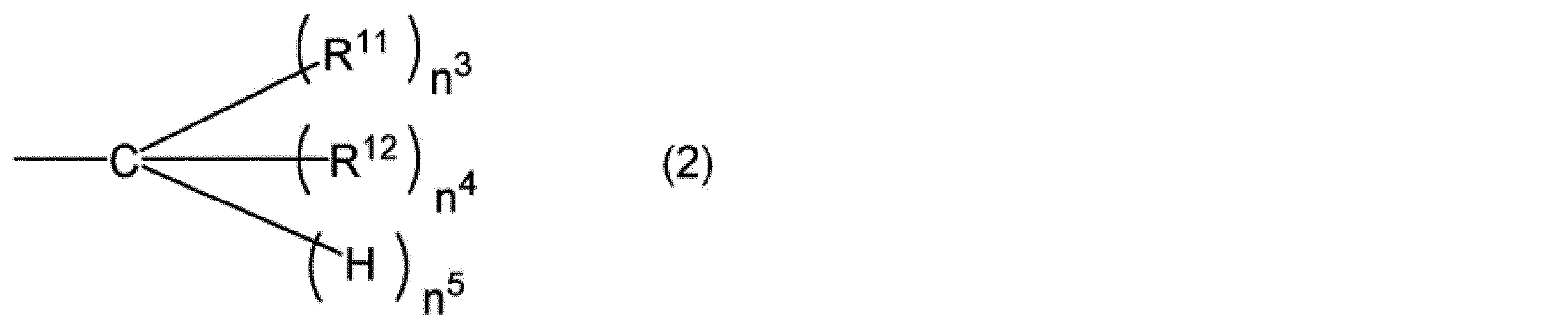
R11はアルキル基を表し、該基は置換基を有していてもよい。R11が複数存在する場合、それらは同一であっても異なっていてもよい。
R12はシクロアルキル基、アルコキシ基、シクロアルコキシ基、アリール基、アリールオキシ基、1価の複素環基、置換アミノ基又はハロゲン原子を表し、これらの基は置換基を有していてもよい。R12が複数存在する場合、それらは同一であっても異なっていてもよい。
n3は1~3の整数を表し、n4は0~2の整数を表し、n5は0又は1を表し、n3+n4+n5は3である。] - n5が0である、請求項5に記載の金属錯体。
- n4が0である、請求項5又は6に記載の金属錯体。
- R2が置換基を有していてもよいアルキル基である、請求項1~7のいずれか一項に記載の金属錯体。
- Mが白金原子又はイリジウム原子である、請求項1~8のいずれか一項に記載の金属錯体。
- n2が0である、請求項1~9のいずれか一項に記載の金属錯体。
- Xが窒素原子である、請求項1~10のいずれか一項に記載の金属錯体。
- 請求項1~11のいずれか一項に記載の金属錯体と、
式(H-1)で表される化合物及び式(Y)で表される構成単位を含む高分子化合物からなる群より選択される少なくとも一種と、
を含有する、組成物。

ArH1及びArH2は、それぞれ独立に、アリール基又は1価の複素環基を表し、これらの基は置換基を有していてもよい。
nH1及びnH2は、それぞれ独立に、0又は1を表す。nH1が複数存在する場合、それらは同一であっても異なっていてもよい。複数存在するnH2は、同一であっても異なっていてもよい。
nH3は、0以上の整数を表す。
LH1は、アリーレン基、2価の複素環基、又は、-[C(RH11)2]nH11-で表される基を表し、これらの基は置換基を有していてもよい。LH1が複数存在する場合、それらは同一であっても異なっていてもよい。
nH11は、1以上10以下の整数を表す。RH11は、水素原子、アルキル基、シクロアルキル基、アルコキシ基、シクロアルコキシ基、アリール基又は1価の複素環基を表し、これらの基は置換基を有していてもよい。複数存在するRH11は、同一であっても異なっていてもよく、互いに結合して、それぞれが結合する炭素原子とともに環を形成していてもよい。
LH2は、-N(-LH21-RH21)-で表される基を表す。LH2が複数存在する場合、それらは同一であっても異なっていてもよい。
LH21は、単結合、アリーレン基又は2価の複素環基を表し、これらの基は置換基を有していてもよい。RH21は、水素原子、アルキル基、シクロアルキル基、アリール基又は1価の複素環基を表し、これらの基は置換基を有していてもよい。]

- 請求項1~11のいずれか一項に記載の金属錯体と、
正孔輸送材料、正孔注入材料、電子輸送材料、電子注入材料、発光材料、酸化防止剤及び溶媒からなる群より選ばれる少なくとも1種の材料と、
を含有する、組成物。 - 請求項1~11のいずれか一項に記載の金属錯体を含有する、膜。
- 請求項1~11のいずれか一項に記載の金属錯体を含有する、発光素子。
Priority Applications (5)
| Application Number | Priority Date | Filing Date | Title |
|---|---|---|---|
| EP17775450.4A EP3438114B1 (en) | 2016-03-31 | 2017-03-30 | Metal complex, composition and light-emitting device |
| KR1020187026948A KR102323794B1 (ko) | 2016-03-31 | 2017-03-30 | 금속 착체, 조성물 및 발광 소자 |
| JP2017567834A JP6352562B2 (ja) | 2016-03-31 | 2017-03-30 | 金属錯体、組成物及び発光素子 |
| CN201780020312.0A CN108884118A (zh) | 2016-03-31 | 2017-03-30 | 金属络合物、组合物及发光元件 |
| US16/088,853 US20190185500A1 (en) | 2016-03-31 | 2017-03-30 | Metal complex, composition and light emitting device |
Applications Claiming Priority (2)
| Application Number | Priority Date | Filing Date | Title |
|---|---|---|---|
| JP2016-071414 | 2016-03-31 | ||
| JP2016071414 | 2016-03-31 |
Publications (1)
| Publication Number | Publication Date |
|---|---|
| WO2017170916A1 true WO2017170916A1 (ja) | 2017-10-05 |
Family
ID=59965998
Family Applications (1)
| Application Number | Title | Priority Date | Filing Date |
|---|---|---|---|
| PCT/JP2017/013374 Ceased WO2017170916A1 (ja) | 2016-03-31 | 2017-03-30 | 金属錯体、組成物及び発光素子 |
Country Status (6)
| Country | Link |
|---|---|
| US (1) | US20190185500A1 (ja) |
| EP (1) | EP3438114B1 (ja) |
| JP (1) | JP6352562B2 (ja) |
| KR (1) | KR102323794B1 (ja) |
| CN (1) | CN108884118A (ja) |
| WO (1) | WO2017170916A1 (ja) |
Cited By (4)
| Publication number | Priority date | Publication date | Assignee | Title |
|---|---|---|---|---|
| WO2018088573A1 (ja) * | 2016-11-14 | 2018-05-17 | 住友化学株式会社 | 発光素子、並びに、それに用いる金属錯体及び組成物 |
| WO2020162156A1 (ja) | 2019-02-08 | 2020-08-13 | 住友化学株式会社 | 化合物およびそれを用いた発光素子 |
| WO2020174838A1 (ja) | 2019-02-28 | 2020-09-03 | 住友化学株式会社 | 金属錯体及び前記金属錯体を含む組成物 |
| WO2021199948A1 (ja) | 2020-03-31 | 2021-10-07 | 住友化学株式会社 | 組成物及びそれを含有する発光素子 |
Citations (9)
| Publication number | Priority date | Publication date | Assignee | Title |
|---|---|---|---|---|
| JP2011213715A (ja) * | 2010-03-15 | 2011-10-27 | Semiconductor Energy Lab Co Ltd | 有機金属錯体、発光素子、表示装置、電子機器、及び照明装置 |
| JP2011253980A (ja) * | 2010-06-03 | 2011-12-15 | Konica Minolta Holdings Inc | 有機エレクトロルミネッセンス素子、有機エレクトロルミネッセンス素子材料、表示装置及び照明装置 |
| JP2012046479A (ja) * | 2009-11-02 | 2012-03-08 | Semiconductor Energy Lab Co Ltd | 有機金属錯体、発光素子、表示装置、電子機器、及び照明装置 |
| JP2012046492A (ja) * | 2010-07-28 | 2012-03-08 | Semiconductor Energy Lab Co Ltd | 有機金属錯体、発光素子、発光装置、電子機器、及び照明装置 |
| JP2012214463A (ja) * | 2011-04-01 | 2012-11-08 | Semiconductor Energy Lab Co Ltd | 有機金属錯体、発光素子、表示装置、電子機器、及び照明装置 |
| WO2014196685A1 (ko) * | 2013-06-03 | 2014-12-11 | 제일모직 주식회사 | 유기광전자소자용 화합물, 이를 포함하는 유기발광소자 및 상기 유기발광소자를 포함하는 표시장치 |
| US20150349267A1 (en) * | 2014-05-30 | 2015-12-03 | E I Du Pont De Nemours And Company | Blue luminescent compounds |
| US20160049598A1 (en) * | 2014-08-18 | 2016-02-18 | E I Du Pont De Nemours And Company | Blue luminescent compounds |
| WO2016185183A1 (en) * | 2015-05-15 | 2016-11-24 | Cambridge Display Technology Limited | Light-emitting compound |
Family Cites Families (3)
| Publication number | Priority date | Publication date | Assignee | Title |
|---|---|---|---|---|
| JP5946692B2 (ja) * | 2011-05-13 | 2016-07-06 | 株式会社半導体エネルギー研究所 | カルバゾール化合物、有機半導体素子、発光素子、発光装置、照明装置、表示装置、電子機器 |
| US20150236278A1 (en) | 2012-11-29 | 2015-08-20 | E.I. Du Pont De Nemours And Company | Blue luminescent compounds |
| JP6187214B2 (ja) * | 2013-12-09 | 2017-08-30 | コニカミノルタ株式会社 | 金属錯体、有機エレクトロルミネッセンス素子材料、有機エレクトロルミネッセンス素子、表示装置及び照明装置 |
-
2017
- 2017-03-30 KR KR1020187026948A patent/KR102323794B1/ko not_active Expired - Fee Related
- 2017-03-30 JP JP2017567834A patent/JP6352562B2/ja active Active
- 2017-03-30 WO PCT/JP2017/013374 patent/WO2017170916A1/ja not_active Ceased
- 2017-03-30 US US16/088,853 patent/US20190185500A1/en not_active Abandoned
- 2017-03-30 CN CN201780020312.0A patent/CN108884118A/zh active Pending
- 2017-03-30 EP EP17775450.4A patent/EP3438114B1/en not_active Not-in-force
Patent Citations (9)
| Publication number | Priority date | Publication date | Assignee | Title |
|---|---|---|---|---|
| JP2012046479A (ja) * | 2009-11-02 | 2012-03-08 | Semiconductor Energy Lab Co Ltd | 有機金属錯体、発光素子、表示装置、電子機器、及び照明装置 |
| JP2011213715A (ja) * | 2010-03-15 | 2011-10-27 | Semiconductor Energy Lab Co Ltd | 有機金属錯体、発光素子、表示装置、電子機器、及び照明装置 |
| JP2011253980A (ja) * | 2010-06-03 | 2011-12-15 | Konica Minolta Holdings Inc | 有機エレクトロルミネッセンス素子、有機エレクトロルミネッセンス素子材料、表示装置及び照明装置 |
| JP2012046492A (ja) * | 2010-07-28 | 2012-03-08 | Semiconductor Energy Lab Co Ltd | 有機金属錯体、発光素子、発光装置、電子機器、及び照明装置 |
| JP2012214463A (ja) * | 2011-04-01 | 2012-11-08 | Semiconductor Energy Lab Co Ltd | 有機金属錯体、発光素子、表示装置、電子機器、及び照明装置 |
| WO2014196685A1 (ko) * | 2013-06-03 | 2014-12-11 | 제일모직 주식회사 | 유기광전자소자용 화합물, 이를 포함하는 유기발광소자 및 상기 유기발광소자를 포함하는 표시장치 |
| US20150349267A1 (en) * | 2014-05-30 | 2015-12-03 | E I Du Pont De Nemours And Company | Blue luminescent compounds |
| US20160049598A1 (en) * | 2014-08-18 | 2016-02-18 | E I Du Pont De Nemours And Company | Blue luminescent compounds |
| WO2016185183A1 (en) * | 2015-05-15 | 2016-11-24 | Cambridge Display Technology Limited | Light-emitting compound |
Non-Patent Citations (1)
| Title |
|---|
| See also references of EP3438114A4 * |
Cited By (6)
| Publication number | Priority date | Publication date | Assignee | Title |
|---|---|---|---|---|
| WO2018088573A1 (ja) * | 2016-11-14 | 2018-05-17 | 住友化学株式会社 | 発光素子、並びに、それに用いる金属錯体及び組成物 |
| JPWO2018088573A1 (ja) * | 2016-11-14 | 2018-11-22 | 住友化学株式会社 | 発光素子、並びに、それに用いる金属錯体及び組成物 |
| WO2020162156A1 (ja) | 2019-02-08 | 2020-08-13 | 住友化学株式会社 | 化合物およびそれを用いた発光素子 |
| WO2020174838A1 (ja) | 2019-02-28 | 2020-09-03 | 住友化学株式会社 | 金属錯体及び前記金属錯体を含む組成物 |
| KR20210134677A (ko) | 2019-02-28 | 2021-11-10 | 스미또모 가가꾸 가부시키가이샤 | 금속 착체 및 상기 금속 착체를 포함하는 조성물 |
| WO2021199948A1 (ja) | 2020-03-31 | 2021-10-07 | 住友化学株式会社 | 組成物及びそれを含有する発光素子 |
Also Published As
| Publication number | Publication date |
|---|---|
| US20190185500A1 (en) | 2019-06-20 |
| CN108884118A (zh) | 2018-11-23 |
| JPWO2017170916A1 (ja) | 2018-05-31 |
| KR20180123678A (ko) | 2018-11-19 |
| EP3438114A4 (en) | 2019-10-09 |
| JP6352562B2 (ja) | 2018-07-04 |
| EP3438114A1 (en) | 2019-02-06 |
| EP3438114B1 (en) | 2020-11-04 |
| KR102323794B1 (ko) | 2021-11-10 |
Similar Documents
| Publication | Publication Date | Title |
|---|---|---|
| JP6603661B2 (ja) | 金属錯体およびそれを用いた発光素子 | |
| WO2015145871A1 (ja) | 高分子化合物およびそれを用いた発光素子 | |
| JP6724924B2 (ja) | 高分子化合物及びそれを用いた発光素子 | |
| JP6352562B2 (ja) | 金属錯体、組成物及び発光素子 | |
| WO2017146083A1 (ja) | 発光素子及び該発光素子に用いる高分子化合物 | |
| JP2018083941A (ja) | 組成物及びそれを用いた発光素子 | |
| JP6531386B2 (ja) | 発光素子およびそれに用いる高分子化合物 | |
| JP2017125087A (ja) | 高分子化合物及びそれを用いた発光素子 | |
| WO2016009908A1 (ja) | 発光素子の製造方法 | |
| JP6642428B2 (ja) | 高分子化合物およびそれを用いた発光素子 | |
| WO2017099012A1 (ja) | 発光素子 | |
| WO2019065388A1 (ja) | 組成物及びそれを用いた発光素子 | |
| JP2015174824A (ja) | 金属錯体およびそれを用いた発光素子 | |
| JP2018083940A (ja) | 組成物及びそれを用いた発光素子 | |
| JP6851189B2 (ja) | 発光素子及び金属錯体 | |
| JP6417785B2 (ja) | 高分子化合物およびそれを用いた発光素子 | |
| JP7192339B2 (ja) | 発光素子 | |
| JP6506888B2 (ja) | 発光素子、並びに、それに用いる金属錯体及び組成物 | |
| JP6546045B2 (ja) | 金属錯体および該金属錯体を含む発光素子 | |
| JP2016064998A (ja) | 金属錯体およびそれを用いた発光素子 | |
| JP6804465B2 (ja) | 組成物及びそれを用いた発光素子 | |
| JP7124589B2 (ja) | 発光素子 | |
| JP7603392B2 (ja) | 金属錯体、組成物、膜及び発光素子 | |
| JPWO2019065389A1 (ja) | 発光素子 | |
| JP6491420B2 (ja) | 金属錯体及び該金属錯体を用いた発光素子 |
Legal Events
| Date | Code | Title | Description |
|---|---|---|---|
| ENP | Entry into the national phase |
Ref document number: 2017567834 Country of ref document: JP Kind code of ref document: A |
|
| ENP | Entry into the national phase |
Ref document number: 20187026948 Country of ref document: KR Kind code of ref document: A |
|
| NENP | Non-entry into the national phase |
Ref country code: DE |
|
| WWE | Wipo information: entry into national phase |
Ref document number: 2017775450 Country of ref document: EP |
|
| ENP | Entry into the national phase |
Ref document number: 2017775450 Country of ref document: EP Effective date: 20181031 |
|
| 121 | Ep: the epo has been informed by wipo that ep was designated in this application |
Ref document number: 17775450 Country of ref document: EP Kind code of ref document: A1 |