WO2017170532A1 - 摩擦材用酸化鉄粒子粉末 - Google Patents
摩擦材用酸化鉄粒子粉末 Download PDFInfo
- Publication number
- WO2017170532A1 WO2017170532A1 PCT/JP2017/012608 JP2017012608W WO2017170532A1 WO 2017170532 A1 WO2017170532 A1 WO 2017170532A1 JP 2017012608 W JP2017012608 W JP 2017012608W WO 2017170532 A1 WO2017170532 A1 WO 2017170532A1
- Authority
- WO
- WIPO (PCT)
- Prior art keywords
- iron oxide
- particle powder
- oxide particle
- friction material
- material according
- Prior art date
- Legal status (The legal status is an assumption and is not a legal conclusion. Google has not performed a legal analysis and makes no representation as to the accuracy of the status listed.)
- Ceased
Links
Images

Classifications
-
- C—CHEMISTRY; METALLURGY
- C01—INORGANIC CHEMISTRY
- C01G—COMPOUNDS CONTAINING METALS NOT COVERED BY SUBCLASSES C01D OR C01F
- C01G49/00—Compounds of iron
- C01G49/02—Oxides; Hydroxides
- C01G49/08—Ferroso-ferric oxide [Fe3O4]
-
- F—MECHANICAL ENGINEERING; LIGHTING; HEATING; WEAPONS; BLASTING
- F16—ENGINEERING ELEMENTS AND UNITS; GENERAL MEASURES FOR PRODUCING AND MAINTAINING EFFECTIVE FUNCTIONING OF MACHINES OR INSTALLATIONS; THERMAL INSULATION IN GENERAL
- F16D—COUPLINGS FOR TRANSMITTING ROTATION; CLUTCHES; BRAKES
- F16D69/00—Friction linings; Attachment thereof; Selection of coacting friction substances or surfaces
- F16D69/02—Composition of linings ; Methods of manufacturing
Definitions
- the present invention relates to an iron oxide particle powder for a friction material, and more particularly to a friction material used for light loads such as ordinary automobiles and motorcycles.
- Resin pad by resin molding is adopted for brake pads of light load braking devices such as ordinary cars.
- the resin pad is composed of a friction material, a lubricant, a fibrous base material, and a binder mainly composed of a thermosetting polymer for binding them, and after the mixture of each material is filled into a mold It is manufactured by curing the binder by pressurizing and heating.
- organic inorganic fibers such as polyamide fibers and aramid fibers, ceramic fibers such as potassium titanate, artificial mineral fibers such as rock wool, and synthetic inorganic compound fibers such as glass fibers such as glass wool are used.
- various inorganic compound powders such as barium sulfate and calcium carbonate, metal powders, and the like are used.
- the lubricant includes a solid lubricant such as graphite and molybdenum disulfide, and cashew dust that suppresses brake noise is also added.
- the properties required for inorganic particle powders used as friction materials are high braking force, wear resistance, small and stable change in braking force due to changes in temperature, pressure, etc., behavior
- the mechanical strength of the particles may be large.
- the function of generating gas by decomposition of organic matter due to heat generation when using a brake pad and releasing it to the outside without confining it is also required for the friction material because it has gas flowability.
- Patent Document 1 magnetite (iron tetroxide) particle powder has been used as a friction material.
- Patent Document 1 defines the particle size and shape of magnetite particles as a friction material, but it is difficult to say that the mechanical strength and gas flowability of aggregated particles are mentioned. Therefore, there is a demand for iron oxide particle powder having excellent mechanical strength of aggregated particles and appropriate porosity.
- an object of the present invention is to provide an iron oxide particle powder having high strength and appropriate porosity that satisfies the above-mentioned various characteristics.
- the magnetite crystal phase is the main component
- the shape of the primary particles is acicular
- the average particle size of the aggregated particles is 10 to 150 ⁇ m
- 0.01 to 2.0 wt% of different elements are included.
- This is an iron oxide particle powder for friction material (Invention 1).
- the heterogeneous element is one or more selected from C, Si, Al, B, P, Ca, Al, Ti, Si, Mg, Zn, Ni, Mn, Cu, and Co. It is the iron oxide particle powder for friction materials described (Invention 2).
- the present invention is the iron oxide particle powder for friction material according to the present invention 1 or 2 having a true specific gravity of 4.5 to 5.4 g / cm 3 (Invention 3).
- the present invention is the iron oxide particle powder for friction material according to any one of the present inventions 1 to 3 having a BET specific surface area of 3 to 60 m 2 / g (Invention 4).
- the present invention is the iron oxide particle powder for friction material according to any one of the present inventions 1 to 4 having a crushing strength of 1.0 to 100 MPa (Invention 5).
- the present invention also relates to the iron oxide for friction material according to any one of the present inventions 1 to 5 coated with one or more compounds selected from Si, Al, Zr, Ti, Zn, and P or an organic surface treatment agent. It is a particle powder (Invention 6).
- the iron oxide particle powder for friction material according to the present invention is an iron oxide particle powder having excellent mechanical strength of aggregated particles and a large specific surface area. Therefore, although it has high gas flowability due to moderate porosity, it has a property of high mechanical strength, is excellent in abrasiveness, and is suitable as a friction material.
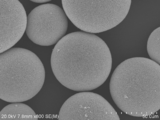
- FIG. 3 is a scanning electron microscope photograph of 800 times the iron oxide particle powder for friction material obtained in Example 1.
- FIG. 3 is a scanning electron microscope photograph of 30,000 times the iron oxide particle powder for friction material obtained in Example 1.
- the iron oxide particle powder for friction material according to the present invention is mainly composed of a magnetite crystal phase.
- the iron oxide particle powder for friction material according to the present invention preferably has a magnetite crystal phase of 50 to 100 wt% so that it can be quantitatively determined by X-ray diffraction.
- magnetite Fe 3 O 4
- the abrasiveness can be made excellent. More preferably, it is 60 to 95 wt%, and still more preferably 70 to 94 wt%.
- crystal phases other than magnetite include wustite (FeO), hematite ( ⁇ -Fe 2 O 3 ), maghemite ( ⁇ -Fe 2 O 3 ), goethite ( ⁇ -FeOOH), ⁇ -iron ( ⁇ -Fe), and the like.
- the primary particles have a needle shape.
- a structure having high mechanical strength and moderate porosity can be configured by making the primary particles acicular and controlling the average particle size of the aggregated particles as described below.
- the primary particle size is preferably 0.1 to 1.2 ⁇ m, more preferably 0.2 to 0.8 ⁇ m.
- the primary particles have a needle shape, and the major axis / minor axis ratio (aspect ratio) is preferably 2 to 10, more preferably 3 to 8.
- the average particle size of the agglomerated particles is 10 to 150 ⁇ m. By controlling the average particle diameter within the above range, it is possible to improve the dispersibility in the resin as well as being excellent in polishing properties.
- the average particle size of the aggregated particles is preferably 15 to 145 ⁇ m, more preferably 20 to 140 ⁇ m.
- the iron oxide particle powder for friction material according to the present invention is one or more selected from the different elements selected from C, Si, Al, B, P, Ca, Al, Ti, Si, Mg, Zn, Ni, Mn, Cu, and Co. It is preferable that Different kinds of elements can mainly suppress an increase in the size of needle-like primary particles during firing, increase the strength of the agglomerated particles by high-temperature firing, and maintain a sufficient degassing function with moderate porosity.
- different elements are roughly classified into those that are dissolved in the iron oxide crystal phase, those that exist as an amorphous material, and those that exist as a crystal phase that cannot be detected by X-ray diffraction. It may be a form.
- the iron oxide particle powder for friction material according to the present invention contains 0.01 to 2.0 wt% of the different element. If it is less than 0.01, the effect of suppressing the growth of acicular primary particle grains cannot be confirmed, and even if it exceeds 2.0 wt%, the suppression effect is saturated and there is no meaning to add more than necessary. More preferably, it is 0.04 to 1.8 wt%, and still more preferably 0.08 to 1.6 wt%.
- the iron oxide particle powder for friction material according to the present invention preferably has a true specific gravity of 4.5 to 5.4 g / cm 3 .
- the true specific gravity of magnetite is 5.2 g / cm 3 , and the magnetite crystal phase can be controlled to 50 to 100 wt% by controlling the true specific gravity within the above range. Moreover, if it is the range of the said true specific gravity, the high mechanical strength of this aggregated particle can be obtained also as a magnetite solid solution, and it will be excellent in abrasiveness.
- the more preferable true specific gravity is 4.6 to 5.3 g / cm 3 , and still more preferably 4.7 to 5.2 g / cm 3 .
- the iron oxide particle powder for friction material according to the present invention preferably has a BET specific surface area of 3 to 60 m 2 / g.
- the friction material is excellent in gas flowability.
- a more preferable specific surface area value is 4 to 45 m 2 / g, and still more preferably 5 to 40 m 2 / g.
- the shape of the aggregated particles of the iron oxide particle powder for friction material according to the present invention is preferably spherical. This is because the more spherical, the better the resin and the better fluidity and the easier molding.
- the iron oxide particle powder for friction material according to the present invention is preferably black and achromatic.
- a * is preferably ⁇ 2 to +10
- b * is preferably ⁇ 5 to +10.
- a * and b * are out of the above ranges, it is difficult to say a black pigment. More preferably, a * is ⁇ 1 to +5, and b * is ⁇ 4 to +5.
- the iron oxide particle powder for friction material according to the present invention preferably has a crushing strength of 1.0 to 100 MPa. When the crushing strength is less than 1.0 MPa and exceeds 100 MPa, it is difficult to maintain spherical aggregated particles. A more preferable crushing strength is 1.2 to 80 MPa, and even more preferably 3 to 60 MPa.
- the iron oxide particle powder for friction material according to the present invention is suitable for friction material because it can maintain high strength even if the amount of binder at the time of brake pad molding is small.
- the crushing strength of the aggregated particles affects the polishing / friction performance. Therefore, the crushing strength can be controlled and adjusted to the polishing / friction performance.
- the ratio of the average particle diameter D 50 of the aggregated particles to the BET converted particle diameter is preferably 100 to 3000. More preferably, it is 150-2500, and still more preferably 200-2200.
- the BET equivalent particle diameter is a particle diameter assuming a true sphere, and is a numerical value represented by 6 / (true specific gravity ⁇ BET specific surface area). The higher the ratio, the higher the void ratio in the aggregated particles. When used as a friction material, it becomes easier for gas to escape.
- the iron oxide particle powder for friction material according to the present invention may coat the surface of the particle powder using one or more compounds selected from Si, Al, Zr, Ti, Zn, and P or an organic surface treatment agent. it can.
- One or more compounds selected from Si, Al, Zr, Ti, Zn, and P include aluminum compounds such as aluminum salts such as aluminum acetate, aluminum sulfate, aluminum chloride, and aluminum nitrate, and aluminates such as sodium aluminate. Examples include alkali salts. Examples of the silicon compound include No. 3 water glass, sodium orthosilicate, sodium metasilicate, and the like.
- zirconium salts such as zirconium acetate, zirconium sulfate, zirconium chloride, and zirconium nitrate can be used.
- titanium salts such as titanium acetate, titanium sulfate, titanium chloride, and titanium nitrate
- zinc compound zinc salts such as zinc acetate, zinc sulfate, zinc chloride, and zinc nitrate can be used.
- phosphorus compound phosphates such as sodium hydrogen phosphate, sodium ammonium hydrogen phosphate, potassium phosphate, sodium polyphosphate, sodium hexametaphosphate and the like can be used.
- organic surface treatment agent examples include stearic acid or its salt, and organic silicon compounds such as rosin, alkoxysilane, fluoroalkylsilane, silane coupling agent, and organopolysiloxane.
- organic silicon compounds such as rosin, alkoxysilane, fluoroalkylsilane, silane coupling agent, and organopolysiloxane.
- titanate-based, aluminate-based and zirconate-based coupling agents, low-molecular or high-molecular surfactants, phosphoric acid compounds, and the like are also included.
- organosilicon compound examples include methyltriethoxysilane, dimethyldiethoxysilane, phenyltriethoxysilane, diphenyldiethoxysilane, methyltrimethoxysilane, dimethyldimethoxysilane, phenyltrimethoxysilane, diphenyldimethoxysilane, and ethyl.
- Alkoxysilanes such as triethoxysilane, propyltriethoxysilane, butyltriethoxysilane, isobutyltrimethoxysilane, hexyltriethoxysilane, octyltriethoxysilane and decyltriethoxysilane, trifluoropropyltrimethoxysilane, tridecafluorooctyltri Methoxysilane, heptadecafluorodecyltrimethoxysilane, trifluoropropyltriethoxysilane, heptadecafluorodecyltri Fluoroalkylsilanes such as toxisilane and tridecafluorooctyltriethoxysilane, vinyltrimethoxysilane, vinyltriethoxysilane, ⁇ -aminopropyltriethoxysilane, ⁇ -glycidoxy
- Titanate coupling agents include isopropyl tristearoyl titanate, isopropyl tris (dioctyl pyrophosphate) titanate, isopropyl tri (N-aminoethylaminoethyl) titanate, tetraoctyl bis (ditridecyl phosphate) titanate, tetra (2- Examples include 2-diallyloxymethyl-1-butyl) bis (ditridecyl) phosphate titanate, bis (dioctylpyrophosphate) oxyacetate titanate, bis (dioctylpyrophosphate) ethylene titanate, and the like.
- aluminate coupling agent examples include acetoalkoxyaluminum diisopropylate, aluminum diisopropoxy monoethyl acetoacetate, aluminum trisethyl acetoacetate, aluminum trisacetylacetonate and the like.
- zirconate coupling agent examples include zirconium tetrakisacetylacetonate, zirconium dibutoxybisacetylacetonate, zirconium tetrakisethylacetoacetate, zirconium tributoxymonoethylacetoacetate, zirconium tributoxyacetylacetonate and the like.
- Examples of the low molecular surfactant include alkylbenzene sulfonate, dioctyl sulfone succinate, alkylamine acetate, alkyl fatty acid salt and the like.
- Examples of the polymeric surfactant include polyvinyl alcohol, polyacrylate, carboxymethylcellulose, acrylic acid-maleate copolymer, and olefin-maleate copolymer.
- phosphoric acid compounds include organic phosphorus compounds such as phosphoric acid esters, phosphorous acid esters, acidic phosphoric acid esters, and phosphonic acids.
- the coupling agent mentioned as the organic surface treatment agent is more preferable. Further, even if a part of the surface treatment agent is changed to an oxide, hydroxide, or carbide, the influence on the powder characteristics obtained by the present invention is small.
- the iron oxide particle powder for friction material according to the present invention can be produced, for example, as follows.
- One or more kinds selected from magnetite particle powder, hematite particle powder, maghemite particle powder, lepidocrocite particle powder and goethite particle powder having an average primary particle size of 0.01 to 2.0 ⁇ m are used as the starting material.
- a granulated product having a predetermined average particle size of aggregated particles through slurrying and spray drying, and firing the obtained granulated product in a temperature range of 250 to 900 ° C. under a low oxygen partial pressure, friction is achieved.
- Oxides and hydroxides containing at least one selected from C, Si, Al, B, P, Ca, Al, Ti, Si, Mg, Zn, Ni, Mn, Cu, and Co, which can be different elements if necessary , Oxalate, carbonate, etc. may be used in combination as the starting material, or an iron oxide or hydrous iron oxide starting material containing one or more selected from these elements may be used.
- the primary particle form of the starting material is needle-like.
- the average primary particle size of the starting material is preferably 0.01 to 2.0 ⁇ m, more preferably 0.02 to 1.8 ⁇ m. That is, if it is less than 0.01 ⁇ m, the slurry viscosity tends to be high and there is a tendency to hinder spray drying. If it exceeds 2.0 ⁇ m, the surface roughness of the sintered body increases and the filling rate cannot be increased. It is.
- the granulated product may be produced according to a conventional method, but spray drying of the slurry containing the raw material is preferable from the viewpoint of controlling the aggregate particle size of the granulated product.
- the particle size of the granulated product can be adjusted by adjusting the solid content concentration of the slurry and the nozzle port of the drying device.
- the particle size is strongly related to the aggregated particle size of the obtained iron oxide particle powder for friction material, and the particle size distribution of the aggregated particles can be sharpened.
- a resin component may be used when slurrying the starting material. It is preferable to mix 0.3 to 5 parts by weight of the resin component with 100 parts by weight of the starting material.
- resin components cellulose, polyvinyl alcohol (PVA), acrylic acid, polyacrylic acid amide, urethane, starches, and the like can be used.
- the carbon (C) component of different elements and other different components Si, Al, B, P, Ca, Al, Ti, Si, Mg, Zn, Ni, Mn, Cu, Co
- Si, Al, B, P, Ca, Al, Ti, Si, Mg, Zn, Ni, Mn, Cu, Co are also primary during heat treatment. It also serves to suppress grain growth.
- an element for modifying the surface of the iron oxide particle powder for friction material is preferable. Water is preferable as a solvent for the slurry from the viewpoint of cost.
- a dispersant may be used when slurrying the starting material. It is preferable to mix 0.1 to 5 parts by weight of a dispersant with 100 parts by weight of the starting material.
- a general surfactant can be used, and those having a functional group capable of binding to a hydroxyl group on the surface of various raw material particles such as iron oxide are preferable.
- a polycarboxylic acid is used.
- the spray drying is preferably performed at a slurry concentration of 40 to 80% by weight, more preferably 50 to 70% by weight. That is, when the amount is less than 40% by weight, the slurry viscosity tends to be low, and the particle size distribution of the aggregated particles tends to be difficult to adjust. When the amount exceeds 80% by weight, the slurry viscosity increases and the aggregated particles have a spherical shape. This is because there is a tendency for it to be difficult to ensure.
- the spray drying conditions are not particularly limited, and may be appropriately selected depending on the slurry concentration, viscosity, and the like.
- the firing is performed at a temperature of about 250 to 900 ° C. for 1 to 8 hours, depending on the starting material. That is, when the temperature is lower than 250 ° C., the primary particles are not fused with each other, and therefore, the aggregate particle strength of the obtained particle powder is lowered, which is not preferable. When the temperature exceeds 850 ° C., the fusion of primary particles proceeds and grows. That is, the shape of the obtained primary particles becomes a snowman shape and tends to be unable to maintain an appropriate porosity.
- the temperature is preferably 320 to 820 ° C.
- the firing atmosphere is preferably a low oxygen partial pressure atmosphere, that is, an inert gas atmosphere, preferably a nitrogen atmosphere, and may be partially mixed with hydrogen.
- the obtained friction material iron oxide particle powder may be washed with water, dried or pulverized by a conventional method.
- the iron oxide particle powder for friction material according to the present invention can be used together with other friction materials, lubricants, fibrous base materials and the like to produce brake pads.
- the surface may be coated with one or more compounds selected from Si, Al, Zr, Ti, Zn, and P.
- the surface treatment method may be performed according to a conventional method such as a wet method or a dry method.
- a wet method one or more soluble compounds selected from the above elements are added to and mixed with a slurry of wet-dispersed iron oxide particles for a friction material while adjusting the pH with an acid or an alkali.
- the dry method is a method in which the iron oxide particle powder for friction material is coated with one or more coupling agents selected from the above elements in an apparatus such as a Henschel mixer.
- a blade-type kneader As equipment used for mixing and stirring.
- a wheel-type kneader can be used more effectively.
- the blade type kneader include a Henschel mixer, a planetary mixer, and a nauta mixer.
- a typical embodiment of the present invention is as follows. Table 1 shows manufacturing conditions, and Table 2 shows powder characteristics.
- the average particle size and aspect ratio of the primary particle size of the sample were calculated by image analysis of “scanning electron microscope” (manufactured by Hitachi High-Technologies Corporation).
- the average particle diameter (D 50 ) of the aggregated particles of the sample was indicated by a value measured by “Laser diffraction particle size distribution analyzer HELOS” (manufactured by SYMPATEC).
- the specific surface area of the sample was indicated by a value measured by BET method using “Monosorb MS-11” (manufactured by Kantachrome Co., Ltd.).
- the true specific gravity of the sample is indicated by a value measured with a “dry automatic densitometer Accupic II-1340” (manufactured by Micromeritics).
- the amount of carbon of a different element of the sample was indicated by a value measured with a “carbon / sulfur analyzer EMIA-920V2” (manufactured by HORIBA).
- Other dissimilar component elements were measured using a “fluorescence X-ray analyzer ZSX PRIMUS II” (manufactured by Rigaku Corporation) according to “General X-ray fluorescence analysis rules” of JIS K0119.
- the content of the crystal phase of the sample was measured using a “Bruker AXS KK” (Bruker AXS Co., Ltd.) XRD apparatus and the attached TOPAS software.
- the hue of the sample (a * value, b * value) was obtained by kneading 0.5 g of the sample and 0.5 ml of castor oil with a Hoover-type Mahler to form a paste, adding 4.5 g of clear lacquer to this paste, kneading and coating Then, an application piece (coating thickness: about 30 ⁇ m) applied on a cast-coated paper using a 150 ⁇ m (6 mil) applicator was produced. The coating piece was measured using a “color difference meter CR-300” (manufactured by Konica Minolta Sensing Co., Ltd.) and indicated by a color index (a * value, b * value) according to JIS Z 8729. .
- the crushing strength of the sample was determined by a single particle compression test (JIS R 1639-5). Using a micro-compression tester (Shimadzu Corporation MCT-W), a compression test of 20 individual particles was performed, and the compressive strength was determined from the fracture test force and the particle size, and the arithmetic average was obtained.
- Example 1 According to the production conditions shown in Table 1, 1 kg of acicular goethite particles having an average primary particle size of 0.4 ⁇ m, 10 g of polyvinyl alcohol, 5 g of ammonium polycarboxylate, and 1 kg of water are mixed for 2 hours in a ball mill. A slurry containing particle powder was obtained. This slurry was granulated and dried by spray drying to prepare composite particles. Next, the particles were placed in a rotary heat treatment furnace and heated at 600 ° C. for 3 hours in a nitrogen atmosphere. After cooling to room temperature, it was taken out to obtain iron oxide particle powder for friction material. The characteristics are shown in Table 2. As shown in FIG. 1 and FIG.
- the aggregated particles have the same particle size (that is, the particle size distribution is sharp), and the friction material has an average particle size of 62.5 ⁇ m aggregated particles.
- An iron oxide particle powder was obtained. From the photograph in FIG. 2, the average particle size of the primary particles was 0.5 ⁇ m, and the aspect ratio was 4.
- Example 2 According to the production conditions shown in Table 1, 1 kg of goethite powder, 10 g of polyvinyl alcohol, 5 g of lignin sulfonate and 1 kg of water were mixed for 2 hours with a ball mill to obtain a slurry containing goethite particle powder. This slurry was granulated and dried by spray drying to prepare composite particles. Next, the particles were placed in a rotary heat treatment furnace and heated at 750 ° C. for 3 hours in a nitrogen atmosphere. After cooling to room temperature, it was taken out to obtain iron oxide particle powder for friction material. The characteristics are shown in Table 2.
- Example 3 According to the production conditions shown in Table 1, 1 kg of goethite powder, 25 g of polyvinyl alcohol, 10 g of ammonium polyacrylate and 1 kg of water were mixed for 2 hours with a ball mill to obtain a slurry containing goethite particle powder. This slurry was granulated and dried by spray drying to prepare composite particles having an average particle size of 33.5 ⁇ m. Next, the particles were placed in a pusher-type firing furnace and heated at 650 ° C. for 1 hour in a nitrogen atmosphere. After cooling to room temperature, it was taken out to obtain iron oxide particle powder for friction material. The characteristics are shown in Table 2.
- Example 4-7 The iron oxide particle powder for friction material was obtained in the same manner as in Example 1 except that the starting material type and blending ratio, the amount of resin and dispersant added, and the firing temperature were varied. It was. The characteristics are shown in Table 2.
- Example 6 used SiO 2 so as to be 1.0 wt% Si as a different element
- Example 7 used CaCO 3 so as to be 2.0 wt% Ca as a different element.
- Example 8 According to the production conditions shown in Table 1, 15 kg of silane coupling agent (methyltriethoxysilane) was used as a surface treatment agent for 1 kg of the iron oxide particle powder obtained in Example 1, and the surface treatment was performed using a mixing device Henschel mixer. Went. The obtained powder characteristics are shown in Table 2.
- silane coupling agent methyltriethoxysilane
- Examples 9-10 According to the manufacturing conditions shown in Table 1, various surface treatment agents (acetoalkoxyaluminum diisopropylate and zirconium tetrakisacetylacetonate) were dry-mixed with the iron oxide particle powder obtained in Example 1 to produce a friction material. An iron oxide particle powder was obtained. The characteristics are shown in Table 2.
- Comparative Example 1 This slurry, in which 1 kg of goethite powder, 10 g of polyvinyl alcohol, 10 g of polycarboxylic acid ammonium salt and 1 kg of water used in Example 1 were mixed by a ball mill for 2 hours, was granulated and dried by spray drying, and the composite was left unfired. Particles were used. Table 2 shows various properties of the obtained composite particles.
- Comparative Examples 2 and 3 An iron oxide particle powder for a friction material was obtained in the same manner as in Comparative Example 1 except that the blending ratio of the iron oxide raw material and the addition amounts of the resin and the dispersant were changed. The production conditions at this time are shown in Table 1, and various properties of the obtained iron oxide particle powder for friction material are shown in Table 2.
- Comparative Example 4 An iron oxide particle powder for a friction material was obtained in the same manner as in Example 1 except that the blending ratio of the iron oxide raw material, the addition amount of the resin and the dispersant, the firing temperature, and the firing atmosphere were changed. The production conditions at this time are shown in Table 1, and various properties of the obtained iron oxide particle powder for friction material are shown in Table 2.
- the obtained iron oxide particle powder for friction material has a ratio of the average particle diameter D 50 of the aggregated particles to the BET converted particle diameter (D 50 / BET converted particle diameter) of 100 to 3000, and has an appropriate porosity. Therefore, it was estimated that it was excellent in outgassing when used as a friction material.
- the iron oxide particle powder for friction material according to the present invention has a high crushing strength and a high specific surface area. Therefore, it has excellent polishing properties and sufficient gas releasing performance, and is suitable as an iron oxide particle powder for friction material. Further, since the average particle size of the aggregated particles is large and the particle size distribution is sharp, an improvement in dispersibility in the resin can be expected. In addition, this invention is not limited to a friction material use, You may use as an abrasive.
Landscapes
- Engineering & Computer Science (AREA)
- General Engineering & Computer Science (AREA)
- Chemical & Material Sciences (AREA)
- Organic Chemistry (AREA)
- Mechanical Engineering (AREA)
- Inorganic Chemistry (AREA)
- Braking Arrangements (AREA)
- Compounds Of Iron (AREA)
- Compositions Of Macromolecular Compounds (AREA)
Abstract
本発明は、主として樹脂成型によるレジンパッド型のブレーキパッドに用いる摩擦材に関するものであり、研磨性に優れるとともに、十分なガス抜け性能を有し、更には樹脂への分散性向上が期待できる機械的強度に優れ、且つ比表面積が大きな摩擦材用酸化鉄粒子粉末を提供するものである。マグネタイト結晶相が主成分であり、一次粒子の形状が針状であり、凝集粒子の平均粒径が10~150μmであり、異種元素を0.01~2.0wt%含むことを特徴とする摩擦材用酸化鉄粒子粉末である。
Description
本発明は、摩擦材用酸化鉄粒子粉末に関するものであり、特に普通自動車や自動二輪車等の軽負荷に用いられる摩擦材に関するものである。
普通自動車などの軽負荷の制動装置のブレーキパッドには樹脂成型によるレジンパッドが採用されている。該レジンパッドは摩擦材、潤滑材、繊維状基材、及びそれらを結合するための熱硬化性高分子を主成分とする結合材などからなり、各材料の混和物を、型に充填した後、加圧、加熱して結合材を硬化することにより製造される。
前記繊維状基材には、ポリアミド繊維、アラミド繊維などの有機繊維及び、チタン酸カリウムなどのセラミック繊維、ロックウールなどの人造鉱物繊維、グラスウールなどのガラス繊維といった合成無機化合物繊維が用いられる。前記摩擦材には、硫酸バリウム、炭酸カルシウムなどの各種無機化合物粉末や、金属粉末などが用いられる。前記潤滑材には、グラファイト、二硫化モリブデンなどの固体潤滑剤があり、ブレーキ鳴きを抑えるカシューダストなども添加される。
摩擦材として用いられる無機粒子粉末に要求される特性は、制動力が大きいこと、耐磨耗性を有すること、温度、圧力などの変化による制動力の変化が小さくて安定していること、挙動粒子(所謂、凝集粒子)の機械的強度が大きいことがある。ブレーキパッド使用時の発熱による有機物の分解でガスが発生し、それを閉じ込めることなく外部に放出する機能も、ガス流通性がある等として摩擦材に求められている。
従来、摩擦材としてマグネタイト(四三酸化鉄)粒子粉末が用いられてきた(特許文献1)。
特許文献1には、摩擦材としてマグネタイト粒子の粒径と形状が規定されているが、凝集粒子の機械的強度やガス流通性に関して言及しているとは言い難い。そのため、凝集粒子の機械的強度に優れ、且つ適度な多孔度を有する酸化鉄粒子粉末が求められている。
従って、本発明は前記諸特性を満たす高強度で且つ適度な多孔度を有する酸化鉄粒子粉末を提供することを目的とする。
前記目的は、次の通りの本発明によって達成できる。
即ち、本発明は、マグネタイト結晶相が主成分であり、一次粒子の形状が針状であり、凝集粒子の平均粒径が10~150μmであり、異種元素を0.01~2.0wt%含むことを特徴とする摩擦材用酸化鉄粒子粉末である(本発明1)。
また、本発明は、前記異種元素がC、Si、Al、B、P、Ca、Al、Ti、Si、Mg、Zn、Ni、Mn、Cu、Coから選ばれる1種以上である本発明1記載の摩擦材用酸化鉄粒子粉末である(本発明2)。
また、本発明は、真比重が4.5~5.4g/cm3である本発明1又は2記載の摩擦材用酸化鉄粒子粉末である(本発明3)。
また、本発明は、BET比表面積が3~60m2/gである本発明1~3のいずれかに記載の摩擦材用酸化鉄粒子粉末である(本発明4)。
また、本発明は、圧壊強度が1.0~100MPaである本発明1~4のいずれかに記載の摩擦材用酸化鉄粒子粉末である(本発明5)。
また、本発明は、Si,Al,Zr,Ti,Zn,Pから選ばれる一種以上の化合物又は有機系表面処理剤で被覆された本発明1~5のいずれかに記載の摩擦材用酸化鉄粒子粉末である(本発明6)。
本発明に係る摩擦材用酸化鉄粒子粉末は、凝集粒子の機械的強度に優れ、且つ比表面積が大きな酸化鉄粒子粉末である。そのため、適度な多孔度によりガス流通性が高いものの、機械的強度が高い性質を有しており、研磨性に優れ、摩擦材として好適である。
本発明の構成をより詳しく説明すれば次の通りである。
先ず、本発明に係る摩擦材用酸化鉄粒子粉末について述べる。
本発明に係る摩擦材用酸化鉄粒子粉末は、マグネタイト結晶相が主成分である。
本発明に係る摩擦材用酸化鉄粒子粉末は、X線回折で定量できるように、マグネタイト結晶相が50~100wt%であることが好ましい。マグネタイト(Fe3O4)の含有量を前記範囲に制御することによって研磨性に優れたものとすることができる。より好ましくは60~95wt%、さらにより好ましくは70~94wt%である。マグネタイト以外の結晶相として、ウスタイト(FeO)、ヘマタイト(α-Fe2O3)、マグヘマイト(γ-Fe2O3)、ゲーサイト(α-FeOOH)、α-鉄(α-Fe)等が挙げられる。ウスタイトを30wt%以下含有することが好ましく、より好ましくは20wt%以下である。さらに、ヘマタイトを10wt%以下含有してもよい。
本発明に係る摩擦材用酸化鉄粒子粉末は一次粒子の形状が針状である。一次粒子を針状にし、下記のような凝集粒子の平均粒径を制御することで、高い機械的強度と適度な多孔度を有する構造が構成できる。一次粒子の大きさは0.1~1.2μmが好ましく、0.2~0.8μmがより好ましい。また、一次粒子の形状は針状であり、長軸/短軸比(アスペクト比)は2~10が好ましく、3~8がより好ましい。
本発明に係る摩擦材用酸化鉄粒子粉末は凝集粒子の平均粒径が10~150μmである。該平均粒径を前記範囲に制御することによって、研磨性に優れるともに、樹脂への分散性向上も期待できる。好ましい凝集粒子の平均粒径は15~145μmであり、より好ましくは20~140μmである。
本発明に係る摩擦材用酸化鉄粒子粉末は異種元素がC、Si、Al、B、P、Ca、Al、Ti、Si、Mg、Zn、Ni、Mn、Cu、Coから選ばれる1種以上であることが好ましい。異種元素は主に焼成時の針状の一次粒子サイズの増加を抑制することができ、高温焼成により凝集粒子の強度向上と共に、適度な多孔度で十分なガス抜け機能を保持できる。摩擦材用酸化鉄粒子粉末において、異種元素は酸化鉄結晶相に固溶するもの、非晶質として存在するもの、X線回折では検出できない結晶相として存在するものに大別されるが、いずれの形態でもよい。
本発明に係る摩擦材用酸化鉄粒子粉末は前記異種元素を0.01~2.0wt%含んでいる。0.01未満であれば、針状の一次粒子粒成長抑制の効果が確認できず、また、2.0wt%を超えても、該抑制効果が飽和するため必要以上に添加する意味が無い。より好ましくは0.04~1.8wt%であり、さらにより好ましくは0.08~1.6wt%である。
本発明に係る摩擦材用酸化鉄粒子粉末は真比重が4.5~5.4g/cm3であることが好ましい。マグネタイトの真比重は5.2g/cm3であり、真比重を前記範囲に制御することによって、マグネタイト結晶相を50~100wt%に制御することが可能である。また、前記真比重の範囲であれば、マグネタイト固溶体としても該凝集粒子の高い機械的強度を得ることができ、研磨性に優れたものとなる。より好ましい真比重は4.6~5.3g/cm3であり、更により好ましくは4.7~5.2g/cm3である。
本発明に係る摩擦材用酸化鉄粒子粉末はBET比表面積が3~60m2/gであることが好ましい。BET比表面積値を前記範囲に制御することによって、摩擦材としてガス流通性に優れたものとなる。より好ましい比表面積値は4~45m2/gであり、更により好ましくは5~40m2/gである。
本発明に係る摩擦材用酸化鉄粒子粉末の凝集粒子の形状は、球状が好ましい。球状であるほど樹脂となじみやすく、また、流動性にも優れて成型しやすいためである。
本発明に係る摩擦材用酸化鉄粒子粉末は黒色で無彩色であることが好ましく、色相のうちa*は-2~+10が好ましく、b*は-5~+10が好ましい。a*及びb*が前記範囲外の場合には、黒色顔料とは言い難い。より好ましくは、a*が-1~+5であり、b*が-4~+5である。
本発明に係る摩擦材用酸化鉄粒子粉末は圧壊強度1.0~100MPaであることが好ましい。該圧壊強度が1.0MPa未満、及び100MPaを超えては球状の凝集粒子を維持することが困難である。より好ましい圧壊強度は1.2~80MPaであり、更により好ましくは3~60MPaである。本発明に係る摩擦材用酸化鉄粒子粉末は、ブレーキパッド成型時におけるバインダー量が少なくても高い強度を維持できるので、摩擦材用として好適である。本発明においては、凝集粒子の圧壊強度は、研磨・摩擦性能に影響を及ぼすので、該圧壊強度をコントロールし、研磨・摩擦性能に調整できる。
また、本発明に係る摩擦材用酸化鉄粒子粉末は、BET換算粒径に対する凝集粒子の平均粒径D50の比(D50/BET換算粒径)が100~3000であることが好ましい。より好ましくは150~2500であり、更により好ましくは200~2200である。ここで、BET換算粒径とは真球と仮定したときの粒径であり、6/(真比重×BET比表面積)で表わされる数値である。前記比率が高いほど凝集粒子内の空隙率が高いことを意味し、摩擦材として使用したとき、ガス抜けがしやすくなる。
本発明に係る摩擦材用酸化鉄粒子粉末は、Si、Al、Zr、Ti、Zn、Pから選ばれる1種以上の化合物又は有機系表面処理剤を用いて粒子粉末の表面を被覆することができる。
Si、Al、Zr、Ti、Zn、Pから選ばれる1種以上の化合物としては、アルミニウム化合物として、酢酸アルミニウム、硫酸アルミニウム、塩化アルミニウム、硝酸アルミニウム等のアルミニウム塩や、アルミン酸ナトリウム等のアルミン酸アルカリ塩等が挙げられる。ケイ素化合物として、3号水ガラス、オルトケイ酸ナトリウム、メタケイ酸ナトリウム等が挙げられる。ジルコニウム化合物として、酢酸ジルコニウム、硫酸ジルコニウム、塩化ジルコニウム、硝酸ジルコニウム等のジルコニウム塩等が使用できる。チタン化合物として、酢酸チタニウム、硫酸チタニウム、塩化チタニウム、硝酸チタニウム等のチタニウム塩等が使用できる。亜鉛化合物として、酢酸亜鉛、硫酸亜鉛、塩化亜鉛、硝酸亜鉛等の亜鉛塩等が使用できる。りん化合物として、リン酸水素ナトリウム、リン酸水素アンモニウムナトリウム、リン酸カリウム、ポリリン酸ナトリウム、ヘキサメタリン酸ナトリウム等のリン酸塩等が使用できる。
有機系表面処理剤としては、ステアリン酸又はその塩、並びにロジン、アルコキシシラン、フルオロアルキルシラン、シラン系カップリング剤及びオルガノポリシロキサン等の有機ケイ素化合物等が挙げられる。更には、チタネート系、アルミネート系及びジルコネート系などのカップリング剤、低分子あるいは高分子界面活性剤、リン酸化合物等も挙げられる。
有機ケイ素化合物としては、具体的には、メチルトリエトキシシラン、ジメチルジエトキシシラン、フェニルトリエトキシシラン、ジフェニルジエトキシシラン、メチルトリメトキシシラン、ジメチルジメトキシシラン、フェニルトリメトキシシラン、ジフェニルジメトキシシラン、エチルトリエトキシシラン、プロピルトリエトキシシラン、ブチルトリエトキシシラン、イソブチルトリメトキシシラン、ヘキシルトリエトキシシラン、オクチルトリエトキシシラン及びデシルトリエトキシシラン等のアルコキシシラン、トリフルオロプロピルトリメトキシシラン、トリデカフルオロオクチルトリメトキシシラン、ヘプタデカフルオロデシルトリメトキシシラン、トルフルオロプロピルトリエトキシシラン、ヘプタデカフルオロデシルトリエトキシシラン及びトリデカフルオロオクチルトリエトキシシラン等のフルオロアルキルシラン、ビニルトリメトキシシラン、ビニルトリエトキシシラン、γ-アミノプロピルトリエトキシシラン、γ-グリシドキシプロピルトリメトキシシラン、γ-メルカプトプロピルトリメトキシシラン、γ-メタクロイルオキシプロピルトリメトキシシラン、N-(β-アミノエチル)-γ-アミノプロピルトリメトキシシラン、γ-グリシドキシプロピルメチルジメトキシシラン、γ-クロロプロピルトリメトキシシラン等のシラン系カップリング剤、ポリシロキサン、メチルハイドロジェンポリシロキサン、変性ポリシロキサン等のオルガノポリシロキサン等が挙げられる。
チタネート系カップリング剤としては、イソプロピルトリステアロイルチタネート、イソプロピルトリス(ジオクチルパイロホスフェート)チタネート、イソプロピルトリ(N-アミノエチル・アミノエチル)チタネート、テトラオクチルビス(ジトリデシルホスフェイト)チタネート、テトラ(2-2-ジアリルオキシメチル-1-ブチル)ビス(ジトリデシル)ホスフェイトチタネート、ビス(ジオクチルパイロホスフェート)オキシアセテートチタネート、ビス(ジオクチルパイロホスフェート)エチレンチタネート等が挙げられる。
アルミネート系カップリング剤としては、アセトアルコキシアルミニウムジイソプロピレート、アルミニウムジイソプロボキシモノエチルアセトアセテート、アルミニウムトリスエチルアセトアセテート、アルミニウムトリスアセチルアセトネート等が挙げられる。
ジルコネート系カップリング剤としては、ジルコニウムテトラキスアセチルアセトネート、ジルコニウムジブトキシビスアセチルアセトネート、ジルコニウムテトラキスエチルアセトアセテート、ジルコニウムトリブトキシモノエチルアセトアセテート、ジルコニウムトリブトキシアセチルアセトネート等が挙げられる。
低分子系界面活性剤としては、アルキルベンゼンスルホン酸塩、ジオクチルスルホンコハク酸塩、アルキルアミン酢酸塩、アルキル脂肪酸塩等が挙げられる。高分子系界面活性剤としては、ポリビニルアルコール、ポリアクリル酸塩、カルボキシメチルセルロース、アクリル酸-マレイン酸塩コポリマー、オレフィン-マレイン酸塩コポリマー等が挙げられる。
リン酸化合物としては、リン酸エステル、亜リン酸エステル、酸性リン酸エステル、ホスホン酸等の有機リン化合物等が挙げられる。
表面処理剤について種々言及したが、より好ましいものは有機系表面処理剤として挙げられたカップリング剤である。また、表面処理剤の一部が酸化物、水酸化物、炭化物に変化しても本発明で得られた粉体特性への影響は少ない。
次に、本発明に係る摩擦材用酸化鉄粒子粉末の製造方法について述べる。
本発明に係る摩擦材用酸化鉄粒子粉末は、例えば、下記のようにして製造することができる。
一次粒子の平均粒径が0.01~2.0μmのマグネタイト粒子粉末、ヘマタイト粒子粉末、マグヘマイト粒子粉末、レピドクロサイト粒子粉末及びゲータイト粒子粉末から選ばれる一種以上を出発原料として用い、該出発原料のスラリー化、噴霧乾燥を経て、所定の凝集粒子の平均粒径を有する造粒物とし、得られた造粒物を低酸素分圧下の250~900℃の温度範囲で焼成することにより、摩擦材用酸化鉄粒子粉末を製造する。
必要により、異種元素となり得るC、Si、Al、B、P、Ca、Al、Ti、Si、Mg、Zn、Ni、Mn、Cu、Coから選ばれる1種以上を含む酸化物、水酸化物、蓚酸塩、炭酸塩等を前記出発原料として併用しても良く、該元素から選ばれる1種以上を含む酸化鉄或いは含水酸化鉄出発原料を用いても良い。
また、前記出発原料の一次粒子形態としては、針状である。該出発原料の一次粒子の平均粒径としては、0.01~2.0μmであることが好ましく、より好ましくは0.02~1.8μmの範囲である。すなわち、0.01μm未満では、スラリー粘度が高くなり噴霧乾燥する際に支障が生ずる傾向がみられ、2.0μmを超えると、焼結体の表面粗度が大きくなり、充填率が上がらなくなるからである。
造粒物は、常法に従って製造すればよいが、造粒物の凝集粒径制御などの点から原料を含有するスラリーの噴霧乾燥が好ましい。スラリーの固形分濃度や該乾燥装置のノズル口を調整することにより造粒物の粒径を調整することができる。該粒径は得られる摩擦材用酸化鉄粒子粉末の凝集粒径と関係が強く、凝集粒子の粒度分布をシャープにすることが可能である。
本発明に係る摩擦材用酸化鉄粒子粉末の製造過程において、出発原料のスラリー化する際に樹脂成分を用いてもよい。出発原料を100重量部として、0.3~5重量部の樹脂成分を混合することが好ましい。具体的な樹脂成分としては、セルロース、ポリビニルアルコール(PVA)、アクリル酸、ポリアクリル酸アミド,ウレタン、でんぷん類などを用いることができる。異種元素の炭素(C)成分、及び他の異種成分(Si、Al、B、P、Ca、Al、Ti、Si、Mg、Zn、Ni、Mn、Cu、Co)もまた、熱処理時の一次粒子成長を抑制する働きもする。灰化後、残存する好ましい元素として、摩擦材用酸化鉄粒子粉末の表面を改質させる元素が好ましい。前記スラリーの溶媒としてコストの観点から水が好ましい。
また、本発明に係る摩擦材用酸化鉄粒子粉末の製造過程において、出発原料をスラリー化する際に分散剤を用いてもよい。出発原料を100重量部として、0.1~5重量部の分散剤を混合することが好ましい。該分散剤としては、一般の界面活性剤を使用することができ、酸化鉄などの各種原料の粒子表面に有する水酸基と結合可能な官能基を有するものが好ましく、具体的には、ポリカルボン酸ナトリウム塩、アニオン性ポリカルボン酸アンモニウム塩、リグニンスルホン酸塩、メラミンスルホン酸塩、ナフタレンスルホン酸ナトリウム塩、リン酸ナトリウム、クエン酸ナトリウム、アミン類、ポリアクリル酸の金属塩またはアンモニウム塩等があげられる。そして、焼成後の不純物元素の残渣を考慮すると、ポリカルボン酸アンモニウム塩を用いることが好ましい。
本発明に係る摩擦材用酸化鉄粒子粉末の製造に際しては、上記噴霧乾燥はスラリー濃度40~80重量%にて行うことが好ましく、より好ましくは50~70重量%である。すなわち、40重量%未満では、スラリー粘度が低くなり、凝集粒子の粒度分布の調整が困難になる傾向がみられ、また80重量%を超えると、スラリー粘度が高くなり、凝集粒子の球状の形状の確保が困難となる傾向がみられるからである。
噴霧乾燥の条件は、特に限定されるものではなく、スラリー濃度や粘度等によって適宜選択すればよい。
さらに、本発明においては、出発原料によって異なるが、250~900℃程度の温度で、1~8時間の焼成を行う。すなわち、250℃未満では、一次粒子が互いに融着しないため、得られる粒子粉末の凝集粒子強度が低下するので好ましくない。850℃を超えると、一次粒子の融着が進行し、成長する。即ち、得られる一次粒子の形状は雪だるま状となり、適度な多孔度を維持できなくなる傾向となるからである。好ましくは320~820℃である。
焼成雰囲気は、低酸素分圧雰囲気、即ち、不活性ガス雰囲気が好ましく、窒素雰囲気が好ましく、一部、水素を混合しても良い。
前記焼成後、得られた摩擦材酸化鉄粒子粉末は、常法によって水洗、乾燥、或いは粉砕しても良い。
本発明に係る摩擦材用酸化鉄粒子粉末は、他の摩擦材や、潤滑材、繊維状基材などともに用いて、ブレーキパッドを作製することができる。
本発明に係る摩擦材用酸化鉄粒子粉末は、該表面をSi、Al、Zr、Ti、Zn、Pから選ばれる1種又は2種以上の化合物によって被覆しておいてもよい。表面処理方法は、湿式あるいは乾式方法等の常法に従って行えばよい。例えば、湿式方法は湿式分散した摩擦材用酸化鉄粒子粉末のスラリーに、前記元素から選ばれる1種又は2種以上の可溶性化合物を、酸又はアルカリでpH調整しながら添加・混合して被覆する方法である。また、乾式方法はヘンシェルミキサーなどの装置中で摩擦材用酸化鉄粒子粉末に前記元素から選ばれる1種又は2種以上のカップリング剤などにより被覆処理する方法である。
乾式方法において、混合撹拌に使用する機器としては、ブレード型混練機を用いることが好ましい。ホイール型混練機がより効果的に使用できる。前記ブレード型混練機としては、ヘンシェルミキサー、プラネタリーミキサー、ナウタミキサーがある。
本発明の代表的な実施例は、次の通りである。尚、表1に製造条件、表2に粉体特性を示す。
試料の一次粒径の平均粒径とアスペクト比は「走査型電子顕微鏡」((株)日立ハイテクノロジーズ製)の画像分析により算出した。
試料の凝集粒子の平均粒径(D50)は、「レーザー回析式粒度分布計HELOS」(SYMPATEC社製)により計測した値で示した。
試料の比表面積は、「モノソーブMS-11」(カンタクロム(株)製)を用いて、BET法により測定した値で示した。
試料の真比重は、「乾式自動密度計 アキュピックII-1340」(マイクロメリティクス製)で測定した値で示した。
試料の異種元素の炭素の量は、「炭素・硫黄分析装置 EMIA-920V2」(HORIBA製)で測定した値で示した。他の異種成分元素は「蛍光X線分析装置ZSX PRIMUS II」((株)リガク製)を使用し、JIS K0119の「けい光X線分析通則」に従って測定した。
試料の結晶相の含有量は、「Bruker AXS K.K」(ブルカー・エイエックスエス(株)製)XRD装置と付属のTOPASソフトウェアを用いて測定した。
試料の色相(a*値、b*値)は、試料0.5gとヒマシ油0.5mlとをフーバー式マーラーで練ってペースト状とし、このペーストにクリアラッカー4.5gを加え、混練、塗料化してキャストコート紙上に150μm(6mil)のアプリケーターを用いて塗布した塗布片(塗膜厚み:約30μm)を作製した。塗膜片について、「色彩色差計CR-300」(コニカミノルタセンシング株式会社製)を用いて測定を行い、JIS Z 8729に定めるところに従って表色指数(a*値、b*値)で示した。
試料の圧壊強度は、単一粒子の圧縮試験(JIS R 1639-5)によって求めた。微小圧縮試験機(島津製作所MCT-W)を用いて、任意の粒子20個の単独粒子の圧縮試験を行い、破壊試験力と粒径より圧懐強度を求め、算術平均した。
実施例1
表1記載の製造条件に従って、一次粒子の平均粒径が0.4μmの針状ゲーサイト粒子粉末1kgとポリビニルアルコール10gとポリカルボン酸アンモニウム塩5gと水1kgをボールミルで2時間混合してゲーサイト粒子粉末を含有するスラリーを得た。このスラリーをスプレードライで造粒及び乾燥を行い、複合体粒子を調整した。次に、該粒子を回転式加熱処理炉内に入れ、窒素雰囲気中、600℃で3時間加熱した。室温まで冷却した後、取り出して摩擦材用酸化鉄粒子粉末を得た。その特性を表2に示す。図1と図2に走査型の電子顕微鏡写真を示すように、凝集粒子の粒度は揃っており(即ち、粒度分布がシャープであり)、62.5μmの凝集粒子の平均粒径を有する摩擦材用酸化鉄粒子粉末を得た。図2の写真から一次粒子の平均粒径は0.5μmであり、アスペクト比は4であった。
表1記載の製造条件に従って、一次粒子の平均粒径が0.4μmの針状ゲーサイト粒子粉末1kgとポリビニルアルコール10gとポリカルボン酸アンモニウム塩5gと水1kgをボールミルで2時間混合してゲーサイト粒子粉末を含有するスラリーを得た。このスラリーをスプレードライで造粒及び乾燥を行い、複合体粒子を調整した。次に、該粒子を回転式加熱処理炉内に入れ、窒素雰囲気中、600℃で3時間加熱した。室温まで冷却した後、取り出して摩擦材用酸化鉄粒子粉末を得た。その特性を表2に示す。図1と図2に走査型の電子顕微鏡写真を示すように、凝集粒子の粒度は揃っており(即ち、粒度分布がシャープであり)、62.5μmの凝集粒子の平均粒径を有する摩擦材用酸化鉄粒子粉末を得た。図2の写真から一次粒子の平均粒径は0.5μmであり、アスペクト比は4であった。
実施例2
表1記載の製造条件に従って、ゲーサイト粉末1kgとポリビニルアルコール10gとリグニンスルホン酸塩を5gと水1kgをボールミルで2時間混合してゲーサイト粒子粉末を含有するスラリーを得た。このスラリーをスプレードライで造粒及び乾燥を行い、複合体粒子を調整した。次に、該粒子を回転式加熱処理炉内に入れ、窒素雰囲気中、750℃で3時間加熱した。室温まで冷却した後、取り出して摩擦材用酸化鉄粒子粉末を得た。その特性を表2に示す。
表1記載の製造条件に従って、ゲーサイト粉末1kgとポリビニルアルコール10gとリグニンスルホン酸塩を5gと水1kgをボールミルで2時間混合してゲーサイト粒子粉末を含有するスラリーを得た。このスラリーをスプレードライで造粒及び乾燥を行い、複合体粒子を調整した。次に、該粒子を回転式加熱処理炉内に入れ、窒素雰囲気中、750℃で3時間加熱した。室温まで冷却した後、取り出して摩擦材用酸化鉄粒子粉末を得た。その特性を表2に示す。
実施例3
表1記載の製造条件に従って、ゲーサイト粉末1kgとポリビニルアルコール25gとポリアクリル酸アンモニウムを10gと水1kgをボールミルで2時間混合してゲーサイト粒子粉末を含有するスラリーを得た。このスラリーをスプレードライで造粒及び乾燥を行い、平均粒径33.5μmの複合体粒子を調整した。次に、該粒子をプッシャ式焼成炉に入れ、窒素雰囲気中、650℃で1時間加熱した。室温まで冷却した後、取り出して摩擦材用酸化鉄粒子粉末を得た。その特性を表2に示す。
表1記載の製造条件に従って、ゲーサイト粉末1kgとポリビニルアルコール25gとポリアクリル酸アンモニウムを10gと水1kgをボールミルで2時間混合してゲーサイト粒子粉末を含有するスラリーを得た。このスラリーをスプレードライで造粒及び乾燥を行い、平均粒径33.5μmの複合体粒子を調整した。次に、該粒子をプッシャ式焼成炉に入れ、窒素雰囲気中、650℃で1時間加熱した。室温まで冷却した後、取り出して摩擦材用酸化鉄粒子粉末を得た。その特性を表2に示す。
実施例4~7
出発原料の種類と配合割合、樹脂及び分散剤の添加量、焼成温度を種々変化させた以外は実施例1と同様にして、表1記載の製造条件に従って、摩擦材用酸化鉄粒子粉末を得た。その特性を表2に示す。ここで、実施例6は異種元素として1.0wt%のSiとなるようSiO2を、実施例7は異種元素として2.0wt%のCaとなるようCaCO3を利用した。
出発原料の種類と配合割合、樹脂及び分散剤の添加量、焼成温度を種々変化させた以外は実施例1と同様にして、表1記載の製造条件に従って、摩擦材用酸化鉄粒子粉末を得た。その特性を表2に示す。ここで、実施例6は異種元素として1.0wt%のSiとなるようSiO2を、実施例7は異種元素として2.0wt%のCaとなるようCaCO3を利用した。
実施例8
表1記載の製造条件に従って、前記実施例1で得られた酸化鉄粒子粉末1kgに、表面処理剤としてシランカップリング剤(メチルトリエトキシシラン)を15g用い、混合装置ヘンシェルミキサーを用いて表面処理を行った。得られた粉体特性を表2に示す。
表1記載の製造条件に従って、前記実施例1で得られた酸化鉄粒子粉末1kgに、表面処理剤としてシランカップリング剤(メチルトリエトキシシラン)を15g用い、混合装置ヘンシェルミキサーを用いて表面処理を行った。得られた粉体特性を表2に示す。
実施例9~10
表1記載の製造条件に従って、前記実施例1で得られた酸化鉄粒子粉末に種々の表面処理剤(アセトアルコキシアルミニウムジイソプロピレート、及びジルコニウムテトラキスアセチルアセトネート)を乾式混合して、摩擦材用酸化鉄粒子粉末を得た。その特性を表2に示す。
表1記載の製造条件に従って、前記実施例1で得られた酸化鉄粒子粉末に種々の表面処理剤(アセトアルコキシアルミニウムジイソプロピレート、及びジルコニウムテトラキスアセチルアセトネート)を乾式混合して、摩擦材用酸化鉄粒子粉末を得た。その特性を表2に示す。
比較例1
実施例1で使用したゲーサイト粉末1kgとポリビニルアルコール10gとポリカルボン酸アンモニウム塩10gと水1kgをボールミルで2時間混合したこのスラリーをスプレードライで造粒及び乾燥を行い、未焼成のまま複合体粒子とした。得られた複合体粒子の諸特性を表2に示す。
実施例1で使用したゲーサイト粉末1kgとポリビニルアルコール10gとポリカルボン酸アンモニウム塩10gと水1kgをボールミルで2時間混合したこのスラリーをスプレードライで造粒及び乾燥を行い、未焼成のまま複合体粒子とした。得られた複合体粒子の諸特性を表2に示す。
比較例2、3
酸化鉄原料の配合割合、樹脂及び分散剤の添加量を変化させた以外は比較例1と同様にして、摩擦材用酸化鉄粒子粉末を得た。このときの製造条件を表1に、得られた摩擦材用酸化鉄粒子粉末の諸特性を表2に示す。
酸化鉄原料の配合割合、樹脂及び分散剤の添加量を変化させた以外は比較例1と同様にして、摩擦材用酸化鉄粒子粉末を得た。このときの製造条件を表1に、得られた摩擦材用酸化鉄粒子粉末の諸特性を表2に示す。
比較例4
酸化鉄原料の配合割合、樹脂及び分散剤の添加量、焼成温度、焼成雰囲気を変化させた以外は実施例1と同様にして、摩擦材用酸化鉄粒子粉末を得た。このときの製造条件を表1に、得られた摩擦材用酸化鉄粒子粉末の諸特性を表2に示す。
酸化鉄原料の配合割合、樹脂及び分散剤の添加量、焼成温度、焼成雰囲気を変化させた以外は実施例1と同様にして、摩擦材用酸化鉄粒子粉末を得た。このときの製造条件を表1に、得られた摩擦材用酸化鉄粒子粉末の諸特性を表2に示す。


得られた摩擦材用酸化鉄粒子粉末は、BET換算粒径に対する凝集粒子の平均粒径D50の比(D50/BET換算粒径)が100~3000であり、適度な多孔度を有しており、摩擦材として使用した時にガス抜けに優れていることが推定できた。
本発明に係る摩擦材用酸化鉄粒子粉末は、圧壊強度が高く、比表面積も高いため、研磨性に優れると共に十分なガス抜け性能を有し、摩擦材用酸化鉄粒子粉末として好適である。また、凝集粒子の平均粒径が大きく、該粒度分布がシャープであるため樹脂への分散性向上も期待できる。尚、本発明は摩擦材用途に限定するものではなく、研磨材として用いても構わない。
Claims (6)
- マグネタイト結晶相が主成分であり、一次粒子の形状が針状であり、凝集粒子の平均粒径が10~150μmであり、異種元素を0.01~2.0wt%含むことを特徴とする摩擦材用酸化鉄粒子粉末。
- 前記異種元素がC、Si、Al、B、P、Ca、Al、Ti、Si、Mg、Zn、Ni、Mn、Cu、Coから選ばれる1種以上である請求項1記載の摩擦材用酸化鉄粒子粉末。
- 真比重が4.5~5.4g/cm3である請求項1又は2記載の摩擦材用酸化鉄粒子粉末。
- BET比表面積が3~60m2/gである請求項1~3のいずれかに記載の摩擦材用酸化鉄粒子粉末。
- 圧壊強度が1.0~100MPaである請求項1~4のいずれかに記載の摩擦材用酸化鉄粒子粉末。
- Si,Al,Zr,Ti,Zn,Pから選ばれる一種以上の化合物又は有機系表面処理剤で被覆された請求項1~5のいずれかに記載の摩擦材用酸化鉄粒子粉末。
Priority Applications (1)
| Application Number | Priority Date | Filing Date | Title |
|---|---|---|---|
| JP2018508065A JP6959583B2 (ja) | 2016-03-30 | 2017-03-28 | 摩擦材用酸化鉄粒子粉末 |
Applications Claiming Priority (2)
| Application Number | Priority Date | Filing Date | Title |
|---|---|---|---|
| JP2016068035 | 2016-03-30 | ||
| JP2016-068035 | 2016-03-30 |
Publications (1)
| Publication Number | Publication Date |
|---|---|
| WO2017170532A1 true WO2017170532A1 (ja) | 2017-10-05 |
Family
ID=59965795
Family Applications (1)
| Application Number | Title | Priority Date | Filing Date |
|---|---|---|---|
| PCT/JP2017/012608 Ceased WO2017170532A1 (ja) | 2016-03-30 | 2017-03-28 | 摩擦材用酸化鉄粒子粉末 |
Country Status (2)
| Country | Link |
|---|---|
| JP (1) | JP6959583B2 (ja) |
| WO (1) | WO2017170532A1 (ja) |
Cited By (6)
| Publication number | Priority date | Publication date | Assignee | Title |
|---|---|---|---|---|
| WO2018110562A1 (ja) * | 2016-12-12 | 2018-06-21 | パウダーテック株式会社 | ブレーキ摩擦材用酸化鉄粉末 |
| WO2018110563A1 (ja) * | 2016-12-12 | 2018-06-21 | パウダーテック株式会社 | ブレーキ摩擦材用酸化鉄粉末 |
| WO2019031557A1 (ja) * | 2017-08-08 | 2019-02-14 | 曙ブレーキ工業株式会社 | 摩擦材 |
| CN109372911A (zh) * | 2018-12-20 | 2019-02-22 | 湖北飞龙摩擦密封材料股份有限公司 | 一种低磨损盘式摩擦片及其制备方法 |
| JP2021054682A (ja) * | 2019-09-30 | 2021-04-08 | 戸田工業株式会社 | 凝集酸化鉄粒子粉末 |
| JP2023150589A (ja) * | 2022-03-31 | 2023-10-16 | 株式会社トクヤマ | 多孔質凝集体及びその製造方法並びにその用途 |
Citations (3)
| Publication number | Priority date | Publication date | Assignee | Title |
|---|---|---|---|---|
| JP2000178538A (ja) * | 1998-12-14 | 2000-06-27 | Hitachi Chem Co Ltd | 摩擦材組成物及び摩擦材組成物を用いた摩擦材 |
| JP2012211054A (ja) * | 2011-03-31 | 2012-11-01 | Toda Kogyo Corp | 磁性酸化鉄粒子粉末 |
| WO2016175284A1 (ja) * | 2015-04-28 | 2016-11-03 | 戸田工業株式会社 | 摩擦材用充填材 |
-
2017
- 2017-03-28 WO PCT/JP2017/012608 patent/WO2017170532A1/ja not_active Ceased
- 2017-03-28 JP JP2018508065A patent/JP6959583B2/ja active Active
Patent Citations (3)
| Publication number | Priority date | Publication date | Assignee | Title |
|---|---|---|---|---|
| JP2000178538A (ja) * | 1998-12-14 | 2000-06-27 | Hitachi Chem Co Ltd | 摩擦材組成物及び摩擦材組成物を用いた摩擦材 |
| JP2012211054A (ja) * | 2011-03-31 | 2012-11-01 | Toda Kogyo Corp | 磁性酸化鉄粒子粉末 |
| WO2016175284A1 (ja) * | 2015-04-28 | 2016-11-03 | 戸田工業株式会社 | 摩擦材用充填材 |
Cited By (15)
| Publication number | Priority date | Publication date | Assignee | Title |
|---|---|---|---|---|
| US10919779B2 (en) | 2016-12-12 | 2021-02-16 | Powdertech Co., Ltd. | Iron oxide powder for brake friction material |
| WO2018110563A1 (ja) * | 2016-12-12 | 2018-06-21 | パウダーテック株式会社 | ブレーキ摩擦材用酸化鉄粉末 |
| US11572926B2 (en) | 2016-12-12 | 2023-02-07 | Powdertech Co., Ltd. | Iron oxide powder for brake friction material |
| WO2018110562A1 (ja) * | 2016-12-12 | 2018-06-21 | パウダーテック株式会社 | ブレーキ摩擦材用酸化鉄粉末 |
| JPWO2018110562A1 (ja) * | 2016-12-12 | 2019-11-07 | パウダーテック株式会社 | ブレーキ摩擦材用酸化鉄粉末 |
| US11359689B2 (en) | 2016-12-12 | 2022-06-14 | Powdertech Co., Ltd. | Iron oxide powder for brake friction material |
| CN110997857B (zh) * | 2017-08-08 | 2022-06-21 | 曙制动器工业株式会社 | 摩擦材料 |
| CN110997857A (zh) * | 2017-08-08 | 2020-04-10 | 曙制动器工业株式会社 | 摩擦材料 |
| WO2019031557A1 (ja) * | 2017-08-08 | 2019-02-14 | 曙ブレーキ工業株式会社 | 摩擦材 |
| US11905182B2 (en) | 2017-08-08 | 2024-02-20 | Akebono Brake Industry Co., Ltd. | Friction material |
| CN109372911A (zh) * | 2018-12-20 | 2019-02-22 | 湖北飞龙摩擦密封材料股份有限公司 | 一种低磨损盘式摩擦片及其制备方法 |
| JP2021054682A (ja) * | 2019-09-30 | 2021-04-08 | 戸田工業株式会社 | 凝集酸化鉄粒子粉末 |
| JP7415220B2 (ja) | 2019-09-30 | 2024-01-17 | 戸田工業株式会社 | 凝集酸化鉄粒子粉末 |
| JP2023150589A (ja) * | 2022-03-31 | 2023-10-16 | 株式会社トクヤマ | 多孔質凝集体及びその製造方法並びにその用途 |
| JP7805226B2 (ja) | 2022-03-31 | 2026-01-23 | 株式会社トクヤマ | 多孔質凝集体及びその製造方法並びにその用途 |
Also Published As
| Publication number | Publication date |
|---|---|
| JPWO2017170532A1 (ja) | 2019-02-28 |
| JP6959583B2 (ja) | 2021-11-02 |
Similar Documents
| Publication | Publication Date | Title |
|---|---|---|
| JP6959583B2 (ja) | 摩擦材用酸化鉄粒子粉末 | |
| US10106464B2 (en) | Porous titanate compound particles and method for producing same | |
| JP6163679B2 (ja) | ナノサイズの真球状フェライト粒子及びその製造方法 | |
| CN108137341B (zh) | 多孔质钛酸盐化合物颗粒及其制造方法 | |
| JP5760599B2 (ja) | 磁性酸化鉄粒子粉末 | |
| JP2008282002A (ja) | 磁性トナー用疎水性磁性酸化鉄粒子粉末及びその製造方法 | |
| JP5862848B2 (ja) | 機能性無機粒子粉末の製造法 | |
| WO2019194158A1 (ja) | アルミナ粒子 | |
| JP6388104B2 (ja) | 酸化鉄粒子粉末、該酸化鉄粒子粉末を用いた塗料及び樹脂組成物 | |
| CN110072965A (zh) | 制动器摩擦材料用氧化铁粉末 | |
| JP6958352B2 (ja) | 摩擦材用充填材 | |
| JPWO2018110562A1 (ja) | ブレーキ摩擦材用酸化鉄粉末 | |
| US10112845B2 (en) | Lepidocrocite-type titanate, method for producing same, and resin composition containing same | |
| JP6933853B2 (ja) | ブレーキ摩擦材用酸化鉄粉末 | |
| JP6730045B2 (ja) | 摩擦材用α−アルミナ粒子及びα−アルミナ粒子の製造方法 | |
| JPS62275027A (ja) | 磁気記録用強磁性微粉末の製造方法 | |
| JPS62241827A (ja) | 磁気記録用強磁性微粉末の製造方法 | |
| JP5344139B2 (ja) | 磁気記録媒体の非磁性下地層用ヘマタイト粒子粉末、並びに磁気記録媒体 | |
| JP6966765B2 (ja) | ブレーキ摩擦材用酸化鉄粉末 | |
| JP5943465B2 (ja) | フェライト粒子並びにそれを用いた電子写真現像用キャリア及び電子写真用現像剤 | |
| JP7415220B2 (ja) | 凝集酸化鉄粒子粉末 | |
| JP5418773B2 (ja) | 磁気記録媒体の非磁性下地層用非磁性粒子粉末、並びに磁気記録媒体 | |
| TW202132222A (zh) | 被覆氧化鋯微粒子及其製造方法 | |
| JP2009286644A (ja) | 複合被覆マグネタイト粒子の製造方法 | |
| JP2011014188A (ja) | 磁気記録媒体の非磁性下地層用非磁性粒子粉末、並びに磁気記録媒体 |
Legal Events
| Date | Code | Title | Description |
|---|---|---|---|
| WWE | Wipo information: entry into national phase |
Ref document number: 2018508065 Country of ref document: JP |
|
| NENP | Non-entry into the national phase |
Ref country code: DE |
|
| 121 | Ep: the epo has been informed by wipo that ep was designated in this application |
Ref document number: 17775069 Country of ref document: EP Kind code of ref document: A1 |
|
| 122 | Ep: pct application non-entry in european phase |
Ref document number: 17775069 Country of ref document: EP Kind code of ref document: A1 |