WO2017169617A1 - 貝類の付着抑制方法並びに海水淡水化方法及び海水淡水化設備 - Google Patents
貝類の付着抑制方法並びに海水淡水化方法及び海水淡水化設備 Download PDFInfo
- Publication number
- WO2017169617A1 WO2017169617A1 PCT/JP2017/009422 JP2017009422W WO2017169617A1 WO 2017169617 A1 WO2017169617 A1 WO 2017169617A1 JP 2017009422 W JP2017009422 W JP 2017009422W WO 2017169617 A1 WO2017169617 A1 WO 2017169617A1
- Authority
- WO
- WIPO (PCT)
- Prior art keywords
- chlorine
- seawater
- bromine
- stabilized
- concentration
- Prior art date
- Legal status (The legal status is an assumption and is not a legal conclusion. Google has not performed a legal analysis and makes no representation as to the accuracy of the status listed.)
- Ceased
Links
Images

Classifications
-
- B—PERFORMING OPERATIONS; TRANSPORTING
- B01—PHYSICAL OR CHEMICAL PROCESSES OR APPARATUS IN GENERAL
- B01D—SEPARATION
- B01D61/00—Processes of separation using semi-permeable membranes, e.g. dialysis, osmosis or ultrafiltration; Apparatus, accessories or auxiliary operations specially adapted therefor
- B01D61/02—Reverse osmosis; Hyperfiltration ; Nanofiltration
-
- B—PERFORMING OPERATIONS; TRANSPORTING
- B01—PHYSICAL OR CHEMICAL PROCESSES OR APPARATUS IN GENERAL
- B01D—SEPARATION
- B01D61/00—Processes of separation using semi-permeable membranes, e.g. dialysis, osmosis or ultrafiltration; Apparatus, accessories or auxiliary operations specially adapted therefor
- B01D61/14—Ultrafiltration; Microfiltration
- B01D61/16—Feed pretreatment
-
- B—PERFORMING OPERATIONS; TRANSPORTING
- B01—PHYSICAL OR CHEMICAL PROCESSES OR APPARATUS IN GENERAL
- B01D—SEPARATION
- B01D61/00—Processes of separation using semi-permeable membranes, e.g. dialysis, osmosis or ultrafiltration; Apparatus, accessories or auxiliary operations specially adapted therefor
- B01D61/14—Ultrafiltration; Microfiltration
- B01D61/22—Controlling or regulating
-
- B—PERFORMING OPERATIONS; TRANSPORTING
- B01—PHYSICAL OR CHEMICAL PROCESSES OR APPARATUS IN GENERAL
- B01D—SEPARATION
- B01D65/00—Accessories or auxiliary operations, in general, for separation processes or apparatus using semi-permeable membranes
- B01D65/08—Prevention of membrane fouling or of concentration polarisation
-
- C—CHEMISTRY; METALLURGY
- C02—TREATMENT OF WATER, WASTE WATER, SEWAGE, OR SLUDGE
- C02F—TREATMENT OF WATER, WASTE WATER, SEWAGE, OR SLUDGE
- C02F1/00—Treatment of water, waste water, or sewage
- C02F1/44—Treatment of water, waste water, or sewage by dialysis, osmosis or reverse osmosis
-
- C—CHEMISTRY; METALLURGY
- C02—TREATMENT OF WATER, WASTE WATER, SEWAGE, OR SLUDGE
- C02F—TREATMENT OF WATER, WASTE WATER, SEWAGE, OR SLUDGE
- C02F1/00—Treatment of water, waste water, or sewage
- C02F1/50—Treatment of water, waste water, or sewage by addition or application of a germicide or by oligodynamic treatment
-
- Y—GENERAL TAGGING OF NEW TECHNOLOGICAL DEVELOPMENTS; GENERAL TAGGING OF CROSS-SECTIONAL TECHNOLOGIES SPANNING OVER SEVERAL SECTIONS OF THE IPC; TECHNICAL SUBJECTS COVERED BY FORMER USPC CROSS-REFERENCE ART COLLECTIONS [XRACs] AND DIGESTS
- Y02—TECHNOLOGIES OR APPLICATIONS FOR MITIGATION OR ADAPTATION AGAINST CLIMATE CHANGE
- Y02A—TECHNOLOGIES FOR ADAPTATION TO CLIMATE CHANGE
- Y02A20/00—Water conservation; Efficient water supply; Efficient water use
- Y02A20/124—Water desalination
- Y02A20/131—Reverse-osmosis
Definitions
- Patent Document 1 Non-Patent Document 1
- the concentration of free residual chlorine (or bromine) to sufficiently prevent the adhesion of shellfish is about 1.0 mg / L, and at least about 0.1 to 0.5 mg / L is necessary. Is described.
- Halogen-based oxidants such as sodium hypochlorite and sodium hypobromite degrade reverse osmosis (RO) membranes, so in seawater desalination facilities using RO membranes, hypochlorite is used in the seawater intake.
- a chlorinated oxidant such as sodium oxide
- a reducing agent such as sodium bisulfite may be added to reduce and remove the remaining chlorinated oxidant at the inlet of the RO membrane separator.
- a halogen-based oxidant such as sodium hypochlorite
- a reducing agent such as sodium bisulfite
- Addition is performed to reduce and remove residual oxidant, and then a slime control agent is added to prevent biofouling failure of the RO membrane.
- FIG. 2 is a system diagram showing such a conventional general seawater desalination facility.
- Seawater is filtered by a sand filter 2 through a raw water tank 1, and filtered water passes through a filtered water tank 3 and a security filter 4.
- the RO membrane is separated by the RO membrane separation device 5 and the permeated water is taken out.
- a shell oxidizing treatment is carried out by adding a chlorine-based oxidizing agent such as sodium hypochlorite (NaClO) in a water supply line for supplying seawater from the sea to the raw water tank 1.
- a reducing agent such as sodium bisulfite (SBS) is added at the inlet to remove residual oxidant, and then a slime control agent is added.
- SBS sodium bisulfite
- seawater is obtained by using stabilized chlorine and / or stabilized bromine composed of a halogen-based oxidant and a sulfamine-based compound, which are conventionally considered to have no shell-killing effect. It aims at providing the method of suppressing adhesion of shellfish to a water contact member.
- the present invention uses this shellfish adhesion suppression method to suppress shellfish adhesion in a seawater desalination facility using an RO membrane separation device, and to provide a reducing agent for reducing and removing residual oxidant. It is an object of the present invention to provide a seawater desalination method and a seawater desalination facility that do not require addition and can prevent biofouling failures of RO membranes.
- the inventors of the present invention have stabilized chlorine and / or stable consisting of a halogen-based oxidant comprising a chlorinated oxidant and / or a bromine-based oxidant and a sulfamine-based compound. Even if it is brominated bromide, by adding it to seawater so that it will have a predetermined free chlorine concentration and total chlorine concentration in terms of chlorine, the effect of suppressing shellfish adhesion to seawater-contacting members and the effect of killing shellfish will be sufficiently obtained. I found out that I can.
- the present invention has been achieved on the basis of such findings, and the gist thereof is as follows.
- Stabilized chlorine and / or stabilization comprising a halogen-containing oxidant comprising a chlorine-based oxidant and / or a bromine-based oxidant and a sulfamine-based compound in a method for suppressing the adhesion of shellfish to a seawater contact member
- Bromine is added to seawater so that the free chlorine concentration is less than 0.1 mg-Cl 2 / L and the total chlorine concentration is in the range of 0.1 to 10 mg-Cl 2 / L in terms of chlorine.
- Shellfish adhesion control method comprising a halogen-containing oxidant comprising a chlorine-based oxidant and / or a bromine-based oxidant and a sulfamine-based compound in a method for suppressing the adhesion of shellfish to a seawater contact member
- a chlorine-based oxidation is performed before the filtration step.
- Seawater desalination method comprising a chemical injection step of adding stabilized chlorine and / or stabilized bromine comprising a halogen-based oxidant and a sulfamine-based compound comprising an agent and / or a bromine-based oxidant to seawater .
- the stabilized chlorine and / or the stabilized bromine are converted to chlorine in a free chlorine concentration of less than 0.1 mg-Cl 2 / L and a total chlorine concentration of 0.1.
- a seawater desalination method comprising adding to seawater so as to be in the range of 1 to 10 mg-Cl 2 / L.
- a chlorine-based oxidant is provided at the front stage of the filter.
- a seawater desalination facility comprising a chemical injection device for adding stabilized chlorine and / or stabilized bromine comprising a halogen-based oxidant comprising a bromine-based oxidant and a sulfamine-based compound to seawater.
- chlorine and / or bromine concentration measurement for measuring free chlorine and / or free bromine concentration and total chlorine and / or total bromine concentration in seawater after addition of the stabilized chlorine and / or stabilized bromine
- the free chlorine and / or free bromine concentration in seawater is less than 0.1 mg-Cl 2 / L in terms of chlorine, total chlorine and / or
- a seawater desalination facility comprising a controller for controlling a chemical injection amount of the chemical injection device so that a bromine concentration is in a range of 0.1 to 10 mg-Cl 2 / L in terms of chlorine.
- shellfish to a seawater contact member using stabilized chlorine and / or stabilized bromine comprising a halogen-based oxidant and a sulfamine-based compound comprising a chlorine-based oxidant and / or a bromine-based oxidant.
- stabilized chlorine and / or stabilized bromine comprising a halogen-based oxidant and a sulfamine-based compound comprising a chlorine-based oxidant and / or a bromine-based oxidant.
- a stabilization comprising a halogen-based oxidant comprising a chlorine-based oxidant and / or a bromine-based oxidant and a sulfamine-based compound in a seawater intake section.
- Chlorine and / or stabilized bromine is added to suppress shellfish adhesion and shell killing treatment, and the stabilized chlorine and / or stabilized bromine added here prevents biofouling failure of the RO membrane separation device at the later stage. It is possible to eliminate the need for the addition of a reducing agent at the inlet of the conventional RO membrane separator and the subsequent addition of a slime control agent, reducing the cost of the drug, and reducing the cost and equipment for the chemical injection. Can be reduced.
- chlorine-based oxidizing agent used in the present invention, and examples thereof include chlorine gas, chlorine dioxide, hypochlorous acid or a salt thereof, chlorous acid or a salt thereof, chloric acid or a salt thereof, perchloric acid or a salt thereof, Examples thereof include chlorinated isocyanuric acid or a salt thereof.
- specific examples of the salt form include alkali metal hypochlorites such as sodium hypochlorite and potassium hypochlorite, hypochlorite such as calcium hypochlorite and barium hypochlorite.
- Alkaline earth metal salts alkali metal chlorites such as sodium chlorite and potassium chlorite, alkaline earth metal chlorites such as barium chlorite, and other chlorites such as nickel chlorite
- alkali metal chlorites such as sodium chlorite and potassium chlorite
- alkaline earth metal chlorites such as barium chlorite
- other chlorites such as nickel chlorite
- acid metal salts alkali metal chlorates such as ammonium chlorate, sodium chlorate and potassium chlorate
- alkaline earth metal chlorates such as calcium chlorate and barium chlorate.
- hypochlorite is easy to handle and can be preferably used.
- the bromine-based oxidant used in the present invention is not particularly limited, and examples thereof include liquid bromine, bromine chloride, bromic acid or a salt thereof, hypobromite or a salt thereof, and the like. These brominated oxidants may be used alone or in combination of two or more.
- Examples of the sulfamine-based compound used in the present invention include a compound represented by the following general formula [1] or a salt thereof.
- R 1 and R 2 are each independently a hydrogen atom or a hydrocarbon having 1 to 8 carbon atoms.
- sulfamine compounds include N-methylsulfamic acid, N, N-dimethylsulfamic acid, N-phenylsulfamic acid and the like in addition to sulfamic acid in which R 1 and R 2 are both hydrogen atoms. .
- examples of the salt of the compound include alkali metal salts such as sodium salt and potassium salt, alkaline earth metal salts such as calcium salt, strontium salt and barium salt, manganese salt, copper Other metal salts such as salts, zinc salts, iron salts, cobalt salts, nickel salts, ammonium salts, guanidine salts, etc., specifically, sodium sulfamate, potassium sulfamate, calcium sulfamate, sulfamine Examples thereof include strontium acid, barium sulfamate, iron sulfamate, and zinc sulfamate.
- the sulfamic acid and these sulfamic acid salts can be used alone or in combination of two or more.
- halogen-based oxidizing agents such as hypochlorite and hypobromite and sulfamine-based compounds such as sulfamate are mixed, they combine to form chlorosulfamate and / or bromosulfamate. It is possible to maintain a stable free chlorine concentration in water.
- the ratio of the halogen-based oxidizing agent to the sulfamine-based compound there are no particular restrictions on the ratio of the halogen-based oxidizing agent to the sulfamine-based compound, but the sulfamine-based compound should be 0.5 to 5.0 moles per mole of effective chlorine and / or effective bromine in the halogen-based oxidizing agent. Is preferable, and 1.0 to 3.0 mol is more preferable.
- Stabilized chlorine and / or stabilized bromine comprising a halogen-containing oxidizing agent and a sulfamine-based compound includes a halogen-containing oxidizing agent comprising a chlorine-based oxidizing agent and / or a bromine-based oxidizing agent and a sulfamine-based compound.
- a halogen-containing oxidizing agent comprising a chlorine-based oxidizing agent and / or a bromine-based oxidizing agent and a sulfamine-based compound.
- the aqueous solution containing the halogen-based oxidant and the sulfamine-based compound may contain an alkali agent for stabilizing the halogen-based oxidant in the liquid, and the alkali agent is usually water. Sodium oxide, potassium hydroxide, etc. are used.
- the pH of the aqueous solution it is preferable to adjust the pH of the aqueous solution to 12 or more, and more preferably to 13 or more by adding an alkali agent such as sodium hydroxide or potassium hydroxide.
- Stabilized chlorine comprising a chlorine-based oxidizing agent and a sulfamine-based compound is, for example, a chlorine-based oxidizing agent having an effective chlorine concentration of 1 to 8% by weight, preferably 3 to 6% by weight, and 1.5 to 9% by weight, preferably Is preferably added to seawater as an aqueous solution having a pH of 12 or more containing 4.5 to 8% by weight of a sulfamine-based compound.
- This aqueous solution more preferably satisfies the following conditions.
- the content ratio of the sulfamine-based compound and the chlorine-based oxidizing agent is 0.45 to 0.6 in terms of Cl / N (molar ratio).
- Cl / N (molar ratio) is the number of moles of Cl 2 of the chlorine-based oxidizing agent measured according to JIS K 0400-33-10: 1999 and the number of moles of the sulfamine-based compound composed of N. It corresponds to the ratio.
- the content ratio of the alkali agent and the chlorine-based oxidizing agent is 0.3 to 0.4 in terms of Cl / alkali metal (molar ratio).
- the content ratio of the alkali agent and the sulfamine compound is 0.5 to 0.7 in terms of N / alkali metal (molar ratio).
- N / alkali metal (molar ratio) corresponds to the ratio between the number of moles of the sulfamine-based compound and the number of moles of the alkali agent composed of the alkali metal hydroxide, and the alkali contained in the sulfamine-based compound.
- the amount of metal is added as alkali.
- pH is 13 or higher.
- the total chlorine concentration is 1 to 10% by weight as Cl 2 , preferably 5 to 10% by weight as Cl 2 , and the content of free chlorine with respect to the total chlorine is 2% by weight or less.
- the added amount of stabilized chlorine and / or stabilized bromine composed of a halogen-based oxidant comprising a chlorinated oxidant and / or bromine-based oxidant and a sulfamine-based compound to seawater is such that the free chlorine concentration is 0.1 mg-Cl.
- the amount is less than 2 / L so that the total chlorine concentration is 0.1 to 10 mg-Cl 2 / L.
- the reason for adding the stabilized chlorine so as to obtain such a concentration is as follows.
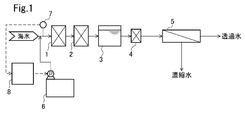
- FIG. 1 is a system diagram showing an example of an embodiment of a seawater desalination method and seawater desalination facility according to the present invention, and members having the same functions as those in FIG.
- seawater taken from the sea is filtered through a raw water tank 1 by a sand filter 2, and the filtered water is filtered into a filtered water tank 3 and a security filter 4. Then, the RO membrane is separated by the RO membrane separation device 5, and the permeated water is taken out as treated water (fresh water).
- Stabilized chlorine consisting of a chlorine-based oxidant and a sulfamine-based compound is added to the water supply line for supplying seawater to the raw water tank 1 by the pump P from the chemical tank 6.
- the measured value by the chlorine concentration meter 7 is obtained by the control device 8 to which the measured value of the chlorine concentration meter 7 provided in the water supply line is input.
- a chemical injection signal is output to the pump P so that the free chlorine concentration and the total chlorine concentration are within the above-described range, and chemical injection control is performed.
- Stabilized chlorine consisting of a chlorine-based oxidant and a sulfamine-based compound remaining in seawater flowing into the RO membrane separation device 5 through the safety filter 4 prevents biofouling failures in the RO membrane separation device 5 and can be used for a long time. Accordingly, it is possible to prevent the increase of the membrane differential pressure and to stably operate.
- the stabilized chlorine composed of a chlorine-based oxidant and a sulfamine-based compound added at the seawater intake section is introduced at the entrance of the RO membrane separator.
- the free chlorine concentration is less than 0.1 mg-Cl 2 / L, further less than 0.05 mg-Cl 2 / L, and the total chlorine concentration is 0.1-5 mg-Cl 2 / L, further 0.3-5 mg-Cl 2 It is preferable to remain so as to be / L.
- a chlorine concentration meter may also be provided in the water supply line at the entrance of the RO membrane separation device 5, and the control device 8 may incorporate this measurement value and perform chemical injection control.
- the sodium hypochlorite used in Runs 2 to 4 is an aqueous solution having an effective chlorine concentration of 12% by weight, and the monochlororosulfamate sodium used in Runs 5 to 8 was prepared as follows.
- sodium hydroxide was added and dissolved in pure water, and further sulfamic acid was added and dissolved, and then an aqueous sodium hypochlorite solution was added and dissolved.
- Table 1 shows the amount of drug added as the free chlorine concentration and total chlorine concentration in the test solution.
- the oyster larvae used in the test were collected at the timing when a population with the same growth stage was attached by size selection. Each individual had a face plate (an organ for swimming) and had grown to a stage where his legs were stretched. In addition, the judgment of whether or not it was attached was determined to be attached if it did not move when the container was shaken and it was confirmed that adhesion was promoted by microscopic observation (adhered with legs). .
Landscapes
- Engineering & Computer Science (AREA)
- Water Supply & Treatment (AREA)
- Chemical & Material Sciences (AREA)
- Chemical Kinetics & Catalysis (AREA)
- Life Sciences & Earth Sciences (AREA)
- Hydrology & Water Resources (AREA)
- Environmental & Geological Engineering (AREA)
- Organic Chemistry (AREA)
- Nanotechnology (AREA)
- Separation Using Semi-Permeable Membranes (AREA)
- Treatment Of Water By Oxidation Or Reduction (AREA)
Abstract
塩素系酸化剤及び/又は臭素系酸化剤からなるハロゲン系酸化剤とスルファミン系化合物とよりなる安定化塩素及び/又は安定化臭素により、海水接水部材への貝類の付着を抑制する。塩素系酸化剤及び/又は臭素系酸化剤からなるハロゲン系酸化剤とスルファミン系化合物とよりなる安定化塩素及び/又は安定化臭素を、塩素換算で、遊離塩素濃度が0.1mg-Cl2/L未満、全塩素濃度が0.1~10mg-Cl2/Lの範囲となるように海水に添加して、海水接水部材への貝類の付着を抑制する方法。海水を濾過する濾過器2と、濾過器2からの濾過水を逆浸透膜分離処理する逆浸透膜分離装置5とを有する海水淡水化設備において、濾過器2の前段に、該安定化塩素及び/又は安定化臭素を海水に添加する薬注装置を有する海水淡水化設備。
Description
本発明は、海水接水部材への貝類の付着を抑制する貝類の付着抑制方法と、この貝類の付着抑制方法を利用した海水淡水化方法及び海水淡水化設備に関する。
海水淡水化設備や、発電所などの海水を用いた海水冷却水設備などでは、海水を取水するための配管や水路などにムラサキイガイ、フジツボ、カキなどの貝類が付着する。
付着した貝類を放置すると、配管閉塞、海水採水量の低下、冷却効率の低下、ひいては装置故障、発電装置稼動効率の低下等の様々な障害を引き起こすため、従来、次亜塩素酸ナトリウム等の塩素系酸化剤を用いた殺貝処理が行われている(特許文献1,非特許文献1)。特許文献1には、十分に貝類の付着を防止するための遊離残留塩素(または臭素)濃度は1.0mg/L程度であり、少なくとも0.1~0.5mg/L程度は必要であることが記載されている。
次亜塩素酸ナトリウムや次亜臭素酸ナトリウム等のハロゲン系酸化剤は、逆浸透(RO)膜を劣化させることから、RO膜を用いた海水淡水化設備では、海水の取水部で次亜塩素酸ナトリウム等の塩素系酸化剤を添加して殺貝処理した後、RO膜分離装置の入口で残留する塩素系酸化剤を還元除去するために亜硫酸水素ナトリウム等の還元剤を添加することが行われている(非特許文献1)。しかし、この場合には、RO膜分離装置に、還元剤により残留酸化剤が除去された水が流入するため、RO膜分離装置におけるバイオファウリング障害が問題となる。
RO膜の劣化を引き起こすことなく、バイオファウリング障害を防止することができるスライムコントロール剤として、クロロスルファミン酸ナトリウム等の安定化塩素剤やブロモスルファミン酸ナトリウム等の安定化臭素剤が提案されている(特許文献2~5)。しかし、これらは、遊離塩素や遊離臭素と比較して殺菌力が弱いため、従来、貝類の付着抑制効果はないと考えられており、貝類の付着抑制や殺貝のための薬剤としては、適用されていない。
このため、RO膜を用いた海水淡水化設備では、海水の取水部で次亜塩素酸ナトリウム等のハロゲン系酸化剤を添加した後、RO膜分離装置の入口で亜硫酸水素ナトリウム等の還元剤を添加して残留酸化剤を還元除去し、その後、RO膜のバイオファウリング障害防止のためにスライムコントロール剤を添加する処理が採用されている。
図2はこのような従来の一般的な海水淡水化設備を示す系統図であり、海水は、原水槽1を経て砂濾過器2で濾過され、濾過水は濾過水槽3、保安フィルタ4を経てRO膜分離装置5でRO膜分離され、透過水が取り出される。従来の海水淡水化設備では、海から原水槽1へ海水を送水する送水ラインで次亜塩素酸ナトリウム(NaClO)等の塩素系酸化剤を添加して殺貝処理し、RO膜分離装置5の入口で亜硫酸水素ナトリウム(SBS)等の還元剤を添加して残留酸化剤を除去し、その後スライムコントロール剤を添加している。
日本海水学会誌 第67巻 第5号(2013)P.279-282「無薬注による海水前処理」(竹内 和久、田畑 雅之、伊藤 嘉晃)
本発明は、従来、殺貝効果がないとされていた塩素系酸化剤及び/又は臭素系酸化剤からなるハロゲン系酸化剤とスルファミン系化合物とよりなる安定化塩素及び/又は安定化臭素により海水接水部材への貝類の付着を抑制する方法を提供することを目的とする。
また、本発明は、この貝類の付着抑制方法を利用して、RO膜分離装置を用いた海水淡水化設備において、貝類の付着を抑制すると共に、残留酸化剤の還元除去のための還元剤の添加を不要とし、また、RO膜のバイオファウリング障害も防止することができる海水淡水化方法及び海水淡水化設備を提供することを目的とする。
また、本発明は、この貝類の付着抑制方法を利用して、RO膜分離装置を用いた海水淡水化設備において、貝類の付着を抑制すると共に、残留酸化剤の還元除去のための還元剤の添加を不要とし、また、RO膜のバイオファウリング障害も防止することができる海水淡水化方法及び海水淡水化設備を提供することを目的とする。
本発明者らは、上記課題を解決すべく鋭意検討を重ねた結果、塩素系酸化剤及び/又は臭素系酸化剤からなるハロゲン系酸化剤とスルファミン系化合物とよりなる安定化塩素及び/又は安定化臭素であっても、塩素換算で所定の遊離塩素濃度及び全塩素濃度となるように海水に添加することにより、海水接水部材への貝類の付着抑制効果および殺貝効果を十分に得ることができることを見出した。また、ハロゲン系酸化剤とスルファミン系化合物よりなる安定化ハロゲンであれば、RO膜劣化の問題がないため、RO膜分離装置を用いた海水淡水化設備において、海水の取水部に添加してもRO膜分離装置の入口で残留した安定化ハロゲンを還元除去する必要はなく、また、残留安定化ハロゲンによりRO膜のバイオファウリング障害も防止することができること、即ち、従来におけるRO膜分離装置入口での還元剤の添加とその後のスライムコントロール剤の添加を不要とすることができることを見出した。
本発明はこのような知見に基づいて達成されたものであり、以下を要旨とする。
[1] 海水接水部材への貝類の付着を抑制する方法において、塩素系酸化剤及び/又は臭素系酸化剤からなるハロゲン系酸化剤とスルファミン系化合物とよりなる安定化塩素及び/又は安定化臭素を、塩素換算で、遊離塩素濃度が0.1mg-Cl2/L未満、全塩素濃度が0.1~10mg-Cl2/Lの範囲となるように海水に添加することを特徴とする貝類の付着抑制方法。
[2] 海水を濾過する濾過工程と、該濾過工程からの濾過水を逆浸透膜分離処理する逆浸透膜分離工程とを有する海水淡水化方法において、該濾過工程よりも前に、塩素系酸化剤及び/又は臭素系酸化剤からなるハロゲン系酸化剤とスルファミン系化合物とよりなる安定化塩素及び/又は安定化臭素を、海水に添加する薬注工程を有することを特徴とする海水淡水化方法。
[3] [2]において、前記薬注工程において、前記安定化塩素及び/又は安定化臭素を、塩素換算で、遊離塩素濃度が0.1mg-Cl2/L未満、全塩素濃度が0.1~10mg-Cl2/Lの範囲となるように海水に添加することを特徴とする海水淡水化方法。
[4] 海水を濾過する濾過器と、該濾過器からの濾過水を逆浸透膜分離処理する逆浸透膜分離装置とを有する海水淡水化設備において、該濾過器の前段に、塩素系酸化剤及び/又は臭素系酸化剤からなるハロゲン系酸化剤とスルファミン系化合物とよりなる安定化塩素及び/又は安定化臭素を、海水に添加する薬注装置を有することを特徴とする海水淡水化設備。
[5] [4]において、前記安定化塩素及び/又は安定化臭素添加後の海水の遊離塩素及び/又は遊離臭素濃度と全塩素及び/又は全臭素濃度を測定する塩素及び/又は臭素濃度測定器と、該塩素及び/又は臭素濃度測定器の測定結果に基づいて、海水の遊離塩素及び/又は遊離臭素濃度が、塩素換算で、0.1mg-Cl2/L未満、全塩素及び/又は臭素濃度が、塩素換算で、0.1~10mg-Cl2/Lの範囲となるように前記薬注装置の薬注量を制御する制御器を有することを特徴とする海水淡水化設備。
本発明によれば、塩素系酸化剤及び/又は臭素系酸化剤からなるハロゲン系酸化剤とスルファミン系化合物とよりなる安定化塩素及び/又は安定化臭素を用いて、海水接水部材への貝類の付着を抑制し、また付着した貝類を殺貝して剥離することができる。
本発明によれば、RO膜分離装置を用いた海水淡水化設備において、海水の取水部で塩素系酸化剤及び/又は臭素系酸化剤からなるハロゲン系酸化剤とスルファミン系化合物とよりなる安定化塩素及び/又は安定化臭素を添加して貝類の付着抑制、殺貝処理を行い、ここで添加した安定化塩素及び/又は安定化臭素により後段のRO膜分離装置のバイオファウリング障害をも防止することができ、従来のRO膜分離装置入口での還元剤の添加、その後のスライムコントロール剤の添加を不要とすることができ、薬剤コストを低減すると共に、薬注のための設備、操作を削減することができる。
以下に本発明の実施の形態を詳細に説明する。
[貝類の付着抑制方法]
本発明の貝類の付着抑制方法では、海水に、塩素系酸化剤及び/又は臭素系酸化剤からなるハロゲン系酸化剤とスルファミン系化合物とよりなる安定化塩素及び/又は安定化臭素を、塩素換算で所定の遊離塩素濃度及び全塩素濃度となるように添加して、海水接水部材への貝類の付着を抑制すると共に、貝類を殺貝して付着した貝類を剥離する。
本発明の貝類の付着抑制方法では、海水に、塩素系酸化剤及び/又は臭素系酸化剤からなるハロゲン系酸化剤とスルファミン系化合物とよりなる安定化塩素及び/又は安定化臭素を、塩素換算で所定の遊離塩素濃度及び全塩素濃度となるように添加して、海水接水部材への貝類の付着を抑制すると共に、貝類を殺貝して付着した貝類を剥離する。
本発明における遊離塩素及び/又は遊離臭素、塩素換算での安定化塩素および全塩素は、JIS K 0400-33-10:1999に示されており、N,N-ジエチル-1,4-フェニレンジアミンを用いるDPD法によりCl2の濃度として測定される。遊離塩素は次亜塩素酸、次亜塩素酸イオンまたは溶存塩素の形で存在する塩素とされている。安定化塩素はクロロアミンおよび有機クロロアミンの形で存在する塩素とされており、上記遊離塩素に含まれないが、DPD法により測定される塩素とされている。全塩素は遊離塩素、安定化塩素または両者の形で存在する塩素とされている。本方法によって、結合塩素(安定化塩素)由来の遊離塩素や全塩素はもちろん、安定化臭素由来の遊離臭素や全臭素が、塩素換算の遊離塩素濃度、塩素換算の全塩素濃度として管理できる。
本発明で用いる塩素系酸化剤に特に制限はなく、例えば、塩素ガス、二酸化塩素、次亜塩素酸又はその塩、亜塩素酸又はその塩、塩素酸又はその塩、過塩素酸又はその塩、塩素化イソシアヌル酸又はその塩などを挙げることができる。これらのうち、塩形のものの具体例としては、次亜塩素酸ナトリウム、次亜塩素酸カリウムなどの次亜塩素酸アルカリ金属塩、次亜塩素酸カルシウム、次亜塩素酸バリウムなどの次亜塩素酸アルカリ土類金属塩、亜塩素酸ナトリウム、亜塩素酸カリウムなどの亜塩素酸アルカリ金属塩、亜塩素酸バリウムなどの亜塩素酸アルカリ土類金属塩、亜塩素酸ニッケルなどの他の亜塩素酸金属塩、塩素酸アンモニウム、塩素酸ナトリウム、塩素酸カリウムなどの塩素酸アルカリ金属塩、塩素酸カルシウム、塩素酸バリウムなどの塩素酸アルカリ土類金属塩などを挙げることができる。これらの塩素系酸化剤は、1種を単独で用いても良く、2種以上を組み合わせて用いても良い。これらの中で、次亜塩素酸塩は取り扱いが容易なので、好適に用いることができる。
本発明で用いる臭素系酸化剤に特に制限はなく、例えば、液体臭素、塩化臭素、臭素酸又はその塩、次亜臭素酸又はその塩などを挙げることができる。これらの臭素系酸化剤は、1種を単独で用いても良く、2種以上を組み合わせて用いても良い。
本発明で用いるスルファミン系化合物としては、下記一般式[1]で表される化合物又はその塩が挙げられる。

スルファミン系化合物としては、例えば、R1とR2がともに水素原子であるスルファミン酸のほかに、N-メチルスルファミン酸、N,N-ジメチルスルファミン酸、N-フェニルスルファミン酸などを挙げることができる。本発明に用いるスルファミン系化合物のうち、前記化合物の塩としては、例えば、ナトリウム塩、カリウム塩などのアルカリ金属塩、カルシウム塩、ストロンチウム塩、バリウム塩などのアルカリ土類金属塩、マンガン塩、銅塩、亜鉛塩、鉄塩、コバルト塩、ニッケル塩などの他の金属塩、アンモニウム塩及びグアニジン塩などを挙げることができ、具体的には、スルファミン酸ナトリウム、スルファミン酸カリウム、スルファミン酸カルシウム、スルファミン酸ストロンチウム、スルファミン酸バリウム、スルファミン酸鉄、スルファミン酸亜鉛などを挙げることができる。スルファミン酸及びこれらのスルファミン酸塩は、1種を単独で用いることもでき、2種以上を組み合わせて用いることもできる。
次亜塩素酸塩や次亜臭素酸塩等のハロゲン系酸化剤とスルファミン酸塩等のスルファミン系化合物を混合すると、これらが結合して、クロロスルファミン酸塩及び/又はブロモスルファミン酸塩を形成して安定化し、水中で安定した遊離塩素濃度を保つことが可能となる。
ハロゲン系酸化剤とスルファミン系化合物との使用割合には特に制限はないが、ハロゲン系酸化剤の有効塩素及び/又は有効臭素1モルあたりスルファミン系化合物を0.5~5.0モルとすることが好ましく、1.0~3.0モルとすることがより好ましい。
ハロゲン系酸化剤とスルファミン系化合物とよりなる安定化塩素及び/又は安定化臭素の安定化ハロゲンは、塩素系酸化剤及び/又は臭素系酸化剤からなるハロゲン系酸化剤とスルファミン系化合物とを含む水溶液として好適に用いられるが、何らこの混合水溶液の形態に限らず、ハロゲン系酸化剤とスルファミン系化合物とは別々に提供されるものであっても良い。また、ハロゲン系酸化剤とスルファミン系化合物とを含む水溶液は、液中のハロゲン系酸化剤を安定化させるためのアルカリ剤を含有するものであってもよく、そのアルカリ剤としては、通常、水酸化ナトリウム、水酸化カリウム等が用いられる。ハロゲン系酸化剤の安定性を保つために、水酸化ナトリウム、水酸化カリウムなどのアルカリ剤の添加で、水溶液のpHを12以上に調整することが好ましく、13以上に調整することがより好ましい。
以下、好適に用いることができる塩素系酸化剤とスルファミン酸化合物よりなる安定化塩素を用いた場合の好ましい態様について説明するが、本発明は、臭素系酸化剤とスルファミン酸化合物よりなる安定化臭素を用いてもよく、安定化塩素と安定化臭素を併用してもよい。以下の説明において、塩素は適宜臭素、或いは塩素及び臭素に置き換えることができる。
塩素系酸化剤とスルファミン系化合物とよりなる安定化塩素は、例えば、有効塩素濃度1~8重量%、好ましくは3~6重量%の塩素系酸化剤と、1.5~9重量%、好ましくは4.5~8重量%のスルファミン系化合物を含む、pH12以上水溶液として海水に添加されることが好ましい。
この水溶液は、以下の条件を満たすことがより好ましい。
i) スルファミン系化合物と塩素系酸化剤との含有割合が、Cl/N(モル比)で0.45~0.6。
ここで、Cl/N(モル比)は、JIS K 0400-33-10:1999により測定される塩素系酸化剤のCl2のモル数と、Nにより構成されるスルファミン系化合物のモル数との比に相当する。
ii) アルカリ剤と塩素系酸化剤との含有割合が、Cl/アルカリ金属(モル比)で0.3~0.4。
iii) アルカリ剤とスルファミン系化合物との含有割合が、N/アルカリ金属(モル比)で0.5~0.7。
ここで、N/アルカリ金属(モル比)は、上記スルファミン系化合物のモル数と、アルカリ金属水酸化物により構成されるアルカリ剤のモル数との比に相当し、スルファミン系化合物に含まれるアルカリ金属の量はアルカリとして加算される。
iv) pHが13以上。
v) 全塩素濃度が1~10重量% as Cl2、好ましくは5~10重量% as Cl2、全塩素に対する遊離塩素の含有率が2重量%以下。
i) スルファミン系化合物と塩素系酸化剤との含有割合が、Cl/N(モル比)で0.45~0.6。
ここで、Cl/N(モル比)は、JIS K 0400-33-10:1999により測定される塩素系酸化剤のCl2のモル数と、Nにより構成されるスルファミン系化合物のモル数との比に相当する。
ii) アルカリ剤と塩素系酸化剤との含有割合が、Cl/アルカリ金属(モル比)で0.3~0.4。
iii) アルカリ剤とスルファミン系化合物との含有割合が、N/アルカリ金属(モル比)で0.5~0.7。
ここで、N/アルカリ金属(モル比)は、上記スルファミン系化合物のモル数と、アルカリ金属水酸化物により構成されるアルカリ剤のモル数との比に相当し、スルファミン系化合物に含まれるアルカリ金属の量はアルカリとして加算される。
iv) pHが13以上。
v) 全塩素濃度が1~10重量% as Cl2、好ましくは5~10重量% as Cl2、全塩素に対する遊離塩素の含有率が2重量%以下。
塩素系酸化剤及び/又は臭素系酸化剤からなるハロゲン系酸化剤とスルファミン系化合物とよりなる安定化塩素及び/又は安定化臭素の海水への添加量は、遊離塩素濃度が0.1mg-Cl2/L未満で、全塩素濃度が0.1~10mg-Cl2/Lとなるような量とする。このような濃度となるように安定化塩素を添加する理由は以下の通りである。
遊離塩素濃度が過度に高いと、ポリアミド系RO膜へダメージを与える可能性があるため、RO膜を保護する観点から上限が存在する。
全塩素濃度については、貝付着抑制及び殺貝の観点から、下限が存在するが、経済的観点から上限が存在する。
このようなことから、本発明では、塩素系酸化剤とスルファミン系化合物とよりなる安定化塩素を、海水の遊離塩素濃度が0.1mg-Cl2/L未満で、全塩素濃度が0.1~10mg-Cl2/Lとなるように、好ましくは遊離塩素濃度が0.05mg-Cl2/L未満で、全塩素濃度が0.3mg-Cl2/L以上、5mg-Cl2/L以下となるように添加する。
[海水淡水化方法及び海水淡水化設備]
本発明の海水淡水化方法及び海水淡水化設備は、上述の本発明の貝類の付着抑制方法をRO膜分離装置を用いた海水淡水化設備に適用して海水の取水部で貝類の付着抑制及び殺貝処理を行う。
本発明の海水淡水化方法及び海水淡水化設備は、上述の本発明の貝類の付着抑制方法をRO膜分離装置を用いた海水淡水化設備に適用して海水の取水部で貝類の付着抑制及び殺貝処理を行う。
図1は本発明の海水淡水化方法及び海水淡水化設備の実施の形態の一例を示す系統図であり、図2におけると同一機能を奏する部材には同一符号を付してある。
図1に示すように、本発明の海水淡水化方法及び海水淡水化設備では、海から取水した海水を原水槽1を経て砂濾過器2で濾過し、濾過水を濾過水槽3、保安フィルタ4を経てRO膜分離装置5でRO膜分離し、透過水を処理水(淡水)として取り出す。
海水を原水槽1へ送水する送水ラインには、薬剤タンク6からポンプPにより、塩素系酸化剤とスルファミン系化合物とよりなる安定化塩素が添加される。この塩素系酸化剤とスルファミン系化合物とよりなる安定化塩素の添加に際しては、送水ラインに設けられた塩素濃度計7の測定値が入力される制御装置8により、塩素濃度計7による測定値が、前述の遊離塩素濃度及び全塩素濃度の範囲となるように、ポンプPに薬注信号が出力され、薬注制御が行われる。
このように、海水の取水部で塩素系酸化剤とスルファミン系化合物とよりなる安定化塩素を添加することにより、送水ラインや原水槽1、砂濾過器2、濾過水槽3、保安フィルタ4における貝類の付着は抑制され、例えば、砂濾過器2では逆洗等のメンテナンス頻度を低減することができる。
保安フィルタ4を経てRO膜分離装置5に流入する海水中に残留する塩素系酸化剤とスルファミン系化合物とよりなる安定化塩素により、RO膜分離装置5におけるバイオファウリング障害も防止され、長期に亘り膜差圧の上昇を防止して安定に運転を行うことができる。
RO膜分離装置5におけるバイオファウリング障害をより確実に防止するために、海水の取水部で添加された塩素系酸化剤とスルファミン系化合物とよりなる安定化塩素は、RO膜分離装置の入口で、遊離塩素濃度が0.1mg-Cl2/L未満、さらに0.05mg-Cl2/L未満、全塩素濃度が0.1~5mg-Cl2/L、さらに0.3~5mg-Cl2/Lとなるように残留していることが好ましい。このため、RO膜分離装置5の入口の給水ラインにも塩素濃度計を設け、制御装置8では、この測定値も組み込んで薬注制御するようにしてもよい。
以下に実施例を挙げて本発明をより具体的に説明する。
以下の実施例、参考例及び比較例では、次のようにして実験を行った。
樹脂製細胞培養用容器(接着細胞用プレート)内で付着期にあるマガキ幼生の海水懸濁液を各試験区に200個体前後になるように一定量分注し、試験終了時点の付着マガキ数(付着個体数)、遊離マガキ数(遊離個体数)、それぞれの生死数を計数した。また、全個体数に占める付着個体数の割合(百分率)を付着率として算出した。
樹脂製細胞培養用容器(接着細胞用プレート)内で付着期にあるマガキ幼生の海水懸濁液を各試験区に200個体前後になるように一定量分注し、試験終了時点の付着マガキ数(付着個体数)、遊離マガキ数(遊離個体数)、それぞれの生死数を計数した。また、全個体数に占める付着個体数の割合(百分率)を付着率として算出した。
各試験区に添加した薬剤と添加量は表1に示す通りである。
Run2~4で用いた次亜塩素酸ナトリウムは、有効塩素濃度12重量%の水溶液であり、Run5~8で用いたモノクロロスルファミン酸ナトリウムは、以下のようにして調製した。
純水に水酸化ナトリウムを添加して溶解し、さらにスルファミン酸を添加して溶解し、その後次亜塩素酸ナトリウム水溶液を添加して溶解した。得られたモノクロロスルファミン酸ナトリウム水溶液は、Cl/N(モル比)=0.46、Cl/Na(モル比)=0.30、N/Na(モル比)=0.66、pH>13、有効塩素濃度=6.9重量%、遊離塩素濃度<1000mg-Cl2/Lである。
表1には、薬剤添加量を、試験液中の遊離塩素濃度及び全塩素濃度として示す。
試験精度確保のために、各Runごとに試験区は3ロット設けた。試験期間中は薬剤の失活の可能性を考慮し24時間毎に飼育海水の交換(全換水)を行うと共に、水替え時点の飼育海水の遊離塩素濃度と全塩素濃度を測定した。遊離塩素濃度及び全塩素濃度はDPD法により測定した。
試験はRun1のブランク試験区のマガキが概ね付着完了し、大量斃死が発生し出した72時間で終了した。試験終了後、各試験区の飼育海水を取り出し、容器内に付着して残ったマガキ稚貝数(生死別)、付着せず遊離している幼生あるいは稚貝数(生死別)を全ロット計数した。試験実施上のその他の条件として、温度は25℃前後(室温にて管理)、光周期は13時間明期、11時間暗期とし、飼育海水の撹拌は振盪機により行った。計数は目視の他実体顕微鏡下で行い、試験区ごとの顕微鏡写真も撮影した。
試験に用いたカキ幼生は、サイズ選別により成長段階をそろえた個体群が付着し出したタイミングで採取したものである。各個体は面盤(遊泳するための器官)を持ち、脚も伸ばす段階まで成長している個体であった。
また、付着しているかどうかの判断は、容器をゆすった際動かないもので、かつ顕微鏡観察により付着が促進されている(脚で接着している)ことを確認できたものを付着と判定した。
また、付着しているかどうかの判断は、容器をゆすった際動かないもので、かつ顕微鏡観察により付着が促進されている(脚で接着している)ことを確認できたものを付着と判定した。
カキの生死判断については、顕微鏡観察によりいわゆる生体反応(例えば、内臓等に動きが観察される、面盤を動かして遊泳している)が観察されたものを生きた個体、内臓等が溶解し消失していたり、明らかに内臓に動きがないものを斃死個体として集計した。
72時間後の試験結果を表1に示す。
72時間後の試験結果を表1に示す。

本試験結果より、殺菌力が弱いため、従来、貝付着抑制効果がないと考えられていたモノクロロスルファミン酸ナトリウムが、次亜塩素酸ナトリウムによる貝付着抑制効果と同等以上の効果を示すことがわかった。さらに、付着斃死率のデータからも付着抑制効果のみでなく、殺貝効果も次亜塩素酸ナトリウムと同程度であることが明らかになった。
本発明を特定の態様を用いて詳細に説明したが、本発明の意図と範囲を離れることなく様々な変更が可能であることは当業者に明らかである。
本出願は、2016年3月29日付で出願された日本特許出願2016-065994に基づいており、その全体が引用により援用される。
本出願は、2016年3月29日付で出願された日本特許出願2016-065994に基づいており、その全体が引用により援用される。
Claims (5)
- 海水接水部材への貝類の付着を抑制する方法において、塩素系酸化剤及び/又は臭素系酸化剤からなるハロゲン系酸化剤とスルファミン系化合物とよりなる安定化塩素及び/又は安定化臭素を、塩素換算で、遊離塩素濃度が0.1mg-Cl2/L未満、全塩素濃度が0.1~10mg-Cl2/Lの範囲となるように海水に添加することを特徴とする貝類の付着抑制方法。
- 海水を濾過する濾過工程と、該濾過工程からの濾過水を逆浸透膜分離処理する逆浸透膜分離工程とを有する海水淡水化方法において、該濾過工程よりも前に、塩素系酸化剤及び/又は臭素系酸化剤からなるハロゲン系酸化剤とスルファミン系化合物とよりなる安定化塩素及び/又は安定化臭素を、海水に添加する薬注工程を有することを特徴とする海水淡水化方法。
- 請求項2において、前記薬注工程において、前記安定化塩素及び/又は安定化臭素を、塩素換算で、遊離塩素濃度が0.1mg-Cl2/L未満、全塩素濃度が0.1~10mg-Cl2/Lの範囲となるように海水に添加することを特徴とする海水淡水化方法。
- 海水を濾過する濾過器と、該濾過器からの濾過水を逆浸透膜分離処理する逆浸透膜分離装置とを有する海水淡水化設備において、該濾過器の前段に、塩素系酸化剤及び/又は臭素系酸化剤からなるハロゲン系酸化剤とスルファミン系化合物とよりなる安定化塩素及び/又は安定化臭素を、海水に添加する薬注装置を有することを特徴とする海水淡水化設備。
- 請求項4において、前記安定化塩素及び/又は安定化臭素添加後の海水の遊離塩素及び/又は遊離臭素濃度と全塩素及び/又は全臭素濃度を測定する塩素及び/又は臭素濃度測定器と、該塩素及び/又は臭素濃度測定器の測定結果に基づいて、海水の遊離塩素及び/又は遊離臭素濃度が、塩素換算で、0.1mg-Cl2/L未満、全塩素及び/又は臭素濃度が、塩素換算で、0.1~10mg-Cl2/Lの範囲となるように前記薬注装置の薬注量を制御する制御器を有することを特徴とする海水淡水化設備。
Applications Claiming Priority (2)
| Application Number | Priority Date | Filing Date | Title |
|---|---|---|---|
| JP2016-065994 | 2016-03-29 | ||
| JP2016065994A JP6299796B2 (ja) | 2016-03-29 | 2016-03-29 | 海水淡水化方法及び海水淡水化設備 |
Publications (1)
| Publication Number | Publication Date |
|---|---|
| WO2017169617A1 true WO2017169617A1 (ja) | 2017-10-05 |
Family
ID=59963117
Family Applications (1)
| Application Number | Title | Priority Date | Filing Date |
|---|---|---|---|
| PCT/JP2017/009422 Ceased WO2017169617A1 (ja) | 2016-03-29 | 2017-03-09 | 貝類の付着抑制方法並びに海水淡水化方法及び海水淡水化設備 |
Country Status (2)
| Country | Link |
|---|---|
| JP (1) | JP6299796B2 (ja) |
| WO (1) | WO2017169617A1 (ja) |
Citations (5)
| Publication number | Priority date | Publication date | Assignee | Title |
|---|---|---|---|---|
| JPS54161592A (en) * | 1978-06-13 | 1979-12-21 | Mitsubishi Gas Chem Co Inc | Marine creature adhesion controlling method |
| JP2012115720A (ja) * | 2010-11-29 | 2012-06-21 | Hakuto Co Ltd | 開放型冷水塔循環水系の殺生物方法 |
| JP2012130852A (ja) * | 2010-12-21 | 2012-07-12 | Hakuto Co Ltd | 水系における微生物障害を抑制する水系処理方法 |
| WO2013005787A1 (ja) * | 2011-07-06 | 2013-01-10 | 栗田工業株式会社 | 膜分離方法 |
| JP2015062889A (ja) * | 2013-08-28 | 2015-04-09 | オルガノ株式会社 | 分離膜のスライム抑制方法、分離膜用スライム抑制剤組成物、および分離膜用スライム抑制剤組成物の製造方法 |
-
2016
- 2016-03-29 JP JP2016065994A patent/JP6299796B2/ja active Active
-
2017
- 2017-03-09 WO PCT/JP2017/009422 patent/WO2017169617A1/ja not_active Ceased
Patent Citations (5)
| Publication number | Priority date | Publication date | Assignee | Title |
|---|---|---|---|---|
| JPS54161592A (en) * | 1978-06-13 | 1979-12-21 | Mitsubishi Gas Chem Co Inc | Marine creature adhesion controlling method |
| JP2012115720A (ja) * | 2010-11-29 | 2012-06-21 | Hakuto Co Ltd | 開放型冷水塔循環水系の殺生物方法 |
| JP2012130852A (ja) * | 2010-12-21 | 2012-07-12 | Hakuto Co Ltd | 水系における微生物障害を抑制する水系処理方法 |
| WO2013005787A1 (ja) * | 2011-07-06 | 2013-01-10 | 栗田工業株式会社 | 膜分離方法 |
| JP2015062889A (ja) * | 2013-08-28 | 2015-04-09 | オルガノ株式会社 | 分離膜のスライム抑制方法、分離膜用スライム抑制剤組成物、および分離膜用スライム抑制剤組成物の製造方法 |
Also Published As
| Publication number | Publication date |
|---|---|
| JP6299796B2 (ja) | 2018-03-28 |
| JP2017176965A (ja) | 2017-10-05 |
Similar Documents
| Publication | Publication Date | Title |
|---|---|---|
| TWI597235B (zh) | Production method of hypobromous acid stabilized composition, hypobromous acid stabilized composition, and slime inhibition method of separation membrane | |
| JP6131342B2 (ja) | 滅菌養殖水の製造方法およびこれを利用した流水式滅菌水魚類養殖方法 | |
| KR101990262B1 (ko) | 여과 처리 시스템 및 여과 처리 방법 | |
| JP6534524B2 (ja) | ろ過処理システムおよびろ過処理方法 | |
| KR102101320B1 (ko) | 현장에서 직접 제조한 살균제로 역삼투막을 살균처리하는 방법 및 장치 | |
| JP7175837B2 (ja) | 海洋生物の飼育水製造方法および製造装置 | |
| Hill et al. | Electrolytic sodium hypochlorite system for treatment of ballast water | |
| KR20100059089A (ko) | 해수 살균처리방법 및 장치 | |
| JP6513424B2 (ja) | 分離膜の殺菌方法 | |
| JP6682401B2 (ja) | 逆浸透膜を用いる水処理方法 | |
| JP6299796B2 (ja) | 海水淡水化方法及び海水淡水化設備 | |
| JP7050414B2 (ja) | 逆浸透膜を用いる水処理方法 | |
| JP2018030133A (ja) | 貝類の付着抑制方法 | |
| JP7552938B2 (ja) | 水系の微生物汚染抑制方法 | |
| JP5281465B2 (ja) | 殺菌殺藻剤組成物、水系の殺菌殺藻方法および殺菌殺藻剤組成物の製造方法 | |
| JP2016120486A (ja) | 分離膜のスライム抑制方法 | |
| WO2012124039A1 (ja) | バラスト水の殺菌剤及びバラスト水処理装置 | |
| JP2020104093A (ja) | 水系の殺菌方法、および水系のニトロソアミン化合物の除去方法 | |
| WO2020136963A1 (ja) | 水系の殺菌方法、水系のニトロソアミン化合物の除去方法、および飲料水の製造方法 | |
| KR102246909B1 (ko) | 미생물 살균제, 이의 제조방법 및 이를 이용한 수처리 방법 | |
| CN110127897A (zh) | 一种不加盐次氯酸钠发生器消毒装置及其消毒方法 | |
| JP4846298B2 (ja) | 海水の殺菌処理方法 | |
| TW202333806A (zh) | 水系統的微生物污染抑制方法 | |
| JP2016117033A (ja) | 膜分離処理システムおよび膜分離処理方法 |
Legal Events
| Date | Code | Title | Description |
|---|---|---|---|
| NENP | Non-entry into the national phase |
Ref country code: DE |
|
| 121 | Ep: the epo has been informed by wipo that ep was designated in this application |
Ref document number: 17774162 Country of ref document: EP Kind code of ref document: A1 |
|
| 122 | Ep: pct application non-entry in european phase |
Ref document number: 17774162 Country of ref document: EP Kind code of ref document: A1 |