WO2017159538A1 - ポリアミド酸、ポリアミド酸溶液、ポリイミド、およびポリイミド基板ならびにそれらの製造方法 - Google Patents
ポリアミド酸、ポリアミド酸溶液、ポリイミド、およびポリイミド基板ならびにそれらの製造方法 Download PDFInfo
- Publication number
- WO2017159538A1 WO2017159538A1 PCT/JP2017/009485 JP2017009485W WO2017159538A1 WO 2017159538 A1 WO2017159538 A1 WO 2017159538A1 JP 2017009485 W JP2017009485 W JP 2017009485W WO 2017159538 A1 WO2017159538 A1 WO 2017159538A1
- Authority
- WO
- WIPO (PCT)
- Prior art keywords
- polyimide
- general formula
- polyamic acid
- structural unit
- unit represented
- Prior art date
- Legal status (The legal status is an assumption and is not a legal conclusion. Google has not performed a legal analysis and makes no representation as to the accuracy of the status listed.)
- Ceased
Links
- 0 CCCC[Si](C)(C)O[Si](C)(C)CCCN(C(c(c1c2)ccc2-c(cc2)cc(C(N3C(C)*)=O)c2C3=O)=O)C1=O Chemical compound CCCC[Si](C)(C)O[Si](C)(C)CCCN(C(c(c1c2)ccc2-c(cc2)cc(C(N3C(C)*)=O)c2C3=O)=O)C1=O 0.000 description 1
Classifications
-
- C—CHEMISTRY; METALLURGY
- C08—ORGANIC MACROMOLECULAR COMPOUNDS; THEIR PREPARATION OR CHEMICAL WORKING-UP; COMPOSITIONS BASED THEREON
- C08G—MACROMOLECULAR COMPOUNDS OBTAINED OTHERWISE THAN BY REACTIONS ONLY INVOLVING UNSATURATED CARBON-TO-CARBON BONDS
- C08G73/00—Macromolecular compounds obtained by reactions forming a linkage containing nitrogen with or without oxygen or carbon in the main chain of the macromolecule, not provided for in groups C08G12/00 - C08G71/00
- C08G73/06—Polycondensates having nitrogen-containing heterocyclic rings in the main chain of the macromolecule
- C08G73/10—Polyimides; Polyester-imides; Polyamide-imides; Polyamide acids or similar polyimide precursors
Definitions
- the present invention relates to a polyamic acid, a polyamic acid solution, a polyimide, and a polyimide substrate.
- Electronic devices such as displays, touch panels, and solar cells are required to be thin, light, and flexible, and use of a resin film substrate in place of a glass substrate is being studied.
- semiconductor elements such as thin film transistors and electronic elements such as electrodes are formed on the substrate. Since formation of these elements requires a high temperature process, the resin film substrate is required to have high heat resistance.
- the element provided on the substrate is generally made of an inorganic material. If the linear thermal expansion coefficient of the substrate and the linear thermal expansion coefficient of the inorganic material constituting the element are greatly different, the substrate may be warped or the element may be destroyed due to stress at the element formation interface or the like. Therefore, the resin film substrate is desired to have a linear thermal expansion coefficient equivalent to that of the inorganic material constituting the element.
- the resin film substrate is required to have transparency, and particularly has high light transmittance in the visible light region. Is required.
- resin film substrate materials for electronic devices are required to have high heat resistance, low thermal expansion, and high transparency.
- the electronic device manufacturing process can be divided into batch type and roll-to-roll type.
- Resin film substrates can also be applied to the roll-to-roll process, but in addition to the need for new equipment for the manufacture of electronic devices by the roll-to-roll process, there are new problems associated with roll transport. Must be overcome.
- a resin solution is applied on a support and dried to form a film substrate, and then an element can be formed on the substrate.
- the current glass substrate process equipment can be used, which is advantageous in terms of cost. It is.
- JP 2012-041530 A Patent No. 5660249 Japanese Patent Laying-Open No. 2015-229691
- the present invention has a high heat resistance, a low thermal expansion property, a high transparency, and a polyimide that exhibits appropriate adhesion to glass as a support, and a polyamic acid as a precursor thereof.
- a polyimide that exhibits appropriate adhesion to glass as a support, and a polyamic acid as a precursor thereof.
- the inventors of the present application introduce a rigid structure and an alicyclic structure into a polymer skeleton, and further use a monomer component having a siloxane bond in combination, so that a polyimide satisfying the above characteristics and a polyamic acid as a precursor thereof are obtained. It was found that it can be obtained.
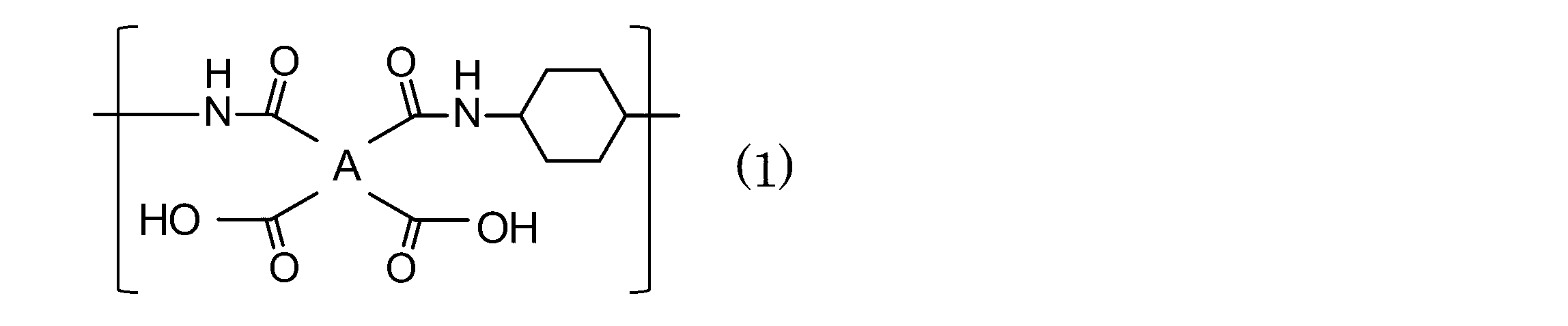
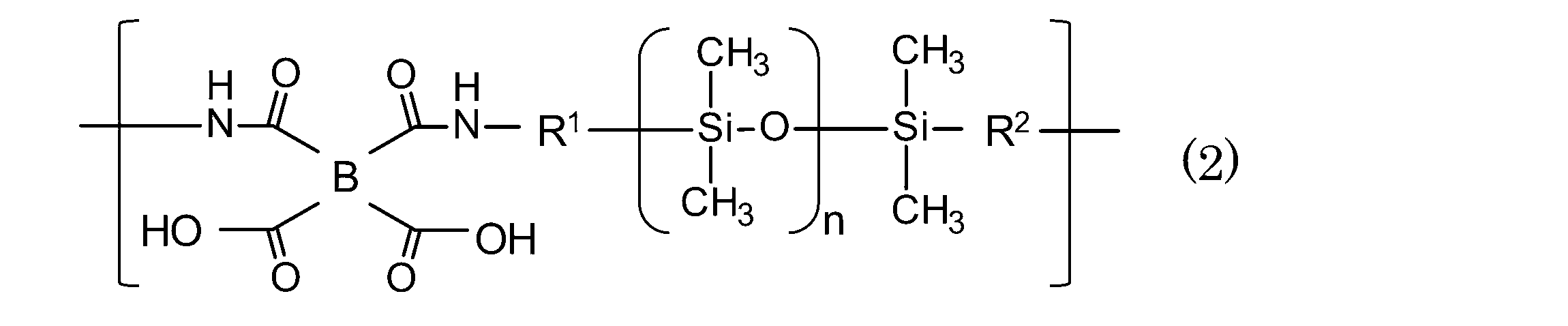
- the polyamic acid of the present invention contains a structural unit represented by general formula 1 and a structural unit represented by general formula 2.
- the polyimide of the present invention has a structural unit represented by the general formula I and a structural unit represented by the general formula II.
- a in General Formula 1 and General Formula I, and B in General Formula 2 and General Formula II are all tetravalent aromatic groups.
- R 1 and R 2 are each independently a divalent hydrocarbon group, and n is an integer of 1 to 5.
- the tetravalent aromatic groups A and B are both residues of an aromatic tetracarboxylic dianhydride, preferably a biphenyl-3,3 ′, 4,4′-tetrayl group.
- R 1 and R 2 are each independently preferably a methylene group, an ethylene group, or a propylene group, and particularly preferably a propylene group.
- n is more preferably 1 to 3, and most preferably 1.
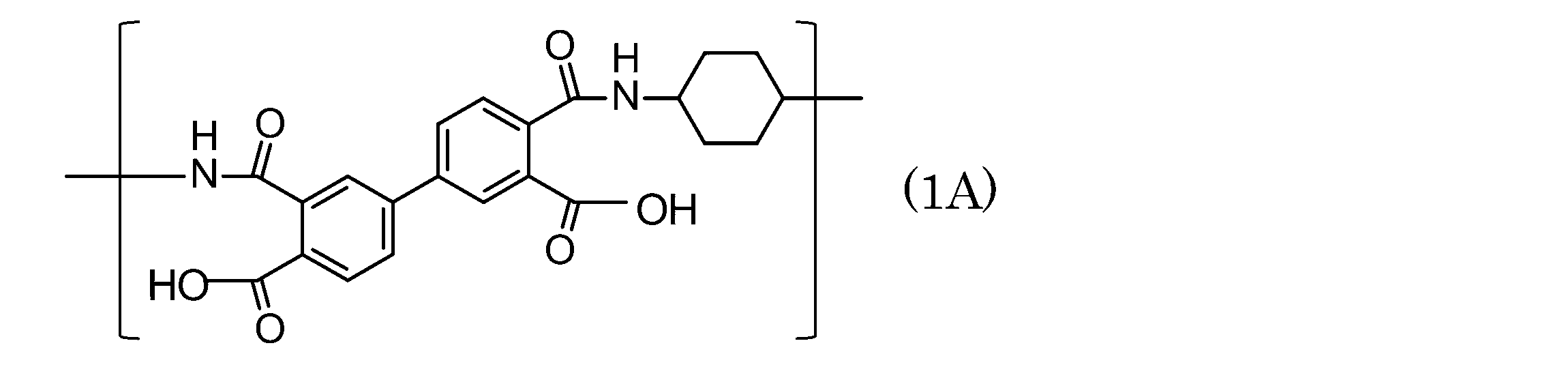
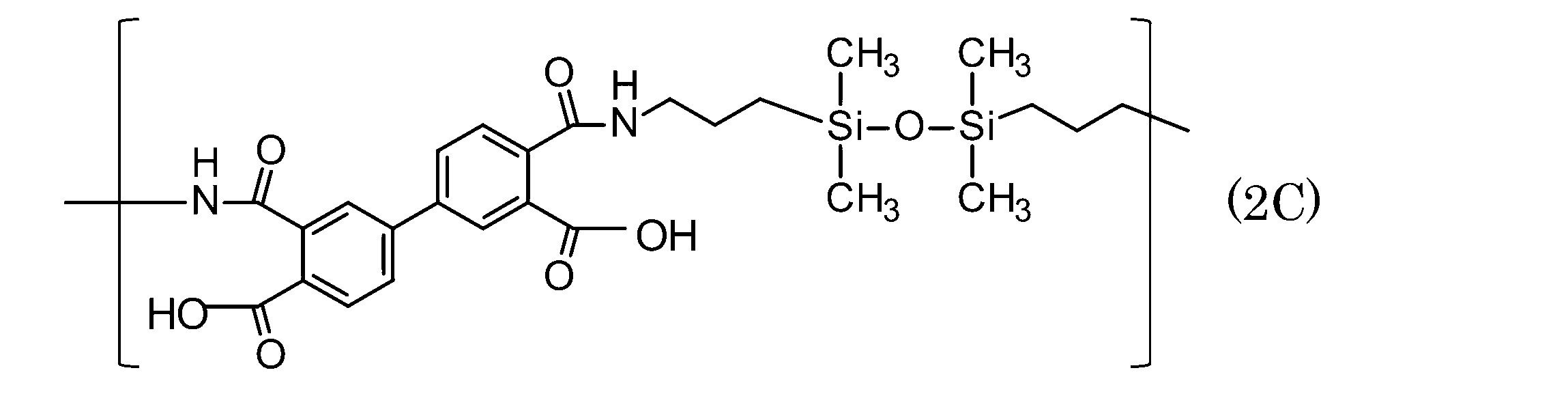
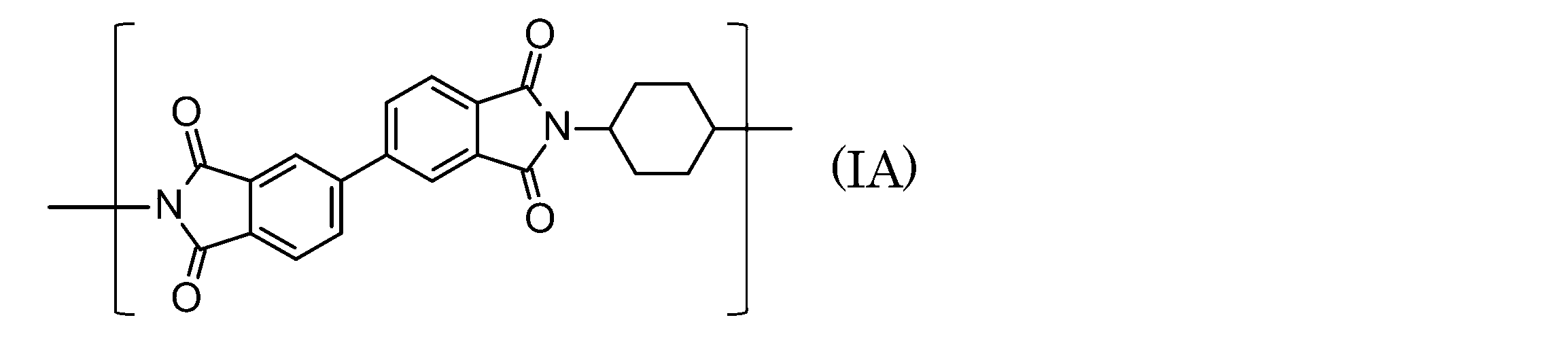
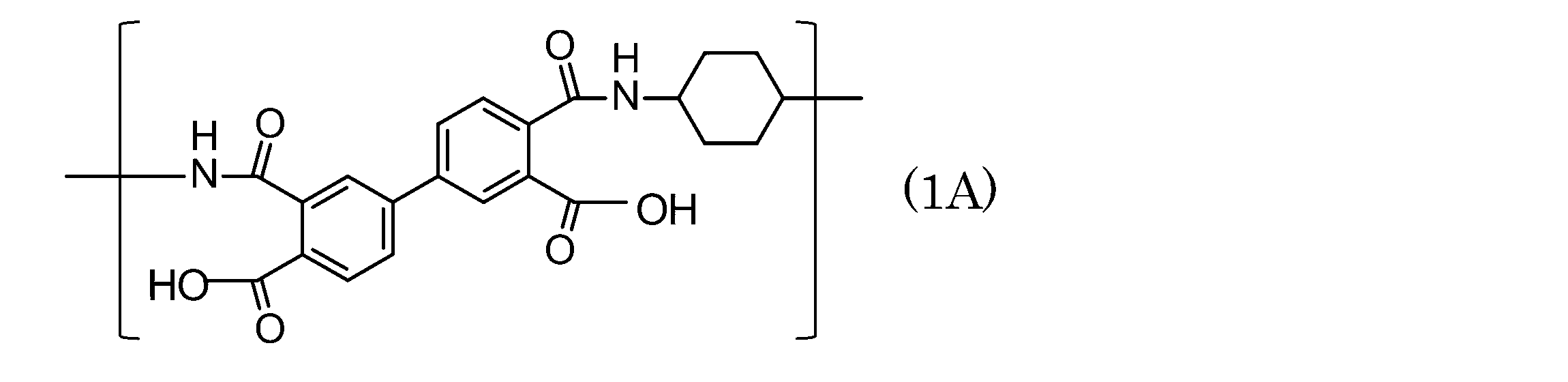
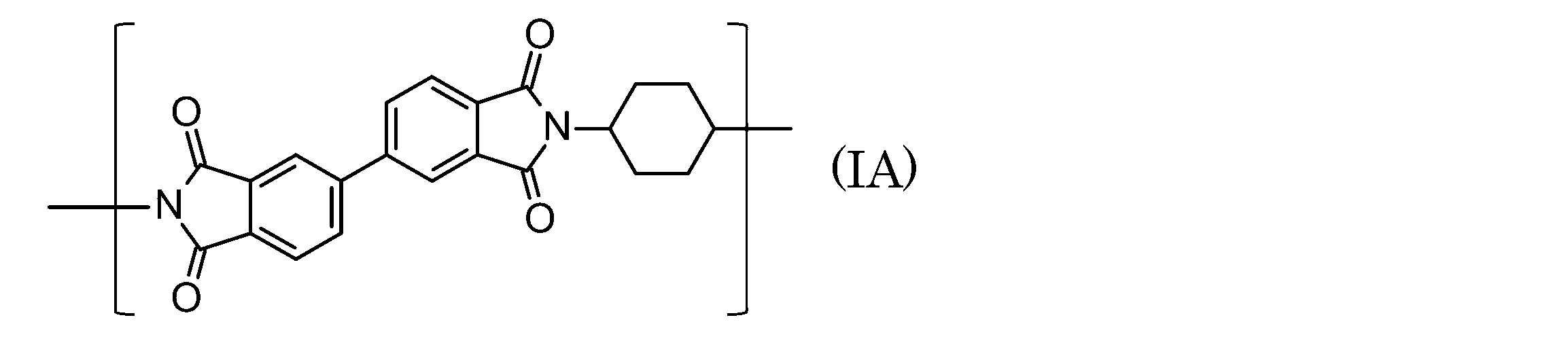
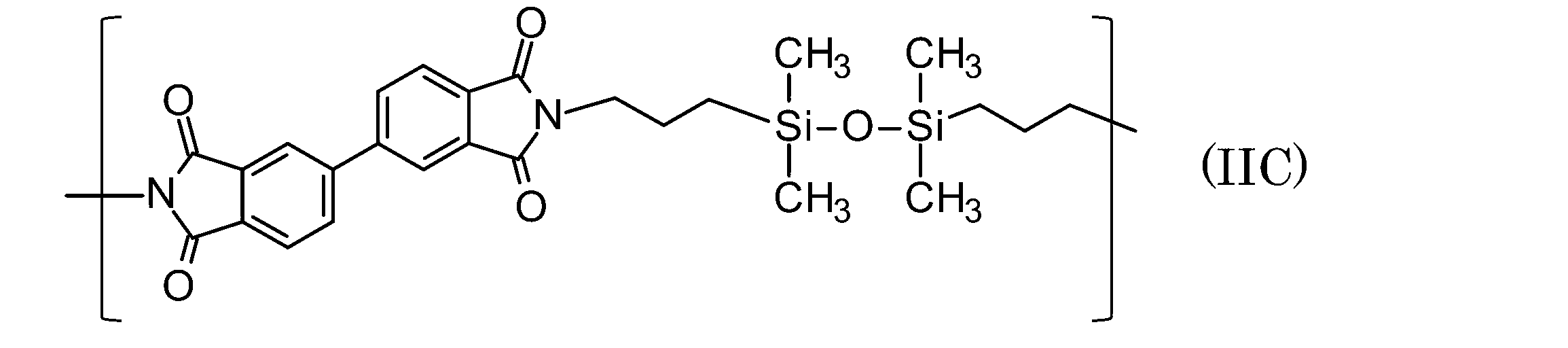
- the polyamic acid of the present invention preferably contains a structural unit represented by the following formula 1A and a structural unit represented by the following formula 2C, and the polyimide of the present invention preferably has the following formula IA And a structural unit represented by the following formula IIC.
- the present invention relates to a polyimide substrate containing the above polyimide.
- a polyimide substrate is obtained by applying a polyamic acid solution containing the above polyamic acid and an organic solvent on a support, and removing the organic solvent and imidating the polyamic acid.
- This polyimide substrate is formed as a polyimide film adhered and laminated on a support.
- the support on which the polyamic acid solution is applied for example, glass is used.
- the polyimide obtained from the polyamic acid of the present invention has appropriate heat adhesion to a support such as glass in addition to high heat resistance, low thermal expansion and high transparency. Therefore, it is suitable as a substrate material for an electronic device that requires appropriate adhesion to a support in a batch process.
- the polyamic acid of the present invention includes a structural unit represented by the following general formula 1 and a structural unit represented by the general formula 2.
- the polyimide of the present invention includes the structural unit represented by the following general formula I and the structural unit represented by the general formula II, and is obtained, for example, by imidizing the polyamic acid having the structure 1 and the structure 2 described above. .
- a in the general formula 1 and the general formula I and B in the general formula 2 and the general formula II are all tetravalent aromatic groups.
- the aromatic group may have a single aromatic ring, may be a combination of a plurality of aromatic rings, or may be a condensed polycycle.
- R 1 and R 2 are each independently a divalent hydrocarbon group, and n is an integer of 1 to 5.
- a polyimide having a structural unit of the general formula I and a structural unit of the general formula II is obtained by imidizing the polyamic acid having the structural unit of the general formula 1 and the structural unit of the general formula 2. Since the polyimide having this structure is excellent in adhesion to glass, it is suitable for use in the formation of a resin film substrate in a batch process and the formation process of elements on the film substrate.
- aromatic tetracarboxylic dianhydride residues are preferably aromatic tetracarboxylic dianhydride residues.
- aromatic tetracarboxylic dianhydrides include pyromellitic dianhydride, 3,3 ′, 4,4-biphenyltetracarboxylic dianhydride, 3,3 ′, 4,4′-benzophenone tetracarboxylic acid dianhydride.
- A represents a residue of 3,3 ′, 4,4′-biphenyltetracarboxylic dianhydride (biphenyl-3 represented by the following chemical formula). , 3 ′, 4,4′-tetrayl group).
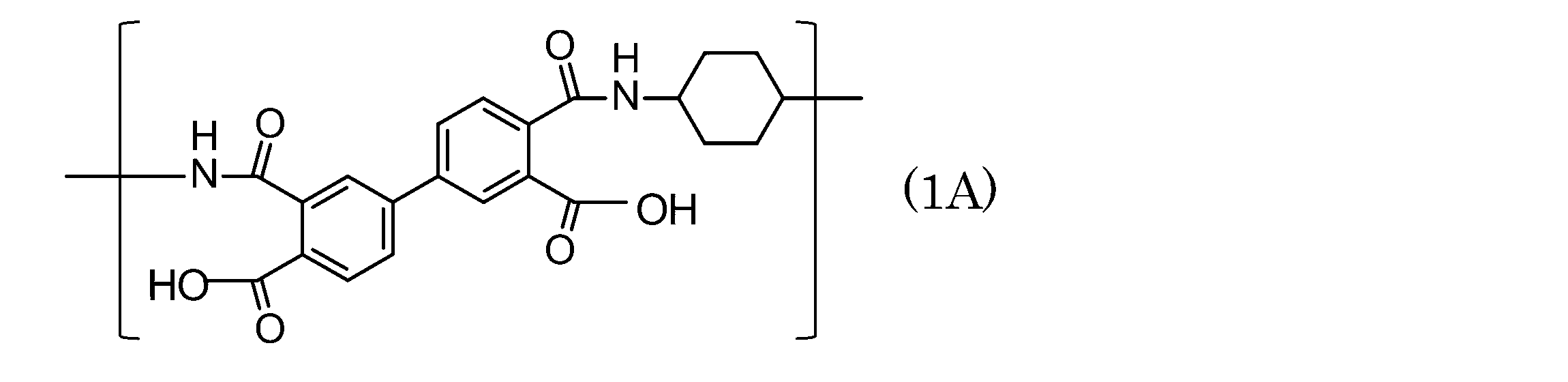
- the structural unit of the general formula 1 is preferably an amic acid structural unit represented by the following formula 1A
- the structural unit of the general formula I is an imide structural unit represented by the following formula IA Is preferred.
- These structural units are obtained from 3,3 ', 4,4'-biphenyltetracarboxylic dianhydride and 1,4-cyclohexanediamine.
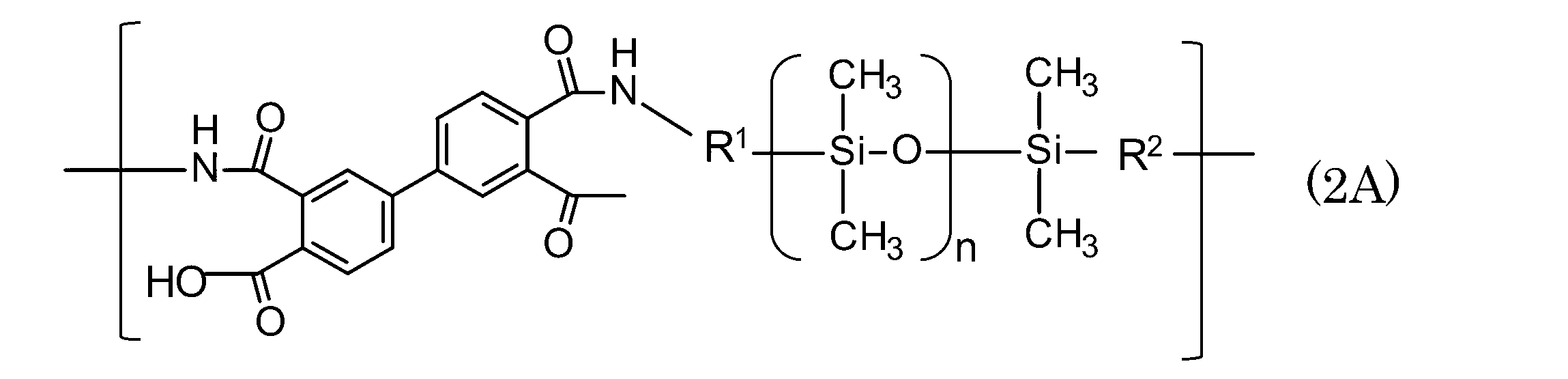
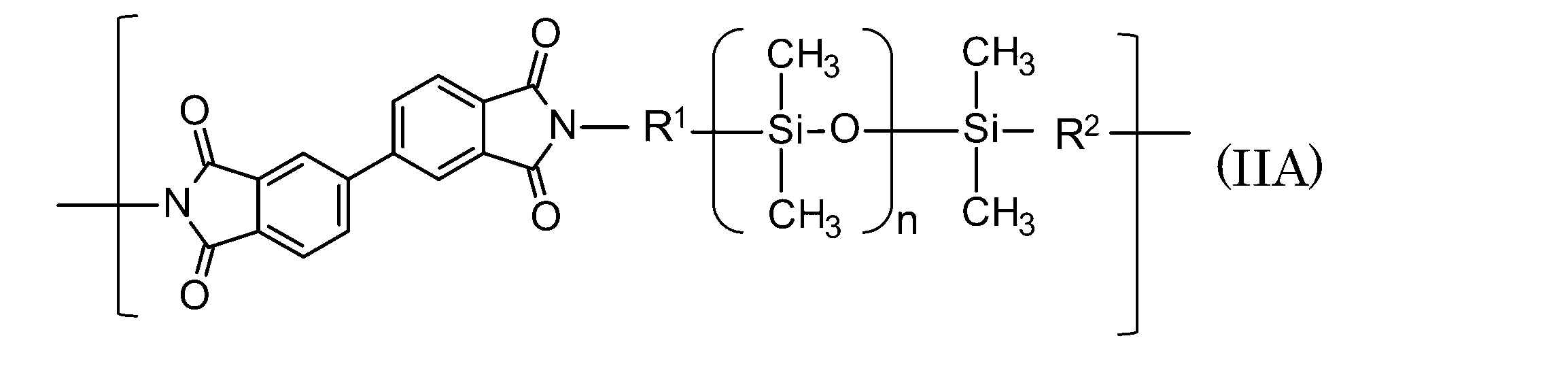
- the structural unit represented by the general formula 2 is preferably an amic acid structural unit represented by the following general formula 2A
- the structural unit represented by the general formula II is represented by the following general formula IIA. It is preferable that it is an imide structural unit. These structural units are obtained from 3,3 ', 4,4'-biphenyltetracarboxylic dianhydride and a siloxane structure-containing diamine.
- a and B may be the same. From the viewpoint of simultaneously realizing the high transparency and low linear expansion coefficient of the polyimide film, it is preferable that both A and B are biphenyl-3,3 ', 4,4'-tetrayl groups.
- R 1 and R 2 in the general formula 2 and the general formula II are each independently a methylene group, an ethylene group, or an excellent reactivity at the time of polymerization of the polyamic acid and the polyimide exhibits low thermal expansion.
- a propylene group is preferable, and a propylene group is particularly preferable. Since the polyamic acid exhibits high solubility and the polyimide film exhibits high transparency, n in the general formula 2 and the general formula II is preferably 1 to 5, and preferably 1 to 3. More preferably, 1 is most preferable.
- the structural unit of the general formula 2 is preferably an amic acid structural unit represented by the following general formula 2B
- the structural unit of the general formula II is an imide structural unit represented by the following general formula IIB.
- These structural units are obtained from aromatic tetracarboxylic dianhydride and 1,3-bis (3-aminopropyl) tetramethyldisiloxane as a diamine component.
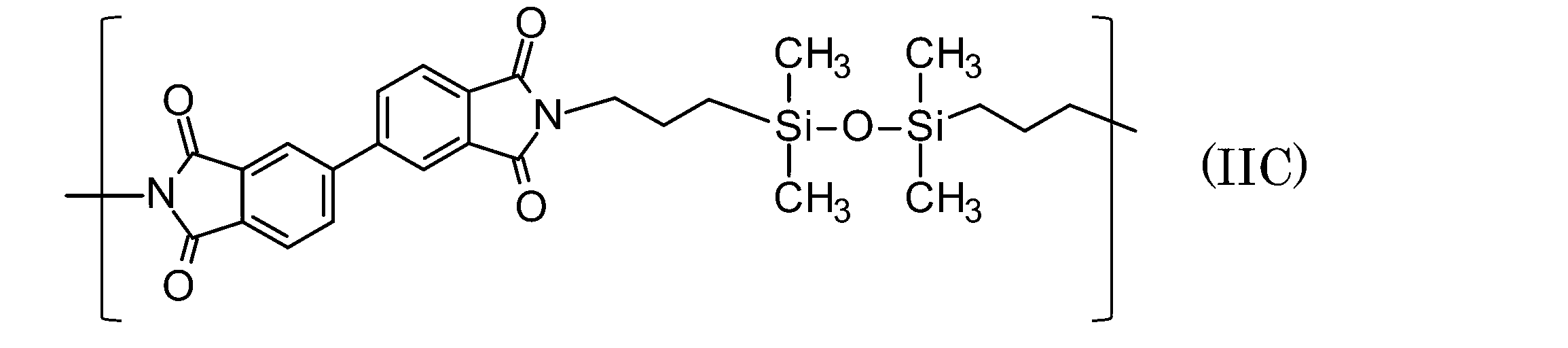
- the tetravalent aromatic group B in the general formulas 2 and II is preferably a biphenyl-3,3 ', 4,4'-tetrayl group. Therefore, the structural unit of the general formula 2 is particularly preferably an amic acid structural unit represented by the following formula 2C, and the structural unit of the general formula II is an imide structural unit represented by the following formula IIC. It is particularly preferred.
- These building blocks are obtained from 3,3 ', 4,4'-biphenyltetracarboxylic dianhydride and 1,3-bis (3-aminopropyl) tetramethyldisiloxane.
- the structural unit represented by general formula I in polyimide and represented by general formula II 80 mol% or more is preferable with respect to the polyimide whole quantity, and, as for the sum total with a structural unit, 90 mol% or more is more preferable, and 95 mol% or more is especially preferable.
- the total of the structural units represented by Formula 2 is preferably 80 mol% or more, more preferably 90 mol% or more, and particularly preferably 95 mol% or more, based on the total amount of polyamic acid. preferable.
- the number of moles of polyimide is the number of moles of structural units derived from all diamines constituting the polyimide.
- the number of moles of polyamic acid is the number of moles of structural units derived from all diamines constituting the polyamic acid. Since polyimide and polyamic acid have equimolar constituent units derived from diamine and constituent units derived from acid dianhydride, in polyimide and polyamic acid, the number of moles of constituent units derived from all diamines is derived from all acid dianhydrides. Equal to the number of moles of structural units.
- a molar number M A of the general formula II of the structural unit represented by the general formula I in the polyimide having a moderate adhesion between the support the ratio M a / M B of the moles M B of structural unit is preferably in the range of 95.0 / 5.0 to 99.9 / 0.1. That is, in the polyimide of the present invention, most of the diamine component is 1,4-cyclohexanediamine, and preferably contains a small amount of a siloxane structure-containing diamine such as 1,3-bis (3-aminopropyl) tetramethyldisiloxane.
- the adhesion of polyimide to a support such as glass tends to be improved. Therefore, when a polyamic acid solution is applied on the support and imidized, peeling or floating between the polyimide and the support can be suppressed.
- the adhesion with glass or the like tends to improve.
- the adhesiveness is excessively high, it may be difficult to peel the polyimide film from the support, or a dimensional change or opacification may occur during peeling.
- peeling is a feasible without any problem of the polyimide film from the support after forming the electronic element or the like on the polyimide film.
- the M A / M B 95.0 / 5.0 or higher can be maintained low thermal expansion properties and a high transparency of the polyimide film.
- M A / M B is more preferably 96.0 / 4.0 to 99.8 / 0.2, more preferably from 97.0 / 3.0 to 99.7 / 0.3, 98.0 / 2 0.0 to 99.6 / 0.4 is particularly preferable, and 99.0 / 1.0 to 99.5 / 0.5 is most preferable.
- the ratio m A / m B of the number of moles m A of units and the number of moles m B of structural units represented by general formula 2 is in the range of 95.0 / 5.0 to 99.9 / 0.1. It is preferably 96.0 / 4.0 to 99.8 / 0.2, more preferably 97.0 / 3.0 to 99.7 / 0.3, and 98.0 / 2.0 to 99.6 / 0.4 is particularly preferable, and 99.0 / 1.0 to 99.6 / 0.4 is most preferable.
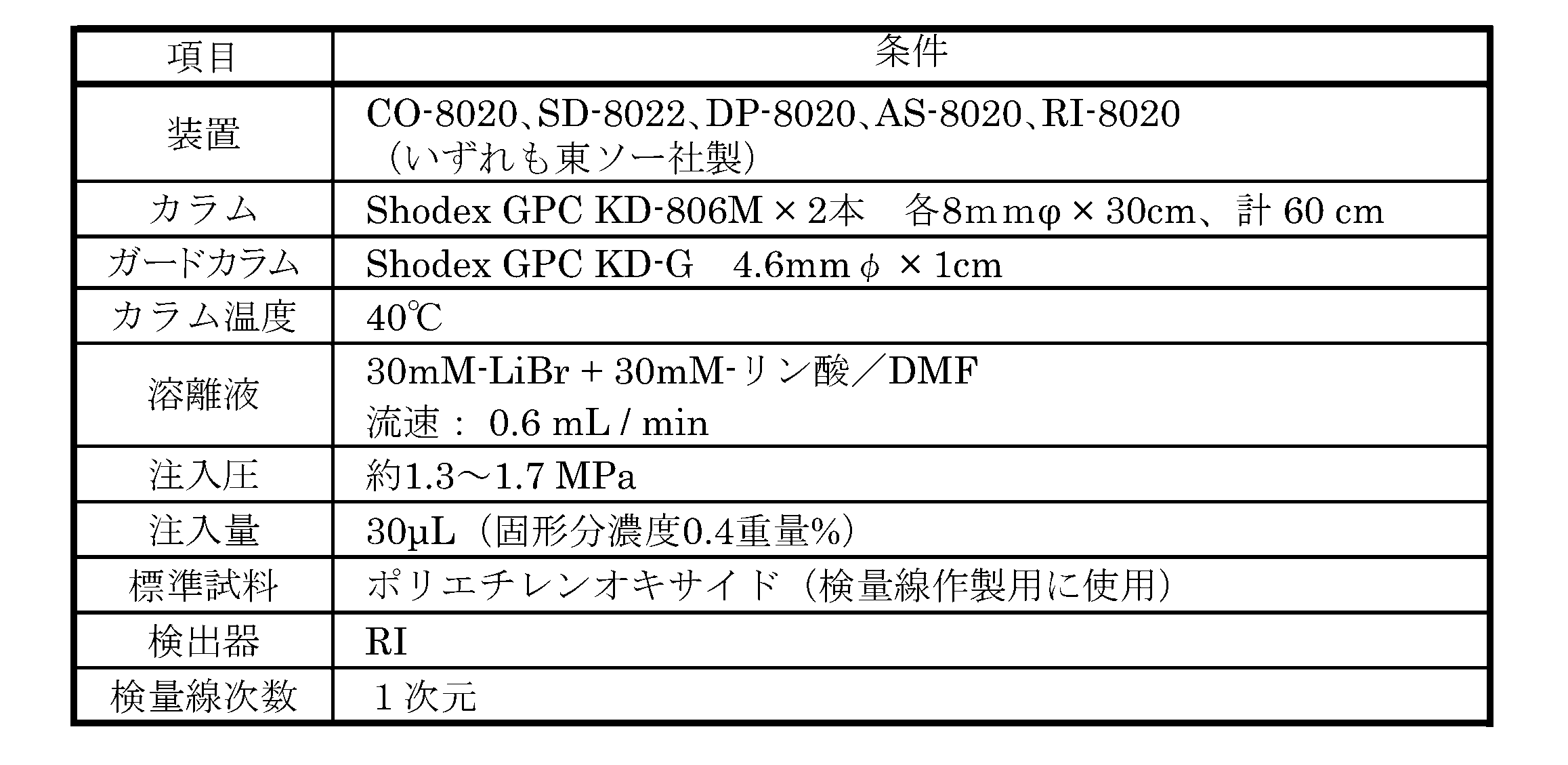
- the polyamic acid and polyimide of the present invention preferably have a weight average molecular weight in terms of polyethylene oxide by gel permeation chromatography (GPC) of 10,000 to 500,000, and preferably 20,000 to 300,000. More preferably, it is more preferably 30,000 to 200,000. If the weight average molecular weight is 10,000 or more, it becomes possible to use polyamic acid and polyimide as a coating film or film. On the other hand, when the weight average molecular weight is 500,000 or less, sufficient solubility in a solvent is exhibited, so that a coating film or film having a smooth surface and a uniform film thickness is easily obtained.
- GPC gel permeation chromatography
- polyimide containing the above structure I and structure II is obtained by a known method.
- Polyimide can be synthesized by a synthesis method via a precursor such as polyamic acid or polyimide ester, and a synthesis method not via a precursor. From the availability of monomers and the ease of polymerization, it is preferable to synthesize polyimide by imidation of polyamic acid as a precursor.
- the polyamic acid containing the above structures 1 and 2 can be obtained by reacting diamine and tetracarboxylic dianhydride in an organic solvent.
- the diamine is dissolved or dispersed in a slurry form in an organic solvent to form a diamine solution, and the diamine is dissolved in a solution or solid state in which tetracarboxylic dianhydride is dissolved or dispersed in an organic solvent. What is necessary is just to add in a solution.
- a diamine may be added to the tetracarboxylic dianhydride solution. Dissolution and reaction of diamine and tetracarboxylic dianhydride are preferably carried out in an inert gas atmosphere such as argon or nitrogen.
- the number of moles of the total amount of the diamine component and the number of moles of the total amount of the tetracarboxylic dianhydride component is preferable to adjust the number of moles of the total amount of the diamine component and the number of moles of the total amount of the tetracarboxylic dianhydride component to be substantially equimolar.
- a polyamic acid having a plurality of structures can be obtained by using a plurality of types of diamines and / or a plurality of types of tetracarboxylic dianhydrides.
- the polyamic acid which has several types of structural units from which a structure differs can also be obtained by blending the polyamic acid from which a structure differs.
- m A / m B is 95 A polyamic acid in the range of 0.0 / 5.0 to 99.9 / 0.1 is obtained.
- the organic solvent used for the polyamic acid synthesis reaction is not particularly limited.
- the organic solvent is preferably one that can dissolve the tetracarboxylic dianhydride and diamine to be used and can dissolve the polyamic acid produced by polymerization.
- Specific examples of the organic solvent include urea solvents such as tetramethylurea and N, N-dimethylethylurea; sulfoxides or sulfone solvents such as dimethylsulfoxide, diphenylsulfone and tetramethylsulfone; N, N-dimethylacetamide (DMAC) ), N, N-dimethylformamide (DMF), N, N′-diethylacetamide, N-methyl-2-pyrrolidone (NMP), ⁇ -butyrolactone, and other ester solvents; hexamethylphosphate triamide, and other amide solvents Alkyl halide solvents such as chloroform and methylene chloride; aromatic hydrocarbon solvents
- organic solvent used for the synthesis of the polyamic acid is preferably selected from amide solvents, ketone solvents, ester solvents, and ether solvents, particularly DMF, Amide solvents such as DMAC and NMP are preferred.
- the temperature conditions for the polyamic acid synthesis reaction are not particularly limited. As the reaction between the diamine and tetracarboxylic dianhydride proceeds, polyamic acid is produced, and the viscosity of the reaction solution increases. When an alicyclic diamine such as 1,4-cyclohexanediamine is used, salt formation may occur. Therefore, the temperature of the synthesis reaction may be in the range of 50 ° C. to 150 ° C. as necessary. After the salt is dissolved and the polymerization reaction starts to proceed, the temperature is preferably 80 ° C. or less, more preferably 0 ° C. to 50 ° C., in order to suppress a decrease in molecular weight due to depolymerization of the polyamic acid. preferable. The reaction time may be arbitrarily set in the range of 10 minutes to 30 hours.
- a polyamic acid solution containing a polyamic acid and an organic solvent is obtained by polymerizing diamine and tetracarboxylic dianhydride in an organic solvent.
- This polymerization solution can be used as it is as a polyamic acid solution.
- the concentration of the polyamic acid and the viscosity of the solution may be adjusted by removing a part of the solvent from the polymerization solution or adding a solvent.
- the solvent to be added may be different from the solvent used for the polymerization of the polyamic acid.
- a polyamic acid solution may be prepared by dissolving a solid polyamic acid resin obtained by removing the solvent from the polymerization solution in a solvent.
- organic solvent of the polyamic acid solution those having high solubility of the polyamic acid are preferable, and the organic solvents exemplified above can be used as the organic solvent used for the synthesis of the polyamic acid.
- amide solvents such as DMF, DMAC, and NMP are preferable.
- Imidization is performed by dehydrating and ring-closing the polyamic acid.
- Dehydration ring closure is performed by an azeotropic method using an azeotropic solvent, a thermal method, or a chemical method.
- an imidizing agent and / or a dehydration catalyst it is preferable to perform chemical imidization by adding an imidizing agent and / or a dehydration catalyst to the polyamic acid solution.
- the imidizing agent is not particularly limited, it is preferable to use a tertiary amine, and among them, a heterocyclic tertiary amine is preferable.
- the heterocyclic tertiary amine include pyridine, picoline, quinoline, isoquinoline, imidazoles and the like.
- the dehydration catalyst include acetic anhydride, propionic anhydride, n-butyric anhydride, benzoic anhydride, trifluoroacetic anhydride, ⁇ -valerol
- thermal imidization in which dehydration ring closure is performed by heating is preferable.
- the method for heating the polyamic acid is not particularly limited. For example, after applying the polyamic acid solution to a support such as a glass plate, a metal plate, or PET (polyethylene terephthalate), heat treatment is performed within a range of 80 ° C to 500 ° C. Just do it.
- the heating time varies depending on the treatment amount and heating temperature of the polyamic acid solution to be dehydrated and closed, but in general, heating is preferably performed for 1 minute to 5 hours after the processing temperature reaches the maximum temperature.
- An imidizing agent and / or a dehydration catalyst may be added to the polyamic acid solution, and imidation may be performed by heating by the method described above.
- the imidation from polyamic acid to polyimide can be performed at an arbitrary ratio of 1 to 100%, and a partially imidized polyamic acid may be synthesized.
- a partially imidized polyamic acid may be synthesized.
- the solubility in organic solvents and the viscosity of the solution tend to change.
- the solution viscosity and thixotropy affect the film thickness uniformity. Therefore, in consideration of process stability, the imidization agent and dehydration catalyst are not added to the polyamic acid, and the imidation rate is applied to the support with substantially zero, and heating on the support is performed. It is preferable to perform removal of the solvent and imidization.
- thermosetting component thermosetting component
- photocurable component non-polymerizable binder resin
- dye surfactant
- leveling agent plasticizer
- silane coupling agent fine particles, sensitizer, etc.
- the blending ratio of these optional components is preferably in the range of 0.1 wt% to 95 wt% with respect to the total solid content of the polyimide.
- solid content of a composition is all components other than an organic solvent, and a liquid monomer component is also contained in solid content.
- the polyimide of the present invention is excellent in transparency and heat resistance, it can be used as a transparent substrate for glass substitute applications, and can be expected to be applied to substrates for electronic devices such as TFT substrates and electrode substrates.
- electronic devices it is preferably used as a substrate for devices that require light transmission, such as liquid crystal display devices, organic EL elements, electronic paper, and touch panels.
- the polyimide of the present invention can be used as an optical member such as a color filter, an antireflection film or a hologram, or a building material or a structure material.
- Various inorganic thin films such as metal oxides and transparent electrodes may be formed on the surface of the polyimide of the present invention.
- the inorganic thin film is formed by, for example, a PVD method such as a sputtering method, a vacuum vapor deposition method and an ion plating method, and a dry process such as a CVD method.
- the polyimide of the present invention is preferably used as a substrate for an electronic device produced by a batch process because it has good adhesion to a support in addition to heat resistance, low thermal expansion and transparency.
- a polyimide film substrate
- an element is formed thereon, and then the polyimide substrate on which the element is formed is peeled from the support to obtain an electronic device.
- a polyimide film (polyimide substrate) adhered and laminated on the support is obtained by applying a polyamic acid solution on the support, drying by heating, and imidization.
- the thickness of the polyimide substrate is about 1 to 200 ⁇ m, preferably about 5 to 100 ⁇ m.
- the support on which the polyamic acid solution is applied examples include a glass substrate; a metal substrate such as SUS or a metal belt; a resin film such as polyethylene terephthalate, polycarbonate, polyacrylate, polyethylene naphthalate, and triacetyl cellulose.
- a glass substrate In order to adapt to the current batch type device manufacturing process, it is preferable to use a glass substrate as a support.
- the polyamic acid and polyimide of the present invention having a siloxane structure have high adhesiveness to glass, the organic solvent to the interface between the glass support and the resin film during drying and imidization of the solvent on the support Floating or peeling caused by water or stagnation is unlikely to occur. Therefore, it is possible to accurately form and mount elements on a polyimide substrate that is closely stacked on a support. Moreover, peeling from the support body of the polyimide substrate after forming an element can be easily implemented by adjusting the ratio of the alicyclic structure (general formula I) and the siloxane structure (general formula II) in polyimide.
- the polyimide film (polyimide substrate) adhered and laminated on the support preferably has a 90 ° peel strength from the support of 0.08 to 5.00 N / cm, preferably 0.09 to 4.00 N / cm. More preferably, it is 0.10 to 3.5 N / cm.
- peeling hardly occurs in the element formation and mounting process, and peeling from the support after the element formation and mounting is easy.
- the 90 ° peel strength can be measured by the method described in Examples below.
- the transparency of the polyimide film can be evaluated by, for example, total light transmittance and haze.
- the total light transmittance of the polyimide film is preferably 80% or more, and more preferably 85% or more.
- the haze is preferably 2.0% or less, and more preferably 1.0% or less.
- Polyimide tends to absorb light on the short wavelength side, and the film itself is often colored yellow.
- the light transmittance at a wavelength of 450 nm of the polyimide film is preferably 70% or more, and more preferably 75% or more.
- the polyimide of the present invention preferably has the above total light transmittance, haze, and light transmittance at a wavelength of 450 nm when a film having a thickness of 10 ⁇ m is formed.
- the polyimide substrate containing the polyimide of the present invention has small linear thermal expansion and excellent dimensional stability before and after heating.
- the linear thermal expansion coefficient of the polyimide film is preferably 30 ppm / K or less, and more preferably 20 ppm / K or less.
- the linear thermal expansion coefficient can be measured by the method described in Examples described later.
- the polyimide of the present invention preferably has a linear thermal expansion coefficient in the above range when a film having a thickness of 10 ⁇ m is formed.
- Example 1 A 500 mL glass separable flask equipped with a stirrer equipped with a stainless steel stirring blade and a nitrogen introduction tube was charged with 8.38 g of trans-1,4-cyclohexanediamine (CHDA) and N-methyl-2-pyrrolidone (NMP). 170.0 g was charged and dissolved by stirring at room temperature (23 ° C.). After visually confirming the dissolution of CHDA, 0.02 g of 1,3-bis (3-aminopropyl) tetramethyldisiloxane (PAM-E) was added and further stirred.
- CHDA trans-1,4-cyclohexanediamine
- NMP N-methyl-2-pyrrolidone
- Example 2 A polyamic acid solution was obtained in the same manner as in Example 1 except that the amount of CHDA charged was changed to 8.37 g, the amount of PAM-E charged was 0.04 g, and the amount of BPDA charged was 21.60 g.
- Example 3 A polyamic acid solution was obtained in the same manner as in Example 1, except that the amount of CHDA charged was 8.36 g, the amount of PAM-E charged was 0.06 g, and the amount of BPDA charged was 21.59 g.
- Example 4 A polyamic acid solution was obtained in the same manner as in Example 1 except that the amount of CHDA charged was 8.33 g, the amount of PAM-E charged was 0.09 g, and the amount of BPDA charged was 21.58 g.
- Example 5 A polyamic acid solution was obtained in the same manner as in Example 1, except that the amount of CHDA charged was 8.30 g, the amount of PAM-E charged was 0.13 g, and the amount of BPDA charged was 21.56 g.
- Example 6 A polyamic acid solution was obtained in the same manner as in Example 1, except that the amount of CHDA charged was 8.28 g, the amount of PAM-E charged was 0.18 g, and the amount of BPDA charged was 21.54 g.
- Example 7 A polyamic acid solution was obtained in the same manner as in Example 1 except that the amount of CHDA charged was 8.06 g, the amount of PAM-E charged was 0.54 g, and the amount of BPDA charged was 21.40 g.
- Example 8> A polyamic acid solution was obtained in the same manner as in Example 1 except that the amount of CHDA charged was 7.84 g, the amount of PAM-E was 0.90 g, and the amount of BPDA was 21.26 g.
- the coating film is imidized by heating at 350 ° C. for 1 hour A laminate of polyimide film and glass was obtained.
- the polyamic acid solution was cast so that the thickness after drying was 20 ⁇ m, the drying temperature in a hot air oven was 120 ° C., and the temperature was increased to 450 ° C. at a temperature rising rate of 7 ° C./min in a nitrogen atmosphere. After raising the temperature, imidization was carried out by heating at 450 ° C. for 10 minutes.
- Comparative Example 1 In Comparative Example 1, many bubbles were observed between the glass and the polyimide film. Except for Comparative Example 1, no bubbles due to peeling of the polyimide film were confirmed. On the other hand, in Example 8, since the adhesiveness between the glass and the polyimide film was high and could not be peeled off from the glass, the following physical property evaluation was not performed.
- ⁇ Linear thermal expansion coefficient (CTE)> The linear thermal expansion coefficient was measured using TMA / SS7100 manufactured by Hitachi High-Tech Science Co., Ltd. (sample size: width 3 mm ⁇ length 10 mm; the film thickness was measured and the cross-sectional area of the film was calculated), and the load was 29.4 mN. The temperature is once raised from 10 ° C. to 350 ° C. at 10 ° C./minute, then lowered at 40 ° C./minute, and the linear expansion coefficient is obtained from the amount of change in strain of the sample per unit temperature at 100 to 300 ° C. It was.
- TT Total light transmittance
- haze of polyimide film It was measured by a method described in JIS K7105-1981 using an integrating sphere haze meter 300A manufactured by Nippon Denshoku Industries Co., Ltd.
- Examples and Comparative Examples of monomer charge during polyamic acid polymerization (molar ratio of acid dianhydride and diamine), weight average molecular weight of polyamic acid and presence or absence of modification, film thickness of polyimide film, glass during imidization
- Table 2 shows the evaluation results of the presence or absence of peeling from the plate, the peel strength of the polyimide film from the glass plate, and the characteristics of the polyimide film.
- the polyamic acid solution of Comparative Example 1 obtained from BPDA as the acid dianhydride and CHDA as the diamine has a large number of gaps between the glass plate and the polyimide film during thermal imidization after coating on the glass plate. Bubbles were generated, and 25% or more of the coated area was peeled off from the glass plate.
- Comparative Example 2 in which the polyamic acid of Comparative Example 1 was modified with a silane coupling agent, the adhesion to the glass plate was improved as compared with Comparative Example 1, but the peel strength was small and the adhesion was sufficient. It wasn't. The same was true for Comparative Example 3 in which 1 mol% of BPAF was added to BPDA as an acid dianhydride.
- Comparative Example 5 and Comparative Example 6 in which the reactive silicone oil was added to the monomer component, the adhesion with the glass plate was improved as compared with Comparative Example 1, but the peel strength was small and the adhesion was not sufficient. . Moreover, in Comparative Example 5 and Comparative Example 6, the obtained polyimide film had a high linear thermal expansion coefficient (CTE), inferior dimensional stability, and transparency was lowered.
- CTE linear thermal expansion coefficient
- Example 8 in which the ratio m A / m B of CHDA / PAM-E was 95/5 the characteristics of the polyimide film were not evaluated. However, when the polyimide film formed on the glass plate was visually observed, The transparency was the same as in Examples 1-7.
- Example 8 is presumed to maintain the same low CTE and high transparency as Example 7 because the composition of polyamic acid and polyimide is similar to Example 7.
- Comparative Example 4 using PDA instead of CHDA the peel strength equivalent to that of Examples 1 and 2 was shown, but the transparency (particularly the visible light short wavelength side) was greatly reduced, and coloring was observed. It was.
- Examples 1 to 8 there was a tendency for the peel strength to increase as the amount of PAM-E charged increased and the adhesion to glass to improve.
- the amount of diamine used is preferably 5 mol% or less, particularly preferably 1 mol% or less, based on the total amount of diamine.
- the polyamic acid of the present invention has good processability during film formation on the glass support and heating imidization, and the glass support. Excellent adhesion.
- the polyimide film obtained by imidation of the polyamic acid of the present invention has low thermal expansion even in a high temperature range of 100 to 300 ° C. and has high transparency, so that it can be used as a transparent substrate material instead of glass. Application can be expected.
Landscapes
- Chemical & Material Sciences (AREA)
- Health & Medical Sciences (AREA)
- Chemical Kinetics & Catalysis (AREA)
- Medicinal Chemistry (AREA)
- Polymers & Plastics (AREA)
- Organic Chemistry (AREA)
- Macromolecular Compounds Obtained By Forming Nitrogen-Containing Linkages In General (AREA)
- Electroluminescent Light Sources (AREA)
- Photovoltaic Devices (AREA)
- Devices For Indicating Variable Information By Combining Individual Elements (AREA)
Abstract
本発明のポリアミド酸は、一般式1で表される構成単位、および一般式2で表される構成単位を含有する。一般式1のAおよび一般式2のBはそれぞれ独立に4価の芳香族基であり;一般式2のR1およびR2はそれぞれ独立に2価の炭化水素基であり;nは1~5の整数である。ポリアミド酸をイミド化することによりポリイミドが得られる。ポリアミド酸および有機を含むポリアミド酸溶液を、ガラス等の支持体上でイミド化することにより、ポリイミド基板が得られる。
Description
本発明は、ポリアミド酸、ポリアミド酸溶液、ポリイミド、およびポリイミド基板に関する。
ディスプレイ、タッチパネル、太陽電池等の電子デバイスにおいて、薄型化、軽量化、およびフレキシブル化が要求されており、ガラス基板に代えて樹脂フィルム基板の利用が検討されている。
これらの電子デバイスの製造プロセスでは、基板上に、薄膜トランジスタ等の半導体等や電極等の電子素子が形成される。これらの素子の形成は高温プロセスを要するため、樹脂クフィルム基板に高い耐熱性が要求される。基板上に設けられる素子は一般に無機材料からなる。基板の線熱膨張係数と素子を構成する無機材料の線熱膨張係数とが大きく異なると、素子形成界面の応力等に起因して、基板の反りや素子の破壊が生じる場合がある。そのため、樹脂フィルム基板は、素子を構成する無機材料と同等の線熱膨張係数を有することが望まれる。液晶ディスプレイやボトムエミッション型の有機EL素子では、表示素子からの光が基板を透過して出射するため、樹脂フィルム基板には透明性が求められ、特に、可視光領域での光透過率が高いことが要求される。上記の理由により、電子デバイス用の樹脂フィルム基板材料には、高耐熱性、低熱膨張、および高透明性が求められる。
電子デバイスの製造プロセスは、バッチタイプとロール・トゥ・ロールタイプに分けられる。樹脂フィルム基板は、ロール・トゥ・ロールプロセスにも適用できるが、ロール・トゥ・ロールプロセスによる電子デバイスの製造には、新たな設備が必要となることに加えて、ロール搬送に伴う新たな問題を克服しなければならない。一方、バッチプロセスでは、支持体上に樹脂溶液を塗布、乾燥してフィルム基板を形成し、その上に素子を形成すればよく、現行のガラス基板用プロセス設備を利用できるため、コスト面で優位である。
ガラスに匹敵する高耐熱性、低熱膨張、および高透明性を実現可能な樹脂材料として、耐熱性に優れるポリイミド系材料が検討されている。剛直な構造のモノマーや脂環式モノマーを用いたポリイミドは、透明性が高く、低熱膨張性を示すことが知られている(特許文献1、特許文献2)。また、ポリイミド前駆体としてのポリアミド酸にシリコーンオイルを添加してイミド化を行うことにより、得られるポリイミドフィルムが基材への高い密着性を示すことが知られている(特許文献3)。
ポリイミド基板をバッチプロセスに適用するためには、高耐熱性、低熱膨張、および高透明性に加えて、素子形成プロセスにおいて支持体として用いられるガラスとの適度の接着性を示し、かつ素子形成後にガラス支持体から容易に剥離できることが求められる。しかしながら、上記特許文献1~3に開示のポリイミド材料は、これらすべての要求特性を同時に満足することはできない。
上記に鑑みて、本発明は、高耐熱性、低熱膨張性、および高透明性を有し、かつ、支持体であるガラスと適度な密着性を示すポリイミド、およびその前駆体としてのポリアミド酸の提供を目的とする。
本願発明者らは、ポリマー骨格中に剛直な構造および脂環構造を導入し、さらにシロキサン結合を有するモノマー成分を併用することにより、上記特性を満足するポリイミド、およびその前駆体としてのポリアミド酸が得られることを見出した。
本発明のポリアミド酸は、一般式1で表される構成単位、および一般式2で表される構成単位を含有する。

本発明のポリイミドは、一般式Iで表される構成単位、および一般式IIで表される構成単位を端有する。


一般式1および一般式IにおけるA、ならびに一般式2および一般式IIにおけるBは、いずれも4価の芳香族基である。一般式2および一般式IIにおいて、R1およびR2は、それぞれ独立に2価の炭化水素基であり、nは1~5の整数である。
4価の芳香族基AおよびBは、いずれも芳香族テトラカルボン酸二無水物の残基であり、好ましくは、ビフェニル-3,3’,4,4’-テトライル基である。R1およびR2は、それぞれ独立に、メチレン基、エチレン基、またはプロピレン基であることが好ましく、中でもプロピレン基であることが特に好ましい。nは1~3であることがより好ましく、1であることが最も好ましい。
すなわち、本発明のポリアミド酸は、好ましくは、下記の式1Aで表される構成単位および下記の式2Cで表される構成単位を含有し、本発明のポリイミドは、好ましくは下記の式IAで表される構成単位および下記の式IICで表される構成単位を含有する。

本発明は、上記のポリイミドを含有するポリイミド基板に関する。例えば、上記のポリアミド酸と有機溶媒とを含有するポリアミド酸溶液を支持体上に塗布し、有機溶媒の除去およびポリアミド酸のイミド化を行うことにより、ポリイミド基板が得られる。このポリイミド基板は、支持体に密着積層されたポリイミド膜として形成される。ポリアミド酸溶液を塗布する支持体としては、例えばガラスが用いられる。
本発明のポリアミド酸から得られるポリイミドは、高耐熱性、低熱膨張性、および高透明性に加えて、ガラス等の支持体への適度な密着性を有する。そのため、バッチプロセスにおいて支持体への適度な密着性が要求される電子デバイス用基板材料として好適である。
[ポリアミド酸およびポリイミドの構造]
本発明のポリアミド酸は、以下の一般式1で表される構成単位および一般式2で表される構成単位を含む。
本発明のポリアミド酸は、以下の一般式1で表される構成単位および一般式2で表される構成単位を含む。

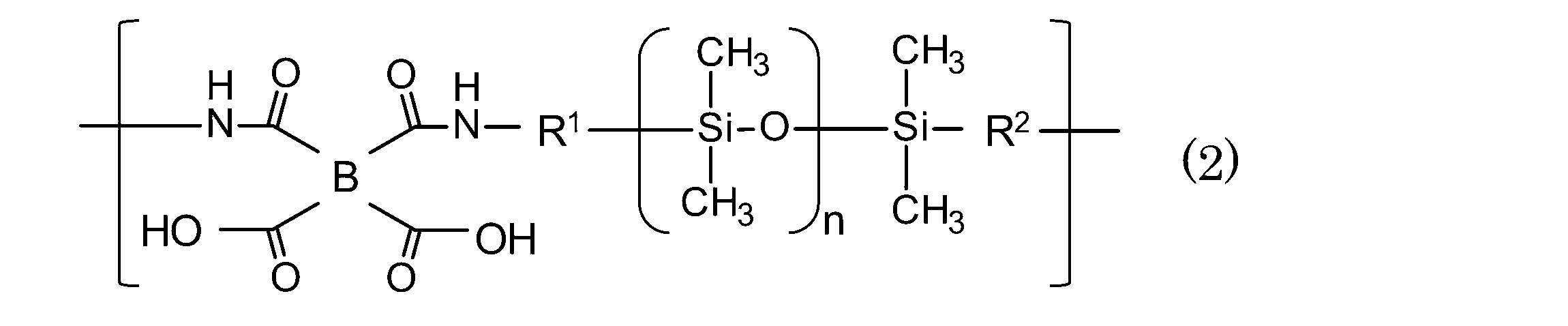
本発明のポリイミドは、以下の一般式Iで表される構成単位および一般式IIで表される構成単位を含み、例えば上記の構造1および構造2を有するポリアミド酸をイミド化することにより得られる。


上記一般式1および上記一般式IにおけるA、ならびに上記一般式2および上記一般式IIにおけるBは、いずれも4価の芳香族基である。芳香族基は、単一の芳香族環を有するものでもよく、複数の芳香族環が結合したものでもよく、縮合多環でもよい。上記一般式2および上記一般式IIにおいて、R1およびR2はそれぞれ独立に2価の炭化水素基であり、nは1~5の整数である。
上記一般式1の構成単位および上記一般式2の構成単位を有するポリアミド酸をイミド化することにより、一般式Iの構成単位および一般式IIの構成単位を有するポリイミドが得られる。この構造を有するポリイミドは、ガラスとの密着性に優れるため、バッチプロセスでの樹脂フィルム基板の形成、およびフィルム基板上への素子の形成プロセスへの利用に適している。
上記AおよびBは、好ましくは芳香族テトラカルボン酸二無水物の残基である。芳香族テトラカルボン酸二無水物としては、ピロメリット酸二無水物、3,3’,4,4-ビフェニルテトラカルボン酸二無水物、3,3’,4,4’-ベンゾフェノンテトラカルボン酸二無水物、2,3,3’,4’-ビフェニルテトラカルボン酸二無水物、3,3’,4,4’-ジフェニルスルホンテトラカルボン酸二無水物、1,4,5,8-ナフタレンテトラカルボン酸二無水物、2,3,6,7-ナフタレンテトラカルボン酸二無水物、1,2,5,6-ナフタレンテトラカルボン酸二無水物、4,4’-オキシジフタル酸無水物、9,9-ビス(3,4-ジカルボキシフェニル)フルオレン二無水物、9,9’-ビス[4-(3,4-ジカルボキシフェノキシ)フェニル]フルオレン二無水物、3,3’,4,4′-ビフェニルエーテルテトラカルボン酸二無水物、2,3,5,6-ピリジンテトラカルボン酸二無水物、3,4,9,10-ペリレンテトラカルボン酸二無水物、4,4’-スルホニルジフタル酸二無水物、パラテルフェニル-3,4,3’,4’-テトラカルボン酸二無水物、メタテルフェニル-3,3’,4,4’-テトラカルボン酸二無水物、3,3’,4,4’-ジフェニルエーテルテトラカルボン酸二無水物等が挙げられるが、これらに限定されるものではない。一般式1および一般式IにおけるAと、一般式2および一般式IIにおけるBとは、同一でもよく異なっていてもよい。
高透明性かつ低線膨張係数のポリイミドを得られることから、Aは、3,3’,4,4’-ビフェニルテトラカルボン酸二無水物の残基(下記の化学式で表されるビフェニル-3,3’,4,4’-テトライル基)であることが特に好ましい。

すなわち、一般式1の構成単位は、下記の式1Aで表されるアミド酸構成単位であることが好ましく、一般式Iの構成単位は、下記の式IAで表されるイミド構成単位であることが好ましい。これらの構成単位は、3,3’,4,4’-ビフェニルテトラカルボン酸二無水物と1,4-シクロヘキサンジアミンとから得られる。

高透明性かつ低線膨張係数のポリイミドを得られることから、Bは、3,3’,4,4’-ビフェニルテトラカルボン酸二無水物の残基であることが特に好ましい。すなわち、一般式2で表される構成単位は、下記の一般式2Aで表されるアミド酸構成単位であることが好ましく、一般式IIで表される構成単位は、下記の一般式IIAで表されるイミド構成単位であることが好ましい。これらの構成単位は、3,3’,4,4’-ビフェニルテトラカルボン酸二無水物とシロキサン構造含有ジアミンとから得られる。
前述のように、AとBは同一でもよい。ポリイミドフィルムの高透明性と低線膨張係数とを同時に実現する観点から、AおよびBは、いずれもビフェニル-3,3’,4,4’-テトライル基であることが好ましい。
ポリアミド酸の重合時の反応性に優れ、かつポリイミドが低熱膨張性を示すことから、上記一般式2および上記一般式IIにおけるR1およびR2は、それぞれ独立に、メチレン基、エチレン基、またはプロピレン基であることが好ましく、中でもプロピレン基であることが特に好ましい。ポリアミド酸が高い溶解性を示し、かつポリイミドフィルムが高透明性を示すことから、上記一般式2および上記一般式IIにおけるnは、1~5であることが好ましく、1~3であることがより好ましく、1であることが最も好ましい。
すなわち、一般式2の構成単位は、下記の一般式2Bで表されるアミド酸構成単位であることが好ましく、一般式IIの構成単位は、下記の一般式IIBで表されるイミド構成単位であることが好ましい。これらの構成単位は、芳香族テトラカルボン酸二無水物とジアミン成分としての1,3-ビス(3-アミノプロピル)テトラメチルジシロキサンとから得られる。


前述のように、一般式2および一般式IIにおける4価の芳香族基Bはビフェニル-3,3’,4,4’-テトライル基であることが好ましい。したがって、一般式2の構成単位は、下記の式2Cで表されるアミド酸構成単位であることが特に好ましく、一般式IIの構成単位は、下記の式IICで表されるイミド構成単位であることが特に好ましい。これらの構成単位は、3,3’,4,4’-ビフェニルテトラカルボン酸二無水物と1,3-ビス(3-アミノプロピル)テトラメチルジシロキサンとから得られる。

ポリイミドフィルムに、高耐熱性、低熱膨張性、高透明性、およびガラスとの適度な密着性を持たせる観点から、ポリイミド中の一般式Iで表される構成単位と一般式IIで表される構成単位との合計は、ポリイミド全量に対して、80モル%以上が好ましく、90モル%以上がより好ましく、95モル%以上が特に好ましい。一般式Iで表される構成単位と一般式IIで表される構成単位との合計を上記範囲とするためには、前駆体であるポリアミド酸中の一般式1で表される構成単位と一般式2で表される構成単位との合計が、ポリアミド酸全量に対して、80モル%以上であることが好ましく、90モル%以上であることがより好ましく、95モル%以上であることが特に好ましい。
ポリイミドのモル数とは、ポリイミドを構成する全ジアミン由来の構成単位のモル数である。ポリアミド酸のモル数とは、ポリアミド酸を構成する全ジアミン由来構成単位のモル数である。ポリイミドおよびポリアミド酸は、ジアミン由来の構成単位と酸二無水物由来の構成単位を等モル有するため、ポリイミドおよびポリアミド酸では、全ジアミン由来の構成単位のモル数は、全酸二無水物由来の構成単位のモル数に等しい。
高透明性および低熱膨張性に加えて、支持体との適度の密着性を有するポリイミドを得る観点から、ポリイミド中の一般式Iで表される構成単位のモル数MAと一般式IIで表される構成単位のモル数MBとの比MA/MBは、95.0/5.0~99.9/0.1の範囲であることが好ましい。すなわち、本発明のポリイミドは、ジアミン成分の大半が1,4-シクロヘキサンジアミンであり、1,3-ビス(3-アミノプロピル)テトラメチルジシロキサン等のシロキサン構造含有ジアミンを少量含むことが好ましい。ジアミン成分に少量のシロキサン構造を導入することにより、ガラス等の支持体へのポリイミドの密着性が向上する傾向がある。そのため、支持体上にポリアミド酸溶液を塗布してイミド化したとき、ポリイミドと支持体との間の剥離または浮きを抑制できる。
シロキサン構造の含有量の増大に伴ってガラス等との密着性が向上する傾向がある。一方、密着性が過度に高いと、支持体からポリイミド膜の剥離が困難となったり、剥離時に寸法変化や不透明化を生じる場合がある。MA/MBが95.0/5.0以上であれば、ポリイミド膜上に電子素子等を形成した後の支持体からのポリイミド膜の剥離を問題なく実施可能である。また、MA/MBが95.0/5.0以上であれば、ポリイミド膜の低熱膨張特性および高透明性を維持できる。
MA/MBは、96.0/4.0~99.8/0.2がより好ましく、97.0/3.0~99.7/0.3がさらに好ましく、98.0/2.0~99.6/0.4が特に好ましく、99.0/1.0~99.5/0.5が最も好ましい。
ポリイミド中の一般式Iで表される構成単位と一般式IIで表される構成単位との比率を上記範囲とするためには、前駆体であるポリアミド酸中の一般式1で表される構成単位のモル数mAと一般式2で表される構成単位のモル数mBとの比mA/mBが、95.0/5.0~99.9/0.1の範囲であることが好ましく、96.0/4.0~99.8/0.2がより好ましく、97.0/3.0~99.7/0.3がさらに好ましく、98.0/2.0~99.6/0.4が特に好ましく、99.0/1.0~99.6/0.4が最も好ましい。
本発明のポリアミド酸およびポリイミドは、ゲルパーミレーションクロマトグラフィー(GPC)によるポリエチレンオキシド換算の重量平均分子量が、10,000~500,000であることが好ましく、20,000~300,000あることがより好ましく、30,000~200,000であることがさらに好ましい。重量平均分子量が10,000以上であれば、ポリアミド酸およびポリイミドを塗膜またはフィルムとすることが可能となる。一方、重量平均分子量が500,000以下であると、溶媒に対して十分な溶解性を示すため、表面が平滑で膜厚が均一な塗膜またはフィルムが得られやすい。
[ポリアミド酸およびポリイミドの合成]
上記の構造Iおよび構造IIを含むポリイミドは、公知の方法により得られる。ポリイミドは、ポリアミド酸やポリイミドエステル等の前躯体を経由する合成法、および前躯体を経由しない合成法により合成できる。モノマーの入手性および重合の簡便さから、前駆体としてのポリアミド酸のイミド化により、ポリイミドを合成することが好ましい。
上記の構造Iおよび構造IIを含むポリイミドは、公知の方法により得られる。ポリイミドは、ポリアミド酸やポリイミドエステル等の前躯体を経由する合成法、および前躯体を経由しない合成法により合成できる。モノマーの入手性および重合の簡便さから、前駆体としてのポリアミド酸のイミド化により、ポリイミドを合成することが好ましい。
上記の構造1および構造2を含むポリアミド酸は、有機溶媒中でジアミンとテトラカルボン酸二無水物とを反応させることにより得られる。例えば、ジアミンを、有機溶媒中に溶解またはスラリー状に分散させて、ジアミン溶液とし、テトラカルボン酸二無水物を、有機溶媒に溶解もしくはスラリー状に分散させた溶液または固体の状態で、上記ジアミン溶液中に添加すればよい。テトラカルボン酸二無水物溶液中に、ジアミンを添加してもよい。ジアミンおよびテトラカルボン酸二無水物の溶解および反応は、アルゴン、窒素等の不活性ガス雰囲気中で実施することが好ましい。
ポリアミド酸の合成においては、ジアミン成分全量のモル数と、テトラカルボン酸二無水物成分全量のモル数とを、実質上等モルに調整することが好ましい。複数種のジアミンおよび/または複数種のテトラカルボン酸二無水物を用いることにより、複数の構造を有するポリアミド酸が得られる。また、構造の異なるポリアミド酸をブレンドすることにより、構造の異なる複数種の構成単位を有するポリアミド酸を得ることもできる。
テトラカルボン酸二無水物として芳香族テトラカルボン酸二無水物を用い、ジアミンとして1,4-シクロヘキサンジアミンおよびシロキサン構造含有ジアミンを用いることにより、一般式1で表される構成単位および一般式2で表される構成単位を含有するポリアミド酸が得られる。芳香族ジアミンとして3,3’,4,4’-ビフェニルテトラカルボン酸二無水物を用い、シロキサン構造含有ジアミンとして1,3-ビス(3-アミノプロピル)テトラメチルジシロキサンを用いることにより、式1Aで表されるアミド酸構成単位および式1Cで表されるアミド酸構成単位を有するポリアミド酸が得られる。1,4-シクロヘキサンジアミンのモル数とシロキサン構造含有ジアミンのモル数の比を、95.0/5.0~99.9/0.1の範囲とすることにより、mA/mBが95.0/5.0~99.9/0.1の範囲のポリアミド酸が得られる。
ポリアミド酸の合成反応に使用する有機溶媒は特に限定されない。有機溶媒は、使用するテトラカルボン酸二無水物およびジアミン類を溶解可能であり、かつ重合により生成するポリアミド酸を溶解可能であるものが好ましい。有機溶媒の具体例としては、テトラメチル尿素、N,N-ジメチルエチルウレア等のウレア系溶媒;ジメチルスルホキシド、ジフェニルスルホン、テトラメチルスルフォン等のスルホキシドまたはスルホン系溶媒;N,N-ジメチルアセトアミド(DMAC)、N,N-ジメチルホルムアミド(DMF)、N,N’-ジエチルアセトアミド、N-メチル-2-ピロリドン(NMP)、γ―ブチロラクトン等のエステル系溶媒;ヘキサメチルリン酸トリアミド等のアミド系溶媒;クロロホルム、塩化メチレン等のハロゲン化アルキル系溶媒;ベンゼン、トルエン等の芳香族炭化水素系溶媒;フェノール、クレゾール等のフェノール系溶媒;シクロペンタノン等のケトン系溶媒;テトラヒドロフラン、1,3-ジオキソラン、1,4-ジオキサン、ジメチルエーテル、ジエチルエーテル、p-クレゾールメチルエーテル等のエーテル系溶媒が挙げられる。必要に応じて2種以上の有機溶媒を組合せて用いてもよい。ポリアミド酸の溶解性および反応性を高めるために、ポリアミド酸の合成に使用する有機溶媒は、アミド系溶媒、ケトン系溶媒、エステル系溶媒およびエーテル系溶媒より選択されることが好ましく、特にDMF、DMAC、NMP等のアミド系溶媒が好ましい。
ポリアミド酸の合成反応の温度条件は、特に限定されない。ジアミンとテトラカルボン酸二無水物との反応が進行するにつれてポリアミド酸が生成し、反応液の粘度が上昇する。1,4-シクロヘキサンジアミン等の脂環式ジアミンを用いると、塩形成が起こる場合があるため、合成反応の温度を、必要に応じて50℃~150℃の範囲としてもよい。塩が溶解し、重合反応が進行しはじめた後は、ポリアミド酸の解重合による分子量低下を抑制するために、温度を80℃以下とすることが好ましく、0℃~50℃とすることがより好ましい。反応時間は10分~30時間の範囲で任意に設定すればよい。
有機溶媒中でジアミンとテトラカルボン酸二無水物とを重合することにより、ポリアミド酸と有機溶媒とを含むポリアミド酸溶液が得られる。この重合溶液は、そのままポリアミド酸溶液として使用できる。また、重合溶液から溶媒の一部を除去したり、溶媒を添加することにより、ポリアミド酸の濃度および溶液の粘度を調整してもよい。添加する溶媒は、ポリアミド酸の重合に用いた溶媒と異なっていてもよい。また、重合溶液から溶媒を除去して得られた固体のポリアミド酸樹脂を溶媒に溶解してポリアミド酸溶液を調製してもよい。ポリアミド酸溶液の有機溶媒としては、ポリアミド酸の溶解性が高いものが好ましく、ポリアミド酸の合成に使用する有機溶媒として先に例示の有機溶媒を使用できる。中でも、DMF、DMAC、NMP等のアミド系溶媒が好ましい。
ポリアミド酸を脱水閉環することにより、イミド化が行われる。脱水閉環は、共沸溶媒を用いた共沸法、熱的手法または化学的手法により行われる。溶液の状態でイミド化を行う場合は、イミド化剤および/または脱水触媒をポリアミド酸溶液に添加して、化学的イミド化を行うことが好ましい。イミド化剤は特に限定されないが、3級アミンを用いることが好ましく、中でも複素環式の3級アミンが好ましい。複素環式の3級アミンとしては、ピリジン、ピコリン、キノリン、イソキノリン、イミダゾール類等が挙げられる。脱水触媒としては、無水酢酸、プロピオン酸無水物、n-酪酸無水物、安息香酸無水物、トリフルオロ酢酸無水物、γ―バレロラクトン等が挙げられる。
ポリアミド酸溶液から溶媒を除去してイミド化を行う場合は、加熱により脱水閉環を行う熱イミド化が好ましい。ポリアミド酸を加熱する方法は特に制限されないが、例えば、ガラス板、金属板、PET(ポリエチレンテレフタレート)等の支持体に、ポリアミド酸溶液を塗布した後、80℃~500℃の範囲内で熱処理を行えばよい。加熱時間は、脱水閉環を行うポリアミド酸溶液の処理量や加熱温度により異なるが、一般的には、処理温度が最高温度に達してから1分~5時間加熱を行うことが好ましい。ポリアミド酸溶液にイミド化剤および/または脱水触媒を加えて、上記のような方法で加熱してイミド化を行ってもよい。
ポリアミド酸からポリイミドへのイミド化は、1~100%の任意の割合で行うことができ、一部がイミド化されたポリアミド酸を合成してもよい。ポリアミド酸からポリイミドへのイミド化が進行すると、有機溶媒への溶解性や溶液の粘度が変化する傾向がある。また、特定のイミド化率でイミド化を停止することは一般に容易ではない。溶液の塗布および乾燥によりフィルムを形成する場合は、溶液の粘度やチクソトロピーが膜厚の均一性に影響を及ぼす。そのため、プロセスの安定性を考慮すると、ポリアミド酸にはイミド化剤および脱水触媒を添加せずに、イミド化率が略ゼロの状態で支持体上への塗布を行い、支持体上での加熱により溶媒の除去およびイミド化を行うことが好ましい。
[ポリアミド酸およびポリイミドの用途]
ポリアミド酸およびポリイミドは、そのまま製品や部材の作製に用いてもよい。ポリアミド酸およびポリイミドに、熱硬化性成分、光硬化性成分、非重合性バインダー樹脂、染料、界面活性剤、レベリング剤、可塑剤、シランカップリング剤、微粒子、増感剤等を添加して組成物としてもよい。これらの任意成分の配合割合は、ポリイミドの固形分全体に対し、0.1重量%~95重量%の範囲であることが好ましい。なお、組成物の固形分とは有機溶媒以外の全成分であり、液状のモノマー成分も固形分に含まれる。
ポリアミド酸およびポリイミドは、そのまま製品や部材の作製に用いてもよい。ポリアミド酸およびポリイミドに、熱硬化性成分、光硬化性成分、非重合性バインダー樹脂、染料、界面活性剤、レベリング剤、可塑剤、シランカップリング剤、微粒子、増感剤等を添加して組成物としてもよい。これらの任意成分の配合割合は、ポリイミドの固形分全体に対し、0.1重量%~95重量%の範囲であることが好ましい。なお、組成物の固形分とは有機溶媒以外の全成分であり、液状のモノマー成分も固形分に含まれる。
本発明のポリイミドは、透明性および耐熱性に優れるため、ガラス代替用途等の透明基板として使用可能であり、例えば、TFT基板、電極基板等の電子デバイス用基板への適用が期待できる。電子デバイスの中でも、液晶表示装置、有機EL素子、電子ペーパー、タッチパネル等の光透過性を必要とするデバイス用の基板としての使用が好ましい。本発明のポリイミドは、カラーフィルター、反射防止膜、ホログラム等の光学部材または建築材料や構造物の材料としても利用できる。本発明のポリイミドの表面に、金属酸化物や透明電極等の各種無機薄膜を形成していてもよい。無機薄膜は、例えば、スパッタリング法、真空蒸着法およびイオンプレーティング法等のPVD法、ならびにCVD法等のドライプロセスにより形成される。
[ポリイミド基板および電子デバイスの作製]
本発明のポリイミドは、耐熱性、低熱膨張性、および透明性に加えて、支持体との密着性が良いことから、バッチプロセスで製造される電子デバイスの基板として好ましく用いられる。バッチプロセスでは、支持体上にポリイミド膜(基板)を形成し、その上に素子を形成した後、素子が形成されたポリイミド基板を支持体から剥離することにより電子デバイスが得られる。
本発明のポリイミドは、耐熱性、低熱膨張性、および透明性に加えて、支持体との密着性が良いことから、バッチプロセスで製造される電子デバイスの基板として好ましく用いられる。バッチプロセスでは、支持体上にポリイミド膜(基板)を形成し、その上に素子を形成した後、素子が形成されたポリイミド基板を支持体から剥離することにより電子デバイスが得られる。
支持体上にポリアミド酸溶液を塗布し、加熱による乾燥およびイミド化を行うことにより、支持体上に密着積層されたポリイミド膜(ポリイミド基板)が得られる。ポリイミド基板の厚みは、1~200μm程度であり、5~100μm程度が好ましい。
ポリアミド酸溶液を塗布する支持体としては、ガラス基板;SUS等の金属基板または金属ベルト;ポリエチレンテレフタレート、ポリカーボネート、ポリアクリレート、ポリエチレンナフタレート、トリアセチルセルロース等の樹脂フィルム等が挙げられる。現行のバッチタイプのデバイス製造プロセスに適応させるためには、支持体としてガラス基板を用いることが好ましい。
ガラス等の支持体にポリアミド酸溶液を塗布し、加熱すると、溶媒の蒸発とともにポリアミド酸のイミド化が始まり、有機溶媒およびイミド化(ポリアミド酸の脱水)により生成した水がポリアミド酸溶液から揮発する。このとき、一部の水および/または有機溶媒が揮発せずに、支持体とイミド化中の樹脂膜との間に滞留し、支持体と樹脂膜との界面での剥離の原因となる。支持体と樹脂膜との界面に滞留した水および/または有機溶媒は、その後、高温で加熱する工程において、ポリイミド膜を透過して排出され、剥離または浮きが生じた部分に気泡が残存する。このような気泡が生じると、ポリイミド基板上に素子を形成する際に不具合を生じる。特に、薄型化または小型化されたデバイスでは、細かい剥離または浮きでも、素子等の形成または実装に大きな影響を与える。
シロキサン構造を有する本発明のポリアミド酸およびポリイミドは、ガラスとの密着性が高いため、支持体上での溶媒の乾燥およびイミド化の際に、ガラス支持体と樹脂膜との界面への有機溶媒や水の滞留に起因する浮きや剥離が生じ難い。そのため、支持体上に密着積層されたポリイミド基板上への素子の形成や実装を正確に実施できる。また、ポリイミド中の脂環式構造(一般式I)とシロキサン構造(一般式II)との比率を調整することにより、素子を形成後のポリイミド基板の支持体からの剥離を容易に実施できる。
支持体上に密着積層されたポリイミド膜(ポリイミド基板)は、支持体からの90°ピール強度が、0.08~5.00N/cmがあることが好ましく、0.09~4.00N/cmであることがより好ましく、0.10~3.5N/cmであることがさらに好ましい。上記の密着性を有する場合、素子の形成および実装プロセスにおいて剥離が生じ難く、かつ素子の形成および実装後の支持体からの剥離が容易である。90°ピール強度は、後述の実施例に記載の方法により測定できる。
ポリイミド膜の透明性は、例えば、全光線透過率およびヘイズにより評価できる。ポリイミド膜の全光線透過率は、80%以上であることが好ましく、85%以上であることがより好ましい。ヘイズは、2.0%以下であることが好ましく、1.0%以下であることがより好ましい。ポリイミドは短波長側の光を吸収しやすい傾向があり、膜自体が黄色に着色することが多い。着色の少ない膜とするためには、ポリイミド膜の波長450nmでの光透過率は70%以上が好ましく、75%以上がより好ましい。本発明のポリイミドは、膜厚10μmの膜を形成した際の全光線透過率、ヘイズ、および波長450nmにおける光透過率が上記範囲であることが好ましい。
本発明のポリイミドを含むポリイミド基板は、線熱膨張が小さく、加熱前後の寸法安定性に優れる。ポリイミド膜の線熱膨張係数は、30ppm/K以下が好ましく、20ppm/K以下がより好ましい。線熱膨張係数は、後述の実施例に記載の方法により測定できる。本発明のポリイミドは、膜厚10μmの膜を形成した際の線熱膨張係数が上記範囲であることが好ましい。
[ポリアミド酸溶液の調製]
<実施例1>
ステンレス製撹拌翼を備える撹拌機および窒素導入管を取り付けた500mLのガラス製セパラブルフラスコに、トランス-1,4-シクロヘキサンジアミン(CHDA)8.38g、およびN-メチル-2-ピロリドン(NMP)170.0gを仕込み、室温(23℃)で攪拌して溶解させた。CHDAの溶解を目視で確認した後、1,3-ビス(3-アミノプロピル)テトラメチルジシロキサン(PAM-E)を0.02g添加し、さらに撹拌した。この溶液に、3,3’,4,4’-ビフェニルテトラカルボン酸無水物(BPDA)21.61gを加え、80℃で1時間加熱した後、室温で5時間攪拌して、ポリアミド酸溶液を得た。この反応溶液におけるジアミンおよびテトラカルボン酸二無水物の仕込み濃度は、反応溶液全量に対して15重量%であった。
<実施例1>
ステンレス製撹拌翼を備える撹拌機および窒素導入管を取り付けた500mLのガラス製セパラブルフラスコに、トランス-1,4-シクロヘキサンジアミン(CHDA)8.38g、およびN-メチル-2-ピロリドン(NMP)170.0gを仕込み、室温(23℃)で攪拌して溶解させた。CHDAの溶解を目視で確認した後、1,3-ビス(3-アミノプロピル)テトラメチルジシロキサン(PAM-E)を0.02g添加し、さらに撹拌した。この溶液に、3,3’,4,4’-ビフェニルテトラカルボン酸無水物(BPDA)21.61gを加え、80℃で1時間加熱した後、室温で5時間攪拌して、ポリアミド酸溶液を得た。この反応溶液におけるジアミンおよびテトラカルボン酸二無水物の仕込み濃度は、反応溶液全量に対して15重量%であった。
<実施例2>
CHDAの仕込み量を8.37g、PAM-Eの仕込み量を0.04g、BPDAの仕込み量を21.60gに変更したこと以外は、実施例1と同様にしてポリアミド酸溶液を得た。
CHDAの仕込み量を8.37g、PAM-Eの仕込み量を0.04g、BPDAの仕込み量を21.60gに変更したこと以外は、実施例1と同様にしてポリアミド酸溶液を得た。
<実施例3>
CHDAの仕込み量を8.36g、PAM-Eの仕込み量を0.06g、BPDAの仕込み量を21.59gに変更したこと以外は、実施例1と同様にしてポリアミド酸溶液を得た。
CHDAの仕込み量を8.36g、PAM-Eの仕込み量を0.06g、BPDAの仕込み量を21.59gに変更したこと以外は、実施例1と同様にしてポリアミド酸溶液を得た。
<実施例4>
CHDAの仕込み量を8.33g、PAM-Eの仕込み量を0.09g、BPDAの仕込み量を21.58gに変更したこと以外は、実施例1と同様にしてポリアミド酸溶液を得た。
CHDAの仕込み量を8.33g、PAM-Eの仕込み量を0.09g、BPDAの仕込み量を21.58gに変更したこと以外は、実施例1と同様にしてポリアミド酸溶液を得た。
<実施例5>
CHDAの仕込み量を8.30g、PAM-Eの仕込み量を0.13g、BPDAの仕込み量を21.56gに変更したこと以外は、実施例1と同様にしてポリアミド酸溶液を得た。
CHDAの仕込み量を8.30g、PAM-Eの仕込み量を0.13g、BPDAの仕込み量を21.56gに変更したこと以外は、実施例1と同様にしてポリアミド酸溶液を得た。
<実施例6>
CHDAの仕込み量を8.28g、PAM-Eの仕込み量を0.18g、BPDAの仕込み量を21.54gに変更したこと以外は、実施例1と同様にしてポリアミド酸溶液を得た。
CHDAの仕込み量を8.28g、PAM-Eの仕込み量を0.18g、BPDAの仕込み量を21.54gに変更したこと以外は、実施例1と同様にしてポリアミド酸溶液を得た。
<実施例7>
CHDAの仕込み量を8.06g、PAM-Eの仕込み量を0.54g、BPDAの仕込み量を21.40gに変更したこと以外は、実施例1と同様にしてポリアミド酸溶液を得た。
CHDAの仕込み量を8.06g、PAM-Eの仕込み量を0.54g、BPDAの仕込み量を21.40gに変更したこと以外は、実施例1と同様にしてポリアミド酸溶液を得た。
<実施例8>
CHDAの仕込み量を7.84g、PAM-Eの仕込み量を0.90g、BPDAの仕込み量を21.26gに変更したこと以外は、実施例1と同様にしてポリアミド酸溶液を得た。
CHDAの仕込み量を7.84g、PAM-Eの仕込み量を0.90g、BPDAの仕込み量を21.26gに変更したこと以外は、実施例1と同様にしてポリアミド酸溶液を得た。
<比較例1>
CHDAの仕込み量を8.39gに変更し、PAM-Eを添加せずにBPDA21.61gを加えたこと以外は、実施例1と同様にしてポリアミド酸溶液を得た。
CHDAの仕込み量を8.39gに変更し、PAM-Eを添加せずにBPDA21.61gを加えたこと以外は、実施例1と同様にしてポリアミド酸溶液を得た。
<比較例2>
比較例1で合成したポリアミド酸溶液に、ポリアミド酸に対して0.1重量%のシランカップリング剤:γ―アミノプロピルトリエトキシシランを添加し、24時間撹拌して、アルコキシシラン変性ポリアミド酸溶液を調製した。
比較例1で合成したポリアミド酸溶液に、ポリアミド酸に対して0.1重量%のシランカップリング剤:γ―アミノプロピルトリエトキシシランを添加し、24時間撹拌して、アルコキシシラン変性ポリアミド酸溶液を調製した。
<比較例3>
CHDAの仕込み量を8.36gに変更し、PAM-Eを添加せずに、BPDA21.31gと、9,9-ビス(3,4-ジカルボキシフェニル)フルオレン酸二無水物(以下、BPAF)0.335gとを同時に加えたこと以外は、実施例1と同様にしてポリアミド酸溶液を得た。
CHDAの仕込み量を8.36gに変更し、PAM-Eを添加せずに、BPDA21.31gと、9,9-ビス(3,4-ジカルボキシフェニル)フルオレン酸二無水物(以下、BPAF)0.335gとを同時に加えたこと以外は、実施例1と同様にしてポリアミド酸溶液を得た。
<比較例4>
ステンレス製撹拌翼を備える撹拌機および窒素導入管を取り付けた500mLのガラス製セパラブルフラスコに、パラフェニレンジアミン(PDA)7.98gおよびNMP170.0gを仕込み、室温で攪拌して溶解させた。PDAの溶解を目視で確認した後、PAM-Eを0.19g添加し、さらに撹拌した。その後、BPDA21.83gを加え、溶解するまで50℃で攪拌した後、溶液の温度を約90℃に調整して攪拌を続けて溶液の粘度を下げ、23℃における粘度が28,800mPa・sであるポリアミド酸溶液を得た。
ステンレス製撹拌翼を備える撹拌機および窒素導入管を取り付けた500mLのガラス製セパラブルフラスコに、パラフェニレンジアミン(PDA)7.98gおよびNMP170.0gを仕込み、室温で攪拌して溶解させた。PDAの溶解を目視で確認した後、PAM-Eを0.19g添加し、さらに撹拌した。その後、BPDA21.83gを加え、溶解するまで50℃で攪拌した後、溶液の温度を約90℃に調整して攪拌を続けて溶液の粘度を下げ、23℃における粘度が28,800mPa・sであるポリアミド酸溶液を得た。
<比較例5>
ステンレス製撹拌翼を備える撹拌機および窒素導入管を取り付けた500mLのガラス製セパラブルフラスコに、CHDA8.34gおよびNMP170.0gを仕込み、室温で攪拌して溶解させた。CHDAの溶解を目視で確認した後、信越シリコーン製の反応性シリコーンオイル:KF-8010(アミン当量:430g/mol)を0.13g添加し、さらに撹拌した。この溶液に、BPDA21.53gを加え、80℃で1時間加熱し、その後冷却し、室温(23℃)で5時間攪拌して、ポリアミド酸溶液を得た。
ステンレス製撹拌翼を備える撹拌機および窒素導入管を取り付けた500mLのガラス製セパラブルフラスコに、CHDA8.34gおよびNMP170.0gを仕込み、室温で攪拌して溶解させた。CHDAの溶解を目視で確認した後、信越シリコーン製の反応性シリコーンオイル:KF-8010(アミン当量:430g/mol)を0.13g添加し、さらに撹拌した。この溶液に、BPDA21.53gを加え、80℃で1時間加熱し、その後冷却し、室温(23℃)で5時間攪拌して、ポリアミド酸溶液を得た。
<比較例6>
CHDAの仕込み量を8.36g、BPDAの仕込み量を21.50gに変更し、反応性シリコーンオイルとして、KF-8010に代えて信越シリコーン製の反応性シリコーンオイル:X-22-168AS(酸無水物当量:500g/mol)0.15gを添加した。これらの変更点以外は、比較例5と同様にしてポリアミド酸溶液を得た。
CHDAの仕込み量を8.36g、BPDAの仕込み量を21.50gに変更し、反応性シリコーンオイルとして、KF-8010に代えて信越シリコーン製の反応性シリコーンオイル:X-22-168AS(酸無水物当量:500g/mol)0.15gを添加した。これらの変更点以外は、比較例5と同様にしてポリアミド酸溶液を得た。
[ポリアミド酸の評価]
<分子量>
表1の条件にて重量平均分子量(Mw)を求めた。
<分子量>
表1の条件にて重量平均分子量(Mw)を求めた。
[ポリイミド膜の作製]
上記の実施例および比較例で得られたポリアミド酸溶液を、固形分濃度が10%になるようにNMPで希釈した。希釈した溶液を、バーコーターを用いて、150mm×150mmの無アルカリガラス板(コーニング社製 イーグルXG、厚さ0.7mm)上に、乾燥後の厚みが10μmになるように流延し、熱風オーブン内で80℃にて30分乾燥して、ガラス板上にポリアミド酸の塗膜を形成した。ガラス板とポリアミド酸塗膜との積層体を、窒素雰囲気下で、20℃から350℃まで5℃/分で昇温した後、350℃で1時間加熱して、塗膜のイミド化を行い、ポリイミド膜とガラスとの積層体を得た。比較例4のみ、乾燥後の厚みが20μmとなるようにポリアミド酸溶液の流延を行い、熱風オーブンでの乾燥温度を120℃とし、窒素雰囲気下で昇温速度7℃/分で450℃まで昇温を行った後、450℃で10分間加熱してイミド化を実施した。
上記の実施例および比較例で得られたポリアミド酸溶液を、固形分濃度が10%になるようにNMPで希釈した。希釈した溶液を、バーコーターを用いて、150mm×150mmの無アルカリガラス板(コーニング社製 イーグルXG、厚さ0.7mm)上に、乾燥後の厚みが10μmになるように流延し、熱風オーブン内で80℃にて30分乾燥して、ガラス板上にポリアミド酸の塗膜を形成した。ガラス板とポリアミド酸塗膜との積層体を、窒素雰囲気下で、20℃から350℃まで5℃/分で昇温した後、350℃で1時間加熱して、塗膜のイミド化を行い、ポリイミド膜とガラスとの積層体を得た。比較例4のみ、乾燥後の厚みが20μmとなるようにポリアミド酸溶液の流延を行い、熱風オーブンでの乾燥温度を120℃とし、窒素雰囲気下で昇温速度7℃/分で450℃まで昇温を行った後、450℃で10分間加熱してイミド化を実施した。
比較例1では、ガラスとポリイミド膜との間に多数の気泡が確認された。比較例1以外では、ポリイミド膜の剥離による気泡は確認されなかった。一方、実施例8では、ガラスとポリイミド膜との密着性が高く、ガラスから剥離することができなかったため、下記の物性評価は実施しなかった。
[ポリイミド膜の評価]
<ピール強度>
ガラス板とポリイミド膜との積層体を、23℃55%RHの環境下で24時間静置して調湿した後、ASTM D1876-01規格に従い、90°ピール強度を測定した。ポリイミド膜にカッターナイフにて10mm幅の切り込みを入れ、東洋精機製引張試験機(ストログラフVES1D)を用いて、23℃55%RH条件下、引張速度50mm/分、剥離長さ50mmにて90°ピール試験を実施し、剥離強度の平均値をピール強度とした。実施例6および実施例7では、ピール強度がロードセルの最大荷重(5.0N)を上回っていた。
<ピール強度>
ガラス板とポリイミド膜との積層体を、23℃55%RHの環境下で24時間静置して調湿した後、ASTM D1876-01規格に従い、90°ピール強度を測定した。ポリイミド膜にカッターナイフにて10mm幅の切り込みを入れ、東洋精機製引張試験機(ストログラフVES1D)を用いて、23℃55%RH条件下、引張速度50mm/分、剥離長さ50mmにて90°ピール試験を実施し、剥離強度の平均値をピール強度とした。実施例6および実施例7では、ピール強度がロードセルの最大荷重(5.0N)を上回っていた。
<線熱膨張係数(CTE)>
線熱膨張係数の測定は、日立ハイテクサイエンス社製TMA/SS7100を用いて(サンプルサイズ:幅3mm×長さ10mm;膜厚を測定し、フィルムの断面積を算出)、荷重29.4mNとし、10℃/分で10℃から350℃まで一旦昇温させた後、40℃/分で降温させ、降温時の100~300℃における単位温度あたりの試料の歪の変化量から線膨張係数を求めた。
線熱膨張係数の測定は、日立ハイテクサイエンス社製TMA/SS7100を用いて(サンプルサイズ:幅3mm×長さ10mm;膜厚を測定し、フィルムの断面積を算出)、荷重29.4mNとし、10℃/分で10℃から350℃まで一旦昇温させた後、40℃/分で降温させ、降温時の100~300℃における単位温度あたりの試料の歪の変化量から線膨張係数を求めた。
<光透過率>
日本分光社製紫外可視近赤外分光光度計(V-650)を用いて、200~800nmにおける光透過率を測定し、450nmの波長における光透過率をポリイミド膜の透過率とした。
日本分光社製紫外可視近赤外分光光度計(V-650)を用いて、200~800nmにおける光透過率を測定し、450nmの波長における光透過率をポリイミド膜の透過率とした。
<ポリイミド膜の全光線透過率(TT)およびヘイズ>
日本電色工業製の積分球式ヘイズメーター300Aにより、JIS K7105-1981記載の方法により測定した。
日本電色工業製の積分球式ヘイズメーター300Aにより、JIS K7105-1981記載の方法により測定した。
実施例および比較例のポリアミド酸重合時のモノマー仕込み量(酸二無水物およびジアミンのそれぞれのモル比)、ポリアミド酸の重量平均分子量および変性の有無、ポリイミド膜の膜厚、イミド化時のガラス板からの剥離の有無、ポリイミド膜のガラス板からのピール強度、ならびにポリイミド膜の特性の評価結果を、表2に示す。
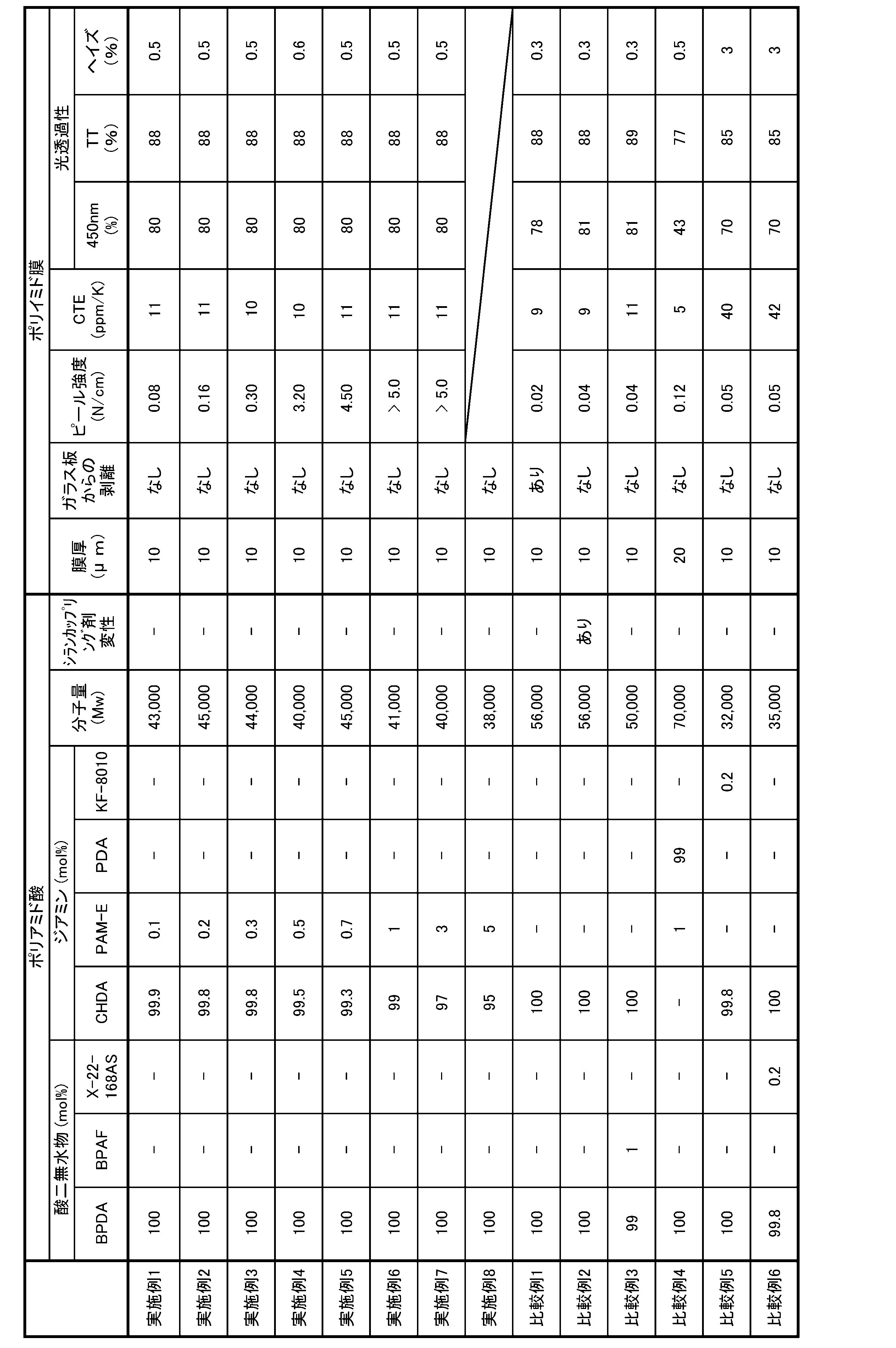
酸二無水物としてのBPDAとジアミンとしてのCHDAから得られた比較例1のポリアミド酸溶液は、ガラス板上への塗布後の熱イミド化の際にガラス板とポリイミド膜との間に多数の気泡が発生し、塗布面積の25%以上がガラス板から剥離していた。比較例1のポリアミド酸をシランカップリング剤により変性した比較例2では、比較例1に比べるとガラス板との密着性が向上していたが、ピール強度が小さく、密着性は十分といえるものではなかった。酸二無水物として、BPDAに1モル%のBPAFを添加した比較例3においても同様であった。
モノマー成分に反応性シリコーンオイルを添加した比較例5および比較例6では、比較例1に比べるとガラス板との密着性が向上していたが、ピール強度が小さく、密着性は十分ではなかった。また、比較例5および比較例6では、得られたポリイミド膜の線熱膨張係数(CTE)が高く寸法安定性が劣っており、透明性が低下していた。
ジアミン成分として、CHDAに加えてシロキサン構造を有するPAM-Eを用いた実施例1~8は、いずれもガラスに対して良好な密着性を示していた。CHDA/PAM-Eのモル数の比mA/mBが97/3~99.0/0.1である実施例1~7は、いずれも比較例1と同等の低CTEおよび高透明性を維持していた。CHDA/PAM-Eのモル数の比mA/mBが95/5である実施例8では、ポリイミド膜の特性評価を行っていないが、ガラス板上に形成されたポリイミド膜の目視では、実施例1~7と同様の透明性を有していた。また、実施例8は実施例7とポリアミド酸およびポリイミドの組成が類似であるため、実施例7と同様の低CTEおよび高透明性を維持していると推測される。CHDAに代えてPDAを用いた比較例4では、実施例1,2等と同等のピール強度を示したが、透明性(特に可視光短波長側)が大幅に低下しており、着色がみられた。
実施例1~8では、PAM-Eの仕込み量の増加に伴ってピール強度が増加し、ガラスとの密着性が向上する傾向がみられた。ガラス板上にポリイミド膜を形成し、必要に応じてポリイミド膜上への素子の形成や実装を行った後に、ガラス板からポリイミド膜を剥離する際の剥離の容易性を考慮すると、シロキサン構造含有ジアミンの使用量は、ジアミン全量に対して5モル%以下が好ましく、1モル%以下が特に好ましいといえる。
上記の実施例と比較例との対比から理解できるように、本発明のポリアミド酸は、ガラス支持体上への膜形成および加熱イミド化の際の加工性が良好であり、ガラス支持体との密着性に優れている。本発明のポリアミド酸のイミド化により得られるポリイミド膜は、100~300℃の高温領域においても低熱膨張性を有しており、かつ高透明性を有することから、ガラス代替の透明基板材料としての応用が期待できる。
Claims (15)
- 一般式1で表される構成単位、および一般式2で表される構成単位を含有するポリアミド酸:

- 前記一般式1で表される構成単位のモル数mAと前記一般式2で表される構成単位のモル数mBとの比mA/mBが、95.0/5.0~99.9/0.1の範囲である、請求項1に記載のポリアミド酸。
- 前記一般式2で表される構成単位が式2Bで表される構成単位である、請求項1または2に記載のポリアミド酸。

- 前記一般式1で表される構成単位が式1Aで表される構成単位であり、前記一般式2で表される構成単位が式2Cで表される構成単位である、請求項1または2に記載のポリアミド酸。
- 請求項1~4のいずれか1項に記載のポリアミド酸と有機溶媒とを含有するポリアミド酸溶液。
- 請求項5に記載のポリアミド酸溶液を支持体上に塗布し、前記有機溶媒の除去および前記ポリアミド酸のイミド化を行い、前記支持体上に密着積層されたポリイミド膜を形成する、ポリイミド基板の製造方法。
- 前記支持体がガラスである、請求項6に記載のポリイミド基板の製造方法。
- 一般式Iで表される構成単位、および一般式IIで表される構成単位を含有するポリイミド:


- 前記一般式Iで表される構成単位のモル数MAと前記一般式IIで表される構成単位のモル数MBとの比MA/MBが、95.0/5.0~99.9/0.1の範囲である、請求項8に記載のポリイミド。
- 前記一般式IIで表される構成単位が式IIBで表される構成単位である、請求項8または9に記載のポリイミド。

- 前記一般式Iで表される構成単位が式IAで表される構成単位であり、前記一般式IIで表される構成単位が式IICで表される構成単位である、請求項8または9に記載のポリイミド。
- 請求項8~11のいずれか1項に記載のポリイミドを含むポリイミド基板。
- 波長450nmの光透過率が70%以上である、請求項12に記載のポリイミド基板。
- 100~300℃における線熱膨張係数が30ppm/K以下である、請求項12または13に記載のポリイミド基板。
- 請求項12~14のいずれか1項に記載のポリイミド基板上に電極および/または電子素子を備える電子デバイス。
Priority Applications (2)
| Application Number | Priority Date | Filing Date | Title |
|---|---|---|---|
| JP2018505879A JPWO2017159538A1 (ja) | 2016-03-17 | 2017-03-09 | ポリアミド酸、ポリアミド酸溶液、ポリイミド、およびポリイミド基板ならびにそれらの製造方法 |
| JP2021146539A JP7157859B2 (ja) | 2016-03-17 | 2021-09-09 | 電子デバイスの製造方法 |
Applications Claiming Priority (2)
| Application Number | Priority Date | Filing Date | Title |
|---|---|---|---|
| JP2016054094 | 2016-03-17 | ||
| JP2016-054094 | 2016-03-17 |
Publications (1)
| Publication Number | Publication Date |
|---|---|
| WO2017159538A1 true WO2017159538A1 (ja) | 2017-09-21 |
Family
ID=59850768
Family Applications (1)
| Application Number | Title | Priority Date | Filing Date |
|---|---|---|---|
| PCT/JP2017/009485 Ceased WO2017159538A1 (ja) | 2016-03-17 | 2017-03-09 | ポリアミド酸、ポリアミド酸溶液、ポリイミド、およびポリイミド基板ならびにそれらの製造方法 |
Country Status (3)
| Country | Link |
|---|---|
| JP (2) | JPWO2017159538A1 (ja) |
| TW (1) | TWI735550B (ja) |
| WO (1) | WO2017159538A1 (ja) |
Cited By (7)
| Publication number | Priority date | Publication date | Assignee | Title |
|---|---|---|---|---|
| WO2018117145A1 (ja) * | 2016-12-22 | 2018-06-28 | 大日本印刷株式会社 | ポリイミドフィルム、ポリイミド、ポリイミド前駆体、積層体、及びディスプレイ用表面材 |
| JP2018104682A (ja) * | 2016-12-22 | 2018-07-05 | 大日本印刷株式会社 | ポリイミドフィルム、ポリイミド、ポリイミド前駆体、積層体、及びディスプレイ用表面材 |
| KR20190044010A (ko) | 2017-10-19 | 2019-04-29 | 닛테츠 케미컬 앤드 머티리얼 가부시키가이샤 | 폴리이미드 전구체 및 폴리이미드 |
| JP2020002196A (ja) * | 2018-06-26 | 2020-01-09 | 大日本印刷株式会社 | ポリイミドフィルム、積層体、ディスプレイ用表面材、タッチパネル部材、液晶表示装置、及び有機エレクトロルミネッセンス表示装置 |
| CN111732910A (zh) * | 2020-06-30 | 2020-10-02 | 晶科绿能(上海)管理有限公司 | 复合封装材料和用其封装的光伏组件 |
| US10982048B2 (en) * | 2018-04-17 | 2021-04-20 | Jiaxing Super Lighting Electric Appliance Co., Ltd | Organosilicon-modified polyimide resin composition and use thereof |
| EP4223521A4 (en) * | 2020-09-29 | 2024-10-30 | Toyobo Co., Ltd. | LAMINATED BODY COMPRISING AN INORGANIC SUBSTRATE AND CURED POLYAMIC ACID PRODUCT |
Citations (3)
| Publication number | Priority date | Publication date | Assignee | Title |
|---|---|---|---|---|
| JPH10170713A (ja) * | 1996-12-13 | 1998-06-26 | Toray Ind Inc | カラーペーストおよびカラーフィルターとその製造方法 |
| JPH1138620A (ja) * | 1997-07-23 | 1999-02-12 | Toray Ind Inc | 半導体装置とその製造方法 |
| JP2008107766A (ja) * | 2006-07-21 | 2008-05-08 | Toray Ind Inc | 位相差薄膜用樹脂組成物、液晶表示装置用カラーフィルター基板、および液晶表示装置、並びに位相差薄膜付き液晶表示装置用カラーフィルター基板の製造方法 |
Family Cites Families (4)
| Publication number | Priority date | Publication date | Assignee | Title |
|---|---|---|---|---|
| CN101490607B (zh) * | 2006-07-21 | 2011-06-01 | 东丽株式会社 | 相位差薄膜用树脂组合物、滤色器基板及其制造方法和液晶显示装置 |
| JP6317733B2 (ja) * | 2013-04-03 | 2018-04-25 | 三井化学株式会社 | ポリアミド酸、及びこれを含むワニス、並びにポリイミドフィルム |
| KR102207439B1 (ko) * | 2013-09-27 | 2021-01-26 | 도레이 카부시키가이샤 | 폴리이미드 전구체, 그것으로부터 얻어지는 폴리이미드 수지막, 및 그것을 포함하는 표시 소자, 광학 소자, 수광 소자, 터치 패널, 회로 기판, 유기 el 디스플레이, 및 유기 el 소자 및 컬러 필터의 제조 방법 |
| JP6420064B2 (ja) * | 2014-06-03 | 2018-11-07 | 旭化成株式会社 | ポリイミド前駆体組成物及びポリイミドフィルム |
-
2017
- 2017-03-09 JP JP2018505879A patent/JPWO2017159538A1/ja active Pending
- 2017-03-09 WO PCT/JP2017/009485 patent/WO2017159538A1/ja not_active Ceased
- 2017-03-16 TW TW106108655A patent/TWI735550B/zh active
-
2021
- 2021-09-09 JP JP2021146539A patent/JP7157859B2/ja active Active
Patent Citations (3)
| Publication number | Priority date | Publication date | Assignee | Title |
|---|---|---|---|---|
| JPH10170713A (ja) * | 1996-12-13 | 1998-06-26 | Toray Ind Inc | カラーペーストおよびカラーフィルターとその製造方法 |
| JPH1138620A (ja) * | 1997-07-23 | 1999-02-12 | Toray Ind Inc | 半導体装置とその製造方法 |
| JP2008107766A (ja) * | 2006-07-21 | 2008-05-08 | Toray Ind Inc | 位相差薄膜用樹脂組成物、液晶表示装置用カラーフィルター基板、および液晶表示装置、並びに位相差薄膜付き液晶表示装置用カラーフィルター基板の製造方法 |
Cited By (11)
| Publication number | Priority date | Publication date | Assignee | Title |
|---|---|---|---|---|
| WO2018117145A1 (ja) * | 2016-12-22 | 2018-06-28 | 大日本印刷株式会社 | ポリイミドフィルム、ポリイミド、ポリイミド前駆体、積層体、及びディスプレイ用表面材 |
| JP2018104682A (ja) * | 2016-12-22 | 2018-07-05 | 大日本印刷株式会社 | ポリイミドフィルム、ポリイミド、ポリイミド前駆体、積層体、及びディスプレイ用表面材 |
| JP7027867B2 (ja) | 2016-12-22 | 2022-03-02 | 大日本印刷株式会社 | フレキシブルディスプレイ用表面材 |
| KR20190044010A (ko) | 2017-10-19 | 2019-04-29 | 닛테츠 케미컬 앤드 머티리얼 가부시키가이샤 | 폴리이미드 전구체 및 폴리이미드 |
| US10982048B2 (en) * | 2018-04-17 | 2021-04-20 | Jiaxing Super Lighting Electric Appliance Co., Ltd | Organosilicon-modified polyimide resin composition and use thereof |
| JP2020002196A (ja) * | 2018-06-26 | 2020-01-09 | 大日本印刷株式会社 | ポリイミドフィルム、積層体、ディスプレイ用表面材、タッチパネル部材、液晶表示装置、及び有機エレクトロルミネッセンス表示装置 |
| JP7139715B2 (ja) | 2018-06-26 | 2022-09-21 | 大日本印刷株式会社 | ポリイミドフィルム、積層体、ディスプレイ用表面材、タッチパネル部材、液晶表示装置、及び有機エレクトロルミネッセンス表示装置 |
| CN111732910A (zh) * | 2020-06-30 | 2020-10-02 | 晶科绿能(上海)管理有限公司 | 复合封装材料和用其封装的光伏组件 |
| US11810777B2 (en) | 2020-06-30 | 2023-11-07 | Jinko Green Energy (shanghai) Management Co., Ltd. | Composite encapsulating material and photovoltaic module including the same |
| EP4223521A4 (en) * | 2020-09-29 | 2024-10-30 | Toyobo Co., Ltd. | LAMINATED BODY COMPRISING AN INORGANIC SUBSTRATE AND CURED POLYAMIC ACID PRODUCT |
| US12391813B2 (en) | 2020-09-29 | 2025-08-19 | Toyobo Co., Ltd. | Layered body including inorganic substrate and polyamic acid cured product |
Also Published As
| Publication number | Publication date |
|---|---|
| JPWO2017159538A1 (ja) | 2019-01-24 |
| JP2022008353A (ja) | 2022-01-13 |
| TW201800445A (zh) | 2018-01-01 |
| TWI735550B (zh) | 2021-08-11 |
| JP7157859B2 (ja) | 2022-10-20 |
Similar Documents
| Publication | Publication Date | Title |
|---|---|---|
| JP7157859B2 (ja) | 電子デバイスの製造方法 | |
| TWI785224B (zh) | 聚醯胺酸及其製造方法、聚醯胺酸溶液、聚醯亞胺、聚醯亞胺膜、積層體及其製造方法、與可撓性裝置及其製造方法 | |
| JP5650458B2 (ja) | 積層体の製造方法、及びフレキシブルデバイスの製造方法 | |
| TWI762635B (zh) | 聚醯胺酸、聚醯胺酸溶液、聚醯亞胺、聚醯亞胺膜、積層體及可撓性裝置,與聚醯亞胺膜之製造方法 | |
| CN104395376B (zh) | 聚酰胺酸、聚酰亚胺、聚酰胺酸溶液、及聚酰亚胺的利用 | |
| TWI664212B (zh) | 烷氧基矽烷改質聚醯胺酸溶液、使用其之積層體及可撓性裝置、與聚醯亞胺膜及積層體之製造方法 | |
| JP2012102155A (ja) | ポリイミドフィルム、積層体、及びフレキシブルデバイス | |
| KR20160095910A (ko) | 폴리(이미드-아미드) 코폴리머, 폴리(이미드-아미드) 코폴리머를 포함하는 성형품, 상기 성형품을 포함하는 디스플레이 장치 | |
| CN111212868B (zh) | 聚酰亚胺树脂及其制造方法、聚酰亚胺溶液、以及聚酰亚胺薄膜及其制造方法 | |
| CN107108886A (zh) | 聚酰亚胺前体、聚酰亚胺和聚酰亚胺膜 | |
| CN115803365A (zh) | 聚酰胺酸、聚酰胺酸溶液、聚酰亚胺、聚酰亚胺膜、层叠体、层叠体的制造方法及电子器件 | |
| JP6687442B2 (ja) | ポリアミド酸、ポリイミド、ポリアミド酸溶液、およびポリイミドの利用 | |
| JP6336194B2 (ja) | ポリイミド積層体の製造方法およびその利用 | |
| TWI709592B (zh) | 聚醯亞胺膜以及聚醯亞胺膜的製造方法 | |
| JP2024113638A (ja) | ポリアミド酸、ポリアミド酸溶液、ポリイミド、ポリイミド基板、電子デバイス、ならびにポリイミド基板の製造方法 | |
| CN117043230B (zh) | 聚酰胺酸、聚酰胺酸溶液、聚酰亚胺、聚酰亚胺基板和层叠体以及它们的制造方法 | |
| WO2024190613A1 (ja) | ポリアミド酸組成物、ポリイミド、ポリイミド膜、積層体、電子デバイス、ポリイミドの製造方法、積層体の製造方法及び電子デバイスの製造方法 | |
| KR20150078925A (ko) | 폴리이미드실록산 공중합체 및 이로부터 제조된 필름 | |
| TW202319452A (zh) | 聚醯胺醯亞胺前驅物及其應用 |
Legal Events
| Date | Code | Title | Description |
|---|---|---|---|
| ENP | Entry into the national phase |
Ref document number: 2018505879 Country of ref document: JP Kind code of ref document: A |
|
| NENP | Non-entry into the national phase |
Ref country code: DE |
|
| 121 | Ep: the epo has been informed by wipo that ep was designated in this application |
Ref document number: 17766539 Country of ref document: EP Kind code of ref document: A1 |
|
| 122 | Ep: pct application non-entry in european phase |
Ref document number: 17766539 Country of ref document: EP Kind code of ref document: A1 |