WO2017145985A1 - 多穴型押出ダイス、金属化合物押出成形体の製造方法、不飽和アルデヒドおよび/または不飽和カルボン酸製造用触媒押出成形体の製造方法、ならびに不飽和アルデヒドおよび/または不飽和カルボン酸の製造方法 - Google Patents
多穴型押出ダイス、金属化合物押出成形体の製造方法、不飽和アルデヒドおよび/または不飽和カルボン酸製造用触媒押出成形体の製造方法、ならびに不飽和アルデヒドおよび/または不飽和カルボン酸の製造方法 Download PDFInfo
- Publication number
- WO2017145985A1 WO2017145985A1 PCT/JP2017/006133 JP2017006133W WO2017145985A1 WO 2017145985 A1 WO2017145985 A1 WO 2017145985A1 JP 2017006133 W JP2017006133 W JP 2017006133W WO 2017145985 A1 WO2017145985 A1 WO 2017145985A1
- Authority
- WO
- WIPO (PCT)
- Prior art keywords
- producing
- catalyst
- extrusion
- carboxylic acid
- hole
- Prior art date
- Legal status (The legal status is an assumption and is not a legal conclusion. Google has not performed a legal analysis and makes no representation as to the accuracy of the status listed.)
- Ceased
Links
Images


Classifications
-
- B—PERFORMING OPERATIONS; TRANSPORTING
- B01—PHYSICAL OR CHEMICAL PROCESSES OR APPARATUS IN GENERAL
- B01J—CHEMICAL OR PHYSICAL PROCESSES, e.g. CATALYSIS OR COLLOID CHEMISTRY; THEIR RELEVANT APPARATUS
- B01J37/00—Processes, in general, for preparing catalysts; Processes, in general, for activation of catalysts
- B01J37/0009—Use of binding agents; Moulding; Pressing; Powdering; Granulating; Addition of materials ameliorating the mechanical properties of the product catalyst
-
- B—PERFORMING OPERATIONS; TRANSPORTING
- B01—PHYSICAL OR CHEMICAL PROCESSES OR APPARATUS IN GENERAL
- B01J—CHEMICAL OR PHYSICAL PROCESSES, e.g. CATALYSIS OR COLLOID CHEMISTRY; THEIR RELEVANT APPARATUS
- B01J27/00—Catalysts comprising the elements or compounds of halogens, sulfur, selenium, tellurium, phosphorus or nitrogen; Catalysts comprising carbon compounds
- B01J27/14—Phosphorus; Compounds thereof
- B01J27/186—Phosphorus; Compounds thereof with arsenic, antimony, bismuth, vanadium, niobium, tantalum, polonium, chromium, molybdenum, tungsten, manganese, technetium or rhenium
- B01J27/195—Phosphorus; Compounds thereof with arsenic, antimony, bismuth, vanadium, niobium, tantalum, polonium, chromium, molybdenum, tungsten, manganese, technetium or rhenium with vanadium, niobium or tantalum
- B01J27/198—Vanadium
- B01J27/199—Vanadium with chromium, molybdenum, tungsten or polonium
-
- B—PERFORMING OPERATIONS; TRANSPORTING
- B01—PHYSICAL OR CHEMICAL PROCESSES OR APPARATUS IN GENERAL
- B01J—CHEMICAL OR PHYSICAL PROCESSES, e.g. CATALYSIS OR COLLOID CHEMISTRY; THEIR RELEVANT APPARATUS
- B01J37/00—Processes, in general, for preparing catalysts; Processes, in general, for activation of catalysts
-
- B—PERFORMING OPERATIONS; TRANSPORTING
- B01—PHYSICAL OR CHEMICAL PROCESSES OR APPARATUS IN GENERAL
- B01J—CHEMICAL OR PHYSICAL PROCESSES, e.g. CATALYSIS OR COLLOID CHEMISTRY; THEIR RELEVANT APPARATUS
- B01J37/00—Processes, in general, for preparing catalysts; Processes, in general, for activation of catalysts
- B01J37/04—Mixing
-
- B—PERFORMING OPERATIONS; TRANSPORTING
- B28—WORKING CEMENT, CLAY, OR STONE
- B28B—SHAPING CLAY OR OTHER CERAMIC COMPOSITIONS; SHAPING SLAG; SHAPING MIXTURES CONTAINING CEMENTITIOUS MATERIAL, e.g. PLASTER
- B28B3/00—Producing shaped articles from the material by using presses; Presses specially adapted therefor
- B28B3/20—Producing shaped articles from the material by using presses; Presses specially adapted therefor wherein the material is extruded
- B28B3/26—Extrusion dies
-
- C—CHEMISTRY; METALLURGY
- C07—ORGANIC CHEMISTRY
- C07C—ACYCLIC OR CARBOCYCLIC COMPOUNDS
- C07C45/00—Preparation of compounds having >C = O groups bound only to carbon or hydrogen atoms; Preparation of chelates of such compounds
- C07C45/27—Preparation of compounds having >C = O groups bound only to carbon or hydrogen atoms; Preparation of chelates of such compounds by oxidation
- C07C45/32—Preparation of compounds having >C = O groups bound only to carbon or hydrogen atoms; Preparation of chelates of such compounds by oxidation with molecular oxygen
- C07C45/33—Preparation of compounds having >C = O groups bound only to carbon or hydrogen atoms; Preparation of chelates of such compounds by oxidation with molecular oxygen of CHx-moieties
- C07C45/34—Preparation of compounds having >C = O groups bound only to carbon or hydrogen atoms; Preparation of chelates of such compounds by oxidation with molecular oxygen of CHx-moieties in unsaturated compounds
- C07C45/35—Preparation of compounds having >C = O groups bound only to carbon or hydrogen atoms; Preparation of chelates of such compounds by oxidation with molecular oxygen of CHx-moieties in unsaturated compounds in propene or isobutene
-
- C—CHEMISTRY; METALLURGY
- C07—ORGANIC CHEMISTRY
- C07C—ACYCLIC OR CARBOCYCLIC COMPOUNDS
- C07C51/00—Preparation of carboxylic acids or their salts, halides or anhydrides
- C07C51/16—Preparation of carboxylic acids or their salts, halides or anhydrides by oxidation
- C07C51/21—Preparation of carboxylic acids or their salts, halides or anhydrides by oxidation with molecular oxygen
- C07C51/25—Preparation of carboxylic acids or their salts, halides or anhydrides by oxidation with molecular oxygen of unsaturated compounds containing no six-membered aromatic ring
-
- C—CHEMISTRY; METALLURGY
- C07—ORGANIC CHEMISTRY
- C07B—GENERAL METHODS OF ORGANIC CHEMISTRY; APPARATUS THEREFOR
- C07B61/00—Other general methods
Definitions
- the present invention relates to a multi-hole extrusion die, a method for producing a metal compound extrusion, a method for producing a catalyst extrusion for producing an unsaturated aldehyde and / or an unsaturated carboxylic acid, and an unsaturated aldehyde and / or an unsaturated carboxylic acid. It relates to the manufacturing method.
- Patent Documents 1 and 2 a method of adding an organic compound such as alcohol when the catalyst components are kneaded
- Patent Document 3 a method of extruding the catalyst and then freezing
- Patent Document 4 a catalyst extrusion molding in two stages
- the catalyst obtained by the above method is insufficient as an industrial catalyst in terms of catalyst performance such as catalyst activity and target product selectivity. Furthermore, the yield in catalyst production is also insufficient. Therefore, further improvement in the manufacturing method of the catalyst extrusion molded object for unsaturated aldehyde and / or unsaturated carboxylic acid manufacture, and the extrusion die used for this method is desired from an industrial viewpoint.
- An object of the present invention is to provide a multi-hole type extrusion die capable of producing a catalyst extrudate for producing an unsaturated aldehyde and / or an unsaturated carboxylic acid having stable and high quality and high catalytic performance. .
- the present invention includes the following [1] to [15].
- a die body having a die hole and a rectifying unit for uniformly flowing the material formed in the die hole;
- a breaker plate including a material having a yield strength of 300 MPa or more, having a plurality of through holes having a diameter of a (mm), and a thickness of b (mm);
- a multi-hole extrusion die comprising: b / a is 0.5 or more and less than 3.0, A multi-hole extrusion die having a structure in which a central portion of the breaker plate is supported by a flat portion provided in the rectifying portion of the die body.
- a method for producing a metal compound extruded body comprising a step of extruding a metal compound kneaded product using the multi-hole extrusion die according to [1] to produce a metal compound extruded body.
- At least one stainless steel material in which the member other than the breaker plate of the multi-hole extrusion die is selected from the group consisting of austenite, martensite, ferrite, two-phase, precipitation hardening, and superalloy The manufacturing method of the metal compound extrusion molding in any one of [2] to [6] containing this.
- a method for producing a catalyst extrudate for producing acrolein and acrylic acid comprising the step of extruding a kneaded product of the catalyst for producing acrolein and acrylic acid using the multi-hole extrusion die according to [1]. And The acrolein and acrylic acid production catalyst extrudate is used for producing acrolein and acrylic acid by vapor-phase catalytic oxidation of propylene with molecular oxygen, and contains at least molybdenum and bismuth.
- a method for producing a catalyst extrusion molded body comprising the step of extruding a kneaded product of the catalyst for producing acrolein and acrylic acid using the multi-hole extrusion die according to [1]. And The acrolein and acrylic acid production catalyst extrudate is used for producing acrolein and acrylic acid by vapor-phase catalytic oxidation of propylene with molecular oxygen, and contains at least molybdenum and bismuth.
- a method for producing a catalyst extrudate for producing methacrolein and methacrylic acid comprising a step of extruding a kneaded product of methacrolein and a catalyst for producing methacrylic acid using the multi-hole extrusion die according to [1]. Because The catalyst extrudate for producing methacrolein and methacrylic acid is used for producing methacrolein and methacrylic acid by vapor-phase catalytic oxidation of isobutylene and / or tertiary butyl alcohol with molecular oxygen, at least molybdenum and The manufacturing method of the catalyst extrusion molding for the production of methacrolein and methacrylic acid containing bismuth.
- a method for producing an extruded product of an unsaturated carboxylic acid production catalyst comprising the step of extruding a kneaded product of an unsaturated carboxylic acid production catalyst using the multi-hole extrusion die according to [1].
- the catalyst extrudate for producing an unsaturated carboxylic acid is used when producing an unsaturated carboxylic acid by vapor-phase catalytic oxidation of an unsaturated aldehyde with molecular oxygen, contains molybdenum, and contains phosphorus and / or vanadium.
- the manufacturing method of the catalyst extrusion molding for unsaturated carboxylic acid manufacture containing this.
- the multi-hole extrusion die it is possible to produce a catalyst extrudate for producing an unsaturated aldehyde and / or unsaturated carboxylic acid having a stable and high quality and high catalytic performance.
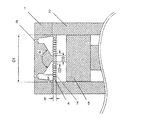
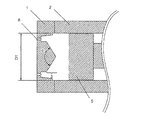
- FIG. 3 is a cross-sectional view showing a multi-hole extrusion die used in Comparative Example 1.
- FIG. It is sectional drawing which shows the multi-hole type extrusion die used in Comparative Examples 2 and 6. It is a top view which shows an example of arrangement
- the multi-hole type extrusion die according to the present invention includes a die body having a die hole and a rectifying portion for uniformly flowing the material formed in the die hole, and a material having a proof stress of 300 MPa or more.
- b / a is 0.5 or more and less than 3.0.
- the multi-hole extrusion die has a structure in which a central portion of the breaker plate is supported by a flat portion provided in the rectifying portion of the die body.
- the multi-hole extrusion die By using the multi-hole extrusion die to produce an extruded product for unsaturated aldehyde and / or unsaturated carboxylic acid production by the method described later, it is possible to stably produce the device without causing deformation or breakage of the apparatus.
- a catalyst extrudate for producing an unsaturated aldehyde and / or unsaturated carboxylic acid having high quality and high catalytic performance can be produced with a high yield. That is, the multi-hole type extrusion die is preferably a multi-hole type extrusion die for producing a catalyst extrusion molded body for producing an unsaturated aldehyde and / or unsaturated carboxylic acid.
- FIG. 1 An example of a multi-hole extrusion die according to the present invention is shown in FIG.
- the multi-hole extrusion die shown in FIG. 1 is composed of a die body 1 having a die hole 6 and a rectifying unit 3 for allowing the material formed in the die hole 6 to flow uniformly, and a breaker plate 4. ing.
- the tip portion of the die body 1 facing the breaker plate 4 of the rectifying unit 3 is a flat surface, and the center portion of the breaker plate 4 is supported by the flat portion of the tip portion.
- the material to be extruded disposed in the cylinder 2 is extruded by the piston head 5 and is extruded from the die hole 6 of the die body 1 through the through hole 7 of the breaker plate 4 and molded.
- the arrangement of the die holes in the die body can be freely selected from concentric circles (single / multiple), latticed, staggered, etc., but concentric circles (single) are preferable from the viewpoint of equalizing the differential pressure in the die holes.
- the number of die holes in the die body is not particularly limited, but is preferably 2 to 50, more preferably 5 to 30, and still more preferably 10 to 25. When the number of die holes is 2 or more, the productivity of the molded product can be increased. In addition, when the number of die holes is 50 or less, it is possible to make the differential pressure uniform in each die hole while maintaining a manageable die size.
- the diameter of the die hole is preferably 2 to 10 mm, and more preferably 3 to 7 mm.
- the diameter of the die hole By setting the diameter of the die hole to 2 mm or more, the differential pressure during the reaction can be reduced. Moreover, the diameter of a die hole shall be 10 mm or less, and the fall of the catalyst performance by the spreading
- “diameter” means the maximum length of passing. For example, the diameter indicates the diameter when the hole is circular, and the length of the diagonal line when the hole is rectangular.
- a breaker plate is installed in the multi-hole extrusion die according to the present invention.
- the breaker plate is a perforated plate used for extrusion molding.
- the breaker plate according to the present invention has a plurality of through holes. In an orifice plate having a single hole, it is impossible to make the differential pressure uniform in each die hole.
- the arrangement of the through holes in the breaker plate can be freely selected from a radial shape, a concentric circle shape, a lattice shape, a staggered shape, and the like, but is preferably a radial shape as shown in FIG.
- b / a is 0.5 or more and less than 3.0, 0.7 or more; 7 or less is preferable, 1.0 or more and 2.5 or less are more preferable, and 1.3 or more and 2.0 or less are more preferable.
- b / a is less than 0.5, the breaker plate cannot withstand the extrusion pressure and deforms. In addition, foreign matter passes through the breaker plate and the die hole is blocked.
- the differential pressure in each die hole becomes non-uniform, and not only the length variation of the extruded product in each die hole is increased, but also the variation in pore distribution inside the catalyst extrusion is increased, and the catalyst performance Decreases.
- b / a is 3.0 or more, the breaker plate is deformed or clogged due to a large differential pressure.
- strong shearing occurs in the material to be molded, the particles constituting the catalyst extrusion molded body are destroyed, and the pores inside the catalyst are reduced, so that the catalyst performance is lowered.
- the diameter a of the through hole of the breaker plate is preferably 2 to 10 mm, more preferably 3 to 8 mm, further preferably 4 to 6 mm, and the same diameter as that of the die hole. Particularly preferred.
- the diameter a of the through hole is 2 mm or more, the breaker plate can be prevented from being deformed or clogged due to a large differential pressure.
- strong shearing occurs in the material to be molded, the particles constituting the catalyst extrusion-molded body are destroyed, and the decrease in catalyst performance due to the decrease in pores inside the catalyst can be suppressed.
- the diameter a of the through hole is 10 mm or less, the differential pressure in each die hole becomes uniform, and not only the length variation of the extruded product in each die hole is reduced, but also the inside of the catalyst extrusion molded body. Variation in the pore distribution of the catalyst is reduced, and the catalyst performance is improved. In addition, it can prevent that a foreign material passes a breaker plate and obstruct
- the diameter a of a through-hole may be single, and may use it combining 2 or more types of diameters. When two or more types of diameters are used in combination, the diameter a of the through hole indicates the average value.
- the thickness b of the breaker plate is preferably 3 to 20 mm, more preferably 4 to 15 mm, still more preferably 5 to 10 mm, and particularly preferably 6 to 9 mm.
- the thickness b of the breaker plate is 3 mm or more, deformation of the breaker plate can be suppressed.
- the thickness b of the breaker plate is 20 mm or less, strong shear occurs in the breaker plate, the particles constituting the catalyst extrusion molded body are destroyed, and the pores inside the catalyst are reduced. The decrease can be suppressed.
- the opening ratio of the breaker plate (ratio of the total area of the opening portion of the through hole to the cross-sectional area of the extruder cylinder calculated from the extruder cylinder diameter) is preferably 10 to 50%, more preferably 20 to 45%, more preferably 30 to 40% is more preferable.
- the opening ratio is 10% or more, it is possible to suppress breaker plate deformation and clogging of the breaker plate due to a large differential pressure.
- strong shearing occurs in the material to be molded, the particles constituting the catalyst extrusion-molded body are destroyed, and the decrease in catalyst performance due to the decrease in pores inside the catalyst can be suppressed.
- the opening ratio is 50% or less, the strength of the breaker plate is maintained, and deformation and breakage can be suppressed.
- the breaker plate includes a material having a yield strength of 300 MPa or more.
- the proof stress indicates a limit stress value at which the material does not cause plastic deformation.
- the yield strength is measured by the method described in JIS Z 2241: 2011.
- the proof stress of the material is preferably 500 MPa or more, more preferably 700 MPa or more, and further preferably 1000 MPa or more.
- the upper limit of the proof stress range of the material is not particularly limited, but can be, for example, 2000 MPa or less.
- a catalyst for producing methacrylic acid by gas phase catalytic oxidation of methacrolein contains a metal compound that is easily reduced. Therefore, when manufacturing an extrusion molding using the kneaded material containing the metal compound which is easy to reduce, the breaker plate contains the material which does not reduce the kneaded material including the metal compound, which will be described later, to prevent the kneaded material from being reduced. It is preferable from the viewpoint.
- Examples of the material having a proof stress of 300 MPa or more include, for example, a martensite system (SUS403, SUS410, SUS410J1, SUS416, SUS420J1, SUS420J2, SUS431, SUS440C), a two-phase system (SUS329J1, SUS329J3L, SUS329J4L, S327750, S327, and S327).
- SUS630S, SUS630H900, SUS630H1025, SUS630H1075, SUS630H1150, SUS631S, SUS631TH1050, SUS631RH950 and the like.
- These stainless steel materials correspond also to the material which does not reduce the kneaded material mentioned above.
- These stainless steel materials may be used alone or in combination of two or more.
- an electroless plating process or an electrolytic plating process may be performed on the surface of the breaker plate.
- heat-treated high-speed steel or die steel may be used on the surface of the breaker plate.
- the content of the material having a yield strength of 300 MPa or more in the breaker plate is preferably 80% by mass or more, more preferably 90% by mass or more, and 100% by mass or more, that is, the breaker plate has a yield strength of 300 MPa or more. It is particularly preferable to be made of the following materials.
- the multi-hole extrusion die according to the present invention has a structure in which the center portion of the breaker plate is supported by a flat portion provided in the rectifying portion of the die body. Specifically, the center part of the breaker plate is supported by the surface of the flat part of the tip part of the rectifying part whose tip part is a flat surface.
- the rectifying part of the die body according to the present invention is preferably a truncated cone.
- the area of the portion of the breaker plate that is in contact with the flat portion of the flow straightening portion is preferably 0.5 to 10% of the flat portion area of the breaker plate (the cross-sectional area of the extruder cylinder calculated from the diameter of the extruder cylinder). It is more preferably 1 to 5%, and further preferably 2 to 4%.
- the ratio of the area is 0.5% or more, the stress at the contact portion with the rectifying portion is reduced, and deformation of the breaker plate can be suppressed.
- the area ratio is 10% or less, the effective area of the breaker plate is increased and the processing efficiency is improved.
- the rectifying part and breaker plate of the die body are in contact with each other and may not be integrated, or the flat part of the rectifying part and the breaker plate may be fastened with bolts and integrated.
- the angle of the cone when the truncated cone is assumed to be a cone is preferably 30 to 150 degrees, more preferably 70 to 130 degrees, and more preferably 100 to 120 degrees. More preferably.
- the angle of the cone is within the above range, the effect of rectification is improved, and the length variation of the extruded product for each die hole is reduced.
- the multi-hole extrusion die includes a step of extruding a kneaded product of a metal compound and producing a metal compound extrusion molded body. Used when extruding the kneaded product.
- the multi-hole extrusion die includes a material that does not reduce the kneaded product from the viewpoint of improving the catalyst performance and preventing the oxidative corrosion and cracking of the multi-hole extrusion die.
- the said kneaded material shows the kneaded material and the primary molded object which contain the particle
- Examples of the material that does not reduce the kneaded material used for the breaker plate include the stainless steel materials described above.
- materials used for members of multi-hole extrusion dies other than breaker plates that do not reduce the kneaded product include austenite (SUS201, SUS202, SUS301, SUS302, SUS303, SUS303Se, SUS304, SUS304N1, SUS304N2, SUS304LN, SUS305, SUS309S, SUS310S, SUS316, SUS316H, SUS316L, SUS316N, SUS316LN, SUS316J1, SUS316J1L, SUS317, SUS317L, SUS317J1, SUS321, SUS321H, SUS321H, SUS321H (SUS40 SUS410, SUS410J1, SUS416, SUS420J1, SUS420J2, SUS431, SUS440C), ferrite type (SUS405, SUS410L, SUS430
- SS material high-speed steel, die steel, etc. that have been subjected to electroless plating treatment or electrolytic plating treatment may be used for the member surface.
- electroless plating treatment or electrolytic plating treatment
- the extrusion pressure is preferably 0.1 to 30 MPaG, more preferably 0.5 to 20 MPaG on the primary side of the breaker plate. Preferably, it is 1.0 to 15 MPaG, more preferably 2.0 to 13 MPaG.
- the extrusion pressure is 0.1 MPaG or more, a sufficient differential pressure is generated in the die holes, and the length variation of the extruded product in each die hole is reduced.
- the extrusion pressure is 30 MPaG or less, strong shearing occurs in the breaker plate and the die hole, the particles constituting the catalyst extrusion molded body are destroyed, and the pores inside the catalyst are reduced, thereby reducing the catalyst performance. Can be suppressed.
- the molded body extruded from the multi-hole extrusion die is cut to an arbitrary length, but the length of the molded body after cutting is preferably 2 to 10 mm, and more preferably 3 to 7 mm.
- the length is 2 mm or more, the pressure loss at the time of filling the reactor can be reduced.
- the length is 10 mm or less, it is possible to suppress a decrease in catalyst performance due to diffusion in pores inside the catalyst and a decrease in heat transfer performance.
- the cutting method can be selected from any method, and examples thereof include a method using a cutting blade rotating around the center of the die surface and a method using a cutting blade reciprocating in parallel with the die surface.
- the method for producing a metal compound extruded product according to the present invention includes a step of producing a metal compound extruded product by extruding a kneaded product of a metal compound using the multi-hole extrusion die according to the present invention.
- metal compound catalysts such as molybdenum, bismuth, phosphorus, vanadium, iron, cobalt, chromium, aluminum, strontium, germanium, boron, arsenic, selenium, silver, silicon, sodium, tellurium, lithium, antimony, Potassium, barium, magnesium, titanium, manganese, copper, zinc, zirconium, niobium, tungsten, tantalum, calcium, tin, gallium, cerium, lanthanum, rubidium, cesium, thallium, and the like can be included.
- metal compound catalysts such as molybdenum, bismuth, phosphorus, vanadium, iron, cobalt, chromium, aluminum, strontium, germanium, boron, arsenic, selenium, silver, silicon, sodium, tellurium, lithium, antimony, Potassium, barium, magnesium, titanium, manganese, copper, zinc, zirconium, niobium, tungsten,
- the metal compound is a metal compound catalyst
- an unsaturated aldehyde having stable and high quality and high catalytic performance A catalyst extrudate for producing unsaturated carboxylic acids can be produced.
- the metal compound catalyst preferably contains molybdenum from the viewpoint of obtaining high catalyst performance.
- the multi-hole extrusion die according to the present invention can be preferably used in a method for producing a catalyst extrusion molded body for producing an unsaturated aldehyde and / or unsaturated carboxylic acid.
- it can be preferably used in the methods shown in the following (i) to (iii).
- (I) a method for producing an acrolein and acrylic acid production catalyst extrudate comprising a step of extruding a kneaded product of acrolein and acrylic acid production catalyst using the multi-hole extrusion die according to the present invention
- the acrolein and acrylic acid production catalyst extrudate is used for producing acrolein and acrylic acid by vapor-phase catalytic oxidation of propylene with molecular oxygen, and contains at least molybdenum and bismuth.
- a method for producing a catalyst extrudate for producing methacrolein and methacrylic acid comprising a step of extruding a kneaded product of methacrolein and a catalyst for producing methacrylic acid using the multi-hole extrusion die according to the present invention.
- the catalyst extrudate for producing methacrolein and methacrylic acid is used for producing methacrolein and methacrylic acid by gas-phase catalytic oxidation of isobutylene and / or tertiary butyl alcohol with molecular oxygen.
- a method for producing a catalyst extrudate for producing methacrolein and methacrylic acid comprising molybdenum and bismuth.
- a method for producing an extruded product of an unsaturated carboxylic acid production catalyst comprising the step of extruding a kneaded product of an unsaturated carboxylic acid production catalyst using the multi-hole extrusion die according to the present invention,
- the catalyst extrudate for producing an unsaturated carboxylic acid is used when producing an unsaturated carboxylic acid by vapor-phase catalytic oxidation of an unsaturated aldehyde with molecular oxygen, contains molybdenum, and contains phosphorus and / or vanadium.
- the manufacturing method of the catalyst extrusion molding for unsaturated carboxylic acid manufacture containing this.
- the unsaturated aldehyde is (meth) acrolein
- the unsaturated carboxylic acid is (meth) acrylic acid, which has more stable and high quality and high catalytic performance. It is preferable from the viewpoint that a catalyst extrusion molded body for producing (meth) acrolein and / or (meth) acrylic acid can be produced.
- the manufacturing method of the catalyst extrusion molding for unsaturated carboxylic acid manufacture shown by said (iii) as an example is demonstrated concretely, it can implement similarly about another method.
- the method shown in (iii) includes molybdenum, which is used for producing an unsaturated carboxylic acid corresponding to the unsaturated aldehyde by vapor-phase catalytic oxidation of the unsaturated aldehyde with molecular oxygen, and phosphorus. And / or a method for producing an extruded product for producing an unsaturated carboxylic acid containing vanadium as a catalyst component, which may include the following steps (1) to (4).
- a step of producing particles containing the catalyst component (2) a step of kneading the composition containing the particles to obtain a kneaded product, and (3) a catalyst extrudate by extruding the kneaded product.
- (4) a step of drying the catalyst extrusion molded body In the step (3), the kneaded product is extruded using the multi-hole extrusion die according to the present invention.
- the catalyst extrudate for producing an unsaturated carboxylic acid contains at least molybdenum as a catalyst component and contains phosphorus and / or vanadium.
- the catalyst extrudate is composed of iron, cobalt, chromium, aluminum, strontium, germanium, boron, arsenic, selenium, silver, silicon, sodium, tellurium, lithium, Antimony, potassium, barium, magnesium, titanium, manganese, copper, zinc, zirconium, niobium, tungsten, tantalum, calcium, tin, bismuth, gallium, cerium, lanthanum, rubidium, cesium, thallium, and the like can be included.
- the catalyst extrudate may contain one or more of these.
- the method for producing the particles containing the catalyst component is not particularly limited, and examples thereof include a method of drying an aqueous slurry containing the catalyst component and further pulverizing it into particles as necessary.
- the raw material of the catalyst component contained in the aqueous slurry include elemental oxides, sulfates, nitrates, carbonates, hydroxides, ammonium salts, halides and the like as the catalyst components.
- the molybdenum raw material include ammonium paramolybdate and molybdenum trioxide.
- Examples of the vanadium raw material include ammonium metavanadate.
- One kind of raw material for these catalyst components may be used for each element, or two or more kinds may be used.
- the method for preparing the aqueous slurry containing the catalyst component is not particularly limited, and various methods such as a precipitation method and an oxide mixing method can be used as long as the components are not unevenly distributed.
- the method of drying the aqueous slurry containing the catalyst component to form particles is not particularly limited, and for example, a method of drying using a spray dryer, a method of drying using a slurry dryer, or a drum dryer.
- a method of drying, a method of pulverizing a lump-like dried product by evaporation to dryness, and the like are applied.
- a method of drying using a spray dryer is preferable because particles can be obtained simultaneously with drying, and the obtained particles are spherical.
- the inlet temperature of the spray dryer is preferably 100 to 500 ° C.
- the outlet temperature of the spray dryer is preferably 100 ° C. or higher, more preferably 105 to 200 ° C.
- the obtained dry particles may be heat-treated (fired) at 200 to 500 ° C. as necessary.
- the heat treatment conditions are not particularly limited, and the heat treatment can be performed under a flow of oxygen, air, or nitrogen.
- the heat treatment time is appropriately set depending on the target catalyst.
- the composition containing the particles obtained in the step (1) is kneaded to obtain a kneaded product.
- a kneaded product by kneading the composition obtained by mixing the particles obtained in the step (1) and a liquid.
- the liquid is preferably water or alcohol.
- the alcohol include lower alcohols such as ethanol, methyl alcohol, propyl alcohol, and butyl alcohol.
- the liquid may be used alone or in combination of two or more, but preferably contains at least an alcohol. The amount of the liquid used is appropriately selected depending on the type and size of the particles, the type of the liquid, and the like.
- a molding aid such as an organic binder from the viewpoint of improving the strength of the catalyst.
- the molding aid include methylcellulose, ethylcellulose, carboxymethylcellulose, sodium carboxymethylcellulose, hydroxyethylcellulose, hydroxypropylcellulose, hydroxypropylmethylcellulose, hydroxyethylmethylcellulose, hydroxybutylmethylcellulose, ethylhydroxyethylcellulose, hydroxypropylcellulose and the like. These may use 1 type and may use 2 or more types together.
- inorganic compounds such as diatomaceous earth, inorganic fibers such as graphite, glass fibers, and ceramic fibers, carbon fibers, and the like may be added to the composition.
- the apparatus for kneading the composition is not particularly limited, and a batch-type kneader equipped with a double-arm type stirring blade, a continuous kneader such as a shaft rotation reciprocating type or a self-cleaning type is used. it can. However, a batch-type kneader is preferable in that kneading can be performed while checking the state of the kneaded product.
- step (3) the kneaded product obtained in step (2) is extrusion molded to obtain a catalyst extrusion molded body.
- the method of extruding the kneaded product is not particularly limited as long as at least the step of extruding the kneaded product using the multi-hole extrusion die according to the present invention is included.
- the kneaded product may be directly formed into a final shape by a screw extruder or a piston extruder.
- secondary molding may be performed in which the primary molded product is molded into a final shape with a piston molding machine.
- the method of performing secondary molding after performing primary molding is preferable.
- the occurrence of bending or the like of the final shape product during extrusion is reduced, and the yield of the product is improved.
- molding can be performed with a uniform force and excess air is hardly mixed, a uniform catalyst extrusion molded body is obtained, and the powdering rate when filling the catalyst extrusion molded body into the reaction tube is high.
- the unsaturated carboxylic acid selectivity is reduced.
- the extrusion can be performed more smoothly, so that no excessive load is applied to the catalyst particles during molding and the catalyst particles are not destroyed. Since soft molding can be performed and preferable pores are expressed in the obtained catalyst, a catalyst excellent in catalytic activity and selectivity of unsaturated carboxylic acid can be obtained.
- the primary forming step of step (2) and step (3) can be performed continuously using a single or a plurality of screw extruders, but kneading can be performed while checking the state of kneading, and productivity is high. From the viewpoint, it is preferable that kneading is performed with a batch-type kneader and primary molding is performed with a screw extruder or a piston-type extruder.
- the shape when the kneaded product is primarily molded is not particularly limited, but when a piston molding machine is used in the secondary molding, the shape of the primary molded product is the cylinder diameter of the piston molding machine that performs the secondary molding.
- a cylindrical shape having a diameter of 0.5 times or more and less than 1 time is preferable, and a cylindrical shape having a diameter of 0.8 times or more and less than 1 time the cylinder diameter of the piston molding machine is more preferable.
- the diameter is 0.5 times or more of the cylinder diameter of the piston molding machine that performs secondary molding, it is difficult for excess air to enter during secondary molding, and the number of primary moldings can be reduced, and the load on the catalyst particles is reduced. Becomes smaller.
- the said diameter is less than 1 time of the cylinder diameter of the piston molding machine which performs secondary shaping
- the specific gravity of the primary molded product is preferably 1.5 to 3.5 kg / L, more preferably 2.0 to 2.9 kg / L, 2 More preferably, it is 2 to 2.7 kg / L.
- the specific gravity is a value calculated by dividing the mass of the primary molded product containing moisture by the volume of the primary molded product.
- a piston molding machine when secondary-molding a primary molded product obtained by primary molding into a final shape, a piston molding machine, a screw molding machine, or the like can be used, but a piston molding machine is preferably used.
- the multi-hole extrusion die according to the present invention is preferably used.
- the conditions described above can be used as the conditions for extrusion. In particular, when the kneaded material contains at least alcohol as a liquid, drying of the kneaded material or the primary molded product is easy to proceed.
- the primary molding in which the drying is partially progressed and the fluidity is lowered by the breaker plate according to the present invention can be crushed and redispersed.
- the differential pressure in each die hole can be made uniform by the effect of the breaker plate, the quality of the catalyst such as shape, specific gravity and pore distribution is made uniform, and the catalyst performance is improved.
- the shape of the secondary molded product is not particularly limited, and is appropriately selected in consideration of ease of filling into the reaction tube, porosity, filling spots, pressure loss during reaction, reactivity, selectivity to the target component, etc. do it.
- it can be formed into an arbitrary shape such as a ring shape, a cylindrical shape, or a star shape.
- vacuum deaeration it is preferable not to perform vacuum deaeration so as not to reduce the pore volume of the catalyst.
- the catalyst extruded product obtained in the step (3) is dried.
- the drying method is not particularly limited, and methods such as hot air drying, far-infrared drying, and microwave drying are arbitrarily used.
- the drying conditions are appropriately selected according to the target liquid content.
- the dried catalyst extrudate can be fired as necessary. However, when the particles are fired in the step (1) and no organic binder or the like is used, the firing can be omitted.
- an organic binder or the like it is preferable that the baking is performed in the step (4) without baking in the step (1) because of the simplicity of the step.
- firing conditions there are no particular limitations on the firing conditions, and for example, firing is performed in a temperature range of 200 to 600 ° C. in an atmosphere of air or nitrogen gas. Thereby, the catalyst extrusion molding for unsaturated carboxylic acid manufacture is obtained.
- the catalyst extrusion molded body for producing an unsaturated carboxylic acid produced by the method according to the present invention can be used, for example, for producing acrylic acid by oxidation of acrolein or for producing methacrylic acid by oxidation of methacrolein.
- the catalyst When the unsaturated carboxylic acid production catalyst produced by the method according to the present invention is used for the production of acrylic acid by oxidation of acrolein, the catalyst preferably has a composition represented by the following formula (1).
- Mo, V, and O show molybdenum, vanadium, and oxygen, respectively.
- A represents at least one element selected from the group consisting of iron, cobalt, chromium, aluminum, and strontium.
- X1 represents at least one element selected from the group consisting of germanium, boron, arsenic, selenium, silver, silicon, sodium, tellurium, lithium, antimony, phosphorus, potassium, and barium.
- Y1 represents at least one element selected from the group consisting of magnesium, titanium, manganese, copper, zinc, zirconium, niobium, tungsten, tantalum, calcium, tin and bismuth.
- the catalyst When the unsaturated carboxylic acid production catalyst produced by the method according to the present invention is used for production of methacrylic acid by oxidation of methacrolein, the catalyst may have a composition represented by the following formula (2). preferable.
- P, Mo, V, Cu and O represent phosphorus, molybdenum, vanadium, copper and oxygen, respectively.
- X2 represents at least one element selected from the group consisting of antimony, bismuth, arsenic, germanium, zirconium, tellurium, selenium, silicon, tungsten, boron and silver.
- Y2 represents at least one element selected from the group consisting of iron, zinc, chromium, magnesium, tantalum, manganese, cobalt, barium, gallium, cerium, and lanthanum.
- Z2 represents at least one element selected from the group consisting of potassium, rubidium, cesium and thallium.
- a2, b2, c2, d2, e2, f2, and g2 represent atomic ratios of the respective elements.
- b2 12
- a2 0.5 to 3
- c2 0.01 to 3
- d2 0 to 2
- e2 0 to 3
- f2 0 to 3
- g2 0.01 to 3
- h2 is the number of oxygen atoms necessary to satisfy the valence of each component.
- these catalyst compositions are values calculated from the raw material charge amount at the time of catalyst manufacture.
- the method for producing acrolein and acrylic acid according to the present invention comprises a step of producing a catalyst extrusion molded body for producing acrolein and acrylic acid by the method shown in (i) above, and the reactor is filled with the extrusion molded body, And vapor-phase catalytic oxidation of propylene with molecular oxygen using the extruded product.
- the method for producing methacrolein and methacrylic acid according to the present invention comprises the steps of producing a catalyst extrudate for producing methacrolein and methacrylic acid by the method shown in (ii) above, and filling the extrudate into the reactor. And gas phase catalytic oxidation of isobutylene and / or tertiary butyl alcohol with molecular oxygen using the extruded product.
- the method for producing an unsaturated carboxylic acid according to the present invention comprises a step of producing a catalyst extrusion molded article for unsaturated carboxylic acid production by the method shown in (iii) above, a reactor filled with the extrusion molded article, Gas phase catalytic oxidation of unsaturated aldehydes with molecular oxygen using an extrusion.
- the target product can be produced with a high reaction rate and selectivity.
- the manufacturing method of the said unsaturated carboxylic acid is demonstrated concretely as an example, it can implement similarly about another method.
- the method for producing an unsaturated carboxylic acid according to the present invention comprises producing a catalyst extrusion molded body for producing an unsaturated carboxylic acid by the method according to the present invention, and filling the reactor with the catalyst extrusion molded body for producing an unsaturated carboxylic acid.
- the unsaturated aldehyde is subjected to gas phase catalytic oxidation with molecular oxygen using the catalyst extrudate for production of unsaturated carboxylic acid.
- an unsaturated carboxylic acid can be produced from an unsaturated aldehyde with a high reaction rate and selectivity.
- a catalyst tube according to the present invention is filled in a reaction tube made of stainless steel or the like to form a catalyst layer.
- An unsaturated carboxylic acid corresponding to the unsaturated aldehyde is obtained by circulating a raw material gas containing an unsaturated aldehyde as a reaction raw material and molecular oxygen through the catalyst layer and subjecting the unsaturated aldehyde to gas phase catalytic oxidation.
- Examples of the unsaturated aldehyde include acrolein and methacrolein. These may be used alone or in combination of two or more.
- the concentration of the unsaturated aldehyde in the raw material gas can be varied within a wide range, but is preferably 1 to 20% by volume, more preferably 3 to 10% by volume.
- the raw material unsaturated aldehyde may contain a small amount of impurities such as water and lower saturated aldehyde, and these impurities do not substantially affect the reaction.
- the molecular oxygen source it is economical to use air, but if necessary, air enriched with pure oxygen can also be used.
- the oxygen concentration in the raw material gas is preferably 0.3 to 4 and more preferably 0.4 to 2.5 in terms of a molar ratio to the unsaturated aldehyde.
- the source gas preferably contains water in addition to the unsaturated aldehyde and molecular oxygen.
- the source gas is preferably diluted with an inert gas.
- the reaction pressure is preferably from normal pressure to several hundred kPaG.
- the reaction temperature is preferably 200 to 430 ° C, more preferably 220 to 400 ° C.
- the catalyst extrudate may be diluted with an inert carrier such as silica, alumina, silica-alumina, silicon carbide, titania, magnesia, ceramic balls, and stainless steel.
- reaction rate The reaction rate of unsaturated aldehydes in Examples and Comparative Examples (hereinafter referred to as reaction rate) and the selectivity of the unsaturated carboxylic acid to be produced were calculated by the following equations.
- Reaction rate (%) A / B ⁇ 100
- Selectivity of unsaturated carboxylic acid (%) C / A ⁇ 100
- A is the number of moles of reacted unsaturated aldehyde
- B is the number of moles of unsaturated aldehyde supplied
- C is the number of moles of unsaturated carboxylic acid produced.
- the bulk specific gravity of the particles containing the catalyst component was measured by the method described in JISK6721.
- the specific gravity of the primary molded product was calculated by dividing the mass of the primary molded product containing moisture by the volume of the primary molded product.
- the particle crushing strength was measured with a micro compression tester (trade name: MCTM-200, manufactured by Shimadzu Corporation).
- the average particle crushing strength is an average value obtained by measuring 30 particles.
- the standard deviation of the length of the catalyst extrudate was calculated from the result of measuring 100 catalyst extrudates.
- the ratio of the sieve upper and lower products (hereinafter referred to as sieve upper and lower) was calculated by the following formula.
- A is the total mass of the molded product after drying
- B is the mass of a small particle size product sieved using a SUS304 wire mesh with a mesh size of 3 mm ⁇ 6 mm and a wire diameter of 1.2 mm
- C is individually measured. It is the mass of the thing of length 7mm or more removed by performing.
- Example 1 In 4000 parts of pure water, 1000 parts of molybdenum trioxide, 34 parts of ammonium metavanadate, 80 parts of 85 mass% phosphoric acid aqueous solution and 14 parts of copper nitrate are dissolved, and the temperature is raised to 95 ° C. while stirring, and the liquid temperature is 95. The mixture was stirred for 3 hours while maintaining the temperature. After cooling to 40 ° C., a solution obtained by dissolving 135 parts of cesium bicarbonate in 200 parts of pure water was added and stirred for 15 minutes while stirring using a rotary blade stirrer. Next, a solution prepared by dissolving 107 parts of ammonium carbonate in 200 parts of pure water was added, and the mixture was further stirred for 20 minutes.
- the resulting aqueous slurry containing the catalyst component was dried using a spray dryer to obtain dry spherical particles containing a catalyst component having an average particle size of 38 ⁇ m.
- the average particle crushing strength of the dry spherical particles was 3.9 ⁇ 10 ⁇ 3 N, and the bulk specific gravity was 0.87 kg / L.
- hydroxypropylcellulose 25 parts was added to 500 parts of the dry spherical particles and dry mixed. 20 parts of pure water and 80 parts of ethanol were mixed here and kneaded until it became a clay-like substance with a kneader to obtain a kneaded product.
- the irregular shaped kneaded product was extruded using a piston molding machine to obtain a cylindrical primary molded product having a diameter of 100 mm and a length of 350 mm.
- the specific gravity of the primary molded product was 2.30 kg / L.
- the primary molded product is a piston-type extruder having a cylinder with a cylinder diameter of 120 mm (D1 in FIG. 1) and a cylinder with a length of 400 mm, and a multi-hole type in which 20 die holes with a diameter of 5.5 mm are arranged concentrically.
- Extrusion molding was performed using an extrusion die to obtain a cylindrical catalyst extrusion molded body having an outer diameter of 5.5 mm and a length of 5 mm.
- the multi-hole extrusion die is provided with a plurality of radial through holes 7 having a diameter a of 5 mm, an aperture ratio of 36.5%, and a thickness b of 8 mm.
- the plate 4 (b / a 1.6) and a circular plane having a diameter D3 of 20 mm at the tip, and a structure that supports the center of the breaker plate 4, is a truncated cone type having an angle ⁇ of 118 °.
- a die body 1 having a rectifying unit 3 and a die hole 6 was installed.
- the through-hole 7 was not provided about the part (center part of the breaker plate 4) which touches the plane part of the rectification
- FIG. The diameter D2 of the portion where the through hole 7 was not provided was 25 mm. Further, the breaker plate 4 and the flat portion of the rectifying unit 3 are in contact with each other, and fixing such as bolting is not performed.
- the breaker plate 4 was made of SUS630H900 having a yield strength of 1175 MPa or more, and the structural members other than the breaker plate 4 were made of SUS304. A cutting blade that rotates around the center of the die surface was used for cutting the catalyst extrusion. Note that vacuum deaeration was not performed during molding. The extrusion pressure was measured by installing a nozzle on the wall surface of the cylinder 2 on the primary side of the breaker plate 4.
- the catalyst extrudate is dried at 130 ° C. for 6 hours, and the standard deviation of the catalyst extrudate length and the ratio of the product above and below the sieve are measured, and then heat-treated at 380 ° C. for 5 hours under air flow to produce an unsaturated carboxylic acid.
- a catalyst extrudate for acid production was obtained.
- the composition of elements other than oxygen in the obtained catalyst extrusion was P 1.2 Mo 12 V 0.5 Cu 0.1 Cs 1.2 .
- the catalyst extrudate is filled into a stainless steel reaction tube, and a catalyst layer is formed with a source gas consisting of 5% by volume of methacrolein, 10% by volume of oxygen, 10% by volume of water vapor and 75% by volume of nitrogen at a contact time of 4.3 seconds. Passed through and reacted at 300 ° C. The results are shown in Table 1.
- Example 3 A catalyst extrusion molded article was produced in the same manner as in Example 1 except that the thickness b of the breaker plate 4 was changed to 30 mm. However, since the extrusion pressure reached 35 MPaG which is the upper limit of the apparatus after the start of extrusion molding, the operation was immediately stopped.
- Example 4 A catalyst extrusion molded body was produced and reacted in the same manner as in Example 1 except that the diameter a of the through hole 7 of the breaker plate 4 was changed to 1.5 mm. The results are shown in Table 1. However, since the extrusion pressure exceeded 30 MPaG after the start of extrusion molding and the extrusion pressure reached 35 MPaG, which is the upper limit of the apparatus at the end of molding, the operation was stopped. Then, when the inside of the apparatus was opened and the state of the breaker plate 4 was confirmed, almost all through holes 7 were closed.
- the obtained catalyst extrusion molded body was changed to black, and the operation was immediately stopped. Thereafter, the inside of the apparatus was opened, and the state of the breaker plate 4 was confirmed. As a result, corrosion was confirmed on the entire surface, and deformation was confirmed on the entire breaker plate 4, particularly on the central portion of the breaker plate 4.
- Example 1 using the multi-hole extrusion die according to the present invention, a catalyst exhibiting a high standard reaction rate and a high value of methacrylic acid selectivity was obtained with a small standard deviation of the catalyst extruded product length and a value above and below the sieve.
Landscapes
- Chemical & Material Sciences (AREA)
- Organic Chemistry (AREA)
- Engineering & Computer Science (AREA)
- Chemical Kinetics & Catalysis (AREA)
- Materials Engineering (AREA)
- Mechanical Engineering (AREA)
- Ceramic Engineering (AREA)
- Manufacturing & Machinery (AREA)
- Oil, Petroleum & Natural Gas (AREA)
- Catalysts (AREA)
- Press-Shaping Or Shaping Using Conveyers (AREA)
- Organic Low-Molecular-Weight Compounds And Preparation Thereof (AREA)
- Extrusion Moulding Of Plastics Or The Like (AREA)
- Extrusion Of Metal (AREA)
Abstract
Description
300MPa以上の耐力を有する材料を含み、径がa(mm)の貫通穴を複数有し、厚さがb(mm)であるブレーカープレートと、
を備える多穴型押出ダイスであって、
b/aが0.5以上、3.0未満であり、
前記ブレーカープレートの中央部が、前記ダイス本体の前記整流部に設けられた平面部で支えられた構造を有する、多穴型押出ダイス。
前記アクロレインおよびアクリル酸製造用触媒押出成形体が、プロピレンを分子状酸素により気相接触酸化してアクロレインおよびアクリル酸を製造する際に用いられ、少なくともモリブデンおよびビスマスを含む、アクロレインおよびアクリル酸製造用触媒押出成形体の製造方法。
前記メタクロレインおよびメタクリル酸製造用触媒押出成形体が、イソブチレンおよび/または第三級ブチルアルコールを分子状酸素により気相接触酸化してメタクロレインおよびメタクリル酸を製造する際に用いられ、少なくともモリブデンおよびビスマスを含む、メタクロレインおよびメタクリル酸製造用触媒押出成形体の製造方法。
前記不飽和カルボン酸製造用触媒押出成形体が、不飽和アルデヒドを分子状酸素により気相接触酸化して不飽和カルボン酸を製造する際に用いられ、モリブデンを含み、かつ、リンおよび/またはバナジウムを含む、不飽和カルボン酸製造用触媒押出成形体の製造方法。
前記押出成形体を反応器に充填し、該押出成形体を使用してプロピレンを分子状酸素により気相接触酸化する工程と、
を含むアクロレインおよびアクリル酸の製造方法。
前記押出成形体を反応器に充填し、該押出成形体を使用してイソブチレンおよび/または第三級ブチルアルコールを分子状酸素により気相接触酸化する工程と、
を含むメタクロレインおよびメタクリル酸の製造方法。
前記押出成形体を反応器に充填し、該押出成形体を使用して不飽和アルデヒドを分子状酸素により気相接触酸化する工程と、
を含む不飽和カルボン酸の製造方法。
本発明に係る多穴型押出ダイスは、ダイス穴と、該ダイス穴に成形される材料を均一に流入させるための整流部とを有するダイス本体と、300MPa以上の耐力を有する材料を含み、径がa(mm)の貫通穴を複数有し、厚さがb(mm)であるブレーカープレートと、を備える。ここで、b/aは0.5以上、3.0未満である。また、前記多穴型押出ダイスは、前記ブレーカープレートの中央部が、前記ダイス本体の前記整流部に設けられた平面部で支えられた構造を有する。該多穴型押出ダイスを用いて後述する方法により不飽和アルデヒドおよび/または不飽和カルボン酸製造用触媒押出成形体を製造することで、装置の変形や破損等を生じさせずに、安定して高品質かつ高い触媒性能を有する不飽和アルデヒドおよび/または不飽和カルボン酸製造用触媒押出成形体を高い歩留まりで製造することができる。すなわち、該多穴型押出ダイスは、不飽和アルデヒドおよび/または不飽和カルボン酸製造用触媒押出成形体製造用の多穴型押出ダイスであることが好ましい。
本発明に係る金属化合物押出成形体の製造方法は、本発明に係る多穴型押出ダイスを用いて金属化合物の混練物を押出成形し、金属化合物押出成形体を製造する工程を含む。金属化合物としては金属化合物触媒が挙げられ、例えばモリブデン、ビスマス、リン、バナジウム、鉄、コバルト、クロム、アルミニウム、ストロンチウム、ゲルマニウム、ホウ素、ヒ素、セレン、銀、ケイ素、ナトリウム、テルル、リチウム、アンチモン、カリウム、バリウム、マグネシウム、チタン、マンガン、銅、亜鉛、ジルコニウム、ニオブ、タングステン、タンタル、カルシウム、スズ、ガリウム、セリウム、ランタン、ルビジウム、セシウム、タリウム等を含むことができる。本発明に係る多穴型押出ダイスを用いて金属化合物の混練物を押出成形することで、該金属化合物が金属化合物触媒である場合、安定して高品質かつ高い触媒性能を有する不飽和アルデヒドおよび/または不飽和カルボン酸製造用触媒押出成形体を製造することができる。該金属化合物触媒はモリブデンを含むことが、高い触媒性能が得られる観点から好ましい。
本発明に係る多穴型押出ダイスは、不飽和アルデヒドおよび/または不飽和カルボン酸製造用触媒押出成形体の製造方法に好ましく用いることができる。例えば、以下の(i)~(iii)に示される方法において、好ましく用いることができる。
(i)本発明に係る多穴型押出ダイスを用いてアクロレインおよびアクリル酸製造用触媒の混練物を押出成形する工程を含む、アクロレインおよびアクリル酸製造用触媒押出成形体の製造方法であって、前記アクロレインおよびアクリル酸製造用触媒押出成形体が、プロピレンを分子状酸素により気相接触酸化してアクロレインおよびアクリル酸を製造する際に用いられ、少なくともモリブデンおよびビスマスを含む、アクロレインおよびアクリル酸製造用触媒押出成形体の製造方法。
(ii)本発明に係る多穴型押出ダイスを用いてメタクロレインおよびメタクリル酸製造用触媒の混練物を押出成形する工程を含む、メタクロレインおよびメタクリル酸製造用触媒押出成形体の製造方法であって、前記メタクロレインおよびメタクリル酸製造用触媒押出成形体が、イソブチレンおよび/または第三級ブチルアルコールを分子状酸素により気相接触酸化してメタクロレインおよびメタクリル酸を製造する際に用いられ、少なくともモリブデンおよびビスマスを含む、メタクロレインおよびメタクリル酸製造用触媒押出成形体の製造方法。
(iii)本発明に係る多穴型押出ダイスを用いて不飽和カルボン酸製造用触媒の混練物を押出成形する工程を含む、不飽和カルボン酸製造用触媒押出成形体の製造方法であって、前記不飽和カルボン酸製造用触媒押出成形体が、不飽和アルデヒドを分子状酸素により気相接触酸化して不飽和カルボン酸を製造する際に用いられ、モリブデンを含み、かつ、リンおよび/またはバナジウムを含む、不飽和カルボン酸製造用触媒押出成形体の製造方法。
前記(iii)に示される方法は、不飽和アルデヒドを分子状酸素により気相接触酸化し、該不飽和アルデヒドに対応する不飽和カルボン酸を製造する際に用いられる、モリブデンを含み、かつ、リンおよび/またはバナジウムを触媒成分として含む不飽和カルボン酸製造用触媒押出成形体の製造方法であって、以下の工程(1)から工程(4)を含むことができる。(1)前記触媒成分を含む粒子を製造する工程、(2)前記粒子を含む組成物を混練りして混練物を得る工程、(3)前記混練物を押出成形して触媒押出成形体を得る工程、(4)前記触媒押出成形体を乾燥する工程。前記工程(3)において、本発明に係る多穴型押出ダイスを用いて前記混練物を押出成形する。前記方法により不飽和カルボン酸製造用触媒押出成形体を製造することで、安定して高品質かつ高い触媒性能を有する不飽和カルボン酸製造用触媒押出成形体を得ることができる。
工程(1)では、触媒成分を含む粒子を製造する。不飽和カルボン酸製造用触媒押出成形体は、触媒成分として少なくともモリブデンを含み、かつ、リンおよび/またはバナジウムを含む。該触媒押出成形体は、モリブデン、リンおよび/またはバナジウム以外にも、触媒成分として、鉄、コバルト、クロム、アルミニウム、ストロンチウム、ゲルマニウム、ホウ素、ヒ素、セレン、銀、ケイ素、ナトリウム、テルル、リチウム、アンチモン、カリウム、バリウム、マグネシウム、チタン、マンガン、銅、亜鉛、ジルコニウム、ニオブ、タングステン、タンタル、カルシウム、スズ、ビスマス、ガリウム、セリウム、ランタン、ルビジウム、セシウム、タリウム等を含むことができる。該触媒押出成形体は、これらを一種含んでもよく、二種以上含んでもよい。
工程(2)では、前記工程(1)で得られた前記粒子を含む組成物を混練りして、混練物を得る。有効な触媒の細孔形成の観点から、前記工程(1)で得られた前記粒子と、液体とを混合した組成物を混練りし、混練物を得ることが好ましい。該液体としては、水、アルコールが好ましい。該アルコールとしては、エタノール、メチルアルコール、プロピルアルコール、ブチルアルコール等の低級アルコールが挙げられる。該液体は1種を用いてもよく、2種以上を組み合わせて用いてもよいが、少なくともアルコールを含むことが好ましい。該液体の使用量は、前記粒子の種類や大きさ、該液体の種類等により適宜選択される。
工程(3)では、前記工程(2)で得られた前記混練物を押出成形して触媒押出成形体を得る。工程(3)では、本発明に係る多穴型押出ダイスを用いて前記混練物を押出成形する工程を少なくとも含めば、前記混練物を押出成形する方法は特に限定されない。例えば、前記混練物をスクリュー押出機やピストン押出機によって、直接最終形状に成形してもよい。また、前記混練物を1次成形して1次成形品を得た後に、ピストン成形機で該1次成形品を最終形状に成形する2次成形を行ってもよい。これらの中でも、1次成形を行った後に2次成形を行う方法が好ましい。2段階で成形を行うことにより、押出時における最終形状品の曲がり等の発生が少なくなり、製品の歩留まりが向上する。また、均一な力で成形を行うことができ、余分な空気が混入することも少ないため、均一な触媒押出成形体が得られ、触媒押出成形体を反応管に充填する際の粉化率が低下し、不飽和カルボン酸選択率が向上する。また、前記混練物をスクリュー押出機等で直接最終形状に押出成形する方法と比べて、よりスムーズに押出成形ができるため、成形中に触媒粒子に余分な負荷を与えず、触媒粒子を破壊しないソフトな成形ができ、得られる触媒中に好ましい細孔が発現することから、触媒活性、不飽和カルボン酸の選択性に優れる触媒が得られる。
工程(4)では、前記工程(3)で得られた前記触媒押出成形体を乾燥する。乾燥方法としては、特に限定されず、熱風乾燥、遠赤外線乾燥、マイクロ波乾燥などの方法が任意に用いられる。乾燥条件は、目的とする含液率に応じて適宜選択される。乾燥した触媒押出成形体は、必要に応じて焼成することができる。しかし、前記工程(1)で粒子を焼成しており、かつ有機バインダー等を使用していない場合には、焼成を省略することができる。一方、有機バインダー等を使用する場合には、工程の簡便さから、前記工程(1)で焼成を行わず、前記工程(4)で焼成することが好ましい。焼成条件については、特に限定はなく、例えば空気または窒素ガスの雰囲気下、200~600℃の温度範囲で焼成が行われる。これにより、不飽和カルボン酸製造用触媒押出成形体が得られる。
前記式(1)において、Mo、V及びOは、それぞれモリブデン、バナジウム及び酸素を示す。Aは、鉄、コバルト、クロム、アルミニウム及びストロンチウムからなる群から選択される少なくとも一種の元素を示す。X1は、ゲルマニウム、ホウ素、ヒ素、セレン、銀、ケイ素、ナトリウム、テルル、リチウム、アンチモン、リン、カリウム及びバリウムからなる群から選択される少なくとも1種の元素を示す。Y1は、マグネシウム、チタン、マンガン、銅、亜鉛、ジルコニウム、ニオブ、タングステン、タンタル、カルシウム、スズ及びビスマスからなる群から選択される少なくとも1種の元素を示す。a1、b1、c1、d1、e1は各元素の原子比率を表し、a1=12のとき、b1=0.01~6、c1=0~5、d1=0~10、e1=0~5であり、f1は前記各成分の原子価を満足するのに必要な酸素原子数である。
前記式(2)において、P、Mo、V、Cu及びOは、それぞれリン、モリブデン、バナジウム、銅及び酸素を示す。X2は、アンチモン、ビスマス、ヒ素、ゲルマニウム、ジルコニウム、テルル、セレン、ケイ素、タングステン、ホウ素及び銀からなる群から選択される少なくとも1種の元素を示す。Y2は、鉄、亜鉛、クロム、マグネシウム、タンタル、マンガン、コバルト、バリウム、ガリウム、セリウム及びランタンからなる群から選択される少なくとも1種の元素を示す。Z2は、カリウム、ルビジウム、セシウム及びタリウムからなる群から選択される少なくとも1種の元素を示す。a2、b2、c2、d2、e2、f2、g2は各元素の原子比率を表し、b2=12のとき、a2=0.5~3、c2=0.01~3、d2=0~2、e2=0~3、f2=0~3、g2=0.01~3であり、h2は前記各成分の原子価を満足するのに必要な酸素原子数である。なお、これらの触媒組成は触媒製造時の原料仕込み量から算出される値である。
本発明に係るアクロレインおよびアクリル酸の製造方法は、前記(i)に示される方法により、アクロレインおよびアクリル酸製造用触媒押出成形体を製造する工程と、前記押出成形体を反応器に充填し、該押出成形体を使用してプロピレンを分子状酸素により気相接触酸化する工程と、を含む。
本発明に係る不飽和カルボン酸の製造方法は、本発明に係る方法により不飽和カルボン酸製造用触媒押出成形体を製造し、該不飽和カルボン酸製造用触媒押出成形体を反応器に充填し、該不飽和カルボン酸製造用触媒押出成形体を使用して、不飽和アルデヒドを、分子状酸素を用いて気相接触酸化する。該方法によれば、高い反応率および選択率で不飽和アルデヒドから不飽和カルボン酸を製造することができる。
不飽和カルボン酸の選択率(%)=C/A×100
ここで、Aは反応した不飽和アルデヒドのモル数、Bは供給した不飽和アルデヒドのモル数、Cは生成した不飽和カルボン酸のモル数である。
ここでAは乾燥後の成形体の総質量、Bは目開き3mm×6mm、線径1.2mmのSUS304製金網を用いて篩別された小粒径品の質量、Cは個別に測定を行うことによって取り除かれた長さ7mm以上のものの質量である。
純水4000部に三酸化モリブデン1000部、メタバナジン酸アンモニウム34部、85質量%リン酸水溶液80部及び硝酸銅14部を溶解し、これを攪拌しながら95℃に昇温し、液温を95℃に保ちつつ3時間攪拌した。40℃まで冷却後回転翼攪拌機を用いて攪拌しながら、重炭酸セシウム135部を純水200部に溶解した溶液を添加して15分間攪拌した。次いで炭酸アンモニウム107部を純水200部に溶解した溶液を添加し、更に20分間攪拌した。そして、得られた触媒成分を含む水性スラリーを、スプレー乾燥機を用いて乾燥し、平均粒径38μmの触媒成分を含む乾燥球状粒子を得た。ここで、該乾燥球状粒子の平均粒子圧壊強度は3.9×10⁻³N、嵩比重は0.87kg/Lであった。
図2に示されるように、前記多穴型押出ダイスにおいて、ブレーカープレート4を設置せず、整流部3の形状を、先端部に平面を有する円錐台型から、先端部に頂点を有する円錐型へ変更した以外は、実施例1と同様に触媒押出成形体を製造し、反応を行った。結果を表1に示す。
図3に示されるように、前記多穴型押出ダイスにおいて、整流部3の形状を、先端部に平面を有する円錐台型から、先端部に頂点を有する円錐型へ変更した。また、ブレーカープレート4の厚さbを2mmに変更し、ブレーカープレート4の、整流部3の先端部と接する部分(ブレーカープレート4の中央部)についても、貫通穴7を設けるように変更した。これら以外は実施例1と同様に触媒押出成形体を製造した。しかしながら、押出成形開始後、異音が発生したため、直ちに運転を停止した。装置内部を確認した所、ブレーカープレート4全体、特にブレーカープレート4の中央部が変形し、破損が認められた。
ブレーカープレート4の厚さbを30mmに変更した以外は、実施例1と同様に触媒押出成形体を製造した。しかしながら、押出成形開始後、押出圧力が装置の上限である35MPaGに達したため、直ちに運転を中止した。
ブレーカープレート4の貫通穴7の直径aを1.5mmに変更した以外は、実施例1と同様に触媒押出成形体を製造し、反応を行った。結果を表1に示す。しかしながら、押出成形開始後、押出圧力が30MPaGを超え、成形終盤に押出圧力が装置の上限である35MPaGに達したため、運転を中止した。その後、装置内部を開放し、ブレーカープレート4の状態を確認した所、ほぼすべての貫通穴7が閉塞していた。
図3に示されるように、前記多穴型押出ダイスにおいて、整流部3の形状を、先端部に平面を有する円錐台型から、先端部に頂点を有する円錐型へ変更した。また、ブレーカープレート4の材料をSS400(耐力:300MPa未満)に変更し、ブレーカープレート4の、整流部3の先端部と接する部分(ブレーカープレート4の中央部)についても、貫通穴7を設けるように変更した。これら以外は実施例1と同様に触媒押出成形体を製造した。結果を表1に示す。しかしながら、ブレーカープレート4の表面に無電解ニッケルめっき処理等を施さなかったため、押出成形1回目において、得られた触媒押出成形体が黒色に変色した状態となり、直ちに運転を中止した。その後、装置内部を開放し、ブレーカープレート4の状態を確認した所、全面に腐食が確認されたと共に、ブレーカープレート4全体、特にブレーカープレート4の中央部分に変形が確認された。
図3に示されるように、前記多穴型押出ダイスにおいて、整流部3の形状を、先端部に平面を有する円錐台型から、先端部に頂点を有する円錐型へ変更した。また、ブレーカープレート4の材料をSUS304(耐力:300MPa未満)に変更し、ブレーカープレート4の、整流部3の先端部と接する部分(ブレーカープレート4の中央部)についても、貫通穴7を設けるように変更した。これら以外は実施例1と同様に触媒押出成形体を製造し、反応を行った。結果を表1に示す。触媒押出成形体の製造終了後、装置内部を開放し、ブレーカープレート4の状態を確認したところ、ブレーカープレート4全体、特にブレーカープレート4の中央部分に変形が確認された。

2 シリンダー
3 整流部
4 ブレーカープレート
5 ピストンヘッド
6 ダイス穴
7 貫通穴
Claims (15)
- ダイス穴と、該ダイス穴に成形される材料を均一に流入させるための整流部とを有するダイス本体と、
300MPa以上の耐力を有する材料を含み、径がa(mm)の貫通穴を複数有し、厚さがb(mm)であるブレーカープレートと、
を備える多穴型押出ダイスであって、
b/aが0.5以上、3.0未満であり、
前記ブレーカープレートの中央部が、前記ダイス本体の前記整流部に設けられた平面部で支えられた構造を有する、多穴型押出ダイス。 - 請求項1に記載の多穴型押出ダイスを用いて金属化合物の混練物を押出成形し、金属化合物押出成形体を製造する工程を含む金属化合物押出成形体の製造方法。
- 前記金属化合物が金属化合物触媒である請求項2に記載の金属化合物押出成形体の製造方法。
- 前記金属化合物触媒がモリブデンを含む請求項3に記載の金属化合物押出成形体の製造方法。
- 前記多穴型押出ダイスが、前記混練物を還元しない材料を含む請求項2から4のいずれか1項に記載の金属化合物押出成形体の製造方法。
- 前記ブレーカープレートが、マルテンサイト系、二相系および析出硬化系からなる群から選択される少なくとも一種のステンレス鋼材を含む請求項2から5のいずれか1項に記載の金属化合物押出成形体の製造方法。
- 前記多穴型押出ダイスの前記ブレーカープレート以外の部材が、オーステナイト系、マルテンサイト系、フェライト系、二相系、析出硬化系および超合金からなる群から選択される少なくとも一種のステンレス鋼材を含む請求項2から6のいずれか1項に記載の金属化合物押出成形体の製造方法。
- 前記多穴型押出ダイスを用いて前記混練物を押出成形する際の前記混練物の押出圧力が、0.1~30MPaGである請求項2から7のいずれか1項に記載の金属化合物押出成形体の製造方法。
- 請求項1に記載の多穴型押出ダイスを用いてアクロレインおよびアクリル酸製造用触媒の混練物を押出成形する工程を含む、アクロレインおよびアクリル酸製造用触媒押出成形体の製造方法であって、
前記アクロレインおよびアクリル酸製造用触媒押出成形体が、プロピレンを分子状酸素により気相接触酸化してアクロレインおよびアクリル酸を製造する際に用いられ、少なくともモリブデンおよびビスマスを含む、アクロレインおよびアクリル酸製造用触媒押出成形体の製造方法。 - 請求項1に記載の多穴型押出ダイスを用いてメタクロレインおよびメタクリル酸製造用触媒の混練物を押出成形する工程を含む、メタクロレインおよびメタクリル酸製造用触媒押出成形体の製造方法であって、
前記メタクロレインおよびメタクリル酸製造用触媒押出成形体が、イソブチレンおよび/または第三級ブチルアルコールを分子状酸素により気相接触酸化してメタクロレインおよびメタクリル酸を製造する際に用いられ、少なくともモリブデンおよびビスマスを含む、メタクロレインおよびメタクリル酸製造用触媒押出成形体の製造方法。 - 請求項1に記載の多穴型押出ダイスを用いて不飽和カルボン酸製造用触媒の混練物を押出成形する工程を含む、不飽和カルボン酸製造用触媒押出成形体の製造方法であって、
前記不飽和カルボン酸製造用触媒押出成形体が、不飽和アルデヒドを分子状酸素により気相接触酸化して不飽和カルボン酸を製造する際に用いられ、モリブデンを含み、かつ、リンおよび/またはバナジウムを含む、不飽和カルボン酸製造用触媒押出成形体の製造方法。 - 前記不飽和アルデヒドが(メタ)アクロレインであり、前記不飽和カルボン酸が(メタ)アクリル酸である請求項11に記載の不飽和カルボン酸製造用触媒押出成形体の製造方法。
- 請求項9に記載の方法により、アクロレインおよびアクリル酸製造用触媒押出成形体を製造する工程と、
前記押出成形体を反応器に充填し、該押出成形体を使用してプロピレンを分子状酸素により気相接触酸化する工程と、
を含むアクロレインおよびアクリル酸の製造方法。 - 請求項10に記載の方法により、メタクロレインおよびメタクリル酸製造用触媒押出成形体を製造する工程と、
前記押出成形体を反応器に充填し、該押出成形体を使用してイソブチレンおよび/または第三級ブチルアルコールを分子状酸素により気相接触酸化する工程と、
を含むメタクロレインおよびメタクリル酸の製造方法。 - 請求項11または12に記載の方法により不飽和カルボン酸製造用触媒押出成形体を製造する工程と、
前記押出成形体を反応器に充填し、該押出成形体を使用して不飽和アルデヒドを分子状酸素により気相接触酸化する工程と、
を含む不飽和カルボン酸の製造方法。
Priority Applications (5)
| Application Number | Priority Date | Filing Date | Title |
|---|---|---|---|
| JP2017514372A JP6555340B2 (ja) | 2016-02-24 | 2017-02-20 | 多穴型押出ダイス、金属化合物押出成形体の製造方法、不飽和アルデヒドおよび/または不飽和カルボン酸製造用触媒押出成形体の製造方法、ならびに不飽和アルデヒドおよび/または不飽和カルボン酸の製造方法 |
| KR1020187021957A KR102134568B1 (ko) | 2016-02-24 | 2017-02-20 | 다공형 압출 다이스, 금속 화합물 압출 성형체의 제조 방법, 불포화 알데히드 및/또는 불포화 카르복실산 제조용 촉매 압출 성형체의 제조 방법, 그리고 불포화 알데히드 및/또는 불포화 카르복실산의 제조 방법 |
| CN201780010696.8A CN108602061B (zh) | 2016-02-24 | 2017-02-20 | 多孔型挤出模和催化剂挤出成型体的制造方法 |
| SG11201806289PA SG11201806289PA (en) | 2016-02-24 | 2017-02-20 | Multi-hole extrusion die, method for producing metal compound extrusion-molded body, method for producing catalyst extrusion-molded body for production of unsaturated aldehyde and/or unsaturated carboxylic acid, and method for producing unsaturated aldehyde and/or unsaturated carboxylic acid |
| SA518392214A SA518392214B1 (ar) | 2016-02-24 | 2018-08-15 | قالب تشكيل بالبثق متعدد الثقوب، وطريقة لإنتاج أجسام مقولبة بالبثق لمركب فلزي |
Applications Claiming Priority (2)
| Application Number | Priority Date | Filing Date | Title |
|---|---|---|---|
| JP2016033044 | 2016-02-24 | ||
| JP2016-033044 | 2016-02-24 |
Publications (1)
| Publication Number | Publication Date |
|---|---|
| WO2017145985A1 true WO2017145985A1 (ja) | 2017-08-31 |
Family
ID=59685755
Family Applications (1)
| Application Number | Title | Priority Date | Filing Date |
|---|---|---|---|
| PCT/JP2017/006133 Ceased WO2017145985A1 (ja) | 2016-02-24 | 2017-02-20 | 多穴型押出ダイス、金属化合物押出成形体の製造方法、不飽和アルデヒドおよび/または不飽和カルボン酸製造用触媒押出成形体の製造方法、ならびに不飽和アルデヒドおよび/または不飽和カルボン酸の製造方法 |
Country Status (6)
| Country | Link |
|---|---|
| JP (1) | JP6555340B2 (ja) |
| KR (1) | KR102134568B1 (ja) |
| CN (1) | CN108602061B (ja) |
| SA (1) | SA518392214B1 (ja) |
| SG (1) | SG11201806289PA (ja) |
| WO (1) | WO2017145985A1 (ja) |
Cited By (2)
| Publication number | Priority date | Publication date | Assignee | Title |
|---|---|---|---|---|
| WO2020196150A1 (ja) * | 2019-03-28 | 2020-10-01 | 三菱ケミカル株式会社 | 触媒成形体並びにこれを用いた不飽和アルデヒド及び不飽和カルボン酸の製造方法 |
| WO2022202096A1 (ja) * | 2021-03-26 | 2022-09-29 | ポリプラスチックス株式会社 | 熱可塑性樹脂組成物の製造方法 |
Citations (7)
| Publication number | Priority date | Publication date | Assignee | Title |
|---|---|---|---|---|
| JPH04278325A (ja) * | 1991-03-06 | 1992-10-02 | Kobe Steel Ltd | 溶融材料押し出し装置 |
| JPH08276487A (ja) * | 1994-12-16 | 1996-10-22 | Corning Inc | ハニカム構造体の製造方法および装置 |
| JP2003093882A (ja) * | 2001-09-26 | 2003-04-02 | Mitsubishi Rayon Co Ltd | 不飽和カルボン酸合成用触媒、その製造方法、およびその触媒を用いた不飽和カルボン酸の合成方法 |
| WO2008093571A1 (ja) * | 2007-02-01 | 2008-08-07 | Ngk Insulators, Ltd. | 押出成形用治具 |
| JP2010023464A (ja) * | 2008-07-24 | 2010-02-04 | Sumitomo Chemical Co Ltd | ポリオレフィン系樹脂組成物の製造方法及びこれに用いる濾過装置 |
| JP2012130919A (ja) * | 2012-02-23 | 2012-07-12 | Mitsubishi Rayon Co Ltd | 不飽和アルデヒド及び不飽和カルボン酸合成用触媒の製造方法 |
| JP2013132624A (ja) * | 2011-12-27 | 2013-07-08 | Jgc Catalysts & Chemicals Ltd | チタン含有粒状粉末及びそれを用いた排ガス処理触媒並びにそれらの製造方法 |
Family Cites Families (9)
| Publication number | Priority date | Publication date | Assignee | Title |
|---|---|---|---|---|
| JPH0784400B2 (ja) * | 1990-04-03 | 1995-09-13 | 株式会社日本触媒 | 不飽和アルデヒドおよび不飽和酸の製造方法 |
| JPH0615178A (ja) | 1991-11-28 | 1994-01-25 | Tosoh Corp | メタクリル酸製造用触媒の調製方法 |
| JP3200149B2 (ja) | 1992-05-08 | 2001-08-20 | 三菱レイヨン株式会社 | メタクリル酸合成用触媒の製造法 |
| JPH05309274A (ja) | 1992-05-11 | 1993-11-22 | Mitsubishi Rayon Co Ltd | メタクリル酸合成用触媒の製造法 |
| JP4185217B2 (ja) * | 1999-05-25 | 2008-11-26 | 株式会社日本触媒 | 複合酸化物触媒、並びに(メタ)アクロレインおよび(メタ)アクリル酸の製造方法 |
| CN1209321C (zh) * | 2001-02-08 | 2005-07-06 | 住友电气工业株式会社 | 多孔性陶瓷及其制造方法,以及微波传输带基片 |
| CN100364665C (zh) * | 2003-11-14 | 2008-01-30 | 三菱化学株式会社 | 复合氧化物催化剂的生产方法 |
| JP2011140210A (ja) * | 2009-06-24 | 2011-07-21 | Sumitomo Chemical Co Ltd | 成形体およびその製造方法、並びに触媒およびその製造方法 |
| ES2472368B1 (es) * | 2012-11-30 | 2015-04-16 | Consejo Superior De Investigaciones Científicas (Csic) | Material compuesto que comprende una matriz porosa de carbón amorfo y nanopartículas de bi obtenible mediante un procedimiento sol-gel, procedimiento de obtención y su uso |
-
2017
- 2017-02-20 JP JP2017514372A patent/JP6555340B2/ja active Active
- 2017-02-20 SG SG11201806289PA patent/SG11201806289PA/en unknown
- 2017-02-20 KR KR1020187021957A patent/KR102134568B1/ko active Active
- 2017-02-20 WO PCT/JP2017/006133 patent/WO2017145985A1/ja not_active Ceased
- 2017-02-20 CN CN201780010696.8A patent/CN108602061B/zh active Active
-
2018
- 2018-08-15 SA SA518392214A patent/SA518392214B1/ar unknown
Patent Citations (7)
| Publication number | Priority date | Publication date | Assignee | Title |
|---|---|---|---|---|
| JPH04278325A (ja) * | 1991-03-06 | 1992-10-02 | Kobe Steel Ltd | 溶融材料押し出し装置 |
| JPH08276487A (ja) * | 1994-12-16 | 1996-10-22 | Corning Inc | ハニカム構造体の製造方法および装置 |
| JP2003093882A (ja) * | 2001-09-26 | 2003-04-02 | Mitsubishi Rayon Co Ltd | 不飽和カルボン酸合成用触媒、その製造方法、およびその触媒を用いた不飽和カルボン酸の合成方法 |
| WO2008093571A1 (ja) * | 2007-02-01 | 2008-08-07 | Ngk Insulators, Ltd. | 押出成形用治具 |
| JP2010023464A (ja) * | 2008-07-24 | 2010-02-04 | Sumitomo Chemical Co Ltd | ポリオレフィン系樹脂組成物の製造方法及びこれに用いる濾過装置 |
| JP2013132624A (ja) * | 2011-12-27 | 2013-07-08 | Jgc Catalysts & Chemicals Ltd | チタン含有粒状粉末及びそれを用いた排ガス処理触媒並びにそれらの製造方法 |
| JP2012130919A (ja) * | 2012-02-23 | 2012-07-12 | Mitsubishi Rayon Co Ltd | 不飽和アルデヒド及び不飽和カルボン酸合成用触媒の製造方法 |
Cited By (8)
| Publication number | Priority date | Publication date | Assignee | Title |
|---|---|---|---|---|
| WO2020196150A1 (ja) * | 2019-03-28 | 2020-10-01 | 三菱ケミカル株式会社 | 触媒成形体並びにこれを用いた不飽和アルデヒド及び不飽和カルボン酸の製造方法 |
| CN113613785A (zh) * | 2019-03-28 | 2021-11-05 | 三菱化学株式会社 | 催化剂成型体以及使用其的不饱和醛和不饱和羧酸的制造方法 |
| JPWO2020196150A1 (ja) * | 2019-03-28 | 2021-11-18 | 三菱ケミカル株式会社 | 触媒成形体並びにこれを用いた不飽和アルデヒド及び不飽和カルボン酸の製造方法 |
| JP7264235B2 (ja) | 2019-03-28 | 2023-04-25 | 三菱ケミカル株式会社 | 触媒成形体並びにこれを用いた不飽和アルデヒド及び不飽和カルボン酸の製造方法 |
| CN113613785B (zh) * | 2019-03-28 | 2023-12-29 | 三菱化学株式会社 | 催化剂成型体以及使用其的不饱和醛和不饱和羧酸的制造方法 |
| WO2022202096A1 (ja) * | 2021-03-26 | 2022-09-29 | ポリプラスチックス株式会社 | 熱可塑性樹脂組成物の製造方法 |
| JP2022151055A (ja) * | 2021-03-26 | 2022-10-07 | ポリプラスチックス株式会社 | 熱可塑性樹脂組成物の製造方法 |
| JP7168714B2 (ja) | 2021-03-26 | 2022-11-09 | ポリプラスチックス株式会社 | 熱可塑性樹脂組成物の製造方法 |
Also Published As
| Publication number | Publication date |
|---|---|
| KR102134568B1 (ko) | 2020-07-16 |
| KR20180100062A (ko) | 2018-09-06 |
| SA518392214B1 (ar) | 2022-09-11 |
| CN108602061B (zh) | 2021-11-05 |
| JPWO2017145985A1 (ja) | 2018-03-08 |
| CN108602061A (zh) | 2018-09-28 |
| SG11201806289PA (en) | 2018-08-30 |
| JP6555340B2 (ja) | 2019-08-07 |
Similar Documents
| Publication | Publication Date | Title |
|---|---|---|
| CN102989471B (zh) | 多金属氧化物催化剂及其制备方法 | |
| US20240238768A1 (en) | Catalyst precursor, catalyst using same, production method for compound and production method for catalyst | |
| EP3967398A1 (en) | Catalyst, method for producing compound using same, and compound | |
| JP6555340B2 (ja) | 多穴型押出ダイス、金属化合物押出成形体の製造方法、不飽和アルデヒドおよび/または不飽和カルボン酸製造用触媒押出成形体の製造方法、ならびに不飽和アルデヒドおよび/または不飽和カルボン酸の製造方法 | |
| CN102989469B (zh) | 一种多金属氧化物催化剂及其制备方法 | |
| CN102989479A (zh) | 一种选择性氧化催化剂及其制备方法 | |
| CN102992980B (zh) | 一种制备丙烯醛的方法 | |
| CN102989475B (zh) | 一种多金属氧化物催化剂及制备方法 | |
| CN103769131B (zh) | 一种丙烯选择性氧化催化剂及其制备方法 | |
| JP2005329363A (ja) | 複合酸化物触媒の製造方法 | |
| CN102992979B (zh) | 丙烯选择性氧化制备丙烯醛的方法 | |
| CN102989480B (zh) | 复合多金属氧化物催化剂及其制备方法 | |
| CN102992978B (zh) | 丙烯醛的制备方法 | |
| CN103772139B (zh) | 丙烯选择性氧化生产丙烯醛的方法 | |
| CN103772172B (zh) | 一种丙烯选择性氧化生产丙烯醛的方法 | |
| CN103769132B (zh) | 低碳烯烃氧化催化剂及制备方法 | |
| JP5451271B2 (ja) | 不飽和アルデヒド又は不飽和カルボン酸の製造方法 | |
| CN102992996B (zh) | 一种丙烯酸的制备方法 | |
| JP7817036B2 (ja) | 不飽和アルデヒド及び/又は不飽和カルボン酸の製造方法 | |
| JP6814140B2 (ja) | メタクリル酸製造用触媒の製造方法、メタクリル酸の製造方法、およびメタクリル酸エステルの製造方法 | |
| CN102989472B (zh) | 一种复合多金属氧化物催化剂及其制备方法 | |
| JP2023141551A (ja) | 触媒、及びそれを用いた不飽和アルデヒド及び/又は不飽和カルボン酸の製造方法 | |
| CN103772179B (zh) | 不饱和醛选择性氧化方法 | |
| CN103772140B (zh) | 一种低碳烯烃选择性氧化方法 | |
| CN103772178B (zh) | 一种不饱和醛制备不饱和酸的方法 |
Legal Events
| Date | Code | Title | Description |
|---|---|---|---|
| ENP | Entry into the national phase |
Ref document number: 2017514372 Country of ref document: JP Kind code of ref document: A |
|
| WWE | Wipo information: entry into national phase |
Ref document number: 11201806289P Country of ref document: SG |
|
| ENP | Entry into the national phase |
Ref document number: 20187021957 Country of ref document: KR Kind code of ref document: A |
|
| NENP | Non-entry into the national phase |
Ref country code: DE |
|
| 121 | Ep: the epo has been informed by wipo that ep was designated in this application |
Ref document number: 17756423 Country of ref document: EP Kind code of ref document: A1 |
|
| 122 | Ep: pct application non-entry in european phase |
Ref document number: 17756423 Country of ref document: EP Kind code of ref document: A1 |