WO2017126554A1 - 処理液 - Google Patents
処理液 Download PDFInfo
- Publication number
- WO2017126554A1 WO2017126554A1 PCT/JP2017/001560 JP2017001560W WO2017126554A1 WO 2017126554 A1 WO2017126554 A1 WO 2017126554A1 JP 2017001560 W JP2017001560 W JP 2017001560W WO 2017126554 A1 WO2017126554 A1 WO 2017126554A1
- Authority
- WO
- WIPO (PCT)
- Prior art keywords
- treatment liquid
- mass
- substrate
- acid
- film
- Prior art date
- Legal status (The legal status is an assumption and is not a legal conclusion. Google has not performed a legal analysis and makes no representation as to the accuracy of the status listed.)
- Ceased
Links
Images
Classifications
-
- C—CHEMISTRY; METALLURGY
- C11—ANIMAL OR VEGETABLE OILS, FATS, FATTY SUBSTANCES OR WAXES; FATTY ACIDS THEREFROM; DETERGENTS; CANDLES
- C11D—DETERGENT COMPOSITIONS; USE OF SINGLE SUBSTANCES AS DETERGENTS; SOAP OR SOAP-MAKING; RESIN SOAPS; RECOVERY OF GLYCEROL
- C11D17/00—Detergent materials or soaps characterised by their shape or physical properties
- C11D17/08—Liquid soap, e.g. for dispensers; capsuled
-
- C—CHEMISTRY; METALLURGY
- C11—ANIMAL OR VEGETABLE OILS, FATS, FATTY SUBSTANCES OR WAXES; FATTY ACIDS THEREFROM; DETERGENTS; CANDLES
- C11D—DETERGENT COMPOSITIONS; USE OF SINGLE SUBSTANCES AS DETERGENTS; SOAP OR SOAP-MAKING; RESIN SOAPS; RECOVERY OF GLYCEROL
- C11D7/00—Compositions of detergents based essentially on non-surface-active compounds
- C11D7/02—Inorganic compounds
- C11D7/04—Water-soluble compounds
- C11D7/08—Acids
-
- C—CHEMISTRY; METALLURGY
- C11—ANIMAL OR VEGETABLE OILS, FATS, FATTY SUBSTANCES OR WAXES; FATTY ACIDS THEREFROM; DETERGENTS; CANDLES
- C11D—DETERGENT COMPOSITIONS; USE OF SINGLE SUBSTANCES AS DETERGENTS; SOAP OR SOAP-MAKING; RESIN SOAPS; RECOVERY OF GLYCEROL
- C11D7/00—Compositions of detergents based essentially on non-surface-active compounds
- C11D7/02—Inorganic compounds
- C11D7/04—Water-soluble compounds
- C11D7/10—Salts
-
- C—CHEMISTRY; METALLURGY
- C11—ANIMAL OR VEGETABLE OILS, FATS, FATTY SUBSTANCES OR WAXES; FATTY ACIDS THEREFROM; DETERGENTS; CANDLES
- C11D—DETERGENT COMPOSITIONS; USE OF SINGLE SUBSTANCES AS DETERGENTS; SOAP OR SOAP-MAKING; RESIN SOAPS; RECOVERY OF GLYCEROL
- C11D7/00—Compositions of detergents based essentially on non-surface-active compounds
- C11D7/22—Organic compounds
- C11D7/32—Organic compounds containing nitrogen
-
- C—CHEMISTRY; METALLURGY
- C11—ANIMAL OR VEGETABLE OILS, FATS, FATTY SUBSTANCES OR WAXES; FATTY ACIDS THEREFROM; DETERGENTS; CANDLES
- C11D—DETERGENT COMPOSITIONS; USE OF SINGLE SUBSTANCES AS DETERGENTS; SOAP OR SOAP-MAKING; RESIN SOAPS; RECOVERY OF GLYCEROL
- C11D7/00—Compositions of detergents based essentially on non-surface-active compounds
- C11D7/50—Solvents
-
- H—ELECTRICITY
- H10—SEMICONDUCTOR DEVICES; ELECTRIC SOLID-STATE DEVICES NOT OTHERWISE PROVIDED FOR
- H10P—GENERIC PROCESSES OR APPARATUS FOR THE MANUFACTURE OR TREATMENT OF DEVICES COVERED BY CLASS H10
- H10P52/00—Grinding, lapping or polishing of wafers, substrates or parts of devices
-
- C—CHEMISTRY; METALLURGY
- C11—ANIMAL OR VEGETABLE OILS, FATS, FATTY SUBSTANCES OR WAXES; FATTY ACIDS THEREFROM; DETERGENTS; CANDLES
- C11D—DETERGENT COMPOSITIONS; USE OF SINGLE SUBSTANCES AS DETERGENTS; SOAP OR SOAP-MAKING; RESIN SOAPS; RECOVERY OF GLYCEROL
- C11D2111/00—Cleaning compositions characterised by the objects to be cleaned; Cleaning compositions characterised by non-standard cleaning or washing processes
- C11D2111/10—Objects to be cleaned
- C11D2111/14—Hard surfaces
- C11D2111/22—Electronic devices, e.g. PCBs or semiconductors
Definitions
- the present invention relates to a processing liquid mainly applied to processing of a semiconductor device substrate.
- a lithography process using a positive-type or negative-type photoresist is employed.
- a photoresist film coated on a substrate (for example, a silicon substrate and a substrate on which a circuit structure is formed) is exposed through an exposure master such as a photomask.
- an exposure master such as a photomask.
- a resist resist pattern, resist film
- Etching is performed using the obtained resist as a mask.
- the wet method using a stripping solution is a form in which a resist used as a mask at the time of etching is stripped and removed using a treatment solution (stripping composition).
- a permanent film for example, a pattern film such as a color filter
- the permanent film is required to be removed.
- the permanent film is removed from the entire substrate and the substrate is reused (regenerated).
- examples of the permanent film include a finely processed color filter, a transparent insulating film, and a resin lens, which are applied to manufacture of a solid-state imaging device and an image display device.
- removing the permanent film as in the case of the resist used as a mask at the time of etching as described above, it is considered to remove and remove using a stripping composition as a treatment liquid.
- Patent Document 1 discloses a cleaning composition for removing a color resist as a permanent film removing solution. More specifically, a cleaning composition containing tetramethylammonium hydroxide (TMAH) is disclosed.
- TMAH tetramethylammonium hydroxide
- the present inventor uses the removing liquid described in Patent Document 1 to remove and remove organic films (for example, various resists and permanent films used as a mask during etching) on the substrate, and dry etching residue.
- organic films for example, various resists and permanent films used as a mask during etching
- the removal liquid described in Patent Document 1 does not satisfy the desired requirements and needs further improvement. became.
- metal such as an electrode or wiring disposed on the substrate Often the film is exposed.
- the treatment liquid needs to have corrosion resistance to metal films (particularly aluminum films) such as electrodes or wirings formed on the substrate.
- the present invention has a corrosion prevention property for the metal film disposed on the substrate, and a removal property for the organic film on the substrate, or a removal for dry etching residue or dry ashing residue adhered on the substrate. It aims at providing the processing liquid which is excellent in property.
- the present inventor has found that water, a hydrophilic organic solvent, a quaternary ammonium salt, a predetermined amount (0.001 mass ppt to 1 mass ppm relative to the total mass of the treatment liquid). It was found that a desired effect can be obtained by using a treatment liquid containing an inorganic anion). That is, it has been found that the above object can be achieved by the following configuration.
- a treatment liquid containing water, a hydrophilic organic solvent, a quaternary ammonium salt, and an inorganic anion A treatment liquid, wherein the content of the inorganic anion is 0.001 mass ppt to 1 mass ppm relative to the total mass of the treatment liquid.
- the water content is 1-30% by mass, The content of the hydrophilic organic solvent is 40 to 98% by mass, The treatment liquid according to any one of (1) to (3), wherein the content of the quaternary ammonium salt is 0.1 to 30% by mass.
- the water content is 20 to 98% by mass, The content of the hydrophilic organic solvent is 1 to 40% by mass, The treatment liquid according to any one of (1) to (3), wherein the content of the quaternary ammonium salt is 0.1 to 30% by mass.
- the metal film disposed on the substrate has corrosion resistance and can be removed from the organic film on the substrate, or removed from the dry etching residue or dry ashing residue attached on the substrate. It is possible to provide a treatment liquid having excellent properties.
- a numerical range represented by using “to” means a range including numerical values described before and after “to” as a lower limit value and an upper limit value.
- the description that does not indicate substitution and non-substitution includes those that do not have a substituent and those that have a substituent, as long as the effects of the present invention are not impaired.
- the “alkyl group” includes not only an alkyl group having no substituent (unsubstituted alkyl group) but also an alkyl group having a substituent (substituted alkyl group). This is synonymous also about each compound.
- radiation in the present specification means, for example, an emission line spectrum of a mercury lamp, far ultraviolet rays represented by excimer laser, extreme ultraviolet rays (EUV light), X-rays, electron beams, and the like.
- light means an actinic ray or radiation.
- exposure in the present specification is not limited to exposure to deep ultraviolet rays such as mercury lamps and excimer lasers, X-rays and EUV light, but also particles such as electron beams and ion beams. Line drawing is also included in the exposure.
- (meth) acrylate represents both and / or acrylate and methacrylate
- (meth) acryl represents both and / or acryl and methacryl.
- “monomer” and “monomer” are synonymous.
- a monomer in the present specification is distinguished from an oligomer and a polymer, and unless otherwise specified, refers to a compound having a weight average molecular weight of 2,000 or less.
- the polymerizable compound means a compound having a polymerizable functional group, and may be a monomer or a polymer.
- the polymerizable functional group refers to a group that participates in a polymerization reaction.
- the term “preparation” in the present specification means that a specific material is synthesized or blended, and a predetermined item is procured by purchase or the like.
- the dry etching residue is a by-product generated by performing dry etching (for example, plasma etching), for example, a resist-derived organic residue, a Si-containing residue, and a metal-containing residue.
- dry ash residue is a by-product generated by performing dry ashing (for example, plasma ashing), for example, a resist-derived organic residue, Si-containing residue, and This refers to metal-containing residues.
- dry etching residue and dry ashing residue may be collectively referred to as “residue”.
- the treatment liquid of the present invention contains water, a hydrophilic organic solvent, a quaternary ammonium salt, and an inorganic anion.
- a feature of the present invention is that the content of inorganic anions in the treatment liquid having the above composition is 0.001 mass ppt to 1 mass ppm with respect to the total mass of the treatment liquid.
- the inorganic anion preferably uses an inorganic acid as an ion source.
- the treatment liquid of the present invention has the above-described configuration, so that it has corrosion resistance to the metal film disposed on the substrate, while it can be removed from the organic film on the substrate, or dry etching residue adhering to the substrate.
- the treatment liquid can be used to remove a permanent film formed on a substrate or to remove and remove various resists used as a mask during etching, or to clean and remove dry etching residue or dry ashing residue adhered on the substrate. It is preferable to be used for.
- each component contained in the treatment liquid of the present invention will be described, and then the method for producing the treatment liquid of the present invention will be described.
- the treatment liquid of the present invention contains water as a solvent.
- the water content is not particularly limited, but may be 1 to 99.999 mass% with respect to the total mass of the treatment liquid.
- the treatment liquid of the present invention may be formulated as either an aqueous treatment liquid or an organic solvent treatment liquid by adjusting the contents of the hydrophilic organic solvent and water.
- As the water ultrapure water used for semiconductor production is preferable, but it is more preferable to use water that is further purified to reduce inorganic anions and metal ions.
- the purification method is not particularly limited, but purification using a filtration membrane or an ion exchange membrane, or purification by distillation is preferable.
- the treatment liquid of the present invention contains a hydrophilic organic solvent.
- a hydrophilic organic solvent By containing the hydrophilic organic solvent, it is possible to promote solubilization of the additive components and unnecessary organic substances and residues, and to further improve the corrosion prevention effect.
- the hydrophilic organic solvent is preferably an organic solvent that can be uniformly mixed with water at any ratio.
- hydrophilic organic solvent for example, water-soluble alcohol solvent, water-soluble ketone solvent, water-soluble ester solvent, water-soluble ether solvent (for example, glycol diether), sulfone solvent, sulfoxide
- water-soluble alcohol solvent for example, water-soluble ketone solvent, water-soluble ester solvent, water-soluble ether solvent (for example, glycol diether), sulfone solvent, sulfoxide
- sulfone solvent for example, glycol diether
- sulfoxide examples thereof include a system solvent, a nitrile solvent, and an amide solvent, and any of these can be used to obtain the desired effect of the present application.
- water-soluble alcohol solvent examples include alkanediol (for example, including alkylene glycol), alkoxy alcohol (for example, including glycol monoether), saturated aliphatic monohydric alcohol, unsaturated non-aromatic monohydric alcohol, and And low molecular weight alcohols containing a ring structure.
- alkanediol examples include glycol, 2-methyl-1,3-propanediol, 1,3-propanediol, 2,2-dimethyl-1,3-diol, 1,4-butanediol, 1,3- Examples include butanediol, 1,2-butanediol, 2,3-butanediol, pinacol, and alkylene glycol.
- alkylene glycol examples include ethylene glycol, propylene glycol, diethylene glycol, dipropylene glycol, triethylene glycol, and tetraethylene glycol.
- alkoxy alcohol examples include 3-methoxy-3-methyl-1-butanol, 3-methoxy-1-butanol, 1-methoxy-2-butanol, and glycol monoether.
- glycol monoether examples include ethylene glycol monomethyl ether, ethylene glycol monoethyl ether, ethylene glycol mono n-propyl ether, ethylene glycol monoisopropyl ether, ethylene glycol mono n-butyl ether, diethylene glycol monomethyl ether, diethylene glycol monoethyl ether, diethylene glycol.
- Monobutyl ether triethylene glycol monomethyl ether, triethylene glycol monoethyl ether, triethylene glycol monobutyl ether, 1-methoxy-2-propanol, 2-methoxy-1-propanol, 1-ethoxy-2-propanol, 2-ethoxy- 1-propanol, propylene glycol mono-n-propyl ether , Dipropylene glycol monomethyl ether, dipropylene glycol monoethyl ether, dipropylene glycol mono-n-propyl ether, tripropylene glycol monoethyl ether, tripropylene glycol monomethyl ether, ethylene glycol monobenzyl ether, and diethylene glycol monobenzyl ether It is done.
- saturated aliphatic monohydric alcohols include methanol, ethanol, n-propyl alcohol, isopropyl alcohol, 1-butanol, 2-butanol, isobutyl alcohol, tert-butyl alcohol, 2-pentanol, t-pentyl alcohol, and 1-hexanol is mentioned.
- Examples of the unsaturated non-aromatic monohydric alcohol include allyl alcohol, propargyl alcohol, 2-butenyl alcohol, 3-butenyl alcohol, and 4-penten-2-ol.
- Examples of the low molecular weight alcohol containing a ring structure include tetrahydrofurfuryl alcohol, furfuryl alcohol, and 1,3-cyclopentanediol.
- water-soluble ketone solvents include acetone, propanone, cyclobutanone, cyclopentanone, cyclohexanone, diacetone alcohol, 2-butanone, 5-hexanedione, 1,4-cyclohexanedione, 3-hydroxyacetophenone, 1,3 -Cyclohexanedione and cyclohexanone.
- water-soluble ester solvents examples include glycol monoesters such as ethyl acetate, ethylene glycol monoacetate, diethylene glycol monoacetate, and propylene glycol monomethyl ether acetate, ethylene glycol monomethyl ether acetate, propylene glycol monoethyl ether acetate, And glycol monoether monoesters such as ethylene glycol monoethyl ether acetate.
- sulfone solvent examples include sulfolane, 3-methylsulfolane, 2,4-dimethylsulfolane, and the like.
- sulfoxide solvent examples include dimethyl sulfoxide and the like.
- a sulfoxide-based solvent it is preferable to use a grade in which inorganic ions such as sulfate ion, chloride ion or nitrate ion and metal ions described later are reduced, or further refined and used.
- nitrile solvents examples include acetonitrile.
- amide solvents include N, N-dimethylformamide, 1-methyl-2-pyrrolidone, 2-pyrrolidinone, 1,3-dimethyl-2-imidazolidinone, 2-pyrrolidinone, ⁇ -caprolactam, formamide, and N-methyl.
- Examples include formamide, acetamide, N-methylacetamide, N, N-dimethylacetamide, N-methylpropanamide, and hexamethylphosphoric triamide.
- hydrophilic organic solvents from the viewpoint of further improving the corrosion prevention effect, water-soluble alcohol solvents, sulfone solvents, amide solvents, and sulfoxide solvents are preferred, and water-soluble alcohol solvents and sulfoxide solvents are preferred.
- a solvent is more preferable, and among these, ethylene glycol monobutyl ether, tri (propylene glycol) methyl ether, and diethylene glycol monoethyl ether are still more preferable. These are preferably used in grades in which inorganic ions such as sulfate ions, chloride ions, and nitrate ions, and metal ions described later are reduced, or further purified.
- the hydrophilic organic solvents may be used alone or in appropriate combination of two or more.
- the content of the hydrophilic organic solvent is not particularly limited, but may be 1 to 99.999% by mass with respect to the total mass of the treatment liquid.
- the treatment liquid of the present invention can be made to have both liquid and organic solvent formulations by adjusting the contents of water and the hydrophilic organic solvent contained in the treatment liquid.
- Aqueous processing solution When the aqueous treatment liquid is used, the water content is preferably 20 to 98% by mass, more preferably 35 to 98% by mass, and more preferably 50 to 95% by mass with respect to the total mass of the treatment liquid. More preferably. Further, the content of the hydrophilic organic solvent is preferably 1 to 40% by mass, more preferably 5 to 35% by mass, and more preferably 10 to 30% by mass with respect to the total mass of the treatment liquid. More preferably.
- the water content is preferably 1 to 30% by mass, more preferably 2 to 25% by mass, more preferably 4 to 20%, based on the total mass of the treatment liquid. It is more preferable to set it as the mass%.
- the content of the hydrophilic organic solvent is preferably 40 to 98% by mass, more preferably 45 to 98% by mass, and more preferably 50 to 95% by mass with respect to the total mass of the treatment liquid. More preferably.
- the treatment liquid of the present invention contains a quaternary ammonium salt.
- a quaternary ammonium salt By adding a quaternary ammonium salt, it is possible to further improve the removability to organic films (various resists, permanent films) and residues on the substrate.
- the quaternary ammonium salt also functions as a pH adjuster.
- the quaternary ammonium salt is preferably a compound represented by the following general formula (1).
- R 4A to R 4D each independently represents an alkyl group having 1 to 6 carbon atoms, a hydroxyalkyl group having 1 to 6 carbon atoms, a benzyl group, or an aryl group.
- X ⁇ represents a counter anion. Represents.
- R 4A to R 4D each independently represent an alkyl group having 1 to 6 carbon atoms (for example, a methyl group, an ethyl group, and a butyl group), or a hydroxyalkyl group having 1 to 6 carbon atoms (for example, , A hydroxymethyl group, a hydroxyethyl group, and a hydroxybutyl group), a benzyl group, or an aryl group (for example, a phenyl group, a naphthyl group, and a naphthalene group).
- an alkyl group, a hydroxyethyl group, or a benzyl group is preferable.
- X ⁇ represents a counter anion and is not particularly limited.
- various acid anions such as carboxylate ions, phosphate ions, sulfate ions, phosphonate ions, and nitrate ions, and hydroxides Ions, halide ions (eg, chloride ions, fluoride ions, bromide ions, etc.) and the like.
- Specific examples of the compound represented by the formula (1) include tetramethylammonium hydroxide, tetraethylammonium hydroxide, tetrabutylammonium hydroxide, trimethylhydroxyethylammonium hydroxide, dimethyldi (hydroxyethyl) ammonium hydroxide, methyltrimethyl. (Hydroxyethyl) ammonium hydroxide, tetra (hydroxyethyl) ammonium hydroxide, benzyltrimethylammonium hydroxide, and choline.
- Quaternary ammonium salts may be used alone or in combination of two or more.
- the content of the quaternary ammonium salt in the treatment liquid is not particularly limited, but is preferably 0.1 to 30% by mass, and preferably 0.5 to 10% by mass with respect to the total mass of the treatment liquid. Is more preferably 0.5 to 5% by mass.
- the treatment liquid of the present invention contains inorganic anions.
- inorganic anions By containing a predetermined amount of inorganic anions in the treatment liquid, it is possible to further improve the removability of the organic film and residue on the substrate without corroding the metal film such as the electrode or wiring disposed on the substrate. it can.
- a nitrate ion, a chloride ion, or a sulfate ion is preferable, and a nitrate ion is more preferable.
- the treatment liquid may contain two or more inorganic anions.
- the inorganic anion is preferably an inorganic acid ion source.
- Examples of the method of adding an inorganic anion to the treatment liquid include a method of adding an inorganic acid such as nitric acid, hydrochloric acid or sulfuric acid to the treatment liquid.
- examples of inorganic acids include nitric acid, hydrochloric acid, sulfuric acid, and phosphoric acid.
- the content of the inorganic anion is 0.001 mass ppt to 1 mass ppm, preferably 0.001 mass ppt to 0.75 mass ppm with respect to the total mass of the treatment liquid, and 1 mass ppt to 0.75 mass ppm. Is more preferable, and 1 mass ppt to 0.5 mass ppm is even more preferable.
- nitrate ions When two or more kinds of inorganic anions are contained in the treatment liquid, it is preferable that at least nitrate ions are contained and the amount of nitrate ions is in the above range.
- a process liquid contains at least nitrate ion and sulfate ion, and each quantity of nitrate ion and sulfate ion is the said range, and a process liquid is nitrate ion, chloride ion,
- at least sulfate ions are contained, and the respective amounts of nitrate ions, chloride ions, and sulfate ions are in the above range.
- the treatment liquid contains at least one inorganic anion selected from nitrate ions, chloride ions, and sulfate ions
- the treatment liquid further includes at least one selected from nitrate ions, chloride ions, and sulfate ions.
- Content ratio (mass ratio) of the content of ionic species of each species (the amount of each of nitrate ions, chloride ions, and sulfate ions when two or more are included) and the content of the quaternary ammonium salt Is preferably adjusted to the following range.
- the content of the quaternary ammonium salt is the content of at least one ion species selected from nitrate ions, chloride ions, and sulfate ions (two or more of nitrate ions, chloride ions, and sulfate ions are included).
- the mass ratio is preferably 1 ⁇ 10 2 to 1 ⁇ 10 14 , more preferably 1 ⁇ 10 4 to 1 ⁇ 10 13, and more preferably 1 ⁇ 10 7. preferably more than to a ⁇ 1 ⁇ 10 12, it is particularly preferable to 1 ⁇ 10 9 ⁇ 1 ⁇ 10 12.
- the treatment liquid of the present invention can not only keep the above-described effects of the present invention well even after aging, but also has excellent recyclability. It has been confirmed that The effect is particularly remarkable with nitrate ions and sulfate ions. During recycling, if washing is repeated, trace amounts of inorganic anions and metal-derived ions are eluted in the processing solution. Although the effects of the present invention may change depending on the accumulation thereof, it has been found that the recyclability is excellent within the above range. It is presumed that nitrate ions, chloride ions, and sulfate ions are particularly likely to interact with quaternary ammonium salts compared to other inorganic anions.
- the content of the inorganic anion contained in the treatment liquid of the present invention can be adjusted by a known method.
- a cation exchange resin, an anion exchange resin, or It can be reduced by passing through a purification apparatus comprising a mixed bed type ion exchange resin and performing secondary purification.
- a method described in Japanese Patent Application Laid-Open No. 2007-254168 can also be used.
- the step of reducing the content of the inorganic anion as described above is not particularly limited as long as the inorganic anion finally contained in the treatment liquid can be reduced.
- an embodiment performed on a compound used in the treatment liquid for example, any solvent selected from water and a hydrophilic organic solvent
- the aspect performed with respect to a process liquid may be sufficient.
- an embodiment in which the compound used for the treatment liquid is performed before the treatment liquid is prepared is preferable.
- Quantification of inorganic anions contained in the treatment liquid or water and solvents used in the treatment liquid can be analyzed by ion chromatography.
- the analysis and measurement are preferably all performed in a clean room.
- the clean room preferably meets the 14644-1 clean room criteria. It is preferable to satisfy any of ISO class 1, ISO class 2, ISO class 3, and ISO class 4, preferably ISO class 1 and ISO class 2, and particularly preferably ISO class 1.
- the treatment liquid of the present invention preferably contains a corrosion inhibitor.
- the corrosion inhibitor has a function of eliminating over-etching of a metal (for example, Co, W) that becomes a wiring film.
- the corrosion inhibitor is not particularly limited.
- 1,2,4-triazole TEZ
- 5-aminotetrazole ATA
- 5-amino-1,3,4-thiadiazole-2-thiol 3-amino -1H-1,2,4 triazole
- 3,5-diamino-1,2,4-triazole tolyltriazole
- 3-amino-5-mercapto-1,2,4-triazole 1-amino-1,2 , 4-triazole, 1-amino-1,2,3-triazole, 1-amino-5-methyl-1,2,3-triazole, 3-mercapto-1,2,4-triazole, 3-isopropyl-1 , 2,4-triazole, naphthotriazole, 1H-tetrazole-5-acetic acid, 2-mercaptobenzothiazole (2-MBT), 1-phenyl-2-tetrazoli -5-thione, 2-mercaptobenzimidazole (2-MBI), 4-methyl-2-phenylimidazole, 2-mercaptothiazo
- the substituted benzotriazole is preferably, for example, an benzotriazole substituted with an alkyl group, an aryl group, a halogen group, an amino group, a nitro group, an alkoxy group, or a hydroxyl group.
- the substituted bebenzotriazole may be condensed with one or more aryl (eg, phenyl) or heteroaryl groups.
- the substituted or unsubstituted benzotriazole includes, in addition to those described above, benzotriazole (BTA), 5-aminotetrazole, 1-hydroxybenzotriazole, 5-phenylthiol-benzotriazole, 5-chlorobenzotriazole, 4-chlorobenzotriazole Triazole, 5-bromobenzotriazole, 4-bromobenzotriazole, 5-fluorobenzotriazole, 4-fluorobenzotriazole, naphthotriazole, tolyltriazole, 5-phenyl-benzotriazole, 5-nitrobenzotriazole, 4-nitrobenzotriazole 3-amino-5-mercapto-1,2,4-triazole, 2- (5-amino-pentyl) -benzotriazole, 1-amino-benzotriazole, 5-methyl-1H-benzo Riazole, benzotriazole-5-carboxylic acid, 4-methylbenzotriazole, 4-ethylbenzotriazo
- the corrosion inhibitor is preferably any one selected from compounds represented by the following formulas (A) to (C) and substituted or unsubstituted tetrazole from the viewpoint of further improving the corrosion resistance. .
- R 1A to R 5A each independently represents a hydrogen atom, a substituent or an unsubstituted hydrocarbon group, a hydroxyl group, a carboxy group, or a substituted or unsubstituted amino group. However, the structure contains at least one group selected from a hydroxyl group, a carboxy group, and a substituted or unsubstituted amino group.
- R 1B to R 4B each independently represents a hydrogen atom, a substituent, or an unsubstituted hydrocarbon group.
- R 1C, R 2C and R N are each independently represent a hydrogen atom, a substituent or unsubstituted hydrocarbon group. R 1C and R 2C may be bonded to form a ring.
- the hydrocarbon represented by R 1A to R 5A is an alkyl group (the carbon number is preferably 1 to 12, more preferably 1 to 6, and particularly preferably 1 to 3), an alkenyl group ( The number of carbon atoms is preferably 2-12, more preferably 2-6, an alkynyl group (carbon number is preferably 2-12, more preferably 2-6), and an aryl group (carbon number is 6-22). 6 to 14 are more preferable, and 6 to 10 are particularly preferable.) And aralkyl groups (the carbon number is preferably 7 to 23, more preferably 7 to 15, and particularly preferably 7 to 11).
- substituents examples include a hydroxyl group, a carboxy group, or a substituted or unsubstituted amino group (the substituent is preferably an alkyl group having 1 to 6 carbon atoms, and an alkyl group having 1 to 3 carbon atoms). Is more preferable).
- a hydroxyl group, a carboxy group, and a substituted or unsubstituted amino group in the structure (the substituent is preferably an alkyl group having 1 to 6 carbon atoms, and an alkyl group having 1 to 3 carbon atoms). At least one group selected from the group (which is more preferable).
- examples of the substituent or unsubstituted hydrocarbon group represented by R 1A to R 5A include an unsubstituted hydrocarbon group having 1 to 6 carbon atoms, a hydroxyl group, a carboxy group, or an amino group. And a hydrocarbon group having 1 to 6 carbon atoms substituted with a group.
- examples of the compound represented by the formula (A) include 1-thioglycerol, L-cysteine, thiomalic acid and the like.
- the hydrocarbon groups and substituents represented by R 1B to R 4B have the same meanings as the hydrocarbons and substituents represented by R 1A to R 5A in the formula (A) described above.
- the substituted or unsubstituted hydrocarbon group represented by R 1B to R 4B include hydrocarbon groups having 1 to 6 carbon atoms such as a methyl group, an ethyl group, a propyl group, and a t-butyl group. It is done.
- Examples of the compound represented by the formula (B) include catechol and t-butylcatechol.
- R 1C hydrocarbon groups and substituents represented by R 2C and R N, respectively and hydrocarbon and substituents represented by R 1A ⁇ R 5A of formula (A) described above synonymous is there.
- R 1C, as a substituted or unsubstituted hydrocarbon group represented by R 2C and R N are, for example, include a methyl group, an ethyl group, a propyl group and a hydrocarbon group having 1 to 6 carbon atoms such as butyl group, It is done.
- R 1C and R 2C may be combined to form a ring, and examples thereof include a benzene ring.
- R 1C and R 2C are combined to form a ring, it may further have a substituent (for example, a hydrocarbon group having 1 to 5 carbon atoms).
- substituent for example, a hydrocarbon group having 1 to 5 carbon atoms.
- Examples of the compound represented by the formula (C) include 1H-1,2,3-triazole, benzotriazole, and 5-methyl-1H-benzotriazole.
- substituted or unsubstituted tetrazole examples include an unsubstituted tetrazole, a hydroxyl group, a carboxyl group, or a substituted or unsubstituted amino group as a substituent (the substituent includes an alkyl group having 1 to 6 carbon atoms).
- the substituent includes an alkyl group having 1 to 6 carbon atoms.
- tetrazole having an alkyl group having 1 to 3 carbon atoms is more preferable.
- silicon compounds can be suitably used as corrosion inhibitors, and include tetraethoxysilane, tetramethoxysilane, methyltrimethoxysilane, methyltriethoxysilane, ethyltrimethoxysilane, ethyltriethoxysilane, phenyltrimethoxysilane, or diphenyl. Dimethoxysilane is preferred. Of these, methyltrimethoxysilane is more preferable.
- the content thereof is preferably 0.01 to 5% by mass, more preferably 0.05 to 5% by mass with respect to the total mass of the treatment liquid, and 0 More preferably, the content is 1 to 3% by mass.
- Corrosion inhibitors may be used alone or in appropriate combination of two or more. When using in combination of 2 or more types, the total content should just be in the above-mentioned range.
- the treatment liquid of the present invention preferably contains an amine compound. It does not specifically limit as an amine compound, A hydroxylamine, a hydroxylamine salt, an alkanolamine, etc. are mentioned. Especially, it is preferable that it is at least 1 sort (s) chosen from a hydroxylamine and a hydroxylamine salt from a viewpoint of accelerating
- hydroxylamine according to hydroxylamine and hydroxylamine salt refers to hydroxylamines in a broad sense including substituted or unsubstituted alkylhydroxylamine, and the effects of the present application are obtained in any case. be able to.
- the hydroxylamine is not particularly limited, and preferred embodiments include unsubstituted hydroxylamine and hydroxylamine derivatives.
- the hydroxylamine derivative is not particularly limited, and examples thereof include O-methylhydroxylamine, O-ethylhydroxylamine, N-methylhydroxylamine, N, N-dimethylhydroxylamine, N, O-dimethylhydroxylamine, N-ethyl.
- the salt of hydroxylamine is preferably the inorganic acid salt or organic acid salt of hydroxylamine described above, and is a salt of an inorganic acid formed by bonding a nonmetal such as Cl, S, N, and P with hydrogen. More preferred is a salt of any one of hydrochloric acid, sulfuric acid, and nitric acid.
- Hydroxylamine salts used to form the processing solution of the present invention include hydroxylammonium nitrate (also referred to as HAN), hydroxylammonium sulfate (also referred to as HAS), and hydroxylamine hydrochloride (also referred to as HAC).
- HAS hydroxylammonium sulfate
- HAC hydroxylamine hydrochloride
- hydroxylammonium phosphate hydroxylammonium hydrochloride
- N, N-diethylhydroxylammonium sulfate N, N-diethylhydroxylammonium nitrate
- an organic acid salt of hydroxylamine can be used, and examples thereof include hydroxylammonium citrate, hydroxylammonium oxalate, and hydroxylammonium fluoride.
- hydroxylamine or its salt may be sufficient as the processing liquid of this invention.
- hydroxylamine or hydroxylammonium sulfate is preferable and hydroxylammonium sulfate is more preferable from the viewpoint that the desired effect of the present application can be remarkably obtained.
- the content is 0.1 to 15 with respect to the total mass of the treatment liquid from the viewpoint of further improving the effect of the present invention. It is preferably in the range of mass%, more preferably in the range of 0.5 to 10 mass%.
- alkanolamine as an amine compound from the viewpoint of corrosion prevention while promoting solubilization of the additive component and the organic film and residue on the substrate.
- the alkanolamine may be any of primary amine, secondary amine, and tertiary amine, and is preferably monoamine, diamine, or triamine, and more preferably monoamine.
- the alkanol group of the amine preferably has 1 to 5 carbon atoms.
- a compound represented by the following formula (2) is preferable.
- R 1 R 2 —N—CH 2 CH 2 —O—R 3 (In Formula (2), R 1 and R 2 each independently represent a hydrogen atom, a methyl group, an ethyl group, or a hydroxyethyl group, and R 3 each independently represents a hydrogen atom or a hydroxyethyl group.
- alkanolamine examples include monoethanolamine, diethanolamine, triethanolamine, tert-butyldiethanolamine, isopropanolamine, 2-amino-1-propanol, 3-amino-1-propanol, isobutanolamine, 2- Examples include amino-2-ethoxy-propanol and 2-amino-2-ethoxy-ethanol, also known as diglycolamine.
- Alkanolamines may be used alone or in combination of two or more.
- the content thereof is preferably 0.1 to 60% by mass, more preferably 0.5 to 50% by mass with respect to the total mass of the treatment liquid. More preferably, it is 5 to 20% by mass.
- the treatment liquid of the present invention may contain an oxidizing agent.
- the oxidizing agent may be a compound having an oxidizing action.
- hydrogen peroxide, ammonium persulfate, chloric acid, chlorous acid, hypochlorous acid, perchloric acid, permanganic acid are more excellent in terms of both the ability to remove residues and the corrosiveness to insulating films.
- At least one compound selected from the group consisting of iodic acid, hypoiodic acid, periodic acid, and orthoperiodic acid is preferred.
- hydrogen peroxide or orthoperiodic acid is particularly preferable.
- the oxidizing agents may be used alone or in combination of two or more.
- the content thereof is preferably 0.01 to 10% by mass, more preferably 0.01 to 5% by mass with respect to the total mass of the treatment liquid.
- the treatment liquid of the present invention may contain a halide.
- the halide promotes decomposition and solubilization of the residue.
- the halide is a compound containing one or more halogen elements, and examples of the halogen element include one or more selected from the group consisting of fluorine, chlorine, bromine, and iodine.
- fluoride or chloride is preferable from the viewpoint of promoting decomposition and solubilization of the residue, and fluoride is particularly preferable from the viewpoint of excellent effects.
- the fluoride is not particularly limited, but hydrofluoric acid (HF), fluorosilicic acid (H 2 SiF 6 ), fluoroboric acid, fluorosilicate ammonium salt ((NH 4 ) 2 SiF 6 ), hexafluorophosphoric acid Tetramethylammonium, ammonium fluoride, ammonium fluoride salt, ammonium bifluoride salt, tetrafluoroboric acid quaternary ammonium represented by formula NR 4 BF 4 , tetrafluoroboric acid quaternary represented by PR 4 BF 4 Quaternary phosphonium and tetrabutylammonium tetrafluoroborate (TBA-BF 4 ) can be mentioned.
- hydrofluoric acid HF
- fluorosilicic acid H 2 SiF 6
- fluoroboric acid fluorosilicate ammonium salt
- (NH 4 ) 2 SiF 6 ) fluorosilicate ammonium salt
- R may be hydrogen, a linear, branched, or cyclic C1-C6 alkyl group (eg, a methyl group, an ethyl group, a propyl group, a butyl group, a pentyl group, and a hexyl group), and a linear or branched C6 -C10 aryl group (for example, benzyl group).
- Examples of the quaternary ammonium tetrafluoroborate represented by the formula NR 4 BF 4 and the quaternary phosphonium tetrafluoroborate represented by PR 4 BF 4 include, for example, tetramethylammonium tetrafluoroborate, tetrafluorobora Examples include tetraethylammonium acid, tetrapropylammonium tetrafluoroborate, and tetrabutylammonium tetrafluoroborate.
- Fluoride may be used alone or in combination of two or more. Among these, ammonium fluoride or fluorosilicic acid is preferable in that the desired effect of the present application can be remarkably obtained.
- the content thereof is preferably 0.01 to 30% by mass, more preferably 0.1 to 15% by mass, and preferably 0.1 to 15% by mass with respect to the total mass of the treatment liquid. More preferably, it is 1 to 5% by mass.
- the treatment liquid may further contain a chelating agent.
- the chelating agent chelates with the oxidized metal contained in the residue. For this reason, the recyclability of a processing liquid improves by adding a chelating agent.
- it does not specifically limit as a chelating agent, It is preferable that it is polyamino polycarboxylic acid.
- the polyaminopolycarboxylic acid is a compound having a plurality of amino groups and a plurality of carboxylic acid groups.
- polyaminopolycarboxylic acid examples include mono- or polyalkylene polyamine polycarboxylic acid, polyaminoalkane polycarboxylic acid, polyaminoalkanol polycarboxylic acid, and hydroxyalkyl ether polyamine polycarboxylic acid.
- polyaminopolycarboxylic acid examples include butylene diamine tetraacetic acid, diethylenetriaminepentaacetic acid (DTPA), ethylenediaminetetrapropionic acid, triethylenetetraminehexaacetic acid, 1,3-diamino-2-hydroxypropane-N, N, N ′, N'-tetraacetic acid, propylenediaminetetraacetic acid, ethylenediaminetetraacetic acid (EDTA), trans-1,2-diaminocyclohexanetetraacetic acid, ethylenediaminediacetic acid, ethylenediaminedipropionic acid, 1,6-hexamethylene-diamine-N, N , N ′, N′-tetraacetic acid, N, N-bis (2-hydroxybenzyl) ethylenediamine-N, N-diacetic acid, diaminopropanetetraacetic acid, 1,4,7,10-tetraaza
- DTPA diethylenetriaminepentaacetic acid
- EDTA ethylenediaminetetraacetic acid
- trans-1,2-diaminocyclohexanetetraacetic acid is preferred.
- DTPA diethylenetriaminepentaacetic acid
- EDTA ethylenediaminetetraacetic acid
- trans-1,2-diaminocyclohexanetetraacetic acid is preferred.
- the content thereof is preferably 0.01 to 5% by mass, and more preferably 0.01 to 3% by mass with respect to the total mass of the treatment liquid.
- the pH of the treatment liquid of the present invention is not particularly limited, but when it contains hydroxylamine and a hydroxylamine salt as optional components, it is preferably at least pKa of the conjugate acid of hydroxylamine and hydroxylamine salt.
- pKa or more of the conjugate acid of hydroxylamine and hydroxylamine salt residue removability is dramatically improved.
- the residue removal property is more excellent.
- the pKa of hydroxylamine conjugate acid is about 6.
- the pH of the treatment liquid of the present invention is preferably pH 7.0 as a lower limit, more preferably pH 7.5, and particularly preferably pH 8.0.
- the upper limit is preferably pH 14, and more preferably pH 13.4.
- pH adjusting agent known ones can be used, but generally it is preferable that no metal ion is contained.
- ammonium hydroxide, monoamines, imines for example, 1,8-diazabicyclo [5.4 0.0] undecan-7-ene, and 1,5-diazabicyclo [4.3.0] non-5-ene
- imines for example, 1,8-diazabicyclo [5.4 0.0] undecan-7-ene, and 1,5-diazabicyclo [4.3.0] non-5-ene
- 1,4-diazabicyclo [2.2.2] octane 1,4-diazabicyclo [2.2.2] octane
- guanidine salts eg, carbonic acid Any of these can be used to obtain the effects of the present invention.
- ammonium hydroxide or imines for example, 1,8-diazabicyclo [5.4.0] undecan-7-ene and 1,5-diazabicyclo [4.3.0] non-5-ene
- the pH adjusters may be used alone or in appropriate combination of two or more.
- the content of the pH adjusting agent in the treatment liquid is not particularly limited as long as the treatment liquid can achieve a desired pH, but generally 0.1 to The content is preferably 5% by mass, more preferably 0.1 to 2% by mass.
- the treatment liquid of the present invention may contain other additives as long as the effects of the present invention are achieved.
- additives include surfactants, antifoaming agents, rust preventives, and preservatives described later.
- the treatment liquid of the present invention may be a kit obtained by dividing the raw material into a plurality of parts.
- a kit is preferable.
- a liquid composition containing at least one hydroxylamine compound selected from hydroxylamine and a hydroxylamine salt in water as the first liquid is used.
- the aspect which prepares and prepares the liquid composition containing another component as a 2nd liquid is mentioned.
- a hydrophilic organic solvent, an inorganic anion, and a quaternary ammonium salt may be contained in any of them.
- a liquid composition containing a quaternary ammonium salt is prepared as the first liquid
- a liquid composition containing an oxidizing agent is prepared as the second liquid.
- a mode in which both solutions are mixed to prepare a treatment solution and then applied to the above treatment in a timely manner is preferable.
- Other components such as a hydrophilic organic solvent and inorganic anion may be contained in either. By doing in this way, it does not cause deterioration of the liquid performance by decomposition
- Content of each component in a 1st liquid and a 2nd liquid can be suitably set as content after mixing based on content described previously.
- the treatment liquid of the present invention can be stored, transported and used in any container as long as corrosivity does not matter (whether or not it is a kit).
- a container a container having a high cleanliness and a small amount of impurity elution is preferable for semiconductor applications.
- the containers that can be used include, but are not limited to, “Clean Bottle” series manufactured by Aicero Chemical Co., Ltd., “Pure Bottle” manufactured by Kodama Resin Co., Ltd., and the like.
- the inner wall of the container is made of a resin different from at least one resin selected from the group consisting of polyethylene resin, polypropylene resin, and polyethylene-polypropylene resin, or a metal that has been subjected to rust prevention and metal elution prevention treatment. Preferably it is formed.
- a fluororesin perfluoro resin
- elution of ethylene and propylene oligomers is achieved compared to the case where a container whose inner wall is made of polyethylene resin, polypropylene resin, or polyethylene-polypropylene resin. The occurrence of defects can be suppressed.
- a FluoroPure PFA composite drum manufactured by Entegris may be mentioned.
- a FluoroPure PFA composite drum manufactured by Entegris may be mentioned.
- it is described in, for example, page 4 of Japanese Patent Publication No. 3-502677, page 3 of International Publication No. 2004/016526, pages 9 and 16 of International Publication No. 99/46309, etc.
- Containers can also be used.
- the treatment liquid of the present invention is preferably filtered with a filter for the purpose of removing foreign substances or reducing defects.
- the material of the filter can be used without particular limitation as long as it has been conventionally used for filtration.
- a filter made of a fluororesin such as PTFE (polytetrafluoroethylene), a polyamide resin such as nylon, and a polyolefin resin (including high density and ultrahigh molecular weight) such as polyethylene and polypropylene (PP) can be used.
- a filter made of a fluororesin such as PTFE (polytetrafluoroethylene), a polyamide resin such as nylon, and a polyolefin resin (including high density and ultrahigh molecular weight) such as polyethylene and polypropylene (PP)
- PP polypropylene
- nylon is preferable.
- the pore size of the filter is suitably about 0.001 to 1.0 ⁇ m, preferably about 0.02 to 0.5 ⁇ m, more preferably about 0.01 to 0.1 ⁇ m. By setting it as this range, it becomes possible to remove fine foreign matters, such as impurities or aggregates contained in the processing liquid, while suppressing filtration clogging.
- filters different filters may be combined. In that case, filtering with each filter may be performed only once or may be performed twice or more. This filtering twice or more means, for example, a case where the liquid is circulated and filtering is performed twice or more by the same filter.
- the filtering can be performed by combining different filters as described above.
- the second and subsequent pore diameters are the same or larger than the pore diameter of the first filtering.
- the pore diameter here can refer to the nominal value of the filter manufacturer.
- the second filter can be a filter formed of the same material as the first filter described above.
- the pore size of the second filter is suitably about 0.01 to 1.0 ⁇ m, preferably about 0.1 to 0.5 ⁇ m. By setting it as this range, when the component particles are contained in the liquid, the foreign matters mixed in the liquid can be removed while the component particles remain. For example, only a part of the components of the treatment liquid to be finally prepared is mixed in advance to prepare a mixed liquid, and the mixed liquid is filtered by the first filter, and then the first filter is used. The remaining components for constituting the treatment liquid may be added to the mixed liquid after filtering, and the second filtering may be performed on the mixed liquid.
- the treatment liquid of the present invention has an ion concentration of metal (Na, K, Ca, Cu, Mg, Mn, Li, Al, Cr, Ni, Fe, Co, and Zn metal elements) contained as impurities in the liquid. Is preferably 5 ppm or less (preferably 1 ppm or less). In particular, in the manufacture of the most advanced semiconductor elements, it is assumed that a higher-purity processing solution is required, so that the metal concentration is lower than the ppm order, that is, ppb order or less. More preferably, it is more preferably in the order of ppt (all the above concentrations are based on mass), and it is particularly preferable that the concentration is not substantially contained.
- metal Na, K, Ca, Cu, Mg, Mn, Li, Al, Cr, Ni, Fe, Co, and Zn metal elements
- distillation and / or an ion exchange resin is used in at least one of a raw material stage used in manufacturing a processing liquid and a stage after preparing the processing liquid. Sufficient filtration.
- the elution of impurities as shown in the section describing the container that contains the treatment liquid may occur. It is mentioned to use few containers.
- the treatment liquid of the present invention preferably has few impurities, such as a metal content, in the liquid.
- the Na, K, and Ca ion concentrations in the liquid are more preferably in the range of 5 ppm or less (mass basis).
- the treatment liquid does not substantially contain coarse particles.
- the coarse particles contained in the treatment liquid are particles such as dust, dust, organic solids, and inorganic solids contained as impurities in the raw material, and dust and dust brought in as contaminants during the preparation of the treatment liquid. These include particles such as organic solids and inorganic solids, which finally exist as particles without being dissolved in the treatment liquid.
- the amount of coarse particles present in the treatment liquid can be measured in a liquid phase using a commercially available measuring apparatus in a light scattering type in-liquid particle measurement method using a laser as a light source.
- the processing application and the object to be processed using the processing liquid of the present invention are not particularly limited, but the organic film on the substrate (for example, various resists used as a mask at the time of etching, a permanent film, etc.) is removed or removed. It can be preferably used for cleaning and removing dry etching residue or dry ash residue adhering thereto. That is, the treatment liquid of the present invention can be suitably applied to a stripping liquid, a cleaning liquid, a rinsing liquid, and the like.
- the substrate in the object to be processed is not particularly limited, and examples include a silicon substrate (Si substrate), a silicon oxide substrate (SiO substrate), and a silicon nitride substrate (SiN substrate). Further, the substrate may include not only the wafer but also the entire substrate structure having a circuit structure applied thereto.
- the treatment liquid of the present invention is preferably applied to a substrate provided with a circuit structure because corrosiveness to a metal material (for example, electrode material) such as an electrode or wiring disposed on the substrate is suppressed. it can.
- the permanent film removal method using the treatment liquid of the present invention can include a step of applying the treatment liquid to the substrate on which the permanent film is provided. As a result, the treatment liquid described above penetrates into the permanent film and the interface between the permanent film and the substrate, and the permanent film can be peeled and removed.
- the method for applying the treatment liquid in the permanent film removal method is not particularly limited. There is a method in which the treatment liquid and the permanent film or the substrate are brought into contact with each other by ejection from the ejection port of the ejection mechanism or ejection (spraying) from the ejection port of the ejection mechanism.
- the processing liquid introduced into the introduction port of the apparatus reaches the discharge port via a flow path connected to the introduction port, and is discharged from the discharge port to be processed into a processing container (for example, a processing vessel). It adheres to the substrate placed in the tank.
- the flow path may have a path for reusing the processing liquid.
- the substrate may be placed on a rotary table having a rotation driving unit, and may be rotated together with the rotary table when or after the treatment liquid is attached.
- the single wafer apparatus has a treatment tank. In the processing tank, processing such as transport and rotation of the substrate, supply of the processing liquid, and the like are performed. Thereby, it is preferable that the substrate is brought into contact with the treatment liquid in the treatment tank and the treatment liquid is applied to the substrate (e.g., ejection, jetting, flowing down, and dropping).
- Advantages of using the above-mentioned single-wafer type apparatus include good reproducibility because a fresh processing liquid is always supplied, and high in-plane uniform processing performance.
- the single wafer apparatus preferably includes a nozzle in its treatment tank.
- a method of applying the processing liquid to the substrate there is a method of discharging the processing liquid while swinging the nozzle in the surface direction of the substrate and applying the processing liquid to the substrate. Use of this method is preferable in that deterioration of the treatment liquid can be prevented.
- the treatment temperature in the permanent film removing method is preferably 40 ° C. or higher, more preferably 50 ° C. or higher, and further preferably 60 ° C. or higher. As an upper limit, it is preferable that it is 100 degrees C or less, and it is more preferable that it is 90 degrees C or less.
- the processing temperature is measured under the following conditions in a single wafer type apparatus.
- a radiation thermometer IT-550F (trade name) manufactured by HORIBA, Ltd. is fixed to a height of 30 cm above the wafer in the single wafer type apparatus.
- a thermometer is directed onto the wafer surface 2 cm outside from the center of the wafer, and the temperature is measured while flowing the processing liquid. The temperature is digitally output from the radiation thermometer and recorded continuously by a personal computer.
- a value obtained by averaging temperatures for 10 seconds at which the temperature is stabilized is defined as a temperature on the wafer.
- the temperature in the tank can be held and set until it stabilizes for a predetermined time (for example, 1 minute).
- a predetermined time for example, 1 minute.
- the temperature may be maintained and set until the temperature in the circulation channel is stabilized for a predetermined time (for example, 1 minute).
- the supply rate of the treatment liquid when using a single wafer apparatus is not particularly limited, but is preferably 0.05 to 5 L / min, and more preferably 0.1 to 3 L / min. By setting it as said range, it is preferable at the point which can ensure the stable performance at the time of continuous processing, ensuring the uniformity in the surface of a process target more favorably.
- the substrate is rotated, although it depends on the size and the like, it is preferable to rotate the substrate at 50 to 1000 rpm from the same viewpoint as described above.
- the moving speed at the time of moving a discharge outlet (nozzle) is not specifically limited, It is preferable that it is 0.1 cm / s or more, and it is more preferable that it is 1 cm / s or more.
- the upper limit is preferably 30 cm / s or less, and more preferably 15 cm / s or less.
- the movement trajectory line may be a straight line or a curved line (for example, an arc shape). In any case, the moving speed can be calculated from the actual distance of the trajectory line and the time spent for the movement.
- the time required for processing one substrate is preferably in the range of 10 to 1200 seconds.
- an immersion method dip treatment
- a substrate provided with a permanent film is immersed in a treatment liquid in a treatment tank, and the substrate and the treatment liquid are brought into contact in the treatment tank.
- substrate it is as having shown with the process temperature in the permanent film removal method mentioned above.
- other conditions for example, time for immersing the substrate
- the permanent film examples include a finely processed color filter, a transparent insulating film, and a resin lens, which are applied to manufacture of a solid-state imaging device and an image display device. These materials are not particularly limited, and known materials can be used.
- the above-described permanent film removal method can be applied after the manufacture of the semiconductor substrate product. That is, for example, when a permanent film already formed on a semiconductor substrate product has a defect or the like, the permanent film can be removed from the semiconductor substrate product and the substrate can be reused.
- the semiconductor substrate product is a general term for products including semiconductor elements obtained through a process such as a lithography process using the substrate.
- Such a permanent film unlike a resist that is removed after an etching process in the manufacture of a semiconductor substrate product, remains undissolved even by development, and is not assumed to be removed after processing. Expected to be difficult. However, the permanent film can be removed satisfactorily by using the treatment liquid of the present invention.
- treatment liquid of the present invention can be suitably used for removing color filters described in, for example, WO2015 / 115539 publication and JP2015-31800A.
- the treatment liquid of the present invention can be applied not only to the removal of the permanent film formed on the substrate, but also as a stripping removal liquid for various resists used as a mask during etching in the manufacture of semiconductor substrate products. . That is, the resist can be used as a stripping removal liquid for removing the resist dissolved by processing such as development and the residue. The removal and removal of the various resists can be performed in the same manner as the permanent film.
- the material of the photoresist is not particularly limited, and a known material can be used.
- the composition is not particularly limited, water and, A hydrophilic organic solvent, A quaternary ammonium salt, 0.001 mass ppt to 1 mass ppm of inorganic anions with respect to the total mass of the treatment liquid, Further, at least one embodiment selected from the following (1) to (3) is preferable.
- the treatment liquid further contains at least one selected from a corrosion inhibitor and an amine compound.
- a corrosion inhibitor and an amine compound.
- an aprotic polar solvent or a sulfone solvent is included.
- the treatment liquid further contains a surfactant.
- the treatment liquid of the present invention When the treatment liquid of the present invention is applied to the removal of a permanent film and an organic film such as a resist, the treatment liquid may be an aqueous treatment liquid or an organic solvent treatment liquid.
- the permanent film is an organic compound film, an organic solvent-based treatment liquid is preferable.
- aprotic polar organic solvents include dimethyl sulfoxide (hereinafter abbreviated as DMSO), sulfolane, dimethyl sulfone, N, N-dimethylformamide (DMF), N, N-dimethylacetamide, N, N-diethylacetamide, N-methyl.
- NMP N-vinyl-2-pyrrolidone
- ⁇ -caprolactam 1,3-dimethyl-2-imidazolidinone
- tetramethylurea hexamethylphosphate triamide
- ⁇ -butyrolactone ⁇ -Valerolactone
- ⁇ -caprolactone acetonitrile
- pyridine dimethoxyethane
- diglyme triglyme
- ethylene carbonate propylene carbonate and the like.
- DMSO and NMP are preferable and DMSO is more preferable in terms of peelability and permeability.
- the removal property of the resist formed in contact with the hydrophobic resist and the hydrophobic material is further improved, and damage to the electrode can be further suppressed.
- aprotic polar organic solvents may be used alone or in combination of two or more.
- nonionic, anionic, cationic surfactants, and amphoteric surfactants can be used as the surfactant.
- the content of the surfactant is preferably 0.0001 to 5% by mass, more preferably 0.0001 to 1% by mass.
- Nonionic surfactants include, for example, polyalkylene oxide alkylphenyl ether surfactants, polyalkylene oxide alkyl ether surfactants, block polymer surfactants composed of polyethylene oxide and polypropylene oxide, and polyoxyalkylene distyrene. Phenyl ether surfactants, polyalkylene tribenzylphenyl ether surfactants, and acetylene polyalkylene oxide surfactants.
- Anionic surfactants include alkyl sulfates, alkyl sulfonic acids, alkyl benzene sulfonic acids, alkyl naphthalene sulfonic acids, alkyl diphenyl ether sulfonic acids, polyoxyethylene alkyl ether carboxylic acids, polyoxyethylene alkyl ether acetic acids, polyoxyethylene alkyl ethers.
- Examples include propionic acid and salts thereof.
- Examples of the cationic surfactant include quaternary ammonium salt surfactants and alkyl pyridium surfactants.
- amphoteric surfactants include betaine surfactants, amino acid surfactants, imidazoline surfactants, and amine oxide surfactants.
- the substrate described above can be used as the substrate on which the resist is disposed.
- the resist film to be processed is not particularly limited, and examples thereof include positive type, negative type, and positive / negative type photoresists.
- positive resists include (meth) acrylate resin-based, vinyl cinnamate-based, cyclized polyisobutylene-based, azo-novolak resin-based, and diazoketone-novolak resin-based, as well as novolac-based resins and polyhydroxystyrene-based resins.
- the resin include at least one resin.
- the negative resist examples include an azide-cyclized polyisoprene system, an azide-phenol resin system, and a chloromethyl polystyrene system.
- specific examples of the positive / negative resist include poly (p-butoxycarbonyloxystyrene) type.
- Other examples of resists for patterning are disclosed in Japanese Patent Nos. 5222804, 5244740, 5244933, 5286236, 5210755, 5277128, 5303604, 5216892, 5553139, 5531578, and 5155803. Can be referred to and are incorporated herein by reference.
- the permanent film to be treated is not particularly limited, and examples thereof include a color filter resist (hereinafter also referred to as “color resist”).
- color resist a color resist to which the treatment liquid of the present invention can be preferably applied will be described in detail.
- the color filter has a component such as a coloring material that is not included in a normal resist, and it is expected that it is difficult to remove it.
- the treatment liquid of the present invention exhibits its effect well in removing the color filter. Therefore, the treatment liquid of the present invention is particularly suitable for removing color filters among permanent films.
- RGB 5000 series / 6000 series (trade name) and CMY 3000 series (trade name) manufactured by FUJIFILM Corporation can be suitably used as the color resist.
- the color filter forming material and the forming method will be described in detail with an example.
- Each pixel of the color filter can be formed by curing the following colored curable resin composition.
- the colored curable resin composition include an alkali-soluble resin, a polymerizable compound, a polymerization initiator, and a colorant.
- alkali-soluble resin what has at least 1 group which promotes alkali solubility in a molecule
- numerator is preferable.
- polyhydroxystyrene resins, polysiloxane resins, acrylic resins, acrylamide resins, or acrylic / acrylamide copolymer resins are preferred.
- an acrylic resin, an acrylamide resin, or an acrylic / acrylamide copolymer resin is preferable.
- Examples of the group that promotes alkali solubility include a carboxy group, a phosphoric acid group, a sulfonic acid group, and a phenolic hydroxyl group. Those which are soluble in a solvent and can be developed with a weak alkaline aqueous solution are preferred, and (meth) acrylic acid is particularly preferred. These acidic groups may be only one type or two or more types.
- the alkali-soluble resin is preferably a polymer having a carboxy group in the main chain or side chain.
- methacrylic acid copolymer such as methacrylic acid copolymer, acrylic acid copolymer, itaconic acid copolymer, crotonic acid copolymer, maleic acid copolymer, partially esterified maleic acid copolymer, and novolak type resin
- alkali-soluble phenol resins acidic cellulose derivatives having a carboxylic acid in the side chain, and those obtained by adding an acid anhydride to a polymer having a hydroxyl group.
- a copolymer of (meth) acrylic acid and another monomer copolymerizable therewith is suitable.
- Examples of other monomers copolymerizable with (meth) acrylic acid include alkyl (meth) acrylates, aryl (meth) acrylates, and vinyl compounds.
- Examples of the alkyl (meth) acrylate and aryl (meth) acrylate include methyl (meth) acrylate, ethyl (meth) acrylate, propyl (meth) acrylate, n-butyl (meth) acrylate, isobutyl (meth) acrylate, and (iso) pentyl (Meth) acrylate, 2-hydroxyethyl (meth) acrylate, 2-hydroxypropyl (meth) acrylate, hexyl (meth) acrylate, octyl (meth) acrylate, phenyl (meth) acrylate, benzyl (meth) acrylate, tolyl (meth) ) Acrylate, naphthyl (meth) acrylate,
- Examples of the vinyl compound include styrene, ⁇ -methyl styrene, vinyl toluene, glycidyl methacrylate, acrylonitrile, vinyl acetate, N-vinyl pyrrolidone, tetrahydrofurfuryl methacrylate, polystyrene macromonomer, polymethyl methacrylate macromonomer, and the like.
- Examples of N-substituted maleimide monomers described in JP-A-10-300922 include N-phenylmaleimide and N-cyclohexylmaleimide.
- the alkali-soluble resin preferably has a polymerizable group.
- Examples of the polymerizable group include an ethylenically unsaturated bond group. Specifically, a (meth) acryloyl group or a vinyl group is preferable, and a (meth) acryloyl group is more preferable.
- the acrylic polymer is preferably a vinyl polymer having a repeating unit derived from one or more of (meth) acrylic acid, (meth) acrylic acid ester, and (meth) acrylamide.
- the synthesis of the polymerizable alkali-soluble resin can be performed based on the synthesis method described in paragraph Nos. 0027 to 0057 of JP-A No. 2003-262958. Of these, the synthesis method 1 in the publication is preferred. As the exemplified compounds, the compounds described in paragraph Nos. 0058 to 0061 of the above-mentioned JP-A No. 2003-262958 can be referred to and incorporated in the present specification. Specific examples of the compound include the following compound (resin P-1) (weight average molecular weight: 14000).
- the alkali-soluble resin is also preferably a polymer represented by the following formula.
- L X1 represents a single bond or a linking group.
- the linking group include the linking group L described above. Of these, a single bond is preferable.
- R X1 and R Y1 are a hydrogen atom, a methyl group, an ethyl group, a propyl group, or a cyano group, preferably a hydrogen atom or a methyl group.
- R A is an acidic group. The preferable thing is synonymous with the above.
- R Y2 represents a substituent, and among them, an alkyl group (preferably having 1 to 12 carbon atoms, more preferably 1 to 6 carbon atoms, particularly preferably 1 to 3 carbon atoms), an aryl group (having 6 to 22 carbon atoms) Preferably 6 to 14 carbon atoms, more preferably 6 to 10 carbon atoms), an aralkyl group (preferably 7 to 23 carbon atoms, more preferably 7 to 15 carbon atoms, and particularly preferably 7 to 11 carbon atoms). Is preferred. These groups may further have a substituent, and examples of the further substituent include a hydroxyl group and a carboxy group.
- nx and ny are mole fractions, and nx + ny may be less than 1 (meaning that it may have other repeating units), and is preferably 1.
- nx is preferably 0.05 or more, more preferably 0.1 or more, and still more preferably 0.2 or more.
- 0.7 or less is preferable, 0.6 or less is more preferable, and 0.5 or less is still more preferable.
- the lower limit of ny is preferably 0.3 or more, more preferably 0.4 or more, and still more preferably 0.6 or more.
- 0.9 or less is preferable and 0.8 or less is more preferable.
- the alkali-soluble resin is preferably soluble in a tetramethylammonium hydroxide (TMAH) aqueous solution having a concentration of 0.1% by mass or more at 23 ° C. Furthermore, it is preferable that it is soluble in 1% by mass or more of TMAH aqueous solution, and further soluble in 2% by mass or more of TMAH aqueous solution.
- TMAH tetramethylammonium hydroxide
- the acid value of the alkali-soluble resin is preferably 30 to 200 mgKOH / g, more preferably 70 to 120 mgKOH / g. By setting it as such a range, the image development residue of an unexposed part can be reduced effectively.
- the weight average molecular weight (Mw) of the alkali-soluble resin is preferably 2000 to 50000, particularly preferably 7000 to 20000.
- the content of the alkali-soluble resin is preferably 10 to 50% by mass, more preferably 15 to 40% by mass, and particularly preferably 20 to 35% by mass with respect to the total solid content of the colored curable resin composition. It is.
- Alkali-soluble resin may be used individually by 1 type, or may be used in combination of 2 or more type.
- the polymerizable compound may be a compound having a polymerizable group in the molecule, and among them, a monomer having an ethylenically unsaturated double bond (hereinafter sometimes referred to as “specific monomer”) is preferable. .
- the specific monomer is preferably a polyfunctional monomer.
- a specific monomer may be used individually by 1 type, and may use 2 or more types together.
- the specific monomer is preferably a (meth) acrylate monomer.
- the specific monomer is preferably further represented by the following formulas (MO-1) to (MO-6).
- n 0 to 14, respectively, and m is 1 to 8, respectively.
- a plurality of R, T and Z present in one molecule may be the same or different.
- T is an oxyalkylene group
- the terminal on the carbon atom side is bonded to R.
- At least one of R is a polymerizable group.
- n is preferably from 0 to 5, and more preferably from 1 to 3.
- m is preferably 1 to 5, and more preferably 1 to 3.
- dipentaerythritol triacrylate (KAYARAD D-330 as a commercial product; manufactured by Nippon Kayaku Co., Ltd.), dipentaerythritol tetraacrylate (as a commercial product, KAYARAD D-320; Nippon Kayaku Co., Ltd.) Dipentaerythritol penta (meth) acrylate (commercially available product: KAYARAD D-310; manufactured by Nippon Kayaku Co., Ltd.), dipentaerythritol hexa (meth) acrylate (commercially available product: KAYARAD DPHA; Nippon Kayaku Co., Ltd.)
- diglycerin EO ethylene oxide
- meth) acrylate commercially available product is M-460; Toa Gosei)
- the molecular weight of the polymerizable compound is not particularly limited, but is preferably 300 or more and 1500 or less, and more preferably 400 or more and 700 or less.
- the content of the polymerizable compound with respect to the total solid content in the composition is preferably in the range of 1 to 50% by mass, more preferably in the range of 3 to 40% by mass, and 5 to 30% by mass. More preferably, it is in the range of%. Within this range, the curability is good and preferable without excessively reducing the refractive index and transparency.
- a polymeric compound may be used individually by 1 type, or may be used in combination of 2 or more type.
- the polymerization initiator may be either a thermal polymerization initiator or a photopolymerization initiator, but a photopolymerization initiator is preferred.
- an oxime compound among the above.
- commercially available products such as IRGACURE OXE01 (lower formula) or IRGACURE OXE02 (lower formula) can be suitably used.
- the polymerization initiator is preferably in the range of 0.1 to 20% by mass, more preferably in the range of 0.5 to 10% by mass, and particularly preferably 1 to 8% by mass in the solid content of the colored curable resin composition. It is a range. You may use a polymerization initiator in combination of 2 or more type as needed.
- Colorant is not particularly limited, and various dyes and pigments can be used.
- chromatic colorants such as red, magenta, yellow, blue, cyan, and green that form color pixels of color filters, and black that is commonly used for black matrix formation Any of the above colorants (black colorants) can be used.
- the colorant is preferably at least one selected from red, magenta, yellow, blue, cyan, and green.
- the inorganic pigment include metal compounds represented by metal oxides, metal complex salts, and the like.
- iron, cobalt, aluminum, cadmium, lead, copper, titanium, magnesium, chromium, zinc, antimony examples thereof include metal oxides such as silver and complex oxides of the above metals. Titanium nitrides, silver tin compounds, silver compounds, and the like can also be used.
- Organic pigments include perylene pigment, perinone pigment, quinacridone pigment, quinacridone quinone pigment, anthraquinone pigment, anthanthrone pigment, benzimidazolone pigment, disazo pigment, azo pigment, indanthrone pigment, phthalocyanine pigment, triarylcarbonium pigment, dioxazine
- Examples include pigments, aminoanthraquinone pigments, diketopyrrolopyrrole pigments, indigo pigments, thioindigo pigments, isoindoline pigments, isoindolinone pigments, pyranthrone pigments, and isoviolanthrone pigments.
- the dye examples include triarylmethane, pyrazoleazo, anilinoazo, triphenylmethane, anthraquinone, anthrapyridone, benzylidene, oxonol, pyrazolotriazoleazo, pyridoneazo, cyanine, phenothiazine Azomethine, pyrrolopyrazole, azomethine, xanthene, phthalocyanine, benzopyran, indigo, and pyromethene dyes can be used. Moreover, you may use the multimer of these dyes.
- the average primary particle size is preferably 5 nm or more, particularly preferably 30 nm or more.
- 1 micrometer or less is preferable, 500 nm or less is more preferable, and 100 nm or less is especially preferable.
- the particle size is measured using a dynamic light scattering particle size distribution analyzer (Nanotrack Nano-Wave-EX150 [trade name] manufactured by Nikkiso, LB-500 [trade name] manufactured by HORIBA, Ltd.). Do it. The procedure is as follows. The sample dispersion is dispensed into a 20 ml sample bottle and diluted with an insoluble solvent (eg water) to a solid component concentration of 0.2% by weight.
- an insoluble solvent eg water
- the content of the colorant is preferably 10% by mass or more, more preferably 20% by mass or more, and further preferably 30% by mass or more in the solid content of the colored curable resin composition.
- limiting in particular about an upper limit Preferably it is 80 mass% or less, More preferably, it is 60 mass% or less. According to the treatment liquid of the present invention, the color resist can be sufficiently removed even when the colorant is contained in a large amount as described above.
- a coloring curable resin composition may contain a dispersing agent.
- a dispersant for example, polyamidoamine and its salt, polycarboxylic acid and its salt, high molecular weight unsaturated acid ester, modified polyurethane, modified polyester, modified poly (meth) acrylate, (meth) acrylic type) Copolymer, naphthalenesulfonic acid formalin condensate), polyoxyethylene alkyl phosphate ester, polyoxyethylene alkyl amine, alkanol amine, pigment dispersant and the like.
- a polymer dispersant for example, polyamidoamine and its salt, polycarboxylic acid and its salt, high molecular weight unsaturated acid ester, modified polyurethane, modified polyester, modified poly (meth) acrylate, (meth) acrylic type) Copolymer, naphthalenesulfonic acid formalin condensate
- polyoxyethylene alkyl phosphate ester polyoxyethylene alkyl amine
- the polymer dispersant can be further classified into a linear polymer, a terminal-modified polymer, a graft polymer, and a block polymer according to its structure.
- Specific examples of the pigment dispersant include “Disperbyk-101 (polyamideamine phosphate), 107 (carboxylic acid ester), 110 (copolymer containing an acid group), 130 (polyamide), 161, 162 manufactured by BYK Chemie.
- the concentration of the dispersant is preferably 1 to 100 parts by weight, more preferably 3 to 100 parts by weight, and still more preferably 5 to 80 parts by weight with respect to 1 part by weight of the colorant. Further, the content is preferably 5 to 30% by mass with respect to the total solid content of the colored curable resin composition.
- a dispersing agent may be used independently and may be used in combination of 2 or more type.
- surfactant You may add various surfactant to a colored curable resin composition from a viewpoint of improving applicability
- various surfactants such as a fluorosurfactant, a nonionic surfactant, a cationic surfactant, an anionic surfactant, and a silicone surfactant can be used.
- the content is preferably in the range of 1 to 40% by mass and more preferably 5 to 20% by mass with respect to the total mass of the solid content of the colored curable resin composition.
- the colored curable resin composition may contain other components as appropriate.
- other components include organic solvents, ultraviolet absorbers, adhesion improvers, sensitizing dyes, co-sensitizers, diluents, plasticizers, and sensitizers.
- Preparation of the colored curable resin composition and formation of the cured film may be performed by a general method, but in the following, formation of a color filter using the colored curable resin composition is an example. Further details are given in As a support for forming the color filter, for example, an imaging element (light receiving element) such as a CCD (Charge Coupled Device) and a CMOS (Complementary Metal-Oxide Semiconductor) is provided on a substrate (for example, a silicon substrate).
- a substrate for example, a silicon substrate.
- the above-described substrate such as a solid-state imaging device substrate can be used.
- the coloring pattern may be formed on the imaging element forming surface side (front surface) of the solid-state imaging element substrate, or may be formed on the imaging element non-forming surface side (back surface).
- a light-shielding film may be provided between the image sensors in the solid-state image sensor substrate and on the back surface of the solid-state image sensor substrate.
- an undercoat layer may be partially provided on the support in order to improve adhesion with the upper layer, prevent diffusion of substances, or planarize the substrate surface.
- Color filters on the hydrophilic layer and the color filter on the hydrophobic layer coexist on one substrate by forming color filters on both the areas with and without the primer layer. Can be made.
- an overcoat layer described later can be used for the undercoat layer.
- various coating methods such as slit coating, ink jet method, spin coating, cast coating, roll coating, and screen printing can be applied.
- the colored curable resin composition layer coated on the support can be dried (pre-baked) at a temperature of 50 ° C. to 140 ° C. for 10 seconds to 300 seconds using a hot plate, an oven, or the like.
- the colored curable resin composition layer formed in the colored curable resin composition layer forming step is subjected to pattern exposure through a mask having a predetermined mask pattern using an exposure apparatus such as a stepper, for example.
- an exposure apparatus such as a stepper
- radiation light
- ultraviolet rays such as g-line and i-line are particularly preferable (particularly preferably i-line).
- Irradiation dose is preferably 30 ⁇ 1500mJ / cm 2, more preferably 50 ⁇ 1000mJ / cm 2, more preferably 80 ⁇ 500mJ / cm 2.
- the colored curable resin composition of the light non-irradiated portion in the exposure step is eluted into the alkaline aqueous solution, and only the photocured portion remains.
- the developer an organic alkali developer that does not easily cause damage to the underlying image sensor and circuit is desirable.
- the development temperature is usually 20 ° C. to 30 ° C., and the development time is, for example, 20 seconds to 90 seconds. In order to remove the residue more, in recent years, it may be carried out for 120 seconds to 180 seconds. Furthermore, in order to further improve residue removability, the process of shaking off the developer every 60 seconds and further supplying a new developer may be repeated several times.
- Examples of methods and materials for producing a color filter that can be preferably applied in the present invention include Japanese Unexamined Patent Application Publication Nos. 2014-199272, 2013-064999, 2013-0664998, 2013-0664993, and 2013-054081.
- Post-baking is a heat treatment after development for complete curing.
- the heating temperature is preferably 250 ° C. or lower, more preferably 240 ° C. or lower, further preferably 230 ° C. or lower, and particularly preferably 220 ° C. or lower.
- thermosetting treatment 50 ° C. or higher, and more preferably 100 ° C. or higher.
- the pixels of the color filter may be cured by UV (ultraviolet) irradiation.
- the film thickness of the cured film (color filter) is preferably 0.05 ⁇ m or more, more preferably 0.1 ⁇ m or more, and particularly preferably 0.5 ⁇ m or more.
- the size (pattern width) of the colored pattern (colored pixel) is preferably 5 ⁇ m or less, more preferably 4 ⁇ m or less, and particularly preferably 3 ⁇ m or less.
- 0.1 ⁇ m or more is practical.
- -Overcoat layer When using said color filter as a permanent film, it may have the process of forming an overcoat layer on a board
- the overcoat layer for example, International Publication No. 2010/010899, Japanese Patent No. 4269480, Japanese Patent Application Laid-Open No. 2005-227525, Japanese Patent Application Laid-Open No. 2000-250217, Japanese Patent Application Laid-Open No. 9-221602, and This can be carried out using an epoxy-based radiation-sensitive resin composition (overcoat-forming composition) based on Japanese Unexamined Patent Publication No. 2001-343748.
- specific examples of the process of forming the overcoat layer will be shown.
- an epoxy-based radiation-sensitive resin composition is applied to the surface of the substrate and pre-baked to remove the solvent, thereby forming a film.
- a coating method of the composition solution for example, an appropriate method such as a spray method, a roll coating method, a spin coating method (spin coating method), a slit die coating method, a bar coating method, and an ink jet method can be employed.
- the spin coating method or the slit die coating method is particularly preferable.
- the prebaking conditions vary depending on the type of each component, the blending ratio, etc., but are usually about 80 to 120 ° C. for about 1 to 15 minutes.
- a silicon nitride substrate is preferably used as the substrate.
- the pre-baked film is exposed and polymerized through a mask having a predetermined pattern, and then developed with a developing solution, and unnecessary portions are removed to form a pattern.
- radiation used for exposure radiation such as visible light, ultraviolet light, far ultraviolet light, charged particle beam, and X-ray can be appropriately selected and used, but radiation having a wavelength in the range of 190 to 450 nm. Is preferred.
- the developing method for example, any of a liquid filling method, a dipping method, a shower method, and the like may be used.
- the development time is usually about 30 to 180 seconds at room temperature.
- Examples of the developer include inorganic alkalis such as sodium hydroxide, potassium hydroxide, sodium carbonate, sodium silicate, sodium metasilicate, and ammonia; primary amines such as ethylamine and n-propylamine; diethylamine, And secondary amines such as di-n-propylamine; tertiary amines such as trimethylamine, methyldiethylamine, ethyldimethylamine, and triethylamine; tertiary alkanolamines such as dimethylethanolamine, methyldiethanolamine, and triethanolamine Pyrrole, piperidine, N-methylpiperidine, N-methylpyrrolidine, 1,8-diazabicyclo [5.4.0] -7-undecene, 1,5-diazabicyclo [4.3.0] -5-nonene, etc.
- inorganic alkalis such as sodium hydroxide, potassium hydroxide, sodium carbonate, sodium silicate, sodium metasi
- Aromatic tertiary amines such as gin, collidine, lutidine, and quinoline; use of aqueous solutions (alkaline aqueous solutions) of alkaline compounds such as quaternary ammonium compounds such as tetramethylammonium hydroxide and tetraethylammonium hydroxide. it can.
- a water-soluble organic solvent such as methanol and ethanol and / or a surfactant can be added to the alkaline aqueous solution.
- the pattern is heated by a heating device such as a hot plate and an oven at a predetermined temperature, for example, 150 to 250 ° C., for a predetermined time, for example, for 3 to 10 minutes on the hot plate, and for example, 30 to 90 minutes in the oven.
- a heating device such as a hot plate and an oven at a predetermined temperature, for example, 150 to 250 ° C., for a predetermined time, for example, for 3 to 10 minutes on the hot plate, and for example, 30 to 90 minutes in the oven.
- post-bake an overcoat layer can be obtained.
- the treatment liquid of the present invention is applied during or after the production of a semiconductor substrate product.
- a portion resist or permanent film
- the substrate can be regenerated by removing a portion that needs to be repaired.
- the method for regenerating a substrate of the present invention removes the permanent film or resist film provided on the substrate with the treatment liquid of the present invention during or after the manufacture of the semiconductor substrate product, thereby removing the above-mentioned semiconductor substrate product from the semiconductor substrate product. It includes a step of obtaining a substrate from which the permanent film or resist film has been removed.
- the treatment liquid of the present invention can also be applied to cleaning and removing dry etching residue or dry ashing residue adhering to the substrate.
- the cleaning removal method using the processing liquid of the present invention includes a cleaning step of cleaning at least one of a dry etching residue and a dry ashing residue adhered on the substrate with the processing liquid.
- the composition is not particularly limited, water and, A hydrophilic organic solvent, A quaternary ammonium salt, 0.001 mass ppt to 1 mass ppm of inorganic anions with respect to the total mass of the treatment liquid, Further, at least one embodiment selected from the following (1) to (3) is preferable.
- the treatment liquid further contains an amine compound.
- the treatment liquid further contains a corrosion inhibitor.
- the treatment liquid contains a water-soluble alcohol solvent as the hydrophilic organic solvent.
- the treatment liquid When applying the treatment liquid of the present invention to cleaning and removing residues, the treatment liquid may be an aqueous treatment liquid or an organic solvent treatment liquid. When a residue contains an organic substance, it is preferable to use an organic solvent treatment liquid.
- the substrate to be cleaned in the cleaning process is not particularly limited as long as a dry etching residue and a dry ash residue are attached, and a known substrate such as a substrate including the circuit structure described above can be processed. .
- the substrate to which the dry etching residue and the dry ash residue adhere is specifically the surface or internal metal film by providing a hole, a pad pattern, or a wiring through a dry etching process (for via). And a substrate exposed.
- the treatment liquid of the present invention can remove the residue without corroding the metal film disposed on the substrate.
- the method of bringing the treatment liquid into contact with the substrate is not particularly limited.
- the method of immersing the substrate in the treatment liquid placed in the tank, the method of spraying the treatment liquid on the substrate, the method of flowing the treatment liquid on the substrate, or Any combination thereof may be mentioned.
- a method of immersing the substrate in the treatment liquid is preferable.
- the temperature of the treatment liquid is preferably 90 ° C. or less, more preferably 25 to 80 ° C., further preferably 30 to 75 ° C., and particularly preferably 40 to 65 ° C.
- the cleaning time can be adjusted according to the cleaning method used and the temperature of the treatment liquid.
- the cleaning time is, for example, within 60 minutes, and preferably 1 to 60 minutes. It is more preferably 3 to 20 minutes, and further preferably 4 to 15 minutes.
- the cleaning time is, for example, 10 seconds to 5 minutes, preferably 15 seconds to 4 minutes, more preferably 15 seconds to 3 minutes, and more preferably 20 seconds to More preferably, it is 2 minutes.
- a mechanical stirring method may be implemented in order to further improve the cleaning ability of the treatment liquid.
- the mechanical stirring method include a method of circulating the processing liquid on the substrate, a method of flowing or spraying the processing liquid on the substrate, and stirring by ultrasonic waves or megasonic.
- the supply rate of the treatment liquid is preferably 0.05 to 5 L / min, and more preferably 0.1 to 3 L / min. By setting it as the said numerical range, it is excellent by the effect of this invention. Furthermore, it is possible to secure stable performance during continuous processing while ensuring better uniformity within the surface to be processed.
- the chemical solution supply rate is 0.05 to 5 L / min
- the content of inorganic anions in the treatment solution is desirably 1 mass ppt or more.
- a step of rinsing the substrate with a solvent and cleaning the substrate may be further included.
- the rinsing step is preferably carried out continuously with the washing step, and is a rinsing step with a rinsing solvent for 5 seconds to 5 minutes.
- the rinse process may implement the mechanical stirring method described above.
- rinsing solvent examples include deionized (DI) water, methanol, ethanol, isopropyl alcohol, N-methylpyrrolidinone, ⁇ -butyrolactone, dimethyl sulfoxide, ethyl lactate, and propylene glycol monomethyl ether acetate. It is not limited to. Or you may utilize the aqueous
- the rinsing solvent is preferably an aqueous ammonium hydroxide solution, DI water, methanol, ethanol, or isopropyl alcohol, more preferably an aqueous ammonium hydroxide solution, DI water, or isopropyl alcohol, and even more preferably an aqueous ammonium hydroxide solution or DI water.
- a method of bringing the rinsing solvent into contact with the substrate the above-described method of bringing the treatment liquid into contact with the substrate can be similarly applied.
- the temperature of the rinsing solvent in the rinsing step is preferably 16 to 27 ° C.
- the drying method is not particularly limited. Examples of the drying method include spin drying, a method of allowing a dry gas to flow over a substrate with a mask, a method of heating a substrate by a heating means such as a hot plate or an infrared lamp, Marangoni drying, rotagoni drying, IPA (isopropyl alcohol). ) Drying, or any combination thereof.
- the drying time depends on the specific method used, but is generally preferably 30 seconds to several minutes.
- the treatment liquid of the present invention can be applied as a rinsing liquid in the rinsing process described above.
- the treatment liquid may be an aqueous treatment liquid or an organic solvent treatment liquid, but it is preferable to use an aqueous treatment liquid from the viewpoint that a residue is less likely to remain in subsequent steps.
- the treatment liquid of the present invention can also be applied as a silicon etching liquid for a polycrystalline silicon film or an amorphous silicon film.
- a silicon etching liquid for a polycrystalline silicon film or an amorphous silicon film can also be used as an etching solution for forming a capacitor structure having an uneven shape to be a capacitor.
- it can also be used for the silicon etching solution described in US Patent Application Publication No. 2007/0175862, Japanese Unexamined Patent Application Publication No. 2014-220300, and Japanese Unexamined Patent Application Publication No. 2013-008900.
- the composition is not particularly limited, water and, A hydrophilic organic solvent, A quaternary ammonium salt, 0.001 mass ppt to 1 mass ppm of inorganic anions with respect to the total mass of the treatment liquid, Furthermore, it is preferable that it is at least 1 sort (s) chosen from following (1) and (2).
- the treatment liquid further contains an amine compound.
- a water-soluble alcohol solvent is included as the hydrophilic organic solvent.
- the etching solution water and, A hydrophilic organic solvent, A quaternary ammonium salt, 0.001 mass ppt to 1 mass ppm of inorganic anions with respect to the total mass of the treatment liquid, Furthermore, the aspect containing an oxidizing agent is preferable.
- the treatment liquid further contains a corrosion inhibitor.
- the treatment liquid further contains an amine compound.
- the treatment liquid further contains a chelating agent.
- a phosphonic acid chelating agent having a hydroxyl group and a phosphonic acid chelating agent having a hydroxyl group described in JP 2012-080128 A Two or more kinds of anionic species other than those having no oxidizing power may be used in combination.
- the treatment liquid of the present invention When the treatment liquid of the present invention is applied to the etching liquid, the treatment liquid may be an aqueous treatment liquid or an organic solvent treatment liquid.
- an aqueous processing solution is more advantageous from the viewpoint of etching speed. What was mentioned above can be used for said amine compound and water-soluble alcohol solvent.
- the semiconductor wafer for etching a polycrystalline silicon film or an amorphous silicon film as described above is not particularly limited, but a semiconductor wafer having a group IV material such as SiP and SiGe on a silicon substrate. can give.
- the treatment solution of the present invention Al, Cu, a metal electrode layer such as W, Co, HfO, HfSiO, WO, AlO x, SiO 2, SiOC, SiON, SiOCN, TiN, SiN, and an insulating film such as TiAlC Since damage and elution of the layer can also be suitably suppressed, it is also preferable to be applied to a semiconductor substrate including these.
- composition of a metal compound when expressed by a combination of elements, it means that a composition having an arbitrary composition is widely included.
- SiOC SiON
- each treatment liquid of Examples and Comparative Examples were purified by the method described in JP-A-2007-254168, and both contained inorganic anions in the liquid. After confirming that the amount was less than 0.001 mass ppt, it was used for adjusting the treatment liquid.
- the amount of inorganic anions contained in the liquid was analyzed by an ion chromatography method (DX-500, manufactured by Nippon Dionex Co., Ltd.). All analytical measurements were performed in a clean room that meets ISO class 2 or lower. In order to improve the measurement accuracy, the measurement of the treatment liquid with the inorganic anion content of 0.001 mass ppt (corresponding to 1 mass ppq in the table described later) is concentrated to 1/100 in terms of volume. And the content of the inorganic anion was calculated in terms of the concentration of the treatment liquid before concentration.
- DX-500 ion chromatography method
- TMAH Tetramethylammonium hydroxide (manufactured by SACHEM)
- TEAH Tetraethylammonium hydroxide (manufactured by SACHEM)
- TBAH Tetrabutylammonium hydroxide (manufactured by SACHEM)
- AH212 Dimethylbis (2-hydroxyethyl) ammonium hydroxide (Yokkaichi Synthesis)
- DMSO Dimethyl sulfoxide (Wako Pure Chemical Industries, Ltd.) Diethylene glycol monoethyl ether (Wako Pure Chemical Industries, Ltd.) Propylene glycol (Wako Pure Chemical Industries, Ltd.) Sulfolane (also known as tetrahydrothiophene 1,1-dioxide) (Wako Pure Chemical Industries, Ltd.) Hydroxylamine (BASF) Alkanolamine (using diglycolamine) (manufactured by Tokyo Chemical Industry Co., Ltd.) Surfynol MD-20 (manu
- inorganic anions in each treatment solution were introduced by containing nitric acid, hydrochloric acid, and sulfuric acid as ion sources so as to have concentrations shown in the table.
- Red Pigment Dispersion 2 As a pigment, C.I. I. Pigment Red 254 12.1 parts, BYK2001 (Disperbyk: manufactured by BYK) (solid content concentration 45.1% by mass) as a dispersant, 10.4 parts, and benzyl methacrylate / methacrylic acid copolymer (as a dispersion resin)
- composition A Pigment dispersion (any of pigment dispersions 1 to 3 above) 82.35 parts Alkali-soluble resin 2.05 parts Polymerization initiator 1.2 parts DPHA (polymerizable compound) 1.4 parts M-305 (polymerizable compound) ) 1.4 parts p-methoxyphenol 0.001 part PEGMEA 7.4 parts F-1 4.2 parts
- composition A Each component contained in the composition A is as follows. Polymerization initiator: IRGACURE OXE01 [trade name] manufactured by BASF DPHA: Nippon Kayaku Co., Ltd. KARAYAD DPHA [trade name] Dipentaerythritol hexaacrylate M-305: A mixture of triacrylate and pentaerythritol tetraacrylate manufactured by Toagosei Co., Ltd. [trade name] F-1: A mixture represented by the following formula was applied as a 0.2% solution of PEGMEA.
- PEGMEA Propylene glycol monomethyl ether acetate
- GPC gel permeation chromatography
- the GPC method uses HLC-8020GPC (manufactured by Tosoh Corporation), TSKgel SuperHZM-H, TSKgel SuperHZ4000, TSKgel SuperHZ2000 (manufactured by Tosoh Corporation, 4.6 mm ID ⁇ 15 cm) as columns and THF (tetrahydrofuran) as an eluent. ).
- the exposure amount is changed by 50 mJ / cm 2 ).
- the silicon wafer on which the irradiated coating film was disposed was placed on a horizontal rotary table of a spin shower developing machine (DW-30 type; manufactured by Chemtronics). Paddle development was performed at 23 ° C. for 180 seconds using a 40% dilution of CD-2000 (manufactured by FUJIFILM Electronics Materials) to form a colored pattern on the silicon wafer.
- the silicon wafer on which the colored pattern was formed was fixed to the horizontal rotary table by a vacuum chuck method.
- Al blanket wafer An aluminum (Al) layer was formed on another silicon wafer by a chemical vapor deposition (CVD) method to obtain an Al blanket wafer.
- the thickness of Al was about 0.5 ⁇ m.
- ⁇ Implementation of color filter peeling test and Al corrosion prevention test Using each processing solution described in Tables 1 and 2, a color filter peeling test and an Al corrosion prevention test were performed according to the following procedure.
- the silicon wafer and the Al blanket wafer on which the color filter was arranged were cut into 1 ⁇ 2 cm to obtain two types of test wafers (test wafer with color filter, test wafer with Al).
- the stirrer and the treatment liquid were placed in a beaker and heated to 70 ° C. while stirring the treatment liquid at a rotational speed of 250 rpm. Thereafter, the test wafer was immersed for 5 minutes. Thereafter, the test wafer was taken out of the processing liquid, and ion exchange water (DIW) was ejected from the two-fluid nozzle onto the test wafer and rinsed for 30 seconds.
- DIW ion exchange water
- Evaluation of corrosion resistance of Al is based on the film slip amount (%) calculated from the film thickness of the Al layer before and after the treatment of ⁇ color filter peeling test and Al corrosion prevention test> on a test wafer with Al. Based on.
- the film thickness was calculated from the current value of the Al layer using a four-terminal ammeter (trade name VR200, manufactured by Kokusai Electric Alpha Co., Ltd.).
- Y Film thickness after treatment of test wafer with Al after the above-mentioned treatment (nm)
- the evaluation criteria are as follows.
- A The amount of film slip is 5% or less.
- B The amount of film slip is more than 5% and 10% or less.
- C The amount of film slip is more than 10% and 50% or less.
- D The amount of film slip is over 50%.
- Examples A37, A38, and A39 a treatment solution was prepared and evaluated in the same manner except that hydroxylamine was changed to hydroxylamine sulfate (manufactured by Aldrich, 99.999% trace metals bases). The same results as in Examples A37, A38, and A39 were obtained.
- Example A107 has a removability of “A”, but compared with Example A2. There was a lot of residue.
- Example A108 although the removability was “A”, the amount of the residue was larger than that in Example A3.
- Example A109 although the removability was “A”, the amount of the residue was larger than that in Example A4. That is, it was confirmed that the effect of the present invention is more excellent when the water content in the organic solvent-based treatment liquid is 1% by mass or more.
- Examples A112, A113, and A114 had a removability of “A”, but some residue was confirmed. On the other hand, it was confirmed that the residue can be reduced when the content of DMSO in each of the treatment liquids of Examples A112, A113, and A114 is 1% by mass or more. That is, when it was set as the aqueous processing liquid, when content of the hydrophilic organic solvent was 1 mass% or more, it was confirmed that the effect of this invention is more excellent.
- the treatment liquid of the comparative example did not exhibit the desired effect because the content of inorganic anions with respect to the total mass of the treatment liquid was not within the predetermined range.
- a multilayer substrate (corresponding to a pre-treatment multilayer substrate) is provided on a Si substrate with a wiring film composed of an Al alloy film and a titanium nitride film, a silicon oxide film, and a resist film having a predetermined opening in this order. ) was formed.
- the laminated substrate 10 having the above was manufactured as a workpiece sample (pattern wafer) (see FIG. 1).
- the prepared pattern wafer section (about 2.0 cm ⁇ 2.0 cm) is immersed in each cleaning composition heated to 70 ° C. for 15 minutes, and then the pattern wafer section is taken out and immediately washed with ultrapure water. Water separation and N 2 drying were performed.
- the surface of the section of the patterned wafer after the immersion test is observed with an SEM, according to the following evaluation criteria for the removal property of the dry etching residue and the ashing residue, and the corrosion resistance of Al of the wiring exposed at the bottom of the hole 6 Evaluation was performed. The evaluation criteria are shown below.
- Residue removability (removability)> “A”: The residue was completely removed or less than 25% of the residue remained. “B”: The dissolution of the residue was incomplete, and 25% or more and 50% or less of the residue remained. “C”: More than 50% of the residue remained.
- A The amount of film slip is 5% or less.
- B The amount of film slip is more than 5% and 10% or less.
- C The amount of film slip is more than 10% and 50% or less.
- D The amount of film slip is over 50%.
- Example B112 is compared with Example B2, although the removability is “A”. There was a lot of residue.
- Example B113 although the removability was “A”, the amount of the residue was larger than that in Example B3.
- Example B114 although the removability was “A”, the amount of the residue was larger than that in Example B4.
- the effect of the present invention was more excellent when the hydrophilic organic solvent was 1% by mass or more.
- Examples B107, B108, and B109 were confirmed to have a slight amount of residue although the removability was “A”.
- the DMSO content in each of the treatment liquids of Examples B107, B108, and B109 was reduced so that the water content was 1% by mass or more, the residue could be reduced. That is, when it was set as the organic solvent processing liquid, when the content of water was 1% by mass or more, it was confirmed that the effect of the present invention was more excellent.
- the treatment liquid of the present invention has excellent corrosion removal properties for dry etching residues and dry ashing residues while having corrosion resistance to metal films. confirmed.
- the treatment liquid of the comparative example did not exhibit the desired effect because the content of inorganic anions with respect to the total mass of the treatment liquid was not within the predetermined range.
- Test wafer A poly-Si wafer having a thickness of 500 nm formed on a single crystal ⁇ 100> silicon was prepared. On the other hand, the dry etching process was performed. Subsequently, the poly-Si wafer was subjected to a cleaning process under the following conditions using a single wafer type apparatus (manufactured by SPS-Europe BV, POLOS (trade name)), and an evaluation test was performed. ⁇ Chemical temperature: 60 °C ⁇ Discharge rate: 1 L / min.
- a SiN film was formed on Poly-Si by CVD (chemical vapor deposition), a photoresist film was formed, and the photoresist was patterned by UV (ultraviolet) exposure and development to produce a resist film. Thereafter, the SiN film was dry-etched with a fluorine-based gas, and the obtained substrate was used as an evaluation target. The obtained substrate was immersed in each treatment solution described in Table 5 adjusted to 60 ° C., and treated for 30 seconds. Thereafter, the substrate was taken out from each processing solution, washed with water, and further dried by air blowing.
- ⁇ Electrode corrosion prevention> A model substrate having SiP and SiGe as electrodes formed by CVD was used as an evaluation target. The obtained substrate was immersed in each treatment solution described in Table 5 adjusted to 60 ° C., and treated for 30 seconds. Thereafter, the substrate was taken out from each processing solution, washed with water, and further dried by air blowing. In the following evaluation criteria, the “film slip amount” was determined by the same method as in the above ⁇ Evaluation of Al corrosion prevention>.
- A film slippage amount is 5% or less.
- B The amount of film slip is more than 5% and 20% or less.
- C The amount of film slippage exceeds 20%.
- A film slippage amount is 5% or less.
- B The amount of film slip is more than 5% and 20% or less.
- C The amount of film slippage exceeds 20%.
- the chemical supply rate is preferably 0.05 to 5 L / min.
- Example A2 when the content of the inorganic anion was 1 mass ppq to 1 mass ppm, the evaluation was “A” at any flow rate.
- the chemical supply rate exceeds 5.5 L / min, the chemical supply rate is 0.05 L / min and Compared to the case of 3 L / min, the residue removal property against Poly-Si and the corrosion prevention property against SiP and SiGe were slightly inferior.
Landscapes
- Chemical & Material Sciences (AREA)
- Life Sciences & Earth Sciences (AREA)
- Engineering & Computer Science (AREA)
- Chemical Kinetics & Catalysis (AREA)
- Oil, Petroleum & Natural Gas (AREA)
- Wood Science & Technology (AREA)
- Organic Chemistry (AREA)
- Inorganic Chemistry (AREA)
- Cleaning Or Drying Semiconductors (AREA)
- Detergent Compositions (AREA)
- Exposure Of Semiconductors, Excluding Electron Or Ion Beam Exposure (AREA)
Abstract
Description
更に、エッチング時にマスクとして用いられたレジストは、その後、アッシング(灰化)による乾式の方法(ドライアッシング)、又は、剥離液を使用する湿式の方法によって基板から除去される。ドライアッシングによってレジスト除去を実施した基板上には残渣物が付着するため、この残渣物を除去するために処理液(洗浄用組成物)を用いた洗浄工程が行われるのが通常である。
ところで、半導体素子の製造において、基板上に永久膜(例えば、カラーフィルター等のパターン膜)を形成した後、この永久膜の除去が求められる場合がある。具体的には、形成された永久膜に製造上の欠損等があると、基板の全体からこれらの永久膜を除去して、基板を再利用(再生)することが考えられる。ここで、永久膜としては、固体撮像素子及び画像表示素子等の製造に適用される、微細加工されたカラーフィルタ、透明絶縁膜、及び樹脂製のレンズ等が挙げられる。
永久膜を除去する際においても、上述したようなエッチング時にマスクとして用いられたレジストと同様に、処理液として剥離用組成物を用いて剥離除去することが検討されている。
一方、一般的に、基板上の有機膜を剥離除去する、又は、基板上に付着したドライエッチング残渣物若しくはドライアッシング残渣物を洗浄する際には、基板に配置された電極又は配線等の金属膜が露出していることが多い。このため、処理液は、基板に形成された電極又は配線等の金属膜(特に、アルミニウム膜)に対する腐食防止性を有している必要がある。
すなわち、以下の構成により上記目的を達成することができることを見出した。
上記無機陰イオンの含有量が、処理液全質量に対して0.001質量ppt~1質量ppmである、処理液。
(2) 上記無機陰イオンが、硫酸イオン、塩化物イオン、又は硝酸イオンである、(1)に記載の処理液。
(3) 上記無機陰イオンが、硝酸イオンである、(1)又は(2)に記載の処理液。
(4) 処理液全質量に対して、
上記水の含有量が、1~30質量%であり、
上記親水性有機溶剤の含有量が、40~98質量%であり、
上記4級アンモニウム塩の含有量が、0.1~30質量%である、(1)~(3)のいずれかに記載の処理液。
(5) 処理液全質量に対して、
上記水の含有量が、20~98質量%であり、
上記親水性有機溶剤の含有量が、1~40質量%であり、
上記4級アンモニウム塩の含有量が、0.1~30質量%である、(1)~(3)のいずれかに記載の処理液。
(6) 更に、アミン化合物を含む、(1)~(5)のいずれかに記載の処理液。
(7) 上記アミン化合物が、ヒドロキシルアミン及びヒドロキシルアミン塩から選ばれる少なくとも1種を含む、(6)に記載の処理液。
(8) 上記ヒドロキシルアミン及びヒドロキシルアミン塩から選ばれる少なくとも1種の含有量が、処理液全質量に対して0.1~15質量%である、(7)に記載の処理液。
(9) 更に、酸化剤を含む、(1)~(8)のいずれかに記載の処理液。
(10) 更に、ハロゲン化物を含む、(1)~(9)のいずれかに記載の処理液。
以下に記載する構成要件の説明は、本発明の代表的な実施態様に基づいてなされることがあるが、本発明はそのような実施態様に限定されるものではない。
本明細書における基(原子群)の表記において、置換及び無置換を記していない表記は、本発明の効果を損ねない範囲で、置換基を有さないものと共に置換基を有するものをも包含するものである。例えば、「アルキル基」とは、置換基を有さないアルキル基(無置換アルキル基)のみならず、置換基を有するアルキル基(置換アルキル基)をも包含するものである。このことは、各化合物についても同義である。
また、本明細書において、「(メタ)アクリレート」はアクリレート及びメタクリレートの双方、又は、いずれかを表し、「(メタ)アクリル」はアクリル及びメタクリルの双方、又は、いずれかを表す。
また、本明細書において、「単量体」と「モノマー」とは同義である。本明細書における単量体は、オリゴマー及びポリマーと区別され、特に断らない限り、重量平均分子量が2,000以下の化合物をいう。本明細書において、重合性化合物とは、重合性官能基を有する化合物のことをいい、単量体であっても、ポリマーであってもよい。重合性官能基とは、重合反応に関与する基を言う。
また、本明細書において「準備」というときには、特定の材料を合成ないし調合等して備えることのほか、購入等により所定の物を調達することを含む意味である。
また、本発明においてドライアッシング残渣物とは、ドライアッシング(例えば、プラズマアッシング)を行うことで生じた副生成物のことであり、例えば、レジスト由来の有機物残渣物、Si含有残渣物、及び、金属含有残渣物などをいう。
なお、以下の説明においては、上述のドライエッチング残渣物及びドライアッシング残渣物を「残渣物」と総称することもある。
本発明の処理液は、水と、親水性有機溶剤と、4級アンモニウム塩と、無機陰イオンと、を含む。本発明の特徴点は、上記組成の処理液において、無機陰イオンの含有量を、処理液全質量に対して0.001質量ppt~1質量ppmとしている点にある。特に、この無機陰イオンは、無機酸をイオン源としていることが好ましい。
本発明の処理液は、上記構成とすることで、基板に配置された金属膜に対する腐食防止性を有しつつ、基板上の有機膜に対する除去性、又は、基板上に付着したドライエッチング残渣物若しくはドライアッシング残渣物に対する除去性に優れる。
無機陰イオンを所定量含有することにより所望の効果が得られる理由の詳細は不明だが、処理液中、4級アンモニウム塩と無機陰イオンとが相互に作用することで残渣物等に対して優れた除去性を発現すると考えられる。また、上記処理液は除去速度が速いことが推測され、これにより基板上の金属膜に対する損傷を抑制できる(言い換えると、腐食防止性を有する)ものと考えられる。特に、無機陰イオンとして硝酸をイオン源とする硝酸イオンを含有する場合に、より顕著な効果が発現されることを確認している。
上記処理液は、例えば、基板上に形成された永久膜の除去若しくはエッチング時にマスクとして用いられた各種レジストの剥離除去、又は、基板上に付着したドライエッチング残渣物又はドライアッシング残渣物の洗浄除去に用いられることが好ましい。
以下、本発明の処理液に含有される各成分について述べ、その後、本発明の処理液の製造方法について述べる。
本発明の処理液は、溶剤として水を含有する。
水の含有量は、特に限定されないが、処理液の全質量に対して、1~99.999質量%であればよい。なお、後述するように、本発明の処理液は、親水性有機溶剤と水の含有量を調整することにより、水系処理液及び有機溶剤系処理液のいずれの処方としてもよい。
水としては、半導体製造に使用される超純水が好ましいが、それをさらに精製し、無機陰イオン及び金属イオンなどを低減させた水を用いることがより好ましい。精製方法は特に限定されないが、ろ過膜若しくはイオン交換膜を用いた精製、又は、蒸留による精製が好ましい。
本発明の処理液は、親水性有機溶剤を含有する。親水性有機溶剤を含有することで、添加成分並びに不要な有機物及び残渣物の可溶化を促進させるとともに、腐食防止効果をより向上させることができる。
親水性有機溶剤とは、水といずれの比率においても均一に混合可能な有機溶媒であることが好ましい。
親水性有機溶剤としては、特に限定されないが、例えば、水溶性アルコール系溶剤、水溶性ケトン系溶剤、水溶性エステル系溶剤、水溶性エーテル系溶剤(例えば、グリコールジエーテル)、スルホン系溶剤、スルホキシド系溶剤、ニトリル系溶剤、及び、アミド系溶剤が挙げられ、本願所望の効果を得るためにこれらのいずれも用いることができる。
親水性有機溶剤は単独でも2種類以上適宜組み合わせて用いてもよい。
親水性有機溶剤の含有量は、特に限定されないが、処理液の全質量に対して、1~99.999質量%であればよい。
(水系処理液)
水系処理液とする場合、水の含有量は、処理液の全質量に対して、20~98質量%とすることが好ましく、35~98質量%とすることがより好ましく、50~95質量%とすることが更に好ましい。また、親水性有機溶剤の含有量は、処理液の全質量に対して、1~40質量%とすることが好ましく、5~35質量%とすることがより好ましく、10~30質量%とすることが更に好ましい。
有機溶剤系処理液とする場合、水の含有量は、処理液の全質量に対して、1~30質量%とすることが好ましく、2~25質量%とすることがより好ましく、4~20質量%とすることが更に好ましい。また、親水性有機溶剤の含有量は、処理液の全質量に対して、40~98質量%とすることが好ましく、45~98質量%とすることがより好ましく、50~95質量%とすることが更に好ましい。
また、本発明の処理液は、4級アンモニウム塩を含む。4級アンモニウム塩を添加することで基板上の有機膜(各種レジスト、永久膜)及び残渣物に対する除去性をより向上させることができる。また、4級アンモニウム塩は、pH調整剤としても機能する。
4級アンモニウム塩としては、下記一般式(1)で表される化合物であることが好ましい。

なかでも、テトラメチルアンモニウムヒドロキシド、テトラエチルアンモニウムヒドロキシド、テトラブチルアンモニウムヒドロキシド、ジメチルジ(ヒドロキシエチル)アンモニウムヒドロキシド、ベンジルトリメチルアンモニウムヒドロキシド、又はコリンが好ましい。
4級アンモニウム塩は、単独でも2種類以上の組み合わせで用いてもよい。
また、本発明の処理液は、無機陰イオンを含む。処理液に無機陰イオンが所定量含まれることで、基板上に配置された電極又は配線等の金属膜を腐食せずに、基板上の有機膜及び残渣物に対する除去性をより向上させることができる。
無機陰イオンとしては、特に限定されないが、硝酸イオン、塩化物イオン、又は、硫酸イオンが好ましく、硝酸イオンがより好ましい。また、処理液は、無機陰イオンを、2種以上含んでいてもよい。
なお、無機陰イオンは、無機酸をイオン源とするものが好ましい。処理液中に無機陰イオンを含有させる方法としては、例えば、硝酸、塩酸若しくは硫酸等の無機酸を処理液中に添加する方法が挙げられる。
無機酸としては、例えば、硝酸、塩酸、硫酸、及び燐酸等が挙げられる。
無機陰イオンの含有量は、処理液全質量に対して0.001質量ppt~1質量ppmであり、0.001質量ppt~0.75質量ppmが好ましく、1質量ppt~0.75質量ppmがより好ましく、1質量ppt~0.5質量ppmが更に好ましい。
処理液中に2種以上の無機陰イオンが含まれる場合は、硝酸イオンを少なくとも含み、且つ、硝酸イオンの量が上記範囲であることが好ましい。なかでも、処理液は、硝酸イオンと硫酸イオンとを少なくとも含み、且つ、硝酸イオン、及び硫酸イオンのそれぞれの量が上記範囲であることがより好ましく、処理液は、硝酸イオン、塩化物イオン、及び、硫酸イオンを少なくとも含み、且つ、硝酸イオン、塩化物イオン、及び、硫酸イオンのそれぞれの量が上記範囲であることが特に好ましい。
4級アンモニウム塩の含有量は、硝酸イオン、塩化物イオン、及び、硫酸イオンから選ばれる少なくとも1種のイオン種の含有量(硝酸イオン、塩化物イオン、及び、硫酸イオンのうち2種以上が含まれる場合にはそれぞれの量)に対して質量比で1×10²~1×10¹⁴とすることが好ましく、1×10⁴~1×10¹³とすることがより好ましく、1×10⁷~1×10¹²とすることが更により好ましく、1×10⁹~1×10¹²とすることが特に好ましい。
今般の検討により、このように含有比率を調整することで、本発明の処理液は、経時後においても上述したような本発明の効果を良好に保持できるだけでなく、更にリサイクル性にもより優れたものとなることが確認されている。特に硝酸イオン、硫酸イオンでその効果が顕著である。
リサイクル時には、洗浄を繰り返すと、処理液への無機陰イオン及び金属由来のイオンの微量な溶出がおこる。それらの蓄積によって本発明の効果が変化する場合があるが、上記の範囲内であるとリサイクル性に優れることが分かった。硝酸イオン、塩化物イオン、及び、硫酸イオンが他の無機陰イオンに比べ、4級アンモニウム塩と特に相互に作用しやすいためと推定する。
本発明の処理液中に含まれる無機陰イオンの含有量は、公知の方法で調整できる。処理液中に含まれる無機陰イオンの含有量を低減する必要がある場合には、例えば、逆浸透膜等に通液して1次精製を行った後、カチオン交換樹脂、アニオン交換樹脂、又は混床型イオン交換樹脂からなる精製装置に通液して2次精製を行って低減できる。
また、特開2007―254168号公報に記載されている方法も用いることが可能である。具体的には、上記2次精製を行った処理液を、さらにカチオン交換樹脂に対しアニオン交換樹脂が少ない混合比率で混合された特定の混床型イオン交換樹脂からなる精製装置を通液させる手法である。
(腐食防止剤)
本発明の処理液は腐食防止剤を含むことが好ましい。腐食防止剤は、配線膜となる金属(例えば、Co、W)のオーバーエッチングを解消する機能を有する。
腐食防止剤としては特に限定されないが、例えば、1,2,4-トリアゾール(TAZ)、5-アミノテトラゾール(ATA)、5-アミノ-1,3,4-チアジアゾール-2-チオール、3-アミノ-1H-1,2,4トリアゾール、3,5-ジアミノ-1,2,4-トリアゾール、トリルトリアゾール、3-アミノ-5-メルカプト-1,2,4-トリアゾール、1-アミノ-1,2,4-トリアゾール、1-アミノ-1,2,3-トリアゾール、1-アミノ-5-メチル-1,2,3-トリアゾール、3-メルカプト-1,2,4-トリアゾール、3-イソプロピル-1,2,4-トリアゾール、ナフトトリアゾール、1H-テトラゾール-5-酢酸、2-メルカプトベンゾチアゾール(2-MBT)、1-フェニル-2-テトラゾリン-5-チオン、2-メルカプトベンゾイミダゾール(2-MBI)、4-メチル-2-フェニルイミダゾール、2-メルカプトチアゾリン、2,4-ジアミノ-6-メチル-1,3,5-トリアジン、チアゾール、イミダゾール、ベンゾイミダゾール、トリアジン、メチルテトラゾール、ビスムチオールI、1,3-ジメチル-2-イミダゾリジノン、1,5-ペンタメチレンテトラゾール、1-フェニル-5-メルカプトテトラゾール、ジアミノメチルトリアジン、イミダゾリンチオン、4-メチル-4H-1,2,4-トリアゾール-3-チオール、5-アミノ-1,3,4-チアジアゾール-2-チオール、ベンゾチアゾール、リン酸トリトリル、インダゾール、アデニン、シトシン、グアニン、チミン、ホスフェート阻害剤、アミン類、ピラゾール類、プロパンチオール、シラン類、第2級アミン類、ベンゾヒドロキサム酸類、複素環式窒素阻害剤、クエン酸、アスコルビン酸、チオ尿素、1,1,3,3-テトラメチル尿素、尿素、尿素誘導体類、尿酸、エチルキサントゲン酸カリウム、グリシン、ドデシルホスホン酸、イミノ二酢酸、酸、ホウ酸、マロン酸、コハク酸、ニトリロ三酢酸、2,3,5-トリメチルピラジン、2-エチル-3,5-ジメチルピラジン、キノキサリン、アセチルピロール、ピリダジン、ヒスタジン(histadine)、ピラジン、グルタチオン(還元型)、システイン、シスチン、チオフェン、メルカプトピリジンN-オキシド、チアミンHCl、テトラエチルチウラムジスルフィド、2,5-ジメルカプト-1,3-チアジアゾールアスコルビン酸、アスコルビン酸、カテコール、t-ブチルカテコール、フェノール、ピロガロールが挙げられる。
腐食防止剤は、単独でも2種類以上適宜組み合わせて用いてもよい。
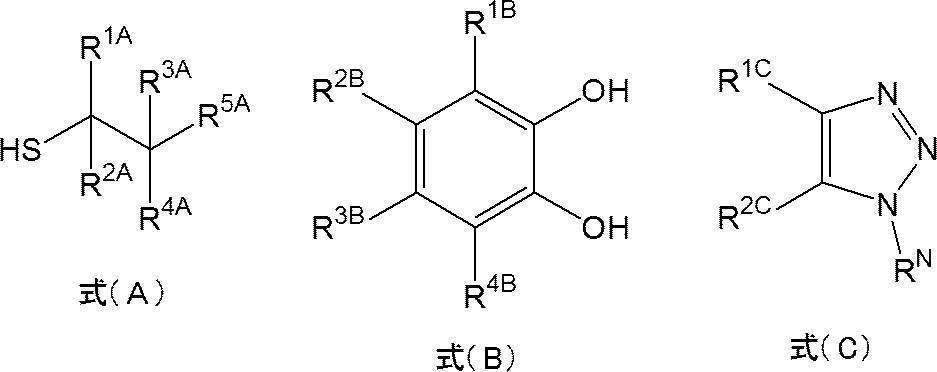
上記式(B)において、R1B~R4Bは、それぞれ独立に、水素原子、置換基若しくは無置換の炭化水素基を表す。
上記式(C)において、R1C、R2C及びRNは、それぞれ独立に、水素原子、置換基若しくは無置換の炭化水素基を表す。また、R1CとR2Cとが結合して環を形成してもよい。
また、置換基としては、例えば、水酸基、カルボキシ基、又は、置換若しくは無置換のアミノ基(置換基としては、炭素数が1~6のアルキル基が好ましく、炭素数が1~3のアルキル基がより好ましい)が挙げられる。
なお、式(A)においては、構造中に水酸基、カルボキシ基及び置換若しくは無置換のアミノ基(置換基としては、炭素数が1~6のアルキル基が好ましく、炭素数が1~3のアルキル基がより好ましい)から選ばれる基を少なくとも1つ含む。
式(A)で表される化合物としては、例えば、1-チオグリセロール、及びL-システイン、チオリンゴ酸等が挙げられる。
式(B)で表される化合物としては、例えば、カテコール、及びt-ブチルカテコール等が挙げられる。
また、R1CとR2Cとが結合して環を形成してもよく、例えば、ベンゼン環が挙げられる。R1CとR2Cとが結合して環を形成した場合、更に置換基(例えば、炭素数1~5の炭化水素基)を有していてもよい。
式(C)で表される化合物としては、例えば、1H-1,2,3-トリアゾール、ベンゾトリアゾール、及び5-メチル-1H-ベンゾトリアゾール等が挙げられる。
腐食防止剤は、単独でも2種類以上適宜組み合わせて用いてもよい。2種以上組み合わせて用いる場合には、その総含有量が上述の範囲内となればよい。
本発明の処理液は、アミン化合物を含むことが好ましい。
アミン化合物としては、特に限定されず、ヒドロキシルアミン、ヒドロキシルアミン塩、及びアルカノールアミン等が挙げられる。
なかでも、基板上の有機膜及び残渣物の分解及び可溶化を促進し、被処理物の腐食をより防止する観点から、ヒドロキシルアミン及びヒドロキシルアミン塩から選ばれる少なくとも1種であることが好ましい。
ヒドロキシルアミンとしては、特に限定はされないが、好ましい態様として、無置換ヒドロキシルアミン及びヒドロキシルアミン誘導体が挙げられる。
ヒドロキシルアミン誘導体としては、特に限定されないが、例えば、O-メチルヒドロキシルアミン、O-エチルヒドロキシルアミン、N-メチルヒドロキシルアミン、N,N-ジメチルヒドロキシルアミン、N,O-ジメチルヒドロキシルアミン、N-エチルヒドロキシルアミン、N,N-ジエチルヒドロキシルアミン、N,O-ジエチルヒドロキシルアミン、O,N,N-トリメチルヒドロキシルアミン、N,N-ジカルボキシエチルヒドロキシルアミン、及びN,N-ジスルホエチルヒドロキシルアミンなどが挙げられる。
ヒドロキシルアミンの塩は、上述したヒドロキシルアミンの無機酸塩又は有機酸塩であることが好ましく、Cl、S、N、及びPなどの非金属が水素と結合してできた無機酸の塩であることがより好ましく、塩酸、硫酸、及び硝酸のいずれかの酸の塩であることが更に好ましい。
本発明の処理液を形成するのに使われるヒドロキシルアミンの塩としては、ヒドロキシルアンモニウム硝酸塩(HANとも称される)、ヒドロキシルアンモニウム硫酸塩(HASとも称される)、ヒドロキシルアミン塩酸塩(HACとも称される)、ヒドロキシルアンモニウムリン酸塩、ヒドロキシルアンモニウム塩酸塩、N,N-ジエチルヒドロキシルアンモニウム硫酸塩、N,N-ジエチルヒドロキシルアンモニウム硝酸塩、又はこれらの混合物が好ましい。
また、ヒドロキシルアミンの有機酸塩も使用することができ、ヒドロキシルアンモニウムクエン酸塩、ヒドロキシルアンモニウムシュウ酸塩、及びヒドロキシルアンモニウムフルオライドなどが例示できる。
なお、本発明の処理液は、ヒドロキシルアミン及びその塩をいずれも含んだ形態であってもよい。上記の化合物を、単独でも2種類以上適宜組み合わせて用いてもよい。
上記の中でも、本願所望の効果が顕著に得られる観点で、ヒドロキシルアミン、又はヒドロキシルアンモニウム硫酸塩が好ましく、ヒドロキシルアンモニウム硫酸塩がより好ましい。
アルカノールアミンは、第一アミン、第二アミン、及び第三アミンのいずれであってもよく、モノアミン、ジアミン、又はトリアミンであることが好ましく、モノアミンがより好ましい。アミンのアルカノール基は炭素原子を1~5個有することが好ましい。
本発明の処理液においては、下記式(2)で表される化合物が好ましい。
式(2): R1R2-N-CH2CH2-O-R3
(式(2)中、R1及びR2は、それぞれ独立に、水素原子、メチル基、エチル基、又はヒドロキシエチル基を表し、R3は、それぞれ独立に、水素原子、又はヒドロキシエチル基を表す。ただし、式中、アルカノール基が少なくとも1つは含まれる)
アルカノールアミンとしては、具体的には、モノエタノールアミン、ジエタノールアミン、トリエタノールアミン、第三ブチルジエタノールアミン、イソプロパノールアミン、2-アミノ-1-プロパノール、3-アミノ-1-プロパノール、イソブタノールアミン、2-アミノ-2-エトキシ-プロパノール、及びジグリコールアミンとしても知られている2-アミノ-2-エトキシ-エタノールが挙げられる。アルカノールアミンは単独でも2種類以上の組み合わせで用いてもよい。
本発明の処理液は、酸化剤を含有してもよい。ここで酸化剤は、酸化作用を有する化合物であればよい。なかでも、残渣物の除去性と絶縁膜などに対する腐食性の両者がより優れるという点から、過酸化水素、過硫酸アンモニウム、塩素酸、亜塩素酸、次亜塩素酸、過塩素酸、過マンガン酸、ヨウ素酸、次亜ヨウ素酸、過ヨウ素酸、及び、オルト過ヨウ素酸からなる群から選ばれる少なくとも1つの化合物が好ましい。本発明においては、特に、過酸化水素又はオルト過ヨウ素酸が好ましい。酸化剤は単独でも2種類以上の組み合わせで用いてもよい。
本発明の処理液は、ハロゲン化物を含んでいてもよい。ハロゲン化物は、残渣物の分解及び可溶化を促進する。
ハロゲン化物は、一種以上のハロゲン元素を含む化合物であり、ハロゲン元素としては、例えば、フッ素、塩素、臭素、及びヨウ素からなる群より選ばれる1種又は2種以上が挙げられる。なかでも、残渣物の分解及び可溶化を促進する観点からフッ化物又は塩化物が好ましく、さらにその効果が優れる観点からフッ化物が特に好ましい。
なお、上述の式NR4BF4で表されるテトラフルオロホウ酸第4級アンモニウム、及びPR4BF4で表されるテトラフルオロホウ酸第4級ホスホニウムにおいて、Rは、互いに同種又は異種であってよい。Rとしては、水素、直鎖、分岐、又は環状のC1~C6アルキル基(例えば、メチル基、エチル基、プロピル基、ブチル基、ペンチル基、及びヘキシル基)、及び、直鎖又は分岐のC6~C10アリール基(例えば、ベンジル基)が挙げられる。
式NR4BF4で表されるテトラフルオロホウ酸第4級アンモニウム及びPR4BF4で表されるテトラフルオロホウ酸第4級ホスホニウムとしては、例えば、テトラフルオロホウ酸テトラメチルアンモニウム、テトラフルオロホウ酸テトラエチルアンモニウム、テトラフルオロホウ酸テトラプロピルアンモニウム、及びテトラフルオロホウ酸テトラブチルアンモニウムが挙げられる。
フッ化物は単独でも2種類以上適宜組み合わせて用いてもよい。
上記の中でも、本願所望の効果が顕著に得られる点で、フッ化アンモニウム、又はフルオロケイ酸が好ましい。
処理液は、更にキレート剤を含んでいてもよい。キレート剤は、残渣物中に含まれる酸化した金属とキレート化する。このため、キレート剤を添加することで処理液のリサイクル性が向上する。
キレート剤としては、特に限定されないが、ポリアミノポリカルボン酸であることが好ましい。
ポリアミノポリカルボン酸は、複数のアミノ基及び複数のカルボン酸基を有する化合物である。ポリアミノポリカルボン酸としては、例えば、モノ-又はポリアルキレンポリアミンポリカルボン酸、ポリアミノアルカンポリカルボン酸、ポリアミノアルカノールポリカルボン酸、及びヒドロキシアルキルエーテルポリアミンポリカルボン酸が挙げられる。
本発明の処理液のpHは特に限定されないが、任意成分としてヒドロキシルアミン及びヒドロキシルアミン塩を含有する場合には、ヒドロキシルアミン及びヒドロキシルアミン塩の共役酸のpKa以上であることが好ましい。ヒドロキシルアミン及びヒドロキシルアミン塩の共役酸のpKa以上であることで、残渣物除去性が飛躍的に向上する。言い換えると、処理液中でヒドロキシルアミン及びヒドロキシルアミン塩が分子状態で存在している比率が多い場合に、残渣物除去性により優れる。例えば、ヒドロキシルアミンの共役酸のpKaは約6である。
pH調整剤は単独でも2種類以上適宜組み合わせて用いてもよい。
本発明の処理液は、本発明の効果を奏する範囲で、その他の添加剤を含有していてもよい。その他の添加剤としては、例えば、後述する界面活性剤、消泡剤、防錆剤、及び防腐剤などが挙げられる。
本発明の処理液は、その原料を複数に分割したキットとしてもよい。特に、処理液が、任意成分としてアミン化合物であるヒドロキシルアミン及びヒドロキシルアミン塩を含有する場合、又は、酸化剤と4級アンモニウム塩を含有する場合にはキットとすることが好ましい。
特に限定はされないが、処理液をキットとする具体的な方法としては、例えば、第1液としてヒドロキシルアミン及びヒドロキシルアミン塩から選ばれる少なくとも1種のヒドロキシルアミン化合物を水に含有する液組成物を準備し、第2液として他の成分を含有する液組成物を準備する態様が挙げられる。その使用例としては、両液を混合して処理液を調液し、その後、適時に上記処理に適用する態様が好ましい。親水性有機溶剤、無機陰イオン、及び4級アンモニウム塩等はどちらに含有させてもよい。このようにすることで、ヒドロキシルアミン化合物又はその他の成分の分解による液性能の劣化を招かずにすみ、所望の作用を効果的に発揮させることができる。第1液及び第2液における各成分の含有量は、先に述べた含有量に基づいて、混合後の含有量として適宜設定できる。
また他の例としては、第1液として4級アンモニウム塩を含有する液組成物を準備し、第2液として酸化剤を含有する液組成物を準備する態様が挙げられる。両液を混合して処理液を調液し、その後、適時に上記処理に適用する態様が好ましい。親水性有機溶剤、無機陰イオンなどの他の成分はどちらに含有させてもよい。このようにすることで、酸化剤又はその他の成分の分解による液性能の劣化を招かずにすみ、所望の作用を効果的に発揮させることができる。第1液及び第2液における各成分の含有量は、先に述べた含有量に基づいて、混合後の含有量として適宜設定できる。
また、処理液は、濃縮液として準備してもよい。この場合、使用時に水で希釈して使用することができる。
本発明の処理液は、(キットであるか否かに関わらず)腐食性等が問題とならない限り、任意の容器に充填して保管、運搬、そして使用することができる。容器としては、半導体用途向けに、クリーン度が高く、不純物の溶出が少ないものが好ましい。使用可能な容器としては、アイセロ化学(株)製の「クリーンボトル」シリーズ、及びコダマ樹脂工業(株)製の「ピュアボトル」などが挙げられるが、これらに限定されない。この容器の内壁は、ポリエチレン樹脂、ポリプロピレン樹脂、及び、ポリエチレン-ポリプロピレン樹脂からなる群より選択される1種以上の樹脂とは異なる樹脂、又は、防錆・金属溶出防止処理が施された金属から形成されることが好ましい。
上記の異なる樹脂としては、フッ素系樹脂(パーフルオロ樹脂)を好ましく用いることができる。このように、内壁がフッ素系樹脂である容器を用いることで、内壁が、ポリエチレン樹脂、ポリプロピレン樹脂、又は、ポリエチレン-ポリプロピレン樹脂である容器を用いる場合と比べて、エチレン及びプロピレンのオリゴマーの溶出という不具合の発生を抑制できる。
このような内壁がフッ素系樹脂である容器の具体例としては、例えば、Entegris社製 FluoroPurePFA複合ドラム等が挙げられる。また、特表平3-502677号公報の第4頁等、国際公開第2004/016526号パンフレットの第3頁等、国際公開第99/46309号パンフレットの第9及び16頁等、などに記載の容器も用いることができる。
本発明の処理液は、異物の除去又は欠陥の低減などの目的で、フィルタで濾過されたものであることが好ましい。
フィルタの材質としては、従来からろ過用途等に用いられているものであれば特に限定されることなく用いることができる。例えば、PTFE(ポリテトラフルオロエチレン)等のフッ素樹脂、ナイロン等のポリアミド系樹脂、並びに、ポリエチレン、及びポリプロピレン(PP)等のポリオレフィン樹脂(高密度、超高分子量を含む)等によるフィルタが挙げられる。これら材質の中でもポリプロピレン(高密度ポリプロピレンを含む)、又はナイロンが好ましい。
フィルタの孔径は、0.001~1.0μm程度が適しており、好ましくは0.02~0.5μm程度、より好ましくは0.01~0.1μm程度である。この範囲とすることにより、ろ過詰まりを抑えつつ、処理液に含まれる不純物又は凝集物など、微細な異物を確実に除去することが可能となる。
フィルタを使用する際、異なるフィルタを組み合わせてもよい。その際、各々のフィルタでのフィルタリングは、1回のみでもよいし、2回以上行ってもよい。この2回以上のフィルタリングとは、例えば、液を循環させて、同一のフィルタで2回以上のフィルタリングを行う場合を意味する。
第2のフィルタは、上述した第1のフィルタと同様の材質等で形成されたフィルタを使用できる。第2のフィルタの孔径は、0.01~1.0μm程度が適しており、好ましくは0.1~0.5μm程度である。この範囲とすることにより、液中に成分粒子が含有されている場合には、この成分粒子を残存させたまま、液中に混入している異物を除去できる。
例えば、最終的に調製される処理液の一部の成分のみを予め混合して混合液を調製し、この混合液に対して第1のフィルタによるフィルタリングを実施した後、上記第1のフィルタによるフィルタリング後の混合液に処理液を構成するための残りの成分を添加し、この混合液に対し第2のフィルタリングを行ってもよい。
本発明の処理液は、液中に不純物として含まれるメタル(Na、K、Ca、Cu、Mg、Mn、Li、Al、Cr、Ni、Fe、Co、及び、Znの金属元素)のイオン濃度がいずれも5ppm以下(好ましくは1ppm以下)であることが好ましい。特に、最先端の半導体素子の製造においては、更に高純度の処理液が求められることが想定されることから、そのメタル濃度がppmオーダーよりも更に低い値、すなわち、ppbオーダー以下であることがより好ましく、pptオーダー(上記濃度はいずれも質量基準)であることが更に好ましく、実質的に含まないことが特に好ましい。
メタル濃度の低減方法のその他の方法としては、処理液の製造に使用する原材料を収容する「容器」について、処理液を収容する容器の説明を行った項で示したような、不純物の溶出が少ない容器を用いることが挙げられる。また、処理液の調製時の「配管」などからメタル分が溶出しないように、配管内壁にフッ素系樹脂のライニングを施すなどの方法も挙げられる。
本発明の処理液は、その使用用途に鑑み、液中の不純物、例えば金属分などは少ないことが好ましい。特に、液中のNa、K、Caイオン濃度が5ppm以下(質量基準)の範囲にあることがより好ましい。
また、処理液において、粗大粒子は実質的に含まないことが好ましい。
なお、処理液に含まれる粗大粒子とは、原料に不純物として含まれる塵、埃、有機固形物、及び無機固形物などの粒子、並びに、処理液の調製中に汚染物として持ち込まれる塵、埃、有機固形物、及び無機固形物などの粒子などであり、最終的に処理液中で溶解せずに粒子として存在するものが該当する。処理液中に存在する粗大粒子の量は、レーザを光源とした光散乱式液中粒子測定方式における市販の測定装置を利用して液相で測定することができる。
本発明の処理液を用いた処理用途及び被処理物は特に限定されないが、基板上の有機膜(例えば、エッチング時にマスクとして用いられた各種レジスト、及び永久膜等)の剥離除去、又は、基板上に付着したドライエッチング残渣物若しくはドライアッシング残渣物の洗浄除去に好ましく用いることができる。
つまり、本発明の処理液は、剥離液、洗浄液、及びリンス液などに好適に適用できる。
被処理物中における基板としては、特に限定されず、シリコン基板(Si基板)、酸化シリコン基板(SiO基板)、及び窒化シリコン基板(SiN基板)などが挙げられる。また、基板は、ウェハのみではなくそこに回路構造が施された基板構造体全体を含むものであってもよい。特に、本発明の処理液は、基板に配置された電極又は配線等の金属材料(例えば、電極材料)に対する腐食性が抑制されているため、回路構造が施された基板に好ましく適用することができる。
基板のウェハサイズは、特に限定されないが、直径8インチ、直径12インチ、又は直径14インチのものを好適に使用することができる(1インチ=25.4mm)。
以下、本発明の処理液を上記各用途に適用する形態についてそれぞれ説明する。
(永久膜除去方法)
本発明の処理液を用いた永久膜除去方法は、永久膜が設けられた上記基板に対して、上記処理液を付与する工程を有することができる。これにより、永久膜内部、及び永久膜と基板との界面に上述した処理液が浸透して、永久膜を剥離除去することができる。
具体的には、上記装置の導入口に導入された上記処理液は、上記導入口に接続された流路を介して吐出口に達し、この吐出口から吐出されて、処理容器(例えば、処理槽)内に載置された基板に付着する。なお、流路は、処理液を再利用するための経路を有していてもよい。基板は、回転駆動部を有する回転テーブル上に載置されていてもよく、処理液を付着させる際又は付着させた後に回転テーブルとともに回転させてもよい。
上記の枚葉式装置を使用する利点としては、常に新鮮な処理液が供給されるので再現性がよいこと、及び面内の均一処理性が高いこと等が挙げられる。
枚葉式装置は、その処理槽にノズルを具備することが好ましい。基板に処理液を付与する方法としては、上記ノズルを基板の面方向にスイングさせながら処理液を吐出させて、これを基板に付与する方法が挙げられる。この方法を用いれば、処理液の劣化が防止できるという点で好ましい。
なお、処理温度は、枚葉式装置においては以下の条件で測定する。株式会社堀場製作所製の放射温度計IT-550F(商品名)を上記枚葉式装置内のウェハ上30cmの高さに固定する。ウェハ中心から2cm外側のウェハ表面上に温度計を向け、処理液を流しながら温度を計測する。温度は、放射温度計からデジタル出力し、パソコンで連続的に記録する。このうち温度が安定した10秒間の温度を平均した値をウェハ上の温度とする。保存温度又はバッチ処理で管理する場合には、そのタンク内の温度を所定時間(例えば1分間)安定するまで保持して設定することができる。循環系で管理する場合には、循環流路内の温度で所定時間(例えば1分間)安定するまで保持して設定してもよい。
基板を回転させるときには、その大きさ等にもよるが、上記と同様の観点から、50~1000rpmで回転させることが好ましい。
吐出口(ノズル)を移動させる際の移動速度は、特に限定されないが、0.1cm/s以上であることが好ましく、1cm/s以上であることがより好ましい。その上限としては、30cm/s以下であることが好ましく、15cm/s以下であることがより好ましい。移動軌跡線は、直線でも曲線(例えば円弧状)でもよい。いずれの場合にも、移動速度は、実際の軌跡線の距離とその移動に費やされた時間から算出することができる。基板1枚の処理に要する時間は、10~1200秒の範囲であることが好ましい。
このような浸漬法の具体例としては、永久膜が設けられた基板を処理槽内の処理液に浸漬させて、上記処理槽内で基板と処理液とを接触させる方法が挙げられる。基板を浸漬する際の処理液の温度については、上述した永久膜除去方法における処理温度で示した通りである。また、これ以外の条件(例えば、基板を浸漬させる時間など)は、適宜設定することができ、特に限定されるものではない。
ここで、半導体基板製品とは、上記基板を用いて、リソグラフィ工程などの工程を経て得られる半導体素子を含む製品の総称である。
このような永久膜は、半導体基板製品の製造時においてエッチング工程後に除去されるレジストとは異なり、現像によっても溶けずに残り、加工後に除去されることが想定されておらず、これの除去は困難となることが予想される。しかしながら、本発明の処理液を用いれば、永久膜を良好に除去することができる。
更に、本発明の処理液は、基板上に形成された永久膜の除去のみならず、半導体基板製品の製造時においてエッチング時にマスクとして用いられた各種レジストの剥離除去液としても適用することができる。つまり、現像などの処理によって溶解するレジスト及びこの残渣物を除去するための剥離除去液として用いることができる。上記各種レジストの剥離除去においても、永久膜と同様の方法で実施することができる。また、フォトレジストの材料は、特に限定されず、公知の材料を用いることができる。
水と、
親水性有機溶剤と、
4級アンモニウム塩と、
処理液全質量に対して0.001質量ppt~1質量ppmの無機陰イオンと、を含み、
更に、下記(1)~(3)から選ばれるいずれか少なくとも1種の態様であることが好ましい。
(2)上記親水性有機溶剤として、非プロトン性極性溶媒、又は、スルホン系溶剤を含む。
(3)処理液が、更に、界面活性剤を含む。
非プロトン性極性有機溶剤としては、ジメチルスルホキシド(以下DMSOと略す)、スルホラン、ジメチルスルホン、N,N-ジメチルホルムアミド(DMF)、N,N-ジメチルアセトアミド、N,N-ジエチルアセトアミド、N-メチル-2-ピロリドン(以下NMPと略す)、N-ビニル-2-ピロリドン、ε-カプロラクタム、1,3-ジメチル-2-イミダゾリジノン、テトラメチル尿素、ヘキサメチルリン酸トリアミド、γ-ブチロラクトン、δ-バレロラクトン、ε-カプロラクトン、アセトニトリル、ピリジン、ジメトキシエタン、ジグライム、トリグライム、エチレンカーボネート、及び、プロピレンカーボネート等が挙げられる。この中でも、剥離性、浸透性の点でDMSO及びNMPが好ましく、DMSOがより好ましい。処理液がジメチルスルホキシドを含むことで、疎水性のレジスト及び疎水性の材料に接して形成されたレジストの除去性がより優れたものとなり、かつ、電極のダメージをより抑制できる。これらの非プロトン性極性有機溶剤は、単独で用いてもよく、2種以上を混合して用いてもよい。
ノニオン性界面活性剤としては、例えば、ポリアルキレンオキサイドアルキルフェニルエーテル系界面活性剤、ポリアルキレンオキサイドアルキルエーテル系界面活性剤、ポリエチレンオキサイドとポリプロピレンオキサイドからなるブロックポリマー系界面活性剤、ポリオキシアルキレンジスチレン化フェニルエーテル系界面活性剤、ポリアルキレントリベンジルフェニルエーテル系界面活性剤、及びアセチレンポリアルキレンオキサイド系界面活性剤が挙げられる。
アニオン性界面活性剤としては、アルキル硫酸エステル、アルキルスルホン酸、アルキルベンゼンスルホン酸、アルキルナフタレンスルホン酸、アルキルジフェニルエーテルスルホン酸、ポリオキシエチレンアルキルエーテルカルボン酸、ポリオキシエチレンアルキルエーテル酢酸、ポリオキシエチレンアルキルエーテルプロピオン酸、及びそれらの塩が挙げられる。
カチオン性界面活性剤としては、第4級アンモニウム塩系界面活性剤、及びアルキルピリジウム系界面活性剤が挙げられる。
両性界面活性剤としては、ベタイン型界面活性剤、アミノ酸型界面活性剤、イミダゾリン型界面活性剤、及びアミンオキサイド型界面活性剤が挙げられる。
以下、上述した本発明の処理液の処理対象として好ましい永久膜及びレジスト膜、さらに上記各膜が配置される基板について詳述する。
本発明の処理液を用いた永久膜除去及びレジスト剥離除去において、その表面にレジストが配置される基板としては、上述した基板を用いることができる。
本発明の処理液を用いたレジスト剥離除去においては、処理対象となるレジスト膜は特に限定されないが、例えば、ポジ型、ネガ型、及びポジ-ネガ兼用型のフォトレジストが挙げられる。
ポジ型レジストの具体例は、(メタ)アクリレート樹脂系、ケイ皮酸ビニール系、環化ポリイソブチレン系、アゾ-ノボラック樹脂系、及びジアゾケトン-ノボラック樹脂系のほか、ノボラック系樹脂及びポリヒドロキシスチレン系樹脂の少なくとも一方の樹脂などが挙げられる。
ネガ型レジストの具体例は、アジド-環化ポリイソプレン系、アジド-フェノール樹脂系、クロロメチルポリスチレン系などが挙げられる。さらに、ポジ-ネガ兼用型レジストの具体例は、ポリ(p-ブトキシカルボニルオキシスチレン)系などが挙げられる。
その他、パターニング用のレジストの例として、特許5222804、特許5244740、特許5244933、特許5286236、特許5210755、特許5277128、特許5303604、特許5216892、特許5531139、特許5531078、及び特許5155803号の各公報に開示されたものを参照することができ、本明細書に引用して取り込む。
本発明の処理液を用いた永久膜除去方法において、処理対象となる永久膜は特に限定されないが、例えば、カラーフィルタ用のレジスト(以下、「カラーレジスト」ともいう。)が挙げられる。以下、本発明の処理液を好ましく適用できるカラーレジストについて詳述する。
以下に、カラーフィルタの形成材料と形成方法ついて、その一例を挙げて詳細に説明する。
アルカリ可溶性樹脂としては、分子中に少なくとも1つのアルカリ可溶性を促進する基を有するものが好ましい。耐熱性の観点からは、ポリヒドロキシスチレン系樹脂、ポリシロキサン系樹脂、アクリル系樹脂、アクリルアミド系樹脂、又は、アクリル/アクリルアミド共重合体樹脂が好ましい。現像性制御の観点からは、アクリル系樹脂、アクリルアミド系樹脂、又は、アクリル/アクリルアミド共重合体樹脂が好ましい。アルカリ可溶性を促進する基(以下、酸性基ともいう)としては、例えば、カルボキシ基、リン酸基、スルホン酸基、及びフェノール性水酸基などが挙げられる。溶媒に可溶で弱アルカリ水溶液により現像可能なものが好ましく、(メタ)アクリル酸が特に好ましいものとして挙げられる。これら酸性基は、1種のみであってもよいし、2種以上であってもよい。
アルカリ可溶性樹脂としては、主鎖もしくは側鎖にカルボキシ基を有するポリマーが好ましい。具体的には、メタクリル酸共重合体、アクリル酸共重合体、イタコン酸共重合体、クロトン酸共重合体、マレイン酸共重合体、部分エステル化マレイン酸共重合体、及びノボラック型樹脂などのアルカリ可溶性フェノール樹脂等のほか、側鎖にカルボン酸を有する酸性セルロース誘導体、及び水酸基を有するポリマーに酸無水物を付加させたもの挙げられる。特に、(メタ)アクリル酸と、これと共重合可能な他の単量体との共重合体が好適である。(メタ)アクリル酸と共重合可能な他の単量体としては、アルキル(メタ)アクリレート、アリール(メタ)アクリレート、及びビニル化合物などが挙げられる。アルキル(メタ)アクリレート及びアリール(メタ)アクリレートとしては、メチル(メタ)アクリレート、エチル(メタ)アクリレート、プロピル(メタ)アクリレート、n-ブチル(メタ)アクリレート、イソブチル(メタ)アクリレート、(イソ)ペンチル(メタ)アクリレート、2-ヒドロキシエチル(メタ)アクリレート、2-ヒドロキシプロピル(メタ)アクリレート、ヘキシル(メタ)アクリレート、オクチル(メタ)アクリレート、フェニル(メタ)アクリレート、ベンジル(メタ)アクリレート、トリル(メタ)アクリレート、ナフチル(メタ)アクリレート、及びシクロヘキシル(メタ)アクリレート等が挙げられる。ビニル化合物としては、スチレン、α-メチルスチレン、ビニルトルエン、グリシジルメタクリレート、アクリロニトリル、ビニルアセテート、N-ビニルピロリドン、テトラヒドロフルフリルメタクリレート、ポリスチレンマクロモノマー、ポリメチルメタクリレートマクロモノマー等が挙げられる。特開平10-300922号公報に記載のN位置換マレイミドモノマーとして、N-フェニルマレイミド、N-シクロヘキシルマレイミド等が挙げられる。
アルカリ可溶性樹脂としては、重合性基を有することも好ましい。重合性基としては、エチレン性不飽和結合性基が挙げられる。具体的には、(メタ)アクリロイル基、又はビニル基が好ましく、(メタ)アクリロイル基がより好ましい。アクリル系ポリマーは、(メタ)アクリル酸、(メタ)アクリル酸エステル、及び(メタ)アクリルアミドのいずれか1種以上由来の繰り返し単位を有するビニル重合体が好ましい。


RX1、RY1は、水素原子、メチル基、エチル基、プロピル基、又はシアノ基であり、水素原子又はメチル基が好ましい。
RAは、酸性基である。その好ましいものは、上記と同義である。
RY2は、置換基を表し、中でも、アルキル基(炭素数1~12が好ましく、炭素数1~6がより好ましく、炭素数1~3が特に好ましい)、アリール基(炭素数6~22が好ましく、炭素数6~14がより好ましく、炭素数6~10が特に好ましい)、アラルキル基(炭素数7~23が好ましく、炭素数7~15がより好ましく、炭素数7~11が特に好ましい)が好ましい。これらの基はさらに置換基を有してもよく、さらなる置換基としては、ヒドロキシル基、及びカルボキシ基等が挙げられる。
nx、nyはモル分率であり、nx+nyは1未満でもよいが(他の繰り返し単位を有してよいという意味)、1であることが好ましい。nxは下限としては、0.05以上が好ましく、0.1以上がより好ましく、0.2以上が更に好ましい。上限としては、0.7以下が好ましく、0.6以下がより好ましく、0.5以下が更に好ましい。nyは下限としては0.3以上が好ましく、0.4以上がより好ましく、0.6以上が更に好ましい。上限としては、0.9以下が好ましく、0.8以下がより好ましい。
アルカリ可溶性樹脂の重量平均分子量(Mw)としては、2000~50000が好ましく、7000~20000が特に好ましい。
アルカリ可溶性樹脂の含有量としては、着色硬化性樹脂組成物の全固形分に対して、10~50質量%が好ましく、より好ましくは15~40質量%であり、特に好ましくは20~35質量%である。
アルカリ可溶性樹脂は、1種を単独で用いても2種以上を組み合わせて用いてもよい。
重合性化合物は、分子内に重合性基を有する化合物であればよいが、なかでもエチレン性不飽和二重結合を有するモノマー(以下、「特定モノマー」ということがある)が好ましい。特定モノマーは、多官能のモノマーであることが好ましい。
特定モノマーは、1種単独で用いてもよいし、2種以上を併用してもよい。
特定モノマーは、(メタ)アクリレートモノマーが好ましい。これらの具体的な化合物としては、特開2009-288705号公報の段落番号0095~0108に記載されている化合物を本実施形態においても好適に用いることができる。特定モノマーは、さらに、下記式(MO-1)~(MO-6)で表されるものであることが好ましい。
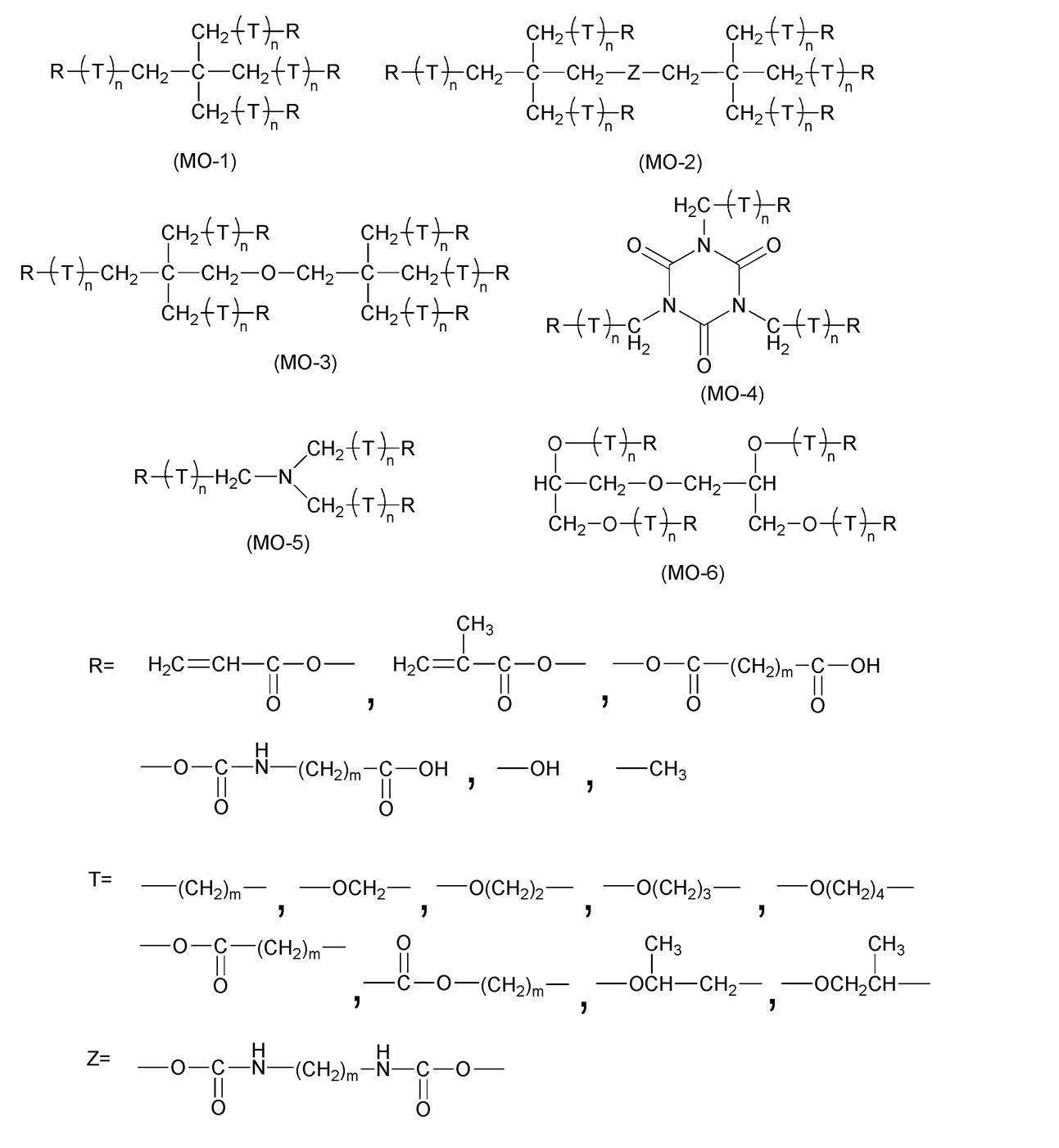
mは、1~5が好ましく、1~3がより好ましい。
上記式(MO-1)~(MO-6)で表される重合性化合物の具体例としては、特開2007-269779号公報の段落番号0248~0251に記載されている化合物を、本実施形態においても好適に用いることができる。
重合性化合物の分子量は、特に限定されないが、300以上1500以下であることが好ましく、400以上700以下であることがより好ましい。
組成物中の全固形分に対して、重合性化合物の含有率は、1~50質量%の範囲であることが好ましく、3~40質量%の範囲であることがより好ましく、5~30質量%の範囲であることがさらに好ましい。この範囲内であると、屈折率及び透明性を過度に低下させることなく、硬化性が良好で好ましい。重合性化合物は、1種を単独で用いても2種以上を組み合わせて用いてもよい。
重合開始剤としては、熱重合開始剤でも光重合開始剤でもよいが、光重合性開始剤が好ましい。例えば、有機ハロゲン化化合物、オキシジアゾール化合物、カルボニル化合物、ケタール化合物、ベンゾイン化合物、アクリジン化合物、有機過酸化化合物、アゾ化合物、クマリン化合物、アジド化合物、メタロセン化合物、ヘキサアリールビイミダゾール化合物、有機ホウ酸化合物、ジスルホン酸化合物、オキシム化合物、オニウム塩化合物、ヒドロキシアセトフェノン化合物、アミノアセトフェノン化合物、アシルホスフィンオキシド化合物、トリハロメチルトリアジン化合物、ベンジルジメチルケタール化合物、α-ヒドロキシケトン化合物、α-アミノケトン化合物、アシルホスフィン化合物、フォスフィンオキサイド化合物、メタロセン化合物、トリアリルイミダゾールダイマー、オニウム化合物、ベンゾチアゾール化合物、ベンゾフェノン化合物、シクロペンタジエン-ベンゼン-鉄錯体化合物、ハロメチルオキサジアゾール化合物、3-アリール置換クマリン化合物、α-アミノアルキルフェノン化合物、及び安息香酸エステル化合物が挙げられる。
これらの具体例として、特開2010-106268号公報の段落[0135](対応する米国特許出願公開第2011/0124824号明細書の[0163])以降の記載を参酌でき、これらの内容は本願明細書に組み込まれる。

重合開始剤は、必要に応じて2種以上を組み合わせて使用しても良い。
着色剤は、特に限定されるものではなく、種々の染料及び顔料を用いることができる。例えば、カラーフィルタの色画素を形成する赤色、マゼンタ色、黄色、青色、シアン色及び緑色等の有彩色系の着色剤(有彩色着色剤)、並びにブラックマトリクス形成用に一般に用いられている黒色系の着色剤(黒色着色剤)のいずれをも用いることができる。本実施形態では、着色剤が、赤色、マゼンタ色、黄色、青色、シアン色及び緑色から選択される少なくとも1種であることが好ましい。
無機顔料としては、金属酸化物、金属錯塩等で示される金属化合物を挙げることができ、具体的には、鉄、コバルト、アルミニウム、カドミウム、鉛、銅、チタン、マグネシウム、クロム、亜鉛、アンチモン、銀等の金属酸化物、及び上記金属の複合酸化物を挙げることができる。チタンの窒化物、銀錫化合物、及び銀化合物なども使用することができる。
有機顔料としては、ペリレン顔料、ペリノン顔料、キナクリドン顔料、キナクリドンキノン顔料、アントラキノン顔料、アントアントロン顔料、ベンズイミダゾロン顔料、ジスアゾ顔料、アゾ顔料、インダントロン顔料、フタロシアニン顔料、トリアリールカルボニウム顔料、ジオキサジン顔料、アミノアントラキノン顔料、ジケトピロロピロール顔料、インジゴ顔料、チオインジゴ顔料、イソインドリン顔料、イソインドリノン顔料、ピラントロン顔料、及びイソビオラントロン顔料が挙げられる。
染料としては、例えば、トリアリールメタン系、ピラゾールアゾ系、アニリノアゾ系、トリフェニルメタン系、アントラキノン系、アンスラピリドン系、ベンジリデン系、オキソノール系、ピラゾロトリアゾールアゾ系、ピリドンアゾ系、シアニン系、フェノチアジン系、アゾメチン系、ピロロピラゾールアゾメチン系、キサテン系、フタロシアニン系、ベンゾピラン系、インジゴ系、及びピロメテン系等の染料が使用できる。また、これらの染料の多量体を用いてもよい。
上記粒径の測定は、動的光散乱式粒径分布測定装置(日機装製 ナノトラック(Nanotrac) Wave-EX150[商品名])、株式会社堀場製作所社製 LB-500[商品名])を用いて行う。手順は以下のとおりである。試料分散物を20mlサンプル瓶に分取し、不溶性の溶媒(例えば水)により固形成分濃度が0.2質量%になるように希釈する。温度25℃で2mlの測定用石英セルを使用してデータ取り込みを50回行い、得られた「数平均」を平均粒子径とした。その他の詳細な条件等は必要によりJISZ8828:2013「粒子径解析-動的光散乱法」の記載を参照することができる。
着色硬化性樹脂組成物には分散剤を含有させてもよい。分散剤としては、高分子分散剤(例えば、ポリアミドアミンとその塩、ポリカルボン酸とその塩、高分子量不飽和酸エステル、変性ポリウレタン、変性ポリエステル、変性ポリ(メタ)アクリレート、(メタ)アクリル系共重合体、及びナフタレンスルホン酸ホルマリン縮合物)、及び、ポリオキシエチレンアルキルリン酸エステル、ポリオキシエチレンアルキルアミン、アルカノールアミン、顔料分散剤等を挙げることができる。
高分子分散剤は、その構造からさらに直鎖状高分子、末端変性型高分子、グラフト型高分子、及びブロック型高分子に分類することができる。
顔料分散剤の具体例としては、BYK Chemie社製「Disperbyk-101(ポリアミドアミン燐酸塩)、107(カルボン酸エステル)、110(酸基を含む共重合物)、130(ポリアミド)、161、162、163、164、165、166、170(高分子共重合物)」、「BYK-P104、P105(高分子量不飽和ポリカルボン酸)、BYK2001」、EFKA社製「EFKA4047、4050、4010、4165(ポリウレタン系)、EFKA4330、4340(ブロック共重合体)、4400、4402(変性ポリアクリレート)、5010(ポリエステルアミド)、5765(高分子量ポリカルボン酸塩)、6220(脂肪酸ポリエステル)、6745(フタロシアニン誘導体)、6750(アゾ顔料誘導体)」、味の素ファンテクノ社製「アジスパーPB821、PB822」、共栄社化学社製「フローレンTG-710(ウレタンオリゴマー)」、「ポリフローNo.50E、No.300(アクリル系共重合体)」、楠本化成社製「ディスパロンKS-860、873SN、874、#2150(脂肪族多価カルボン酸)、#7004(ポリエーテルエステル)、DA-703-50、DA-705、DA-725」、花王社製「デモールRN、N(ナフタレンスルホン酸ホルマリン重縮合物)、MS、C、SN-B(芳香族スルホン酸ホルマリン重縮合物)」、「ホモゲノールL-18(高分子ポリカルボン酸)」、「エマルゲン920、930、935、985(ポリオキシエチレンノニルフェニルエーテル)」、「アセタミン86(ステアリルアミンアセテート)」、ルーブリゾール社製「ソルスパース5000(フタロシアニン誘導体)、22000(アゾ顔料誘導体)、13240(ポリエステルアミン)、3000、17000、27000(末端部に機能部を有する高分子)、24000、28000、32000、38500(グラフト型高分子)」、及び、日光ケミカル社製「ニッコールT106(ポリオキシエチレンソルビタンモノオレート)、MYS-IEX(ポリオキシエチレンモノステアレート)」等が挙げられる。
分散剤は、単独で使用してもよく、2種以上を組み合わせて使用してもよい。
着色硬化性樹脂組成物には、塗布性をより向上させる観点から、各種の界面活性剤を添加してもよい。界面活性剤としては、フッ素系界面活性剤、ノニオン系界面活性剤、カチオン系界面活性剤、アニオン系界面活性剤、及びシリコーン系界面活性剤などの各種界面活性剤を使用できる。
界面活性剤の含有する場合の含有量は、着色硬化性樹脂組成物の固形分全質量に対して、1~40質量%の範囲であることが好ましく、5~20質量%がより好ましい。
着色硬化性樹脂組成物の調製及びその硬化膜の形成については、一般的な方法によればよいが、以下では、着色硬化性樹脂組成物を用いたカラーフィルタの形成を例にさらに詳述する。
カラーフィルタを形成する際の支持体としては、例えば、基板(例えば、シリコン基板)上にCCD(Charge Coupled Device)及びCMOS(Complementary Metal-Oxide Semiconductor)等の撮像素子(受光素子)が設けられた固体撮像素子用基板などの、上述した基板を用いることができる。
着色パターンは、固体撮像素子用基板の撮像素子形成面側(おもて面)に形成されてもよいし、撮像素子非形成面側(裏面)に形成されてもよい。
固体撮像素子用基板における各撮像素子間及び固体撮像素子用基板の裏面には、遮光膜が設けられていてもよい。また、支持体上には、上部の層との密着改良、物質の拡散防止又は基板表面の平坦化のために、部分的に下塗り層を設けてもよい。下塗り層を設けた部分及び設けなかった部分のいずれにもカラーフィルタを形成することで、親水性の層上のカラーフィルタと、疎水性の層上のカラーフィルタと、を1つの基板上に併存させることができる。
ここで、下塗り層には、後述するオーバーコート層を用いることができる。
支持体上への着色硬化性樹脂組成物の適用方法としては、スリット塗布、インクジェット法、回転塗布、流延塗布、ロール塗布、スクリーン印刷法等の各種の塗布方法を適用することができる。
本発明において好ましく適用できるカラーフィルタの製造方法及び材料としては、特開2014-199272号、特開2013-064999号、特開2013-064998号、特開2013-064993号、特開2013-054081号、特開2013-040240号、特開2012-136669号、特開2012-012498号、特開2011-252046号、特開2011-252045号、特開2011-252044号、特開2011-162781号、特開2011-144299号、特開2011-144298号、特開2011-127044号、特開2011-127043号、特開2011-084726号、特開2010-244028号、特開2010-159409号、特開2010-155983号、特開2010-085979号、特開2010-084135号、特開2009-244320号、特開2006-058821号、及び特開2004-117856号などの記載を参照することができ、本明細書に引用して取り込む。
着色パターン(着色画素)のサイズ(パターン幅)としては、5μm以下が好ましく、4μm以下がより好ましく、3μm以下が特に好ましい。下限としては、0.1μm以上が実際的である。
この程度の膜厚及びサイズがカラーフィルタとして一般的であり、本発明の処理液によれば、上記のようなカラーフィルタに対しても十分な除去効果が得られる。
上記のカラーフィルタを永久膜として用いる場合において、着色硬化性樹脂組成物層の形成工程の前に、基板(支持体)上にオーバーコート層を形成する工程を有してもよい。
オーバーコート層の形成には、例えば、国際公開第2010/010899号、特許第4269480号公報、特開2005-227525号公報、特開2000-250217号公報、特開平9-221602号公報、及び特開2001-343748号公報に基づいて、エポキシ系感放射線性樹脂組成物(オーバーコート形成用組成物)を用いて行うことができる。
以下、オーバーコート層の形成する工程の具体例を示す。
組成物溶液の塗布方法としては、例えば、スプレー法、ロールコート法、回転塗布法(スピンコート法)、スリットダイ塗布法、バー塗布法、及びインクジェット法等の適宜の方法を採用することができるが、特に、スピンコート法、又はスリットダイ塗布法が好ましい。
プレベークの条件は、各構成成分の種類、配合割合などによっても異なるが、通常、80~120℃で1~15分間程度である。
基板としては、窒化シリコン基板を用いることが好ましい。
露光に使用される放射線としては、可視光線、紫外線、遠紫外線、荷電粒子線、及びX線等の放射線を適宜に選択して使用することができるが、波長が190~450nmの範囲にある放射線が好ましい。
現像方法としては、例えば、液盛り法、浸漬法、及びシャワー法等のいずれでもよい。現像時間は、通常、常温で30~180秒間程度である。
現像液としては、例えば、水酸化ナトリウム、水酸化カリウム、炭酸ナトリウム、ケイ酸ナトリウム、メタケイ酸ナトリウム、及びアンモニア等の無機アルカリ類;エチルアミン、及びn-プロピルアミン等の1級アミン類;ジエチルアミン、及びジ-n-プロピルアミン等の2級アミン類;トリメチルアミン、メチルジエチルアミン、エチルジメチルアミン、及びトリエチルアミン等の3級アミン類;ジメチルエタノールアミン、メチルジエタノールアミン、及びトリエタノールアミン等の3級アルカノールアミン類;ピロール、ピペリジン、N-メチルピペリジン、N-メチルピロリジン、1,8-ジアザビシクロ[5.4.0]-7-ウンデセン、及び1,5-ジアザビシクロ[4.3.0]-5-ノネン等の脂環族3級アミン類;ピリジン、コリジン、ルチジン、及びキノリン等の芳香族3級アミン類;水酸化テトラメチルアンモニウム、及び水酸化テトラエチルアンモニウム等の第4級アンモニウム化合物等のアルカリ性化合物の水溶液(アルカリ水溶液)を使用することができる。
また、上記アルカリ水溶液には、メタノール及びエタノール等の水溶性有機溶媒、並びに/又は界面活性剤を適当量添加することもできる。
現像後、例えば流水洗浄等により、例えば30~90秒間洗浄して、不要な部分を除去したのち、圧縮空気又は圧縮窒素を吹きつけて乾燥させることにより、所定のパターンが形成される。
本発明の処理液は、上述のとおり、半導体基板製品の製造時又は製造後に適用される。
半導体基板製品の製造時又は製造後において、半導体基板製品に修復が必要な部分(レジスト又は永久膜)が発見されることがある。この場合には、修復が必要な部分を除去することで、基板を再生することができる。
つまり、本発明の基板の再生方法は、半導体基板製品の製造時又は製造後に、基板上に設けられた永久膜又はレジスト膜を本発明の処理液で除去することにより、上記半導体基板製品から上記永久膜又はレジスト膜が除去された基板を得る工程を含むものである。
また、本発明の処理液は、基板上に付着したドライエッチング残渣物又はドライアッシング残渣物の洗浄除去にも適用することができる。
本発明の処理液を用いた洗浄除去方法は、基板上に付着したドライエッチング残渣物及びドライアッシング残渣物の少なくともいずれかを、上記処理液により洗浄する洗浄工程を含む。
水と、
親水性有機溶剤と、
4級アンモニウム塩と、
処理液全質量に対して0.001質量ppt~1質量ppmの無機陰イオンと、を含み、
更に、下記(1)~(3)から選ばれるいずれか少なくとも1種の態様であることが好ましい。
(2)処理液が、更に、腐食防止剤を含む。
(3)処理液が、上記親水性有機溶剤として、水溶性アルコール系溶剤を含む。
本発明の処理液は、基板に配置された金属膜を腐食することなく、残渣物を除去することができる。
浸漬バッチ方式(処理槽内で複数枚の洗浄対象物を浸漬し処理するバッチ方式)で洗浄する場合には、洗浄時間は、例えば、60分以内であり、1~60分であることが好ましく、3~20分であることがより好ましく、4~15分であることが更に好ましい。
機械的撹拌方法としては、例えば、基板上で処理液を循環させる方法、基板上で処理液を流過又は噴霧させる方法、及び超音波又はメガソニックによる撹拌等が挙げられる。
また、薬液供給速度を0.05~5L/minとする場合には、処理液中の無機陰イオンの含有量は1質量ppt以上であることが望ましい。薬液供給速度が上がると、基板に接触する物質の量頻度も上がり、さらに液自体も帯電しやすくなる。液が帯電すると、処理対象の面内の均一性が確保できず(例えば、残渣物が面内に不均一に残存する)、腐食防止性が低下したりする結果を招く恐れがある。処理液中に無機陰イオンを1質量ppt以上含有させておくことで、液の帯電を抑制することができる。
リンス工程は、洗浄工程に連続して行われ、リンス溶剤で5秒~5分にわたってすすぐ工程であることが好ましい。リンス工程は、上述の機械的撹拌方法を実施してもよい。
リンス溶剤としては、水酸化アンモニウム水溶液、DI水、メタノール、エタノール、又はイソプロピルアルコールが好ましく、水酸化アンモニウム水溶液、DI水、又はイソプロピルアルコールがより好ましく、水酸化アンモニウム水溶液、又はDI水が更に好ましい。
リンス溶剤を基板に接触させる方法としては、上述した処理液を基板に接触させる方法を同様に適用することができる。
リンス工程におけるリンス溶剤の温度は、16~27℃であることが好ましい。
乾燥方法としては、特に限定されない。乾燥方法としては、例えば、スピン乾燥、マスク付き基板上に乾性ガスを流過させる方法、ホットプレート若しくは赤外線ランプのような加熱手段によって基板を加熱する方法、マランゴニ乾燥、ロタゴニ乾燥、IPA(イソプロピルアルコール)乾燥、又はそれらの任意の組み合わせが挙げられる。
乾燥時間は、用いる特定の方法に依存するが、一般的には、30秒~数分であることが好ましい。
また、米国特許出願公開第2007/0175862号明細書、特開2014-220300号公報、及び特開2013-008900号公報に記載のシリコンエッチング液用途でも使用することができる。
水と、
親水性有機溶剤と、
4級アンモニウム塩と、
処理液全質量に対して0.001質量ppt~1質量ppmの無機陰イオンと、を含み、
更に、下記(1)及び(2)から選ばれるいずれか少なくとも1種の態様であることが好ましい。
(1)処理液が、更に、アミン化合物を含む。
(2)上記親水性有機溶剤として、水溶性アルコール系溶剤を含む。
水と、
親水性有機溶剤と、
4級アンモニウム塩と、
処理液全質量に対して0.001質量ppt~1質量ppmの無機陰イオンと、を含み、
更に、酸化剤を含む態様が好ましい。
また上記に加え、さらに、下記(1)~(3)から選ばれるいずれか少なくとも1種の態様であることが好ましい。
(1)処理液が、更に、腐食防止剤を含む。
(2)処理液が、更に、アミン化合物を含む。
(3)処理液が、更に、キレート剤を含む。
また、特に限定はされないが、例えば(3)としては、キレート剤として、特開2012-080128号公報に記載の、ヒドロキシル基を有するホスホン酸系キレート剤と、ヒドロキシル基を有するホスホン酸系キレート剤以外の酸化力を有さない2種以上のアニオン種と、を併用して用いてもよい。
上記のアミン化合物、及び、水溶性アルコール系溶剤は、上述したものを用いることができる。
さらに、本発明の処理液では、Al、Cu、W等の金属電極層、Co、HfO、HfSiO、WO、AlOx、SiO2、SiOC、SiON、SiOCN、TiN、SiN、及びTiAlC等の絶縁膜層の損傷及び溶出も好適に抑制できるため、これらを含む半導体基板に適用されることも好ましい。なお、本明細書において、金属化合物の組成をその元素の組合せにより表記した場合には、任意の組成のものを広く包含する意味である。例えば、SiOC(SiON)とは、SiとOとC(N)とが共存することを意味し、その量の比率が1:1:1であることを意味するものではない。このことは、本明細書において共通し、別の金属化合物についても同様である。
なお、実施例中で処方及び配合量として示した「%」及び「部」は特に断らない限り質量基準である。また、「ppm」、「ppt」、「ppq」等についても同様に質量基準である。なお、下記表中において、「1ppq」とは「0.001ppt」を意味し、「1ppq未満」とは「0.001ppt未満」であることを意味する。
以下のとおり、永久膜であるカラーフィルタを基板から剥離する試験を行った。
<処理液の調製>
第1表、第2表に示す実施例及び比較例の各処理液(A1~A115)を各々調製した。
なお、各処理液において、使用する各種成分の濃度(質量%、質量ppq(1質量ppqは、0.001質量pptに相当)、質量ppt、質量ppm)は表中に記載の通りであり、残部(質量%)は水である。
第1表、第2表において記載する成分は下記のとおりである。
TMAH:水酸化テトラメチルアンモニウム(SACHEM社製)
TEAH:水酸化テトラエチルアンモニウム(SACHEM社製)
TBAH:水酸化テトラブチルアンモニウム(SACHEM社製)
AH212:ジメチルビス(2-ヒドロキシエチル)アンモニウムヒドロキシド(四日市合成社製)
DMSO:ジメチルスルホキシド(和光純薬社製)
ジエチレングリコールモノエチルエーテル(和光純薬社製)
プロピレングリコール(和光純薬社製)
スルホラン(別名:テトラヒドロチオフェン1,1-ジオキシド)(和光純薬社製)
ヒドロキシルアミン(BASF社製)
アルカノールアミン(ジグリコールアミンを使用)(東京化成株式会社製)
サーフィノールMD-20(日信化学工業社製)
HF(関東化学社製)
H2O2(関東化学社製)
顔料としてC.I.ピグメント・グリーン36とC.I.ピグメント・イエロー139との100/55(質量比)混合物12.6部と、分散剤としてBYK2001(Disperbyk:ビックケミー(BYK)社製、固形分濃度45.1質量%)5.2部と、分散樹脂としてベンジルメタクリレート/メタクリル酸共重合体(酸価134mgKOH/g、Mw=30,000)2.7部と、溶媒としてプロピレングリコールモノメチルエーテルアセテート78.3部とからなる混合液を、ビーズミルにより15時間混合して、Green顔料分散液を調製した。
顔料としてC.I.ピグメントレッド254 12.1部と、分散剤としてBYK2001(Disperbyk:ビックケミー(BYK)社製、固形分濃度45.1質量%)10.4部と、分散樹脂としてベンジルメタクリレート/メタクリル酸共重合体(酸価134mgKOH/g、Mw=30,000)3.8部と、溶媒としてプロピレングリコールモノメチルエーテルアセテート73.7部とからなる混合液を、ビーズミルにより15時間混合して、Red顔料分散液を調製した。
顔料としてC.I.ピグメント・ブルー15:6とC.I.ピグメント・バイオレット23との100/25(質量比)混合物14部と、分散剤としてBYK2001(Disperbyk:ビックケミー(BYK)社製、固形分濃度45.1質量%)4.7部と、分散樹脂としてベンジルメタクリレート/メタクリル酸共重合体(酸価134mgKOH/g、Mw=30,000)3.5部と、溶媒としてプロピレングリコールモノメチルエーテルアセテート77.8部とからなる混合液を、ビーズミルにより15時間混合して、Blue顔料分散液を調製した。
上記の顔料分散液1~3のいずれかを用い、下記組成Aとなるように混合、撹拌して着色硬化性樹脂組成物を調製した。
(組成A)
顔料分散液(上記顔料分散液1~3のいずれか) 82.35部
アルカリ可溶性樹脂 2.05部
重合開始剤 1.2部
DPHA (重合性化合物) 1.4部
M-305 (重合性化合物) 1.4部
p-メトキシフェノール 0.001部
PEGMEA 7.4部
F-1 4.2部
重合開始剤:BASF社製 IRGACURE OXE01[商品名]
DPHA:日本化薬社製 KARAYAD DPHA[商品名]
ジペンタエリスリトールヘキサアクリレート
M-305:東亞合成社製 トリアクリレート及び
ペンタエリスリトールテトラアクリレートの混合物[商品名]
F-1:下記式で表される混合物をPEGMEAの0.2%溶液で適用した。
PEGMEA:プロピレングリコールモノメチルエーテルアセテート
アルカリ可溶性樹脂:(メタクリル酸ベンジル/メタクリル酸/メタクリル酸-2-ヒドロキシエチル共重合体(=60/22/18[モル比])、重量平均分子量:15,000、数平均分子量:8,000)
なお、GPC(ゲル浸透クロマトグラフィー)法によるポリスチレン換算値として、測定される。
GPC法は、HLC-8020GPC(東ソー(株)製)を用い、カラムとしてTSKgel SuperHZM-H、TSKgel SuperHZ4000、TSKgel SuperHZ2000(東ソー(株)製、4.6mmID×15cm)を、溶離液としてTHF(テトラヒドロフラン)を用いる方法に基づく。

上記において調製された各色の着色硬化性樹脂組成物を、あらかじめヘキサメチルジシラザンを噴霧した8インチのシリコンウェハの上に塗布し、光硬化性の塗布膜を形成した。この塗布膜の乾燥膜厚が1.0μmになるように、100℃のホットプレートを用いて180秒間加熱処理(プリベーク)を行った。次いで、ステッパー露光装置FPA-3000i5+(Canon(株)製)を使用して、i線を、365nmの波長で1.0μm四方のベイヤーパターンマスクを通して50~1000mJ/cm2にて塗布膜に照射した(50mJ/cm2ずつ露光量を変化)。その後、照射された塗布膜が配置されているシリコンウェハをスピン・シャワー現像機(DW-30型;(株)ケミトロニクス製)の水平回転テーブル上に載置した。CD-2000(富士フイルムエレクトロニクスマテリアルズ(株)製)の40%希釈液を用いて23℃で180秒間パドル現像を行い、シリコンウェハ上に着色パターンを形成した。
着色パターンが形成されたシリコンウェハを真空チャック方式で上記水平回転テーブルに固定した。その後、回転装置によってシリコンウェハを回転数50rpmで回転させつつ、その回転中心の上方より純水を噴出ノズルからシャワー状にシリコンウェハ上に供給してリンス処理を行い、その後スプレー乾燥した。次に、得られたシリコンウェハを200℃のホットプレートにて5分間加熱し、カラーフィルタを配置したシリコンウェハを得た。
別のシリコンウェハ上にアルミニウム(Al)の層をCVD(chemical vapor deposition)法により形成し、Alのブランケットウェハを得た。Alの厚さは約0.5μmであった。
第1表及び第2表に記載の各処理液を用い、下記の手順でカラーフィルタ剥離試験、Al腐食防止性試験を実施した。
上記カラーフィルタを配置したシリコンウェハ及びAlのブランケットウェハを1×2cmにカットし、テストウェハを2種得た(カラーフィルタ付きテストウェハ、Al付きテストウェハ)。ビーカーに攪拌子と処理液を入れ、回転数250rpmにて処理液を攪拌させながら70℃まで加温した。その後、上記テストウェハを5分間浸漬した。その後、テストウェハを処理液から取り出し、テストウェハ上にイオン交換水(DIW)を二流体ノズルより噴出させ、30秒間リンス処理した。
上記<カラーフィルタ剥離試験、Alの腐食防止性試験の実施>の処理が施されたカラーフィルタ付きテストウェハを光学顕微鏡(倍率50倍)にて観察し、カラーフィルタの剥離性を観察した。カラーフィルタの剥離性(CF剥離性)については、下記のように区分して評価した。
「A」: 光学顕微鏡で残留物が確認できず、98%以上除去された状態
「B」: 光学顕微鏡で残留物が確認でき、50%超98%未満除去された状態
「C」: 光学顕微鏡で残留物が確認でき、50%以上残存している状態
Alの腐食防止性の評価は、Al付きテストウェハの上記<カラーフィルタ剥離試験、Alの腐食防止性試験の実施>の処理前後における、Al層の膜厚から算出される膜べり量(%)に基づいて行った。なお、膜厚は、4端子型電流計(国際電気アルファ社製、商品名VR200)を用い、Al層の電流値より膜厚を算出した。
膜べり量(%)=(X-Y)/X
X=Al付きテストウェハの処理前における初期膜厚(nm)
Y=Al付きテストウェハの上述した処理後の処理後膜厚(nm)
評価基準は以下のとおりである。
「A」: 膜べり量が5%以下。
「B」: 膜べり量が5%超10%以下。
「C」: 膜べり量が10%超50%以下。
「D」: 膜べり量が50%超。
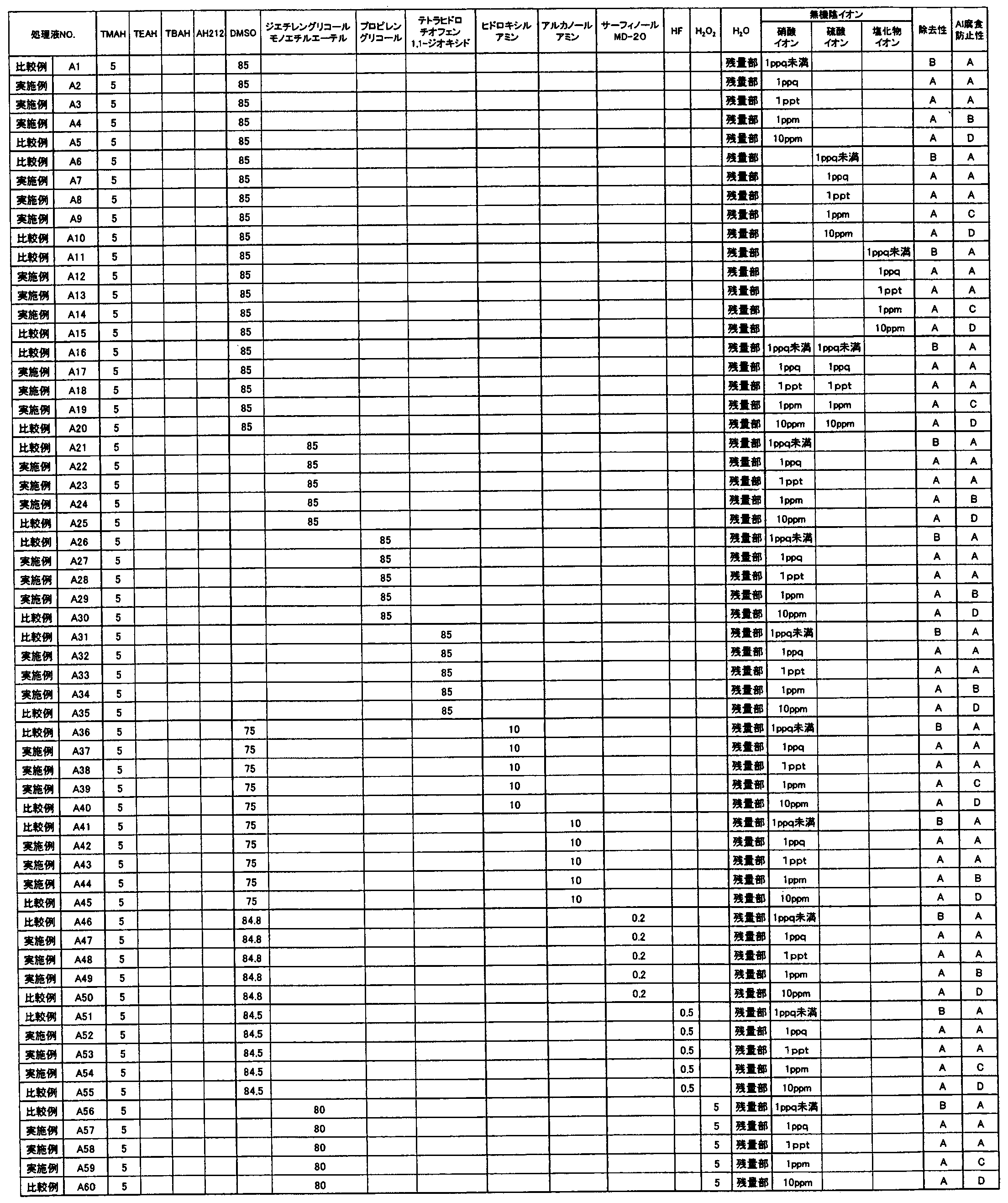
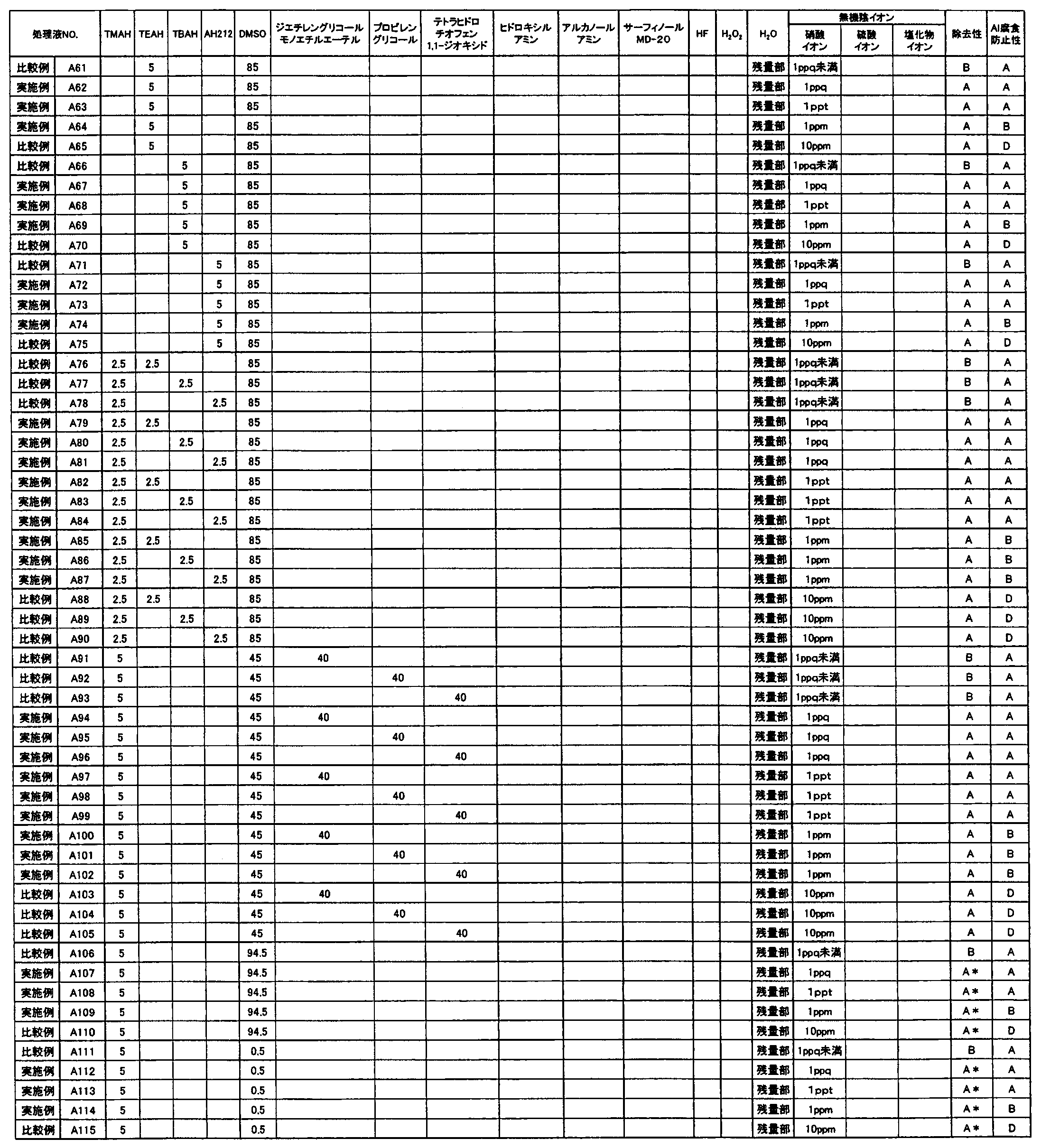
第1表及び第2表において、実施例A2、A3、A4と実施例A107、A108、A109とをそれぞれ対比すると、実施例A107は、除去性が「A」ではあるものの、実施例A2と比べると残渣物の量が多かった。実施例A108は、除去性が「A」ではあるものの、実施例A3と比べると残渣物の量が多かった。実施例A109は、除去性が「A」ではあるものの、実施例A4と比べると残渣物の量が多かった。つまり、有機溶剤系処理液において水が1質量%以上の場合には、本発明の効果がより優れることが確認された。
以下のとおり、ドライエッチング残渣物及びドライアッシング残渣物を基板から洗浄除去する試験を行った。
<処理液の調製>
第3表、第4表に示す実施例及び比較例の各処理液(B1~B115)を各々調製した。なお、各処理液において、使用する各種成分の濃度(質量%、質量ppq(1質量ppqは、0.001質量pptに相当)、質量ppt、質量ppm)は表中に記載の通りであり、残部(質量%)は水である。
第3表、第4表において記載する成分は上述した第1表、第2表の成分と同様である。
以下の手順に従って、Si基板上に、Al合金膜と窒化チタン膜とからなる配線膜、シリコン酸化膜、及び所定の開口部を有するレジスト膜をこの順で備える積層基板(処理前積層基板に該当)を形成した。
上記手順により、Si基板1上に、Al合金膜2と窒化チタン膜3とからなる配線膜4、シリコン酸化膜5をこの順に有し、且つ、所定位置にAl合金膜2が露出するホール6を有する積層基板10を、被処理物サンプル(パターンウェハ)として製造した(図1参照)。
この積層基板10の断面を走査型電子顕微鏡写真(SEM:Scanning Electron Microscope)で確認すると、ホール6の壁面及び底面(底面はAl合金膜2の露出面である。)にはドライエッチング残渣物及びドライアッシング残渣物(残渣物11)が認められた。
上記ドライエッチング残渣物及びドライアッシング残渣物は、変質したレジスト膜、シリコン酸化膜、及び、窒化チタン膜だけでなく、ホール6の底部に露出したAl合金膜にも由来する。
次いで、70℃に加温した各洗浄組成物に、用意したパターンウェハの切片(約2.0cm×2.0cm)を15分浸漬し、その後パターンウェハの切片を取り出し、直ちに超純水で1分水洗、N2乾燥を行った。
浸漬試験後のパターンウェハの切片の表面をSEMで観察し、ドライエッチング残渣物及びアッシング残渣物の除去性、並びに、ホール6の底部に露出した配線のAlの腐食防止性について下記の評価基準に従って評価を行った。
評価基準を以下に示す。
「A」: 残渣物が完全に除去された、又は、残渣物の25%未満が残存していた。
「B」: 残渣物の溶解が未完了であり、残渣物の25%以上50%以下が残存していた。
「C」: 残渣物の50%超が残存していた。
「A」: 膜べり量が5%以下。
「B」: 膜べり量が5%超10%以下。
「C」: 膜べり量が10%超50%以下。
「D」: 膜べり量が50%超。
Alの腐食防止性の評価については、上述した〔永久膜の剥離試験〕における評価と同様の方法により実施した。
結果を第3表、第4表にそれぞれ示す。


第3表及び第4表において、実施例B2、B3、B4と実施例B112、B113、B114とをそれぞれ対比すると、実施例B112は、除去性が「A」ではあるものの、実施例B2と比べると残渣物の量が多かった。実施例B113は、除去性が「A」ではあるものの、実施例B3と比べると残渣物の量が多かった。実施例B114は、除去性が「A」ではあるものの、実施例B4と比べると残渣物の量が多かった。水系処理液において、親水性有機溶剤が1質量%以上の場合には、本発明の効果がより優れることが確認された。
以下のとおり、ドライエッチング残渣物を基板から洗浄除去する試験を行った。
なお、以下の評価では、ポリシリコン(poly-Si)のドライエッチング処理後のモデル基板、及び、SiP及びSiGeを有するモデル基板を準備し、その各々を評価することで残渣物除去性と腐食防止性を評価した。また、上記のモデル基板以外に、ポリシリコン(poly-Si)のギャップ膜として用いられ得るSiN膜のドライエッチング処理後のモデル基板を準備し、ドライエッチング処理時に用いられ、基板上に残存するレジスト膜(レジスト残渣物)の残渣物除去性を同様に評価した。
第5表に示す実施例及び比較例の各処理液(C1~C42)を各々調製した。なお、各処理液において、使用する各種成分の濃度(質量%、質量ppq(1質量ppqは、0.001質量pptに相当)、質量ppt、質量ppm)は表中に記載の通りであり、残部(質量%)は水である。
第5表において記載する成分は上述した第1表の成分と同様である。
試験ウェハ:単結晶<100>シリコン上に製膜された500nmの膜厚のPoly―Siのウェハを準備した。これに対して、ドライエッチング処理を行った。次いでPoly―Siのウェハに枚葉式装置(SPS-Europe B.V.社製、POLOS(商品名))にて下記の条件で洗浄処理を行い、評価試験を実施した。
・薬液温度:60℃
・吐出量:1L/min.
・ウエハ回転数500rpm
なお、<ポリシリコン残渣物の除去性>及び後述する<レジスト残渣物の除去性>の評価試験において、得られた基板を光学顕微鏡(倍率50倍)により観察することにより残渣物量を定量した。
「A」: 残渣物が完全に除去された、又は、残渣物の25%未満が残存していた。
「B」: 残渣物の溶解が未完了であり、残渣物の25%以上50%以下が残存していた。
「C」: 残渣物の50%超が残存していた。
Poly―Si上にSiN膜をCVD(chemical vapor deposition)で成膜した上に、フォトレジスト膜を成膜し、UV(紫外線)露光及び現像によりフォトレジストのパターニングを行い、レジスト膜を作製した。その後、フッ素系のガスにてSiN膜をドライエッチングし、得られた基板を評価対象とした。
60℃に調整した第5表に記載の各処理液に得られた基板を浸漬し、30秒間処理をした。その後、基板を各処理液から取り出し、基板を水洗し、更に空気ブローにて基板を乾燥した。
「A」: 光学顕微鏡で残留物が確認できず、100%除去された状態
「B」: 光学顕微鏡で残留物が確認でき、50%超100%未満除去された状態
「C」: 光学顕微鏡で残留物が確認でき、50%以上残存している状態
CVDによって製膜した、SiP及びSiGeを電極として有するモデル基板を評価対象とした。
60℃に調整した第5表に記載の各処理液に得られた基板を浸漬し、30秒間処理をした。その後、基板を各処理液から取り出し、基板を水洗し、更に空気ブローにて基板を乾燥した。なお、下記評価基準において「膜べり量」は、上述の<Alの腐食防止性の評価>と同様の方法により求めた。
「A」:膜べり量が5%以下。
「B」:膜べり量が5%超20%以下。
「C」:膜べり量が20%超。
「A」:膜べり量が5%以下。
「B」:膜べり量が5%超20%以下。
「C」:膜べり量が20%超。
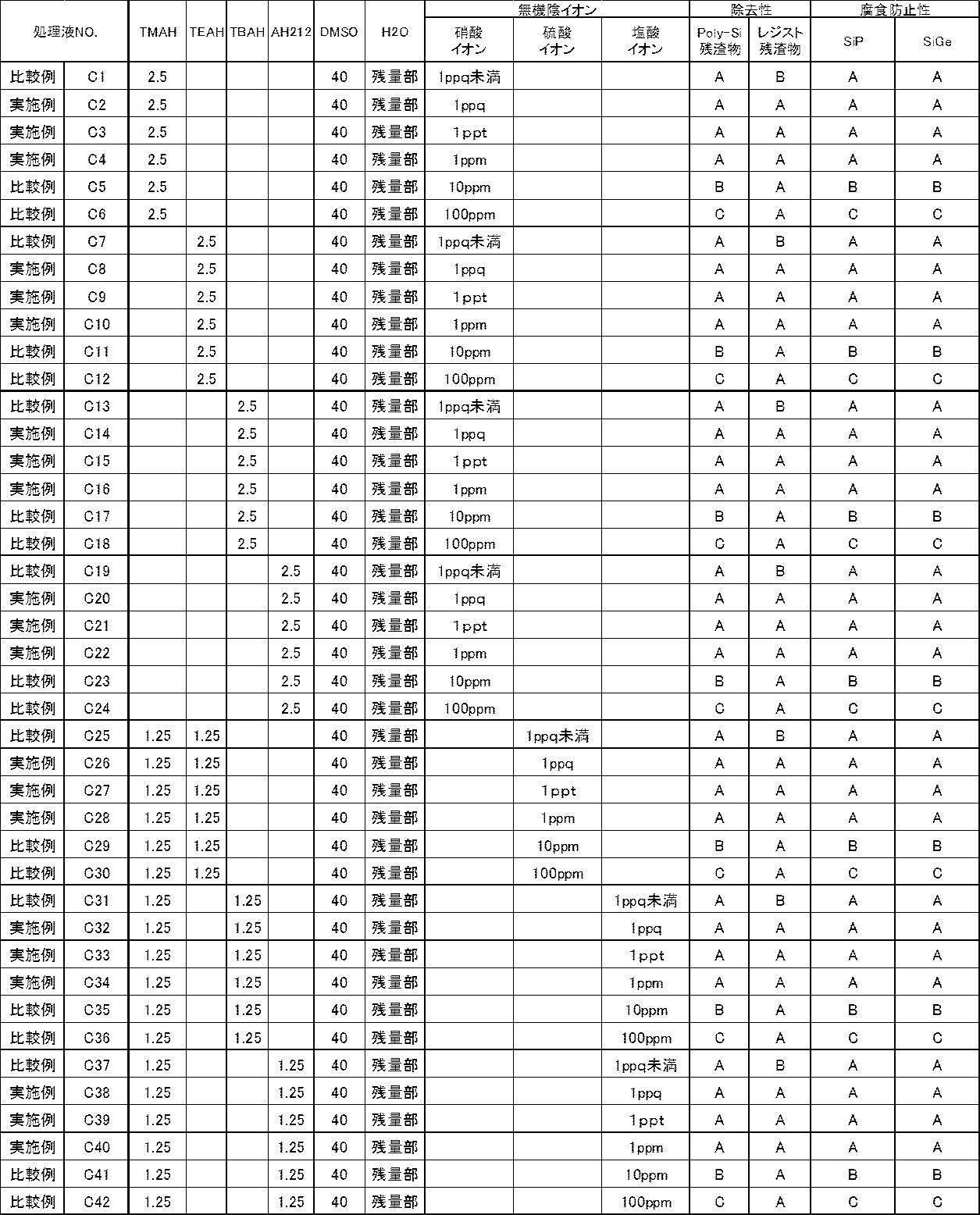
上述の除去方法3について、枚葉装置を用いた実施例及び比較例を示す。枚葉式装置を用い、処理液の供給速度を変更して処理を実施した。なお、処理対象は、上述の除去方法3で使用した各種モデル基板である。また、除去方法4で実施した評価方法及びその評価基準についても除去方法3と同様である。
結果を第6表に示す。

2 Al合金膜
3 窒化チタン膜
4 配線膜
5 シリコン酸化膜
6 ホール
10 積層基板
11 残渣物
Claims (10)
- 水と、親水性有機溶剤と、4級アンモニウム塩と、無機陰イオンと、を含む処理液であって、
前記無機陰イオンの含有量が、処理液全質量に対して0.001質量ppt~1質量ppmである、処理液。 - 前記無機陰イオンが、硫酸イオン、塩化物イオン、又は硝酸イオンである、請求項1に記載の処理液。
- 前記無機陰イオンが、硝酸イオンである、請求項1又は2に記載の処理液。
- 処理液全質量に対して、
前記水の含有量が、1~30質量%であり、
前記親水性有機溶剤の含有量が、40~98質量%であり、
前記4級アンモニウム塩の含有量が、0.1~30質量%である、請求項1~3のいずれか1項に記載の処理液。 - 処理液全質量に対して、
前記水の含有量が、20~98質量%であり、
前記親水性有機溶剤の含有量が、1~40質量%であり、
前記4級アンモニウム塩の含有量が、0.1~30質量%である、請求項1~3のいずれか1項に記載の処理液。 - 更に、アミン化合物を含む、請求項1~5のいずれか1項に記載の処理液。
- 前記アミン化合物が、ヒドロキシルアミン及びヒドロキシルアミン塩から選ばれる少なくとも1種を含む、請求項6に記載の処理液。
- 前記ヒドロキシルアミン及びヒドロキシルアミン塩から選ばれる少なくとも1種の含有量が、処理液全質量に対して0.1~15質量%である、請求項7に記載の処理液。
- 更に、酸化剤を含む、請求項1~8のいずれか1項に記載の処理液。
- 更に、ハロゲン化物を含む、請求項1~9のいずれか1項に記載の処理液。
Priority Applications (2)
| Application Number | Priority Date | Filing Date | Title |
|---|---|---|---|
| JP2017562852A JP6646073B2 (ja) | 2016-01-22 | 2017-01-18 | 処理液 |
| KR1020187018406A KR102113463B1 (ko) | 2016-01-22 | 2017-01-18 | 처리액 |
Applications Claiming Priority (2)
| Application Number | Priority Date | Filing Date | Title |
|---|---|---|---|
| JP2016-011123 | 2016-01-22 | ||
| JP2016011123 | 2016-01-22 |
Publications (1)
| Publication Number | Publication Date |
|---|---|
| WO2017126554A1 true WO2017126554A1 (ja) | 2017-07-27 |
Family
ID=59362377
Family Applications (1)
| Application Number | Title | Priority Date | Filing Date |
|---|---|---|---|
| PCT/JP2017/001560 Ceased WO2017126554A1 (ja) | 2016-01-22 | 2017-01-18 | 処理液 |
Country Status (4)
| Country | Link |
|---|---|
| JP (1) | JP6646073B2 (ja) |
| KR (1) | KR102113463B1 (ja) |
| TW (1) | TWI717452B (ja) |
| WO (1) | WO2017126554A1 (ja) |
Cited By (20)
| Publication number | Priority date | Publication date | Assignee | Title |
|---|---|---|---|---|
| KR20190082602A (ko) * | 2018-01-02 | 2019-07-10 | 삼성전자주식회사 | 포토레지스트 현상액 조성물 및 이를 이용한 반도체 패키지 제조방법 |
| WO2020054296A1 (ja) * | 2018-09-12 | 2020-03-19 | 富士フイルム株式会社 | 薬液、基板の処理方法 |
| KR20200103071A (ko) * | 2018-02-05 | 2020-09-01 | 후지필름 가부시키가이샤 | 약액, 약액의 제조 방법, 기판의 처리 방법 |
| WO2021044774A1 (ja) * | 2019-09-02 | 2021-03-11 | 富士フイルム株式会社 | 処理液、被処理物の処理方法 |
| JPWO2021100353A1 (ja) * | 2019-11-22 | 2021-05-27 | ||
| CN113296374A (zh) * | 2021-05-25 | 2021-08-24 | 深圳深骏微电子材料有限公司 | 一种彩色滤光片的返工液 |
| WO2021176952A1 (ja) * | 2020-03-04 | 2021-09-10 | 富士フイルム株式会社 | 処理液、処理液収容体 |
| WO2022024820A1 (ja) * | 2020-07-29 | 2022-02-03 | 東洋紡株式会社 | フレキシブル電子デバイスの製造方法 |
| WO2022163350A1 (ja) * | 2021-01-29 | 2022-08-04 | 富士フイルム株式会社 | 組成物、基板の洗浄方法 |
| JPWO2022176663A1 (ja) * | 2021-02-22 | 2022-08-25 | ||
| EP3888890A4 (en) * | 2018-11-26 | 2022-08-31 | Kao Corporation | THREE-DIMENSIONAL OBJECT PRECURSOR TREATMENT AGENT COMPOSITION |
| JP2022547312A (ja) * | 2019-09-10 | 2022-11-11 | フジフイルム エレクトロニック マテリアルズ ユー.エス.エー., インコーポレイテッド | エッチング組成物 |
| JP7236123B1 (ja) | 2022-03-31 | 2023-03-09 | 株式会社片山化学工業研究所 | 洗浄剤 |
| CN116368601A (zh) * | 2020-09-11 | 2023-06-30 | 富士胶片电子材料美国有限公司 | 蚀刻组成物 |
| WO2023162853A1 (ja) * | 2022-02-22 | 2023-08-31 | 富士フイルム株式会社 | 半導体製造用組成物、被処理物の処理方法、半導体素子の製造方法 |
| CN117062940A (zh) * | 2021-03-17 | 2023-11-14 | 富士胶片株式会社 | 组合物、基板的处理方法 |
| WO2023244825A1 (en) * | 2022-06-16 | 2023-12-21 | Entegris, Inc. | Method for etching polysilicon |
| WO2024048498A1 (ja) * | 2022-09-01 | 2024-03-07 | 株式会社トクヤマ | シリコンエッチング液、基板の処理方法およびシリコンデバイスの製造方法 |
| US12139693B2 (en) | 2020-01-28 | 2024-11-12 | Fujifilm Corporation | Treatment liquid and method for treating object to be treated |
| WO2025235712A1 (en) * | 2024-05-08 | 2025-11-13 | Essex Solutions Usa Llc | Alternative solvent blends for use in forming and applying thermosetting polyamide-imide |
Families Citing this family (10)
| Publication number | Priority date | Publication date | Assignee | Title |
|---|---|---|---|---|
| CN120065655A (zh) * | 2018-07-13 | 2025-05-30 | 富士胶片株式会社 | 药液、试剂盒、图案形成方法、药液的制造方法及药液收容体 |
| WO2020049955A1 (ja) * | 2018-09-06 | 2020-03-12 | 富士フイルム株式会社 | 薬液、基板の処理方法 |
| WO2020054291A1 (ja) * | 2018-09-13 | 2020-03-19 | 富士フイルム株式会社 | 薬液 |
| KR102544429B1 (ko) * | 2019-01-15 | 2023-06-20 | 가부시끼가이샤 레조낙 | 분해세정 조성물, 접착성 폴리머의 세정 방법, 및 디바이스 웨이퍼의 제조 방법 |
| US20220010206A1 (en) * | 2019-02-13 | 2022-01-13 | Tokuyama Corporation | Semiconductor wafer treatment liquid containing hypochlorite ions and ph buffer |
| EP3974070A4 (en) * | 2019-05-22 | 2023-07-12 | Shin-Etsu Chemical Co., Ltd. | CLEANING AGENT COMPOSITION, SUBSTRATE CLEANING METHOD, AND SUPPORT BODY OR SUBSTRATE CLEANING METHOD |
| JP2021081545A (ja) * | 2019-11-18 | 2021-05-27 | メルク、パテント、ゲゼルシャフト、ミット、ベシュレンクテル、ハフツングMerck Patent GmbH | レジストパターン間置換液、およびそれを用いたレジストパターンの製造方法 |
| JP6823819B1 (ja) * | 2019-11-20 | 2021-02-03 | パナソニックIpマネジメント株式会社 | レジスト剥離液 |
| KR102798781B1 (ko) * | 2020-03-16 | 2025-04-22 | 동우 화인켐 주식회사 | 식각액 조성물, 이를 이용한 패턴 형성 방법 및 어레이 기판의 제조 방법, 및 이에 따라 제조된 어레이 기판 |
| CN112558434B (zh) * | 2020-12-22 | 2023-03-07 | 江苏奥首材料科技有限公司 | 一种光刻胶清洗剂组合物 |
Citations (1)
| Publication number | Priority date | Publication date | Assignee | Title |
|---|---|---|---|---|
| JP2012009513A (ja) * | 2010-06-22 | 2012-01-12 | Fujifilm Corp | 洗浄組成物、洗浄方法、及び、半導体装置の製造方法 |
Family Cites Families (5)
| Publication number | Priority date | Publication date | Assignee | Title |
|---|---|---|---|---|
| JPH1055993A (ja) * | 1996-08-09 | 1998-02-24 | Hitachi Ltd | 半導体素子製造用洗浄液及びそれを用いた半導体素子の製造方法 |
| US6030932A (en) * | 1996-09-06 | 2000-02-29 | Olin Microelectronic Chemicals | Cleaning composition and method for removing residues |
| JP2002113431A (ja) * | 2000-10-10 | 2002-04-16 | Tokyo Electron Ltd | 洗浄方法 |
| US20060003910A1 (en) * | 2004-06-15 | 2006-01-05 | Hsu Jiun Y | Composition and method comprising same for removing residue from a substrate |
| KR101988668B1 (ko) | 2013-03-15 | 2019-06-12 | 동우 화인켐 주식회사 | 칼라 레지스트 및 유기계 절연막 제거용 세정제 조성물 |
-
2017
- 2017-01-18 JP JP2017562852A patent/JP6646073B2/ja active Active
- 2017-01-18 WO PCT/JP2017/001560 patent/WO2017126554A1/ja not_active Ceased
- 2017-01-18 KR KR1020187018406A patent/KR102113463B1/ko active Active
- 2017-01-19 TW TW106101791A patent/TWI717452B/zh active
Patent Citations (1)
| Publication number | Priority date | Publication date | Assignee | Title |
|---|---|---|---|---|
| JP2012009513A (ja) * | 2010-06-22 | 2012-01-12 | Fujifilm Corp | 洗浄組成物、洗浄方法、及び、半導体装置の製造方法 |
Cited By (52)
| Publication number | Priority date | Publication date | Assignee | Title |
|---|---|---|---|---|
| KR20190082602A (ko) * | 2018-01-02 | 2019-07-10 | 삼성전자주식회사 | 포토레지스트 현상액 조성물 및 이를 이용한 반도체 패키지 제조방법 |
| US10908505B2 (en) | 2018-01-02 | 2021-02-02 | Samsung Electronics Co., Ltd. | Photoresist developer composition and manufacturing method of semiconductor package using the same |
| KR102089286B1 (ko) * | 2018-01-02 | 2020-03-16 | 삼성전자주식회사 | 포토레지스트 현상액 조성물 및 이를 이용한 반도체 패키지 제조방법 |
| US11732190B2 (en) | 2018-02-05 | 2023-08-22 | Fujifilm Corporation | Chemical solution, method for manufacturing chemical solution, and method for treating substrate |
| KR20200103071A (ko) * | 2018-02-05 | 2020-09-01 | 후지필름 가부시키가이샤 | 약액, 약액의 제조 방법, 기판의 처리 방법 |
| KR102838494B1 (ko) * | 2018-02-05 | 2025-07-28 | 후지필름 가부시키가이샤 | 약액, 약액의 제조 방법, 기판의 처리 방법 |
| US12234399B2 (en) | 2018-02-05 | 2025-02-25 | Fujifilm Corporation | Chemical solution, method for manufacturing chemical solution, and method for treating substrate |
| KR20230030663A (ko) * | 2018-02-05 | 2023-03-06 | 후지필름 가부시키가이샤 | 약액, 약액의 제조 방법, 기판의 처리 방법 |
| KR102501870B1 (ko) * | 2018-02-05 | 2023-02-21 | 후지필름 가부시키가이샤 | 약액, 약액의 제조 방법, 기판의 처리 방법 |
| WO2020054296A1 (ja) * | 2018-09-12 | 2020-03-19 | 富士フイルム株式会社 | 薬液、基板の処理方法 |
| JP7513665B2 (ja) | 2018-09-12 | 2024-07-09 | 富士フイルム株式会社 | 薬液、基板の処理方法 |
| JPWO2020054296A1 (ja) * | 2018-09-12 | 2021-09-02 | 富士フイルム株式会社 | 薬液、基板の処理方法 |
| US11479863B2 (en) | 2018-09-12 | 2022-10-25 | Fujifilm Corporation | Chemical solution and method for treating substrate |
| JP2022140501A (ja) * | 2018-09-12 | 2022-09-26 | 富士フイルム株式会社 | 薬液、基板の処理方法 |
| JP7108042B2 (ja) | 2018-09-12 | 2022-07-27 | 富士フイルム株式会社 | 薬液、基板の処理方法 |
| EP3888890A4 (en) * | 2018-11-26 | 2022-08-31 | Kao Corporation | THREE-DIMENSIONAL OBJECT PRECURSOR TREATMENT AGENT COMPOSITION |
| CN114364779B (zh) * | 2019-09-02 | 2024-05-28 | 富士胶片株式会社 | 处理液、被处理物的处理方法 |
| JP7273165B2 (ja) | 2019-09-02 | 2023-05-12 | 富士フイルム株式会社 | 処理液、被処理物の処理方法 |
| WO2021044774A1 (ja) * | 2019-09-02 | 2021-03-11 | 富士フイルム株式会社 | 処理液、被処理物の処理方法 |
| JPWO2021044774A1 (ja) * | 2019-09-02 | 2021-03-11 | ||
| CN114364779A (zh) * | 2019-09-02 | 2022-04-15 | 富士胶片株式会社 | 处理液、被处理物的处理方法 |
| US12187984B2 (en) | 2019-09-02 | 2025-01-07 | Fujifilm Corporation | Treatment liquid and method for treating object to be treated |
| JP7538286B2 (ja) | 2019-09-02 | 2024-08-21 | 富士フイルム株式会社 | 処理液、被処理物の処理方法 |
| JP2023099573A (ja) * | 2019-09-02 | 2023-07-13 | 富士フイルム株式会社 | 処理液、被処理物の処理方法 |
| JP7766020B2 (ja) | 2019-09-10 | 2025-11-07 | フジフイルム エレクトロニック マテリアルズ ユー.エス.エー., インコーポレイテッド | エッチング組成物 |
| JP2022547312A (ja) * | 2019-09-10 | 2022-11-11 | フジフイルム エレクトロニック マテリアルズ ユー.エス.エー., インコーポレイテッド | エッチング組成物 |
| TWI858179B (zh) * | 2019-11-22 | 2024-10-11 | 日商富士軟片股份有限公司 | 洗淨液、半導體基板的洗淨方法 |
| JPWO2021100353A1 (ja) * | 2019-11-22 | 2021-05-27 | ||
| US12247300B2 (en) | 2019-11-22 | 2025-03-11 | Fujifilm Corporation | Cleaning solution and cleaning method |
| WO2021100353A1 (ja) * | 2019-11-22 | 2021-05-27 | 富士フイルムエレクトロニクスマテリアルズ株式会社 | 洗浄液、洗浄方法 |
| JP7365427B2 (ja) | 2019-11-22 | 2023-10-19 | 富士フイルム株式会社 | 洗浄液、洗浄方法 |
| US12139693B2 (en) | 2020-01-28 | 2024-11-12 | Fujifilm Corporation | Treatment liquid and method for treating object to be treated |
| WO2021176952A1 (ja) * | 2020-03-04 | 2021-09-10 | 富士フイルム株式会社 | 処理液、処理液収容体 |
| JP7771956B2 (ja) | 2020-07-29 | 2025-11-18 | 東洋紡株式会社 | フレキシブル電子デバイスの製造方法 |
| JPWO2022024820A1 (ja) * | 2020-07-29 | 2022-02-03 | ||
| WO2022024820A1 (ja) * | 2020-07-29 | 2022-02-03 | 東洋紡株式会社 | フレキシブル電子デバイスの製造方法 |
| US11820929B2 (en) * | 2020-09-11 | 2023-11-21 | Fujifilm Electronic Materials U.S.A., Inc. | Etching compositions |
| CN116368601A (zh) * | 2020-09-11 | 2023-06-30 | 富士胶片电子材料美国有限公司 | 蚀刻组成物 |
| JPWO2022163350A1 (ja) * | 2021-01-29 | 2022-08-04 | ||
| WO2022163350A1 (ja) * | 2021-01-29 | 2022-08-04 | 富士フイルム株式会社 | 組成物、基板の洗浄方法 |
| JP7787146B2 (ja) | 2021-02-22 | 2025-12-16 | 富士フイルム株式会社 | 洗浄液、半導体基板の洗浄方法 |
| JPWO2022176663A1 (ja) * | 2021-02-22 | 2022-08-25 | ||
| WO2022176663A1 (ja) * | 2021-02-22 | 2022-08-25 | 富士フイルム株式会社 | 洗浄液、半導体基板の洗浄方法 |
| CN117062940A (zh) * | 2021-03-17 | 2023-11-14 | 富士胶片株式会社 | 组合物、基板的处理方法 |
| CN113296374A (zh) * | 2021-05-25 | 2021-08-24 | 深圳深骏微电子材料有限公司 | 一种彩色滤光片的返工液 |
| WO2023162853A1 (ja) * | 2022-02-22 | 2023-08-31 | 富士フイルム株式会社 | 半導体製造用組成物、被処理物の処理方法、半導体素子の製造方法 |
| JP7236123B1 (ja) | 2022-03-31 | 2023-03-09 | 株式会社片山化学工業研究所 | 洗浄剤 |
| JP2023152278A (ja) * | 2022-03-31 | 2023-10-16 | 株式会社片山化学工業研究所 | 洗浄剤 |
| WO2023244825A1 (en) * | 2022-06-16 | 2023-12-21 | Entegris, Inc. | Method for etching polysilicon |
| JP2025519682A (ja) * | 2022-06-16 | 2025-06-26 | インテグリス・インコーポレーテッド | ポリシリコンをエッチングするための方法 |
| WO2024048498A1 (ja) * | 2022-09-01 | 2024-03-07 | 株式会社トクヤマ | シリコンエッチング液、基板の処理方法およびシリコンデバイスの製造方法 |
| WO2025235712A1 (en) * | 2024-05-08 | 2025-11-13 | Essex Solutions Usa Llc | Alternative solvent blends for use in forming and applying thermosetting polyamide-imide |
Also Published As
| Publication number | Publication date |
|---|---|
| TW201739909A (zh) | 2017-11-16 |
| TWI717452B (zh) | 2021-02-01 |
| JPWO2017126554A1 (ja) | 2018-11-15 |
| KR20180088441A (ko) | 2018-08-03 |
| KR102113463B1 (ko) | 2020-05-21 |
| JP6646073B2 (ja) | 2020-02-14 |
Similar Documents
| Publication | Publication Date | Title |
|---|---|---|
| JP6646073B2 (ja) | 処理液 | |
| JP7566826B2 (ja) | 処理液、基板洗浄方法およびレジストの除去方法 | |
| JP6713044B2 (ja) | 処理液、基板の洗浄方法及びレジストの除去方法 | |
| JP6421197B2 (ja) | 除去液、これを用いた除去方法および半導体基板製品の製造方法 | |
| TWI702286B (zh) | 處理液、基板的洗淨方法以及半導體裝置的製造方法 | |
| CN108885412A (zh) | 半导体制造用处理液及图案形成方法 | |
| TWI261734B (en) | Photoresist removing solution and method for removing photoresist using same | |
| JP2002184743A (ja) | ストリッピング組成物 | |
| JP2013511063A (ja) | 非水系レジスト剥離液組成物 | |
| JP6556834B2 (ja) | レジスト除去液、レジスト除去方法、再生半導体基板の製造方法 | |
| JP6542393B2 (ja) | 処理液、基板の洗浄方法および半導体デバイスの製造方法 | |
| JP4177758B2 (ja) | 基板適合性が改善されたアンモニア不含アルカリ性マイクロエレクトロニクス洗浄組成物 | |
| JP2005331913A (ja) | フォトレジスト用ストリッパー組成物及びこれをフォトレジスト剥離に用いる方法。 | |
| TWI251132B (en) | Remover for photoresist and method for removing photoresist using same | |
| JP5015553B2 (ja) | 水性アルカリフォトレジスト洗浄組成物及び該組成物を使用する方法 | |
| JP2006060078A (ja) | 多段階処理用剥離液およびこれを用いたエッチング残渣物の剥離方法 |
Legal Events
| Date | Code | Title | Description |
|---|---|---|---|
| 121 | Ep: the epo has been informed by wipo that ep was designated in this application |
Ref document number: 17741431 Country of ref document: EP Kind code of ref document: A1 |
|
| ENP | Entry into the national phase |
Ref document number: 20187018406 Country of ref document: KR Kind code of ref document: A |
|
| WWE | Wipo information: entry into national phase |
Ref document number: 2017562852 Country of ref document: JP |
|
| NENP | Non-entry into the national phase |
Ref country code: DE |
|
| 122 | Ep: pct application non-entry in european phase |
Ref document number: 17741431 Country of ref document: EP Kind code of ref document: A1 |