WO2017073549A1 - ポリアリレート樹脂およびその製造方法ならびにポリアリレート樹脂組成物 - Google Patents
ポリアリレート樹脂およびその製造方法ならびにポリアリレート樹脂組成物 Download PDFInfo
- Publication number
- WO2017073549A1 WO2017073549A1 PCT/JP2016/081551 JP2016081551W WO2017073549A1 WO 2017073549 A1 WO2017073549 A1 WO 2017073549A1 JP 2016081551 W JP2016081551 W JP 2016081551W WO 2017073549 A1 WO2017073549 A1 WO 2017073549A1
- Authority
- WO
- WIPO (PCT)
- Prior art keywords
- polyarylate resin
- resin
- group
- polyarylate
- dihydric phenol
- Prior art date
- Legal status (The legal status is an assumption and is not a legal conclusion. Google has not performed a legal analysis and makes no representation as to the accuracy of the status listed.)
- Ceased
Links
Classifications
-
- C—CHEMISTRY; METALLURGY
- C08—ORGANIC MACROMOLECULAR COMPOUNDS; THEIR PREPARATION OR CHEMICAL WORKING-UP; COMPOSITIONS BASED THEREON
- C08G—MACROMOLECULAR COMPOUNDS OBTAINED OTHERWISE THAN BY REACTIONS ONLY INVOLVING UNSATURATED CARBON-TO-CARBON BONDS
- C08G63/00—Macromolecular compounds obtained by reactions forming a carboxylic ester link in the main chain of the macromolecule
- C08G63/02—Polyesters derived from hydroxycarboxylic acids or from polycarboxylic acids and polyhydroxy compounds
- C08G63/60—Polyesters derived from hydroxycarboxylic acids or from polycarboxylic acids and polyhydroxy compounds derived from the reaction of a mixture of hydroxy carboxylic acids, polycarboxylic acids and polyhydroxy compounds
- C08G63/605—Polyesters derived from hydroxycarboxylic acids or from polycarboxylic acids and polyhydroxy compounds derived from the reaction of a mixture of hydroxy carboxylic acids, polycarboxylic acids and polyhydroxy compounds the hydroxy and carboxylic groups being bound to aromatic rings
-
- B—PERFORMING OPERATIONS; TRANSPORTING
- B32—LAYERED PRODUCTS
- B32B—LAYERED PRODUCTS, i.e. PRODUCTS BUILT-UP OF STRATA OF FLAT OR NON-FLAT, e.g. CELLULAR OR HONEYCOMB, FORM
- B32B5/00—Layered products characterised by the non- homogeneity or physical structure, i.e. comprising a fibrous, filamentary, particulate or foam layer; Layered products characterised by having a layer differing constitutionally or physically in different parts
- B32B5/22—Layered products characterised by the non- homogeneity or physical structure, i.e. comprising a fibrous, filamentary, particulate or foam layer; Layered products characterised by having a layer differing constitutionally or physically in different parts characterised by the presence of two or more layers which are next to each other and are fibrous, filamentary, formed of particles or foamed
- B32B5/24—Layered products characterised by the non- homogeneity or physical structure, i.e. comprising a fibrous, filamentary, particulate or foam layer; Layered products characterised by having a layer differing constitutionally or physically in different parts characterised by the presence of two or more layers which are next to each other and are fibrous, filamentary, formed of particles or foamed one layer being a fibrous or filamentary layer
-
- C—CHEMISTRY; METALLURGY
- C08—ORGANIC MACROMOLECULAR COMPOUNDS; THEIR PREPARATION OR CHEMICAL WORKING-UP; COMPOSITIONS BASED THEREON
- C08G—MACROMOLECULAR COMPOUNDS OBTAINED OTHERWISE THAN BY REACTIONS ONLY INVOLVING UNSATURATED CARBON-TO-CARBON BONDS
- C08G63/00—Macromolecular compounds obtained by reactions forming a carboxylic ester link in the main chain of the macromolecule
- C08G63/02—Polyesters derived from hydroxycarboxylic acids or from polycarboxylic acids and polyhydroxy compounds
- C08G63/60—Polyesters derived from hydroxycarboxylic acids or from polycarboxylic acids and polyhydroxy compounds derived from the reaction of a mixture of hydroxy carboxylic acids, polycarboxylic acids and polyhydroxy compounds
-
- C—CHEMISTRY; METALLURGY
- C08—ORGANIC MACROMOLECULAR COMPOUNDS; THEIR PREPARATION OR CHEMICAL WORKING-UP; COMPOSITIONS BASED THEREON
- C08G—MACROMOLECULAR COMPOUNDS OBTAINED OTHERWISE THAN BY REACTIONS ONLY INVOLVING UNSATURATED CARBON-TO-CARBON BONDS
- C08G63/00—Macromolecular compounds obtained by reactions forming a carboxylic ester link in the main chain of the macromolecule
- C08G63/78—Preparation processes
-
- C—CHEMISTRY; METALLURGY
- C08—ORGANIC MACROMOLECULAR COMPOUNDS; THEIR PREPARATION OR CHEMICAL WORKING-UP; COMPOSITIONS BASED THEREON
- C08J—WORKING-UP; GENERAL PROCESSES OF COMPOUNDING; AFTER-TREATMENT NOT COVERED BY SUBCLASSES C08B, C08C, C08F, C08G or C08H
- C08J5/00—Manufacture of articles or shaped materials containing macromolecular substances
- C08J5/24—Impregnating materials with prepolymers which can be polymerised in situ, e.g. manufacture of prepregs
-
- C—CHEMISTRY; METALLURGY
- C08—ORGANIC MACROMOLECULAR COMPOUNDS; THEIR PREPARATION OR CHEMICAL WORKING-UP; COMPOSITIONS BASED THEREON
- C08L—COMPOSITIONS OF MACROMOLECULAR COMPOUNDS
- C08L63/00—Compositions of epoxy resins; Compositions of derivatives of epoxy resins
-
- C—CHEMISTRY; METALLURGY
- C08—ORGANIC MACROMOLECULAR COMPOUNDS; THEIR PREPARATION OR CHEMICAL WORKING-UP; COMPOSITIONS BASED THEREON
- C08L—COMPOSITIONS OF MACROMOLECULAR COMPOUNDS
- C08L67/00—Compositions of polyesters obtained by reactions forming a carboxylic ester link in the main chain; Compositions of derivatives of such polymers
- C08L67/02—Polyesters derived from dicarboxylic acids and dihydroxy compounds
- C08L67/03—Polyesters derived from dicarboxylic acids and dihydroxy compounds the dicarboxylic acids and dihydroxy compounds having the carboxyl- and the hydroxy groups directly linked to aromatic rings
Definitions
- the present invention relates to a polyarylate resin, a method for producing the same, and a polyarylate resin composition.
- Insulating materials such as printed wiring boards used in various electronic devices are required to have excellent dielectric properties. Specifically, in order to increase the transmission speed of a signal, a low dielectric constant and a low dielectric loss tangent are required to reduce loss during signal transmission. Further, an insulating material such as a printed wiring board is required to have excellent heat resistance that can withstand heat treatment such as soldering.
- Insulating materials such as printed wiring boards include thermosetting resins such as epoxy resins, but thermosetting resins are difficult to achieve both heat resistance and dielectric properties such as relative permittivity and dielectric loss tangent.
- thermosetting resins such as epoxy resins
- thermosetting resins are difficult to achieve both heat resistance and dielectric properties such as relative permittivity and dielectric loss tangent.
- polyarylate resin which is a thermoplastic resin is excellent in heat resistance and dielectric properties. Therefore, it is expected that the heat resistance and dielectric properties of the epoxy resin are improved by blending the polyarylate resin with the epoxy resin.
- Patent Document 1 discloses a technique in which a resin composition in which an active ester compound, a curing accelerator, and an epoxy resin are blended with a specific polyarylate resin is used for a printed wiring board.
- the polyarylate resin contained in the resin composition in Patent Document 1 has low fluidity, it is inferior in workability. For example, when producing a multilayer printed wiring board, voids are generated when the prepreg is multilayered. However, there is a problem that a highly reliable multilayer printed wiring board cannot be obtained.
- the polyarylate resin is generally produced by an interfacial polymerization method or a melt polymerization method.
- an end-blocking agent is usually used, so that the carboxyl group and hydroxyl group, which are polar groups excellent in reaction with an epoxy resin, hardly remain at the end of the molecular chain of the resulting polyarylate resin. Therefore, even if the polyarylate resin has a relatively high glass transition temperature, the reactivity to the epoxy resin is low, so that a cured product having a sufficiently high glass transition temperature cannot be obtained together with the epoxy resin. There was a problem with heat resistance. Furthermore, in the interfacial polymerization method, a large amount of organic solvent and water are used in the production of the polyarylate resin. Therefore, a large amount of energy such as electric power is required for the solvent recovery and regeneration treatment. Was big.
- the raw dihydric phenol is acetylated, and then the acetylated dihydric phenol and dicarboxylic acid are subjected to deacetic acid polymerization.
- the hydroxyl group hardly remains at the molecular chain terminal of the polyarylate resin obtained by the melt polymerization method. Therefore, the polyarylate resin produced by a general melt polymerization method has a relatively high glass transition temperature even if it has a relatively high glass transition temperature. In some cases, a high cured product could not be obtained, resulting in problems in heat resistance.
- polyarylate resins generally have low solubility in general-purpose solvents, are difficult to handle, and polyarylate resins excellent in solubility in general-purpose solvents are demanded. If the solubility in a general-purpose solvent is low, it is difficult to prepare a varnish having a high solid content concentration, and gelation or precipitation is likely to occur. In addition, the production of polyarylate resin may require a long reaction time, and polyarylate having good production efficiency is also demanded.
- An object of the present invention is to provide a polyarylate resin excellent in fluidity and reactivity with an epoxy resin, and a method for producing the same, which can form a cured product sufficiently excellent in heat resistance and dielectric properties.
- the present invention also provides a polyarylate resin that is capable of forming a cured product sufficiently excellent in heat resistance and dielectric properties, has excellent solubility in general-purpose solvents, fluidity, and reactivity with an epoxy resin, and a method for producing the same. For the purpose.
- the present invention also provides a polyarylate resin capable of forming a cured product sufficiently excellent in heat resistance and dielectric properties, having solubility in a general-purpose solvent, fluidity, reactivity with an epoxy resin, and production efficiency, and a production method thereof.
- the purpose is to provide.
- the gist of the present invention is as follows.
- ⁇ 4> The polyarylate resin according to any one of ⁇ 1> to ⁇ 3>, further containing a hydroxycarboxylic acid component.
- ⁇ 5> The polyarylate resin according to ⁇ 4>, wherein the hydroxycarboxylic acid component is contained in an amount of 2 to 50 mol% with respect to all monomer components.
- ⁇ 6> The polyarylate resin according to any one of ⁇ 1> to ⁇ 5>, wherein the dihydric phenol component contains an alicyclic dihydric phenol represented by the general formula (1).
- R 1, R 2, R 3 and R 4 are each independently a hydrogen atom, a hydrocarbon group or a halogen atom carbon atoms 1 ⁇ 12;
- R 5 and R 6 Each independently represents a hydrogen atom or a hydrocarbon group having 1 to 4 carbon atoms; m represents an integer of 4 to 12;
- X represents a saturated aliphatic hydrocarbon ring together with the carbon atom to which the hydroxyphenyl group is bonded. Represents the carbon atom to be formed]
- the dihydric phenol component includes 2,2-bis (4-hydroxyphenyl) propane (BisA) and / or 1,1-bis (4-hydroxyphenyl) -1-phenylethane (BisAP), 1 , 1-bis (4-hydroxyphenyl) -3,3,5-trimethylcyclohexane (BisTMC) and / or 1,1-bis (4-hydroxyphenyl) -cyclododecane (BisCDE), ⁇ 6> Or the polyarylate resin as described in ⁇ 7>.
- the content ratio ((BisA + BisAP) / (BisTMC + BisCDE)) of the total content of the BisA and / or the BisAP and the total content of the BisTMC and / or the BisCDE is 15/85 to 85/15 (
- the polyarylate resin according to ⁇ 8> which is a molar ratio).
- a method for producing a polyarylate resin according to any one of ⁇ 1> to ⁇ 9> by performing an acetylation reaction and a deacetic acid polymerization reaction A method for producing a polyarylate resin, comprising adding a hydroxycarboxylic acid component after the acetylation reaction and before the deacetic acid polymerization reaction.
- a preliminary step of adjusting the temperature and pressure for the deacetic acid polymerization reaction after the acetylation reaction and before the deacetic acid polymerization reaction The method for producing a polyarylate resin according to ⁇ 10>, wherein the hydroxycarboxylic acid component is added in the preliminary stage.
- the preliminary step is a step of depressurizing after raising the temperature of the reaction system, The method for producing a polyarylate resin according to ⁇ 11>, wherein in the preliminary stage, the hydroxycarboxylic acid component is added before the temperature rise and / or after the temperature rise and before the pressure reduction.
- a polyarylate resin composition comprising the polyarylate resin according to any one of ⁇ 1> to ⁇ 9> and an epoxy resin.
- ⁇ 17> A prepreg, wherein the resin solution according to ⁇ 16> is impregnated or applied to a reinforcing fiber cloth.
- the polyarylate resin of the present invention is excellent in reactivity with an epoxy resin and fluidity.
- the polyarylate resin of the present invention can also form a cured product sufficiently excellent in heat resistance and dielectric properties together with an epoxy resin.
- the polyarylate resin of the present invention is a polyester containing a dihydric phenol component and an aromatic dicarboxylic acid component as monomer components.
- the dihydric phenol component may be any organic compound containing two phenolic hydroxyl groups in one molecule.
- a phenolic hydroxyl group is a hydroxyl group bonded directly to an aromatic ring.
- the dihydric phenol component is an alicyclic dihydric phenol represented by the general formula (1) from the viewpoint of improving the solubility in a general-purpose solvent and further improving the heat resistance of the cured product of the polyarylate resin and the epoxy resin. It is preferable to contain.
- R 1 , R 2 , R 3 and R 4 each independently represents a hydrogen atom, a hydrocarbon group having 1 to 12 carbon atoms or a halogen atom.
- the hydrocarbon group having 1 to 12 carbon atoms includes a saturated aliphatic hydrocarbon group, an unsaturated aliphatic hydrocarbon group, and an aromatic hydrocarbon group.
- the saturated aliphatic hydrocarbon group includes an alkyl group having 1 to 12, preferably 1 to 6, and more preferably 1 to 3 carbon atoms.
- a methyl group, an ethyl group, an n-propyl group, an isopropyl group, an n- examples thereof include a butyl group, an isobutyl group, a t-butyl group, an n-pentyl group, and an n-hexyl group.
- the unsaturated aliphatic hydrocarbon group includes an alkenyl group having 1 to 6 carbon atoms, preferably 1 to 3 carbon atoms, and examples thereof include a vinyl group and an allyl group.
- the aromatic hydrocarbon group includes an aryl group having 6 to 10 carbon atoms, preferably 6 carbon atoms, and examples thereof include a phenyl group and a naphthyl group.
- a halogen atom a fluorine atom, a chlorine atom, a bromine atom, and an iodine atom are mentioned, for example, Preferably they are a chlorine atom and a bromine atom.
- preferred R 1 , R 2 , R 3 and R 4 are each independently a hydrogen atom, an alkyl group having 1 to 6 carbon atoms (particularly 1 to 3), or 6 to 10 carbon atoms. (Especially 6) aryl group or halogen atom (especially chlorine atom, bromine atom). More preferred R 1 , R 2 , R 3 and R 4 each independently represents a hydrogen atom or an alkyl group having 1 to 6 (particularly 1 to 3) carbon atoms. R 1 , R 2 , R 3 and R 4 may be partially or completely different from each other, or may be the same group, and preferably represent the same group.
- R 5 and R 6 each independently represents a hydrogen atom or a hydrocarbon group having 1 to 4 carbon atoms.
- the hydrocarbon group having 1 to 4 carbon atoms includes a saturated aliphatic hydrocarbon group and an unsaturated aliphatic hydrocarbon group.
- the saturated aliphatic hydrocarbon group contains an alkyl group having 1 to 4 carbon atoms, preferably 1 to 3 carbon atoms, such as methyl group, ethyl group, n-propyl group, isopropyl group, n-butyl group, isobutyl group, t -A butyl group etc. are mentioned.
- the unsaturated aliphatic hydrocarbon group includes an alkenyl group having 1 to 4 carbon atoms, preferably 1 to 3 carbon atoms, and examples thereof include a vinyl group and an allyl group.
- a plurality of R 5 and R 6 are present depending on the value of m described later, and the plurality of R 5 and the plurality of R 6 may be independently selected from the above range.
- R 5 and R 6 each independently represent a hydrogen atom or an alkyl group having 1 to 4 carbon atoms. More preferred R 5 and R 6 each independently represents a hydrogen atom or an alkyl group having 1 to 3 carbon atoms, particularly a hydrogen atom.
- m represents an integer of 4 to 12, preferably an integer of 5 to 11.
- X represents a carbon atom that forms a saturated aliphatic hydrocarbon ring (monocycle) together with the carbon atom to which the hydroxyphenyl group is bonded.
- the saturated aliphatic hydrocarbon ring represents a cycloalkane ring corresponding to the number of m.
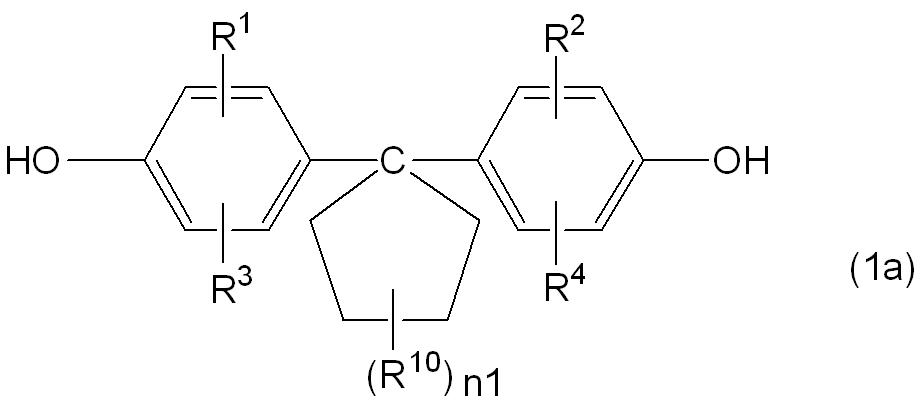
- R 1, R 2, R 3 and R 4 are the same as R 1, R 2, R 3 and R 4 in the formula (1)
- preferred R 1, R 2, R 3 and R 4 and more preferable R 1 , R 2 , R 3 and R 4 are also the same as in the above formula (1).
- n1 is an integer of 0 to 8, preferably an integer of 0 to 4, and more preferably an integer of 0 to 2.
- R 10 represents a hydrocarbon group having 1 to 4 carbon atoms.
- the hydrocarbon group having 1 to 4 carbon atoms includes a saturated aliphatic hydrocarbon group and an unsaturated aliphatic hydrocarbon group.
- the saturated aliphatic hydrocarbon group contains an alkyl group having 1 to 4 carbon atoms, preferably 1 to 3 carbon atoms, such as methyl group, ethyl group, n-propyl group, isopropyl group, n-butyl group, isobutyl group, t -A butyl group etc. are mentioned.
- the unsaturated aliphatic hydrocarbon group includes an alkenyl group having 1 to 4 carbon atoms, preferably 1 to 3 carbon atoms, and examples thereof include a vinyl group and an allyl group.
- n1 is an integer of 2 or more
- plural R 10 are each independently, may be selected from the above range.
- the bonding position of R 10 in the cyclopentane ring is not particularly limited, but is selected from the 3- and 4-position carbon atoms when the carbon atom of the cyclopentane ring to which the hydroxyphenyl group is bonded in the formula (1a). it is preferred that each R 10 carbon atom is bound that.
- Desirable R 10 each independently represents an alkyl group having 1 to 4 carbon atoms. More preferred R 10 each independently represents an alkyl group having 1 to 3 carbon atoms.
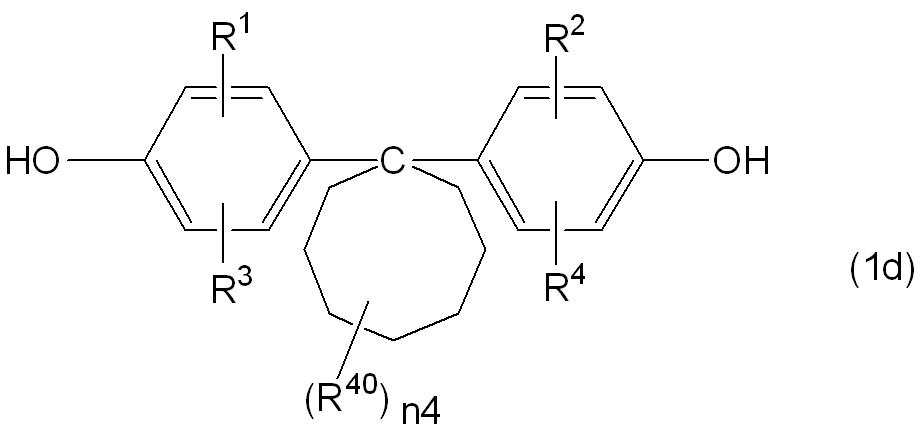
- alicyclic dihydric phenol represented by the general formula (1a) include 1,1-bis (4-hydroxyphenyl) cyclopentane.
- R 1, R 2, R 3 and R 4 are the same as R 1, R 2, R 3 and R 4 in the formula (1)
- preferred R 1, R 2, R 3 and R 4 and more preferable R 1 , R 2 , R 3 and R 4 are also the same as in the above formula (1).
- n2 is an integer of 0 to 10, preferably an integer of 0 to 5, and more preferably an integer of 2 to 4.
- R 20 is the same as R 10 in the above formula (1a).
- n2 is an integer of 2 or more, plural R 20 are each independently, may be selected from a range similar to the above R 10.
- the bonding position of R 20 in the cyclohexane ring is not particularly limited, but when the carbon atom of the cyclohexane ring to which the hydroxyphenyl group is bonded in the formula (1b) is selected from the carbon atoms at the 3-position, 4-position and 5-position. It is preferable that each R 20 is bonded to the carbon atom to be formed, particularly the carbon atom at the 3rd and 5th positions.
- Desirable R 20 each independently represents an alkyl group having 1 to 4 carbon atoms. More preferred R 20 each independently represents an alkyl group having 1 to 3 carbon atoms.
- alicyclic dihydric phenol represented by the general formula (1b) include 1,1-bis (4-hydroxyphenyl) cyclohexane and 1,1-bis (3,5-dimethyl-4-hydroxyphenyl).
- R 1, R 2, R 3 and R 4 are the same as R 1, R 2, R 3 and R 4 in the formula (1)
- preferred R 1, R 2, R 3 and R 4 and more preferable R 1 , R 2 , R 3 and R 4 are also the same as in the above formula (1).
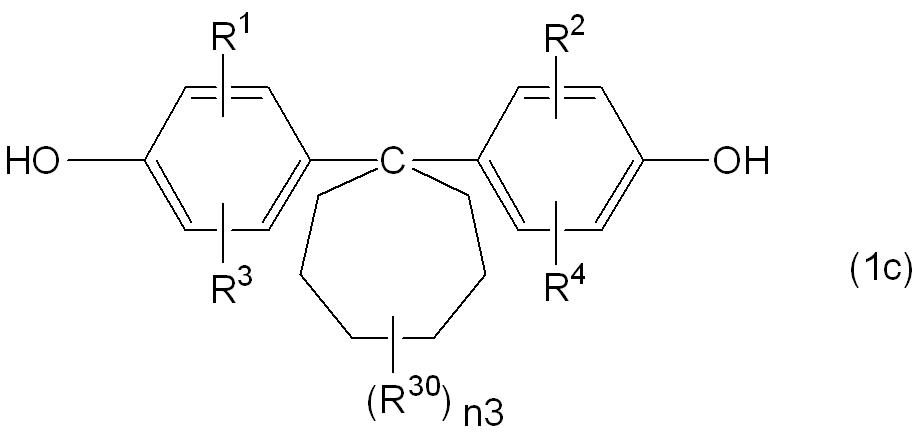
- n3 is an integer of 0 to 12, preferably an integer of 0 to 6, and more preferably an integer of 0 to 2.
- R 30 is the same as R 10 in the above formula (1a).
- n3 is an integer of 2 or more, plural R 30 are each independently, may be selected from a range similar to the above R 10.
- the bonding position of R 30 in the cycloheptane ring is not particularly limited. However, when the carbon atom of the cycloheptane ring to which the hydroxyphenyl group is bonded is the first position in the formula (1c), the 3-position, 4-position, 5-position and 6-position It is preferable that each R 30 is bonded to a carbon atom selected from the following carbon atoms.
- Desirable R 30 each independently represents an alkyl group having 1 to 4 carbon atoms. More preferred R 30 each independently represents an alkyl group having 1 to 3 carbon atoms.
- alicyclic dihydric phenol represented by the general formula (1c) include, for example, 1,1-bis (4-hydroxyphenyl) -cycloheptane.
- R 1, R 2, R 3 and R 4 are the same as R 1, R 2, R 3 and R 4 in the formula (1)
- preferred R 1, R 2, R 3 and R 4 and more preferable R 1 , R 2 , R 3 and R 4 are also the same as in the above formula (1).
- n4 is an integer of 0 to 14, preferably an integer of 0 to 7, and more preferably an integer of 0 to 2.
- R 40 is the same as R 10 in the above formula (1a).
- n4 is an integer of 2 or more, plural R 40 are each independently, may be selected from a range similar to the above R 10.
- the bonding position of R 40 in the cyclooctane ring is not particularly limited. However, when the carbon atom of the cyclooctane ring to which the hydroxyphenyl group is bonded in the formula (1d) is the first position, the fourth, fifth and sixth position carbon atoms It is preferable that each R 40 is bonded to a carbon atom selected from:
- Desirable R 40 each independently represents an alkyl group having 1 to 4 carbon atoms. More preferred R 40 each independently represents an alkyl group having 1 to 3 carbon atoms.
- alicyclic dihydric phenol represented by the general formula (1d) include 1,1-bis (4-hydroxyphenyl) -cyclooctane.
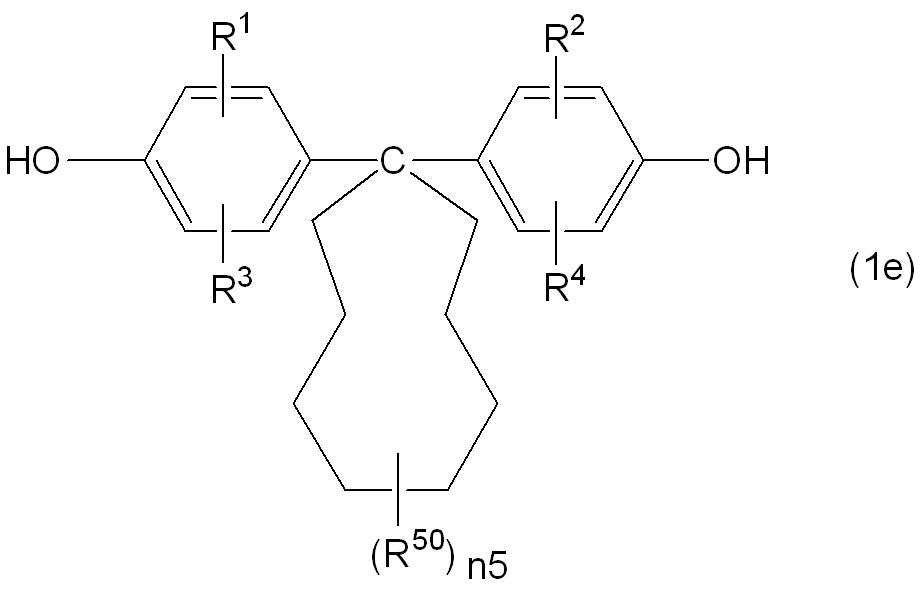
- R 1, R 2, R 3 and R 4 are the same as R 1, R 2, R 3 and R 4 in the formula (1)
- preferred R 1, R 2, R 3 and R 4 and more preferable R 1 , R 2 , R 3 and R 4 are also the same as in the above formula (1).
- n5 is an integer of 0 to 16, preferably an integer of 0 to 8, and more preferably an integer of 0 to 2.
- R 50 is the same as R 10 in formula (1a).
- n5 is an integer of 2 or more
- plural R 50 is each independently may be selected from a range similar to the above R 10.
- the bonding position of R 50 in the cyclononane ring is not particularly limited, but when the carbon atom of the cyclononane ring to which the hydroxyphenyl group is bonded in the formula (1e) is the first position, the carbons at the 4-position, 5-position, 6-position and 7-position
- Each R 50 is preferably bonded to a carbon atom selected from the atoms.
- Desirable R 50 each independently represents an alkyl group having 1 to 4 carbon atoms. More preferred R 50 each independently represents an alkyl group having 1 to 3 carbon atoms.
- alicyclic dihydric phenol represented by the general formula (1e) include 1,1-bis (4-hydroxyphenyl) -cyclononane.
- R 1, R 2, R 3 and R 4 are the same as R 1, R 2, R 3 and R 4 in the formula (1)
- preferred R 1, R 2, R 3 and R 4 and more preferable R 1 , R 2 , R 3 and R 4 are also the same as in the above formula (1).
- n6 is an integer of 0 to 18, preferably an integer of 0 to 9, and more preferably an integer of 0 to 2.
- R 60 is the same as R 10 in the above formula (1a).
- n6 is an integer of 2 or more, plural R 60 are each independently, may be selected from a range similar to the above R 10.
- the bonding position of R 60 in the cyclodecane ring is not particularly limited, but when the carbon atom of the cyclodecane ring to which the hydroxyphenyl group is bonded in the formula (1f) is selected from the 4-position, 5-position and 6-position carbon atoms It is preferable that each R 60 is bonded to the carbon atom to be formed.
- Desirable R 60 each independently represents an alkyl group having 1 to 4 carbon atoms. More preferred R 60 each independently represents an alkyl group having 1 to 3 carbon atoms.
- alicyclic dihydric phenol represented by the general formula (1f) include 1,1-bis (4-hydroxyphenyl) -cyclodecane.
- R 1, R 2, R 3 and R 4 are the same as R 1, R 2, R 3 and R 4 in the formula (1)
- preferred R 1, R 2, R 3 and R 4 and more preferable R 1 , R 2 , R 3 and R 4 are also the same as in the above formula (1).
- n7 is an integer of 0 to 20, preferably an integer of 0 to 10, and more preferably an integer of 0 to 2.
- R 70 is the same as R 10 in the above formula (1a).
- n7 is an integer of 2 or more, plural R 70 are each independently, may be selected from a range similar to the above R 10.
- the bonding position of R 70 in the cycloundecane ring is not particularly limited, but when the carbon atom of the cycloundecane ring to which the hydroxyphenyl group is bonded in the formula (1g) is the first position, the fourth position, the fifth position, the sixth position and the seventh position. It is preferable that each R 70 is bonded to a carbon atom selected from the following carbon atoms.
- Desirable R 70 each independently represents an alkyl group having 1 to 4 carbon atoms. More preferred R 70 each independently represents an alkyl group having 1 to 3 carbon atoms.
- alicyclic dihydric phenol represented by the general formula (1g) include 1,1-bis (4-hydroxyphenyl) -cycloundecane.
- R 1, R 2, R 3 and R 4 are the same as R 1, R 2, R 3 and R 4 in the formula (1)
- preferred R 1, R 2, R 3 and R 4 and more preferable R 1 , R 2 , R 3 and R 4 are also the same as in the above formula (1).
- n8 is an integer of 0 to 22, preferably an integer of 0 to 11, and more preferably an integer of 0 to 2.
- R 80 is the same as R 10 in the above formula (1a).
- n8 is an integer of 2 or more, plural R 80 are each independently, may be selected from a range similar to the above R 10.
- the bonding position of R 80 in the cyclododecane ring is not particularly limited, but when the carbon atom of the cyclododecane ring to which the hydroxyphenyl group is bonded in the formula (1h) is the first position, the fifth position, the sixth position, the seventh position, the eighth position And each R 80 is preferably bonded to a carbon atom selected from carbon atoms at the 9-position.
- Desirable R 80 each independently represents an alkyl group having 1 to 4 carbon atoms. More preferred R 80 each independently represents an alkyl group having 1 to 3 carbon atoms.
- alicyclic dihydric phenol represented by the general formula (1h) include, for example, 1,1-bis (4-hydroxyphenyl) -cyclododecane (BisCDE).
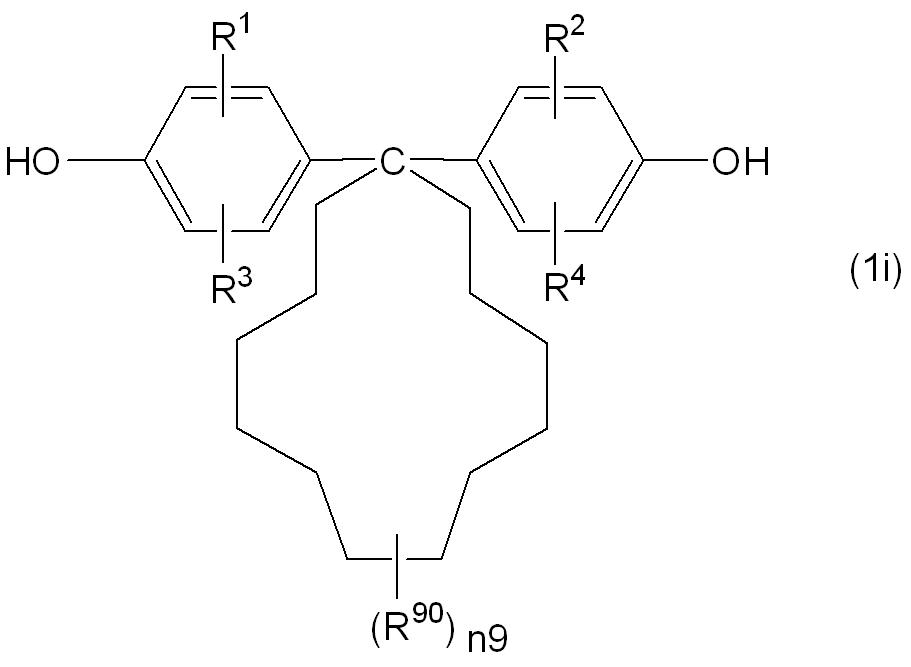
- each R 1, R 2, R 3 and R 4 are the same as R 1, R 2, R 3 and R 4 in the formula (1), preferred R 1, R 2, R 3 and R 4 and more preferable R 1 , R 2 , R 3 and R 4 are also the same as in the above formula (1).
- n9 is an integer of 0 to 24, preferably an integer of 0 to 12, and more preferably an integer of 0 to 2.
- R 90 is the same as R 10 in formula (1a).
- n9 is an integer of 2 or more, plural R 90 are each independently, may be selected from a range similar to the above R 10.
- the bonding position of R 90 in the cyclotridecane ring is not particularly limited. However, when the carbon atom of the cyclotridecane ring to which the hydroxyphenyl group is bonded in the formula (1i) is the first position, the sixth position, the seventh position, the eighth position, and Each R 90 is preferably bonded to a carbon atom selected from the carbon atoms at the 9th position.
- Desirable R 90 each independently represents an alkyl group having 1 to 4 carbon atoms. More preferred R 90 each independently represents an alkyl group having 1 to 3 carbon atoms.
- alicyclic dihydric phenol represented by the general formula (1i) include 1,1-bis (4-hydroxyphenyl) -cyclotridecane.
- the content ratio of the alicyclic dihydric phenol represented by the general formula (1) is not particularly limited, and is usually 15 mol% or more (15 to 100 mol%) with respect to the total dihydric phenol component.
- the content ratio is preferably 15 to 90 mol%, more preferably 25 to 75 mol%, based on the total dihydric phenol component, from the viewpoint of improving the solubility of the polyarylate resin in a general-purpose solvent.
- the content ratio is preferably 40 to 100 mol%, more preferably 55 to 100 mol% with respect to the total dihydric phenol component, from the viewpoint of further improving the heat resistance of the cured product of the polyarylate resin. 90 to 100 mol% is preferred.
- the content ratio is the total dihydric phenol component from the viewpoint of the balance between the improvement of the solubility of the polyarylate resin in a general-purpose solvent and the further improvement of the reactivity of the polyarylate resin with the epoxy resin and the heat resistance of the cured product. Is preferably 40 to 90 mol%, more preferably 50 to 90 mol%.
- the alicyclic dihydric phenol represented by the alicyclic dihydric phenol represented by the general formula (1) may be used alone or in combination, and in that case, the total amount thereof. Should just be in the said range.
- the dihydric phenol component may contain a dihydric phenol other than the alicyclic dihydric phenol represented by the general formula (1). From the viewpoint of improving the solubility of the polyarylate resin in a general-purpose solvent, the dihydric phenol component preferably contains a dihydric phenol other than the alicyclic dihydric phenol represented by the general formula (1).
- the dihydric phenol other than the alicyclic dihydric phenol represented by the general formula (1) is not particularly limited as long as it is a dihydric phenol component not included in the alicyclic dihydric phenol represented by the general formula (1).
- Examples thereof include the following dihydric phenols: 2,2-bis (4-hydroxyphenyl) propane [BisA], 2,2-bis (3,5-dimethyl-4-hydroxyphenyl) propane, 2, 2-bis (3-methyl-4-hydroxyphenyl) propane, 1,1-bis (4-hydroxyphenyl) -1-phenylethane [BisAP], 1,1-bis (4-hydroxyphenyl) ethane, 1, 1-bis (3,5-dimethyl-4-hydroxyphenyl) ethane, 1,1-bis (3-methyl-4-hydroxyphenyl) ethane, bis (4-hydroxyphenyl) ) Methane, bis (3,5-dimethyl-4-hydroxyphenyl) methane, bis (3-methyl-4-hydroxyphenyl) methane.
- BisA and / or BisAP are preferred because of their versatility and high solubility in general-purpose solvents.
- Divalent phenols other than the alicyclic dihydric phenol represented by the general formula (1) may be used alone or in combination of two or more.
- the dihydric phenol component As the dihydric phenol component, the above dihydric phenol may be used alone, or a plurality of dihydric phenols may be used in combination. However, it is preferable to use a plurality of dihydric phenols because solubility in a general-purpose solvent increases.
- the dihydric phenol component preferably contains a combination of BisA and / or BisAP and BisTMC and / or BisCDE.
- the content ratio of the total content of BisA and BisAP and the total content of BisTMC and BisCDE ((BisA + BisAP) / (BisTMC + BisCDE)) is 10/90 Is preferably 90 to 90/10 (molar ratio), and more preferably 15/85 to 85/15 (molar ratio) because solubility in methyl ethyl ketone is particularly high, and 30/70 to 70 / More preferably, it is 30 (molar ratio). From the viewpoint of solubility in a general-purpose solvent, BisA / BisTMC is more preferably 30/70 to 70/30 (molar ratio).
- the aromatic dicarboxylic acid component may be any organic compound containing two carboxyl groups directly bonded to the aromatic ring in one molecule.
- Specific examples of the aromatic dicarboxylic acid component include, for example, terephthalic acid [TPA], isophthalic acid [IPA], orthophthalic acid, 4,4′-diphenyldicarboxylic acid, diphenylether-2,2′-dicarboxylic acid, diphenylether-2, 3′-dicarboxylic acid, diphenyl ether-2,4′-dicarboxylic acid, diphenyl ether-3,3′-dicarboxylic acid, diphenyl ether-3,4′-dicarboxylic acid, diphenyl ether-4,4′-dicarboxylic acid, 2,6- And naphthalenedicarboxylic acid [NDCA].
- the aromatic dicarboxylic acid component one of the above compounds may be used alone, or a plurality of compounds may be used in combination.
- IPA alone or to use TPA and / or NDCA and IPA in combination.
- the content ratio of IPA is preferably 20 mol% or more, more preferably 40 mol% or more, further preferably 50 mol% or more, and more preferably 60 mol% with respect to the wholly aromatic dicarboxylic acid component. % Or more is most preferable.
- the aromatic dicarboxylic acid component contains TPA and / or NDCA and IPA
- the content ratio of (TPA + NDCA) / IPA is 0 / 100/80/20 is preferable, 0/100 to 60/40 is more preferable, 0/100 to 50/50 is further preferable, 0/100 to 40/60 is further preferable, and 10/90 to 40/60 is most preferable. preferable.
- the polyarylate resin of the present invention may further contain a hydroxycarboxylic acid component as a monomer component.
- the hydroxycarboxylic acid may be any organic compound (especially an aromatic compound) containing one hydroxyl group and one carboxyl group in one molecule.
- Specific examples of the hydroxycarboxylic acid include, for example, p-hydroxybenzoic acid [PHBA], m-hydroxybenzoic acid, 2-hydroxy-6-naphthoic acid, 2-hydroxy-3-naphthoic acid, 1-hydroxy-4- Naphthoic acid is mentioned. Of these, PHBA is preferred because of its high versatility.
- the content ratio of the hydroxycarboxylic acid component is required to be 2 to 50 mol% with respect to 100 mol% of all monomer components. From the viewpoint of improving the solubility of the polyarylate resin in a general-purpose solvent, it is 2 to 35. In particular, it is preferably 2 to 30 mol%, and preferably 5 to 30 mol%, more preferably from the viewpoint of further improving the solubility, the reactivity of the polyarylate resin with the epoxy resin and the heat resistance of the cured product. It is 5 to 25 mol%, more preferably 10 to 25 mol%.
- the content ratio of the hydroxycarboxylic acid component is less than 2 mol%, it is difficult to obtain a polyarylate resin having a predetermined hydroxyl group concentration, which is not preferable.
- the content of the hydroxycarboxylic acid component exceeds 50 mol%, the solubility in a general-purpose solvent (particularly a non-halogenated solvent) and the solution stability are unfavorable.
- all the monomer components mean all the monomer components which comprise polyarylate resin.
- the polyarylate resin when the polyarylate resin is composed of only a dihydric phenol component, an aromatic dicarboxylic acid component, and a hydroxycarboxylic acid component, all monomer components are all dihydric phenol component, aromatic dicarboxylic acid component, and hydroxycarboxylic acid component ( Total amount). Further, for example, when the polyarylate resin contains other monomer components in addition to the dihydric phenol component, the aromatic dicarboxylic acid component, and the hydroxycarboxylic acid component, all of these components (total amount).
- the polyarylate resin may contain other monomer components other than the above-described dihydric phenol component, aromatic dicarboxylic acid component, and hydroxycarboxylic acid component as long as the effects of the present invention are not impaired.
- specific examples of other monomer components include, for example, aliphatic diols such as ethylene glycol and propylene glycol; alicyclic diols such as 1,4-cyclohexanediol, 1,3-cyclohexanediol, and 1,2-cyclohexanediol; And aliphatic dicarboxylic acids such as acid and sebacic acid; and alicyclic dicarboxylic acids such as 1,4-cyclohexanedicarboxylic acid, 1,3-cyclohexanedicarboxylic acid, and 1,2-cyclohexanedicarboxylic acid.
- the aliphatic dicarboxylic acid and alicyclic dicarboxylic acid may be derivatives or anhydrides thereof.
- the content ratio of the other monomer components is usually 10 mol% or less, preferably 5 mol% or less, more preferably 0 mol%, based on 100 mol% of all monomer components.
- the hydroxyl group concentration of the polyarylate resin of the present invention is required to be 100 geq / ton or more, from the viewpoint of improving solubility in general-purpose solvents, reactivity with epoxy resins, and further improving heat resistance of cured products. 200 geq / ton or more, preferably 300 geq / ton or more, and more preferably 500 geq / ton or more.
- the hydroxyl group concentration is less than 100 geq / ton, the reactivity with the epoxy resin and the heat resistance of the cured product are lowered.
- the solubility to a general purpose solvent falls, it is not preferable.
- the upper limit of the hydroxyl group concentration is not particularly limited, but does not exceed the hydroxyl group concentration of the dihydric phenol component, and the hydroxyl group concentration is usually 2500 geq / ton or less, more preferably 1500 geq / ton or less, Preferably it is 1000 geq / ton or less.
- Hydroxyl group concentration a method of obtaining the group concentration if it is possible to quantify the hydroxyl group is not particularly limited, may be obtained by a known method such as neutralization titration method, but will be described in detail later 1 H
- 1 H In NMR analysis, the peak area of protons located in the ortho position or meta position with respect to the phenolic hydroxyl group is calculated, and the group can be quantified.
- the polyarylate resin of the present invention preferably has an acetyl group concentration of 10 geq / ton or more, more preferably 20 geq / ton or more, from the viewpoint of increasing the efficiency of production of the polyarylate resin by shortening the reaction time. More preferably, it is more than / ton.
- the acetyl group of the polyarylate resin is an acetylated hydroxyl group, and the polymerization reaction proceeds as the reaction between the carboxyl group and the acetyl group in the aromatic dicarboxylic acid component proceeds. The concentration of acetyl groups in the resin decreases.
- the acetyl group concentration of the polyarylate resin is less than 10 geq / ton, the effect of the present invention is not affected, but in order to make the acetyl group concentration less than 10 geq / ton, the polymerization time must be lengthened. Therefore, it is not preferable because the production efficiency of the polyarylate resin is lowered.
- the upper limit of the acetyl group concentration is not particularly limited, but the acetyl group concentration is usually 2000 geq / ton or less, more preferably 1000 geq / ton or less, and further preferably 500 geq / ton or less.
- the method for obtaining the concentration of the acetyl group is not particularly limited as long as the acetyl group concentration can be quantified.
- the peak area of the proton of the methyl group of the acetyl group is determined. It can be determined by calculating and quantifying the group.
- the monomer concentration in the polyarylate resin of the present invention is preferably 2% by mass or less from the viewpoint of improving the solubility in a general-purpose solvent and further improving the reactivity with the epoxy resin and the heat resistance of the cured product. Preferably it is 1.5 mass% or less, More preferably, it is 1.0 mass% or less, Most preferably, it is 0.5 mass% or less.
- the monomer concentration exceeds 2% by mass when the polyarylate resin is dissolved in a solvent, insoluble matter precipitates in the solution and / or the solution becomes cloudy, so that the solubility of the polyarylate resin decreases. For this reason, when it uses for uses, such as a coating agent, since quality worsens, it is not preferable.
- the lower limit of the monomer concentration is not particularly limited, and the monomer concentration is usually 0.01% by mass or more, particularly 0.1% by mass or more.
- the monomer concentration in the polyarylate resin refers to the monomer used in the production of the polyarylate resin but remaining unreacted and the polymer chain of the polyarylate resin, but released (decomposed) from the polymer chain. And the ratio of the total amount of monomers produced to the total amount of polyarylate resin.
- the monomer component contained in the polyarylate resin is difficult to separate and precipitates as an insoluble substance when the polyarylate resin is dissolved in a solvent. It is considered that the solubility of the polyarylate resin in a general-purpose solvent depends not only on the structure and monomer composition of the polymer itself of the polyarylate resin but also on the presence of the monomer contained in the polyarylate resin.
- the monomer concentration can be measured from a polyarylate resin solution by high performance liquid chromatography. Specifically, the measurement by high performance liquid chromatography is performed by the method described later.
- the number average molecular weight of the polyarylate resin of the present invention is preferably less than 20000, more preferably less than 10,000, further preferably less than 6000, and particularly preferably less than 3000. When the number average molecular weight is 20000 or more, the hydroxyl group concentration becomes low, and the reactivity with the epoxy resin may decrease.
- the lower limit of the number average molecular weight of the polyarylate resin is not particularly limited, but the number average molecular weight is usually 500 or more, particularly 1000 or more.
- the hydroxyl group may be modified with a compound having an epoxy group, an acrylate group, a vinyl group, an isocyanate group, an oxazoline group, a carbodiimide group, or a silanol group as long as the properties are not impaired. Good.
- thermosetting reactivity and / or photocuring reactivity is improved. .
- the production method of the polyarylate resin of the present invention is not particularly limited as long as the hydroxyl group concentration can be within a predetermined range. However, since the control of the hydroxyl group concentration is easy, control is performed using a hydroxycarboxylic acid component during melt polymerization. Is preferred.
- a method of performing a depolymerization reaction by adding a polyvalent glycol component after completion of a polycondensation reaction is widely known.
- the progress of the depolymerization reaction by the polyhydric glycol component, the dihydric phenol component, or the hydroxycarboxylic acid component is slow, and the reaction time of the whole reaction becomes long.
- a part of the monomer component added during the depolymerization reaction remains unreacted, and a part of the monomer component constituting the polyarylate resin is generated as a monomer by the depolymerization reaction. For this reason, the method of performing a depolymerization reaction is not preferable.
- the method of controlling the hydroxyl group concentration using a hydroxycarboxylic acid component at the time of melt polymerization refers to a method of performing an acetylation reaction and a deacetic acid polymerization reaction, after the acetylation reaction and before the deacetic acid polymerization reaction.
- This is a method of adding a hydroxycarboxylic acid component. That is, the hydroxycarboxylic acid component is added after the acetylation reaction and before the deacetic acid polymerization reaction.
- Such a method is also preferable from the viewpoint of solubility of the polyarylate resin in a general-purpose solvent.
- the acetylation reaction is carried out by adding a part of the hydroxycarboxylic acid component, the remaining hydroxy group is added after the acetylation reaction and before the deacetic acid polymerization reaction.
- a carboxylic acid component may be added.
- the acetylation reaction is a reaction for acetylating a dihydric phenol component or a dihydric phenol component and a hydroxycarboxylic acid component.
- an aromatic dicarboxylic acid component, a dihydric phenol component, and acetic anhydride are charged into a reaction vessel, or an aromatic dicarboxylic acid component, a dihydric phenol component, hydroxycarboxylic acid, and acetic anhydride are charged.
- the molar ratio of acetic anhydride to the hydroxyl group of the dihydric phenol component is preferably 1.00 to 1.20.
- the deacetic acid polymerization reaction is a reaction in which acetylated dihydric phenol and aromatic dicarboxylic acid are reacted and polycondensed. In the deacetic acid polymerization reaction, it is maintained at a temperature of 240 ° C. or higher, preferably 260 ° C. or higher, more preferably 280 ° C. or higher, 500 Pa or lower, preferably 260 Pa or lower, more preferably 130 Pa or lower, for 30 minutes or longer. Stir.
- a preliminary stage in which the temperature and pressure of the reaction system are adjusted to the temperature and pressure for the deacetic acid polymerization reaction.
- a hydroxycarboxylic acid component may be added in this preliminary stage.
- a hydroxycarboxylic acid component when the pressure is reduced after raising the temperature of the reaction system, a hydroxycarboxylic acid component may be added before raising the temperature, or after raising the temperature and before reducing the pressure, A carboxylic acid component may be added.
- the hydroxycarboxylic acid component may be added both before the temperature rise and after the temperature rise and before the pressure reduction.
- the hydroxycarboxylic acid component is added after reacting acetic anhydride with the dihydric phenol component or with the dihydric phenol component and the hydroxycarboxylic acid component. For this reason, the hydroxyl group of the hydroxycarboxylic acid component added after the acetylation reaction is not acetylated.
- the carboxyl group having excellent reactivity proceeds with the polyarylate resin in the deacetic acid polymerization reaction stage, but the hydroxyl group that is not acetylated is polyarylate. The reaction with the resin does not proceed. For this reason, it is estimated that the hydroxyl group concentration of the polyarylate resin obtained can be made into a predetermined range.
- a catalyst in the acetylation reaction and deacetic acid polymerization reaction, it is preferable to use a catalyst, if necessary.
- the catalyst include organic titanate compounds such as tetrabutyl titanate; zinc acetate; alkali metal salts such as potassium acetate; alkaline earth metal salts such as magnesium acetate; antimony trioxide; hydroxybutyltin oxide, tin octylate, etc.
- Organic tin compounds; heterocyclic compounds such as N-methylimidazole can be mentioned.
- the addition amount of the catalyst is usually 1.0 mol% or less, more preferably 0.5 mol% or less, further preferably 0.2 mol% or less, based on all monomer components of the polyarylate resin obtained. It is.
- Examples of the apparatus for producing the polyarylate resin of the present invention include known reaction apparatuses, such as a batch reaction apparatus and a continuous reaction apparatus.
- the present invention also provides a polyarylate resin composition.
- the polyarylate resin composition of the present invention includes at least the polyarylate resin and the epoxy resin described above.
- the epoxy resin used in the present invention is not particularly limited as long as it is an organic compound having two or more epoxy groups in one molecule.
- Specific examples of the epoxy resin include, for example, bisphenol A type epoxy resin, bisphenol F type epoxy resin, bisphenol S type epoxy resin, naphthalene type epoxy resin, biphenyl type epoxy resin, dicyclopentadiene type epoxy resin, phenol novolac type epoxy resin. , Cresol novolac type epoxy resin, isocyanurate type epoxy resin, alicyclic epoxy resin, acrylic acid modified epoxy resin, polyfunctional epoxy resin, brominated epoxy resin, phosphorus modified epoxy resin.
- An epoxy resin may be used independently and may use 2 or more types together.
- the epoxy equivalent of the epoxy resin is usually 100 to 3000, preferably 150 to 300.
- the softening point of the epoxy resin is usually 200 ° C. or lower, preferably 100 ° C. or lower.
- the blending amount of the polyarylate resin is such that the functional group equivalent of the polyarylate resin is preferably 0.5 to 1.5 equivalent ratio, more preferably 0.7 to 1.3 equivalent ratio with respect to the epoxy equivalent of the epoxy resin.
- the amount is such that The functional group equivalent of the polyarylate resin corresponds to an equivalent calculated from the contents of the phenolic hydroxyl group and the ester group.
- the blending amount of such polyarylate resin is usually 20 to 80 parts by weight, preferably 35 to 65 parts by weight, more preferably 40 to 40 parts by weight with respect to 100 parts by weight of the total amount of epoxy resin and polyarylate resin. 50 parts by mass.
- the polyarylate resin composition of the present invention usually contains a curing accelerator.
- the curing accelerator is not particularly limited.
- imidazoles such as 2-methylimidazole, 2-ethyl-4-methylimidazole, 2-phenylimidazole; 4-dimethylaminopyridine, benzyldimethylamine, 2- (dimethylamino) And tertiary amines such as methyl) phenol and 2,4,6-tris (dimethylaminomethyl) phenol; and organic phosphines such as triphenylphosphine and tributylphosphine.
- a hardening accelerator may be used independently and may use 2 or more types together.
- a curing agent can be used in combination with the resin composition of the present invention.
- the curing agent include aliphatic polyamine compounds such as diethylenetriamine, triethylenetetonramine, tetraethylenepentamine, dicyandiamine, adipic dihydrazide, and polyamide polyamine; mensendiamine, isophoronediamine, bis (4-amino-3) -Alicyclic polyamine compounds such as methylcyclohexyl) methane and bis (4-aminocyclohexyl) methane; aromatic polyamine compounds such as metaxylenediamine, diaminodiphenylmethane, diaminodiphenylsulfone and metaphenylenediamine; phthalic anhydride, tetrahydrophthalic anhydride Acid, hexahydrophthalic anhydride, methyltetrahydrophthalic anhydride, methylhexahydrophthalic anhydride, methyl nadic
- the resin composition of the present invention may further contain a thermosetting resin such as a cyanate resin, an isocyanate resin, a maleimide resin, a polyimide resin, a urethane resin, or a phenol resin.
- a thermosetting resin such as a cyanate resin, an isocyanate resin, a maleimide resin, a polyimide resin, a urethane resin, or a phenol resin.
- the resin composition of the present invention may contain a resin having two or more terminal groups in one molecule that reacts favorably with phenolic hydroxyl groups, instead of the epoxy resin.
- the resin that may be contained instead of the epoxy resin include a cyanate resin, an isocyanate resin, and a maleimide resin.
- the resin composition of the present invention may be used by adding to a high molecular weight resin. Depending on the application, it can be used for molded products, films, sheets, adhesives, coatings, conductive pastes, film-in-molded transfer foils, and the like. By adding the resin composition of the present invention to a high molecular weight resin, fluidity and coating properties can be improved while improving or maintaining the heat resistance of the high molecular weight resin.
- the high molecular weight resin is not particularly limited as long as it has a weight average molecular weight (Mw) of 10,000 or more.
- high molecular weight resin examples include polyester resin, polyarylate resin, polycarbonate resin, polysulfone resin, polyether sulfone resin, polyphenylene ether resin, polyetherimide resin, polyimide resin, polyamideimide resin, and polyamide resin.
- a high molecular weight resin may be used independently and may use 2 or more types together.
- the resin composition of the present invention may further contain an inorganic filler.
- the inorganic filler include silica, glass, alumina, talc, mica, barium sulfate, aluminum hydroxide, magnesium hydroxide, calcium carbonate, magnesium carbonate, magnesium oxide, titanium oxide, silicon nitride, and boron nitride.
- An inorganic filler may be used independently and may use 2 or more types together.
- the inorganic filler is preferably surface-treated with a surface treatment agent such as an epoxy silane coupling agent or an amino silane coupling agent.
- the polyarylate resin and the polyarylate resin composition of the present invention may contain an antioxidant as long as the characteristics are not impaired.
- an antioxidant for example, as a hindered phenol-based antioxidant, 1,3,5-tris (3,5-di-t-butyl-4-hydroxybenzyl) isocyanurate, 1,1,3-tri (4-hydroxy-2 -Methyl-5-tert-butylphenyl) butane, 1,1-bis (3-tert-butyl-6-methyl-4-hydroxyphenyl) butane, 3,5-bis (1,1-dimethylethyl) -4 -Hydroxy-benzenepropanoic acid, pentaerythrityl tetrakis (3,5-di-t-butyl-4-hydroxyphenyl) propionate, 3- (1,1-dimethylethyl) -4-hydroxy-5-methyl- Benzenepropanoic acid, 3,9-bis [1,1-dimethyl-2-[(3
- 4,4′-thiobis [2-tert-butyl-5-methylphenol] bis [3- (dodecylthio) propionate], thiobis [2- (1,1-dimethylethyl) -5-methyl as a thioether antioxidant -4,1-phenylene] bis [3- (tetradecylthio) -propionate], pentaerythritol tetrakis (3-n-dodecylthiopropionate), bis (tridecyl) thiodipropionate.
- An antioxidant may be used independently and may use 2 or more types together.
- the resin composition of the present invention may contain a flame retardant.
- a flame retardant Non-halogen flame retardants are preferred from the viewpoint of environmental impact.
- the flame retardant include phosphorus-based flame retardant, nitrogen-based flame retardant, and silicone-based flame retardant.
- a flame retardant may be used independently and may use 2 or more types together.
- the polyarylate resin and the polyarylate resin composition of the present invention can be dissolved in an organic solvent to form a resin solution.
- the method for preparing the resin solution is not particularly limited. However, when preparing the resin solution of the polyarylate resin composition, the polyarylate resin and the epoxy resin are respectively organically prepared in advance rather than simultaneously dissolving the polyarylate resin and the epoxy resin in an organic solvent. It is easier to obtain a uniform resin solution in a shorter time by mixing them after dissolving in a solvent. In the latter case, it is easier to obtain a uniform resin solution in a shorter time when the solid concentration of both resin solutions is closer.
- the organic solvent used in the resin solution of the polyarylate resin of the present invention is not particularly limited as long as the polyarylate resin can be uniformly dissolved, and a non-halogenated solvent is preferable from the viewpoint of influence on the environment.
- the organic solvent used in the resin solution of the polyarylate resin composition of the present invention is not particularly limited as long as the epoxy resin and the polyarylate resin can be uniformly dissolved, and a non-halogenated solvent is preferable from the viewpoint of influence on the environment.
- non-halogenated solvents examples include amide compounds such as N, N-dimethylformamide, N, N-dimethylacetamide, and N-methyl-2-pyrrolidone; 1,4-dioxane, 1,3-dioxolane, Ether compounds such as tetrahydrofuran; ketone compounds such as methyl ethyl ketone, cyclopentanone and cyclohexanone; aromatic hydrocarbons such as toluene and xylene; and acetates such as ethyl acetate and propylene glycol monoethyl ether acetate.
- amide compounds such as N, N-dimethylformamide, N, N-dimethylacetamide, and N-methyl-2-pyrrolidone
- 1,4-dioxane 1,3-dioxolane
- Ether compounds such as tetrahydrofuran
- ketone compounds such as methyl ethyl ketone
- non-halogenated solvents are useful as general-purpose solvents, and ketone compounds and aromatic hydrocarbons, particularly methyl ethyl ketone and toluene are useful as more general-purpose solvents.
- the most useful general purpose solvent is methyl ethyl ketone.
- the said organic solvent may be used independently and may use 2 or more types together.
- the solid content concentration of each resin solution can be increased, specifically, 20 mass. % Or more, more preferably 40% by mass or more, and even more preferably 50% by mass or more.
- the polyarylate resin is dissolved in a non-halogenated solvent at a solid content concentration of, for example, 5 to 40% by mass, preferably 10 to 40% by mass, more preferably 20 to 40% by mass, and further preferably 30 to 40% by mass. Can be made.
- Methyl ethyl ketone and toluene used as the solvent for the resin solution of the present invention are widely used in the electrical and electronic field, are easily available, and are inexpensive, and are particularly convenient organic solvents.
- polyarylate resins have been thought to be difficult to dissolve in the solvent because of the high concentration of aromatic rings.
- the polyarylate resin dissolves in the solvent at a high concentration. Therefore, the polyarylate resin and the polyarylate resin composition of the present invention are very easy to handle in the formation of coatings and films and the preparation of prepregs, and their industrial significance is very high.
- the resin solution for forming the coating and film may be a resin solution in which a polyarylate resin is dissolved in an organic solvent, or a resin solution in which a polyarylate resin composition is dissolved in an organic solvent, or a polyarylate resin composition
- dissolved the thing and high molecular weight resin in the organic solvent may be sufficient.
- Examples of the substrate include a PET film, a polyimide film, a glass plate, and a stainless plate.
- Application methods include, for example, wire bar coater coating method, film applicator coating method, brush coating method, spray coating method, gravure roll coating method, screen printing method, reverse roll coating method, lip coating method, air knife coating method, curtain Examples thereof include a flow coating method and a dip coating method.
- the resin solution of the present invention can be impregnated or coated on a reinforcing fiber cloth and then dried to obtain a prepreg.
- the resin solution for producing the prepreg is a resin solution in which the polyarylate resin composition is dissolved in an organic solvent.
- the reinforcing fiber constituting the reinforcing fiber cloth examples include glass fiber, carbon fiber, organic fiber, and ceramic fiber. These reinforcing fibers can be used in any form such as woven fabric and non-woven fabric. Moreover, you may use the synthetic paper which mixed paper-made these fibers in the state of the short fiber using fibrid. Among these, glass fiber and carbon fiber are preferable because of excellent processability.
- the thickness of the reinforcing fiber cloth is preferably 5 to 50 ⁇ m, more preferably 10 to 45 ⁇ m, and even more preferably 15 to 40 ⁇ m.
- the method of impregnating the reinforcing fiber cloth with the resin solution is not particularly limited, and a known method can be used.
- the impregnation method include a method using a commercially available or self-made continuous impregnation apparatus, a method of immersing reinforcing fibers in a resin solution made of polyarylate resin, and spreading reinforcing fibers on a plate such as a release paper, a glass plate, and a stainless plate.
- a method of applying a resin solution comprising a polyarylate resin The prepreg is obtained by evaporating and drying an organic solvent from the coated resin solution after the coating.
- the method for applying the resin solution to the reinforcing fiber cloth is not particularly limited, and a known method can be used.
- coating method for example, coating can be performed using a commercially available coating machine. When performing double-sided coating, after single-sided coating, once dried and then coated again on the opposite side, after single-sided coating and then coated on the opposite side without drying, both sides simultaneously The method of coating is mentioned. These coating methods can be appropriately selected in consideration of workability and performance of the obtained prepreg.
- the prepreg is obtained by evaporating and drying an organic solvent from the coated resin solution after the coating.
- the thickness of the prepreg varies depending on the thickness of the reinforcing fiber cloth to be used, but is preferably 10 to 150 ⁇ m, more preferably 20 to 140 ⁇ m, and further preferably 30 to 130 ⁇ m.
- the prepreg is obtained by impregnating or applying a resin solution to the reinforcing fiber cloth, and then drying, but heat resistance is obtained by obtaining the prepreg so that the thickness of the reinforcing fiber cloth used is approximately three times the thickness.
- a prepreg excellent in mechanical properties, adhesiveness and appearance can be obtained.
- the prepreg of the present invention can be used as it is without being subjected to heat treatment for curing.
- the polyarylate resin contained in the prepreg melts and exhibits fluidity when heated above its glass transition temperature, it is densified by laminating the prepreg as it is or by laminating and heating and forming a laminate. be able to.
- the laminate is excellent in adhesion between prepregs, the mechanical strength is sufficiently improved and the heat resistance is also excellent.
- the said laminated body can be used as a high intensity
- the moldability varies depending on the material of the reinforcing fiber cloth to be used and the amount of the solid content containing the prepreg, but can be formed according to a predetermined mold. Punching or the like may be performed as long as the mechanical characteristics are not significantly impaired. Since the prepreg of the present invention does not use a thermosetting resin, it is particularly excellent in workability such as adhesion, moldability, and punchability. The forming and punching can be performed by cold working, but can be performed under heating as necessary.
- the polyarylate resin and epoxy resin can be reacted to achieve complete curing. it can.
- the heating temperature (curing temperature) is usually 110 to 250 ° C., preferably 130 to 220 ° C.
- the heating time (curing time) is usually 1 minute to 20 hours, preferably 5 minutes to 10 hours.
- the polyarylate resin of the present invention can be suitably used as an insulating material such as a printed wiring board because it has heat resistance and dielectric properties, and is excellent in fluidity and reactivity with an epoxy resin.
- Resin composition, hydroxyl group concentration and acetyl group concentration of polyarylate resin Each copolymer was obtained by 1 H-NMR analysis using a high-resolution nuclear magnetic resonance apparatus (LA-400 NMR manufactured by JEOL Ltd.). The resin composition was determined from the peak areas of the components. Further, by analyzing the 1 H-NMR, the peak area of the proton located at the ortho position or the meta position with respect to the phenolic hydroxyl group was calculated, and the hydroxyl group concentration was determined by quantifying the hydroxyl group. Moreover, the peak area of the proton of the methyl group of the acetyl group was calculated, and the acetyl group concentration was determined by quantifying the acetyl group. (Resolution: 400 MHz, solvent: mixed solvent having a volume ratio of deuterated trifluoroacetic acid to deuterated tetrachloroethane of 1/11, temperature: 50 ° C.).
- Example / Comparative Example was carried out using a reaction vessel having a capacity of 150 L so that the resulting polyarylate resin would be 45 to 55 kg.
- the time from the start of depressurization in the deacetic acid polymerization reaction to the start of extraction of the polyarylate resin was shown as “production time of polyarylate resin” and evaluated.
- the “production time of the polyarylate resin” indicates the reaction time of the deacetic acid polymerization reaction in Examples 1 to 21, 24 and Comparative Examples 1 to 6, and the reaction time of the deacetic acid polymerization reaction in Examples 22 and 23.
- the total time of time and reaction time of depolymerization reaction (2 hours) is shown.
- the solution concentration of the solution having the highest solution concentration and the highest solution concentration was defined as the soluble solid content concentration.
- the soluble solid content concentration was also obtained when the solvent was methyl ethyl ketone.
- the obtained resin composition was heated from 30 ° C. to 300 ° C. at a temperature rising rate of 20 ° C./min using a differential scanning calorimeter (DSC7 manufactured by PerkinElmer Co.), and after the temperature was lowered, the temperature was again reduced from 30 ° C. to 300 ° C. The temperature was raised to ° C., and the onset temperature of the discontinuous change derived from the glass transition temperature in the obtained temperature rise curve was defined as the glass transition temperature (Tga).
- the obtained resin solution was poured into an aluminum cup and dried at room temperature for 2 hours. Thereafter, using a vacuum dryer, drying was performed at 200 ° C. and 170 ° C. for 2 hours, followed by drying at 200 Pa and 200 ° C. for 3 hours to perform solvent removal and curing to obtain a cured product.
- the resin solution was obtained using the methylene chloride, and hardened
- the obtained cured plate was cut, and a differential scanning calorimeter (DSC7, manufactured by Perkin Elmer) was measured. The temperature was raised from 30 ° C. to 300 ° C. at a rate of temperature rise of 20 ° C./min.
- the starting temperature was the glass transition temperature Tgb.
- S best: 190 ° C. ⁇ Tgb;
- A excellent: 180 ° C. ⁇ Tgb ⁇ 190 ° C .;
- B good: 170 ° C. ⁇ Tgb ⁇ 180 ° C .;
- C pass: 160 ° C. ⁇ Tgb ⁇ 170 ° C .;
- D failure: Tgb ⁇ 160 ° C.
- Fluidity of polyarylate resin composition The plate of the cured product of the polyarylate resin composition obtained in (7) was observed, and the fluidity of the polyarylate resin composition was judged according to the following criteria. ⁇ : No bubbles were observed in the cured product. X: Bubbles were observed in the cured product.
- Sample solution A and sample solution B were measured using an HPLC apparatus (HP1100 manufactured by Hewlett Packard). From the measurement results of the sample solution A, the monomer concentrations of the dihydric phenol component and the hydroxycarboxylic acid component were determined. Further, from the measurement result of the sample solution B, the monomer concentration of the aromatic dicarboxylic acid component was determined. From the sum of the monomer concentrations of the dihydric phenol component, hydroxycarboxylic acid component and aromatic dicarboxylic acid component, the monomer concentration in the polyarylate resin was determined.
- Example 1 (melt polymerization method) A reaction vessel equipped with a stirrer was charged with 6.7 parts by mass of TPA, 6.7 parts by mass of IPA, 31.0 parts by mass of BisTMC, and 20.4 parts by mass of acetic anhydride (TPA: IPA: BisTMC: acetic anhydride (molar ratio)).
- TPA IPA: BisTMC: acetic anhydride (molar ratio)
- PHBA 5.5 parts by mass of PHBA was added at 140 ° C., and then the temperature was raised to 280 ° C. over 3 hours and held at 280 ° C. for 1 hour.
- Example 2 (melt polymerization method) A reaction vessel equipped with a stirrer was charged with 6.7 parts by mass of TPA, 6.7 parts by mass of IPA, 31.0 parts by mass of BisTMC, and 20.4 parts by mass of acetic anhydride (TPA: IPA: BisTMC: acetic anhydride (molar ratio)).
- TPA IPA: BisTMC: acetic anhydride (molar ratio)
- Examples 3 to 17 and 19 to 21 and Comparative Examples 1 to 6 (melt polymerization method) Except for changing the resin composition of the raw material charge as described in Table 1, Table 2, Table 3 or Table 4 and changing the “production time of polyarylate resin” as described in these tables, The same operation as in Example 1 was performed to obtain a polyarylate resin.
- Comparative Example 7 (interfacial polymerization method) In a reaction vessel equipped with a stirrer, 51.1 parts by mass of 2,2-bis (4-hydroxyphenyl) propane (BisA) as the bisphenol component and 2.01 parts by mass of p-tert-butylphenol (PTBP) as the end-capping agent ), 36.5 parts by mass of sodium hydroxide as an alkali, and 0.56 parts by mass of a 50% by mass aqueous solution of tri-n-butylbenzylammonium chloride (TBBAC) as a polymerization catalyst were dissolved in 1200 parts by mass of water (water phase).
- BisA 2,2-bis (4-hydroxyphenyl) propane
- PTBP p-tert-butylphenol
- TBBAC tri-n-butylbenzylammonium chloride
- TPA IPA
- BisA BisTMC
- acetic anhydride (molar ratio) 30: 70: 62.5: 62.5
- the polyarylate resins obtained in Examples 1 to 24 were able to form a cured product having sufficiently excellent heat resistance and dielectric properties, and were excellent in fluidity and reactivity with epoxy resins.
- the polyarylate resin preferably has a monomer concentration of 2% by mass or less and further satisfies the following compositional condition.
- the polyarylate resin preferably satisfies the following composition condition (1), more preferably satisfies the composition condition (2), further preferably satisfies the composition condition (3), and satisfies the composition condition (4).
- Examples 1 to 21 are polyarylate resins obtained by the preferred method for producing the polyarylate resin of the present invention, and the monomer concentration in the polyarylate resin was 2% by mass or less.
- Example 24 in order to leave a part of the hydroxyl group of the dihydric phenol component without acetylation, the reaction was carried out by reducing the amount of acetic anhydride added. Although the predetermined hydroxyl group concentration was obtained, the divalent phenol component that was not acetylated remained unreacted, so that the monomer concentration in the polyarylate resin exceeded 2% by mass.
- the polyarylate resin and the resin composition of the present invention are useful as an insulating material used in the electronic field.
- the polyarylate resin and the resin composition of the present invention are particularly useful as insulating materials for printed wiring boards and the like.
Landscapes
- Chemical & Material Sciences (AREA)
- Health & Medical Sciences (AREA)
- Chemical Kinetics & Catalysis (AREA)
- Medicinal Chemistry (AREA)
- Polymers & Plastics (AREA)
- Organic Chemistry (AREA)
- Engineering & Computer Science (AREA)
- Materials Engineering (AREA)
- Manufacturing & Machinery (AREA)
- Polyesters Or Polycarbonates (AREA)
- Compositions Of Macromolecular Compounds (AREA)
Abstract
Description
すなわち、本発明の要旨は以下のとおりである。
<1> 二価フェノール成分および芳香族ジカルボン酸成分を含有し、ヒドロキシル基濃度が100geq/トン以上であることを特徴とするポリアリレート樹脂。
<2> アセチル基濃度が10geq/トン以上であることを特徴とする、<1>に記載のポリアリレート樹脂。
<3> モノマー濃度が2質量%以下であることを特徴とする、<1>または<2>に記載のポリアリレート樹脂。
<4> ヒドロキシカルボン酸成分をさらに含有する、<1>~<3>のいずれかに記載のポリアリレート樹脂。
<5> 前記ヒドロキシカルボン酸成分が全モノマー成分に対して2~50モル%の割合で含有される、<4>に記載のポリアリレート樹脂。
<6> 前記二価フェノール成分が一般式(1)で示される脂環式二価フェノールを含有する、<1>~<5>のいずれかに記載のポリアリレート樹脂。
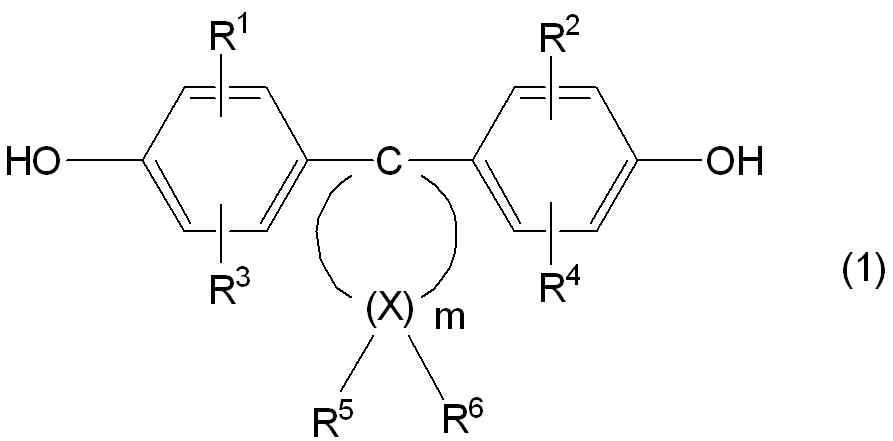
<7> 前記脂環式二価フェノールが全二価フェノール成分に対して15モル%以上の割合で含有される、<6>に記載のポリアリレート樹脂。
<8> 前記二価フェノール成分が、2,2-ビス(4-ヒドロキシフェニル)プロパン(BisA)および/または1,1-ビス(4-ヒドロキシフェニル)-1-フェニルエタン(BisAP)と、1,1-ビス(4-ヒドロキシフェニル)-3,3,5-トリメチルシクロヘキサン(BisTMC)および/または1,1-ビス(4-ヒドロキシフェニル)-シクロドデカン(BisCDE)とを含有する、<6>または<7>に記載のポリアリレート樹脂。
<9> 前記BisAおよび/または前記BisAPの合計含有量と、前記BisTMCおよび/または前記BisCDEの合計含有量との含有比率((BisA+BisAP)/(BisTMC+BisCDE))が、15/85~85/15(モル比)である、<8>に記載のポリアリレート樹脂。
<10> アセチル化反応および脱酢酸重合反応を行い<1>~<9>のいずれかに記載のポリアリレート樹脂を製造する方法であって、
前記アセチル化反応の後から前記脱酢酸重合反応の前に、ヒドロキシカルボン酸成分を添加することを特徴とするポリアリレート樹脂の製造方法。
<11> 前記アセチル化反応の後から前記脱酢酸重合反応の前に、前記脱酢酸重合反応のための温度および圧力に調整する予備段階を有し、
該予備段階において前記ヒドロキシカルボン酸成分を添加する、<10>に記載のポリアリレート樹脂の製造方法。
<12> 前記予備段階が、反応系を昇温した後、減圧を行う段階であり、
該予備段階において、昇温前に、かつ/または昇温後であって減圧前に、前記ヒドロキシカルボン酸成分を添加する、<11>に記載のポリアリレート樹脂の製造方法。
<13> <1>~<9>のいずれかに記載のポリアリレート樹脂およびエポキシ樹脂を含むことを特徴とするポリアリレート樹脂組成物。
<14> <1>~<9>のいずれかに記載のポリアリレート樹脂を含む被膜。
<15> <1>~<9>のいずれかに記載のポリアリレート樹脂を含むフィルム。
<16> <1>~<9>のいずれかに記載のポリアリレート樹脂および有機溶媒を含有する樹脂溶液。
<17> <16>に記載の樹脂溶液が強化繊維クロスに含浸または塗布されていることを特徴とするプリプレグ。
<18> <17>に記載のプリプレグが積層されていることを特徴とする積層体。
本発明のポリアリレート樹脂はまた、エポキシ樹脂とともに、耐熱性および誘電特性に十分に優れた硬化物を形成できる。
本発明のポリアリレート樹脂は、二価フェノール成分および芳香族ジカルボン酸成分をモノマー成分として含有するポリエステルである。
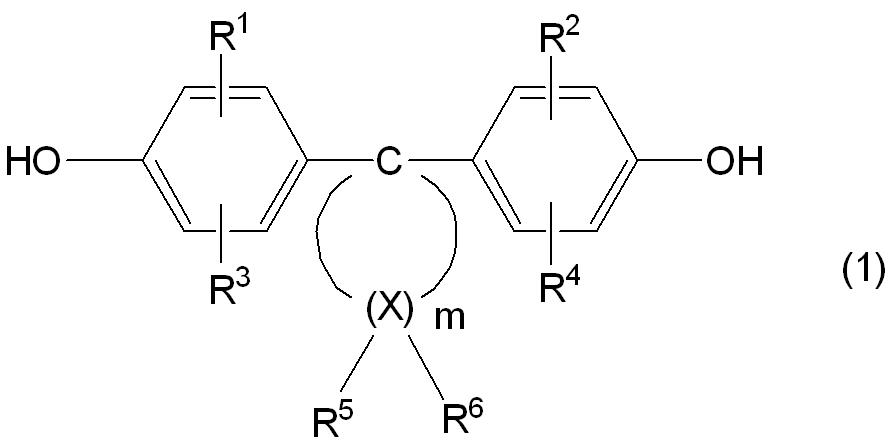
式(1)中、Xはヒドロキシフェニル基が結合する炭素原子とともに飽和脂肪族炭化水素環(単環)を形成する炭素原子を表す。飽和脂肪族炭化水素環は、mの数に応じたシクロアルカン環を示す。飽和脂肪族炭化水素環の具体例として、例えば、シクロペンタン環(m=4)、シクロヘキサン環(m=5)、シクロヘプタン環(m=6)、シクロオクタン環(m=7)、シクロノナン環(m=8)、シクロデカン環(m=9)、シクロウンデカン環(m=10)、シクロドデカン環(m=11)、シクロトリデカン環(m=12)が挙げられる。



本発明のポリアリレート樹脂の製造方法は、ヒドロキシル基濃度を所定の範囲内とすることができれば特に限定されないが、ヒドロキシル基濃度の制御が容易なことから、溶融重合時にヒドロキシカルボン酸成分用いて制御する方法が好ましい。
本発明はポリアリレート樹脂組成物も提供する。本発明のポリアリレート樹脂組成物は、少なくとも前記したポリアリレート樹脂およびエポキシ樹脂を含む。
そのようなポリアリレート樹脂の配合量は通常、エポキシ樹脂とポリアリレート樹脂との合計量100質量部に対して、20~80質量部であり、好ましくは35~65質量部、より好ましくは40~50質量部である。
本発明のポリアリレート樹脂およびポリアリレート樹脂組成物は、有機溶媒に溶解し、樹脂溶液とすることができる。樹脂溶液の作製方法は特に限定されないが、ポリアリレート樹脂組成物の樹脂溶液を作製する場合、ポリアリレート樹脂とエポキシ樹脂を同時に有機溶媒に溶解するよりも、予めポリアリレート樹脂とエポキシ樹脂をそれぞれ有機溶媒に溶解した後それらを混合する方が、短時間で均一な樹脂溶液を得やすい。なお、後者の場合、両者の樹脂溶液の固形分濃度が近い方が、より短時間で均一な樹脂溶液を得やすい。
高分解能核磁気共鳴装置(日本電子社製LA-400 NMR)を用いて、1H-NMR分析することにより、それぞれの共重合成分のピーク面積から樹脂組成を求めた。また、1H-NMR分析することにより、フェノール性ヒドロキシル基に対してオルト位またはメタ位に位置するプロトンのピーク面積を算出して、ヒドロキシル基を定量化することによりヒドロキシル基濃度を求めた。また、アセチル基のメチル基のプロトンのピーク面積を算出して、アセチル基を定量化することによりアセチル基濃度を求めた。(分解能:400MHz、溶媒:重水素化トリフルオロ酢酸と重水素化テトラクロロエタンとの容量比が1/11の混合溶媒、温度:50℃)。
示差走査熱量測定装置(パーキンエルマー社製DSC7)を用いて、昇温速度20℃/分で40℃から340℃まで昇温し、得られた昇温曲線中のガラス転移温度に由来する不連続変化の開始温度をガラス転移温度とした。
クロロホルムを溶媒とし、ポリアリレート樹脂のペレットを濃度1000ppmとなるよう溶解させて溶液を得た。GPC分析により、ポリスチレン換算で数平均分子量を求めた。
各実施例/比較例を、容量150Lの反応容器を用いて、得られるポリアリレート樹脂が45~55kgとなるようにして実施した。脱酢酸重合反応における減圧開始から、ポリアリレート樹脂の抜き出し開始までの時間を「ポリアリレート樹脂の製造時間」として示し、評価した。
なお、「ポリアリレート樹脂の製造時間」は、実施例1~21、24および比較例1~6においては脱酢酸重合反応の反応時間を示し、実施例22および23においては脱酢酸重合反応の反応時間と解重合反応の反応時間(2時間)の合計時間を示す。
S(最良):4時間未満;
A(優良):4時間以上、5時間未満;
B(良):5時間以上、7時間未満;
C(合格):7時間以上、8時間未満;
D(不合格):8時間以上。
内容量50mLのガラス製ねじ口瓶に、合計量が30gで、溶液濃度が5、10、20、30質量%になるようにポリアリレート樹脂とトルエンを秤量した。その後、ガラス製ねじ口瓶を密封し、23℃の室温でミックスローターを使用して70rpmで24時間回転させ、23℃の室温下、48時間静置した。静置後、樹脂溶液を目視で観察し、以下の基準で溶液安定性を判断した。
良好:透明性が維持されており、増粘していなかった。
不良:透明性が維持されていなかったか、増粘していたか、あるいは溶け残りがあった。
溶液濃度が5、10、20、30質量%のうち、溶液安定性が良好で、かつ溶液濃度が最も高い溶液の溶液濃度を可溶固形分濃度とした。
なお、いずれの溶液濃度においても溶液安定性が良好な結果が得られなかった場合は、表には「0」と記載した。
また、溶媒がトルエンの場合と同様にして、溶媒がメチルエチルケトンの場合についても可溶固形分濃度を求めた。
本発明のポリアリレート樹脂は、トルエンおよびメチルエチルケトンの少なくとも一方の溶媒への溶解性が良好であれば、汎用溶媒への溶解性が良好である。本発明のポリアリレート樹脂は、これらの両方の溶媒への溶解性、特にメチルエチルケトンへの溶解性が良好であることが好ましい。上記溶液濃度が高いほど、当該溶媒への溶解性は良好である。
エポキシ樹脂(EOCN-1020-55、日本化薬社製、o-クレゾールノボラック型エポキシ樹脂、軟化点55℃、エポキシ当量195)とポリアリレート樹脂を50/50の比率で計100質量部となるように混合し、さらに硬化促進剤(2-エチル-4-メチルイミダゾール、東京化成工業社製)0.2質量部とトルエン100質量部を混合し、透明になるまで攪拌した。常温(25℃)下において、攪拌後、脱溶媒および乾燥し、樹脂組成物を得た。なお、トルエンに溶解しない場合は、塩化メチレンを用いた。
得られた樹脂組成物を、示差走査熱量測定装置(パーキンエルマー社製DSC7)を用いて、昇温速度20℃/分で30℃から300℃まで昇温し、降温後、再度30℃から300℃まで昇温し、得られた昇温曲線中のガラス転移温度に由来する不連続変化の開始温度をガラス転移温度(Tga)とした。
S(最良):200℃≦Tga;
A(優良):190℃≦Tga<200℃;
B(良):180℃≦Tga<190℃;
C(合格):170℃≦Tga<180℃;
D(不合格):Tga<170℃。
ポリアリレート樹脂50質量部と、エポキシ樹脂(jER828、三菱化学社製、ビスフェノールA型エポキシ樹脂、エポキシ当量184~194g/eq、粘度120~150(25℃)、軟化点20℃以下)50質量部、硬化促進剤(2-エチル-4-メチルイミダゾール、東京化成工業社製)0.2質量部と、テトラヒドロフラン100質量部とを混合し、透明になるまで攪拌し、樹脂溶液を得た。
得られた樹脂溶液を、アルミカップに注ぎ、室温で2時間乾燥させた。その後、真空乾燥機を用いて、200Pa下、170℃で2時間、続いて、200Pa下、200℃で3時間乾燥して、脱溶媒および硬化を行い、硬化物を得た。なお、トルエンに溶解しない場合は、塩化メチレンを用いて、樹脂溶液を得て、硬化物を作製した。
得られた硬化物の板を切削し、示差走査熱量測定装置(パーキンエルマー社製DSC7)を測定した。昇温速度20℃/分で30℃から300℃まで昇温し、降温後、再度30℃から300℃まで昇温し、得られた昇温曲線中のガラス転移温度に由来する不連続変化の開始温度をガラス転移温度Tgbとした。
S(最良):190℃≦Tgb;
A(優良):180℃≦Tgb<190℃;
B(良):170℃≦Tgb<180℃;
C(合格):160℃≦Tgb<170℃;
D(不合格):Tgb<160℃。
装置:アジレント・テクノロジー株式会社製、E4991A RFインピーダンス/マテリアル・アナライザ試料寸法:長さ60mm×幅60mm×厚み100μm
周波数:1GHz
測定温度:23℃
試験環境:23℃±1℃、50%RH±5%RH
(7)で得られたポリアリレート樹脂組成物の硬化物の板を観察し、以下の基準でポリアリレート樹脂組成物の流動性の判断をした。
○:硬化物に気泡が見られなかった。
×:硬化物に気泡が見られた。
(試料溶液Aの調製)
凍結粉砕したポリアリレート樹脂0.2gをアセトニトリル3mLに浸漬し、室温で3日間静置抽出した。その後、抽出液を孔径0.45μmのフィルターで濾過し、アセトニトリルで希釈して測定用試料溶液を調製した。
(試料溶液Bの調製)
凍結粉砕したポリアリレート樹脂0.2gをメタノール3mLに浸漬し、室温で3日間静置抽出した。その後、抽出液を孔径0.45μmのフィルターで濾過して測定用試料溶液を調製した。
HPLC装置(HewlettPackard社製 HP1100)を用いて、試料溶液Aおよび試料溶液Bの測定を行った。試料溶液Aの測定結果より、二価フェノール成分およびヒドロキシカルボン酸成分のモノマー濃度を求めた。また、試料溶液Bの測定結果より、芳香族ジカルボン酸成分のモノマー濃度を求めた。二価フェノール成分、ヒドロキシカルボン酸成分および芳香族ジカルボン酸成分のモノマー濃度の合計から、ポリアリレート樹脂中のモノマー濃度を求めた。(カラム:WatersAtlantis T3 5μmφ4.6×15mm、温度:40℃、検出器:UV275nm、溶離液A:0.1%ギ酸水溶液、溶離液B:アクリロニトリル/ギ酸=100/2、流量:0.5mL/min)
S(最良):ポリアリレート樹脂中のモノマー濃度が0.5質量%以下;
A(優良):ポリアリレート樹脂中のモノマー濃度が0.5質量%を超えて1.0質量%以下;
B(良):ポリアリレート樹脂中のモノマー濃度が1.0質量%を超えて1.5質量%以下;
C(合格):ポリアリレート樹脂中のモノマー濃度が1.5質量%を超えて2.0質量%以下;
D(不合格):ポリアリレート樹脂中のモノマー濃度が2.0質量%超。
撹拌装置を備えた反応容器に、TPA6.7質量部、IPA6.7質量部、BisTMC31.0質量部、無水酢酸20.4質量部を投入し(TPA:IPA:BisTMC:無水酢酸(モル比)=50:50:125:250)、窒素雰囲気下で、常圧、140℃で2時間撹拌混合させて反応させた(アセチル化反応)。
続いて、140℃でPHBA5.5質量部を投入した後、280℃まで3時間かけて昇温し、280℃で1時間保持した。その後、280℃おいて90分かけて130Paまで減圧し、2時間撹拌して、ポリアリレート樹脂を得た後、ポリアリレート樹脂を反応容器から抜き出した(脱酢酸重合反応)。
得られたポリアリレート樹脂の樹脂組成を分析したところ、TPA:IPA:BisTMC:PHBA=50:50:125:50(モル比)と、仕込みの組成と同一であった。
撹拌装置を備えた反応容器に、TPA6.7質量部、IPA6.7質量部、BisTMC31.0質量部、無水酢酸20.4質量部を投入し(TPA:IPA:BisTMC:無水酢酸(モル比)=50:50:125:250)、窒素雰囲気下で、常圧、140℃で2時間撹拌混合させて反応させた(アセチル化反応)。
続いて、280℃まで3時間かけて昇温し、280℃で1時間保持した後、280℃でPHBA5.5質量部を投入した。その後、280℃において90分かけて130Paまで減圧し、2時間撹拌して、ポリアリレート樹脂を得た後、ポリアリレート樹脂を反応容器から抜き出した(脱酢酸重合反応)。
表1、表2、表3または表4に記載のように原料の仕込の樹脂組成を変更したことおよび「ポリアリレート樹脂の製造時間」をこれらの表に記載のように変更したこと以外は、実施例1と同様の操作を行って、ポリアリレート樹脂を得た。
攪拌装置を備えた反応容器に、ビスフェノール成分として2,2-ビス(4-ヒドロキシフェニル)プロパン(BisA)51.1質量部、末端封止剤としてp-tert-ブチルフェノール2.01質量部(PTBP)、アルカリとして水酸化ナトリウム36.5質量部、重合触媒としてトリ-n-ブチルベンジルアンモニウムクロライド(TBBAC)の50質量%水溶液を0.56質量部仕込み、水1200質量部に溶解させた(水相)。また、これとは別に、塩化メチレン700質量部に、テレフタル酸クロライド23.4質量部とイソフタル酸クロライド23.4質量部を溶解させた(有機相)(TPC:IPC:PTBP:BisA(モル比)=50:50:7:97)。水相をあらかじめ攪拌しておき、有機相を水相中に強攪拌下で添加し、20℃で2時間、界面重合法で重合を行った。この後、攪拌を停止し、水相と有機相をデカンテーションして分離した。水相を除去した後、酢酸1質量部を添加して反応を停止した。その後、有機相を純水でpHが7前後になるまで洗浄を繰り返し、続いて、有機相を、ホモミキサーを装着した50℃の温水槽中に徐々に投入しながら塩化メチレンを蒸発させ、粉末状のポリマーを析出させた。得られたポリマーを、脱水、乾燥し、ポリアリレート樹脂を得た。
撹拌装置を備えた反応容器に、TPA5.5質量部、IPA12.8質量部、BisA15.7質量部、BisTMC21.3質量部、PHBA8.7質量部、無水酢酸22.6質量部を投入し(TPA:IPA:BisA:BisTMC:PHBA:無水酢酸(モル比)=30:70:62.5:62.5:57.7:307.5)、窒素雰囲気下で、常圧、140℃で2時間撹拌混合させて反応させた(アセチル化反応)。
続いて、140℃でPHBA8.7質質量部を投入した後、280℃まで3時間かけて昇温し、280℃で1時間保持した。その後、280℃において90分かけて130Paまで減圧し、2時間撹拌して、ポリアリレート樹脂を得た後、ポリアリレート樹脂を反応容器から抜き出した(脱酢酸重合反応)。
撹拌装置を備えた反応容器に、TPA5.0質量部、IPA11.6質量部、BisA14.3質量部、BisTMC19.4質量部、無水酢酸25.5質量部を投入し(TPA:IPA:BisA:BisTMC:無水酢酸(モル比)=30:70:62.5:62.5:250)、窒素雰囲気下で、常圧、140℃で2時間撹拌混合させて反応させた(アセチル化反応)。
続いて、280℃まで3時間かけて昇温し、280℃で1時間保持した後、90分かけて130Paまで減圧し、2時間撹拌した(脱酢酸重合反応)。その後、窒素雰囲気下で常圧とし、280℃でPHBA6.9質量部を投入し後、280℃で2時間撹拌して解重合反応を行い、ポリアリレート樹脂を得た後、ポリアリレート樹脂を反応容器から抜き出した(解重合反応)。
撹拌装置を備えた反応容器に、TPA5.0質量部、IPA11.6質量部、BisA8.6質量部、BisTMC19.4質量部、PHBA6.9質量部、無水酢酸25.5質量部を投入し(TPA:IPA:BisA:BisTMC:PHBA:無水酢酸(モル比)=30:70:37.5:62.5:50:250)、窒素雰囲気下で、常圧、140℃で2時間撹拌混合させて反応させた(アセチル化反応)。
続いて、280℃まで3時間かけて昇温し、280℃で1時間保持した。その後、280℃おいて90分かけて130Paまで減圧し、2時間撹拌して、ポリアリレート樹脂を得た(脱酢酸重合反応)。その後、窒素雰囲気下で常圧とし、280℃でBisA5.7質量部を投入し後、280℃で2時間撹拌して解重合反応を行い、ポリアリレート樹脂を得た後、ポリアリレート樹脂を反応容器から抜き出した(解重合反応)。
撹拌装置を備えた反応容器に、TPA5.5質量部、IPA12.8質量部、BisA15.7質量部、BisTMC21.3質量部、無水酢酸22.5質量部を投入し(TPA:IPA:BisA:BisTMC:無水酢酸(モル比)=30:70:62.5:62.5:200)、窒素雰囲気下で、常圧、140℃で2時間撹拌混合させて反応させた(アセチル化反応)。
続いて、280℃まで3時間かけて昇温し、280℃で1時間保持した。その後、90分かけて130Paまで減圧し、2時間撹拌して、ポリアリレート樹脂を得た後、ポリアリレート樹脂を反応容器から抜き出した(脱酢酸重合反応)。
エポキシ樹脂(EOCN-1020-55、日本化薬社製、o-クレゾールノボラック型エポキシ樹脂、軟化点55℃、エポキシ当量195)100質量部と硬化促進剤(2-エチル-4-メチルイミダゾール、東京化成工業社製)0.2質量部とトルエン100質量部を混合し、透明になるまで攪拌した。攪拌後、脱溶媒し、乾燥し、樹脂組成物を得た。
得られた樹脂組成物を、示差走査熱量測定装置(パーキンエルマー社製DSC7)を用いて、昇温速度20℃/分で30℃から300℃まで昇温し、降温後、再度30℃から300℃まで昇温し、得られた昇温曲線中のガラス転移温度に由来する不連続変化の開始温度の有無を調べた。
ガラス転移温度は30℃から300℃の範囲にはなかった。


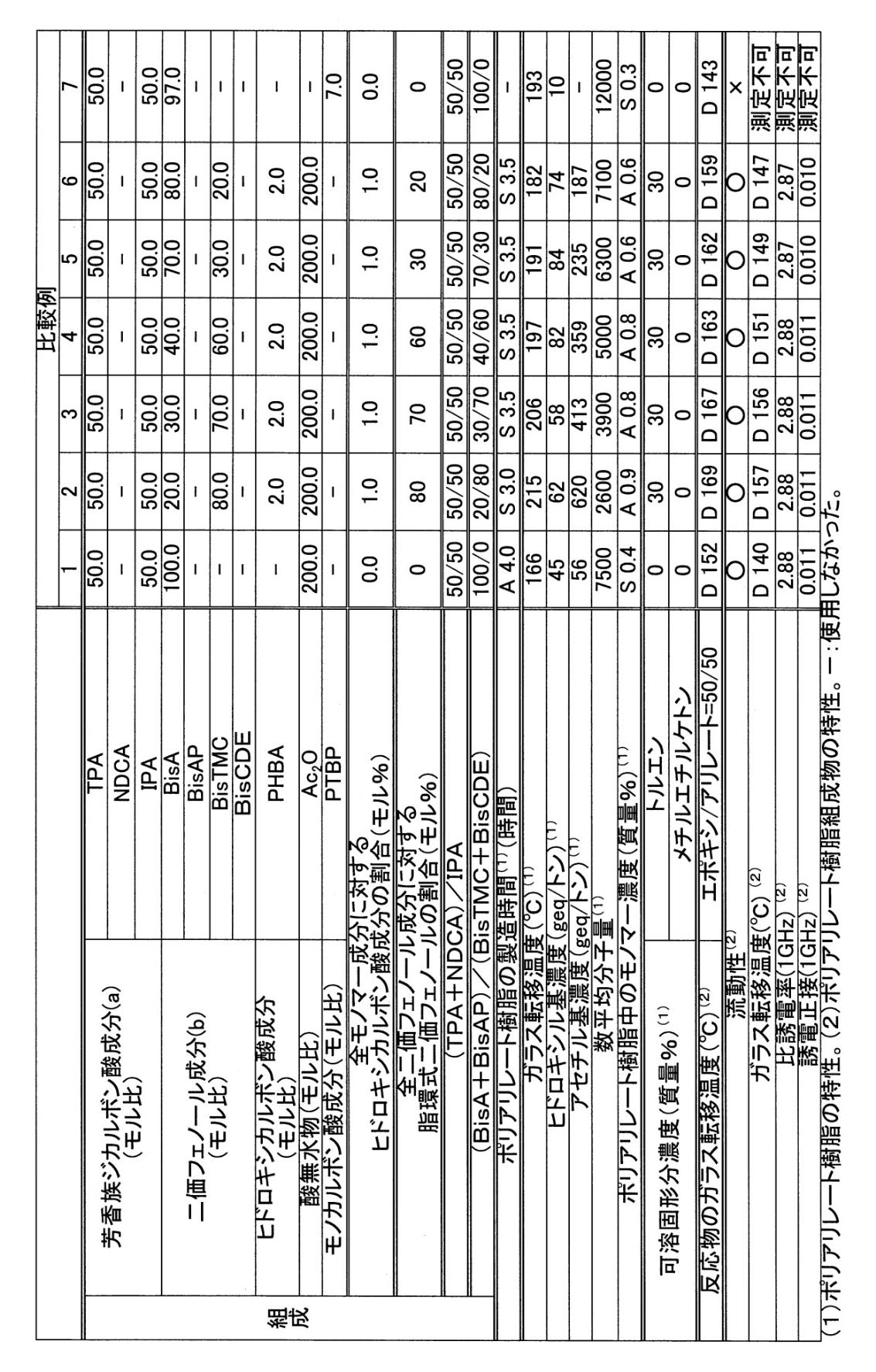
組成条件(1);全モノマー成分に対するヒドロキシカルボン酸成分の割合=2~30モル%。
組成条件(2);全モノマー成分に対するヒドロキシカルボン酸成分の割合=5~30モル%および(BisA+BisAP)/(BisTMC+BisCDE)の含有比率=15/85~85/15(モル比)。
組成条件(3);全モノマー成分に対するヒドロキシカルボン酸成分の割合=5~25モル%、(BisA+BisAP)/(BisTMC+BisCDE)の含有比率=30/70~70/30(モル比)および(TPA+NDCA)/IPAの含有比率=0/100~60/40(モル比)。
組成条件(4);全モノマー成分に対するヒドロキシカルボン酸成分の割合=10~25モル%、(BisA+BisAP)/(BisTMC+BisCDE)の含有比率=30/70~70/30(モル比)および(TPA+NDCA)/IPAの含有比率=10/90~40/60(モル比)。
Claims (18)
- 二価フェノール成分および芳香族ジカルボン酸成分を含有し、ヒドロキシル基濃度が100geq/トン以上であることを特徴とするポリアリレート樹脂。
- アセチル基濃度が10geq/トン以上であることを特徴とする、請求項1に記載のポリアリレート樹脂。
- モノマー濃度が2質量%以下であることを特徴とする、請求項1または2に記載のポリアリレート樹脂。
- ヒドロキシカルボン酸成分をさらに含有する、請求項1~3のいずれかに記載のポリアリレート樹脂。
- 前記ヒドロキシカルボン酸成分が全モノマー成分に対して2~50モル%の割合で含有される、請求項4に記載のポリアリレート樹脂。
- 前記二価フェノール成分が一般式(1)で示される脂環式二価フェノールを含有する、請求項1~5のいずれかに記載のポリアリレート樹脂。

- 前記脂環式二価フェノールが全二価フェノール成分に対して15モル%以上の割合で含有される、請求項6に記載のポリアリレート樹脂。
- 前記二価フェノール成分が、2,2-ビス(4-ヒドロキシフェニル)プロパン(BisA)および/または1,1-ビス(4-ヒドロキシフェニル)-1-フェニルエタン(BisAP)と、1,1-ビス(4-ヒドロキシフェニル)-3,3,5-トリメチルシクロヘキサン(BisTMC)および/または1,1-ビス(4-ヒドロキシフェニル)-シクロドデカン(BisCDE)とを含有する、請求項6または7に記載のポリアリレート樹脂。
- 前記BisAおよび/または前記BisAPの合計含有量と、前記BisTMCおよび/または前記BisCDEの合計含有量との含有比率((BisA+BisAP)/(BisTMC+BisCDE))が、15/85~85/15(モル比)である、請求項8に記載のポリアリレート樹脂。
- アセチル化反応および脱酢酸重合反応を行い請求項1~9のいずれかに記載のポリアリレート樹脂を製造する方法であって、
前記アセチル化反応の後から前記脱酢酸重合反応の前に、ヒドロキシカルボン酸成分を添加することを特徴とするポリアリレート樹脂の製造方法。 - 前記アセチル化反応の後から前記脱酢酸重合反応の前に、前記脱酢酸重合反応のための温度および圧力に調整する予備段階を有し、
該予備段階において前記ヒドロキシカルボン酸成分を添加する、請求項10に記載のポリアリレート樹脂の製造方法。 - 前記予備段階が、反応系を昇温した後、減圧を行う段階であり、
該予備段階において、昇温前に、かつ/または昇温後であって減圧前に、前記ヒドロキシカルボン酸成分を添加する、請求項11に記載のポリアリレート樹脂の製造方法。 - 請求項1~9のいずれかに記載のポリアリレート樹脂およびエポキシ樹脂を含むことを特徴とするポリアリレート樹脂組成物。
- 請求項1~9のいずれかに記載のポリアリレート樹脂を含む被膜。
- 請求項1~9のいずれかに記載のポリアリレート樹脂を含むフィルム。
- 請求項1~9のいずれかに記載のポリアリレート樹脂および有機溶媒を含有する樹脂溶液。
- 請求項16に記載の樹脂溶液が強化繊維クロスに含浸または塗布されていることを特徴とするプリプレグ。
- 請求項17に記載のプリプレグが積層されていることを特徴とする積層体。
Priority Applications (3)
| Application Number | Priority Date | Filing Date | Title |
|---|---|---|---|
| CN201680063737.5A CN108291014B (zh) | 2015-10-30 | 2016-10-25 | 聚芳酯树脂和其制造方法以及聚芳酯树脂组合物 |
| JP2017513259A JP6152235B1 (ja) | 2015-10-30 | 2016-10-25 | ポリアリレート樹脂およびその製造方法ならびにポリアリレート樹脂組成物 |
| KR1020187011368A KR102567077B1 (ko) | 2015-10-30 | 2016-10-25 | 폴리아릴레이트 수지 및 그의 제조 방법, 및 폴리아릴레이트 수지 조성물 |
Applications Claiming Priority (4)
| Application Number | Priority Date | Filing Date | Title |
|---|---|---|---|
| JP2015214425 | 2015-10-30 | ||
| JP2015-214425 | 2015-10-30 | ||
| JP2016-162131 | 2016-08-22 | ||
| JP2016162131 | 2016-08-22 |
Publications (1)
| Publication Number | Publication Date |
|---|---|
| WO2017073549A1 true WO2017073549A1 (ja) | 2017-05-04 |
Family
ID=58630194
Family Applications (1)
| Application Number | Title | Priority Date | Filing Date |
|---|---|---|---|
| PCT/JP2016/081551 Ceased WO2017073549A1 (ja) | 2015-10-30 | 2016-10-25 | ポリアリレート樹脂およびその製造方法ならびにポリアリレート樹脂組成物 |
Country Status (5)
| Country | Link |
|---|---|
| JP (1) | JP6152235B1 (ja) |
| KR (1) | KR102567077B1 (ja) |
| CN (1) | CN108291014B (ja) |
| TW (1) | TWI720045B (ja) |
| WO (1) | WO2017073549A1 (ja) |
Cited By (6)
| Publication number | Priority date | Publication date | Assignee | Title |
|---|---|---|---|---|
| WO2017175716A1 (ja) * | 2016-04-05 | 2017-10-12 | ユニチカ株式会社 | ポリアリレート樹脂およびその樹脂組成物 |
| JP2018044094A (ja) * | 2016-09-16 | 2018-03-22 | ユニチカ株式会社 | 樹脂組成物、それを用いた塗膜および積層体 |
| WO2018092418A1 (ja) * | 2016-11-18 | 2018-05-24 | 京セラドキュメントソリューションズ株式会社 | ポリアリレート樹脂及び電子写真感光体 |
| WO2018199127A1 (ja) * | 2017-04-28 | 2018-11-01 | ユニチカ株式会社 | 変性ポリアリレート樹脂 |
| WO2018199038A1 (ja) * | 2017-04-25 | 2018-11-01 | ユニチカ株式会社 | ポリアリレート樹脂およびポリアリレート樹脂組成物 |
| JP2020176239A (ja) * | 2019-04-22 | 2020-10-29 | 帝人株式会社 | エポキシ樹脂組成物、プリプレグ、プリプレグの製造方法、及び繊維強化複合材料の製造方法 |
Families Citing this family (1)
| Publication number | Priority date | Publication date | Assignee | Title |
|---|---|---|---|---|
| CN117368250B (zh) * | 2023-12-08 | 2024-02-20 | 烟台泰和新材高分子新材料研究院有限公司 | 一种定量分析液晶聚芳酯结构的方法 |
Citations (6)
| Publication number | Priority date | Publication date | Assignee | Title |
|---|---|---|---|---|
| JPH11263829A (ja) * | 1997-12-26 | 1999-09-28 | Toray Ind Inc | 液晶性樹脂および熱可塑性樹脂組成物 |
| JP2004169021A (ja) * | 2002-10-31 | 2004-06-17 | Dainippon Ink & Chem Inc | エポキシ樹脂組成物およびその硬化物 |
| JP2004224890A (ja) * | 2003-01-22 | 2004-08-12 | Dainippon Ink & Chem Inc | エポキシ樹脂組成物の硬化物の製造方法 |
| WO2012090407A1 (ja) * | 2010-12-27 | 2012-07-05 | 東レ株式会社 | 全芳香族液晶ポリエステルおよびその製造方法 |
| WO2014115694A1 (ja) * | 2013-01-24 | 2014-07-31 | 三菱瓦斯化学株式会社 | ポリアリレート及びそれを用いた成形品 |
| JP2015187214A (ja) * | 2014-03-26 | 2015-10-29 | ユニチカ株式会社 | ワニスおよびその製造方法 |
Family Cites Families (3)
| Publication number | Priority date | Publication date | Assignee | Title |
|---|---|---|---|---|
| JPS6038429A (ja) * | 1983-08-11 | 1985-02-28 | Mitsubishi Chem Ind Ltd | 芳香族ポリエステルの製造法 |
| DE3913403A1 (de) * | 1988-12-23 | 1990-06-28 | Bayer Ag | Neue thermotrope polyester, verfahren zu ihrer herstellung sowie ihrer verwendung zur herstellung von formkoerpern, filamenten, fasern und folien |
| WO2015005442A1 (ja) * | 2013-07-12 | 2015-01-15 | 三菱化学株式会社 | 電子写真感光体、電子写真感光体カートリッジ、画像形成装置、及びポリアリレート樹脂 |
-
2016
- 2016-10-25 KR KR1020187011368A patent/KR102567077B1/ko active Active
- 2016-10-25 WO PCT/JP2016/081551 patent/WO2017073549A1/ja not_active Ceased
- 2016-10-25 CN CN201680063737.5A patent/CN108291014B/zh active Active
- 2016-10-25 JP JP2017513259A patent/JP6152235B1/ja active Active
- 2016-10-28 TW TW105135003A patent/TWI720045B/zh active
Patent Citations (6)
| Publication number | Priority date | Publication date | Assignee | Title |
|---|---|---|---|---|
| JPH11263829A (ja) * | 1997-12-26 | 1999-09-28 | Toray Ind Inc | 液晶性樹脂および熱可塑性樹脂組成物 |
| JP2004169021A (ja) * | 2002-10-31 | 2004-06-17 | Dainippon Ink & Chem Inc | エポキシ樹脂組成物およびその硬化物 |
| JP2004224890A (ja) * | 2003-01-22 | 2004-08-12 | Dainippon Ink & Chem Inc | エポキシ樹脂組成物の硬化物の製造方法 |
| WO2012090407A1 (ja) * | 2010-12-27 | 2012-07-05 | 東レ株式会社 | 全芳香族液晶ポリエステルおよびその製造方法 |
| WO2014115694A1 (ja) * | 2013-01-24 | 2014-07-31 | 三菱瓦斯化学株式会社 | ポリアリレート及びそれを用いた成形品 |
| JP2015187214A (ja) * | 2014-03-26 | 2015-10-29 | ユニチカ株式会社 | ワニスおよびその製造方法 |
Cited By (7)
| Publication number | Priority date | Publication date | Assignee | Title |
|---|---|---|---|---|
| WO2017175716A1 (ja) * | 2016-04-05 | 2017-10-12 | ユニチカ株式会社 | ポリアリレート樹脂およびその樹脂組成物 |
| JP2018044094A (ja) * | 2016-09-16 | 2018-03-22 | ユニチカ株式会社 | 樹脂組成物、それを用いた塗膜および積層体 |
| WO2018092418A1 (ja) * | 2016-11-18 | 2018-05-24 | 京セラドキュメントソリューションズ株式会社 | ポリアリレート樹脂及び電子写真感光体 |
| JPWO2018092418A1 (ja) * | 2016-11-18 | 2019-10-17 | 京セラドキュメントソリューションズ株式会社 | ポリアリレート樹脂及び電子写真感光体 |
| WO2018199038A1 (ja) * | 2017-04-25 | 2018-11-01 | ユニチカ株式会社 | ポリアリレート樹脂およびポリアリレート樹脂組成物 |
| WO2018199127A1 (ja) * | 2017-04-28 | 2018-11-01 | ユニチカ株式会社 | 変性ポリアリレート樹脂 |
| JP2020176239A (ja) * | 2019-04-22 | 2020-10-29 | 帝人株式会社 | エポキシ樹脂組成物、プリプレグ、プリプレグの製造方法、及び繊維強化複合材料の製造方法 |
Also Published As
| Publication number | Publication date |
|---|---|
| TWI720045B (zh) | 2021-03-01 |
| CN108291014A (zh) | 2018-07-17 |
| KR20180077165A (ko) | 2018-07-06 |
| JP6152235B1 (ja) | 2017-06-21 |
| TW201728612A (zh) | 2017-08-16 |
| KR102567077B1 (ko) | 2023-08-14 |
| CN108291014B (zh) | 2021-03-19 |
| JPWO2017073549A1 (ja) | 2017-11-02 |
Similar Documents
| Publication | Publication Date | Title |
|---|---|---|
| JP6152235B1 (ja) | ポリアリレート樹脂およびその製造方法ならびにポリアリレート樹脂組成物 | |
| JP6676529B2 (ja) | 樹脂組成物およびそれを用いた積層体 | |
| US6838546B2 (en) | Aromatic liquid-crystalline polyester solution composition | |
| EP1416007B1 (en) | Epoxy resin composition | |
| JP7733639B2 (ja) | フェノキシ樹脂、樹脂組成物、硬化物、電気・電子回路用積層板、及びフェノキシ樹脂の製造方法 | |
| JP6951707B2 (ja) | ポリアリレート樹脂およびその樹脂組成物 | |
| TWI391421B (zh) | 聚醯胺樹脂,環氧樹脂組成物及其硬化物 | |
| WO2018199127A1 (ja) | 変性ポリアリレート樹脂 | |
| JP7217472B2 (ja) | ポリアリレート樹脂およびポリアリレート樹脂組成物 | |
| JP2004210941A (ja) | 樹脂組成物、樹脂硬化物、シート状樹脂硬化物及び積層体 | |
| JP2019163410A (ja) | 樹脂組成物およびそれより得られる樹脂フィルム | |
| WO2019127389A1 (zh) | 环氧树脂组合物、预浸料、层压板和印刷电路板 | |
| TW202340317A (zh) | 硬化性樹脂、硬化性樹脂組成物、及硬化物 |
Legal Events
| Date | Code | Title | Description |
|---|---|---|---|
| ENP | Entry into the national phase |
Ref document number: 2017513259 Country of ref document: JP Kind code of ref document: A |
|
| 121 | Ep: the epo has been informed by wipo that ep was designated in this application |
Ref document number: 16859779 Country of ref document: EP Kind code of ref document: A1 |
|
| ENP | Entry into the national phase |
Ref document number: 20187011368 Country of ref document: KR Kind code of ref document: A |
|
| NENP | Non-entry into the national phase |
Ref country code: DE |
|
| 122 | Ep: pct application non-entry in european phase |
Ref document number: 16859779 Country of ref document: EP Kind code of ref document: A1 |