WO2017073193A1 - ダンパ装置 - Google Patents
ダンパ装置 Download PDFInfo
- Publication number
- WO2017073193A1 WO2017073193A1 PCT/JP2016/077068 JP2016077068W WO2017073193A1 WO 2017073193 A1 WO2017073193 A1 WO 2017073193A1 JP 2016077068 W JP2016077068 W JP 2016077068W WO 2017073193 A1 WO2017073193 A1 WO 2017073193A1
- Authority
- WO
- WIPO (PCT)
- Prior art keywords
- storage
- rotating body
- elastic member
- window
- coil spring
- Prior art date
- Legal status (The legal status is an assumption and is not a legal conclusion. Google has not performed a legal analysis and makes no representation as to the accuracy of the status listed.)
- Ceased
Links
Images



Classifications
-
- F—MECHANICAL ENGINEERING; LIGHTING; HEATING; WEAPONS; BLASTING
- F16—ENGINEERING ELEMENTS AND UNITS; GENERAL MEASURES FOR PRODUCING AND MAINTAINING EFFECTIVE FUNCTIONING OF MACHINES OR INSTALLATIONS; THERMAL INSULATION IN GENERAL
- F16F—SPRINGS; SHOCK-ABSORBERS; MEANS FOR DAMPING VIBRATION
- F16F15/00—Suppression of vibrations in systems; Means or arrangements for avoiding or reducing out-of-balance forces, e.g. due to motion
- F16F15/10—Suppression of vibrations in rotating systems by making use of members moving with the system
- F16F15/12—Suppression of vibrations in rotating systems by making use of members moving with the system using elastic members or friction-damping members, e.g. between a rotating shaft and a gyratory mass mounted thereon
- F16F15/121—Suppression of vibrations in rotating systems by making use of members moving with the system using elastic members or friction-damping members, e.g. between a rotating shaft and a gyratory mass mounted thereon using springs as elastic members, e.g. metallic springs
- F16F15/123—Wound springs
- F16F15/12353—Combinations of dampers, e.g. with multiple plates, multiple spring sets, i.e. complex configurations
-
- F—MECHANICAL ENGINEERING; LIGHTING; HEATING; WEAPONS; BLASTING
- F16—ENGINEERING ELEMENTS AND UNITS; GENERAL MEASURES FOR PRODUCING AND MAINTAINING EFFECTIVE FUNCTIONING OF MACHINES OR INSTALLATIONS; THERMAL INSULATION IN GENERAL
- F16D—COUPLINGS FOR TRANSMITTING ROTATION; CLUTCHES; BRAKES
- F16D13/00—Friction clutches
- F16D13/58—Details
- F16D13/60—Clutching elements
- F16D13/64—Clutch-plates; Clutch-lamellae
- F16D13/68—Attachments of plates or lamellae to their supports
-
- F—MECHANICAL ENGINEERING; LIGHTING; HEATING; WEAPONS; BLASTING
- F16—ENGINEERING ELEMENTS AND UNITS; GENERAL MEASURES FOR PRODUCING AND MAINTAINING EFFECTIVE FUNCTIONING OF MACHINES OR INSTALLATIONS; THERMAL INSULATION IN GENERAL
- F16H—GEARING
- F16H45/00—Combinations of fluid gearings for conveying rotary motion with couplings or clutches
- F16H45/02—Combinations of fluid gearings for conveying rotary motion with couplings or clutches with mechanical clutches for bridging a fluid gearing of the hydrokinetic type
-
- F—MECHANICAL ENGINEERING; LIGHTING; HEATING; WEAPONS; BLASTING
- F16—ENGINEERING ELEMENTS AND UNITS; GENERAL MEASURES FOR PRODUCING AND MAINTAINING EFFECTIVE FUNCTIONING OF MACHINES OR INSTALLATIONS; THERMAL INSULATION IN GENERAL
- F16D—COUPLINGS FOR TRANSMITTING ROTATION; CLUTCHES; BRAKES
- F16D2300/00—Special features for couplings or clutches
- F16D2300/22—Vibration damping
-
- F—MECHANICAL ENGINEERING; LIGHTING; HEATING; WEAPONS; BLASTING
- F16—ENGINEERING ELEMENTS AND UNITS; GENERAL MEASURES FOR PRODUCING AND MAINTAINING EFFECTIVE FUNCTIONING OF MACHINES OR INSTALLATIONS; THERMAL INSULATION IN GENERAL
- F16F—SPRINGS; SHOCK-ABSORBERS; MEANS FOR DAMPING VIBRATION
- F16F2228/00—Functional characteristics, e.g. variability, frequency-dependence
- F16F2228/10—Functional characteristics, e.g. variability, frequency-dependence with threshold or dead zone
Definitions
- the present invention relates to a damper device, and more particularly to a damper device capable of damping torque fluctuations.
- a conventional dynamic damper device includes a damper plate portion (45), an inertia member (46), and a coil spring (48a) (see Patent Document 1).
- the inertia member is rotatable relative to the damper plate portion.
- the coil spring elastically connects the damper plate portion and the inertia member in the rotational direction.
- the coil spring is disposed in the window part (46a) of the inertia member and the window part (45a) of the damper plate part. In this state, when the inertia member rotates relative to the damper plate portion, the coil device can smoothly operate the damper device within a range in which the first rotating body and the second rotating body are operated.
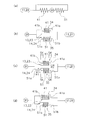
- the inertia member I and the damper plate portion D are elastically connected by a coil spring C as shown in the model diagram shown in FIG.
- both ends of the coil spring C are A pair of window walls W11, W12 facing in the circumferential direction in the window portion W1 of the inertia member I, and a pair of window walls W21, W22 facing in the circumferential direction in the window portion W2 of the damper plate portion D, It is in contact.
- the coil spring C is one of the window walls in the inertia member I. It is compressed by W11 and one window wall W22 in the damper plate portion D.
- a gap S is formed between one end of the coil spring C and the window wall W12 of the inertia member I. Further, a gap S is also formed between the other end of the coil spring C and the window wall W21 of the damper plate portion D.
- the coil spring C is the other member of the inertia member I. It is compressed by the window wall W12 and the other window wall W21 in the damper plate portion D.
- a gap S is formed between one end of the coil spring C and the window wall W11 of the inertia member I. Further, a gap S is also formed between the other end of the coil spring C and the window wall W22 of the damper plate portion D.
- the damper device that operates as described above passes through the neutral state in FIG. 7C when shifting from the first rotation state in FIG. 7B to the second rotation state in FIG. 7D.
- the gap S becomes zero, and the end portion of the coil spring C collides with the window wall W12 of the inertia member I and the window wall W21 of the damper plate portion D.
- the window wall that compresses the coil spring C is switched from the window walls W11 and W22 to the window walls W12 and W21.
- the present invention has been made in view of the above problems, and an object of the present invention is to provide a damper device that can be operated smoothly. Another object of the present invention is to provide a damper device capable of reducing operating noise. Still another object of the present invention is to provide a damper device capable of improving robustness against repeated stress acting on an elastic member.
- the damper device can attenuate torque fluctuations.
- the damper device includes a first rotating body, a second rotating body, and a plurality of elastic members.
- the second rotating body is configured to be rotatable relative to the first rotating body.
- the plurality of elastic members elastically connect the first rotating body and the second rotating body.
- the second rotating body is rotatable relative to the first rotating body in a state where the first rotating body holds the second rotating body using a plurality of elastic members.
- the elastic member only elastically connects the first rotating body and the second rotating body, and thus the above-described problem. Had occurred.
- the first rotating body holds the second rotating body using a plurality of elastic members (see FIG. 4A). For this reason, even if the rotation direction is reversed via the neutral state, switching of the portion that presses the elastic member does not occur. Further, when the first rotating body holds the second rotating body using a plurality of elastic members, the second rotating body rotates relative to the first rotating body, so that the torque fluctuation is attenuated. Is done.
- this damper device can operate smoothly compared to the conventional damper device. Moreover, in this damper apparatus, an operation sound can also be reduced compared with the conventional damper apparatus.
- the damper device can be configured by the configuration in which the first rotating body holds the second rotating body using a plurality of elastic members. It can be operated stably. That is, in this damper apparatus, the robustness with respect to the repetitive stress which acts on an elastic member can be improved.
- the plurality of elastic members operate in a compressed state between the first rotating body and the second rotating body.
- the 1st rotary body can hold
- the plurality of elastic members are the first rotating body and the second rotating body so that the total deformation amount in the plurality of elastic members is substantially zero.
- the plurality of elastic members elastically connect the first rotating body and the second rotating body, when a certain elastic member is compressed, the other elastic members are stretched, so that the plurality of elastic members are elastic.
- the total amount of deformation in the member is substantially zero.
- the 1st rotation body can hold the 2nd rotation body stably using a plurality of elastic members.
- each of the plurality of elastic members has the same rigidity. Therefore, the 1st rotation body can hold the 2nd rotation body stably using a plurality of elastic members.
- the plurality of elastic members include a first elastic member and a second elastic member.
- the first elastic member presses the second rotating body in the first rotating direction in a state where the first elastic member is in contact with the first rotating body.
- the second elastic member presses the second rotating body in the second rotation direction opposite to the first rotation direction in a state where the second elastic member is in contact with the first rotating body.
- the plurality of elastic members include a first elastic member and a second elastic member.
- first elastic member and the second elastic member When either one of the first elastic member and the second elastic member is compressed between the first rotating body and the second rotating body, one of the first elastic member and the second elastic member is the first It extends between the rotating body and the second rotating body.
- the 1st rotating body and the 2nd rotating body can operate stably, maintaining the balance of the 1st and 2nd elastic members.
- the plurality of elastic members include a first elastic member and a second elastic member.
- the first rotating body includes a first storage portion that stores the first elastic member, and a second storage portion that stores the second elastic member.
- the second rotating body is disposed to face the first housing portion and stores the first elastic member, and the fourth rotating body is disposed to face the second housing portion and houses the second elastic member.
- the first storage unit is offset in the first rotation direction with respect to the third storage unit.
- the second storage part is offset with respect to the fourth storage part in the second rotation direction opposite to the first rotation direction.
- the first rotating body and the second rotating body can be stably moved without switching the portions that press the first and second elastic members. Can be operated.
- the plurality of elastic members include a first elastic member and a second elastic member.
- the first elastic member contacts the first storage portion located inside the third storage portion and the third storage portion located inside the first storage portion when viewed in the axial direction.
- the second elastic member contacts the second storage portion located inside the fourth storage portion and the fourth storage portion located inside the second storage portion when viewed in the axial direction.
- the first rotating body and the second rotating body can be stably moved without switching the portions that press the first and second elastic members. Can be operated.
- the damper device can be operated smoothly. Moreover, in this invention, the operating sound of a damper apparatus can be reduced. Furthermore, in the present invention, it is possible to improve the robustness of the damper device against repeated stress acting on the elastic member.
- FIG. 1 is a cross-sectional view of a dynamic damper device according to a first embodiment of the present invention.
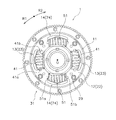
- the front view of a dynamic damper device in a 1st embodiment except for the 1st retaining plate).
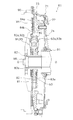
- the dynamic damper device 1 As shown in FIG. 1, the dynamic damper device 1 according to the first embodiment of the present invention is attached to a drive shaft 100. Specifically, the dynamic damper device 1 is attached to the drive shaft 100 via the connecting member 101. The connecting member 101 is attached to the drive shaft 100 so as to be integrally rotatable, and transmits the torque (including torque fluctuation) of the drive shaft 100 to the dynamic damper device 1. The torque fluctuation transmitted here is attenuated by the dynamic damper device 1.
- the OO line is the rotation axis.
- the direction along the rotation axis O may be referred to as “axial direction”.
- a direction away from the rotation axis O may be referred to as a “radial direction”.
- the direction around the rotation axis O may be referred to as “circumferential direction” and / or “rotational direction”.
- the dynamic damper device 1 includes a first retaining plate 11, a second retaining plate 21, an inertia part 31, and a plurality of first and second coil springs 41 and 51. have.
- first retaining plate 11 and the second retaining plate 21 are examples of the first rotating body.
- the inertia part 31 is an example of a second rotating body.
- Each of the first and second coil springs 41 and 51 is an example of an elastic member.
- the first coil spring 41 is an example of a first elastic member
- the second coil spring 51 is an example of a second elastic member.
- the first retaining plate 11 and the second retaining plate 21 hold the inertia part 31 using a plurality of first and second coil springs 41 and 51.
- the first retaining plate 11 and the second retaining plate 21 are disposed on both sides of the inertia part 31 in the axial direction.
- the 1st retaining plate 11 and the 2nd retaining plate 21 are arrange
- the first retaining plate 11 and the second retaining plate 21 are fixed to the connecting member 101 by fixing means 29 such as a plurality of bolts and nuts.
- the first retaining plate 11 is a member disposed on the connecting member 101 side.
- the first retaining plate 11 is disposed between the second retaining plate 21 and the connecting member 101 in the axial direction.
- the first retaining plate 11 includes a first plate body 12, a plurality of (for example, two) first storage windows 13, and a plurality of (for example, two) second storage windows. 14.
- the first storage window 13 is an example of a first storage part
- the second storage window 14 is an example of a second storage part.
- the first plate body 12 is formed in a substantially annular shape.
- the plurality of first storage windows 13 and the plurality of second storage windows 14 are formed in the first plate body 12.
- the plurality of first storage windows 13 and the plurality of second storage windows 14 are arranged side by side in the circumferential direction.
- the 1st storage window 13 and the 2nd storage window 14 are arrange
- the plurality of first storage windows 13 and the plurality of second storage windows 14 are formed, for example, in a substantially rectangular shape.
- a first coil spring 41 is housed in each of the plurality of first housing windows 13 so as to be elastically deformable in the rotational direction.
- the second coil spring 51 is stored so as to be elastically deformable in the rotation direction.
- the second retaining plate 21 is arranged so as to have a mirror image relationship with the first retaining plate 11 with respect to a plane orthogonal to the rotation axis O. Except for this point, the second retaining plate 21 has substantially the same configuration as the first retaining plate 11. For this reason, the code
- the second retaining plate 21 includes a second plate body 22, a plurality of (for example, two) third storage windows 23, and a plurality of (for example, two) fourth storage windows. 24.
- the third storage window 23 is an example of a first storage unit
- the fourth storage window 24 is an example of a second storage unit.
- the second plate body 22 is substantially formed in an annular shape.
- the second plate body 22 is disposed to face the first plate body 12 in the axial direction.
- the second plate main body 22 is disposed to face the first plate main body 12 in the axial direction via the boss member 19 (see FIG. 1).
- the boss member 19 is disposed between the first plate main body 12 and the second plate main body 22, and holds the interval between the first plate main body 12 and the second plate main body 22 at a predetermined interval.
- the second plate body 22 is fixed to the connecting member 101 together with the first plate body 12 by fixing means 29 such as bolts and nuts. That is, the 1st plate main body 12 and the 2nd plate main body 22 are comprised so that integral rotation is possible with the drive shaft 100 (connection member 101).
- the shaft portion of the bolt 29 is inserted into the bolt hole of the first plate body 12, the inner peripheral portion of the boss member 19, and the bolt hole of the second plate body 22. Then, the first plate main body 12, the boss member 19, and the second plate main body 22 are fixed to the connecting member 101 by the fixing means 29 (bolt head and nut).
- the boss member 19 constitutes a stopper mechanism described later.
- the plurality of third storage windows 23 and the plurality of fourth storage windows 24 are formed in the second plate body 22.
- the plurality of third storage windows 23 and the plurality of fourth storage windows 24 are arranged side by side in the circumferential direction.
- the 3rd storage window 23 and the 4th storage window 24 are arrange
- the third storage window 23 is disposed to face the first storage window 13 in the axial direction. Further, the fourth storage window 24 is disposed to face the second storage window 14 in the axial direction.
- the first storage window 13 and the third storage window 23 form a set of storage windows in the axial direction.
- the second storage window 14 and the fourth storage window 24 form a set of storage windows in the axial direction.
- the plurality of third storage windows 23 and the plurality of fourth storage windows 24 are formed in a substantially rectangular shape, for example.
- the first coil spring 41 is stored so as to be elastically deformable in the rotation direction.
- the second coil spring 51 is stored so as to be elastically deformable in the rotation direction.
- the inertia part 31 is configured to be rotatable with respect to the first retaining plate 11 and the second retaining plate 21. Specifically, the inertia part 31 is in a state where the first retaining plate 11 and the second retaining plate 21 hold the inertia part 31 in the rotational direction by using the plurality of first and second coil springs 41 and 51. Is configured to be relatively rotatable with respect to the first retaining plate 11 and the second retaining plate 21.
- the inertia part 31 is disposed between the first retaining plate 11 and the second retaining plate 21 in the axial direction.
- the inertia part 31 includes an inertia ring 32, an additional mass part 33, a plurality of (for example, two) fifth storage windows 34, a plurality of (for example, two) sixth storage windows 35, and a plurality (for example, four). Individual) restricting window 36.
- the fifth storage window 34 is an example of a third storage part
- the sixth storage window 35 is an example of a fourth storage part.
- the inertia ring 32 is formed in a substantially annular shape.
- the inertia ring 32 is disposed between the first plate body 12 and the second plate body 22 in the axial direction.
- the inertia ring 32 is configured to be rotatable relative to the first plate body 12 and the second plate body 22. Specifically, the inertia ring 32 is held by the first plate body 12 and the second plate body 22 via a plurality of first and second coil springs 41 and 51.
- the additional mass portion 33 is attached to the outer peripheral portion of the inertia ring 32.
- the additional mass unit 33 includes a pair of plate members 33a and a fixing member 33b.
- the pair of plate members 33a is disposed on both sides of the inertia ring 32 in the axial direction, and is fixed to the inertia ring 32 by a fixing member 33b.
- the fixing member 33b is, for example, a bolt and a nut.
- the plurality of fifth storage windows 34 and the plurality of sixth storage windows 35 are formed in the inertia ring 32.
- the plurality of fifth storage windows 34 and the plurality of sixth storage windows 35 are arranged side by side in the circumferential direction.
- the fifth storage window 34 and the sixth storage window 35 are disposed adjacent to each other in the circumferential direction.
- the fifth storage window 34 is disposed between the first storage window 13 and the third storage window 23 so as to face the first storage window 13 and the third storage window 23 in the axial direction.
- the sixth storage window 35 is disposed opposite to the second storage window 14 and the fourth storage window 24 between the second storage window 14 and the fourth storage window 24 in the axial direction.
- the fifth storage window 34 is provided in the inertia ring 32 so as to be offset in the first rotation direction R ⁇ b> 1 with respect to the first storage window 13 and the third storage window 23.
- the sixth storage window 35 is provided on the inertia ring 32 so as to be offset with respect to the second storage window 14 and the fourth storage window 24 in the second rotation direction R2 opposite to the first rotation direction R1. Yes.
- the first storage window 13, the third storage window 23, and the fifth storage window 34 are arranged at 9 o'clock and 3 o'clock positions.
- the second storage window 14, the fourth storage window 24, and the sixth storage window 35 are disposed at the 6 o'clock and 12 o'clock positions.
- the fifth storage window 34 is provided at a position offset from the first storage window 13 and the third storage window 23 by a predetermined rotation angle in the first rotation direction R1.
- the sixth storage window 35 is provided at a position that is offset from the second storage window 14 and the fourth storage window 24 by a predetermined rotation angle in the second rotation direction R2.
- FIG. 3 is a diagram showing a state where the relative rotation between the first retaining plate 11 and the second retaining plate 21 and the inertia part 31 is substantially “zero (0)”, that is, a neutral state. is there.
- the plurality of fifth storage windows 34 and the plurality of sixth storage windows 35 are, for example, substantially rectangular.
- the first coil spring 41 is stored so as to be elastically deformable in the rotation direction.
- the second coil spring 51 is stored so as to be elastically deformable in the rotation direction.
- each of the plurality of restriction windows 36 is formed in the inertia ring 32.
- Each of the plurality of restriction windows 36 is arranged side by side in the circumferential direction.
- the restriction window 36 is disposed between the first storage window 13 and the second storage window 14 (the third storage window 23 and the fourth storage window 24) that are adjacent in the circumferential direction.
- Each of the plurality of restriction windows 36 is formed in a substantially rectangular shape, for example.
- a boss member 19 is disposed in each of the plurality of restriction windows 36.
- the boss member 19 is movable in the circumferential direction inside the restriction window 36.
- the boss member 19 can be brought into contact with one of a pair of wall portions facing each other in the circumferential direction in the restriction window 36.
- a shaft portion of a bolt 29 for fixing the first retaining plate 11 and the second retaining plate 21 to the connecting member 101 is disposed on the inner peripheral portion of the boss member 19. That is, the shaft portion of the bolt 29 is inserted into each of the plurality of restriction windows 36, and the boss member 19 is disposed on the outer peripheral portion of the shaft portion of the bolt 29.
- the boss member 19 moves inside the regulating window 36 together with the shaft portion of the bolt 29.
- the boss member 19 comes into contact with the wall portion of the restriction window 36.
- the boss member 19 and the restriction window 36 function as a stopper mechanism for the inertia part 31 with respect to the first retaining plate 11 and the second retaining plate 21.
- restriction windows 36 may be set in any way as long as at least one restriction window 36 is provided.
- the plurality of (for example, two) first coil springs 41 and the plurality of (for example, two) second coil springs 51 include a first retaining plate 11 and a second retaining plate.
- the plate 21 and the inertia part 31 are elastically connected in the rotation direction.
- the first coil spring 41 and the second coil spring 51 operate as a set of coil springs.
- two sets of coil spring groups two sets of first coil spring 41 and second coil spring 51 are used.
- the first retaining plate 11 and the second retaining plate 21 hold the inertia part 31 in the rotational direction.
- first coil spring 41 and the second coil spring 51 have the same rigidity.
- the natural lengths of the first coil spring 41 and the second coil spring 51 are the same.
- the first coil spring 41 is arranged in a compressed state (less than natural length) in the first storage window 13 and the third storage window 23 and the offset fifth storage window 34.
- the second coil spring 51 is disposed in the second storage window 14 and the fourth storage window 24 and the offset sixth storage window 35 in a compressed state (less than natural length).
- one end 41 a of the first coil spring 41 abuts against the wall of the first storage window 13 and the wall of the third storage window 23 (see FIG. 2), and the other end 41 b of the first coil spring 41. Is in contact with the offset wall portion of the fifth storage window 34 (see FIG. 3).
- One end 51a (see FIG. 2) of the second coil spring 51 abuts against the wall of the second storage window 14 and the wall of the fourth storage window 24, and the other end 51b (see FIG. 2) of the second coil spring 51. 3) is in contact with the offset wall portion of the sixth storage window 35.
- the one end 41a of the first coil spring 41 is an end on the downstream side in the first rotation direction R1.
- the other end 41b of the first coil spring 41 is an upstream end in the first rotation direction R1.
- the one end 51a of the second coil spring 51 is the downstream end in the second rotational direction R2.
- the other end 51b of the second coil spring 51 is an upstream end in the second rotational direction R2.
- the wall portions of the first to sixth storage windows 13, 14, 23, 24, 34, and 35 are either one of a pair of wall portions facing each other in the circumferential direction.
- the one end 41 a of the first coil spring 41 is located inside the fifth storage window 34. It abuts against the wall portion of the first storage window 13 and the wall portion of the third storage window 23 that are positioned.
- the other end 41 b of the first coil spring 41 abuts against the wall portion of the fifth storage window 34 that is located inside the first storage window 13 and inside the third storage window 23.
- the one end portion 51 a of the second coil spring 51 abuts against the wall portion of the first storage window 13 and the wall portion of the third storage window 23 located inside the sixth storage window 35.
- the other end 51 b of the second coil spring 51 abuts against the wall portion of the sixth storage window 35 located inside the first storage window 13 and inside the third storage window 23.
- the first coil spring 41 is in contact with the first retaining plate 11 and the second retaining plate 21, and the inertia portion 31 is moved. Press in the second rotation direction R2.
- the second coil spring 51 presses the inertia part 31 in the first rotation direction R ⁇ b> 1 in a state where the second coil spring 51 is in contact with the first retaining plate 11 and the second retaining plate 21.
- first and second coil springs 41 and 51 hold the inertia part 31 in the rotation direction. That is, the first retaining plate 11 and the second retaining plate 21 use the first coil spring 41 and the second coil spring 51 to hold the inertia part 31 in the rotational direction.
- the first coil spring 41 is compressed between the first retaining plate 11 and the second retaining plate 21 and the inertia part 31.
- the second coil spring 51 extends.
- the first coil spring 41 and the second coil spring 51 are compressed, the second coil spring 51 is interposed between the first retaining plate 11 and the second retaining plate 21 and the inertia part 31. When compressed, the first coil spring 41 extends.
- each of the first coil spring 41 and the second coil spring 51 expands and contracts in a compressed state.
- the first coil spring 41 and the second coil spring 51 are set so that the total deformation amount in the plurality of first coil springs 41 and the plurality of second coil springs 51 is substantially zero (0).
- the wall portion of the first storage window 13 and the wall portion of the third storage window 23 with which the one end portion 41 a of the first coil spring 41 abuts move in the circumferential direction inside the fifth storage window 34.
- the wall portion of the fifth storage window 34 with which the other end portion 41 b of the first coil spring 41 abuts moves in the circumferential direction inside the first storage window 13 and inside the third storage window 23.
- the wall portion of the second storage window 14 and the wall portion of the fourth storage window 24 with which the one end portion 51 a of the second coil spring 51 abuts are arranged in the circumferential direction inside the sixth storage window 35.
- the wall portion of the sixth storage window 35 with which the other end portion 51 b of the second coil spring 51 abuts moves in the circumferential direction inside the second storage window 14 and inside the fourth storage window 24.
- the wall portion of the first storage window 13 and the wall portion of the third storage window 23 are used.
- the interval SK between the fifth storage window 34 and the wall portion is configured to be larger than zero (0).
- the distance SK between the wall portion of the second storage window 14 and the wall portion of the fourth storage window 24 and the wall portion of the sixth storage window 35 is larger than zero (0). It is comprised so that it may become.
- the distance SK between the wall portion of the first and third storage windows 13 and 23 and the wall portion of the fifth storage window 34 and the walls of the second and fourth storage windows 14 and 24 was shown. However, if the distance between the two is greater than zero (0), the dynamic damper device may be configured so that the distance between the two is different.
- the first retaining plate 11 and the second retaining plate 21 rotate in the first rotation direction R1 or the second rotation direction R2 due to torque fluctuation. Then, due to this torque fluctuation, the inertia part 31 passes through the plurality of coil springs (the plurality of first coil springs 41 and the plurality of second coil springs 51) to the first retaining plate 11 and the second retaining plate 21. Rotates relative to.
- the inertia part 31 is opposite to the rotation direction (first rotation direction R1 or second rotation direction R2) of the first retaining plate 11 and the second retaining plate 21 via a plurality of coil springs (first rotation direction R1 or second rotation direction R2). 2 rotation direction R2 or 1st rotation direction R1).
- the torque fluctuation is attenuated by the relative rotation of the inertia part 31.
- the stopper mechanism (the wall portion of the boss member 19 and the restriction window 36).
- the rotation of the inertia part 31 is regulated.
- the first coil spring 41 is between the wall portions of the first and third storage windows 13 and 23 and the offset wall portion of the fifth storage window 34. It expands and contracts in a compressed state.
- the second coil spring 51 expands and contracts in a compressed state between the wall portions of the second and fourth storage windows 14 and 24 and the wall portion of the offset sixth storage window 35.
- the first and second coil springs 41 and 51 expand and contract in the compressed state within a range less than the offset amount in the neutral state.
- the inertia part 31 rotates relatively with respect to the 1st and 2nd retaining plates 11 and 21 within the range of less than offset amount (less than SK).
- the first and second retaining plates 11 and 21 use the plurality of first and second coil springs 41 and 51 to hold the inertia part 31 in the rotational direction.
- the first and second retaining plates 11 and 21 can be rotated relative to each other.
- the dynamic damper device 1 can attenuate torque fluctuations.
- the dynamic damper device 1 includes a first retaining plate 11 and a second retaining plate 21, an inertia part 31, and a plurality of first and second coil springs 41 and 51.
- the inertia part 31 is configured to be rotatable relative to the first retaining plate 11 and the second retaining plate 21.
- the plurality of first and second coil springs 41 and 51 elastically connect the first retaining plate 11 and the second retaining plate 21 to the inertia part 31.
- the inertia part 31 is in a state where the first retaining plate 11 and the second retaining plate 21 hold the inertia part 31 using the plurality of first and second coil springs 41 and 51. However, it can rotate relative to the first retaining plate 11 and the second retaining plate 21. As a result, torque fluctuations are attenuated. Moreover, even if the rotation direction is reversed via the neutral state, switching of the portion that presses the first and second coil springs 41 and 51 does not occur.
- the dynamic damper device 1 can operate smoothly as compared with the conventional damper device.
- the dynamic damper device 1 can also reduce the operation noise as compared with the conventional damper device.
- the dynamic damper device 1 there is a possibility that the plurality of first and second coil springs 41, 51 may sag due to repeated stress acting on the plurality of first and second coil springs 41, 51. . That is, the free lengths of the plurality of first and second coil springs 41 and 51 may change. Thereby, even if the free length of each of the plurality of first and second coil springs 41 and 51 varies, the first retaining plate 11 and the first retaining plate 11 and the second coil springs 41 and 51 are used.
- the dynamic damper device 1 can be stably operated by the configuration in which the two retaining plates 21 hold the inertia part 31.
- the first and second coil springs 41 and 51 always hold the inertia part 31 by the force that the first and second coil springs 41 and 51 extend. Therefore, even if the above-described variation occurs, the dynamic damper The apparatus 1 can be operated stably. That is, in the dynamic damper device 1, robustness against repeated stress acting on the first and second coil springs 41 and 51 can be improved.
- the present invention has been described by using the dynamic damper device 1 as an example of a damper device.
- the present invention is applicable not only to the dynamic damper device 1 but also to the clutch device. For this reason, in 2nd Embodiment, description of this invention is performed using a clutch apparatus.
- third and fourth coil springs 94 and 95 (described later) in the second embodiment is substantially the same as the configuration of first and second coil springs 41 and 51 in the first embodiment.
- the seventh to twelfth storage windows 92a, 92b, 93a, 93b, 83c, and 83d (described later) of the second embodiment are configured in the first to sixth storage windows 13, 14, and 23 of the first embodiment. 24, 34, and 35 are substantially the same.
- the description of the third and fourth coil springs 94 and 95 and the description of the seventh to twelfth storage windows may be omitted.
- omitted it applies to description of 1st Embodiment.
- the clutch device 61 (Configuration of clutch device) is disposed between an engine (not shown) and a transmission (not shown). As shown in FIG. 5, the OO line is the rotation axis. The engine is arranged on the left side of FIG. 5, and the transmission is arranged on the right side of FIG.
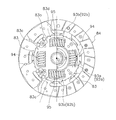
- the clutch device 61 is for transmitting and interrupting torque from the engine to the transmission. As shown in FIGS. 5 and 6, the clutch device 61 includes a clutch cover assembly 71 and a clutch disk assembly 81.
- the clutch disk assembly 81 is an example of a damper device.
- the clutch cover assembly 71 has a clutch cover 72, a pressure plate 73, and a diaphragm spring 74.
- the clutch cover 72 is an annular member fixed to the flywheel 90. Inside the clutch cover 72, a pressure plate 73, a diaphragm spring 74, and a clutch disc assembly 81 are accommodated.
- the pressure plate 73 is a member that holds the clutch disk 84 between the flywheel 90 and the pressure plate 73.
- the pressure plate 73 is formed in a substantially annular shape.
- the pressure plate 73 is provided so as to be non-rotatable and movable in the axial direction with respect to the clutch cover 72.
- the diaphragm spring 74 is a member that biases the pressure plate 73 toward the flywheel 90.
- the diaphragm spring 74 is provided so as not to rotate with respect to the clutch cover 72.
- the diaphragm spring 74 is provided so as to be elastically deformable in the axial direction with respect to the clutch cover 72. For example, when the diaphragm spring 74 is pressed in the axial direction by the release device 91, the diaphragm spring 74 is elastically deformed in the axial direction and biases the pressure plate 73 toward the flywheel 90.
- the clutch disk assembly 81 can attenuate torque fluctuations.
- the clutch disk assembly 81 has a damper mechanism 82, a spline hub 83, and a clutch disk 84.
- the spline hub 83 is an example of a first rotating body.
- the damper mechanism 82 elastically connects the clutch disk 84 and the spline hub 83.
- the damper mechanism 82 includes a clutch plate 92, a retaining plate 93, and a plurality of third and fourth coil springs 94 and 95.
- the clutch plate 92 and the retaining plate 93 are examples of the second rotating body.
- Each of the third and fourth coil springs 94 and 95 is an example of an elastic member.
- the third coil spring 94 is an example of a first elastic member
- the fourth coil spring 95 is an example of a second elastic member.
- the clutch plate 92 and the retaining plate 93 are arranged on both sides of a flange portion 83b (described later) of the spline hub 83 in the axial direction.
- the clutch plate 92 and the retaining plate 93 are connected to each other in the axial direction by fixing means such as a plurality of rivets.
- the clutch plate 92 and the retaining plate 93 are formed in a substantially annular shape.
- the clutch plate 92 has a plurality of (for example, two) seventh storage windows 92a and a plurality of (for example, two) eighth storage windows 92b.
- the plurality of seventh storage windows 92 a and the plurality of eighth storage windows 92 b are formed in the clutch plate 92.
- the multiple seventh storage windows 92a and the multiple eighth storage windows 92b are arranged side by side in the circumferential direction.
- the seventh storage window 92a and the eighth storage window 92b are disposed adjacent to each other in the circumferential direction.
- the plurality of seventh storage windows 92a and the plurality of eighth storage windows 92b are formed, for example, in a substantially rectangular shape.
- the third coil spring 94 is stored so as to be elastically deformable in the rotation direction.
- a fourth coil spring 95 is stored so as to be elastically deformable in the rotation direction.
- the clutch plate 92 is arranged so as to have a mirror image relationship with the retaining plate 93 with respect to a plane orthogonal to the rotation axis O. For this reason, the code
- the seventh storage window 92a is an example of a first storage unit, and corresponds to the first storage window 13 of the first embodiment.
- the eighth storage window 92b is an example of a second storage portion, and corresponds to the second storage window 14 of the first embodiment.
- the retaining plate 93 has a plurality (for example, two) of ninth storage windows 93a and a plurality (for example, two) of tenth storage windows 93b.
- the plurality of ninth storage windows 93 a and the plurality of tenth storage windows 93 b are formed on the retaining plate 93.
- the plurality of ninth storage windows 93a and the plurality of tenth storage windows 93b are arranged side by side in the circumferential direction.
- the ninth storage window 93a and the tenth storage window 93b are arranged adjacent to each other in the circumferential direction.
- the ninth storage window 93a is disposed to face the seventh storage window 92a in the axial direction. Further, the tenth storage window 93b is disposed to face the eighth storage window 92b in the axial direction.
- the seventh storage window 92a and the ninth storage window 93a form a set of storage windows in the axial direction. Further, the eighth storage window 92b and the tenth storage window 93b form a set of storage windows in the axial direction.
- the plurality of ninth storage windows 93a and the plurality of tenth storage windows 93b are formed in a substantially rectangular shape, for example.
- the third coil spring 94 is stored so as to be elastically deformable in the rotation direction.
- a fourth coil spring 94 is stored so as to be elastically deformable in the rotation direction.
- the ninth storage window 93a is an example of a first storage unit, and corresponds to the third storage window 23 of the first embodiment.
- the 10th storage window 93b is an example of a 2nd storage part, and respond
- the spline hub 83 is disposed on the outer peripheral side of the input shaft 98 of the transmission.
- the spline hub 83 includes a hub 83a, a flange portion 83b, a plurality (for example, two) of eleventh storage windows 83c, and a plurality (for example, two) of twelfth storage windows 83d.
- the hub 83a is a cylindrical member extending in the axial direction.
- the hub 83a is spline-engaged with the input shaft 98.
- the flange portion 83b is a portion that extends radially outward from the outer peripheral portion of the hub 83a.
- the flange portion 83b is formed substantially in an annular shape.
- the plurality of eleventh storage windows 83c and the plurality of twelfth storage windows 83d are formed in the flange portion 83b.
- the plurality of eleventh storage windows 83c and the plurality of twelfth storage windows 83d are arranged side by side in the circumferential direction.
- the plurality of eleventh storage windows 83c and the plurality of twelfth storage windows 83d are arranged adjacent to each other in the circumferential direction.
- the eleventh storage window 83c is disposed between the seventh storage window 92a and the ninth storage window 93a in the axial direction so as to face the seventh storage window 92a and the ninth storage window 93a.
- the twelfth storage window 83d is disposed between the eighth storage window 92b and the tenth storage window 93b so as to face the eighth storage window 92b and the tenth storage window 93b in the axial direction.
- the eleventh storage window 83c is offset from the seventh storage window 92a and the ninth storage window 93a in the first rotation direction R1.
- the twelfth storage window 83d is disposed with an offset in the second rotation direction R2 opposite to the first rotation direction R1 with respect to the eighth storage window 92b and the tenth storage window 93b.
- the eleventh storage window 83c is an example of a third storage unit, and corresponds to the fifth storage window 34 of the first embodiment.
- the twelfth storage window 83d is an example of a fourth storage portion, and corresponds to the sixth storage window 35 of the first embodiment.
- the relationship between the eleventh storage window 83c and the seventh and ninth storage windows 92a and 93a is the same as that of the fifth storage window 34 of the first embodiment and the first and second storage windows of the first embodiment.
- the relationship with the third storage windows 13 and 23 is substantially the same.
- the relationship between the twelfth storage window 83d and the eighth and tenth storage windows 92b and 93b is the same as the sixth storage window 35 of the first embodiment and the second and second of the first embodiment.
- the relationship with the four storage windows 14 and 24 is substantially the same. For this reason, the description about the offset is omitted here and is equivalent to the description of the first embodiment.
- the plurality of eleventh storage windows 83c and the plurality of twelfth storage windows 83d are formed, for example, in a substantially rectangular shape.
- a third coil spring 94 is housed in each of the plurality of eleventh storage windows 83c.
- a fourth coil spring 95 is stored in each of the plurality of twelfth storage windows 83d.
- a plurality (for example, two) of third coil springs 94 and a plurality of (for example, two) fourth coil springs 95 connect the clutch plate 92, the retaining plate 93, and the spline hub 83 in the rotational direction. .
- the third coil spring 94 and the fourth coil spring 95 operate as a set of coil spring groups.
- two sets of coil spring groups are used. With these two sets of coil spring groups, the spline hub 83 (flange portion 83b) holds the clutch plate 92 and the retaining plate 93 in the rotational direction.
- each of the third coil spring 94 and the fourth coil spring 95 is the same.
- the natural lengths of the third coil spring 94 and the fourth coil spring 95 are the same.
- the third coil spring 94 is disposed in a compressed state (less than natural length) in the seventh storage window 92a and the ninth storage window 93a and the offset eleventh storage window 83c.
- the fourth coil spring 95 is disposed in the compressed state (less than natural length) in the eighth storage window 92b and the tenth storage window 93b and the offset twelfth storage window 83d.
- the third coil spring 94 corresponds to the first coil spring 41 of the first embodiment.
- the fourth coil spring 95 corresponds to the second coil spring 51 of the first embodiment.
- the relationship between the third and fourth coil springs 94, 95 and the seventh to twelfth receiving windows 92a, 92b, 93a, 93b, 83c, 83d is the same as that of the first and second coil springs of the first embodiment. 41 and 51 and the relationship between the first to sixth storage windows 13, 14, 23, 24, 34, and 35 are substantially the same.
- the clutch disc 84 is for transmitting torque from the flywheel 90 to the clutch disc assembly 81.
- the clutch disc 84 is connected to the damper mechanism 82.
- the clutch disk 84 has a pair of friction facings 84a and a cushioning plate 84b.
- the friction facing 84 a is a portion that is sandwiched between the flywheel 90 and the pressure plate 73 and frictionally engages with the flywheel 90 and the pressure plate 73.
- the friction facing 84a is made of a friction material.
- the friction facings 84a are mounted on both sides of the cushioning plate 84b in the axial direction.
- the cushioning plate 84b elastically supports the pair of friction facings 84a in the axial direction.
- the cushioning plate 84b is non-rotatably connected to the damper mechanism 82.
- the cushioning plate 84b is fixed to the outer peripheral portion of the clutch plate 92 by fixing means such as a plurality of rivets.
- the third coil spring 94 is compressed between the wall portions of the seventh and ninth storage windows 92a and 93a and the wall portion of the offset eleventh storage window 83c. It expands and contracts.
- the fourth coil spring 95 extends and contracts in a compressed state between the wall portions of the eighth and tenth storage windows 92b and 93b and the offset wall portion of the twelfth storage window 83d.
- the third and fourth coil springs 94 and 95 expand and contract in the compressed state within a range less than the offset amount in the neutral state (less than SK in FIG. 4). Further, the clutch plate 92 and the retaining plate 93 rotate relative to the spline hub 83 within a range less than the offset amount (less than SK in FIG. 4).
- the spline hub 83 holds the clutch plate 92 and the retaining plate 93 in a state where the clutch plate 92 and the retaining plate 93 are held in the rotational direction by using the plurality of third and fourth coil springs 94 and 95.
- the spline hub 83 can be rotated relative to the spline hub 83.
- the clutch disk assembly 81 can attenuate torque fluctuations.
- the clutch disk assembly 81 includes a spline hub 83, a clutch plate 92 and a retaining plate 93, and a plurality of third and fourth coil springs 94 and 95.
- the clutch plate 92 and the retaining plate 93 are configured to be rotatable relative to the spline hub 83.
- the plurality of third and fourth coil springs 94 and 95 elastically connect the clutch plate 92 and the retaining plate 93 to the spline hub 83.
- the spline hub 83 holds the clutch plate 92 and the retaining plate 93 in the rotational direction by using a plurality of third and fourth coil springs 94 and 95. In this state, the spline hub 83 rotates the clutch plate 92 and the retaining plate 93 relative to the spline hub 83. As a result, torque fluctuations are attenuated. Further, even if the rotation direction is reversed via the neutral state, switching of the portion that presses the third and fourth coil springs 94 and 95 does not occur.
- the clutch disk assembly 81 can operate smoothly as compared with the conventional damper device.
- the clutch disk assembly 81 can reduce the operating noise as compared with the conventional damper device.
- the spline hub 83 can be connected to the clutch plate 92 and the clutch plate 92 using the plurality of third and fourth coil springs 94 and 95.
- the clutch disk assembly 81 can be stably operated by the structure that holds the retaining plate 93.
- the third and fourth coil springs 94 and 95 always hold the clutch plate 92 and the retaining plate 93 by the extending force of the third and fourth coil springs 94 and 95, so that the above-described variation occurs. Even in this case, the clutch disk assembly 81 can be stably operated. In other words, in the present clutch disk assembly 81, robustness against repeated stress acting on the third and fourth coil springs 94 and 95 can be improved.
Landscapes
- Engineering & Computer Science (AREA)
- General Engineering & Computer Science (AREA)
- Mechanical Engineering (AREA)
- Physics & Mathematics (AREA)
- Acoustics & Sound (AREA)
- Aviation & Aerospace Engineering (AREA)
- Mechanical Operated Clutches (AREA)
Priority Applications (3)
| Application Number | Priority Date | Filing Date | Title |
|---|---|---|---|
| US15/753,576 US10648532B2 (en) | 2015-10-30 | 2016-09-14 | Damper device |
| CN201680057441.2A CN108138902B (zh) | 2015-10-30 | 2016-09-14 | 减振装置 |
| DE112016004070.9T DE112016004070T5 (de) | 2015-10-30 | 2016-09-14 | Dämpfervorrichtung |
Applications Claiming Priority (2)
| Application Number | Priority Date | Filing Date | Title |
|---|---|---|---|
| JP2015214031A JP6616662B2 (ja) | 2015-10-30 | 2015-10-30 | ダンパ装置 |
| JP2015-214031 | 2015-10-30 |
Publications (1)
| Publication Number | Publication Date |
|---|---|
| WO2017073193A1 true WO2017073193A1 (ja) | 2017-05-04 |
Family
ID=58630223
Family Applications (1)
| Application Number | Title | Priority Date | Filing Date |
|---|---|---|---|
| PCT/JP2016/077068 Ceased WO2017073193A1 (ja) | 2015-10-30 | 2016-09-14 | ダンパ装置 |
Country Status (5)
| Country | Link |
|---|---|
| US (1) | US10648532B2 (https=) |
| JP (1) | JP6616662B2 (https=) |
| CN (1) | CN108138902B (https=) |
| DE (1) | DE112016004070T5 (https=) |
| WO (1) | WO2017073193A1 (https=) |
Families Citing this family (8)
| Publication number | Priority date | Publication date | Assignee | Title |
|---|---|---|---|---|
| JP7218205B2 (ja) * | 2019-02-19 | 2023-02-06 | 株式会社エクセディ | ダイナミックダンパ装置 |
| JP7211844B2 (ja) * | 2019-02-19 | 2023-01-24 | 株式会社エクセディ | ダンパ装置 |
| JP7218206B2 (ja) * | 2019-02-19 | 2023-02-06 | 株式会社エクセディ | ダンパ装置 |
| JP7477396B2 (ja) | 2020-08-07 | 2024-05-01 | 株式会社エクセディ | ダンパ装置 |
| JP7461827B2 (ja) | 2020-08-07 | 2024-04-04 | 株式会社エクセディ | ダンパ装置 |
| JP7473420B2 (ja) | 2020-08-20 | 2024-04-23 | 株式会社エクセディ | ダンパ装置 |
| JP7473419B2 (ja) | 2020-08-20 | 2024-04-23 | 株式会社エクセディ | ダンパ装置 |
| DE102021101310A1 (de) | 2021-01-22 | 2022-07-28 | Schaeffler Technologies AG & Co. KG | Drehschwingungstilgungsvorrichtung und Hybridanordnung |
Citations (2)
| Publication number | Priority date | Publication date | Assignee | Title |
|---|---|---|---|---|
| WO2015037124A1 (ja) * | 2013-09-13 | 2015-03-19 | 日産自動車株式会社 | ダンパ装置 |
| JP2015094424A (ja) * | 2013-11-12 | 2015-05-18 | 株式会社エクセディ | トルクコンバータのロックアップ装置 |
Family Cites Families (9)
| Publication number | Priority date | Publication date | Assignee | Title |
|---|---|---|---|---|
| US1942677A (en) * | 1928-02-09 | 1934-01-09 | Columbia Axle Company | Torque absorbing device |
| US1977368A (en) * | 1931-10-23 | 1934-10-16 | Clarence G Wood | Clutch plate |
| US2065531A (en) * | 1935-05-23 | 1936-12-29 | Paul W Kerr | Shower bath cabinet |
| JPS57107433A (en) * | 1980-12-22 | 1982-07-03 | Daikin Mfg Co Ltd | Damper disc |
| JP5447339B2 (ja) | 2010-11-02 | 2014-03-19 | アイシン精機株式会社 | 捩れ緩衝装置 |
| JP5993186B2 (ja) | 2012-04-10 | 2016-09-14 | ヴァレオユニシアトランスミッション株式会社 | 捻り振動低減装置及びその捻り振動低減装置を用いたトルクコンバータのロックアップクラッチ機構 |
| CN203488587U (zh) | 2013-04-28 | 2014-03-19 | 宁波宏协离合器有限公司 | 一种安装有外置预减震装置的离合器从动盘 |
| JP6182433B2 (ja) | 2013-11-12 | 2017-08-16 | 株式会社エクセディ | ダイナミックダンパ装置及びトルクコンバータのロックアップ装置 |
| JP6559399B2 (ja) | 2014-02-27 | 2019-08-14 | 株式会社エクセディ | ダンパー装置 |
-
2015
- 2015-10-30 JP JP2015214031A patent/JP6616662B2/ja active Active
-
2016
- 2016-09-14 US US15/753,576 patent/US10648532B2/en active Active
- 2016-09-14 WO PCT/JP2016/077068 patent/WO2017073193A1/ja not_active Ceased
- 2016-09-14 DE DE112016004070.9T patent/DE112016004070T5/de not_active Withdrawn
- 2016-09-14 CN CN201680057441.2A patent/CN108138902B/zh active Active
Patent Citations (2)
| Publication number | Priority date | Publication date | Assignee | Title |
|---|---|---|---|---|
| WO2015037124A1 (ja) * | 2013-09-13 | 2015-03-19 | 日産自動車株式会社 | ダンパ装置 |
| JP2015094424A (ja) * | 2013-11-12 | 2015-05-18 | 株式会社エクセディ | トルクコンバータのロックアップ装置 |
Also Published As
| Publication number | Publication date |
|---|---|
| US10648532B2 (en) | 2020-05-12 |
| US20190085935A1 (en) | 2019-03-21 |
| DE112016004070T5 (de) | 2018-05-24 |
| CN108138902A (zh) | 2018-06-08 |
| CN108138902B (zh) | 2020-05-15 |
| JP2017082981A (ja) | 2017-05-18 |
| JP6616662B2 (ja) | 2019-12-04 |
Similar Documents
| Publication | Publication Date | Title |
|---|---|---|
| JP6616662B2 (ja) | ダンパ装置 | |
| JP2017082981A5 (https=) | ||
| JP6965566B2 (ja) | トルク変動吸収装置 | |
| JP6541969B2 (ja) | 動力伝達装置及びトルクコンバータのロックアップ装置 | |
| JP2019039456A5 (https=) | ||
| WO2016129519A1 (ja) | ダンパーディスク組立体 | |
| CN111263866B (zh) | 具有可激活摩擦装置的扭转阻尼装置 | |
| JP2005098401A (ja) | クラッチディスク組立体 | |
| JP2016114193A (ja) | ダンパ装置 | |
| WO2016129183A1 (ja) | ダンパーディスク組立体 | |
| WO2015119172A1 (ja) | 車両用ダンパ装置のヒステリシス機構 | |
| US10041561B2 (en) | Spring assembly and damper device including spring assembly | |
| JP6331992B2 (ja) | クラッチ装置 | |
| JP6136415B2 (ja) | ダンパ装置 | |
| JP2019090428A (ja) | ダンパディスク組立体 | |
| JP6708565B2 (ja) | 動力伝達装置 | |
| JP2006144883A (ja) | サブダンパーユニットおよびクラッチディスク組立体 | |
| JP2021038762A (ja) | ダンパ装置 | |
| JP7392449B2 (ja) | ダンパ装置 | |
| WO2005028915A1 (ja) | フレキシブルフライホイール | |
| JP2015175453A (ja) | ダンパ装置 | |
| JP2019019857A (ja) | ダンパ | |
| JP5256160B2 (ja) | ダンパ装置及び動力伝達装置 | |
| JP6708566B2 (ja) | 動力伝達装置 | |
| US20180142761A1 (en) | Power transmission device |
Legal Events
| Date | Code | Title | Description |
|---|---|---|---|
| 121 | Ep: the epo has been informed by wipo that ep was designated in this application |
Ref document number: 16859430 Country of ref document: EP Kind code of ref document: A1 |
|
| WWE | Wipo information: entry into national phase |
Ref document number: 112016004070 Country of ref document: DE |
|
| 122 | Ep: pct application non-entry in european phase |
Ref document number: 16859430 Country of ref document: EP Kind code of ref document: A1 |