WO2017033867A1 - 不織布及びそれを備えた吸収性物品 - Google Patents
不織布及びそれを備えた吸収性物品 Download PDFInfo
- Publication number
- WO2017033867A1 WO2017033867A1 PCT/JP2016/074271 JP2016074271W WO2017033867A1 WO 2017033867 A1 WO2017033867 A1 WO 2017033867A1 JP 2016074271 W JP2016074271 W JP 2016074271W WO 2017033867 A1 WO2017033867 A1 WO 2017033867A1
- Authority
- WO
- WIPO (PCT)
- Prior art keywords
- nonwoven fabric
- region
- treatment agent
- degrees
- fiber treatment
- Prior art date
- Legal status (The legal status is an assumption and is not a legal conclusion. Google has not performed a legal analysis and makes no representation as to the accuracy of the status listed.)
- Ceased
Links
Images


Classifications
-
- A—HUMAN NECESSITIES
- A61—MEDICAL OR VETERINARY SCIENCE; HYGIENE
- A61F—FILTERS IMPLANTABLE INTO BLOOD VESSELS; PROSTHESES; DEVICES PROVIDING PATENCY TO, OR PREVENTING COLLAPSING OF, TUBULAR STRUCTURES OF THE BODY, e.g. STENTS; ORTHOPAEDIC, NURSING OR CONTRACEPTIVE DEVICES; FOMENTATION; TREATMENT OR PROTECTION OF EYES OR EARS; BANDAGES, DRESSINGS OR ABSORBENT PADS; FIRST-AID KITS
- A61F13/00—Bandages or dressings; Absorbent pads
- A61F13/15—Absorbent pads, e.g. sanitary towels, swabs or tampons for external or internal application to the body; Supporting or fastening means therefor; Tampon applicators
- A61F13/51—Absorbent pads, e.g. sanitary towels, swabs or tampons for external or internal application to the body; Supporting or fastening means therefor; Tampon applicators characterised by the outer layers of the pads
- A61F13/511—Topsheet, i.e. the permeable cover or layer facing the skin
- A61F13/513—Topsheet, i.e. the permeable cover or layer facing the skin characterised by its function or properties, e.g. stretchability, breathability, rewet, visual effect; having areas of different permeability
-
- A—HUMAN NECESSITIES
- A61—MEDICAL OR VETERINARY SCIENCE; HYGIENE
- A61F—FILTERS IMPLANTABLE INTO BLOOD VESSELS; PROSTHESES; DEVICES PROVIDING PATENCY TO, OR PREVENTING COLLAPSING OF, TUBULAR STRUCTURES OF THE BODY, e.g. STENTS; ORTHOPAEDIC, NURSING OR CONTRACEPTIVE DEVICES; FOMENTATION; TREATMENT OR PROTECTION OF EYES OR EARS; BANDAGES, DRESSINGS OR ABSORBENT PADS; FIRST-AID KITS
- A61F13/00—Bandages or dressings; Absorbent pads
- A61F13/15—Absorbent pads, e.g. sanitary towels, swabs or tampons for external or internal application to the body; Supporting or fastening means therefor; Tampon applicators
- A61F13/51—Absorbent pads, e.g. sanitary towels, swabs or tampons for external or internal application to the body; Supporting or fastening means therefor; Tampon applicators characterised by the outer layers of the pads
- A61F13/511—Topsheet, i.e. the permeable cover or layer facing the skin
-
- A—HUMAN NECESSITIES
- A61—MEDICAL OR VETERINARY SCIENCE; HYGIENE
- A61F—FILTERS IMPLANTABLE INTO BLOOD VESSELS; PROSTHESES; DEVICES PROVIDING PATENCY TO, OR PREVENTING COLLAPSING OF, TUBULAR STRUCTURES OF THE BODY, e.g. STENTS; ORTHOPAEDIC, NURSING OR CONTRACEPTIVE DEVICES; FOMENTATION; TREATMENT OR PROTECTION OF EYES OR EARS; BANDAGES, DRESSINGS OR ABSORBENT PADS; FIRST-AID KITS
- A61F13/00—Bandages or dressings; Absorbent pads
- A61F13/15—Absorbent pads, e.g. sanitary towels, swabs or tampons for external or internal application to the body; Supporting or fastening means therefor; Tampon applicators
- A61F13/51—Absorbent pads, e.g. sanitary towels, swabs or tampons for external or internal application to the body; Supporting or fastening means therefor; Tampon applicators characterised by the outer layers of the pads
- A61F13/511—Topsheet, i.e. the permeable cover or layer facing the skin
- A61F13/51104—Topsheet, i.e. the permeable cover or layer facing the skin the top sheet having a three-dimensional cross-section, e.g. corrugations, embossments, recesses or projections
-
- A—HUMAN NECESSITIES
- A61—MEDICAL OR VETERINARY SCIENCE; HYGIENE
- A61F—FILTERS IMPLANTABLE INTO BLOOD VESSELS; PROSTHESES; DEVICES PROVIDING PATENCY TO, OR PREVENTING COLLAPSING OF, TUBULAR STRUCTURES OF THE BODY, e.g. STENTS; ORTHOPAEDIC, NURSING OR CONTRACEPTIVE DEVICES; FOMENTATION; TREATMENT OR PROTECTION OF EYES OR EARS; BANDAGES, DRESSINGS OR ABSORBENT PADS; FIRST-AID KITS
- A61F13/00—Bandages or dressings; Absorbent pads
- A61F13/15—Absorbent pads, e.g. sanitary towels, swabs or tampons for external or internal application to the body; Supporting or fastening means therefor; Tampon applicators
- A61F13/51—Absorbent pads, e.g. sanitary towels, swabs or tampons for external or internal application to the body; Supporting or fastening means therefor; Tampon applicators characterised by the outer layers of the pads
- A61F13/511—Topsheet, i.e. the permeable cover or layer facing the skin
- A61F13/51121—Topsheet, i.e. the permeable cover or layer facing the skin characterised by the material
-
- A—HUMAN NECESSITIES
- A61—MEDICAL OR VETERINARY SCIENCE; HYGIENE
- A61F—FILTERS IMPLANTABLE INTO BLOOD VESSELS; PROSTHESES; DEVICES PROVIDING PATENCY TO, OR PREVENTING COLLAPSING OF, TUBULAR STRUCTURES OF THE BODY, e.g. STENTS; ORTHOPAEDIC, NURSING OR CONTRACEPTIVE DEVICES; FOMENTATION; TREATMENT OR PROTECTION OF EYES OR EARS; BANDAGES, DRESSINGS OR ABSORBENT PADS; FIRST-AID KITS
- A61F13/00—Bandages or dressings; Absorbent pads
- A61F13/15—Absorbent pads, e.g. sanitary towels, swabs or tampons for external or internal application to the body; Supporting or fastening means therefor; Tampon applicators
- A61F13/51—Absorbent pads, e.g. sanitary towels, swabs or tampons for external or internal application to the body; Supporting or fastening means therefor; Tampon applicators characterised by the outer layers of the pads
- A61F13/511—Topsheet, i.e. the permeable cover or layer facing the skin
- A61F13/5116—Topsheet, i.e. the permeable cover or layer facing the skin being formed of multiple layers
-
- D—TEXTILES; PAPER
- D04—BRAIDING; LACE-MAKING; KNITTING; TRIMMINGS; NON-WOVEN FABRICS
- D04H—MAKING TEXTILE FABRICS, e.g. FROM FIBRES OR FILAMENTARY MATERIAL; FABRICS MADE BY SUCH PROCESSES OR APPARATUS, e.g. FELTS, NON-WOVEN FABRICS; COTTON-WOOL; WADDING ; NON-WOVEN FABRICS FROM STAPLE FIBRES, FILAMENTS OR YARNS, BONDED WITH AT LEAST ONE WEB-LIKE MATERIAL DURING THEIR CONSOLIDATION
- D04H1/00—Non-woven fabrics formed wholly or mainly of staple fibres or like relatively short fibres
- D04H1/40—Non-woven fabrics formed wholly or mainly of staple fibres or like relatively short fibres from fleeces or layers composed of fibres without existing or potential cohesive properties
- D04H1/42—Non-woven fabrics formed wholly or mainly of staple fibres or like relatively short fibres from fleeces or layers composed of fibres without existing or potential cohesive properties characterised by the use of certain kinds of fibres insofar as this use has no preponderant influence on the consolidation of the fleece
- D04H1/4374—Non-woven fabrics formed wholly or mainly of staple fibres or like relatively short fibres from fleeces or layers composed of fibres without existing or potential cohesive properties characterised by the use of certain kinds of fibres insofar as this use has no preponderant influence on the consolidation of the fleece using different kinds of webs, e.g. by layering webs
-
- D—TEXTILES; PAPER
- D04—BRAIDING; LACE-MAKING; KNITTING; TRIMMINGS; NON-WOVEN FABRICS
- D04H—MAKING TEXTILE FABRICS, e.g. FROM FIBRES OR FILAMENTARY MATERIAL; FABRICS MADE BY SUCH PROCESSES OR APPARATUS, e.g. FELTS, NON-WOVEN FABRICS; COTTON-WOOL; WADDING ; NON-WOVEN FABRICS FROM STAPLE FIBRES, FILAMENTS OR YARNS, BONDED WITH AT LEAST ONE WEB-LIKE MATERIAL DURING THEIR CONSOLIDATION
- D04H1/00—Non-woven fabrics formed wholly or mainly of staple fibres or like relatively short fibres
- D04H1/70—Non-woven fabrics formed wholly or mainly of staple fibres or like relatively short fibres characterised by the method of forming fleeces or layers, e.g. reorientation of fibres
- D04H1/72—Non-woven fabrics formed wholly or mainly of staple fibres or like relatively short fibres characterised by the method of forming fleeces or layers, e.g. reorientation of fibres the fibres being randomly arranged
- D04H1/732—Non-woven fabrics formed wholly or mainly of staple fibres or like relatively short fibres characterised by the method of forming fleeces or layers, e.g. reorientation of fibres the fibres being randomly arranged by fluid current, e.g. air-lay
-
- D—TEXTILES; PAPER
- D06—TREATMENT OF TEXTILES OR THE LIKE; LAUNDERING; FLEXIBLE MATERIALS NOT OTHERWISE PROVIDED FOR
- D06M—TREATMENT, NOT PROVIDED FOR ELSEWHERE IN CLASS D06, OF FIBRES, THREADS, YARNS, FABRICS, FEATHERS OR FIBROUS GOODS MADE FROM SUCH MATERIALS
- D06M15/00—Treating fibres, threads, yarns, fabrics, or fibrous goods made from such materials, with macromolecular compounds; Such treatment combined with mechanical treatment
- D06M15/19—Treating fibres, threads, yarns, fabrics, or fibrous goods made from such materials, with macromolecular compounds; Such treatment combined with mechanical treatment with synthetic macromolecular compounds
- D06M15/37—Macromolecular compounds obtained otherwise than by reactions only involving carbon-to-carbon unsaturated bonds
- D06M15/643—Macromolecular compounds obtained otherwise than by reactions only involving carbon-to-carbon unsaturated bonds containing silicon in the main chain
-
- A—HUMAN NECESSITIES
- A61—MEDICAL OR VETERINARY SCIENCE; HYGIENE
- A61F—FILTERS IMPLANTABLE INTO BLOOD VESSELS; PROSTHESES; DEVICES PROVIDING PATENCY TO, OR PREVENTING COLLAPSING OF, TUBULAR STRUCTURES OF THE BODY, e.g. STENTS; ORTHOPAEDIC, NURSING OR CONTRACEPTIVE DEVICES; FOMENTATION; TREATMENT OR PROTECTION OF EYES OR EARS; BANDAGES, DRESSINGS OR ABSORBENT PADS; FIRST-AID KITS
- A61F13/00—Bandages or dressings; Absorbent pads
- A61F13/15—Absorbent pads, e.g. sanitary towels, swabs or tampons for external or internal application to the body; Supporting or fastening means therefor; Tampon applicators
- A61F13/51—Absorbent pads, e.g. sanitary towels, swabs or tampons for external or internal application to the body; Supporting or fastening means therefor; Tampon applicators characterised by the outer layers of the pads
- A61F13/511—Topsheet, i.e. the permeable cover or layer facing the skin
- A61F13/5116—Topsheet, i.e. the permeable cover or layer facing the skin being formed of multiple layers
- A61F2013/51178—Topsheet, i.e. the permeable cover or layer facing the skin being formed of multiple layers with the combination of nonwoven webs
-
- A—HUMAN NECESSITIES
- A61—MEDICAL OR VETERINARY SCIENCE; HYGIENE
- A61F—FILTERS IMPLANTABLE INTO BLOOD VESSELS; PROSTHESES; DEVICES PROVIDING PATENCY TO, OR PREVENTING COLLAPSING OF, TUBULAR STRUCTURES OF THE BODY, e.g. STENTS; ORTHOPAEDIC, NURSING OR CONTRACEPTIVE DEVICES; FOMENTATION; TREATMENT OR PROTECTION OF EYES OR EARS; BANDAGES, DRESSINGS OR ABSORBENT PADS; FIRST-AID KITS
- A61F13/00—Bandages or dressings; Absorbent pads
- A61F13/15—Absorbent pads, e.g. sanitary towels, swabs or tampons for external or internal application to the body; Supporting or fastening means therefor; Tampon applicators
- A61F13/51—Absorbent pads, e.g. sanitary towels, swabs or tampons for external or internal application to the body; Supporting or fastening means therefor; Tampon applicators characterised by the outer layers of the pads
- A61F13/511—Topsheet, i.e. the permeable cover or layer facing the skin
- A61F13/513—Topsheet, i.e. the permeable cover or layer facing the skin characterised by its function or properties, e.g. stretchability, breathability, rewet, visual effect; having areas of different permeability
- A61F2013/51355—Topsheet, i.e. the permeable cover or layer facing the skin characterised by its function or properties, e.g. stretchability, breathability, rewet, visual effect; having areas of different permeability for improving fluid flow
Definitions
- the present invention relates to a nonwoven fabric and an absorbent article provided with the same.
- wetback The phenomenon in which the body fluid held in the absorber returns is generally referred to as wetback, and various proposals have been made to prevent this.
- a method for controlling the hydrophilicity of a surface sheet which is a member located on the skin-facing surface side of the absorber, that is, the degree of familiarity with water.
- the surface sheet of the absorbent article has two layers, an upper layer positioned on the liquid-receiving side surface and a lower layer positioned on the absorber side, and the upper layer and the lower layer are formed of continuous filaments. It is described that the lower layer has higher hydrophilicity than the lower layer.
- Patent Document 2 describes a surface sheet of an absorbent article in which concave portions and convex portions are alternately formed by embossing in a predetermined pattern.
- the concave portion has hydrophilicity
- the convex portion has hydrophobicity
- the concave portion is a high density region having a relatively high fiber density
- the convex portion is a low density region having a relatively low fiber density.
- the concave portion is not provided with an opening or the like, and has improved hydrophilicity by providing hydrophilicity, so that the bodily fluid absorbed by the absorber is subsequently subjected to pressure. Even in this case, it is described in the same document that reversal is prevented.
- the first region and the second region having different hydrophilicity of the constituent fibers are along the thickness direction.
- a non-woven fabric that is made to produce The first region is a region including the surface of the nonwoven fabric, the second region is a region adjacent to the first region when viewed along the thickness direction of the nonwoven fabric,
- the hydrophilicity is represented by a contact angle with water
- a nonwoven fabric is provided in which the contact angle of the constituent fibers in the first region is larger than the contact angle of the constituent fibers in the second region.
- the present invention also provides an absorbent article comprising the above-mentioned nonwoven fabric and having a first region of the nonwoven fabric arranged so as to face the wearer's skin.
- FIG. 1 is a cross-sectional view in the thickness direction showing one embodiment of the nonwoven fabric of the present invention.
- Fig.2 (a) is a perspective view of an example of the nonwoven fabric shown in FIG. 1
- FIG.2 (b) is a perspective view of another example of the nonwoven fabric shown in FIG.
- FIG. 3 is a cross-sectional view in the thickness direction showing another embodiment of the nonwoven fabric of the present invention.
- FIG. 4 is a cross-sectional view in the thickness direction showing still another embodiment of the nonwoven fabric of the present invention.
- FIG. 5 is a cross-sectional view in the thickness direction showing still another embodiment of the nonwoven fabric of the present invention.
- the present invention relates to an improvement of a nonwoven fabric and an absorbent article provided therewith, and more specifically, a nonwoven fabric capable of maintaining liquid permeability control even after a plurality of liquid passages and an absorbent article provided therewith It is about.
- the present inventor has made a liquid permeate through a nonwoven fabric having two or more regions having different hydrophilicities along the thickness direction, and a region located on the upper layer side which is a layer on the liquid receiving side, and It was found that not only the region located on the lower layer side, which is the layer on the absorber side, becomes hydrophobic, but also the region located on the lower layer side becomes more hydrophobic than the region located on the upper layer side.
- FIG. 1 is a cross-sectional view in the thickness direction showing one embodiment of the nonwoven fabric of the present invention.
- the nonwoven fabric 10 shown in the figure is composed of a laminated structure including a first nonwoven fabric layer 11 and a second nonwoven fabric layer 12.
- the 1st nonwoven fabric layer 11 and the 2nd nonwoven fabric layer 12 are joined partially, and the several junction part 13 is formed.
- the 1st nonwoven fabric layer 11 protrudes in the direction away from the 2nd nonwoven fabric layer 12 in parts other than the junction part 13.
- a plurality of convex portions 14 are formed on the nonwoven fabric 10.
- a space 16 defined by the first nonwoven fabric layer 11 and the second nonwoven fabric layer 12 is formed inside the convex portion 14.
- a concave portion 15 is formed between adjacent convex portions 14, and the joint portion 13 is located in the concave portion 15.
- the nonwoven fabric 10 has an uneven structure on the surface of the first nonwoven fabric layer 11.
- the surface of the second nonwoven fabric layer 12 of the nonwoven fabric 10 is generally flat.
- FIG. 1 is a view of the nonwoven fabric 10 as viewed along its thickness direction.
- the convex portions 14 of the nonwoven fabric 10 can be arranged in the form of dots.
- the convex part 14 and the recessed part 15 are alternately arrange
- the convex portions 14 and the concave portions 15 are alternately arranged along the Y direction orthogonal to the X direction.
- a nonwoven fabric having such a structure can be produced by, for example, a method described in JP-A No. 2004-174234.
- FIG. 2B instead of the structure shown in FIG. 2A, the structure shown in FIG. 2B can be adopted.
- convex portions 14 extending along one direction X in the plane and concave portions 15 extending along the X direction alternately along the Y direction orthogonal to the X direction. It has a structure arranged in In any of the embodiments shown in FIGS. 2A and 2B, a space 16 is formed inside the convex portion 14.
- the nonwoven fabric 10 is characterized in that the hydrophilic state after passing artificial urine through the nonwoven fabric 10 differs in the thickness direction T of the nonwoven fabric 10. Specifically, in the nonwoven fabric 10, when artificial urine is passed through, a first region and a second region in which the hydrophilicity of the constituent fibers are different from each other are generated along the thickness direction T.
- the first region is a region including the surface of the nonwoven fabric 10.
- the second region is a region adjacent to the first region when viewed along the thickness direction T of the nonwoven fabric 10. “Adjacent” is a state in which no other region is interposed between the two regions of interest and the two regions are in direct contact with each other.
- the nonwoven fabric 10 is used, for example, when the nonwoven fabric 10 is incorporated into an absorbent article and the absorbent article is attached (at the time of liquid return), the space The case where the area is crushed and the two areas are in direct contact with each other is also included in the adjacent area.
- the 1st nonwoven fabric layer 11 is an area
- the second nonwoven fabric layer 12 is a region corresponding to the second region.
- the first nonwoven fabric layer 11 and the second nonwoven fabric layer 12 are different from each other in hydrophilicity of their constituent fibers after passing the artificial urine through the nonwoven fabric 10.
- Hydrophilicity refers to the property of compatibility with water. High hydrophilicity tends to be compatible with water, and highly hydrophilic fibers tend to wet and spread on the surface. If the hydrophilicity is low, the compatibility with water is not good, and the fibers having low hydrophilicity tend to be repelled on the surface. In the present invention, the degree of hydrophilicity of the fiber is quantitatively expressed by the contact angle with water. The contact angle with water is measured by the method described later. Low hydrophilicity is synonymous with a large contact angle, and high hydrophilicity is synonymous with a small contact angle.
- region in the state after a liquid flow is more than the contact angle of the constituent fiber of the 2nd nonwoven fabric layer 12 which is a 2nd area
- the first nonwoven fabric layer 11 is lower in hydrophilicity than the second nonwoven fabric layer 12 in the state after liquid passage.
- the hydrophilicity of the constituent fibers increases from the first nonwoven fabric layer 11 toward the second nonwoven fabric layer 12 along the thickness direction T when viewed as a whole of the nonwoven fabric 10 after liquid passage. A gradient is formed.
- the nonwoven fabric 10 control of the liquid permeability is maintained even after a plurality of times of liquid passage.
- the nonwoven fabric 10 since the hydrophilic gradient is formed along the thickness direction T of the nonwoven fabric 10, the nonwoven fabric 10 is used as a surface sheet of the absorbent article, and the first nonwoven fabric layer 11 in the nonwoven fabric 10 is used as the skin of the wearer.
- the absorbent article arranged so as to oppose the liquid, the wetback of the liquid once absorbed and held in the absorbent body is effectively prevented by the nonwoven fabric 10 having a hydrophilic gradient.
- the above-mentioned artificial urine flow means that 90 g of artificial urine is passed through the nonwoven fabric 10 at a rate of 5.0 g / sec under no-pressure condition under the condition that the nonwoven fabric 10 is placed on the absorbent body.
- the artificial urine is supplied to the nonwoven fabric 10 by using a liquid injection pump (manufactured by ISMATEC, MCP-J) by guiding the liquid discharge port 10 mm above the nonwoven fabric placed on the absorbent body with a silicon tube.
- the absorber the surface sheet was removed from the Marys (registered trademark) tape type S size manufactured by Kao Corporation manufactured in 2013, and the absorber was used.
- the supply amount of 90 g assumes the average excretion amount of infants.
- the supply rate of 5.0 g / sec assumes the urinary excretion speed during excretion of infants.
- the composition of artificial urine was 1.940% by weight of urea, 0.795% by weight of sodium chloride, 0.110% by weight of magnesium sulfate, 0.062% by weight of calcium chloride, 0.197% by weight of potassium sulfate, red No. 2 (dye ) 0.010% by mass, water (about 96.88% by mass) and polyoxyethylene lauryl ether (about 0.07% by mass) with the surface tension adjusted to 53 ⁇ 1 dyne / cm (23 ° C.) is there.
- the method for measuring the contact angle with water as described above is as follows. After passing artificial urine through the nonwoven fabric 10 under the above-described conditions, fibers are taken out from the first nonwoven fabric layer 11 and the second nonwoven fabric layer 12 in the nonwoven fabric 10 and the contact angle of water with the fibers is measured. In addition, the present inventor has confirmed that no change in the contact angle is observed for about half a day after the artificial urine is passed, and in the examples and comparative examples, the contact after the passage by measuring within half a day. Got horns. As a measuring device, an automatic contact angle meter MCA-J manufactured by Kyowa Interface Science Co., Ltd. is used. Distilled water is used to measure the contact angle.
- the amount of liquid discharged from an ink jet type water droplet discharge part (manufactured by Cluster Technology Co., Ltd., pulse injector CTC-25 having a discharge part hole diameter of 25 ⁇ m) is set to 20 picoliters, and a water drop is dropped just above the fiber.
- the state of dripping is recorded on a high-speed recording device connected to a horizontally installed camera.
- the recording device is preferably a personal computer incorporating a high-speed capture device from the viewpoint of image analysis later. In this measurement, an image is recorded every 17 msec.
- the first image of water droplets on the fibers taken out from the first nonwoven fabric layer 11 and the second nonwoven fabric layer 12 is attached to the attached software FAMAS (software version is 2.6.2, analysis method is liquid Drop method and analysis method are ⁇ / 2 method, image processing algorithm is non-reflective, image processing image mode is frame, threshold level is 200, and curvature correction is not performed).
- the angle between the surface touching the fiber and the fiber is calculated as the contact angle.
- a fiber treatment agent may be applied in advance to the fibers constituting the first nonwoven fabric layer 11 and the second nonwoven fabric layer 12.
- the fiber treatment agent is a substance that can adhere to the surface of the fiber and change the hydrophilicity of the fiber, and generally a surfactant is preferably used.
- a fiber treatment agent in which the contact angle of the constituent fibers of the first nonwoven fabric layer 11 is larger than the contact angle of the constituent fibers of the second nonwoven fabric layer 12 It is preferable to apply to the constituent fibers of the nonwoven fabric layer in advance.
- the relative hydrophilicity of the first nonwoven fabric layer 11 and the second nonwoven fabric layer 12 is as described above.
- the contact angle of the constituent fibers of the first nonwoven fabric layer 11 is 80 degrees after the liquid is passed through. Preferably, the angle is 85 ° or more, more preferably 90 ° or more. Moreover, it is preferable that it is 100 degrees or less, More preferably, it is 97 degrees or less, More preferably, it is 94 degrees or less.
- the contact angle of the constituent fibers of the first nonwoven fabric layer 11 is preferably 80 degrees or more and 100 degrees or less, more preferably 85 degrees or more and 97 degrees or less, and still more preferably 90 degrees or more and 94 degrees or less. .
- the contact angle of the constituent fibers themselves of the second nonwoven fabric layer 12 is preferably 65 degrees or more after liquid passing, on condition that the contact angle of the constituent fibers of the first nonwoven fabric layer 11 is smaller.
- it is 70 degree
- it is preferable that it is 90 degrees or less, More preferably, it is 87 degrees or less, More preferably, it is 84 degrees or less.
- the contact angle of the constituent fibers of the second nonwoven fabric layer 12 is preferably 65 degrees or more and 90 degrees or less, more preferably 70 degrees or more and 87 degrees or less, and further preferably 75 degrees or more and 84 degrees or less after liquid passage. .
- the difference between the contact angle of the constituent fibers of the first nonwoven fabric layer 11 that is the first region and the contact angle of the constituent fibers of the second nonwoven fabric layer 12 that is the second region is From the viewpoint of reducing the back amount and suppressing the return of the liquid to the user, it is preferably greater than 0 degree, more preferably 3 degrees or more, and even more preferably 5 degrees or more. Basically, the larger the contact angle difference, the better. However, it is preferable to suppress the hydrophilicity to some extent in order to allow the liquid to permeate the first nonwoven fabric layer 11 quickly, and from the second nonwoven fabric layer 12 to the absorbent body.
- the upper limit of the contact angle difference is preferably 30 degrees or less, more preferably 25 degrees or less, and even more preferably 20 degrees or less. is there.
- the above is the explanation about the contact angles of the constituent fibers of the first and second nonwoven fabric layers 11 and 12 after the liquid passage.
- the contact angles of the constituent fibers of the first and second nonwoven fabric layers 11 and 12 before the fluid passage. Is preferably as follows. That is, the contact angle of the constituent fibers of the first nonwoven fabric layer 11 is preferably 75 ° or more before passing through, more preferably 78 ° or more, and still more preferably 81 ° or more. Also, it is preferably less than 90 degrees, more preferably 87 degrees or less, and still more preferably 84 degrees or less.
- the contact angle of the constituent fibers of the first nonwoven fabric layer 11 is preferably 75 degrees or more and less than 90 degrees before passing, more preferably 78 degrees or more and 87 degrees or less, and still more preferably 81 degrees or more and 84 degrees or less. .
- the contact angle of the constituent fibers of the first nonwoven fabric layer 11 before liquid passage is smaller than the contact angle of the constituent fibers of the first nonwoven fabric layer 11 after liquid passage.
- the contact angle of the constituent fibers of the second nonwoven fabric layer 12 is smaller than the contact angle of the constituent fibers of the first nonwoven fabric layer 11, it is preferably 60 degrees or more before liquid passing, more preferably It is 65 degrees or more, more preferably 70 degrees or more. Moreover, it is preferable that it is 85 degrees or less, More preferably, it is 80 degrees or less, More preferably, it is 75 degrees or less.
- the contact angle of the constituent fibers of the second nonwoven fabric layer 12 is preferably 60 degrees or more and 85 degrees or less, more preferably 65 degrees or more and 80 degrees or less, and further preferably 70 degrees or more and 75 degrees or less before liquid passage. .
- the difference between the contact angle of the constituent fibers of the first nonwoven fabric layer 11 that is the first region and the contact angle of the constituent fibers of the second nonwoven fabric layer 12 that is the second region (the former-the latter) before the liquid flow is From the viewpoint of reducing the back amount and suppressing the return of the liquid to the user, it is preferably greater than 0 degree, more preferably 3 degrees or more, and even more preferably 5 degrees or more. Basically, the larger the contact angle difference is, the better. However, if the first nonwoven fabric layer 11 is made too hydrophobic, liquid passage may be hindered.
- the upper limit of the contact angle difference is preferably 30 degrees or less, more preferably 25 degrees or less, and still more preferably. It is 20 degrees or less.
- the main component of the fiber treatment agent applied to the constituent fibers in the first region is preferably different from the main component of the fiber treatment agent applied to the constituent fibers in the second region.
- the “main component” refers to a component having a content ratio of 10% by mass or more with respect to all components of the fiber treatment agent in the fiber treatment agent in a state before being applied to the fiber.
- the amount of the fiber treatment agent attached to the fibers is generally 2% by mass or less.
- the reason why the adhesion amount is set so low is that if an excessive amount is applied, a machine for manufacturing is contaminated or the user's skin becomes sticky. Therefore, in the fiber treatment agent to which only a very small amount is applied as described above, a sufficient function on the nonwoven fabric such as hydrophilicity is not exhibited unless the ratio of the main component in the fiber treatment agent is set to 10% by mass or more. For example, when the proportion of the main component is 10% by mass, the proportion of the main component imparted to the fiber is only 0.2% by mass with respect to the fiber treatment agent. Therefore, there may be two or more main components.
- the main components are different between the first nonwoven fabric layer 11 and the second nonwoven fabric layer 12 regardless of which main component is focused.
- the minor component in the fiber treatment agent applied to the constituent fibers of the first nonwoven fabric layer 11 and the minor component in the fiber treatment agent applied to the constituent fibers of the second nonwoven fabric layer 12 It is not hindered that the types of and match.
- first region main component The main component (hereinafter also referred to as “first region main component”) of the fiber treatment agent applied to the constituent fibers of the first nonwoven fabric layer 11 (first region) and the second nonwoven fabric layer 12 (second region).
- second region main component When the main component of the fiber treatment agent applied to the constituent fibers (hereinafter also referred to as “second region main component”) is made different, the extent to which both main components are eluted in water upon contact with water is different. It is preferable. In particular, it is preferable that the first region main component has a greater degree of elution into water than the second region main component.
- the second nonwoven fabric layer 12 has higher hydrophilicity than the first nonwoven fabric layer 11 after repeated liquid passage. , Wetback is effectively prevented.
- the constituent fibers of the second nonwoven fabric layer 12 are different from the main components applied to the constituent fibers of the first nonwoven fabric layer 11 (first region).
- the main component is preferably applied in an amount of 40% by mass or more, more preferably 50% by mass or more.
- one of the main components of the fiber treatment agent applied to the constituent fibers is a polyorganosiloxane having a hydrophilic group. Since hydrophilicity can be maintained higher than a constituent fiber, it is preferable.
- the hydrophilic group include a hydroxyl group, a polyoxyalkylene group, an amino group, a diamino group, a polyglyceryl group, an epoxy group, a carbinol group, a carboxyl group, a diol group, and a methacryl group. These hydrophilic groups can be used alone or in combination of two or more.
- hydrophilic groups it is preferable to use a polyoxyalkylene group or a polyglyceryl group from the viewpoint of imparting sufficient hydrophilicity to the fiber surface and improving dispersibility in water and handling properties as a fiber treatment agent.
- the polyoxyalkylene-modified silicone modified with a polyoxyalkylene group can maintain higher hydrophilicity than the constituent fibers of the first nonwoven fabric layer 11 even after liquid passage (that is, keep the contact angle small). It is preferable.
- Polyoxyalkylene-modified silicone is a polymer compound obtained by modifying silicone with polyoxyalkylene.
- polyoxyalkylene used for modification those having a lower alkylene group having 2 to 4 carbon atoms are preferably used, and specific examples thereof include polyoxyethylene (hereinafter also referred to as “POE”) and polyoxypropylene. (Hereinafter also referred to as “POP”) and polyoxybutylene (hereinafter also referred to as “POB”).
- POE polyoxyethylene
- POP polyoxypropylene
- POB polyoxybutylene
- a polyoxyalkylene containing a plurality of POE, POP and POB can also be used.
- the number of repeating oxyalkylene groups in the polyoxyalkylene group is preferably 3 or more, more preferably 5 or more, and still more preferably 7 or more. Moreover, it is preferably 40 or less, more preferably 30 or less, and still more preferably 20 or less.
- the number of repeating oxyalkylene groups is preferably 3 or more and 40 or less, more preferably 5 or more and 30 or less, and still more preferably 7 or more and 20 or less.
- a commercially available product may be used as the polyoxyalkylene-modified silicone. Examples of such commercially available products include “Shin-Etsu Silicone KF-6012” and “Shin-Etsu Silicone X-22-4515” manufactured by Shin-Etsu Chemical Co., Ltd.
- the proportion of the polyoxyalkylene-modified silicone contained in the fiber treatment agent applied to the constituent fibers of the second nonwoven fabric layer 12 is preferably 15% by mass or more, more preferably 20% by mass or more, and 25% by mass. It is still more preferable that it is above. Further, it is preferably 60% by mass or less, more preferably 50% by mass or less, and further preferably 40% by mass or less.
- the proportion of the polyoxyalkylene-modified silicone contained in the fiber treatment agent is preferably 15% by mass to 60% by mass, more preferably 20% by mass to 50% by mass, and more preferably 25% by mass to 40% by mass. More preferably, it is as follows.
- Examples of the substance used as a main component in addition to the polyoxyalkylene-modified silicone include, for example, alkali metal salts of alkyl phosphate esters, POE polyhydric alcohol fatty acid esters, alkyl betaines, alkyl sulfonic acids, alkyl sulfuric acids, dialkyl sulfonic acids, POE alkylamide and the like can be mentioned.
- Examples of the minor component that is not the main component include alkylhydroxysulfobetaine, imidazolium type cationic surfactant, polyethylene glycol, and polypropylene glycol.
- the fiber treatment agent to be applied to the constituent fibers of the first nonwoven fabric layer 11, the composition of the first and second nonwoven fabric layers 11, 12 after the passage is that it contains a hydrophobic substance as a main component. This is preferable because the hydrophilicity of the fibers is easily different from each other.
- the main component of the fiber treatment agent is hydrocarbon oil, fluorine oil, fatty acid ester, polyoxyalkylene-modified silicone, polyorganosiloxane, and nonionic and ionic surfactants having an alkyl group having 16 or more carbon atoms. It is preferably at least one selected from the group consisting of agents.
- At least one selected from the group consisting of polyoxyalkylene-modified silicones, polyorganosiloxanes, nonionic and ionic surfactants having an alkyl group having 16 or more carbon atoms it is particularly preferable to use at least one selected from the group consisting of polyoxyalkylene-modified silicones, polyorganosiloxanes, nonionic and ionic surfactants having an alkyl group having 16 or more carbon atoms. It is preferable to use at least one selected from the group consisting of polyorganosiloxanes, nonionic and ionic surfactants having an alkyl group having 16 or more carbon atoms.
- examples of the minor component that is not a main component include alkylsulfonic acid, alkylsulfuric acid, dialkylsulfonic acid, alkylhydroxysulfobetaine, and imidazolium type cationic surface activity.
- Agents polyethylene glycol, polypropylene glycol and the like.
- Identification and quantification of the type of the fiber treatment agent in the nonwoven fabric to which the fiber treatment agent is applied can be performed by, for example, the following method. If the nonwoven fabric is a surface sheet of an absorbent article, collect the required amount of product, peel off the surface sheet of the product from the absorber, and use a solvent such as methanol or ethanol from the peeled surface sheet. Extract the fiber treatment agent. After extraction of the fiber treatment agent, the residue is subjected to column separation, GPC, GC-MS, LC-MS, NMR, IR, solvent extraction using solubility in solvents, recrystallization with mixed solvents, and elemental analysis Thus, the structure of the substance is identified and quantified. The component contained by 10 mass% or more with respect to the total amount is the main component described above.
- a fiber treatment agent to the first nonwoven fabric layer 11 and the second nonwoven fabric layer 12, for example, a case where a fiber treatment agent is applied to fibers before being made into a nonwoven fabric, and a case where a fiber treatment agent is applied to the nonwoven fabric after being made into a nonwoven fabric.
- a specific method for applying the fiber treatment agent for example, immersing the fiber or the nonwoven fabric in the fiber treatment agent, spraying the fiber treatment agent on the fiber or the nonwoven fabric, or fiber or nonwoven fabric using various rolls such as a kiss roll. Coating by various printing methods such as mechanical coating, inkjet, gravure, screen, flexo and the like.
- the fiber treatment agent can be adhered to the surface of the constituent fibers by removing an excessive amount of the fiber treatment agent and subsequently removing volatile components by heat drying or natural drying.
- FIG. 3 shows another embodiment of the nonwoven fabric of the present invention.
- the nonwoven fabric 10 shown in FIG. 1 has a laminated structure of a first nonwoven fabric layer 11 and a second nonwoven fabric layer 12.
- the nonwoven fabric 10 of this embodiment in the nonwoven fabric of the embodiment shown in FIG. 1, no space is formed inside the convex portion 14, and the inside of the convex portion 14 is filled with fibers.
- the surface of the 2nd nonwoven fabric layer 12 is exposed.
- each surface of the nonwoven fabric 10 of the present embodiment is generally flat and does not have an uneven structure.
- the nonwoven fabric layers 11 and 12 are joined discontinuously over the entire area of the opposing surfaces. Since there is no difference in appearance between the front and back surfaces of the nonwoven fabric 10 of the present embodiment, which side of the nonwoven fabric layer is attributed to the first nonwoven fabric layer 11 is determined by the contact angle of the constituent fibers in the nonwoven fabric 10 after liquid passage. To do. Specifically, the non-woven fabric layer on which fibers having a larger contact angle exist is assigned to the first non-woven fabric layer 11.
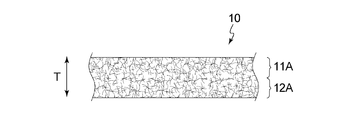
- the nonwoven fabric 10 of the embodiment shown in FIG. 5 is a single layer, unlike the nonwoven fabric of the previous embodiments.
- the first region 11 ⁇ / b> A and the second region 12 ⁇ / b> A having different hydrophilicity of the constituent fibers are formed along the thickness direction T.
- the first region 11 ⁇ / b> A is a region including one surface of the nonwoven fabric 10.
- the second region 12 ⁇ / b> A is a region adjacent to the first region 11 ⁇ / b> A when viewed along the thickness direction T of the nonwoven fabric 10.
- the contact angle of the constituent fibers in the first region 11A is larger than the contact angle of the constituent fibers in the second region 12A after the liquid is passed.
- the hydrophilic gradient of the constituent fibers increases from the first region 11A toward the second region 12A along the thickness direction T when viewed in the entire nonwoven fabric 10 after liquid passage. It is formed.
- the first fiber treatment agent is applied from one surface of the raw nonwoven fabric, and the second fiber treatment agent having a composition different from that of the first fiber treatment agent is applied from the other surface. That's fine.
- a first web made of fibers to which the first fiber treatment agent is applied and a second web made of fibers to which the second fiber treatment agent having a composition different from that of the first fiber treatment agent is laminated Next, the laminated web may be made into a nonwoven fabric.
- the first fiber treatment agent is applied to the first web, the second fiber treatment agent having a composition different from that of the first fiber treatment agent is applied to the second web, and then both the webs are laminated, and then the laminated web is formed. What is necessary is just to use a nonwoven fabric.
- thermoplastic resins having fiber-forming properties can be used as the resin of the fibers constituting the nonwoven fabric in each of the above embodiments.
- resins include polyolefin resins such as polyethylene (PE) and polypropylene, polyester resins such as polyethylene terephthalate (PET) and polybutylene terephthalate, vinyl resins such as polystyrene and polyvinyl chloride, and polyacrylic acid.
- group or polymethacrylic acid type resin which consists of polymethacrylic acid or those esters is mentioned. These resins can be used alone or in combination of two or more.
- a fiber having a single structure is produced from a blend of two or more resins, and a fiber having a composite structure such as a core-sheath type or side-by-side type fiber is used.
- a fiber having a composite structure such as a core-sheath type or side-by-side type fiber is used.
- the case of manufacturing is included.
- the nonwoven fabric 10 of this embodiment is manufactured by air-through treatment of a laminated web, for example, from the viewpoint of air-through treatment conditions and physical properties of the nonwoven fabric
- the core is a polyester resin
- the sheath is a polyolefin resin having a lower melting point than the core. It is preferable to use a fiber having a core-sheath type composite structure.
- the first nonwoven fabric layer 11 and the second nonwoven fabric layer 12 may have the same or different types of constituent fibers.
- an absorbent article including the nonwoven fabric described so far is also provided.
- this absorbent article it is preferable to arrange the first nonwoven fabric layer 11 (first region 11A) in the nonwoven fabric so as to face the wearer's skin from the viewpoint of preventing the occurrence of wetback. That is, this nonwoven fabric is suitably used as a top sheet for absorbent articles.
- the absorbent article is generally configured to include a liquid-permeable top sheet, a liquid-holding absorber, and a liquid-impermeable or hardly-permeable back sheet.
- a liquid-permeable top sheet As the absorbent body, a mixed fiber of flap pulp and a water absorbent polymer, or an absorbent sheet in which a water absorbent polymer is interposed between a pair of pulp sheets can be used.
- a synthetic resin film, a film imparted with moisture permeability, a liquid-impermeable nonwoven fabric, and the like can be used.
- the absorbent article may further include various members according to specific uses of the absorbent article. Such members are known to those skilled in the art. For example, when applying an absorbent article to a disposable diaper or a sanitary napkin, a pair or two or more pairs of three-dimensional guards can be disposed on the left and right sides of the topsheet.
- the non-woven fabric of the present invention can be used as a sub-layer sheet for absorbent articles in addition to the above-described surface sheet for absorbent articles by utilizing the hydrophilic gradient that occurs after liquid passage.
- the sublayer sheet is a liquid-permeable sheet that is generally disposed between the surface sheet of the absorbent article and the absorbent body.
- the nonwoven fabric 10 has a two-layer structure of a first nonwoven fabric layer 11 and a second nonwoven fabric layer 12, but instead, the outer surface of the second nonwoven fabric layer 12. Furthermore, you may laminate
- This invention discloses the following nonwoven fabrics and absorbent articles further regarding embodiment mentioned above.
- ⁇ 1> When 90 g of artificial urine is passed at a rate of 5.0 g / sec under no-pressure condition, the first region and the second region having different hydrophilicity of the constituent fibers are generated along the thickness direction.
- Non-woven fabric The first region is a region including the surface of the nonwoven fabric, the second region is a region adjacent to the first region when viewed along the thickness direction of the nonwoven fabric, A nonwoven fabric in which the contact angle of the constituent fibers in the first region is larger than the contact angle of the constituent fibers in the second region when the hydrophilicity is represented by a contact angle with water.
- a fiber treatment agent is applied to each of the constituent fibers of the first region and the second region, When two or more types of main components are present in the fiber treatment agent, the main component is different between the first region and the second region regardless of which main component is ⁇ 1.
- Non-woven fabric ⁇ 3> A fiber treatment agent is applied to each of the constituent fibers of the first region and the second region, ⁇ 1> or ⁇ 2> in which the main component of the fiber treatment agent applied to the constituent fibers in the first region is different from the main component of the fiber treatment agent applied to the constituent fibers in the second region.
- a fiber treatment agent is applied to each of the constituent fibers of the first region and the second region,
- the nonwoven fabric according to any one of ⁇ 1> to ⁇ 3>, wherein a main component of the fiber treatment agent applied to the constituent fibers in the second region is a polyorganosiloxane having a hydrophilic group.
- the hydrophilic group is a hydroxyl group, polyoxyalkylene group, amino group, diamino group, polyglyceryl group, epoxy group, carbinol group, carboxyl group, diol group or methacryl group, or a combination of two or more thereof.
- the nonwoven fabric as described in said ⁇ 4>.
- ⁇ 6> The nonwoven fabric according to ⁇ 4> or ⁇ 5>, wherein the hydrophilic group is a polyoxyalkylene group or a polyglyceryl group.
- a fiber treatment agent is applied to each of the constituent fibers of the first region and the second region,
- the nonwoven fabric according to any one of ⁇ 1> to ⁇ 6>, wherein one of main components of the fiber treatment agent applied to the second region is polyoxyalkylene-modified silicone.
- the proportion of the polyoxyalkylene-modified silicone contained in the fiber treatment agent applied to the constituent fibers in the second region is preferably 15% by mass or more, more preferably 20% by mass or more, and 25% by mass or more.
- the nonwoven fabric according to the above ⁇ 7> more preferably 60% by mass or less, further preferably 50% by mass or less, and further preferably 40% by mass or less.
- the number of repeating oxyalkylene groups in the polyoxyalkylene group is preferably 3 or more, more preferably 5 or more, more preferably 7 or more, and preferably 40 or less, more preferably 30 or less, more preferably 20 or less.
- a fiber treatment agent is applied to each of the constituent fibers of the first region and the second region,
- the main component of the fiber treatment agent applied to the first region is hydrocarbon oil, fluorine oil, fatty acid ester, polyoxyalkylene-modified silicone, polyorganosiloxane, and nonionic having an alkyl group having 16 or more carbon atoms.
- ⁇ 11> It consists of a laminated structure including a first nonwoven fabric layer and a second nonwoven fabric layer, The nonwoven fabric according to any one of ⁇ 1> to ⁇ 10>, wherein the first nonwoven fabric layer is a region corresponding to the first region, and the second nonwoven fabric layer is a region corresponding to the second region.
- the contact angle of the constituent fibers themselves of the first region is preferably 80 degrees or more after passage of artificial urine, more preferably 85 degrees or more, more preferably 90 degrees or more, and 100 degrees or less.
- the contact angle of the constituent fibers of the second region itself is preferably 65 degrees or more after passage of artificial urine, more preferably 70, provided that the contact angle of the constituent fibers of the first region is smaller than the contact angle of the constituent fibers of the first region.
- the difference between the contact angle of the constituent fibers in the first region and the contact angle of the constituent fibers in the second region (the former-the latter) is preferably greater than 0 degree, more preferably 3 More preferably, it is 5 degrees or more, more preferably 5 degrees or more and preferably 30 degrees or less, more preferably 25 degrees or less, and still more preferably 20 degrees or less, according to any one of the above items ⁇ 1> to ⁇ 13> Non-woven fabric.
- the contact angle of the constituent fibers in the first region is preferably 75 ° or more, more preferably 78 ° or more, more preferably 81 ° or more, and less than 90 ° before the artificial urine is passed through. Preferably, it is 87 degrees or less, More preferably, it is 84 degrees or less, The nonwoven fabric as described in any one of said ⁇ 1> thru
- the contact angle of the constituent fibers in the second region is preferably 60 degrees or more, more preferably 65 degrees or more before the artificial urine is passed, on condition that the contact angle of the constituent fibers in the first region is smaller than that. More preferably, it is 70 degrees or more, preferably 85 degrees or less, more preferably 80 degrees or less, and still more preferably 75 degrees or less, according to any one of the above ⁇ 1> to ⁇ 15> Non-woven fabric.
- the difference between the contact angle of the constituent fibers in the first region and the contact angle of the constituent fibers in the second region is preferably greater than 0 degree, more preferably 3 ⁇ 1> to ⁇ 16>, preferably at least 5 degrees, more preferably at least 5 degrees, and preferably at most 30 degrees, more preferably at most 25 degrees, and even more preferably at most 20 degrees.
- Non-woven fabric is preferably greater than 0 degree, more preferably 3 ⁇ 1> to ⁇ 16>, preferably at least 5 degrees, more preferably at least 5 degrees, and preferably at most 30 degrees, more preferably at most 25 degrees, and even more preferably at most 20 degrees.
- the contact angle of the constituent fibers of the first region is less than 90 degrees
- ⁇ 19> The state according to any one of ⁇ 1> to ⁇ 18>, wherein the contact angle of the constituent fibers in the first region is larger than the contact angle of the constituent fibers in the second region in the state before the artificial urine is passed through.
- Non-woven fabric. ⁇ 20> The nonwoven fabric according to any one of ⁇ 1> to ⁇ 19>, wherein the surface of the first region has an uneven structure.
- ⁇ 21> It consists of a laminated structure including a first nonwoven fabric layer corresponding to the first region and a second nonwoven fabric layer corresponding to the second region, The first nonwoven fabric layer and the second nonwoven fabric layer are partially joined to form a plurality of joined portions, and the first nonwoven fabric layer protrudes in a direction away from the second nonwoven fabric layer at a portion other than the joined portions. Forming a plurality of convex portions, The nonwoven fabric according to ⁇ 20>, wherein a space defined by the first nonwoven fabric layer and the second nonwoven fabric layer is formed inside the convex portion.
- a fiber treatment agent is applied to each of the constituent fibers of the first region and the second region,
- One of the main components of the fiber treatment agent applied to the second region is polyoxyalkylene-modified silicone
- the substance used as the main component is alkali metal salt of alkyl phosphate ester, polyoxyethylene polyhydric alcohol fatty acid ester, alkyl betaine, alkyl sulfonic acid, alkyl sulfuric acid, dialkyl sulfonic acid or polyoxy
- the nonwoven fabric according to any one of ⁇ 1> to ⁇ 21>, which is ethylene alkylamide.
- An absorbent article comprising the nonwoven fabric according to any one of ⁇ 1> to ⁇ 22>, wherein a first region of the nonwoven fabric is disposed so as to face the wearer's skin.
- the method for producing a nonwoven fabric according to any one of ⁇ 1> to ⁇ 22> The first fiber treatment agent is applied from one surface of the raw nonwoven fabric, and the second fiber treatment agent having a composition different from that of the first fiber treatment agent is applied from the other surface, The manufacturing method of the nonwoven fabric from which a 1st fiber treatment agent and a 2nd fiber treatment agent differ in a main component.
- ⁇ 26> The method for producing a nonwoven fabric according to any one of ⁇ 1> to ⁇ 22>, Laminating a first web made of fibers to which a first fiber treatment agent has been applied and a second web made of fibers to which a second fiber treatment agent having a composition different from that of the first fiber treatment agent has been applied, Having a process of making a nonwoven fabric, The manufacturing method of the nonwoven fabric from which a 1st fiber treatment agent and a 2nd fiber treatment agent differ in a main component.
- ⁇ 27> The method for producing a nonwoven fabric according to any one of ⁇ 1> to ⁇ 22>,
- the first fiber treatment agent is applied to the first web
- the second fiber treatment agent having a composition different from that of the first fiber treatment agent is applied to the second web
- both the webs are laminated
- the laminated web is made into a non-woven fabric.
- the first fiber treatment agent and the second fiber treatment agent have different main components. Among the first region and the second region adjacent to each other in the thickness direction of the nonwoven fabric, the first fiber treatment agent is added to the first region.
- ⁇ 29> The method according to any one of ⁇ 25> to ⁇ 28>, wherein one of the main components of the second fiber treatment agent is polyoxyalkylene-modified silicone.
- the proportion of the polyoxyalkylene-modified silicone contained in the second fiber treatment agent is preferably 15% by mass or more, more preferably 20% by mass or more, still more preferably 25% by mass or more,
- the production method according to ⁇ 29> preferably 60% by mass or less, more preferably 50% by mass or less, and still more preferably 40% by mass or less.
- the main components of the first fiber treatment agent are hydrocarbon oil, fluorine oil, fatty acid ester, polyoxyalkylene-modified silicone, polyorganosiloxane, and nonionic and ionic surfactants having an alkyl group having 16 or more carbon atoms.
- it is at least one selected from the group consisting of, among these substances, polyoxyalkylene-modified silicone, polyorganosiloxane, nonionic and ionic surfactants having an alkyl group having 16 or more carbon atoms It is more preferable to use at least one selected from the group consisting of polyorganosiloxane, at least one selected from the group consisting of nonionic and ionic surfactants having an alkyl group having 16 or more carbon atoms. More preferably, any one of the above ⁇ 25> to ⁇ 30> The method of production.
- a nonwoven fabric 10 having the structure shown in FIGS. 1 and 2 (a) was produced according to the method described in JP-A No. 2004-174234.
- the first nonwoven fabric layer 11 uses two types of constituent fibers (one is called “fiber 1” and the other is called “fiber 2”), and the second nonwoven fabric layer 12 uses one type of constituent fiber.
- Each of the first fiber and the second fiber is a core-sheath fiber in which the core is polyethylene terephthalate (PET) and the sheath is polyethylene (PE).
- PET polyethylene terephthalate
- PE polyethylene
- the fineness of the fiber 1 is 2.2 dtex and the fineness of the fiber 2 is 4.4 dtex. Met.
- the constituent fibers used for the second nonwoven fabric layer 12 were core-sheath fibers having a core of polyethylene terephthalate (PET) and a sheath of polyethylene (PE), and the fineness was 2.2 dtex. Both the first nonwoven fabric layer 11 and the second nonwoven fabric layer 12 had a basis weight of 18 g / m 2 .
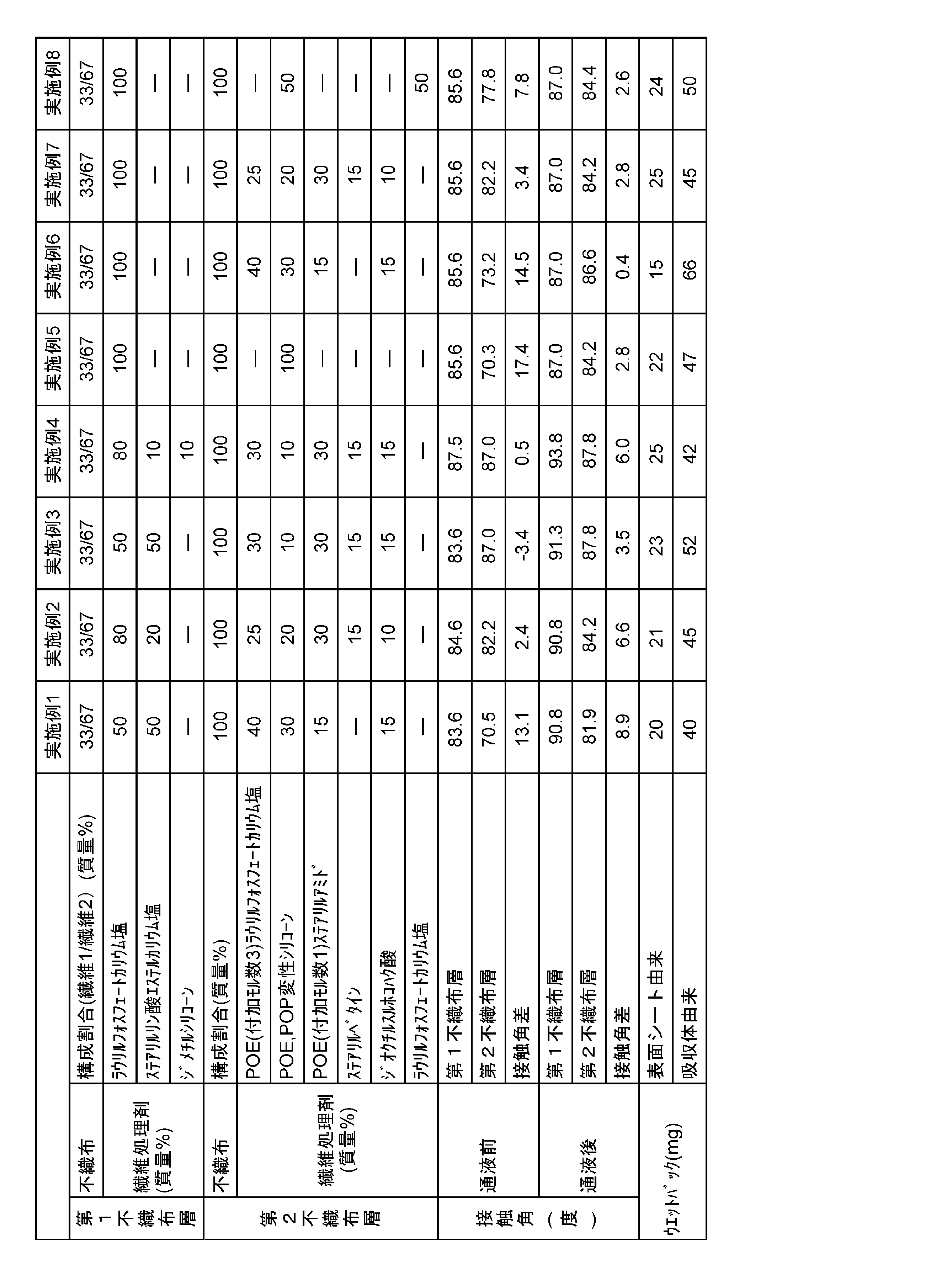
- the composition ratio of these fibers and the fiber treating agent used for these fibers are as shown in Table 1.
- Each of the nonwoven fabric layers 11 and 12 was composed of an air-through nonwoven fabric. In order to produce the respective nonwoven fabric layers 11 and 12 before lamination, first, about 12 g of fibers weighed were immersed in the fiber treatment agent shown in Table 1, and the fiber treatment agent was applied to the fibers.
- the adhesion amount of the fiber treatment agent was 0.40% with respect to the whole nonwoven fabric.
- the fibers were carded to form a web, and the web was air-through treated to obtain nonwoven fabrics 11 and 12. Thereafter, the nonwoven fabrics 11 and 12 were laminated, and the nonwoven fabric 11 was sucked into a convex shape with a roll having a suction function, and the nonwoven fabrics 11 and 12 were heat-sealed at the joint portion 13 to form an uneven structure. .
- the target nonwoven fabric 10 was obtained.
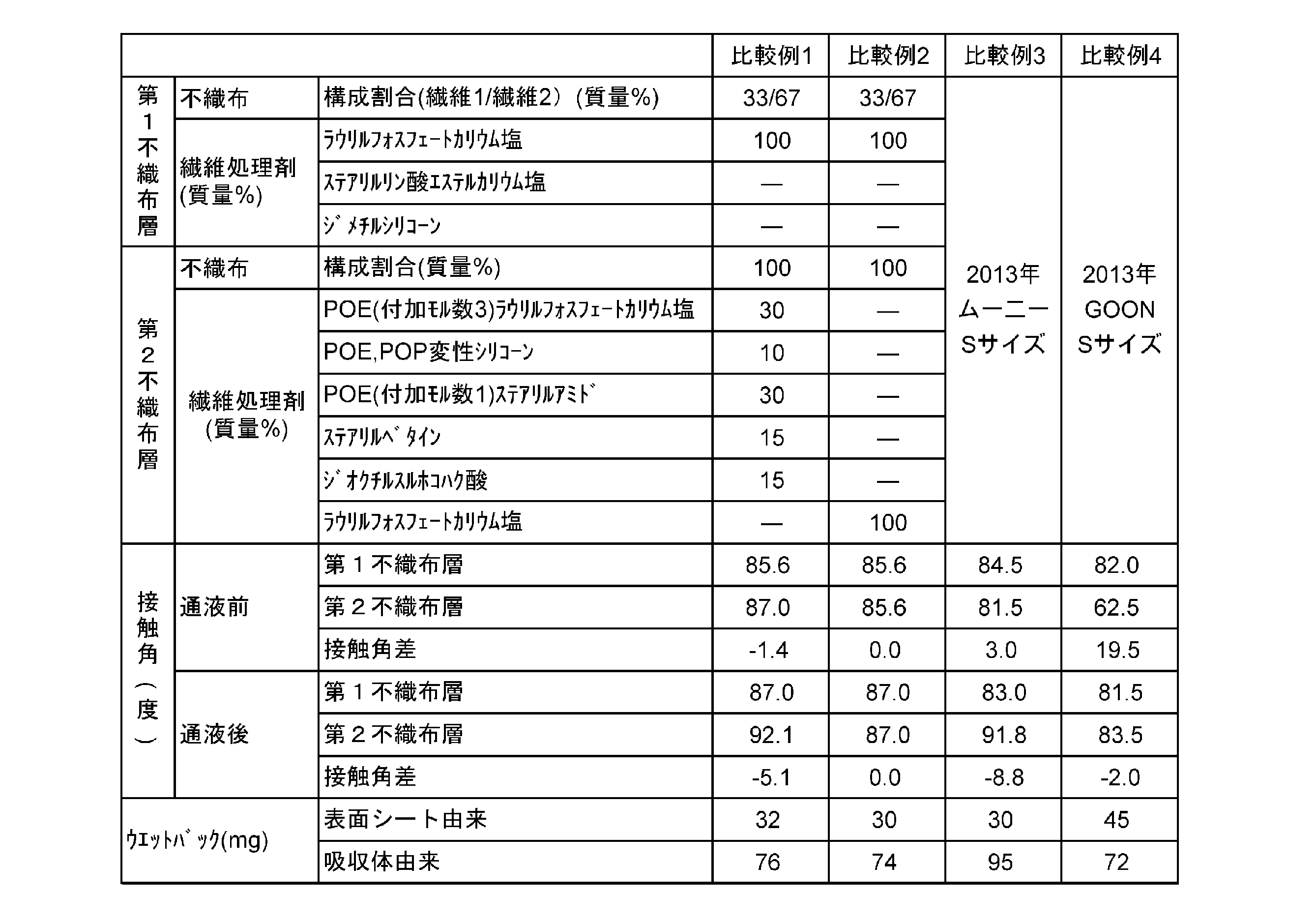
- Example 2 to 8 and Comparative Examples 1 to 4 In Example 1, what is shown in Table 1 was used as the fiber treatment agent applied to the first nonwoven fabric layer 11 and the second nonwoven fabric layer 12. Except this, it carried out similarly to Example 1, and obtained the nonwoven fabric 10 of the structure shown to FIG.1 and FIG.2 (a).
- Comparative Examples 3 and 4 disposable diapers marketed in October 2013, Moony (registered trademark) Airfit (trade name) S size, manufactured by Unicharm Corporation, and Daio Paper Co., Ltd. GON (registered trademark) first underwear (trade name) S size surface sheet was used as it was.
- the details of the fiber treatment agents shown in Tables 1 and 2 below are as follows.
- Lauryl phosphate potassium salt Potassium hydroxide neutralized product of “Fuosfanol ML-200” manufactured by Toho Chemical Co., Ltd.
- Stearyl phosphate potassium salt Potassium hydroxide neutralized of “Gripper 4131” manufactured by Kao Corporation -Dimethylsilicone: Shin-Etsu Chemical Co., Ltd., "KM-903" -POE (addition mole number 3) lauryl phosphate potassium salt: "Amholex MP-2K” manufactured by Miyoshi Oil & Fats Co., Ltd. POE, POP modified silicone: “X-22-4515” manufactured by Shin-Etsu Chemical Co., Ltd.
- the top part of the uneven structure extended continuously in the longitudinal direction of the surface sheet of a diaper was applied to the 1st nonwoven fabric layer 11, and the bottom part was evaluated to the bottom part of the 2nd nonwoven fabric layer 12, and evaluation was implemented.
- the contact angle after passing through the liquid after spraying a predetermined amount of liquid, spray cold spray to solidify the hot melt and weaken the adhesive force so that it does not reach the liquid passing part.
- the sheet was peeled off and the contact angle after liquid passage was evaluated.
- Comparative Example 4 was evaluated by applying the top of the uneven structure of the top sheet of the diaper to the first nonwoven fabric layer 11 and the bottom of the nonwoven fabric existing further below the second nonwoven fabric layer 12. The contact angle after liquid passing was evaluated in the same manner as in Comparative Example 3.
- the artificial urine absorbed and retained in the absorbent article was absorbed into the collagen film. Then, the mass of the collagen film which absorbed artificial urine was measured. The mass of the collagen film before absorption was subtracted from this mass to calculate the mass of artificial urine absorbed by the collagen film. This value was defined as the wetback amount (the sum of the wetback amount derived from the top sheet and the wetback amount derived from the absorber). In the measurement of the amount of wetback derived from the topsheet, after the third artificial urine was injected and left for 10 minutes, only the topsheet was peeled off, and an OHP film (VF1300 manufactured by KOKUYO) was interposed between the absorber and the topsheet.
- the wetback amount the sum of the wetback amount derived from the top sheet and the wetback amount derived from the absorber.
- the amount of wet back derived from the absorber was determined by subtracting the amount of wet back derived from the topsheet from the above liquid return amount.
- Comparative Example 2 in which the fiber processing agent having the same main component as the first nonwoven fabric layer is applied to the second nonwoven fabric layer has a contact angle difference of 0 degrees after passing through, and the wetback is greater than any of the examples. It has grown up.
- Example 8 in which the second nonwoven fabric layer contains 50% of a main component different from the first nonwoven fabric layer has a contact angle difference after passing through larger than 0 degrees, and wetback. was smaller than Comparative Example 2.
- a nonwoven fabric that can maintain liquid permeability control even after a plurality of times of liquid passage.
- the occurrence of wetback is effectively prevented.
Landscapes
- Health & Medical Sciences (AREA)
- Engineering & Computer Science (AREA)
- General Health & Medical Sciences (AREA)
- Public Health (AREA)
- Heart & Thoracic Surgery (AREA)
- Vascular Medicine (AREA)
- Life Sciences & Earth Sciences (AREA)
- Animal Behavior & Ethology (AREA)
- Epidemiology (AREA)
- Biomedical Technology (AREA)
- Veterinary Medicine (AREA)
- Textile Engineering (AREA)
- Chemical & Material Sciences (AREA)
- Chemical Kinetics & Catalysis (AREA)
- Absorbent Articles And Supports Therefor (AREA)
- Treatments For Attaching Organic Compounds To Fibrous Goods (AREA)
- Laminated Bodies (AREA)
- Nonwoven Fabrics (AREA)
Abstract
Description
第1領域は前記不織布の表面を含む領域であり、第2領域は前記不織布の厚み方向に沿って見たときに、第1領域に隣接する領域であり、
前記親水性を水との接触角で表したとき、第1領域の構成繊維の接触角の方が、第2領域の構成繊維の接触角よりも大きい、不織布を提供するものである。
<1>
無加圧条件下で90gの人工尿を5.0g/秒の速度で通液させたとき、構成繊維の親水性が互いに異なる第1領域及び第2領域が厚み方向に沿って生じるようになされている不織布であって、
第1領域は前記不織布の表面を含む領域であり、第2領域は前記不織布の厚み方向に沿って見たときに、第1領域に隣接する領域であり、
前記親水性を水との接触角で表したとき、第1領域の構成繊維の接触角の方が、第2領域の構成繊維の接触角よりも大きい、不織布。
第1領域及び第2領域の構成繊維にそれぞれ繊維処理剤が施されており、
前記繊維処理剤に主成分が2種以上存在する場合には、いずれの主成分に着目した場合であっても、第1領域と第2領域とで、主成分が相違している前記<1>に記載の不織布。
<3>
第1領域及び第2領域の構成繊維にそれぞれ繊維処理剤が施されており、
第1領域の構成繊維に施されている繊維処理剤の主成分と、第2領域の構成繊維に施されている繊維処理剤の主成分とが相違している前記<1>又は<2>に記載の不織布。
<4>
第1領域及び第2領域の構成繊維にそれぞれ繊維処理剤が施されており、
第2領域の構成繊維に施されている前記繊維処理剤の主成分が親水基を有するポリオルガノシロキサンである前記<1>ないし<3>のいずれか1に記載の不織布。
<5>
前記親水基が、水酸基、ポリオキシアルキレン基、アミノ基、ジアミノ基、ポリグリセリル基、エポキシ基、カルビノール基、カルボキシル基、ジオール基若しくはメタクリル基であるか、又はそれらの2種以上の組み合わせである前記<4>に記載の不織布。
<6>
前記親水基が、ポリオキシアルキレン基又はポリグリセリル基である前記<4>又は<5>に記載の不織布。
第1領域及び第2領域の構成繊維にそれぞれ繊維処理剤が施されており、
第2領域に施されている前記繊維処理剤の主成分の1つがポリオキシアルキレン変性シリコーンである前記<1>ないし<6>のいずれか1に記載の不織布。
<8>
第2領域の構成繊維に施すための前記繊維処理剤に含まれるポリオキシアルキレン変性シリコーンの割合は15質量%以上であることが好ましく、20質量%以上であることが更に好ましく、25質量%以上であることが一層好ましく、また、60質量%以下であることが好ましく、50質量%以下であることが更に好ましく、40質量%以下であることが一層好ましい前記<7>に記載の不織布。
<9>
ポリオキシアルキレン基におけるオキシアルキレン基の繰り返し数は好ましくは3以上、更に好ましくは5以上、一層好ましくは7以上であり、また、好ましくは40以下、更に好ましくは30以下、一層好ましくは20以下である前記<8>に記載の不織布。
<10>
第1領域及び第2領域の構成繊維にそれぞれ繊維処理剤が施されており、
第1領域に施されている前記繊維処理剤の主成分が、炭化水素油、フッ素油、脂肪酸エステル、ポリオキシアルキレン変性シリコーン、ポリオルガノシロキサン、並びに炭素数16以上のアルキル基を有する非イオン性及びイオン性界面活性剤からなる群より選択される少なくとも1種であることが好ましく、これらの物質のうち、特に、ポリオキシアルキレン変性シリコーン、ポリオルガノシロキサン、炭素数16以上のアルキル基を有する非イオン及びイオン性界面活性剤からなる群より選択される少なくとも1種を用いることが更に好ましく、ポリオルガノシロキサン、炭素数16以上のアルキル基を有する非イオン及びイオン性界面活性剤からなる群より選択される少なくとも1種を用いることが一層好ましい前記<1>ないし<9>のいずれか1に記載の不織布。
<11>
第1不織布層と第2不織布層とを含む積層構造体からなり、
第1不織布層が第1領域に対応する領域になっており、第2不織布層が第2領域に対応する領域になっている前記<1>ないし<10>のいずれか1に記載の不織布。
第1領域の構成繊維それ自体の接触角は、人工尿の通液後において80度以上であることが好ましく、更に好ましくは85度以上、一層好ましくは90度以上であり、また100度以下であることが好ましく、更に好ましくは97度以下、一層好ましくは94度以下である前記<1>ないし<11>のいずれか1に記載の不織布。
<13>
第2領域の構成繊維それ自体の接触角は、第1領域の構成繊維の接触角よりも小さいことを条件として、人工尿の通液後において65度以上であることが好ましく、更に好ましくは70度以上、一層好ましくは75度以上であり、また90度以下であることが好ましく、更に好ましくは87度以下、一層好ましくは84度以下である前記<1>ないし<12>のいずれか1に記載の不織布。
<14>
人工尿の通液後において、第1領域の構成繊維の接触角と、第2領域の構成繊維の接触角との差(前者-後者)は、0度より大きいことが好ましく、更に好ましくは3度以上、一層好ましくは5度以上大きく、30度以下であることが好ましく、更に好ましくは25度以下、一層好ましくは20度以下である前記<1>ないし<13>のいずれか1に記載の不織布。
<15>
第1領域の構成繊維の接触角は、人工尿の通液前において75度以上であることが好ましく、更に好ましくは78度以上、一層好ましくは81度以上であり、また90度未満であることが好ましく、更に好ましくは87度以下、一層好ましくは84度以下である前記<1>ないし<14>のいずれか1に記載の不織布。
<16>
第2領域の構成繊維の接触角は、第1領域の構成繊維の接触角よりも小さいことを条件として、人工尿の通液前において60度以上であることが好ましく、更に好ましくは65度以上、一層好ましくは70度以上であり、また85度以下であることが好ましく、更に好ましくは80度以下、一層好ましくは75度以下である前記<1>ないし<15>のいずれか1に記載の不織布。
人工尿の通液前において、第1領域の構成繊維の接触角と、第2領域の構成繊維の接触角との差(前者-後者)は、0度より大きいことが好ましく、更に好ましくは3度以上、一層好ましくは5度以上大きく、また30度以下であることが好ましく、更に好ましくは25度以下、一層好ましくは20度以下である前記<1>ないし<16>のいずれか1に記載の不織布。
<18>
人工尿の通液前の状態において、第1領域の構成繊維の接触角が90度未満であり、
人工尿の通液後の状態において、第1領域の構成繊維の接触角が90度以上である前記<1>ないし<17>のいずれか1に記載の不織布。
<19>
人工尿の通液前の状態において、第1領域の構成繊維の接触角の方が、第2領域の構成繊維の接触角よりも大きい前記<1>ないし<18>のいずれか1に記載の不織布。
<20>
第1領域の表面に凹凸構造を有する前記<1>ないし<19>のいずれか1に記載の不織布。
<21>
第1領域に対応する第1不織布層と、第2領域に対応する第2不織布層とを含む積層構造からなり、
第1不織布層と第2不織布層とが部分的に接合されて複数の接合部が形成されており、且つ第1不織布層が、該接合部以外の部位において第2不織布層から離れる方向に突出して複数の凸部を形成しており、
前記凸部の内部に、第1不織布層及び第2不織布層によって画定される空間が形成されている前記<20>に記載の不織布。
第1領域及び第2領域の構成繊維にそれぞれ繊維処理剤が施されており、
第2領域に施されている前記繊維処理剤の主成分の1つがポリオキシアルキレン変性シリコーンであり、
ポリオキシアルキレン変性シリコーンの他に主成分として用いられる物質が、アルキルリン酸エステルのアルカリ金属塩、ポリオキシエチレン多価アルコール脂肪酸エステル、アルキルベタイン、アルキルスルホン酸、アルキル硫酸、ジアルキルスルホン酸又はポリオキシエチレンアルキルアミドである前記<1>ないし<21>のいずれか1に記載の不織布。
<23>
前記<1>ないし<22>のいずれか1に記載の不織布を備え、該不織布における第1領域を着用者の肌に対向するように配した吸収性物品。
<24>
前記不織布を表面シートとして用い、該不織布における第1領域を着用者の肌に対向するように配した前記<23>に記載の吸収性物品。
<25>
前記<1>ないし<22>のいずれか1に記載の不織布の製造方法であって、
原反不織布の一方の面から第1繊維処理剤を施すとともに、他方の面から第1繊維処理剤と異なる組成の第2繊維処理剤を施す工程を有し、
第1繊維処理剤と第2繊維処理剤とは主成分が相違している、不織布の製造方法。
<26>
前記<1>ないし<22>のいずれか1に記載の不織布の製造方法であって、
第1繊維処理剤が施された繊維からなる第1ウエブと、第1繊維処理剤と異なる組成の第2繊維処理剤が施された繊維からなる第2ウエブとを積層し、次いで積層ウエブを不織布化する工程を有し、
第1繊維処理剤と第2繊維処理剤とは主成分が相違している、不織布の製造方法。
<27>
前記<1>ないし<22>のいずれか1に記載の不織布の製造方法であって、
第1ウエブに第1繊維処理剤を施すとともに、第2ウエブに第1繊維処理剤と異なる組成の第2繊維処理剤を施し、次いで両ウエブとを積層し、然る後に積層ウエブを不織布化する工程を有し、
第1繊維処理剤と第2繊維処理剤とは主成分が相違している、不織布の製造方法。
第1繊維処理剤と第2繊維処理剤は主成分が相違しており、不織布の厚み方向に隣接する第1領域及び第2領域のうち、第1領域に第1繊維処理剤を、第2領域に第2繊維処理剤を塗工する前記<25>ないし<27>のいずれか1に記載の製造方法。
<29>
第2繊維処理剤の主成分の1つがポリオキシアルキレン変性シリコーンである前記<25>ないし<28>のいずれか1に記載の製造方法。
<30>
第2繊維処理剤に含まれるポリオキシアルキレン変性シリコーンの割合は15質量%以上であることが好ましく、20質量%以上であることが更に好ましく、25質量%以上であることが一層好ましく、また、60質量%以下であることが好ましく、50質量%以下であることが更に好ましく、40質量%以下であることが一層好ましい前記<29>に記載の製造方法。
<31>
第1繊維処理剤の主成分が、炭化水素油、フッ素油、脂肪酸エステル、ポリオキシアルキレン変性シリコーン、ポリオルガノシロキサン、並びに炭素数16以上のアルキル基を有する非イオン性及びイオン性界面活性剤からなる群より選択される少なくとも1種であることが好ましく、これらの物質のうち、特に、ポリオキシアルキレン変性シリコーン、ポリオルガノシロキサン、炭素数16以上のアルキル基を有する非イオン及びイオン性界面活性剤からなる群より選択される少なくとも1種を用いることが更に好ましく、ポリオルガノシロキサン、炭素数16以上のアルキル基を有する非イオン及びイオン性界面活性剤からなる群より選択される少なくとも1種を用いることが一層好ましい前記<25>ないし<30>のいずれか1に記載の製造方法。
図1及び図2(a)に示す構造の不織布10を、特開2004-174234号公報に記載の方法にしたがって製造した。第1不織布層11は2種類の構成繊維(一方を「繊維1」、他方を「繊維2」と呼ぶ)を用いており、第2不織布層12は1種類の構成繊維を用いた。第1繊維及び第2繊維のいずれの繊維も芯がポリエチレンテレフタレート(PET)、鞘がポリエチレン(PE)の芯鞘繊維であり、繊維1の繊度は2.2dtex、繊維2の繊度は4.4dtexであった。第2不織布層12に用いられている構成繊維は、芯がポリエチレンテレフタレート(PET)、鞘がポリエチレン(PE)の芯鞘繊維であり、繊度は2.2dtexであった。第1不織布層11及び第2不織布層12とも、坪量は18g/m2であった。これらの繊維の構成割合、これらの繊維に用いた繊維処理剤は表1に示すとおりであった。各不織布層11,12はいずれもエアスルー不織布から構成されていた。積層前の各不織布層11,12を作製するために、まず、12g程度秤量した繊維を表1に示す繊維処理剤に浸漬し、該繊維処理剤を該繊維に塗工した。繊維処理剤の付着量は不織布全体に対して0.40%であった。次いで、この繊維をカード処理してウエブを形成させ、該ウエブをエアスルー処理することで、不織布11,12を得た。然る後、不織布11及び12を積層し、吸引機能を持ったロールで不織布11を凸形状に吸引しながら、不織布11と12とを接合部13で熱融着させることで凹凸構造を形成した。このようにして、目的とする不織布10を得た。
実施例1において、第1不織布層11及び第2不織布層12に施す繊維処理剤として、表1に示すものを用いた。これ以外は実施例1と同様にして、図1及び図2(a)に示す構造の不織布10を得た。
比較例3及び比較例4においてはそれぞれ、2013年10月に市販されていた使い捨ておむつである、ユニ・チャーム株式会社製ムーニー(登録商標)エアフィット(商品名)Sサイズ、及び大王製紙株式会社製GOON(登録商標)はじめての肌着(商品名)Sサイズの表面シートをそのまま用いた。
下記表1及び表2に示す繊維処理剤の詳細は下記の通りである。
・ラウリルフォスフェートカリウム塩:東邦化学工業株式会社製、「フオスフアノールML-200」の水酸化カリウム中和物
・ステアリルリン酸エステルカリウム塩:花王株式会社製、「グリッパー4131」の水酸化カリウム中和物
・ジメチルシリコーン:信越化学工業株式会社製、「KM-903」
・POE(付加モル数3)ラウリルフォスフェートカリウム塩:ミヨシ油脂株式会社製、「アンホレックスMP-2K」
・POE,POP変性シリコーン:信越化学工業株式会社製、「X-22-4515」
・POE(付加モル数1)ステアリルアミド:川研ファインケミカル製、「アミゾールSDE」
・ステアリルベタイン:花王株式会社製、「アンヒトール86B」
・ジオクチルスルホコハク酸:花王株式会社製、「ペレックスOT-P」
実施例及び比較例で得られた不織布(比較例2及び3においてはおむつ)について、人工尿の通液前及び上述の方法で人工尿を通液させた後での第1不織布層11及び第2不織布層12の構成繊維の接触角を、上述の方法で測定した。測定は、第1不織布層11については凸部14の頂部の位置で行い、第2不織布層12については凹部の位置で行った。その結果を表1及び表2に示す。
また、比較例3については、おむつの表面シートの長手方向に連続して延びる凹凸構造の頂部を第1不織布層11、その底部を第2不織布層12の底部に当てはめて評価を実施した。通液後接触角の評価を行う際には、所定量の液を通液した後に、通液部にかからないように、コールドスプレーを吹きかけ、ホットメルトを固化して接着力を弱め、慎重に表面シートを剥がし、通液後の接触角評価を行った。更に比較例4については、おむつの表面シートの凹凸構造の頂部を第1不織布層11、その更に下側に存在する不織布の底部を第2不織布層12に当てはめて評価を実施した。通液後接触角の評価については、比較例3と同様の方法で実施した。
2013年10月に市販されていた花王株式会社製の使い捨ておむつであるメリーズ(登録商標)テープ(Sサイズ)にコールドスプレーを噴霧して、接着剤を固化させて表面シートを取り除いた。取り除いた表面シートに代えて、実施例及び比較例で得られた不織布を貼り直し、測定対象の吸収性物品を作製した。ただし、比較例2及び3については、この操作を行わず、おむつそのものをウエットバック量の測定に供した。測定対象の吸収性物品を平面状に広げて肌対向面側(表面シート側)が上を向くように水平に載置した。この状態下に、30gの人工尿を流速5g/秒で3回注入した(合計90g注入)。1回目の注入後、10分経過後に2回目の注入を行った。人工尿の注入箇所は、吸収体の縦方向(長手方向)における腹側部側の端部から縦方向内方に130mm離間した位置の横方向中央部とした。吸収性物品に2回目の人工尿を注入した後これを10分間放置し、然る後、コラーゲンフィルム(Viscofan社製Coffi J)を7cm四方に切断して4枚重ねたものを、吸収性物品における人工尿の注入箇所に載せ、該コラーゲンフィルムの上から7kPaの加圧を1分間行った。これによって吸収性物品に吸収保持されていた人工尿を該コラーゲンフィルムに吸収させた。その後、人工尿を吸収したコラーゲンフィルムの質量を測定した。この質量から吸収前のコラーゲンフィルムの質量を差し引き、コラーゲンフィルムに吸収された人工尿の質量を算出した。この値をウエットバック量(表面シート由来のウエットバック量と吸収体由来のウエットバック量との合計)とした。また、表面シート由来のウエットバック量の測定においては、3回目の人工尿を注入して10分間放置した後に、表面シートのみを剥がし、吸収体と表面シートとの間にOHPフィルム(コクヨ製VF1300)を1枚挟み、前述と同様に液戻り量を測定し、表面シート由来のウエットバック量とした。吸収体由来のウエットバック量は、前述の液戻り量から、表面シート由来のウエットバック量を差し引くことで求めた。
Claims (31)
- 無加圧条件下で90gの人工尿を5.0g/秒の速度で通液させたとき、構成繊維の親水性が互いに異なる第1領域及び第2領域が厚み方向に沿って生じるようになされている不織布であって、
第1領域は前記不織布の表面を含む領域であり、第2領域は前記不織布の厚み方向に沿って見たときに、第1領域に隣接する領域であり、
前記親水性を水との接触角で表したとき、第1領域の構成繊維の接触角の方が、第2領域の構成繊維の接触角よりも大きい、不織布。 - 第1領域及び第2領域の構成繊維にそれぞれ繊維処理剤が施されており、
前記繊維処理剤に主成分が2種以上存在する場合には、いずれの主成分に着目した場合であっても、第1領域と第2領域とで、主成分が相違している請求項1に記載の不織布。 - 第1領域及び第2領域の構成繊維にそれぞれ繊維処理剤が施されており、
第1領域の構成繊維に施されている繊維処理剤の主成分と、第2領域の構成繊維に施されている繊維処理剤の主成分とが相違している請求項1又は2に記載の不織布。 - 第1領域及び第2領域の構成繊維にそれぞれ繊維処理剤が施されており、
第2領域の構成繊維に施されている前記繊維処理剤の主成分が親水基を有するポリオルガノシロキサンである請求項1ないし3のいずれか一項に記載の不織布。 - 前記親水基が、水酸基、ポリオキシアルキレン基、アミノ基、ジアミノ基、ポリグリセリル基、エポキシ基、カルビノール基、カルボキシル基、ジオール基若しくはメタクリル基であるか、又はそれらの2種以上の組み合わせである請求項4に記載の不織布。
- 前記親水基が、ポリオキシアルキレン基又はポリグリセリル基である請求項4又は5に記載の不織布。
- 第1領域及び第2領域の構成繊維にそれぞれ繊維処理剤が施されており、
第2領域に施されている前記繊維処理剤の主成分の1つがポリオキシアルキレン変性シリコーンである請求項1ないし6のいずれか一項に記載の不織布。 - 第2領域の構成繊維に施すための前記繊維処理剤に含まれるポリオキシアルキレン変性シリコーンの割合は、15質量%以上であることが好ましく、20質量%以上であることが更に好ましく、25質量%以上であることが一層好ましく、また、60質量%以下であることが好ましく、50質量%以下であることが更に好ましく、40質量%以下であることが一層好ましい請求項7に記載の不織布。
- ポリオキシアルキレン基におけるオキシアルキレン基の繰り返し数は、好ましくは3以上、更に好ましくは5以上、一層好ましくは7以上であり、また、好ましくは40以下、更に好ましくは30以下、一層好ましくは20以下である請求項8に記載の不織布。
- 第1領域及び第2領域の構成繊維にそれぞれ繊維処理剤が施されており、
第1領域に施されている前記繊維処理剤の主成分が、炭化水素油、フッ素油、脂肪酸エステル、ポリオキシアルキレン変性シリコーン、ポリオルガノシロキサン、並びに炭素数16以上のアルキル基を有する非イオン性及びイオン性界面活性剤からなる群より選択される少なくとも1種であることが好ましく、
ポリオキシアルキレン変性シリコーン、ポリオルガノシロキサン、並びに炭素数16以上のアルキル基を有する非イオン及びイオン性界面活性剤からなる群より選択される少なくとも1種を用いることが更に好ましく、
ポリオルガノシロキサン、並びに炭素数16以上のアルキル基を有する非イオン及びイオン性界面活性剤からなる群より選択される少なくとも1種を用いることが一層好ましい請求項1ないし9のいずれか一項に記載の不織布。 - 第1不織布層と第2不織布層とを含む積層構造体からなり、
第1不織布層が第1領域に対応する領域になっており、第2不織布層が第2領域に対応する領域になっている請求項1ないし10のいずれか一項に記載の不織布。 - 第1領域の構成繊維の接触角は、人工尿の通液後において80度以上であることが好ましく、更に好ましくは85度以上、一層好ましくは90度以上であり、また100度以下であることが好ましく、更に好ましくは97度以下、一層好ましくは94度以下である請求項1ないし11のいずれか一項に記載の不織布。
- 第2領域の構成繊維の接触角は、第1領域の構成繊維の接触角よりも小さいことを条件として、人工尿の通液後において65度以上であることが好ましく、更に好ましくは70度以上、一層好ましくは75度以上であり、また90度以下であることが好ましく、更に好ましくは87度以下、一層好ましくは84度以下である請求項1ないし12のいずれか一項に記載の不織布。
- 人工尿の通液後において、第1領域の構成繊維の接触角と、第2領域の構成繊維の接触角との差(前者-後者)は、0度より大きいことが好ましく、更に好ましくは3度以上、一層好ましくは5度以上大きく、30度以下であることが好ましく、更に好ましくは25度以下、一層好ましくは20度以下である請求項1ないし13のいずれか一項に記載の不織布。
- 第1領域の構成繊維の接触角は、人工尿の通液前において75度以上であることが好ましく、更に好ましくは78度以上、一層好ましくは81度以上であり、また90度未満であることが好ましく、更に好ましくは87度以下、一層好ましくは84度以下である請求項1ないし14のいずれか一項に記載の不織布。
- 第2領域の構成繊維の接触角は、第1領域の構成繊維の接触角よりも小さいことを条件として、人工尿の通液前において60度以上であることが好ましく、更に好ましくは65度以上、一層好ましくは70度以上であり、また85度以下であることが好ましく、更に好ましくは80度以下、一層好ましくは75度以下である請求項1ないし15のいずれか一項に記載の不織布。
- 人工尿の通液前において、第1領域の構成繊維の接触角と、第2領域の構成繊維の接触角との差(前者-後者)は、0度より大きいことが好ましく、更に好ましくは3度以上、一層好ましくは5度以上大きく、また30度以下であることが好ましく、更に好ましくは25度以下、一層好ましくは20度以下である請求項1ないし16のいずれか一項に記載の不織布。
- 人工尿の通液前の状態において、第1領域の構成繊維の接触角が90度未満であり、
人工尿の通液後の状態において、第1領域の構成繊維の接触角が90度以上である請求項1ないし17のいずれか一項に記載の不織布。 - 人工尿の通液前の状態において、第1領域の構成繊維の接触角の方が、第2領域の構成繊維の接触角よりも大きい請求項1ないし18のいずれか一項に記載の不織布。
- 第1領域の表面に凹凸構造を有する請求項1ないし19のいずれか一項に記載の不織布。
- 第1領域に対応する第1不織布層と、第2領域に対応する第2不織布層とを含む積層構造からなり、
第1不織布層と第2不織布層とが部分的に接合されて複数の接合部が形成されており、且つ第1不織布層が、該接合部以外の部位において第2不織布層から離れる方向に突出して複数の凸部を形成しており、
前記凸部の内部に、第1不織布層及び第2不織布層によって画定される空間が形成されている請求項20に記載の不織布。 - 第1領域及び第2領域の構成繊維にそれぞれ繊維処理剤が施されており、
第2領域に施されている前記繊維処理剤の主成分の1つがポリオキシアルキレン変性シリコーンであり、
ポリオキシアルキレン変性シリコーンの他に主成分として用いられる物質が、アルキルリン酸エステルのアルカリ金属塩、ポリオキシエチレン多価アルコール脂肪酸エステル、アルキルベタイン、アルキルスルホン酸、アルキル硫酸、ジアルキルスルホン酸又はポリオキシエチレンアルキルアミドである請求項1ないし21のいずれか一項に記載の不織布。 - 請求項1ないし22のいずれか一項に記載の不織布を備え、該不織布における第1領域を着用者の肌に対向するように配した吸収性物品。
- 前記不織布を表面シートとして用い、該不織布における第1領域を着用者の肌に対向するように配した請求項23に記載の吸収性物品。
- 請求項1ないし22のいずれか一項に記載の不織布の製造方法であって、
原反不織布の一方の面から第1繊維処理剤を施すとともに、他方の面から第1繊維処理剤と異なる組成の第2繊維処理剤を施す工程を有し、
第1繊維処理剤と第2繊維処理剤とは主成分が相違している、不織布の製造方法。 - 請求項1ないし22のいずれか一項に記載の不織布の製造方法であって、
第1繊維処理剤が施された繊維からなる第1ウエブと、第1繊維処理剤と異なる組成の第2繊維処理剤が施された繊維からなる第2ウエブとを積層し、次いで積層ウエブを不織布化する工程を有し、
第1繊維処理剤と第2繊維処理剤とは主成分が相違している、不織布の製造方法。 - 請求項1ないし22のいずれか一項に記載の不織布の製造方法であって、
第1ウエブに第1繊維処理剤を施すとともに、第2ウエブに第1繊維処理剤と異なる組成の第2繊維処理剤を施し、次いで両ウエブとを積層し、然る後に積層ウエブを不織布化する工程を有し、
第1繊維処理剤と第2繊維処理剤とは主成分が相違している、不織布の製造方法。 - 第1繊維処理剤と第2繊維処理剤は主成分が相違しており、不織布の厚み方向に隣接する第1領域及び第2領域のうち、第1領域に第1繊維処理剤を塗工し、第2領域に第2繊維処理剤を塗工する請求項25ないし27のいずれか一項に記載の製造方法。
- 第2繊維処理剤の主成分の1つがポリオキシアルキレン変性シリコーンである請求項25ないし28のいずれか一項に記載の製造方法。
- 第2繊維処理剤に含まれるポリオキシアルキレン変性シリコーンの割合は、15質量%以上であることが好ましく、20質量%以上であることが更に好ましく、25質量%以上であることが一層好ましく、また、60質量%以下であることが好ましく、50質量%以下であることが更に好ましく、40質量%以下であることが一層好ましい請求項29に記載の製造方法。
- 第1繊維処理剤の主成分が、炭化水素油、フッ素油、脂肪酸エステル、ポリオキシアルキレン変性シリコーン、ポリオルガノシロキサン、並びに炭素数16以上のアルキル基を有する非イオン性及びイオン性界面活性剤からなる群より選択される少なくとも1種であることが好ましく、
ポリオキシアルキレン変性シリコーン、ポリオルガノシロキサン、並びに炭素数16以上のアルキル基を有する非イオン及びイオン性界面活性剤からなる群より選択される少なくとも1種を用いることが更に好ましく、
ポリオルガノシロキサン、並びに炭素数16以上のアルキル基を有する非イオン及びイオン性界面活性剤からなる群より選択される少なくとも1種を用いることが一層好ましい請求項25ないし30のいずれか一項に記載の製造方法。
Priority Applications (5)
| Application Number | Priority Date | Filing Date | Title |
|---|---|---|---|
| TR2018/02629T TR201802629T1 (tr) | 2015-08-24 | 2016-08-19 | Dokunmamış kumaş ve bununla elde edilen emici ürün. |
| RU2018109359A RU2674686C1 (ru) | 2015-08-24 | 2016-08-19 | Нетканый материал и впитывающее изделие с таким нетканым материалом |
| CN201680048926.5A CN107920939A (zh) | 2015-08-24 | 2016-08-19 | 无纺布及具备其的吸收性物品 |
| KR1020187005977A KR102081047B1 (ko) | 2015-08-24 | 2016-08-19 | 부직포 및 그것을 구비한 흡수성 물품 |
| BR112018003750-8A BR112018003750A2 (ja) | 2015-08-24 | 2016-08-19 | The absorptive article provided with a nonwoven fabric and it |
Applications Claiming Priority (2)
| Application Number | Priority Date | Filing Date | Title |
|---|---|---|---|
| JP2015164665 | 2015-08-24 | ||
| JP2015-164665 | 2015-08-24 |
Publications (1)
| Publication Number | Publication Date |
|---|---|
| WO2017033867A1 true WO2017033867A1 (ja) | 2017-03-02 |
Family
ID=58100226
Family Applications (1)
| Application Number | Title | Priority Date | Filing Date |
|---|---|---|---|
| PCT/JP2016/074271 Ceased WO2017033867A1 (ja) | 2015-08-24 | 2016-08-19 | 不織布及びそれを備えた吸収性物品 |
Country Status (8)
| Country | Link |
|---|---|
| JP (1) | JP6259877B2 (ja) |
| KR (1) | KR102081047B1 (ja) |
| CN (1) | CN107920939A (ja) |
| BR (1) | BR112018003750A2 (ja) |
| RU (1) | RU2674686C1 (ja) |
| TR (1) | TR201802629T1 (ja) |
| TW (1) | TWI727966B (ja) |
| WO (1) | WO2017033867A1 (ja) |
Cited By (5)
| Publication number | Priority date | Publication date | Assignee | Title |
|---|---|---|---|---|
| CN108374237A (zh) * | 2017-12-23 | 2018-08-07 | 招汉 | 一种干爽型透液无纺布及其制造方法 |
| WO2019076287A1 (en) * | 2017-10-19 | 2019-04-25 | The Procter & Gamble Company | UPPER SHEET COMPRISING NATURAL FIBERS |
| CN111182871A (zh) * | 2017-10-11 | 2020-05-19 | 宝洁公司 | 具有开孔三维材料的吸收制品及其制造方法 |
| EP3639802A4 (en) * | 2017-06-16 | 2021-04-07 | Kao Corporation | ABSORBENT ITEM |
| US11173077B2 (en) | 2017-10-19 | 2021-11-16 | The Procter & Gamble Company | Topsheet comprising natural fibers with good mechanical strength |
Families Citing this family (16)
| Publication number | Priority date | Publication date | Assignee | Title |
|---|---|---|---|---|
| CN110199093B (zh) | 2017-01-19 | 2021-04-23 | 株式会社电装 | 气门正时调整装置 |
| JP6790925B2 (ja) | 2017-03-07 | 2020-11-25 | 株式会社デンソー | 作動油制御弁、および、これを用いたバルブタイミング調整装置 |
| JP7245963B2 (ja) * | 2017-10-04 | 2023-03-27 | 大和紡績株式会社 | 吸収性物品用不織布、吸収性物品用表面シート、及びそれを含む吸収性物品 |
| JP6429971B1 (ja) * | 2017-10-11 | 2018-11-28 | ユニ・チャーム株式会社 | 吸収性物品の液透過性シート用の不織布及び不織布ロール |
| JP2019103589A (ja) * | 2017-12-12 | 2019-06-27 | 王子ホールディングス株式会社 | 吸収性物品 |
| JP7374404B2 (ja) * | 2018-02-15 | 2023-11-07 | 大和紡績株式会社 | 吸収性物品用不織布および吸収性物品 |
| JP6998356B2 (ja) * | 2019-12-10 | 2022-02-10 | 花王株式会社 | 吸収性物品 |
| JP7371316B2 (ja) * | 2020-03-31 | 2023-10-31 | 大和紡績株式会社 | 吸収性物品用不織布、及びこれを含む吸収性物品 |
| WO2021237507A1 (en) * | 2020-05-27 | 2021-12-02 | The Procter & Gamble Company | Absorbent article with topsheet comprising cellulose-based fibers |
| US20230265613A1 (en) * | 2020-08-13 | 2023-08-24 | Cellulotech Inc | Process for acylation of a hydroxylated solid material |
| JP7438889B2 (ja) * | 2020-08-18 | 2024-02-27 | 花王株式会社 | 吸収性物品 |
| JP7553813B2 (ja) * | 2021-01-29 | 2024-09-19 | 株式会社ワコール | 衣料用部材及び衣料用部材の製造方法 |
| CN222765361U (zh) * | 2021-12-24 | 2025-04-18 | 花王株式会社 | 吸收性物品 |
| JP7752062B2 (ja) * | 2022-01-28 | 2025-10-09 | 大和紡績株式会社 | 吸収性物品用不織布およびその製造方法、ならびに吸収性物品 |
| CN116158910A (zh) * | 2023-02-10 | 2023-05-26 | 深圳全棉时代科技有限公司 | 全棉吸收芯体、全棉芯卫生巾及其制备方法 |
| CN119840258A (zh) * | 2023-10-16 | 2025-04-18 | 黄振正 | 软性薄层物 |
Citations (6)
| Publication number | Priority date | Publication date | Assignee | Title |
|---|---|---|---|---|
| JPH09215706A (ja) * | 1996-02-08 | 1997-08-19 | Kao Corp | 親水性不織布並びにそれを用いた吸収性物品 |
| JP2002065738A (ja) * | 2000-09-01 | 2002-03-05 | Uni Charm Corp | 連続フィラメントの表面材を用いた吸収性物品 |
| JP2003175074A (ja) * | 2001-09-11 | 2003-06-24 | Uni Charm Corp | 吸収性物品 |
| JP2006305044A (ja) * | 2005-04-28 | 2006-11-09 | Kao Corp | 吸収性物品の表面シート |
| JP2008038277A (ja) * | 2006-08-04 | 2008-02-21 | Asahi Kasei Fibers Corp | 衛生材料用ポリオレフィン系長繊維不織布 |
| JP2009268559A (ja) * | 2008-05-01 | 2009-11-19 | Daio Paper Corp | 吸収性物品 |
Family Cites Families (11)
| Publication number | Priority date | Publication date | Assignee | Title |
|---|---|---|---|---|
| KR101148537B1 (ko) * | 2004-04-15 | 2012-05-23 | 가오 가부시키가이샤 | 흡수성 물품의 표면 시트 |
| JP4229868B2 (ja) | 2004-04-27 | 2009-02-25 | 花王株式会社 | 立体不織布 |
| JP5566596B2 (ja) * | 2008-11-17 | 2014-08-06 | ユニ・チャーム株式会社 | 使い捨ての体液吸収性着用物品 |
| RU2500844C2 (ru) * | 2008-12-25 | 2013-12-10 | Као Корпорейшн | Нетканая ткань и способ ее получения |
| CN204237974U (zh) * | 2012-06-22 | 2015-04-01 | 花王株式会社 | 无纺布、吸收性物品以及乳幼儿用尿布 |
| JP5640139B1 (ja) * | 2013-12-03 | 2014-12-10 | 花王株式会社 | 不織布 |
| MY166229A (en) * | 2013-04-19 | 2018-06-22 | Kao Corp | Nonwoven fabric and textile treating agent |
| JP5640140B1 (ja) * | 2013-12-03 | 2014-12-10 | 花王株式会社 | 不織布 |
| CN103422256B (zh) * | 2013-07-17 | 2016-08-24 | 厦门延江新材料股份有限公司 | 一种热风无纺布 |
| CN103417337A (zh) * | 2013-07-17 | 2013-12-04 | 厦门延江工贸有限公司 | 一种无纺布 |
| JP6267501B2 (ja) * | 2013-12-06 | 2018-01-24 | 花王株式会社 | 立体シート |
-
2016
- 2016-08-19 CN CN201680048926.5A patent/CN107920939A/zh active Pending
- 2016-08-19 TW TW105126556A patent/TWI727966B/zh not_active IP Right Cessation
- 2016-08-19 WO PCT/JP2016/074271 patent/WO2017033867A1/ja not_active Ceased
- 2016-08-19 KR KR1020187005977A patent/KR102081047B1/ko not_active Expired - Fee Related
- 2016-08-19 BR BR112018003750-8A patent/BR112018003750A2/ja not_active Application Discontinuation
- 2016-08-19 RU RU2018109359A patent/RU2674686C1/ru active
- 2016-08-19 JP JP2016161382A patent/JP6259877B2/ja active Active
- 2016-08-19 TR TR2018/02629T patent/TR201802629T1/tr unknown
Patent Citations (6)
| Publication number | Priority date | Publication date | Assignee | Title |
|---|---|---|---|---|
| JPH09215706A (ja) * | 1996-02-08 | 1997-08-19 | Kao Corp | 親水性不織布並びにそれを用いた吸収性物品 |
| JP2002065738A (ja) * | 2000-09-01 | 2002-03-05 | Uni Charm Corp | 連続フィラメントの表面材を用いた吸収性物品 |
| JP2003175074A (ja) * | 2001-09-11 | 2003-06-24 | Uni Charm Corp | 吸収性物品 |
| JP2006305044A (ja) * | 2005-04-28 | 2006-11-09 | Kao Corp | 吸収性物品の表面シート |
| JP2008038277A (ja) * | 2006-08-04 | 2008-02-21 | Asahi Kasei Fibers Corp | 衛生材料用ポリオレフィン系長繊維不織布 |
| JP2009268559A (ja) * | 2008-05-01 | 2009-11-19 | Daio Paper Corp | 吸収性物品 |
Cited By (10)
| Publication number | Priority date | Publication date | Assignee | Title |
|---|---|---|---|---|
| EP3639802A4 (en) * | 2017-06-16 | 2021-04-07 | Kao Corporation | ABSORBENT ITEM |
| CN111182871A (zh) * | 2017-10-11 | 2020-05-19 | 宝洁公司 | 具有开孔三维材料的吸收制品及其制造方法 |
| US11382801B2 (en) | 2017-10-11 | 2022-07-12 | The Procter & Gamble Company | Absorbent articles having apertured, three-dimensional materials and methods for making same |
| WO2019076287A1 (en) * | 2017-10-19 | 2019-04-25 | The Procter & Gamble Company | UPPER SHEET COMPRISING NATURAL FIBERS |
| CN111182870A (zh) * | 2017-10-19 | 2020-05-19 | 宝洁公司 | 包括天然纤维的顶片 |
| US11173077B2 (en) | 2017-10-19 | 2021-11-16 | The Procter & Gamble Company | Topsheet comprising natural fibers with good mechanical strength |
| US11285056B2 (en) | 2017-10-19 | 2022-03-29 | The Procter & Gamble Company | Topsheet comprising natural fibers with good mechanical strength |
| US11291595B2 (en) | 2017-10-19 | 2022-04-05 | The Procter & Gamble Company | Topsheet comprising natural fibers |
| US11369527B2 (en) | 2017-10-19 | 2022-06-28 | The Procter & Gamble Company | Topsheet comprising natural fibers |
| CN108374237A (zh) * | 2017-12-23 | 2018-08-07 | 招汉 | 一种干爽型透液无纺布及其制造方法 |
Also Published As
| Publication number | Publication date |
|---|---|
| JP6259877B2 (ja) | 2018-01-10 |
| TWI727966B (zh) | 2021-05-21 |
| KR102081047B1 (ko) | 2020-02-25 |
| JP2017042607A (ja) | 2017-03-02 |
| TW201713293A (zh) | 2017-04-16 |
| KR20180037223A (ko) | 2018-04-11 |
| RU2674686C1 (ru) | 2018-12-12 |
| BR112018003750A2 (ja) | 2018-09-25 |
| CN107920939A (zh) | 2018-04-17 |
| TR201802629T1 (tr) | 2018-03-21 |
Similar Documents
| Publication | Publication Date | Title |
|---|---|---|
| JP6259877B2 (ja) | 不織布及びそれを備えた吸収性物品 | |
| JP4986673B2 (ja) | 吸収性物品 | |
| JP4023996B2 (ja) | 吸収性物品の表面シート | |
| JP6332805B2 (ja) | 不織布 | |
| JP5016020B2 (ja) | おりものシート | |
| TWI684435B (zh) | 吸收性物品及具備該吸收性物品的穿著用物品 | |
| JP6408320B2 (ja) | 親水性不織布及び不織布用繊維処理剤 | |
| TWI516578B (zh) | Non-woven and fiber treatment agent | |
| JP5809341B1 (ja) | 積層不織布及びその製造方法 | |
| TW201121521A (en) | Absorbent article | |
| TW201631107A (zh) | 液膜開裂劑 | |
| WO2014171388A1 (ja) | 不織布及び繊維処理剤 | |
| JP6321505B2 (ja) | 凹凸不織布 | |
| JP2015113548A (ja) | 不織布及び吸収性物品 | |
| TWI550155B (zh) | Not weaving | |
| WO2017104511A1 (ja) | 不織布 | |
| JP3195231U (ja) | 吸収性物品 | |
| JP6587415B2 (ja) | 吸収性物品 | |
| JP6709068B2 (ja) | 吸収性物品 | |
| JP5255323B2 (ja) | 吸収性物品 | |
| JP5096257B2 (ja) | 植毛シート | |
| JP5640164B2 (ja) | 不織布及び繊維処理剤 | |
| JP5238449B2 (ja) | 吸収性物品の表面シート | |
| JP6382709B2 (ja) | 不織布、それを用いた吸収性物品の表面シート、それを用いた吸収性物品、及びその製造方法 | |
| JP7373985B2 (ja) | 吸収性物品用表面シート |
Legal Events
| Date | Code | Title | Description |
|---|---|---|---|
| 121 | Ep: the epo has been informed by wipo that ep was designated in this application |
Ref document number: 16839214 Country of ref document: EP Kind code of ref document: A1 |
|
| NENP | Non-entry into the national phase |
Ref country code: DE |
|
| ENP | Entry into the national phase |
Ref document number: 20187005977 Country of ref document: KR Kind code of ref document: A |
|
| WWE | Wipo information: entry into national phase |
Ref document number: 2018109359 Country of ref document: RU |
|
| REG | Reference to national code |
Ref country code: BR Ref legal event code: B01A Ref document number: 112018003750 Country of ref document: BR |
|
| 122 | Ep: pct application non-entry in european phase |
Ref document number: 16839214 Country of ref document: EP Kind code of ref document: A1 |
|
| ENP | Entry into the national phase |
Ref document number: 112018003750 Country of ref document: BR Kind code of ref document: A2 Effective date: 20180226 |