WO2017029936A1 - スチレン系樹脂組成物、二軸延伸スチレン系樹脂シート及び成形体 - Google Patents
スチレン系樹脂組成物、二軸延伸スチレン系樹脂シート及び成形体 Download PDFInfo
- Publication number
- WO2017029936A1 WO2017029936A1 PCT/JP2016/071382 JP2016071382W WO2017029936A1 WO 2017029936 A1 WO2017029936 A1 WO 2017029936A1 JP 2016071382 W JP2016071382 W JP 2016071382W WO 2017029936 A1 WO2017029936 A1 WO 2017029936A1
- Authority
- WO
- WIPO (PCT)
- Prior art keywords
- styrene
- resin composition
- resin
- sheet
- styrene resin
- Prior art date
- Legal status (The legal status is an assumption and is not a legal conclusion. Google has not performed a legal analysis and makes no representation as to the accuracy of the status listed.)
- Ceased
Links
Images
Classifications
-
- B—PERFORMING OPERATIONS; TRANSPORTING
- B29—WORKING OF PLASTICS; WORKING OF SUBSTANCES IN A PLASTIC STATE IN GENERAL
- B29C—SHAPING OR JOINING OF PLASTICS; SHAPING OF MATERIAL IN A PLASTIC STATE, NOT OTHERWISE PROVIDED FOR; AFTER-TREATMENT OF THE SHAPED PRODUCTS, e.g. REPAIRING
- B29C55/00—Shaping by stretching, e.g. drawing through a die; Apparatus therefor
- B29C55/02—Shaping by stretching, e.g. drawing through a die; Apparatus therefor of plates or sheets
- B29C55/10—Shaping by stretching, e.g. drawing through a die; Apparatus therefor of plates or sheets multiaxial
- B29C55/12—Shaping by stretching, e.g. drawing through a die; Apparatus therefor of plates or sheets multiaxial biaxial
-
- B—PERFORMING OPERATIONS; TRANSPORTING
- B65—CONVEYING; PACKING; STORING; HANDLING THIN OR FILAMENTARY MATERIAL
- B65D—CONTAINERS FOR STORAGE OR TRANSPORT OF ARTICLES OR MATERIALS, e.g. BAGS, BARRELS, BOTTLES, BOXES, CANS, CARTONS, CRATES, DRUMS, JARS, TANKS, HOPPERS, FORWARDING CONTAINERS; ACCESSORIES, CLOSURES, OR FITTINGS THEREFOR; PACKAGING ELEMENTS; PACKAGES
- B65D1/00—Rigid or semi-rigid containers having bodies formed in one piece, e.g. by casting metallic material, by moulding plastics, by blowing vitreous material, by throwing ceramic material, by moulding pulped fibrous material or by deep-drawing operations performed on sheet material
-
- C—CHEMISTRY; METALLURGY
- C08—ORGANIC MACROMOLECULAR COMPOUNDS; THEIR PREPARATION OR CHEMICAL WORKING-UP; COMPOSITIONS BASED THEREON
- C08J—WORKING-UP; GENERAL PROCESSES OF COMPOUNDING; AFTER-TREATMENT NOT COVERED BY SUBCLASSES C08B, C08C, C08F, C08G or C08H
- C08J5/00—Manufacture of articles or shaped materials containing macromolecular substances
- C08J5/18—Manufacture of films or sheets
-
- C—CHEMISTRY; METALLURGY
- C08—ORGANIC MACROMOLECULAR COMPOUNDS; THEIR PREPARATION OR CHEMICAL WORKING-UP; COMPOSITIONS BASED THEREON
- C08K—Use of inorganic or non-macromolecular organic substances as compounding ingredients
- C08K3/00—Use of inorganic substances as compounding ingredients
-
- C—CHEMISTRY; METALLURGY
- C08—ORGANIC MACROMOLECULAR COMPOUNDS; THEIR PREPARATION OR CHEMICAL WORKING-UP; COMPOSITIONS BASED THEREON
- C08K—Use of inorganic or non-macromolecular organic substances as compounding ingredients
- C08K3/00—Use of inorganic substances as compounding ingredients
- C08K3/30—Sulfur-, selenium- or tellurium-containing compounds
-
- C—CHEMISTRY; METALLURGY
- C08—ORGANIC MACROMOLECULAR COMPOUNDS; THEIR PREPARATION OR CHEMICAL WORKING-UP; COMPOSITIONS BASED THEREON
- C08L—COMPOSITIONS OF MACROMOLECULAR COMPOUNDS
- C08L25/00—Compositions of, homopolymers or copolymers of compounds having one or more unsaturated aliphatic radicals, each having only one carbon-to-carbon double bond, and at least one being terminated by an aromatic carbocyclic ring; Compositions of derivatives of such polymers
- C08L25/02—Homopolymers or copolymers of hydrocarbons
- C08L25/04—Homopolymers or copolymers of styrene
-
- C—CHEMISTRY; METALLURGY
- C08—ORGANIC MACROMOLECULAR COMPOUNDS; THEIR PREPARATION OR CHEMICAL WORKING-UP; COMPOSITIONS BASED THEREON
- C08L—COMPOSITIONS OF MACROMOLECULAR COMPOUNDS
- C08L51/00—Compositions of graft polymers in which the grafted component is obtained by reactions only involving carbon-to-carbon unsaturated bonds; Compositions of derivatives of such polymers
Definitions
- the present invention relates to a specific styrene resin composition containing inorganic fine particles, and more specifically, the strength can be improved without impairing transparency in a molded product obtained from the styrene resin composition.
- the present invention relates to a styrene-based resin composition that is excellent in properties and can contribute to thinning of a molded product, a sheet obtained by biaxially stretching the composition, and a molded product obtained therefrom.
- sheets obtained from polystyrene are excellent in transparency and rigidity, they are mainly used as food packaging containers.
- the sheet container obtained from polystyrene is suitable as a general food packaging container, the sheet impact is insufficient, so the sheet is used for reducing the volume of packaging material or improving moldability.
- it is attempted to reduce the thickness of the secondary molded product it is difficult to maintain the suitability as a packaging material at a practical level, that is, the trade-off between strength and formability cannot be resolved, and this solution Is required.
- a method of mixing a small amount of fine particles with a styrene resin is provided (for example, see Patent Document 1).
- the molded product of the styrenic resin composition substantially provided in this document is an injection molded product, which improves impact strength in practical use in the injection molded product, but is processed into a sheet shape. There is no description as to whether or not the impact strength is improved.
- Patent Document 3 a molded body in which a small amount of fine particles are mixed with a styrene resin and stretched has been proposed (see, for example, Patent Document 3). Although this document shows an effect of improving impact strength, there is no description about heat resistance.
- the problem to be solved by the present invention is to improve the surface impact strength and heat resistance without impairing the transparency, and thus can be thinned and has good secondary moldability. It is in providing the composition, the biaxially-stretched styrene-type sheet
- the present invention relates to a styrene resin (A) having a structure derived from a styrene monomer (a1) and a structure derived from methacrylic acid (a2), inorganic fine particles (B) having an average particle diameter of 0.1 to 10 ⁇ m, and , A resin composition comprising rubber-modified polystyrene (C) as an essential component, wherein the blending ratio of the inorganic fine particles (B) in the composition is in the range of 0.01 to 1.0% by mass.
- a styrenic resin composition, a sheet obtained by biaxially stretching the composition, and a molded product are provided.
- the styrenic resin composition of the present invention improves the heat resistance of the composition by copolymerizing a specific monomer, blends specific fine particles, and further uses a rubber-modified polystyrene in combination.
- the surface impact strength when processed into a sheet can be improved. For this reason, without impairing the transparency inherent in the styrene-based resin, the heat resistance and impact strength of the molded product are improved, thinning is possible, secondary moldability is improved, and whitening during molding does not occur. It can be suitably used as a packaging material for food use.
- the styrene resin composition used in the present invention includes a styrene resin (A) having a structure derived from a styrene monomer (a1) and a structure derived from methacrylic acid (a2), an inorganic material having an average particle diameter of 0.1 to 10 ⁇ m.
- a resin composition comprising fine particles (B) and rubber-modified polystyrene (C) as essential components, and the blending ratio of the inorganic fine particles (B) in the composition is in the range of 0.01 to 1.0% by mass. It is characterized by that.
- the styrene-based resin (A) has a structure derived from a styrene-based monomer (a2) and a structure derived from a methacrylic acid (a3), and this derived structure refers to a styrene-based monomer (a2) or methacrylic acid (a3).
- a polymerizable group vinyl group
- the styrene resin (A) is preferably a copolymer of monomers containing styrene monomer (a1) and methacrylic acid (a2) as essential components.
- styrene monomer (a1) examples include the following. Styrene and its derivatives; for example, styrene, methyl styrene, dimethyl styrene, trimethyl styrene, ethyl styrene, diethyl styrene, triethyl styrene, propyl styrene, butyl styrene, hexyl styrene, heptyl styrene, alkyl styrene such as octyl styrene, fluorostyrene, chlorostyrene , Halogenated styrene such as bromostyrene, dibromostyrene and iodostyrene, nitrostyrene, acetylstyrene, methoxystyrene and the like, which can be used alone or in combination of two
- a compound copolymerizable with the styrene monomer (a1) for example, vinyl monomers such as ester derivatives such as acrylonitrile, methacrylonitrile, methyl methacrylate, butyl acrylate, and the like
- vinyl monomers such as ester derivatives such as acrylonitrile, methacrylonitrile, methyl methacrylate, butyl acrylate, and the like
- Maleic acid, maleimide, nucleus-substituted maleimide and the like may be used in combination.
- a multi-branched macromonomer (a3) having a plurality of branches and a plurality of polymerizable double bonds is contained as an essential component. It may be a copolymer of monomers. Alternatively, this multi-branched copolymer may be mixed with the copolymer described above.
- a use ratio of the styrene monomer (a1) and methacrylic acid (a2) from the viewpoint of heat resistance and moldability of the molded product, as a mass ratio represented by (a1) / (a2), The range is preferably 99.9 / 0.1 to 97.0 / 3.0% by mass.
- the multi-branched macromonomer (a3) having a plurality of branches and having a plurality of polymerizable double bonds is used in combination, it is possible to increase the molecular weight of the styrene resin (A). As a result, the mechanical strength of the obtained molded product can be improved. As a result, it is preferable that the sheet obtained from the resin composition and the secondary molded product thereof be used together in that the thickness can be reduced.
- the styrenic resin (A) comprises a styrenic monomer (a1), methacrylic acid (a2), a multi-branched macromonomer (a3) having a plurality of branches and a plurality of polymerizable double bonds.
- a1 styrenic monomer
- methacrylic acid (a2) methacrylic acid
- a3 multi-branched macromonomer
- the use ratio of the styrene monomer (a1) and the methacrylic acid (a2) at this time is represented by (a1) / (a2).
- the mass ratio is more preferably in the range of 99.9 / 0.1 to 97.0 / 3.0 mass%.
- the weight average determined by GPC The molecular weight is preferably in the range of 100,000 to 400,000.
- the weight average molecular weight determined by the GPC-MALLS method is 150,000 to 700,000.
- the styrenic resin (A) may be a single one or a mixture of a plurality of copolymers.
- the molecular weight of the mixture is preferably within the above-mentioned range.
- the styrene resin (A) which is a copolymer of monomers essentially comprising the styrene monomer (a1) and methacrylic acid (a2), is a resin in the styrene resin composition. Containing 85% by mass or more as a component is preferable in that the effects of the present invention are easily achieved.
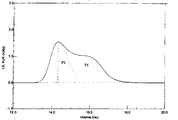
- the region of peak P2 includes a perpendicular line drawn from the highest point of peak P2 to the baseline (a dotted line drawn substantially parallel to the volume axis in FIG. 1), a baseline, and a molecular weight curve on the left side from the highest point. And a molecular weight curve formed when the region (1) is folded to the right side with the perpendicular as the axis of symmetry (in FIG. 1, a virtual line indicated by a dotted line on the right side of the perpendicular). This is a region formed by a region (2) surrounded by a molecular weight curve), a perpendicular, and a base line.
- the region of peak P1 is a portion obtained by subtracting the region of peak P1 composed of the region (1) and region (2) from the region surrounded by the molecular weight curve and the baseline.
- This ratio can be adjusted by adjusting the ratio of the multi-branched macromonomer (a3) and the styrene monomer (a1), methacrylic acid (a2), or other monomers used in combination as necessary, It can be easily controlled by the type and the amount of use.
- the molecular weight obtained from GPC-MALLS of the styrenic resin (A) is 250,000 to 1000 in a log-log graph with the horizontal axis representing the molecular weight and the inertial radius representing the vertical axis.
- the inclination in the region of 10,000 is an index representing the degree of branching of the resin.
- the inclination is preferably 0.30 to 0.55 from the viewpoint of exhibiting an excellent balance between strength and moldability. When this inclination is larger than 0.55, the physical properties are closer to those of the linear resin, and conversely when it is smaller than 0.30, the fluidity may be lowered due to the increase in molecular weight accompanying the increase in the degree of branching.
- Multi-branched macromonomer (a3) As the multi-branched macromonomer (a3) having a plurality of branches and having a plurality of polymerizable double bonds that can be used in the present invention, from the viewpoint of suppressing the generation of gel and ensuring fluidity.
- the multi-branched macromonomer (a3) has a weight average molecular weight (Mw) of preferably 1,000 to 15,000, more preferably 3,000 to 8,000.
- the molecular weight of the hyperbranched macromonomer (a1) was measured by gel permeation chromatography (hereinafter abbreviated as “GPC”) using “HPLC8010” manufactured by Tosoh Corporation, column Shodex KF802 ⁇ 2 + KF803 + KF804, solvent THF, flow rate 1 Measurement was performed at a condition of 0.0 ml / min.
- the branched structure in the multi-branched macromonomer (a3) is not particularly limited, but all three bonds other than the electron-withdrawing group and the bond that is bonded to the electron-withdrawing group are bonded to the carbon atom 4 Those that are branched by secondary carbon atoms and those that form a branched structure by repeating structural units having an ether bond, an ester bond or an amide bond are preferred.
- the electron withdrawing group content is 2.5 ⁇ 10 5 per g of the hyperbranched macromonomer (a3). It is preferably in the range of ⁇ 4 mmol to 5.0 ⁇ 10 ⁇ 1 mmol, more preferably in the range of 5.0 ⁇ 10 ⁇ 4 mmol to 5.0 ⁇ 10 ⁇ 2 mmol.
- the multi-branched macromonomer (a3) has two or more polymerizable double bonds per molecule.
- the content of the polymerizable double bond is preferably in the range of 0.1 to 5.5 mmol, and more preferably in the range of 0.5 to 3.5 mmol, per 1 g of the macromonomer (a3).
- the polymerizable double bond is preferably present at the tip of the multi-branched macromonomer (a3).
- the multi-branched macromonomer (a3) that can be used in the present invention includes a branched structure formed by repeating structural units having an ester bond, an ether bond or an amide bond, and two or more polymerizable groups in one molecule at the branch end. Mention may be made of a multibranched macromonomer (a3-i) having a double bond.
- the carbon atom adjacent to the carbonyl group of the ester bond forming the molecular chain is a quaternary carbon atom.
- a preferred embodiment is one in which a polymerizable double bond such as a vinyl group or an isopropenyl group is introduced into a multi-branched polyester polyol. Introducing a polymerizable double bond into a multi-branched polyester polyol can be carried out by an esterification reaction or an addition reaction.
- a substituent may be introduced into a part of the hydroxy group in advance by an ether bond or other bond, and a part of the hydroxy group may be oxidized or other reaction. It may be denatured. Further, in the hyperbranched polyester polyol, a part of the hydroxy group may be esterified in advance.
- Examples of the multi-branched macromonomer (a3-i-1) include a compound having one or more hydroxy groups, a carbon atom adjacent to the carboxy group being a quaternary carbon atom, and two or more hydroxy groups. It is obtained by reacting a monocarboxylic acid having a multi-branched polymer, and then reacting the hydroxyl group, which is a terminal group of the polymer, with an unsaturated acid such as acrylic acid or methacrylic acid or an acrylic compound containing an isocyanate group. Things.
- a multi-branched polymer having a branched structure formed by repeating structural units having an ester bond is described in “Angew. Chem. Int. Ed. Engl. 29” p138-177 (1990) by Tamalia et al. Are listed.
- Examples of the compound having at least one hydroxy group include a) aliphatic diol, alicyclic diol, or aromatic diol, b) triol, c) tetraol, d) sugar alcohols such as sorbitol and mannitol, e) anne Hydroenenea-heptitol or dipentaerythritol, f) ⁇ -alkyl glucoside such as ⁇ -methyl glycoside, g) monofunctional alcohol such as ethanol, hexanol, h) alkylene oxide having a weight average molecular weight of at most 8,000, or Examples thereof include a hydroxy group-containing polymer produced by reacting the derivative with a hydroxy group in one or more compounds selected from any one of the above a) to g).
- Examples of the a) aliphatic diol, alicyclic diol and aromatic diol include, for example, 1,2-ethanediol, 1,3-propanediol, 1,4-butanediol, 1,5-pentanediol, 1, 6-hexanediol, polytetrahydrofuran, dimethylolpropane, neopentylpropane, 2-propyl-2-ethyl-1,3-propanediol, 1,2-propanediol, 1,3-butanediol, diethylene glycol, triethylene glycol , Polyethylene glycol, dipropylene glycol, tripropylene glycol, polypropylene glycol; cyclohexanedimethanol, 1,3-dioxane-5,5-dimethanol; 1,4-xylylenediethanol, 1-phenyl-1,2-ethanediol Etc.
- triol examples include trimethylolpropane, trimethylolethane, trimethylolbutane, glycerol, 1,2,5-hexanetriol, 1,3,5-trihydroxybenzene, and the like.
- c) tetraol examples include pentaerythritol, ditrimethylolpropane, diglycerol, and ditrimethylolethane.
- Examples of the monocarboxylic acid having a quaternary carbon atom adjacent to the carboxyl group and having two or more hydroxy groups include, for example, dimethylolpropionic acid, ⁇ , ⁇ -bis (hydroxymethyl) butyric acid, ⁇ , ⁇ , ⁇ -tris (hydroxymethyl) acetic acid, ⁇ , ⁇ -bis (hydroxymethyl) valeric acid, ⁇ , ⁇ -bis (hydroxymethyl) propionic acid, and the like.
- the ester decomposition reaction is suppressed and a multibranched polyester polyol can be formed.
- a catalyst when producing the multi-branched polyester polyol.
- the catalyst include organic tins such as dialkyltin oxide, halogenated dialkyltin, dialkyltin biscarboxylate, and stannoxane.
- organic tins such as dialkyltin oxide, halogenated dialkyltin, dialkyltin biscarboxylate, and stannoxane.
- examples thereof include compounds, titanates such as tetrabutyl titanate, organic sulfonic acids such as Lewis acid and p-toluenesulfonic acid.
- the multi-branched macromonomer (a3-i-2) in which a structural unit having an ether bond is repeatedly formed to form a branched structure for example, a compound having at least one hydroxy group or cyclic ether compound has one hydroxy group
- a compound having at least one hydroxy group or cyclic ether compound has one hydroxy group
- the terminal hydroxyl group of the polymer is unsaturated acid such as acrylic acid or methacrylic acid, isocyanate group-containing acrylic compound, 4-chloromethyl
- examples thereof include those obtained by reacting halogenated methylstyrene such as styrene.
- a compound containing one or more hydroxy groups and two or more hydroxy groups and a halogen atom, —OSO 2 OCH 3 or —OSO 2 CH 3, based on Williamson's ether synthesis method A method of reacting with is also useful.
- any of those mentioned above can be used, and as the cyclic ether compound having one or more hydroxy groups, for example, 3-ethyl-3- (hydroxymethyl) Examples include oxetane, 2,3-epoxy-1-propanol, 2,3-epoxy-1-butanol, and 3,4-epoxy-1-butanol.
- the compounds having one or more hydroxy groups used in the Williamson ether synthesis method may be those described above, but aromatic compounds having two or more hydroxy groups bonded to an aromatic ring are preferred. Examples of the compound include 1,3,5-trihydroxybenzene, 1,4-xylylenediethanol, 1-phenyl-1,2-ethanediol and the like.
- Examples of the compound containing two or more hydroxy groups and a halogen atom, —OSO 2 OCH 3 or —OSO 2 CH 3 include, for example, 5- (bromomethyl) -1,3-dihydroxybenzene, 2-ethyl-2- (bromomethyl) -1 , 3-propanediol, 2-methyl-2- (bromomethyl) -1,3-propanediol, 2- (bromomethyl) -2- (hydroxymethyl) -1,3-propanediol, and the like.
- a catalyst when manufacturing the said multi-branched polymer, it is preferable to use a catalyst normally, and examples of the catalyst include BF3 diethyl ether, FSO3H, ClSO3H, and HClO4.
- Examples of the multibranched macromonomer (a3-i-3) in which a structural unit having an amide bond is repeatedly formed to form a branched structure include, for example, those having an amide bond in the molecule through a nitrogen atom in the structure.
- a typical example is the generation 2.0 (PAMAM dentrimer) manufactured by Dentorite.
- the above-mentioned multibranched macromonomer (a3) at a ratio of preferably 50 ppm to 1%, more preferably 100 ppm to 3000 ppm (mass basis) with respect to the total amount of other monomers, It is easy to produce a branched resin and facilitates the production of the styrene resin (A) used in the present invention.
- the polymerization method is not particularly limited, but bulk polymerization, suspension polymerization, or solution polymerization is preferable. Among them, continuous bulk polymerization is particularly preferable from the viewpoint of production efficiency.For example, by performing continuous bulk polymerization incorporating one or more stirred reactors and a tubular reactor in which a plurality of mixing elements having no moving parts are fixed. An excellent resin can be obtained. Although thermal polymerization can be performed without using a polymerization initiator, it is preferable to use various radical polymerization initiators. Moreover, what is used for manufacture of a normal polystyrene can be used for polymerization adjuvants, such as a suspending agent and an emulsifier required for superposition
- an organic solvent may be added to the reaction system.
- the organic solvent include toluene, ethylbenzene, xylene, acetonitrile, benzene, chlorobenzene, dichlorobenzene, and anisole. , Cyanobenzene, dimethylformamide, N, N-dimethylacetamide, methyl ethyl ketone and the like.
- an organic solvent from the viewpoint of suppressing gelation.
- the radical polymerization initiator is not particularly limited.
- 1,1-bis (t-butylperoxy) cyclohexane 2,2-bis (t-butylperoxy) butane, 2,2-bis (4 , 4-di-butylperoxycyclohexyl) propane and other peroxyketals, cumene hydroperoxide, hydroperoxides such as t-butyl hydroperoxide, di-t-butyl peroxide, dicumyl peroxide, di -Dialkyl peroxides such as t-hexyl peroxide, diacyl peroxides such as benzoyl peroxide and disinamoyl peroxide, t-butyl peroxybenzoate, di-t-butyl peroxyisophthalate, t-butyl peroxide Pars such as oxy isopropyl monocarbonate Xyesters, N, N′-azobisisobutylnitrile, N, N′-azobis
- a chain transfer agent may be added so that the molecular weight of the obtained resin does not become excessively large.
- the chain transfer agent either a monofunctional chain transfer agent having one chain transfer group or a polyfunctional chain transfer agent having a plurality of chain transfer groups can be used.
- the monofunctional chain transfer agent include alkyl mercaptans and thioglycolic acid esters.
- Polyfunctional chain transfer agents include ethylene glycol, neopentyl glycol, trimethylol propane, pentaerythritol, dipentaerythritol, tripentaerythritol, sorbitol and the like, wherein the hydroxy group is thioglycolic acid or 3-mercaptopropionic acid. And the like esterified with.
- long chain alcohols polyoxyethylene alkyl ethers, polyoxyethylene lauryl ethers, polyoxyoleyl ethers, polyoxyethylene alkenyl ethers, and the like can be used to suppress gel generation of the resulting resin.
- a lubricant an antistatic agent, an antioxidant, a heat stabilizer, an ultraviolet absorber, a dye, a plasticizer, and the like can be used as long as the physical properties of the obtained resin and sheet are not impaired.
- styrenic monomer (a1), methacrylic acid (a2), other monomers used in combination, and multibranched macromonomer (a3) are used as monomers, and these are copolymerized to produce a styrene resin ( A) can be obtained.
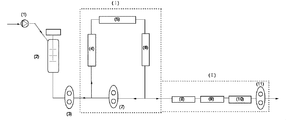
- An example of the reaction vessel of the polymerization apparatus for obtaining the resin (A) in the present invention is shown in FIG. That is, the reaction solution is sent to the stirring reactor (I) by the pump (1), then sent to the circulation polymerization line (II) by the pump (2), and the inside of the circulation polymerization line (II) is sent by the pump (3).
- the circulation polymerization line (II) is composed of three reactors composed of (4) to (6)
- the non-circulation polymerization line (III) is composed of three reactors composed of (7) to (9). Is done.
- a devolatilization tank 1 and a devolatilization tank 2 for volatilizing unreacted monomers and solvent components are connected.
- the devolatilization tank 1 and the devolatilization tank 2 are preferably adjusted to a reduced pressure of 4.0 kPa and 1.3 kPa, respectively, and after passing through the devolatilization tank 1 and the devolatilization tank 2, they are pelletized.
- the styrene resin (A) to be used can be obtained.
- the present invention is characterized in that the inorganic fine particles (B) are used in the composition in a range of 0.01 to 1.0 mass% with respect to the styrene resin (A) described above.
- the average particle size of the inorganic fine particles (B) is in the range of 0.1 to 10 ⁇ m.
- the average particle diameter is a value determined by a laser diffraction method, and when it is not a perfect spherical particle, it is the average value of the longest part of the primary particles.
- the surface impact strength of the sheet obtained using this composition does not reach a practical level, and when it exceeds 10 ⁇ m, the molded product obtained is obtained. Insufficient transparency.
- Examples of the inorganic fine particles (B) include, for example, barium sulfate, talc, calcium phosphate and the like, and in particular, barium sulfate does not impair the transparency in a molded product and contributes to improvement of mechanical strength. It can be preferably used.
- the inorganic fine particles (B) preferably have an average particle diameter of 0.5 to 8 ⁇ m, and the shape thereof is preferably a plate shape.
- inorganic fine particles marketed as having such an average particle diameter Sakai Chemical Industry Co., Ltd., plate-like barium sulfate A and the like can be mentioned.
- the use ratio is essential to be in the range of 0.01 to 1.0% by mass from the viewpoint of excellent balance between surface impact strength and transparency of the molded product to be obtained.
- the range is preferably 0.3% by mass.
- the present invention is characterized in that rubber-modified polystyrene (C) is used in combination in order to further increase the impact strength without impairing the transparency of the molded product.
- the rubber-modified polystyrene (C) used in the present invention may be any polystyrene-based resin containing components such as rubber.
- the rubber-like polymer is graft-polymerized on a continuous phase composed of a polymer of styrene alone.
- resin can be used as it is as a dispersed resin.
- the rubber component contained in the rubber-modified polystyrene (C) include polybutadiene, styrene-butadiene copolymer, polyisoprene, butadiene-isoprene copolymer, and the like.
- the average particle diameter of the particles is preferably in the range of 0.8 to 3.0 ⁇ m.
- the average particle diameter can be measured with a laser diffraction particle size distribution measuring apparatus.
- the fluidity of the rubber-modified polystyrene (C) used in the present invention is 1 to 10 g / 10 min. From the viewpoint of moldability. It is preferable that it exists in the range.
- the content of the rubbery polymer contained in the rubber-modified polystyrene (C) is 1.5 to 15.0% by mass from the viewpoint of achieving both impact strength and processing characteristics during stretch molding. Is preferred.
- the rubber-modified polystyrene (C) having such characteristics a commercially available product may be used as described above, but ordinary polystyrene is mixed with a resin having a high rubber component content, The content rate and fluidity may be adjusted to a suitable range.
- the blending ratio of the rubber-modified polystyrene (C) is 0.1 in the composition from the viewpoint of moldability of the obtained sheet, impact strength of the molded product obtained after secondary molding, and prevention of whitening. It is preferably in the range of ⁇ 5.0 parts by mass.
- the styrenic resin composition in the present invention can be produced by the following method. After the styrene monomer (a1), methacrylic acid (a2), other necessary styrenic monomers used together and a monomer copolymerizable with the inorganic fine particles (B) are uniformly mixed in advance, the mixed solution is polymerized, A method of mixing rubber-modified polystyrene (C), or a method of adding inorganic fine particles (B) to a polymerization solution of styrene-based resin (A) and further mixing rubber-modified polystyrene (C), or a styrene-based resin (A ), A method of adding inorganic fine particles (B) and rubber-modified polystyrene (C).
- inorganic fine particles (B) and rubber-modified polystyrene (C) When adding inorganic fine particles (B) and rubber-modified polystyrene (C) to the styrene resin (A) melt, it can be prepared by melt-kneading with a twin screw extruder or the like. It is also possible to prepare a master batch by melt-kneading so that the inorganic fine particles (B) have a high concentration, and then melt-kneading with styrene-based resin (A) and rubber-modified polystyrene (C) to dilute to a prescribed concentration.
- the styrenic resin composition of the present invention may be blended with other resins, various additives and the like within a range not impairing the effects of the present invention.
- other resins that can be used in combination include styrene-based thermoplastic elastomers such as styrene-butadiene block copolymers and hydrogenated products thereof, and styrene-isoprene block copolymers and hydrogenated products thereof.
- the diene component content of these elastomers is not particularly limited, but a diene component content of 20% by mass or more with respect to all monomer components constituting the elastomer is preferable from the viewpoint of strength improvement effect.
- the use ratio of these is 0.1 to 3 with respect to the total amount of the styrene resin (A), the inorganic fine particles (B), and the rubber-modified polystyrene (C) from the viewpoint of the balance between strength and transparency. It is preferable to use in the range of mass%.
- the additive examples include a plasticizer, an antistatic agent, an antioxidant, an ultraviolet absorber, a lubricant, an antiblocking agent, and a heat stabilizer.
- the non-stretched sheet can be produced by melt-extruding the styrene resin composition pellets obtained above with an extruder and then melt-extruding it into a sheet with a T-die and then cooling it with a cooling roll or the like.
- the cooling temperature is preferably 70 to 90 ° C.
- the biaxially stretched sheet is obtained by stretching in a longitudinal and lateral biaxial direction with a stretching machine after melt extrusion with an extruder.
- a heat-resistant styrenic resin composition is supplied to an extruder and melt-extruded into a sheet form from a T-die.
- casting is performed so that the sheet before stretching has a predetermined thickness.
- the sheet is cooled to a temperature capable of biaxial stretching, for example, 110 to 150 ° C., and stretched in the longitudinal direction (flow direction) and the transverse direction (cross direction with respect to the flow direction).
- simultaneous biaxial stretching or sequential biaxial stretching can be performed after melt-extrusion of the styrenic resin composition to form a sheet.
- sequential biaxial stretching it is common to first perform longitudinal stretching and then perform lateral stretching.
- a longitudinal stretching using a roll is followed by a lateral stretching using a tenter.
- the tenter method is advantageous in that a wide range of products can be obtained and productivity is high.
- a longitudinal stretching method using a roll As a longitudinal stretching method using a roll, a low-speed roll and a high-speed roll are rotated in the same direction to pass the resin flat, and a stretching method, and a low-speed roll and a high-speed roll are rotated in reverse to pass the resin through the cloth.
- a stretching method, and a low-speed roll and a high-speed roll are rotated in reverse to pass the resin through the cloth.
- the stretching ratio varies depending on the purpose, but is usually 1.5 to 15 times, more preferably 4 to 10 times in terms of surface magnification.
- the draw ratio in the flow direction is 1.2 to 5 times, preferably 1.5 to 3.0 times
- the draw ratio in the cross direction with respect to the flow direction is 1.2 to 5 times.
- it is 1.5 to 3.0 times.
- the stretching ratio in each direction of simultaneous biaxial stretching is 1.5 to 5 times.
- the temperature condition at this time is preferably such that the orientation relaxation stress measured according to ASTM D-1504 is 0.2 to 2.0 MPa, more preferably 0.4 to 1.0 MPa.
- the orientation relaxation stress is less than 0.2 MPa, the impact resistance of the sheet is likely to be insufficient, and if it exceeds 2.0 MPa, the sheet is likely to be stretched and the secondary formability may be poor. Because there is. On the other hand, the range of 0.4 to 1.0 MPa is more preferable because not only the obtained sheet has good crackability but also the sheet formability itself becomes extremely good.
- the unstretched raw sheet is stretched in the longitudinal direction at a stretching temperature of 110 to 150 ° C. at the above magnification, and then crossed with respect to the longitudinal direction at a stretching temperature of 110 to 150 ° C. Stretching is performed in the direction at the above magnification.
- the thickness of the biaxially stretched sheet made of a styrene resin composition is preferably 0.1 to 0.5 mm.
- the biaxially stretched sheet may be laminated with the same or different thermoplastic resin by coextrusion or dry lamination, if necessary. Moreover, you may apply
- the obtained biaxially stretched sheet can be easily obtained in a desired container, lid, and the like if it is pressure-formed with a mold having a predetermined shape under the same conditions as those of a conventional biaxially stretched polystyrene sheet.
- GPC-MALLS measurement GPC-MALS measurement of the styrene resin composition was performed under the conditions of Shodex HPLC, detector Wyatt Technology DAWN EOS, Shodex RI-101, column Shodex KF-806L ⁇ 2, solvent THF, flow rate 1.0 ml / min. .
- GPC-MALLS measurement was analyzed using Wyatt's analysis software ASTRA to obtain the weight average molecular weight of the styrene resin composition, and the molecular weight of the resin composition obtained from GPC-MALLS was plotted on the horizontal axis.
- Styrenic resin (A) and inorganic fine particles (B) were mixed in advance at a mass ratio of 99.0 / 1.0, and melt-kneaded at 230 ° C. using a twin-screw extruder to prepare a master batch.
- the styrene resin (A), the master batch, and the rubber-modified polystyrene (C) are mixed, and using a 40 mm single screw extruder, the extrusion temperature is 230 ° C., the roll temperature is 85 ° C., and the take-off speed is 0.8 to 0.9 m.
- a sheet having a thickness of 1.0 mm was formed at / min.
- Haze (turbidity) was measured according to JIS K7105.
- reaction mixture was further stirred at 120 ° C. for 3 hours and then cooled to room temperature.
- the resulting multi-branched polyether polyol had a weight average molecular weight of 3,000 and a hydroxyl value of 530.
- the amount of heating was adjusted so that the amount of distillate in the decanter was 30 g per hour, and heating was continued until the amount of dehydration reached 2.9 g.
- the mixture was cooled once, 36 g of acetic anhydride and 5.7 g of sulfamic acid were added, and the mixture was stirred at 60 ° C. for 10 hours. Thereafter, in order to remove the remaining acetic acid and hydroquinone, it was washed with 50 g of 5% aqueous sodium hydroxide solution four times, and further washed once with 50 g of 1% aqueous sulfuric acid solution and twice with 50 g of water.
- Oxetane: propylene oxide 1: 1.9.
- ⁇ Synthesis of multi-branched polyether 2 having acryloyl group> In a 500 mL four-necked flask equipped with a Dean-Stark tube, nitrogen and air introduction tube, a stirrer, and a thermometer, the multi-branched polyether polyol obtained in the above ⁇ Synthesis of multi-branched polyether polyol 2> 155 g, 51 g of acrylic acid, 200 g of cyclohexane, 0.21 g of hydroquinone monomethyl ether, and 4 g (12.3 mmol) of dodecylbenzenesulfonic acid as a catalyst were added, and the temperature was raised to 82 ° C. under a mixed gas flow of nitrogen and air 2 to 1.
- reaction mixture was once cooled, and 34 g of acetic anhydride and 5.4 g of sulfamic acid were added, followed by stirring at 60 ° C. for 10 hours. Thereafter, the tetrahydrofuran was distilled off under reduced pressure, the resulting mixture was dissolved in 150 g of toluene, washed with 50 g of 5% aqueous sodium hydroxide solution to remove the remaining acetic acid, and further 50 g of 1% aqueous sulfuric acid solution. And once with 50 g of water.
- the solvent was distilled off from the obtained organic layer under reduced pressure to obtain 70 g of a multi-branched polyether having a styryl group and an acetyl group.
- the obtained multi-branched polyether had a mass average molecular weight of 4,800, and the styryl group and acetyl group introduction rates into the multi-branched polyether polyol were 38 mol% and 57 mol%, respectively.
- methyl methacrylate was distilled off under reduced pressure, and 10 g of acetic anhydride and 2 g of sulfamic acid were added to cap the remaining hydroxy groups, followed by stirring at room temperature for 10 hours.
- the residue was dissolved in 70 g of ethyl acetate and washed 4 times with 20 g of 5% aqueous sodium hydroxide to remove hydroquinone. Further, it was washed twice with 20 g of a 7% aqueous sulfuric acid solution and twice with 20 g of water.
- a hyperbranched macromonomer (Mm-3) having an isopropenyl group and an acetyl group. It was.
- the resulting multi-branched macromonomer (Mm-3) has a weight average molecular weight of 3,000, a number average molecular weight of 2,100, and a double bond introduction amount of 2.00 mmol / g. Isopropenyl group and acetyl group The introduction rates were 55 mol% and 36 mol%, respectively.
- the obtained mixture was dissolved in dichloromethane and washed three times with water, and then the dichloromethane solution was added dropwise to hexane to precipitate a multibranched polyether. This was filtered and dried to obtain 12 g of a multi-branched polyether polyol having a styryl group and an acetyl group.
- the mass average molecular weight was 3,200, and the styryl group content was 3.5 mmol / gram.
- methyl methacrylate was distilled off under reduced pressure, and 10 g of acetic anhydride and 2 g of sulfamic acid were added to cap the remaining hydroxy groups, and the mixture was stirred at room temperature for 10 hours.
- the residue was dissolved in 70 g of ethyl acetate and washed 4 times with 20 g of 5% aqueous sodium hydroxide to remove hydroquinone. Further, it was washed twice with 20 g of a 7% aqueous sulfuric acid solution and twice with 20 g of water.
- the obtained organic layer 0.0045 g of methoquinone was added, and the solvent was distilled off while introducing 7% oxygen under reduced pressure to obtain 12 g of a hyperbranched polyester having an isopropenyl group and an acetyl group.
- the obtained multibranched polyester had a mass average molecular weight of 2860 and a number average molecular weight of 3770, and the introduction rates of isopropenyl group and acetyl group into the multibranched polyester polyol (A) were 55% and 40%, respectively.
- Example 1 A mixed solution consisting of 98 parts of styrene monomer, 2 parts of methacrylic acid and 12 parts of toluene was prepared, and 2,2-bis (4,4-di-t-butylperoxycyclohexyl) propane was used as the organic peroxide. 750 ppm was added to the total amount of styrene monomer and methacrylic acid, and continuous polymerization was performed under the following conditions using the apparatus shown in FIG.
- the stirring reactor (I) was 110 to 130 ° C.
- the circulation polymerization line (II) and the non-circulation polymerization line (III) were 120 to 160 ° C., respectively.
- the devolatilization tank 1 and the devolatilization tank 2 installed after the non-recycling polymerization line (III) as the final reactor.
- the devolatilization tank 1 and the devolatilization tank 2 were set to 240 to 280 ° C. Thereafter, it passed through a single tube and was converted into a strand and pelletized with a pelletizer to obtain a styrene resin (A-1).
- Example 2 A stretched sheet was obtained in the same manner as in Example 1 except that barium sulfate was changed to 4 ⁇ m plate-like barium sulfate.
- Example 3 A stretched sheet was obtained in the same manner as in Example 1 except that the barium sulfate was changed to 2 ⁇ m plate-like barium sulfate.
- a stretched sheet was obtained in the same manner as in Example 1 except that the sheet was obtained.
- Example 5 Prepare a mixed solution of 98 parts of styrene monomer, 2 parts of methacrylic acid, 500 ppm of the multi-branched macromonomer (Mm-1) obtained in Reference Example 1 and 11 parts of toluene with respect to the total amount of styrene monomer and methacrylic acid. Furthermore, 300 ppm of t-butyl peroxybenzoate as an organic peroxide was added to the total amount of styrene monomer and methacrylic acid monomer, and continuous bulk polymerization was performed under the following conditions using the apparatus shown in FIG.
- the stirring reactor (I) was 110 to 130 ° C., and the circulation polymerization line (II) and the non-circulation polymerization line (III) were 120 to 160 ° C., respectively.
- the devolatilization tank 1 and the devolatilization tank 2 were set to 240 to 280 ° C. Thereafter, it passed through a single tube and was stranded and pelletized with a pelletizer to obtain a styrene resin (A-2).
- a stretched sheet was obtained in the same manner as in Example 1 except that the styrene resin (A-2) was obtained.
- Example 6 A stretched sheet was obtained in the same manner as in Example 5 except that the macromonomer was changed to Mm-2 obtained in Reference Example 2 to obtain a styrene resin (A-3).
- Example 7 A stretched sheet was obtained in the same manner as in Example 5, except that the macromonomer was changed to Mm-3 obtained in Reference Example 2 to obtain a styrene resin (A-4).
- Example 8 A stretched sheet was obtained in the same manner as in Example 5 except that the macromonomer was changed to Mm-4 obtained in Reference Example 2 to obtain a styrene resin (A-5).
- Example 9 A stretched sheet was obtained in the same manner as in Example 5 except that the macromonomer was changed to Mm-5 obtained in Reference Example 2 to obtain a styrene resin (A-6).
- Example 10 A stretched sheet was obtained in the same manner as in Example 5 except that the macromonomer was changed to Mm-6 obtained in Reference Example 2 to obtain a styrene resin (A-7).
- Example 11 A stretched sheet was obtained in the same manner as in Example 5 except that the macromonomer was changed to Mm-7 obtained in Reference Example 2 to obtain a styrene resin (A-8).
- a stretched sheet was obtained in the same manner as in Example 11 except that the sheet was obtained.
- Comparative Example 1 A stretched sheet was obtained in the same manner as in Example 1 except that the content of methacrylic acid was 0% by mass.
- Comparative Example 2 A stretched sheet was obtained in the same manner as in Example 1 except that barium sulfate was changed to 15 ⁇ m plate-like barium sulfate.
- Comparative Example 4 A stretched sheet was obtained in the same manner as in Example 1 except that barium sulfate and rubber-modified polystyrene were not added.
Landscapes
- Chemical & Material Sciences (AREA)
- Engineering & Computer Science (AREA)
- Chemical Kinetics & Catalysis (AREA)
- Medicinal Chemistry (AREA)
- Polymers & Plastics (AREA)
- Organic Chemistry (AREA)
- Health & Medical Sciences (AREA)
- Mechanical Engineering (AREA)
- Manufacturing & Machinery (AREA)
- Ceramic Engineering (AREA)
- Materials Engineering (AREA)
- Compositions Of Macromolecular Compounds (AREA)
- Manufacture Of Macromolecular Shaped Articles (AREA)
- Macromonomer-Based Addition Polymer (AREA)
Abstract
透明性を損なわずに衝撃強度、耐熱性を向上させ、よって薄肉化が可能であり二次成形性が良好であるスチレン系樹脂組成物及びこれを用いて得られる二軸延伸スチレン系シート、その成形品を提供する。具体的には、スチレン系モノマー(a1)由来構造と、メタクリル酸(a2)由来構造とを有するスチレン系樹脂(A)と、平均粒径が0.1~10μmの無機微粒子(B)と、ゴム変性ポリスチレン(C)とを必須成分とする樹脂組成物であり、前記無機微粒子(B)の組成物における配合割合が0.01~1.0質量%の範囲であることを特徴とするスチレン系樹脂組成物、これを用いた二軸延伸スチレン系シート及びその成形品を提供する。
Description
本発明は、無機微粒子を含有する特定のスチレン系樹脂組成物に関するものであり、詳しくは、スチレン系樹脂組成物から得られる成形品における透明性を損なわずに強度を向上させることができ、耐熱性に優れ、成形品の薄肉化に寄与することができるスチレン系樹脂組成物、これを二軸延伸してなるシート、及びこれから得られる成形品に関するものである。
ポリスチレンから得られるシートは、透明性や剛性が優れているため、主に食品包装用容器として使用されている。しかし、このポリスチレンから得られるシート製の容器は一般的な食品包装容器としては適しているものの、面衝撃性が不十分であるため、包装材料の減容化、あるいは成形性向上のためにシート又はその二次成形品を薄肉化しようとすると、包装材としての適性を実用レベルに維持することが困難であり、すなわち、強度と成形性とのトレードオフを解消することができず、この解決が求められている。
また、最近は内容物の入った状態で食品包装容器を電子レンジによって加熱する使用方法が増えている。しかし、使用条件によっては耐熱性の不足により容器が変形する場合があり、食品包装容器に対して一層の耐熱性向上が求められている。
耐衝撃性を改善する手段として、例えば、スチレン系樹脂に、微粒子を少量混合する方法が提供されている(例えば、特許文献1参照)。この文献で実質的に提供されているスチレン系樹脂組成物の成形品は射出成形品であり、当該射出成形品においての実用的な使用において衝撃強度を改善するものであるが、シート状に加工した際の衝撃強度までもが改善されるかどうかについての記載はない。
一方、フィルム状に加工した際の異方性の改良のために、スチレン系樹脂に特定の微粒子を配合することが提案されている(例えば、特許文献2参照)。この文献では、インフレーションフィルムとしたときの異方性の改良効果は示されているもの、MD方向(フィルムの巻き取り方向)での引張強度はむしろ微粒子を入れた方が落ちていることが示されており、スチレン系樹脂に微粒子を配合することよって機械的強度を向上させることを目指したものではないことは明らかである。
また、透明性を維持したままで衝撃強度を改良する目的で、スチレン系樹脂に、微粒子を少量混合し延伸した成形体が提案されている(例えば、特許文献3参照)。この文献では、衝撃強度の改良効果は示されているものの、耐熱性についての記載はない。
これらの事情に鑑み、本発明が解決しようとする課題は、透明性を損なわずに面衝撃強度、耐熱性を向上させ、よって薄肉化が可能であり二次成形性が良好であるスチレン系樹脂組成物及びこれを用いて得られる二軸延伸スチレン系シート、その成形品を提供することにある。
本発明者らは、上記課題を解決すべく鋭意研究を重ねた結果、無機微粒子を特定量含有させてなる特定のスチレン系樹脂組成物を用いることで、上記課題を解決できることを見出し、本発明を完成するに至った。
即ち、本発明は、スチレン系モノマー(a1)由来構造と、メタクリル酸(a2)由来構造とを有するスチレン系樹脂(A)と、平均粒径が0.1~10μmの無機微粒子(B)と、ゴム変性ポリスチレン(C)とを必須成分とする樹脂組成物であり、前記無機微粒子(B)の組成物における配合割合が0.01~1.0質量%の範囲であることを特徴とするスチレン系樹脂組成物、これを二軸延伸してなるシート及び成形品を提供するものである。
本発明のスチレン系樹脂組成物は、特定の単量体を共重合化させることにより組成物の耐熱性を向上させ、また特定の微粒子を配合し、更にゴム変性ポリスチレンを併用する事により、特にシート状に加工した際の面衝撃強度を向上させることができる。このため、スチレン系樹脂が本来有する透明性を損なわずに、成形品の耐熱性、衝撃強度が向上し、薄肉化が可能となり、二次成形性が良好となり、成形時の白化も起こさず、食品用途等の包装材として好適に用いることができる。
以下に本発明の組成物について詳細に説明する。
〔スチレン系樹脂組成物〕
本発明で用いるスチレン系樹脂組成物は、スチレン系モノマー(a1)由来構造と、メタクリル酸(a2)由来構造とを有するスチレン系樹脂(A)と、平均粒径が0.1~10μmの無機微粒子(B)と、ゴム変性ポリスチレン(C)とを必須成分とする樹脂組成物であり、前記無機微粒子(B)の組成物における配合割合が0.01~1.0質量%の範囲であることを特徴とする。
〔スチレン系樹脂組成物〕
本発明で用いるスチレン系樹脂組成物は、スチレン系モノマー(a1)由来構造と、メタクリル酸(a2)由来構造とを有するスチレン系樹脂(A)と、平均粒径が0.1~10μmの無機微粒子(B)と、ゴム変性ポリスチレン(C)とを必須成分とする樹脂組成物であり、前記無機微粒子(B)の組成物における配合割合が0.01~1.0質量%の範囲であることを特徴とする。
前記スチレン系樹脂(A)は、スチレン系モノマー(a2)由来構造とメタクリル酸(a3)由来構造とを有するものであるが、この由来構造とは、スチレン系モノマー(a2)あるいはメタクリル酸(a3)中の重合性基(ビニル基)が反応により単結合になったものをいう。即ち、前記スチレン系樹脂(A)は、スチレン系モノマー(a1)とメタクリル酸(a2)とを必須成分として含有する単量体類の共重合体であることが好ましい。
前記スチレン系モノマー(a1)としては、例えば以下の物が挙げられる。スチレン及びその誘導体;例えばスチレン、メチルスチレン、ジメチルスチレン、トリメチルスチレン、エチルスチレン、ジエチルスチレン、トリエチルスチレン、プロピルスチレン、ブチルスチレン、ヘキシルスチレン、ヘプチルスチレン、オクチルスチレンの如きアルキルスチレン、フロロスチレン、クロロスチレン、ブロモスチレン、ジブロモスチレン、ヨードスチレンの如きハロゲン化スチレン、更にニトロスチレン、アセチルスチレン、メトキシスチレン等があり、これを単独あるいは2種以上を組み合わせて用いることができる。更に、該スチレン系モノマー(a1)と共に、スチレン系モノマー(a1)と共重合可能な化合物、例えばアクリロニトリル、メタクリロニトリル、メタクリル酸メチル、アクリル酸ブチルなどのエステル誘導体などのビニルモノマー、更には無水マレイン酸、マレイミド、核置換マレイミドなどを組み合わせて用いてもよい。
更にまた、前記スチレン系モノマー(a1)、及びメタクリル酸(a2)に加え、複数の分岐を有し、且つ複数の重合性二重結合を有する多分岐状マクロモノマー(a3)を必須成分として含有する単量体類の共重合体であってもよい。あるいは、この多分岐状共重合体を、前記で記載した共重合体と混合してなるものであってもよい。
スチレン系モノマー(a1)とメタクリル酸(a2)との共重合体を用いると、耐熱性に優れるシートが得られることから、特に電子レンジ等を使用する食品包装材として使用可能な成形品が得られる。
この時、前記スチレン系モノマー(a1)とメタクリル酸(a2)との使用割合としては、成形品の耐熱性、成形性の観点から、(a1)/(a2)で表される質量比として、99.9/0.1~97.0/3.0質量%の範囲であることが好ましい。
また、前述の複数の分岐を有し、且つ複数の重合性二重結合を有する多分岐状マクロモノマー(a3)を併用する場合は、スチレン系樹脂(A)をより高分子量化することが可能であり、この結果、得られる成形品の機械的強度を向上させることができる。この結果として、樹脂組成物から得られるシート及びその二次成形品の薄肉化も可能となる点で併用することが好ましい。
従って、前記スチレン系樹脂(A)が、スチレン系モノマー(a1)と、メタクリル酸(a2)と、複数の分岐を有し、且つ複数の重合性二重結合を有する多分岐状マクロモノマー(a3)とを必須とする単量体類の共重合体であることが好ましく、この時のスチレン系モノマー(a1)と前記メタクリル酸(a2)の使用割合が、(a1)/(a2)で表される質量比として、99.9/0.1~97.0/3.0質量%の範囲であることがより好ましい。
本発明に使用されるスチレン系樹脂(A)は、複数の分岐を有し、且つ複数の重合性二重結合を有する多分岐状マクロモノマー(a3)を使用しない場合、GPCにより求められる重量平均分子量は、10~40万の範囲であることが好ましく、前記多分岐状マクロモノマー(a3)を併用する場合には、GPC-MALLS法により求められる重量平均分子量が15万~70万であることが好ましく、更に、生産性、加工性の観点から、20万~60万の範囲であることがより好ましい。スチレン系樹脂(A)は、単独のものであっても、複数の共重合体の混合物であってもよく、混合物の場合は、その混合物としての分子量が前述の範囲のものであることが好ましい。また、混合物の場合は、スチレン系モノマー(a1)とメタクリル酸(a2)とを必須とする単量体類の共重合体であるスチレン系樹脂(A)が、スチレン系樹脂組成物中の樹脂成分として85質量%以上含有することが、本発明の効果を奏しやすい点で好ましいものである。
〔GPC-MALLS〕
前記多分岐状マクロモノマー(a3)を併用する場合、スチレン系樹脂(A)をGPC-MALLSにより分子量を測定すると、例えば、図1に示すクロマトグラフが得られる。図1中、低分子量側のピークがP1であり、高分子量側のピークがP2である。ピークP1には、線状の樹脂と、低分岐度の樹脂が含まれていると推測される。そして、ピークP2には主として多分岐状の高分岐度の樹脂が含まれていると推測される。なお、ピークP2の領域は、ピークP2の最高点からベースライン(図1中、volume軸にほぼ平行に引かれた点線)に降ろした垂線と、ベースラインと、該最高点から左側の分子量カーブとで囲まれた領域(1)と、該領域(1)を、前記垂線を対称軸として右側に折り返したときに形成される分子量カーブ(図1中、垂線の右側に点線で示した仮想の分子量カーブ)と、垂線と、ベースラインとで囲まれた領域(2)とにより形成される領域である。そして、ピークP1の領域は、分子量カーブと、ベースラインとで囲まれた領域から前記領域(1)と領域(2)からなるピークP1の領域を差し引いた部分である。
前記多分岐状マクロモノマー(a3)を併用する場合、スチレン系樹脂(A)をGPC-MALLSにより分子量を測定すると、例えば、図1に示すクロマトグラフが得られる。図1中、低分子量側のピークがP1であり、高分子量側のピークがP2である。ピークP1には、線状の樹脂と、低分岐度の樹脂が含まれていると推測される。そして、ピークP2には主として多分岐状の高分岐度の樹脂が含まれていると推測される。なお、ピークP2の領域は、ピークP2の最高点からベースライン(図1中、volume軸にほぼ平行に引かれた点線)に降ろした垂線と、ベースラインと、該最高点から左側の分子量カーブとで囲まれた領域(1)と、該領域(1)を、前記垂線を対称軸として右側に折り返したときに形成される分子量カーブ(図1中、垂線の右側に点線で示した仮想の分子量カーブ)と、垂線と、ベースラインとで囲まれた領域(2)とにより形成される領域である。そして、ピークP1の領域は、分子量カーブと、ベースラインとで囲まれた領域から前記領域(1)と領域(2)からなるピークP1の領域を差し引いた部分である。
〔ピークP1の領域中の樹脂とピークP2の領域中の樹脂の配合比〕
前記多分岐状マクロモノマー(a3)を併用する場合、スチレン系樹脂(A)のピークP1の領域中の樹脂とピークP2の領域中の樹脂の質量比は、得られるシートの強度と加工性とのバランスに優れる点で(ピークP2の領域中の樹脂)/(ピークP1の領域中の樹脂)=30/70~70/30が好ましく、より好ましくは、40/60~60/40である。この比率は、多分岐状マクロモノマー(a3)とスチレン系モノマー(a1)、メタクリル酸(a2)、あるいはその他必要に応じて併用されるその他のモノマーとの使用割合の調整や、連鎖移動剤の種類及びその使用量によって、容易に制御可能である。
前記多分岐状マクロモノマー(a3)を併用する場合、スチレン系樹脂(A)のピークP1の領域中の樹脂とピークP2の領域中の樹脂の質量比は、得られるシートの強度と加工性とのバランスに優れる点で(ピークP2の領域中の樹脂)/(ピークP1の領域中の樹脂)=30/70~70/30が好ましく、より好ましくは、40/60~60/40である。この比率は、多分岐状マクロモノマー(a3)とスチレン系モノマー(a1)、メタクリル酸(a2)、あるいはその他必要に応じて併用されるその他のモノマーとの使用割合の調整や、連鎖移動剤の種類及びその使用量によって、容易に制御可能である。
〔両対数グラフの傾き〕
また、前記多分岐状マクロモノマー(a3)を併用する場合のスチレン系樹脂(A)のGPC-MALLSから求められる分子量を横軸、慣性半径を縦軸とした両対数グラフにおける分子量25万~1000万の領域での傾きは、樹脂の分岐度を表す指標となる。この傾きについては、強度と成形加工性とを優れたバランスで発現させる点で、0.30~0.55であることが好ましい。この傾きが0.55よりも大きくなると、線状樹脂により近い物性となり、逆に0.30よりも小さくなると、分岐度増加に伴う分子量増大により流動性が低下することがある。
また、前記多分岐状マクロモノマー(a3)を併用する場合のスチレン系樹脂(A)のGPC-MALLSから求められる分子量を横軸、慣性半径を縦軸とした両対数グラフにおける分子量25万~1000万の領域での傾きは、樹脂の分岐度を表す指標となる。この傾きについては、強度と成形加工性とを優れたバランスで発現させる点で、0.30~0.55であることが好ましい。この傾きが0.55よりも大きくなると、線状樹脂により近い物性となり、逆に0.30よりも小さくなると、分岐度増加に伴う分子量増大により流動性が低下することがある。
〔GPC-MALLS測定〕
尚、前述のGPC-MALS測定は、Shodex HPLC、検出器Wyatt Technology DAWN EOS、Shodex RI-101、カラムShodex KF-806L×2、溶媒THF、流量1.0ml/minの条件にて測定するものである。また、GPC-MALLSの測定の解析は、Wyatt社の解析ソフトASTRAにより行い、スチレン系樹脂について重量平均分子量を求めた他、GPC-MALLSから求められる該樹脂の分子量を横軸、慣性半径を縦軸とした両対数グラフにおける分子量25万~1000万の領域での傾き(当該分子量範囲で得られた直線状の部分のみの測定値を元に、前記ソフトにて自動計算される近似直線の傾き)である。
尚、前述のGPC-MALS測定は、Shodex HPLC、検出器Wyatt Technology DAWN EOS、Shodex RI-101、カラムShodex KF-806L×2、溶媒THF、流量1.0ml/minの条件にて測定するものである。また、GPC-MALLSの測定の解析は、Wyatt社の解析ソフトASTRAにより行い、スチレン系樹脂について重量平均分子量を求めた他、GPC-MALLSから求められる該樹脂の分子量を横軸、慣性半径を縦軸とした両対数グラフにおける分子量25万~1000万の領域での傾き(当該分子量範囲で得られた直線状の部分のみの測定値を元に、前記ソフトにて自動計算される近似直線の傾き)である。
〔多分岐状マクロモノマー(a3)〕
本発明で使用することができる複数の分岐を有し、且つ複数の重合性二重結合を有する多分岐状マクロモノマー(a3)としては、ゲル物発生を抑制し、流動性を確保する観点から、多分岐状マクロモノマー(a3)の重量平均分子量(Mw)が、好ましくは1,000~15,000、より好ましくは3,000~8,000の範囲のものを用いる。
本発明で使用することができる複数の分岐を有し、且つ複数の重合性二重結合を有する多分岐状マクロモノマー(a3)としては、ゲル物発生を抑制し、流動性を確保する観点から、多分岐状マクロモノマー(a3)の重量平均分子量(Mw)が、好ましくは1,000~15,000、より好ましくは3,000~8,000の範囲のものを用いる。
〔GPC測定〕
多分岐状マクロモノマー(a1)の分子量は、ゲル浸透クロマトグラフィー(以下、「GPC」と略す。)によって、東ソー(株)製「HPLC8010」を用い、カラムShodex KF802×2+KF803+KF804、溶媒THF、流量1.0ml/minの条件にて測定した。
多分岐状マクロモノマー(a1)の分子量は、ゲル浸透クロマトグラフィー(以下、「GPC」と略す。)によって、東ソー(株)製「HPLC8010」を用い、カラムShodex KF802×2+KF803+KF804、溶媒THF、流量1.0ml/minの条件にて測定した。
多分岐状マクロモノマー(a3)における分岐構造としては、特に制限はないが、電子吸引基と、該電子吸引基に結合する結合手以外の3つの結合手すべてが炭素原子に結合している4級炭素原子によって枝分かれしているもの、及びエーテル結合、エステル結合又はアミド結合を有する構造単位の繰り返しによって分岐構造を形成するものが好ましい。
前記多分岐状マクロモノマー(a3)が前述の4級炭素によって分岐構造を形成するものである場合、前記電子吸引基含有量としては、多分岐状マクロモノマー(a3)1g当たり2.5×10⁻⁴mmol~5.0×10⁻¹mmolの範囲であることが好ましく、更に好ましくは5.0×10⁻⁴mmol~5.0×10⁻²mmolの範囲である。
前記多分岐状マクロモノマー(a3)には1分子あたり2個以上の重合性二重結合を有していることを必須とする。前記重合性二重結合の含有量としては、該マクロモノマー(a3)1g当たり0.1~5.5mmolの範囲であることが好ましく、より好ましくは0.5~3.5mmolの範囲である。また、前記重合性二重結合は多分岐状マクロモノマー(a3)の先端部に存在することが好ましい。
本発明において使用できる多分岐状マクロモノマー(a3)としては、エステル結合、エーテル結合又はアミド結合を有する構造単位を繰り返すことによって形成する分岐構造と、分岐末端に1分子中2個以上の重合性二重結合とを有する多分岐状マクロモノマー(a3-i)を挙げることができる。
エステル結合を有する構造単位を繰り返して分岐構造を形成した多分岐状マクロモノマー(a3-i-1)は、分子鎖を形成するエステル結合のカルボニル基に隣接する炭素原子が4級の炭素原子である多分岐状ポリエステルポリオールに、ビニル基またはイソプロペニル基などの重合性二重結合を導入したものを好ましい態様として挙げることができる。多分岐状ポリエステルポリオールに重合性二重結合を導入するには、エステル化反応や付加反応によって行なうことができる。
前記多分岐状ポリエステルポリオールは、そのヒドロキシ基の一部にあらかじめエーテル結合やその他の結合によって置換基が導入されていてもよいし、また、そのヒドロキシ基の一部が酸化反応やその他の反応で変性されていてもよい。また、多分岐状ポリエステルポリオールは、そのヒドロキシ基の一部が、あらかじめエステル化されていてもよい。
前記多分岐状マクロモノマー(a3-i-1)としては、例えばヒドロキシ基を1個以上有する化合物に、カルボキシ基に隣接する炭素原子が4級の炭素原子であり、且つヒドロキシ基を2個以上有するモノカルボン酸を反応させて多分岐状のポリマーとし、次いで該ポリマーの末端基であるヒドロキシ基にアクリル酸やメタクリル酸などの不飽和酸、イソシアネート基含有アクリル系化合物などを反応させて得られるものが挙げられる。尚、エステル結合を有する構造単位を繰り返して分岐構造を形成した多分岐状ポリマーについては、タマリア(Tamalia)氏等による「Angew.Chem.Int.Ed.Engl.29」p138~177(1990)に記載されている。
前記ヒドロキシ基を1個以上有する化合物としては、a)脂肪族ジオール、脂環式ジオール、又は芳香族ジオール、b)トリオール、c)テトラオール、d)ソルビトール及びマンニトール等の糖アルコール、e)アンヒドロエンネア-ヘプチトール又はジペンタエリトリトール、f)α-メチルグリコシド等のα-アルキルグルコシド、g)エタノール、ヘキサノールなどの一官能性アルコール、h)重量平均分子量が多くとも8,000であるアルキレンオキシド或いはその誘導体と、上記a)~g)のいずれかから選択された1種以上の化合物中のヒドロキシ基とを反応させることにより生成されたヒドロキシ基含有ポリマーなどを挙げることができる。
前記a)肪族ジオール、脂環式ジオール及び芳香族ジオールとしては、例えば、1,2-エタンジオール、1,3-プロパンジオール、1,4-ブタンジオール、1,5-ペンタンジオール、1,6-ヘキサンジオール、ポリテトラヒドロフラン、ジメチロールプロパン、ネオペンチルプロパン、2-プロピル-2-エチル-1,3-プロパンジオール、1,2-プロパンジオール、1,3-ブタンジオール、ジエチレングリコール、トリエチレングリコール、ポリエチレングリコール、ジプロピレングリコール、トリプロピレングリコール、ポリプロピレングリコール;シクロヘキサンジメタノール、1,3-ジオキサン-5,5-ジメタノール;1,4-キシリレンジメタノール、1-フェニル-1,2-エタンジオールなどが挙げられる。前記b)トリオールとしては、例えば、トリメチロールプロパン、トリメチロールエタン、トリメチロールブタン、グリセロール、1,2,5-ヘキサントリオール、1,3,5-トリヒドロキシベンゼンなどが挙げられる。前記c)テトラオールとしては、ペンタエリスリトール、ジトリメチロールプロパン、ジグリセロール、ジトリメチロールエタンなどを挙げることができる。
前記カルボキシル基に隣接する炭素原子が4級の炭素原子であり、且つヒドロキシ基を2個以上有するモノカルボン酸としては、例えば、ジメチロールプロピオン酸、α,α-ビス(ヒドロキシメチル)酪酸、α,α,α-トリス(ヒドロキシメチル)酢酸、α,α-ビス(ヒドロキシメチル)吉草酸、α,α-ビス(ヒドロキシメチル)プロピオン酸などがあげられる。前記モノカルボン酸を使用することにより、エステル分解反応が抑制され、多分岐状ポリエステルポリオールを形成することができる。
また、前記多分岐状ポリエステルポリオールを製造する際に、触媒を使用するのが好ましく、前記触媒としては、例えば、ジアルキルスズオキシド、ハロゲン化ジアルキルスズ、ジアルキルスズビスカルボキシレート、あるいはスタノキサンなどの有機錫化合物、テトラブチルチタネートなどのチタネート、ルイス酸、パラトルエンスルホン酸などの有機スルホン酸などが挙げられる。
エーテル結合を有する構造単位を繰り返して分岐構造を形成した多分岐状マクロモノマー(a3-i-2)としては、例えば、ヒドロキシ基や環状エーテル化合物が1個以上有する化合物に、ヒドロキシ基を1個以上有する環状エーテル化合物を反応させることにより多分岐状のポリマーとし、次いで該ポリマーの末端基であるヒドロキシ基にアクリル酸やメタクリル酸などの不飽和酸、イソシアネート基含有アクリル系化合物、4-クロロメチルスチレンなどのハロゲン化メチルスチレンを反応させて得られるものが挙げられる。また、該多分岐状ポリマーの製法としては、Williamsonのエーテル合成法に基づいて、ヒドロキシ基を1個以上有する化合物と、2個以上のヒドロキシ基とハロゲン原子、-OSO2OCH3又は-OSO2CH3を含有する化合物とを反応する方法も有用である。
ヒドロキシ基を1個以上有する化合物としては、前記で挙げたものを何れも使用することができ、ヒドロキシ基を1個以上有する環状エーテル化合物としては、例えば、3-エチル-3-(ヒドロキシメチル)オキセタン、2,3-エポキシ-1-プロパノール、2,3-エポキシ-1-ブタノール、3,4-エポキシ-1-ブタノールなどが挙げられる。Williamsonのエーテル合成法に於いて使用されるヒドロキシ基を1個以上有する化合物としても、前記したものでよいが、芳香環に結合したヒドロキシ基を2個以上有する芳香族化合物が好ましい。前記化合物としては、例えば、1,3,5-トリヒドロキシベンゼン、1,4-キシリレンジメタノール、1-フェニル-1,2-エタンジオールなどが挙げられる。また、2個以上のヒドロキシ基とハロゲン原子、-OSO2OCH3又は-OSO2CH3を含有する化合物としては、例えば、5-(ブロモメチル)-1,3-ジヒドロキシベンゼン、2-エチル-2-(ブロモメチル)-1,3-プロパンジオール、2-メチル-2-(ブロモメチル)-1,3-プロパンジオール、2-(ブロモメチル)-2-(ヒドロキシメチル)-1,3-プロパンジオールなどが挙げられる。なお、上記多分岐状のポリマーを製造する際には、通常触媒を使用することが好ましく、前記触媒としては、例えば、BF3ジエチルエーテル、FSO3H、ClSO3H、HClO4などを挙げることができる。
また、アミド結合を有する構造単位を繰り返して分岐構造を形成した多分岐状マクロモノマー(a3-i-3)としては、例えば、分子中に窒素原子を介してアミド結合を繰り返し構造に有するものがあり、Dentoritech社製のゼネレーション2.0(PAMAMデントリマー)が代表的なものである。
〔多分岐状マクロモノマー(a3)とスチレン系モノマー(a1)、メタクリル酸(a2)との重合方法〕
前記多分岐状マクロモノマー(a3)とスチレン系モノマー(a1)、メタクリル酸(a2)と、必要により併用されるその他の単量体類を共重合させると、多分岐状の樹脂と、重合条件により同時に生成する線状の樹脂及び低分岐樹脂との混合物である樹脂混合物が得られる。この時、前述の多分岐状マクロモノマー(a3)をこれ以外の単量体の総量に対して好ましくは50ppm~1%、より好ましくは100ppm~3000ppm(質量基準)の比率で用いることにより、多分岐状の樹脂の生成が容易であり、本発明に使用されるスチレン系樹脂(A)の作製を安易にする。
前記多分岐状マクロモノマー(a3)とスチレン系モノマー(a1)、メタクリル酸(a2)と、必要により併用されるその他の単量体類を共重合させると、多分岐状の樹脂と、重合条件により同時に生成する線状の樹脂及び低分岐樹脂との混合物である樹脂混合物が得られる。この時、前述の多分岐状マクロモノマー(a3)をこれ以外の単量体の総量に対して好ましくは50ppm~1%、より好ましくは100ppm~3000ppm(質量基準)の比率で用いることにより、多分岐状の樹脂の生成が容易であり、本発明に使用されるスチレン系樹脂(A)の作製を安易にする。
重合反応には種々の汎用されているスチレン系モノマーの重合方法を応用することができる。重合方式には特に限定はないが、塊状重合、懸濁重合、あるいは溶液重合が好ましい。中でも生産効率の点で特に連続塊状重合が好ましく、例えば一個以上の攪拌式反応器と可動部分の無い複数のミキシングエレメントが内部に固定されている管状反応器を組み込んだ連続塊状重合を行うことにより、優れた樹脂を得ることができる。重合開始剤を使用せずに熱重合させることもできるが、種々のラジカル重合開始剤を使用することが好ましい。また、重合に必要な懸濁剤や乳化剤などのような重合助剤は、通常のポリスチレンの製造に使用されるものを使用できる。
重合反応での反応物の粘性を低下させるために、反応系に有機溶剤を添加してもよく、その有機溶剤としては、例えば、トルエン、エチルベンゼン、キシレン、アセトニトリル、ベンゼン、クロロベンゼン、ジクロロベンゼン、アニソール、シアノベンゼン、ジメチルフォルムアミド、N,N-ジメチルアセトアミド、メチルエチルケトン等が挙げられる。特に多分岐状マクロモノマーの添加量を多くしたい場合には、ゲル化を抑制する観点からも有機溶剤を使用することが好ましい。これにより、先に示した多分岐状マクロモノマー(a3)の添加量を飛躍的に増量させ分岐構造を多く導入することができ、且つ、ゲル化が生じにくくなる。
前記ラジカル重合開始剤としては、特に制限はなく、例えば、1,1-ビス(t-ブチルパーオキシ)シクロヘキサン、2,2-ビス(t-ブチルパーオキシ)ブタン、2,2-ビス(4,4-ジ-ブチルパーオキシシクロヘキシル)プロパン等のパーオキシケタール類、クメンハイドロパーオキサイド、t-ブチルハイドロパーオキサイド等のハイドロパーオキサイド類、ジ-t-ブチルパーオキサイド、ジクミルパーオキサイド、ジ-t-ヘキシルパーオキサイド等のジアルキルパーオキサイド類、ベンゾイルパーオキサイド、ジシナモイルパーオキサイド等のジアシルパーオキサイド類、t-ブチルパーオキシベンゾエート、ジ-t-ブチルパーオキシイソフタレート、t-ブチルパーオキシイシプロピルモノカーボネート等のパーオキシエステル類、N,N’-アゾビスイソブチルニトリル、N,N’-アゾビス(シクロヘキサン-1-カルボニトリル)、N,N’-アゾビス(2-メチルブチロニトリル)、N,N’-アゾビス(2,4-ジメチルバレロニトリル)、N,N’-アゾビス[2-(ヒドロキシメチル)プロピオニトリル]等が挙げられ、これらの1種あるいは2種以上を組み合わせて使用することができる。
更に、得られる樹脂の分子量が過度に大きくなりすぎないように連鎖移動剤を添加してもよい。連鎖移動剤としては、連鎖移動基を1つ有する単官能連鎖移動剤でも連鎖移動基を複数有する多官能連鎖移動剤でも使用できる。単官能連鎖移動剤としては、アルキルメルカプタン類、チオグリコール酸エステル類等が挙げられる。多官能連鎖移動剤としては、エチレングリコール、ネオペンチルグリコール、トリメチロールプロパン、ペンタエリスリトール、ジペンタエリスリトール、トリペンタエリスリトール、ソルビトール等の多価アルコール中のヒドロキシ基をチオグリコール酸または3-メルカプトプロピオン酸でエステル化したもの等が挙げられる。
また、得られる樹脂のゲル発生抑制のために、長鎖アルコールやポリオキシエチレンアルキルエーテル、ポリオキシエチレンラウリルエーテル、ポリオキシオレイルエーテル、ポリオキシエチレンアルケニルエーテル等も使用することが可能である。
また、得られる樹脂及びシートの物性を損なわない範囲で、滑剤、帯電防止剤、酸化防止剤、熱安定剤、紫外線吸収剤、染料、可塑剤等も使用することが可能である。
<重合工程>
重合工程では、スチレン系モノマー(a1)、メタクリル酸(a2)、その他併用されるモノマー、多分岐状マクロモノマー(a3)を単量体として用い、これらを共重合することによって、スチレン系樹脂(A)を得ることができる。本発明における当該樹脂(A)を得るための重合装置の反応容器についての一例を図2に示す。すなわち、反応液はポンプ(1)によって攪拌式反応器(I)に送られ、次いでポンプ(2)によって循環重合ライン(II)に送られ、循環重合ライン(II)内をポンプ(3)によって循環し、循環後は非循環重合ライン(III)に送られる。ここで、循環重合ライン(II)は(4)~(6)から成る3つの反応器から構成され、非循環重合ライン(III)は(7)~(9)から成る3つの反応器から構成される。
重合工程では、スチレン系モノマー(a1)、メタクリル酸(a2)、その他併用されるモノマー、多分岐状マクロモノマー(a3)を単量体として用い、これらを共重合することによって、スチレン系樹脂(A)を得ることができる。本発明における当該樹脂(A)を得るための重合装置の反応容器についての一例を図2に示す。すなわち、反応液はポンプ(1)によって攪拌式反応器(I)に送られ、次いでポンプ(2)によって循環重合ライン(II)に送られ、循環重合ライン(II)内をポンプ(3)によって循環し、循環後は非循環重合ライン(III)に送られる。ここで、循環重合ライン(II)は(4)~(6)から成る3つの反応器から構成され、非循環重合ライン(III)は(7)~(9)から成る3つの反応器から構成される。
また、必要に応じて、攪拌式反応器(I)と循環重合ライン(II)の間や、循環式重合ライン(II)と非循環式重合ライン(III)との間からモノマーや溶剤を追加添加することも可能である。
<脱揮工程>
重合工程の後に、未反応モノマーや溶剤分を揮発するための脱揮槽1及び脱揮槽2が連結される。脱揮槽1、脱揮槽2はそれぞれ4.0kPa、1.3kPaの減圧下状態に調整しておくことが好ましく、脱揮槽1、脱揮槽2を通過後ペレット化され、本発明で用いるスチレン系樹脂(A)を得ることができる。
重合工程の後に、未反応モノマーや溶剤分を揮発するための脱揮槽1及び脱揮槽2が連結される。脱揮槽1、脱揮槽2はそれぞれ4.0kPa、1.3kPaの減圧下状態に調整しておくことが好ましく、脱揮槽1、脱揮槽2を通過後ペレット化され、本発明で用いるスチレン系樹脂(A)を得ることができる。
<無機微粒子(B)>
本発明では、前述のスチレン系樹脂(A)に対し、無機微粒子(B)を組成物における配合割合が0.01~1.0質量%の範囲で用いることを特徴とする。
本発明では、前述のスチレン系樹脂(A)に対し、無機微粒子(B)を組成物における配合割合が0.01~1.0質量%の範囲で用いることを特徴とする。
前記無機微粒子(B)の平均粒径は、0.1~10μmの範囲であることを必須とする。本発明において、平均粒径は、レーザー回折法によって求められた値であり、完全な球状の粒子でない場合には、一次粒子におけるもっとも長い部分の平均値である。
前記における平均粒径が、0.1μm未満の場合には、この組成物を用いて得られるシートにおける面衝撃強度が実用レベルには達せず、また、10μmを超える場合には、得られる成形品における透明性が不足する。
前記無機微粒子(B)としては、例えば、硫酸バリウム、タルク、リン酸カルシウム等が挙げられ、特に硫酸バリウムは、成形品における透明性を損なわず、且つ機械的強度の向上に寄与するところが大きい点より、好ましく使用できる。
また、前記無機微粒子(B)としては、0.5~8μmの平均粒径を有するものであることがより好ましく、その形状としては、板状であることが好ましい。このような平均粒径を有するものとして市販されている無機微粒子としては、堺化学工業株式会社製、板状硫酸バリウムA等が挙げられる。
また、その使用割合としては、得られる成形品の面衝撃強度と透明性とのバランスに優れる観点より、0.01~1.0質量%の範囲であることを必須として、特に0.05~0.3質量%の範囲であることが好ましい。
<ゴム変性ポリスチレン(C)>
本発明では、更に成形体の透明性を損なわずに衝撃強度を上げるために、ゴム変性ポリスチレン(C)を併用することを特徴とする。
本発明では、更に成形体の透明性を損なわずに衝撃強度を上げるために、ゴム変性ポリスチレン(C)を併用することを特徴とする。
本発明で用いるゴム変性ポリスチレン(C)としては、ゴム等の成分が含まれるポリスチレン系樹脂であれば良く、例えば、スチレン単独の重合体からなる連続相にゴム状重合体がグラフト重合して粒子分散してなる樹脂として、一般的に入手できるものをそのまま用いることができる。ゴム変性ポリスチレン(C)に含まれるゴム成分としては、ポリブタジエン、スチレン-ブタジエン共重合体、ポリイソプレン、ブタジエン-イソプレン共重合体などが挙げられる。特に、ポリブタジエン、スチレン-ブタジエン共重合体として含まれていることが好ましい。更に、前記粒子としての平均粒子径としては、0.8~3.0μmの範囲であることが好ましい。尚、この平均粒子径は、レーザー回折式粒度分布測定装置により測定することができる。
本発明で使用するゴム変性ポリスチレン(C)の流動性としては、成形性の観点から、1~10g/10min.の範囲にあることが好ましい。
また、ゴム変性ポリスチレン(C)に含まれる前記ゴム状重合体の含有率としては、衝撃強度と延伸成形時の加工特性との両立の観点から、1.5~15.0質量%であることが好ましい。このような特性を有するゴム変性ポリスチレン(C)としては、前述のように市販品をそのまま用いてもよいが、ゴム成分の含有率が高い樹脂に、通常のポリスチレンを混合して、ゴム成分の含有率や流動性を好適な範囲に調整して用いてもよい。
また、本発明において、前記ゴム変性ポリスチレン(C)の配合割合は、得られるシートの成形性、二次成形後に得られる成形体の衝撃強度、白化防止の観点より、組成物中において0.1~5.0質量部の範囲であることが好ましい。
<スチレン系樹脂組成物の調製方法>
本発明におけるスチレン系樹脂組成物は、次の方法により製造することができる。スチレン系モノマー(a1)、メタクリル酸(a2)、その他必要にして併用されるスチレン系モノマーと共重合可能なモノマー及び無機微粒子(B)をあらかじめ均一に混合し、該混合溶液を重合した後、ゴム変性ポリスチレン(C)を混合する方法、あるいはスチレン系樹脂(A)の重合溶液中に無機微粒子(B)を添加し、更にゴム変性ポリスチレン(C)を混合する方法、あるいはスチレン系樹脂(A)の溶融物に無機微粒子(B)、ゴム変性ポリスチレン(C)を添加する方法が挙げられる。スチレン系樹脂(A)の溶融物に無機微粒子(B)、ゴム変性ポリスチレン(C)を添加する場合、二軸押出機等により溶融混練することで作製できるが、あらかじめスチレン系樹脂(A)に無機微粒子(B)が高濃度となるよう溶融混練してマスターバッチを作製し、次いでスチレン系樹脂(A)、ゴム変性ポリスチレン(C)と溶融混練して規定の濃度に希釈することもできる。
本発明におけるスチレン系樹脂組成物は、次の方法により製造することができる。スチレン系モノマー(a1)、メタクリル酸(a2)、その他必要にして併用されるスチレン系モノマーと共重合可能なモノマー及び無機微粒子(B)をあらかじめ均一に混合し、該混合溶液を重合した後、ゴム変性ポリスチレン(C)を混合する方法、あるいはスチレン系樹脂(A)の重合溶液中に無機微粒子(B)を添加し、更にゴム変性ポリスチレン(C)を混合する方法、あるいはスチレン系樹脂(A)の溶融物に無機微粒子(B)、ゴム変性ポリスチレン(C)を添加する方法が挙げられる。スチレン系樹脂(A)の溶融物に無機微粒子(B)、ゴム変性ポリスチレン(C)を添加する場合、二軸押出機等により溶融混練することで作製できるが、あらかじめスチレン系樹脂(A)に無機微粒子(B)が高濃度となるよう溶融混練してマスターバッチを作製し、次いでスチレン系樹脂(A)、ゴム変性ポリスチレン(C)と溶融混練して規定の濃度に希釈することもできる。
本発明のスチレン系樹脂組成物には、本発明の効果を損なわない範囲で、その他の樹脂や各種添加剤等を配合してもよい。併用することができるその他の樹脂としては、例えば、スチレン-ブタジエンブロック共重合体やその水素添加物、スチレン-イソプレンブロック共重合体やその水素添加物等のスチレン系熱可塑性エラストマーが挙げられる。これらのエラストマーのジエン系成分含有量は特に限定されないが、強度改良効果の点から、エラストマーを構成する全単量体成分に対してジエン系成分含有量20質量%以上が好ましい。これらの使用割合としては、強度と透明性とのバランスの観点より、前記スチレン系樹脂(A)と無機微粒子(B)、ゴム変性ポリスチレン(C)の合計量に対して、0.1~3質量%の範囲で用いることが好ましい。
また、添加剤としては、例えば、可塑剤、帯電防止剤、酸化防止剤、紫外線吸収剤、滑剤、アンチブロッキング剤、熱安定化剤などが挙げられる。
<無延伸シート>
無延伸シートは、上記で得られたスチレン系樹脂組成物のペレットを押出機で溶融押出後、T-ダイによりシート状に溶融押出した後、冷却ロール等により冷却し作製できる。冷却温度としては、70~90℃が好ましい。
無延伸シートは、上記で得られたスチレン系樹脂組成物のペレットを押出機で溶融押出後、T-ダイによりシート状に溶融押出した後、冷却ロール等により冷却し作製できる。冷却温度としては、70~90℃が好ましい。
<二軸延伸シート>
二軸延伸シートは、押出機での溶融押出後、延伸機で縦横ニ軸に延伸することで得られる。例えば、まず、押出機に耐熱スチレン系樹脂組成物を供給し、T-ダイよりシート状に溶融押出する。その際、延伸前のシートが所定厚みになるようにキャスティングする。その後、二軸延伸可能な温度、例えば110~150℃にシートを冷却して、縦方向(流れ方向)及び横方向(流れ方向に対するクロス方向)に延伸することで得られる。
二軸延伸シートは、押出機での溶融押出後、延伸機で縦横ニ軸に延伸することで得られる。例えば、まず、押出機に耐熱スチレン系樹脂組成物を供給し、T-ダイよりシート状に溶融押出する。その際、延伸前のシートが所定厚みになるようにキャスティングする。その後、二軸延伸可能な温度、例えば110~150℃にシートを冷却して、縦方向(流れ方向)及び横方向(流れ方向に対するクロス方向)に延伸することで得られる。
延伸方法は、上記スチレン系樹脂組成物を溶融押出してシート状にした後、同時ニ軸延伸あるいは逐次ニ軸延伸を行うことができる。逐次ニ軸延伸の場合は、はじめに縦延伸処理を行い、次に横延伸を行うことが一般的である。特にニ軸延伸スチレン系シートでは、ロールを用いた縦延伸後、テンターを用いた横延伸を行なわれる。テンター法は広幅な製品がとれ、生産性が高いことがメリットである。
ロールを用いた縦延伸方法としては、低速ロールと高速ロールを同方向に回転させて樹脂をフラットに通紙し、延伸する方法と、低速ロールと高速ロールを逆回転させて樹脂をクロスに通紙し、延伸する方法とがあり、1段あるいは多段、フラットあるいはクロスの任意の組み合わせとすることができる。
具体的な延伸条件として、延伸倍率は目的に応じ異なるが、通常面倍率で1.5~15倍、より好ましくは4~10倍である。逐次延伸の場合の流れ方向の延伸倍率は1.2~5倍で、好ましくは1.5~3.0倍であり、流れ方向に対しそのクロス方向の延伸倍率は1.2~5倍で、好ましくは1.5~3.0倍である。同時ニ軸延伸の各方向の延伸倍率は1.5~5倍である。また、この際の温度条件は、ASTMD-1504に準拠し測定される配向緩和応力が0.2~2.0MPa、より好ましくは0.4~1.0MPaとなるように行うのが良い。配向緩和応力が0.2MPa未満では、シートの耐衝撃性が不十分なものとなりやすく、2.0MPaを超える場合、シートが延伸切れを起こし易く、また二次成形性の悪いものとなる可能性があるためである。一方、0.4~1.0MPaの範囲であると、得られたシートの折り割れ性が良好であるばかりでなく、シートの成形性自体も極めて良好となるのでより好ましい。
また、この際の、例えば、延伸前の原反シートを延伸温度110~150℃で縦方向に上記の倍率で延伸し、次いで、延伸温度110~150℃で上記縦方向に対してクロスする横方向に上記倍率で延伸が行われる。
スチレン系樹脂組成物からなるニ軸延伸シートの厚さは、0.1~0.5mmであることが好ましい。なお、前記ニ軸延伸シートは、必要により、共押出やドライラミネートなどによって、同種または異種の熱可塑性樹脂を積層しても良い。また、前記二軸延伸シートには、必要に応じて防曇剤等を塗布しても良い。
得られたニ軸延伸シートは、従来の二軸延伸ポリスチレンシートと同様な条件で、所定の形状の金型で圧空成形すれば所望の容器、蓋材等を容易に得ることができる。
以下に実施例を用いて本発明を更に具体的に説明する。本発明はもとより、これらの実施例の範囲に限定されるべきものではない。以下、「部」「%」は特に断りのない限り、質量基準である。
〔GPC-MALLS測定〕
スチレン系樹脂組成物のGPC-MALS測定を、Shodex HPLC、検出器Wyatt Technology DAWN EOS、Shodex RI-101、カラムShodex KF-806L×2、溶媒THF、流量1.0ml/minの条件にて行った。また、GPC-MALLSの測定の解析は、Wyatt社の解析ソフトASTRAにより行い、スチレン系樹脂組成物について重量平均分子量を求めた他、GPC-MALLSから求められる該樹脂組成物の分子量を横軸、慣性半径を縦軸とした両対数グラフにおける分子量25万~1000万の領域での傾き(当該分子量範囲で得られた直線状の部分のみの測定値を元に、前記ソフトにて自動計算される近似直線の傾き)を求めた。
スチレン系樹脂組成物のGPC-MALS測定を、Shodex HPLC、検出器Wyatt Technology DAWN EOS、Shodex RI-101、カラムShodex KF-806L×2、溶媒THF、流量1.0ml/minの条件にて行った。また、GPC-MALLSの測定の解析は、Wyatt社の解析ソフトASTRAにより行い、スチレン系樹脂組成物について重量平均分子量を求めた他、GPC-MALLSから求められる該樹脂組成物の分子量を横軸、慣性半径を縦軸とした両対数グラフにおける分子量25万~1000万の領域での傾き(当該分子量範囲で得られた直線状の部分のみの測定値を元に、前記ソフトにて自動計算される近似直線の傾き)を求めた。
〔メルトマスフローレイト測定法〕
JIS K7210に準拠して測定した。測定条件は、200℃、5.0kgである。
JIS K7210に準拠して測定した。測定条件は、200℃、5.0kgである。
〔ビカット軟化温度の測定法〕
JIS K7206に準拠して測定した。
JIS K7206に準拠して測定した。
〔スチレン系樹脂と無機微粒子との溶融混練及びシート化〕
スチレン系樹脂(A)と無機微粒子(B)を99.0/1.0の質量比であらかじめ混合し、二軸押出機を用いて230℃で溶融混練しマスターバッチを作製した。次いで、スチレン系樹脂(A)と該マスターバッチとゴム変性ポリスチレン(C)を混合し、40mm単軸押出機を用いて押出温度230℃、ロール温度85℃、引取速度0.8~0.9m/minで厚さ1.0mmのシートを成形した。
スチレン系樹脂(A)と無機微粒子(B)を99.0/1.0の質量比であらかじめ混合し、二軸押出機を用いて230℃で溶融混練しマスターバッチを作製した。次いで、スチレン系樹脂(A)と該マスターバッチとゴム変性ポリスチレン(C)を混合し、40mm単軸押出機を用いて押出温度230℃、ロール温度85℃、引取速度0.8~0.9m/minで厚さ1.0mmのシートを成形した。
〔シートの延伸加工〕
得られたシートを8×8cmに切り出し、単発延伸機を用いて延伸温度130℃にて2.5倍に延伸し、延伸シートを得た。
得られたシートを8×8cmに切り出し、単発延伸機を用いて延伸温度130℃にて2.5倍に延伸し、延伸シートを得た。
〔シートの衝撃強度評価〕
スチレン系樹脂組成物を用いた延伸シートを作製後、東洋精機社製ダートインパクトテスタを用いて、衝撃強度の測定を行った。
スチレン系樹脂組成物を用いた延伸シートを作製後、東洋精機社製ダートインパクトテスタを用いて、衝撃強度の測定を行った。
〔シートの透明性評価〕
JIS K7105に準拠してヘーズ(濁度)を測定した。
JIS K7105に準拠してヘーズ(濁度)を測定した。
〔シートの成形性評価〕
熱板圧空成形機にて、絞り比0.3の金型を用いてシートの成形を行い、成形白化の有無を評価した。成形品のコーナー部に白化が認められなければ○、白化が認められれば×とした。
熱板圧空成形機にて、絞り比0.3の金型を用いてシートの成形を行い、成形白化の有無を評価した。成形品のコーナー部に白化が認められなければ○、白化が認められれば×とした。
〔シートの耐熱性評価〕
熱板圧空成形機を用いて成形した成形品を100℃のハイテンプオーブンにて15分加熱し、加熱後の変形を観察した。変形が無ければ○、変形していれば×とした。
熱板圧空成形機を用いて成形した成形品を100℃のハイテンプオーブンにて15分加熱し、加熱後の変形を観察した。変形が無ければ○、変形していれば×とした。
ゴム変性ポリスチレン(C)としては、メルトマスフローレート2.5g/10min、ゴム粒子径2.5μmの耐衝撃性ポリスチレンを使用した。
(参考例1)多分岐状マクロモノマー(Mm-1)の合成
<多分岐ポリエーテルポリオール1の合成>
攪拌機、温度計、滴下ロート及びコンデンサーを備えた2リットルフラスコに、室温下、エトキシ化ペンタエリスリトール(5モル-エチレンオキシド付加ペンタエリスリトール)50.5g、BF3ジエチルエーテル溶液(50%)1gを加え、110℃に加熱した。これに3-エチル-3-(ヒドロキシメチル)オキセタン450gを、反応による発熱を制御しつつ、25分間でゆっくり加えた。発熱が収まったところで、反応混合物をさらに120℃で3時間撹拌し、その後、室温に冷却した。得られた多分岐ポリエーテルポリオールの重量平均分子量は3,000、水酸基価は530であった。
<多分岐ポリエーテルポリオール1の合成>
攪拌機、温度計、滴下ロート及びコンデンサーを備えた2リットルフラスコに、室温下、エトキシ化ペンタエリスリトール(5モル-エチレンオキシド付加ペンタエリスリトール)50.5g、BF3ジエチルエーテル溶液(50%)1gを加え、110℃に加熱した。これに3-エチル-3-(ヒドロキシメチル)オキセタン450gを、反応による発熱を制御しつつ、25分間でゆっくり加えた。発熱が収まったところで、反応混合物をさらに120℃で3時間撹拌し、その後、室温に冷却した。得られた多分岐ポリエーテルポリオールの重量平均分子量は3,000、水酸基価は530であった。
<メタクリロイル基及びアセチル基を有する多分岐ポリエーテル1の合成>
攪拌機、温度計、コンデンサーを備えたディーンスタークデカンター及び気体導入管を備えた反応器に、上述の<多分岐ポリエーテルポリオール1の合成>で得られた多分岐ポリエーテルポリオール50g、メタアクリル酸13.8g、トルエン150g、ヒドロキノン0.06g、パラトルエンスルホン酸1gを加え、混合溶液中に3ミリリットル/分の速度で7%酸素含有窒素(v/v)を吹き込みながら、常圧下で撹拌し、加熱した。デカンターへの留出液量が1時間あたり30gになるように加熱量を調節し、脱水量が2.9gに到達するまで加熱を続けた。反応終了後、一度冷却し、無水酢酸36g、スルファミン酸5.7gを加え、60℃で10時間撹拌した。その後、残っている酢酸及びヒドロキノンを除去する為に5%水酸化ナトリウム水溶液50gで4回洗浄し、さらに1%硫酸水溶液50gで1回、水50gで2回洗浄した。得られた有機層にメトキノン0.02gを加え、減圧下、7%酸素含有窒素(v/v)を導入しながら溶媒を留去し、イソプロペニル基およびアセチル基を有する多分岐ポリエーテル60gを得た。得られた多分岐ポリエーテルの重量平均分子量は3,900であり、多分岐ポリエーテルポリオールへのイソプロペニル基およびアセチル基導入率は、それぞれ30モル%および62モル%であった。
攪拌機、温度計、コンデンサーを備えたディーンスタークデカンター及び気体導入管を備えた反応器に、上述の<多分岐ポリエーテルポリオール1の合成>で得られた多分岐ポリエーテルポリオール50g、メタアクリル酸13.8g、トルエン150g、ヒドロキノン0.06g、パラトルエンスルホン酸1gを加え、混合溶液中に3ミリリットル/分の速度で7%酸素含有窒素(v/v)を吹き込みながら、常圧下で撹拌し、加熱した。デカンターへの留出液量が1時間あたり30gになるように加熱量を調節し、脱水量が2.9gに到達するまで加熱を続けた。反応終了後、一度冷却し、無水酢酸36g、スルファミン酸5.7gを加え、60℃で10時間撹拌した。その後、残っている酢酸及びヒドロキノンを除去する為に5%水酸化ナトリウム水溶液50gで4回洗浄し、さらに1%硫酸水溶液50gで1回、水50gで2回洗浄した。得られた有機層にメトキノン0.02gを加え、減圧下、7%酸素含有窒素(v/v)を導入しながら溶媒を留去し、イソプロペニル基およびアセチル基を有する多分岐ポリエーテル60gを得た。得られた多分岐ポリエーテルの重量平均分子量は3,900であり、多分岐ポリエーテルポリオールへのイソプロペニル基およびアセチル基導入率は、それぞれ30モル%および62モル%であった。
(参考例2)多分岐状マクロモノマー(Mm-2)の合成
<多分岐ポリエーテルポリオール2の合成>
窒素、空気リフラックスコンデンサー、マグネット式撹拌棒、温度計を接続した1000mLの3つ口フラスコ中で、三フッ化ホウ素ジエチルエーテル錯体1.24g(8.7mmol)を、乾燥かつ過酸化物を除去したメチル-t-ブチルエーテル273gで希釈した。別途容器にて、3-ヒドロキシメチル-3-エチルオキセタン140g(1.21mol)とプロピレンオキサイド70.0g(1.21mol)を混合し、上記3つ口フラスコへ、定量ポンプで5.5時間かけて滴下した。このとき、系内の温度を20℃に保つよう、随時アイスバスで冷却を行った。滴下終了後、さらにプロピレンオキサイド63.0g(1.08mol)を、同様に系内の温度を20℃に保ちつつ、3時間かけて滴下し、さらに4時間攪拌した。ここで、三フッ化ホウ素ジエチルエーテル錯体0.620g(4.4mmol)を添加し、さらに20℃で6時間攪拌した。反応混合物は、反応に使用した三フッ化ホウ素ジエチルエーテル錯体の10倍重量のハイドロタルサイトを加え、1時間還流させることにより吸着除去した。ハイドロタルサイトを濾別したのち、メチル-t-ブチルエーテルを除去し、透明で高粘性の多分岐ポリエーテルポリオール267gを得た。この多分岐ポリエーテルポリオールは、Mn=2,876g/mol、Mw=7,171g/mol、水酸基価=253mg・KOH/gであり、プロトンNMRから、モル基準で3-ヒドロキシメチル-3-エチルオキセタン:プロピレンオキサイド=1:1.9であった。
<多分岐ポリエーテルポリオール2の合成>
窒素、空気リフラックスコンデンサー、マグネット式撹拌棒、温度計を接続した1000mLの3つ口フラスコ中で、三フッ化ホウ素ジエチルエーテル錯体1.24g(8.7mmol)を、乾燥かつ過酸化物を除去したメチル-t-ブチルエーテル273gで希釈した。別途容器にて、3-ヒドロキシメチル-3-エチルオキセタン140g(1.21mol)とプロピレンオキサイド70.0g(1.21mol)を混合し、上記3つ口フラスコへ、定量ポンプで5.5時間かけて滴下した。このとき、系内の温度を20℃に保つよう、随時アイスバスで冷却を行った。滴下終了後、さらにプロピレンオキサイド63.0g(1.08mol)を、同様に系内の温度を20℃に保ちつつ、3時間かけて滴下し、さらに4時間攪拌した。ここで、三フッ化ホウ素ジエチルエーテル錯体0.620g(4.4mmol)を添加し、さらに20℃で6時間攪拌した。反応混合物は、反応に使用した三フッ化ホウ素ジエチルエーテル錯体の10倍重量のハイドロタルサイトを加え、1時間還流させることにより吸着除去した。ハイドロタルサイトを濾別したのち、メチル-t-ブチルエーテルを除去し、透明で高粘性の多分岐ポリエーテルポリオール267gを得た。この多分岐ポリエーテルポリオールは、Mn=2,876g/mol、Mw=7,171g/mol、水酸基価=253mg・KOH/gであり、プロトンNMRから、モル基準で3-ヒドロキシメチル-3-エチルオキセタン:プロピレンオキサイド=1:1.9であった。
<アクリロイル基を有する多分岐ポリエーテル2の合成>
ディーン・スターク管、窒素及び空気導入管、撹拌装置、温度計を具備した500mLの4つ口フラスコ中に、上述の<多分岐ポリエーテルポリオール2の合成>で得られた多分岐ポリエーテルポリオールを155g、アクリル酸51g、シクロヘキサン200g、ハイドロキノンモノメチルエーテル0.21g、触媒としてドデシルベンゼンスルホン酸4g(12.3mmol)を仕込み、窒素と空気2対1の混合ガス流通下で、82℃まで昇温した。シクロヘキサンの還流が始まり、水の流出が徐々に始まった。その後、85℃まで昇温して18時間反応させると、理論脱水量の60%に達したので冷却を開始した。30℃付近まで冷却した後、5%水酸化ナトリウム水溶液及び15%NaCl水溶液を加えて洗浄を行った。得られた重合性不飽和基含有多分岐ポリエーテルの水酸基価は、70mg・KOH/gで、全水酸基のアクリル基導入率は、60%であった。
ディーン・スターク管、窒素及び空気導入管、撹拌装置、温度計を具備した500mLの4つ口フラスコ中に、上述の<多分岐ポリエーテルポリオール2の合成>で得られた多分岐ポリエーテルポリオールを155g、アクリル酸51g、シクロヘキサン200g、ハイドロキノンモノメチルエーテル0.21g、触媒としてドデシルベンゼンスルホン酸4g(12.3mmol)を仕込み、窒素と空気2対1の混合ガス流通下で、82℃まで昇温した。シクロヘキサンの還流が始まり、水の流出が徐々に始まった。その後、85℃まで昇温して18時間反応させると、理論脱水量の60%に達したので冷却を開始した。30℃付近まで冷却した後、5%水酸化ナトリウム水溶液及び15%NaCl水溶液を加えて洗浄を行った。得られた重合性不飽和基含有多分岐ポリエーテルの水酸基価は、70mg・KOH/gで、全水酸基のアクリル基導入率は、60%であった。
(参考例3)多分岐状マクロモノマー(Mm-3)の合成
<スチリル基及びアセチル基を有する多分岐ポリエーテル1の合成>
攪拌機、乾燥管を備えたコンデンサー、滴下ロート及び温度計を備えた反応器に、上述の<多分岐ポリエーテルポリオール1の合成>で得られた多分岐ポリエーテルポリオール50g、テトラヒドロフラン100g及び水素化ナトリウム4.3gを加え、室温下、撹拌した。これに4-クロロメチルスチレン26.7gを1時間かけて滴下し、得られた反応混合物を50℃でさらに4時間撹拌した。反応終了後、一度冷却し、無水酢酸34g、スルファミン酸5.4gを加え、60℃で10時間撹拌した。その後、減圧下でテトラヒドロフランを留去し、得られた混合物をトルエン150gで溶解させ、残っている酢酸を除去する為に5%水酸化ナトリウム水溶液50gで4回洗浄し、さらに1%硫酸水溶液50gで1回、水50gで2回洗浄した。得られた有機層から減圧下で溶媒を留去し、スチリル基およびアセチル基を有する多分岐ポリエーテル70gを得た。得られた多分岐ポリエーテルの質量平均分子量は4,800であり、多分岐ポリエーテルポリオールへのスチリル基およびアセチル基導入率は、それぞれ38モル%および57モル%であった。
<スチリル基及びアセチル基を有する多分岐ポリエーテル1の合成>
攪拌機、乾燥管を備えたコンデンサー、滴下ロート及び温度計を備えた反応器に、上述の<多分岐ポリエーテルポリオール1の合成>で得られた多分岐ポリエーテルポリオール50g、テトラヒドロフラン100g及び水素化ナトリウム4.3gを加え、室温下、撹拌した。これに4-クロロメチルスチレン26.7gを1時間かけて滴下し、得られた反応混合物を50℃でさらに4時間撹拌した。反応終了後、一度冷却し、無水酢酸34g、スルファミン酸5.4gを加え、60℃で10時間撹拌した。その後、減圧下でテトラヒドロフランを留去し、得られた混合物をトルエン150gで溶解させ、残っている酢酸を除去する為に5%水酸化ナトリウム水溶液50gで4回洗浄し、さらに1%硫酸水溶液50gで1回、水50gで2回洗浄した。得られた有機層から減圧下で溶媒を留去し、スチリル基およびアセチル基を有する多分岐ポリエーテル70gを得た。得られた多分岐ポリエーテルの質量平均分子量は4,800であり、多分岐ポリエーテルポリオールへのスチリル基およびアセチル基導入率は、それぞれ38モル%および57モル%であった。
(参考例4)多分岐状マクロモノマー(Mm-4)の合成
<メタクリロイル基及びアセチル基を有する多分岐状マクロモノマーの合成>
4口フラスコにスターラー、圧力計、冷却器及び受け皿を取り付け、これに308.9gのエトキシル化ペンタエリスリトールと0.46gの硫酸を加えた。その後、140℃まで加温し、460.5gの2,2-ジ(ヒドロキシメチル)プロピオン酸を10分間で加えた。2,2-ジ(ヒドロキシメチル)プロピオン酸が完全に溶解して、透明溶液になってから、30~40mmHgに減圧し、攪拌しながら、酸価が7.0mgKOH/gになるまで4時間反応させた。その後、この反応液に921gの2,2-ジ(ヒドロキシメチル)プロピオン酸と0.92gの硫酸を15分かけて加え、透明溶液になってから、30~40mmHgに減圧し、攪拌しながら3時間反応させて、ポリエステルポリオールを得た。7%酸素導入管、温度計、コンデンサーを備えたディーンスタークデカンター、および攪拌機を備えた反応容器に、上記で生成したポリエステルポリオールを10g、ジブチル錫オキシド1.25g、イソプロペニル基を有するメチルメタクリレート100g、およびヒドロキノン0.05gを加え、混合溶液中に3ml/分の速度で7%酸素を吹き込みながら、撹拌下に加熱した。デカンターへの留出液量が1時間あたり15~20gになるように加熱量を調節し、1時間ごとにデカンター内の留出液を取り出し、これに相当する量のメチルメタクリレートを加えながら4時間反応させた。反応終了後、メチルメタクリレートを減圧下で留去し、残っているヒドロキシ基をキャッピングするために無水酢酸10g、スルファミン酸2gを加えて室温下、10時間撹拌した。濾過でスルファミン酸を除去し、減圧下で無水酢酸および酢酸を留去した後に、残留物を酢酸エチル70gに溶解し、ヒドロキノンを除去する為に5%水酸化ナトリウム水溶液20gで4回洗浄した。さらに7%硫酸水溶液20gで2回、水20gで2回洗浄した。得られた有機層にメトキノン0.0045gを加え、減圧下、7%酸素を導入しながら溶媒を留去し、イソプロペニル基およびアセチル基を有する多分岐状マクロモノマー(Mm-3)11gを得た。得られた多分岐状マクロモノマー(Mm-3)の重量平均分子量は3,000、数平均分子量は2,100、二重結合導入量は2.00mmol/gであり、イソプロペニル基およびアセチル基導入率は、それぞれ55モル%および36モル%であった。
<メタクリロイル基及びアセチル基を有する多分岐状マクロモノマーの合成>
4口フラスコにスターラー、圧力計、冷却器及び受け皿を取り付け、これに308.9gのエトキシル化ペンタエリスリトールと0.46gの硫酸を加えた。その後、140℃まで加温し、460.5gの2,2-ジ(ヒドロキシメチル)プロピオン酸を10分間で加えた。2,2-ジ(ヒドロキシメチル)プロピオン酸が完全に溶解して、透明溶液になってから、30~40mmHgに減圧し、攪拌しながら、酸価が7.0mgKOH/gになるまで4時間反応させた。その後、この反応液に921gの2,2-ジ(ヒドロキシメチル)プロピオン酸と0.92gの硫酸を15分かけて加え、透明溶液になってから、30~40mmHgに減圧し、攪拌しながら3時間反応させて、ポリエステルポリオールを得た。7%酸素導入管、温度計、コンデンサーを備えたディーンスタークデカンター、および攪拌機を備えた反応容器に、上記で生成したポリエステルポリオールを10g、ジブチル錫オキシド1.25g、イソプロペニル基を有するメチルメタクリレート100g、およびヒドロキノン0.05gを加え、混合溶液中に3ml/分の速度で7%酸素を吹き込みながら、撹拌下に加熱した。デカンターへの留出液量が1時間あたり15~20gになるように加熱量を調節し、1時間ごとにデカンター内の留出液を取り出し、これに相当する量のメチルメタクリレートを加えながら4時間反応させた。反応終了後、メチルメタクリレートを減圧下で留去し、残っているヒドロキシ基をキャッピングするために無水酢酸10g、スルファミン酸2gを加えて室温下、10時間撹拌した。濾過でスルファミン酸を除去し、減圧下で無水酢酸および酢酸を留去した後に、残留物を酢酸エチル70gに溶解し、ヒドロキノンを除去する為に5%水酸化ナトリウム水溶液20gで4回洗浄した。さらに7%硫酸水溶液20gで2回、水20gで2回洗浄した。得られた有機層にメトキノン0.0045gを加え、減圧下、7%酸素を導入しながら溶媒を留去し、イソプロペニル基およびアセチル基を有する多分岐状マクロモノマー(Mm-3)11gを得た。得られた多分岐状マクロモノマー(Mm-3)の重量平均分子量は3,000、数平均分子量は2,100、二重結合導入量は2.00mmol/gであり、イソプロペニル基およびアセチル基導入率は、それぞれ55モル%および36モル%であった。
(参考例5)多分岐状マクロモノマー(Mm-5)の合成
<スチリル基を有するPAMAMデンドリマーの合成>
攪拌機、乾燥管を備えたコンデンサー、滴下ロート及び温度計を備えた反応器にPAMAMデンドリマー(ゼネレーション2.0:Dentritech社製)のメタノール溶液(20%)50gを加え、減圧下、撹拌しながらメタノールを留去した。続いて、テトラヒドロフラン50g及び微粉化した水酸化カリウム3.0gを加え、室温下、撹拌した。これに4-クロロメチルスチレン7.0gを10分間かけて滴下し、得られた反応混合物を50℃でさらに3時間撹拌した。反応終了後、冷却し、固体を濾過した後に、テトラヒドロフランを減圧下、留去し、スチリル基を有するPAMAMデンドリマー13gを得た。得られたデンドリマーのスチリル基含有率は2.7ミリモル/グラムであった。
<スチリル基を有するPAMAMデンドリマーの合成>
攪拌機、乾燥管を備えたコンデンサー、滴下ロート及び温度計を備えた反応器にPAMAMデンドリマー(ゼネレーション2.0:Dentritech社製)のメタノール溶液(20%)50gを加え、減圧下、撹拌しながらメタノールを留去した。続いて、テトラヒドロフラン50g及び微粉化した水酸化カリウム3.0gを加え、室温下、撹拌した。これに4-クロロメチルスチレン7.0gを10分間かけて滴下し、得られた反応混合物を50℃でさらに3時間撹拌した。反応終了後、冷却し、固体を濾過した後に、テトラヒドロフランを減圧下、留去し、スチリル基を有するPAMAMデンドリマー13gを得た。得られたデンドリマーのスチリル基含有率は2.7ミリモル/グラムであった。
(参考例6)多分岐状マクロモノマー(Mm-6)の合成
<スチリル基及びアセチル基を有する多分岐ポリエーテルポリオール2>
攪拌機、コンデンサー、遮光性滴下ロート及び温度計を備え、窒素シールが可能な遮光性反応容器に、窒素気流下、無水1,3,5-トリヒドロキシベンゼン0.5g、炭酸カリウム29g、18-クラウン-6 2.7g及びアセトン180gを加え、撹拌しながら、5-(ブロモメチル)-1,3-ジヒドロキシベンゼン21.7gとアセトン180gからなる溶液を2時間かけて滴下、加えた。その後、5-(ブロモメチル)-1,3-ジヒドロキシベンゼンが消失するまで、撹拌下、加熱、還流させた。その後、4-クロロメチルスチレン9.0gを加え、これが消失するまで、さらに撹拌下、加熱、還流させた。その後、反応混合物に無水酢酸4g、スルファミン酸0.6gを加え、室温下、一晩撹拌した。冷却後、反応混合物中の固体を濾過で除き、溶媒を減圧下で留去した。得られた混合物をジクロロメタンに溶解し、水で3回洗浄した後、ジクロロメタン溶液をヘキサンに滴下し、多分岐ポリエーテルを沈殿させた。これを濾過し、乾燥させて、スチリル基及びアセチル基を有する多分岐ポリエーテルポリオール12gを得た。質量平均分子量は3,200で、スチリル基の含有率は3.5ミリモル/グラムであった。
<スチリル基及びアセチル基を有する多分岐ポリエーテルポリオール2>
攪拌機、コンデンサー、遮光性滴下ロート及び温度計を備え、窒素シールが可能な遮光性反応容器に、窒素気流下、無水1,3,5-トリヒドロキシベンゼン0.5g、炭酸カリウム29g、18-クラウン-6 2.7g及びアセトン180gを加え、撹拌しながら、5-(ブロモメチル)-1,3-ジヒドロキシベンゼン21.7gとアセトン180gからなる溶液を2時間かけて滴下、加えた。その後、5-(ブロモメチル)-1,3-ジヒドロキシベンゼンが消失するまで、撹拌下、加熱、還流させた。その後、4-クロロメチルスチレン9.0gを加え、これが消失するまで、さらに撹拌下、加熱、還流させた。その後、反応混合物に無水酢酸4g、スルファミン酸0.6gを加え、室温下、一晩撹拌した。冷却後、反応混合物中の固体を濾過で除き、溶媒を減圧下で留去した。得られた混合物をジクロロメタンに溶解し、水で3回洗浄した後、ジクロロメタン溶液をヘキサンに滴下し、多分岐ポリエーテルを沈殿させた。これを濾過し、乾燥させて、スチリル基及びアセチル基を有する多分岐ポリエーテルポリオール12gを得た。質量平均分子量は3,200で、スチリル基の含有率は3.5ミリモル/グラムであった。
(参考例7)多分岐状マクロモノマー(M-m7)の合成
<メタクリロイル基及びアセチル基を有する多分岐ポリエステルポリオールの合成>
7%酸素導入管、温度計、コンデンサーを備えたディーンスタークデカンター、および攪拌機を備えた反応容器に、「Boltorn H20」10g、ジブチル錫オキシド1.25g、官能基(B)としてイソプロペニル基を有するメチルメタクリレート100g、およびヒドロキノン0.05gを加え、混合溶液中に3ml/分の速度で7%酸素を吹き込みながら、撹拌下に加熱した。デカンターへの留出液量が1時間あたり15~20gになるように加熱量を調節し、1時間ごとにデカンター内の留出液を取り出し、これに相当する量のメチルメタクリレートを加えながら6時間反応させた。
<メタクリロイル基及びアセチル基を有する多分岐ポリエステルポリオールの合成>
7%酸素導入管、温度計、コンデンサーを備えたディーンスタークデカンター、および攪拌機を備えた反応容器に、「Boltorn H20」10g、ジブチル錫オキシド1.25g、官能基(B)としてイソプロペニル基を有するメチルメタクリレート100g、およびヒドロキノン0.05gを加え、混合溶液中に3ml/分の速度で7%酸素を吹き込みながら、撹拌下に加熱した。デカンターへの留出液量が1時間あたり15~20gになるように加熱量を調節し、1時間ごとにデカンター内の留出液を取り出し、これに相当する量のメチルメタクリレートを加えながら6時間反応させた。
反応終了後、メチルメタクリレートを減圧下で留去し、残っているヒドロキシ基をキャッピングするために無水酢酸10g、スルファミン酸2gを加えて室温下、10時間撹拌した。濾過でスルファミン酸を除去し、減圧下で無水酢酸および酢酸を留去した後に、残留物を酢酸エチル70gに溶解し、ヒドロキノンを除去する為に5%水酸化ナトリウム水溶液20gで4回洗浄した。さらに7%硫酸水溶液20gで2回、水20gで2回洗浄した。得られた有機層にメトキノン0.0045gを加え、減圧下、7%酸素を導入しながら溶媒を留去し、イソプロペニル基およびアセチル基を有する多分岐ポリエステル12gを得た。得られた多分岐ポリエステルの質量平均分子量は2860、数平均分子量は3770であり、多分岐ポリエステルポリオール(A)へのイソプロペニル基およびアセチル基導入率は、それぞれ55%および40%であった。
実施例1
スチレンモノマー98部、メタクリル酸を2部、トルエン12部からなる混合溶液を調製し、更に、有機過酸化物として2,2-ビス(4,4-ジ-t-ブチルパーオキシシクロヘキシル)プロパンをスチレンモノマーとメタクリル酸の合計量に対し750ppm加え、図2に示す装置を用いて下記条件で連続的に塊状重合させた。攪拌式反応器(I)は110~130℃、循環重合ライン(II)、非循環重合ライン(III)は、それぞれ120~160℃とした。反応液からは、最終反応器である非循環重合ライン(III)後に設置され脱揮槽1及び脱揮槽2において、未反応モノマー及び溶剤分が回収される。脱揮槽1及び脱揮槽2は、240~280℃とした。その後単管を通過しストランド化及びペレタイザーにてペレット化を行い、スチレン系樹脂(A-1)を得た。
スチレンモノマー98部、メタクリル酸を2部、トルエン12部からなる混合溶液を調製し、更に、有機過酸化物として2,2-ビス(4,4-ジ-t-ブチルパーオキシシクロヘキシル)プロパンをスチレンモノマーとメタクリル酸の合計量に対し750ppm加え、図2に示す装置を用いて下記条件で連続的に塊状重合させた。攪拌式反応器(I)は110~130℃、循環重合ライン(II)、非循環重合ライン(III)は、それぞれ120~160℃とした。反応液からは、最終反応器である非循環重合ライン(III)後に設置され脱揮槽1及び脱揮槽2において、未反応モノマー及び溶剤分が回収される。脱揮槽1及び脱揮槽2は、240~280℃とした。その後単管を通過しストランド化及びペレタイザーにてペレット化を行い、スチレン系樹脂(A-1)を得た。
得られたスチレン系樹脂と平均粒子径が7μmの板状硫酸バリウムを溶融混練して硫酸バリウム2.0質量%のマスターバッチを作製し、次いでスチレン系樹脂/マスターバッチ/ゴム変性ポリスチレン=94/5/1質量部の配合にてあらかじめ混合後、溶融押出して硫酸バリウムを0.1質量%、ゴム変性ポリスチレンを1.0質量%含有するシートを得た。得られたシートを単発延伸機にて2.5倍延伸し、延伸シートを得た。
実施例2
硫酸バリウムを4μmの板状硫酸バリウムとした以外は、実施例1と同様にして延伸シートを得た。
硫酸バリウムを4μmの板状硫酸バリウムとした以外は、実施例1と同様にして延伸シートを得た。
実施例3
硫酸バリウムを2μmの板状硫酸バリウムとした以外は、実施例1と同様にして延伸シートを得た。
硫酸バリウムを2μmの板状硫酸バリウムとした以外は、実施例1と同様にして延伸シートを得た。
実施例4
シート作製時の配合をスチレン系樹脂/マスターバッチ/ゴム変性ポリスチレン=95.5/2.5/2質量部として、硫酸バリウムを0.05質量%、ゴム変性ポリスチレンを2.0質量%含有するシートを得た以外は、実施例1と同様にして延伸シートを得た。
シート作製時の配合をスチレン系樹脂/マスターバッチ/ゴム変性ポリスチレン=95.5/2.5/2質量部として、硫酸バリウムを0.05質量%、ゴム変性ポリスチレンを2.0質量%含有するシートを得た以外は、実施例1と同様にして延伸シートを得た。
実施例5
スチレンモノマー98部、メタクリル酸を2部、参考例1で得られた多分岐状マクロモノマー(Mm-1)をスチレンモノマーとメタクリル酸の合計量に対し500ppm、トルエン11部からなる混合溶液を調製し、更に、有機過酸化物としてt-ブチルパーオキシベンゾエートをスチレンモノマーとメタクリル酸モノマーの合計量に対し300ppm加え、図2に示す装置を用いて下記条件で連続的に塊状重合させた。攪拌式反応器(I)は110~130℃、循環重合ライン(II)、非循環重合ライン(III)は、それぞれ120~160℃とした。反応液からは、最終反応器である非循環重合ライン(III)後に設置され脱揮槽1及び脱揮槽2において、未反応モノマー及び溶剤分が回収される。脱揮槽1及び脱揮槽2は、240~280℃とした。その後単管を通過しストランド化及びペレタイザーにてペレット化を行い、スチレン系樹脂(A-2)を得た。スチレン系樹脂(A-2)を得た方法以外は、実施例1と同様にして延伸シートを得た。
スチレンモノマー98部、メタクリル酸を2部、参考例1で得られた多分岐状マクロモノマー(Mm-1)をスチレンモノマーとメタクリル酸の合計量に対し500ppm、トルエン11部からなる混合溶液を調製し、更に、有機過酸化物としてt-ブチルパーオキシベンゾエートをスチレンモノマーとメタクリル酸モノマーの合計量に対し300ppm加え、図2に示す装置を用いて下記条件で連続的に塊状重合させた。攪拌式反応器(I)は110~130℃、循環重合ライン(II)、非循環重合ライン(III)は、それぞれ120~160℃とした。反応液からは、最終反応器である非循環重合ライン(III)後に設置され脱揮槽1及び脱揮槽2において、未反応モノマー及び溶剤分が回収される。脱揮槽1及び脱揮槽2は、240~280℃とした。その後単管を通過しストランド化及びペレタイザーにてペレット化を行い、スチレン系樹脂(A-2)を得た。スチレン系樹脂(A-2)を得た方法以外は、実施例1と同様にして延伸シートを得た。
実施例6
マクロモノマーを参考例2で得られたMm-2に変更しスチレン系樹脂(A-3)を得た以外は、実施例5と同様にして延伸シートを得た。
マクロモノマーを参考例2で得られたMm-2に変更しスチレン系樹脂(A-3)を得た以外は、実施例5と同様にして延伸シートを得た。
実施例7
マクロモノマーを参考例2で得られたMm-3に変更しスチレン系樹脂(A-4)を得た以外は、実施例5と同様にして延伸シートを得た。
マクロモノマーを参考例2で得られたMm-3に変更しスチレン系樹脂(A-4)を得た以外は、実施例5と同様にして延伸シートを得た。
実施例8
マクロモノマーを参考例2で得られたMm-4に変更しスチレン系樹脂(A-5)を得た以外は、実施例5と同様にして延伸シートを得た。
マクロモノマーを参考例2で得られたMm-4に変更しスチレン系樹脂(A-5)を得た以外は、実施例5と同様にして延伸シートを得た。
実施例9
マクロモノマーを参考例2で得られたMm-5に変更しスチレン系樹脂(A-6)を得た以外は、実施例5と同様にして延伸シートを得た。
マクロモノマーを参考例2で得られたMm-5に変更しスチレン系樹脂(A-6)を得た以外は、実施例5と同様にして延伸シートを得た。
実施例10
マクロモノマーを参考例2で得られたMm-6に変更しスチレン系樹脂(A-7)を得た以外は、実施例5と同様にして延伸シートを得た。
マクロモノマーを参考例2で得られたMm-6に変更しスチレン系樹脂(A-7)を得た以外は、実施例5と同様にして延伸シートを得た。
実施例11
マクロモノマーを参考例2で得られたMm-7に変更しスチレン系樹脂(A-8)を得た以外は、実施例5と同様にして延伸シートを得た。
マクロモノマーを参考例2で得られたMm-7に変更しスチレン系樹脂(A-8)を得た以外は、実施例5と同様にして延伸シートを得た。
実施例12
シート作製時の配合をスチレン系樹脂/マスターバッチ/ゴム変性ポリスチレン=95.5/2.5/2質量部として、硫酸バリウムを0.05質量%、ゴム変性ポリスチレンを2.0質量%含有するシートを得た以外は、実施例11と同様にして延伸シートを得た。
シート作製時の配合をスチレン系樹脂/マスターバッチ/ゴム変性ポリスチレン=95.5/2.5/2質量部として、硫酸バリウムを0.05質量%、ゴム変性ポリスチレンを2.0質量%含有するシートを得た以外は、実施例11と同様にして延伸シートを得た。
比較例1
メタクリル酸の含有量を0質量%とした以外は、実施例1と同様にして延伸シートを得た。
メタクリル酸の含有量を0質量%とした以外は、実施例1と同様にして延伸シートを得た。
比較例2
硫酸バリウムを15μmの板状硫酸バリウムとした以外は、実施例1と同様にして延伸シートを得た。
硫酸バリウムを15μmの板状硫酸バリウムとした以外は、実施例1と同様にして延伸シートを得た。
比較例3
シート作製時の配合をスチレン系樹脂/マスターバッチ/ゴム変性ポリスチレン=24/75/1質量部として、硫酸バリウムを1.5質量%、ゴム変性ポリスチレンを1.0質量%含有するシートを得た以外は、実施例1と同様にして延伸シートを得た。
シート作製時の配合をスチレン系樹脂/マスターバッチ/ゴム変性ポリスチレン=24/75/1質量部として、硫酸バリウムを1.5質量%、ゴム変性ポリスチレンを1.0質量%含有するシートを得た以外は、実施例1と同様にして延伸シートを得た。
比較例4
硫酸バリウム及びゴム変性ポリスチレンを無添加とする以外は、実施例1と同様にして、延伸シートを得た。
硫酸バリウム及びゴム変性ポリスチレンを無添加とする以外は、実施例1と同様にして、延伸シートを得た。
上記で得られた延伸シートについての評価結果を以下に示す。

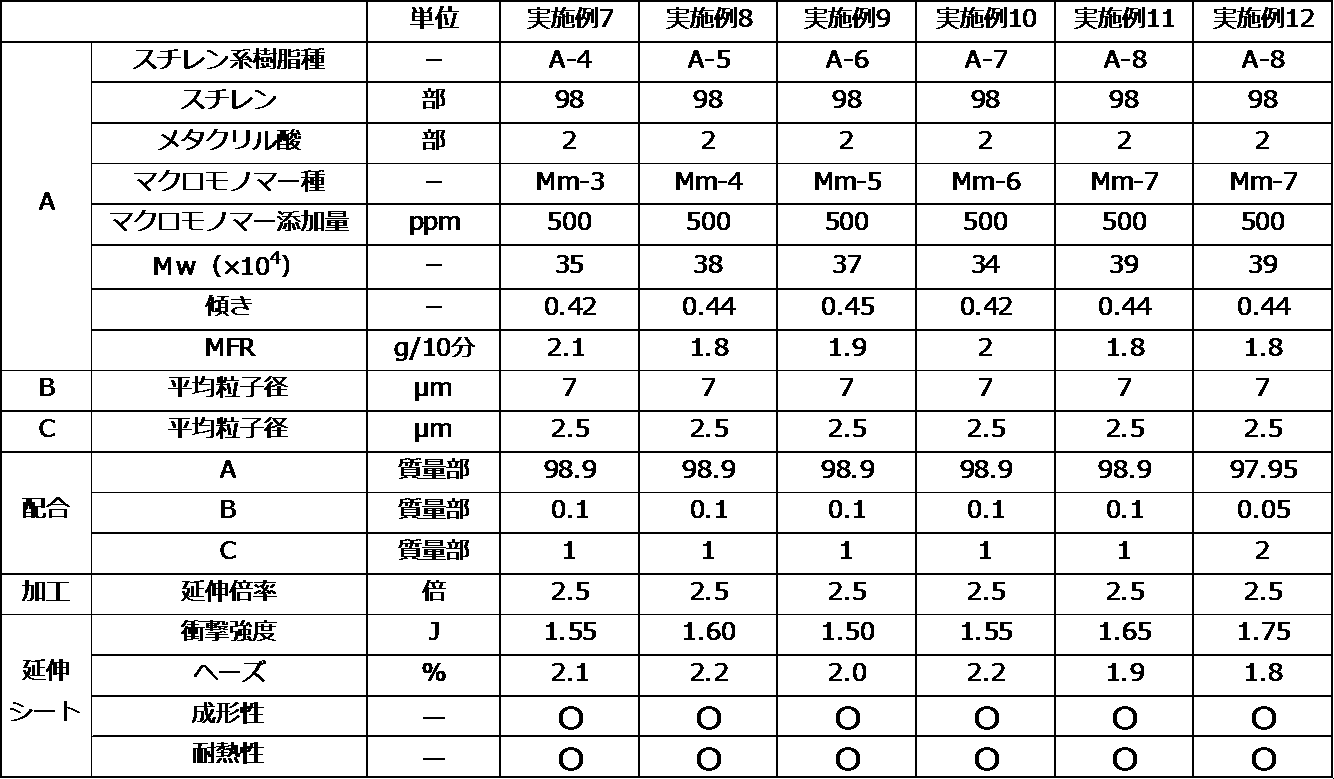
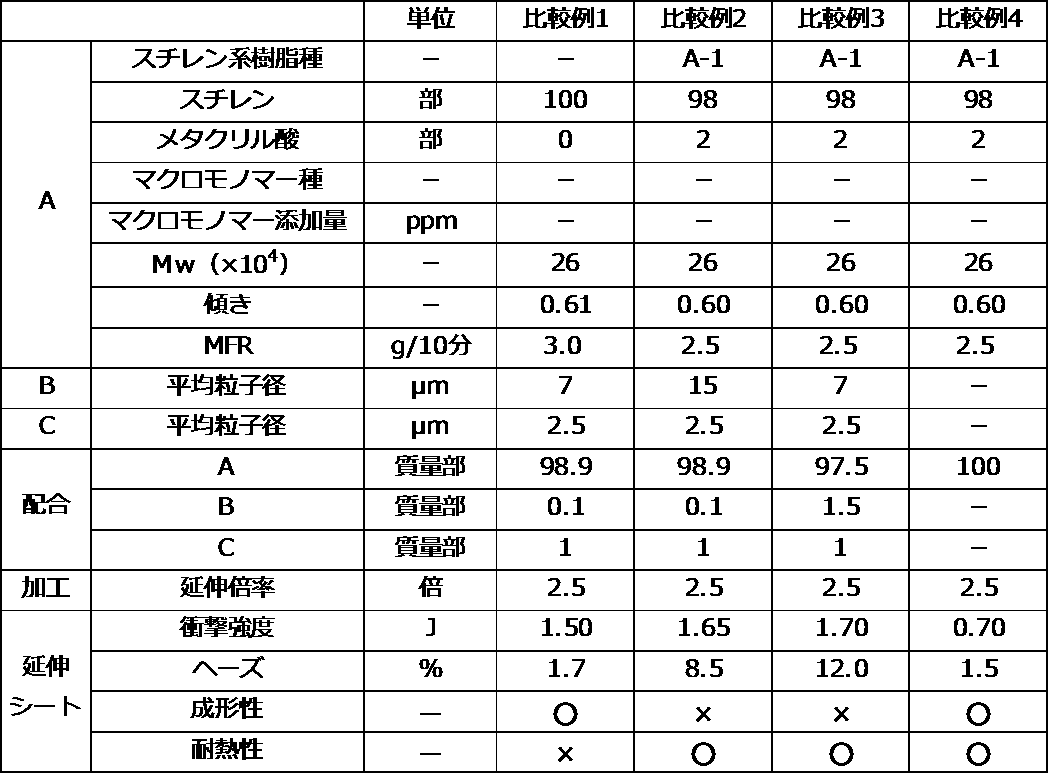
Claims (14)
- スチレン系モノマー(a1)由来構造と、メタクリル酸(a2)由来構造とを有するスチレン系樹脂(A)と、平均粒径が0.1~10μmの無機微粒子(B)と、ゴム変性ポリスチレン(C)とを必須成分とする樹脂組成物であり、
前記無機微粒子(B)の組成物における配合割合が0.01~1.0質量%の範囲であることを特徴とするスチレン系樹脂組成物。 - 前記スチレン系樹脂(A)が、スチレン系モノマー(a1)とメタクリル酸(a2)とを必須成分として含有する単量体類の共重合体である請求項1記載のスチレン系樹脂組成物。
- 前記スチレン系モノマー(a1)と前記メタクリル酸(a2)との使用割合が、(a1)/(a2)で表される質量比として、99.9/0.1~97.0/3.0の範囲である請求項2記載のスチレン系樹脂組成物。
- 前記スチレン系樹脂(A)が、スチレン系モノマー(a1)由来構造と、メタクリル酸(a2)由来構造とを有する多分岐状の樹脂であり、且つ
(1)GPC-MALS法により求められる重量平均分子量が15万~70万であり、
(2)GPC-MALS法により求められる分子量を横軸、慣性半径を縦軸とした両対数グラフにおいて、分子量25万~1000万の領域での傾きが0.30~0.55である
請求項1記載のスチレン系樹脂組成物。 - 前記ポリスチレン系樹脂(A)が、複数の分岐を有し、且つ複数の重合性二重結合を有する多分岐状マクロモノマー(a3)とスチレン系モノマー(a1)とメタクリル酸(a2)とを必須成分として含有する単量体類の共重合体である請求項4記載のスチレン系樹脂組成物。
- 前記スチレン系モノマー(a1)と前記メタクリル酸(a2)の使用割合が、(a1)/(a2)で表される質量比として、99.9/0.1~97.0/3.0の範囲である請求項5記載のスチレン系樹脂組成物。
- 前記ゴム変性ポリスチレン(C)が、スチレン単独の重合体からなる連続相にゴム状重合体がグラフト重合体として粒子分散してなる樹脂である請求項1~6の何れか1項記載のスチレン系樹脂組成物。
- 前記無機微粒子(B)が硫酸バリウムである請求項1~7の何れか1項記載のスチレン系樹脂組成物。
- 前記無機微粒子(B)が、板状の微粒子である請求項1~8の何れか1項記載のスチレン系樹脂組成物。
- 前記無機微粒子(B)の組成物中における配合割合が0.1~0.5質量%の範囲である請求項1~9の何れか1項記載のスチレン系樹脂組成物。
- 請求項1~10の何れか1項記載のスチレン系樹脂組成物を二軸延伸したものであることを特徴とする、二軸延伸スチレン系樹脂シート。
- シートの厚みが、0.1~0.5mmの範囲である請求項11記載の二軸延伸スチレン系樹脂シート。
- 請求項11又は12記載の二軸延伸スチレン系樹脂シートを成形したものであることを特徴とする成形体。
- 食品用包装材として用いる請求項13記載の成形体。
Priority Applications (1)
| Application Number | Priority Date | Filing Date | Title |
|---|---|---|---|
| JP2017535302A JP6930422B2 (ja) | 2015-08-17 | 2016-07-21 | スチレン系樹脂組成物、二軸延伸スチレン系樹脂シート及び成形体 |
Applications Claiming Priority (2)
| Application Number | Priority Date | Filing Date | Title |
|---|---|---|---|
| JP2015-160480 | 2015-08-17 | ||
| JP2015160480 | 2015-08-17 |
Publications (1)
| Publication Number | Publication Date |
|---|---|
| WO2017029936A1 true WO2017029936A1 (ja) | 2017-02-23 |
Family
ID=58050944
Family Applications (1)
| Application Number | Title | Priority Date | Filing Date |
|---|---|---|---|
| PCT/JP2016/071382 Ceased WO2017029936A1 (ja) | 2015-08-17 | 2016-07-21 | スチレン系樹脂組成物、二軸延伸スチレン系樹脂シート及び成形体 |
Country Status (2)
| Country | Link |
|---|---|
| JP (1) | JP6930422B2 (ja) |
| WO (1) | WO2017029936A1 (ja) |
Cited By (3)
| Publication number | Priority date | Publication date | Assignee | Title |
|---|---|---|---|---|
| JP2018100367A (ja) * | 2016-12-21 | 2018-06-28 | Dic株式会社 | 樹脂組成物および成形体 |
| JP2019044132A (ja) * | 2017-09-07 | 2019-03-22 | Psジャパン株式会社 | スチレン系共重合体及びその製造方法、シート及びその成形品 |
| CN113677543A (zh) * | 2019-04-12 | 2021-11-19 | 株式会社普利司通 | 聚异戊二烯、橡胶组合物以及轮胎 |
Citations (9)
| Publication number | Priority date | Publication date | Assignee | Title |
|---|---|---|---|---|
| JPH07323474A (ja) * | 1994-04-05 | 1995-12-12 | Sumitomo Chem Co Ltd | スチレン系樹脂組成物からなる成形体 |
| JP2006124498A (ja) * | 2004-10-28 | 2006-05-18 | Dainippon Ink & Chem Inc | スチレン−(メタ)アクリル系樹脂組成物およびその製造方法 |
| JP2011162639A (ja) * | 2010-02-09 | 2011-08-25 | Toyo Styrene Co Ltd | ゴム変性スチレン系樹脂組成物 |
| WO2012063876A1 (ja) * | 2010-11-12 | 2012-05-18 | 旭化成ケミカルズ株式会社 | プレススルーパック包装体 |
| JP2014208773A (ja) * | 2013-03-29 | 2014-11-06 | Dic株式会社 | 耐熱性スチレン系樹脂組成物、その製造方法、及びこれを用いる成形体 |
| JP2015021074A (ja) * | 2013-07-19 | 2015-02-02 | サンディック株式会社 | 二軸延伸スチレン系樹脂シート及びその成形品 |
| JP2015193784A (ja) * | 2014-03-28 | 2015-11-05 | 積水化成品工業株式会社 | スチレン−メタクリル酸系樹脂シート、樹脂成形品、及び、容器 |
| JP2016030817A (ja) * | 2014-07-30 | 2016-03-07 | Dic株式会社 | スチレン系樹脂シート及びこれを用いた成形体 |
| JP2016030818A (ja) * | 2014-07-30 | 2016-03-07 | Dic株式会社 | スチレン系樹脂組成物、二軸延伸スチレン系樹脂シート及び成形体 |
Family Cites Families (2)
| Publication number | Priority date | Publication date | Assignee | Title |
|---|---|---|---|---|
| JP4313889B2 (ja) * | 1999-04-26 | 2009-08-12 | サンディック株式会社 | 二軸延伸スチレン系樹脂シート |
| JP2002225127A (ja) * | 2000-11-29 | 2002-08-14 | Denki Kagaku Kogyo Kk | 二軸延伸ポリスチレン系シート及びその容器 |
-
2016
- 2016-07-21 WO PCT/JP2016/071382 patent/WO2017029936A1/ja not_active Ceased
- 2016-07-21 JP JP2017535302A patent/JP6930422B2/ja active Active
Patent Citations (9)
| Publication number | Priority date | Publication date | Assignee | Title |
|---|---|---|---|---|
| JPH07323474A (ja) * | 1994-04-05 | 1995-12-12 | Sumitomo Chem Co Ltd | スチレン系樹脂組成物からなる成形体 |
| JP2006124498A (ja) * | 2004-10-28 | 2006-05-18 | Dainippon Ink & Chem Inc | スチレン−(メタ)アクリル系樹脂組成物およびその製造方法 |
| JP2011162639A (ja) * | 2010-02-09 | 2011-08-25 | Toyo Styrene Co Ltd | ゴム変性スチレン系樹脂組成物 |
| WO2012063876A1 (ja) * | 2010-11-12 | 2012-05-18 | 旭化成ケミカルズ株式会社 | プレススルーパック包装体 |
| JP2014208773A (ja) * | 2013-03-29 | 2014-11-06 | Dic株式会社 | 耐熱性スチレン系樹脂組成物、その製造方法、及びこれを用いる成形体 |
| JP2015021074A (ja) * | 2013-07-19 | 2015-02-02 | サンディック株式会社 | 二軸延伸スチレン系樹脂シート及びその成形品 |
| JP2015193784A (ja) * | 2014-03-28 | 2015-11-05 | 積水化成品工業株式会社 | スチレン−メタクリル酸系樹脂シート、樹脂成形品、及び、容器 |
| JP2016030817A (ja) * | 2014-07-30 | 2016-03-07 | Dic株式会社 | スチレン系樹脂シート及びこれを用いた成形体 |
| JP2016030818A (ja) * | 2014-07-30 | 2016-03-07 | Dic株式会社 | スチレン系樹脂組成物、二軸延伸スチレン系樹脂シート及び成形体 |
Cited By (5)
| Publication number | Priority date | Publication date | Assignee | Title |
|---|---|---|---|---|
| JP2018100367A (ja) * | 2016-12-21 | 2018-06-28 | Dic株式会社 | 樹脂組成物および成形体 |
| JP2019044132A (ja) * | 2017-09-07 | 2019-03-22 | Psジャパン株式会社 | スチレン系共重合体及びその製造方法、シート及びその成形品 |
| CN113677543A (zh) * | 2019-04-12 | 2021-11-19 | 株式会社普利司通 | 聚异戊二烯、橡胶组合物以及轮胎 |
| CN113677543B (zh) * | 2019-04-12 | 2023-04-28 | 株式会社普利司通 | 聚异戊二烯、橡胶组合物以及轮胎 |
| US12227600B2 (en) | 2019-04-12 | 2025-02-18 | Bridgestone Corporation | Polyisoprene, rubber composition, and tire |
Also Published As
| Publication number | Publication date |
|---|---|
| JPWO2017029936A1 (ja) | 2018-06-28 |
| JP6930422B2 (ja) | 2021-09-01 |
Similar Documents
| Publication | Publication Date | Title |
|---|---|---|
| JP4423386B2 (ja) | スチレン樹脂組成物およびその製造方法 | |
| JP4990995B2 (ja) | 二軸延伸スチレン系樹脂シート及びこれを用いた成形品 | |
| JP6481848B2 (ja) | スチレン系樹脂組成物、二軸延伸スチレン系樹脂シート及び成形体 | |
| JP6083494B1 (ja) | スチレン系発泡シート及びこれを用いる成形体 | |
| JP2005179389A (ja) | 二軸延伸用スチレン系樹脂組成物、二軸延伸シート及びその製造方法 | |
| JP2005281405A (ja) | スチレン系樹脂組成物、その発泡シート及び発泡容器 | |
| JP2009263512A (ja) | 発泡シート用スチレン系樹脂組成物、発泡シート及び発泡容器 | |
| JP5333808B2 (ja) | ニ軸延伸スチレン系樹脂シート用樹脂組成物、及びそれを用いたシート、成形品 | |
| JP6930422B2 (ja) | スチレン系樹脂組成物、二軸延伸スチレン系樹脂シート及び成形体 | |
| JP6273923B2 (ja) | 耐熱性スチレン系樹脂組成物、その製造方法、及びこれを用いる成形体 | |
| CA2474454C (en) | Styrene resin composition and process for producing the same | |
| JP2007291366A (ja) | ニ軸延伸スチレン系樹脂シート用樹脂組成物、及びそれを用いたシート、成形品 | |
| JP6481847B2 (ja) | スチレン系樹脂シート及びこれを用いた成形体 | |
| JP2006124498A (ja) | スチレン−(メタ)アクリル系樹脂組成物およびその製造方法 | |
| JP6507622B2 (ja) | スチレン系発泡シート及びこれを用いた成形体 | |
| JP4992271B2 (ja) | ゴム変性スチレン系樹脂組成物、それを用いたスチレン系樹脂シート及び成形体 | |
| JP6891877B2 (ja) | スチレン系樹脂組成物及びこれを用いる成形体 | |
| JP6384616B2 (ja) | スチレン系樹脂組成物、発泡シート及びこれを用いた成形体 | |
| JP2012116875A (ja) | 熱収縮性フィルム用樹脂組成物及び熱収縮性フィルム | |
| JP2007284591A (ja) | スチレン−(メタ)アクリル系樹脂及びその成形品 | |
| JP6634812B2 (ja) | スチレン系樹脂組成物、シート、成形体及びその製造方法 | |
| JP2017205935A (ja) | 積層シート及びこれを用いる成形体 | |
| JP2007031660A (ja) | スチレン系樹脂組成物、それを用いたスチレン系樹脂シート及び成形体 | |
| JP7384723B2 (ja) | 耐熱スチレン系樹脂組成物、非発泡押出シート、及び発泡押出シート、並びにこれらの成形品 | |
| JP2017206612A (ja) | 積層シート及びこれを用いる成形体 |
Legal Events
| Date | Code | Title | Description |
|---|---|---|---|
| 121 | Ep: the epo has been informed by wipo that ep was designated in this application |
Ref document number: 16836927 Country of ref document: EP Kind code of ref document: A1 |
|
| ENP | Entry into the national phase |
Ref document number: 2017535302 Country of ref document: JP Kind code of ref document: A |
|
| NENP | Non-entry into the national phase |
Ref country code: DE |
|
| 122 | Ep: pct application non-entry in european phase |
Ref document number: 16836927 Country of ref document: EP Kind code of ref document: A1 |