WO2017010571A1 - 水系処理剤、亜鉛めっき鋼材又は亜鉛合金めっき鋼材および塗装亜鉛めっき鋼材又は塗装亜鉛合金めっき鋼材 - Google Patents
水系処理剤、亜鉛めっき鋼材又は亜鉛合金めっき鋼材および塗装亜鉛めっき鋼材又は塗装亜鉛合金めっき鋼材 Download PDFInfo
- Publication number
- WO2017010571A1 WO2017010571A1 PCT/JP2016/071070 JP2016071070W WO2017010571A1 WO 2017010571 A1 WO2017010571 A1 WO 2017010571A1 JP 2016071070 W JP2016071070 W JP 2016071070W WO 2017010571 A1 WO2017010571 A1 WO 2017010571A1
- Authority
- WO
- WIPO (PCT)
- Prior art keywords
- mass
- steel material
- plated steel
- compound
- group
- Prior art date
- Legal status (The legal status is an assumption and is not a legal conclusion. Google has not performed a legal analysis and makes no representation as to the accuracy of the status listed.)
- Ceased
Links
Classifications
-
- C—CHEMISTRY; METALLURGY
- C23—COATING METALLIC MATERIAL; COATING MATERIAL WITH METALLIC MATERIAL; CHEMICAL SURFACE TREATMENT; DIFFUSION TREATMENT OF METALLIC MATERIAL; COATING BY VACUUM EVAPORATION, BY SPUTTERING, BY ION IMPLANTATION OR BY CHEMICAL VAPOUR DEPOSITION, IN GENERAL; INHIBITING CORROSION OF METALLIC MATERIAL OR INCRUSTATION IN GENERAL
- C23C—COATING METALLIC MATERIAL; COATING MATERIAL WITH METALLIC MATERIAL; SURFACE TREATMENT OF METALLIC MATERIAL BY DIFFUSION INTO THE SURFACE, BY CHEMICAL CONVERSION OR SUBSTITUTION; COATING BY VACUUM EVAPORATION, BY SPUTTERING, BY ION IMPLANTATION OR BY CHEMICAL VAPOUR DEPOSITION, IN GENERAL
- C23C22/00—Chemical surface treatment of metallic material by reaction of the surface with a reactive liquid, leaving reaction products of surface material in the coating, e.g. conversion coatings, passivation of metals
- C23C22/05—Chemical surface treatment of metallic material by reaction of the surface with a reactive liquid, leaving reaction products of surface material in the coating, e.g. conversion coatings, passivation of metals using aqueous solutions
- C23C22/06—Chemical surface treatment of metallic material by reaction of the surface with a reactive liquid, leaving reaction products of surface material in the coating, e.g. conversion coatings, passivation of metals using aqueous solutions using aqueous acidic solutions with pH less than 6
- C23C22/40—Chemical surface treatment of metallic material by reaction of the surface with a reactive liquid, leaving reaction products of surface material in the coating, e.g. conversion coatings, passivation of metals using aqueous solutions using aqueous acidic solutions with pH less than 6 containing molybdates, tungstates or vanadates
- C23C22/42—Chemical surface treatment of metallic material by reaction of the surface with a reactive liquid, leaving reaction products of surface material in the coating, e.g. conversion coatings, passivation of metals using aqueous solutions using aqueous acidic solutions with pH less than 6 containing molybdates, tungstates or vanadates containing also phosphates
-
- C—CHEMISTRY; METALLURGY
- C23—COATING METALLIC MATERIAL; COATING MATERIAL WITH METALLIC MATERIAL; CHEMICAL SURFACE TREATMENT; DIFFUSION TREATMENT OF METALLIC MATERIAL; COATING BY VACUUM EVAPORATION, BY SPUTTERING, BY ION IMPLANTATION OR BY CHEMICAL VAPOUR DEPOSITION, IN GENERAL; INHIBITING CORROSION OF METALLIC MATERIAL OR INCRUSTATION IN GENERAL
- C23C—COATING METALLIC MATERIAL; COATING MATERIAL WITH METALLIC MATERIAL; SURFACE TREATMENT OF METALLIC MATERIAL BY DIFFUSION INTO THE SURFACE, BY CHEMICAL CONVERSION OR SUBSTITUTION; COATING BY VACUUM EVAPORATION, BY SPUTTERING, BY ION IMPLANTATION OR BY CHEMICAL VAPOUR DEPOSITION, IN GENERAL
- C23C22/00—Chemical surface treatment of metallic material by reaction of the surface with a reactive liquid, leaving reaction products of surface material in the coating, e.g. conversion coatings, passivation of metals
- C23C22/82—After-treatment
-
- C—CHEMISTRY; METALLURGY
- C23—COATING METALLIC MATERIAL; COATING MATERIAL WITH METALLIC MATERIAL; CHEMICAL SURFACE TREATMENT; DIFFUSION TREATMENT OF METALLIC MATERIAL; COATING BY VACUUM EVAPORATION, BY SPUTTERING, BY ION IMPLANTATION OR BY CHEMICAL VAPOUR DEPOSITION, IN GENERAL; INHIBITING CORROSION OF METALLIC MATERIAL OR INCRUSTATION IN GENERAL
- C23C—COATING METALLIC MATERIAL; COATING MATERIAL WITH METALLIC MATERIAL; SURFACE TREATMENT OF METALLIC MATERIAL BY DIFFUSION INTO THE SURFACE, BY CHEMICAL CONVERSION OR SUBSTITUTION; COATING BY VACUUM EVAPORATION, BY SPUTTERING, BY ION IMPLANTATION OR BY CHEMICAL VAPOUR DEPOSITION, IN GENERAL
- C23C28/00—Coating for obtaining at least two superposed coatings either by methods not provided for in a single one of groups C23C2/00 - C23C26/00 or by combinations of methods provided for in subclasses C23C and C25C or C25D
- C23C28/30—Coatings combining at least one metallic layer and at least one inorganic non-metallic layer
- C23C28/32—Coatings combining at least one metallic layer and at least one inorganic non-metallic layer including at least one pure metallic layer
- C23C28/321—Coatings combining at least one metallic layer and at least one inorganic non-metallic layer including at least one pure metallic layer with at least one metal alloy layer
-
- C—CHEMISTRY; METALLURGY
- C23—COATING METALLIC MATERIAL; COATING MATERIAL WITH METALLIC MATERIAL; CHEMICAL SURFACE TREATMENT; DIFFUSION TREATMENT OF METALLIC MATERIAL; COATING BY VACUUM EVAPORATION, BY SPUTTERING, BY ION IMPLANTATION OR BY CHEMICAL VAPOUR DEPOSITION, IN GENERAL; INHIBITING CORROSION OF METALLIC MATERIAL OR INCRUSTATION IN GENERAL
- C23C—COATING METALLIC MATERIAL; COATING MATERIAL WITH METALLIC MATERIAL; SURFACE TREATMENT OF METALLIC MATERIAL BY DIFFUSION INTO THE SURFACE, BY CHEMICAL CONVERSION OR SUBSTITUTION; COATING BY VACUUM EVAPORATION, BY SPUTTERING, BY ION IMPLANTATION OR BY CHEMICAL VAPOUR DEPOSITION, IN GENERAL
- C23C28/00—Coating for obtaining at least two superposed coatings either by methods not provided for in a single one of groups C23C2/00 - C23C26/00 or by combinations of methods provided for in subclasses C23C and C25C or C25D
- C23C28/30—Coatings combining at least one metallic layer and at least one inorganic non-metallic layer
- C23C28/34—Coatings combining at least one metallic layer and at least one inorganic non-metallic layer including at least one inorganic non-metallic material layer, e.g. metal carbide, nitride, boride, silicide layer and their mixtures, enamels, phosphates and sulphates
Definitions
- the present invention provides excellent corrosion resistance, chemical resistance (for example, alkali resistance, acid resistance, etc.) and forming processing in a coated steel plate (also referred to as a pre-coated steel plate or a post-coated steel plate) and a post-coated steel material having a zinc and zinc alloy plating layer.
- Zinc-plated steel materials and zinc alloys having a coating film with excellent corrosion resistance, chemical resistance and coating film adhesion obtained by the aqueous processing agent and imparting coating film adhesion of the part
- the present invention relates to a plated steel material, a coated galvanized steel material, a coated galvanized steel material, and a method for producing the same.
- the structure of a typical coated steel plate consists of what coat
- the treatment for imparting the coating film adhesion includes a chromate treatment, and a paint containing a chromium-based anticorrosive pigment in the primer coating film has been conventionally used.
- chromate-free coatings and the like due to the environmental load of hexavalent chromium.
- Chromate-free products are being made indoors that are used in mild conditions such as the home appliance field, but it is difficult to satisfy all end-user requirements for outdoor products that are used in severe outdoor conditions such as the building materials field. However, there is a current situation that chromate-free is not progressing.
- the coating film adhesion of a coated steel sheet is evaluated by a test by bending.
- coating film adhesion is required under more severe processing conditions such as a test by drawing.
- the processing conditions are severe, if the coating film adhesion is insufficient, the coating film swells up and peels off from the side surface, the end surface, and the heel that are subjected to the processing load.
- a treatment agent mainly composed of a resin is applicable as the chromate-free treatment.
- conventional treatment agents mainly composed of resins that cannot be prevented from deterioration when exposed to long-term corrosive environments are not necessarily required. The performance is not satisfied.
- the coating layer composition of the coated steel sheet is zinc-based, the coating layer has ductility when processed, so there is no crack in the coating layer during processing, and a large stress is applied to the coating film formed on the plating layer. It takes. Since the stress causes peeling of the coating film, it is more possible to ensure the adhesion of the coating film after severe processing such as the above-mentioned drawing forming process in the coated steel sheet based on zinc and zinc alloy plated steel sheet. More difficult.
- a technique relating to a metal surface treatment agent further comprising a water-soluble resin is disclosed. According to these techniques, excellent corrosion resistance and the like can be imparted to the steel material.
- Patent Document 4 discloses a surface treatment agent containing water, a metal carbonate selected from Mg, Co, Zr, Ni, Zn, and Cu, water-dispersible silica, and a specific organic acid. Yes. According to this surface treatment agent, it is possible to provide a surface-treated steel sheet having excellent coating adhesion and corrosion resistance.
- the present invention has excellent corrosion resistance, and can form a film having chemical resistance and coating film adhesion of a molded portion, a chromium-free aqueous treatment agent, and a galvanized steel material having the film,
- An object of the present invention is to provide a zinc alloy-plated steel material, a coated zinc-plated steel material, a painted zinc alloy-plated steel material, and methods for producing the same.
- the inventors of the present invention include a specific zirconium compound, an epoxy resin, a specific silanol group-containing compound, a phosphoric acid compound, and a vanadium compound.
- a water-based treatment agent that satisfies a specific composition ratio for the components, it has excellent corrosion resistance, as well as coated galvanized steel and coated zinc alloy plating that can achieve both high chemical resistance and coating film adhesion at the formed part. It discovered that a steel material was obtained and came to complete this invention.
- the present invention is as follows. (1) (A) a zirconium compound selected from ammonium zirconium carbonate, potassium zirconium carbonate, basic zirconium carbonate, and zirconium acetate; (B) epoxy resin, (C) a silanol group-containing compound represented by the following formula [I] and / or a condensate thereof, XY (Z) n Si (OH) 3-n (I) (X represents a glycidoxy group or a functional group derived from a glycidoxy group, Y represents an alkyl group having 1 to 10 carbon atoms, Z represents a methoxy group, an ethoxy group, or a methyl group, and n represents an integer of 0 to 2) Represents.) (D) a phosphoric acid compound, (E) a vanadium compound, An aqueous treatment agent containing With respect to the mass of the zirconium compound (A) in terms of Zr, The solid content mass ratio [
- the epoxy resin is a bisphenol A type epoxy resin containing a carboxyl group, and has a polystyrene equivalent weight average molecular weight of 30,000 to 150,000 by gel permeation chromatography.
- Water-based treatment agent (3) Zr formed on at least one surface of a galvanized steel sheet or zinc alloy plated steel sheet having a plating layer composition of Zn: 80% by mass or more using the aqueous treatment agent according to (1) or (2).
- Zinc alloy plated steel (5) Applying the aqueous processing agent according to the above (1) or (2) to at least one surface of a galvanized steel sheet or a zinc alloy plated steel sheet having a plating layer composition of Zn: 80% by mass or more to form a treated film layer, A method for producing a galvanized steel material or a zinc alloy plated steel material, wherein the treated film layer is heated and dried to form a treated film layer having a Zr adhesion amount of 1 to 40 mg / m 2 .
- aqueous processing agent according to the above (1) or (2) to at least one surface of a galvanized steel sheet or a zinc alloy plated steel sheet having a plating layer composition of Zn: 80% by mass or more to form a treated film layer
- the treatment film layer is dried by heating to form a treatment film layer having a Zr adhesion amount of 1 to 40 mg / m 2 .
- at least one layer of paint for a multilayer coating film is applied,
- the at least one laminated coating film is dried by heating to form a laminated coating film having a total film thickness of 1 to 50 ⁇ m.
- the water-based treatment agent of the present invention can form a film having excellent corrosion resistance as well as chemical resistance and coating film adhesion at a molded portion, even though it does not contain chromium. For this reason, it becomes possible to remarkably reduce the environmental load of the coated steel sheet used for the outdoors. Therefore, the water-based treatment agent of the present invention has extremely great industrial value.
- the coated galvanized steel material and coated galvanized steel material of the present invention are not limited to pre-coated steel sheets whose laminated coating is pre-applied by a steel sheet manufacturer, but in any specification of post-coated steel sheets that are applied on the user side after delivery. In addition, the effect of the aqueous treatment agent of the present invention can be expected.
- the aqueous treating agent of the present invention comprises a zirconium compound (A), an epoxy resin (B), a silanol group-containing compound and / or its condensate (C), a phosphoric acid compound (D), and a vanadium compound (E). Containing.
- A zirconium compound
- B epoxy resin
- C silanol group-containing compound and / or its condensate
- D a phosphoric acid compound
- E vanadium compound
- the zirconium compound (A) is selected from ammonium zirconium carbonate, potassium zirconium carbonate, basic zirconium carbonate, and zirconium acetate.
- Zirconium compound (A) is a film-forming component capable of forming a three-dimensionally crosslinked zirconium oxide film by hydrolysis and condensation accompanying the elimination of volatile acids such as carbonic acid and acetic acid during film formation (baking). Yes, contributing to the development of processing adhesion, corrosion resistance, and chemical resistance.
- zirconium activated by acid desorption is firmly bonded to the plating layer surface via oxygen atoms, thereby contributing to the expression of adhesion.
- zirconium compound (A) cannot be obtained with zircon hydrofluoric acid, fluorozirconate, zirconium nitrate, zirconium sulfate, zirconium oxychloride, etc., but stabilized with carbonic acid and acetic acid, which are volatile acids. It can be obtained only with the obtained zirconium compound.
- the epoxy resin (B) is a film-forming component, and is intricately intertwined with the zirconium compound (A), the silanol group-containing compound and / or its condensate (C), and imparts toughness and suitable processing followability to the treated film. This contributes to the development of processing adhesion. In addition, the formation of a dense film structure with high hydrolysis resistance contributes to the development of work adhesion, chemical resistance and corrosion resistance. Moreover, the epoxy group and the hydroxyl group in the resin contribute to the adhesion with the upper layer due to the reaction with the organic functional group of the laminated coating film on the upper layer and the hydrogen bonding action. Such an effect of the epoxy resin (B) cannot be obtained with a resin type other than the epoxy resin.
- acrylic resin has a hard film and is inferior in process followability, so process adhesion cannot be obtained
- polyurethane resin has inferior durability to moisture, ultraviolet rays, and heat, so long-term corrosion resistance cannot be obtained
- polyester resin is subject to hydrolysis. It is easy to obtain alkali resistance.
- Epoxy resin (B) to be contained in the aqueous treatment agent of the present invention can be obtained by a known production method and is not particularly limited.
- Epoxy resin (B) is an addition reaction and condensation reaction of bisphenol A, bisphenol F, novolak resin, etc., which are usually used in the production of aqueous epoxy resins, and epihalohydrins such as epichlorohydrin or epoxy compounds having two or more glycidyl groups. It can be obtained by dispersing in water an epoxy resin obtained by repeating or repeating the addition reaction.
- the epoxy resin (B) may be obtained by reacting an epoxy group or a hydroxyl group in the resin with a modifier.
- a modifier for example, epoxy ester resin reacted with unsaturated fatty acid, acrylic modified epoxy resin reacted with (meth) acrylic acid or its ester, urethane modified epoxy resin reacted with isocyanate compound, silane reacted with silane coupling agent
- modified epoxy resins phosphoric acid-modified epoxy resins obtained by reacting phosphoric acids or esters thereof.
- Said epoxy resin (B) may be used independently and may be used in combination of 2 or more type.
- the epoxy resin (B) is preferably a bisphenol A type epoxy resin containing a carboxyl group.
- the rigidity and moderate flexibility derived from the bisphenol A type structural unit in the resin contributes to the improvement of the processing adhesion of the coating film.
- the structure which is hard to hydrolyze contributes to the improvement of chemical resistance and corrosion resistance.
- the carboxyl group in the epoxy resin is strongly bonded to the plated metal surface due to its polarity, and contributes to the improvement of the adhesion to the plated metal surface.
- the carboxyl group in the epoxy resin crosslinks with the zirconium compound or the silanol group-containing compound, thereby improving the toughness of the treatment film and contributing to improvement in chemical resistance and corrosion resistance.
- the carboxyl group in the resin is preferably neutralized with a basic neutralizing agent from the viewpoint of maintaining the mixing stability with the zirconium compound (A) in the treating agent.
- a basic neutralizing agent it is more preferable to use a volatile amine or ammonia in that it hardly remains in the film forming process.
- the weight average molecular weight in terms of polystyrene by gel permeation chromatography of the epoxy resin (B) is preferably 30,000 to 150,000. By defining the weight average molecular weight within the above range, it contributes to the development of excellent chemical resistance, and contributes to the development of work adhesion and corrosion resistance.
- the acid value of the epoxy resin (B) is not particularly limited, but is preferably 10 to 40. By defining the acid value within the above range, it is possible to improve the processing adhesion and liquid stability of the treatment film and improve the chemical resistance.
- the solid content mass ratio [(B) / Zr] of the mass of the epoxy resin (B) to the mass of the zirconium compound (A) in terms of Zr is 0.7 to 1.5.
- it is 1.0 to 1.5.
- it is less than 0.7, sufficient work adhesion and corrosion resistance cannot be obtained.
- it exceeds 1.5 sufficient work adhesion, chemical resistance and corrosion resistance cannot be obtained.
- the silanol group-containing compound as component (C) is represented by the following formula [I].
- X represents a glycidoxy group or a functional group derived from a glycidoxy group
- Y represents an alkylene group having 1 to 10 carbon atoms
- Z represents a methoxy group, an ethoxy group, or a methyl group
- n represents Represents an integer of 0-2.
- the silanol group-containing compound used in the present invention is a compound obtained by hydrolyzing an organosilicon compound having a glycidoxy group.
- Hydrolysis of an organosilicon compound is generally performed by adding a hydrolysis aid to water or an alcohol, ketone or cellosolve-based water-soluble organic solvent containing water. Hydrolysis aids are used to bring the pH value of the solvent to a range of 3 to 5, and known ones are not particularly limited.
- the hydrolysis assistant include mineral acids such as hydrochloric acid, sulfuric acid and nitric acid, and carboxylic acids such as acetic acid, lactic acid, tartaric acid and citric acid.
- acetic acid is particularly preferable in that it volatilizes during the film formation process and hardly remains in the treated film.
- organosilicon compound having a glycidoxy group examples include 3-glycidoxypropyltrimethoxysilane, 3-glycidoxypropyltriethoxysilane, 3-glycidoxypropylmethyldiethoxysilane, and 3-glycidoxypropyl. And methyldiethoxysilane. These compounds may be used alone or in combination of two or more.
- the silanol group-containing compound and / or its condensate (C) used in the present invention is a film-forming component, is intricately entangled with the zirconium compound (A) and the epoxy resin (B), and has a toughness and suitable processing for the treated film. By giving followability, it contributes to the expression of the processing adhesion of the treated film. In addition, the formation of a dense film structure contributes to the development of chemical resistance. In addition, the silanol group (—Si—OH) forms a strong chemical bond of —Si—OM with the plating metal surface via oxygen atoms, which contributes to the improvement of adhesion to the plating metal surface.
- the glycidoxy group or the functional group derived from the glycidoxy group has a role of maintaining the mixing stability with the zirconium compound (A) and the epoxy resin (B) in the treatment agent.
- the silanol group-containing compound has a functional group such as highly active amino group, vinyl group or methacryl group at the terminal, the mixing stability with the zirconium compound (A) and the epoxy resin (B) in the treating agent is maintained. These functional groups are not applicable.
- the solid content mass ratio [SiO 2 / Zr] of the silanol group-containing compound and / or the condensate thereof (C) in terms of SiO 2 with respect to the mass of the zirconium compound (A) in terms of Zr Is 0.15 to 1.5, preferably 0.2 to 1.0.
- it is less than 0.15 sufficient work adhesion and corrosion resistance cannot be obtained.
- it exceeds 1.5 sufficient work adhesion, chemical resistance and corrosion resistance cannot be obtained.
- Phosphoric acid compound (D) and vanadium compound (E) contribute to corrosion resistance as an eluting inhibitor (corrosion inhibiting substance).
- the anodic dissolution reaction of the plating layer occurs due to sacrificial anticorrosive action.
- the phosphate compound and vanadium compound contained in the treated coating layer elute, and the plating layer Forms corrosion products with zinc that elutes from the metal and suppresses the progress of corrosion by passivating the plating layer surface.
- both the phosphoric acid compound (D) and the vanadium compound (E) are contained, a corrosion product having higher electrical insulation is formed and immobilized on the surface of the plating layer, so that the corrosion suppressing effect is remarkably enhanced.
- the phosphoric acid compound (D) is not particularly limited, and examples thereof include phosphoric acid, an ammonium salt of phosphoric acid, an alkali metal salt of phosphoric acid, and an alkaline earth metal salt of phosphoric acid.
- the solid content mass ratio [P / Zr] of the P-converted mass of the phosphoric acid compound (D) to the Zr-converted mass of the zirconium compound (A) is 0.025 to 0.1. Preferably, it is 0.03 to 0.07. If it is less than 0.025, the effects on chemical resistance and corrosion resistance do not appear. On the other hand, if it exceeds 0.1, sufficient corrosion resistance cannot be obtained.
- the solid content mass ratio [V / Zr] in terms of V of the vanadium compound (E) to the mass in terms of Zr of the zirconium compound (A) is 0.02 to 0.05. Preferably, it is 0.02 to 0.03. If it is less than 0.02, the effect on chemical resistance and corrosion resistance does not appear. On the other hand, if it exceeds 0.05, sufficient acid resistance cannot be obtained.
- the aqueous treatment agent of the present invention preferably does not contain a noble metal component (F) than zinc.
- a noble metal component (F) include Fe, Co, Ni, Sn, Pb, Bi, Cu, and the like.
- solid content mass ratio [F / Zr] in the metal element conversion mass of the metal component (F) with respect to the mass in Zr conversion of the zirconium compound (A) is 0.01 or less. This is because the metal component (F) elutes from the treated coating layer in a corrosive environment, and is then deposited on the galvanized layer to promote zinc corrosion in the plated layer, resulting in a decrease in alkali resistance, acid resistance, and corrosion resistance. It is because it tends to do.
- the aqueous treatment agent of the present invention can be prepared by dissolving or dispersing the above components (A), (B), (C), (D), and (E) in water or an aqueous solvent.
- Each component is adjusted so as to have a specified composition ratio with a non-volatile content (in the treatment film) excluding the solvent and the volatile component.
- the solvent is usually water, a small amount (for example, 10% by volume or less of the entire aqueous medium) of alcohol, ketone, cellosolve-based water-soluble organic solvent is used for the purpose of improving the drying property of the obtained treated film layer. You may use together.
- additives that are commonly used in coating treatment agents such as a surfactant that improves wettability and an antifoaming agent that suppresses foaming, do not impair the effects of the present invention. Can be blended.
- the pH of the aqueous treatment agent of the present invention is not particularly limited as long as the effects of the present invention can be achieved, but is preferably in the range of 7 to 10. By adjusting the pH to this range, the storage stability can be improved and the corrosion resistance can be improved.
- volatile alkali components such as ammonia
- volatile acid components such as an acetic acid and a formic acid
- the solid content concentration of the aqueous treatment agent of the present invention is not particularly limited as long as the effect of the present invention can be achieved, but is preferably in the range of 1 to 20% by mass. When the solid content concentration of the aqueous treatment agent is within this range, a film can be efficiently formed, and the storage stability of the aqueous treatment composition can be improved.
- the aqueous treatment agent of the present invention contains a specific zirconium compound, an epoxy resin, a specific silanol group-containing compound and / or a condensate thereof as main components.
- a volatile acid-stabilized zirconium compound (A) is applied, and three-dimensionally cross-linked by hydrolysis and condensation accompanying detachment of volatile acid in the process film formation (baking) process.
- a zirconium oxide film is formed.
- Such a coating made of zirconium oxide has extremely high chemical resistance, and hardly dissolves even in a concentrated acid or alkaline environment.
- the epoxy resin (B) is optimal as a component for imparting toughness to the film.
- the epoxy resin has both rigidity and flexibility in structure, and has high hydrolyzability. Moreover, it contributes to adhesiveness expression with a laminated coating film by reaction with the organic functional group of the top coat film of the epoxy group or the hydroxyl group in the epoxy resin, or a hydrogen bonding action. Moreover, it crosslinks with the zirconium compound to form a dense structure. For this reason, it is presumed that toughness could be imparted to the coating without deteriorating the high chemical resistance of the zirconium oxide coating by blending the epoxy resin in an appropriate ratio with respect to the zirconium compound.
- silanol group-containing compound a compound called a silane coupling agent is generally known, and the silanol group (—Si—OH) at the molecular end is oriented in the vicinity of the material, and the plating metal surface and oxygen atoms are interposed— In order to form a strong chemical bond of Si-OM, it adheres firmly.
- the organic functional group at the reverse end contributes to adhesion with the laminated coating film.
- the inventors of the present invention are the silanol group-containing compound containing a glycidoxy group or an organic functional group derived from a glycidoxy group and / or a condensate thereof that most effectively acts to impart admixture stability and adhesion. It was found that (C). Glycidoxy groups have poor reactivity and can maintain their mixing stability. Also, adhesion with laminated coatings via hydrogen bonds, moderate flexibility derived from organic groups, and plating metal surfaces derived from silanol groups. Adhesion could also be imparted.
- the blending ratio of the zirconium compound and the silanol group-containing compound is also important. Silanol group-containing compounds themselves are easy to elute under concentrated acid and alkaline environments, and excessive compounding amount of silanol group-containing compounds will reduce chemical resistance. It is presumed that the silanol group and zirconium are three-dimensionally cross-linked by blending at a proper ratio, and elution of the silanol group-containing compound is suppressed. As described above, by blending a specific zirconium compound, an epoxy resin, a specific silanol group-containing compound and / or a condensate thereof in a specific ratio, the chemical resistance and the coating film adhesion of the molded portion are excellent. It is estimated that the treatment film layer could be formed.
- the aqueous treatment agent of the present invention can be applied to a galvanized steel sheet or a zinc alloy plated steel sheet having a plating layer composition of Zn: 80% by mass or more.
- a galvanized steel material and the zinc alloy plated steel material known galvanized steel sheets and galvanized steel sheets can be used. Examples thereof include a hot dip galvanized steel sheet, an alloyed hot dip galvanized steel sheet, an electrogalvanized steel sheet, a hot dip Zn—Al plated steel sheet, a hot dip Zn—Al—Mg plated steel sheet, and an electric Zn—Ni plated steel sheet.
- washing with a degreasing agent hot water washing, acid Washing, alkali washing, solvent washing and the like can be performed in appropriate combination.
- a degreasing agent hot water washing, acid Washing, alkali washing, solvent washing and the like
- the treatment coating layer of the galvanized steel material or the zinc alloy plated steel material of the present invention is formed on the surface by bringing the aqueous treatment agent of the present invention into contact with the plated steel sheet, followed by heating and drying without washing.
- the contact method of the aqueous treatment agent of the present invention is not particularly limited, and examples thereof include known methods such as a roll coater method, a dipping method, and a spray method.
- the heating and drying method is not particularly limited, but heating and drying with a hot air furnace, an induction heating furnace, an electric furnace or the like is preferable. Further, the ultimate steel plate temperature at the time of drying is not particularly limited, but 50 to 150 ° C. is preferable.
- the coating amount of the treatment coating layer formed on the galvanized steel material or the zinc alloy plated steel material by the contact with the aqueous treatment agent of the present invention is 1 to 40 mg / m 2 as the Zr adhesion amount, preferably 5 to 30 mg / m 2. m 2 . If the amount of Zr adhesion is less than 1 mg / m 2 , the effect of the treatment film layer cannot be obtained, and if it exceeds 40 mg / m 2 , the formed film tends to cause cohesive failure, and the work adhesion decreases.
- the coated galvanized steel material or the coated zinc alloy plated steel material of the present invention has a laminated coating film composed of at least one layer on the treated coating layer of the galvanized steel material or the zinc alloy plated steel material, and is generally a precoated steel sheet. And a coated steel sheet called a post-coated steel sheet.
- the total film thickness of the laminated coating film of the coated galvanized steel material or the coated zinc alloy plated steel material of the present invention is 1 to 50 ⁇ m. By adjusting the film thickness within this range, chemical resistance, corrosion resistance, and work adhesion can be improved.
- the structure of the laminated coating film is not particularly limited, but for outdoor use under harsh conditions, an intermediate coating film layer containing an anticorrosive pigment for the purpose of improving corrosion resistance is provided on the treated coating layer.
- a structure in which a top coat film layer in which a color pigment is blended for the purpose of imparting designability is further laminated can be applied.
- a top coat film layer for the purpose of imparting design properties is formed on the treated film layer without an intermediate coat film layer containing a rust preventive pigment.
- a structure having a coating structure in which a functional pigment such as a conductive pigment or a functional pigment is blended is also applicable.
- the rust preventive pigment known chromate-free pigments can be used.
- phosphate phosphate rust preventive pigments such as zinc phosphate, iron phosphate, aluminum phosphate, and magnesium phosphate, calcium molybdate, and molybdate.
- molybdate anticorrosion pigments such as aluminum and barium molybdate
- vanadium anticorrosion pigments such as vanadium oxide and calcium vanadate
- fine silica anticorrosion pigments such as water-dispersible silica and fumed silica.
- the coloring pigment known inorganic and organic coloring pigments can be used.
- the inorganic coloring pigment titanium oxide (TiO 2 ), zinc oxide (ZnO), zirconium oxide (ZrO 2 ), calcium carbonate (CaCO 3 ). ), Barium sulfate (BaSO 4 ), alumina (Al 2 O 3 ), kaolin clay, carbon black, iron oxide (Fe 2 O 3 , Fe 3 O 4 ), etc., and organic color pigments such as Hansa Yellow, pyrazolone orange, azo And pigments.
- the method of forming the laminated coating film there are no particular restrictions on the method of forming the laminated coating film.
- a forming method in which a coating process is contacted by a known method such as a roll coater method, a dipping method, or a spray method, and then a step of performing heat drying by a known method such as a hot air furnace, an induction heating furnace, or an electric furnace is repeated.
- the ultimate steel plate temperature during drying is not particularly limited, but is preferably 80 to 250 ° C.
- Preparation of aqueous treatment agent 1 Preparation of aqueous treatment agent 1 (Nos. 1-31 and 35-39)
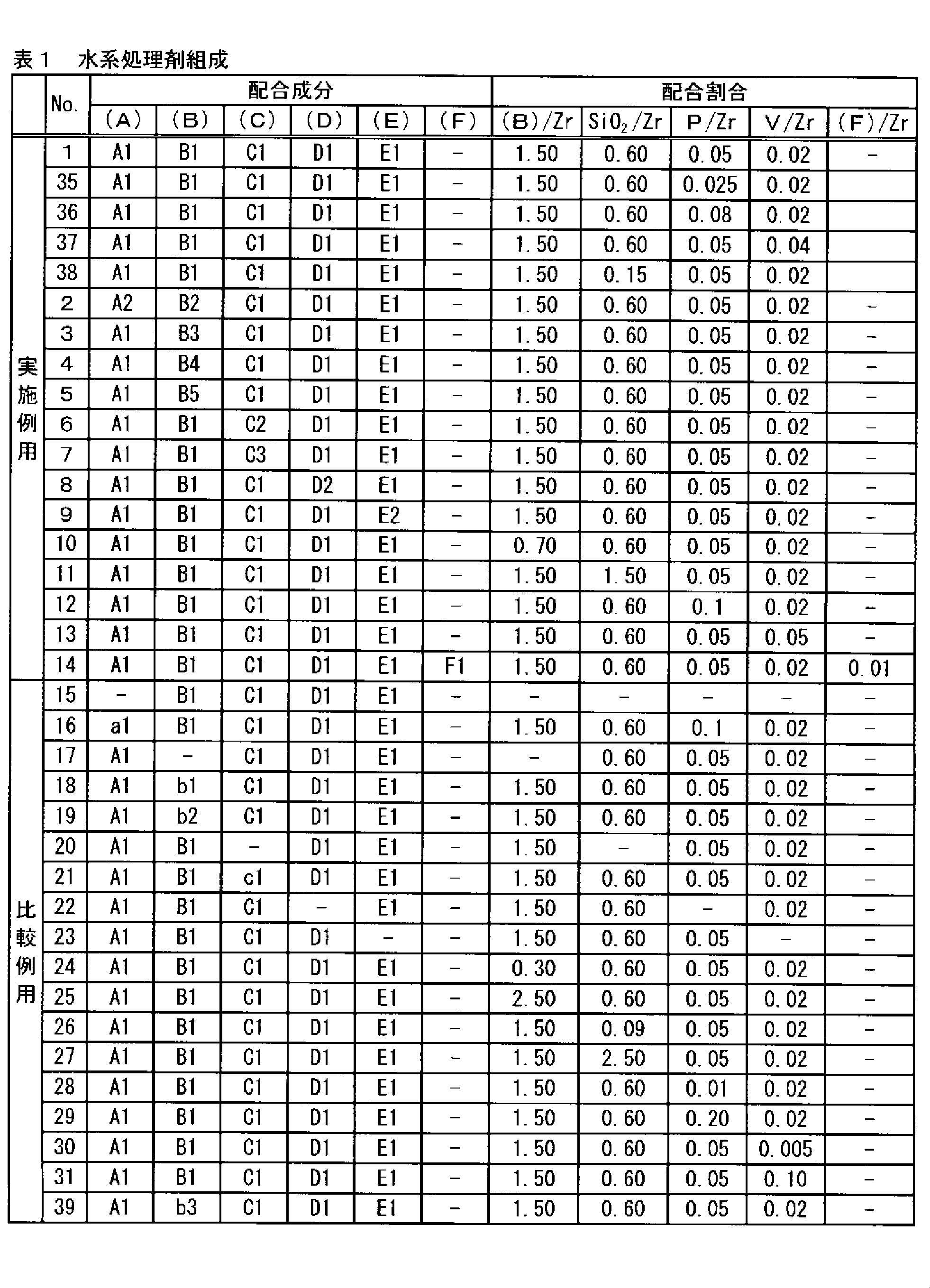
- the components (A) to (F) selected from the following are sequentially added to deionized water in the combinations and mixing ratios of the raw materials shown in Table 1, and water treatment agents for examples (Nos. 1 to 14, 35) are added.
- To 38) and comparative aqueous treatment agents (No. 15 to 31, 39) were obtained.
- Deionized water was added to adjust the nonvolatile content to 7% by mass.
- ⁇ Zirconium compound (A)> A1: Zirconium ammonium carbonate
- a reaction vessel was charged with 200 parts by mass of bisphenol A-type liquid epoxy resin, 30 parts by mass of polyethylene glycol diglycidyl ether, and 80 parts by mass of butyl cellosolve, and heated to 100 ° C. under nitrogen reflux and stirring. After dissolution, 5 parts by mass of triethylamine was added and reacted at 120 ° C. for 5 hours. Next, 100 parts by mass of bisphenol A type liquid epoxy resin and 80 parts by mass of methyl isobutyl diketimine were added and heating, nitrogen reflux and stirring were continued for 4 hours.
- carboxyl group-free bisphenol type epoxy resin (B2) had a weight average molecular weight of 18,000 and an acid value of 25 mgKOH / g.
- a reaction vessel was charged with 200 parts by weight of a bisphenol A-type liquid epoxy resin, 30 parts by weight of polyethylene glycol diglycidyl ether and 80 parts by weight of butyl cellosolve, and heated to 100 ° C. under nitrogen reflux and stirring. After dissolution, 5 parts by mass of triethylamine was added and reacted at 120 ° C. for 5 hours. Next, a mixed liquid of 30 parts by mass of butyl acrylate, 20 parts by mass of acrylic acid, 10 parts by mass of methyl methacrylate, 25 parts by mass of styrene, and 30 parts by mass of butyl cellosolve was dropped over 2 hours using a dropping funnel.
- the resulting carboxyl group-containing bisphenol A type epoxy resin (B3) had a weight average molecular weight of 84,000 and an acid value of 41 mgKOH / g.
- a reaction vessel was charged with 200 parts by weight of a bisphenol A-type liquid epoxy resin, 30 parts by weight of polyethylene glycol diglycidyl ether, and 80 parts by weight of butyl cellosolve, and heated to 100 ° C. under nitrogen reflux and stirring. After dissolution, 0.5 part by mass of triethylamine was added and reacted at 120 ° C. for 5 hours.
- Carboxyl group-containing novolak type epoxy resin 200 parts by mass of novolac type liquid epoxy resin, 30 parts by mass of polyethylene glycol diglycidyl ether, and 80 parts by mass of butyl cellosolve are charged in a reaction vessel, heated to 100 ° C. under nitrogen reflux and stirring, and dissolved. Then, 3 parts by mass of triethylamine was added and reacted at 120 ° C. for 5 hours.
- b2 Acrylic resin
- a reaction vessel 100 parts by mass of deionized water, 3 parts by mass of a reactive surfactant (Aqualon KH-10, manufactured by Daiichi Kogyo Seiyaku Co., Ltd.), heated to 50 ° C. under nitrogen reflux and stirring.
- a mixed monomer solution 20 parts by mass of butyl acrylate, 2 parts by mass of acrylic acid, 15 parts by mass of methyl methacrylate, and 13 parts by mass of styrene, 0.2 part by mass of ammonium persulfate, and 4 parts by mass of ion-exchanged water
- the solution was added dropwise using a dropping funnel over 2 hours. After completion of the dropwise addition, heating, nitrogen reflux and stirring were continued for 3 hours. After cooling to 30 ° C., stirring was continued for 5 hours to obtain an acrylic resin emulsion (b2).
- b3 Polyester resin In a reaction vessel, 1 mol of total acid component consisting of terephthalic acid (41 mol%), isophthalic acid (40 mol%), dimethyl-5-sulfonate sodium isophthalate (2 mol%) and trimellitic anhydride (17 mol%) 2 mol of all alcohol components consisting of ethylene glycol (90 mol%) and trimethylolpropane (10 mol%), and 0.25 g of calcium acetate and 0.1 g of N-butyl titanate as a catalyst, Stir and heat to 180 ° C. to melt the contents. Then, after heating to 200 degreeC, stirring was continued for about 2 hours and esterification or transesterification was performed.
- 1 mol of total acid component consisting of terephthalic acid (41 mol%), isophthalic acid (40 mol%), dimethyl-5-sulfonate sodium isophthalate (2 mol%) and trimellitic anhydride (17 mol%) 2 mol of all alcohol components consisting of ethylene glycol
- the mixture was heated to 260 ° C., and after about 15 minutes, the pressure in the system was reduced to 0.5 mmHg and subjected to a polycondensation reaction for about 3 hours. After completion of the reaction, the mixture was allowed to cool under nitrogen introduction, and the contents were taken out. Add appropriate amounts of ammonia water and deionized water to a final pH of 6-7 to the taken out contents, stir in an autoclave at 100 ° C for 2 hours, and finally add 30% solids with deionized water. A polyester resin (b3) of an aqueous emulsion adjusted to 1 was obtained.
- C2 Silanol group-containing compound by adding 0.02 part by weight of acetic acid, 20 parts by weight of ethanol and 25 parts by weight of 3-glycidoxypropyltriethoxysilane to 60 parts by weight of deionized water and stirring at 60 ° C. for 2 hours (C2) was obtained.
- c1 30 parts by mass of N-2- (aminoethyl) -3-aminopropyltriethoxysilane was added to 70 parts by mass of deionized water and stirred at 25 ° C. for 2 hours to obtain a silanol group-containing compound (c1). It was.
- aqueous treatment agent 2 (No. 32)
- the aqueous treatment composition described in the example of Patent Document 1 was prepared for a comparative example.
- 1.5 parts by mass of ⁇ -aminopropyltriethoxysilane, 0.5 parts by mass of water-dispersible silica (Snowtex N; manufactured by Nissan Chemical Industries, Ltd.), and zirconium ammonium carbonate in terms of zirconium ions 0.02 mass part was mixed and the aqueous processing agent (No. 32) was obtained.
- aqueous treatment agent 3 (No. 33)
- the aqueous treatment composition described in the Examples of Patent Document 4 was prepared as a comparative example. 100 parts by mass of deionized water, 25 parts by mass of ammonium zirconium carbonate, 25 parts by mass of water-dispersible silica (Snowtex N; manufactured by Nissan Chemical Industries, Ltd.) and 5 parts by mass of tartaric acid are mixed, and an aqueous treatment agent (No. 33) is added. Obtained.
- aqueous treatment agent 4 No. 34
- ZM-1300AN manufactured by Nippon Parkerizing Co., Ltd.
- This example is an example of a prior art chromate treatment composition.
- T1 60 parts by mass of a polyester resin, 15 parts by mass of a butylated melamine resin, 10 parts by mass of titanium oxide, and 15 parts by mass of carbon black were mixed to obtain a top coat paint.
- FC-E6406 manufactured by Nihon Parkerizing Co., Ltd.
- FC-E6406 manufactured by Nihon Parkerizing Co., Ltd.
- FC-E6406 was sprayed at a concentration of 20 g / L and a temperature of 60 ° C. for 10 seconds to degrease.
- each water system was applied to the surface of various steel plates after pretreatment using a bar coater so that the Zr adhesion amount (Cr: represents the Cr adhesion amount) becomes a predetermined amount.
- a treating agent was applied.
- the substrate was heated and dried in a hot air drying furnace so that the ultimate plate temperature was 80 ° C.
- the intermediate coating composition was applied using a bar coater so as to have a dry film thickness of 5 ⁇ m. Subsequently, it was heated and dried in a hot air drying furnace so that the ultimate plate temperature was 210 ° C.
- top coat layer After forming the intermediate coat layer, the top coat was applied using a bar coater to a dry film thickness of 15 ⁇ m. Subsequently, it was heated and dried in a hot air drying furnace so that the ultimate plate temperature was 220 ° C.
- the generation density of blisters is evaluated according to ASTM D 714, and the symbols used have the following meanings.
- Acid resistance Sulfuric acid resistance test Each test plate was immersed in a 5% by weight sulfuric acid aqueous solution at room temperature for 24 hours, then the size and density of the generated blisters were observed with the naked eye, and evaluated according to the same criteria as alkali resistance. Went.
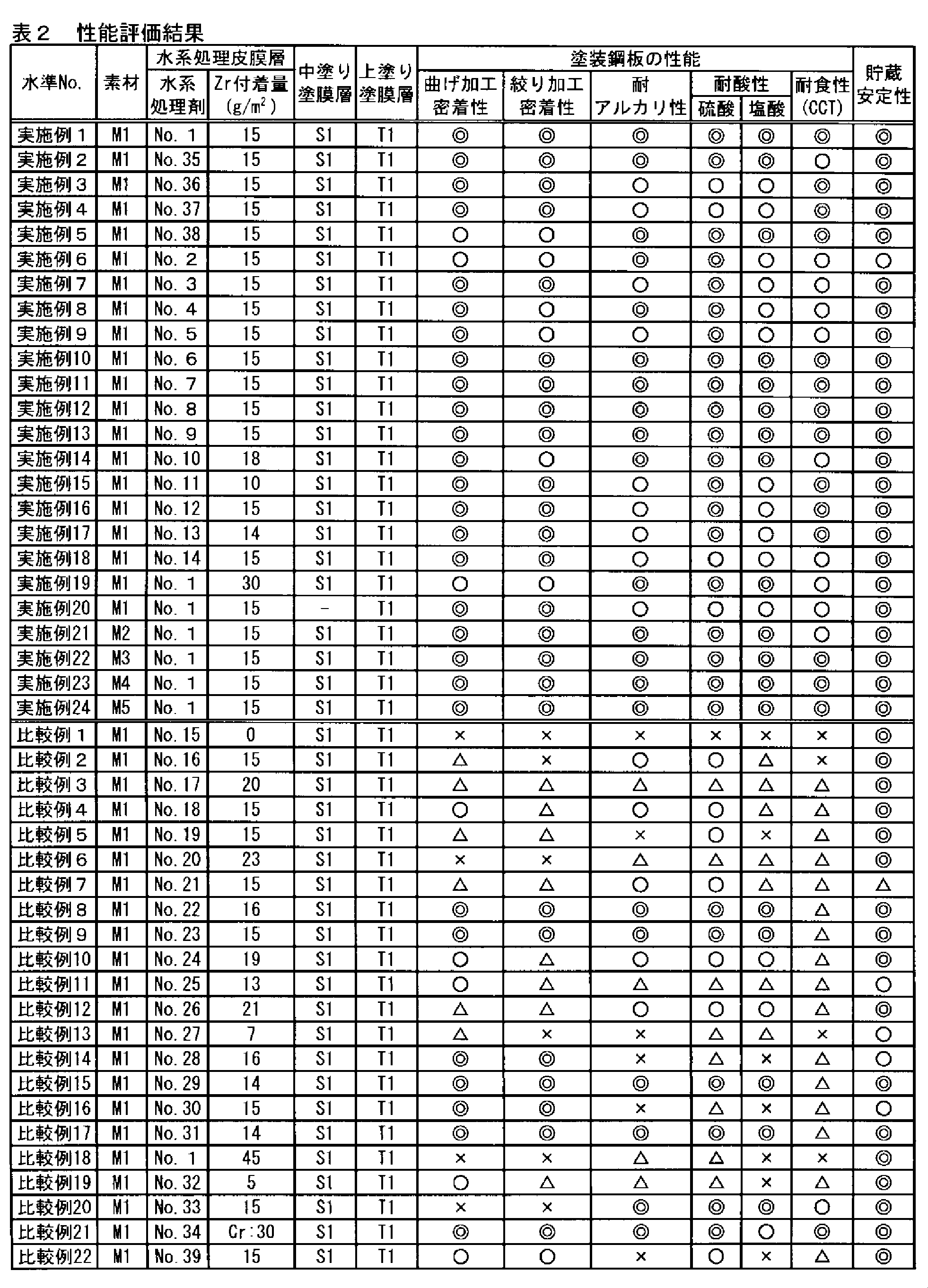
- Examples 1 to 24 which are coated zinc and zinc alloy-plated steel sheets having a treated coating layer of the present invention, have a work adhesion (bending work adhesion, drawing work adhesion, etc.) and chemical resistance. Excellent results were obtained in all the performances (alkali resistance, acid resistance, etc.) and corrosion resistance, and the same performance as that of Comparative Example 21 which is a chromate type was shown. Further, all of the aqueous treatment agents used in Examples 1 to 24 were excellent in storage stability.
- Comparative Example 1 containing no zirconium compound (A) is remarkably inferior in all of processing adhesion, corrosion resistance, and chemical resistance. Further, Comparative Example 2 containing a zirconium compound outside the scope of the present invention instead of the zirconium compound (A) was remarkably inferior in work adhesion and corrosion resistance.
- Comparative Example 3 not including the epoxy resin (B) has insufficient performance.
- Comparative Examples 4 and 5 including a resin outside the scope of the present invention had insufficient work adhesion, corrosion resistance, chemical resistance, and the like.
- Comparative Example 6 not containing the silanol group-containing compound (C) is remarkably inferior in processing adhesion. Moreover, the comparative example 7 which contains the silanol group containing compound outside the range of this invention instead was insufficient in process adhesiveness and corrosion resistance.
- Comparative Example 8 containing no phosphoric acid compound (D) and Comparative Example 9 containing no vanadium compound (E) were insufficient in corrosion resistance.
- Comparative Examples 12 and 13 in which the blending ratio of the silanol group-containing compound (C) was outside the scope of the present invention were insufficient in work adhesion and corrosion resistance.
- Comparative Examples 14 and 15 in which the blending ratio of the phosphoric acid compound (D) was outside the scope of the present invention were remarkably inferior in corrosion resistance.
- Comparative Examples 16 and 17 in which the compounding ratio of the vanadium compound (E) was outside the scope of the present invention were remarkably inferior in corrosion resistance.
- Comparative Example 18 in which the Zr adhesion amount was outside the range of the present invention was remarkably inferior in work adhesion and corrosion resistance.
Landscapes
- Chemical & Material Sciences (AREA)
- Metallurgy (AREA)
- Chemical Kinetics & Catalysis (AREA)
- Engineering & Computer Science (AREA)
- Materials Engineering (AREA)
- Mechanical Engineering (AREA)
- Organic Chemistry (AREA)
- Inorganic Chemistry (AREA)
- General Chemical & Material Sciences (AREA)
- Chemical Treatment Of Metals (AREA)
- Paints Or Removers (AREA)
- Laminated Bodies (AREA)
- Other Surface Treatments For Metallic Materials (AREA)
Abstract
Description
代表的な塗装鋼板の構成は、塗膜密着性を付与する処理を施しためっき鋼板の上に、プライマー塗膜とトップ塗膜からなる2層構造の有機塗膜を被覆したものからなる。上記の耐食性能を達成するため、この塗膜密着性を付与する処理にはクロメート処理を含み、またプライマー塗膜にもクロム系の防錆顔料を含有させた塗料が従来から使用されている。しかし、6価クロムの環境負荷の問題から、近年はこれら塗膜等のクロメートフリー化が強く望まれている。家電分野など穏和な条件で使用される屋内向けではクロメートフリー化が進んでいるが、建材分野など屋外の過酷な条件で使用される屋外向け製品では、エンドユーザーの要求を全て満足することが困難であり、クロメートフリー化が進んでいないという現状がある。
(1)(A)炭酸ジルコニウムアンモニウム、炭酸ジルコニウムカリウム、塩基性炭酸ジルコニウム、及び酢酸ジルコニウムから選ばれるジルコニウム化合物、
(B)エポキシ樹脂、
(C)下記式[I]で示されるシラノール基含有化合物及び/又はその縮合物、
XY(Z)nSi(OH)3-n・・・(I)
(Xはグリシドキシ基又はグリシドキシ基に由来する官能基を表し、Yは炭素数1~10のアルキル基を表し、Zはメトキシ基、エトキシ基、又はメチル基を表し、nは0~2の整数を表す。)
(D)りん酸化合物、
(E)バナジウム化合物、
を含有する水系処理剤であって、
ジルコニウム化合物(A)のZr換算での質量に対する、
エポキシ樹脂(B)の質量の固形分質量比[(B)/Zr]が0.7~1.5であり、
シラノール基含有化合物及び/又はその縮合物(C)のSiO2換算質量での固形分質量比[SiO2/Zr]が0.15~1.5であり、
りん酸化合物(D)のP換算質量での固形分質量比[P/Zr]が0.025~0.1であり、
バナジウム化合物(E)のV換算質量での固形分質量比[V/Zr]が0.02~0.05である、水系処理剤。
(2)前記エポキシ樹脂がカルボキシル基を含有するビスフェノールA型エポキシ樹脂であり、かつゲルパーミエーションクロマトグラフィーによるポリスチレン換算の重量平均分子量が30,000~150,000である前記(1)に記載の水系処理剤。
(3)めっき層組成がZn:80質量%以上である亜鉛めっき鋼板又は亜鉛合金めっき鋼板の少なくとも片面に、前記(1)又は(2)に記載の水系処理剤を用いて形成される、Zr付着量として1~40mg/m2の処理皮膜層を有する亜鉛めっき鋼材又は亜鉛合金めっき鋼材。
(4)前記(3)に記載の亜鉛めっき鋼材又は亜鉛合金めっき鋼材が有する前記処理皮膜層の上に少なくとも1層からなる積層塗膜を合計膜厚1~50μmで有する塗装亜鉛めっき鋼材又は塗装亜鉛合金めっき鋼材。
(5)
前記(1)又は(2)に記載の水系処理剤を、めっき層組成がZn:80質量%以上である亜鉛めっき鋼板又は亜鉛合金めっき鋼板の少なくとも片面に塗布し、処理皮膜層を形成し、
前記処理皮膜層を加熱乾燥して、Zr付着量として1~40mg/m2の処理皮膜層を形成する、亜鉛めっき鋼材又は亜鉛合金めっき鋼材の製造方法。
(6)
前記(1)又は(2)に記載の水系処理剤を、めっき層組成がZn:80質量%以上である亜鉛めっき鋼板又は亜鉛合金めっき鋼板の少なくとも片面に塗布し、処理皮膜層を形成し、
前記処理皮膜層を加熱乾燥して、Zr付着量として1~40mg/m2の処理皮膜層を形成し、
さらに、前記処理皮膜層の上に、少なくとも1層の積層塗膜用塗料を塗布し、
前記少なくとも1層の積層塗膜を加熱乾燥して、合計膜厚1~50μmの積層塗膜を形成する、
塗装亜鉛めっき鋼材又は塗装亜鉛合金めっき鋼材の製造方法。
ジルコニウム化合物としては、揮発性の酸で安定化されたジルコニム化合物(A)が適用され、処理皮膜形成(焼付け)過程において、加水分解や揮発性の酸の脱離に伴う縮合により三次元架橋したジルコニウム酸化物の皮膜を形成する。このようなジルコニウム酸化物からなる皮膜は耐薬品性が極めて高く、濃い酸やアルカリ環境下においても溶出し難い。しかし、硬くて脆い物性を持つため、成形加工時は処理皮膜が全く追従せず、それだけでは塗膜密着性が得られない。
そこで発明者らは、皮膜に強靭性を持たせる成分として、エポキシ樹脂(B)が最適であることを見出した。エポキシ樹脂は構造上、剛直性と柔軟性を併せ持ち、高い加水分解性を有する。また、エポキシ樹脂中のエポキシ基や水酸基の上塗り塗膜の有機官能基との反応や水素結合作用により、積層塗膜との密着性発現に寄与する。また、前記ジルコニウム化合物と架橋し緻密な構造を形成する。そのため、ジルコニウム化合物に対してエポキシ樹脂を適切な比率で配合することで、ジルコニウム酸化物皮膜の高い耐薬品性を低下させることなく、皮膜に強靭性を付与することができたと推察する。
以上、特定のジルコニウム化合物と、エポキシ樹脂と、特定のシラノール基含有化合物及び/又はその縮合物と、を特定の比率で配合することで、耐薬品性、成形加工部の塗膜密着性に優れる処理皮膜層を形成することができたと推定する。
水系処理剤1の調製(No.1~31及び35~39)
表1に示す原料の組み合わせ、配合割合にて、脱イオン水に下記から選択される各成分(A)~(F)を順次添加し、実施例用水系処理剤(No.1~14、35~38)及び比較例用水系処理剤(No.15~31、39)を得た。脱イオン水を加えて、不揮発分が7質量%となるよう調整した。
A1:炭酸ジルコニウムアンモニウム
A2:酢酸ジルコニウム
a1:ジルコンフッ化アンモニウム
B1:カルボキシル基含有ビスフェノール型エポキシ樹脂
反応容器にビスフェノールA型液状エポキシ樹脂200質量部、ポリエチレングリコールジグリシジリエーテル30質量部、ブチルセロソルブ80質量部を仕込み、窒素還流・攪拌下、100℃に加熱し溶解させた後、トリエチルアミン3質量部を添加し、120℃で5時間反応させた。次いで、ブチルアクリレート30質量部、アクリル酸10質量部、メタクリル酸メチル10質量部、スチレン25質量部、及びブチルセロソルブ30質量部の混合液を、滴下漏斗を用いて、2時間掛けて滴下した。滴下終了後、加熱・窒素還流・攪拌を4時間継続した。80℃に冷却後、トリエチルアミン10質量部、脱イオン水580質量部を混合した。得られたカルボキシル基含有ビスフェノールA型エポキシ樹脂(B1)の重量平均分子量は分子量61,000、酸価は20mgKOH/gであった。
反応容器にビスフェノールA型液状エポキシ樹脂200質量部、ポリエチレングリコールジグリシジリエーテル30質量部、ブチルセロソルブ80質量部を仕込み、窒素還流・攪拌下、100℃に加熱し溶解させた後、トリエチルアミン5質量部を添加し、120℃で5時間反応させた。次いで、ビスフェノールA型液状エポキシ樹脂100質量部、メチルイソブチルジケチミン80質量部を加えて加熱・窒素還流・攪拌を4時間継続した。その後メチルイソブチルジケチミン50質量部を加えて80℃に冷却後、トリエチルアミン10質量部、脱イオン水550質量部を混合した。得られたカルボキシル基非含有ビスフェノール型エポキシ樹脂(B2)の重量平均分子量は分子量18,000、酸価は25mgKOH/gであった。
反応容器にビスフェノールA型液状エポキシ樹脂200質量部、ポリエチレングリコールジグリシジリエーテル30質量部、ブチルセロソルブ80質量部を仕込み、窒素還流・攪拌下、100℃に加熱し溶解させた後、トリエチルアミン5質量部を添加し、120℃で5時間反応させた。次いで、ブチルアクリレート30質量部、アクリル酸20質量部、メタクリル酸メチル10質量部、スチレン25質量部、及びブチルセロソルブ30質量部の混合液を、滴下漏斗を用いて、2時間掛けて滴下した。滴下終了後、加熱・窒素還流・攪拌を4時間継続した。80℃に冷却後、トリエチルアミン10質量部、脱イオン水560質量部を混合した。得られたカルボキシル基含有ビスフェノールA型エポキシ樹脂(B3)の重量平均分子量は分子量84,000、酸価は41mgKOH/gであった。
反応容器にビスフェノールA型液状エポキシ樹脂200質量部、ポリエチレングリコールジグリシジリエーテル30質量部、ブチルセロソルブ80質量部を仕込み、窒素還流・攪拌下、100℃に加熱し溶解させた後、トリエチルアミン0.5質量部を添加し、120℃で5時間反応させた。次いで、ブチルアクリレート30質量部、アクリル酸10質量部、メタクリル酸メチル10質量部、スチレン25質量部、及びブチルセロソルブ30質量部の混合液を、滴下漏斗を用いて、2時間掛けて滴下した。滴下終了後、加熱・窒素還流・攪拌を4時間継続した。80℃に冷却後、トリエチルアミン10質量部、脱イオン水580質量部を混合した。得られたカルボキシル基含有ビスフェノールA型エポキシ樹脂(B4)の重量平均分子量は分子量22,000、酸価は26mgKOH/gであった。
反応容器にノボラック型液状エポキシ樹脂200質量部、ポリエチレングリコールジグリシジリエーテル30質量部、ブチルセロソルブ80質量部を仕込み、窒素還流・攪拌下、100℃に加熱し溶解させた後、トリエチルアミン3質量部を添加し、120℃で5時間反応させた。次いで、ブチルアクリレート30質量部、アクリル酸10質量部、メタクリル酸メチル10質量部、スチレン25質量部、及びブチルセロソルブ30質量部の混合液を、滴下漏斗を用いて、2時間掛けて滴下した。滴下終了後、加熱・窒素還流・攪拌を4時間継続した。80℃に冷却後、トリエチルアミン10質量部、脱イオン水580質量部を混合した。得られたカルボキシル基含有ノボラック型エポキシ樹脂(B5)の重量平均分子量は分子量33,000、酸価は28mgKOH/gであった。
反応容器に、1,6-ヘキサンジオールとアジピン酸とテレフタル酸とを反応させて得られたポリエステルポリオール66質量部、ジシクロヘキシルメタン4,4’-ジイソシアナート44質量部、ジメチロールプロピオン酸6質量部、N-メチル-2-ピロリドン30質量部を仕込み、窒素還流・攪拌下、70℃に保ちながら5時間反応させることにより得られるウレタンプレポリマーに、トリエチルアミン4質量部を加え、30℃で30分間反応させてアニオン性ウレタンプレポリマーを得た。次いで、脱イオン水110質量部を加えて乳化分散させた後、40℃で10時間攪拌を継続し、アニオン性ポリウレタン樹脂エマルションを得た。
反応容器に脱イオン水100質量部、反応性界面活性剤(アクアロンKH-10 第一工業製薬(株)製)3質量部、窒素還流・攪拌下、50℃に加熱した。次いで、ブチルアクリレート20質量部、アクリル酸2質量部、メタクリル酸メチル15質量部、及びスチレン13質量部の混合モノマー液、過硫酸アンモニウム0.2質量部、並びにイオン交換水4質量部の混合液を、それぞれ滴下漏斗を用いて、2時間かけて滴下した。滴下終了後、加熱・窒素還流・攪拌を3時間継続した。30℃まで冷却し、5時間攪拌を継続し、アクリル樹脂エマルション(b2)を得た。
反応容器に、テレフタル酸(41mol%)、イソフタル酸(40mol%)、イソフタル酸ジメチル-5-スルホン酸ナトリウム(2mol%)及び無水トリメリット酸(17mol%)からなる全酸成分1molと、エチレングリコール(90mol%)及びトリメチロールプロパン(10mol%)からなる2molの全アルコール成分と、触媒として酢酸カルシウム0.25gおよびN-ブチルチタネート0.1gとを入れ、系内を窒素還流・撹拌し、180℃に加熱して内容物を融解させた。その後、200℃に加熱した後、約2時間撹拌を継続し、エステル化又はエステル交換反応を行った。次に、260℃に加熱し、約15分後に系内を0.5mmHgまで減圧し、約3時間重縮合反応させた。反応終了後、窒素導入下で放冷し、内容物を取り出した。取り出した内容物に最終pHが6~7になる適当量のアンモニア水と脱イオン水を加え、オートクレーブ中で、100℃で2時間加熱撹拌し、最終的に脱イオン水で固形分を30%に調整した水系エマルジョンのポリエステル樹脂(b3)を得た。
C1:脱イオン水80質量部に酢酸0.02質量部、3-グリシドキシプロピルトリメトキシシラン25質量部を添加し、25℃で2時間攪拌することでシラノール基含有化合物(C1)を得た。
D1:りん酸
D2:りん酸二水素アンモニウム
E1:シュウ酸バナジル
E2:メタバナジン酸アンモニウム
F1:硝酸ニッケル
前記特許文献1の実施例に記載の水系処理組成物を比較例用として調製した。
脱イオン水1リットルに、γ-アミノプロピルトリエトキシシラン1.5質量部、水分散性シリカ(スノーテックスN;日産化学工業社製)を0.5質量部、炭酸ジルコニウムアンモニウムをジルコニウムイオン換算で0.02質量部を混合し、水系処理剤(No.32)を得た。
前記特許文献4の実施例に記載の水系処理組成物を比較例用として調製した。
脱イオン水100質量部、炭酸ジルコニウムアンモニウム25質量部、水分散性シリカ(スノーテックスN;日産化学工業社製)25質量部、酒石酸5質量部を混合し、水系処理剤(No.33)を得た。
塗布クロメート薬剤であるZM-1300AN(日本パ-カライジング(株)製)を比較例として用いた。この例は、従来技術のクロメート処理組成物の例である。
S1:ポリエステル樹脂70質量部、メラミン樹脂10質量部、リン酸亜鉛系防錆顔料5質量部、リン酸マグネシウム系防錆顔料5質量部、トリポリリン酸2水素アルミニウム5質量部及び変性シリカ5質量部を混合し、中塗り塗料を得た。
T1:ポリエステル樹脂60質量部、ブチル化メラミン樹脂15質量部、酸化チタン10質量部及びカーボンブラック15質量部を混合し、上塗り塗料を得た。
1.素材
M1:溶融亜鉛めっき鋼板
板厚0.6mm、めっき付着量片面当たり40g/m2(両面めっき)
M2:電気亜鉛めっき鋼板
板厚0.6mm、めっき付着量片面当たり20g/m2(両面めっき)
M3:合金化溶融亜鉛めっき鋼板
板厚0.6mm、めっき付着量片面当たり45g/m2(両面めっき)
M4:溶融Zn-11%Al-3%Mg-0.2%Si合金めっき鋼板
板厚0.6mm、めっき付着量片面当たり40g/m2(両面めっき)
M5:電気Zn-Niめっき鋼板
板厚0.6mm、めっき付着量片面当たり20g/m2(両面めっき)
アルカリ脱脂剤であるFC-E6406(日本パ-カライジング(株)製)を濃度20g/L、温度60℃で上記各種鋼板を10秒間スプレーし、脱脂処理した。次いで、水道水で洗浄した後に、水切りロールで絞り、熱風乾燥した。
表2に示すように、Zr付着量(Cr:はCr付着量を表す)が所定量となるように、前処理後の各種鋼板の表面に、バーコーターを用いて各水系処理剤を塗布した。次いで、熱風乾燥炉にて到達板温度が80℃となるよう加熱乾燥した。
処理皮膜層を形成させた後、前記中塗り塗料を、5μmの乾燥膜厚となるようにバーコーターを用いて塗布した。次いで、熱風乾燥炉にて到達板温度が210℃となるように加熱乾燥した。
中塗り塗膜層を形成させた後、前記上塗り塗料を、15μmの乾燥膜厚となるようにバーコーターを用いて塗布した。次いで、熱風乾燥炉にて到達板温度が220℃となるように加熱乾燥した。
1.曲げ加工密着性
各試験板を沸水中に2時間浸漬した後、JIS-G3312の試験法に準じて各試験板に対し内側間隔板を挟まない0T折曲げ試験を20℃で行い、テープ剥離後の塗膜剥離状態を肉眼で観察し、下記の判定基準に準じて評価を行った。
◎:剥離なし
○:剥離面積10%未満
△:剥離面積10%以上50%未満
×:剥離面積50%以上
絞り比:2.0、しわ抑え圧:0.5tにて深絞り加工を行った後、側面部に金属素地に達する疵を「X」型にカッターで入れ、沸騰水に1時間浸漬後、「X」型疵部にテープを貼り付けた。その後、テープを剥がして塗膜剥離状態を肉眼で観察し、下記の判定基準に準じて評価を行なった。
◎:剥離なし
○:カット部より2mm未満の剥離
△:カット部より2mm以上10mm未満の剥離
×:カット部より10mm以上の剥離
各試験板を5質量%の水酸化ナトリウム水溶液に室温で24時間浸漬した後、発生したブリスターの大きさと発生密度を肉眼で観察し、下記の判定基準に従って耐アルカリ性の評価を行った。
◎:ブリスターなし。
○:1つのブリスターが1.0mm未満で、かつ発生密度がFである。
△:1つのブリスターが1.0mm以上で、かつ発生密度がFである。もしくは、1つのブリスターの大きさが1.0mm未満で、かつ発生密度がMである。
×:1つのブリスターの大きさが1.0mm以上で、かつ発生密度がMである。もしくは、ブリスターの大きさに関わらず発生密度がDである。
F:ブリスター密度が少ない
M:ブリスター密度が中
D:ブリスター密度が密
(1)耐硫酸試験
各試験板を5質量%の硫酸水溶液に室温で24時間浸漬した後、発生したブリスターの大きさと発生密度を肉眼で観察し、耐アルカリ性と同様の判定基準で評価を行った。
各試験板を5質量%の塩酸水溶液に室温で24時間浸漬した後、発生したブリスターの大きさと発生密度を肉眼で観察し、耐アルカリ性と同様の判定基準で評価を行った。
150mm×70mmに切断した各試験板について、長手部の切断端面を露出させたまま、JASO M609-91に規定された複合サイクル試験を200サイクル実施した。切断端面部からの塗膜膨れ幅(最大値)を測定し、下記の判定基準に準じて評価を行った。
◎:2mm未満
○:2mm以上5mm未満
△:5mm以上10mm未満
×:10mm以上
表1に示す各水系処理剤を40℃で30日間放置した。その後、下記の評価基準に従って各水系処理剤を評価した。
◎:変化なし
○:極微量の沈殿が見られた。
△:微量の沈殿が見られ、粘度が高くなった。
×:多量の沈殿が見られたか、あるいはゲル化した。
表2に示すように、本発明の処理皮膜層を有する塗装亜鉛及び亜鉛合金めっき鋼板である実施例1~24は、加工密着性(曲げ加工密着性、絞り加工密着性等)、耐薬品性(耐アルカリ性、耐酸性等)、耐食性の全ての性能において優れた結果を示し、クロメート系である比較例21と同等の性能を示した。また、実施例1~24で用いた全ての水系処理剤は、貯蔵安定性においても優れていた。
Claims (6)
- (A)炭酸ジルコニウムアンモニウム、炭酸ジルコニウムカリウム、塩基性炭酸ジルコニウム、及び酢酸ジルコニウムから選ばれるジルコニウム化合物、
(B)エポキシ樹脂、
(C)下記式[I]で示されるシラノール基含有化合物及び/又はその縮合物、
XY(Z)nSi(OH)3-n・・・(I)
(Xはグリシドキシ基又はグリシドキシ基に由来する官能基を表し、Yは炭素数1~10のアルキレン基を表し、Zはメトキシ基、エトキシ基、又はメチル基を表し、nは0~2の整数を表す。)
(D)りん酸化合物、
(E)バナジウム化合物、
を含有する水系処理剤であって、
ジルコニウム化合物(A)のZr換算での質量に対する、
エポキシ樹脂(B)の質量の固形分質量比[(B)/Zr]が0.7~1.5であり、
シラノール基含有化合物及び/又はその縮合物(C)のSiO2換算質量での固形分質量比[SiO2/Zr]が0.15~1.5であり、
りん酸化合物(D)のP換算質量での固形分質量比[P/Zr]が0.025~0.1であり、
バナジウム化合物(E)のV換算質量での固形分質量比[V/Zr]が0.02~0.05である、
水系処理剤。 - 前記エポキシ樹脂(B)がカルボキシル基を含有するビスフェノールA型エポキシ樹脂であり、かつゲルパーミエーションクロマトグラフィーによるポリスチレン換算の重量平均分子量が30,000~150,000である請求項1に記載の水系処理剤。
- めっき層組成がZn:80質量%以上である亜鉛めっき鋼板又は亜鉛合金めっき鋼板の少なくとも片面に、請求項1又は2に記載の水系処理剤を用いて形成される、Zr付着量として1~40mg/m2の処理皮膜層を有する亜鉛めっき鋼材又は亜鉛合金めっき鋼材。
- 請求項3に記載の亜鉛めっき鋼材又は亜鉛合金めっき鋼材が有する前記処理皮膜層の上に少なくとも1層からなる積層塗膜を合計膜厚1~50μmで有する塗装亜鉛めっき鋼材又は塗装亜鉛合金めっき鋼材。
- 請求項1又は2に記載の水系処理剤を、めっき層組成がZn:80質量%以上である亜鉛めっき鋼板又は亜鉛合金めっき鋼板の少なくとも片面に塗布し、処理皮膜層を形成し、
前記処理皮膜層を加熱乾燥して、Zr付着量として1~40mg/m2の処理皮膜層を形成する、亜鉛めっき鋼材又は亜鉛合金めっき鋼材の製造方法。 - 請求項1又は2に記載の水系処理剤を、めっき層組成がZn:80質量%以上である亜鉛めっき鋼板又は亜鉛合金めっき鋼板の少なくとも片面に塗布し、処理皮膜層を形成し、
前記処理皮膜層を加熱乾燥して、Zr付着量として1~40mg/m2の処理皮膜層を形成し、
さらに、前記処理皮膜層の上に、少なくとも1層の積層塗膜用塗料を塗布し、
前記少なくとも1層の積層塗膜を加熱乾燥して、合計膜厚1~50μmの積層塗膜を形成する、
塗装亜鉛めっき鋼材又は塗装亜鉛合金めっき鋼材の製造方法。
Priority Applications (4)
| Application Number | Priority Date | Filing Date | Title |
|---|---|---|---|
| JP2017528740A JP6564036B2 (ja) | 2015-07-15 | 2016-07-15 | 水系処理剤、亜鉛めっき鋼材又は亜鉛合金めっき鋼材および塗装亜鉛めっき鋼材又は塗装亜鉛合金めっき鋼材 |
| CN201680040716.1A CN107849696B (zh) | 2015-07-15 | 2016-07-15 | 水系处理剂、镀锌钢材或镀锌合金钢材以及涂装镀锌钢材或涂装镀锌合金钢材 |
| MYPI2017705131A MY183818A (en) | 2015-07-15 | 2016-07-15 | Water-based treatment agent, galvanized steel material or galvannealed steel material, coated galvanized steel material or coated galvannealed steel material , and method for producing same |
| KR1020187000597A KR102043572B1 (ko) | 2015-07-15 | 2016-07-15 | 수계 처리제, 아연 도금 강재 또는 아연 합금 도금 강재 및 도장 아연 도금 강재 또는 도장 아연 합금 도금 강재 |
Applications Claiming Priority (2)
| Application Number | Priority Date | Filing Date | Title |
|---|---|---|---|
| JP2015141681 | 2015-07-15 | ||
| JP2015-141681 | 2015-07-15 |
Publications (1)
| Publication Number | Publication Date |
|---|---|
| WO2017010571A1 true WO2017010571A1 (ja) | 2017-01-19 |
Family
ID=57757973
Family Applications (1)
| Application Number | Title | Priority Date | Filing Date |
|---|---|---|---|
| PCT/JP2016/071070 Ceased WO2017010571A1 (ja) | 2015-07-15 | 2016-07-15 | 水系処理剤、亜鉛めっき鋼材又は亜鉛合金めっき鋼材および塗装亜鉛めっき鋼材又は塗装亜鉛合金めっき鋼材 |
Country Status (5)
| Country | Link |
|---|---|
| JP (1) | JP6564036B2 (ja) |
| KR (1) | KR102043572B1 (ja) |
| CN (1) | CN107849696B (ja) |
| MY (1) | MY183818A (ja) |
| WO (1) | WO2017010571A1 (ja) |
Cited By (3)
| Publication number | Priority date | Publication date | Assignee | Title |
|---|---|---|---|---|
| WO2021235363A1 (ja) * | 2020-05-20 | 2021-11-25 | 日鉄鋼板株式会社 | 被覆めっき鋼板 |
| JPWO2022186380A1 (ja) * | 2021-03-04 | 2022-09-09 | ||
| CN115537793A (zh) * | 2022-09-30 | 2022-12-30 | 安徽舜邦精细化工有限公司 | 一种镀锌钢板无铬钝化封闭处理方法 |
Families Citing this family (1)
| Publication number | Priority date | Publication date | Assignee | Title |
|---|---|---|---|---|
| JP7568983B2 (ja) * | 2021-05-20 | 2024-10-17 | 日本製鉄株式会社 | 冷却構造、バッテリーユニット、及び冷却構造の製造方法 |
Citations (4)
| Publication number | Priority date | Publication date | Assignee | Title |
|---|---|---|---|---|
| US20100068396A1 (en) * | 2008-05-23 | 2010-03-18 | Jong Gi Kim | Metal surface treatment solution and method of manufacturing steel sheet using the same |
| JP2011195942A (ja) * | 2010-03-24 | 2011-10-06 | Jfe Steel Corp | 表面処理鋼板 |
| JP2012117108A (ja) * | 2010-11-30 | 2012-06-21 | Nippon Steel Corp | 塗装亜鉛系めっき鋼板 |
| JP2014055319A (ja) * | 2012-09-12 | 2014-03-27 | Kansai Paint Co Ltd | 水性金属表面処理剤 |
Family Cites Families (9)
| Publication number | Priority date | Publication date | Assignee | Title |
|---|---|---|---|---|
| JP3857866B2 (ja) | 2000-02-29 | 2006-12-13 | 日本ペイント株式会社 | ノンクロメート金属表面処理剤、表面処理方法および処理された塗装鋼材 |
| JP4393660B2 (ja) | 2000-02-29 | 2010-01-06 | 日本ペイント株式会社 | Pcm用ノンクロメート金属表面処理剤、pcm表面処理方法および処理されたpcm鋼板 |
| TWI331085B (en) | 2002-07-02 | 2010-10-01 | Nippon Steel Corp | Precoated metal sheet with excellent press-formability and production method thereof |
| JP4291022B2 (ja) | 2003-03-18 | 2009-07-08 | 日本パーカライジング株式会社 | 金属材料用表面処理剤及び表面処理方法 |
| JP4575047B2 (ja) * | 2004-06-29 | 2010-11-04 | 関西ペイント株式会社 | 金属表面処理組成物および金属表面処理鋼板 |
| JP5088095B2 (ja) * | 2006-12-13 | 2012-12-05 | Jfeスチール株式会社 | 平板部耐食性、耐黒変性およびプレス成形後の外観と耐食性に優れた表面処理亜鉛系めっき鋼板、並びに亜鉛系めっき鋼板用水系表面処理液 |
| JP2008274419A (ja) * | 2007-03-30 | 2008-11-13 | Jfe Steel Kk | 耐食性、電着塗装密着性および溶接性に優れた表面処理鋼板 |
| CN101289741B (zh) * | 2007-04-18 | 2010-05-19 | 宝山钢铁股份有限公司 | 用于电镀锌钢板表面处理的无铬钝化液及其使用方法 |
| CN103834938A (zh) * | 2014-03-05 | 2014-06-04 | 东北大学 | 一种钢厂连退线镀锌板无铬复合钝化剂及其制备方法 |
-
2016
- 2016-07-15 JP JP2017528740A patent/JP6564036B2/ja active Active
- 2016-07-15 KR KR1020187000597A patent/KR102043572B1/ko active Active
- 2016-07-15 CN CN201680040716.1A patent/CN107849696B/zh active Active
- 2016-07-15 MY MYPI2017705131A patent/MY183818A/en unknown
- 2016-07-15 WO PCT/JP2016/071070 patent/WO2017010571A1/ja not_active Ceased
Patent Citations (4)
| Publication number | Priority date | Publication date | Assignee | Title |
|---|---|---|---|---|
| US20100068396A1 (en) * | 2008-05-23 | 2010-03-18 | Jong Gi Kim | Metal surface treatment solution and method of manufacturing steel sheet using the same |
| JP2011195942A (ja) * | 2010-03-24 | 2011-10-06 | Jfe Steel Corp | 表面処理鋼板 |
| JP2012117108A (ja) * | 2010-11-30 | 2012-06-21 | Nippon Steel Corp | 塗装亜鉛系めっき鋼板 |
| JP2014055319A (ja) * | 2012-09-12 | 2014-03-27 | Kansai Paint Co Ltd | 水性金属表面処理剤 |
Cited By (8)
| Publication number | Priority date | Publication date | Assignee | Title |
|---|---|---|---|---|
| WO2021235363A1 (ja) * | 2020-05-20 | 2021-11-25 | 日鉄鋼板株式会社 | 被覆めっき鋼板 |
| JP2021181214A (ja) * | 2020-05-20 | 2021-11-25 | 日鉄鋼板株式会社 | 被覆めっき鋼板 |
| JP7417473B2 (ja) | 2020-05-20 | 2024-01-18 | 日鉄鋼板株式会社 | 被覆めっき鋼板 |
| JPWO2022186380A1 (ja) * | 2021-03-04 | 2022-09-09 | ||
| WO2022186380A1 (ja) * | 2021-03-04 | 2022-09-09 | 日本製鉄株式会社 | 表面処理鋼材 |
| JP7376843B2 (ja) | 2021-03-04 | 2023-11-09 | 日本製鉄株式会社 | 表面処理鋼材 |
| US12104254B2 (en) | 2021-03-04 | 2024-10-01 | Nippon Steel Corporation | Surface-treated steel |
| CN115537793A (zh) * | 2022-09-30 | 2022-12-30 | 安徽舜邦精细化工有限公司 | 一种镀锌钢板无铬钝化封闭处理方法 |
Also Published As
| Publication number | Publication date |
|---|---|
| CN107849696A (zh) | 2018-03-27 |
| JP6564036B2 (ja) | 2019-08-21 |
| CN107849696B (zh) | 2020-01-14 |
| KR102043572B1 (ko) | 2019-11-11 |
| MY183818A (en) | 2021-03-17 |
| JPWO2017010571A1 (ja) | 2018-04-12 |
| KR20180016533A (ko) | 2018-02-14 |
Similar Documents
| Publication | Publication Date | Title |
|---|---|---|
| CN103140605B (zh) | 镀锌系钢板 | |
| CN102884225B (zh) | 镀锌系钢板用表面处理液及镀锌系钢板及其制造方法 | |
| JP5183586B2 (ja) | プライマー兼用水系塗装下地処理剤、表面処理金属材料及びプレコート金属材料 | |
| CN101542018B (zh) | 环保型预涂金属材料用水性表面处理剂、以及表面处理金属材料和环保型预涂金属材料 | |
| CN103119200B (zh) | 镀锌系钢板用表面处理液、镀锌系钢板及其制造方法 | |
| CN105143513B (zh) | 涂装钢板用基底处理组合物、以及进行了基底处理的镀覆钢板及其制造方法、涂装镀覆钢板及其制造方法 | |
| CN102378827B (zh) | 表面处理剂、使用该表面处理剂的镀覆钢板的制造方法以及镀覆钢板 | |
| TWI529261B (zh) | 鍍鋅系鋼板用之表面處理液和鍍鋅系鋼板及其製造方法 | |
| CN103069046B (zh) | 镀锌系钢板的制造方法和镀锌系钢板 | |
| JP5498634B2 (ja) | 水系金属表面処理剤、表面処理方法及び表面処理金属材料 | |
| JP6564036B2 (ja) | 水系処理剤、亜鉛めっき鋼材又は亜鉛合金めっき鋼材および塗装亜鉛めっき鋼材又は塗装亜鉛合金めっき鋼材 | |
| JP2004238716A (ja) | 耐白錆性に優れた表面処理鋼板およびその製造方法 | |
| JP5661238B2 (ja) | 表面処理亜鉛系めっき鋼板 | |
| JP5638191B2 (ja) | 化成処理金属板およびその製造方法 | |
| JP5241075B2 (ja) | 金属材料表面処理用のノンクロメート水系表面処理剤 | |
| JP5055822B2 (ja) | 塗膜密着性に優れた塗装鋼板 | |
| KR20120128771A (ko) | 금속표면처리용 공중합 수지, 이를 포함하는 금속표면처리용 조성물 및 이를 이용한 아연계 도금강판 | |
| JP4970773B2 (ja) | 金属表面処理剤、金属材の表面処理方法及び表面処理金属材 | |
| JPH029067B2 (ja) | ||
| JP6085369B2 (ja) | 金属材料用表面処理剤、表面処理金属材料およびその製造方法 | |
| JP3106498B2 (ja) | 耐傷付き性および耐食性に優れたアルミニウム合金板およびその製造方法 | |
| JP2006321957A (ja) | 環境対応型プレコート金属材料用水系表面処理剤及び表面処理方法 | |
| JPS632310B2 (ja) | ||
| JP2007321223A (ja) | 耐食性に優れたクロメートフリー表面処理Al−Zn系合金めっき鋼板及びその製造方法 |
Legal Events
| Date | Code | Title | Description |
|---|---|---|---|
| 121 | Ep: the epo has been informed by wipo that ep was designated in this application |
Ref document number: 16824551 Country of ref document: EP Kind code of ref document: A1 |
|
| ENP | Entry into the national phase |
Ref document number: 2017528740 Country of ref document: JP Kind code of ref document: A |
|
| ENP | Entry into the national phase |
Ref document number: 20187000597 Country of ref document: KR Kind code of ref document: A |
|
| NENP | Non-entry into the national phase |
Ref country code: DE |
|
| 122 | Ep: pct application non-entry in european phase |
Ref document number: 16824551 Country of ref document: EP Kind code of ref document: A1 |