WO2016199809A1 - 熱収縮性ポリエステル系フィルムおよび包装体 - Google Patents
熱収縮性ポリエステル系フィルムおよび包装体 Download PDFInfo
- Publication number
- WO2016199809A1 WO2016199809A1 PCT/JP2016/067049 JP2016067049W WO2016199809A1 WO 2016199809 A1 WO2016199809 A1 WO 2016199809A1 JP 2016067049 W JP2016067049 W JP 2016067049W WO 2016199809 A1 WO2016199809 A1 WO 2016199809A1
- Authority
- WO
- WIPO (PCT)
- Prior art keywords
- shrinkage
- film
- heat
- polyester
- stress
- Prior art date
- Legal status (The legal status is an assumption and is not a legal conclusion. Google has not performed a legal analysis and makes no representation as to the accuracy of the status listed.)
- Ceased
Links
Images


Classifications
-
- B—PERFORMING OPERATIONS; TRANSPORTING
- B32—LAYERED PRODUCTS
- B32B—LAYERED PRODUCTS, i.e. PRODUCTS BUILT-UP OF STRATA OF FLAT OR NON-FLAT, e.g. CELLULAR OR HONEYCOMB, FORM
- B32B27/00—Layered products comprising a layer of synthetic resin
- B32B27/06—Layered products comprising a layer of synthetic resin as the main or only constituent of a layer, which is next to another layer of the same or of a different material
- B32B27/08—Layered products comprising a layer of synthetic resin as the main or only constituent of a layer, which is next to another layer of the same or of a different material of synthetic resin
-
- B—PERFORMING OPERATIONS; TRANSPORTING
- B65—CONVEYING; PACKING; STORING; HANDLING THIN OR FILAMENTARY MATERIAL
- B65D—CONTAINERS FOR STORAGE OR TRANSPORT OF ARTICLES OR MATERIALS, e.g. BAGS, BARRELS, BOTTLES, BOXES, CANS, CARTONS, CRATES, DRUMS, JARS, TANKS, HOPPERS, FORWARDING CONTAINERS; ACCESSORIES, CLOSURES, OR FITTINGS THEREFOR; PACKAGING ELEMENTS; PACKAGES
- B65D75/00—Packages comprising articles or materials partially or wholly enclosed in strips, sheets, blanks, tubes or webs of flexible sheet material, e.g. in folded wrappers
- B65D75/002—Packages comprising articles or materials partially or wholly enclosed in strips, sheets, blanks, tubes or webs of flexible sheet material, e.g. in folded wrappers in shrink films
-
- B—PERFORMING OPERATIONS; TRANSPORTING
- B29—WORKING OF PLASTICS; WORKING OF SUBSTANCES IN A PLASTIC STATE IN GENERAL
- B29C—SHAPING OR JOINING OF PLASTICS; SHAPING OF MATERIAL IN A PLASTIC STATE, NOT OTHERWISE PROVIDED FOR; AFTER-TREATMENT OF THE SHAPED PRODUCTS, e.g. REPAIRING
- B29C61/00—Shaping by liberation of internal stresses; Making preforms having internal stresses; Apparatus therefor
- B29C61/06—Making preforms having internal stresses, e.g. plastic memory
-
- B—PERFORMING OPERATIONS; TRANSPORTING
- B32—LAYERED PRODUCTS
- B32B—LAYERED PRODUCTS, i.e. PRODUCTS BUILT-UP OF STRATA OF FLAT OR NON-FLAT, e.g. CELLULAR OR HONEYCOMB, FORM
- B32B27/00—Layered products comprising a layer of synthetic resin
- B32B27/06—Layered products comprising a layer of synthetic resin as the main or only constituent of a layer, which is next to another layer of the same or of a different material
- B32B27/10—Layered products comprising a layer of synthetic resin as the main or only constituent of a layer, which is next to another layer of the same or of a different material of paper or cardboard
-
- B—PERFORMING OPERATIONS; TRANSPORTING
- B32—LAYERED PRODUCTS
- B32B—LAYERED PRODUCTS, i.e. PRODUCTS BUILT-UP OF STRATA OF FLAT OR NON-FLAT, e.g. CELLULAR OR HONEYCOMB, FORM
- B32B27/00—Layered products comprising a layer of synthetic resin
- B32B27/18—Layered products comprising a layer of synthetic resin characterised by the use of special additives
- B32B27/20—Layered products comprising a layer of synthetic resin characterised by the use of special additives using fillers, pigments, thixotroping agents
-
- B—PERFORMING OPERATIONS; TRANSPORTING
- B32—LAYERED PRODUCTS
- B32B—LAYERED PRODUCTS, i.e. PRODUCTS BUILT-UP OF STRATA OF FLAT OR NON-FLAT, e.g. CELLULAR OR HONEYCOMB, FORM
- B32B27/00—Layered products comprising a layer of synthetic resin
- B32B27/28—Layered products comprising a layer of synthetic resin comprising synthetic resins not wholly covered by any one of the sub-groups B32B27/30 - B32B27/42
-
- B—PERFORMING OPERATIONS; TRANSPORTING
- B32—LAYERED PRODUCTS
- B32B—LAYERED PRODUCTS, i.e. PRODUCTS BUILT-UP OF STRATA OF FLAT OR NON-FLAT, e.g. CELLULAR OR HONEYCOMB, FORM
- B32B27/00—Layered products comprising a layer of synthetic resin
- B32B27/36—Layered products comprising a layer of synthetic resin comprising polyesters
-
- B—PERFORMING OPERATIONS; TRANSPORTING
- B32—LAYERED PRODUCTS
- B32B—LAYERED PRODUCTS, i.e. PRODUCTS BUILT-UP OF STRATA OF FLAT OR NON-FLAT, e.g. CELLULAR OR HONEYCOMB, FORM
- B32B3/00—Layered products comprising a layer with external or internal discontinuities or unevennesses, or a layer of non-planar shape; Layered products comprising a layer having particular features of form
- B32B3/02—Layered products comprising a layer with external or internal discontinuities or unevennesses, or a layer of non-planar shape; Layered products comprising a layer having particular features of form characterised by features of form at particular places, e.g. in edge regions
-
- B—PERFORMING OPERATIONS; TRANSPORTING
- B32—LAYERED PRODUCTS
- B32B—LAYERED PRODUCTS, i.e. PRODUCTS BUILT-UP OF STRATA OF FLAT OR NON-FLAT, e.g. CELLULAR OR HONEYCOMB, FORM
- B32B7/00—Layered products characterised by the relation between layers; Layered products characterised by the relative orientation of features between layers, or by the relative values of a measurable parameter between layers, i.e. products comprising layers having different physical, chemical or physicochemical properties; Layered products characterised by the interconnection of layers
- B32B7/02—Physical, chemical or physicochemical properties
- B32B7/022—Mechanical properties
-
- B—PERFORMING OPERATIONS; TRANSPORTING
- B32—LAYERED PRODUCTS
- B32B—LAYERED PRODUCTS, i.e. PRODUCTS BUILT-UP OF STRATA OF FLAT OR NON-FLAT, e.g. CELLULAR OR HONEYCOMB, FORM
- B32B7/00—Layered products characterised by the relation between layers; Layered products characterised by the relative orientation of features between layers, or by the relative values of a measurable parameter between layers, i.e. products comprising layers having different physical, chemical or physicochemical properties; Layered products characterised by the interconnection of layers
- B32B7/04—Interconnection of layers
-
- B—PERFORMING OPERATIONS; TRANSPORTING
- B65—CONVEYING; PACKING; STORING; HANDLING THIN OR FILAMENTARY MATERIAL
- B65D—CONTAINERS FOR STORAGE OR TRANSPORT OF ARTICLES OR MATERIALS, e.g. BAGS, BARRELS, BOTTLES, BOXES, CANS, CARTONS, CRATES, DRUMS, JARS, TANKS, HOPPERS, FORWARDING CONTAINERS; ACCESSORIES, CLOSURES, OR FITTINGS THEREFOR; PACKAGING ELEMENTS; PACKAGES
- B65D65/00—Wrappers or flexible covers; Packaging materials of special type or form
- B65D65/02—Wrappers or flexible covers
-
- C—CHEMISTRY; METALLURGY
- C08—ORGANIC MACROMOLECULAR COMPOUNDS; THEIR PREPARATION OR CHEMICAL WORKING-UP; COMPOSITIONS BASED THEREON
- C08J—WORKING-UP; GENERAL PROCESSES OF COMPOUNDING; AFTER-TREATMENT NOT COVERED BY SUBCLASSES C08B, C08C, C08F, C08G or C08H
- C08J5/00—Manufacture of articles or shaped materials containing macromolecular substances
- C08J5/18—Manufacture of films or sheets
-
- C—CHEMISTRY; METALLURGY
- C08—ORGANIC MACROMOLECULAR COMPOUNDS; THEIR PREPARATION OR CHEMICAL WORKING-UP; COMPOSITIONS BASED THEREON
- C08L—COMPOSITIONS OF MACROMOLECULAR COMPOUNDS
- C08L67/00—Compositions of polyesters obtained by reactions forming a carboxylic ester link in the main chain; Compositions of derivatives of such polymers
- C08L67/02—Polyesters derived from dicarboxylic acids and dihydroxy compounds
-
- B—PERFORMING OPERATIONS; TRANSPORTING
- B32—LAYERED PRODUCTS
- B32B—LAYERED PRODUCTS, i.e. PRODUCTS BUILT-UP OF STRATA OF FLAT OR NON-FLAT, e.g. CELLULAR OR HONEYCOMB, FORM
- B32B2250/00—Layers arrangement
- B32B2250/02—2 layers
-
- B—PERFORMING OPERATIONS; TRANSPORTING
- B32—LAYERED PRODUCTS
- B32B—LAYERED PRODUCTS, i.e. PRODUCTS BUILT-UP OF STRATA OF FLAT OR NON-FLAT, e.g. CELLULAR OR HONEYCOMB, FORM
- B32B2250/00—Layers arrangement
- B32B2250/03—3 layers
-
- B—PERFORMING OPERATIONS; TRANSPORTING
- B32—LAYERED PRODUCTS
- B32B—LAYERED PRODUCTS, i.e. PRODUCTS BUILT-UP OF STRATA OF FLAT OR NON-FLAT, e.g. CELLULAR OR HONEYCOMB, FORM
- B32B2264/00—Composition or properties of particles which form a particulate layer or are present as additives
- B32B2264/02—Synthetic macromolecular particles
- B32B2264/0214—Particles made of materials belonging to B32B27/00
-
- B—PERFORMING OPERATIONS; TRANSPORTING
- B32—LAYERED PRODUCTS
- B32B—LAYERED PRODUCTS, i.e. PRODUCTS BUILT-UP OF STRATA OF FLAT OR NON-FLAT, e.g. CELLULAR OR HONEYCOMB, FORM
- B32B2264/00—Composition or properties of particles which form a particulate layer or are present as additives
- B32B2264/02—Synthetic macromolecular particles
- B32B2264/0214—Particles made of materials belonging to B32B27/00
- B32B2264/0228—Vinyl resin particles, e.g. polyvinyl acetate, polyvinyl alcohol polymers or ethylene-vinyl acetate copolymers
- B32B2264/0235—Aromatic vinyl resin, e.g. styrenic (co)polymers
-
- B—PERFORMING OPERATIONS; TRANSPORTING
- B32—LAYERED PRODUCTS
- B32B—LAYERED PRODUCTS, i.e. PRODUCTS BUILT-UP OF STRATA OF FLAT OR NON-FLAT, e.g. CELLULAR OR HONEYCOMB, FORM
- B32B2264/00—Composition or properties of particles which form a particulate layer or are present as additives
- B32B2264/02—Synthetic macromolecular particles
- B32B2264/0214—Particles made of materials belonging to B32B27/00
- B32B2264/025—Acrylic resin particles, e.g. polymethyl methacrylate or ethylene-acrylate copolymers
-
- B—PERFORMING OPERATIONS; TRANSPORTING
- B32—LAYERED PRODUCTS
- B32B—LAYERED PRODUCTS, i.e. PRODUCTS BUILT-UP OF STRATA OF FLAT OR NON-FLAT, e.g. CELLULAR OR HONEYCOMB, FORM
- B32B2264/00—Composition or properties of particles which form a particulate layer or are present as additives
- B32B2264/10—Inorganic particles
-
- B—PERFORMING OPERATIONS; TRANSPORTING
- B32—LAYERED PRODUCTS
- B32B—LAYERED PRODUCTS, i.e. PRODUCTS BUILT-UP OF STRATA OF FLAT OR NON-FLAT, e.g. CELLULAR OR HONEYCOMB, FORM
- B32B2264/00—Composition or properties of particles which form a particulate layer or are present as additives
- B32B2264/10—Inorganic particles
- B32B2264/102—Oxide or hydroxide
-
- B—PERFORMING OPERATIONS; TRANSPORTING
- B32—LAYERED PRODUCTS
- B32B—LAYERED PRODUCTS, i.e. PRODUCTS BUILT-UP OF STRATA OF FLAT OR NON-FLAT, e.g. CELLULAR OR HONEYCOMB, FORM
- B32B2264/00—Composition or properties of particles which form a particulate layer or are present as additives
- B32B2264/10—Inorganic particles
- B32B2264/104—Oxysalt, e.g. carbonate, sulfate, phosphate or nitrate particles
-
- B—PERFORMING OPERATIONS; TRANSPORTING
- B32—LAYERED PRODUCTS
- B32B—LAYERED PRODUCTS, i.e. PRODUCTS BUILT-UP OF STRATA OF FLAT OR NON-FLAT, e.g. CELLULAR OR HONEYCOMB, FORM
- B32B2270/00—Resin or rubber layer containing a blend of at least two different polymers
-
- B—PERFORMING OPERATIONS; TRANSPORTING
- B32—LAYERED PRODUCTS
- B32B—LAYERED PRODUCTS, i.e. PRODUCTS BUILT-UP OF STRATA OF FLAT OR NON-FLAT, e.g. CELLULAR OR HONEYCOMB, FORM
- B32B2307/00—Properties of the layers or laminate
- B32B2307/30—Properties of the layers or laminate having particular thermal properties
-
- B—PERFORMING OPERATIONS; TRANSPORTING
- B32—LAYERED PRODUCTS
- B32B—LAYERED PRODUCTS, i.e. PRODUCTS BUILT-UP OF STRATA OF FLAT OR NON-FLAT, e.g. CELLULAR OR HONEYCOMB, FORM
- B32B2307/00—Properties of the layers or laminate
- B32B2307/40—Properties of the layers or laminate having particular optical properties
- B32B2307/418—Refractive
-
- B—PERFORMING OPERATIONS; TRANSPORTING
- B32—LAYERED PRODUCTS
- B32B—LAYERED PRODUCTS, i.e. PRODUCTS BUILT-UP OF STRATA OF FLAT OR NON-FLAT, e.g. CELLULAR OR HONEYCOMB, FORM
- B32B2307/00—Properties of the layers or laminate
- B32B2307/70—Other properties
- B32B2307/732—Dimensional properties
-
- B—PERFORMING OPERATIONS; TRANSPORTING
- B32—LAYERED PRODUCTS
- B32B—LAYERED PRODUCTS, i.e. PRODUCTS BUILT-UP OF STRATA OF FLAT OR NON-FLAT, e.g. CELLULAR OR HONEYCOMB, FORM
- B32B2307/00—Properties of the layers or laminate
- B32B2307/70—Other properties
- B32B2307/746—Slipping, anti-blocking, low friction
-
- B—PERFORMING OPERATIONS; TRANSPORTING
- B32—LAYERED PRODUCTS
- B32B—LAYERED PRODUCTS, i.e. PRODUCTS BUILT-UP OF STRATA OF FLAT OR NON-FLAT, e.g. CELLULAR OR HONEYCOMB, FORM
- B32B2439/00—Containers; Receptacles
- B32B2439/40—Closed containers
- B32B2439/60—Bottles
-
- B—PERFORMING OPERATIONS; TRANSPORTING
- B32—LAYERED PRODUCTS
- B32B—LAYERED PRODUCTS, i.e. PRODUCTS BUILT-UP OF STRATA OF FLAT OR NON-FLAT, e.g. CELLULAR OR HONEYCOMB, FORM
- B32B2439/00—Containers; Receptacles
- B32B2439/40—Closed containers
- B32B2439/62—Boxes, cartons, cases
-
- B—PERFORMING OPERATIONS; TRANSPORTING
- B32—LAYERED PRODUCTS
- B32B—LAYERED PRODUCTS, i.e. PRODUCTS BUILT-UP OF STRATA OF FLAT OR NON-FLAT, e.g. CELLULAR OR HONEYCOMB, FORM
- B32B2439/00—Containers; Receptacles
- B32B2439/40—Closed containers
- B32B2439/66—Cans, tins
-
- B—PERFORMING OPERATIONS; TRANSPORTING
- B32—LAYERED PRODUCTS
- B32B—LAYERED PRODUCTS, i.e. PRODUCTS BUILT-UP OF STRATA OF FLAT OR NON-FLAT, e.g. CELLULAR OR HONEYCOMB, FORM
- B32B2519/00—Labels, badges
-
- C—CHEMISTRY; METALLURGY
- C08—ORGANIC MACROMOLECULAR COMPOUNDS; THEIR PREPARATION OR CHEMICAL WORKING-UP; COMPOSITIONS BASED THEREON
- C08J—WORKING-UP; GENERAL PROCESSES OF COMPOUNDING; AFTER-TREATMENT NOT COVERED BY SUBCLASSES C08B, C08C, C08F, C08G or C08H
- C08J2367/00—Characterised by the use of polyesters obtained by reactions forming a carboxylic ester link in the main chain; Derivatives of such polymers
- C08J2367/02—Polyesters derived from dicarboxylic acids and dihydroxy compounds
-
- Y—GENERAL TAGGING OF NEW TECHNOLOGICAL DEVELOPMENTS; GENERAL TAGGING OF CROSS-SECTIONAL TECHNOLOGIES SPANNING OVER SEVERAL SECTIONS OF THE IPC; TECHNICAL SUBJECTS COVERED BY FORMER USPC CROSS-REFERENCE ART COLLECTIONS [XRACs] AND DIGESTS
- Y02—TECHNOLOGIES OR APPLICATIONS FOR MITIGATION OR ADAPTATION AGAINST CLIMATE CHANGE
- Y02W—CLIMATE CHANGE MITIGATION TECHNOLOGIES RELATED TO WASTEWATER TREATMENT OR WASTE MANAGEMENT
- Y02W30/00—Technologies for solid waste management
- Y02W30/50—Reuse, recycling or recovery technologies
- Y02W30/80—Packaging reuse or recycling, e.g. of multilayer packaging
Definitions
- the present invention relates to a heat-shrinkable polyester film and a package, and more specifically, suitable for labeling and banding applications for binding lunch boxes, etc.
- the present invention relates to a heat-shrinkable polyester-based film that can be finished with little hemilysis.
- a film that greatly shrinks in the width direction is widely used.
- the film When used as a banding film that binds bottle label films or lunch boxes, etc., the film must be annularly attached to the bottle or lunch container and then heat shrunk in the circumferential direction.
- an annular body is formed so that the width direction of the film is the circumferential direction, and then the annular body is cut into a predetermined length and handed to a bottle or a lunch box. Must be worn with a cover.
- Increasing the shrinkage stress can be considered as a method to give tightness after shrink finishing, but if the shrinkage stress is too high, there is a problem that the container deforms when wrapped in a thin and soft beverage bottle or lunch box. . Moreover, there exists a problem that the adhesion part of a cylindrical label or a banding film peels off by high shrinkage stress.
- Patent Document 1 after stretching in the longitudinal direction, an intermediate heat treatment is performed, and then in the width direction, the maximum value of the shrinkage stress in the width shrinkage direction with 90 ° C. hot air is large, and after 30 seconds.
- a heat-shrinkable film having a small shrinkage stress reduction is described, and it is described that the film has good followability to a container in label applications, and does not easily sag after finishing, and has a good appearance.
- Patent Document 1 requires a large-scale facility for biaxial stretching, and there is a problem that costs increase.
- a heat-shrinkable polyester film having a main shrinkage direction as a longitudinal direction and satisfying the following requirements (1) to (4): (1) Hot water shrinkage in the main film shrinkage direction when treated for 10 seconds in 98 ° C. hot water over 40% to 80% (2) Hot water shrinkage in the direction orthogonal to the main shrinkage when treated in 98 ° C hot water for 10 seconds is -5% to 15% (3)
- the shrinkage stress ratio represented by the following formula is 0.6 or more and 1.0 or less.
- Shrinkage stress ratio (value of shrinkage stress after 30 seconds) ) ⁇ (maximum shrinkage stress) (4) The heat described in the above item 1, wherein the maximum shrinkage stress in the film main shrinkage direction measured under hot air having a refractive index in the film main shrinkage direction of 1.600 to 2.90 ° C. is 15 MPa or less.
- the present invention it has sufficient heat shrinkage characteristics in the main shrinkage direction, which is the longitudinal direction, and the thermal shrinkage rate is low in the width direction perpendicular to the main shrinkage direction, and the shrinkage stress in the main shrinkage direction is high.
- the shrinkage of the shrinkage stress is small, so that it is possible to provide a heat-shrinkable polyester-based film that has high followability to a container that is a packaged body at the time of shrinkage and is less likely to sag.
- the heat-shrinkable polyester film of the present invention can be suitably used as a film label for bottles and a banding film for binding containers such as lunch boxes, and since the main shrinkage direction is the longitudinal direction, it can be used within a short time.
- a plastic container for a bento box that evaluates the wrinkle of the film after shrinkage is shown. Shows a plastic container for a bento box that evaluates the shrinkage of the film after shrinkage
- the heat-shrinkable polyester film according to the present invention has at least one layer containing 50 mol% or more of ethylene terephthalate unit in 100 mol% of the polyester structural unit.
- a film having at least one layer containing 50 mol% or more of ethylene terephthalate unit in 100 mol% of the structural unit of polyester has a draw ratio higher than 3 times. Then, since crystallization progresses, it was found that the shrinkage rate of shrinkage stress was small, and the shrinkage stress 30 seconds after the start of shrinkage became high.
- the polyester used for the heat-shrinkable polyester film for the above-mentioned reasons has an ethylene terephthalate unit as the main constituent component, and the ethylene terephthalate unit is 50 mol% in 100 mol% of the polyester constituent unit. That's it.
- the ethylene terephthalate unit is more preferably 55 mol% or more, more preferably 60 mol% or more, in 100 mol% of the structural unit of polyester.
- the upper limit of the ethylene terephthalate unit is preferably 70% or less.
- dicarboxylic acid components constituting the polyester of the present invention include aromatic dicarboxylic acids such as isophthalic acid, naphthalenedicarboxylic acid and orthophthalic acid, aliphatic dicarboxylic acids such as adipic acid, azelaic acid, sebacic acid and decanedicarboxylic acid, And alicyclic dicarboxylic acid.
- the content is preferably less than 3 mol% (in 100 mol% of the dicarboxylic acid component).
- the polyester does not contain a trivalent or higher polyvalent carboxylic acid (for example, trimellitic acid, pyromellitic acid, and anhydrides thereof).
- a trivalent or higher polyvalent carboxylic acid for example, trimellitic acid, pyromellitic acid, and anhydrides thereof.
- diol component constituting the polyester examples include aliphatic diols such as ethylene glycol, 1,3-propanediol, 1,4-butanediol, neopentyl glycol, hexanediol, and alicyclic compounds such as 1,4-cyclohexanedimethanol.
- aromatic diols such as diol and bisphenol A.
- the total of at least one monomer component that can be an amorphous component in 100 mol% of the polyhydric alcohol component or 100 mol% of the polyvalent carboxylic acid component in the total polyester resin is preferably 2% or more, preferably It is 3% or more, more preferably 4% or more, and particularly preferably 5% or more. Further, if the monomer component that can be an amorphous component increases, crystallization at the time of stretching in the longitudinal direction does not proceed sufficiently, so the upper limit is preferably 20 mol%.
- Examples of the monomer that can be an amorphous component include neopentyl glycol, 1,4-cyclohexanedimethanol, isophthalic acid, 1,4-cyclohexanedicarboxylic acid, 2,6-naphthalenedicarboxylic acid, 2,2-diethyl 1, 3-propanediol, 2-n-butyl-2-ethyl-1,3-propanediol, 2,2-isopropyl-1,3-propanediol, 2,2-di-n-butyl-1,3-propane Examples include diol and hexanediol. Among these, neopentyl glycol, 1,4-cyclohexanedimethanol or isophthalic acid is preferably used. It is also preferable to use ⁇ -caprolactone.
- various additives as required, for example, waxes, antioxidants, antistatic agents, crystal nucleating agents, viscosity reducing agents, heat stability
- An agent, a coloring pigment, an anti-coloring agent, an ultraviolet absorber and the like can be added.
- fine particles as a lubricant for improving the workability (slidability) of the film.
- the fine particles any one can be selected.
- inorganic fine particles silica, alumina, titanium dioxide, calcium carbonate, kaolin, barium sulfate, etc.
- organic fine particles for example, acrylic resin Examples thereof include particles, melamine resin particles, silicone resin particles, and crosslinked polystyrene particles.
- the average particle diameter of the fine particles is in the range of 0.05 to 3.0 ⁇ m (when measured with a Coulter counter) and can be appropriately selected as necessary.
- the above particles into the resin forming the heat-shrinkable polyester film for example, it can be added at any stage for producing the polyester resin, but it can be added at the esterification stage or transesterification reaction. After completion, it is preferable to add as a slurry dispersed in ethylene glycol or the like at a stage before the start of the polycondensation reaction, and proceed with the polycondensation reaction.
- a method of blending a slurry of particles dispersed in ethylene glycol or water using a vented kneading extruder and a polyester resin material, or a dried particle and a polyester resin material using a kneading extruder It is also preferable to carry out by a method of blending and the like.
- the heat-shrinkable polyester film of the present invention can be subjected to corona treatment, coating treatment, flame treatment or the like in order to improve the adhesion of the film surface.
- the outermost layer is preferably a layer containing 50 mol% or more of an ethylene terephthalate unit. The reason for this is to promote crystallization of the outermost layer by stretching and to reduce the shrinkage rate of shrinkage stress.
- the composition of the resin forming the core layer is not particularly limited, but from the viewpoint of mechanical strength and the like, an ethylene terephthalate unit as a main constituent component is preferable, and the ethylene terephthalate unit is a polyester constituent unit in 100 mol% of polyester. It is preferably 85 mol% or less. When there are too many ethylene terephthalate units, crystallization is promoted too much, so that a high shrinkage rate cannot be obtained.
- diol component constituting the polyester of the core layer examples include aliphatic diols such as ethylene glycol, 1,3-propanediol, 1,4-butanediol, neopentyl glycol, and hexanediol, and 1,4-cyclohexanedimethanol.
- aliphatic diols such as ethylene glycol, 1,3-propanediol, 1,4-butanediol, neopentyl glycol, and hexanediol, and 1,4-cyclohexanedimethanol.
- aromatic diols such as alicyclic diols and bisphenol A.
- the total of at least one monomer component that can be an amorphous component in 100 mol% of the polyhydric alcohol component or 100 mol% of the polyvalent carboxylic acid component in the total polyester resin is preferably 2% or more, preferably It is 3% or more, more preferably 4% or more, and particularly preferably 5% or more.
- amorphous polymer specifically refers to a case where there is no endothermic peak due to melting as measured by a DSC differential scanning calorimeter. Amorphous polymers are substantially not crystallized and cannot be in a crystalline state, or have a very low crystallinity even when crystallized.
- the “crystalline polymer” is not the above “amorphous polymer”, that is, a case where it has an endothermic peak due to melting as measured by a DSC differential scanning calorimeter.
- a crystalline polymer is one that can be crystallized at elevated temperatures, has a crystallizable property, or has already been crystallized.
- the stereoregularity of the polymer is low, the target property of the polymer is poor, the polymer has a large side chain, the polymer has many branches, and the intermolecular molecules
- an amorphous polymer is obtained.
- crystallization may proceed sufficiently to become a crystalline polymer.
- the polymer may be crystalline or amorphous, and therefore, in the present invention, the expression “unit derived from a monomer that can be an amorphous component” is used. Using.
- the monomer unit in the present invention is a repeating unit constituting a polymer derived from one polyhydric alcohol molecule and one polycarboxylic acid molecule, and in the case of ⁇ -caprolactone, a lactone A structural unit obtained by ring opening is shown.
- the monomer unit consisting of terephthalic acid and ethylene glycol is the main monomer unit constituting the polymer
- the monomer unit consisting of isophthalic acid and ethylene glycol the monomer unit consisting of terephthalic acid and neopentyl glycol, terephthalic acid and 1.4-cyclohexane
- a monomer unit composed of dimethanol, a monomer unit composed of isophthalic acid and butanediol, and the like can be cited as a monomer-derived unit that can be the amorphous component.
- Examples of the monomer that can be an amorphous component of the resin forming the core layer include neopentyl glycol, 1,4-cyclohexanedimethanol, isophthalic acid, 1,4-cyclohexanedicarboxylic acid, 2,6-naphthalenedicarboxylic acid, 2,2-diethyl 1,3-propanediol, 2-n-butyl-2-ethyl-1,3-propanediol, 2,2-isopropyl-1,3-propanediol, 2,2-di-n- Examples include butyl-1,3-propanediol and hexanediol. Among these, neopentyl glycol, 1,4-cyclohexanedimethanol or isophthalic acid is preferably used.
- the value obtained by dividing the total thickness of the skin layer by the thickness of the core layer is preferably 0.1 to 0.5. If the value obtained by dividing the total thickness of the skin layer by the thickness of the core layer is less than 0.1, the amount of the layer containing 50 mol% or more of polyethylene terephthalate units in the film structure of the laminated film is small, and the shrinkage stress This is not preferable because the effect of reducing the attenuation rate cannot be sufficiently obtained. On the other hand, if the value obtained by dividing the total thickness of the skin layer by the thickness of the core layer exceeds 0.5, the number of core layers that mainly perform heat shrinkage becomes relatively small, and the necessary heat This is not preferable because the shrinkage rate cannot be achieved.
- the core layer and the skin layer each have a thickness of at least 1 ⁇ m or more. If the thickness of the core layer or skin layer is less than 1 ⁇ m, the necessary shrinkage characteristics cannot be obtained, which is not preferable.
- various additives as necessary, for example, waxes, antioxidants, antistatic agents, crystal nucleating agents, viscosity reducing agents, thermal stability
- An agent, a coloring pigment, an anti-coloring agent, an ultraviolet absorber and the like can be added.
- a laminated film When making a laminated film, it can be produced by a known method used for producing a laminated film, and examples thereof include a feed block method and a multi-manifold method.
- a feed block method For example, in the case of a co-extrusion method, various resin mixtures forming a layer are melted individually with an extruder, merged in a T-die mold equipped with a multi-manifold system, extruded, and stretched with a stretching device.
- a laminated film can be obtained.
- the form of the laminated film is not particularly limited.
- the laminated form of the A / B two-type two-layer structure, the B / A / B two-type three-layer structure, and the C / A / B three-type three-layer structure is not particularly limited.
- the laminated form of the A / B two-type two-layer structure, the B / A / B two-type three-layer structure, and the C / A / B three-type three-layer structure Is mentioned.
- the heat-shrinkable polyester film of the present invention has a main shrinkage direction calculated from the length before and after shrinkage in the main shrinkage direction of the film when treated for 10 seconds in 98 ° C. warm water without load.
- the heat shrinkage rate in a certain longitudinal direction (that is, hot water heat shrinkage rate of 98 ° C.) is 40% or more and 80% or less.
- Thermal shrinkage rate ⁇ (length before shrinkage ⁇ length after shrinkage) / length before shrinkage ⁇ ⁇ 100 (%) ⁇ Equation 1
- the shrinkage amount in the longitudinal direction at 98 ° C. is small when used as a banding film. Absent.
- the hot water heat shrinkage rate in the longitudinal direction at 98 ° C. is greater than 80%, the container is deformed when wrapped in a thin and soft beverage bottle or a lunch box.
- the hot water heat shrinkage in the longitudinal direction is more preferably 75% or less, and still more preferably 70% or less.
- the lower limit of the hot water heat shrinkage in the longitudinal direction at 90 ° C. is more preferably 45% or more, and further preferably 50% or more.
- the heat-shrinkable polyester film of the present invention is a main shrinkage of the film calculated from the length before and after the shrinkage when treated for 10 seconds in 98 ° C. warm water without load.
- the hot water heat shrinkage in the width direction which is a direction orthogonal to the direction, is -5% or more and 15% or less.
- the hot-water heat shrinkage rate in the width direction at 98 ° C exceeds 15%, the film length in the direction perpendicular to the shrinkage direction is shortened when used as a banding film (sink), and the binding force decreases. This is not preferable because the contents of the lunch box are spilled or foreign matter is mixed.
- the hot water heat shrinkage in the width direction at 98 ° C. is preferably ⁇ 4% or more and 9% or less, more preferably ⁇ 3% or more and 8% or less, and further preferably ⁇ 2% or more and 7% or less. preferable.
- the heat-shrinkable polyester film of the present invention exhibits a unique heat-shrinkage characteristic that exhibits a shrinkage stress comparable to the maximum heat-shrinkage stress even after 30 seconds from the start of heat shrinkage.
- stress ratio maximum shrinkage stress
- the label does not follow the shape and has no tightness.
- the finished shrink film is not tight, and the contents of the lunch are spilled or foreign matter is mixed.
- the stress ratio is more preferably 0.75 or more, and further preferably 0.8 or more. A larger stress ratio is preferable because the followability becomes better.
- the maximum value of the stress ratio is 1.
- the heat-shrinkable polyester film of the present invention has a refractive index of 1.600 or more in the longitudinal direction, which is the main shrinkage direction of the film. If the refractive index in the longitudinal direction is less than 1.600, it is not preferable because the film has no rigidity (stiffness) and tends to wrinkle when used as a label.
- the lower limit of the refractive index in the longitudinal direction is preferably 1.625 or more, and particularly preferably 1.650 or more. On the other hand, if the refractive index in the longitudinal direction exceeds 1.700, the solvent adhesiveness when making a label deteriorates, which is not preferable.
- the heat-shrinkage stress value in the longitudinal direction which is the main shrinkage direction of the film is as follows: in hot air at a temperature of 90 ° C. and a blowing speed of 5 m / sec.
- the maximum heat shrinkage stress value is preferably 15 MPa or less. If the maximum heat shrinkage stress value is 15 MPa or less, the shrinkage stress is not too high, and there is no problem such as deformation of the container when wrapped in a thin and soft beverage bottle or lunch box.
- the adhesion part of a cylindrical label or a banding film peels off by high shrinkage stress does not arise, it is preferable.
- the maximum heat shrinkage stress value is more preferably 14 MPa or less, and further preferably 12 MPa or less.
- the shrinkage stress is too small, the tightness after shrinkage finish will be insufficient when packaged in beverage bottles or lunch boxes, and the label will not appear when the consumer holds the bottle body and opens the bottle lid.
- the maximum heat shrinkage stress value measured by the above method is preferably 5 MPa or more, and more preferably 6 MPa or more.
- the thickness of the heat-shrinkable polyester film of the present invention is not particularly limited, but is preferably 5 to 100 ⁇ m, more preferably 10 to 95 ⁇ m as a heat-shrinkable film for labeling or banding.
- the heat-shrinkable polyester film of the present invention is not limited in terms of its production method.
- the above-described polyester raw material is melt-extruded by an extruder to form an unstretched film, and the unstretched film The film can be obtained by stretching by the method shown below.
- the polyester raw material is preferably dried using a dryer such as a hopper dryer or a paddle dryer, or a vacuum dryer. After the polyester raw material is dried in such a manner, it is melted at a temperature of 200 to 300 ° C. and extruded into a film using an extruder.
- a dryer such as a hopper dryer or a paddle dryer, or a vacuum dryer.
- the polyester raw material is melted at a temperature of 200 to 300 ° C. and extruded into a film using an extruder.
- any existing method such as a T-die method or a tubular method can be employed.
- an unstretched film can be obtained by quenching the extruded sheet-like molten resin.
- a method of rapidly cooling the molten resin a method of obtaining a substantially unoriented resin sheet by casting the molten resin on a rotating drum from a die and rapidly solidifying it can be suitably employed.
- the obtained unstretched film is stretched in the longitudinal direction under predetermined conditions, and the heat-shrinkable polyester film of the present invention can be obtained.
- preferable stretching for obtaining the heat-shrinkable polyester film of the present invention will be described in detail in consideration of the difference from the stretching method of the conventional heat-shrinkable polyester film.
- a normal heat-shrinkable polyester film is produced by stretching an unstretched film in the direction in which it is desired to shrink.
- the unstretched film is simply placed in the longitudinal direction. By simply stretching, it is not possible to obtain a polyester film having a small shrinkage rate of shrinkage stress and a high shrinkage stress 30 seconds after the start of shrinkage.
- stretching method of the heat-shrinkable film of this invention is described.
- the present inventor found that a film having at least one layer containing 50 mol% or more of ethylene terephthalate unit in 100 mol% of a polyester constituent unit proceeds with crystallization when the draw ratio is higher than 3 times. It was found that the shrinkage rate of shrinkage stress was small and the shrinkage stress after 30 seconds from the start of shrinkage was high.
- a conventional heat-shrinkable polyester film containing a large amount of an amorphous component when the film is uniaxially stretched, the shrinkage rate of the shrinkage stress is large, and the shrinkage stress 30 seconds after the start of shrinkage is low.
- at least one layer containing 50 mol% or more of an ethylene terephthalate unit is provided and stretched at a high magnification of 3 times or more to reduce the shrinkage stress attenuation rate. It is considered that this shrinkage stress attenuation is related to crystallization by stretching.
- a polyester film having at least one layer containing 50 mol% or more of the ethylene terephthalate unit of the present invention and stretched at a high magnification of 3 or more molecular crystallization is likely to occur.
- the crystal of this molecule has low mobility when heat is applied compared to an amorphous molecule, and it is considered that when the film is thermally contracted, rapid molecular orientation relaxation is suppressed and gentle molecular orientation relaxation occurs. . That is, it is considered that since the relaxation of orientation occurs over a long period of time, the shrinkage rate of the contraction stress decreases, and the contraction stress after 30 seconds increases.
- the draw ratio in the longitudinal direction is preferably 3 to 7 times. If the draw ratio in the longitudinal direction is less than 3 times, the film is insufficiently crystallized and the shrinkage stress does not last, so it does not sufficiently follow the shape of the package, and shrinks as a label or banding film. In this case, defects such as wrinkles are not preferable. Moreover, the thickness unevenness of a film longitudinal direction becomes large and is unpreferable.
- the upper limit of the longitudinal stretching ratio is not particularly specified, but if it is higher than 7 times, it is not preferable because stretching in the longitudinal direction is difficult (so-called breakage is likely to occur). More preferably, they are 3.2 times or more and 6.5 times or less, More preferably, they are 3.5 times or more and 6 times or less.
- the packaging body of the present invention is formed by heat-shrinking a banding film (and a label) obtained from the heat-shrinkable polyester film of the present invention covering at least a part of the outer periphery of the packaging object.
- the packaging object include plastic containers such as bento (including PET bottles for beverages, various bottles, cans, confectionery), paper boxes, and the like.
- the banding film (and label) is heat-shrinked by about 5 to 70%. Adhere closely to the package. Note that the banding film (and the label) to be covered with the packaging object may be printed or may not be printed.
- the banding film (and label) can be produced by rolling a rectangular film in the longitudinal direction and overlaying the edges to adhere to form a label, or by rolling a film wound up in a roll shape. It is rounded in the direction and the ends are overlapped and adhered to the film, and the tube-shaped body is cut to form a label.
- the method for adhering the films can be performed using a known method such as fusing sealing, solvent adhesion, adhesion with a hot-melt adhesive, or adhesion with an energy ray curable adhesive.
- Table 1 shows the composition of the raw materials used in Examples and Comparative Examples
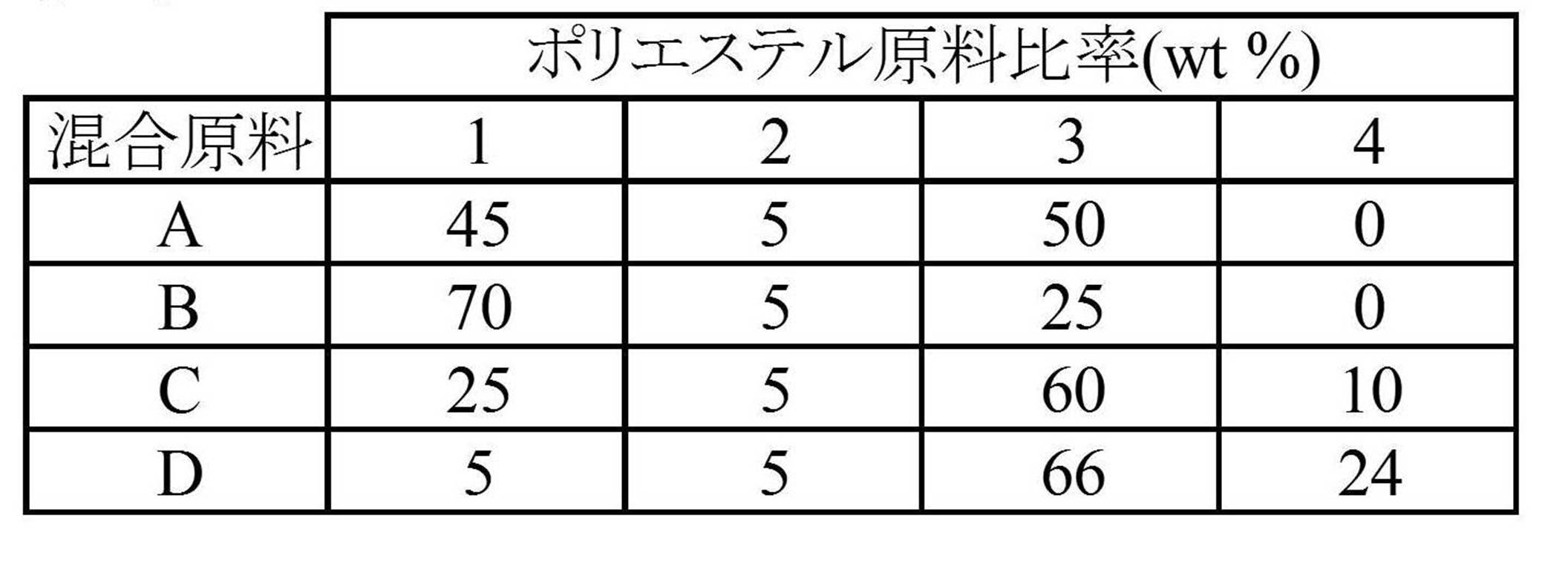
- Table 2 shows the ratio of mixed raw materials used in each layer
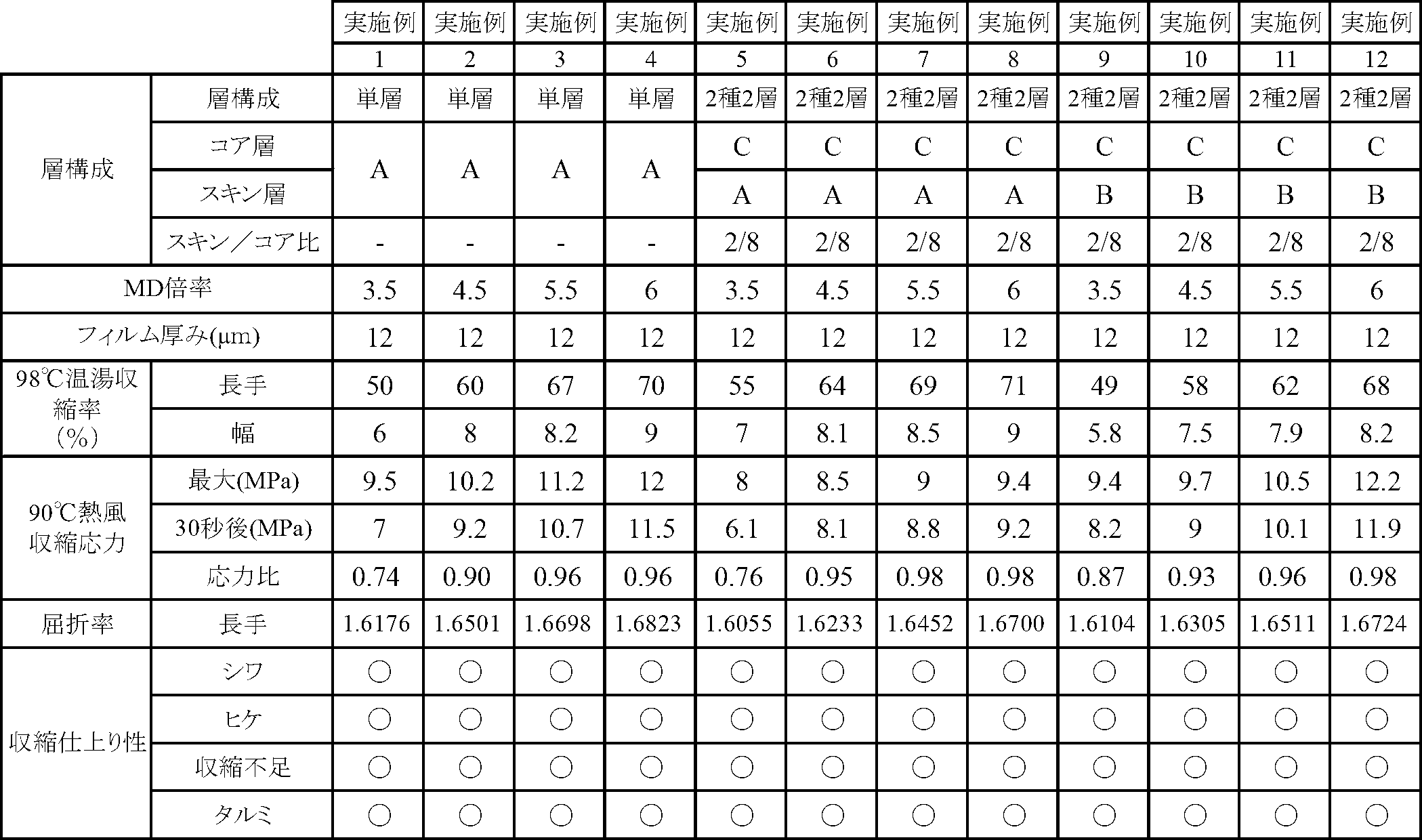
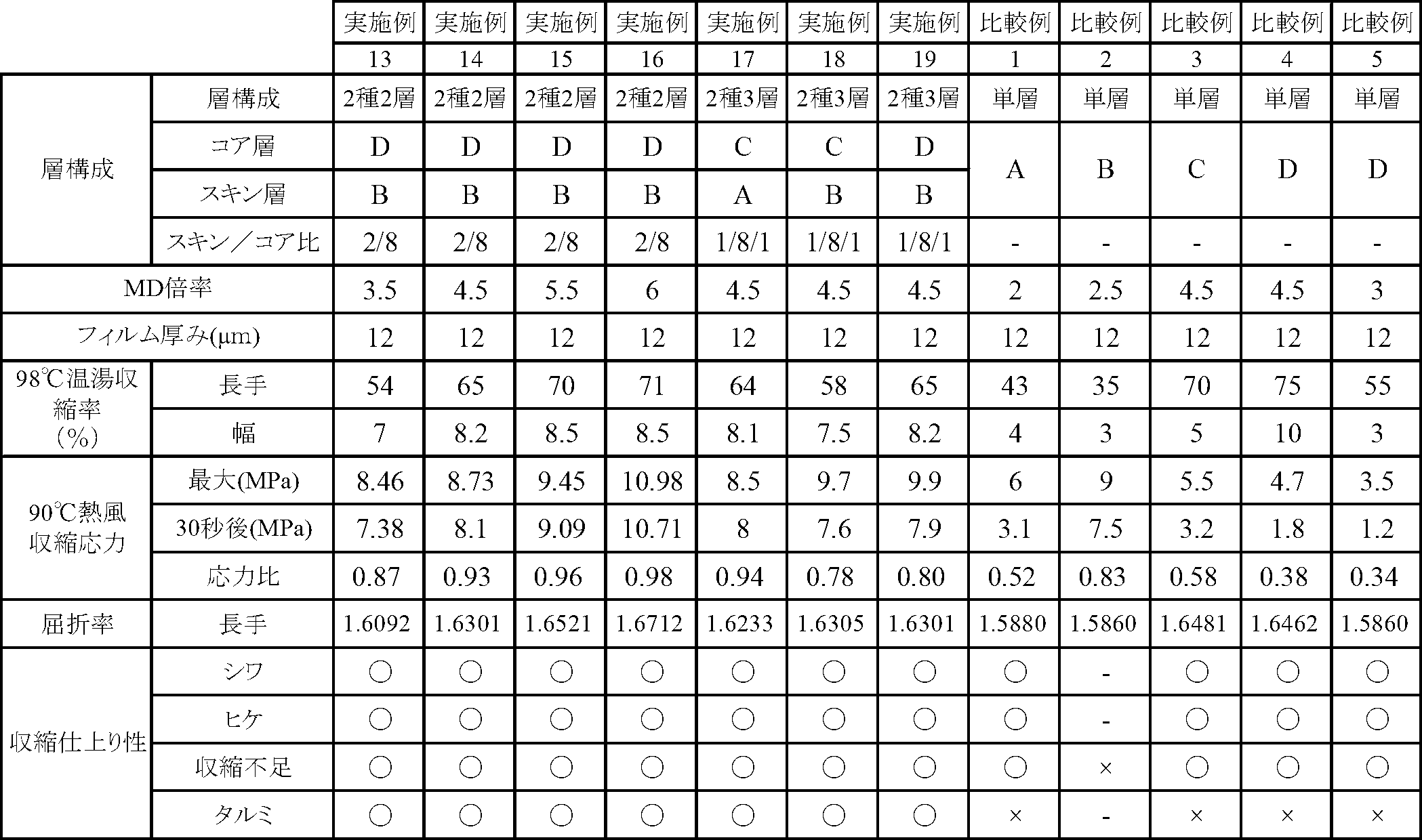
- Table 3 shows the production conditions and evaluation results of the films in Examples and Comparative Examples.
- the evaluation method of a film is as follows. [Tg (glass transition point)] Using a differential scanning calorimeter (Seiko Denshi Kogyo Co., Ltd., DSC220), 5 mg of unstretched film was placed in a sample pan, the pan was capped, and the temperature was reduced from ⁇ 40 ° C. to 120 ° C. at 10 ° C./120° C. The temperature was measured at a temperature rising rate of 1 minute. Tg (° C.) was determined based on JIS-K7121-1987.
- Heat shrinkage hot water heat shrinkage
- the film is cut into a 10 cm ⁇ 10 cm square, immersed in warm water at a predetermined temperature ⁇ 0.5 ° C. for 10 seconds under no load, and thermally contracted, and then immersed in water at 25 ° C. ⁇ 0.5 ° C. for 10 seconds. Then, the film was drawn out of water, the dimensions in the vertical and horizontal directions of the film were measured, and the thermal contraction rate was determined according to the following formula (1). The direction in which the heat shrinkage rate is large was taken as the main shrinkage direction.
- Thermal shrinkage rate ⁇ (length before shrinkage ⁇ length after shrinkage) / length before shrinkage ⁇ ⁇ 100 (%)
- the maximum value of the contraction stress measurement value from the start of measurement of the contraction stress to 30 seconds after the start of the measurement was defined as the maximum value of the contraction stress (maximum contraction stress (MPa)).
- MPa maximum contraction stress
- the distance between chucks was fixed to 100 mm, and the transition of the shrinkage stress from the start of measurement to 30 seconds after the start of measurement was measured.
- Fig. 2 shows the banding film and lunch box container after shrinkage as seen from above.
- L be the length from the end of one side of the film to the end of the other side of the film.
- the difference between the maximum value Lmax and the minimum value Lmin when measured at a pitch of 5 mm in the circumferential direction of the lunch box was defined as R.
- Judgment of large sinks was made for those with large R, and the criteria were as follows. ⁇ : 0mm ⁇ R ⁇ 10mm ⁇ : 10mm ⁇ R ⁇ 15mm ⁇ : 15mm ⁇ R
- Insufficient shrinkage was determined based on whether or not shrinkage occurred after finishing shrinkage, and the criteria were as follows. ⁇ : No contraction ⁇ : Insufficient contraction
- the banding film after shrinkage is not completely in close contact with the lunch box container, and when it is touched by hand, it is judged that there is no tightness and the film is floating, and the standard is as follows. did. ⁇ : The film is tightly tightened and there is no floating ⁇ : The film finish is loose and there is floating
- Synthesis example 1 In a stainless steel autoclave equipped with a stirrer, a thermometer and a partial reflux condenser, 100 mol% of dimethyl terephthalate (DMT) as a dicarboxylic acid component and 100 mol% of ethylene glycol (EG) as a polyhydric alcohol component, Charge ethylene glycol to a molar ratio 2.2 times that of dimethyl terephthalate, 0.05 mol% of zinc acetate (based on the acid component) as a transesterification catalyst, 0.225 mol of antimony trioxide as a polycondensation catalyst % (Based on the acid component) was added, and the ester exchange reaction was carried out while distilling off the produced methanol out of the system.
- DMT dimethyl terephthalate
- EG ethylene glycol
- NPG is neopentyl glycol
- BD is 1,4-butanediol
- DEG is by-product diethylene glycol.
- the intrinsic viscosities of each polyester were 2: 0.75 dl / g, 3: 1.20 dl / g, and 4: 1.20 dl / g, respectively.
- Each polyester was appropriately formed into a chip shape.
- Example 1 The above-mentioned polyester 1, polyester 2 and polyester 3 were mixed at a mass ratio of 45: 5: 50 and charged into an extruder. Thereafter, the mixed resin was melted at 280 ° C., extruded from a T-die, wound around a rotating metal roll cooled to a surface temperature of 30 ° C., and rapidly cooled to obtain an unstretched film having a thickness of 42 ⁇ m. The Tg of the unstretched film was 75 ° C.
- the unstretched film is guided to a longitudinal stretching machine in which a plurality of roll groups are continuously arranged, heated in a preheated roll shape until the film temperature reaches 80 ° C., and then the stretching ratio in the longitudinal direction is 3.5 times by a roll stretching method.
- the film was stretched longitudinally so that the thickness of the stretched film was 12 ⁇ m.
- the film was cooled with a cooling roll set at a surface temperature of 25 ° C. and then wound into a roll.
- the properties of the obtained film were evaluated by the above methods. The evaluation results are shown in Table 3. As a result of the evaluation, the film had sufficient shrinkage and good shrinkage finish.
- Example 2 Same as Example 1, except that the draw ratio in the longitudinal direction was 4.5 times and the extrusion amount was adjusted from the T-die of the mixed resin melted so that the thickness of the film after stretching in the longitudinal direction was 12 ⁇ m. It was. As a result of the evaluation, the film had sufficient shrinkage and good shrinkage finish.
- Example 3 Same as Example 1, except that the draw ratio in the longitudinal direction was 5.5 times and the extrusion amount was adjusted from a T-die of a mixed resin melted so that the thickness of the film after stretching in the longitudinal direction was 12 ⁇ m. It was. As a result of the evaluation, the film had sufficient shrinkage and good shrinkage finish.
- Example 4 The same as in Example 1, except that the stretching ratio in the longitudinal direction was 6 times and the extrusion amount was adjusted from the T-die of the mixed resin melted so that the thickness of the film after stretching in the longitudinal direction was 12 ⁇ m. . As a result of the evaluation, the film had sufficient shrinkage and good shrinkage finish.
- Example 5 The above-mentioned polyester 1, polyester 2 and polyester 3 were mixed at a mass ratio of 45: 5: 50 to obtain a resin mixture for the skin layer.
- the above-described resin mixture for each layer of the skin layer and the core layer was coextruded at a temperature of 280 ° C. using a T-die mold equipped with a two-layer multi-manifold using two twin-screw extruders, and promptly It cooled with the cooling roll and produced the sheet
- the sheet was heated to 80 ° C., and stretched longitudinally so that the stretching ratio in the longitudinal direction was 3.5 times and the total thickness of the stretched film was 12 ⁇ m by a roll stretching method. After longitudinal stretching, the film was cooled with a cooling roll and then wound into a roll. The properties of the obtained film were evaluated by the above methods. The evaluation results are shown in Table 3. As a result of the evaluation, the film had sufficient shrinkage and good shrinkage finish.
- Example 6 The same as in Example 5 except that the stretching ratio in the longitudinal direction was 4.5 times and the extrusion amount was adjusted from the T-die of the mixed resin melted so that the thickness of the film after stretching in the longitudinal direction was 12 ⁇ m. It was. As a result of the evaluation, the film had sufficient shrinkage and good shrinkage finish.
- Example 7 Same as Example 5 except that the draw ratio in the longitudinal direction was 5.5 times and the extrusion amount was adjusted from a T-die of a mixed resin melted so that the thickness of the film after stretching in the longitudinal direction was 12 ⁇ m. It was. As a result of the evaluation, the film had sufficient shrinkage and good shrinkage finish.
- Example 8 The same as in Example 5 except that the stretching ratio in the longitudinal direction was set to 6 and the extrusion amount was adjusted from the T-die of the mixed resin melted so that the thickness of the film after stretching in the longitudinal direction was 12 ⁇ m. . As a result of the evaluation, the film had sufficient shrinkage and good shrinkage finish.
- Example 9 It was the same as Example 5 except that the above-described polyester 1, polyester 2, and polyester 3 were mixed at a mass ratio of 70: 5: 25 to obtain a resin mixture for the skin layer. As a result of the evaluation, the film had sufficient shrinkage and good shrinkage finish.
- Example 10 Same as Example 9 except that the draw ratio in the longitudinal direction was 4.5 times and the extrusion amount was adjusted from the T-die of the mixed resin melted so that the thickness of the film after stretching in the longitudinal direction was 12 ⁇ m. It was. As a result of the evaluation, the film had sufficient shrinkage and good shrinkage finish.
- Example 11 Example 9 except that the draw ratio in the longitudinal direction was 5.5 times and the extrusion amount was adjusted from a T-die of a mixed resin melted so that the thickness of the film after stretching in the longitudinal direction was 12 ⁇ m. It was. As a result of the evaluation, the film had sufficient shrinkage and good shrinkage finish.
- Example 12 The same as in Example 9, except that the stretching ratio in the longitudinal direction was 6 times and the extrusion amount was adjusted from the T-die of the mixed resin melted so that the thickness of the film after stretching in the longitudinal direction was 12 ⁇ m. . As a result of the evaluation, the film had sufficient shrinkage and good shrinkage finish.
- Example 13 Polyester 1, polyester 2, polyester 3, and polyester 4 described above were mixed in a mass ratio of 5: 5: 66: 24 to obtain a resin mixture for the core layer, and the same as in Example 9. As a result of the evaluation, the film had sufficient shrinkage and good shrinkage finish. The evaluation results are shown in Table 4.
- Example 14 Example 13 except that the draw ratio in the longitudinal direction was set to 4.5 times and the extrusion amount was adjusted from a T-die of a mixed resin melted so that the thickness of the film after stretching in the longitudinal direction was 12 ⁇ m. It was. As a result of the evaluation, the film had sufficient shrinkage and good shrinkage finish.
- Example 15 Same as Example 13 except that the draw ratio in the longitudinal direction was set to 5.5 times and the extrusion amount was adjusted from the T-die of the mixed resin melted so that the thickness of the film after stretching in the longitudinal direction was 12 ⁇ m. It was. As a result of the evaluation, the film had sufficient shrinkage and good shrinkage finish.
- Example 16 The same as Example 13 except that the stretching ratio in the longitudinal direction was 6 times and the extrusion amount was adjusted from the T-die of the mixed resin melted so that the thickness of the film after stretching in the longitudinal direction was 12 ⁇ m. . As a result of the evaluation, the film had sufficient shrinkage and good shrinkage finish.
- Example 17 The above-mentioned polyester 1, polyester 2 and polyester 3 were mixed at a mass ratio of 45: 5: 50 to obtain a resin mixture for the skin layer.
- the above-mentioned resin mixture for each layer of the skin layer and the core layer was coextruded at a temperature of 280 ° C. using a T-die mold equipped with a three-layer multi-manifold using two twin-screw extruders, and promptly It cooled with the cooling roll and produced the sheet
- the sheet was heated to 80 ° C., and stretched in the longitudinal direction so that the stretching ratio in the longitudinal direction was 4.5 times and the total thickness of the stretched film was 12 ⁇ m by a roll stretching method. After longitudinal stretching, the film was cooled with a cooling roll and then wound into a roll. The properties of the obtained film were evaluated by the above methods. The evaluation results are shown in Table 4. As a result of the evaluation, the film had sufficient shrinkage and good shrinkage finish.
- Example 18 The same procedure as in Example 17 was performed except that the above-described polyester 1, polyester 2, and polyester 3 were mixed at a mass ratio of 70: 5: 25 to obtain a resin mixture for the skin layer. As a result of the evaluation, the film had sufficient shrinkage and good shrinkage finish.
- Example 19 Polyester 1, polyester 2, polyester 3 and polyester 4 described above were mixed at a mass ratio of 5: 5: 66: 24 to obtain a resin mixture for the core layer, and the same as in Example 18. As a result of the evaluation, the film had sufficient shrinkage and good shrinkage finish.
- Example 1 The same as in Example 1 except that the stretching ratio in the longitudinal direction was set to 2 and the extrusion amount was adjusted from a T-die of a mixed resin melted so that the thickness of the film after stretching in the longitudinal direction was 12 ⁇ m. .
- the banding film after shrinkage was talmi, and the film was inferior in shrink finish.
- Example 3 The same procedure as in Example 2 was performed except that the above-described polyester 1, polyester 2, polyester 3, and polyester 4 were mixed at a mass ratio of 25: 5: 60: 10 and charged into an extruder. As a result of evaluation, it was a film in which tarmi was generated in the label after shrinkage and the shrinkage finish was inferior.
- Example 4 The same procedure as in Example 2 was performed except that the above-described polyester 1, polyester 2, polyester 3, and polyester 4 were mixed at a mass ratio of 5: 5: 66: 24 and charged into an extruder. As a result of evaluation, the banding film after shrinkage was talmi, and the film was inferior in shrink finish.
- Comparative Example 5 The same as Comparative Example 4 except that the stretching ratio in the longitudinal direction was 3 times and the extrusion amount was adjusted from a T-die of a mixed resin melted so that the thickness of the film after stretching in the longitudinal direction was 12 ⁇ m. .
- the banding film after shrinkage was talmi, and the film was inferior in shrink finish.
- the heat-shrinkable polyester film of the present invention has excellent properties as described above, it can be suitably used for labeling and banding for binding lunch containers and the like.
- a package such as a lunch box used as a bottle or a banding film obtained by using the heat-shrinkable polyester film of the present invention as a label has a beautiful appearance.
Landscapes
- Chemical & Material Sciences (AREA)
- Engineering & Computer Science (AREA)
- Manufacturing & Machinery (AREA)
- Chemical Kinetics & Catalysis (AREA)
- Health & Medical Sciences (AREA)
- Medicinal Chemistry (AREA)
- Polymers & Plastics (AREA)
- Organic Chemistry (AREA)
- Mechanical Engineering (AREA)
- Materials Engineering (AREA)
- Shaping By String And By Release Of Stress In Plastics And The Like (AREA)
- Manufacture Of Macromolecular Shaped Articles (AREA)
- Wrappers (AREA)
- Laminated Bodies (AREA)
Abstract
Description
延伸することにより、90℃熱風での幅収縮方向の収縮応力の最大値が大きく、かつ30秒後の収縮応力の減衰が小さい熱収縮性フィルムが記載されており、ラベル用途において容器への追従性がよく、仕上がり後の弛みが生じ難く外観が良好であると記載されている。
1.主収縮方向が長手方向である熱収縮性ポリエステル系フィルムであって、下記要件(1)~(4)を満たすことを特徴とする熱収縮性ポリエステル系フィルム。
(1)98℃の温水中で10秒間に亘って処理した場合におけるフィルム主収縮方向の温湯収縮率が40%以上80%以下
(2)98℃の温水中で10秒間に亘って処理した場合における主収縮方向と直交する方向の温湯収縮率が-5%以上15%以下
(3)90℃の熱風下で測定したフィルム主収縮方向の収縮応力について、下式で示される収縮応力比が0.6以上1.0以下
収縮応力比=(30秒後の収縮応力の値)÷(収縮応力の最大値)
(4)フィルム主収縮方向の屈折率が1.600以上
2.90℃の熱風下で測定したフィルム主収縮方向の最大収縮応力が15MPa以下であることを特徴とする上記第1に記載の熱収縮性ポリエステル系フィルム。
3.エチレンテレフタレートを主たる構成成分とし、全ポリエステル樹脂成分中において非晶質成分となりうる1種以上のモノマー成分を10モル%以上含有していることを特徴とする上記第1又は2に記載の熱収縮性ポリエステル系フィルム。
4.非晶質成分となりうる1種以上のモノマー成分としてネオペンチルグリコールを使用していることを特徴とする上記第1~3のいずれかに記載の熱収縮性ポリエステル系フィルム。
5.包装対象物の外周の少なくとも一部を上記第1~4のいずれかに記載の熱収縮性フィルムによって被覆し、次いで熱収縮させることによって得られる包装体。
2:フィルム
3:シワ
4:弁当容器
5:フィルム
単層フィルムの場合、上記の理由から熱収縮性ポリエステル系フィルムに用いるポリエステルは、エチレンテレフタレートユニットを主たる構成成分とするものとなり、エチレンテレフタレートユニットは、ポリエステルの構成ユニット100モル%中、50モル%以上である。後述する長手方向延伸時の結晶化を促進させるために、エチレンテレフタレートユニットは、ポリエステルの構成ユニット100モル%中、55モル%以上がより好ましく、60モル%以上が更に好ましい。ただし、エチレンテレフタレートユニットの比率が高過ぎると、結晶化により収縮性を阻害し必要な高収縮を得にくくなるため、エチレンテレフタレートユニットの上限は70%以下が好ましい。
異なる樹脂組成からなる樹脂層を積層させた積層フィルムの場合、ポリエステルの構成ユニット100モル%中、エチレンテレフタレートユニットが50モル%以上であるポリエステル層を、フィルムの積層構成において少なくとも1層用いる必要がある。単層フィルムの場合と同様の理由、すなわち積層フィルムのフィルム構成中にエチレンテレフタレートユニットが50モル%以上含む層を少なくとも一層以上有することで、延伸倍率を3倍より高くすると結晶化が進行するために、収縮応力の減衰率が小さく、収縮開始から30秒後の収縮応力が高くなるという特徴を有する。
本発明の熱収縮性ポリエステル系フィルムは、98℃の温水中で無荷重状態で10秒間に亘って処理したときに、収縮前後の長さから、下式1により算出したフィルムの主収縮方向である長手方向の熱収縮率(すなわち、98℃の温湯熱収縮率)が、40%以上80%以下である。
熱収縮率={(収縮前の長さ-収縮後の長さ)/収縮前の長さ}×100(%)・・式1
収縮応力比=(30秒後の収縮応力の値)÷(収縮応力の最大値)
通常の熱収縮性ポリエステル系フィルムは、収縮させたい方向に未延伸フィルムを延伸することによって製造される。従来から収縮時に被包装体の形状に追従し、収縮後はタイトなしまり感を有する長手方向に収縮する熱収縮性ポリエステル系フィルムについての要求は高かったものの、未延伸フィルムを単純に長手方向に延伸するだけでは、収縮応力の減衰率が小さく、収縮開始から30秒後の収縮応力が高いポリエステルフィルムを得る事はできない。
本発明者は研究の結果、ポリエステルの構成ユニット100モル%中、エチレンテレフタレートユニットが50モル%以上含む層を少なくとも一層以上有するフィルムは、延伸倍率を3倍より高くすると結晶化が進行するために、収縮応力の減衰率が小さく、収縮開始から30秒後の収縮応力が高くなることが分かった。
率を表2に、実施例、比較例におけるフィルムの製造条件および評価結果を、表3に示す。

[Tg(ガラス転移点)]
示差走査熱量分析装置(セイコー電子工業株式会社製、DSC220)を用いて、未延伸フィルム5mgをサンプルパンに入れ、パンのふたをし、窒素ガス雰囲気下で-40℃から120℃に10℃/分の昇温速度で昇温して測定した。Tg(℃)はJIS-K7121-1987に基づいて求めた。
ポリエステル0.2gをフェノール/1,1,2,2-テトラクロルエタン(60/40(重量比))の混合溶媒50ml中に溶解し、30℃でオストワルド粘度計を用いて測定した。単位はdl/g。
フィルムを10cm×10cmの正方形に裁断し、所定温度±0.5℃の温水中に無荷重状態で10秒間浸漬して熱収縮させた後、25℃±0.5℃の水中に10秒間浸漬し、水中から引き出してフィルムの縦および横方向の寸法を測定し、下記式(1)にしたがって、それぞれ熱収縮率を求めた。熱収縮率の大きい方向を主収縮方向とした。
熱収縮率={(収縮前の長さ-収縮後の長さ)/収縮前の長さ}×100(%) 式1
熱収縮性フィルムから主収縮方向の長さが150mm、幅20mmの短冊状フィルムサンプルを切り出し、東洋ボールドウィン社製(現社名オリエンテック)の加熱炉付き強伸度測定機テシロン万能試験機 PTM-250(オリエンテック社の登録商標)を用いて収縮応力を測定した。強伸度測定機の加熱炉は予め炉内を90℃に加熱しておき、フィルムサンプルを把持するためのチャック間距離は100mmとした。サンプルを強伸度測定機のチャックに取り付ける際には、加熱炉の送風を一旦止めて加熱炉の扉を開け、長さ方向150mmのサンプルの両端25mmずつをチャック間に挟み、チャック間距離は100mmとして、チャック間とサンプルの長さ方向とが一致し且つサンプルが水平となるように緩みなく固定した。サンプルをチャックに取り付けた後、速やかに加熱炉の扉を閉めて、送風を再開した。加熱炉の扉を閉め送風を再開した時点を収縮応力の測定開始時点とし、30秒後の収縮応力(MPa)を求めた。また、収縮応力の測定開始時点から、測定開始後30秒までの間における収縮応力測定値の最大値を収縮応力の最大値(最大収縮応力(MPa))とした。尚、収縮応力の測定時にはチャック間距離を100mmに固定し、測定開始から測定開始後30秒までの収縮応力の推移を測定した。そして、収縮応力の最大値に対する測定開始時点から30秒後の収縮応力の値の比率を収縮応力比とした(下式で表す)
収縮応力比=(30秒後の収縮応力の値)÷(収縮応力の最大値)
アタゴ社製の「アッベ屈折計4T型」を用いて、各試料フィルムを23℃、65%RHの雰囲気中で2時間以上放置した後に測定した。
弁当のプラスチック容器(辺 150×150mm、高さ100mm)に対して、容器の胴部と蓋部をフィルムが結束するように、幅50mmのフィルムを容器の周方向をフィルムの収縮方向にして巻き付け、220℃で溶断シール後、設定温度90℃のシュリンクトンネルにて弁当のプラスチック容器に加熱収縮させた。収縮仕上り性の評価においては、シワ、ヒケ、収縮不足、タルミの4点において評価した。シワの評価に関しては、図1において、弁当容器の辺方向に入る長さ5cm以上のシワの個数で判断し、基準は下記のようにした
○:0~4個
△ : 5~14個
× : 15個以上
○:0mm ≦ R < 10mm
△ : 10mm ≦ R < 15mm
× : 15mm ≦ R
○:収縮不足なし
×:収縮不足あり
○:フィルムがタイトに締まっており、浮きが無い
×:フィルムの仕上りがゆるく、浮きがある
合成例1
撹拌機、温度計および部分環流式冷却器を備えたステンレススチール製オートクレーブに、ジカルボン酸成分としてジメチルテレフタレート(DMT)100モル%と、多価アルコール成分としてエチレングリコール(EG)100モル%とを、エチレングリコールがモル比でジメチルテレフタレートの2.2倍になるように仕込み、エステル交換触媒として酢酸亜鉛を0.05モル%(酸成分に対して)、重縮合触媒として三酸化アンチモン0.225モル%(酸成分に対して)を添加し、生成するメタノールを系外へ留去しながらエステル交換反応を行った。その後、280℃で26.7Paの減圧条件のもとで重縮合反応を行い、固有粘度0.75dl/gのポリエステル1を得た。組成を表1に示す。
合成例2~7
合成例1と同様の方法により、表1に示すポリエステル2~4を得た。ポリエステル2の製造の際には、滑剤としてSiO2(富士シリシア社製サイリシア266;平均粒径1.5μm)をポリエステルに対して7200ppmの割合で添加した。なお、表中、NPGはネオペンチルグリコール、BDは1,4-ブタンジオール、DEGは副生成物のジエチレングリコールである。各ポリエステルの固有粘度は、それぞれ、2:0.75dl/g,3:1.20dl/g,4:1.20dl/gであった。なお、各ポリエステルは、適宜チップ状にした。
上記したポリエステル1、ポリエステル2およびポリエステル3を質量比45:5:50で混合して押出機に投入した。しかる後、その混合樹脂を280℃で溶融させてTダイから押出し、表面温度30℃に冷却された回転する金属ロールに巻き付けて急冷することにより、厚さが42μmの未延伸フィルムを得た。未延伸フィルムのTgは75℃であった。当該未延伸フィルムを複数のロール群が連続的に配置した縦延伸機に導き、予熱ロール状でフィルム温度80℃になるまで加熱した後に、ロール延伸法によって長手方向の延伸倍率を3.5倍、延伸後のフィルムの厚さが12μmになるように縦延伸した。縦延伸後は表面温度25℃に設定された冷却ロールで冷却し、次いでロール状に巻き取った。得られたフィルムの特性を上記の方法により評価した。評価結果を表3に示す。評価の結果、十分な収縮性を有し、収縮仕上がり性が良いフィルムであった。
長手方向の延伸倍率を4.5倍とし、長手方向への延伸後のフィルムの厚さが12μmになるように溶融させた混合樹脂のTダイから押出し量を調整した以外は実施例1と同様とした。評価の結果、十分な収縮性を有し、収縮仕上がり性が良いフィルムであった。
長手方向の延伸倍率を5.5倍とし、長手方向への延伸後のフィルムの厚さが12μmになるように溶融させた混合樹脂のTダイから押出し量を調整した以外は実施例1と同様とした。評価の結果、十分な収縮性を有し、収縮仕上がり性が良いフィルムであった。
長手方向の延伸倍率を6倍とし、長手方向への延伸後のフィルムの厚さが12μmになるように溶融させた混合樹脂のTダイから押出し量を調整した以外は実施例1と同様とした。評価の結果、十分な収縮性を有し、収縮仕上がり性が良いフィルムであった。
上記したポリエステル1、ポリエステル2およびポリエステル3を質量比45:5:50で混合して、スキン層用の樹脂混合物とした。上記したポリエステル1、ポリエステル2、ポリエステル3およびポリエステル4を質量比25:5:60:10で混合して、コア層用の樹脂混合物とした。上記、スキン層およびコア層の各層用の樹脂混合物を、2台の2軸押出機を使用して2層マルチマニホールドを備えたTダイ金型を用いて280℃の温度で共押出し、速やかに冷却ロールで冷却し、スキン層/コア層の2層のシートを作製した。この時、スキン層とコア層の厚み比がスキン層:コア層=2:8となるように共押出しした。次いで、当該シートを80℃に加熱し、ロール延伸法によって長手方向の延伸倍率を3.5倍、延伸後のフィルムの総厚さが12μmとなるように縦延伸した。縦延伸後は冷却ロールで冷却し、次いでロール状に巻き取った。得られたフィルムの特性を上記の方法により評価した。評価結果を表3に示す。評価の結果、十分な収縮性を有し、収縮仕上がり性が良いフィルムであった。
長手方向の延伸倍率を4.5倍とし、長手方向への延伸後のフィルムの厚さが12μmになるように溶融させた混合樹脂のTダイから押出し量を調整した以外は実施例5と同様とした。評価の結果、十分な収縮性を有し、収縮仕上がり性が良いフィルムであった。
長手方向の延伸倍率を5.5倍とし、長手方向への延伸後のフィルムの厚さが12μmになるように溶融させた混合樹脂のTダイから押出し量を調整した以外は実施例5と同様とした。評価の結果、十分な収縮性を有し、収縮仕上がり性が良いフィルムであった。
長手方向の延伸倍率を6倍とし、長手方向への延伸後のフィルムの厚さが12μmになるように溶融させた混合樹脂のTダイから押出し量を調整した以外は実施例5と同様とした。評価の結果、十分な収縮性を有し、収縮仕上がり性が良いフィルムであった。
上記したポリエステル1、ポリエステル2およびポリエステル3を質量比70:5:25混合して、スキン層用の樹脂混合物とした以外は、実施例5と同様とした。評価の結果、十分な収縮性を有し、収縮仕上がり性が良いフィルムであった。
長手方向の延伸倍率を4.5倍とし、長手方向への延伸後のフィルムの厚さが12μmになるように溶融させた混合樹脂のTダイから押出し量を調整した以外は実施例9と同様とした。評価の結果、十分な収縮性を有し、収縮仕上がり性が良いフィルムであった。
長手方向の延伸倍率を5.5倍とし、長手方向への延伸後のフィルムの厚さが12μmになるように溶融させた混合樹脂のTダイから押出し量を調整した以外は実施例9と同様とした。評価の結果、十分な収縮性を有し、収縮仕上がり性が良いフィルムであった。
長手方向の延伸倍率を6倍とし、長手方向への延伸後のフィルムの厚さが12μmになるように溶融させた混合樹脂のTダイから押出し量を調整した以外は実施例9と同様とした。評価の結果、十分な収縮性を有し、収縮仕上がり性が良いフィルムであった。
上記したポリエステル1、ポリエステル2、ポリエステル3およびポリエステル4を質量比5:5:66:24で混合して、コア層用の樹脂混合物とした以外は実施例9と同様とした。評価の結果、十分な収縮性を有し、収縮仕上がり性が良いフィルムであった。評価結果を表4に示す。
長手方向の延伸倍率を4.5倍とし、長手方向への延伸後のフィルムの厚さが12μmになるように溶融させた混合樹脂のTダイから押出し量を調整した以外は実施例13と同様とした。評価の結果、十分な収縮性を有し、収縮仕上がり性が良いフィルムであった。
長手方向の延伸倍率を5.5倍とし、長手方向への延伸後のフィルムの厚さが12μmになるように溶融させた混合樹脂のTダイから押出し量を調整した以外は実施例13と同様とした。評価の結果、十分な収縮性を有し、収縮仕上がり性が良いフィルムであった。
長手方向の延伸倍率を6倍とし、長手方向への延伸後のフィルムの厚さが12μmになるように溶融させた混合樹脂のTダイから押出し量を調整した以外は実施例13と同様とした。評価の結果、十分な収縮性を有し、収縮仕上がり性が良いフィルムであった。
上記したポリエステル1、ポリエステル2およびポリエステル3を質量比45:5:50で混合して、スキン層用の樹脂混合物とした。上記したポリエステル1、ポリエステル2、ポリエステル3およびポリエステル4を質量比25:5:60:10で混合して、コア層用の樹脂混合物とした。上記、スキン層およびコア層の各層用の樹脂混合物を、2台の2軸押出機を使用して3層マルチマニホールドを備えたTダイ金型を用いて280℃の温度で共押出し、速やかに冷却ロールで冷却しスキン層/コア層/スキン層の3層のシートを作製した。この時、スキン層とコア層の厚み比がスキン層:コア層:スキン層=1:8:1となるように共押出しした。次いで、当該シートを80℃に加熱し、ロール延伸法によって長手方向の延伸倍率を4.5倍、延伸後のフィルムの総厚さが12μmになるように縦延伸した。縦延伸後は冷却ロールで冷却し、次いでロール状に巻き取った。得られたフィルムの特性を上記の方法により評価した。評価結果を表4に示す。評価の結果、十分な収縮性を有し、収縮仕上がり性が良いフィルムであった。
上記したポリエステル1、ポリエステル2およびポリエステル3を質量比70:5:25で混合して、スキン層用の樹脂混合物とした以外は実施例17と同様とした。評価の結果、十分な収縮性を有し、収縮仕上がり性が良いフィルムであった。
上記したポリエステル1、ポリエステル2、ポリエステル3およびポリエステル4を質量比5:5:66:24で混合して、コア層用の樹脂混合物とした以外は実施例18と同様とした。評価の結果、十分な収縮性を有し、収縮仕上がり性が良いフィルムであった。
長手方向の延伸倍率を2倍とし、長手方向への延伸後のフィルムの厚さが12μmになるように溶融させた混合樹脂のTダイから押出し量を調整した以外は実施例1と同様とした。評価の結果、収縮後のバンディングフィルムにタルミが生じ、収縮仕上がり性に劣るフィルムであった。
上記したポリエステル1、ポリエステル2およびポリエステル3を質量比70:5:25で混合して押出機に投入し、長手方向の延伸倍率を2.5倍とし、長手方向への延伸後のフィルムの厚さが12μmになるように溶融させた混合樹脂のTダイから押出し量を調整した以外は実施例1と同様とした。評価の結果、収縮後のバンディングフィルムは収縮量が不足し、収縮仕上がり性に劣るフィルムであった。
上記したポリエステル1、ポリエステル2、ポリエステル3およびポリエステル4を質量比25:5:60:10で混合して押出機に投入した以外は実施例2と同様とした。評価の結果、収縮後のラベルにタルミが生じ、収縮仕上がり性に劣るフィルムであった。
上記したポリエステル1、ポリエステル2、ポリエステル3およびポリエステル4を質量比5:5:66:24で混合して押出機に投入した以外は実施例2と同様とした。評価の結果、収縮後のバンディングフィルムにタルミが生じ、収縮仕上がり性に劣るフィルムであった。
長手方向の延伸倍率を3倍とし、長手方向への延伸後のフィルムの厚さが12μmになるように溶融させた混合樹脂のTダイから押出し量を調整した以外は比較例4と同様とした。評価の結果、収縮後のバンディングフィルムにタルミが生じ、収縮仕上がり性に劣るフィルムであった。
Claims (5)
- 主収縮方向が長手方向である熱収縮性ポリエステル系フィルムであって、下記要件(1)~(4)を満たすことを特徴とする熱収縮性ポリエステル系フィルム。
(1)98℃の温水中で10秒間に亘って処理した場合におけるフィルム主収縮方向の温湯収縮率が40%以上80%以下
(2)98℃の温水中で10秒間に亘って処理した場合におけるフィルム主収縮方向と直交する方向の温湯収縮率が-5%以上15%以下
(3)90℃の熱風下で測定したフィルム主収縮方向の収縮応力について、下式で示される収縮応力比が0.6以上1.0以下
収縮応力比=(30秒後の収縮応力の値)÷(収縮応力の最大値)
(4)フィルム主収縮方向の屈折率が1.600以上 - 90℃の熱風下で測定したフィルム主収縮方向の最大収縮応力が15MPa以下であることを特徴とする請求項1に記載の熱収縮性ポリエステル系フィルム。
- エチレンテレフタレートを主たる構成成分とし、全ポリエステル樹脂成分中において非晶質成分となりうる1種以上のモノマー成分を2モル%以上含有していることを特徴とする請求項1又は2に記載の熱収縮性ポリエステル系フィルム。
- 非晶質成分となりうる1種以上のモノマー成分としてネオペンチルグリコールを使用していることを特徴とする請求項1~3のいずれかに記載の熱収縮性ポリエステル系フィルム。
- 包装対象物の外周の少なくとも一部を請求項1~4のいずれかに記載の熱収縮性フィルムによって被覆し、次いで熱収縮させることによって得られる包装体。
Priority Applications (3)
| Application Number | Priority Date | Filing Date | Title |
|---|---|---|---|
| US15/580,726 US20180162616A1 (en) | 2015-06-11 | 2016-06-08 | Heat-shrinkable polyester film and package |
| KR1020177035725A KR102463003B1 (ko) | 2015-06-11 | 2016-06-08 | 열수축성 폴리에스테르계 필름 및 포장체 |
| CN201680033264.4A CN107708966B (zh) | 2015-06-11 | 2016-06-08 | 热收缩性聚酯系薄膜和包装体 |
Applications Claiming Priority (2)
| Application Number | Priority Date | Filing Date | Title |
|---|---|---|---|
| JP2015118277A JP6519331B2 (ja) | 2015-06-11 | 2015-06-11 | 熱収縮性ポリエステル系フィルムおよび包装体 |
| JP2015-118277 | 2015-06-11 |
Publications (1)
| Publication Number | Publication Date |
|---|---|
| WO2016199809A1 true WO2016199809A1 (ja) | 2016-12-15 |
Family
ID=57503850
Family Applications (1)
| Application Number | Title | Priority Date | Filing Date |
|---|---|---|---|
| PCT/JP2016/067049 Ceased WO2016199809A1 (ja) | 2015-06-11 | 2016-06-08 | 熱収縮性ポリエステル系フィルムおよび包装体 |
Country Status (6)
| Country | Link |
|---|---|
| US (1) | US20180162616A1 (ja) |
| JP (1) | JP6519331B2 (ja) |
| KR (1) | KR102463003B1 (ja) |
| CN (1) | CN107708966B (ja) |
| TW (1) | TWI696551B (ja) |
| WO (1) | WO2016199809A1 (ja) |
Cited By (3)
| Publication number | Priority date | Publication date | Assignee | Title |
|---|---|---|---|---|
| US10994880B2 (en) | 2018-05-21 | 2021-05-04 | Skc Co., Ltd. | Heat shrinkable film and preparation method thereof |
| US11548996B2 (en) | 2018-04-30 | 2023-01-10 | Skc Co., Ltd. | Polyester film and method for reproducing polyester container using same |
| WO2025009456A1 (ja) * | 2023-07-04 | 2025-01-09 | 東洋紡株式会社 | 熱収縮性ポリエステル系フィルム |
Families Citing this family (7)
| Publication number | Priority date | Publication date | Assignee | Title |
|---|---|---|---|---|
| KR102654779B1 (ko) * | 2016-11-24 | 2024-04-03 | 에스케이케미칼 주식회사 | 다층 mdo 내열 열수축성 필름 |
| KR102654778B1 (ko) * | 2016-11-24 | 2024-04-03 | 에스케이케미칼 주식회사 | 내열성 mdo 열수축 필름 |
| MX2021003703A (es) | 2018-10-08 | 2021-06-04 | Eastman Chem Co | Peliculas contraibles cristalizables y laminas termoformables hechas de mezclas de resina. |
| WO2020246420A1 (ja) * | 2019-06-05 | 2020-12-10 | 東洋紡株式会社 | 縦(長手)方向を主収縮方向とする熱収縮性ポリエステル系フィルム |
| WO2021072020A1 (en) | 2019-10-08 | 2021-04-15 | Eastman Chemical Company | Catalyst systems for crystallizable reactor grade resins with recycled content |
| KR102553960B1 (ko) | 2021-07-05 | 2023-07-11 | 에스케이마이크로웍스 주식회사 | 폴리에스테르 필름, 이를 포함하는 열수축성 라벨 및 포장재 |
| CN117162437B (zh) * | 2023-11-02 | 2024-06-18 | 河南银金达新材料股份有限公司 | 一种低纵向收缩率pla热缩膜及其制备方法 |
Citations (3)
| Publication number | Priority date | Publication date | Assignee | Title |
|---|---|---|---|---|
| JP2004181863A (ja) * | 2002-12-05 | 2004-07-02 | Toyobo Co Ltd | 熱収縮性ポリエステル系フィルムロールおよびその製造方法 |
| WO2004063255A1 (ja) * | 2002-12-24 | 2004-07-29 | Toyo Boseki Kabushiki Kasisha | 熱収縮性ポリエステル系フィルム |
| JP2007237434A (ja) * | 2006-03-06 | 2007-09-20 | Teijin Dupont Films Japan Ltd | 熱収縮性フィルム |
Family Cites Families (11)
| Publication number | Priority date | Publication date | Assignee | Title |
|---|---|---|---|---|
| JPS5240387B2 (ja) | 1972-01-29 | 1977-10-12 | ||
| GB9806537D0 (en) * | 1998-03-26 | 1998-05-27 | Kobe Steel Europ Ltd | Polyester compositions |
| WO2004067669A1 (ja) * | 2003-01-30 | 2004-08-12 | Suzuka Fuji Xerox Co., Ltd. | 帯電防止剤、塗料用または成形用合成樹脂 |
| JP4411556B2 (ja) * | 2006-06-14 | 2010-02-10 | 東洋紡績株式会社 | 熱収縮性ポリエステル系フィルム、およびその製造方法 |
| JP5381044B2 (ja) * | 2008-11-26 | 2014-01-08 | 東洋紡株式会社 | 熱収縮性ラベルおよびその製造方法 |
| KR20110060829A (ko) * | 2009-11-30 | 2011-06-08 | 스미또모 가가꾸 가부시끼가이샤 | 액정 폴리에스테르의 제조 방법, 액정 폴리에스테르 조성물, 반사판 및 발광 장치 |
| US20110177283A1 (en) * | 2010-01-18 | 2011-07-21 | Futuris Automotive Interiors (Us), Inc. | PET Carpet With Additive |
| KR100981129B1 (ko) * | 2010-03-09 | 2010-09-10 | 에스케이씨 주식회사 | 열수축성 폴리에스터계 필름 |
| JP5240387B1 (ja) * | 2012-07-26 | 2013-07-17 | 東洋紡株式会社 | 熱収縮性ポリエステル系フィルムおよび包装体 |
| MY173061A (en) * | 2012-08-03 | 2019-12-23 | Toyo Boseki | Heat-shrinkable polyester-based film |
| CA2912355C (en) * | 2013-05-16 | 2021-02-16 | Toyobo Co., Ltd. | Heat-shrinkable polyester film and package |
-
2015
- 2015-06-11 JP JP2015118277A patent/JP6519331B2/ja active Active
-
2016
- 2016-06-08 US US15/580,726 patent/US20180162616A1/en active Pending
- 2016-06-08 WO PCT/JP2016/067049 patent/WO2016199809A1/ja not_active Ceased
- 2016-06-08 KR KR1020177035725A patent/KR102463003B1/ko active Active
- 2016-06-08 TW TW105118156A patent/TWI696551B/zh active
- 2016-06-08 CN CN201680033264.4A patent/CN107708966B/zh active Active
Patent Citations (3)
| Publication number | Priority date | Publication date | Assignee | Title |
|---|---|---|---|---|
| JP2004181863A (ja) * | 2002-12-05 | 2004-07-02 | Toyobo Co Ltd | 熱収縮性ポリエステル系フィルムロールおよびその製造方法 |
| WO2004063255A1 (ja) * | 2002-12-24 | 2004-07-29 | Toyo Boseki Kabushiki Kasisha | 熱収縮性ポリエステル系フィルム |
| JP2007237434A (ja) * | 2006-03-06 | 2007-09-20 | Teijin Dupont Films Japan Ltd | 熱収縮性フィルム |
Cited By (4)
| Publication number | Priority date | Publication date | Assignee | Title |
|---|---|---|---|---|
| US11548996B2 (en) | 2018-04-30 | 2023-01-10 | Skc Co., Ltd. | Polyester film and method for reproducing polyester container using same |
| US10994880B2 (en) | 2018-05-21 | 2021-05-04 | Skc Co., Ltd. | Heat shrinkable film and preparation method thereof |
| US11655062B2 (en) | 2018-05-21 | 2023-05-23 | Sk Microworks Co., Ltd. | Heat shrinkable film and preparation method thereof |
| WO2025009456A1 (ja) * | 2023-07-04 | 2025-01-09 | 東洋紡株式会社 | 熱収縮性ポリエステル系フィルム |
Also Published As
| Publication number | Publication date |
|---|---|
| US20180162616A1 (en) | 2018-06-14 |
| KR20180018553A (ko) | 2018-02-21 |
| JP2017213682A (ja) | 2017-12-07 |
| TWI696551B (zh) | 2020-06-21 |
| KR102463003B1 (ko) | 2022-11-02 |
| TW201706136A (zh) | 2017-02-16 |
| JP6519331B2 (ja) | 2019-05-29 |
| CN107708966A (zh) | 2018-02-16 |
| CN107708966B (zh) | 2020-02-21 |
Similar Documents
| Publication | Publication Date | Title |
|---|---|---|
| JP6572907B2 (ja) | 熱収縮性ポリエステル系フィルム、およびその製造方法、包装体 | |
| JP6519331B2 (ja) | 熱収縮性ポリエステル系フィルムおよび包装体 | |
| JP6597633B2 (ja) | 熱収縮性ポリエステル系フィルムおよび包装体 | |
| JP6337774B2 (ja) | 熱収縮性ポリエステル系フィルムおよび包装体 | |
| JP6485054B2 (ja) | 熱収縮性ポリエステル系フィルムおよび包装体 | |
| JP6459533B2 (ja) | 熱収縮性ポリエステル系フィルムおよび包装体 | |
| TWI777966B (zh) | 熱收縮性聚酯系膜以及包裝體 | |
| JPWO2018147249A1 (ja) | 非晶性のフィルム用共重合ポリエステル原料、熱収縮性ポリエステル系フィルム、熱収縮性ラベル、及び包装体 | |
| JP6642001B2 (ja) | 熱収縮性ポリエステル系フィルム及び包装体 | |
| JP2019177702A (ja) | 熱収縮性ポリエステル系フィルムロール | |
| JP2019147954A (ja) | 熱収縮性ポリエステル系フィルムおよび包装体 | |
| JP6988440B2 (ja) | ヒートシール性に優れた熱収縮性ポリエステル系フィルム | |
| JP6721071B2 (ja) | 熱収縮性ポリエステル系フィルムおよび包装体 | |
| JP6760434B2 (ja) | 熱収縮性ポリエステル系フィルムロール | |
| JP2015229242A (ja) | 熱収縮性ポリエステル系フィルム及び包装体 | |
| JP2017024382A (ja) | 熱収縮性ポリエステル系フィルムおよび包装体 | |
| JP2019178236A (ja) | 熱収縮性ポリエステル系フィルム | |
| TW202110970A (zh) | 熱收縮性聚酯系膜、標籤、及包裝體 | |
| KR102411172B1 (ko) | 열수축성 폴리에스테르계 라벨, 포장체 및 열수축성 폴리에스테르계 라벨의 제조방법 | |
| JP6888702B2 (ja) | 熱収縮性ポリエステル系フィルムおよび包装体 | |
| WO2020246420A1 (ja) | 縦(長手)方向を主収縮方向とする熱収縮性ポリエステル系フィルム | |
| JP6673453B2 (ja) | 熱収縮性ポリエステル系フィルムおよび包装体 |
Legal Events
| Date | Code | Title | Description |
|---|---|---|---|
| 121 | Ep: the epo has been informed by wipo that ep was designated in this application |
Ref document number: 16807515 Country of ref document: EP Kind code of ref document: A1 |
|
| WWE | Wipo information: entry into national phase |
Ref document number: 15580726 Country of ref document: US |
|
| ENP | Entry into the national phase |
Ref document number: 20177035725 Country of ref document: KR Kind code of ref document: A |
|
| NENP | Non-entry into the national phase |
Ref country code: DE |
|
| 122 | Ep: pct application non-entry in european phase |
Ref document number: 16807515 Country of ref document: EP Kind code of ref document: A1 |