WO2016194936A1 - 磁性粉末複合体、アンテナおよび電子機器、とその製造方法 - Google Patents
磁性粉末複合体、アンテナおよび電子機器、とその製造方法 Download PDFInfo
- Publication number
- WO2016194936A1 WO2016194936A1 PCT/JP2016/066148 JP2016066148W WO2016194936A1 WO 2016194936 A1 WO2016194936 A1 WO 2016194936A1 JP 2016066148 W JP2016066148 W JP 2016066148W WO 2016194936 A1 WO2016194936 A1 WO 2016194936A1
- Authority
- WO
- WIPO (PCT)
- Prior art keywords
- magnetic powder
- carboxylic acid
- acid
- powder composite
- anhydride
- Prior art date
- Legal status (The legal status is an assumption and is not a legal conclusion. Google has not performed a legal analysis and makes no representation as to the accuracy of the status listed.)
- Ceased
Links
Classifications
-
- H—ELECTRICITY
- H01—ELECTRIC ELEMENTS
- H01F—MAGNETS; INDUCTANCES; TRANSFORMERS; SELECTION OF MATERIALS FOR THEIR MAGNETIC PROPERTIES
- H01F1/00—Magnets or magnetic bodies characterised by the magnetic materials therefor; Selection of materials for their magnetic properties
- H01F1/01—Magnets or magnetic bodies characterised by the magnetic materials therefor; Selection of materials for their magnetic properties of inorganic materials
- H01F1/03—Magnets or magnetic bodies characterised by the magnetic materials therefor; Selection of materials for their magnetic properties of inorganic materials characterised by their coercivity
- H01F1/12—Magnets or magnetic bodies characterised by the magnetic materials therefor; Selection of materials for their magnetic properties of inorganic materials characterised by their coercivity of soft-magnetic materials
- H01F1/14—Magnets or magnetic bodies characterised by the magnetic materials therefor; Selection of materials for their magnetic properties of inorganic materials characterised by their coercivity of soft-magnetic materials metals or alloys
- H01F1/20—Magnets or magnetic bodies characterised by the magnetic materials therefor; Selection of materials for their magnetic properties of inorganic materials characterised by their coercivity of soft-magnetic materials metals or alloys in the form of particles, e.g. powder
- H01F1/22—Magnets or magnetic bodies characterised by the magnetic materials therefor; Selection of materials for their magnetic properties of inorganic materials characterised by their coercivity of soft-magnetic materials metals or alloys in the form of particles, e.g. powder pressed, sintered, or bound together
- H01F1/24—Magnets or magnetic bodies characterised by the magnetic materials therefor; Selection of materials for their magnetic properties of inorganic materials characterised by their coercivity of soft-magnetic materials metals or alloys in the form of particles, e.g. powder pressed, sintered, or bound together the particles being insulated
- H01F1/26—Magnets or magnetic bodies characterised by the magnetic materials therefor; Selection of materials for their magnetic properties of inorganic materials characterised by their coercivity of soft-magnetic materials metals or alloys in the form of particles, e.g. powder pressed, sintered, or bound together the particles being insulated by macromolecular organic substances
-
- B—PERFORMING OPERATIONS; TRANSPORTING
- B22—CASTING; POWDER METALLURGY
- B22F—WORKING METALLIC POWDER; MANUFACTURE OF ARTICLES FROM METALLIC POWDER; MAKING METALLIC POWDER; APPARATUS OR DEVICES SPECIALLY ADAPTED FOR METALLIC POWDER
- B22F1/00—Metallic powder; Treatment of metallic powder, e.g. to facilitate working or to improve properties
- B22F1/10—Metallic powder containing lubricating or binding agents; Metallic powder containing organic material
-
- B—PERFORMING OPERATIONS; TRANSPORTING
- B22—CASTING; POWDER METALLURGY
- B22F—WORKING METALLIC POWDER; MANUFACTURE OF ARTICLES FROM METALLIC POWDER; MAKING METALLIC POWDER; APPARATUS OR DEVICES SPECIALLY ADAPTED FOR METALLIC POWDER
- B22F1/00—Metallic powder; Treatment of metallic powder, e.g. to facilitate working or to improve properties
- B22F1/10—Metallic powder containing lubricating or binding agents; Metallic powder containing organic material
- B22F1/102—Metallic powder coated with organic material
-
- B—PERFORMING OPERATIONS; TRANSPORTING
- B22—CASTING; POWDER METALLURGY
- B22F—WORKING METALLIC POWDER; MANUFACTURE OF ARTICLES FROM METALLIC POWDER; MAKING METALLIC POWDER; APPARATUS OR DEVICES SPECIALLY ADAPTED FOR METALLIC POWDER
- B22F1/00—Metallic powder; Treatment of metallic powder, e.g. to facilitate working or to improve properties
- B22F1/10—Metallic powder containing lubricating or binding agents; Metallic powder containing organic material
- B22F1/103—Metallic powder containing lubricating or binding agents; Metallic powder containing organic material containing an organic binding agent comprising a mixture of, or obtained by reaction of, two or more components other than a solvent or a lubricating agent
-
- H—ELECTRICITY
- H01—ELECTRIC ELEMENTS
- H01F—MAGNETS; INDUCTANCES; TRANSFORMERS; SELECTION OF MATERIALS FOR THEIR MAGNETIC PROPERTIES
- H01F1/00—Magnets or magnetic bodies characterised by the magnetic materials therefor; Selection of materials for their magnetic properties
- H01F1/44—Magnets or magnetic bodies characterised by the magnetic materials therefor; Selection of materials for their magnetic properties of magnetic liquids, e.g. ferrofluids
- H01F1/442—Magnets or magnetic bodies characterised by the magnetic materials therefor; Selection of materials for their magnetic properties of magnetic liquids, e.g. ferrofluids the magnetic component being a metal or alloy, e.g. Fe
-
- H—ELECTRICITY
- H01—ELECTRIC ELEMENTS
- H01F—MAGNETS; INDUCTANCES; TRANSFORMERS; SELECTION OF MATERIALS FOR THEIR MAGNETIC PROPERTIES
- H01F41/00—Apparatus or processes specially adapted for manufacturing or assembling magnets, inductances or transformers; Apparatus or processes specially adapted for manufacturing materials characterised by their magnetic properties
-
- B—PERFORMING OPERATIONS; TRANSPORTING
- B22—CASTING; POWDER METALLURGY
- B22F—WORKING METALLIC POWDER; MANUFACTURE OF ARTICLES FROM METALLIC POWDER; MAKING METALLIC POWDER; APPARATUS OR DEVICES SPECIALLY ADAPTED FOR METALLIC POWDER
- B22F2998/00—Supplementary information concerning processes or compositions relating to powder metallurgy
- B22F2998/10—Processes characterised by the sequence of their steps
-
- B—PERFORMING OPERATIONS; TRANSPORTING
- B22—CASTING; POWDER METALLURGY
- B22F—WORKING METALLIC POWDER; MANUFACTURE OF ARTICLES FROM METALLIC POWDER; MAKING METALLIC POWDER; APPARATUS OR DEVICES SPECIALLY ADAPTED FOR METALLIC POWDER
- B22F2999/00—Aspects linked to processes or compositions used in powder metallurgy
-
- C—CHEMISTRY; METALLURGY
- C22—METALLURGY; FERROUS OR NON-FERROUS ALLOYS; TREATMENT OF ALLOYS OR NON-FERROUS METALS
- C22C—ALLOYS
- C22C2202/00—Physical properties
- C22C2202/02—Magnetic
Definitions
- the present invention relates to a magnetic powder composite, an antenna, and an electronic device.
- Patent Document 1 describes a magnetic composite material that also functions in a high-frequency region.
- This magnetic composite material preferably has needle-shaped magnetic metal particles having an aspect ratio (major axis length / minor axis length) of 1.5 to 20 in a dielectric material such as polyarylene ether resin or polyethylene resin.
- a dielectric material such as polyarylene ether resin or polyethylene resin.
- Patent Document 2 describes a composite magnetic material that can be used for a small antenna that can be used in a wide band.
- This composite magnetic material is obtained by dispersing a composite magnetic material in an insulating material.
- the magnetic powder is a substantially spherical powder containing a soft magnetic metal, and has an average particle diameter D 50 of 0.1 to 3 ⁇ m, and a crystallite having an average crystallite diameter of 2 to 100 nm in the particles,
- Various resins are described as the insulating material ([0018] to [0021] of Patent Document 2).
- an antenna is manufactured by mixing magnetic powder, a thermoplastic PC / ABS resin, a solvent, and the like (see [0069]).
- tan ⁇ at a frequency of 2 GHz is less than 0.01, and that the volume ratio of the magnetic powder to the total volume is 2 to 50 vol%, so that the antenna can be miniaturized (see [0031] ] [0032].
- Patent Document 3 describes that the loss factor in the GHz band of an inductor, an antenna, or the like can be suppressed to a low level by using metal magnetic powder.
- a bonded magnet having heat resistance includes magnet powder, polyphenylene sulfide (PPS) resin, and polyamide (PA) resin, and the content ratio of the magnet powder in the magnetic composite is 79 to 94.5 wt%, It is described that the content ratio of the PPS resin is 5 to 20 wt% and the content ratio of the PA resin is 0.1 to 2 wt% (see [Claim 1] of Patent Document 4).
- magnetic compound As described above, there is a description of a magnetic composite containing metal magnetic powder and resin (also referred to as “magnetic compound”), but in a magnetic composite containing metal magnetic powder and resin, the metal magnetic powder is inorganic.
- the fine particles of the compound, and the resin is a polymer compound. That is, the metal magnetic powder and the resin have completely different chemical properties and physical properties. For this reason, it is difficult to predict the performance of the magnetic composite, and various trial and error studies are required as in the prior art.
- JP 2014-116332 A JP2011-096923A JP 2013-236021 A JP2013-077802A
- Patent Documents 1 to 4 disclose magnetic compounds having a high content ratio of magnetic powder.
- the content of the metal magnetic powder in the magnetic compound Sufficient high-frequency characteristics can be obtained even if the value is reduced to some extent.
- Patent Document 4 describes that other unexpected effects may occur during kneading and molding because the wettability between the PPS resin and the magnetic powder is poor (Patent Document 4 [[ [0008] [0035]). ). In the high frequency range, many resins with low dielectric loss can be seen, but it is difficult to obtain a magnetic compound with low dielectric loss even when kneading metal magnetic powder and resin to simply take good points. It was confirmed.
- the problem to be solved is to provide a metal magnetic powder that disperses well in a resin with a low dielectric loss, thereby providing a magnetic compound with a low dielectric loss, and thus an antenna formed from the magnetic compound and an electronic device incorporating the antenna.
- an antenna is formed from a resin in which metal magnetic powder is mixed with a resin, the antenna itself can be reduced due to the wavelength shortening effect, and thus downsizing of portable devices and smartphones. Can contribute.
- Patent Document 1 magnetic compound materials used for antennas and the like have been limited to investigations related to metal materials even if they are configured to be mixed with resin.
- the present inventor described above how to improve the familiarity with the resin to which the metal magnetic powder is mixed, instead of the metal magnetic powder alone that can be mixed with the resin and express the characteristics. We came up with a technological idea that there was a clue that could solve this problem.
- the first aspect of the present invention is: Metal magnetic powder, A magnetic powder composite comprising one or more selected from carboxylic acid or anhydride, aromatic carboxylic acid ester, and derivatives thereof, To a thermoplastic resin having a tan ⁇ at 1 MHz specified in IEC 60250 or JISC2138: 2007 of 0.05 or less with respect to 100 parts by mass of the metal magnetic powder, the carboxylic acid or its anhydride, an aromatic carboxylic acid ester, And 30% by volume of a magnetic powder composite prepared by adding 5 parts by mass of one or more selected from those derivatives, the real part ⁇ ′ of the permeability is 1.45 or more at a measurement frequency of 2 GHz. Tan ⁇ is 0.1 or less, and tan ⁇ is 0.05 or less.
- the second aspect of the present invention is:
- the said thermoplastic resin is a magnetic powder composite_body
- the third aspect of the present invention is: Metal magnetic powder, A magnetic powder composite comprising one or more selected from carboxylic acid or anhydride, aromatic carboxylic acid ester, and derivatives thereof, A material containing at least one selected from SPS, m-PPE, and PPS, and 100 parts by mass of the metal magnetic powder, the carboxylic acid or its anhydride, an aromatic carboxylic acid ester, and derivatives thereof
- 30% by volume of a magnetic powder composite prepared by adding one or more 5 parts by mass selected from the above is included, at a measurement frequency of 2 GHz, the real part ⁇ ′ of the magnetic permeability is 1.45 or more and tan ⁇ is 0. .1 or less, tan ⁇ is a magnetic powder composite having a property of showing a value of 0.05 or less.
- the fourth aspect of the present invention is: In the invention described in the first to third aspects,
- the carboxylic acid is a magnetic powder composite that is at least one selected from aromatic carboxylic acids, unsaturated carboxylic acids, and dicarboxylic acids.
- the magnetic powder composite has 4 or more and 30 or less carbon atoms constituting any of the carboxylic acid or its anhydride, aromatic carboxylic acid ester, and derivatives thereof.
- the sixth aspect of the present invention is: In the invention according to any one of the first to fifth aspects,
- the carboxylic acid or its anhydride, aromatic carboxylic acid ester, and derivatives thereof are phthalic acid, phthalic anhydride, maleic acid, maleic anhydride, succinic acid, succinic anhydride, malonic acid, fumaric acid, glutaric acid
- a magnetic powder composite which is at least one selected from azelaic acid, sebacic acid, benzoic acid, dimethyl phthalate and derivatives thereof.
- the seventh aspect of the present invention is The magnetic powder composite according to any one of the first to fifth aspects; A magnetic compound containing at least one resin selected from SPS and m-PPE.
- the eighth aspect of the present invention is Examples of the carboxylic acid or anhydride, aromatic carboxylic acid ester, and derivatives thereof include maleic acid, maleic anhydride, succinic acid, succinic anhydride, malonic acid, fumaric acid, glutaric acid, azelaic acid, sebacic acid, benzoic acid
- the magnetic powder composite according to the sixth aspect which comprises at least one selected from acids and derivatives thereof; A magnetic compound containing PPS resin.
- the ninth aspect of the present invention provides An antenna comprising the magnetic powder composite according to any one of the first to sixth.
- the tenth aspect of the present invention provides An electronic apparatus comprising an antenna constituted by the magnetic powder composite according to any one of the first to sixth.
- the eleventh aspect of the present invention is Metal magnetic powder, This is a method for producing a magnetic powder composite in which a magnetic powder composite is produced by mixing a carboxylic acid or an anhydride thereof, an aromatic carboxylic acid ester, and a derivative thereof.
- the twelfth aspect of the present invention provides Metal magnetic powder, In the step of mixing a carboxylic acid or its anhydride, an aromatic carboxylic acid ester, and a derivative thereof, a magnetic powder composite is produced by interposing a solution having a boiling point at 1 atm of 100 ° C. or less.
- the method for producing a magnetic powder composite according to the eleventh aspect is described in detail below.
- a magnetic powder composite that is well dispersed in a resin having a low dielectric loss, a magnetic compound having a low dielectric loss, and thus an antenna formed from the magnetic compound, and the antenna are incorporated.
- Electronic equipment can be provided.
- Magnetic powder composite for composing magnetic compounds > 1-1.
- Coating and magnetic powder composite ⁇ 2.
- “to” refers to a value that is greater than or equal to a predetermined value and less than or equal to a predetermined value.
- Magnetic powder composite for constituting magnetic compound includes a metal magnetic powder, a carboxylic acid, an anhydride produced by dehydration of a plurality of carboxylic acids, or an aromatic carboxylic acid. And one or more coatings selected from esters and their derivatives. Each configuration will be described below.
- Metal Magnetic Powder An example of the metal magnetic powder in the present embodiment has the following configuration.
- a magnetic powder, a particle size, and the like that are appropriately designed may be used.
- the magnetic permeability and dielectric constant of the magnetic compound can be set by saturation magnetization ( ⁇ s).
- the particle size, shape, BET (specific surface area), and TAP (tap) density may be adjusted as coercive force (Hc), squareness ratio (SQ), etc., and powder characteristics.
- the metal magnetic powder in the present embodiment includes Fe (iron), Fe and Co (cobalt), rare earth elements (including Y (yttrium), and so on), Al (aluminum), Si (silicon).
- Al etc. Mg (magnesium) (hereinafter referred to as “Al etc.”).
- the amount of rare earth elements is small, the axial ratio becomes large, and a metal powder with further reduced loss can be obtained, but the magnetic permeability is reduced.
- the amount of rare earth elements is large, the axial ratio is small and the loss is slightly increased, but the permeability is increased as compared with the case where the amount of rare earth elements is small.
- the metal magnetic powder by setting an appropriate rare earth content in the metal magnetic powder, it has lower loss and higher magnetic permeability. As a result, a metal magnetic powder that can be used in a wide range from kHz to GHz can be obtained.
- the specific content range of elements suitable for maintaining the balance of characteristics is 0 at% (preferably over 0 at%) to 10 at% in terms of rare earth element content relative to the total of Fe and Co. %, Preferably more than 0 at% and not more than 5 at%. Further, as the rare earth element species to be used, Y and La are preferable.
- the Co content is 0 to 60 at% in the atomic ratio of Co to Fe (hereinafter referred to as “Co / Fe atomic ratio”). More preferably, the Co / Fe atomic ratio is 5 to 55 at%, more preferably 10 to 50 at%. In such a Co / Fe atomic ratio range, the metal magnetic powder has a high saturation magnetization and a stable magnetic property is easily obtained.
- Al etc. also has a sintering suppression effect, and can suppress the coarsening of the metal magnetic powder particles due to sintering during heat treatment.
- Al or the like is treated as one of “sintering suppression elements”.
- Al or the like is a nonmagnetic component, it is preferably contained in a range that can ensure the magnetic properties of the metal magnetic powder.
- the content of Al or the like with respect to the total of Fe and Co is preferably 1 at% to 20 at%, more preferably 3 at% to 18 at%, and even more preferably 5 at% to 15 at%.
- the metal magnetic powder in the present embodiment preferably has a core / shell structure composed of a core made of a metal component and a shell mainly made of an oxide component. Whether or not it has a core / shell structure can be confirmed by, for example, a TEM photograph, and the composition analysis adopts methods such as ICP emission analysis, ESCA (aka XPS), TEM-EDX, SIMS, etc. can do.
- the average primary particle diameter of a metal magnetic powder is a nanoparticle of 10 nm or more and 500 nm or less (preferably 100 nm or less).
- a metal magnetic powder having a micro-level ( ⁇ m) size can be used, but a smaller particle size is desirable from the viewpoint of improving communication characteristics and downsizing the device.
- the blending may be adjusted so that the content of the metal magnetic powder is 50% by volume or less, preferably 40% by volume or less, more preferably 35% by volume or less with respect to a predetermined resin (described later). This is because the elastic modulus can be improved without impairing the bending strength of the resin while obtaining desired excellent communication characteristics.
- the coating in the present embodiment is formed on the surface of the metal magnetic powder by the surface treatment process described later, and becomes a magnetic powder composite. Presumably, the coating is considered to adhere to at least a part of the surface of the metal magnetic powder to form a magnetic powder composite.
- the said coating is 1 or more types selected from the carboxylic acid or the anhydride produced
- derivative refers to a compound that has been modified to such an extent that it does not significantly change the structure and properties of the matrix, such as the introduction of a functional group, oxidation, reduction, or atom replacement. The concept also includes those in which the terminal is substituted with an alkali metal and made soluble.
- carboxylic acids having a molecular weight of 500 or less are preferable to polymers having a molecular weight of tens of thousands such as resins. Further, those having 4 to 30 carbon atoms are preferred.
- carboxylic acid or anhydride thereof aromatic carboxylic acid ester, and derivatives thereof
- phthalic acid, phthalic anhydride, maleic acid, maleic anhydride, succinic acid, succinic anhydride, malonic acid It is preferably fumaric acid, glutaric acid, azelaic acid, sebacic acid, benzoic acid, dimethyl phthalate, and derivatives thereof, more preferably phthalic acid, phthalic anhydride, maleic acid, maleic anhydride, succinic acid, Those having a structure having 4 to 30 carbon atoms with succinic anhydride, malonic acid, fumaric acid, glutaric acid, azelaic acid, sebacic acid, benzoic acid and dimethyl phthalate as the main skeleton are preferred.
- carboxylic acids or their derivatives are not necessarily used alone, and do not prevent the use of a plurality of carboxylic acids.
- anhydride refers to a compound (relation between phthalic acid and phthalic anhydride) formed by removing water molecules from a compound by heating or the like (intramolecular dehydration), and two molecules of oxo acid. Also includes a compound obtained by dehydration condensation (relation between benzoic acid and benzoic anhydride).
- the carbon measurement value in the high frequency combustion method is 0.1% by mass or more and 10% by mass or less in the magnetic powder composite. It is preferable.
- the resin suitable in this embodiment is a thermoplastic resin having a tan ⁇ of 0.05 or less at 1 MHz specified in IEC60250 or JISC2138: 2007.
- the effect of this embodiment can be produced by using the resin.
- the use of a thermoplastic resin having an aromatic ring is preferable because tan ⁇ is good, and is particularly selected from SPS (syndiotactic polystyrene), PPS (polyphenylene sulfide), and m-PPE (modified polyphenylene ether). It is preferable to use one or more.
- one or more selected from PPS, SPS, and m-PPE are employed as the resin, and the resin and the magnetic powder composite according to the present invention are kneaded to form the magnetic according to the present invention. It is possible to produce a compound.
- the magnetic properties in the high frequency (2 GHz) region of the molded body given by the magnetic compound (composition of metal magnetic powder in the composite: equivalent to 30% by volume) according to the present invention are as follows: the real part ⁇ ′ of the complex relative permeability is 1. It is preferably 450 or more, preferably 1.50 or more, more preferably 1.70 or more.
- a magnetic compound having such characteristics is extremely useful for the construction of an antenna that can exhibit a sufficient size reduction effect due to its high magnetic permeability and has a small return loss.
- the magnetic powder composite is added to the thermoplastic resin or one or more resins selected from the PPS, SPS, and m-PPE.
- Magnetic powder prepared by adding 5 parts by mass of one or more selected from the carboxylic acid or anhydride, aromatic carboxylic acid ester, and derivatives thereof to 100 parts by mass of the metal magnetic powder as a body
- tan ⁇ is 0.10 or less, more preferably 0.05 or less, and more preferably 0.02 or less at a measurement frequency of 2 GHz. It is good to be. Further, tan ⁇ should be 0.10 or less, more preferably 0.05 or less, and still more preferably 0.02 or less.
- Step 2 various preparations related to the production of the magnetic compound are performed.
- various raw materials such as the above-described metal magnetic powder, raw materials for the covering, and a resin to be mixed are prepared.
- Coating process surface treatment
- a predetermined organic compound one or more selected from carboxylic acid, carboxylic anhydride, aromatic carboxylic acid ester and derivatives thereof
- carboxylic acids a carboxylic acid having a molecular weight of 500 or less is preferable to a polymer having a molecular weight of tens of thousands such as a resin. Further, the carbon number is preferably 4 to 30.
- carboxylic acids, carboxylic acid anhydrides, aromatic carboxylic acid esters, and derivatives thereof do not necessarily need to be composed of only one kind, and plural kinds of carboxylic acids, carboxylic acid anhydrides, aromatic carboxylic acid esters, and It does not prevent the use of these derivatives.
- the carbon content of the organic compound is 0.1% by mass or more because the magnetic powder composite can be suitably dispersed in the resin.
- the carbon content is 10% by mass or less, the nonmagnetic component does not become excessive, and the magnetic permeability when the magnetic powder composite or the magnetic compound formed thereafter is not lowered is preferable.
- the addition amount of the organic compound in the magnetic powder composite is 2 to 15, more preferably 2.5 to 10, and more preferably 5 to 10 with respect to the metal magnetic powder 100 in mass ratio.
- the mass ratio is 2 or more, the metal magnetic powder and the resin become compatible, so that the property stability of the product when produced is improved.
- the nonmagnetic component in the metal magnetic powder becomes an appropriate amount, and a decrease in the magnetic properties of the magnetic powder composite itself composed of the metal magnetic powder coated with the coating can be suppressed.
- the high frequency characteristics when the magnetic powder composite is mixed with the resin to form a magnetic compound can be kept relatively high, and the characteristics of the antenna finally formed can be kept relatively high as well. it can.
- a predetermined solvent a liquid to be added to improve the familiarity between the powder and the coating
- a solvent having a boiling point of 100 ° C. or less at 1 atm is added, the familiarity between the metal magnetic powder and the carboxylic acid or anhydride, aromatic carboxylic acid ester, and derivatives thereof can be improved.
- the added solvent can be removed even with slight heating.
- the predetermined solvent various alcohols, hydrocarbon solvents, ketones, ethers and the like can be used, and the above-mentioned carboxylic acid or its anhydride, aromatic carboxylic acid ester, and derivatives organic compounds thereof are not necessarily completely. It does not need to be soluble. Specific examples include ethanol, methanol, propanol, IPA, hexane, acetone, butanone, but are not limited thereto. A particularly preferred embodiment is preferably alcohols, particularly ethanol for ease of handling. Therefore, in order to obtain a dried magnetic powder composite, a method is adopted in which a metal magnetic powder is added to the above organic compound and the solvent added, the metal magnetic powder is impregnated in the solvent, and then the solvent is removed. This is convenient.
- a method is adopted in which a metal magnetic powder is added to the above organic compound solution, and the mixture is agitated with a rotating and revolving combined stirrer or stirred while applying a shearing force to form a paste. May be.
- the organic compound and the metal magnetic powder are mixed so that they are well-adapted, so that the organic compound is easily adsorbed on the surface of the metal magnetic powder, and thus a covering is easily formed. . That is, there is no problem as long as the organic substance added to the metal magnetic powder spreads uniformly.
- a mixer or the like may be used for removing the solvent and drying while kneading. It is important to leave the organic compound on the surface of the metal magnetic powder after the removal and drying.
- a dispersion having a high shearing force A kneader may be used, and a method of dispersing the metal magnetic powder in the solvent while applying a strong shearing force to the solvent may be employed.
- T.K. of PRIMIX Co., Ltd. known as a turbine-stator type stirrer is used as a disperser having a strong shearing force used when adopting a method of drying into a powder state after producing the paste.
- K. Examples include Homomixer (registered trademark), Ultra-Turrax (registered trademark) of IKA, and the like.
- the strength of the shearing force described above can be evaluated by the peripheral speed of the stirring blade if the device has the stirring blade.
- the “strong shearing force” refers to a blade peripheral speed of 3.0 (m / s) or more, preferably 5.0 (m / s) or more.
- the blade peripheral speed is equal to or higher than the above value, the shearing force is moderately high, the pasting time can be shortened, and the production efficiency is moderately good.
- the blade peripheral speed can be calculated by the following equation: Circumference ratio x Turbine blade diameter (m) x Stirring rotation speed (rotation speed) per second. For example, if the turbine blade diameter is 3.0 cm (0.03 m) and the stirring rotation speed is 8000 rpm, the rotation speed per second is 133.3 (rps), and the blade peripheral speed is 12.57 (m / S).
- the obtained paste-like processed product may be dried to remove the solvent.
- the paste can be spread on the vat and dried by setting the temperature to be equal to or higher than the drying temperature of the solvent and lower than the decomposition temperature of the coating substance.
- the solvent is preferably dried in nitrogen under an inert atmosphere in terms of cost.
- a method may be employed in which drying is performed after removing a certain amount of solvent by filtration.
- drying time can also be shortened.
- cover in order to confirm whether the said coating
- the metal magnetic powder When performing such a treatment, it is preferable to carry out the treatment in an inert atmosphere for the purpose of suppressing deterioration of characteristics due to oxidation of the metal magnetic powder. Furthermore, it is more preferable to perform an operation of passing an inert gas (nitrogen in terms of cost) through a liquid once mixed with a solvent and an organic compound. After the inside of the processing vessel is replaced with an inert gas, the metal magnetic powder is added so as not to oxidize, and a solvent, an organic compound, and the metal magnetic powder are mixed to prepare a mixture. Drying can be performed by setting the temperature to be equal to or higher than the drying temperature and lower than the decomposition temperature of the coating substance. In order to dry in a shorter time, it is preferable that the mixer is operated and dried while rolling the mixture.
- an inert gas nitrogen in terms of cost
- coarse particles are preferably removed using a classifier or a sieve. This is because by removing large coarse particles, it is possible to avoid a situation in which force is applied to a portion where coarse particles are present and mechanical characteristics deteriorate when an antenna is manufactured.
- classifying using a sieve it is appropriate to use one having an opening of 500 mesh or less.
- BET specific surface area A BET specific surface area is calculated
- the means for producing the magnetic compound there are no particular restrictions on the means for producing the magnetic compound.
- the kneading strength and the like may be adjusted using a commercially available kneader.
- a method of heating a mixture containing a resin, a metal magnetic powder, and the above organic compound to produce a magnetic compound may be employed, or a method of adding a magnetic powder composite to a melted resin may be employed. It doesn't matter.
- the melting temperature of the resin is usually higher than the melting temperature of the resin, and is set below the decomposition temperature when the decomposability of the resin is high.
- a fiber state glass fiber which is a fiber state glass fiber, carbon fiber, graphite fiber, aramid fiber, vinylon fiber, polyamide fiber, polyester Fiber, hemp fiber, kenaf fiber, bamboo fiber, steel fiber, cotton, rayon, aluminum fiber, carbon nanofiber, carbon nanotube, cotton fibril, silicon nitride whisker, alumina whisker, silicon carbide whisker, nickel whisker, plate-like talc , Kaolin clay, mica, glass flake, aragonite, calcium sulfate, aluminum hydroxide, organic montmorillonite, swelling synthetic mica, graphite, granular calcium carbonate, silica, glass beads, titanium oxide, zinc oxide, wollastonite, Bamiki Light can be added Shirasu balloons, glass balloons, nano titanium oxide, nano silica, things like carbon black.
- a substance that suppresses deterioration over time can be added within a range in which the characteristics
- the high frequency characteristics of the obtained magnetic compound molded body that is, the interval of 0.5 to 5 GHz, the measurement width is in increments of 0.05 GHz
- the real part of the magnetic permeability ( ⁇ ′), the imaginary number of the magnetic permeability Part ( ⁇ ′′), real part of dielectric constant ( ⁇ ′), and imaginary part of dielectric constant ( ⁇ ′′) were measured to confirm high frequency characteristics.
- tan ⁇ ⁇ ′′ / ⁇ ′
- Metal magnetic particles, coatings, magnetic powder composites and resins Metal magnetic particles, coatings, magnetic powder composites and resins
- the main elements and compounds have been described in detail regarding the metal magnetic particles, the covering, the magnetic powder composite, and the resin.
- the metal magnetic particles, the covering, the magnetic powder composite, and the resin may contain materials other than the elements and compounds listed above.
- a magnetic compound composed of the magnetic powder composite and a specific resin obtained in the present embodiment can be used for an antenna, an inductor, and a radio wave shielding material.
- Such an electronic communication device includes, for example, a portion that functions as an electronic communication device based on the radio wave received by the antenna in the present embodiment, and a control unit that controls the portion based on the received radio wave. Things.
- the electronic communication device in the present embodiment is preferably a communication device having a communication function because it includes an antenna.
- an electronic device that does not have a communication function such as a telephone call may be used as long as it is an electronic device that receives radio waves from an antenna and performs its function.
- Tables 1 to 5 show the conditions and measurement results in each example given in this item.
- Table 1 describes the raw materials of the samples according to Examples 1 to 20 and Comparative Examples 1 to 6.
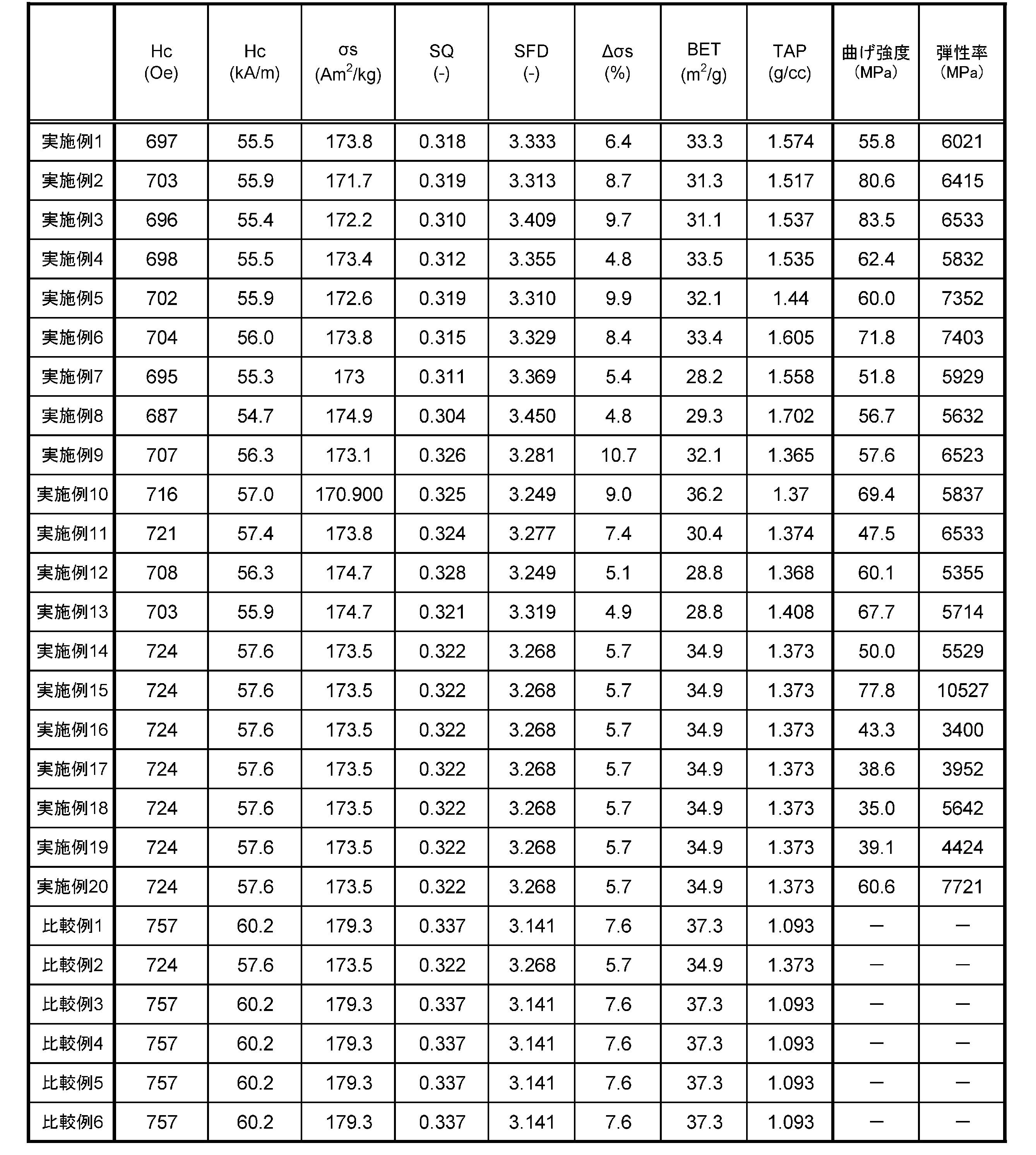
- Table 2 describes the magnetic properties and mechanical properties of the samples according to Examples 1 to 20 and Comparative Examples 1 to 6.
- Table 3 describes the high-frequency characteristics (750 MHz to 1 GHz, 2 GHz) of the samples according to Examples 1 to 20 and Comparative Examples 1 to 6.
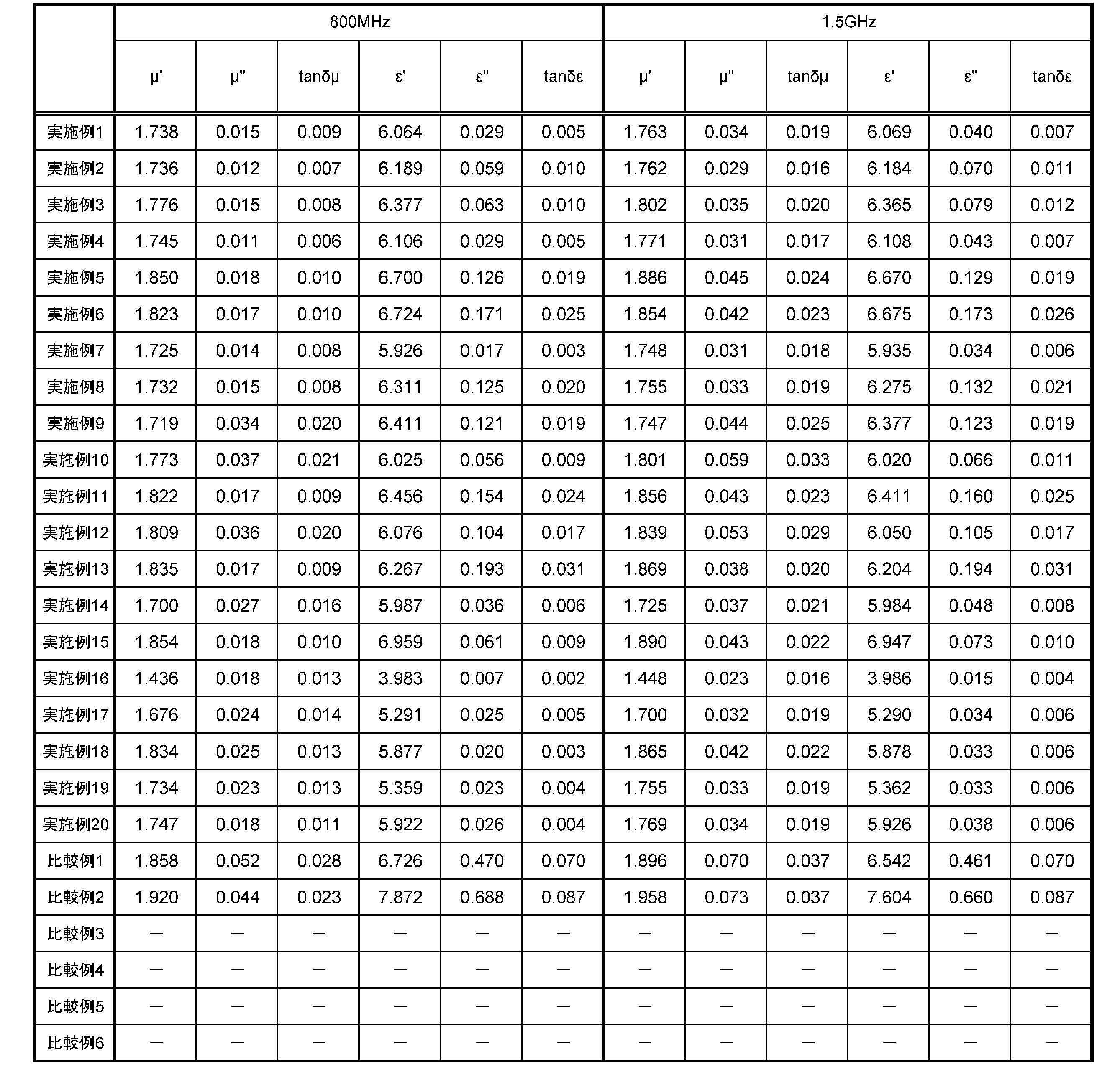
- Table 4 describes the high frequency characteristics (800 MHz, 1.5 GHz) of the samples according to Examples 1 to 20 and Comparative Examples 1 to 6.
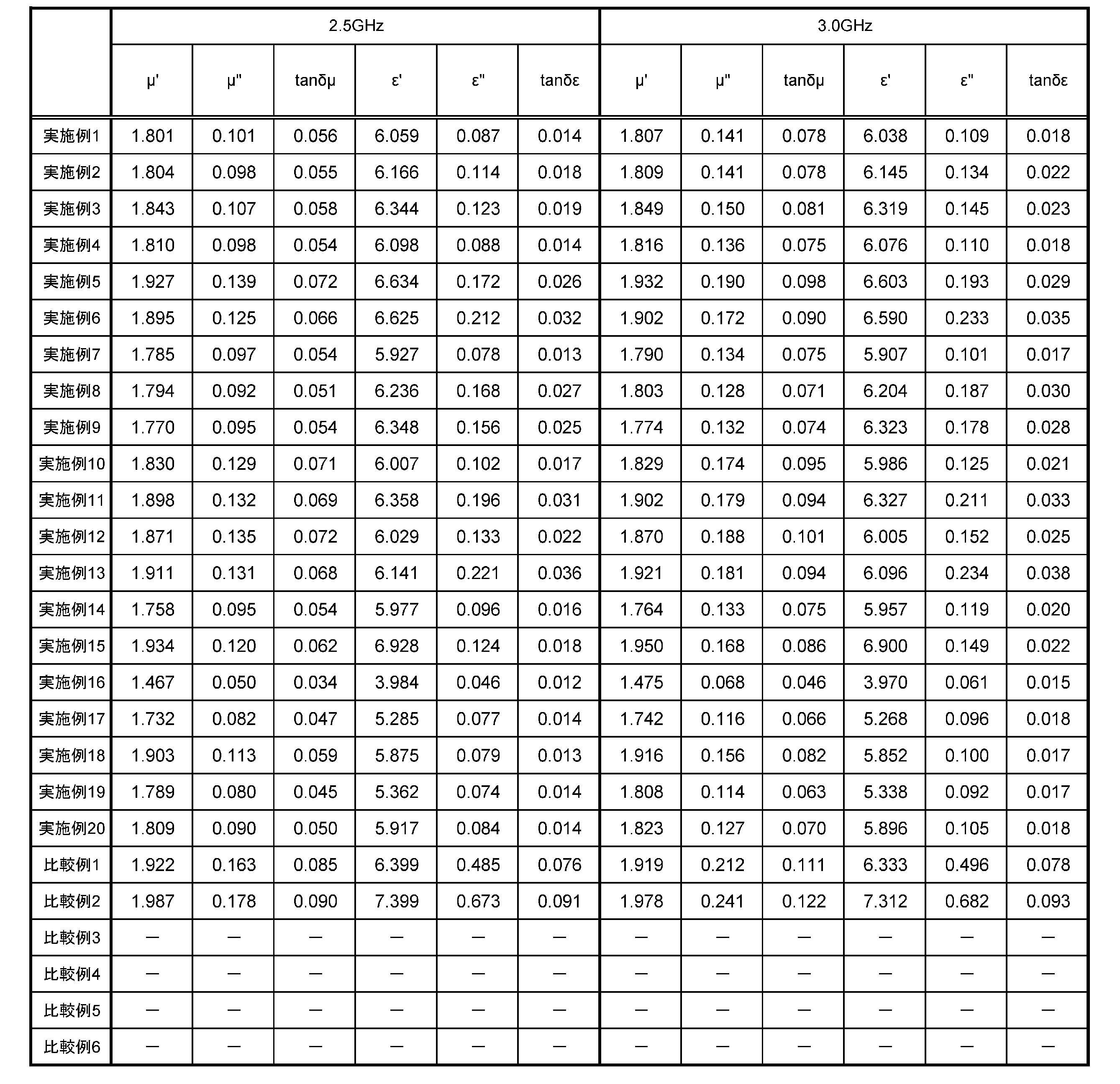
- Table 5 describes the high frequency characteristics (2.5 GHz, 3.0 GHz) of the samples according to Examples 1 to 20 and Comparative Examples 1 to 6.
- the blanks in each table are items that were not measured or could not be measured.
- Example 1 a small sample was prepared.
- the metal magnetic powder DOWA Electronics Co., Ltd.: iron - cobalt metal particles, major axis length: 40nm, BET: 37.3m 2 /g, ⁇ s:179.3Am 2 / kg, the carbon content (high-frequency combustion method) : 0.01% by mass) with a 500 mesh sieve, phthalic acid (special grade reagent manufactured by Wako Pure Chemical Industries) is added to the metal magnetic powder (50 g) under the sieve and 5% (2.5 g) of the magnetic powder. ), 30% by weight (15 g) of ethanol was added to the magnetic powder and mixed for 5 minutes in an agate mortar.
- the metal magnetic powder DOWA Electronics Co., Ltd.: iron - cobalt metal particles, major axis length: 40nm, BET: 37.3m 2 /g, ⁇ s:179.3Am 2 / kg, the carbon content (high-frequency combustion method) : 0.01% by mass
- phthalic acid special grade
- the true density of the obtained magnetic powder composite was determined by a gas phase (He gas) substitution method to be 5.58 g / cm 3 .
- the obtained true density value was used for calculation of the blending ratio for making the content of the magnetic powder composite in the compound a desired ratio.
- the obtained magnetic compound was put into an injection molding machine, which is an optional device of a small kneader, under conditions of a cylinder temperature of 300 ° C. and a mold temperature of 130 ° C., and a molded body for bending test (ISO178 standard size: 80 mm ⁇ 10 mm ⁇ 4mm), and using a digital force gauge (manufactured by Imada Co., Ltd., ZTS-500N), the distance between fulcrums was set to 16 mm, the bending strength was measured, the bending displacement was calculated, and the elastic modulus (MPa) was measured. .
- a digital force gauge manufactured by Imada Co., Ltd., ZTS-500N
- 0.2 g of the magnetic compound was put into a donut-shaped jig having a diameter of 6 mm, and then heated at 300 ° C. for 20 minutes with a small hot press machine (manufactured by ASONE). In this way, after the resin in the magnetic compound is melted, it is molded and cooled into a toroidal shaped molded body having an outer diameter of 7 mm and an inner diameter of 3 mm while applying pressure.
- the high frequency characteristics were measured by the method described in the embodiment.
- Example 2 This example was the same as Example 1 except that the treatment agent added in Example 1 was maleic anhydride.
- Example 3> This example was the same as Example 1 except that the treatment agent added in Example 1 was maleic acid.
- Example 4 This example was the same as Example 1 except that the treatment agent added in Example 1 was dimethyl phthalate.
- Example 5> This example was the same as Example 1 except that the treatment agent added in Example 1 was succinic acid.
- Example 6> This example was the same as Example 1 except that the treatment agent added in Example 1 was succinic anhydride.
- Example 7 This example was the same as Example 1 except that the treatment agent added in Example 1 was phthalic anhydride.
- Example 8> This example was the same as Example 1 except that the treatment agent added in Example 1 was benzoic acid.
- Example 9 This example was the same as Example 1 except that the treatment agent added in Example 1 was malonic acid.
- Example 10> This example was the same as Example 1 except that the treating agent added in Example 1 was fumaric acid.
- Example 11 This example was the same as Example 1 except that the treatment agent added in Example 1 was glutaric acid.
- Example 12 This example was the same as Example 1 except that the treatment agent added in Example 1 was azelaic acid.
- Example 13> This example was the same as Example 1 except that the treatment agent added in Example 1 was sebacic acid.
- Example 14 a medium amount sample was produced.
- ethanol special grade reagent manufactured by Wako Pure Chemical Industries, Ltd.
- phthalic acid special grade reagent manufactured by Wako Pure Chemical Industries, Ltd.
- phthalic acid was dissolved in ethanol.
- the metal magnetic powder DOWA Electronics Co., Ltd.: iron - cobalt metal particles, major axis length: 40nm, BET: 37.3m 2 /g, ⁇ s:179.3Am 2 / kg
- TK homomixer Mark II manufactured by PRIMIX Corporation
- the obtained paste was spread on an aluminum vat, heated for 1 hour at around the volatilization temperature of ethanol (78 ° C), then heated to 120 ° C and heated for 1.5 hours, ethanol was removed from the paste, phthalic acid and metal Agglomerates mixed with magnetic powder were obtained.
- the obtained agglomerate was passed through a 500 mesh screen to remove coarse particles to obtain a magnetic powder composite according to this example.
- the resulting magnetic powder composites, BET: 34.9m 2 /g, ⁇ s:173.5Am 2 / kg, the carbon content (high-frequency combustion method): 2.82 were those having a mass% of properties.
- the true density of the magnetic powder composite is obtained by a gas phase (He gas) substitution method, and the blended ratio for making the obtained true density value a desired ratio of the content of the magnetic powder composite in the compound. Used to calculate Thereafter, evaluation was performed in the same manner as in Example 1.
- He gas gas phase
- Example 15 Example 14 was carried out except that the resin was changed to DURAFIDE (registered trademark) 1130A64 (PPS / polyphenylene sulfide manufactured by Polyplastics Co., Ltd.) having a specific gravity of 1.57 g / cm 3 containing 30% glass fiber. And so on.
- DURAFIDE registered trademark
- 1130A64 PPS / polyphenylene sulfide manufactured by Polyplastics Co., Ltd.
- Example 16 a magnetic powder composite having a volume filling rate of 20% by volume at the time of forming a molded body and XAREC (registered trademark) SP105 (SPS / Idemitsu Kosan Co., Ltd., SyndioTac, having a specific gravity of 1.18 g / cm 3 ).
- 11.5 g of tic polystyrene was weighed in nitrogen, placed in a No. 5 standard bottle, and capped. After lightly shaking by hand, the mixture was kneaded for 10 minutes with a small kneader (DSM Xplore (registered trademark) MC15, manufactured by Xplo Instruments) at a set temperature of 300 ° C. and a kneading stirring speed of 100 rpm. Resin and magnetic powder were added) to prepare a kneaded product, that is, a magnetic compound. The remainder was evaluated in the same manner as in Example 1.
- DSM Xplore registered trademark
- MC15
- Example 17 In this example, the same procedure as in Example 16 was performed except that the addition amount of the magnetic powder composite and SPS was adjusted so that the volume filling rate of the magnetic powder composite was equivalent to 30% by volume.
- Example 18 In this example, the same procedure as in Example 16 was performed, except that the addition amount of the magnetic powder composite and SPS was adjusted so that the volume filling rate of the magnetic powder composite corresponds to 40% by volume.
- Example 19 In this example, the same procedure as in Example 16 was performed except that the resin was changed to Zylon (registered trademark) AH-40 (PPE / modified polyphenylene ether manufactured by Asahi Kasei Chemicals Corporation) having a specific gravity of 1.06 g / cm 3 .
- Zylon registered trademark
- AH-40 PPE / modified polyphenylene ether manufactured by Asahi Kasei Chemicals Corporation
- Example 20 In this example, the resin was changed to Zylon (registered trademark) GH-30 (PPE / modified polyphenylene ether manufactured by Asahi Kasei Chemicals Corporation) having a specific gravity of 1.31 g / cm 3 containing 30% glass fiber. Same as 16.
- Zylon registered trademark
- GH-30 PPE / modified polyphenylene ether manufactured by Asahi Kasei Chemicals Corporation
- Example 1 metal magnetic particles not surface-treated with phthalic acid in Example 1 were used. Furthermore, an epoxy resin (one-pack type epoxy resin, manufactured by Tesque Co., Ltd.), which is not a thermoplastic resin but a thermosetting resin, is weighed so that the metal magnetic powder is 30% by mass. Using a defoaming mixer (V-mini300), the metal magnetic powder was dispersed in an epoxy resin to form a paste. This paste was dried on a hot plate at 60 ° C. for 2 hours to obtain a metal magnetic powder-resin composite. This composite is pulverized to prepare a composite powder. 0.2 g of this composite powder is placed in a donut-shaped container, and a load of 1 t is applied by a hand press machine. A 3 mm toroidal shaped body was obtained. Thereafter, evaluation was performed in the same manner as in Example 1.
- an epoxy resin one-pack type epoxy resin, manufactured by Tesque Co., Ltd.
- V-mini300 defoaming mixer
- Example 3 This example was the same as Example 14 except that the metal magnetic powder was not surface-treated with phthalic acid. In this example, when the kneaded material was produced, the metal magnetic powder ignited and smoke was generated at the stage when the kneaded material was taken out into the atmosphere, and the kneaded material could not be produced in the first place.
- Example 4 This example was the same as Example 17 except that the surface of the metal magnetic powder was not treated with phthalic acid. In this example, when the kneaded material was produced, the metal magnetic powder ignited and smoke was generated at the stage when the kneaded material was taken out into the atmosphere, and the kneaded material could not be produced in the first place.
- Example 5 This example was the same as Example 19 except that the metal magnetic powder was not surface-treated with phthalic acid. In this example, when the kneaded material was produced, the metal magnetic powder ignited and smoke was generated at the stage when the kneaded material was taken out into the atmosphere, and the kneaded material could not be produced in the first place.
- Example 6 it was confirmed whether the same effect was seen in the magnetic powder composite by using a mixed resin of thermoplastic resin and aromatic nylon which is an existing technology.
- the metal magnetic powder was not surface-treated with phthalic acid, and the resin was DURAFIDE (registered trademark) (PPS / polyphenylene sulfide resin A0220A9 manufactured by Polyplastics Co., Ltd.) and aromatic Nylon 6T Vestamide (registered trademark) (HTplus M1000 manufactured by Daicel-Evonik Co., Ltd.) was mixed in the same manner.
- DURAFIDE registered trademark
- aromatic Nylon 6T Vestamide registered trademark
- HTplus M1000 manufactured by Daicel-Evonik Co., Ltd.
Landscapes
- Engineering & Computer Science (AREA)
- Power Engineering (AREA)
- Chemical & Material Sciences (AREA)
- Physics & Mathematics (AREA)
- Spectroscopy & Molecular Physics (AREA)
- Dispersion Chemistry (AREA)
- Chemical Kinetics & Catalysis (AREA)
- Manufacturing & Machinery (AREA)
- Soft Magnetic Materials (AREA)
- Powder Metallurgy (AREA)
- Hard Magnetic Materials (AREA)
- Compositions Of Macromolecular Compounds (AREA)
Abstract
Description
当該構成により、GHz帯の高周波領域で使用する電子機器、通信機器に装備する高周波電子部品に好適に用いられ、しかも、所定の針状金属粒子を用いることにより、誘電体材料中で、金属粒子を配向させるか否かにかかわらず所定の磁気特性を備えることができる(特許文献1の[0024][0029]参照。)ことが記載されている。
特許文献1から4では、磁性コンパウンドにおいて、磁性粉末の含有比率が高いものが開示されている。しかし、出願人らの検討によって達成できた金属磁性粉末の性能の向上に伴い、例えば、出願人が特許文献3に開示した金属磁性粉末を用いることにより、磁性コンパウンド中の金属磁性粉末の含有量をある程度減じても十分な高周波特性が得られるようになってきた。しかし、かような金属磁性粉末を樹脂に分散させる場合、混練段階で発火したり、金属磁性粉末を添加しない場合と比較して、著しい強度の低下が生じたりすることがわかってきた。すなわち、機械的強度と高周波特性とを共に満足するような磁性コンパウンド用材料は未だ得られていない。
また、その混ぜ込みの手法としては、樹脂割合を高くすることで、金属磁性粉末を樹脂で封止し、発火を防止する方法も考えられるが、当然金属磁性粉末の含有割合が低下し、磁性コンパウンドそのものの透磁率が低下するため、アンテナとして十分に動作しない可能性が考えられる。
ここで、本発明者らは、磁性粉末を樹脂に混ぜ込む手法について検討したところ、金属磁性粉末を加工して磁性粉末複合体とすることで、所望の樹脂に対して混ぜ込むことができるようになることを見いだした。
金属磁性粉末と、
カルボン酸もしくはその無水物、芳香族カルボン酸エステル、およびそれらの誘導体、から選択される一種以上とを含む磁性粉末複合体であって、
IEC60250またはJISC2138:2007に規定された1MHzにおけるtanδεが0.05以下である熱可塑性樹脂に、前記金属磁性粉末の100質量部に対して、前記カルボン酸もしくはその無水物、芳香族カルボン酸エステル、およびそれらの誘導体から選択される一種以上の5質量部を添加して作製した磁性粉末複合体を30体積%含有させたとき、測定周波数2GHzにおいて、透磁率の実数部μ’が1.45以上、tanδμが0.1以下、tanδεが0.05以下の値を示す性質を有する、磁性粉末複合体である。
前記熱可塑性樹脂が、芳香環を含む熱可塑性樹脂である、磁性粉末複合体である。
金属磁性粉末と、
カルボン酸もしくはその無水物、芳香族カルボン酸エステル、およびそれらの誘導体、から選択される一種以上とを含む磁性粉末複合体であって、
SPS、m-PPE、PPS、から選択される一種以上とを含む材料に、前記金属磁性粉末の100質量部に対して、前記カルボン酸もしくはその無水物、芳香族カルボン酸エステル、およびそれらの誘導体から選択される一種以上の5質量部を添加して作製した磁性粉末複合体を30体積%含有させたとき、測定周波数2GHzにおいて、透磁率の実数部μ’が1.45以上、tanδμが0.1以下、tanδεが0.05以下の値を示す性質を有する、磁性粉末複合体である。
第1~3の態様に記載の発明において、
前記カルボン酸は、芳香族カルボン酸もしくは不飽和カルボン酸、ジカルボン酸、から選択される一種以上である、磁性粉末複合体である。
第1~第4のいずれかの態様に記載の発明において、
前記カルボン酸もしくはその無水物、芳香族カルボン酸エステル、およびそれらの誘導体のいずれかを構成する炭素数は4以上30以下である、磁性粉末複合体である。
第1~第5のいずれかの態様に記載の発明において、
前記カルボン酸もしくはその無水物、芳香族カルボン酸エステル、およびそれらの誘導体とは、フタル酸、無水フタル酸、マレイン酸、無水マレイン酸、コハク酸、無水コハク酸、マロン酸、フマル酸、グルタル酸、アゼライン酸、セバシン酸、安息香酸、フタル酸ジメチルおよびそれらの誘導体から選択される一種以上である、磁性粉末複合体である。
第1~第5のいずれかの態様に記載の磁性粉末複合体と、
SPS、m-PPEから選択される一種以上の樹脂とを含む磁性コンパウンドである。
前記カルボン酸もしくはその無水物、芳香族カルボン酸エステル、およびそれらの誘導体として、マレイン酸、無水マレイン酸、コハク酸、無水コハク酸、マロン酸、フマル酸、グルタル酸、アゼライン酸、セバシン酸、安息香酸、およびそれらの誘導体から選択される一種以上を含む第6の態様に記載の磁性粉末複合体と、
PPS樹脂とを、含む磁性コンパウンドである。
第1~第6のいずれかに記載の磁性粉末複合体により構成されたアンテナである。
第1~第6のいずれかに記載の磁性粉末複合体により構成されたアンテナを備えた電子機器である。
金属磁性粉末と、
カルボン酸もしくはその無水物、芳香族カルボン酸エステル、およびそれらの誘導体、から選択される一種とを混合することで、磁性粉末複合体を製造する磁性粉末複合体の製造方法である。
金属磁性粉末と、
カルボン酸もしくはその無水物、芳香族カルボン酸エステル、およびそれらの誘導体、から選択される一種とを混合する工程において、1気圧における沸点が100℃以下の溶液を介在させて磁性粉末複合体を製造する、第11の態様に記載の磁性粉末複合体の製造方法である。
〈1.磁性コンパウンドを構成するための磁性粉末複合体〉
1-1.金属磁性粉末
1-2.被覆物と磁性粉末複合体
〈2.磁性コンパウンドの製造方法〉
2-1.使用される樹脂
2-2.準備工程
2-3.被覆工程(表面処理9
2-4.樹脂との混練工程
〈3.変形例等〉
本明細書において「~」は所定の値以上かつ所定の値以下のことを指す。
本実施形態における磁性コンパウンドを構成するための磁性粉末複合体は、金属磁性粉末と、カルボン酸もしくは、その分子内における脱水、もしくは複数のカルボン酸の脱水作用によって生成した無水物、芳香族カルボン酸エステルおよびそれらの誘導体から選択される一種以上の被覆物とを含む。
以下、各構成について説明する。
本実施形態における金属磁性粉末の一例は、以下の構成を有する。
金属磁性粉末は、磁性特性、粒径などを適宜設計したものを用いれば良い。
磁性特性としては、飽和磁化(σs)により磁性コンパウンドの透磁率、誘電率を設定できる。ほかには、保磁力(Hc)、角形比(SQ)等、また粉体特性として、粒径、形状、BET(比表面積)、TAP(タップ)密度を調整すればよい。例えば、本実施形態における金属磁性粉末には、Fe(鉄)若しくは、FeとCo(コバルト)に、希土類元素(Y(イットリウム)を含む、以降同様。)、Al(アルミニウム)、Si(ケイ素)、Mg(マグネシウム)から選択される一種以上(以後「Al等」という。)が含まれる。
金属磁性粉末の原材料となる元素を含む水溶液中において、Yを含む希土類元素量を変化させることで、最終的に得られる金属粒子の軸比(=長軸長/短軸長)を変更することができる。
希土類元素が少ない場合は軸比が大きくなり、より損失を低減した金属粉末を得ることができるが、透磁率は低減する。その一方、希土類元素が多い場合は軸比が小さくなり損失はやや大きくなるが、希土類元素が少ない場合と比べると透磁率が大きくなる。
ただし、Al等は非磁性成分であるので、金属磁性粉末の磁気特性が担保できる範囲で含有させることが好ましい。具体的には、FeとCoとの総和に対するAl等の含有量は、1at%~20at%とすることが好ましく、3at%~18at%がより好ましく、5at%~15at%が一層好ましい。
本実施形態における被覆物は、後述の表面処理工程により金属磁性粉末の表面に形成され、磁性粉末複合体となる。おそらく、当該被覆物は、金属磁性粉末の表面の少なくとも一部に付着して磁性粉末複合体を形成していると考えられる。当該被覆物は、カルボン酸もしくは、その分子内の脱水作用によって生成した無水物、芳香族カルボン酸エステルおよびそれらの誘導体から選択される一種以上である。ここで「誘導体」とは、官能基の導入、酸化、還元、原子の置き換えなど、母体の構造や性質を大幅に変えない程度の改変がなされた化合物をさし、「原子の置き換え」には、末端がアルカリ金属で置換がなされ、可溶性とされたものも含む概念である。
なお、これらカルボン酸又はその誘導体は必ずしも一種だけで使用する必要は無く、複数種のカルボン酸を使用することを妨げるものではない。
以下、磁性コンパウンドの製造方法について説明する。
本実施形態における樹脂として好適なのは、IEC60250またはJISC2138:2007に規定された1MHzにおけるtanδεが0.05以下の熱可塑性樹脂である。当該樹脂を用いることで本実施形態の効果を奏することができる。特に、芳香環を有する熱可塑性樹脂を使用するとtanδεが良好であるため好ましく、とりわけ、SPS(シンジオタクチックポリスチレン)、PPS(ポリフェニレンサルファイド)、および、m-PPE(変性ポリフェニレンエーテル)から選択される一種以上を使用することが好ましい。
実施例の項目で後述するように、PPS、SPSおよびm-PPEから選択される一種以上を樹脂として採用し、当該樹脂と本発明に係る磁性粉末複合体とで混練し、本発明に係る磁性コンパウンドを製造することが可能である。
本工程においては、磁性コンパウンドの作製に係る諸々の準備を行う。例えば、上記の金属磁性粉末などの各種原材料や、被覆体の原材料、混ぜ入れる対象となる樹脂を用意する。
金属磁性粉末に対し、所定の有機化合物(カルボン酸、カルボン酸無水物、芳香族カルボン酸エステルおよびそれらの誘導体から選択される一種以上。)を添加して混合し表面処理することで、磁性粉末複合体を得る。カルボン酸のなかでも、樹脂のように分子量が何万もあるような高分子より、分子量が500以下のカルボン酸が好ましい。さらに、炭素数は4から30までのものとするのが良い。具体的には、カルボン酸、カルボン酸無水物、芳香族カルボン酸エステル、およびそれらの誘導体のなかでも、フタル酸、無水フタル酸、マレイン酸、無水マレイン酸、コハク酸、無水コハク酸、マロン酸、フマル酸、グルタル酸、アゼライン酸、セバシン酸、安息香酸、フタル酸ジメチル、およびそれらの誘導体であることが好ましく、一層好ましくは、フタル酸、無水フタル酸、マレイン酸、無水マレイン酸、コハク酸、無水コハク酸、マロン酸、フマル酸、グルタル酸、アゼライン酸、セバシン酸、安息香酸、フタル酸ジメチルを主骨格としつつ、炭素数が4以上30以下である構造とするのが良い。
なお、これらカルボン酸、カルボン酸無水物、芳香族カルボン酸エステル、およびそれらの誘導体は必ずしも一種だけで構成する必要は無く、複数種のカルボン酸、カルボン酸無水物、芳香族カルボン酸エステル、およびそれらの誘導体を使用することを妨げるものではない。
また、磁性粉末複合体において、前記有機化合物に係る炭素量が0.1質量%以上あれば、磁性粉末複合体の樹脂への分散が好適に行えるので、好ましい。一方、炭素量が10質量%以下であれば非磁性成分が過剰にならず、磁性粉末複合体あるいはその後に形成する磁性コンパウンドとしたときの透磁率が低下しないので好ましい。
当該質量比が2以上だと、金属磁性粉末と樹脂とがなじむため、生産した時の製品の性質安定性が向上する。15以下だと、金属磁性粉末における非磁性成分が適量となり、被覆体が被覆された金属磁性粉末により構成される磁性粉末複合体そのものの磁気特性の低下を抑制できる。ひいては、磁性粉末複合体を樹脂に混ぜ入れて磁性コンパウンドとしたときの高周波特性を比較的高く維持することができ、最終的に形成されるアンテナの特性についても同様に比較的高く維持することができる。
具体的には、エタノール、メタノール、プロパノール、IPA、ヘキサン、アセトン、ブタノン等を挙げることが出来るが、これらに限定されない。特に好ましい態様はアルコール類、とりわけ取扱の容易さからエタノールとするのが好ましい。
そこで、乾燥した磁性粉末複合体を得るには、上記の有機化合物と当該溶媒を加えたものに金属磁性粉末を加え、金属磁性粉末を当該溶媒に含浸させた後、溶媒を除去する方法を採用すると簡便である。
つまり、金属磁性粉末に対して添加した有機物が満遍なく行き渡るようであれば、問題はない。また、混練を行いながら溶媒の除去、乾燥を行うために、ミキサーなどを使用しても差し支えない。なお、当該除去、乾燥後において、有機化合物を金属磁性粉末の粒子表面に残存させることが肝要である。
BET比表面積は、ユアサアイオニクス株式会社製の4ソーブUSを用いて、BET一点法により求められる。
得られた磁性粉末複合体(または金属磁性粉末)の磁気特性(バルク特性)として、東英工業株式会社製のVSM装置(VSM-7P)を使用して、外部磁場10kOe(795.8kA/m)で、保磁力Hc(OeまたはkA/m)、飽和磁化σs(Am2/kg)、角形比SQ、保磁力分布SFDを測定可能である。Δσsは、磁性粉を60℃、90%の高温多湿環境下に一週間放置した時の飽和磁化の低下割合を百分率(%)で示したものである。
特開2007-263860号明細書に記載された方法で測定可能である。また、JISK-5101:1991の手法を採用しても測定可能である。
得られた磁性粉末複合体と上述の樹脂とを混練し、磁性コンパウンドを形成する。混練工程により樹脂中に金属磁性粉末が分散された状態となる。混練後の状態は、樹脂中に磁性粉末が均一濃度に分散されているのが好ましい。樹脂に混ぜ込むことのできる磁性粉末複合体の量が多い場合、高周波を加えた際の透磁率が高くなる一方、樹脂の有する機械的特性は低下することになる。そのため、磁性コンパウンドへの磁性粉末複合体の添加量は機械的特性と高周波特性との間のバランスを考慮して検討することが好ましい。
樹脂、金属磁性粉末、上記の有機化合物を含む混合物を加熱し、磁性コンパウンドを作製する方法を採用しても構わないし、樹脂を溶融させたところに磁性粉末複合体を添加する方法を採用しても構わない。
上述の方法により得られた磁性粉末複合体と特定の樹脂から構成される磁性コンパウンド0.2gをドーナッツ状の容器内に入れて、ハンドプレス機、もしくはホットプレス機を用い、外径7mm、内径3mmのトロイダル形状の磁性コンパウンドの成形体を形成する。その後、アジレント・テクノロジー株式会社製のネットワーク・アナライザー(E8362C)と株式会社関東電子応用開発製の同軸型Sパラメーター法サンプルホルダーキット(製品型番:CSH2-APC7、試料寸法:φ7.0mm-φ3.04mm×5mm)を用い、得られた磁性コンパウンドの成形体の高周波特性すなわち0.5~5GHzの区間、測定幅は0.05GHz刻みで行い、透磁率の実数部(μ’)、透磁率の虚数部(μ”)、誘電率の実数部(ε’)、誘電率の虚数部(ε”)を測定し、高周波特性を確認した。ここで、tanδε=ε”/ε’であり、tanδμ=μ”/μ’で算出することができる。
なお、本発明の技術的範囲は上述した実施の形態に限定されるものではなく、発明の構成要件やその組み合わせによって得られる特定の効果を導き出せる範囲において、種々の変更や改良を加えた形態も含む。
本実施形態においては、金属磁性粒子、被覆体、磁性粉末複合体および樹脂に関し、主となる元素や化合物について詳述した。その一方、上記で列挙した元素や化合物以外のものを、金属磁性粒子、被覆体、磁性粉末複合体および樹脂が含有していても構わない。
本実施形態における得られた磁性粉末複合体と特定の樹脂から構成される磁性コンパウンドは、アンテナ、インダクタ、電波遮蔽材に用いることができる。特に、当該磁性コンパウンドにより構成されるアンテナ、更には当該アンテナを備えた電子通信機器(電子機器)においても、後述の実施例の項目で示すような比較的高い通信特性を享受することが可能である。つまり、本実施形態における磁性コンパウンドは、上記のような電子部品、アンテナ、電子機器等々へと加工可能なものである。
表1は、実施例1~20、比較例1~6に係る試料の原料について記載する。
表2は、実施例1~20、比較例1~6に係る試料の磁気的特性および機械的特性について記載する。
表3は、実施例1~20、比較例1~6に係る試料の高周波特性(750MHz~1GHz、2GHz)について記載する。
表4は、実施例1~20、比較例1~6に係る試料の高周波特性(800MHz、1.5GHz)について記載する。
表5は、実施例1~20、比較例1~6に係る試料の高周波特性(2.5GHz、3.0GHz)について記載する。


<実施例1>
本例においては、少量サンプルを作製した。
まず、金属磁性粉末(DOWAエレクトロニクス株式会社製:鉄-コバルト金属粒子、長軸長:40nm、BET:37.3m2/g、σs:179.3Am2/kg、炭素含有量(高周波燃焼法):0.01質量%)を500メッシュ篩で篩わけし、篩下の金属磁性粉末(50g)に、フタル酸(和光純薬工業製特級試薬)を磁性粉に対して5%(2.5g)、エタノールを磁性粉に対して30重量%(15g)添加して、メノウ乳鉢中で5分間混合させた。乾燥は60℃で2時間行い、本例における磁性粉末複合体を得た。なお、得られた磁性粉末複合体の真密度を気相(Heガス)置換法で求めたところ、5.58g/cm3であった。求めた真密度の値は、コンパウンド中の磁性粉末複合体の含有量を所望の割合にするための配合比の算出に使用した。
本例では、実施例1において添加する処理剤を無水マレイン酸とした以外は実施例1と同様にした。
本例では、実施例1において添加する処理剤をマレイン酸とした以外は実施例1と同様にした。
本例では、実施例1において添加する処理剤をフタル酸ジメチルとした以外は実施例1と同様にした。
本例では、実施例1において添加する処理剤をコハク酸とした以外は実施例1と同様にした。
本例では、実施例1において添加する処理剤を無水コハク酸とした以外は実施例1と同様にした。
本例では、実施例1において添加する処理剤を無水フタル酸とした以外は実施例1と同様にした。
本例では、実施例1において添加する処理剤を安息香酸とした以外は実施例1と同様にした。
本例では、実施例1において添加する処理剤をマロン酸とした以外は実施例1と同様にした。
本例では、実施例1において添加する処理剤をフマル酸とした以外は実施例1と同様にした。
本例では、実施例1において添加する処理剤をグルタル酸とした以外は実施例1と同様にした。
本例では、実施例1において添加する処理剤をアゼライン酸とした以外は実施例1と同様にした。
本例では、実施例1において添加する処理剤をセバシン酸とした以外は実施例1と同様にした。
本例においては、中量サンプルを作製した。
まず、フタル酸(和光純薬工業株式会社製特級試薬)25gにエタノール(和光純薬工業株式会社製特級試薬)を500gになるように添加し、フタル酸をエタノールへと溶解させた。この溶液に対し、金属磁性粉末(DOWAエレクトロニクス株式会社製:鉄-コバルト金属粒子、長軸長:40nm、BET:37.3m2/g、σs:179.3Am2/kg、炭素含有量(高周波燃焼法):0.01質量%)500gを不活性雰囲気下で添加し、溶液中にて金属磁性粉末を沈降させた。これを大気中で高速攪拌機(プライミクス株式会社製TKホモミキサーMarkII)で8000rpmにおいて2分間攪拌して、金属磁性粉末のペースト態とした。
ここで、磁性粉末複合体の真密度を気相(Heガス)置換法で求め、求めた真密度の値を、コンパウンド中の磁性粉末複合体の含有量を所望の割合にするための配合比の算出に使用した。
以降は実施例1と同様にして評価した。
本例では、ガラス繊維が30%含有された比重1.57g/cm3のジュラファイド(登録商標)1130A64(PPS/ポリプラスチックス株式会社製 ポリフェニレンサルファイド)へと樹脂を変更した以外は実施例14と同様にした。
本例では、成形体形成時の体積充填率が20体積%に相当する磁性粉末複合体と、比重1.18g/cm3のXAREC(登録商標)SP105(SPS/出光興産株式会社製、シンジオタクチックポリスチレン)を11.5gそれぞれ窒素中で秤量して5号規格瓶に入れてフタをした。軽く手で振ってかき混ぜたあと、小型混練機(DSM Xplore(登録商標) MC15、Xplore Instruments社製)にて、窒素雰囲気中で、設定温度300℃、混練攪拌速度100rpmにて、10分間混練(樹脂および磁性粉の投入時間を含む)して、混練物すなわち磁性コンパウンドを作製した。その余は実施例1と同様にして評価した。
本例では、実施例16において、磁性粉末複合体の体積充填率が30体積%に相当するように、磁性粉末複合体とSPSの添加量を調整した以外は実施例16と同様にした。
本例では、実施例16において、磁性粉末複合体の体積充填率が40体積%に相当するように、磁性粉末複合体とSPSの添加量を調整した以外は実施例16と同様にした。
本例では、樹脂を比重1.06g/cm3のザイロン(登録商標)AH-40(PPE/旭化成ケミカルズ株式会社製 変性ポリフェニレンエーテル)に変更した以外は実施例16と同様にした。
本例では、ガラス繊維が30%含有された比重1.31g/cm3のザイロン(登録商標)GH-30(PPE/旭化成ケミカルズ株式会社製 変性ポリフェニレンエーテル)へと樹脂を変更した以外は実施例16と同様にした。
本例では、実施例1において、フタル酸で表面処理していない金属磁性粒子を用いた。更に、熱可塑性樹脂ではなく熱硬化性樹脂であるエポキシ樹脂(一液型エポキシ樹脂 テスク株式会社製)を、金属磁性粉末が30質量%になるように秤量し、株式会社EME社製真空攪拌・脱泡ミキサー(V-mini300)を用いて、当該金属磁性粉末をエポキシ樹脂に分散させペースト状にした。このペーストをホットプレート上で60℃、2時間乾燥させて、金属磁性粉末-樹脂の複合体を得た。この複合体を解粒して複合体の粉末を作製し、この複合体粉末0.2gをドーナッツ状の容器内に入れて、ハンドプレス機により1tの荷重をかけることにより、外径7mm、内径3mmのトロイダル形状の成形体とした。以降は実施例1と同様にして評価した。
本例では、比較例1に用いた金属磁性粉末を実施例14で使用した磁性粉末複合体に変更した以外は同様にした。
本例では、実施例14において、金属磁性粉末をフタル酸で表面処理しなかった以外は同様にした。
本例においては、混練物の作製の際、混練物を大気中に取り出した段階で金属磁性粉末が発火して発煙が生じ、そもそも混練物を作製することができなかった。
本例では、実施例17において、金属磁性粉末をフタル酸で表面処理しなかった以外は同様にした。
本例においては、混練物の作製の際、混練物を大気中に取り出した段階で金属磁性粉末が発火して発煙が生じ、そもそも混練物を作製することができなかった。
本例では、実施例19において、金属磁性粉末をフタル酸で表面処理しなかった以外は同様にした。
本例においては、混練物の作製の際、混練物を大気中に取り出した段階で金属磁性粉末が発火して発煙が生じ、そもそも混練物を作製することができなかった。
本例においては、既存の技術である熱可塑性樹脂と芳香族ナイロンの混合樹脂を用いて、磁性粉末複合体に同様の効果が見られるか確認した。具体的には、実施例1において、金属磁性粉末をフタル酸で表面処理せず、かつ、樹脂をジュラファイド(登録商標)(PPS/ポリフェニレンサルファイド樹脂 ポリプラスチックス株式会社製 A0220A9)と、芳香族ナイロン6T ベスタミド(登録商標)(ダイセル・エボニック株式会社製 HTplus M1000)を混合した以外は同様にした。
本例においては、混練物の作製の際、混練物を大気中に取り出した段階で金属磁性粉末が発火して発煙が生じ、そもそも混練物を作製することができなかった。
上記の内容をまとめたのが、先に挙げた表1~5である。
上記の各表を見ると、いずれの実施例も、各表に記載した全ての周波数において、透磁率の実数部(μ’)、透磁率の虚数部(μ”)、誘電率の実数部(ε’)、誘電率の虚数部(ε”)、(tanδμ)および(tanδε)、更には750MHz~1GHzにおけるμ’やε’の標準偏差も含め、全てが良好な値となっていた。それに加え、曲げ強度や弾性率についても良好であった。
比較例1、2においては、磁性コンパウンドを作製できた。しかし、高周波特性において実施例よりも劣る結果となっていた。
Claims (12)
- 金属磁性粉末と、
カルボン酸もしくはその無水物、芳香族カルボン酸エステル、およびそれらの誘導体、から選択される一種とを含む磁性粉末複合体であって、
IEC60250またはJISC2138:2007に規定された1MHzにおけるtanδεが0.05以下である熱可塑性樹脂に、前記金属磁性粉末の100質量部に対して、前記カルボン酸もしくはその無水物、芳香族カルボン酸エステル、およびそれらの誘導体から選択される一種以上の5質量部を添加して作製した磁性粉末複合体を30体積%含有させたとき、測定周波数2GHzにおいて、透磁率の実数部μ’が1.45以上、tanδμが0.1以下、tanδεが0.05以下の値を示す性質を有する、磁性粉末複合体。 - 前記熱可塑性樹脂が、芳香環を有する熱可塑性樹脂である、請求項1に記載の磁性粉末複合体。
- 金属磁性粉末と、
カルボン酸もしくはその無水物、芳香族カルボン酸エステル、およびそれらの誘導体、から選択される一種とを含む磁性粉末複合体であって、
SPS、m-PPE、PPS、から選択される一種以上とを含む材料に、前記金属磁性粉末の100質量部に対して、前記カルボン酸もしくはその無水物、芳香族カルボン酸エステル、およびそれらの誘導体から選択される一種以上の5質量部を添加して作製した磁性粉末複合体を30体積%含有させたとき、測定周波数2GHzにおいて、透磁率の実数部μ’が1.45以上、tanδμが0.1以下、tanδεが0.05以下の値を示す
性質を有する、磁性粉末複合体。 - 前記カルボン酸は、芳香族カルボン酸もしくは不飽和カルボン酸、ジカルボン酸、から選択される一種以上である、請求項1ないし3のいずれかに記載の磁性粉末複合体。
- 前記カルボン酸もしくはその無水物、芳香族カルボン酸エステル、およびそれらの誘導体のいずれかを構成する炭素数は4以上30以下である、請求項1ないし4のいずれか一項に記載の磁性粉末複合体。
- 前記カルボン酸もしくはその無水物、芳香族カルボン酸エステル、およびそれらの誘導体とは、フタル酸、無水フタル酸、マレイン酸、無水マレイン酸、コハク酸、無水コハク酸、マロン酸、フマル酸、グルタル酸、アゼライン酸、セバシン酸、安息香酸、フタル酸ジメチルおよびそれらの誘導体から選択される一種以上である、請求項1ないし5のいずれか一項に記載の磁性粉末複合体。
- 請求項1から6のいずれか一項に記載の磁性粉末複合体と、
SPS、m-PPEから選択される一種以上の樹脂とを含む磁性コンパウンド。 - 前記カルボン酸もしくはその無水物、芳香族カルボン酸エステル、およびそれらの誘導体として、マレイン酸、無水マレイン酸、コハク酸、無水コハク酸、マロン酸、フマル酸、グルタル酸、アゼライン酸、セバシン酸、安息香酸、およびそれらの誘導体から選択される一種以上を含む請求項6に記載の磁性粉末複合体と、
PPS樹脂とを、含む磁性コンパウンド。 - 請求項1ないし6のいずれか一項に記載の磁性粉末複合体により構成されたアンテナ。
- 請求項1ないし6のいずれか一項に記載の磁性粉末複合体により構成されたアンテナを備えた電子機器。
- 金属磁性粉末と、
カルボン酸もしくはその無水物、芳香族カルボン酸エステル、およびそれらの誘導体、から選択される一種とを混合することで、磁性粉末複合体を製造する磁性粉末複合体の製造方法。 - 金属磁性粉末と、
カルボン酸もしくはその無水物、芳香族カルボン酸エステル、およびそれらの誘導体、から選択される一種とを混合する工程において、1気圧における沸点が100℃以下の溶液を介在させて磁性粉末複合体を製造する、請求項11に記載の磁性粉末複合体の製造方法。
Priority Applications (3)
| Application Number | Priority Date | Filing Date | Title |
|---|---|---|---|
| KR1020177037510A KR20180015175A (ko) | 2015-06-02 | 2016-06-01 | 자성 분말 복합체, 안테나 및 전자기기와 이의 제조 방법 |
| US15/578,471 US11114228B2 (en) | 2015-06-02 | 2016-06-01 | Magnetic powder composite, antenna and electronic device, and method for producing the same |
| CN201680032225.2A CN107615413B (zh) | 2015-06-02 | 2016-06-01 | 磁性粉末复合体、天线和电子设备、及其制造方法 |
Applications Claiming Priority (2)
| Application Number | Priority Date | Filing Date | Title |
|---|---|---|---|
| JP2015-112704 | 2015-06-02 | ||
| JP2015112704A JP6552283B2 (ja) | 2015-06-02 | 2015-06-02 | 磁性コンパウンド、アンテナおよび電子機器 |
Publications (1)
| Publication Number | Publication Date |
|---|---|
| WO2016194936A1 true WO2016194936A1 (ja) | 2016-12-08 |
Family
ID=57441996
Family Applications (1)
| Application Number | Title | Priority Date | Filing Date |
|---|---|---|---|
| PCT/JP2016/066148 Ceased WO2016194936A1 (ja) | 2015-06-02 | 2016-06-01 | 磁性粉末複合体、アンテナおよび電子機器、とその製造方法 |
Country Status (6)
| Country | Link |
|---|---|
| US (1) | US11114228B2 (ja) |
| JP (1) | JP6552283B2 (ja) |
| KR (1) | KR20180015175A (ja) |
| CN (1) | CN107615413B (ja) |
| TW (1) | TWI709983B (ja) |
| WO (1) | WO2016194936A1 (ja) |
Cited By (2)
| Publication number | Priority date | Publication date | Assignee | Title |
|---|---|---|---|---|
| WO2019143502A1 (en) * | 2018-01-16 | 2019-07-25 | Rogers Corporation | Core-shell particles, magneto-dielectric materials, methods of making, and uses thereof |
| US11476022B2 (en) | 2019-08-30 | 2022-10-18 | Rogers Corporation | Magnetic particles, methods of making, and uses thereof |
Families Citing this family (6)
| Publication number | Priority date | Publication date | Assignee | Title |
|---|---|---|---|---|
| JP6552283B2 (ja) | 2015-06-02 | 2019-07-31 | Dowaエレクトロニクス株式会社 | 磁性コンパウンド、アンテナおよび電子機器 |
| KR102691324B1 (ko) * | 2016-09-26 | 2024-08-05 | 삼성전기주식회사 | 인덕터 |
| WO2021011330A1 (en) | 2019-07-16 | 2021-01-21 | Rogers Corporation | Magneto-dielectric materials, methods of making, and uses thereof |
| JP7348596B2 (ja) * | 2019-11-08 | 2023-09-21 | 株式会社豊田中央研究所 | 圧粉磁心 |
| CN111384587B (zh) * | 2020-02-17 | 2021-04-20 | 珠海格力电器股份有限公司 | 天线的制造方法、天线及终端设备 |
| WO2026023436A1 (ja) * | 2024-07-23 | 2026-01-29 | 株式会社デンソー | 磁性材料 |
Citations (4)
| Publication number | Priority date | Publication date | Assignee | Title |
|---|---|---|---|---|
| JP2003318014A (ja) * | 2002-04-24 | 2003-11-07 | Kobe Steel Ltd | 圧粉磁心用粉末および高強度圧粉磁心、並びにその製法 |
| JP2008214665A (ja) * | 2007-02-28 | 2008-09-18 | Seiko Epson Corp | Co基金属ガラス合金、磁心、電磁変換機および時計 |
| JP2009105170A (ja) * | 2007-10-23 | 2009-05-14 | Nec Tokin Corp | 複合磁性材料およびそれを用いた圧粉磁心およびインダクタ |
| JP2009155545A (ja) * | 2007-12-27 | 2009-07-16 | Nippon Zeon Co Ltd | 磁性複合材料の製造方法及び成形体 |
Family Cites Families (13)
| Publication number | Priority date | Publication date | Assignee | Title |
|---|---|---|---|---|
| JPH01281705A (ja) | 1988-05-09 | 1989-11-13 | Mitsui Mining & Smelting Co Ltd | 磁性金属粉末の表面処理法 |
| US5629092A (en) * | 1994-12-16 | 1997-05-13 | General Motors Corporation | Lubricous encapsulated ferromagnetic particles |
| KR101067731B1 (ko) | 2004-12-03 | 2011-09-28 | 니타 가부시키가이샤 | 전자 간섭 억제체, 안테나 장치, 및 전자 정보 전달 장치 |
| JP5267665B2 (ja) * | 2009-06-18 | 2013-08-21 | トヨタ自動車株式会社 | 磁性粉末の製造方法及びその製造装置 |
| JP5299223B2 (ja) | 2009-10-30 | 2013-09-25 | Tdk株式会社 | 複合磁性材料、並びに、これを用いたアンテナ及び無線通信機器 |
| JP5234207B2 (ja) | 2011-09-17 | 2013-07-10 | Tdk株式会社 | ボンド磁石用コンパウンド、及び、ボンド磁石 |
| US20150104664A1 (en) | 2012-01-20 | 2015-04-16 | Dowa Electronics Materials Co., Ltd. | Magnetic component, and soft magnetic metal powder used therein and manufacturing method thereof |
| JP5373127B2 (ja) | 2012-01-20 | 2013-12-18 | Dowaエレクトロニクス株式会社 | 磁性部品とそれに用いられる軟磁性金属粉末およびその製造方法 |
| JP5548234B2 (ja) | 2012-05-10 | 2014-07-16 | Dowaエレクトロニクス株式会社 | 磁性部品とそれに用いられる金属粉末およびその製造方法 |
| JP2014116332A (ja) | 2012-12-06 | 2014-06-26 | Samsung R&D Institute Japan Co Ltd | 磁性体複合材料 |
| US9418780B2 (en) * | 2012-12-06 | 2016-08-16 | Samsung Electronics Co., Ltd. | Magnetic composite material |
| EP2783774A1 (en) * | 2013-03-28 | 2014-10-01 | Basf Se | Non-corrosive soft-magnetic powder |
| JP6552283B2 (ja) | 2015-06-02 | 2019-07-31 | Dowaエレクトロニクス株式会社 | 磁性コンパウンド、アンテナおよび電子機器 |
-
2015
- 2015-06-02 JP JP2015112704A patent/JP6552283B2/ja active Active
-
2016
- 2016-06-01 CN CN201680032225.2A patent/CN107615413B/zh not_active Expired - Fee Related
- 2016-06-01 US US15/578,471 patent/US11114228B2/en not_active Expired - Fee Related
- 2016-06-01 WO PCT/JP2016/066148 patent/WO2016194936A1/ja not_active Ceased
- 2016-06-01 KR KR1020177037510A patent/KR20180015175A/ko not_active Ceased
- 2016-06-02 TW TW105117363A patent/TWI709983B/zh not_active IP Right Cessation
Patent Citations (4)
| Publication number | Priority date | Publication date | Assignee | Title |
|---|---|---|---|---|
| JP2003318014A (ja) * | 2002-04-24 | 2003-11-07 | Kobe Steel Ltd | 圧粉磁心用粉末および高強度圧粉磁心、並びにその製法 |
| JP2008214665A (ja) * | 2007-02-28 | 2008-09-18 | Seiko Epson Corp | Co基金属ガラス合金、磁心、電磁変換機および時計 |
| JP2009105170A (ja) * | 2007-10-23 | 2009-05-14 | Nec Tokin Corp | 複合磁性材料およびそれを用いた圧粉磁心およびインダクタ |
| JP2009155545A (ja) * | 2007-12-27 | 2009-07-16 | Nippon Zeon Co Ltd | 磁性複合材料の製造方法及び成形体 |
Cited By (3)
| Publication number | Priority date | Publication date | Assignee | Title |
|---|---|---|---|---|
| WO2019143502A1 (en) * | 2018-01-16 | 2019-07-25 | Rogers Corporation | Core-shell particles, magneto-dielectric materials, methods of making, and uses thereof |
| CN111656466A (zh) * | 2018-01-16 | 2020-09-11 | 罗杰斯公司 | 芯-壳颗粒、磁介电材料、其制造方法和用途 |
| US11476022B2 (en) | 2019-08-30 | 2022-10-18 | Rogers Corporation | Magnetic particles, methods of making, and uses thereof |
Also Published As
| Publication number | Publication date |
|---|---|
| JP6552283B2 (ja) | 2019-07-31 |
| JP2016225551A (ja) | 2016-12-28 |
| CN107615413A (zh) | 2018-01-19 |
| US11114228B2 (en) | 2021-09-07 |
| TW201707018A (zh) | 2017-02-16 |
| KR20180015175A (ko) | 2018-02-12 |
| TWI709983B (zh) | 2020-11-11 |
| US20180151279A1 (en) | 2018-05-31 |
| CN107615413B (zh) | 2019-12-10 |
Similar Documents
| Publication | Publication Date | Title |
|---|---|---|
| JP6552283B2 (ja) | 磁性コンパウンド、アンテナおよび電子機器 | |
| Hosseini et al. | Nanocomposite based on epoxy and MWCNTs modified with NiFe2O4 nanoparticles as efficient microwave absorbing material | |
| WO2009123018A1 (ja) | 複合材料及びその製造方法 | |
| CN107615412B (zh) | 磁性混合物以及天线 | |
| EP2980811A1 (en) | Noise-suppressing composite magnetic powder | |
| JP6778790B2 (ja) | 磁性粉末複合体、アンテナおよび電子機器 | |
| CN101604568A (zh) | 一种磁场取向片状软磁复合材料及其制备方法 | |
| JP2008311255A (ja) | 複合磁性体とその製造方法 | |
| JP6813941B2 (ja) | 磁性コンパウンド、アンテナおよび電子機器 | |
| Idris et al. | Electromagnetic wave reduction of multiwalled carbon nanotubes (MWCNT) mixed nanometer CoFe2O4 at higher frequency range | |
| JP6679305B2 (ja) | 磁性コンパウンドとその製造方法並びに電子部品、アンテナ | |
| Wang et al. | Dielectric and microwave absorption properties of Cu@ Graphite filled epoxy resin composite coatings | |
| Aka et al. | PANI and Fe3O4 content-dependent electromagnetic wave absorbing properties in PANI@ Fe3O4: MoS2 hybrid nanocomposite | |
| Hsiang et al. | Titanate coupling agent surface modification effect on the magnetic properties of iron-based alloy powder coil prepared using screen printing | |
| WO2016136785A1 (ja) | 磁性コンパウンド、アンテナおよび電子機器 | |
| JP2007088316A (ja) | 磁性粉末および電波吸収体 | |
| Azimi et al. | Preparation absorption microwave X-band based carbonyl iron/polypyrrole nanocomposite | |
| JP2006339528A (ja) | 電波吸収体及びその製造方法 | |
| JP2012079737A (ja) | 磁性金属粒子の製造方法及び複合磁性材料の製造方法 | |
| Lin¹ | 1 Temasek Laboratories, National University of Singapore, 117508; 2 Department of Physics | |
| JP2011204987A (ja) | 複合磁性体の製造方法 | |
| JP2003238900A (ja) | 導電性コーティング用組成物の製造方法および導電性コーティング用組成物 |
Legal Events
| Date | Code | Title | Description |
|---|---|---|---|
| 121 | Ep: the epo has been informed by wipo that ep was designated in this application |
Ref document number: 16803370 Country of ref document: EP Kind code of ref document: A1 |
|
| WWE | Wipo information: entry into national phase |
Ref document number: 15578471 Country of ref document: US |
|
| NENP | Non-entry into the national phase |
Ref country code: DE |
|
| ENP | Entry into the national phase |
Ref document number: 20177037510 Country of ref document: KR Kind code of ref document: A |
|
| 122 | Ep: pct application non-entry in european phase |
Ref document number: 16803370 Country of ref document: EP Kind code of ref document: A1 |