WO2016190208A1 - 顔料捺染剤及びそれを用いた布帛 - Google Patents
顔料捺染剤及びそれを用いた布帛 Download PDFInfo
- Publication number
- WO2016190208A1 WO2016190208A1 PCT/JP2016/064853 JP2016064853W WO2016190208A1 WO 2016190208 A1 WO2016190208 A1 WO 2016190208A1 JP 2016064853 W JP2016064853 W JP 2016064853W WO 2016190208 A1 WO2016190208 A1 WO 2016190208A1
- Authority
- WO
- WIPO (PCT)
- Prior art keywords
- printing agent
- pigment
- pigment printing
- polymerizable monomer
- polymer
- Prior art date
- Legal status (The legal status is an assumption and is not a legal conclusion. Google has not performed a legal analysis and makes no representation as to the accuracy of the status listed.)
- Ceased
Links
Classifications
-
- D—TEXTILES; PAPER
- D06—TREATMENT OF TEXTILES OR THE LIKE; LAUNDERING; FLEXIBLE MATERIALS NOT OTHERWISE PROVIDED FOR
- D06C—FINISHING, DRESSING, TENTERING OR STRETCHING TEXTILE FABRICS
- D06C23/00—Making patterns or designs on fabrics
-
- D—TEXTILES; PAPER
- D06—TREATMENT OF TEXTILES OR THE LIKE; LAUNDERING; FLEXIBLE MATERIALS NOT OTHERWISE PROVIDED FOR
- D06P—DYEING OR PRINTING TEXTILES; DYEING LEATHER, FURS OR SOLID MACROMOLECULAR SUBSTANCES IN ANY FORM
- D06P1/00—General processes of dyeing or printing textiles, or general processes of dyeing leather, furs, or solid macromolecular substances in any form, classified according to the dyes, pigments, or auxiliary substances employed
- D06P1/44—General processes of dyeing or printing textiles, or general processes of dyeing leather, furs, or solid macromolecular substances in any form, classified according to the dyes, pigments, or auxiliary substances employed using insoluble pigments or auxiliary substances, e.g. binders
-
- D—TEXTILES; PAPER
- D06—TREATMENT OF TEXTILES OR THE LIKE; LAUNDERING; FLEXIBLE MATERIALS NOT OTHERWISE PROVIDED FOR
- D06P—DYEING OR PRINTING TEXTILES; DYEING LEATHER, FURS OR SOLID MACROMOLECULAR SUBSTANCES IN ANY FORM
- D06P5/00—Other features in dyeing or printing textiles, or dyeing leather, furs, or solid macromolecular substances in any form
Definitions
- the present invention can impart an excellent texture to a printed fabric without generating harmful formaldehyde, can impart high washing resistance and friction resistance to the printed portion, and further overlays a dye printing agent on the fabric.
- the present invention relates to a pigment printing agent capable of imparting high washing resistance to a printed part and a fabric using the same.
- a binder resin of a pigment printing agent is a heavy resin that uses a polymerizable monomer having a reactive functional group such as N-methylol (meth) acrylamide to impart washing resistance, friction resistance, and the like. Coalescence was used. Since this polymer has a reactive functional group, high crosslinking resistance and friction resistance can be imparted by the crosslinking reaction of the functional group, but there is a problem that harmful formaldehyde is generated during the crosslinking reaction. there were.
- the problem to be solved by the present invention is that a printed fabric can be given an excellent texture without generating harmful formaldehyde, high washing resistance and friction resistance can be given to the printed portion, and further, It is an object to provide a pigment printing agent that can impart high washability to the color portion, and a fabric using the pigment printing agent.
- the present inventors polymerized a polymerizable monomer including a polymerizable monomer having a carboxyl group and a polymerizable monomer having a hydrolyzable silyl group. It was found that the above-mentioned problems can be solved by using the polymer obtained in the above-mentioned manner and setting the film elongation rate and 1,000% modulus of the polymer alone within a specific range, thereby completing the present invention.
- the present invention relates to a polymer obtained by polymerizing a polymerizable monomer containing a polymerizable monomer (a1) having a carboxyl group and a polymerizable monomer (a2) having a hydrolyzable silyl group.
- the present invention provides a pigment printing agent characterized in that is 0.1 MPa or more and a fabric using the same.
- the pigment printing agent of the present invention is excellent in washing resistance, friction resistance, etc. of the printed part without damaging the original texture of the fabric, even if it contains titanium oxide as a pigment or is printed on the fabric. Since it is excellent in the washing resistance of the dye heavy color portion, it is possible to obtain a printed fabric with a natural texture and suppressed color fading during washing or the like.
- the pigment printing agent of the present invention can be used in combination with a dye printing agent to print various designs on a fabric without being restricted by the design.
- the pigment printing agent of the present invention was obtained by polymerizing a polymerizable monomer containing a polymerizable monomer (a1) having a carboxyl group and a polymerizable monomer (a2) having a hydrolyzable silyl group.
- a pigment printing agent comprising a polymer (A) and titanium oxide (B), wherein the elongation percentage of the polymer (A) alone film is in the range of 1,200 to 5,000%, 1,000 % Modulus is 0.1 MPa or more.
- the polymerizable monomer (a1) is a polymerizable monomer having a carboxyl group, and examples thereof include (meth) acrylic acid, itaconic acid, crotonic acid, fumaric acid, maleic anhydride, and citraconic acid. It is done.
- the polymerizable monomer (a2) is a polymerizable monomer having a hydrolyzable silyl group, and examples thereof include vinylmethyldimethoxysilane, vinyltrimethoxysilane, vinyltriethoxysilane, vinyltris (2-methoxyethoxy).
- Vinylsilane compounds such as silane; 3- (meth) acryloyloxypropyltrimethoxysilane, 3- (meth) acryloyloxypropylmethyldimethoxysilane, 3- (meth) acryloyloxypropyltriethoxysilane, 3- (meth) acryloyloxy Examples include (meth) acryloyloxyalkylsilane compounds such as propylmethyldiethoxysilane.
- the above polymerizable monomers (a1) and (a2) can be used alone or in combination of two or more.
- (meth) acrylic acid refers to one or both of methacrylic acid and acrylic acid
- (meth) acrylate refers to one or both of methacrylate and acrylate
- (meta) “) Acryloyl” refers to one or both of methacryloyl and acryloyl.
- polymerizable monomers that can be used as raw materials for the polymer (A) other than the polymerizable monomer (a1) having a carboxyl group and the polymerizable monomer (a2) having a hydrolyzable silyl group.
- the monomer (a3) include methyl (meth) acrylate, ethyl (meth) acrylate, n-butyl (meth) acrylate, sec-butyl (meth) acrylate, t-butyl (meth) acrylate, and isopropyl (meth).
- Alkyl (meth) acrylates such as acrylate, isobutyl (meth) acrylate, 2-ethylhexyl (meth) acrylate; aromatic (meth) acrylates such as benzyl (meth) acrylate; silanes such as trimethylsiloxyethyl (meth) acrylate (meta ) Acrylate; methoxypolyethylene glycol mono ( ) Acrylate, alkylpolyalkylene glycol mono (meth) acrylate such as methoxypolypropylene glycol mono (meth) acrylate; fluorine-based (meth) acrylate such as perfluoroalkylethyl (meth) acrylate; styrene, styrene derivative (p-dimethylsilyl) Styrene, (p-vinylphenyl) methylsulfide, p-hexynylstyrene, p-methoxyst
- the elongation percentage of the polymer (A) alone film is in the range of 1,200 to 5,000%, and the 1,000% modulus is 0.1 MPa or more. Therefore, it is preferable to use a polymerizable monomer having a glass transition temperature (Tg) of a homopolymer such as 2-ethylhexyl acrylate, n-butyl acrylate and ethyl acrylate of ⁇ 20 ° C. or lower.
- Tg glass transition temperature
- the ratio of the polymerizable monomer (a1) in the total amount of the polymerizable monomers (a1) to (a3) used as the raw material of the polymer (A) is determined by adding the pigment printing agent of the present invention to water.
- a range of 0.1 to 10% by mass is preferable, and a range of 0.5 to 8% by mass is more preferable because better dispersibility can be imparted and high washing resistance and friction resistance can be imparted to the printed part.
- the range of 1 to 6% by mass is more preferable.
- the ratio of the polymerizable monomer (a2) in the total amount of the polymerizable monomers (a1) to (a3) as the raw material of the polymer (A) is marked with the pigment printing agent of the present invention.
- the range of 0.1 to 5% by mass is preferable, since an excellent texture can be imparted to the printed fabric, and high washing resistance and friction resistance can be imparted to the printed part. Is more preferable, and the range of 0.5 to 2.5% by mass is more preferable.
- a method for producing the polymer (A) for example, a known emulsion polymerization method can be used.
- the elongation percentage of the polymer (A) alone is in the range of 1,200 to 5,000%, but since it can impart high washing resistance and friction resistance to the printed part, 1,500 to A range of 4,000% is preferred.
- the 1,000% modulus of the film is 0.1 MPa or more, and the upper limit is preferably 3 MPa because the printing part can impart high washing resistance and friction resistance with a soft texture. Is more preferable.
- the elongation rate and 1,000% modulus of the polymer (A) alone are values obtained by preparing a film with the polymer (A) alone and measuring with a tensile tester.
- a tensile tester for example, “Tensilon” manufactured by Orientec Co., Ltd., “Autograph” manufactured by Shimadzu Corporation, etc. can be used.
- the said polymer (A) of the quantity used as the film thickness of about 0.5 mm is poured into a glass-made type
- the pigment printing agent of the present invention contains titanium oxide (B).
- the titanium oxide (B) is used for coloring the pigment printing agent of the present invention in white, and there are anatase type (tetragonal), rutile type (tetragonal) and brookite type (orthorhombic). In addition to the rutile type having low activity and excellent thermal stability, an anatase type can also be used.
- the titanium oxide (B) may be added directly to the polymer (A) and mixed uniformly. However, the titanium oxide (B) is previously dispersed in water together with a surfactant and a pigment dispersant. After preparing the liquid, it is preferable to use a method in which the dispersion is added to the polymer (A) and mixed uniformly to improve concealability and miscibility.
- an extender pigment (C) such as silica, alumina silicate, calcium carbonate, precipitated barium sulfate is blended for the purpose of enhancing the hiding property. Also good.
- the extender pigment (C) may be added directly to the polymer (A) and mixed uniformly.
- the extender pigment (C) is dispersed in water together with a surfactant and a pigment dispersant in advance. After preparing the liquid, it is preferable to use a method in which the dispersion is added to the polymer (A) and mixed uniformly to improve concealability and miscibility.
- a pigment (D) other than the titanium oxide (B) may be blended in order to obtain a desired hue.
- An organic pigment and an inorganic pigment can be used.
- the organic pigment include lake red, permanent red, brilliant carmine, calcium lake, naphthol AS red, benzimidazolone yellow, disazo yellow HR, pyrazolone red, condensed azo yellow, condensed azo red, condensed azo brown, nickel azo yellow.
- Phthalocyanine pigments such as phthalocyanine blue, chlorinated phthalocyanine green, brominated phthalocyanine green; anthraquinone yellow, dianthraquinonyl red, indanthrene blue, thioindigo Bordeaux, perinone orange, perylene scarlet, perylene orange Perylene red, perylene maroon, quinacridone red, quinacridone magenta, quinacridone scarlet, dioxazine violet, Isoindolinone yellow, quinophthalone yellow, isoindoline yellow, etc. condensed polycyclic pigments such as diketopyrrolopyrrole red and the like.
- the inorganic pigment examples include metal oxide pigments such as zinc white, petal, iron black, and chromium oxide; titanium yellow, zinc-iron brown, titanium cobalt green, cobalt green, cobalt blue, and copper-chromium black.
- Metal complex oxide pigments such as copper-iron black; Chromic acid pigments such as yellow lead and molybdate orange; Ferrocyanide pigments such as bitumen; Sulfide pigments such as cadmium yellow, cadmium red, zinc sulfide, and barium sulfide; Examples include ultramarine blue, calcium carbonate, cobalt violet, yellow iron oxide, and carbon black.
- the other pigment (D) may be directly added to the polymer (A) and mixed uniformly.
- the pigment (D) may be added in advance to a surfactant or a pigment. It is preferable to use a method of preparing a dispersion dispersed in water together with a dispersant, and then adding the dispersion to the polymer (A) and mixing them uniformly, because the saturation and miscibility are improved.
- the blending amount of the titanium oxide (B), the extender pigment (C) and the other pigment (D) in the pigment printing agent of the present invention varies depending on the desired hue, but usually the pigment printing agent of the present invention.
- the total of the titanium oxide (B), the extender pigment (C) and the other pigment (D) is preferably in the range of 5 to 40% by mass.
- a printing paste or the like can be blended to impart suitability such as viscosity according to the printing method.
- Printing paste is a material that thickens pigment printing agents and imparts printability to screen printing, such as sodium carboxymethylcellulose, hydroxyethylcellulose, propioxycellulose, sodium alginate, alginate, polycarboxylate, etc. The thing melt
- distributed to water is mentioned.
- the pigment printing agent of the present invention includes a pH adjuster such as ammonia water, petroleum solvents such as mineral spirits, emulsifiers, thickeners, crosslinking agents, antioxidants, ultraviolet absorbers, dispersants, Additives such as water repellents, leveling agents, antifoaming agents, bactericides, and preservatives can be blended.
- a pH adjuster such as ammonia water
- petroleum solvents such as mineral spirits, emulsifiers, thickeners, crosslinking agents, antioxidants, ultraviolet absorbers, dispersants
- Additives such as water repellents, leveling agents, antifoaming agents, bactericides, and preservatives can be blended.
- Examples of a method for printing the pigment printing agent of the present invention on a fabric include a screen printing method using a roller printing machine, a flat screen, a rotary screen printing machine or the like with a squeegee such as rubber or urethane resin.
- the screen used for screen printing is usually 60 to 300 mesh.
- a drying and heat treatment process is performed at 100 to 150 ° C. for 1 to 5 minutes to fix the pigment printing agent to the fabric.
- the pigment printing agent of the present invention is printed on the fabric and then dried once to print the dye printing agent.
- the method (wet-on-dry method) or the method of printing the pigment printing agent of the present invention on a fabric and then printing the dye-printing agent without drying may be used.
- various printing methods such as gravure coating, roll coating, comma coating, air knife coating, kiss coating, wire bar coating, and flow coating can also be used as a method for printing the pigment printing agent of the present invention on a fabric. Can do.
- the pigment printing agent of this invention can also be apply
- Synthesis Example 1 Synthesis of polymer (A-1)) 8 parts by mass of acrylic acid (hereinafter abbreviated as “AA”), 12 parts by mass of maleic anhydride (hereinafter abbreviated as “MAH”), vinyltriethoxysilane (hereinafter abbreviated as “VSi”) 2 parts by mass, 2-ethylhexyl acrylate (hereinafter abbreviated as “2EHA”) 277 parts by mass, styrene (hereinafter abbreviated as “St”) 100 parts by mass, water 200 parts by mass and a nonionic emulsifier (No.
- the mixture was further reacted at 60 ° C. for 1 hour to obtain a polymer (A-1). Thereafter, the mixture was cooled to room temperature, neutralized by adding 9 parts by mass of 25% by mass of aqueous ammonia, water was added so that the non-volatile content was 36% by mass, and the mixture was uniformly mixed. An aqueous resin emulsion was obtained.
- Example 1 Preparation of pigment printing agent (1)
- 30 parts by mass of an aqueous acrylic resin emulsion of the polymer (A-1) obtained in Synthesis Example 1 3 parts by mass of ethylene glycol, 4.5 parts by mass of water, and a white pigment dispersion (“WHITE 70 BASE” manufactured by DIC Corporation) , 60 mass parts of pigment content) was uniformly mixed using a dispersion stirrer.
- 1.5 parts by mass of a thickener (“RYUDYE-W NT CONC 117” manufactured by DIC Corporation) and 1 part by mass of 25% by mass ammonia water are added, and mixed uniformly using a dispersion stirrer to produce a pigment printing agent. (1) was obtained.
- Examples 2 to 4 Preparation of pigment printing agents (2) to (4)
- the aqueous resin emulsion of polymer (A-1) used in Example 1 instead of the aqueous resin emulsion of polymer (A-1) used in Example 1, the aqueous resin emulsions of polymers (A-2) to (A-4) obtained in Synthesis Examples 2 to 4 were used respectively. Except that, pigment printing agents (2) to (4) were obtained in the same manner as in Example 1.
- Friction resistance was evaluated by judging grades from grades 1 to 5 according to visual criteria using a gray scale for fading. The grade 1 has the lowest wear resistance (large fading), and the grade 5 has higher wear resistance (less fading).
- Preparation Example 1 Preparation of emulsion paste
- 5 parts by mass of an emulsifying thickener (“RYUDYE-W REDUCER CONC 720ENF” manufactured by DIC Corporation)
- 45 parts by mass of water were mixed together to produce a homogenizer
- special Emulsion paste was obtained by emulsification using “TK Homomixer” manufactured by Meika Kogyo Co., Ltd.
- Preparation Example 2 Preparation of dye printing agent 10 parts by weight of water, 20 parts by weight of 4% by weight aqueous sodium alginate solution, 20 parts by weight of 6% by weight aqueous carboxymethylcellulose solution, 40 parts by weight of the emulsion paste obtained in Preparation Example 1, 2 parts by weight of sodium bicarbonate, 10 parts by weight of urea, Dye printing using 5 parts by weight of dye (“Kayacion Red P-BN Liquid 33” or “Kayacion Blue P-NFB Liquid 50”, manufactured by Nippon Kayaku Co., Ltd.) using a dispersion stirrer and mixing them uniformly An agent was obtained.
- dye printing agent 10 parts by weight of water, 20 parts by weight of 4% by weight aqueous sodium alginate solution, 20 parts by weight of 6% by weight aqueous carboxymethylcellulose solution, 40 parts by weight of the emulsion paste obtained in Preparation Example 1, 2 parts by weight of sodium bicarbonate, 10 parts by weight of urea
- Table 2 shows the evaluation results using the pigment printing agents (1) to (4), (R1) and (R2) obtained in Examples 1 to 4 and Comparative Examples 1 and 2.
- the fabric printed with the pigment printing agent of the present invention (Examples 1 to 4) has excellent washing resistance and friction resistance without impairing the original texture of the fabric. It was confirmed that there was no problem with the water resistance of the portion (dye heavy color portion) printed with the printing agent.
- Comparative Example 1 is an example in which a polymer that did not use the polymerizable monomer (a2) having a hydrolyzable silyl group was used, and the 1,000% modulus of the polymer film was less than 0.1 MPa. However, as compared with the pigment printing agent of the present invention, it was confirmed that it was inferior in washing resistance, wet friction resistance and washing resistance of the dye-heavy color part.
- Comparative Example 2 is an example in which the elongation percentage of the polymer alone used in the pigment printing agent is less than 1,200%. However, compared with the pigment printing agent of the present invention, the original texture of the fabric is impaired, and It was confirmed that the washability, the wet rub resistance, and the washability of the dye heavy color portion were inferior.
Landscapes
- Engineering & Computer Science (AREA)
- Textile Engineering (AREA)
- Coloring (AREA)
Abstract
本発明は、カルボキシル基を有する重合性単量体(a1)及び加水分解性シリル基を有する重合性単量体(a2)を含む重合性単量体を重合して得られた重合体(A)及び酸化チタン(B)を含有する顔料捺染剤であって、前記重合体(A)単独のフィルムの伸び率が1,200~5,000%の範囲であり、1,000%モジュラスが0.1MPa以上である顔料捺染剤を提供する。この顔料捺染剤は、有害なホルムアルデヒドを発生させることなく、印捺した布帛に優れた風合いを付与でき、印捺部に高い耐洗濯性及び耐摩擦性を付与でき、さらに染料重色部にも高い洗濯性を付与することができる。
Description
本発明は、有害なホルムアルデヒドを発生させることなく、印捺した布帛に優れた風合いを付与でき、印捺部に高い耐洗濯性及び耐摩擦性を付与でき、さらに布帛上に染料捺染剤を重ねて印捺した部分にも高い耐洗濯性を付与することのできる顔料捺染剤及びそれを用いた布帛に関する。
従来、顔料捺染剤のバインダー樹脂には、耐洗濯性、耐摩擦性等を付与するために、N-メチロール(メタ)アクリルアミドのような反応性官能基を有する重合性単量体を用いた重合体が用いられていた。この重合体は、反応性官能基を有するため、その官能基の架橋反応により、高い耐洗濯性及び耐摩擦性を付与することはできるが、この架橋反応時に有害なホルムアルデヒドを発生するという問題があった。
上記のホルムアルデヒドの問題を解決する方法としては、N-メチロール(メタ)アクリルアミド以外のもので架橋反応を行うことが提案されており、例えば、オキサゾリン化合物、ブロックイソシアネート化合物等の架橋剤を用いることが試みられている(例えば、特許文献1参照。)。しかしながら、これらの架橋剤を含有する顔料捺染剤は、顔料に酸化チタンを用いた場合、布帛に優れた風合いと印捺部に高い耐洗濯性、耐摩擦性等を十分に付与することができなかった。
また、従来の顔料捺染剤では、布帛上に印捺した後、その上にさらに染料捺染剤を印捺した場合、又は、染料捺染剤を印捺した後、その上にさらに顔料捺染剤を印捺した場合、顔料と染料が重なった印捺部(以下、「染料重色部」と略記する。)の耐洗濯性が低下するという問題もあった。
そこで、有害なホルムアルデヒドを発生させることなく、印捺した布帛に優れた風合いを付与でき、印捺部に高い耐洗濯性及び耐摩擦性を付与でき、さらに染料重色部にも高い耐水性を付与することのできる顔料捺染剤が求められていた。
本発明が解決しようとする課題は、有害なホルムアルデヒドを発生させることなく、印捺した布帛に優れた風合いを付与でき、印捺部に高い耐洗濯性及び耐摩擦性を付与でき、さらに染料重色部にも高い洗濯性を付与することのできる顔料捺染剤それを用いた顔料捺染剤及びそれを用いた布帛を提供することである。
本発明者らは、上記の課題を解決すべく鋭意研究した結果、カルボキシル基を有する重合性単量体及び加水分解性シリル基を有する重合性単量体を含む重合性単量体を重合させて得られた重合体を用い、かつ前記重合体単独でのフィルムの伸び率及び1,000%モジュラスを特定の範囲とすることで、上記課題を解決できることを見出し、本発明を完成させた。
すなわち、本発明は、カルボキシル基を有する重合性単量体(a1)及び加水分解性シリル基を有する重合性単量体(a2)を含む重合性単量体を重合して得られた重合体(A)及び酸化チタン(B)を含有する顔料捺染剤であって、前記重合体(A)単独のフィルムの伸び率が1,200~5,000%の範囲であり、1,000%モジュラスが0.1MPa以上であることを特徴とする顔料捺染剤及びそれを用いた布帛を提供するものである。
本発明の顔料捺染剤は、顔料として酸化チタンを含有していても、布帛に印捺しても布帛本来の風合いが損なうことなく、印捺部の耐洗濯性、耐摩擦性等に優れ、さらに染料重色部の耐洗濯性に優れることから、自然な風合いで、洗濯等での色落ちが抑制されたプリント布帛を得ることができる。また、本発明の顔料捺染剤は、染料捺染剤との併用で、デザインに制約を受けることなく様々なデザインのプリントを布帛に施すことができる。
本発明の顔料捺染剤は、カルボキシル基を有する重合性単量体(a1)及び加水分解性シリル基を有する重合性単量体(a2)を含む重合性単量体を重合して得られた重合体(A)及び酸化チタン(B)を含有する顔料捺染剤であって、前記重合体(A)単独のフィルムの伸び率が1,200~5,000%の範囲であり、1,000%モジュラスが0.1MPa以上のものである。
前記重合性単量体(a1)は、カルボキシル基を有する重合性単量体であるが、例えば、(メタ)アクリル酸、イタコン酸、クロトン酸、フマル酸、無水マレイン酸、シトラコン酸等が挙げられる。
前記重合性単量体(a2)は、加水分解性シリル基を有する重合性単量体であるが、例えば、ビニルメチルジメトキシシラン、ビニルトリメトキシシラン、ビニルトリエトキシシラン、ビニルトリス(2-メトキシエトキシ)シラン等のビニルシラン化合物;3-(メタ)アクリロイルオキシプロピルトリメトキシシラン、3-(メタ)アクリロイルオキシプロピルメチルジメトキシシラン、3-(メタ)アクリロイルオキシプロピルトリエトキシシラン、3-(メタ)アクリロイルオキシプロピルメチルジエトキシシラン等の(メタ)アクリロイルオキシアルキルシラン化合物などが挙げられる。
上記の重合性単量体(a1)及び(a2)は、それぞれ1種で用いることも2種以上併用することもできる。
なお、本発明において、「(メタ)アクリル酸」とは、メタクリル酸とアクリル酸の一方又は両方をいい、「(メタ)アクリレート」とは、メタクリレートとアクリレートの一方又は両方をいい、「(メタ)アクリロイル」とは、メタクリロイルとアクリロイルの一方又は両方をいう。
上記のカルボキシル基を有する重合性単量体(a1)及び加水分解性シリル基を有する重合性単量体(a2)以外の前記重合体(A)の原料として用いることのできるその他の重合性単量体(a3)としては、例えば、メチル(メタ)アクリレート、エチル(メタ)アクリレート、n-ブチル(メタ)アクリレート、sec-ブチル(メタ)アクリレート、t-ブチル(メタ)アクリレート、イソプロピル(メタ)アクリレート、イソブチル(メタ)アクリレート、2-エチルヘキシル(メタ)アクリレート等のアルキル(メタ)アクリレート;ベンジル(メタ)アクリレート等の芳香族(メタ)アクリレート;トリメチルシロキシエチル(メタ)アクリレート等のシラン系(メタ)アクリレート;メトキシポリエチレングリコールモノ(メタ)アクリレート、メトキシポリプロピレングリコールモノ(メタ)アクリレート等のアルキルポリアルキレングリコールモノ(メタ)アクリレート;パーフルオロアルキルエチル(メタ)アクリレート等のフッ素系(メタ)アクリレート;スチレン、スチレン誘導体(p-ジメチルシリルスチレン、(p-ビニルフェニル)メチルスルフィド、p-ヘキシニルスチレン、p-メトキシスチレン、p-tert-ブチルジメチルシロキシスチレン、o-メチルスチレン、p-メチルスチレン、p-tert-ブチルスチレン、α-メチルスチレン等)、ビニルナフタレン、ビニルアントラセン、1,1-ジフェニルエチレン等の芳香族ビニル化合物;グリシジル(メタ)アクリレート、エポキシ(メタ)アクリレート、エチレングリコールジ(メタ)アクリレート、ジエチレングリコールジ(メタ)アクリレート、トリメチロールプロパントリ(メタ)アクリレート、テトラメチレングリコールテトラ(メタ)アクリレート、2-ヒドロキシ-1,3-ジアクリロキシプロパン、2,2-ビス[4-(アクリロキシメトキシ)フェニル]プロパン、2,2-ビス[4-(アクリロキシエトキシ)フェニル]プロパン、ジシクロペンテニル(メタ)アクリレートトリシクロデカニル(メタ)アクリレート、トリス(アクリロキシエチル)イソシアヌレート、ウレタン(メタ)アクリレート等の(メタ)アクリレート化合物;ジメチルアミノエチル(メタ)アクリレート、ジエチルアミノエチル(メタ)アクリレート、ジメチルアミノプロピル(メタ)アクリレート等のアルキルアミノ基を有する(メタ)アクリレート;(メタ)アクリルアミド、N,N-ジメチルアクリルアミド、イソプロピルアクリルアミド、ダイアセトンアクリルアミド等のアクリルアミド化合物;アクリロニトリル;2-ビニルピリジン、4-ビニルピリジン、ナフチルビニルピリジン等のビニルピリジン化合物;1,3-ブタジエン、2-メチル-1,3-ブタジエン、2,3-ジメチル-1,3-ブタジエン、1,3-ペンタジエン、1,3-ヘキサジエン、1,3-シクロヘキサジエン等の共役ジエンなどが挙げられる。これらの重合性単量体(a3)は、1種で用いることも2種以上併用することもできる。
また、前記重合性単量体(a3)の中でも、前記重合体(A)単独のフィルムの伸び率を1,200~5,000%の範囲とし、1,000%モジュラスが0.1MPa以上とするために、2-エチルヘキシルアクリレート、n-ブチルアクリレート、エチルアクリレート等のホモポリマーのガラス転移温度(Tg)が-20℃以下となる重合性単量体を用いることが好ましい。
前記重合体(A)の原料となる前記重合性単量体(a1)~(a3)の全量中の前記重合性単量体(a1)の比率は、本発明の顔料捺染剤に水へのより良好な分散性を付与でき、さらに印捺部により高い耐洗濯性及び耐摩擦性を付与できることから、0.1~10質量%の範囲が好ましく、0.5~8質量%の範囲がより好ましく、1~6質量%の範囲がさらに好ましい。
また、前記重合体(A)の原料となる前記重合性単量体(a1)~(a3)の全量中の前記重合性単量体(a2)の比率は、本発明の顔料捺染剤で印捺した布帛により優れた風合いを付与でき、さらに印捺部により高い耐洗濯性及び耐摩擦性を付与できることから、0.1~5質量%の範囲が好ましく、0.2~3.5質量%の範囲がより好ましく、0.5~2.5質量%の範囲がさらに好ましい。
前記重合体(A)の製造方法としては、例えば、公知の乳化重合法を用いることができる。
前記重合体(A)単独でのフィルムの伸び率は、1,200~5,000%の範囲であるが、印捺部により高い耐洗濯性及び耐摩擦性を付与できることから、1,500~4,000%の範囲が好ましい。また、前記フィルムの1,000%モジュラスは、0.1MPa以上であるが、その上限は、印捺部により柔軟な風合いで高い耐洗濯性及び耐摩擦性を付与できることから、3MPaが好ましく、2MPaがより好ましい。
なお、前記重合体(A)単独でのフィルムの伸び率及び1,000%モジュラスは、前記前記重合体(A)単独でフィルムを作製し、引張試験機によって測定した値である。引張試験機としては、例えば、株式会社オリエンテック製「テンシロン」、株式会社島津製作所製「オートグラフ」等を用いることができる。また、前記重合体(A)単独のフィルムの作製方法としては、例えば、フィルムの厚さが約0.5mmになる量の前記重合体(A)を、ガラス製の型に流し込み、加熱乾燥させた後に剥がす方法等が挙げられる。
本発明の顔料捺染剤は、酸化チタン(B)を含有するものである。前記酸化チタン(B)は、本発明の顔料捺染剤を白く着色するために用いるもので、アナターゼ型(正方晶)、ルチル型(正方晶)及びブルッカイト型(斜方晶)があるが、触媒としても活性が低く、熱安定性に優れるルチル型の他、アナターゼ型も用いることができる。
また、前記酸化チタン(B)は、前記重合体(A)に直接加えて均一に混合してもよいが、予め前記酸化チタン(B)を界面活性剤や顔料分散剤とともに水中に分散した分散液を調製した後、その分散液を前記重合体(A)に加えて均一に混合する方法を用いると、隠ぺい性や混和性が向上することから好ましい。
さらに、本発明の顔料捺染剤中に、前記酸化チタン(B)以外に、隠ぺい性を高める目的で、シリカ、アルミナシリケート、炭酸カルシウム、沈降性硫酸バリウム等の体質顔料(C)を配合してもよい。
また、前記体質顔料(C)は、前記重合体(A)に直接加えて均一に混合してもよいが、予め前記体質顔料(C)を界面活性剤や顔料分散剤とともに水中に分散した分散液を調製した後、その分散液を前記重合体(A)に加えて均一に混合する方法を用いると、隠ぺい性や混和性が向上することから好ましい。
本発明の顔料捺染剤には、所望の色相とするために前記酸化チタン(B)以外のその他の顔料(D)を配合してもよい。前記その他の顔料(D)としては、特に制限はなく有機顔料も無機顔料も用いることができる。前記有機顔料としては、例えば、レーキレッド、パーマネントレッド、ブリリアントカーミン、カルシウムレーキ、ナフトールASレッド、ベンズイミダゾロンイエロー、ジスアゾイエローHR、ピラゾロンレッド、縮合アゾイエロー、縮合アゾレッド、縮合アゾブラウン、ニッケルアゾイエロー等のアゾ顔料;フタロシアニンブルー、塩素化フタロシアニングリーン、臭素化フタロシアニングリーン等のフタロシアニン顔料;アンスラキノンイエロー、ジアンスラキノニルレッド、インダンスレンブルー、チオインジゴボルドー、ペリノンオレンジ、ペリレンスカーレット、ペリレンオレンジ、ペリレンレッド、ペリレンマルーン、キナクリドンレッド、キナクリドンマゼンタ、キナクリドンスカーレット、ジオキサジンバイオレット、イソインドリノンイエロー、キノフタロンイエロー、イソインドリンイエロー、ジケトピロロピロールレッド等の縮合多環顔料などが挙げられる。
また、前記無機顔料としては、例えば、亜鉛華、弁柄、鉄黒、酸化クロム等の金属酸化物顔料;チタンイエロー、亜鉛-鉄ブラウン、チタンコバルトグリーン、コバルトグリーン、コバルトブルー、銅-クロムブラック、銅-鉄ブラック等の金属複合酸化物顔料;黄鉛、モリブテートオレンジ等のクロム酸顔料;紺青等のフェロシアン化物顔料;カドミウムイエロー、カドミウムレッド、硫化亜鉛、硫化バリウム等の硫化物顔料;群青、炭酸カルシウム、コバルトバイオレット、黄色酸化鉄、カーボンブラック等が挙げられる。これらの有機顔料及び無機顔料は、1種で用いることも2種以上併用することもできる。
前記その他の顔料(D)は、前記酸化チタン(B)と同様に、前記重合体(A)に直接加えて均一に混合してもよいが、予め前記顔料(D)を界面活性剤や顔料分散剤とともに水中に分散した分散液を調製した後、その分散液を前記重合体(A)に加えて均一に混合する方法を用いると、彩度や混和性が向上することから好ましい。また、分散液を調製する際には、各顔料の分散液を個別に調製しても、前記酸化チタン(B)や前記体質顔料(C)とともに水中に分散してもよい。
本発明の顔料捺染剤における前記酸化チタン(B)、前記体質顔料(C)及び前記その他の顔料(D)の配合量は、所望とする色相によって異なるが、通常は、本発明の顔料捺染剤中に前記酸化チタン(B)、前記体質顔料(C)及び前記その他の顔料(D)の合計で、5~40質量%の範囲が好ましい。
本発明の顔料捺染剤には、印捺(プリント)方式に応じた粘度等の適性を付与するため、捺染糊等を配合することができる。捺染糊は、顔料捺染剤を増粘させ、スクリーン印刷等への印刷適性を付与する材料で、例えば、カルボキシルメチルセルロースナトリウム、ヒドロキシエチルセルロース、プロピオキシセルロース、アルギン酸ナトリウム、アルギン酸エステル、ポリカルボン酸塩等を水に溶解又は分散させたものが挙げられる。
本発明の顔料捺染剤には、上記したものの他、アンモニア水等のpH調整剤、ミネラルスピリット等の石油系溶剤、乳化剤、増粘剤、架橋剤、酸化防止剤、紫外線吸収剤、分散剤、撥水剤、レベリング剤、消泡剤、殺菌剤、防腐剤などの添加剤を配合することができる。
本発明の顔料捺染剤を布帛に印捺する方法としては、例えば、ローラー捺染機や、フラットスクリーン、ロータリースクリーン捺染機等を用いてゴム、ウレタン樹脂等のスキージでスクリーン印刷する方法が挙げられる。また、スクリーン印刷に用いるスクリーンは、通常、60~300メッシュのものを用いる。印捺後は、100~150℃で1~5分の乾燥・熱処理工程を行い、布帛への顔料捺染剤の定着を行う。
また、本発明の顔料捺染剤を布帛に印捺した後、染料捺染剤を印捺する場合、本発明の顔料捺染剤を布帛に印捺した後、一度乾燥して染料捺染剤を印捺する方法(ウェット・オン・ドライ方式)でも、本発明の顔料捺染剤を布帛に印捺した後、乾燥せずに染料捺染剤を印捺する方法(ウェット・オン・ウェット方式)でも構わない。
本発明の顔料捺染剤を布帛に印捺する方法として、上記のスクリーン印刷以外に、グラビアコート、ロールコート、コンマコート、エアナイフコート、キスコート、ワイヤーバーコート、フローコート等の各種印刷方法も用いることができる。さらに、本発明の顔料捺染剤を浸漬(パディング法)、スプレー方式、インクジェット方式によって、布帛に塗布することもできる。
以下、実施例及び比較例により、本発明について具体的に説明する。
(合成例1:重合体(A-1)の合成)
アクリル酸(以下、「AA」と略記する。)8質量部、無水マレイン酸(以下、「MAH」と略記する。)12質量部、ビニルトリエトキシシラン(以下、「VSi」と略記する。)2質量部、2-エチルヘキシルアクリレート(以下、「2EHA」と略記する。)277質量部、スチレン(以下、「St」と略記する。)100質量部、水200質量部及び非イオン性乳化剤(第一工業製薬株式会社製「ノイゲンEA-207D」、ポリオキシエチレンジスチレン化フェニルエーテル)10質量部を混合した後、ホモジナイザー(特殊機化工業株式会社製「TKホモディスパー」)を用いて乳化して単量体乳化物を調製した。
アクリル酸(以下、「AA」と略記する。)8質量部、無水マレイン酸(以下、「MAH」と略記する。)12質量部、ビニルトリエトキシシラン(以下、「VSi」と略記する。)2質量部、2-エチルヘキシルアクリレート(以下、「2EHA」と略記する。)277質量部、スチレン(以下、「St」と略記する。)100質量部、水200質量部及び非イオン性乳化剤(第一工業製薬株式会社製「ノイゲンEA-207D」、ポリオキシエチレンジスチレン化フェニルエーテル)10質量部を混合した後、ホモジナイザー(特殊機化工業株式会社製「TKホモディスパー」)を用いて乳化して単量体乳化物を調製した。
次いで、撹拌機、窒素導入管及び還流冷却器を取り付けたフラスコに、水300質量部を入れ窒素ガス雰囲気下で撹拌混合しながら50℃に昇温した後、過硫酸アンモニウム(以下、「APS」と略記する。)2質量部及びメタ重亜硫酸ナトリウム(以下、「SMS」と略記する。)2質量部をフラスコ内に添加して溶解した。その後、上記で調製した単量体乳化物、5質量%APS水溶液40質量部及び5質量%SMS水溶液40質量部を3時間かけてフラスコ内に滴下した。なお、この滴下中のフラスコ内の温度は50~60℃にコントロールした。滴下終了後、60℃でさらに1時間反応して重合体(A-1)を得た。その後、室温まで冷却した後、25質量%アンモニア水9質量部を加えて中和し、不揮発分が36質量%となるように水を加えて均一に混合して、重合体(A-1)の水性樹脂エマルジョンを得た。
(合成例2~4:重合体(A-2)~(A-4)の合成)
下記の表1に示した原料を用いた以外は合成例1と同様に行い、重合体(A-2)~(A-4)の水性樹脂エマルジョンを得た。
下記の表1に示した原料を用いた以外は合成例1と同様に行い、重合体(A-2)~(A-4)の水性樹脂エマルジョンを得た。
(比較合成例1及び:重合体(RA-1)及び(RA-2)の合成)
下記の表1に示した原料を用いた以外は合成例1と同様に行い、比較用の重合体(RA-1)及び(RA-2)の水性樹脂エマルジョンを得た。
下記の表1に示した原料を用いた以外は合成例1と同様に行い、比較用の重合体(RA-1)及び(RA-2)の水性樹脂エマルジョンを得た。
[フィルム物性の測定]
上記の合成例1~4、合成比較例1及び2で得られた重合体(A-1)~(A-4)、(RA-1)及び(RA-2)について、それぞれ、ガラス製の型に流し込み、加熱乾燥させることによって膜厚0.5mmのフィルムを作製した。次いで、得られたフィルムについて、引張試験機(株式会社オリエンテック製「テンシロン RTC-1310A」を用い、伸び率及び1000%モジュラスを測定した。
上記の合成例1~4、合成比較例1及び2で得られた重合体(A-1)~(A-4)、(RA-1)及び(RA-2)について、それぞれ、ガラス製の型に流し込み、加熱乾燥させることによって膜厚0.5mmのフィルムを作製した。次いで、得られたフィルムについて、引張試験機(株式会社オリエンテック製「テンシロン RTC-1310A」を用い、伸び率及び1000%モジュラスを測定した。
上記の合成例1~3、合成比較例1及び2で得られた重合体(A-1)~(A-4)、(RA-1)及び(RA-2)の原料組成及びフィルム物性を表1に示す。

表1中の略号は、下記のものを表す。
IA:イタコン酸
EA:エチルアクリレート
AN:アクリロニトリル
BA:n-ブチルアクリレート
GMA:グリシジルメタクリレート
IA:イタコン酸
EA:エチルアクリレート
AN:アクリロニトリル
BA:n-ブチルアクリレート
GMA:グリシジルメタクリレート
(実施例1:顔料捺染剤(1)の調製)
合成例1で得られた重合体(A-1)の水性アクリル樹脂エマルジョン30質量部、エチレングリコール3質量部、水4.5質量部及び白色顔料分散液(DIC株式会社製「WHITE 70 BASE」、顔料分50質量%)60質量部を分散攪拌機を用いて均一に混合した。次いで、増粘剤(DIC株式会社製「RYUDYE-W NT CONC 117」)1.5質量部及び25質量%アンモニア水1質量部を加え、分散撹拌機を用いて均一に混合して顔料捺染剤(1)を得た。
合成例1で得られた重合体(A-1)の水性アクリル樹脂エマルジョン30質量部、エチレングリコール3質量部、水4.5質量部及び白色顔料分散液(DIC株式会社製「WHITE 70 BASE」、顔料分50質量%)60質量部を分散攪拌機を用いて均一に混合した。次いで、増粘剤(DIC株式会社製「RYUDYE-W NT CONC 117」)1.5質量部及び25質量%アンモニア水1質量部を加え、分散撹拌機を用いて均一に混合して顔料捺染剤(1)を得た。
(実施例2~4:顔料捺染剤(2)~(4)の調製)
実施例1で用いた重合体(A-1)の水性樹脂エマルジョンに代えて、合成例2~4で得られた重合体(A-2)~(A-4)の水性樹脂エマルジョンをそれぞれ用いた以外は実施例1と同様に行い、顔料捺染剤(2)~(4)を得た。
実施例1で用いた重合体(A-1)の水性樹脂エマルジョンに代えて、合成例2~4で得られた重合体(A-2)~(A-4)の水性樹脂エマルジョンをそれぞれ用いた以外は実施例1と同様に行い、顔料捺染剤(2)~(4)を得た。
(比較例1及び2:顔料捺染剤(R1)及び(R2)の調製)
実施例1で用いた重合体(A-1)の水性樹脂エマルジョンに代えて、比較合成例1及び2で得られた重合体(RA-1)及び(RA-2)の水性樹脂エマルジョンをそれぞれ用いた以外は実施例1と同様に行い、比較用の顔料捺染剤(R1)及び(R2)を得た。
実施例1で用いた重合体(A-1)の水性樹脂エマルジョンに代えて、比較合成例1及び2で得られた重合体(RA-1)及び(RA-2)の水性樹脂エマルジョンをそれぞれ用いた以外は実施例1と同様に行い、比較用の顔料捺染剤(R1)及び(R2)を得た。
[評価用布帛の作製]
上記の実施例1~3、比較例1及び2で得られた顔料捺染剤(1)~(4)、(R1)及び(R2)を、それぞれオートスクリーン捺染機(辻井染機工業株式会社製)を使用して、135メッシュの長方形柄のスクリーンにて、B4サイズの綿ブロード上に印捺した。次いで、印捺した綿ブロードをパッドドライヤー(辻井染機工業株式会社製)で100℃、1分の乾燥をした後、140℃、2分の熱処理をして評価用布帛を得た。
上記の実施例1~3、比較例1及び2で得られた顔料捺染剤(1)~(4)、(R1)及び(R2)を、それぞれオートスクリーン捺染機(辻井染機工業株式会社製)を使用して、135メッシュの長方形柄のスクリーンにて、B4サイズの綿ブロード上に印捺した。次いで、印捺した綿ブロードをパッドドライヤー(辻井染機工業株式会社製)で100℃、1分の乾燥をした後、140℃、2分の熱処理をして評価用布帛を得た。
[風合いの評価]
上記で得られた評価用布帛を触手により、以下の基準に従って評価した。
○:プリント面と生地の境目が感じられない柔軟な触感である。
△:プリント面と生地の境目がわずかに感じられる程度の触感である。
×:プリント面と生地の境目が感じられる堅い触感である。
上記で得られた評価用布帛を触手により、以下の基準に従って評価した。
○:プリント面と生地の境目が感じられない柔軟な触感である。
△:プリント面と生地の境目がわずかに感じられる程度の触感である。
×:プリント面と生地の境目が感じられる堅い触感である。
[耐洗濯性の評価]
上記で得られた評価用布帛について、JIS L 0844:2005のA-4法に準拠して、試験を繰り返し30回行った後、JIS L 0801:2004の変退色用グレースケールを用いた視感法の判定基準にしたがって、1級~5級で等級を判定して耐洗濯性を評価した。なお、等級は、1級が最も退色が大きく、5級に近づくほど退色が少ない。
上記で得られた評価用布帛について、JIS L 0844:2005のA-4法に準拠して、試験を繰り返し30回行った後、JIS L 0801:2004の変退色用グレースケールを用いた視感法の判定基準にしたがって、1級~5級で等級を判定して耐洗濯性を評価した。なお、等級は、1級が最も退色が大きく、5級に近づくほど退色が少ない。
[耐摩擦性の評価]
上記で得られた評価用布帛について、JIS L 0849:2004に準拠して、学振型摩擦堅牢度試験機を使用して、乾式及び湿式の試験を行った後、JIS L 0801:2004の変退色用グレースケールを用いた視感法の判定基準にしたがって、1級~5級で等級を判定して耐摩擦性を評価した。なお、等級は、1級が最も耐摩耗性が低く(退色が大きく)、5級に近づくほど耐摩耗性が高い(退色が少ない)。
上記で得られた評価用布帛について、JIS L 0849:2004に準拠して、学振型摩擦堅牢度試験機を使用して、乾式及び湿式の試験を行った後、JIS L 0801:2004の変退色用グレースケールを用いた視感法の判定基準にしたがって、1級~5級で等級を判定して耐摩擦性を評価した。なお、等級は、1級が最も耐摩耗性が低く(退色が大きく)、5級に近づくほど耐摩耗性が高い(退色が少ない)。
(調製例1:エマルジョン糊の調製)
ミネラルスピリット(エクソンモービル社製「エクソールD40」)50質量部、乳化増粘剤(DIC株式会社製「RYUDYE-W REDUCER CONC 720ENF」)5質量部、及び水45質量部を混合し、ホモジナイザー(特殊機化工業株式会社製「TKホモミキサー」)を用いて乳化してエマルジョン糊を得た。
ミネラルスピリット(エクソンモービル社製「エクソールD40」)50質量部、乳化増粘剤(DIC株式会社製「RYUDYE-W REDUCER CONC 720ENF」)5質量部、及び水45質量部を混合し、ホモジナイザー(特殊機化工業株式会社製「TKホモミキサー」)を用いて乳化してエマルジョン糊を得た。
(調製例2:染料捺染剤の調製)
水10質量部、4質量%アルギン酸ナトリウム水溶液20質量部、6質量%カルボキシメチルセルロース水溶液20質量部、調製例1で得られたエマルジョン糊40質量部、炭酸水素ナトリウム2質量部、尿素10質量部及び染料(日本化薬株式会社製「Kayacion Red P-BN Liquid33」又は「Kayacion Blue P-NFB Liquid50」)5質量部を、分散撹拌機を用いて均一に混合して染料併用加工に使用する染料捺染剤を得た。
水10質量部、4質量%アルギン酸ナトリウム水溶液20質量部、6質量%カルボキシメチルセルロース水溶液20質量部、調製例1で得られたエマルジョン糊40質量部、炭酸水素ナトリウム2質量部、尿素10質量部及び染料(日本化薬株式会社製「Kayacion Red P-BN Liquid33」又は「Kayacion Blue P-NFB Liquid50」)5質量部を、分散撹拌機を用いて均一に混合して染料併用加工に使用する染料捺染剤を得た。
[染料併用加工した評価用布帛の作製]
上記の実施例1~3、比較例1及び2で得られた顔料捺染剤(1)~(3)、(R1)及び(R2)を、それぞれオートスクリーン捺染機(辻井染機工業株式会社製)を使用して、135メッシュの長方形柄のスクリーンにて、B4サイズの綿ブロード上に印捺した後、続けて調製例2で得られた染料捺染剤を顔料捺染剤と同様に2回連続して印捺した。次いで、パッドドライヤー(辻井染機工業株式会社製)で100℃、1分の乾燥をした後、100℃、8分のスチーミング工程を行い、染料を発色させた。その後、80℃の温水で10分洗浄して未染着の染料を洗い流した後、自然乾燥させて染料重色加工した評価用布帛を得た。
上記の実施例1~3、比較例1及び2で得られた顔料捺染剤(1)~(3)、(R1)及び(R2)を、それぞれオートスクリーン捺染機(辻井染機工業株式会社製)を使用して、135メッシュの長方形柄のスクリーンにて、B4サイズの綿ブロード上に印捺した後、続けて調製例2で得られた染料捺染剤を顔料捺染剤と同様に2回連続して印捺した。次いで、パッドドライヤー(辻井染機工業株式会社製)で100℃、1分の乾燥をした後、100℃、8分のスチーミング工程を行い、染料を発色させた。その後、80℃の温水で10分洗浄して未染着の染料を洗い流した後、自然乾燥させて染料重色加工した評価用布帛を得た。
[染料重色加工布帛の評価]
上記で得られた染料重色加工した評価用布帛について、上記の耐洗濯性の評価と同様に試験し、染料重色部の耐洗濯性を評価した。
上記で得られた染料重色加工した評価用布帛について、上記の耐洗濯性の評価と同様に試験し、染料重色部の耐洗濯性を評価した。
上記の実施例1~4、比較例1及び2で得られた顔料捺染剤(1)~(4)、(R1)及び(R2)を用いた評価結果を表2に示す。
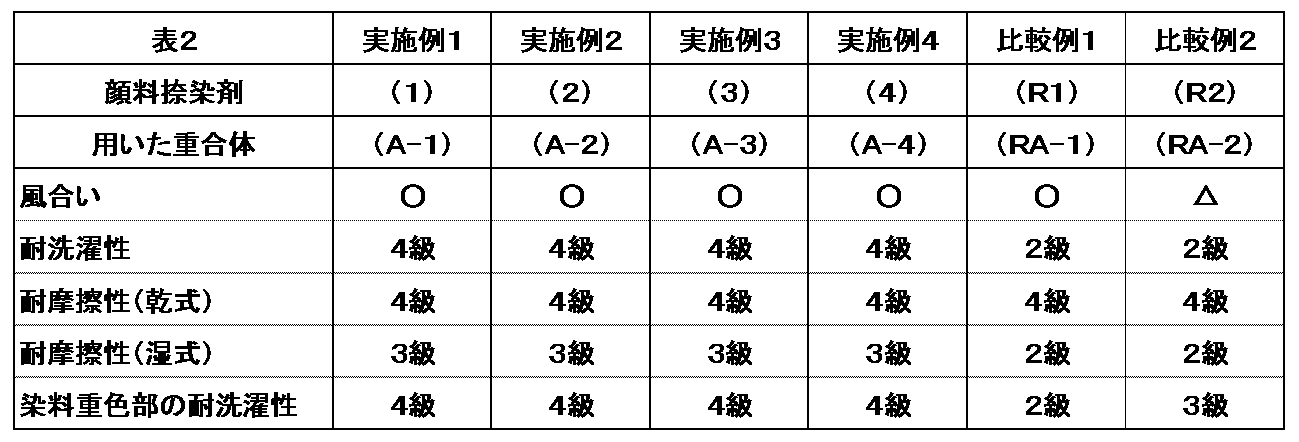
表1に示した評価結果から、本発明の顔料捺染剤(実施例1~4)で印捺した布帛は、布帛本来の風合いを損なうことなく、耐洗濯性、耐摩擦性に優れ、また染料捺染剤を重ねて印捺した部分(染料重色部)の耐水性にも問題がないことが確認できた。
一方、比較例1は、加水分解性シリル基を有する重合性単量体(a2)を用いなかった重合体を用い、当該重合体のフィルムの1,000%モジュラスが0.1MPa未満の例であるが、本発明の顔料捺染剤と比較して、耐洗濯性、湿式での耐摩擦性及び染料重色部の耐洗濯性に劣ることが確認できた。
比較例2は、顔料捺染剤に用いる重合体単独でのフィルムの伸び率が1,200%未満の例であるが、本発明の顔料捺染剤と比較して、布帛本来の風合いを損ない、耐洗濯性、湿式での耐摩擦性及び染料重色部の耐洗濯性に劣ることが確認できた。
Claims (5)
- カルボキシル基を有する重合性単量体(a1)及び加水分解性シリル基を有する重合性単量体(a2)を含む重合性単量体を重合して得られた重合体(A)及び酸化チタン(B)を含有する顔料捺染剤であって、前記重合体(A)単独でのフィルムの伸び率が1,200~5,000%の範囲であり、1,000%モジュラスが0.1MPa以上であることを特徴とする顔料捺染剤。
- 前記重合体(A)の原料となる重合性単量体全量中の前記重合性単量体(a1)の比率が0.1~10質量%の範囲であり、前記重合性単量体(a2)の比率が0.1~5質量%の範囲である請求項1記載の顔料捺染剤。
- さらに体質顔料(C)及び/又は前記酸化チタン(B)以外の顔料(D)を含有する請求項1又は2記載の顔料捺染剤。
- 請求項1~3のいずれか1項記載の顔料捺染剤で印捺されたことを特徴とする布帛。
- 請求項1~3のいずれか1項記載の顔料捺染剤と染料捺染剤とが重ねて印捺された部分を有する請求項4記載の布帛。
Priority Applications (2)
| Application Number | Priority Date | Filing Date | Title |
|---|---|---|---|
| JP2017520660A JP6222404B2 (ja) | 2015-05-28 | 2016-05-19 | 顔料捺染剤及びそれを用いた布帛 |
| CN201680029069.4A CN107614786B (zh) | 2015-05-28 | 2016-05-19 | 颜料印染剂和使用其的布帛 |
Applications Claiming Priority (2)
| Application Number | Priority Date | Filing Date | Title |
|---|---|---|---|
| JP2015108678 | 2015-05-28 | ||
| JP2015-108678 | 2015-05-28 |
Publications (1)
| Publication Number | Publication Date |
|---|---|
| WO2016190208A1 true WO2016190208A1 (ja) | 2016-12-01 |
Family
ID=57393418
Family Applications (1)
| Application Number | Title | Priority Date | Filing Date |
|---|---|---|---|
| PCT/JP2016/064853 Ceased WO2016190208A1 (ja) | 2015-05-28 | 2016-05-19 | 顔料捺染剤及びそれを用いた布帛 |
Country Status (3)
| Country | Link |
|---|---|
| JP (1) | JP6222404B2 (ja) |
| CN (1) | CN107614786B (ja) |
| WO (1) | WO2016190208A1 (ja) |
Cited By (2)
| Publication number | Priority date | Publication date | Assignee | Title |
|---|---|---|---|---|
| WO2018221235A1 (ja) * | 2017-05-30 | 2018-12-06 | Dic株式会社 | インク、印刷物及び印刷物の製造方法 |
| KR102212265B1 (ko) * | 2019-08-30 | 2021-02-04 | (주)대성티앤씨 | 섬유 날염용 백색 페이스트 및 이의 제조방법 |
Citations (14)
| Publication number | Priority date | Publication date | Assignee | Title |
|---|---|---|---|---|
| JPS52147654A (en) * | 1976-06-03 | 1977-12-08 | Dynamit Nobel Ag | Aqueous solution comprising organoosilicon compound and process for production thereof |
| JPS61151259A (ja) * | 1984-12-26 | 1986-07-09 | Nippon Shokubai Kagaku Kogyo Co Ltd | 水性樹脂組成物 |
| JPS61155474A (ja) * | 1984-12-28 | 1986-07-15 | Kansai Paint Co Ltd | 水性被覆用組成物 |
| JPS62156362A (ja) * | 1985-12-26 | 1987-07-11 | 株式会社日本触媒 | 繊維用処理剤 |
| JPH02284950A (ja) * | 1989-04-26 | 1990-11-22 | Nippon Synthetic Chem Ind Co Ltd:The | 安定化された塗料用組成物 |
| JPH02305871A (ja) * | 1989-05-22 | 1990-12-19 | Dainichiseika Color & Chem Mfg Co Ltd | 塗料組成物 |
| JPH08291474A (ja) * | 1995-02-20 | 1996-11-05 | Kuraray Co Ltd | 樹脂加工布及び加工方法 |
| JPH09250086A (ja) * | 1996-03-12 | 1997-09-22 | Kuraray Co Ltd | 防炎性樹脂加工布 |
| JPH11293195A (ja) * | 1998-04-07 | 1999-10-26 | Jsr Corp | 硬化体 |
| JP2000119587A (ja) * | 1998-10-20 | 2000-04-25 | Clariant Polymer Kk | コーティング組成物 |
| JP2002180386A (ja) * | 2000-09-18 | 2002-06-26 | Hiraoka & Co Ltd | プリント用複合メッシュシー卜 |
| JP2002309489A (ja) * | 2001-04-17 | 2002-10-23 | Komatsu Seiren Co Ltd | 印刷用シート |
| JP2007231459A (ja) * | 2006-03-01 | 2007-09-13 | Basu Corporation:Kk | 着色加工用半製品、染料により着色加工した製品およびそれらの製造方法 |
| JP2013245333A (ja) * | 2012-05-29 | 2013-12-09 | Kansai Paint Co Ltd | 無機建材用水性シーラー組成物 |
Family Cites Families (8)
| Publication number | Priority date | Publication date | Assignee | Title |
|---|---|---|---|---|
| JPS60224852A (ja) * | 1984-04-13 | 1985-11-09 | 大日本インキ化学工業株式会社 | 不織布 |
| IT1320087B1 (it) * | 2000-11-21 | 2003-11-18 | Atofina | Dispersioni acquose di polimeri acrilici. |
| CN1978575A (zh) * | 2005-11-30 | 2007-06-13 | 东莞奥美医疗用品有限公司 | 一种水性粘合剂 |
| JP5057690B2 (ja) * | 2006-04-21 | 2012-10-24 | 日本合成化学工業株式会社 | 合成樹脂エマルジョン、該エマルジョンを含有する不織布用バインダーおよび加工不織布 |
| CA2689190A1 (en) * | 2008-12-29 | 2010-06-29 | Alistair John Mclennan | Vinyl acetate/ vinyl 2-ethylhexanoate co-polymer binder resins |
| JP5630644B2 (ja) * | 2010-10-15 | 2014-11-26 | 株式会社ミマキエンジニアリング | 捺染方法及び捺染物 |
| JP5413702B2 (ja) * | 2011-09-09 | 2014-02-12 | Dic株式会社 | 複合顔料及びその製造方法 |
| CN103526599A (zh) * | 2013-10-25 | 2014-01-22 | 合肥聚合辐化技术有限公司 | 一种高鲜艳度印花粘合剂及其制备方法 |
-
2016
- 2016-05-19 CN CN201680029069.4A patent/CN107614786B/zh active Active
- 2016-05-19 JP JP2017520660A patent/JP6222404B2/ja active Active
- 2016-05-19 WO PCT/JP2016/064853 patent/WO2016190208A1/ja not_active Ceased
Patent Citations (14)
| Publication number | Priority date | Publication date | Assignee | Title |
|---|---|---|---|---|
| JPS52147654A (en) * | 1976-06-03 | 1977-12-08 | Dynamit Nobel Ag | Aqueous solution comprising organoosilicon compound and process for production thereof |
| JPS61151259A (ja) * | 1984-12-26 | 1986-07-09 | Nippon Shokubai Kagaku Kogyo Co Ltd | 水性樹脂組成物 |
| JPS61155474A (ja) * | 1984-12-28 | 1986-07-15 | Kansai Paint Co Ltd | 水性被覆用組成物 |
| JPS62156362A (ja) * | 1985-12-26 | 1987-07-11 | 株式会社日本触媒 | 繊維用処理剤 |
| JPH02284950A (ja) * | 1989-04-26 | 1990-11-22 | Nippon Synthetic Chem Ind Co Ltd:The | 安定化された塗料用組成物 |
| JPH02305871A (ja) * | 1989-05-22 | 1990-12-19 | Dainichiseika Color & Chem Mfg Co Ltd | 塗料組成物 |
| JPH08291474A (ja) * | 1995-02-20 | 1996-11-05 | Kuraray Co Ltd | 樹脂加工布及び加工方法 |
| JPH09250086A (ja) * | 1996-03-12 | 1997-09-22 | Kuraray Co Ltd | 防炎性樹脂加工布 |
| JPH11293195A (ja) * | 1998-04-07 | 1999-10-26 | Jsr Corp | 硬化体 |
| JP2000119587A (ja) * | 1998-10-20 | 2000-04-25 | Clariant Polymer Kk | コーティング組成物 |
| JP2002180386A (ja) * | 2000-09-18 | 2002-06-26 | Hiraoka & Co Ltd | プリント用複合メッシュシー卜 |
| JP2002309489A (ja) * | 2001-04-17 | 2002-10-23 | Komatsu Seiren Co Ltd | 印刷用シート |
| JP2007231459A (ja) * | 2006-03-01 | 2007-09-13 | Basu Corporation:Kk | 着色加工用半製品、染料により着色加工した製品およびそれらの製造方法 |
| JP2013245333A (ja) * | 2012-05-29 | 2013-12-09 | Kansai Paint Co Ltd | 無機建材用水性シーラー組成物 |
Cited By (4)
| Publication number | Priority date | Publication date | Assignee | Title |
|---|---|---|---|---|
| WO2018221235A1 (ja) * | 2017-05-30 | 2018-12-06 | Dic株式会社 | インク、印刷物及び印刷物の製造方法 |
| JPWO2018221235A1 (ja) * | 2017-05-30 | 2019-06-27 | Dic株式会社 | インク、印刷物及び印刷物の製造方法 |
| US12091560B2 (en) | 2017-05-30 | 2024-09-17 | Dic Corporation | Ink, printed article, and method of manufacturing printed article |
| KR102212265B1 (ko) * | 2019-08-30 | 2021-02-04 | (주)대성티앤씨 | 섬유 날염용 백색 페이스트 및 이의 제조방법 |
Also Published As
| Publication number | Publication date |
|---|---|
| JP6222404B2 (ja) | 2017-11-01 |
| CN107614786A (zh) | 2018-01-19 |
| JPWO2016190208A1 (ja) | 2017-10-05 |
| CN107614786B (zh) | 2020-03-27 |
Similar Documents
| Publication | Publication Date | Title |
|---|---|---|
| CN105111363B (zh) | 一种功能预聚体及其制备方法与应用 | |
| CN112062918A (zh) | 无硫无皂原位raft乳液共聚合成聚合物/颜料杂化乳胶的方法 | |
| CN101531830A (zh) | 一种涂料印花用自粘性有机颜料微胶囊的制备方法 | |
| JP4297627B2 (ja) | 繊維加工用水分散性樹脂組成物 | |
| Xie et al. | Nanoscale polymer encapsulated pigment hybrid latexes with high pigment content for binder-free pigment printing of cotton/polyester blend fabrics | |
| CN100451037C (zh) | 使用中空球体聚合物的方法 | |
| JP6222404B2 (ja) | 顔料捺染剤及びそれを用いた布帛 | |
| US8540974B2 (en) | Aqueous dispersions of water-soluble and/or water-swellable anionic polymers, method for their production and use thereof | |
| WO2005000594A1 (ja) | インク受容層形成剤及び水性インク | |
| CN111304932A (zh) | 一种遮光涂层浆料及其制备方法 | |
| CN106988134A (zh) | 一种印花粘合剂及其制备方法、印花色浆和服装 | |
| CN101084344A (zh) | 印刷或着色底材的方法 | |
| CN100439408C (zh) | 一种用于喷墨印花的纳米级聚合物微乳液及其制备方法 | |
| JP7651971B2 (ja) | 捺染用インク | |
| JP6201767B2 (ja) | 繊維加工用樹脂組成物、それを用いた顔料捺染剤及び布帛 | |
| WO2006112452A1 (ja) | 着色剤組成物及び着色方法 | |
| JPS58134156A (ja) | 皮革および模造皮革用仕上剤の顔料添加やつや消しのための配合物 | |
| CN104610512A (zh) | 一种超柔软互穿网络涂料印花粘合剂的制备方法 | |
| CN113373709A (zh) | 一种印花胶浆及其制备方法和应用 | |
| CN101772523B (zh) | 水分散体、其制备方法及其用途 | |
| JP7855933B2 (ja) | 画像形成方法及びインクセット | |
| JP6528912B2 (ja) | インク、印刷物及び印刷物の製造方法 | |
| JP2023156338A (ja) | インクジェット捺染用インク、該インクを用いた印刷物の製造方法および画像固着物品 | |
| JP4074189B2 (ja) | 水性着色剤及びそれを用いた水性塗工剤 | |
| CN109266258B (zh) | 一种用于涂料罩印的水性粘合剂及其制备方法、罩印白浆 |
Legal Events
| Date | Code | Title | Description |
|---|---|---|---|
| 121 | Ep: the epo has been informed by wipo that ep was designated in this application |
Ref document number: 16799914 Country of ref document: EP Kind code of ref document: A1 |
|
| ENP | Entry into the national phase |
Ref document number: 2017520660 Country of ref document: JP Kind code of ref document: A |
|
| NENP | Non-entry into the national phase |
Ref country code: DE |
|
| 122 | Ep: pct application non-entry in european phase |
Ref document number: 16799914 Country of ref document: EP Kind code of ref document: A1 |