WO2016185730A1 - 加硫ゴム成形用離型剤 - Google Patents
加硫ゴム成形用離型剤 Download PDFInfo
- Publication number
- WO2016185730A1 WO2016185730A1 PCT/JP2016/051272 JP2016051272W WO2016185730A1 WO 2016185730 A1 WO2016185730 A1 WO 2016185730A1 JP 2016051272 W JP2016051272 W JP 2016051272W WO 2016185730 A1 WO2016185730 A1 WO 2016185730A1
- Authority
- WO
- WIPO (PCT)
- Prior art keywords
- release agent
- vulcanized rubber
- mass
- polyoxyalkylene
- glyceryl ether
- Prior art date
- Legal status (The legal status is an assumption and is not a legal conclusion. Google has not performed a legal analysis and makes no representation as to the accuracy of the status listed.)
- Ceased
Links
Classifications
-
- B—PERFORMING OPERATIONS; TRANSPORTING
- B29—WORKING OF PLASTICS; WORKING OF SUBSTANCES IN A PLASTIC STATE IN GENERAL
- B29C—SHAPING OR JOINING OF PLASTICS; SHAPING OF MATERIAL IN A PLASTIC STATE, NOT OTHERWISE PROVIDED FOR; AFTER-TREATMENT OF THE SHAPED PRODUCTS, e.g. REPAIRING
- B29C33/00—Moulds or cores; Details thereof or accessories therefor
- B29C33/56—Coatings, e.g. enameled or galvanised; Releasing, lubricating or separating agents
- B29C33/60—Releasing, lubricating or separating agents
- B29C33/62—Releasing, lubricating or separating agents based on polymers or oligomers
-
- C—CHEMISTRY; METALLURGY
- C08—ORGANIC MACROMOLECULAR COMPOUNDS; THEIR PREPARATION OR CHEMICAL WORKING-UP; COMPOSITIONS BASED THEREON
- C08G—MACROMOLECULAR COMPOUNDS OBTAINED OTHERWISE THAN BY REACTIONS ONLY INVOLVING UNSATURATED CARBON-TO-CARBON BONDS
- C08G65/00—Macromolecular compounds obtained by reactions forming an ether link in the main chain of the macromolecule
- C08G65/02—Macromolecular compounds obtained by reactions forming an ether link in the main chain of the macromolecule from cyclic ethers by opening of the heterocyclic ring
- C08G65/04—Macromolecular compounds obtained by reactions forming an ether link in the main chain of the macromolecule from cyclic ethers by opening of the heterocyclic ring from cyclic ethers only
- C08G65/06—Cyclic ethers having no atoms other than carbon and hydrogen outside the ring
- C08G65/08—Saturated oxiranes
-
- C—CHEMISTRY; METALLURGY
- C08—ORGANIC MACROMOLECULAR COMPOUNDS; THEIR PREPARATION OR CHEMICAL WORKING-UP; COMPOSITIONS BASED THEREON
- C08G—MACROMOLECULAR COMPOUNDS OBTAINED OTHERWISE THAN BY REACTIONS ONLY INVOLVING UNSATURATED CARBON-TO-CARBON BONDS
- C08G65/00—Macromolecular compounds obtained by reactions forming an ether link in the main chain of the macromolecule
- C08G65/02—Macromolecular compounds obtained by reactions forming an ether link in the main chain of the macromolecule from cyclic ethers by opening of the heterocyclic ring
- C08G65/26—Macromolecular compounds obtained by reactions forming an ether link in the main chain of the macromolecule from cyclic ethers by opening of the heterocyclic ring from cyclic ethers and other compounds
- C08G65/2603—Macromolecular compounds obtained by reactions forming an ether link in the main chain of the macromolecule from cyclic ethers by opening of the heterocyclic ring from cyclic ethers and other compounds the other compounds containing oxygen
- C08G65/2606—Macromolecular compounds obtained by reactions forming an ether link in the main chain of the macromolecule from cyclic ethers by opening of the heterocyclic ring from cyclic ethers and other compounds the other compounds containing oxygen containing hydroxyl groups
- C08G65/2609—Macromolecular compounds obtained by reactions forming an ether link in the main chain of the macromolecule from cyclic ethers by opening of the heterocyclic ring from cyclic ethers and other compounds the other compounds containing oxygen containing hydroxyl groups containing aliphatic hydroxyl groups
-
- C—CHEMISTRY; METALLURGY
- C08—ORGANIC MACROMOLECULAR COMPOUNDS; THEIR PREPARATION OR CHEMICAL WORKING-UP; COMPOSITIONS BASED THEREON
- C08G—MACROMOLECULAR COMPOUNDS OBTAINED OTHERWISE THAN BY REACTIONS ONLY INVOLVING UNSATURATED CARBON-TO-CARBON BONDS
- C08G65/00—Macromolecular compounds obtained by reactions forming an ether link in the main chain of the macromolecule
- C08G65/02—Macromolecular compounds obtained by reactions forming an ether link in the main chain of the macromolecule from cyclic ethers by opening of the heterocyclic ring
- C08G65/26—Macromolecular compounds obtained by reactions forming an ether link in the main chain of the macromolecule from cyclic ethers by opening of the heterocyclic ring from cyclic ethers and other compounds
- C08G65/2603—Macromolecular compounds obtained by reactions forming an ether link in the main chain of the macromolecule from cyclic ethers by opening of the heterocyclic ring from cyclic ethers and other compounds the other compounds containing oxygen
- C08G65/2615—Macromolecular compounds obtained by reactions forming an ether link in the main chain of the macromolecule from cyclic ethers by opening of the heterocyclic ring from cyclic ethers and other compounds the other compounds containing oxygen the other compounds containing carboxylic acid, ester or anhydride groups
-
- C—CHEMISTRY; METALLURGY
- C08—ORGANIC MACROMOLECULAR COMPOUNDS; THEIR PREPARATION OR CHEMICAL WORKING-UP; COMPOSITIONS BASED THEREON
- C08L—COMPOSITIONS OF MACROMOLECULAR COMPOUNDS
- C08L71/00—Compositions of polyethers obtained by reactions forming an ether link in the main chain; Compositions of derivatives of such polymers
-
- C—CHEMISTRY; METALLURGY
- C08—ORGANIC MACROMOLECULAR COMPOUNDS; THEIR PREPARATION OR CHEMICAL WORKING-UP; COMPOSITIONS BASED THEREON
- C08L—COMPOSITIONS OF MACROMOLECULAR COMPOUNDS
- C08L71/00—Compositions of polyethers obtained by reactions forming an ether link in the main chain; Compositions of derivatives of such polymers
- C08L71/02—Polyalkylene oxides
-
- C—CHEMISTRY; METALLURGY
- C10—PETROLEUM, GAS OR COKE INDUSTRIES; TECHNICAL GASES CONTAINING CARBON MONOXIDE; FUELS; LUBRICANTS; PEAT
- C10M—LUBRICATING COMPOSITIONS; USE OF CHEMICAL SUBSTANCES EITHER ALONE OR AS LUBRICATING INGREDIENTS IN A LUBRICATING COMPOSITION
- C10M173/00—Lubricating compositions containing more than 10% water
- C10M173/02—Lubricating compositions containing more than 10% water not containing mineral or fatty oils
-
- C—CHEMISTRY; METALLURGY
- C08—ORGANIC MACROMOLECULAR COMPOUNDS; THEIR PREPARATION OR CHEMICAL WORKING-UP; COMPOSITIONS BASED THEREON
- C08G—MACROMOLECULAR COMPOUNDS OBTAINED OTHERWISE THAN BY REACTIONS ONLY INVOLVING UNSATURATED CARBON-TO-CARBON BONDS
- C08G2125/00—Compositions for processes using internal mould release agents
-
- C—CHEMISTRY; METALLURGY
- C08—ORGANIC MACROMOLECULAR COMPOUNDS; THEIR PREPARATION OR CHEMICAL WORKING-UP; COMPOSITIONS BASED THEREON
- C08L—COMPOSITIONS OF MACROMOLECULAR COMPOUNDS
- C08L2205/00—Polymer mixtures characterised by other features
- C08L2205/02—Polymer mixtures characterised by other features containing two or more polymers of the same C08L -group
-
- C—CHEMISTRY; METALLURGY
- C10—PETROLEUM, GAS OR COKE INDUSTRIES; TECHNICAL GASES CONTAINING CARBON MONOXIDE; FUELS; LUBRICANTS; PEAT
- C10M—LUBRICATING COMPOSITIONS; USE OF CHEMICAL SUBSTANCES EITHER ALONE OR AS LUBRICATING INGREDIENTS IN A LUBRICATING COMPOSITION
- C10M2207/00—Organic non-macromolecular hydrocarbon compounds containing hydrogen, carbon and oxygen as ingredients in lubricant compositions
- C10M2207/02—Hydroxy compounds
- C10M2207/021—Hydroxy compounds having hydroxy groups bound to acyclic or cycloaliphatic carbon atoms
- C10M2207/022—Hydroxy compounds having hydroxy groups bound to acyclic or cycloaliphatic carbon atoms containing at least two hydroxy groups
-
- C—CHEMISTRY; METALLURGY
- C10—PETROLEUM, GAS OR COKE INDUSTRIES; TECHNICAL GASES CONTAINING CARBON MONOXIDE; FUELS; LUBRICANTS; PEAT
- C10M—LUBRICATING COMPOSITIONS; USE OF CHEMICAL SUBSTANCES EITHER ALONE OR AS LUBRICATING INGREDIENTS IN A LUBRICATING COMPOSITION
- C10M2209/00—Organic macromolecular compounds containing oxygen as ingredients in lubricant compositions
- C10M2209/10—Macromolecular compoundss obtained otherwise than by reactions only involving carbon-to-carbon unsaturated bonds
- C10M2209/103—Polyethers, i.e. containing di- or higher polyoxyalkylene groups
- C10M2209/104—Polyethers, i.e. containing di- or higher polyoxyalkylene groups of alkylene oxides containing two carbon atoms only
- C10M2209/1045—Polyethers, i.e. containing di- or higher polyoxyalkylene groups of alkylene oxides containing two carbon atoms only used as base material
-
- C—CHEMISTRY; METALLURGY
- C10—PETROLEUM, GAS OR COKE INDUSTRIES; TECHNICAL GASES CONTAINING CARBON MONOXIDE; FUELS; LUBRICANTS; PEAT
- C10M—LUBRICATING COMPOSITIONS; USE OF CHEMICAL SUBSTANCES EITHER ALONE OR AS LUBRICATING INGREDIENTS IN A LUBRICATING COMPOSITION
- C10M2209/00—Organic macromolecular compounds containing oxygen as ingredients in lubricant compositions
- C10M2209/10—Macromolecular compoundss obtained otherwise than by reactions only involving carbon-to-carbon unsaturated bonds
- C10M2209/103—Polyethers, i.e. containing di- or higher polyoxyalkylene groups
- C10M2209/105—Polyethers, i.e. containing di- or higher polyoxyalkylene groups of alkylene oxides containing three carbon atoms only
- C10M2209/1055—Polyethers, i.e. containing di- or higher polyoxyalkylene groups of alkylene oxides containing three carbon atoms only used as base material
-
- C—CHEMISTRY; METALLURGY
- C10—PETROLEUM, GAS OR COKE INDUSTRIES; TECHNICAL GASES CONTAINING CARBON MONOXIDE; FUELS; LUBRICANTS; PEAT
- C10M—LUBRICATING COMPOSITIONS; USE OF CHEMICAL SUBSTANCES EITHER ALONE OR AS LUBRICATING INGREDIENTS IN A LUBRICATING COMPOSITION
- C10M2209/00—Organic macromolecular compounds containing oxygen as ingredients in lubricant compositions
- C10M2209/10—Macromolecular compoundss obtained otherwise than by reactions only involving carbon-to-carbon unsaturated bonds
- C10M2209/103—Polyethers, i.e. containing di- or higher polyoxyalkylene groups
- C10M2209/107—Polyethers, i.e. containing di- or higher polyoxyalkylene groups of two or more specified different alkylene oxides covered by groups C10M2209/104 - C10M2209/106
- C10M2209/1075—Polyethers, i.e. containing di- or higher polyoxyalkylene groups of two or more specified different alkylene oxides covered by groups C10M2209/104 - C10M2209/106 used as base material
-
- C—CHEMISTRY; METALLURGY
- C10—PETROLEUM, GAS OR COKE INDUSTRIES; TECHNICAL GASES CONTAINING CARBON MONOXIDE; FUELS; LUBRICANTS; PEAT
- C10M—LUBRICATING COMPOSITIONS; USE OF CHEMICAL SUBSTANCES EITHER ALONE OR AS LUBRICATING INGREDIENTS IN A LUBRICATING COMPOSITION
- C10M2209/00—Organic macromolecular compounds containing oxygen as ingredients in lubricant compositions
- C10M2209/10—Macromolecular compoundss obtained otherwise than by reactions only involving carbon-to-carbon unsaturated bonds
- C10M2209/103—Polyethers, i.e. containing di- or higher polyoxyalkylene groups
- C10M2209/109—Polyethers, i.e. containing di- or higher polyoxyalkylene groups esterified
-
- C—CHEMISTRY; METALLURGY
- C10—PETROLEUM, GAS OR COKE INDUSTRIES; TECHNICAL GASES CONTAINING CARBON MONOXIDE; FUELS; LUBRICANTS; PEAT
- C10M—LUBRICATING COMPOSITIONS; USE OF CHEMICAL SUBSTANCES EITHER ALONE OR AS LUBRICATING INGREDIENTS IN A LUBRICATING COMPOSITION
- C10M2229/00—Organic macromolecular compounds containing atoms of elements not provided for in groups C10M2205/00, C10M2209/00, C10M2213/00, C10M2217/00, C10M2221/00 or C10M2225/00 as ingredients in lubricant compositions
- C10M2229/02—Unspecified siloxanes; Silicones
-
- C—CHEMISTRY; METALLURGY
- C10—PETROLEUM, GAS OR COKE INDUSTRIES; TECHNICAL GASES CONTAINING CARBON MONOXIDE; FUELS; LUBRICANTS; PEAT
- C10N—INDEXING SCHEME ASSOCIATED WITH SUBCLASS C10M RELATING TO LUBRICATING COMPOSITIONS
- C10N2020/00—Specified physical or chemical properties or characteristics, i.e. function, of component of lubricating compositions
- C10N2020/01—Physico-chemical properties
- C10N2020/04—Molecular weight; Molecular weight distribution
-
- C—CHEMISTRY; METALLURGY
- C10—PETROLEUM, GAS OR COKE INDUSTRIES; TECHNICAL GASES CONTAINING CARBON MONOXIDE; FUELS; LUBRICANTS; PEAT
- C10N—INDEXING SCHEME ASSOCIATED WITH SUBCLASS C10M RELATING TO LUBRICATING COMPOSITIONS
- C10N2040/00—Specified use or application for which the lubricating composition is intended
- C10N2040/36—Release agents or mold release agents
Definitions
- the present invention relates to a release agent for molding vulcanized rubber.
- Vulcanized rubber is used in automobile parts, railway parts, construction machinery and the like. These vulcanized rubbers can be obtained by putting the rubber composition into a mold or the like, vulcanizing and molding it, and then desorbing it. To facilitate desorption, a mold release agent is applied to the mold. Has been.
- Patent Document 1 discloses an alkylene oxide adduct of glycerin fatty acid ester.
- the release agent described in Patent Document 1 has a problem that sufficient release properties cannot be obtained unless a large amount of release agent is used. Further, since the amount of the release agent used is large, the amount of washing water for removing the release agent becomes large, and there is also a problem that the drainage load is large.
- the present invention provides a release agent that is excellent in releasability between a vulcanized rubber and a mold and can be removed with a relatively small amount of washing water.
- the mold release agent for vulcanized rubber molding according to the present invention contains polyoxyalkylene glyceryl ether (A), and the polyoxyalkylene glyceryl ether (A) is 100% by mass of the entire oxyalkylene group. In this case, it contains 50 to 95% by mass of oxyethylene groups.
- the release agent for molding vulcanized rubber according to the present invention preferably further contains a polyoxyalkylene diol (B) in addition to the polyoxyalkylene glyceryl ether (A).
- the above vulcanized rubber mold release agent has excellent mold release properties between the vulcanized rubber and the mold, and can be removed from the surface of the vulcanized rubber with a relatively small amount of washing water. Excellent.
- the release agent for molding vulcanized rubber in the present invention contains polyoxyalkylene glyceryl ether (A), and the polyoxyalkylene glyceryl ether (A) is 100% by mass of the entire oxyalkylene group. In some cases, it contains 50 to 95% by mass of oxyethylene groups.
- polyoxyalkylene glyceryl ether having a high content of oxyethylene groups it is possible to improve the washability after vulcanization molding. Further, when the content is 50 to 95% by mass, the releasability between the mold and the vulcanized rubber can be improved.
- the content of the oxyethylene group is preferably 60 to 90% by mass, and more preferably 70 to 85% by mass when the entire oxyalkylene group is 100% by mass.
- the polyoxyalkylene group in the polyoxyalkylene glyceryl ether (A) used in the present embodiment can include an oxypropylene group, an oxybutylene group, and the like.
- the content of oxyalkylene groups other than oxyethylene groups is preferably 5 to 50% by mass, more preferably 10 to 40% by mass, based on 100% by mass of the entire oxyalkylene group. More preferably, it is ⁇ 30% by mass.
- the oxyalkylene group other than the oxyethylene group is preferably an oxypropylene group.
- the polyoxyalkylene glyceryl ether (A) used in this embodiment preferably has a number average molecular weight (Mn) of 2000 to 20000. By using a material having such a number average molecular weight, the viscosity of the release agent becomes lower and workability can be improved.
- the number average molecular weight of the polyoxyalkylene glyceryl ether (A) is more preferably 3000 to 10,000.
- the method for producing the polyoxyalkylene glyceryl ether (A) is not particularly limited, and the polyoxyalkylene glyceryl ether (A) can be produced using a known polyoxyalkylene glyceryl ether synthesis method.
- the polyoxyalkylene glyceryl ether (A) can be produced using a known polyoxyalkylene glyceryl ether synthesis method.
- it can be obtained by adding an alkali catalyst or an acid catalyst to glycerin and reacting the alkylene oxide at 80 to 150 ° C.
- the addition form in the case of 2 or more types of alkylene oxides may be block addition or random addition, and these may be combined.
- an addition form includes random addition.
- the release agent for molding a vulcanized rubber hose according to the present embodiment preferably further contains a polyoxyalkylene diol (B) in addition to the polyoxyalkylene glyceryl ether (A).
- B polyoxyalkylene diol
- the polyoxyalkylene diol (B) used in the present embodiment contains 20 to 80% by mass of oxyethylene groups when the total amount of oxyalkylene groups contained in the polyoxyalkylene diol (B) is 100% by mass. It is preferable. By making the content of the oxyethylene group within the above range, the releasability and detergency become more excellent.
- the content of the oxyethylene group is preferably 30 to 75% by mass, and more preferably 40 to 70% by mass.
- the number average molecular weight (Mn) of the polyoxyalkylene diol (B) is preferably 2000 to 20000. By using a material having such a number average molecular weight, the viscosity of the release agent becomes lower and workability can be improved.
- the number average molecular weight of the polyoxyalkylene diol (B) is more preferably 3000 to 10,000.
- the method for producing the polyoxyalkylene diol (B) is not particularly limited, and the polyoxyalkylene diol (B) can be produced using a known method for synthesizing polyoxyalkylene diol (B).
- a known method for synthesizing polyoxyalkylene diol (B) For example, when it is produced by addition polymerization of alkylene oxide, it can be obtained by adding an alkali catalyst or an acid catalyst to diol and reacting the alkylene oxide at 80 to 150 ° C.
- the addition form in the case of 2 or more types of alkylene oxides may be block addition or random addition, and these may be combined. Among these, it is preferable that the additional form includes a block addition because the release property and the cleaning property are more excellent.
- the diol that can be used in the production of the polyoxyalkylene diol (B) is not particularly limited, and examples thereof include ethylene glycol, 1,2-propylene glycol, 1,3-propylene glycol, 1,2-butanediol, , 3-butanediol, 1,4-butanediol, 1,5-pentanediol, 1,6-hexanediol, 3-methyl-1,5-pentanediol and the like.
- the content of the polyoxyalkylene diol (B) is preferably 20 to 500 parts by mass with respect to 100 parts by mass of the polyoxyalkylene glyceryl ether (A). By setting it within the above range, the releasability and detergency become more excellent.
- the content of the polyoxyalkylene diol (B) is more preferably 30 to 300 parts by mass, and further preferably 40 to 250 parts by mass with respect to 100 parts by mass of the polyoxyalkylene glyceryl ether (A). preferable.
- the release agent for molding vulcanized rubber of the present invention may be diluted with water.
- concentration of the polyoxyalkylene glyceryl ether (A) or the mixture of the polyoxyalkylene glyceryl ether (A) and the polyoxyalkylene diol (B) is 10 to 60% by mass, more preferably 20 to 20% by mass. The thing diluted with water so that it may become 40 mass% is mentioned.
- the release agent for molding vulcanized rubber of the present invention may contain known release agent components such as nonionic or anionic surfactants and silicones as long as the effect is not impaired.
- the mold release agent for molding vulcanized rubber of the present invention includes acrylonitrile-butadiene copolymer rubber (NBR), ethylene / propylene / diene copolymer rubber (EPDM), and rubber (NBR) blended with NBR and polyvinyl chloride (PVC). / PVC), acrylic rubber (ACM), fluorine rubber (FKM), etc., can be used for known rubbers.
- the rubber can contain known additives such as a vulcanizing agent, a vulcanizing aid, a processing aid, a plasticizer, a process oil, carbon black, a white filler, and an antioxidant.
- the rubber can be vulcanized and molded in accordance with a conventional method. For example, after applying the release agent of the present invention to a mold and mounting the rubber, it may be heated and vulcanized. After vulcanization, the rubber is removed from the mold, and the release agent adhering to the rubber surface is washed with water or warm water to obtain a vulcanized rubber.
- the number average molecular weight and the oxyethylene group content relative to the oxyalkylene group were measured by the following methods.
- the number average molecular weight was determined by the GPC method.
- the GPC apparatus and analysis conditions were as follows, and a standard sample calibrated with polyethylene glycol having molecular weights of 327, 2000, 8250, and 19700 was used.
- GPC device System controller: SCL-10A (manufactured by Shimadzu Corporation) Detector: RID-10A (manufactured by Shimadzu Corporation) Column: Shodex GPC KF-G, KF-803, KF802.5, KF-802, KF-801 (all manufactured by Showa Denko KK) Eluent: Tetrahydrofuran Sample injection: 0.5 wt% solution, 80 ⁇ L Flow rate: 0.8mL / min Temperature: 25 ° C
- the raw materials used in this example are as follows.
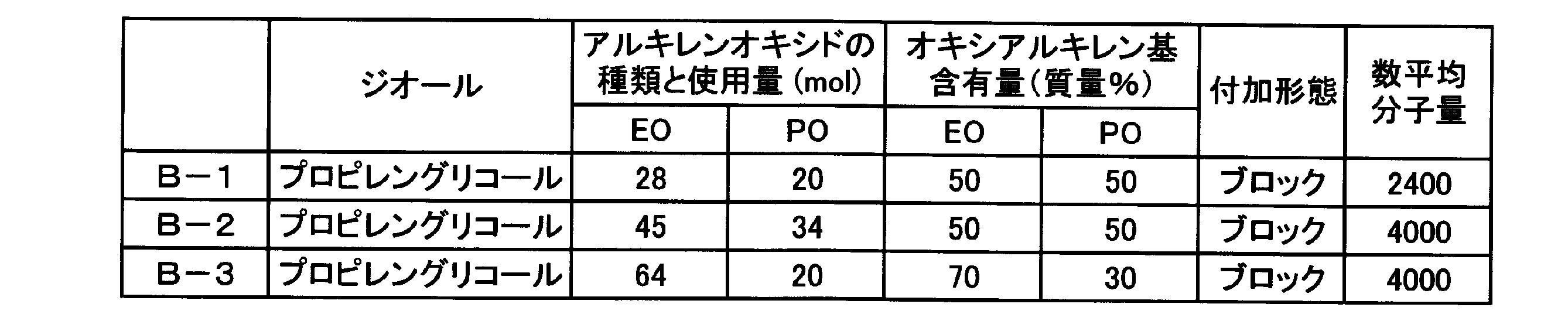
- ⁇ Polyoxyalkylene polyol (B)> The type and ratio described in Table 2 were used in which alkylene oxide was added to 1 mol of diol.
- EO in the type of alkylene oxide represents ethylene oxide
- PO represents propylene oxide.
- EO in alkylene oxide content shows oxyethylene group content
- PO shows oxypropylene group content
- all are content when the whole oxyalkylene group is 100 mass%.
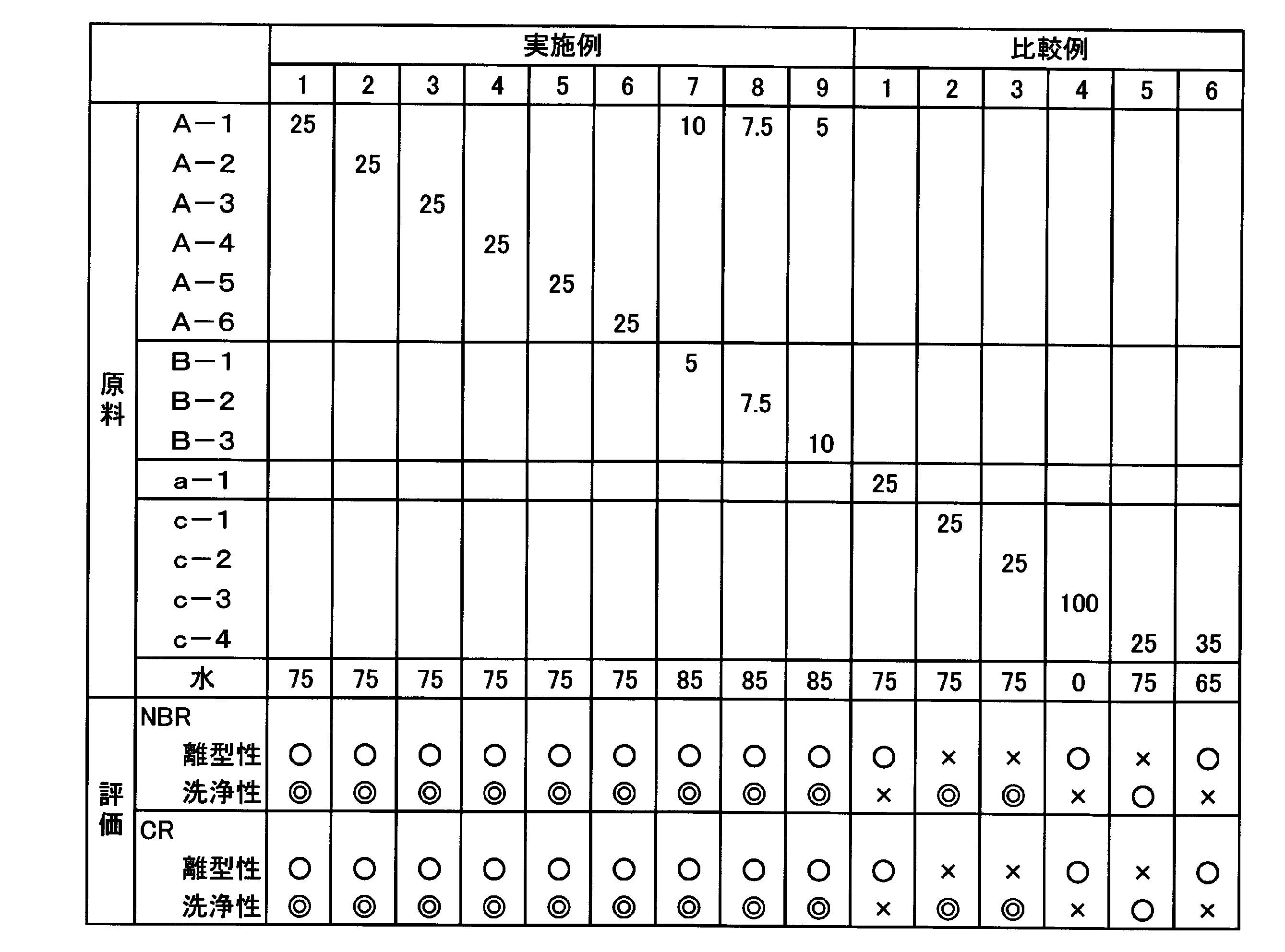
- Examples 1 to 9, Comparative Examples 1 to 6 A release agent was obtained by mixing each raw material at a ratio (mass ratio) described in Table 3 below. The following evaluation was performed using this mold release agent.
- “Dimethylpolysiloxane” is KF-96-20CS (trade name) manufactured by Shin-Etsu Chemical Co., Ltd.
- Unvulcanized rubber acrylonitrile-butadiene copolymer rubber (NBR) or chloroprene rubber (CR) coated with a release agent was mounted on a mold (120 ⁇ 120 ⁇ 2 mm). Subsequently, vulcanization treatment was performed at 150 ° C. for 1 hour, and the vulcanized rubber was taken out from the mold. The workability at this time was defined as releasability, and evaluation was performed according to the following criteria. The results are shown in Table 3. ⁇ : Workability is the same as when dimethylpolysiloxane is used. ⁇ : Workability is worse than when dimethylpolysiloxane is used.
- the release agent for molding vulcanized rubber of the present invention is excellent in cleaning properties and mold release properties. Moreover, it turns out that sufficient release property is obtained even if it is a small amount of mold release agent by using polyoxyalkylene glyceryl ether (A) and polyoxyalkylene diol (B) together.
- A polyoxyalkylene glyceryl ether
- B polyoxyalkylene diol
Landscapes
- Chemical & Material Sciences (AREA)
- Chemical Kinetics & Catalysis (AREA)
- Organic Chemistry (AREA)
- Health & Medical Sciences (AREA)
- Medicinal Chemistry (AREA)
- Polymers & Plastics (AREA)
- Engineering & Computer Science (AREA)
- Mechanical Engineering (AREA)
- General Chemical & Material Sciences (AREA)
- Oil, Petroleum & Natural Gas (AREA)
- Moulds For Moulding Plastics Or The Like (AREA)
- Compositions Of Macromolecular Compounds (AREA)
Abstract
Description
数平均分子量は、GPC法により求めた。GPC装置及び分析条件は以下の通りであり、標準サンプルとして分子量327、2000、8250、19700のポリエチレングリコールで校正したものを用いた。
GPC装置:システムコントローラー:SCL-10A(島津製作所社製)
検出器:RID-10A(島津製作所社製)
カラム:Shodex GPC KF-G、KF-803、KF802.5、KF-802、KF-801を連結したもの(いずれも昭和電工社製)
溶離液:テトラヒドロフラン
サンプル注入:0.5重量%溶液、80μL
流速:0.8mL/min
温度:25℃
1H-NMR(溶媒:CDCl3)により算出した。
グリセリン1モルに表1に記載したアルキレンオキシドを付加したものを用いた。なお、表中、アルキレンオキシドの種類と使用量におけるEOはエチレンオキシドの使用量、POはプロピレンオキシドの使用量を示し、いずれもグリセリン1モルに対する使用量(mol)である。また、アルキレンオキシド含有量におけるEOはオキシエチレン基の含有量、POはオキシプロピレン基の含有量を示し、いずれもオキシアルキレン基全体を100質量%とした場合の含有量である。

表2に記載した種類および割合で、ジオール1モルにアルキレンオキシドを付加されたものを用いた。なお、表中、アルキレンオキシドの種類におけるEOはエチレンオキシド、POはプロピレンオキシドを示す。また、アルキレンオキシド含有量におけるEOはオキシエチレン基含有量、POはオキシプロピレン基含有量を示し、いずれもオキシアルキレン基全体を100質量%とした場合の含有量である。
(c-1)グリセリン
(c-2)ポリエチレングリコール(数平均分子量:4000)
(c-3)ジメチルポリシロキサン(商品名:KF-96-20CS、信越化学工業社製)
(c-4)グリセリン脂肪酸エステルのアルキレンオキサイド付加物
ポリオキシアルキレングリセリルエーテル(A-5)において、グリセリンに代えてグリセリンモノラウレート1モルを用いた以外は同様の操作を行い、グリセリン脂肪酸エステルのアルキレンオキサイド付加物(c-4)を得た。
下記表3に記載の割合(質量比)で各原料を混合することにより、離型剤を得た。この離型剤を用いて、下記の評価を行った。なお、「ジメチルポリシロキサン」は、信越化学工業社製のKF-96-20CS(商品名)である。
離型剤を塗布した未加硫ゴム(アクリロニトリル-ブタジエン共重合ゴム(NBR)またはクロロプレンゴム(CR))を金型(120×120×2mm)に装着した。続いて、150℃で1時間加硫処理を行い、金型から加硫ゴムを取り出した。このときの作業性を離型性とし、下記の基準で評価した。結果を表3に示す。
○:ジメチルポリシロキサンを用いた場合と作業性が同程度である
×:ジメチルポリシロキサンを用いた場合よりも作業性が悪い
上記離型性の評価で得られた加硫ゴムを、2Lの水(温度:80℃)に浸漬し、浸漬開始から1分後および2分後に加硫ゴム表面のヌメリを確認し、下記の基準で評価した。なお、加硫ゴム表面にヌメリがある場合は離型剤が残っており、ヌメリがない場合は離型剤が残っていないことを示す。結果を表1に示す。
◎:1分間浸漬後に加硫ゴムの表面にヌメリがない
○:2分間浸漬後に加硫ゴムの表面にヌメリがない
×:2分間浸漬後も加硫ゴムの表面にヌメリがある
Claims (4)
- ポリオキシアルキレングリセリルエーテル(A)を含有する加硫ゴム成形用離型剤であって、前記ポリオキシアルキレングリセリルエーテル(A)が、オキシアルキレン基全体を100質量%とした場合にオキシエチレン基を50~95質量%含んでなる、加硫ゴム成形用離型剤。
- 前記ポリオキシアルキレングリセリルエーテル(A)の数平均分子量が2000~20000である、請求項1記載の加硫ゴム成形用離型剤。
- さらに、ポリオキシアルキレンジオール(B)を含有する、請求項1または2記載の加硫ゴム成形用離型剤。
- 前記ポリオキシアルキレンジオール(B)の含有量が、前記ポリオキシアルキレングリセリルエーテル(A)100質量部に対して、20~500質量部である請求項3に記載の加硫ゴム成形用離型剤。
Priority Applications (3)
| Application Number | Priority Date | Filing Date | Title |
|---|---|---|---|
| JP2016514779A JP5944087B1 (ja) | 2015-05-15 | 2016-01-18 | 加硫ゴム成形用離型剤 |
| US15/569,834 US10870222B2 (en) | 2015-05-15 | 2016-01-18 | Release agent for vulcanized rubber molding |
| CN201680028130.3A CN107530917B (zh) | 2015-05-15 | 2016-01-18 | 硫化橡胶成型用脱模剂 |
Applications Claiming Priority (2)
| Application Number | Priority Date | Filing Date | Title |
|---|---|---|---|
| JP2015-099826 | 2015-05-15 | ||
| JP2015099826 | 2015-05-15 |
Publications (1)
| Publication Number | Publication Date |
|---|---|
| WO2016185730A1 true WO2016185730A1 (ja) | 2016-11-24 |
Family
ID=57319772
Family Applications (1)
| Application Number | Title | Priority Date | Filing Date |
|---|---|---|---|
| PCT/JP2016/051272 Ceased WO2016185730A1 (ja) | 2015-05-15 | 2016-01-18 | 加硫ゴム成形用離型剤 |
Country Status (3)
| Country | Link |
|---|---|
| US (1) | US10870222B2 (ja) |
| CN (1) | CN107530917B (ja) |
| WO (1) | WO2016185730A1 (ja) |
Cited By (2)
| Publication number | Priority date | Publication date | Assignee | Title |
|---|---|---|---|---|
| CN109153153B (zh) * | 2016-05-13 | 2021-06-18 | 第一工业制药株式会社 | 硫化橡胶成形用脱模剂 |
| WO2023084909A1 (ja) * | 2021-11-15 | 2023-05-19 | ライオン・スペシャリティ・ケミカルズ株式会社 | 加硫ゴム成形用離型剤、水希釈液、加硫ゴム成形品の製造方法及び加硫ゴム成形品 |
Citations (2)
| Publication number | Priority date | Publication date | Assignee | Title |
|---|---|---|---|---|
| JPS58132090A (ja) * | 1982-01-29 | 1983-08-06 | Dai Ichi Kogyo Seiyaku Co Ltd | ゴムホース加硫成形用離型剤 |
| JPH11255894A (ja) * | 1997-12-18 | 1999-09-21 | Arakawa Chem Ind Co Ltd | ポリエーテルエステルアミド、帯電防止剤および熱可塑性樹脂組成物 |
Family Cites Families (7)
| Publication number | Priority date | Publication date | Assignee | Title |
|---|---|---|---|---|
| US5753368A (en) * | 1996-08-22 | 1998-05-19 | W.R. Grace & Co.-Conn. | Fibers having enhanced concrete bonding strength |
| US6403063B1 (en) * | 1999-07-26 | 2002-06-11 | Kenneth I. Sawyer | Method of treating nail fungus |
| TWI433873B (zh) * | 2006-06-21 | 2014-04-11 | Daikin Ind Ltd | 氟矽酮離模組成物 |
| JP4919491B2 (ja) | 2007-02-21 | 2012-04-18 | 一方社油脂工業株式会社 | 加硫ゴム用離型剤 |
| KR101378572B1 (ko) * | 2009-06-04 | 2014-03-25 | 유니마테크 가부시키가이샤 | 그라프트 공중합체 및 그것을 유효성분으로 하는 이형제 |
| TWI415737B (zh) * | 2010-06-07 | 2013-11-21 | 三菱麗陽股份有限公司 | 表面具有微細凹凸結構的物品的製造方法 |
| JP2013199632A (ja) * | 2012-02-23 | 2013-10-03 | Nitto Denko Corp | 粘着剤組成物、粘着剤層および粘着シート |
-
2016
- 2016-01-18 US US15/569,834 patent/US10870222B2/en active Active
- 2016-01-18 CN CN201680028130.3A patent/CN107530917B/zh active Active
- 2016-01-18 WO PCT/JP2016/051272 patent/WO2016185730A1/ja not_active Ceased
Patent Citations (2)
| Publication number | Priority date | Publication date | Assignee | Title |
|---|---|---|---|---|
| JPS58132090A (ja) * | 1982-01-29 | 1983-08-06 | Dai Ichi Kogyo Seiyaku Co Ltd | ゴムホース加硫成形用離型剤 |
| JPH11255894A (ja) * | 1997-12-18 | 1999-09-21 | Arakawa Chem Ind Co Ltd | ポリエーテルエステルアミド、帯電防止剤および熱可塑性樹脂組成物 |
Cited By (4)
| Publication number | Priority date | Publication date | Assignee | Title |
|---|---|---|---|---|
| CN109153153B (zh) * | 2016-05-13 | 2021-06-18 | 第一工业制药株式会社 | 硫化橡胶成形用脱模剂 |
| WO2023084909A1 (ja) * | 2021-11-15 | 2023-05-19 | ライオン・スペシャリティ・ケミカルズ株式会社 | 加硫ゴム成形用離型剤、水希釈液、加硫ゴム成形品の製造方法及び加硫ゴム成形品 |
| JPWO2023084909A1 (ja) * | 2021-11-15 | 2023-05-19 | ||
| JP7685068B2 (ja) | 2021-11-15 | 2025-05-28 | ライオン・スペシャリティ・ケミカルズ株式会社 | 加硫ゴム成形用離型剤、水希釈液、加硫ゴム成形品の製造方法 |
Also Published As
| Publication number | Publication date |
|---|---|
| US20180126602A1 (en) | 2018-05-10 |
| US10870222B2 (en) | 2020-12-22 |
| CN107530917A (zh) | 2018-01-02 |
| CN107530917B (zh) | 2020-02-14 |
Similar Documents
| Publication | Publication Date | Title |
|---|---|---|
| JP2019504919A (ja) | 低温硬化シリコーンエラストマー | |
| KR20140105511A (ko) | 플루오로실리콘 고무 층을 실리콘 고무 층에 접착하는 방법 | |
| TW201609979A (zh) | 加成硬化性液狀聚矽氧橡膠組成物 | |
| WO2016185730A1 (ja) | 加硫ゴム成形用離型剤 | |
| JP6937225B2 (ja) | 加硫ゴム成形用離型剤 | |
| JP5944087B1 (ja) | 加硫ゴム成形用離型剤 | |
| JP6240710B2 (ja) | 加硫ゴム成形用離型剤 | |
| JP5493554B2 (ja) | ポリエーテル重合体の製造方法、ならびにポリエーテル重合体組成物、架橋物、および導電性ロール | |
| JP6479510B2 (ja) | 加硫ゴムホース成形用離型剤 | |
| JP2008209736A5 (ja) | ||
| JP2019115471A (ja) | 清掃器具 | |
| JP6240709B2 (ja) | 加硫ゴム成形用離型剤 | |
| JP2019093640A (ja) | 加硫ゴム用離型剤、水希釈液および加硫ゴム成形品の製造方法 | |
| TWI453119B (zh) | 微接觸印刷用版材 | |
| JP5909119B2 (ja) | 天然ゴムの製造方法 | |
| JP2009073030A (ja) | エピクロルヒドリンゴムホース用離型剤 | |
| JP2004306409A (ja) | ホース製造用マンドレル離型剤 | |
| JP7809870B1 (ja) | 加硫ゴム成形用離型剤 | |
| JP6567896B2 (ja) | 加硫ゴム成形用離型剤 | |
| JP7275005B2 (ja) | 加硫ゴム成形用離型剤、水希釈液及び加硫ゴム成形品の製造方法 | |
| JP2024094178A (ja) | 加硫ゴム用離型剤、加硫ゴム用離型剤水希釈液、加硫ゴム及び加硫ゴムの製造方法 | |
| JP2026054653A (ja) | 加硫ゴム成形用離型剤 | |
| JP6966048B2 (ja) | 加硫ゴム用離型剤 | |
| JP6822739B2 (ja) | 付加硬化型液状シリコーンゴム組成物 | |
| JP5337424B2 (ja) | ゴムホースの製法 |
Legal Events
| Date | Code | Title | Description |
|---|---|---|---|
| ENP | Entry into the national phase |
Ref document number: 2016514779 Country of ref document: JP Kind code of ref document: A |
|
| 121 | Ep: the epo has been informed by wipo that ep was designated in this application |
Ref document number: 16796125 Country of ref document: EP Kind code of ref document: A1 |
|
| WWE | Wipo information: entry into national phase |
Ref document number: 15569834 Country of ref document: US |
|
| NENP | Non-entry into the national phase |
Ref country code: DE |
|
| 122 | Ep: pct application non-entry in european phase |
Ref document number: 16796125 Country of ref document: EP Kind code of ref document: A1 |