WO2016174863A1 - ゴム組成物及びその製造方法 - Google Patents
ゴム組成物及びその製造方法 Download PDFInfo
- Publication number
- WO2016174863A1 WO2016174863A1 PCT/JP2016/002179 JP2016002179W WO2016174863A1 WO 2016174863 A1 WO2016174863 A1 WO 2016174863A1 JP 2016002179 W JP2016002179 W JP 2016002179W WO 2016174863 A1 WO2016174863 A1 WO 2016174863A1
- Authority
- WO
- WIPO (PCT)
- Prior art keywords
- rubber composition
- cellulose
- oil
- mass
- rubber
- Prior art date
- Legal status (The legal status is an assumption and is not a legal conclusion. Google has not performed a legal analysis and makes no representation as to the accuracy of the status listed.)
- Ceased
Links
Classifications
-
- C—CHEMISTRY; METALLURGY
- C08—ORGANIC MACROMOLECULAR COMPOUNDS; THEIR PREPARATION OR CHEMICAL WORKING-UP; COMPOSITIONS BASED THEREON
- C08J—WORKING-UP; GENERAL PROCESSES OF COMPOUNDING; AFTER-TREATMENT NOT COVERED BY SUBCLASSES C08B, C08C, C08F, C08G or C08H
- C08J3/00—Processes of treating or compounding macromolecular substances
- C08J3/20—Compounding polymers with additives, e.g. colouring
-
- C—CHEMISTRY; METALLURGY
- C08—ORGANIC MACROMOLECULAR COMPOUNDS; THEIR PREPARATION OR CHEMICAL WORKING-UP; COMPOSITIONS BASED THEREON
- C08L—COMPOSITIONS OF MACROMOLECULAR COMPOUNDS
- C08L1/00—Compositions of cellulose, modified cellulose or cellulose derivatives
- C08L1/02—Cellulose; Modified cellulose
-
- C—CHEMISTRY; METALLURGY
- C08—ORGANIC MACROMOLECULAR COMPOUNDS; THEIR PREPARATION OR CHEMICAL WORKING-UP; COMPOSITIONS BASED THEREON
- C08L—COMPOSITIONS OF MACROMOLECULAR COMPOUNDS
- C08L21/00—Compositions of unspecified rubbers
Definitions
- the present disclosure relates to a rubber composition and a manufacturing method thereof.
- cellulose fine fibers are blended in a rubber composition.
- a rubber composition For example, in Patent Document 1, after mixing water or a polar solvent dispersion of fine unicellular cellulose fibers and rubber latex, at least a part of water or solvent is removed to obtain a finely modified cellulose fiber / rubber composite. Later, it is disclosed that this is mixed with rubber to produce a rubber composition.
- an object of the technology of the present disclosure is to provide a method for producing a rubber composition that can reduce cost and environmental load.
- a mechanical defibrating process is performed to defibrate the hydrophobized cellulose to produce an oil dispersion of cellulosic fine fibers.
- the method for producing a rubber composition of the present embodiment includes a step of producing an oil dispersion of hydrophobic cellulose-based fine fibers and a step of kneading the dispersion into a rubber component.
- the hydrophobic cellulose fiber is defibrated into fine fibers using mechanical defibrating means, and a gel-like oil dispersion in which the hydrophobic cellulose-based fine fibers are dispersed in the oil is obtained. obtain. Since the cellulose fiber hydrophobized is used, it can be dispersed well in the oil.
- Cellulose fibers are fiber materials derived from cellulose fibers composed of plant cell wall skeletal components obtained from plant fibers.
- Examples of the raw material plant for cellulose fiber include wood, bamboo, rice (rice straw), potato, sugar cane (bagasse), aquatic plants, seaweed and the like. Of these, wood is preferred.
- hydrophobic cellulose fibers include, but are not limited to, cellulose fibers in which some or all of the hydroxyl groups of cellulose are substituted with hydrophobic groups, cellulose fibers that have been subjected to a hydrophobic surface treatment with a surface treatment agent, and the like. Can be mentioned.
- Examples of the hydrophobization for obtaining cellulose fibers in which some or all of the hydroxyl groups of cellulose are substituted with hydrophobic groups include esterification (acylation) (alkyl esterification, complex esterification, ⁇ -ketoesterification, etc.) , Alkylation, tosylation, epoxidation, arylation and the like. Of these, esterification is preferred. Specifically, in the esterified hydrophobized cellulose fiber, part or all of the hydroxyl groups of cellulose are formed by carboxylic acid such as acetic acid, acetic anhydride, propionic acid, butyric acid, or a halide (particularly chloride) thereof. Acylated cellulose fiber.
- Examples of the surface treatment agent for obtaining a cellulose fiber hydrophobized and surface-treated with a surface treatment agent include a silane coupling agent.
- non-volatile process oil or plasticizer as the oil.
- specific examples include paraffin oil, naphthenic oil, aroma oil, and ether / ester oil. Since volatile oil volatilizes due to temperature rise during processing, there are problems such as a change in the concentration of cellulose fibers in the oil and the need to recover and treat the volatilized oil. Therefore, it is preferable to use a non-volatile oil that does not cause such a problem.
- the viscosity of the oil is preferably 25 cSt (centistokes) or more, more preferably 100 cSt or more, still more preferably 200 cSt or more, and particularly preferably 300 cSt or more, from the viewpoint of dispersibility of cellulose fibers, workability of dispersion preparation, and the like. Moreover, it is preferably 600 cSt or less, more preferably 550 cSt or less, still more preferably 500 cSt or less, and particularly preferably 450 cSt or less. In addition, the viscosity said here is the value measured according to JISK2283 at 40 degreeC.
- the mechanical defibrating means used in the present embodiment is not particularly limited, and examples thereof include a jet mill, a two-roll mill, a mixer, a jet mixer, and a ball mill. Among these, it is preferable to use a jet mill.
- the hydrophobic cellulose fiber is preferably contained in the oil dispersion in an amount of 10% by mass or more, more preferably 20% by mass or more, and preferably 50% by mass or less, more preferably 40% by mass or less. Yes.
- the oil dispersion when preparing a rubber composition by kneading the oil dispersion with the rubber component, it becomes easy to set the blending amount of the oil and the cellulosic fine fibers within an appropriate range, and an oil dispersion that is easy to handle is obtained. be able to.
- the hydrophobic cellulose-based fine fiber is preferably 0.5 parts by mass or more, more preferably 1 part by mass or more, further preferably 5 parts by mass or more, and preferably 40 parts by mass with respect to 100 parts by mass of the rubber component.
- it is determined such that it is more preferably 30 parts by mass or less, and still more preferably 20 parts by mass or less.
- the rubber component and the hydrophobized cellulose fine fiber are kneaded, and a compounding agent such as a reinforcing material, a processing aid, and a crosslinking agent is added and kneaded to obtain an uncrosslinked rubber composition part.
- a compounding agent such as a reinforcing material, a processing aid, and a crosslinking agent is added and kneaded to obtain an uncrosslinked rubber composition part.
- a general kneader such as a kneader or a Banbury mixer can be used.
- Examples of rubber components include ethylene- ⁇ -olefin elastomers such as natural rubber (NR), ethylene / propylene copolymer (EPR), ethylene / propylene / diene terpolymer (EPDM), ethylene / octene copolymer, and ethylene / butene copolymer; Examples include chloroprene rubber (CR); chlorosulfonated polyethylene rubber (CSM); hydrogenated acrylonitrile rubber (H-NBR). The rubber component is preferably one or more of these blend rubbers.
- NR natural rubber
- EPR ethylene / propylene copolymer
- EPDM ethylene / propylene / diene terpolymer
- H-NBR hydrogenated acrylonitrile rubber
- rubber compounding agents examples include reinforcing materials, oils, vulcanization acceleration aids, processing aids, crosslinking agents, and vulcanization accelerators.
- carbon black for example, channel black; furnace black such as SAF, ISAF, N-339, HAF, N-351, MAF, FEF, SRF, GPF, ECF, N-234; FT, MT, etc. Thermal black; acetylene black and the like.
- Silica is also mentioned as the reinforcing material. It is preferable that a reinforcing material is 1 type, or 2 or more types among these.
- the content of the reinforcing material is preferably 5 parts by mass or more, more preferably 10 parts by mass or more, and preferably 50 parts by mass or less, more preferably 40 parts by mass with respect to 100 parts by mass of the rubber component of the rubber composition. It is below mass parts.
- Oils include, for example, petroleum-based softeners, mineral oils such as paraffin wax, castor oil, cottonseed oil, linseed oil, rapeseed oil, soybean oil, palm oil, palm oil, fall raw oil, wax, rosin, pine And vegetable oils such as oil.
- the oil is preferably one or more of these.
- the oil content is, for example, 5 to 15 parts by mass with respect to 100 parts by mass of the rubber component of the rubber composition.
- processing aids include stearic acid, polyethylene wax, and fatty acid metal salts.
- the processing aid may be composed of a single species or a plurality of species.
- the content of the processing aid is, for example, 0.1 to 3 parts by mass with respect to 100 parts by mass of the rubber component of the rubber composition.
- the vulcanization acceleration aid examples include metal oxides such as zinc oxide (zinc white) and magnesium oxide, metal carbonates, fatty acids and derivatives thereof.
- the vulcanization acceleration aid is preferably one or more.
- the content of the vulcanization acceleration aid is, for example, 5 to 15 parts by mass with respect to 100 parts by mass of the rubber component of the rubber composition.
- crosslinking agent examples include organic peroxides and sulfur.
- an organic peroxide may be blended, sulfur may be blended, or both of them may be used in combination.
- the amount of the crosslinking agent is, for example, 1 to 5 parts by mass with respect to 100 parts by mass of the rubber component of the rubber composition.
- sulfur the compounding amount is 100 parts by mass of the rubber component of the rubber composition. For example, 1 to 5 parts by mass.
- vulcanization accelerator examples include thiazole type (eg MBT, MBTS etc.), thiuram type (eg TT, TRA etc.), sulfenamide type (eg CZ etc.), dithiocarbamate type (eg BZ-P etc.) And the like. It is preferable that a vulcanization accelerator is 1 type, or 2 or more types among these. The content of the vulcanization accelerator is, for example, 2 to 5 parts by mass with respect to 100 parts by mass of the rubber component of the rubber composition.
- the lower limit of the fiber diameter distribution is preferably 10 nm or more, and more preferably 20 nm or more, in order to ensure that the hydrophobic cellulose-based fine fiber exhibits its effect.
- An upper limit becomes like this.
- Preferably it is 1 micrometer or less, More preferably, it is 700 nm or less, More preferably, it is 500 nm or less.
- the fiber diameter distribution range of the hydrophobized cellulose-based fine fibers is preferably 20 nm to 1 ⁇ m, more preferably 20 to 700 mm, and more preferably 20 to 500 nm. More preferably.
- the fiber diameter distribution of the hydrophobized cellulose-based fine fibers is determined by freezing and pulverizing a sample of the rubber composition, then observing the cross section with a transmission electron microscope (TEM), and arbitrarily selecting 50 cellulose-based fine fibers. It is calculated
- the average fiber diameter of the cellulosic fine fibers is obtained as the number average of the fiber diameters of 50 arbitrarily selected cellulosic fine fibers.
- the uncrosslinked rubber composition obtained by the kneading process is molded and crosslinked by a normal molding and crosslinking process, whereby a crosslinked rubber composition is obtained.
- the rubber composition can be produced with reduced cost and environmental load.
- organic solvents when cellulose is defibrated in an organic solvent, most of the organic solvent is volatile, so there is a risk of ignition during kneading and the like, and a decrease in weight is also considered.
- organic solvents since organic solvents generally have low viscosity, if the affinity with fibers is low, liquid leakage may occur from the gaps of the rotor during kneading, which may cause mechanical contamination and failure.
- organic solvents since organic solvents generally have a lower molecular weight than oil, it is considered that bleeding from rubber is likely to occur.
- a press for example, a press, a vulcanizer, a continuous vulcanizer, or the like may be used, or a special crosslinking group that is crosslinked by high-frequency crosslinking, radiation crosslinking, or electron beam crosslinking may be used.
- the molding crosslinking conditions such as temperature, pressure, and time are appropriately set based on the composition of the filler-containing uncrosslinked rubber, the required quality of the rubber molded product, and the like.
- the polymer molecules contained in the uncrosslinked rubber composition are crosslinked with a crosslinking agent to form a network structure. Thereby, a crosslinked rubber composition is obtained.
- cellulose dispersions 1 to 8 were prepared.
- the degree of dispersion varies, and there are liquid forms, but here all are referred to as dispersions.
- the individual dispersions are also listed in Table 1.
- the above-mentioned powdered cellulose was dispersed in paraffin oil (manufactured by Idemitsu Kosan Co., Ltd., trade name: Diana Fresia P22) to prepare a dispersion having a cellulose fiber concentration of 50% by mass. Using two rolls, powdered cellulose was fibrillated into cellulose fine fibers to obtain a gel-like oil dispersion in which hydrophobic cellulose fine fibers were dispersed in oil.
- paraffin oil manufactured by Idemitsu Kosan Co., Ltd., trade name: Diana Fresia P22
- Dispersion 2 was produced in the same manner as Dispersion 1, except that a mixer was used as a means for defibrating powdered cellulose.
- Dispersion 3 was produced in the same manner as Dispersion 1, except that a jet mill was used as a means for defibrating powdered cellulose.
- Dispersion 4 Dispersed in the same manner as Dispersion 1 except that a ball mill (pot mill rotating table: manufactured by Nippon Ceramic Science Co., Ltd., trade name BALL MILL ANZ-51S, zirconia balls: YTZ-5) was used as a means for defibrating powdered cellulose. Body 4 was produced.
- a ball mill pot mill rotating table: manufactured by Nippon Ceramic Science Co., Ltd., trade name BALL MILL ANZ-51S, zirconia balls: YTZ-5
- BALL MILL ANZ-51S zirconia balls
- Dispersion 5 Powdered cellulose was dispersed in toluene to prepare a dispersion having a cellulose fiber concentration of 50% by mass. Using a high-pressure homogenizer, the dispersions were collided with each other to pulverize the powdered cellulose into cellulose fine fibers to obtain a dispersion in which the cellulose fine fibers were dispersed in toluene. The dispersion was designated as Dispersion 5.
- Dispersion 6 A dispersion liquid (cellulose fine fiber concentration: 10% by mass) in which cellulose fiber (trade name: BiNFi-s cellulose Wma-10010), which has been defibrated, is dispersed in water is prepared, and dispersion 6 is prepared. It was.
- Dispersion 7 similar to dispersion 6 was mixed with a solution in which styrene-butadiene (SBR) latex (manufactured by JSR, trade name: JSR 2108) was dissolved.
- SBR styrene-butadiene
- Dispersion 8 similar to dispersion 6 was mixed with a solution in which chlorosulfonated polyethylene (CSM) latex (trade name: Sepolex CSM, manufactured by Sumitomo Seika) was dissolved to obtain dispersion 8.
- CSM chlorosulfonated polyethylene
- Example 1 Natural rubber (manufactured by ALMA, natural rubber from Malaysia, trade name: SMR CV60) was masticated, and then dispersion 1 was added and kneaded. The amount of dispersion 1 introduced was such that the content of fine cellulose fibers was 10 parts by mass with respect to 100 parts by mass of natural rubber.
- Example 2 An uncrosslinked rubber composition of Example 2 was produced in the same manner as Example 1 except that Dispersion 2 was used.
- Example 3 An uncrosslinked rubber composition of Example 3 was produced in the same manner as Example 1 except that Dispersion 3 was used.
- Example 4 An uncrosslinked rubber composition of Example 4 was produced in the same manner as Example 1 except that Dispersion 4 was used.
- Example 5 An uncrosslinked rubber composition of Example 5 was produced in the same manner as in Example 1 except that EPDM (trade name: EP33, manufactured by JSR Corporation) was used as the rubber component.
- EPDM trade name: EP33, manufactured by JSR Corporation
- Example 6 An uncrosslinked rubber composition of Example 6 was prepared in the same manner as in Example 1 except that EPDM was used as the rubber component and Dispersion 2 was used.
- Example 7 An uncrosslinked rubber composition of Example 7 was prepared in the same manner as in Example 1 except that EPDM was used as the rubber component and Dispersion 3 was used.
- Example 8 An uncrosslinked rubber composition of Example 8 was prepared in the same manner as in Example 1 except that EPDM was used as the rubber component and Dispersion 4 was used.
- Example 1 the same amount of the same compounding agent as in Example 1 (70 parts by mass of reinforcing material GPF carbon black, 3 parts by mass of zinc oxide as a vulcanization accelerator, 3 parts by mass of stearic acid as a processing aid, and crosslinking 4 parts by mass of sulfur as an agent and 2 parts by mass of a thiuram vulcanization accelerator were added and kneaded to prepare an uncrosslinked rubber composition of Comparative Example 1.
- Comparative Example 2 Similarly to Comparative Example 1, after the dispersion 6 was put into natural rubber and kneaded, each compounding agent was added and further kneaded. Thereafter, drying under reduced pressure was performed to remove moisture derived from the dispersion 6, and an uncrosslinked rubber composition of Comparative Example 2 was produced.
- Comparative Example 3 An uncrosslinked rubber composition of Comparative Example 3 was produced in the same manner as Comparative Example 1 except that Dispersion 7 was used.
- Comparative Example 4 An uncrosslinked rubber composition of Comparative Example 4 was produced in the same manner as Comparative Example 1 except that Dispersion 8 was used.
- Comparative Example 5 An uncrosslinked rubber composition of Comparative Example 5 was produced in the same manner as Comparative Example 1 except that EPDM was used as the rubber component.
- Comparative Example 6 An uncrosslinked rubber composition of Comparative Example 6 was produced in the same manner as Comparative Example 1 except that EPDM was used as the rubber component and Dispersion 6 was used.
- Comparative Example 7 An uncrosslinked rubber composition of Comparative Example 7 was produced in the same manner as Comparative Example 1 except that EPDM was used as the rubber component and Dispersion 7 was used.
- Comparative Example 8 An uncrosslinked rubber composition of Comparative Example 8 was prepared in the same manner as Comparative Example 1 except that EPDM was used as the rubber component and Dispersion 8 was used.
- a plasticizer may be used.
- trade names DOA and DBP manufactured by Taoka Chemical Co., Ltd., trade names DOP manufactured by JNC Corporation, trade names DOS manufactured by Shin Nippon Rika Co., Ltd., and the like may be used.
- the technique of the present disclosure is useful as a method for producing a rubber composition.
Landscapes
- Chemical & Material Sciences (AREA)
- Health & Medical Sciences (AREA)
- Chemical Kinetics & Catalysis (AREA)
- Medicinal Chemistry (AREA)
- Polymers & Plastics (AREA)
- Organic Chemistry (AREA)
- Compositions Of Macromolecular Compounds (AREA)
- Processes Of Treating Macromolecular Substances (AREA)
Abstract
ゴム組成物の製造方法は、疎水化セルロース繊維をオイルに混合した後、機械的な解繊処理を行って疎水化セルロースを解繊し、セルロース系微細繊維のオイル分散体を作製する工程を備える。更に、セルロース系微細繊維のオイル分散体をゴムと共に混練する工程を備える。
Description
本開示は、ゴム組成物及びその製造方法に関する。
補強材等として、ゴム組成物にセルロース微細繊維を配合することが行われている。例えば特許文献1では、微細片性セルロース繊維の水又は極性溶媒分散液と、ゴムラテックスとを混合した後、少なくとも水又は溶媒の一部を除去して微細変性セルロース繊維/ゴム複合体を得た後、これをゴムと混合してゴム組成物を製造することが開示されている。
セルロース系微細繊維の水や極性溶媒への分散液を用いる場合、ゴム組成物を得る過程において水や溶媒の少なくとも一部を除去する必要がある。このためにはエネルギーを必要とし、また、製造されるゴム組成物には含まれない水や溶媒を用いているので、費用及び環境負荷の観点から望ましくない。
以上に鑑み、本開示の技術の目的は、費用及び環境負荷を低減できるゴム組成物の製造方法を提供することである。
本開示のゴム組成物の製造方法は、疎水化セルロース繊維をオイルに混合した後、機械的な解繊処理を行って疎水化セルロースを解繊し、セルロース系微細繊維のオイル分散体を作製する工程と、セルロース系微細繊維のオイル分散体をゴムと共に混練する工程とを備える。
本開示のゴム組成物の製造方法によると、水や溶媒の使用を削減し、これらを除去する工程も不要とすることができるので、費用及び環境負荷を削減できる。
以下、本開示の実施形態について説明する。
<ゴム組成物の製造方法>
本実施形態のゴム組成物の製造方法は、疎水化セルロース系微細繊維のオイル分散体を作製する工程と、当該分散体をゴム成分に混練する工程とを備える。
本実施形態のゴム組成物の製造方法は、疎水化セルロース系微細繊維のオイル分散体を作製する工程と、当該分散体をゴム成分に混練する工程とを備える。
(オイル分散体の作製)
オイルに疎水化セルロース繊維を混合した後、機械的な解繊手段を用いて疎水化セルロース繊維を微細繊維に解繊し、疎水化セルロース系微細繊維がオイルに分散したゲル状のオイル分散体を得る。疎水化処理されたセルロース繊維を用いるので、オイルに対して良好に分散させることができる。
オイルに疎水化セルロース繊維を混合した後、機械的な解繊手段を用いて疎水化セルロース繊維を微細繊維に解繊し、疎水化セルロース系微細繊維がオイルに分散したゲル状のオイル分散体を得る。疎水化処理されたセルロース繊維を用いるので、オイルに対して良好に分散させることができる。
セルロース繊維は、植物繊維から得られる植物細胞壁の骨格成分で構成されたセルロース繊維を由来とする繊維材料である。セルロース繊維の原料植物としては、例えば、木、竹、稲(稲わら)、じゃがいも、サトウキビ(バガス)、水草、海藻等が挙げられる。これらのうち木が好ましい。
また、疎水化セルロース繊維としては、限定するものではないが、セルロースの水酸基の一部又は全部が疎水性基に置換されたセルロース繊維、及び表面処理剤によって疎水化表面処理されたセルロース繊維等が挙げられる。
セルロースの水酸基の一部又は全部が疎水性基に置換されたセルロース繊維を得るための疎水化としては、例えば、エステル化(アシル化)(アルキルエステル化、複合エステル化、β-ケトエステル化など)、アルキル化、トシル化、エポキシ化、アリール化等が挙げられる。これらのうちエステル化が好ましい。具体的には、エステル化された疎水化セルロース繊維は、セルロースの水酸基の一部又は全部が、酢酸、無水酢酸、プロピオン酸、酪酸等のカルボン酸、若しくは、そのハロゲン化物(特に塩化物)によりアシル化されたセルロース繊維である。表面処理剤によって疎水化表面処理されたセルロース繊維を得るための表面処理剤としては、例えば、シランカップリング剤等が挙げられる。
また、オイルとしては、非揮発性のプロセスオイルや可塑剤を用いることが好ましい。具体的には、パラフィンオイル、ナフテンオイル、アロマオイル、エーテル・エステル系オイル等が挙げられる。揮発性のオイルは加工時の温度上昇により揮発するので、オイル中のセルロース繊維濃度が変化すること、揮発したオイルを回収、処理する必要が生じること等が問題となる。従って、このような問題の生じない非揮発性のオイルを用いるのが良い。
また、セルロース繊維の分散性、分散体作製の作業性等から、オイルの粘度は、好ましくは25cSt(センチストークス)以上、より好ましくは100cSt以上、更に好ましいのは200cSt以上、特に好ましいのは300cSt以上であり、また、好ましくは600cSt以下、より好ましくは550cSt以下、更に好ましくは500cSt以下、特に好ましくは450cSt以下である。尚、ここで言う粘度は40℃にてJIS K2283に従って測定した値である。
また、本実施形態において用いる機械的な解繊手段としては、特に限定するものではないが、例えば、ジェットミル、2本ロールミル、ミキサー、ジェットミキサー又はボールミル等を挙げることができる。中でも、ジェットミルを用いることが好ましい。
また、疎水化セルロース繊維は、オイル分散体において好ましくは10質量%以上、より好ましくは20質量%以上含まれており、また、好ましくは50質量%以下、より好ましくは40質量%以下含まれている。これにより、オイル分散体をゴム成分に混練してゴム組成物を作製する際に、オイル及びセルロース系微細繊維の配合量を適正な範囲に設定しやすくなり、また、取り扱い易いオイル分散体を得ることができる。
(ゴム組成物の作製)
天然ゴム等のゴム成分を素練りした後、ここに、上記のように作製した疎水化セルロース系微細繊維のオイル分散体を投入し、混練する。オイル分散体の投入量は、疎水化セルロース系微細繊維が望ましい配合量となるように決定する。例えば、ゴム成分100質量部に対して疎水化セルロース系微細繊維が好ましくは0.5質量部以上、より好ましくは1質量部以上、更に好ましくは5質量部以上となり、また、好ましくは40質量部以下、より好ましくは30質量部以下、更に好ましくは20質量部以下となるように決定する。
天然ゴム等のゴム成分を素練りした後、ここに、上記のように作製した疎水化セルロース系微細繊維のオイル分散体を投入し、混練する。オイル分散体の投入量は、疎水化セルロース系微細繊維が望ましい配合量となるように決定する。例えば、ゴム成分100質量部に対して疎水化セルロース系微細繊維が好ましくは0.5質量部以上、より好ましくは1質量部以上、更に好ましくは5質量部以上となり、また、好ましくは40質量部以下、より好ましくは30質量部以下、更に好ましくは20質量部以下となるように決定する。
更に、ゴム成分及び疎水化セルロース系微細繊維を混練すると共に、補強材、加工助剤、架橋剤等の配合剤をそれぞれ投入して混練することにより、未架橋ゴム組成部を得る。混練には、ニーダー、バンバリーミキサー等の一般的な混練器を用いることができる。
ゴム成分としては、例えば、天然ゴム(NR)、エチレン・プロピレンコポリマー(EPR)、エチレン・プロピレン・ジエンターポリマー(EPDM)、エチレン・オクテンコポリマー、エチレン・ブテンコポリマー等のエチレン-α-オレフィンエラストマー;クロロプレンゴム(CR);クロロスルホン化ポリエチレンゴム(CSM);水素添加アクリロニトリルゴム(H-NBR)等が挙げられる。ゴム成分は、これらのうち1種又は2種以上のブレンドゴムであることが好ましい。
ゴム配合剤としては、補強材、オイル、加硫促進助剤、加工助剤、架橋剤、加硫促進剤等が挙げられる。
補強材としては、カーボンブラックでは、例えば、チャネルブラック;SAF、ISAF、N-339、HAF、N-351、MAF、FEF、SRF、GPF、ECF、N-234などのファーネスブラック;FT、MTなどのサーマルブラック;アセチレンブラック等が挙げられる。補強材としてはシリカも挙げられる。補強材は、これらのうち1種又は2種以上であることが好ましい。補強材の含有量は、ゴム組成物のゴム成分100質量部に対して、好ましくは5質量部以上、より好ましくは10質量部以上であり、また、好ましくは50質量部以下、より好ましくは40質量部以下である。
オイルとしては、例えば、石油系軟化剤、パラフィンワックスなどの鉱物油系オイル、ひまし油、綿実油、あまに油、なたね油、大豆油、パーム油、やし油、落下生油、木ろう、ロジン、パインオイルなどの植物油系オイル等が挙げられる。オイルは、これらのうち1種又は2種以上であることが好ましい。オイルの含有量は、ゴム組成物のゴム成分100質量部に対して例えば5~15質量部である。
加工助剤としては、例えば、ステアリン酸、ポリエチレンワックス、脂肪酸の金属塩等が挙げられる。加工助剤は、単一種で構成されていても、また、複数種で構成されていても、どちらでもよい。加工助剤の含有量は、ゴム組成物のゴム成分100質量部に対して例えば0.1~3質量部である。
加硫促進助剤としては、例えば、酸化亜鉛(亜鉛華)や酸化マグネシウムなどの金属酸化物、金属炭酸塩、脂肪酸及びその誘導体等が挙げられる。加硫促進助剤は、これらのうち1種又は2種以上であることが好ましい。加硫促進助剤の含有量は、ゴム組成物のゴム成分100質量部に対して例えば5~15質量部である。
架橋剤としては、有機過酸化物及び硫黄が挙げられる。架橋剤として、有機過酸化物が配合されていてもよく、また、硫黄が配合されていてもよく、更には、それらの両方が併用されていてもよい。架橋剤の配合量は、有機過酸化物の場合、ゴム組成物のゴム成分100質量部に対して例えば1~5質量部であり、硫黄の場合、ゴム組成物のゴム成分100質量部に対して例えば1~5質量部である。
加硫促進剤としては、例えば、チアゾール系(例えばMBT、MBTSなど)、チウラム系(例えばTT、TRAなど)、スルフェンアミド系(例えばCZなど)、ジチオカルバミン酸塩系(例えばBZ-Pなど)のもの等が挙げられる。加硫促進剤は、これらのうち1種又は2種以上であることが好ましい。加硫促進剤の含有量は、ゴム組成物のゴム成分100質量部に対して例えば2~5質量部である。
作製された未架橋ゴム組成物において、疎水化セルロース系微細繊維は、その効果を確実に発揮するために、その繊維径の分布の下限は、好ましくは10nm以上、より好ましくは20nm以上である。上限は、好ましくは1μm以下、より好ましくは700nm以下、更に好ましくは500nm以下である。疎水化セルロース系微細繊維の繊維径の分布範囲は、表面ゴム層11aの補強効果を高める観点から、20nm~1μmを含むことが好ましく、20~700mmを含むことがより好ましく、20~500nmを含むことが更に好ましい。
尚、疎水化セルロース系微細繊維の繊維径の分布は、ゴム組成物の試料を凍結粉砕した後、その断面を透過型電子顕微鏡(TEM)で観察すると共に、50本のセルロース系微細繊維を任意に選択して繊維径を測定し、その測定結果に基づいて求められる。また、セルロース系微細繊維の平均繊維径は、その任意に選択した50本のセルロース系微細繊維の繊維径の数平均として求められる。
混練工程により得られた未架橋ゴム組成物を、通常通りの成形架橋工程によって成形及び架橋することにより、架橋済みゴム組成物が得られる。
以上のようなゴム組成物の製造方法によると、費用及び環境負荷を低減してゴム組成物を製造することができる。
セルロース微細繊維を水に分散したものを用いる場合、水分を除去(乾燥)させる工程を要し、必要なエネルギー及び工数が増加する。また、製造工程においてゴム中の水分が多くなり、被着材成分が湿熱劣化する原因ともなる。
また、有機溶媒中にてセルロースの解繊を行う場合、有機溶媒の多くは揮発性であるから混練中等に引火のおそれがあり、重量減少の発生も考えられる。また、有機溶媒は一般に粘性が低いので、繊維との親和性が低いと混練時にローターの隙間等から液漏れすることがあり、機械の汚染及び故障の原因となる。更に、有機溶媒は一般にオイルに比べると分子量が小さいので、ゴムからのブリードが生じやすいと考えられる。
これら問題は、本実施形態のようにオイルを用いて疎水化セルロース繊維の解繊を行うことにより解消される。
成形架橋工程については、例えばプレス、加硫缶、連続加硫機等を用いてもよいし、高周波架橋、放射線架橋又は電子線架橋により架橋する特殊架橋基等を用いても良い。
温度、圧力、及び時間等の成形架橋条件については、フィラー含有未架橋ゴムの組成、ゴム成形品の要求品質等に基づいて適宜設定する。成形架橋工程により、未架橋ゴム組成物に含まれるポリマーの分子間が架橋剤により架橋されてネットワーク構造が形成される。これにより、架橋済みゴム組成物が得られる。
以下に、実施例のゴム組成物の製造法について説明する。
まず、以下のセルロースの分散体1~8を作製した。分散の程度は様々であり、また、液状のものもあるが、ここではいずれも分散体と呼ぶことにする。個々の分散体については、表1にも記載している。
(分散体1)
セルロース繊維の原料として、疎水化処理された粉末セルロース(星光PMC社製、商品名:T-NP101)を用いた。
セルロース繊維の原料として、疎水化処理された粉末セルロース(星光PMC社製、商品名:T-NP101)を用いた。
パラフィンオイル(出光興産製、商品名:ダイアナフレシアP22)に上記の粉末セルロースを分散させて、セルロース繊維濃度が50質量%である分散液を作製した。2本ロールを用いて粉末セルロースをセルロース微細繊維に解繊し、オイルに疎水化セルロース微細繊維が分散したゲル状のオイル分散体を得た。
(分散体2)
粉末セルロースの解繊手段としてミキサーを用いたことを除き、分散体1と同様にして分散体2を作製した。
粉末セルロースの解繊手段としてミキサーを用いたことを除き、分散体1と同様にして分散体2を作製した。
(分散体3)
粉末セルロースの解繊手段としてジェットミルを用いたことを除き、分散体1と同様にして分散体3を作製した。
粉末セルロースの解繊手段としてジェットミルを用いたことを除き、分散体1と同様にして分散体3を作製した。
(分散体4)
粉末セルロースの解繊手段としてボールミル(ポットミル回転台:日陶科学株式会社製、商品名BALL MILL ANZ-51S、ジルコニアボール:YTZ-5)を用いたことを除き、分散体1と同様にして分散体4を作製した。
粉末セルロースの解繊手段としてボールミル(ポットミル回転台:日陶科学株式会社製、商品名BALL MILL ANZ-51S、ジルコニアボール:YTZ-5)を用いたことを除き、分散体1と同様にして分散体4を作製した。
(分散体5)
トルエンに粉末セルロースを分散させて、セルロース繊維濃度が50質量%である分散液を作製した。高圧ホモジナイザーを用い、その分散液同士を衝突させて粉末セルロースをセルロース微細繊維に解繊し、トルエンにセルロース微細繊維を分散させた分散液を得た。当該分散液を、分散体5とした。
トルエンに粉末セルロースを分散させて、セルロース繊維濃度が50質量%である分散液を作製した。高圧ホモジナイザーを用い、その分散液同士を衝突させて粉末セルロースをセルロース微細繊維に解繊し、トルエンにセルロース微細繊維を分散させた分散液を得た。当該分散液を、分散体5とした。
(分散体6)
解繊処理されたセルロース繊維(スギノマシン社製、商品名:BiNFi-s cellulose Wma-10010)を水に分散させた分散液(セルロース微細繊維濃度10質量%)を作製し、これを分散体6とした。
解繊処理されたセルロース繊維(スギノマシン社製、商品名:BiNFi-s cellulose Wma-10010)を水に分散させた分散液(セルロース微細繊維濃度10質量%)を作製し、これを分散体6とした。
(分散体7)
分散体6と同様の分散液と、スチレン・ブタジエン(SBR)ラテックス(JSR社製、商品名:JSR 2108)を溶解させた溶液とを混合して、分散体7とした。
分散体6と同様の分散液と、スチレン・ブタジエン(SBR)ラテックス(JSR社製、商品名:JSR 2108)を溶解させた溶液とを混合して、分散体7とした。
(分散体8)
分散体6と同様の分散液と、クロロスルホン化ポリエチレン(CSM)ラテックス(住友精化製 商品名:セポレックスCSM)を溶解させた溶液と混合して、分散体8とした。
分散体6と同様の分散液と、クロロスルホン化ポリエチレン(CSM)ラテックス(住友精化製 商品名:セポレックスCSM)を溶解させた溶液と混合して、分散体8とした。

(ゴム組成物の作製)
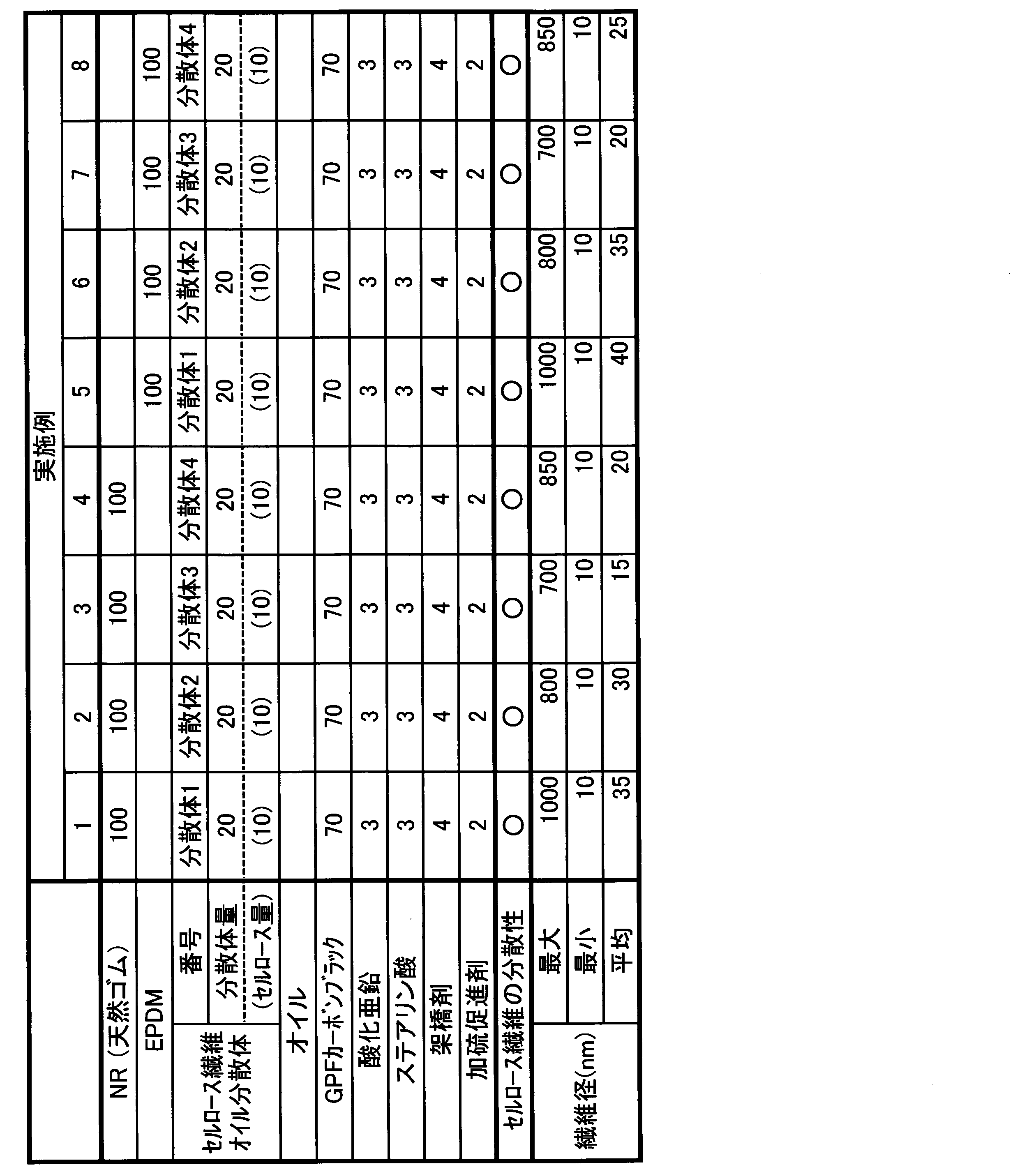
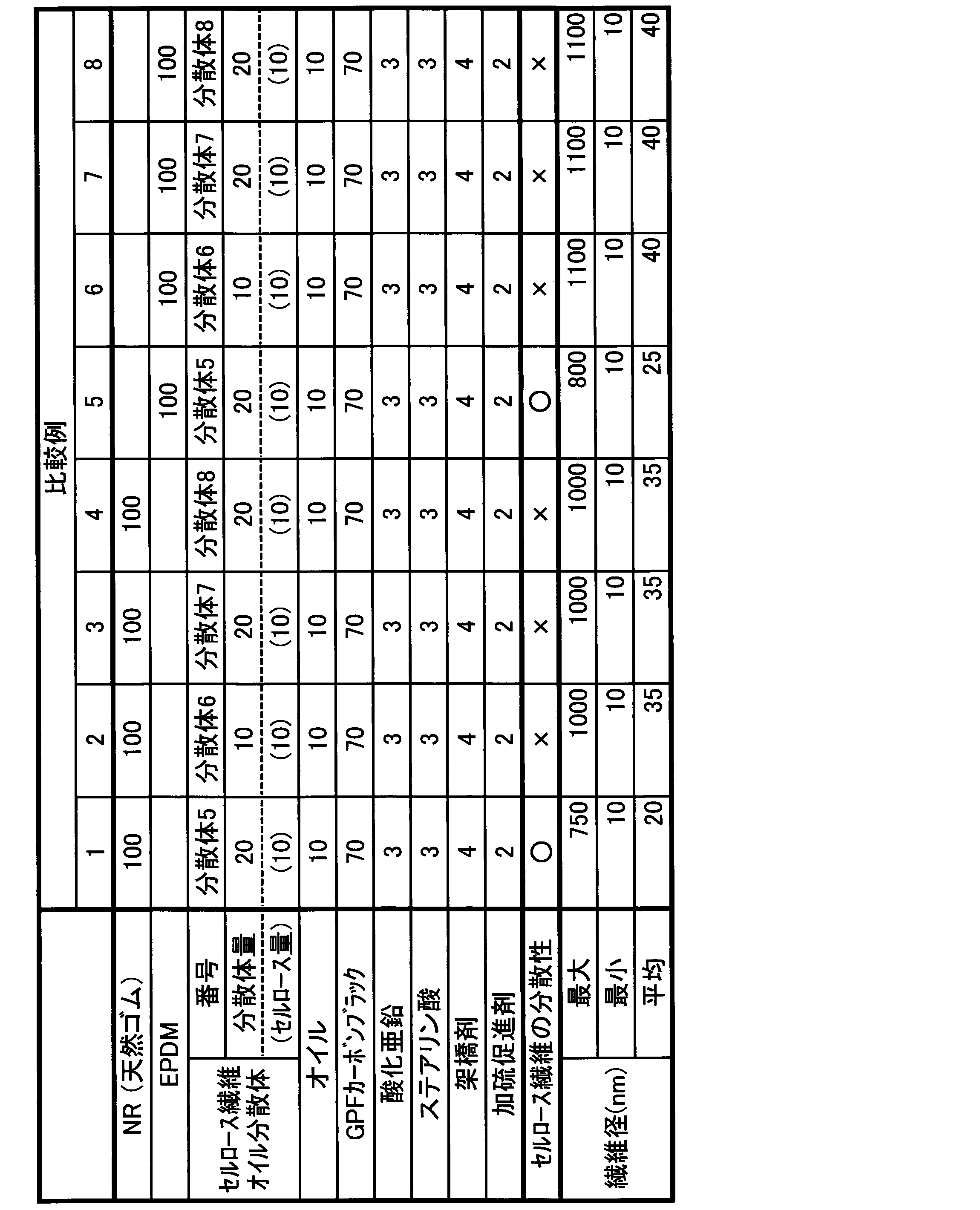
上記のように作製した分散体1~8を用いて、実施例1~8及び比較例1~8のゴム組成物を作製した。各組成物については、表2及び表3にも記載している。
上記のように作製した分散体1~8を用いて、実施例1~8及び比較例1~8のゴム組成物を作製した。各組成物については、表2及び表3にも記載している。
(実施例1)
天然ゴム(ALMA社製、マレーシア産天然ゴム、商品名:SMR CV60)を素練りした後、分散体1を投入して混練した。分散体1の投入量は、天然ゴム100質量部に対してセルロース微細繊維の含有量が10質量部となる量とした。
天然ゴム(ALMA社製、マレーシア産天然ゴム、商品名:SMR CV60)を素練りした後、分散体1を投入して混練した。分散体1の投入量は、天然ゴム100質量部に対してセルロース微細繊維の含有量が10質量部となる量とした。
続いて、天然ゴムとセルロース微細繊維とを混練すると共に、天然ゴム100質量部に対して、補強材のGPFカーボンブラック(三菱化学社製、商品名:ダイアブラックG)を70質量部、加硫促進助剤の酸化亜鉛(堺化学工業社製、商品名:酸化亜鉛3種)を3質量部、加工助剤のステアリン酸(花王製、商品名:ルナックS-50V)を3質量部、架橋剤の硫黄(細井化学工業社製)を4質量部、及びチウラム系の加硫促進剤(大内新興化学工業社製、商品名:ノクセラーTET-G)を2質量部それぞれ投入して混練することにより、実施例1の未架橋ゴム組成物を作製した。
(実施例2)
分散体2を用いたことを除いて、実施例1と同様にして実施例2の未架橋ゴム組成物を作製した。
分散体2を用いたことを除いて、実施例1と同様にして実施例2の未架橋ゴム組成物を作製した。
(実施例3)
分散体3を用いたことを除いて、実施例1と同様にして実施例3の未架橋ゴム組成物を作製した。
分散体3を用いたことを除いて、実施例1と同様にして実施例3の未架橋ゴム組成物を作製した。
(実施例4)
分散体4を用いたことを除いて、実施例1と同様にして実施例4の未架橋ゴム組成物を作製した。
分散体4を用いたことを除いて、実施例1と同様にして実施例4の未架橋ゴム組成物を作製した。
(実施例5)
ゴム成分としてEPDM(JSR社製、商品名:EP33)を用いたことを除いて、実施例1と同様にして実施例5の未架橋ゴム組成物を作製した。
ゴム成分としてEPDM(JSR社製、商品名:EP33)を用いたことを除いて、実施例1と同様にして実施例5の未架橋ゴム組成物を作製した。
(実施例6)
ゴム成分としてEPDMを用い、分散体2を用いたことを除いて、実施例1と同様にして実施例6の未架橋ゴム組成物を作製した。
ゴム成分としてEPDMを用い、分散体2を用いたことを除いて、実施例1と同様にして実施例6の未架橋ゴム組成物を作製した。
(実施例7)
ゴム成分としてEPDMを用い、分散体3を用いたことを除いて、実施例1と同様にして実施例7の未架橋ゴム組成物を作製した。
ゴム成分としてEPDMを用い、分散体3を用いたことを除いて、実施例1と同様にして実施例7の未架橋ゴム組成物を作製した。
(実施例8)
ゴム成分としてEPDMを用い、分散体4を用いたことを除いて、実施例1と同様にして実施例8の未架橋ゴム組成物を作製した。
ゴム成分としてEPDMを用い、分散体4を用いたことを除いて、実施例1と同様にして実施例8の未架橋ゴム組成物を作製した。
(比較例1)
天然ゴムを素練りした後、分散体5を投入して混練した。分散体5の投入量は、天然ゴム100質量部に対してセルロース微細繊維の含有量が10質量部となる量とした。
天然ゴムを素練りした後、分散体5を投入して混練した。分散体5の投入量は、天然ゴム100質量部に対してセルロース微細繊維の含有量が10質量部となる量とした。
続いて、実施例1と同じ配合剤を同じ量(補強材のGPFカーボンブラックを70質量部、加硫促進助剤の酸化亜鉛を3質量部、加工助剤のステアリン酸を3質量部、架橋剤の硫黄を4質量部、及びチウラム系の加硫促進剤を2質量部)投入して混練することにより、比較例1の未架橋ゴム組成物を作製した。
(比較例2)
比較例1と同様に、分散体6を天然ゴムに投入して混練した後、各配合剤を投入して更に混練した。その後、減圧乾燥を行って分散体6に由来する水分を除去し、比較例2の未架橋ゴム組成物を作製した。
比較例1と同様に、分散体6を天然ゴムに投入して混練した後、各配合剤を投入して更に混練した。その後、減圧乾燥を行って分散体6に由来する水分を除去し、比較例2の未架橋ゴム組成物を作製した。
(比較例3)
分散体7を用いたことを除いて、比較例1と同様にして比較例3の未架橋ゴム組成物を作製した。
分散体7を用いたことを除いて、比較例1と同様にして比較例3の未架橋ゴム組成物を作製した。
(比較例4)
分散体8を用いたことを除いて、比較例1と同様にして比較例4の未架橋ゴム組成物を作製した。
分散体8を用いたことを除いて、比較例1と同様にして比較例4の未架橋ゴム組成物を作製した。
(比較例5)
ゴム成分としてEPDMを用いたことを除いて、比較例1と同様にして比較例5の未架橋ゴム組成物を作製した。
ゴム成分としてEPDMを用いたことを除いて、比較例1と同様にして比較例5の未架橋ゴム組成物を作製した。
(比較例6)
ゴム成分としてEPDMを用い、分散体6を用いたことを除いて、比較例1と同様にして比較例6の未架橋ゴム組成物を作製した。
ゴム成分としてEPDMを用い、分散体6を用いたことを除いて、比較例1と同様にして比較例6の未架橋ゴム組成物を作製した。
(比較例7)
ゴム成分としてEPDMを用い、分散体7を用いたことを除いて、比較例1と同様にして比較例7の未架橋ゴム組成物を作製した。
ゴム成分としてEPDMを用い、分散体7を用いたことを除いて、比較例1と同様にして比較例7の未架橋ゴム組成物を作製した。
(比較例8)
ゴム成分としてEPDMを用い、分散体8を用いたことを除いて、比較例1と同様にして比較例8の未架橋ゴム組成物を作製した。
ゴム成分としてEPDMを用い、分散体8を用いたことを除いて、比較例1と同様にして比較例8の未架橋ゴム組成物を作製した。
(試験評価)
実施例1~8及び比較例1~8の未架橋ゴム組成物について、プレス成形により架橋したゴム組成物から試料を採取した。当該試料を凍結粉砕した後、その断面を透過型電子顕微鏡(TEM)で観察すると共に、50本のセルロース系微細繊維を任意に選択して繊維径を測定し、疎水化セルロース系微細繊維の繊維径の分布を求めた。また、その任意に選択した50本のセルロース系微細繊維の繊維径の数平均を求め、平均繊維径とした。また、セルロース微細の分散の状態を観察した。結果は表1及び表2に示す。
実施例1~8及び比較例1~8の未架橋ゴム組成物について、プレス成形により架橋したゴム組成物から試料を採取した。当該試料を凍結粉砕した後、その断面を透過型電子顕微鏡(TEM)で観察すると共に、50本のセルロース系微細繊維を任意に選択して繊維径を測定し、疎水化セルロース系微細繊維の繊維径の分布を求めた。また、その任意に選択した50本のセルロース系微細繊維の繊維径の数平均を求め、平均繊維径とした。また、セルロース微細の分散の状態を観察した。結果は表1及び表2に示す。
オイル分散体を用いる実施例1~8のゴム組成物において、疎水化セルロース微細繊維は良好に分散していた(表2にて○で表す)。また、水や溶媒を除去することは不要である。これに対し、比較例2~4及び6~8の非疎水化セルロースの分散体を用いたゴム組成物において、微細繊維の分散性は悪かった(表3では×で表す)。また、比較例1及び比較例5については、分散性は良好であるが、有機溶剤を用いているため作業中曝露や引火の可能性がある。
尚、実施例1~8の分散体を作製するためにプロセルオイル(パラフィンオイル)を用いたが、可塑剤を用いても良い。例えば、田岡化学工業株式会社製の商品名DOA及びDBP、JNC株式会社製の商品名DOP、新日本理化株式会社製の商品名DOS等を用いても良い。
本開示の技術は、ゴム組成物の製造方法として有用である。
Claims (9)
- ゴム組成物の製造方法であって、
疎水化セルロース繊維をオイルに混合した後、機械的な解繊処理を行って疎水化セルロースを解繊し、セルロース系微細繊維のオイル分散体を作製する工程と、
前記セルロース系微細繊維のオイル分散体をゴムと共に混練する工程とを備えることを特徴とするゴム組成物の製造方法。 - 請求項1のゴム組成物の製造方法において、
前記解繊処理のための解繊手段は、ジェットミル、2本ロールミル、ミキサー、ジェットミキサー又はボールミルであることを特徴とするゴム組成物の製造方法。 - 請求項1又は2のゴム組成物の製造方法において、
前記疎水化セルロースは、セルロースの水酸基の一部又は全部が疎水性基に置換されているか、又は、表面処理剤により疎水表面化されているセルロース系微細繊維であることを特徴とするゴム組成物の製造方法。 - 請求項3のゴム組成物の製造方法において、
前記水酸基の一部又は全部は、エステル化、アルキル化、トシル化、エポキシ化又はアリール化されていることを特徴とするゴム組成物の製造方法。 - 請求項1~4のいずれか1つのゴム組成物の製造方法において、
前記オイルは、非揮発性のオイルであることを特徴とするゴム組成物の製造方法。 - 請求項1~5のいずれか1つのゴム組成物の製造方法において、
前記オイル分散体において、前記セルロース系微細繊維を10質量%以上で且つ50質量%以下とすることを特徴とするゴム組成物の製造方法。 - オイルに分散された疎水化セルロース微細繊維とゴムとが混練されていることを特徴とするゴム組成物。
- 請求項7のゴム組成物において、
前記疎水化セルロース微細繊維の繊維径の分布範囲が50~500nmを含むことを特徴とするゴム組成物。 - 請求項7又は8のゴム組成物において、
前記疎水化セルロース微細繊維は、ゴム成分100質量部に対して0.5質量部以上で且つ50質量部以下の範囲で配合されていることを特徴とするゴム組成物。
Priority Applications (1)
| Application Number | Priority Date | Filing Date | Title |
|---|---|---|---|
| JP2016570905A JP6123037B2 (ja) | 2015-04-28 | 2016-04-26 | ゴム組成物の製造方法 |
Applications Claiming Priority (2)
| Application Number | Priority Date | Filing Date | Title |
|---|---|---|---|
| JP2015092258 | 2015-04-28 | ||
| JP2015-092258 | 2015-04-28 |
Publications (1)
| Publication Number | Publication Date |
|---|---|
| WO2016174863A1 true WO2016174863A1 (ja) | 2016-11-03 |
Family
ID=57198376
Family Applications (1)
| Application Number | Title | Priority Date | Filing Date |
|---|---|---|---|
| PCT/JP2016/002179 Ceased WO2016174863A1 (ja) | 2015-04-28 | 2016-04-26 | ゴム組成物及びその製造方法 |
Country Status (2)
| Country | Link |
|---|---|
| JP (1) | JP6123037B2 (ja) |
| WO (1) | WO2016174863A1 (ja) |
Cited By (10)
| Publication number | Priority date | Publication date | Assignee | Title |
|---|---|---|---|---|
| JP2017165956A (ja) * | 2016-03-15 | 2017-09-21 | 株式会社服部商店 | 修飾セルロースナノファイバーの製造方法 |
| JP2018119081A (ja) * | 2017-01-26 | 2018-08-02 | バンドー化学株式会社 | ゴム組成物の製造方法及びそれを含む伝動ベルトの製造方法 |
| JP2019178195A (ja) * | 2018-03-30 | 2019-10-17 | 豊田合成株式会社 | ゴム組成物の製造方法 |
| JP2020012069A (ja) * | 2018-07-19 | 2020-01-23 | 住友ゴム工業株式会社 | 分散体、製造方法、ゴム組成物及び空気入りタイヤ |
| CN111087707A (zh) * | 2019-12-11 | 2020-05-01 | 太仓荣南密封件科技有限公司 | 一种琥珀酸酐改性ncc增强橡胶及其制备方法 |
| JP2020196843A (ja) * | 2019-06-05 | 2020-12-10 | 住友ゴム工業株式会社 | ゴム組成物及び空気入りタイヤ |
| JP7007781B1 (ja) * | 2021-04-28 | 2022-02-10 | Caetus Technology株式会社 | 水分散装置 |
| JP7007782B1 (ja) * | 2021-04-28 | 2022-02-10 | Caetus Technology株式会社 | 親水性多糖高分子を含有する粉末の水分散液の製造方法 |
| WO2022230209A1 (ja) * | 2021-04-28 | 2022-11-03 | Caetus Technology株式会社 | 親水性多糖高分子を含有する粉末の水分散液の製造方法、及び、親水性多糖高分子の水分散液 |
| WO2022230210A1 (ja) * | 2021-04-28 | 2022-11-03 | Caetus Technology株式会社 | 水分散装置及び親水性多糖高分子の水分散液 |
Citations (4)
| Publication number | Priority date | Publication date | Assignee | Title |
|---|---|---|---|---|
| JP2008274064A (ja) * | 2007-04-27 | 2008-11-13 | Mitsuboshi Belting Ltd | パルプの分散方法およびパルプ配合ゴム組成物 |
| JP2009084564A (ja) * | 2007-09-10 | 2009-04-23 | Sumitomo Rubber Ind Ltd | 加硫ゴム組成物、空気入りタイヤおよびこれらの製造方法 |
| JP2010106251A (ja) * | 2008-09-30 | 2010-05-13 | Daicel Chem Ind Ltd | 疎水化されたセルロース系繊維を含む樹脂組成物及びその製造方法 |
| JP2014125607A (ja) * | 2012-12-27 | 2014-07-07 | Kao Corp | ゴム組成物 |
Family Cites Families (2)
| Publication number | Priority date | Publication date | Assignee | Title |
|---|---|---|---|---|
| US3943079A (en) * | 1974-03-15 | 1976-03-09 | Monsanto Company | Discontinuous cellulose fiber treated with plastic polymer and lubricant |
| JP2009073878A (ja) * | 2007-09-19 | 2009-04-09 | Bando Chem Ind Ltd | 短繊維含有ゴムの製造方法 |
-
2016
- 2016-04-26 WO PCT/JP2016/002179 patent/WO2016174863A1/ja not_active Ceased
- 2016-04-26 JP JP2016570905A patent/JP6123037B2/ja active Active
Patent Citations (4)
| Publication number | Priority date | Publication date | Assignee | Title |
|---|---|---|---|---|
| JP2008274064A (ja) * | 2007-04-27 | 2008-11-13 | Mitsuboshi Belting Ltd | パルプの分散方法およびパルプ配合ゴム組成物 |
| JP2009084564A (ja) * | 2007-09-10 | 2009-04-23 | Sumitomo Rubber Ind Ltd | 加硫ゴム組成物、空気入りタイヤおよびこれらの製造方法 |
| JP2010106251A (ja) * | 2008-09-30 | 2010-05-13 | Daicel Chem Ind Ltd | 疎水化されたセルロース系繊維を含む樹脂組成物及びその製造方法 |
| JP2014125607A (ja) * | 2012-12-27 | 2014-07-07 | Kao Corp | ゴム組成物 |
Cited By (12)
| Publication number | Priority date | Publication date | Assignee | Title |
|---|---|---|---|---|
| JP2017165956A (ja) * | 2016-03-15 | 2017-09-21 | 株式会社服部商店 | 修飾セルロースナノファイバーの製造方法 |
| JP2018119081A (ja) * | 2017-01-26 | 2018-08-02 | バンドー化学株式会社 | ゴム組成物の製造方法及びそれを含む伝動ベルトの製造方法 |
| JP2019178195A (ja) * | 2018-03-30 | 2019-10-17 | 豊田合成株式会社 | ゴム組成物の製造方法 |
| JP2020012069A (ja) * | 2018-07-19 | 2020-01-23 | 住友ゴム工業株式会社 | 分散体、製造方法、ゴム組成物及び空気入りタイヤ |
| JP7243060B2 (ja) | 2018-07-19 | 2023-03-22 | 住友ゴム工業株式会社 | 分散体、製造方法、ゴム組成物及び空気入りタイヤ |
| JP2020196843A (ja) * | 2019-06-05 | 2020-12-10 | 住友ゴム工業株式会社 | ゴム組成物及び空気入りタイヤ |
| JP7342431B2 (ja) | 2019-06-05 | 2023-09-12 | 住友ゴム工業株式会社 | ゴム組成物及び空気入りタイヤ |
| CN111087707A (zh) * | 2019-12-11 | 2020-05-01 | 太仓荣南密封件科技有限公司 | 一种琥珀酸酐改性ncc增强橡胶及其制备方法 |
| JP7007781B1 (ja) * | 2021-04-28 | 2022-02-10 | Caetus Technology株式会社 | 水分散装置 |
| JP7007782B1 (ja) * | 2021-04-28 | 2022-02-10 | Caetus Technology株式会社 | 親水性多糖高分子を含有する粉末の水分散液の製造方法 |
| WO2022230209A1 (ja) * | 2021-04-28 | 2022-11-03 | Caetus Technology株式会社 | 親水性多糖高分子を含有する粉末の水分散液の製造方法、及び、親水性多糖高分子の水分散液 |
| WO2022230210A1 (ja) * | 2021-04-28 | 2022-11-03 | Caetus Technology株式会社 | 水分散装置及び親水性多糖高分子の水分散液 |
Also Published As
| Publication number | Publication date |
|---|---|
| JP6123037B2 (ja) | 2017-04-26 |
| JPWO2016174863A1 (ja) | 2017-05-18 |
Similar Documents
| Publication | Publication Date | Title |
|---|---|---|
| JP6123037B2 (ja) | ゴム組成物の製造方法 | |
| JP5656086B2 (ja) | 重合体組成物の製造方法及び重合体組成物用添加剤の製造方法 | |
| JP6590456B2 (ja) | ゴム組成物の製造方法、並びに、伝動ベルトの製造方法 | |
| JP6615444B2 (ja) | ゴム組成物の製造方法及びゴム組成物 | |
| JP2015209439A (ja) | 繊維含有樹脂組成物の製造方法 | |
| KR101973272B1 (ko) | 셀룰로오스 제제 | |
| JP2018111768A (ja) | 繊維材料及び繊維材料の製造方法並びに複合材料及び複合材料の製造方法 | |
| JP2019173253A (ja) | 繊維材料の製造方法及び複合材料の製造方法並びに繊維材料及び複合材料 | |
| JP6487037B2 (ja) | 伝動ベルト | |
| JP2021014512A (ja) | 複合材料 | |
| JP2020063327A (ja) | 複合材料の製造方法及び複合材料 | |
| JP2021176930A (ja) | 組成物の製造方法 | |
| Venugopal et al. | Reinforcement of natural rubber using cellulose nanofibres isolated from Coconut spathe | |
| Hirase et al. | Development of powdering method for cellulose nanofibers assisted by zinc oxide for compounding reinforced natural rubber composite | |
| JP6230067B2 (ja) | 重合体組成物の製造方法及び重合体組成物用添加剤の製造方法 | |
| JP6779158B2 (ja) | 改質セルロース繊維の製造方法 | |
| JP7295520B2 (ja) | タイヤ用ゴム組成物 | |
| JP2020075996A (ja) | 伝動ベルト用ゴム組成物及びその製造方法、並びにそれを用いた伝動ベルト | |
| JP2010209175A (ja) | ウエットマスターバッチの製造方法、および該ウエットマスターバッチを用いて得られた加硫ゴム | |
| JP6948631B2 (ja) | 膨潤繊維材料及び膨潤繊維材料の製造方法並びに複合材料の製造方法 | |
| JP2016204558A (ja) | ゴム組成物 | |
| CN108299701B (zh) | 纤维材料及其制造方法以及复合材料及其制造方法 | |
| JP7353600B2 (ja) | 組成物及び組成物の製造方法 | |
| JP7510027B1 (ja) | ゴム組成物 | |
| JP2016211145A (ja) | 床材 |
Legal Events
| Date | Code | Title | Description |
|---|---|---|---|
| ENP | Entry into the national phase |
Ref document number: 2016570905 Country of ref document: JP Kind code of ref document: A |
|
| 121 | Ep: the epo has been informed by wipo that ep was designated in this application |
Ref document number: 16786140 Country of ref document: EP Kind code of ref document: A1 |
|
| NENP | Non-entry into the national phase |
Ref country code: DE |
|
| 122 | Ep: pct application non-entry in european phase |
Ref document number: 16786140 Country of ref document: EP Kind code of ref document: A1 |