WO2016167341A1 - 位相差フィルム及びその利用 - Google Patents
位相差フィルム及びその利用 Download PDFInfo
- Publication number
- WO2016167341A1 WO2016167341A1 PCT/JP2016/062098 JP2016062098W WO2016167341A1 WO 2016167341 A1 WO2016167341 A1 WO 2016167341A1 JP 2016062098 W JP2016062098 W JP 2016062098W WO 2016167341 A1 WO2016167341 A1 WO 2016167341A1
- Authority
- WO
- WIPO (PCT)
- Prior art keywords
- film
- retardation film
- group
- retardation
- cellulose derivative
- Prior art date
- Legal status (The legal status is an assumption and is not a legal conclusion. Google has not performed a legal analysis and makes no representation as to the accuracy of the status listed.)
- Ceased
Links
Images

Classifications
-
- G—PHYSICS
- G02—OPTICS
- G02B—OPTICAL ELEMENTS, SYSTEMS OR APPARATUS
- G02B1/00—Optical elements characterised by the material of which they are made; Optical coatings for optical elements
- G02B1/08—Optical elements characterised by the material of which they are made; Optical coatings for optical elements made of polarising materials
-
- C—CHEMISTRY; METALLURGY
- C08—ORGANIC MACROMOLECULAR COMPOUNDS; THEIR PREPARATION OR CHEMICAL WORKING-UP; COMPOSITIONS BASED THEREON
- C08J—WORKING-UP; GENERAL PROCESSES OF COMPOUNDING; AFTER-TREATMENT NOT COVERED BY SUBCLASSES C08B, C08C, C08F, C08G or C08H
- C08J5/00—Manufacture of articles or shaped materials containing macromolecular substances
- C08J5/18—Manufacture of films or sheets
-
- C—CHEMISTRY; METALLURGY
- C08—ORGANIC MACROMOLECULAR COMPOUNDS; THEIR PREPARATION OR CHEMICAL WORKING-UP; COMPOSITIONS BASED THEREON
- C08K—Use of inorganic or non-macromolecular organic substances as compounding ingredients
- C08K3/00—Use of inorganic substances as compounding ingredients
- C08K3/34—Silicon-containing compounds
- C08K3/36—Silica
-
- C—CHEMISTRY; METALLURGY
- C08—ORGANIC MACROMOLECULAR COMPOUNDS; THEIR PREPARATION OR CHEMICAL WORKING-UP; COMPOSITIONS BASED THEREON
- C08K—Use of inorganic or non-macromolecular organic substances as compounding ingredients
- C08K7/00—Use of ingredients characterised by shape
- C08K7/16—Solid spheres
- C08K7/18—Solid spheres inorganic
-
- C—CHEMISTRY; METALLURGY
- C08—ORGANIC MACROMOLECULAR COMPOUNDS; THEIR PREPARATION OR CHEMICAL WORKING-UP; COMPOSITIONS BASED THEREON
- C08K—Use of inorganic or non-macromolecular organic substances as compounding ingredients
- C08K9/00—Use of pretreated ingredients
- C08K9/04—Ingredients treated with organic substances
- C08K9/06—Ingredients treated with organic substances with silicon-containing compounds
-
- C—CHEMISTRY; METALLURGY
- C08—ORGANIC MACROMOLECULAR COMPOUNDS; THEIR PREPARATION OR CHEMICAL WORKING-UP; COMPOSITIONS BASED THEREON
- C08L—COMPOSITIONS OF MACROMOLECULAR COMPOUNDS
- C08L1/00—Compositions of cellulose, modified cellulose or cellulose derivatives
- C08L1/08—Cellulose derivatives
- C08L1/26—Cellulose ethers
- C08L1/30—Aryl ethers; Aralkyl ethers
-
- G—PHYSICS
- G02—OPTICS
- G02B—OPTICAL ELEMENTS, SYSTEMS OR APPARATUS
- G02B5/00—Optical elements other than lenses
- G02B5/30—Polarising elements
- G02B5/3083—Birefringent or phase retarding elements
-
- C—CHEMISTRY; METALLURGY
- C08—ORGANIC MACROMOLECULAR COMPOUNDS; THEIR PREPARATION OR CHEMICAL WORKING-UP; COMPOSITIONS BASED THEREON
- C08J—WORKING-UP; GENERAL PROCESSES OF COMPOUNDING; AFTER-TREATMENT NOT COVERED BY SUBCLASSES C08B, C08C, C08F, C08G or C08H
- C08J2301/00—Characterised by the use of cellulose, modified cellulose or cellulose derivatives
- C08J2301/08—Cellulose derivatives
- C08J2301/26—Cellulose ethers
- C08J2301/28—Alkyl ethers
-
- C—CHEMISTRY; METALLURGY
- C08—ORGANIC MACROMOLECULAR COMPOUNDS; THEIR PREPARATION OR CHEMICAL WORKING-UP; COMPOSITIONS BASED THEREON
- C08K—Use of inorganic or non-macromolecular organic substances as compounding ingredients
- C08K2201/00—Specific properties of additives
- C08K2201/002—Physical properties
- C08K2201/003—Additives being defined by their diameter
-
- C—CHEMISTRY; METALLURGY
- C08—ORGANIC MACROMOLECULAR COMPOUNDS; THEIR PREPARATION OR CHEMICAL WORKING-UP; COMPOSITIONS BASED THEREON
- C08K—Use of inorganic or non-macromolecular organic substances as compounding ingredients
- C08K2201/00—Specific properties of additives
- C08K2201/011—Nanostructured additives
-
- C—CHEMISTRY; METALLURGY
- C08—ORGANIC MACROMOLECULAR COMPOUNDS; THEIR PREPARATION OR CHEMICAL WORKING-UP; COMPOSITIONS BASED THEREON
- C08L—COMPOSITIONS OF MACROMOLECULAR COMPOUNDS
- C08L2205/00—Polymer mixtures characterised by other features
- C08L2205/02—Polymer mixtures characterised by other features containing two or more polymers of the same C08L -group
- C08L2205/025—Polymer mixtures characterised by other features containing two or more polymers of the same C08L -group containing two or more polymers of the same hierarchy C08L, and differing only in parameters such as density, comonomer content, molecular weight, structure
-
- G—PHYSICS
- G02—OPTICS
- G02F—OPTICAL DEVICES OR ARRANGEMENTS FOR THE CONTROL OF LIGHT BY MODIFICATION OF THE OPTICAL PROPERTIES OF THE MEDIA OF THE ELEMENTS INVOLVED THEREIN; NON-LINEAR OPTICS; FREQUENCY-CHANGING OF LIGHT; OPTICAL LOGIC ELEMENTS; OPTICAL ANALOGUE/DIGITAL CONVERTERS
- G02F1/00—Devices or arrangements for the control of the intensity, colour, phase, polarisation or direction of light arriving from an independent light source, e.g. switching, gating or modulating; Non-linear optics
- G02F1/01—Devices or arrangements for the control of the intensity, colour, phase, polarisation or direction of light arriving from an independent light source, e.g. switching, gating or modulating; Non-linear optics for the control of the intensity, phase, polarisation or colour
- G02F1/13—Devices or arrangements for the control of the intensity, colour, phase, polarisation or direction of light arriving from an independent light source, e.g. switching, gating or modulating; Non-linear optics for the control of the intensity, phase, polarisation or colour based on liquid crystals, e.g. single liquid crystal display cells
- G02F1/133—Constructional arrangements; Operation of liquid crystal cells; Circuit arrangements
- G02F1/1333—Constructional arrangements; Manufacturing methods
- G02F1/1335—Structural association of cells with optical devices, e.g. polarisers or reflectors
- G02F1/13363—Birefringent elements, e.g. for optical compensation
Definitions
- the present invention relates to a retardation film that can be used in an image display device such as a liquid crystal display device and an organic EL, and the use thereof. More specifically, the present invention relates to a retardation film having a larger in-plane retardation toward the longer wavelength side and use thereof.
- retardation films In order to improve the display performance of image display devices such as liquid crystal display devices and organic EL, various retardation films are used.
- a retardation film (hereinafter referred to as “reverse wavelength dispersion film”) having a larger in-plane retardation toward the longer wavelength side can be used as a reflection type liquid crystal display device, a touch panel or an organic EL antireflection layer. .
- the phase difference is about 1 ⁇ 4 of the measurement wavelength ⁇ , and the ratio of the in-plane retardation at 450 nm to the in-plane retardation at 550 nm Re (450) / Re (550 ) Is preferably close to 0.81.
- the reverse wavelength dispersion film used is required to have a thin film thickness of about 20 ⁇ m to 50 ⁇ m.
- Various retardation films have been developed in response to the above characteristic requirements.
- Patent Document 1 discloses a reverse wavelength dispersion film made of cellulose acylate and ethyl cellulose.
- Each of the retardation films disclosed herein has an in-plane retardation of about ⁇ / 4, and is suitable for the purpose of use as an antireflection layer.
- Patent Document 2 discloses a reverse wavelength dispersion film composed of cellulose acylate and ethyl cellulose.
- the retardation film disclosed here requires adjustment of in-plane retardation for the purpose of use as an antireflection layer. Since the in-plane retardation is proportional to the film thickness, it is possible to achieve an in-plane retardation of about ⁇ / 4 by increasing the thickness of the film.
- Patent Document 3 discloses a reverse wavelength dispersion film composed of cellulose acylate and ethyl cellulose. Since the retardation film disclosed here has high retardation development with respect to the retardation films described in Patent Documents 1 and 2, it is possible to develop an equivalent in-plane retardation with a thin film thickness.
- Patent Document 4 discloses cellulose derivatives having various aromatic and aliphatic acylates as substituents having different maximum absorption wavelengths and molar extinction coefficients.
- the retardation film disclosed here can exhibit the desired reverse wavelength dispersion characteristic.
- Patent Document 5 discloses a cellulose derivative film having a large thickness direction retardation (Rth) of the film.
- An aromatic esterified product of cellulose ether is used as a material for the film, and inorganic particles are added as a matting agent.
- Patent Documents 1 to 4 can exhibit reverse wavelength dispersion, but all have a film thickness of about 60 ⁇ m.
- patent document 5 has description regarding an inorganic particle, disclosure regarding reverse wavelength dispersion and a photoelastic coefficient is not made.
- the conventional technology cannot realize a retardation film having excellent reverse wavelength dispersion characteristics, an in-plane retardation of about ⁇ / 4, and a thin film thickness of 20 ⁇ m to 50 ⁇ m. Further, in the retardation film, since it is necessary to reduce color unevenness when stress is applied to the film, a low photoelastic coefficient is required.
- the present invention has been made in view of these problems, and its purpose is to have excellent reverse wavelength dispersion characteristics, an in-plane retardation of about ⁇ / 4, a thin film thickness of 20 ⁇ m to 50 ⁇ m, and An object of the present invention is to provide a reverse wavelength dispersion film having a reduced photoelastic coefficient.
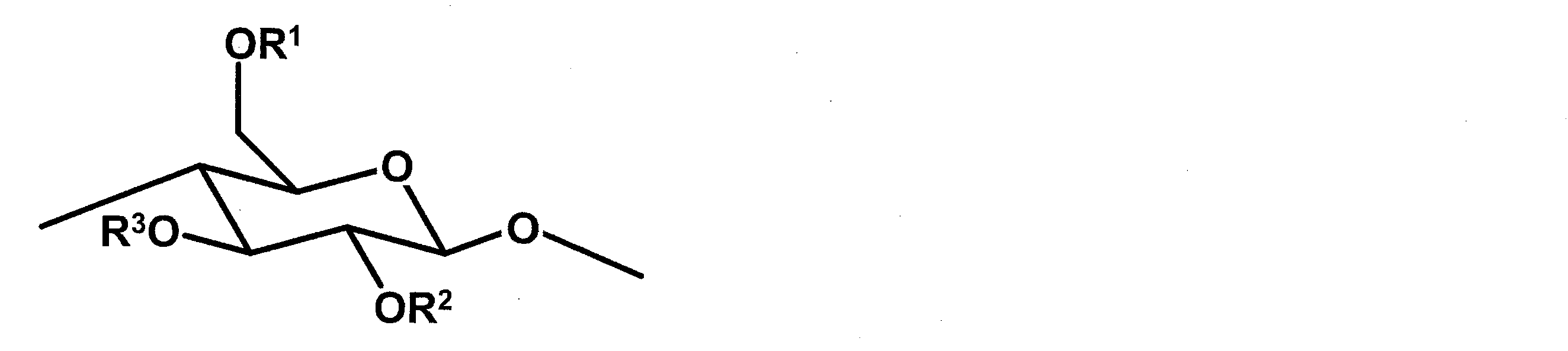
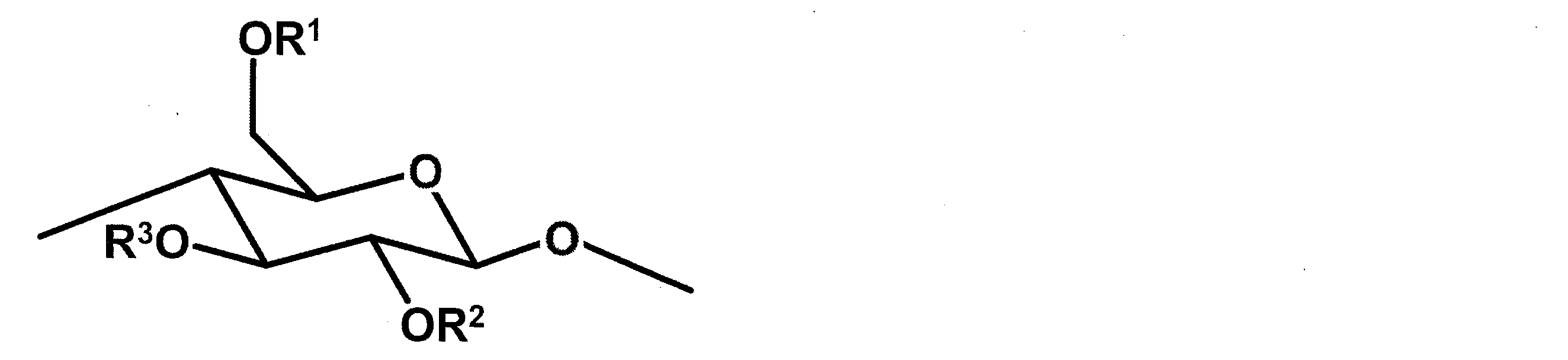
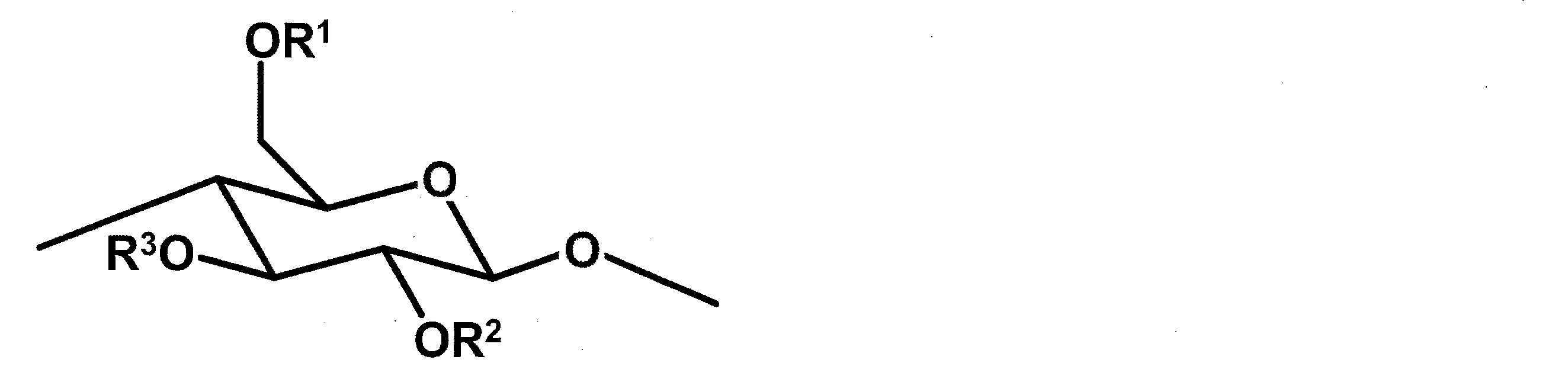
- R 1 , R 2 and R 3 are each independently hydrogen, a saturated aliphatic group, an unsaturated aliphatic group or an aromatic group
- ⁇ 2> The phase difference according to ⁇ 1>, wherein in the cellulose derivative, at least one of R 1 , R 2 and R 3 in the monomer unit represented by the general formula (1) is an aromatic group. the film.
- the total substitution degree (D 1 ) of saturated aliphatic groups or unsaturated aliphatic groups is 2.00 to 2.70
- the aromatic group substitution degree (D 2 ) is 0.30 to 1.00
- the total substitution degree (D 3 ) of aromatic groups in the polymer material is 0.40 to 0.50
- ⁇ 5> The retardation film according to any one of ⁇ 1> to ⁇ 4>, wherein the retardation film has a photoelastic coefficient of less than 42.0 ⁇ 10 ⁇ 12 m 2 / N.
- ⁇ 6> The retardation film according to any one of ⁇ 1> to ⁇ 5>, wherein the inorganic particles are inorganic particles containing an unsaturated bond.
- ⁇ 8> The retardation film according to any one of ⁇ 1> to ⁇ 7>, wherein the inorganic particles are contained in an amount of 5 to 40 parts by weight with respect to 100 parts by weight of the cellulose derivative.
- a circularly polarizing plate comprising at least one retardation film according to any one of ⁇ 1> to ⁇ 13>.
- the image display apparatus characterized by including the circularly-polarizing plate as described in.
- a method for producing a retardation film comprising a step of obtaining the retardation film by stretching a film-forming film containing the polymer material at a stretching ratio of 20% to 200%.
- a retardation film having excellent reverse wavelength dispersion characteristics, an in-plane retardation of about ⁇ / 4, a thin film thickness of 20 ⁇ m to 50 ⁇ m, and a reduced photoelastic coefficient is manufactured. Is possible.
- the retardation film of the present invention contains a polymer material composed of at least one cellulose derivative containing a monomer unit represented by the following general formula (1), and has an in-plane retardation Re (550). ) Is 105 nm to 160 nm, reverse wavelength dispersion characteristic Re (450) / Re (550) is 0.80 to 0.89, and the film thickness is 20 ⁇ m to 50 ⁇ m, A retardation film containing inorganic particles.
- the “polymer material” means a cellulose derivative represented by the general formula (1) contained in the retardation film of the present invention.
- the “polymer material” may be a single cellulose derivative containing a monomer unit represented by the general formula (1) or a single unit represented by the general formula (1). The thing which consists of a mixture of the multiple types of cellulose derivative containing a monomer unit may be sufficient.
- the “polymer material” is composed of a mixture of a plurality of types of cellulose derivatives including the monomer unit represented by the general formula (1)
- the single amount represented by the general formula (1) The plurality of types of cellulose derivatives including the body unit are preferably compatible with each other.
- the retardation film of the present invention may include a configuration other than the “polymer material” described above.
- the retardation film of the present invention contains a polymer material composed of a mixture of a plurality of types of cellulose derivatives containing the monomer unit represented by the general formula (1), and has an in-plane retardation Re (550) of 105 nm.
- a retardation film containing inorganic particles may be used.
- (A) Cellulose derivative The cellulose derivative is, as described in the general formula (1), all or part of three hydroxyl groups (—OH) of a ⁇ -glucose skeleton, which is a monomer constituting cellulose. Is substituted with an alcohol derivative by various known substitution reactions. That is, in the cellulose derivative, OR 2 , OR 3 and OR 1 are coordinated to the 2-position, 3-position and 6-position of the ⁇ -glucose skeleton, respectively.
- R 1 , R 2 and R 3 are each independently hydrogen, a saturated aliphatic group, an unsaturated aliphatic group or an aromatic group.
- substitution of a hydroxyl group (—OH) with OR 2 , OR 3 or OR 1 is also referred to as “substitution of a hydroxyl group with a substituent R 1 , R 2 or R 3 ”.
- the film-forming film and a stretched film (retardation film) produced by stretching the film-forming film have high transparency (haze, etc.) and optical properties. (In-plane retardation expression and reverse wavelength dispersion) can be imparted.
- the cellulose derivative may be various aliphatic and aromatic esters, alkoxyls, amides, urethanes, carbonates, carbamates, and the like depending on substituents, and various substituents may be mixed in the same molecule.
- R 1 , R 2 and R 3 shown in the general formula (1) are each independently hydrogen, a saturated aliphatic group, or unsaturated. It is an aliphatic group or an aromatic group, preferably a hydrogen atom, a saturated aliphatic group or an aromatic group, and more preferably a saturated aliphatic group or an aromatic group.
- the cellulose derivative has a skeleton containing a saturated aliphatic group and an aromatic group in the same molecule.
- the saturated aliphatic group an aliphatic alkyl group is particularly preferable.
- the reverse wavelength dispersibility means a characteristic that the in-plane retardation is reduced as the wavelength of transmitted light is shorter (the in-plane retardation is increased as the wavelength is longer).
- the wavelength dispersion of retardation in the retardation film (stretched film) obtained by stretching the polymer film is determined by the wavelength dispersion of the refractive index (n x ) in the stretching axis direction of the polymer film and the direction perpendicular thereto. This is caused by the difference in chromatic dispersion of the refractive index (n y ).
- the wavelength dispersion of retardation of a retardation film containing a cellulose derivative as in the present invention is considered.
- a cellulose derivative ethyl cellulose in which “-H” in at least one of the three hydroxyl groups of the ⁇ -glucose skeleton is substituted with an ethyl group that is an aliphatic alkyl group is stretched in the direction of the polymer axis. Orientation birefringence is exhibited in the film, and positive and almost flat wavelength dispersion is exhibited.
- a substituent having a large polarizability anisotropy such as an aromatic group has a negative retardation.
- an aromatic group for example, an aromatic acyl group, etc.
- “—H” in at least one of the hydroxyl groups in the ⁇ -glucose skeleton is a substituent having a high polarizability anisotropy.
- the aromatic group is introduced in a direction orthogonal to the main chain of the cellulose, the cellulose derivative exhibits negative normal wavelength dispersion. Therefore, by introducing an aromatic group exhibiting negative normal wavelength dispersion in the direction perpendicular to the main chain into ethyl cellulose exhibiting positive flat wavelength dispersion, the direction of the polymer axis extending in the direction orthogonal to the direction of the stretching axis. Positive reverse wavelength dispersion develops due to the difference in refractive index wavelength dispersion (see the description in FIG. 1).
- “-H” of at least one of the three hydroxyl groups of the ⁇ -glucose skeleton of the cellulose derivative is substituted with an aliphatic group, and the aromatic group is perpendicular to the direction (vertical direction). It is considered that the retardation film of the present invention in which the cellulose derivative is stretched by introducing a group exhibits excellent reverse wavelength dispersion characteristics.
- the aliphatic alkyl group is not particularly limited, but is preferably an ethyl group from the viewpoint of imparting solubility of the cellulose derivative to the solvent.
- the unsaturated aliphatic group is not particularly limited, and examples thereof include an allyl group, a 2-butenyl group, and a propargyl group.
- the aromatic group can be introduced by substitution with “—H” of three hydroxyl groups (—OH) of the ⁇ -glucose skeleton, and is not particularly limited as long as it has at least one aromatic ring.
- the aromatic ring include a benzene ring and a polycyclic aromatic ring.
- the polycyclic aromatic ring is not particularly limited, and examples thereof include a naphthalene ring, an anthracene ring, a phenanthrene ring, a naphthacene ring, and a perylene ring.
- the bonding group between the carbon atom and the aromatic ring to which the hydroxyl group is coordinated is not particularly limited. For example, an ether bond, an ester bond, a urethane bond, etc. are mentioned.
- an aromatic acyl group is preferable from the viewpoint of easy introduction into the ⁇ -glucose skeleton. Furthermore, the aromatic acyl group exhibits an excellent effect in expressing reverse wavelength dispersion.
- the aromatic acyl group include a substituted or unsubstituted benzoyl group and a substituted or unsubstituted polycyclic aromatic acyl group.
- the polycyclic aromatic refers to an aromatic compound in which at least two aromatic rings share at least two sp2 carbons of each aromatic ring.
- the substituent is not particularly limited, and specific examples thereof include, for example, saturated aliphatic substituent, unsaturated aliphatic substituent, aromatic substituent, alkoxyl group, carbonyl group, ester group, halogen atom, carbamoyl Groups and the like.
- the substituent of the substituted benzoyl group can be selected from the substituents listed below, and the type, position, and number of substituents are not limited. Saturated aliphatic substituents (for example, methyl group, ethyl group, propyl group, isopropyl group, isobutyl group, tert-butyl group and the like), unsaturated aliphatic substituents (for example, allyl group, 2-butenyl group, Propargyl group etc.), aromatic substituents (eg phenyl group, biphenyl group etc.), alkoxyl groups (eg methoxy group, ethoxy group, butoxy group etc.), carbonyl groups (eg, Formyl group, acetyl group, etc.), alkoxycarbonyl group (eg, methoxycarbonyl group, ethoxycarbonyl group, etc.), halogen atom (eg, fluorine atom, chlorine atom, bromine atom,
- substituted or unsubstituted polycyclic aromatic acyl group examples include a substituted or unsubstituted naphthoyl group, a phenanthrenecarbonyl group, and an anthracenecarbonyl group.
- the substitution position of the carbonyl group of these polycyclic aromatic acyl groups is not particularly limited.
- a 2-naphthoyl group is particularly preferable because it exhibits excellent effects due to the expression of reverse wavelength dispersion.
- the 2-naphthoyl group may have a substituent in the naphthalene ring.
- the substituent is not particularly limited, and specific examples thereof include an alkoxyl group, an ester group, an amide group, a nitrile group, and a halogen.
- the cellulose derivative is characterized by being able to achieve both good in-plane retardation and reverse wavelength dispersibility, which is usually a trade-off with other cellulose derivatives, by hot stretching. Therefore, it is possible to reduce the film thickness while maintaining good reverse wavelength dispersion and in-plane retardation.
- substitution reaction for producing the above cellulose derivative
- a known synthesis method can be appropriately used.
- the substitution reaction of a cellulose derivative is not limited to this.
- the simplest method is to heat a commercially available cellulose ether (eg, ethyl cellulose) and an aromatic acyl chloride (eg, 2-naphthoyl chloride) in the presence of pyridine, and to mix the reaction product with water and By washing with a solvent, a desired cellulose derivative in which a hydroxyl group in ethylcellulose is aromatically esterified can be obtained.
- the degree of cellulose substitution D (specifically, D 1 , D 2 , D 3 ) is determined by the three hydroxyl groups present at the 2-position, 3-position, and 6-position in the cellulose molecule. , On average, how much is replaced. D is a maximum of three.
- the degree of substitution of each of the three hydroxyl groups present at the 2-position, 3-position and 6-position in the cellulose molecule may be substantially the same, or the 2-position, 3-
- the degree of substitution of any of the three hydroxyl groups present at the 6-position may be high, and the degree of substitution of other hydroxyl groups may be low.
- the degree of substitution (D 1 ) is such that “—H” of the three hydroxyl groups present at the 2-position, 3-position and 6-position in the cellulose molecule is different for each type of cellulose derivative contained in the retardation film. It shows how much it is substituted with an aliphatic group (saturated aliphatic group or unsaturated aliphatic group) on average. D 1 is a maximum of three. In this case, the degree of substitution of each of the three hydroxyl groups present at the 2-position, 3-position and 6-position in the cellulose molecule may be substantially the same, or the 2-position, 3- The degree of substitution of any of the three hydroxyl groups present at the 6-position may be high, and the degree of substitution of other hydroxyl groups may be low.
- the degree of substitution D 1 of the aliphatic group indicates the number of “O—R (R: aliphatic group)” groups generated by substitution of the aliphatic group in the cellulose derivative.
- the degree of substitution (D 2 ) is, on average, how much the three hydroxyl groups present in the 2-position, 3-position and 6-position in the cellulose molecule are in each type of cellulose derivative contained in the retardation film. Indicates whether it is substituted with an aromatic group. D 2 is the maximum 3. In this case, the degree of substitution of each of the three hydroxyl groups present at the 2-position, 3-position and 6-position in the cellulose molecule may be substantially the same, or the 2-position, 3- The degree of substitution of any of the three hydroxyl groups present at the 6-position may be high, and the degree of substitution of other hydroxyl groups may be low.
- the degree of substitution D 2 of the aromatic group indicates the number of “O—Ar 0 (Ar 0 : aromatic group)” groups generated by substitution of the aromatic group in the cellulose derivative.
- the total degree of substitution (D 3 ) is, on average, how aromatic the three hydroxyl groups present in the 2-position, 3-position and 6-position in the cellulose molecule are in the polymer material contained in the retardation film. Indicates whether or not a group is substituted. D 3 is a maximum of three. For example, when the polymer material is composed of one kind of cellulose derivative, the total degree of substitution (D 3 ) is determined by the three hydroxyl groups present at the 2-position, 3-position and 6-position in the cellulose molecule. In the one type of cellulose derivative, the average value represents how much the aromatic derivative is substituted, and the maximum value is 3.
- the total degree of substitution (D 3 ) is determined by the three positions existing in the 2-position, 3-position, and 6-position in the cellulose molecule.
- the average value of how many hydroxyl groups are substituted with aromatic groups in the whole mixture of the plurality of cellulose derivatives is 3, and the maximum value is 3.
- the values of D 1 , D 2 , D 3 can be calculated by a well-known method. For example, when “-H” of a hydroxyl group in a cellulose molecule is substituted with an ethyl group which is a saturated aliphatic group, the degree of substitution D 1 of the ethyl group is “Cellulose Communications 6, 73-79 (1999)”. Can be quantified by the method described in (Nuclear magnetic resonance spectroscopy: NMR). Note that this document is incorporated herein by reference. Similarly, D 2 and D 3 can be measured using nuclear magnetic resonance spectroscopy (NMR).
- NMR nuclear magnetic resonance spectroscopy
- the degree of substitution (D 1 ) and the degree of substitution (D 2 ) intend the degree of substitution in each type of cellulose derivative constituting the polymer material, while the total degree of substitution (D 3 ) is The degree of substitution in the overall polymer material is intended. Specifically, when the polymer material is composed of one kind of cellulose derivative, the value of the total degree of substitution (D 3 ) in the polymer material is the same as the value of the degree of substitution (D 2 ) in one kind of cellulose derivative. Become.
- the value of the total substitution degree (D 3 ) in the polymer material is equal to each value of the substitution degree (D 2 ) of each type of cellulose derivative. To be determined.
- the amount of aromatic groups introduced into the polymer material (in other words, the total degree of substitution (D 3 )) needs to be an optimal amount.
- the total degree of substitution (D 3 ) can be 0.40 to 0.50, but is preferably 0.41 to 0.50, and more preferably 0. It is 42 to 0.50, more preferably 0.42 to 0.48, and still more preferably 0.44 to 0.48.
- the obtained retardation film can be improved in reverse wavelength dispersion, and negative birefringence described later can be obtained.
- the possibility of becoming a cellulose derivative can be extremely low, which is preferable.
- the degree of aliphatic group substitution (D 1 ) is in the range of 2.00 to 2.70, the solubility of the target cellulose derivative is good, the type of solvent used is difficult to limit, and The tendency of the intensity
- the value of D 1 is preferably in the range of 2.00 to 2.70. Therefore, the substitution degree (D 1 ) of the aliphatic group is 2.00 to 2.70, preferably 2.20 to 2.70, more preferably 2.20 to 2.65, It is preferably 2.30 to 2.65, and more preferably 2.30 to 2.60.
- the main chain component (cellulose ether skeleton) in the cellulose derivative is introduced by introducing an aromatic group into the hydroxyl group remaining in the cellulose ether skeleton having an aliphatic group substitution degree (D 1 ) in the above range.
- the side chain component (aromatic group) are orthogonal to each other.
- the film-forming film it is necessary to heat-stretch the film-forming film at an optimum magnification to cause positive birefringence in the stretched film and to express positive in-plane retardation in the stretched film.
- the introduction amount of the side chain component in the cellulose derivative is an appropriate amount, the stretched film having negative birefringence, negative in-plane retardation, and normal wavelength dispersibility without changing the maximum birefringence direction of the stretched film (negative A stretched film containing a cellulose derivative having the above birefringence), and desired properties are easily exhibited.
- the aromatic group is introduced into hydroxyl groups remaining in the cellulose ether backbone with a degree of substitution of the aliphatic group of said range (D 1).
- an aromatic group may be introduced into almost all of the remaining hydroxyl groups, or an aromatic group may be introduced into a part of the remaining hydroxyl groups.
- the degree of substitution (D 2 ) is 0.30 to 1.0, preferably 0.35 to 0.70, from the viewpoint of easily realizing the desired total degree of substitution (D 3 ).
- the degree of substitution (D 2 ) can be between 0.40 and 0.50.
- the value of the total degree of substitution (D 3 ) of the aromatic group in the polymer material is the value of the degree of substitution (D 2 ) of the aromatic group in one kind of cellulose derivative. It becomes the same as the value.
- the value of the total degree of substitution (D 3 ) of aromatic groups in the polymer material is the degree of substitution of aromatic groups ( D 2 ) can be calculated based on each value. This point will be described below.
- the optimum value of the total substitution degree (D 3 ) can be calculated by the following calculation simulation method when, for example, one kind of cellulose derivative is used.
- the optimal total substitution degree (D 3 ) is calculated by calculation simulation, the in-plane retardation and chromatic dispersion characteristics can be calculated based on the values.
- the in-plane retardation and wavelength dispersion characteristics of cellulose derivatives are experimentally measured.
- each of the in-plane retardation and wavelength dispersion characteristics of the main chain component (cellulose ether skeleton) alone contained in the cellulose derivative separately measured experimentally is subtracted from each of the in-plane retardation and wavelength dispersion characteristics of the cellulose derivative.
- the in-plane retardation and wavelength dispersion characteristics of the side chain component (aromatic group) contained in the cellulose derivative are calculated.
- in-plane retardation and wavelength dispersion characteristic data derived from various constituent main chain components cellulose ether skeleton
- in-plane retardation derived from various constituent side chain components aromatic groups
- the in-plane retardation and wavelength dispersion characteristics of the desired cellulose derivative are based on the above-mentioned additivity, and the in-plane retardation of the main chain component (cellulose ether skeleton) corresponding to the desired cellulose derivative from the above-mentioned database. And the data of wavelength dispersion characteristics and the data of in-plane retardation and wavelength dispersion characteristics of the side chain component (aromatic group) corresponding to the desired cellulose derivative can be calculated.
- the most preferable total substitution degree (D 3 ) for obtaining the effect of the present invention is 0.46.
- D 1 aliphatic group substitution degree
- the optimum total degree of substitution (D 3 ) may be achieved with a plurality of types of cellulose derivatives.
- the total degree of substitution (D 3 ) can be set to 0.46, and optimal reverse wavelength dispersion can be exhibited.
- the total degree of substitution (D 3 ) represents the total degree of substitution of aromatic groups contained in the cellulose derivative constituting the invention.
- the total degree of substitution (D 3 ) of the aromatic group is the sum of the degree of substitution (D 2 ) of each type of cellulose derivative.
- the value of the total degree of substitution (D 3 ) can be measured by applying the aforementioned nuclear magnetic resonance spectroscopy (NMR).
- a part of the hydroxyl group (—H) is substituted with an aromatic group, preferably an aromatic acyl group.
- an aromatic group preferably an aromatic acyl group.
- a single bond in a bonding group for example, an ether bond, an ester bond, a urethane bond, etc.
- the aromatic group Is an aromatic acyl group, rotation of a single bond between Ar and carbon (C) of the aromatic acyl group (Ar—C ( ⁇ O) —) (wherein Ar represents an aromatic ring)
- a retardation film produced using the polymer material usually has a high photoelastic coefficient.
- the photoelastic coefficient is reduced by containing inorganic particles in addition to the polymer material.
- the inorganic particles are packed around the aromatic group, for example, an aromatic acyl group, and the degree of freedom of rotation around the single bond between the Ar 0 -O or the Ar-C is reduced. Therefore, it is considered that when inorganic particles are blended, the photoelastic coefficient of the finally obtained retardation film is lowered.
- the photoelastic coefficient is an index indicating the degree to which anisotropy occurs and birefringence occurs when stress is applied to the film. In the present invention, since the possibility of birefringence is reduced, the photoelastic coefficient is preferably lower.
- the inorganic particles that can be used in the present invention are not particularly limited.
- the particles may be particles composed of aluminum silicate, magnesium silicate, calcium phosphate, and the like, and silica particles mainly containing silicon dioxide are particularly preferable.
- the inorganic particles are more preferably inorganic particles containing unsaturated bonds, and the unsaturated bonds on the surface. It is more preferable that the inorganic particles have.
- the inorganic particles containing an unsaturated bond are more preferably inorganic particles containing an acryloyl group, and more preferably inorganic particles having an acryloyl group on the surface.
- the inorganic particles are particularly preferably silica particles containing an acryloyl group, and more preferably silica particles having an acryloyl group on the surface.
- the shape of the inorganic particles is not particularly limited as long as it is particulate.
- the inorganic particles can have various shapes such as a spherical shape, a needle shape, a flat plate shape, or an indefinite shape, and the inorganic particles are more preferably a spherical particle.
- the average particle size of the inorganic particles is preferably 5 nm to 30 nm, and more preferably 10 nm to 20 nm.
- the average particle diameter of the inorganic particles is 5 nm or more, it is preferable because the inorganic particles are easily available.
- the average particle diameter of the said inorganic particle is 30 nm or less, since the haze of the retardation film obtained can be reduced suitably, it is preferable.
- the average particle diameter is a specific surface area value (unit [m 2 / g]) obtained by measuring a specific surface area by the BET method and the density of inorganic particles (unit [g] / Cm 3 ]).
- silica particles having the name V-8804 and the like having no acryloyl group on the surface include trade name IPA-ST manufactured by Nissan Chemical Industries, Ltd. and trade name OSCAL1432M manufactured by JGC Catalysts & Chemicals.
- the amount of the inorganic particles used in the retardation film is preferably 5 to 40 parts by weight, more preferably 10 to 30 parts by weight with respect to 100 parts by weight of the cellulose derivative.
- 100 parts by weight of the cellulose derivative means 100 parts by weight of the total amount of all types of cellulose derivatives.
- the content of the inorganic particles is 5 parts by weight or more with respect to 100 parts by weight of the cellulose derivative, the photoelastic coefficient of the retardation film can be reduced.
- the content of the inorganic particles is 40 parts by weight or less with respect to 100 parts by weight of the cellulose derivative because the optical properties of the retardation film are not adversely affected.
- Re ( ⁇ ) Re ( ⁇ ) represents in-plane retardation at ⁇ nm and is defined by the following formula (1).
- ⁇ Nxy ( ⁇ ) ⁇ Nxy ( ⁇ ) ⁇ d
- ⁇ Nxy ( ⁇ ) represents birefringence at ⁇ nm
- d represents the thickness of the film.
- the birefringence is the difference between the maximum refractive index and the minimum refractive index among the refractive indexes in the film plane.
- the in-plane retardation of the retardation film is preferably about 1/4 of the measurement wavelength.
- the retardation Re (550) at 550 nm is from 105 nm to 160 nm, preferably from 108 nm to 155 nm.
- the reverse wavelength dispersion characteristic Re (450) / Re (550) of the retardation film is preferably 0.80 to 0.89.
- the in-plane retardation and chromatic dispersion characteristics are within this range, the possibility of insufficient reflection prevention in a specific wavelength region is reduced.
- the retardation film is 20 ⁇ m to 50 ⁇ m.
- the thickness of the retardation film may be further reduced as long as desired in-plane retardation and reverse wavelength dispersion characteristics are satisfied.
- it must be taken into consideration that when the film becomes thin, problems arise in the strength and handling properties of the film.
- the drying time of the solvent becomes long, so that productivity is deteriorated.
- the photoelastic coefficient is a value obtained by dividing the amount of change in birefringence when stress is applied to a retardation film or the like by the stress.
- the retardation film having a high photoelastic coefficient is used for a liquid crystal display device or the like, the retardation film attached to a different substrate receives stress based on a difference in thermal expansion coefficient of the substrate, and the retardation is It changes a lot. Due to the change in the phase difference, the function of the liquid crystal display device or the like is adversely affected (for example, color unevenness occurs in a display device incorporating the phase difference film). It is not preferable as a retardation film used in an apparatus or the like.
- the photoelastic coefficient of the retardation film in the present invention is low, and considering that it is used in actual products (image display devices such as liquid crystal display devices and organic EL devices), 42.0 More preferably, it is less than ⁇ 10 ⁇ 12 m 2 / N.
- the haze value of the retardation film (for example, stretched film) of the present invention is not particularly limited, but is preferably 2.00% or less, more preferably 1.00% or less, Most preferably, it is 0.50% or less. If the haze value is within the above range, it is preferable because the total light transmittance of the stretched film can be increased and the transparency of the stretched film can be improved.
- the retardation film of the present embodiment may be added with a small amount of additives such as a plasticizer, a heat stabilizer, and an ultraviolet stabilizer as other components as necessary. Good.
- a plasticizer for the purpose of improving processing characteristics such as stretching.
- the blending amount of these other components is arbitrary as long as desired optical characteristics are not impaired.
- the molecular weight of the resin (cellulose derivative) used in the present invention is not particularly limited as long as film molding is possible.
- the number average molecular weight of the resin is preferably 10,000 to 300,000.
- the number average molecular weight of the resin is more preferably 20,000 to 200,000 from the viewpoint of availability.
- a molecular weight of 10,000 or more is preferable in terms of improving the strength of the obtained retardation film, while a resin having a number average molecular weight of 300,000 or less means that the resin is dissolved in a solvent. This is preferable in terms of production, because the properties are improved, the solid content concentration of the polymer solution is increased, and the amount of solvent used at the time of solution casting is reduced.
- the retardation film of the present invention is preferably produced by stretching an unstretched film-forming film (also referred to as an unstretched film).
- An unstretched film-forming film can be produced according to a known method.
- a melt extrusion method in which a molten resin is extruded from a T-die or the like, and a polymer solution in which the resin is dissolved is cast on a support and the solvent is dried by heating.
- a solvent casting method for forming a film is preferably used because a retardation film with good thickness accuracy can be obtained relatively easily.
- the solvent in the case of employing the solvent cast method is not particularly limited. From the viewpoint of drying efficiency, a solvent having a lower boiling point is preferred, and specifically, a solvent having a low boiling point of 100 ° C. or lower is preferred. Specifically, ketone solvents and ester solvents can be used.
- a halogenated hydrocarbon solvent such as methylene chloride is preferable because it easily dissolves the resin material and has a low boiling point.
- methylene chloride is particularly preferable as a solvent used for producing the retardation film of the present invention because it has a low boiling point of 40 ° C. and high safety against fire during drying.
- the solvent used in the present invention is preferably methylene chloride alone from the viewpoint of recovery and reuse, but methylene chloride is 70% to 99% by weight and alcohol having 3 or less carbon atoms is 1% to 30% by weight. % Can also be used.
- ethyl alcohol is preferable as the alcohol having 3 or less carbon atoms because it is safe and has a low boiling point. Furthermore, in order to reduce costs, it is preferable that 1 to 10 parts by weight of alcohol having 3 or less carbon atoms other than ethyl alcohol is included in 100 parts by weight of alcohol having 3 or less carbon atoms. As the alcohol having 3 or less carbon atoms other than the ethyl alcohol, it is particularly preferable to use isopropyl alcohol from the viewpoint of safety and boiling point. Moreover, the solvent said here refers to the solvent whose boiling point is lower than the maximum temperature concerning a film in a drying process or a extending
- the inorganic particles are blended with the polymer material, but the method of blending the inorganic particles is not particularly limited.
- the melt extrusion method described above include a method in which the inorganic particles are mixed into the polymer material and melted to extrude the molten resin, and a method in which the inorganic particles are mixed and extruded after the polymer material is melted. Can do.
- the solvent cast method described above a method in which the inorganic particles are mixed and cast in a solvent in which the polymer material is dissolved, and a mixture obtained after mixing the inorganic particles in the polymer material is dissolved in a solvent and cast. And the like.
- (L) Stretch ratio In order to obtain the retardation film of the present invention, it is preferable to perform an orientation treatment by stretching the unstretched film obtained above in at least one axis according to a known stretching method. As the stretching method, a uniaxial or biaxial thermal stretching method can be employed. In order to obtain the retardation film of the present invention, it is preferable to employ longitudinal uniaxial stretching. Further, when the retardation film of the present invention is used as the antireflection layer, uniaxiality is important, and therefore, free end uniaxial stretching is preferable.
- the draw ratio X is represented by the following formula (2).
- L0 is the length of the unstretched film
- L is the length of the stretched film.
- X (L ⁇ L0) / L0 ⁇ 100 (2)
- the stretch ratio in producing the retardation film of the present invention is preferably 20% to 200%, more preferably 20% to 150%, and further preferably 20% to 100%, Even more preferably, it is 30% to 100%.
- the in-plane retardation of the stretched film is prevented from becoming larger than the target numerical range, and the polymer material is excessively oriented so that it is perpendicular to the stretch direction (TD direction). It is preferable because the strength can be prevented from extremely decreasing. Further, as the draw ratio increases, the thickness of the film decreases. As shown in the above formula (1), the in-plane retardation is proportional to the thickness (d) of the film, and therefore, the viewpoint that the desired in-plane retardation is achieved when the stretch ratio is not excessively high. Is preferable.
- a draw ratio of 20% or more is preferable in terms of preventing the birefringence of the stretched film from becoming small and preventing the film having a desired in-plane retardation from becoming thick.
- the stretch ratio in producing the retardation film of the present invention is preferably 20% to 60%, and preferably 30% to 50%. It is more preferable that If it is the said structure, when the aliphatic group which is a substituent of a cellulose derivative is an ethyl group, a desired in-plane retardation can be implement
- the stretching temperature is preferably selected in the range of (Tg ⁇ 30) ° C. to (Tg + 30) ° C. with respect to the glass transition temperature Tg of the film.
- a particularly preferred stretching temperature is in the range of (Tg ⁇ 10) ° C. to (Tg + 30) ° C.
- the stretching temperature is preferably 140 ° C. to 170 ° C., and more preferably 150 ° C. to 160 ° C.
- the stretching temperature is a value within the above-described temperature range, whitening of the film during stretching can be prevented, variation in retardation of the obtained retardation film can be reduced, and an optimum reverse wavelength can be obtained. Dispersibility, in-plane retardation, and haze value (specifically, low haze value) can all be expressed in a compatible manner.
- the preferred viscosity of the solvent in which the resin is dissolved is 10 poise to 50 poise, more preferably 15 poise to 50 poise.
- a film such as a stainless steel endless belt, a polyimide film, a biaxially stretched polyethylene terephthalate film, or the like can be used.
- Drying after casting can be performed while the film is supported on the support, but if necessary, the pre-dried film is peeled off from the support until it has self-supporting property, and further dried. You can also.
- a float method, a tenter or a roll conveying method can be generally used.
- the film itself is subjected to complex stress, and optical characteristics are likely to be uneven.
- the tenter method it is necessary to balance the width shrinkage that accompanies the drying of the solvent and the tension to support its own weight, depending on the distance between the pins or clips that support both ends of the film. There is a need.
- the film is most preferably dried by a roll conveyance method. Further, drying in an atmosphere kept at a low humidity so that the film does not absorb moisture when the solvent is dried is an effective method for obtaining the retardation film of the present invention having high mechanical strength and transparency. .
- the surface of the retardation film of the present invention may be subjected to a surface treatment such as hard coating, optical adjustment or antistatic.
- a transparent conductive layer can be provided and used for a touch panel or an electromagnetic wave shield.
- the retardation film of the present invention can be used as an antireflection layer.
- a circularly polarizing plate containing the retardation film of the present invention can be mentioned.
- a circularly polarizing plate is an optical element that converts non-polarized light into circularly polarized light.
- the laminated body bonded so that the absorption axis of a polarizer and the slow axis of the retardation film of this invention may make 45 degrees is mentioned.
- the pressure-sensitive adhesive layer and the polarizer protective film used in this case can have any configuration. These antireflection layers can be usefully used in image display devices such as liquid crystal display devices and organic EL devices.
- the retardation film of this invention can also be used as a polarizer protective film.
- the method for producing a retardation film of the present embodiment comprises a polymer material comprising at least one cellulose derivative containing a monomer unit represented by the following general formula (1).
- R 1 , R 2 and R 3 are each independently hydrogen, a saturated aliphatic group, an unsaturated aliphatic group or an aromatic group), It is a manufacturing method characterized by having the process of extending
- the stretching temperature in the stretching step is preferably selected in the range of (Tg-30) ° C. to (Tg + 30) ° C., and in the range of (Tg ⁇ 10) ° C. to (Tg + 30) ° C. It is particularly preferred that it be selected.
- the stretching temperature is preferably 140 ° C. to 170 ° C., and more preferably 150 ° C. to 160 ° C.
- the film-forming film containing the polymer material is preferably stretched at a stretch ratio of 20% to 200%, more preferably 20% to 150%, and more preferably 20% to Stretching at 100% is more preferable, stretching at 30% to 100% is even more preferable, and stretching at 30% to 50% is particularly preferable.
- In-plane retardation and reverse wavelength dispersion characteristics In-plane retardation and reverse wavelength dispersion characteristics were measured using OPTIPRO manufactured by Shintech.
- Tg Glass transition temperature
- TMA-4000SA thermomechanical analyzer manufactured by Bruker AXS. Specifically, in a nitrogen atmosphere, the film was heated under the condition of 3 ° C./min with a 3 g tensile load applied to the film cut to 5 mm ⁇ 20 mm. The intersection of two tangents before and after the start of film elongation in the obtained actual graph (actual graph in which temperature data is plotted in the X-axis direction and actual measured data in the Y-axis direction is plotted) is defined as Tg. Tg was calculated.
- the photoelastic coefficient was measured using KOBRA manufactured by Oji Scientific Instruments. Specifically, a tensile load was applied to the film cut to 15 mm ⁇ 60 mm, and the change in phase difference was measured when the tensile load was changed from 0 g to 1100 g in 100 g increments. The slope of the straight line of the graph obtained by plotting the stress calculated from the above and plotting the actual measured phase difference and the birefringence calculated from the film thickness on the Y axis was defined as the photoelastic coefficient, and the photoelastic coefficient was calculated.
- Haze A haze was measured using a haze meter (HZ-V3 manufactured by Suga Test Instruments Co., Ltd.).
- the resin was analyzed by Bruker 400 MHz 1 H-NMR to confirm that it was the target cellulose derivative, and the degree of substitution was calculated. As a result, the degree of naphthoyl substitution D 2 was 0.40.
- the resin was analyzed by Bruker 400 MHz 1 H-NMR to confirm that it was the objective cellulose derivative and the degree of substitution was calculated. As a result, the degree of naphthoyl substitution D 2 was 0.62.
- the resin purified in Synthesis Example 1 was dissolved in a methylene chloride super-dehydrated product (manufactured by Wako Pure Chemical Industries, Ltd.) to prepare a 1 wt% diluted solution. Insoluble matter was filtered from the diluted solution by suction filtration using No. 4, and then the diluted solution was concentrated by an evaporator to obtain a 4.1 wt% polymer solution.
- silica particles having an acryloyl group on the surface (manufactured by Nissan Chemical Co., Ltd .; particle diameter: 10 nm, trade name: MIBK-SD) is added to 100 parts by weight of the cellulose derivative resin to prepare a coating solution. Obtained.
- the coating solution is cast on a biaxially stretched polyethylene terephthalate film (hereinafter referred to as PET film), the coating solution is applied in a uniform film shape with a bar coater so that the thickness after drying is approximately 40 ⁇ m to 50 ⁇ m. did.
- PET film biaxially stretched polyethylene terephthalate film
- a film 2 was produced by applying the same method as in Example 1 of the film-forming film except that 20 parts by weight of silica particles having an acryloyl group on the surface was added to 100 parts by weight of the cellulose derivative resin. It was 137 degreeC when the glass transition temperature of the film 2 was measured.
- a film 3 was produced by applying the same method as in Example 1 of the film-forming film except that 30 parts by weight of silica particles having an acryloyl group on the surface was added to 100 parts by weight of the cellulose derivative resin. It was 137 degreeC when the glass transition temperature of the film 3 was measured.
- a film 4 was prepared by applying the same method as in Example 2 of the film forming film except that .44) was applied. It was 139 degreeC when the glass transition temperature of the film 4 was measured.
- a film 5 was produced by applying the same method as in Example 2 of the film-forming film except that silica particles having no acryloyl group on the surface (manufactured by JGC Catalysts &Chemicals; particle diameter 10 nm, trade name OSCAL1432M) were applied. It was 145 degreeC when the glass transition temperature of the film 5 was measured.
- Example 1 The film 1 was subjected to 50% free end uniaxial stretching at 150 ° C. A 50 mm ⁇ 40 mm film was cut out and measured from the center of the stretched film. The results are shown in Table 1.
- Example 2 The film 2 was subjected to 50% free end uniaxial stretching at 150 ° C. A 50 mm ⁇ 40 mm film was cut out and measured from the center of the stretched film. The results are shown in Table 1.
- Example 3 The film 3 was subjected to 50% free end uniaxial stretching at 150 ° C. A 50 mm ⁇ 40 mm film was cut out and measured from the center of the stretched film. The results are shown in Table 1.
- Example 4 The film 4 was subjected to 50% free end uniaxial stretching at 150 ° C. A 50 mm ⁇ 40 mm film was cut out and measured from the center of the stretched film. The results are shown in Table 1.
- Example 5 The film 5 was uniaxially stretched at 155 ° C. by 50% free end. A 50 mm ⁇ 40 mm film was cut out and measured from the center of the stretched film. The results are shown in Table 1.
- the retardation films produced in Examples 1 to 5 and the retardation films produced in Comparative Examples 1 and 2 are compared by their photoelastic coefficients.
- the retardation films of Examples 1 to 5 have a lower photoelastic coefficient than the retardation films of Comparative Examples 1 and 2. From this, it was found that the photoelastic coefficient of the retardation film is reduced by blending silica particles that are inorganic particles.
- the retardation film produced in Examples 1 to 4 and the retardation film produced in Example 5 are compared by their haze. Compared with the haze of Example 5, the hazes of Examples 1 to 4 are considerably lower. From this, it was found that the dispersibility of the inorganic particles was improved by the unsaturated bond (acryloyl group) contained in the inorganic particles to be blended, and the haze of the obtained retardation film could be lowered.
- the present invention can be used for image display devices such as liquid crystal display devices and organic EL devices.
Landscapes
- Chemical & Material Sciences (AREA)
- Organic Chemistry (AREA)
- Medicinal Chemistry (AREA)
- Health & Medical Sciences (AREA)
- Polymers & Plastics (AREA)
- Chemical Kinetics & Catalysis (AREA)
- Physics & Mathematics (AREA)
- Optics & Photonics (AREA)
- General Physics & Mathematics (AREA)
- Manufacturing & Machinery (AREA)
- Engineering & Computer Science (AREA)
- Materials Engineering (AREA)
- Manufacture Of Macromolecular Shaped Articles (AREA)
- Polarising Elements (AREA)
- Liquid Crystal (AREA)
- Electroluminescent Light Sources (AREA)
Abstract
Description
下記の一般式(1)で表される単量体単位を含むセルロース誘導体の少なくとも1種からなるポリマー材料を含有し、面内レタデーションRe(550)が105nm~160nmであり、逆波長分散特性Re(450)/Re(550)が0.80~0.89であり、フィルム厚みが20μm~50μmである、位相差フィルムであって、
無機粒子を含有する、位相差フィルム。
<2>
前記セルロース誘導体において、前記一般式(1)で表される単量体単位における、R1、R2及びR3の少なくともいずれか1つが、芳香族基である、<1>に記載の位相差フィルム。
前記セルロース誘導体における、飽和脂肪族基又は不飽和脂肪族基の置換度(D1)の合計が、2.00~2.70であり、
前記セルロース誘導体における、芳香族基の置換度(D2)が、0.30~1.00であり、
前記ポリマー材料における、芳香族基の総置換度(D3)が0.40~0.50であり、
前記置換度(D1)と前記置換度(D2)とが、D1+D2≦3.0を満たす、<1>または<2>に記載の位相差フィルム。
前記芳香族基が、芳香族アシル基である、<1>~<3>の何れか1つに記載の位相差フィルム。
前記位相差フィルムの光弾性係数が、42.0×10⁻¹²m2/N未満である、<1>~<4>の何れか1つに記載の位相差フィルム。
前記無機粒子が、不飽和結合を含有する無機粒子であることを特徴とする、<1>~<5>の何れか1つに記載の位相差フィルム。
前記無機粒子が、アクリロイル基を含有する無機粒子であることを特徴とする、<6>に記載の位相差フィルム。
前記無機粒子を、前記セルロース誘導体100重量部に対して5重量部~40重量部含有することを特徴とする、<1>~<7>の何れか1つに記載の位相差フィルム。
前記無機粒子が、シリカ粒子であることを特徴とする、<1>~<8>の何れか1つに記載の位相差フィルム。
前記無機粒子の平均粒子径が、5nm~30nmであることを特徴とする、<1>~<9>の何れか1つに記載の位相差フィルム。
前記無機粒子が、真球状粒子であることを特徴とする、<1>~<10>の何れか1つに記載の位相差フィルム。
前記セルロース誘導体では、一般式(1)の前記飽和脂肪族基が脂肪族アルキル基を有することを特徴とする、<1>~<11>の何れか1つに記載の位相差フィルム。
前記脂肪族アルキル基がエチル基であることを特徴とする、<12>に記載の位相差フィルム。
<1>~<13>の何れか1つに記載の位相差フィルムを少なくとも一枚含むことを特徴とする、円偏光板。
<14>に記載の円偏光板を含むことを特徴とする、画像表示装置。
<1>~<13>の何れか1つに記載の位相差フィルムの製造方法であって、
前記ポリマー材料を含有する製膜フィルムを、延伸倍率20%~200%で延伸して前記位相差フィルムを得る工程を含むことを特徴とする、位相差フィルムの製造方法。
前記延伸時の温度が、前記製膜フィルムのガラス転位温度Tgに対して、(Tg-30)℃~(Tg+30)℃の範囲であることを特徴とする、<16>に記載の位相差フィルムの製造方法。
無機粒子を含有する、位相差フィルムである。
本明細書において、「ポリマー材料」とは、本発明の位相差フィルムに含まれる、一般式(1)で表されるセルロース誘導体を意味する。前記「ポリマー材料」は、一般式(1)にて表される単量体単位を含む、1種類のセルロース誘導体からなる物であってもよいし、一般式(1)にて表される単量体単位を含む、複数種類のセルロース誘導体の混合物からなる物であってもよい。なお、前記「ポリマー材料」が、一般式(1)にて表される単量体単位を含む、複数種類のセルロース誘導体の混合物からなる場合、前記一般式(1)にて表される単量体単位を含む、複数種類のセルロース誘導体は、それぞれ、お互いに相溶化が可能であることが好ましい。なお、本発明の位相差フィルムは、上述した「ポリマー材料」以外の構成を含んでいてもよい。
無機粒子を含有する位相差フィルムであってもよい。
前記セルロース誘導体とは、一般式(1)に記載のように、セルロースを構成する単量体であるβ-グルコース骨格が有する3つの水酸基(-OH)の全てまたはその一部を公知の各種置換反応によりアルコール誘導体に置換したものである。すなわち、前記セルロース誘導体においては、β-グルコース骨格の2-位、3-位及び6-位の部位に、それぞれ、OR2、OR3及びOR1が配位している。ここで、R1、R2及びR3は、それぞれ独立に、水素、飽和脂肪族基、不飽和脂肪族基又は芳香族基である。なお、本明細書において、水酸基(-OH)を、OR2、OR3またはOR1に置換することを、「水酸基を置換基R1、R2またはR3にて置換する」とも称する。
前記のセルロース誘導体を作製するための置換反応としては、公知の合成法を適宜用いることが出来る。以下に一例を記載するが、セルロース誘導体の置換反応はこれに限定されるものではない。最も簡便な方法は、市販のセルロースエーテル(例:エチルセルロース)と芳香族アシルクロリド(例:2-ナフトイルクロリド)とをピリジン存在下で共存させた状態にて、加熱し、反応物を水及び溶剤にて洗浄することにより、エチルセルロース中の水酸基が芳香族エステル化された目的のセルロース誘導体を得ることが出来る。
セルロース置換度D(具体的には、D1、D2、D3)は、セルロース分子中の2-位、3-位、6-位に存在する3個の水酸基が、平均してどれだけ置換されているかを表す。Dは、最大3である。この場合、セルロース分子中の2-位、3-位、6-位に存在する3個の水酸基の各々の置換度が略同一であってもよいし、セルロース分子中の2-位、3-位、6-位に存在する3個の水酸基の何れかの置換度が高く、その他の水酸基の置換度が低くてもよい。
本発明の位相差フィルムには、無機粒子が配合されている。
Re(λ)とは、λnmにおける面内レタデーションを表し、下式(1)にて定義される。
ここで、ΔNxy(λ)は、λnmにおける複屈折、dは、フィルムの厚みを表す。ここでいう複屈折とは、フィルム面内の屈折率のうち最大の屈折率と最小の屈折率との差である。
本発明の位相差フィルムを反射防止層として使用した場合の層全体の厚みを考慮すると、位相差フィルムは20μm~50μmである。
光弾性係数とは、位相差フィルム等に応力を加えた際の複屈折の変化量を前記応力で割った値である。前記光弾性係数が高い位相差フィルムを液晶表示装置等に使用すると、異なる基材に張り付けられる前記位相差フィルムは、その基材の熱膨張率の差等に基づく応力を受け、その位相差が大きく変化する。その位相差の変化により、液晶表示装置等の機能に悪影響(例えば、位相差フィルムを組み込んだ表示装置に色むらが生じる、等)が生じるため、光弾性係数の大きい位相差フィルムは、液晶表示装置等に使用する位相差フィルムとして好ましくない。
本発明の位相差フィルム(例えば、延伸フィルム)のヘイズの値は、特に限定されないが、2.00%以下であることが好ましく、1.00%以下であることがより好ましく、0.50%以下であることが最も好ましい。ヘイズの値が、前記範囲内であれば、延伸フィルムの全光線透過率を増大させて延伸フィルムの透明性を向上させることができるという利点があるため、好ましい。
本実施の形態の位相差フィルムは、フィルム化の際に、必要に応じて少量の可塑剤や熱安定剤、紫外線安定剤等の添加剤をその他の成分として加えてもよい。特に、得られた位相差フィルムが脆い場合、延伸などの加工特性を改善する目的で可塑剤を加えることは有効である。これらのその他の成分の配合量は、所望の光学特性を損なわない範囲で任意である。
本発明で使用される樹脂(セルロース誘導体)の分子量は、フィルム成形が可能な限り特に限定されるものではない。例えば、靱性に優れたフィルムを得るためには、樹脂の数平均分子量が、10,000~300,000であることが好ましい。天然樹脂を原料とした樹脂を用いる場合、入手容易性の観点から、樹脂の数平均分子量が、20,000~200,000であることがさらに好ましい。分子量が10,000以上であることは、得られる位相差フィルムの強度が向上するという面において好ましく、一方、樹脂の数平均分子量が、300,000以下であることは、溶剤への樹脂の溶解性が良好となり、ポリマー溶液の固形分濃度が高くなり、溶液キャスト時の溶剤使用量が少なくなるため、製造上好ましい。
本発明の位相差フィルムは、未延伸である製膜フィルム(未延伸フィルムとも呼ぶ)を延伸することにより製造されることが好ましい。未延伸である製膜フィルムは、周知の方法にしたがって作製することができる。
本発明の位相差フィルムを得るためには、前記で得られた未延伸フィルムを公知の延伸方法にしたがって、少なくとも1軸に延伸して配向処理を行うことが好ましい。延伸方法としては、1軸または2軸の熱延伸法を採用することができる。本発明の位相差フィルムを得るためには、縦1軸延伸を採用することが好ましい。また、反射防止層として本発明の位相差フィルムを使用する場合には、1軸性が重要となるため、自由端1軸延伸が好ましい。
X=(L-L0)/L0×100 (2)
本発明の位相差フィルムを製造する際の延伸倍率は、20%~200%であることが好ましく、20%~150%であることがより好ましく、20%~100%であることがさらに好ましく、30%~100%であることがさらにより好ましい。
延伸温度は、フィルムのガラス転移温度Tgに対して、(Tg-30)℃~(Tg+30)℃の範囲で選択されることが好ましい。特に好ましい延伸温度は、(Tg-10)℃~(Tg+30)℃の範囲である。
ソルベントキャスト法によりフィルム化する際、樹脂を前記溶剤に溶解して得られるポリマー溶液を支持体にキャストし、乾燥して当該溶剤を除去し、フィルムとする。
本発明の位相差フィルムは、反射防止層として用いることができる。反射防止層の一形態として、本発明の位相差フィルムを含む円偏光板が挙げられる。円偏光板とは、無偏光の光を円偏光に変換する光学素子である。円偏光板の構成として、偏光子の吸収軸と本発明の位相差フィルムの遅相軸とが45°をなすように貼合した積層体が挙げられる。この際に用いられる粘着層及び偏光子保護フィルムは、任意の構成であり得る。これらの反射防止層は、液晶表示装置及び有機ELなどの画像表示装置に有用に使用され得る。また、本発明の位相差フィルムを、偏光子保護フィルムとして兼用することもできる。
本実施の形態の位相差フィルムの製造方法は、下記の一般式(1)で表される単量体単位を含むセルロース誘導体の少なくとも1種からなるポリマー材料を含有し、面内レタデーションRe(550)が105nm~160nmであり、逆波長分散特性Re(450)/Re(550)が0.80~0.89であり、フィルム厚みが20μm~50μmであり、ヘイズが2.00%以下である、位相差フィルムであって、
無機粒子を含有することを特徴とする位相差フィルム、の製造方法であり、
前記ポリマー材料を含有する製膜フィルムを延伸する工程を有することを特徴とする製造方法である。
本明細書に記載の特性値等は、以下の評価法によって得られたものである。
シンテック社製OPTIPROを使用し、面内レタデーション及び波長分散特性を測定した。
アンリツ製電子マイクロメーターを使用し、厚みを測定した。
ブルカー・エイエックスエス社製熱機械分析装置TMA-4000SAを使用し、ガラス転移温度を測定した。具体的には、窒素雰囲気下において、5mm×20mmに裁断したフィルムに対して3gの引張荷重をかけた状態で、3℃/minの条件にてフィルムを昇温させた。得られた実測グラフ(X軸方向に温度のデータをプロットし、Y軸方向の伸び実測値のデータをプロットした実測グラフ)のフィルム伸び始め前後における2つの接線の交点をTgと定義し、当該Tgを算出した。
王子計測機器株式会社製KOBRAを使用し、光弾性係数を測定した。具体的には、15mm×60mmに裁断したフィルムに引張荷重を掛け、引張荷重を0gから1100gまで100gずつ変えたときの位相差変化を測定し、得られた実測グラフ(X軸に引張荷重値より算出される応力をプロットし、Y軸に位相差実測値とフィルム厚みより算出される複屈折をプロットしたグラフ)の直線の傾きを光弾性係数と定義し、当該光弾性係数を算出した。
ヘイズメーター(スガ試験機株式会社製 HZ-V3)を使用し、ヘイズを測定した。
以下に、セルロース誘導体の具体的な合成方法を説明する。
セルロースエーテルとして、エチルセルロース(11.74g:50mmol、D1=2.60)を4つ口リアクターに計量した後マグネティック攪拌子を投入し、4つ口リアクターに、ジムロート冷却管、滴下漏斗、熱電対、窒素封入バルーンを取り付け、4つ口リアクター内の窒素置換を行った。
セルロースエーテルとして、エチルセルロース(11.42g:50mmol、D1=2.37)を使用した以外は合成例1と同様の手法を適用し、目的の粉末状のセルロース誘導体を得た(モル収率93%、15.11g)。
以下に、上述したセルロース誘導体を用いた製膜フィルムの作製方法を説明する。
合成例1で精製した樹脂を塩化メチレン超脱水体(和光純薬製)に溶解して1wt%の希釈溶液を作製し、アドバンテック社の硬質濾紙No.4を用いた吸引ろ過にて希釈溶液から不溶物をろ過した後、希釈溶液をエバポレーターで濃縮して、4.1wt%のポリマー溶液を得た。
アクリロイル基を表面に有するシリカ粒子を、セルロース誘導体樹脂100重量部に対して20重量部添加した以外は、製膜フィルムの例1と同様の手法を適用し、フィルム2を作製した。フィルム2のガラス転移温度を測定したところ、137℃であった。
アクリロイル基を表面に有するシリカ粒子を、セルロース誘導体樹脂100重量部に対して30重量部添加した以外は、製膜フィルムの例1と同様の手法を適用し、フィルム3を作製した。フィルム3のガラス転移温度を測定したところ、137℃であった。
合成例1で作製した樹脂(D2=0.40)と合成例2で作製した樹脂(D2=0.62)とを、重量比8:2の割合で混合した樹脂(D3=0.44)を適用した以外は、製膜フィルムの例2と同様の手法を適用し、フィルム4を作製した。フィルム4のガラス転移温度を測定したところ、139℃であった。
アクリロイル基を表面に持たないシリカ粒子(日揮触媒化成社製;粒子径10nm、商品名OSCAL1432M)を適用した以外は、製膜フィルムの例2と同様の手法を適用し、フィルム5を作製した。フィルム5のガラス転移温度を測定したところ、145℃であった。
シリカ粒子を添加していないこと以外は、製膜フィルムの例1と同様の手法を適用し、フィルム6を作製した。フィルム6のガラス転移温度を測定したところ、145℃であった。
合成例1で作製した樹脂(D2=0.40)と合成例2で作製した樹脂(D2=0.62)とを、重量比8:2の割合で混合した樹脂(D3=0.44)を適用し、シリカ粒子を添加していないこと以外は、製膜フィルムの例1と同様の手法を適用し、フィルム7を作製した。フィルム7のガラス転移温度を測定したところ、145℃であった。
以下に、上述した製膜フィルムを用いた延伸フィルムの作製方法を説明する。
フィルム1を150℃にて50%自由端1軸延伸を行った。延伸フィルムの中央部より50mm×40mmのフィルムを切り出し測定した。結果を表1に示す。
フィルム2を150℃にて50%自由端1軸延伸を行った。延伸フィルムの中央部より50mm×40mmのフィルムを切り出し測定した。結果を表1に示す。
フィルム3を150℃にて50%自由端1軸延伸を行った。延伸フィルムの中央部より50mm×40mmのフィルムを切り出し測定した。結果を表1に示す。
フィルム4を150℃にて50%自由端1軸延伸を行った。延伸フィルムの中央部より50mm×40mmのフィルムを切り出し測定した。結果を表1に示す。
フィルム5を155℃にて50%自由端1軸延伸を行った。延伸フィルムの中央部より50mm×40mmのフィルムを切り出し測定した。結果を表1に示す。
フィルム6を155℃にて50%自由端1軸延伸を行った。延伸フィルムの中央部より50mm×40mmのフィルムを切り出し測定した。結果を表1に示す。
フィルム7を155℃にて50%自由端1軸延伸を行った。延伸フィルムの中央部より50mm×40mmのフィルムを切り出し測定した。結果を表1に示す。
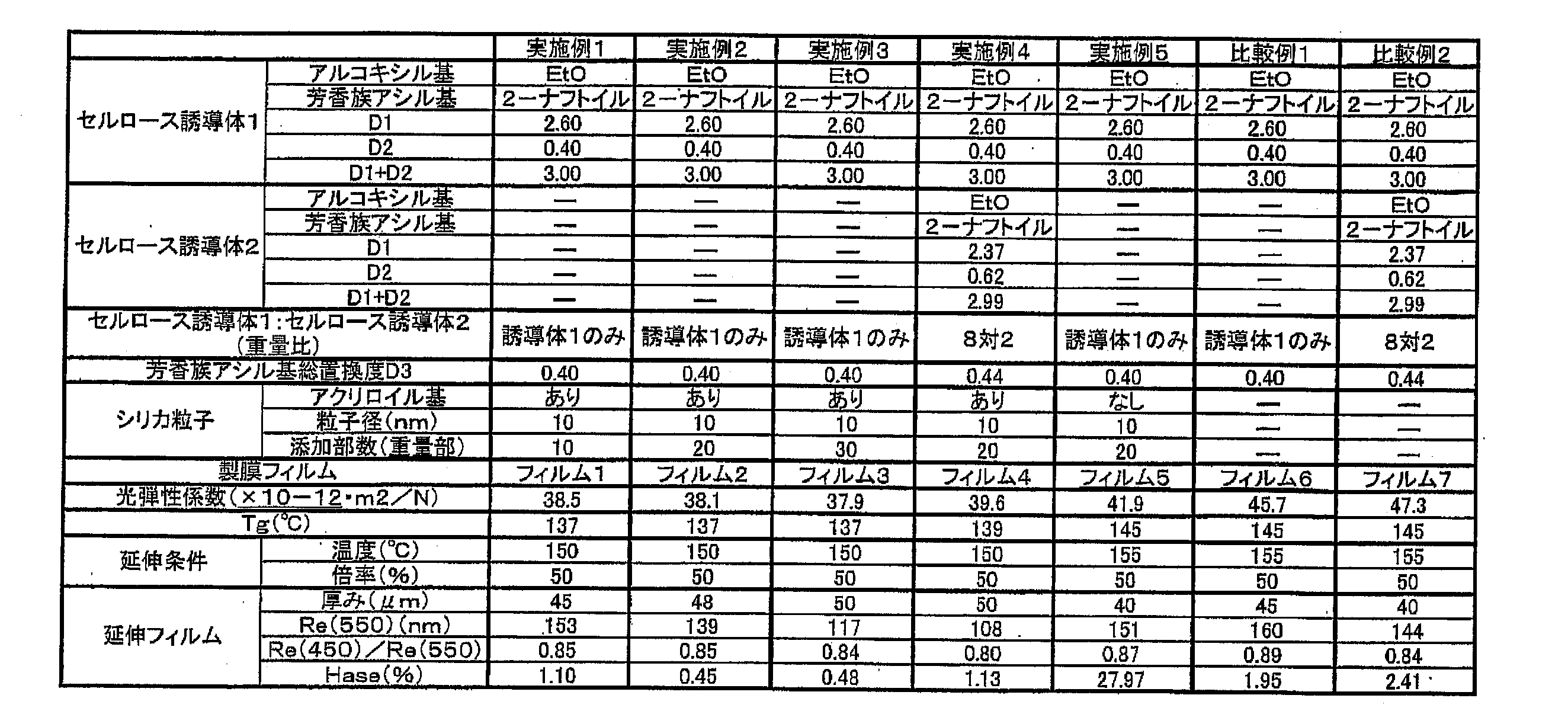
実施例1~5にて製造された位相差フィルムと、比較例1~2にて製造された位相差フィルムとを、その光弾性係数にて比較する。実施例1~5の位相差フィルムの方が、比較例1~2の位相差フィルムよりも光弾性係数が低い。このことから、無機粒子であるシリカ粒子を配合することにより、位相差フィルムの光弾性係数が低減することが分かった。
2.負の正常波長分散(導入側鎖の特性)
3.正の逆波長分散(目標特性)
Claims (17)
- 下記の一般式(1)で表される単量体単位を含むセルロース誘導体の少なくとも1種からなるポリマー材料を含有し、面内レタデーションRe(550)が105nm~160nmであり、逆波長分散特性Re(450)/Re(550)が0.80~0.89であり、フィルム厚みが20μm~50μmである、位相差フィルムであって、
無機粒子を含有する、位相差フィルム。

- 前記セルロース誘導体において、前記一般式(1)で表される単量体単位における、R1、R2及びR3の少なくともいずれか1つが、芳香族基である、請求項1に記載の位相差フィルム。
- 前記セルロース誘導体における、飽和脂肪族基又は不飽和脂肪族基の置換度(D1)の合計が、2.00~2.70であり、
前記セルロース誘導体における、芳香族基の置換度(D2)が、0.30~1.00であり、
前記ポリマー材料における、芳香族基の総置換度(D3)が0.40~0.50であり、
前記置換度(D1)と前記置換度(D2)とが、D1+D2≦3.0を満たす、請求項1または2に記載の位相差フィルム。 - 前記芳香族基が、芳香族アシル基である、請求項1~3の何れか1項に記載の位相差フィルム。
- 前記位相差フィルムの光弾性係数が、42.0×10⁻¹²m2/N未満である、請求項1~4の何れか1項に記載の位相差フィルム。
- 前記無機粒子が、不飽和結合を含有する無機粒子であることを特徴とする、請求項1~5の何れか1項に記載の位相差フィルム。
- 前記無機粒子が、アクリロイル基を含有する無機粒子であることを特徴とする、請求項6に記載の位相差フィルム。
- 前記無機粒子を、前記セルロース誘導体100重量部に対して5重量部~40重量部含有することを特徴とする、請求項1~7の何れか1項に記載の位相差フィルム。
- 前記無機粒子が、シリカ粒子であることを特徴とする、請求項1~8の何れか1項に記載の位相差フィルム。
- 前記無機粒子の平均粒子径が、5nm~30nmであることを特徴とする、請求項1~9の何れか1項に記載の位相差フィルム。
- 前記無機粒子が、真球状粒子であることを特徴とする、請求項1~10の何れか1項に記載の位相差フィルム。
- 前記セルロース誘導体では、一般式(1)の前記飽和脂肪族基が脂肪族アルキル基であることを特徴とする、請求項1~11の何れか1項に記載の位相差フィルム。
- 前記脂肪族アルキル基がエチル基であることを特徴とする、請求項12に記載の位相差フィルム。
- 請求項1~13の何れか1項に記載の位相差フィルムを少なくとも一枚含むことを特徴とする、円偏光板。
- 請求項14に記載の円偏光板を含むことを特徴とする、画像表示装置。
- 請求項1~13の何れか1項に記載の位相差フィルムの製造方法であって、
前記ポリマー材料を含有する製膜フィルムを、延伸倍率20%~200%で延伸して前記位相差フィルムを得る工程を含むことを特徴とする、位相差フィルムの製造方法。 - 前記延伸時の温度が、前記製膜フィルムのガラス転位温度Tgに対して、(Tg-30)℃~(Tg+30)℃の範囲であることを特徴とする、請求項16に記載の位相差フィルムの製造方法。
Priority Applications (3)
| Application Number | Priority Date | Filing Date | Title |
|---|---|---|---|
| CN201680021424.3A CN107533174B (zh) | 2015-04-17 | 2016-04-15 | 相位差膜及其运用 |
| US15/566,960 US10663621B2 (en) | 2015-04-17 | 2016-04-15 | Retardation film and utilization thereof |
| JP2017512593A JP6488371B2 (ja) | 2015-04-17 | 2016-04-15 | 位相差フィルム及びその利用 |
Applications Claiming Priority (2)
| Application Number | Priority Date | Filing Date | Title |
|---|---|---|---|
| JP2015085431 | 2015-04-17 | ||
| JP2015-085431 | 2015-04-17 |
Publications (1)
| Publication Number | Publication Date |
|---|---|
| WO2016167341A1 true WO2016167341A1 (ja) | 2016-10-20 |
Family
ID=57127259
Family Applications (1)
| Application Number | Title | Priority Date | Filing Date |
|---|---|---|---|
| PCT/JP2016/062098 Ceased WO2016167341A1 (ja) | 2015-04-17 | 2016-04-15 | 位相差フィルム及びその利用 |
Country Status (4)
| Country | Link |
|---|---|
| US (1) | US10663621B2 (ja) |
| JP (1) | JP6488371B2 (ja) |
| CN (1) | CN107533174B (ja) |
| WO (1) | WO2016167341A1 (ja) |
Cited By (3)
| Publication number | Priority date | Publication date | Assignee | Title |
|---|---|---|---|---|
| WO2018123772A1 (ja) * | 2016-12-28 | 2018-07-05 | 日本ゼオン株式会社 | 位相差フィルム、その製造方法、偏光板及び表示装置 |
| WO2018181999A1 (ja) * | 2017-03-31 | 2018-10-04 | 株式会社カネカ | 位相差フィルム |
| JP2023086191A (ja) * | 2021-12-10 | 2023-06-22 | パナソニックIpマネジメント株式会社 | 表示装置 |
Families Citing this family (3)
| Publication number | Priority date | Publication date | Assignee | Title |
|---|---|---|---|---|
| WO2021200987A1 (ja) * | 2020-03-30 | 2021-10-07 | 富士フイルム株式会社 | 光学異方性膜、円偏光板、表示装置 |
| IL316906A (en) * | 2022-05-08 | 2025-01-01 | Bagira Systems Ltd | Portable game console |
| CN117075248B (zh) * | 2023-09-25 | 2024-01-05 | 深圳市华星光电半导体显示技术有限公司 | 光学膜、偏光片及显示装置 |
Citations (6)
| Publication number | Priority date | Publication date | Assignee | Title |
|---|---|---|---|---|
| JP2005208257A (ja) * | 2004-01-21 | 2005-08-04 | Japan Science & Technology Agency | 光弾性複屈折性を減殺した光学樹脂材料 |
| JP2007121351A (ja) * | 2005-10-25 | 2007-05-17 | Kaneka Corp | 位相差フィルム、及びその製造方法、並びに光学補償偏光板 |
| JP2008095026A (ja) * | 2006-10-13 | 2008-04-24 | Fujifilm Corp | セルロース化合物、セルロースフィルム、光学補償シート、偏光板および液晶表示装置 |
| JP2008262187A (ja) * | 2007-03-20 | 2008-10-30 | Fujifilm Corp | 反射防止フィルム、偏光板、および画像表示装置 |
| JP2011112842A (ja) * | 2009-11-26 | 2011-06-09 | Kaneka Corp | 位相差フィルム |
| JP2014195988A (ja) * | 2013-03-08 | 2014-10-16 | 昭和電工株式会社 | ノルボルネン化合物重合体フィルム |
Family Cites Families (8)
| Publication number | Priority date | Publication date | Assignee | Title |
|---|---|---|---|---|
| US6686031B2 (en) * | 2000-02-23 | 2004-02-03 | Fuji Photo Film Co., Ltd. | Hard coat film and display device having same |
| US7695781B2 (en) * | 2004-02-16 | 2010-04-13 | Fujifilm Corporation | Antireflective film, polarizing plate including the same, image display unit including the same and method for producing antireflective film |
| JP4740604B2 (ja) | 2005-01-21 | 2011-08-03 | 富士フイルム株式会社 | 光学補償フィルム、その製造方法、偏光板および液晶表示装置 |
| JP4796781B2 (ja) | 2005-03-31 | 2011-10-19 | 株式会社カネカ | ポリマーフィルムおよび光学補償フィルム |
| JP2009132764A (ja) | 2007-11-29 | 2009-06-18 | Fujifilm Corp | セルロース誘導体、セルロース誘導体フィルム、及びその用途 |
| KR101091534B1 (ko) | 2008-04-30 | 2011-12-13 | 주식회사 엘지화학 | 광학 필름 및 이를 포함하는 정보전자 장치 |
| US9309360B2 (en) * | 2013-12-17 | 2016-04-12 | Eastman Chemical Company | Cellulose ester based quarter wave plates having normal wavelength dispersion |
| TWI673513B (zh) * | 2014-09-26 | 2019-10-01 | 日商大日本印刷股份有限公司 | 抗反射膜、顯示裝置及顯示裝置之抗反射膜之選擇方法 |
-
2016
- 2016-04-15 CN CN201680021424.3A patent/CN107533174B/zh active Active
- 2016-04-15 JP JP2017512593A patent/JP6488371B2/ja active Active
- 2016-04-15 WO PCT/JP2016/062098 patent/WO2016167341A1/ja not_active Ceased
- 2016-04-15 US US15/566,960 patent/US10663621B2/en active Active
Patent Citations (6)
| Publication number | Priority date | Publication date | Assignee | Title |
|---|---|---|---|---|
| JP2005208257A (ja) * | 2004-01-21 | 2005-08-04 | Japan Science & Technology Agency | 光弾性複屈折性を減殺した光学樹脂材料 |
| JP2007121351A (ja) * | 2005-10-25 | 2007-05-17 | Kaneka Corp | 位相差フィルム、及びその製造方法、並びに光学補償偏光板 |
| JP2008095026A (ja) * | 2006-10-13 | 2008-04-24 | Fujifilm Corp | セルロース化合物、セルロースフィルム、光学補償シート、偏光板および液晶表示装置 |
| JP2008262187A (ja) * | 2007-03-20 | 2008-10-30 | Fujifilm Corp | 反射防止フィルム、偏光板、および画像表示装置 |
| JP2011112842A (ja) * | 2009-11-26 | 2011-06-09 | Kaneka Corp | 位相差フィルム |
| JP2014195988A (ja) * | 2013-03-08 | 2014-10-16 | 昭和電工株式会社 | ノルボルネン化合物重合体フィルム |
Cited By (11)
| Publication number | Priority date | Publication date | Assignee | Title |
|---|---|---|---|---|
| WO2018123772A1 (ja) * | 2016-12-28 | 2018-07-05 | 日本ゼオン株式会社 | 位相差フィルム、その製造方法、偏光板及び表示装置 |
| CN109863431A (zh) * | 2016-12-28 | 2019-06-07 | 日本瑞翁株式会社 | 相位差膜、其制造方法、偏振片和显示装置 |
| KR20190096996A (ko) * | 2016-12-28 | 2019-08-20 | 니폰 제온 가부시키가이샤 | 위상차 필름, 그 제조 방법, 편광판 및 표시 장치 |
| JPWO2018123772A1 (ja) * | 2016-12-28 | 2019-10-31 | 日本ゼオン株式会社 | 位相差フィルム、その製造方法、偏光板及び表示装置 |
| TWI732982B (zh) * | 2016-12-28 | 2021-07-11 | 日商日本瑞翁股份有限公司 | 相位差薄膜、相位差薄膜之製造方法、偏光板及顯示裝置 |
| JP7014182B2 (ja) | 2016-12-28 | 2022-02-01 | 日本ゼオン株式会社 | 位相差フィルム、その製造方法、偏光板及び表示装置 |
| KR102510655B1 (ko) * | 2016-12-28 | 2023-03-15 | 니폰 제온 가부시키가이샤 | 위상차 필름, 그 제조 방법, 편광판 및 표시 장치 |
| WO2018181999A1 (ja) * | 2017-03-31 | 2018-10-04 | 株式会社カネカ | 位相差フィルム |
| JPWO2018181999A1 (ja) * | 2017-03-31 | 2019-11-07 | 株式会社カネカ | 位相差フィルム |
| JP2023086191A (ja) * | 2021-12-10 | 2023-06-22 | パナソニックIpマネジメント株式会社 | 表示装置 |
| US12298625B2 (en) | 2021-12-10 | 2025-05-13 | Panasonic Automotive Systems Co., Ltd. | Electronic mirror device |
Also Published As
| Publication number | Publication date |
|---|---|
| US10663621B2 (en) | 2020-05-26 |
| US20180081082A1 (en) | 2018-03-22 |
| JP6488371B2 (ja) | 2019-03-20 |
| JPWO2016167341A1 (ja) | 2018-02-08 |
| CN107533174B (zh) | 2020-06-16 |
| CN107533174A (zh) | 2018-01-02 |
Similar Documents
| Publication | Publication Date | Title |
|---|---|---|
| JP6488371B2 (ja) | 位相差フィルム及びその利用 | |
| JP4242602B2 (ja) | 位相差フィルム | |
| JP5047784B2 (ja) | 位相差フィルム、およびその製造方法 | |
| US9309362B2 (en) | Optical films containing optical retardation-enhancing additive | |
| WO2007108347A1 (ja) | セルロースアシレート光学フィルム、その製造方法、それを用いる偏光板及び液晶表示装置 | |
| JP6788598B2 (ja) | ポリマー材料、フィルム、円偏光板、画像表示装置及びフィルムの製造方法 | |
| WO2007061139A1 (en) | Cellulose acylate film, method of producing the same, cellulose derivative film, optically compensatory film using the same, optically-compensatory film incorporating polarizing plate, polarizing plate and liquid crystal display device | |
| JP6010233B2 (ja) | 位相差フィルム並びにそれを用いた光学補償層、光学補償偏光板、液晶及び有機el表示装置 | |
| WO2007119646A1 (ja) | 偏光板保護フィルム、偏光板及び液晶表示装置 | |
| JP5050307B2 (ja) | セルロースエステルフィルムの製造方法 | |
| JP2011112842A (ja) | 位相差フィルム | |
| WO2018181999A1 (ja) | 位相差フィルム | |
| JP2006225626A (ja) | 位相差フィルム、光学フィルム、液晶パネル、液晶表示装置、及び画像表示装置 | |
| JP2008163193A (ja) | セルロース誘導体、セルロース誘導体溶液、およびそれらを用いた光学フィルムとその製造方法 | |
| JP2006274135A (ja) | 位相差フィルムおよび位相差フィルムを形成するためのポリマーフィルムとその製造方法 | |
| JP2006282885A (ja) | ポリマーフィルムおよび光学補償フィルム | |
| JP2007298889A (ja) | 位相差フィルム、およびその製造方法 | |
| JP2007121352A (ja) | 位相差フィルム、及びその製造方法、並びに光学補償偏光板 | |
| JP2007121351A (ja) | 位相差フィルム、及びその製造方法、並びに光学補償偏光板 | |
| WO2014065083A1 (ja) | 光学フィルム、円偏光板及び画像表示装置 | |
| JP2007316559A (ja) | 位相差フィルム | |
| JP2007304428A (ja) | 位相差フィルム | |
| JP2018177893A (ja) | ポリマー材料、フィルム、および延伸フィルムの製造方法 | |
| JP2007093654A (ja) | 位相差フィルム、及びその製造方法、並びに光学補償偏光板 | |
| JP2007241151A (ja) | 位相差フィルムの製造方法、並びに光学補償偏光板 |
Legal Events
| Date | Code | Title | Description |
|---|---|---|---|
| 121 | Ep: the epo has been informed by wipo that ep was designated in this application |
Ref document number: 16780132 Country of ref document: EP Kind code of ref document: A1 |
|
| ENP | Entry into the national phase |
Ref document number: 2017512593 Country of ref document: JP Kind code of ref document: A |
|
| WWE | Wipo information: entry into national phase |
Ref document number: 15566960 Country of ref document: US |
|
| NENP | Non-entry into the national phase |
Ref country code: DE |
|
| 122 | Ep: pct application non-entry in european phase |
Ref document number: 16780132 Country of ref document: EP Kind code of ref document: A1 |