WO2016167232A1 - 熱可塑性樹脂シートまたはフィルムのプレス成形による成形体の製造方法 - Google Patents
熱可塑性樹脂シートまたはフィルムのプレス成形による成形体の製造方法 Download PDFInfo
- Publication number
- WO2016167232A1 WO2016167232A1 PCT/JP2016/061748 JP2016061748W WO2016167232A1 WO 2016167232 A1 WO2016167232 A1 WO 2016167232A1 JP 2016061748 W JP2016061748 W JP 2016061748W WO 2016167232 A1 WO2016167232 A1 WO 2016167232A1
- Authority
- WO
- WIPO (PCT)
- Prior art keywords
- resin sheet
- press molding
- inorganic filler
- resin
- length
- Prior art date
- Legal status (The legal status is an assumption and is not a legal conclusion. Google has not performed a legal analysis and makes no representation as to the accuracy of the status listed.)
- Ceased
Links
Images


Classifications
-
- B—PERFORMING OPERATIONS; TRANSPORTING
- B29—WORKING OF PLASTICS; WORKING OF SUBSTANCES IN A PLASTIC STATE IN GENERAL
- B29C—SHAPING OR JOINING OF PLASTICS; SHAPING OF MATERIAL IN A PLASTIC STATE, NOT OTHERWISE PROVIDED FOR; AFTER-TREATMENT OF THE SHAPED PRODUCTS, e.g. REPAIRING
- B29C51/00—Shaping by thermoforming, i.e. shaping sheets or sheet like preforms after heating, e.g. shaping sheets in matched moulds or by deep-drawing; Apparatus therefor
- B29C51/002—Shaping by thermoforming, i.e. shaping sheets or sheet like preforms after heating, e.g. shaping sheets in matched moulds or by deep-drawing; Apparatus therefor characterised by the choice of material
-
- B—PERFORMING OPERATIONS; TRANSPORTING
- B29—WORKING OF PLASTICS; WORKING OF SUBSTANCES IN A PLASTIC STATE IN GENERAL
- B29B—PREPARATION OR PRETREATMENT OF THE MATERIAL TO BE SHAPED; MAKING GRANULES OR PREFORMS; RECOVERY OF PLASTICS OR OTHER CONSTITUENTS OF WASTE MATERIAL CONTAINING PLASTICS
- B29B7/00—Mixing; Kneading
- B29B7/80—Component parts, details or accessories; Auxiliary operations
- B29B7/88—Adding charges, i.e. additives
- B29B7/90—Fillers or reinforcements, e.g. fibres
-
- B—PERFORMING OPERATIONS; TRANSPORTING
- B29—WORKING OF PLASTICS; WORKING OF SUBSTANCES IN A PLASTIC STATE IN GENERAL
- B29B—PREPARATION OR PRETREATMENT OF THE MATERIAL TO BE SHAPED; MAKING GRANULES OR PREFORMS; RECOVERY OF PLASTICS OR OTHER CONSTITUENTS OF WASTE MATERIAL CONTAINING PLASTICS
- B29B9/00—Making granules
- B29B9/02—Making granules by dividing preformed material
- B29B9/06—Making granules by dividing preformed material in the form of filamentary material, e.g. combined with extrusion
- B29B9/065—Making granules by dividing preformed material in the form of filamentary material, e.g. combined with extrusion under-water, e.g. underwater pelletizers
-
- B—PERFORMING OPERATIONS; TRANSPORTING
- B29—WORKING OF PLASTICS; WORKING OF SUBSTANCES IN A PLASTIC STATE IN GENERAL
- B29B—PREPARATION OR PRETREATMENT OF THE MATERIAL TO BE SHAPED; MAKING GRANULES OR PREFORMS; RECOVERY OF PLASTICS OR OTHER CONSTITUENTS OF WASTE MATERIAL CONTAINING PLASTICS
- B29B9/00—Making granules
- B29B9/12—Making granules characterised by structure or composition
- B29B9/14—Making granules characterised by structure or composition fibre-reinforced
-
- B—PERFORMING OPERATIONS; TRANSPORTING
- B29—WORKING OF PLASTICS; WORKING OF SUBSTANCES IN A PLASTIC STATE IN GENERAL
- B29C—SHAPING OR JOINING OF PLASTICS; SHAPING OF MATERIAL IN A PLASTIC STATE, NOT OTHERWISE PROVIDED FOR; AFTER-TREATMENT OF THE SHAPED PRODUCTS, e.g. REPAIRING
- B29C43/00—Compression moulding, i.e. applying external pressure to flow the moulding material; Apparatus therefor
- B29C43/02—Compression moulding, i.e. applying external pressure to flow the moulding material; Apparatus therefor of articles of definite length, i.e. discrete articles
- B29C43/021—Compression moulding, i.e. applying external pressure to flow the moulding material; Apparatus therefor of articles of definite length, i.e. discrete articles characterised by the shape of the surface
-
- B—PERFORMING OPERATIONS; TRANSPORTING
- B29—WORKING OF PLASTICS; WORKING OF SUBSTANCES IN A PLASTIC STATE IN GENERAL
- B29C—SHAPING OR JOINING OF PLASTICS; SHAPING OF MATERIAL IN A PLASTIC STATE, NOT OTHERWISE PROVIDED FOR; AFTER-TREATMENT OF THE SHAPED PRODUCTS, e.g. REPAIRING
- B29C43/00—Compression moulding, i.e. applying external pressure to flow the moulding material; Apparatus therefor
- B29C43/32—Component parts, details or accessories; Auxiliary operations
- B29C43/34—Feeding the material to the mould or the compression means
-
- B—PERFORMING OPERATIONS; TRANSPORTING
- B29—WORKING OF PLASTICS; WORKING OF SUBSTANCES IN A PLASTIC STATE IN GENERAL
- B29C—SHAPING OR JOINING OF PLASTICS; SHAPING OF MATERIAL IN A PLASTIC STATE, NOT OTHERWISE PROVIDED FOR; AFTER-TREATMENT OF THE SHAPED PRODUCTS, e.g. REPAIRING
- B29C48/00—Extrusion moulding, i.e. expressing the moulding material through a die or nozzle which imparts the desired form; Apparatus therefor
- B29C48/001—Combinations of extrusion moulding with other shaping operations
- B29C48/0011—Combinations of extrusion moulding with other shaping operations combined with compression moulding
-
- B—PERFORMING OPERATIONS; TRANSPORTING
- B29—WORKING OF PLASTICS; WORKING OF SUBSTANCES IN A PLASTIC STATE IN GENERAL
- B29C—SHAPING OR JOINING OF PLASTICS; SHAPING OF MATERIAL IN A PLASTIC STATE, NOT OTHERWISE PROVIDED FOR; AFTER-TREATMENT OF THE SHAPED PRODUCTS, e.g. REPAIRING
- B29C48/00—Extrusion moulding, i.e. expressing the moulding material through a die or nozzle which imparts the desired form; Apparatus therefor
- B29C48/022—Extrusion moulding, i.e. expressing the moulding material through a die or nozzle which imparts the desired form; Apparatus therefor characterised by the choice of material
-
- B—PERFORMING OPERATIONS; TRANSPORTING
- B29—WORKING OF PLASTICS; WORKING OF SUBSTANCES IN A PLASTIC STATE IN GENERAL
- B29C—SHAPING OR JOINING OF PLASTICS; SHAPING OF MATERIAL IN A PLASTIC STATE, NOT OTHERWISE PROVIDED FOR; AFTER-TREATMENT OF THE SHAPED PRODUCTS, e.g. REPAIRING
- B29C48/00—Extrusion moulding, i.e. expressing the moulding material through a die or nozzle which imparts the desired form; Apparatus therefor
- B29C48/03—Extrusion moulding, i.e. expressing the moulding material through a die or nozzle which imparts the desired form; Apparatus therefor characterised by the shape of the extruded material at extrusion
- B29C48/07—Flat, e.g. panels
- B29C48/08—Flat, e.g. panels flexible, e.g. films
-
- B—PERFORMING OPERATIONS; TRANSPORTING
- B29—WORKING OF PLASTICS; WORKING OF SUBSTANCES IN A PLASTIC STATE IN GENERAL
- B29B—PREPARATION OR PRETREATMENT OF THE MATERIAL TO BE SHAPED; MAKING GRANULES OR PREFORMS; RECOVERY OF PLASTICS OR OTHER CONSTITUENTS OF WASTE MATERIAL CONTAINING PLASTICS
- B29B7/00—Mixing; Kneading
- B29B7/30—Mixing; Kneading continuous, with mechanical mixing or kneading devices
- B29B7/34—Mixing; Kneading continuous, with mechanical mixing or kneading devices with movable mixing or kneading devices
- B29B7/38—Mixing; Kneading continuous, with mechanical mixing or kneading devices with movable mixing or kneading devices rotary
- B29B7/46—Mixing; Kneading continuous, with mechanical mixing or kneading devices with movable mixing or kneading devices rotary with more than one shaft
-
- B—PERFORMING OPERATIONS; TRANSPORTING
- B29—WORKING OF PLASTICS; WORKING OF SUBSTANCES IN A PLASTIC STATE IN GENERAL
- B29B—PREPARATION OR PRETREATMENT OF THE MATERIAL TO BE SHAPED; MAKING GRANULES OR PREFORMS; RECOVERY OF PLASTICS OR OTHER CONSTITUENTS OF WASTE MATERIAL CONTAINING PLASTICS
- B29B9/00—Making granules
- B29B9/02—Making granules by dividing preformed material
- B29B9/06—Making granules by dividing preformed material in the form of filamentary material, e.g. combined with extrusion
-
- B—PERFORMING OPERATIONS; TRANSPORTING
- B29—WORKING OF PLASTICS; WORKING OF SUBSTANCES IN A PLASTIC STATE IN GENERAL
- B29C—SHAPING OR JOINING OF PLASTICS; SHAPING OF MATERIAL IN A PLASTIC STATE, NOT OTHERWISE PROVIDED FOR; AFTER-TREATMENT OF THE SHAPED PRODUCTS, e.g. REPAIRING
- B29C51/00—Shaping by thermoforming, i.e. shaping sheets or sheet like preforms after heating, e.g. shaping sheets in matched moulds or by deep-drawing; Apparatus therefor
- B29C51/08—Deep drawing or matched-mould forming, i.e. using mechanical means only
-
- B—PERFORMING OPERATIONS; TRANSPORTING
- B29—WORKING OF PLASTICS; WORKING OF SUBSTANCES IN A PLASTIC STATE IN GENERAL
- B29K—INDEXING SCHEME ASSOCIATED WITH SUBCLASSES B29B, B29C OR B29D, RELATING TO MOULDING MATERIALS OR TO MATERIALS FOR MOULDS, REINFORCEMENTS, FILLERS OR PREFORMED PARTS, e.g. INSERTS
- B29K2023/00—Use of polyalkenes or derivatives thereof as moulding material
- B29K2023/10—Polymers of propylene
- B29K2023/12—PP, i.e. polypropylene
-
- B—PERFORMING OPERATIONS; TRANSPORTING
- B29—WORKING OF PLASTICS; WORKING OF SUBSTANCES IN A PLASTIC STATE IN GENERAL
- B29K—INDEXING SCHEME ASSOCIATED WITH SUBCLASSES B29B, B29C OR B29D, RELATING TO MOULDING MATERIALS OR TO MATERIALS FOR MOULDS, REINFORCEMENTS, FILLERS OR PREFORMED PARTS, e.g. INSERTS
- B29K2067/00—Use of polyesters or derivatives thereof, as moulding material
- B29K2067/006—PBT, i.e. polybutylene terephthalate
-
- B—PERFORMING OPERATIONS; TRANSPORTING
- B29—WORKING OF PLASTICS; WORKING OF SUBSTANCES IN A PLASTIC STATE IN GENERAL
- B29K—INDEXING SCHEME ASSOCIATED WITH SUBCLASSES B29B, B29C OR B29D, RELATING TO MOULDING MATERIALS OR TO MATERIALS FOR MOULDS, REINFORCEMENTS, FILLERS OR PREFORMED PARTS, e.g. INSERTS
- B29K2069/00—Use of PC, i.e. polycarbonates or derivatives thereof, as moulding material
-
- B—PERFORMING OPERATIONS; TRANSPORTING
- B29—WORKING OF PLASTICS; WORKING OF SUBSTANCES IN A PLASTIC STATE IN GENERAL
- B29K—INDEXING SCHEME ASSOCIATED WITH SUBCLASSES B29B, B29C OR B29D, RELATING TO MOULDING MATERIALS OR TO MATERIALS FOR MOULDS, REINFORCEMENTS, FILLERS OR PREFORMED PARTS, e.g. INSERTS
- B29K2101/00—Use of unspecified macromolecular compounds as moulding material
- B29K2101/12—Thermoplastic materials
-
- B—PERFORMING OPERATIONS; TRANSPORTING
- B29—WORKING OF PLASTICS; WORKING OF SUBSTANCES IN A PLASTIC STATE IN GENERAL
- B29K—INDEXING SCHEME ASSOCIATED WITH SUBCLASSES B29B, B29C OR B29D, RELATING TO MOULDING MATERIALS OR TO MATERIALS FOR MOULDS, REINFORCEMENTS, FILLERS OR PREFORMED PARTS, e.g. INSERTS
- B29K2105/00—Condition, form or state of moulded material or of the material to be shaped
- B29K2105/06—Condition, form or state of moulded material or of the material to be shaped containing reinforcements, fillers or inserts
- B29K2105/12—Condition, form or state of moulded material or of the material to be shaped containing reinforcements, fillers or inserts of short lengths, e.g. chopped filaments, staple fibres or bristles
-
- B—PERFORMING OPERATIONS; TRANSPORTING
- B29—WORKING OF PLASTICS; WORKING OF SUBSTANCES IN A PLASTIC STATE IN GENERAL
- B29K—INDEXING SCHEME ASSOCIATED WITH SUBCLASSES B29B, B29C OR B29D, RELATING TO MOULDING MATERIALS OR TO MATERIALS FOR MOULDS, REINFORCEMENTS, FILLERS OR PREFORMED PARTS, e.g. INSERTS
- B29K2309/00—Use of inorganic materials not provided for in groups B29K2303/00 - B29K2307/00, as reinforcement
- B29K2309/08—Glass
Definitions
- the present invention relates to a method for producing a molded body by press molding a thermoplastic resin sheet or film containing an inorganic filler. More specifically, the present invention relates to a method using press molding that does not have an unfilled portion of resin, a hole, or a cracked portion on a side surface portion of a press-molded product and realizes a good appearance.
- press molding is a method of forming, working by applying deformation such as bending, shearing, compression, etc. to various materials exemplified by metals, plastic materials, ceramic materials, etc. using a processing machine, a mold, a tool, etc. It is.
- press molding is characterized by the ability to produce a large amount of products with relatively uniform precision, and there are high demands for high speed, high precision, stable quality, etc. for mass production. Therefore, the market demand for improving workability and formability is very high.
- Patent Document 1 A method of quenching is disclosed (Patent Document 1).
- Patent Document 1 A method of quenching is disclosed (Patent Document 1).
- these press molding methods relate to a material in which an inorganic filler is not mixed, and the press molding method in the case where the thermoplastic resin is difficult to extend by containing the inorganic filler is not mentioned in Patent Document 1. .
- thermoplastic resin sheet A method of making a cut and clamping is disclosed (Patent Document 2).
- Patent Document 2 A method of making a cut and clamping is disclosed.
- these press molding methods are preferable in a fiber reinforced thermoplastic resin sheet having a fiber length of 5 mm or more produced by a papermaking method, and contain an inorganic filler having a length of 5 mm or less produced by a melt extrusion molding method.
- a method for press-molding a thermoplastic resin sheet in particular, a method for press-molding without cutting the sheet.
- the papermaking method is suitably used when manufacturing a molded product having a thickness of 1 mm or more, and when used for manufacturing a thin molded product, the fibers protrude from the surface of the molded product. There was a problem that it was large and its formability was insufficient.
- JP 2006-224332 A Japanese Patent Laid-Open No. 10-1000017
- the thermoplastic resin sheet and film to be pressed are formed into a stepped shape such as a box shape, the resin breaks at the time of mold clamping due to adhesion between the sheet and film edge and the outer peripheral portion of the mold, and the resin component Since it did not enter the cavity, there was a problem that the side surface of the molded product was perforated or cracked.
- An object of the present invention is to solve the above-described conventional problems and to provide a method for producing a hot-press molded product having an excellent appearance by hot-press molding of a thermoplastic resin sheet and a film containing an inorganic filler.
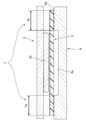
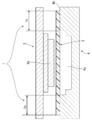
- the present inventors have, for example, specified that the length of the blank portion of the resin sheet shown in 1a to 1d in FIGS. 1 to 6 is 5 mm to 50 mm.
- the present inventors have found that a hot press molded article having an excellent appearance not obtained can be obtained.
- the present invention relates to a method for hot pressing into a stepped shape such as a thermoplastic resin sheet and a film box shown below, and the summary is as follows.
- a method for producing a molded body comprising a step of press-molding a resin sheet or resin film containing a thermoplastic resin (A) and a fibrous inorganic filler (B) with an upper mold and a lower mold,
- the resin sheet contains 40 to 80 parts by mass of the thermoplastic resin (A) and 20 to 60 parts by mass of the fibrous inorganic filler (B) in 100 parts by mass of the resin sheet.
- a method for producing a molded body by press molding wherein a length of a blank portion of the resin sheet disposed on a concave portion of the lower mold used for the press molding is 5 to 50 mm.
- [3] A value of (the length of the blank portion (mm)) / (the depth of the concave portion of the lower mold (mm)), which is a ratio of the length of the blank portion to the depth of the concave portion of the lower mold.
- the manufacturing method of the molded object by press molding as described in [1] or [2] whose is 1.0 or more and 10.0 or less.
- thermoplastic resin (A) contains an aromatic polycarbonate.
- the method of the present invention for producing a molded body by press-molding a thermoplastic resin sheet and film containing an inorganic filler into a box shape for example, provides a molded product with excellent appearance without perforations on the side surface of the molded product. It is possible to provide. For this reason, this invention can be used conveniently for the hot press method of the sheet
- thermoplastic resin (A) As the thermoplastic resin (A) (hereinafter sometimes referred to as “component (A)”) used in the molding method of the present invention, a known resin can be used without particular limitation. Examples thereof include polyethylene, polypropylene, modified PPE, acrylic resin, polystyrene, polyvinyl chloride, ABS resin, polyester resin (polyethylene terephthalate, polybutylene terephthalate), polycarbonate resin, polyamide, polyacetal, polysulfone, polyphenylene sulfide, and the like. . These resins can be used not only alone but also as a mixture or copolymer of two or more kinds.
- Aromatic polycarbonate resin is excellent in transparency, impact resistance, heat resistance, etc., and because the resulting molded product is also excellent in dimensional stability, etc., it is possible to obtain a beautiful appearance in the case. is there.
- the aromatic polycarbonate resin used in the present invention may be, for example, a branched thermoplastic polymer obtained by reacting an aromatic dihydroxy compound or a small amount thereof with phosgene or a carbonic acid diester. Or it is a copolymer.
- the production method of the aromatic polycarbonate resin is not particularly limited, and those produced by a conventionally known phosgene method (interfacial polymerization method) or melting method (transesterification method) can be used. Moreover, when the melting method is used, an aromatic polycarbonate resin in which the amount of OH groups in the terminal groups is adjusted can be used.
- bisphenol A 2,2-bis (4-hydroxyphenyl) propane
- tetramethylbisphenol A bis (4-hydroxyphenyl) -p-diisopropylbenzene
- hydroquinone resorcinol
- 4 4-dihydroxydiphenyl and the like
- a compound in which one or more tetraalkylphosphonium sulfonates are bonded to the above aromatic dihydroxy compound can also be used.
- a part of the above-mentioned aromatic dihydroxy compound is mixed with the following branching agent, ie, phloroglucin, 4,6-dimethyl-2,4,6-tri (4-hydroxyphenyl).
- Heptene-2,4,6-dimethyl-2,4,6-tri (4-hydroxyphenyl) heptane, 2,6-dimethyl-2,4,6-tri (4-hydroxyphenylheptene-3,1, Polyhydroxy compounds such as 3,5-tri (4-hydroxyphenyl) benzene and 1,1,1-tri (4-hydroxyphenyl) ethane, and 3,3-bis (4-hydroxyaryl) oxindole ( isa) Bisbisphenol), 5-chlorouisatin, 5,7-dichlorouisatin, 5-bromoisatin, etc. These substituted compounds The amount, based on the aromatic dihydroxy compound is usually 0.01 to 10 mol%, preferably 0.1 to 2 mol%.
- aromatic polycarbonate resin among the above-mentioned, polycarbonate resin derived from 2,2-bis (4-hydroxyphenyl) propane, or 2,2-bis (4-hydroxyphenyl) propane and other aromatic dihydroxy Polycarbonate copolymers derived from the compounds are preferred. Further, it may be a copolymer mainly composed of a polycarbonate resin, such as a copolymer with a polymer or oligomer having a siloxane structure.
- the above aromatic polycarbonate resins may be used alone or in combination of two or more.
- a monovalent aromatic hydroxy compound may be used.
- the monovalent aromatic hydroxy compound include m- and p-methylphenol, m- and p- And propylphenol, p-tert-butylphenol, p-long chain alkyl-substituted phenol, and the like.
- the molecular weight of the aromatic polycarbonate resin used in the present invention is arbitrary depending on the use and may be appropriately selected and determined. From the viewpoint of moldability, strength, etc., the molecular weight of the aromatic polycarbonate resin is a viscosity average molecular weight [Mv]. 15,000 to 40,000, preferably 15,000 to 30,000. As described above, when the viscosity average molecular weight is 15,000 or more, the mechanical strength tends to be further improved, which is more preferable in the case of use in applications requiring high mechanical strength.
- the intrinsic viscosity [ ⁇ ] is a value calculated from the following equation by measuring the specific viscosity [ ⁇ sp ] at each solution concentration [c] (g / dl).
- the viscosity average molecular weight of the aromatic polycarbonate resin is preferably 17,000 to 30,000, particularly preferably 19,000 to 27,000. Two or more aromatic polycarbonate resins having different viscosity average molecular weights may be mixed. In this case, an aromatic polycarbonate resin having a viscosity average molecular weight deviating from the above-described preferred range may be mixed. In this case, the viscosity average molecular weight of the mixture is preferably within the above range.
- the proportion of the thermoplastic resin (A) in 100 parts by mass of the resin sheet in the present invention is 40 to 80 parts by mass, preferably 45 to 75 parts by mass, more preferably 50 to 70 parts by mass.
- Fibrous inorganic filler (B) The thermoplastic resin sheet used in the present invention may be referred to as a fibrous inorganic filler (B) (hereinafter referred to as “component (B)”) in order to enhance bending properties such as bending elastic modulus and bending strength of the molded product. ).
- a glass-type reinforcement material and a carbon-type reinforcement material can be used.
- a glass-based reinforcing material any glass-based reinforcing material is classified into a fibrous inorganic filler and a plate-like inorganic filler according to its shape.
- the fibrous glass fiber used in the present invention may be any known form regardless of the form of the glass fiber when blended, such as chopped strand, roving glass, (long fiber) masterbatch of thermoplastic resin and glass fiber. Glass fiber can also be used.
- the average length of the fibrous inorganic filler (B) used as a raw material is 50 ⁇ m or more, preferably 1 mm or more, more preferably 2 mm or more.
- the fibrous inorganic filler (B) used as a raw material needs to have a certain length or more because it is broken and shortened in processes such as resin pellet production and sheet molding.
- the average length of the inorganic filler in the molded product is 50 to 500 ⁇ m, preferably 100 to 500 ⁇ m, more preferably 150 to 500 ⁇ m.
- the fiber length is measured as follows. That is, about 2 g of a molded product containing a fibrous inorganic filler is left in an electric furnace at 600 ° C.
- the average fiber diameter of the fibrous inorganic filler is preferably 1 to 50 ⁇ m, and more preferably 3 to 40 ⁇ m.
- an inorganic filler may be used individually by 1 type, and 2 or more types may be mixed and used for it.
- two or more kinds of glass fibers (including milled fibers) having different average fiber diameters and average lengths may be used in combination, and two or more kinds of glass flakes having different average particle diameters, average thicknesses, and aspect ratios.
- May be used in combination, or one or two or more kinds of glass fibers (including milled fibers) may be used in combination, or one or more kinds of flakes and one or more kinds of glass fibers (milled fibers). May be used in combination.
- particle size glass beads can be used in combination for the purpose of dimensional stabilization.
- the proportion of the fibrous inorganic filler (B) in 100 parts by mass of the resin sheet in the present invention is 20 to 60 parts by mass, preferably 25 to 55 parts by mass, more preferably 30 to 50 parts by mass.
- a filler is orientated along one direction before press molding, and an orientation state is changed by press molding and it does not follow only one direction.
- the anisotropy of the orientation of the filler may be relaxed.
- a silicate-based reinforcing material can also be used.
- the fibrous filler wollastonite or the like can be used, and as the plate-like filler, talc, mica, or the like can be used.
- Other fibrous fillers are metal fibers, whisker such as potassium titanate whisker, calcium carbonate whisker, aluminum borate whisker, titanium oxide whisker, zinc oxide whisker and magnesium sulfate whisker, and plate filler is metal flake, silica, alumina. Calcium carbonate or the like can also be used.
- one kind may be used alone, or two or more kinds may be mixed and used.
- the amount used when adding an inorganic filler other than a fibrous material, for example, a plate-like filler is 0.1 to 10 parts by weight, preferably 1 to 10 parts by weight, more preferably 5 to 10 parts per 100 parts by weight of the resin sheet. Part by mass.
- thermoplastic resin composition There is no restriction
- thermoplastic resin (A) and the fibrous inorganic filler (B) according to the present invention examples thereof include the thermoplastic resin (A) and the fibrous inorganic filler (B) according to the present invention, a phosphorus-based heat stabilizer, an antioxidant, and other components blended as necessary.
- a phosphorus-based heat stabilizer such as a phosphorus-based heat stabilizer
- an antioxidant such as a phosphorus-based heat stabilizer
- other components blended as necessary for example, after pre-mixing using various mixers such as a tumbler, Henschel mixer, super mixer, etc., melt kneading with a mixer such as a Banbury mixer, roll, brabender, single-screw kneading extruder, twin-screw kneading extruder, kneader A method is mentioned.
- the inorganic filler (B) is preferably supplied and mixed from a side feeder installed on the downstream side of the extruder separately from the resin component in order to suppress crushing.
- thermoplastic resin sheet and film As a method for producing the thermoplastic resin sheet and film in the present invention, a melt extrusion method (for example, a T-die molding method) is preferably used.
- press molding refers to molding by applying deformation such as bending, shearing, and compression to various materials exemplified by metal, plastic material, ceramic material, etc. using a mold (die), processing machine, tool and the like. Means how to get the body.
- the press molding method include a molding method in which molding is performed using a mold, for example, a die press method, a rubber press method (hydrostatic pressure molding method), an extrusion molding method, and the like.
- the length of each blank portion of the resin sheet is adjusted to be 5 mm to 50 mm.
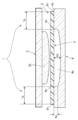
- the length of the blank portion 1 of the resin sheet 2 shown as 1a to 1d is adjusted to be 5 mm to 50 mm. That is, when the resin sheet 1 is disposed between the upper mold 3 having the convex portion 3a and the lower mold 4 so as to cover the concave portion 4a of the lower mold 4, blank portions 1a to 1d of the resin sheet 2 are disposed.
- the length of each is 5 mm to 50 mm.
- the blank portion of the resin sheet in the present invention refers to a region in contact with a flat portion excluding the concave portion of the lower mold in the resin sheet disposed on the lower mold before pressing.
- the length of a blank part means the distance (shortest length) from the outline of the recessed part of a lower metal mold
- the length of the blank portion 1 of the resin sheet 2 is represented by 1a to 1d, and these lengths are: Each is 5 mm to 50 mm.
- the lengths 1a and 1b and 1c and 1d of the margin portions are the same, but when these lengths are different, all the lengths of 1a to 1d are 5 mm to It is preferable to be in the range of 50 mm.
- the lengths of a plurality of blank portions are different for the same sheet, at least a part of the length of the blank portion needs to be in the range of 5 mm to 50 mm.
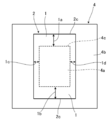
- FIG. 5 is a plan view showing the resin sheet 2 and the lower die 4 before pressing
- the length of the blank portion 1 of the resin sheet 2 is represented by 1a to 1d, and these lengths are: Each is 5 mm to 50 mm.
- the lengths 1a and 1b and 1c and 1d of the margin portions are the same, but when these lengths are different, all the lengths of 1a to 1d are 5 mm to It
- the length 1a (or 1b) of the blank portion and the length 1c (or 1d) of the blank portion are in the range of 5 mm to 50 mm.
- An average value of the lengths of the plurality of different margin portions for example, an average value of the length 1a (or 1b) of the margin portion and the length 1c (or 1d) of the margin portion in FIG. It is preferable to be in the range of 50 mm.
- the outline 2c of the resin sheet 2 and the outline 4c of the recess 4a of the lower mold 4 are both rectangular, but the shape of the recess 4a of the resin sheet 2 and the lower mold 4 is as follows. The invention is not limited to that shown in FIG.
- At least a part of the length of the blank portion defined by the above definition is 5 mm. It is in the range of ⁇ 50 mm, preferably the length of a plurality of margin portions, particularly preferably the length of all the margin portions is in the above-mentioned range. Moreover, it is preferable that the average value of the length of a several margin part also exists in the above-mentioned range.
- the resin sheet containing the filler is pushed into the concave portion of the lower mold, but if the size of the margin is appropriate at this time, the aforementioned adhesive force is small, and the resin sheet is concave. It is drawn into and can be shaped normally.
- the margin part of the resin sheet is too large, the contact area with the lower mold of the resin sheet is large, so that the adhesive force becomes larger, and is pulled and stretched without being drawn into the recess of the lower mold, Easy to break. For this reason, it is highly possible that the filler-containing resin sheet having a large blank portion cannot be shaped normally.
- the value of the ratio of the length (mm) of the blank portion of the resin sheet / the depth (mm) of the recess of the lower mold is preferably 1.0 or more, more preferably 1.2 or more. is there. Further, the value of the ratio of the length of the blank portion (mm) / the depth of the recess of the lower mold (mm) is preferably 10.0 or less. Note that the depth of the concave portion of the lower mold is a distance between the opening of the concave portion of the lower mold and the deepest region of the concave portion.
- the length of the blank portion of the resin sheet is preferably 5 to 40 mm, more preferably 7 to 30 mm, and particularly preferably 7 to 20 mm.
- the thickness of the resin sheet is 0.3 to 1.2 mm, preferably 0.4 to 1.1 mm, more preferably 0.5 to 1.0 mm.
- the depth of the concave portion of the lower mold used in the present invention corresponds to the length from the sheet installation surface before pressing to the deepest portion.
- the depth of the lower mold 4 indicated by 4d is 1 mm to 50 mm, preferably 1 mm to 30 mm, and more preferably 1 mm to 20 mm.
- the side depth 4e of the lower mold recess is the same as the depth 4d. If the depth exceeds 50 mm, the side surface of the molded product is likely to be perforated or cracked. Therefore, it is preferable that the value of the side surface depth 4e is also within the range defined for the above-described depth 4d.
- the thermoplastic resin sheet may be a single layer or may be laminated so as to have a multilayer structure.
- the heating medium used for heating the mold include use of hot water, water vapor, heating oil, an electric heating element, ultrasonic waves, electromagnetic induction, or a combination thereof. It is preferable to use at least one of cold water and cooling oil as a cooling medium used for cooling the mold.
- ⁇ Temperature setting at the time of heating stops supply of cold water and cooling oil and heats the mold.
- stop supplying hot water, heating steam, and heating oil, or stop energizing the ultrasonic oscillator, heater, etc. and supply cold water and cooling oil to the same mold temperature control line or separate molds. It cools by supplying to the pipe for mold temperature control.
- the heating and cooling medium is a liquid, the same pipe line may be used.
- Examples of application of the press-formed product of the present invention thus obtained include information terminal equipment represented by electrical and electronic equipment, OA equipment, smartphones, and tablet PCs, mechanical parts, home appliances, vehicle parts, and building members. , Various containers, leisure goods and miscellaneous goods, parts such as lighting equipment, and housings.
- the molded product produced by the present invention due to excellent surface smoothness is very suitably used as a housing application requiring high design properties such as a smartphone and a tablet PC.
- Example 1 ⁇ Manufacture of resin pellets> An aromatic polycarbonate (A-1) was used as the thermoplastic resin (A), and (B-1-1) glass chopped strand was used as the inorganic filler (B).
- the component (A) was supplied from the upstream side of the extruder (C1), and the component (B) was supplied from the downstream side of the extruder (C13 barrel) using a side feeder according to the mixing ratios shown in Tables 1 and 2.
- upper mold 3 (core mold) is made of silicone rubber without heating / cooling circuit
- lower mold 4 (cavity mold) is made of steel with heating circuit by electromagnetic induction, cooling circuit by cold water, box-shaped molded product
- the resin sheet 2 cut so that the length of the sheet blank portion is a fixed length shown in Tables 1 and 2 with respect to the mold is placed on the lower mold 4.
- the resin sheet 2 was molded by placing it so as to cover the recess 4a and clamping it with 1 MPa of pressurized air and holding it for 1 minute.
- the lower mold 4 was cooled to 80 ° C. to obtain a heat-shaped product.
- thermoplastic resin is polypropylene (A-2), the inorganic filler (B) content is 30 wt%, the cylinder temperature during compounding is 220 ° C, the cylinder temperature during resin sheet production is 220 ° C, and rolls 1 to 3
- thermoplastic resin is polybutylene terephthalate (A-3), the inorganic filler (B) content is 30 wt%, the cylinder temperature during compounding is 265 ° C., the cylinder temperature during resin sheet production is 265 ° C., rolls 1 to 3 The same as Example 1, except that the number roll temperature was 140 ° C. and the heating temperature of the lower mold during hot pressing was 180 ° C.
- Example 4 The same as Example 1 except that the content of the inorganic filler (B) was 55 wt%.
- Example 5 The same as Example 1, except that the inorganic filler (B) was a glass chopped strand (B-1-2) having a diameter of 7 ⁇ m.
- Example 1 is the same as Example 1 except that the inorganic filler (B) is a glass chopped strand (B-1-4) having a flat cross section.
- Example 7 The same as Example 1, except that the inorganic filler (B) was changed to 30 wt% (B-1-5) carbon fiber.
- Example 8 The inorganic filler (B) was used in combination with a circular cross-section glass chopped strand having a diameter of 13 ⁇ m (B-1-1) and a glass flake having a thickness of 0.7 ⁇ m (B-2-1). The same as in the first embodiment.
- Example 9 Example 1 is the same as Example 1 except that the length of the blank portion of the sheet is 5 mm.
- Example 10 is the same as Example 1 except that the length of the blank portion of the sheet is 40 mm.
- Example 11 Example 1 is the same as Example 1 except that the thickness of the sheet is 0.3 mm.
- Example 1 is the same as Example 1 except that the thickness of the sheet is 1.2 mm.
- Example 1 The same as Example 1 except that the length of the blank portion of the sheet was set to 60 mm.
- Example 2 The same as Example 1 except that the length of the margin part of the sheet was set to 2 mm.
- Example 1 is the same as Example 1 except that the thickness of the sheet is 0.2 mm.
- Example 1 is the same as Example 1 except that the thickness of the sheet is 1.3 mm.
- Example 5 The same as Example 1 except that the content of the inorganic filler (B) was 10 wt%.
- Example 6 The same as Example 1 except that the content of the inorganic filler (B) was 65 wt%.
- Example 1 is the same as Example 1 except that the inorganic filler (B) is 40 wt% (B-3-1) of glass beads.
- a web-shaped molding material prepared by dispersing polypropylene powder (A-2) and glass fibers (B-1-3) having a fiber length of 10 to 50 mm in water is dried with hot air of 180 ° C., and heated to 220 ° C., 0 ° C. After hot pressing at 2 MPa, cold pressing was performed at the same pressure to obtain a glass fiber reinforced polypropylene molded product containing 40% by weight of glass fiber.
- Comparative Example 1 in which the length of the blank portion is 60 mm, the resin sheet breaks at the time of mold clamping due to adhesion between the sheet end portion and the outer peripheral portion of the mold, and does not enter the cavity, and the molded product Perforations and cracks occurred on the side.
- Comparative Example 3 in which the thickness of the resin sheet is 0.2 mm, since the thickness is too thin, the resin sheet is broken at the time of mold clamping, and the side surface of the molded product is perforated and cracked, and the molded product has insufficient rigidity. there were.
- Comparative Example 6 in which the content of the inorganic filler is 65 wt%, since the content of the inorganic filler is high and the resin sheet is easily broken, there are unfilled portions of resin, perforated / cracked portions on the side surface of the press-formed product. occured. Furthermore, the surface smoothness of the design surface was significantly reduced by the inorganic filler.
- Comparative Example 8 produced by a papermaking method using glass fibers having a fiber length of 10 to 50 mm, the fibers protruded on the surface of the molded product, and the surface smoothness of the design surface was insufficient.
- Resin sheet margin part 2 Resin sheet 3: Upper mold 4: Lower mold 4a: Lower mold recess 4d: Lower mold recess (center) depth 4e: Side depth of lower mold recess
Landscapes
- Engineering & Computer Science (AREA)
- Mechanical Engineering (AREA)
- Casting Or Compression Moulding Of Plastics Or The Like (AREA)
- Compositions Of Macromolecular Compounds (AREA)
- Manufacture Of Macromolecular Shaped Articles (AREA)
Abstract
Description
該樹脂シートが、該樹脂シート100質量部において、熱可塑性樹脂(A)40~80質量部、繊維状無機フィラー(B)を20~60質量部それぞれ含有し、樹脂シートの厚さが0.3~1.2mmであり、成形体中の繊維状無機フィラー(B)の繊維長の平均長さが50~500μmであって、
前記プレス成形に用いる前記下金型の凹部上に配置した該樹脂シートの余白部分の長さが5~50mmである、プレス成形による成形体の製造方法。
本発明の成形方法で使用される熱可塑性樹脂(A)(以下「(A)成分」と称す場合がある。)としては、周知のものを特に制限なく使用することが可能である。
例えば、ポリエチレン、ポリプロピレン、変性PPE、アクリル樹脂、ポリスチレン、ポリ塩化ビニル、ABS樹脂、ポリエステル樹脂(ポリエチレンテレフタレート、ポリブチレンテレフタレート)、ポリカーボネート樹脂、ポリアミド、ポリアセタール、ポリサルホン、ポリフェニレンスルファイドなどを挙げることができる。これらの樹脂は単独のみならず、2種類またはそれ以上の混合物や共重合体としても使用することができる。

本発明における樹脂シート100質量部中の熱可塑性樹脂(A)の割合は40~80質量部、好ましくは45~75質量部、より好ましくは50~70質量部である。
本発明に使用する熱可塑性樹脂シートは、成形品の曲げ弾性率、曲げ強度等の曲げ特性を高めるために繊維状無機フィラー(B)(以下、「(B)成分」と称す場合がある。)を含有することを特徴とする。
原料として用いる繊維状無機フィラー(B)は、樹脂ペレットの製造やシート成形などの工程で破断され短くなるため、一定以上の長さを有することが必要である。
繊維長は、以下のように測定する。すなわち、繊維状無機フィラーを含む成形品約2gを600℃の電気炉に2時間放置し、灰分として残った繊維状無機フィラーをガラス上に広げて光学顕微鏡により観察し、撮影した後、画像解析装置(三谷商事(株)製WinRoof2013)にて500本測定して平均値を算出する。なお、上述のように、繊維状無機フィラーは、シートまたはフィルムの形成時に破断されるため、シートまたはフィルムに含まれる実際の繊維長は、原料として用いた繊維状無機フィラーの繊維長よりも短くなる。このため、上述のように、シートまたはフィルムを用いた成形品における繊維状無機フィラーの実際の繊維長は、上述の方法により測定される。
また、繊維状無機フィラーの平均繊維径は、1~50μmであることが好ましく、3~40μmであることがより好ましい。
また寸法安定化を目的に粒径ガラスビーズを併用することができる。
本発明における樹脂シート100質量部中の繊維状無機フィラー(B)の割合は20~60質量部、好ましくは25~55質量部、より好ましくは30~50質量部である。
上記の無機フィラーの他、本発明においては、珪酸塩系強化材も用いることができ、繊維状フィラーとしてワラストナイト等、板状フィラーとしてタルク、マイカ等を用いることができる。またその他繊維状フィラーとして金属繊維や、チタン酸カリウムウイスカー、炭酸カルシウムウイスカー、ホウ酸アルミニウムウイスカー、酸化チタンウイスカー、酸化亜鉛ウイスカー、硫酸マグネシウムウイスカーといったウイスカーや、板状フィラーとしては金属フレーク、シリカ、アルミナ、炭酸カルシウム等を用いることもできる。これらのその他の無機フィラーについても、1種を単独で用いてもよく、2種以上を混合して用いてもよい。繊維状以外の無機フィラー、例えば板状フィラーを添加する場合の使用量は、樹脂シート100質量部に対して0.1~10質量部、好ましくは1~10質量部、より好ましくは5~10質量部である。
本発明の熱可塑性樹脂組成物の製造方法に制限はなく、公知の熱可塑性樹脂組成物の製造方法を広く採用することができる。
本発明における熱可塑性樹脂シートおよびフィルムを作製する方法としては、溶融押出法(例えば、Tダイ成形法)が好適に用いられる。
ここで、プレス成形とは、型(金型)、加工機械、及び工具等を用いて金属、プラスチック材料、セラミックス材料などに例示される各種材料に曲げ、剪断、圧縮等の変形を与えて成形体を得る方法を意味する。また、プレス成形の方法としては、いずれも型を用いて成形をおこなう成形法、例えば、金型プレス法、ラバープレス法(静水圧成形法)、押出し成形法などが例示される。
本発明における樹脂シートの余白部分とは、プレス前の下金型上に配置した樹脂シートにおいて、下金型の凹部を除く平坦な部分と接触している領域をいう。そして、余白部分の長さとは、余白部分における、下金型の凹部の輪郭線から、樹脂シートの輪郭線までの距離(最短の長さ)を意味する。
なお図5においては、樹脂シート2の輪郭線2cと、下金型4の凹部4aの輪郭線4cとがいずれも矩形状であるが、樹脂シート2と下金型4の凹部4aの形状は、図5に示されたものには限定されない。例えば、樹脂シート2と下金型4の凹部4aとの少なくとも一方が、楕円形などの矩形以外の形状であっても、上述の定義により規定される余白部分の長さの少なくとも一部は5mm~50mmの範囲内にあり、好ましくは複数の余白部分の長さ、特に好ましくは全ての余白部分の長さが上述の範囲内にある。また、複数の余白部分の長さの平均値もまた、上述の範囲内にあることが好ましい。
この主な理由は以下の通りである。フィラーを含有する樹脂シートは、破断し易い傾向にあり、通常、数%伸びると破断する。そして、フィラーを含有する樹脂シートが高温の金型に接触すると、接触面の樹脂が溶けて接着力が発生する。その後のプレス時において、フィラーを含有する樹脂シートは、下金型の凹部に押し込まれるが、このときに余白部分の大きさが適切である場合には前述の接着力が小さく、樹脂シートは凹部に引き込まれて正常に賦形できる。これに対し、樹脂シートの余白部分が大き過ぎる場合には、樹脂シートの下金型に対する接触面積が大きいため、接着力がより大きくなり、下金型の凹部に引き込まれずに引っ張られて伸び、破断し易い。このため、余白部分が大きいフィラー含有樹脂シートは、正常に賦形できない可能性が高い。
また、樹脂シートの余白部分が小さ過ぎると、下金型の凹部の周囲において成形体を形成することが困難となり得る。このため、樹脂シートの余白部分の長さ(mm)/下金型の凹部の深さ(mm)の比の値は、1.0以上であることが好ましく、より好ましくは1.2以上である。また、余白部分の長さ(mm)/下金型の凹部の深さ(mm)の比の値は、10.0以下であることが好ましい。なお、下金型の凹部の深さとは、下金型の凹部の開口と、凹部の最も深い領域との距離である。
また、樹脂シートの厚さは、0.3~1.2mmであり、好ましくは0.4~1.1mm、より好ましくは0.5~1.0mmである。樹脂シートが薄すぎる場合には賦形時に側面部が破れやすくなり、さらに成形体の剛性も不足する。樹脂シートが厚すぎる場合には成形体のR部分の賦形性が不十分である。
下金型の深さが50mmを超えるものは、シート端部と金型の外周部分との接着面積が大きくなり型締時に樹脂が破断し、キャビティ内部に入り込まず、成形品側面部に穴あき・割れが生じ易い傾向にある。また、下金型凹部の側面深さ4eについても、深さ4dと同様であり、50mmを超えるものは成形品側面部に穴あき・割れを生じさせ易い。よって側面深さ4eの値も、上述の深さ4dについて規定した範囲内にあることが好ましい。
以下の実施例および比較例で用いた測定・評価法並びに使用材料は、以下の通りである。
熱プレス成形品の側面部の未充填部分、穴あき・割れ部分がない場合は特に良好、一部薄くなっている箇所があるものの、穴あき・割れが生じていない場合を良好、穴あき・割れが生じている場合は不良と評価した。
金型形状を転写し、側面部以外の全ての表面が平滑な場合を「特に良好」、平滑性がやや劣る部分があるものの、全体的に表面が平滑な場合を「良好」、側面部以外の全ての表面の平滑性が乏しい場合を「不良」と評価した。
プレス成形品の中央部に直径30mmの円筒形状の重りを載せ、4.5Nの静荷重を加えたときのたわみの最大値を測定した。たわみの最大値が5mm未満の場合を「特に良好」、5mm以上10mm未満の場合を「良好」、10mm以上の場合を「不良」とした。
成形品約2gを600℃の電気炉に2時間放置し、灰分として残った無機フィラーをガラス上に広げて光学顕微鏡により観察し、撮影した後、画像解析装置(三谷商事(株)製WinRoof2013)にて500本測定して平均値を算出した。
<熱可塑性樹脂(A)>
<(A-1)芳香族ポリカーボネート>
界面重合法で製造されたビスフェノールA型芳香族ポリカーボネート(三菱エンジニアリングプラスチックス(株)製「ユーピロン(登録商標)S-3000FN」)
<(A-2)ポリプロピレン>
ホモタイプポリプロピレン(日本ポリプロ(株)製「ノバテック(登録商標)PP MA-3H」)
<(A-3)ポリエスエル>
ポリブチレンテレフタレート(三菱エンジニアリングプラスチックス(株)製「ノバデュラン(登録商標)5010R5」)
<(B-1)繊維状フィラー>
(B-1-1)ガラスチョップドストランド(日本電気硝子社製「T-571」、平均繊維径13μm、平均繊維長さ3mm、アミノシラン処理、耐熱ウレタン集束)
(B-1-2)ガラスチョップドストランド 平均繊維径7μm、平均繊維長さ3mm、アミノシラン処理、耐熱ウレタン集束)(以下「7φ」)
(B-1-3)ガラス繊維 平均繊維径17μm、繊維長10~50mm(以下「17φ」)
(B-1-4)断面扁平形状ガラスチョップドストランド 平均長径24μm/平均短径7μm(以下「扁平」)
(B-1-5)炭素繊維(チョップドストランド)(三菱レイヨン(株)製「TR-06U」、平均繊維径7μm、平均繊維長さ6mm、ウレタン系化合物集束、表面処理なし)
<(B-2)板状フィラー>
(B-2-1)ガラスフレーク(日本板硝子社製「ガラスフレークMEG160FY-M01」、平均粒径160μm、平均厚み0.7μm、アミノシランエポキシシラン処理)
(以下「FY-M01」)
<(B-3)球状フィラー>
(B-3-1)ガラスビーズ(ポッターズバロディーニ社製「EGB731B」、平均粒径18μm、アミノシラン処理)
<樹脂ペレットの製造>
熱可塑性樹脂(A)として芳香族ポリカーボネート(A-1)、無機フィラー(B)として(B-1-1)ガラスチョップドストランドを使用した。
芳香族ポリカーボネート樹脂組成物のコンパウンドを、1ベントを備えた日本製鋼所社製二軸押出機TEX30α(C18ブロック、L/D=63)を用いて、スクリュ回転数200rpm、吐出量20kg/h、シリンダ温度270℃の条件下で混練し、ストランド状に押出した溶融樹脂を水槽にて急冷し、ペレタイザーを用いてペレット化して樹脂ペレットを得た。(A)成分は押出機上流側(C1)から供給、(B)成分は表1、表2に示す混合比に従い、サイドフィーダを用いて、押出機下流側(C13バレル)より供給した。
上記樹脂ペレットを原料として、バレル直径32mm、スクリュのL/D=35の二軸押出成形機を用い、吐出量20kg/h、スクリュ回転数200rpm、シリンダ温度270℃の条件で、幅400mm、表1~3に記載の厚みの樹脂シートを成形した。ダイより流れ出した樹脂は、鏡面仕上げされた3本のポリッシングロールに導かれ、このときに1番ロール、2番ロール、3番ロールの温度を160℃に設定した。各種シート厚みは、引取速度を調整することで調整した。なお1番ロール/2番ロール間のロール挟み圧は油圧表示で5MPaであった。
金型として、上型3(コア型)が加熱・冷却回路のないシリコーンゴム製、下型4(キャビティ型)が電磁誘導による加熱回路、冷水による冷却回路をもつ鋼材製で、箱型成形品の投影面寸法が190×240mm、側面深さ4e=7mm、中央部深さ4d=15mmのものを用いた(図6を参照)。そして下部金型4を200℃まで加熱したのち、シート余白部分の長さを金型に対して表1、2に示す一定の長さとなるように裁断した樹脂シート2を、下型金4上に凹部4aを覆うように置き、1MPaの加圧空気で型締して1分間保持して、樹脂シート2を成形した。次いで下金型4を80℃まで冷却することで熱賦形品を得た。
なお、実施例1におけるシート余白部分の長さは20mmであり(表1参照)、下金型(下型4)の凹部の開口から最も深い領域までの距離は15mm(中央部深さ4d)であることから、「余白部分の長さ/下金型の凹部の深さの比の値」=1.3となる(20(mm)/15(mm))。このように、下金型の凹部の深さに対する余白部分の長さを大きくすることにより、シートから形成される成形品の側面部において樹脂が未充填となることを確実に防止できる。
熱可塑性樹脂をポリプロピレン(A-2)、無機フィラー(B)含有量を30wt%とし、コンパウンド時のシリンダ温度を220℃、樹脂シート製造時のシリンダ温度を220℃、1番ロール~3番ロール温度を60℃、熱プレス時の下部金型の加熱温度を190℃とした以外は、実施例1と同様である。
熱可塑性樹脂をポリブチレンテレフタレート(A-3)、無機フィラー(B)含有量を30wt%とし、コンパウンド時のシリンダ温度を265℃、樹脂シート製造時のシリンダ温度を265℃、1番ロール~3番ロール温度を140℃、熱プレス時の下部金型の加熱温度を180℃とした以外は、実施例1と同様である。
無機フィラー(B)の含有量を55wt%とした以外は、実施例1と同様である。
無機フィラー(B)を、直径7μmのガラスチョップドストランド(B-1-2)とした以外は、実施例1と同様である。
無機フィラー(B)を、断面が扁平形状のガラスチョップドストランド(B-1-4)とした以外は、実施例1と同様である。
無機フィラー(B)を炭素繊維30wt%(B-1-5)とした以外は、実施例1と同様である。
無機フィラー(B)を、直径13μmの円形断面ガラスチョップドストランド40wt%(B-1-1)と、厚さ0.7μmのガラスフレーク10wt%(B-2-1)の併用とした以外は、実施例1と同様である。
シートの余白部分の長さを5mmとした以外は、実施例1と同様である。
シートの余白部分の長さを40mmとした以外は、実施例1と同様である。
シートの厚みを0.3mmとした以外は、実施例1と同様である。
シートの厚みを1.2mmとした以外は、実施例1と同様である。
シートの余白部分の長さを60mmとした以外は、実施例1と同様である。
シートの余白部分の長さを2mmとした以外は、実施例1と同様である。
シートの厚みを0.2mmとした以外は、実施例1と同様である。
シートの厚みを1.3mmとした以外は、実施例1と同様である。
無機フィラー(B)の含有量を10wt%とした以外は、実施例1と同様である。
無機フィラー(B)の含有量を65wt%とした以外は、実施例1と同様である。
無機フィラー(B)をガラスビーズ40wt%(B-3-1)とした以外は、実施例1と同様である。
ポリプロピレン粉末(A-2)と、繊維長10~50mmのガラス繊維(B-1-3)を水中に分散させて抄造したウェブ状の成形材料を180℃の熱風で乾燥させ、220℃、0.2MPaで熱プレスを行った後、同圧力で冷間プレスを行い、ガラス繊維を40重量%含むガラス繊維強化ポリプロピレン成形品を得た。
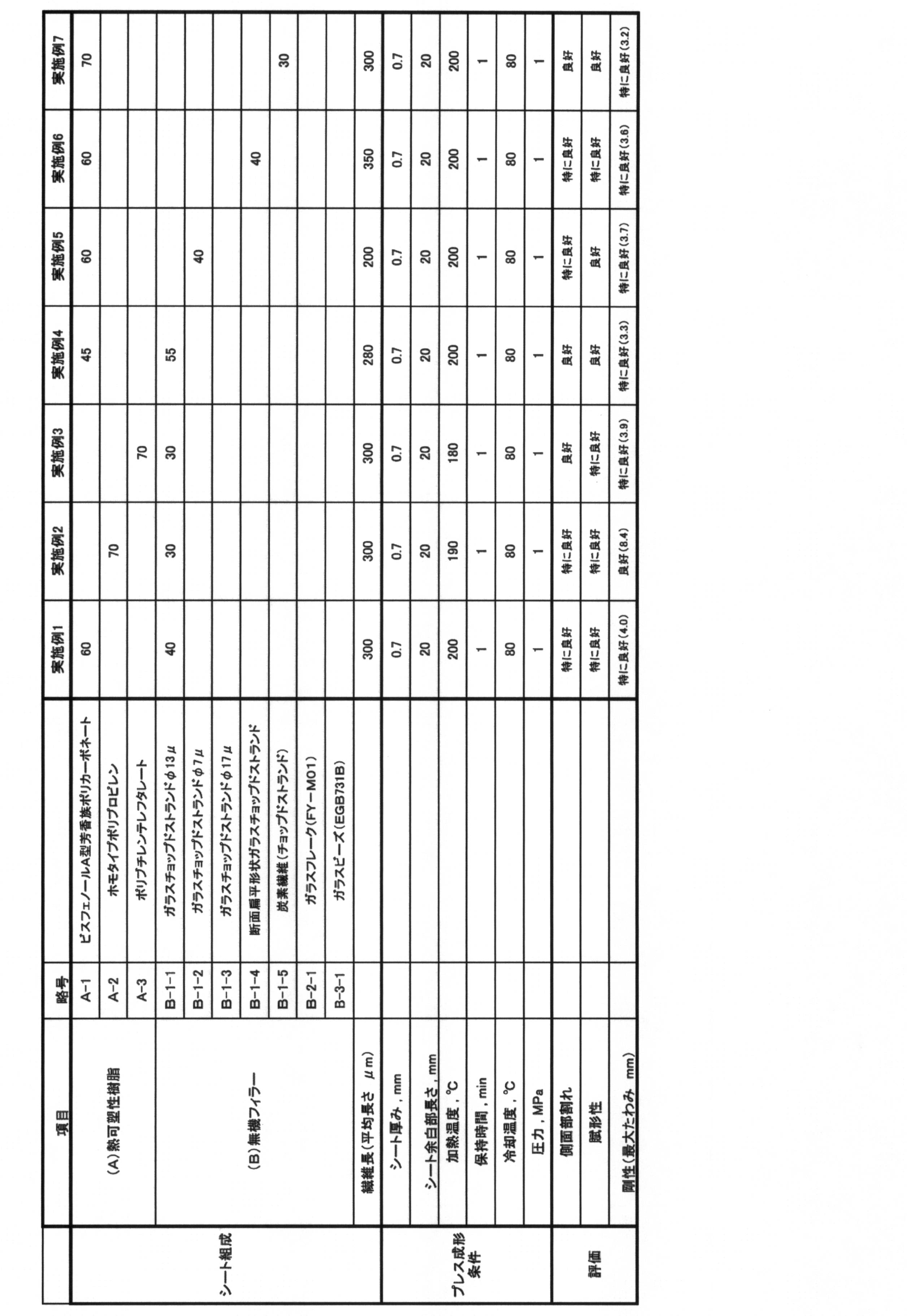
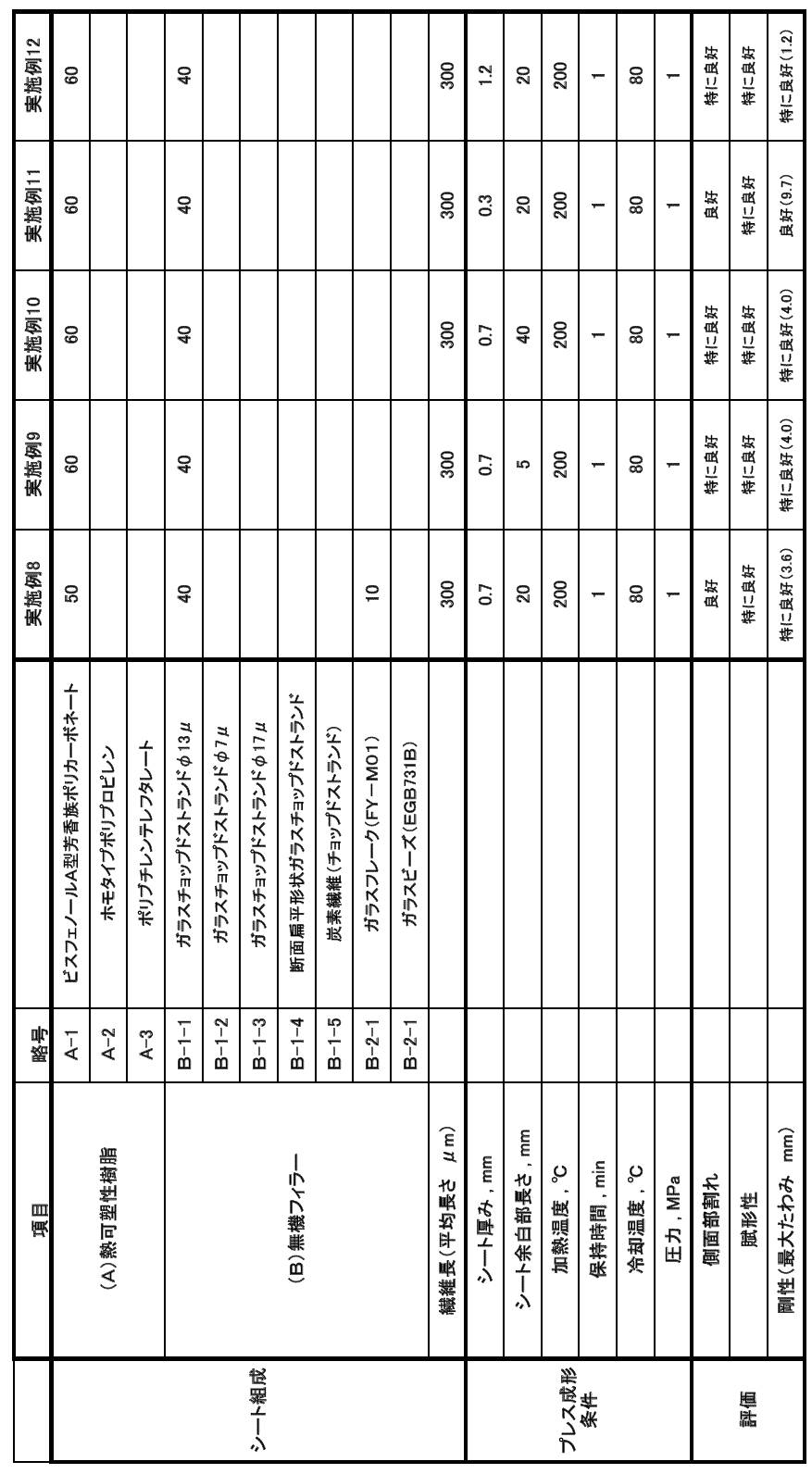

実施例1~12においては、いずれも図6の1aおよび1bとして示す、樹脂シートの余白部分の長さが5mm~50mmであることにより、プレス成形品側面部に樹脂の未充填部分、穴あき・割れ部分がなく、成形品は、良好な外観を有していた。また、成形品は、無機フィラーにより高い剛性を有するため、成形品中央部に4.5Nの静荷重を加えたときの最大たわみ量が小さかった。なお、図6に示された金型とは形状の異なる金型、例えば、図1~4に示された形状を有する金型も使用可能である。
2:樹脂シート
3:上金型
4:下金型
4a:下金型凹部
4d:下金型凹部の(中央部)深さ
4e:下金型凹部の側面深さ
Claims (7)
- 熱可塑性樹脂(A)及び繊維状無機フィラー(B)を含有する樹脂シートまたは樹脂フィルムを上金型と下金型とでプレス成形する工程を含む成形体の製造方法であって、
該樹脂シートが、該樹脂シート100質量部において、熱可塑性樹脂(A)を40~80質量部、繊維状無機フィラー(B)を20~60質量部それぞれ含有し、前記樹脂シートの厚さが0.3~1.2mmであり、成形体中の繊維状無機フィラー(B)の繊維長の平均長さが50~500μmであって、
前記プレス成形に用いる前記下金型の凹部上に配置した該樹脂シートの余白部分の長さが5~50mmである、プレス成形による成形体の製造方法。 - 前記プレス成形に用いる前記下金型の凹部の深さが1~30mmである、請求項1に記載のプレス成形による成形体の製造方法。
- 前記下金型の凹部の深さに対する前記余白部分の長さの比である、(余白部分の長さ(mm))/(下金型の凹部の深さ(mm))の値が1.0以上10.0以下である、請求項1又は2に記載のプレス成形による成形体の製造方法。
- 前記樹脂シートが、さらに板状フィラーを0.1~10質量部含有する、請求項1~3のいずれか一項に記載のプレス成形による成形体の製造方法。
- 前記熱可塑性樹脂(A)が芳香族ポリカーボネートを含む、請求項1~4のいずれか一項に記載のプレス成形による成形体の製造方法。
- 前記余白部分の長さが、7mm~20mmである請求項1~5のいずれか一項に記載のプレス成形による成形体の製造方法。
- 請求項1~6のいずれか一項に記載の製造方法によって得られる成形体。
Priority Applications (4)
| Application Number | Priority Date | Filing Date | Title |
|---|---|---|---|
| US15/564,557 US20180071970A1 (en) | 2015-04-16 | 2016-04-12 | Method for producing molded article by press molding thermoplastic resin sheet or film |
| JP2017512535A JP6875271B2 (ja) | 2015-04-16 | 2016-04-12 | 熱可塑性樹脂シートまたはフィルムのプレス成形による成形体の製造方法 |
| KR1020177032181A KR102452776B1 (ko) | 2015-04-16 | 2016-04-12 | 열가소성 수지 시트 또는 필름의 프레스 성형에 의한 성형체의 제조 방법 |
| CN201680021476.0A CN107428043B (zh) | 2015-04-16 | 2016-04-12 | 通过热塑性树脂片材或膜的压制成型制造成型体的制造方法 |
Applications Claiming Priority (2)
| Application Number | Priority Date | Filing Date | Title |
|---|---|---|---|
| JP2015-084247 | 2015-04-16 | ||
| JP2015084247 | 2015-04-16 |
Publications (1)
| Publication Number | Publication Date |
|---|---|
| WO2016167232A1 true WO2016167232A1 (ja) | 2016-10-20 |
Family
ID=57125876
Family Applications (1)
| Application Number | Title | Priority Date | Filing Date |
|---|---|---|---|
| PCT/JP2016/061748 Ceased WO2016167232A1 (ja) | 2015-04-16 | 2016-04-12 | 熱可塑性樹脂シートまたはフィルムのプレス成形による成形体の製造方法 |
Country Status (6)
| Country | Link |
|---|---|
| US (1) | US20180071970A1 (ja) |
| JP (1) | JP6875271B2 (ja) |
| KR (1) | KR102452776B1 (ja) |
| CN (1) | CN107428043B (ja) |
| TW (1) | TWI689399B (ja) |
| WO (1) | WO2016167232A1 (ja) |
Cited By (1)
| Publication number | Priority date | Publication date | Assignee | Title |
|---|---|---|---|---|
| EP3904066A4 (en) * | 2018-12-25 | 2022-01-26 | Teijin Limited | FIBER-REINFORCED THERMOPLASTIC RESIN MOLDING AND METHOD FOR PRODUCTION THEREOF |
Families Citing this family (3)
| Publication number | Priority date | Publication date | Assignee | Title |
|---|---|---|---|---|
| CN110315660B (zh) * | 2018-03-28 | 2022-06-10 | 福美化学工业株式会社 | 准各向同性补强片材、frp成型体和frp成型体的制造方法 |
| WO2019189384A1 (ja) * | 2018-03-30 | 2019-10-03 | 東レ株式会社 | 成形品の製造方法 |
| CN113997476B (zh) * | 2021-10-18 | 2024-06-07 | 湖北三江航天江河化工科技有限公司 | 一种用于火箭发动机药柱成型的芯模材料及其制备方法 |
Citations (4)
| Publication number | Priority date | Publication date | Assignee | Title |
|---|---|---|---|---|
| JPS61137714A (ja) * | 1984-12-10 | 1986-06-25 | Sumitomo Chem Co Ltd | 積層体の製造方法及びそのための金型装置 |
| JP2013056451A (ja) * | 2011-09-07 | 2013-03-28 | Honda Motor Co Ltd | 樹脂シートの成形方法、樹脂シートの成形装置及び樹脂部品の製造方法 |
| JP2013173334A (ja) * | 2012-02-27 | 2013-09-05 | Ibaraki Kogyo Kk | 立体添加物付き繊維強化プラスチック成形体の成形方法 |
| JP2014040555A (ja) * | 2012-08-24 | 2014-03-06 | Mitsubishi Engineering Plastics Corp | ポリカーボネート樹脂組成物及び成形体 |
Family Cites Families (11)
| Publication number | Priority date | Publication date | Assignee | Title |
|---|---|---|---|---|
| US4205036A (en) * | 1978-01-23 | 1980-05-27 | Everbrite Electric Signs, Inc. | Method of making simulated three-dimensional stained glass objects |
| US5238640A (en) * | 1984-12-10 | 1993-08-24 | Sumitomo Chemical Co., Limited | Method of manufacturing a laminated body |
| JP2863019B2 (ja) * | 1991-03-05 | 1999-03-03 | ポリプラスチックス株式会社 | ランプリフレクター |
| JP3572823B2 (ja) | 1996-09-26 | 2004-10-06 | 東海化成工業株式会社 | 繊維強化熱可塑性樹脂成形体の製造方法 |
| GB0020964D0 (en) * | 2000-08-25 | 2000-10-11 | Reckitt & Colmann Prod Ltd | Improvements in or relating to containers |
| JP4439361B2 (ja) * | 2004-09-14 | 2010-03-24 | 三菱エンジニアリングプラスチックス株式会社 | 長繊維強化熱可塑性樹脂製外装成形体 |
| JP2006224332A (ja) | 2005-02-15 | 2006-08-31 | Ge Plastics Japan Ltd | 熱可塑性樹脂プレス成形型物の製造方法 |
| MX2010013865A (es) | 2008-06-17 | 2011-02-15 | Cryovac Inc | Charola termoplastica. |
| TW201113316A (en) * | 2009-06-15 | 2011-04-16 | Sumitomo Chemical Co | Resin forming body and production method thereof |
| JP2014007283A (ja) * | 2012-06-25 | 2014-01-16 | Asahi Kasei Chemicals Corp | 筐体及び金型 |
| JP5675919B2 (ja) * | 2012-09-14 | 2015-02-25 | 三菱エンジニアリングプラスチックス株式会社 | レーザーダイレクトストラクチャリング用樹脂組成物、樹脂成形品、およびメッキ層付樹脂成形品の製造方法 |
-
2016
- 2016-04-12 US US15/564,557 patent/US20180071970A1/en not_active Abandoned
- 2016-04-12 KR KR1020177032181A patent/KR102452776B1/ko active Active
- 2016-04-12 JP JP2017512535A patent/JP6875271B2/ja active Active
- 2016-04-12 CN CN201680021476.0A patent/CN107428043B/zh active Active
- 2016-04-12 WO PCT/JP2016/061748 patent/WO2016167232A1/ja not_active Ceased
- 2016-04-14 TW TW105111669A patent/TWI689399B/zh active
Patent Citations (4)
| Publication number | Priority date | Publication date | Assignee | Title |
|---|---|---|---|---|
| JPS61137714A (ja) * | 1984-12-10 | 1986-06-25 | Sumitomo Chem Co Ltd | 積層体の製造方法及びそのための金型装置 |
| JP2013056451A (ja) * | 2011-09-07 | 2013-03-28 | Honda Motor Co Ltd | 樹脂シートの成形方法、樹脂シートの成形装置及び樹脂部品の製造方法 |
| JP2013173334A (ja) * | 2012-02-27 | 2013-09-05 | Ibaraki Kogyo Kk | 立体添加物付き繊維強化プラスチック成形体の成形方法 |
| JP2014040555A (ja) * | 2012-08-24 | 2014-03-06 | Mitsubishi Engineering Plastics Corp | ポリカーボネート樹脂組成物及び成形体 |
Cited By (1)
| Publication number | Priority date | Publication date | Assignee | Title |
|---|---|---|---|---|
| EP3904066A4 (en) * | 2018-12-25 | 2022-01-26 | Teijin Limited | FIBER-REINFORCED THERMOPLASTIC RESIN MOLDING AND METHOD FOR PRODUCTION THEREOF |
Also Published As
| Publication number | Publication date |
|---|---|
| CN107428043A (zh) | 2017-12-01 |
| TW201703969A (zh) | 2017-02-01 |
| KR20170137808A (ko) | 2017-12-13 |
| JP6875271B2 (ja) | 2021-05-19 |
| US20180071970A1 (en) | 2018-03-15 |
| CN107428043B (zh) | 2020-02-21 |
| KR102452776B1 (ko) | 2022-10-07 |
| TWI689399B (zh) | 2020-04-01 |
| JPWO2016167232A1 (ja) | 2018-02-22 |
Similar Documents
| Publication | Publication Date | Title |
|---|---|---|
| CN106232694B (zh) | 强化芳香族聚碳酸酯树脂片或膜 | |
| CN111771013B (zh) | 热塑性树脂组合物及其制造方法 | |
| CN108026643B (zh) | 激光直接成型用聚酯系树脂组合物 | |
| CN101910310B (zh) | 聚碳酸酯树脂组合物、聚碳酸酯树脂成形品及其制造方法 | |
| CN113646375B (zh) | 强化热塑性聚酯树脂组合物 | |
| CN101874074B (zh) | 聚碳酸酯树脂组合物、聚碳酸酯树脂成形品及其制造方法 | |
| JP2020114674A (ja) | レーザー溶着用部材及び成形品 | |
| JP6875271B2 (ja) | 熱可塑性樹脂シートまたはフィルムのプレス成形による成形体の製造方法 | |
| CN101918492A (zh) | 聚碳酸酯树脂组合物、聚碳酸酯树脂成形品及其制造方法 | |
| JP2016155939A (ja) | レーザー溶着用樹脂組成物及びその溶着体 | |
| KR20150023780A (ko) | 광반사 부품 및 그 제조방법 | |
| CN105452527A (zh) | 树脂组合物、树脂成型品以及树脂成型品的制造方法 | |
| JP2016097589A (ja) | パネル及び車両 | |
| JP5111560B2 (ja) | 自動車用パネル構造体 | |
| JP6567866B2 (ja) | レーザー溶着用樹脂組成物及びその溶着体 | |
| TW201520267A (zh) | 聚碳酸酯樹脂組成物和包含其的模製物品 | |
| JP7120212B2 (ja) | 無機強化熱可塑性ポリエステル樹脂組成物 | |
| KR20190087672A (ko) | 충전제 보강된 고형 수지 다층 구조물 | |
| JP5323525B2 (ja) | 難燃性芳香族ポリカーボネート樹脂組成物 | |
| TWI888669B (zh) | 無機強化熱塑性聚酯樹脂組成物及其製造方法 | |
| JP2017193707A (ja) | ポリブチレンテレフタレート樹脂組成物、及びそれを用いた成形品 | |
| JPWO2005054345A1 (ja) | フィルム状配線基板の生産工程用テープ | |
| WO2022071102A1 (ja) | 樹脂組成物、成形品、および、ハードコート層付成形品 | |
| JPH07126507A (ja) | 強化芳香族ポリカーボネート樹脂組成物 | |
| JP2005103951A (ja) | フィルム状基板生産工程用スペーステープ |
Legal Events
| Date | Code | Title | Description |
|---|---|---|---|
| 121 | Ep: the epo has been informed by wipo that ep was designated in this application |
Ref document number: 16780023 Country of ref document: EP Kind code of ref document: A1 |
|
| ENP | Entry into the national phase |
Ref document number: 2017512535 Country of ref document: JP Kind code of ref document: A |
|
| WWE | Wipo information: entry into national phase |
Ref document number: 15564557 Country of ref document: US |
|
| NENP | Non-entry into the national phase |
Ref country code: DE |
|
| ENP | Entry into the national phase |
Ref document number: 20177032181 Country of ref document: KR Kind code of ref document: A |
|
| 122 | Ep: pct application non-entry in european phase |
Ref document number: 16780023 Country of ref document: EP Kind code of ref document: A1 |