WO2016158668A1 - 着色樹脂組成物、カラーフィルタ、及び画像表示装置 - Google Patents
着色樹脂組成物、カラーフィルタ、及び画像表示装置 Download PDFInfo
- Publication number
- WO2016158668A1 WO2016158668A1 PCT/JP2016/059381 JP2016059381W WO2016158668A1 WO 2016158668 A1 WO2016158668 A1 WO 2016158668A1 JP 2016059381 W JP2016059381 W JP 2016059381W WO 2016158668 A1 WO2016158668 A1 WO 2016158668A1
- Authority
- WO
- WIPO (PCT)
- Prior art keywords
- group
- mass
- solvent
- pigment
- meth
- Prior art date
- Legal status (The legal status is an assumption and is not a legal conclusion. Google has not performed a legal analysis and makes no representation as to the accuracy of the status listed.)
- Ceased
Links
Images


Classifications
-
- G—PHYSICS
- G03—PHOTOGRAPHY; CINEMATOGRAPHY; ANALOGOUS TECHNIQUES USING WAVES OTHER THAN OPTICAL WAVES; ELECTROGRAPHY; HOLOGRAPHY
- G03F—PHOTOMECHANICAL PRODUCTION OF TEXTURED OR PATTERNED SURFACES, e.g. FOR PRINTING, FOR PROCESSING OF SEMICONDUCTOR DEVICES; MATERIALS THEREFOR; ORIGINALS THEREFOR; APPARATUS SPECIALLY ADAPTED THEREFOR
- G03F7/00—Photomechanical, e.g. photolithographic, production of textured or patterned surfaces, e.g. printing surfaces; Materials therefor, e.g. comprising photoresists; Apparatus specially adapted therefor
- G03F7/004—Photosensitive materials
- G03F7/09—Photosensitive materials characterised by structural details, e.g. supports, auxiliary layers
- G03F7/105—Photosensitive materials characterised by structural details, e.g. supports, auxiliary layers having substances, e.g. indicators, for forming visible images
-
- C—CHEMISTRY; METALLURGY
- C08—ORGANIC MACROMOLECULAR COMPOUNDS; THEIR PREPARATION OR CHEMICAL WORKING-UP; COMPOSITIONS BASED THEREON
- C08K—Use of inorganic or non-macromolecular organic substances as compounding ingredients
- C08K5/00—Use of organic ingredients
- C08K5/16—Nitrogen-containing compounds
- C08K5/32—Compounds containing nitrogen bound to oxygen
- C08K5/33—Oximes
-
- C—CHEMISTRY; METALLURGY
- C08—ORGANIC MACROMOLECULAR COMPOUNDS; THEIR PREPARATION OR CHEMICAL WORKING-UP; COMPOSITIONS BASED THEREON
- C08L—COMPOSITIONS OF MACROMOLECULAR COMPOUNDS
- C08L101/00—Compositions of unspecified macromolecular compounds
-
- C—CHEMISTRY; METALLURGY
- C09—DYES; PAINTS; POLISHES; NATURAL RESINS; ADHESIVES; COMPOSITIONS NOT OTHERWISE PROVIDED FOR; APPLICATIONS OF MATERIALS NOT OTHERWISE PROVIDED FOR
- C09B—ORGANIC DYES OR CLOSELY-RELATED COMPOUNDS FOR PRODUCING DYES, e.g. PIGMENTS; MORDANTS; LAKES
- C09B47/00—Porphines; Azaporphines
- C09B47/04—Phthalocyanines abbreviation: Pc
-
- C—CHEMISTRY; METALLURGY
- C09—DYES; PAINTS; POLISHES; NATURAL RESINS; ADHESIVES; COMPOSITIONS NOT OTHERWISE PROVIDED FOR; APPLICATIONS OF MATERIALS NOT OTHERWISE PROVIDED FOR
- C09B—ORGANIC DYES OR CLOSELY-RELATED COMPOUNDS FOR PRODUCING DYES, e.g. PIGMENTS; MORDANTS; LAKES
- C09B67/00—Influencing the physical, e.g. the dyeing or printing properties of dyestuffs without chemical reactions, e.g. by treating with solvents grinding or grinding assistants, coating of pigments or dyes; Process features in the making of dyestuff preparations; Dyestuff preparations of a special physical nature, e.g. tablets, films
- C09B67/006—Preparation of organic pigments
- C09B67/0069—Non aqueous dispersions of pigments containing only a solvent and a dispersing agent
- C09B67/007—Non aqueous dispersions of phthalocyanines containing only a solvent and a dispersing agent
-
- C—CHEMISTRY; METALLURGY
- C09—DYES; PAINTS; POLISHES; NATURAL RESINS; ADHESIVES; COMPOSITIONS NOT OTHERWISE PROVIDED FOR; APPLICATIONS OF MATERIALS NOT OTHERWISE PROVIDED FOR
- C09B—ORGANIC DYES OR CLOSELY-RELATED COMPOUNDS FOR PRODUCING DYES, e.g. PIGMENTS; MORDANTS; LAKES
- C09B67/00—Influencing the physical, e.g. the dyeing or printing properties of dyestuffs without chemical reactions, e.g. by treating with solvents grinding or grinding assistants, coating of pigments or dyes; Process features in the making of dyestuff preparations; Dyestuff preparations of a special physical nature, e.g. tablets, films
- C09B67/0071—Process features in the making of dyestuff preparations; Dehydrating agents; Dispersing agents; Dustfree compositions
- C09B67/0084—Dispersions of dyes
-
- C—CHEMISTRY; METALLURGY
- C09—DYES; PAINTS; POLISHES; NATURAL RESINS; ADHESIVES; COMPOSITIONS NOT OTHERWISE PROVIDED FOR; APPLICATIONS OF MATERIALS NOT OTHERWISE PROVIDED FOR
- C09D—COATING COMPOSITIONS, e.g. PAINTS, VARNISHES OR LACQUERS; FILLING PASTES; CHEMICAL PAINT OR INK REMOVERS; INKS; CORRECTING FLUIDS; WOODSTAINS; PASTES OR SOLIDS FOR COLOURING OR PRINTING; USE OF MATERIALS THEREFOR
- C09D17/00—Pigment pastes, e.g. for mixing in paints
-
- C—CHEMISTRY; METALLURGY
- C09—DYES; PAINTS; POLISHES; NATURAL RESINS; ADHESIVES; COMPOSITIONS NOT OTHERWISE PROVIDED FOR; APPLICATIONS OF MATERIALS NOT OTHERWISE PROVIDED FOR
- C09D—COATING COMPOSITIONS, e.g. PAINTS, VARNISHES OR LACQUERS; FILLING PASTES; CHEMICAL PAINT OR INK REMOVERS; INKS; CORRECTING FLUIDS; WOODSTAINS; PASTES OR SOLIDS FOR COLOURING OR PRINTING; USE OF MATERIALS THEREFOR
- C09D17/00—Pigment pastes, e.g. for mixing in paints
- C09D17/002—Pigment pastes, e.g. for mixing in paints in organic medium
-
- C—CHEMISTRY; METALLURGY
- C09—DYES; PAINTS; POLISHES; NATURAL RESINS; ADHESIVES; COMPOSITIONS NOT OTHERWISE PROVIDED FOR; APPLICATIONS OF MATERIALS NOT OTHERWISE PROVIDED FOR
- C09D—COATING COMPOSITIONS, e.g. PAINTS, VARNISHES OR LACQUERS; FILLING PASTES; CHEMICAL PAINT OR INK REMOVERS; INKS; CORRECTING FLUIDS; WOODSTAINS; PASTES OR SOLIDS FOR COLOURING OR PRINTING; USE OF MATERIALS THEREFOR
- C09D17/00—Pigment pastes, e.g. for mixing in paints
- C09D17/003—Pigment pastes, e.g. for mixing in paints containing an organic pigment
-
- G—PHYSICS
- G02—OPTICS
- G02B—OPTICAL ELEMENTS, SYSTEMS OR APPARATUS
- G02B5/00—Optical elements other than lenses
- G02B5/20—Filters
-
- G—PHYSICS
- G03—PHOTOGRAPHY; CINEMATOGRAPHY; ANALOGOUS TECHNIQUES USING WAVES OTHER THAN OPTICAL WAVES; ELECTROGRAPHY; HOLOGRAPHY
- G03F—PHOTOMECHANICAL PRODUCTION OF TEXTURED OR PATTERNED SURFACES, e.g. FOR PRINTING, FOR PROCESSING OF SEMICONDUCTOR DEVICES; MATERIALS THEREFOR; ORIGINALS THEREFOR; APPARATUS SPECIALLY ADAPTED THEREFOR
- G03F7/00—Photomechanical, e.g. photolithographic, production of textured or patterned surfaces, e.g. printing surfaces; Materials therefor, e.g. comprising photoresists; Apparatus specially adapted therefor
- G03F7/0005—Production of optical devices or components in so far as characterised by the lithographic processes or materials used therefor
- G03F7/0007—Filters, e.g. additive colour filters; Components for display devices
-
- G—PHYSICS
- G03—PHOTOGRAPHY; CINEMATOGRAPHY; ANALOGOUS TECHNIQUES USING WAVES OTHER THAN OPTICAL WAVES; ELECTROGRAPHY; HOLOGRAPHY
- G03F—PHOTOMECHANICAL PRODUCTION OF TEXTURED OR PATTERNED SURFACES, e.g. FOR PRINTING, FOR PROCESSING OF SEMICONDUCTOR DEVICES; MATERIALS THEREFOR; ORIGINALS THEREFOR; APPARATUS SPECIALLY ADAPTED THEREFOR
- G03F7/00—Photomechanical, e.g. photolithographic, production of textured or patterned surfaces, e.g. printing surfaces; Materials therefor, e.g. comprising photoresists; Apparatus specially adapted therefor
- G03F7/004—Photosensitive materials
-
- G—PHYSICS
- G03—PHOTOGRAPHY; CINEMATOGRAPHY; ANALOGOUS TECHNIQUES USING WAVES OTHER THAN OPTICAL WAVES; ELECTROGRAPHY; HOLOGRAPHY
- G03F—PHOTOMECHANICAL PRODUCTION OF TEXTURED OR PATTERNED SURFACES, e.g. FOR PRINTING, FOR PROCESSING OF SEMICONDUCTOR DEVICES; MATERIALS THEREFOR; ORIGINALS THEREFOR; APPARATUS SPECIALLY ADAPTED THEREFOR
- G03F7/00—Photomechanical, e.g. photolithographic, production of textured or patterned surfaces, e.g. printing surfaces; Materials therefor, e.g. comprising photoresists; Apparatus specially adapted therefor
- G03F7/004—Photosensitive materials
- G03F7/027—Non-macromolecular photopolymerisable compounds having carbon-to-carbon double bonds, e.g. ethylenic compounds
- G03F7/028—Non-macromolecular photopolymerisable compounds having carbon-to-carbon double bonds, e.g. ethylenic compounds with photosensitivity-increasing substances, e.g. photoinitiators
- G03F7/031—Organic compounds not covered by group G03F7/029
-
- H—ELECTRICITY
- H05—ELECTRIC TECHNIQUES NOT OTHERWISE PROVIDED FOR
- H05B—ELECTRIC HEATING; ELECTRIC LIGHT SOURCES NOT OTHERWISE PROVIDED FOR; CIRCUIT ARRANGEMENTS FOR ELECTRIC LIGHT SOURCES, IN GENERAL
- H05B33/00—Electroluminescent light sources
- H05B33/12—Light sources with substantially two-dimensional [2D] radiating surfaces
Definitions
- the present invention relates to a colored resin composition, a color filter, and an image display device. More specifically, a colored resin composition containing a specific zinc halide phthalocyanine pigment and a specific high-boiling solvent, a color filter having pixels formed using the colored resin composition, and an image display device having the color filter About.
- a pigment dispersion method, a dyeing method, an electrodeposition method, and a printing method are known as methods for producing a color filter used in a liquid crystal display device or the like.
- a pigment dispersion method having excellent characteristics on average is most widely adopted.
- pigments are generally used from the viewpoints of heat resistance, light resistance, etc., among which the intrinsic transmission absorption spectrum matches the phosphor spectrum of the backlight in the visible light wavelength region. Those are preferably used. For example, a combination of a halogenated copper phthalocyanine green pigment and various yellow pigments has long been used for forming a green pixel.
- Patent Documents 1 to 3 describe examples in which a halogenated zinc phthalocyanine pigment is combined with a photopolymerization initiator such as biimidazole or ⁇ -aminoalkylphenone.
- a zinc halide phthalocyanine green pigment C.I. I. In a colored composition containing CI Pigment Green 58 and containing propylene glycol monomethyl ether acetate, ethyl 3-ethoxypropionate, 3-methoxybutyl acetate, etc.
- Patent Document 5 by using together a halogenated zinc phthalocyanine green pigment and a photopolymerization initiator composed of a specific oxime ester compound, the colored resin composition is produced or stored. It has been found that the generation of foreign substances can be suppressed and the generation of precipitates when in contact with N-methylpyrrolidone can be suppressed.
- Patent Documents 6 to 11 also describe examples in which a halogenated zinc phthalocyanine green pigment and a photopolymerization initiator composed of an oxime ester compound are combined.
- Japanese Unexamined Patent Publication No. 2004-70342 Japanese Unexamined Patent Publication No. 2004-70343 Japanese Unexamined Patent Publication No. 2009-52010 Japanese Unexamined Patent Publication No. 2011-028219 Japanese Unexamined Patent Publication No. 2009-271502 Japanese Unexamined Patent Publication No. 2010-84119 Japanese Unexamined Patent Publication No. 2010-97172 Japanese Unexamined Patent Publication No. 2011-99974 Japanese Unexamined Patent Publication No. 2011-145668 Japanese Unexamined Patent Publication No. 2012-53278 Japanese Unexamined Patent Publication No. 2012-172003
- C.I. is a zinc halide phthalocyanine pigment described in Patent Documents 1 to 11.
- G58 Pigment Green 58
- the coloring power is low, and in order to achieve a certain chromaticity, the coating film thickness must be increased. It was found. Therefore, as a result of intensive studies to obtain a colored resin composition having high coloring power and capable of reducing the coating film thickness to achieve a certain chromaticity, a specific zinc halide phthalocyanine pigment should be used. Was found to be achievable.
- the present invention has been made in view of the above-mentioned problems, and the object thereof is a colored resin composition having a high coloring power, a high solubility in a solvent of a dry film, and capable of suppressing the generation of adhered foreign substances, and the colored resin.
- the present inventors have found that the above problems can be solved by using a specific zinc halide phthalocyanine green pigment and a specific high boiling point solvent, and have completed the present invention. It was. That is, the gist of the present invention is as follows.
- a colored resin composition comprising (A) a pigment, (B) a dispersant, (C) a solvent, (D) a binder resin, and (E) a photopolymerization initiator,
- the (A) pigment contains a halogenated zinc phthalocyanine pigment, the average number of hydrogen atoms contained in one molecule of the halogenated zinc phthalocyanine pigment is 3 or more, and
- the (A) pigment contains a halogenated zinc phthalocyanine pigment, the average number of hydrogen atoms contained in one molecule of the halogenated zinc phthalocyanine pigment is 3 or more, and
- the solvent (C) further includes a low-boiling solvent having a boiling point of less than 150 ° C. at 1013.25 hPa.
- a colored resin composition having a high coloring power, a high solubility in a solvent of a dry film, and capable of suppressing the generation of adhered foreign matter, and a color filter having pixels formed using the colored resin composition
- an image display device having the color filter and a pigment dispersion used in the colored resin composition.
- FIG. 1 is a schematic cross-sectional view showing an example of an organic EL element having the color filter of the present invention.
- FIG. 2 is a mass spectrum of the green pigment A.
- FIG. 3 is a mass spectrum of the green pigment B.
- FIG. 4 is a measurement profile for film surface evaluation in Example 8.
- FIG. 5 is a measurement profile for film surface evaluation in Comparative Example 2.
- FIG. 6 is a measurement profile for film surface evaluation of Comparative Example 4.
- FIG. 7 is a measurement profile for film surface evaluation of Comparative Example 3.
- (meth) acryl means “acryl and / or methacryl”, “acrylate and / or methacrylate” and the like, for example, “(meth) acrylic acid” is “ It means “acrylic acid and / or methacrylic acid”.
- total solid content means all components other than the solvent components described later, which are contained in the pigment dispersion or the colored resin composition.
- weight average molecular weight refers to polystyrene-reduced weight average molecular weight (Mw) by GPC (gel permeation chromatography).
- amine value means an amine value in terms of effective solid content unless otherwise specified, and is a value represented by the mass of KOH equivalent to the base amount per 1 g of the solid content of the dispersant. . In the present specification, all percentages and parts expressed by mass are the same as percentages and parts expressed by weight.
- the constituent components of the colored resin composition and pigment dispersion of the present invention are described below.
- the colored resin composition according to the present invention includes (A) a pigment, (B) a dispersant, (C) a solvent, (D) a binder resin, and (E) a photopolymerization initiator as essential components. Other additives other than the above components may be blended.
- the pigment dispersion according to the present invention contains (A) a pigment, (B) a dispersant, and (C) a solvent as essential components, and if necessary, additives other than the above components are blended. May be.
- the pigment contains a halogenated zinc phthalocyanine pigment, and the average number of hydrogen atoms contained in one molecule of the halogenated zinc phthalocyanine pigment is 3 or more.
- the solvent contains a high-boiling solvent having a boiling point of 150 ° C. or more at 101.25 hPa.
- the pigment contains a halogenated zinc phthalocyanine pigment, and the average number of hydrogen atoms contained in one molecule of the halogenated zinc phthalocyanine pigment is 3 or more,
- the (C) solvent contains the high boiling point solvent whose boiling point in 101.25 hPa is 150 degreeC or more.
- the (A) pigment contains a halogenated zinc phthalocyanine pigment, and the average number of hydrogen atoms contained in one molecule of the zinc halide phthalocyanine pigment is 3
- the (E) photopolymerization initiator includes an oxime ester compound.
- the (A) pigment used in the colored resin composition and pigment dispersion of the present invention is a zinc halide phthalocyanine pigment (hereinafter sometimes referred to as “green pigment a”). including.
- green pigment a The average number of hydrogen atoms contained in one molecule of the halogenated zinc phthalocyanine pigment is 3 or more.
- high coloring and high luminance can be achieved by including the green pigment a as the (A) pigment.
- the detailed mechanism is unknown, but the half-width of the peak is narrow due to the change in the transmission spectrum due to the inclusion of many hydrogen atoms, and the red and blue transmitted light is effectively blocked. Is presumed to be realized.
- Ordinary zinc phthalocyanine has 16 hydrogen atoms in one molecule, and a halogenated zinc phthalocyanine pigment used in the present invention is one obtained by substituting a part of these hydrogen atoms with a halogen atom.
- a chlorinated brominated zinc phthalocyanine pigment is preferable.
- the method for specifying the average number of hydrogen atoms in one molecule of the pigment is not particularly limited, but a method of calculating using the average number of halogen atoms measured by the fluorescent X-ray fundamental parameter method (FP method), a laser desorption ionization method (Laser Desorption / Ionization, LDI) —Method of measuring by mass spectrometry (Mass Spectrometry, MS) and the like can be mentioned, but the FP method is preferable from the viewpoint of simplicity and accuracy.
- FP method fluorescent X-ray fundamental parameter method
- LDI laser desorption ionization
- MS Mass Spectrometry
- the average number of halogen atoms is measured by the FP method. Since there are 16 sites occupied by halogen atoms and hydrogen atoms in the halogenated zinc phthalocyanine, the average number of hydrogen atoms can be obtained by calculating the remaining sites not occupied by halogen atoms. It is preferable to perform measurement by adopting the apparatus and conditions used in the examples. Specifically, the average number of halogen atoms is obtained by calculating the average number of halogen atoms per zinc atom from the mass ratio of zinc atoms and halogen atoms measured by the FP method, and subtracting the average number of halogen atoms from 16. .
- the strength with respect to the molecular weight (m / z value) is measured by the LDI-MS method.
- the green pigment a is a mixture of molecules having different numbers of hydrogen atoms, chlorine atoms and bromine atoms, and from the strength of each molecule obtained by measuring the mixture by the above method, Calculate the average number of hydrogen atoms, chlorine atoms and bromine atoms contained in one molecule by calculating the number of hydrogen atoms, chlorine atoms and bromine atoms contained in each molecule, and averaging them. Can do. It is preferable to perform measurement by adopting the apparatus and conditions used in the examples.
- the values of x and y in the chlorinated brominated zinc phthalocyanine molecule (H 16-xy ZnC 32 N 8 Br x Cl y ) corresponding to each peak are obtained from the molecular weight of the main peak of the mass spectrum. Then, by calculating the average value of a plurality of peaks (molecules) whose peak intensity is a certain value or more, the average number of atoms of each atom can be obtained.
- the green pigment a has an average number of hydrogen atoms contained in one molecule of usually 2 or more, preferably 3 or more, more preferably 4 or more, still more preferably 5 or more, and preferably 16 or less, more preferably 14 Hereinafter, it is more preferably 12 or less, even more preferably 10 or less, and particularly preferably 8 or less. There exists a tendency which becomes highly colored by setting it as the said lower limit or more. Moreover, there exists a tendency which can improve the stability of a dispersion liquid by setting it as the said upper limit or less.
- the green pigment a has an average number of chlorine atoms contained in one molecule of preferably 0.5 or more, more preferably 1 or more, further preferably 1.5 or more, and preferably 14 or less, more preferably 13 or less, more preferably 12 or less. There exists a tendency which becomes highly colored by setting it as the said lower limit or more. Moreover, there exists a tendency for it to become high-intensity by setting it as the said upper limit or less.
- the green pigment a has an average number of bromine atoms contained in one molecule of preferably 1 or more, more preferably 2 or more, further preferably 3 or more, and preferably 14 or less, more preferably 13 or less, Preferably it is 12 or less. There exists a tendency for it to become high-intensity by setting it as the said lower limit or more. Moreover, there exists a tendency which becomes highly colored by setting it as the said upper limit or less.
- the ratio of the average number of chlorine atoms contained in one molecule to the average number of bromine atoms contained in one molecule is preferably 0.1 or more, and is 0.15 or more. Is more preferably 0.2 or more, preferably 7 or less, more preferably 3 or less, further preferably 1 or less, and 0.5 or less. Is particularly preferred. There exists a tendency which becomes highly colored by setting it as the said lower limit or more, and there exists a tendency for it to become high-intensity by setting it as the said upper limit or less.
- the green pigment a has an average number of hydrogen atoms contained in one molecule calculated by the FP method of usually 2 or more, preferably 3 or more, more preferably 3.5 or more, and still more preferably 4.0. More preferably, it is 4.2 or more, particularly preferably 4.5 or more, preferably 12 or less, more preferably 10 or less, still more preferably 8 or less, still more preferably 6 or less, particularly preferably 5. 5 or less.
- the green pigment a has an average number of chlorine atoms contained in one molecule measured by the FP method of preferably 0.5 or more, more preferably 1 or more, still more preferably 1.5 or more, and preferably It is 14 or less, more preferably 12 or less, further preferably 10 or less, even more preferably 8 or less, particularly preferably 6 or less, and most preferably 4 or less.
- a tendency which becomes highly colored by setting it as the said lower limit or more Moreover, there exists a tendency for it to become high-intensity by setting it as the said upper limit or less.
- the green pigment a has an average number of bromine atoms contained in one molecule measured by the FP method of preferably 1 or more, more preferably 3 or more, still more preferably 5 or more, still more preferably 6 or more, particularly It is preferably 7 or more, most preferably 8 or more, and is preferably 14 or less, more preferably 13 or less, still more preferably 12 or less, still more preferably 11 or less, and particularly preferably 10 or less.
- the ratio of the average number of chlorine atoms contained in one molecule to the average number of bromine atoms contained in one molecule, measured by the FP method is preferably 0.1 or more. Is preferably 15 or more, more preferably 0.2 or more, and is preferably 7 or less, more preferably 3 or less, still more preferably 1 or less, 0 It is particularly preferred that it is not more than. There exists a tendency which becomes highly colored by setting it as the said lower limit or more, and there exists a tendency which becomes high brightness by setting it as the said upper limit or less.
- the green pigment a preferably contains 3.5% by mass or more of chlorine atoms in the green pigment a, more preferably 4.0% by mass or more, and still more preferably 4.3% by mass or more.
- 4.5 mass% or more is especially preferable, Preferably it is 30 mass% or less, More preferably, it is 20 mass% or less, More preferably, it is 10 mass% or less, Most preferably, it is 6 mass% or less.
- the content of chlorine atoms and bromine atoms contained in the green pigment a is determined by dissolving the pigment in ethyl benzoate, burning it in a combustion device, absorbing the combustion gas in the hydrogen peroxide absorbent, It can be measured by a combustion gas-ion chromatography method for measuring the ions of the gas.
- the green pigment a has a bromine atom content in the green pigment a measured by the above analysis method of preferably 30% by mass or more, more preferably 40% by mass or more, and 45% by mass. % Or more is more preferable, and 50% by mass or more is particularly preferable. Further, the content of bromine atoms is preferably 80% by mass or less, more preferably 70% by mass or less, further preferably 60% by mass or less, and particularly preferably 55% by mass or less. preferable. By setting it to the lower limit value or more, there is a tendency that the luminance becomes high. Moreover, there exists a tendency which becomes highly colored by setting it as the said upper limit or less.
- Such a chlorinated brominated zinc phthalocyanine pigment can be produced by a known production method disclosed in Japanese Patent Application Laid-Open No. 50-130816.
- a catalyst such as ammonium molybdate may be used as necessary.
- the ratio of various brominated zinc phthalocyanines with different bromine contents can be adjusted by adjusting the ratio of chloride and bromide in the molten salt, or by changing the amount of chlorine gas introduced and the reaction time. Can be controlled arbitrarily.
- the obtained mixture is put into an acidic aqueous solution such as hydrochloric acid after the reaction is completed, the produced brominated zinc phthalocyanine is precipitated. Thereafter, post-treatment such as filtration, washing and drying is performed to obtain brominated zinc phthalocyanine.
- the chlorinated brominated zinc phthalocyanine pigment thus obtained is dry-ground in a pulverizer such as an attritor, ball mill, vibration mill, vibration ball mill, etc., if necessary, and then pigmented by a solvent salt milling method or a solvent boiling method.
- a chlorinated brominated zinc phthalocyanine pigment that develops a green color with high transmittance and contrast can be obtained.
- the pigmentation method is not particularly limited, but it is preferable to employ a solvent salt milling treatment from the viewpoint that crystal growth can be easily suppressed and pigment particles having a large specific surface area can be obtained.
- Solvent salt milling means kneading and grinding a crude pigment immediately after synthesis, an inorganic salt, and an organic solvent. Specifically, a crude pigment, an inorganic salt, and an organic solvent that does not dissolve it are charged into a kneader, and kneading and grinding are performed therein.
- a kneading machine at this time for example, a kneader, a mix muller, a planetary mixer, or the formation of a gap portion of a rotating disk concentric with an annular fixed disk as described in Japanese Unexamined Patent Publication No. 2006-77062 A continuous kneader having a pulverized space is preferably used.
- a water-soluble inorganic salt can be preferably used.
- an inorganic salt such as sodium chloride, potassium chloride, sodium sulfate is preferably used.
- the average particle diameter of these inorganic salts is more preferably 0.5 to 50 ⁇ m.
- Such an inorganic salt can be easily obtained by pulverizing a normal inorganic salt.
- G59 manufactured by DIC Corporation can also be used as the green pigment a.
- the pigment may contain other green pigments in addition to the green pigment a.
- Other green pigments include, for example, C.I. I. Pigment green 7, C.I. I. Pigment green 36, C.I. I. And CI Pigment Green 58.
- the content ratio of the green pigment a contained in the green pigment is preferably 5% by mass or more, more preferably 10% by mass or more, further preferably 30% by mass or more, and 50% by mass or more. More preferably, it is more preferably 80% by mass or more, and usually 100% by mass or less. When the amount is not less than the lower limit, the effect of the pigment tends to be obtained more.
- the content ratio of the green pigment contained in the (A) pigment is preferably 30% by mass or more, more preferably 35% by mass or more, further preferably 40% by mass or more, and 45% by mass.
- % Is particularly preferably 100% by mass or less, preferably 90% by mass or less, more preferably 80% by mass or less, and further preferably 70% by mass or less. 60 mass% or less is particularly preferable.
- the content ratio of the pigment (A) in the colored resin composition of the present invention is usually 20% by mass or more, preferably 25% by mass or more, more preferably 30% by mass or more, and further preferably 35% by mass with respect to the total solid content. In addition, it is usually 90% by mass or less, preferably 70% by mass or less, more preferably 60% by mass or less, still more preferably 50% by mass or less, and particularly preferably 45% by mass or less. Within the above range, the dispersion stability is good and there is a tendency that more effects of the green pigment can be obtained.
- the content ratio of the pigment (A) in the pigment dispersion of the present invention is preferably 20% by mass or more, more preferably 30% by mass or more, and more preferably 40% by mass or more with respect to the total solid content. More preferably, it is particularly preferably 50% by mass or more, more preferably 80% by mass or less, and even more preferably 70% by mass or less. Within the above range, the dispersion stability is good and there is a tendency that more effects of the green pigment can be obtained.
- the content ratio of the green pigment in the pigment dispersion of the present invention is preferably 20% by mass or more, more preferably 30% by mass or more, and 40% by mass or more with respect to the total solid content. Is more preferably 50% by mass or more, more preferably 80% by mass or less, and even more preferably 70% by mass or less. Within the above range, the dispersion stability is good and there is a tendency that more effects of the green pigment can be obtained.
- the average primary particle size of the green pigment containing the green pigment a is usually 0.1 ⁇ m or less, preferably 0.04 ⁇ m or less, more preferably 0.03 ⁇ m or less, and usually 0.005 ⁇ m or more.
- the average primary particle size of the pigment can be obtained by the following method. That is, the pigment is ultrasonically dispersed in chloroform, dropped onto a collodion film-attached mesh, dried, and a primary particle image of the pigment is obtained by observation with a transmission electron microscope (TEM).
- TEM transmission electron microscope
- the particle diameter of each pigment particle is defined as an area equivalent circle diameter converted to the diameter of a circle having the same area, and after calculating the particle diameter for each of the plurality of pigment particles, the following formula Calculate the average particle size by calculating the number average value as follows.
- the (A) pigment can contain a yellow pigment.
- yellow pigments include C.I. I. Pigment Yellow (P.Y.) 1, 1: 1, 2, 3, 4, 5, 6, 9, 10, 12, 13, 14, 16, 17, 20, 24, 31, 32, 34, 35, 35: 1, 36, 36: 1, 37, 37: 1, 40, 41, 42, 43, 48, 53, 55, 61, 62, 62: 1, 63, 65, 73, 74, 75, 81, 83, 86, 87, 93, 94, 95, 97, 100, 101, 104, 105, 108, 109, 110, 111, 116, 117, 119, 120, 125, 126, 127, 127: 1, 128, 129, 133, 134, 136, 137, 138, 139, 142, 147, 148, 150, 151, 153, 154, 155, 157, 158, 159, 160, 161, 162, 163, 164, 165, 166,
- examples of the other compounds include compounds represented by the following formula (II).
- the average primary particle diameter of these yellow pigments is usually 0.2 ⁇ m or less, preferably 0.1 ⁇ m or less, more preferably 0.04 ⁇ m or less.
- a technique such as the solvent salt milling described above is preferably used.
- the content ratio of the yellow pigment contained in the pigment is preferably 95% by mass or less, more preferably 90% by mass or less, still more preferably 80% by mass or less, and 70% by mass. The following is particularly preferable, 60% by mass or less is most preferable, usually 0% by mass or more, 10% by mass or more is preferable, 30% by mass or more is more preferable, 40% by mass or more is further preferable, and 50% by mass or more is particularly preferable.
- the amount is not more than the above upper limit value, the effect of the green pigment a tends to be obtained more.
- the colored resin composition and the pigment dispersion of the present invention may contain a dye in addition to (A) the pigment.
- a dye in addition to (A) the pigment.
- the colored resin composition and the pigment dispersion of the present invention contain (B) a dispersant for the purpose of stably dispersing (A) the pigment.
- a dispersant for the purpose of stably dispersing
- the use of a polymer dispersant is preferred because of excellent dispersion stability over time.
- the polymer dispersant include a urethane dispersant, a polyethyleneimine dispersant, a polyoxyethylene alkyl ether dispersant, a polyoxyethylene glycol diester dispersant, a sorbitan aliphatic ester dispersant, and an aliphatic modified polyester. There may be mentioned system dispersants.
- dispersants are trade names of EFKA (registered trademark, manufactured by BASF), DisperBYK (registered trademark, manufactured by Big Chemie), Disparon (registered trademark, manufactured by Enomoto Kasei), SOLPERSE (registered trademark, Louvre). Zol), KP (Shin-Etsu Chemical Co., Ltd.), Polyflow (Kyoeisha Chemical Co., Ltd.) and the like.
- a block copolymer having a functional group containing a nitrogen atom is preferable from the viewpoint of dispersibility and storage stability, and an acrylic block copolymer is more preferable.
- the block copolymer having a functional group containing a nitrogen atom includes an A block having a quaternary ammonium base and / or amino group in a side chain and a B block having no quaternary ammonium base and / or amino group.
- the AB block copolymer and / or the BAB block copolymer are preferable.
- Examples of the functional group containing a nitrogen atom include a primary to tertiary amino group and a quaternary ammonium base, and from the viewpoint of dispersibility and storage stability, a primary amino group is preferable. It is more preferable to have a group.
- the structure of the repeating unit having a tertiary amino group in the block copolymer is not particularly limited, but is preferably a repeating unit represented by the following general formula (1) from the viewpoint of dispersibility and storage stability. .
- R 1 and R 2 each independently have a hydrogen atom, an alkyl group which may have a substituent, an aryl group which may have a substituent, or a substituent.
- An aralkyl group which may be present, and R 1 and R 2 may be bonded to each other to form a cyclic structure.
- R 3 is a hydrogen atom or a methyl group.
- X is a divalent linking group.
- the number of carbon atoms of the alkyl group that may have a substituent in the above formula (1) is not particularly limited, but is usually 1 or more, preferably 10 or less, and more preferably 6 or less. Preferably, it is 4 or less.
- Specific examples of the alkyl group include a methyl group, an ethyl group, a propyl group, a butyl group, a pentyl group, a hexyl group, a heptyl group, and an octyl group. Among these, a methyl group, an ethyl group, a propyl group, and a butyl group are exemplified.
- It is preferably a group, a pentyl group, or a hexyl group, and more preferably a methyl group, an ethyl group, a propyl group, or a butyl group. Further, it may be linear or branched. Further, it may contain a cyclic structure such as a cyclohexyl group or a cyclohexylmethyl group.
- the number of carbon atoms of the aryl group that may have a substituent in the above formula (1) is not particularly limited, but is usually 6 or more, preferably 16 or less, and more preferably 12 or less. Preferably, it is 8 or less.
- Specific examples of the aryl group include a phenyl group, a methylphenyl group, an ethylphenyl group, a dimethylphenyl group, a diethylphenyl group, a naphthyl group, and an anthracenyl group.
- a phenyl group, a methylphenyl group, and an ethylphenyl group A dimethylphenyl group, or a diethylphenyl group, and more preferably a phenyl group, a methylphenyl group, or an ethylphenyl group.
- the carbon number of the aralkyl group which may have a substituent is not particularly limited, but is usually 7 or more, preferably 16 or less, and more preferably 12 or less. Preferably, it is 9 or less.
- Specific examples of the aralkyl group include a phenylmethylene group, a phenylethylene group, a phenylpropylene group, a phenylbutylene group, and a phenylisopropylene group.
- a phenylmethylene group, a phenylethylene group, a phenylpropylene group, or A phenylbutylene group is preferable, and a phenylmethylene group or a phenylethylene group is more preferable.
- R 1 and R 2 are preferably each independently an alkyl group which may have a substituent, a methyl group or More preferably, it is an ethyl group.
- alkyl group, aralkyl group, or aryl group in the above formula (1) may have include a halogen atom, an alkoxy group, a benzoyl group, a hydroxyl group, and the like. Substitution is preferred.
- examples of the cyclic structure formed by combining R 1 and R 2 with each other include, for example, a 5- to 7-membered nitrogen-containing heterocyclic monocycle or a condensed ring formed by condensing two of these. Is mentioned.
- the nitrogen-containing heterocycle preferably has no aromaticity, more preferably a saturated ring. Specific examples include the following (IV).
- These cyclic structures may further have a substituent.
- examples of the divalent linking group X include an alkylene group having 1 to 10 carbon atoms, an arylene group having 6 to 12 carbon atoms, a —CONH—R 13 — group, a —COOR 14 — group [ Provided that R 13 and R 14 are a single bond, an alkylene group having 1 to 10 carbon atoms, or an ether group (alkyloxyalkyl group) having 2 to 10 carbon atoms], preferably —COO—R 14 -Group.
- the content ratio of the repeating unit represented by the formula (1) in all the repeating units of the block copolymer is preferably 1 mol% or more, more preferably 5 mol% or more, More preferably, it is 10 mol% or more, more preferably 15 mol% or more, particularly preferably 20 mol% or more, most preferably 25 mol% or more, and 90 mol%. Is preferably 70 mol% or less, more preferably 50 mol% or less, and particularly preferably 40 mol% or less. If it is within the above range, both dispersion stability and high luminance tend to be compatible.
- the block copolymer preferably has a repeating unit represented by the following formula (2) from the viewpoint of improving the compatibility of the dispersant with a binder component such as a solvent and improving the dispersion stability.
- R 10 is ethylene or propylene group
- R 11 is an alkyl group which may have a substituent
- R 12 is hydrogen atom or a methyl group.
- n is an integer of 1 to 20.
- the carbon number of the alkyl group which may have a substituent in R 11 of the above formula (2) is not particularly limited, but is usually 1 or more, preferably 2 or more, and 10 or less. Is preferably 6 or less, more preferably 4 or less.
- Specific examples of the alkyl group include a methyl group, an ethyl group, a propyl group, a butyl group, a pentyl group, a hexyl group, a heptyl group, and an octyl group. Among these, a methyl group, an ethyl group, a propyl group, and a butyl group are exemplified.
- It is preferably a group, a pentyl group, or a hexyl group, and more preferably a methyl group, an ethyl group, a propyl group, or a butyl group. Further, it may be linear or branched. Further, it may contain a cyclic structure such as a cyclohexyl group or a cyclohexylmethyl group.
- n in the above formula (2) is preferably 1 or more, more preferably 2 or more, and preferably 10 or less from the viewpoint of compatibility and dispersibility with respect to a binder component such as a solvent. More preferably, it is 5 or less.
- the content ratio of the repeating unit represented by the formula (2) in all the repeating units of the block copolymer is preferably 1 mol% or more, more preferably 2 mol% or more, 4 mol% or more is more preferable, 30 mol% or less is preferable, 20 mol% or less is more preferable, and 10 mol% or less is more preferable.
- the amount is within the above range, compatibility with a binder component such as a solvent tends to be compatible with dispersion stability.
- the block copolymer preferably has a repeating unit represented by the following formula (3) from the viewpoint of improving the compatibility of the dispersant with a binder component such as a solvent and improving the dispersion stability.
- R 8 is an alkyl group which may have a substituent, an aryl group which may have a substituent, or an aralkyl group which may have a substituent.
- R 9 is a hydrogen atom or a methyl group.
- the number of carbon atoms of the alkyl group which may have a substituent in R 8 of the above formula (3) is not particularly limited, but is usually 1 or more, preferably 2 or more, and 10 or less. It is preferably 6 or less.
- Specific examples of the alkyl group include a methyl group, an ethyl group, a propyl group, a butyl group, a pentyl group, a hexyl group, a heptyl group, and an octyl group. Among these, a methyl group, an ethyl group, a propyl group, and a butyl group are exemplified.
- It is preferably a group, a pentyl group, or a hexyl group, and more preferably a methyl group, an ethyl group, a propyl group, or a butyl group. Further, it may be linear or branched. Further, it may contain a cyclic structure such as a cyclohexyl group or a cyclohexylmethyl group.
- the number of carbon atoms of the aryl group which may have a substituent in R 8 of the above formula (3) is not particularly limited, but is usually 6 or more, preferably 16 or less, and preferably 12 or less. It is more preferable.
- Specific examples of the aryl group include a phenyl group, a methylphenyl group, an ethylphenyl group, a dimethylphenyl group, a diethylphenyl group, a naphthyl group, and an anthracenyl group.
- a phenyl group, a methylphenyl group, and an ethylphenyl group A dimethylphenyl group, or a diethylphenyl group, and more preferably a phenyl group, a methylphenyl group, or an ethylphenyl group.
- the carbon number of the aralkyl group which may have a substituent in R 8 in the above formula (3) is not particularly limited, but is usually 7 or more, preferably 16 or less, and preferably 12 or less. It is more preferable.
- Specific examples of the aralkyl group include a phenylmethylene group, a phenylethylene group, a phenylpropylene group, a phenylbutylene group, and a phenylisopropylene group.
- a phenylmethylene group, a phenylethylene group, a phenylpropylene group, or A phenylbutylene group is preferable, and a phenylmethylene group or a phenylethylene group is more preferable.
- R 8 is preferably an alkyl group or an aralkyl group, and more preferably a methyl group, an ethyl group, or a phenylmethylene group.
- the alkyl group in R 8 may have include a halogen atom and an alkoxy group.
- the substituent that the aryl group or aralkyl group may have include a chain alkyl group, a halogen atom, and an alkoxy group.
- the linear alkyl group represented by R 8 includes both linear and branched chains.
- the content ratio of the repeating unit represented by the formula (3) in all the repeating units of the block copolymer is preferably 30 mol% or more, more preferably 40 mol% or more, It is further preferably 50 mol% or more, more preferably 80 mol% or less, and even more preferably 70 mol% or less. If it is within the above range, both dispersion stability and high luminance tend to be compatible.
- the block copolymer includes a repeating unit other than the repeating unit represented by the general formula (1), the repeating unit represented by the general formula (2), and the repeating unit represented by the general formula (3). You may have.
- repeating units include styrene monomers such as styrene and ⁇ -methylstyrene; (meth) acrylate monomers such as (meth) acrylic acid chloride; (meth) acrylamide, N- (Meth) acrylamide monomers such as methylolacrylamide; vinyl acetate; acrylonitrile; allyl glycidyl ether, crotonic acid glycidyl ether; and repeating units derived from monomers such as N-methacryloylmorpholine.
- the A block having a repeating unit represented by the general formula (1) and a B block having no repeating unit represented by the general formula (1) is preferred.
- the block copolymer is preferably an AB block copolymer or a BAB block copolymer.
- B block has a repeating unit represented by the said General formula (2) and a repeating unit represented by the said General formula (3).
- repeating units other than the repeating unit represented by the general formula (1) may be contained in the A block, and examples of such repeating units include the (meth) acrylic acid ester group described above. Examples thereof include a monomer-derived repeating unit.
- the content of the repeating unit other than the repeating unit represented by the general formula (1) in the A block is preferably 0 to 50 mol%, more preferably 0 to 20 mol%. Most preferably, it is not contained in the A block.
- a repeating unit other than the repeating unit represented by the general formula (2) and the repeating unit represented by the general formula (3) may be contained in the B block.
- Examples of such a repeating unit include: Styrene monomers such as styrene, ⁇ -methylstyrene; (meth) acrylate monomers such as (meth) acrylic acid chloride; (meth) acrylamides such as (meth) acrylamide and N-methylolacrylamide Monomers; vinyl acetate; acrylonitrile; allyl glycidyl ether, crotonic acid glycidyl ether; and repeating units derived from monomers such as N-methacryloylmorpholine.
- the content in the B block of the repeating unit other than the repeating unit represented by the general formula (2) and the repeating unit represented by the general formula (3) is preferably 0 to 50 mol%, more preferably Although it is 0 to 20 mol%, it is most preferable that such a repeating unit is not contained in the B block.
- the acid value of the block copolymer is preferably lower from the viewpoint of dispersibility, and particularly preferably 0 mgKOH / g.
- the acid value represents the number of mg of KOH necessary for neutralizing 1 g of the solid content of the dispersant.
- the amine value of the block copolymer is preferably 30 mgKOH / g or more, more preferably 50 mgKOH / g or more, and 70 mgKOH / g or more from the viewpoint of dispersibility and developability. More preferably, it is more preferably 90 mgKOH / g or more, particularly preferably 100 mgKOH / g or more, most preferably 110 mgKOH / g or more, and preferably 150 mgKOH / g or less, 130 mgKOH / G or less is more preferable.
- the amine value represents an amine value in terms of effective solid content, and is a value represented by the mass of KOH equivalent to the amount of base per 1 g of the solid content of the dispersant.
- the molecular weight of the block copolymer is preferably in the range of 1000 to 30000 in terms of polystyrene-converted weight average molecular weight (hereinafter sometimes referred to as “Mw”). When it is within the above range, the dispersion stability is good, and there is a tendency that dry foreign matters are less likely to be generated during coating by the slit nozzle method.
- the block copolymer can be produced by a known method.
- the block copolymer can be produced by living polymerization of a monomer into which each of the repeating units is introduced.
- Examples of the living polymerization method include Japanese Patent Laid-Open No. 9-62002, Japanese Patent Laid-Open No. 2002-31713, and P.I. Lutz, P.M. Masson et al, Polym. Bull. 12, 79 (1984); C. Anderson, G.M. D. Andrews et al, Macromolecules, 14, 1601 (1981); Hatada, K .; Ute, et al, Polym. J. et al.
- the content ratio of the (B) dispersant is not particularly limited, but is preferably 0.5 parts by mass or more with respect to 100 parts by mass of the (A) pigment. More preferably 5 parts by mass or more, further preferably 10 parts by mass or more, still more preferably 20 parts by mass or more, particularly preferably 30 parts by mass or more, and preferably 70 parts by mass or less, more preferably 50 parts by mass. Part or less, more preferably 40 parts by weight or less. By being in the said range, there exists a tendency which can be excellent in dispersion stability and can obtain a high-intensity coloring resin composition.
- the colored resin composition and the pigment dispersion according to the present invention may contain a pigment derivative or the like as a dispersion aid for improving the dispersibility of the pigment and improving the dispersion stability.
- a pigment derivative or the like for improving the dispersibility of the pigment and improving the dispersion stability.
- pigment derivatives azo, phthalocyanine, quinacridone, benzimidazolone, quinophthalone, isoindolinone, isoindoline, dioxazine, anthraquinone, indanthrene, perylene, perinone, diketopyrrolo Derivatives such as pyrrole and dioxazine pigments may be mentioned.
- Substituents of pigment derivatives include sulfonic acid groups, sulfonamide groups and quaternary salts thereof, phthalimidomethyl groups, dialkylaminoalkyl groups, hydroxyl groups, carboxyl groups, amide groups, etc. directly on the pigment skeleton or alkyl groups, aryl groups, and complex groups. Examples thereof include those bonded via a ring group and the like, preferably a sulfonamide group and a quaternary salt thereof, and a sulfonic acid group, and more preferably a sulfonic acid group. In addition, a plurality of these substituents may be substituted on one pigment skeleton, or a mixture of compounds having different numbers of substitutions.
- pigment derivatives include azo pigment sulfonic acid derivatives, phthalocyanine pigment sulfonic acid derivatives, quinophthalone pigment sulfonic acid derivatives, isoindoline pigment sulfonic acid derivatives, anthraquinone pigment sulfonic acid derivatives, quinacridone pigment sulfonic acid derivatives, Examples thereof include sulfonic acid derivatives of diketopyrrolopyrrole pigments and sulfonic acid derivatives of dioxazine pigments.
- a pigment derivative that has less interference with the hue of the green pigment is preferable, and a sulfonic acid derivative of Pigment Yellow 138, a sulfonic acid derivative of Pigment Yellow 139, and a sulfonic acid derivative of Pigment Blue 15 are more preferable.
- the amount of the pigment derivative used is usually 0.1 parts by mass or more, usually 30 parts by mass or less, preferably 20 parts by mass or less, more preferably 10 parts by mass or less, and still more preferably 100 parts by mass of the pigment (A). Is 5 parts by mass or less.
- the pigment dispersion according to the present invention may contain a part or all of a resin selected from binder resins described later.
- the binder resin is dispersed and stabilized by a synergistic effect with the dispersant by including part or all of the binder resin together with the above-described dispersant. This is preferable because it contributes to the properties and may result in a reduction in the amount of dispersant added.
- the resin used in the dispersion treatment step may be referred to as a dispersion resin.
- (C) Solvent The (C) solvent has a function of adjusting the viscosity by dissolving or dispersing the pigment, dispersant, and other components in the colored resin composition and the pigment dispersion of the present invention.
- the solvent (C) may be any solvent that can dissolve or disperse each component.
- the solvent (C) is a high-boiling solvent having a boiling point of 150 ° C. or higher at 101.25 hPa (hereinafter simply “high” Abbreviated as “boiling point solvent”).
- a high-boiling solvent By including a high-boiling solvent in this way, re-solubility is improved and curing caused by re-solubility of the colored resin composition, which occurs specifically when a specific chlorinated brominated zinc phthalocyanine green pigment is used. It is considered that the generation of foreign matters on the film surface can be suppressed.
- the boiling point of the high-boiling solvent at 1013.25 hPa (hereinafter simply abbreviated as “boiling point” unless otherwise specified) is usually 150 ° C. or higher, preferably 170 ° C. or higher, more preferably 190 ° C. or higher, even more preferably. Is 210 ° C. or higher, preferably 340 ° C. or lower, more preferably 300 ° C. or lower, and further preferably 280 ° C. or lower. When the amount is not less than the lower limit, the resolubility tends to be improved, and when the amount is not more than the upper limit, the efficiency of VCD (vacuum drying) during the color filter manufacturing process tends to be improved.
- VCD vacuum drying
- the vapor pressure of the high boiling point solvent at 20 ° C. is not particularly limited, but is preferably 1 Pa or more, more preferably 10 Pa or more, further preferably 100 Pa or more, preferably 2000 Pa or less, more preferably 1000 Pa or less, and further preferably. Is 500 Pa or less, particularly preferably 400 Pa or less.
- the high boiling point solvent examples include ethylene glycol diacetate (boiling point: 191 ° C.), ethylene glycol mono-n-butyl ether (boiling point: 171 ° C.), propylene glycol mono-n-butyl ether (boiling point: 170 ° C.), diethylene glycol Glycol ethers such as diethyl ether (boiling point: 188 ° C), diethylene glycol monoethyl ether (boiling point: 202 ° C), ethylene glycol mono-n-butyl ether acetate (boiling point: 192 ° C), diethylene glycol monoethyl ether acetate (boiling point: 217 ° C) ), Diethylene glycol mono-n-butyl ether acetate (boiling point: 247 ° C.), ethyl 3-ethoxypropionate (boiling point: 170 ° C.), 3-
- glycol diacetates such as recall ether acetates and 1,3-butylene glycol diacetate (boiling point: 232 ° C.). From the viewpoint of solubility of the colored resin composition, acetates and glycol ethers are preferable. Glycol alkyl ether acetates are more preferred.
- the solvent (C) is a low boiling point solvent having a boiling point of less than 150 ° C. Abbreviated as “low boiling solvent”).
- low boiling solvent By including a low boiling point solvent in this manner, the efficiency of VCD (vacuum drying) during the color filter manufacturing process tends to be improved.
- the boiling point of the low boiling point solvent at 1013.25 hPa (hereinafter simply abbreviated as “boiling point” unless otherwise specified) is usually less than 150 ° C., preferably 140 ° C. or less, more preferably 130 ° C. or less, and still more preferably Is 120 ° C. or lower, preferably 80 ° C. or higher, more preferably 90 ° C. or higher, and still more preferably 100 ° C. or higher.
- VCD vacuum drying
- the low boiling point solvent examples include propylene glycol monomethyl ether, propylene glycol monoethyl ether, propylene glycol monomethyl ether acetate, 2-peptanone, n-butyl acetate, i-butyl acetate, i-pentyl acetate, ethyl butyrate, n-butyrate -Propyl, i-propyl butyrate, ethyl pyruvate, methyl-3-methoxypropionate, ethylene glycol methyl ether, ethylene glycol ethyl ether, ethylene glycol diethyl ether, dibutyl ether, ethyl pyruvate, n-butyl acetate, isobutyl acetate , Amyl acetate, isoamyl acetate, butyl propionate, ethyl butyrate, propyl butyrate, methyl-3-methoxyisobutyl
- the content ratio of the solvent (C) in the colored resin composition according to the first aspect of the present invention is not particularly limited, but is preferably 50% by mass or more, more preferably 60% by mass or more, and further preferably 70% by mass or more, It is particularly preferably 75% by mass or more, most preferably 80% by mass or more, preferably 95% by mass or less, more preferably 90% by mass or less, and further preferably 85% by mass or less.
- the content of the high boiling point solvent relative to the solvent (C) is not particularly limited, but is preferably 0.5% by mass or more, more preferably 1% by mass. Or more, more preferably 2% by mass or more, still more preferably 5% by mass or more, even more preferably 8% by mass or more, particularly preferably 15% by mass or more, most preferably 30% by mass or more, and preferably 80% by mass. % Or less, more preferably 60% by mass or less, further preferably 40% by mass or less, still more preferably 30% by mass or less, and particularly preferably 20% by mass or less.
- the content ratio of the low-boiling solvent to the solvent (C) is not particularly limited, but is preferably 20% by mass or more, more preferably 40% by mass or more, More preferably 60% by mass or more, particularly preferably 80% by mass or more, preferably 99.5% by mass or less, more preferably 99% by mass or less, further preferably 98% by mass or less, particularly preferably 95% by mass or less. It is. There exists a tendency which can shorten the drying time of the coating film after cloth by setting it as the said lower limit or more, and there exists a tendency which can improve the solubility to the solvent of a dry film by setting it as the said upper limit or less.
- the content rate of the (C) solvent in the pigment dispersion which concerns on the 2nd aspect of this invention is not specifically limited, Preferably it is 50 mass% or more, More preferably, it is 60 mass% or more, More preferably, it is 70 mass% or more. Particularly preferably, it is 80% by mass or more, preferably 95% by mass or less, more preferably 90% by mass or less, and still more preferably 85% by mass or less.
- the amount is not less than the lower limit, the storage stability of the pigment dispersion tends to be improved, and when the amount is not more than the upper limit, the ratio of the solvent brought into the coloring composition tends to be reduced.
- the content ratio of the high boiling point solvent relative to the solvent (C) is not particularly limited, but is preferably 1% by mass or more, more preferably 2% by mass or more, Preferably 5% by weight or more, more preferably 10% by weight or more, even more preferably 15% by weight or more, particularly preferably 40% by weight or more, most preferably 60% by weight or more, and preferably 80% by weight or less, More preferably, it is 60 mass% or less, More preferably, it is 40 mass% or less, Most preferably, it is 30 mass% or less.
- the content of the low boiling point solvent relative to the solvent (C) is not particularly limited, but is preferably 20% by mass or more, more preferably 40% by mass or more, Preferably it is 60 mass% or more, Especially preferably, it is 70 mass% or more, Preferably it is 99 mass% or less, More preferably, it is 98 mass% or less, More preferably, it is 95 mass% or less, Most preferably, it is 90 mass% or less.
- the solvent can be used without any particular limitation, and for example, those exemplified below can be used.
- Glycol dialkyl ethers such as ethylene glycol dimethyl ether, ethylene glycol diethyl ether, diethylene glycol dimethyl ether, diethylene glycol diethyl ether, diethylene glycol dipropyl ether, diethylene glycol dibutyl ether, dipropylene glycol dimethyl ether; Ethylene glycol monomethyl ether acetate, ethylene glycol monoethyl ether acetate, ethylene glycol mono-n-butyl ether acetate, propylene glycol monomethyl ether acetate, propylene glycol monoethyl ether acetate, propylene glycol monopropyl ether acetate, propylene glycol monobutyl ether acetate, methoxybutyl Acetate, 3-methoxybutyl acetate, methoxypentyl acetate, diethylene glycol monomethyl ether acetate, diethylene glycol monoethyl ether acetate, diethylene glycol mono-n
- Glycol diacetates such as ethylene glycol diacetate, 1,3-butylene glycol diacetate, 1,6-hexanol diacetate; Alkyl acetates such as cyclohexanol acetate; Ethers such as amyl ether, propyl ether, diethyl ether, dipropyl ether, diisopropyl ether, butyl ether, diamyl ether, ethyl isobutyl ether, dihexyl ether; Like acetone, methyl ethyl ketone, methyl amyl ketone, methyl isopropyl ketone, methyl isoamyl ketone, diisopropyl ketone, diisobutyl ketone, methyl isobutyl ketone, cyclohexanone, ethyl amyl ketone, methyl butyl ketone, methyl hexyl ketone,
- Aromatic hydrocarbons such as benzene, toluene, xylene, cumene; Amyl formate, ethyl formate, ethyl acetate, butyl acetate, propyl acetate, amyl acetate, methyl isobutyrate, ethylene glycol acetate, ethyl propionate, propyl propionate, butyl butyrate, isobutyl butyrate, methyl isobutyrate, ethyl Caprylate, butyl stearate, ethyl benzoate, methyl 3-ethoxypropionate, ethyl 3-ethoxypropionate, methyl 3-methoxypropionate, ethyl 3-methoxypropionate, propyl 3-methoxypropionate, 3-methoxypropionic acid Linear or cyclic esters such as butyl, ⁇ -butyrolactone; Alkoxycarboxylic acids such as 3-methoxy
- solvents corresponding to the above include mineral spirits, Valsol # 2, Apco # 18 solvent, Apco thinner, Soal Solvent No. 1 and no. 2, Solvesso # 150, Shell TS28, Solvent, Carbitol, Ethylcarbitol, Butylcarbitol, Methylcellosolve, Ethylcellosolve, Ethylcellosolve acetate, Methylcellosolve acetate, Diglyme (all are trade names) and the like. These solvents may be used alone or in combination of two or more.
- a solvent having a boiling point in the range of 100 to 200 ° C. (under a pressure of 101.25 [hPa].
- all of the boiling points are the same) is selected. Is preferred. More preferably, it has a boiling point of 120 to 170 ° C.
- Glycol alkyl ether acetates are preferred from the viewpoints of good balance between the above-mentioned solvent, applicability, surface tension and the like, and relatively high solubility of the constituent components in the composition.
- glycol alkyl ether acetates may be used alone or in combination with other solvents.
- glycol monoalkyl ethers are particularly preferable.
- propylene glycol monomethyl ether is particularly preferred because of the solubility of the constituent components in the composition.
- Glycol monoalkyl ethers are highly polar, and if the amount added is too large, the pigment tends to aggregate, and the storage stability such as the viscosity of the colored resin composition obtained later tends to decrease.
- the proportion of glycol monoalkyl ethers in the solvent is preferably 5% by mass to 30% by mass, and more preferably 5% by mass to 20% by mass.
- the colored resin composition becomes difficult to dry, but it has the effect of making it difficult for the pigment dispersion liquid to break down due to rapid drying.
- the content of the high boiling point solvent is preferably 3% by mass to 50% by mass, more preferably 5% by mass to 40% by mass, and particularly preferably 5% by mass to 30% by mass with respect to the solvent. If the amount of the high-boiling solvent is too small, for example, coloring material components may precipitate and solidify at the tip of the slit nozzle to cause foreign matter defects, and if it is too much, the drying temperature of the composition will be slow, which will be described later.
- the solvent having a boiling point of 150 ° C. or higher may be glycol alkyl ether acetates or glycol alkyl ethers. In this case, a solvent having a boiling point of 150 ° C. or higher may not be separately contained.
- a solvent having a boiling point of usually 130 ° C. or higher and 300 ° C. or lower, preferably 150 ° C. or higher and 280 ° C. or lower is appropriate.
- the boiling point is too low, the uniformity of the resulting coating film tends to be poor.
- the boiling point is too high, the effect of inhibiting drying of the curable resin composition is high as described later, but there are many residual solvents in the coating film even after heat firing, which may cause quality problems. In some cases, the drying time in vacuum drying or the like becomes long, resulting in problems such as an increase in tact time.
- the solvent vapor pressure is usually 10 mmHg or less, preferably 5 mmHg or less, more preferably 1 mmHg or less, from the viewpoint of the uniformity of the resulting coating film.
- the ink emitted from the nozzle is very fine, from several to several tens of pL, so the solvent evaporates and concentrates before landing on the periphery of the nozzle opening or in the pixel bank. ⁇ Tends to dry.
- the solvent has a high boiling point. Specifically, it is preferable to include a solvent having a boiling point of 180 ° C. or higher. More preferably, it contains a solvent having a boiling point of 200 ° C. or higher, particularly preferably a boiling point of 220 ° C. or higher. Further, the high boiling point solvent having a boiling point of 180 ° C.
- the high boiling point solvent is less than 50% by mass, the effect of preventing evaporation of the solvent from the droplets may not be sufficiently exhibited.
- Preferred high boiling solvents include, for example, diethylene glycol mono-n-butyl ether acetate, diethylene glycol monoethyl ether acetate, dipropylene glycol methyl ether acetate, 1,3-butylene glycol diacetate, and 1,6-hexanol diester. Examples include acetate and triacetin. Furthermore, it is also effective to partially contain a solvent having a boiling point lower than 180 ° C. in order to adjust the viscosity of the pigment dispersion and the colored resin composition described later and the solubility of the solid content.
- a solvent having low viscosity, high solubility, and low surface tension is preferable, and ethers, esters, ketones, and the like are preferable.
- ethers, esters, ketones, and the like are particularly preferable.
- alcohol is 20 mass% or less in all the solvents, 10 mass% or less is more preferable, and 5 mass% or less is especially preferable.
- the content of the solvent in the entire colored resin composition according to the third aspect of the present invention is not particularly limited, but the upper limit is usually 99% by mass or less, preferably 90% by mass or less, more preferably 85%. It is below mass%. When the above upper limit is exceeded, the amount of pigment, dispersant, etc. may be too small to be suitable for forming a coating film.
- the lower limit of the solvent content is usually 70% by mass or more, preferably 75% by mass or more, and more preferably 80% by mass or more in consideration of viscosity suitable for application.
- the colored resin composition of the present invention contains (D) a binder resin.
- a binder resin By containing a binder resin, film curability by photopolymerization and solubility by a developer can be compatible.
- a preferable resin tends to be different depending on what means is used for the colored resin composition to be cured.
- examples of the binder resin include, for example, Japanese Patent Application Laid-Open No. 7-207211, Japanese Patent Application Laid-Open No. 8-259876, Japanese Patent Application Laid-Open No. 10-300922, Japanese Patent Application Laid-Open No. Known polymer compounds described in JP-A No.
- each of these resins will be described.
- epoxy group-containing (meth) acrylate examples include glycidyl (meth) acrylate, 3,4-epoxybutyl (meth) acrylate, (3,4-epoxycyclohexyl) methyl (meth) acrylate, and 4-hydroxybutyl (meth) acrylate. ) Acrylate glycidyl ether and the like. Of these, glycidyl (meth) acrylate is preferred. These epoxy group-containing (meth) acrylates may be used alone or in combination of two or more.
- the other radical polymerizable monomer copolymerized with the epoxy group-containing (meth) acrylate is preferably a mono (meth) acrylate having a structure represented by the following general formula (V).
- R 91 to R 98 each independently represent a hydrogen atom or an alkyl group having 1 to 3 carbon atoms.
- R 96 and R 98 , or R 95 and R 97 may be connected to each other to form a ring.
- the ring formed by linking R 96 and R 98 or R 95 and R 97 is preferably an aliphatic ring, which may be saturated or unsaturated, The number is preferably 5-6.
- the structure represented by following formula (Va), (Vb), or (Vc) is preferable.
- the mono (meth) acrylate which has a structure represented by general formula (V) may be used individually by 1 type, and may use 2 or more types together.
- the mono (meth) acrylate having the structure represented by the general formula (V) various known ones can be used as long as the structure has the structure, and those represented by the following general formula (VI) are particularly preferable. .
- R 89 represents a hydrogen atom or a methyl group
- R 90 represents the structure of the general formula (V).
- the repeating unit derived from the mono (meth) acrylate having the structure represented by the general formula (VI) is: Among the repeating units derived from “other radical polymerizable monomers”, those containing 5 to 90 mol% are preferred, those containing 10 to 70 mol% are more preferred, and those containing 15 to 50 mol% are particularly preferred preferable.
- the “other radical polymerizable monomer” other than the mono (meth) acrylate having the structure represented by the general formula (VI) is not particularly limited. Specifically, for example, vinyl aromatics such as styrene, styrene ⁇ -, o-, m-, or p-alkyl, nitro, cyano, amide, ester derivatives; butadiene, 2,3-dimethylbutadiene, isoprene Dienes such as chloroprene; methyl (meth) acrylate, ethyl (meth) acrylate, (meth) acrylate-n-propyl, (meth) acrylate-iso-propyl, (meth) acrylate-n-butyl , (Meth) acrylic acid-sec-butyl, (meth) acrylic acid-tert-butyl, pentyl (meth) acrylate, neopentyl (meth) acrylate, isoamyl
- At least one selected from styrene, benzyl (meth) acrylate, and monomaleimide is used to impart excellent heat resistance and strength to the colored resin composition. It is effective to use
- the content of the repeating unit derived from at least one selected from styrene, benzyl (meth) acrylate, and monomaleimide is 1 to 70 mol. %, Preferably 3 to 50 mol%.
- a known solution polymerization method is applied to the copolymerization reaction between the epoxy group-containing (meth) acrylate and the other radical polymerizable monomer.
- the solvent to be used is not particularly limited as long as it is inert to radical polymerization, and a commonly used organic solvent can be used.
- the solvent examples include ethylene glycol monoalkyl ether acetates such as ethyl acetate, isopropyl acetate, cellosolve acetate, and butyl cellosolve acetate; diethylene glycol monoalkyl ether acetates such as diethylene glycol monomethyl ether acetate, carbitol acetate, and butyl carbitol acetate; Propylene glycol monoalkyl ether acetates; Acetic esters such as dipropylene glycol monoalkyl ether acetates; Ethylene glycol dialkyl ethers; Diethylene glycol dialkyl ethers such as methyl carbitol, ethyl carbitol, butyl carbitol; Triethylene glycol dialkyl Ethers; propylene glycol dialkyl Ethers; dipropylene glycol dialkyl ethers; ethers such as 1,4-dioxane and tetrahydrofuran
- the amount of these solvents to be used is generally 30 to 1000 parts by mass, preferably 50 to 800 parts by mass with respect to 100 parts by mass of the copolymer obtained. When the amount of the solvent used is outside this range, it becomes difficult to control the molecular weight of the copolymer.
- the radical polymerization initiator used in the copolymerization reaction is not particularly limited as long as it can initiate radical polymerization, and a commonly used organic peroxide catalyst or azo compound catalyst should be used. Can do. Examples of the organic peroxide catalyst include those classified into known ketone peroxides, peroxyketals, hydroperoxides, diallyl peroxides, diacyl peroxides, peroxyesters, and peroxydicarbonates.
- the azo compound catalyst examples include azobisisobutyronitrile and azobiscarbonamide.
- one or more radical polymerization initiators having an appropriate half-life are used depending on the polymerization temperature.
- the amount of the radical polymerization initiator used is 0.5 to 20 parts by mass, preferably 1 to 10 parts by mass with respect to 100 parts by mass in total of the monomers used for the copolymerization reaction.
- the copolymerization reaction may be carried out by dissolving the monomer and radical polymerization initiator used in the copolymerization reaction in a solvent and raising the temperature while stirring, or by adding the monomer to which the radical polymerization initiator has been added.
- the reaction may be performed dropwise in a solvent that has been heated and stirred. Further, the monomer may be added dropwise while the temperature is raised by adding a radical polymerization initiator to the solvent.
- the reaction conditions can be freely changed according to the target molecular weight.
- the copolymer of the epoxy group-containing (meth) acrylate and the other radical polymerizable monomer may include 5 to 90 mol% of repeating units derived from the epoxy group-containing (meth) acrylate, and the like. Are preferably composed of 10 to 95 mol% of repeating units derived from the radical polymerizable monomer, more preferably 20 to 80 mol% of the former and 80 to 20 mol% of the latter, and 30 to Those composed of 70 mol% and the latter 70 to 30 mol% are particularly preferred.
- the amount of the epoxy group-containing (meth) acrylate is too small, the addition amount of the polymerizable component and the alkali-soluble component described later may be insufficient, while the amount of the epoxy group-containing (meth) acrylate is too large and other radicals.
- strength may become inadequate.
- an unsaturated monobasic acid (polymerizable component) and a polybasic acid anhydride (alkali) are added to the epoxy group portion of the copolymer of the epoxy resin-containing (meth) acrylate and another radical polymerizable monomer.
- a soluble component is added to the epoxy group portion of the copolymer of the epoxy resin-containing (meth) acrylate and another radical polymerizable monomer.
- the “unsaturated monobasic acid” to be added to the epoxy group known ones can be used, and examples thereof include unsaturated carboxylic acids having an ethylenically unsaturated double bond. Specific examples include (meth) acrylic acid, crotonic acid, o-, m-, or p-vinylbenzoic acid, the ⁇ -position is substituted with a haloalkyl group, an alkoxyl group, a halogen atom, a nitro group, or a cyano group. And monocarboxylic acids such as (meth) acrylic acid. Of these, (meth) acrylic acid is preferred. These 1 type may be used independently and may use 2 or more types together.
- unsaturated monobasic acids are usually added to 10 to 100 mol% of the epoxy group of the copolymer, preferably 30 to 100 mol%, more preferably 50 to 100 mol%. If the addition ratio of unsaturated monobasic acid is too small, there is a concern about the adverse effects of the remaining epoxy groups on the temporal stability of the colored resin composition.
- a well-known method is employable as a method of adding unsaturated monobasic acid to the epoxy group of a copolymer.
- polybasic acid anhydride to be added to the hydroxyl group generated when an unsaturated monobasic acid is added to the epoxy group of the copolymer
- known ones can be used.
- dibasic acid anhydrides such as maleic anhydride, succinic anhydride, itaconic anhydride, phthalic anhydride, tetrahydrophthalic anhydride, hexahydrophthalic anhydride, chlorendic anhydride; trimellitic anhydride, pyromellitic anhydride, benzophenone
- examples thereof include anhydrides of three or more bases such as tetracarboxylic acid anhydride and biphenyltetracarboxylic acid anhydride. Of these, tetrahydrophthalic anhydride and / or succinic anhydride are preferable.
- These polybasic acid anhydrides may be used individually by 1 type, and may use 2 or more types together.
- alkali solubility can be imparted to the binder resin used in the present invention.
- These polybasic acid anhydrides are usually added to 10 to 100 mol% of the hydroxyl group generated by adding an unsaturated monobasic acid to the epoxy group of the copolymer, preferably 20 to 90 mol. %, More preferably 30 to 80 mol%.
- the addition ratio is too large, the remaining film ratio at the time of development may decrease, and when it is too small, the solubility may be insufficient.
- a well-known method is employable as a method of adding a polybasic acid anhydride to the said hydroxyl group.
- glycidyl (meth) acrylate or a glycidyl ether compound having a polymerizable unsaturated group is added to a part of the generated carboxyl group. May be.
- glycidyl ether compound having no polymerizable unsaturated group examples include glycidyl ether compounds having a phenyl group or an alkyl group.
- Examples include Denacol EX-146, Denacol EX-171, and Denacol EX-192.
- the structure of such a resin is described in, for example, Japanese Patent Application Laid-Open No. 8-297366 and Japanese Patent Application Laid-Open No. 2001-89533, and is already known.
- the above-mentioned binder resin has a polystyrene-reduced weight average molecular weight (Mw) measured by GPC of preferably from 3000 to 100,000, particularly preferably from 5000 to 50,000. If the molecular weight is less than 3000, heat resistance and film strength may be inferior, and if it exceeds 100,000, the solubility in a developer tends to be insufficient.
- Mw weight average molecular weight
- Mn number average molecular weight
- the ratio of weight average molecular weight (Mw) / number average molecular weight (Mn) is preferably 2.0 to 5.0.
- Linear alkali-soluble resin containing a carboxyl group in the main chain is not particularly limited as long as it has a carboxyl group. Usually, it is obtained by polymerizing a polymerizable monomer containing a carboxyl group.
- carboxyl group-containing polymerizable monomer examples include (meth) acrylic acid, maleic acid, crotonic acid, itaconic acid, fumaric acid, 2- (meth) acryloyloxyethyl succinic acid, and 2- (meth) acryloyloxyethyl.
- Adipic acid 2- (meth) acryloyloxyethylmaleic acid, 2- (meth) acryloyloxyethylhexahydrophthalic acid, 2- (meth) acryloyloxyethylphthalic acid, 2- (meth) acryloyloxypropylsuccinic acid, 2 -(Meth) acryloyloxypropyladipic acid, 2- (meth) acryloyloxypropylmaleic acid, 2- (meth) acryloyloxypropylhydrophthalic acid, 2- (meth) acryloyloxypropylphthalic acid, 2- (meth) acryloyl Oxybutyl succinic acid, 2- (me ) Vinyl monomers such as acryloyloxybutyl adipic acid, 2- (meth) acryloyloxybutylmaleic acid, 2- (meth) acryloyloxybutylhydrophthalic acid, 2- (meth) acryloy
- (meth) acrylic acid and 2- (meth) acryloyloxyethyl succinic acid are preferable, and (meth) acrylic acid is more preferable.
- the linear alkali-soluble resin containing a carboxyl group in the main chain may be copolymerized with the above-mentioned polymerizable monomer having no carboxyl group to the carboxyl group-containing polymerizable monomer. .
- polymerizable monomers include, but are not limited to, methyl (meth) acrylate, ethyl (meth) acrylate, propyl (meth) acrylate, isopropyl (meth) acrylate, butyl (meth) acrylate, isobutyl (meth) acrylate , Benzyl (meth) acrylate, phenyl (meth) acrylate, cyclohexyl (meth) acrylate, phenoxyethyl (meth) acrylate, phenoxymethyl (meth) acrylate, 2-ethylhexyl (meth) acrylate, isobornyl (meth) acrylate, 2-hydroxy Ethyl (meth) acrylate, Glycerol mono (meth) acrylate, Tetrahydrofurfuryl (meth) acrylate, Tricyclodecanyl (meth) acrylate, Isobonyl (meth) acrylate (
- styrene methyl (meth) acrylate, cyclohexyl (meth) acrylate, benzyl (meth) acrylate, 4-hydroxybutyl (meth) acrylate, 2-hydroxyethyl (meth) acrylate, hydroxypropyl (meth) acrylate, These are butyl (meth) acrylate, isobutyl (meth) acrylate, tricyclodecanyl (meth) acrylate, N-cyclohexylmaleimide, N-benzylmaleimide, and N-phenylmaleimide.
- the linear alkali-soluble resin containing a carboxyl group in the main chain may further have a hydroxyl group.
- the hydroxyl group-containing monomer include 2-hydroxyethyl (meth) acrylate, hydroxypropyl (meth) acrylate, hydroxyalkyl (meth) acrylate such as 4-hydroxybutyl (meth) acrylate, glycerol mono (meth) acrylate, etc. Is mentioned.
- a linear alkali-soluble resin containing a carboxyl group in the main chain for example, (meth) acrylic acid, methyl (meth) acrylate, benzyl (meth) acrylate, butyl (meth) acrylate, isobutyl ( Polymeric monomers that do not contain hydroxyl groups such as meth) acrylate, cyclohexyl (meth) acrylate, cyclohexylmaleimide, 2-hydroxyethyl (meth) acrylate, hydroxypropyl (meth) acrylate, 4-hydroxybutyl (meth) acrylate, etc.
- a copolymer of a hydroxyl group-containing monomer such as (meth) acrylic acid, methyl (meth) acrylate, benzyl (meth) acrylate, butyl (meth) acrylate, isobutyl (meth) acrylate, 2-hydroxyethyl methacrylate, etc.
- (Meta) Acu Copolymer with sulfonic acid ester; Copolymer of (meth) acrylic acid and styrene; Copolymer of (meth) acrylic acid, styrene and ⁇ -methylstyrene; Copolymer of (meth) acrylic acid and cyclohexylmaleimide A copolymer etc. are mentioned.
- a copolymer resin containing benzyl (meth) acrylate is particularly preferable.
- the acid value of the linear alkali-soluble resin containing a carboxyl group in the main chain in the present invention is usually 30 to 500 KOH mg / g, preferably 40 to 350 KOH mg / g, more preferably 50 to 300 KOH mg / g.
- the weight average molecular weight in terms of polystyrene measured by GPC is usually 2000 to 80000, preferably 3000 to 50000, and more preferably 4000 to 30000. If the weight average molecular weight is too small, the stability of the colored resin composition tends to be inferior. If it is too large, the solubility in a developer tends to deteriorate when used in a color filter or a liquid crystal display device described later. .
- the epoxy group-containing unsaturated compound is not particularly limited as long as it has an ethylenically unsaturated group and an epoxy group in the molecule.
- glycidyl (meth) acrylate allyl glycidyl ether, glycidyl- ⁇ -ethyl acrylate, crotonyl glycidyl ether, (iso) crotonic acid glycidyl ether, N- (3,5-dimethyl-4-glycidyl) benzylacrylamide, 4-
- Acyclic epoxy group-containing unsaturated compounds such as hydroxybutyl (meth) acrylate glycidyl ether can also be mentioned, but from the viewpoints of heat resistance and dispersibility of the pigment described later, alicyclic epoxy group-containing unsaturated compounds are used. preferable.
- alicyclic epoxy group-containing unsaturated compound for example, 2,3-epoxycyclopentyl group, 3,4-epoxycyclohexyl group, 7,8-epoxy [tricyclo [5 .2.1.0] dec-2-yl] group and the like.
- the ethylenically unsaturated group is preferably derived from a (meth) acryloyl group.
- Suitable alicyclic epoxy group-containing unsaturated compounds include the following general formulas (5a) to (5m) The compound which is made is mentioned.
- R 21 represents a hydrogen atom or a methyl group
- R 22 represents an alkylene group
- R 23 represents a divalent hydrocarbon group
- m is an integer of 1 to 10.
- the alkylene group for R 22 preferably has 1 to 10 carbon atoms. Specific examples include a methylene group, an ethylene group, a propylene group, and a butylene group, and a methylene group, an ethylene group, and a propylene group are preferable.
- the hydrocarbon group for R 23 is preferably one having 1 to 10 carbon atoms, and examples thereof include an alkylene group and a phenylene group.
- alicyclic epoxy group-containing unsaturated compounds may be used alone or in combination of two or more.
- a compound represented by the general formula (5c) is preferable, and 3,4-epoxycyclohexylmethyl (meth) acrylate is particularly preferable.
- a known method can be used.
- a carboxyl group-containing resin and an epoxy group-containing unsaturated compound are converted into a tertiary amine such as triethylamine or benzylmethylamine; dodecyltrimethylammonium chloride, tetramethylammonium chloride, tetraethylammonium chloride, tetrabutylammonium chloride, benzyltriethylammonium chloride Quaternary ammonium salts such as pyridine, triphenylphosphine, etc .; in the presence of a catalyst such as pyridine and triphenylphosphine, the reaction is carried out in an organic solvent at a reaction temperature of 50 to 150 ° C. for several hours to several tens of hours. Saturated compounds can be introduced.
- a tertiary amine such as triethylamine or benzylmethylamine
- dodecyltrimethylammonium chloride tetramethylammonium chloride,
- the acid value of the carboxyl group-containing resin into which the epoxy group-containing unsaturated compound is introduced is usually 10 to 200 KOH mg / g, preferably 20 to 150 KOH mg / g, more preferably 30 to 150 KOH mg / g.
- the polystyrene-reduced weight average molecular weight measured by GPC is usually 2000 to 100,000, preferably 4000 to 50000, and more preferably 5000 to 30000.
- (Meth) acrylic resin is a polymer obtained by polymerizing (meth) acrylic acid and / or (meth) acrylic acid ester as monomer components.
- Preferred (meth) acrylic resins include, for example, a polymer obtained by polymerizing monomer components including (meth) acrylic acid and benzyl (meth) acrylate, and the following general formulas (6) and / or (7). The polymer formed by polymerizing the monomer component which has the essential compound represented can be mentioned.
- R 1a and R 2a each independently represent a hydrogen atom or a hydrocarbon group having 1 to 25 carbon atoms which may have a substituent.
- R 1b represents a hydrogen atom or an alkyl group which may have a substituent
- L 3 represents a divalent linking group or a direct bond
- X is represented by the following formula (8). Or an adamantyl group which may be substituted. L 3 may be bonded to R 3b or R 4b in the following formula (8) to form a ring.
- R 2b , R 3b and R 4b each independently represent a hydrogen atom, a hydroxyl group, a halogen atom, an amino group, or an organic group
- L 1 and L 2 represent a divalent linking group.
- * Represents a bond, and two or more of L 1 , L 2 and L 3 in the above formula (7) may be bonded to each other to form a ring.
- a monomer component containing (meth) acrylic acid and benzyl (meth) acrylate is polymerized.
- the polymer is preferably used in that it has a high affinity with the pigment.
- the ratio of the (meth) acrylic acid and benzyl (meth) acrylate in the monomer component is not particularly limited, but (meth) acrylic acid in the total monomer component is usually 10 to 90% by mass, preferably 15%. -80 mass%, more preferably 20-70 mass%.
- the benzyl (meth) acrylate is generally 5 to 90% by mass, preferably 15 to 80% by mass, and more preferably 20 to 70% by mass in the total monomer components. If the amount of (meth) acrylic acid is too large, the surface of the coating film tends to be rough during development, and if it is too small, development may be impossible. Further, if the amount of benzyl (meth) acrylate is too much or too little, dispersion tends to be difficult.
- [1-6-4b] A polymer obtained by polymerizing a monomer component essentially comprising the compound represented by the general formula (6) and / or (7).
- the compound of the general formula (6) will be described.
- the hydrocarbon group having 1 to 25 carbon atoms which may have a substituent represented by R 1a and R 2a is not particularly limited.
- Linear or branched alkyl groups such as methyl, ethyl, n-propyl, isopropyl, n-butyl, isobutyl, t-butyl, t-amyl, stearyl, lauryl, 2-ethylhexyl; aryl groups such as phenyl; Alicyclic groups such as cyclohexyl, t-butylcyclohexyl, dicyclopentadienyl, tricyclodecanyl, isobornyl, adamantyl, 2-methyl-2-adamantyl; substituted with alkoxy such as 1-methoxyethyl, 1-ethoxyethyl An alkyl group substituted with an aryl group such as benzyl; and the like.
- R 1a and R 2a may be the same type of substituent or different substituents.
- ether dimer examples include dimethyl-2,2 ′-[oxybis (methylene)] bis-2-propenoate, diethyl-2,2 ′-[oxybis (methylene)] bis-2-propenoate, (N-propyl) -2,2 '-[oxybis (methylene)] bis-2-propenoate, di (isopropyl) -2,2'-[oxybis (methylene)] bis-2-propenoate, di (n-butyl) ) -2,2 '-[oxybis (methylene)] bis-2-propenoate, di (isobutyl) -2,2'-[oxybis (methylene)] bis-2-propenoate, di (t-butyl) -2, 2 '-[oxybis (methylene)] bis-2-propenoate, di (t-amyl) -2,2'-[oxybis (methylene)] bis-2-propenoate, di (t-amyl) -2,2'-
- dimethyl-2,2 '-[oxybis (methylene)] bis-2-propenoate, diethyl-2,2'-[oxybis (methylene)] bis-2-propenoate, dicyclohexyl-2,2'- [Oxybis (methylene)] bis-2-propenoate, dibenzyl-2,2 ′-[oxybis (methylene)] bis-2-propenoate are preferred.
- These ether dimers may be used alone or in combination of two or more.
- the proportion of the ether dimer in the monomer component in obtaining the acrylic resin is not particularly limited, but is usually 2 to 60% by mass, preferably 5 to 55% by mass, based on the total monomer component. Preferably, it is 5 to 50% by mass. If the amount of the ether dimer is too large, it may be difficult to obtain a low molecular weight product during polymerization, or may be easily gelled. On the other hand, if the amount is too small, the transparency, heat resistance, etc. The coating film performance may be insufficient.
- R 1b preferably represents a hydrogen atom or an alkyl group having 1 to 5 carbon atoms, more preferably a hydrogen atom or a methyl group.
- the organic groups represented by R 2b , R 3b , and R 4b are each independently, for example, an alkyl group, a cycloalkyl group, an alkenyl group, a cycloalkenyl group, an alkoxy group, an alkylthio group, an acyl group.
- An alkyl group having 1 to 10 carbon atoms or a cycloalkyl group having 3 to 15 carbon atoms is preferable.
- R 2b , R 3b , and R 4b are a hydrogen atom, a hydroxyl group, and an alkyl group having 1 to 10 carbon atoms.
- L 1 and L 2 are not particularly limited as long as they are divalent linking groups and L 3 is a divalent linking group or a direct bond, but at least either L 1 or L 2 is a linking group having 1 or more carbon atoms. Is preferred.
- L 1 , L 2 , and L 3 are each independently a direct bond, alkylene having 1 to 15 carbon atoms, —O—, —S—, —C ( ⁇ O) —, or alkenylene having 1 to 15 carbon atoms. , Phenylene, or combinations thereof are preferred.
- L 1 , L 2 and L 3 , L 3 is a direct bond, alkylene having 1 to 5 carbon atoms, or a ring formed by bonding with R 3b or R 4b, and L 1 and L 2 are Alkylene having 1 to 5 carbon atoms.
- L 1 and L 2 are Alkylene having 1 to 5 carbon atoms.
- General formula (8) the compound represented by following General formula (9) can be mentioned.
- R 2b , R 3b , R 4b , L 1 , L 2 , and * are as defined in formula (8), and R 5b and R 6b are each independently a hydrogen atom, hydroxyl group Represents a halogen atom, an amino group, or an organic group.
- the organic groups represented by R 5b and R 6b are each independently, for example, an alkyl group, a cycloalkyl group, an alkenyl group, a cycloalkenyl group, an alkoxy group, an alkylthio group, an acyl group, a carboxyl group, Or an acyloxy group, preferably an alkyl group having 1 to 18 carbon atoms, a cycloalkyl group having 3 to 18 carbon atoms, an alkenyl group having 2 to 18 carbon atoms, a cycloalkenyl group having 3 to 18 carbon atoms, a carbon number
- R 5b and R 6b are a hydrogen atom, a hydroxyl group, and an alkyl group having 1 to 10 carbon atoms.
- the alkyl group of R 1b , the organic groups of R 2b , R 3b , and R 4b , the divalent linking group of L 1 , L 2 , and L 3 , and the adamantyl group of X are each independently a substituent. Specific examples thereof may include the following substituents.
- a linear or branched alkyl group having 1 to 18 carbon atoms such as n-heptyl group, n-octyl group and t-octyl group; carbon number such as cyclopropyl group, cyclobutyl group, cyclopentyl group, cyclohexyl group and adamantyl group
- R 17 to R 28 are each a hydrogen atom, an alkyl group which may have a substituent, an alkenyl group which may have a substituent, an aryl group which may have a substituent, or The aralkyl group which may have a substituent is shown. Moreover, the positional relationship of the said substituent is not specifically limited, When it has a some substituent, it may be same or different.
- the ratio of the general formula (7) in the monomer component constituting the polymer of [1-6-4b] according to the present invention is not particularly limited, but is usually 0.5 to 60 mass in the total monomer components. %, Preferably 1 to 55% by mass, more preferably 5 to 50% by mass. If the amount is too large, the dispersion stability of the dispersion may be lowered when used as a dispersant. On the other hand, if the amount is too small, the soil stain aptitude may be lowered.
- [1-6-4] (meth) acrylic resin in the present invention preferably has an acid group, including the polymers described in [1-6-4a] and [1-6-4b]. .
- the resulting colored resin composition can be cured by a crosslinking reaction in which an acid group and an epoxy group react to form an ester bond (hereinafter abbreviated as acid-epoxy curing). Or a composition in which an uncured part can be visualized with an alkali developer.
- the acid group is not particularly limited, and examples thereof include a carboxyl group, a phenolic hydroxyl group, and a carboxylic anhydride group. These acid groups may be used alone or in combination of two or more.
- a monomer having an acid group and / or a “monomer capable of imparting an acid group after polymerization” (hereinafter, “monomer for introducing an acid group”) May be used as a monomer component.
- polymerization” the process for providing an acid group as mentioned later is required after superposition
- Examples of the monomer having an acid group include monomers having a carboxyl group such as (meth) acrylic acid and itaconic acid; monomers having a phenolic hydroxyl group such as N-hydroxyphenylmaleimide; maleic anhydride and itaconic anhydride.
- monomers having a carboxyl group such as (meth) acrylic acid and itaconic acid
- monomers having a phenolic hydroxyl group such as N-hydroxyphenylmaleimide
- maleic anhydride and itaconic anhydride is preferable among these.
- Examples of the monomer capable of imparting an acid group after the polymerization include, for example, a monomer having a hydroxyl group such as 2-hydroxyethyl (meth) acrylate; a monomer having an epoxy group such as glycidyl (meth) acrylate; ) Monomers having an isocyanate group such as acrylate.
- These monomers for introducing an acid group may be only one type or two or more types.
- the monomer component for obtaining the (meth) acrylic resin also includes the monomer for introducing the acid group
- the content ratio is not particularly limited, but usually 5% of all the monomer components. It is ⁇ 70% by mass, preferably 10 to 60% by mass.
- (Meth) acrylic resin may have a radical polymerizable double bond.
- a radical polymerizable double bond for example, “a monomer capable of imparting a radical polymerizable double bond after polymerization” (hereinafter referred to as “for introducing a radical polymerizable double bond”). May be referred to as a “monomer”.) Is polymerized as a monomer component, and then a treatment for imparting a radical polymerizable double bond as described later may be performed.
- Examples of the monomer capable of imparting a radical polymerizable double bond after polymerization include, for example, a monomer having a carboxyl group such as (meth) acrylic acid and itaconic acid; a carboxylic acid anhydride group such as maleic anhydride and itaconic anhydride Monomers: Monomers having an epoxy group such as glycidyl (meth) acrylate, 3,4-epoxycyclohexylmethyl (meth) acrylate, o- (or m-, or p-) vinylbenzylglycidyl ether, and the like.
- the monomer for introducing these radical polymerizable double bonds may be only one kind or two or more kinds.
- the monomer component for obtaining the (meth) acrylic resin of [1-6-4] also contains a monomer for introducing the radical polymerizable double bond
- its content is particularly limited. However, it is usually 5 to 70% by mass, preferably 10 to 60% by mass, based on all monomer components.
- the (meth) acrylic resin of the present invention is a polymer having the compound of the general formula (6) as an essential monomer component described in the section [1-6-4a], it has an epoxy group It is preferable.
- a monomer having an epoxy group may be polymerized as a monomer component.
- the monomer having an epoxy group include glycidyl (meth) acrylate, 3,4-epoxycyclohexylmethyl (meth) acrylate, o- (or m-, or p-) vinylbenzyl glycidyl ether, and the like. These monomers for introducing an epoxy group may be only one type or two or more types.
- the content ratio is not particularly limited, but usually Is 5 to 70% by mass, preferably 10 to 60% by mass, based on the total monomer components.
- the monomer component for obtaining the (meth) acrylic resin of [1-6-4] contains, in addition to the above essential monomer component, other copolymerizable monomers as required. May be.
- Examples of other copolymerizable monomers include methyl (meth) acrylate, ethyl (meth) acrylate, n-propyl (meth) acrylate, isopropyl (meth) acrylate, and n-butyl (meth) acrylate.
- acrylic acid esters such as: aromatic vinyl compounds such as styrene, vinyltoluene and ⁇ -methylstyrene; N-substituted maleimides such as N-phenylmaleimide and N-cyclohexylmaleimide; butadienes such as butadiene and isoprene; Substituted butadiene compounds; ethylene, propylene, vinyl chloride Le, ethylene or substituted ethylene compound such as acrylonitrile, vinyl esters such as vinyl acetate and the like.
- methyl (meth) acrylate, cyclohexyl (meth) acrylate, benzyl (meth) acrylate, and styrene are preferable in terms of good transparency and resistance to heat resistance.
- These other copolymerizable monomers may be used alone or in combination of two or more.
- benzyl (meth) acrylate when a part or all of the (meth) acrylic resin is used as a dispersant as described later, it is preferable to use benzyl (meth) acrylate, and the content thereof is usually all monomer components.
- the content is 1 to 70% by mass, preferably 5 to 60% by mass.
- the content ratio is not particularly limited, but is preferably 95% by mass or less, and 85% by mass or less. Is more preferable.
- the polymerization temperature and polymerization concentration are the types and ratios of the monomer components used. , Depending on the molecular weight of the target polymer.
- the polymerization temperature is preferably 40 to 150 ° C., more preferably 60 to 130 ° C.
- the polymerization concentration is preferably 5 to 50% by mass, more preferably 10 to 40% by mass.
- a solvent used in a normal radical polymerization reaction may be used.
- ethers such as tetrahydrofuran, dioxane, ethylene glycol dimethyl ether, diethylene glycol dimethyl ether; ketones such as acetone, methyl ethyl ketone, methyl isobutyl ketone, cyclohexanone; ethyl acetate, butyl acetate, propylene glycol monomethyl ether acetate, 3- Esters such as methoxybutyl acetate; alcohols such as methanol, ethanol, isopropanol, n-butanol, ethylene glycol monomethyl ether, and propylene glycol monomethyl ether; aromatic hydrocarbons such as toluene, xylene, and ethylbenzene; chloroform; dimethyl sulfoxide, and the like Is mentioned.
- a polymerization initiator When polymerizing the monomer component, a polymerization initiator may be used as necessary.
- the polymerization initiator is not particularly limited, and examples thereof include cumene hydroperoxide, diisopropylbenzene hydroperoxide, di-t-butyl peroxide, lauroyl peroxide, benzoyl peroxide, t-butylperoxyisopropyl carbonate, and t-amyl.
- Organic peroxides such as peroxy-2-ethylhexanoate and t-butylperoxy-2-ethylhexanoate; 2,2'-azobis (isobutyronitrile), 1,1'-azobis (cyclohexane Carbonitrile), 2,2'-azobis (2,4-dimethylvaleronitrile), dimethyl 2,2'-azobis (2-methylpropionate) and the like.
- These polymerization initiators may be used alone or in combination of two or more.
- the amount of initiator used may be appropriately set according to the combination of monomers used, reaction conditions, target polymer molecular weight, etc., and is not particularly limited, but the weight average molecular weight without gelation.
- the amount is usually from 0.1 to 15% by mass, more preferably from 0.5 to 10% by mass, based on all monomer components, in that several thousand to several tens of thousands of polymers can be obtained.
- you may add a chain transfer agent for molecular weight adjustment.
- the chain transfer agent include mercaptan chain transfer agents such as n-dodecyl mercaptan, mercaptoacetic acid, methyl mercaptoacetate and the like, ⁇ -methylstyrene dimer, and the like.
- n-dodecyl mercaptan and mercaptoacetic acid which can be reduced and easily obtained.
- the amount used may be appropriately set according to the combination of monomers used, reaction conditions, the molecular weight of the target polymer, etc., and is not particularly limited, but without gelation In terms of being able to obtain a polymer having a weight average molecular weight of several thousand to several tens of thousands, it is usually 0.1 to 15% by mass, more preferably 0.5 to 10% by mass with respect to the total monomer components.
- the compound of the general formula (6) when used as an essential monomer component, it is considered that the cyclization reaction of the ether dimer proceeds simultaneously in the polymerization reaction.
- the conversion rate is not necessarily 100 mol%.
- the acrylic resin when the acid group is introduced by using the monomer capable of imparting the acid group described above as the monomer component, it is necessary to perform a treatment for imparting the acid group after polymerization. .
- the treatment varies depending on the type of monomer used.
- a monomer having an epoxy group such as glycidyl (meth) acrylate a compound having an amino group and an acid group such as N-methylaminobenzoic acid or N-methylaminophenol is added, or first ( An acid such as meth) acrylic acid may be added, and an acid anhydride such as succinic anhydride, tetrahydrophthalic anhydride, maleic anhydride or the like may be added to the resulting hydroxyl group.
- an isocyanate group such as 2-isocyanatoethyl (meth) acrylate
- a compound having a hydroxyl group and an acid group such as 2-hydroxybutyric acid may be added.
- a radical polymerizable double bond is formed by using the monomer capable of imparting the radical polymerizable double bond described above as a monomer component.
- a treatment for imparting a radically polymerizable double bond after polymerization The treatment varies depending on the type of monomer used.
- a monomer having a carboxyl group such as (meth) acrylic acid or itaconic acid
- glycidyl (meth) acrylate, 3,4-epoxycyclohexylmethyl A compound having an epoxy group and a radically polymerizable double bond such as (meth) acrylate, o- (or m-, or p-) vinylbenzylglycidyl ether may be added.
- a monomer having a carboxylic acid anhydride group such as maleic anhydride or itaconic anhydride
- a compound having a hydroxyl group and a radical polymerizable double bond such as 2-hydroxyethyl (meth) acrylate is added. Just do it.
- a compound having an acid group such as acrylic acid and a radical polymerizable double bond may be added.
- the weight average molecular weight of the [1-6-4] (meth) acrylic resin is not particularly limited, but preferably has a polystyrene equivalent weight average molecular weight of 2,000 to 200,000, more preferably 4,000 to 100,000, as measured by GPC. It is. When the weight average molecular weight exceeds 200,000, the viscosity may become too high to form a coating film, and when it is less than 2,000, sufficient heat resistance tends to be hardly exhibited.
- a preferable acid value is 30 to 500 mgKOH / g, more preferably 50 to 400 mgKOH / g.
- the acid value is less than 30 mgKOH / g, it may be difficult to apply to alkali development, and when it exceeds 500 mgKOH / g, the viscosity tends to be too high to form a coating film.
- the polymer having the compound represented by the general formula (6) as an essential monomer component is a compound known per se, such as Japanese Patent Application Laid-Open No. 2004-2004. And the compounds described in JP-A-300203 and JP-A-2004-300204.
- Epoxy (meth) acrylate resin having carboxyl group The epoxy (meth) acrylate resin is an ⁇ , ⁇ -unsaturated monocarboxylic acid in the epoxy resin or ⁇ , ⁇ -unsaturated having a carboxyl group in the ester moiety. It is synthesized by adding a saturated monocarboxylic acid ester and further reacting with a polybasic acid anhydride. Such a reaction product has substantially no epoxy group in terms of chemical structure and is not limited to “(meth) acrylate”. However, epoxy resin is a raw material, and “(meth) acrylate” Since it is a representative example, it is named in this manner according to common usage.
- an epoxy resin used as a raw material for example, a bisphenol A type epoxy resin (for example, “Epicoat (registered trademark, the same applies hereinafter) 828”, “Epicoat 1001”, “Epicoat 1002”, “Epicoat 1004”, etc., manufactured by Mitsubishi Chemical Corporation)
- An epoxy resin obtained by the reaction of an alcoholic hydroxyl group of bisphenol A type epoxy resin and epichlorohydrin for example, “NER-1302” (epoxy equivalent 323, softening point 76 ° C.) manufactured by Nippon Kayaku Co., Ltd.), bisphenol F type resin ( For example, “Epicoat 807”, “EP-4001”, “EP-4002”, “EP-4004”, etc., manufactured by Mitsubishi Chemical Corporation)
- an epoxy resin obtained by reaction of an alcoholic hydroxyl group of bisphenol F type epoxy resin with epichlorohydrin for example, “NER” manufactured by Nippon Kayaku Co., Ltd.
- the epoxy resin is a copolymer type epoxy resin.
- the copolymerization type epoxy resin include glycidyl (meth) acrylate, (meth) acryloylmethylcyclohexene oxide, vinylcyclohexene oxide and the like (hereinafter referred to as “first component of copolymerization type epoxy resin”) and one other than these.
- Second component of copolymerization type epoxy resin Functional ethylenically unsaturated group-containing compound
- second component of copolymerization type epoxy resin for example, methyl (meth) acrylate, ethyl (meth) acrylate, butyl (meth) acrylate, 2-hydroxy Ethyl acrylate, 2-hydroxypropyl (meth) acrylate, (meth) acrylic acid, styrene, phenoxyethyl (meth) acrylate, benzyl (meth) acrylate, ⁇ -methylstyrene, glycerin mono (meth) acrylate, the following general formula (10 Compound represented by Al one or more selected, reacting the city include a copolymer obtained by.
- R 61 represents a hydrogen atom or an ethyl group
- R 62 represents a hydrogen atom or an alkyl group having 1 to 6 carbon atoms
- r is an integer of 2 to 10.
- Examples of the compound of the general formula (10) include polyethylene glycol mono (meth) acrylates such as diethylene glycol mono (meth) acrylate, triethylene glycol mono (meth) acrylate, and tetraethylene glycol mono (meth) acrylate; methoxydiethylene glycol mono ( Examples thereof include alkoxy polyethylene glycol (meth) acrylates such as meth) acrylate, methoxytriethylene glycol mono (meth) acrylate, and methoxytetraethylene glycol mono (meth) acrylate.
- the copolymer type epoxy resin preferably has a molecular weight of about 1,000 to 200,000. Further, the amount of the first component of the copolymerization type epoxy resin used is preferably 10% by mass or more, particularly preferably 20% by mass or more, preferably 70%, based on the second component of the copolymerization type epoxy resin. It is at most 50% by mass, particularly preferably at most 50% by mass. Specific examples of such a copolymer type epoxy resin include “CP-15”, “CP-30”, “CP-50”, “CP-20SA”, “CP-510SA” manufactured by NOF Corporation, “CP-50S”, “CP-50M”, “CP-20MA” and the like are exemplified.
- the molecular weight of the raw material epoxy resin is usually in the range of 200 to 200,000, preferably 300 to 100,000 as the weight average molecular weight in terms of polystyrene measured by GPC. If the weight average molecular weight is less than the above range, there are many cases where a problem occurs in the film forming property. Conversely, if the resin exceeds the above range, gelation easily occurs during the addition reaction of ⁇ , ⁇ -unsaturated monocarboxylic acid. May be difficult.
- Examples of the ⁇ , ⁇ -unsaturated monocarboxylic acid include itaconic acid, crotonic acid, cinnamic acid, acrylic acid, methacrylic acid and the like, preferably acrylic acid and methacrylic acid, and particularly acrylic acid is highly reactive. Therefore, it is preferable.
- Examples of the ⁇ , ⁇ -unsaturated monocarboxylic acid ester having a carboxyl group in the ester moiety include 2-succinoyloxyethyl acrylate, 2-malenoyloxyethyl acrylate, 2-phthaloyloxyethyl acrylate, Acrylic acid-2-hexahydrophthaloyloxyethyl, methacrylic acid-2-succinoyloxyethyl, methacrylic acid-2-malenoyloxyethyl, methacrylic acid-2-phthaloyloxyethyl, methacrylic acid-2-hexahydrophthalo Yloxyethyl, crotonic acid-2-succinoyloxyethyl, and the like.
- 2-maleoyloxyethyl acrylate and 2-phthaloyloxyethyl acrylate and in particular, 2-maleic acrylate.
- Noyloxyethyl is preferred. These may be used alone or in combination of two or more.
- the addition reaction between the ⁇ , ⁇ -unsaturated monocarboxylic acid or its ester and the epoxy resin can be carried out by a known method, for example, by carrying out the reaction at a temperature of 50 to 150 ° C. in the presence of an esterification catalyst. can do.
- an esterification catalyst tertiary amines such as triethylamine, trimethylamine, benzyldimethylamine, and benzyldiethylamine; quaternary ammonium salts such as tetramethylammonium chloride, tetraethylammonium chloride, and dodecyltrimethylammonium chloride can be used.
- the amount of ⁇ , ⁇ -unsaturated monocarboxylic acid or ester thereof used is preferably in the range of 0.5 to 1.2 equivalents, more preferably 0.7 to 1.1, relative to 1 equivalent of the epoxy group of the raw material epoxy resin. Equivalent range. If the amount of ⁇ , ⁇ -unsaturated monocarboxylic acid or ester thereof used is small, the amount of unsaturated groups introduced is insufficient, and the subsequent reaction with polybasic acid anhydrides is also insufficient. Also, it is not advantageous that a large amount of epoxy groups remain. On the other hand, when the amount used is large, ⁇ , ⁇ -unsaturated monocarboxylic acid or ester thereof remains as an unreacted product. In either case, there is a tendency for the curing properties to deteriorate.
- the polybasic acid anhydride to be further added to the epoxy resin to which ⁇ , ⁇ -unsaturated carboxylic acid or its ester is added includes maleic anhydride, succinic anhydride, itaconic anhydride, phthalic anhydride, tetrahydrophthalic anhydride, Hexahydrophthalic anhydride, pyromellitic anhydride, trimellitic anhydride, benzophenonetetracarboxylic dianhydride, methylhexahydrophthalic anhydride, endomethylenetetrahydrophthalic anhydride, chlorendic anhydride, methyltetrahydrophthalic anhydride, biphenyltetra Carboxylic acid dianhydride and the like, preferably maleic anhydride, succinic anhydride, itaconic anhydride, phthalic anhydride, tetrahydrophthalic anhydride, hexahydrophthalic anhydride, pyromellitic anhydride
- a known method can also be used for the addition reaction of the polybasic acid anhydride, and it can be carried out by continuing the reaction under the same conditions as the addition reaction of the ⁇ , ⁇ -unsaturated carboxylic acid or its ester.
- the addition amount of the polybasic acid anhydride is preferably such that the acid value of the resulting epoxy acrylate resin is in the range of 10 to 150 mgKOH / g, more preferably in the range of 20 to 140 mgKOH / g. If the acid value of the resin is too small, the alkali developability is poor, and if the acid value of the resin is too large, the curing performance tends to be inferior.
- epoxy acrylate resin having a carboxyl group examples include a naphthalene-containing resin described in Japanese Patent Laid-Open No. 6-49174; Japanese Patent Laid-Open No. 2003-89716, Japanese Patent Laid-Open No. 2003-165830, Japan Fluorene-containing resins described in JP-A-2005-325331, JP-A-2001-354735; JP-A-2005-126694, JP-A-2005-55814, JP-A-2004 The resin described in 295084 gazette etc. can be mentioned.
- epoxy acrylate resins having a carboxyl group can be used, and examples of commercially available products include “ACA-200M” manufactured by Daicel Corporation.
- the binder resin an acrylic binder described in, for example, Japanese Patent Application Laid-Open No. 2005-154708 can also be used.
- a copolymer of [1-6-1] “epoxy group-containing (meth) acrylate and other radical polymerizable monomer is particularly preferred.
- binder resin in this invention 1 type may be used independently among the above-mentioned various binder resins, and 2 or more types may be used together.
- the above-mentioned various binder resins contribute to the dispersion stability due to the synergistic effect particularly in combination with the above-mentioned dispersant and the like, and as a result, the amount of the dispersant added can be reduced, so that the developability is improved.
- the binder resin is used in the dispersion treatment step described later together with the above-described dispersant and dispersion aid.
- the binder resin is preferably used in an amount of about 5 to 200% by mass, more preferably about 10 to 100% by mass, based on the total amount of pigment in the pigment dispersion.
- the various resins described above can be used, and the (meth) acrylic resin of [1-6-4] is particularly preferable, and among them, the general formula A polymer obtained by polymerizing a monomer component essentially comprising the compound represented by (6) is most preferable.
- the acid value of the binder resin is preferably 10 mgKOH / g or more, more preferably 30 mgKOH / g or more, most preferably 50 mgKOH / g or more, and preferably 500 mgKOH / g or less, 300 mgKOH / G or less is more preferable, and 200 mgKOH / g or less is most preferable. If the acid value is too high, the viscosity tends to be high and synthesis tends to be difficult, and if it is too low, it may be difficult to apply to alkali development.
- the weight average molecular weight in terms of polystyrene measured by GPC of the binder resin is preferably 1000 or more, more preferably 1500 or more, most preferably 2000 or more, and 200000 or less. Is more preferable, 50000 or less is more preferable, and 30000 or less is most preferable. If the molecular weight is too large, it tends to be difficult to apply to alkali development, and if the molecular weight is too small, the dispersion stability may decrease.
- the content ratio of the binder resin in the total solid content is usually 0.1% by mass or more, preferably 1% by mass or more, and usually 80% by mass or less, preferably 60% by mass. % Or less.
- the lower limit value or more By setting it to the lower limit value or more, a strong film can be obtained and the adhesion to the substrate tends to be excellent.
- the permeability of the developing solution to an exposure part By setting it as the said upper limit or less, there exists a tendency for the permeability of the developing solution to an exposure part to be low, and to suppress the deterioration of the surface smoothness and sensitivity of a pixel.
- the colored resin composition of the present invention contains (E) a photopolymerization initiator.
- E) a photopolymerization initiator By containing a photopolymerization initiator, film curability by photopolymerization can be obtained.
- the photopolymerization initiator is usually used as a mixture (photopolymerization initiation system) with an accelerator and an additive such as a sensitizing dye added as necessary.
- the photopolymerization initiation system is a component that has a function of directly absorbing light or photosensitized to cause a decomposition reaction or a hydrogen abstraction reaction to generate a polymerization active radical.
- photopolymerization initiator examples include those titanocene compounds, hexaarylbiimidazole derivatives, halomethyl-s-triazine derivatives, N-aryl- ⁇ -amino acids such as N-phenylglycine described in JP-A-10-39503, N- Radical activators such as aryl- ⁇ -amino acid salts and N-aryl- ⁇ -amino acid esters, ⁇ -aminoalkylphenone compounds, oxime ester initiators described in Japanese Unexamined Patent Publication No. 2000-80068, etc. Is mentioned.
- photopolymerization initiator that can be used in the present invention are listed below.
- 2- (4-methoxyphenyl) -4,6-bis (trichloromethyl) -s-triazine 2- (4-methoxynaphthyl) -4,6-bis (trichloromethyl) -s-triazine, 2- (4 Halomethylated triazine derivatives such as -ethoxynaphthyl) -4,6-bis (trichloromethyl) -s-triazine, 2- (4-ethoxycarbonylnaphthyl) -4,6-bis (trichloromethyl) -s-triazine;
- Benzophenone derivatives such as benzophenone, Michler's ketone, 2-methylbenzophenone, 3-methylbenzophenone, 4-methylbenzophenone, 2-chlorobenzophenone, 4-bromobenzophenone, 2-carboxybenzophenone; 2,2-dimethoxy-2-phenylacetophenone, 2,2-diethoxyacetophenone, 1-hydroxycyclohexyl phenyl ketone, ⁇ -hydroxy-2-methylphenylpropanone, 1-hydroxy-1-methylethyl- (p -Isopropylphenyl) ketone, 1-hydroxy-1- (p-dodecylphenyl) ketone, 2-methyl-1- [4- (methylthio) phenyl] -2-morpholinopropan-1-one, 1,1,1
- An acetophenone derivative such as trichloromethyl- (p-butylphenyl) ketone; Thioxanthone derivatives such as thioxanth
- benzoic acid ester derivatives such as ethyl p-dimethylaminobenzoate and ethyl P-diethylaminobenzoate; Acridine derivatives such as 9-phenylacridine, 9- (p-methoxyphenyl) acridine; Phenazine derivatives such as 9,10-dimethylbenzphenazine; Anthrone derivatives such as benzanthrone; Dicyclopentadienyl-Ti-dichloride, dicyclopentagenyl-Ti-bis-phenyl, dicyclopentaenyl-Ti-bis-2,3,4,5,6-pentafluorophenyl-1-yl, Dicyclopentagenyl-Ti-bis-2,3,5,6-tetrafluorophenyl-1-yl, dicyclopentagenenyl-Ti-bis-2,4,6-trifluorophen-1-yl, Dicyclopentagenyl-Ti-2,6-dip
- oxime ester compounds are preferred from the viewpoint of sensitivity.
- Examples of the accelerator constituting the photopolymerization initiation system component include N, N-dialkylaminobenzoic acid alkyl esters such as N, N-dimethylaminobenzoic acid ethyl ester, 2-mercaptobenzothiazole, 2-mercaptobenzoxazole, A mercapto compound having a heterocyclic ring such as 2-mercaptobenzimidazole or an aliphatic polyfunctional mercapto compound is used.
- photopolymerization initiators and accelerators may be used alone or in combination of two or more.
- Specific examples of the photopolymerization initiating system component include dialkylacetophenone-based compounds described on pages 16 to 26 of “Fine Chemical” (March 1, 1991, vol. 20, No.
- the blending ratio of the photopolymerization initiator is usually 0.1% by mass or more, preferably 0.5% by mass or more, more preferably 1% by mass or more, further preferably, in the total solid content of the colored resin composition of the present invention. Is 1.5% by mass or more, 40% by mass or less, preferably 30% by mass or less, more preferably 20% by mass or less, still more preferably 10% by mass or less, and particularly preferably 5% by mass or less.
- the sensitivity to the exposure light beam can be sufficiently secured by setting it to the lower limit value or more, and suppressing the decrease in solubility in the developing solution of the unexposed portion by preventing the development failure by setting the upper limit value or less. There is a tendency to be able to.
- the colored resin composition according to the third aspect of the present invention is characterized in that (E) the photopolymerization initiator includes an oxime ester compound.
- the photopolymerization initiator can be appropriately selected and used according to the use of the colored resin composition, etc. Photocuring can be sufficiently achieved by using ⁇ -aminoalkylphenone or the like.
- a halogenated zinc phthalocyanine pigment having an average number of hydrogen atoms of 3 or more contained in one molecule is used, it becomes highly colored due to a change in the transmission spectrum due to the inclusion of many hydrogen atoms, but the coating film has a low wavelength.
- the exposure dose is attenuated. Therefore, when biimidazole, ⁇ -aminoalkylphenone, or the like is used, photocuring cannot be sufficiently performed, and it becomes difficult to form a fine pattern. Tend. On the other hand, it is considered that a fine pattern can be formed because the photopolymerization initiator can be sufficiently photocured by using an oxime ester compound having a large absorption in the low wavelength region.
- Oxime ester compounds have a structure that absorbs ultraviolet rays, a structure that transmits light energy, and a structure that generates radicals in the structure, so they are highly sensitive in small amounts and stable against thermal reactions. Therefore, it is possible to design a photosensitive resin composition with high sensitivity in a small amount.
- an oxime ester-based compound having a carbazole ring which may have a substituent is preferable from the viewpoint of light absorption with respect to i-line (365 nm) of an exposure light source.
- oxime ester compounds examples include compounds represented by the following general formula (I-1).
- R 21a represents a hydrogen atom, an alkyl group which may have a substituent, or an aromatic ring group which may have a substituent.
- R 21b represents an arbitrary substituent containing an aromatic ring or a heteroaromatic ring.
- R 22a represents an alkanoyl group which may have a substituent or an aryloyl group which may have a substituent.
- the number of carbon atoms of the alkyl group in R 21a is not particularly limited, but from the viewpoint of solubility in a solvent and sensitivity to exposure, it is usually 1 or more, preferably 2 or more, and usually 20 or less, preferably 15 or less, more preferably 10 or less, more preferably 5 or less.
- Specific examples of the alkyl group include a methyl group, an ethyl group, a propyl group, a cyclopentylethyl group, and a propyl group.
- alkyl group may have include an aromatic ring group, a hydroxyl group, a carboxyl group, a halogen atom, an amino group, an amide group, and 4- (2-methoxy-1-methyl) ethoxy-2-methylphenyl.
- Examples of the aromatic ring group for R 21a include an aromatic hydrocarbon ring group and an aromatic heterocyclic group.
- the number of carbon atoms of the aromatic ring group is not particularly limited, but is preferably 5 or more from the viewpoint of solubility in the photosensitive coloring composition. Further, from the viewpoint of developability, it is preferably 30 or less, more preferably 20 or less, further preferably 12 or less, and particularly preferably 8 or less.
- aromatic ring group examples include a phenyl group, a naphthyl group, a pyridyl group, and a furyl group. Among these, a phenyl group or a naphthyl group is preferable, and a phenyl group is more preferable from the viewpoint of developability.
- substituent that the aromatic ring group may have include a hydroxyl group, an alkyl group that may have a substituent, an alkoxy group that may have a substituent, a carboxyl group, a halogen atom, and an amino group. , An amide group, an alkyl group, and the like.
- a hydroxyl group and a carboxyl group are preferable, and a carboxyl group is more preferable.
- the substituent in the alkyl group which may have a substituent and the alkoxy group which may have a substituent include a hydroxyl group, an alkoxy group and a halogen atom.
- R 21a is preferably an alkyl group which may have a substituent, more preferably an unsubstituted alkyl group, and even more preferably a methyl group. .
- R 21b is an arbitrary substituent containing an aromatic ring or a heteroaromatic ring, but from the viewpoint of solubility in a solvent and sensitivity to light exposure, R 21b has an optionally substituted carbazolyl group or substituent.
- Preferred is a thioxanthonyl group which may be substituted or a diphenyl sulfide group which may have a substituent.
- a carbazolyl group which may have a substituent is preferable from the viewpoint of light absorption with respect to i-line (365 nm) of the exposure light source.
- the number of carbon atoms of the alkanoyl group in R 22a is not particularly limited, but from the viewpoint of solubility in a solvent and sensitivity, it is usually 2 or more, preferably 3 or more, and usually 20 or less, preferably 15 or less, more preferably 10 or less, more preferably 5 or less.
- Specific examples of the alkanoyl group include an acetyl group, an ethyloyl group, a propanoyl group, and a butanoyl group.
- the number of carbon atoms of the aryloyl group in R 22a is not particularly limited, but is usually 7 or more, preferably 8 or more, and usually 20 or less, preferably 15 or less, more preferably from the viewpoint of solubility in a solvent or sensitivity. 10 or less.
- Specific examples of the aryloyl group include a benzoyl group and a naphthoyl group.
- Examples of the substituent that the aryloyl group may have include a hydroxyl group, a carboxyl group, a halogen atom, an amino group, an amide group, and an alkyl group. From the viewpoint of ease of synthesis, it is preferably unsubstituted. .
- the compounds represented by the general formula (I-1) are exemplified from the viewpoint of light absorption with respect to i-line (365 nm) of an exposure light source.
- R 21a and R 22a have the same meaning as in the general formula (I-1).
- R 23a represents an alkyl group which may have a substituent.
- R 24a represents an alkyl group that may have a substituent, an aryloyl group that may have a substituent, a heteroaryloyl group that may have a substituent, or a nitro group.
- the benzene ring constituting the carbazole ring may be further condensed with an aromatic ring to form a polycyclic aromatic ring.
- the number of carbon atoms of the alkyl group in R 23a is not particularly limited, but is usually 1 or more, preferably 2 or more, and usually 20 or less, preferably 15 or less, more preferably 10 or less, from the viewpoint of solubility in a solvent. Preferably it is 5 or less.
- Specific examples of the alkyl group include a methyl group, an ethyl group, a propyl group, a butyl group, and a cyclohexyl group.
- alkyl group may have include a carbonyl group, a carboxyl group, a hydroxyl group, a phenyl group, a benzyl group, a cyclohexyl group, or a nitro group. From the viewpoint of ease of synthesis, there is no substitution. It is preferable that
- the number of carbon atoms of the aryloyl group in R 23a is not particularly limited, but is usually 7 or more, preferably 8 or more, more preferably 9 or more, and usually 20 or less, preferably 15 or less, from the viewpoint of solubility in a solvent. Preferably it is 10 or less, More preferably, it is 9 or less.
- Specific examples of the aryloyl group include a benzoyl group and a naphthoyl group.
- the substituent that the aryloyl group may have include a carbonyl group, a carboxyl group, a hydroxyl group, a phenyl group, a benzyl group, a cyclohexyl group, or a nitro group. From the viewpoint of ease of synthesis, an ethyl group It is preferable that
- the carbon number of the heteroaryloyl group in R 23a is not particularly limited, but is usually 7 or more, preferably 8 or more, more preferably 9 or more, and usually 20 or less, preferably 15 or less, from the viewpoint of solubility in a solvent. More preferably, it is 10 or less, More preferably, it is 9 or less.
- Specific examples of the heteroaryl group include a fluorobenzoyl group, a chlorobenzoyl group, a bromobenzoyl group, a fluoronaphthoyl group, a chloronaphthoyl group, and a bromonaphthoyl group.
- heteroaryloyl group may have include a carbonyl group, a carboxyl group, a hydroxyl group, a phenyl group, a benzyl group, a cyclohexyl group, or a nitro group. Substitution is preferred.
- R 23a is preferably an alkyl group, more preferably an ethyl group, from the viewpoint of solubility in a solvent and ease of synthesis.
- the benzene ring constituting the carbazole ring may be further condensed with an aromatic ring to form a polycyclic aromatic ring.
- oxime ester compounds include OXE-02, OXE-03 manufactured by BASF, TR-PBG-304, TR-PBG-314 manufactured by Changzhou Power Electronics, or NCI-831 manufactured by ADEKA. is there.
- oxime ester-based compound examples include compounds exemplified below, but the oxime ester-based compound is not limited to these compounds.
- the colored resin composition according to the third aspect of the present invention includes (E) a photopolymerization initiator containing an oxime ester compound, but may contain a photopolymerization initiator other than the oxime ester compound.
- a photopolymerization initiator containing an oxime ester compound but may contain a photopolymerization initiator other than the oxime ester compound.
- metallocene compounds including titanocene compounds described in Japanese Patent Publication Nos. 59-152396 and 61-151197, and hexaarylbiimidazole derivatives disclosed in Japanese Patent Publication No. 10-39503.
- Radical activators such as halomethyl-s-triazine derivatives, N-aryl- ⁇ -amino acids such as N-phenylglycine, N-aryl- ⁇ -amino acid salts, N-aryl- ⁇ -amino acid esters, ⁇ -amino Examples thereof include alkylphenone compounds.
- Examples of the accelerator constituting the photopolymerization initiation system component include N, N-dialkylaminobenzoic acid alkyl esters such as N, N-dimethylaminobenzoic acid ethyl ester, 2-mercaptobenzothiazole, 2-mercaptobenzoic acid.
- a mercapto compound having a heterocyclic ring such as oxazole or 2-mercaptobenzimidazole or an aliphatic polyfunctional mercapto compound is used.
- photopolymerization initiators and accelerators may be used singly or in combination of two or more.
- the blending ratio of the photopolymerization initiator is usually 0.1% by mass or more, preferably 0.8% in the total solid content of the colored resin composition of the present invention. 5% by mass or more, more preferably 1.0% by mass or more, further preferably 1.5% by mass or more, particularly preferably 2.0% by mass or more, and usually 40% by mass or less, preferably 30% by mass or less. More preferably, it is 20 mass% or less, More preferably, it is 10 mass% or less, Most preferably, it is 5 mass% or less.
- the sensitivity to the exposure light beam can be sufficiently secured by setting it to the lower limit value or more, and suppressing the decrease in solubility in the developing solution of the unexposed portion by preventing the development failure by setting the upper limit value or less. There is a tendency to be able to.
- the photopolymerization initiation system component can be mixed with a sensitizing dye according to the wavelength of the image exposure light source for the purpose of increasing the sensitivity as needed.
- sensitizing dyes include xanthene dyes described in JP-A-4-221958, JP-A-4-219756, JP-A-3-239703, JP-A-5-289335.
- amino group-containing sensitizing dyes preferred are amino group-containing sensitizing dyes, and more preferred are compounds having an amino group and a phenyl group in the same molecule. Particularly preferred are, for example, 4,4′-dimethylaminobenzophenone, 4,4′-diethylaminobenzophenone, 2-aminobenzophenone, 4-aminobenzophenone, 4,4′-diaminobenzophenone, 3,3′-diaminobenzophenone.
- Benzophenone compounds such as 3,4-diaminobenzophenone; 2- (p-dimethylaminophenyl) benzoxazole, 2- (p-diethylaminophenyl) benzoxazole, 2- (p-dimethylaminophenyl) benzo [4,5 ] Benzoxazole, 2- (p-dimethylaminophenyl) benzo [6,7] benzoxazole, 2,5-bis (p-diethylaminophenyl) 1,3,4-oxazole, 2- (p-dimethylaminophenyl) Benzothiazole, 2- (p-di Tilaminophenyl) benzothiazole, 2- (p-dimethylaminophenyl) benzimidazole, 2- (p-diethylaminophenyl) benzimidazole, 2,5-bis (p-diethylaminophenyl) 1,3,4-thiadiazole, p-di
- a sensitizing dye may also be used individually by 1 type, and 2 or more types may be mixed and used for it.
- the blending ratio of the sensitizing dye in the colored resin composition according to the present invention is usually 0% by mass or more, preferably 0.2% by mass or more, more preferably 0.5% in the total solid content of the colored resin composition. It is in the range of not less than mass%, usually not more than 20 mass%, preferably not more than 15 mass%, more preferably not more than 10 mass%.
- the colored resin composition of the present invention may further contain a solid content other than the above components as necessary.
- Such components include photopolymerizable monomers, organic carboxylic acids, organic carboxylic acid anhydrides, surfactants, thermal polymerization inhibitors, plasticizers, storage stabilizers, surface protectants, adhesion improvers, development improvers, And dyes.
- photopolymerizable monomer is not particularly limited as long as it is a low molecular weight compound that can be polymerized.
- an addition polymerizable compound having at least one ethylenic double bond hereinafter referred to as “polymerizable monomer”).
- ethylenic compound is a compound having an ethylenic double bond that undergoes addition polymerization and cures by the action of a photopolymerization initiation system described later when the colored resin composition of the present invention is irradiated with actinic rays.
- the monomer in this invention means the concept which opposes what is called a polymeric substance, and means the concept also containing a dimer, a trimer, and an oligomer other than the monomer of a narrow sense.
- Examples of the ethylenic compound include an unsaturated carboxylic acid, an ester thereof with a monohydroxy compound, an ester of an aliphatic polyhydroxy compound and an unsaturated carboxylic acid, an ester of an aromatic polyhydroxy compound and an unsaturated carboxylic acid, An ester, a polyisocyanate compound and a (meth) acryloyl-containing hydroxy compound obtained by an esterification reaction with a saturated carboxylic acid and a polyvalent carboxylic acid and the polyvalent hydroxy compound such as the above-mentioned aliphatic polyhydroxy compound or aromatic polyhydroxy compound; And an ethylenic compound having a urethane skeleton obtained by reacting.
- esters of aliphatic polyhydroxy compounds and unsaturated carboxylic acids include ethylene glycol diacrylate, triethylene glycol diacrylate, trimethylol propane triacrylate, trimethylol ethane triacrylate, pentaerythritol diacrylate, pentaerythritol triacrylate.
- acrylic esters such as pentaerythritol tetraacrylate, dipentaerythritol tetraacrylate, dipentaerythritol pentaacrylate, dipentaerythritol hexaacrylate, and glycerol acrylate.
- the acrylic acid part of these acrylates is a methacrylic acid ester replaced with a methacrylic acid part, an itaconic acid ester replaced with an itaconic acid part, a crotonic acid ester replaced with a crotonic acid part, or a maleic acid replaced with a maleic acid part
- esters include esters.
- ester of an aromatic polyhydroxy compound and an unsaturated carboxylic acid examples include hydroquinone diacrylate, hydroquinone dimethacrylate, resorcin diacrylate, resorcin dimethacrylate, pyrogallol triacrylate, and the like.
- the ester obtained by the esterification reaction of an unsaturated carboxylic acid with a polyvalent carboxylic acid and a polyvalent hydroxy compound is not necessarily a single substance but may be a mixture.
- Typical examples include, for example, condensates of acrylic acid, phthalic acid and ethylene glycol, condensates of acrylic acid, maleic acid and diethylene glycol, condensates of methacrylic acid, terephthalic acid and pentaerythritol, acrylic acid, adipic acid, butanediol. And condensates of glycerin and the like.
- Examples of the ethylenic compound having a urethane skeleton obtained by reacting a polyisocyanate compound and a (meth) acryloyl group-containing hydroxy compound include aliphatic diisocyanates such as hexamethylene diisocyanate and trimethylhexamethylene diisocyanate; cyclohexane diisocyanate and isophorone diisocyanate.
- Alicyclic diisocyanates such as tolylene diisocyanate and diphenylmethane diisocyanate, 2-hydroxyethyl acrylate, 2-hydroxyethyl methacrylate, 3-hydroxy (1,1,1-triacryloyloxymethyl) propane, 3- Hydroxy compounds containing (meth) acryloyl groups such as hydroxy (1,1,1-trimethacryloyloxymethyl) propane Reactants are exemplified.
- acrylamides such as ethylene bisacrylamide
- allyl esters such as diallyl phthalate
- vinyl group-containing compounds such as divinyl phthalate
- the ethylenic compound may be a monomer having an acid value.
- the monomer having an acid value is an ester of an aliphatic polyhydroxy compound and an unsaturated carboxylic acid, and an unreacted hydroxyl group of the aliphatic polyhydroxy compound is reacted with a non-aromatic carboxylic acid anhydride to form an acid group.
- the polyfunctional monomer provided is preferred, and particularly preferably in this ester, the aliphatic polyhydroxy compound is pentaerythritol and / or dipentaerythritol.
- a preferable acid value of the polyfunctional monomer having an acid group is 0.1 to 40 mgKOH / g, and particularly preferably 5 to 30 mgKOH / g. If the acid value of the polyfunctional monomer is too low, the development and dissolution properties are lowered, and if it is too high, the production and handling are difficult, the photopolymerization performance is lowered, and the curability such as the surface smoothness of the pixel tends to be inferior. Accordingly, when two or more polyfunctional monomers having different acid groups are used in combination, or when a polyfunctional monomer having no acid group is used in combination, the acid groups as the entire polyfunctional monomer should be adjusted so as to fall within the above range. Is preferred.
- more preferred polyfunctional monomers having an acid group are mainly dipentaerythritol hexaacrylate, dipentaerythritol pentaacrylate, and succinic acid ester of dipentaerythritol pentaacrylate which are commercially available as TO1382 manufactured by Toagosei Co., Ltd. It is a mixture as a component.
- Other polyfunctional monomers can be used in combination with this polyfunctional monomer. Also, those described in paragraphs [0056] and [0057] of JP-A-2013-140346 can be used.
- the present invention from the viewpoint of improving the chemical resistance of the pixel and the linearity of the edge of the pixel, it is preferable to use a polymerizable monomer described in Japanese Patent Application Laid-Open No. 2013-195971. From the viewpoint of achieving both sensitivity of the coating film and shortening of the development time, it is preferable to use a polymerizable monomer described in Japanese Patent Application Laid-Open No. 2013-195974.
- the content of these photopolymerizable monomers is usually 0% by mass or more, preferably 5% by mass or more, more preferably 10% by mass or more, and further preferably 15% by mass in the total solid content of the colored resin composition of the present invention.
- % Usually 80% by mass or less, preferably 70% by mass or less, more preferably 50% by mass or less, further preferably 40% by mass or less, still more preferably 30% by mass or less, and particularly preferably 20% by mass or less. It is.
- the ratio of (A) to 100 parts by mass of the pigment is usually 0 part by mass or more, preferably 5 parts by mass or more, more preferably 10 parts by mass or more, particularly preferably 20 parts by mass or more, and usually 200 parts by mass or less. Preferably it is 100 mass parts or less, More preferably, it is 80 mass parts or less.
- the colored resin composition of the present invention may contain an organic carboxylic acid having a molecular weight of 1000 or less and / or an organic carboxylic anhydride.
- organic carboxylic acid compound include aliphatic carboxylic acids and aromatic carboxylic acids.
- Aliphatic carboxylic acids include formic acid, acetic acid, propionic acid, butyric acid, valeric acid, pivalic acid, caproic acid, glycolic acid, acrylic acid, methacrylic acid and other monocarboxylic acids, oxalic acid, malonic acid, succinic acid, glutaric acid And dicarboxylic acids such as adipic acid, pimelic acid, cyclohexanedicarboxylic acid, cyclohexene dicarboxylic acid, itaconic acid, citraconic acid, maleic acid and fumaric acid, and tricarboxylic acids such as tricarbaric acid and aconitic acid.
- aromatic carboxylic acid examples include carboxylic acids in which a carboxyl group is directly bonded to a phenyl group such as benzoic acid and phthalic acid, and carboxylic acids in which a carboxyl group is bonded to the phenyl group through a carbon bond.
- carboxylic acids in which a carboxyl group is directly bonded to a phenyl group such as benzoic acid and phthalic acid
- carboxylic acids in which a carboxyl group is bonded to the phenyl group through a carbon bond examples of the aromatic carboxylic acid.
- those having a molecular weight of 600 or less, particularly those having a molecular weight of 50 to 500 specifically maleic acid, malonic acid, succinic acid and itaconic acid are preferred.
- organic carboxylic acid anhydrides include aliphatic carboxylic acid anhydrides and aromatic carboxylic acid anhydrides. Specifically, acetic anhydride, trichloroacetic anhydride, trifluoroacetic anhydride, tetrahydrophthalic anhydride, succinic anhydride, Aliphatic carboxylic acid anhydrides such as maleic anhydride, citraconic anhydride, itaconic anhydride, glutaric anhydride, 1,2-cyclohexene dicarboxylic anhydride, n-octadecyl succinic anhydride, and 5-norbornene-2,3-dicarboxylic anhydride Things.
- aromatic carboxylic acid anhydride examples include phthalic anhydride, trimellitic anhydride, pyromellitic anhydride, and naphthalic anhydride. Of these, those having a molecular weight of 600 or less, particularly 50 to 500, particularly maleic anhydride, succinic anhydride, citraconic anhydride, and itaconic anhydride are preferred.
- the addition amount of these organic carboxylic acids and / or organic carboxylic anhydrides is usually 0.01% by mass or more, preferably 0.03% by mass or more, more preferably 0.05% by mass or more in the total solid content. Yes, 10 mass% or less, preferably 5 mass% or less, more preferably 3 mass% or less.
- surfactant A variety of surfactants such as anionic, cationic, nonionic, and amphoteric surfactants can be used as surfactants, which may adversely affect various properties. It is preferable to use a nonionic surfactant from the viewpoint of low.
- concentration range of the surfactant is usually 0.001% by mass or more, preferably 0.005% by mass or more, more preferably 0.01% by mass or more, and most preferably 0.03% by mass with respect to the total solid content.
- the range of usually 10% by mass or less, preferably 1% by mass or less, more preferably 0.5% by mass or less, and most preferably 0.3% by mass or less is used.
- thermal polymerization inhibitor examples include hydroquinone, p-methoxyphenol, pyrogallol, catechol, 2,6-t-butyl-p-cresol, ⁇ -naphthol, and the like. .
- the blending amount of the thermal polymerization inhibitor is preferably in the range of 3% by mass or less based on the total solid content of the composition.
- plasticizers examples include dioctyl phthalate, didodecyl phthalate, triethylene glycol dicaprylate, dimethyl glycol phthalate, tricresyl phosphate, dioctyl adipate, dibutyl sebacate, triacetyl glycerin and the like. Is used.
- the blending amount of these plasticizers is preferably in the range of usually 10% by mass or less with respect to the total solid content of the composition.
- a predetermined amount of each of a pigment, a solvent, and a dispersant is weighed, and a pigment dispersion liquid is prepared by dispersing a pigment containing a chlorinated brominated zinc phthalocyanine pigment in a dispersion treatment step.
- a paint conditioner, a sand grinder, a ball mill, a roll mill, a stone mill, a jet mill, a homogenizer, or the like can be used.
- the color material is made fine particles, so that the coating characteristics of the colored resin composition are improved, and the transmittance of the pixels in the product color filter substrate is improved.
- a dispersion aid or a dispersion resin in combination as appropriate.
- the pigment it is essential to contain a pigment containing the above-mentioned chlorinated brominated zinc phthalocyanine pigment, but it may be mixed with other pigment for dispersion and dispersed.
- the dispersion treatment is performed using a sand grinder, it is preferable to use glass beads or zirconia beads having a diameter of 0.1 to several mm.
- the temperature during the dispersion treatment is usually set to 0 ° C. or higher, preferably room temperature or higher, and usually 100 ° C. or lower, preferably 80 ° C. or lower.
- the dispersion time varies depending on the composition of the pigment dispersion, the size of the sand grinder apparatus, and the like, and therefore needs to be adjusted appropriately.
- the pigment dispersion obtained by the above dispersion treatment is mixed with a solvent, a binder resin, a photopolymerization initiator, and in some cases, a predetermined amount of a photopolymerizable monomer and components other than those described above to obtain a uniform dispersion solution. .
- fine dust may be mixed. Therefore, the obtained pigment dispersion is preferably filtered with a filter or the like.
- the color filter which concerns on this invention has a pixel formed using the above-mentioned colored resin composition.
- Transparent substrate (support) The transparent substrate of the color filter is not particularly limited as long as it is transparent and has an appropriate strength.
- materials include polyester resins such as polyethylene terephthalate, polyolefin resins such as polypropylene and polyethylene, polycarbonate, polymethyl methacrylate, polysulfone thermoplastic resin sheets, epoxy resins, unsaturated polyester resins, and poly (meth) acrylic.
- thermosetting resin sheets such as a resin, and various glasses. Among these, glass or heat resistant resin is preferable from the viewpoint of heat resistance.
- the thickness of the transparent substrate is usually 0.05 mm or more, preferably 0.1 mm or more, and usually 10 mm or less, preferably 7 mm or less.
- the film thickness is 0.01 micrometer or more normally, Preferably it is 0.05 micrometer or more, and is 10 micrometers or less normally, Preferably it is the range of 5 micrometers or less.
- the color filter according to the present invention can be manufactured by providing a black matrix on the above-described transparent substrate and further forming pixel images of red, green and blue colors.
- the colored resin composition is used as a coating solution for forming a green pixel (resist pattern) among red, green, and blue pixels.
- a green pixel resist pattern
- Using the green resist on a resin black matrix forming surface formed on a transparent substrate, or on a metal black matrix forming surface formed using a chromium compound or other light shielding metal material, coating, heat drying, image exposure, Each process of development and thermosetting is performed to form a pixel image.
- the black matrix is formed on a transparent substrate using a light shielding metal thin film or a colored resin composition for black matrix.
- a light shielding metal thin film or a colored resin composition for black matrix As the light-shielding metal material, chromium compounds such as metal chromium, chromium oxide, and chromium nitride, nickel and tungsten alloys, and the like may be used, and these may be laminated in a plurality of layers.
- These metal light shielding films are generally formed by a sputtering method, and after forming a desired pattern in a film shape with a positive photoresist, ceric ammonium nitrate, perchloric acid and / or nitric acid are added to chromium. Other materials are etched using an etchant according to the material, and finally a positive photoresist is stripped with a dedicated stripper to form a black matrix. be able to.
- a thin film of these metals or metal / metal oxide is formed on the transparent substrate by vapor deposition or sputtering.
- the coating film is exposed and developed using a photomask having a repeated pattern such as stripes, mosaics, and triangles to form a resist image. Thereafter, this coating film can be etched to form a black matrix.
- a black matrix is formed using a colored resin composition containing a black color material.
- black color material such as carbon black, graphite, iron black, aniline black, cyanine black, titanium black or the like, or red, green, blue or the like appropriately selected from inorganic or organic pigments and dyes
- a black matrix can be formed in the same manner as described below for forming a red, green, and blue pixel image using a colored resin composition containing a black color material by mixing.
- Application of the colored resin composition for the color filter can be performed by a spinner method, a wire bar method, a flow coating method, a die coating method, a roll coating method, a spray coating method, or the like.
- the die coating method the amount of coating solution used is greatly reduced, there is no influence of mist adhering when using the spin coating method, and the generation of foreign matter is further suppressed. It is preferable from a viewpoint.
- the thickness of the coating film is usually 0.2 ⁇ m or more, preferably 0.5 ⁇ m or more, more preferably 0.8 ⁇ m or more, and usually 20 ⁇ m or less, preferably 10 ⁇ m or less, more preferably 5 ⁇ m as the film thickness after drying. The range is as follows.
- the coating film after the colored resin composition is coated on the substrate is preferably dried by a drying method using a hot plate, an IR oven, or a convection oven. Usually, after preliminary drying, it is heated again and dried.
- the conditions for the preliminary drying can be appropriately selected according to the type of the solvent component, the performance of the dryer to be used, and the like.
- the drying temperature and drying time are selected according to the type of the solvent component, the performance of the dryer used, and the like. Specifically, the drying temperature is usually 40 ° C. or higher, preferably 50 ° C. or higher, and usually 80
- the drying time is usually 15 seconds or longer, preferably 30 seconds or longer, and usually 5 minutes or shorter, preferably 3 minutes or shorter.
- the temperature condition for reheat drying is preferably higher than the pre-drying temperature. Specifically, it is usually 50 ° C. or higher, preferably 70 ° C. or higher, and usually 200 ° C. or lower, preferably 160 ° C. or lower, particularly preferably 130 ° C. It is the range below °C. Moreover, although it depends on the heating temperature, the drying time is usually 10 seconds or more, preferably 15 seconds or more, and usually 10 minutes or less, preferably 5 minutes. The higher the drying temperature, the better the adhesion to the transparent substrate. However, when the drying temperature is too high, the binder resin is decomposed, and thermal polymerization may be induced to cause development failure. In addition, as a drying process of this coating film, you may use the reduced pressure drying method which dries in a reduced pressure chamber, without raising temperature.
- Exposure Step Image exposure is performed by superimposing a negative matrix pattern on the coating film of the colored resin composition and irradiating a UV or visible light source through this mask pattern. At this time, if necessary, exposure may be performed after an oxygen blocking layer such as a polyvinyl alcohol layer is formed on the photopolymerizable layer in order to prevent a decrease in sensitivity of the photopolymerizable layer due to oxygen.
- the light source used for said image exposure is not specifically limited.
- Examples of the light source include a xenon lamp, a halogen lamp, a tungsten lamp, a high-pressure mercury lamp, an ultra-high pressure mercury lamp, a metal halide lamp, a medium-pressure mercury lamp, a low-pressure mercury lamp, a carbon arc, and a fluorescent lamp, an argon ion laser, a YAG laser, Examples include an excimer laser, a nitrogen laser, a helium cadmium laser, and a laser light source such as a semiconductor laser. An optical filter can also be used when used by irradiating light of a specific wavelength.
- the color filter according to the present invention comprises an organic solvent or a surfactant after performing image exposure with the above light source on the coating film using the colored resin composition according to the present invention.
- an aqueous solution containing an alkaline compound and an alkaline compound an image can be formed on a substrate for production.
- This aqueous solution may further contain an organic solvent, a buffering agent, a complexing agent, a dye or a pigment.
- Alkaline compounds include sodium hydroxide, potassium hydroxide, lithium hydroxide, sodium carbonate, potassium carbonate, sodium bicarbonate, potassium bicarbonate, sodium silicate, potassium silicate, sodium metasilicate, sodium phosphate, potassium phosphate
- Inorganic alkaline compounds such as sodium hydrogen phosphate, potassium hydrogen phosphate, sodium dihydrogen phosphate, potassium dihydrogen phosphate, ammonium hydroxide, mono-di- or triethanolamine, mono-di- or trimethylamine , Mono-di- or triethylamine, mono- or diisopropylamine, n-butylamine, mono-di- or triisopropanolamine, ethyleneimine, ethylenediimine, tetramethylammonium hydroxide (TMAH), choline, etc.
- Organic alkaline compounds. These alkaline compounds may be a mixture of two or more.
- surfactant examples include nonionic surfactants such as polyoxyethylene alkyl ethers, polyoxyethylene alkyl aryl ethers, polyoxyethylene alkyl esters, sorbitan alkyl esters, monoglyceride alkyl esters, and alkylbenzene sulfonic acids.
- nonionic surfactants such as polyoxyethylene alkyl ethers, polyoxyethylene alkyl aryl ethers, polyoxyethylene alkyl esters, sorbitan alkyl esters, monoglyceride alkyl esters, and alkylbenzene sulfonic acids.
- anionic surfactants such as salts, alkylnaphthalene sulfonates, alkyl sulfates, alkyl sulfonates, and sulfosuccinate esters
- amphoteric surfactants such as alkylbetaines and amino acids.
- the organic solvent examples include isopropyl alcohol, benzyl alcohol, ethyl cellosolve, butyl cellosolve, phenyl cellosolve, propylene glycol, diacetone alcohol and the like.
- the organic solvent can be used alone or in combination with an aqueous solution.
- the development temperature is usually 10 ° C. or higher, especially 15 ° C. or higher, more preferably 20 ° C. or higher, and usually 50 ° C. or lower, especially 45 ° C. or lower, further 40 ° C. or lower. Is preferred.
- the development method can be any method such as immersion development, spray development, brush development, and ultrasonic development.
- thermosetting treatment The color filter after development is subjected to thermosetting treatment.
- the thermosetting treatment conditions are such that the temperature is usually 100 ° C. or more, preferably 150 ° C. or more, and usually 280 ° C. or less, preferably 250 ° C. or less, and the time is 5 minutes or more and 60 minutes or less. Selected by range.
- the patterning image formation for one color is completed. This process is sequentially repeated to pattern black, red, green, and blue to form a color filter. Note that the order of patterning the four colors is not limited to the order described above.
- the color filter according to the present invention includes, in addition to the above-described production method, (1) a curable colored resin composition containing a solvent, a chlorinated brominated zinc phthalocyanine pigment as a coloring material, and a polyimide resin as a binder resin.
- a curable colored resin composition containing a solvent, a chlorinated brominated zinc phthalocyanine pigment as a coloring material, and a polyimide resin as a binder resin.
- a method of directly forming a pixel image on a transparent substrate using a colored resin composition containing a chlorinated brominated zinc phthalocyanine pigment as a colored ink and (3) a chlorinated brominated zinc phthalocyanine
- a colored resin composition containing a pigment is used as an electrodeposition solution, and a colored film is deposited on an ITO electrode having a predetermined pattern by dipping the substrate in the electrodeposition solution.
- the color filter according to the present invention is used as a part of components such as a color display and a liquid crystal display device by forming a transparent electrode such as ITO on the image as it is.
- a transparent electrode such as ITO
- a top coat layer such as polyamide or polyimide can be provided on the image as necessary.
- the transparent electrode may not be formed.
- the image display device of the present invention has the color filter described above.
- a liquid crystal display device and an organic EL (Electro Luminescence) display device will be described in detail as the image display device.
- the liquid crystal display device according to the present invention is generally formed by forming an alignment film on the color filter according to the present invention, spraying spacers on the alignment film, and then bonding to a counter substrate to form a liquid crystal cell.
- the liquid crystal is injected into the liquid crystal cell and connected to the counter electrode to complete.
- the alignment film is preferably a resin film such as polyimide.
- a gravure printing method and / or a flexographic printing method is usually employed, and the thickness of the alignment film is several tens of nm.
- After the alignment film is cured by thermal baking, it is surface-treated by irradiation with ultraviolet rays or a rubbing cloth to form a surface state in which the tilt of the liquid crystal can be adjusted.
- spacer a spacer having a size corresponding to a gap with the counter substrate is used, and a spacer of 2 to 8 ⁇ m is usually preferable.
- a photo spacer (PS) of a transparent resin film can be formed on the color filter substrate by a photolithography method, and this can be used instead of the spacer.
- the counter substrate an array substrate is usually used, and a TFT (thin film transistor) substrate is particularly preferable.
- the gap for bonding to the counter substrate varies depending on the use of the liquid crystal display device, but is usually selected in the range of 2 ⁇ m or more and 8 ⁇ m or less.
- portions other than the liquid crystal injection port are sealed with a sealing material such as an epoxy resin.
- the sealing material is cured by UV irradiation and / or heating, and the periphery of the liquid crystal cell is sealed.
- the liquid crystal cell whose periphery is sealed is cut into panel units, then decompressed in a vacuum chamber, the liquid crystal injection port is immersed in liquid crystal, and then the liquid crystal is injected into the liquid crystal cell by leaking in the chamber. .
- the degree of vacuum in the liquid crystal cell is usually in the range of 1 ⁇ 10 ⁇ 2 Pa or more, preferably 1 ⁇ 10 ⁇ 3 Pa or more, and usually 1 ⁇ 10 ⁇ 7 Pa or less, preferably 1 ⁇ 10 ⁇ 6 Pa or less. is there.
- the liquid crystal cell is preferably heated during decompression, and the heating temperature is usually 30 ° C. or higher, preferably 50 ° C. or higher, and usually 100 ° C. or lower, preferably 90 ° C. or lower.
- the warming holding at the time of depressurization is usually in the range of 10 minutes or more and 60 minutes or less, and then immersed in the liquid crystal.
- a liquid crystal display device panel
- the type of liquid crystal is not particularly limited, and may be any of conventionally known liquid crystals such as aromatic, aliphatic, and polycyclic compounds, and may be any of lyotropic liquid crystals, thermotropic liquid crystals, and the like.
- thermotropic liquid crystal nematic liquid crystal, smectic liquid crystal, cholesteric liquid crystal and the like are known, but any of them may be used.
- a transparent anode 50, a hole injection layer 51, a hole transport layer 52, a light emitting layer 53, an electron injection layer 54, and a cathode 55 are sequentially formed on the upper surface of the color filter.
- a method of adhering the organic light-emitting body 500 formed on another substrate onto the inorganic oxide film 40 can be used.
- the organic EL element 100 manufactured as described above can be applied to both a passive drive type organic EL display device and an active drive type organic EL display device.
- Green pigment> In Examples and Comparative Examples, green pigments A and B described in Table 1 were used.
- the average number of chlorine atoms and the average number of bromine atoms in Table 1 are values measured by a fluorescent X-ray fundamental parameter method (FP method), and the number of chlorine atoms occupied in 16 substitution sites of one molecule of zinc phthalocyanine. Is the average number of bromine atoms.
- chlorinated brominated zinc phthalocyanine is obtained by substituting all or part of 16 hydrogen atoms in one molecule of zinc phthalocyanine with chlorine atoms or bromine atoms. The average number of hydrogen atoms was calculated by subtracting the sum with the number.
- the average number of chlorine atoms and the average number of bromine atoms were calculated as relative values per zinc atom from the mass ratio of zinc atom, chlorine atom and bromine atom measured by the FP method.
- the fluorescent X-ray evaluation apparatus used was RIX-3000 manufactured by Rigaku Denki Kogyo Co., Ltd., and the X-ray tube was used at Rh 50 kV / 50 mA. The amount of the measurement sample was 2 g and used after being pressure-molded (30 mm ⁇ , 200 kN). Further, the average number of chlorine atoms and the average number of bromine atoms in one molecule were the average values in the entire measurement sample. Table 2 shows other detailed conditions set on the RIX-3000 screen. Green pigment B is C.I. I. Pigment Green 58.
- Table 3 shows the chlorine atom content ratio and bromine atom content ratio measured by combustion ion chromatography for the same green pigments A and B as in Table 1. Specifically, each pigment was dissolved in ethyl benzoate, burned with a combustion device, the combustion gas was absorbed into a hydrogen peroxide absorbing solution, and ions in the absorbing solution were measured by ion chromatography. The average number of hydrogen atoms contained in one molecule of green pigments A and B described in Table 3 is determined by laser desorption / ionization (LDI) -mass spectrometry (MS). It is the value measured by.
- LPI laser desorption / ionization
- Measurement is performed by dissolving 1 to 3 mg of pigment in 100 mg of THF (tetrahydrofuran) or NMP (N-methylpyrrolidone), applying ultrasonic waves, mounting the solution on a plate of several ⁇ L, and using an autoflex speed manufactured by BRUKER.
- the mass spectrum of the green pigment A is shown in FIG. 2, and the mass spectrum of the green pigment B is shown in FIG.
- the average number of hydrogen atoms contained in one molecule was measured by the following procedure. First, the maximum peak intensity in the mass spectrum was used as a reference, and the 40% intensity was used as a threshold value. Next, the peak above the threshold was used as a calculation target peak, the number of hydrogen atoms was calculated from the molecular weight at the peak top for each peak, and the average number of hydrogen atoms was calculated by averaging them.
- Dispersion resin A was synthesized by the following procedure. First, a separable flask equipped with a cooling tube as a reaction vessel was prepared, charged with 400 parts by mass of propylene glycol monomethyl ether acetate, purged with nitrogen, and then heated in an oil bath with stirring until the temperature of the reaction vessel reached 90 ° C. The temperature rose.
- Dispersant A Dispersant “BYK-LPN6919” manufactured by Big Chemie> A methacrylic acid AB block copolymer comprising an A block having a nitrogen atom-containing functional group and a B block having solvophilicity. It has repeating units of the following formulas (2b) and (3b) and does not have a repeating unit of the following formula (1b).
- the amine value is 120 mgKOH / g, and the acid value is 1 mgKOH / g or less.
- the content of the following formula (2b) in all repeating units of the A block is 100 mol%, and the content of (3b) in all repeating units of the B block is 11 mol%.
- Binder resin A was synthesized by the following procedure. 145 parts by mass of propylene glycol monomethyl ether acetate was stirred while replacing with nitrogen, and the temperature was raised to 120 ° C. 20 parts by mass of styrene, 57 parts by mass of glycidyl methacrylate, and 82 parts by mass of monoacrylate having a tricyclodecane skeleton (FA-513M manufactured by Hitachi Chemical Co., Ltd.) were added dropwise thereto, and the mixture was further stirred at 120 ° C. for 2 hours.
- Me in the above structural formula represents a methyl group.
- Examples 1 to 5, Comparative Examples 1 to 3 A green pigment and a solvent are used in the types and amounts described in Table 4, Dispersant A as a dispersant is 4.0 parts by mass in terms of solid content, Dispersing resin A as a disperse resin is 4.0 parts by mass in terms of solid content, Using 225 parts by mass of zirconia beads having a diameter of 0.5 mm, they were filled in a stainless steel container and dispersed for 6 hours in a paint shaker to prepare green pigment dispersions of Examples 1 to 5 and Comparative Examples 1 to 3. .
- the boiling point is a value at 1013.25 hPa
- the vapor pressure is a value at 20 ° C.
- the amount of solvent 1 in Table 4 is the total amount contained in the green pigment dispersion.
- DEGEA Diethylene glycol monoethyl ether acetate
- DEGBEA Diethylene glycol monobutyl ether acetate
- 1,3-BGDA 1,3-butylene glycol diacetate
- EEP Ethyl 3-ethoxypropionate MBA: 3-methoxybutyl acetate
- BA Butyl acetate (butyl acetate)
- PGMEA Propylene glycol monomethyl ether acetate
- ⁇ Preparation of colored resin composition The other components shown in Table 5 were mixed with each of the pigment dispersions to prepare a colored resin composition.
- the compounding amount of the binder resin and the photopolymerizable monomer in Table 5 is a solid content conversion value
- the compounding amount of the solvent is a value including the amount of the solvent contained in the binder resin and the photopolymerizable monomer.
- ⁇ The ratio of the area covered with the deposit to the total immersion area of the glass piece is 0%.
- ⁇ The ratio of the area covered with the adhered material to the total immersion area of the glass piece exceeds 0% and less than 10%. 10% or more
- Example 1 using Green Pigment A and DEGEA having a boiling point of 217 ° C. and Example 2 using DEGBEA having a boiling point of 247 ° C. show almost no deposit on the glass piece. Very good.
- Example 5 using MBA having a boiling point of 171 ° C. are also made of glass. Only a small amount of deposit is seen on the piece, which is good. Thus, by using a high boiling point solvent having a boiling point of 150 ° C.
- the green pigment B has a very small average number of hydrogen atoms contained in one molecule, and has good wettability and adsorptivity of the pigment. This is probably because the pigment surface is sufficiently coated and the solubility in the solvent is good.
- Example 6 to 11 Green pigment dispersions of Examples 6 to 11 were prepared in the same manner as in Example 1 except that the green pigment and the solvent were used in the types and amounts shown in Table 7.
- the boiling point is a value at 1013.25 hPa
- the vapor pressure is a value at 20 ° C.
- the amount of solvent 1 in Table 7 is the total amount contained in the green pigment dispersion.
- ⁇ Preparation of colored resin composition The pigment dispersion of Table 7 was mixed with other components shown in Table 8 to prepare a colored resin composition.
- the compounding amount of the binder resin and the photopolymerizable monomer in Table 8 is a solid content conversion value
- the compounding amount of the solvent is a value including the amount of the solvent contained in the binder resin and the photopolymerizable monomer.
- Example 9 the deposits were evaluated by the method described above. The results are shown in Table 9 together with the results of Example 3 and Example 5.
- Example 8 ⁇ Evaluation of film wrinkle after high temperature treatment>
- Comparative Example 4 was obtained in the same manner as Example 8 except that the green pigment type was changed to green pigment B.
- a colored resin composition was applied on a glass substrate (Asahi Glass Co., Ltd., AN100) having a 50 mm square and a thickness of 0.6 mm using a spin coater, and then dried at 80 ° C. for 3 minutes.
- the coating film thickness was set so that the chromaticity (sx, sy) after post-baking would be (0.250, 0.580) with a C light source.
- the whole surface exposure process was performed with the exposure amount of 40 mJ / cm ⁇ 2 > with the 2kW high pressure mercury lamp. Thereafter, post-baking was performed in an oven at 230 ° C. for 30 minutes.
- Sq root mean square deviation roughness, nm
- Sa arithmetic mean roughness, nm
- Sz maximum height of roughness, nm
- the measurement was performed in a 12800 nm ⁇ 6400 nm visual field in the Focus mode using a 50 ⁇ optical lens.
- Sq, Sa, and Sz were calculated in accordance with ISO 25178. The results are shown in Table 10.
- the profile obtained by the measurement is shown in FIG. 4 (Example 8), FIG. 5 (Comparative Example 2), FIG.
- FIG. 6 Comparative Example 4
- FIG. 7 Comparative Example 3
- the lateral width is 12800 nm and the depth is 6400 nm.
- corrugations seen in each figure correspond to a film wrinkle.
- Example 8 using the green pigment A and using the high-boiling solvent had small values of Sq, Sa and St, and the film wrinkle was effectively suppressed.
- the difference between Sq and Sa was small and the value of St was small, it was confirmed that there were few surface irregularities caused by wrinkles, and there was no wrinkle variation in the measurement visual field.
- the pigment concentration in the color filter is increased, and film wrinkles tend to occur accordingly. When film wrinkles are generated, color unevenness is caused accordingly, and problems such as disconnection failure during panel formation also occur.
- the colored resin composition and the pigment dispersion of the present invention it is possible to suppress the occurrence of film wrinkles even when the color gamut is widened, and also effectively prevent color unevenness and disconnection failure during panel formation. It was suggested that it can be suppressed.
- the green pigment A since the green pigment A has a higher coloring power than the green pigment B, the green pigment A can be made thinner to obtain a film having the same chromaticity. This is probably because the amount of the solvent, which is a volatile component, can be relatively reduced, and the amount of a component such as a binder resin, which is a component that contributes to thermal deformation, can also be relatively reduced.
- the St value is greatly improved by the use of the high boiling point solvent.
- Green Pigment A has an average number of hydrogen atoms greater than or equal to a predetermined value, so that the affinity with the solvent is increased, and the high boiling point solvent is likely to be present uniformly throughout the film. It can be suppressed, and as a result, the generation of film wrinkles on the entire surface of the film can be suppressed.
- ⁇ Evaluation of coloring power> Except for using the green pigment dispersion of Comparative Example 2 or Comparative Example 3 described in Table 4 and the yellow pigment dispersion described below, except that the amount of pigment dispersion used was changed to the amount described in Table 11.
- a colored resin composition was prepared in the same manner as in ⁇ Preparation of colored resin composition>.
- concentration of Table 11 is a content rate of all the pigments with respect to the total solid of a colored resin composition.
- the yellow pigment C as a yellow pigment is 12.0 parts by mass in terms of solids
- the dispersant A is 4.0 parts by mass in terms of solids
- the dispersion resin A is 4.0 parts by mass in terms of solids as a dispersion resin.
- a nickel azo complex obtained by inserting a compound represented by the following formula (II) into a 1: 1 complex of azobarbituric acid represented by the following formula (I) with nickel or a compatible isomer thereof (E4GN-GT, manufactured by LANXESS) was used.
- Reference Example 1 using Green Pigment A has a lower pigment concentration and higher coloring power than Reference Example 2 using Green Pigment B.
- the binder resin, photopolymerizable monomer, photopolymerization initiator, and the like can be used more in terms of solid content, which is advantageous for many properties such as developability and reliability.
- the half width of the peak of green pigment A is larger than that of green pigment B due to the influence of the average number of hydrogen atoms contained in one molecule. This is considered to be because it is narrow and effectively shields red and blue transmitted light.
- ⁇ Preparation of colored resin composition Other components shown in Table 13 were mixed with each pigment dispersion to prepare a colored resin composition.
- the combinations of the green pigment species and the photopolymerization initiator species were as shown in Table 14.
- the compounding amount of the binder resin and the photopolymerizable monomer in Table 13 is a solid content conversion value
- the compounding amount of the solvent is a value including the amount of the solvent contained in the binder resin and the photopolymerizable monomer.
- the photopolymerization initiators A to I in Table 14 are as follows.
- a mask pattern having a linear opening with a width of 1 to 50 ⁇ m (1 to 10 ⁇ m: every 1 ⁇ m, every 15 to 50 ⁇ m: every 5 ⁇ m) is placed at a gap of 150 ⁇ m, and a sample is passed through this through a high-pressure mercury lamp to 40 mJ / cm 2.
- 0.04 mass% potassium hydroxide aqueous solution was used and spray development was performed at a developer temperature of 23 ° C. and a pressure of 0.25 MPa.
- the development time was set to twice the dissolution time of the colored resin composition measured in advance.
- the substrate was rinsed with sufficient water and then dried with clean air. Thereafter, post-baking was performed in an oven at 230 ° C. for 30 minutes.
- the green pigment A when used as in Experimental Examples 1 to 6, the use of an oxime ester compound as a photopolymerization initiator resulted in a small minimum adhesion value and good adhesion.
- the green pigment A Compared to the green pigment B, the green pigment A has a higher average number of hydrogen atoms, and due to the difference in the light absorption characteristics associated therewith, it tends to be hard to be sufficiently photocured to the inside of the coating film.
- the colored resin composition was applied on a 50 mm square and 0.6 mm thick glass substrate (AN100 manufactured by Asahi Glass Co., Ltd.) with a spin coater, and then dried at 80 ° C. for 3 minutes. Subsequently, the whole surface exposure process was performed with the exposure amount of 40 mJ / cm ⁇ 2 > with the 2kW high pressure mercury lamp. Thereafter, post-baking was performed in an oven at 230 ° C. for 30 minutes.
Landscapes
- Chemical & Material Sciences (AREA)
- Physics & Mathematics (AREA)
- General Physics & Mathematics (AREA)
- Organic Chemistry (AREA)
- Engineering & Computer Science (AREA)
- Chemical Kinetics & Catalysis (AREA)
- Materials Engineering (AREA)
- Life Sciences & Earth Sciences (AREA)
- Wood Science & Technology (AREA)
- Optics & Photonics (AREA)
- Spectroscopy & Molecular Physics (AREA)
- Dispersion Chemistry (AREA)
- Health & Medical Sciences (AREA)
- Medicinal Chemistry (AREA)
- Polymers & Plastics (AREA)
- Architecture (AREA)
- Structural Engineering (AREA)
- Materials For Photolithography (AREA)
- Optical Filters (AREA)
- Compositions Of Macromolecular Compounds (AREA)
- Electroluminescent Light Sources (AREA)
- Polymerisation Methods In General (AREA)
- Liquid Crystal (AREA)
Abstract
Description
さらに、近年においては特許文献4に記載のような、ハロゲン化亜鉛フタロシアニン緑色顔料としてC.I.ピグメントグリーン58を含有し、溶媒としてプロピレングリコールモノメチルエーテルアセテート、3-エトキシプロピオン酸エチル及び3-メトキシブチルアセテート等を含む着色組成物において、塗布基板上の凝集異物や表面粗度が改善できることが見出されている。
さらに、特許文献5に記載されているように、ハロゲン化亜鉛フタロシアニン緑色顔料と、特定のオキシムエステル系化合物からなる光重合開始剤とを併用することで、着色樹脂組成物製造時や保管中の異物発生を抑制でき、また、N-メチルピロリドンに接した際の析出物の発生を抑制できることが見出されている。また、特許文献6~11にも、ハロゲン化亜鉛フタロシアニン緑色顔料と、オキシムエステル系化合物からなる光重合開始剤とを組み合わせた例が記載されている。
そこで、着色力が高く、一定の色度を達成するために塗布膜厚を薄くすることが可能な着色樹脂組成物を得るべく鋭意検討を重ねた結果、特定のハロゲン化亜鉛フタロシアニン顔料を用いることで達成可能であることが見出された。他方、当該顔料を含有する着色樹脂組成物について検討を重ねた結果、当該組成物を用いて形成した乾燥膜は溶媒への溶解性が低く、そのためダイコート法で当該組成物を塗布する際にディスペンスノズル先端に乾燥付着した異物が、塗布膜表面に異物として付着するという、G58の場合には存在しなかった新たな課題があることが見出された。
前記(A)顔料が、ハロゲン化亜鉛フタロシアニン顔料を含み、該ハロゲン化亜鉛フタロシアニン顔料の一分子中に含まれる平均水素原子数が3以上であり、かつ、
前記(C)溶剤が、1013.25hPaにおける沸点が150℃以上の高沸点溶剤を含む着色樹脂組成物。
[2] 前記(C)溶剤が、さらに1013.25hPaにおける沸点が150℃未満の低沸点溶剤を含む、[1]に記載の着色樹脂組成物。
[3] 着色樹脂組成物に対する前記(C)溶剤の含有割合が50質量%以上である、[1]又は[2]に記載の着色樹脂組成物。
[4] 前記(C)溶剤に対する前記高沸点溶剤の含有割合が0.5質量%以上である、[1]~[3]のいずれか1つに記載の着色樹脂組成物。
[5] 前記高沸点溶剤の20℃における蒸気圧が400Pa以下である、[1]~[4]のいずれか1つに記載の着色樹脂組成物。
[6] 前記(B)分散剤が、窒素原子を含む官能基を有するブロック共重合体を含む、[1]~[5]のいずれか1つに記載の着色樹脂組成物。
[8] [1]~[7]のいずれか1つに記載の着色樹脂組成物を用いて作成した画素を有する、カラーフィルタ。
[9] [8]に記載のカラーフィルタを有する、画像表示装置。
[10] (A)顔料、(B)分散剤、及び(C)溶剤を含有する顔料分散液であって、
前記(A)顔料が、ハロゲン化亜鉛フタロシアニン顔料を含み、該ハロゲン化亜鉛フタロシアニン顔料の一分子中に含まれる平均水素原子数が3以上であり、かつ、
前記(C)溶剤が、1013.25hPaにおける沸点が150℃以上の高沸点溶剤を含む顔料分散液。
[11] 前記(C)溶剤が、さらに1013.25hPaにおける沸点が150℃未満の低沸点溶剤を含む、[10]に記載の顔料分散液。
[12] 顔料分散液に対する前記(C)溶剤の含有割合が50質量%以上である、[10]又は[11]に記載の顔料分散液。
[13] 前記(C)溶剤に対する前記高沸点溶剤の含有割合が1質量%以上である、請求項[10]~[12]のいずれか1つに記載の顔料分散液。
[14] 前記高沸点溶剤の20℃における蒸気圧が400Pa以下である、[10]~[13]のいずれか1つに記載の顔料分散液。
[15] 前記(B)分散剤が、窒素原子を含む官能基を有するブロック共重合体を含む、[10]~[14]のいずれか1つに記載の顔料分散液。
尚、「(メタ)アクリル」、「(メタ)アクリレート」等は、「アクリル及び/又はメタクリル」、「アクリレート及び/又はメタクリレート」等を意味するものとし、例えば「(メタ)アクリル酸」は「アクリル酸及び/又はメタクリル酸」を意味するものとする。また「全固形分」とは、顔料分散液または着色樹脂組成物に含まれる、後記する溶剤成分以外の全成分を意味するものとする。
また本発明において、「アミン価」とは、特に断りのない限り有効固形分換算のアミン価を表し、分散剤の固形分1gあたりの塩基量と当量のKOHの質量で表される値である。
尚、本明細書において、質量で表される全ての百分率や部は、重量で表される百分率や部と同様である。
以下に本発明の着色樹脂組成物及び顔料分散液の各構成成分を説明する。本発明に係る着色樹脂組成物は、(A)顔料、(B)分散剤、(C)溶剤、(D)バインダー樹脂、及び(E)光重合開始剤を必須成分とし、更に要すれば、上記成分以外の他の添加物等が配合されていてもよい。また、本発明に係る顔料分散液は、(A)顔料、(B)分散剤、及び(C)溶剤を必須成分とし、更に要すれば、上記成分以外の他の添加物等が配合されていてもよい。
以下、各構成成分を説明する。以下、特に断りがない限り、第1~第3の態様を併せて説明する。
本発明の着色樹脂組成物及び顔料分散液に使用される(A)顔料は、ハロゲン化亜鉛フタロシアニン顔料(以下、「緑色顔料a」と称することがある。)を含む。当該ハロゲン化亜鉛フタロシアニン顔料の一分子中に含まれる平均水素原子数は3以上である。
このように、(A)顔料として緑色顔料aを含むことで、高着色化と高輝度化を両立することができると考えられる。その詳細な機構は不明であるが、水素原子を多く含むことによる透過スペクトル変化によって、ピークの半値幅が狭く、赤色や青色の透過光を効果的に遮蔽するため、高着色化及び高輝度化が実現されているものと推測される。
詳細には、マススペクトルの主要ピークの分子量から、各ピークに対応する塩素化臭素化亜鉛フタロシアニン分子(H16-x-yZnC32N8BrxCly)におけるx及びyの値を得て、次に、ピーク強度が一定値以上の複数のピーク(分子)を対象にしてそれらの平均値を算出することで、各々の原子の平均原子数が得られる。
緑色顔料aに含まれる塩素原子及び臭素原子の含有量は、該顔料を安息香酸エチルに溶解後、燃焼装置にて燃焼し、その燃焼ガスを過酸化水素吸収液に吸収させ、その吸収液中のイオンを測定する燃焼ガス-イオンクロマトグラフィー法にて測定することができる。
反応終了後、得られた混合物を塩酸等の酸性水溶液中に投入すると、生成した臭素化亜鉛フタロシアニンが沈殿する。その後、ろ過、洗浄、乾燥等の後処理を行って、臭素化亜鉛フタロシアニンを得る。
なお、緑色顔料aとして、DIC株式会社製のG59を用いることもできる。
X1,X2,X3,X4,・・・・,Xi,・・・・・・Xm 平均粒径 = ΣXi/m


(A)顔料に含まれる黄色顔料の含有割合は、95質量%以下であることが好ましく、90質量%以下であることがより好ましく、80質量%以下であることがよりさらに好ましく、70質量%以下が特に好ましく、60質量%以下が最も好ましく、通常0質量%以上、10質量%以上が好ましく、30質量%以上がより好ましく、40質量%以上がさらに好ましく、50質量%以上が特に好ましい。前記上限値以下の場合には緑色顔料aの効果をより多く得られる傾向がある。
本発明の着色樹脂組成物及び顔料分散液は、(A)顔料を安定に分散させる目的で(B)分散剤を含有する。中でも高分子分散剤を用いると経時の分散安定性に優れるので好ましい。
高分子分散剤としては、例えば、ウレタン系分散剤、ポリエチレンイミン系分散剤、ポリオキシエチレンアルキルエーテル系分散剤、ポリオキシエチレングリコールジエステル系分散剤、ソルビタン脂肪族エステル系分散剤、脂肪族変性ポリエステル系分散剤を挙げることができる。これら分散剤の具体例としては、商品名で、EFKA(登録商標、BASF社製)、DisperBYK(登録商標、ビックケミー社製)、ディスパロン(登録商標、楠本化成社製)、SOLSPERSE(登録商標、ルーブリゾール社製)、KP(信越化学工業社製)、ポリフロー(共栄社化学社製)等を挙げることができる。
窒素原子を含む官能基を有するブロック共重合体としては、側鎖に4級アンモニウム塩基及び/又はアミノ基を有するAブロックと、4級アンモニウム塩基及び/又はアミノ基を有さないBブロックとからなる、A-Bブロック共重合体及び/又はB-A-Bブロック共重合体が好ましい。
前記ブロック共重合体における、3級アミノ基を有する繰り返し単位の構造は特に限定されないが、分散性や保存安定性の観点から、下記一般式(1)で表される繰り返し単位であることが好ましい。
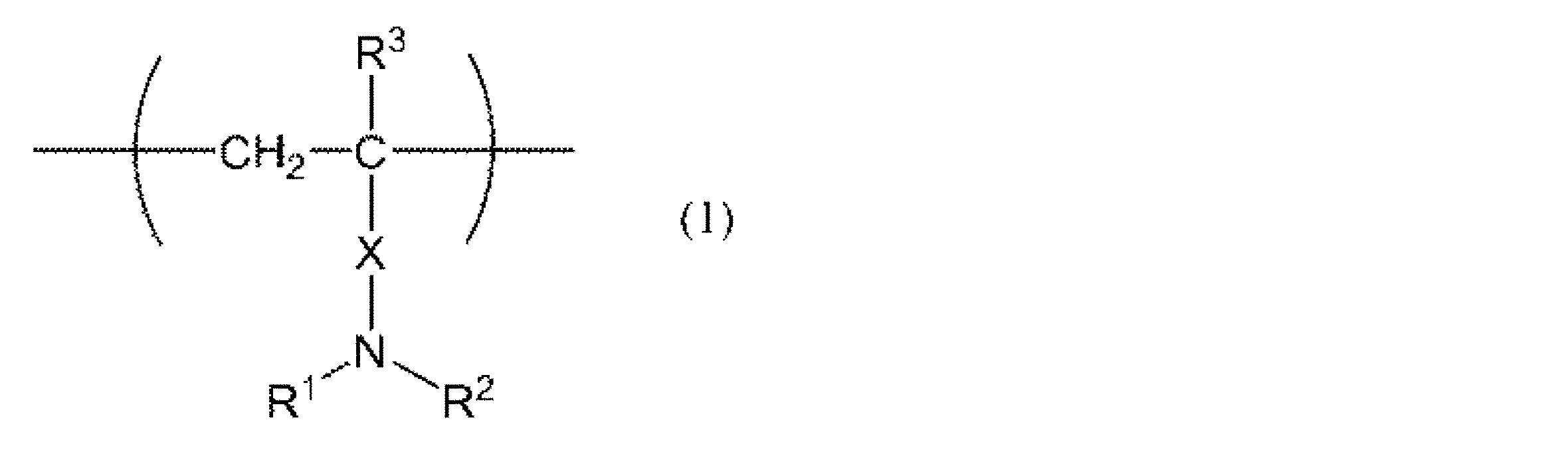

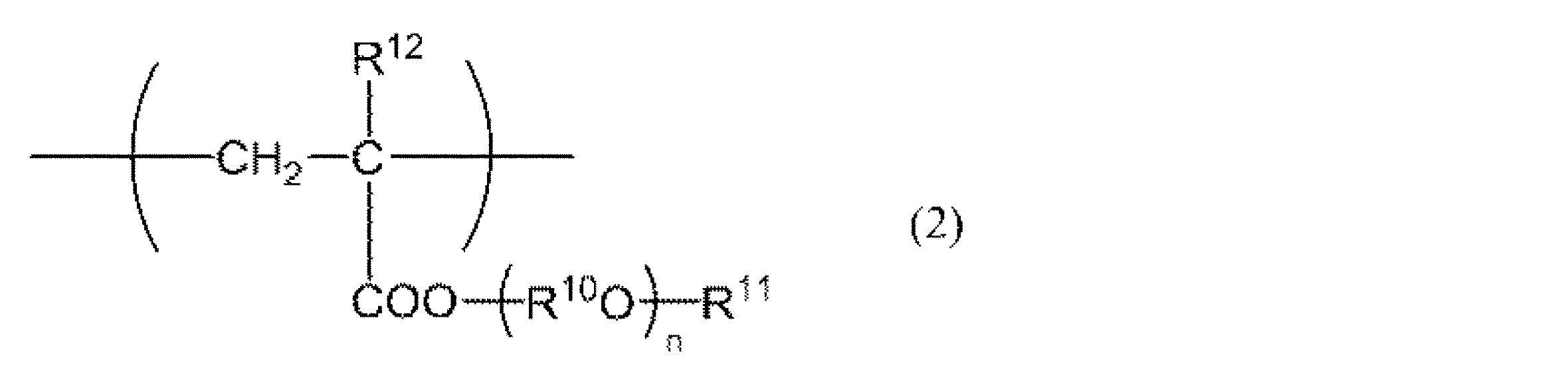
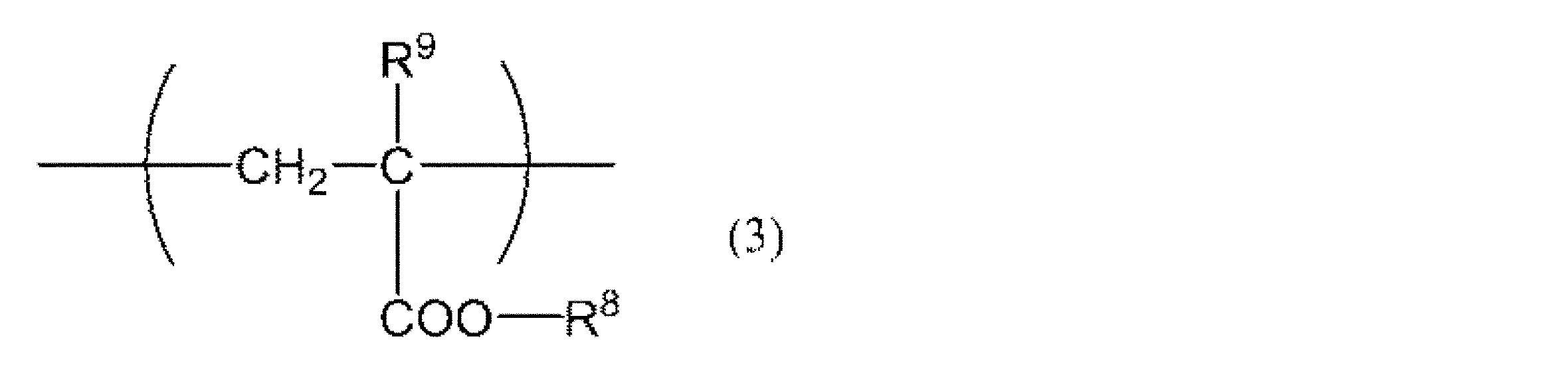
R8における、アルキル基が有していてもよい置換基としては、ハロゲン原子、アルコキシ基等が挙げられる。また、アリール基又はアラルキル基が有していてもよい置換基としては、鎖状のアルキル基、ハロゲン原子、アルコキシ基等が挙げられる。また、R8で示される鎖状のアルキル基には、直鎖状及び分岐鎖状のいずれも含まれる。
本発明に係る着色樹脂組成物及び顔料分散液には、顔料の分散性の向上、分散安定性の向上のために分散助剤として顔料誘導体等を含んでいてもよい。顔料誘導体としてはアゾ系、フタロシアニン系、キナクリドン系、ベンツイミダゾロン系、キノフタロン系、イソインドリノン系、イソインドリン系、ジオキサジン系、アントラキノン系、インダンスレン系、ペリレン系、ペリノン系、ジケトピロロピロール系、ジオキサジン系顔料等の誘導体が挙げられる。顔料誘導体の置換基としてはスルホン酸基、スルホンアミド基及びその4級塩、フタルイミドメチル基、ジアルキルアミノアルキル基、水酸基、カルボキシル基、アミド基等が顔料骨格に直接またはアルキル基、アリール基、複素環基等を介して結合したものが挙げられ、好ましくはスルホンアミド基及びその4級塩、スルホン酸基が挙げられ、より好ましくはスルホン酸基である。またこれら置換基は一つの顔料骨格に複数置換していてもよいし、置換数の異なる化合物の混合物でもよい。顔料誘導体の具体例としてはアゾ顔料のスルホン酸誘導体、フタロシアニン顔料のスルホン酸誘導体、キノフタロン顔料のスルホン酸誘導体、イソインドリン顔料のスルホン酸誘導体、アントラキノン顔料のスルホン酸誘導体、キナクリドン顔料のスルホン酸誘導体、ジケトピロロピロール顔料のスルホン酸誘導体、ジオキサジン顔料のスルホン酸誘導体等が挙げられる。
顔料誘導体の使用量は、(A)顔料100質量部に対して通常0.1質量部以上、また、通常30質量部以下、好ましくは20質量部以下、より好ましくは10質量部以下、更に好ましくは5質量部以下である。
本発明に係る顔料分散液には、後述するバインダー樹脂から選ばれた樹脂の一部または全部を含有していてもよい。具体的には、後述する顔料分散液の調製における分散処理工程において、前述の分散剤とともにバインダー樹脂の一部または全部を含有させることにより、該バインダー樹脂は、分散剤との相乗効果で分散安定性に寄与し、結果として分散剤の添加量を減らせる可能性があるため好ましい。このように、分散処理工程に使用される樹脂を、分散樹脂と称することがある。
(C)溶剤は、本発明の着色樹脂組成物や顔料分散液において、顔料、分散剤、その他の成分を溶解又は分散させ、粘度を調節する機能を有する。
かかる(C)溶剤としては、各成分を溶解または分散させることができるものであればよい。
エチレングリコールモノメチルエーテル、エチレングリコールモノエチルエーテル、エチレングリコールモノプロピルエーテル、エチレングリコールモノブチルエーテル、プロピレングリコールモノメチルエーテル、プロピレングリコールモノエチルエーテル、プロピレングリコールモノ-n-ブチルエーテル、プロピレングリコール-t-ブチルエーテル、ジエチレングリコールモノメチルエーテル、ジエチレングリコールモノエチルエーテル、ジエチレングリコールモノ-n-ブチルエーテル、メトキシメチルペンタノール、プロピレングリコールモノエチルエーテル、ジプロピレングリコールモノエチルエーテル、ジプロピレングリコールモノメチルエーテル、3-メチル-3-メトキシブタノール、トリエチレングリコールモノメチルエーテル、トリエチレングリコールモノエチルエーテル、トリプロピレングリコールメチルエーテルのようなグリコールモノアルキルエーテル類;
エチレングリコールモノメチルエーテルアセテート、エチレングリコールモノエチルエーテルアセテート、エチレングリコールモノ-n-ブチルエーテルアセテート、プロピレングリコールモノメチルエーテルアセテート、プロピレングリコールモノエチルエーテルアセテート、プロピレングリコールモノプロピルエーテルアセテート、プロピレングリコールモノブチルエーテルアセテート、メトキシブチルアセテート、3-メトキシブチルアセテート、メトキシペンチルアセテート、ジエチレングリコールモノメチルエーテルアセテート、ジエチレングリコールモノエチルエーテルアセテート、ジエチレングリコールモノ-n-ブチルエーテルアセテート、ジプロピレングリコールモノメチルエーテルアセテート、トリエチレングリコールモノメチルエーテルアセテート、トリエチレングリコールモノエチルエーテルアセテート、3-メチル-3-メトキシブチルアセテートのようなグリコールアルキルエーテルアセテート類;
シクロヘキサノールアセテートなどのアルキルアセテート類;
アミルエーテル、プロピルエーテル、ジエチルエーテル、ジプロピルエーテル、ジイソプロピルエーテル、ブチルエーテル、ジアミルエーテル、エチルイソブチルエーテル、ジヘキシルエーテルのようなエーテル類;
アセトン、メチルエチルケトン、メチルアミルケトン、メチルイソプロピルケトン、メチルイソアミルケトン、ジイソプロピルケトン、ジイソブチルケトン、メチルイソブチルケトン、シクロヘキサノン、エチルアミルケトン、メチルブチルケトン、メチルヘキシルケトン、メチルノニルケトン、メトキシメチルペンタノンのようなケトン類;
エタノール、プロパノール、ブタノール、ヘキサノール、シクロヘキサノール、エチレングリコール、プロピレングリコール、ブタンジオール、ジエチレングリコール、ジプロピレングリコール、トリエチレングリコール、メトキシメチルペンタノール、グリセリン、ベンジルアルコールのような1価又は多価アルコール類;
n-ペンタン、n-オクタン、ジイソブチレン、n-ヘキサン、ヘキセン、イソプレン、ジペンテン、ドデカンのような脂肪族炭化水素類;
シクロヘキサン、メチルシクロヘキサン、メチルシクロヘキセン、ビシクロヘキシルのような脂環式炭化水素類;
アミルホルメート、エチルホルメート、酢酸エチル、酢酸ブチル、酢酸プロピル、酢酸アミル、メチルイソブチレート、エチレングリコールアセテート、エチルプロピオネート、プロピルプロピオネート、酪酸ブチル、酪酸イソブチル、イソ酪酸メチル、エチルカプリレート、ブチルステアレート、エチルベンゾエート、3-エトキシプロピオン酸メチル、3-エトキシプロピオン酸エチル、3-メトキシプロピオン酸メチル、3-メトキシプロピオン酸エチル、3-メトキシプロピオン酸プロピル、3-メトキシプロピオン酸ブチル、γ-ブチロラクトンのような鎖状又は環状エステル類;
3-メトキシプロピオン酸、3-エトキシプロピオン酸のようなアルコキシカルボン酸類;
ブチルクロライド、アミルクロライドのようなハロゲン化炭化水素類;
メトキシメチルペンタノンのようなエーテルケトン類;
アセトニトリル、ベンゾニトリルのようなニトリル類等。
上記溶剤中、塗布性、表面張力などのバランスがよく、組成物中の構成成分の溶解度が比較的高い点からは、グリコールアルキルエーテルアセテート類が好ましい。
なお沸点150℃以上の溶剤が、グリコールアルキルエーテルアセテート類であっても、またグリコールアルキルエーテル類であってもよく、この場合は、沸点150℃以上の溶剤を別途含有させなくてもかまわない。
また、溶剤の蒸気圧は、得られる塗膜の均一性の観点から、通常10mmHg以下、好ましくは5mmHg以下、より好ましくは1mmHg以下のものが使用できる。
さらに、顔料分散液や後述する着色樹脂組成物の粘度調整や固形分の溶解度調整のためには、沸点が180℃より低い溶剤を一部含有することも効果的である。このような溶剤としては、低粘度で溶解性が高く、低表面張力であるような溶剤が好ましく、エーテル類、エステル類やケトン類などが好ましい。中でも特に、シクロヘキサノン、ジプロピレングリコールジメチルエーテル、シクロヘキサノールアセテートなどが好ましい。
本発明の着色樹脂組成物は、(D)バインダー樹脂を含有する。(D)バインダー樹脂を含有することで、光重合による膜硬化性と現像液による溶解性を両立することができる。
(D)バインダー樹脂としては、どのような手段により硬化する着色樹脂組成物とするかにより、好ましい樹脂は異なる傾向がある。光重合性樹脂組成物の場合、バインダー樹脂としては、例えば日本国特開平7-207211号公報、日本国特開平8-259876号公報、日本国特開平10-300922号公報、日本国特開平11-140144号公報、日本国特開平11-174224号公報、日本国特開2000-56118号公報、日本国特開2003-233179号公報などの各公報等に記載される公知の高分子化合物を使用することができる。好ましくは、
[1-6-1]:エポキシ基含有(メタ)アクリレートと、他のラジカル重合性単量体との共重合体に対し、該共重合体が有するエポキシ基の少なくとも一部に不飽和一塩基酸を付加させてなる樹脂、或いは該付加反応により生じた水酸基の少なくとも一部に多塩基酸無水物を付加させて得られる、アルカリ可溶性樹脂
[1-6-2]主鎖にカルボキシル基を含有する直鎖状アルカリ可溶性樹脂
[1-6-3]前記カルボキシル基含有樹脂のカルボキシル基部分に、エポキシ基含有不飽和化合物を付加させた樹脂
[1-6-4](メタ)アクリル系樹脂
[1-6-5]カルボキシル基を有するエポキシ(メタ)アクリレート樹脂、等が挙げられる。以下、これら各樹脂について説明する。
特に好ましい樹脂の一つとして、「エポキシ基含有(メタ)アクリレート5~90モル%と、他のラジカル重合性単量体10~95モル%との共重合体に対し、該共重合体が有するエポキシ基の10~100モル%に不飽和一塩基酸を付加させてなる樹脂、或いは該付加反応により生じた水酸基の10~100モル%に多塩基酸無水物を付加させて得られるアルカリ可溶性樹脂」が挙げられる。
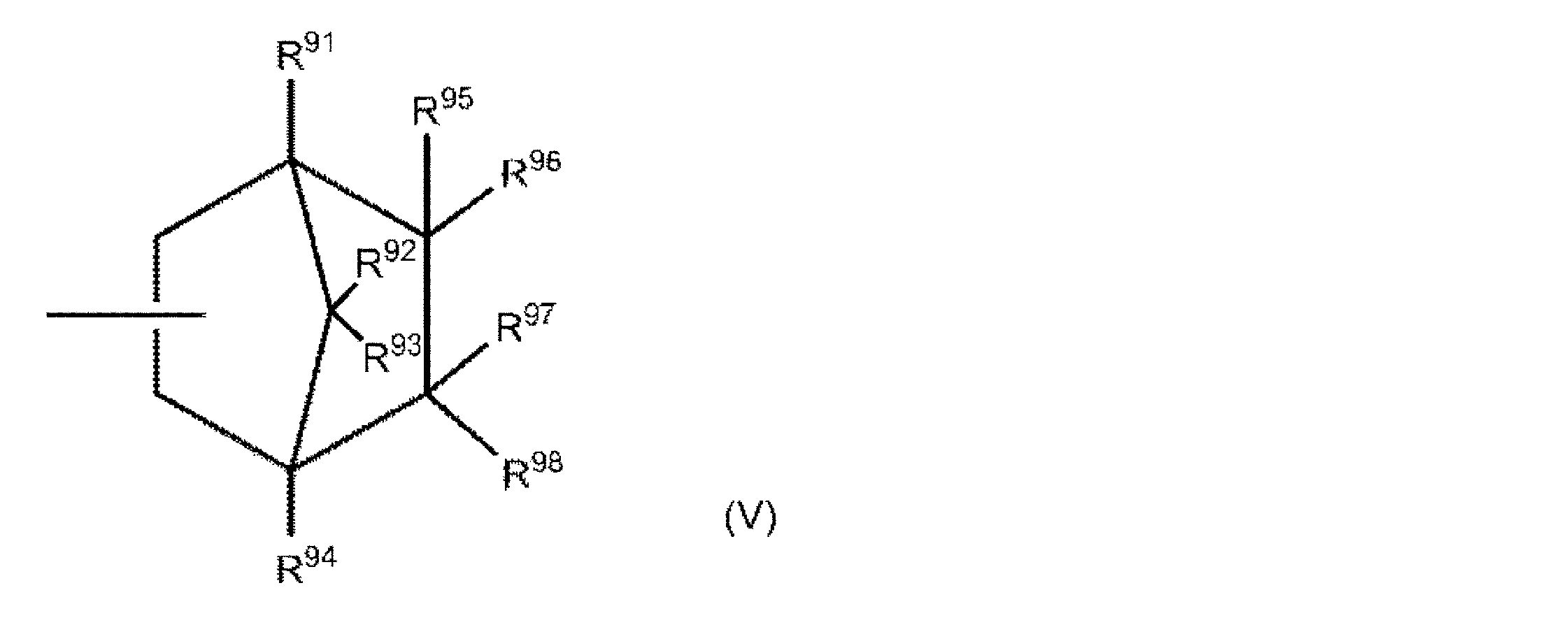
式(V)において、R96とR98、又はR95とR97とが連結して形成される環は、脂肪族環であるのが好ましく、飽和又は不飽和の何れでもよく、又、炭素数が5~6であるのが好ましい。
バインダー樹脂にこれらの構造を導入することによって、本発明の着色樹脂組成物をカラーフィルタや液晶表示素子に使用する場合に、該着色樹脂組成物の耐熱性を向上させたり、該着色樹脂組成物を用いて形成された画素の強度を増すことが可能である。
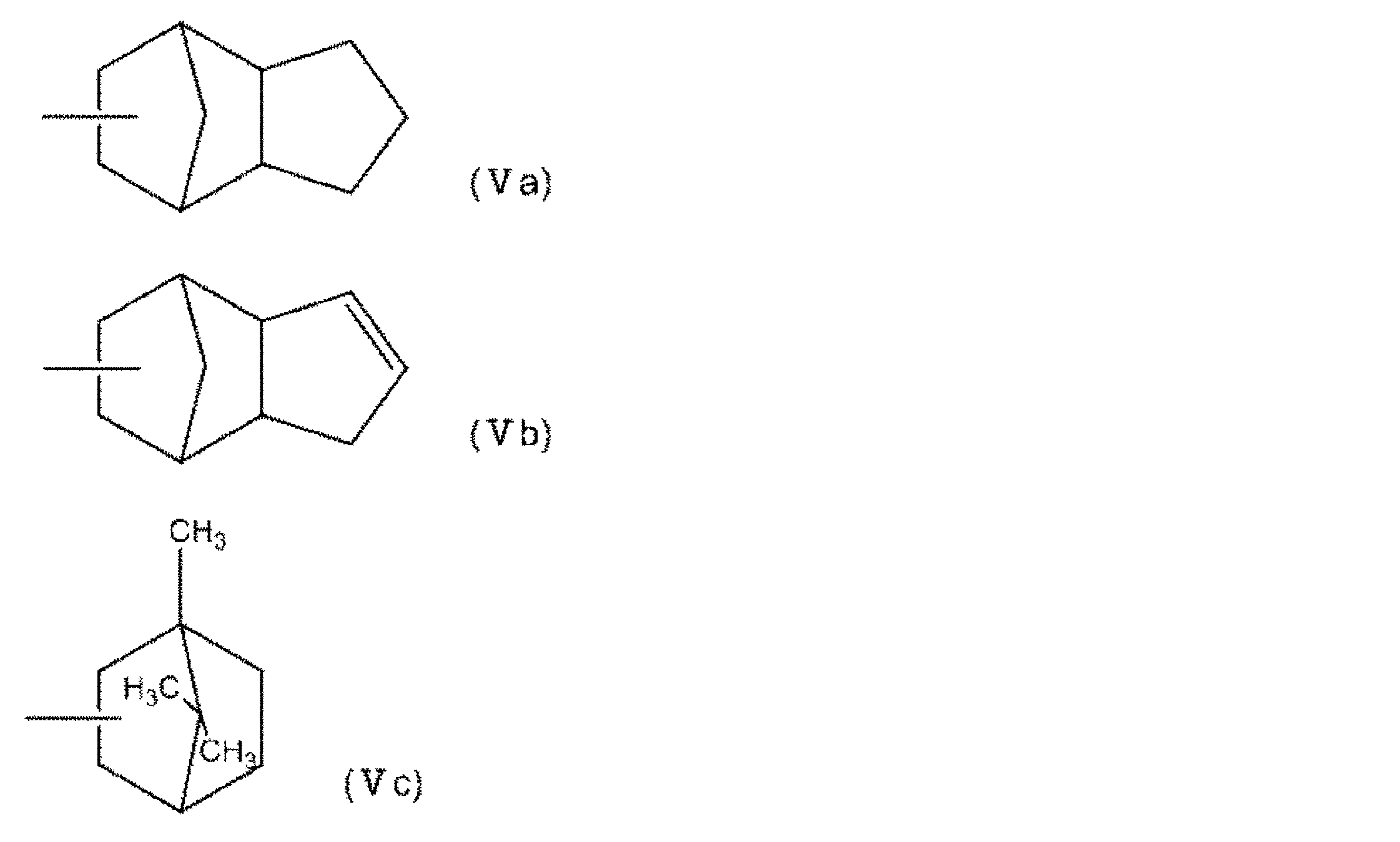

前記エポキシ基含有(メタ)アクリレートと、他のラジカル重合性単量体との共重合体において、前記一般式(VI)で表される構造を有するモノ(メタ)アクリレートに由来する繰返し単位は、「他のラジカル重合性単量体」に由来する繰返し単位中、5~90モル%含有するものが好ましく、10~70モル%含有するものが更に好ましく、15~50モル%含有するものが特に好ましい。
その溶剤としては、例えば、酢酸エチル、酢酸イソプロピル、セロソルブアセテート、ブチルセロソルブアセテート等のエチレングリコールモノアルキルエーテルアセテート類;ジエチレングリコールモノメチルエーテルアセテート、カルビトールアセテート、ブチルカルビトールアセテート等のジエチレングリコールモノアルキルエーテルアセテート類;プロピレングリコールモノアルキルエーテルアセテート類;ジプロピレングリコールモノアルキルエーテルアセテート類等の酢酸エステル類;エチレングリコールジアルキルエーテル類;メチルカルビトール、エチルカルビトール、ブチルカルビトール等のジエチレングリコールジアルキルエーテル類;トリエチレングリコールジアルキルエーテル類;プロピレングリコールジアルキルエーテル類;ジプロピレングリコールジアルキルエーテル類;1,4-ジオキサン、テトラヒドロフラン等のエーテル類;アセトン、メチルエチルケトン、メチルイソブチルケトン、シクロヘキサノン等のケトン類;ベンゼン、トルエン、キシレン、オクタン、デカン等の炭化水素類;石油エーテル、石油ナフサ、水添石油ナフサ、ソルベントナフサ等の石油系溶剤;乳酸メチル、乳酸エチル、乳酸ブチル等の乳酸エステル類;ジメチルホルムアミド、N-メチルピロリドン等が挙げられる。これらの溶剤は単独で用いてもよく、2種以上を併用してもよい。
又、共重合反応に使用されるラジカル重合開始剤は、ラジカル重合を開始できるものであれば特に限定されるものではなく、通常用いられている有機過酸化物触媒やアゾ化合物触媒を使用することができる。その有機過酸化物触媒としては、公知のケトンパーオキサイド、パーオキシケタール、ハイドロパーオキサイド、ジアリルパーオキサイド、ジアシルパーオキサイド、パーオキシエステル、パーオキシジカーボネートに分類されるものが挙げられる。
これらの中から、重合温度に応じて、適当な半減期のラジカル重合開始剤が1種又は2種以上使用される。ラジカル重合開始剤の使用量は、共重合反応に使用される単量体の合計100質量部に対して、0.5~20質量部、好ましくは1~10質量部である。
続いて、エポキシ樹脂含有(メタ)アクリレートと、他のラジカル重合性単量体との共重合体のエポキシ基部分に、不飽和一塩基酸(重合性成分)と、多塩基酸無水物(アルカリ可溶性成分)とを反応させる。
具体例としては、(メタ)アクリル酸、クロトン酸、o-、m-、又はp-ビニル安息香酸、α-位がハロアルキル基、アルコキシル基、ハロゲン原子、ニトロ基、又はシアノ基などで置換された(メタ)アクリル酸等のモノカルボン酸等が挙げられる。中でも好ましくは(メタ)アクリル酸である。これらの1種を単独で用いてもよく、2種以上を併用してもよい。
これらの不飽和一塩基酸は、通常、前記共重合体が有するエポキシ基の10~100モル%に付加させるが、好ましくは30~100モル%、より好ましくは50~100モル%に付加させる。不飽和一塩基酸の付加割合が少なすぎると、着色樹脂組成物の経時安定性等に関して、残存エポキシ基による悪影響が懸念される。尚、共重合体のエポキシ基に不飽和一塩基酸を付加させる方法としては、公知の方法を採用することができる。
例えば、無水マレイン酸、無水コハク酸、無水イタコン酸、無水フタル酸、テトラヒドロ無水フタル酸、ヘキサヒドロ無水フタル酸、無水クロレンド酸等の二塩基酸無水物;無水トリメリット酸、無水ピロメリット酸、ベンゾフェノンテトラカルボン酸無水物、ビフェニルテトラカルボン酸無水物等の三塩基以上の酸の無水物が挙げられる。中でも、テトラヒドロ無水フタル酸、及び/又は無水コハク酸が好ましい。これらの多塩基酸無水物は1種を単独で用いてもよく、2種以上を併用してもよい。
これらの多塩基酸無水物は、通常、前記共重合体が有するエポキシ基に、不飽和一塩基酸を付加させることにより生じる水酸基の10~100モル%に付加させるが、好ましくは20~90モル%、より好ましくは30~80モル%に付加させる。この付加割合が多すぎると、現像時の残膜率が低下する場合があり、少なすぎると溶解性が不十分となる可能性がある。尚、当該水酸基に多塩基酸無水物を付加させる方法としては、公知の方法を採用することができる。
また、現像性を向上させるために、生成したカルボキシル基の一部に、重合性不飽和基を有さないグリシジルエーテル化合物を付加させてもよい。
重合性不飽和基を有さないグリシジルエーテル化合物の具体例としては、フェニル基やアルキル基を有するグリシジルエーテル化合物等が挙げられる。市販品として、例えば、ナガセ化成工業社製の商品名「デナコール(登録商標、以下同様)EX-111」、「デナコールEX-121」、「デナコールEX-141」、「デナコールEX-145」、「デナコールEX-146」、「デナコールEX-171」、「デナコールEX-192」等がある。
上述のバインダー樹脂の、GPCで測定したポリスチレン換算の重量平均分子量(Mw)は、3000~100000が好ましく、5000~50000が特に好ましい。分子量が3000未満であると、耐熱性や膜強度に劣る可能性があり、100000を超えると現像液に対する溶解性が不足する傾向がある。又、分子量分布の目安として、重量平均分子量(Mw)/数平均分子量(Mn)の比は、2.0~5.0が好ましい。
主鎖にカルボキシル基を含有する直鎖状アルカリ可溶性樹脂としては、カルボキシル基を有していれば特に限定されず、通常、カルボキシル基を含有する重合性単量体を重合して得られる。
又、主鎖にカルボキシル基を含有する直鎖状アルカリ可溶性樹脂は、上記のカルボキシル基含有重合性単量体に、カルボキシル基を有さない他の重合性単量体を共重合させてもよい。
本発明における主鎖にカルボキシル基を含有する直鎖状アルカリ可溶性樹脂の酸価は、通常30~500KOHmg/g、好ましくは40~350KOHmg/g、さらに好ましくは50~300KOHmg/gである。
前記、主鎖にカルボキシル基を含有する直鎖状アルカリ可溶性樹脂の、カルボキシル基部分にエポキシ基含有不飽和化合物を付加させた樹脂も特に好ましい。
例えば、グリシジル(メタ)アクリレート、アリルグリシジルエーテル、グリシジル-α-エチルアクリレート、クロトニルグリシジルエーテル、(イソ)クロトン酸グリシジルエーテル、N-(3,5-ジメチル-4-グリシジル)ベンジルアクリルアミド、4-ヒドロキシブチル(メタ)アクリレートグリシジルエーテル等の非環式エポキシ基含有不飽和化合物も挙げることができるが、耐熱性や、後述する顔料の分散性の観点から、脂環式エポキシ基含有不飽和化合物が好ましい。
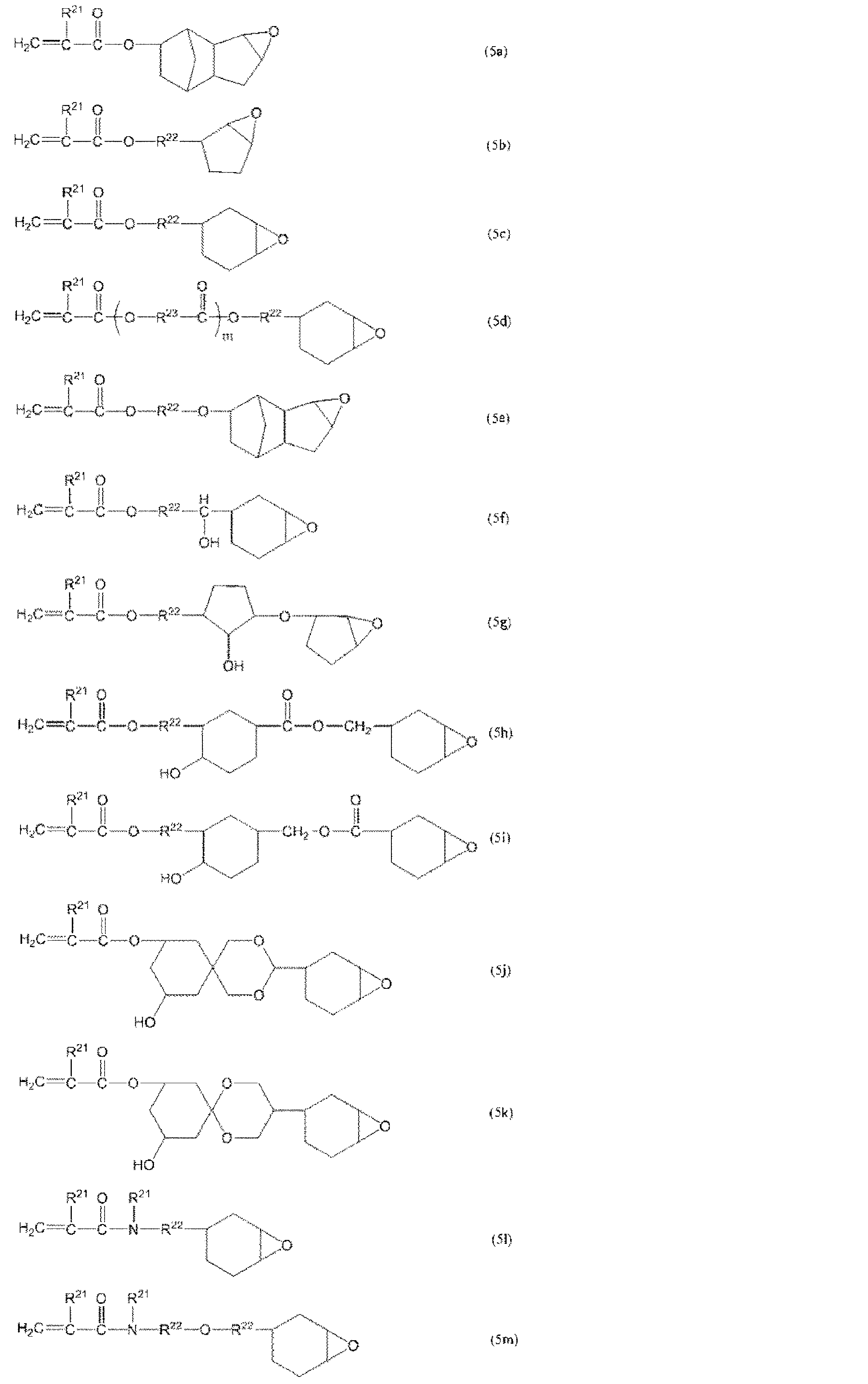
一般式(5a)~(5m)における、R22のアルキレン基は、炭素数1~10であるものが好ましい。具体的には、メチレン基、エチレン基、プロピレン基、ブチレン基等が例示できるが、好ましくはメチレン基、エチレン基、プロピレン基である。又、R23の炭化水素基としては、炭素数が1~10であるものが好ましく、アルキレン基、フェニレン基等が挙げられる。
中でも、一般式(5c)で表される化合物が好ましく、3,4-エポキシシクロヘキシルメチル(メタ)アクリレートが特に好ましい。
前記[1-6-2]記載の樹脂のカルボキシル基部分に、前記エポキシ基含有不飽和化合物を付加させるには、公知の手法を用いることができる。例えば、カルボキシル基含有樹脂とエポキシ基含有不飽和化合物とを、トリエチルアミン、ベンジルメチルアミン等の3級アミン;ドデシルトリメチルアンモニウムクロライド、テトラメチルアンモニウムクロライド、テトラエチルアンモニウムクロライド、テトラブチルアンモニウムクロライド、ベンジルトリエチルアンモニウムクロライド等の4級アンモニウム塩;ピリジン、トリフェニルホスフィン等の触媒の存在下、有機溶剤中、反応温度50~150℃で数時間~数十時間反応させることにより、樹脂のカルボキシル基にエポキシ基含有不飽和化合物を導入することができる。
又、GPCで測定したポリスチレン換算の重量平均分子量は、通常2000~100000、好ましくは4000~50000、更に好ましくは5000~30000である。
(メタ)アクリル系樹脂としては、(メタ)アクリル酸及び/又は(メタ)アクリル酸エステルを単量体成分とし、これらを重合してなるポリマーをいう。好ましい(メタ)アクリル系樹脂としては、例えば、(メタ)アクリル酸及びベンジル(メタ)アクリレートを含む単量体成分を重合してなるポリマー、及び下記一般式(6)及び/又は(7)で表される化合物を必須とする単量体成分を重合してなるポリマー、を挙げることができる。


(メタ)アクリル酸及びベンジル(メタ)アクリレートを含む単量体成分を重合してなるポリマーは、顔料との親和性が高いという点で、好ましく用いられる。
まず、一般式(6)の化合物について説明する。
一般式(6)で表されるエーテルダイマーにおいて、R1aおよびR2aで表される置換基を有していてもよい炭素数1~25の炭化水素基としては、特に制限はないが、例えば、メチル、エチル、n-プロピル、イソプロピル、n-ブチル、イソブチル、t-ブチル、t-アミル、ステアリル、ラウリル、2-エチルヘキシル等の直鎖状または分岐状のアルキル基;フェニル等のアリール基;シクロヘキシル、t-ブチルシクロヘキシル、ジシクロペンタジエニル、トリシクロデカニル、イソボルニル、アダマンチル、2-メチル-2-アダマンチル等の脂環式基;1-メトキシエチル、1-エトキシエチル等のアルコキシで置換されたアルキル基;ベンジル等のアリール基で置換されたアルキル基;等が挙げられる。これらの中でも特に、メチル、エチル、シクロヘキシル、ベンジル等のような酸や熱で脱離しにくい1級または2級炭素の置換基が耐熱性の点で好ましい。なお、R1aおよびR2aは、同種の置換基であってもよいし、異なる置換基であってもよい。
一般式(7)中、R1bは、好ましくは水素原子、炭素数1~5のアルキル基を表し、さらに好ましくは水素原子、メチル基である。
また、一般式(8)中、R2b、R3b、R4bの有機基としては、それぞれ独立して、例えばアルキル基、シクロアルキル基、アルケニル基、シクロアルケニル基、アルコキシ基、アルキルチオ基、アシル基、カルボキシル基、又はアシルオキシ基等が挙げられ、好ましくは炭素数1~18のアルキル基、炭素数3~18のシクロアルキル基、炭素数2~18のアルケニル基、炭素数3~18のシクロアルケニル基、炭素数1~15のアルコキシ基、炭素数1~15のアルキルチオ基、炭素数1~15のアシル基、炭素数1のカルボキシル基、又は炭素数1~15のアシルオキシ基であり、更に好ましくは、炭素数1~10のアルキル基、又は炭素数3~15のシクロアルキル基である。
L1、L2は2価の連結基、L3は2価の連結基又は直接結合であれば特に限定を受けないが、少なくともL1又はL2のどちらかは炭素数1以上の連結基であるのが好ましい。また、L1、L2、L3は、それぞれ独立に、直接結合、炭素数1~15のアルキレン、-O-、-S-、-C(=O)-、炭素数1~15のアルケニレン、フェニレン、あるいはそれらの組み合わせが好ましい。
また、一般式(8)の好ましいものとしては、下記一般式(9)で表される化合物を挙げることができる。

一般式(9)中、R5b、R6bの有機基としては、それぞれ独立して、例えばアルキル基、シクロアルキル基、アルケニル基、シクロアルケニル基、アルコキシ基、アルキルチオ基、アシル基、カルボキシル基、又はアシルオキシ基等が挙げられ、好ましくは炭素数1~18のアルキル基、炭素数3~18のシクロアルキル基、炭素数2~18のアルケニル基、炭素数3~18のシクロアルケニル基、炭素数1~15のアルコキシ基、炭素数1~15のアルキルチオ基、炭素数1~15のアシル基、炭素数1のカルボキシル基、又は炭素数1~15のアシルオキシ基であり、更に好ましくは、炭素数1~10のアルキル基、又は炭素数3~15のシクロアルキル基である。
また、R1bのアルキル基、R2b、R3b、R4b、の各有機基、L1、L2、L3の2価の連結基、Xのアダマンチル基は、それぞれ独立して置換基を有していてよく、具体的には以下の置換基を挙げることができる。
また、上記置換基の位置関係は特に限定されず、複数の置換基を有する場合、同種でも異なっていてもよい。
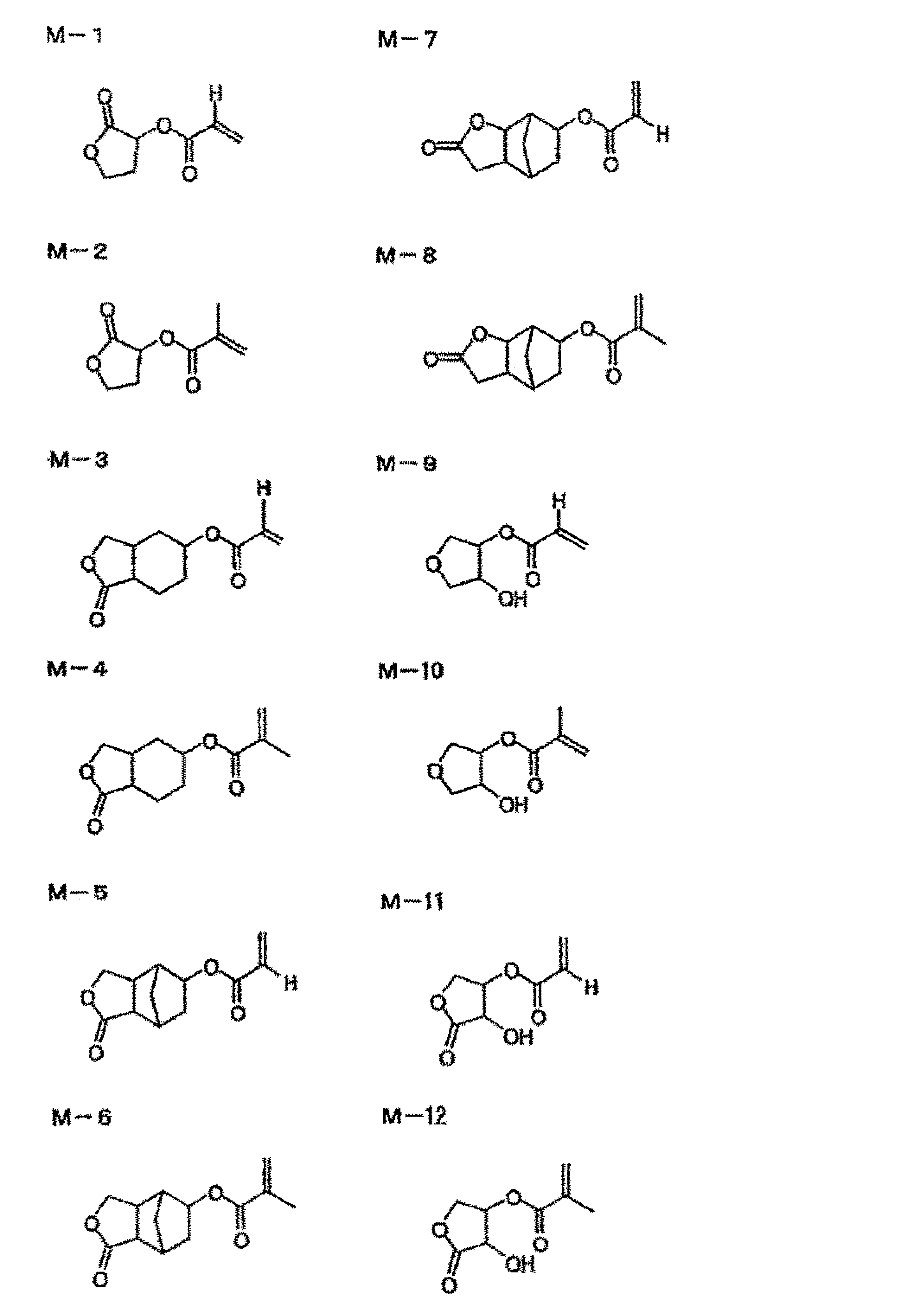
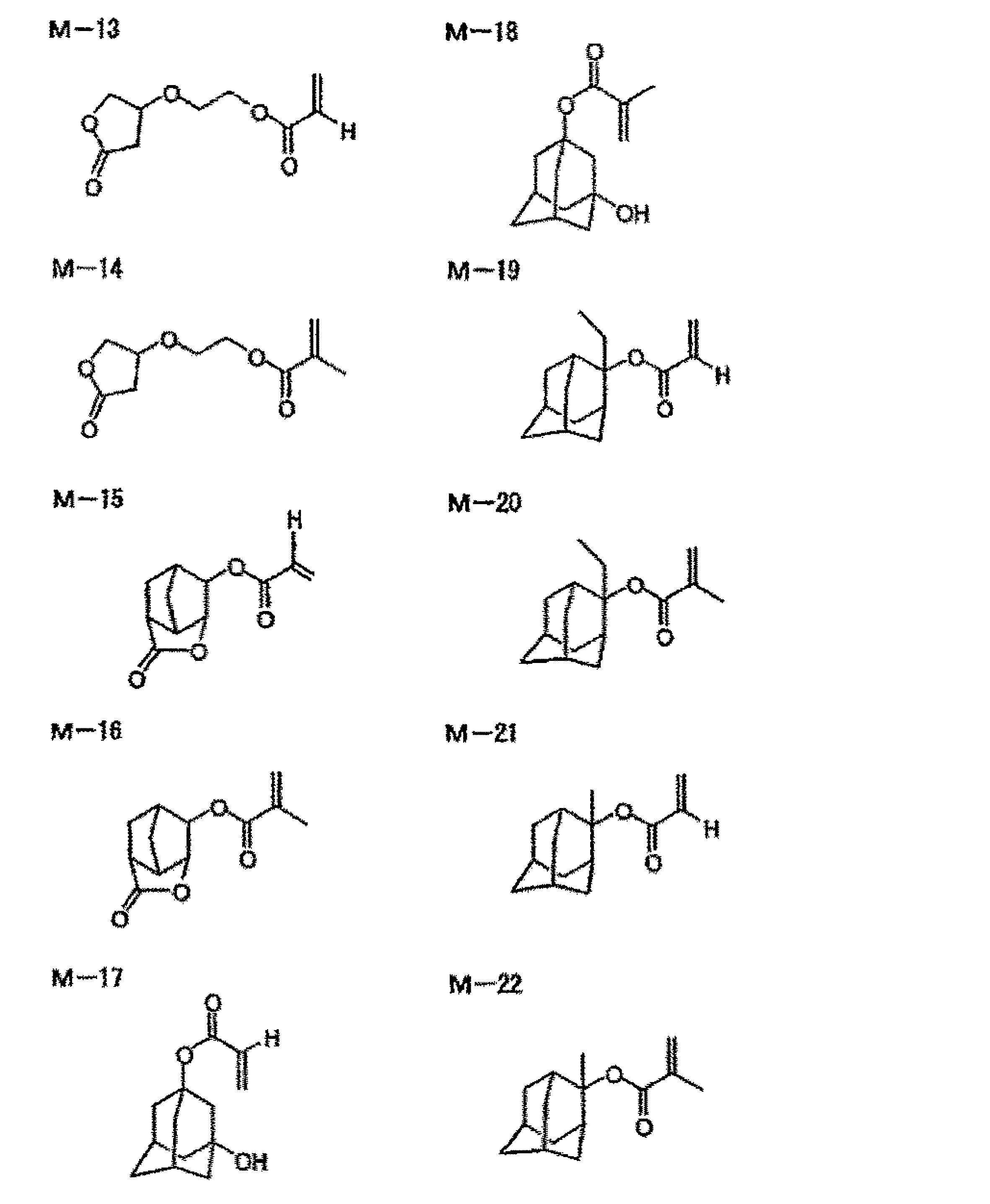
前記重合後に酸基を付与しうるモノマーとしては、例えば、2-ヒドロキシエチル(メタ)アクリレート等の水酸基を有するモノマー;グリシジル(メタ)アクリレート等のエポキシ基を有するモノマー;2-イソシアナートエチル(メタ)アクリレート等のイソシアネート基を有するモノマー等が挙げられる。
(メタ)アクリル系樹脂を得る際の単量体成分が、前記酸基を導入するための単量体をも含む場合、その含有割合は特に制限されないが、通常は全単量体成分中5~70質量%、好ましくは10~60質量%である。
前記(メタ)アクリル系樹脂にラジカル重合性二重結合を導入するには、例えば「重合後にラジカル重合性二重結合を付与しうるモノマー」(以下「ラジカル重合性二重結合を導入するための単量体」と称することもある。)を、単量体成分として重合した後に、後述するようなラジカル重合性二重結合を付与するための処理を行えばよい。
本発明の(メタ)アクリル系樹脂が、[1-6-4a]の項で説明した、前記一般式(6)の化合物を必須の単量体成分とするポリマーである場合、エポキシ基を有することが好ましい。
前記エポキシ基を有するモノマーとしては、例えば、グリシジル(メタ)アクリレート、3,4-エポキシシクロヘキシルメチル(メタ)アクリレート、o-(またはm-、またはp-)ビニルベンジルグリシジルエーテル等が挙げられる。これらエポキシ基を導入するための単量体は、1種のみであってもよいし、2種以上であってもよい。
[1-6-4]の(メタ)アクリル系樹脂を得る際の単量体成分は、上記必須の単量体成分のほかに、必要に応じて、他の共重合可能なモノマーを含んでいてもよい。
また、特に(メタ)アクリル系樹脂の一部または全部を、後述するように分散剤として用いる場合は、(メタ)アクリル酸ベンジルを用いることが好ましく、その含有量は、通常全単量体成分中1~70質量%、好ましくは5~60質量%であるのがよい。
次に、[1-6-4]の(メタ)アクリル系樹脂の製造方法(重合方法)について説明する。
また分子量調整のために、連鎖移動剤を添加してもよい。連鎖移動剤としては、例えば、n-ドデシルメルカプタン、メルカプト酢酸、メルカプト酢酸メチル等のメルカプタン系連鎖移動剤、α-メチルスチレンダイマー等が挙げられるが、好ましくは、連鎖移動効果が高く、残存モノマーを低減でき、入手も容易な、n-ドデシルメルカプタン、メルカプト酢酸がよい。連鎖移動剤を使用する場合、その使用量は、用いる単量体の組み合わせや、反応条件、目標とするポリマーの分子量等に応じて適宜設定すればよく、特に限定されないが、ゲル化することなく重量平均分子量が数千~数万のポリマーを得ることができる点で、通常は全単量体成分に対して0.1~15質量%、より好ましくは0.5~10質量%である。
前記アクリル系樹脂を得る際に、単量体成分として、前述した酸基を付与しうるモノマーを用いることにより酸基を導入する場合、重合後に酸基を付与するための処理を行う必要がある。該処理は、用いるモノマーの種類によって異なるが、例えば、2-ヒドロキシエチル(メタ)アクリレートのような水酸基を有するモノマーを用いた場合には、コハク酸無水物、テトラヒドロフタル酸無水物、マレイン酸無水物等の酸無水物を付加させればよい。グリシジル(メタ)アクリレート等のエポキシ基を有するモノマーを用いた場合には、N-メチルアミノ安息香酸、N-メチルアミノフェノール等のアミノ基と酸基を有する化合物を付加させるか、もしくは、まず(メタ)アクリル酸のような酸を付加させ、結果生じた水酸基に、コハク酸無水物、テトラヒドロフタル酸無水物、マレイン酸無水物等の酸無水物を付加させればよい。2-イソシアナートエチル(メタ)アクリレート等のイソシアネート基を有するモノマーを用いた場合には、例えば、2-ヒドロキシ酪酸等の水酸基と酸基を有する化合物を付加させればよい。
該処理は、用いるモノマーの種類によって異なるが、例えば、(メタ)アクリル酸やイタコン酸等のカルボキシル基を有するモノマーを用いた場合には、グリシジル(メタ)アクリレート、3,4-エポキシシクロヘキシルメチル(メタ)アクリレート、o-(またはm-、またはp-)ビニルベンジルグリシジルエーテル等の、エポキシ基とラジカル重合性二重結合とを有する化合物を付加させればよい。無水マレイン酸や無水イタコン酸等のカルボン酸無水物基を有するモノマーを用いた場合には、2-ヒドロキシエチル(メタ)アクリレート等の、水酸基とラジカル重合性二重結合とを有する化合物を付加させればよい。グリシジル(メタ)アクリレート、3,4-エポキシシクロヘキシルメチル(メタ)アクリレート、o-(またはm-、またはp-)ビニルベンジルグリシジルエーテル等の、エポキシ基を有するモノマーを用いた場合には、(メタ)アクリル酸等の酸基とラジカル重合性二重結合とを有する化合物を付加させればよい。
尚、前記(メタ)アクリル系樹脂成分のうち、一般式(6)で表される化合物を必須の単量体成分とするポリマーは、それ自体公知の化合物であり、例えば、日本国特開2004-300203号公報及び日本国特開2004-300204号公報に記載の化合物を挙げることが出来る。
エポキシ(メタ)アクリレート樹脂は、エポキシ樹脂にα,β-不飽和モノカルボン酸又はエステル部分にカルボキシル基を有するα,β-不飽和モノカルボン酸エステルを付加させ、さらに、多塩基酸無水物を反応させることにより合成される。かかる反応生成物は化学構造上、実質的にエポキシ基を有さず、かつ「(メタ)アクリレート」に限定されるものではないが、エポキシ樹脂が原料であり、かつ「(メタ)アクリレート」が代表例であるので、慣用に従いこのように命名したものである。
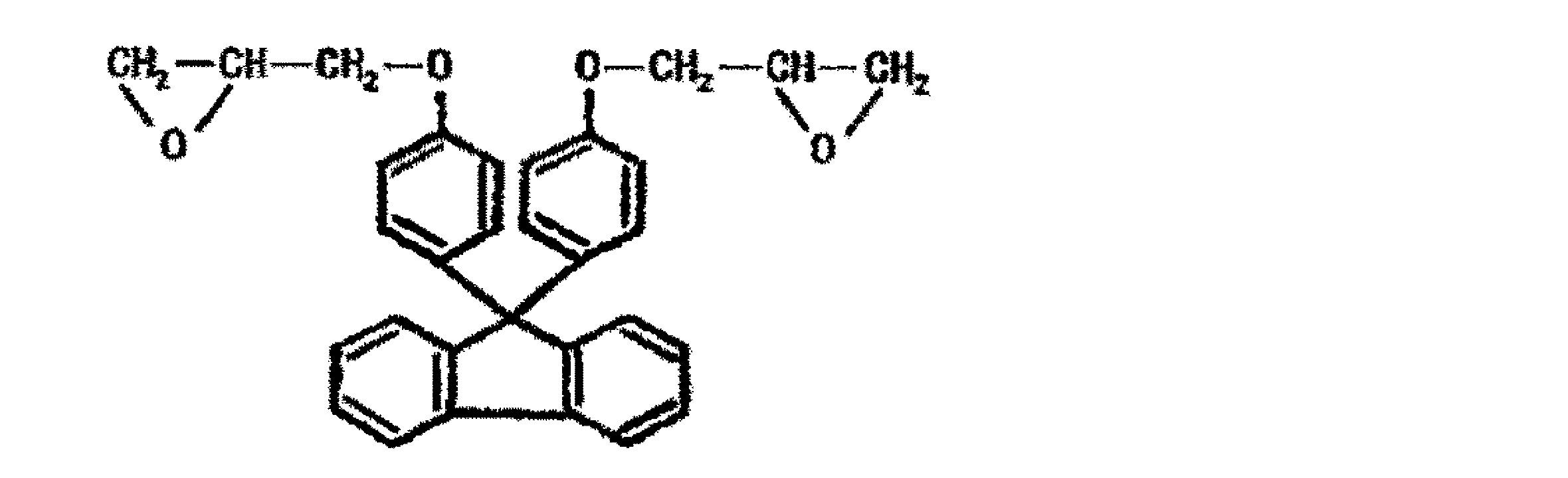
エポキシ樹脂の他の例としては共重合型エポキシ樹脂が挙げられる。共重合型エポキシ樹脂としては、例えば、グリシジル(メタ)アクリレート、(メタ)アクリロイルメチルシクロヘキセンオキサイド、ビニルシクロヘキセンオキサイドなど(以下「共重合型エポキシ樹脂の第1成分」と称す。)とこれら以外の1官能エチレン性不飽和基含有化合物(以下、「共重合型エポキシ樹脂の第2成分」と称す。)、例えば、メチル(メタ)アクリレート、エチル(メタ)アクリレート、ブチル(メタ)アクリレート、2-ヒドロキシエチルアクリレート、2-ヒドロキシプロピル(メタ)アクリレート、(メタ)アクリル酸、スチレン、フェノキシエチル(メタ)アクリレート、ベンジル(メタ)アクリレート、α-メチルスチレン、グリセリンモノ(メタ)アクリレート、下記一般式(10)で表される化合物から選ばれる1種又は2種以上、とを反応させて得られた共重合体が挙げられる。

このような共重合型エポキシ樹脂としては、具体的には日油社製の「CP-15」、「CP-30」、「CP-50」、「CP-20SA」、「CP-510SA」、「CP-50S」、「CP-50M」、「CP-20MA」等が例示される。
エステル部分にカルボキシル基を有するα,β-不飽和モノカルボン酸エステルとしては、アクリル酸-2-サクシノイルオキシエチル、アクリル酸-2-マレイノイルオキシエチル、アクリル酸-2-フタロイルオキシエチル、アクリル酸-2-ヘキサヒドロフタロイルオキシエチル、メタクリル酸-2-サクシノイルオキシエチル、メタクリル酸-2-マレイノイルオキシエチル、メタクリル酸-2-フタロイルオキシエチル、メタクリル酸-2-ヘキサヒドロフタロイルオキシエチル、クロトン酸-2-サクシノイルオキシエチル等が挙げられ、好ましくは、アクリル酸-2-マレイノイルオキシエチル及びアクリル酸-2-フタロイルオキシエチルであり、特にアクリル酸-2-マレイノイルオキシエチルが好ましい。これらは1種を単独で用いてもよく、2種以上を併用してもよい。
多塩基酸無水物の付加量は、生成するエポキシアクリレート樹脂の酸価が10~150mgKOH/gの範囲となるような量が好ましく、更に20~140mgKOH/gの範囲が特に好ましい。樹脂の酸価が小さすぎるとアルカリ現像性に乏しくなり、また、樹脂の酸価が大きすぎると硬化性能に劣る傾向が認められる。
バインダー樹脂としては、また、例えば日本国特開2005-154708号公報などに記載のアクリル系のバインダーも用いることができる。
上述した各種バインダー樹脂のうち、特に好ましいのは、[1-6-1]の「エポキシ基含有(メタ)アクリレートと、他のラジカル重合性単量体との共重合体に対し、該共重合体が有するエポキシ基の少なくとも一部に不飽和一塩基酸を付加させてなる樹脂、或いは該付加反応により生じた水酸基の少なくとも一部に多塩基酸無水物を付加させて得られるアルカリ可溶性樹脂」である。
前述の各種バインダー樹脂は、特に前述の分散剤等との併用による相乗効果により、分散安定性に寄与し、結果として分散剤の添加量を減少させることができるため、現像性が向上した、具体的には例えば、基板上の非画像部に未溶解物が残存することなく基板との密着性に優れた、高濃度の色画素を形成し得るといった効果を奏し、好ましい。
このように、分散処理工程に使用するバインダー樹脂としては、前述した各種樹脂を使用することができるが、特に[1-6-4]の(メタ)アクリル系樹脂が好ましく、その中でも前記一般式(6)で表される化合物を必須とするモノマー成分を重合してなるポリマーが最も好ましい。
本発明の着色樹脂組成物は(E)光重合開始剤を含有する。(E)光重合開始剤を含有することで光重合による膜硬化性を得ることができる。
(E)光重合開始剤は、通常、加速剤及び必要に応じて添加される増感色素等の付加剤との混合物(光重合開始系)として用いられる。光重合開始系は、光を直接吸収し、或いは光増感されて分解反応又は水素引き抜き反応を起こし、重合活性ラジカルを発生する機能を有する成分である。
2-(4-メトキシフェニル)-4,6-ビス(トリクロロメチル)-s-トリアジン、2-(4-メトキシナフチル)-4,6-ビス(トリクロロメチル)-s-トリアジン、2-(4-エトキシナフチル)-4,6-ビス(トリクロロメチル)-s-トリアジン、2-(4-エトキシカルボニルナフチル)-4,6-ビス(トリクロロメチル)-s-トリアジン等のハロメチル化トリアジン誘導体;
2-(2′-クロロフェニル)-4,5-ジフェニルイミダソール2量体、2-(2′-クロロフェニル)-4,5-ビス(3′-メトキシフェニル)イミダゾール2量体、2-(2′-フルオロフェニル)-4,5-ジフェニルイミダゾール2量体、2-(2′-メトキシフエニル)-4,5-ジフェニルイミダゾール2量体、(4′-メトキシフェニル)-4,5-ジフェニルイミダゾール2量体等のイミダゾール誘導体;
ベンゾインメチルエーテル、ベンゾインフェニルエーテル、ベンゾインイソブチルエーテル、ベンゾインイソプロピルエーテル等のベンゾインアルキルエーテル類;
2-メチルアントラキノン、2-エチルアントラキノン、2-t-ブチルアントラキノン、1-クロロアントラキノン等のアントラキノン誘導体;
2,2-ジメトキシ-2-フェニルアセトフェノン、2,2-ジエトキシアセトフェノン、1-ヒドロキシシクロへキシルフェニルケトン、α-ヒドロキシ-2-メチルフェニルプロパノン、1-ヒドロキシ-1-メチルエチル-(p-イソプロピルフェニル)ケトン、1-ヒドロキシ-1-(p-ドデシルフェニル)ケトン、2-メチル-1-[4-(メチルチオ)フェニル]-2-モルフォリノプロパン-1-オン、1,1,1-トリクロロメチル-(p一ブチルフェニル)ケトン等のアセトフェノン誘導体;
チオキサントン、2-エチルチオキサントン、2-イソプロピルチオキサントン、2-クロロチオキサントン、2,4-ジメチルチオキサントン、2、4-ジエチルチオキサントン、2,4-ジイソプロピルチオキサントン等のチオキサントン誘導体;
9-フェニルアクリジン、9-(p-メトキシフェニル)アクリジン等のアクリジン誘導体;
9,10-ジメチルベンズフェナジン等のフェナジン誘導体;
ベンズアンスロン等のアンスロン誘導体;
ジシクロペンタジエニル-Ti-ジクロライド、ジシクロペンタジェニル-Ti-ビス-フェニル、ジシクロペンタジェニル-Ti-ビス-2,3,4,5,6-ペンタフルオロフェニル-1-イル、ジシクロペンタジェニル-Ti-ビス-2,3,5,6-テトラフルオロフェニル-1-イル、ジシクロペンタジェニル-Ti-ビス-2,4,6-トリフルオロフェニ-1-イル、ジシクロペンタジェニル-Ti-2,6-ジプルオロフェニ-1-イル、ジシクロペンタジェニル-Ti-2,4-ジフルオロフェニ-1-イル、ジメチルシクロペンタジェニル-Ti-ビス-2,3,4,5,6-ペンタフルオロフェニ-1-イル、ジメチルシクロペンタジェニル-Ti-ビス-2,6-ジフルオロフェニ-1-イル、ジシクロペンタジェニル-Ti-2,6-ジフルオロ-3-(ピル-1-イル)-フェニ-1-イル等のチタノセン誘導体;
1,2-オクタンジオン-1-[4-(フェニルチオ)フェニル]-2-(O-ベンゾイルオキシム)エタノン、1-[9-エチル-6-(2-メチルベンゾイル)-9H-カルバゾール-3-イル]-1-(O-アセチルオキシム)等のオキシムエステル系化合物。
具体的な光重合開始系成分としては、例えば、「ファインケミカル」(1991年、3月1日号、vol.20、No.4)の第16~26頁に記載されている、ジアルキルアセトフェノン系、ベンゾイン、チオキサントン誘導体等のほか、日本国特開昭58-403023号公報、日本国特公昭45-37377号公報等に記載されている、ヘキサアリールビイミダゾール系、S-トリハロメチルトリアジン系、日本国特開平4-221958号公報、日本国特開平4-219756号公報等に記載されている、チタノセンとキサンテン色素、アミノ基又はウレタン基を有する付加重合可能なエチレン性飽和二重結合含有化合物を組み合わせた系、等が挙げられる。
特許文献1~11に記載の公知のハロゲン化亜鉛フタロシアニン顔料を用いる場合には、光重合開始剤としては、着色樹脂組成物の用途等に応じて適宜選択して用いることができ、ビイミダゾールやα-アミノアルキルフェノンなどを用いることでも十分に光硬化することができる。
しかしながら、一分子中に含まれる平均水素原子数が3以上であるハロゲン化亜鉛フタロシアニン顔料を用いる場合には、水素原子を多く含むことによる透過スペクトル変化によって高着色となる反面、塗膜の低波長領域の吸収が強くなることで、露光量が減衰するため、ビイミダゾールやα-アミノアルキルフェノンなどを用いた場合には十分に光硬化ができず、微細なパターンを形成することが困難となる傾向がある。これに対して、光重合開始剤として低波長領域により大きな吸収を持つオキシムエステル系化合物を用いることで、十分に光硬化ができるため、微細なパターンを形成することができると考えられる。

R21bは芳香環又はヘテロ芳香環を含む任意の置換基を示す。
R22aは、置換基を有していてもよいアルカノイル基、又は、置換基を有していてもよいアリーロイル基を示す。
アルキル基が有していてもよい置換基としては、芳香族環基、水酸基、カルボキシル基、ハロゲン原子、アミノ基、アミド基、4-(2-メトキシ-1-メチル)エトキシ-2-メチルフェニル基又はN-アセチル-N-アセトキシアミノ基などが挙げられ、合成容易性の観点からは、無置換であることが好ましい。
芳香族環基が有していてもよい置換基としては、水酸基、置換基を有していてもよいアルキル基、置換基を有していてもよいアルコキシ基、カルボキシル基、ハロゲン原子、アミノ基、アミド基、アルキル基などが挙げられ、現像性の観点から水酸基、カルボキシル基が好ましく、カルボキシル基がより好ましい。また、置換基を有していてもよいアルキル基や置換基を有していてもよいアルコキシ基における置換基としては、水酸基、アルコキシ基、ハロゲン原子が挙げられる。
これらの中でも、現像性の観点から、R21aが置換基を有していてもよいアルキル基であることが好ましく、無置換のアルキル基であることがより好ましく、メチル基であることがさらに好ましい。
アルカノイル基が有していてもよい置換基としては、芳香族環基、水酸基、カルボキシル基、ハロゲン原子、アミノ基、アミド基などが挙げられ、合成容易性の観点からは、無置換であることが好ましい。
アリーロイル基が有していてもよい置換基としては、水酸基、カルボキシル基、ハロゲン原子、アミノ基、アミド基、アルキル基などが挙げられ、合成容易性の観点からは、無置換であることが好ましい。
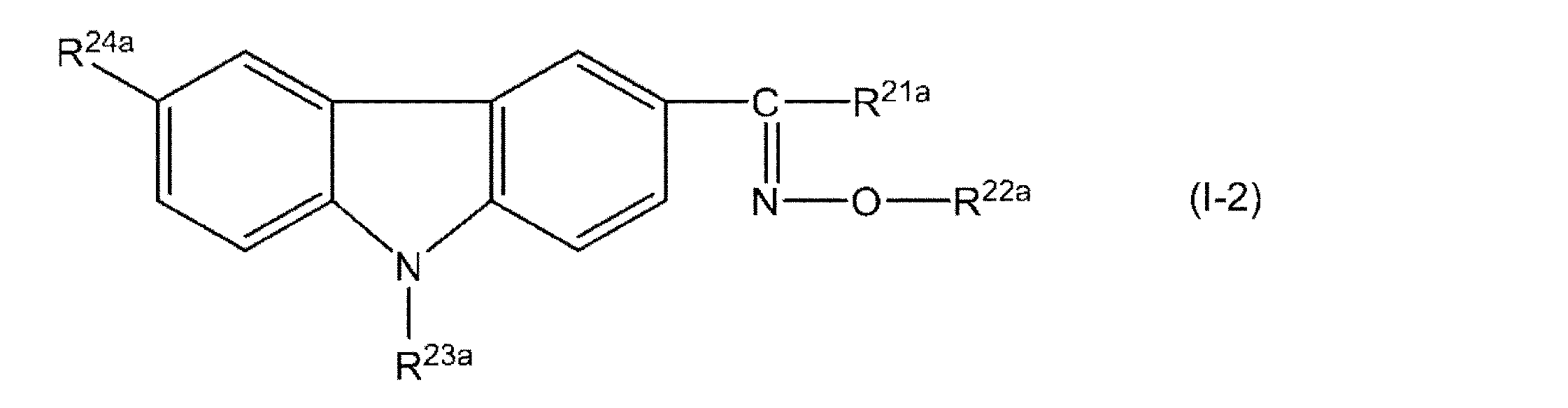
R23aは、置換基を有していてもよいアルキル基を示す。
R24aは、置換基を有していてもよいアルキル基、置換基を有していてもよいアリーロイル基、置換基を有していてもよいヘテロアリーロイル基、又はニトロ基を示す。
カルバゾール環を構成するベンゼン環は、さらに芳香族環によって縮合されて多環芳香族環となっていてもよい。
アルキル基が有していてもよい置換基としては、カルボニル基、カルボキシル基、ヒドロキシル基、フェニル基、ベンジル基、シクロヘキシル基、又はニトロ基などが挙げられ、合成容易性の観点からは、無置換であることが好ましい。
アリーロイル基が有していてもよい置換基としては、カルボニル基、カルボキシル基、ヒドロキシル基、フェニル基、ベンジル基、シクロヘキシル基、又はニトロ基などが挙げられ、合成容易性の観点からは、エチル基であることが好ましい。
ヘテロアリーロイル基が有していてもよい置換基としてはカルボニル基、カルボキシル基、ヒドロキシル基、フェニル基、ベンジル基、シクロヘキシル基、又はニトロ基などが挙げられ、合成容易性の観点からは、無置換であることが好ましい。
これらの中でもR23aとしては、溶媒への溶解性と合成容易性の観点から、アルキル基であることが好ましく、エチル基であることがより好ましい。


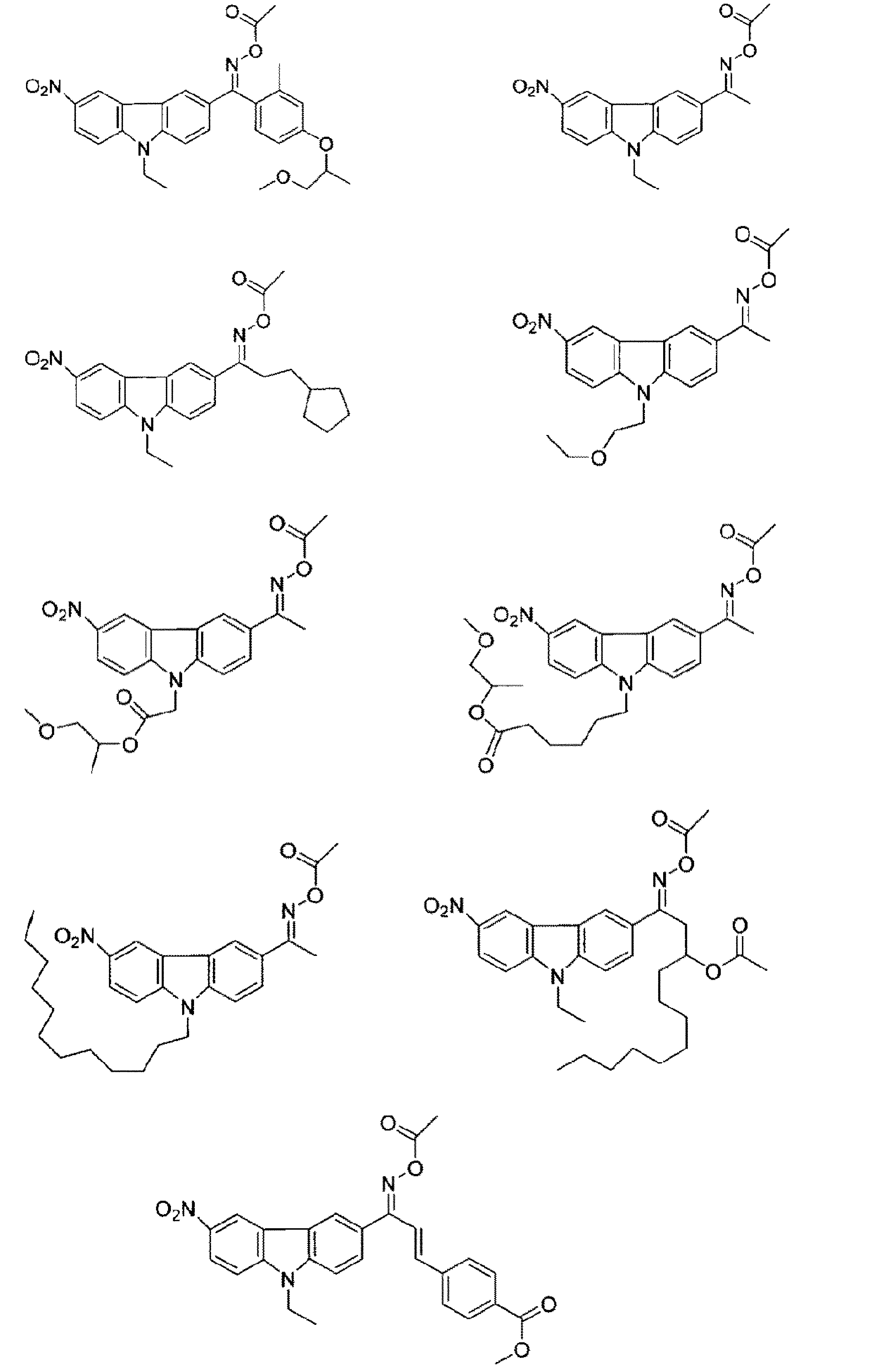
本発明に係る着色樹脂組成物中に占める増感色素の配合率は、着色樹脂組成物の全固形分中、通常0質量%以上、好ましくは0.2質量%以上、更に好ましくは0.5質量%以上、また、通常20質量%以下、好ましくは15質量%以下、更に好ましくは10質量%以下の範囲である。
本発明の着色樹脂組成物には、更に、必要に応じ上記成分以外の固形分を配合できる。このような成分としては、光重合性モノマー、有機カルボン酸、有機カルボン酸無水物、界面活性剤、熱重合防止剤、可塑剤、保存安定剤、表面保護剤、密着向上剤、現像改良剤、染料等が挙げられる。
光重合性モノマーは、重合可能な低分子化合物であれば特に制限はないが、エチレン性二重結合を少なくとも1つ有する付加重合可能な化合物(以下、「エチレン性化合物」と称す)が好ましい。エチレン性化合物とは、本発明の着色樹脂組成物が活性光線の照射を受けた場合、後述の光重合開始系の作用により付加重合し、硬化するようなエチレン性二重結合を有する化合物である。なお、本発明における単量体は、いわゆる高分子物質に相対する概念を意味し、狭義の単量体以外に二量体、三量体、オリゴマーも含有する概念を意味する。
不飽和カルボン酸と多価カルボン酸及び多価ヒドロキシ化合物とのエステル化反応により得られるエステルは、必ずしも単一物ではなく、混合物であってもよい。代表例としては、例えば、アクリル酸、フタル酸及びエチレングリコールの縮合物、アクリル酸、マレイン酸及びジエチレングリコールの縮合物、メタクリル酸、テレフタル酸及びペンタエリスリトールの縮合物、アクリル酸、アジピン酸、ブタンジオール及びグリセリンの縮合物等が挙げられる。
また、エチレン性化合物は酸価を有するモノマーであってもよい。酸価を有するモノマーとしては、脂肪族ポリヒドロキシ化合物と不飽和カルボン酸とのエステルであり、脂肪族ポリヒドロキシ化合物の未反応のヒドロキシル基に非芳香族カルボン酸無水物を反応させて酸基を持たせた多官能モノマーが好ましく、特に好ましくは、このエステルにおいて、脂肪族ポリヒドロキシ化合物がペンタエリスリトール及び/又はジペンタエリスリトールであるものである。
酸基を有する多官能モノマーの好ましい酸価としては、0.1~40mgKOH/gであり、特に好ましくは5~30mgKOH/gである。多官能モノマーの酸価が低すぎると現像溶解特性が落ち、高すぎると製造や取扱いが困難になり光重合性能が落ち、画素の表面平滑性等の硬化性が劣る傾向がある。従って、異なる酸基の多官能モノマーを2種以上併用する場合、或いは酸基を有しない多官能モノマーを併用する場合、全体の多官能モノマーとしての酸基が上記範囲に入るように調整することが好ましい。
本発明の着色樹脂組成物は、分子量1000以下の有機カルボン酸および/または有機カルボン酸無水物を含有していてもよい。
有機カルボン酸化合物としては、具体的には、脂肪族カルボン酸または芳香族カルボン酸が挙げられる。脂肪族カルボン酸としては、ギ酸、酢酸、プロピオン酸、酪酸、吉草酸、ピバル酸、カプロン酸、グリコール酸、アクリル酸、メタクリル酸などのモノカルボン酸、シュウ酸、マロン酸、コハク酸、グルタル酸、アジピン酸、ピメリン酸、シクロヘキサンジカルボン酸、シクロヘキセンジカルボン酸、イタコン酸、シトラコン酸、マレイン酸、フマル酸などのジカルボン酸、トリカルバリル酸、アコニット酸などのトリカルボン酸などが挙げられる。また、芳香族カルボン酸としては、安息香酸、フタル酸などのフェニル基に直接カルボキシル基が結合したカルボン酸、およびフェニル基から炭素結合を介してカルボキシル基が結合したカルボン酸類が挙げられる。これらの中では、特に分子量600以下、とりわけ分子量50~500のもの、具体的には、マレイン酸、マロン酸、コハク酸、イタコン酸が好ましい。
これら分子量1000以下の有機カルボン酸及び/又は有機カルボン酸無水物を添加することによって、高いパターン密着性を保ちながら、着色樹脂組成物の未溶解物の残存をより一層低減することが可能である。
界面活性剤としては、アニオン系、カチオン系、非イオン系、両性界面活性剤等、各種のものを用いることができるが、諸特性に悪影響を及ぼす可能性が低い点で、非イオン系界面活性剤を用いるのが好ましい。界面活性剤の濃度範囲としては、全固形分に対して通常0.001質量%以上、好ましくは0.005質量%以上、更に好ましくは0.01質量%以上、最も好ましくは0.03質量%以上、また、通常10質量%以下、好ましくは1質量%以下、更に好ましくは0.5質量%以下、最も好ましくは0.3質量%以下の範囲が用いられる。
熱重合防止剤としては、例えば、ハイドロキノン、p-メトキシフェノール、ピロガロール、カテコール、2,6-t-ブチル-p-クレゾール、β-ナフトール等が用いられる。熱重合防止剤の配合量は、組成物の全固形分に対し3質量%以下の範囲であることが好ましい。
可塑剤としては、例えば、ジオクチルフタレート、ジドデシルフタレート、トリエチレングリコールジカプリレート、ジメチルグリコールフタレート、トリクレジルホスフェート、ジオクチルアジペート、ジブチルセバケート、トリアセチルグリセリン等が用いられる。これら可塑剤の配合量は、組成物の全固形分に対し、通常10質量%以下の範囲であることが好ましい。
次に、本発明に係る着色樹脂組成物(以下、レジストと称することがある)を調製する方法を説明する。
又、顔料としては上述の塩素化臭素化亜鉛フタロシアニン顔料を含む顔料を含有することが必須ではあるが、調色用に他の顔料と混合して分散を行ってもよい。
サンドグラインダーを用いて分散処理を行なう場合は、0.1から数mm径のガラスビーズ、又は、ジルコニアビーズを用いるのが好ましい。分散処理する際の温度は、通常0℃以上、好ましくは室温以上、また、通常100℃以下、好ましくは80℃以下の範囲に設定する。なお、分散時間は、顔料分散液の組成、及びサンドグラインダーの装置の大きさなどにより適正時間が異なるため、適宜調整する必要がある。
次に、本発明に係るカラーフィルタについて説明する。
本発明に係るカラーフィルタは、上述の着色樹脂組成物を用いて形成した画素を有する。
[3-1]透明基板(支持体)
カラーフィルタの透明基板としては、透明で適度の強度があれば、その材質は特に限定されるものではない。材質としては、例えば、ポリエチレンテレフタレートなどのポリエステル系樹脂、ポリプロピレン、ポリエチレンなどのポリオレフィン系樹脂、ポリカーボネート、ポリメチルメタクリレート、ポリスルホンの熱可塑性樹脂製シート、エポキシ樹脂、不飽和ポリエステル樹脂、ポリ(メタ)アクリル系樹脂などの熱硬化性樹脂シート、又は各種ガラスなどが挙げられる。この中でも、耐熱性の観点からガラスまたは耐熱性樹脂が好ましい。
上述の透明基板上にブラックマトリクスを設け、更に通常は赤色、緑色、青色の画素画像を形成することにより、本発明に係るカラーフィルタを製造することができる。上記着色樹脂組成物は、赤色、緑色、青色の画素のうち、緑色の画素(レジストパターン)形成用塗布液として使用される。当該緑色レジストを用い、透明基板上に形成された樹脂ブラックマトリクス形成面上、又は、クロム化合物その他の遮光金属材料を用いて形成した金属ブラックマトリクス形成面上に、塗布、加熱乾燥、画像露光、現像及び熱硬化の各処理を行なって画素画像を形成する。
これらの金属遮光膜は、一般にスパッタリング法によって形成され、ポジ型フォトレジストにより、膜状に所望のパターンを形成した後、クロムに対しては硝酸第二セリウムアンモニウムと過塩素酸及び/又は硝酸とを混合したエッチング液を用い、その他の材料に対しては、材料に応じたエッチング液を用いて蝕刻され、最後にポジ型フォトレジストを専用の剥離剤で剥離することによって、ブラックマトリクスを形成することができる。
画素の形成方法は、使用する着色樹脂組成物の種類により異なるが、ここでは着色樹脂組成物として光重合性組成物を用いた場合を例に説明する。
ブラックマトリクスを設けた透明基板上に、赤色、緑色、青色のうち一色の着色樹脂組成物を塗布し、乾燥した後、塗布膜の上にフォトマスクを重ね、このフォトマスクを介して画像露光、現像、必要に応じて熱硬化又は光硬化により画素画像を形成させ、着色層を作成する。この操作を、赤色、緑色、青色の三色の着色樹脂組成物について各々行なうことによって、カラーフィルタ画像を形成することができる。
基板に着色樹脂組成物を塗布した後の塗布膜の乾燥は、ホットプレート、IRオーブン、コンベクションオーブンを使用した乾燥法によるのが好ましい。通常は、予備乾燥の後、再度加熱させて乾燥させる。予備乾燥の条件は、前記溶剤成分の種類、使用する乾燥機の性能などに応じて適宜選択することができる。乾燥温度及び乾燥時間は、溶剤成分の種類、使用する乾燥機の性能などに応じて選択されるが、具体的には、乾燥温度は通常40℃以上、好ましくは50℃以上、また、通常80℃以下、好ましくは70℃以下の範囲であり、乾燥時間は通常15秒以上、好ましくは30秒以上、また、通常5分間以下、好ましくは3分間以下の範囲である。
画像露光は、着色樹脂組成物の塗布膜上に、ネガのマトリクスパターンを重ね、このマスクパターンを介し、紫外線又は可視光線の光源を照射して行なう。この際、必要に応じ、酸素による光重合性層の感度の低下を防ぐため、光重合性層上にポリビニルアルコール層などの酸素遮断層を形成した後に露光を行なってもよい。上記の画像露光に使用される光源は、特に限定されるものではない。光源としては、例えば、キセノンランプ、ハロゲンランプ、タングステンランプ、高圧水銀灯、超高圧水銀灯、メタルハライドランプ、中圧水銀灯、低圧水銀灯、カーボンアーク、蛍光ランプなどのランプ光源や、アルゴンイオンレーザー、YAGレーザー、エキシマレーザー、窒素レーザー、ヘリウムカドミニウムレーザー、半導体レーザーなどのレーザー光源などが挙げられる。特定の波長の光を照射して使用する場合には、光学フィルタを利用することもできる。
本発明に係るカラーフィルタは、本発明に係る着色樹脂組成物を用いた塗布膜に対し、上記の光源によって画像露光を行なった後、有機溶剤、又は、界面活性剤とアルカリ性化合物とを含む水溶液を用いて現像を行なうことによって、基板上に画像を形成して製造することができる。この水溶液には、更に有機溶剤、緩衝剤、錯化剤、染料又は顔料を含ませることができる。
現像処理の条件には特に制限はないが、現像温度は通常10℃以上、中でも15℃以上、更には20℃以上、また、通常50℃以下、中でも45℃以下、更には40℃以下の範囲が好ましい。現像方法は、浸漬現像法、スプレー現像法、ブラシ現像法、超音波現像法などの何れかの方法によることができる。
現像の後のカラーフィルタには、熱硬化処理を施す。この際の熱硬化処理条件は、温度は通常100℃以上、好ましくは150℃以上、また、通常280℃以下、好ましくは250℃以下の範囲で選ばれ、時間は5分間以上、60分間以下の範囲で選ばれる。これら一連の工程を経て、一色のパターニング画像形成は終了する。この工程を順次繰り返し、ブラック、赤色、緑色、青色をパターニングし、カラーフィルタを形成する。なお、4色のパターニングの順番は、上記した順番に限定されるものではない。
本発明に係るカラーフィルタは、このままの状態で画像上にITOなどの透明電極を形成して、カラーディスプレー、液晶表示装置などの部品の一部として使用されるが、表面平滑性や耐久性を高めるため、必要に応じ、画像上にポリアミド、ポリイミドなどのトップコート層を設けることもできる。また一部、平面配向型駆動方式(IPSモード)などの用途においては、透明電極を形成しないこともある。
次に、本発明の画像表示装置について説明する。本発明の画像表示装置は、前述のカラーフィルタを有する。以下、画像表示装置として、液晶表示装置及び有機EL(Electro Luminescence)表示装置について詳述する。
本発明に係る液晶表示装置の製造方法について説明する。本発明に係る液晶表示装置は、通常、上記本発明に係るカラーフィルタ上に配向膜を形成し、この配向膜上にスペーサを散布した後、対向基板と貼り合わせて液晶セルを形成し、形成した液晶セルに液晶を注入し、対向電極に結線して完成する。配向膜は、ポリイミド等の樹脂膜が好適である。配向膜の形成には、通常、グラビア印刷法及び/又はフレキソ印刷法が採用され、配向膜の厚さは数10nmとされる。熱焼成によって配向膜の硬化処理を行なった後、紫外線の照射やラビング布による処理によって表面処理し、液晶の傾きを調整しうる表面状態に加工される。
周辺をシールされた液晶セルは、パネル単位に切断した後、真空チャンバー内で減圧とし、上記液晶注入口を液晶に浸漬した後、チャンバー内をリークすることによって、液晶を液晶セル内に注入する。液晶セル内の減圧度は、通常1×10⁻²Pa以上、好ましくは1×10⁻³Pa以上、また、通常1×10⁻⁷Pa以下、好ましくは1×10⁻⁶Pa以下の範囲である。また、減圧時に液晶セルを加温するのが好ましく、加温温度は通常30℃以上、好ましくは50℃以上、また、通常100℃以下、好ましくは90℃以下の範囲である。
液晶の種類には特に制限がなく、芳香族系、脂肪族系、多環状化合物等、従来から知られている液晶であって、リオトロピック液晶、サーモトロピック液晶等の何れでもよい。サーモトロピック液晶には、ネマティック液晶、スメスティック液晶及びコレステリック液晶等が知られているが、何れであってもよい。
本発明のカラーフィルタを有する有機EL表示装置を作成する場合、例えば図1に示すように、透明支持基板10上に、本発明の着色樹脂組成物により画素20が形成された青色カラーフィルタ上に有機保護層30及び無機酸化膜40を介して有機発光体500を積層することによって多色の有機EL素子を作製する。
実施例及び比較例では、表1に記載の緑色顔料A及びBを用いた。
なお、表1中の平均塩素原子数、平均臭素原子数は、蛍光X線ファンダメンタルパラメーター法(FP法)によって測定した値であり、亜鉛フタロシアニン1分子が有する16個の置換サイトに占める塩素原子数、臭素原子数の平均値である。また、塩素化臭素化亜鉛フタロシアニンは、亜鉛フタロシアニン1分子にある16個の水素原子の全部又は一部を塩素原子や臭素原子で置換したものであるため、16から平均塩素原子数と平均臭素原子数との和を減ずることにより、平均水素原子数を算出した。また、平均塩素原子数及び平均臭素原子数は、FP法で測定した亜鉛原子、塩素原子及び臭素原子の質量比から、亜鉛原子1個当たりの相対値として算出した。なお、蛍光X線評価装置は、理学電機工業株式会社製 RIX-3000を使用し、X線管球はRh50kV/50mAで使用し、測定径30mmφ、真空雰囲気下にて測定した。測定試料の量は2gとし、加圧成型(30mmφ、200kN)して用いた。また、1分子中の平均塩素原子数及び平均臭素原子数は、該測定試料全体における平均値とした。RIX-3000の画面上で設定したその他の詳細条件を表2に示す。また、緑色顔料BはC.I.ピグメントグリーン58である。
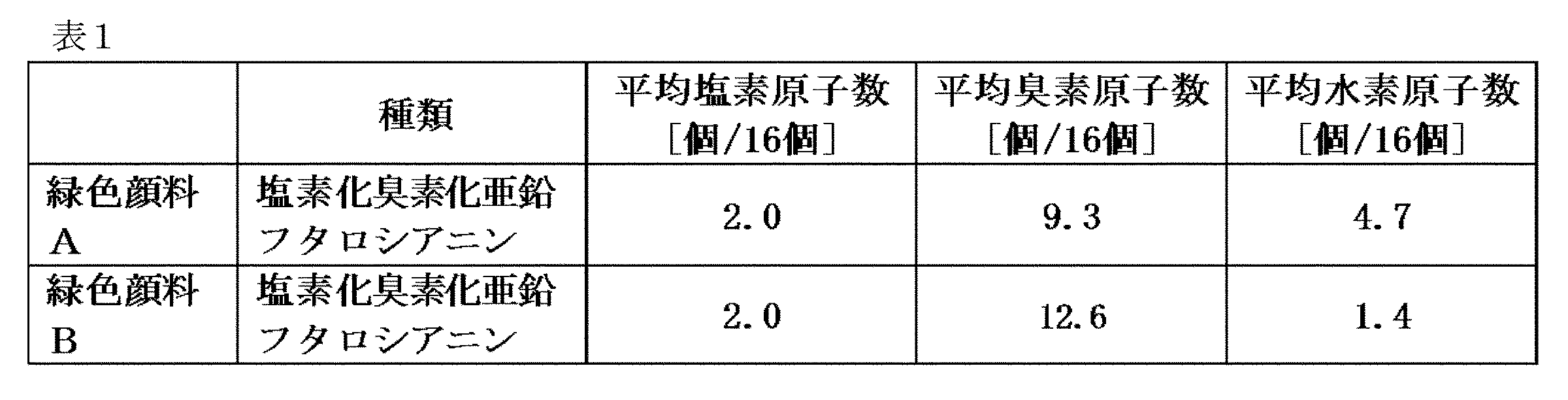

なお、表3中に記載した、緑色顔料A及びBの一分子中に含まれる平均水素原子数は、レーザー脱離イオン化法(Laser Desorption/Ionization、LDI)―質量分析法(Mass Spectrometry、MS)にて測定した値である。測定は、顔料1~3mgを100mgのTHF(テトラヒドロフラン)もしくはNMP(N-メチルピロリドン)に溶解させ、超音波をかけてから、その溶液を数μLプレートへマウントし、BRUKER社製autoflex speedにて反射モード、Positiveモードにて、レーザーパワー:約40%~60%、500shots×3、m/z=300~3000の条件にて行った。また、緑色顔料Aのマススペクトルを図2に、緑色顔料Bのマススペクトルを図3に示す。一分子中に含まれる平均水素原子数は以下の手順で測定した。
まず、マススペクトルにおける最大ピーク強度を基準とし、その40%強度を閾値とした。次いで、該閾値以上のピークを計算対象のピークとし、各々のピークごとにピークトップにおける分子量から水素原子数を算出し、それらを平均することで、平均水素原子数を算出した。

以下の手順にて分散樹脂Aを合成した。
まず、反応槽として冷却管を付けたセパラブルフラスコを準備し、プロピレングリコールモノメチルエーテルアセテート400質量部を仕込み、窒素置換したあと、攪拌しながらオイルバスで加熱して反応槽の温度を90℃まで昇温した。
室温まで冷却し、分散樹脂Aとして、重量平均分子量8000、酸価101mgKOH/gの重合体溶液を得た。
窒素原子含有官能基を有するAブロックと、親溶媒性を有するBブロックからなるメタクリル酸系ABブロック共重合体。下記式(2b)及び(3b)の繰り返し単位を有し、かつ、下記式(1b)の繰り返し単位を有さない。アミン価は120mgKOH/g、酸価は1mgKOH/g以下である。
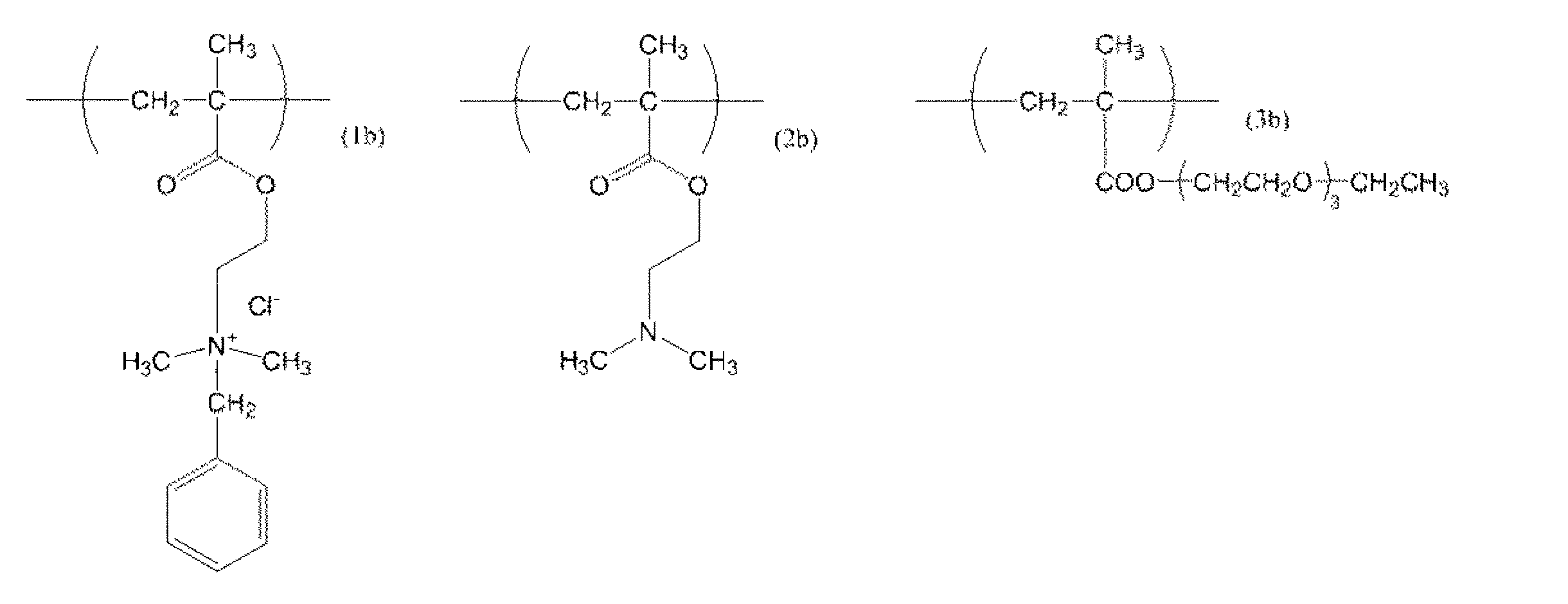
以下の手順にてバインダー樹脂Aを合成した。
プロピレングリコールモノメチルエーテルアセテート145質量部を窒素置換しながら攪拌し120℃に昇温した。ここにスチレン20質量部、グリシジルメタクリレート57質量部およびトリシクロデカン骨格を有するモノアクリレート(日立化成(株)製FA-513M)82質量部を滴下し、更に120℃で2時間攪拌し続けた。次ぎに反応容器内を空気置換に変え、アクリル酸27質量部にトリスジメチルアミノメチルフェノール0.7質量部およびハイドロキノン0.12質量部を投入し、120℃で6時間反応を続けた。その後、テトラヒドロ無水フタル酸(THPA)52質量部、トリエチルアミン0.7質量部を加え、120℃3.5時間反応させた。こうして得られたバインダー樹脂AのGPCにより測定したポリスチレン換算の重量平均分子量Mwは約15000であった。
実施例及び比較例では、光重合開始剤として、下記構造を有する、[9-エチル-6-(1-アセトキシイミノ-4-メチルオキシカルボニルブチル)カルバゾール-3-イル](2-メチルフェニル)ケトンを用いた。

メガファック F-559(DIC社製、フッ素系界面活性剤)
緑色顔料及び溶剤を表4に記載の種類及び量で用い、分散剤として分散剤Aを固形分換算で4.0質量部、分散樹脂として分散樹脂Aを固形分換算で4.0質量部、直径0.5mmのジルコニアビーズ225質量部を用い、それらをステンレス容器に充填し、ペイントシェーカーにて6時間分散させて、実施例1~5及び比較例1~3の緑色顔料分散液を調製した。なお、表4中の沸点は1013.25hPaにおける値、蒸気圧は20℃における値である。また、表4中の溶剤1の配合量は、緑色顔料分散液中に含まれる総量である。
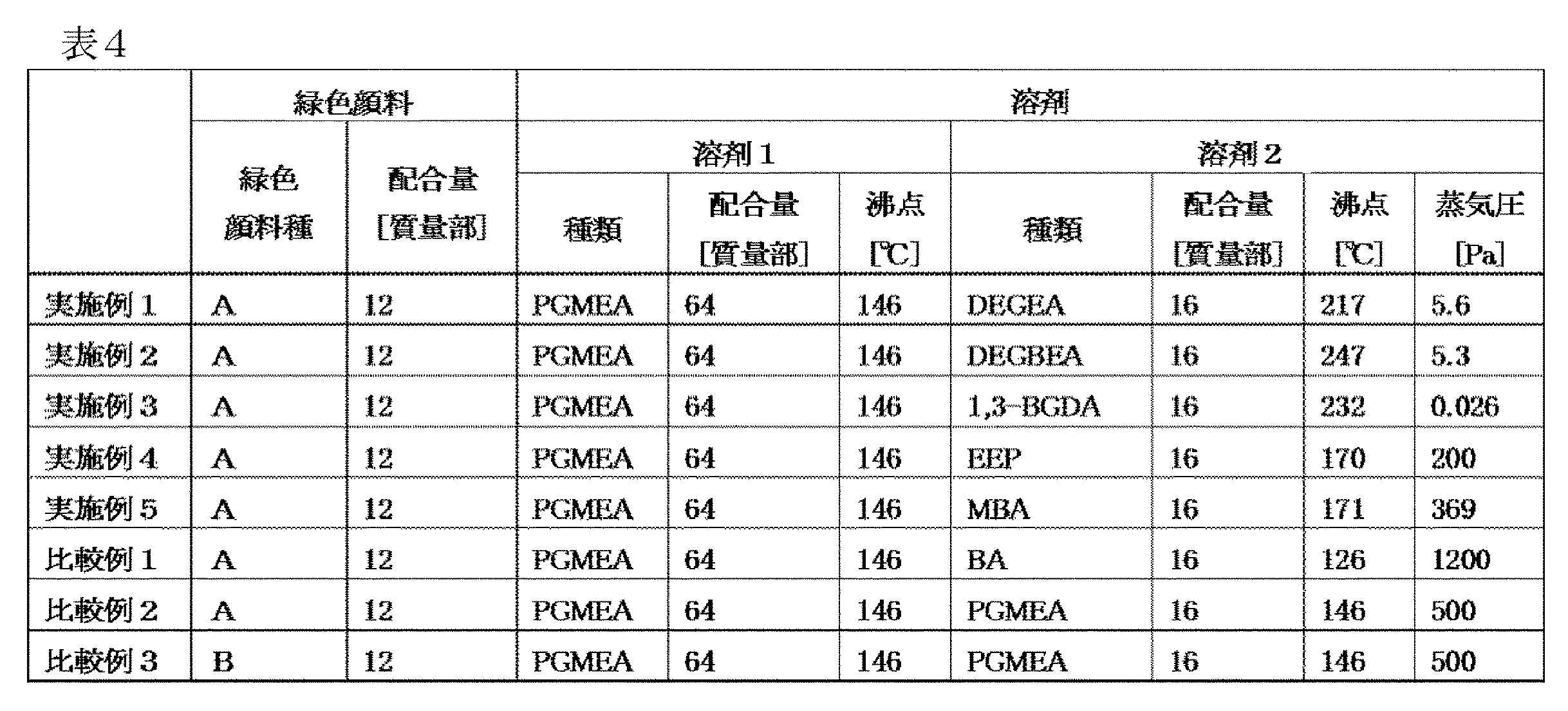
DEGBEA:ジエチレングリコールモノブチルエーテルアセテート
1,3-BGDA:1,3-ブチレングリコールジアセテート
EEP:3-エトキシプロピオン酸エチル
MBA:3-メトキシブチルアセテート
BA:酢酸ブチル(ブチルアセテート)
PGMEA:プロピレングリコールモノメチルエーテルアセテート
前記の各顔料分散液に表5に示す他の成分を混合して、着色樹脂組成物を調製した。なお、表5中のバインダー樹脂及び光重合性モノマーの配合量は固形分換算値であり、溶媒の配合量は、バインダー樹脂及び光重合性モノマーに含まれる溶媒量を含む値である。
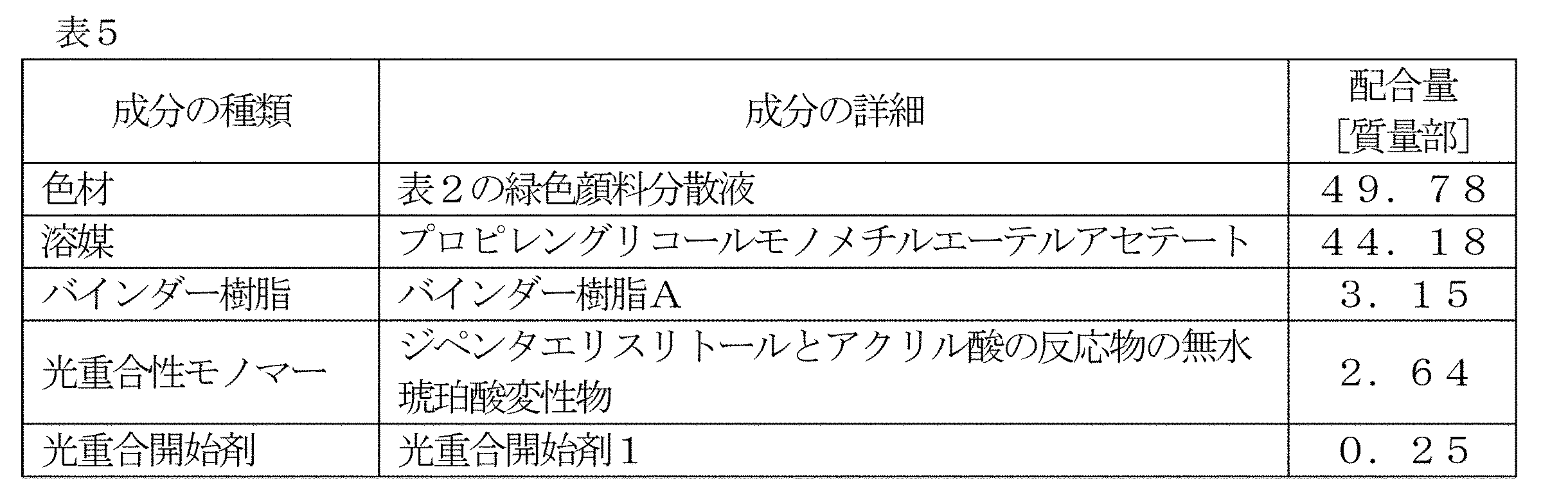
日本国特開2007-270147号公報の実施例に記載の〔塗布適正評価方法(I)〕に準じて評価を実施した。
前述の手順により得られた着色樹脂組成物を、以下に記載する(1)~(4)の工程を経て評価するに当たって、アクチュエータのアームに試験片を取り付け、瓶に満たした着色樹脂組成物にその先端を繰り返し出し入れする操作を、自動的に行う制御装置を使用した。
(1)雰囲気温度23℃で、長さ100mm×幅5mm×厚み0.6mmのガラス試験片の縦方向の先端部分20mmを、12.5mm/秒の速度で着色樹脂組成物中に浸漬し、その後4秒間維持した。
(2)該ガラス試験片を、12.5mm/秒の速度で着色樹脂組成物から取り出し、該ガラス試験片の先端を下にして垂直に保持した後、雰囲気温度23℃、湿度55%、風速0.5±0.2m/秒の条件下で56秒間乾燥させた。
(3)工程(1)及び(2)を合計120回繰り返し、該ガラス試験片に着色樹脂組成物由来の付着物を形成させた。
(4)ガラス片の付着物を顕微鏡にて観察した。その結果を表6に示す。なお、付着物の評価基準は以下のとおりである。また、表6中の( )内の数値は、ガラス片全浸漬面積に対して、付着物で被覆された面積割合(%)を示す。
△:ガラス片全浸漬面積に対して、付着物で被覆された面積割合が0%を超え、かつ、10%未満
×:ガラス片全浸漬面積に対して、付着物で被覆された面積割合が10%以上

他方、沸点が126℃であるBAを用いた比較例1や、沸点が146℃であるPGMEAのみを用いた比較例2では、ガラス片に付着物が非常に多くみられた。
また、緑色顔料Bを用いた比較例3では、沸点が150℃以上の高沸点溶剤を含まないにも関わらず、ガラス片に付着物がほとんど見られないことが確認された。詳細な理由は不明であるが、緑色顔料Bは一分子中に含まれる平均水素原子数が非常に少なく、顔料の濡れ性や吸着性が良好であり、分散剤や分散樹脂の顔料からの脱離が少なく、顔料表面を十分に被覆している為に、溶剤への溶解性が良好であるからだと考えられる。
緑色顔料及び溶剤を表7の種類及び量で用いた以外は実施例1と同様にして、実施例6~11の緑色顔料分散液を調製した。なお、表7中の沸点は1013.25hPaにおける値、蒸気圧は20℃における値である。また、表7中の溶剤1の配合量は、緑色顔料分散液中に含まれる総量である。
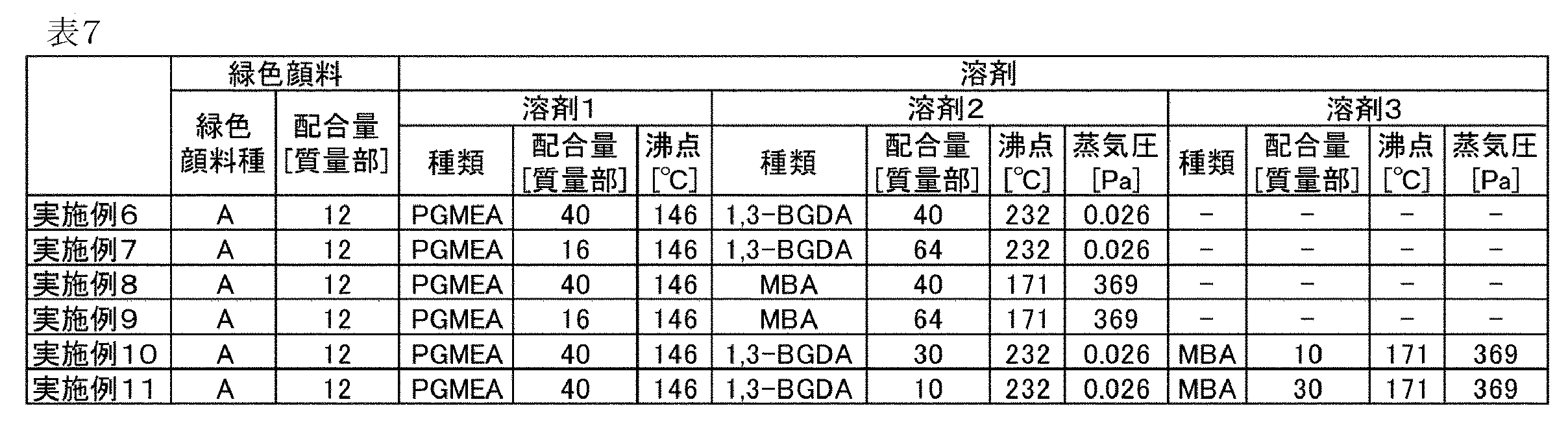
表7の各顔料分散液に表8に示す他の成分を混合して、着色樹脂組成物を調製した。なお、表8中のバインダー樹脂及び光重合性モノマーの配合量は固形分換算値であり、溶媒の配合量は、バインダー樹脂及び光重合性モノマーに含まれる溶媒量を含む値である。

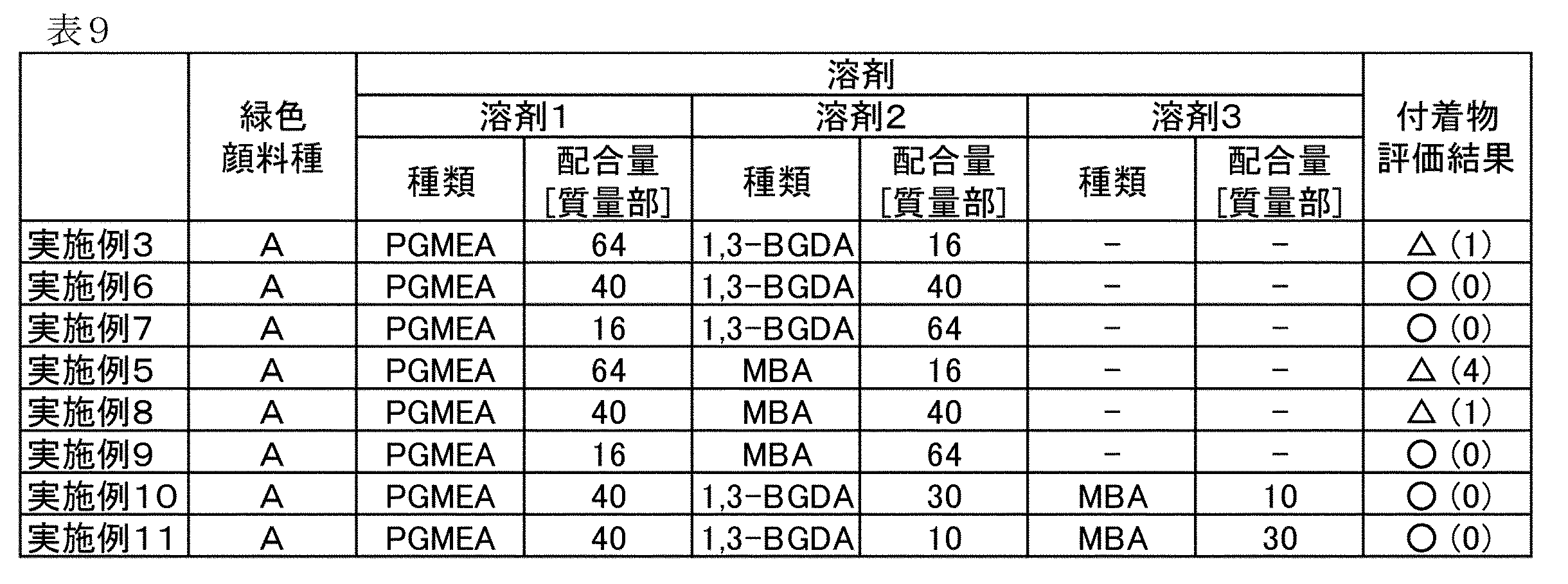
次に、実施例8、比較例2、3及び4の着色樹脂組成物を用いて、高温処理後の膜しわの評価を行った。なお、比較例4は、緑色顔料種を緑色顔料Bに換えた以外は実施例8と同様にして得たものである。
まず、50mm角、厚さ0.6mmのガラス基板(旭硝子社製、AN100)上に、着色樹脂組成物をスピンコーターで塗布した後、80℃で3分間乾燥した。なお、塗布膜厚は、ポストベーク後の色度(sx,sy)がC光源で(0.250,0.580)となるように設定した。次いで、2kW高圧水銀灯により、40mJ/cm2の露光量で全面露光処理を行った。その後、230℃のオーブンにて30分間ポストベークを行った。
また、測定にて得られたプロファイルを図4(実施例8)、図5(比較例2)、図6(比較例4)及び図7(比較例3)に示す。図4~7のプロファイルにおいて、横幅は12800nm、奥行きは6400nmである。なお、各図中に見られる数十個の凹凸が、膜しわに相当する。

表4に記載の比較例2又は比較例3の緑色顔料分散液と、以下に記載の黄色顔料分散液とを用い、顔料分散液の使用量を表11に記載の量に変更した以外は前記<着色樹脂組成物の調製>と同様の方法で、着色樹脂組成物を調製した。なお、顔料分散液の使用量は、膜厚2.00μmの塗膜を作製した際の、C光源における色度がsx=0.280、sy=0.600となるように調整したものである。また、表11に記載の顔料濃度は、着色樹脂組成物の全固形分に対する全顔料の含有割合である。
黄色顔料として黄色顔料Cを固形分換算で12.0質量部、分散剤として分散剤Aを固形分換算で4.0質量部、分散樹脂として分散樹脂Aを固形分換算で4.0質量部、溶剤としてプロピレングリコールモノメチルアセテート80.0質量部、直径0.5mmのジルコニアビーズ225質量部を用い、それらをステンレス容器に充填し、ペイントシェーカーにて6時間分散させて、黄色顔料分散液を調製した。
黄色顔料Cとして、下記式(I)で表されるアゾバルビツール酸のニッケルとの1:1錯体又はその互換異性体に、下記式(II)で表される化合物が挿入されてなるニッケルアゾ錯体(E4GN-GT、ランクセス社製)を用いた。

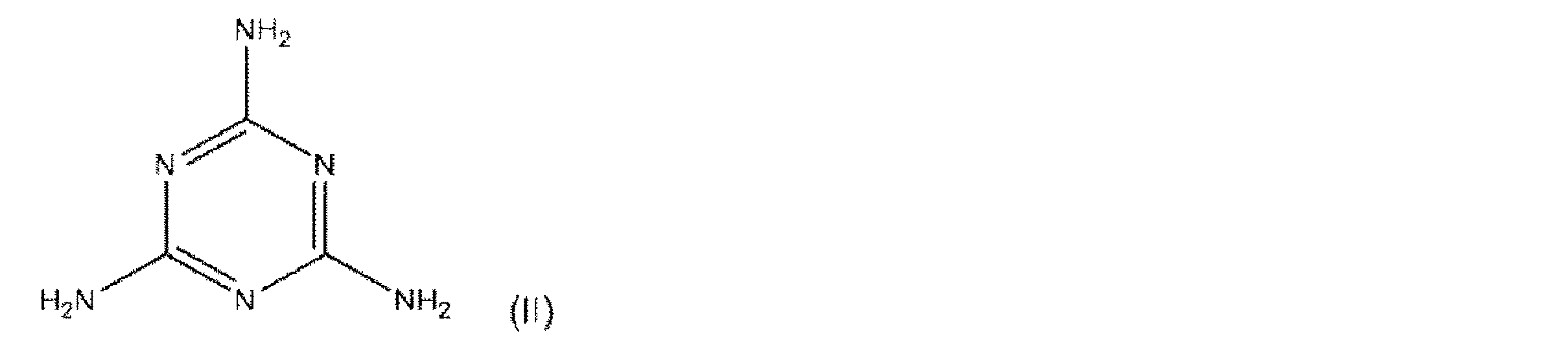
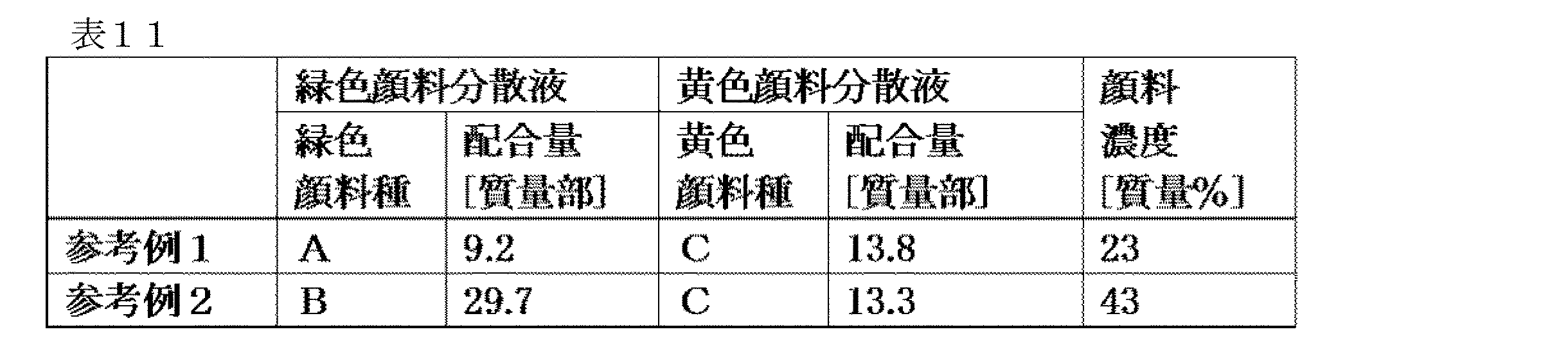
表12に記載の緑色顔料、黄色顔料C、分散剤A、分散樹脂A、溶剤(プロピレングリコールモノメチルエーテルアセテート)と、直径0.5mmのジルコニアビーズ225質量部をステンレス容器に充填し、ペイントシェーカーにて6時間分散させて、緑色顔料分散液A及びBを調製した。なお、表中の「溶剤」以外の成分の配合量は固形分換算値である。

前記の各顔料分散液に表13に示す他の成分を混合して、着色樹脂組成物を調製した。なお、緑色顔料種と光重合開始剤種の組み合わせは、表14に記載の通りとした。
なお、表13中のバインダー樹脂及び光重合性モノマーの配合量は固形分換算値であり、溶媒の配合量は、バインダー樹脂及び光重合性モノマーに含まれる溶媒量を含む値である。


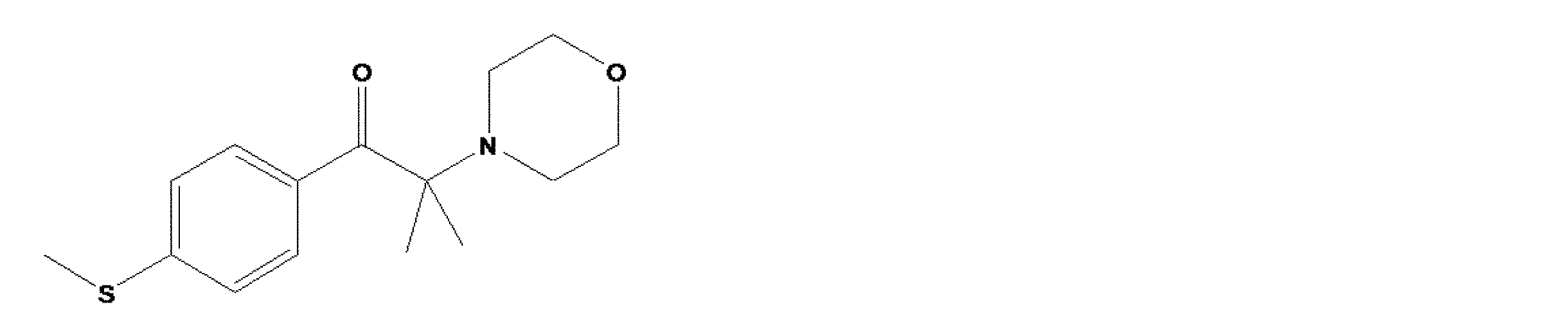
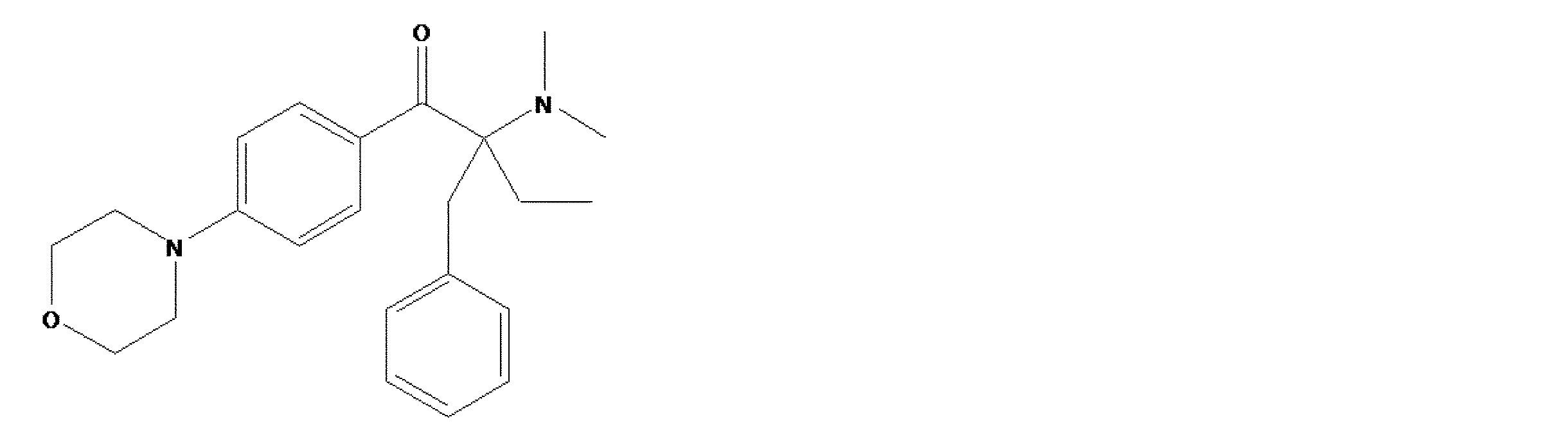
クロムが蒸着されたガラス基板上に、各着色樹脂組成物をそれぞれスピンコート塗布し、80℃のホットプレートにて3分間プリベークを行った。塗布に際してはポストベーク後、塗膜の膜厚が2.0μmとなるように回転数を調整した。
上記手順で得られた直線状パターンを光学顕微鏡で観測し、幅が異なる直線状マスクパターン中で、パターンが基板上に残存しているもののうち、対応するマスクの開口部の幅が最も小さいものを特定し、その開口部の幅を最小密着とした。その結果を表14に示す。
一方で、比較実験例3~5のように緑色顔料Aを用いた場合には、光重合開始剤としてオキシムエステル系化合物以外の開始剤を使用すると最小密着の値が大きく密着性が悪いと言える。他方、実験例1~6のように緑色顔料Aを用いた場合において、光重合開始剤としてオキシムエステル系化合物を使用することで最小密着の値が小さく密着性が良好であった。
緑色顔料Bに比べて、緑色顔料Aはその平均水素原子数が高く、それに伴う光吸収特性の違いに起因して塗膜内部まで十分に光硬化がしにくい傾向にあるが、光重合開始剤として、低波長領域により大きな吸収帯を有するオキシムエステル系化合物を用いることで、塗膜内部まで十分に光硬化ができ、微細なパターンを密着性良く形成することができたと考えられる。
50mm角、厚さ0.6mmのガラス基板(旭硝子社製、AN100)上に、上記着色樹脂組成物をスピンコーターで塗布した後、80℃で3分間乾燥した。次いで、2kW高圧水銀灯により、40mJ/cm2の露光量で全面露光処理を行った。
その後、230℃のオーブンにて30分間ポストベークを行った。
着色力の差が生じる詳細な理由は不明であるが、同じ顔料濃度で透過スペクトルを比較した場合、緑色顔料Aは緑色顔料Bに比べてピークの半値幅が狭くなっているため、赤色や青色の透過光を効果的に遮蔽している為であると考えられる。

10 透明支持基板
20 画素
30 有機保護層
40 無機酸化膜
50 透明陽極
Claims (15)
- (A)顔料、(B)分散剤、(C)溶剤、(D)バインダー樹脂、及び(E)光重合開始剤を含有する着色樹脂組成物であって、
前記(A)顔料が、ハロゲン化亜鉛フタロシアニン顔料を含み、該ハロゲン化亜鉛フタロシアニン顔料の一分子中に含まれる平均水素原子数が3以上であり、かつ、
前記(C)溶剤が、1013.25hPaにおける沸点が150℃以上の高沸点溶剤を含む着色樹脂組成物。 - 前記(C)溶剤が、さらに1013.25hPaにおける沸点が150℃未満の低沸点溶剤を含む、請求項1に記載の着色樹脂組成物。
- 着色樹脂組成物に対する前記(C)溶剤の含有割合が50質量%以上である、請求項1又は2に記載の着色樹脂組成物。
- 前記(C)溶剤に対する前記高沸点溶剤の含有割合が0.5質量%以上である、請求項1~3のいずれか1項に記載の着色樹脂組成物。
- 前記高沸点溶剤の20℃における蒸気圧が400Pa以下である、請求項1~4のいずれか1項に記載の着色樹脂組成物。
- 前記(B)分散剤が、窒素原子を含む官能基を有するブロック共重合体を含む、請求項1~5のいずれか1項に記載の着色樹脂組成物。
- 前記(E)光重合開始剤が、オキシムエステル系化合物を含む、請求項1~6のいずれか1項に記載の着色樹脂組成物。
- 請求項1~7のいずれか1項に記載の着色樹脂組成物を用いて作成した画素を有する、カラーフィルタ。
- 請求項8に記載のカラーフィルタを有する、画像表示装置。
- (A)顔料、(B)分散剤、及び(C)溶剤を含有する顔料分散液であって、
前記(A)顔料が、ハロゲン化亜鉛フタロシアニン顔料を含み、該ハロゲン化亜鉛フタロシアニン顔料の一分子中に含まれる平均水素原子数が3以上であり、かつ、
前記(C)溶剤が、1013.25hPaにおける沸点が150℃以上の高沸点溶剤を含む顔料分散液。 - 前記(C)溶剤が、さらに1013.25hPaにおける沸点が150℃未満の低沸点溶剤を含む、請求項10に記載の顔料分散液。
- 顔料分散液に対する前記(C)溶剤の含有割合が50質量%以上である、請求項10又は11に記載の顔料分散液。
- 前記(C)溶剤に対する前記高沸点溶剤の含有割合が1質量%以上である、請求項10~12のいずれか1項に記載の顔料分散液。
- 前記高沸点溶剤の20℃における蒸気圧が400Pa以下である、請求項10~13のいずれか1項に記載の顔料分散液。
- 前記(B)分散剤が、窒素原子を含む官能基を有するブロック共重合体を含む、請求項10~14のいずれか1項に記載の顔料分散液。
Priority Applications (4)
| Application Number | Priority Date | Filing Date | Title |
|---|---|---|---|
| JP2016555370A JP6119922B2 (ja) | 2015-03-27 | 2016-03-24 | 着色樹脂組成物、カラーフィルタ、及び画像表示装置 |
| CN201910879050.4A CN110618583B (zh) | 2015-03-27 | 2016-03-24 | 着色树脂组合物、滤色片、以及图像显示装置 |
| CN201680016741.6A CN107429078B (zh) | 2015-03-27 | 2016-03-24 | 着色树脂组合物、滤色片、以及图像显示装置 |
| KR1020177026019A KR102491715B1 (ko) | 2015-03-27 | 2016-03-24 | 착색 수지 조성물, 컬러 필터, 및 화상 표시 장치 |
Applications Claiming Priority (8)
| Application Number | Priority Date | Filing Date | Title |
|---|---|---|---|
| JP2015-067187 | 2015-03-27 | ||
| JP2015067187 | 2015-03-27 | ||
| JP2015206474 | 2015-10-20 | ||
| JP2015-206474 | 2015-10-20 | ||
| JP2015207298 | 2015-10-21 | ||
| JP2015-207298 | 2015-10-21 | ||
| JP2016-048419 | 2016-03-11 | ||
| JP2016048419 | 2016-03-11 |
Publications (1)
| Publication Number | Publication Date |
|---|---|
| WO2016158668A1 true WO2016158668A1 (ja) | 2016-10-06 |
Family
ID=57005726
Family Applications (1)
| Application Number | Title | Priority Date | Filing Date |
|---|---|---|---|
| PCT/JP2016/059381 Ceased WO2016158668A1 (ja) | 2015-03-27 | 2016-03-24 | 着色樹脂組成物、カラーフィルタ、及び画像表示装置 |
Country Status (5)
| Country | Link |
|---|---|
| JP (2) | JP6119922B2 (ja) |
| KR (1) | KR102491715B1 (ja) |
| CN (2) | CN110618583B (ja) |
| TW (1) | TWI712653B (ja) |
| WO (1) | WO2016158668A1 (ja) |
Cited By (10)
| Publication number | Priority date | Publication date | Assignee | Title |
|---|---|---|---|---|
| WO2018043548A1 (ja) * | 2016-08-31 | 2018-03-08 | Dic株式会社 | カラーフィルタ用顔料組成物及びカラーフィルタ |
| CN108415220A (zh) * | 2017-02-09 | 2018-08-17 | 东友精细化工有限公司 | 黑色感光性树脂组合物、由其衍生的有机发光元件、量子点发光元件及显示装置 |
| CN108693707A (zh) * | 2017-03-29 | 2018-10-23 | 东友精细化工有限公司 | 黑色感光性树脂组合物及利用其制造的显示装置 |
| CN109814335A (zh) * | 2017-11-21 | 2019-05-28 | 东友精细化工有限公司 | 着色感光性树脂组合物、滤色器和图像显示装置 |
| CN109870877A (zh) * | 2017-11-03 | 2019-06-11 | 东友精细化工有限公司 | 着色感光性树脂组合物、彩色滤光片和图像显示装置 |
| CN110262188A (zh) * | 2018-03-12 | 2019-09-20 | 东友精细化工有限公司 | 绿色感光性树脂组合物、彩色滤光片和图像显示装置 |
| JP2020190665A (ja) * | 2019-05-23 | 2020-11-26 | 東洋インキScホールディングス株式会社 | 固体撮像素子用カラーフィルタの感光性着色組成物、カラーフィルタ、およびそれを用いた固体撮像素子 |
| JP2021096342A (ja) * | 2019-12-17 | 2021-06-24 | 東洋インキScホールディングス株式会社 | カラーフィルタ用着色組成物およびカラーフィルタ |
| WO2025033443A1 (ja) * | 2023-08-07 | 2025-02-13 | 三菱ケミカル株式会社 | 着色剤分散液、着色樹脂組成物、硬化物、カラーフィルタ、液晶表示装置及び有機el表示装置 |
| WO2025047328A1 (ja) * | 2023-08-31 | 2025-03-06 | 株式会社Dnpファインケミカル | 着色組成物、着色硬化膜の製造方法、カラーフィルタの製造方法、並びに表示装置の製造方法 |
Families Citing this family (9)
| Publication number | Priority date | Publication date | Assignee | Title |
|---|---|---|---|---|
| CN113272346B (zh) * | 2019-02-21 | 2025-04-15 | 三菱化学株式会社 | 着色树脂组合物、滤色片、以及图像显示装置 |
| JP2021067706A (ja) * | 2019-10-17 | 2021-04-30 | 三菱ケミカル株式会社 | 顔料分散液及び着色樹脂組成物 |
| CN115516039B (zh) * | 2020-05-22 | 2023-09-15 | 富士胶片株式会社 | 树脂组合物、膜、滤光器、固体摄像元件及图像显示装置 |
| KR102618632B1 (ko) * | 2020-08-26 | 2023-12-27 | 삼성에스디아이 주식회사 | 감광성 수지 조성물, 이를 이용한 감광성 수지막 및 컬러필터 |
| JP7625243B2 (ja) * | 2020-10-16 | 2025-02-03 | 山陽色素株式会社 | 黒色顔料分散体 |
| CN112674423A (zh) * | 2020-12-14 | 2021-04-20 | 东莞市三嘉光学科技有限公司 | 一种具有滤光层的飞行头盔及滤光材料生产方法 |
| JP2023019164A (ja) * | 2021-07-28 | 2023-02-09 | 山陽色素株式会社 | 顔料分散体及び塗膜形成用組成物 |
| CN114085549B (zh) * | 2021-11-16 | 2024-09-10 | 西安思摩威新材料有限公司 | 一种用于彩色滤光片的绿色颜料分散液及其制备方法 |
| KR102761652B1 (ko) * | 2021-11-17 | 2025-01-31 | 삼성에스디아이 주식회사 | 감광성 수지 조성물, 이를 이용하여 제조된 감광성 수지막 및 컬러필터 |
Citations (6)
| Publication number | Priority date | Publication date | Assignee | Title |
|---|---|---|---|---|
| JP2003161821A (ja) * | 2000-12-22 | 2003-06-06 | Mitsubishi Chemicals Corp | カラーフィルター用組成物及びカラーフィルター |
| JP2010163616A (ja) * | 2008-12-19 | 2010-07-29 | Mitsubishi Chemicals Corp | 着色樹脂組成物、カラーフィルタ、液晶表示装置及び有機elディスプレイ |
| JP2012181512A (ja) * | 2011-02-10 | 2012-09-20 | Fujifilm Corp | 着色硬化性組成物およびカラーフィルタ |
| JP2012197369A (ja) * | 2011-03-22 | 2012-10-18 | Mitsubishi Chemicals Corp | 着色樹脂組成物、カラーフィルタ、液晶表示装置及び有機el表示装置 |
| JP2013080204A (ja) * | 2011-09-21 | 2013-05-02 | Jsr Corp | 着色組成物、カラーフィルタ及び表示素子 |
| JP2015191208A (ja) * | 2014-03-28 | 2015-11-02 | 株式会社日本触媒 | カラーフィルター |
Family Cites Families (29)
| Publication number | Priority date | Publication date | Assignee | Title |
|---|---|---|---|---|
| DE60212345T2 (de) * | 2001-02-23 | 2007-05-24 | Dainippon Ink And Chemicals, Inc. | Farbfilter |
| JP4368157B2 (ja) | 2002-07-24 | 2009-11-18 | 大日本印刷株式会社 | カラーフィルター用緑色顔料、緑色顔料分散体、感光性着色組成物、カラーフィルター、及び、液晶パネル |
| US7781129B2 (en) * | 2002-07-24 | 2010-08-24 | Dai Nippon Printing Co., Ltd. | Green pigment for color filter, green pigment dispersion, photosensitive color composition, color filter, and liquid crystal panel |
| JP4368158B2 (ja) | 2002-07-24 | 2009-11-18 | 大日本印刷株式会社 | 感光性着色組成物、カラーフィルター、及び、液晶パネル |
| JP4882515B2 (ja) * | 2006-05-30 | 2012-02-22 | Dic株式会社 | ポリハロゲン化亜鉛フタロシアニン顔料組成物及びカラーフィルタ |
| JP2008122478A (ja) * | 2006-11-08 | 2008-05-29 | Fujifilm Corp | 緑色感光性樹脂組成物、感光性転写材料、カラーフィルタ基板及び表示装置 |
| JP5320760B2 (ja) | 2007-07-27 | 2013-10-23 | 三菱化学株式会社 | カラーフィルタ用着色組成物、カラーフィルタ、及び液晶表示装置 |
| KR101443928B1 (ko) * | 2007-06-21 | 2014-09-29 | 미쓰비시 가가꾸 가부시키가이샤 | 안료 분산액, 컬러 필터용 착색 조성물, 컬러 필터, 액정 표시 장치 및 유기 el 디스플레이 |
| TWI506306B (zh) * | 2007-11-22 | 2015-11-01 | Toyo Ink Mfg Co | 彩色濾光片用綠色著色組成物,及彩色濾光片 |
| JP5316034B2 (ja) | 2008-04-07 | 2013-10-16 | 三菱化学株式会社 | カラーフィルタ用着色組成物、カラーフィルタ、及び液晶表示装置 |
| JP2010049161A (ja) * | 2008-08-25 | 2010-03-04 | Fujifilm Corp | カラーフィルタ用着色組成物、カラーフィルタ、及びカラーフィルタの製造方法 |
| JP5611531B2 (ja) | 2008-09-02 | 2014-10-22 | 富士フイルム株式会社 | 加工顔料、顔料分散組成物、光硬化性組成物、カラーフィルタ、及びカラーフィルタの製造方法 |
| KR20100033928A (ko) * | 2008-09-22 | 2010-03-31 | 후지필름 가부시키가이샤 | 착색 감광성 조성물, 컬러필터, 및 액정 표시 장치 |
| JP5371507B2 (ja) | 2008-09-22 | 2013-12-18 | 富士フイルム株式会社 | 着色感光性組成物、カラーフィルタ、および液晶表示装置 |
| JP2010145858A (ja) * | 2008-12-19 | 2010-07-01 | Mitsubishi Chemicals Corp | カラーフィルタ用着色樹脂組成物、カラーフィルタ、液晶表示装置及び有機elディスプレイ |
| JP5834379B2 (ja) * | 2009-06-25 | 2015-12-24 | Jsr株式会社 | 着色組成物、カラーフィルタ及びカラー液晶表示素子 |
| JP2011068837A (ja) * | 2009-09-28 | 2011-04-07 | Fujifilm Corp | フタロシアニン化合物を含有する緑色顔料分散体 |
| JP2011099974A (ja) | 2009-11-05 | 2011-05-19 | Fujifilm Corp | 着色感光性組成物、カラーフィルタ、及び液晶表示装置 |
| JP2011128589A (ja) * | 2009-11-18 | 2011-06-30 | Fujifilm Corp | 着色感光性樹脂組成物、パターン形成方法、カラーフィルタの製造方法、カラーフィルタ及びそれを備えた表示装置。 |
| JP5554223B2 (ja) * | 2009-12-14 | 2014-07-23 | 富士フイルム株式会社 | 着色感光性組成物、カラーフィルタの製造方法、カラーフィルタ、及び液晶表示装置 |
| JP5726462B2 (ja) * | 2010-09-01 | 2015-06-03 | 富士フイルム株式会社 | 着色感光性組成物、カラーフィルタの製造方法、カラーフィルタ、および液晶表示装置 |
| JP5657405B2 (ja) * | 2010-09-27 | 2015-01-21 | 富士フイルム株式会社 | 着色硬化性組成物、カラーフィルタの製造方法、カラーフィルタ、固体撮像素子、および液晶表示装置 |
| JP2012172003A (ja) * | 2011-02-18 | 2012-09-10 | Fujifilm Corp | 着色組成物の製造方法、着色組成物、カラーフィルタ、液晶表示装置、及び有機el表示装置 |
| JP2013076764A (ja) * | 2011-09-29 | 2013-04-25 | Dainippon Printing Co Ltd | カラーフィルタ用色材分散液、カラーフィルタ用着色樹脂組成物、カラーフィルタ、並びに、液晶表示装置及び有機発光表示装置 |
| CN103403613B (zh) * | 2012-02-01 | 2014-07-30 | Dic株式会社 | 液晶显示装置 |
| JP6024149B2 (ja) * | 2012-03-28 | 2016-11-09 | 大日本印刷株式会社 | カラーフィルター用着色樹脂組成物、カラーフィルター、及び液晶表示装置 |
| JP5612178B2 (ja) * | 2013-07-26 | 2014-10-22 | 富士フイルム株式会社 | カラーフィルタ用着色組成物、カラーフィルタ、及びカラーフィルタの製造方法 |
| CN105388705B (zh) * | 2014-09-01 | 2020-09-22 | 东友精细化工有限公司 | 着色感光性树脂组合物 |
| KR102279575B1 (ko) * | 2015-03-26 | 2021-07-20 | 동우 화인켐 주식회사 | 착색 감광성 수지 조성물, 컬러 필터 및 이를 구비한 화상 표시 장치 |
-
2016
- 2016-03-24 CN CN201910879050.4A patent/CN110618583B/zh active Active
- 2016-03-24 WO PCT/JP2016/059381 patent/WO2016158668A1/ja not_active Ceased
- 2016-03-24 CN CN201680016741.6A patent/CN107429078B/zh active Active
- 2016-03-24 JP JP2016555370A patent/JP6119922B2/ja active Active
- 2016-03-24 KR KR1020177026019A patent/KR102491715B1/ko active Active
- 2016-03-25 TW TW105109409A patent/TWI712653B/zh active
-
2017
- 2017-03-13 JP JP2017047786A patent/JP6891553B2/ja active Active
Patent Citations (6)
| Publication number | Priority date | Publication date | Assignee | Title |
|---|---|---|---|---|
| JP2003161821A (ja) * | 2000-12-22 | 2003-06-06 | Mitsubishi Chemicals Corp | カラーフィルター用組成物及びカラーフィルター |
| JP2010163616A (ja) * | 2008-12-19 | 2010-07-29 | Mitsubishi Chemicals Corp | 着色樹脂組成物、カラーフィルタ、液晶表示装置及び有機elディスプレイ |
| JP2012181512A (ja) * | 2011-02-10 | 2012-09-20 | Fujifilm Corp | 着色硬化性組成物およびカラーフィルタ |
| JP2012197369A (ja) * | 2011-03-22 | 2012-10-18 | Mitsubishi Chemicals Corp | 着色樹脂組成物、カラーフィルタ、液晶表示装置及び有機el表示装置 |
| JP2013080204A (ja) * | 2011-09-21 | 2013-05-02 | Jsr Corp | 着色組成物、カラーフィルタ及び表示素子 |
| JP2015191208A (ja) * | 2014-03-28 | 2015-11-02 | 株式会社日本触媒 | カラーフィルター |
Cited By (13)
| Publication number | Priority date | Publication date | Assignee | Title |
|---|---|---|---|---|
| WO2018043548A1 (ja) * | 2016-08-31 | 2018-03-08 | Dic株式会社 | カラーフィルタ用顔料組成物及びカラーフィルタ |
| CN108415220A (zh) * | 2017-02-09 | 2018-08-17 | 东友精细化工有限公司 | 黑色感光性树脂组合物、由其衍生的有机发光元件、量子点发光元件及显示装置 |
| CN108693707A (zh) * | 2017-03-29 | 2018-10-23 | 东友精细化工有限公司 | 黑色感光性树脂组合物及利用其制造的显示装置 |
| CN109870877A (zh) * | 2017-11-03 | 2019-06-11 | 东友精细化工有限公司 | 着色感光性树脂组合物、彩色滤光片和图像显示装置 |
| CN109814335B (zh) * | 2017-11-21 | 2022-03-04 | 东友精细化工有限公司 | 着色感光性树脂组合物、滤色器和图像显示装置 |
| KR20190058126A (ko) * | 2017-11-21 | 2019-05-29 | 동우 화인켐 주식회사 | 착색 감광성 수지 조성물, 컬러필터 및 화상표시장치 |
| CN109814335A (zh) * | 2017-11-21 | 2019-05-28 | 东友精细化工有限公司 | 着色感光性树脂组合物、滤色器和图像显示装置 |
| KR102397084B1 (ko) | 2017-11-21 | 2022-05-11 | 동우 화인켐 주식회사 | 착색 감광성 수지 조성물, 컬러필터 및 화상표시장치 |
| CN110262188A (zh) * | 2018-03-12 | 2019-09-20 | 东友精细化工有限公司 | 绿色感光性树脂组合物、彩色滤光片和图像显示装置 |
| JP2020190665A (ja) * | 2019-05-23 | 2020-11-26 | 東洋インキScホールディングス株式会社 | 固体撮像素子用カラーフィルタの感光性着色組成物、カラーフィルタ、およびそれを用いた固体撮像素子 |
| JP2021096342A (ja) * | 2019-12-17 | 2021-06-24 | 東洋インキScホールディングス株式会社 | カラーフィルタ用着色組成物およびカラーフィルタ |
| WO2025033443A1 (ja) * | 2023-08-07 | 2025-02-13 | 三菱ケミカル株式会社 | 着色剤分散液、着色樹脂組成物、硬化物、カラーフィルタ、液晶表示装置及び有機el表示装置 |
| WO2025047328A1 (ja) * | 2023-08-31 | 2025-03-06 | 株式会社Dnpファインケミカル | 着色組成物、着色硬化膜の製造方法、カラーフィルタの製造方法、並びに表示装置の製造方法 |
Also Published As
| Publication number | Publication date |
|---|---|
| CN107429078B (zh) | 2019-10-15 |
| KR102491715B1 (ko) | 2023-01-25 |
| CN107429078A (zh) | 2017-12-01 |
| TWI712653B (zh) | 2020-12-11 |
| JP2017167538A (ja) | 2017-09-21 |
| CN110618583A (zh) | 2019-12-27 |
| TW201641611A (zh) | 2016-12-01 |
| JPWO2016158668A1 (ja) | 2017-04-27 |
| KR20170131415A (ko) | 2017-11-29 |
| JP6891553B2 (ja) | 2021-06-18 |
| JP6119922B2 (ja) | 2017-04-26 |
| CN110618583B (zh) | 2024-02-23 |
Similar Documents
| Publication | Publication Date | Title |
|---|---|---|
| JP6119922B2 (ja) | 着色樹脂組成物、カラーフィルタ、及び画像表示装置 | |
| JP6489245B2 (ja) | カラーフィルタ用顔料分散液、カラーフィルタ用着色組成物、カラーフィルタ、及び液晶表示装置 | |
| JP5652510B2 (ja) | 着色樹脂組成物、カラーフィルタ、液晶表示装置及び有機elディスプレイ | |
| JP5092326B2 (ja) | 色材分散液、着色樹脂組成物、カラーフィルタ、及び液晶表示装置 | |
| JP5407199B2 (ja) | 顔料分散液、着色組成物、カラーフィルタ、液晶表示装置及び有機elディスプレイ | |
| JP6707818B2 (ja) | 顔料分散液、着色樹脂組成物、カラーフィルタ、液晶表示装置、及び有機el表示装置 | |
| JP5509553B2 (ja) | 顔料分散体、カラーフィルター用着色組成物、カラーフィルター、液晶表示装置および有機elディスプレイ | |
| JP2008304766A (ja) | カラーフィルター用着色樹脂組成物、カラーフィルター、有機elディスプレイおよび液晶表示装置 | |
| JP5316034B2 (ja) | カラーフィルタ用着色組成物、カラーフィルタ、及び液晶表示装置 | |
| JP2010044243A (ja) | 顔料分散液、カラーフィルタ用着色組成物、カラーフィルタ、液晶表示装置及び有機elディスプレイ | |
| JP6885075B2 (ja) | 着色樹脂組成物、カラーフィルタ、及び画像表示装置 | |
| JP4852935B2 (ja) | 色材分散液、着色樹脂組成物、カラーフィルタ、及び液晶表示装置 | |
| JP6911365B2 (ja) | 着色樹脂組成物、カラーフィルタ、及び画像表示装置 | |
| JP6786932B2 (ja) | 着色樹脂組成物、カラーフィルタ、及び画像表示装置 | |
| JP5381682B2 (ja) | 着色樹脂組成物、カラーフィルタ、液晶表示装置及び有機elディスプレイ | |
| JP2008040109A (ja) | 着色組成物、カラーフィルタ、及び液晶表示装置 |
Legal Events
| Date | Code | Title | Description |
|---|---|---|---|
| ENP | Entry into the national phase |
Ref document number: 2016555370 Country of ref document: JP Kind code of ref document: A |
|
| 121 | Ep: the epo has been informed by wipo that ep was designated in this application |
Ref document number: 16772549 Country of ref document: EP Kind code of ref document: A1 |
|
| ENP | Entry into the national phase |
Ref document number: 20177026019 Country of ref document: KR Kind code of ref document: A |
|
| NENP | Non-entry into the national phase |
Ref country code: DE |
|
| 122 | Ep: pct application non-entry in european phase |
Ref document number: 16772549 Country of ref document: EP Kind code of ref document: A1 |