WO2016136455A1 - 不飽和基含有アルカリ現像性樹脂及びソルダーレジスト用樹脂材料 - Google Patents
不飽和基含有アルカリ現像性樹脂及びソルダーレジスト用樹脂材料 Download PDFInfo
- Publication number
- WO2016136455A1 WO2016136455A1 PCT/JP2016/053771 JP2016053771W WO2016136455A1 WO 2016136455 A1 WO2016136455 A1 WO 2016136455A1 JP 2016053771 W JP2016053771 W JP 2016053771W WO 2016136455 A1 WO2016136455 A1 WO 2016136455A1
- Authority
- WO
- WIPO (PCT)
- Prior art keywords
- resin
- unsaturated group
- mass
- containing alkali
- parts
- Prior art date
- Legal status (The legal status is an assumption and is not a legal conclusion. Google has not performed a legal analysis and makes no representation as to the accuracy of the status listed.)
- Ceased
Links
Images



Classifications
-
- C—CHEMISTRY; METALLURGY
- C08—ORGANIC MACROMOLECULAR COMPOUNDS; THEIR PREPARATION OR CHEMICAL WORKING-UP; COMPOSITIONS BASED THEREON
- C08F—MACROMOLECULAR COMPOUNDS OBTAINED BY REACTIONS ONLY INVOLVING CARBON-TO-CARBON UNSATURATED BONDS
- C08F299/00—Macromolecular compounds obtained by interreacting polymers involving only carbon-to-carbon unsaturated bond reactions, in the absence of non-macromolecular monomers
-
- G—PHYSICS
- G03—PHOTOGRAPHY; CINEMATOGRAPHY; ANALOGOUS TECHNIQUES USING WAVES OTHER THAN OPTICAL WAVES; ELECTROGRAPHY; HOLOGRAPHY
- G03F—PHOTOMECHANICAL PRODUCTION OF TEXTURED OR PATTERNED SURFACES, e.g. FOR PRINTING, FOR PROCESSING OF SEMICONDUCTOR DEVICES; MATERIALS THEREFOR; ORIGINALS THEREFOR; APPARATUS SPECIALLY ADAPTED THEREFOR
- G03F7/00—Photomechanical, e.g. photolithographic, production of textured or patterned surfaces, e.g. printing surfaces; Materials therefor, e.g. comprising photoresists; Apparatus specially adapted therefor
- G03F7/004—Photosensitive materials
- G03F7/027—Non-macromolecular photopolymerisable compounds having carbon-to-carbon double bonds, e.g. ethylenic compounds
-
- C—CHEMISTRY; METALLURGY
- C08—ORGANIC MACROMOLECULAR COMPOUNDS; THEIR PREPARATION OR CHEMICAL WORKING-UP; COMPOSITIONS BASED THEREON
- C08F—MACROMOLECULAR COMPOUNDS OBTAINED BY REACTIONS ONLY INVOLVING CARBON-TO-CARBON UNSATURATED BONDS
- C08F299/00—Macromolecular compounds obtained by interreacting polymers involving only carbon-to-carbon unsaturated bond reactions, in the absence of non-macromolecular monomers
- C08F299/02—Macromolecular compounds obtained by interreacting polymers involving only carbon-to-carbon unsaturated bond reactions, in the absence of non-macromolecular monomers from unsaturated polycondensates
- C08F299/026—Macromolecular compounds obtained by interreacting polymers involving only carbon-to-carbon unsaturated bond reactions, in the absence of non-macromolecular monomers from unsaturated polycondensates from the reaction products of polyepoxides and unsaturated monocarboxylic acids, their anhydrides, halogenides or esters with low molecular weight
- C08F299/028—Macromolecular compounds obtained by interreacting polymers involving only carbon-to-carbon unsaturated bond reactions, in the absence of non-macromolecular monomers from unsaturated polycondensates from the reaction products of polyepoxides and unsaturated monocarboxylic acids, their anhydrides, halogenides or esters with low molecular weight photopolymerisable compositions
-
- C—CHEMISTRY; METALLURGY
- C08—ORGANIC MACROMOLECULAR COMPOUNDS; THEIR PREPARATION OR CHEMICAL WORKING-UP; COMPOSITIONS BASED THEREON
- C08L—COMPOSITIONS OF MACROMOLECULAR COMPOUNDS
- C08L63/00—Compositions of epoxy resins; Compositions of derivatives of epoxy resins
-
- G—PHYSICS
- G03—PHOTOGRAPHY; CINEMATOGRAPHY; ANALOGOUS TECHNIQUES USING WAVES OTHER THAN OPTICAL WAVES; ELECTROGRAPHY; HOLOGRAPHY
- G03F—PHOTOMECHANICAL PRODUCTION OF TEXTURED OR PATTERNED SURFACES, e.g. FOR PRINTING, FOR PROCESSING OF SEMICONDUCTOR DEVICES; MATERIALS THEREFOR; ORIGINALS THEREFOR; APPARATUS SPECIALLY ADAPTED THEREFOR
- G03F7/00—Photomechanical, e.g. photolithographic, production of textured or patterned surfaces, e.g. printing surfaces; Materials therefor, e.g. comprising photoresists; Apparatus specially adapted therefor
- G03F7/004—Photosensitive materials
- G03F7/027—Non-macromolecular photopolymerisable compounds having carbon-to-carbon double bonds, e.g. ethylenic compounds
- G03F7/028—Non-macromolecular photopolymerisable compounds having carbon-to-carbon double bonds, e.g. ethylenic compounds with photosensitivity-increasing substances, e.g. photoinitiators
Definitions
- the present invention relates to an developable, unsaturated group-containing alkali developable resin excellent in heat resistance and dielectric properties in a cured product, a photocurable alkali developable resin composition containing the same, a cured product thereof, and a resin for solder resist
- the present invention relates to a material and a resist member.
- an acid pendant epoxy obtained by further reacting tetrahydrophthalic anhydride with an intermediate obtained by reacting a cresol novolak type epoxy resin, acrylic acid and methacrylic anhydride.
- Acrylates are known (see Patent Document 1 below).
- the acid pendant type epoxy acrylate has high curability by light irradiation and is excellent in developability, but the heat resistance and dielectric properties of the cured product are not sufficient, and it does not satisfy the recent required level.
- An object of the present invention is to provide a cured product, a resin material for solder resist, and a resist member.
- the present inventors reacted polyepoxy compounds, unsaturated monocarboxylic acids, unsaturated monocarboxylic acid anhydrides, and dicarboxylic acid anhydrides as essential raw materials.
- unsaturated group-containing alkali-developable resin a resin having a certain acid value and hydroxyl value is found to be excellent in developability, heat resistance and dielectric properties in a cured product, and the present invention is completed. It came to.
- the present invention is obtained by reacting polyepoxy compound (A), unsaturated monocarboxylic acid (B), unsaturated monocarboxylic acid anhydride (C), and dicarboxylic acid anhydride (D) as essential raw materials.
- the present invention relates to an unsaturated group-containing alkali-developable resin having a molecular structure such that the acid value is in the range of 50 to 80 mgKOH / g and the hydroxyl value is in the range of 19 mgKOH / g or less.
- the present invention further relates to a photocurable alkali developable resin composition containing the unsaturated group-containing alkali developable resin and a photopolymerization initiator.
- the present invention further relates to a resin material for a solder resist containing the unsaturated group-containing alkali-developable resin and a photopolymerization initiator.
- the present invention further relates to a cured product obtained by curing the photocurable alkali developable resin composition.
- the present invention further relates to a resist member using the solder resist resin material.
- an unsaturated group-containing alkali developable resin excellent in developability, heat resistance and dielectric properties in a cured product, a photocurable alkali developable resin composition containing the same, a cured product thereof, and a solder resist Resin material and resist member can be provided.
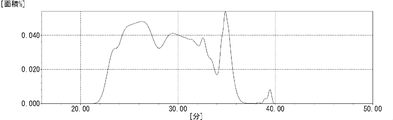
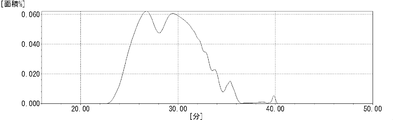
- FIG. 1 is a GPC chart of the unsaturated group-containing alkali developable resin (1) obtained in Example 1.
- FIG. 2 is a GPC chart of the unsaturated group-containing alkali developable resin (2) obtained in Example 2.
- FIG. 3 is a GPC chart of the unsaturated group-containing alkali developable resin (3) obtained in Example 3.
- FIG. 4 is a GPC chart of the unsaturated group-containing alkali developing resin (4) obtained in Example 4.
- FIG. 5 is a GPC chart of the unsaturated group-containing alkali developable resin (5) obtained in Example 5.
- the unsaturated group-containing alkali-developable resin of the present invention requires a polyepoxy compound (A), an unsaturated monocarboxylic acid (B), an unsaturated monocarboxylic acid anhydride (C), and a dicarboxylic acid anhydride (D). It has a molecular structure obtained by reacting as a raw material, has an acid value in the range of 50 to 80 mgKOH / g, and a hydroxyl value in the range of 19 mgKOH / g or less.
- an unsaturated group-containing alkali developable resin for a solder resist it is common to design the acid value of the resin to a high value exceeding 80 mgKOH / in order to improve developability with an alkaline solution.
- the acid value of the resin By setting the acid value of the resin to a relatively low value of 50 to 80 mgKOH / g and the hydroxyl value in the range of 19 mgKOH / g or less, the heat resistance and dielectric properties of the cured product can be maintained while maintaining high developability. It has succeeded in realizing an excellent unsaturated group-containing alkali-developable resin.
- the acid value of the unsaturated group-containing alkali-developable resin of the present invention is in the range of 50 to 80 mgKOH / g, and is excellent in the heat resistance and dielectric properties of the cured product. Therefore, in the range of 55 to 75 mgKOH / g. Preferably there is.
- the acid value of the unsaturated group-containing alkali-developable resin is a value measured by a neutralization titration method of JIS K 0070 (1992).
- the hydroxyl value of unsaturated group containing alkali developable resin is a value measured in the following way.
- a hydroxyl group in an unsaturated group-containing alkali developing resin is reacted with 2-chloro-4,4,5,5-tetramethyldioxaphosphorane to introduce a phosphorus atom.
- (2) The hydroxyl group of cyclohexanol is reacted with 2-chloro-4,4,5,5-tetramethyldioxaphosphorane to introduce a phosphorus atom, which is used as an internal standard.
- any compound having two or more epoxy groups in one molecule can be used.
- examples thereof include a resin, a naphthol-phenol co-condensed novolak type epoxy resin, a naphthol-cresol co-condensed novolak type epoxy resin, a phenol aralkyl type epoxy resin, a naphthol aralkyl type epoxy resin, and a dicyclopentadiene-phenol addition reaction type epoxy resin.
- the polyepoxy compound (A) may be used alone or in combination of two or more. Among them, it is an alkali-developing resin containing an unsaturated group having excellent developability and heat resistance and dielectric properties in a cured product, so that it is a phenol novolac type epoxy resin, a cresol novolak type epoxy resin, a bisphenol novolak type epoxy resin, a naphthol novolak type.
- Novolac type epoxy resins such as epoxy resin, naphthol-phenol co-condensed novolac type epoxy resin, naphthol-cresol co-condensed novolac type epoxy resin and the like are preferable.
- the polyepoxy compound (A) preferably has a softening point in the range of 50 to 120 ° C.
- the unsaturated monocarboxylic acid (B) used in the present invention includes a compound having a (meth) acryloyl group and a carboxy group in one molecule, and examples thereof include acrylic acid and methacrylic acid.
- the unsaturated monocarboxylic acid (B) may be used alone or in combination of two or more.
- Examples of the unsaturated monocarboxylic acid anhydride (C) used in the present invention include acid anhydrides of compounds having a (meth) acryloyl group and a carboxy group in one molecule, such as acrylic acid anhydride and methacrylic acid. An anhydride etc. are mentioned.
- the unsaturated monocarboxylic acid anhydride (C) may be used alone or in combination of two or more.
- Any dicarboxylic acid anhydride (D) may be used as long as it is an acid anhydride of a compound having two carboxy groups in one molecule.
- oxalic acid, malonic acid, succinic acid, glutaric acid, adipic acid, pimelic acid, suberic acid, azelaic acid, sebacic acid, maleic acid, fumaric acid, phthalic acid, isophthalic acid, terephthalic acid, tetrahydrophthalic acid examples thereof include acid anhydrides of dicarboxylic acid compounds such as hexahydrophthalic acid and methylhexahydrophthalic acid.
- Each of the dicarboxylic acid anhydrides (D) may be used alone or in combination of two or more. Among them, since it becomes an unsaturated group-containing alkali-developable resin with excellent heat resistance in cured products, it has a molecular structure such as phthalic acid, isophthalic acid, terephthalic acid, tetrahydrophthalic acid, hexahydrophthalic acid, methylhexahydrophthalic acid, etc. An acid anhydride having a cyclic structure is preferred.
- the unsaturated group-containing alkali developable resin of the present invention comprises the polyepoxy compound (A), the unsaturated monocarboxylic acid (B), the unsaturated monocarboxylic acid anhydride (C), and the dicarboxylic acid anhydride (D). It has a molecular structure obtained by reacting as an essential raw material.
- the reaction ratio of the polyepoxy compound (A), the unsaturated monocarboxylic acid (B), and the unsaturated monocarboxylic acid anhydride (C) is unsaturated with respect to 1 mol of the epoxy group in the polyepoxy compound (A). It is preferable to use the monocarboxylic acid (B) and the unsaturated monocarboxylic anhydride (C) in a total range of 0.9 to 1.1 mol.
- the unsaturated carboxylic acid (B) and the unsaturated carboxylic acid anhydride are excellent because of the balance between the developability of the resulting unsaturated group-containing alkali-developable resin and the heat resistance and dielectric properties of the cured product.
- the molar ratio [(B) / (C)] to the product (C) is more preferably in the range of 0.5 to 1.4.
- the reaction rate of the dicarboxylic acid anhydride (D) is preferably in the range of 0.9 to 1.1 mol per 1 mol of the unsaturated carboxylic acid (B).
- the reaction method of each raw material component of the unsaturated group-containing alkali-developing resin is not particularly limited.
- the polyepoxy compound (A), the unsaturated monocarboxylic acid (B), and the unsaturated monoester are used.
- a method of reacting the carboxylic acid anhydride (C) to obtain an intermediate (M) and then reacting the dicarboxylic acid anhydride (D) can be mentioned.
- the reaction for obtaining the intermediate (M) is performed, for example, in an organic solvent in the presence of an esterification reaction catalyst, an antioxidant, and a polymerization inhibitor at a temperature range of 100 to 150 ° C. for about 5 to 12 hours.
- an esterification reaction catalyst for example, an antioxidant, and a polymerization inhibitor at a temperature range of 100 to 150 ° C. for about 5 to 12 hours.
- the reaction between the obtained intermediate (M) and the dicarboxylic acid anhydride (D) is performed, for example, by adding the dicarboxylic acid anhydride (D) to the reaction system containing the obtained intermediate (M). And a reaction in the temperature range of 90 to 120 ° C. for about 1 to 5 hours.
- the unsaturated group-containing alkali-developable resin of the present invention has an unsaturated group derived from the unsaturated carboxylic acid (B) or the unsaturated monocarboxylic anhydride (C) in the molecular structure.
- an initiator By adding an initiator, a photocurable alkali-developable resin composition can be obtained.
- photopolymerization initiator examples include 1-hydroxycyclohexyl phenyl ketone, 2-hydroxy-2-methyl-1-phenylpropan-1-one, and 1- [4- (2-hydroxyethoxy) phenyl] -2.
- the amount of the photopolymerization initiator added is, for example, in the range of 1 to 20 parts by mass with respect to 100 parts by mass of the alkali developing resin.
- the photocurable alkali developable resin composition of the present invention contains various additives such as inorganic fine particles and polymer fine particles, pigments, antifoaming agents, viscosity modifiers, leveling agents, flame retardants, and storage stabilizers. You may do it.
- the unsaturated group-containing alkali-developable resin of the present invention has high developability and is excellent in heat resistance and dielectric properties in a cured product, and therefore can be suitably used for solder resist applications.
- the resin material for solder resist of the present invention includes, for example, each component such as a curing agent, a curing accelerator, and an organic solvent in addition to the unsaturated group-containing alkali-developable resin, the photopolymerization initiator, and various additives. Become.
- the curing agent is not particularly limited as long as it has a functional group capable of reacting with a carboxy group in the unsaturated group-containing alkali developing resin, and examples thereof include an epoxy resin.
- examples of the epoxy resin used here include bisphenol type epoxy resin, phenylene ether type epoxy resin, naphthylene ether type epoxy resin, biphenyl type epoxy resin, triphenylmethane type epoxy resin, phenol novolac type epoxy resin, and cresol novolac type epoxy resin.
- Bisphenol novolac type epoxy resin, naphthol novolak type epoxy resin, naphthol-phenol co-condensed novolac type epoxy resin, naphthol-cresol co-condensed novolac type epoxy resin, phenol aralkyl type epoxy resin, naphthol aralkyl type epoxy resin, dicyclopentadiene-phenol Examples include addition reaction type epoxy resins. These may be used alone or in combination of two or more. Among these epoxy resins, phenolic novolac type epoxy resins, cresol novolac type epoxy resins, bisphenol novolac type epoxy resins, naphthol novolak type epoxy resins, naphthol-phenol co-condensed novolak type epoxy resins are excellent in heat resistance in cured products. Novolak type epoxy resins such as naphthol-cresol co-condensed novolak type epoxy resins are preferable, and those having a softening point in the range of 50 to 120 ° C. are particularly preferable.
- the curing accelerator accelerates the curing reaction of the curing agent.
- a phosphorus compound, a tertiary amine, an imidazole, an organic acid metal salt, a Lewis acid examples include amine complex salts. These may be used alone or in combination of two or more.
- the addition amount of the curing accelerator is, for example, in the range of 1 to 10 parts by mass with respect to 100 parts by mass of the curing agent.
- the organic solvent is not particularly limited as long as it can dissolve various components such as the unsaturated group-containing alkali-developable resin and the curing agent.
- methyl ethyl ketone, acetone, dimethylformamide, methyl isobutyl ketone, methoxypropanol examples include cyclohexanone, methyl cellosolve, diethylene glycol monoethyl ether acetate, and propylene glycol monomethyl ether acetate.
- the method of obtaining a resist member using the solder resist resin material of the present invention is, for example, by applying the solder resist resin material on a substrate and evaporating and drying the organic solvent in a temperature range of about 60 to 100 ° C. Thereafter, there is a method in which a non-exposed portion is exposed with an ultraviolet solution or an electron beam through a photomask having a desired pattern formed, and an unexposed portion is developed with an alkaline aqueous solution, and further heated and cured in a temperature range of about 140 to 180 ° C. .
- Measuring device “HLC-8220 GPC” manufactured by Tosoh Corporation Column: Guard column “HXL-L” manufactured by Tosoh Corporation + “TSK-GEL G5000HXL” manufactured by Tosoh Corporation + “TSK-GEL G4000HXL” manufactured by Tosoh Corporation + Tosoh Corporation “TSK-GEL G3000HXL” + “TSK-GEL G2000HXL” manufactured by Tosoh Corporation Detector: RI (Differential refraction diameter)
- Data processing “GPC-8020 Model II version 4.10” manufactured by Tosoh Corporation Measurement conditions: Column temperature 40 ° C Developing solvent Tetrahydrofuran Flow rate 1.0 ml / min Standard: The following monodisperse polystyrene having a known molecular weight was used according to the measurement manual of “GPC-8020 model II version 4.10”.
- the acid value of the unsaturated group-containing alkali-developable resin was measured by the neutralization titration method of JIS K 0070 (1992).
- the hydroxyl value of the unsaturated group-containing alkali developable resin was measured in the following manner.
- a hydroxyl group in an unsaturated group-containing alkali developing resin is reacted with 2-chloro-4,4,5,5-tetramethyldioxaphosphorane to introduce a phosphorus atom.
- 2-chloro-4,4,5,5-tetramethyldioxaphosphorane is reacted with 2-chloro-4,4,5,5-tetramethyldioxaphosphorane to introduce a phosphorus atom.
- a cyclohexanol hydroxyl group prepared by reacting with 2-chloro-4,4,5,5-tetramethyldioxaphosphorane to introduce a phosphorus atom is prepared.
- the internal standard obtained in (2) is added to the sample obtained in (1), and the spectrum is measured by 31P-NMR under the following conditions.
- the hydroxyl value of the unsaturated group-containing alkali developing resin is calculated from the peak height of the obtained 31-NMR spectrum.
- Example 1 Production of unsaturated group-containing alkali-developable resin (1) In a flask equipped with a thermometer, a stirrer, and a reflux condenser, 114 parts by mass of diethylene glycol monoethyl ether acetate was added, and an ortho-cresol novolac epoxy resin ( 428 parts by mass of “EPICLON N-680” (epoxy equivalent 214 g / equivalent, softening point 86 ° C.) manufactured by DIC Corporation, 4.5 parts by mass of dibutylhydroxytoluene as an antioxidant, and methoquinone 0.5 as a thermal polymerization inhibitor After adding parts by mass, 85 parts by mass of acrylic acid, 134 parts by mass of methacrylic anhydride (purity 94% by mass), and 1.8 parts by mass of triphenylphosphine are added and reacted at 120 ° C.
- an ortho-cresol novolac epoxy resin 428 parts by mass of “EPICLON N-680” (e
- an unsaturated group-containing alkali developing resin (1) solution solid content: 70% by mass.
- the solid content acid value of the unsaturated group-containing alkali-developable resin (1) was 80 mgKOH / g, and the hydroxyl value was 18.5 mgKOH / g.
- the molar ratio [(B) / (C)] of acrylic acid (B) to methacrylic anhydride (C) is 1.36.
- Example 3 Production of unsaturated group-containing alkali-developable resin (3) A flask equipped with a thermometer, a stirrer, and a reflux condenser was charged with 162 parts by mass of diethylene glycol monoethyl ether acetate, and an ortho-cresol novolac epoxy resin ( 430 parts by mass of “EPICLON N-695” (Equipment equivalent: 215 g / equivalent, softening point: 97 ° C.) manufactured by DIC Corporation, 1.6 parts by mass of dibutylhydroxytoluene as an antioxidant, and hydroquinone 0.3 as a thermal polymerization inhibitor After adding parts by mass, 85 parts by mass of acrylic acid, 134 parts by mass of methacrylic anhydride (purity 94% by mass), and 3.2 parts by mass of triphenylphosphine are added and reacted at 120 ° C.
- an ortho-cresol novolac epoxy resin 430 parts by mass of “EPICLON N-695” (Equipment
- Example 4 Production of unsaturated group-containing alkali-developable resin (4)
- a flask equipped with a thermometer, a stirrer, and a reflux condenser was charged with 168 parts by weight of diethylene glycol monoethyl ether acetate, and an ortho-cresol novolac epoxy resin ( DIC Corporation “EPICLON N-695” epoxy equivalent 215 g / equivalent, softening point 97 ° C.) 430 parts by mass is dissolved, 1.7 parts by mass of dibutylhydroxytoluene as an antioxidant, and 0.3 parts by mass of hydroquinone as a thermal polymerization inhibitor Then, 68 parts by mass of acrylic acid, 174 parts by mass of methacrylic anhydride (purity 94% by mass) and 3.4 parts by mass of triphenylphosphine were added and reacted at 120 ° C.
- an ortho-cresol novolac epoxy resin DIC Corporation “EPICLON N-695” epoxy equivalent 215 g
- Example 5 Production of unsaturated group-containing alkali-developable resin (5)
- a flask equipped with a thermometer, a stirrer, and a reflux condenser was charged with 173 parts by mass of diethylene glycol monoethyl ether acetate, and an ortho-cresol novolac epoxy resin ( DIC Corporation “EPICLON N-695” epoxy equivalent 215 g / equivalent, softening point 97 ° C.) 430 parts by mass is dissolved, 1.7 parts by mass of dibutylhydroxytoluene as an antioxidant, and 0.3 parts by mass of hydroquinone as a thermal polymerization inhibitor After adding parts, 52 parts by mass of acrylic acid, 210 parts by mass of methacrylic anhydride (purity 94% by mass) and 3.5 parts by mass of triphenylphosphine were added and reacted at 120 ° C.
- an ortho-cresol novolac epoxy resin DIC Corporation “EPICLON N-695” epoxy equivalent 215 g
- the unsaturated group-containing alkali-developable resin (2 ′) had a solid content acid value of 85 mgKOH / g and a hydroxyl value of 19.2 mgKOH / g.
- molar ratio [(B) / (C)] of acrylic acid (B) and methacrylic anhydride (C) is 2.20.
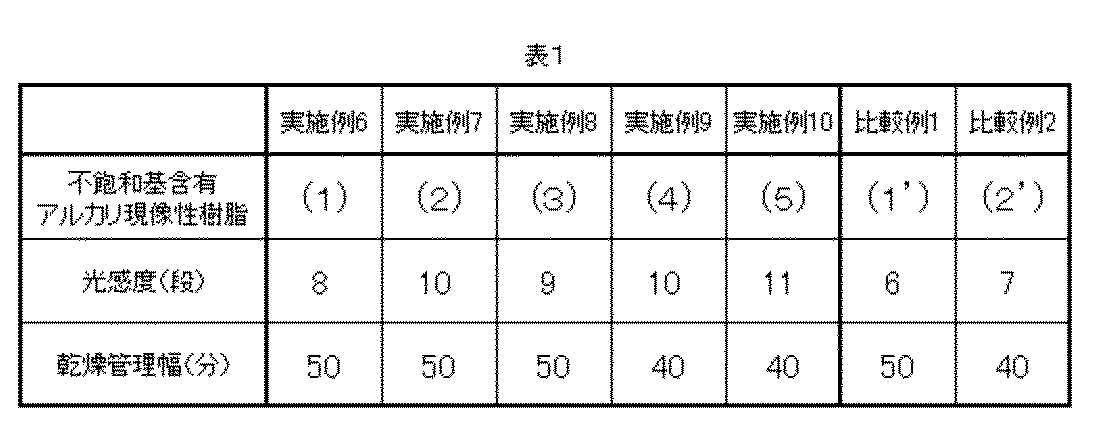
- Example 6 Evaluation of developability A photocurable alkali-developable resin composition (1-1) was prepared in the following manner, and as an evaluation of developability, photosensitivity and drying control width were evaluated.
- photocurable alkali-developable resin composition 100 parts by mass of the unsaturated group-containing alkali-developable resin (1) solution obtained in Example 1, and an ortho-cresol novolac-type epoxy resin (“EPICLON” manufactured by DIC Corporation) N-680 ”), 24 parts by mass, and 2-methyl-1- (4-methylthiophenyl) -2-morpholinopropan-1-one (“ Irgacure 907 ”manufactured by BASF) as a photopolymerization initiator , 0.5 parts by mass of 2-ethyl-4-methylimidazole as a curing accelerator, 13 parts by mass of diethylene glycol monoethyl ether acetate as an organic solvent, and 0.65 parts by mass of phthalocyanine green as a pigment are kneaded by a roll mill.
- a photocurable alkali-developable resin composition (1-1) was obtained.
- Step Tablet No. 2 was irradiated with ultraviolet rays of 750 mJ / cm 2 using a metal halide lamp. This was developed with a 1% by mass aqueous sodium carbonate solution for 180 seconds and evaluated by the number of remaining steps. The greater the number of remaining stages, the higher the photosensitivity.
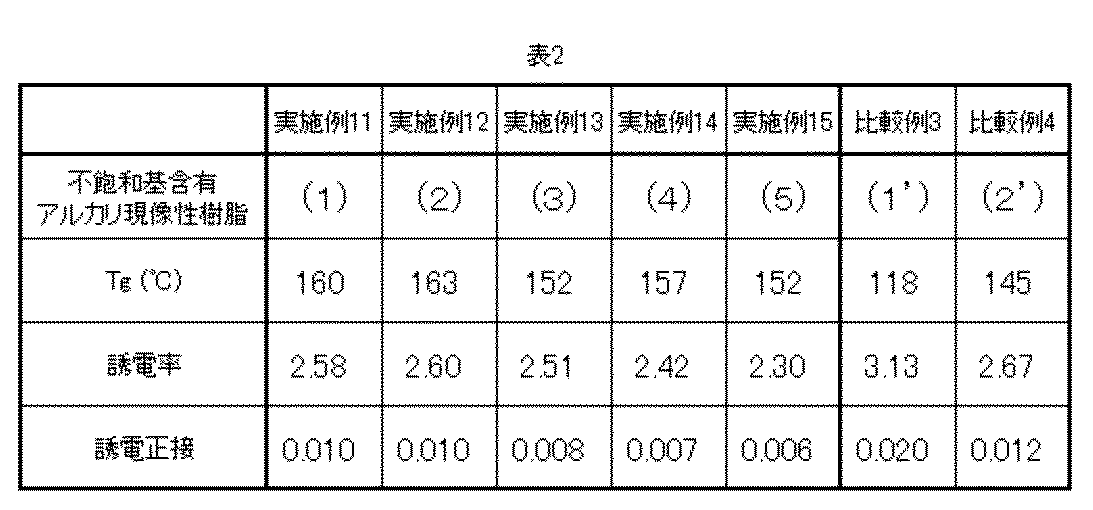
- Example 11 Evaluation of Cured Product A photocurable alkali-developable resin composition (1-2) was prepared in the following manner, and the heat resistance and dielectric properties of the cured product were evaluated.
- photocurable alkali-developable resin composition 100 parts by mass of the unsaturated group-containing alkali-developable resin (1) solution obtained in Example 1, and an ortho-cresol novolac-type epoxy resin (“EPICLON” manufactured by DIC Corporation) N-680 ”), 24 parts by mass, 2-methyl-1- (4-methylthiophenyl) -2-morpholinopropan-1-one (“ Irgacure 907 ”manufactured by BASF) as a photopolymerization initiator
- 2-ethyl-4-methylimidazole as a curing accelerator
- 13 parts by mass of diethylene glycol monoethyl ether acetate as an organic solvent were blended and kneaded by a roll mill (photocurable alkali-developable resin composition ( 1-2) was obtained.
Landscapes
- Physics & Mathematics (AREA)
- Chemical & Material Sciences (AREA)
- Spectroscopy & Molecular Physics (AREA)
- General Physics & Mathematics (AREA)
- Health & Medical Sciences (AREA)
- Chemical Kinetics & Catalysis (AREA)
- Medicinal Chemistry (AREA)
- Polymers & Plastics (AREA)
- Organic Chemistry (AREA)
- Materials For Photolithography (AREA)
- Macromonomer-Based Addition Polymer (AREA)
- Epoxy Resins (AREA)
Abstract
Description
本発明の不飽和基含有アルカリ現像性樹脂は、ポリエポキシ化合物(A)、不飽和モノカルボン酸(B)、不飽和モノカルボン酸無水物(C)、及びジカルボン酸無水物(D)を必須の原料として反応させて得られる分子構造を有し、酸価が50~80mgKOH/gの範囲であり、かつ、水酸基価が19mgKOH/g以下の範囲であることを特徴とする。
(1)不飽和基含有アルカリ現像性樹脂中の水酸基を2-クロロ-4,4,5,5-テトラメチルジオキサホスホランと反応させリン原子を導入する。[下記式(1)参照]
(2)シクロヘキサノールの水酸基を2-クロロ-4,4,5,5-テトラメチルジオキサホスホランと反応させリン原子を導入し、これを内部標準とする。[下記式(1)参照]
(3)(1)で得たサンプルに(2)で得た内部標準を添加し、下記条件の31P-NMRにてスペクトルを測定する。
(4)得られた31-NMRスペクトルのピーク高さから不飽和基含有アルカリ現像性樹脂の水酸基価を算出する。
[31P-NMR測定条件]
装置名:日本電子社製『JNM-ECA500』
測定法:逆ゲート付きデカップリング
積算回数:2000回
試料濃度:約40mg/ml

なお、実施例で得た不飽和基含有アルカリ現像性樹脂のGPCチャートは、下記条件のゲルパーミエーションクロマトグラフ(GPC)にて測定した。
カラム:東ソー株式会社製ガードカラム「HXL-L」
+東ソー株式会社製「TSK-GEL G5000HXL」
+東ソー株式会社製「TSK-GEL G4000HXL」
+東ソー株式会社製「TSK-GEL G3000HXL」
+東ソー株式会社製「TSK-GEL G2000HXL」
検出器: RI(示差屈折径)
データ処理:東ソー株式会社製「GPC-8020モデルIIバージョン4.10」
測定条件: カラム温度 40℃
展開溶媒 テトラヒドロフラン
流速 1.0ml/分
標準 : 前記「GPC-8020モデルIIバージョン4.10」の測定マニュアルに準拠して、分子量が既知の下記の単分散ポリスチレンを用いた。
東ソー株式会社製「A-500」
東ソー株式会社製「A-1000」
東ソー株式会社製「A-2500」
東ソー株式会社製「A-5000」
東ソー株式会社製「F-1」
東ソー株式会社製「F-2」
東ソー株式会社製「F-4」
東ソー株式会社製「F-10」
東ソー株式会社製「F-20」
東ソー株式会社製「F-40」
東ソー株式会社製「F-80」
東ソー株式会社製「F-128」
試料 : 樹脂固形分換算で1.0質量%のテトラヒドロフラン溶液をマイクロフィルターでろ過したもの(50μl)。
(1)不飽和基含有アルカリ現像性樹脂中の水酸基を2-クロロ-4,4,5,5-テトラメチルジオキサホスホランと反応させリン原子を導入する。
(2)内部標準としてシクロヘキサノールの水酸基を2-クロロ-4,4,5,5-テトラメチルジオキサホスホランと反応させリン原子を導入したものを用意する。
(3)(1)で得たサンプルに(2)で得た内部標準を添加し、下記条件の31P-NMRにてスペクトルを測定する。
(4)得られた31-NMRスペクトルのピーク高さから不飽和基含有アルカリ現像性樹脂の水酸基価を算出する。
[31P-NMR測定条件]
装置名:日本電子社製『JNM-ECA500』
測定法:逆ゲート付きデカップリング
積算回数:2000回
試料濃度:約40mg/ml
温度計、攪拌器、及び還流冷却器を備えたフラスコに、ジエチレングリコールモノエチルエーテルアセテート114質量部を入れ、オルソクレゾールノボラック型エポキシ樹脂(DIC株式会社製『EPICLON N-680』エポキシ当量214g/当量、軟化点86℃)428質量部を溶解させ、酸化防止剤としてジブチルヒドロキシトルエン4.5質量部、熱重合禁止剤としてメトキノン0.5質量部を加えた後、アクリル酸85質量部、無水メタクリル酸(純度94質量%)134質量部、トリフェニルフォスフィン1.8質量部を添加し、空気を吹き込みながら120℃で10時間反応させた。次いで、ジエチレングリコールモノエチルエーテルアセテート240質量部、テトラヒドロ無水フタル酸179質量部を加え、110℃で2.5時間反応させ、不飽和基含有アルカリ現像性樹脂(1)溶液(固形分70質量%)を得た。不飽和基含有アルカリ現像性樹脂(1)の固形分酸価は80mgKOH/g、水酸基価は18.5mgKOH/gであった。なお、アクリル酸(B)と無水メタクリル酸(C)とのモル比[(B)/(C)]は1.36。
温度計、攪拌器、及び還流冷却器を備えたフラスコに、ジエチレングリコールモノエチルエーテルアセテート106質量部を入れ、ビスフェノールFノボラック型エポキシ樹脂(DIC株式会社製『EPICLON N-570』エポキシ当量187g/当量、軟化点68℃)374質量部を溶解させ、酸化防止剤としてジブチルヒドロキシトルエン4.2質量部、熱重合禁止剤としてメトキノン0.4質量部を加えた後、アクリル酸79質量部、無水メタクリル酸(純度94質量%)148質量部、トリフェニルフォスフィン1.6質量部を添加し、空気を吹き込みながら120℃で10時間反応させた。次いで、ジエチレングリコールモノエチルエーテルアセテート223質量部、テトラヒドロ無水フタル酸167質量部を加え、110℃で2.5時間反応させ、不飽和基含有アルカリ現像性樹脂(2)溶液(固形分70質量%)を得た。不飽和基含有アルカリ現像性樹脂(2)の固形分酸価は80mgKOH/g、水酸基価は16.3mgKOH/gであった。なお、アクリル酸(B)と無水メタクリル酸(C)とのモル比[(B)/(C)]は1.14。
温度計、攪拌器、及び還流冷却器を備えたフラスコに、ジエチレングリコールモノエチルエーテルアセテート162質量部を入れ、オルソクレゾールノボラック型エポキシ樹脂(DIC株式会社製『EPICLON N-695』エポキシ当量215g/当量、軟化点97℃)430質量部を溶解させ、酸化防止剤としてジブチルヒドロキシトルエン1.6質量部、熱重合禁止剤としてハイドロキノン0.3質量部を加えた後、アクリル酸85質量部、無水メタクリル酸(純度94質量%)134質量部、トリフェニルフォスフィン3.2質量部を添加し、空気を吹き込みながら120℃で8時間反応させた。次いで、ジエチレングリコールモノエチルエーテルアセテート284質量部、テトラヒドロ無水フタル酸179質量部を加え、110℃で2.5時間反応させ、不飽和基含有アルカリ現像性樹脂(3)溶液(固形分65質量%)を得た。不飽和基含有アルカリ現像性樹脂(3)の固形分酸価は80mgKOH/g、水酸基価は12.3mgKOH/gであった。なお、アクリル酸(B)と無水メタクリル酸(C)とのモル比[(B)/(C)]は1.36。
温度計、攪拌器、及び還流冷却器を備えたフラスコに、ジエチレングリコールモノエチルエーテルアセテート168質量部を入れ、オルソクレゾールノボラック型エポキシ樹脂(DIC株式会社『EPICLON N-695』エポキシ当量215g/当量、軟化点97℃)430質量部を溶解させ、酸化防止剤としてジブチルヒドロキシトルエン1.7質量部、熱重合禁止剤としてハイドロキノン0.3質量部を加えた後、アクリル酸68質量部、無水メタクリル酸(純度94質量%)174質量部、トリフェニルフォスフィン3.4質量部を添加し、空気を吹き込みながら120℃で8時間反応させた。次いで、ジエチレングリコールモノエチルエーテルアセテート271質量部、テトラヒドロ無水フタル酸143質量部を加え、110℃で2.5時間反応させ、不飽和基含有アルカリ現像性樹脂(4)溶液(固形分65質量%)を得た。不飽和基含有アルカリ現像性樹脂(4)の固形分酸価は65mgKOH/g、水酸基価は14.0mgKOH/gであった。なお、アクリル酸(B)と無水メタクリル酸(C)とのモル比[(B)/(C)]は0.84。
温度計、攪拌器、及び還流冷却器を備えたフラスコに、ジエチレングリコールモノエチルエーテルアセテート173質量部を入れ、オルソクレゾールノボラック型エポキシ樹脂(DIC株式会社『EPICLON N-695』エポキシ当量215g/当量、軟化点97℃)430質量部を溶解させ、酸化防止剤としてジブチルヒドロキシトルエン1.7質量部、熱重合禁止剤としてハイドロキノン0.3質量部を加えた後、アクリル酸52質量部、無水メタクリル酸(純度94質量%)210質量部、トリフェニルフォスフィン3.5質量部を添加し、空気を吹き込みながら120℃で8時間反応させた。次いで、ジエチレングリコールモノエチルエーテルアセテート258質量部、テトラヒドロ無水フタル酸109質量部を加え、110℃で2.5時間反応させ、不飽和基含有アルカリ現像性樹脂(5)溶液(固形分65質量%)を得た。不飽和基含有アルカリ現像性樹脂(5)の固形分酸価は50mgKOH/g、水酸基価は14.0mgKOH/gであった。なお、アクリル酸(B)と無水メタクリル酸(C)とのモル比[(B)/(C)]は0.53。
温度計、攪拌器、及び還流冷却器を備えたフラスコに、ジエチレングリコールモノエチルエーテルアセテート101質量部を入れ、オルソクレゾールノボラック型エポキシ樹脂(DIC株式会社製『EPICLON N-680』エポキシ当量214g/当量)428質量部を溶解させ、酸化防止剤としてジブチルヒドロキシトルエン4質量部、熱重合禁止剤としてメトキノン0.4質量部を加えた後、アクリル酸144質量部、トリフェニルフォスフィン1.6質量部を添加し、空気を吹き込みながら120℃で10時間反応させた。次いで、ジエチレングリコールモノエチルエーテルアセテート311質量部、テトラヒドロ無水フタル酸160質量部を加え110℃で2.5時間反応させ、不飽和基含有アルカリ現像性樹脂(1’)溶液(固形分64質量%)を得た。不飽和基含有アルカリ現像性樹脂(1’)の固形分酸価は85mgKOH/gであった。
温度計、攪拌器、及び還流冷却器を備えたフラスコに、ジエチレングリコールモノエチルエーテルアセテート157質量部を入れ、オルソクレゾールノボラック型エポキシ樹脂(DIC株式会社製『EPICLON N-695』エポキシ当量215g/当量)430質量部を溶解し、酸化防止剤としてジブチルヒドロキシトルエン1.6質量部、熱重合禁止剤としてハイドロキノン0.3質量部を加えた後、アクリル酸101質量部、無水メタクリル酸(純度94質量%)98質量部、トリフェニルフォスフィン3.1質量部を添加し、空気を吹き込みながら120℃で8時間反応させた。次いで、ジエチレングリコールモノエチルエーテルアセテート280質量部、テトラヒドロ無水フタル酸182質量部を加え110℃で2.5時間反応させ、不飽和基含有アルカリ現像性樹脂(2’)溶液(固形分65質量%)を得た。不飽和基含有アルカリ現像性樹脂(2’)の固形分酸価は85mgKOH/g、水酸基価は19.2mgKOH/gであった。なお、アクリル酸(B)と無水メタクリル酸(C)とのモル比[(B)/(C)]は2.20。
下記要領で光硬化型アルカリ現像性樹脂組成物(1-1)を調製し、現像性の評価として、光感度と乾燥管理幅を評価した。
実施例1で得た不飽和基含有アルカリ現像性樹脂(1)溶液100質量部、硬化剤としてオルソクレゾールノボラック型エポキシ樹脂(DIC株式会社製『EPICLON N-680』)24質量部、光重合開始剤として2-メチル-1-(4-メチルチオフェニル)-2-モルフォリノプロパン-1-オン(BASF社製『イルガキュア907』)5.0質量部、硬化促進剤として2-エチル-4-メチルイミダゾール0.5質量部、有機溶剤としてジエチレングリコールモノエチルエーテルアセテート13質量部、顔料としてフタロシアニングリーン0.65質量部を配合し、ロールミルにより混錬して光硬化型アルカリ現像性樹脂組成物(1-1)を得た。
ガラス基材の上に先で得た光硬化型アルカリ現像性樹脂組成物(1-1)を50μmのアプリケーターで塗布し、80℃で30分乾燥させた。次いで、コダック社製のステップタブレットNo.2を介し、メタルハライドランプを用いて750mJ/cm2の紫外線を照射した。これを1質量%の炭酸ナトリウム水溶液で180秒現像し、残存した段数で評価した。残存段数が多いほど光感度が高い。
ガラス基材の上に先で得た光硬化型アルカリ現像性樹脂組成物(1-1)を50μmのアプリケーターで塗布し、80℃での乾燥時間がそれぞれ30分、40分、50分、60分であるサンプルを作成した。これらを1質量%の炭酸ナトリウム水溶液で180秒現像し、残渣が残らなかったサンプルの80℃乾燥時間を乾燥管理幅として評価した。乾燥管理幅が長いほどアルカリ現像性に優れる。
実施例1と同じ要領で光硬化型アルカリ現像性樹脂組成物(2-1)~(5-1)及び(1’-1)、(2’-1)を作製し、光感度と乾燥管理幅を測定した。結果を表1に示した。
下記要領で光硬化型アルカリ現像性樹脂組成物(1-2)を調製し、硬化物の耐熱性と誘電特性とを評価した。
実施例1で得た不飽和基含有アルカリ現像性樹脂(1)溶液100質量部、硬化剤としてオルソクレゾールノボラック型エポキシ樹脂(DIC株式会社製『EPICLON N-680』)24質量部、光重合開始剤として2-メチル-1-(4-メチルチオフェニル)-2-モルフォリノプロパン-1-オン(BASF社製『イルガキュア907』)5.0質量部、硬化促進剤として2-エチル-4-メチルイミダゾール0.5質量部、有機溶剤としてジエチレングリコールモノエチルエーテルアセテート13質量部を配合し、ロールミルにより混錬して光硬化型アルカリ現像性樹脂組成物(1-2)を得た。
ガラス基材上に先で得た光硬化型アルカリ現像性樹脂組成物(1-2)を76μmのアプリケーターで塗布し、80℃で30分間乾燥させた。次いで、メタルハライドランプを用いて750mJ/cm2の紫外線を照射した後、150℃で1時間加熱して、硬化物をガラス基材から剥離し、硬化物(1)を得た。
硬化物(1)から6mm×35mmの試験片を切り出し、粘弾性測定装置(DMA:レオメトリック社製固体粘弾性測定装置「RSAII」、引張り法:周波数1Hz、昇温速度3℃/分)を用いて、弾性率変化が最大となる(tanδ変化率が最も大きい)温度をガラス転移温度として評価した。
アジレント・テクノロジー株式会社製インピーダンス・マテリアル・アナライザ「HP4291B」により、絶乾後23℃、湿度50%の室内に24時間保管した後の硬化物(1)の1GHzでの誘電率および誘電正接を容量法により測定した。
実施例1と同じ要領で光硬化型アルカリ現像性樹脂組成物(2-2)~(5-2)及び(1’-2)、(2’-2)を作製し、硬化物の耐熱性と誘電特性とを評価した。結果を表2に示した。
Claims (7)
- ポリエポキシ化合物(A)、不飽和モノカルボン酸(B)、不飽和モノカルボン酸無水物(C)、及びジカルボン酸無水物(D)を必須の原料として反応させて得られる分子構造を有し、酸価が50~80mgKOH/gの範囲であり、かつ、水酸基価が19mgKOH/g以下の範囲である不飽和基含有アルカリ現像性樹脂。
- 前記ポリエポキシ化合物(A)が、ノボラック型エポキシ樹脂(A1)である請求項1記載の不飽和基含有アルカリ現像性樹脂。
- 前記不飽和カルボン酸(B)と前記不飽和カルボン酸無水物(C)とのモル比[(B)/(C)]の値が、0.5~1.4の範囲である請求項1記載の不飽和基含有アルカリ現像性樹脂。
- 請求項1~3何れか記載の不飽和基含有アルカリ現像性樹脂と、光重合開始剤とを含有する光硬化型アルカリ現像性樹脂組成物。
- 請求項1~3何れか記載の不飽和基含有アルカリ現像性樹脂と、光重合開始剤とを含有するソルダーレジスト用樹脂材料。
- 請求項4記載の光硬化型アルカリ現像性樹脂組成物を硬化させてなる硬化物。
- 請求項5記載のソルダーレジスト用樹脂材料を用いてなるレジスト部材。
Priority Applications (3)
| Application Number | Priority Date | Filing Date | Title |
|---|---|---|---|
| CN201680012226.0A CN107250199B (zh) | 2015-02-26 | 2016-02-09 | 含不饱和基团的碱显影性树脂以及阻焊剂用树脂材料 |
| JP2016546853A JP6324517B2 (ja) | 2015-02-26 | 2016-02-09 | 不飽和基含有アルカリ現像性樹脂及びソルダーレジスト用樹脂材料 |
| KR1020177024473A KR102371057B1 (ko) | 2015-02-26 | 2016-02-09 | 불포화기 함유 알칼리 현상성 수지 및 솔더 레지스트용 수지 재료 |
Applications Claiming Priority (2)
| Application Number | Priority Date | Filing Date | Title |
|---|---|---|---|
| JP2015-036639 | 2015-02-26 | ||
| JP2015036639 | 2015-02-26 |
Publications (1)
| Publication Number | Publication Date |
|---|---|
| WO2016136455A1 true WO2016136455A1 (ja) | 2016-09-01 |
Family
ID=56789529
Family Applications (1)
| Application Number | Title | Priority Date | Filing Date |
|---|---|---|---|
| PCT/JP2016/053771 Ceased WO2016136455A1 (ja) | 2015-02-26 | 2016-02-09 | 不飽和基含有アルカリ現像性樹脂及びソルダーレジスト用樹脂材料 |
Country Status (5)
| Country | Link |
|---|---|
| JP (1) | JP6324517B2 (ja) |
| KR (1) | KR102371057B1 (ja) |
| CN (1) | CN107250199B (ja) |
| TW (1) | TWI691789B (ja) |
| WO (1) | WO2016136455A1 (ja) |
Cited By (4)
| Publication number | Priority date | Publication date | Assignee | Title |
|---|---|---|---|---|
| JP2017082193A (ja) * | 2015-10-26 | 2017-05-18 | Dic株式会社 | 不飽和基含有アルカリ現像性樹脂及びソルダーレジスト用樹脂材料 |
| WO2017217243A1 (ja) * | 2016-06-16 | 2017-12-21 | Dic株式会社 | エポキシ(メタ)アクリレート樹脂及びレジスト部材 |
| JP2018095743A (ja) * | 2016-12-14 | 2018-06-21 | Dic株式会社 | 酸基含有(メタ)アクリレート樹脂及びソルダーレジスト用樹脂材料 |
| WO2018169036A1 (ja) * | 2017-03-17 | 2018-09-20 | 大阪有機化学工業株式会社 | 感光性樹脂組成物 |
Citations (7)
| Publication number | Priority date | Publication date | Assignee | Title |
|---|---|---|---|---|
| JPH08259663A (ja) * | 1995-03-24 | 1996-10-08 | Dainippon Ink & Chem Inc | 活性エネルギ−線硬化型エポキシアクリレ−ト樹脂組成物 |
| JPH0987346A (ja) * | 1995-09-19 | 1997-03-31 | Dainippon Ink & Chem Inc | エネルギ−線硬化型エポキシアクリレ−ト樹脂組成物 |
| US6515166B1 (en) * | 1999-11-25 | 2003-02-04 | Bakelite Ag | Vinyl esters with high cross-linkage density |
| JP2008038029A (ja) * | 2006-08-07 | 2008-02-21 | Kyoeisha Chem Co Ltd | エポキシ基含有硬化性樹脂成分 |
| JP2009096758A (ja) * | 2007-10-17 | 2009-05-07 | Kyoeisha Chem Co Ltd | 硬化性樹脂成分の製造方法 |
| JP2010248308A (ja) * | 2009-04-13 | 2010-11-04 | Japan U-Pica Co Ltd | 多官能エポキシ(メタ)アクリレート化合物及び該化合物を含有する感光性熱硬化性樹脂組成物並びにその硬化物 |
| JP2011144230A (ja) * | 2010-01-13 | 2011-07-28 | Japan U-Pica Co Ltd | 多官能エポキシ(メタ)アクリレート化合物及び該化合物を含有する感光性熱硬化性樹脂組成物並びにその硬化物 |
Family Cites Families (4)
| Publication number | Priority date | Publication date | Assignee | Title |
|---|---|---|---|---|
| JP3912405B2 (ja) * | 2003-11-11 | 2007-05-09 | 三菱化学株式会社 | 硬化性組成物、硬化物、カラーフィルタ及び液晶表示装置 |
| WO2006121062A1 (ja) * | 2005-05-11 | 2006-11-16 | Toppan Printing Co., Ltd. | アルカリ現像型感光性樹脂組成物、それを用いて形成した液晶分割配向制御突起付き基板及びカラーフィルタ、並びに液晶表示装置 |
| JP5757749B2 (ja) * | 2010-05-19 | 2015-07-29 | 富士フイルム株式会社 | 重合性組成物 |
| JP5775479B2 (ja) * | 2012-03-21 | 2015-09-09 | 富士フイルム株式会社 | 着色感放射線性組成物、着色硬化膜、カラーフィルタ、パターン形成方法、カラーフィルタの製造方法、固体撮像素子、及び画像表示装置 |
-
2016
- 2016-02-09 CN CN201680012226.0A patent/CN107250199B/zh not_active Expired - Fee Related
- 2016-02-09 WO PCT/JP2016/053771 patent/WO2016136455A1/ja not_active Ceased
- 2016-02-09 JP JP2016546853A patent/JP6324517B2/ja not_active Expired - Fee Related
- 2016-02-09 KR KR1020177024473A patent/KR102371057B1/ko not_active Expired - Fee Related
- 2016-02-19 TW TW105104905A patent/TWI691789B/zh not_active IP Right Cessation
Patent Citations (7)
| Publication number | Priority date | Publication date | Assignee | Title |
|---|---|---|---|---|
| JPH08259663A (ja) * | 1995-03-24 | 1996-10-08 | Dainippon Ink & Chem Inc | 活性エネルギ−線硬化型エポキシアクリレ−ト樹脂組成物 |
| JPH0987346A (ja) * | 1995-09-19 | 1997-03-31 | Dainippon Ink & Chem Inc | エネルギ−線硬化型エポキシアクリレ−ト樹脂組成物 |
| US6515166B1 (en) * | 1999-11-25 | 2003-02-04 | Bakelite Ag | Vinyl esters with high cross-linkage density |
| JP2008038029A (ja) * | 2006-08-07 | 2008-02-21 | Kyoeisha Chem Co Ltd | エポキシ基含有硬化性樹脂成分 |
| JP2009096758A (ja) * | 2007-10-17 | 2009-05-07 | Kyoeisha Chem Co Ltd | 硬化性樹脂成分の製造方法 |
| JP2010248308A (ja) * | 2009-04-13 | 2010-11-04 | Japan U-Pica Co Ltd | 多官能エポキシ(メタ)アクリレート化合物及び該化合物を含有する感光性熱硬化性樹脂組成物並びにその硬化物 |
| JP2011144230A (ja) * | 2010-01-13 | 2011-07-28 | Japan U-Pica Co Ltd | 多官能エポキシ(メタ)アクリレート化合物及び該化合物を含有する感光性熱硬化性樹脂組成物並びにその硬化物 |
Cited By (5)
| Publication number | Priority date | Publication date | Assignee | Title |
|---|---|---|---|---|
| JP2017082193A (ja) * | 2015-10-26 | 2017-05-18 | Dic株式会社 | 不飽和基含有アルカリ現像性樹脂及びソルダーレジスト用樹脂材料 |
| WO2017217243A1 (ja) * | 2016-06-16 | 2017-12-21 | Dic株式会社 | エポキシ(メタ)アクリレート樹脂及びレジスト部材 |
| JPWO2017217243A1 (ja) * | 2016-06-16 | 2018-06-21 | Dic株式会社 | エポキシ(メタ)アクリレート樹脂及びレジスト部材 |
| JP2018095743A (ja) * | 2016-12-14 | 2018-06-21 | Dic株式会社 | 酸基含有(メタ)アクリレート樹脂及びソルダーレジスト用樹脂材料 |
| WO2018169036A1 (ja) * | 2017-03-17 | 2018-09-20 | 大阪有機化学工業株式会社 | 感光性樹脂組成物 |
Also Published As
| Publication number | Publication date |
|---|---|
| TWI691789B (zh) | 2020-04-21 |
| KR20170125033A (ko) | 2017-11-13 |
| KR102371057B1 (ko) | 2022-03-07 |
| TW201704866A (zh) | 2017-02-01 |
| CN107250199A (zh) | 2017-10-13 |
| JPWO2016136455A1 (ja) | 2017-04-27 |
| CN107250199B (zh) | 2019-10-11 |
| JP6324517B2 (ja) | 2018-05-16 |
Similar Documents
| Publication | Publication Date | Title |
|---|---|---|
| JP6324517B2 (ja) | 不飽和基含有アルカリ現像性樹脂及びソルダーレジスト用樹脂材料 | |
| JP7151411B2 (ja) | 酸基含有(メタ)アクリレート樹脂、硬化性樹脂組成物、硬化物、絶縁材料、ソルダーレジスト用樹脂材料及びレジスト部材 | |
| TWI782991B (zh) | 含有酸基之(甲基)丙烯酸酯樹脂及阻焊用樹脂材料 | |
| JP6669311B2 (ja) | 酸基含有(メタ)アクリレート樹脂及びソルダーレジスト用樹脂材料 | |
| JP6813135B1 (ja) | 酸基含有(メタ)アクリレート樹脂、硬化性樹脂組成物、硬化物、絶縁材料、ソルダーレジスト用樹脂材料及びレジスト部材 | |
| TWI768019B (zh) | 含有酸基之(甲基)丙烯酸酯樹脂及阻焊劑用樹脂材料 | |
| JP6620923B2 (ja) | (メタ)アクリレート樹脂及びレジスト部材 | |
| JP7264004B2 (ja) | 酸基含有(メタ)アクリレート樹脂組成物、硬化性樹脂組成物、硬化物、絶縁材料、ソルダーレジスト用樹脂材料及びレジスト部材 | |
| JPWO2018173679A1 (ja) | 酸基含有(メタ)アクリレート樹脂及びソルダーレジスト用樹脂材料 | |
| JP6597164B2 (ja) | 光硬化型アルカリ現像性樹脂組成物とその硬化物 | |
| JP6819104B2 (ja) | 不飽和基含有アルカリ現像性樹脂及びソルダーレジスト用樹脂材料 | |
| JP6828410B2 (ja) | 酸基含有(メタ)アクリレート樹脂及びソルダーレジスト用樹脂材料 | |
| JP7215105B2 (ja) | 酸基含有(メタ)アクリレート樹脂、硬化性樹脂組成物、硬化物、絶縁材料、ソルダーレジスト用樹脂材料及びレジスト部材 | |
| JP7183761B2 (ja) | 酸基含有(メタ)アクリレート樹脂、硬化性樹脂組成物、硬化物、絶縁材料、ソルダーレジスト用樹脂材料及びレジスト部材 | |
| JP7188053B2 (ja) | 酸基含有(メタ)アクリレート樹脂、硬化性樹脂組成物、硬化物、絶縁材料、ソルダーレジスト用樹脂材料及びレジスト部材 | |
| JP6562249B2 (ja) | (メタ)アクリレート樹脂及びレジスト部材 | |
| JP6721858B2 (ja) | 不飽和基含有アルカリ現像性樹脂及びソルダーレジスト用樹脂材料 | |
| JP7192480B2 (ja) | 硬化性樹脂組成物、硬化物、絶縁材料、ソルダーレジスト用樹脂材料及びレジスト部材 | |
| JP2020097705A (ja) | 酸基含有(メタ)アクリレート樹脂、硬化性樹脂組成物、硬化物、絶縁材料、ソルダーレジスト用樹脂材料及びレジスト部材 |
Legal Events
| Date | Code | Title | Description |
|---|---|---|---|
| ENP | Entry into the national phase |
Ref document number: 2016546853 Country of ref document: JP Kind code of ref document: A |
|
| 121 | Ep: the epo has been informed by wipo that ep was designated in this application |
Ref document number: 16755202 Country of ref document: EP Kind code of ref document: A1 |
|
| NENP | Non-entry into the national phase |
Ref country code: DE |
|
| ENP | Entry into the national phase |
Ref document number: 20177024473 Country of ref document: KR Kind code of ref document: A |
|
| 122 | Ep: pct application non-entry in european phase |
Ref document number: 16755202 Country of ref document: EP Kind code of ref document: A1 |