WO2016117592A1 - 低屈折率膜形成用液組成物 - Google Patents
低屈折率膜形成用液組成物 Download PDFInfo
- Publication number
- WO2016117592A1 WO2016117592A1 PCT/JP2016/051548 JP2016051548W WO2016117592A1 WO 2016117592 A1 WO2016117592 A1 WO 2016117592A1 JP 2016051548 W JP2016051548 W JP 2016051548W WO 2016117592 A1 WO2016117592 A1 WO 2016117592A1
- Authority
- WO
- WIPO (PCT)
- Prior art keywords
- film
- refractive index
- low refractive
- liquid composition
- ether
- Prior art date
- Legal status (The legal status is an assumption and is not a legal conclusion. Google has not performed a legal analysis and makes no representation as to the accuracy of the status listed.)
- Ceased
Links
Classifications
-
- C—CHEMISTRY; METALLURGY
- C09—DYES; PAINTS; POLISHES; NATURAL RESINS; ADHESIVES; COMPOSITIONS NOT OTHERWISE PROVIDED FOR; APPLICATIONS OF MATERIALS NOT OTHERWISE PROVIDED FOR
- C09D—COATING COMPOSITIONS, e.g. PAINTS, VARNISHES OR LACQUERS; FILLING PASTES; CHEMICAL PAINT OR INK REMOVERS; INKS; CORRECTING FLUIDS; WOODSTAINS; PASTES OR SOLIDS FOR COLOURING OR PRINTING; USE OF MATERIALS THEREFOR
- C09D7/00—Features of coating compositions, not provided for in group C09D5/00; Processes for incorporating ingredients in coating compositions
- C09D7/40—Additives
-
- C—CHEMISTRY; METALLURGY
- C09—DYES; PAINTS; POLISHES; NATURAL RESINS; ADHESIVES; COMPOSITIONS NOT OTHERWISE PROVIDED FOR; APPLICATIONS OF MATERIALS NOT OTHERWISE PROVIDED FOR
- C09D—COATING COMPOSITIONS, e.g. PAINTS, VARNISHES OR LACQUERS; FILLING PASTES; CHEMICAL PAINT OR INK REMOVERS; INKS; CORRECTING FLUIDS; WOODSTAINS; PASTES OR SOLIDS FOR COLOURING OR PRINTING; USE OF MATERIALS THEREFOR
- C09D183/00—Coating compositions based on macromolecular compounds obtained by reactions forming in the main chain of the macromolecule a linkage containing silicon, with or without sulfur, nitrogen, oxygen, or carbon only; Coating compositions based on derivatives of such polymers
- C09D183/04—Polysiloxanes
- C09D183/06—Polysiloxanes containing silicon bound to oxygen-containing groups
-
- C—CHEMISTRY; METALLURGY
- C09—DYES; PAINTS; POLISHES; NATURAL RESINS; ADHESIVES; COMPOSITIONS NOT OTHERWISE PROVIDED FOR; APPLICATIONS OF MATERIALS NOT OTHERWISE PROVIDED FOR
- C09K—MATERIALS FOR MISCELLANEOUS APPLICATIONS, NOT PROVIDED FOR ELSEWHERE
- C09K3/00—Materials not provided for elsewhere
- C09K3/18—Materials not provided for elsewhere for application to surfaces to minimize adherence of ice, mist or water thereto; Thawing or antifreeze materials for application to surfaces
Definitions
- the present invention relates to a liquid composition for forming a low refractive index film.
- the present invention relates to a liquid composition for forming a low refractive index film used for display panels, solar cells, optical lenses, camera modules, sensor modules, mirrors, glasses and the like. More specifically, the present invention relates to a liquid composition for forming a low refractive index film which is less likely to aggregate the colloidal silica particles in the liquid composition, has a low refractive index, and is excellent in water wettability and antifogging property on the film surface. is there.
- This application claims priority based on Japanese Patent Application No. 2015-008192 filed in Japan on January 20, 2015, and Japanese Patent Application No. 2015-025889 filed in Japan on February 13, 2015. , The contents of which are incorporated herein.
- a low refractive index film formed on the surface of a transparent substrate such as glass or plastic is a reflection of incident light on display panels such as cathode ray tubes, liquid crystals, organic EL, solar cells, optical lenses, glass for showcases, etc. It is used as an antireflection film for preventing the above.
- display panels such as cathode ray tubes, liquid crystals, organic EL, solar cells, optical lenses, glass for showcases, etc. It is used as an antireflection film for preventing the above.
- an antireflection film for improving visibility is provided on the display surface side of the display panel, and in the field of solar cells, the reflection of incident sunlight is prevented to increase the light absorption rate.
- measures such as forming a low refractive index film as an antireflection film on the surface of a glass substrate are taken.
- a single-layer film made of MgF 2 , cryolite or the like formed by a vapor phase method such as a vacuum evaporation method or a sputtering method has been put into practical use.
- a multilayer film formed by alternately laminating a low refractive index film such as SiO 2 and a high refractive index film such as TiO 2 or ZrO 2 on a base material has a high antireflection effect. It has been known.
- gas phase methods such as vacuum deposition and sputtering have problems in terms of manufacturing cost because the equipment is expensive.
- the method of forming a multilayer film by alternately laminating a low refractive index film and a high refractive index film is not practical because the manufacturing process is complicated and takes time and labor.
- a coating method such as a sol-gel method has attracted attention from the viewpoint of manufacturing cost.
- a sol-gel method generally, a sol-gel solution is prepared, applied to a transparent substrate such as glass, and then dried or fired to form a film.
- the film formed by the sol-gel method cannot obtain a desired low refractive index as compared with a film formed by a vapor phase method such as a vacuum vapor deposition method, and various problems such as poor adhesion to the substrate and occurrence of cracks. Challenges remained.
- a silica sol (a) in which silica particles having a predetermined average particle diameter are dispersed, an alkoxysilane hydrolyzate, a metal alkoxide hydrolyzate, and a metal salt are included.
- a coating liquid containing at least one component (b) selected from the group and obtained by mixing silica sol (a) and component (b) with an organic solvent in a desired ratio to a substrate A cured low refractive index antireflection film is disclosed (for example, see Patent Document 1).
- an organic solvent-based silica sol obtained by substituting water in the aqueous silica sol with an organic solvent by a distillation method or the like is shown.
- the organic solvent used in the organic solvent-based silica sol is preferably an alcohol such as methanol (flash point 12 ° C.), ethanol (flash point 13 ° C.), isopropanol (flash point 15 ° C.), butanol (flash point 37 ° C.), or ethyl cellosolve.
- Flash point 43 ° C. Flash point 43 ° C.
- butyl cellosolve flash point 64 ° C.
- ethyl carbitol flash point 94 ° C.
- butyl carbitol flash point 113 ° C.
- diethyl cellosolve flash point 35 ° C.
- diethyl carbitol flash point
- a hydrophilic solvent of glycol ethers such as 82 ° C. is used.
- Patent Document 1 by using the silica particles in a specific ratio, the film obtained using the coating liquid of Patent Document 1 has minute irregularities formed on the surface of the film, which decreases the refractive index. Describes that a good antireflection effect can be obtained.
- the coating liquid (low refractive index film forming liquid composition) for forming the low refractive index antireflection film disclosed in Patent Document 1 alcohols and glycol ethers used in the solvent and the organic solvent-based silica sol are used. All the hydrophilic solvents have a low flash point of less than 140 ° C. Therefore, when the coating solution is used for a long-time continuous coating process in the air and the coating solution is left in the air, the solvent and the organic solvent are likely to volatilize from the coating solution, and the dispersion of silica particles in the coating solution is difficult. Become stable.
- the silica particles When the silica particles are aggregated, the aggregates adhere like projections on a uniform thin film and do not form a uniform film, which may not function as an optical film. Further, the low refractive index film formed on this type of transparent substrate is required to have antifogging properties so as to maintain transparency in any environment. The anti-fogging property was insufficient with the low refractive index film obtained in (1).
- An object of the present invention is to solve the above-mentioned problems, and to provide a low refractive index film that is less likely to aggregate the colloidal silica particles in the liquid composition, has a low refractive index, and is excellent in water wettability and antifogging property on the film surface. It is in providing the liquid composition for forming.
- the present inventors include a certain proportion of a high boiling point solvent, that is, a solvent having a flash point of 140 to 160 ° C., the low refractive index film-forming liquid composition as a whole.
- a high boiling point solvent that is, a solvent having a flash point of 140 to 160 ° C.
- the present inventors have found that the composition of the entire liquid composition is stable and that aggregation is suppressed, and have reached the present invention.
- a hydrolyzate of silicon alkoxide produced by adding a mixture of water and nitric acid to a tetramethoxysilane or tetraethoxysilane alcohol solution as a silicon alkoxide and stirring the mixture.
- Low refractive index which is prepared by mixing silica sol in which colloidal silica particles are dispersed in a liquid medium and further mixing with an organic solvent of glycol ether, wherein the glycol ether has a flash point of 140 ° C. or higher and 160 ° C. or lower. It is a liquid composition for rate film formation.
- a second aspect of the present invention is the invention based on the first aspect, wherein the glycol ether, which is a solvent having a flash point of 140 ° C. or higher and 160 ° C. or lower, is polyethylene glycol monomethyl ether, triethylene glycol monobutyl ether, Tetraethylene glycol dimethyl ether, polyethylene glycol dimethyl ether or diethylene glycol monobenzyl ether.
- the glycol ether which is a solvent having a flash point of 140 ° C. or higher and 160 ° C. or lower, is polyethylene glycol monomethyl ether, triethylene glycol monobutyl ether, Tetraethylene glycol dimethyl ether, polyethylene glycol dimethyl ether or diethylene glycol monobenzyl ether.
- a third aspect of the present invention is a method of forming a low refractive index film using the liquid composition for forming a low refractive index film according to the first or second aspect.
- a fourth aspect of the present invention is a low refractive index film formed by the method of the third aspect.
- a fifth aspect of the present invention is a composite film including the low refractive index film and the infrared shielding film according to the fourth aspect.
- the liquid component of the liquid composition is It becomes difficult to volatilize, the dispersion of the colloidal silica particles is stabilized, and the colloidal silica particles are less likely to aggregate.
- glycol ethers having a flash point of 140 ° C. or higher and 160 ° C. or lower have a high viscosity of 3 to 30 cP, and colloidal silica particles do not collide with each other in the liquid composition.
- the film obtained from the liquid composition has a fine concavo-convex structure formed on the surface, and is excellent in water wettability and antifogging property on the film surface.
- glycol ether which is a solvent having a flash point of 140 ° C. or higher and 160 ° C. or lower is polyethylene glycol monomethyl ether, triethylene glycol monobutyl ether, tetraethylene glycol dimethyl ether, polyethylene glycol Since it is dimethyl ether or diethylene glycol monobenzyl ether, if such glycol ether is used as the solvent of the liquid composition, the colloidal silica in the liquid composition is less likely to aggregate, more reliably with a low refractive index, and water wettability on the film surface. And a low refractive index film excellent in antifogging property.
- the low refractive index film-forming liquid composition according to the first or second aspect is used, and the low refractive index is excellent in water wettability and antifogging property on the film surface.
- a refractive index film can be formed.
- the fourth low refractive index film of the present invention has a low refractive index and is excellent in water wettability and antifogging property on the film surface.
- the composite film according to the fifth aspect of the present invention includes the low refractive index film and the infrared shielding film according to the fourth aspect, the composite film has an effect of shielding infrared rays and has a low refractive index and a composite. Excellent wettability and anti-fogging property on the film surface.
- the liquid composition for forming a low refractive index film of the present embodiment (hereinafter sometimes abbreviated as “liquid composition”) is obtained by adding water, nitric acid, and glycol ether to an alcohol solution of tetramethoxysilane or tetraethoxysilane as a silicon alkoxide. It is prepared by mixing a hydrolyzate of silicon alkoxide produced by adding a mixture with an organic solvent and stirring, and a silica sol in which beaded colloidal silica particles are dispersed in a liquid medium.
- the glycol ether is a liquid composition for forming a low refractive index film, which is a solvent having a flash point of 140 ° C. or higher and 160 ° C. or lower.
- the amount is 0.5 to 8.0 parts by mass with respect to 1 part by mass of tetramethoxysilane or tetraethoxysilane as silicon alkoxide. It is preferred to add an amount of alcohol solution.
- an organic solvent such as ethanol, isopropanol (IPA), propylene glycol monomethyl ether (PGME) can be used.
- the first liquid is prepared by stirring a mixed solution of the silicon alkoxide and the alcohol solution, preferably at a temperature of 30 to 40 ° C. for 5 to 20 minutes.
- the silicon alkoxide tetraethoxysilane is preferred from the viewpoint of versatility and safety of raw materials.
- the second liquid is prepared by stirring for 5 to 20 minutes at a temperature of ⁇ 40 ° C.
- the prepared first liquid is preferably maintained at a temperature of 30 to 80 ° C. using a water bath or the like, and then the second liquid is added to the first liquid and the temperature is preferably maintained. Stir for 30-180 minutes. Thereby, the hydrolyzate of the silicon alkoxide is generated.
- a liquid composition for forming a low refractive index film according to this embodiment is prepared by adding and mixing a glycol ether, which is a hydrophilic solvent, at a flash point of 140 ° C. or higher to a mixed solution of a hydrolyzate of silicon alkoxide and silica sol. A thing is obtained. At this time, it is preferable to add 5 to 50 parts by mass of glycol ether with respect to 1 part by mass of SiO 2 in the hydrolyzate of silicon alkoxide.
- glycol ethers having a flash point of 140 ° C. or higher and 160 ° C. or lower include polyethylene glycol monomethyl ether (flash point 145 ° C.), triethylene glycol monobutyl ether (flash point 156 ° C.), tetraethylene glycol.
- examples include hydrophilic solvents such as dimethyl ether (flash point 141 ° C.), polyethylene glycol dimethyl ether (flash point 147 ° C.) or diethylene glycol monobenzyl ether (flash point 158 ° C.).
- glycol ether having a flash point of less than 140 ° C. when the liquid composition is left in the atmosphere, the organic solvent is likely to volatilize from the liquid composition, and the dispersion of the beaded colloidal silica particles becomes unstable. Further, in the case of glycol ether exceeding 160 ° C., when forming a low refractive index film using this glycol ether, it is necessary to set the temperature for volatilizing this glycol ether to a high temperature exceeding 250 ° C.
- the base material of the film is limited to those having heat resistance.
- Glycol ether which is a solvent having a flash point of 140 ° C. or higher and 160 ° C. or lower, is a hydrophilic solvent, and therefore has excellent compatibility with water in the liquid composition.
- glycol ether which is a solvent having a flash point of 140 ° C. or higher and 160 ° C. or lower, has a high viscosity of 3 to 30 cP, and colloidal silica particles hardly collide with each other in the liquid composition.
- the silica sol contained in the liquid composition for forming a low refractive index film of the present embodiment is a sol in which beaded colloidal silica particles are dispersed in a liquid medium.
- the silica particles contained in the silica sol in addition to the bead shape, spherical, needle-like or plate-like ones are widely known, but in this embodiment, the silica sol in which the bead-like colloidal silica particles are dispersed is used. Use.
- the reason why the bead-like colloidal silica particles are dispersed is that the presence of the bead-like colloidal silica particles makes it easy to form pores in the formed film, and a film having a very low refractive index can be formed. Because. Further, the bead-like colloidal silica particles have a small particle size and can reduce the haze of the film.
- the beaded colloidal silica particles are obtained by joining a plurality of spherical colloidal silica particles having an average particle diameter of 5 to 50 nm with metal oxide-containing silica.
- the average particle diameter of the plurality of spherical colloidal silica particles constituting the beaded colloidal silica particles is limited to the above range because the refractive index of the formed film is sufficiently lowered when the average particle diameter is less than the lower limit.
- the upper limit is exceeded, the haze of the film increases due to the unevenness of the film surface.
- the average particle diameter of the plurality of spherical colloidal silica particles constituting the beaded colloidal silica particles is preferably in the range of 5 to 30 nm.
- the average particle diameter of the spherical colloidal silica particles used was an average value obtained by measuring 200 particle shapes obtained by TEM observation.
- examples of the metal oxide-containing silica that joins the spherical colloidal silica particles include amorphous silica, amorphous alumina, and the like.
- the silica sol used preferably has a SiO 2 concentration of 5 to 40% by mass. If the SiO 2 concentration of the silica sol to be used is too low, the refractive index of the film after formation may not be sufficiently lowered. On the other hand, if it is too high, the SiO 2 in the silica sol tends to aggregate and the liquid may become unstable. .
- a silica sol in which such beaded colloidal silica particles are dispersed for example, a silica sol described in Japanese Patent No. 4328935 can be used.
- the hydrolyzate and the silica sol have a SiO 2 content of 3 to 3 parts by weight when the SiO 2 content in the hydrolyzate is 1 part by mass. It is prepared by mixing so as to be 45 parts by mass. If the ratio of silica sol is less than the lower limit, the refractive index of the film after formation does not sufficiently decrease, whereas if the upper limit is exceeded, the film thickness becomes uneven, resulting in increased film surface irregularities and increased haze. It is. Of these, the proportion of the silica sol, SiO 2 minutes of silica sol for SiO 2 minutes 1 part by weight of the hydrolyzate is preferably in the ratio of 10 to 30 parts by weight.
- a method for forming the low refractive index film of this embodiment will be described.
- a substrate such as glass or plastic is prepared, and the liquid composition for forming a low refractive index film of the present embodiment described above is prepared on the surface of the substrate. Apply by spin coating, die coating or spraying. After coating, it is preferably dried at a temperature of 50 to 100 ° C. for 5 to 60 minutes using a hot plate or an atmosphere firing furnace, and then preferably 100 to 300 ° C. using a hot plate or an atmosphere firing furnace. Bake at a temperature of 5 to 120 minutes to cure.
- the film thus formed exhibits a very low refractive index of about 1.15 to 1.4 due to the generation of appropriate pores inside the film.
- the film surface is excellent in wettability and exhibits high water repellency, it is easy to form another film on the formed film surface, so that it is excellent in versatility. Therefore, for example, an antireflection film used for preventing reflection of incident light in a display panel such as a cathode ray tube, a liquid crystal, an organic EL, a solar cell, a glass for a showcase, or a refractive index difference used for a sensor, a camera module, or the like.
- the surface has a fine concavo-convex structure and is excellent in antifogging properties, it can be suitably used as a film for coating on the surface of mirrors, glasses, infrared shielding films and the like.
- the liquid composition of this embodiment can also be applied (coated) to the surface of the infrared shielding film.
- the composite film provided with the low refractive index film of this embodiment on the surface of the infrared shielding film will be described in detail.
- the infrared shielding film is prepared by mixing a surface-modified ITO powder (indium tin oxide powder) and a dispersion medium to prepare a dispersion, and mixing the dispersion with an organic solvent to form an infrared shielding film-forming paint. Then, it is applied to the surface of a transparent substrate such as a glass substrate or a plastic film and dried to form.
- the composite film is produced by forming the low refractive index film of this embodiment on the surface of the infrared shielding film by the method described above.
- the base material to which the liquid composition for forming a low refractive index film of the present embodiment is applied is an infrared shielding film.
- the surface-modified ITO powder is manufactured by the following method. First, a mixed aqueous solution in which an indium chloride (InCl 3 ) aqueous solution and tin dichloride (SnCl 2 .2H 2 O) are mixed is prepared. Next, the mixed aqueous solution and the aqueous ammonia (NH 3 ) solution are simultaneously dropped into water, adjusted to a predetermined pH, and then reacted at a predetermined liquid temperature for a predetermined time. Next, the precipitate formed by this reaction is repeatedly washed with ion-exchanged water.
- InCl 3 indium chloride
- SnCl 2 .2H 2 O tin dichloride
- the precipitate (In / Sn coprecipitated hydroxide) is separated by filtration to obtain coprecipitated indium tin hydroxide.
- the solid-liquid separated indium tin hydroxide is dried at a predetermined temperature for a predetermined time, and then baked in the air at a predetermined temperature for a predetermined time.
- the aggregate formed by this firing is pulverized and loosened to obtain an ITO powder before surface modification.
- the ITO powder is impregnated in a surface treatment solution in which distilled water is slightly mixed with absolute ethanol.
- the ITO powder impregnated with the surface treatment liquid is heated at a predetermined temperature for a predetermined time in an inert gas atmosphere to obtain a surface-modified ITO powder.
- TEOS tetraexylsilane
- ion exchange water in an amount of 0.8 parts by mass and nitric acid in an amount of 0.01 parts by mass with respect to 1 part by mass of silicon alkoxide are charged into a beaker and mixed.
- the second liquid was prepared by stirring at a temperature of 30 ° C. for 15 minutes.
- the second liquid was added to the first liquid and stirred for 60 minutes while maintaining the temperature. Thereby, the hydrolyzate of the silicon alkoxide was obtained.
- the obtained hydrolyzate and the silica sol in which the beaded colloidal silica particles are dispersed are stirred at a ratio that the SiO 2 content in the silica sol becomes 20 parts by mass with respect to 1 part by mass of SiO 2 in the hydrolyzate. And mixed. Furthermore, polyethylene glycol monomethyl ether (flash point 145 ° C.) as a glycol ether solvent having a flash point of 140 ° C. or higher is added to the mixed solution of the hydrolyzate and silica sol with respect to 1 part by mass of SiO 2 in the hydrolyzate. The mixture was stirred and mixed at a ratio of 22 parts by mass of polyethylene glycol monomethyl ether to obtain a liquid composition.
- Example 2 A liquid composition was prepared in the same manner as in Example 1 except that the glycol ether solvent having a flash point of 140 ° C. or higher was changed to triethylene glycol monobutyl ether (flash point 156 ° C.).
- Example 3 A liquid composition was prepared in the same manner as in Example 1 except that tetraethylene glycol dimethyl ether (flash point 141 ° C.) was used as a glycol ether solvent having a flash point of 140 ° C. or higher.
- Example 4 A liquid composition was prepared in the same manner as in Example 1 except that polyethylene glycol dimethyl ether (flash point 147 ° C.) was used as a glycol ether solvent having a flash point of 140 ° C. or higher.
- Example 5 A liquid composition was prepared in the same manner as in Example 1 except that diethylene glycol monobenzyl ether (flash point 158 ° C.) was used as a glycol ether solvent having a flash point of 140 ° C. or higher.
- the prepared liquid composition was applied to the surface of a glass substrate by a spin coating method to form a coating film.
- the glass substrate on which this coating film was formed was dried at a temperature of 50 ° C. for 10 minutes using an atmosphere firing furnace, and then baked and cured at a temperature of 250 ° C. using an atmosphere firing furnace to obtain a thickness.
- a film of about 80 nm was formed on the surface of the glass substrate.
- the refractive index of this film was measured using a spectroscopic ellipsometry apparatus (manufactured by JAWoollam Japan, model number: M-2000). The value of 633 nm in the analyzed optical constant was taken as the refractive index.
- the antifogging property of the film surface was evaluated with respect to the film
- the mass reduction rate in Comparative Example 1 was as high as 11.5%.
- the mass reduction rate was extremely small at 2.7 to 4.2%, and it was found that the liquid compositions of Examples 1 to 5 had less cohesiveness of colloidal silica particles.
- the visual observation of the liquid composition in Comparative Example 1, a white floating substance was confirmed, which was defective.
- no suspended matter was observed, which was good.
- the refractive index of the film is 1.28 in Comparative Example 1 and 1.22 to 1.27 in Examples 1 to 5, which is slightly lower than that of Comparative Example 1, and both films are Good at low refractive index. It is considered that the refractive index of the film depends on the solid matter of the liquid composition.
- the water wettability (contact angle) of the film was as high as 7.1 degrees in Comparative Example 1.
- the antifogging property of the film in Comparative Example 1, fogging occurred on the film surface on the glass substrate, and the antifogging effect was poor.
- the film surface on the glass substrate did not generate any fogging and was clear and good.
- Example 6 An ITO dispersion liquid (1.0 g) in which the surface-modified ITO powder was dispersed and 3.0 g of ethanol were mixed to prepare a coating material for forming an infrared shielding film.
- This paint was spin-coated on a glass substrate at a rotation speed of 1000 rpm. After spin coating, the film was dried in an atmosphere firing furnace at a temperature of 50 ° C. for 10 minutes to form an infrared shielding film on the glass substrate.
- the low refractive index film-forming liquid composition obtained in Example 2 was applied in the same manner as in Example 2 to form a low refractive index film. As a result, a composite film having a low refractive index film on the surface of the infrared shielding film was obtained.
- the surface-modified ITO powder used in Example 6 was produced by the following method. 50 mL of an indium chloride (InCl 3 ) aqueous solution (containing 18 g of In metal) and 3.6 g of tin dichloride (SnCl 2 .2H 2 O) are mixed, and this mixed aqueous solution and an aqueous ammonia (NH 3 ) solution are added to 500 ml of water. The solution was added dropwise at the same time, adjusted to pH 7, and reacted at a liquid temperature of 30 ° C. for 30 minutes. The generated precipitate was repeatedly washed with ion-exchange water.
- InCl 3 indium chloride
- SnCl 2 .2H 2 O tin dichloride
- NH 3 aqueous ammonia
- the precipitate (In / Sn coprecipitated hydroxide) was separated by filtration to obtain coprecipitated indium tin hydroxide.
- the solid-liquid separated indium tin hydroxide was dried at 110 ° C. overnight and then calcined at 550 ° C. for 3 hours in the atmosphere.
- the aggregate formed by this firing was pulverized and loosened to obtain about 25 g of ITO powder before surface modification.
- the ITO dispersion liquid in which the ITO powder subjected to the surface modification treatment used in Example 6 was dispersed was prepared by the following method. 20 g of the ITO powder subjected to the surface modification treatment and 29.42 g of the dispersion medium are placed in a Laboran standard bottle No. 10 together with 100 g of 0.5 mm ⁇ ZrO 2 beads, and dispersed with a paint shaker for 10 hours to obtain the ITO dispersion liquid. Obtained. ZrO 2 beads were used to uniformly disperse ITO powder in a dispersion medium.
- This dispersion medium comprises 0.020 g of distilled water, 23.8 g of triethylene glycol-di-2-ethylhexanoate, 2.1 g of absolute ethanol, 1.0 g of phosphoric acid polyester, 2.0 g of 2-ethylhexanoic acid, and It is a mixed solution of 0.5 g of 2,4-pentanedione.
- Example 7 The same solution as in Example 6 was prepared by mixing and dissolving 15 g of absolute ethanol, 0.99 g of epoxy acrylate resin beam set 577 (Arakawa Chemical) and 0.01 g of photopolymerization initiator Irgacure 907 (BASF). 4.0 g of the ITO dispersion prepared by the method was added to prepare an infrared shielding film-forming coating material. This paint was spin-coated on a glass substrate at a rotation speed of 1000 rpm. After spin coating, the film was dried in an atmosphere firing furnace at a temperature of 50 ° C. for 10 minutes.
- the resin was cured by using a UV irradiation device (manufactured by USHIO) and irradiated with 3-pass ultraviolet rays at a metal halide lamp output of 80 W and a feed rate of 5.0 m / s to form an infrared shielding film.
- a UV irradiation device manufactured by USHIO
- 3-pass ultraviolet rays at a metal halide lamp output of 80 W and a feed rate of 5.0 m / s
- the low refractive index film-forming liquid composition obtained in Example 2 was applied in the same manner as in Example 2 to form a low refractive index film.
- a composite film having a low refractive index film on the surface of the infrared shielding film was obtained.
- Example 8> 1.63 g of a mixed solution was prepared by mixing 0.33 g of the ITO dispersion prepared by the same method as in Example 6 and 1.30 g of absolute ethanol. The mixture was mixed with 1.00 g of the hydrolyzate of silicate alkoxide prepared in Example 1 to prepare an infrared shielding film-forming coating material. This paint was spin-coated on a glass substrate at a rotation speed of 1000 rpm. After spin coating, the film was dried at a temperature of 50 ° C. for 10 minutes in an atmosphere firing furnace to form an infrared shielding film.
- Example 2 On the surface of this infrared shielding film, the low refractive index film-forming liquid composition obtained in Example 2 was applied in the same manner as in Example 2 to form a low refractive index film. As a result, a composite film having a low refractive index film on the surface of the infrared shielding film was obtained.
- Infrared shielding properties were measured by irradiating the composite film with infrared rays having a wavelength of 1500 nm using an ultraviolet-visible spectrophotometer (Hitachi High Technologies: U-4100).
- the composite films obtained in Examples 6 to 8 have a low refractive index of 1.22 to 1.24 and a water wettability (contact angle) of the film of 3.2 to It was found to be as low as 3.4 degrees and the water wettability of the film was high.
- the composite films obtained in Examples 6 to 8 were clear and free from fogging on the film surface on the glass substrate. Further, when the composite film obtained in Examples 6 to 8 was irradiated with infrared rays having a wavelength of 1500 nm, the transmittance was 12 to 35%, indicating that the infrared rays were sufficiently shielded.
- the liquid composition of the present invention is used to form a low refractive index film used for coating the surface of display panels, solar cells, optical lenses, camera modules, sensor modules, mirrors, glasses, infrared shielding films, and the like. it can.
Landscapes
- Chemical & Material Sciences (AREA)
- Engineering & Computer Science (AREA)
- Materials Engineering (AREA)
- Organic Chemistry (AREA)
- Life Sciences & Earth Sciences (AREA)
- Wood Science & Technology (AREA)
- Combustion & Propulsion (AREA)
- Chemical Kinetics & Catalysis (AREA)
- Paints Or Removers (AREA)
- Surface Treatment Of Optical Elements (AREA)
Abstract
この低屈折率膜形成用液組成物は、ケイ素アルコキシドとしてのテトラメトキシシラン又はテトラエトキシシランのアルコール溶液に水と硝酸との混合物を添加して攪拌することにより生成されたケイ素アルコキシドの加水分解物と、数珠状コロイダルシリカ粒子が液体媒体中に分散したシリカゾルとを混合し、更にグリコールエーテルの有機溶媒を混合して調製される。前記グリコールエーテルは140℃以上160℃以下の引火点を有する溶媒である。
Description
本発明は、低屈折率膜形成用液組成物に関する。詳しくは、本発明は、ディスプレイパネルや太陽電池、光学レンズ、カメラモジュール、センサーモジュール、ミラー、メガネ等に用いられる低屈折率膜を形成するための液組成物に関する。更に詳しくは、液組成物中のコロイダルシリカ粒子が凝集しにくく、低屈折率で、膜表面の水濡れ性と防曇性に優れた低屈折率膜を形成するための液組成物に関するものである。
本願は、2015年1月20日に、日本に出願された特願2015-008192号、及び2015年2月13日に、日本に出願された特願2015-025889号に基づき優先権を主張し、その内容をここに援用する。
本願は、2015年1月20日に、日本に出願された特願2015-008192号、及び2015年2月13日に、日本に出願された特願2015-025889号に基づき優先権を主張し、その内容をここに援用する。
ガラスやプラスチック等の透明基材の表面に形成された低屈折率の膜は、ブラウン管、液晶、有機EL等のディスプレイパネルや太陽電池、光学レンズ、ショーケース用ガラス等において、入射する光の反射を防止するための反射防止膜として利用されている。例えば、ディスプレイパネルの表示面側には視認性を向上させるための反射防止膜が設けられたり、また、太陽電池の分野では、入射する太陽光の反射を防止して光の吸収率を上げるために、ガラス基材の表面等に低屈折率の膜を反射防止膜として形成する等の対策がなされている。
このような反射を防止するための膜としては、従来、真空蒸着法やスパッタリング法等の気相法により形成したMgF2や氷晶石等からなる単層膜が実用化されている。また、SiO2等の低屈折率被膜と、TiO2やZrO2等の高屈折率被膜を、基材上に交互に積層して形成された多層膜等も、高い反射防止効果が得られることが知られている。しかし、真空蒸着法やスパッタリング法等の気相法では、装置等が高価であることから製造コスト等の面で問題がある。また、低屈折率被膜と高屈折率被膜を交互に積層して多層膜を形成する方法では、製造工程が煩雑で、時間と手間が掛かることからあまり実用的ではない。
そのため、最近では、製造コスト等の面から、ゾルゲル法等の塗布法が注目されている。ゾルゲル法では、一般に、ゾルゲル液を調製し、これをガラス等の透明基板に塗布した後、乾燥や焼成等を行うことにより膜の形成を行う。しかし、ゾルゲル法によって形成された膜は、真空蒸着法等の気相法で形成された膜に比べて所望の低屈折率が得られなかったり、基板との密着性不良やクラックの発生といった様々な課題が残されていた。
このようなゾルゲル法を利用した低屈折率膜として、所定の平均粒径を有するシリカ粒子が分散するシリカゾル(a)と、アルコキシシランの加水分解物、金属アルコキシドの加水分解物及び金属塩からなる群より選ばれた少なくとも1種の成分(b)とを含有し、シリカゾル(a)と成分(b)とを所望の割合で有機溶媒と混合して得る塗布液を、基材に塗布した後、硬化させた低屈折率反射防止膜が開示されている(例えば、特許文献1参照。)。前記塗布液におけるシリカゾルとして、水性シリカゾル中の水を蒸留法等により有機溶剤に置換することにより得られる有機溶剤系シリカゾル(オルガノシリカゾル)が示される。有機溶剤系シリカゾルに用いる有機溶剤として好ましくは、メタノール(引火点12℃)、エタノール(引火点13℃)、イソプロパノール(引火点15℃)、ブタノール(引火点37℃)等のアルコール類、エチルセロソルブ(引火点43℃)、ブチルセロソルブ(引火点64℃)、エチルカルビトール(引火点94℃)、ブチルカルビトール(引火点113℃)、ジエチルセロソルブ(引火点35℃)、ジエチルカルビトール(引火点82℃)等のグリコールエーテル類の親水性溶剤が用いられる。この特許文献1には、前記シリカ粒子を特定の割合で用いることによって、特許文献1の塗布液を用いて得た膜は、その被膜表面に微小な凹凸が形成され、屈折率を低下させるのに良好な反射防止効果が得られることが記載されている。
しかしながら、特許文献1に示された低屈折率反射防止膜を形成する塗布液(低屈折率膜形成用液組成物)では、その溶媒及び有機溶剤系シリカゾルに用いられるアルコール類、グリコールエーテル類の全ての親水性溶剤の引火点が140℃未満と低い。従って、塗布液を大気中での長時間連続塗布プロセスに用い、大気中に塗布液を放置した場合、溶媒及び有機溶剤が塗布液から揮発し易くなり、塗布液中のシリカ粒子の分散が不安定になる。このシリカ粒子が凝集すると、凝集物が均一な薄膜上に突起のように付着し、一様な膜とならないことから、光学膜として機能しないおそれがある。また、この種の透明基材の上に形成される低屈折率膜では、あらゆる環境での透明性を維持できるよう防曇性が求められているが、特許文献1で開示されている塗布液で得られる低屈折率膜では防曇性が不十分であった。
本発明の目的は、上記課題を解決するもので、液組成物中のコロイダルシリカ粒子が凝集しにくく、低屈折率で、膜表面の水濡れ性と防曇性に優れた低屈折率膜を形成するための液組成物を提供することにある。
本発明者らは、低屈折率膜形成用液組成物全体に対して、一定割合の高沸点溶媒、即ち、140~160℃の引火点を持つ溶媒を含ませると、低屈折率膜形成用液組成物全体の組成が安定し、凝集が抑制されることを知見し本発明に到達した。
本発明の第1の観点は、ケイ素アルコキシドとしてのテトラメトキシシラン又はテトラエトキシシランのアルコール溶液に水と硝酸との混合物を添加して攪拌することにより生成されたケイ素アルコキシドの加水分解物と、数珠状コロイダルシリカ粒子が液体媒体中に分散したシリカゾルとを混合し、更にグリコールエーテルの有機溶媒を混合して調製され、前記グリコールエーテルが140℃以上160℃以下の引火点を有する溶媒である低屈折率膜形成用液組成物である。
本発明の第2の観点は、第1の観点に基づく発明であって、前記140℃以上160℃以下の引火点を有する溶媒であるグリコールエーテルが、ポリエチレングリコールモノメチルエーテル、トリエチレングリコールモノブチルエーテル、テトラエチレングリコールジメチルエーテル、ポリエチレングリコールジメチルエーテル又はジエチレングリコールモノベンジルエーテルである。
本発明の第3の観点は、第1又は第2の観点の低屈折率膜形成用液組成物を用いて低屈折率膜を形成する方法である。
本発明の第4の観点は、第3の観点の方法により形成された低屈折率膜である。
本発明の第5の観点は、第4の観点の低屈折率膜と赤外線遮蔽膜とを備えた複合膜である。
本発明の第1の観点の液組成物によれば、液組成物中の有機溶媒として、引火点が140℃以上160℃以下の溶媒であるグリコールエーテルを用いるため、液組成物の液成分が揮発しにくくなり、コロイダルシリカ粒子の分散が安定し、コロイダルシリカ粒子が凝集しにくくなる。一方、引火点が140℃以上160℃以下であるグリコールエーテルは3~30cPと粘度が高く、液組成物中でコロイダルシリカ粒子同士が衝突しない。この結果、長時間連続塗布プロセスにおいても、低屈折率な膜を形成することができる。また前記液組成物で得られた膜は、表面に微小な凹凸構造が形成され、膜表面の水濡れ性と防曇性に優れる。
本発明の第2の観点の液組成物によれば、引火点が140℃以上160℃以下の溶媒であるグリコールエーテルが、ポリエチレングリコールモノメチルエーテル、トリエチレングリコールモノブチルエーテル、テトラエチレングリコールジメチルエーテル、ポリエチレングリコールジメチルエーテル又はジエチレングリコールモノベンジルエーテルであるので、こうしたグリコールエーテルを液組成物の溶媒として用いれば、液組成物中のコロイダルシリカがより凝集しにくく、より確実に低屈折率で、膜表面の水濡れ性と防曇性に優れた低屈折率膜を形成することができる。
本発明の第3の方法によれば、第1又は第2の観点の低屈折率膜形成用液組成物を用いて低屈折率で、膜表面の水濡れ性と防曇性に優れた低屈折率膜を形成することができる。
本発明の第4の低屈折率膜は、低屈折率で、膜表面の水濡れ性と防曇性に優れる。
本発明の第5の観点の複合膜は、第4の観点の低屈折率膜と赤外線遮蔽膜とを備えるため、この複合膜は、赤外線を遮蔽する効果を有するとともに、低屈折率で、複合膜表面の水濡れ性と防曇性に優れる。
次に本発明を実施するための実施形態を説明する。
本実施形態の低屈折率膜形成用液組成物(以下、液組成物と省略することがある)は、ケイ素アルコキシドとしてのテトラメトキシシラン又はテトラエトキシシランのアルコール溶液に水と硝酸とグリコールエーテルの有機溶媒との混合物を添加して攪拌することにより生成されたケイ素アルコキシドの加水分解物と、数珠状コロイダルシリカ粒子が液体媒体中に分散したシリカゾルとを混合して調製される。そして前記グリコールエーテルが140℃以上160℃以下の引火点を有する溶媒であることを特徴とする低屈折率膜形成用液組成物である。
本実施形態の低屈折率膜形成用液組成物を製造するには、先ず、ケイ素アルコキシドとしてのテトラメトキシシラン又はテトラエトキシシラン1質量部に対して、0.5~8.0質量部となる量のアルコール溶液を添加することが好ましい。アルコール溶液としては、エタノール、イソプロパノール(IPA)、プロピレングリコールモノメチルエーテル(PGME)等の有機溶媒を用いることができる。前記ケイ素アルコキシドと前記アルコール溶液との混合溶液を、好ましくは30~40℃の温度で5~20分間撹拌することにより第1液が調製される。ケイ素アルコキシドとしては、汎用性および原料の安全性の面から、テトラエトキシシランが好ましい。
一方、この第1液とは別に、前記ケイ素アルコキシド1質量部に対して、水を0.5~5.0質量部、硝酸を0.005~0.5質量部の割合で添加し、30~40℃の温度で5~20分間攪拌することにより第2液を調製する。
次に、前記調製した第1液を、ウォーターバス等を用いて好ましくは30~80℃の温度に保持してから、第1液に第2液を添加し、前記温度を保持した状態で好ましくは30~180分間撹拌する。これにより、前記ケイ素アルコキシドの加水分解物が生成される。
次に、前記得られたケイ素アルコキシドの加水分解物と、数珠状コロイダルシリカ粒子が分散したシリカゾルを、前記ケイ素アルコキシドの加水分解物中のSiO2分1質量部に対するシリカゾル中のSiO2分が3~45質量部となる割合で、撹拌して混合する。更に、ケイ素アルコキシドの加水分解物とシリカゾルとの混合溶液に、引火点140℃以上で親水性溶媒であるグリコールエーテルを添加混合し攪拌することにより、本実施形態の低屈折率膜形成用液組成物が得られる。このとき、ケイ素アルコキシドの加水分解物中のSiO2分1質量部に対して、グリコールエーテルを5~50質量部添加することが好ましい。
前記引火点が140℃以上160℃以下の溶媒であるグリコールエーテルとしては、具体的には、ポリエチレングリコールモノメチルエーテル(引火点145℃)、トリエチレングリコールモノブチルエーテル(引火点156℃)、テトラエチレングリコールジメチルエーテル(引火点141℃)、ポリエチレングリコールジメチルエーテル(引火点147℃)又はジエチレングリコールモノベンジルエーテル(引火点158℃)等の親水性溶媒が挙げられる。引火点が140℃未満のグリコールエーテルでは、大気中に液組成物を放置した場合、有機溶媒が液組成物から揮発し易くなり、数珠状コロイダルシリカ粒子の分散が不安定になる。また160℃を超えるグリコールエーテルでは、このグリコールエーテルを用いて低屈折率膜を形成するときにこのグリコールエーテルを揮発させるための温度を250℃を超えた高い温度にする必要があり、低屈折率膜の基材が耐熱性のあるものに限定される。
前記引火点が140℃以上160℃以下の溶媒であるグリコールエーテルは、親水性溶媒であるため、液組成物中の水との相溶性に優れる。また、前記引火点が140℃以上160℃以下の溶媒であるグリコールエーテルは、3~30cPと粘度が高く、液組成物中でコロイダルシリカ粒子同士が衝突し難い。
本実施形態の低屈折率膜形成用液組成物に含まれるシリカゾルは、数珠状コロイダルシリカ粒子が液体媒体中に分散したゾルである。一般に、シリカゾルに含まれるシリカ粒子としては、数珠状の他に、球状、針状又は板状のもの等が広く知られているが、本実施形態では、数珠状コロイダルシリカ粒子が分散したシリカゾルを用いる。数珠状コロイダルシリカ粒子が分散したものに限定する理由は、数珠状コロイダルシリカ粒子が存在することによって、形成される膜に空孔ができやすく、非常に低い屈折率の膜を形成することができるからである。また、数珠状コロイダルシリカ粒子は、粒子のサイズが小さく、膜のヘイズを小さくできる。
前記数珠状コロイダルシリカ粒子は、平均粒子径が5~50nmの複数の球状コロイダルシリカ粒子が、金属酸化物含有シリカによって接合されたものである。ここで、数珠状コロイダルシリカ粒子を構成する複数の球状コロイダルシリカ粒子の平均粒子径を前記範囲に限定したのは、平均粒子径が下限値未満では形成後の膜の屈折率が十分に低下せず、一方、上限値を越えると膜表面の凹凸により膜のヘイズが増大するからである。このうち、前記数珠状コロイダルシリカ粒子を構成する複数の球状コロイダルシリカ粒子の平均粒子径は5~30nmの範囲であることが好ましい。なお、前記球状コロイダルシリカ粒子の平均粒子径とは、TEM観察により得られた粒子形状を200点計測した平均値を用いた。
また、球状コロイダルシリカ粒子を接合する金属酸化物含有シリカとしては、例えば非晶質のシリカ、又は、非晶質のアルミナ等が例示される。
使用するシリカゾルのSiO2濃度が5~40質量%であるものが好ましい。使用するシリカゾルのSiO2濃度が低すぎると形成後の膜の屈折率が十分に低下しない場合があり、一方、高すぎるとシリカゾル中のSiO2が凝集しやすく液が不安定となる場合がある。このような数珠状コロイダルシリカ粒子が分散したシリカゾルとしては、例えば特許第4328935号に記載されているシリカゾル等を使用することができる。
本実施形態の低屈折率膜形成用液組成物において、前記加水分解物と前記シリカゾルは、加水分解物中のSiO2分を1質量部とするときに、前記シリカゾルのSiO2分が3~45質量部となるように混合して調製される。シリカゾルの割合が下限値未満では形成後の膜の屈折率が十分に低下せず、一方、上限値を越えると膜厚が不均一になることで膜表面の凹凸が大きくなりヘイズが増大するからである。このうち、シリカゾルの割合は、加水分解物中のSiO2分1質量部に対するシリカゾルのSiO2分が10~30質量部となる割合とするのが好ましい。
続いて、本実施形態の低屈折率膜を形成する方法について説明する。本実施形態の低屈折率膜の形成方法では、先ず、ガラスやプラスチック等の基材を用意し、この基材表面に、上述した本実施形態の低屈折率膜形成用液組成物を、例えばスピンコート法、ダイコート法又はスプレー法等により塗布する。塗布した後は、ホットプレートや雰囲気焼成炉等を用いて、好ましくは50~100℃の温度で5~60分間乾燥した後、ホットプレートや雰囲気焼成炉等を用いて、好ましくは100~300℃の温度で5~120分間焼成して硬化させる。このように形成された膜は、膜内部に適度な空孔が生じることにより、1.15~1.4程度の非常に低い屈折率を示す。また膜表面の濡れ性に優れ、高い撥水性を示すため、形成された膜表面に、また別の膜を形成するのが容易であることから汎用性等にも優れる。そのため、例えばブラウン管、液晶、有機EL等のディスプレイパネルや太陽電池、ショーケース用ガラス等において入射光の反射を防止するために用いられる反射防止膜、或いはセンサーやカメラモジュール等に用いられる屈折率差を利用した中間膜等の形成に好適に使用することができる。更に表面の微細な凹凸構造により防曇性に優れため、ミラー、メガネ、赤外線遮蔽膜等の表面にコーティングするための膜に好適に用いることができる。
本実施形態の液組成物は、赤外線遮蔽膜表面に塗布(コーティング)することも可能である。
前記赤外線遮蔽膜表面に本実施形態の低屈折率膜を備えた複合膜について、詳述する。
前記赤外線遮蔽膜表面に本実施形態の低屈折率膜を備えた複合膜について、詳述する。
赤外線遮蔽膜は、表面改質処理したITO粉末(インジウム錫酸化物粉末)と分散媒とを混合して分散液を調製し、この分散液を有機溶媒と混合して赤外線遮蔽膜形成用塗料にした後、ガラス基板、プラスチックフィルム等の透明基材表面に塗布し、乾燥して形成される。そして前記複合膜はこの赤外線遮蔽膜表面に本実施形態の低屈折率膜を上述した方法で形成して作製される。ここでは本実施形態の低屈折率膜形成用液組成物が塗布される基材は赤外線遮蔽膜である。
前記表面改質したITO粉末は、次の方法により製造される。先ず、塩化インジウム(InCl3)水溶液と、二塩化錫(SnCl2・2H2O) とを混合した混合水溶液を調製する。次いでこの混合水溶液とアンモニア(NH3)水溶液とを、水に同時に滴下し、所定のpHに調整した後、所定の液温で所定時間反応させる。次にこの反応により生成した沈殿をイオン交換水によって繰り返し傾斜洗浄を行う。上澄み液の抵抗率が50000Ω・cm以上になったところで、沈殿物(In/Sn共沈水酸化物)を濾別し、共沈インジウム錫水酸化物を得る。続いて固液分離したインジウム錫水酸化物を所定の温度で所定時間乾燥した後、大気中で所定の温度で所定時間焼成する。この焼成で形成された凝集体を粉砕してほぐし、表面改質前のITO粉末を得る。続いて無水エタノールに蒸留水を僅かに混合した表面処理液にこのITO粉末を含浸させる。表面処理液に含浸したITO粉を不活性ガス雰囲気下、所定の温度で所定時間加熱して表面改質処理したITO粉末を得る。
次に本発明の実施例を比較例とともに詳しく説明する。
<実施例1>
先ず、ケイ素アルコキシドとしてテトラエキシシラン(TEOS)を用意し、セパラブルフラスコ内に投入した。このケイ素アルコキシド1質量部に対して1.0質量部となる量のエタノールを添加し、30℃の温度で15分間撹拌することにより第1液を調製した。
先ず、ケイ素アルコキシドとしてテトラエキシシラン(TEOS)を用意し、セパラブルフラスコ内に投入した。このケイ素アルコキシド1質量部に対して1.0質量部となる量のエタノールを添加し、30℃の温度で15分間撹拌することにより第1液を調製した。
また、この第1液とは別に、ケイ素アルコキシド1質量部に対して0.8質量部となる量のイオン交換水と、0.01質量部となる量の硝酸をビーカー内に投入して混合し、30℃の温度で15分間撹拌することにより第2液を調製した。次に、前記調製した第1液を、ウォーターバスにて55℃の温度に保持してから、この第1液に第2液を添加し、前記温度を保持した状態で60分間撹拌した。これにより、前記ケイ素アルコキシドの加水分解物を得た。
そして、前記得られた加水分解物と、数珠状コロイダルシリカ粒子が分散したシリカゾルを、加水分解物中のSiO2分1質量部に対するシリカゾル中のSiO2分が20質量部となる割合で、撹拌して混合した。さらに、加水分解物とシリカゾルとの混合溶液に、引火点140℃以上を示すグリコールエーテル溶媒としてポリエチレングリコールモノメチルエーテル(引火点145℃)を前記加水分解物中のSiO2分1質量部に対して、ポリエチレングリコールモノメチルエーテルが22質量部となる割合で撹拌混合し、液組成物を得た。
<実施例2>
引火点140℃以上を示すグリコールエーテル溶媒として、トリエチレングリコールモノブチルエーテル(引火点156℃)に変更した以外は、実施例1と同様にして液組成物を調製した。
引火点140℃以上を示すグリコールエーテル溶媒として、トリエチレングリコールモノブチルエーテル(引火点156℃)に変更した以外は、実施例1と同様にして液組成物を調製した。
<実施例3>
引火点140℃以上を示すグリコールエーテル溶媒として、テトラエチレングリコールジメチルエーテル(引火点141℃)を用いた以外は、実施例1と同様にして液組成物を調製した。
引火点140℃以上を示すグリコールエーテル溶媒として、テトラエチレングリコールジメチルエーテル(引火点141℃)を用いた以外は、実施例1と同様にして液組成物を調製した。
<実施例4>
引火点140℃以上を示すグリコールエーテル溶媒として、ポリエチレングリコールジメチルエーテル(引火点147℃)を用いた以外は、実施例1と同様にして液組成物を調製した。
引火点140℃以上を示すグリコールエーテル溶媒として、ポリエチレングリコールジメチルエーテル(引火点147℃)を用いた以外は、実施例1と同様にして液組成物を調製した。
<実施例5>
引火点140℃以上を示すグリコールエーテル溶媒として、ジエチレングリコールモノベンジルエーテル(引火点158℃)を用いた以外は、実施例1と同様にして液組成物を調製した。
引火点140℃以上を示すグリコールエーテル溶媒として、ジエチレングリコールモノベンジルエーテル(引火点158℃)を用いた以外は、実施例1と同様にして液組成物を調製した。
<比較例1>
引火点140℃未満を示すグリコールエーテル溶媒として、エチレングリコールモノブチルエーテル(ブチルセロソルブ)(引火点64℃)を用いた以外は、実施例1と同様にして液組成物を調製した。
引火点140℃未満を示すグリコールエーテル溶媒として、エチレングリコールモノブチルエーテル(ブチルセロソルブ)(引火点64℃)を用いた以外は、実施例1と同様にして液組成物を調製した。
<第1の比較試験とその評価>
実施例1~5及び比較例1で調製した液組成物中のコロイダルシリカ粒子の凝集性、この液組成物から形成した膜の屈折率、膜の水濡れ性(接触角)及び膜の防曇性を評価した。これらの結果を以下の表1に示す。評価試験は次の方法により行った。
実施例1~5及び比較例1で調製した液組成物中のコロイダルシリカ粒子の凝集性、この液組成物から形成した膜の屈折率、膜の水濡れ性(接触角)及び膜の防曇性を評価した。これらの結果を以下の表1に示す。評価試験は次の方法により行った。
(1)液組成物中のコロイダルシリカの凝集性
コロイダルシリカ粒子の凝集状態の評価は、次の第1及び第2の方法で行った。
第1の評価方法では、開放したガラス製容器に液組成物1gを秤量し、この容器を45℃に保持した雰囲気炉内に6時間静置した。秤量時の液組成物の質量1gを100%とし、静置後の液組成物の質量を計測し、減少した質量を百分率で評価した(質量減少率)。また第2の評価方法では、室温25℃の大気雰囲気下に液組成物を5日間静置させ、液組成物中のコロイダルシリカ粒子の分散が経時的に安定しているか否か、またコロイダルシリカ粒子の凝集物の有無を目視にて確認した。白色の浮遊物が確認されたものを「不良」とし、浮遊物が無いものを「良好」とした。
コロイダルシリカ粒子の凝集状態の評価は、次の第1及び第2の方法で行った。
第1の評価方法では、開放したガラス製容器に液組成物1gを秤量し、この容器を45℃に保持した雰囲気炉内に6時間静置した。秤量時の液組成物の質量1gを100%とし、静置後の液組成物の質量を計測し、減少した質量を百分率で評価した(質量減少率)。また第2の評価方法では、室温25℃の大気雰囲気下に液組成物を5日間静置させ、液組成物中のコロイダルシリカ粒子の分散が経時的に安定しているか否か、またコロイダルシリカ粒子の凝集物の有無を目視にて確認した。白色の浮遊物が確認されたものを「不良」とし、浮遊物が無いものを「良好」とした。
(2)膜の屈折率
調製した液組成物を、ガラス基板の表面にスピンコート法により塗布して塗膜を形成した。この塗膜が形成されたガラス基板を、雰囲気焼成炉を用いて50℃の温度で10分間乾燥させた後、雰囲気焼成炉を用いて250℃の温度で焼成して硬化させることにより、厚さ約80nmの膜をガラス基板の表面に形成した。この膜について、分光エリプソメトリー装置(J.A.Woollam Japan株式会社製、型番:M-2000)を用いて屈折率を測定した。解析した光学定数における633nmの値を屈折率とした。
調製した液組成物を、ガラス基板の表面にスピンコート法により塗布して塗膜を形成した。この塗膜が形成されたガラス基板を、雰囲気焼成炉を用いて50℃の温度で10分間乾燥させた後、雰囲気焼成炉を用いて250℃の温度で焼成して硬化させることにより、厚さ約80nmの膜をガラス基板の表面に形成した。この膜について、分光エリプソメトリー装置(J.A.Woollam Japan株式会社製、型番:M-2000)を用いて屈折率を測定した。解析した光学定数における633nmの値を屈折率とした。
(3)膜表面の水濡れ性(接触角)
屈折率を評価するために形成した膜と同様に作製した膜に対して、膜表面の水濡れ性を評価した。協和界面科学製ドロップマスターDM-700を用いて、シリンジにイオン交換水を準備し、シリンジの針の先端から2μLの液滴を飛び出した状態にする。次いで評価する基板をこの液滴に近づけて基板に液滴を付着させる。この付着した水の接触角を測定した。静止状態で水が膜表面に触れた5秒後の接触角をθ/2法により解析した値を水の接触角とし、膜表面の水濡れ性を評価した。
屈折率を評価するために形成した膜と同様に作製した膜に対して、膜表面の水濡れ性を評価した。協和界面科学製ドロップマスターDM-700を用いて、シリンジにイオン交換水を準備し、シリンジの針の先端から2μLの液滴を飛び出した状態にする。次いで評価する基板をこの液滴に近づけて基板に液滴を付着させる。この付着した水の接触角を測定した。静止状態で水が膜表面に触れた5秒後の接触角をθ/2法により解析した値を水の接触角とし、膜表面の水濡れ性を評価した。
(4)膜の防曇性
屈折率を評価するために形成した膜と同様に作製した膜に対して、膜表面の防曇性を評価した。イオン交換水を入れて40℃に加温したビーカーの開口部に、ガラス基板上の膜が対向するように、ガラス基板を水平に載せ、ガラス基板上の膜をビーカー内の温水の湯気に曝した。30秒経過した後、その状態で膜を介してのガラス基板の透明度を目視で確認した。膜表面に曇りが発生せずにガラス基板を通してビーカー下部がはっきりと見える場合は「良好」とし、ガラス基板上の膜表面に曇りが発生したために、ビーカー下部がうっすらと見える程度に曇った場合を「不良」とした。
屈折率を評価するために形成した膜と同様に作製した膜に対して、膜表面の防曇性を評価した。イオン交換水を入れて40℃に加温したビーカーの開口部に、ガラス基板上の膜が対向するように、ガラス基板を水平に載せ、ガラス基板上の膜をビーカー内の温水の湯気に曝した。30秒経過した後、その状態で膜を介してのガラス基板の透明度を目視で確認した。膜表面に曇りが発生せずにガラス基板を通してビーカー下部がはっきりと見える場合は「良好」とし、ガラス基板上の膜表面に曇りが発生したために、ビーカー下部がうっすらと見える程度に曇った場合を「不良」とした。

表1から明らかなように、コロイダルシリカ粒子の凝集性に関して、比較例1では質量減少率が11.5%と高かった。これに対して、実施例1~5では質量減少率は2.7~4.2%と極めて少なく、実施例1~5の液組成物はコロイダルシリカ粒子の凝集性が少ないことが分かった。また液組成物の目視による観察に関して、比較例1では白色の浮遊物が確認され、不良であった。これに対して、実施例1~5では浮遊物は全く観察されず、良好であった。また膜の屈折率に関して、比較例1では1.28であるのに対して、実施例1~5では1.22~1.27であり、比較例1に対して若干低く、双方の膜は低屈折率で良好であった。膜の屈折率は液組成物の固形物に依存するためであると考えられる。
また膜の水濡れ性(接触角)に関して、比較例1では7.1度と高かった。これに対して実施例1~5では3.2~4.6度と低く、実施例1~5の膜の水濡れ性が高いことが分かった。更に膜の防曇性に関して、比較例1ではガラス基板上の膜表面に曇りが発生し、防曇効果が不良であった。これに対して実施例1~5ではガラス基板上の膜表面に曇りが全く発生せずクリアであって、良好であった。
<実施例6>
表面改質処理したITO粉末が分散したITO分散液1.0gとエタノール3.0gとを混合して赤外線遮蔽膜形成用塗料を作製した。この塗料をガラス基板に1000rpmの回転速度でスピンコートした。スピンコート後、雰囲気焼成炉で50℃の温度で10分間乾燥し、ガラス基板上に赤外線遮蔽膜を形成した。この赤外線遮蔽膜の表面に、実施例2で得られた低屈折率膜形成用液組成物を実施例2と同一の方法で塗布し、低屈折率膜を形成した。これにより赤外線遮蔽膜表面に低屈折率膜を備えた複合膜を得た。
表面改質処理したITO粉末が分散したITO分散液1.0gとエタノール3.0gとを混合して赤外線遮蔽膜形成用塗料を作製した。この塗料をガラス基板に1000rpmの回転速度でスピンコートした。スピンコート後、雰囲気焼成炉で50℃の温度で10分間乾燥し、ガラス基板上に赤外線遮蔽膜を形成した。この赤外線遮蔽膜の表面に、実施例2で得られた低屈折率膜形成用液組成物を実施例2と同一の方法で塗布し、低屈折率膜を形成した。これにより赤外線遮蔽膜表面に低屈折率膜を備えた複合膜を得た。
実施例6で用いた表面改質処理したITO粉末は、次の方法により製造した。塩化インジウム(InCl3)水溶液(In金属18g含有)50mLと、二塩化錫(SnCl2・2H2O) 3.6gとを混合し、この混合水溶液とアンモニア(NH3)水溶液を、水500mlに同時に滴下し、pH7に調整し、30℃の液温で30分間反応させた。生成した沈殿をイオン交換水によって繰り返し傾斜洗浄を行った。上澄み液の抵抗率が50000Ω・cm以上になったところで、沈殿物(In/Sn共沈水酸化物)を濾別し、共沈インジウム錫水酸化物を得た。固液分離したインジウム錫水酸化物を110℃で一晩乾燥した後、大気中550℃で3時間焼成した。この焼成で形成された凝集体を粉砕してほぐし、表面改質前のITO粉末約25gを得た。このITO粉末25gを、無水エタノールと蒸留水を混合した表面処理液(混合比率はエタノール95重量部に対して蒸留水5重量部)に入れて含浸させた後、ガラスシャーレに入れて窒素ガス雰囲気下、330℃にて2時間加熱して表面改質処理したITO粉末を得た。
また実施例6で用いた表面改質処理したITO粉末が分散したITO分散液は次の方法で作製した。前記表面改質処理したITO粉末20gと分散媒29.42gとを、0.5mmφのZrO2ビーズ100gとともにラボラン規格瓶No.10に入れ、ペイントシェーカで10時間分散させることにより前記ITO分散液を得た。ZrO2ビーズはITO粉末を分散媒に均一に分散させるために用いた。この分散媒は、蒸留水0.020g、トリエチレングリコール-ジ-2-エチルヘキサノエート23.8g、無水エタノール2.1g、リン酸ポリエステル1.0g、2-エチルヘキサン酸2.0g、及び2,4-ペンタンジオン0.5gの混合液である。
<実施例7>
無水エタノール15gと、エポキシアクリレート樹脂ビームセット577(荒川化学製)0.99gと、光重合開始剤イルガキュア907(BASF製)0.01gとを混合、溶解した混合液に、実施例6と同一の方法で作製したITO分散液4.0gを添加して赤外線遮蔽膜形成用塗料を作製した。この塗料をガラス基板に1000rpmの回転速度でスピンコートした。スピンコート後、雰囲気焼成炉で50℃の温度で10分間乾燥した。乾燥後、UV照射装置 (USHIO製)を用い、メタルハライドランプ 出力80W、送り速度5.0m/sで3パス紫外線を照射することによって、樹脂を硬化させ、赤外線遮蔽膜を形成した。この赤外線遮蔽膜の表面に、実施例2で得られた低屈折率膜形成用液組成物を実施例2と同一の方法で塗布し、低屈折率膜を形成した。これにより赤外線遮蔽膜表面に低屈折率膜を備えた複合膜を得た。
無水エタノール15gと、エポキシアクリレート樹脂ビームセット577(荒川化学製)0.99gと、光重合開始剤イルガキュア907(BASF製)0.01gとを混合、溶解した混合液に、実施例6と同一の方法で作製したITO分散液4.0gを添加して赤外線遮蔽膜形成用塗料を作製した。この塗料をガラス基板に1000rpmの回転速度でスピンコートした。スピンコート後、雰囲気焼成炉で50℃の温度で10分間乾燥した。乾燥後、UV照射装置 (USHIO製)を用い、メタルハライドランプ 出力80W、送り速度5.0m/sで3パス紫外線を照射することによって、樹脂を硬化させ、赤外線遮蔽膜を形成した。この赤外線遮蔽膜の表面に、実施例2で得られた低屈折率膜形成用液組成物を実施例2と同一の方法で塗布し、低屈折率膜を形成した。これにより赤外線遮蔽膜表面に低屈折率膜を備えた複合膜を得た。
<実施例8>
実施例6と同一の方法で作製したITO分散液0.33gと無水エタノール1.30gとを混合して混合液1.63gを調製した。この混合液に実施例1で作製したケイ酸アルコキシドの加水分解物1.00gを混合して赤外線遮蔽膜形成用塗料を作製した。この塗料をガラス基板に1000rpmの回転速度でスピンコートした。スピンコート後、雰囲気焼成炉で50℃の温度で10分間乾燥させ、赤外線遮蔽膜を形成した。この赤外線遮蔽膜の表面に、実施例2で得られた低屈折率膜形成用液組成物を実施例2と同一の方法で塗布し、低屈折率膜を形成した。これにより赤外線遮蔽膜表面に低屈折率膜を備えた複合膜を得た。
実施例6と同一の方法で作製したITO分散液0.33gと無水エタノール1.30gとを混合して混合液1.63gを調製した。この混合液に実施例1で作製したケイ酸アルコキシドの加水分解物1.00gを混合して赤外線遮蔽膜形成用塗料を作製した。この塗料をガラス基板に1000rpmの回転速度でスピンコートした。スピンコート後、雰囲気焼成炉で50℃の温度で10分間乾燥させ、赤外線遮蔽膜を形成した。この赤外線遮蔽膜の表面に、実施例2で得られた低屈折率膜形成用液組成物を実施例2と同一の方法で塗布し、低屈折率膜を形成した。これにより赤外線遮蔽膜表面に低屈折率膜を備えた複合膜を得た。
<第2の比較試験とその評価>
実施例6~8で得られた複合膜について、屈折率、膜の水濡れ性(接触角)及び膜の防曇性の評価に加えて、赤外線遮蔽特性を次の方法により評価した屈折率、膜の水濡れ性(接触角)及び膜の防曇性は、前述した方法により評価した。
実施例6~8で得られた複合膜について、屈折率、膜の水濡れ性(接触角)及び膜の防曇性の評価に加えて、赤外線遮蔽特性を次の方法により評価した屈折率、膜の水濡れ性(接触角)及び膜の防曇性は、前述した方法により評価した。
(5)赤外線遮蔽特性
赤外線遮蔽特性は、紫外可視分光光度計(日立ハイテクノロジーズ:U-4100)を用い、複合膜に波長1500nmの赤外線を照射し、その透過率を測定した。
赤外線遮蔽特性は、紫外可視分光光度計(日立ハイテクノロジーズ:U-4100)を用い、複合膜に波長1500nmの赤外線を照射し、その透過率を測定した。
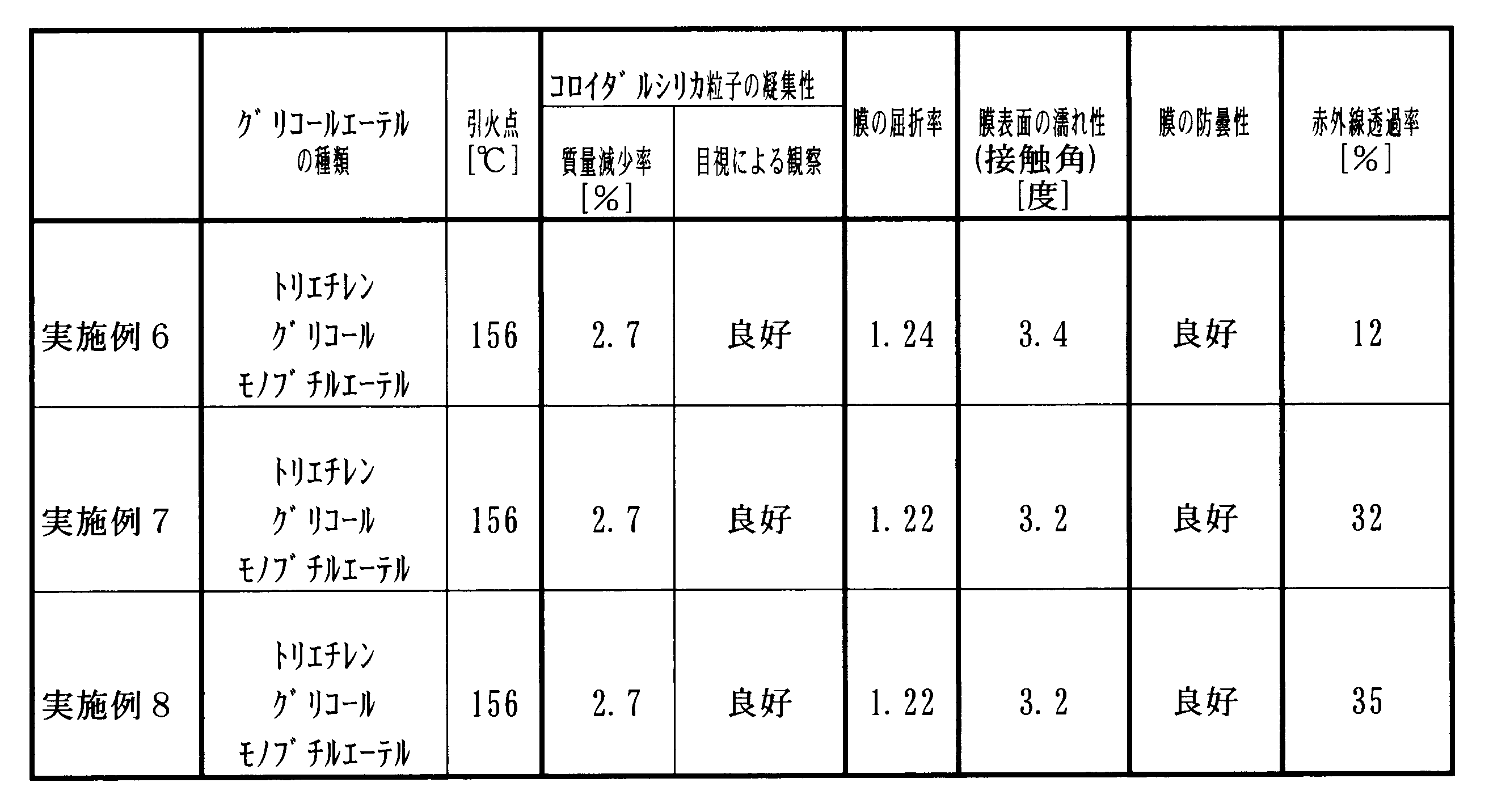
表2から明らかなように、実施例6~8で得られた複合膜は、膜の屈折率が1.22~1.24と低く、膜の水濡れ性(接触角)が3.2~3.4度と低く、膜の水濡れ性が高いことが分かった。また実施例6~8で得られた複合膜ではガラス基板上の膜表面に曇りが全く発生せずクリアであって、良好であった。更に波長1500nmの赤外線を実施例6~8で得られた複合膜に照射したときの透過率は12~35%であり、赤外線を十分に遮蔽していることが分かった。
本発明の液組成物は、ディスプレイパネルや太陽電池、光学レンズ、カメラモジュール、センサーモジュール、ミラー、メガネ、赤外線遮蔽膜等の表面をコーティングするために用いられる低屈折率膜を形成することに利用できる。
Claims (5)
- ケイ素アルコキシドとしてのテトラメトキシシラン又はテトラエトキシシランのアルコール溶液に水と硝酸との混合物を添加して攪拌することにより生成されたケイ素アルコキシドの加水分解物と、数珠状コロイダルシリカ粒子が液体媒体中に分散したシリカゾルとを混合し、更にグリコールエーテルの有機溶媒を混合して調製され、前記グリコールエーテルが140℃以上160℃以下の引火点を有する溶媒である低屈折率膜形成用液組成物。
- 前記140℃以上160℃以下の引火点を有する溶媒であるグリコールエーテルが、ポリエチレングリコールモノメチルエーテル、トリエチレングリコールモノブチルエーテル、テトラエチレングリコールジメチルエーテル、ポリエチレングリコールジメチルエーテル又はジエチレングリコールモノベンジルエーテルである請求項1記載の低屈折率膜形成用液組成物。
- 請求項1又は2記載の低屈折率膜形成用液組成物を用いて低屈折率膜を形成する方法。
- 請求項3記載の方法により形成された低屈折率膜。
- 請求項4記載の低屈折率膜と赤外線遮蔽膜とを備えた複合膜。
Priority Applications (2)
| Application Number | Priority Date | Filing Date | Title |
|---|---|---|---|
| KR1020177018932A KR102237333B1 (ko) | 2015-01-20 | 2016-01-20 | 저굴절률막 형성용 액 조성물 |
| CN201680006229.3A CN107207907B (zh) | 2015-01-20 | 2016-01-20 | 低折射率膜形成用液体组合物 |
Applications Claiming Priority (4)
| Application Number | Priority Date | Filing Date | Title |
|---|---|---|---|
| JP2015008192 | 2015-01-20 | ||
| JP2015-008192 | 2015-01-20 | ||
| JP2015-025889 | 2015-02-13 | ||
| JP2015025889A JP6451376B2 (ja) | 2015-01-20 | 2015-02-13 | 低屈折率膜形成用液組成物 |
Publications (1)
| Publication Number | Publication Date |
|---|---|
| WO2016117592A1 true WO2016117592A1 (ja) | 2016-07-28 |
Family
ID=56417133
Family Applications (1)
| Application Number | Title | Priority Date | Filing Date |
|---|---|---|---|
| PCT/JP2016/051548 Ceased WO2016117592A1 (ja) | 2015-01-20 | 2016-01-20 | 低屈折率膜形成用液組成物 |
Country Status (1)
| Country | Link |
|---|---|
| WO (1) | WO2016117592A1 (ja) |
Cited By (1)
| Publication number | Priority date | Publication date | Assignee | Title |
|---|---|---|---|---|
| WO2018163929A1 (ja) * | 2017-03-08 | 2018-09-13 | 三菱マテリアル株式会社 | 低屈折率膜形成用液組成物及びこれを用いた低屈折率膜の形成方法 |
Citations (6)
| Publication number | Priority date | Publication date | Assignee | Title |
|---|---|---|---|---|
| JPH0524885A (ja) * | 1991-07-15 | 1993-02-02 | Nissan Motor Co Ltd | ガラスの撥水処理方法 |
| JP2002307596A (ja) * | 2001-04-09 | 2002-10-23 | Toray Ind Inc | 積層ポリエステルフィルムおよびその製造方法 |
| JP2003246999A (ja) * | 2002-02-26 | 2003-09-05 | Nof Corp | 水性ハードコート前処理剤、前処理方法及びプラスチックレンズ |
| JP2008272652A (ja) * | 2007-04-27 | 2008-11-13 | Kansai Paint Co Ltd | 複層塗膜形成方法 |
| WO2012147625A1 (ja) * | 2011-04-27 | 2012-11-01 | 旭硝子株式会社 | 撥水撥油剤組成物、その製造方法および物品 |
| JP2013253145A (ja) * | 2012-06-06 | 2013-12-19 | Mitsubishi Materials Corp | 低屈折率膜形成用組成物及びこれを用いた低屈折率膜の形成方法 |
-
2016
- 2016-01-20 WO PCT/JP2016/051548 patent/WO2016117592A1/ja not_active Ceased
Patent Citations (6)
| Publication number | Priority date | Publication date | Assignee | Title |
|---|---|---|---|---|
| JPH0524885A (ja) * | 1991-07-15 | 1993-02-02 | Nissan Motor Co Ltd | ガラスの撥水処理方法 |
| JP2002307596A (ja) * | 2001-04-09 | 2002-10-23 | Toray Ind Inc | 積層ポリエステルフィルムおよびその製造方法 |
| JP2003246999A (ja) * | 2002-02-26 | 2003-09-05 | Nof Corp | 水性ハードコート前処理剤、前処理方法及びプラスチックレンズ |
| JP2008272652A (ja) * | 2007-04-27 | 2008-11-13 | Kansai Paint Co Ltd | 複層塗膜形成方法 |
| WO2012147625A1 (ja) * | 2011-04-27 | 2012-11-01 | 旭硝子株式会社 | 撥水撥油剤組成物、その製造方法および物品 |
| JP2013253145A (ja) * | 2012-06-06 | 2013-12-19 | Mitsubishi Materials Corp | 低屈折率膜形成用組成物及びこれを用いた低屈折率膜の形成方法 |
Cited By (2)
| Publication number | Priority date | Publication date | Assignee | Title |
|---|---|---|---|---|
| WO2018163929A1 (ja) * | 2017-03-08 | 2018-09-13 | 三菱マテリアル株式会社 | 低屈折率膜形成用液組成物及びこれを用いた低屈折率膜の形成方法 |
| CN110291165A (zh) * | 2017-03-08 | 2019-09-27 | 三菱综合材料株式会社 | 低折射率膜形成用液体组合物及使用该组合物的低折射率膜的形成方法 |
Similar Documents
| Publication | Publication Date | Title |
|---|---|---|
| JP5927743B2 (ja) | 低屈折率膜形成用組成物の製造方法及び低屈折率膜の形成方法 | |
| CN1969023B (zh) | 硅氧烷系涂料、光学制品及硅氧烷系涂料的制备方法 | |
| JP6451376B2 (ja) | 低屈折率膜形成用液組成物 | |
| JP6986339B2 (ja) | 反射防止膜形成用組成物、反射防止膜およびその形成方法 | |
| JPH0877832A (ja) | 透明導電性被膜付基材、その製造方法および該基材を備えた表示装置 | |
| JP2015049319A (ja) | 透明基材と防汚性反射防止膜とを備える物品およびその製造方法 | |
| JP6233136B2 (ja) | 膜形成用液組成物 | |
| JP4540979B2 (ja) | ハードコート膜付基材および該ハードコート膜形成用塗布液 | |
| TW201920993A (zh) | 經多層抗反射塗層塗覆之物件 | |
| JP2012246440A (ja) | 無機コーティング組成物 | |
| JP6970349B2 (ja) | 着色被膜付ガラス物品 | |
| WO2011136370A1 (ja) | スプレー塗布用の被膜形成用塗布液及び被膜 | |
| JP2004050810A (ja) | ハードコート膜付基材 | |
| WO2016117592A1 (ja) | 低屈折率膜形成用液組成物 | |
| KR102188211B1 (ko) | 저굴절률막 형성용 조성물 및 그 제조 방법 그리고 저굴절률막의 형성 방법 | |
| WO2018163929A1 (ja) | 低屈折率膜形成用液組成物及びこれを用いた低屈折率膜の形成方法 | |
| JP6451424B2 (ja) | 高耐久性低屈折率膜 | |
| JP6123432B2 (ja) | 低屈折率膜形成用組成物の製造方法及び低屈折率膜の形成方法 | |
| JP6733235B2 (ja) | 低屈折率膜形成用液組成物 | |
| EP2937319B1 (en) | Method of manufacturing a composition for forming a thin layer with low refractive index, and method of manufacturing a thin layer with low refractive index | |
| WO2019162847A1 (en) | Anti-fouling, multi-layer coated sapphire articles | |
| JPH0351733B2 (ja) | ||
| JPS63191101A (ja) | 表面被膜を有する透明成形品 | |
| JP2016194000A (ja) | 無機粒子含有組成物、塗膜、塗膜付きプラスチック基材、表示装置 |
Legal Events
| Date | Code | Title | Description |
|---|---|---|---|
| 121 | Ep: the epo has been informed by wipo that ep was designated in this application |
Ref document number: 16740199 Country of ref document: EP Kind code of ref document: A1 |
|
| ENP | Entry into the national phase |
Ref document number: 20177018932 Country of ref document: KR Kind code of ref document: A |
|
| NENP | Non-entry into the national phase |
Ref country code: DE |
|
| 122 | Ep: pct application non-entry in european phase |
Ref document number: 16740199 Country of ref document: EP Kind code of ref document: A1 |