WO2016114001A1 - フェノール性水酸基含有化合物、これを含む組成物及びその硬化膜 - Google Patents
フェノール性水酸基含有化合物、これを含む組成物及びその硬化膜 Download PDFInfo
- Publication number
- WO2016114001A1 WO2016114001A1 PCT/JP2015/082513 JP2015082513W WO2016114001A1 WO 2016114001 A1 WO2016114001 A1 WO 2016114001A1 JP 2015082513 W JP2015082513 W JP 2015082513W WO 2016114001 A1 WO2016114001 A1 WO 2016114001A1
- Authority
- WO
- WIPO (PCT)
- Prior art keywords
- group
- phenolic hydroxyl
- containing compound
- hydroxyl group
- composition
- Prior art date
- Legal status (The legal status is an assumption and is not a legal conclusion. Google has not performed a legal analysis and makes no representation as to the accuracy of the status listed.)
- Ceased
Links
Images



Classifications
-
- C—CHEMISTRY; METALLURGY
- C07—ORGANIC CHEMISTRY
- C07C—ACYCLIC OR CARBOCYCLIC COMPOUNDS
- C07C39/00—Compounds having at least one hydroxy or O-metal group bound to a carbon atom of a six-membered aromatic ring
- C07C39/12—Compounds having at least one hydroxy or O-metal group bound to a carbon atom of a six-membered aromatic ring polycyclic with no unsaturation outside the aromatic rings
- C07C39/14—Compounds having at least one hydroxy or O-metal group bound to a carbon atom of a six-membered aromatic ring polycyclic with no unsaturation outside the aromatic rings with at least one hydroxy group on a condensed ring system containing two rings
-
- C—CHEMISTRY; METALLURGY
- C07—ORGANIC CHEMISTRY
- C07C—ACYCLIC OR CARBOCYCLIC COMPOUNDS
- C07C37/00—Preparation of compounds having hydroxy or O-metal groups bound to a carbon atom of a six-membered aromatic ring
- C07C37/11—Preparation of compounds having hydroxy or O-metal groups bound to a carbon atom of a six-membered aromatic ring by reactions increasing the number of carbon atoms
- C07C37/20—Preparation of compounds having hydroxy or O-metal groups bound to a carbon atom of a six-membered aromatic ring by reactions increasing the number of carbon atoms using aldehydes or ketones
-
- C—CHEMISTRY; METALLURGY
- C07—ORGANIC CHEMISTRY
- C07C—ACYCLIC OR CARBOCYCLIC COMPOUNDS
- C07C39/00—Compounds having at least one hydroxy or O-metal group bound to a carbon atom of a six-membered aromatic ring
- C07C39/12—Compounds having at least one hydroxy or O-metal group bound to a carbon atom of a six-membered aromatic ring polycyclic with no unsaturation outside the aromatic rings
- C07C39/17—Compounds having at least one hydroxy or O-metal group bound to a carbon atom of a six-membered aromatic ring polycyclic with no unsaturation outside the aromatic rings containing other rings in addition to the six-membered aromatic rings, e.g. cyclohexylphenol
-
- C—CHEMISTRY; METALLURGY
- C08—ORGANIC MACROMOLECULAR COMPOUNDS; THEIR PREPARATION OR CHEMICAL WORKING-UP; COMPOSITIONS BASED THEREON
- C08G—MACROMOLECULAR COMPOUNDS OBTAINED OTHERWISE THAN BY REACTIONS ONLY INVOLVING UNSATURATED CARBON-TO-CARBON BONDS
- C08G65/00—Macromolecular compounds obtained by reactions forming an ether link in the main chain of the macromolecule
- C08G65/34—Macromolecular compounds obtained by reactions forming an ether link in the main chain of the macromolecule from hydroxy compounds or their metallic derivatives
- C08G65/38—Macromolecular compounds obtained by reactions forming an ether link in the main chain of the macromolecule from hydroxy compounds or their metallic derivatives derived from phenols
-
- C—CHEMISTRY; METALLURGY
- C08—ORGANIC MACROMOLECULAR COMPOUNDS; THEIR PREPARATION OR CHEMICAL WORKING-UP; COMPOSITIONS BASED THEREON
- C08G—MACROMOLECULAR COMPOUNDS OBTAINED OTHERWISE THAN BY REACTIONS ONLY INVOLVING UNSATURATED CARBON-TO-CARBON BONDS
- C08G8/00—Condensation polymers of aldehydes or ketones with phenols only
- C08G8/04—Condensation polymers of aldehydes or ketones with phenols only of aldehydes
-
- C—CHEMISTRY; METALLURGY
- C08—ORGANIC MACROMOLECULAR COMPOUNDS; THEIR PREPARATION OR CHEMICAL WORKING-UP; COMPOSITIONS BASED THEREON
- C08G—MACROMOLECULAR COMPOUNDS OBTAINED OTHERWISE THAN BY REACTIONS ONLY INVOLVING UNSATURATED CARBON-TO-CARBON BONDS
- C08G8/00—Condensation polymers of aldehydes or ketones with phenols only
- C08G8/04—Condensation polymers of aldehydes or ketones with phenols only of aldehydes
- C08G8/08—Condensation polymers of aldehydes or ketones with phenols only of aldehydes of formaldehyde, e.g. of formaldehyde formed in situ
- C08G8/24—Condensation polymers of aldehydes or ketones with phenols only of aldehydes of formaldehyde, e.g. of formaldehyde formed in situ with mixtures of two or more phenols which are not covered by only one of the groups C08G8/10 - C08G8/20
-
- C—CHEMISTRY; METALLURGY
- C09—DYES; PAINTS; POLISHES; NATURAL RESINS; ADHESIVES; COMPOSITIONS NOT OTHERWISE PROVIDED FOR; APPLICATIONS OF MATERIALS NOT OTHERWISE PROVIDED FOR
- C09D—COATING COMPOSITIONS, e.g. PAINTS, VARNISHES OR LACQUERS; FILLING PASTES; CHEMICAL PAINT OR INK REMOVERS; INKS; CORRECTING FLUIDS; WOODSTAINS; PASTES OR SOLIDS FOR COLOURING OR PRINTING; USE OF MATERIALS THEREFOR
- C09D161/00—Coating compositions based on condensation polymers of aldehydes or ketones; Coating compositions based on derivatives of such polymers
- C09D161/04—Condensation polymers of aldehydes or ketones with phenols only
- C09D161/06—Condensation polymers of aldehydes or ketones with phenols only of aldehydes with phenols
- C09D161/12—Condensation polymers of aldehydes or ketones with phenols only of aldehydes with phenols with polyhydric phenols
-
- G—PHYSICS
- G03—PHOTOGRAPHY; CINEMATOGRAPHY; ANALOGOUS TECHNIQUES USING WAVES OTHER THAN OPTICAL WAVES; ELECTROGRAPHY; HOLOGRAPHY
- G03F—PHOTOMECHANICAL PRODUCTION OF TEXTURED OR PATTERNED SURFACES, e.g. FOR PRINTING, FOR PROCESSING OF SEMICONDUCTOR DEVICES; MATERIALS THEREFOR; ORIGINALS THEREFOR; APPARATUS SPECIALLY ADAPTED THEREFOR
- G03F7/00—Photomechanical, e.g. photolithographic, production of textured or patterned surfaces, e.g. printing surfaces; Materials therefor, e.g. comprising photoresists; Apparatus specially adapted therefor
- G03F7/004—Photosensitive materials
- G03F7/022—Quinonediazides
- G03F7/0226—Quinonediazides characterised by the non-macromolecular additives
-
- G—PHYSICS
- G03—PHOTOGRAPHY; CINEMATOGRAPHY; ANALOGOUS TECHNIQUES USING WAVES OTHER THAN OPTICAL WAVES; ELECTROGRAPHY; HOLOGRAPHY
- G03F—PHOTOMECHANICAL PRODUCTION OF TEXTURED OR PATTERNED SURFACES, e.g. FOR PRINTING, FOR PROCESSING OF SEMICONDUCTOR DEVICES; MATERIALS THEREFOR; ORIGINALS THEREFOR; APPARATUS SPECIALLY ADAPTED THEREFOR
- G03F7/00—Photomechanical, e.g. photolithographic, production of textured or patterned surfaces, e.g. printing surfaces; Materials therefor, e.g. comprising photoresists; Apparatus specially adapted therefor
- G03F7/004—Photosensitive materials
- G03F7/022—Quinonediazides
- G03F7/023—Macromolecular quinonediazides; Macromolecular additives, e.g. binders
-
- G—PHYSICS
- G03—PHOTOGRAPHY; CINEMATOGRAPHY; ANALOGOUS TECHNIQUES USING WAVES OTHER THAN OPTICAL WAVES; ELECTROGRAPHY; HOLOGRAPHY
- G03F—PHOTOMECHANICAL PRODUCTION OF TEXTURED OR PATTERNED SURFACES, e.g. FOR PRINTING, FOR PROCESSING OF SEMICONDUCTOR DEVICES; MATERIALS THEREFOR; ORIGINALS THEREFOR; APPARATUS SPECIALLY ADAPTED THEREFOR
- G03F7/00—Photomechanical, e.g. photolithographic, production of textured or patterned surfaces, e.g. printing surfaces; Materials therefor, e.g. comprising photoresists; Apparatus specially adapted therefor
- G03F7/004—Photosensitive materials
- G03F7/039—Macromolecular compounds which are photodegradable, e.g. positive electron resists
-
- G—PHYSICS
- G03—PHOTOGRAPHY; CINEMATOGRAPHY; ANALOGOUS TECHNIQUES USING WAVES OTHER THAN OPTICAL WAVES; ELECTROGRAPHY; HOLOGRAPHY
- G03F—PHOTOMECHANICAL PRODUCTION OF TEXTURED OR PATTERNED SURFACES, e.g. FOR PRINTING, FOR PROCESSING OF SEMICONDUCTOR DEVICES; MATERIALS THEREFOR; ORIGINALS THEREFOR; APPARATUS SPECIALLY ADAPTED THEREFOR
- G03F7/00—Photomechanical, e.g. photolithographic, production of textured or patterned surfaces, e.g. printing surfaces; Materials therefor, e.g. comprising photoresists; Apparatus specially adapted therefor
- G03F7/004—Photosensitive materials
- G03F7/09—Photosensitive materials characterised by structural details, e.g. supports, auxiliary layers
- G03F7/091—Photosensitive materials characterised by structural details, e.g. supports, auxiliary layers characterised by antireflection means or light filtering or absorbing means, e.g. anti-halation, contrast enhancement
-
- G—PHYSICS
- G03—PHOTOGRAPHY; CINEMATOGRAPHY; ANALOGOUS TECHNIQUES USING WAVES OTHER THAN OPTICAL WAVES; ELECTROGRAPHY; HOLOGRAPHY
- G03F—PHOTOMECHANICAL PRODUCTION OF TEXTURED OR PATTERNED SURFACES, e.g. FOR PRINTING, FOR PROCESSING OF SEMICONDUCTOR DEVICES; MATERIALS THEREFOR; ORIGINALS THEREFOR; APPARATUS SPECIALLY ADAPTED THEREFOR
- G03F7/00—Photomechanical, e.g. photolithographic, production of textured or patterned surfaces, e.g. printing surfaces; Materials therefor, e.g. comprising photoresists; Apparatus specially adapted therefor
- G03F7/004—Photosensitive materials
- G03F7/09—Photosensitive materials characterised by structural details, e.g. supports, auxiliary layers
- G03F7/094—Multilayer resist systems, e.g. planarising layers
-
- G—PHYSICS
- G03—PHOTOGRAPHY; CINEMATOGRAPHY; ANALOGOUS TECHNIQUES USING WAVES OTHER THAN OPTICAL WAVES; ELECTROGRAPHY; HOLOGRAPHY
- G03F—PHOTOMECHANICAL PRODUCTION OF TEXTURED OR PATTERNED SURFACES, e.g. FOR PRINTING, FOR PROCESSING OF SEMICONDUCTOR DEVICES; MATERIALS THEREFOR; ORIGINALS THEREFOR; APPARATUS SPECIALLY ADAPTED THEREFOR
- G03F7/00—Photomechanical, e.g. photolithographic, production of textured or patterned surfaces, e.g. printing surfaces; Materials therefor, e.g. comprising photoresists; Apparatus specially adapted therefor
- G03F7/004—Photosensitive materials
- G03F7/09—Photosensitive materials characterised by structural details, e.g. supports, auxiliary layers
- G03F7/11—Photosensitive materials characterised by structural details, e.g. supports, auxiliary layers having cover layers or intermediate layers, e.g. subbing layers
-
- C—CHEMISTRY; METALLURGY
- C07—ORGANIC CHEMISTRY
- C07C—ACYCLIC OR CARBOCYCLIC COMPOUNDS
- C07C2603/00—Systems containing at least three condensed rings
- C07C2603/92—Systems containing at least three condensed rings with a condensed ring system consisting of at least two mutually uncondensed aromatic ring systems, linked by an annular structure formed by carbon chains on non-adjacent positions of the aromatic system, e.g. cyclophanes
Definitions
- the present invention includes a phenolic hydroxyl group-containing compound capable of suitably obtaining a composition capable of obtaining a coating film having excellent solvent solubility, thermal decomposition resistance, alkali developability, resolution and dry etching resistance, and the compound.
- the present invention relates to a resist composition, a resist underlayer film composition, and a resist permanent film composition. Furthermore, it is related with the resist coating film obtained by using the said composition for resists, the composition for resist underlayer films, and the composition for resist permanent films, a resist underlayer film, and a resist permanent film.
- the phenolic hydroxyl group-containing compound is used in adhesives, molding materials, paints, photoresist materials, epoxy resin raw materials, epoxy resin curing agents, etc., it is excellent in heat resistance and moisture resistance in cured products, Widely used in the electrical and electronic fields such as semiconductor encapsulants and insulating materials for printed wiring boards, as curable resin compositions based on phenolic hydroxyl group-containing compounds themselves, or as curing agents such as epoxy resins .
- the multilayer resist method which has recently been developed as a method for forming a finer wiring pattern, one or more layers called a resist underlayer film or an antireflection film are formed on a substrate and then usually formed thereon.
- a resist pattern is formed by photolithography, and then the wiring pattern is processed and transferred to the substrate by dry etching.
- One of the important members in the multilayer resist technique is the resist underlayer film.
- the underlayer film has high dry etching resistance, low resist pattern line edge roughness (LER), low light reflectivity, and thermal decomposition. It is required to have high performance.
- the resin material for the resist underlayer film needs to be soluble in a general-purpose organic solvent.
- the performance is required such that the resin composition for the lower layer film is soluble in an alkali developing solution and can be removed simultaneously with development of the photoresist.
- a phenolic hydroxyl group-containing compound having excellent heat resistance As a phenolic hydroxyl group-containing compound having excellent heat resistance, a dihydroxynaphthalene type novolak resin (see Patent Document 1) and a phenolic hydroxyl group-containing compound having a cylindrical structure called a calixarene structure (see Patent Document 2) are known. . Moreover, as a phenol hydroxyl group containing compound for resist underlayer film, the following structural formula
- a fluorene skeleton-containing compound having a molecular structure represented by the formula is known (see Patent Document 3).
- the dihydroxynaphthalene type novolak resin described in Patent Document 1 has a feature that is excellent in heat resistance among general phenol novolak resins, but does not satisfy the demand level for heat resistance that is increasing more and more recently. Further, when used for resist applications, the sensitivity and resolution were inferior.
- 1-naphthol-type calix (4) arene compounds described in Patent Document 2 are not sufficiently soluble in general-purpose organic solvents, and are difficult to be applied to adhesives, paints, photoresists, and printed wiring board applications. Met.
- the fluorene skeleton-containing compound described in Patent Document 3 is excellent in solubility in general-purpose organic solvents and has low light reflectance in a cured coating film, while dry etching resistance and thermal decomposition resistance are at the current required levels.
- a phenolic compound for a resist underlayer film that does not satisfy the requirements but has both higher dry etching resistance and thermal decomposition resistance.
- the problem to be solved by the present invention is to provide a phenolic hydroxyl group-containing compound that is excellent in solvent solubility, and that provides a coating film that is excellent in thermal decomposition resistance, alkali developability, resolution and dry etching resistance.
- Another object of the present invention is to provide a composition containing the phenolic hydroxyl group-containing compound and suitable for obtaining a resist underlayer film and a resist permanent film.
- phenolic hydroxyl group-containing compounds (calixarene compounds) obtained by using dihydroxynaphthalene and naphthol in combination have extremely high heat resistance and can be dissolved in general-purpose solvents. It has been found that the coating film obtained using this has excellent alkali developability, resolution, heat resistance, dry etching resistance and heat decomposition resistance, and is suitable as a resist underlayer film and a resist permanent film. It came to complete.
- R 1 and R 4 are each a hydrogen atom, an alkyl group or an aryl group.
- R 2 and R 3 are each an alkyl group, an alkoxy group, an aryl group, an aralkyl group or a halogen atom.
- M is 0. It is an integer of ⁇ 4
- the plurality of R 2 may be the same or different, and may be bonded to any one of the two aromatic rings of the naphthylene skeleton, where n is And an integer of 0 to 5.
- n is 2 or more, the plurality of R 3 may be the same or different from each other, and may be bonded to any one of the two aromatic rings of the naphthylene skeleton.
- the structure represented by (A) has both the structure represented by (1-1) and the structure represented by (1-2) as -A-, and represented by (1-1). And a phenolic hydroxyl group-containing compound characterized by having a molecular structure in which the total repeating number p of the structure represented by (1-2) is an integer of 2 to 10.
- the present invention also provides a photosensitive composition comprising the phenolic hydroxyl group-containing compound and a photosensitizer.
- the present invention also provides a resist composition comprising the photosensitive composition.
- the present invention also provides a resist coating film comprising the resist composition.
- the present invention also provides a curable composition comprising the phenolic hydroxyl group-containing compound and a curing agent.
- the present invention provides a cured product obtained by curing the curable composition.
- the present invention provides a resist underlayer film composition comprising the curable composition.
- the present invention provides a resist underlayer film comprising the resist underlayer film composition.
- this invention provides the composition for resist permanent films which consists of the said curable composition.
- the present invention provides a resist permanent film made of the resist underlayer film composition.
- the phenolic hydroxyl group-containing compound of the present invention provides a phenolic hydroxyl group-containing compound that is excellent in solvent solubility and can suitably obtain a composition capable of obtaining a coating film having excellent thermal decomposition resistance, alkali developability, and dry etching resistance. be able to.
- the composition has excellent heat resistance, alkali developability and resolution, and is suitable as a composition for obtaining a positive resist film.
- the coating film which consists of a curable composition containing the phenolic hydroxyl group containing compound of this invention is excellent as heat resistance and dry etching tolerance, and since it has low light reflectance, it is suitable as a resist underlayer film use.
- the coating film which consists of a curable composition containing the phenolic hydroxyl group containing compound of this invention is suitable also as a resist permanent film.
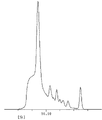
- FIG. 1 is a GPC chart of the phenolic hydroxyl group-containing compound (1) obtained in Example 1.
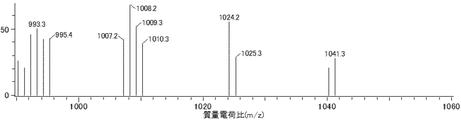
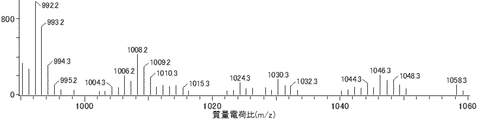
- FIG. 2 is an FD-MS spectrum of the phenolic hydroxyl group-containing compound (1) obtained in Example 1.
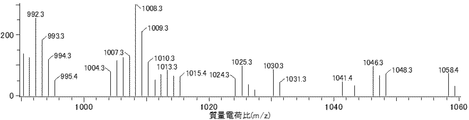
- FIG. 3 is an FD-MS spectrum (32-fold enlarged view) of the phenolic hydroxyl group-containing compound (1) obtained in Example 1.
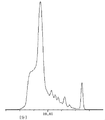
- FIG. 4 is a GPC chart of the phenolic hydroxyl group-containing compound (2) obtained in Example 2.
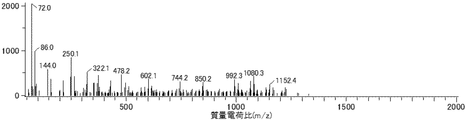
- FIG. 5 is an FD-MS spectrum of the phenolic hydroxyl group-containing compound (2) obtained in Example 2.
- FIG. 6 is an FD-MS spectrum (7-fold enlarged view) of the phenolic hydroxyl group-containing compound (2) obtained in Example 2.
- FIG. 1 is a GPC chart of the phenolic hydroxyl group-containing compound (1) obtained in Example 1.
- FIG. 2 is an FD-MS spectrum of the phenolic hydroxyl group-containing compound (1) obtained in Example 1.
- FIG. 3 is an FD-MS spectrum
- FIG. 7 is a GPC chart of the phenolic hydroxyl group-containing compound (3) obtained in Example 3.
- FIG. 8 is an FD-MS spectrum of the phenolic hydroxyl group-containing compound (3) obtained in Example 3.
- FIG. 9 is an FD-MS spectrum (3-fold enlarged view) of the phenolic hydroxyl group-containing compound (3) obtained in Example 3.
- the phenolic hydroxyl group-containing compound of the present invention has the following structural formula (1)
- R 1 and R 4 are each a hydrogen atom, an alkyl group or an aryl group.
- R 2 and R 3 are each an alkyl group, an alkoxy group, an aryl group, an aralkyl group or a halogen atom.
- M is 0. It is an integer of ⁇ 4
- the plurality of R 2 may be the same or different, and may be bonded to any one of the two aromatic rings of the naphthylene skeleton, where n is And an integer of 0 to 5.
- n is 2 or more, the plurality of R 3 may be the same or different from each other, and may be bonded to any one of the two aromatic rings of the naphthylene skeleton.
- the structure represented by (A) has both the structure represented by (1-1) and the structure represented by (1-2) as -A-, and represented by (1-1). And a molecular structure in which the total repeating number p of the structure represented by (1-2) is an integer of 2 to 10.
- the conventionally known calixarene type compounds have high glass transition temperature and melting point and excellent thermal stability, but are not sufficiently compatible with general-purpose organic solvents and other resin components and additives.
- Met the phenolic hydroxyl group-containing compound of the present invention has both a structure having one hydroxyl group on the naphthylene skeleton and a structure having two hydroxyl groups on the naphthylene skeleton in the structural formula (1).
- the phenolic hydroxyl group-containing compound of the present invention is excellent in photosensitivity and resolution when used in a photosensitive material.
- the alkali-solubility resistance before and after exposure when used in a positive resist application, the alkali-solubility resistance before and after exposure. It is possible to form a resist film with high photosensitivity that is excellent in both alkali solubility and fine resist pattern formation.
- the phenolic hydroxyl group-containing compound of the present invention represented by the structural formula (1) has a calixarene structure including a plurality of naphthalene ring structures, and thus has high rigidity, and is used for resist underlayer film applications. In such a case, the dry etching resistance and the thermal decomposition resistance with a halogen-based plasma gas are excellent. Furthermore, since such a compound containing a large amount of naphthalene ring structure has a high refractive index and high absorbance, it has a low light reflectivity in a cured product and is a suitable material as a resist underlayer film material. Furthermore, since the phenolic hydroxyl group-containing compound of the present invention represented by the structural formula (1) is excellent in thermal decomposition resistance, it is also a suitable material as a material for obtaining a resist permanent film.
- P in the structural formula (1) is the sum of the total number of repetitions of the structure represented by (1-1) and the structure represented by (1-2), and is an integer of 2 to 10. Especially, since it becomes a phenolic hydroxyl group containing compound which is excellent in structural stability and excellent in thermal decomposition resistance, it is preferably any of 2, 3, 4, 5, 6, 8 and particularly preferably 4.
- the phenolic hydroxyl group-containing compound of the present invention has both the structure represented by (1-1) and the structure represented by (1-2), and is represented by (1-1). And the total number of the structures represented by (1-2) (total number of repetitions) may be 2 to 10. Accordingly, the phenolic hydroxyl group-containing compound of the present invention can take various forms with respect to the structure represented by (1-1) and the position and number of repetitions of the structure represented by (1-2). Specifically, the structure represented by (1-1) and the structure represented by (1-2) may be present randomly or in a block form. More specifically, “—A—” represented by the structural formula (1) can be exemplified by a structure having the following repetition, for example.
- “(1-1)” represents the structural formula (1-1)
- “(1-2)” represents the structural formula (1-2).
- the substitution position of two hydroxyl groups on the naphthylene skeleton may be any of the two aromatic rings of the naphthylene skeleton.
- the substitution positions of two hydroxyl groups on the naphthylene skeleton having two hydroxyl groups as the structural formula (1-1) are 1, 4-position, 1, 5-position, 1,6-position.
- a phenolic hydroxyl group-containing compound having a structure in any of positions 2, 6 and 2, 7 is preferable because the raw material (dinaphthol described later) is easily available, and further, the phenolic hydroxyl group-containing compound of the present invention. It is more preferable that it is the 1st and 6th positions from the viewpoint of easy production.
- the phenolic hydroxyl group-containing compound having a structure in which the substitution position of one hydroxyl group on the naphthylene skeleton having one hydroxyl group is the 1-position as the structural formula (1-2) Is preferable because it becomes a phenolic hydroxyl group-containing compound from which a coating film having excellent thermal decomposition resistance is obtained.
- the substitution positions of the two hydroxyl groups on the naphthylene skeleton having two hydroxyl groups as the structural formula (1-1) are 1, 4, 5, 1,
- a structure in which the substitution position of one hydroxyl group on the naphthylene skeleton having one hydroxyl group as the structural formula (1-2) is any one of the 6-position, 2,6-position, 2,7-position
- a phenolic hydroxyl group-containing compound having the above structure is preferred, the substitution position of two hydroxyl groups on the naphthylene skeleton having two hydroxyl groups as the structural formula (1-1) is at the 1,6-position, and the structural formula (1-2) More preferred is a phenolic hydroxyl group-containing compound having a structure in which the substitution position of one hydroxyl group on the naphthylene skeleton having one hydroxyl group is the first position.
- the structural formula (1-1) is a structure represented by the following structural formula (1-1-1), and the structural formula (1-2) is represented by the following structural formula (1-2-1).
- a phenolic hydroxyl group-containing compound having a structure represented by is more preferable.
- R 1 and R 4 are each a hydrogen atom, an alkyl group or an aryl group, and p is an integer of 2 to 10.
- R 2 and R 3 are an alkyl group, an alkoxy group, an aryl group and an aralkyl group, respectively.
- M is an integer of 0 to 4.
- m 2 or more, the plurality of R 2 may be the same or different from each other, and each of the two aromatic rings of the naphthylene skeleton N is an integer of 0 to 5.
- n is 2 or more, the plurality of R 3 may be the same or different, and the two aromatic rings of the naphthylene skeleton Either of which may be combined.
- the ratio of the structure represented by the structural formula (1-1) to the structure represented by the structural formula (1-2) is a coating film when used as a resist material.
- the molar ratio [structural formula (1-1): structural formula (1-2)] is preferably 1: 0.01 to 50, and 1: 0.05 to 20 is a molecule having a cyclic structure. Since the effect of an internal hydrogen bond is exhibited, it is more preferable.
- R 1 and R 4 in the structural formula (1-1) and the structural formula (1-2) are a hydrogen atom, an alkyl group, or an aryl group, respectively.
- the alkyl group include a methyl group, an ethyl group, a propyl group, a butyl group, a pentyl group, a hexyl group, and a cyclohexyl group.
- the aryl group for example, the following structural formula (2-1) or (2-2)
- R 5 and R 6 are each independently a hydroxyl group, a halogen atom, an alkyl group, an alkoxy group, an aryl group or an aralkyl group, k is an integer from 0 to 5, and l is an integer from 7 to 7)
- k or l is 2 or more, the plurality of R 3 or R 4 may be the same or different. And the like.
- aryl group examples include a phenyl group, a hydroxyphenyl group, a dihydroxyphenyl group, a hydroxyalkoxyphenyl group, an alkoxyphenyl group, a tolyl group, a xylyl group, a naphthyl group, a hydroxynaphthyl group, and a dihydroxynaphthyl group.
- an aryl group is preferable, a hydroxyphenyl group, It is more preferably a hydroxyl-containing structural moiety such as a dihydroxyphenyl group, a hydroxyalkoxyphenyl group, a hydroxynaphthyl group, or a dihydroxynaphthyl group, and a hydroxyphenyl group is still more preferable.
- R 2 and R 3 in the structural formula (1-1) and the structural formula (1-2) are each an alkyl group, an alkoxy group, an aryl group, an aralkyl group, or a halogen atom.
- the alkyl group include a methyl group, an ethyl group, a propyl group, a butyl group, a pentyl group, a hexyl group, and a cyclohexyl group.
- Examples of the alkoxy group include a methoxy group, an ethoxy group, a propyloxy group, a butoxy group, a pentyloxy group, a hexyloxy group, and a cyclohexyloxy group.
- aryl group examples include a phenyl group, a hydroxyphenyl group, a dihydroxyphenyl group, a hydroxyalkoxyphenyl group, an alkoxyphenyl group, a tolyl group, a xylyl group, a naphthyl group, a hydroxynaphthyl group, and a dihydroxynaphthyl group.
- aralkyl group examples include phenylmethyl group, hydroxyphenylmethyl group, dihydroxyphenylmethyl group, tolylmethyl group, xylylmethyl group, naphthylmethyl group, hydroxynaphthylmethyl group, dihydroxynaphthylmethyl group, phenylethyl group, hydroxyphenylethyl group. , Dihydroxyphenylethyl group, tolylethyl group, xylylethyl group, naphthylethyl group, hydroxynaphthylethyl group, dihydroxynaphthylethyl group and the like.
- the value of m in the structural formula (1-1) is preferably 0 because it becomes a phenolic hydroxyl group-containing compound having excellent thermal decomposition resistance.
- the value of n in the structural formula (1-2) is preferably 0 because it becomes a phenolic hydroxyl group-containing compound having excellent thermal decomposition resistance.
- the phenolic hydroxyl group-containing compound of the present invention can be preferably produced, for example, by the following method.
- Method 1 A method of reacting dihydroxynaphthalenes, naphthols and formaldehyde in the presence of a basic catalyst.
- Method 2 A method in which dihydroxynaphthalenes, naphthols, and aliphatic aldehyde compounds or aromatic aldehydes having two or more carbon atoms are reacted in the presence of an acidic catalyst.
- the phenolic hydroxyl group-containing compound of the present invention is produced by the method 1 or the method 2, the phenolic hydroxyl group-containing compound of the present invention is selectively produced or contains other components by appropriately changing the reaction conditions. Or can be produced as a phenolic resin composition. Moreover, you may isolate and use the said phenolic hydroxyl group containing compound from the phenol resin composition containing another component.
- Examples of the dihydroxynaphthalene used in Method 1 and Method 2 include 1,4-dihydroxynaphthalene, 1,5-dihydroxynaphthalene, 1,6-dihydroxynaphthalene, 2,6-dihydroxynaphthalene, and 2,7-dihydroxynaphthalene.
- alkyl group such as methyl group, ethyl group, propyl group, butyl group, pentyl group, hexyl group, cyclohexyl group, methoxy group, ethoxy group, propyloxy group
- alkoxy groups such as a butoxy group, a pentyloxy group, a hexyloxy group, and a cyclohexyloxy group are substituted. These may be used alone or in combination of two or more.
- 1,6-dihydroxynaphthalene and compounds having one or more alkyl groups or aralkyl groups substituted on the aromatic nucleus thereof are preferred because the phenolic hydroxyl group-containing compound of the present invention can be efficiently produced. 1,6-dihydroxynaphthalene is more preferred.
- Examples of the naphthols used in Method 1 and Method 2 include 1-naphthol, 2-naphthol, and aromatic nuclei of these naphthols having a methyl group, an ethyl group, a propyl group, a butyl group, a pentyl group, and a hexyl group.
- 1-naphthol is preferable because it becomes a phenolic hydroxyl group-containing compound that can provide a coating film having excellent thermal decomposition resistance.
- the formaldehyde used in the method 1 may be used in the form of either formalin in a solution state or paraformaldehyde in a solid state.
- the aliphatic aldehydes or aromatic aldehydes having 2 or more carbon atoms used in Method 2 are, for example, the following structural formulas (3-1) to (3-3):
- R 7 is a hydrocarbon group having 1 to 6 carbon atoms, or one or more carbon atoms in the hydrocarbon group are substituted with any one of a hydroxyl group, an alkoxy group, an aryl group, and a halogen atom.
- R 8 and R 9 are each independently a hydroxyl group, an alkyl group, an alkoxy group, an aryl group, an aralkyl group, or a halogen atom, r is an integer of 0 to 5, and s is an integer of 0 to 7 When r or s is 2 or more, the plurality of R 8 or R 9 may be the same or different. Or a compound represented by any of the above.
- Examples of the aliphatic aldehydes represented by the structural formula (3-1) include acetaldehyde, propyl aldehyde, butyraldehyde, isobutyraldehyde, pentyl aldehyde, hexyl aldehyde, and the like.
- aromatic aldehyde represented by the structural formula (3-2) or (3-3) examples include salicylaldehyde, 3-hydroxybenzaldehyde, 4-hydroxybenzaldehyde, 2-hydroxy-4-methylbenzaldehyde, 2, Hydroxybenzaldehyde compounds such as 4-dihydroxybenzaldehyde and 3,4-dihydroxybenzaldehyde; 2-hydroxy-3-methoxybenzaldehyde, 3-hydroxy-4-methoxybenzaldehyde, 4-hydroxy-3-methoxybenzaldehyde, 3-ethoxy-4- Benzaldehyde compounds having both hydroxy and alkoxy groups such as hydroxybenzaldehyde and 4-hydroxy-3,5-dimethoxybenzaldehyde; methoxybenzaldehyde, ethoxybenzaldehyde Alkoxy benzaldehyde compound and the like; 1-hydroxy-2-naphthaldehyde, 2-hydroxy-1-naphthaldehyde, 6-hydroxy-2-na
- a phenolic hydroxyl group-containing compound having high solubility in an organic solvent and high heat resistance and excellent sensitivity when used as a photosensitive composition is used.
- the aromatic aldehydes represented by the structural formula (3-2) or (3-3) are preferred, and the substitution on the aromatic ring is preferable.
- a compound having one or more hydroxyl groups or one or more alkoxy groups as a group, that is, in the structural formula (3-2) or (3-3), r or s is 1 or more, and at least one of R8 and R9
- a compound in which one is a hydroxyl group, or a compound in which at least one of R8 or R9 is an alkoxy group is more preferable.
- a hydroxybenzaldehyde compound represented by the structural formula (3-2), wherein r is 1 or more and at least one of R8 is a hydroxyl group is preferable because the phenolic hydroxyl group-containing compound is efficiently generated.
- 4-hydroxy-3-methoxybenzaldehyde, 3-ethoxy-4-hydroxybenzaldehyde, salicylaldehyde, 3-hydroxybenzaldehyde, 4-hydroxybenzaldehyde, or 2,4-dihydroxybenzaldehyde is more preferable, and salicylaldehyde, 3 -Hydroxybenzaldehyde or 4-hydroxybenzaldehyde is particularly preferred.
- Examples of the basic catalyst used in Method 1 include alkali metal hydroxides such as sodium hydroxide, lithium hydroxide, and potassium hydroxide, and alkaline earth metal hydroxides such as calcium hydroxide. Among these, alkali metal hydroxides are preferable because of higher catalytic ability, and sodium hydroxide is more preferable.
- the amount of these basic catalysts used is preferably in the range of 0.02 to 1.00 mol with respect to 1 mol in total of the dihydroxynaphthalenes and naphthols.
- Examples of the acid catalyst used in Method 2 include inorganic acids such as hydrochloric acid, sulfuric acid, and phosphoric acid, organic acids such as methanesulfonic acid, p-toluenesulfonic acid, and oxalic acid, boron trifluoride, anhydrous aluminum chloride, Examples include Lewis acids such as zinc chloride.
- the amount of these acid catalysts used is preferably in the range of 0.1 to 25% by mass relative to the total mass of the reaction raw materials.
- the reaction ratio of the dihydroxynaphthalenes, naphthols, and formaldehyde is such that the phenolic hydroxyl group-containing compound is efficiently produced, so that the molar ratio [(total number of dihydroxynaphthalenes and naphthols is Amount) / (molar amount of formaldehyde)] is preferably in the range of 0.1 to 3.0.
- the temperature condition for reacting dihydroxynaphthalenes, naphthols and formaldehyde is preferably in the range of 50 to 100 ° C., because the phenolic hydroxyl group-containing compound is efficiently produced.
- the reaction of dihydroxynaphthalenes, naphthols and formaldehyde may be carried out in an organic solvent, if necessary.
- the organic solvent used here is alcohol solvent such as propanol, butanol, ethylene glycol, glycerin, ethylene glycol monomethyl ether, ethylene glycol monoethyl ether, ethylene glycol monobutyl ether, propylene glycol monomethyl ether, butyl acetate, ethylene glycol monomethyl ether acetate, Examples include ester solvents such as ethylene glycol monoethyl ether acetate and propylene glycol monomethyl ether acetate.
- the manufacturing method 1 after completion
- the reaction ratio of dihydroxynaphthalenes, naphthols, and aldehydes is determined by the molar ratio [(total of dihydroxynaphthalenes and naphthols, since the phenolic hydroxyl group-containing compound is efficiently produced).
- the molar amount) / (molar amount of aldehydes)] is preferably in the range of 0.1 to 3.0.
- the temperature condition for reacting the dihydroxynaphthalene compound and the aldehyde compound is preferably in the range of 50 to 120 ° C. because the phenolic hydroxyl group-containing compound is efficiently produced.
- the reaction of dihydroxynaphthalenes, naphthols and aldehydes may be carried out in an organic solvent as necessary.
- the organic solvent used here can illustrate the organic solvent which can be used by the said manufacturing method 1, for example.
- the reaction mixture is washed with water, an organic solvent is removed and dried under heating-reduced pressure conditions, etc.,
- the said phenolic hydroxyl group containing compound A phenolic resin composition containing is obtained.
- the phenolic hydroxyl group-containing compound can be obtained with a higher purity by a method of re-dissolving the obtained phenol resin in the alcohol solvent or the like and then dropping it into water to cause reprecipitation.
- the amount of dihydroxynaphthalene and naphthol used is 1: 0 in molar ratio (dihydroxynaphthalenes: naphthols) due to coating film characteristics and heat resistance when used as a resist material.
- 0.5 to 2.0 is preferable, and 1: 0.7 to 1.5 is more preferable.
- the phenolic hydroxyl group-containing compound of the present invention described in detail above is excellent in solubility in general-purpose organic solvents and heat-resistant decomposition, so that various electrical properties such as adhesives, paints, photoresists, printed wiring boards, etc. -It can be used for electronic member applications.
- the phenolic hydroxyl group-containing compound of the present invention is suitable for resist applications because it is excellent in alkali solubility, and becomes a resist material excellent in photosensitivity and resolution.
- the phenolic hydroxyl group-containing compound of the present invention is used for resist underlayer film applications, it is excellent in dry etching resistance, heat decomposition resistance, and low light reflectivity.
- the phenolic hydroxyl group-containing compound of the present invention has a calixarene structure, utilizing the inclusion function and catalytic function resulting from the structure, qualitative or quantitative analysis of metal ions, separation of metal ions, Applications to molecular sensors, artificial enzymes, various chromatographic materials, charge control agents in toners, etc. can also be expected.
- the photosensitive composition of the present invention contains the phenolic hydroxyl group-containing compound of the present invention [hereinafter abbreviated as “phenolic hydroxyl group-containing compound (A)”] and a photosensitive agent (B1) as essential components.
- Examples of the photosensitive agent (B1) used in the present invention include compounds having a quinonediazide group.
- Specific examples of the compound having a quinonediazide group include, for example, an aromatic (poly) hydroxy compound, naphthoquinone-1,2-diazide-5-sulfonic acid, naphthoquinone-1,2-diazide-4-sulfonic acid, orthoanthra Examples thereof include complete ester compounds, partial ester compounds, amidated products, and partially amidated products with sulfonic acids having a quinonediazide group such as quinonediazidesulfonic acid.
- aromatic (poly) hydroxy compound used here examples include 2,3,4-trihydroxybenzophenone, 2,4,4′-trihydroxybenzophenone, 2,4,6-trihydroxybenzophenone, 2,3,4, 6-trihydroxybenzophenone, 2,3,4-trihydroxy-2′-methylbenzophenone, 2,3,4,4′-tetrahydroxybenzophenone, 2,2 ′, 4,4′-tetrahydroxybenzophenone, 2, 3 ′, 4,4 ′, 6-pentahydroxybenzophenone, 2,2 ′, 3,4,4′-pentahydroxybenzophenone, 2,2 ′, 3,4,5-pentahydroxybenzophenone, 2,3 ′, 4,4 ′, 5 ′, 6-hexahydroxybenzophenone, 2,3,3 ′, 4,4 ′, 5′-hexahydroxyben Polyhydroxy benzophenone compounds such phenone;
- a tris (hydroxyphenyl) methane compound such as phenyl) -3,4-dihydroxyphenylmethane, bis (4-hydroxy-3,5-dimethylphenyl) -3,4-dihydroxyphenylmethane, or a methyl-substituted product thereof;
- the blending amount of the photosensitive agent (B) in the photosensitive composition of the present invention is a composition having excellent photosensitivity, and therefore 5 to 50 parts by mass with respect to 100 parts by mass of the phenolic hydroxyl group-containing compound (A). It is preferable that the ratio is
- resin (A ′) in addition to the phenolic hydroxyl group-containing compound (A), other resin (A ′) may be used in combination. Any other resin (A ′) may be used as long as it is soluble in an alkali developer or can be dissolved in an alkali developer by using it in combination with an additive such as an acid generator. it can.
- Examples of the other resin (A ′) used herein include other phenol resins (A′-1) other than the phenolic hydroxyl group-containing compound (A), p-hydroxystyrene, and p- (1,1,1,1). Homopolymers or copolymers (A′-2), (A′-1) or (A′-2) of hydroxy group-containing styrene compounds such as 3,3,3-hexafluoro-2-hydroxypropyl) styrene ) Modified with an acid-decomposable group such as t-butoxycarbonyl group or benzyloxycarbonyl group (A'-3), homopolymer or copolymer of (meth) acrylic acid (A'-4) And an alternating polymer (A′-5) of an alicyclic polymerizable monomer such as a norbornene compound or a tetracyclododecene compound and maleic anhydride or maleimide.
- Examples of the other phenol resin (A′-1) include phenol novolak resin, cresol novolak resin, naphthol novolak resin, co-condensed novolak resin using various phenolic compounds, aromatic hydrocarbon formaldehyde resin-modified phenol resin, Dicyclopentadiene phenol addition resin, phenol aralkyl resin (Xylok resin), naphthol aralkyl resin, trimethylol methane resin, tetraphenylol ethane resin, biphenyl-modified phenol resin (polyhydric phenol compound in which phenol nucleus is linked by bismethylene group) Biphenyl-modified naphthol resin (polyvalent naphthol compound in which phenol nucleus is linked by bismethylene group), aminotriazine-modified phenol resin (melamine, benzoguanamine, etc.
- phenol novolak resin cresol novolak resin
- naphthol novolak resin co-condensed novolak
- a cresol novolak resin or a co-condensed novolak resin of cresol and another phenolic compound is preferable because it is a photosensitive resin composition having high sensitivity and excellent heat resistance.
- the cresol novolak resin or the co-condensed novolak resin of cresol and another phenolic compound comprises at least one cresol selected from the group consisting of o-cresol, m-cresol and p-cresol and an aldehyde. It is a novolak resin obtained as an essential raw material and appropriately used in combination with other phenolic compounds.
- phenolic compounds other than the cresol include, for example, phenol; 2,3-xylenol, 2,4-xylenol, 2,5-xylenol, 2,6-xylenol, 3,4-xylenol, 3,5-xylenol Xylenol such as o-ethylphenol, m-ethylphenol, p-ethylphenol, etc .; butylphenol such as isopropylphenol, butylphenol, pt-butylphenol; p-pentylphenol, p-octylphenol, p-nonylphenol, alkylphenols such as p-cumylphenol; halogenated phenols such as fluorophenol, chlorophenol, bromophenol and iodophenol; p-phenylphenol, aminophenol, nitrophenol, 1-substituted phenols such as nitrophenol and trinitrophenol; condensed polycycl
- phenolic compounds may be used alone or in combination of two or more.
- the amount used is preferably such that the other phenolic compound is in the range of 0.05 to 1 mol with respect to a total of 1 mol of the cresol raw material.
- aldehydes examples include formaldehyde, paraformaldehyde, trioxane, acetaldehyde, propionaldehyde, polyoxymethylene, chloral, hexamethylenetetramine, furfural, glyoxal, n-butyraldehyde, caproaldehyde, allylaldehyde, benzaldehyde, croton.
- formaldehyde is preferable because of its excellent reactivity, and formaldehyde and other aldehyde compounds may be used in combination.
- the amount of other aldehydes used is preferably in the range of 0.05 to 1 mole per mole of formaldehyde.
- the reaction ratio between the phenolic compound and the aldehyde in the production of the novolak resin is such that a photosensitive resin composition having excellent sensitivity and heat resistance can be obtained.
- the range is preferably 1.6 mol, and more preferably in the range of 0.5 to 1.3.
- the reaction between the phenolic compound and the aldehyde is performed in the presence of an acid catalyst at a temperature of 60 to 140 ° C., and then water and residual monomers are removed under reduced pressure.
- an acid catalyst used here include oxalic acid, sulfuric acid, hydrochloric acid, phenolsulfonic acid, p-toluenesulfonic acid, zinc acetate, manganese acetate, etc., each of which may be used alone or in combination of two or more. May be. Of these, oxalic acid is preferred because of its excellent catalytic activity.
- cresol novolak resins using metacresol alone or cresol novolak resins using metacresol and paracresol in combination It is preferable that In the latter case, the reaction molar ratio of metacresol to paracresol [metacresol / paracresol] is a photosensitive resin composition having an excellent balance between sensitivity and heat resistance, so that the ratio is 10/0 to 2/8.
- the range is preferable, and the range of 7/3 to 2/8 is more preferable.
- the blending ratio of the phenolic hydroxyl group-containing compound (A) and the other resin (A ′) can be arbitrarily adjusted depending on the desired application.
- the phenolic hydroxyl group-containing compound (A) is excellent in photosensitivity, resolution, and heat resistance when combined with the photosensitive agent (B1). is there.
- the ratio of the phenolic hydroxyl group-containing compound (A) in the total resin component is a curable composition having high photosensitivity and excellent resolution and heat resistance, it is preferably 60% by mass or more. 80% by mass or more is more preferable.
- the compounding ratio of the phenolic hydroxyl group-containing compound (A) and the other resin (A ′) is such that the phenolic hydroxyl group-containing compound (A) is 100 parts by mass of the other resin (A ′). It is preferably in the range of 3 to 80 parts by mass.
- the resin component in the composition is preferably 5 to 50 parts by mass with respect to 100 parts by mass in total.
- the photosensitive composition of the present invention may contain a surfactant for the purpose of improving the film-forming property and pattern adhesion when used for resist applications, and reducing development defects.
- a surfactant for the purpose of improving the film-forming property and pattern adhesion when used for resist applications, and reducing development defects.
- the surfactant used here include polyoxyethylene lauryl ether, polyoxyethylene stearyl ether, polyoxyethylene cetyl ether, polyoxyethylene alkyl ether compounds such as polyoxyethylene oleyl ether, polyoxyethylene octylphenol ether, polyoxyethylene Polyoxyethylene alkyl allyl ether compounds such as ethylene nonylphenol ether, polyoxyethylene / polyoxypropylene block copolymers, sorbitan monolaurate, sorbitan monopalmitate, sorbitan monostearate, sorbitan monooleate, sorbitan trioleate, sorbitan tristearate Sorbitan fatty acid ester compounds such as polyoxy
- the compounding amount of these surfactants is preferably in the range of 0.001 to 2 parts by mass with respect to 100 parts by mass of the resin solid content in the photosensitive composition of the present invention.
- a resist composition can be obtained by adding various additives such as an activator, a dye, a filler, a cross-linking agent, and a dissolution accelerator and dissolving in an organic solvent. This may be used as it is as a positive resist solution, or may be used as a positive resist film obtained by removing the solvent by applying the resist composition in a film form.
- the support film used as a resist film examples include synthetic resin films such as polyethylene, polypropylene, polycarbonate, and polyethylene terephthalate, and may be a single layer film or a plurality of laminated films.
- the surface of the support film may be a corona-treated one or a release agent.
- the organic solvent used in the resist composition of the present invention is not particularly limited.
- alkylene glycol monoalkyl such as ethylene glycol monomethyl ether, ethylene glycol monoethyl ether, ethylene glycol monopropyl ether, ethylene glycol monobutyl ether propylene glycol monomethyl ether, etc.
- Dialkylene glycol dialkyl ethers such as diethylene glycol dimethyl ether, diethylene glycol diethyl ether, diethylene glycol dipropyl ether, diethylene glycol dibutyl ether; alkylene groups such as ethylene glycol monomethyl ether acetate, ethylene glycol monoethyl ether acetate, propylene glycol monomethyl ether acetate Cole alkyl ether acetate; Ketone compounds such as acetone, methyl ethyl ketone, cyclohexanone, and methyl amyl ketone; Cyclic ethers such as dioxane; Methyl 2-hydroxypropionate, Ethyl 2-hydroxypropionate, Ethyl 2-hydroxy-2-methylpropionate , Ethyl ethoxyacetate, ethyl oxyacetate, methyl 2-hydroxy-3-methylbutanoate, 3-methoxybutyl acetate, 3-methyl-3-methoxybutyl acetate
- the resist composition of the present invention can be prepared by blending the above components and mixing them using a stirrer or the like. Moreover, when the resin composition for photoresists contains a filler and a pigment, it can adjust by disperse
- the resist composition is applied onto an object to be subjected to silicon substrate photolithography, and prebaked at a temperature of 60 to 150 ° C.
- the coating method at this time may be any method such as spin coating, roll coating, flow coating, dip coating, spray coating, doctor blade coating and the like.
- a resist pattern is created. Since the resist composition of the present invention is a positive type, the target resist pattern is exposed through a predetermined mask, and the exposed portion is dissolved with an alkaline developer. Thus, a resist pattern is formed. Since the resist composition of the present invention has both high alkali solubility in the exposed area and high alkali resistance in the non-exposed area, it is possible to form a resist pattern with excellent resolution.
- the curable composition of the present invention can be suitably used as a resist underlayer film application or a resist permanent film application, and a cured product obtained by curing the curable composition of the present invention is a resist underlayer film or a resist permanent film.
- a cured product obtained by curing the curable composition of the present invention is a resist underlayer film or a resist permanent film.
- the curable composition of the present invention contains the phenolic hydroxyl group-containing compound (A) of the present invention and a curing agent (B2) as essential components.
- the curing agent (B2) used in the present invention is, for example, a melamine compound substituted with at least one group selected from a methylol group, an alkoxymethyl group, and an acyloxymethyl group, a guanamine compound, a glycoluril compound, a urea compound, and a resole.
- examples include resins, epoxy compounds, isocyanate compounds, azide compounds, compounds containing double bonds such as alkenyl ether groups, acid anhydrides, and oxazoline compounds.
- Examples of the melamine compound include hexamethylol melamine, hexamethoxymethyl melamine, a compound in which 1 to 6 methylol groups of hexamethylol melamine are methoxymethylated, hexamethoxyethyl melamine, hexaacyloxymethyl melamine, hexamethylol melamine methylol
- Examples include compounds in which 1 to 6 groups are acyloxymethylated.
- guanamine compound examples include tetramethylol guanamine, tetramethoxymethyl guanamine, tetramethoxymethyl benzoguanamine, a compound in which 1 to 4 methylol groups of tetramethylol guanamine are methoxymethylated, tetramethoxyethyl guanamine, tetraacyloxyguanamine, tetra Examples thereof include compounds in which 1 to 4 methylol groups of methylolguanamine are acyloxymethylated.
- glycoluril compound examples include 1,3,4,6-tetrakis (methoxymethyl) glycoluril, 1,3,4,6-tetrakis (butoxymethyl) glycoluril, 1,3,4,6-tetrakis ( Hydroxymethyl) glycoluril and the like.
- urea compound examples include 1,3-bis (hydroxymethyl) urea, 1,1,3,3-tetrakis (butoxymethyl) urea and 1,1,3,3-tetrakis (methoxymethyl) urea. It is done.
- the resole resin may be, for example, an alkylphenol such as phenol, cresol or xylenol, a bisphenol such as phenylphenol, resorcinol, biphenyl, bisphenol A or bisphenol F, a phenolic hydroxyl group-containing compound such as naphthol or dihydroxynaphthalene, and an aldehyde compound.
- alkylphenol such as phenol, cresol or xylenol
- a bisphenol such as phenylphenol, resorcinol, biphenyl, bisphenol A or bisphenol F
- a phenolic hydroxyl group-containing compound such as naphthol or dihydroxynaphthalene
- aldehyde compound examples include polymers obtained by reacting under catalytic conditions.
- epoxy compound examples include tris (2,3-epoxypropyl) isocyanurate, trimethylolmethane triglycidyl ether, trimethylolpropane triglycidyl ether, triethylolethane triglycidyl ether, and the like.
- isocyanate compound examples include tolylene diisocyanate, diphenylmethane diisocyanate, hexamethylene diisocyanate, and cyclohexane diisocyanate.
- azide compound examples include 1,1'-biphenyl-4,4'-bisazide, 4,4'-methylidenebisazide, 4,4'-oxybisazide, and the like.
- Examples of the compound containing a double bond such as an alkenyl ether group include ethylene glycol divinyl ether, triethylene glycol divinyl ether, 1,2-propanediol divinyl ether, 1,4-butanediol divinyl ether, tetramethylene glycol divinyl ether.
- Examples of the acid anhydride include phthalic anhydride, trimellitic anhydride, pyromellitic anhydride, 3,3 ′, 4,4′-benzophenonetetracarboxylic dianhydride, biphenyltetracarboxylic dianhydride, 4,4 Aromatic acid anhydrides such as '-(isopropylidene) diphthalic anhydride, 4,4'-(hexafluoroisopropylidene) diphthalic anhydride; tetrahydrophthalic anhydride, methyltetrahydrophthalic anhydride, hexahydrophthalic anhydride And alicyclic carboxylic acid anhydrides such as methylhexahydrophthalic anhydride, endomethylenetetrahydrophthalic anhydride, dodecenyl succinic anhydride, and trialkyltetrahydrophthalic anhydride.
- a glycoluril compound, a urea compound, and a resole resin are preferable because the composition is excellent in curability and excellent in dry etching resistance and thermal decomposition resistance when used for resist underlayer film applications, and a glycoluril compound is preferable. Particularly preferred.
- the blending amount of the curing agent (B2) in the curable composition of the present invention is a composition having excellent curability, and therefore 0.5 to 20 with respect to 100 parts by mass of the phenolic hydroxyl group-containing compound (A). It is preferable that it is the ratio used as a mass part.
- the curable composition of the present invention may use other resins in addition to the phenolic hydroxyl group-containing compound (A).
- Other resins used here include, for example, various novolak resins, addition polymerization resins of alicyclic diene compounds such as dicyclopentadiene and phenolic compounds, modified novolaks of phenolic hydroxyl group-containing compounds and alkoxy group-containing aromatic compounds.
- phenol aralkyl resin (Zylok resin), naphthol aralkyl resin, trimethylol methane resin, tetraphenylol ethane resin, biphenyl modified phenol resin, biphenyl modified naphthol resin, aminotriazine modified phenol resin, and various vinyl polymers It is done.
- the various novolak resins include phenolphenol, cresol, xylenol and other alkylphenols, phenylphenol, resorcinol, biphenyl, bisphenols such as bisphenol A and bisphenol F, phenolic hydroxyl group-containing compounds such as naphthol and dihydroxynaphthalene. And a polymer obtained by reacting an aldehyde compound with acid catalyst conditions.
- the various vinyl polymers include polyhydroxystyrene, polystyrene, polyvinyl naphthalene, polyvinyl anthracene, polyvinyl carbazole, polyindene, polyacenaphthylene, polynorbornene, polycyclodecene, polytetracyclododecene, polynortricyclene, poly ( A homopolymer of a vinyl compound such as (meth) acrylate or a copolymer thereof may be mentioned.
- the blending ratio of the phenolic hydroxyl group-containing compound (A) and other resins can be arbitrarily set according to the use, but the dry etching resistance and thermal decomposition exhibited by the present invention can be achieved. From the standpoint of more prominently exhibiting the effect of excellent properties, it is preferable that the ratio of the other resin is 0.5 to 100 parts by mass with respect to 100 parts by mass of the phenolic hydroxyl group-containing compound (A).
- curing agent (B2) in the curable composition of this invention becomes a composition excellent in sclerosis
- the said phenolic hydroxyl-containing compound (A) and The ratio is preferably 0.5 to 50 parts by mass with respect to 100 parts by mass in total with other resins.
- the curable composition of the present invention is used for a resist underlayer film (BARC film) or a resist permanent film, in addition to the phenolic hydroxyl group-containing compound (A) and the curing agent (B), if necessary.
- Add various additives such as other resins, surfactants, dyes, fillers, crosslinking agents, dissolution accelerators, and dissolve in organic solvents to form resist underlayer film compositions and resist permanent film compositions. Can do.
- the organic solvent is not particularly limited, and examples thereof include alkylene glycol monoalkyl ethers such as ethylene glycol monomethyl ether, ethylene glycol monoethyl ether, ethylene glycol monopropyl ether, ethylene glycol monobutyl ether propylene glycol monomethyl ether; diethylene glycol dimethyl ether, diethylene glycol diethyl Dialkylene glycol dialkyl ethers such as ether, diethylene glycol dipropyl ether, diethylene glycol dibutyl ether; alkylene glycol alkyl ethers such as ethylene glycol monomethyl ether acetate, ethylene glycol monoethyl ether acetate, propylene glycol monomethyl ether acetate Tate; ketone compounds such as acetone, methyl ethyl ketone, cyclohexanone, methyl amyl ketone; cyclic ethers such as dioxane; methyl 2-hydroxypropionate, ethyl
- the resist underlayer film composition and resist permanent film composition of the present invention can be prepared by blending the above components and mixing them using a stirrer or the like. Further, when the resist underlayer film composition or resist permanent film composition of the present invention contains a filler or a pigment, it is prepared by dispersing or mixing using a dispersing device such as a dissolver, a homogenizer, or a three roll mill. I can do it.
- a dispersing device such as a dissolver, a homogenizer, or a three roll mill. I can do it.
- the resist underlayer film composition is applied onto an object to be subjected to photolithography, such as a silicon substrate, and a temperature of 100 to 200 ° C. After drying under the conditions, a resist underlayer film is formed by a method such as heat curing at a temperature of 250 to 400 ° C. Next, a resist pattern is formed on this lower layer film by performing a normal photolithography operation, and a resist pattern by a multilayer resist method can be formed by performing a dry etching process with a halogen-based plasma gas or the like.
- the coating film made of the curable composition of the present invention is excellent in etching resistance and low in light reflectance, and therefore can be suitably used for resist underlayer film applications.
- the photolithography method using the curable composition for permanent film of the present invention is, for example, by applying a photosensitive composition for permanent film dissolved and dispersed in an organic solvent onto an object to be subjected to silicon substrate photolithography. , And pre-bake at a temperature of 60 to 150 ° C.
- the coating method at this time may be any method such as spin coating, roll coating, flow coating, dip coating, spray coating, doctor blade coating and the like.
- a resist pattern is created.
- the permanent film photosensitive composition is positive, the target resist pattern is exposed through a predetermined mask, and the exposed portion is dissolved with an alkaline developer. Thus, a resist pattern is formed. Since the photosensitive composition for permanent films according to the present invention has high photosensitivity, it is possible to form a resist pattern with excellent resolution.
- the thin film (coating film, resist permanent film) formed by applying the curable composition for permanent film of the present invention is suitable as a permanent film remaining in the final product after forming a resist pattern as necessary.
- permanent films include solder resists, package materials, underfill materials, package adhesive layers such as circuit elements, adhesive layers between integrated circuit elements and circuit boards, and thin displays such as LCD and OELD.
- Examples include a thin film transistor protective film, a liquid crystal color filter protective film, a black matrix, and a spacer.
- the permanent film made of the photosensitive composition for permanent film according to the present invention is excellent in heat resistance and moisture absorption, and also has very little released hydroxynaphthalenes and low contamination. It also has excellent advantages.
- the photosensitive composition for a permanent film according to the present invention is a material having high sensitivity, high heat resistance, and moisture absorption reliability with little image quality deterioration.
- ⁇ GPC measurement conditions Measuring device: “HLC-8220 GPC” manufactured by Tosoh Corporation Column: Guard column “HHR-H” (6.0 mm ID ⁇ 4 cm) manufactured by Tosoh Corporation + “TSK-GEL GMHHR-N” (7.8 mm ID ⁇ 30 cm) manufactured by Tosoh Corporation + Tosoh Corporation “TSK-GEL GMHHR-N” (7.8 mm ID ⁇ 30 cm) + Tosoh Corporation “TSK-GEL GMHHR-N” (7.8 mm ID ⁇ 30 cm) + Tosoh Corporation “TSK- GEL GMHHR-N "(7.8 mm ID x 30 cm) Detector: ELSD ("ELSD2000” manufactured by Oltech Japan Co., Ltd.) Data processing: “GPC-8020 Model II data analysis version 4.30” manufactured by Tosoh Corporation Measurement conditions: Column temperature 40 ° C Developing solvent Tetrahydrofuran (THF) Flow rate: 1.0 ml
- Example 1 Synthesis of a phenolic hydroxyl group-containing compound having a molecular structure represented by the structural formula (1)]
- a flask equipped with a thermometer, a dropping funnel, a condenser, and a stirrer was charged with 120 g of 1,6-dihydroxynaphthalene, 36 g of 1-naphthol, 122 g of 4-hydroxybenzaldehyde, 290 g of 1-butanol and 1.7 g of 95% sulfuric acid. After raising the temperature to 100 ° C., the reaction was carried out with stirring for 12 hours.
- the compound (A1) contained in 74% of the composition was judged to be a phenolic hydroxyl group-containing compound having a molecular structure represented by the structural formula (1).
- the compound (A1) since 1,6-dihydroxynaphthalene and 1-naphthol are used, the compound (A1) has the structure represented by the structural formula (1-1) and the structural formula (1 It is clear that the structure represented by -2) is included.
- the GPC chart of the phenolic hydroxyl group-containing compound (A1) is shown in FIG. 1, the FD-MS chart (overall view) is shown in FIG. 2, and the FD-MS chart (32 times enlarged view) is shown in FIG.
- the composition containing the obtained phenolic hydroxyl group-containing compound (A1) was used to evaluate the solubility of the phenolic hydroxyl group-containing compound (A1) in the solvent, and the heat resistance of the phenolic hydroxyl group-containing compound (A1). Evaluation was made according to the following. The evaluation results are shown in Table 1.
- Example 2 (same as above) Except for using 80 g of 1,6-dihydroxynaphthalene and 72 g of 1-naphthol, the phenolic hydroxyl group-containing compound (A2) having the molecular structure represented by the structural formula (1) was used in the same manner as in Example 1 except that the area ratio of GPC 237 g of a composition containing 79% was obtained. As a result of the FD-MS spectrum measurement of the composition, peaks of 992, 1008, 1024, 1041, 1058 corresponding to the cyclic compound represented by the structural formula (i) were detected. % Compound (A2) was determined to be a phenolic hydroxyl group-containing compound having the molecular structure represented by the structural formula (1).
- the GPC chart of the phenolic hydroxyl group-containing compound (A2) is shown in FIG. 4, the FD-MS chart (overall view) is shown in FIG. 5, and the FD-MS chart (seven times enlarged view) is shown in FIG.
- Example 3 (same as above) Except that 40 g of 1,6-dihydroxynaphthalene and 108 g of 1-naphthol were used, the phenolic hydroxyl group-containing compound (A3) having a molecular structure represented by the structural formula (1) was obtained in the same manner as in Example 1 except that GPC area ratio 231 g of a composition containing 65% was obtained. As a result of FD-MS spectrum measurement of the composition, peaks of 992, 1008, 1024, 1041, and 1058 corresponding to the cyclic compound represented by the structural formula (i) were detected. % Compound (A3) was determined to be a phenolic hydroxyl group-containing compound having the molecular structure represented by the structural formula (1).
- FIG. 7 shows a GPC chart of the phenolic hydroxyl group-containing compound (A3)
- FIG. 8 shows an FD-MS chart (overall view)
- FIG. 9 shows an FD-MS chart (3-fold enlarged view).
- Example 4 (Preparation of photosensitive composition)
- the photosensitive composition was prepared according to the following using the composition containing the obtained phenolic hydroxyl group containing compound (A1).
- the alkali developability and resolution of the coating film obtained using this composition were evaluated.
- a method for preparing the composition, a method for evaluating alkali developability, and a method for evaluating resolution are shown below.
- the photosensitive composition is prepared assuming a resist application, specifically, a positive photoresist application. And the coating film obtained using this composition was created assuming a resist coating film, specifically, a positive photoresist coating film. The coating film obtained using this composition was evaluated for alkali developability and resolution.
- the preparation method and evaluation method of a photosensitive composition are shown below.
- 16 parts of a composition containing 74% of the phenolic hydroxyl group-containing compound (A1) in the area ratio of GPC is added to 80 parts of PGMEA and dissolved, and further a photosensitive agent (“P-200” manufactured by Toyo Gosei Co., Ltd.) 4 The mixture was added and mixed with a 0.2 ⁇ m membrane filter to obtain a photosensitive composition (a).
- 20 parts of a composition containing 74% of the phenolic hydroxyl group-containing compound (A1) in GPC area ratio dissolved in 80 parts of PGMEA is filtered through a 0.2 ⁇ m membrane filter and does not contain a photosensitizer.
- a composition (b) was obtained.
- the photosensitive composition (a) containing the photosensitive agent was applied on a silicon wafer having a diameter of 5 inches using a spin coater, and then dried at 110 ° C. for 60 seconds to prepare a coated silicon wafer.
- a photomask was placed on the coating film surface of the obtained silicon wafer with a coating film, and exposed to 100 mJ / cm 2 with a multilight (g, h, i line) manufactured by USHIO INC. For exposure.
- the silicon wafer after exposure was immersed in an alkaline solution (2.38% tetramethylammonium hydroxide aqueous solution) for 60 seconds, the pattern surface was washed with pure water, spin-dried with a spin coater, and then at 100 ° C.
- Examples 5 to 6 and Comparative Examples 3 to 4 A photosensitive composition was obtained in the same manner as in Example 4 except that the phenolic hydroxyl group-containing compound or phenol resin shown in Table 2 was used. Using these photosensitive compositions, the alkali developability and resolution of the coating film were evaluated. The evaluation results are shown in Table 2.
- Example 7 (Preparation of curable composition) Using the composition containing the obtained phenolic hydroxyl group-containing compound (A1), a chemical composition was prepared according to the following. The alkali developability and dry etching resistance of the coating film obtained using this composition were evaluated. A method for preparing the composition, a method for evaluating alkali developability, and a method for evaluating dry etching resistance are shown below.
- the curable composition is prepared assuming a resist underlayer film application and a resist permanent film application. And the coating film obtained using this composition was created assuming a resist underlayer film and a resist permanent film. The coating film obtained using this composition was evaluated for alkali developability and dry etching resistance.
- the preparation method and evaluation method of the curable composition are shown below.
- ⁇ Preparation of curable composition 16 parts of a composition containing 74% phenolic hydroxyl group-containing compound (A1) by area ratio of GPC and a crosslinking agent (“1,3,4,6-tetrakis (methoxymethyl) glycoluril manufactured by Tokyo Chemical Industry Co., Ltd.”) ) 3 parts was added to 100 parts of PGMEA, mixed and dissolved to obtain a solution. This solution was filtered through a 0.2 ⁇ m membrane filter to obtain a curable composition.
- A1 phenolic hydroxyl group-containing compound
- a crosslinking agent 1,3,4,6-tetrakis (methoxymethyl) glycoluril manufactured by Tokyo Chemical Industry Co., Ltd.
- ⁇ Alkali developability evaluation method> The curable composition was applied onto a silicon wafer having a diameter of 5 inches using a spin coater and then dried at 110 ° C. for 60 seconds to obtain a silicon wafer with a coating having a thickness of about 1 ⁇ m.
- the obtained coated silicon wafer was immersed in an alkaline solution (2.38% tetramethylammonium hydroxide aqueous solution) for 60 seconds, and the film thickness after immersion was measured by a film thickness meter (“F-20” manufactured by Filmetrics). And the alkali dissolution rate (ADR) was evaluated. It is a curable composition from which the coating film which is excellent in developability with respect to an alkaline solution is obtained, so that the alkali dissolution rate which shows an evaluation result in Table 3 is high.
- the curable composition was applied on a silicon wafer having a diameter of 5 inches using a spin coater, and then heated at 180 ° C. for 60 seconds in a hot plate having an oxygen concentration of 20% by volume. Furthermore, it heated at 350 degreeC for 120 second, and obtained the silicon wafer with a coating film with a film thickness of 0.3 micrometer.
- the formed coating film was CF 4 / Ar / O 2 (CF 4 : 40 mL / min, Ar: 20 mL / min, O 2 : 5 mL / min).
- Etching was performed under the conditions of pressure: 20 Pa RF power: 200 W, processing time: 40 seconds, temperature: 15 ° C.
- the film thickness before and after the etching treatment at this time was measured, the etching rate was calculated, and the etching resistance was evaluated.
- the evaluation criteria are as follows. The evaluation results are shown in Table 3. ⁇ : When the etching rate is 150 nm / min or less. X: When an etching rate exceeds 150 nm / min.
- Examples 8 to 9 and Comparative Examples 5 to 6 A curable composition was obtained in the same manner as in Example 4 except that the phenolic hydroxyl group-containing compound or phenol resin shown in Table 2 was used. These photosensitive compositions were used to evaluate the alkali developability and dry etching resistance of the coating film. The evaluation results are shown in Table 3.
Landscapes
- Chemical & Material Sciences (AREA)
- Organic Chemistry (AREA)
- Physics & Mathematics (AREA)
- General Physics & Mathematics (AREA)
- Engineering & Computer Science (AREA)
- Architecture (AREA)
- Structural Engineering (AREA)
- Chemical Kinetics & Catalysis (AREA)
- Polymers & Plastics (AREA)
- Health & Medical Sciences (AREA)
- Spectroscopy & Molecular Physics (AREA)
- Medicinal Chemistry (AREA)
- Life Sciences & Earth Sciences (AREA)
- Materials Engineering (AREA)
- Wood Science & Technology (AREA)
- Organic Low-Molecular-Weight Compounds And Preparation Thereof (AREA)
- Materials For Photolithography (AREA)
- Phenolic Resins Or Amino Resins (AREA)
- Exposure And Positioning Against Photoresist Photosensitive Materials (AREA)
- Low-Molecular Organic Synthesis Reactions Using Catalysts (AREA)
- Paints Or Removers (AREA)
- Exposure Of Semiconductors, Excluding Electron Or Ion Beam Exposure (AREA)
Abstract
Description


で表される構造で、前記-A-として前記(1-1)で表される構造と(1-2)で表される構造を併有し、しかも、前記(1-1)で表される構造と(1-2)で表される構造の合計の繰り返し数pが2~10の整数である分子構造を有することを特徴とするフェノール性水酸基含有化合物を提供するものである。
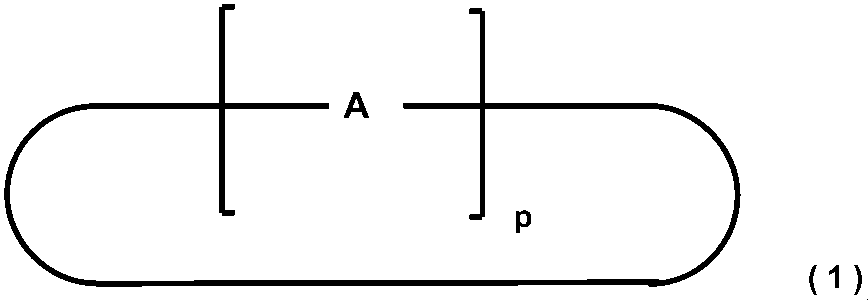
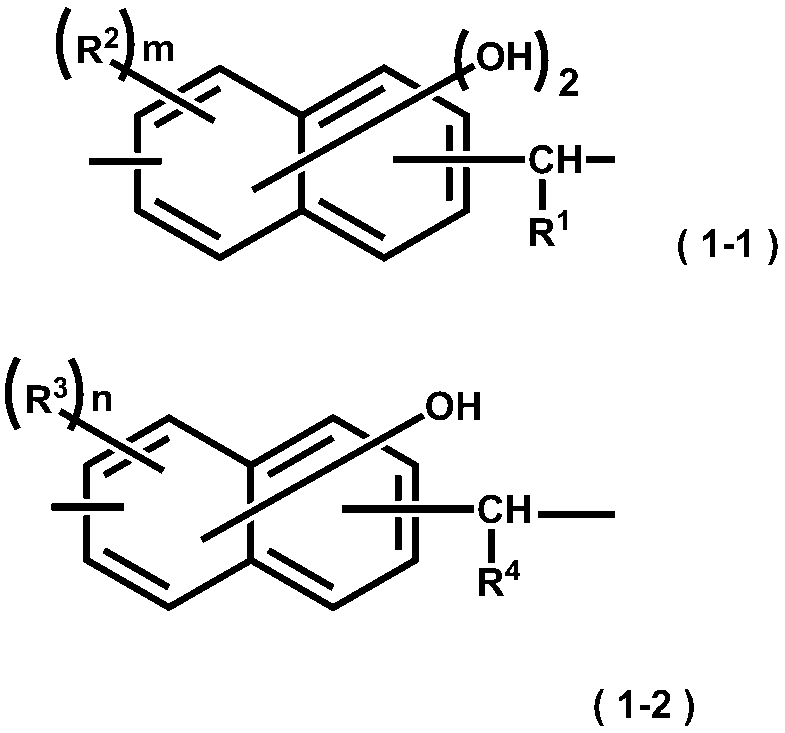
で表される構造で、前記-A-として前記(1-1)で表される構造と(1-2)で表される構造を併有し、しかも、前記(1-1)で表される構造と(1-2)で表される構造の合計の繰り返し数pが2~10の整数である分子構造を有することを特徴とする。
(1-1)-(1-1)-(1-2)
(1-2)-(1-2)-(1-1)
(1-1)-(1-2)-(1-2)
(1-2)-(1-1)-(1-2)
(1-1)-(1-2)-(1-1)-(1-2)
(1-1)-(1-1)-(1-2)-(1-2)
(1-1)-(1-1)-(1-1)-(1-2)
(1-1)-(1-2)-(1-2)-(1-1)


で表される構造部位等が挙げられる。具体的にアリール基は、例えば、フェニル基、ヒドロキシフェニル基、ジヒドロキシフェニル基、ヒドロキシアルコキシフェニル基、アルコキシフェニル基、トリル基、キシリル基、ナフチル基、ヒドロキシナフチル基、ジヒドロキシナフチル基等が挙げられる。
方法1:ジヒドロキシナフタレン類とナフトール類とホルムアルデヒドとを塩基性触媒の存在下で反応させる方法。
方法2:ジヒドロキシナフタレン類とナフトール類と炭素原子数が2つ以上の脂肪族アルデヒド化合物又は芳香族アルデヒド類とを、酸性触媒の存在下で反応させる方法。

の何れかで表される化合物等が挙げられる。
測定装置:東ソー株式会社製「HLC-8220 GPC」、
カラム:東ソー株式会社製ガードカラム「HHR-H」(6.0mmI.D.×4cm)+東ソー株式会社製「TSK-GEL GMHHR-N」(7.8mmI.D.×30cm)+東ソー株式会社製「TSK-GEL GMHHR-N」(7.8mmI.D.×30cm)+東ソー株式会社製「TSK-GEL GMHHR-N」(7.8mmI.D.×30cm)+東ソー株式会社製「TSK-GEL GMHHR-N」(7.8mmI.D.×30cm)
検出器:ELSD(オルテックジャパン株式会社製「ELSD2000」)
データ処理:東ソー株式会社製「GPC-8020モデルIIデータ解析バージョン4.30」
測定条件:カラム温度 40℃
展開溶媒 テトラヒドロフラン(THF)
流速 1.0ml/分
試料:樹脂固形分換算で1.0質量%のテトラヒドロフラン溶液をマイクロフィルターでろ過したもの(5μl)。
標準試料:前記「GPC-8020モデルIIデータ解析バージョン4.30」の測定マニュアルに準拠して、分子量が既知の下記の単分散ポリスチレンを用いた。
東ソー株式会社製「A-500」
東ソー株式会社製「A-1000」
東ソー株式会社製「A-2500」
東ソー株式会社製「A-5000」
東ソー株式会社製「F-1」
東ソー株式会社製「F-2」
東ソー株式会社製「F-4」
東ソー株式会社製「F-10」
東ソー株式会社製「F-20」
東ソー株式会社製「F-40」
東ソー株式会社製「F-80」
東ソー株式会社製「F-128」
東ソー株式会社製「F-288」
東ソー株式会社製「F-550」
日本電子株式会社製の二重収束型質量分析装置AX505H(FD505H)を用いて測定した。
温度計、滴下ロート、冷却管、撹拌器を取り付けたフラスコに、1,6-ジヒドロキシナフタレン120g、1―ナフトール36g、4-ヒドロキシベンズアルデヒド122g、1-ブタノール290g及び95%硫酸1.7gを仕込み、100℃に昇温後12時間撹拌ししながら反応させた。反応終了後、イオン交換水160gを加えた後、分液漏斗で下層よりpH1の水層を棄却した。イオン交換水160gによる有機層の洗浄を7回実施し、棄却される水層がpH4であることを確認した。上層の有機層を、エバポレータを用いて加熱減圧濃縮し、その後乾燥を行い、化合物(A1)がGPCの面積比で74%含まれる組成物246gを得た。該組成物のFD-MSスペクトル測定の結果、前記構造式(1)で表される環状化合物〔構造式(1)中のpは4である〕に相当する992、1008、1024、1041のピークが検出され、該組成物中に74%含まれる化合物(A1)が、構造式(1)で表される分子構造を有するフェノール性水酸基含有化合物であると判断した。尚、本実施例において、1,6-ジヒドロキシナフタレンと1―ナフトールとを使用していることから、化合物(A1)は、前記構造式(1-1)で表される構造及び構造式(1-2)で表される構造を併有していることは明らかである。フェノール性水酸基含有化合物(A1)のGPCのチャートを図1に、FD-MSのチャート(全体図)を図2に、FD-MSのチャート(32倍の拡大図)を図3にそれぞれ示す。
フェノール性水酸基含有化合物(A1)を含む組成物8部と、と感光剤(東洋合成工業株式会社製の「P-200」。4,4‘-[1-[4-[1-(4-ヒドロキシフェニル)-1-メチルエチル]フェニル]エチリデン]ビスフェノール1モルと、1,2-ナフトキノン-2-ジアジド-5-スルホニルクロリド2モルとの縮合物)2部を、プロピレングリコールモノメチルエーテルアセテート(以下、「PGMEA」と略記する。)を溶液濃度20%になるようPGMEAに加え、常温条件下で振とう機にて撹拌し、PGMEA溶液を得た。撹拌後、容器内の溶剤の状態を目視で評価した。
溶解:均一透明な状態(第1表の表記では○)
不溶:固形成分が析出または沈殿した状態(第1表の表記では×)
示差熱熱重量同時測定装置(TG/DTA)を用い、下記条件で、一定速度で昇温時の重量減少を測定し、熱分解開始温度を求めた。この温度が高い程、耐熱性に優れる。
測定機器:セイコーインスツールメント社製TG/DTA 6200
測定範囲:RT~400℃
昇温速度:10℃/min
雰囲気:窒素
1,6-ジヒドロキシナフタレン80g、1-ナフトール72gを用いた以外は実施例1と同様にして構造式(1)で表される分子構造を有するフェノール性水酸基含有化合物(A2)がGPCの面積比で79%含まれる組成物237gを得た。尚、該組成物のFD-MSスペクトル測定の結果、前記構造式(i)で表される環状化合物に相当する992、1008、1024、1041、1058のピークが検出され、該組成物中に79%含まれる化合物(A2)は、前記構造式(1)で表される分子構造を有するフェノール性水酸基含有化合物であると判断した。フェノール性水酸基含有化合物(A2)のGPCのチャートを図4に、FD-MSのチャート(全体図)を図5に、FD-MSのチャート(7倍の拡大図)を図6にそれぞれ示す。
1,6-ジヒドロキシナフタレン40g、1-ナフトール108gを用いた以外は実施例1と同様にして構造式(1)で表される分子構造を有するフェノール性水酸基含有化合物(A3)がGPCの面積比で65%含まれる組成物231gを得た。尚、該組成物のFD-MSスペクトル測定の結果、前記構造式(i)で表される環状化合物に相当する992、1008、1024、1041、1058のピークが検出され、該組成物中に65%含まれる化合物(A3)は、前記構造式(1)で表される分子構造を有するフェノール性水酸基含有化合物であると判断した。フェノール性水酸基含有化合物(A3)のGPCのチャートを図7に、FD-MSのチャート(全体図)を図8に、FD-MSのチャート(3倍の拡大図)を図9にそれぞれ示す。
温度計、冷却管、撹拌器を取り付けたフラスコに、1,6-ジヒドロキシナフタレン160g(1.00モル)、メチルイソブチルケトン400g、水96g及び92%パラホルムアルデヒド27.7g(0.85モル)を仕込み、室温下で撹拌した。その後、50%濃度に調整したパラトルエンスルホン酸水溶液4.8gを添加した。その後、撹拌しながら80℃に昇温し、2時間反応させた。反応終了後、系内の溶液を分液ロートに移し水層を有機層から分離除去した。次いで洗浄水が中性を示すまで水洗後、有機層から溶媒を加熱減圧下で除去し、比較対照用非環状化合物〔ノボラック型フェノール樹脂(A´1)〕を162g得た。
温度計、滴下ロート、冷却管、撹拌器を取り付けたフラスコに、1-ナフトール48g(0.3モル)、42%ホルムアルデヒド水溶液26g(0.36モル)、イソプロピルアルコール50g及び48%水酸化ナトリウム9.4g(0.11モル)を仕込み、室温下、窒素を吹き込みながら撹拌した。その後、80℃に昇温後、1時間撹拌した。反応終了後、第1リン酸ソーダ8質量部を添加して中和した後、冷却し結晶物をろ別した。その後、水50gで3回洗浄を繰り返した後に、加熱減圧乾燥して比較対照用環状化合物〔比較対照用フェノール性水酸基含有化合物(A´2)〕47gを得た。
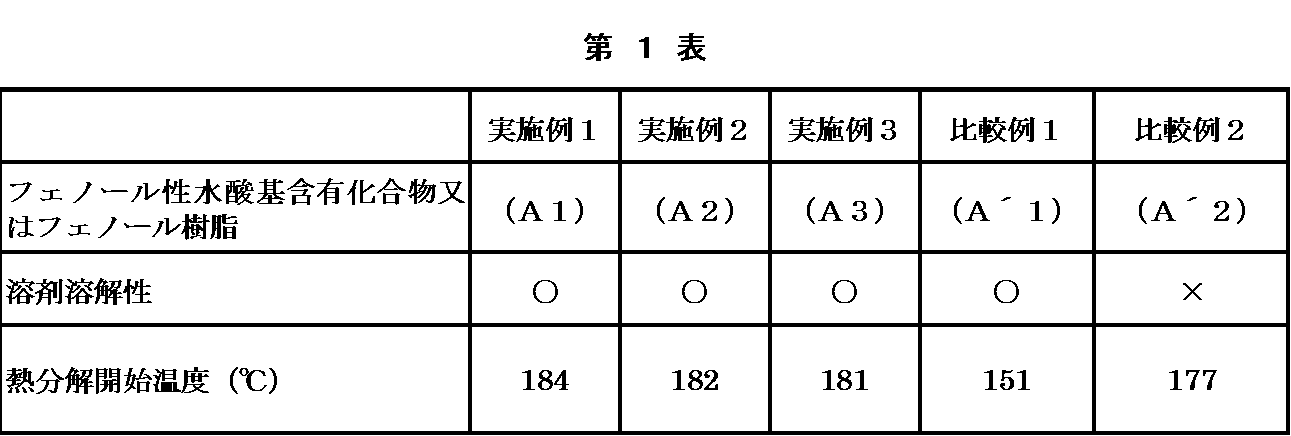
得られたフェノール性水酸基含有化合物(A1)を含む組成物を用いて、下記に従い感光性組成物を調製した。この組成物を用いて得られる塗膜のアルカリ現像性及び解像度を評価した。組成物の調製方法、アルカリ現像性の評価方法及び解像度の評価方法を下記に示す。
感光性組成物は、レジスト用途、具体的には、ポジ型フォトレジスト用途を想定して調製したものである。そして、この組成物を用いて得られる塗膜はレジスト塗膜、具体的には、ポジ型フォトレジスト塗膜を想定して作成したものである。この組成物を用いて得られる塗膜はアルカリ現像性と解像度を評価した。感光性組成物の調製法と評価法を以下に示す。
得られた組成物(a)、(b)それぞれを、直径5インチのシリコンウェハー上にスピンコーターを用いて塗布後、110℃で60秒乾燥し、厚さ約1μmの塗膜(A)及び(B)を得た。この塗膜(A)、(B)をアルカリ溶液(2.38%のテトラメチルアンモニウムヒドロキシド水溶液)に60秒浸漬させ、浸漬後の膜厚を膜厚計(フィルメトリクス社製「F-20」)にて測定し、アルカリ溶解速度(ADR)を評価した。評価結果を第2表に示す。塗膜(A)におけるアルカリ溶液溶解速度が低く、また、塗膜(B)におけるアルカリ溶解速度が高いほど、光感度に優れる塗膜が得られるレジスト用組成物である。
前記感光剤を含有する感光性組成物(a)を直径5インチのシリコンウェハー上にスピンコーターを用いて塗布した後、110℃で60秒乾燥させ、塗膜付きシリコンウェハーを作成した。得られた塗膜付きシリコンウェハーの塗膜面にフォトマスクを乗せ、ウシオ電機株式会社製マルチライト(g・h・i線)で100mJ/cm2照射し感光させた。感光後のシリコンウェハーをアルカリ溶液(2.38%のテトラメチルアンモニウムヒドロキシド水溶液)に60秒浸漬させた後、パターン表面を純水で洗い、スピンコーターでスピン乾燥した後、100℃で60秒乾燥させた。得られたシリコンウェハー上のレジストパターンの状態をレーザーマイクロスコープ(株式会社キーエンス製「VK-8500」)で確認し下記基準に従い評価した。評価結果を第2表に示す
○:L/S=5μmで解像できているもの。
×:L/S=5μmで解像できていないもの。
第2表に示すフェノール性水酸基含有化合物またはフェノール樹脂を用いた以外は実施例4と同様にして感光性組成物を得た。これらの感光性組成物を用いて塗膜のアルカリ現像性と解像度を評価した。評価結果を第2表に示す。
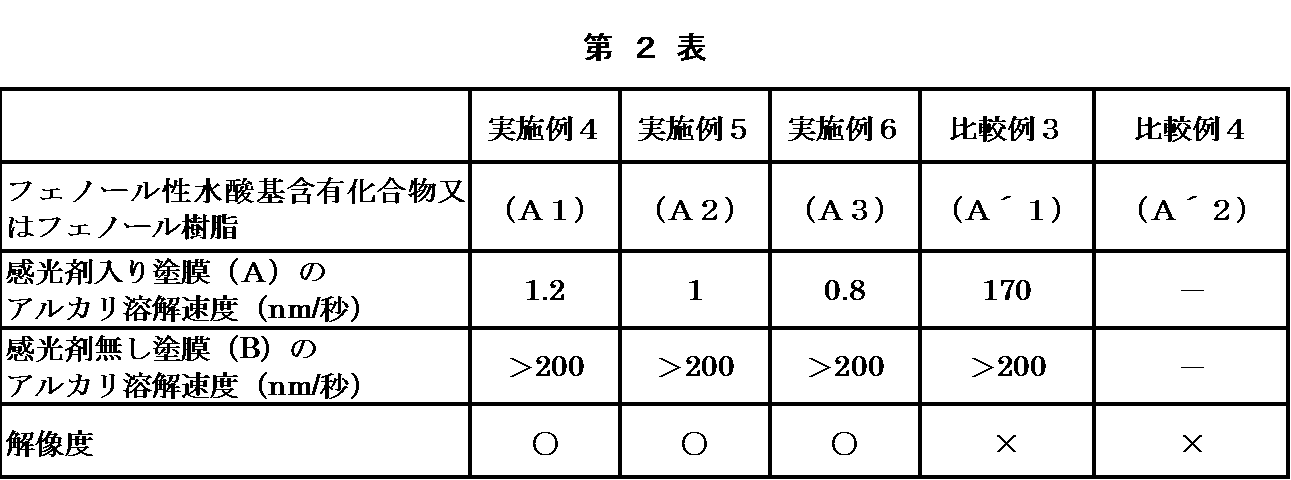
-:塗膜を形成する際に結晶が析出し、塗膜を形成できなかったため測定不可能であった。
得られたフェノール性水酸基含有化合物(A1)を含む組成物を用いて、下記に従い化性組成物を調製した。この組成物を用いて得られる塗膜のアルカリ現像性及びドライエッチング耐性を評価した。組成物の調製方法、アルカリ現像性の評価方法及びドライエッチング耐性の評価方法を下記に示す。
硬化性組成物は、レジスト下層膜用途、レジスト永久膜用途を想定して調製したものである。そして、この組成物を用いて得られる塗膜はレジスト下層膜、レジスト永久膜を想定して作成したものである。この組成物を用いて得られる塗膜はアルカリ現像性とドライエッチング耐性を評価した。硬化性組成物の調製法と評価方法を以下に示す。
フェノール性水酸基含有化合物(A1)をGPCの面積比で74%含まれる組成物16部と架橋剤(東京化成工業(株)製「1,3,4,6-テトラキス(メトキシメチル)グリコールウリル」)3部をPGMEA 100部に加え、混合、溶解し溶液を得た。この溶液を0.2μmのメンブランフィルターでろ過し、硬化性組成物を得た。
前記硬化性組成物を直径5インチのシリコンウェハー上にスピンコーターを用いて塗布後、110℃で60秒乾燥し、厚さ約1μmの塗膜付きシリコンウェハーを得た。得られた塗膜付きシリコンウェハーをアルカリ溶液(2.38%のテトラメチルアンモニウムヒドロキシド水溶液)に60秒浸漬させ、浸漬後の膜厚を膜厚計(フィルメトリクス社製「F-20」)にて測定し、アルカリ溶解速度(ADR)を評価した。評価結果を第3表に示すアルカリ溶解速度が高いほど、アルカリ溶液に対し現像性に優れる塗膜が得られる硬化性組成物である。
前記硬化性組成物を直径5インチのシリコンウェハー上にスピンコーターを用いて塗布した後、酸素濃度20容量%のホットプレート内にて、180℃で60秒間加熱した。更に、350℃で120秒間加熱して、膜厚0.3μmの塗膜付きシリコンウェハーを得た。形成した塗膜を、エッチング装置(神鋼精機社製の「EXAM」)を使用して、CF4/Ar/O2(CF4:40mL/分、Ar:20mL/分、O2:5mL/分 圧力:20Pa RFパワー:200W 処理時間:40秒 温度:15℃)の条件でエッチング処理した。このときのエッチング処理前後の膜厚を測定して、エッチングレートを算出し、エッチング耐性を評価した。評価基準は以下の通りである。評価結果を第3表に示す
○:エッチングレートが150nm/分以下の場合。
×:エッチングレートが150nm/分を超える場合。
第2表に示すフェノール性水酸基含有化合物またはフェノール樹脂を用いた以外は実施例4と同様にして硬化性組成物を得た。これらの感光性組成物を用いて塗膜のアルカリ現像性とドライエッチング耐性を評価した。評価結果を第3表に示す。
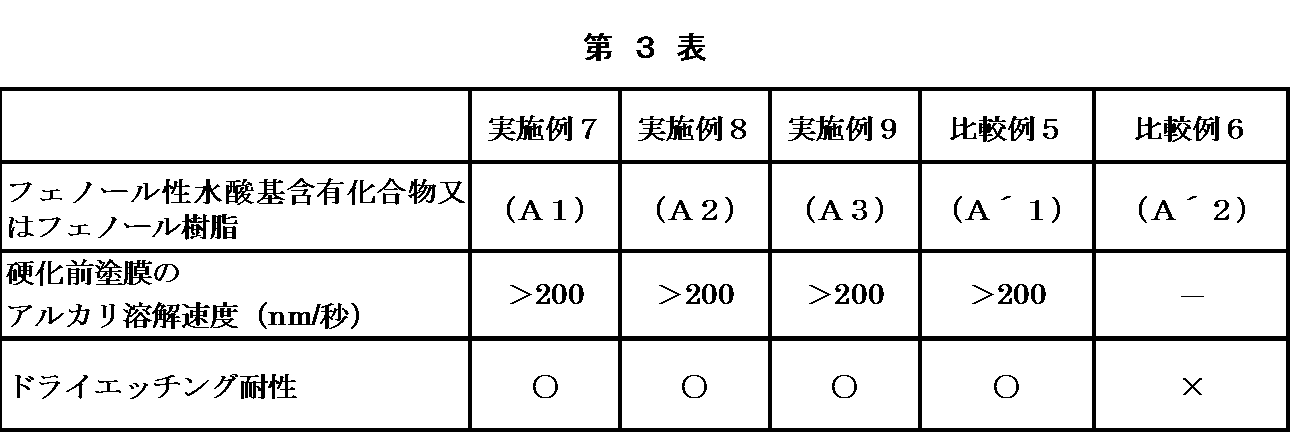
-:塗膜を形成する際に結晶が析出し、塗膜を形成できなかったため測定不可能であった。
Claims (16)
- 下記構造式(1)

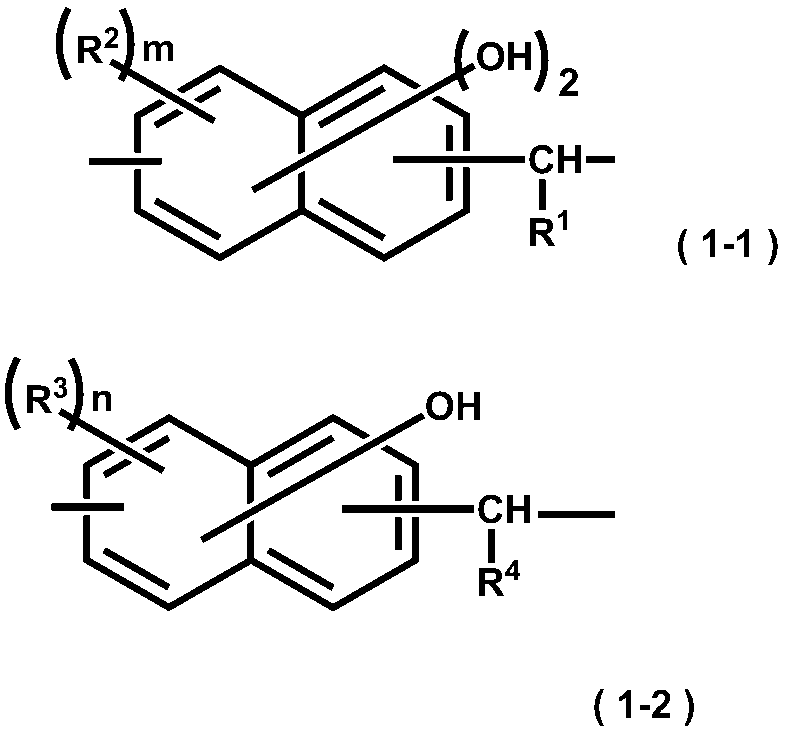
で表される構造で、前記-A-として前記(1-1)で表される構造と(1-2)で表される構造を併有し、しかも、前記(1-1)で表される構造と(1-2)で表される構造の合計の繰り返し数pが2~10の整数である分子構造を有することを特徴とするフェノール性水酸基含有化合物。 - 前記構造式(1-1)が下記構造式(1-1-1)で表される構造で、前記構造式(1-2)が下記構造式(1-2-1)で表される構造である請求項1記載のフェノール性水酸基含有化合物。
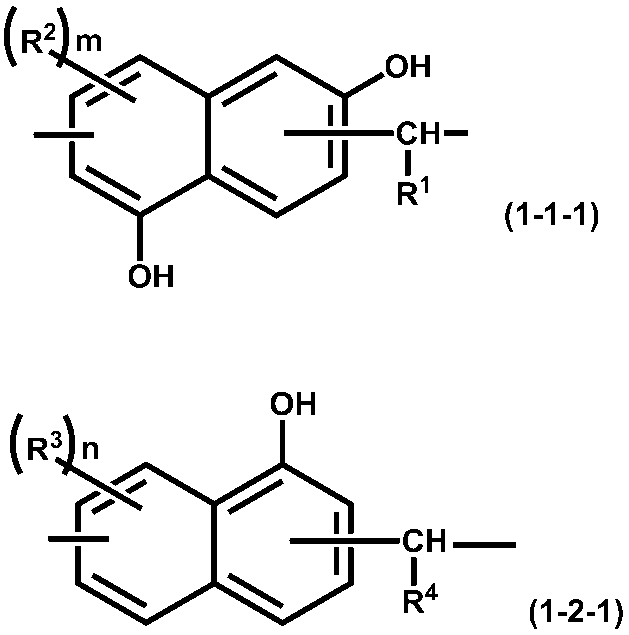
- 前記R1及びR4がヒドロキシフェニル基である請求項1または2記載のフェノール性水酸基含有化合物。
- 前記pが、2、3、4、5、6、8である請求項1記載のフェノール性水酸基含有化合物。
- ジヒドロキシナフタレン類とナフトール類とホルムアルデヒドとを塩基性触媒の存在下で反応させて得られる請求項1記載のフェノール性水酸基含有化合物。
- ジヒドロキシナフタレン類とナフトール類と炭素原子数が2つ以上の脂肪族アルデヒド類又は芳香族アルデヒド類とを、酸性触媒の存在下で反応させて得られる請求項1記載のフェノール性水酸基含有化合物。
- 1,6-ジヒドロキシナフタレンと1-ナフトールと4-ヒドロキシベンズアルデヒドを酸性触媒の存在下で反応させて得られる請求項6記載のフェノール性水酸基含有化合物。
- 請求項1~7の何れか一つに記載のフェノール性水酸基含有化合物(A)と感光剤(B1)とを含有することを特徴とする感光性組成物。
- 請求項8記載の感光性組成物からなることを特徴とするレジスト用組成物。
- 請求項9記載のレジスト用組成物からなることを特徴とするレジスト塗膜。
- 請求項1~7の何れか一つに記載のフェノール性水酸基含有化合物と硬化剤(B2)とを含有することを特徴とする硬化性組成物。
- 請求項11記載の硬化性組成物を硬化させてなることを特徴とする硬化物。
- 請求項11記載の硬化性組成物からなることを特徴とするレジスト下層膜用組成物。
- 請求項13記載のレジスト下層膜用組成物からなることを特徴とするレジスト下層膜。
- 請求項11記載の硬化性組成物からなるレジスト永久膜用組成物。
- 請求項13記載のレジスト下層膜用組成物からなるレジスト永久膜。
Priority Applications (4)
| Application Number | Priority Date | Filing Date | Title |
|---|---|---|---|
| US15/532,272 US10266471B2 (en) | 2015-01-16 | 2015-11-19 | Phenolic hydroxyl-containing compound, composition containing the same, and cured film of the composition |
| KR1020177012628A KR102432122B1 (ko) | 2015-01-16 | 2015-11-19 | 페놀성 수산기 함유 화합물, 이것을 포함하는 조성물 및 그 경화막 |
| JP2016536266A JP6025011B1 (ja) | 2015-01-16 | 2015-11-19 | フェノール性水酸基含有化合物、これを含む組成物及びその硬化膜 |
| CN201580073573.XA CN107108418B (zh) | 2015-01-16 | 2015-11-19 | 含酚性羟基化合物、包含其的组合物及其固化膜 |
Applications Claiming Priority (2)
| Application Number | Priority Date | Filing Date | Title |
|---|---|---|---|
| JP2015006725 | 2015-01-16 | ||
| JP2015-006725 | 2015-01-16 |
Publications (1)
| Publication Number | Publication Date |
|---|---|
| WO2016114001A1 true WO2016114001A1 (ja) | 2016-07-21 |
Family
ID=56405558
Family Applications (1)
| Application Number | Title | Priority Date | Filing Date |
|---|---|---|---|
| PCT/JP2015/082513 Ceased WO2016114001A1 (ja) | 2015-01-16 | 2015-11-19 | フェノール性水酸基含有化合物、これを含む組成物及びその硬化膜 |
Country Status (6)
| Country | Link |
|---|---|
| US (1) | US10266471B2 (ja) |
| JP (1) | JP6025011B1 (ja) |
| KR (1) | KR102432122B1 (ja) |
| CN (1) | CN107108418B (ja) |
| TW (1) | TWI675866B (ja) |
| WO (1) | WO2016114001A1 (ja) |
Cited By (4)
| Publication number | Priority date | Publication date | Assignee | Title |
|---|---|---|---|---|
| WO2017098882A1 (ja) * | 2015-12-11 | 2017-06-15 | Dic株式会社 | ノボラック型樹脂及びレジスト膜 |
| KR20180040495A (ko) * | 2016-10-12 | 2018-04-20 | 제이에스알 가부시끼가이샤 | 레지스트 하층막 형성용 조성물, 레지스트 하층막, 레지스트 하층막의 형성 방법, 패터닝된 기판의 제조 방법 및 화합물 |
| WO2025225566A1 (ja) * | 2024-04-23 | 2025-10-30 | 日産化学株式会社 | 着色レジストのパターン形成方法及びそれに用いる組成物 |
| WO2026074762A1 (ja) * | 2024-10-02 | 2026-04-09 | Dic株式会社 | ナフチレンエーテル樹脂、樹脂組成物、硬化物、プリプレグ、回路基板、ビルドアップフィルム、半導体封止材、半導体装置、ナフチレンエーテル樹脂の製造方法、及びフェノール樹脂の製造方法 |
Families Citing this family (4)
| Publication number | Priority date | Publication date | Assignee | Title |
|---|---|---|---|---|
| TWI675051B (zh) * | 2014-10-10 | 2019-10-21 | 日商迪愛生股份有限公司 | 萘酚型杯芳烴化合物及其製造方法、感光性組成物、光阻材料、及塗膜 |
| WO2016114000A1 (ja) * | 2015-01-16 | 2016-07-21 | Dic株式会社 | レジスト永久膜用硬化性組成物及びレジスト永久膜 |
| US11487204B2 (en) * | 2017-07-27 | 2022-11-01 | Dic Corporation | Resist material |
| WO2022065041A1 (ja) * | 2020-09-28 | 2022-03-31 | Dic株式会社 | フェノール性水酸基含有樹脂、アルカリ現像性レジスト用樹脂組成物、及びレジスト硬化性樹脂組成物、並びにフェノール性水酸基含有樹脂の製造方法 |
Citations (6)
| Publication number | Priority date | Publication date | Assignee | Title |
|---|---|---|---|---|
| JP2010248435A (ja) * | 2009-04-20 | 2010-11-04 | Dic Corp | ノボラック樹脂の製造方法 |
| JP2012162474A (ja) * | 2011-02-04 | 2012-08-30 | Dic Corp | ナフトール型カリックス(4)アレーン化合物の製造方法 |
| JP2012201798A (ja) * | 2011-03-25 | 2012-10-22 | Dic Corp | 硬化性樹脂組成物、その硬化物、プリント配線基板、及びナフトール樹脂 |
| JP2013079230A (ja) * | 2011-09-23 | 2013-05-02 | Rohm & Haas Electronic Materials Llc | カリックスアレーンおよびこれを含むフォトレジスト組成物 |
| WO2015008560A1 (ja) * | 2013-07-19 | 2015-01-22 | Dic株式会社 | フェノール性水酸基含有化合物、感光性組成物、レジスト用組成物、レジスト塗膜、硬化性組成物、レジスト下層膜用組成物、及びレジスト下層膜 |
| WO2015174199A1 (ja) * | 2014-05-15 | 2015-11-19 | Dic株式会社 | 変性フェノール性水酸基含有化合物、変性フェノール性水酸基含有化合物の製造方法、感光性組成物、レジスト材料及びレジスト塗膜 |
Family Cites Families (11)
| Publication number | Priority date | Publication date | Assignee | Title |
|---|---|---|---|---|
| JPS6169826A (ja) * | 1984-09-14 | 1986-04-10 | Agency Of Ind Science & Technol | ポリグリシジルエーテル |
| JPH05132543A (ja) * | 1991-11-11 | 1993-05-28 | Dai Ichi Kogyo Seiyaku Co Ltd | エポキシ樹脂組成物 |
| JP5593667B2 (ja) * | 2009-04-30 | 2014-09-24 | 大日本印刷株式会社 | ネガ型レジスト組成物、当該ネガ型レジスト組成物を用いたパターン形成方法、及び電子部品 |
| US9029069B2 (en) * | 2011-03-31 | 2015-05-12 | Jsr Corporation | Resist underlayer film-forming composition and method for forming pattern |
| JP6064360B2 (ja) | 2011-05-11 | 2017-01-25 | Jsr株式会社 | パターン形成方法及びレジスト下層膜形成用組成物 |
| JP5776465B2 (ja) * | 2011-09-21 | 2015-09-09 | Dic株式会社 | ナフトール樹脂、硬化性樹脂組成物、その硬化物、及びプリント配線基板 |
| JP5859420B2 (ja) * | 2012-01-04 | 2016-02-10 | 信越化学工業株式会社 | レジスト下層膜材料、レジスト下層膜材料の製造方法、及び前記レジスト下層膜材料を用いたパターン形成方法 |
| EP2899593A4 (en) * | 2012-09-10 | 2016-06-22 | Jsr Corp | COMPOSITION FOR FORMING A LACQUER LAYER FILM AND METHOD FOR STRUCTURED FORMING |
| US9765175B2 (en) * | 2013-09-18 | 2017-09-19 | Dic Corporation | Modified hydroxy naphthalene novolak resin, production method for modified hydroxy naphthalene novolak resin, photosensitive composition, resist material and coating |
| US20170082923A1 (en) * | 2014-06-12 | 2017-03-23 | Dic Corporation | Photosensitive composition for permanent films, resist material and coating film |
| TWI675051B (zh) * | 2014-10-10 | 2019-10-21 | 日商迪愛生股份有限公司 | 萘酚型杯芳烴化合物及其製造方法、感光性組成物、光阻材料、及塗膜 |
-
2015
- 2015-11-19 US US15/532,272 patent/US10266471B2/en active Active
- 2015-11-19 JP JP2016536266A patent/JP6025011B1/ja active Active
- 2015-11-19 WO PCT/JP2015/082513 patent/WO2016114001A1/ja not_active Ceased
- 2015-11-19 KR KR1020177012628A patent/KR102432122B1/ko active Active
- 2015-11-19 CN CN201580073573.XA patent/CN107108418B/zh active Active
- 2015-11-24 TW TW104138943A patent/TWI675866B/zh active
Patent Citations (6)
| Publication number | Priority date | Publication date | Assignee | Title |
|---|---|---|---|---|
| JP2010248435A (ja) * | 2009-04-20 | 2010-11-04 | Dic Corp | ノボラック樹脂の製造方法 |
| JP2012162474A (ja) * | 2011-02-04 | 2012-08-30 | Dic Corp | ナフトール型カリックス(4)アレーン化合物の製造方法 |
| JP2012201798A (ja) * | 2011-03-25 | 2012-10-22 | Dic Corp | 硬化性樹脂組成物、その硬化物、プリント配線基板、及びナフトール樹脂 |
| JP2013079230A (ja) * | 2011-09-23 | 2013-05-02 | Rohm & Haas Electronic Materials Llc | カリックスアレーンおよびこれを含むフォトレジスト組成物 |
| WO2015008560A1 (ja) * | 2013-07-19 | 2015-01-22 | Dic株式会社 | フェノール性水酸基含有化合物、感光性組成物、レジスト用組成物、レジスト塗膜、硬化性組成物、レジスト下層膜用組成物、及びレジスト下層膜 |
| WO2015174199A1 (ja) * | 2014-05-15 | 2015-11-19 | Dic株式会社 | 変性フェノール性水酸基含有化合物、変性フェノール性水酸基含有化合物の製造方法、感光性組成物、レジスト材料及びレジスト塗膜 |
Non-Patent Citations (3)
| Title |
|---|
| PARIS E. GEORGHIOU ET AL.: "Calixnaphthalenes: Deep, electron-rich naphthalene ring-containing calixarenes.", THE FIRST DECADE, SYNLETT, 2005, pages 879 - 891, ISSN: 0936-5214 * |
| PARIS E. GEORGHIOU: "Calixparagraph[4] naphthalenes: Cyclic tetramers of 1-naphthol and formaldehyde", TETRAHEDRON LETTERS, vol. 34, no. 18, 1993, pages 2887 - 2890 * |
| SHORTHILL, B.J. ET AL.: "Synthesis of 3,5- and 3,6-linked calix[n]naphthalenes", JOURNAL OF ORGANIC CHEMISTRY, vol. 67, no. 3, 2002, pages 904 - 909, ISSN: 0022-3263 * |
Cited By (5)
| Publication number | Priority date | Publication date | Assignee | Title |
|---|---|---|---|---|
| WO2017098882A1 (ja) * | 2015-12-11 | 2017-06-15 | Dic株式会社 | ノボラック型樹脂及びレジスト膜 |
| KR20180040495A (ko) * | 2016-10-12 | 2018-04-20 | 제이에스알 가부시끼가이샤 | 레지스트 하층막 형성용 조성물, 레지스트 하층막, 레지스트 하층막의 형성 방법, 패터닝된 기판의 제조 방법 및 화합물 |
| KR102456401B1 (ko) | 2016-10-12 | 2022-10-20 | 제이에스알 가부시끼가이샤 | 레지스트 하층막 형성용 조성물, 레지스트 하층막, 레지스트 하층막의 형성 방법, 패터닝된 기판의 제조 방법 및 화합물 |
| WO2025225566A1 (ja) * | 2024-04-23 | 2025-10-30 | 日産化学株式会社 | 着色レジストのパターン形成方法及びそれに用いる組成物 |
| WO2026074762A1 (ja) * | 2024-10-02 | 2026-04-09 | Dic株式会社 | ナフチレンエーテル樹脂、樹脂組成物、硬化物、プリプレグ、回路基板、ビルドアップフィルム、半導体封止材、半導体装置、ナフチレンエーテル樹脂の製造方法、及びフェノール樹脂の製造方法 |
Also Published As
| Publication number | Publication date |
|---|---|
| TWI675866B (zh) | 2019-11-01 |
| JP6025011B1 (ja) | 2016-11-16 |
| JPWO2016114001A1 (ja) | 2017-04-27 |
| US10266471B2 (en) | 2019-04-23 |
| TW201634507A (zh) | 2016-10-01 |
| CN107108418A (zh) | 2017-08-29 |
| KR102432122B1 (ko) | 2022-08-16 |
| CN107108418B (zh) | 2021-04-27 |
| KR20170104989A (ko) | 2017-09-18 |
| US20170334817A1 (en) | 2017-11-23 |
Similar Documents
| Publication | Publication Date | Title |
|---|---|---|
| JP5700269B1 (ja) | フェノール性水酸基含有化合物、感光性組成物、レジスト用組成物、レジスト塗膜、硬化性組成物、レジスト下層膜用組成物、及びレジスト下層膜 | |
| JP6025011B1 (ja) | フェノール性水酸基含有化合物、これを含む組成物及びその硬化膜 | |
| CN107848926B (zh) | 酚醛清漆型含酚性羟基树脂以及抗蚀膜 | |
| CN107531858B (zh) | 酚醛清漆型含酚性羟基树脂以及抗蚀膜 | |
| JP5939450B1 (ja) | フェノール性水酸基含有樹脂、その製造方法、感光性組成物、レジスト材料、塗膜、硬化性組成物とその硬化物、及びレジスト下層膜 | |
| JP6028883B1 (ja) | レジスト永久膜用硬化性組成物及びレジスト永久膜 | |
| JP6269904B1 (ja) | ノボラック型樹脂の製造方法 | |
| JP7124989B1 (ja) | フェノール性水酸基含有樹脂、アルカリ現像性レジスト用樹脂組成物、及びレジスト硬化性樹脂組成物、並びにフェノール性水酸基含有樹脂の製造方法 |
Legal Events
| Date | Code | Title | Description |
|---|---|---|---|
| ENP | Entry into the national phase |
Ref document number: 2016536266 Country of ref document: JP Kind code of ref document: A |
|
| 121 | Ep: the epo has been informed by wipo that ep was designated in this application |
Ref document number: 15877953 Country of ref document: EP Kind code of ref document: A1 |
|
| ENP | Entry into the national phase |
Ref document number: 20177012628 Country of ref document: KR Kind code of ref document: A |
|
| NENP | Non-entry into the national phase |
Ref country code: DE |
|
| 122 | Ep: pct application non-entry in european phase |
Ref document number: 15877953 Country of ref document: EP Kind code of ref document: A1 |