WO2016111104A1 - 消泡剤用シリコーンオイルコンパウンド及び消泡剤組成物 - Google Patents
消泡剤用シリコーンオイルコンパウンド及び消泡剤組成物 Download PDFInfo
- Publication number
- WO2016111104A1 WO2016111104A1 PCT/JP2015/084110 JP2015084110W WO2016111104A1 WO 2016111104 A1 WO2016111104 A1 WO 2016111104A1 JP 2015084110 W JP2015084110 W JP 2015084110W WO 2016111104 A1 WO2016111104 A1 WO 2016111104A1
- Authority
- WO
- WIPO (PCT)
- Prior art keywords
- silicone oil
- group
- oil compound
- composition
- antifoaming
- Prior art date
- Legal status (The legal status is an assumption and is not a legal conclusion. Google has not performed a legal analysis and makes no representation as to the accuracy of the status listed.)
- Ceased
Links
Classifications
-
- B—PERFORMING OPERATIONS; TRANSPORTING
- B01—PHYSICAL OR CHEMICAL PROCESSES OR APPARATUS IN GENERAL
- B01D—SEPARATION
- B01D19/00—Degasification of liquids
- B01D19/02—Foam dispersion or prevention
- B01D19/04—Foam dispersion or prevention by addition of chemical substances
Definitions
- the present invention particularly relates to a silicone oil compound and an antifoaming composition that give an antifoaming composition excellent in antifoaming properties and dispersibility in a foaming liquid.
- Silicone-based antifoaming agents have extremely low surface tension and are insoluble in many solvents, so they have better antifoaming performance than other antifoaming agents.
- Chemical, food and petroleum industries It is widely used in processes involving foaming, such as textile industry, paper industry, paper pulp industry, and pharmaceutical industry.
- an oil compound type antifoaming agent obtained by mixing silicone oil such as dimethylpolysiloxane, methylphenylpolysiloxane, and methylvinylpolysiloxane with fine powder silica, and these silicone oil compounds together with a surfactant in water.
- Dispersed emulsion antifoaming agents are widely used.
- the emulsion type antifoaming agent has a problem that the emulsified particles are destroyed under severe conditions such as high temperature, high alkalinity, and high shearing force and the defoaming ability is lowered.
- Self-emulsifying antifoaming agent using organopolysiloxane modified with a silicone oil compound Japanese Patent Publication No. 51-71886, Japanese Patent Publication No. 54-43015, Japanese Patent Publication No. 52-19836, Japanese Patent Publication No. 52- No. 22638 and Japanese Patent Publication No. 55-23084 (Patent Documents 1 to 5)] have also been proposed.
- silicone-based antifoaming agents have excellent antifoaming effects, but their dispersibility is poor, and even those with improved dispersibility in aqueous systems as emulsion type or self-emulsifying type can reach the target dispersibility. In addition, there is a problem that the defoaming effect is not sufficiently exhibited, or bleeding of the silicone component is often generated.
- the present invention has been made in view of the above circumstances, and particularly provides a silicone oil compound and an antifoaming agent composition that provide an antifoaming agent composition having excellent antifoaming properties and dispersion stability in a foaming liquid. For the purpose.
- the present inventors have reduced low molecular weight siloxane in the silicone oil of the antifoaming agent composition, in particular, trimer to decameric cyclic dimethylpolysiloxane. It has been found that the emulsifiability is improved by reducing the amount of water, the dispersion stability of the emulsion is obtained while ensuring the defoaming effect, and further, it is possible to prevent the electric contact failure in the final product.
- low molecular weight siloxane is a destabilizing factor of emulsion type or self-emulsifying type silicone antifoaming agent.
- Low-molecular-weight siloxanes are mainly cyclic trimers to 10-mers of dimethylsiloxy units represented by “-Me 2 SiO—”, and these have lower specific gravity than high-molecular silicone oil and water. It was discovered that when a self-emulsifying type is used, separation due to a difference in specific gravity is likely to occur, resulting in a loss of dispersibility in an aqueous system.
- the low molecular weight siloxane volatilizes not only in a high temperature atmosphere but also at room temperature. Moreover, low molecular siloxane may be taken in and volatilized by the mist produced from a foaming liquid.
- the low-molecular siloxane volatilized or volatilized in this way adheres to the equipment during the process, and there is a risk of causing electrical contact failure of components such as relays, switches and motors used in electronic and electrical equipment.
- silicone-based antifoaming agents are sometimes used in the production of resins, fibers, rubber, paints and inks, or resin molding. Furthermore, indirectly, coating agents, mold release agents, lubricants, anti-blocking agents, and fiber treatment agents are used as treatment agents for these materials. For the purpose of improving workability, silicone antifoaming agents are used. It is used frequently.
- nonwoven fabrics in which fibers are entangled into a sheet form are used in many electronic devices, including air conditioner filters, battery separators for mobile phones, personal computers, etc. Used in equipment.
- non-woven fabrics are also used in automobile parts that are also susceptible to electrical contact obstructions, such as transmission tunnels in engine parts, soundproofing parts such as turbo compressors, filter parts such as oil filters, transmission filters, and diesel filters, and other thermal insulation materials.
- electrical contact obstructions such as transmission tunnels in engine parts, soundproofing parts such as turbo compressors, filter parts such as oil filters, transmission filters, and diesel filters, and other thermal insulation materials.
- Such problems of electrical contact failures are not limited to electronic materials, but are also observed in the food industry, for example.
- many food processing machines are used in the food industry.
- volatilization of these low-molecular siloxanes is promoted by high-temperature treatment such as heating process and frying process, which may cause electric contact failure of food processing machines. is there.
- the low molecular weight siloxane may be volatilized to cause troubles such as electrical contact failure.
- wastewater and sewage treatment plants not only simply purify wastewater and sewage, but also use digestive gases such as methane gas and carbon dioxide generated by anaerobic fermentation during purification using activated sludge as fuel.
- digestive gases such as methane gas and carbon dioxide generated by anaerobic fermentation during purification using activated sludge as fuel.
- part of the power from the wastewater and sewage treatment plant is provided. If low molecular siloxane is present at that time, it causes deterioration of wear of the engine sliding member of the gas power generation facility, and power generation efficiency and maintainability due to silica deposition on the spark plug. Further, the generated silica may cause clogging of the exhaust gas treatment catalyst, which may become a catalyst poison.
- silica derived from such low molecular siloxanes becomes a catalyst poison.
- silicone-based antifoaming agents are used in the petroleum refining process. At that time, aromatics such as sulfur, nitrogen or benzene are removed, and in petroleum, a low octane fraction is increased by reaction. Many reforming catalysts having an octane number are also used. If such a catalyst is blocked by silica derived from low molecular siloxane, the operation efficiency and maintainability are similarly lowered.
- the present invention provides the following antifoaming silicone oil compound and antifoaming composition.
- the following average composition formula (1) R a SiO (4-a) / 2 (1)
- R is, independently of each other, an unsubstituted or substituted monovalent hydrocarbon group, and a is a number of 1.9 to 2.2.
- An antifoaming composition comprising the silicone oil compound for an antifoaming agent according to [1] or [2] and a nonionic surfactant.
- the antifoaming composition according to [4] which is a solution type.
- the antifoaming composition according to [4] or [5] which is a self-emulsifying type in combination with an organopolysiloxane modified with a polyoxyalkylene group.
- the antifoaming composition according to [5] which is an emulsion type.
- a powder type antifoaming composition comprising the antifoaming silicone oil compound according to [1] or [2] adsorbed on a fine powder carrier.
- an antifoaming composition that is particularly excellent in antifoaming properties and dispersion stability in a foaming liquid and that can prevent electrical contact failure.
- the silicone oil compound is a main component for imparting antifoaming properties to the antifoaming agent composition, and is composed of silicone oil (a) and fine powder silica (b).
- a silicone oil compound may be used individually by 1 type, or may use 2 or more types together.
- Silicone oil may be either linear or branched, and may be used alone or in combination of two or more.
- the silicone oil the following average composition formula (1): R a SiO (4-a) / 2 (1) (In the formula, R is, independently of each other, an unsubstituted or substituted monovalent hydrocarbon group, and a is a number of 1.9 to 2.2.) The thing represented by is mentioned.
- the silicone oil represented by the above formula (1) is essentially hydrophobic.
- R is preferably, independently of each other, an unsubstituted or substituted monovalent hydrocarbon group having 1 to 18 carbon atoms.
- the monovalent hydrocarbon group include methyl group, ethyl group, propyl group, butyl group, pentyl group, hexyl group, heptyl group, octyl group, nonyl group, decyl group, dodecyl group, tridecyl group, tetradecyl group, Hexadecyl, octadecyl and other alkyl groups, cyclohexyl and other cycloalkyl groups, vinyl and allyl groups and other alkenyl groups, phenyl and tolyl groups and other aryl groups, styryl groups and ⁇ -methylstyryl groups and other aralkyl groups Or some or all of the hydrogen atoms bonded to the carbon atoms of these groups are substituted with halogen
- 80% or more, particularly 90% or more, of the total number of groups represented by R is a methyl group.
- a is a number satisfying 1.9 ⁇ a ⁇ 2.2, preferably 1.95 ⁇ a ⁇ 2.15.
- the end of the organopolysiloxane may be blocked with a triorganosilyl group represented by R 3 Si— or a diorganohydroxysilyl group represented by HOR 2 Si—.
- the silicone oil from the viewpoint of antifoaming property and workability, ⁇ viscosity of 10 at 25 ° C. as measured by an Ostwald viscometer 100,000 mm 2 / s, preferably can have a 50 ⁇ 10,000 mm 2 / s . If it is less than the lower limit, the defoaming performance of the silicone oil compound is inferior, and if it exceeds the upper limit, the viscosity of the silicone oil compound increases and the workability deteriorates.
- the cyclic tetramer and pentamer of the dimethylsiloxy unit represented by “-Me 2 SiO—” are each 1,000 ppm or less, particularly the cyclic trimer to 10-mer, respectively.
- One having 1,000 ppm or less, preferably a total amount of cyclic trimer to 10-mer of 1,000 ppm or less is used.
- a siloxane polymer is produced by an equilibrium reaction of a siloxane oligomer with an acid or an alkali, a considerable amount of low molecular weight siloxane always exists regardless of the degree of polymerization.
- a method for reducing the low molecular weight siloxane component contained in the silicone oil a method for vaporizing and removing the low molecular weight siloxane component under high temperature heating of about 100 to 300 ° C. under reduced pressure, or during or after the vaporization removal is performed.
- a method of promoting vaporization by blowing an inert gas may be used.
- the cyclic trimer to 10-mer of the dimethylsiloxy unit represented by “-Me 2 SiO—” in the silicone oil as component (a) is 1,000 ppm or less, preferably 500 ppm or less, more preferably Is reduced to 200 ppm or less, and in particular, the total amount of cyclic trimer to 10-mer is reduced to 1,000 ppm or less, preferably 500 ppm or less, more preferably 200 ppm or less.
- silicone oil represented by the above formula (1) examples include dimethylpolysiloxane, diethylpolysiloxane, methylphenylpolysiloxane, dimethylsiloxane / diphenylsiloxane copolymer, methyl (3,3,3-trifluoropropyl) poly Examples thereof include siloxane and ⁇ , ⁇ -dihydroxydimethylpolysiloxane.
- the amount of silicone oil (a) is preferably 60 to 99.9 parts by mass, particularly 80 to 99 parts by mass in 100 parts by mass of (A) silicone oil compound.
- the fine powder silica may be a known one.
- wet silica such as precipitated silica
- dry silica such as silica xerogel and fumed silica
- All the silicas are hydrophilic silicas.
- the hydrophilic silica may be used as it is or may be surface-treated with a compound having an organic silyl group and modified with a trimethylsilyl group, a dimethylsilyl group, a monomethylsilyl group, a polydimethylsiloxy group, or the like.
- Hydrophobic silica may be used.
- the fine powder silica may be used alone or in combination of two or more.
- a commercially available product can be used as the fine powder silica.
- the fine powder silica preferably has a specific surface area of 100 m 2 / g or more by BET method, more preferably 100 to 500 m 2 / g, still more preferably 150 to 500 m 2 / g.
- the amount of finely divided silica (b) is preferably 0.1 to 40 parts by mass, particularly 1 to 20 parts by mass in 100 parts by mass of the (A) silicone oil compound.
- the total amount of (a) silicone oil and (b) fine powder silica is 100 parts by mass.
- the silicone oil compound may be prepared by a known method. For example, after the above (a) silicone oil and (b) fine powder silica are mixed and heat-treated at a temperature of 80 ° C. or more, particularly 80 to 200 ° C. If necessary, it can be produced by neutralization and / or removal of a low-boiling fraction.
- This silicone oil compound includes inorganic ammonium salts, organosilicon compounds, siloxane resins, and alkali catalysts described in JP-B-4-42043, JP-A-5-261206, and JP-A-2005-324140. Or the like may be further added to improve the antifoaming sustainability, high temperature characteristics, dilution stability, alkali resistance and the like of the antifoaming agent.
- the low molecular siloxane content in the silicone oil compound depends on the low molecular siloxane content in the silicone oil, and the tetramer and pentamer cyclic dimethylpolysiloxane contents are each 1,000 ppm or less, Preferably, it is 500 ppm or less, more preferably 200 ppm or less.
- the content of the cyclic dimethylpolysiloxane of trimer to 10-mer is 1,000 ppm or less, preferably 500 ppm or less, more preferably 200 ppm or less. More preferably, the total content of the trimer to 10-mer cyclic dimethylpolysiloxane is 1,000 ppm or less, preferably 500 ppm or less, more preferably 200 ppm or less.
- the silicone oil compound (A) may be used as an antifoam composition as it is, or may be used as an antifoam composition by combining the silicone oil compound (A) and the nonionic surfactant (B). Good.
- the antifoam composition containing the silicone oil compound may be an embodiment in which the silicone oil compound is used as it is, or a solvent that dissolves the silicone oil in the silicone oil compound, such as toluene, xylene, hexane, chloroform, 2-butanone,
- a solution-type antifoaming agent composition in which a silicone oil compound is dispersed in a solvent such as 4-methyl-2-pentanone, or a silicone oil compound containing methyl cellulose, polyvinyl alcohol, lactose, dextrin, hydrophilic fine powder silica, starch, etc.
- An embodiment of a powder type antifoaming agent composition in which a silicone oil compound is adsorbed on the fine powder carrier is mentioned.
- a silicone oil compound is 5-80 mass% of the whole antifoamer composition, More preferably, it is 30-70 mass%. If the silicone oil compound content is too low, the defoaming performance of the antifoaming composition may be inferior. If it is too high, the main purpose of the solution type antifoaming composition is to improve the dispersibility of the silicone oil compound. There are cases where it is not possible.
- an antifoaming composition using the silicone oil compound (A) and the nonionic surfactant (B) in combination an embodiment in which a mixture of the silicone oil compound and the nonionic surfactant is used as it is, the mixture is used as water.
- the emulsion type antifoaming agent composition emulsified and dispersed in the above are mentioned.
- the nonionic surfactant (B) is used to disperse the silicone oil compound (A) in water, but may be generally known, for example, sorbitan fatty acid ester, glycerin fatty acid ester, poly Glycerin fatty acid ester, propylene glycol fatty acid ester, sucrose fatty acid ester, polyethylene glycol fatty acid ester, polyoxyethylene alkyl ether, polyoxyethylene alkyl phenyl ether, polyoxyethylene fatty acid ester, polyoxyethylene sorbitan fatty acid ester, polyoxyethylene glycerin fatty acid Esters, polyoxyethylene propylene glycol fatty acid esters, polyoxyethylene castor oil, polyoxyethylene hydrogenated castor oil, polyoxyalkylene modified ol Roh polysiloxane, and the like.
- the (B) nonionic surfactant in the antifoam composition of the present invention may be used alone or in a mixture of two or more, but the blending amount is (A) silicone.
- the amount is 2 to 500 parts by weight, preferably 5 to 300 parts by weight, based on 100 parts by weight of the oil compound. When the amount is less than 2 parts by mass, the water dispersibility is deteriorated. When the amount is more than 500 parts by mass, the defoaming property is inferior.
- the silicone oil compound may be a self-emulsifying antifoaming composition that is used in combination with an organopolysiloxane modified with a polyoxyalkylene group.
- the organopolysiloxane modified with the polyoxyalkylene group is represented by the following general formula (2). What is shown. R 1 2 R 3 SiO— (R 1 2 SiO) b — (R 1 R 2 SiO) c —SiR 1 2 R 3 (2)
- R 1 is the same or different unsubstituted or substituted monovalent hydrocarbon group having 1 to 18 carbon atoms, specifically, methyl group, ethyl group, propyl group, isopropyl group , Butyl group, isobutyl group, pentyl group, hexyl group, heptyl group, octyl group, nonyl group, decyl group, dodecyl group, tridecyl group, tetradecyl group, hexadecyl group, octadecyl group and other alkyl groups, cyclohexyl group and other cycloalkyl groups Group, an alkenyl group such as a vinyl group or an allyl group, an aryl group such as a phenyl group or a tolyl group, an aralkyl group such as a styryl group or an ⁇ -methylstyryl group, or a
- monovalent hydrocarbon groups such as a propyl group, a cyanoethyl group, a 3-aminopropyl group, and an N- ( ⁇ -aminoethyl) - ⁇ -aminopropyl group.
- R 2 is a polyoxyalkylene group represented by the following general formula (3). —R 4 —O (CH 2 CH 2 O) d — (CH 2 (CH 3 ) CHO) e —R 5 (3)
- R 4 is a divalent hydrocarbon group having 2 to 6 carbon atoms, and examples thereof include an alkylene group and an alkenylene group. Examples thereof include an ethylene group, a propylene group, a butylene group, a pentylene group and a hexylene group.
- R 5 represents a hydrogen atom, an alkyl group having 1 to 6 carbon atoms, an acetyl group, or an isocyan group.
- alkyl group examples include a methyl group, an ethyl group, a propyl group, a butyl group, and a pentyl group.
- R 3 is the same group as R 1 or R 2 , a hydroxyl group or an alkoxy group having 1 to 6 carbon atoms.
- the groups exemplified as the above R 1 and R 2 and the alkoxy group include methoxy Group, ethoxy group, propoxy group, butoxy group and the like.
- b is an integer of 5 to 200, preferably 20 to 150
- c is an integer of 1 to 30, preferably 1 to 20.
- the organopolysiloxane modified with a polyoxyalkylene group may be used alone or in a mixture of two or more.
- the viscosity at 25 ° C. measured by an Ostwald viscometer is 10 to 10, Those having a thickness of 000 mm 2 / s, preferably 50 to 8,000 mm 2 / s, more preferably 500 to 5,000 mm 2 / s can be used.
- organopolysiloxane modified with a polyoxyalkylene group examples include, but are not limited to, the following.
- the organopolysiloxane modified with the polyoxyalkylene group may be used alone or in a mixture of two or more, but the content thereof is self-emulsifying. It is preferably 0 to 95% by mass, more preferably 0 to 70% by mass, based on the total mold defoamer composition. If the content is too small, the main purpose of the self-emulsifying antifoam composition to increase the dispersibility of the silicone oil compound may not be satisfied. If the content is too large, the defoaming performance as an antifoam composition may be inferior. is there. In addition, although it can be set as an effective amount when mix
- the polyoxyalkylene polymer is blended in order to increase the dispersibility of the silicone oil compound, and even if it is used alone or in combination of two or more.
- the content thereof is preferably 0 to 95% by mass, more preferably 0 to 70% by mass, based on the total amount of the self-emulsifying antifoam composition.
- the defoaming performance as an antifoamer composition may be inferior.
- it can be set as an effective amount when mix
- the nonionic surfactant is blended in order to improve the dispersibility of the silicone oil compound, and even if it is used alone, it is a mixture of two or more.
- the content is preferably 0 to 95% by mass, more preferably 0 to 70% by mass, based on the total amount of the self-emulsifying antifoaming agent composition.
- the defoaming performance as an antifoamer composition may be inferior.
- it can be set as an effective amount when mix
- the content of the silicone oil compound is preferably 5 to 80% by mass, more preferably 10 to 70% by mass of the total self-emulsifying antifoam composition. %, More preferably 20 to 60% by mass. If the content of the silicone oil compound is too small, the defoaming performance as an antifoaming composition may be inferior. If the content is too large, the main purpose of the self-emulsifying antifoaming composition is to increase the dispersibility of the silicone oil compound. You may not be satisfied.
- an emulsion type antifoaming agent composition when used, a known method can be used.
- an emulsifier for emulsifying a silicone oil compound the above-mentioned organopolysiloxane modified with a polyoxyalkylene group, polyoxyalkylene, An alkylene polymer, the above-mentioned nonionic surfactant, etc. can be used.
- the organopolysiloxane modified with the polyoxyalkylene group may be used singly or in a mixture of two or more, but the content thereof is an emulsion type antifoaming agent.
- the content is preferably 0 to 30% by mass, more preferably 1 to 20% by mass, based on the total foaming agent composition. When content exceeds 30 mass%, the defoaming performance of a composition may worsen.
- the polyoxyalkylene polymer serves as an emulsification aid and may be used alone or in a mixture of two or more. Is preferably 0 to 40% by mass, more preferably 0 to 20% by mass, based on the total amount of the emulsion type antifoaming agent composition. When content exceeds 40 mass%, the emulsification characteristic of a composition may worsen. In addition, although it can be set as an effective amount when mix
- the nonionic surfactant is for dispersing the silicone oil compound in water, and it can be used alone or in combination of two or more.
- the content is preferably 0 to 20% by mass, more preferably 1 to 12% by mass, based on the whole emulsion antifoam composition. When it exceeds 20 mass%, the viscosity of an antifoamer composition may become high and workability
- the content of the silicone oil compound is preferably 5 to 50% by mass, more preferably 10 to 40% by mass of the total emulsion type antifoaming agent composition. is there. If the content of the silicone oil compound is too small, the defoaming performance as the antifoaming composition may be inferior, and if it is too large, the viscosity of the antifoaming composition may be increased and workability may be deteriorated.
- water necessary for emulsifying each component such as a silicone oil compound, an organopolysiloxane modified with a polyoxyalkylene group, a polyoxyalkylene polymer, and a nonionic surfactant.
- the amount is the balance with respect to the total content of each component, preferably 50 to 2,000 parts by weight, more preferably 80 to 400 parts by weight, based on a total of 100 parts by weight of each component Add to be.
- the emulsion type antifoaming composition is prepared by mixing a predetermined amount of each component other than water and heating as necessary, for example, a known method, for example, a mixer / disperser such as a homomixer, homogenizer, colloid mill or the like. It can be prepared by stirring and emulsifying, but in particular, after a predetermined amount of each component other than water is uniformly mixed and dispersed, a part of water is added, and the remaining after stirring and emulsification A method of adding water and stirring and mixing uniformly is preferable.
- preservatives and bactericides may optionally be added to the emulsion antifoam composition for the purpose of preserving.
- the preservative / disinfectant include sodium hypochlorite, sorbic acid, potassium sorbate, salicylic acid, sodium salicylate, benzoic acid, sodium benzoate, parabens, isothiazoline compounds and the like.
- the amount of addition is preferably 0 to 0.5% by mass, particularly 0.005 to 0.5% by mass, based on the total emulsion antifoam composition.
- a small amount of a thickener may be optionally added to the emulsion antifoam composition for the purpose of thickening.
- the thickener include polyacrylic acid, sodium polyacrylate, acrylic acid / methacrylic acid copolymer, sodium carboxymethylcellulose, methylcellulose, hydroxypropylmethylcellulose, hydroxyethylmethylcellulose, xanthan gum, and guar gum.
- the addition amount is preferably 0 to 1.0% by mass, particularly 0.01 to 0.5% by mass, based on the total emulsion antifoam composition.
- the viscosity in an Example is a value in 25 degreeC measured with the Canon Fenceke (SO) viscometer (model name: No.500, Shibata Kagaku Co., Ltd. product).
- Example 1 90 parts by mass of dimethylpolysiloxane having a viscosity of 1,000 mm 2 / s [manufactured by Shin-Etsu Chemical Co., Ltd., KF96 (1,000 cs)], and nipsil HD-2 [Tosoh Silica Co., Ltd.] as fine powder silica 10 parts by mass of a specific surface area of 300 m 2 / g] were mixed at 150 ° C. for 3 hours under a nitrogen gas atmosphere to obtain a silicone oil compound (A-1).
- Example 2 90 parts by mass of dimethylpolysiloxane having a viscosity of 1,000 mm 2 / s [manufactured by Shin-Etsu Chemical Co., Ltd., KF96 (1,000 cs)], surface hydrophobized silica Aerosil R812 treated with hexamethyldisilazane as fine powder silica [Nippon Aerosil Co., Ltd., specific surface area 250 m 2 / g] 5 parts by mass and 5 parts by mass of potassium siliconate (Shin-Etsu Chemical Co., Ltd.) containing 3% by mass of potassium hydroxide under nitrogen gas atmosphere The mixture was mixed at 150 ° C.
- a silicone oil compound (A-2) 1 g of the obtained silicone oil compound and 10 mL of acetone are weighed into a glass bottle, sealed, shaken for 16 hours, and gas chromatography is used to measure the dimethylsiloxy unit represented by “-Me 2 SiO—” in acetone.
- an antifoaming composition was prepared using the silicone oil compound and the following nonionic surfactant.
- B-1 A polyoxyalkylene-modified organopolysiloxane having an average composition represented by the following formula (4) and a viscosity of 1,640 mm 2 / s.
- B-2 A polyoxyalkylene-modified organopolysiloxane having an average composition represented by the following formula (5) and a viscosity of 1,100 mm 2 / s.
- R 5 is —CH 3
- R 6 is —C 13 H 27
- R 7 is —C 3 H 6 O (C 2 H 4 O) 6 (C 3 H 6 O) 24 CH 3
- x is 80
- y is 2.
- B-3 A polyoxyalkylene polymer having an average composition represented by the following formula (6). HO— (C 3 H 6 O) 35 —H (6)
- Sorbitan monostearate B-5) Polyethylene glycol monostearate (EO addition mole number 50)
- Examples 3 to 5, Comparative Examples 2 and 3 The components (A) and (B) were used in the amounts shown in Table 1, and heated and mixed with a homomixer at 80 ° C.
- an antifoaming composition was prepared by gradually adding water and emulsifying and dispersing again with a homomixer. These compositions were evaluated for defoaming properties, water dispersibility, dilution stability, electrical contact failure prevention properties, dyeability, and oil spots.
Landscapes
- Chemical & Material Sciences (AREA)
- Health & Medical Sciences (AREA)
- Toxicology (AREA)
- Dispersion Chemistry (AREA)
- Chemical Kinetics & Catalysis (AREA)
- Degasification And Air Bubble Elimination (AREA)
Abstract
下記平均組成式(1) RaSiO(4-a)/2 (1) (式中、Rは、互いに独立に、非置換もしくは置換の1価炭化水素基であり、aは1.9~2.2の数である。) で表される25℃における粘度が10~100,000mm2/sであるシリコーンオイル60~99.9質量部と、BET法による比表面積が100m2/g以上の微粉末シリカ0.1~40質量部とを含み、4量体及び5量体の環状ジメチルポリシロキサンの含有量がそれぞれ1,000ppm以下である消泡剤用シリコーンオイルコンパウンド。 本発明によれば、特には消泡性、発泡液への分散安定性に優れ、かつ電気接点障害の防止が可能な消泡剤組成物を得ることを可能とする。
Description
本発明は、特には消泡性、発泡液への分散性に優れた消泡剤組成物を与えるシリコーンオイルコンパウンド及び消泡剤組成物に関するものである。
シリコーン系消泡剤は、シリコーンの表面張力が非常に小さく、多くの溶剤に不溶であることから、他の消泡剤に比べて消泡性能に優れており、化学工業、食品工業、石油工業、繊維工業、製紙工業、紙パルプ工業又は医薬品工業等の発泡を伴う工程において広く使用されている。その製品形態としては、例えば、ジメチルポリシロキサン、メチルフェニルポリシロキサン、メチルビニルポリシロキサン等のシリコーンオイルを微粉末シリカと混合したオイルコンパウンド型消泡剤、これらシリコーンオイルコンパウンドを界面活性剤と共に水中に分散してなるエマルジョン型消泡剤が汎用されている。
しかし、エマルジョン型消泡剤は、高温、高アルカリ性、高剪断力といった過酷な条件下では乳化粒子が破壊され、消泡能力が低下するという問題があるため、これに代わるものとしてポリオキシアルキレン基で変性されたオルガノポリシロキサンとシリコーンオイルコンパウンドとを併用した自己乳化型消泡剤〔特公昭51-71886号公報、特公昭54-43015号公報、特公昭52-19836号公報、特公昭52-22638号公報、特公昭55-23084号公報(特許文献1~5)〕も提案されている。
ところが、これらシリコーン系消泡剤は消泡効果こそ優れているものの、分散性が悪く、エマルジョン型あるいは自己乳化型として水系に対する分散性を向上させたものでも、目標の分散性まで達することができず、消泡効果が十分に発揮されない、又はシリコーン成分のブリードが発生することが少なくないという問題がある。
このようにシリコーン成分がブリードすると、排水処理用途ではシリコーンのスカムが配管に付着することで閉塞させたり、フィルターを目詰まりさせたり、ポンプの動作不良を招くなどして、排水処理効率を低下させるおそれがある。また、各種塗料や染色剤、サイズ剤に内添する用途においては、このような現象によりハジキ、オイルスポットによる塗り・染色ムラ発生の原因となる。製紙工業においてもブリードしたオイル由来のハジキが発生する原因となる。
本発明は、上記事情に鑑みてなされたものであり、特には消泡性、発泡液への分散安定性に優れた消泡剤組成物を与えるシリコーンオイルコンパウンド及び消泡剤組成物を提供することを目的とする。
本発明者らは、上記目的を達成するため鋭意検討を行った結果、消泡剤組成物のシリコーンオイル中の低分子シロキサンを低減させること、特に3量体~10量体の環状ジメチルポリシロキサンを低減させることで乳化性が向上することを見出し、消泡効果を確保しつつエマルジョンの分散安定性を獲得、更には最終製品での電気接点障害の防止が可能であることを見出した。
即ち、エマルジョン型あるいは自己乳化型シリコーン系消泡剤の不安定化要因として、低分子シロキサンの存在があることを知見した。低分子シロキサンは主に「-Me2SiO-」で示されるジメチルシロキシ単位の環状3量体~10量体であり、これらは高分子のシリコーンオイル及び水より比重が小さいために、エマルジョン型あるいは自己乳化型とした際に、比重差による分離を引き起こしやすく、結果として水系に対する分散性を損なうことを知見したものである。
この場合、低分子シロキサンは、高温雰囲気下のみならず室温においても揮発する。また、低分子シロキサンが発泡液から生じるミストに取り込まれて揮散することもある。このようにして揮発あるいは揮散した低分子シロキサンが工程中で機器に付着し、電子電気機器に用いられているリレー、スイッチ、モーター等の部品の電気接点障害を引き起こすおそれがある。
これら電子電気機器に関連する材料は多岐にわたっており、樹脂、繊維、ゴム、塗料・インキの製造、あるいは樹脂成型時にシリコーン系消泡剤が用いられることがある。更には、間接的に、これら材料の処理剤としてコーティング剤、離型剤、潤滑剤、ブロッキング防止剤、繊維処理剤が用いられるが、その際の作業性向上を目的としてシリコーン系消泡剤が頻繁に利用されている。
例えば、繊維処理剤にシリコーン系消泡剤を用いた場合について、繊維を絡み合わせてシート状にした不織布は、エアコンのフィルターや、携帯電話、パソコンなどの電池用セパレータをはじめとして、多くの電子機器に使用されている。また、同じく電気接点障害を嫌う自動車部材においても、エンジン部のトランスミッショントンネル、ターボコンプレッサーなどの防音部材、オイルフィルター、トランスミッションフィルター、ディーゼルフィルターなどのフィルター部材、その他各所の断熱材として不織布が使用されており、繊維処理工程時に繊維に付着した低分子シロキサン由来の問題が発生することがある。
こうした電気接点障害の問題は電子材料に限らず、例えば食品工業分野でもみられる。食品工業分野では近年、多くの食品加工機械が用いられており、この場合特に加熱工程、フライ工程など高温処理によってこれら低分子シロキサンの揮発が促され、食品加工機械の電気接点障害を起こすおそれがある。また、加熱がない工程においても、発酵工程など発泡が激しい場合においては、同様に低分子シロキサンが揮散することで電気接点障害等のトラブルを引き起こすおそれがある。
そのほか、近年の排水・下水処理場は、単純に排水・下水の浄化を行うだけではなく、活性汚泥を用いた浄化処理の際に嫌気性発酵により発生するメタンガス、二酸化炭素などの消化ガスを燃料としてガス発電を行うことで、排水・下水処理場の電力を一部まかなっている。そのとき低分子シロキサンが存在すると、ガス発電設備のエンジン摺動部材の摩耗劣化、点火プラグへのシリカ堆積による発電効率及びメンテナンス性の低下原因となる。更に生成したシリカが排ガス処理用触媒の閉塞を招き、触媒毒となるおそれもある。
このような低分子シロキサン由来のシリカが触媒毒となるケースは他にもある。石油工業、ガス工業においてもシリコーン系消泡剤を石油精製工程で使用しているが、その際に硫黄、窒素あるいはベンゼンなど芳香族の除去触媒、石油においては低オクタン価の留分を反応により高オクタン価とする改質触媒も多く使用されている。こうした触媒が低分子シロキサン由来のシリカにより閉塞されることで同様に操業効率、メンテナンス性が低下してしまう。
しかしながら、シリコーンオイルコンパウンド中の低分子シロキサン、特に4量体及び5量体の含有量をそれぞれ1,000ppm以下に低減させることにより、上記の問題を解消し得ることを知見したものである。
従って、本発明は、下記消泡剤用シリコーンオイルコンパウンド及び消泡剤組成物を提供する。
〔1〕
下記平均組成式(1)
RaSiO(4-a)/2 (1)
(式中、Rは、互いに独立に、非置換もしくは置換の1価炭化水素基であり、aは1.9~2.2の数である。)
で表される25℃における粘度が10~100,000mm2/sであるシリコーンオイル60~99.9質量部と、BET法による比表面積が100m2/g以上の微粉末シリカ0.1~40質量部とを含み、4量体及び5量体の環状ジメチルポリシロキサンの含有量がそれぞれ1,000ppm以下であることを特徴とする消泡剤用シリコーンオイルコンパウンド。
〔2〕
3量体~10量体の環状ジメチルポリシロキサンの合計含有量が1,000ppm以下である〔1〕に記載の消泡剤用シリコーンオイルコンパウンド。
〔3〕
微粉末シリカが、未処理、又はトリメチルシリル基、ジメチルシリル基、モノメチルシリル基又はポリジメチルシロキシ基により修飾されたものである〔1〕又は〔2〕に記載の消泡剤用シリコーンオイルコンパウンド。
〔4〕
〔1〕又は〔2〕に記載の消泡剤用シリコーンオイルコンパウンドを含む消泡剤組成物。
〔5〕
〔1〕又は〔2〕に記載の消泡剤用シリコーンオイルコンパウンドと、非イオン性界面活性剤とを含有する消泡剤組成物。
〔6〕
溶液型である〔4〕に記載の消泡剤組成物。
〔7〕
ポリオキシアルキレン基で変性されたオルガノポリシロキサンとの併用による自己乳化型である〔4〕又は〔5〕に記載の消泡剤組成物。
〔8〕
エマルジョン型である〔5〕に記載の消泡剤組成物。
〔9〕
〔1〕又は〔2〕に記載の消泡剤用シリコーンオイルコンパウンドを微粉末担体に吸着させた粉末型消泡剤組成物。
〔1〕
下記平均組成式(1)
RaSiO(4-a)/2 (1)
(式中、Rは、互いに独立に、非置換もしくは置換の1価炭化水素基であり、aは1.9~2.2の数である。)
で表される25℃における粘度が10~100,000mm2/sであるシリコーンオイル60~99.9質量部と、BET法による比表面積が100m2/g以上の微粉末シリカ0.1~40質量部とを含み、4量体及び5量体の環状ジメチルポリシロキサンの含有量がそれぞれ1,000ppm以下であることを特徴とする消泡剤用シリコーンオイルコンパウンド。
〔2〕
3量体~10量体の環状ジメチルポリシロキサンの合計含有量が1,000ppm以下である〔1〕に記載の消泡剤用シリコーンオイルコンパウンド。
〔3〕
微粉末シリカが、未処理、又はトリメチルシリル基、ジメチルシリル基、モノメチルシリル基又はポリジメチルシロキシ基により修飾されたものである〔1〕又は〔2〕に記載の消泡剤用シリコーンオイルコンパウンド。
〔4〕
〔1〕又は〔2〕に記載の消泡剤用シリコーンオイルコンパウンドを含む消泡剤組成物。
〔5〕
〔1〕又は〔2〕に記載の消泡剤用シリコーンオイルコンパウンドと、非イオン性界面活性剤とを含有する消泡剤組成物。
〔6〕
溶液型である〔4〕に記載の消泡剤組成物。
〔7〕
ポリオキシアルキレン基で変性されたオルガノポリシロキサンとの併用による自己乳化型である〔4〕又は〔5〕に記載の消泡剤組成物。
〔8〕
エマルジョン型である〔5〕に記載の消泡剤組成物。
〔9〕
〔1〕又は〔2〕に記載の消泡剤用シリコーンオイルコンパウンドを微粉末担体に吸着させた粉末型消泡剤組成物。
本発明によれば、特には消泡性、発泡液への分散安定性に優れ、かつ電気接点障害の防止が可能な消泡剤組成物を得ることを可能とする。
以下、本発明を詳しく説明する。
[(A)シリコーンオイルコンパウンド]
シリコーンオイルコンパウンドは、消泡剤組成物に消泡性を付与するための主成分となるもので、シリコーンオイル(a)と微粉末シリカ(b)からなるものである。シリコーンオイルコンパウンドは、1種を単独で使用しても、2種以上を併用してもよい。
[(A)シリコーンオイルコンパウンド]
シリコーンオイルコンパウンドは、消泡剤組成物に消泡性を付与するための主成分となるもので、シリコーンオイル(a)と微粉末シリカ(b)からなるものである。シリコーンオイルコンパウンドは、1種を単独で使用しても、2種以上を併用してもよい。
(a)シリコーンオイル
シリコーンオイルは、直鎖状、分岐状のいずれであってもよく、1種を単独で使用しても、2種以上を併用してもよい。該シリコーンオイルとしては、下記平均組成式(1):
RaSiO(4-a)/2 (1)
(式中、Rは、互いに独立に、非置換もしくは置換の1価炭化水素基であり、aは1.9~2.2の数である。)
で表されるものが挙げられる。なお、上記式(1)で示されるシリコーンオイルは本質的に疎水性である。
シリコーンオイルは、直鎖状、分岐状のいずれであってもよく、1種を単独で使用しても、2種以上を併用してもよい。該シリコーンオイルとしては、下記平均組成式(1):
RaSiO(4-a)/2 (1)
(式中、Rは、互いに独立に、非置換もしくは置換の1価炭化水素基であり、aは1.9~2.2の数である。)
で表されるものが挙げられる。なお、上記式(1)で示されるシリコーンオイルは本質的に疎水性である。
上記式(1)において、Rは好ましくは、互いに独立に、非置換もしくは置換の、炭素数1~18の1価炭化水素基である。該1価炭化水素基としては、例えば、メチル基、エチル基、プロピル基、ブチル基、ペンチル基、ヘキシル基、ヘプチル基、オクチル基、ノニル基、デシル基、ドデシル基、トリデシル基、テトラデシル基、ヘキサデシル基、オクタデシル基等のアルキル基、シクロヘキシル基等のシクロアルキル基、ビニル基、アリル基等のアルケニル基、フェニル基、トリル基等のアリール基、スチリル基、α-メチルスチリル基等のアラルキル基など、又は、これらの基の炭素原子に結合した水素原子の一部又は全部をハロゲン原子、シアノ基、アミノ基、水酸基等で置換したクロロメチル基、3-クロロプロピル基、3,3,3-トリフルオロプロピル基、シアノエチル基、3-アミノプロピル基、N-(β-アミノエチル)-γ-アミノプロピル基等が挙げられる。中でも、消泡性及び経済性の面から、Rで示される基の合計個数のうち80%以上、特に90%以上がメチル基であることが好ましい。aは1.9≦a≦2.2、好ましくは1.95≦a≦2.15を満たす数である。該オルガノポリシロキサンの末端は、R3Si-で示されるトリオルガノシリル基で封鎖されていても、HOR2Si-で示されるジオルガノヒドロキシシリル基で封鎖されていてもよい。
該シリコーンオイルは、消泡性及び作業性の面から、オストワルド粘度計により測定した25℃における粘度が10~100,000mm2/s、好ましくは50~10,000mm2/sを有するのがよい。上記下限値未満ではシリコーンオイルコンパウンドの消泡性能が劣り、上記上限値を超えるとシリコーンオイルコンパウンドの粘度が増大して作業性が悪くなる。
本発明において、上記シリコーンオイルとしては、「-Me2SiO-」で示されるジメチルシロキシ単位の環状4量体及び5量体がそれぞれ1,000ppm以下、特に環状3量体~10量体がそれぞれ1,000ppm以下、好ましくは環状3量体~10量体の合計量が1,000ppm以下のものを使用する。通常、シロキサンポリマーは、酸やアルカリなどによるシロキサンオリゴマーの平衡反応により生成されるため、重合度の大小にかかわらず、常に相当量の低分子シロキサンが存在してしまう。シリコーンオイルに含まれる低分子シロキサン成分を低減する方法としては、減圧状態で100~300℃程度の高温加熱下に低分子シロキサン成分を気化除去する方法や、該気化除去中あるいはこの気化除去の後に、更に不活性ガスを吹き込んで気化を促進する方法などが挙げられる。これらの方法により、(a)成分のシリコーンオイル中の「-Me2SiO-」で示されるジメチルシロキシ単位の環状3量体~10量体はそれぞれ1,000ppm以下、好ましくは500ppm以下、より好ましくは200ppm以下に低減され、特には環状3量体~10量体の合計量が1,000ppm以下、好ましくは500ppm以下、より好ましくは200ppm以下まで低減化される。
上記式(1)で表されるシリコーンオイルの好ましい例としては、ジメチルポリシロキサン、ジエチルポリシロキサン、メチルフェニルポリシロキサン、ジメチルシロキサン・ジフェニルシロキサンコポリマー、メチル(3,3,3-トリフルオロプロピル)ポリシロキサン、及びα,ω-ジヒドロキシジメチルポリシロキサン等が挙げられる。
シリコーンオイル(a)の量は、(A)シリコーンオイルコンパウンド100質量部中に60~99.9質量部、特に80~99質量部となる量が好ましい。
(b)微粉末シリカ
微粉末シリカは公知のものであればよく、例えば、沈降シリカ等の湿式シリカ、シリカキセロゲル、ヒュームドシリカ等の乾式シリカが使用できる。上記シリカはいずれも親水性シリカである。本発明は、該親水性シリカを未処理のまま用いてもよいし、有機シリル基を有する化合物で表面処理してトリメチルシリル基、ジメチルシリル基、モノメチルシリル基、ポリジメチルシロキシ基等により修飾された疎水性シリカとしたものを用いてもよい。微粉末シリカは1種を単独で使用しても、2種以上を併用してもよい。
微粉末シリカは公知のものであればよく、例えば、沈降シリカ等の湿式シリカ、シリカキセロゲル、ヒュームドシリカ等の乾式シリカが使用できる。上記シリカはいずれも親水性シリカである。本発明は、該親水性シリカを未処理のまま用いてもよいし、有機シリル基を有する化合物で表面処理してトリメチルシリル基、ジメチルシリル基、モノメチルシリル基、ポリジメチルシロキシ基等により修飾された疎水性シリカとしたものを用いてもよい。微粉末シリカは1種を単独で使用しても、2種以上を併用してもよい。
該微粉末シリカは市販品を用いることができる。例えば、商品名で、アエロジル(登録商標)(日本アエロジル(株)製)、ニプシル(登録商標)、ニプジェル(登録商標)(共に東ソー・シリカ(株)製)、サイリシア(登録商標)(富士シリシア化学(株)製)等が挙げられる。微粉末シリカは、BET法による比表面積100m2/g以上を有するものが好ましく、より好ましくは100~500m2/g、更に好ましくは150~500m2/gを有するものである。
微粉末シリカ(b)の量は、上記(A)シリコーンオイルコンパウンド100質量部中に0.1~40質量部、特に1~20質量部となる量が好ましい。微粉末シリカの量が少なすぎると消泡性能が劣り、多すぎるとシリコーンオイルコンパウンドの粘度が増加して作業性が悪くなる。なお、(a)シリコーンオイルと(b)微粉末シリカとの合計量は100質量部である。
<シリコーンオイルコンパウンドの調製>
シリコーンオイルコンパウンドの調製は公知の方法に従えばよいが、例えば、上記(a)シリコーンオイルと(b)微粉末シリカを混合し、80℃以上、特に80~200℃の温度で加熱処理した後、必要に応じて中和及び/又は低沸点留分を除くことによって製造することができる。
このシリコーンオイルコンパウンドには、特公平4-42043号公報、特開平5-261206号公報、及び特開2005-324140号公報等に記載される無機質アンモニウム塩、有機ケイ素化合物、シロキサン樹脂、及びアルカリ触媒などを、消泡剤の消泡持続性、高温特性、希釈安定性、及び耐アルカリ性などの向上のために更に添加してもよい。
シリコーンオイルコンパウンドの調製は公知の方法に従えばよいが、例えば、上記(a)シリコーンオイルと(b)微粉末シリカを混合し、80℃以上、特に80~200℃の温度で加熱処理した後、必要に応じて中和及び/又は低沸点留分を除くことによって製造することができる。
このシリコーンオイルコンパウンドには、特公平4-42043号公報、特開平5-261206号公報、及び特開2005-324140号公報等に記載される無機質アンモニウム塩、有機ケイ素化合物、シロキサン樹脂、及びアルカリ触媒などを、消泡剤の消泡持続性、高温特性、希釈安定性、及び耐アルカリ性などの向上のために更に添加してもよい。
このシリコーンオイルコンパウンド中の低分子シロキサンの含有量は、上記シリコーンオイル中の低分子シロキサン含有量に依存し、4量体及び5量体の環状ジメチルポリシロキサンの含有量がそれぞれ1,000ppm以下、好ましくは500ppm以下、より好ましくは200ppm以下であり、この場合より好適には、3量体~10量体の環状ジメチルポリシロキサンの含有量がそれぞれ1,000ppm以下、好ましくは500ppm以下、より好ましくは200ppm以下である。更に好適には、3量体~10量体の環状ジメチルポリシロキサンの合計含有量が1,000ppm以下、好ましくは500ppm以下、より好ましくは200ppm以下である。
上記シリコーンオイルコンパウンド(A)は、そのまま消泡剤組成物として用いてもよく、シリコーンオイルコンパウンド(A)と非イオン性界面活性剤(B)とを組み合わせて消泡剤組成物として用いてもよい。
この場合、シリコーンオイルコンパウンドを含む消泡剤組成物としては、シリコーンオイルコンパウンドをそのまま用いる態様、あるいはシリコーンオイルコンパウンドのシリコーンオイルを溶解する溶媒、例えば、トルエン、キシレン、ヘキサン、クロロホルム、2-ブタノン、4-メチル-2-ペンタノン等の溶媒にシリコーンオイルコンパウンドを分散させた溶液型消泡剤組成物の態様、あるいはシリコーンオイルコンパウンドをメチルセルロース、ポリビニルアルコール、乳糖、デキストリン、親水性微粉末シリカ、澱粉などの微粉末担体にシリコーンオイルコンパウンドを吸着させた粉末型消泡剤組成物の態様が挙げられる。
なお、溶液型消泡剤組成物とする場合、シリコーンオイルコンパウンドの含有量は、消泡剤組成物全体の5~80質量%であることが好ましく、より好ましくは30~70質量%である。シリコーンオイルコンパウンドの含有量が少なすぎると消泡剤組成物としての消泡性能が劣る場合があり、多すぎるとシリコーンオイルコンパウンドの分散性を高めるという溶液型消泡剤組成物の主目的を満足できない場合がある。
シリコーンオイルコンパウンド(A)と非イオン性界面活性剤(B)とを併用した消泡剤組成物としては、シリコーンオイルコンパウンドと非イオン性界面活性剤との混合物をそのまま用いる態様、当該混合物を水に乳化、分散させたエマルジョン型消泡剤組成物の態様が挙げられる。
ここで、非イオン性界面活性剤(B)は、上記シリコーンオイルコンパウンド(A)を水に分散させるためのものであるが、一般に公知のものでよく、例えばソルビタン脂肪酸エステル、グリセリン脂肪酸エステル、ポリグリセリン脂肪酸エステル、プロピレングリコール脂肪酸エステル、ショ糖脂肪酸エステル、ポリエチレングリコール脂肪酸エステル、ポリオキシエチレンアルキルエーテル、ポリオキシエチレンアルキルフェニルエーテル、ポリオキシエチレン脂肪酸エステル、ポリオキシエチレンソルビタン脂肪酸エステル、ポリオキシエチレングリセリン脂肪酸エステル、ポリオキシエチレンプロピレングリコール脂肪酸エステル、ポリオキシエチレンひまし油、ポリオキシエチレン硬化ひまし油、ポリオキシアルキレン変性オルガノポリシロキサン等が挙げられる。
本発明の消泡剤組成物中における(B)非イオン性界面活性剤は、1種単独で用いても、2種以上の混合物で用いてもよいが、その配合量は、(A)シリコーンオイルコンパウンド100質量部に対し2~500質量部であり、好ましくは5~300質量部である。2質量部未満では水分散性が悪くなり、500質量部より多くすると消泡性が劣るものとなる。
更に、上記シリコーンオイルコンパウンドは、ポリオキシアルキレン基で変性されたオルガノポリシロキサンとの併用による自己乳化型消泡剤組成物とすることもできる。
また、ポリオキシアルキレン基で変性されたオルガノポリシロキサンとの併用による自己乳化型消泡剤組成物とする場合、ポリオキシアルキレン基で変性されたオルガノポリシロキサンとしては、下記一般式(2)で示されるものが挙げられる。
R1 2R3SiO-(R1 2SiO)b-(R1R2SiO)c-SiR1 2R3 (2)
R1 2R3SiO-(R1 2SiO)b-(R1R2SiO)c-SiR1 2R3 (2)
上記式(2)中、R1は互いに同一又は異種の非置換もしくは置換の炭素数1~18の1価炭化水素基であり、具体的には、メチル基、エチル基、プロピル基、イソプロピル基、ブチル基、イソブチル基、ペンチル基、ヘキシル基、ヘプチル基、オクチル基、ノニル基、デシル基、ドデシル基、トリデシル基、テトラデシル基、ヘキサデシル基、オクタデシル基等のアルキル基、シクロヘキシル基等のシクロアルキル基、ビニル基、アリル基等のアルケニル基、フェニル基、トリル基等のアリール基、スチリル基、α-メチルスチリル基等のアラルキル基など、又はこれらの基の炭素原子に結合した水素原子の一部又は全部をハロゲン原子、シアノ基、アミノ基等で置換したクロロメチル基、3-クロロプロピル基、3,3,3-トリフルオロプロピル基、シアノエチル基、3-アミノプロピル基、N-(β-アミノエチル)-γ-アミノプロピル基等の1価炭化水素基が挙げられる。
また、R2は下記一般式(3)で示されるポリオキシアルキレン基である。
-R4-O(CH2CH2O)d-(CH2(CH3)CHO)e-R5 (3)
上記式(3)中、R4は炭素数2~6の2価炭化水素基であり、アルキレン基、アルケニレン基等が挙げられ、例えば、エチレン基、プロピレン基、ブチレン基、ペンチレン基、ヘキシレン基等が挙げられる。また、R5は水素原子、炭素数1~6のアルキル基、アセチル基又はイソシアン基であり、アルキル基としてはメチル基、エチル基、プロピル基、ブチル基、ペンチル基等が挙げられる。d及びeはブロック状又はランダム状に重合してよく、その重合度d及びeは3≦d+e≦80、好ましくは5≦d+e≦60、かつd/e=2/8~8/2、好ましくはd/e=2.5/7.5~7.5/2.5を満たす正数である。
-R4-O(CH2CH2O)d-(CH2(CH3)CHO)e-R5 (3)
上記式(3)中、R4は炭素数2~6の2価炭化水素基であり、アルキレン基、アルケニレン基等が挙げられ、例えば、エチレン基、プロピレン基、ブチレン基、ペンチレン基、ヘキシレン基等が挙げられる。また、R5は水素原子、炭素数1~6のアルキル基、アセチル基又はイソシアン基であり、アルキル基としてはメチル基、エチル基、プロピル基、ブチル基、ペンチル基等が挙げられる。d及びeはブロック状又はランダム状に重合してよく、その重合度d及びeは3≦d+e≦80、好ましくは5≦d+e≦60、かつd/e=2/8~8/2、好ましくはd/e=2.5/7.5~7.5/2.5を満たす正数である。
一方、R3はR1もしくはR2と同様の基、水酸基又は炭素数1~6のアルコキシ基であり、具体的には前記のR1及びR2として例示した基、アルコキシ基としては、メトキシ基、エトキシ基、プロポキシ基、ブトキシ基等が挙げられる。
なお、上記式(2)中のbは5~200、好ましくは20~150の整数であり、cは1~30、好ましくは1~20の整数である。
なお、上記式(2)中のbは5~200、好ましくは20~150の整数であり、cは1~30、好ましくは1~20の整数である。
このポリオキシアルキレン基で変性されたオルガノポリシロキサンは、1種単独で用いても、2種以上の混合物を用いてもよいが、オストワルド粘度計により測定した25℃における粘度が、10~10,000mm2/s、好ましくは50~8,000mm2/s、更に好ましくは500~5,000mm2/sであるものを用いることができる。
ポリオキシアルキレン基で変性されたオルガノポリシロキサンの具体例としては、次のものが挙げられるが、これらに限定されるものではない。
(CH3)3SiO-[(CH3)2SiO]30-[(CH3)R’SiO]5-Si(CH3)3
R’:-C3H6O-(C2H4O)30-(C3H6O)10-C4H9、
(CH3)3SiO-[(CH3)2SiO]30-[(CH3)R’SiO]3-Si(CH3)3
R’:-C3H6O-(C2H4O)20-(C3H6O)20-C4H9、
(CH3)3SiO-[(CH3)2SiO]40-[(CH3)R’SiO]4-Si(CH3)3
R’:-C3H6O-(C2H4O)21-(C3H6O)7-COCH3、
(CH3)3SiO-[(CH3)2SiO]50-[(CH3)R’’SiO]6-[(CH3)R’’’SiO]1-Si(CH3)3
R’’:-C3H6O-(C2H4O)32-(C3H6O)8-C4H9
R’’’:-C12H25、
(CH3)3SiO-[(CH3)2SiO]135-[(CH3)R’SiO]15-Si(CH3)3
R’:-C3H6O-(C2H4O)21-(C3H6O)21-CH3、
(CH3)3SiO-[(CH3)2SiO]30-[(CH3)R’SiO]5-Si(CH3)3
R’:-C3H6O-(C2H4O)25.5-(C3H6O)8.5-C4H9、
(CH3)3SiO-[(CH3)2SiO]27-[(CH3)R’SiO]3-Si(CH3)3
R’:-C3H6O-(C2H4O)23-(C3H6O)23-C4H9
(CH3)3SiO-[(CH3)2SiO]30-[(CH3)R’SiO]5-Si(CH3)3
R’:-C3H6O-(C2H4O)30-(C3H6O)10-C4H9、
(CH3)3SiO-[(CH3)2SiO]30-[(CH3)R’SiO]3-Si(CH3)3
R’:-C3H6O-(C2H4O)20-(C3H6O)20-C4H9、
(CH3)3SiO-[(CH3)2SiO]40-[(CH3)R’SiO]4-Si(CH3)3
R’:-C3H6O-(C2H4O)21-(C3H6O)7-COCH3、
(CH3)3SiO-[(CH3)2SiO]50-[(CH3)R’’SiO]6-[(CH3)R’’’SiO]1-Si(CH3)3
R’’:-C3H6O-(C2H4O)32-(C3H6O)8-C4H9
R’’’:-C12H25、
(CH3)3SiO-[(CH3)2SiO]135-[(CH3)R’SiO]15-Si(CH3)3
R’:-C3H6O-(C2H4O)21-(C3H6O)21-CH3、
(CH3)3SiO-[(CH3)2SiO]30-[(CH3)R’SiO]5-Si(CH3)3
R’:-C3H6O-(C2H4O)25.5-(C3H6O)8.5-C4H9、
(CH3)3SiO-[(CH3)2SiO]27-[(CH3)R’SiO]3-Si(CH3)3
R’:-C3H6O-(C2H4O)23-(C3H6O)23-C4H9
自己乳化型消泡剤組成物において、上記ポリオキシアルキレン基で変性されたオルガノポリシロキサンは、1種単独で用いても、2種以上の混合物を用いてもよいが、その含有量は自己乳化型消泡剤組成物全体の0~95質量%であることが好ましく、より好ましくは0~70質量%である。含有量が少なすぎるとシリコーンオイルコンパウンドの分散性を高めるという自己乳化型消泡剤組成物の主目的を満足できない場合があり、多すぎると消泡剤組成物としての消泡性能が劣る場合がある。なお、配合する場合は有効量とすることができるが、20質量%以上配合することが好ましい。
また、ポリオキシアルキレン基で変性されたオルガノポリシロキサンとの併用による自己乳化型消泡剤組成物には、
HO-[CH2(CH3)CHO]35-H、
HO-[CH2(CH3)CHO]70-H、
HO-(CH2CH2O)4-[CH2(CH3)CHO]30-H、
HO-(C2H4O)25-(C3H6O)35-H、
HO-(C3H6O)30-H、
CH2=CHCH2O-(CH2CH2O)32-[CH2(CH3)CHO]8-H、
CH2=CHCH2O-(CH2CH2O)22-[CH2(CH3)CHO]22-C4H9、
CH2=CHCH2O-(CH2CH2O)10-CH3
で例示されるようなポリオキシアルキレン重合体や、上記(B)成分の非イオン性界面活性剤を用いてもよい。
なお、上記に例示した組成式は一例であり、本発明を制限するものではない。
HO-[CH2(CH3)CHO]35-H、
HO-[CH2(CH3)CHO]70-H、
HO-(CH2CH2O)4-[CH2(CH3)CHO]30-H、
HO-(C2H4O)25-(C3H6O)35-H、
HO-(C3H6O)30-H、
CH2=CHCH2O-(CH2CH2O)32-[CH2(CH3)CHO]8-H、
CH2=CHCH2O-(CH2CH2O)22-[CH2(CH3)CHO]22-C4H9、
CH2=CHCH2O-(CH2CH2O)10-CH3
で例示されるようなポリオキシアルキレン重合体や、上記(B)成分の非イオン性界面活性剤を用いてもよい。
なお、上記に例示した組成式は一例であり、本発明を制限するものではない。
自己乳化型消泡剤組成物において、上記ポリオキシアルキレン重合体は、シリコーンオイルコンパウンドの分散性を高めるために配合するものであり、1種単独で用いても、2種以上の混合物を用いてもよいが、その含有量は自己乳化型消泡剤組成物全体の0~95質量%であることが好ましく、より好ましくは0~70質量%である。含有量が多すぎると消泡剤組成物としての消泡性能が劣る場合がある。なお、配合する場合は有効量とすることができるが、20質量%以上配合することが好ましい。
また、自己乳化型消泡剤組成物において、上記非イオン性界面活性剤は、シリコーンオイルコンパウンドの分散性を高めるために配合するものであり、1種単独で用いても、2種以上の混合物を用いてもよいが、この含有量は自己乳化型消泡剤組成物全体の0~95質量%であることが好ましく、より好ましくは0~70質量%である。含有量が多すぎると消泡剤組成物としての消泡性能が劣る場合がある。なお、配合する場合は有効量とすることができるが、20質量%以上配合することが好ましい。
また、自己乳化型消泡剤組成物とする場合、シリコーンオイルコンパウンドの含有量は、自己乳化型消泡剤組成物全体の5~80質量%であることが好ましく、より好ましくは10~70質量%であり、更に好ましくは20~60質量%である。シリコーンオイルコンパウンドの含有量が少なすぎると消泡剤組成物としての消泡性能が劣る場合があり、多すぎるとシリコーンオイルコンパウンドの分散性を高めるという自己乳化型消泡剤組成物の主目的を満足できない場合がある。
更に、エマルジョン型消泡剤組成物とする場合、公知の方法を用いることができるが、シリコーンオイルコンパウンドを乳化する乳化剤としては、上述したポリオキシアルキレン基で変性されたオルガノポリシロキサンや、ポリオキシアルキレン重合体、上記非イオン性界面活性剤等を使用することができる。
エマルジョン型消泡剤組成物において、上記ポリオキシアルキレン基で変性されたオルガノポリシロキサンは、1種単独で用いても、2種以上の混合物を用いてもよいが、その含有量はエマルジョン型消泡剤組成物全体の0~30質量%であることが好ましく、より好ましくは1~20質量%である。含有量が30質量%を超えると組成物の消泡性能が悪くなる場合がある。
また、エマルジョン型消泡剤組成物において、上記ポリオキシアルキレン重合体は、乳化助剤となるもので、1種単独で用いても、2種以上の混合物を用いてもよいが、その含有量はエマルジョン型消泡剤組成物全体の0~40質量%であることが好ましく、より好ましくは0~20質量%である。含有量が40質量%を超えると組成物の乳化特性が悪くなる場合がある。なお、配合する場合は有効量とすることができるが、5質量%以上配合することが好ましい。
更に、エマルジョン型消泡剤組成物において、上記非イオン性界面活性剤は、シリコーンオイルコンパウンドを水に分散させるためのものであり、1種単独で用いても、2種以上の混合物を用いてもよいが、この含有量はエマルジョン型消泡剤組成物全体の0~20質量%であることが好ましく、より好ましくは1~12質量%である。20質量%を超えると消泡剤組成物の粘度が高くなり、作業性が悪くなる場合がある。
また、エマルジョン型消泡剤組成物とする場合、シリコーンオイルコンパウンドの含有量は、エマルジョン型消泡剤組成物全体の5~50質量%であることが好ましく、より好ましくは10~40質量%である。シリコーンオイルコンパウンドの含有量が少なすぎると消泡剤組成物としての消泡性能が劣る場合があり、多すぎると消泡剤組成物の粘度が高くなり、作業性が悪くなる場合がある。
エマルジョン型消泡剤組成物においては、シリコーンオイルコンパウンド、ポリオキシアルキレン基で変性されたオルガノポリシロキサン、ポリオキシアルキレン重合体、非イオン性界面活性剤等の各成分を乳化するのに必要な水を添加する必要があり、その量は各成分の含有割合の合計に対する残部であり、好ましくは各成分の合計100質量部に対して50~2,000質量部、より好ましくは80~400質量部となるように添加する。
なお、エマルジョン型消泡剤組成物は、水以外の各成分の所定量を混合し、必要に応じて加熱しながら、公知の方法、例えば、ホモミキサー、ホモジナイザー、コロイドミル等の混合・分散機により撹拌・乳化することにより調製することができるが、特に水以外の各成分の所定量を均一に混合・分散させた後、水の一部を添加し、撹拌・乳化を行った後に更に残りの水を加え、均一に撹拌・混合して調製する方法が好ましい。
また、エマルジョン型消泡剤組成物には、防腐の目的で少量の保存料・殺菌料を任意で添加してもよい。この保存料・殺菌料の具体例としては、次亜塩素酸ナトリウム、ソルビン酸、ソルビン酸カリウム、サリチル酸、サリチル酸ナトリウム、安息香酸、安息香酸ナトリウム、パラベン類、イソチアゾリン化合物等が挙げられる。この添加量は、エマルジョン型消泡剤組成物全体の0~0.5質量%、特に0.005~0.5質量%が好ましい。
また、エマルジョン型消泡剤組成物には、増粘の目的で少量の増粘剤を任意で添加してもよい。この増粘剤の具体例としては、ポリアクリル酸、ポリアクリル酸ナトリウム、アクリル酸・メタクリル酸共重合体、カルボキシメチルセルロースナトリウム、メチルセルロース、ヒドロキシプロピルメチルセルロース、ヒドロキシエチルメチルセルロース、キサンタンガム、グアーガム等が挙げられる。この添加量は、エマルジョン型消泡剤組成物全体の0~1.0質量%、特に0.01~0.5質量%が好ましい。
以下、実施例及び比較例により本発明を具体的に説明するが、本発明はこれによって限定されるものではない。なお、実施例中の粘度はキャノンフェンスケ(SO)粘度計(型名:No.500、柴田科学(株)製)により測定した25℃における値である。
[実施例1]
粘度1,000mm2/sを有するジメチルポリシロキサン[信越化学工業(株)製、KF96(1,000cs)]90質量部、微粉末シリカとしてニプシル(Nipsil)HD-2[東ソー・シリカ(株)製、比表面積300m2/g]10質量部を、窒素ガス雰囲気下で150℃、3時間混合してシリコーンオイルコンパウンド(A-1)を得た。
得られたシリコーンオイルコンパウンド1g及びアセトン10mLをガラス瓶に量り取り、封をして16時間振とうし、ガスクロマトグラフィーを用いて、アセトン中の「-Me2SiO-」で示されるジメチルシロキシ単位の環状3量体~10量体を定量した。オイルコンパウンド中のジメチルシロキシ単位において環状4量体(D4)と環状5量体(D5)はそれぞれ100ppm未満であり、環状3量体~10量体の合計量は100ppm未満であった。
粘度1,000mm2/sを有するジメチルポリシロキサン[信越化学工業(株)製、KF96(1,000cs)]90質量部、微粉末シリカとしてニプシル(Nipsil)HD-2[東ソー・シリカ(株)製、比表面積300m2/g]10質量部を、窒素ガス雰囲気下で150℃、3時間混合してシリコーンオイルコンパウンド(A-1)を得た。
得られたシリコーンオイルコンパウンド1g及びアセトン10mLをガラス瓶に量り取り、封をして16時間振とうし、ガスクロマトグラフィーを用いて、アセトン中の「-Me2SiO-」で示されるジメチルシロキシ単位の環状3量体~10量体を定量した。オイルコンパウンド中のジメチルシロキシ単位において環状4量体(D4)と環状5量体(D5)はそれぞれ100ppm未満であり、環状3量体~10量体の合計量は100ppm未満であった。
[実施例2]
粘度1,000mm2/sを有するジメチルポリシロキサン[信越化学工業(株)製、KF96(1,000cs)]90質量部、微粉末シリカとしてヘキサメチルジシラザンで表面処理した表面疎水化シリカAerosil R812[日本アエロジル(株)製、比表面積250m2/g]5質量部、及び水酸化カリウムを3質量%含有するカリウムシリコネート(信越化学工業(株)製)5質量部を、窒素ガス雰囲気下で150℃、3時間混合した後、2-クロロエタノールで中和し、次いで低沸点留分を除去してシリコーンオイルコンパウンド(A-2)を得た。
得られたシリコーンオイルコンパウンド1g及びアセトン10mLをガラス瓶に量り取り、封をして16時間振とうし、ガスクロマトグラフィーを用いて、アセトン中の「-Me2SiO-」で示されるジメチルシロキシ単位において環状4量体(D4)と環状5量体(D5)はそれぞれ100ppm未満であり、環状3量体~10量体の合計量は100ppm未満であった。
粘度1,000mm2/sを有するジメチルポリシロキサン[信越化学工業(株)製、KF96(1,000cs)]90質量部、微粉末シリカとしてヘキサメチルジシラザンで表面処理した表面疎水化シリカAerosil R812[日本アエロジル(株)製、比表面積250m2/g]5質量部、及び水酸化カリウムを3質量%含有するカリウムシリコネート(信越化学工業(株)製)5質量部を、窒素ガス雰囲気下で150℃、3時間混合した後、2-クロロエタノールで中和し、次いで低沸点留分を除去してシリコーンオイルコンパウンド(A-2)を得た。
得られたシリコーンオイルコンパウンド1g及びアセトン10mLをガラス瓶に量り取り、封をして16時間振とうし、ガスクロマトグラフィーを用いて、アセトン中の「-Me2SiO-」で示されるジメチルシロキシ単位において環状4量体(D4)と環状5量体(D5)はそれぞれ100ppm未満であり、環状3量体~10量体の合計量は100ppm未満であった。
[比較例1]
粘度1,000mm2/s、「-Me2SiO-」で示されるジメチルシロキシ単位の環状3量体~10量体の含有量が2,000ppmを有するジメチルポリシロキサン[信越化学工業(株)製、KF96(1,000cs)]90質量部、微粉末シリカとしてニプシル(Nipsil)HD-2[東ソー・シリカ(株)製、比表面積300m2/g]10質量部を、窒素ガス雰囲気下で150℃、3時間混合してシリコーンオイルコンパウンド(A-3)を得た。
得られたシリコーンオイルコンパウンド1g及びアセトン10mLをガラス瓶に量り取り、封をして16時間振とうし、ガスクロマトグラフィーを用いて、アセトン中の「-Me2SiO-」で示されるジメチルシロキシ単位の環状3量体~10量体を定量した。オイルコンパウンド中のジメチルシロキシ単位において環状4量体(D4)の量は1,220ppm、環状5量体(D5)の量は310ppmであり、環状3量体~10量体の合計量は1,700ppmであった。
粘度1,000mm2/s、「-Me2SiO-」で示されるジメチルシロキシ単位の環状3量体~10量体の含有量が2,000ppmを有するジメチルポリシロキサン[信越化学工業(株)製、KF96(1,000cs)]90質量部、微粉末シリカとしてニプシル(Nipsil)HD-2[東ソー・シリカ(株)製、比表面積300m2/g]10質量部を、窒素ガス雰囲気下で150℃、3時間混合してシリコーンオイルコンパウンド(A-3)を得た。
得られたシリコーンオイルコンパウンド1g及びアセトン10mLをガラス瓶に量り取り、封をして16時間振とうし、ガスクロマトグラフィーを用いて、アセトン中の「-Me2SiO-」で示されるジメチルシロキシ単位の環状3量体~10量体を定量した。オイルコンパウンド中のジメチルシロキシ単位において環状4量体(D4)の量は1,220ppm、環状5量体(D5)の量は310ppmであり、環状3量体~10量体の合計量は1,700ppmであった。
次に、上記シリコーンオイルコンパウンドと下記非イオン性界面活性剤を用い、消泡剤組成物を調製した。
(B-1)
平均組成が下記式(4)で表され、かつ粘度が1,640mm2/sのポリオキシアルキレン変性オルガノポリシロキサン。
R2 2R3SiO-(R2 2SiO)m-(R2R4SiO)n-SiR2 2R3 (4)
(式中、R2及びR3は-CH3、R4は-C3H6O(CH2CH2O)23(CH2CH(CH3)O)23C4H9、mは27、nは3である。)
(B-2)
平均組成が下記式(5)で表され、かつ粘度が1,100mm2/sのポリオキシアルキレン変性オルガノポリシロキサン。
R5 2R6SiO-(R5 2SiO)x-(R5R7SiO)y-SiR5 2R6 (5)
(式中、R5は-CH3、R6は-C13H27、R7は-C3H6O(C2H4O)6(C3H6O)24CH3、xは80、yは2である。)
(B-3)
平均組成が下記式(6)で表されるポリオキシアルキレン重合体。
HO-(C3H6O)35-H (6)
(B-4)
ソルビタンモノステアレート
(B-5)
モノステアリン酸ポリエチレングリコール(EO付加モル数50)
(B-1)
平均組成が下記式(4)で表され、かつ粘度が1,640mm2/sのポリオキシアルキレン変性オルガノポリシロキサン。
R2 2R3SiO-(R2 2SiO)m-(R2R4SiO)n-SiR2 2R3 (4)
(式中、R2及びR3は-CH3、R4は-C3H6O(CH2CH2O)23(CH2CH(CH3)O)23C4H9、mは27、nは3である。)
(B-2)
平均組成が下記式(5)で表され、かつ粘度が1,100mm2/sのポリオキシアルキレン変性オルガノポリシロキサン。
R5 2R6SiO-(R5 2SiO)x-(R5R7SiO)y-SiR5 2R6 (5)
(式中、R5は-CH3、R6は-C13H27、R7は-C3H6O(C2H4O)6(C3H6O)24CH3、xは80、yは2である。)
(B-3)
平均組成が下記式(6)で表されるポリオキシアルキレン重合体。
HO-(C3H6O)35-H (6)
(B-4)
ソルビタンモノステアレート
(B-5)
モノステアリン酸ポリエチレングリコール(EO付加モル数50)
[実施例3~5、比較例2,3]
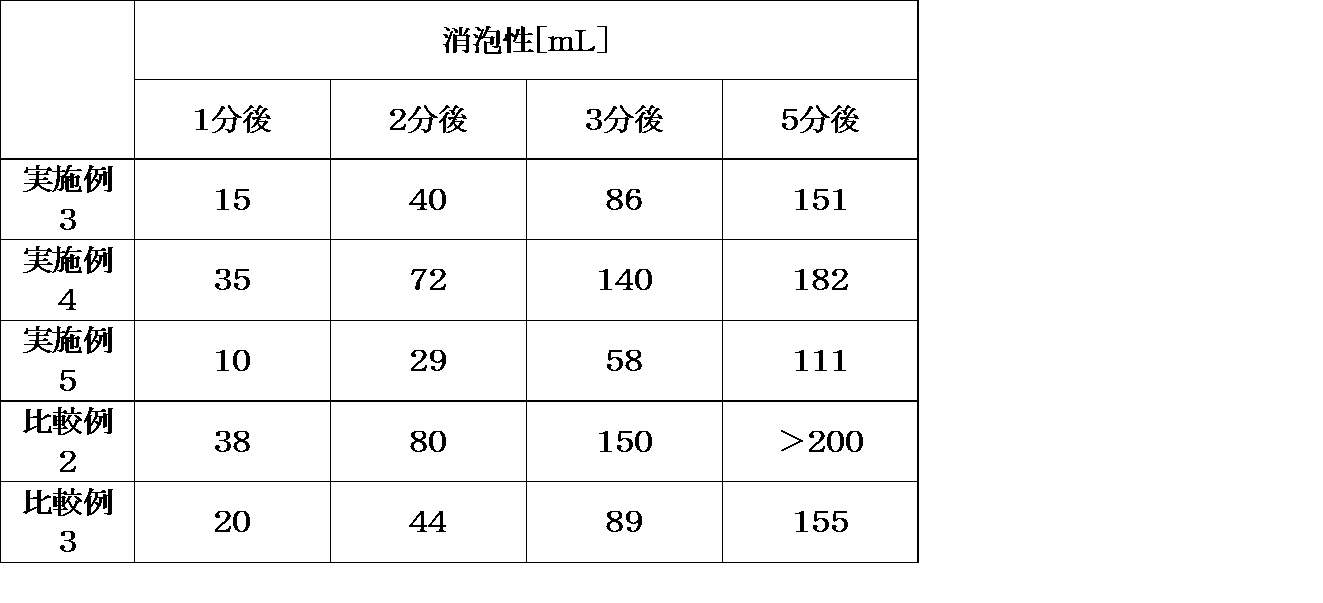
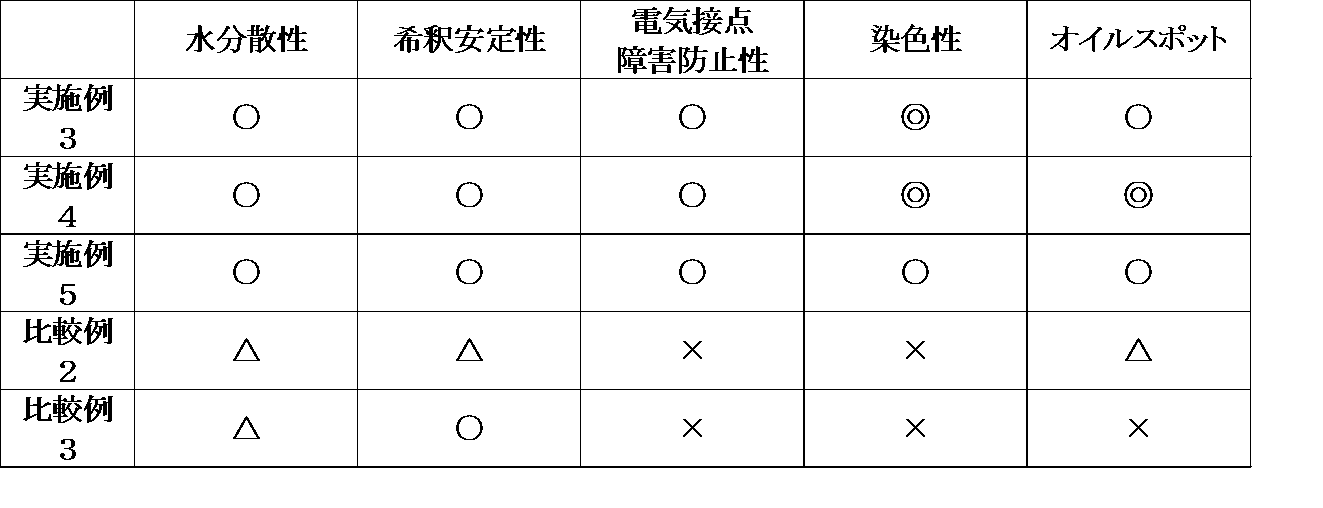
上記(A)、(B)成分を表1に示した量で用い、80℃でホモミキサーにて加熱混合した。エマルジョン型の場合は水を徐々に添加して再度ホモミキサーで乳化分散させることで消泡剤組成物を調製した。これらの組成物の消泡性、水分散性、希釈安定性、電気接点障害防止性、染色性、及びオイルスポットを評価した。
上記(A)、(B)成分を表1に示した量で用い、80℃でホモミキサーにて加熱混合した。エマルジョン型の場合は水を徐々に添加して再度ホモミキサーで乳化分散させることで消泡剤組成物を調製した。これらの組成物の消泡性、水分散性、希釈安定性、電気接点障害防止性、染色性、及びオイルスポットを評価した。
[消泡性試験]
発泡液として家庭用台所用合成洗剤「ママレモン」(ライオン(株)製)の0.2質量%水溶液150mLを、自動循環式消泡試験装置(Teclis社製、MiniJet)へ充填、発泡液温度25℃、発泡液循環流量500mL/minにて循環を開始し、泡体積が100mLに達した瞬間に、表1に従って調製した消泡剤組成物を、水を除いた固形分換算で50ppm添加した。該希釈消泡剤組成物を添加してから1分後、2分後、3分後、5分後の泡体積を測定し、消泡性を評価した。結果を表2に示す。
発泡液として家庭用台所用合成洗剤「ママレモン」(ライオン(株)製)の0.2質量%水溶液150mLを、自動循環式消泡試験装置(Teclis社製、MiniJet)へ充填、発泡液温度25℃、発泡液循環流量500mL/minにて循環を開始し、泡体積が100mLに達した瞬間に、表1に従って調製した消泡剤組成物を、水を除いた固形分換算で50ppm添加した。該希釈消泡剤組成物を添加してから1分後、2分後、3分後、5分後の泡体積を測定し、消泡性を評価した。結果を表2に示す。
[水分散性試験]
表1に従って調製した消泡剤組成物5gを、150mLの透明ガラス瓶(広口規格ガラス瓶PS-No.12)にイオン交換水95gと共に充填した。これを振とう器で250rpm×1分間撹拌し、撹拌停止直後の消泡剤組成物の状態を目視で観察し、水分散性を下記の基準で評価した。結果を表3に示す。
○:消泡剤組成物が完全に分散し、未分散物が確認されない
△:消泡剤組成物の大部分の分散が認められるものの、未分散物が確認され
た
×:分散が認められず、消泡剤組成物の大部分が溶け残り、スカムが確認さ
れた
表1に従って調製した消泡剤組成物5gを、150mLの透明ガラス瓶(広口規格ガラス瓶PS-No.12)にイオン交換水95gと共に充填した。これを振とう器で250rpm×1分間撹拌し、撹拌停止直後の消泡剤組成物の状態を目視で観察し、水分散性を下記の基準で評価した。結果を表3に示す。
○:消泡剤組成物が完全に分散し、未分散物が確認されない
△:消泡剤組成物の大部分の分散が認められるものの、未分散物が確認され
た
×:分散が認められず、消泡剤組成物の大部分が溶け残り、スカムが確認さ
れた
[希釈安定性試験]
表1に従って調製した消泡剤組成物10gとイオン交換水10gを、スパチュラを用いて撹拌し乳化物とし、続いて80gのイオン交換水で希釈し、10倍希釈液とした。希釈後の該消泡剤組成物を25℃で1日間保存した後の状態を目視で観察し、希釈安定性を下記の基準で評価した。結果を表3に示す。
○:油層と水層の分離/スカムの発生は認められなかった
△:油層と水層の濃淡分離が認められた/スカムの発生は認められなかった
×:油層と水層の分離、あるいはスカムの発生が認められた
表1に従って調製した消泡剤組成物10gとイオン交換水10gを、スパチュラを用いて撹拌し乳化物とし、続いて80gのイオン交換水で希釈し、10倍希釈液とした。希釈後の該消泡剤組成物を25℃で1日間保存した後の状態を目視で観察し、希釈安定性を下記の基準で評価した。結果を表3に示す。
○:油層と水層の分離/スカムの発生は認められなかった
△:油層と水層の濃淡分離が認められた/スカムの発生は認められなかった
×:油層と水層の分離、あるいはスカムの発生が認められた
[電気接点障害防止性試験]
表1に従って調製した消泡剤組成物100gを体積5Lの容器に入れ、密閉後、熱風循環型乾燥機中80℃の条件でマイクロモーター加速耐久寿命試験を実施した。測定はモーター電流波形をオシロスコープにより追跡し、波形の乱れが確認された時点で電気接点障害が発生したものとして下記の基準で電気接点障害防止性を評価した。結果を表3に示す。
○:240時間を超えても波形に乱れがない(接点障害なし)
×:240時間以内に波形に乱れが発生した(接点障害あり)
表1に従って調製した消泡剤組成物100gを体積5Lの容器に入れ、密閉後、熱風循環型乾燥機中80℃の条件でマイクロモーター加速耐久寿命試験を実施した。測定はモーター電流波形をオシロスコープにより追跡し、波形の乱れが確認された時点で電気接点障害が発生したものとして下記の基準で電気接点障害防止性を評価した。結果を表3に示す。
○:240時間を超えても波形に乱れがない(接点障害なし)
×:240時間以内に波形に乱れが発生した(接点障害あり)
[染色性試験]
染料(S-BGU、HOECHST社製)0.1g、染色助剤(エマ-ルNC-35、花王(株)製)4g、酢酸4g、表1に従って調製した消泡剤組成物10gを添加した水溶液2Lを用いて、マチス社製高温染色機(JF型)にてポリエステル布10gを135℃×10分で染色し、染色ムラを目視により下記の基準で評価した。結果を表3に示す。
◎:全く染色ムラがない
○:若干染色ムラがあるが、ブランク(消泡剤組成物を添加しない場合)と
同等
△:少し濃色又は白ぬけがある
×:濃色又は白ぬけが目立つ
染料(S-BGU、HOECHST社製)0.1g、染色助剤(エマ-ルNC-35、花王(株)製)4g、酢酸4g、表1に従って調製した消泡剤組成物10gを添加した水溶液2Lを用いて、マチス社製高温染色機(JF型)にてポリエステル布10gを135℃×10分で染色し、染色ムラを目視により下記の基準で評価した。結果を表3に示す。
◎:全く染色ムラがない
○:若干染色ムラがあるが、ブランク(消泡剤組成物を添加しない場合)と
同等
△:少し濃色又は白ぬけがある
×:濃色又は白ぬけが目立つ
[オイルスポット試験]
ポリエステル布10gに表1に従って調製した消泡剤組成物を2滴滴下し、150℃×10分加熱後、上記染色試験の消泡剤組成物を添加せずに同様に染色し、染色ムラを目視により上記と同様に評価した。結果を表3に示す。
ポリエステル布10gに表1に従って調製した消泡剤組成物を2滴滴下し、150℃×10分加熱後、上記染色試験の消泡剤組成物を添加せずに同様に染色し、染色ムラを目視により上記と同様に評価した。結果を表3に示す。

Claims (9)
- 下記平均組成式(1)
RaSiO(4-a)/2 (1)
(式中、Rは、互いに独立に、非置換もしくは置換の1価炭化水素基であり、aは1.9~2.2の数である。)
で表される25℃における粘度が10~100,000mm2/sであるシリコーンオイル60~99.9質量部と、BET法による比表面積が100m2/g以上の微粉末シリカ0.1~40質量部とを含み、4量体及び5量体の環状ジメチルポリシロキサンの含有量がそれぞれ1,000ppm以下であることを特徴とする消泡剤用シリコーンオイルコンパウンド。 - 3量体~10量体の環状ジメチルポリシロキサンの合計含有量が1,000ppm以下である請求項1に記載の消泡剤用シリコーンオイルコンパウンド。
- 微粉末シリカが、未処理、又はトリメチルシリル基、ジメチルシリル基、モノメチルシリル基又はポリジメチルシロキシ基により修飾されたものである請求項1又は2に記載の消泡剤用シリコーンオイルコンパウンド。
- 請求項1又は2に記載の消泡剤用シリコーンオイルコンパウンドを含む消泡剤組成物。
- 請求項1又は2に記載の消泡剤用シリコーンオイルコンパウンドと、非イオン性界面活性剤とを含有する消泡剤組成物。
- 溶液型である請求項4に記載の消泡剤組成物。
- ポリオキシアルキレン基で変性されたオルガノポリシロキサンとの併用による自己乳化型である請求項4又は5に記載の消泡剤組成物。
- エマルジョン型である請求項5に記載の消泡剤組成物。
- 請求項1又は2に記載の消泡剤用シリコーンオイルコンパウンドを微粉末担体に吸着させた粉末型消泡剤組成物。
Applications Claiming Priority (2)
| Application Number | Priority Date | Filing Date | Title |
|---|---|---|---|
| JP2015-002258 | 2015-01-08 | ||
| JP2015002258A JP6554796B2 (ja) | 2015-01-08 | 2015-01-08 | 消泡剤組成物 |
Publications (1)
| Publication Number | Publication Date |
|---|---|
| WO2016111104A1 true WO2016111104A1 (ja) | 2016-07-14 |
Family
ID=56355806
Family Applications (1)
| Application Number | Title | Priority Date | Filing Date |
|---|---|---|---|
| PCT/JP2015/084110 Ceased WO2016111104A1 (ja) | 2015-01-08 | 2015-12-04 | 消泡剤用シリコーンオイルコンパウンド及び消泡剤組成物 |
Country Status (2)
| Country | Link |
|---|---|
| JP (1) | JP6554796B2 (ja) |
| WO (1) | WO2016111104A1 (ja) |
Cited By (6)
| Publication number | Priority date | Publication date | Assignee | Title |
|---|---|---|---|---|
| CN113301975A (zh) * | 2019-12-23 | 2021-08-24 | 现代炼油株式会社 | 用于减少烃泡沫和硅残留物的消泡剂组合物 |
| CN115228148A (zh) * | 2022-09-26 | 2022-10-25 | 烟台恒鑫化工科技有限公司 | 一种油田用复合消泡剂及其制备方法 |
| WO2023074236A1 (ja) | 2021-10-29 | 2023-05-04 | 信越化学工業株式会社 | ポリオルガノシロキサン及びその製造方法 |
| WO2024018943A1 (ja) | 2022-07-22 | 2024-01-25 | 信越化学工業株式会社 | エポキシ樹脂組成物、エポキシ樹脂硬化物、及びエポキシ接着剤 |
| WO2024084968A1 (ja) | 2022-10-18 | 2024-04-25 | 信越化学工業株式会社 | エポキシ樹脂組成物 |
| WO2024111447A1 (ja) | 2022-11-22 | 2024-05-30 | 信越化学工業株式会社 | エポキシ樹脂組成物 |
Citations (6)
| Publication number | Priority date | Publication date | Assignee | Title |
|---|---|---|---|---|
| JPS51134795A (en) * | 1975-05-05 | 1976-11-22 | Gen Electric | Process for producing diorganopolysiloxane |
| JPS5771608A (en) * | 1980-10-20 | 1982-05-04 | Mikasa Kagaku Kogyo Kk | Solid silicon defoaming agent |
| JPH06142410A (ja) * | 1992-11-13 | 1994-05-24 | Shin Etsu Chem Co Ltd | 泡抑制剤組成物 |
| JPH08108008A (ja) * | 1994-10-14 | 1996-04-30 | Toshiba Silicone Co Ltd | 消泡剤組成物 |
| JPH08109260A (ja) * | 1993-11-10 | 1996-04-30 | Shin Etsu Chem Co Ltd | 直鎖状オルガノポリシロキサン及びその製造方法 |
| JP2013103204A (ja) * | 2011-11-16 | 2013-05-30 | Shin-Etsu Chemical Co Ltd | 粉末消泡剤及びその製造方法 |
Family Cites Families (9)
| Publication number | Priority date | Publication date | Assignee | Title |
|---|---|---|---|---|
| JPS5334854A (en) * | 1976-09-14 | 1978-03-31 | Toray Silicone Co Ltd | Self-emulsifiable silicone composition |
| DE2903423A1 (de) * | 1979-01-30 | 1980-08-07 | Wacker Chemie Gmbh | Selbstemulgierbare antischaummittel |
| ATE113493T1 (de) * | 1991-01-16 | 1994-11-15 | Procter & Gamble | Schaumkontrollmittel in granulierter form. |
| GB9214567D0 (en) * | 1992-07-09 | 1992-08-19 | Dow Corning Sa | Foam control agents |
| JPH08196811A (ja) * | 1995-01-31 | 1996-08-06 | Shin Etsu Chem Co Ltd | 消泡剤用オイルコンパウンドの製造方法及びそれを含有する消泡剤組成物 |
| JP3944690B2 (ja) * | 2001-07-11 | 2007-07-11 | 信越化学工業株式会社 | 消泡剤組成物 |
| JP3974845B2 (ja) * | 2002-12-05 | 2007-09-12 | 信越化学工業株式会社 | 消泡剤組成物 |
| JP2007222812A (ja) * | 2006-02-24 | 2007-09-06 | Shin Etsu Chem Co Ltd | 消泡剤組成物 |
| JP5804565B2 (ja) * | 2012-06-29 | 2015-11-04 | 信越化学工業株式会社 | 消泡剤組成物 |
-
2015
- 2015-01-08 JP JP2015002258A patent/JP6554796B2/ja active Active
- 2015-12-04 WO PCT/JP2015/084110 patent/WO2016111104A1/ja not_active Ceased
Patent Citations (6)
| Publication number | Priority date | Publication date | Assignee | Title |
|---|---|---|---|---|
| JPS51134795A (en) * | 1975-05-05 | 1976-11-22 | Gen Electric | Process for producing diorganopolysiloxane |
| JPS5771608A (en) * | 1980-10-20 | 1982-05-04 | Mikasa Kagaku Kogyo Kk | Solid silicon defoaming agent |
| JPH06142410A (ja) * | 1992-11-13 | 1994-05-24 | Shin Etsu Chem Co Ltd | 泡抑制剤組成物 |
| JPH08109260A (ja) * | 1993-11-10 | 1996-04-30 | Shin Etsu Chem Co Ltd | 直鎖状オルガノポリシロキサン及びその製造方法 |
| JPH08108008A (ja) * | 1994-10-14 | 1996-04-30 | Toshiba Silicone Co Ltd | 消泡剤組成物 |
| JP2013103204A (ja) * | 2011-11-16 | 2013-05-30 | Shin-Etsu Chemical Co Ltd | 粉末消泡剤及びその製造方法 |
Cited By (7)
| Publication number | Priority date | Publication date | Assignee | Title |
|---|---|---|---|---|
| CN113301975A (zh) * | 2019-12-23 | 2021-08-24 | 现代炼油株式会社 | 用于减少烃泡沫和硅残留物的消泡剂组合物 |
| WO2023074236A1 (ja) | 2021-10-29 | 2023-05-04 | 信越化学工業株式会社 | ポリオルガノシロキサン及びその製造方法 |
| WO2024018943A1 (ja) | 2022-07-22 | 2024-01-25 | 信越化学工業株式会社 | エポキシ樹脂組成物、エポキシ樹脂硬化物、及びエポキシ接着剤 |
| CN115228148A (zh) * | 2022-09-26 | 2022-10-25 | 烟台恒鑫化工科技有限公司 | 一种油田用复合消泡剂及其制备方法 |
| WO2024084968A1 (ja) | 2022-10-18 | 2024-04-25 | 信越化学工業株式会社 | エポキシ樹脂組成物 |
| WO2024111447A1 (ja) | 2022-11-22 | 2024-05-30 | 信越化学工業株式会社 | エポキシ樹脂組成物 |
| EP4624508A1 (en) | 2022-11-22 | 2025-10-01 | Shin-Etsu Chemical Co., Ltd. | Epoxy resin composition |
Also Published As
| Publication number | Publication date |
|---|---|
| JP2016123965A (ja) | 2016-07-11 |
| JP6554796B2 (ja) | 2019-08-07 |
Similar Documents
| Publication | Publication Date | Title |
|---|---|---|
| US6512015B1 (en) | Silicone foam control compositions | |
| JP6554796B2 (ja) | 消泡剤組成物 | |
| EP0121210B1 (en) | Hydrocarbon oil based silicone antifoams | |
| WO2013043487A1 (en) | Silicone foam control compositions and process for making thereof | |
| KR20070088384A (ko) | 소포제 조성물 | |
| CA2314766A1 (en) | Antifoam formulation | |
| JP2865466B2 (ja) | 泡抑制剤組成物 | |
| CN102728108A (zh) | 油配混物和消泡剂组合物 | |
| CN106659950B (zh) | 消泡剂用油复配物及其制造方法以及消泡剂组合物 | |
| EP2100650B1 (en) | Preparation of antifoaming oil compound and antifoam composition | |
| CN1864792B (zh) | 消泡剂组合物 | |
| CA1040964A (en) | Foam control composition | |
| JPH08192001A (ja) | W/oエマルション型消泡剤組成物及びそれを用いた消泡方法 | |
| EP2325262B1 (en) | Preparation of antifoaming oil compound and antifoam composition | |
| JP4232031B2 (ja) | 消泡剤組成物及びその製造方法 | |
| JP3974845B2 (ja) | 消泡剤組成物 | |
| JP3944689B2 (ja) | 消泡剤組成物 | |
| KR100761777B1 (ko) | 자기 유화형 실리콘 소포제 조성물 | |
| US11414547B2 (en) | Oil mist inhibitor, lubricant containing same, and oil mist reduction method | |
| JP3064130B2 (ja) | 泡抑制剤組成物 | |
| JPH05261206A (ja) | 泡抑制剤組成物 | |
| JP3194681B2 (ja) | 泡抑制剤組成物 | |
| JP3944690B2 (ja) | 消泡剤組成物 | |
| JP2685692B2 (ja) | 泡抑制剤組成物 | |
| KR20230173681A (ko) | 소포제용 실리콘 오일 컴파운드 및 소포제 조성물 |
Legal Events
| Date | Code | Title | Description |
|---|---|---|---|
| 121 | Ep: the epo has been informed by wipo that ep was designated in this application |
Ref document number: 15876977 Country of ref document: EP Kind code of ref document: A1 |
|
| NENP | Non-entry into the national phase |
Ref country code: DE |
|
| 122 | Ep: pct application non-entry in european phase |
Ref document number: 15876977 Country of ref document: EP Kind code of ref document: A1 |