WO2016093383A1 - 둘 이상의 알콕시실릴기를 갖는 열경화성 알콕시 실릴 화합물, 이를 포함하는 조성물, 경화물, 이의 용도 및 알콕시실릴 화합물의 제조방법 - Google Patents

둘 이상의 알콕시실릴기를 갖는 열경화성 알콕시 실릴 화합물, 이를 포함하는 조성물, 경화물, 이의 용도 및 알콕시실릴 화합물의 제조방법 Download PDF

Info

Publication number
WO2016093383A1
WO2016093383A1 PCT/KR2014/012072 KR2014012072W WO2016093383A1 WO 2016093383 A1 WO2016093383 A1 WO 2016093383A1 KR 2014012072 W KR2014012072 W KR 2014012072W WO 2016093383 A1 WO2016093383 A1 WO 2016093383A1
Authority
WO
WIPO (PCT)
Prior art keywords
group
formula
alkoxysilyl
compound
composition
Prior art date
Legal status (The legal status is an assumption and is not a legal conclusion. Google has not performed a legal analysis and makes no representation as to the accuracy of the status listed.)
Ceased
Application number
PCT/KR2014/012072
Other languages
English (en)
French (fr)
Inventor
전현애
박성환
김윤주
박수진
박숙연
탁상용
Current Assignee (The listed assignees may be inaccurate. Google has not performed a legal analysis and makes no representation or warranty as to the accuracy of the list.)
Korea Institute of Industrial Technology KITECH
Original Assignee
Korea Institute of Industrial Technology KITECH
Priority date (The priority date is an assumption and is not a legal conclusion. Google has not performed a legal analysis and makes no representation as to the accuracy of the date listed.)
Filing date
Publication date
Application filed by Korea Institute of Industrial Technology KITECH filed Critical Korea Institute of Industrial Technology KITECH
Priority to JP2017531390A priority Critical patent/JP6664398B2/ja
Priority to PCT/KR2014/012072 priority patent/WO2016093383A1/ko
Priority to US15/534,451 priority patent/US10428176B2/en
Publication of WO2016093383A1 publication Critical patent/WO2016093383A1/ko
Anticipated expiration legal-status Critical
Ceased legal-status Critical Current

Links

Classifications

    • CCHEMISTRY; METALLURGY
    • C08ORGANIC MACROMOLECULAR COMPOUNDS; THEIR PREPARATION OR CHEMICAL WORKING-UP; COMPOSITIONS BASED THEREON
    • C08GMACROMOLECULAR COMPOUNDS OBTAINED OTHERWISE THAN BY REACTIONS ONLY INVOLVING UNSATURATED CARBON-TO-CARBON BONDS
    • C08G59/00Polycondensates containing more than one epoxy group per molecule; Macromolecules obtained by polymerising compounds containing more than one epoxy group per molecule using curing agents or catalysts which react with the epoxy groups
    • C08G59/18Macromolecules obtained by polymerising compounds containing more than one epoxy group per molecule using curing agents or catalysts which react with the epoxy groups ; e.g. general methods of curing
    • C08G59/40Macromolecules obtained by polymerising compounds containing more than one epoxy group per molecule using curing agents or catalysts which react with the epoxy groups ; e.g. general methods of curing characterised by the curing agents used
    • C08G59/4007Curing agents not provided for by the groups C08G59/42 - C08G59/66
    • C08G59/4085Curing agents not provided for by the groups C08G59/42 - C08G59/66 silicon containing compounds
    • CCHEMISTRY; METALLURGY
    • C07ORGANIC CHEMISTRY
    • C07FACYCLIC, CARBOCYCLIC OR HETEROCYCLIC COMPOUNDS CONTAINING ELEMENTS OTHER THAN CARBON, HYDROGEN, HALOGEN, OXYGEN, NITROGEN, SULFUR, SELENIUM OR TELLURIUM
    • C07F7/00Compounds containing elements of Groups 4 or 14 of the Periodic Table
    • C07F7/02Silicon compounds
    • C07F7/08Compounds having one or more C—Si linkages
    • C07F7/18Compounds having one or more C—Si linkages as well as one or more C—O—Si linkages
    • C07F7/1804Compounds having Si-O-C linkages
    • CCHEMISTRY; METALLURGY
    • C08ORGANIC MACROMOLECULAR COMPOUNDS; THEIR PREPARATION OR CHEMICAL WORKING-UP; COMPOSITIONS BASED THEREON
    • C08GMACROMOLECULAR COMPOUNDS OBTAINED OTHERWISE THAN BY REACTIONS ONLY INVOLVING UNSATURATED CARBON-TO-CARBON BONDS
    • C08G59/00Polycondensates containing more than one epoxy group per molecule; Macromolecules obtained by polymerising compounds containing more than one epoxy group per molecule using curing agents or catalysts which react with the epoxy groups
    • C08G59/18Macromolecules obtained by polymerising compounds containing more than one epoxy group per molecule using curing agents or catalysts which react with the epoxy groups ; e.g. general methods of curing
    • C08G59/20Macromolecules obtained by polymerising compounds containing more than one epoxy group per molecule using curing agents or catalysts which react with the epoxy groups ; e.g. general methods of curing characterised by the epoxy compounds used
    • CCHEMISTRY; METALLURGY
    • C08ORGANIC MACROMOLECULAR COMPOUNDS; THEIR PREPARATION OR CHEMICAL WORKING-UP; COMPOSITIONS BASED THEREON
    • C08KUse of inorganic or non-macromolecular organic substances as compounding ingredients
    • C08K3/00Use of inorganic substances as compounding ingredients
    • C08K3/34Silicon-containing compounds
    • C08K3/36Silica
    • CCHEMISTRY; METALLURGY
    • C08ORGANIC MACROMOLECULAR COMPOUNDS; THEIR PREPARATION OR CHEMICAL WORKING-UP; COMPOSITIONS BASED THEREON
    • C08KUse of inorganic or non-macromolecular organic substances as compounding ingredients
    • C08K7/00Use of ingredients characterised by shape
    • C08K7/02Fibres or whiskers
    • C08K7/04Fibres or whiskers inorganic
    • C08K7/14Glass
    • CCHEMISTRY; METALLURGY
    • C08ORGANIC MACROMOLECULAR COMPOUNDS; THEIR PREPARATION OR CHEMICAL WORKING-UP; COMPOSITIONS BASED THEREON
    • C08LCOMPOSITIONS OF MACROMOLECULAR COMPOUNDS
    • C08L63/00Compositions of epoxy resins; Compositions of derivatives of epoxy resins

Definitions

  • Thermosetting alkoxy silyl compounds having two or more alkoxysilyl groups compositions comprising the same, cured products, uses thereof and methods of preparing alkoxysilyl compounds
  • the present invention provides two or more alkoxysilyl groups which exhibit excellent heat resistance in the composite.
  • the present invention relates to a thermosetting alkoxysilyl compound having a hereinafter (hereinafter referred to as an "alkoxysilyl compound”), a composition comprising the same, a cured product, and a use thereof and a method for producing an alkoxysilyl compound. More specifically, the present invention relates to thermosetting alkoxy having excellent heat resistance in the composite, specifically, low coefficient of thermal expansion (CTE) and composite Tg-less exhibiting no glass transition temperature in the composite.
  • CTE coefficient of thermal expansion
  • the thermal expansion coefficient of the thermosetting organic material is approximately 50 to 80 ppm / ° C.
  • the thermal expansion coefficient of the ceramic material and the metal material which are inorganic particles for example, the thermal expansion coefficient of silicon is 3 to 5 ppiii / ° C.
  • the thermal expansion coefficient of copper is Coefficient of thermal expansion compared to 17ppm / ° C) It is very much like several times to several ten times.
  • the thermosetting material is used together with the inorganic material or the metal material in the field of semiconductor display, etc., the physical properties and processability of the polymer material are remarkably due to the different coefficients of thermal expansion of the thermosetting material and the inorganic material or the metal material. Limited.
  • a large amount of silica inorganic particles having a size of about 2 to 30 ⁇ may be used to reduce the CTE.
  • a large amount of inorganic particles are accompanied with a problem of deterioration of workability and physical properties of the component. That is, a decrease in fluidity due to a large amount of inorganic particles and the formation of voids during the filling of the particles are problematic.
  • the viscosity of the material increases rapidly due to the addition of inorganic particles.
  • the size of the inorganic particles tends to decrease due to the miniaturization of the semiconductor structure, but when the filler of I mi or less is used, the problem of fluidity decrease (viscosity increase) becomes more serious.
  • the frequency of unfilling at the application site of the composition containing the resin and the inorganic particles increases.
  • the CTE is greatly reduced, but still shows a high CTE compared to the silicon chip.
  • thermoset alkoxysilyl compound exhibiting improved heat resistance in the composite, specifically low CTE and Tg-ess properties and excellent flame retardancy in the cured product.
  • thermosetting alkoxysilyl composition exhibiting improved heat resistance in the composite of the alkoxysilyl compound, specifically low CTE and Tg-less properties and excellent flame retardancy in the cured product.
  • Tg- exhibits improved heat resistance in the composite through blending with the epoxy compound, specifically low CTE and properties and excellent flame retardancy in the cured product.
  • thermosetting alkoxysilyl composition according to an embodiment of the present invention.
  • a method for producing a thermosetting alkoxysilyl group compound is provided.
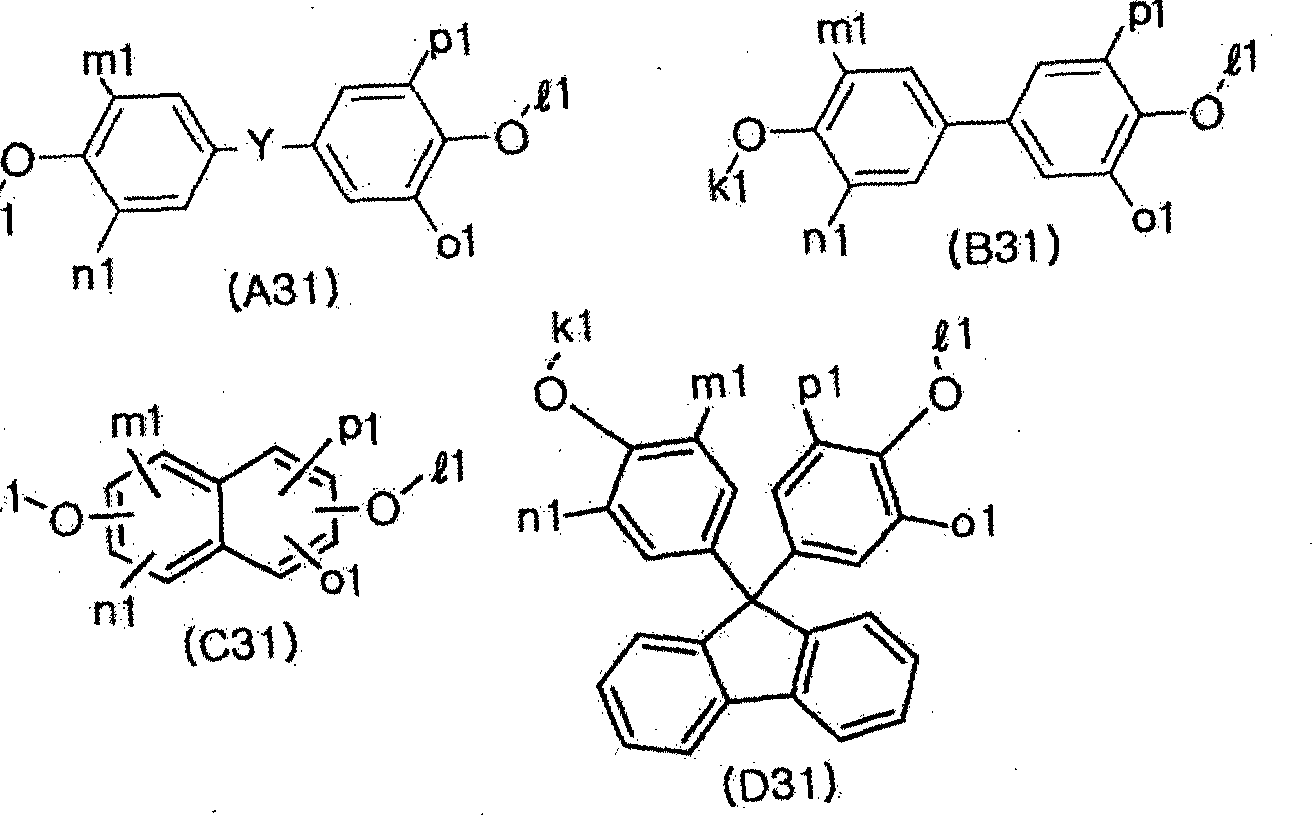
  • an alkoxysilyl compound selected from the group consisting of the following formulas AI to II and having at least two alkoxysilyl groups is provided.
  • Substituents a and b of Formulas AI to DI are each independently selected from the group consisting of Formulas S1, S2, hydrogen, and Cwo alkenyl groups, and substituents c to f are each independently represented by Formulas S1, hydrogen , 10 alkyl group, d - is selected from the group consisting of a 30-aryl (aryl), - 10 alkenyl group and a C 6 lkenyU At least two substituents of a to f are selected from the group consisting of Formulas S1 and S2;
  • Y is -CH 2- , -C (CH 3 ) 2- . — C (CF 3 ) 2 —, —S— or — S0 2 —;
  • Formula than the EI to II of the substituents g to j in is selected from the group consisting of the formula S1 and S2 to, and the other is hydrogen, an alkyl group, d -) alkenyl (alkenyl) group, or a C 6 - 30 aryl (aryl) Can be a group;
  • M in Formula HI is -CH 2- , -C (C3 ⁇ 4) 2 ⁇ , -C (CF 3 ) 2- , _S_ or ⁇ S0 2- ;
  • Formula ( ⁇ ) may be substituted in the meta position of oxygen to a straight chain black branched C1-C10 alkyl group
  • an alkoxysilyl compound selected from the group consisting of formulas EI to GI, at least one of substituents g to j is hydrogen, and at least two are selected from the group consisting of formula S1 and formula S2 This is provided.
  • the first to third aspects of the present invention are selected from the group consisting of formulas EI to GI, at least one of substituents g to j is hydrogen, and at least two are selected from the group consisting of formula S1 and formula S2
  • an alkoxysilyl composition further comprising at least one kind of layering agent selected from the group consisting of inorganic particles and fibers in the fourth aspect.
  • the inorganic particles are composed of silica, zirconia, titania, alumina, silicon nitride and aluminum nitride
  • at least one alkoxysilyl composition selected from the group consisting of caged silsesquinoxanes.
  • the inorganic particle is 5 wt 3 to 95% of the alkoxysilyl composition based on the total solids of the alkoxysilyl composition.
  • the inorganic particles are included in the alkoxysilyl composition of 30wt3 ⁇ 4 to 95wt% based on the total solids of the alkoxysilyl composition.
  • the inorganic particles are contained in an alkoxysilyl composition in an amount of 5wt% to 60wt% based on the total solids of the alkoxysilyl composition.
  • the fiber is glass fiber and liquid crystal selected from the group consisting of E glass fiber, T glass fiber, S glass fiber, NE glass fiber, H glass fiber, and quartz.
  • Polyester fiber polyethylene terephthalate fiber, wholly aromatic fiber, polybenzoxazole fiber nylon fiber.
  • Polyethylene naphthalate fibers polypropylene fibers, polyether sulfone fibers.
  • At least one alkoxysilyl composition selected from the group consisting of organic fibers selected from the group consisting of polyvinylidene fluoride fibers, polyethylene sulfide fibers, and polyether ether ketone fibers.
  • the eleventh aspect of the present invention 5.
  • the fiber is included.
  • Alkoxysilyl composition further comprising an inorganic particle.
  • an alkoxysilyl composition containing an alkoxysilyl compound and an epoxy compound is provided.
  • the epoxy compound is a glycidyl ether epoxy compound, a glycidyl epoxy compound, a glycidyl amine epoxy compound, a glycidyl ester epoxy compound.
  • Rubber-modified epoxy compound, an aliphatic polyglycidyl dilgye epoxy compound and an aliphatic glycidyl amine is at least one kinds of system selected from the group consisting of epoxy compounds alkoxysilyl composition.
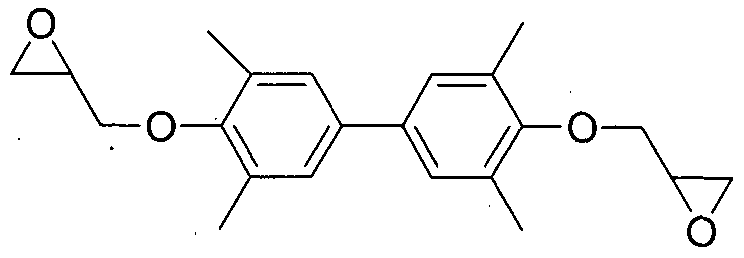
  • the epoxy compound has a core structure of bisphenol, bisphenol F.
  • the alkoxysilyl composition includes an alkoxysilyl compound and an epoxy compound selected from the group consisting of Formulas AI to CI,
  • Y is -C3 ⁇ 4—, or ⁇ C (C3 ⁇ 4) 2 —.
  • a and b are each selected from the group consisting of Formulas S1 and S2, [Formula SI]
  • the alkoxysilyl composition includes an alkoxysilyl compound and an epoxy compound selected from the group consisting of Formulas AI to CI,
  • Y is -CH 2 -or -C (CH 3 ) 2- ,
  • a and b are hydrogen, At least two of c to f are the following formula S1.
  • the composition of the alkoxy: silyl compound includes an alkoxysilyl compound and an epoxy compound selected from the group consisting of the following formulas EI to GI.
  • R 3 is a straight or branched chain alkoxy group having 1 to 4 carbon atoms, z is an integer of 3 to 10,
  • R 3 is a straight or branched chain alkoxy group having 1 to 10 carbon atoms, the remainder is a straight chain black or branched alkyl group having 1 to 10 carbon atoms, and z is an alkoxysilyl compound having an integer of 3 to 10.
  • an alkoxysilyl composition having an alkoxy group of the alkoxysilyl compound: an epoxy group of the epoxy compound is 0.1 to 10: 1.
  • an alkoxysilyl composition having an alkoxy group of the alkoxysilyl compound: an epoxy group of the epoxy compound is 0.2 to 1: 1.
  • the alkoxysilyl composition further comprises a curing agent.
  • An electronic material comprising the alkoxysilyl composition of any of claims 4 to 21 is provided.
  • substrate containing the alkoxysilyl composition in any one of 4th aspect-21nd aspect is provided.
  • the film containing the alkoxysilyl composition in any one of 4th-21st aspect is provided.
  • the laminated board containing a metal layer is provided on the base material layer which consists of an alkoxysilyl composition in any one of 4th-21st aspect.
  • a printed wiring board comprising the reddish plate of the twenty fifth aspect.
  • a semiconductor device comprising the printed wiring board of the twenty sixth aspect.
  • the semiconductor packaging material containing the alkoxysilyl composition in any one of 4th-21st aspect is provided.
  • the semiconductor device containing the semiconductor packaging material of the 28th aspect is provided.
  • an adhesive comprising the alkoxysilyl composition of any of the second to nineteenth aspects is provided.
  • a paint comprising the alkoxysilyl composition of any of the fourth to twenty-first aspects.
  • a composite material comprising the alkoxysilyl composition of any of the fourth to twenty-first aspects.
  • any one of the fourth to twenty-first aspects there is provided a prepreg comprising an alkoxysilyl composition.
  • a laminated plate in which a metal layer is disposed in the prepreg of the 33rd aspect.
  • cured material of the alkoxysilyl composition in any one of 4th-21st aspect is provided.
  • a cured product of an alkoxysilyl composition having a thermal expansion coefficient of 100 ppm / r or less is provided.
  • a cured product of the alkoxysilyl composition having a glass transition temperature higher than 80 ° C. or showing no glass transition temperature is provided.
  • the starting material of any one of Formulas AS to IS is reacted with an isocyanate-based alkoxy group silane represented by Formula Ml in the presence of any base and any solvent to the final of any one of Formulas AI to II.
  • a method for producing an alkoxysilyl compound is obtained.
  • a substituent and k and 1 in the formula AS to DS are each hydrogen, ⁇ ) ⁇ to p are each independently hydrogen, Cwo alkyl, Cwo alkenyl (alkenyl) group, and a C 6 - from the group consisting of 30-aryl (aryl)
  • Y is ⁇ C3 ⁇ 4— , -C (CH 3 ) 2 —, ⁇ C (CF 3 ) 2 —, -S- or -S0 2 —
  • Formula ES to a two or more of the substituents Q to t at IS is hydrogen and the other is a group independently, Cwo alkenyl (alkenyl) group, and a C 6 - 30 may be selected from aryl (aryl) groups,
  • M is ⁇ CH 2 —, —C (C3 ⁇ 4) 2—, —C (CF 3 ) 2 —, —S— or —S0 2 —, where Formula IS is a straight chain or branched at the meta position of oxygen. Chain may be substituted with a C10-C10 alkyl group.
  • At least one of to 3 ⁇ 4 is a C1 ⁇ C10 linear or branched alkoxy group, the rest is a straight or branched C1-C10 alkyl group, and z is an integer of 3 to 10.
  • an optionally substituted c to f are each independently hydrogen, du ⁇ kilgi, d- 10 alkenyl (alkenyl) group, and a C 6 - 30 aryl (aryl) Is selected from the group consisting of groups
  • Y is -CH 2- , -C (CH 3 ) 2- , ⁇ C (CF 3 ) 2 —, -S- or -S0 2-
  • Formulas EI to II, to have more than one formula, and S2, and the remains are each independently hydrogen, ( ⁇ 10 alkyl, d- 10 alkenyl (alkenyl) group, and a C 6 - is selected from the group consisting of an 3 o aryl (aryl)
  • M is —CH 2 — , —C (CH 3 ) 2 —, —C (CF 3 ) 2 —.
  • -S 'or ⁇ S0 2 ⁇ Formula II may be substituted with a linear or branched C1' C10 alkyl group in the meta position of oxygen.
  • the reaction is provided with a method for preparing an alkoxysilyl compound, which is performed at 15 ° C. to 120 ° C. for 1 to 72 hours.
  • an intermediate of any one of Formulas A1 to II is reacted by reacting a starting material of any one of Formulas AS to IS and an alkenyl compound of Formula M2 in the presence of any base and any solvent.
  • the first step of obtaining (1) Preparation of the alkoxysilyl compound comprising the step 1 ⁇ 2 of the intermediate (1) and the alkoxy group silane of the formula M3 in the presence of a metal catalyst and an optional solvent to obtain a final product of any one of formulas AI to II.
  • a method is provided.
  • the substituents k and 1 are each hydrogen, and m to p are each independently hydrogen, a group consisting of an alkyl group, a C 1 10 alkenyl group, and a C 6 — 30 aryl). Is selected from
  • Y in formula AS is ⁇ CH 2 —, ⁇ C (C3 ⁇ 4) 2 —, -C (CF 3 ) 2 ⁇ , -S- or ⁇ S0 2
  • Formula ES to two or more substituents Q to t species in IS is hydrogen and the other is independently Cwo alkyl, d- 10 alkenyl (alkenyl) group, and a C 6 - 30 aryl group is selected from the group consisting of groups (aryl).
  • M is -CH 2 —, -C (C3 ⁇ 4) 2- , -C (CF 3 ) 2- , — S- or -S0 2 —, wherein the formula is linear or branched at the meta position of oxygen May be substituted with a C1-C10 alkyl group in the chain.
  • X is CI, Br, I,-S0 2 -CH 3 , S0 2 — CF 3 , ⁇ 0-S0 2 — C 6 H 4 ⁇ CF 3 ,-0-S0 2 -C 6 H 4 -N0 2 or -0-S0 2 -C 6 H4-CH 3 , z is an integer of 3 to 10.
  • the substituents kl and 11 are each-(C3 ⁇ 4) Z - 2 CH 3 ⁇ 4 (Z is an integer of 3 to 10), and the substituents ml to pi are each independently hydrogen, an alkyl group, an alkenyl group, and an aryl ( ary l) is selected from the group consisting of
  • Y is -C3 ⁇ 4-, ⁇ C (CH 3 ) 2- , — C (CF 3 ) 2- , -S ⁇ or -S0 2- , and two of the substituents ql to tl in Formulas E1 to II The above is-(CH 2 ) Z- 2 CH ⁇ CH 2 (Z is an integer of 3 to 10), and the remainder may each independently be selected from the group consisting of hydrogen, an alkyl group, an alkenyl group and an aryl group.
  • M is ⁇ C3 ⁇ 4 ⁇ , -C (CH 3 ) 2- , -C (CF 3 ) 2- . -S 'or -S0 2- , Formula II may be substituted with a straight-chain or branched CI-C10 alkyl group in the meta position of oxygen.
  • At least one of 3 ⁇ 4 to 3 ⁇ 4 is a C1-C10 linear or branched alkoxy group, and the others are each independently a linear or branched C1-C10 alkyl group.
  • Substituents a and b in Formulas AI to DI are the following Formula S1.
  • Substituents c to f are each independently selected from Formula S1, hydrogen, OH, d- 10 alkyl group, Cwo alkenyl group and C 6 ⁇ .
  • And may be selected from the group consisting of 30 aryl groups.
  • Y is -C —, -C (CH 3 ) 2 ⁇ , -C (CF 3 ) 2 ⁇ , -S- or -S0 2-
  • the substituents to EI g to j is two or more of the following formulas S1, the remains are each independently hydrogen, Cwo alkyl, d- 10 alkenyl groups and C 6 - 30 aryl (aryl) can be selected from the group consisting of a And
  • M is -CH 2- , -C (CH 3 ) 2- , -C (CF 3 ) 2- , -S— or -S0 2- , wherein Formula II is a straight chain or It may be substituted with a branched C1-C10 alkyl group.
  • step 1-1 is based on 1 equivalent of the hydroxy group of the starting material, and ⁇ (CH 2 ) Z - 2 CH 3 ⁇ 4 (Z is Provided is a method for preparing an alkoxysilyl compound, which is carried out by reacting an integer of 3 to 10 to 0.5 to 10 equivalents.
  • the method of claim 41 wherein the first step ° C to Provided is a method for preparing an alkoxysilyl compound, which is carried out at 100 ° C. for 1 to 120 hours.
  • the alkoxy group silane of the formula M3 is reacted with 1 to 5 equivalents to 1 equivalent of the alkenyl group of the intermediate product (1).
  • the first stage 2 stage is provided with a method for preparing an alkoxysilyl compound which is performed at 15 ° C. to 120 ° C. for 1 to 72 hours.
  • Substituents a and b in Formulas AI to DI may be represented by Formula S1 or S2; hydrogen; or alkenyl group, and substituents c to f may be represented by Formula S1, hydrogen, alkyl group, alkenyl group, or It may be an aryl group, Y in the formula AI may be -C3 ⁇ 4-, -C (C3 ⁇ 4) 2- , -C (CF 3 ) 2- , -S- or -S0 2 ,
  • At least two of the substituents g to j in Formulas EI to II are the following Formulas S1 or S2.
  • the remainder may be hydrogen, an alkyl group, an alkenyl group or an aryl group, and in the above formula HI, M is —CH 2 —, —C (CH 3 ) 2 —, —C (CF 3 ) 2 —, —S ′ or —S0 2 —, Formula II may be substituted with a straight-chain or branched CI—C10 alkyl group at the meta position of oxygen.
  • Ri to 3 ⁇ 4 is a C1-10 alkoxy group, the remainder is a C1-10 alkyl group, a sing- group alkyl group and an alkoxy group are straight or branched chain, z is 3-10 Is an integer of)
  • thermosetting alkoxysilyl composition comprising the new alkoxysilyl compound according to the present invention is characterized in that the composite exhibits improved thermal resistance, i.e., It has the effect of reducing CTE and not showing glass transition temperature (hereinafter referred to as 'Tg—ess'). Furthermore, the cured product containing the alkoxysilyl compound according to the present invention exhibits excellent flame retardancy due to the alkoxysilyl group.
  • Example 1 is a graph showing the dimensional change of Example 34 and Comparative Example 1 according to the temperature change.
  • Example 2 is a graph showing the dimensional change of Example 1 and Comparative Example 1 according to the change in the silver.
  • Example 3 is a graph showing the dimensional change of Example 46 according to the temperature change.
  • 4 is a photograph showing that the strips of the composite of Example 1 and Comparative Example 1 were burned.
  • the present invention relates to a novel thermosetting alkoxysilyl compound having improved heat resistance in composites, particularly low CTE and Tg-less and / or flame retardant properties in cured products , by curing the alkoxysilyl composition, including The alkoxysilyl composition, its hardened
  • composite refers to a cured product of a composition comprising an alkoxysilyl compound and a filler (fibers and / or particles) .
  • cured refers to a cured product of a composition containing an alkoxysilyl compound. It refers to a cured product of a composition containing any alkoxysilyl compound, optionally including at least one selected from the group consisting of a curing catalyst, a filler, an epoxy compound, a curing agent, a curing catalyst and other additives together with the alkoxysilyl compound.
  • the cured product may include a semi-cured material
  • the cured product since only the cured product reinforced with inorganic particles or fibers is referred to as a composite, the cured product has a broader meaning than the composite, but the cured product reinforced with inorganic particles or fibers may be It may also be understood as having the same meaning as the composite, hereinafter, thermosetting alkoxy provided in one embodiment of the present invention.
  • the silyl compound, a composition comprising the same, a cured product and its use, and a method of preparing the alkoxysilyl compound will be described in more detail. 1. Alkoxysilyl Compound
  • an alkoxysilyl compound selected from the group consisting of the following formulas AI to ⁇ and having at least two alkoxysilyl groups is provided.
  • substituents a and b of the above formulas AI to Di are each independently selected from the group consisting of the following formulas S1, S2, hydrogen, and d- 10 alkenyl groups
  • substituents c to f are each independently represented by the following formula S1: . from 30 aryl is selected from the group consisting of groups (aryl), wherein a to ⁇ increased at least two substituents for the group consisting of the formula S1 and S2 - hydrogen, d- 10 alkyl, 10 alkenyl (alkenyl) group, and a C 6 Selected;
  • Formula ⁇ ⁇ is -CH 2 -, -C (C3 ⁇ 4) 2 -, -C (CF 3) 2 eu, -S- or - S0 2 - may be flew;
  • at least two of the substituents g to j are selected from the group consisting of the hi-groups of Formulas S1 and S2, and the rest are hydrogen, a Cwo alkyl group, a d- 10 alkenyl group, or C 6 — 30 aryl (aryl) group;
  • M is -CH 2- . -C (CH 3 ) 2- , -C (CF 3 ) 2- , -S 'or ⁇ S0 2- ;
  • Formula I I may be substituted with a linear or branched C1-C10 alkyl group in the meta position of oxygen,
  • At least one of 3 ⁇ 4 to R 3 is a straight chain black alkoxy group having 1 to 10 carbon atoms, the remainder is a straight chain black branched alkyl group having 1 to 10 carbon atoms, and z is 3 to 10 Is an integer. More preferably, at least one of the above R 3 is a straight chain black or branched alkoxy group having 1 to 3 carbon atoms, and more preferably at least one of the above Ri to R 3 is alkoxy having 1 or 2 carbon atoms. In the present specification, 'alkoxy' is.
  • R is alkyl
  • a monovalent group which may be straight or branched, may be cyclic or acyclic, with or without a hetero atom such as N, 0, S, or P Can be.
  • 'alkyl' refers to a monovalent ent hydrocarbon group having from 1 to 10 carbon atoms, which may be linear or branched, may be cyclic or acyclic, and N, 0.
  • alkenyl 1 refers to an alkyl group having one or more double carbon-carbon bonds, which may be linear or branched, and cyclic. Or acyclic. It may or may not have a hetero atom such as N, 0, S, or P.
  • the carbon number of alkenyl may be C 3 to Q 0, and ⁇ (C3 ⁇ 4) Z ⁇ 2 CH ⁇ C3 ⁇ 4 (wherein Z is an integer of 3 to 10) to be described later may also be included in the alkenyl.
  • 'aryl (aryl)' refers to a residue from which one hydrogen atom has been removed from the nucleus of an aromatic hydrocarbon, without particular limitation, the carbon number may be C6 to C30, for example, C6 C15, and also It may be monocyclic or polycyclic.
  • Specific alkoxysilyl compounds according to the present invention are for example selected from the group consisting of the above formulas AI to DI, at least one of the substituents a and b is hydrogen, at least two of the substituents c to f is an alkoxysilyl compound of the formula S1 Can be.
  • Another example of a specific alkoxysilyl compound according to the present invention is selected from the group consisting of the above formulas EI to GI, at least one of the substituents g to j is hydrogen, and at least two are selected from the group consisting of formulas S1 and S2 It may be an alkoxysilyl compound.
  • compositions comprising at least one alkoxysilyl compound selected from the group consisting of the above formulas AI to II according to any embodiment of the present invention.
  • Any of the compositions provided in the present invention may be used for electronic materials, such as, but not limited to, electronic components such as semiconductor substrates, encapsulation materials (packaging materials), films, printed wiring boards, adhesives, paints, composite materials. It can be used for various purposes.
  • any of the compositions provided in the present invention may be a curable composition comprising a curable composition and / or an inorganic material.
  • the alkoxysilyl compound was used for the preparation of inorganic particle surface treatment agents, additives, silica or organic-inorganic hybrids through sol-gel reaction, but the alkoxysilyl compound of the present invention is used as a thermosetting binder. It can be distinguished from the prior art. That is, the alkoxysilyl compound of the present invention contained in such a composition acts as a monomer or a binder capable of thermosetting reaction, but is not limited thereto. For example, the alkoxysilyl compound may react with an imidazole curing agent or a novolac curing agent during curing. You can.
  • composition of the alkoxysilyl compound according to any of the above-described and later embodiments of the present invention includes at least one alkoxysilyl compound selected from the group consisting of the above formulas AI to II provided by any embodiment of the present invention as an alkoxysilyl compound.
  • alkoxysilyl compound of the present invention is understood to mean a composition of an alkoxysilyl compound, It does not limit the types of catalysts, inorganic materials (fillers) (eg, inorganic particles and / or fibers), other additives, compounding ratios, and the like, which may be further included in the composition of the alkoxysilyl compound.
  • At least one alkoxysilyl compound and inorganic material (filler) selected from the group consisting of the above formulas AI to II according to any embodiment of the present invention described above for example, inorganic is referred to as particles and / or fibers
  • the composition of the compound containing the alkoxysilyl group is provided.
  • the composite composition is understood to include a composition of an alkoxysilyl compound comprising at least one alkoxysilyl compound selected from the group consisting of formulas AI to II and a filler. It does not limit the types of catalysts, inorganic materials (fillers) (e.g.
  • inorganic particles and / or fibers may be further included as a filler as an inorganic material in the compositions of any embodiment of the present invention described above and below. Inorganic particles are used to reduce the thermal expansion coefficient of conventional organic resins.
  • any inorganic particles known to be used may be used, including but not limited to at least one selected from the group consisting of silica (including, for example, fused silica and crystalline silica), zirconia, titania, alumina, silicon nitride and aluminum nitride At least one selected from the group consisting of a kind of metal oxide, T - 10 type silsesquinoxane, l adder type silsesquinoxane, and cage type silsesquinoxane may be used.
  • the inorganic particles may be used alone or in combination of two or more thereof. In particular, in the case of blending a large amount of inorganic particles, it is preferable to use fused silica.
  • Fused silica can be used in either crushed or spherical form. In order to raise the compounding quantity of fused silica and to suppress the raise of the melt viscosity of a molding material, it is preferable to use a spherical thing.
  • the inorganic particles are not limited thereto, inorganic particles having a particle size of 0.5 nm to several tens (for example, 50 to 100) may be used in consideration of the use of the composite, specifically, the dispersibility of the inorganic particles. Can be used. Since the inorganic particles are dispersed in the epoxy compound, it is preferable to use the inorganic particles of the above sizes due to the difference in dispersibility according to the particle size. In addition, in order to increase the blending amount of the inorganic particles, the particle distribution of the inorganic particles may be wider and blended. It is preferable.
  • the inorganic particles may be suitably added to the alkoxysilyl compound according to the appropriate viscosity and use required in reducing and applying CTE of the alkoxysilyl composite.
  • the content is 5 wt% to 95 wt%, for example 5 wt% to 90 wt%, based on the total solids of the composition of the alkoxysilyl compound.
  • 10wt% to 90wt3 ⁇ 4 for example 30wt% to 95wt%, for example 30wt% to 9CKvt%, for example 5wt% to 60wt%, for example lOwt to 50wt% Can be.
  • the content of the inorganic particles in consideration of the CTE value and the material processability is, for example, an alkoxysilyl compound. It may be 30 wt% to 95wt%, for example 30wt% to 90wt3 ⁇ 4 with respect to the total solids of the composition of.
  • the content of the inorganic particles is, for example, in consideration of the CTE value and the strength of the substrate.
  • the fiber when the fiber is used as an inorganic material, any kind and size of fibers generally used in the thermosetting resin technology may be used.
  • the fiber is not limited thereto, and any fiber generally used for improving physical properties of the cured organic resin may be used.
  • glass fibers, organic fibers or mixtures thereof can be used.
  • the term 'glass fiber' as used herein is used to mean not only glass fiber, but also glass fiber fabric, glass fiber nonwoven fabric, etc. ⁇ Although not limited to this, E glass fiber, T Glass fiber, S glass fiber, NE glass fiber.
  • Glass fibers such as D glass fiber and quartz glass fiber, are mentioned, for example, E or T glass fiber is mentioned as an example.
  • organic fiber Liquid crystalline polyester fiber, Polyethylene terephthalate fiber.
  • At least one selected from the group consisting of polyethylene sulfide fibers and polyether ether ketone fibers may be used alone or in combination of two or more thereof.
  • the content of the fiber is determined by the total amount of the composition of the alkoxysilyl compound. It may be 10 wt% to 90 wt%, for example 30 wt% to 70 wt%, and for example 35 wt% to 65 ⁇ % based on solids.
  • the resin component in the composition of the alkoxysilyl compound containing the fiber, if the solid part except the fiber is usually referred to as the resin component, in the composition of the alkoxysilyl compound containing the fiber, the amount other than the fiber is the amount of the resin component. Therefore, the resin content is 10wt% to 90wt%.
  • the content of the fiber is in the above range in terms of heat resistance improvement and processability.
  • the total solids of the composition of the alkoxysilyl compound refers to the sum of the weights of the components of the composition of the composition of the alkoxysilyl compound, excluding the component increasing solvent and other liquid substances constituting the composition of the alkoxysilyl compound. Furthermore, any that contain the fibers.
  • the composition of the alkoxysilyl compound may further include inorganic particles, if necessary. At this time, the inorganic particles in consideration of the improvement of physical properties and fairness.
  • the type of inorganic particles that can be used is not particularly limited. Any inorganic particles known in the art can be used. For example, the kind of inorganic particles described above may be used.
  • the alkoxysilyl compound and epoxy of the present invention Provided are compositions of alkoxysilyl compounds comprising a compound, and in the art, compositions, cured products and / or composites of alkoxysilyl compounds may be combined with various types of conventional epoxy compounds, depending on their application and / or use. Can be used.
  • Epoxy compounds of any kind known in the art may also be included.
  • the conventional epoxy compound is not particularly limited and may be any epoxy compound known in the art, for example, a glycidyl ether epoxy compound, a glycidyl epoxy compound, a glycidylamine epoxy compound At least one selected from the group consisting of a glycidyl ester epoxy compound, a rubber-modified epoxy compound, an aliphatic poly glycidyl epoxy compound and an aliphatic glycidyl amine epoxy compound.
  • the conventional epoxy compound is bisphenol A, bisphenol F, bisphenol S, biphenyl, naphthalene, benzene, thiodiphenol, fluorene (f luorene), anthracene, isocyanurate, triphenylmethane, 1 as a core structure , 1, 2, 2 ⁇ tetraphenylethane, tetraphenylmethane, 4.4'-diaminodiphenylmethane, aminophenol cycloaliphatic, or novolak unit
  • Glycidyl ether epoxy compound glycidyl epoxy compound, glycidyl amine epoxy compound, glycidyl ester epoxy compound, rubber modified epoxy compound, aliphatic poly glycidyl epoxy compound and aliphatic glycidyl amine At least one selected from the group consisting of a series epoxy compound.
  • the conventional epoxy compound is a glycidyl ether epoxy compound, a glycidyl epoxy compound having a bisphenol A, bisphenol F, bisphenol S, biphenyl, naphthalene, or fluorene as a core structure glycidyl Amine epoxy compound and glycidyl ester epoxy compound.
  • the composition of any alkoxysilyl compound according to one embodiment of the present invention is based on the total weight of the alkoxysilyl compound.
  • the alkoxysilyl compound of the present invention 50 to 99 wt and conventional 1 to 50 wt% epoxy compound, for example, less than 10 to 100 wt% alkoxysilyl compound of the present invention and more than 0 to 90 wt% of conventional epoxy compound; For example, less than 30 to 100 wt% of the alkoxysilyl compound of the present invention and more than 0 to 70 wt% of the conventional epoxy compound;
  • the alkoxysilyl compound of the present invention may comprise less than 50 to 100 t% and more than 0 to 50% of the conventional epoxy compound.
  • the molar ratio of the alkoxy group of the alkoxysilyl compound to the epoxy group of the epoxy compound is preferably from 0.01 to 10: 1, more preferably from 0.2 to 1: 1.
  • the molar ratio of the alkoxy group of the alkoxysilyl compound is included in an amount of less than 1 mole per 1 mole of epoxy group of the epoxy compound, there may be no effect of improving the heat resistance due to the alkoxysilyl compound, when included in excess of 10 moles There is a problem that the curing degree of the cured product containing the epoxy may not be sufficient.
  • the composition of the alkoxysilyl compound containing the epoxy compound may be for example, the following composition containing the alkoxysilyl compound and an epoxy compound selected from the group consisting of formula AI to C 'l.
  • Additions a and b are each selected from the group consisting of the formulas S1 and S2,
  • a and b are hydrogen
  • At least two of c to ⁇ are of Formula S1.
  • Ri to R 3 is an alkoxy group having 1 or 2 carbon atoms, z is an integer of 3 to 10)
  • Another specific example of the composition of the alkoxysilyl compound is an alkoxysilyl compound and epoxy selected from the group consisting of the formulas EI to GI It is a composition containing a fire.
  • At least one of the g to j is hydrogen, at least two of the formula
  • At least one of 3 ⁇ 4 is a straight or branched chain alkoxy group having 1 to 10 carbon atoms, and the rest is a straight or branched chain alkyl group having 1 to 10 carbon atoms.
  • z is a composition of the alkoxysilyl compound which is an integer of 3-10.
  • the composition of the alkoxysilyl compound may further include a curing agent, and the curing agent may be used any curing agent generally known as a curing agent for the epoxy compound, which is not particularly limited, for example, imidazole, Amines, phenol resins, acid anhydrides and the like can be used. More specifically, although not limited thereto, the imidazole curing agent
  • the amine curing agent aliphatic amines, alicyclic amines, aromatic amines, other amines and modified polyamines can be used, and amine compounds containing two or more primary amine groups can be used.
  • amine curing agent examples include 4, 4 'methylenedianiline (diamino diphenyl methane) (4, 4'- Methylenedi ani 1 ine (Diamino diphenyl methane, DAM or DDM)), diamino diphenyl sulfone ( Diamino dipheny 1 sul f one, DDS), m- poe 1 alkenylene diamine (at least one selected from the group consisting of aromatic ni- phenylened 'amine i) amine, Diethylenetriamine (DTA), diethylenetetraamine, triethylenetetramine (TETA), ni—xylenediamine (m-Xylenedi amine, MXDA), Methanediamine, MDA, ⁇ , ⁇ ' ⁇ diethylenediamine ( ⁇ , ⁇ '-D iet hy 1 ened i am ine, N, N' -DEDA), tetraethylenepentaamine .TEPA
  • phenol curing agent examples include, but are not limited to, phenol novolac resins, cresol novolac resins, and bisphenol A novolac resins.
  • xylene novolac resins triphenyl novolac resins, biphenyl novolac resins, dicyclopentadiene novolac resins, phenol p'xylenes, naphthalene phenol novolac resins, triazine compounds and the like.
  • acid anhydride curing agents include, but are not limited to, dodecenyl succinic anhydride (DDSA), polyazelaic poly Aliphatic anhydrides such as poly azelaic poly anhydride, hexahydrophthalic anhydride (HHPA), methyl tetrahydrophthal ic anhydride (MeTHPA), methylnadic anhydride Alicyclic anhydrides such as niethylnadic anhydride (MNA), trimellitic anhydride (TMA), pyromeilitic acid di anhydride (PMDA), benzophenonetetracarboxylic acid dianhydride aromatic anhydrides such as benzophenonetetracarboxylic di anhydride (BTDA), tetrabromophthalic anhydride (TBPA), halogenated anhydrides such as chlorendic anhydride
  • DDSA dodecenyl succinic anhydride
  • polyazelaic poly Aliphatic anhydrides such as poly a
  • the content of the curing agent may be adjusted based on the concentration of the alkoxysilyl group and the epoxy group, for example, when using an imidazole curing agent, (alkoxysilyl compound + 0.1-7phr based on the weight of the epoxy compound), and when using a phenol curing agent, the phenol curing agent and the alkoxysilyl group or the phenol curing agent and the alkoxysilyl group + Epoxy) equivalent to phenol equivalent ratios of from 0.5 to 10, for example, It is preferable to adjust the content of the curing agent to be 0.8 to 5.0.
  • any curing agent that can be used for curing an epoxy compound such as an amine or an acid anhydride, which is not separately described herein, and alkoxysilyl depending on the desired curing degree range.
  • an epoxy compound such as an amine or an acid anhydride, which is not separately described herein, and alkoxysilyl depending on the desired curing degree range.
  • concentration of the total alkoxysilyl group or alkoxysilyl group and epoxy group in the composition it can be suitably used in a stoichiometric amount according to the chemical reaction of the thermosetting functional group and the semi-ung functional group of the curing agent, which is appropriate for those skilled in the art. It can be adjusted.
  • Optional curing accelerators may be further included as necessary to accelerate the curing reaction of the alkoxysilyl compounds and the epoxy compounds which may optionally be added thereto.
  • the curing accelerator any catalyst known in the art to be generally used for curing an epoxy composition may be used, but is not limited thereto.
  • imidazole, tertiary amine, or fourth Curing accelerators such as quaternary ammonium compounds, organic acid salts, Lewis acids, phosphorus compounds and the like can be used.
  • Imidazole series Tertiary amine compounds such as benzyl dimethyl amine (BDMA), trisdimethylaminomethylphenol (DMP-30) and triethylenediamine; Quaternary ammonium salts such as tetrabutylammonium bromide; Organic acid salts of diazabicycloundecene (DBU) or DBU; Triphenylphosphine, phosphorus compounds such as phosphoric ester, BF 3 - monoethylamine may be made of Lewis acid, such as (BF 3 -MEA). It does not limit to this. These curing accelerators may be used as latent in their microcapsule coating and complex salt formation.
  • BDMA benzyl dimethyl amine
  • DMP-30 trisdimethylaminomethylphenol
  • Quaternary ammonium salts such as tetrabutylammonium bromide
  • the compounding quantity of the said hardening accelerator is not specifically limited, It can mix
  • the epoxy compound may be 0.1 to 10 phr (parts per hundred resin, parts by weight per 100 parts by weight of epoxy compound), for example, 0.2 to 5 phr.
  • the curing accelerator is preferably used in the above content in terms of curing reaction promoting effect and curing reaction rate control.
  • composition of the alkoxysilyl compound such as a release agent, surface treatment agent, flame retardant, plasticizer, antibacterial agent, leveling crab, antifoaming agent, coloring agent, stabilizer, coupling agent, viscosity regulator, diluent, etc. which are usually blended in a range that does not impair the physical properties of the cured product
  • Other additives may also be blended as needed.
  • alkoxysilyl composition refers to the alkoxysilyl compound of the present invention as well as other components as needed.
  • catalysts e.g., inorganic materials (fillers) (e.g., inorganic particles and / or fibers), other conventional epoxy compounds, solvents, and the like, and may include other additives formulated as needed in the art.
  • the solvent may optionally be used to suitably adjust the solids content and / or viscosity in view of the fairness of the composition.
  • the composition of any alkoxysilyl compound provided in any of the embodiments of the present invention can be used for electronic materials.
  • the electronic material is not limited thereto, but for example, a semiconductor substrate, a film, a prepreg, or a laminated plate, a substrate, an encapsulating material (packaging material), or a build-up film in which a metal layer is disposed on a substrate filling of the composition of the present invention.
  • build-up substrate such as "as well as the electronic components such as printed wiring boards. It can also be applied to various applications such as adhesives, paints and composite materials.
  • an electronic material comprising or consisting of any composition comprising the alkoxysilyl compound of the present invention.
  • the semiconductor device may be a semiconductor device including a semiconductor device and / or a semiconductor packaging material including (eg, mounting a semiconductor device) a printed wiring board including or consisting of a composition comprising the alkoxysilyl compound of the present invention.
  • a cured product, adhesive, paint or composite comprising or consisting of the composition of any alkoxysilyl compound provided in any of the embodiments of the present invention.
  • the alkoxysilyl compound included in the composition of the alkoxysilyl compound of the present invention is not used as an additive, but acts as a curing monomer and / or a binder.
  • a cured product comprising or consisting of a composition of the alkoxysilyl compound provided in any embodiment.
  • the composition of the alkoxysilyl compound provided in any of the embodiments of the present invention is used as a cured product when it is actually applied, for example, when used as an electronic material, and the like in the art.
  • cured material of the composition containing a phosphorus layering agent is generally called a composite.
  • the alkoxysilyl compound provided in one embodiment of the present invention described above exhibits excellent heat resistance in the composite and / or excellent flame retardancy in the cured product.
  • the composite of the present invention has a low CTE, for example, 15 ppm / ° C.
  • CTE value is the better the physical properties are, and the CTE value is not particularly limited.
  • any alkoxysilyl compound according to the present invention which includes glass fibers as inorganic materials, for example E-glass and / or T-glass glass fibers, has a resin content of 15wt% to 60wt% (resin content complexes of that may ⁇ be included also contain inorganic particles and) are, for example, lOppmrC or less, for example, 8ppm / ° C or less, for example, 6ppm / ° C or less, for example, 4ppm / ° C or less CTE.
  • any alkoxysilyl compound according to the present invention a composite containing inorganic particles, for example, silica particles 60 to 80 wt%, for example 70 to 80wt% as an inorganic material, 20ppm / ° C or less, for example For example, i5ppm / ° C or less, for example, 10ppm / ° C or less, for example, 8ppm / ° C or less, for example, 6p i / ° C or less, for example, 4p i / ° C or less Represents the CTE.
  • inorganic particles for example, silica particles 60 to 80 wt%, for example 70 to 80wt% as an inorganic material, 20ppm / ° C or less, for example For example, i5ppm / ° C or less, for example, 10ppm / ° C or less, for example, 8ppm / ° C or less, for example, 6p i / ° C or less,
  • the composite according to the present invention (cured product including an inorganic material) has a Tg higher than 100 ° C., or may be Tg-less.
  • conventional thermosetting resins show a very large difference in CTE values before and after Tg.
  • the composition of the present invention has a characteristic of Tg-less, there is no change in CTE in the measurement silver section, or even when Tg is observed, the physical property deterioration is significantly reduced compared to conventional thermosetting resins at temperatures above Tg. Meanwhile.
  • the alkoxysilyl compound self-cured product (cured product containing no inorganic material) according to the present invention has a CTE of 50 ppm / ° C. to 100 ppm / ° C.
  • the value indicated by the range means each including not only the lower limit and the upper limit of the range, but also any lower range between the ranges and all the numbers belonging to the range.
  • C1 to C10 are CI, C2, C3, C4, C5, C6, C7. C8, C9. It is understood to include all of C10. It is to be understood that the lower limit or upper limit of the numerical range is not defined, the smaller the numerical value is, the larger the black value is, and the specific value thereof is not particularly defined, and any value is included.
  • CTE of less than 4ppm / ° C is 4.5, 4, 3.5, 3 2.7, is understood to include every value between 2, 1.4, 1, 0.5 ppm / ° C range and so on.
  • the composition containing the alkoxysilyl compound and the epoxy compound is easier to synthesize than the silyl epoxy having a silyl group and an epoxy group at the same time, thereby making the process more efficient.
  • the alkoxysilyl compound containing the above-mentioned alkoxysilyl compound and an epoxy compound when the alkoxysilyl compound contains at least one -0H group, compared to the composition of the alkoxysilyl compound without 0H group, it can be observed that the heat resistance is further improved, such as lower CTE and Tg-less characteristics without glass transition temperature.
  • the alkoxysilyl compound which may be included at this time is selected from the group consisting of the above formulas AI to DI, at least one of the substituents a and b is hydrogen, at least two of the substituents c to f is represented by the formula . It may be S1.
  • the specific alkoxysilyl compound according to the present invention is for example selected from the group consisting of the formulas EI to GI, at least one of the substituents g to j is hydrogen, and at least two are selected from the group consisting of the formulas S1 and S2. It may be an alkoxysilyl compound.
  • the alkoxysilyl compound according to the present invention of Formulas AI to II may be prepared by the following method, and each method will be described in detail. end.
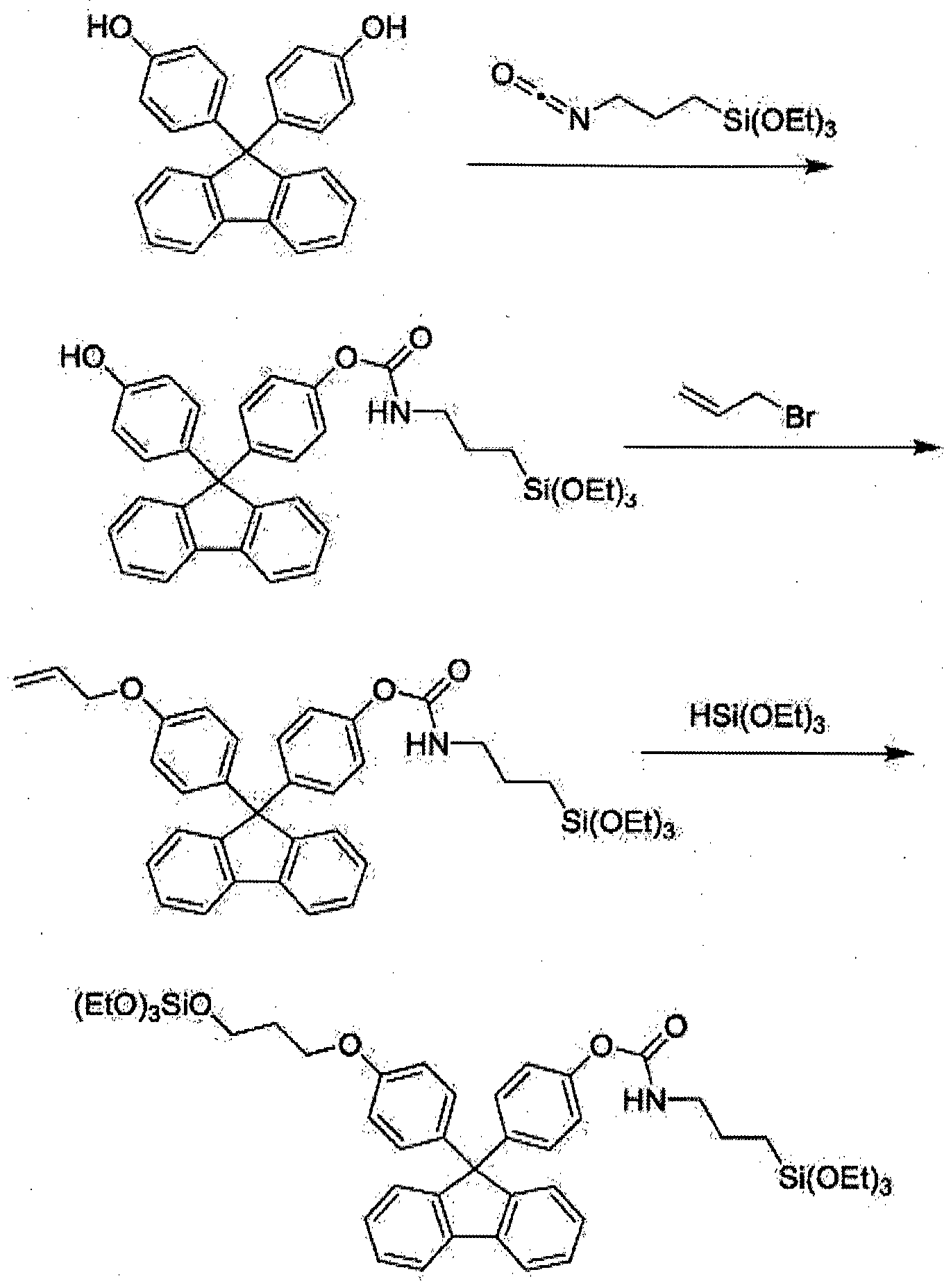
  • Process for the preparation of alkoxysilyl compounds having at least two -C0NH (CH 2 ) z -SiRiR 2 R 3 substituents and unbanung substituents (Method 1)
  • An alkoxysilyl compound having the substituents of at least two ⁇ ⁇ ((3 ⁇ 4) ⁇ -53 ⁇ 43 ⁇ 43 ⁇ 4 and an unbanung substituent is represented by an isocyanate-based alkoxy group of any one of the following formulas Salane can be obtained by reaction in the presence of any base and any solvent.
  • the substituents k and 1 are each hydrogen, in to p are each independently selected from the group consisting of hydrogen, an alkyl group, a Cwo alkenyl group and a C 6 — 30 aryl,
  • Y is -C3 ⁇ 4-, -C (CH 3 ) 2 -,- C (CF 3 ) 2- , -S- or ⁇ S0 2- ,
  • ES IS in the above formula to a substituent two or more of q to t is hydrogen and the other is independently Cwo alkyl, alkenyl Cwo (alkenyi) group and a C 6 - 30 may be selected from aryl (aryl) groups,
  • M is-(3 ⁇ 4- ' -C (CH 3 ) 2 ⁇ .-C (CF 3 ) 2- , -S- or -S0 2 ⁇ , wherein the formula IS is linear or May be substituted with a branched C1-C10 alkyl group.
  • At least one of 3 ⁇ 4 to 3 ⁇ 4 is a C1-C10 linear or branched alkoxy group, the remainder is a straight black or branched C1-C10 alkyl group, and ⁇ is an integer of 3 to 10.
  • Substituents a and b in Formulas AI to DI are each of the following Formula S2, and substituents c to f are each independently hydrogen, a ( 10 alkyl group, an alkenyl group, and C 6 ⁇ ). And from the group consisting of 30 aryl groups.
  • Y is ⁇ (3 ⁇ 4-, -C (CH 3 ) 2 -.- C (CF 3 ) 2- , -S- or -S0 2- , and the substituents in the formulas EI to II increase g to j At least two of which are represented by Formula S2, and the others are each independently selected from the group consisting of hydrogen, a Cwo alkyl group, a d- 10 alkenyl group, and a C 6 ⁇ 30 aryl group,
  • M in Formula HI is -CH 2- , -C (CH 3 ) 2- , -C (CF 3 ) 2- , -S- or ⁇ S0 2-
  • Formula II is a straight chain or May be substituted with a branched C1-C10 alkyl group
  • R 3 To R is a straight or branched chain alkoxy group having 1 to 10 carbon atoms, the rest is a straight or branched chain alkyl group having 1 to 10 carbon atoms, z is an integer of 3 to 10.
  • An alkoxysilyl compound may be prepared in which the isocyanate-based alkoxy group silane of Formula Ml is reacted with 4 equivalents in the presence of any base and any solvent to 1 equivalent. Also. Such reaction is at 15 ° C to 12 CTC It may be performed for 1 to 72 hours. Hydroxy group of one of the starting materials of the AS to IS by the method 1 is ⁇ ( ⁇ 1 ⁇ 2) ⁇ - substituted with ⁇ 3 ⁇ 43 ⁇ 43 ⁇ 4, more than one alkoxysilyl group and the remaining non-banung hydrogen, an alkyl group, an alkenyl (alkenyl) as a substituent An alkoxysilyl compound having a group or an aryl group can be prepared.
  • examples of the base that can be used are not limited thereto, for example, K 2 CO 3 , Na 2 CO 3 , HCOs. NaHC0 3 , triethylamine, diisopropylethyl amine can be mentioned. These bases may be used alone or in combination of two or more black.
  • the base is preferably used in an amount of 0.01 to 5 equivalents based on 1 equivalent of the hydroxy group of the starting material in terms of reaction efficiency.
  • the solvent in the reaction can be optionally used as needed. E.g. The solvent may not be used if the viscosity of the reaction product is suitable for the reaction to proceed at a reaction temperature without a separate solvent in the first step reaction.
  • a separate solvent is not required, which can be easily determined by those skilled in the art.
  • a solvent a possible solvent may dissolve the reactant well. Any organic solvent may be used so long as it can be easily removed after reaction without any adverse effects, thereby limiting it, for example, toluene, acetonitrile, THKtet ra hydrofur an), ME (methyl ethyl ketone ), Dimethyl formamide (DMF), dimethyl sul foxi (DMSO), methylene chloride (MC) and the like can be used.
  • solvents may be used alone or in combination of two or more black.
  • the amount of the solvent used is not particularly limited and may be used in a suitable amount within a range in which the reaction product is sufficiently dissolved and does not adversely affect the reaction, and those skilled in the art may appropriately select it.
  • the alkoxysilyl compound having at least two substituents of-((3 ⁇ 4) 2- ⁇ 3 ⁇ 43 ⁇ 43 ⁇ 4 and unbanung substituents may be selected from any of the bases and the optional alkenyl compounds of the starting materials of any of Reacting in the presence of a solvent to obtain an intermediate (1) of any one of Formulas A1 to II; and the intermediate (1) and an alkoxy group silane of Formula (M3) in the presence of a metal catalyst and an optional solvent. It can be prepared by performing the first and second steps to obtain the final product of any one of the formulas AI to II. [Departure material]
  • Y is -CH 2- , -C (CH 3 ) 2- , _C (CF 3 ) 2- ' ⁇ S— or ⁇ S0 2-
  • Formula ES to two or more of the substituents Q to t at IS is hydrogen, the remains are each independently C WO alkyl, CHO-alkenyl (alkenyl) group, and a C 6 - 30 aryl group is selected from the group consisting of groups (aryl),
  • M is-(3 ⁇ 4-, ⁇ C (CH 3 ) 2- , -C (CF 3 ) 2- , ⁇ S ⁇ or -S0 2 ⁇ .
  • Formula (IS) may be substituted with a linear or branched C1-C10 alkyl group in the meta position of oxygen.
  • X is CI, Br, I,-S0 2 -C3 ⁇ 4, -0-S0 2 -CF 3 , ⁇ 0-S0 2 — C 6 H 4 -CF 3 ⁇ — 0-S0 2- C 6 iirN0 2 or -0-S0 2 -C 6 H 4 -CH 3 , and z is an integer from 3 to 10.
  • Y in Formula A1 is -CH 2 ⁇ , -C (C3 ⁇ 4) 2- , -C (CF 3 ) 2- , -S- or -S0 2- ,
  • substituents ql to tl are _ (CH 2 ) Z - 2 CH 3 ⁇ 4 (Z is an integer of 3 to 10), and the rest are each independently hydrogen, an alkyl group, an alkenyl group.
  • an aryl group wherein M in formula HI is -C3 ⁇ 4-, ⁇ C (CH 3 ) 2 ⁇ , -C (CF 3 ) 2- , ⁇ S ⁇ or -S0 2- Formula II may be substituted with a linear or branched C1-C10 alkyl group at the meta position of oxygen.
  • At least one of to 3 ⁇ 4 is a C1-C10 linear or branched alkoxy group, and the rest are each independently a linear or branched C1-C10 alkyl group.
  • substituent a and b of Formula DI and AI to the formula S1 substituent c to f are each independently formula S1, hydrogen, -OH, Cwo alkyl, d- 10 alkenyl groups and C 6 - 30 aryl ryl) groups
  • substituent c to f are each independently formula S1, hydrogen, -OH, Cwo alkyl, d- 10 alkenyl groups and C 6 - 30 aryl ryl
  • Y is-(3 ⁇ 4-, ⁇ C (C3 ⁇ 4) 2 —, -C (CF 3 ) 2- , -S- or -S0 2- ,
  • substituents g to j at least two of the following formula S1, and the remains are each independently hydrogen, Cwo alkyl, Cwo alkenyl groups and C 6 - may be selected from the group consisting of a 30-aryl (aryi) ,
  • M is -C3 ⁇ 4 ⁇ , -C (C3 ⁇ 4) 2 ⁇ , -C (CF 3 ) 2- , -S- or ⁇ S0 2- , wherein Formula II is a straight or branched chain at the meta position of oxygen. May be substituted with C1 ⁇ C10 alkyl group.
  • the ⁇ (CH 2 ) Z - 2 CH C3 ⁇ 4 (Z is an integer of 3 to 10) of the alkenyl compound of the formula M2 with respect to 1 equivalent of hydroxy group of the starting material.
  • the reaction product was added to 10 equivalents and reacted at 15 ° C. to 100 ° C. for 1 to 120 hours to obtain an intermediate (1).
  • Examples of the base that can be used in the first step 1 stage are not limited thereto, for example, KOH, NaOH, K 2 CO 3) Na 2 CO 3 , HC0 3 , NaHC0 3 , NaH, pyridine, triethylamine, And diisopropylethyl amine. These bases may be used alone or in combination of two or more.
  • the base is preferably used in an amount of 0.01 to 5 equivalents based on 1 equivalent of the hydroxy group of the starting material in terms of reaction efficiency.
  • the solvent may be optionally used as necessary. Even without a separate solvent at a reaction temperature 'if the viscosity of the reaction product is suitable for the reaction to proceed the reaction may not be used. In other words, if the viscosity of the reactants is low enough that the mixing and stirring of the semi-agitator can proceed smoothly without a solvent, a separate solvent is not required, which can be easily determined by those skilled in the art.
  • the reaction product can be dissolved well, and any organic solvent can be used as long as it can be easily removed after the reaction without adversely affecting the reaction.
  • any organic solvent can be used as long as it can be easily removed after the reaction without adversely affecting the reaction.
  • THF tetrahydrofuran
  • MEK methyl ethyl ketone
  • Dimethyl formamide (DMF), Dimethyl sul foxide (DMSO), methylene chloride (MC), H 2 O or alcohols (methanol, ethanol) and the like can be used.
  • These solvents may be used alone or in combination of two or more.
  • the amount of the solvent to be used is not particularly limited, and may be used in a suitable amount within a range in which the reactants are sufficiently dissolved and do not adversely affect the reaction, and those skilled in the art may select appropriately.
  • the intermediate (1) and the alkoxy group silane of the formula M3 are reacted in the presence of a metal catalyst and an optional solvent, whereby the alkenyl group of the intermediate (1) is substituted with the following formula S1.
  • a final product of II can be obtained.
  • the alkenyl group and the alkoxy silane of the intermediate product (1) is reacted in an equivalence ratio according to the stoichiometry, so that the alkoxy group silane of the formula M3 to 1 equivalent of the alkenyl group of the intermediate product (1) 5 equivalents are added for reaction. It may be carried out at 15 ° C to 120 ° C for 1 to 72 hours.
  • the metal catalyst in the first and second reactions is not limited thereto.
  • a platinum catalyst of Pt0 2 or 3 ⁇ 4PtCl 6 Chloroplat inic acid
  • the platinum catalyst is preferably used in an amount of 0.005 to 0.05 equivalents based on 1 equivalent of the alkenyl group of the intermediate product (1) in view of reaction efficiency.
  • the solvent may be optionally used in the first 1-2 step reaction as necessary.
  • the solvent may not be used if the viscosity of the reaction product is suitable for reaction to proceed at the reaction temperature without a separate solvent in the first reaction reaction. In other words, if the viscosity of the reactants is low enough that the mixing and stirring of the reaction product can proceed smoothly without a solvent, a separate solvent is not required, which can be easily determined by those skilled in the art.
  • the reactant can be dissolved well, and any aprotic solvent can be used as long as it can be easily removed after the reaction without any adverse effect on the reaction.
  • any aprotic solvent can be used as long as it can be easily removed after the reaction without any adverse effect on the reaction.
  • toluene, acetonitrile, THF tetra hydrofuran (ME), methyl ethyl ketone (ME), dimethyl formamide (DMF), climethyl sul foxide (DMS0), methylene chloride (MC), and the like Can be used.
  • solvents may be used alone or in combination of two or more.
  • the amount of the solvent used is not particularly limited and may be used in a suitable amount within a range in which the reaction product is sufficiently dissolved and does not adversely affect the reaction, and a person skilled in the art may select appropriately. . All. Two or more - ⁇ ( ⁇ 2) ⁇ - ⁇ eu ⁇ 3 ⁇ 4) substituent and at least one 3 ⁇ 43 ⁇ 4 ⁇ - ⁇ 3 ⁇ 43 ⁇ 43 ⁇ 4 substituent group, and "non-manufacturing method of the alkoxysilyl compounds having a reactive substituent (Method 3)
  • An alkoxysilyl compound having at least two substituents of-( ⁇ ((: ⁇ 2 ) ⁇ -5 ⁇ 3 ⁇ 4 ⁇ 3 ⁇ 4, at least one substituent of-(CH 2 ) z -Si3 ⁇ 4R 2 R 3 and an unbanung substituent is prepared in Method 1 above.
  • the alkoxysilyl compound prepared in Method 1 may have an alkenal compound of Formula EI to II, which may have an hydroxy group, and the following Formula M2 in any base and in any solvent.
  • X is a halide of CI, Br or I, — 0-S0 2 — CH 3 , -0-S0 2 -CF 3 , — 0-S0 2 ⁇ C 6 H 4 -CF 3 ,-S0 2- C 6 H 4 -N0 2 or -0-S0 2 -C 6 H 4 -CH 3 , z is an integer of 3 to 10.
  • step 1-3 any one of formulas EI to II having a hydroxy group and an alkenyl compound of formula M2 are reacted. One hydroxy group is substituted with ⁇ (C) Z - 2 CH: H 2 (Z is an integer from 3 to 10).
  • steps 1 to 3 of the formula II of the EI to any one of the hydroxy groups of the alkenyl with respect to one equivalent of Al of the compound the formula M2 - (C3 ⁇ 4) Z - 2 CH CH 2 (Z is an integer of 3 to 10) It may be carried out for 1 to 120 hours at 15 ° C to 100 ° C by adding 0.5 to 10 equivalents.
  • Examples of the base that can be used in the first to third steps are not limited thereto, for example, KOH, NaOH, K 2 C0 3 , Na 2 C0 3) KHC0 3 , NaHC0 3 , NaH, pyridine, triethylamine And diisopropylethyl amine. These bases may be used alone or in combination of two or more.
  • the base may be used in an amount of 0.1 to 5 equivalents based on 1 equivalent of the hydroxy group of the starting material in terms of reaction efficiency.
  • the solvent may be optionally used as necessary. Even without a separate solvent, if the viscosity of the reaction product is suitable for the reaction, the solvent may not be used. That is, if the viscosity of the reaction product is low enough that the mixing and stirring of the reactants can proceed smoothly without a solvent, a separate solvent is not required, which can be easily determined by those skilled in the art.
  • solvent possible The solvent can dissolve the reaction well, and any organic solvent can be used as long as it can be easily removed after the reaction without adversely affecting the reaction.
  • toluene aceto Nitrile, tetrahydrofuran (THF), methyl ethyl ketone (MEK), dimethyl formamide (DMF), dimethyl sul foxide (DMS0), methylene chloride (MC), H 2 0 or alcohols (methanol, ethanol)
  • THF tetrahydrofuran
  • MEK methyl ethyl ketone
  • DMF dimethyl formamide
  • DMS0 dimethyl sul foxide
  • MC methylene chloride
  • H 2 0 or alcohols methanol, ethanol
  • the solvent in the 1-4 step reaction can optionally be used as needed. For example, in the first step 4, the solvent may not be used if the viscosity of the reaction product is suitable for the reaction to proceed in the reaction product without any solvent.
  • a separate solvent is not required, which can be easily determined by those skilled in the art.
  • the possible solvent can dissolve the reaction product well, and any aprotic solvent can be used as long as it can be easily removed after the reaction without any adverse effect on the reaction.
  • any aprotic solvent can be used as long as it can be easily removed after the reaction without any adverse effect on the reaction.
  • toluene, acetonitrile, tetrahydrofuran (THF), methyl ethyl ketone (MEK), dimethyl formamide (DMF), and dimethyl sul foxide (DMS0) Methylene chloride (MC) and the like can be used.
  • solvents may be used alone or in combination of two or more.
  • the amount of the solvent to be used is not particularly limited, and may be used in a suitable amount within a range in which the reactants are sufficiently dissolved and do not adversely affect the reaction, and those skilled in the art may select appropriately.
  • la. Method for preparing an alkoxysilyl compound having two or more (C3 ⁇ 4) z — 3 ⁇ 43 ⁇ 43 ⁇ 4 substituents and at least one -COMKCH ⁇ z-SiRi ⁇ Rs substituent and a non-banung substituent (method 4)
  • the alkoxysilyl compound having a substituent of Si ⁇ RzRs and an unbanung substituent is any one of Formulas EI to II, which may have a hydroxy group among the alkoxysilyl compounds having at least two substituents and unbanung substituents prepared in Method 2 above. In addition it can be prepared by combining a substituent of -C0NH (CH 2 ) z -Si3 ⁇ 4R 2 R 3 . Specifically, the alkoxysilyl compound prepared in Method 2 may have a hydroxy group which is not substituted with an alkenyl group in the first step. Any of II to II may be reacted with an isocyanate-based alkoxy group silane of formula Ml in the presence of any base and any solvent to obtain an alkoxysilyl compound that substitutes the hydroxy group with formula S2.
  • At least one is a C1-C10 alkoxy group, the remainder is a straight or branched C1-C10 alkyl group, the alkoxy group and the alkyl group are linear or branched, and z is an integer of 3 to 10.
  • an alkoxysilyl compound is reacted in the presence of any base and any solvent such that 1 to 5 equivalents of the isocyanate-based alkoxy group silane of the formula Ml with respect to 1 equivalent of the hydroxy of any one of the formulas EI to II. It can manufacture.
  • this reaction may be carried out at 15 ° C to 120 ° C for 1 to 72 hours.
  • the hydroxy group of any one of the formulas EI to II is substituted with - ⁇ : ⁇ 2 ) ⁇ -3 ⁇ ⁇ , so that at least two substituents and at least one substituent of -CONtKCH ⁇ -SiR ⁇ Rg are substituted.
  • hydrogen, an alkyl group, An alkoxysilyl compound having a remaining half-banung substituent, which is an alkenyl group or an aryl group can be prepared.
  • the base that can be used include, but are not limited to, K 2 CO 3 , Na 2 CO 3 , KHCO 3 , NaHC0 3 , ⁇ triethylamine, diisopropylethyl amine.
  • bases may be used alone or in combination of two or more.
  • the base is preferably used in an amount of 0.01 to 5 equivalents based on 1 equivalent of the hydroxy group of the starting material in terms of reaction efficiency.
  • the solvent in the reaction can be optionally used as needed.
  • the solvent may not be used if the viscosity of the reaction product is suitable for the reaction to proceed at a reaction temperature even without a separate solvent. In other words, if the viscosity of the reactants is low enough that the mixing and stirring of the semi-agitator can proceed smoothly without a solvent, a separate solvent is not required, which can be easily determined by those skilled in the art.
  • the reaction product can be dissolved well, and any organic solvent can be used as long as it can be easily removed after the reaction without adversely affecting the reaction, and the present invention is not particularly limited.
  • any organic solvent can be used as long as it can be easily removed after the reaction without adversely affecting the reaction, and the present invention is not particularly limited.
  • toluene, acetonitrile, tetrahydrofuran (THF), methyl ethyl ketone (MEK), dimethyl formamide (DMF), dimethyl sul foxide (DMMS0), methylene chloride (MC) And the like can be used.
  • THF tetrahydrofuran
  • MEK methyl ethyl ketone
  • DMF dimethyl formamide
  • DMMS0 dimethyl sul foxide
  • MC methylene chloride
  • the amount of the solvent to be used is not particularly limited, and may be used in a suitable amount within a range in which the reactants are sufficiently dissolved and do not adversely affect the reaction, and those skilled in the art may select appropriately. hemp.
  • Alkenylated starting materials (Formulas AS to DS) in which all substituents are hydrogen, and after performing the reaction reaction once, include two substituents of ⁇ - ⁇ or alkenylated again after the displacement reaction ( ⁇ 1 ⁇ 2) ⁇ - ⁇ manufacturing method of the alkoxysilyl compounds 3 ⁇ 43 ⁇ 43 ⁇ 4 substituent of 3 to 4 to have (method 5) production method 5-1 alkenyl carbonylation all substituents are the starting material (formula AS to DS) hydrogen, and after performing once the seat moving banung, ((:) 2 - can be prepared alkoxysilyl compound having two substituents of 3 ⁇ 43 ⁇ 43 ⁇ 4 ⁇ .
  • Alkoxysilyl compounds having 3 to 4 substituents of 3 ⁇ 43 ⁇ 43 ⁇ 4 can be prepared.
  • the alkoxysilyl compound having 2 to 4 substituents of (CH 2 ) Z — ⁇ 3 ⁇ 43 ⁇ 43 ⁇ 4 may be alkenylated from the starting materials (Formulas AS to DS) in which all of the substituents are hydrogen, and then once subjected to relocation reaction, It may be prepared by alkenylation and bonding of substituents of (C) z ⁇ SiR RsRs.
  • Y in AS is -CH 2- , -C (CH 3 ) 2- , -C (CF 3 ) 2- , -S- or ⁇ S0 2- . )
  • X is a halide of CI, Br or I, -0-S0 2 -CH 3 , -O-SO2-CF3, -0-S0 2 ⁇ C 6 H 4 -CF 3 , -O-SO2-C6H4- NO2 or -0-S02-C 6 H 4 -CH 3 and z is an integer of 3 to 10.
  • Y in Formula A21 is- ( : 3 ⁇ 4-, -C (C3 ⁇ 4) 2 -.- C (CF 3 ) 2- , -S- or -S0 2- .)
  • any one of m2 and n2 and any one of o2 and p2 is-(CH 2 ) Z - 2 CH 3 ⁇ 4 (Z is an integer of 3 to 10), and the rest Is hydrogen
  • Y is -CH 2 _, -C (CH 3 ) 2- , -C (CF 3 ) 2 ⁇ , ⁇ S ⁇ or -so 2- .
  • At least one of Ri to 3 ⁇ 4 is a C1-C10 alkoxy group, and the rest is a straight or branched C1 ⁇ C10 alkyl group, and the alkoxy group and alkyl group are straight or branched chain.
  • step 2-1 the hydroxy group is reacted by reacting the starting material of any one of the above formulas AS to DS in which all substituents are hydrogen with the alkenyl compound of the formula M2 in the presence of any base and any solvent.
  • Z - 2 CH CH 2 (Z is an integer of 3 to 10) to afford intermediate (21).
  • step 2-1 -(CH 2 ) Z - 2 CH 3/4 (Z is an integer of 3 to 10) of the alkenyl compound of Formula M2 with respect to 1 equivalent of the hydroxy group of any one of Formulas AS to DS.
  • the reaction is carried out by adding 0.5 to 10 equivalents, and may be performed at 15 ° C. to 100 ° C. for 1 to 120 hours.
  • Examples of the base that can be used in the second stage 1 are not limited thereto, for example, KOH, NaOH, K 2 C0 3 , Na 2 C0 3 , KHC0 3 , NaHC0 3 , NaH, pyridine, triethylamine, And diisopropylethyl amine. These bases may be used alone or in combination of two or more black.
  • the base is preferably used in an amount of 0.01 to 5 equivalents based on 1 equivalent of the hydroxy group of the starting material in terms of reaction efficiency.
  • the solvent may be optionally used as necessary. Even without a separate solvent, if the viscosity of the reaction product is suitable for the reaction, the solvent may not be used. That is, if the viscosity of the reaction product is low enough that the mixing and stirring of the reactants can proceed smoothly without a solvent, a separate solvent is not required, which can be easily determined by those skilled in the art. In the case of using a solvent, as a possible solvent, any organic solvent can be used as long as it can dissolve the reaction product well and can be easily removed after the reaction without any adverse effect on the reaction.
  • toluene acetonitrile, tetrahydrofuran (THF), methyl ethyl ketone (MEK), dimethyl formaraide (DMF), climethyl sul foxide (DMSO), methylene chloride (MC), H 2 0 or alcohols (methane Ethanol) may be used.
  • THF tetrahydrofuran
  • MEK methyl ethyl ketone
  • DMF dimethyl formaraide
  • DMSO climethyl sul foxide
  • MC methylene chloride
  • H 2 0 or alcohols methane Ethanol
  • Step 2-2 may be performed to obtain the intermediate product 22 having a hydroxy group by performing a reaction reaction on the alkenylated intermediate product 21 in step 2-1. Since the inversion reaction is a monomolecular reaction (unimol ecul ar react i on), there is no equivalent limit, it is carried out for 1 to 200 hours at 140 ° C to 25 CTC, or 12C C to 250 ° C by injecting a microwave of 100W to 750W Furnace may be performed for 1 to 1000 minutes. The solvent may not be used if the viscosity of the reaction product is appropriate to proceed with reaction as the temperature of the displacement reaction is increased.
  • the viscosity of the reaction product is low enough that the mixing and stirring of the reaction product can proceed smoothly without a solvent, a separate solvent is not required, which can be easily determined by those skilled in the art. However, if necessary, it may proceed in the presence of a solvent, but is not particularly limited to xylene, 1, 2-dichlorobenzene. N, N-diethylaniline round can be used.
  • the shift reaction described later may be performed in the same manner as in the second step 2-2.
  • the intermediate 22 having the hydroxy group prepared in step 2-2 and the alkenyl compound of the formula M2 are reacted in the presence of any base and any solvent to form a hydroxy group.
  • the second step 3 is an alkenylation step of the intermediate 22, and may be performed under the same conditions as the alkenylation reaction performed in step 2 ′ 1.
  • step 2-4 the intermediate (23) and the alkoxy group silane of the formula M3 subjected to alkenylation in the second stage 3 and 3 are reacted in the presence of a metal catalyst and an optional solvent to form a final compound of formulas AI to DI.
  • An alkoxysilyl compound having 2 to 4 substituents of a product, that is, (CH 2 ) Z ⁇ ⁇ 3 ⁇ 43 ⁇ 43 ⁇ 4 can be obtained.
  • the metal catalyst used in the 2-4 step reaction is not limited to this, for example, a platinum catalyst of Pt0 2 or ⁇ H 2 PtCl 6 (Chl oropl at ini c acid) may be used.
  • the platinum catalyst is preferably used in an amount of 0.005 to 0.05 equivalents based on 1 equivalent of the alkenyl group substituted in the first step 1-3 in view of the reaction efficiency.
  • the solvent may be optionally used in the second stage 4 reaction. For example, even without a separate solvent in steps 2-4, the solvent may not be used if the viscosity of the reaction product is suitable for the reaction to proceed.
  • a separate solvent is not required, which can be easily determined by those skilled in the art.
  • the reaction product can be dissolved well, and any aprotic solvent can be used as long as it can be easily removed after the reaction without adversely affecting the reaction.
  • any aprotic solvent can be used as long as it can be easily removed after the reaction without adversely affecting the reaction.
  • toluene, acetonitrile, tetrahydrofuran (THF), methyl ethyl ketone (MEK), dimethyl formami de (DMF), dimethyl sul foxide (DMS0), methylene chloride (MC) And the like can be used.
  • solvents may be used alone or in combination of two or more.
  • the amount of the solvent to be used is not particularly limited and may be used in a suitable amount within a range in which the reactants are sufficiently dissolved and do not adversely affect the reaction, and those skilled in the art We can choose appropriately. bar.
  • Alkenylated starting materials (Formulas AS-DS) in which all substituents are hydrogen, followed by one displacement reaction. 2 - ⁇ ⁇ ((3 ⁇ 4) ⁇ - ⁇ manufacturing method of an alkoxysilyl compound having a substituent group and an alkenyl 3 ⁇ 43 ⁇ 43 ⁇ 4 (Method 6)
  • the alkoxysilyl compound having two substituents of -CON ⁇ CH ⁇ z-SiR ⁇ and an alkenyl group is obtained by alkenylating the starting material (Formulas AS to DS) in which all substituents are hydrogen, and performing a reaction reaction once. It can be prepared by binding a substituent of -C0NH (C3 ⁇ 4) z -SiR R 3 . Specifically, in Method 5, alkenylation of a starting material (Formulas AS-DS) in which all substituents are hydrogen.
  • Y in Formula A22 is -CH 2- , -C (CH 3 ) 2- . ⁇ C (CF 3 ) 2- , -S ⁇ or _S0 2- .
  • Ri to 3 ⁇ 4 is a C1-C10 alkoxy group, the remainder is a straight or branched C1 - C10 alkyl group, the alkoxy group and the alkyl group are straight or branched, and z is an integer of 3 to 10 to be.
  • step 2-5 an alkoxysilyl compound is reacted in the presence of any base and any solvent such that 1 to 5 equivalents of isocyanate-based alkoxy group silanes of the following formula Ml with respect to 1 equivalent of the hydroxy group of the intermediate (22). It can manufacture. In addition, this reaction can be carried out at 15 ° C to 1201: for 1 to 72 hours.
  • Examples of the base that can be used in the second step 2-5 are not limited thereto, for example, K 2 CO 3 , Na 2 CO 3) KHC0 3 , NaHC0 3 , NaH, pyridine, triethylamine, diisopropylethyl Amines. These bases may be used alone or in combination of two or more black. The base is preferably used in an amount of 0.01 to 5 equivalents based on 1 equivalent of the hydroxy group of the intermediate 22, in terms of reaction efficiency.
  • the solvent may be optionally used as necessary. When the viscosity of the reaction is suitable for the reaction proceeds at the reaction temperature without a separate, anol solvent you can not use the solvent.
  • a separate solvent is not required, which can be easily determined by those skilled in the art.
  • the reactant can be dissolved well, and any organic solvent can be used as long as it can be easily removed after the reaction without any adverse effect on the reaction.
  • any organic solvent can be used as long as it can be easily removed after the reaction without any adverse effect on the reaction.
  • toluene, acetonitrile, THF tetra hydro furan, methyl methyl ketone, dimethyl formamide (DMF), dimethyl sul foxide (DMS0), methylene chloride (MC), and the like may be used. These solvents may be used alone or in combination of two or more.
  • the amount of the solvent used is not particularly limited and may be used in a suitable amount within a range in which the reaction product is sufficiently dissolved and does not adversely affect the reaction, and those skilled in the art may appropriately select it. four.
  • Starting materials (Formulas AS to DS) all al substituents are hydrogen and after one displacement reaction, two-( ⁇ ) ⁇ ((: 3 ⁇ 4) ⁇ -3 ⁇ 3 ⁇ 4 substituents and at least one or more Method for preparing alkoxysilyl compound having a substituent of-((: 3 ⁇ 4) 2 - ⁇ 3 ⁇ 41 (Method 7)
  • the alkoxysilyl compound having two substituents of — () ⁇ ; ⁇ 2 ) ⁇ -33 ⁇ 43 ⁇ 43 ⁇ 4 and at least one substituent of _ (CH 2 ) Z -SiRi ⁇ Rs may be prepared from the two ⁇ ⁇ ( ⁇ ) 2 ) an alkoxysilyl compound having a substituent of ⁇ -3 ⁇ 3 ⁇ 43 ⁇ 43 ⁇ 4 and an alkenyl group may be prepared by additionally combining a substituent of-((: ⁇ - ⁇ .
  • the alkoxysilyl compound is prepared by carrying out the second to sixth step of reacting the alkoxy group silane of formula M3 in the presence of a metal catalyst and any solvent to obtain the final product of any one of formulas AI to DI.
  • At least one of 3 ⁇ 4 to 3 ⁇ 4 is a C1-C10 alkoxy group, the remaining straight or branched C1-C10 alkyl group, and the alkoxy group and the alkyl group are straight or branched chain.
  • R 3 is a C 1-10 alkoxy group
  • the rest is a C 1-10 alkyl group
  • the alkoxy group and the alkyl group is a branched or branched chain
  • z is a 3-10
  • the alkoxy silane of the alkoxysilyl compound prepared in the second to 5th step is an integer of 3 to 10.
  • the alkoxy group silane of the formula M3 to 1 equivalent of-(CH 2 ) Z - 2 CH C3 ⁇ 4 (Z is an integer of 3 to 10) of the alkoxysilyl compound prepared in step 2-5 1 sikimyeo added to banung so that to 5 equivalents, to about 15 ° C It may be carried out at 120 ° C for 1 to 72 hours.
  • the metal catalyst used in the reaction of step 2-6 is not limited thereto.
  • a platinum catalyst of Pt0 2 or H 2 PtCl 6 Chloroplat inic acid
  • the solvent may be used as a fruit nectar if necessary.
  • the solvent may not be used if the viscosity of the reactants at the reaction temperature is suitable to proceed reaction without the need for a separate solvent in step 2-6. That is, if the viscosity of the reactants is low enough that the mixing and stirring of the reactants can proceed smoothly without solvent, no separate solvent is required, which can be easily determined by those skilled in the art.
  • the possible solvent can dissolve the reaction product well, and any aprotic solvent can be used as long as it can be easily removed after reaction without any adverse effect on the reaction.
  • any aprotic solvent can be used as long as it can be easily removed after reaction without any adverse effect on the reaction.
  • toluene, acetonitrile, THF tetra hydro furan (ME), methyl ethyl ketone (ME), dimethyl formamide (DMF), dimethyl sul foxi de) methylene chloride (MC), etc. may be used.
  • MMF dimethyl formamide
  • MC dimethyl sul foxi de) methylene chloride
  • the amount of the solvent to be used is not particularly limited, and may be used in a suitable amount within a range in which the reactants are sufficiently dissolved and do not adversely affect the reaction, and those skilled in the art may appropriately select it in consideration of this.
  • Ah Alkenylation of the starting materials (Formulas AS-DS) in which all substituents are hydrogen, followed by two displacement reactions, preparation of an alkoxysilyl compound having four-((3 ⁇ 4) 2 ⁇ 33 ⁇ 43 ⁇ 43 ⁇ 4 substituents and hydroxy groups).
  • the alkoxysilyl compound having a substituent of 4 '-3 ⁇ 4) 2- ⁇ 3 ⁇ 43 ⁇ 43 ⁇ 4 and a hydroxy group was subjected to further in situ reaction to the intermediate (23) prepared in the above method 5, and additionally ⁇ 3 ⁇ 4) 2- ⁇ It can be prepared by combining a substituent of 3 ⁇ 43 ⁇ 43 ⁇ 4.
  • step 3-1 to obtain the intermediate (31) having a hydroxy group by performing the reaction in place in the intermediate (23) prepared in Method 5; And reacting the intermediate (31) with the alkoxygasilane of the formula (M3) in the presence of a metal catalyst and any solvent to perform the third step of obtaining the final product of any one of the formulas ( ⁇ -DI).
  • Compounds can be prepared.
  • Y in the formula A31 is ⁇ (3 ⁇ 4-,-C (CH 3 ) 2- , -C (CF 3 ) 2 ⁇ , -S- or -S0 2 ))
  • the remainder is a straight or branched C1-C10 alkyl group, the alkoxy group
  • step 3-1 may be performed in the same manner as the displacement reaction of step 2-2 of method 5.
  • step 3-2 the intermediate (31) prepared in step 3-1 and the alkoxy group silane of the formula M3 are reacted in the presence of a metal catalyst and 'an optional solvent to obtain a final product of formulas AI to DI. You can get it.
  • the metal catalyst used in the third ⁇ 2 step reaction is not limited to this, for example, a platinum catalyst of Pt0 2 or H 2 PtCl 6 (Chloroplat inc c id) may be used. Platinum catalyst is-of the intermediate product ⁇ .31) prepared in step 3-1 (CH 2 ) Z ⁇ 2 CH ⁇ CH 2 (Z is an integer of 3 to 10) It is preferable to use from 0.005 to 0.05 equivalents based on 1 equivalent in terms of reaction efficiency.
  • the solvent may optionally be used if necessary.
  • the solvent may not be used if the viscosity of the reactants in the reaction is suitable for the reaction to proceed without the need for a separate solvent. That is, if the viscosity of the reaction product is low enough that the mixing and stirring of the reaction product can proceed smoothly without a solvent, a separate solvent is not required, which can be easily determined by those skilled in the art.
  • the possible solvent can dissolve the reaction product well, and any aprotic solvent can be used as long as it can be easily removed after the reaction without any adverse effect on the reaction.
  • solvents may be used alone or in combination of two or more.
  • the amount of the solvent used is not particularly limited and may be used in a suitable amount within a range in which the reaction product is sufficiently dissolved and does not adversely affect the reaction, and those skilled in the art may appropriately select it. character.
  • Biotinylated alkenyl all substituents are the starting material (Formula AS to DS) hydrogen, and seat shifting subjected to twice banung, 6 - ( ⁇ 2) ⁇ - ⁇ 3 ⁇ 43 ⁇ 43 ⁇ 4 of "having a substituent alkoxy no hydroxy group silyl Method of Preparation of the Compound (Method 9)
  • the intermediate (31) prepared in the third step (1) of Method 8 is reacted with the following formula (M2) under any base and any solvent conditions, and the Third step 3, obtaining an intermediate (32) in which the oxy group is substituted with-(CH 2 ) Z - 2 CH H 2 (Z is an integer of 3 to 10); and the intermediate (32) and the following formula M3
  • the alkoxysilyl compound may be prepared by performing step 3-4, in which the alkoxy group silane of is reacted in the presence of a metal catalyst and an optional solvent to obtain a final product of any one of formulas AI to DI.
  • X is a halide of CI, Br or I, -0-S0 2 -CH 3 , -O-SO2-CF3, -0-S0 2 -C 6 H 4 -CF 3 , — 0— S0 2 ⁇ C 6 H 4 -N0 2 or — 0-S0 2 -C 6 H 4 -CH 3 , and z is an integer from 3 to 10.
  • step 3-3 the intermediate (31) prepared in step 3-1 and the alkenyl compound of the formula M2 are reacted in the presence of any base and any solvent. Hydroxy group .
  • the base that can be used in step 3 to 3 are not limited thereto, for example, KOH, NaOH, 2 C0 3 , Na 2 C0 3 , KHC0 3 , NaHC0 3 , NaH, pyridine, triethylamine, di Isopropylethyl amine. These bases may be used alone or in combination of two or more.
  • the base is preferably used in an amount of 0.1 to 5 equivalents based on 1 equivalent of the hydroxy group of the intermediate product 31 prepared in step 3-1 in terms of reaction efficiency.
  • the solvent may be optionally used as necessary. Even without a separate solvent, if the viscosity of the reaction product is suitable for the reaction to proceed at reaction temperature, a solvent may not be used. In other words, if the viscosity of the reactant is low enough that the mixing and stirring of the reaction product can proceed smoothly without solvent, a separate solvent is not required. This can be easily determined by those skilled in the art.
  • the reaction product can be dissolved well, and any organic solvent can be used as long as it can be easily removed after the reaction without adversely affecting the reaction.
  • any organic solvent for example, toluene, acetonitrile, tetrahydrofuran (THF).
  • MEKdnethyl ethyl ketone dimethyl formamide (DMF), dimethyl sul foxi (DMSO), methylene chloride (MC), H 2 O or alcohols (methanol. Ethanol) may be used.
  • These solvents may be used alone or in combination of two or more black.
  • step 3-4 the intermediate product 32 prepared in step 3-3 and the alkoxy group silane of formula M3 may be reacted in the presence of a metal catalyst and an optional solvent to obtain final products of formulas AI to DI. have.
  • the metal catalyst used in the 3-4 step reaction is not limited to this, for example, a platinum catalyst of Pt0 2 or 3 ⁇ 4PtCl 6 (Chloropl at ini c ac id) may be used.
  • the solvent may be optionally used in the third to fourth reactions as necessary. For example, even without a separate solvent in step 3-4, the reaction may not use a solvent if the viscosity of the reaction product is suitable for the reaction to proceed.
  • a separate solvent is not required, which can be easily determined by those skilled in the art.
  • the possible solvent can dissolve the semi-ungmul well.
  • Any aprotic solvent can be used so long as it can be easily removed after the reaction without any adverse effect on the reaction.
  • toluene, acetonitrile, THF tetra hydrofur an), MEK (methyl ethyl ketone), DMF (dimethyl formamide), DMS0 (dimethyl sul foxide) methylene chloride (MC) and the like can be used.
  • solvents may be used alone or in combination of two or more.
  • the amount of the solvent to be used is not particularly limited, and may be used in a suitable amount within a range in which the reaction product is sufficiently dissolved and does not adversely affect the reaction, and those skilled in the art may appropriately select it.
  • 'Cars Alkenylation of the starting materials (Formulas AS-DS) in which all substituents are hydrogen, followed by two inversion reactions, having two-(: 0 ((3 ⁇ 4) 2- ⁇ 3 ⁇ 43 ⁇ 43 ⁇ 4 substituents and four alkenyl groups
  • Alkoxysilyl compounds having two- (: 0 ((3 ⁇ 4) 2-3 substituents and 4 ⁇ (CH 2 ) Z - 2 CH 3/4 (Z is an integer of 3 to 10)) It may be prepared by additionally combining a substituent of-(: 0) 2- ⁇ 3 ⁇ 43 ⁇ 43 ⁇ 4 to the intermediate product 31 prepared in step 3. Specifically, the intermediate product (31) prepared in step 3-1 of Method 8 above. And an isocyanate-based alkoxy group silane of the formula Ml in the presence of any base and any solvent to form a final product of any one of formulas AI to DI It can be prepared by performing the third step.
  • Y in the formula A31 is -CH 2 -,-C (CH 3 ) 2- , -C (CF 3 ) 2 -,- S ⁇ or -S0 2- )
  • Ri to 3 ⁇ 4 is a ci- ⁇ alkoxy group, the remainder is a straight or branched C1-C10 alkyl group, and the alkoxy group and the alkyl group are straight or branched chain, z is an integer of 3 to 10 to be.
  • step 3-5 alkoxysilyl is reacted with 1 to 5 equivalents of isocyanate-based alkoxy group silanes of the general formula Ml in the presence of any base and any solvent in relation to 1 equivalent of the specific group of the intermediate 31.
  • Compounds can be prepared. Also. This reaction can be carried out at 15 ° C to 120 ° C for 1 to 72 hours.
  • Examples of the base that can be used in the third step is not limited thereto, for example, K 2 CO 3 , Na 2 CO 3 , KHCOs, NaHC0 3 . NaH, pyridine, triethylamine. And diisopropylethyl amine. These bases may be used alone or in combination of two or more.
  • the base is preferably used in an amount of 0.01 to 5 equivalents based on 1 equivalent of the hydroxy group of the intermediate 31 in terms of reaction efficiency.
  • the solvent may be optionally used as necessary. Even without a separate solvent, if the viscosity of the reactants at the reaction temperature is suitable for the reaction proceeds, the solvent may not be used.
  • a separate solvent is not required, which can be easily determined by those skilled in the art.
  • a solvent as a possible solvent, the reaction product can be dissolved well, and any organic solvent can be used as long as it can be easily removed after the reaction without any adverse effect on the reaction.
  • any organic solvent can be used as long as it can be easily removed after the reaction without any adverse effect on the reaction.
  • toluene acetonitrile, tetrahydrofuran (THF), methyl ethyl ketone ( ⁇ F), dimethyl formami de (DMF), dimethyl sul foxide (DMS0), methylene chloride (MC), and the like. This can be used.
  • the carbonylation alkenyl substituents are all the starting material (Formula AS to DS) hydrogen, and repeated twice a spot moving banung, two - ⁇ 3 ⁇ ((3 ⁇ 2) ⁇ - ⁇ substituent and at least two of 3 ⁇ 43 ⁇ 43 ⁇ 4 - (CH 2 ) Method for preparing an alkoxysilyl compound having a substituent of Z ⁇ Si ⁇ (Method 11)
  • the alkoxysilyl compound having two substituents of :(: 0 ⁇ ((3 ⁇ 4) 2 -3 1 and at least two substituents of-(C3 ⁇ 4) z - is in addition to the alkoxysilyl compound prepared in Method 10 above-( ⁇ 2) ⁇ -. It can be prepared by combining the substituent of ⁇ 3 ⁇ 43 ⁇ 43 ⁇ 4 specifically with any one of an alkoxy silyl compound prepared in method 10 It can be prepared by carrying out the third to sixth step of reacting the alkoxy group silane of the formula M3 in the presence of a metal catalyst and any solvent to obtain the final product of any of the formulas AI to DI.
  • R to 3 ⁇ 4 is a C1 ⁇ C10 alkoxy group, the rest is a straight chain black branched C1-C10 alkyl group, and the alkoxy group and alkyl group are straight or branched chain.
  • R 3 is a C 1-10 alkoxy group
  • the rest is a C 1-10 alkyl group
  • the alkoxy group and the alkyl group is a branched or branched chain
  • z is a 3-10 (C3 ⁇ 4)
  • Z -2CH C3 ⁇ 4 (Z is an integer of 3 to 10) and the alkoxy silane of the alkoxysilyl compound prepared in Method 10 are reacted in equivalent ratio according to the stoichiometry.
  • the solvent may optionally be used as needed.
  • the solvent may not be used if the viscosity of the reaction product in the reaction is suitable for the reaction to proceed even in the 3-6 reaction step without any solvent. That is, if the viscosity of the reaction product is low enough that the mixing and stirring of the reactants can proceed smoothly without a solvent, a separate solvent is not required, which can be easily determined by those skilled in the art.
  • the reactant can be dissolved well, and any aprotic solvent can be used as long as it can be easily removed after the reaction without any adverse effect on the reaction.
  • any aprotic solvent can be used as long as it can be easily removed after the reaction without any adverse effect on the reaction.
  • toluene acetonitrile, tetrahydrofuran (THF), MEKXmethyl ethyl ketone (THF), dimethyl formamide (DMF), dimethol foxide (DMSO) methylene chloride (MC), etc.
  • THF tetrahydrofuran
  • MEKXmethyl ethyl ketone THF
  • DMF dimethyl formamide
  • DMSO dimethol foxide
  • MC dimethol foxide
  • MC dimethol foxide
  • Synthesis reaction of Synthesis Example 8 is as follows.
  • Synthesis reaction used in Synthesis Example 9 is as follows.
  • Synthesis Examples 11 to 16 Alkoxysilyl Compounds (carbamate, B— 2 to G ⁇ 2) (Method 1) The reaction was carried out in the same manner as in Synthesis Example 10 except for the amount of the reactants used, and the chemical formula B-2 To alkoxysilyl compounds of G-2 were synthesized. The amount of reactants used in each synthesis step is shown in the table below.
  • the synthesis reaction used in the synthesis example 11 is as follows.
  • Synthesis reaction used in Synthesis Example 12 is as follows.
  • Synthetic reaction used in Synthesis Example 13 is as follows.
  • Synthetic reaction used in Synthesis Example 14 is as follows.
  • Synthesis reaction used in Synthesis Example 15 is as follows.
  • Synthesis reaction used in Synthesis Example 16 is as follows.
  • Synthetic reaction used in Synthesis Example 17 is as follows.
  • the phase was cooled to silver, and then worked up using 3 ⁇ 40 to separate the organic layer, MgS0 4 was added to the organic layer to remove the remaining 3 ⁇ 40, and the resultant was filtered through a celite filter and evaporated to obtain a final target (1-2). .
  • Synthesis reaction used in Synthesis Example 18 is as follows.
  • the intermediate product was obtained by the same reaction as in the first stage reaction of Synthesis Example 1.
  • the organic solvent layer was dried over MgS0 4 , filtered, and the solvent was removed using an evaporator to obtain 4,4 '-( pr0 p ane -2,2-diyl) bis (2— allyl-l- (allyloxy) having four allyl groups. ) benzene) was obtained.
  • Synthesis reaction used in Synthesis Example 19 is as follows.
  • Synthesis Examples 20 to 22 Alkoxysilyl Compounds (Hydros ilyat ion, B ⁇ 3 to D_ 3) (Method 5)
  • the first to fourth steps were carried out in the same manner as in Synthesis Example 19, except for the amount of the reactants used.
  • the reaction was carried out to synthesize alkoxysilyl compounds of the formulas B3 to D3 having four alkoxysilyl groups.
  • Each of the reactants used in the third and fourth steps is shown in Tables 4 and 5 below.
  • Synthesis Example 21 The synthetic reaction used in Synthesis Example 21 is as follows.
  • Synthetic reaction used in Synthesis Example 22 is as follows.
  • Synthesis Examples 24 to 26 Alkoxysilyl Compounds Having Two Allyl Groups (Carbamate, B-4 to D-4) (Method 6) Except for the amount of reaction product used, the same procedures as in Synthesis Example 23 were used. The three-step reaction was carried out to synthesize an alkoxysilyl compound represented by Chemical Formulas B-4 to 4 having two allyl groups. The amount of reactants used in each synthesis step is shown in Table 6 below. Table 6
  • Synthesis reaction used in Synthesis Example 24 is as follows. Show ⁇
  • Synthetic reaction used for the said synthesis example 25 is as follows.
  • Synthetic reaction used in Synthesis Example 27 is as follows.
  • Synthesis Examples 28 to 30 Alkoxysilyl compounds having two kinds of alkoxysilyl groups (B-5 to D-5) (Method 7) A reaction was carried out in the same manner as in Synthesis Example 27, except that the amount of the reactant was used. It proceeded and synthesize
  • Synthesis reaction used in Synthesis Example 30 is as follows.
  • intermediate 2 of the first step 9.69 g of allyl bromide, and 50 ml of tetrahydrofuran (THF) were added and stirred at room temperature. Then, a solution in which 3.20 g of NaOH was dissolved in 0 50 ml was slowly added at room temperature for 1 hour, followed by further stirring for 4 hours. Thereafter, the THF was removed using an evaporator, 200 ml of ethyl acetate was added thereto, and the inorganic material was removed by working up with 3 ⁇ 40. MgS0 4 was added to the organic layer to remove the remaining 0, and then filtered through a celite filter and evaporated to dryness to obtain an intermediate product. (3) third stage
  • Synthesis reaction used in Synthesis Example 31 is as follows.
  • Synthesis Example 32 Alkoxysilyl compound having two kinds of alkoxysilyl groups (B-6 to D-6) (Method 8) The reaction was carried out in the same manner as in Synthesis Example 31, except that the amount of the used semi-aerated water was used to synthesize an alkoxysilyl compound represented by formulas B-6 to D-6 having two alkoxysilyl groups. The amount of reaction product used in each synthesis step is shown in the table below.
  • Synthetic reaction used in Synthesis Example 32 is as follows.
  • Synthetic reaction used in Synthesis Example 33 is as follows.
  • One synthetic reaction used in Synthesis Example 34 is as follows.
  • Synthesis reaction used in Synthesis Example 35 is as follows.
  • Synthesis reaction used in Synthesis Example 36 is as follows.
  • Synthetic reaction used in Synthesis Example 38 is as follows.
  • Synthesis Example 40 to 42 compound (B-8 to D-) having four alkoxysilyl groups (method 10) Except for the amount of the reactants used, the reaction was carried out in the same manner as in Synthesis Example 39 to synthesize alkoxysilyl compounds represented by formulas B-8 to D-8 having four alkoxysilyl groups. The amount of reaction product used in each synthesis step is shown in the table below.
  • Synthesis reaction used in Synthesis Example 41 is as follows.
  • Synthesis reaction used in Synthesis Example 42 is as follows.
  • Synthetic reaction used in Synthesis Example 45 is as follows.
  • Synthetic reaction used in Synthesis Example 46 is as follows.
  • Synthesis Example 47 Compound Having Four Allyl Groups and Two Alkoxysilyl Groups (Carbamate, Method 12) 11.94 g of diisopropylethylamine (DIPEA), 22.85 g of triethoxysilyl propyl isocyanate and 46 ml of methylene chloride were stirred in a flask at room temperature. Then, a solution obtained by dissolving 25 g of the intermediate product after the fourth step reaction of Synthesis Example 39 in 46 ml of methylene chloride was slowly added at 60 ° C. for 6 hours. Thereafter, the mixture was further stirred for 9 hours.
  • DIPEA diisopropylethylamine
  • Triethoxysilyl propyl isocyanate 46 ml of methylene chloride
  • Synthesis reaction used in Synthesis Example 48 is as follows.
  • Synthetic reaction used in Synthesis Example 49 is as follows.
  • Synthetic reaction used in the one-phase synthesis example 50 is as follows.
  • the intermediate product in the flask after the fourth step of the synthesis example 39 banung 25 g, Pt0 2 0. 10 g , triethoxysilane 30.36 g, and 214 ml toluene to come into and stirred at room temperature for 5 minutes. Thereafter, the temperature was heated to 80 ° C. and stirred for 12 hours. Thereafter, the phases were cooled with silver and filtered through a celite filter to remove inorganics. Toluene was removed by evaporation to dryness and completely dried using a vacuum pump to obtain an intermediate. (2) second stage
  • DIPEA diisopropylethylamine
  • Synthesis reaction used in Synthesis Example 51 is as follows.
  • Synthesis Examples 52 to 54 Compounds having two kinds of alkoxysilyl groups (B-11 to D- 11) (Method 13)
  • the alkoxysilyl compounds of the formulas B-11 to D-11 having compounds having two kinds of alkoxy silyl groups were subjected to reaction in the same manner as in Synthesis Example 51, except for the amount of the reactants used.
  • the amount of reactants used in each synthesis step is shown in the table below.
  • Synthetic reaction used in Synthesis Example 52 is as follows.
  • Synthesis reaction used in Synthesis Example 53 is as follows.
  • Synthetic reaction used in Synthesis Example 54 is as follows.
  • the resin content of the composite film was adjusted according to the pressure of the press and the viscosity of the resin, and the resin content in the composite film is shown in Table 22 below.
  • the polyvinyl acetal of the following Table 22 was used as an additive to mix the composition when dissolved in methyl ethyl ketone, to catch the cracks of the cured product ⁇
  • Epoxy Filler Composite (Hardened) A mixed solution was prepared by dissolving the composition of Table 23 in methyl ethyl ketone so that the solid content was 40%. At this time, silica was used as a slurry dispersed in 2-methoxyethanol ⁇ solvent. After the mixture was mixed for 1 hour at a speed of 1500 rpm, a curing agent was added and the mixture was further mixed for another 50 minutes. Thereafter, a curing catalyst was finally added thereto, followed by further mixing for 10 minutes to obtain an epoxy mixture. The mixture was placed in a vacuum oven heated to 100 ° C to remove solvent and then in a preheated hot press. It hardened
  • thermo-mechanical analyzer Therm mechanical analysizer
  • the specimen of the glass fiber composite film of the alkoxysilyl compound was prepared in the size of 4X16X0.1 ( ⁇ 3 ), the specimen of the epoxy filler composite was 5X5X3 (11111
  • Tg-less means not showing the glass transition temperature.
  • the dimensional change with the temperature of Example 34 and the comparative example 1 is shown in FIG. 1, and the dimensional change with the temperature of Example 1 and the comparative example 1 is shown in FIG.
  • the glass fiber composite of Examples 1 to 37 containing the alkoxysilyl compound according to the present invention was lower than the glass fiber composite of Comparative Example 1 containing no alkoxysilyl compound of the present invention. It can be seen that it has a CTE. Specifically, it can be seen that the glass fiber composite of the alkoxysilyl compound of Example 34 prepared as shown in FIG. 1 has a small dimensional change with temperature, and that the CTE was significantly reduced compared to the CTE of the glass fiber composite of Comparative Example 1. there was. Also, unlike Comparative Example 1, which shows the glass transition temperature, the glass transition temperature is not observed.
  • the thermal properties are much better than the comparative example.
  • the ura transition temperature is observed.
  • the difference in physical properties before and after the glass transition temperature is clearly observed.
  • Example 1 in which glass transition is observed, it can be seen that the difference in physical properties before and after the glass transition temperature is not large.
  • the filler composite of Examples 38 to 40 containing the alkoxysilyl compound according to the present invention was compared with the filler composite of Comparative Example 2 not containing the alkoxysilyl compound of the present invention. Low CTE and Tg-l ess transitions were found.

Landscapes

  • Chemical & Material Sciences (AREA)
  • Organic Chemistry (AREA)
  • Health & Medical Sciences (AREA)
  • Chemical Kinetics & Catalysis (AREA)
  • Medicinal Chemistry (AREA)
  • Polymers & Plastics (AREA)
  • Compositions Of Macromolecular Compounds (AREA)

Abstract

본 발명은 복합체에서 우수한 내열특성을 나타내는 둘 이상의 알콕시실릴기를 갖는 열경화성 알콕시실릴 화합물(이하, '알콕시실릴 화합물'이라 함), 이를 포함하는 조성물, 경화물, 및 이의 용도 및 알콕시실릴 화합물의 제조방법에 관한 것이다. 본 발명에 의한 새로운 알콕시실릴 화합물을 포함하는 알콕시실릴 화합물의 조성물은 복합체에서, 향상된 내열특성, 즉, 알콕시실릴 화합물의 조성물의 CTE가 감소되고 유리전이온도를 나타내지 않는(이하, 'Tg 리스 (Tg-less) '라 함) 효과를 나타낸다. 나아가, 본 발명에 의한 알콕시실릴 화합물을 포함하는 경화물은 알콕시실릴기로 인하여 우수한 난연성을 나타낸다.

Description

【명세서】
【발명의 명칭】
둘 이상의 알콕시실릴기를 갖는 열경화성 알콕시 실릴 화합물, 이를 포함하는 조성물, 경화물, 이의 용도 및 알콕시실릴 화합물의 제조방법
【기술분야】
본 발명은 복합체에서 우수한 내열특성을 나타내는 둘 이상의 알콕시실릴기를 . 갖는 열경화성 알콕시실릴 화합물 (이하, '알콕시실릴 화합물 '이라 함), 이를 포함하는 조성물, 경화물, 및 이의 용도 및 알콕시실릴 화합물의 제조방법에 관한 것이다. 보다 상세하게, 본 발명은 복합체에서 우수한 내열특성, 구체적으로, 복합체에서 낮은 열팽창계수 (CTE , Coef f i c ient of Thermal Expans ion)와 유리 전이 온도를 나타내지 않는 ¾ 리스 (Tg-less) 를 갖는 열경화성 알콕시실릴 화합물, 이를 포함하는 조성물, 경화물, 이의 용도 및 알콕시실릴 화합물의 제조방법에 관한 것이다.
【발명의 배경이 되는 기술】
열경화유기소재의 열팽창계수는 대략 50~80ppm/ °C로 무기입자인 세라믹재료 및 금속재료의 열팽창계수 (예를 들어, 실리콘의 열팽창계수는 3~5ppiii/ °C이며, 구리의 열팽창계수는 17ppm/ °C임)에 비하여 열팽창계수 값이 수배 ~수십배 정도로 매우.크다. 따라서 , 예를 들어 , 반도체ᅳ 디스플레이 분야 등에서 열경화성 재료가 무기재료 또는 금속재료와 함께 사용되는 경우에, 열경화성 재료와 무기재료 또는 금속재료의 서로 다른 열팽창계수로 인하여 고분자 재료의 물성 및 가공성이 현저하게 제한된다. 또한, 예를 들어 실리콘 웨이퍼와 에폭시 기판이 인접하여 사용되는 반도체 패키징 등의 경우나, 가스 배리어 특성을 부여하기 위해 무기차단막을 고분자 필름 위에 코팅하는 경우에, 공정 및 /또는 사용 은도 변화 시 구성 성분 간의 현저한 열팽창계수의 차이 (CTE- niismatch)로 인하여 무기층의 크랙 생성. 기판의 휨, 코팅층의 박리 (peeling- off), 기판 깨짐 등 제품불량이 발생한다. 이와 같은 열경화성 재료의 높은 CTE 및 이로 인한 열경화성 재료의 치수변화 (dimensional change)로 인하여 차세대 반도체 기판. PCB(printed circuit board) , 패키징 (packaging), 0TFT( Organic Thin Film Transistor) , 가요성 디스플레이 기판 (flexible display substrate) 등의 기술개발이 제한된다. 구체적으로. 현재 반도체 및 PCB 분야에서는 금속 /세라믹 재료에 비해 매우 높은 CTE를 갖는 에폭시 재료로 인하여, 고집적화, 고미세화. 플렉서블화, 고성능화 등이 요구되는 차세대 부품의 설계와 가공성 및 신뢰성 확보에 어려움을 겪고 있다. 다시 말하자면, 부품 공정은도에서의 에폭시 재료의 높은 열팽창 특성으로 인하여 부품 제조시, 불량이 발생할 뿐만 아니라 공정이 제한되고 부품의 설계 그리고 가공성 및 신뢰성 확보가 문제시된다ᅳ 따라서 , 전자부품의 가공성 및 신뢰성 확보를 위해 에폭시의 개선된 열팽창 특성, 즉 치수안정성이 요구된다. 현재까지 열경화성 에폭시 화합물의 열팽창특성을 개선 (즉, 작은 열팽창계수)하기 위해서는 일반적으로 에폭시 화합물을 무기입자 (무기필러) 및 /또는 섬유와 복합화하는 방법이 널리 사용되어 왔다ᅳ 열팽창특성 개선을 위해 에폭시 화합물과 충전제로서 무기입자를 복합화하는 경우에는 약 2~30μηι 크기의 실리카 무기입자를 다량 사용해야만 CTE 감소 효과를 볼 수 있다. 그러나, 다량의 무기입자 충진으로 인하여 가공성 및 부품의 물성이 저하되는 문제가 수반된다ᅳ 즉, 다량의 무기입자로 인한 유동성 감소 및 합간 충진시 보이드 형성 등이 문제시된다. 또한, 무기입자의 첨가로 인하여 재료의 점도가 급격하게 증가한다. 나아가, 반도체 구조의 미세화로 인하여 무기입자의 크기가 감소되는 경향이나, I mi 이하의 필러를 사용하면 유동성 저하 (점도증가) 문제가 휠씬 심각해진다. 그리고, 평균입경이 큰 무기입자를 사용하는 경우에는 수지와 무기입자를 포함하는 조성물의 적용부위에 미충진되는 빈도가 높아진다. 한편, 유기수지와 충전제로서 섬유를 포함하는 조성물을 사용하는 경우에도 CTE는 크게 감소되지만, 실리콘 칩 등에 비해 여전히 높은 CTE를 보인다. 상기한 바와 같이, 현재의 에폭시 화합물의 복합화 기술의 한계로 인하여 차세대 반도체 기판 및 PCB 등의 고집적된 고성능 전자부품의 제조가 제한된다. 따라서 종래 열경화성 고분자 복합체의 높은 CTE와 이로 인한 내열특성 및 가공성 부족 등과 같은 문제를 개선하기 위한 개선된 열팽창 특성, 즉, 낮은 CTE 및 Tg—리스 (Tg l ess )특성을 갖는 새로운 화합물의 개발이 요구된다.
【발명의 내용】
【해결하고자 하는 과제】
본 발명의 일 실시형태에 의하면 복합체에서 향상된 내열특성, 구체적으로는 낮은 CTE와 Tg- l ess 특성 및 경화물에서 우수한 난연성을 나타내는 새로운 열경화성 알콕시실릴 화합물이 제공된다. 본 발명의 다른 실시형태에 의하면, 알콕시실릴 화합물의 복합체에서 향상된 내열특성 , 구체적으로는 낮은 CTE와 Tg-less 특성 및 경화물에서 우수한 난연성을 나타내는 열경화성 알콕시실릴 조성물이 제공된다. 나아가ᅳ 본 발명의 또 다른 실시형태에 의하면, 에폭시 화합물과의 블렌딩을 통해 복합체에서 향상된 내열특성, 구체적으로는 낮은 CTE와 특성 및 경화물에서 우수한 난연성을 나타내는 본 발명의 일 실시형태에 의한 Tg-l ess 콕시실릴 조성물의 경화물 ο 또한, 본 발명의 다른 실시형태에 의하면, 본 발명의 일 실시형태에 의한 열경화성 알콕시실릴 조성물의 용도가 제공된다. 본 발명의 다른 실시형태에 의하면, 열경화성 알콕시실릴기 화합물의 제조방법이 제공된다.
【과제의 해결 수단】
본 발명의 제 1견지에 의하면, 하기 화학식 AI 내지 I I로 구성되는 그룹으로부터 선택되며, 적어도 둘 이상의 알콕시실릴기를 갖는 알콕시실릴 화합물이 제공된다.
Figure imgf000007_0001
(상기 화학식 AI 내지 DI의 치환기 a 및 b는 각각 독립적으로 하기 화학식 S1, S2, 수소, 및 Cwo알케닐 (alkenyl)기로 이루어진 그룹으로부터 선택되고, 치환기 c 내지 f는 각각 독립적으로 하기 화학식 S1, 수소, 10알킬기, d - 10알케닐 lkenyU기 및 C6-30아릴 (aryl )기로 이루어진 그룹으로부터 선택되고, 상기 a 내지 f 중 적어도 두 개의 치환기는 하기 화학식 S1 및 S2로 이루어진 그룹으로부터 선택되며;
상기 화학식 AI에서 Y는 -CH2- , -C(CH3)2- . — C(CF3)2- , -S— 또는 — S02- 일 수 있고; 상기 화학식 EI 내지 I I에서 치환기 g 내지 j 중 들 이상은 하기 화학식 S1 및 S2로 이루어진 그룹으로부터 선택되며, 나머지는 수소, 알킬기, d - )알케닐 (alkenyl )기 또는 C6-30아릴 (aryl )기일 수 있고;
상기 화학식 HI에서 M은 -CH2- , -C(C¾)2ᅳ, -C(CF3)2- , _S_ 또는 ᅳ S02- 이고;
상기 화학식 Π는 산소의 메타위치에서 직쇄 흑은 분지쇄의 C1-C10 알킬기로 치환될 수 있으며,
[화학식 S1]
-(CH2)z-SiRi 2 3
[화학식 S2]
-CONH(CH2)z-SiRiR2R3 상기 화학식 S1 및 S2에서, 내지 ¾ 중 적어도 하나는 탄소수 1 내지 10의 직쇄 혹은 분지쇄 알콕시기이고, 나머지는 탄소수 1 내지 10의 직쇄 혹은 분지쇄 알킬기이며, z는 3 내지 10의 정수이다. 본 발명의 제 2견지에 의하면, 상기 화학식 AI 내지 DI로 구성되는 그룹으로부터 선택되며, 치환기 a 및 b 중 적어도 하나는 수소이고, 치환기 c 내지 f 중 적어도 두개는 화학식 S1인 알콕시실릴 화합물이 제공된다. 본 발명의 제 3 견지에 의하면, 상기 화학식 EI 내지 GI로 구성되는 그룹으로부터 선택되며, 치환기 g 내지 j 중 적어도 하나는 수소이고, 적어도 두개는 화학식 S1 및 화학식 S2로 이루어지는 그룹으로부터 선택되는 알콕시실릴 화합물이 제공된다. 본 발명의 제 4견지에 의하면, 본 발명의 제 1견지 내지 제 3견지 중
의하면, 상기 제 1견지의 알콕시실릴 화합물을 적어도 하나 포함하는
조성물이 제공된다ᅳ 본 발명의 제 5견지에 의하면, 제 4견지에 있어서 무기입자 및 섬유로 구성되는 그룹으로부터 선택되는 적어도 일종의 층전제를 추가로 포함하는 알콕시실릴 조성물이 제공된다. 본 발명의 제 6견지에 의하면, '제 5견지에 있어서 상기 무기입자는 실리카, 지르코니아, 티타니아, 알루미나, 질화규소 및 질화알루미늄으로 구성되는 그룹으로부터 선택되는 적어도 일종의 금속산화물; τ-10형 실세스퀴녹산; 래더 ( l adder )형 실세스퀴녹산; 및 케이지형 실세스퀴녹산으로 구성되는 그룹으로부터 선택되는 적어도 일종인 알콕시실릴 조성물이 제공된다. 본 발명의 제 7견지에 의하면, 제 5견지에 있어서 상기 무기입자는 알콕시실릴 조성물의 총 고형분을 기준으로 5wt¾ 내지 95 %로 포함되는 알콕시실릴 조성물. 본 발명의 제 8견지에 의하면, 제 5견지에 있어서 상기 무기입자는 알콕시실릴 조성물의 총 고형분을 기준으로 30wt¾ 내지 95wt% 로 포함되는 알콕시실릴 조성물. 본 발명의 제 9견지에 의하면, 제 5견지에 있어서 상기 무기입자는 알콕시실릴 조성물의 총 고형분을 기준으로 5wt% 내지 60wt% 로 포함되는 알콕시실릴 조성물. 본 발명의 제 10견지에 의하면, 제 5견지에 있어서 상기 섬유는 E 유리섬유, T 유리섬유, S 유리섬유, NE 유리섬유, H 유리섬유, 및 석영으로 구성되는 그룹으로부터 선택되는 유리섬유 및 액정 폴리에스테르 섬유, 폴리에틸렌테레프탈레이트 섬유, 전방향족 섬유, 폴리벤즈옥사졸 섬유 나일론 섬유. 폴리에틸렌 나프탈레이트 섬유, 폴리프로필렌 섬유, 폴리에테르 술폰 섬유. 폴리비닐리덴플로라이드 섬유, 폴리에틸렌 술파이드 섬유, 및 폴리에테르에테르케톤 섬유로 구성되는 그룹으로부터 선텍되는 유기 섬유로 구성되는 그룹으로부터 선택되는 적어도 일종인 알콕시실릴 조성물.
본 발명의 제 11견지에 의하면. 제 5견지에 있어서 상기 섬유는 알콕시실릴 조성물의 총 고형분에 대하여 10 wt% 내지 90 %로 포함되는 알콕시실릴 조성물. 본 발명의 제 12견지에 의하면, 제 5견지에 있어서 섬유를 포함하는 경우에. 무기입자를 추가로 포함하는 알콕시실릴 조성물. 본 발명의 제 13견지에 의하면. 제 1견지 내지 제 3 견지 중 어느 하나에 있어서 알콕시실릴 화합물 및 에폭시 화합물을 포함하는 알콕시실릴 조성물이 제공된다. 본 발명의 게 14견지에 의하면, 제 13견지에 있어서 상기 에폭시 화합물은 글리시딜에테르계 에폭시 화합물, 글리시딜계 에폭시 화합물, 글리시딜아민계 에폭시 화합물, 글리시딜에스테르계 에폭시 화합물. 고무 개질된 에폭시 화합물', 지방족 폴리 글리시딜계 에폭시 화합물 및 지방족 글리시딜 아민계 에폭시 화합물로 구성되는 그룹으로부터 선택되는 적어도 일종인 알콕시실릴 조성물. 본 발명의 제 15견지에 의하면, 제 14견지에 있어서 상기 에폭시 화합물은 코어구조로 비스페놀 , 비스페놀 F. 비스페놀 S, 비페닐, 나프탈렌, 벤젠, 티오디페놀, 플루오렌 (fluorene), 안트라센, 이소시아누레이트. 트리페닐메탄, 1,1,2,2-테트라페닐에탄, 테트라페닐메탄, 4, 4'ᅳ디아미노디페닐메탄, 아미노페놀, 시클로 지방족, 또는 노볼락 유니트를 갖는 알콕시실릴 조성물. 본 발명의 제 16견지에 의하면, 제 13견지에 있어서 상기 알콕시실릴 조성물은 하기 화학식 AI 내지 CI로 구성되는 그룹으로부터 선택되는 알콕시실릴 화합물 및 에폭시 화합물을 포함하며 ,
Figure imgf000012_0001
이때, 상기 Y는 -C¾— , 또는 ᅳ C(C¾)2—이고.
상기 c 내지 f는 수소이고
상기 a 및 b는 각각 하기 화학식 S1 및 S2로 이루어진 그룹으로부터 선택되며, [화학식 SI]
ᅳ :¾)ζ-^¾¾¾
[화학식 S2]
-C0NH(CH2)z-SiRiR2R3 상기 화학식 S1 및 S2에서, Ri 내지 ¾은 탄소수 1 내지 2의 알콕시기이고, z는 3 내지 10의 정수인 알콕시실릴 조성물이 제공된다. 본 발명의 제 17견지에 의하면, 제 13견지에 있어서 상기 알콕시실릴 조성물은 하기 화학식 AI 내지 CI로 구성되는 그룹으로부터 선택되는 알콕시실릴 화합물 및 에폭시 화합물을 포함하며,
Figure imgf000013_0001
Figure imgf000013_0002
이때, 상기 Y는 -CH2- 또는 -C(CH3)2-이고,
상기 a 및 b는 수소이며, 상기 c 내지 f중 적어도 두 개는 하기 화학식 S1이며.
[화학식 S1]
-(CH2)z-Si iR2R3 상기 화학식 S1에서. 내지 R3은 탄소수 1 내지 2의 알콕시기이고, z는 3 내지 10의 정수인 알콕시실릴 조성물이 제공된다. 본 발명의 제 18 견지에 의하면, .제 13 견지에 있어서, 상기 알콕시:실릴 화합물의 조성물은 하기 화학식 EI 내지 GI로 구성되는 그룹으로부터 선택되는 알콕시실틸 화합물 및 에폭시 화합물을 포함하며.
Figure imgf000014_0001
EI FI GI 이때, 상기 g 내지 j 증 적어도 하나는 수소이고, 적어도 두 개는 하기 화학식
S1 및 화학식 S2로 이루어진 그룹으로부터 선택되며 [화학식 SI]
-(CH2)z-SiRiR2 3
상기 화학식 SI에서, 내지 R3은 탄소수 1 내지 4의 직쇄 혹은 분지쇄 알콕시기이고, z는 3 내지 10의 정수이며,
[화학식 S2]
-CONH(CH2)z-SiRiR2R3
상기 화학식 S2에서, 내지 R3 중 적어도 하나는 탄소수 1 내지 10의 직쇄 혹은 분지쇄 알콕시기이고, 나머지는 탄소수 1 내지 10의 직쇄 흑은 분지쇄 알킬기이며, z는 3 내지 10의 정수인 알콕시실릴 화합물의 조성물 본 발명의 제 19견지에 의하면, 제 13견지에 있어서 상기 알콕시실릴 화합물의 알콕시기: 상기 에폭시 화합물의 에폭시기의 몰비는 0.1 내지 10 : 1인 알콕시실릴 조성물이 제공된다. 본 발명의 제 20견지에 의하면, 제 13견지에 있어서 상기 알콕시실릴 화합물의 알콕시기: 상기 에폭시 화합물의 에폭시기의 몰비는 0.2 내지 1 : 1인 알콕시실릴 조성물이 제공된다. 본 발명의 제 21견지에 의하면, 제 13견지에 있어서 경화제를 추가로 포함하는 알콕시실릴 조성물. 본 발명의 제 22견지에 의하면. 제 4견지 내^ 제 21견지 중 어느 한 견지의 알콕시실릴 조성물을 포함하는 전자재료가 제공된다. 본 발명의 제 23견.지에 의하면, 제 4견지 내지 제 21견지 중 어느 한 견지의 알콕시실릴 조성물을 포함하는 기판이 제공된다. 본 발명의 제 24견지에 의하면., 제 4견지 내지 제 21견지 중 어느 한 견지의 알콕시실릴 조성물을 포함하는 필름이 제공된다. 본 발명의 제 25견지에 의하면, 제 4견지 내지 제 21견지 중 어느 한 견지의 알콕시실릴 조성물로 이루어진 기재층 상에 금속층을 포함하는 적층판이 제공된다. 본 발명의 제 26견지에 의하면, 제 25견지의 적충판을 포함하는 인쇄배선판이 제공된다. 본 발명의 제 27견지에 의하면, 제 26견지의 인쇄배선판을 포함하는 반도체 장치가 제공된다. 본 발명의 제 28견지에 의하면, 제 4견지 내지 제 21견지 중 어느 한 견지의 알콕시실릴 조성물을 포함하는 반도체 패키징 재료가 제공된다. 본 발명의 제 29견지에 의하면, 제 28견지의 반도체 패키징 재료를 포함하는 반도체 장치가 제공된다. 본 발명의 제 30견지에 의하면, 제 2견지 내지 제 19견지 중 어느 한 견지의 알콕시실릴 조성물을 포함하는 접착제가 제^된다. 본 발명의 제 31견지에 의하면, 제 4견지 내지 제 21견지 중 어느 한 견지의 알콕시실릴 조성물을 포함하는 도료가 제공된다. 본 발명의 제 32견지에 의하면, 제 4견지 내지 제 21견지 중 어느 한 견지의 알콕시실릴 조성물을 포함하는 복합재료가 제공된다. 본 발명의 제 33견지에 의하면, 제 4견지 내지 제 21견지 중 어느 한 견지의 알콕시실릴 조성물을 포함하는 프리프레그가 제공된다. 본 발명의 거 1 34견지에 의하면, 제 33견지의 프리프레그에 금속층이 배치된 적층판이 제공된다. 본 발명의 제 35견지에 의하면, 제 4견지 내지 제 21견지 중 어느 한 견지의 알콕시실릴 조성물의 경화물이 제공된다. 본 발명의 제 36견지에 의하면, 제 35견지에 있어서, 열팽창계수가 100 ppm/ r 이하인 알콕시실릴 조성물의 경화물이 제공된다. 본 발명의 제 37견지에 의하면, 제 36견지에 있어서, 유리전이온도가 80°C 보다 높거나 유리전이온도를 나타내지 않는 알콕시실릴 조성물의 경화물이 제공된다. 본 발명의 제 38견지에 의하면 하기 화학식 AS 내지 IS 중 어느 하나의 출발물질과 하기 화학식 Ml의 이소시아네이트계 알콕시기실란을 임의의 염기 및 임의의 용매 존재하에서 반응시켜서 하기 화학식 AI 내지 I I 중 어느 하나의 최종 목적물을 얻는 알콕시실릴 화합물의 제조방법이 제공된다. 출발물질
Figure imgf000019_0001
(상기 화학식 AS 내지 DS에서 치환기 k 및 1은 각각 수소이고, ι)ι 내지 p는 각각 독립적으로 수소, Cwo알킬기, Cwo알케닐 (alkenyl)기 및 C6-30아릴 (aryl )로 이루어진 그룹으로부터 선택되며, 상기 화학식 AS에서 Y는 ᅳ C¾—, -C(CH3)2-, ᅳ C(CF3)2— , -S- 또는 -S02— 이고,
상기 화학식 ES 내지 IS에서 치환기 Q 내지 t 중 둘 이상은 수소이며, 나머지는 독립적으로 에알킬기, Cwo알케닐 (alkenyl)기 및 C6-30아릴 (aryl)기로부터 선택될 수 있고,
상기 화학식 HS에서 M은 ᅳ CH2—, -C(C¾)2—, -C(CF3)2-, -S- 또는 -S02- 이고, 상기 화학식 IS는 산소의 메타위치에서 직쇄 혹은 분지쇄의 CI— C10 알킬기로 치환될 수 있다.)
[화학식 Ml]
OCN-(CH2)z-SiR!R2R3
(상기 식에서, 내지 ¾중 적어도 하나는 C1ᅳ C10의 직쇄 혹은 분지쇄 알콕시기이고, 나머지는 직쇄 혹은 분지쇄의 C1-C10 알킬기이며 , z는 3 내지 10의 정수이다.) '
[최종생성물
Figure imgf000021_0001
( 11}
(상기 화학식 AI 내지 DI의 치환기 a 및 b는 각각 하기 화학식 S2이고, 치환기 c 내지 f는 각각 독립적으로 수소, d-u^킬기, d-10알케닐 (alkenyl )기 및 C6- 30아릴 (aryl )기로 이루어진 그룹으로부터 선택되고, 상기 화학식 AI에서 Y는 -CH2- , -C(CH3)2- , ᅳ C(CF3)2—, -S- 또는 -S02- 이고, 상기 화학식 EI 내지 I I에서 치환기 g 내지 j 중 둘 이상은 하기 화학식 S2이고, 나머지는 각각 독립적으로 수소, (^10알킬기, d-10알케닐 (alkenyl )기 및 C6- 3o아릴 (aryl )기로 이루어지는 그룹으로부터 선택되고,
상기 화학식 HI에서 M은 — CH2—, -C(CH3)2—, -C(CF3)2- . -Sᅳ 또는 ᅳ S02ᅳ 이고, 상기 화학식 I I는 산소의 메타위치에서 직쇄 흑은 분지쇄의 C1ᅳ C10 알킬기로 치환될 수 있다. )
[화학식 S2]
-CONH(CH2)z-SiRiR2R3
(상기 화학식 S2에서, R! 내지 ¾ 중 적어도 하나는 탄소수 1 내지 10의 직쇄 혹은 분지쇄 알콕시기이고 나머지는 탄소수 1 내지 10의 직쇄 혹은 분지쇄 알킬기이며, z는 3 내지 10의 정수이다. ) 본 발명의 제. 39견지에 의하면, 제 38견지에 있어서 상기 반웅은 AS 내지 IS 증 어느 하나의 출발물질의 히드록시 그룹 1 당량에 대하여 상기 화학식 Ml의 이소시아네이트계 알콕시기실란을 으 1 내지 5 당량이 되도록 반웅시켜 수행되는 알콕시실릴 화합물의 제조방법이 제공된다. 본 발명의 제 40견지에 와하면, 제 38견지에 있어서, 상기 반웅은 15°C 내지 120°C로 1 내지 72시간 동안 수행되는 알콕시실릴 화합물의 제조방법이 제공된다. 본 발명의 제 41견지에 의하면 하기 화학식 AS 내지 IS 중 어느 하나의 출발물질과 하기 화학식 M2의 알케닐화합물을 임의의 염기 및 임의의 용매 존재하에서 반웅시켜서 하기 화학식 A1 내지 I I 중 어느 하나의 중간생성물 ( 1)을 얻는 제 1ᅳ1단계; 상기 중간생성물 ( 1)과 하기 화학식 M3의 알콕시기실란을 금속촉매 및 임의의 용매 존재하에서 반웅시켜서 하기 화학식 AI 내지 I I 중 어느 하나의 최종 생성물을 얻는 제 1ᅳ2단계를 포함하는 알콕시실릴 화합물의 제조방법이 제공된다.
[출발물질]
Figure imgf000024_0001
(상기 화학식 AS 내지 DS에서 치환기 k 및 1은 각각 수소이고, m 내지 p는 각각 독립적으로 수소, (; 알킬기, C1 10알케닐 (alkenyl)기 및 C630아릴 (aryl )로 이루어진 그룹으로부터 선택되며,
상기 화학식 AS에서 Y는 ᅳ CH2— , ᅳ C(C¾)2—, -C(CF3)2ᅳ, -S- 또는 ᅳ S02ᅳ 이고, 상기 화학식 ES 내지 IS에서 치환기 Q 내지 t 종 둘 이상은 수소이며, 나머지는 각각 독립적으로 Cwo알킬기, d-10알케닐 (alkenyl)기 및 C6-30아릴 (aryl )기로 이루어진 그룹으로부터 선택되고.
상기 화학식 HS에서 M은 -CH2—, -C(C¾)2-, -C(CF3)2-, — S- 또는 -S02— 이고, 상기 화학식 is는 산소의 메타위치에서 직쇄 혹은 분지쇄의 C1-C10 알킬기로 치환될 수 있다.)
[화학식 M2]
Figure imgf000025_0001
(상기 화학식 M2 중, X는 CI, Br, I, -으 S02-CH3, ᅳ으 S02— CF3, ᅳ 0-S02— C6H4ᅳ CF3 , - 0-S02-C6H4-N02또는 -0-S02-C6H4-CH3 이고, z는 3내지 10의 정수이다. )
[중간생성물 (1)]
Figure imgf000026_0001
(상기 화학식 A1 내지 D1에서 치환기 kl 및 11은 각각 -(C¾)Z-2CH ¾(Z는 3내지 10인 정수)이고, 치환기 ml 내지 pi은 각각 독립적으로 수소, 알킬기, 알케닐기 및 아릴 (aryl)기로 이루어진 그룹으로부터 선택되고,
상기 화학식 A1에서 Y는 -C¾-, ᅳ C(CH3)2-, — C(CF3)2-, -Sᅳ 또는 -S02- 이고, 상기 화학식 E1 내지 II에서 치환기 ql 내지 tl 중 둘 이상은 -(CH2)Z- 2CH=CH2(Z는 3내지 10인 정수)이고, 나머지는 각각 독립적으로 수소, 알킬기, 알케닐 (alkenyl)기 및 아릴 (aryl)기로 이루어진 그룹으로부터 선택될 수 있고. 상기 화학식 HI에서 M은 ᅳ C¾ᅳ, -C(CH3)2-, -C(CF3)2-. -Sᅳ 또는 -S02- 이고, 상기 화학식 II은 산소의 메타위치에서 직쇄 혹은 분지쇄의 CI— C10 알킬기로 치환될 수 있다.)
[화학식 M3]
HSiR1R2 3
(상기 화학식 M3에서, ¾ 내지 ¾중 적어도 하나는 C1-C10의 직쇄 혹은 분지쇄 알콕시기이고 나머지는 각각 독립적으로 직쇄 혹은 분지쇄의 C1-C10 알킬기이이다.)
[최종생성물
Figure imgf000028_0001
(상기 화학식 AI 내지 DI의 치환기 a 및 b는 하기 화학식 S1이고. 치환기 c 내지 f는 각각 독립적으로 화학식 S1, 수소, OH, d-10알킬기, Cwo알케닐기 및 C6-
30아릴 (aryl)기로 이루어진 그룹으로부터 선택될 수 있고.
상기 화학식 AI에서 Y는 -C —, -C(CH3)2ᅳ, -C(CF3)2ᅳ, -S- 또는 -S02- 이고, 상기 화학식 EI 내지 I I에서 치환기 g 내지 j 중 둘 이상은 하기 화학식 S1이고, 나머지는 각각 독립적으로 수소, Cwo알킬기, d-10알케닐기 및 C6- 30아릴 ( aryl )기로 이루어진 그룹으로부터 선택될 수 있고,
상기 화학식 HI에서 M은 -CH2- , -C(CH3)2- , -C(CF3)2- , -S— 또는 -S02- 이고, 상기 화학식 Π는 산소의 메타위치에서 직쇄 혹은 분지쇄의 C1-C10 알킬기로 치환될 수 있다.
[화학식 S1]
-(CH2)7-SiRiR2R3
(상기 화학식 S1에서, 내지 중 적어도 하나는 탄소수 1 내지 10의 직쇄 혹은 분지쇄 알콕시기이고 나머지는 탄소수 1 내지 10의 직쇄 흑은 분지쇄 알킬기이며ᅳ z는 3 내지 10의 정수이다. ) 본 발명의 계 42견지에 의하면, 제 41견지에 있어서 상기 제 1-1단계는 출발물질의 히드록시 그룹 1 당량에 대하여 상기 화학식 M2의 알케닐화합물의 ᅳ (CH2)Z-2CH ¾(Z는 3내지 10인 정수)가 0.5 내지 10 당량이 되도록 반웅시켜 수행되는 알콕시실릴 화합물의 제조방법이 제공된다ᅳ 본 발명의 제 43견지에 의하면, 제 41항에 있어서, 상기 제 1-1단계는 15°C 내지 100°C에서 1 내지 120시간 동안 수행되는 알콕시실릴 화합물의 제조방법이 제공된다. 본 발명의 제 44견지에 의하면, 제 41견지에 있어서, 상기 제 1ᅳ 2단계는 상기 중간생성물 ( 1)의 알케닐기 1 당량에 대하여 상기 화학식 M3의 알콕시기실란을 1 내지 5 당량이 되도록 반웅시켜 수행되는 알콕시실릴 화합물의 제조방법이 제공된다. 본 발명의 제 45견지에 의하면, 제 41견지에 있어서 상기 제 1ᅳ 2단계는 15°C 내지 120°C에서 1 내지 72시간 동안 수행되는 알콕시실릴 화합물의 제조방법이 제공된다.
Figure imgf000031_0001
( π)
(상기 화학식 AI 내지 DI의 치환기 a 및 b는 하기 화학식 S1 또는 S2; 수소; 또는 알케닐 (alkenyl)기일 수 있고, 치환기 c 내지 f는 하기 화학식 S1, 수소, 알킬기, 알케닐 (alkenyl)기 또는 아릴 (aryl)기일 수 있고, 상기 화학식 AI에서 Y는 -C¾-, -C(C¾)2-, -C(CF3)2-, -S-또는 -S02ᅳ 일 수 있고, 상기 화학식 EI 내지 I I의 치환기 g 내지 j 중 둘 이상은 하기 화학식 S1 또는 S2이며. 나머지는 수소, 알킬기, 알케닐 (alkenyl )기 또는 아릴 (aryl )기일 수 있고, 상기 화학식 HI에서 M은 -CH2- , -C(CH3)2—, -C(CF3)2- , -Sᅳ 또는 ᅳ S02- 이고, 상기 화학식 I I는 산소의 메타위치에서 직쇄 혹은 분지쇄의 CI— C10 알킬기로 치환될 수 있다.
[화학식 S1]
-(CH2)z-Si iR2R3
[화학식 S2]
-C0NH(CH2)z-Si iR2R3
(상기 화학식 S1 및 S2에서. Ri 내지 ¾중 적어도 하나는 탄소수 1 내지 10 알콕시기이고, 나머지는 탄소수 1 내지 10 알킬기이며, 싱-기 알킬기 및 알콕시기는 직쇄 혹은 분지쇄이고, z는 3 내지 10의 정수이다. )
【발명의 효과】
본 발명에 의한 새로운 알콕시실릴 화합물을 포함하는 열경화성 알콕시실릴 조성물은 복합체에서 향상된 내'열특성, 즉, 알콕시실릴 조성물의 CTE가 감소되고 유리전이온도를 나타내지 않는 (이하. ' Tg 리스 (Tg— l ess) '라 함) 효과를 나타낸다. 나아가, 본 발명에 의한 알콕시실릴 화합물을 포함하는 경화물은 알콕시실릴기로 인하여 우수한 난연성을 나타낸다.
【도면의 간단한 설명】
도 1은 온도 변화에 따른 실시예 34과 비교예 1의 치수변화를 나타내는 그래프이다.
도 2는 은도 변화에 따른 실시예 1과 비교예 1의 치수변화를 나타내는 그래프이다.
도 3는 온도 변화에 따른 실시예 46의 치수변화를 나타내는 그래프이다. 도 4은 실시예 1과 비교예 1 의 복합체의 스트립이 연소된 것을 사진으로 도시한 것이다.
【발명을 실시하기 위한 구체적인 내용】
이하, 첨부된 도면을 참조하여 본 발명의 바람직한 실시 형태들을 설명한다. 그러나, 본 발명의 실시형태는 여러 가지 다른 형태로 변형될 수 있으며, 본 발명의 범위가 이하 설명하는 실시 형태로 한정되는 것은 아니다. 또한, 본 발명의 실시형태는 당해 기술분야에서 평균적인 지식을 가진 자에게 본 발명을 더욱 완전하게 설명하기 위해서 제공되는 것이다. 본 발명은 알콕시실릴 조성물의 경화에,의한 복합체에서 개선된 내열특성, 구체적으로는 낮은 CTE 및 Tg 리스 (Tg-less) 및 /또는 경화물에서 우수한 난연성을 갖는 새로운 열경화성 알콕시실릴 화합물, 이를 포함하는 알콕시실릴 조성물ᅳ 이의 경화물ᅳ 이의 용도 및 이의 제조방법을 제공하는 것이다. 본 발명에서 "복합체' '란 알콕시실릴 화합물 및 충전제 (섬유 및 /또는 입자)를 포함하는 조성물의 경화물을 말한다. 본 발명에서 "경화물 "이란 알콕시실릴 화합물을 포함하는 조성물의 경화물을 말하는 것으로, 알콕시실릴 화합물과 함께 경화 촉매, 충전제, 에폭시 화합물, 경화제, 경화촉매 및 기타 첨가제로 구성되는 그룹으로부터 선택되는 적어도 일종을 임의로 포함하는, 어떠한 알콕시실릴 화합물을 포함하는 조성물의 경화물을 말한다. 또한, 상기 경화물은 반경화물을 포함할 수 있다. 일반적으로, 무기입자나 섬유가 보강된 경화물만을 복합체라 하므로, 경화물은 복합체보다 넓은 의미이지만, 무기입자나 섬유가 보강된 경화물은 복합체와 동일한 의미로 이해될 수도 있다. 이하, 본 발명의 일 실시형태에서 제공되는 열경화성 알콕시실릴 화합물, 이를 포함하는 조성물, 경화물 및 이의 용도 그리고 알콕시실릴 화합물의 제조방법에 대하여 보다 상세히 설명한다. 1. 알콕시실릴 화합물
본 발명의 일 실시형태에 의하면, 하기 화학식 AI 내지 Π로 구성되는 그룹으로부터 선택되며, 적어도 둘 이상의 알콕시실릴기를 갖는 알콕시실릴 화합물이 제공된다.
Figure imgf000035_0001
(상기 화학식 AI 내지 Di의 치환기 a 및 b는 각각 독립적으로 하기 화학식 S1 , S2 , 수소, 및 d— 10알케닐 (alkenyl )기로 이루어진 그룹으로부터 선택되고, 치환기 c 내지 f는 각각 독립적으로 하기 화학식 S1. 수소, d-10알킬기, 10알케닐 (alkenyl )기 및 C6-30아릴 (aryl )기로 이루어진 그룹으로부터 선택되고, 상기 a 내지 ί 증 적어도 두 개의 치환기는 하기 화학식 S1 및 S2로 이루어진 그룹으로부터 선택되며;
상기 화학식 ΑΙ에서 Υ는 -CH2-, -C(C¾)2- , -C(CF3)2ᅳ, -S- 또는 — S02- 일 수 았고; 상기 화학식 EI 내지 I I에서 치환기 g 내지 j 중 둘 이상은 히-기 화학식 S1 및 S2로 이루어진 그룹으로부터 선택되며, 나머지는 수소, Cwo알킬기, d - 10알케닐 (alkenyl )기 또는 C630아릴 (aryl )기일 수 있고;
상기 화학식 HI에서 M은 -CH2- . -C(CH3)2- , -C(CF3)2- , -Sᅳ 또는 ᅳ S02- 이고;
상기 화학식 I I는 산소의 메타위치에서 직쇄 흑은 분지쇄의 C1-C10 알킬기로 치환될 수 있으며 ,
[화학식 S1]
-(CH2)z-SiRiR2R3
[화학식 S2]
-C0NH(CH2)z-SiRiR2R3 상기 화학식 SI 및 S2에서, ¾ 내지 R3중 적어도 하나는 탄소수 1 내지 10의 직쇄 흑은 분지쇄 알콕시기이고, 나머지는 탄소수 1 내지 10의 직쇄 흑은 분지쇄 알킬기이며 , z는 3 내지 10의 정수이다. 보다 바람직하게, 상기 내지 R3중 적어도 하나는 탄소수 1 내지 3의 직쇄 흑은 분지쇄 알콕시기이고, 더욱 바람직하게 상기 Ri 내지 R3중 적어도 하나는 탄소수 1 또는 2의 알콕시이다. 본 명세서에서, '알콕시'는. ᅳ OR (R은 알킬)인 1가 그룹으로서, 이는 직쇄상 또는 분지쇄상일 수 있고 , 고리형 또는 비고리형일 수 있으며, N , 0 , S , 또는 P와 같은 해테로 원자를 갖거나 갖지 않을 수 있다. 본 명세서에서 , '알킬 '은 탄소수가 C1~C10인 1가 (monoval ent ) 탄화수소 그룹을 말하여, 이는 직쇄상 또는 분지쇄상일 수 있고, 고리형 또는 비고리형일 수 있으며, N , 0. S , 또는 P와 같은 헤테로 원자를 갖거나 갖지 않을 수 있다ᅳ 본 명세서에서, '알케닐1은 하나 이상의 이중 탄소 -탄소 결합을 갖는 알킬기를 말하여, 이는 직쇄상 또는 분지쇄상일 수 있고, 고리형 또는 비고리형일 수 있으며 . N , 0 , S, 또는 P와 같은 헤테로 원자를 갖거나 갖지 않을 수 있다. 특별히 한정하지 않으나, 알케닐의 탄소수는 C3~Q0일 수 있으며, 후술하는 ᅳ (C¾)Z-2CH=C¾(Z는 3 내지 10인 정수)도 상기 알케닐에 포함될 수 있다. 본 명세서에서, '아릴 (aryl ) '은 방향족 탄화수소의 핵에서 수소 원자 하나를 제거한 잔기를 말하여, 특별히 한정하지 않으나, 탄소수는 C6~C30일 수 있으며, 예를 들어 C6 C15일 수 있고, 또한 모노사이클릭 또는 폴리사이클릭일 수 있다. 본 발명에 의한 구체적인 알콕시실릴 화합물은 예를 들어 상기 화학식 AI 내지 DI로 구성되는 그룹으로부터 선택되며, 치환기 a 및 b 중 적어도 하나는 수소이고, 치환기 c 내지 f 중 적어도 두개는 화학식 S1인 알콕시실릴 화합물일 수 있다. 본 발명에 의한 구체적인 알콕시실릴 화합물의 또 다른 예는 상기 화학식 EI 내지 GI로 구성되는 그룹으로부터 선택되며, 치환기 g 내지 j 중 적어도 하나는 수소이고, 적어도 두개는 화학식 S1 및 화학식 S2로 이루어지는 그룹으로부터 선택되는 알콕시실릴 화합물 일 수 있다.
2. 알콕시실릴 화합물의 조성물
본 발명의 또 다른 실시형태에 의하면, 상기 본 발명의 어떠한 실시형태에 의한 상기 화학식 AI 내지 I I로 구성되는 그룹으로부터 선택되는 적어도 일종의 알콕시실릴 화합물을 포함하는 조성물이 제공된다. 상기 본 발명에서 제공되는 어떠한 조성물은 전자재료용, 예를 들어, 이로서 한정하는 것은 아니지만, 반도체 기판, 봉지재료 (패키징 재료), 필름, 프린트 배선기판등의 전자부품 용도, 접착제 , 도료, 복합 재료 등 각종 용도로 사용될 수 있다. 또한, 상기 본 발명에서 제공되는 어떠한 조성물은 경화성 조성물 및 /또는 무기재료를 포함하는 경화성 조성물일 수 있다. 종래의 가술에서는 알콕시실릴 화합물이 무기입자 표면처리제, 첨가제 (addi t ives) , 졸겔반웅을 통한 실리카 혹은 유무기하이브리도의 제조 등에 사용되었으나, 본 발명의 알콕시실릴 화합물은 열경화성바인더로 사용되는 점에서 종래의 기술과 구별될 수 있다. 즉, 이러한 조성물에 포함된 본 발명의 알콕시실릴 화합물은 열경화반응이 가능한 모노머 또는 바인더로 작용하는 것으로, 이에 한정하는 것은 아니나 예를 들어 경화 시에 이미다졸 경화제 또는 노볼락 경화제 둥에 의해 반응을 시킬 수 있다. 본 발명의 상기한 및 후술하는 어떠한 실시형태에 의한 알콕시실릴 화합물의 조성물에는 알콕시실릴 화합물로 본 발명의 어떠한 실시형태에 의해 제공되는 상기 화학식 AI 내지 I I로 구성되는 그룹으로부터 선택되는 적어도 일종의 알콕시실릴 화합물 (이하, '본 발명의 알콕시실릴 화합물 '이라 하기도 함)을 포함하는 알콕시실릴 화합물의 조성물을 의미하는 것으로 이해되며, 알콕시실릴 화합물의 조성물에 추가로 포함될 수 있는 촉매, 무기재료 (충전제) (예를 들어, 무기입자 및 /또는 섬유) , 기타 첨가제의 종류, 배합비 등을 한정하는 것은 아니다. 나아가, 본 발명의 일 실시형태에 의하면 , 상기한 본 발명의 어떠한 실시형태에 의한 상기 화학식 AI 내지 I I로 구성되는 그룹으로부터 선택되는 적어도 일종의 알콕시실릴 화합물 및 무기재료 (충전제) (예를 들어, 무기입자 및 /또는 섬유)를 포함하는 알콕시실릴 화합물의 조성물 (이히 · , '복합 조성물 '이라 함)이 제공된다. 상기 복합 조성물은 상기 화학식 AI 내지 I I로 구성되는 그룹으로부터 선택되는 적어도 일종의 알콕시실릴 화합물과 충전제를 포함하는 알콕시실릴 화합물의 조성물이 포함되는 것으로 이해되며. 알콕시실릴 화합물의 조성물에 추가로 포함될 수 있는 촉매, 무기재료 (충전제) (예를 들어, 무기입자 및 /또는 섬유) , 기타 첨가제의 종류, 배합비둥을 한정하는 것은 아니다. 상기 복합 조성물뿐만 아니라 상기한 및 후술한 본 발명의 어떠한 실시형태의 조성물에 무기재료인 충전제로서 무기입자 및 /또는 섬유를 추가로 포함할 수 있다. 무기입자로는 종래 유기수지의 열팽창계수를 감소시키기 위해 사용되는 것으로 알려져 있는 어떠한 무기입자가 사용될 수 있으며 , 이로써 한정하는 것은 아니지만, 실리카 (예를 들어, 용융 실리카 및 결정성 실리카 포함) , 지르코니아, 티타니아, 알루미나, 질화규소 및 질화알루미늄으로 구성되는 그룹으로부터 선택되는 적어도 일종의 금속산화물, T-10형 실세스퀴녹산, 래더 ( l adder )형 실세스퀴녹산, 및 케이지형 실세스퀴녹산로 구성되는 그룹으로부터 선택되는 적어도 일종이 사용될 수 있다. 상기 무기입자는 단독으로 또는 2종 이상의 흔합물로 사용될 수 있다. 무기입자를 특히 다량 배합하는 경우에는, 용융 실리카를 이용하는 것이 바람직하다. 용융 실리카는 파쇄상이나 구상의 어느 쪽도 사용 가능하지만. 용융 실리카의 배합량을 높이고, 또한 성형 재료의 용융 점도의 상승을 억제하기 위해서는, 구상의 것을 이용하는 것이 바람직하다.
' 상기 무기입자로는 이로써 한정하는 것은 아니지만, 복합체의 사용 용도, 구체적으로는 무기입자의 분산성 등을 고려하여, 입자크기가 0.5nm 내지 수십 (예를 들어, 50 내지 100 )인 무기입자가 사용될 수 있다. 무기입자는 에폭시 화합물에 분산되므로 입자크기에 따른 분산성의 차이로 인하여 상기한 크기의 무기입자가 함께 사용되는 것이 바람직하다. 뿐만 아니라, 무기입자의 배합량을 높이기 위해서는, 무기입자의 입자 분포가 보다 넓게 하여 배합하는 것이 바람직하다. 본 발명의 일 실시형태에 의한 알콕시실릴 화합물의 조성물에서 상기 알콕시실릴 화합물에 대하여 무기입자는 알콕시실릴 복합체의 CTE 감소 및 적용시 요구되는 적정한 점도 및 용도에 따라 적합하게 첨가할 수 있는데, 무기입자의 함량은 알콕시실릴 화합물의 조성물의 총 고형분을 기준으로 5 wt% 내지 95wt% , 예를 들어, 5wt% 내지 90wt% . 예를ᅳ들어 10wt% 내지 90wt¾ , 예를 들어, 30 wt% 내지 95wt% , 예를 들어, 30wt% 내지 9CKvt% , 예를 들어, 5 wt% 내지 60wt% , 예를 들어, lOwt 내지 50wt% 일 수 있다. 보다 구체적으로, 일 예로서, 알콕시실릴 화합물의 조성물이 반도체 봉지재 등으로 사용되는 경우에는, 이로써 한정하는 것은 아니지만, CTE 값과 재료 가공성을 고려하여 무기입자의 함량은 예를 들어, 알콕시실릴 화합물의 조성물의 총 고형분에 대해서 30 wt% 내지 95wt% , 예를 들어, 30wt% 내지 90wt¾ 일 수 있다. 또한 일 예로서 , 알콕시실릴 화합물의 조성물이 반도체 기판 등으로 사용되는 경우에는, 기판의 CTE 값과 강도 등을 고려하여 무기입자의 함량은 예를 들어 . 알콕시실릴 화합물의 조성물의 총 고형분에 대해서 5 wt% 내지
Figure imgf000042_0001
, 예를 들어 , 10wt% 내지 50wt% 일 수 있다. 한편 , 섬유가 무기재료로 사용되는 경우에는 열경화성 수지기술분야에서 일반적으로 사용되는 어떠한 종류 및 치수의 섬유가사용될 수 있다. 섬유로는 이로써 한정하는 것은 아니지만, 종래 유기 수지 경화물의 물성 개선을 위해 사용되는 일반적인 어떠한 섬유가 사용될 수 있다. 구체적으로는 유리 섬유, 유기 섬유 또는 이들의 흔합물이 사용될 수 있다. 또한, 본 명세서에서 사용된 용어 '유리 섬유'는 유리 섬유뿐만 아니라, 유리 섬유 직물, 유리 섬유 부직물 등을 포함하는 의미로 사용된다ᅳ 이로써 한정하는 것은 아니지만, 유리 섬유로는 E 유리섬유, T 유리섬유, S 유리섬유, NE 유리섬유. D 유리섬유, 석영 유리섬유 등의 유리 섬유를 예로 들 수 있으며, 예를 들어, E 또는 T 유리 섬유를 예로 들 수 있다. 유기 섬유로는 이로써 특별히 한정하는 것은 아니지만, 액정 폴리에스테르 섬유, 폴리에틸렌테레프탈레이트 섬유. 전방향족 섬유, 폴리벤즈옥사졸 섬유, 나일론 섬유, 폴리에틸렌 나프탈레이트 섬유 폴리프로필렌 섬유, 폴리에테르 술폰 섬유, 폴리비닐리덴폴로라이드 섬유. 폴리에틸렌 술파이드 섬유ᅳ 폴리에테르에테르케톤 섬유로 구성되는 그룹으로부터 선텍된 적어도 일종이 단독으로 혹은 이종 이상이 함께 사용될 수 있다. 본 발명에— 의한 어떠한 알콕시실릴 화합물의 조성물에서 충전제로서 섬유가 사용되는 경우에, 섬유의 함량은 알콕시실릴 화합물의 조성물의 총 고형분에 대해 10wt% 내지 90wt% , 예를 들어, 30wt% 내지 70wt% , 또한 예를 들어 35wt% 내지 65^%일 수 있다. 한편, 섬유를 포함하는 알콕시실릴 화합물의 조성물에서, 통상, 섬유를 제외한 고형분 부분은 레진 성분으로 칭하여지면, 섬유를 포함하는 알콕시실릴 화합물의 조성물에서, 섬유 이외의 양은 레진 성분의 양이다. 따라서 , 레진 함량은 10wt% 내지 90wt% . 예를 들어, 30wt% 내지 70wt% , 또한 예를 들어, 35wt% 내지 65 %일 수 있다. 섬유의 함량이 상기 범위인 것이 내열성 향상 및 가공성 측면에서 바람직하다. 상기 알콕시실릴 화합물의 조성물의 총 고형분은 알콕시실릴 화합물의 조성물올 구성하는 성분 증 용매 및 기타 액체 물질을 제외한 알콕시실릴 화합물의 조성물의 구성 성분의 중량의 합을 말한다. 나아가, 상기 섬유를 포함하는 어떠한. 알콕시실릴 화합물의 조성물에는 또한, 필요에 따라, 무기입자가 추가로 포함될 수 있다. 이때 무기입자는 물성 향상 및 공정성을 고려하여. 총 레잔 함량의 중량을 기준으로 lwt% 내지 70wt% 범위의 양으로 배합될 수 있다. 이때, 사용될 수 있는 무기입자의 종류는 특히 한정되지 않으며. 이 기술분야에 알려져 있는 어떠한 무기입자가 사용될 수 있으며. 예를 들어, 상기한, 무기입자의 종류가 사용될 수 있다. 나아가, 본 발명에 의하면ᅳ 상기 본 발명의 알콕시실릴 화합물 및 에폭시 화합물을 포함하는 알콕시실릴화합물의 조성물이 제공되며, 이 기술분야에서, 알콕시실릴 화합물의 조성물, 경화물 및 /또는 복합체는 이들의 적용처 및 /또는 용도에 따라, 다양한 종류의 통상의 에폭시 화합물이 함께 사용될 수 있다. 따라서, 본 발명의 상기한 및 후술하는 어떠한 실시형태에 의한 알콕시실릴 화합물의 조성물에서 본 발명의 어떠한 실시형태에 의한 상기 화학식 AI 내지 I I로 구성되는 그룹으로부터 선택되는 적어도 일종의 알콕시실릴 화합물뿐만 아니라, 종래 이 기술분야에 알려져 있는 어떠한 종류의 에폭시 화합물 (이하, '종래의 에폭시 화합물 '이라 하기도 함)을 또한 포함할 수 있다.
상기 종래의 에폭시 화합물은 특히 한정하는 것은 아니며 종래 이 기술분야에 알려져 있는 어떠한 에폭시 화합물일 수 있으며, 예를 들어, 글리시딜에테르계 에폭시 화합물, 글리시딜계 에폭시 화합물, 글리시딜아민계 에폭시 화합물, 글리시딜에스테르계 에폭시 화합물, 고무 개질된 에폭시 화합물, 지방족 폴리 글리시딜계 에폭시 화합물 및 지방족 글리시딜 아민계 에폭시 화합물로 구성되는 그룹으로부터 선택된 적어도 일종일 수 있다. 나아가, 상기 종래의 에폭시 화합물은 코어구조로 비스페놀 A, 비스페놀 F, 비스페놀 S, 비페닐, 나프탈렌, 벤젠, 티오디페놀, 플루오렌 ( f luorene) , 안트라센, 이소시아누레이트, 트리페닐메탄, 1 , 1 , 2 , 2ᅳ테트라페닐에탄, 테트라페닐메탄, 4.4 ' -디아미노디페닐메탄, 아미노페놀 시클로 지방족, 또는 노볼락 유니트를 갖는 글리시딜에테르계 에폭시 화합물, 글리시딜계 에폭시 화합물, 글리시딜아민계 에폭시 화합물, 글리시딜에스테르계 에폭시 화합물, 고무 개질된 에폭시 화합물, 지방족 폴리 글리시딜계 에폭시 화합물 및 지방족 글리시딜 아민계 에폭시 화합물로 구성되는 그룹으로부터 선택된 적어도 일종일 수 있다. 예를 들어, 상기 종래의 에폭시 화합물은 코어구조로 비스페놀 A , 비스페놀 F , 비스페놀 S , 비페닐, 나프탈렌, 또는 플루오렌을 갖는, 글리시딜에테르계 에폭시 화합물, 글리시딜계 에폭시 화합물ᅳ 글리시딜아민계 에폭시 화합물, 글리시딜에스테르계 에폭시 화합물. 고무 개질된 에폭시 화합물, 지방족 폴리 글리시딜계 에폭시 화합물 및 지.방족 글리시딜 아민계 에폭시 화합물로 구성되는 그룹으로부터 선택된 적어도 일종일 수 있다. 이로써 한정하는 것은 아니지만 예를 들어, 본 발명의 일 실시형태에 의한 어떠한 알콕시실릴 화합물의 조성물은 알콕시실릴 화합물의 총 중량을 기준으로 본 발명의 어떠한 실시형태에 의한 알콕시실릴 화합물 1 내지. 99 wt% 및 종래의 에폭시 화합물 1 내지 99wt% ; 예를 들어ᅳ 본 발명의 알콕시실릴 화합물 10 내지 90 wt% 및 종래의 에폭시 화합물 10 내지 90wt% ; 예를 들어 . 본 발명의 알콕시실릴 화합물 30 내지 99 wt% 및 종래의 에폭시 화합물 1 내지 70wt% . 예를 들어, 본 발명의 알콕시실릴 화합물 50 내지 99 wt 및 종래의 에폭시 화합물 1 내지 50wt% , 예를 들어, 본 발명의 알콕시실릴 화합물 10 내지 100 wt% 미만 및 종래의 에폭시 화합물 0 초과 내지 90wt%; 예를 들어, 본 발명의 알콕시실릴 화합물 30 내지 100 wt% 미만 및 종래의 에폭시 화합물 0 초과 내지 70wt% ; 예를 들어, 본 발명의 알콕시실릴 화합물 50 내지 100 t% 미만 및 종래의 에폭시 화합물 0 초과 내지 50 %를 포함할 수 있다. 보다 구체적으로, 에폭시 화합물이 흔합된 상기 조성물의 경우, 알콕시실릴 화합물의 알콕시기: 상기 에폭시 화합물의 에폭시기의 몰비는 0. 1 내지 10 : 1인 것이 바람직하며, 0.2 내지 1 : 1인 것이 보다 바람직하다. 상기 알콕시실릴화합물의 알콕시기의 몰비가 에폭시 화합물의 에폭시기 1몰 당 으 1 몰 미만의 함량으로 포함되는 경우에는 알콕시실릴화합물로 인한 내열특성 향상 효과가 없을 수 있으며, 10 몰을 초과하여 포함되는 경우에는 에폭시가 포함된 경화물의 경화도가 충분하지 않을 수 있는 문제가 있다. 상기 에폭시 화합물을 포함하는 알콕시실릴 화합물의 조성물은 예를 들어 하기 화학식 AI 내지 C'l 로 구성되는 그룹으로부터 선택되는 알콕시실릴 화합물 및 에폭시 화합물을 포함하는 조성물일 수 있다.
Figure imgf000048_0001
(이때, 상기 Y는 -(¾- , 또는 -C(CH3)2-이고,
상기 c 내지 f는 수소이고
상가 a 및 b는 각각 하기 화학식 S1 및 S2로 이루어진 그룹으로부터 선택되며,
[화학식 S1]
-(CH2)z-SiRiR2R3
[화학식 S2]
-C0NH(CH2)z-SiRiR2R3 상기 화학식 S1 및 S2에서, 내지 ¾은 탄소수 1 또는 2의 직쇄 혹은 분지쇄 알콕시기이고, z는 3 내지 10의 정수) 상기 알콕시실릴 화합물의 조성물의 다른 구체적인 예는 하기 화학식 AI 내지 CI로 구성되는 그룹으로부터 선택되는 알콕시실릴 화합물 및 에폭시 화합물을 포함하는 조성물이다.
Figure imgf000049_0001
(이때, 상기 Y는 -CH2- , 또는 ᅳ C(CH3)2ᅳ이고,
상기 a 및 b는 수소이며,
상기 c 내지 ί중 적어도 두 개는 하기 화학식 S1이며.
[화학식 S1]
Figure imgf000049_0002
상기 화학식 S1에서. Ri 내지 R3은 탄소수 1 또는 2의 알콕시기이고, z는 3 내지 10의 정수)상기 알콕시실릴 화합물의 조성물의 다른 구체적인 예는 하기 화학식 EI 내지 GI 로 구성되는 그룹으로부터 선택되는 알콕시실릴 화합물 및 에폭시 화합불을 포함하는 조성물이다.
Figure imgf000050_0001
이때, 상기 g 내지 j 중 적어도 하나는 수소이고, 적어도 두 개는 하기 화학식
S1 및 화학식 S2로 이루어진 그룹으로부터 선택되며, [화학식 S1] 상기 화학식 S1에서, R! 내지 R3은 탄소수 1 내지 4의 직쇄 혹은 분지쇄 알콕시기이고, z는 3 내지 10의 정수이며,
[화학식 S2]
Figure imgf000050_0002
상기 화학식 S2에서, 내지 ¾중 적어도 하나는 탄소수 1 내지 10의 직쇄 혹은 분지쇄 알콕시기이고, 나머지는 탄소수 1 내지 10의 직쇄 혹은 분지쇄 알킬기이며. z는 3 내지 10의 정수인 알콕시실릴 화합물의 조성물이다. 상기 알콕시실릴 화합물의 조성물은 경화제를 추가로 포함할 수 있으며, 상기 경화제는 에폭시 화합물에 대한 경화제로 일반적으로 알려져 있는 어떠한 경화제가 사용될 수 있으며, 이로써 특히 한정하는 것은 아니지만, 예를 들어, 이미다졸, 아민, 페놀수지, 산무수물 등이 사용될 수 있다. 보다 구체적으로, 이로써 한정하는 것은 아니지만, 이미다졸경화제로는
2-메틸이미다졸 (2MZ), 2ᅳ운데실이미다졸, 2ᅳ에틸 -4-메틸이미다졸 (2E4M), 2ᅳ 페날이미다졸 , 1-(2-시아노에틸) -2-알킬 이미다졸, 2-헵타데실이미다졸, (heptaclecyl imidazole, 2HDI ) 등의 이미다졸, 잠재성이미다졸등을 들수 있다. 이로써 한정하는 것은 아니지만, 아민 경화제로는 지방족 아민, 지환족 아민, 방향족 아민, 기타 아민 및 변성폴리아민을 사용할 수 있으며, 2개 이상의 일차 아민기를 포함하는 아민 화합물을 사용할 수 있다 . 상기 아민 경화제의 구체적인 예로는 4, 4 'ᅳ메틸렌디아닐린 (디아미노 디페닐 메탄) ( 4 , 4 ' - Methylenedi ani 1 ine(Diamino di phenyl methane , DAM 또는 DDM)), 디아미노 디페닐설폰 (Diamino dipheny 1 sul f one , DDS) , m-푀 1닐렌 디아민 (ni- phenylened'i amine)으로 구성되는 그룹으로부터 선택된 1종 이상의 방향족 아민, 디에틸렌트리아민 ( D i e t hy 1 ene t r i am i ne , DETA ) , 디에틸렌테트라아민 (D i e t hy 1 ene tetramine) , 트리에틸렌테트라아민 (Triethylene Tetramine, TETA), ni—크실렌 디아민 (m-Xylenedi amine, MXDA), 메탄 디아민 (Methanediamine, MDA) , Ν,Ν'ᅳ 디에틸렌디아민 ( Ν, Ν ' -D i e t hy 1 ened i am ine,N,N' -DEDA ) , 테트라에틸렌펜타아민 (Tetraethylenepentaamine.TEPA) 및 핵사메틸렌디아민 (Hexamethylenedi amine) 으로 구성되는 그룹으로부터 선택된 적어도 1종 이상의 지방족 아민, 이소포론 디아민 (Isophorone Diamine, IPDI), N-아미노에틸 피레라진 (N-Aminoethyl piperazine, AEP), 비스 (4-아미노 3ᅳ메틸시클로핵실)메탄 (Bis(4ᅳ Amino 3- Me t hy 1 eye 1 ohexy 1 ) Me t hane , Larominc 260)으로 구성되는 그룹으로부터 선택된 1종 이상의 지환족아민, 디시안디아미드 (DICY) 등과 같은 기타 아민, 폴리아미드계, 에폭사이드계 등의 변성아민을 들 수 있다. 이로써 한정하는 것은 아니지만, 페놀 경화제의 예로는 페놀노볼락 수지, 크레졸 노볼락 수지, 비스페놀 A 노볼락 수지. 자일렌노볼락 수지, 트리페닐 노볼락 수지, 비페닐 노볼락수지, 디시클로펜타디엔계 노불락수지, 페놀 pᅳ 자일렌, 나프탈렌계 페놀노불락 수지, 트리아진계 화합물등을 들 수 있다. 이로써 한정하는 것은 아니지만, 산무수물 경화제의 예로는 도데세닐 숙신산무수물 (dodecenyl succinic anhydride, DDSA) , 폴리 아젤라익 폴리 안하이드리드 (poly azelaic poly anhydr ide)등과 같은 지방족 무수물, 핵사하이드로프탈릭 안하이드리드 (hexahydrophthalic anhydride, HHPA) , 메틸 테트라하이드로프탈릭 안하이드리드 (methyl tetrahydrophthal ic anhydride. MeTHPA) , 메틸나딕 안하이드리드 (niethylnadic anhydride, MNA)등과 같은 지환족 무수물, 트리멜리트 안하이드리드 (TrimelHtic Anhydride, TMA), 피로멜리트산 디안하이드리드 (pyromeilitic acid di anhydr ide, PMDA), 벤조페논테트라카르복시 산 디안하이드리드 (benzophenonetetracarboxylic di anhydr ide, BTDA) 등과 같은 방향족 무수물, 테트라브로모프탈릭 안하이드리드 (tetrabromophthalic anhydride, TBPA) , 클로렌딕 안하이드리드((±10^1(1 anhydride) 등과 같은 할로겐계 무수물 둥을 들 수 있다. 경화제는 열경화성 복합체의 목적하는 경화도 범위에 따라 알콕시실릴 화합물의 알콕시실릴기의 농도를 기준으로 하며, 만약 에폭시화합물이 추가적으로 조성물에 포함되는 경우는 알콕시실릴기와 에폭시기의 농도를 기준으로 경화제의 함량을 조절할 수 있다. 예를 들어, 이미다졸 경화제를 사용하는 경우, (알콕시실릴화합물 + 에폭시화합물)의 무게를 기준으로 0.1 - 7phr을 사용하며, 페놀 경화제를 사용하는 경우에는, 페놀경화제와 알콕시실릴기 또는 페놀경화제와 알콕시실릴기 및 에폭시 그룹의 당.량 반웅에 있어서 (알콕시실릴기 + 에폭시) 당량 /페놀 당량비가 0.5 내지 10 이 되도톡, 예를 들어, 0.8 내지 5.0 이 되도록 경화제의 함량을 조절하여 사용하는 것이 바람직하다.
이미다졸 경화제와 페놀경화제의 경우를 예로 하여 경화제의 배합량에 대하여 설명하였으나, 아민, 산무수물 등 본 명세서에 별도로 기재하지 않은 에폭시 화합물의 경화에 사용될 수 있는 어떠한 경화제 또한 원하는 경화도 범위에 따라 알콕시실릴 조성물 중 총 알콕시실릴기 또는 알콕시실릴기와 에폭시기의 농도를 기준으로 하여 열경화성 작용기와 경화제의 반웅성 작용기의 화학반응식에 따라 화학양론적 양으로 적합하게 배합하여 사용할 수 있으며, 이는 당해 기술분야 숙련자가 적절하게 조절할 수 있는 것이다. - 상기한 알콕시실릴 화합물과 이에 임의로 첨가될 수 있는 에폭시 화합물의 경화반응을 촉진하도록 임의의 경화 촉진제 (촉매)가 필요에 따라 추가로 포함될 수 있다. 경화 촉진제 (촉매)로는 이 기술분야에서 에폭시 조성물의 경화에 일반적으로 사용되는 것으로 알려져 있는 어떠한 촉매가 사용될 수 있으며, 이로써 한정하는 것은 아니지만, 예를 들어 이미다졸계, 제 3급 아민계, 제 4급 암모늄계, 유기산염계, 루이스산, 인 화합물계 등의 경화촉진제가 사용될 수 있다. 보다 구체적으로, 예를 들어, 2-메틸이미다졸 ( 2MZ) , 2ᅳ운데실이미다졸, 2-에틸ᅳ 4-메틸이미다졸 (2E4M), 2-페닐이미다졸, 1_(2-시아노에틸) -2-알킬 이미다졸, 2-헵타데실이미다졸 (heptadecylimidazole, 2HDI) 등의 이미다졸계; 벤질디메틸아민 (benzyl dimethyl amine, BDMA) , 트리스디메틸아미노메틸페놀 (DMP-30) , 트리에틸렌디아민 등의 3급 아민계 화합물; 테트라부틸암모늄브로마이 드 등의 4급 암모늄염; 디아자비시클로운데센 (DBU)이나 DBU의 유기산염; 트리페닐포스핀, 인산에스테르 등의 인계 화합물, BF3-모노에틸 아민 (BF3-MEA) 등과 같은 루이스산 등을 들 수 있으며 . 이로써 한정하는 것은 아니다. 이들 경화촉진제는 이들의 마이크로 캡슐코팅 및 착염 형성 등으로 잠재화된 것을 사용할 수도 있다. 이들은 경화 조건에 따라 단독으로 사용할 수도 있고 2종 이상을 병용할 수도 있다. 상기 경화 촉진제의 배합량은, 특히 한정하는 것은 아니며, 이 기술분야에서 일반적으로 사용되는 양으로 배합하여 사용할 수 있다. 예를 들어, 상기 에폭시 화합물에 대하여 0.1 내지 10 phr(parts per hundred resin, 에폭시 화합물 100중량부당의 중량부), 예를 들어, 0.2 내지 5 phr일 수 있다. 경화 촉진제는 경화반응 촉진 효과 및 경화 반웅 속도 제어 측면에서 상기 함량으로 사용되는 것이 바람직하다. 상기 경화 촉진제를 상기 범위의 배합량으로 사용함으로써 빠르게 경화가 진행되며 작업처리량의 향상을 기대할 수 있다. 상기 알콕시실릴 화합물의 조성물은 경화물의 물성을 손상시키지 않는 범위에서, 통상적으로 배합되는 이형제, 표면 처리제, 난연제, 가소제, 항균제, 레벨링게, 소포제, 착색제, 안정제, 커플링제, 점도조절제, 희석제 등의 기타 첨가제가 또한 필요에 따라 배합될 수 있다.
상기한 바와 같이, 본 명세서에서 사용된 용어 '알콕시실릴 조성물 '은 본 발명의 알콕시실릴 화합물뿐만 아니라 필요에 따라 다른 구성성분. 예를 들어, 촉매, 무기재료 (충전제) (예를 들어, 무기입자 및 /또는 섬유), 기타 통상의 에폭시 화합물, 용매 등과 같이 이 기술분야에서 필요에 따라 배합되는 기타 첨가제를 포함할 수 있는 것으로 이해되며, 통상 알콕시실릴 화합물의 조성물에서 용매는 조성물의 공정성 둥을 고려하여 고형분 함량 및 /또는 점도를 적합하게 조절하도록 임의로 사용될 수 있다.
상기 본 발명의 어떠한 실시형태에서 제공되는 어떠한 알콕시실릴 화합물의 조성물은 전자재료용으로 사용될 수 있다. 전자 재료는 이로써 한정하는 것은 아니지만, 예를 들어, 반도체용 기판, 필름, 프리프레그, 또는 본 발명의 조성물로된 기재충에 금속층이 배치된 적층판, 기판, 봉지재료 (패키징 재료) , 빌드 업 필름, 빌드 업 기판등 '뿐만 아니라, 인쇄 배선기판 등의 전자부품이다. 또한, 접착제, 도료 및 복합재료 등 각종 용도에 적용될 수 있다. 본 발명의 또 다른 실시형태에 의하면, 본 발명의 알콕시실릴 화합물을 포함하는 어떠한 조성물을 포함하는 또는 이로 이루어진 전자재료가 제공된다. 나아가, 상기 전자재료를 포함하거나 이로 이루어지는 반도체 장치가 또한 제공된다. 구체적으로 상기 반도체 장치는 본 발명의 알콕시실릴 화합물을 포함하는 조성물을 포함하는 또는 이로 이루어진 인쇄배선판을 포함 (예를 들어, 반도체 소자 탑재)하는 반도체 장치 및 /또는 반도체 패키징 재료를 포함하는 반도체 장치일 수 있다. 또한ᅳ 상기 본 발명의 어떠한 실시 형태에서 제공되는 어떠한 알콕시실릴 화합물의 조성물을 포함하거나 이로 이루어진 경화물 , 접착제 , 도료 또는 복합재료가 제공된다. 이때 본 발명의 알콕시실릴 화합물의 조성물에 포함되는 알콕시실릴 화합물은 첨가제로 사용되는 것이 아니며, 경화용 모노머 및 /또는 바인더로 작용하는 것이다ᅳ 본 발명의 또 다른 실시형태에 의하면, 상기한 본 발명의 어떠한 실시형태에서 제공되는 알콕시실릴 화합물의 조성물을 포함하거나 혹은 이로 이루어진 경화물이 제공된다. 상기 본 발명의 어떠한 실시형태에서 제공되는 알콕시실릴 화합물의 조성물은 실제 적용되는 경우에, 예를 들어, 전자재료 등으로 적용되는 경우에는 경화물로서 사용되며, 이 기술분야에서 알콕시실릴 화합물과 무기 성분인 층전제를 포함하는 조성물의 경화물은 일반적으로 복합체로 칭하여진다. 상기한 본 발명의 일 실시형태에서 제공되는 알콕시실릴 화합물은 복합체에서 우수한 내열특성 및 /또는 경화물에서 우수한 난연성을 나타낸다. 구체적으로ᅳ 본 발명의 복합체는 낮은 CTE, 예를 들어, 15ppm/°C 이하, 예를 들어, 12ppm/°C 이하, 예를 들어 , 10ppm/°C 이하, 예를 들어, 8ppm/°C 이하 예를 들어, 6ppi/°C 이하, 예를 들어 , 4ppm/°C 이하의 CTE를 나타낸다. CTE 값은 작을수록 물성이 우수한 것으로 CTE의 하한값을 특히 한정하는 것은 아니다. 예를 들어, 본 발명에 의한 어떠한 알콕시실릴 화합물, 무기재료로서 유리 섬유, 예를 들어, E-글라스 및 /또는 T-글라스유리 섬유를 포함하고, 레진 함량이 15wt% 내지 60wt% (레진함량에는 무기입자가 포함될 수도 있고 포함되 ^ 않을 수도 있음)인 복합체는 예를 들어, lOppmrC 이하, 예를 들어, 8ppm/°C 이하, 예를 들어, 6ppm/°C 이하, 예를 들어, 4ppm/°C 이하의 CTE를 나타낸다. 또한 예를 들어, 본 발명에 의한 어떠한 알콕시실릴 화합물, 무기재료로서 무기입자, 예를 들어 , 실리카 입자를 60 내지 80wt%, 예를 들어 70 내지 80wt% 포함하는 복합체는 20ppm/°C 이하, 예를 들어, i5ppm/°C 이하, 예를 들어, 10ppm/°C 이하, 예를 들어, 8ppm/°C 이하, 예를 들어, 6p i/°C 이하, 예를 들어, 4p i/°C 이하의 CTE를 나타낸다. 또한, 본 발명에 의한 복합체 (무기재료를 포함하는 경화물)는 Tg가 100°C 보다 높으며, 또는 Tg-리스일 수 있다. Tg 값은 클수록 물성이 우수한 것으로 ¾의 상한값을 특히 한정하는 것은 아니다. 또한 종래의 열경화성수지는 Tg 전후의 CTE 값이 매우 큰 차이를 보인다. 그러나 본 발명의 조성물은 Tg-less의 특성을 갖기 때문에 측정 은도 구간에서 CTE 변화가 없거나, 혹은 Tg가 관찰되는 경우라도 Tg 이상의 온도에서 물성 저하가 종래의 열경화수지에 비해 현저하게 감소된다. 한편. 본 발명에 의한 알콕시실릴 화합물 자체 경화물 (무기재료를 함유하지 않는 경화물)은 50ppm/°C 내지 100 ppm/°C의 CTE를 갖는다. 본 명세서에서, 범위로 나타낸 값은 특히 달리 언급하지 않는 한 범위의 하한값과 상한값뿐만 아니라 범위 사이의 어떠한 하부 범위 및 그 범위에 속하는 모든 수를 각각 포함함을 의미한다. 예를 들어, C1 내지 C10은 CI, C2, C3, C4, C5, C6, C7. C8, C9. C10 모두를 포함하는 것으로 이해된다. 또한, 수치 범위 중 하한값 또는 상한값이 규정되지 않는 것은 수치가 작을수록 흑은 클수록 바람직한 것으로 특히 이들의 한계를 규정하지 않으며, 어떠한 값을 포함하는 것으로 이해된다. 예를 들어, 4ppm/°C 이하의 CTE는, 4, 3.5, 3. 2.7, 2, 1.4, 1, 0.5 ppm/°C 등 범위 사이의 모든 값을 포함하는 것으로 이해된다. 특히, 본 발명에 의한 알콕시실릴 화합물의 조성물에 있어서 알콕시실릴 화합물과 에폭시 화합물을 포함하는 조성물의 경우 실릴기 및 에폭시기를 동시에 갖는 실릴에폭시에 비하여 합성이 용이하므로 공정의 효율화가 가능하다. 나아가, 상기와 같은 알콕시실릴 화합물과 에폭시 화합물을 포함하는 알콕시실릴 화합물의 조성물에 있어서, 이때 상기 알콕시실릴 화합물이 적어도 하나의 -0H 기를 포함하는 경우에는, 0H기가 없는 알콕시실릴 화합물의 조성물에 비해, CTE가 보다 낮아지고, 유리전이 온도가 없는 Tg— less 특성이 관찰되는 것과 같이, 내열 특성이 더욱 향상되는 것을 관찰할 수 있다. 이때 포함될 수 있는 알콕시실릴 화합물은 상기 화학식 AI 내지 DI로 구성되는 그룹으로부터 선택되며, 치환기 a 및 b 중 적어도 하나는 수소이고, 치환기 c 내지 f 중 적어도 두개는 화학식. S1인 것일 수 있다. 또한 본 발명에 의한 구체적인 알콕시실릴 화합물은 예를 들어 상기 화학식 EI 내지 GI로 구성되는 그룹으로부터 선택되며, 치환기 g 내지 j 중 적어도 하나는 수소이고, 적어도 두개는 화학식 S1 및 화학식 S2로 이루어지는 그룹으로부터 선택되는 알콕시실릴 화합물일 수 있다. 3. 알콕시실릴 화합물의 제조방법
상기 화학식 AI 내지 I I의 본 발명에 의한 알콕시실릴 화합물은 다음의 방법으로 제조될 수 있으며, 각각의 방법에 대하여 구체적으로 설명한다. 가. 2개 이상의 -C0NH(CH2)z-SiRiR2R3 의 치환기와 미반웅 치환기를 갖는 알콕시실릴 화합물의 제조방법 (방법 1)
2개 이상의 ᅳ ωΝΗ((¾)ζ-5¾¾¾의 치환기와 미반웅 치환기를 갖는.화학식 ΑΙ 내지 I I의 알콕시실릴 화합물은 하기 화학식 AS 내지 IS 중 어느 하나의 출발물질과 하기 화학식 Ml의 이소시아네이트계 알콕시기살란을 임의의 염기 및 임의의 용매 존재하에서 반웅시켜서 얻을 수 있다.
:출발물질:
Figure imgf000062_0001
(상기 화학식 AS 내지 DS에서 치환기 k 및 1은 각각 수소이고, in 내지 p는 각각 독립적으로 수소, 알킬기, Cwo알케닐 (alkenyl )기 및 C630아릴 (aryl )로 이루어진 그룹으로부터 선택되며, 상기 화학식 AS에서 Y는 -C¾- , -C(CH3)2- , - C(CF3)2-, -S- 또는 ᅳ S02- 이고,
상기 화학식 ES 내지 IS에서 치환기 q 내지 t 중 둘 이상은 수소이며, 나머지는 독립적으로 Cwo알킬기, Cwo알케닐 (alkenyi)기 및 C6-30아릴 (aryl)기로부터 선택될 수 있고,
상기 화학식 HS에서 M은 -(¾-' -C(CH3)2ᅳ. -C(CF3)2-, -S- 또는 -S02ᅳ 이고, 상기 화학식 IS는 산소의 메타위치에서 직쇄 혹은 분지쇄의 C1-C10 알킬기로 치환될 수 있다.)
[화학식 Ml]
(상기 식에서, ¾ 내지 ¾중 적어도 하나는 C1-C10의 직쇄 혹은 분지쇄 알콕시기이고, 나머지는 직쇄 흑은 분지쇄의 C1-C10 알킬기이며, ζ는 3 내지 10의 정수이다.)
[최종생성물
Figure imgf000064_0001
(상기 화학식 AI 내지 DI의 치환기 a 및 b는 각각 하기 화학식 S2이고, 치환기 c 내지 f는 각각 독립적으로 수소, ( 10알킬기, 알케닐 (alkenyl )기 및 C6- 30아릴 (aryl)기로 이루어진 그룹으로부터 선택되고.
상기 화학식 AI에서 Y는 ᅳ(¾-, -C(CH3)2-. -C(CF3)2-, -S- 또는 -S02- 이고, 상기 화학식 EI 내지 II에서 치환기 g 내지 j 증 둘 이상은 하기 화학식 S2이고, 나머지는 각각 독립적으로 수소, Cwo알킬기, d-10알케닐 (alkenyi)기 및 C630아릴 (aryl)기로 이루어지는 그룹으로부터 선택되고,
상기 화학식 HI에서 M은 -CH2-, -C(CH3)2-, -C(CF3)2-, -S-또는 ᅳ S02- 이고, 상기 화학식 II는 산소의 메타위치에서 직쇄 혹은 분지쇄의 C1-C10 알킬기로 치환될 수 있다ᅳ)
[화학식 S2]
-C0NH(CH2),-Si R2 3
(상기 화학식 S2에서, 내지 R3 증 적어도 하나는 탄소수 1 내지 10의 직쇄 혹은 분지쇄 알콕시기이고 나머지는 탄소수 1 내지 10의 직쇄 혹은 분지쇄 알킬기이며, z는 3 내지 10의 정수이다.) 상기 방법 1에서는 AS 내지 IS 중 어느 하나의 출발물질의 히드록시 그룹
1 당량에 대하여 상기 화학식 Ml의 이소시아네이트계 알콕시기실란을 4 0.1 내지 5 당량이 되도록 임의의 염기 및 임의의 용매 존재하에서 반웅시키는 알콕시실릴 화합물을 제조할 수 있다. 또한. 이러한 반웅은 15°C 내지 12CTC에서 1 내지 72시간 동안 수행될 수 있다. 상기 방법 1에 의해 AS 내지 IS 중 어느 하나의 출발물질의 히드록시 그룹은 ωΝΗ(α½)ζ-^¾¾¾로 치환되어, 둘 이상의 알콕시실릴기와 나머지 미반웅 치환기로 수소, 알킬기, 알케닐 (alkenyl )기 또는 아릴 (aryl )기를 갖는 알콕시실릴 화합물을 제조할 수 있다. 이때, 사용 가능한 염기의 예로는 이로써 한정하는 것은 아니지만, 예를 들어 K2C03 , Na2C03 , HCOs . NaHC03 , 트리에틸아민, 디이소프로필에틸 아민을 들 수 있다. 이들 염기는 단독으로 흑은 2가지 이상이 함께 사용될 수 있다. 염기는 상기 출발물질의 히드록시 그룹 1당량에 대하여 0. 1 당량 내지 5 당량으로 사용하는 것이 반웅효율 측면에서 좋다. 상기 반응에서 용매는 필요에 따라 임의로 사용될 수 있다. 예를 들어. 제 1단계 반응에서 별도의 용매 없이도 반웅온도에서 반웅물의 점도가 반웅이 진행되기에 적합하면 용매를 사용하지 않을 수 있다. 즉, 반웅물의 흔합 및 교반이 용매 없이 원활하게 진행될 수 있을 정도로 반응물의 점도가 낮아지면 별도의 용매를 필요로 하지 않으며, 이는 당업자가 용이하게 판단할 수 있다. 용매를 사용할 경우, 가능한 용매로는 반응물을 잘 용해할 수 있으며, 반웅에 어떠한 악영향을 미치지 않고 반웅 후에 쉽게 제거될 수 있는 한 어떠한 유기용매가 사용될 수 있으며, 이로써 특히 한정하는 것은 아니지만, 예를 들어, 를루엔, 아세토니트릴, THKtet ra hydro fur an) , ME ( methyl ethyl ketone) , DMF(dimethyl formamide) , DMS0(dimethyl sul foxi de) , 메틸렌 클로라이드 (MC) 등이 사용될 수 있다. 이들 용매는 단독으로 흑은 2가지 이상이 함께 사용될 수 있다. 용매의 사용양은 특히 한정하는 것은 아니며, 반웅물이 충분히 용해되고 반웅에 바람직하지 않은 영향을 미치지 않는 범위에서 적합한 양으로 사용될 수 있으며, 이 기술분야의 기술자는 이를 고려하여 적합하게 선택할 수 있다. 나. 2개 이상의 (CH2) ^1^¾¾의 치환기와 미반웅 치환기를 갖는 알콕시실릴 화합물의 제조방법 (방법 2)
2개 이상의 -((¾)2-^¾¾¾의 치환기와 미반웅 치환기를 갖는 알콕시실릴 화합물은 하기 화학식 AS 내지 IS 중 어느 하나의 출발물질과 하기 화학식 M2의 알케닐화합물을 임의의 염기 및 임의의 용매 존재하에서 반웅시켜서 하기 화학식 A1 내지 I I 중 어느 하나의 증간생성물 ( 1)을 얻는 제 1-1단계; 및 상기 중간생성물 ( 1)과 하기 화학식 M3의 알콕시기실란을 금속촉매 및 임의의 용매 존재하에서 반웅시켜서 하기 화학식 AI 내지 I I중 어느 하나의 최종 생성물을 얻는 제 1-2단계를 수행하여 제조될 수 있다. [출발물질]
Figure imgf000068_0001
(상기 화학식 AS 내지 DS에서 치환기 k 및 1은 각각 수소이고ᅳ m 내지 p는 각각 독립적으로 수소, 에알킬기, Cwo알케닐 (alkenyl)기 및 C6-30아릴 (aryl )로 이루어진 그룹으로부터 선택되며,
상기 화학식 AS에서 Y는 -CH2-, -C(CH3)2-, _C(CF3)2-' ᅳ S— 또는 ᅳ S02- 이고, 상기 화학식 ES 내지 IS에서 치환기 Q 내지 t 중 둘 이상은 수소이며, 나머지는 각각 독립적으로 CWO알킬기, CHO알케닐 (alkenyl)기 및 C6-30아릴 (aryl )기로 이루어진 그룹으로부터 선택되고,
상기 화학식 HS에서 M은 -(¾-, ᅳ C(CH3)2-, -C(CF3)2-, ᅳ Sᅳ또는 -S02ᅳ 이고.
상기 화학식 IS는 산소의 메타위치에서 직쇄 혹은 분지쇄의 C1-C10 알킬기로 치환될 수 있다.)
[화학식 M2]
X-(CH2)z-2-CH=CH2
(상기 화학식 M2 중, X는 CI, Br, I, -으 S02-C¾, -0-S02-CF3, ᅳ 0-S02— C6H4-CF3ᅳ ― 0-S02-C6iirN02또는 -0-S02-C6H4-CH3 이고, z는 3내지 10의 정수이다.)
[중간생성물 (1)]
Figure imgf000070_0001
(상기 화학식 A1 내지 D1에서 치환기 kl 및 11은 각각 -(CH2)Z-2CH=C¾(Z는 3내지 10인 정수)이고, 치환기 ml 내지 pi은 각각 독립적으로 수소, 알킬기, 알케닐기 및 아릴 (aryl)기로 이루어진 그룹으로부터 선택되고,
상기 화학식 A1에서 Y는 -CH2ᅳ, -C(C¾)2-, -C(CF3)2-, -S-또는 -S02- 이고, 상기 화학식 El 내지 II에서 치환기 ql 내지 tl 중 둘 이상은 _(CH2)Z- 2CH ¾(Z는 3내지 10인 정수)이고, 나머지는 각각 독립적으로 수소, 알킬기, 알케닐 (alkenyl)기 및 아릴 (aryl)기로 이루어진 그룹으로부터 선택될 수 있고, 상기 화학식 HI에서 M은 -C¾-, ᅳ C(CH3)2ᅳ, -C(CF3)2-, ᅳ Sᅳ 또는 -S02- 이고, 상기 화학식 II은 산소의 메타위치에서 직쇄 혹은 분지쇄의 C1-C10 알킬기로 치환될 수 있다.)
[화학식 M3]
HSiRiR2 3
(상기 화학식 M3에서, 내지 ¾중 적어도 하나는 C1-C10의 직쇄 혹은 분지쇄 알콕시기이고 나머지는 각각 독립적으로 직쇄 혹은 분지쇄의 C1-C10 알킬기이이다.)
[최종생성물
Figure imgf000072_0001
(상기 화학식 AI 내지 DI의 치환기 a 및 b는 하기 화학식 S1이고, 치환기 c 내지 f는 각각 독립적으로 화학식 S1, 수소, -OH, Cwo알킬기, d-10알케닐기 및 C6- 30아릴 ryl)기로 이루어진 그룹으로부터 선택될 수 있고,
상기 화학식 AI에서 Y는 -(¾-, ᅳ C(C¾)2—, -C(CF3)2-, -S- 또는 -S02- 이고, 상기 화학식 EI 내지 1 1에서 치환기 g 내지 j 중 둘 이상은 하기 화학식 S1이고, 나머지는 각각 독립적으로 수소, Cwo알킬기, Cwo알케닐기 및 C6- 30아릴 (aryi )기로 이루어진 그룹으로부터 선택될 수 있고,
상기 화학식 HI에서 M은 -C¾ᅳ, -C(C¾)2ᅳ, -C(CF3)2- , -S- 또는 ᅳ S02- 이고, 상기 화학식 I I는 산소의 메타위치에서 직쇄 혹은 분지쇄의 C1ᅳ C10 알킬기로 치환될 수 있다.
[화학식 S1]
-(CH2)z-SiRiR2R3
(상기 화학식 S1에서, 내지 중 적어도 하나는 탄소수 1 내지 10의 직쇄 혹은 분지쇄 알콕시기이고 나머지는 탄소수 1 내지 10의 직쇄 혹은 분지쇄 알킬기이며, z는 3 내지 10의 정수이다. ) 상기 제 1ᅳ 1단계에서는 상기 화학식 AS 내지 IS 중 어느 하나의 출발물질과 상기 화학식 M2의 알케닐화합물을 반웅시켜 출발물질의 히드록시 그룹이 -(CH2)Z-2CH=CH2(Z는 3내지 10인 정수)로 치환된 중간생성물 ( 1)을 얻는다. 상기 제 1ᅳ 1단계는 출발물질의 히드록시 그룹 1 당량에 대하여 상기 화학식 M2의 알케닐화합물의 ᅳ (CH2)Z-2CH=C¾(Z는 3내지 10인 정수)가 0.5 내지 10 당량이 되도록 첨가하여 반웅시키며, 15°C 내지 100°C에서 1 내지 120시간 동안 수행되어 중간생성물 ( 1)을 얻을 수 있다. 상기 제 1ᅳ 1단계에서 사용 가능한 염기의 예로는 이로써 한정하는 것은 아니지만, 예를 들어 KOH , NaOH , K2C03 ) Na2C03 , HC03 , NaHC03 , NaH , 피리딘, 트리에틸아민, 디이소프로필에틸 아민을 들 수 있다. 이들 염기는 단독으로 혹은 2가지 이상이 함께 사용될 수 있다. 염기는 상기 출발물질의 히드록시 그룹 1당량에 대하여 0. 1 당량 내지 5 당량으로 사용하는 것이 반웅효율 측면에서 좋다. 상기 제 1ᅳ1단계에서 용매는 필요에 따라 임의로 사용될 수 있다. 별도의 용매 없이도 반웅온도에서 '반웅물의 점도가 반웅이 진행되기에 적합하면 용매를 사용하지 않을 수 있다. 즉, 반웅물의 흔합 및 교반이 용매 없이 원활하게 진행될 수 있을 정도로 반응물의 점도가 낮아지면 별도의 용매를 필요로 하지 않으며, 이는 당업자가 용이하게 판단할 수 있다. 용매를 사용할 경우, 가능한 용매로는 반웅물을 잘 용해할 수 있으며, 반웅에 어떠한 악영향을 미치지 않고 반웅 후에 쉽게 제거될 수 있는 한 어떠한 유기용매가 사용될 수 있으며, 이로써 특히 한정하는 것은 아니지만, 예를 들어, 를루엔, 아세토니트릴, THF( tetra hydro fur an) , MEK( methyl ethyl ketone) . DMF(dimethyl formamide) , DMS0(dimethyl sul foxide) , 메틸렌 클로라이드 (MC) , H20 또는 알코을류 (메탄올, 에탄올) 등이 사용될 수 있다. 이들 용매는 단독으로 혹은 2가지 이상이 함께 사용될 수 있다. 용매의 사용양은 특히 한정하는 것은 아니며, 반응물이 충분히 용해되고 반응쎄 바람직하지 않은 영향을 미치지 않는 범위에서 적합한 양으로 사용될 수 있으며, 이 기술분야의 기술자는 이를 고려하여 적합하게 선택할 수 있다. 상기 제 1-2단계에서는 중간생성물 ( 1)과 상기 화학식 M3의 알콕시기실란을 금속촉매 및 임의의 용매 존재하에서 반응시켜서, 중간생성물 ( 1)의 알케닐기가 하기 화학식 S1으로 치환된 하기 화학식 AI 내지 I I의 최종 생성물을 얻을 수 있다. 상기 중간생성물 ( 1)의 알케닐기는 출발물질에 존재하던 알케닐기뿐만 아니라, 상기 화학식 M2에 의해 치환된 -(CH2)Z-2CH=CH2(Z는 3내지 10인 정수)도 포함한다. 상기 제 1-2단계에서는 중간생성물 ( 1)의 알케닐기와 알콕시 실란이 화학양론에 따라 당량비로 반응하므로, 상기 중간생성물 ( 1)의 알케닐기 1 당량에 대하여 상기 화학식 M3의 알콕시기실란을 1 내지 5 당량이 되도록 첨가하여 반응시키며,. 15 °C 내지 120°C로 1 내지 72시간 동안 수행될 수 있다. 상기 제 1-2단계 반웅에서 금속촉매로는 이로써 한정하는 것은 아니지만, 예를 들어, Pt02 또는 ¾PtCl6(Chloroplat inic acid)의 백금촉매가 사용될 수 있다. 백금촉매는 증간생성물 ( 1)의 알케닐기 1 당량에 대하여 0.005 내지 0.05 당량으로 사용하는 것이 반응효율 측면에서 바람직하다. 제 1-2단계 반응에서 용매는 필요에 따라 임의로 사용될 수 있다. 예를 들어, 제 1ᅳ 2 반웅단계에서 별도의 용매 없이도 반응온도에서 반웅물의 점도가 반웅이 진행되기에 적합하면 용매를 사용하지 않을 수 있다. 즉, 반웅물의 흔합 및 교반이 용매 없이 원활하게 진행될 수 있을 정도로 반응물의 점도가 낮아지면 별도의 용매를 필요로 하지 않으며, 이는 당업자가 용이하게 판단할 수 있다. 용매를 사용할 경우에, 가능한 용매로는 반응물을 잘 용해할 수 있으며, 반웅에 어떠한 악영향을 미치지 않고 반웅 후에 쉽게 제거될 수 있는 한 어떠한 비양성자성 용매 (aprot i c solvent )가 사용될 수 있다. 이로써 한정하는 것은 아니지만, 예를 들어, 를루엔, 아세토니트릴, THF tetra hydro fur an) , ME (methyl ethyl ketone) , DMF(dimethyl formamide) , DMS0(climethyl sul foxide) , 메틸렌 클로라이드 (MC) 등이 사용될 수 있다. 이들 용매는 단독으로 혹은 2가지 이상이 함께 사용될 수 있다. 용매의 사용양은 특히 한정하는 것은 아니며, 반웅물이 충분히 용해되고 반웅에 바람직하.지 않은 영향을 미치지 않는 범위에서 적합한 양으로 사용될 수 있으며, 이 기술분야의 기술자는 이를 고려하여 적합하게 선택할 수 있다. 다. 2개 이상의 -ωΝΗ(αι2)ζ-^¾¾ 의 치환기와 적어도 하나 이상의 ᅳ α¾)ζ-^¾¾¾의 치환기 및' 미반응 치환기를 갖는 알콕시실릴 화합물의 제조방법 (방법 3)
2개 이상의 -(ΌΝΗ((:Η2)ζ-5ί¾Ι ¾ 의 치환기와 적어도 하나 이상의 - (CH2)z-Si¾R2R3의 치환기 및 미반웅 치환기를 갖는 알콕시실릴 화합물은 상기 방법 1에서 제조된 2개 이상의 — (:0 ¾)2- ¾의 치환기와 미반웅 치환기를 갖는 알콕시실릴 화합물 중 히드록시 그룹을 가질 수 있는 화학식 EI 내지 I I 중 어느 하나에 추가적으로 -(C¾)zᅳ ¾¾¾의 치환기를 결합하여 제조될 수 있다. 구체적으로 상기 방법 1에서 제조된 알콕시실릴 화합물 증 히드록시 그룹을 가질 수 있는 화학식 EI 내지 I I 증 어느 하나와 하기 화학식 M2의 알케날화합물을 임의의 염기 및 임의의 용매 존재하에서 반응시켜서 상기 히드톡시 그룹을 -(CH2)Z-2CH=CH2(Z는 3내지 10인 정수)로 치환하는 제 1—3단계 및 상기 제 1ᅳ3 단계에서 치환된 ᅳ (CH2)2-2CH<:H2(Z는 3내지 10인 정수)를 하기 화학식 M3의 알콕시기실란과 금속촉매 및 임의의 용매 존재하에서 반웅시켜서 하기 화학식 S1으로 치환하는 제 1ᅳ 4단계를 수행하여 제조될 수 있다.
[화학식 M2] X-(CH2)z-2-CH=CH2
(식중, X는 CI, Br 또는 I의 할라이드, — 0-S02— CH3, -0-S02-CF3, — 0-S02ᅳ C6H4-CF3, -으 S02-C6H4-N02또는 -0-S02-C6H4-CH3 이고, z는 3내지 10의 정수이다.)
[화학식 M3]
HSiRi 2R3
(상기 식에서, ¾ 내지 ! 중 적어도 하나는 C1 C10 알콕시기이고, 나머지는 직쇄 혹은 분지쇄의 C1-C10 알킬기이며, 상기 알콕시기 및 알킬기는 직쇄 또는 분지쇄이다.)
[화학식 S1]
-(CH2)z-SiRiR2R3
(상기 화학식 S1에서, 내지 ¾ 중 적어도 하나는 탄소수 1 내지 10 알콕시기이고, 나머지는 탄소수 1 내지 10 알킬기이며 , 상기 알콕시기 및 알킬기는 측쇄 또는 분지쇄이며, z는 3 내지 10의 정수이다.) 상기 제 1-3단계에서는 히드록시 그룹을 갖는 화학식 EI 내지 Π 중 어느 하나와 상기 화학식 M2의 알케닐화합물을 반웅시켜 화학식 EI 내지 II 중 어느 하나의 히드록시 그룹을 ᅳ (C )Z-2CH :H2(Z는 3내지 10인 정수)로 치환시킨다. 상기 제 1—3단계는 화학식 EI 내지 II 중 어느 하나의 히드록시 그룹 1 당량에 대하여 상기 화학식 M2의 알케닐화합물의 -(C¾)Z-2CH=CH2(Z는 3내지 10인 정수)가 0.5 내지 10 당량이 되도록 첨가하여 반웅시키몌 15 °C 내지 100°C로 1 내지 120시간 동안 수행될 수 있다. 상기 제 1-3단계에서 사용 가능한 염기의 예로는 이로써 한정하는 것은 아니자만, 예를 들어 KOH, NaOH, K2C03, Na2C03) KHC03, NaHC03, NaH, 피리딘, 트리에틸아민, 디이소프로필에틸 아민을 들 수 있다. 이들 염기는 단독으로 혹은 2가지 이상이 함께 사용될 수 있다. 염기는 상기 출발물질의 히드록시 그룹 1당량에 대하여 0.1 당량 내지 5 당량으로 사용하는 것이 반응효율 측면에서 좋다. 상기 제 1-3단계에서 용매는 필요에 따라 임의로 사용될 수 있다. 별도의 용매 없이도 반웅은도에서 반웅물의 점도가 반웅이 진행되기에 적합하면 용매를 사용하지 않을 수 있다. 즉, 반응물의 흔합 및 교반이 용매 없이 원활하게 진행될 수 있을 정도로 반웅물의 점도가 낮아지면 별도의 용매를 필요로 하지 않으며, 이는 당업자가 용이하게 판단할 수 있다. 용매를 사용할 경우, 가능한 용매로는 반웅물을 잘 용해할 수 있으며, 반웅에 어떠한 악영향을 미치지 않고 반웅 후에 쉽게 제거될 수 있는 한 어떠한 유기용매가사용될 수 있으며, 이로써 특히 한정하는 것은 아니지만, 예를 들어, 를루엔, 아세토니트릴, THF( tetra hydro fur an) , MEK( methyl ethyl ketone) , DMF(dimethyl formami de) , DMS0( dimethyl sul foxide) , 메틸렌 클로라이드 (MC) , H20 또는 알코올류 (메탄올, 에탄올) 등이 사용될 수 있다. 이들 용매는 단독으로 혹은 2가지 이상이 함께 사용될 수 있다. 용매의 사용양은 특히 한정하는 것은 아니며, 반응물이 충분히 용해되고 반웅에 바람직하지 않은 영향을 미치지 않는 범위에서 적합한 양으로 사용될 수 있으며, 이 기술분야의 기술자는 이를 고려하여 적합하게 선택할 수 있다.
. 상기 제 1-4단계에서는 상기 제 1ᅳ3단계에서 치환된 -(C¾)Z-2CH (Z는 3내지 10인 정수)와 상기 화학식 M3의 알콕시기실란을 금속촉매 및 임의의 용매 존재하에서 반응시켜서, 상기 -(CH2)Z-2CH=C¾(Z는 3내지 10인 정수)가 상기 화학식 S1으로 치환되어 2개 이상의 -(:01« ;¾)2- ¾의 치환기와 적어도 하나 이상의 - Ή2)ζ-3¾¾¾의 치환기 및 미반웅 치환기를 갖는 알콕시실릴 화합물을 얻을 수 있다. 상기 제 1ᅳ4단계에서는 상기 제 1-3단계에서 치환된 - (C¾)Z-2CH=CH2(Z는 3내지 10인 정수)와 알콕시 실란이 화학양론에 따라 당량비로 반웅하므로, 상기 제 1-3단계에서 치환된 -(CH2)Z-2CH=CH2(Z는 3내지 10인 정수) 1 당량에 대하여 상기 화학식 M3의 알콕시기실란을 1 내지 5 당량이 되도록 첨가하여 반웅시키며 , 15°C 내지 120°C로 1 내지 72시간 동안 수행될 수 있다. 상기 제 1—4단계 반웅에서 금속촉매로는 이로써 한정하는 것은 아니지만, 예를 들어, Pt¾ 또는 ¾PtCi6(Chloroplat ini c ac id)의 백금촉매가 사용될 수 있다.. 백금촉매는 상기 계 1-3단계에서 치환된 -(CH2)Z-2CH=CH2(Z는 3내지 10인 정수) 1 당량에 대하여 0.005 내지 0.05 당량으로 사용하는 것이 반응효율 측면에서 바람직하다. ' . 제 1-4단계 반응에서 용매는 필요에 따라 임의로 사용될 수 있다. 예를 들어, 제 1ᅳ 4단계에서 별도의 용매 없이도 반웅은도에서 반웅물의 점도가 반응이 진행되기에 적합하면 용매를 사용하지 않을 수 있다. 즉, 반응물의 흔합 및 교반이 용매 없이 원활하게 진행될 수 있을 정도로 반웅물의 점도가 낮아지면 별도의 용매를 필요로 하지 않으며, 이는 당업자가 용이하게 판단할 수 있다. 용매를 사용할 경우에, 가능한 용매로는 반웅물을 잘 용해할 수 있으며, 반웅에 어떠한 악영향을 미치지 않고 반웅 후에 쉽게 제거될 수 있는 한 어떠한 비양성자성 용매 (aprot i c solvent )가 사용될 수 있다. 이로써 한정하는 것은 아니지만, 예를 들어 , 를루엔, 아세토니트릴, THF( tetra hydro furan) , MEK(methyl ethyl ketone) , DMF( dimethyl formamide) , DMS0( dimethyl sul foxide) 메틸렌 클로라이드 (MC) 등이 사용될 수 있다. 이들 용매는 단독으로 혹은 2가지 이상이 함께 사용될 수 있다. 용매의 사용양은 특히 한정하는 것은 아니며, 반응물이 충분히 용해되고 반웅에 바람직하지 않은 영향을 미치지 않는 범위에서 적합한 양으로 사용될 수 있으며, 이 기술분야의 기술자는 이를 고려하여 적합하게 선택할 수 있다. 라. 2개 이상의 (C¾)z— ¾¾¾의 치환기와 적어도 하나 이상의 - COMKCH^z-SiRi^Rs의 치환기 및 미반웅 치환기를 갖는 알콕시실릴 화합물의 제조방법 (방법 4)
2개 이상의 의 치환기와 적어도 하나 이상의 -C0NH(CH2)z-
Si^RzRs의 치환기 및 미반웅 치환기를 갖는 알콕시실릴 화합물은 상기 방법 2에서 제조된 2개 이상의 의 치환기와 미반웅 치환기를 갖는 알콕시실릴 화합물 중 히드록시 그룹을 가질 수 있는 화학식 EI 내지 I I 증 어느 하나에 추가적으로 -C0NH(CH2)z-Si¾R2R3의 치환기를 결합함으로써 제조될 수 있다. 구체적으로 상기 방법 2에서 제조된 알콕시실릴 화합물 증 상기 제 1- 1단계에서 알케닐기로 치환되지 않은 히드록시 그룹을 가질 수 있는 화학식 EI 내지 I I 중 어느 하나와 하기 화학식 Ml의 이소시아네이트계 알콕시기실란을 임의의 염기 및 임의의 용매존재하에서 반응시켜서 상기 히드록시 그룹을 화학식 S2로 치환하는 알콕시실릴 화합물을 얻을 수 있다.
[화학식 Ml]
OCN-(CH2)z-SiRiR2R3
(상기 식에서, 내지 중 적어도 하나는 C1-C10 알콕시기이고, 나머지는 직쇄 혹은 분지쇄의 C1-C10 알킬기이며, 상기 알콕시기 및 알킬기는 직쇄 또는 분지쇄이며 , z는 3 내지 10의 정수이다. ) 상기 방법 4에서는 화학식 EI 내지 I I 중 어느 하나의 히드록시 그 1 당량에 대하여 상기 화학식 Ml의 이소시아네이트계 알콕시기실란을 1 내지 5 당량이 되도록 임의의 염기 및 임의의 용매 존재하에서 반웅시키는 알콕시실릴 화합물을 제조할 수 있다. 또한, 이러한 반웅은 15°C 내지 120°C로 1 내지 72시간 동안 수행될 수 있다. 상기 방법 4에 의해 화학식 EI 내지 I I 중 어느 하나의 히드록시 그룹은 -ωΝΗ :Η2)ζ-3ί Ι 로 치환되어, 2개 이상의 의 치환기와 적어도 하나 이상의 -CONtKCH^-SiR^Rg의 치환기를 가지며, 선택적으로 수소, 알킬기, 알케닐 (alkenyl )기 또는 아릴 (aryl )기인 나머지 미반웅 치환기를 갖는 알콕시실릴 화합물을 제조할 수 있다. 사용 가능한 염기의 예로는 이로써 한정하는 것은 아니지만, 예를 들어 K2C03 , Na2C03 , KHCO3 , NaHC03 , ·트리에틸아민, 디이소프로필에틸 아민을 들 수 있다. 이들 염기는 단독으로 혹은 2가지 이상이 함께 사용될 수 있다. 염기는 상기 출발물질의 히드록시 그룹 1당량에 대하여 0. 1 당량 내지 5 당량으로 사용하는 것이 반웅효율 측면에서 좋다. 상기 반웅에서 용매는 필요에 따라 임의로 사용될 수 있다. 예를 들어, 상기 반웅에서 별도의 용매 없이도 반웅온도에서 반웅물의 점도가 반웅이 진행되기에 적합하면 용매를 사용하지 않을 수 있다. 즉, 반웅물의 흔합 및 교반이 용매 없이 원활하게 진행될 수 을 정도로 반응물의 점도가 낮아지면 별도의 용매를 필요로 하지 않으며, 이는 당업자가 용이하게 판단할 수 있다. 용매를 사용할 경우, 가능한 용매로는 반웅물을 잘 용해할 수 있으며, 반웅에 어떠한 악영향을 미치지 않고 반응 후에 쉽게 제거될 수 있는 한 어떠한 유기용매가사용될 수 있으며, 이로써 특히 한정하는것은 아니지만, 예를 들어, 를루엔, 아세토니트릴, THF( tetra hydro fur an) , MEK(methyl ethyl ketone) , DMF(dimethyl formamide) , DMS0( dimethyl sul foxide) , 메틸렌 클로라이드 (MC) 등이 사용될 수 있다. 이들 용매는 단독으로 혹은 2가지 이상이 함께 사용될 수 있다. 용매의 사용양은 특히 한정하는 것은 아니며, 반응물이 충분히 용해되고 반웅에 바람직하지 않은 영향을 미치지 않는 범위에서 적합한 양으로 사용될 수 있으며, 이 기술분야의 기술자는 이를 고려하여 적합하게 선택할 수 있다. 마. 모든 치환기가 수소인 출발물질 (화학식 AS 내지 DS)을 알케닐화하고, 자리옮김 반웅을 1회 실시한 후 ^-^^^^의 치환기를 2개 포함하도록 하거나, 자리옮김반응 후 다시 알케닐화하여 (α½)ζ-^¾¾¾의 치환기를 3개 내지 4개 갖도록 하는 알콕시실릴 화합물의 제조방법 (방법 5) 제조방법 5-1 : 모든 치환기가 수소인 출발물질 (화학식 AS 내지 DS)을 알케닐화하고, 자리옮김 반웅을 1회 실시한 후, ((: )2-^¾¾¾의 치환기를 2개 갖는 알콕시실릴 화합물을 제조할 수 있다.
[5ᅳ1방법으로 합성된 구조예]
Figure imgf000085_0001
제조방법 5ᅳ 2 : 모든 치환기가 수소인 출발물질 (화학식 알케닐화하고, 자리옮김 반응을 1회 실시한 후, 다시 알케닐화하여
¾¾¾의 치환기를 3~4개 갖는 알콕시실릴 화합물을 제조할 수 있다ᅳ
[5-2 방법으로 합성된 구조예]
Figure imgf000086_0001
즉, (CH2)Z— ^¾¾¾의 치환기를 2~4개 갖는 알콕시실릴 화합물은 모든 치환기가 수소인 출발 물질 (화학식 AS 내지 DS)올 알케닐화하고, 자리옮김 반웅을 1회 실시한 후, 다시 알케닐화하고 (C )zᅳ SiR RsRs의 치환기를 결합시킴으로써 제조될 수 있다. 구체적으로, 하기 화학식 AS 내지 DS 중 어느 하나의 출발물질과 하기 화학식 M2의 알케닐화합물을 임의의 염기 및 임의의 용매 존재하에서 반응시켜 히드록시 그룹이 -(CH2)Z-2CH=C¾(Z는 3내지 10인 정수)로 치환된 중간생성물 (21)을 얻는 제 2—1 단계; 상기 중간생성물 (21)에 대해 자리옮김 반웅을 수행하여 히드록시 그룹을 갖는 중간생성물 (22)를 얻는 제 2-2 단계; 상기 중간생성물 (22)와 하기 화학식 M2의 알케닐화합물을 임의의 염기 및 임의의 용매 존재하에서 반웅시켜 히드록시 그룹이 -(CH2)Z-2CH=CH2(Z는 3내지 10인 정수)로 치환된 중간생성물 ( 23)을 얻는 제 2ᅳ 3단계; 및 상기 증간생성물 (23)과 하기 화학식 M3의 알콕시기실란을 금속촉매 및 임의의 용매 존재하에서 반웅시켜서 하기 화학식 AI 내지 DI중 어느 하나와 최종 생성물을 얻는 제 2ᅳ 4단계를 수행함으로써 상기 알콕시실릴 화합물을 얻을 수 있다.
[출발물질]
Figure imgf000087_0001
(상기 화학식 AS 내지 DS의 치환기 k 내지 p는 수소이고,
AS에서 Y는 -CH2- , -C(CH3)2- , -C(CF3)2- , -S- 또는 ᅳ S02- 이다. ) [화학식 M2]
X-(CH2)2-2-CH=CH2
(식중, X는 CI, Br 또는 I의 할라이드, -0-S02-CH3, -O-SO2-CF3, -0-S02ᅳ C6H4-CF3, -O-SO2-C6H4-NO2 또는 -0-S02-C6H4-CH3 이고. z는 3내지 10의 정수이다.)
[중간생성물 (21)]
Figure imgf000088_0001
(상기 화학식 A21 내지 D21와 치환기 kl 및 11은 -(CH2)Z-2CH=CH2(Z는
3내지 10인 정수)이고, ml 내지 pi은 수소이고. 상기 화학식 A21에서 Y는 -(:¾-, -C(C¾)2-. -C(CF3)2-, -S- 또는 -S02- 이다.)
중간생성물 (22)]
Figure imgf000089_0001
(상기 화학식 A22 내지 D22의 치환기 k2 내지 p2에 있어서 , m2 및 n2 중 어느 하나와 o2 및 p2 중 어느 하나는 -(CH2)Z-2CH ¾(Z는 3내지 10인 정수)이고, 나머지는 수소이며, 상기 화학식 A22에서 Y는 -CH2_, -C(CH3)2-, -C(CF3)2ᅳ, ᅳ Sᅳ 또는 -so2-이다.) '
[중간생성물 (23)]
Figure imgf000089_0002
(상기 화학식 A23 내지 D23의 치환기 k3 내지 p3에 있어서, k3 ; 13; m3 또는 η3 중 어느 하나; 및 ο3 또는 ρ3 중 어느 하나는 — (CH2)Z-2CH=CH2(Z는 3내지 10인 정수)이고, 나머지는 수소이며, 상기 화학식 A23에서 Y는 -CH2- , — C(C¾)2- , -C(CF3)2- , -S- 또는 -S02ᅳ 이다. )
[화학식 M3] .
HSiRiR2R3
(상기 식에서, Ri 내지 ¾중 적어도 하나는 C1-C10 알콕시기이고, 나머지는 직쇄 혹은 분지쇄의 C1ᅳ C10 알킬기이며 , 상기 알콕시기 및 알킬기는 직쇄 또는 분지쇄이다. )
[최종생성물]
Figure imgf000090_0001
(상기 화학식 AI 내지 DI의 치환기 a 내지 f 중 2 이상이 하기 화학식 S1이고, 나머지는 수소이거나 -(CH2)Z-2CH=C¾(Z는 3내지 10인 정수)이며, 상기 화학식 AI에서 Y는 -CH2- , -C(CH3)2- , -C(CF3)2- , -S- 또는 ᅳ S02- 이다. )
[화학식 S1]
-(CH2)2-SiR1R2R3
(상기 화학식 S1에서, 내지 R3 중 적어도 하나는 탄소수 1 내지 10 알콕시기이고, 나머지는 탄소수 1 내지 10 알킬기이며, 상기 알콕시기 및 알킬기는 측쇄 또는 분지쇄이며, z는 3 내지 10의 정수이다ᅳ ) 상기 제 2-1단계에서는 모든 치환기가 수소인 상기 화학식 AS 내지 DS 중 어느 하나의 출발물질과 상기 화학식 M2의 알케닐화합물을 임의의 염기 및 임의의 용매 존재하에서 반응시켜 히드록시 그룹이 -(C¾)Z-2CH=CH2(Z는 3내지 10인 정수)로 치환된 중간생성물 (21)을 얻을 수 있다. 상기 제 2-1단계는 화학식 AS 내지 DS 중 어느 하나의 히드록시 그룹 1 당량에 대하여 상기 화학식 M2의 알케닐화합물의 -(CH2)Z-2CH ¾(Z는 3내지 10인 정수)가 0.5 내지 10 당량이 되도록 첨가하여 반응시키며, 15 °C 내지 100°C로 1 내지 120시간 동안 수행될 수 있다. 상기 제 2ᅳ 1단계에서 사용 가능한 염기의 예로는 이로써 한정하는 것은 아니지만, 예를 들어 KOH , NaOH , K2C03 , Na2C03 , KHC03 , NaHC03 , NaH , 피리딘, 트리에틸아민, 디이소프로필에틸 아민을 들 수 있다. 이들 염기는 단독으로 흑은 2가지 이상이 함께 사용될 수 있다. 염기는 상기 출발물질의 히드록시 그룹 1당량에 대하여 0. 1 당량 내지 5 당량으로 사용하는 것이 반응효율 측면에서 좋다, 상기 게 2-1단계에서 용매는 필요에 따라 임의로 사용될 수 있다. 별도의 용매 없이도 반웅온도에서 반웅물의 점도가 반웅이 진행되기에 적합하면 용매를 사용하지 않을 수 있다. 즉, 반응물의 흔합 및 교반이 용매 없이 원활하게 진행될 수 있을 정도로 반웅물의 점도가 낮아지면 별도의 용매를 필요로 하지 않으며, 이는 당업자가 용이하게 판단할 수 있다. 용매를 사용할 경우, 가능한 용매로는 반웅물을 잘 용해할 수 있으며, 반응에 어떠한 악영향을 미치지 않고 반웅 후에 쉽게 제거될 수 있는 한 어떠한 유기용매가 사용될 수 있으며, 이로써 특히 한정하는 것은 아니지만, 예를 들어, 를루엔, 아세토니트릴, THF( tetra hydro fur an) , MEK( methyl ethyl ketone) , DMF(dimethyl formaraide) , DMSO(climethyl sul foxide) , 메틸렌 클로라이드 (MC) , H20 또는 알코을류 (메탄을, 에탄올) 등이 사용될 수 있다. 이들 용매는 단독으로 혹은 2가지 이상이 함께 사용될 수 있다ᅳ 용매의 사용양은 특히 한정하는 것은 아니며. 반웅물이 충분히 용해되고 반웅에 바람직하지 않은 영향을 미치지 않는 범위에서 적합한 양으로 사용될 수 있으며, 이 기술분야의 기술자는 이를 고려하여 적합하게 선택할 수 있다. 상기 제 2-1단계에서 알케닐화된 중간생성물 (21)에 대해 자리옮김 반웅을 수행하여 히드록시 그룹을 갖는 중간생성물 (22)를 얻는 제 2-2 단계를 수행할 수 있다. 상기 자리옮김 반응은 단분자 반응 (unimol ecul ar react i on)이므로 당량 제한이 없으며, 140°C 내지 25CTC에서 1 내지 200시간 동안 수행되거나, 100W 내지 750W의 마이크로파를 주사하여 12C C 내지 250 °C로 1 내지 1000분 동안 수행될 수 있다. 상기 자리옮김 반웅시 온도가 상승됨에 따라 반웅물의 점도가 반웅이 진행되기에 적합하면 용매를 사용하지 않을 수 있다. 즉, 반웅물의 흔합 및 교반이 용매 없이 원활하게 진행될 수 있을 정도로 반웅물의 점도가 낮아지면 별도의 용매를 필요로 하지 않으며, 이는 당업자가 용이하게 판단할 수 있다. 다만, 필요에 따라 용매의 존재하에서 진행될 수 있으며, 특별히 한정하지 않으나 자일렌 , 1 , 2-다이클로로벤젠. Ν , Ν-디에틸아닐린 둥을 사용할 수 있다. 후술하는 자리옮김 반웅은 상기 제 2-2단계와 동일하게 수행될 수 있다. 상기 제 2-3단계에서는 상기 제 2-2단계에서 제조된 히드록시 그룹을 갖는 상기 중간생성물 (22)와 상기 화학식 M2의 알케닐화합물을 임의의 염기 및 임의의 용매 존재하에서 반응시켜 히드록시 그룹이 -(CH2)Z-2CH=CH2(Z는 3내지 10인 정수)로 치환된 중간생성물 (23)을 얻을 수 있다. 상기 제 2ᅳ 3단계는 중간생성물 (22)을 알케닐화하는 단계로서, 상기 2ᅳ 1단계에서 수행되는 알케닐화 반응과 동일한 조건으로 수행될 수 있다. 상기 제 2-4단계에서는 상기 제 2ᅳ 3단계에서 알케닐화가 수행된 상기 중간생성물 (23)과 상기 화학식 M3의 알콕시기실란을 금속촉매 및 임의의 용매 존재하에서 반웅시켜서 하기 화학식 AI 내지 DI의 최종 생성물, 즉 (CH2)Zᅳ ^¾¾¾의 치환기를 2~4개 갖는 알콕시실릴 화합물을 얻을 수 있다. 상기 제 2ᅳ 4단계에서는 상기 제 2ᅳ 3단계에서 치환된 -(C¾)Z.-2CH ;¾(Z는 3내지 10인 정수)와 알콕시 실란이 화학양론에 따라 당량비로 반웅하므로. 상기 제 2-3단계에서 치환된 — (CH2)Z-2CH (Z는 3내지 10인 정수) 1 당량에 대하여 상기 화학식 M3의 알콕시기실란을 1 내지 5 당량이 되도록 첨가하여 반웅시키며 , 15°C 내지 120°C로 1 내지 72시간 동안 수행될 수 있다. 상기 제 2-4단계 반웅에서 사용되는 금속촉매로는 이로써 한정하는 것은 아니지만, 예를 들어, Pt02 또^ H2PtCl6(Chl oropl at ini c acid)의 백금촉매가 사용될 수 있다. 백금촉매는 상기 제 1-3단계에서 치환된 알케닐기 1 당량에 대하여 0.005 내지 0.05 당량으로 사용하는 것이 반응효율 측면에서 바람직하다. 제 2ᅳ4단계 반웅에서 용매는 필요에 따라 임의로 사용될 수 있다. 예를 들어, 제 2-4단계에서 별도의 용매 없이도 반응은도에서 반웅물의 점도가 반응이 진행되기에 적합하면 용매를 사용하지 않을 수 있다 · . 즉, 반웅물의 흔합 및 교반이 용매 없이 원활하게 진행될 수 있을 정도로 반응물의 점도가 낮아지면 별도의 용매를 필요로 하지 않으며, 이는 당업자가 용이하게 판단할 수 있다. 용매를 사용할 경우에, 가능한 용매로는 반웅물을 잘 용해할 수 있으며, 반웅에 어떠한 악영향을 미치지 않고 반웅 후에 쉽게 제거될 수 있는 한 어떠한 비양성자성 용매 (aprot ic solvent )가 사용될 수 있다. 이로써 한정하는 것은 아니지만, 예를 들어, 를루엔, 아세토니트릴, THF( tetra hydro fur an) , MEK( methyl ethyl ketone) , DMF( dimethyl formami de) , DMS0( dimethyl sul foxide) , 메틸렌 클로라이드 (MC) 등이 사용될 수 있다. 이들 용매는 단독으로 혹은 2가지 이상이 함께 사용될 수 있다. 용매의 사용양은 특히 한정하는 것은 아니며, 반응물이 충분히 용해되고 반웅에 바람직하지 않은 영향을 미치지 않는 범위에서 적합한 양으로 사용될 수 있으며, 이 기술분야의 기술자는 이를 고려하여 적합하게 선택할 수 있다. 바. 모든 치환기가 수소인 출발물질 (화학식 AS 내지 DS)을 알케닐화하고, 자리옮김 반웅을 1회 실시한 후. 2개의 -α}ΝΗ((¾)ζ-^¾¾¾의 치환기 및 알케닐기를 갖는 알콕시실릴 화합물의 제조방법 (방법 6)
2개의 -CON^CH^ z-SiR ^^의 치환기 및 알케닐기를 갖는 알콕시실릴 화합물은 모든 치환기가 수소인 출발 물질 (화학식 AS 내지 DS)을 알케닐화하고, 자리옮김 반웅을 1회 실시한 후, -C0NH(C¾)z-SiR R3의 치환기를 결합시킴으로싸 제조될 수 있다. 구체적으로, 상기 방법 5에서 모든 치환기가 수소인 출발 물질 (화학식 AS 내지 DS)을 알케닐화하고. 자리옮김 반응을 1회 실시하여 얻어진 중간생성물 (22)와 하기 화학식 Ml의 이소시아네이트계 알콕시기실란을 임의의 염기 및 임의의 용매 존재하에서 반웅시켜서 하기 화학식 AI 내지 DI중 어느 하나의 최종 생성물을 얻는 제 2-5단계를 수행함으로써 상기 알콕시실릴 화합물이 제조된다. ' [중간생성물 (22)]
Figure imgf000097_0001
(상기 화학식 A22 내지 D22의 치환기 k2 내지 p2에 있어서, m2 및 n2 중 어느 하나와 o2 및 p2 중 어느 하나는 -(C )z2CH=C¾(Z는 3내지 10인 정수)이고, 나머지는 수소이며, 상기 화학식 A22에서 Y는 -CH2-, -C(CH3)2-. ᅳ C(CF3)2-, -Sᅳ 또는 _S02- 이다.)
[화학식 Ml]
0CN-(CH2)z-SiR1R2R3
(상기 식에서, Ri 내지 ¾중 적어도 하나는 C1-C10 알콕시기이고, 나머지는 직쇄 혹은 분지쇄의 C1-C10 알킬기이며, 상기 알콕시기 및 알킬기는 직쇄 또는 분지쇄이며, z는 3 내지 10의 정수이다.) [최종생성물
Figure imgf000098_0001
(상기 화학식 AI 내지 DI의 치환기 a 및 b는 하기 화학식 S2이고, c 또는 d 중 어느 하나 및, e 또는 f 중 어느 하나는 -(CH2)Z2CH=C¾(Z는 3내지 10인 정수)이고, 나머지는 수소이며, 상기 화학식 A.I에서 Y는 -CH2- , -C(CH3)2ᅳ, - C(CF3)2- , -S- 또는ᅳ S02- 이다. )
[화학식 S2]
-CONH(CH2)z-SiRi 2 3
(상기 화학식 S2에서, 내지 ¾ 중 적어도 하나는 탄소수 1 내지 10 알콕시기이고, 나머지는 탄소수 1 내지 10 알킬기이며, 상기 알콕시기 및 알킬기는 측쇄 또는 분지쇄이며 , z는 3 내지 10의 정수이다. ) 상기 제 2-5단계에서는 중간생성물 (22)의 히드록시 그룹 1 당량에 대하여 하기 화학식 Ml의 이소시아네이트계 알콕시기실란을 1 내지 5 당량이 되도록 임의의 염기 및 임의의 용매 존재하에서 반웅시키는 알콕시실릴 화합물을 제조할 수 있다. 또한, 이러한 반응은 15°C 내지 1201:로 1 내지 72시간 동안 수행될 수 있다. 상기 제 2ᅳ5단계에서 사용 가능한 염기의 예로는 이로써 한정하는 것은 아니지만, 예를 들어 K2C03 , Na2C03 ) KHC03 , NaHC03 , NaH , 피리딘, 트리에틸아민, 디이소프로필에틸 아민을 들 수 있다. 이들 염기는 단독으로 흑은 2가지 이상이 함께 사용될 수 있다. 염기는 상기 중간생성물 (22)의 히드록시 그룹 1당량에 대하여 0. 1 당량 내지 5 당량으로 사용하는 것이 반웅효율 측면에서 좋다. 상기 제 2-5단계에서 용매는 필요에 따라 임의로 사용될 수 있다. 별도의' 용매 없이도 반응온도에서 반응물의 점도가 반응이 진행되기에 적합하면 용매를 사용하지 않올 수 있다. 즉, 반웅물의 흔합 및 교반이 용매 없이 원활하게 진행될 수 있을 정도로 반웅물의 점도가 낮아지면 별도의 용매를 필요로 하지 않으며, 이는 당업자가 용이하게 판단할 수 있다. 용매를 사용할 경우, 가능한 용매로는 반응물올 잘 용해할 수 있으며, 반웅에 어떠한 악영향을 미치지 않고 반웅 후에 쉽게 제거될 수 있는 한 어떠한 유기용매가사용될 수 있으며, 이로써 특히 한정하는 것은 아니지만. 예를 들어, 틀루엔, 아세토니트릴, THF tetra hydro furan) , ΜΕ ( methyl ethyl ketone) , DMF(dimethyl formamide) , DMS0(d imethyl sul foxide) , 메틸렌 클로라이드 (MC) 등이 사용될 수 있다. 이들 용매는 단독으로 혹은 2가지 이상이 함께 사용될 수 있다. 용매의 사용양은 특히 한정하는 것은 아니며, 반웅물이 충분히 용해되고 반웅에 바람직하지 않은 영향을 미치지 않는 범위에서 적합한 양으로 사용될 수 있으며, 이 기술분야의 기술자는 이를 고려하여 적합하게 선택할 수 있다. 사. 모든 치환기가 수소인 출발물질 (화학식 AS 내지 DS)올 알케닐화하고, 자리옮김 반응을 1회 실시한 후, 2개의 -(Χ)ΝΗ((:¾)ζ-3ί ¾의 치환기 및 적어도 1개 이상의 -((:¾)2-^^¾1 의 치환기를 갖는 알콕시실릴 화합물의 제조방법 (방법 7)
2개의 — ( )ΝΗ ;Η2)ζ-3¾¾¾의 치환기 및 적어도 1개 이상의 _(CH2)Z - SiRi^Rs의 치환기를 갖는 알콕시실릴 화합물은 상기 방법 6에서 제조된 2개의 ᅳ ωΝΗ(αΐ2)ζ-3ί¾¾¾의 치환기 및 알케닐기를 갖는 알콕시실릴 화합물에 추가적으로 —((: ^-^^^^의 치환기를 결합시킴으로써 제조될 수 있다. 구체적으로, 상기 방법 6에서 제조된 알콕시실릴 화합물 중 어느 하나와 하기 화학식 M3의 알콕시기실란을 금속촉매 및 임의의 용매 존재하에서 반응시켜서 하기 화학식 AI 내지 DI중 어느 하나의 최종 생성물을 얻는 제 2- 6단계를 수행함으로써 상기 알콕시실릴 화합물이 제조된다.
[화학식 M3]
HSiRiR2R3
상기 식에서, ¾ 내지 ¾중 적어도 하나는 C1-C10 알콕시기이고, 나머지 직쇄 혹은 분지쇄의 C1-C10 알킬기이며, 상기 알콕시기 및 알킬기는 직쇄 또는 분지쇄이다. )
[최종생성물:
Figure imgf000101_0001
(상기 화학식 AI 내지 DI의 치환기 a 및 b는 하기 화학식 S2이고, c 및 d 중 어느 하나 및, e 및 f 중 어느 하나는 하기 화학식 S1이고, 나머지는 수소이며, 상기 화학식 AI에서 Y는 -(¾-, -C(CH3)2ᅳ, -C(CF3)2- , -S- 또는 -S02ᅳ 이다. )
[화학식 S1]
-(CH2)z-SiRiR2R3
[화학식 S2]
-CONH(eH2)z-SiR!R2R3 '
(상기 화학식 S1 및 S2에서, 내지 R3중 적어도 하나는 탄소수 1 내지 10 알콕시기이고, 나머지는 탄소수 1 내지 10 알킬기이며, 상기 알콕시기 및 알킬기는 측쇄 또는 분지쇄이며, z는 3 내지 10의 정수이다. ) 상기 제 2ᅳ 6단계에서는 상기 제 2-5단계에서 제조된 알콕시실릴 화합물의 - (CH2)Z2CH ¾(Z는 3내지 10인 정수)와 알콕시 실란이 화학양론에 따라 당량비로 반응하므로, 상기 제 2-5단계에서 제조된 알콕시실릴 화합물의 -(CH2)Z- 2CH=C¾(Z는 3내지 10인 정수) 1 당량에 대하여 상기 화학식 M3의 알콕시기실란을 1 내지 5 당량이 되도록 첨가하여 반웅시키며, 15°C 내지 120 °C로 1 내지 72시간 동안 수행될 수 있다. 상기 계 2-6단계 반웅에서 사용되는 금속촉매로는 이로써 한정하는 것은 아니지만, 예를 들어, Pt02 또는 H2PtCl6(Chloroplat inic acid)의 백금촉매가 사용될 수 있다. 백금촉매는 상기 제 2-5단계에서 제조된 알콕시실릴 화합물의 - (CH2)Z-2CH=C¾(Z는 3내지 10인 정수) 1 당량에 대하여 0.005 내지 0.05 당량으로 사용하는 것이 반웅효율 측면에서 바람직하다. 제 2-6단계 반웅에서 용매는 필요에 따라 임와로 사용될 수 있다. 예를 들어, 제 2-6단계에서 별도의 용매 없이도 반응온도에서 반응물의 점도가 반웅이 진행되기에 적합하면 용매를 사용하지 않을 수 있다. 즉, 반응물의 흔합 및 교반이 용매 없이 원활하게 진행될 수 있을 정도로 반응물의 점도가 낮아지면 별도의 용매를 필요로 하지 않으며, 이는 당업자가 용이하게 판단할 수 있다. 용매를 사용할 경우에 , 가능한 용매로는 반웅물을 잘 용해할 수 있으며, 반응에 어떠한 악영향을 미치지 않고 반웅 후에 쉽게 제거될 수 있는 한 어떠한 비양성자성 용매 (aprot i c solvent )가 사용될 수 있다. 이로써 한정하는 것은 아니지만, 예를 들어 , 를루엔, 아세토니트릴, THF tetra hydro furan) , ME (methyl ethyl ketone) , DMF(dimethyl formamide) , DMS0( dimethyl sul foxi de) 메틸렌 클로라이드 (MC) 등이 사용될 수 있다. 이들 용매는 단독으로 혹은 2가지 이상이 함께 사용될 수 있다. 용매의 사용양은 특히 한정하는 것은 아니며, 반응물이 충분히 용해되고 반웅에 바람직하지 않은 영향을 미치지 않는 범위에서 적합한 양으로 사용될 수 있으며, 이 기술분야의 기술자는 이를 고려하여 적합하게 선택할 수 있다. 아. 모든 치환기가 수소인 출발물질 (화학식 AS 내지 DS)을 알케닐화하고, 자리옮김 반웅을 2회 실시한 후, 4개의 -((¾)2ᅳ3¾¾¾의 치환기 및 히드록시 그룹을 갖는 알콕시실릴 화합물의 제조방법 (방법 8)
4개의 '- ¾)2-^¾¾¾의 치환기 및 히드록시 그룹을 갖는 알콕시실릴 화합물은 상기 방법 5에서 제조된 중간생성물 (23)에 추가로 자리옮김 반웅을 수행하고, 추가적으로 ᅳ ¾)2-^¾¾¾의 치환기를 결합시킴으로써 제조될 수 있다. 구체적으로, 상기 방법 5에서 제조된 중간생성물 (23)에 자리옮김 반웅을 수행하여 히드록시 그룹을 갖는 중간생성물 (31)을 얻는 제 3-1 단계; 및 상기 중간생성물 (31)과 하기 화학식 Μ3의 알콕시가실란을 금속촉매 및 임의의 용매 존재하에서 반웅시켜서 하기 화학식 ΑΙ 내지 DI중 어느 하나의 최종 생성물을 얻는 제 3-2단계를 수행함으로써 상기 알콕시실릴 화합물이 제조될 수 있다. [중간생성물 (23)]
Figure imgf000105_0001
(상기 화학식 A23 내지 D23의 치환기 k3 내지 p3에 있어서, k3; 13; ηι3' 또는 η3 중 어느 하나; 및 ο3 또는 ρ3 중 어느 하나는 -(C¾)Z-2CH=CH2(Z는 3내지 10인 정수)이고. 나머지는 수소이며, 상기 화학식 A23에서 Y는 -C¾-, -C(C¾)2-, -C(CF3)2-, -S- 또는 -S02- 이다.)
[중간생성물 (31) ]
Figure imgf000106_0001
(상기 화학식 A31 내지 D31의 치환기 kl 및 11은 수소이고, ml 내지 pi은
-(CH2)Z-2CH=CH2(Z는 3내지 10인 정수)이고, 상기 화학식 A31에서 Y는 ᅳ(¾-, - C(CH3)2- , -C(CF3)2ᅳ, -S- 또는 -S02ᅳ 이다. )
[화학식 M3]
HSi iR2R3
(상기 식에서, 내지 ¾중 적어도 하나는 C1-C10
나머지는 직쇄 혹은 분지쇄의 C1-C10 알킬기이며, 상기 알콕시기
직쇄 또는 분지쇄이다. ) [최종생성물
Figure imgf000107_0001
(상기 화학식 AI 내지 DI의 치환기 a 및 b는 수소이고, c 내지 f 중 2 이상은 하기 화학식 S1이고, 나머지는 -(C¾)Z-2CH=C¾(Z는 3내지 10인 정수)이며. 상기 화학식 AI에서 Y는 -C¾- , -C(CH3 )2- -C(CF3)2- , -S- 또는 ᅳ S¾— 이다. )
[화학식 S1]
-(CH2)z-SiRiR2R3
(상기 화학식 S1 에서, 내지 ¾ 중 적어도 하나는 탄소수 1 내지 10 알콕시기이고 나머지는 탄소수 1 내지 10 알킬기이며, 상기 알콕시기 및 알킬기는 측쇄 또는 분지쇄이며, z는 3 내지 10의 정수이다. ) 상기 제 3-1단계의 자리옮김 반응은 상기 방법 5의 제 2-2단계의 자리옮김 반웅과 동일하게 수행될 수 있다. 자리옮김 반웅을 통해 4개의 _(CH2)Z- 2CH=C (Z는 3내지 10인 정수) 및 히드록시 그룹을 갖는 중간생성물 (31)을 얻을 수 있다. 상기 제 3-2단계에서는 상기 제 3-1단계에서 제조된 중간생성물 (31)과 상기 화학식 M3의 알콕시기실란을 금속촉매 및' 임의의 용매 존재하에서 반웅시켜서 、상기 화학식 AI 내지 DI의 최종 생성물을 얻을 수 있다. 상기 제 3-2단계에서는 상기 제 3-1단계에서 제조된 중간생성물 (31)의 - (CH2)Z-XH=CH2(Z는 3내지 10인 정수)와 알콕시 실란이 화학양론에 따라 당량비로 반응하므로, 상기 상기 제 3-1단계에서 제조된 중간생성물 (31)의 ᅳ (C¾)z - 2CH=C¾(Z는 3내지 10인 정수) 1 당량에 대하여 상기 화학식 M3의 알콕시기실란을 1 내지 5 당량이. 되도록 첨가하여 반웅시키며, 15°C 내지 120°C로 1 내지 72시간 동안 수행될 수 있다. 상기 제 3ᅳ2단계 반응에서 사용되는 금속촉매로는 이로써 한정하는 것은 아니지만, 예를 들어, Pt02 또는 H2PtCl6(Chloroplat ini c ac id)의 백금촉매가 사용될 수 있다. 백금촉매는 상기 제 3-1단계에서 제조된 중간생성물〈.31)의 - (CH2)Z-2CH=CH2(Z는 3내지 10인 정수) 1 당량에 대하여 0.005 내지 0.05 당량으로 사용하는 것이 반응효율 측면에서 바람직하다. 제 3-2단계 반웅에서 용매는 필요에 따라 임의로 사용될 수 있다. 예를 들어ᅳ 제 3-2단계에서 별도의 용매 없이도 반웅은도에서 반응물의 점도가 반응이 진행되기에 적합하면 용매를 사용하지 않을 수 있다. 즉, 반웅물의 흔합 및 교반이 용매 없이 원활하게 진행될 수 있을 정도로 반웅물의 점도가 낮아지면 별도의 용매를 필요로 하지 않으며, 이는 당업자가 용이하게 판단할 수 있다. 용매를 사용할 경우에, 가능한 용매로는 반웅물을 잘 용해할 수 있으며, 반응에 어떠한 악영향을 미치지 않고 반웅 후에 쉽게 제거될 수 있는 한 어떠한 비양성자성 용매 (aprot i c solvent )가 사용될 수 있다. 이로써 한정하는 것은 아니지만, 예를 들어, 를루엔, 아세토니트릴, THF etra hydro furan) , ME (methyl ethyl ketone) , DMF(dimethyl formamide) , DMS0( dimethyl sul foxi de) , 메틸렌 클로라이드 (MC) 등이 사용될 수 있다. 이들 용매는 단독으로 혹은 2가지 이상이 함께 사용될 수 있다. 용매의 사용양은 특히 한정하는 것은 아니며, 반웅물이 층분히 용해되고 반웅에 바람직하지 않은 영향을 미치지 않는 범위에서 적합한 양으로 사용될 수 있으며, 이 기술분야의 기술자는 이를 고려하여 적합하게 선택할 수 있다. 자. 모든 치환기가 수소인 출발물질 (화학식 AS 내지 DS)을 알케닐화하고, 자리옮김 반웅을 2회 실시하여, 6개의 -(αί2)ζ-^¾¾¾의 '치환기를 가지며 히드록시 그룹이 없는 알콕시실릴 화합물의 제조방법 (방법 9)
6개의 ᅳ((:¾)2ᅳ^¾¾¾의 치환기를 가지며 히드록시 그룹이 없는 알콕시실릴 화합물은 상기 방법 8의 중간생성물 (31)을 알케닐화한 후, 추가적으로 -(CH2)Zᅳ SiRil^Rs의 치환기를 결합함으로써 제조될 수 있다. 구체적으로, 상기 방법 8의 제 3ᅳ 1단계에서 제조된 중간생성물 (31)과 하기 화학식 M2와 임의의 염기 및 임의의 용매조건하에서 반응시켜, 상기 히드록시 그룹이 -(CH2)Z-2CH H2(Z는 3내지 10인 정수)로 치환된 중간생성물 (32)를 얻는 제 3ᅳ 3단계; 및 상기 중간생성물 (32)와 하기 화학식 M3의 알콕시기실란을 금속촉매 및 임의의 용매 존재하에서 반웅시켜서 하기 화학식 AI 내지 DI 중 어느 하나의 최종 생성물을 얻는 제 3-4단계를 수행함으로써 상기 알콕시실릴 화합물이 제조될 수 있다.
중간생성물 (31)]
Figure imgf000111_0001
(상기 화학식 A31 내지 D31의 치환기 kl 및 11은 수소이고, ml 내지 pi은 -(CH2)Z-2CH=CH2(Z는 3내지 10인 정수)이고, 상기 화학식. A31에서 Y는 -CH2_, - C(CH3)2-, -C(CF3)2ᅳ, -S- 또는 -S02- 이다.)
[화학식 M2]
X-(CH2)z-2-CH=CH2
(식증, X는 CI, Br 또는 I의 할라이드, -0-S02-CH3, -O-SO2-CF3, -0-S02- C6H4-CF3, — 0— S02ᅳ C6H4-N02 또는 — 0-S02-C6H4-CH3 이고, z는 3내지 10의 정수이다.)
[중간생성물 (32)]
Figure imgf000112_0001
(상기 화학식 A32내지 D32의 치환기 k2 내지 p2은 ᅳ ¾)2-2(:}{ ¾(2는 3내지 10인 정수)이고, 상기 화학식 A31에서 Y는 -CH2-, -C(C¾)2ᅳ, -C(CF3)2—, - S- 또는 -S02- 이다.)
[화학식 M3]
HSiRiR2R3
(상기 식에서, 내지 1¾ 증 적어도 하나는 C1-C10 알콕시기이고, 나머지는 직쇄 혹은 분지쇄의 C1ᅳ C10 알킬기이며, 상기 알콕시기 및 알킬기는 직쇄 또는 분지쇄이다.) [최종생성물
Figure imgf000113_0001
(EH)
(상기 화학식 AI 내지 DI의 치환기 a 내지 f 중 2 이상은 하기 화학식 S1이고, 나머지는 -(CH2)Z-2CH=CH2(Z는 3내지 10인 정수)이며, 상기 화학식 AI에서 Y는 -(¾- , -C(CH3)2- , ᅳ C(CF3)2- . -S- 또는 -S02— 이다. )
[화학식 S1]
-(CH2) z-SiRiR2R3
(상기 화학식 S1 에서, R! 내지 ¾ 중 적어도 하나는 탄소수 1 내지 10 알콕시기이고, 나머지는 탄소수 1 내지 10 알킬기이며 , 상기 알콕시기 및 알킬기는 측쇄 또는 분지쇄이며, z는 3 내지 10의 정수이다. ) 상기 제 3-3단계에서는 제 3-1단계에서 제조된 중간생성물 (31)과 상기 화학식 M2의 알케닐화합물을 임의의 염기 및 임의의 용매 존재하에서 반웅시켜 히드록시 그룹이 . -(CH2)Z-2CH=CH2(Z는 3내지 10인 정수)로 치환된 중간생성물 (32)을 얻을 수 있다. 상기 제 3-3단계는 제 3-1단계에서 제조된 중간생성물 (31)의 히드록시 그룹 1 당량에 대하여 상기 화학식 M2의 알케닐화합물의 -(CH2)Z-2CH=CH2(Z는 3내지 10인 정수)가 0. 5 내지 10 당량이 되도록 첨가하여 반응시키며, 15 °C 내지 10Q°C로 1 내지 120시간 동안 수행될 수 있다. 상기 제 3— 3단계에서 사용 가능한 염기의 예로는 이로써 한정하는 것은 아니지만, 예를 들어 KOH , NaOH , 2C03 , Na2C03 , KHC03 , NaHC03 , NaH , 피리딘, 트리에틸아민, 디이소프로필에틸 아민을 들 수 있다. 이들 염기는 단독으로 혹은 2가지 이상이 함께 사용될 수 있다. 염기는 상기 제 3-1단계에서 제조된 중간생성물 (31)의 히드록시 그룹 1당량에 대하여 0. 1 당량 내지 5 당량으로 사용하는 것이 반응효율 측면에서 좋다. 상기 제 3-3단계에서 용매는 필요에 따라 임의로 사용될 수 있다. 별도의 용매 없이도 반응온도에서 반웅물의 점도가 반웅이 진행되기에 적합하면 용매를 사용하지 않을 수 있다. 즉, 반웅물의 흔합 및 교반이 용매 없이 원활하게 진행될 수 있을 정도로 반응물의 점도가 낮아지면 별도의 용매를 필요로 하지 않으며, 이는 당업자가 용이하게 판단할 수 있다. 용매를 사용할 경우, 가능한 용매로는 반웅물을 잘 용해할 수 있으며, 반응에 어떠한 악영향을 미치지 않고 반웅 후에 쉽게 제거될 수 있는 한 어떠한 유기용매가 사용될 수 있으며, 이로써 특히 한정하는 것은 아니지만, 예를 들어, 를루엔, 아세토니트릴, THF( tetra hydro furan) . MEKdnethyl ethyl ketone) , DMF( dimethyl formamide) , DMS0(dimethyl sul foxi de) , 메틸렌 클로라이드 (MC) , H20 또는 알코올류 (메탄올. 에탄올) 등이 사용될 수 있다. 이들 용매는 단독으로 흑은 2가지 이상이 함께 사용될 수 있다. 용매의 사용양은 특히 한정하는 것은 아니며, 반웅물이 충분히 용해되고 반응에 바람직하지 않은 영향을 미치지 않는 범위에서 적합한 양으로 사용될 수 있으며, 이 기술분야의 기술자는 이를 고려하여 적합하게 선택할 수 있다. 상기 제 3-4단계에서는 상기 제 3-3단계에서 제조된 중간생성물 (32)와 상기 화학식 M3의 알콕시기실란을 금속촉매 및 임의의 용매 존재하에서 반웅시켜서 하기 화학식 AI 내지 DI의 최종 생성물을 얻을 수 있다. 상기 제 3-4단계에서는 상기 제 3-3단계에서 제조된 중간생성물 (32)의 - (C¾)Z-2CH=CH2(Z는 3내지 10인 정수)와 알콕시 실란이 화학양론에 따라 당량비로 반웅하므로, 상기 상기 제 3ᅳ 3단계에서 제조된 중간생성물 (32)의 -(C¾)z- 2CH=C¾(Z는 3내지 10인 정수) 1 당량에 대하여 상기 화학식 M3의 알콕시기실란을 1 내지 5 당량이 되도록 첨가하여 반웅시키며, 15°C 내지 120°C로 1 내지 72시간 동안 수행될 수 있다. 상기 제 3-4단계 반응에서 사용되는 금속촉매로는 이로써 한정하는 것은 아니지만, 예를 들어, Pt02 또는 ¾PtCl6(Chloropl at ini c ac id)의 백금촉매가 사용될 수 있다. 백금촉매는 상기 제 3—1단계에서 제조된 중간생성물 (31)의 ᅳ (CH2)Z-2CH=CH2(Z는 3내지 10인 정수) 1 당량에 대하여 0.005 내지 0.05 당량으로 사용하는 것이 반웅효율 측면에서 바람직하다. 제 3-4단계 반웅에서 용매는 필요에 따라 임의로 사용될 수 있다. 예를 들어, 제 3-4단계에서 별도의 용매 없이도 반응은도에서 반웅물의 점도가 반웅이 진행되기에 적합하면 용매를 사용하지 않을 수 있다. 즉, 반응물의 흔합 및 교반이 용매 없이 원활하게 진행될 수 있을 정도로 반웅물의 점도가 낮아지면 별도의 용매를 필요로 하지 않으며, 이는 당업자가 용이하게 판단할 수 있다. 용매를 사용할 경우에, 가능한 용매로는 반웅물을 잘 용해할 수 있으며. 반웅에 어떠한 악영향을 미치지 않고 반웅 후에 쉽게 제거될 수 있는 한 어떠한 비양성자성 용매 (aprot i c solvent )가 사용될 수 있다. 이로써 한정하는 것은 아니지만, 예를 들어, 를루엔, 아세토니트릴, THF tetra hydro fur an) , MEK( methyl ethyl ketone) , DMF(dimethyl formamide) , DMS0( dimethyl sul foxide) 메틸렌 클로라이드 (MC) 등이 사용될 수 있다. 이들 용매는 단독으로 혹은 2가지 이상이 함께 사용될 수 있다. 용매의 사용양은 특히 한정하는 것은 아니며, 반웅물이 충분히 용해되고 반웅에 바람직하지 않은 영향을 미치지 않는 범위에서 적합한 양으로 사용될 수 있으며, 이 기술분야의 기술자는 이를 고려하여 적합하게 선택할 수 있다. ' 차. 모든 치환기가 수소인 출발물질 (화학식 AS 내지 DS)을 알케닐화하고, 자리옮김 반웅을 2회 실시하여, 2개의 -(:0 ((¾)2-^¾¾¾의 치환기 및 4개의 알케닐기를 갖는 알콕시실릴 화합물의 제조방법 (방법 10)
2개의 -(:0 ((¾)2- ¾의 치환기 및 4개의 ᅳ (CH2)Z-2CH ¾(Z는 3내지 10인 정수)를 갖는 알콕시실릴 화합물은 방법 8의 제 3-1단계에서 제조된 중간생성물 (31)에 -(:0 )2-^¾¾¾의 치환기를 추가적으로 결합함으로써 제조될 수 있다. 구체적으로, 상기 방법 8의 제 3-1단계에서 제조된 중간생성물 (31)과 하기 화학식 Ml의 이소시아네이트계 알콕시기실란을 임의의 염기 및 임의의 용매 존재하에서 반응시켜서 하기 화학식 AI 내지 DI중 어느 하나의 최종 생성물을 제 3-5단계를 수행함으로써 제조될 수 있다.
중간생성물 (31)]
Figure imgf000118_0001
(상기 화학식 A31 내지 D31의 치환기 kl 및 11은 수소이고, ml 내지 pi은
-(C¾)Z-2CH ¾(Z는 3내지 10인 정수)이고, 상기 화학식 A31에서 Y는 -CH2-, - C(CH3)2-, -C(CF3)2-, -Sᅳ 또는 -S02- 이다.)
[화학식 Ml]
0CN-(CH2)z-SiRiR2 3
(상기 식에서 , Ri 내지 ¾중 적어도 하나는 ci-αο 알콕시기이고, 나머지는 직쇄 혹은 분지쇄의 C1-C10 알킬기이며 , 상기 알콕시기 및 알킬기는 직쇄 또는 분지쇄이며. z는 3 내지 10의 정수이다.) [최종생성물
Figure imgf000119_0001
foi)
(상기 화학식 AI 내지 DI의 치환기 a 및 b는 하기 화학식 S2이고, c 내지 f는 -(CH2)Z-2CH=CH2(Z는 3내지 10인 정수)이며, 상기 화학식 AI에서 Y는 -(¾ᅳ, ᅳ C(CH3)2_ , -C(CF3)2ᅳ, -S- 또는 ᅳ S02- 이다. ) ,
[화학식 S2]
' -C0NH(CH2)?-Si iR2R3
(상기 화학식 S2 에서, 내지 ¾ 중 적어도 하나는 탄소수 1 내지 10 알콕시기이고, 나머지는 탄소수 1 내지 10 알킬기이며, 상기 알콕시기 및 알킬기는 측쇄 또는 분지쇄이며, z는 3 내지 10의 정수이다. ) 상기 제 3-5단계에서는 중간생성물 (31)의 히드특시 그룹 1 당량에 대하여 하기 화학식 Ml의 이소시아네이트계 알콕시기실란을 1 내지 5 당량이 되도톡 임의의 염기 및 임의의 용매 존재하에서 반웅시키는 알콕시실릴 화합물을 제조할 수 있다. 또한. 이러한 반응은 15°C 내지 120°C로 1 내지 72시간 동안 수행될 수 있다. 상기 제 3-5단계에서 사용 가능한 염기의 예로는 이로써 한정하는 것은 아니지만, 예를 들어 K2C03 , Na2C03 , KHCOs , NaHC03. NaH, 피리딘, 트리에틸아민. 디이소프로필에틸 아민을 들 수 있다. 이들 염기는 단독으로 혹은 2가지 이상이 함께 사용될 수 있다. 염기는 상기 중간생성물 (31)의 히드록시 그룹 1당량에 대하여 0. 1 당량 내지 5 당량으로 사용하는 것이 반웅효율 측면에서 좋다. 상기 제 3-5단계에서 용매는 필요에 따라 임의로 사용될 수 있다. 별도의 용매 없이도 반웅온도에서 반응물의 점도가 반응이 진행되기에 적합하면 용매를 사용하지 않을 수 있다. 즉, 반응물의 흔합 및 교반이 용매 없이 원활하게 진행될 수 있을 정도로 반웅물의 점도가 낮아지면 별도의 용매를 필요로 하지 않으며, 이는 당업자가 용이하게 판단할 수 있다. 용매를 사용할 경우, 가능한 용매로는 반웅물을 잘 용해할 수 있으며, 반웅에 어떠한 악영향을 미치지 않고 반응 후에 쉽게 제거될 수 있는 한 어떠한 유기용매가 사용될 수 있으며ᅳ 이로써 특히 한정하는 것은 아니지만, 예를 들어, 를루엔, 아세토니트릴, THF(tetra hydro furan) , ΜΕΚ( methyl ethyl ketone) , DMF(dimethyl formami de) , DMS0( dimethyl sul foxide) , 메틸렌 클로라이드 (MC) 등이 사용될 수 있다. 이들 용매는 단독으로 흑은 2가지 이상이 함께 사용될 수 있다. 용매의 사용양은 특히 한정하는 것은 아니며, 반웅물이 충분히 용해되고 반응에 바람직하지 않은 영향을 미치지 않는 범위에서 적합한 양으로 사용될 수 았으며, 이 기술분야의 기술자는 이를 고려하여 적합하게 선택할 수 있다. 카. 모든 치환기가 수소인 출발물질 (화학식 AS 내지 DS)을 알케닐화하고, 자리옮김 반웅을 2회 실시하여, 2개의 -α3ΝΗ((2)ζ-^¾¾¾의 치환기 및 적어도 2개 이상의 -(CH2)Zᅳ Si^^^의 치환기를 갖는 알콕시실릴 화합물의 제조방법 (방법 11)
2개의 ᅳ(:0^((¾)2-3 1 의 치환기 및 적어도 2개 이상의 -(C¾)z- 의 치환기를 갖는 알콕시실릴 화합물은 상기 방법 10에서 제조된 알콕시실릴 화합물에 추가적으로 -(αι2)ζ-^¾¾¾의 치환기를 결합함으로써 제조될 수 있다. 구체적으로 상기 방법 10에서 제조된 알콕시실릴 화합물 중 어느 하나와 하기 화학식 M3의 알콕시기실란을 금속촉매 및 임의의 용매 존재하에서 반응시켜서 하기 화학식 AI 내지 DI증 어느 하나의 최종 생성물을 얻는 제 3- 6단계를 수행함으로써 제조될 수 있다.
[화학식 M3]
HSiRiR2R3
(상기 식에서, R 내지 ¾중 적어도 하나는 C1ᅳ C10 알콕시기이고, 나머지는 직쇄 흑은 분지쇄의 C1-C10 알킬기이며, 상기 알콕시기 및 알킬기는 직쇄 또는 분지쇄이다. )
[최종생성물]
Figure imgf000122_0001
(상기 화학식 AI 내지 DI의 치환기 a 및 b는 하기 화학식 S2이고, c 내지 f 중 2 이상은 하기 화학식 S1이고, 나머지는 -(C¾)Z-2CH=CH2(Z는 3내지 10¾: 정수)이며, 상기 화학식 AI에서 Y는 -C¾- , -C(CH3)2- , -C(CF3)2ᅳ, -S- 또는 -S02ᅳ 이다. )
[화학식 S1]
-(CH2)z-SiRiR2R3
[화학식 S2]
-C0NH(CH2)z-SiRiR2R3
(상기 화학식 S1 및 S2에서, 내지 R3중 적어도 하나는 탄소수 1 내지 10 알콕시기이고, 나머지는 탄소수 1 내지 10 알킬기이며, 상기 알콕시기 및 알킬기는 측쇄 또는 분지쇄이며, z는 3 내지 10의 정수이다. ) 상기 제 3— 6단계에서는 방법 10에서 제조된 알콕시실릴 화합물의 _(C¾)Z- 2CH=C¾(Z는 3내지 10인 정수)와 알콕시 실란이 화학양론에 따라 당량비로 반응하므로, 상기 방법 10에서 제조된 알콕시실릴 화합물의 ᅳ (CH2)Z-2CH=CH2(Z는 3내지 10인 정수) 1 당량에 대하여 상기 화학식 M3의 알콕시기실란을 1 내지 5 당량이 되도록 첨가하여 반응시키며. 15t 내지 120°C로 1 내지 72시간 동안 수행될 수 있다. 상기 제 3-6단계 반웅에서 금속촉매로는 이로써 한정하는 것은 아니지만, 예를 들어, Pt02 또는 ¾PtCl6(Chloropl at ini c acid)의 백금촉매가 사용될 수 있다. 백금촉매는 상기 방법 10에서 제조된 알콕시실릴 화합물의 -(C¾)z- 2CH=CH2(Z는 3내지 10인 정수) 1 당량에 대하여 0.005 내지 0.05 당량으로 사용하는 것이 반웅효율 측면에서 바람직하다. ' 제 3ᅳ 6단계 반응에서 용매는 필요에 따라 임의로 사용될 수 있다. 예를 들어, 제 3-6 반웅단계에서 별도의 용메 없이도 반응은도에서 반웅물의 점도가 반웅이 진행되기에 적합하면 용매를 사용하지 않을 수 있다. 즉, 반응물의 흔합 및 교반이 용매 없이 원활하게 진행될 수 있을 정도로 반웅물의 점도가 낮아지면 별도의 용매를 필요로 하지 않으며, 이는 당업자가 용이하게 판단할 수 있다. 용매를 사용할 경우에, 가능한 용매로는 반응물을 잘 용해할 수 있으며, 반응에 어떠한 악영향을 미치지 않고 반응 후에 쉽게 제거될 수 있는 한 어떠한 비양성자성 용매 (aprot i c solvent )가 사용될 수 있다. 이로써 한정하는 것은 아니지만, 예를 들어, 를루엔, 아세토니트릴, THF( tetra hydro f uran) , MEKXmethyl ethyl ketone) , DMF(dimethyl formamide) , DMS0( dimeth l sul foxide) 메틸렌 클로라이드 (MC) 등이 사용될 수 있다. 이들 용매는 단독으로 혹은 2가지 이상이 함께 사용될 수 있다. 용매의 사용양은 특히 한정하는 것은 아니며. 반웅물이 충분히 용해되고 반응에 바람직하지 않은 영향을 미치지 않는 범위에서 적합한 양으로 사용될 수 있으며, 이 기술분야의 기술자는 이를 고려하여 적합하게 선택할 수 있다. 이하, 구체적인 실시예를 통해 본 발명을 보다 구체적으로 설명한다. 하기 실시예는 본 발명의 이해를 돕기 위한 예시에 불과하며, 본 발명의 범위가 이에 한정되는 것은 아니다. 합성예 1 : "비스페놀 A계 알콕시실릴 화합물 (화학식 Al KHydrosi lyat ion, A-1)의 합성 (방법 2)
(1) 제 1단계
2구 플라스크에 비스페놀 A (A) 25g, 알릴 브로마이드 39.7g 및 테트라하이드로퓨란 (THF) 400ml을 넣고 상온에서 교반하였다. 그 후, ¾0 400 ml에 NaOH10.5g을 녹인 용액을 1시간 동안 상온에서 천천히 첨가한 후 4시간 더 교반하였다. 그 후, 증발기를 이용하여 THF를 제거한 후 에틸아세테이트 400 ml을 넣어 ¾0와 함께 워크업하여 무기물을 제거하였다. 유기층에 MgS04를 넣어 남아있는 ¾0를 제거한 후 셀라이트 필터 (cel i te f i l ter)로 여과하고 증발 건조시켜서 증간생성물을 얻었다. (2) 제 2단계
플라스크에 상기 중간생성물 10g , Pt02 0. 15g, 트리에특시실란 11.7g, 및 를루엔 150ml을 넣고 5분간 상은에서 교반하였다. 그 후, 온도를 80°C로 하여 12시간 동안 가열 및 교반하였다. 그 후, 상온으로 냉각하고 셀라이트 필터로 여과하여 무기물을 제거하였다. 를루엔을 증발건조로 제거하고 진공 펌프를 이용하여 완전히 건조시켜서 최종 목적물 (A-1)을 얻었다. 상기 합성예 1의 합성반웅은 다음과 같다.
Figure imgf000126_0001
합성예 2 내지 7: 알콕시실릴 화합물 (Hydros i lyat i on , B-l 내지 G- 1) (방법 2) 사용한 반응물의 양을 제외하고는, 상기한 합성예 1과 동일한 방법으로 제 1단계 및 제 2단계 반웅을 진행하여 화학식 B-1 내지 G-1의 알콕시실릴 화합물을 합성하였다. 제 1단계 및 제 2단계에서 사용한 반웅물의 양 각각은 아래 표 1 및 표 2와 같다. 【표 1]
Figure imgf000127_0001
7 , 1 , 1' -tBet'kylenediftaiiiifcaisas-S., Miol 54, 6¾ 4GfOal 14, 4
【표 2】
1단계에서 ¾¾¾
02 HSi(OEt)- 최 ¾¾물
:2 10ε 0,l? - 13,6έ' Β-ί 3' lOg 0,:19® l:5.'0g 1 0 C-l
4 lOg 0,11¾ ..8.4a ISOiitl D-l
'5' 1 lOg QAls. 13Λ-€ i E-l
6 lOg Q.OBg. 12.3g' IBOmi F-l
T 10s 0.0§g 1 I4.7.g i50i»I
-합성예 2의 합성반웅
Figure imgf000127_0002
Figure imgf000127_0003
-합성예 3의 합성반응
Figure imgf000128_0001
C
Figure imgf000128_0002
C-1
Figure imgf000128_0003
-합성예 5의 합성반응
Figure imgf000129_0001
-합성예 6의 합성반응
Figure imgf000129_0002
F-1
Figure imgf000130_0001
Figure imgf000130_0002
합성예 8: 디아미노디페닐메탄계 알콕시실릴 화합물 (Hydros i lyat i on , H- 1) (방법 2)
( 1)제 1단계
상은에서 2구 플라스크에 디아미노미페닐메탄 ( I ) 20g과 C¾CN 400ml을 첨가하여 교반한 다음에, 0°C에서 알릴브로마이드 73.2g를 첨가하였다. 그 후, 피리딘 47.9g을 1시간 동안 천천히 첨가하고 80°C에서 2시간 동안 교반하면서 반웅시켰다. 반응 종결 후, 증발기를 이용하여 용매를 제거하고 에틸아세테이트 400ml와 1M NaOH 용액을 이용하여 워크업한 후, 유기층을 분리하고 유기충에 MgS04를 넣어 남아있는 ¾0를 제거하고, 여과 및 증발시키고 중간생성물을 얻었다. (2) 제 2단계
플라스크에 상기 중간생성물 10g 과 Pt020.13g, 트리에록시실란 20.2g, 및 를루엔 150ml을 넣고 5분간 상온에서 교반하였다. 그 후, 온도를 80°C로 하여 12시간 동안 가열 및 교반하였다. 그 후, 상온으로 넁각하고 셀라이트 필터로 여과하여 무기물을 제거하였다. 를루엔을 증발 건조시켜 제거하고, 진공 펌프를 이용하여 완전히 건조시켜서 최종 목적물 (H-1)을 얻었다.
-상기 합성예 8의 합성반응은 아래와 같다.
Figure imgf000131_0001
Figure imgf000131_0002
H-1 합성예 9: 아미노페놀계 알콕시실릴 화합물 (Hydrosilyation, 1-1) (방법 2)
(1)제 1단계 .
2구 플라스크에 아미노페놀 (I) 25g, 알릴 브로마이드 124.7g 및 테트라하이드로퓨란 (THF) 400ml을 넣고 상온에서 교반하였다. 그 후, ¾0 400ml에 NaOH 33.0g을 녹인 용액을 1시간 동안 상온에서 천천히 첨가하고 4시간 더 교반하였다. 그 후, 증발기를 이용하여 THF를 제거한 후, 에틸아세테이트 400ml을 넣어 ¾0와 함께 워크 업 (work up)하여 무기물을 제거하였다. 유기층에 MgS04를 넣어 남아있는 ¾0를 제거한 후, 셀라이트 필터 (cel i te f i lter )로 여과하고 증발 건조시켜서 중간생성물을 얻었다ᅳ
(2) 제 2단계
플라스크에 상기 중간생성물 10g 과 Pt02 0.20g , 트리에특시실란 23.6g, 및 를루엔 150ml을 넣고 5분간 상은에서 교반하였다. 그 후, 온도를 80°C로 하여 12시간 동안 가열 및 교반하였다. 그 후, 상온으로 냉각하고 셀라이트 필터로 여과하여 무기물을 제거하였다. 를루엔을 증발건조시켜 제거하고, 진공 펌프를 이용하여 완전히 건조시켜서 최종 목적물 ( 1-3)을 얻었다.
-상기 합성예 9에 사용된 합성반응은 아래와 같다.
Figure imgf000133_0001
합성예 10: 비스페놀 A계 알콕시실릴 화합물 (carbamate , A_2) (방법 1) 플라스크에 비스페놀 A(A) 25g , 디이소프로필에틸아민 (DIPEA) 34. Og 및 메틸렌클로라이드 200ml을 넣고 상온에서 5분간 교반하였다. 그 후, 트리에특시실릴 프로필 이소시아네이트 54.2g를 상은에서 첨가한 후. 온도를 60°C로 가열하여 12시간 동안 반웅시켰다. 반웅 종결 후, 상은으로 식힌 용액을 ¾0를 이용하여 워크 업하고 유기층을 분리하여 MgS04를 넣어 남아있는 ¾0를 제거한 후, 세라이트 필터로 여과하고 증발건조하여 최종 목적물 (A-2)을 얻었다. -합성예 10에 사용된 합성반웅은 아래와 같다 .
Figure imgf000134_0001
합성예 11 내지 16: 알콕시실릴 화합물 (carbamate , B— 2 내지 Gᅳ 2) (방법 1) 사용한 반응물의 양을 제외하고는, 상기한 합성예 10과 동일한 방법으로 반응을 진행하여 화학식 B-2 내지 G-2의 알콕시실릴 화합물을 합성하였다. 각 합성 단계에서 사용한 반응물의 양은 아래 표와 같다.
【표 3]
Figure imgf000134_0002
ᅳ합성예 11에 사용된 합성반응은 아래와 같다.
Figure imgf000135_0001
-합성예 12에 사용된 합성반응은 아래와 같다ᅳ
Figure imgf000135_0002
C-2
-합성예 13에 사용된 합성반웅은 아래와 같다.
Figure imgf000135_0003
-합성예 14에 사용된 합성반웅은 아래와 같다.
Figure imgf000135_0004
-합성예 15에 사용된 합성반응은 아래와 같다.
Figure imgf000135_0005
-합성예 16에 사용된 합성반응은 아래와 같다.
Figure imgf000136_0001
합성예 17: 디아미노디페닐메탄계 알콕시실릴 화합물 (carbamate , H-2) (방법 1) 플라스크에 디아미노디페닐메탄 (H) 25g과 디이소프로필에틸아민 (DIPEA) 97.8g 및 메틸렌클로라이드 500ml을 넣고 상온에서 교반하였다. 그 후, 트리에록시실릴 프로필 이소시아네이트 374.3g를 상은에서 30분간 첨가한 후, 상은에서 30분 더 반웅시켰다. 그 후 증발기 (evaporator )를 이용하여 용매를 제거한 후, 온도를 80°C로 가열하여 12시간 동안 반웅시켰다. 반응 종결 후, 상은으로 식힌 후 ¾0를 이용하여 워크업하여 유기층을 분리하고, 유기층에 MgS04를 넣어 남아있는 ¾0를 제거한 후, 셀라이트 필터로 여과하고 증발시켜 최종 목적물 (H-2)을 얻었다.
-상기 합성예 17에 사용된 합성반웅은 아래와 같다.
Figure imgf000137_0001
합성예 18: 아미노페놀계 알콕시실릴 화합물 (carbamate , 1-2) (방법 1) 플라스크에 아미노페놀 ( I ) 10g 과디이소프로필에틸아민 (DIPEA)' 28.4g 및 메틸렌클로라이드 400ml을 넣고 상온에서 교반하였다. 그 후, 트리에특시실릴 프로필 이소시아네이트 45.3 g를 상은에서 30분간 첨가하고, 상온에서 30분 더 반응시켰다. 그 후 은도를 60°C로 가열하여 12시간 동안 반응시켰다. 반웅 종결 후 상은으로 식힌 후, ¾0를 이용하여 워크업하여 유기층을 분리하고, 유기층에 MgS04를 넣어 남아있는 ¾0를 제거한 후, 샐라이트 필터로 여과하고 증발시켜 최종 목적물 ( 1-2)을 얻었다.
-합성예 18에 사용한 합성반응은 아래와 같다.
Figure imgf000138_0001
합성예 19: 비스페놀 A계 알콕시실릴 화합물 (Hydrosilylation, A— 3) (방법
5)
(1) 제 1단계
합성예 1의 1단계 반웅과 동일한 반응으로 중간생성물을 얻었다.
(2) 제 2단계
플라스크에 상기 제 1단계의 중간생성물인 4,4'— (propane-2,2- diyl)bis(allyloxybenzene) 10g을 넣고 180°C에서 8시간 동안 반응시켜 자리옮김 (Claisen rearrangement)이 이루어진 4,4'-(propane-2,2-diyl )bis(2- allylphenol)을 얻었다.
(3) 제 3단계 2구 플라스크에 환류 넁각기 (reflux condenser)를 장착하고, 상기 제 2단계의 중간생성물인 4,4,-(propane-2,2-diyl)bis(2-allylphenol) 9g을 80 °C 아세톤에 녹였다. 그 후, 알릴 브로마이드 6.½1와 K2C0324.7g를 넣고 80°C에서 24시간 교반한 후, 상온으로 넁각하고 셀라이트 필터로 여과하고 증발시켜 용매를 제거하여 반응물을 얻었다. 상기 반응물을 에틸아세테이드에 녹인 후, 물로 씻고, 브라인 (brine)용액으로 세척하였다. 유기용매층을 MgS04로 건조한 후, 여과하고 증발기를 이용해 용매를 제거하여 4개의 알릴기를 갖는 4,4'-(pr0pane- 2,2-diyl)bis(2— allyl-l-(allyloxy)benzene)을 얻었다.
(4) 제 4단계
플라스크에 상기 제 3단계의 중간생성물 10g 과 Pt02 0.23g, 트리에톡시실란 22.1ml, 및 를루엔 150ml을 넣고 5분간 상온에서 교반한 후, 온도를 85°C로 하여 36시간 동안 교반하였다. 그 후, 상온으로 넁각하고 셀라이트 ¾터로 여과하여 무기물을 제거하였다. 를루엔을 증발건조시켜 제거하고, 진공 펌프를 이용하여 완전히 건조시켜서 최종 목적물 (A-3)을 얻었다ᅳ
-상기 합성예 19에 사용된 합성반응은 아래와 같다.
Figure imgf000140_0001
Figure imgf000140_0002
합성예 20 내지 22: 알콕시실릴 화합물 (Hydros ilyat ion, Bᅳ 3 내지 D_ 3) (방법 5) 사용한 반응물의 양을 제외하고는, 상기한 합성예 19과 동일한 방법으로 제 1단계 내지 제 4단계의 반웅올 진행하여, 4개의 알콕시실릴기를 갖는 화학식 B3 내지 D3의 알콕시실릴 화합물을 합성하였다. 제 3단계 및 제 4단계에서 사용한 반응물의 양 각각은 아래 표 4 및 표 5와 같다.
【표 4】
Figure imgf000140_0003
【표 5]
Figure imgf000141_0003
-합성예 20에 사용된 합성반웅은 아래와 같다 .
Figure imgf000141_0001
ᅳ합성예 21에 사용된 합성반웅은 아래와 같다.
Figure imgf000141_0002
합성예 22에 사용된 합성반웅은 아래와 같다.
Figure imgf000142_0002
합성예 23: 알릴기를 갖는 비스페놀 A계 알콕시실릴 화합물 (Carbamate ,Α- 4) (방법 6) '
(1) 제 1단계 및 제 2단계
합성예 19에서의 제 1단계와 제 2단계 반응과 동일하게 진행하여 2개의 알릴기를 갖는 중간생성물인 4,4'-(propane-2,2-diyl)bis(2-allylphenol)을 얻었다.
(2) 제 3단계
플라스크에 상기 중간생성물인 4,4'-(propaneᅳ 2,2-diyl)bis(2- al lylphenol) 10g, 과디이소프로필에틸아민 (DIPEA) 10. lg 및 메틸렌클로라이드 3001111을 넣고 상온에서 교반하였다. 그 후, 트리에톡시실릴 프로필 이소시아네이트 (0CN(CH2)3Si (0Et )3) 16.0g를 상온에서 5분간 첨가하고, 온도를 80°C로 가열하여 12시간 동안 반웅시켰다. 반웅 종결 후, 상은으로 식힌 후 0를 이용하여 워크업하여 유기충을 분리하고, 유기층에 MgS04를 넣어 남아있는 ¾0를 제거한 후, 셀라이트 필터로 여과하고 증발시켜 최종 목적물 (A— 4)을 얻었다.
-상기 합성예 23에 사용한 합성반웅은 아래와 같다.
Figure imgf000143_0001
A
합성예 24 내지 26: 2개의 알릴기를 갖는 알콕시실릴 화합물 (Carbamate , B-4 내지 D-4) (방법 6) 사용한 반웅물의 양을 제외하고는, 상기한 합성예 23과 동일한 방법으로 1단계 내지 3단계 반응을 진행하여, 2개의 알릴기를 갖는 화학식 B-4 내지 으 4의 알콕시실릴 화합물을 합성하였다. 각 합성 단계에서 사용한 반응물의 양은 아래 표 6과 같다. 【표 6】
Figure imgf000144_0004
상기 합성예 24에 사용한 합성반응은 아래와 같다. 쇼^
Figure imgf000144_0001
Figure imgf000144_0002
E
상기 합성예 25에 사용한 합성반웅은 아래와 같다.
Figure imgf000144_0003
-상기 합성예 26에 사용한 합성반웅은 아래와 같다.
Figure imgf000145_0001
합성예 27: 2종류의 알콕시실릴기를 갖는 비스페놀 A계 알콕시실릴 화합물 (A-5) (방법 7) 폴라스크에 합성예 23에서 합성된 A-4 화합물인 4ᅳ4'— (propane-2,2- diyl )bis(2-al lyl-4, l_phenylene)bis(3-(tr iethoxysi lyl )propyl carbamate) lOg 과 Pt02 0.06g, 트리에록시실란 4.5g 및 를루엔 100ml을 넣고 5분간 상온에서 교반한 후, 온도를 80°C로 하여 12시간 동안 가열 및 교반하였다. 그 후, 상은으로 넁각하고 셀라이트 필터로 여과하여 무기물을 제거하였다. 를루엔을 증발건조시켜서 제거하고 진공 펌프를 이용하여 완전히 건조시켜서 최종 목적물 (A-5)을ᅳ얻었다. -상기 합성예 27에 사용된 합성반웅은 아래와 같다.
Figure imgf000146_0001
합성예 28 내지 합성예 30: 2종류의 알콕시실릴기를 갖는 알콕시실릴 화합물 (B-5 내지 D-5) (방법 7) 사용한 반웅물의 양을 제외하고는, 상기한 합성예 27과 동일한 방법으로 반웅을 진행하여, 2종류의 알콕시실릴기를 갖는 화학식 B-5 내지 D-5의 알콕시실릴 화합물을 합성하였다. 각 합성 단계에서 사용한 반웅물의 양은 아래 표 7과 같다.
【표 7]
Figure imgf000146_0002
-상기 합성예 28에 사용된 합성반응은 아래와 같다.
Figure imgf000147_0001
ᅳ상기 합성예 29에 사용된 합성반응은 아래와 같다.
Figure imgf000147_0002
04
Figure imgf000147_0003
C-5
-상기 합성예 30에 사용된 합성반응은 아래와 같다.
Figure imgf000147_0004
합성예 31: 2종류의 알콕시실릴기를 갖는 알콕시실릴 화합물 (A-6) (방법 8) (1) 제 1단계 플라스크에 디이소프로필에틸아민 (DIPEA) 8.57 g, 트리에특시실릴 프로필 이소시아네이트 16.40 g 및 메틸렌클로라이드 60nil을 상온에서 교반하였다. 그 후, 비스페놀 A (A) 25 g을 60 ml의 메틸렌클로라이드에 용해시킨 용액을 6시간 동안 60 °C에서 천천히 첨가하였다. 그 후, 9시간 동안 더 교반시켰다. 반웅 종결 후, 상은으로 식힌 용액을 0를 이용하여 워크 업하고 유기층을 분리하여 MgS04를 넣어 남아있는 ¾0를 제거한 후, 여과하고 증발건조하여 중간생성물을 얻었다.
(2) 제 2단계
2구 플라스크에 상기 제 1단계의 중간생성물 2 , 알릴 브로마이드 9.69 g 및 테트라하이드로퓨란 (THF) 50 ml을 넣고 상온에서 교반하였다. 그 후, 0 50 ml에 NaOH 3.20 g을 녹인 용액을 1시간 동안 상온에서 천천히 첨가한 후 4시간 더 교반하였다. 그 후, 증발기를 이용하여 THF를 제거한 후 에틸아세테이트 200 ml을 넣어 ¾0와 함께 워크업하여 무기물을 제거하였다. 유기층에 MgS04를 넣어 남아있는 0를 제거한 후 셀라이트 필터 (celite filter)로 여과하고 증발 건조시켜서 중간생성물을 얻었다. (3) 제 3단계
플라스크에 상기 제 2단계의 중간생성물 25 g , Pt02 0. 18 g, 트리에특시실란 11.7 g, 및 를루엔 150 ml을 넣고 5분간 상온에서 교반하였다. 그 후, 온도를 80 °C로 하여 12시간 동안 가열 및 교반하였다. 그 후, 상온으로 넁각하고 셀라이트 필터로 여과하여 무기물을 제거하였다ᅳ 를루엔을 증발건조로 제거하고 진.공 펌프를 이용하여 완전히 건조시켜서 최종.목적물 (A-6)을 얻었다.
-합성예 31에 사용된 합성반응은 아래와 같다.
Figure imgf000149_0001
합성예 32 내지 합성예 2종류의 알콕시실릴기를 갖는 알콕시실릴 화합물 (B-6 내지 D-6) (방법 8) 사용한 반웅물의 양을 제외하고는, 상기한 합성예 31과 동일한 방법으로 반응을 진행하여, 2종류의 알콕시실릴기를 갖는 화학식 B-6 내지 D-6의 알콕시실릴 화합물을 합성하였다. 각 합성 단계에서 사용한 반웅물의 양은 아래 표와 같다.
( 1) 제 1단계
【표 8】
Figure imgf000150_0001
(2) 제 2단계
【표 9】
Figure imgf000151_0001
(3) 제 3단계
【표 10]
Figure imgf000151_0002
-상기 합성예 32에 사용된 합성반웅은 아래와 같다ᅳ
Figure imgf000152_0001
-상기 합성예 33에 사용된 합성반웅은 아래와 같다.
Figure imgf000152_0002
一상기 합성예 34에 사용된 합성반웅은 아래와 같다.
Figure imgf000153_0001
합성예 35: 2종류의 알콕시실릴기를 갖는 알콕시 실릴 화합물 (A-7) (방법 (1) 제 1단계
2구 플라스크에 비스페놀 A (A) 25g, 알릴 브로마이드 8.02 g 및 테트라하이드로퓨란 (THF) 83 ml을 넣고 상온에서 교반하였다. 그 후, 0 83 ml에 NaOH 2.65 g을 녹인 용액을 3시간 동안 상온에서 천천히 첨가한 후 4시간 더 교반하였다. 그 후, 증발기를 이용하여 THF를 제거한 후 에틸아세테이트 200 ,ml을 넣어 ¾0와 함께 워크압하여 무기물을 제거하였다. 유기충에 MgS04를 넣어 남아있는 ¾0를 제거한 후 셀라이트 필터 (celite filter)로 여과하고 증발 건조시켜서 중간생성물을 얻었다.
(2) 제 2단계
풀라스크에 상기 제 1단계의 증간생성물 25 g, Pt02 0.14 g, 트리에특시실란 10.59 g, 및 틀루엔 277 nil을 넣고 5분간 상온에서 교반하였다. 그 후, 은도를 801:로 하여 12시간 동안 가열 및 교반하였다. 그 후, 상온으로 넁각하고 셀라이트 필터로 여과하여 무기물을 제거하였다. 를루엔을 증발건조로 제거하고 진공 펌프를 이용하여 완전히 건조시켜서 중간생성물을 얻었다.
(3) 제 3단계
플라스크에 디이소프로필에틸아민 (DIPEA) 5.55 g, 트리에특시실릴 프로필 이소시아네이트 10.63 g 및 메틸렌클로라이드 86 ml을 상온에서 교반하였다. 그 후, 제 2단계의 증간생성물 25 g을 64 ml의 메틸렌클로라이드에 용해시킨 용액을 6시간 동안 60 °C에서 천천히 첨가하였다. 그 후, 9시간 동안 더 교반시켰다. 반웅 종결 후, 상온으로 식힌 용액을 ¾0를 이용하여 워크 업하고 유기충을 분리하여 MgS04를 넣어 남아있는 0를 제거한 후, 여과하고 증발건조하여 최종 목적물 (A-7)을 얻었다.
-합성예 35에 사용된 합성반응은 아래와 같다.
Figure imgf000155_0001
합성예 36 내지 합성예
화합물 (B-7 내지 D-7) (방법 9) 사용한 반응물의 양을 제외하고는, 상기한 합성예 35과 동일한 방법으로 반웅을 진행하여, 2종류의 알콕시실릴기를 갖는 화학식 B-7 내지 D-7의 알콕시실릴 화합물을 합성하였다. 각 합성 단계에서 사용한 반웅물의 양은 아래 표와 같다.
( 1) 제 1단계
【표 111
Figure imgf000156_0001
Λ 2 ) 제 2단계
【표 12]
Figure imgf000156_0002
38 제 1단계의 생성물 25g - 0. 14g 11.30g 295ml
(3) 제 3단계
【표 13]
Figure imgf000157_0002
-상기 합성예 36에 사용된 합성반응은 아래와 같다.
Figure imgf000157_0001
—상기 합성예 37에 사용된 합성반웅은 아래와 같다.
Figure imgf000158_0001
-상기 합성예 38에 사용된 합성반웅은 아래와 같다.
Figure imgf000159_0001
합성예 39: 4개의 알콕시실릴기를 갖는 알콕시실릴 화합물 (A-8) (방법 10) (1) 제 1단계
2구 플라스크에 비스페놀 A (A) 25g, 알릴 브로마이드 16.25 g 및 테트라하이드로퓨란 (THF) 83 nil을 넣고 상온에서 교반하였다. 그 후, 0 83 ml에 NaOH 5.37 g을 녹인 용액을 3시간 동안 상온에서 천천히 첨가한 후 4시간 더 교반하였다. 그 후. 증발기를 이용하여 THF를 제거한 후 에틸아세테이트 200 ml을 넣어 ¾0와 함께 워크업하여 무기물을 제거하였다. 유기층에 MgS04를 넣어 남아있는 ¾0를 제거한 후 셀라이트 필터 (celite filter)로 여과하고 증발 건조시켜서 중간생성물을 얻었다.
(2) 제 2단계
폴라스크에 상기 제 1단계의 중간생성물인 4,4'— (propane— 2,2- diyl)bis((allyloxy)benzene) 25 g을 넣고 180°C에서 8시간 동안 반웅시켜 자리옮김 (Claisen rearrangement)0] 이루어진 4,4'-(propane— ^S-diyDbis^- al lylphenol )을 얻는다.
(3) 제 3단계
2구 플라스크에 상기 제 2단계의 중간생성물인 4,4'-(propane-2,2- diyl)bis(2-allylphenol) 25g, 알릴 브로마이드 13.18 g 및 테트라하이드로퓨란 (THF) 68 nil을 넣고 상은에서 교반하였다. 그 후, ¾0 68 ml에 NaOH 4.36 g을 녹인 용액을 3시간 등안 상은에서 천천히 첨가한 후 4시간 더 교반하였다. 그 후, 증발기를 이용하여 THF를 제거한 후 에틸아세테이트 200 ml을 넣어 ¾0와 함께 워크업하여 무기물을 제거하였다. 유기층에 MgS04를 넣어 남아있는 0를 제거한 후 샐라이트 필터 (celite filter)로 여과하고 증발 건조시켜서 증간생성물을 얻었다.
(4) 제 4단계
플라스크에 제 3단계의 중간생성물인 4,4'-(propane-2,2-diyl)bis(2- allyl-l-(allyloxy)benzene) 25 g을 넣고, 180 °C에서 8시간 동안 반웅시켜 .자리옮김 (Claisen rearrangement)0] 이루어진 4.4'— (propane— 2, 2_diyl)bis(2, 6一 diallylphenol)을 얻는다.
(5) 제 5단계
플라스크에 제 4단계의 증간생성물 25 g, Pt02 0.10 g, 트리에록시실란 30.36 g, 및 를루엔 214 ml을 넣고 5분간 상온에서 교반하였다. 그 후, 온도를 80 °C로 하여 12시간 동안 가열 및 교반하였다. 그 후, 상온으로 냉각하고 셀라이트 필터로 여과하여 무기물을 제거하였다. 를루엔을 증발건조로 제거하고 진공 펌프를 이용하여 완전히 건조시켜서 최종 목적물 (A-8)을 얻었다. ᅳ합성예 39에 사용된 합성반웅은 아래와 같다.
Figure imgf000162_0001
합성예 40. 내지 42 : 4개의 알콕시실릴기를 갖는 화합물 (B-8 내지 D-) (방법 10) 사용한 반응물의 양을 제외하고는, 상기한 합성예 39와 동일한 방법으로 반응을 진행하여, 4개의 알콕시실릴기를 갖는 화학식 B-8 내지 D-8의 알콕시실릴 화합물을 합성하였다. 각 합성 단계에서 사용한 반웅물의 양은 아래 표와 같다.
( 1) 제 1단계
【표 14】
Figure imgf000163_0001
(2) 제 2단계
화합물 B-8 내지 D-8 합성을 위한 제 2단계 반웅에서는 제 1단계의 생성물만으로 반웅을 진행. (3) 제 3단계
【표 15]
Figure imgf000164_0001
(4) 제 4단계
화합물 B-8 내지 D-8 합성을 위한 제 2단계 반웅에서는 제 3단계의 생성물만으로 반응을 진행.
(5) 제 5단계
【표 16】
Figure imgf000164_0002
-상기 합성예 40에 사용된 합성반응은 아래와 같다 .
Figure imgf000165_0001
Figure imgf000165_0002
-상기 합성예 41에 사용된 합성반응은 아래와 같다.
Figure imgf000166_0001
-상기 합성예 42에 사용된 합성반응은 아래와 같다.
Figure imgf000167_0001
합성예 43: 6개의 알콕시실릴기를 갖는 화합물 (A-9) (방법 11)
( 1) 제 1단계
2구 플라스크에 합성예 39의 제 4단계 반웅 후의 중간 생성물 25g, 알릴 브로마이드 11. 18 g 및 테트라하이드로퓨란 (THF) 58 ml을 넣고 상온에서 교반하였다. 그 후, ¾0 58 ml에 NaOH 3.70 g을 녹인 용액을 3시간 동안 상온에서 천천히 첨가한 후 4시간 더 교반하였다. 그 후, 증발기를 이용하여 THF를 제거한 후 에틸아세테이트 200 ml을 넣어 ¾0와 함께 워크업하여 무기들을 제거하였다. 유기층에 MgS04를 넣어 남아있는 ¾0를 제거한 후 셀라이트 필터 (cel i te f i l ter )로 여과하고 증발 건조시켜서 중간생성물을 얻었다.
(2) 제 2단계
플라스크에 상기 제 1단계의 중간생성물 25 g, Pt02 0.09 g, 트리에톡시실란 39.54 g , 및 를루엔 186 ml을 넣고 5분간 상온에서 교반하였다. 그 후, 온도를 80 °C로 하여 12시간 동안 가열 및 교반하였다. 그 후, 상은으로 냉각하고 셀라이트 필터로 여과하여 무기물을 제거하였다. 를루엔을 증발건조로 제거하고 진공 펌프를 이용하여 완전히 건조시켜서 최종 목적물 (A-9)을 얻었다. -합성예 43에 사용된 합성반응은 아래와 같다.
Figure imgf000169_0001
합성예 4 내지 46: 6개의 알콕시실릴기를 갖는 화합물 (B-9 내지 D- 9) (방법 11) 사용한 반응물의 양을 제외하고는, 상기한 합성예 43과 동일한 방법으로 반웅을 진행하여, 6개의 알콕시실릴기를 갖는 화학식 B-9 내지 D-9의 알콕시실릴 화합물을 합성하였다. 각 합성 단계에서 사용한 반응물의 양은 아래 표와 같다. (1) 제 1단계 【표 17]
Figure imgf000170_0001
(2) 제 2단계 【표. 18]
Figure imgf000170_0002
-상기 합성예 44에 사용된 합성반웅은 아래와 같다.
Figure imgf000171_0001
-상기 합성예 45에 사용된 합성반웅은 아래와 같다.
Figure imgf000172_0001
-상기 합성예 46에 사용된 합성반웅은 아래와 같다.
Figure imgf000173_0001
합성예 47: 4개의 알릴기와 2개의 알콕시실릴기를 갖는 화합물 (carbamate , 법 12) 플라스크에 디이소프로필에틸아민 (DIPEA) 11.94 g , 트리에톡시실릴 프로필 이소시아네이트 22.85 g 및 메틸렌클로라이드 46ml을 상온에서 교반하였다. 그 후, 합성예 39의 제 4단계 반응 후의 중간 생성물 25 g을 46 ml의 메틸렌클로라이드에 용해시킨 용액을 6시간 동안 60 °C에서 천천히 첨가하였다. 그 후, 9시간 동안 더 교반시켰다. 반웅 종결 후, 상온으로 식힌 용액을 0를 이용하여 워크 업하고 유기층을 분리하여 MgS04를 낳어 남아있는 ¾0를 제거한 후, 여과하고 증발건조하여 중간생성물을 얻었다. ᅳ합성예 47에 사용된 합성반응은 아래와 같다.
Figure imgf000174_0001
합성예 48 내지 50: 4개의 알릴기와 2개의
화합물 (carbamate , B-10 내지 D-10) (방법 12) 사용한 반응물의 양을 제외하고는, 상기한 합성예 47과 동일한 방법으로 반응을 진행하여, 4개의 알릴기와 2개의 알콕시실릴기를 갖는 화학식 B-10 내지 D-10의 알콕시실릴 화합물을 합성하였다. 각 합성 단계에서 사용한 반웅물의 양은 아래 표와 같다.
【표 19】
Figure imgf000175_0001
-상기 합성예 48에 사용된 합성반응은 아래와 같다.
Figure imgf000176_0001
-상기 합성예 49에 사용된 합성반웅은 아래와 같다.
Figure imgf000176_0002
一상가 합성예 50에 사용된 합성반웅은 아래와 같다.
Figure imgf000177_0001
합성예 51: 2 종류의 알콕시실릴기를 갖는 화합물 (A-11) (방법 13) ( 1) 제 1단계
플라스크에 합성예 39의 제 4단계 반웅 후의 중간 생성물 25 g, Pt02 0. 10 g , 트리에톡시실란 30.36 g , 및 를루엔 214 ml올 넣고 5분간 상온에서 교반하였다. 그 후, 온도를 80 °C로 하여 12지간 동안 가열 및 교반하였다. 그 후, 상은으로 냉각하고 셀라이트 필터로 여과하여 무기물을 제거하였다. 를루엔을 증발건조로 제거하고 진공 펌프를 이용하여 완전히 건조시켜서 중간생성물을 얻었다. (2) 제 2단계
플라스크에 디이소프로필에틸아민 (DIPEA) 5.39 g . 트리에특시실릴 프로필 이소시아네이트 10.32 g 및 메틸렌클로라이드 20 ml을 상온에서 교반하였다. 그 후, 제 1단계의 중간생성물 25 g을 20 nil의 메틸렌클로라이드에 용해시킨 용액을 6시간 동안 60 °C에서 천천히 첨가하였다. 그 후, 9시간 동안 더 교반시켰다. 반응 종결 후, 상온으로 식힌 용액을 0를 이용하여 워크 업하고 유기층을 분리하여 MgS04를 넣어 남아있는 ¾0를 제거한 후, 여과하고 증발건조하여 중간생성물을 얻었다/
-합성예 51에 사용된 합성반응은 아래와 같다.
Figure imgf000178_0001
합성예 52 내지 54: 2 종류의 알콕시실릴기를 갖는 화합물 (B-11 내지 D- 11) (방법 13) 사용한 반응물의 양을 제외하고는, 상기한 합성예 51과 동일한 방법으로 반웅을 진행하여, 두 종류의 알콕시 실릴기를 가지는 화합물 갖는 화학식 B-11 내지 D-11의 알콕시실릴 화합물을 합성하였다. 각 합성 단계에서 사용한 반응물의 양은 아래 표와 같다.
( 1) 제 1단계
【표 20]
Figure imgf000179_0001
(2) 제 2단계
【표 21]
Figure imgf000180_0002
-상기 합성예 52에 사용된 합성반웅은 아래와 같다.
Figure imgf000180_0001
-상기 합성예 53에 사용된 합성반응은 아래와 같다.
Figure imgf000181_0001
-상기 합성예 54에 사용된 합성반웅은 아래와 같다.
Figure imgf000182_0001
합성예 55: 비스페놀 A계 코어를 갖은 실릴화합물의 합성
500ml 플라스크에 출발물질 22.61g. 트리에록시실란 29.75ηιί, 백금 산화물 337mg , 및 테트라하이드로퓨란 60ml을 넣고 흔합한 후, 아르곤이 충전된 상태에서 60°C에서 3시간 동안 교반하였다. 반웅 후, 얻은 조질의 생성물을 셀라이트 여과하고 증발기를 이용해 용매를 제거하여 최종 목적물인 알콕시 실릴기를 포함한 비스페놀 A 화합물을 얻었다. 반응스킴 및 얻어진 최종 생성물의 NMR 데이타는 다음과 같다.
Figure imgf000183_0001
Ή NMR (400MHz, DMS0): δ=0.53 (t, J=8.0Hz, 4H), 1.11 (t, J二 4.0Hz, 18H), 1.51-1.57 (m, 10H) , 2.44-2.48 (m, 4H) , 3.70 (dd, J=8.0Hz, 12H) , 6.62-6.68 (m, 2H), 6.78-6.85 (ni, 4H) , 8.94 (br, 2H). 합성예 56: 바이페닐계 코어를 갖은 실릴화합물의 합성
500ml 플라스크에 출발물질 22.67g, 트리에록시실란 34.54ml, 백금 산화물 389mg 및 테트라하이드로퓨란 60ml을 넣고 흔합한 후, 아르곤이 충전된 상태에서 60°C에서 3시간 동안 교반하였다. 반웅 후, 얻은 조질의 생성물을 셀라이트 여과하고 증발기를 이용해 용매를 제거하여 최종 목적물인 알콕시 실릴기를 포함한 바이페닐 화합물을 얻었다. 반응스킴 및 얻어진 최종 생성물의 NMR 데이타는 다음과 같다.
Figure imgf000184_0001
¾ NMR (400MHz , DMSO): δ=0.60 (t, J=8.0Hz, 4H), 1.13 (t, J=4.0Hz, 18H), 1.55-1.66 Cm' 4H), 2.55—2.59 (m, 4H), 3.74 (dd. J=8.0Hz' 12H) ,. 6.78-6.84 (m, 2H), 7.16-7.24 (m, 4H), 9.20 (br, 2H). 합성예 57: 나프탈렌계 코어를 갖은실릴화합물의 합성
500ml 플라스크에 출발물질 15.78g, 트리에톡시실란 26.65ml, 백금 산화물 301mg, 및 테트라하이드로퓨란 60ml을 넣고 흔합한 후, 아르곤이 충전된 상태에서 60°C에서 3시간 동안 교반하였다. 반응 후, 얻은 조질의 생성물을 셀라이트 여과하고 증발기를 이용해 용매를 제거하여 최종 목적물인 알콕시 실릴기를 포함한 바이페닐 화합물을 얻었다. 반웅스킴 및 얻어진 최종 생성물의 匿 데이타는 다음과 같다.
Figure imgf000184_0002
¾ NMR (400MHz, DMS0): δ=0.53 (t, J=8.0Hz, 4H), 1.11 (t, J=4.0Hz, 18H),
1.51—1.57 (m, 4H), 2.44-2.48 (m, 4H), 3.70 (dd, J=8.0Hz, 12H), 7.08-7.11 (m, 2H), 7.59-7.64 (m, 2H), 8.79 (br, 2H). 합성예 58: 트리페닐메탄계 코어를 가진 실릴 화합물의 합성
플라스크에 4,4' ,4' '-트리히드록시트리페닐메탄 (E) 25g을 테트라히드로퓨란 (THF) 500ml에 넣고 상온에서 교반하였다. 그 후, 트리에특시실릴 프로필 이소시아네이트 42.3g을 상은에서 30분간 첨가한 후, 상온에서 20시간 동안 반웅시켰다. 반웅 종결 후, 증발기 (evaporator)를 이용하여 용매를 제거한 후, 진공오븐을 이용해 완전히 건조하여 최종 목적물을 얻었다. 반웅스킴 및 얻어진 최종 생성물의 NMR 데이타는 다음과 같다.
Figure imgf000185_0001
Ή NMR (400MHz, DMS0): δ=9.48 (br.s. 1H) , 7.89-7.86 (m, 2Η) , 7.05- 6.97 (m, 4Η), 6.84-6.80 (in, 4H), 6.75-6.69 (m, 4H), 5.65 (s, 0.25H), 5.51 (s, .0.47H), 5.34 (s, 0.17H), 5.18 (s, 0.11H), 3.83 (q. 12H, J=6.8Hz)' ( 3.26 (q, 4H, J=6.8Hz), 1.74-1.66 (m, 4H) , 1.24 (t. 18H, J=7.2Hz), 0.70-0.66 (m, 4H)
합성예 59: 테트라페닐에탄계 코어를 가진 실릴 화합물의 합성 플라스크에 4,4' ,4' ' ,4' ' '-테트라히드록시테트라페닐에탄 (F) 25g을 테트라히드로퓨란 (THF) 500ml에 넣고 상온에서 교반하였다. 그 후, 트리에톡시실릴 프로필 이소시아네이트 31.0g을 상온에서 30분간 첨가한 후, 상은에서 20 시간 동안 반웅시켰다. 반응 종결 후, 증발기 (evaporator)를 이용하여 용매를 제거한 후, 진공오븐을 이용해 완전히 건조하여 최종 목적물을 얻었다. 반응스킴 및 얻어진 최종 생성물의 NMR 데이타는 다음과 같다.
Figure imgf000186_0001
匿 R (400MHz, DMS0): 5=9.50(s, 2H), 7.90-7.87 (m, 2H). 7.31- 7·11(ιιι, 12H), 6.75-6.66(m, 4H), 4.57-4.55(m, 2H), 3.83 (q, 12H, J =6.8Hz), .36-3.32 (m. 4H), 1.74-1.66 (m. 4H) , 1.24 (t. 18H, J=7.2Hz), 0.70-0.66 (m. H) 합성예 60: 비스나프탈렌계 코어를 가진 실릴 화합물의 합성
플라스크에 1,1'-메틸렌디나프탈렌 -2,7-디올 (G) 25g을 테트라히드로퓨란 (THF) 500ml에 넣고 상온에서 교반하였다. 그 후, 트리에특시실릴 프로필 이소시아네이트 37. ¾을 상온에서 30분간 첨가한 후, 상온에서 20시간 동안 반웅시켰다. 반웅 종결 후. 증발기 (evaporator)를 이용하여 용매를 제거한 후, 진공오븐을 이용해 완전히 건조하여 최종 목적물을 얻었다. 반웅스킴 및 얻어진 최종 생성물의 NMR 데이타는 다음과 같다.
Figure imgf000187_0001
¾ NMR (400MHz, DMS0): 6=9.51(s, 2H), 7.91-7.87 (m, 2H) , 7.48-7.41- 7·33(ΙΊΙ, 6Η), 6.96ᅳ 6.84(m, 4Η), 4.50(s, 2H), 3.84 (q, 12H, J=6.8Hz) , 3.36- .30 (in, 4H), 1.75-1.67 (m, 4H), 1.23 (t, 18H, J=7.2Hz), 0.71-0.66 (m, 4H) 물성평가
1. 유리섬유 복합체의 제조 하기 표 22의 배합 조성물을 고형분 함량이 40wt% 50 ¾>가 되도록 메틸에틸케톤에 녹인 후, 균일한 용액이 되도록 혼합하여 얻어진 혼합물에 유리섬유 (Ni Uobo사의 T-gl ass 2116)를 침지하여 유리섬유 복합물을 제조하였다. 그 후, 상기 복합물을 locrc로 가열된 진공 오븐에 넣어 용매를 제거한 다음, 핫프레스에서 경화시켜 실시예 1 내지 37, 및 비교예 1의 유리섬유 복합체 필름 (4瞧 X 16匪 X 0. 1匪)을 얻었다. 복합체 필름 제조시. 프레스의 압력과 레진의 점도에 따라 복합체 필름의 레진 함량을 조절하였으며, 복합체 필름에서 레진의 함량은 하기 표 22에 나타낸 바와 같다. 이때, 하기 표 22의 폴리비닐아세탈은 배합조성물을 메틸에틸케톤에 녹일 때 함께 흔합하는 것으로, 경화물의 크랙을 잡아주도록 하는 첨가제로 사용된 것이다ᅳ
2. 에폭시 필러 복합체 (경화물)의 제조 하기 표 23의 조성으로 메틸에틸케톤에 고형분 함량이 40 %이 되도록 녹여 혼합액을 제조하였다. 이때 실리카는 2-메록시에탄올 용매에 분산된 슬러리를 사용하였다. 상기 흔합액을 1500 rpm의 속도로 1 시간 흔합한 후, 경화제를 넣고 추가로 50분간 더 흔합하였다. 그 후, 여기에, 마지막으로 경화촉매를 넣고 10분간 더 흔합하여 에폭시 흔합물을 얻었다. 상기 흔합물을 100°C로 가열된 진공 오븐에 넣어 용매를 제거한 다음에 예열된 핫 프레스에서 경화시켜서 에폭시 필러 (무기입자) 복합체 (5圆 X5imnx3画)인 실시예 38 ~ 50를 얻었다.
3. 내열물성평가 상기 실시예 및 비교예에서 얻어진 복합체의 온도에 따른 치수변화를 열- 기계분석기 (Therm으 mechanical Analysizer)를 이용하여 평가하여 하기 표 22 및 표 23에 나타내었다. 알콕시실릴 화합물의 유리섬유 복합체 필름의 시편은 4X16X0.1(謹3)의 크기로, 에폭시 필러 복합체의 시편은 5X5X3(11111ᅵ3)의 크기로 제조하였다. 하기의 표 22 및 표 23에서 Tg-less는 유리전이온도를 나타내지 않음을 의미한다. 실시예 34 및 비교예 1의 온도에 따른 치수 변화를 도 1에 도시하고, 실시예 1 및 비교예 1의 온도에 따른 치수 변화를 도 2에 도시하였다.
【표 22-1】 유리섬유 복합체
Figure imgf000189_0001
Figure imgf000190_0001
Figure imgf000191_0001
【표 22ᅳ 2】 유리섬유 복합체
화합물 실시 실시 실시 실시 실시 실시 실시 실시
(합성예 번호) 여 19 예 10 예 11 예 12 예 13 예 14 예 15 배 ᄉ a 1 합성예 1
합 합성예 2
화 합성예 3 5.00 5.00
조 합 합성예 10 5.00 5.00 5.00
성 합성예 n 5.00 5.00 5.00
Figure imgf000192_0001
Z6l
Figure imgf000193_0001
C8CC60/9T0Z O 【표 22-3】 유리섬유 복합체
Figure imgf000194_0001
Figure imgf000195_0001
【표 22ᅳ 4】 유리섬유 복합체
Figure imgf000196_0001
Figure imgf000197_0001
【표 22-5] 유리섬유 복합체
Figure imgf000198_0001
Figure imgf000199_0001
【표 23—1】 필러 복합체
Figure imgf000200_0001
EXA4700(2) 5.09 5.45 5.70
YX4000H(3) 3.64 3.89 4.07 3.64 polydist ) 0.77 1.08 0.83 1.16 0.87 1.21 0.64 0.77
HF- 1M(5)
TPP 6)
2E4MZ(7) 0.15 0.18 0.15 0.19 0.20 0.20 0.07 0.15 폴리비닐아세탈 1.55 2.17 1.66 2.32 1.74 2.43 1.28 1.55
73.7 98.0
실리카 93.21 77.11 79.61 101.5 40.37 73.71
0 6 필러 함량
89 89 89 89 89 89 89 89 (wt%) 내 CTE
(T<T 6.6 6.1 6.3 6.2 6.3 6.1 5.2 5.9
(ppm/°C )
g)
Tg- Tg- Tg- Tg- Tg- Tg- Tg- Tg一 성 Tg (°C)
less less less less less less less less
【표 23-2] 필러 복합체
Figure imgf000202_0001
zoz
Figure imgf000203_0001
C8CC60/9T0Z OAV 주 : 상기 표 22및 23에서 사용된 화합물은 다음과 같음.
(1) DGEBA: 비스 211놀 A의 디글리시딜 에테르 (Diglycidyl ether of bi spheno 1 A Aldrich사, Mw=377)
(2) EXA4700: 디 나프탈렌계 에폭시 (EEW=162)
Figure imgf000204_0001
(3) YX4000H : 바이페닐계 에폭
Figure imgf000204_0002
(4) polydis: 고무 개질된 에폭시 (Strruktol사)
(5) HF-1M: 페놀노블락계 경화제 (Meiwa Plastic Industries, HEW=107)
Figure imgf000204_0003
(6) TPP: 트리페닐포스핀 (Aklrich사)
(7) 2E4MZ: 2一에틸—4-메틸 이미다졸 (AlWdrich사) 상기 표 22에 나타낸 바와 같이, 본 발명에 의한 알콕시실릴 화합물을 포함하는 실시예 1 내지 실시예 37의 유리섬유 복합체는 본 발명의 알콕시실릴 화합물을 포함하지 않는 비교예 1의 유리섬유 복합체에 비해 낮은 CTE 를 가짐을 알 수 있었다. 구체적으로, 도 1에 나타낸 바와 같이 제조된 실시예 34의 알콕시실릴 화합물의 유리섬유 복합체는 온도에 따른 치수 변화 폭이 작아, 비교예 1의 유리섬유 복합체의 CTE에 비하여 CTE가 크게 감소되었음을 알 수 있었다. 또한 유리전이온도를 보이는 비교예 1과는 달리, 유리전이온도가 관찰되지 않는 Tg- l ess . 전이특성을 보여, 비교예에 비해 열적특성이 훨씬 우수함을 알수 있었다. 상기 표 22의 일부 배합들은 유라전이온도가 관찰된다. 그러나 도 2에서 확인할 수 있는 바와 같이, 비교예 1의 유리섬유복합체는 유리전이온도 전후의 물성차이가 명백하게 관찰된다. 그러나 유리전이가 관찰되는 실시예 1의 경우는 유리전이온도 전후의 물성차이가 크지 않음을 알수가 있다. 상기 표 23 및 도 3에 나타낸 바와 같이, 본 발명에 의한 알콕시실릴 화합물을 포함하는 실시예 38 내지 실시예 40의 필러 복합체는 본 발명의 알콕시실릴 화합물을 포함하지 않는 비교예 2의 필러 복합체에 비해 낮은 CTE 및 Tg-l ess 전이특성을 가짐을 알 수 있었다. 상기 표 22의 실시예 1과 비교예 1의 복합체의 스트립에 점화하였으며. 이들 스트림이 연소된 사진을 도 4에 나타내었다. 도 4에 나타낸 바와 같이, 본 발명에 의한 알콕시실릴 복합체의 스트립은 모두 1초 내지 2초 이내에 자연 소화되었다. 그러나, 알콕시실릴기를 갖지 않는 비교예 1의 복합체 스트립은 끝까지 타며, 완전 연소되었다. 이로부터, 본 발명에 의한 알콕시실릴 화합물을 포함하는 경화물은 우수한 난연성을 가짐을 알 수 있었다. 본 발명은 상술한 실시형태 및 첨부된 도면에 의해 한정되지 아니한다. 첨부된 청구범위에 의해 권리범위를 한정하고자 하몌 청구범위에 기재된 본 발명의 기술적 사상을 벗어나지 않는 범위 내에서 다양한 형태의 치환, 변형 및 변경이 가능하다는 것은 당 기술분야의 통상의 지식을 가진 자에게 자명할 것이다.

Claims

【특허청구범위】 【청구항 1】 하기 화학식 AI 내지 I I로 구성되는 그룹으로부터 선택되며, 적어도 둘 이상의 알콕시실릴기를 갖는 알콕시실릴 화합물. (상기 화학식 AI 내지 DI의 치환기 a 및 b는 각각 독립적으로 하기 화학식 S1, S2, 수소, 및 d- 알케닐 (alkenyl)기로 이루어진 그룹으로부터 선택되고, 치환기 c 내지 f는 각각 독립적으로 하기 화학식 S1, 수소, Cwo알킬기. Ci- 10알케닐 (alkenyl)기 및 C6-30아릴 (aryl )기로 이루어진 그룹으로부터 선택되고, 상기 a 내지 f 증 적어도 두 개의 치환기는 하기 화학식 S1 및 S2로 이루어진 그룹으로부터 선택되며; 상기 화학식 AI에서 Y는 ᅳ CH2-, — C(CH3)2-, -C(CF3)2-, -S- 또는 _S02- 일 수 있고; 상기 화학식 EI 내지 II에서 치환기 g 내지 j 증 둘 이상은 하기 화학식 S1 및 S2로 이루어진 그룹으로부터 선택되며, 나머지는 수소, d-10알킬기, d - 10알케닐 (alkenyl)기 ≥는 C6-30아릴 (aryl )기일 수 있고; 상기 화학식 HI에서 M은 -CH2-, -C(CH3)2-, -C(CF3)2-, -S-또는 -S02- 이고; 상기 화학식 II는 산소의 메타위치에서 직쇄 혹은 분지쇄의 C1-C10 알킬기로 치환될 수 있으며,
[화학식 S1]
Figure imgf000208_0001
[화학식 S2]
-CONH CH -SiR^Rg 상기 화학식 SI 및 S2에서, 내지 R3 중 적어도 하나는 탄소수 1 내지 10의 직쇄 혹은 분지쇄 알콕시기이고, 나머지는 탄소수 1 내지 10의 직쇄 혹은 분지쇄 알킬기이며, z는 3 내지 10의 정수이다.
【청구항 2】
제 1항에 있어서, 상기 화학식 AI 내지 DI로 구성되는 그룹으로부터 선택되며, 치환기 a 및 b 중 적어도 하나는 수소이고 치환기 c 내지 f 중 적어도 두개는 화학식 S1인 알콕시실릴 화합물.
【청구항 3】
제 1항에 있어서, 상기 화학식 EI 내지 GI로 구성되는 그룹으로부터 선택되며, 치환기 g 내지 j 중 적어도 하나는 수소이고, 적어도 두개는 화학식 S1 및 화학식 S2로 이루어지는 그룹으로부터 선택되는 알콕시실릴 화합물.
【청구항 4]
제 1항 내지 제 3항 중 어느 한 항의 알콕시실릴 화합물을 적어도 하나 포함하는 알콕시실릴 화합물의 조성물.
【청구항 5]
제 4항에 있어서, 무기입자 및 섬유로 구성되는 그룹으로부터 선택되는 적어도 일종의 충전제를 추가로 포함하는 알콕시실릴 화합물의 조성물.
【청구항 6】
제 5항에 있어서, 상기 무기입자는 실리카 , 지르코니아, 티타니아, 알루미나. 질화규소 및 질화알루미늄으로 구성되는 그룹으로부터 선택되는 적어도 일종의 금속산화물; T-10형 실세스퀴녹산; 래더 ( l adder )형 실세스퀴녹산; 및 케이지형 실세스퀴녹산으로 구성되는 그룹으로부터 선택되는 적어도 일종인 알콕시실릴 화합물의 조성물.
[청구항 7】
제 5항에 있어서ᅳ 상기 무기입자는 알콕시실릴 화합물의 조성물의 총 고형분을 기준으로 5wt% 내지 95 %로 포함되는 알콕시실릴 화합물의 조성물.
【청구항 8】
제 5항에 있어서, 상기 무기입자는 알콕시실릴 화합물의 조성물의 총 고형분을 기준으로 30wt% 내지 95wt% 로 포함되는 알콕시실릴 화합물의 조성물.
【청구항 9】
제 5항에 있어서, 상기 무기입자는 알콕시실릴 화합물의 조성물의 총 고형분을 기준으로 5wt% 내지 60wt% 로 포함되는 알콕시실릴 화합물의 조성물.
【청구항 10】
제 5항에 있어서, 상기 섬유는 E 유리섬유, T 유리섬유, S 유리섬유, NE 유리섬유, H 유리섬유, 및 석영으로 구성되는 그룹으로부터 선택되는 유리섬유 및 액정 폴리에스테르 섬유, 폴리에틸렌테레프탈레이트 섬유, 전방향족 섬유, 폴리벤즈옥사졸 섬유, 나일론 섬유, 폴뫼에틸렌 나프탈레이트 섬유, 폴리프로필렌 섬유, .폴리에테르 술폰 섬유, 폴리비닐리덴플로라이드 섬유, 폴리에틸렌 술파이드 섬유, 및 폴리에테르에테르케톤 섬유로 구성되는 그룹으로부터 선택되는 유기 섬유로 구성되는 그룹으로부터 선택되는 적어도 일종인 알콕시실릴 화합물의 조성물.
【청구항 11】
제 5항에 있어서, 상기 섬유는 알콕시실릴 화합물의 조성물의 총 고형분에 대하여 10 wt% 내지 90 %로 포함되는 알콕시실릴 화합물의 조성물.
【청구항 12】
제 5항에 있어서 , 섬유를 포함하는 경우에, 무기입자를 추가로 포함하는 알콕시실릴 화합물의 조성물.
【청구항 13】
제 1항 내지 제 3항 중 어느 한 항의 알콕시실릴 화합물 및 에폭시 화합물을 포함하는 알콕시실릴화합물의 조성물.
【청구항 14】
제 13항에 있어서, 상기 에폭시 화합물은 글리시딜에테르계 에폭시 화합물, 글리시딜계 에폭시 화합물, 글리시딜아민계 에폭시 화합물, 글리시딜에스테르계 에폭시 화합물, 고무 개질된 에폭시 화합물, 지방족 폴리 글리시딜계 에폭시 화합물 및 지방족 글리시딜 아민계 에폭시 화합물로 구성되는 그룹으로부터 선택되는 적어도 일종인 알콕시실릴 화합물의 조성물.
【청구항 15】
제 14항에 있어서, 상기 에폭시 화합물은 코머구조로 비스페놀 A , 비스페놀 F , 비스페놀 S , 비페닐, 나프탈렌, 벤젠, 티오디페놀, 플루오렌 ( f luorene) , 안트라센, 이소시아누레이트, 트리페닐메탄, 1,1 , 2,2ᅳ 테트라페닐에탄, 테트라페닐메탄, 4 , 4 '—디아미노디페닐메탄, 아미노페놀ᅳ 시클로 지방족, 또는 노볼락 유니트를 갖는 알콕시실릴 화합물의 조성물.
[청구항 16】
제 13항에 있어서, 상기 알콕시실릴 화합물의 조성물은 하기 화학식 AI 내지 CI로 구성되는 그룹으로부터 선택되는 알콕시실릴 화합물 및 에폭시 화합물을 포함하며,
Figure imgf000213_0001
이때, 상기 Y는 CH2- , 또는 -C(CH3)2-이고,
상기 c 내지 ί는 수소이고
상기 a 및 b는 각각 하기 화학식 S1 및 S2로 이루어진 그룹으로부터 선택되며, [화학식 S1] [화학식 S2]
-C0NH(CH2)z-SiRiR2R3 상기 화학식 SI 및 S2에서, ¾ 내지 ¾은 탄소수 1 또는 2의 알콕시기이고, z는 3 내지 10의 정수인 알콕시실릴 화합물의 조성물.
【청구항 17】
제 13항에 있어서, 상기 알콕시실릴 화합물의 조성물은 하기 화학식 AI 내지 CI로 구성되는 그룹으로부터 선택되는 알콕시실릴 화합물 및 에폭시 화합물을 포함하며,
Figure imgf000214_0001
이때, 상기 Y는 ᅳ C¾—, 또는 C(CH3)2-이고.
및 b는 수소이며,
상기 c 내지 f중 적어도 두 개는 하기 화학식 S1이며. [화학식 SI] '
-(CH2)z-SiRiR2R3 상기 화학식 SI에서. Ri 내지 R3은 탄소수 1 또는 2의 알콕시기이고, z는 3 내지
10의 정수인 알콕시실릴 화합물의 조성물.
【청구항 18】
제 13항에 있어서, 상기 알콕시실릴 화합물의 조성물은 하기 화학식 EI 내지 GI로 구성되는 그룹으로부터 선택되는 알콕시실릴 화합물 및 에폭시 화합물을 포함하며 ,
Figure imgf000215_0001
EI FI GI 이때. 상기 g 내지 j 중 적어도 하나는 수소이고, 적어도 두 개는 하기 화학식
S1 및 화학식 S2로 이루어진 그룹으로부터 선택되며, [화학식 SI]
-(CH2)z-SiRiR2R3
상기 화학식 SI에서, Ri 내지 R3은 탄소수 1 내지 4의 직쇄 혹은 분지쇄 알콕시기이고, z는 3 내지 10의 정수이며,
[화학식 S2]
-CONH(CH2)z-SiRiR2R3 .
상기 화학식 S2에서, 내지 ¾ 중 적어도 하나는 탄소수 1 내지 10의 직쇄 혹은 분지쇄 알콕시기이고, 나머지는 탄소수 1 내지 10의 직쇄 흑은 분지쇄 알킬기이며, z는 3 내지 10의 정수인 알콕시실릴 화합물의 조성물.
【청구항 19]
제 13항에. 있어서, 상기 알콕시실릴 화합물의 알콕시기: 상기 에폭시 화합물의 에폭시기의 몰비는 0.1 내지 10 : 1인 알콕시실릴 화합물의 조성물.
【청구항 20】
제 13항에 있어서, 상기 알콕시실릴 화합물의 알콕시기: 상기 에폭시 화합물의 에폭시기의 몰비는 0.2 내지 1 : 1인 알콕시실릴 화합물의 조성물ᅳ
【청구항 21】
제 13항에 있어서, 경화제를 추가로 포함하는 알콕시실릴 화합물의 조성물.
【청구항 22】 . .
제 4항 내지 제 21항 중 어느 한 항의 알콕시실릴 화합물의 조성물을 포함하는 전자재료.
【청구항 23】
제 4항 내지 제 21항 증 어느 한 항의 알콕시실릴 화합물의 조성'물을 포함하는 기판.
【청구항 24】 제 4항 내지 제 21항 중 어느 한 항의 알콕시실릴 화합물의 조성물을 포함하는 필름.
[청구항 25】
제 4항 내지 제 21항 중 어느 한 항의 알콕시실릴 화합물의 조성물로 이루어진 기재층 상에 금속층을 포함하는 적층판.
【청구항 26]
제 25항의 적층판을 포함하는 인쇄배선판.
【청구항 27】
제 26항의 인쇄배선판을 포함하는 반도체 장치 .
[청구항 28】
제 4항 내지 제 21항 중 어느 한 항의 알콕시실릴 화합물의 조성물을 포함하는 반도체 패키징 재료.
[청구항 29】 '
. 28항의 반도체 패키징 재료를 포함하는 반도체 장치 .
【청구항 30】
제 4항 내지 제 21항 중 어느 한 항의 알콕시실릴 화합물의 조성물을 포함하는 접착제 .
【청구항 31】
제 4항 내지 제 21항 증 어느 한 항의 알콕시실릴화합물의 조성물을 포함하는 도료.
【청구항 32】
제 4항 내지 제 21항 중 어느 한 항의 알콕시실릴화합물의 조성물을 포함하는 복합재료.
【청구항 33】
제 4항 내지 제 21항 중 어느 한 항의 알콕시실¾화합물의 조성물을 포함하는 프리프레그. ' . .
【청구항 34】
제 33항의 프리프레그에 금속층이 배치된 적층판.
【청구항 35】
제 4항 내지 제 21항 중 어느 한 항의 알콕시실릴화합물의 조성물의 경화물.
[청구항 36】 .
제 35항에 있어서, 열팽창계수가 100ppni/ °C 이하인 알콕시실릴 화합물의 조성물의 경화물 .
【청구항 37】
제 36항에 있어서; 유리전이온도가 80°C보다 높거나 유리전이온도를 나타내지 않는 알콕시실릴 화합물의 조성물의 경화물.
[청구항 38】
하기 화학식 AS 내지 IS 중 어느 하나의 출발물질과 하기 화학식 Ml의 이소시아네이트계 알콕시기실란을 임의의 염기 및 임의으ᅵ 용매 존재하에서 반웅시켜서 하기 화학식 AI 내지 I I 중 어느 하나의 최종 목적물을 얻는 알콕시실릴 화합물의 제조방법ᅳ
[출발물질]
Figure imgf000221_0001
(상기 화학식 AS 내지 DS에서 치환기 k 및 1은 각각 수소이고, m 내지 p는 각각 독립적으로 수소, ^10알킬기, d-u)알케닐 (alkenyl )기 및 C6-30아릴 (aryl )로 이루어진 그룹으로부터 선택되며, 상기 화학식 AS에서 Y는 -C¾- , -C(CH3)2- , ᅳ C(CF3)2-, -S- 또는 -S02- 이고,
상기 화학식 ES 내지 IS에서 치환기 q 내지 t 중 둘 이상은 수소이며, 나머지는 독립적으로 Cwo알킬기, d— 10알케닐 (alkenyl )기 및 C6-30아릴 (aryl )기로부터 선택될 수 있고,
상기 화학식 HS에서 M은 -CH2- . -C(CH3)2- , -C(CF3)2- . ~S- 또는 -S02- 이고, 상기 화학식 IS는 산소의 메타위치에서 직쇄 혹은 분지쇄의 C1-C10 알킬기로 치환될 수 있다. )
[화학식 Ml]
0CN-(CH2)z-SiR1R2R3
(상기 식에서, ¾ 내지 R3중 적어도 하나는 C1-C10의 직쇄 혹은 분지쇄 알콕시기이고, 나머지는 직쇄 혹은 분지쇄의 C1-C10 알킬기이며, z는 3 내지 10의 정수이다. )
:최종생성물:
Figure imgf000223_0001
(II)
(상기 화학식 AI 내지 DI의 치환기 a 및 b는 각각 하기 화학식 S2이고, 치환기 c 내지 f는 각각 독립적으로 수소, d- ^킬기, d-10알케닐 (alkenyl)기 및 C6-0아릴 (aryl)기로 이루어진 그룹으로부터 선택되고 상기 화학식 AI에서 Y는 -CH2—, -C(C¾)2- , -C(CF3)2—, -S- 또는 -S02- 이고, 상기 화학식 EI 내지 I I에서 치환기 g 내지 j 중 둘 이상은 하기 화학식 S2이고, 나머지는 각각 독립적으로 수소, 알킬기, 알케닐 (alkenyl )기 및 C6- 30아릴 (aryl )기로 이루어지는 그룹으로부터 선택되고
상기 화학식 HI에서 M은 一 CH2- , -C(CH3)2- , -C(CF3)2- , -S- 또는 -S02- 이고, 상기 화학식 I I는 산소의 메타위치에서 직쇄 혹은 분지쇄의 C1ᅳ C10 알킬기로 치환될 수 있다. )
[화학식 S2]
-CONH(CH2)z-SiRiR2 3
(상기 화학식 S2에서, 내지 중 적어도 하나는 탄소수 1 내지 10의 직쇄 흑은 분지쇄 알콕시기이고 나머지는 탄소수 1 내지 10의 직쇄 혹은 분지쇄 알킬기이며 , z는 3 내지 10의 정수이다. )
【청구항 39】
제 38항에 있어서, 상기 반웅은 AS 내지 IS 중 어느 하나의 출발물질의 히드록시 그룹 1 당량에 대하여 상기 화학식 Ml의 이소시아네이트계 알콕시기실란을 0. 1 내지 5 당량이 되도록 반응시켜 수행되는 알콕시실릴 화합물의 제조방법.
[청구항 40】
제 38항에 있어서, 상기 반웅은 15 °C 내지 120°C로 1 내지 72시간 동안 수행되는 알콕시실릴 화합물의 제조방법.
【청구항 41】
하기 화학식 AS 내지 IS 중 어느 하나의 출발물질과 하기 화학식 M2의 알케닐화합물을 임의의 염기 및 임의의 용매 존재하에서 반웅시켜서 하기 화학식 A1 내지 I I 중 어느 하나의 중간생성물 ( 1)을 얻는 제 1-1단계;
상기 중간생성물 (1)과 하기 화학식 M3의 알콕시기실란을 금속촉매 및 임의의 용매 존재하에서 반웅시켜서 하기 화학식 AI 내지 I I 중 어느 하나의 최종 생성물을 얻는 제 1-2단계를 포함하는 알콕시실릴 화합물의 제조방법 .
[줄발물질:
Figure imgf000226_0001
(상기 화학식 AS 내지 DS에서 치환기 k 및 1은 각각 수소이고, m 내지 p는 각각 독립적으로 수소, 10알킬기, C -K)알케닐 (alkenyl)기 및 C6-30아릴 (aryl )로 이루어진 그룹으로부터 선택되며 상기 화학식 AS에서 Y는 -CH2-, ᅳ C(CH3)2-, -C(CF3)2-, -S- 또는 _S02- 이고.
상기 화학식 ES 내지 IS에서 치환기 q 내지 t 중 둘 이상은 수소이며. 나머지는 각각 독립적으로 Cwo^킬기. d-κ)알케닐 (alkenyl)기 및 C6-30아릴 (aryl )기로 이루어진 그룹으로부터 선택되고.
상기 화학식 HS엑서 M은 -CH2-, -C(CH3)2—, -C(CF3)2-. -Sᅳ 또는 -S02- 이고.
상기 화학식 IS는 산소의 메타위치에서 직쇄 혹은 분지쇄의 C1-C10 알킬기로 치환될 수 있다ᅳ )
[화학식 M2]
Figure imgf000227_0001
(상기 화학식 M2 중. X는 CI, Br. I, -0-S02ᅳ C¾, -0-S(¾-CF3, -0-S02-C6H4-CF3 , - 0-S02-C6H4-N02또는 -0-S02-C6H4-CH3 이고, z는 3내지 10의 정수이다.)
[중간생성물 (1)]
Figure imgf000228_0001
(상기 화학식 A1 내지 D1에서 치환기 kl 및 11은 각각 _(CH2)Z-2CH=CH2(Z는 3내지 10인 정수)이고, 치환기 ml 내지 pi은 각각 독립적으로 수소, 알킬기, 알케닐기 및 아릴 (aryl)기로 이루어진 그룹으로부터 선택되고, 상기 화학식 A1에서 Y는 ᅳ CH2-, -C(CH3)2- , -C(CF3)2—, _S—또는 -S02- 이고, 상기 화학식 El 내지 I I에서 치환기 ql 내지 tl 중 둘 이상은 (CH2)Z-
2CH=C¾(Z는 3내지 10인 정수)이고, 나머지는 각각 독립적으로 수소, 알킬기, 알케닐 (alkenyl )기 및 아릴 (aryl )기로 이루어진 그룹으로부터 선택될 수 있고, 상기 화학식 HI에서 M은 ᅳ(¾-, -C(CH3)2- , -C(CF3)2-, -S- 또는 — S02— 이고, 상기 화학식 I I은 산소의 메타위치에서 직쇄 혹은 분지쇄의 C1ᅳ C10 알킬기로 치환될 수 있다. )
[화학식 M3]
HSiR^Rs
(상기 화학식 M3에서. ^ 내지 R3중 적어도 하나는 C1-C10의 직쇄 혹은 분지쇄 알콕시기이고 나머지는 각각 독립적으로 직쇄 흑은 분지쇄의 C1-C10 알킬기이이다. )
[최종생성물
Figure imgf000230_0001
(상기 화학식 AI 내지 DI의 치환기 a 및 b는 하기 화학식 S1이고, 치환기 c 내지 ί는 각각 독립적으로 화학식 S1, 수소, -OH, CHO알킬기, d-H)알케닐기 및 C6- 0아릴 (aryl)기로 이루어진 그룹으로부터 선택될 수 있고, 상기' 화학식 AI에서 Y는 -CH2—, -C(CH3)2- , -C(CF3)2- , — S_ 또는 -S02- 이고, 상기 화학식 EI 내지 1 1에서 치환기 g 내지 . i 중 둘 이상은 하기 화학식 S1이고, 나머지는 각각 독립적으로 수소, (;-10알킬기, Cwo알케닐기 및 C6- 30아릴 ( aryl )기로 이루어진 그룹으로부터 선택될 수 있고,
상기 화학식 HI에서 M은 -CH2- , -C(C¾)2- , -C(CF3)2- , -S- 또는 -S02- 이고.
상기 화학식 I I는 산소의 메타위치에서 직쇄 혹은 분지쇄의 C1-C10 알킬기로 치환될 수 있다.
[화학식 S1]
-(CH2)z-SiRiR2R3
(상기 화학식 S1에서, 내지 ¾ 중 적어도 하나는 탄소수 1 내지 10의 직쇄 흑은 분지쇄 알콕시기이고 나머지는 탄소수 1 내지 10의 직쇄 혹은 분지쇄 알킬기이며, z는 3 내지 10의 정수이다. )
【청구항 42]
제 41항에 있어서, 상기 제 1-1단계는 출발물질의 히드록시 그룹 1 당량에 대하여 상기 화학식 M2의 알케닐화합물의 -(C¾)Z-2CH ¾(Z는 3내지 10인 정수)가 0.5 내지 10 당량이 되도록 반웅시켜 수행되는 알콕시실릴 화합물의 제조방법.
【청구항 43】
제 41항에 있어서, 상기 제 1-1단계는 15°C 내지 100°C에서 1 내지 120시간 동안 수행되는 알콕시실릴 화합물의 제조방법.
【청구항 44
제 41항에 있어서, 상기 제 1-2단계는 상기 중간생성물 ( 1)의 알케닐기 1 당량에 대하여 상기 화학식 M3의 알콕시기실란을 1 내지 5 당량이 되도록 반웅시켜 수행되는 알콕시실릴 화합물의 제조방법.
【청구항 45】
제 41항에 . 있어서, 상기 제 1-2단계는 15°C 내지 120°C에서 1 내지 72시간 동안 수행되는 알콕시실릴 화합물의 제조방법.
PCT/KR2014/012072 2014-12-09 2014-12-09 둘 이상의 알콕시실릴기를 갖는 열경화성 알콕시 실릴 화합물, 이를 포함하는 조성물, 경화물, 이의 용도 및 알콕시실릴 화합물의 제조방법 Ceased WO2016093383A1 (ko)

Priority Applications (3)

Application Number Priority Date Filing Date Title
JP2017531390A JP6664398B2 (ja) 2014-12-09 2014-12-09 2つ以上のアルコキシシリル基を有する熱硬化性アルコキシシリル化合物、それを含む組成物、硬化物、及びその用途、並びにアルコキシシリル化合物の製造方法
PCT/KR2014/012072 WO2016093383A1 (ko) 2014-12-09 2014-12-09 둘 이상의 알콕시실릴기를 갖는 열경화성 알콕시 실릴 화합물, 이를 포함하는 조성물, 경화물, 이의 용도 및 알콕시실릴 화합물의 제조방법
US15/534,451 US10428176B2 (en) 2014-12-09 2014-12-09 Thermosetting alkoxysilyl compound having two or more alkoxysilyl groups, composition and cured product comprising same, use thereof, and method for preparing alkoxysilyl compound

Applications Claiming Priority (1)

Application Number Priority Date Filing Date Title
PCT/KR2014/012072 WO2016093383A1 (ko) 2014-12-09 2014-12-09 둘 이상의 알콕시실릴기를 갖는 열경화성 알콕시 실릴 화합물, 이를 포함하는 조성물, 경화물, 이의 용도 및 알콕시실릴 화합물의 제조방법

Publications (1)

Publication Number Publication Date
WO2016093383A1 true WO2016093383A1 (ko) 2016-06-16

Family

ID=56107555

Family Applications (1)

Application Number Title Priority Date Filing Date
PCT/KR2014/012072 Ceased WO2016093383A1 (ko) 2014-12-09 2014-12-09 둘 이상의 알콕시실릴기를 갖는 열경화성 알콕시 실릴 화합물, 이를 포함하는 조성물, 경화물, 이의 용도 및 알콕시실릴 화합물의 제조방법

Country Status (3)

Country Link
US (1) US10428176B2 (ko)
JP (1) JP6664398B2 (ko)
WO (1) WO2016093383A1 (ko)

Cited By (9)

* Cited by examiner, † Cited by third party
Publication number Priority date Publication date Assignee Title
JP2018028044A (ja) * 2016-08-19 2018-02-22 味の素株式会社 樹脂組成物
TWI640499B (zh) * 2017-01-19 2018-11-11 日商杰富意化學股份有限公司 亞茀基二烯丙基苯酚類之製造方法及亞茀基二烯丙基苯酚類
CN109305896A (zh) * 2017-07-26 2019-02-05 郑州大学 一种低极性树脂及其制备方法和应用
CN109305894A (zh) * 2017-07-26 2019-02-05 郑州大学 一种低极性树脂及其制备方法和应用
CN110563389A (zh) * 2019-08-30 2019-12-13 王博 一种高硬度防霉抗菌人造石材及使用其的手术室墙板
CN110590232A (zh) * 2019-08-30 2019-12-20 王博 一种抗菌型人造石材及使用其的手术室墙板
CN110590239A (zh) * 2019-08-30 2019-12-20 王博 一种抗菌人造石材的制备方法及使用该石材的手术室墙板
JP2020522532A (ja) * 2017-06-05 2020-07-30 コリア インスティチュート オブ インダストリアル テクノロジー アルコキシシリル基及び活性エステル基を有する化合物、その製造方法、それを含む組成物及び用途
KR102928771B1 (ko) 2024-06-24 2026-02-25 한국생산기술연구원 에스터기 및 아미드기를 갖는 신규한 경화제, 이의 제조방법, 이를 포함하는 에폭시 조성물, 경화물 및 물품

Families Citing this family (8)

* Cited by examiner, † Cited by third party
Publication number Priority date Publication date Assignee Title
DE102019206000A1 (de) * 2019-04-26 2020-10-29 Continental Reifen Deutschland Gmbh Silan, Kautschukmischung enthaltend das Silan und Fahrzeugreifen, der die Kautschukmischung in wenigstens einem Bauteil aufweist sowie Verfahren zur Herstellung des Silans
KR102376880B1 (ko) * 2019-07-04 2022-03-21 (주)이녹스첨단소재 인쇄배선판용 층간 절연재, 이를 포함하는 층간 절연필름 및 이의 제조방법
JP2021066703A (ja) * 2019-10-25 2021-04-30 サカタインクス株式会社 アルコキシシラン化合物およびその製造方法
US20220323913A1 (en) * 2021-04-12 2022-10-13 Texas A&M University Method for Fabricating Mixed-Matrix Membranes and Methods of Use
CN113480566A (zh) * 2021-07-22 2021-10-08 广州星光有机硅科技有限公司 一种含二苯基甲烷的有机硅单体及其制备的超高折射率半导体led封装材料
CN116003464B (zh) * 2022-12-28 2024-07-26 广州白云科技股份有限公司 功能交联剂,耐浸水、耐盐雾的脱醇型有机硅密封胶及其制备方法
JP2025018184A (ja) * 2023-07-26 2025-02-06 信越化学工業株式会社 有機ケイ素化合物、有機ケイ素化合物で表面処理された基材を含む物品、プリプレグ、プリント配線基板、およびガラスクロス処理液
CN118561904B (zh) * 2024-07-31 2024-12-27 苏州易昇光学材料股份有限公司 一种硅烷偶联剂及其在光伏胶膜中的应用

Citations (5)

* Cited by examiner, † Cited by third party
Publication number Priority date Publication date Assignee Title
US6534568B1 (en) * 1998-04-24 2003-03-18 Crompton Corporation Powder coating or adhesives employing silanes or silane treated fillers
JP4618407B2 (ja) * 2004-05-27 2011-01-26 信越化学工業株式会社 半導体封止用エポキシ樹脂組成物及び半導体装置
US8211546B2 (en) * 2009-08-10 2012-07-03 Shin-Etsu Chemical Co., Ltd. Coating composition and coated article
KR101225319B1 (ko) * 2005-06-30 2013-01-22 신에쓰 가가꾸 고교 가부시끼가이샤 박리 필름용 실리콘 조성물
KR20140144663A (ko) * 2013-06-10 2014-12-19 한국생산기술연구원 둘 이상의 알콕시실릴기를 갖는 알콕시 실릴 화합물, 이를 포함하는 조성물, 경화물, 이의 용도 및 알콕시실릴 화합물의 제조방법

Family Cites Families (17)

* Cited by examiner, † Cited by third party
Publication number Priority date Publication date Assignee Title
JPS59197421A (ja) * 1983-04-26 1984-11-09 Shin Etsu Chem Co Ltd 硬化性エポキシ樹脂組成物
JP2751568B2 (ja) * 1990-05-30 1998-05-18 東亞合成株式会社 シラン化合物
US5316855A (en) 1990-07-13 1994-05-31 Virginia Tech Intellectual Properties, Inc. High abrasion resistance coating materials from organic/inorganic hybrid materials produced by the sol-gel method
JP3518399B2 (ja) * 1999-03-12 2004-04-12 信越化学工業株式会社 室温硬化性オルガノポリシロキサン組成物
JP2005113000A (ja) * 2003-10-08 2005-04-28 Shin Etsu Chem Co Ltd 半導体用エポキシ樹脂組成物及び半導体装置
WO2007126410A2 (en) * 2005-06-20 2007-11-08 Aspen Aerogels Inc. Hybrid organic-inorganic materials and methods of preparing the same
US7713499B2 (en) * 2006-04-28 2010-05-11 Xerox Corporation Fluidized bed reaction apparatus and methods for using the same
DE102007020404A1 (de) * 2006-09-18 2008-10-30 Nano-X Gmbh Verfahren zur Herstellung eines Beschichtungsmaterials
JP5632122B2 (ja) * 2008-06-17 2014-11-26 株式会社日本触媒 複合粒子、樹脂組成物、及び、その硬化物
JP5594991B2 (ja) * 2009-07-29 2014-09-24 旭化成ワッカーシリコーン株式会社 接着性シリコーンゴム組成物
JP5409340B2 (ja) * 2009-12-25 2014-02-05 富士フイルム株式会社 熱架橋性レーザー彫刻用樹脂組成物、レーザー彫刻用レリーフ印刷版原版及びその製造方法、並びに、レリーフ印刷版及びその製版方法
CN101816926B (zh) * 2010-03-23 2012-02-08 清华大学 一种基于分子印迹的纳米结构薄膜及其制备方法和应用
WO2011140469A1 (en) * 2010-05-06 2011-11-10 Zakaryae Fathi Adhesive bonding composition and method of use
JP5577149B2 (ja) * 2010-05-10 2014-08-20 大阪ガスケミカル株式会社 新規フルオレン化合物及びその製造方法、並びにその金属酸化物複合体
KR101228927B1 (ko) * 2010-11-29 2013-02-01 한국화학연구원 트리아진계 졸-겔 화합물과 이를 포함하는 내부식성과 내마모성이 우수한 유무기 하이브리드 코팅 조성물
JP5867192B2 (ja) * 2012-03-13 2016-02-24 信越化学工業株式会社 コーティング用組成物及びプラスチックレンズ
EP2826777B1 (en) * 2012-03-14 2020-08-05 Korea Institute of Industrial Technology Epoxy compound having alkoxy silyl group, composition comprising same, cured product, use thereof and method for preparing epoxy compound having alkoxy silyl group

Patent Citations (5)

* Cited by examiner, † Cited by third party
Publication number Priority date Publication date Assignee Title
US6534568B1 (en) * 1998-04-24 2003-03-18 Crompton Corporation Powder coating or adhesives employing silanes or silane treated fillers
JP4618407B2 (ja) * 2004-05-27 2011-01-26 信越化学工業株式会社 半導体封止用エポキシ樹脂組成物及び半導体装置
KR101225319B1 (ko) * 2005-06-30 2013-01-22 신에쓰 가가꾸 고교 가부시끼가이샤 박리 필름용 실리콘 조성물
US8211546B2 (en) * 2009-08-10 2012-07-03 Shin-Etsu Chemical Co., Ltd. Coating composition and coated article
KR20140144663A (ko) * 2013-06-10 2014-12-19 한국생산기술연구원 둘 이상의 알콕시실릴기를 갖는 알콕시 실릴 화합물, 이를 포함하는 조성물, 경화물, 이의 용도 및 알콕시실릴 화합물의 제조방법

Cited By (15)

* Cited by examiner, † Cited by third party
Publication number Priority date Publication date Assignee Title
JP2018028044A (ja) * 2016-08-19 2018-02-22 味の素株式会社 樹脂組成物
TWI640499B (zh) * 2017-01-19 2018-11-11 日商杰富意化學股份有限公司 亞茀基二烯丙基苯酚類之製造方法及亞茀基二烯丙基苯酚類
US11214583B2 (en) 2017-06-05 2022-01-04 Korea Institute Of Industrial Technology Compound having alkoxysilyl group and active ester group, method for preparing same, composition comprising same, and use
JP2020522532A (ja) * 2017-06-05 2020-07-30 コリア インスティチュート オブ インダストリアル テクノロジー アルコキシシリル基及び活性エステル基を有する化合物、その製造方法、それを含む組成物及び用途
CN109305896A (zh) * 2017-07-26 2019-02-05 郑州大学 一种低极性树脂及其制备方法和应用
CN109305894A (zh) * 2017-07-26 2019-02-05 郑州大学 一种低极性树脂及其制备方法和应用
CN109305894B (zh) * 2017-07-26 2022-07-19 郑州大学 一种低极性树脂及其制备方法和应用
CN109305896B (zh) * 2017-07-26 2022-07-19 郑州大学 一种低极性树脂及其制备方法和应用
CN110590239A (zh) * 2019-08-30 2019-12-20 王博 一种抗菌人造石材的制备方法及使用该石材的手术室墙板
CN110590232B (zh) * 2019-08-30 2021-09-24 王博 一种抗菌型人造石材及使用其的手术室墙板
CN110590239B (zh) * 2019-08-30 2021-09-24 王博 一种抗菌人造石材的制备方法及使用该石材的手术室墙板
CN110563389B (zh) * 2019-08-30 2021-09-24 王博 一种高硬度防霉抗菌人造石材及使用其的手术室墙板
CN110590232A (zh) * 2019-08-30 2019-12-20 王博 一种抗菌型人造石材及使用其的手术室墙板
CN110563389A (zh) * 2019-08-30 2019-12-13 王博 一种高硬度防霉抗菌人造石材及使用其的手术室墙板
KR102928771B1 (ko) 2024-06-24 2026-02-25 한국생산기술연구원 에스터기 및 아미드기를 갖는 신규한 경화제, 이의 제조방법, 이를 포함하는 에폭시 조성물, 경화물 및 물품

Also Published As

Publication number Publication date
US20180155370A1 (en) 2018-06-07
JP2018500309A (ja) 2018-01-11
JP6664398B2 (ja) 2020-03-13
US10428176B2 (en) 2019-10-01

Similar Documents

Publication Publication Date Title
WO2016093383A1 (ko) 둘 이상의 알콕시실릴기를 갖는 열경화성 알콕시 실릴 화합물, 이를 포함하는 조성물, 경화물, 이의 용도 및 알콕시실릴 화합물의 제조방법
KR101596880B1 (ko) 알콕시실릴기를 갖는 에폭시 화합물, 이의 제조 방법, 이를 포함하는 조성물, 경화물 및 이의 용도
KR101898526B1 (ko) 알콕시실릴기를 갖는 에폭시 화합물, 이를 포함하는 조성물, 경화물, 이의 용도 및 알콕시실릴기를 갖는 에폭시 화합물의 제조방법
KR101992845B1 (ko) 알콕시실릴기를 갖는 에폭시 화합물, 이를 포함하는 조성물, 경화물, 이의 용도 및 알콕시실릴기를 갖는 에폭시 화합물의 제조방법
KR101755323B1 (ko) 신규한 에폭시 화합물, 이를 포함하는 혼합물, 조성물, 경화물, 이의 제조 방법, 및 이의 용도
KR101664948B1 (ko) 알콕시실릴기를 갖는 새로운 노볼락 경화제, 이의 제조 방법, 이를 포함하는 조성물, 경화물 및 이의 용도
WO2014129877A1 (ko) 알콕시실릴기를 갖는 에폭시 화합물, 이의 제조 방법, 이를 포함하는 조성물과 경화물 및 이의 용도
KR101863111B1 (ko) 노볼락계 에폭시 화합물, 이의 제조 방법, 이를 포함하는 조성물, 경화물 및 이의 용도
KR101644531B1 (ko) 둘 이상의 알콕시실릴기를 갖는 알콕시 실릴 화합물, 이를 포함하는 조성물, 경화물, 이의 용도 및 알콕시실릴 화합물의 제조방법
KR101456025B1 (ko) 알콕시실릴기를 갖는 이소시아누레이트 에폭시 화합물, 이의 제조 방법 및 이를 포함하는 조성물과 경화물 및 이의 용도
KR101749551B1 (ko) 알콕시실릴기를 갖는 에폭시 화합물, 이의 제조 방법, 이를 포함하는 조성물, 경화물 및 이의 용도
KR101881815B1 (ko) 알콕시실릴기 및 활성 에스테르기를 갖는 화합물, 이의 제조방법, 이를 포함하는 조성물 및 용도
JP6918987B2 (ja) アルコキシシリル基及び活性エステル基を有する化合物、その製造方法、それを含む組成物及び用途
WO2015126143A1 (ko) 신규한 에폭시 화합물, 이를 포함하는 혼합물, 조성물, 경화물, 이의 제조 방법, 및 이의 용도
WO2015105379A1 (ko) 알콕시실릴기를 갖는 새로운 노볼락 경화제, 이의 제조 방법, 이를 포함하는 조성물, 경화물 및 이의 용도
WO2015133840A2 (ko) 알콕시실릴기를 갖는 에폭시 화합물, 이의 제조 방법, 이를 포함하는 조성물, 경화물 및 이의 용도

Legal Events

Date Code Title Description
121 Ep: the epo has been informed by wipo that ep was designated in this application

Ref document number: 14907717

Country of ref document: EP

Kind code of ref document: A1

ENP Entry into the national phase

Ref document number: 2017531390

Country of ref document: JP

Kind code of ref document: A

WWE Wipo information: entry into national phase

Ref document number: 15534451

Country of ref document: US

NENP Non-entry into the national phase

Ref country code: DE

122 Ep: pct application non-entry in european phase

Ref document number: 14907717

Country of ref document: EP

Kind code of ref document: A1