WO2016060192A1 - 遠心成形用水硬性組成物 - Google Patents
遠心成形用水硬性組成物 Download PDFInfo
- Publication number
- WO2016060192A1 WO2016060192A1 PCT/JP2015/079129 JP2015079129W WO2016060192A1 WO 2016060192 A1 WO2016060192 A1 WO 2016060192A1 JP 2015079129 W JP2015079129 W JP 2015079129W WO 2016060192 A1 WO2016060192 A1 WO 2016060192A1
- Authority
- WO
- WIPO (PCT)
- Prior art keywords
- component
- mass
- parts
- hydraulic composition
- less
- Prior art date
- Legal status (The legal status is an assumption and is not a legal conclusion. Google has not performed a legal analysis and makes no representation as to the accuracy of the status listed.)
- Ceased
Links
Classifications
-
- B—PERFORMING OPERATIONS; TRANSPORTING
- B28—WORKING CEMENT, CLAY, OR STONE
- B28B—SHAPING CLAY OR OTHER CERAMIC COMPOSITIONS; SHAPING SLAG; SHAPING MIXTURES CONTAINING CEMENTITIOUS MATERIAL, e.g. PLASTER
- B28B1/00—Producing shaped prefabricated articles from the material
- B28B1/20—Producing shaped prefabricated articles from the material by centrifugal or rotational casting
-
- B—PERFORMING OPERATIONS; TRANSPORTING
- B28—WORKING CEMENT, CLAY, OR STONE
- B28B—SHAPING CLAY OR OTHER CERAMIC COMPOSITIONS; SHAPING SLAG; SHAPING MIXTURES CONTAINING CEMENTITIOUS MATERIAL, e.g. PLASTER
- B28B21/00—Methods or machines specially adapted for the production of tubular articles
- B28B21/02—Methods or machines specially adapted for the production of tubular articles by casting into moulds
- B28B21/10—Methods or machines specially adapted for the production of tubular articles by casting into moulds using compacting means
- B28B21/22—Methods or machines specially adapted for the production of tubular articles by casting into moulds using compacting means using rotatable mould or core parts
- B28B21/30—Centrifugal moulding
-
- C—CHEMISTRY; METALLURGY
- C04—CEMENTS; CONCRETE; ARTIFICIAL STONE; CERAMICS; REFRACTORIES
- C04B—LIME, MAGNESIA; SLAG; CEMENTS; COMPOSITIONS THEREOF, e.g. MORTARS, CONCRETE OR LIKE BUILDING MATERIALS; ARTIFICIAL STONE; CERAMICS; REFRACTORIES; TREATMENT OF NATURAL STONE
- C04B22/00—Use of inorganic materials as active ingredients for mortars, concrete or artificial stone, e.g. accelerators or shrinkage compensating agents
- C04B22/08—Acids or salts thereof
- C04B22/14—Acids or salts thereof containing sulfur in the anion, e.g. sulfides
-
- C—CHEMISTRY; METALLURGY
- C04—CEMENTS; CONCRETE; ARTIFICIAL STONE; CERAMICS; REFRACTORIES
- C04B—LIME, MAGNESIA; SLAG; CEMENTS; COMPOSITIONS THEREOF, e.g. MORTARS, CONCRETE OR LIKE BUILDING MATERIALS; ARTIFICIAL STONE; CERAMICS; REFRACTORIES; TREATMENT OF NATURAL STONE
- C04B24/00—Use of organic materials as active ingredients for mortars, concrete or artificial stone, e.g. plasticisers
- C04B24/02—Alcohols; Phenols; Ethers
-
- C—CHEMISTRY; METALLURGY
- C04—CEMENTS; CONCRETE; ARTIFICIAL STONE; CERAMICS; REFRACTORIES
- C04B—LIME, MAGNESIA; SLAG; CEMENTS; COMPOSITIONS THEREOF, e.g. MORTARS, CONCRETE OR LIKE BUILDING MATERIALS; ARTIFICIAL STONE; CERAMICS; REFRACTORIES; TREATMENT OF NATURAL STONE
- C04B24/00—Use of organic materials as active ingredients for mortars, concrete or artificial stone, e.g. plasticisers
- C04B24/04—Carboxylic acids; Salts, anhydrides or esters thereof
- C04B24/06—Carboxylic acids; Salts, anhydrides or esters thereof containing hydroxy groups
-
- C—CHEMISTRY; METALLURGY
- C04—CEMENTS; CONCRETE; ARTIFICIAL STONE; CERAMICS; REFRACTORIES
- C04B—LIME, MAGNESIA; SLAG; CEMENTS; COMPOSITIONS THEREOF, e.g. MORTARS, CONCRETE OR LIKE BUILDING MATERIALS; ARTIFICIAL STONE; CERAMICS; REFRACTORIES; TREATMENT OF NATURAL STONE
- C04B24/00—Use of organic materials as active ingredients for mortars, concrete or artificial stone, e.g. plasticisers
- C04B24/16—Sulfur-containing compounds
- C04B24/20—Sulfonated aromatic compounds
- C04B24/22—Condensation or polymerisation products thereof
-
- C—CHEMISTRY; METALLURGY
- C04—CEMENTS; CONCRETE; ARTIFICIAL STONE; CERAMICS; REFRACTORIES
- C04B—LIME, MAGNESIA; SLAG; CEMENTS; COMPOSITIONS THEREOF, e.g. MORTARS, CONCRETE OR LIKE BUILDING MATERIALS; ARTIFICIAL STONE; CERAMICS; REFRACTORIES; TREATMENT OF NATURAL STONE
- C04B28/00—Compositions of mortars, concrete or artificial stone, containing inorganic binders or the reaction product of an inorganic and an organic binder, e.g. polycarboxylate cements
- C04B28/02—Compositions of mortars, concrete or artificial stone, containing inorganic binders or the reaction product of an inorganic and an organic binder, e.g. polycarboxylate cements containing hydraulic cements other than calcium sulfates
- C04B28/04—Portland cements
Definitions
- the present invention relates to a centrifugal molding hydraulic composition and a method for producing a cured body of the hydraulic composition.
- Centrifugal molding is known as a method for producing hollow cylindrical concrete molded articles such as pipes, piles and poles.
- This centrifugal molding method is a method in which a concrete material kneaded in a mold is put and the concrete is pressed against the inner surface of the mold by a centrifugal force generated by rotating the mold at high speed.
- a high-strength admixture is added to the concrete and steam curing is performed in order to ensure the strength that can be shipped in seven days after kneading.
- Japanese Patent Application Laid-Open No. 59-207863 discloses a process for producing a centrifugal force molded body in which one or more selected from oxymonocarboxylic acid and a salt thereof are added in producing a molded body by centrifugal force molding. It is described, and it is described in the examples that a high-strength admixture is used in combination with a good centrifugal clamping state and high strength can be obtained.
- 2010-100505 discloses a high-strength centrifugal force molding concrete composition containing early-strength Portland cement, an admixture containing anhydrous gypsum and amorphous silica under predetermined conditions, a naphthalene-based dispersant, an aggregate and water. Things are listed. Summary of invention
- the present invention is a hydraulic composition for centrifugal molding containing the following component A, component B, component C, component D, cement, water, and aggregate, With respect to 100 parts by mass of cement, component A is 0.03 parts by mass or more and 0.15 parts by mass or less, component B is 0.02 parts by mass or more and 0.07 parts by mass or less, and component C is 0.5 parts by mass or more. 0 parts by mass or less, containing 0 to 8 parts by mass of D component, The present invention relates to a hydraulic composition for centrifugal molding.
- Component A One or more compounds selected from glycerin and ethylene oxide adducts of glycerin
- Component B One or more compounds selected from gluconic acid, tartronic acid, tartaric acid, and salts thereof
- Component C Naphthalenesulfonic acid formaldehyde condensate
- D component High-strength admixture
- the present invention also relates to a method for producing a cured product of a hydraulic composition including the following steps 1 to 5.
- Step 1 A step of kneading the following A component, B component, C component, D component, cement, water, and aggregate to obtain a hydraulic composition, wherein 0 component A is added to 100 parts by mass of cement. 0.03 parts by mass to 0.15 parts by mass, B component from 0.02 parts by mass to 0.07 parts by mass, C component from 0.5 parts by mass to 1.0 part by mass, and D component from 0 parts by mass.
- Step 2 A step of filling the formwork with the hydraulic composition obtained in Step 1.
- Step 3 A step of clamping the hydraulic composition filled in the mold in Step 2 by applying centrifugal force.
- Step 4 A step of condensing the hydraulic composition clamped in Step 3 in a mold.
- Step 5 A step of steam curing the hydraulic composition condensed in Step 4 in a mold.
- High-strength admixtures are effective in improving the strength of hardened concrete for centrifugal molding.
- the concrete product after curing will expand or the surface will be cracked at the manufacturing site. It turns out that there is a fear.
- reducing the high-strength admixture leads to avoiding such problems, the strength of the hardened body of the concrete for centrifugal molding becomes insufficient.
- a high-strength admixture is used in an addition amount of about 10% by mass with respect to cement. However, it is desirable that this can be further reduced and sufficient strength can be expressed.
- the present invention provides a hydraulic composition such as concrete or mortar in which the cured body exhibits sufficient strength even when the amount of use of a high-strength admixture is reduced to avoid the occurrence of expansion and cracking.
- a hydraulic composition such as concrete or mortar in which a cured body exhibits sufficient strength even if the amount of a high-strength admixture is reduced in order to avoid the occurrence of expansion and cracking. Can be expected to do.
- the B component is presumed to suppress the reaction (abnormal hydration) of ettringite because it has the effect of refining and chelating this calcium hydroxide.
- the A component produces a large amount of ettringite by promoting the hydration of the interstitial phase at the initial stage of water contact. It is presumed that the decrease of ettringite is suppressed by these two synergistic effects.
- the component A is one or more compounds selected from glycerin and an ethylene oxide adduct of glycerin.
- the centrifugal molding hydraulic composition of the present invention is 0.03 mass per 100 parts by mass of cement. Part or more, preferably 0.05 part by weight or more and 0.15 part by weight or less, preferably 0.12 part by weight or less.
- the average addition mole number of ethylene oxide of the glycerin ethylene oxide adduct of the component A is preferably more than 0, more preferably 0.1 or more, from the viewpoint of 7-day strength. Moreover, 6 or less is preferable, 3 or less is more preferable, 2 or less is further more preferable, and 1.5 or less is still more preferable. From the viewpoint of 7-day strength, the A component is preferably glycerin.
- the component B is one or more compounds selected from gluconic acid, tartronic acid, tartaric acid, and salts thereof. From the viewpoint of 7-day strength, the component B is preferably one or more compounds selected from tartronic acid and salts thereof. In addition, from the viewpoint of 7-day strength and availability, the component B is preferably one or more compounds selected from gluconic acid and salts thereof. From the viewpoint of 7-day strength, the centrifugal composition for centrifugal molding of the present invention contains B component in an amount of 0.02 parts by mass or more, preferably 0.03 parts by mass or more, and 0.07 parts by mass with respect to 100 parts by mass of cement. It is contained in parts by mass or less, preferably 0.06 parts by mass or less.
- the mass ratio A / B between the A component and the B component is preferably 1.5 or more, more preferably 2.0 or more, and preferably 3.5 or less from the viewpoint of 7-day strength.
- Component C is a naphthalene sulfonic acid formaldehyde condensate.
- the C component functions as a cement dispersant.
- the C component is 0.5 parts by mass or more, preferably 0.7 parts by mass or more, and 1.0 parts by mass with respect to 100 parts by mass of cement.
- the content is not more than part by mass, preferably not more than 0.9 part by mass.
- the weight average molecular weight of component C is preferably 1000 or more, more preferably 3000 or more, still more preferably 4000 or more, still more preferably 5000 or more, and preferably 200000 or less, more preferably 100000 or less, still more preferably 80000 or less. More preferably, it is 50000 or less.
- This weight average molecular weight is measured by gel permeation chromatography (GPC) shown below.
- C component can be liquid or powdery. Moreover, a commercial item can be used for C component, for example, Kao Co., Ltd. Mighty 150 is mentioned.
- Examples of the method for producing component C include a method of obtaining a condensate by a condensation reaction of naphthalenesulfonic acid and formaldehyde. You may neutralize the said condensate. Moreover, you may remove the water insoluble matter byproduced by neutralization. For example, the following manufacturing method is mentioned. First, in order to obtain naphthalenesulfonic acid, 1.2 to 1.4 mol of sulfuric acid is used with respect to 1 mol of naphthalene and reacted at 150 to 165 ° C. for 2 to 5 hours to obtain a sulfonated product. Next, formalin is added dropwise at 85 to 95 ° C.
- This aqueous solution can be used as it is as a naphthalene dispersant. Further, if necessary, the aqueous solution can be dried and pulverized to obtain a powdery naphthalenesulfonic acid formaldehyde condensate water-soluble salt, which may be used as a powdery naphthalene dispersant. Drying and powdering can be performed by spray drying, drum drying, freeze drying, or the like. Although the naphthalenesulfonic acid formaldehyde condensate can be obtained by the above method, the desired product can be obtained under other conditions and methods.
- D component is a high-strength admixture.
- D component the high intensity
- the high-strength admixture containing anhydrous gypsum include those containing 60% by mass or more of anhydrous gypsum.
- the D component has a fineness (brain specific surface area) of preferably 4000 cm 2 / g or more, more preferably 5000 cm 2 / g or more, preferably 15000 cm 2 / g or less, more preferably 13000 cm 2 / g or less. Also good.
- the D component is preferably at least 1 part by mass, preferably at least 2 parts by mass, more preferably at least 2 parts by mass with respect to 100 parts by mass of cement, from the viewpoint of 7-day strength. Contains 3 parts by mass or more.
- the hydraulic composition for centrifugal molding of the present invention contains 8 parts by mass of the D component from the viewpoint of ease of molding at the time of centrifugal molding and from the viewpoint of avoiding expansion and cracking after curing of the hydraulic composition.
- the content is preferably 7 parts by mass or less, more preferably 5 parts by mass or less.
- the cement used in the present invention is not particularly limited, and examples thereof include various cements such as ordinary Portland cement, early-strength Portland cement, ultra-early-strength Portland cement, mixed cement, and eco-cement (for example, JIS R5214).
- the hydraulic composition for centrifugal molding may include blast furnace slag, fly ash, silica fume and the like as hydraulic powder other than cement.
- the hydraulic composition for centrifugal molding of the present invention contains aggregate.
- the aggregate include fine aggregate and coarse aggregate.
- the fine aggregate is preferably mountain sand, land sand, river sand and crushed sand, and the coarse aggregate is preferably mountain gravel, land gravel, river gravel and crushed stone.
- lightweight aggregates may be used.
- the term “aggregate” is based on “Concrete Overview” (published on June 10, 1998, published by Technical Shoin).
- the hydraulic composition for centrifugal molding of the present invention contains A component, B component, C component, D component, cement, water, and aggregate.
- the centrifugal molding hydraulic composition of the present invention can also contain other additives. For example, the following components can be mentioned.
- -AE agent resin soap, saturated or unsaturated fatty acid, sodium hydroxystearate, lauryl sulfate, alkylbenzene sulfonic acid or its salt, alkane sulfonate, polyoxyalkylene alkyl (phenyl) ether, polyoxyalkylene alkyl (phenyl) ether sulfate Or salt thereof, polyoxyalkylene alkyl (phenyl) ether phosphate or salt thereof, protein material, alkenyl succinic acid, ⁇ -olefin sulfonate, etc., foaming agent, thickener, silica sand, foaming agent, waterproofing material: resin acid Or its salts, fatty acid esters, oils and fats, silicone, paraffin, asphalt, wax, etc., blast furnace slag, fluidizing agents; -Antifoaming agents: dimethylpolysiloxane, polyalkylene glycol fatty acid esters, mineral oils, fats, oxyalkylene
- the ratio of the water content to the sum of the D component content and the cement content is (water content) / (D component content and cement content). ) ⁇ 100 (hereinafter referred to as W / P), and preferably 10% by mass or more from the viewpoint of kneadability, workability and formability of ready-mixed concrete.
- W / P is preferably 50% by mass or less, more preferably 40% by mass or less, and still more preferably 35% by mass or less.
- the hydraulic composition for centrifugal molding of the present invention can contain fine aggregate and coarse aggregate.
- the fine aggregate is contained in an amount of 450 kg or more, more preferably 550 kg or more, and preferably 950 kg or less, more preferably 750 kg or less with respect to 1 m 3 of uncured concrete (fresh concrete).
- the coarse aggregate is contained in an amount of 1000 kg or more, more preferably 1050 kg or more, and preferably 1300 kg or less, more preferably 1200 kg or less with respect to 1 m 3 of uncured concrete (fresh concrete).
- the centrifugal composition for centrifugal molding according to the present invention has a slump value of preferably 0 cm or more and 8 cm or less from the viewpoint of reducing lozenges, and improving the filling property of the hydraulic composition into the mold and reducing lozenges. Therefore, it is preferably 0.5 cm or more, more preferably 1 cm or more, and preferably 6 cm or less, more preferably 4 cm or less.
- the slump value is measured according to JIS A 1101.
- the hydraulic composition of the present invention can be used as concrete or mortar.
- Step 1 A step of kneading the following A component, B component, C component, D component, cement, water, and aggregate to obtain a hydraulic composition, wherein 0 component A is added to 100 parts by mass of cement. 0.03 parts by mass to 0.15 parts by mass, B component from 0.02 parts by mass to 0.07 parts by mass, C component from 0.5 parts by mass to 1.0 part by mass, and D component from 0 parts by mass.
- Step 2 A step of filling the formwork with the hydraulic composition obtained in Step 1.
- Step 3 A step of clamping the hydraulic composition filled in the mold in Step 2 by applying centrifugal force.
- Step 4 A step of condensing the hydraulic composition clamped in Step 3 in a mold.
- Step 5 A step of steam curing the hydraulic composition condensed in Step 4 in a mold.
- the manufacturing method of the hardening body of the hydraulic composition of this invention can include the following process 6 and also the process 7.
- Process 6 The process of cooling a hydraulic composition after process 5 and demolding from a formwork.
- Process 7 The process of curing the hardening body of the hydraulic composition obtained at the process 6 at normal temperature normal pressure.
- component A, component B, component C, component D may be added separately, or may be added after mixing two or more of these components in advance.
- component A, component B, component C, component D may be added separately, or may be added after mixing two or more of these components in advance.
- the mixture containing water, A component, B component, and C component is added and mixed.
- Step 1 cement, D component (when used) and aggregate are mixed, and a mixture containing water, A component, B component and C component is made to satisfy the above quantitative relationship.
- mixing and preparing a hydraulic composition is mentioned.
- the preferable aspect of A component, B component, C component, and D component used at the process 1 is the same as the preferable aspect of each component in the hydraulic composition for centrifugal molding of this invention, respectively.
- the preferable ranges of the kneading amounts of the A component, the B component, the C component, and the D component with respect to the cement in the step 1 are the same as the preferable ranges of the content of each component in the centrifugal molding hydraulic composition of the present invention.
- the mass ratio A / B between the component A and the component B is preferably 1.5 or more, more preferably 2.0 or more, and preferably 3.5 or less from the viewpoint of 7-day strength. It is.
- W / P is preferably 10% by mass or more from the viewpoint of kneadability, workability, and formability of ready-mixed concrete, and inner surface smoothness and end face appearance in the centrifugal molded body. From the viewpoint of the improvement effect, a hydraulic composition of preferably 50% by mass or less, more preferably 40% by mass or less, and further preferably 35% by mass or less is obtained.
- step 2 the method of filling the mold with the hydraulic composition obtained in step 1 is a method of discharging the kneaded hydraulic composition from the kneading means and manually putting it into the mold. Can be mentioned.
- the hydraulic composition filled in the mold is preferably clamped with a centrifugal force of 0.5 G or more.
- the centrifugal force of centrifugal molding is preferably 0.5 G or more and 30 G or less, more preferably 25 G or less. From the viewpoint of energy cost reduction and formability, it is preferable to maintain the centrifugal force in a range of at least 1 minute and 15 G or more, 30 G or less, and further 25 G or less.
- the compaction with a centrifugal force is, for example, 0.5 G or more and 30 G or less, preferably 5 minutes or more, more preferably 7 minutes or more, still more preferably 9 minutes or more, and preferably 40 minutes or less.
- compaction by holding a high centrifugal force is preferably 1 minute or more, more preferably 3 minutes or more, still more preferably 5 minutes or more, and preferably 10 minutes. Do the following.
- the compaction by centrifugal force can be performed in stages, and a method of increasing the centrifugal force G in stages is preferable from the viewpoint of moldability.
- the initial speed of the first stage is 0.5 G or more and less than 2 G with a centrifugal force of 1 minute or more and 10 minutes or less
- the second stage of the second speed is 2 G or more and less than 5 G.
- Centrifugal force for 1 minute or more and 10 minutes or less (3) Third speed at the third stage is 5 G or more and less than 10 G for 1 minute or more and 10 minutes or less
- Fourth stage for the fourth speed is 10 G or more and 20 G or more. It is preferable to perform compaction at a centrifugal force of less than 1 minute to 10 minutes, and (5) the fifth stage, the fifth speed, at a centrifugal force of 20G to 30G for 1 minute to 10 minutes.
- step 4 the hydraulic composition obtained in step 3 is condensed. Specifically, for example, a method of performing air curing for 3 to 4 hours after kneading can be mentioned.
- step 5 the hardened concrete that has entered the mold obtained in step 4 is steam-cured.
- curing conditions it is preferable to perform steam curing at 60 ° C. or more and 85 ° C. or less after pre-curing for 1 to 4 hours at room temperature (20 ° C.).
- Steps 5 and 6 can be performed continuously under a series of temperature controls.
- the ambient temperature of the mold is raised to 60 ° C. or higher and 85 ° C. or lower at a temperature rising rate of 10 ° C. or higher and 30 ° C. or lower per hour. Hold for 8 hours or less, and then, in step 6, cool to room temperature, for example, 20 ° C., at a temperature drop rate of 5 ° C. or more and 20 ° C.
- step 5 it is allowed to stand at room temperature, for example, 20 ° C. for 3 hours, kept at a heating rate of 20 ° C./hour and at 80 ° C. for 6 hours (step 5), and then cooled to room temperature at 10 ° C./hour. Then, after 20 hours or more and 30 hours or less, the molded product is removed from the mold (step 6). Furthermore, it is possible to perform autoclave curing at a predetermined temperature, for example, 180 ° C.
- step 7 the cured product of the hydraulic composition obtained in step 6 is cured at normal temperature and pressure. Specifically, it is stored at 20 ° C. under atmospheric pressure.
- the manufacturing method of these is mentioned.
- the start of the preparation of the hydraulic composition is the time when the cement and water first contact each other.
- the cured product of the hydraulic composition obtained by the production method of the present invention can be used as a centrifugally molded concrete product, and specifically includes piles, poles, fume tubes, and the like.
- the cured product of the hydraulic composition obtained by the production method of the present invention is excellent in initial strength and has a low generation amount of noro during production and can reduce waste at the production site of the product.
- it is excellent in compaction, there are few irregularities on the inner surface and end surface of the product, it is excellent in surface aesthetics, and further, the inner surface of the product is finished smoothly, which improves the trouble of the cutting machine during pile driving and Nakabori method .
- a centrifugal composition for centrifugal molding containing the following component A, component B, component C, component D, cement, water, and aggregate, Component A is 0.03 part by mass or more, preferably 0.05 part by mass or more and 0.15 part by mass or less, preferably 0.12 part by mass or less, and component B is 0.02 part by mass or more with respect to 100 parts by mass of cement.
- C component 0.5 parts by mass or more, preferably 0.7 parts by mass or more and 1.0 parts by mass or less, Preferably 0.9 parts by weight or less, D component is 0 parts by weight or more, preferably 1 part by weight or more, preferably 2 parts by weight or more, more preferably 3 parts by weight or more and 8 parts by weight or less, preferably 7 parts by weight or less. More preferably 5 parts by mass or less, A hydraulic composition for centrifugal molding.
- a component one or more compounds selected from glycerin and ethylene oxide adducts of glycerin, preferably glycerin
- B component one or more compounds selected from gluconic acid, tartronic acid, tartaric acid, and salts thereof, preferably gluconic acid , Tartronic acid, and one or more compounds selected from salts thereof
- Component C Naphthalenesulfonic acid formaldehyde condensate
- Component High-strength admixture
- the ratio of the water content to the sum of the D component content and the cement content is (water content) / (sum of the D component content and the cement content) ⁇ 100, and is 10% by mass or more.
- the hydraulic composition for centrifugal molding according to ⁇ 1> or ⁇ 2> which is 50% by mass or less, preferably 40% by mass or less, more preferably 35% by mass or less.
- ⁇ 4> One or more selected from AE agent, foaming agent, thickener, silica sand, foaming agent, waterproofing material, blast furnace slag, fluidizing agent, antifoaming agent, rust preventing agent, water-soluble polymer, and polymer emulsion
- AE agent foaming agent
- thickener thickener
- silica sand foaming agent
- waterproofing material blast furnace slag
- fluidizing agent antifoaming agent
- rust preventing agent water-soluble polymer
- polymer emulsion The hydraulic composition for centrifugal molding according to any one of ⁇ 1> to ⁇ 3>, comprising an additive.
- Step 1 A step of kneading the following A component, B component, C component, D component, cement, water, and aggregate to obtain a hydraulic composition, wherein 0 component A is added to 100 parts by mass of cement. 0.03 parts by mass or more, preferably 0.05 parts by mass or more and 0.15 parts by mass or less, preferably 0.12 parts by mass or less, and B component is 0.02 parts by mass or more, preferably 0.03 parts by mass or more and 0.0.
- Step 2 A step of filling the formwork with the hydraulic composition obtained in Step 1.
- Step 3 A step of clamping the hydraulic composition filled in the mold in Step 2 by applying centrifugal force.
- Step 4 A step of condensing the hydraulic composition clamped in Step 3 in a mold.
- Step 5 A step of steam curing the hydraulic composition condensed in Step 4 in a mold.
- ⁇ 6> The manufacturing method of the hardening body of the hydraulic composition as described in ⁇ 5> whose mass ratio A / B of A component and B component in process 1 is 1.5 or more, Preferably it is 2.0 or more and 3.5 or less.
- step 1 the ratio of the water content to the sum of the D component content and the cement content is (water content) / (sum of the D component content and the cement content) ⁇ 100.
- cured material of the hydraulic composition as described in ⁇ 5> or ⁇ 6> which obtains the hydraulic composition of 10 mass% or more and 50 mass% or less, Preferably it is 40 mass% or less, More preferably, it is 35 mass% or less. Method.
- step 3 the centrifugal force is changed stepwise to clamp the hydraulic composition, and the centrifugal force is increased stepwise to clamp the hydraulic composition.
- the initial speed is 0.5 G or more and less than 2 G with a centrifugal force of 1 minute or more and 10 minutes or less
- the second stage, the second speed is 2 G or more and less than 5 G with a centrifugal force of 1 minute or more and 10 minutes or less
- the third stage, the third speed is 1 G or more and less than 10 minutes at a centrifugal force of 5 G or more and less than 10 G
- the fourth stage, the fourth speed is a centrifugal force of 10 G or more and less than 20 G, for 1 minute or more and 10 minutes or less 5)
- the hydraulic composition is clamped in five stages, in which the fifth stage, the fifth speed is a centrifugal force of 20 G or more and 30 G for 1 minute or more and 10 minutes or less, according to any one of ⁇ 5> to ⁇ 9>
- a method is a centr
- Example 1 ⁇ Example 1 and Comparative Example 1> The following were used for A component, B component, C component, and D component. In the table, those not corresponding to the B component are also shown in the B component column for convenience.
- High-strength admixture D1: Taiheiyo Material Co., Ltd. Supermix (containing 60% by mass or more of anhydrous gypsum) High-strength admixture: D2: Denka ⁇ 1000 (containing 60% by mass or more of anhydrous gypsum) manufactured by Denki Kagaku Kogyo Co., Ltd.
- the components in Table 1 are as follows.
- the D component is as described above.
- W Wakayama City tap water
- C Ordinary Portland cement: Ordinary Portland cement manufactured by Taiheiyo Cement Co., Ltd./Sumitomo Osaka Cement Co., Ltd.
- Normal Portland cement 1/1 (mass ratio) mixed cement
- S Fine aggregate: Joyo Mountain sand W / P indicates mass% of (content of W) / (total of content of C and content of D component) ⁇ 100 (hereinafter the same).
- the amount of A component, B component, and C component was included in the amount of W2.
- the mass ratio of the amount of W1 and the amount of W2 was 70:30 with W1: W2.
- Table 2 shows the effective amount (parts by mass) of A component, B component, C component, and D component added to 100 parts by mass of cement.
- Compressive strength According to JIS A1132, a mortar was filled into a mold of a cylindrical plastic mold (bottom diameter: 5 cm, height 10 cm) by a two-layer filling method. After pre-setting at 20 ° C. for 3 hours, the temperature was raised to 70 ° C. at a rate of 20 ° C./hour, and kept at 70 ° C. for 4 hours for steam curing. Thereafter, it was naturally cooled to room temperature and cured in the air to obtain a cured mortar. Then, after 7 days, for each cured body, the compressive stress of the cured body was measured based on JIS A1108 to determine the compressive strength. These results are shown in Table 2. The compressive strength obtained here correlates with the compressive strength of the cured product obtained by centrifugal molding.
- Example 2 and Comparative Example 2 Mortar was prepared in the same manner as in Example 1 and Comparative Example 1 with the mortar formulation shown in Table 3 and the addition amounts of components A to D as shown in Table 4, and the compressive strength was measured. The results are shown in Table 4. The components in Tables 3 and 4 are the same as those in Example 1 and Comparative Example 1.
- Compressive strength The compression area was calculated from the average thickness of the cured product. About the hardening body which measured thickness, the compressive stress 7 days after kneading
- mixing was measured according to JISA1108. The compressive strength was determined by the formula of compressive strength compressive stress / compressed area.
- the concrete thickness (mm) of the upper and lower parts of the cured body was measured at four locations (total of 8 locations) and evaluated according to the following criteria.
- State) ⁇ : The difference between the maximum value and the minimum value of the thickness at 8 locations is 5 mm or more and less than 7 mm.
- ⁇ The difference between the maximum value and the minimum value of the thickness at 8 locations is 7 mm or more.
Landscapes
- Chemical & Material Sciences (AREA)
- Engineering & Computer Science (AREA)
- Ceramic Engineering (AREA)
- Materials Engineering (AREA)
- Structural Engineering (AREA)
- Organic Chemistry (AREA)
- Inorganic Chemistry (AREA)
- Manufacturing & Machinery (AREA)
- Mechanical Engineering (AREA)
- Chemical Kinetics & Catalysis (AREA)
- Curing Cements, Concrete, And Artificial Stone (AREA)
Abstract
本発明は、A成分のグリセリン、及びグリセリンのエチレンオキサイド付加物から選ばれる一種以上の化合物、B成分のグルコン酸、タルトロン酸、酒石酸、及びこれらの塩から選ばれる一種以上の化合物、C成分のナフタレンスルホン酸ホルムアルデヒド縮合物、D成分の高強度混和材、セメント、水、及び骨材を含有し、セメントに対するA~D成分の含有量がそれぞれ所定範囲にある、遠心成形用水硬性組成物である。
Description
本発明は、遠心成形用水硬性組成物及び水硬性組成物の硬化体の製造方法に関する。
背景技術
背景技術
管類、パイル、ポール等の中空円筒型コンクリート成形品を製造する方法として、遠心成形法が知られている。この遠心成形法は、型枠内に混練したコンクリート材料を投入し、型枠を高速回転させて生じる遠心力によって、型枠内面にコンクリートを押し付けるようにして締固める方法である。
日本では高強度が要求されるコンクリートパイルを製造する際に、混練から7日で出荷できる強度を担保するために、高強度混和材がコンクリートに添加され、蒸気養生が施されている。
日本では高強度が要求されるコンクリートパイルを製造する際に、混練から7日で出荷できる強度を担保するために、高強度混和材がコンクリートに添加され、蒸気養生が施されている。
特開昭59-207863号公報には、遠心力成型して成型体を製造するに当たり、オキシモノカルボン酸及びその塩から選ばれた1種又は2種以上を添加する遠心力成型体の製法が記載され、実施例では高強度混和材を併用することにより、遠心型締め状態がよく、高い強度が得られることが記載されている。
特開2010-100505号公報には、早強ポルトランドセメント、無水石膏と非晶質シリカとを所定条件で含む混和材、ナフタレン系分散剤、骨材及び水を含む高強度遠心力成形用コンクリート組成物が記載されている。
発明の要約
特開2010-100505号公報には、早強ポルトランドセメント、無水石膏と非晶質シリカとを所定条件で含む混和材、ナフタレン系分散剤、骨材及び水を含む高強度遠心力成形用コンクリート組成物が記載されている。
発明の要約
本発明は、次のA成分、B成分、C成分、D成分、セメント、水、及び骨材を含有する遠心成形用水硬性組成物であって、
セメント100質量部に対し、A成分を0.03質量部以上0.15質量部以下、B成分を0.02質量部以上0.07質量部以下、C成分を0.5質量部以上1.0質量部以下、D成分を0質量部以上8質量部以下含有する、
遠心成形用水硬性組成物に関する。
A成分:グリセリン、及びグリセリンのエチレンオキサイド付加物から選ばれる一種以上の化合物
B成分:グルコン酸、タルトロン酸、酒石酸、及びこれらの塩から選ばれる一種以上の化合物
C成分:ナフタレンスルホン酸ホルムアルデヒド縮合物
D成分:高強度混和材
セメント100質量部に対し、A成分を0.03質量部以上0.15質量部以下、B成分を0.02質量部以上0.07質量部以下、C成分を0.5質量部以上1.0質量部以下、D成分を0質量部以上8質量部以下含有する、
遠心成形用水硬性組成物に関する。
A成分:グリセリン、及びグリセリンのエチレンオキサイド付加物から選ばれる一種以上の化合物
B成分:グルコン酸、タルトロン酸、酒石酸、及びこれらの塩から選ばれる一種以上の化合物
C成分:ナフタレンスルホン酸ホルムアルデヒド縮合物
D成分:高強度混和材
また、本発明は、次の工程1~5を含む水硬性組成物の硬化体の製造方法に関する。
工程1:次のA成分、B成分、C成分、D成分、セメント、水、及び骨材を混練し、水硬性組成物を得る工程であって、セメント100質量部に対し、A成分を0.03質量部以上0.15質量部以下、B成分を0.02質量部以上0.07質量部以下、C成分を0.5質量部以上1.0質量部以下、D成分を0質量部以上8質量部以下混練する工程
A成分:グリセリン、及びグリセリンのエチレンオキサイド付加物から選ばれる一種以上の化合物
B成分:グルコン酸、タルトロン酸、酒石酸、及びこれらの塩から選ばれる一種以上の化合物
C成分:ナフタレンスルホン酸ホルムアルデヒド縮合物
D成分:高強度混和材
工程2:工程1で得られた水硬性組成物を型枠に充填する工程。
工程3:工程2で型枠に充填した水硬性組成物を、遠心力をかけて型締めする工程。
工程4:工程3で型締めした水硬性組成物を型枠中で凝結させる工程。
工程5:工程4で凝結した水硬性組成物を型枠中で蒸気養生する工程。
発明の詳細な説明
工程1:次のA成分、B成分、C成分、D成分、セメント、水、及び骨材を混練し、水硬性組成物を得る工程であって、セメント100質量部に対し、A成分を0.03質量部以上0.15質量部以下、B成分を0.02質量部以上0.07質量部以下、C成分を0.5質量部以上1.0質量部以下、D成分を0質量部以上8質量部以下混練する工程
A成分:グリセリン、及びグリセリンのエチレンオキサイド付加物から選ばれる一種以上の化合物
B成分:グルコン酸、タルトロン酸、酒石酸、及びこれらの塩から選ばれる一種以上の化合物
C成分:ナフタレンスルホン酸ホルムアルデヒド縮合物
D成分:高強度混和材
工程2:工程1で得られた水硬性組成物を型枠に充填する工程。
工程3:工程2で型枠に充填した水硬性組成物を、遠心力をかけて型締めする工程。
工程4:工程3で型締めした水硬性組成物を型枠中で凝結させる工程。
工程5:工程4で凝結した水硬性組成物を型枠中で蒸気養生する工程。
発明の詳細な説明
高強度混和材は遠心成形用コンクリートの硬化体強度の向上に有効であるが、高強度混和材を多量に使用すると、製造現場では養生後のコンクリート製品が膨張したり、表面がひびわれしたりするおそれがあることが判明した。高強度混和材を低減すればこのような問題発生の回避につながると考えられるが、遠心成形用コンクリートの硬化体強度が不十分となる。特開昭59-207863号公報、特開2010-100505号公報の実施例で示されているように、通常、高強度混和材は、セメントに対して10質量%程度の添加量で使用されるが、これを、より低減して十分な強度を発現できることが望まれる。
本発明は、高強度混和材の使用量を減らして膨張やひび割れの発生を回避した場合でも、硬化体が十分な強度を示す、コンクリート、モルタル等の水硬性組成物を提供する。
本発明によれば、膨張やひび割れの発生を回避するために、高強度混和材の使用量を減らしたとしても、硬化体が十分な強度を示す、コンクリート、モルタル等の水硬性組成物を提供することが期待できる。
本発明の作用機構は不明であるが、膨張やひび割れの発生を回避するために高強度混和材(D成分)の使用量を減らすと、エトリンガイト生成が減り、7日強度が低下すると予測されるところ、グリセリン、及びグリセリンのエチレンオキサイド付加物から選ばれる一種以上の化合物(A成分)と特定のオキシカルボン酸又はその塩(B成分)を併用することでエトリンガイト生成が補われるため、7日強度が担保できると推定される。
エトリンガイトの減少は、熱養生および水酸化カルシウム結晶の共存によって生じると考えられる。B成分は、この水酸化カルシウムを微細化・キレートする作用があるため、エトリンガイトの反応(異常水和)性を抑制していると推定される。また、A成分は、接水初期の間隙相の水和促進によるエトリンガイトを多く生成すると推定される。
この2つの相乗効果により、エトリンガイトの減少を抑えていると推定される。
エトリンガイトの減少は、熱養生および水酸化カルシウム結晶の共存によって生じると考えられる。B成分は、この水酸化カルシウムを微細化・キレートする作用があるため、エトリンガイトの反応(異常水和)性を抑制していると推定される。また、A成分は、接水初期の間隙相の水和促進によるエトリンガイトを多く生成すると推定される。
この2つの相乗効果により、エトリンガイトの減少を抑えていると推定される。
〔遠心成形用水硬性組成物〕
<A成分>
A成分は、グリセリン、及びグリセリンのエチレンオキサイド付加物から選ばれる一種以上の化合物である。本発明の遠心成形用水硬性組成物は、水硬性組成物の硬化体の7日強度(以下、7日強度ともいう)の観点から、A成分を、セメント100質量部に対し、0.03質量部以上、好ましくは0.05質量部以上、そして、0.15質量部以下であり、好ましくは0.12質量部以下含有する。
<A成分>
A成分は、グリセリン、及びグリセリンのエチレンオキサイド付加物から選ばれる一種以上の化合物である。本発明の遠心成形用水硬性組成物は、水硬性組成物の硬化体の7日強度(以下、7日強度ともいう)の観点から、A成分を、セメント100質量部に対し、0.03質量部以上、好ましくは0.05質量部以上、そして、0.15質量部以下であり、好ましくは0.12質量部以下含有する。
A成分のグリセリンのエチレンオキサイド付加物のエチレンオキサイドの平均付加モル数は、7日強度の観点から、0を超えることが好ましく、0.1以上がより好ましい。また、6以下が好ましく、3以下がより好ましく、2以下が更に好ましく、1.5以下がより更に好ましい。
7日強度の観点からA成分はグリセリンであることが好ましい。
7日強度の観点からA成分はグリセリンであることが好ましい。
<B成分>
B成分は、グルコン酸、タルトロン酸、酒石酸、及びこれらの塩から選ばれる一種以上の化合物である。7日強度の観点から、B成分は、タルトロン酸及びその塩から選ばれる一種以上の化合物が好ましい。また、7日強度と入手性の観点から、B成分は、グルコン酸及びその塩から選ばれる一種以上の化合物が好ましい。
本発明の遠心成形用水硬性組成物は、7日強度の観点から、B成分を、セメント100質量部に対し、0.02質量部以上、好ましくは0.03質量部以上、そして、0.07質量部以下、好ましくは0.06質量部以下含有する。
B成分は、グルコン酸、タルトロン酸、酒石酸、及びこれらの塩から選ばれる一種以上の化合物である。7日強度の観点から、B成分は、タルトロン酸及びその塩から選ばれる一種以上の化合物が好ましい。また、7日強度と入手性の観点から、B成分は、グルコン酸及びその塩から選ばれる一種以上の化合物が好ましい。
本発明の遠心成形用水硬性組成物は、7日強度の観点から、B成分を、セメント100質量部に対し、0.02質量部以上、好ましくは0.03質量部以上、そして、0.07質量部以下、好ましくは0.06質量部以下含有する。
<A/Bの質量比>
A成分とB成分の質量比A/Bは、7日強度の観点から、好ましくは1.5以上、より好ましくは2.0以上、そして、好ましくは3.5以下である。
A成分とB成分の質量比A/Bは、7日強度の観点から、好ましくは1.5以上、より好ましくは2.0以上、そして、好ましくは3.5以下である。
<C成分>
C成分は、ナフタレンスルホン酸ホルムアルデヒド縮合物である。C成分は、セメントの分散剤として機能する。本発明の遠心成形用水硬性組成物は、7日強度の観点から、C成分を、セメント100質量部に対し、0.5質量部以上、好ましくは0.7質量部以上、そして、1.0質量部以下、好ましくは0.9質量部以下含有する。
C成分は、ナフタレンスルホン酸ホルムアルデヒド縮合物である。C成分は、セメントの分散剤として機能する。本発明の遠心成形用水硬性組成物は、7日強度の観点から、C成分を、セメント100質量部に対し、0.5質量部以上、好ましくは0.7質量部以上、そして、1.0質量部以下、好ましくは0.9質量部以下含有する。
C成分の重量平均分子量は、好ましくは1000以上、より好ましくは3000以上、更に好ましくは4000以上、より更に好ましくは5000以上、そして、好ましくは200000以下、より好ましくは100000以下、更に好ましくは80000以下、より更に好ましくは50000以下である。この重量平均分子量は、次に示すゲルパーミエーションクロマトグラフィー法(GPC)により測定されたものである。
GPC条件
カラム:G4000SWXL+G200SWXL(東ソー株式会社製)
溶離液:30mMCH3COONa/CH3CN=6/4(pH=6.9)
流量:1.0mL/min
カラム温度:40℃
検出:UV(280nm)
サンプルサイズ:2mg/mL,0.01mL
換算用標準物質:ポリスチレンスルホン酸
カラム:G4000SWXL+G200SWXL(東ソー株式会社製)
溶離液:30mMCH3COONa/CH3CN=6/4(pH=6.9)
流量:1.0mL/min
カラム温度:40℃
検出:UV(280nm)
サンプルサイズ:2mg/mL,0.01mL
換算用標準物質:ポリスチレンスルホン酸
C成分は液状及び粉末状のものを用いることができる。また、C成分は市販品を用いることができ、例えば、花王(株)製マイテイ150が挙げられる。
C成分の製造方法は、例えば、ナフタレンスルホン酸とホルムアルデヒドとを縮合反応により縮合物を得る方法が挙げられる。前記縮合物の中和を行っても良い。また、中和で副生する水不溶解物を除去しても良い。例えば、次の製造方法が挙げられる。まず、ナフタレンスルホン酸を得るために、ナフタレン1モルに対して、硫酸1.2~1.4モルを用い、150~165℃で2~5時間反応させてスルホン化物を得る。次いで、該スルホン化物1モルに対して、ホルムアルデヒドとして0.95~0.99モルとなるようにホルマリンを85~95℃で、3~6時間かけて滴下し、滴下後95~105℃で縮合反応を行う。要すれば縮合物に、水と中和剤を加え、80~95℃で中和工程を行う。中和剤は、ナフタレンスルホン酸と未反応硫酸に対してそれぞれ1.0~1.1モル倍添加することが好ましい。また中和により生じる水不溶解物を除去、好ましくは濾過により分離しても良い。これらの工程によって、ナフタレンスルホン酸ホルムアルデヒド縮合物水溶性塩の水溶液が得られる。この水溶液をナフタレン系分散剤としてそのまま使用することができる。更に必要に応じて該水溶液を乾燥、粉末化して粉末状のナフタレンスルホン酸ホルムアルデヒド縮合物水溶性塩を得ることができ、これを粉末状のナフタレン系分散剤として用いてもよい。乾燥、粉末化は、噴霧乾燥、ドラム乾燥、凍結乾燥等により行うことができる。上記方法により、ナフタレンスルホン酸ホルムアルデヒド縮合物を得る事ができるが、その他の条件や方法にて目的物を得る事ができる。
<D成分>
D成分は、高強度混和材である。
D成分としては、無水石膏を含む高強度混和材が挙げられる。無水石膏を含む高強度混和材は、無水石膏を60質量%以上含有するものが挙げられる。
D成分は、粉末度(ブレーン比表面積)が好ましくは4000cm2/g以上、より好ましくは5000cm2/g以上、好ましくは15000cm2/g以下、より好ましくは13000cm2/g以下の範囲であってもよい。
D成分は、高強度混和材である。
D成分としては、無水石膏を含む高強度混和材が挙げられる。無水石膏を含む高強度混和材は、無水石膏を60質量%以上含有するものが挙げられる。
D成分は、粉末度(ブレーン比表面積)が好ましくは4000cm2/g以上、より好ましくは5000cm2/g以上、好ましくは15000cm2/g以下、より好ましくは13000cm2/g以下の範囲であってもよい。
D成分の高強度混和材は、電気化学工業株式会社製デンカΣ1000、太平洋マテリアル株式会社製スーパーミックス、住友大阪セメント株式会社製ノンクレーブ、昭和KDE株式会社製ダイミックスなどの市販品を用いることができる。
本発明の遠心成形用水硬性組成物は、D成分を、セメント100質量部に対し、0質量部以上、7日強度の観点から、好ましくは1質量部以上、好ましくは2質量部以上、より好ましくは3質量部以上含有する。また、本発明の遠心成形用水硬性組成物は、遠心成形時の成形の容易性の観点と水硬性組成物の硬化後の膨張やひび割れの発生を回避する観点から、D成分を、8質量部以下、好ましくは7質量部以下、より好ましくは5質量部以下含有する。
<セメント>
本発明に用いるセメントとしては、特に制限はなく、普通ポルトランドセメント、早強ポルトランドセメント、超早強ポルトランドセメント、混合セメント、エコセメント(例えばJIS R5214等)等の各種セメントが挙げられる。遠心成形用水硬性組成物には、セメント以外の水硬性粉体として、高炉スラグ、フライアッシュ、シリカフューム等が含まれてよい。
本発明に用いるセメントとしては、特に制限はなく、普通ポルトランドセメント、早強ポルトランドセメント、超早強ポルトランドセメント、混合セメント、エコセメント(例えばJIS R5214等)等の各種セメントが挙げられる。遠心成形用水硬性組成物には、セメント以外の水硬性粉体として、高炉スラグ、フライアッシュ、シリカフューム等が含まれてよい。
<骨材>
本発明の遠心成形用水硬性組成物は、骨材を含有する。骨材として細骨材や粗骨材等が挙げられ、細骨材は山砂、陸砂、川砂、砕砂が好ましく、粗骨材は山砂利、陸砂利、川砂利、砕石が好ましい。用途によっては、軽量骨材を使用してもよい。なお、骨材の用語は、「コンクリート総覧」(1998年6月10日、技術書院発行)による。
本発明の遠心成形用水硬性組成物は、骨材を含有する。骨材として細骨材や粗骨材等が挙げられ、細骨材は山砂、陸砂、川砂、砕砂が好ましく、粗骨材は山砂利、陸砂利、川砂利、砕石が好ましい。用途によっては、軽量骨材を使用してもよい。なお、骨材の用語は、「コンクリート総覧」(1998年6月10日、技術書院発行)による。
<その他の成分及び遠心成形用水硬性組成物の物性等>
本発明の遠心成形用水硬性組成物は、A成分、B成分、C成分、D成分、セメント、水、及び骨材を含有する。本発明の遠心成形用水硬性組成物は、その他の添加剤を含有することもできる。例えば、以下の成分が挙げられる。
・AE剤:樹脂石鹸、飽和もしくは不飽和脂肪酸、ヒドロキシステアリン酸ナトリウム、ラウリルサルフェート、アルキルベンゼンスルホン酸又はその塩、アルカンスルホネート、ポリオキシアルキレンアルキル(フェニル)エーテル、ポリオキシアルキレンアルキル(フェニル)エーテル硫酸エステル又はその塩、ポリオキシアルキレンアルキル(フェニル)エーテルリン酸エステル又はその塩、蛋白質材料、アルケニルコハク酸、α-オレフィンスルホネート等
・起泡剤
・増粘剤
・珪砂
・発泡剤
・防水材:樹脂酸又はその塩、脂肪酸エステル、油脂、シリコーン、パラフィン、アスファルト、ワックス等
・高炉スラグ
・流動化剤;
・消泡剤:ジメチルポリシロキサン系、ポリアルキレングリコール脂肪酸エステル系、鉱油系、油脂系、オキシアルキレン系、アルコール系、アミド系等
・防泡剤
・防錆剤:亜硝酸塩、燐酸塩、酸化亜鉛等
・水溶性高分子:メチルセルロース、ヒドロキシエチルセルロース等のセルロース系、β-1,3-グルカン、キサンタンガム等の天然物系水溶性高分子、ポリアクリル酸アミド、ポリエチレングリコール、オレイルアルコールのエチレンオキシド付加物もしくはこれとビニルシクロヘキセンジエポキシドとの反応物等の合成系水溶性高分子等
・高分子エマルジョン:(メタ)アクリル酸アルキル等の単量体を用いた高分子のエマルジョン
本発明の遠心成形用水硬性組成物は、A成分、B成分、C成分、D成分、セメント、水、及び骨材を含有する。本発明の遠心成形用水硬性組成物は、その他の添加剤を含有することもできる。例えば、以下の成分が挙げられる。
・AE剤:樹脂石鹸、飽和もしくは不飽和脂肪酸、ヒドロキシステアリン酸ナトリウム、ラウリルサルフェート、アルキルベンゼンスルホン酸又はその塩、アルカンスルホネート、ポリオキシアルキレンアルキル(フェニル)エーテル、ポリオキシアルキレンアルキル(フェニル)エーテル硫酸エステル又はその塩、ポリオキシアルキレンアルキル(フェニル)エーテルリン酸エステル又はその塩、蛋白質材料、アルケニルコハク酸、α-オレフィンスルホネート等
・起泡剤
・増粘剤
・珪砂
・発泡剤
・防水材:樹脂酸又はその塩、脂肪酸エステル、油脂、シリコーン、パラフィン、アスファルト、ワックス等
・高炉スラグ
・流動化剤;
・消泡剤:ジメチルポリシロキサン系、ポリアルキレングリコール脂肪酸エステル系、鉱油系、油脂系、オキシアルキレン系、アルコール系、アミド系等
・防泡剤
・防錆剤:亜硝酸塩、燐酸塩、酸化亜鉛等
・水溶性高分子:メチルセルロース、ヒドロキシエチルセルロース等のセルロース系、β-1,3-グルカン、キサンタンガム等の天然物系水溶性高分子、ポリアクリル酸アミド、ポリエチレングリコール、オレイルアルコールのエチレンオキシド付加物もしくはこれとビニルシクロヘキセンジエポキシドとの反応物等の合成系水溶性高分子等
・高分子エマルジョン:(メタ)アクリル酸アルキル等の単量体を用いた高分子のエマルジョン
本発明の遠心成形用水硬性組成物は、D成分の含有量とセメントの含有量の合計に対する水の含有量の割合が、(水の含有量)/(D成分の含有量とセメントの含有量の合計)×100(以下、W/Pという)で、生コンクリートの、混練性、作業性、及び型枠への充填性の観点から、好ましくは10質量%以上である。そして、遠心成形体における内面平滑性、端面の外観の改善効果の観点から、W/Pは、好ましくは50質量%以下、より好ましくは40質量%以下、更に好ましくは35質量%以下である。
本発明の遠心成形用水硬性組成物が細骨材(S)と粗骨材(G)を含有する場合、7日強度の観点から、細骨材率(s/a)は、好ましくは30体積%以上、より好ましくは35体積%以上、そして、好ましくは45体積%以下、より好ましくは40体積%以下である。s/aは、細骨材(S)と粗骨材(G)の体積に基づき、s/a=〔S/(S+G)〕×100(体積%)で算出されるものである。
本発明の遠心成形用水硬性組成物は、細骨材と粗骨材とを含有することができる。その場合、細骨材を、未硬化のコンクリート(フレッシュ状態のコンクリート)1m3に対して、好ましくは450kg以上、より好ましくは550kg以上、そして、好ましくは950kg以下、より好ましくは750kg以下含有する。また、粗骨材を、未硬化のコンクリート(フレッシュ状態のコンクリート)1m3に対して、1000kg以上、より好ましくは1050kg以上、そして、好ましくは1300kg以下、より好ましくは1200kg以下含有する。
本発明の遠心成形用水硬性組成物は、ノロの低減の観点から、スランプ値が、好ましくは0cm以上8cm以下であり、水硬性組成物の型枠への充填性の向上とノロの低減の観点から、好ましくは0.5cm以上、より好ましくは1cm以上、そして、好ましくは6cm以下、より好ましくは4cm以下である。スランプ値は、JIS A 1101に従い測定する。
本発明の水硬性組成物は、コンクリート、又はモルタルとして使用できる。
〔水硬性組成物の硬化体の製造方法〕
本発明の水硬性組成物の硬化体の製造方法は、次の工程1~5を含む。
工程1:次のA成分、B成分、C成分、D成分、セメント、水、及び骨材を混練し、水硬性組成物を得る工程であって、セメント100質量部に対し、A成分を0.03質量部以上0.15質量部以下、B成分を0.02質量部以上0.07質量部以下、C成分を0.5質量部以上1.0質量部以下、D成分を0質量部以上8質量部以下混練する工程
A成分:グリセリン、及びグリセリンのエチレンオキサイド付加物から選ばれる一種以上の化合物
B成分:グルコン酸、タルトロン酸、酒石酸、及びこれらの塩から選ばれる一種以上の化合物
C成分:ナフタレンスルホン酸ホルムアルデヒド縮合物
D成分:高強度混和材
工程2:工程1で得られた水硬性組成物を型枠に充填する工程。
工程3:工程2で型枠に充填した水硬性組成物を、遠心力をかけて型締めする工程。
工程4:工程3で型締めした水硬性組成物を型枠中で凝結させる工程。
工程5:工程4で凝結した水硬性組成物を型枠中で蒸気養生する工程。
本発明の水硬性組成物の硬化体の製造方法は、次の工程1~5を含む。
工程1:次のA成分、B成分、C成分、D成分、セメント、水、及び骨材を混練し、水硬性組成物を得る工程であって、セメント100質量部に対し、A成分を0.03質量部以上0.15質量部以下、B成分を0.02質量部以上0.07質量部以下、C成分を0.5質量部以上1.0質量部以下、D成分を0質量部以上8質量部以下混練する工程
A成分:グリセリン、及びグリセリンのエチレンオキサイド付加物から選ばれる一種以上の化合物
B成分:グルコン酸、タルトロン酸、酒石酸、及びこれらの塩から選ばれる一種以上の化合物
C成分:ナフタレンスルホン酸ホルムアルデヒド縮合物
D成分:高強度混和材
工程2:工程1で得られた水硬性組成物を型枠に充填する工程。
工程3:工程2で型枠に充填した水硬性組成物を、遠心力をかけて型締めする工程。
工程4:工程3で型締めした水硬性組成物を型枠中で凝結させる工程。
工程5:工程4で凝結した水硬性組成物を型枠中で蒸気養生する工程。
本発明の水硬性組成物の硬化体の製造方法は、次の工程6、更に工程7を含むことができる。
工程6:工程5の後、水硬性組成物を冷却して、型枠から脱型する工程。
工程7:工程6で得られた水硬性組成物の硬化体を常温常圧で養生する工程。
工程6:工程5の後、水硬性組成物を冷却して、型枠から脱型する工程。
工程7:工程6で得られた水硬性組成物の硬化体を常温常圧で養生する工程。
工程1では、A成分、B成分、C成分、D成分はそれぞれ別々に添加してもよいし、予めこれらの2種以上を混合してから添加してもよい。また、水硬性組成物を調製する際に、セメントとD成分(用いる場合)と骨材とを混合した後、水とA成分とB成分とC成分とを含む混合物を添加して混合する方法が、水硬性組成物を製造する際に、A成分、B成分、C成分、D成分を容易に均一に混合できる点で好ましい。
工程1の具体的な方法としては、セメント、D成分(用いる場合)及び骨材を混合し、水とA成分とB成分とC成分とを含む混合物を、前記の量的関係を満たすように添加し、混練して水硬性組成物を調製する工程が挙げられる。
工程1で用いるA成分、B成分、C成分、D成分の好ましい態様は、それぞれ、本発明の遠心成形用水硬性組成物における各成分の好ましい態様と同じである。
工程1でのセメントに対するA成分、B成分、C成分、D成分の混練量の好ましい範囲は、本発明の遠心成形用水硬性組成物における各成分の含有量の好ましい範囲と同じである。
また、工程1においても、A成分とB成分の質量比A/Bは、7日強度の観点から、好ましくは1.5以上、より好ましくは2.0以上、そして、好ましくは3.5以下である。
工程1でのセメントに対するA成分、B成分、C成分、D成分の混練量の好ましい範囲は、本発明の遠心成形用水硬性組成物における各成分の含有量の好ましい範囲と同じである。
また、工程1においても、A成分とB成分の質量比A/Bは、7日強度の観点から、好ましくは1.5以上、より好ましくは2.0以上、そして、好ましくは3.5以下である。
工程1では、生コンクリートの、混練性、作業性、及び型枠への充填性の観点から、W/Pが、好ましくは10質量%以上、そして、遠心成形体における内面平滑性、端面の外観の改善効果の観点から、好ましくは50質量%以下、より好ましくは40質量%以下、更に好ましくは35質量%以下の水硬性組成物を得る。
工程2で、工程1で得られた水硬性組成物を型枠に充填する方法は、混練後の水硬性組成物を混練手段から排出し、手作業にて型枠へ投入してならす方法が挙げられる。
工程3では、型枠に充填した水硬性組成物を、0.5G以上の遠心力で型締めすることが好ましい。遠心成形の遠心力は、好ましくは0.5G以上、そして、30G以下、より好ましくは25G以下である。エネルギーコスト低減面と成形性の面から、少なくとも1分以上、遠心力を15G以上、そして、30G以下、更に25G以下の範囲に保持することが好ましい。
遠心力での締め固めは、例えば0.5G以上30G以下の遠心力で、好ましくは5分以上、より好ましくは7分以上、更に好ましくは9分以上、そして、好ましくは40分以下行なう。成形体を平滑に締め固める観点から、高遠心力の保持による締め固め(一般に20G以上)は、好ましくは1分以上、より好ましくは3分以上、更に好ましくは5分以上、そして、好ましくは10分以下行なう。
遠心力での締め固めは、段階に分けて行うことができ、成形性の観点から、段階的に遠心力Gを大きくする方法が好ましい。例えば、五段階の場合、(1)一段階目である初速が0.5G以上2G未満の遠心力で1分間以上10分間以下、(2)二段階目である二速が2G以上5G未満の遠心力で1分間以上10分間以下、(3)三段階目である三速が5G以上10G未満の遠心力で1分間以上10分間以下、(4)四段階目である四速が10G以上20G未満の遠心力で1分間以上10分間以下、(5)五段階目である五速が20G以上30Gの遠心力で1分間以上10分間以下、締め固めを行うことが好ましい。
工程4では、工程3で得られた水硬性組成物を凝結させる。具体的には、例えば、混練後3~4時間の気中養生を行う方法が挙げられる。
工程5では、工程4で得られた型枠に入った硬化したコンクリートを蒸気養生する。養生条件としては、室温(20℃)に1~4時間放置する前養生を行った後、60℃以上85℃以下で蒸気養生を行なうことが好ましい。また、工程5と工程6は一連の温度制御のもとに連続して行うことができる。
具体的な養生条件として、工程5として、1時間当たり10℃以上30℃以下の昇温速度で型枠の周囲温度を60℃以上85℃以下に昇温し、昇温した温度を2時間以上8時間以下保持し、次いで、工程6として、1時間当たり5℃以上20℃以下の降温速度で室温、例えば20℃まで冷却し、成形体を脱型する。
好ましい条件の一例を挙げれば、室温、例えば20℃に3時間放置し、昇温速度20℃/時間、80℃で6時間保持し(工程5)、次いで、10℃/時間で室温まで冷却して、20時間以上30時間以下の後に成形体を脱型する(工程6)方法が挙げられる。
また、更に、所定温度、例えば180℃でのオートクレーブ養生を行なう事も可能である。
具体的な養生条件として、工程5として、1時間当たり10℃以上30℃以下の昇温速度で型枠の周囲温度を60℃以上85℃以下に昇温し、昇温した温度を2時間以上8時間以下保持し、次いで、工程6として、1時間当たり5℃以上20℃以下の降温速度で室温、例えば20℃まで冷却し、成形体を脱型する。
好ましい条件の一例を挙げれば、室温、例えば20℃に3時間放置し、昇温速度20℃/時間、80℃で6時間保持し(工程5)、次いで、10℃/時間で室温まで冷却して、20時間以上30時間以下の後に成形体を脱型する(工程6)方法が挙げられる。
また、更に、所定温度、例えば180℃でのオートクレーブ養生を行なう事も可能である。
工程7では、工程6で得られた水硬性組成物の硬化体を常温常圧で養生する。具体的には、20℃、大気圧下で保存する。
本発明の水硬性組成物の硬化体の製造方法としては、水硬性組成物の調製を開始してから脱型するまでの時間が8時間以上30時間以下である、水硬性組成物の硬化体の製造方法が挙げられる。ここで、水硬性組成物の調製の開始とは、セメントと水とが最初に接触した時点である。
本発明の遠心成形用水硬性組成物で述べた事項は、適宜、本発明の水硬性組成物の硬化体の製造方法に適用することができる。
本発明の遠心成形用水硬性組成物で述べた事項は、適宜、本発明の水硬性組成物の硬化体の製造方法に適用することができる。
本発明の製造方法により得られる水硬性組成物の硬化体は、遠心成形コンクリート製品として使用でき、具体的には、パイル、ポール、ヒューム管等が挙げられる。本発明の製造方法により得られる水硬性組成物の硬化体は、初期強度に優れるとともに、製造時のノロの発生量が少なく当該製品の製造現場での廃棄物を低減できる。また、締め固めに優れることから、当該製品の内面及び端面凹凸が少なく、表面美観に優れるとともに、更に製品内面が平滑に仕上がることから、パイル打ち込み、中堀工法時の切削機の障害が改善される。
以下、本発明の形態を示す。
<1>
次のA成分、B成分、C成分、D成分、セメント、水、及び骨材を含有する遠心成形用水硬性組成物であって、
セメント100質量部に対し、A成分を0.03質量部以上、好ましくは0.05質量部以上0.15質量部以下、好ましくは0.12質量部以下、B成分を0.02質量部以上、好ましくは0.03質量部以上0.07質量部以下、好ましくは0.06質量部以下、C成分を0.5質量部以上、好ましくは0.7質量部以上1.0質量部以下、好ましくは0.9質量部以下、D成分を0質量部以上、好ましくは1質量部以上、好ましくは2質量部以上、より好ましくは3質量部以上8質量部以下、好ましくは7質量部以下、より好ましくは5質量部以下含有する、
遠心成形用水硬性組成物。
A成分:グリセリン、及びグリセリンのエチレンオキサイド付加物から選ばれる一種以上の化合物、好ましくはグリセリン
B成分:グルコン酸、タルトロン酸、酒石酸、及びこれらの塩から選ばれる一種以上の化合物、好ましくはグルコン酸、タルトロン酸、及びこれらの塩から選ばれる一種以上の化合物
C成分:ナフタレンスルホン酸ホルムアルデヒド縮合物
D成分:高強度混和材
<1>
次のA成分、B成分、C成分、D成分、セメント、水、及び骨材を含有する遠心成形用水硬性組成物であって、
セメント100質量部に対し、A成分を0.03質量部以上、好ましくは0.05質量部以上0.15質量部以下、好ましくは0.12質量部以下、B成分を0.02質量部以上、好ましくは0.03質量部以上0.07質量部以下、好ましくは0.06質量部以下、C成分を0.5質量部以上、好ましくは0.7質量部以上1.0質量部以下、好ましくは0.9質量部以下、D成分を0質量部以上、好ましくは1質量部以上、好ましくは2質量部以上、より好ましくは3質量部以上8質量部以下、好ましくは7質量部以下、より好ましくは5質量部以下含有する、
遠心成形用水硬性組成物。
A成分:グリセリン、及びグリセリンのエチレンオキサイド付加物から選ばれる一種以上の化合物、好ましくはグリセリン
B成分:グルコン酸、タルトロン酸、酒石酸、及びこれらの塩から選ばれる一種以上の化合物、好ましくはグルコン酸、タルトロン酸、及びこれらの塩から選ばれる一種以上の化合物
C成分:ナフタレンスルホン酸ホルムアルデヒド縮合物
D成分:高強度混和材
<2>
A成分とB成分の質量比A/Bが1.5以上、好ましくは2.0以上3.5以下である、<1>に記載の遠心成形用水硬性組成物。
A成分とB成分の質量比A/Bが1.5以上、好ましくは2.0以上3.5以下である、<1>に記載の遠心成形用水硬性組成物。
<3>
D成分の含有量とセメントの含有量の合計に対する水の含有量の割合が、(水の含有量)/(D成分の含有量とセメントの含有量の合計)×100で、10質量%以上50質量%以下、好ましくは40質量%以下、より好ましくは35質量%以下である、<1>又は<2>に記載の遠心成形用水硬性組成物。
D成分の含有量とセメントの含有量の合計に対する水の含有量の割合が、(水の含有量)/(D成分の含有量とセメントの含有量の合計)×100で、10質量%以上50質量%以下、好ましくは40質量%以下、より好ましくは35質量%以下である、<1>又は<2>に記載の遠心成形用水硬性組成物。
<4>
AE剤、起泡剤、増粘剤、珪砂、発泡剤、防水材、高炉スラグ、流動化剤、防泡剤、防錆剤、水溶性高分子、及び高分子エマルジョンから選ばれる1種以上の添加剤を含有する、<1>~<3>のいずれかに記載の遠心成形用水硬性組成物。
AE剤、起泡剤、増粘剤、珪砂、発泡剤、防水材、高炉スラグ、流動化剤、防泡剤、防錆剤、水溶性高分子、及び高分子エマルジョンから選ばれる1種以上の添加剤を含有する、<1>~<3>のいずれかに記載の遠心成形用水硬性組成物。
<5>
次の工程1~5を含む水硬性組成物の硬化体の製造方法。
工程1:次のA成分、B成分、C成分、D成分、セメント、水、及び骨材を混練し、水硬性組成物を得る工程であって、セメント100質量部に対し、A成分を0.03質量部以上、好ましくは0.05質量部以上0.15質量部以下、好ましくは0.12質量部以下、B成分を0.02質量部以上、好ましくは0.03質量部以上0.07質量部以下、好ましくは0.06質量部以下、C成分を0.5質量部以上、好ましくは0.7質量部以上1.0質量部以下、好ましくは0.9質量部以下、D成分を0質量部以上、好ましくは1質量部以上、好ましくは2質量部以上、より好ましくは3質量部以上8質量部以下、好ましくは7質量部以下、より好ましくは5質量部以下混練する工程
A成分:グリセリン、及びグリセリンのエチレンオキサイド付加物から選ばれる一種以上の化合物、好ましくはグリセリン
B成分:グルコン酸、タルトロン酸、酒石酸、及びこれらの塩から選ばれる一種以上の化合物、好ましくはグルコン酸、タルトロン酸、及びこれらの塩から選ばれる一種以上の化合物
C成分:ナフタレンスルホン酸ホルムアルデヒド縮合物
D成分:高強度混和材
工程2:工程1で得られた水硬性組成物を型枠に充填する工程。
工程3:工程2で型枠に充填した水硬性組成物を、遠心力をかけて型締めする工程。
工程4:工程3で型締めした水硬性組成物を型枠中で凝結させる工程。
工程5:工程4で凝結した水硬性組成物を型枠中で蒸気養生する工程。
次の工程1~5を含む水硬性組成物の硬化体の製造方法。
工程1:次のA成分、B成分、C成分、D成分、セメント、水、及び骨材を混練し、水硬性組成物を得る工程であって、セメント100質量部に対し、A成分を0.03質量部以上、好ましくは0.05質量部以上0.15質量部以下、好ましくは0.12質量部以下、B成分を0.02質量部以上、好ましくは0.03質量部以上0.07質量部以下、好ましくは0.06質量部以下、C成分を0.5質量部以上、好ましくは0.7質量部以上1.0質量部以下、好ましくは0.9質量部以下、D成分を0質量部以上、好ましくは1質量部以上、好ましくは2質量部以上、より好ましくは3質量部以上8質量部以下、好ましくは7質量部以下、より好ましくは5質量部以下混練する工程
A成分:グリセリン、及びグリセリンのエチレンオキサイド付加物から選ばれる一種以上の化合物、好ましくはグリセリン
B成分:グルコン酸、タルトロン酸、酒石酸、及びこれらの塩から選ばれる一種以上の化合物、好ましくはグルコン酸、タルトロン酸、及びこれらの塩から選ばれる一種以上の化合物
C成分:ナフタレンスルホン酸ホルムアルデヒド縮合物
D成分:高強度混和材
工程2:工程1で得られた水硬性組成物を型枠に充填する工程。
工程3:工程2で型枠に充填した水硬性組成物を、遠心力をかけて型締めする工程。
工程4:工程3で型締めした水硬性組成物を型枠中で凝結させる工程。
工程5:工程4で凝結した水硬性組成物を型枠中で蒸気養生する工程。
<6>
工程1におけるA成分とB成分の質量比A/Bが1.5以上、好ましくは2.0以上3.5以下である、<5>に記載の水硬性組成物の硬化体の製造方法。
工程1におけるA成分とB成分の質量比A/Bが1.5以上、好ましくは2.0以上3.5以下である、<5>に記載の水硬性組成物の硬化体の製造方法。
<7>
工程1で、D成分の含有量とセメントの含有量の合計に対する水の含有量の割合が、(水の含有量)/(D成分の含有量とセメントの含有量の合計)×100で、10質量%以上50質量%以下、好ましくは40質量%以下、より好ましくは35質量%以下の水硬性組成物を得る、<5>又は<6>に記載の水硬性組成物の硬化体の製造方法。
工程1で、D成分の含有量とセメントの含有量の合計に対する水の含有量の割合が、(水の含有量)/(D成分の含有量とセメントの含有量の合計)×100で、10質量%以上50質量%以下、好ましくは40質量%以下、より好ましくは35質量%以下の水硬性組成物を得る、<5>又は<6>に記載の水硬性組成物の硬化体の製造方法。
<8>
工程3で、型枠に充填した水硬性組成物を、0.5G以上30G以下、好ましくは25G以下の遠心力で型締めする、<5>~<7>のいずれかに記載の水硬性組成物の硬化体の製造方法。
工程3で、型枠に充填した水硬性組成物を、0.5G以上30G以下、好ましくは25G以下の遠心力で型締めする、<5>~<7>のいずれかに記載の水硬性組成物の硬化体の製造方法。
<9>
工程3で、型枠に充填した水硬性組成物を、少なくとも1分以上、遠心力を15G以上30G以下、更に25G以下の範囲に保持して型締めする、<8>に記載の水硬性組成物の硬化体の製造方法。
工程3で、型枠に充填した水硬性組成物を、少なくとも1分以上、遠心力を15G以上30G以下、更に25G以下の範囲に保持して型締めする、<8>に記載の水硬性組成物の硬化体の製造方法。
<10>
工程3で、段階的に遠心力を変更して水硬性組成物を型締めする、更に、段階的に遠心力を大きくして水硬性組成物を型締めする、更に、(1)一段階目である初速が0.5G以上2G未満の遠心力で1分間以上10分間以下、(2)二段階目である二速が2G以上5G未満の遠心力で1分間以上10分間以下、(3)三段階目である三速が5G以上10G未満の遠心力で1分間以上10分間以下、(4)四段階目である四速が10G以上20G未満の遠心力で1分間以上10分間以下、(5)五段階目である五速が20G以上30Gの遠心力で1分間以上10分間以下、の五段階で水硬性組成物を型締めする、<5>~<9>のいずれかに記載の硬性組成物の硬化体の製造方法。
工程3で、段階的に遠心力を変更して水硬性組成物を型締めする、更に、段階的に遠心力を大きくして水硬性組成物を型締めする、更に、(1)一段階目である初速が0.5G以上2G未満の遠心力で1分間以上10分間以下、(2)二段階目である二速が2G以上5G未満の遠心力で1分間以上10分間以下、(3)三段階目である三速が5G以上10G未満の遠心力で1分間以上10分間以下、(4)四段階目である四速が10G以上20G未満の遠心力で1分間以上10分間以下、(5)五段階目である五速が20G以上30Gの遠心力で1分間以上10分間以下、の五段階で水硬性組成物を型締めする、<5>~<9>のいずれかに記載の硬性組成物の硬化体の製造方法。
実施例
次の実施例は本発明の実施について述べる。実施例は本発明の例示について述べるものであり、本発明を限定するためではない。
次の実施例は本発明の実施について述べる。実施例は本発明の例示について述べるものであり、本発明を限定するためではない。
<実施例1及び比較例1>
A成分、B成分、C成分、D成分には以下のものを用いた。なお、表ではB成分に該当しないものも、便宜上B成分の欄に記載した。
A成分、B成分、C成分、D成分には以下のものを用いた。なお、表ではB成分に該当しないものも、便宜上B成分の欄に記載した。
[A成分]
グリセリン:花王株式会社製 精製グリセリン 純度99.0%以上
[B成分]
グルコン酸ナトリウム:和光純薬工業株式会社製 一級 純度98%以上
タルトロン酸:SIGMA, Aldrich 社製 純度99%以上
酒石酸:和光純薬工業株式会社製 特級 純度99%以上
[比較オキシカルボン酸]
クエン酸:和光純薬工業株式会社製 純度99.5%以上
マロン酸:SIGMA, Aldrich 社製 純度99%以上
[C成分]
ナフタレンスルホン酸ホルムアルデヒド縮合物(表中、NSFと表記):重量平均分子量20,000、花王株式会社製、マイテイ150。重量平均分子量は、前記条件のGPCにて測定を行なった。
グリセリン:花王株式会社製 精製グリセリン 純度99.0%以上
[B成分]
グルコン酸ナトリウム:和光純薬工業株式会社製 一級 純度98%以上
タルトロン酸:SIGMA, Aldrich 社製 純度99%以上
酒石酸:和光純薬工業株式会社製 特級 純度99%以上
[比較オキシカルボン酸]
クエン酸:和光純薬工業株式会社製 純度99.5%以上
マロン酸:SIGMA, Aldrich 社製 純度99%以上
[C成分]
ナフタレンスルホン酸ホルムアルデヒド縮合物(表中、NSFと表記):重量平均分子量20,000、花王株式会社製、マイテイ150。重量平均分子量は、前記条件のGPCにて測定を行なった。
[D成分]
高強度混和材:D1:太平洋マテリアル株式会社製 スーパーミックス(無水石膏を60質量%以上含有する)
高強度混和材:D2:電気化学工業株式会社製 デンカΣ1000(無水石膏を60質量%以上含有する)
高強度混和材:D1:太平洋マテリアル株式会社製 スーパーミックス(無水石膏を60質量%以上含有する)
高強度混和材:D2:電気化学工業株式会社製 デンカΣ1000(無水石膏を60質量%以上含有する)
モルタル配合

表1中の成分は以下である。D成分は前記のものである。
W:和歌山市水道水
C:普通ポルトランドセメント:太平洋セメント(株)製普通ポルトランドセメント/住友大阪セメント(株)製普通ポルトランドセメント=1/1(質量比)の混合セメント
S:細骨材:城陽産 山砂
W/Pは、(Wの含有量)/(Cの含有量とD成分の含有量の合計)×100の質量%を示す(以下、同様)。
W:和歌山市水道水
C:普通ポルトランドセメント:太平洋セメント(株)製普通ポルトランドセメント/住友大阪セメント(株)製普通ポルトランドセメント=1/1(質量比)の混合セメント
S:細骨材:城陽産 山砂
W/Pは、(Wの含有量)/(Cの含有量とD成分の含有量の合計)×100の質量%を示す(以下、同様)。
モルタルの製造
表1に示す配合条件でモルタルを製造した。具体的には、モルタルミキサー((株)ダルトン製 万能混合攪拌機 型式:5DM-03-γ)を用いて、D成分、セメント(C)、細骨材(S)を投入し空練りを30秒間行い、練り水(W1)を加え低速回転にて60秒間混練し、更にA成分、B成分、C成分を含む練り水(W2)を加え、低速回転にて240秒間本混練りして遠心成形用モルタルを調製した。W1の量とW2の量の合計が表1のWの量である。また、W2の量には、A成分、B成分、C成分の量を算入した。W1の量とW2の量の質量比はW1:W2で70:30であった。
なお、A成分、B成分、C成分、D成分のセメント100質量部に対する有効分の添加量(質量部)は表2の通りである。
得られた遠心成形用モルタルを用いて本発明の工程2~5、更に工程6、7を行うことで、硬化体を製造することができる。
表1に示す配合条件でモルタルを製造した。具体的には、モルタルミキサー((株)ダルトン製 万能混合攪拌機 型式:5DM-03-γ)を用いて、D成分、セメント(C)、細骨材(S)を投入し空練りを30秒間行い、練り水(W1)を加え低速回転にて60秒間混練し、更にA成分、B成分、C成分を含む練り水(W2)を加え、低速回転にて240秒間本混練りして遠心成形用モルタルを調製した。W1の量とW2の量の合計が表1のWの量である。また、W2の量には、A成分、B成分、C成分の量を算入した。W1の量とW2の量の質量比はW1:W2で70:30であった。
なお、A成分、B成分、C成分、D成分のセメント100質量部に対する有効分の添加量(質量部)は表2の通りである。
得られた遠心成形用モルタルを用いて本発明の工程2~5、更に工程6、7を行うことで、硬化体を製造することができる。
圧縮強度
JIS A1132に従い、円柱型プラモールド(底面の直径:5cm、高さ10cm)の型枠に、二層詰め方式によりモルタルを充填した。20℃で3時間、前置きした後、20℃/時間の割合で70℃まで昇温し、70℃で4時間保持して蒸気養生を行った。その後、常温まで自然冷却し、大気中で養生を行い、モルタル硬化体を得た。そして、7日後にそれぞれの硬化体について、JIS A1108に基づいて硬化体の圧縮応力を測定し、圧縮強度を求めた。これらの結果を表2に示した。なお、ここで得られた圧縮強度は、遠心成形して得た硬化体の圧縮強度と相関する。
JIS A1132に従い、円柱型プラモールド(底面の直径:5cm、高さ10cm)の型枠に、二層詰め方式によりモルタルを充填した。20℃で3時間、前置きした後、20℃/時間の割合で70℃まで昇温し、70℃で4時間保持して蒸気養生を行った。その後、常温まで自然冷却し、大気中で養生を行い、モルタル硬化体を得た。そして、7日後にそれぞれの硬化体について、JIS A1108に基づいて硬化体の圧縮応力を測定し、圧縮強度を求めた。これらの結果を表2に示した。なお、ここで得られた圧縮強度は、遠心成形して得た硬化体の圧縮強度と相関する。

*1 セメント100質量部に対する質量部
表2の結果より、A成分、B成分、C成分、及びD成分を用いた実施例のコンクリートは、比較例のコンクリートに比べて、7日後の圧縮強度が向上することがわかる。通常はD成分をセメント100質量部に対して約10質量部用いるのに対して、本試験では、D成分の添加量セメント100質量部に対して4質量部まで低減しているが、実施例のコンクリートが示す強度は、出荷に十分なものとなっている。
<実施例2及び比較例2>
モルタル配合を下記表3の通りとし、A~D成分の添加量を表4の通りとして、実施例1及び比較例1と同様にモルタルを製造し、圧縮強度を測定した。結果を表4に示す。表3、4中の成分は実施例1及び比較例1と同じものである。
モルタル配合を下記表3の通りとし、A~D成分の添加量を表4の通りとして、実施例1及び比較例1と同様にモルタルを製造し、圧縮強度を測定した。結果を表4に示す。表3、4中の成分は実施例1及び比較例1と同じものである。

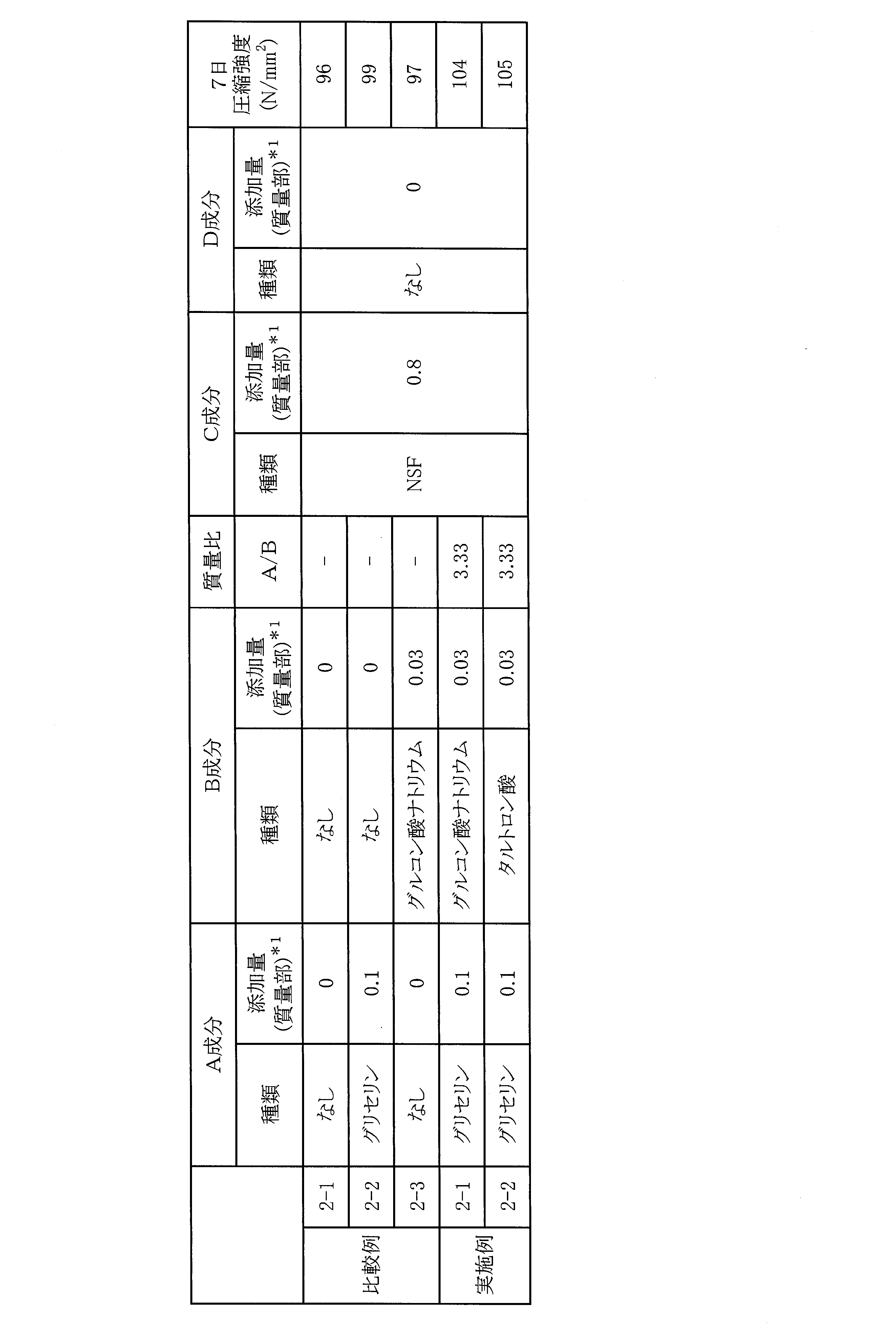
*1 セメント100質量部に対する質量部
<実施例3及び比較例3>
コンクリート配合
コンクリート配合

コンクリートの製造
表5に示す配合条件でコンクリートを製造した。具体的には、表6に示す種類及び量のA成分、B成分、C成分、及びD成分を添加して、強制二軸ミキサーで4分間混練して、遠心成形用コンクリートを調製した。
なお、A成分、B成分、C成分、D成分のセメント100質量部に対する有効分の添加量(質量部)は表6の通りである。表5、6中の成分は実施例1及び比較例1と同じものである。なお、表5中、Gは粗骨材であり、砕石、小(1505)を用いた。
表5に示す配合条件でコンクリートを製造した。具体的には、表6に示す種類及び量のA成分、B成分、C成分、及びD成分を添加して、強制二軸ミキサーで4分間混練して、遠心成形用コンクリートを調製した。
なお、A成分、B成分、C成分、D成分のセメント100質量部に対する有効分の添加量(質量部)は表6の通りである。表5、6中の成分は実施例1及び比較例1と同じものである。なお、表5中、Gは粗骨材であり、砕石、小(1505)を用いた。
圧縮強度
硬化体厚みの平均値から圧縮面積を求めた。厚みを測定した硬化体について、JIS A 1108に従い、混練から7日後の圧縮応力を測定した。圧縮強度を、圧縮強度=圧縮応力/圧縮面積の式により求めた。
硬化体厚みの平均値から圧縮面積を求めた。厚みを測定した硬化体について、JIS A 1108に従い、混練から7日後の圧縮応力を測定した。圧縮強度を、圧縮強度=圧縮応力/圧縮面積の式により求めた。
成形性
遠心成形用コンクリートを遠心成形型枠(内径20cm×高さ30cm)に入れて、初速が0.7Gで3分間、二速が5Gで4分間、三速が15Gで2分間、四速が25Gで3分間の条件で遠心締め固めを行った。その後、20℃で3時間、前置きした後、18℃/時間の割合で80℃まで昇温し、80℃で8時間して蒸気養生を行った。その後、常温まで自然冷却し、大気中で養生を行い、コンクリート硬化体を得た。脱型後、硬化体の上部と下部のコンクリート厚み(mm)を各4ヶ所(計8ヶ所)を測定し、以下の基準で評価した。
◎:8ヶ所の厚みの最大値と最小値の差が3mm未満
○:8ヶ所の厚みの最大値と最小値の差が3mm以上5mm未満(内面のペースト層が軟らかく、下部に若干量堆積している状態)
△:8ヶ所の厚みの最大値と最小値の差が5mm以上7mm未満
×:8ヶ所の厚みの最大値と最小値の差が7mm以上(著しいダレ、あるいはジャンカにより製品形態を保てていない状態)
厚みの最大値と最小値の差が小さいほど、均一な成形がなされているので、成形性が優れる。
遠心成形用コンクリートを遠心成形型枠(内径20cm×高さ30cm)に入れて、初速が0.7Gで3分間、二速が5Gで4分間、三速が15Gで2分間、四速が25Gで3分間の条件で遠心締め固めを行った。その後、20℃で3時間、前置きした後、18℃/時間の割合で80℃まで昇温し、80℃で8時間して蒸気養生を行った。その後、常温まで自然冷却し、大気中で養生を行い、コンクリート硬化体を得た。脱型後、硬化体の上部と下部のコンクリート厚み(mm)を各4ヶ所(計8ヶ所)を測定し、以下の基準で評価した。
◎:8ヶ所の厚みの最大値と最小値の差が3mm未満
○:8ヶ所の厚みの最大値と最小値の差が3mm以上5mm未満(内面のペースト層が軟らかく、下部に若干量堆積している状態)
△:8ヶ所の厚みの最大値と最小値の差が5mm以上7mm未満
×:8ヶ所の厚みの最大値と最小値の差が7mm以上(著しいダレ、あるいはジャンカにより製品形態を保てていない状態)
厚みの最大値と最小値の差が小さいほど、均一な成形がなされているので、成形性が優れる。

*1 セメント100質量部に対する質量部
Claims (6)
- 次のA成分、B成分、C成分、D成分、セメント、水、及び骨材を含有する遠心成形用水硬性組成物であって、
セメント100質量部に対し、A成分を0.03質量部以上0.15質量部以下、B成分を0.02質量部以上0.07質量部以下、C成分を0.5質量部以上1.0質量部以下、D成分を0質量部以上8質量部以下含有する、
遠心成形用水硬性組成物。
A成分:グリセリン、及びグリセリンのエチレンオキサイド付加物から選ばれる一種以上の化合物
B成分:グルコン酸、タルトロン酸、酒石酸、及びこれらの塩から選ばれる一種以上の化合物
C成分:ナフタレンスルホン酸ホルムアルデヒド縮合物
D成分:高強度混和材 - A成分とB成分の質量比A/Bが1.5以上3.5以下である、請求項1に記載の遠心成形用水硬性組成物。
- D成分の含有量とセメントの含有量の合計に対する水の含有量の割合が、(水の含有量)/(D成分の含有量とセメントの含有量の合計)×100で、10質量%以上50質量%以下である、請求項1又は2に記載の遠心成形用水硬性組成物。
- 次の工程1~5を含む水硬性組成物の硬化体の製造方法。
工程1:次のA成分、B成分、C成分、D成分、セメント、水、及び骨材を混練し、水硬性組成物を得る工程であって、セメント100質量部に対し、A成分を0.03質量部以上0.15質量部以下、B成分を0.02質量部以上0.07質量部以下、C成分を0.5質量部以上1.0質量部以下、D成分を0質量部以上8質量部以下混練する工程
A成分:グリセリン、及びグリセリンのエチレンオキサイド付加物から選ばれる一種以上の化合物
B成分:グルコン酸、タルトロン酸、酒石酸、及びこれらの塩から選ばれる一種以上の化合物
C成分:ナフタレンスルホン酸ホルムアルデヒド縮合物
D成分:高強度混和材
工程2:工程1で得られた水硬性組成物を型枠に充填する工程。
工程3:工程2で型枠に充填した水硬性組成物を、遠心力をかけて型締めする工程。
工程4:工程3で型締めした水硬性組成物を型枠中で凝結させる工程。
工程5:工程4で凝結した水硬性組成物を型枠中で蒸気養生する工程。 - 工程1におけるA成分とB成分の質量比A/Bが1.5以上3.5以下である、請求項4に記載の水硬性組成物の硬化体の製造方法。
- 工程1で、D成分の含有量とセメントの含有量の合計に対する水の含有量の割合が、(水の含有量)/(D成分の含有量とセメントの含有量の合計)×100で、10質量%以上50質量%以下の水硬性組成物を得る、請求項4又は5に記載の水硬性組成物の硬化体の製造方法。
Priority Applications (2)
| Application Number | Priority Date | Filing Date | Title |
|---|---|---|---|
| SG11201605808SA SG11201605808SA (en) | 2014-10-17 | 2015-10-15 | Hydraulic composition for centrifugal molding |
| CN201580003709.XA CN105899471B (zh) | 2014-10-17 | 2015-10-15 | 离心成形用水硬性组合物 |
Applications Claiming Priority (2)
| Application Number | Priority Date | Filing Date | Title |
|---|---|---|---|
| JP2014-212244 | 2014-10-17 | ||
| JP2014212244 | 2014-10-17 |
Publications (1)
| Publication Number | Publication Date |
|---|---|
| WO2016060192A1 true WO2016060192A1 (ja) | 2016-04-21 |
Family
ID=55746734
Family Applications (1)
| Application Number | Title | Priority Date | Filing Date |
|---|---|---|---|
| PCT/JP2015/079129 Ceased WO2016060192A1 (ja) | 2014-10-17 | 2015-10-15 | 遠心成形用水硬性組成物 |
Country Status (5)
| Country | Link |
|---|---|
| JP (1) | JP5905153B1 (ja) |
| CN (1) | CN105899471B (ja) |
| MY (1) | MY179614A (ja) |
| SG (1) | SG11201605808SA (ja) |
| WO (1) | WO2016060192A1 (ja) |
Families Citing this family (1)
| Publication number | Priority date | Publication date | Assignee | Title |
|---|---|---|---|---|
| JP6482034B2 (ja) * | 2016-12-14 | 2019-03-13 | 花王株式会社 | 遠心成型用水硬性組成物 |
Citations (4)
| Publication number | Priority date | Publication date | Assignee | Title |
|---|---|---|---|---|
| JPS58135165A (ja) * | 1982-02-02 | 1983-08-11 | 三洋化成工業株式会社 | セメント分散組成物 |
| JPH06183799A (ja) * | 1992-12-21 | 1994-07-05 | Denki Kagaku Kogyo Kk | ノロ低減材、それを使用してなる遠心力成型体、及びその製造方法 |
| JP2010047467A (ja) * | 2008-07-25 | 2010-03-04 | Kao Corp | 遠心成形コンクリート製品の製造方法 |
| JP2012144385A (ja) * | 2011-01-07 | 2012-08-02 | Kao Corp | 遠心成形コンクリート製品の製造方法 |
Family Cites Families (3)
| Publication number | Priority date | Publication date | Assignee | Title |
|---|---|---|---|---|
| CN1319900C (zh) * | 2003-01-23 | 2007-06-06 | 花王株式会社 | 水硬性组合物用添加剂 |
| JP5006466B2 (ja) * | 2010-11-19 | 2012-08-22 | 花王株式会社 | 水硬性組成物用分散剤 |
| US8663384B2 (en) * | 2010-12-08 | 2014-03-04 | Denki Kagaku Kogyo Kabushiki Kaisha | Cement admixture and cement composition |
-
2015
- 2015-10-15 MY MYPI2016702678A patent/MY179614A/en unknown
- 2015-10-15 SG SG11201605808SA patent/SG11201605808SA/en unknown
- 2015-10-15 WO PCT/JP2015/079129 patent/WO2016060192A1/ja not_active Ceased
- 2015-10-15 CN CN201580003709.XA patent/CN105899471B/zh active Active
- 2015-10-15 JP JP2015203416A patent/JP5905153B1/ja active Active
Patent Citations (4)
| Publication number | Priority date | Publication date | Assignee | Title |
|---|---|---|---|---|
| JPS58135165A (ja) * | 1982-02-02 | 1983-08-11 | 三洋化成工業株式会社 | セメント分散組成物 |
| JPH06183799A (ja) * | 1992-12-21 | 1994-07-05 | Denki Kagaku Kogyo Kk | ノロ低減材、それを使用してなる遠心力成型体、及びその製造方法 |
| JP2010047467A (ja) * | 2008-07-25 | 2010-03-04 | Kao Corp | 遠心成形コンクリート製品の製造方法 |
| JP2012144385A (ja) * | 2011-01-07 | 2012-08-02 | Kao Corp | 遠心成形コンクリート製品の製造方法 |
Also Published As
| Publication number | Publication date |
|---|---|
| MY179614A (en) | 2020-11-11 |
| JP2016079088A (ja) | 2016-05-16 |
| JP5905153B1 (ja) | 2016-04-20 |
| CN105899471B (zh) | 2019-10-08 |
| CN105899471A (zh) | 2016-08-24 |
| SG11201605808SA (en) | 2016-08-30 |
Similar Documents
| Publication | Publication Date | Title |
|---|---|---|
| CN102695686B (zh) | 水硬性组合物用早强剂 | |
| CN103415484A (zh) | 用于由水硬性组合物制备硬化体的方法 | |
| CN107353991A (zh) | 一种混凝土脱模液及其制备方法 | |
| JP5647902B2 (ja) | 遠心成形コンクリート製品の製造方法 | |
| JP6444726B2 (ja) | 遠心成形用水硬性組成物 | |
| JP2017001935A (ja) | 遠心成型用水硬性組成物用分散剤組成物 | |
| JP5905153B1 (ja) | 遠心成形用水硬性組成物 | |
| CN105073679B (zh) | 水硬性组合物 | |
| JP5744702B2 (ja) | 水硬性組成物用添加剤 | |
| JP6535316B2 (ja) | 水硬性組成物用の添加剤 | |
| JP6422324B2 (ja) | 遠心成形用水硬性組成物 | |
| JP6543657B2 (ja) | 水硬性組成物の硬化体の製造方法 | |
| JP6482034B2 (ja) | 遠心成型用水硬性組成物 | |
| JP5554080B2 (ja) | 水硬性組成物用添加剤組成物 | |
| JP2010047467A (ja) | 遠心成形コンクリート製品の製造方法 | |
| JP6470131B2 (ja) | 遠心成型用水硬性組成物 | |
| JP6198439B2 (ja) | 水硬性組成物 | |
| JP5759802B2 (ja) | 水硬性組成物の硬化体の製造方法 | |
| JP3993679B2 (ja) | セメント用収縮低減剤 | |
| JP6727182B2 (ja) | 水硬性組成物用の添加剤 | |
| JP2017071539A (ja) | 水硬性組成物用早強剤 | |
| JP6416837B2 (ja) | 遠心成型用水硬性組成物 | |
| JP6616686B2 (ja) | 水硬性組成物の硬化体の製造方法 | |
| JP2016222484A (ja) | 水硬性組成物用添加剤 | |
| JP6362531B2 (ja) | 水硬性組成物 |
Legal Events
| Date | Code | Title | Description |
|---|---|---|---|
| 121 | Ep: the epo has been informed by wipo that ep was designated in this application |
Ref document number: 15850039 Country of ref document: EP Kind code of ref document: A1 |
|
| WWE | Wipo information: entry into national phase |
Ref document number: IDP00201604824 Country of ref document: ID |
|
| NENP | Non-entry into the national phase |
Ref country code: DE |
|
| 122 | Ep: pct application non-entry in european phase |
Ref document number: 15850039 Country of ref document: EP Kind code of ref document: A1 |