WO2016017751A1 - エポキシ樹脂組成物、樹脂シート、プリプレグ及び金属張積層板、プリント配線基板、半導体装置 - Google Patents
エポキシ樹脂組成物、樹脂シート、プリプレグ及び金属張積層板、プリント配線基板、半導体装置 Download PDFInfo
- Publication number
- WO2016017751A1 WO2016017751A1 PCT/JP2015/071632 JP2015071632W WO2016017751A1 WO 2016017751 A1 WO2016017751 A1 WO 2016017751A1 JP 2015071632 W JP2015071632 W JP 2015071632W WO 2016017751 A1 WO2016017751 A1 WO 2016017751A1
- Authority
- WO
- WIPO (PCT)
- Prior art keywords
- epoxy resin
- resin composition
- prepreg
- metal
- glass
- Prior art date
- Legal status (The legal status is an assumption and is not a legal conclusion. Google has not performed a legal analysis and makes no representation as to the accuracy of the status listed.)
- Ceased
Links
Images
Classifications
-
- C—CHEMISTRY; METALLURGY
- C08—ORGANIC MACROMOLECULAR COMPOUNDS; THEIR PREPARATION OR CHEMICAL WORKING-UP; COMPOSITIONS BASED THEREON
- C08G—MACROMOLECULAR COMPOUNDS OBTAINED OTHERWISE THAN BY REACTIONS ONLY INVOLVING UNSATURATED CARBON-TO-CARBON BONDS
- C08G59/00—Polycondensates containing more than one epoxy group per molecule; Macromolecules obtained by polymerising compounds containing more than one epoxy group per molecule using curing agents or catalysts which react with the epoxy groups
- C08G59/18—Macromolecules obtained by polymerising compounds containing more than one epoxy group per molecule using curing agents or catalysts which react with the epoxy groups ; e.g. general methods of curing
- C08G59/20—Macromolecules obtained by polymerising compounds containing more than one epoxy group per molecule using curing agents or catalysts which react with the epoxy groups ; e.g. general methods of curing characterised by the epoxy compounds used
- C08G59/32—Epoxy compounds containing three or more epoxy groups
- C08G59/3218—Carbocyclic compounds
-
- C—CHEMISTRY; METALLURGY
- C08—ORGANIC MACROMOLECULAR COMPOUNDS; THEIR PREPARATION OR CHEMICAL WORKING-UP; COMPOSITIONS BASED THEREON
- C08J—WORKING-UP; GENERAL PROCESSES OF COMPOUNDING; AFTER-TREATMENT NOT COVERED BY SUBCLASSES C08B, C08C, C08F, C08G or C08H
- C08J5/00—Manufacture of articles or shaped materials containing macromolecular substances
- C08J5/24—Impregnating materials with prepolymers which can be polymerised in situ, e.g. manufacture of prepregs
- C08J5/241—Impregnating materials with prepolymers which can be polymerised in situ, e.g. manufacture of prepregs using inorganic fibres
- C08J5/244—Impregnating materials with prepolymers which can be polymerised in situ, e.g. manufacture of prepregs using inorganic fibres using glass fibres
-
- C—CHEMISTRY; METALLURGY
- C08—ORGANIC MACROMOLECULAR COMPOUNDS; THEIR PREPARATION OR CHEMICAL WORKING-UP; COMPOSITIONS BASED THEREON
- C08G—MACROMOLECULAR COMPOUNDS OBTAINED OTHERWISE THAN BY REACTIONS ONLY INVOLVING UNSATURATED CARBON-TO-CARBON BONDS
- C08G59/00—Polycondensates containing more than one epoxy group per molecule; Macromolecules obtained by polymerising compounds containing more than one epoxy group per molecule using curing agents or catalysts which react with the epoxy groups
- C08G59/18—Macromolecules obtained by polymerising compounds containing more than one epoxy group per molecule using curing agents or catalysts which react with the epoxy groups ; e.g. general methods of curing
- C08G59/20—Macromolecules obtained by polymerising compounds containing more than one epoxy group per molecule using curing agents or catalysts which react with the epoxy groups ; e.g. general methods of curing characterised by the epoxy compounds used
- C08G59/32—Epoxy compounds containing three or more epoxy groups
-
- C—CHEMISTRY; METALLURGY
- C08—ORGANIC MACROMOLECULAR COMPOUNDS; THEIR PREPARATION OR CHEMICAL WORKING-UP; COMPOSITIONS BASED THEREON
- C08G—MACROMOLECULAR COMPOUNDS OBTAINED OTHERWISE THAN BY REACTIONS ONLY INVOLVING UNSATURATED CARBON-TO-CARBON BONDS
- C08G59/00—Polycondensates containing more than one epoxy group per molecule; Macromolecules obtained by polymerising compounds containing more than one epoxy group per molecule using curing agents or catalysts which react with the epoxy groups
- C08G59/18—Macromolecules obtained by polymerising compounds containing more than one epoxy group per molecule using curing agents or catalysts which react with the epoxy groups ; e.g. general methods of curing
- C08G59/40—Macromolecules obtained by polymerising compounds containing more than one epoxy group per molecule using curing agents or catalysts which react with the epoxy groups ; e.g. general methods of curing characterised by the curing agents used
- C08G59/50—Amines
-
- C—CHEMISTRY; METALLURGY
- C08—ORGANIC MACROMOLECULAR COMPOUNDS; THEIR PREPARATION OR CHEMICAL WORKING-UP; COMPOSITIONS BASED THEREON
- C08J—WORKING-UP; GENERAL PROCESSES OF COMPOUNDING; AFTER-TREATMENT NOT COVERED BY SUBCLASSES C08B, C08C, C08F, C08G or C08H
- C08J5/00—Manufacture of articles or shaped materials containing macromolecular substances
- C08J5/04—Reinforcing macromolecular compounds with loose or coherent fibrous material
- C08J5/06—Reinforcing macromolecular compounds with loose or coherent fibrous material using pretreated fibrous materials
- C08J5/08—Reinforcing macromolecular compounds with loose or coherent fibrous material using pretreated fibrous materials glass fibres
-
- C—CHEMISTRY; METALLURGY
- C08—ORGANIC MACROMOLECULAR COMPOUNDS; THEIR PREPARATION OR CHEMICAL WORKING-UP; COMPOSITIONS BASED THEREON
- C08J—WORKING-UP; GENERAL PROCESSES OF COMPOUNDING; AFTER-TREATMENT NOT COVERED BY SUBCLASSES C08B, C08C, C08F, C08G or C08H
- C08J7/00—Chemical treatment or coating of shaped articles made of macromolecular substances
- C08J7/04—Coating
-
- H—ELECTRICITY
- H05—ELECTRIC TECHNIQUES NOT OTHERWISE PROVIDED FOR
- H05K—PRINTED CIRCUITS; CASINGS OR CONSTRUCTIONAL DETAILS OF ELECTRIC APPARATUS; MANUFACTURE OF ASSEMBLAGES OF ELECTRICAL COMPONENTS
- H05K1/00—Printed circuits
- H05K1/02—Details
- H05K1/03—Use of materials for the substrate
Definitions
- the present invention relates to an epoxy resin composition that gives a cured product excellent in heat resistance and water resistance, a prepreg impregnated with a fiber base material, a resin sheet, a metal-clad laminate, a printed wiring board, and a semiconductor device.
- Epoxy resin compositions are widely used in the fields of electrical and electronic parts, structural materials, adhesives, paints, etc. due to their workability and excellent electrical properties, heat resistance, adhesion, moisture resistance (water resistance), etc. It has been.
- Patent Document 1 discloses a phenol novolac resin having a biphenyl skeleton and a phenol novolac type epoxy resin obtained by epoxidizing the phenol novolak resin, and describes its usefulness for use as a semiconductor encapsulant.
- this epoxy resin combines high heat resistance and flame retardancy in combination with a phenol resin, there is a problem in using it for electronic materials that have high water absorption and require extremely high reliability.
- there is no description about the characteristics of the composition containing these epoxy resins and amine-based curing agents and there is no description on the usefulness of the printed wiring board.
- the present invention has been made as a result of studies to solve such problems.
- the cured product has high heat resistance, water absorption, low dielectric constant, and prepreg and resin sheet using the epoxy resin composition.
- An object is to provide a metal-clad laminate, a printed wiring board, and a semiconductor device.
- the present invention provides (1) the following general formula (1)
- An epoxy resin composition comprising an epoxy resin and an amine curing agent as essential components, (2) A prepreg obtained by impregnating a fiber base material with the epoxy resin composition according to item (1), (3) The prepreg according to (2) above, wherein the fiber base material is a glass fiber base material, (4) The prepreg according to (3) above, wherein the glass fiber base material includes at least one selected from the group consisting of T glass, S glass, E glass, NE glass, and quartz glass.
- the epoxy resin composition of the present invention provides a cured product that can simultaneously achieve high heat resistance and water resistance in the cured product, it is extremely useful for producing laminated boards such as printed wiring boards and build-up boards.
- Material According to the present invention, an epoxy resin composition whose cured product has high heat resistance, water absorption and low dielectric constant, and a prepreg, a resin sheet, a metal-clad laminate, a printed wiring board, and a semiconductor device using the epoxy resin composition. Can be provided.
- the epoxy resin composition of the present invention comprises, as an essential component, a compound represented by the following formula (1) (hereinafter referred to as “epoxy resin of formula (1)”) and an amine curing agent as an epoxy resin.
- the softening point (ring and ball method) of the epoxy resin used is preferably 50 to 150 ° C., more preferably 52 to 100 ° C., and particularly preferably 52 to 95 ° C. Below 50 ° C., stickiness is severe, handling is difficult, and problems may arise in productivity. Moreover, when it is 150 degreeC or more, since it is a temperature near molding temperature and the fluidity
- the epoxy equivalent of the epoxy resin used is 180 to 350 g / eq. It is preferable that In particular, 190 to 300 g / eq. It is preferable that Epoxy equivalent is 180 g / eq. When the ratio is less than 1, since the functional group is too many, the cured product after curing tends to have a high water absorption rate and may become brittle. Epoxy equivalent is 350 g / eq. If it exceeds 1, the softening point becomes very large or epoxidation has not progressed cleanly, which is not preferable because the amount of chlorine may become very large.
- the chlorine content of the epoxy resin used in the present invention is preferably 200 to 1500 ppm, particularly preferably 200 to 900 ppm in terms of total chlorine (hydrolysis method). From the JPCA standard, it is desired that epoxy alone does not exceed 900 ppm. Furthermore, a large amount of chlorine is not preferable because it may affect the electrical reliability. When it is less than 200 ppm, an excessive purification step is required, which may cause problems in productivity, which is not preferable.
- the melt viscosity at 150 ° C. of the epoxy resin used in the present invention is preferably 0.05 to 5 Pa ⁇ s, particularly preferably 0.05 to 2.0 Pa ⁇ s.
- the melt viscosity is higher than 5 Pa ⁇ s, there is a problem in fluidity, and there may be a problem in flow property and embedding property during pressing.
- it is less than 0.05 Pa ⁇ s, the molecular weight is too small, and the heat resistance may be insufficient.
- n is a repeating unit and is 0-5. When n does not exceed 5, the flowability and fluidity of the prepreg or resin sheet are controlled.
- solubility in a solvent is important.
- solvents such as methyl ethyl ketone, toluene, propylene glycol monomethyl ether and the like.
- solubility in methyl ethyl ketone is particularly important, and it is required that crystals do not precipitate for 2 months or more at 5 ° C., room temperature or the like.
- the epoxy resin composition of the present invention contains an amine curing agent as an essential component.
- amine curing agents that can be used include diaminodiphenylmethane, diethylenetriamine, triethylenetetramine, diaminodiphenylsulfone, isophoronediamine, naphthalenediamine, aniline and substituted biphenyls (4,4′-bis (chloromethyl) -1,1 ′).
- Particularly preferred amine-based curing agents are bifunctional or higher amine compounds, and resins having a structure represented by the following formula are preferred.
- n is the number of repetitions and is 1 to 10.
- each of the amine curing agents used in the present invention exhibits a crystal or resin shape.
- the melting point is preferably 35 to 200 ° C., particularly preferably 40 to 185 ° C.
- the solubility in other resins is also involved, and therefore it is not always necessary that the temperature be lower than the molding temperature like a resin.
- a softening point (ring and ball method) of 50 to 150 ° C. is preferable, and 50 to 100 ° C. is particularly preferable.
- those with a softening point of 50 ° C. or lower are not preferable because stickiness may occur, and when the softening point exceeds 150 ° C., fluidity problems occur at the time of molding, and it cannot be molded cleanly. In addition, there may be a problem that the solvent cannot be removed.
- the functional group equivalent of the amine compound is 60 to 600 g / eq. (Measurement by potentiometric titration) is preferred.
- the active hydrogen equivalent is 60 or less, the cured product may have problems with water absorption and toughness. If it exceeds 600, it may be difficult to maintain heat resistance.
- the amount of the amine curing agent used is preferably 0.2 to 0.6 equivalent in terms of amine equivalent of the amine compound with respect to 1 equivalent of epoxy group of the epoxy resin. Particularly preferred is 0.3 to 0.55 equivalent. When less than 0.2 equivalent or more than 0.6 equivalent with respect to 1 equivalent of epoxy group, curing may be incomplete and good cured physical properties may not be obtained.
- the epoxy resin composition of the present invention may contain a curing accelerator.
- curing accelerators that can be used include formic acid, acetic acid, lactic acid, glycolic acid, n-butyric acid, iso-butyric acid, propionic acid, caproic acid, octanoic acid, n-heptylic acid, monochloroacetic acid, dichloroacetic acid, trichloroacetic acid, Thioglycolic acid, phenol, m-cresol, p-chlorophenol, p-nitrophenol, 2,4-dinitrophenol, o-aminophenol, p-aminophenol, 2,4,5-trichlorophenol, resorcinol, hydroquinone, Catechol, phloroglicinol, benzoic acid, p-toluic acid, p-aminobenzoic acid, p-chlorobenzoic acid, 2,4-dichlorobenzoic acid, salicylic acid,
- epoxy resin composition of the present invention other epoxy resins can be used in combination.
- other epoxy resins that can be used in combination with the epoxy resin of formula (1) include bisphenols (bisphenol A, bisphenol F, bisphenol S, biphenol, bisphenol AD, etc.) or phenols (phenol, alkyl-substituted phenol, aromatic Group-substituted phenol, naphthol, alkyl-substituted naphthol, dihydroxybenzene, alkyl-substituted dihydroxybenzene, dihydroxynaphthalene, etc.) and various aldehydes (formaldehyde, acetaldehyde, alkylaldehyde, benzaldehyde, alkyl-substituted benzaldehyde, hydroxybenzaldehyde, naphthaldehyde, glutaraldehyde, phthalaldehyde) , Crotonaldehyde, cinnamalde
- a conventionally known curing agent can be used in combination.
- other curing agents that can be used in combination include acid anhydride compounds, amide compounds, phenol compounds, and carboxylic acid compounds.
- specific examples of curing agents that can be used include amide compounds such as polyamide resins synthesized from dimers of dicyandiamide and linolenic acid and ethylenediamine; phthalic anhydride, trimellitic anhydride, pyromellitic anhydride, maleic anhydride, Acid anhydride compounds such as tetrahydrophthalic anhydride, methyltetrahydrophthalic anhydride, methyl nadic anhydride, hexahydrophthalic anhydride, methylhexahydrophthalic anhydride; bisphenol A, bisphenol F, bisphenol S, fluorene bisphenol, terpene diphenol 4,4'-biphenol, 2,2'-biphenol, 3,3 ', 5,5'-
- the epoxy resin composition of the present invention may contain a phosphorus-containing compound as a flame retardant component.
- the phosphorus-containing compound may be a reactive type or an additive type.
- Specific examples of phosphorus-containing compounds include trimethyl phosphate, triethyl phosphate, tricresyl phosphate, trixylylenyl phosphate, cresyl diphenyl phosphate, cresyl-2,6-dixylylenyl phosphate, 1,3-phenylenebis ( Phosphoric acid ester compounds such as dixylylenyl phosphate), 1,4-phenylenebis (dixylylenyl phosphate), 4,4′-biphenyl (dixylylenyl phosphate); 9,10-dihydro-9- Phosphanes such as oxa-10-phosphaphenanthrene-10-oxide, 10 (2,5-dihydroxyphenyl) -10H-9-oxa-10-
- Phosphate esters, phosphanes or phosphorus-containing epoxy compounds are preferable, and 1,3-phenylenebis (dixylylenyl phosphate), 1,4-phenylenebis (dixylyl) is preferable. Renyl phosphate), 4,4′-biphenyl (dixylylenyl phosphate) or phosphorus-containing epoxy compounds are particularly preferred.
- the amount of the phosphoric acid ester compound as described above is preferably phosphoric acid ester compound / epoxy resin ⁇ 0.1 (weight ratio) due to environmental problems and concerns about electrical characteristics. More preferably, it is 0.05 or less. It is particularly preferable not to add a phosphorus compound except that it is added as a curing accelerator.
- the epoxy resin composition of the present invention may contain an inorganic filler.
- Inorganic fillers include fused silica, crystalline silica, alumina, calcium carbonate, calcium silicate, barium sulfate, talc, clay, magnesium oxide, aluminum oxide, beryllium oxide, iron oxide, titanium oxide, aluminum nitride, silicon nitride, and nitride Examples thereof include boron, mica, glass, quartz, and mica. Further, it is also preferable to use a metal hydroxide such as magnesium hydroxide or aluminum hydroxide in order to impart a flame retardant effect. However, it is not limited to these. Two or more kinds may be mixed and used.
- the amount of the inorganic filler used is usually 5% to 70% by weight, preferably 10% to 60% by weight, more preferably 15% to 60% by weight. It is a range. If the amount is too small, the linear expansion increases, warping becomes a problem, and the substrate is becoming thinner, so that rigidity may not be achieved and a problem may occur during the process.
- the shape, particle size and the like of the inorganic filler are not particularly limited, but usually the particle size is 0.01 to 50 ⁇ m, preferably 0.1 to 15 ⁇ m.
- a release agent can be blended to improve the release from the mold during molding.
- Any conventionally known release agent can be used, for example, ester waxes such as carnauba wax and montan wax, fatty acids such as stearic acid and palmitic acid, and metal salts thereof, polyolefins such as polyethylene oxide and non-oxidized polyethylene And waxes. These may be used alone or in combination of two or more.
- the compounding amount of these release agents is preferably 0.5 to 3% by weight based on the total organic components. If the amount is too small, release from the mold is poor, and if the amount is too large, adhesion to the substrate or the like may be deteriorated.
- a coupling agent can be blended in order to enhance the adhesion between the inorganic filler and the resin component.
- Any conventionally known coupling agent can be used.
- examples include various alkoxysilane compounds such as silane, alkoxytitanium compounds, and aluminum chelates. These may be used alone or in combination of two or more.
- the coupling agent may be added by treating the surface of the inorganic filler with the coupling agent in advance and then kneading with the resin, or mixing the coupling agent with the resin and then kneading the inorganic filler. .
- varnish-like composition An organic solvent can be added to the epoxy resin composition of the present invention to obtain a varnish-like composition (hereinafter simply referred to as varnish).
- the solvent used include amide solvents such as ⁇ -butyrolactone, N-methylpyrrolidone, N, N-dimethylformamide, N, N-dimethylacetamide, N, N-dimethylimidazolidinone, and tetramethylene sulfone.
- ether solvents such as diethylene glycol dimethyl ether, diethylene glycol diethyl ether, propylene glycol, propylene glycol monomethyl ether, propylene glycol monomethyl ether monoacetate, propylene glycol monobutyl ether, ketones such as methyl ethyl ketone, methyl isobutyl ketone, cyclopentanone and cyclohexanone
- Aromatic solvents such as solvent, toluene, xylene and the like can be mentioned.
- the solvent is used in the range where the solid content concentration excluding the solvent in the obtained varnish is usually 10 to 80% by weight, preferably 20 to 70% by weight.
- additives can be blended in the epoxy resin composition of the present invention as necessary.
- additives that can be used include polybutadiene and modified products thereof, modified products of acrylonitrile copolymer, polyphenylene ether, polystyrene, polyethylene, polyimide, fluororesin, maleimide compounds, cyanate ester compounds, silicone gel, and silicone oil.
- colorants such as carbon black, phthalocyanine blue, and phthalocyanine green.
- the resin sheet of the present invention will be described.
- the resin sheet using the epoxy resin composition of the present invention has a thickness after drying the above varnish on a planar support by various coating methods such as gravure coating, screen printing, metal mask, and spin coating. Can be obtained by drying after coating so that the thickness becomes a predetermined thickness, for example, 5 to 100 ⁇ m. Which coating method is used depends on the type, shape, size, thickness of coating, support It is appropriately selected depending on the heat resistance of the body.
- planar support examples include various types such as polyamide, polyamideimide, polyarylate, polyethylene terephthalate, polybutylene terephthalate, polyetherketone, polyetherimide, polyetheretherketone, polyketone, polyethylene, polypropylene, and Teflon (registered trademark).
- examples thereof include films made from molecules and / or copolymers thereof, and metal foils such as copper foils. After application, it can be dried to obtain a sheet-like composition (resin sheet of the present invention), but it can also be made into a sheet-like cured product by further heating the sheet. Moreover, you may serve as a solvent drying and hardening process by one heating.
- the epoxy resin composition of the present invention can form a cured product layer on both sides or one side of the support by coating and heating on both sides or one side of the support by the above method. It is also possible to produce a laminate by bonding and adhering the adherend before curing. Moreover, the resin sheet of this invention can also be used as an adhesive sheet by peeling off from a support body, and it can also be made to contact with a to-be-adhered body and to apply pressure and heat as needed, and to make it adhere
- the prepreg of the present invention will be described.
- the prepreg of the present invention is obtained by impregnating a fiber base material with the epoxy resin composition of the present invention.
- the fiber base material include glass fiber base materials such as glass woven fabric, glass non-woven fabric, and glass paper, paper, aramid, polyester, aromatic polyester, and synthetic fibers such as fluororesin, etc.
- glass fiber base materials such as glass woven fabric, glass non-woven fabric, and glass paper, paper, aramid, polyester, aromatic polyester, and synthetic fibers such as fluororesin, etc.
- Examples thereof include woven fabrics, nonwoven fabrics, mats and the like made of fibers, carbon fibers, mineral fibers and the like. These substrates may be used alone or in combination.
- a glass fiber base material is preferable. Thereby, the rigidity and dimensional stability of the prepreg can be further improved.
- As a glass fiber base material what contains at least 1 type chosen from the group which consists of T glass, S glass, E glass, NE
- Examples of the method of impregnating the fiber base material with the epoxy resin composition of the present invention include a method of immersing the base material in a resin varnish, a method of applying with various coaters, and a method of spraying.
- the method of immersing the base material in the resin varnish is preferable. Thereby, the impregnation property of the resin composition with respect to a base material can be improved.
- a normal impregnation coating equipment can be used.
- the epoxy resin composition of the present invention is used as it is or in the form of a varnish dissolved or dispersed in a solvent, after impregnating a substrate such as a glass cloth, usually in a drying furnace or the like, usually at 80 to 200 ° C. (however, When the solvent is used, the temperature is set to a temperature at which the solvent can be volatilized or higher), and the prepreg is obtained by drying for 2 to 30 minutes, preferably 2 to 15 minutes.
- the metal-clad laminate of the present invention will be described.
- the laminate used in the present invention is formed by heating and pressing the above-described prepreg of the present invention. Thereby, the metal-clad laminated board excellent in heat resistance, low expansibility, and a flame retardance can be obtained.
- the metal foil is overlapped on both the upper and lower surfaces or one surface.
- Two or more prepregs can be laminated.
- a metal foil or film is laminated on the outermost upper and lower surfaces or one surface of the laminated prepreg.
- a metal-clad laminate can be obtained by heat-pressing a laminate of a prepreg and a metal foil.
- the heating temperature is not particularly limited, but is preferably 120 to 220 ° C, and particularly preferably 150 to 200 ° C.
- the pressure to be pressurized is not particularly limited, but is preferably 1.5 to 5 MPa, and particularly preferably 2 to 4 MPa. If necessary, post-curing may be performed at a temperature of 150 to 300 ° C. with a high-temperature iron or the like.
- the printed wiring board of the present invention uses the metal-clad laminate of the present invention as an inner circuit board.
- a circuit is formed on one or both sides of the metal-clad laminate.
- through holes can be formed by drilling or laser processing, and electrical connection on both sides can be achieved by plating or the like.
- a commercially available or resin sheet of the present invention, or the prepreg of the present invention is superposed on the inner layer circuit board and heated and pressed to obtain a multilayer printed wiring board.
- the insulating layer side of the resin sheet and the inner layer circuit board are combined, vacuum-pressed using a vacuum pressurizing laminator, etc., and then the insulating layer is heated and cured with a hot air dryer or the like.
- the conditions for heat and pressure molding are not particularly limited, but as an example, it can be carried out at a temperature of 60 to 160 ° C. and a pressure of 0.2 to 3 MPa.
- the conditions for heat curing are not particularly limited, but for example, the temperature can be 140 to 240 ° C.
- the time can be 30 to 120 minutes.
- it can be obtained by overlaying the prepreg of the present invention on an inner circuit board and subjecting it to hot press molding using a flat plate press or the like.
- the conditions for heat and pressure molding are not particularly limited, but as an example, it can be carried out at a temperature of 140 to 240 ° C. and a pressure of 1 to 4 MPa.
- the insulating layer is heat-cured simultaneously with the heat and pressure forming.
- the method for producing a multilayer printed wiring board according to the present invention includes a step of continuously laminating the resin sheet or the prepreg of the present invention on a surface on which an inner layer circuit pattern of the inner layer circuit board is formed, and a conductor circuit Forming a layer by a semi-additive process.
- Curing of the resin sheet or the insulating layer formed from the prepreg of the present invention may be left in a semi-cured state in order to facilitate the subsequent laser irradiation and removal of the resin residue and improve desmearability.
- the first insulating layer is partially cured (semi-cured) by heating at a temperature lower than the normal heating temperature, and one or more insulating layers are further formed on the insulating layer to form a semi-cured insulating layer.
- the semi-curing temperature is preferably 80 ° C.
- the inner layer circuit board used when obtaining the multilayer printed wiring board is preferably, for example, one in which a predetermined conductor circuit is formed by etching or the like on both surfaces of a copper clad laminate and the conductor circuit portion is blackened. Can be used.
- Resin residues after laser irradiation are preferably removed with an oxidizing agent such as permanganate or dichromate. Further, the surface of the smooth insulating layer can be simultaneously roughened, and the adhesion of the conductive wiring circuit formed by subsequent metal plating can be improved.
- an outer layer circuit is formed.
- the outer layer circuit is formed by connecting the insulating resin layers by metal plating and forming an outer layer circuit pattern by etching.
- a multilayer printed wiring board can be obtained in the same manner as when a resin sheet or prepreg is used.
- a circuit may be formed by etching for use as a conductor circuit without peeling off the metal foil.
- an ultrathin copper foil of 1 to 5 ⁇ m, or 12 to 18 ⁇ m.
- the copper foil is half-etched to a thickness of 1 to 5 ⁇ m by etching.
- an insulating layer may be further laminated and a circuit may be formed in the same manner as described above.
- a solder resist is formed on the outermost layer after the circuit is formed.
- the method for forming the solder resist is not particularly limited. For example, a method of laminating (laminating) a dry film type solder resist, forming by exposure and development, or forming a printed liquid resist by exposure and development It is done by the method to do.
- the electrode part for a connection is provided.
- the connecting electrode portion can be appropriately coated with a metal film such as gold plating, nickel plating, or solder plating.
- a multilayer printed wiring board can be manufactured by such a method.
- a semiconductor element having solder bumps is mounted on the multilayer printed wiring board obtained as described above, and connection to the multilayer printed wiring board is attempted through the solder bumps. Then, a liquid sealing resin is filled between the multilayer printed wiring board and the semiconductor element to form a semiconductor device.
- the solder bump is preferably made of an alloy made of tin, lead, silver, copper, bismuth or the like.
- the semiconductor element and multilayer printed wiring board can be connected by aligning the connection electrode part on the substrate with the solder bump of the semiconductor element using a flip chip bonder, etc., and then using an IR reflow device, hot plate, etc.
- solder bumps are heated to the melting point or higher by using a heating device, and the multilayer printed wiring board and the solder bumps are connected by fusion bonding.
- a metal layer having a relatively low melting point such as solder paste may be formed in advance on the connection electrode portion on the multilayer printed wiring board.
- the connection reliability can be improved by applying a flux to the solder bumps and / or the surface layer of the connection electrode portion on the multilayer printed wiring board.
- a substrate it is used as a motherboard, a network substrate, a package substrate, etc., and used as a substrate.
- a package substrate it is useful as a thin layer substrate for a single-sided sealing material.
- semiconductor devices obtained from the blending include DIP (Dual Inline Package), QFP (Quad Flat Package), BGA (Ball Grid Array), CSP (Chip Size Package). SOP (Small Outline Package), TSOP (Thin Small Outline Package), TQFP (Sink Quad Flat Package), and the like.
- the measurement conditions of each physical property value are as follows. Epoxy equivalent Measured by the method described in JIS K-7236, the unit is g / eq. It is. -Softening point Measured by a method according to JIS K-7234, the unit is ° C. -Elastic modulus (DMA) Dynamic viscoelasticity measuring instrument: TA-insRents, DMA-2980 Measurement temperature range: -30 to 280 ° C Temperature increase rate: 2 ° C./min. Test piece size: 5 mm ⁇ 50 mm cut out was used. Tg: Tan- ⁇ peak point in DMA measurement was Tg. Water absorption: disk shape with diameter 5 cm ⁇ thickness 4 mm % Increase after boiling the test piece in 100 ° C water for 24 hours
- Example 1 The epoxy resin (EP1) obtained in Synthesis Example 1 was treated with A-1 (amine equivalent 198 g / eq, active hydrogen equivalent 97.5 g / eq, softening point 55 ° C.) as a curing agent with respect to 1 molar equivalent of epoxy equivalent.
- the epoxy resin composition is blended at 0.5 equivalent, and salicylic acid is blended at a ratio (parts by weight) of 1 part by weight with respect to 100 parts by weight of the epoxy resin, and mixed and kneaded uniformly using a mixing roll.
- This epoxy resin composition was pulverized with a mixer and further tableted with a tablet machine. The tableted epoxy resin composition was transfer-molded (175 ° C.
- Example 1 the epoxy resin (EP1) obtained in Synthesis Example 1 and various epoxy resins were equivalent to A-1 or HA-1 (phenol novolak resin manufactured by Meiwa Kasei Kogyo Co., Ltd.) as a curing agent.
- a test piece for evaluation for comparison was obtained by the same composition and method as in Example 1 using triphenylphosphine (TPP) or salicylic acid as a catalyst. The evaluation results are shown in Table 1.
- Example 1 and Comparative Example 3 are compared, by using an amine curing agent as compared with using a phenol resin as a curing agent, a cured product having excellent heat resistance and water absorption characteristics can be obtained. It was confirmed that
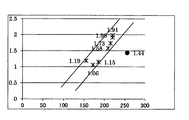
- FIG. 1 is a graph in which the cured physical properties obtained in Table 1 are plotted with heat resistance (Tg) on the horizontal axis and water absorption characteristics (%) on the vertical axis. From FIG. 1, it can be confirmed that the cured products of Comparative Examples 1 to 3 and Comparative Examples 4 to 7 have a correlation such that the water absorption increases as Tg increases. On the other hand, the cured product using the epoxy resin of formula (1) and the amine curing agent has high heat resistance, but has a low water absorption rate, which is different from the above correlation. It can be confirmed that it is a combination.
- the epoxy resin composition of the present invention provides a cured product that can simultaneously achieve high heat resistance and water resistance in the cured product, and thus is extremely useful for producing laminated boards such as printed wiring boards and build-up substrates. Material.
Landscapes
- Chemical & Material Sciences (AREA)
- Engineering & Computer Science (AREA)
- Medicinal Chemistry (AREA)
- Health & Medical Sciences (AREA)
- Polymers & Plastics (AREA)
- Organic Chemistry (AREA)
- Chemical Kinetics & Catalysis (AREA)
- Materials Engineering (AREA)
- Manufacturing & Machinery (AREA)
- Inorganic Chemistry (AREA)
- Microelectronics & Electronic Packaging (AREA)
- Epoxy Resins (AREA)
- Reinforced Plastic Materials (AREA)
Abstract
本発明は、その硬化物が高耐熱性で、吸水性、誘電率が低いエポキシ樹脂組成物、およびそれを用いた樹脂シート、金属張積層板、プリント配線基板、並びに半導体装置を提供することを目的とする。本発明のエポキシ樹脂組成物は、下記一般式(1)で表されるエポキシ樹脂とアミン系硬化剤を必須成分とする。(式中、(a)(b)の比率は(a)/(b)=1~3である。Gはグリシジル基を表す。nは繰り返し数であり、0~5である。)
Description
本発明は耐熱性と耐水性に優れた硬化物を与えるエポキシ樹脂組成物、それを繊維基材に含浸させたプリプレグ、樹脂シート、金属張積層板、プリント配線基板、および半導体装置に関する。
エポキシ樹脂組成物は作業性及びその硬化物の優れた電気特性、耐熱性、接着性、耐湿性(耐水性)等により電気・電子部品、構造用材料、接着剤、塗料等の分野で幅広く用いられている。
しかし近年、電気・電子分野においてはその発展に伴い、樹脂組成物の高純度化をはじめ耐湿性、密着性、誘電特性、フィラー(無機または有機充填剤)を高充填させるための低粘度化、成型サイクルを短くするための反応性のアップ等の諸特性の一層の向上が求められている。又、構造材としては航空宇宙材料、レジャー・スポーツ器具用途などにおいて軽量で機械物性の優れた材料が求められている。特に半導体封止分野、基板(基板自体、もしくはその周辺材料)においてはその要求特性が年々高度になってきており、たとえば半導体の駆動温度の上昇による周辺材料の高Tg化等が要求されてきている。
エポキシ樹脂は一般的に高Tg化すると、吸水率が上昇する(非特許文献1)。これは架橋密度が向上することによる影響である。しかしながら、低吸湿が求められる半導体周辺材料への高Tg化が要求される中、この相反する特性を有する樹脂の開発が急務であった。
一方、特許文献1には、ビフェニル骨格を有するフェノールノボラック樹脂及びこれをエポキシ化することで得られるフェノールノボラック型エポキシ樹脂が開示され、半導体封止剤用途への有用性が記載されている。
しかしながら、本エポキシ樹脂はフェノール樹脂との組み合わせで高い耐熱性と難燃性を両立するが、吸水率は高く、非常に高い信頼性が必要な電子材料用に利用するには課題があった。
また、これらのエポキシ樹脂とアミン系硬化剤を含有する組成物の特性について何ら記載されておらず、またプリント配線基板用途の有用性についても記載されていない。
一方、特許文献1には、ビフェニル骨格を有するフェノールノボラック樹脂及びこれをエポキシ化することで得られるフェノールノボラック型エポキシ樹脂が開示され、半導体封止剤用途への有用性が記載されている。
しかしながら、本エポキシ樹脂はフェノール樹脂との組み合わせで高い耐熱性と難燃性を両立するが、吸水率は高く、非常に高い信頼性が必要な電子材料用に利用するには課題があった。
また、これらのエポキシ樹脂とアミン系硬化剤を含有する組成物の特性について何ら記載されておらず、またプリント配線基板用途の有用性についても記載されていない。
小椋一郎、「エポキシ樹脂の化学構造と特性の関係」、DIC Technical Review No.7、日本、2001年、7頁
本発明はこのような問題を解決すべく検討の結果なされたものであり、その硬化物が高耐熱性で、吸水性、誘電率が低いエポキシ樹脂組成物、およびそれを用いたプリプレグ、樹脂シート、金属張積層板、プリント配線基板、並びに半導体装置を提供することを課題とする。
本発明者らは前記課題を解決するために鋭意研究した結果、本発明を完成させるに到った。
すなわち本発明は
(1)下記一般式(1)
すなわち本発明は
(1)下記一般式(1)

(式中、(a)(b)の比率は(a)/(b)=1~3はである。Gはグリシジル基を表す。nは繰り返し数であり、0~5である。)で表されるエポキシ樹脂とアミン系硬化剤を必須成分とするエポキシ樹脂組成物、
(2)
前項(1)に記載のエポキシ樹脂組成物を繊維基材に含浸してなるプリプレグ、
(3)
前記繊維基材がガラス繊維基材である前項(2)に記載のプリプレグ、
(4)
前記ガラス繊維基材がTガラス、Sガラス、Eガラス、NEガラス、および石英ガラスからなる群から選ばれる少なくとも一種を含む、前項(3)に記載のプリプレグ、
(5)
前項(2)及至(4)に記載のプリプレグの少なくとも一方の面に金属箔が積層された、金属張積層板、
(6)
前項(1)に記載のエポキシ樹脂組成物からなる絶縁層をフィルム上に、又は金属箔上に形成してなる樹脂シート、
(7)
前項(5)に記載の金属張積層板を内層回路基板に用いてなるプリント配線基板、
(8)
前項(2)及至(4)のいずれか一項に記載のプリプレグ又は前項(6)に記載の樹脂シートを硬化してなるプリント配線基板、
(9)
前項(7)又は(8)に記載のプリント配線基板に半導体素子を搭載してなる半導体装置、
を提供するものである。
(2)
前項(1)に記載のエポキシ樹脂組成物を繊維基材に含浸してなるプリプレグ、
(3)
前記繊維基材がガラス繊維基材である前項(2)に記載のプリプレグ、
(4)
前記ガラス繊維基材がTガラス、Sガラス、Eガラス、NEガラス、および石英ガラスからなる群から選ばれる少なくとも一種を含む、前項(3)に記載のプリプレグ、
(5)
前項(2)及至(4)に記載のプリプレグの少なくとも一方の面に金属箔が積層された、金属張積層板、
(6)
前項(1)に記載のエポキシ樹脂組成物からなる絶縁層をフィルム上に、又は金属箔上に形成してなる樹脂シート、
(7)
前項(5)に記載の金属張積層板を内層回路基板に用いてなるプリント配線基板、
(8)
前項(2)及至(4)のいずれか一項に記載のプリプレグ又は前項(6)に記載の樹脂シートを硬化してなるプリント配線基板、
(9)
前項(7)又は(8)に記載のプリント配線基板に半導体素子を搭載してなる半導体装置、
を提供するものである。
本発明のエポキシ樹脂組成物はその硬化物において高耐熱性と耐水性を同時に達成することのできる硬化物を与えるため、プリント配線基板やビルドアップ基板などの積層板を作製するのに極めて有用な材料である。
本発明によれば、その硬化物が高耐熱性で、吸水性、誘電率が低いエポキシ樹脂組成物、およびそれを用いたプリプレグ、樹脂シート、金属張積層板、プリント配線基板、並びに半導体装置を提供することができる。
本発明によれば、その硬化物が高耐熱性で、吸水性、誘電率が低いエポキシ樹脂組成物、およびそれを用いたプリプレグ、樹脂シート、金属張積層板、プリント配線基板、並びに半導体装置を提供することができる。
以下、本発明のエポキシ樹脂組成物について説明する。
本発明のエポキシ樹脂組成物は、エポキシ樹脂として下記式(1)であらわされる化合物(以下、「式(1)のエポキシ樹脂」と称す)とアミン系硬化剤を必須成分とする。
本発明のエポキシ樹脂組成物は、エポキシ樹脂として下記式(1)であらわされる化合物(以下、「式(1)のエポキシ樹脂」と称す)とアミン系硬化剤を必須成分とする。
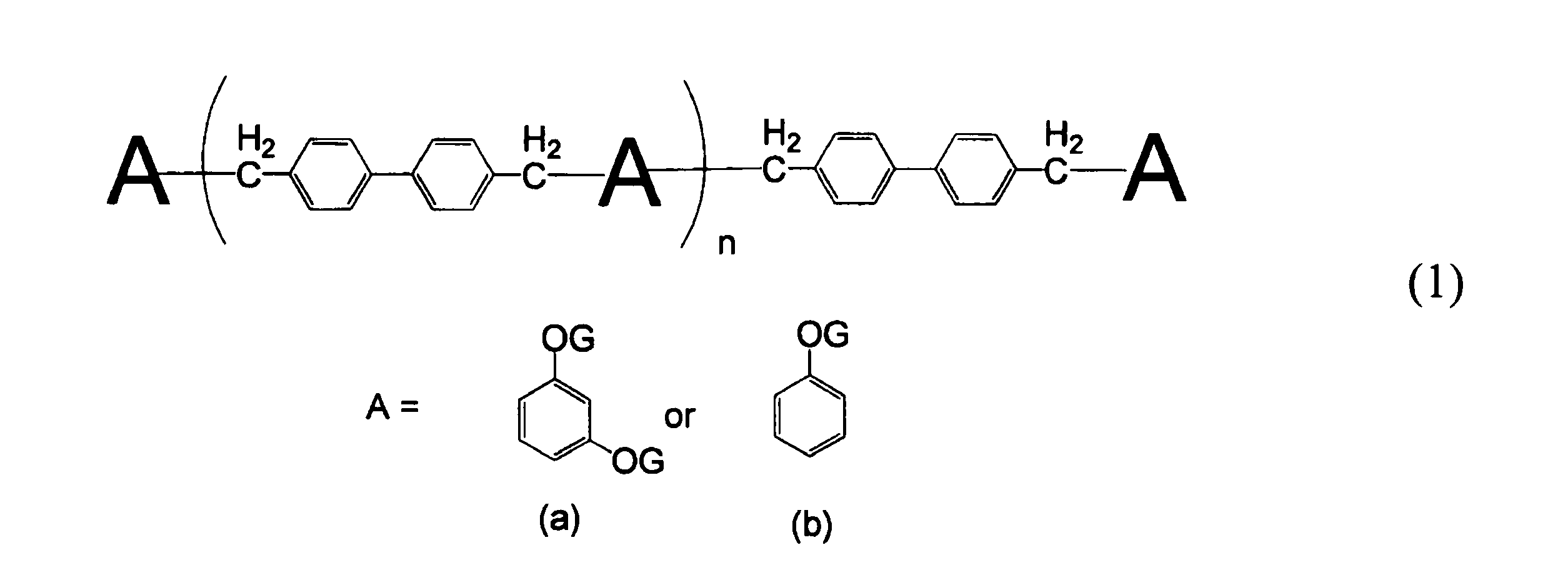
(式中、(a)(b)の比率は(a)/(b)=1~3である。Gはグリシジル基を表す。nは繰り返し数であり、0~5である。)
本発明において使用する式(1)のエポキシ樹脂は日本国特開2011-252037号公報、日本国特開2008-156553号公報、日本国特開2013-043958公報、国際公開WO2012/053522、WO2007/007827に記載されている手法で合成できるが、前記式(1)の構造をもてばどのような手法のものを用いても構わない。
ただし、本発明においては特に前記式(a)と前記式(b)の割合(多官能化率)が(a)/(b)=1~3の物を使用する。(a)の構造が多いと耐熱性があがるがその分吸水特性が悪くなるばかりか、脆く硬くなってしまう。そこで上述の範囲内の多官能化率のものを使用する。
ただし、本発明においては特に前記式(a)と前記式(b)の割合(多官能化率)が(a)/(b)=1~3の物を使用する。(a)の構造が多いと耐熱性があがるがその分吸水特性が悪くなるばかりか、脆く硬くなってしまう。そこで上述の範囲内の多官能化率のものを使用する。
使用するエポキシ樹脂の軟化点(環球法)は50~150℃が好ましく、さらに好ましくは52~100℃、特に好ましくは52~95℃である。50℃以下ではべた付きが激しく、取り扱いが困難であり生産性に課題が生じる場合がある。また150℃以上の場合、成型温度に近い温度であり、成型時の流動性が確保できない場合があることから好ましくない。
使用するエポキシ樹脂のエポキシ当量は180~350g/eq.であることが好ましい。特に190~300g/eq.であることが好ましい。エポキシ当量が180g/eq.を下回る場合、官能基が多すぎるため、硬化後の硬化物において吸水率が高くなる、また脆くなりやすい場合がある。エポキシ当量が350g/eq.を超える場合、軟化点が非常に大きくなるか、きれいにエポキシ化が進行していないことが考えられ、塩素量が非常に多くなってしまう場合があることから好ましくない。
なお、本発明において使用するエポキシ樹脂の塩素量は全塩素(加水分解法)で好ましくは200~1500ppmであり、特に好ましくは200~900ppmとなる。JPCAの規格からエポキシ単体でも900ppmを超えないことが望まれている。さらには塩素量が多いとその分電気信頼性に影響する場合があるので好ましくない。200ppmを下回る場合、過度な精製工程が必要となり、生産性に課題が生じる場合があるため好ましくない。
なお、本発明において使用するエポキシ樹脂の150℃における溶融粘度は、好ましくは0.05~5Pa・sであり、特に好ましくは0.05~2.0Pa・sである。5Pa・sよりも溶融粘度が高いと流動性に課題が生じ、プレス時のフロー性や埋め込み性に問題が生じる場合がある。0.05Pa・sを下回る場合、分子量が小さすぎるため、耐熱性が足りない場合がある。
前記式中(a)と(b)の比率は(a)/(b)=1~3である。すなわち、半分以上がレゾルシン構造のグリシジルエーテル体であることを特徴とする。本比率は結晶の析出および耐熱性の向上には重要であり、(a)/(b)は1を超えることが好ましい。また、(a)/(b)が3以下であることでレゾルシン構造のグリシジルエーテル体の量を制限することで、吸水率と強靭性を改善することができる。
前記式中、nは繰り返し単位であり、0~5である。nが5を超えないことでプリプレグや樹脂シートにした際のフロー性や流動性をコントロールする。これが5を超えた場合、流動性ばかりか、溶剤への溶解性に課題が生じる。
本発明において使用するエポキシ樹脂は溶剤への溶解性が重要となる。例えば同様の骨格を有するビフェニルアラルキルタイプのエポキシ樹脂を併用する場合、これらの樹脂についてもメチルエチルケトンやトルエン、プロピレングリコールモノメチルエーテル等の溶剤に対し、溶解性が必要となる。
本発明においては、特にメチルエチルケトンへの溶解性が重要であり、5℃、室温等で2か月以上、結晶が析出しないことが求められる。前述の(a)/(b)の比率にも関与するが、(a)の値が大きいと結晶が出やすくなってしまうため、(a)/(b)が1以上であることが重要となる。
前記式中、nは繰り返し単位であり、0~5である。nが5を超えないことでプリプレグや樹脂シートにした際のフロー性や流動性をコントロールする。これが5を超えた場合、流動性ばかりか、溶剤への溶解性に課題が生じる。
本発明において使用するエポキシ樹脂は溶剤への溶解性が重要となる。例えば同様の骨格を有するビフェニルアラルキルタイプのエポキシ樹脂を併用する場合、これらの樹脂についてもメチルエチルケトンやトルエン、プロピレングリコールモノメチルエーテル等の溶剤に対し、溶解性が必要となる。
本発明においては、特にメチルエチルケトンへの溶解性が重要であり、5℃、室温等で2か月以上、結晶が析出しないことが求められる。前述の(a)/(b)の比率にも関与するが、(a)の値が大きいと結晶が出やすくなってしまうため、(a)/(b)が1以上であることが重要となる。
本発明のエポキシ樹脂組成物はアミン系硬化剤を必須成分とする。用いることができるアミン系硬化剤としては、ジアミノジフェニルメタン、ジエチレントリアミン、トリエチレンテトラミン、ジアミノジフェニルスルホン、イソホロンジアミン、ナフタレンジアミン、アニリンと置換ビフェニル類(4,4’-ビス(クロルメチル)-1,1’-ビフェニル及び4,4’-ビス(メトキシメチル)-1,1’-ビフェニル等)、若しくは置換フェニル類(1,4-ビス(クロロメチル)ベンゼン、1,4-ビス(メトキシメチル)ベンゼン及び1,4-ビス(ヒドロキシメチル)ベンゼン等)等との重縮合により得られるアニリン樹脂等が挙げられるが、これらに限定されない。
特に好ましいアミン系硬化剤は二官能以上のアミン化合物であり、下記式であらわされる構造の樹脂が好ましい。

(式中、nは繰り返し数であり、1~10である。)
本発明に使用するアミン系硬化剤はそれぞれ結晶、もしくは樹脂の形状を呈する。
結晶の場合、その融点は35~200℃が好ましく、特に好ましくは40~185℃である。融点の場合、軟化点と異なり、他の樹脂への溶解性も関係するため、樹脂のように必ずしも成型温度以下の温度である必要はない。
樹脂の場合、50℃~150℃の軟化点(環球法)が好ましく、特に好ましくは50~100℃である。樹脂の場合、50℃以下の軟化点の物はべたつきの問題が出てしまう場合があることから好ましくなく、150℃を超える軟化点の場合、成型時に流動性の問題が出てきてきれいに成型できない、また溶剤が抜けきらないなどの課題が生じる場合がある。
結晶の場合、その融点は35~200℃が好ましく、特に好ましくは40~185℃である。融点の場合、軟化点と異なり、他の樹脂への溶解性も関係するため、樹脂のように必ずしも成型温度以下の温度である必要はない。
樹脂の場合、50℃~150℃の軟化点(環球法)が好ましく、特に好ましくは50~100℃である。樹脂の場合、50℃以下の軟化点の物はべたつきの問題が出てしまう場合があることから好ましくなく、150℃を超える軟化点の場合、成型時に流動性の問題が出てきてきれいに成型できない、また溶剤が抜けきらないなどの課題が生じる場合がある。
アミン化合物の官能基当量は60~600g/eq.(電位差滴定での測定)が好ましい。活性水素当量が60以下の場合、その硬化物において吸水率や強靭性で課題が生じる場合がある。600を超えると耐熱性の維持が困難となる場合がある。
本発明のエポキシ樹脂組成物においてアミン系硬化剤の使用量は、エポキシ樹脂のエポキシ基1当量に対してアミン化合物のアミン当量で0.2~0.6当量が好ましい。特に好ましくは0.3~0.55当量である。エポキシ基1当量に対して、0.2当量に満たない場合、また0.6当量を超える場合、硬化が不完全となり良好な硬化物性が得られない恐れがあるため好ましくない。
本発明のエポキシ樹脂組成物においては、硬化促進剤を含有させても差し支えない。使用できる硬化促進剤の具体例としては蟻酸、酢酸、乳酸、グリコール酸、n-酪酸、iso-酪酸、プロピオン酸、カプロン酸、オクタン酸、n-ヘプチル酸、モノクロロ酢酸、ジクロロ酢酸、トリクロロ酢酸、チオグリコール酸、フェノール、m-クレゾール、p-クロロフェノール、p-ニトロフェノール、2,4-ジニトロフェノール、o-アミノフェノール、p-アミノフェノール、2,4,5-トリクロロフェノール、レゾルシノール、ヒドロキノン、カテコール、フロログリシノール、安息香酸、p-トルイル酸、p-アミノ安息香酸、p-クロロ安息香酸、2,4-ジクロロ安息香酸、サリチル酸、フタル酸、イソフタル酸、テレフタル酸、リンゴ酸、シュウ酸、コハク酸、マロン酸、フマル酸、マレイン酸、酒石酸、クエン酸、などの酸、モノエタノールアミン、ジエタノールアミン、トリエタノールアミンなどのアミン類、チオフェノール、2-メルカプトエタノール、含硫黄類、2-メチルイミダゾール、2-エチルイミダゾール、2-エチル-4-メチルイミダゾール等のイミダゾ-ル類、2-(ジメチルアミノメチル)フェノール、1,8-ジアザ-ビシクロ[5.4.0]ウンデセン-7等の第3級アミン類、トリフェニルホスフィン等のホスフィン類、オクチル酸スズ等の金属化合物等が挙げられる。硬化促進剤は、エポキシ樹脂100重量部に対して0.1~5.0重量部が必要に応じ用いられる。
本発明のエポキシ樹脂組成物において、他のエポキシ樹脂を併用して用いることができる。式(1)のエポキシ樹脂と併用されうる他のエポキシ樹脂の具体例としては、ビスフェノール類(ビスフェノールA、ビスフェノールF、ビスフェノールS、ビフェノール、ビスフェノールAD等)またはフェノール類(フェノール、アルキル置換フェノール、芳香族置換フェノール、ナフトール、アルキル置換ナフトール、ジヒドロキシベンゼン、アルキル置換ジヒドロキシベンゼン、ジヒドロキシナフタレン等)と各種アルデヒド(ホルムアルデヒド、アセトアルデヒド、アルキルアルデヒド、ベンズアルデヒド、アルキル置換ベンズアルデヒド、ヒドロキシベンズアルデヒド、ナフトアルデヒド、グルタルアルデヒド、フタルアルデヒド、クロトンアルデヒド、シンナムアルデヒド等)との重縮合物;前記フェノール類と各種ジエン化合物(ジシクロペンタジエン、テルペン類、ビニルシクロヘキセン、ノルボルナジエン、ビニルノルボルネン、テトラヒドロインデン、ジビニルベンゼン、ジビニルビフェニル、ジイソプロペニルビフェニル、ブタジエン、イソプレン等)との重合物;前記フェノール類とケトン類(アセトン、メチルエチルケトン、メチルイソブチルケトン、アセトフェノン、ベンゾフェノン等)との重縮合物;前記フェノール類と芳香族ジメタノール類(ベンゼンジメタノール、ビフェニルジメタノール等)との重縮合物;前記フェノール類と芳香族ジクロロメチル類(α,α’-ジクロロキシレン、ビスクロロメチルビフェニル等)との重縮合物;前記フェノール類と芳香族ビスアルコキシメチル類(ビスメトキシメチルベンゼン、ビスメトキシメチルビフェニル、ビスフェノキシメチルビフェニル等)との重縮合物;前記ビスフェノール類と各種アルデヒドの重縮合物またはアルコール類等をグリシジル化したグリシジルエーテル系エポキシ樹脂、脂環式エポキシ樹脂、グリシジルアミン系エポキシ樹脂、グリシジルエステル系エポキシ樹脂等が挙げられるが、通常用いられるエポキシ樹脂であればこれらに限定されるものではない。これらは単独で用いてもよく、2種以上を用いてもよい。
本発明のエポキシ樹脂組成物を配合する場合、従来公知の硬化剤を併用して用いることができる。他の併用できる硬化剤としては、例えば酸無水物系化合物、アミド系化合物、フェノール系化合物、カルボン酸系化合物などが挙げられる。用いうる硬化剤の具体例としては、ジシアンジアミド、リノレン酸の2量体とエチレンジアミンより合成されるポリアミド樹脂等のアミド系化合物;無水フタル酸、無水トリメリット酸、無水ピロメリット酸、無水マレイン酸、テトラヒドロ無水フタル酸、メチルテトラヒドロ無水フタル酸、無水メチルナジック酸、ヘキサヒドロ無水フタル酸、メチルヘキサヒドロ無水フタル酸等の酸無水物系化合物;ビスフェノールA、ビスフェノールF、ビスフェノールS、フルオレンビスフェノール、テルペンジフェノール、4,4’-ビフェノール、2,2’-ビフェノール、3,3’,5,5’-テトラメチル-[1,1’-ビフェニル]-4,4’-ジオール、ハイドロキノン、レゾルシン、ナフタレンジオール、トリス-(4-ヒドロキシフェニル)メタン、1,1,2,2-テトラキス(4-ヒドロキシフェニル)エタンや、フェノール類(フェノール、アルキル置換フェノール、ナフトール、アルキル置換ナフトール、ジヒドロキシベンゼン、ジヒドロキシナフタレン等)とホルムアルデヒド、アセトアルデヒド、ベンズアルデヒド、p-ヒドロキシベンズアルデヒド、o-ヒドロキシベンズアルデヒド、p-ヒドロキシアセトフェノン、o-ヒドロキシアセトフェノン、フルフラールとの重縮合物であるノボラック樹脂や、フェノールまたはクレゾールとフェニレンジメチロール体、ジメトキシメチル体もしくはハロゲン化メチル体との反応物または、フェノールまたはクレゾールとビスクロロメチルビフェニル、ビスメトキシメチルビフェニルもしくはビスヒドロキシメチルビフェニルとの反応物または、フェノールとベンゼンジイソプロパノール、ベンゼンジイソプロパノールジメチルエーテルもしくはベンゼンビス(クロロイソプロパン)との反応物であるフェノールアラルキル樹脂及びこれらの変性物や、テトラブロモビスフェノールA等のハロゲン化ビスフェノール類や、テルペンとフェノール類の縮合物等のフェノール系化合物、イミダゾール、トリフルオロボラン-アミン錯体、グアニジン誘導体などが挙げられるが、これらに限定されるものではない。これらは単独で用いてもよく、2種以上を用いてもよい。
本発明のエポキシ樹脂組成物には、リン含有化合物を難燃性付与成分として含有させることもできる。リン含有化合物としては反応型のものでも添加型のものでもよい。リン含有化合物の具体例としては、トリメチルホスフェート、トリエチルホスフェート、トリクレジルホスフェート、トリキシリレニルホスフェート、クレジルジフェニルホスフェート、クレジル-2,6-ジキシリレニルホスフェート、1,3-フェニレンビス(ジキシリレニルホスフェート)、1,4-フェニレンビス(ジキシリレニルホスフェート)、4,4’-ビフェニル(ジキシリレニルホスフェート)等のリン酸エステル系化合物;9,10-ジヒドロ-9-オキサ-10-ホスファフェナントレン-10-オキサイド、10(2,5-ジヒドロキシフェニル)-10H-9-オキサ-10-ホスファフェナントレン-10-オキサイド等のホスファン類;エポキシ樹脂と前記ホスファン類の活性水素とを反応させて得られるリン含有エポキシ化合物、赤リン等が挙げられるが、リン酸エステル類、ホスファン類またはリン含有エポキシ化合物が好ましく、1,3-フェニレンビス(ジキシリレニルホスフェート)、1,4-フェニレンビス(ジキシリレニルホスフェート)、4,4’-ビフェニル(ジキシリレニルホスフェート)またはリン含有エポキシ化合物が特に好ましい。
しかしながら、環境問題、および電気特性の懸念から前述のようなリン酸エステル系化合物の使用量はリン酸エステル系化合物/エポキシ樹脂≦0.1(重量比)が好ましい。さらに好ましくは0.05以下である。特に好ましくは硬化促進剤として添加する以外は、リン系化合物は添加しないことが良い。
しかしながら、環境問題、および電気特性の懸念から前述のようなリン酸エステル系化合物の使用量はリン酸エステル系化合物/エポキシ樹脂≦0.1(重量比)が好ましい。さらに好ましくは0.05以下である。特に好ましくは硬化促進剤として添加する以外は、リン系化合物は添加しないことが良い。
本発明のエポキシ樹脂組成物は無機充填剤を含有してもよい。無機充填剤としては溶融シリカ、結晶性シリカ、アルミナ、炭酸カルシウム、ケイ酸カルシウム、硫酸バリウム、タルク、クレー、酸化マグネシウム、酸化アルミニウム、酸化ベリリウム、酸化鉄、酸化チタン、窒化アルミニウム、窒化ケイ素、窒化ホウ素、マイカ、ガラス、石英、雲母などが挙げられる。さらに難燃効果を付与するため、水酸化マグネシウム、水酸化アルミニウムなどの金属水酸化物を使用することも好ましい。ただし、これらに限定されない。また2種以上を混合して使用しても良い。これら無機充填剤のうち、溶融シリカや結晶性シリカなどのシリカ類はコストが安く、電気信頼性も良好なため好ましい。
本発明のエポキシ樹脂組成物においては、無機充填剤の使用量は内割りで通常5重量%~70重量%、好ましくは10重量%~60重量%、より好ましくは15重量%~60重量%の範囲である。少なすぎると線膨張が高くなり反りが課題になったり、基板の薄型化が進んでいることから、剛性がでず行程中に課題が出てしまう恐れがある。また、多すぎるとフィラーの沈降等により均質性がなくなったり、基板の埋め込み性が悪くなる、また金属との密着性が悪くなる等の問題が出てくる恐れがあるため、基板として成型した際に、はがれや破壊電圧等の電気特性に悪影響が出る可能性が高い。
また、無機充填剤の形状、粒径等も特に限定されないが、通常、粒径0.01~50μm、好ましくは0.1~15μmのものである。
本発明のエポキシ樹脂組成物においては、無機充填剤の使用量は内割りで通常5重量%~70重量%、好ましくは10重量%~60重量%、より好ましくは15重量%~60重量%の範囲である。少なすぎると線膨張が高くなり反りが課題になったり、基板の薄型化が進んでいることから、剛性がでず行程中に課題が出てしまう恐れがある。また、多すぎるとフィラーの沈降等により均質性がなくなったり、基板の埋め込み性が悪くなる、また金属との密着性が悪くなる等の問題が出てくる恐れがあるため、基板として成型した際に、はがれや破壊電圧等の電気特性に悪影響が出る可能性が高い。
また、無機充填剤の形状、粒径等も特に限定されないが、通常、粒径0.01~50μm、好ましくは0.1~15μmのものである。
本発明のエポキシ樹脂組成物には成形時の金型との離型を良くするために離型剤を配合することができる。離型剤としては従来公知のものいずれも使用できるが、例えばカルナバワックス、モンタンワックスなどのエステル系ワックス、ステアリン酸、パルチミン酸などの脂肪酸およびこれらの金属塩、酸化ポリエチレン、非酸化ポリエチレンなどのポリオレフィン系ワックスなどが挙げられる。これらは単独で使用しても2種以上併用しても良い。これら離型剤の配合量は全有機成分に対して0.5~3重量%が好ましい。これより少なすぎると金型からの離型が悪く、多すぎると基材等との接着が悪くなる恐れがある。
本発明のエポキシ樹脂組成物には無機充填剤と樹脂成分との接着性を高めるためにカップリング剤を配合することができる。カップリング剤としては従来公知のものをいずれも使用できるが、例えばビニルアルコキシシラン、エポキアルコキシシラン、スチリルアルコキシシラン、メタクリロキシアルコキシシラン、アクリロキシアルコキシシラン、アミノアルコキシシラン、メルカプトアルコキシシラン、イソシアナートアルコキシシランなどの各種アルコキシシラン化合物、アルコキシチタン化合物、アルミニウムキレート類などが挙げられる。これらは単独で使用しても2種以上併用しても良い。カップリング剤の添加方法は、カップリング剤であらかじめ無機充填剤表面を処理した後、樹脂と混練しても良いし、樹脂にカップリング剤を混合してから無機充填剤を混練しても良い。
本発明のエポキシ樹脂組成物に有機溶剤を添加してワニス状の組成物(以下、単にワニスという)とすることができる。用いられる溶剤としては、例えばγ-ブチロラクトン類、N-メチルピロリドン、N,N-ジメチルホルムアミド、N,N-ジメチルアセトアミド、N,N-ジメチルイミダゾリジノン等のアミド系溶剤、テトラメチレンスルフォン等のスルフォン類、ジエチレングリコールジメチルエーテル、ジエチレングリコールジエチルエーテル、プロピレングリコール、プロピレングリコールモノメチルエーテル、プロピレングリコールモノメチルエーテルモノアセテート、プロピレングリコールモノブチルエーテル等のエーテル系溶剤、メチルエチルケトン、メチルイソブチルケトン、シクロペンタノン、シクロヘキサノン等のケトン系溶剤、トルエン、キシレンなどの芳香族系溶剤が挙げられる。溶剤は、得られたワニス中の溶剤を除く固形分濃度が通常10~80重量%、好ましくは20~70重量%となる範囲で使用する。
更に本発明のエポキシ樹脂組成物には、必要に応じて公知の添加剤を配合することが出来る。用いうる添加剤の具体例としては、ポリブタジエン及びこの変性物、アクリロニトリル共重合体の変性物、ポリフェニレンエーテル、ポリスチレン、ポリエチレン、ポリイミド、フッ素樹脂、マレイミド系化合物、シアネートエステル系化合物、シリコーンゲル、シリコーンオイル、並びにカーボンブラック、フタロシアニンブルー、フタロシアニングリーン等の着色剤などが挙げられる。
本発明の樹脂シートについて説明する。
本発明のエポキシ樹脂組成物を用いた樹脂シートは上記ワニスをそれ自体公知のグラビアコート法、スクリーン印刷、メタルマスク法、スピンコート法などの各種塗工方法により平面状支持体に乾燥後の厚さが所定の厚さ、たとえば5~100μmになるように塗布後、乾燥して得られるが、どの塗工方法を用いるかは支持体の種類、形状、大きさ、塗工の膜厚、支持体の耐熱性等により適宜選択される。
平面支持体としては、たとえばポリアミド、ポリアミドイミド、ポリアリレート、ポリエチレンテレフタレート、ポリブチレンテレフタレート、ポリエーテルケトン、ポリエーテルイミド、ポリエーテルエーテルケトン、ポリケトン、ポリエチレン、ポリプロピレン、テフロン(登録商標)等の各種高分子、および/またはその共重合体から作られるフィルム、あるいは銅箔等の金属箔等が挙げられる。
塗布後、乾燥し、シート状の組成物を得ることができる(本発明の樹脂シート)が、本シートをさらに加熱することでシート状の硬化物とすることもできる。また一度の加熱で溶剤乾燥と硬化工程を兼ねてもよい。
本発明のエポキシ樹脂組成物は上記支持体の両面もしくは片面に上記方法で塗工、加熱することにより、該支持体の両面または片面に硬化物の層を形成することができる。また硬化前に被着体を貼り合わせ、硬化させることで積層体を作製することも可能である。
また本発明の樹脂シートは支持体から剥がすことで接着シートとして使用することもでき、被着体に接触させ、必要に応じて圧力と熱をかけ、硬化とともに接着させるということもできる。
本発明のエポキシ樹脂組成物を用いた樹脂シートは上記ワニスをそれ自体公知のグラビアコート法、スクリーン印刷、メタルマスク法、スピンコート法などの各種塗工方法により平面状支持体に乾燥後の厚さが所定の厚さ、たとえば5~100μmになるように塗布後、乾燥して得られるが、どの塗工方法を用いるかは支持体の種類、形状、大きさ、塗工の膜厚、支持体の耐熱性等により適宜選択される。
平面支持体としては、たとえばポリアミド、ポリアミドイミド、ポリアリレート、ポリエチレンテレフタレート、ポリブチレンテレフタレート、ポリエーテルケトン、ポリエーテルイミド、ポリエーテルエーテルケトン、ポリケトン、ポリエチレン、ポリプロピレン、テフロン(登録商標)等の各種高分子、および/またはその共重合体から作られるフィルム、あるいは銅箔等の金属箔等が挙げられる。
塗布後、乾燥し、シート状の組成物を得ることができる(本発明の樹脂シート)が、本シートをさらに加熱することでシート状の硬化物とすることもできる。また一度の加熱で溶剤乾燥と硬化工程を兼ねてもよい。
本発明のエポキシ樹脂組成物は上記支持体の両面もしくは片面に上記方法で塗工、加熱することにより、該支持体の両面または片面に硬化物の層を形成することができる。また硬化前に被着体を貼り合わせ、硬化させることで積層体を作製することも可能である。
また本発明の樹脂シートは支持体から剥がすことで接着シートとして使用することもでき、被着体に接触させ、必要に応じて圧力と熱をかけ、硬化とともに接着させるということもできる。
本発明のプリプレグについて説明する。
本発明のプリプレグは上記の本発明のエポキシ樹脂組成物を繊維基材に含浸してなるものである。これにより、耐熱性、低膨張性および難燃性に優れたプリプレグを得ることができる。前記繊維基材としては、例えばガラス織布、ガラス不繊布、ガラスペーパー等のガラス繊維基材、紙、アラミド、ポリエステル、芳香族ポリエステル、フッ素樹脂等の合成繊維等からなる織布や不織布、金属繊維、カーボン繊維、鉱物繊維等からなる織布、不織布、マット類等が挙げられる。これらの基材は単独又は混合して使用してもよい。これらの中でもガラス繊維基材が好ましい。これにより、プリプレグの剛性、寸法安定性をより向上することができる。
ガラス繊維基材としては、Tガラス、Sガラス、Eガラス、NEガラス、および石英ガラスからなる群から選ばれる少なくとも一種を含むものが好ましい。
本発明のプリプレグは上記の本発明のエポキシ樹脂組成物を繊維基材に含浸してなるものである。これにより、耐熱性、低膨張性および難燃性に優れたプリプレグを得ることができる。前記繊維基材としては、例えばガラス織布、ガラス不繊布、ガラスペーパー等のガラス繊維基材、紙、アラミド、ポリエステル、芳香族ポリエステル、フッ素樹脂等の合成繊維等からなる織布や不織布、金属繊維、カーボン繊維、鉱物繊維等からなる織布、不織布、マット類等が挙げられる。これらの基材は単独又は混合して使用してもよい。これらの中でもガラス繊維基材が好ましい。これにより、プリプレグの剛性、寸法安定性をより向上することができる。
ガラス繊維基材としては、Tガラス、Sガラス、Eガラス、NEガラス、および石英ガラスからなる群から選ばれる少なくとも一種を含むものが好ましい。
本発明のエポキシ樹脂組成物を前記繊維基材に含浸させる方法は、例えば基材を樹脂ワニスに浸漬する方法、各種コーターによる塗布する方法、スプレーによる吹き付ける方法等が挙げられる。これらの中でも、基材を樹脂ワニスに浸漬する方法が好ましい。これにより、基材に対する樹脂組成物の含浸性を向上することができる。なお、基材を樹脂ワニスに浸漬する場合、通常の含浸塗布設備を使用することができる。
例えば、本発明のエポキシ樹脂組成物をそのままで、又は溶媒に溶解若しくは分散させたワニスの形態で、ガラス布等の基材に含浸させた後、乾燥炉中等で通常、80~200℃(ただし、溶媒を使用した場合は溶媒の揮発可能な温度以上とする)で、2~30分間、好ましくは2~15分間乾燥させることによってプリプレグが得られる。
例えば、本発明のエポキシ樹脂組成物をそのままで、又は溶媒に溶解若しくは分散させたワニスの形態で、ガラス布等の基材に含浸させた後、乾燥炉中等で通常、80~200℃(ただし、溶媒を使用した場合は溶媒の揮発可能な温度以上とする)で、2~30分間、好ましくは2~15分間乾燥させることによってプリプレグが得られる。
本発明の金属張積層板について説明する。
本発明で用いられる積層板は、上記の本発明のプリプレグを加熱加圧成形してなるものである。これにより、耐熱性、低膨張性および難燃性に優れた金属張積層板を得ることができる。プリプレグ1枚のときは、その上下両面もしくは片面に金属箔を重ねる。また、プリプレグを2枚以上積層することもできる。プリプレグ2枚以上積層するときは、積層したプリプレグの最も外側の上下両面もしくは片面に金属箔あるいはフィルムを重ねる。次に、プリプレグと金属箔とを重ねたものを加熱加圧成形することで金属張積層板を得ることができる。前記加熱する温度は、特に限定されないが、120~220℃が好ましく、特に150~200℃が好ましい。前記加圧する圧力は、特に限定されないが、1.5~5MPaが好ましく、特に2~4MPaが好ましい。また、必要に応じて高温漕等で150~300℃の温度で後硬化を行ってもかまわない。
本発明で用いられる積層板は、上記の本発明のプリプレグを加熱加圧成形してなるものである。これにより、耐熱性、低膨張性および難燃性に優れた金属張積層板を得ることができる。プリプレグ1枚のときは、その上下両面もしくは片面に金属箔を重ねる。また、プリプレグを2枚以上積層することもできる。プリプレグ2枚以上積層するときは、積層したプリプレグの最も外側の上下両面もしくは片面に金属箔あるいはフィルムを重ねる。次に、プリプレグと金属箔とを重ねたものを加熱加圧成形することで金属張積層板を得ることができる。前記加熱する温度は、特に限定されないが、120~220℃が好ましく、特に150~200℃が好ましい。前記加圧する圧力は、特に限定されないが、1.5~5MPaが好ましく、特に2~4MPaが好ましい。また、必要に応じて高温漕等で150~300℃の温度で後硬化を行ってもかまわない。
本発明のプリント配線基板について説明する。
本発明のプリント配線基板は、前記の本発明の金属張積層板を内層回路基板として用いる。金属張積層板の片面又は両面に回路形成する。場合によっては、ドリル加工、レーザー加工によりスルーホールを形成し、めっき等で両面の電気的接続をとることもできる。
本発明のプリント配線基板は、前記の本発明の金属張積層板を内層回路基板として用いる。金属張積層板の片面又は両面に回路形成する。場合によっては、ドリル加工、レーザー加工によりスルーホールを形成し、めっき等で両面の電気的接続をとることもできる。
前記内層回路基板に市販又は本発明の樹脂シート、または前記本発明のプリプレグを重ね合わせて加熱加圧成形し、多層プリント配線基板を得ることができる。
具体的には、上記樹脂シートの絶縁層側と内層回路基板とを合わせて、真空加圧式ラミネーター装置などを用いて真空加熱加圧成形させ、その後、熱風乾燥装置等で絶縁層を加熱硬化させることにより得ることができる。
ここで加熱加圧成形する条件としては特に限定されないが、一例を挙げると、温度60~160℃、圧力0.2~3MPaで実施することができる。また、加熱硬化させる条件としては特に限定されないが、一例を挙げると、温度140~240℃、時間30~120分間で実施することができる。
あるいは、前記本発明のプリプレグを内層回路基板に重ね合わせ、これを平板プレス装置などを用いて加熱加圧成形することにより得ることができる。ここで加熱加圧成形する条件としては特に限定されないが、一例を挙げると、温度140~240℃、圧力1~4MPaで実施することができる。このような平板プレス装置等による加熱加圧成形では、加熱加圧成形と同時に絶縁層の加熱硬化が行われる。
具体的には、上記樹脂シートの絶縁層側と内層回路基板とを合わせて、真空加圧式ラミネーター装置などを用いて真空加熱加圧成形させ、その後、熱風乾燥装置等で絶縁層を加熱硬化させることにより得ることができる。
ここで加熱加圧成形する条件としては特に限定されないが、一例を挙げると、温度60~160℃、圧力0.2~3MPaで実施することができる。また、加熱硬化させる条件としては特に限定されないが、一例を挙げると、温度140~240℃、時間30~120分間で実施することができる。
あるいは、前記本発明のプリプレグを内層回路基板に重ね合わせ、これを平板プレス装置などを用いて加熱加圧成形することにより得ることができる。ここで加熱加圧成形する条件としては特に限定されないが、一例を挙げると、温度140~240℃、圧力1~4MPaで実施することができる。このような平板プレス装置等による加熱加圧成形では、加熱加圧成形と同時に絶縁層の加熱硬化が行われる。
また、本発明に係る多層プリント配線基板の製造方法は、前記樹脂シート、または本発明のプリプレグを、内層回路基板の内層回路パターンが形成された面に重ね合わせて連続積層する工程、及び導体回路層をセミアディティブ法で形成する工程を含む。
前記樹脂シート、または本発明のプリプレグより形成された絶縁層の硬化は、次のレーザー照射および樹脂残渣の除去を容易にし、デスミア性を向上させるため、半硬化状態にしておく場合もある。また、一層目の絶縁層を通常の加熱温度より低い温度で加熱することにより一部硬化(半硬化)させ、絶縁層上に、一層ないし複数の絶縁層をさらに形成し半硬化の絶縁層を実用上問題ない程度に再度加熱硬化させることにより絶縁層間および絶縁層と回路との密着力を向上させることができる。この場合の半硬化の温度は、80℃~200℃が好ましく、100℃~180℃がより好ましい。尚、次工程においてレーザーを照射し、絶縁層に開口部を形成するが、その前に基材を剥離する必要がある。基材の剥離は、絶縁層を形成後、加熱硬化の前、または加熱硬化後のいずれに行っても特に問題はない。
なお、前記多層プリント配線基板を得る際に用いられる内層回路基板は、例えば、銅張積層板の両面に、エッチング等により所定の導体回路を形成し、導体回路部分を黒化処理したものを好適に用いることができる。
なお、前記多層プリント配線基板を得る際に用いられる内層回路基板は、例えば、銅張積層板の両面に、エッチング等により所定の導体回路を形成し、導体回路部分を黒化処理したものを好適に用いることができる。
レーザー照射後の樹脂残渣等は過マンガン酸塩、重クロム酸塩等の酸化剤などにより除去することが好ましい。また、平滑な絶縁層の表面を同時に粗化することができ、続く金属メッキにより形成する導電配線回路の密着性を上げることができる。
次に、外層回路を形成する。外層回路の形成方法は、金属メッキにより絶縁樹脂層間の接続を図り、エッチングにより外層回路パターン形成を行う。樹脂シート、またはプリプレグを用いたときと同様にして、多層プリント配線基板を得ることができる。
尚、金属箔を有する樹脂シート、またはプリプレグを用いた場合は、金属箔を剥離することなく、導体回路として用いるためにエッチングにより回路形成を行ってもよい。その場合、厚い銅箔を使用した基材付き絶縁樹脂シートを使うと、その後の回路パターン形成においてファインピッチ化が困難になるため、1~5μmの極薄銅箔を使うか、または12~18μmの銅箔をエッチングにより1~5μmに薄くするハーフエッチングする場合もある。
尚、金属箔を有する樹脂シート、またはプリプレグを用いた場合は、金属箔を剥離することなく、導体回路として用いるためにエッチングにより回路形成を行ってもよい。その場合、厚い銅箔を使用した基材付き絶縁樹脂シートを使うと、その後の回路パターン形成においてファインピッチ化が困難になるため、1~5μmの極薄銅箔を使うか、または12~18μmの銅箔をエッチングにより1~5μmに薄くするハーフエッチングする場合もある。
さらに絶縁層を積層し、前記同様回路形成を行っても良いが、多層プリント配線基板の設計上、最外層には、回路形成後、ソルダーレジストを形成する。ソルダーレジストの形成方法は、特に限定されないが、例えば、ドライフィルムタイプのソルダーレジストを積層(ラミネート)し、露光、および現像により形成する方法、または液状レジストを印刷したものを露光、および現像により形成する方法によりなされる。なお、得られた多層プリント配線基板を半導体装置に用いる場合、半導体素子を実装するため接続用電極部を設ける。接続用電極部は、金めっき、ニッケルメッキおよび半田めっき等の金属皮膜で適宜被覆することができる。このような方法により多層プリント配線基板を製造することができる。
次に、本発明の半導体装置について説明する。
前記で得られた多層プリント配線基板に半田バンプを有する半導体素子を実装し、半田バンプを介して、前記多層プリント配線基板との接続を図る。そして、多層プリント配線基板と半導体素子との間には液状封止樹脂を充填し、半導体装置を形成する。半田バンプは、錫、鉛、銀、銅、ビスマスなどからなる合金で構成されることが好ましい。
半導体素子と多層プリント配線基板との接続方法は、フリップチップボンダーなどを用いて基板上の接続用電極部と半導体素子の半田バンプとの位置合わせを行ったあと、IRリフロー装置、熱板、その他加熱装置を用いて半田バンプを融点以上に加熱し、多層プリント配線基板と半田バンプとを溶融接合することにより接続する。尚、接続信頼性を良くするため、予め多層プリント配線基板上の接続用電極部に半田ペースト等、比較的融点の低い金属の層を形成しておいても良い。この接合工程に先んじて、半田バンプおよび、または多層プリント配線基板上の接続用電極部の表層にフラックスを塗布することで接続信頼性を向上させることもできる。
前記で得られた多層プリント配線基板に半田バンプを有する半導体素子を実装し、半田バンプを介して、前記多層プリント配線基板との接続を図る。そして、多層プリント配線基板と半導体素子との間には液状封止樹脂を充填し、半導体装置を形成する。半田バンプは、錫、鉛、銀、銅、ビスマスなどからなる合金で構成されることが好ましい。
半導体素子と多層プリント配線基板との接続方法は、フリップチップボンダーなどを用いて基板上の接続用電極部と半導体素子の半田バンプとの位置合わせを行ったあと、IRリフロー装置、熱板、その他加熱装置を用いて半田バンプを融点以上に加熱し、多層プリント配線基板と半田バンプとを溶融接合することにより接続する。尚、接続信頼性を良くするため、予め多層プリント配線基板上の接続用電極部に半田ペースト等、比較的融点の低い金属の層を形成しておいても良い。この接合工程に先んじて、半田バンプおよび、または多層プリント配線基板上の接続用電極部の表層にフラックスを塗布することで接続信頼性を向上させることもできる。
基板としてはマザーボード、ネットワーク基板、パッケージ基板等に使用され、基板として使用される。特にパッケージ基板としては片面封止材料用の薄層基板として有用である。また半導体封止材として使用した場合、その配合から得られる半導体装置としてはとしては、例えばDIP(デュアルインラインパッケージ)、QFP(クワッドフラットパッケージ)、BGA(ボールグリッドアレイ)、CSP(チップサイズパッケージ)、SOP(スモールアウトラインパッケージ)、TSOP(シンスモールアウトラインパッケージ)、TQFP(シンクワッドフラットパッケージ)等が挙げられる。
以下に合成例および実施例を挙げて本発明の特徴をさらに具体的に説明する。以下に示す材料、処理内容、処理手順等は、本発明の趣旨を逸脱しない限り適宜変更することができる。したがって、本発明の範囲は以下に示す具体例により限定的に解釈されるべきものではない。
ここで、各物性値の測定条件は下記の通りである。
・エポキシ当量
JIS K-7236に記載された方法で測定し、単位はg/eq.である。
・軟化点
JIS K-7234に準拠した方法で測定し、単位は℃である。
・弾性率(DMA)
動的粘弾性測定器:TA-instRuments、DMA-2980
測定温度範囲:-30~280℃
昇温速度:2℃/分
試験片サイズ:5mm×50mmに切り出した物を使用した
Tg:DMA測定に於けるTan-δのピーク点をTgとした
・吸水率
直径5cm×厚み4mmの円盤状の試験片を100℃の水中で24時間煮沸した後の重量増加率(%)
・エポキシ当量
JIS K-7236に記載された方法で測定し、単位はg/eq.である。
・軟化点
JIS K-7234に準拠した方法で測定し、単位は℃である。
・弾性率(DMA)
動的粘弾性測定器:TA-instRuments、DMA-2980
測定温度範囲:-30~280℃
昇温速度:2℃/分
試験片サイズ:5mm×50mmに切り出した物を使用した
Tg:DMA測定に於けるTan-δのピーク点をTgとした
・吸水率
直径5cm×厚み4mmの円盤状の試験片を100℃の水中で24時間煮沸した後の重量増加率(%)
合成例1
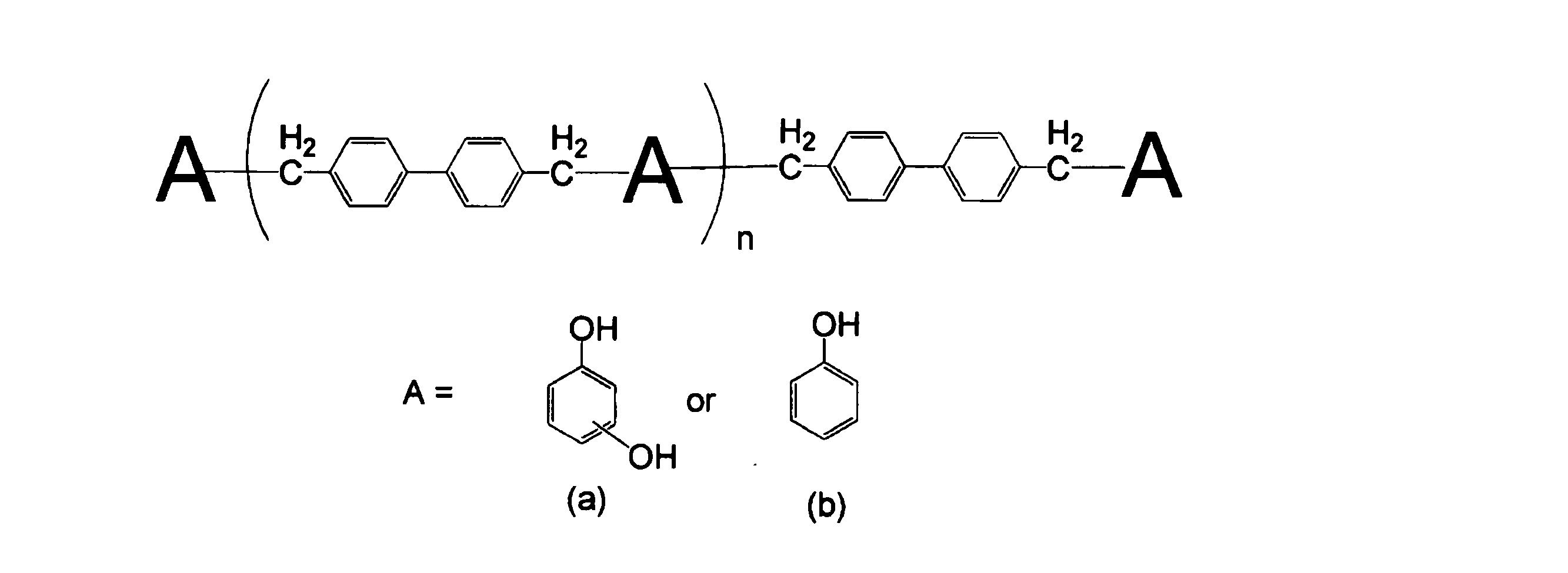
撹拌機、還流冷却管、撹拌装置を備えたフラスコに、窒素パージを施しながらWO2007/007827に準拠して製造した下記式で表されるフェノール樹脂((a)/(b)=1.3 n=1.5 水酸基当量134g/eq. 軟化点93℃)134部、エピクロロヒドリン450部、メタノール54部を加え、撹拌下で溶解し、70℃にまで昇温した。次いでフレーク状の水酸化ナトリウム42.5部を90分かけて分割添加した後、更に70℃で1時間反応を行った。反応終了後,水洗し、塩を除いた後、得られた有機層をロータリーエバポレーターを用いて減圧下、過剰のエピクロルヒドリン等の溶剤類を留去した。残留物にメチルイソブチルケトン500部を加え溶解し、撹拌下で30重量%の水酸化ナトリウム水溶液17部を加え、1時間反応を行った後、油層の洗浄水が中性になるまで水洗を行い、得られた溶液から、ロータリーエバポレーターを用いて減圧下にメチルイソブチルケトン等を留去することで式(1)のエポキシ樹脂(EP1)195部を得た。得られたエポキシ樹脂のエポキシ当量は211g/eq.軟化点71℃、150℃における溶融粘度(ICI溶融粘度 コーン#1)は0.34Pa・sであった。
撹拌機、還流冷却管、撹拌装置を備えたフラスコに、窒素パージを施しながらWO2007/007827に準拠して製造した下記式で表されるフェノール樹脂((a)/(b)=1.3 n=1.5 水酸基当量134g/eq. 軟化点93℃)134部、エピクロロヒドリン450部、メタノール54部を加え、撹拌下で溶解し、70℃にまで昇温した。次いでフレーク状の水酸化ナトリウム42.5部を90分かけて分割添加した後、更に70℃で1時間反応を行った。反応終了後,水洗し、塩を除いた後、得られた有機層をロータリーエバポレーターを用いて減圧下、過剰のエピクロルヒドリン等の溶剤類を留去した。残留物にメチルイソブチルケトン500部を加え溶解し、撹拌下で30重量%の水酸化ナトリウム水溶液17部を加え、1時間反応を行った後、油層の洗浄水が中性になるまで水洗を行い、得られた溶液から、ロータリーエバポレーターを用いて減圧下にメチルイソブチルケトン等を留去することで式(1)のエポキシ樹脂(EP1)195部を得た。得られたエポキシ樹脂のエポキシ当量は211g/eq.軟化点71℃、150℃における溶融粘度(ICI溶融粘度 コーン#1)は0.34Pa・sであった。
実施例1
合成例1で得られたエポキシ樹脂(EP1)を、エポキシ当量1モル当量に対し、硬化剤としてA-1(アミン当量198g/eq、活性水素当量97.5g/eq、軟化点55℃)を0.5当量で配合し、触媒としてサリチル酸をエポキシ樹脂100重量部に対し、1重量部となる割合(重量部)で配合し、ミキシングロールを用いて均一に混合・混練し、エポキシ樹脂組成物を得た。このエポキシ樹脂組成物をミキサーにて粉砕し、更にタブレットマシーンにてタブレット化した。このタブレット化されたエポキシ樹脂組成物をトランスファー成型(175℃×60秒)し、更に脱型後160℃×2時間+180℃×6時間の条件で硬化、評価用試験片を得た。評価結果を表1に示す。
なお、評価に使用したエポキシ樹脂の詳細は、以下、表2に示す。
合成例1で得られたエポキシ樹脂(EP1)を、エポキシ当量1モル当量に対し、硬化剤としてA-1(アミン当量198g/eq、活性水素当量97.5g/eq、軟化点55℃)を0.5当量で配合し、触媒としてサリチル酸をエポキシ樹脂100重量部に対し、1重量部となる割合(重量部)で配合し、ミキシングロールを用いて均一に混合・混練し、エポキシ樹脂組成物を得た。このエポキシ樹脂組成物をミキサーにて粉砕し、更にタブレットマシーンにてタブレット化した。このタブレット化されたエポキシ樹脂組成物をトランスファー成型(175℃×60秒)し、更に脱型後160℃×2時間+180℃×6時間の条件で硬化、評価用試験片を得た。評価結果を表1に示す。
なお、評価に使用したエポキシ樹脂の詳細は、以下、表2に示す。
比較例1~7
実施例1において、合成例1で得られたエポキシ樹脂(EP1)、および各種のエポキシ樹脂を、硬化剤としてA-1もしくはHA-1(明和化成工業(株)製 フェノールノボラック樹脂)を等当量、触媒としてトリフェニルホスフィン(TPP)もしくはサリチル酸を用いて、実施例1と同様の配合・方法にて比較用の評価用試験片を得た。評価結果を表1に示す。
実施例1において、合成例1で得られたエポキシ樹脂(EP1)、および各種のエポキシ樹脂を、硬化剤としてA-1もしくはHA-1(明和化成工業(株)製 フェノールノボラック樹脂)を等当量、触媒としてトリフェニルホスフィン(TPP)もしくはサリチル酸を用いて、実施例1と同様の配合・方法にて比較用の評価用試験片を得た。評価結果を表1に示す。


表1より、実施例1と比較例3を比較すると、硬化剤としてフェノール樹脂を用いることに比べてアミン系硬化剤を用いることで、特異的に耐熱性及び吸水特性が良好な硬化物ができていることが確認できた。
また、表1で得られた硬化物性を、横軸に耐熱性(Tg)と縦軸に吸水特性(%)をプロットしたグラフを図1に示す。
図1より、比較例1~3、比較例4~7の硬化物はTgが上がれば吸水率が上がるという相関関係を有することが確認できる。これに対し、式(1)のエポキシ樹脂とアミン系硬化剤を用いた硬化物は高い耐熱性を有しているにもかかわらず、吸水率が低く、前述の相関関係とは異なる特異的な組み合わせであることが確認できる。
図1より、比較例1~3、比較例4~7の硬化物はTgが上がれば吸水率が上がるという相関関係を有することが確認できる。これに対し、式(1)のエポキシ樹脂とアミン系硬化剤を用いた硬化物は高い耐熱性を有しているにもかかわらず、吸水率が低く、前述の相関関係とは異なる特異的な組み合わせであることが確認できる。
本発明を特定の態様を参照して詳細に説明したが、本発明の精神と範囲を離れることなく様々な変更および修正が可能であることは、当業者にとって明らかである。
なお、本出願は、2014年8月1日付で出願された日本国特許出願(特願2014-157629)に基づいており、その全体が引用により援用される。また、ここに引用されるすべての参照は全体として取り込まれる。
なお、本出願は、2014年8月1日付で出願された日本国特許出願(特願2014-157629)に基づいており、その全体が引用により援用される。また、ここに引用されるすべての参照は全体として取り込まれる。
本発明のエポキシ樹脂組成物は、その硬化物において高耐熱性と耐水性を同時に達成することのできる硬化物を与えるため、プリント配線基板やビルドアップ基板などの積層板を作製するのに極めて有用な材料である。
Claims (9)
- 下記一般式(1)で表されるエポキシ樹脂とアミン系硬化剤を必須成分とするエポキシ樹脂組成物。

- 請求項1に記載のエポキシ樹脂組成物を繊維基材に含浸してなるプリプレグ。
- 前記繊維基材がガラス繊維基材である請求項2に記載のプリプレグ。
- 前記ガラス繊維基材がTガラス、Sガラス、Eガラス、NEガラス、および石英ガラスからなる群から選ばれる少なくとも一種を含む、請求項3に記載のプリプレグ。
- 請求項2及至請求項4のいずれか一項に記載のプリプレグの少なくとも一方の面に金属箔が積層された、金属張積層板。
- 請求項1に記載のエポキシ樹脂組成物からなる絶縁層をフィルム上に、又は金属箔上に形成してなる樹脂シート。
- 請求項5に記載の金属張積層板を内層回路基板に用いてなるプリント配線基板。
- 請求項2及至請求項4のいずれか一項に記載のプリプレグ又は請求項6に記載の樹脂シートを硬化してなるプリント配線基板。
- 請求項7又は請求項8に記載のプリント配線基板に半導体素子を搭載してなる半導体装置。
Priority Applications (2)
| Application Number | Priority Date | Filing Date | Title |
|---|---|---|---|
| KR1020167032745A KR102316144B1 (ko) | 2014-08-01 | 2015-07-30 | 에폭시 수지 조성물, 수지 시트, 프리프레그 및 금속장 적층판, 프린트 배선기판, 반도체 장치 |
| CN201580037762.1A CN106661200B (zh) | 2014-08-01 | 2015-07-30 | 环氧树脂组合物、树脂片、预浸料及覆金属层叠板、印刷布线基板、半导体装置 |
Applications Claiming Priority (2)
| Application Number | Priority Date | Filing Date | Title |
|---|---|---|---|
| JP2014-157629 | 2014-08-01 | ||
| JP2014157629A JP2016034996A (ja) | 2014-08-01 | 2014-08-01 | エポキシ樹脂組成物、プリプレグ及び金属張積層板、プリント配線基板 |
Publications (1)
| Publication Number | Publication Date |
|---|---|
| WO2016017751A1 true WO2016017751A1 (ja) | 2016-02-04 |
Family
ID=55217648
Family Applications (1)
| Application Number | Title | Priority Date | Filing Date |
|---|---|---|---|
| PCT/JP2015/071632 Ceased WO2016017751A1 (ja) | 2014-08-01 | 2015-07-30 | エポキシ樹脂組成物、樹脂シート、プリプレグ及び金属張積層板、プリント配線基板、半導体装置 |
Country Status (5)
| Country | Link |
|---|---|
| JP (1) | JP2016034996A (ja) |
| KR (1) | KR102316144B1 (ja) |
| CN (1) | CN106661200B (ja) |
| TW (1) | TWI664226B (ja) |
| WO (1) | WO2016017751A1 (ja) |
Cited By (4)
| Publication number | Priority date | Publication date | Assignee | Title |
|---|---|---|---|---|
| WO2018174446A1 (ko) * | 2017-03-22 | 2018-09-27 | 주식회사 엘지화학 | 반도체 패키지용 수지 조성물과 이를 이용한 프리프레그 및 금속박 적층판 |
| WO2018174447A1 (ko) * | 2017-03-22 | 2018-09-27 | 주식회사 엘지화학 | 반도체 패키지용 수지 조성물과 이를 이용한 프리프레그 및 금속박 적층판 |
| KR20180107709A (ko) * | 2017-03-22 | 2018-10-02 | 주식회사 엘지화학 | 반도체 패키지용 수지 조성물과 이를 이용한 프리프레그 및 금속박 적층판 |
| CN109661421A (zh) * | 2017-03-22 | 2019-04-19 | 株式会社Lg化学 | 用于半导体封装的树脂组合物、使用其的预浸料和金属包层层合体 |
Families Citing this family (5)
| Publication number | Priority date | Publication date | Assignee | Title |
|---|---|---|---|---|
| TWI765147B (zh) | 2018-04-10 | 2022-05-21 | 南韓商Lg化學股份有限公司 | 用於金屬包覆積層板的熱固性樹脂複合物及使用其之金屬包覆積層板 |
| KR102246974B1 (ko) * | 2018-04-10 | 2021-04-30 | 주식회사 엘지화학 | 반도체 패키지용 열경화성 수지 조성물, 프리프레그 및 금속박 적층판 |
| KR102257926B1 (ko) | 2018-09-20 | 2021-05-28 | 주식회사 엘지화학 | 다층인쇄회로기판, 이의 제조방법 및 이를 이용한 반도체 장치 |
| JP6636599B2 (ja) * | 2018-11-30 | 2020-01-29 | 日本化薬株式会社 | エポキシ樹脂組成物、プリプレグ及び金属張積層板、プリント配線基板 |
| CN121574499A (zh) * | 2026-01-23 | 2026-02-27 | 湖北珍正峰新材料有限公司 | 一种耐温型多官能团环氧树脂及其制备方法 |
Citations (4)
| Publication number | Priority date | Publication date | Assignee | Title |
|---|---|---|---|---|
| JPH07292066A (ja) * | 1994-04-28 | 1995-11-07 | Nippon Kayaku Co Ltd | エポキシ樹脂、エポキシ樹脂組成物及びその硬化物 |
| JP2004189811A (ja) * | 2002-12-10 | 2004-07-08 | Toho Tenax Co Ltd | 織物プリプレグ |
| WO2011132674A1 (ja) * | 2010-04-21 | 2011-10-27 | 三菱瓦斯化学株式会社 | 熱硬化性組成物 |
| JP2013043958A (ja) * | 2011-08-25 | 2013-03-04 | Meiwa Kasei Kk | エポキシ樹脂、エポキシ樹脂の製造方法、及びその使用 |
Family Cites Families (6)
| Publication number | Priority date | Publication date | Assignee | Title |
|---|---|---|---|---|
| JPH05170874A (ja) * | 1991-12-19 | 1993-07-09 | Mitsui Toatsu Chem Inc | エポキシ樹脂組成物 |
| JP3525152B2 (ja) * | 1996-09-30 | 2004-05-10 | 独立行政法人 科学技術振興機構 | エポキシ樹脂硬化性組成物 |
| JP5195582B2 (ja) * | 2009-03-30 | 2013-05-08 | 日立化成株式会社 | 熱硬化性絶縁樹脂組成物、並びにこれを用いた支持体付絶縁フィルム、プリプレグ、積層板及び多層プリント配線板 |
| KR101295688B1 (ko) | 2011-10-21 | 2013-08-14 | 부산대학교 산학협력단 | 유체의 회전을 이용한 액화천연가스 저장탱크의 슬로싱 저감장치 |
| JP6410405B2 (ja) * | 2012-08-01 | 2018-10-24 | 住友ベークライト株式会社 | 樹脂基板、プリプレグ、プリント配線基板、半導体装置 |
| CN103897143B (zh) * | 2012-12-28 | 2018-05-01 | 明和化成株式会社 | 环氧树脂、环氧树脂的制造方法及其使用 |
-
2014
- 2014-08-01 JP JP2014157629A patent/JP2016034996A/ja active Pending
-
2015
- 2015-07-30 CN CN201580037762.1A patent/CN106661200B/zh active Active
- 2015-07-30 KR KR1020167032745A patent/KR102316144B1/ko active Active
- 2015-07-30 WO PCT/JP2015/071632 patent/WO2016017751A1/ja not_active Ceased
- 2015-07-31 TW TW104124878A patent/TWI664226B/zh active
Patent Citations (4)
| Publication number | Priority date | Publication date | Assignee | Title |
|---|---|---|---|---|
| JPH07292066A (ja) * | 1994-04-28 | 1995-11-07 | Nippon Kayaku Co Ltd | エポキシ樹脂、エポキシ樹脂組成物及びその硬化物 |
| JP2004189811A (ja) * | 2002-12-10 | 2004-07-08 | Toho Tenax Co Ltd | 織物プリプレグ |
| WO2011132674A1 (ja) * | 2010-04-21 | 2011-10-27 | 三菱瓦斯化学株式会社 | 熱硬化性組成物 |
| JP2013043958A (ja) * | 2011-08-25 | 2013-03-04 | Meiwa Kasei Kk | エポキシ樹脂、エポキシ樹脂の製造方法、及びその使用 |
Cited By (10)
| Publication number | Priority date | Publication date | Assignee | Title |
|---|---|---|---|---|
| WO2018174446A1 (ko) * | 2017-03-22 | 2018-09-27 | 주식회사 엘지화학 | 반도체 패키지용 수지 조성물과 이를 이용한 프리프레그 및 금속박 적층판 |
| WO2018174447A1 (ko) * | 2017-03-22 | 2018-09-27 | 주식회사 엘지화학 | 반도체 패키지용 수지 조성물과 이를 이용한 프리프레그 및 금속박 적층판 |
| KR20180107709A (ko) * | 2017-03-22 | 2018-10-02 | 주식회사 엘지화학 | 반도체 패키지용 수지 조성물과 이를 이용한 프리프레그 및 금속박 적층판 |
| CN109661422A (zh) * | 2017-03-22 | 2019-04-19 | 株式会社Lg化学 | 用于半导体封装的树脂组合物、使用其的预浸料和金属包层层合体 |
| CN109661421A (zh) * | 2017-03-22 | 2019-04-19 | 株式会社Lg化学 | 用于半导体封装的树脂组合物、使用其的预浸料和金属包层层合体 |
| KR102049024B1 (ko) * | 2017-03-22 | 2019-11-26 | 주식회사 엘지화학 | 반도체 패키지용 수지 조성물과 이를 이용한 프리프레그 및 금속박 적층판 |
| CN109661422B (zh) * | 2017-03-22 | 2021-01-26 | 株式会社Lg化学 | 用于半导体封装的树脂组合物、使用其的预浸料和金属包层层合体 |
| CN109661421B (zh) * | 2017-03-22 | 2021-02-09 | 株式会社Lg化学 | 用于半导体封装的树脂组合物、使用其的预浸料和金属包层层合体 |
| US11091630B2 (en) | 2017-03-22 | 2021-08-17 | Lg Chem, Ltd | Resin composition for semiconductor package, prepreg, and metal clad laminate using the same |
| US11214677B2 (en) | 2017-03-22 | 2022-01-04 | Lg Chem, Ltd. | Resin composition for semiconductor package, prepreg and metal clad laminate using the same |
Also Published As
| Publication number | Publication date |
|---|---|
| JP2016034996A (ja) | 2016-03-17 |
| TW201609946A (zh) | 2016-03-16 |
| TWI664226B (zh) | 2019-07-01 |
| KR102316144B1 (ko) | 2021-10-22 |
| KR20170037883A (ko) | 2017-04-05 |
| CN106661200A (zh) | 2017-05-10 |
| CN106661200B (zh) | 2019-12-24 |
Similar Documents
| Publication | Publication Date | Title |
|---|---|---|
| KR102316144B1 (ko) | 에폭시 수지 조성물, 수지 시트, 프리프레그 및 금속장 적층판, 프린트 배선기판, 반도체 장치 | |
| CN104341581B (zh) | 环氧树脂组合物及其固化物 | |
| JP6366136B2 (ja) | エポキシ樹脂組成物、樹脂シート、プリプレグ及び金属張積層板、プリント配線基板 | |
| JP6785125B2 (ja) | エポキシ樹脂組成物、硬化物、半導体素子、樹脂シート、プリプレグ及び炭素繊維強化複合材料 | |
| TWI662056B (zh) | 含環氧樹脂之清漆、含環氧樹脂組成物之清漆、預浸體、樹脂片、積層板、印刷配線基板、半導體裝置 | |
| JP2020176189A (ja) | エポキシ樹脂、硬化性樹脂組成物、およびその硬化物 | |
| JP7240989B2 (ja) | 硬化性樹脂組成物およびその硬化物 | |
| JP6636599B2 (ja) | エポキシ樹脂組成物、プリプレグ及び金属張積層板、プリント配線基板 | |
| JP6932116B2 (ja) | エポキシ樹脂含有ワニス、エポキシ樹脂組成物含有ワニス、プリプレグ、樹脂シート、プリント配線板、半導体装置 | |
| CN112105673B (zh) | 具有n-烷基的芳香族胺树脂、硬化性树脂组合物及其硬化物 | |
| JP7195372B2 (ja) | エポキシ樹脂含有ワニス、エポキシ樹脂組成物含有ワニス、プリプレグ、樹脂シート、プリント配線板、半導体装置 | |
| JP7594711B1 (ja) | 硬化性樹脂組成物およびその硬化物 | |
| TW202415695A (zh) | 活性酯樹脂及其製造方法、環氧樹脂組成物、環氧樹脂組成物的硬化物、預浸體、樹脂片材、積層板及電路基板用材料 | |
| WO2024203145A1 (ja) | 硬化性樹脂組成物およびその硬化物 | |
| JP2025090987A (ja) | 硬化性樹脂組成物およびその硬化物 | |
| CN116234851A (zh) | 环氧树脂、硬化性树脂组合物、及其硬化物 | |
| CN116670199A (zh) | 环氧树脂及其制造方法、硬化性树脂组合物、及其硬化物 | |
| JP2007284583A (ja) | エポキシ樹脂、硬化性樹脂組成物、およびその硬化物 | |
| JP2007045978A (ja) | エポキシ樹脂、エポキシ樹脂組成物、およびその硬化物 | |
| JP2011052224A (ja) | エポキシ樹脂組成物及びその硬化物 |
Legal Events
| Date | Code | Title | Description |
|---|---|---|---|
| 121 | Ep: the epo has been informed by wipo that ep was designated in this application |
Ref document number: 15826936 Country of ref document: EP Kind code of ref document: A1 |
|
| ENP | Entry into the national phase |
Ref document number: 20167032745 Country of ref document: KR Kind code of ref document: A |
|
| NENP | Non-entry into the national phase |
Ref country code: DE |
|
| 122 | Ep: pct application non-entry in european phase |
Ref document number: 15826936 Country of ref document: EP Kind code of ref document: A1 |