WO2015186532A1 - 多孔質フィルムおよび収納袋 - Google Patents
多孔質フィルムおよび収納袋 Download PDFInfo
- Publication number
- WO2015186532A1 WO2015186532A1 PCT/JP2015/064663 JP2015064663W WO2015186532A1 WO 2015186532 A1 WO2015186532 A1 WO 2015186532A1 JP 2015064663 W JP2015064663 W JP 2015064663W WO 2015186532 A1 WO2015186532 A1 WO 2015186532A1
- Authority
- WO
- WIPO (PCT)
- Prior art keywords
- porous film
- density polyethylene
- parts
- mass
- low density
- Prior art date
- Legal status (The legal status is an assumption and is not a legal conclusion. Google has not performed a legal analysis and makes no representation as to the accuracy of the status listed.)
- Ceased
Links
Images

Classifications
-
- A—HUMAN NECESSITIES
- A61—MEDICAL OR VETERINARY SCIENCE; HYGIENE
- A61F—FILTERS IMPLANTABLE INTO BLOOD VESSELS; PROSTHESES; DEVICES PROVIDING PATENCY TO, OR PREVENTING COLLAPSING OF, TUBULAR STRUCTURES OF THE BODY, e.g. STENTS; ORTHOPAEDIC, NURSING OR CONTRACEPTIVE DEVICES; FOMENTATION; TREATMENT OR PROTECTION OF EYES OR EARS; BANDAGES, DRESSINGS OR ABSORBENT PADS; FIRST-AID KITS
- A61F7/00—Heating or cooling appliances for medical or therapeutic treatment of the human body
- A61F7/02—Compresses or poultices for effecting heating or cooling
- A61F7/03—Compresses or poultices for effecting heating or cooling thermophore, i.e. self-heating, e.g. using a chemical reaction
-
- C—CHEMISTRY; METALLURGY
- C08—ORGANIC MACROMOLECULAR COMPOUNDS; THEIR PREPARATION OR CHEMICAL WORKING-UP; COMPOSITIONS BASED THEREON
- C08J—WORKING-UP; GENERAL PROCESSES OF COMPOUNDING; AFTER-TREATMENT NOT COVERED BY SUBCLASSES C08B, C08C, C08F, C08G or C08H
- C08J9/00—Working-up of macromolecular substances to porous or cellular articles or materials; After-treatment thereof
-
- C—CHEMISTRY; METALLURGY
- C08—ORGANIC MACROMOLECULAR COMPOUNDS; THEIR PREPARATION OR CHEMICAL WORKING-UP; COMPOSITIONS BASED THEREON
- C08K—Use of inorganic or non-macromolecular organic substances as compounding ingredients
- C08K3/00—Use of inorganic substances as compounding ingredients
-
- C—CHEMISTRY; METALLURGY
- C08—ORGANIC MACROMOLECULAR COMPOUNDS; THEIR PREPARATION OR CHEMICAL WORKING-UP; COMPOSITIONS BASED THEREON
- C08L—COMPOSITIONS OF MACROMOLECULAR COMPOUNDS
- C08L23/00—Compositions of homopolymers or copolymers of unsaturated aliphatic hydrocarbons having only one carbon-to-carbon double bond; Compositions of derivatives of such polymers
- C08L23/02—Compositions of homopolymers or copolymers of unsaturated aliphatic hydrocarbons having only one carbon-to-carbon double bond; Compositions of derivatives of such polymers not modified by chemical after-treatment
- C08L23/04—Homopolymers or copolymers of ethene
Definitions
- the present invention relates to a porous film and a storage bag comprising the porous film, and more specifically, a high-strength and thin-film porous film excellent in heat sealability, hot tackiness and air permeability, and the porous film. It is suitably used as a storage bag for storing heat-sealing materials such as disposable warmers and hot compresses by heat sealing.
- JP-A-10-152570 discloses a porous film having excellent heat sealability used as the storage bag, together with polyethylene resin, ethylene-vinyl acetate copolymer (EVA), ethylene-ethyl acrylate copolymer.
- EVA ethylene-vinyl acetate copolymer
- EMA ethylene-methacrylic acid copolymer
- Patent Document 2 contains a layer containing a low melting point metallocene polyethylene resin and a high melting point polyethylene resin as a porous film for a heat sealing bag constituting member.
- a laminated porous film in which layers are laminated is provided.
- the laminated porous film is improved in mechanical properties and heat sealability by providing the low melting point easy heat seal layer on the surface layer.
- the porous film described in Patent Document 1 that is, an ethylene copolymer having a polar group such as EVA, EEA, and EMA, is excellent in adhesiveness with a base material, but has poor thermal stability. There are various problems such as generation of resin burns and yellowing of the porous film. Moreover, since the laminated porous film containing polyethylene with different melting points described in Patent Document 2 has a laminated structure, it is difficult to reuse and recycle defective products from resin raw materials, and there is a problem of low economic efficiency.
- the peripheral edges of the porous film in the machine flow direction (MD) and the transverse direction (TD) are heat sealed.
- the seal temperature control is a single control.
- a general porous film is strongly oriented to MD by extrusion and stretching, MD and TD have different heat seal temperatures (thermal conductivity). Therefore, it is required to make the heat sealing temperature range wider and lower temperature to enable high-speed filling.
- a heating element such as iron powder is filled immediately after heat sealing, hot tack property that prevents the bag from being broken even at a high temperature is important.
- the ventilation heating elements such as disposable warmers and hot compresses may generate abnormal heat, and the user may receive low-temperature burns. Is important.
- the appearance of the porous film is good, that is, there is no stretching unevenness and thickness unevenness and it is uniform.
- causes of unevenness in stretching and thickness are the instability of the original fabric that occurs when the film is transported at high speed and formed into a film (sway of the film due to vibration of the transport), draw resonance (unstable extrusion of molten resin) Pulsation of extruded resin, etc.), variation in cooling and solidification, and defective or unstable operation of equipment.
- the present invention has been made in view of the above-mentioned problems and importance, and has a performance required for a porous film used for a storage bag for a ventilating and exothermic substance such as a disposable body warmer and a hot compress. It is. That is, the present invention is a high-strength and thin film that does not use an ethylene copolymer having a polar group such as EVA, EEA, or EMA in addition to excellent heat sealability, hot tackiness, and quality stability. It is an object to provide a porous film having a layer structure and a storage bag made of the porous film.
- the present invention provides 50 parts by mass or more of linear low density polyethylene (LLDPE), high pressure polymerization low density polyethylene (HP-LDPE) and metallocene linear low density polyethylene (m-LLDPE).
- LLDPE linear low density polyethylene
- HP-LDPE high pressure polymerization low density polyethylene
- m-LLDPE metallocene linear low density polyethylene
- MD machine flow direction
- the porous film is characterized by having a heat seal temperature of 90 ° C. or higher and a heat seal maximum strength of 4.0 N / 50 mm or higher.
- the linear low density polyethylene has a density of 0.910 to 0.940 g / cm 3 , a melting point of 110 to 130 ° C., a blending amount of 55 to 92 parts by mass
- High-pressure polymerization low density polyethylene HP-LDPE
- HP-LDPE High-pressure polymerization low density polyethylene
- m- LLDPE metallocene linear low density polyethylene
- the polyethylene resin composition used in the present invention preferably contains high density polyethylene (HDPE; density 0.940 to 0.970 g / cm 3 , melting point 125 to 145 ° C.).
- the porous film of the present invention preferably has a basis weight of 10 to 100 g / m 2 . Furthermore, the porous film of the present invention has a difference TD (max) ⁇ which is the difference between the minimum fusion temperature MD (min) in the machine flow direction (MD) and the maximum fusion temperature TD (max) in the transverse direction (TD).
- the MD (min) is preferably 1 ° C. or higher.
- the porous film of the present invention is preferably a film that is made porous at a stretch ratio of 2.5 to 5.0 times in at least a uniaxial direction.
- the present invention provides a storage bag of a ventilation exothermic substance including at least one layer of the porous film and having an opening edge bonded by heat sealing, and is particularly preferably used as a storage bag for a disposable body warmer. It is done.
- the porous film of the present invention is a porous film that does not use an ethylene copolymer such as EVA, EEA, or EMA that is expensive and has poor thermal stability, it is excellent in economy and productivity. Further, it has a high strength and a thin film, and has a suitable air permeability and a heat sealing property and a hot tack property suitable for high-speed filling processing of a heating element, and can be more suitably used as a storage bag for a ventilation heat generating material.
- gas_flowing exothermic substance of this invention is shown.
- gas_flowing exothermic substance of this invention is shown.
- the porous film of this invention contains the resin composition which mix
- the polyethylene resin composition comprises 50 parts by mass or more of linear low density polyethylene (A) (LLDPE), high pressure polymerization low density polyethylene (B) (HP-LDPE) and metallocene linear low density polyethylene (C). (M-LLDPE) and a polyethylene resin composition containing less than 50 parts by mass in total.
- the porous film of the present invention is a porous film containing a resin composition in which 50 to 200 parts by mass of an inorganic filler is blended with 100 parts by mass of the polyethylene resin composition, and has a machine flow direction (MD).
- the heat seal temperature is 90 ° C. or higher, and the maximum heat seal strength is 4.0 N / 50 mm or higher.
- the linear low density polyethylene (A) (LLDPE) serving as a base material preferably has a density of 0.910 to 0.940 g / cm 3 and a melting point of 110 to 130 ° C. Is preferably 55 to 92 parts by mass.
- the high-pressure polymerization low-density polyethylene (B) (HP-LDPE) to be blended with the substrate preferably has a density of 0.910 to 0.930 g / cm 3 and a melting point of 100 to 120 ° C. The amount is preferably 3 to 15 parts by mass.
- the metallocene linear low density polyethylene (C) (m-LLDPE) preferably has a density of 0.880 to 0.930 g / cm 3 and a melting point of 85 to 130 ° C. It is preferable that it is a mass part.
- the polyethylene resin composition of the present invention does not contain any ethylene copolymer composed of EVA, EEA, and EMA.
- the inorganic filler is preferably blended in an amount of 50 to 200 parts by weight, more preferably 60 to 150 parts by weight, with respect to 100 parts by weight of the polyethylene resin composition.
- the blending amount of the inorganic filler is less than 50 parts by mass, it is difficult to develop an appropriate air permeability, and when it exceeds 200 parts by mass, the strength and waterproofness of the film are lowered.
- Linear low density polyethylene (A) (LLDPE) used as the substrate examples include ethylene-propylene, ethylene- (1-butene), ethylene- (1-hexene), and ethylene- (4-methyl-1-pentene).
- ethylene- ( ⁇ -olefin) copolymers such as ethylene- (1-octene) can be used.
- Any linear low density polyethylene (excluding metallocene linear low density polyethylene (C)) polymerized by a conventional porous film polymerized by a multi-site catalyst such as Ziegler type or Philips type can be used. .
- the linear low density polyethylene (A) is a DSC in which the density by the pycnometer method (JIS K7112B method) is set to 0.910 to 0.940 g / cm 3 and the scanning speed is set to 10 ° C./min.
- the melting point according to the melting peak temperature (JIS K7121) when measured in (110) is preferably 110 to 130 ° C.
- the MFR at 190 ° C. and a 2.16 kg load (JIS K7210 condition D) is preferably 0.5 to 10 g / 10 min.
- the blending amount of the linear low-density polyethylene (A) is 50 parts by mass or more with respect to 100 parts by mass of the polyethylene resin composition. By being 50 mass parts or more, sufficient hot tack property can be ensured.
- the upper limit is not particularly limited, but since it is preferable to blend the component (B) and the component (C) described later in detail, the blending amount of the component (A) is preferably 55 to 92. Part by mass, more preferably 60 to 80 parts by mass.
- the high pressure polymerization low density polyethylene (B) (HP-LDPE) preferably has a density of 0.910 to 0.930 g / cm 3 and a melting point of 100 to 120 ° C.
- the MFR is preferably 0.5 to 10 g / 10 min.
- the component (B) is preferably blended in an amount of 3 to 15 parts by weight, more preferably 5 to 10 parts by weight, although the preferred blending amount varies depending on the molding method. Since the blending amount of the component (B) is in the range of 3 to 15 parts by mass, shaking of the original fabric, draw resonance, etc. that occur when the original fabric is conveyed at a high speed and formed into a film shape are suppressed. A porous film having a uniform thickness and air permeability can be obtained.
- the said (B) component does not have limitation in particular, such as a manufacturer and a grade, A commercial item can be used arbitrarily.
- Metallocene-based linear low-density polyethylene (C) (m-LLDPE) was polymerized with highly active single-site catalysts such as zirconocene, titanocene, hafnocene (collectively metallocene) Kaminsky catalyst, post metallocene catalyst, etc. It refers to an ethylene- ( ⁇ -olefin) copolymer.
- the metallocene linear low density polyethylene (C) is characterized by improved kneadability and uniform dispersibility of the inorganic filler, improved molding processability to a thin film, low modulus and low melting point. This contributes to the improvement of low-temperature heat sealability, in addition to the reduction of stretching and uneven stretching, and is different from the function of the linear low-density polyethylene (A).
- the metallocene linear low density polyethylene those having a density of 0.880 to 0.930 g / cm 3 and a melting point of 85 to 130 ° C. are preferably used in view of the above characteristics and purposes.
- the density and melting point are smaller than the upper limit of the range, heat sealability, hot tack, uniformity of air permeability and the like are good, and when larger than the lower limit of the range, there is no extreme deterioration in mechanical properties, Troubles such as film-to-film blocking and fusion during molding process do not occur.
- MFR is preferable from the viewpoints of uniform film formability by extrusion molding method, air permeability of the resulting porous film, uniformity of heat sealability, and prevention of breakage at the time of fusion due to a decrease in film mechanical strength.
- the blending amount is preferably 5 to 30 parts by mass, and more preferably 15 to 30 parts by mass.
- metallocene linear low density polyethylene examples include “Kernel” and “Harmolex” manufactured by Nippon Polyethylene Co., Ltd., “Evolue” manufactured by Prime Polymer Co., Ltd., and Sumitomo Chemical Co., Ltd. "Sumikasen E”, “Excellen FX”, “ELITE” manufactured by Dow Chemical Company, “Enable”, “Exceed” manufactured by Exxon Mobil Chemical Company, and the like.
- high-density polyethylene (D) (HDPE) may be added to the polyethylene resin composition of the present invention.
- the production method is not particularly limited, such as a low-pressure method (Ziegler method) and a medium-pressure method (Phillips method, standard method).
- the high density polyethylene (D) has a density of 0.940 to 0.970 g / cm 3 , an MFR of 0.5 to 10 g / 10 min, a melting point of 125 to 145 ° C., and a blending amount of 3 to 30% by mass in the polyethylene resin composition. It is preferable that it is the range of these.
- Examples of the inorganic filler to be blended in the polyethylene resin composition include fine particles such as calcium carbonate, calcium sulfate, barium carbonate, barium sulfate, titanium oxide, talc, clay, kaolinite, and montmorillonite, and minerals.
- an inorganic filler composed of calcium carbonate and barium sulfate is suitably used because of the advantages of the porousness of the film to be produced, high versatility, low cost and variety of kinds.
- the average particle size of the inorganic filler is preferably 0.5 to 5 ⁇ m, more preferably 0.8 to 3 ⁇ m.
- the thickness By setting the thickness to 0.5 ⁇ m or more, there is no dispersion distribution failure and secondary aggregation, and uniform dispersion can be achieved. On the other hand, when the thickness is 5 ⁇ m or less, strength and water resistance can be sufficiently ensured without generating large voids when the film is thinned.
- the inorganic filler is coated with fine particles of fatty acid, fatty acid ester or the like in advance so that the surface of the fine particles can be easily blended with the polyethylene resin.
- additives may be added as necessary. Specifically, higher fatty acid, higher fatty acid ester, higher fatty acid amide, metal soap, higher alcohol, petrolatum, paraffin wax, glycerin fatty acid ester, polyglycerin fatty acid ester, sorbitan fatty acid ester, propylene glycol fatty acid ester, castor oil, hydrogenated castor oil Additives that favorably disperse plasticizers such as hardened castor oil, dehydrated castor oil, aromatic esters, aromatic amides and polyethers, low molecular weight polymers (oligomers) such as polyester, lubricants, and inorganic fillers.
- plasticizers such as hardened castor oil, dehydrated castor oil, aromatic esters, aromatic amides and polyethers, low molecular weight polymers (oligomers) such as polyester, lubricants, and inorganic fillers.
- compatibilizers In addition to the above additives, compatibilizers, processing aids, antioxidants, heat stabilizers, light stabilizers, ultraviolet absorbers, antiblocking agents, antifogging agents, matting agents, depending on the intended use
- An appropriate amount of antibacterial agent, deodorant, antistatic agent, flame retardant, colorant, pigment, and the like may be added to the resin composition.
- Method for producing porous film After mixing the above-mentioned polyethylene resin (linear low density polyethylene (A), high pressure polymerization method low density polyethylene (B), metallocene linear low density polyethylene (C)), inorganic filler, etc. with a mixer And melt kneading with a kneader. Specifically, after mixing for a required time with a mixer such as a tumbler mixer, mixing roll, Banbury mixer, ribbon blender, super mixer, etc., using a kneader such as a different direction twin screw extruder or the same direction twin screw extruder, Promotes uniform distribution of the kneaded product.
- a mixer such as a tumbler mixer, mixing roll, Banbury mixer, ribbon blender, super mixer, etc.
- polyethylene resin, inorganic filler and the like can be directly fed into an extruder and kneaded without being mixed and dispersed by a mixer.
- the kneaded resin composition is preferably pelletized once by a method such as strand cutting or die cutting, but it may be formed into a film-like raw material through a die as it is.
- the kneaded resin composition is made into a film-shaped raw material by a method such as melt extrusion.
- the method for producing the film-shaped original fabric is not limited, and a film-shaped original fabric may be produced using a known method, but from the viewpoint of production efficiency, cost, etc., after melt extrusion of the resin composition, A method of forming into a film by a forming method such as inflation, tubular, or T-die is preferable, and inflation is more preferable.
- a stretch opening method is common, but the method is not limited.
- a known stretching method such as a biaxial stretching method such as a roll stretching method, a tenter method, a simultaneous method, or a sequential method can be applied. In the present invention, it may be carried out at least once in a uniaxial direction, or twice or more in consideration of stretching unevenness and air permeability.
- the stretching temperature is preferably 0 to 90 ° C, more preferably 40 to 90 ° C.
- the stretching ratio is preferably 2.5 to 5.0 times in total, and more preferably 3.0 to 4.5 times in total.
- the porous film By setting the draw ratio to 2.5 times or more in total, a porous film that is drawn uniformly and has a sufficiently excellent appearance can be obtained. Therefore, when the porous film is used as a storage bag for a ventilation exothermic composition, the porous film has sufficiently uniform air permeability, so that abnormal heat generation of a ventilation heating element such as a disposable body warmer can be suppressed.
- the stretch ratio is 5.0 or less in total, a heat-sealing property can be sufficiently secured when heat-sealing the four sides of the storage bag, and a porous film having a balanced mechanical property can be obtained. can get.
- heat setting refers to suppressing the shrinkage of the product roll by heating the film in advance and causing the film to thermally shrink.
- the roll stretching method there is a method in which the draw ratio (ratio of winding side roll speed / unwinding side roll speed) is set to a negative number while heating the stretched film with a heated roll (annealing roll).
- the tenter stretching method the film is heated in the vicinity of the tenter exit, and the film is self-contracted by making the clip width at both ends narrower than the width after stretching.
- the heat setting temperature in the present invention is preferably 70 to 120 ° C.
- the negative draw ratio is preferably ⁇ 20 to ⁇ 5% in total, and if it is within the specified range, heat fixation can be performed without any trouble in production, and sufficient thermal dimensional stability can be obtained. Further, similarly to the stretching, the heat setting may be divided into a plurality of times.
- the storage bag of the present invention is a storage bag of a ventilation exothermic composition containing at least one layer of the porous film of the present invention and having an opening edge bonded by heat sealing. More specifically, the storage bag of the present invention is a bag formed using the porous film of the present invention on the entire surface or one surface.
- the storage bag can be in the form of a conventional bag (such as a four-sided bag, a three-sided bag, or a pillow bag) such as a bag formed by joining the edges of a porous film.
- a fusion method is preferably used from the viewpoint of the production efficiency of the storage bag, etc., and heat fusion, ultrasonic fusion, etc.
- a publicly known system can be adopted, and the storage bag of the present invention is bonded by heat sealing by heat sealing.
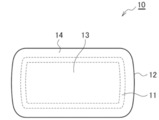
- a storage bag 12 shown in FIGS. 1A and 1B is formed from the porous film 11 of the present invention, and uses the air permeability of the porous film 11 to store the ventilation heat-generating substance 13 of the disposable warmer 10. It is said.
- the storage bag 12 is a four-sided bag, the ventilation heat-generating substance 13 of the disposable warmer 10 is disposed between the porous films 11 on both sides, and the four-side periphery is joined by a heat seal part 14 to form the disposable warmer 10. Yes.
- a storage bag is not limited to a four-sided bag, It is good also as another above-mentioned bag form.
- the air permeability of the porous film 11 used as a storage bag is 500 to 50,000 seconds / 100 ml so that the temperature is appropriate according to the site of the aeration exothermic substance 13 that generates heat based on the air permeability.
- the air permeability refers to an air permeability measuring device (Asahi Seiko Co., Ltd., Oken type air permeability measuring device, EGO1-55 type) according to the method defined in JIS P8117 (Gurley tester method). ) Means the one specified by the measuring method.
- the basis weight of the porous film 1 is preferably 10 to 100 g / m 2 , more preferably 30 to 100 g / m 2 , and still more preferably 40 to 80 g / m 2 .
- the basis weight is 10 g / m 2 or more, the tensile strength, tear strength, and rigidity of the porous film can be sufficiently secured as a storage bag for a breathable exothermic substance such as a disposable body warmer or a hot compress.
- a sufficient lightweight feeling can be obtained.
- the heat seal temperature in the machine flow direction (MD) of the porous film 1 of the present invention is 90 ° C. or higher, preferably 95 ° C. or higher.
- the heat seal temperature in this invention says what is measured by the method as described in an Example.
- the heat seal maximum strength of the porous film 1 of the present invention is 4.0 N / 50 mm or more, and preferably 6.0 N / 50 mm or more.
- problems such as breakage of the storage bag and exposure of the heating element can be sufficiently solved when used as a storage bag for a ventilating heat-generating substance such as a disposable body warmer or a warm compress.
- the heat seal maximum strength in this invention says what is measured by the method as described in an Example.
- the porous film of the present invention has a difference TD (max) that is a difference between the minimum fusion temperature MD (min) in the machine flow direction (MD) and the maximum fusion temperature TD (max) in the transverse direction (TD).
- -MD (min) is preferably 1 ° C or higher.
- this temperature difference is 1 ° C. or more
- TD (max) ⁇ MD (min) is preferably 6 ° C. or more, and more preferably 10 ° C. or more.
- Example and comparative example of this invention are described, this invention is not limited to these.
- the raw materials and compositions of Examples 1 to 3 and Comparative Examples 1 to 5 are shown in Table 1.
- LLDPE (A-1) Linear low-density polyethylene (A-1) uses Novatec LL UF230 (density 0.920 g / cm 3 , MFR 1.0 g / 10 min, melting point 122 ° C.) manufactured by Nippon Polyethylene Co., Ltd. did.
- HP-LDPE High-pressure polymerization method
- Low-density polyethylene B
- Novatec LD LF441 density 0.923 g / cm 3 , MFR 2.3 g / 10 min, melting point 110 ° C.
- m-LLDPE Metallocene linear low density polyethylene (C) uses Harmolex NF324A (density 0.906 g / cm 3 , MFR 1.0 g / 10 min, melting point 120 ° C.) manufactured by Nippon Polyethylene Co., Ltd. did.
- HDPE As a high-density polyethylene (D), Novatec HD HF560 (density 0.962 g / cm 3 , MFR 6.0 g / 10 min, melting point 135 ° C.) manufactured by Nippon Polyethylene Co., Ltd. was used.
- PP polypropylene
- Novatec PP SA03 Density 0.901 g / cm 3 , MFR 36 g / 10 min, melting point 160 ° C.
- Calcium carbonate (inorganic filler) Ryton BS-0 (average particle size 1.1 ⁇ m, fatty acid surface treatment) manufactured by Bihoku Flour Industry Co., Ltd. was used.
- Plasticizer Hardened castor oil HCO-P manufactured by KEF Trading Co., Ltd. was used.
- Thermal stabilizer IRGANOX B225 manufactured by BASF Japan Ltd. was used.
- Examples 1 to 3 All the raw materials shown in Table 1 were put into a super mixer, mixed for a predetermined time, melt-kneaded at an extrusion temperature of 180 ° C. with a same-direction twin screw extruder, and compound pellets were obtained by a strand cut method. Thereafter, it was formed into a film by a single screw extruder and an inflation die. A porous film was obtained by performing uniaxial stretching in the MD direction at a stretching temperature of 76 ° C. and a stretching ratio of 3.50 times using a roll-type longitudinal stretching machine, and heat fixing at 90 ° C.
- Comparative Example 1 As shown in Table 1, a porous film was obtained under the same production conditions as in Example 1 except that the metallocene linear low-density polyethylene (C) was not used.
- Comparative Example 2 As shown in Table 1, a porous film was obtained under the same production conditions as in Example 1 except that a propylene homopolymer (PP) was used instead of the metallocene linear low-density polyethylene (C).
- PP propylene homopolymer
- C metallocene linear low-density polyethylene
- Comparative Example 3 As shown in Table 1, except that a linear low density polyethylene (A-2; ethylene- (1-octene) copolymer) was used instead of the metallocene linear low density polyethylene (C). A porous film was obtained under the same production conditions as in Example 1.
- A-2 linear low density polyethylene
- C metallocene linear low density polyethylene
- Comparative Example 4 As shown in Table 1, a porous film was obtained under the same production conditions as in Example 1 except that high-density polyethylene (D) was used instead of metallocene-based linear low-density polyethylene (C).
- D high-density polyethylene
- C metallocene-based linear low-density polyethylene
- Comparative Example 5 As shown in Table 1, a porous film was obtained under the same production conditions as in Example 1 except that the high-pressure polymerization method low-density polyethylene (B) was not blended.
- TD (max) ⁇ MD (min) is preferably 1 ° C. or higher, more preferably 6 ° C. or higher, and 0 ° C. or a negative number is not suitable for the processing method.
- negative numbers are indicated by “ ⁇ ”.
- Examples 1 to 3 have no stretching unevenness and are excellent in heat seal strength, hot tackiness, and appearance. Therefore, even when a heating element such as a disposable body warmer or a hot compress is filled, it can withstand practical production.
- the storage bag is not broken or peeled off when the heating element is filled. It is excellent for high-speed production. This is considered to be the result of the addition of the metallocene-based linear low-density polyethylene (C) to the functions of elasticity reduction, suppression of stretching unevenness, and low-temperature heat sealability.
- C metallocene-based linear low-density polyethylene
- the maximum heat seal strength is 4.0 N / 50 mm or more, and it has sufficient strength during use from the time of manufacturing and filling processing.
- Comparative Examples 1 to 5 are poor in heat seal strength and appearance of MD, and TD (max) ⁇ MD (min) is a negative number. Therefore, heat seal processing is difficult, and the storage bag is broken and the heating element is exposed. There are fears. Furthermore, since Comparative Example 5 did not contain high-pressure polymerization low-density polyethylene, when forming into a film at a high speed with an inflation die, the raw fabric (bubbles) vibrated unstablely, and the appearance of uneven thickness and stretch unevenness A defect occurred. A bubble is a cylindrical sheet (film) formed by an inflation method.
- the porous film of the present invention has high strength and a thin film and is excellent in heat sealability, hot tackiness, and appearance, and therefore can be suitably used as a storage bag for aeration exothermic compositions such as disposable warmers and hot compresses.
Landscapes
- Chemical & Material Sciences (AREA)
- Health & Medical Sciences (AREA)
- Organic Chemistry (AREA)
- Chemical Kinetics & Catalysis (AREA)
- Medicinal Chemistry (AREA)
- Polymers & Plastics (AREA)
- Engineering & Computer Science (AREA)
- Biomedical Technology (AREA)
- Animal Behavior & Ethology (AREA)
- Thermal Sciences (AREA)
- Materials Engineering (AREA)
- Heart & Thoracic Surgery (AREA)
- Vascular Medicine (AREA)
- Life Sciences & Earth Sciences (AREA)
- Physics & Mathematics (AREA)
- General Health & Medical Sciences (AREA)
- Public Health (AREA)
- Veterinary Medicine (AREA)
- Manufacture Of Porous Articles, And Recovery And Treatment Of Waste Products (AREA)
- Thermotherapy And Cooling Therapy Devices (AREA)
- Extrusion Moulding Of Plastics Or The Like (AREA)
- Shaping By String And By Release Of Stress In Plastics And The Like (AREA)
- Compositions Of Macromolecular Compounds (AREA)
Abstract
直鎖状低密度ポリエチレン(LLDPE)を50質量部以上、高圧重合法低密度ポリエチレン(HP-LDPE)とメタロセン系直鎖状低密度ポリエチレン(m-LLDPE)とを合計50質量部未満で配合したポリエチレン樹脂組成物100質量部に対して、無機充填材を50~200質量部配合した樹脂組成物を含む多孔質フィルムであって、機械流れ方向(MD)のヒートシール温度が90℃以上、かつヒートシール最大強度が4.0N/50mm以上であることを特徴とする多孔質フィルムである。
Description
本発明は、多孔質フィルムおよび該多孔質フィルムからなる収納袋に関し、詳しくは、高強度かつ薄膜で、ヒートシール性、ホットタック性、通気性に優れる多孔質フィルムおよび、該多孔質フィルムからなり、使い捨てカイロ、温湿布等の通気発熱性物質をヒートシールして収納する収納袋として好適に用いられるものである。
従来、この種の使い捨てカイロ等の通気発熱性物質の収納袋として、ポリエチレン系樹脂を基材とする多孔質フィルムが用いられている場合が多く、該収納袋では通気発熱性物質を前記多孔質フィルムで覆った状態で開口周縁をヒートシールして密封している。 前記収納袋として用いられるヒートシール性に優れた多孔質フィルムとして、特開平10-152570号公報(特許文献1)で、ポリエチレン樹脂とともにエチレン-酢酸ビニル共重合体(EVA)、エチレン-エチルアクリレート共重合体(EEA)、エチレン-メタクリル酸共重合体(EMA)などの樹脂を添加し、押出ラミネーション法などの多層押出で製造された多孔質フィルムが提供されている。
また、特開2011-104993号公報(特許文献2)では、ヒートシール用袋体構成部材用多孔質フィルムとして、低融点のメタロセン系ポリエチレン樹脂を含有する層と、高融点のポリエチレン樹脂を含有する層とを積層した積層多孔質フィルムが提供されている。該積層多孔質フィルムは、前記低融点の易ヒートシール層を表層に設けることで、機械物性とヒートシール性を改良している。
しかしながら、特許文献1に記載の多孔質フィルム、すなわち、EVA、EEA、EMAなどの極性基を有するエチレン共重合体は基材との接着性に優れるものの、熱安定性に乏しいため、リサイクル使用時において樹脂ヤケが発生したり、多孔質フィルムが黄変したりするなどの種々の問題がある。
また、特許文献2に記載の融点が異なるポリエチレンを含む積層多孔質フィルムは、積層構造であるため、不良製品から樹脂原料への再利用及びリサイクルが困難となり、経済性が低いという問題がある。
また、特許文献2に記載の融点が異なるポリエチレンを含む積層多孔質フィルムは、積層構造であるため、不良製品から樹脂原料への再利用及びリサイクルが困難となり、経済性が低いという問題がある。
さらに、多孔質フィルムからなる袋体への前記通気発熱性物質の充填加工機の種類によっては、多孔質フィルムの機械流れ方向(MD)と横断方向(TD)との四方の周縁をヒートシールするシール温度制御が単独制御である。しかしながら、一般的な多孔質フィルムは押出及び延伸でMDへ強く配向しているため、MDとTDのヒートシール温度(熱伝導性)が異なる。そのため、ヒートシール温度の範囲をより広く低温側にして、高速充填を可能にすることが求められる。また、ヒートシール直後に鉄粉などの発熱体が充填されるため、シール部分が高温でも破袋しないホットタック性も重要である。
また、多孔質フィルムの通気性が大きくバラついている場合、使い捨てカイロ、温湿布等などの通気発熱体が異常発熱し、使用者が低温やけど等を受ける恐れがあるため、透気度の均等性は重要である。
透気度の均等性を得るためには、多孔質フィルムの外観が良好、つまり延伸ムラ及び厚みムラが無く均一であることが重要である。延伸ムラ及び厚みムラの発生要因としては、高速でフィルムを搬送してフィルム状に成形する際に生じる原反の不安定性(搬送の振動によるフィルムの揺れ)、ドローレゾナンス(溶融樹脂の押出不安定、押し出した樹脂の脈動等)、冷却固化のバラツキおよび設備動作の不良、不安定などが挙げられる。
透気度の均等性を得るためには、多孔質フィルムの外観が良好、つまり延伸ムラ及び厚みムラが無く均一であることが重要である。延伸ムラ及び厚みムラの発生要因としては、高速でフィルムを搬送してフィルム状に成形する際に生じる原反の不安定性(搬送の振動によるフィルムの揺れ)、ドローレゾナンス(溶融樹脂の押出不安定、押し出した樹脂の脈動等)、冷却固化のバラツキおよび設備動作の不良、不安定などが挙げられる。
本発明は、前記問題点および重要性に鑑みてなされたもので、使い捨てカイロ、温湿布等の通気発熱性物質の収納袋に用いられる多孔質フィルムを、要求される性能を有するようにするものである。
即ち、本発明は、高強度かつ薄膜であり、ヒートシール性、ホットタック性および品質の安定性に優れる点に加え、EVA、EEA、EMAなどの極性基を有するエチレン共重合体を用いない1層構造の多孔質フィルム、および該多孔質フィルムからなる収納袋を提供することを課題としている。
即ち、本発明は、高強度かつ薄膜であり、ヒートシール性、ホットタック性および品質の安定性に優れる点に加え、EVA、EEA、EMAなどの極性基を有するエチレン共重合体を用いない1層構造の多孔質フィルム、および該多孔質フィルムからなる収納袋を提供することを課題としている。
前記課題を解決するため、本発明は、直鎖状低密度ポリエチレン(LLDPE)を50質量部以上、高圧重合法低密度ポリエチレン(HP-LDPE)とメタロセン系直鎖状低密度ポリエチレン(m-LLDPE)とを合計50質量部未満で配合したポリエチレン樹脂組成物100質量部に対して、無機充填材を50~200質量部配合した樹脂組成物を含む多孔質フィルムであり、機械流れ方向(MD)のヒートシール温度が90℃以上、かつヒートシール最大強度が4.0N/50mm以上であることを特徴とする多孔質フィルムを提供する。
また本発明で用いる前記ポリエチレン樹脂組成物において、前記直鎖状低密度ポリエチレン(LLDPE)は密度0.910~0.940g/cm3、融点110~130℃、配合量55~92質量部、前記高圧重合法低密度ポリエチレン(HP-LDPE)は密度0.910~0.930g/cm3,融点100~120℃、配合量3~15質量部、前記メタロセン系直鎖状低密度ポリエチレン(m-LLDPE)は密度0.880~0.930g/cm3、融点85~130℃、配合量5~30質量部であることが好ましい。
さらに本発明で用いる前記ポリエチレン樹脂組成物には、高密度ポリエチレン(HDPE; 密度0.940~0.970g/cm3,融点125~145℃)を配合することが好ましい。
さらに本発明で用いる前記ポリエチレン樹脂組成物には、高密度ポリエチレン(HDPE; 密度0.940~0.970g/cm3,融点125~145℃)を配合することが好ましい。
また本発明の多孔質フィルムは、目付量10~100g/m2であることが好ましい。
さらに本発明の多孔質フィルムは、機械流れ方向(MD)の最低融着温度MD(min)と、横断方向(TD)の最高融着温度TD(max)との差であるTD(max)-MD(min)が1℃以上であることが好ましい。
また本発明の多孔質フィルムは、少なくとも一軸方向に2.5~5.0倍の延伸倍率で多孔化されているものであることが好ましい。
さらに本発明の多孔質フィルムは、機械流れ方向(MD)の最低融着温度MD(min)と、横断方向(TD)の最高融着温度TD(max)との差であるTD(max)-MD(min)が1℃以上であることが好ましい。
また本発明の多孔質フィルムは、少なくとも一軸方向に2.5~5.0倍の延伸倍率で多孔化されているものであることが好ましい。
さらに本発明は、前記多孔質フィルムを少なくとも1層含み、開口端縁がヒートシールで結合されている通気発熱性物質の収納袋を提供しており、中でも使い捨てカイロ用の収納袋として好適に用いられる。
本発明の多孔質フィルムは、高価で熱安定性に乏しいEVA、EEA、EMAなどのエチレン共重合体を用いない多孔質フィルムとしているため、経済性および生産性に優れている。また、高強度かつ薄膜であり、適度な通気性および発熱体の高速充填加工に適したヒートシール性およびホットタック性を有しており、通気発熱性物質の収納袋としてより好適に使用できる。
以下、本発明の多孔質フィルムを詳述する。
本発明の多孔質フィルムは、ポリエチレン樹脂組成物に無機充填材を配合した樹脂組成物を含む。前記ポリエチレン樹脂組成物は直鎖状低密度ポリエチレン(A)(LLDPE)を50質量部以上、高圧重合法低密度ポリエチレン(B)(HP-LDPE)とメタロセン系直鎖状低密度ポリエチレン(C)(m-LLDPE)とを合計50質量部未満で配合したポリエチレン樹脂組成物を含む。本発明の多孔質フィルムは、該ポリエチレン樹脂組成物100質量部に対して、無機充填材を50~200質量部配合した樹脂組成物を含む多孔質フィルムであって、機械流れ方向(MD)のヒートシール温度が90℃以上、かつヒートシール最大強度が4.0N/50mm以上であることを特徴とする。
本発明の多孔質フィルムは、ポリエチレン樹脂組成物に無機充填材を配合した樹脂組成物を含む。前記ポリエチレン樹脂組成物は直鎖状低密度ポリエチレン(A)(LLDPE)を50質量部以上、高圧重合法低密度ポリエチレン(B)(HP-LDPE)とメタロセン系直鎖状低密度ポリエチレン(C)(m-LLDPE)とを合計50質量部未満で配合したポリエチレン樹脂組成物を含む。本発明の多孔質フィルムは、該ポリエチレン樹脂組成物100質量部に対して、無機充填材を50~200質量部配合した樹脂組成物を含む多孔質フィルムであって、機械流れ方向(MD)のヒートシール温度が90℃以上、かつヒートシール最大強度が4.0N/50mm以上であることを特徴とする。
前記ポリエチレン樹脂組成物において、基材となる直鎖状低密度ポリエチレン(A)(LLDPE)は、密度0.910~0.940g/cm3、融点110~130℃であることが好ましく、配合量としては55~92質量部であることが好ましい。また、前記基材に配合する高圧重合法低密度ポリエチレン(B)(HP-LDPE)は密度0.910~0.930g/cm3、融点100~120℃であることが好ましく、配合量としては、3~15質量部であることが好ましい。また、メタロセン系直鎖状低密度ポリエチレン(C)(m-LLDPE)は、密度0.880~0.930g/cm3、融点85~130℃であることが好ましく、配合量としては5~30質量部であることが好ましい。
このように、本発明のポリエチレン樹脂組成物は、EVA、EEA、EMAからなるエチレン共重合体を一切配合していない。
このように、本発明のポリエチレン樹脂組成物は、EVA、EEA、EMAからなるエチレン共重合体を一切配合していない。
前記ポリエチレン樹脂組成物100質量部に対して、無機充填材を50~200質量部の割合で配合するのが好ましく、より好ましくは60~150質量部である。
無機充填材の配合量が50質量部未満であると、適度な通気性を発現させるのが困難であり、200質量部を超えると、フィルムの強度および防水性が低下する。
無機充填材の配合量が50質量部未満であると、適度な通気性を発現させるのが困難であり、200質量部を超えると、フィルムの強度および防水性が低下する。
(ポリエチレン樹脂組成物の成分)
前記基材となる直鎖状低密度ポリエチレン(A)(LLDPE)としては、エチレン-プロピレン、エチレン-(1-ブテン)、エチレン-(1-ヘキセン)、エチレン-(4-メチル-1-ペンテン)およびエチレン-(1-オクテン)等のエチレン-(α-オレフィン)共重合体からなるものを用いることができる。従来の多孔質フィルムで公知のチーグラー系、フィリップス系などのマルチサイト触媒で重合された直鎖状低密度ポリエチレン(メタロセン系直鎖状低密度ポリエチレン(C)を除く)のいずれも使用可能である。
該直鎖状低密度ポリエチレン(A)は、前記のように、ピクノメーター法(JIS K7112 B法)による密度が0.910~0.940g/cm3、走査速度10℃/分に設定したDSCで測定した場合の融解ピーク温度(JIS K7121)による融点が110~130℃であることが好ましい。また、190℃,2.16kg荷重(JIS K7210 条件D)におけるMFRは0.5~10g/10minであることが好ましい。
前記基材となる直鎖状低密度ポリエチレン(A)(LLDPE)としては、エチレン-プロピレン、エチレン-(1-ブテン)、エチレン-(1-ヘキセン)、エチレン-(4-メチル-1-ペンテン)およびエチレン-(1-オクテン)等のエチレン-(α-オレフィン)共重合体からなるものを用いることができる。従来の多孔質フィルムで公知のチーグラー系、フィリップス系などのマルチサイト触媒で重合された直鎖状低密度ポリエチレン(メタロセン系直鎖状低密度ポリエチレン(C)を除く)のいずれも使用可能である。
該直鎖状低密度ポリエチレン(A)は、前記のように、ピクノメーター法(JIS K7112 B法)による密度が0.910~0.940g/cm3、走査速度10℃/分に設定したDSCで測定した場合の融解ピーク温度(JIS K7121)による融点が110~130℃であることが好ましい。また、190℃,2.16kg荷重(JIS K7210 条件D)におけるMFRは0.5~10g/10minであることが好ましい。
前記直鎖状低密度ポリエチレン(A)の配合量は、ポリエチレン樹脂組成物100質量部に対して、50質量部以上である。50質量部以上であることによって、十分なホットタック性を確保することができる。一方、上限値については、特に制限はないが、後に詳述する(B)成分及び(C)成分を配合することが好ましいことから、当該(A)成分の配合量は、好ましくは55~92質量部、より好ましくは60~80質量部である。
前記高圧重合法低密度ポリエチレン(B)(HP-LDPE)は、前記した密度が0.910~0.930g/cm3、融点が100~120℃であることが好ましい。また、MFRは0.5~10g/10minであることが好ましい。
当該(B)成分については、成形方法により好適な配合量が異なるが、一般に3~15質量部であることが好ましく、5~10質量部であることがさらに好ましい。(B)成分の配合量が3~15質量部の範囲内であることによって、高速で原反を搬送してフィルム状に成形する際に生じる原反の揺れ、ドローレゾナンスなどが抑制されるため、厚みおよび透気度が均質な多孔質フィルムが得られる。
また、当該(B)成分は、製造メーカーおよびグレードなど特に限定は無く、市販品を任意に使用する事ができる。
当該(B)成分については、成形方法により好適な配合量が異なるが、一般に3~15質量部であることが好ましく、5~10質量部であることがさらに好ましい。(B)成分の配合量が3~15質量部の範囲内であることによって、高速で原反を搬送してフィルム状に成形する際に生じる原反の揺れ、ドローレゾナンスなどが抑制されるため、厚みおよび透気度が均質な多孔質フィルムが得られる。
また、当該(B)成分は、製造メーカーおよびグレードなど特に限定は無く、市販品を任意に使用する事ができる。
メタロセン系直鎖状低密度ポリエチレン(C)(m-LLDPE)は、ジルコノセン、チタノセン、ハフノセン(総称して、メタロセン)のカミンスキー触媒、ポストメタロセン触媒などの高活性なシングルサイト触媒で重合されたエチレン-(α-オレフィン)共重合体のことを指す。該メタロセン系直鎖状低密度ポリエチレン(C)の特徴は、無機充填材の混練性及び均一分散性の向上、薄いフィルムへの成形加工性の向上、低密度及び低融点であることによる弾性率の低下、延伸ムラの抑制のほか、特に低温ヒートシール性の向上に寄与し、前記直鎖状低密度ポリエチレン(A)の機能と異なる。
前記メタロセン系直鎖状低密度ポリエチレン(C)は、前記特徴および目的より、密度0.880~0.930g/cm3、融点85~130℃のものが好適に用いられる。密度および融点が当該範囲の上限値より小さいと、ヒートシール性、ホットタック性、透気度の均等性などが良好となり、当該範囲の下限値より大きいと、機械物性の極端な低下がなく、フィルム同士のブロッキング、成形加工時の融着などのトラブルが生じない。
また、押出成形方式等による均一フィルムの形成性、得られる多孔質フィルムの通気性、ヒートシール性の均等性、フィルム機械強度の低下による融着時の破断防止性などの点より、MFRは好ましくは0.5~10g/10minであり、より好ましくは0.5~5g/10minである。配合量は前記のように5~30質量部であることが好ましく、さらに好ましくは15~30質量部である。
また、押出成形方式等による均一フィルムの形成性、得られる多孔質フィルムの通気性、ヒートシール性の均等性、フィルム機械強度の低下による融着時の破断防止性などの点より、MFRは好ましくは0.5~10g/10minであり、より好ましくは0.5~5g/10minである。配合量は前記のように5~30質量部であることが好ましく、さらに好ましくは15~30質量部である。
前記メタロセン系直鎖状低密度ポリエチレン(C)としては、例えば、日本ポリエチレン(株)製の「カーネル」、「ハーモレックス」、(株)プライムポリマー製の「エボリュー」、住友化学(株)製の「スミカセンE」、「エクセレンFX」、Dow Chemical Company製の「ELITE」、およびExxon Mobil Chemical製の「Enable」、「Exceed」などが挙げられる。
本発明のポリエチレン樹脂組成物には、必要に応じて、高密度ポリエチレン(D)(HDPE)を添加してもよい。製造方法は低圧法(チーグラー法)、中圧法(フィリップス法、スタンダード法)など特に限定はない。該高密度ポリエチレン(D)は、密度0.940~0.970g/cm3、MFR0.5~10g/10min、融点125~145℃、配合量は前記ポリエチレン樹脂組成物中に3~30質量%の範囲であることが好ましい。
前記ポリエチレン樹脂組成物に配合する前記無機充填材としては、炭酸カルシウム、硫酸カルシウム、炭酸バリウム、硫酸バリウム、酸化チタン、タルク、クレイ、カオリナイト、モンモリロナイトなどの微粒子、鉱物等が挙げられる。製造するフィルムの多孔化の発現、汎用性の高さ、低価格および種類の豊富さ等の利点から、本発明では炭酸カルシウムおよび硫酸バリウムからなる無機フィラーが好適に用いられる。該無機フィラーの平均粒子径は好ましくは0.5~5μm、さらに好ましくは0.8~3μmである。0.5μm以上とすることで、分散分配不良及び二次凝集がなく、均一に分散させることができる。一方、5μm以下とすることで、薄膜化した際に大きなボイドが発生することなく、強度及び耐水性を十分に確保することができる。
また、前記無機充填材には、ポリエチレン樹脂との分散混合性を向上させる目的で、あらかじめ脂肪酸、脂肪酸エステルなどを微粒子にコーティングし、微粒子表面をポリエチレン樹脂となじみ易くしておくことが好ましい。
また、前記無機充填材には、ポリエチレン樹脂との分散混合性を向上させる目的で、あらかじめ脂肪酸、脂肪酸エステルなどを微粒子にコーティングし、微粒子表面をポリエチレン樹脂となじみ易くしておくことが好ましい。
必要に応じてその他の添加剤を添加してもよい。具体的には、高級脂肪酸、高級脂肪酸エステル、高級脂肪酸アミド、金属石鹸、高級アルコール、ワセリン、パラフィンワックス、グリセリン脂肪酸エステル、ポリグリセリン脂肪酸エステル、ソルビタン脂肪酸エステル、プロピレングリコール脂肪酸エステル、ひまし油、水添ひまし油、硬化ひまし油、脱水ひまし油、芳香族エステル、芳香族アミドおよびポリエーテル、ポリエステルなどの低分子量ポリマー(オリゴマー)などの可塑剤、滑剤、無機充填材を良好に分散させる添加剤が挙げられる。
また、前記添加剤のほかに使用目的に応じて、相容化剤、加工助剤、酸化防止剤、熱安定剤、光安定剤、紫外線吸収剤、アンチブロッキング剤、防曇剤、艶消し剤、抗菌剤、消臭剤、帯電防止剤、難燃剤、着色剤および顔料などを樹脂組成物に適量添加してもよい。
(多孔質フィルムの製造方法)
前述したポリエチレン樹脂(直鎖状低密度ポリエチレン(A)、高圧重合法低密度ポリエチレン(B)、メタロセン系直鎖状低密度ポリエチレン(C))、および無機充填材などを混合機で混合した後、混練機で溶融混練させる。具体的には、タンブラーミキサー、ミキシングロール、バンバリーミキサー、リボンブレンダー、スーパーミキサー等の混合機で所要時間混合した後、異方向二軸押出機あるいは同方向二軸押出機等の混練機を用い、混練物の均一な分散分配を促す。または、混合機による混合分散を介さずにポリエチレン樹脂、無機充填材などを直接押出機に投入し、混練することも可能である。混練された樹脂組成物はストランドカット、ダイカットなどの方法により一旦ペレット化することが好ましいが、そのままダイを通じてフィルム状の原反に成形してもよい。
前述したポリエチレン樹脂(直鎖状低密度ポリエチレン(A)、高圧重合法低密度ポリエチレン(B)、メタロセン系直鎖状低密度ポリエチレン(C))、および無機充填材などを混合機で混合した後、混練機で溶融混練させる。具体的には、タンブラーミキサー、ミキシングロール、バンバリーミキサー、リボンブレンダー、スーパーミキサー等の混合機で所要時間混合した後、異方向二軸押出機あるいは同方向二軸押出機等の混練機を用い、混練物の均一な分散分配を促す。または、混合機による混合分散を介さずにポリエチレン樹脂、無機充填材などを直接押出機に投入し、混練することも可能である。混練された樹脂組成物はストランドカット、ダイカットなどの方法により一旦ペレット化することが好ましいが、そのままダイを通じてフィルム状の原反に成形してもよい。
まず、混練された樹脂組成物を溶融押出などの方式でフィルム状の原反とする。前記フィルム状の原反を製造する方法は限定されず、公知の方法を用いてフィルム状の原反を製造してもよいが、製造効率、コストなどから、前記樹脂組成物を溶融押出後、インフレーション、チューブラ、Tダイなどの成形方式によりフィルム状に成形する方式が好ましく、中でもインフレーションがより好ましい。
前記溶融押出成形により得られたフィルム状の原反を多孔化する方法としては、延伸開孔法が一般的であるが、その方法についても限定されない。例えば、ロール延伸方式、テンター方式、同時式、逐次式等の二軸延伸方式などの公知の延伸方式を適用することができる。
本発明においては、少なくとも一軸方向に1回、または延伸ムラ、通気性との兼ね合いより2回以上行なってもよい。延伸温度は0~90℃が好ましく、より好ましくは40~90℃である。延伸倍率は合計2.5~5.0倍が好ましく、より好ましくは合計3.0~4.5倍である。延伸倍率が合計2.5倍以上とすることで、均一に延伸されて十分に優れた外見を有する多孔質フィルムを得ることができる。
よって、前記多孔質フィルムを通気発熱性組成物の収納袋として用いる際に、十分に均一な通気性を有するため、使い捨てカイロ等の通気発熱体の異常発熱を抑制することができる。一方で、延伸倍率が合計5.0倍以下とすることで、収納袋の四方の周縁をヒートシールする際に、ヒートシール性が十分に確保でき、機械物性のバランスのとれた多孔質フィルムが得られる。
本発明においては、少なくとも一軸方向に1回、または延伸ムラ、通気性との兼ね合いより2回以上行なってもよい。延伸温度は0~90℃が好ましく、より好ましくは40~90℃である。延伸倍率は合計2.5~5.0倍が好ましく、より好ましくは合計3.0~4.5倍である。延伸倍率が合計2.5倍以上とすることで、均一に延伸されて十分に優れた外見を有する多孔質フィルムを得ることができる。
よって、前記多孔質フィルムを通気発熱性組成物の収納袋として用いる際に、十分に均一な通気性を有するため、使い捨てカイロ等の通気発熱体の異常発熱を抑制することができる。一方で、延伸倍率が合計5.0倍以下とすることで、収納袋の四方の周縁をヒートシールする際に、ヒートシール性が十分に確保でき、機械物性のバランスのとれた多孔質フィルムが得られる。
前記多孔質フィルムの延伸方向の熱収縮対策として、延伸後に熱固定を行ってもよい。ここで、熱固定とは予めフィルムに熱をかけてフィルムをわざと熱収縮させ、製品ロールの収縮を抑えることを指す。ロール延伸法の場合、延伸後のフィルムを加熱したロール(アニールロール)により加熱しながらドロー比(巻取側ロール速度/巻出側ロール速度の比)を負数にする方法が挙げられる。また、テンター延伸法の場合、テンター出口付近でフィルムを加熱し、両端のクリップ幅を延伸後の幅より狭くすることでフィルムを自己収縮させる。
前記熱固定の温度が低すぎるとフィルムが十分に熱固定されず、一方、温度が高すぎるとフィルムがロールに巻きつく、破れるなどの製造トラブルが発生しうる。以上の点を考慮すると、本発明での熱固定温度は70~120℃が好ましい。また負数のドロー比は合計-20~-5%が好ましく、規定された範囲内であることで、製造面で熱固定がトラブルなく施され、十分な熱寸法安定性を得ることができる。
また、前記延伸と同様に熱固定も複数回に分割して実施してもよい。本工程を経た多孔質フィルムはロール状巻物として長期保管しても、弾性回復、熱等による収縮および巻き絞まり、フィルム同士の貼り付きおよびブロッキングが少なく、次工程でも問題なく加工できる。
また、前記延伸と同様に熱固定も複数回に分割して実施してもよい。本工程を経た多孔質フィルムはロール状巻物として長期保管しても、弾性回復、熱等による収縮および巻き絞まり、フィルム同士の貼り付きおよびブロッキングが少なく、次工程でも問題なく加工できる。
(多孔質フィルムを用いた通気発熱性組成物の収納袋)
本発明の収納袋は、本発明の多孔質フィルムを少なくとも1層含み、開口端縁がヒートシールで結合されている通気発熱性組成物の収納袋である。
より具体的には、本発明の収納袋は、前記本発明の多孔質フィルムを全面又は片面に用いて袋体に形成したものである。該収納袋は、例えば、多孔質フィルムの端縁を結合してなる袋体等の従来に準じた袋形態(四方袋、三方袋、ピロー袋等)とすることができる。
フィルム端縁の結合には適宜な方式を採用し得るが、本発明では収納袋の製造効率等の点より融着方式が好適に用いられ、融着にはヒートシール、超音波融着などの公知の方式を採ることができ、本発明の収納袋ではヒートシールにより熱融着で結合している。
本発明の収納袋は、本発明の多孔質フィルムを少なくとも1層含み、開口端縁がヒートシールで結合されている通気発熱性組成物の収納袋である。
より具体的には、本発明の収納袋は、前記本発明の多孔質フィルムを全面又は片面に用いて袋体に形成したものである。該収納袋は、例えば、多孔質フィルムの端縁を結合してなる袋体等の従来に準じた袋形態(四方袋、三方袋、ピロー袋等)とすることができる。
フィルム端縁の結合には適宜な方式を採用し得るが、本発明では収納袋の製造効率等の点より融着方式が好適に用いられ、融着にはヒートシール、超音波融着などの公知の方式を採ることができ、本発明の収納袋ではヒートシールにより熱融着で結合している。
図1A及び図1Bに示す収納袋12は、前記本発明の多孔質フィルム11から形成されており、該多孔質フィルム11の通気性を利用し、使い捨てカイロ10の通気発熱性物質13の収納袋としている。該収納袋12は四方袋とし、両面の多孔質フィルム11の間に使い捨てカイロ10の通気発熱性物質13を配置して、四方周縁をヒートシール部14で結合して使い捨てカイロ10を形成している。なお、収納袋は四方袋に限定されず、前記した他の袋形態としてもよい。
収納袋とする多孔質フィルム11の透気度は、通気性に基づき発熱させる通気発熱性物質13の部位に応じて適温となるように、透気度が500~50,000秒/100mlであるのが好ましい。ここで透気度とは、JIS P8117(ガーレー試験機法)に規定される方法に準じた透気度測定装置(旭精工(株)製、王研式透気度測定機、EGO1-55型)を用いた測定方法で特定されるものをいう。
なお、本発明の多孔質フィルム11と不織布などの他素材とで収納袋を形成してもよい。
収納袋とする多孔質フィルム11の透気度は、通気性に基づき発熱させる通気発熱性物質13の部位に応じて適温となるように、透気度が500~50,000秒/100mlであるのが好ましい。ここで透気度とは、JIS P8117(ガーレー試験機法)に規定される方法に準じた透気度測定装置(旭精工(株)製、王研式透気度測定機、EGO1-55型)を用いた測定方法で特定されるものをいう。
なお、本発明の多孔質フィルム11と不織布などの他素材とで収納袋を形成してもよい。
(収納袋とする多孔質フィルムの物性)
前記多孔質フィルム1の目付量は10~100g/m2が好ましく、より好ましくは30~100g/m2であり、さらに好ましくは40~80g/m2である。目付量が10g/m2以上であることにより、使い捨てカイロ、温湿布などの通気発熱性物質の収納袋として多孔質フィルムの引張強度、引裂強度および剛性を十分確保することができる。また、目付量が100g/m2以下であることにより、十分な軽量感を得ることができる。
前記多孔質フィルム1の目付量は10~100g/m2が好ましく、より好ましくは30~100g/m2であり、さらに好ましくは40~80g/m2である。目付量が10g/m2以上であることにより、使い捨てカイロ、温湿布などの通気発熱性物質の収納袋として多孔質フィルムの引張強度、引裂強度および剛性を十分確保することができる。また、目付量が100g/m2以下であることにより、十分な軽量感を得ることができる。
本発明の多孔質フィルム1の機械流れ方向(MD)のヒートシール温度は90℃以上であり、好ましくは95℃以上である。90℃以上とすることで、延伸開孔時、熱固定時において、両面の結合する多孔質フィルム同士もしくは熱固定ロールに多孔質フィルムが貼り付く生産トラブルを抑制することができる。
なお、本発明におけるヒートシール温度は、実施例に記載の方法により測定されるものをいう。
なお、本発明におけるヒートシール温度は、実施例に記載の方法により測定されるものをいう。
本発明の多孔質フィルム1のヒートシール最大強度は4.0N/50mm以上であり、好ましくは6.0N/50mm以上である。4.0N/50mm以上であることで、使い捨てカイロ、温湿布などの通気発熱性物質の収納袋として用いる際、収納袋の破袋、発熱体の露出といった問題点を十分に解消することができる。
なお、本発明におけるヒートシール最大強度は、実施例に記載の方法により測定されるものをいう。
なお、本発明におけるヒートシール最大強度は、実施例に記載の方法により測定されるものをいう。
また、本発明の多孔質フィルムは、機械流れ方向(MD)の最低融着温度MD(min)と、横断方向(TD)の最高融着温度TD(max)との差であるTD(max)-MD(min)が1℃以上であることが好ましい。この温度差が1℃以上であると、本発明の多孔質フィルムを、例えば、使い捨てカイロ、温湿布などの通気発熱性物質の収納袋として用いる際、発熱体の充填加工時に収納袋の破袋及び剥がれがなく、生産性に優れる。
以上の観点から、TD(max)-MD(min)は6℃以上であることが好ましく、10℃以上であることがさらに好ましい。
以上の観点から、TD(max)-MD(min)は6℃以上であることが好ましく、10℃以上であることがさらに好ましい。
以下、本発明の実施例および比較例を記載するが、本発明はこれらに限定されるものではない。実施例1~3および比較例1~5の原材料および組成を表1に示す。
LLDPE(A-1):直鎖状低密度ポリエチレン(A-1)は、日本ポリエチレン(株)製 ノバテックLL UF230(密度0.920g/cm3、MFR1.0g/10min、融点122℃)を使用した。
LLDPE(A-2):直鎖状低密度ポリエチレン(A-2、エチレン-(1-オクテン)共重合体)は、Dow Chemical Company製 DOWLEX 2032(密度0.926g/cm3、MFR2.0g/10min、融点124℃)を使用した。
HP-LDPE(B):高圧重合法低密度ポリエチレン(B)は、日本ポリエチレン(株)製 ノバテックLD LF441(密度0.923g/cm3、MFR2.3g/10min、融点110℃)を使用した。
m-LLDPE(C):メタロセン系直鎖状低密度ポリエチレン(C)は、日本ポリエチレン(株)製 ハーモレックス NF324A(密度0.906g/cm3、MFR1.0g/10min、融点120℃)を使用した。
HDPE(D):高密度ポリエチレン(D)は、日本ポリエチレン(株)製 ノバテックHD HF560(密度0.962g/cm3、MFR6.0g/10min、融点135℃)を使用した。
PP(ポリプロピレン):日本ポリプロ(株)製 ノバテックPP SA03(密度0.901g/cm3、MFR36g/10min、融点160℃)を使用した。
炭酸カルシウム(無機充填材):備北粉化工業(株)製 ライトンBS-0(平均粒子径1.1μm、脂肪酸表面処理)を使用した。
可塑剤:ケイエフ・トレーディング(株)製 硬化ひまし油 HCO-Pを使用した。
熱安定剤:BASFジャパン(株)製 IRGANOX B225を使用した。
LLDPE(A-2):直鎖状低密度ポリエチレン(A-2、エチレン-(1-オクテン)共重合体)は、Dow Chemical Company製 DOWLEX 2032(密度0.926g/cm3、MFR2.0g/10min、融点124℃)を使用した。
HP-LDPE(B):高圧重合法低密度ポリエチレン(B)は、日本ポリエチレン(株)製 ノバテックLD LF441(密度0.923g/cm3、MFR2.3g/10min、融点110℃)を使用した。
m-LLDPE(C):メタロセン系直鎖状低密度ポリエチレン(C)は、日本ポリエチレン(株)製 ハーモレックス NF324A(密度0.906g/cm3、MFR1.0g/10min、融点120℃)を使用した。
HDPE(D):高密度ポリエチレン(D)は、日本ポリエチレン(株)製 ノバテックHD HF560(密度0.962g/cm3、MFR6.0g/10min、融点135℃)を使用した。
PP(ポリプロピレン):日本ポリプロ(株)製 ノバテックPP SA03(密度0.901g/cm3、MFR36g/10min、融点160℃)を使用した。
炭酸カルシウム(無機充填材):備北粉化工業(株)製 ライトンBS-0(平均粒子径1.1μm、脂肪酸表面処理)を使用した。
可塑剤:ケイエフ・トレーディング(株)製 硬化ひまし油 HCO-Pを使用した。
熱安定剤:BASFジャパン(株)製 IRGANOX B225を使用した。
実施例1~3
表1に示す原材料すべてをスーパーミキサーに投入し所定時間混合させ、同方向二軸押出機で押出温度180℃で溶融混練させ、ストランドカット方式でコンパウンドペレットを得た。その後、単軸押出機とインフレーション・ダイによってフィルム状に成形した。ロール式縦延伸機を用いて延伸温度76℃、延伸倍率3.50倍でMD方向の一軸延伸を行い、90℃で熱固定することで多孔質フィルムを得た。
表1に示す原材料すべてをスーパーミキサーに投入し所定時間混合させ、同方向二軸押出機で押出温度180℃で溶融混練させ、ストランドカット方式でコンパウンドペレットを得た。その後、単軸押出機とインフレーション・ダイによってフィルム状に成形した。ロール式縦延伸機を用いて延伸温度76℃、延伸倍率3.50倍でMD方向の一軸延伸を行い、90℃で熱固定することで多孔質フィルムを得た。
比較例1
表1に示す通り、メタロセン系直鎖状低密度ポリエチレン(C)を用いないこと以外は、実施例1と同様の製造条件で多孔質フィルムを得た。
表1に示す通り、メタロセン系直鎖状低密度ポリエチレン(C)を用いないこと以外は、実施例1と同様の製造条件で多孔質フィルムを得た。
比較例2
表1に示す通り、メタロセン系直鎖状低密度ポリエチレン(C)の代わりにプロピレン単独重合体(PP)を用いたこと以外は、実施例1と同様の製造条件で多孔質フィルムを得た。
表1に示す通り、メタロセン系直鎖状低密度ポリエチレン(C)の代わりにプロピレン単独重合体(PP)を用いたこと以外は、実施例1と同様の製造条件で多孔質フィルムを得た。
比較例3
表1に示す通り、メタロセン系直鎖状低密度ポリエチレン(C)の代わりに直鎖状低密度ポリエチレン(A-2;エチレン-(1-オクテン)共重合体)を用いたこと以外は、実施例1と同様の製造条件で多孔質フィルムを得た。
表1に示す通り、メタロセン系直鎖状低密度ポリエチレン(C)の代わりに直鎖状低密度ポリエチレン(A-2;エチレン-(1-オクテン)共重合体)を用いたこと以外は、実施例1と同様の製造条件で多孔質フィルムを得た。
比較例4
表1に示す通り、メタロセン系直鎖状低密度ポリエチレン(C)の代わりに高密度ポリエチレン(D)を用いたこと以外は、実施例1と同様の製造条件で多孔質フィルムを得た。
表1に示す通り、メタロセン系直鎖状低密度ポリエチレン(C)の代わりに高密度ポリエチレン(D)を用いたこと以外は、実施例1と同様の製造条件で多孔質フィルムを得た。
比較例5
表1に示す通り、高圧重合法低密度ポリエチレン(B)を配合しなかったこと以外は、実施例1と同様の製造条件で多孔質フィルムを得た。
表1に示す通り、高圧重合法低密度ポリエチレン(B)を配合しなかったこと以外は、実施例1と同様の製造条件で多孔質フィルムを得た。

(測定方法および評価)
実施例1~3および比較例1~5を以下の項目で評価した。評価結果は表2に示す。
実施例1~3および比較例1~5を以下の項目で評価した。評価結果は表2に示す。
(1)目付量(g/m2)
得られた多孔質フィルムから試験片(MD:250mm,TD:200mm)を採取した後、電子天秤で重量(g)を測定し、その数値を20倍して目付量とした。
得られた多孔質フィルムから試験片(MD:250mm,TD:200mm)を採取した後、電子天秤で重量(g)を測定し、その数値を20倍して目付量とした。
(2)外観、延伸ムラの有無
多孔質フィルムについて、目視によって以下の4段階で判断した。
A:延伸ムラなし、均一に延伸白化している
B:延伸ムラなし
C:延伸ムラが一部ある
D:延伸ムラがあり、延伸白化が不均一
多孔質フィルムについて、目視によって以下の4段階で判断した。
A:延伸ムラなし、均一に延伸白化している
B:延伸ムラなし
C:延伸ムラが一部ある
D:延伸ムラがあり、延伸白化が不均一
(3)ヒートシール温度(℃)、ホットタック性
ヒートシール試験装置を用い、時間2秒、圧力0.5MPaの条件の下、シール加熱部温度を1℃ずつ上昇させ、汎用ポリエチレンシートと当該多孔質フィルムを融着させる。融着の定義は、ヒートシール直後、多孔質フィルム接合部に12gf/10mmの引張荷重をかけても剥離しないこと、フィルムが溶融し原型を留めない場合は融着したとみなさないこととする。MDの最低融着温度MD(min)、TDの最高融着温度TD(max)を求め、表2よりTD(max)-MD(min)の数値が正数に大きいほど、ヒートシール可能温度範囲が広く、連続式ヒートシールを備えた高速充填加工に適していることを表している。TD(max)-MD(min)の数値は好ましくは1℃以上、さらに好ましくは6℃以上であり、0℃または負数であると前記加工方法に適さない。
なお、表2中で負数は「▲」で示す。
ヒートシール試験装置を用い、時間2秒、圧力0.5MPaの条件の下、シール加熱部温度を1℃ずつ上昇させ、汎用ポリエチレンシートと当該多孔質フィルムを融着させる。融着の定義は、ヒートシール直後、多孔質フィルム接合部に12gf/10mmの引張荷重をかけても剥離しないこと、フィルムが溶融し原型を留めない場合は融着したとみなさないこととする。MDの最低融着温度MD(min)、TDの最高融着温度TD(max)を求め、表2よりTD(max)-MD(min)の数値が正数に大きいほど、ヒートシール可能温度範囲が広く、連続式ヒートシールを備えた高速充填加工に適していることを表している。TD(max)-MD(min)の数値は好ましくは1℃以上、さらに好ましくは6℃以上であり、0℃または負数であると前記加工方法に適さない。
なお、表2中で負数は「▲」で示す。
(4)ヒートシール最大強度 (N/50mm)
前記ヒートシール試験装置を用いて、温度100℃および120℃、時間2秒、圧力0.5MPaで接着後、23℃、50%湿度環境下でJIS K7127準拠の引張試験機で接着部分の強度測定を行なった。多孔質フィルムのMD方向、TD方向それぞれに実施した。使い捨てカイロの発熱体は40~100g程度充填されるため、前述のとおり、好ましいヒートシール最大強度は4.0N/50mm以上、さらに好ましくは6.0N/50mm以上である。これより、製造時及び充填加工時から使用時の十分な強度を備えているといえる。
前記ヒートシール試験装置を用いて、温度100℃および120℃、時間2秒、圧力0.5MPaで接着後、23℃、50%湿度環境下でJIS K7127準拠の引張試験機で接着部分の強度測定を行なった。多孔質フィルムのMD方向、TD方向それぞれに実施した。使い捨てカイロの発熱体は40~100g程度充填されるため、前述のとおり、好ましいヒートシール最大強度は4.0N/50mm以上、さらに好ましくは6.0N/50mm以上である。これより、製造時及び充填加工時から使用時の十分な強度を備えているといえる。
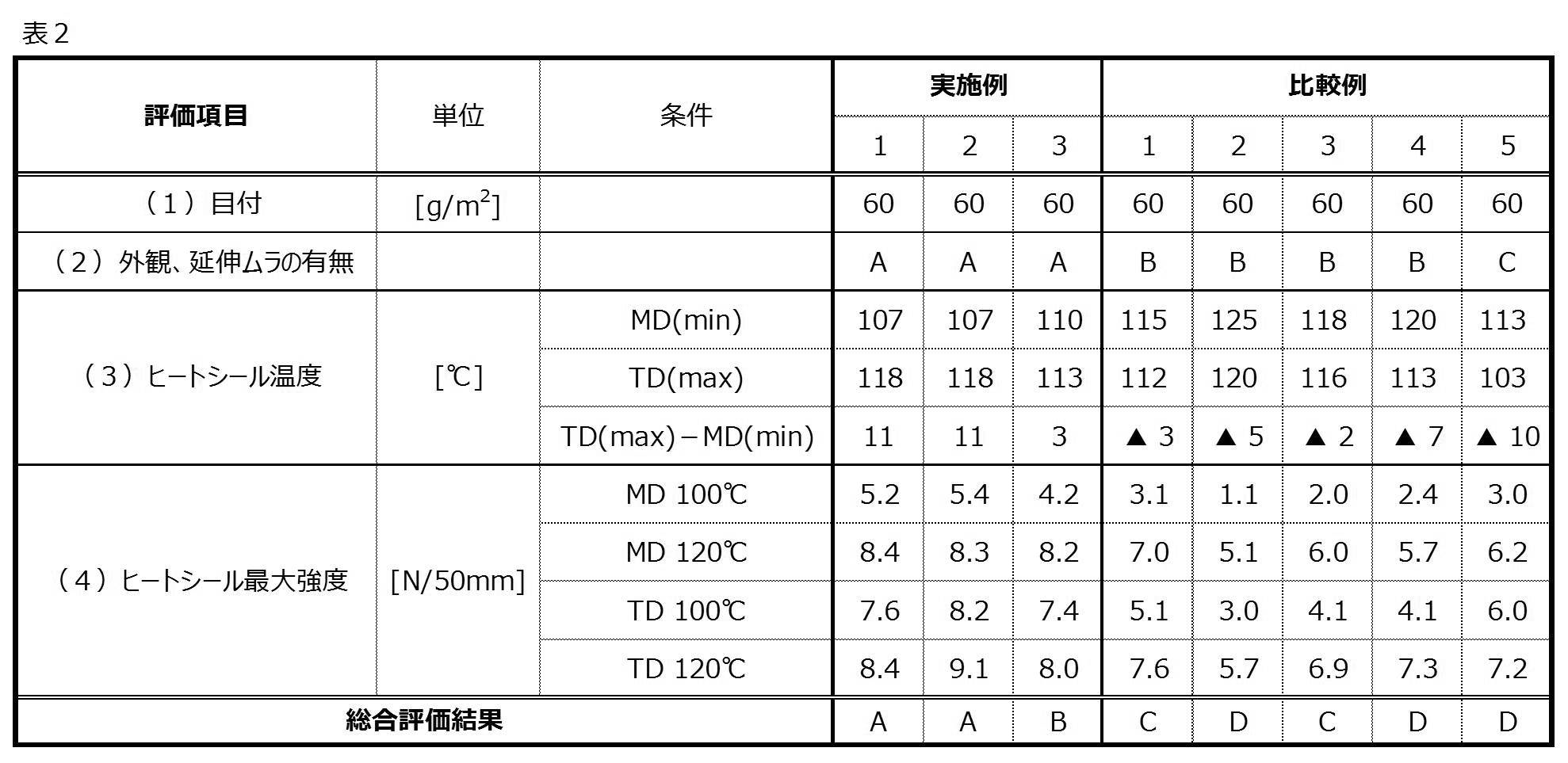
表2より、実施例1~3は延伸ムラも無く、ヒートシール強度、ホットタック性、外観に優れるため、使い捨てカイロ、温湿布などの発熱体を充填した場合も実用生産に耐えうる。特に、実施例1及び2はMDヒートシール可能温度が107℃以上、TD(max)-MD(min)=11℃と大きいため、発熱体の充填加工時に収納袋の破袋及び剥がれがなく、高速生産に優れるものである。メタロセン系直鎖状低密度ポリエチレン(C)を添加したことによる弾性率の低下、延伸ムラの抑制、低温ヒートシール性の機能が付与された結果であると考えられる。また、ヒートシール最大強度も全て4.0N/50mm以上であり、製造時及び充填加工時から使用時の十分な強度を備えている。
一方、比較例1~5はMDのヒートシール強度及び外観に乏しく、TD(max)-MD(min)が負数であるため、ヒートシール加工が難しく、収納袋の破袋、発熱体の露出の恐れ等がある。さらに、比較例5は高圧重合法低密度ポリエチレンを配合しなかったため、インフレーション・ダイによって高速でフィルム状に成形する際、原反(バブル)が不安定に振動し、厚みムラ及び延伸ムラの外観不良が発生した。なお、バブルとは、インフレーション法によって成形される筒状のシート(フィルム)である。
一方、比較例1~5はMDのヒートシール強度及び外観に乏しく、TD(max)-MD(min)が負数であるため、ヒートシール加工が難しく、収納袋の破袋、発熱体の露出の恐れ等がある。さらに、比較例5は高圧重合法低密度ポリエチレンを配合しなかったため、インフレーション・ダイによって高速でフィルム状に成形する際、原反(バブル)が不安定に振動し、厚みムラ及び延伸ムラの外観不良が発生した。なお、バブルとは、インフレーション法によって成形される筒状のシート(フィルム)である。
本発明の多孔質フィルムは、高強度かつ薄膜であり、ヒートシール性、ホットタック性、外観に優れるため、使い捨てカイロ、温湿布などの通気発熱性組成物等の収納袋として好適に使用できる。
Claims (8)
- 直鎖状低密度ポリエチレン(LLDPE)を50質量部以上、高圧重合法低密度ポリエチレン(HP-LDPE)とメタロセン系直鎖状低密度ポリエチレン(m-LLDPE)とを合計50質量部未満で配合したポリエチレン樹脂組成物100質量部に対して、無機充填材を50~200質量部配合した樹脂組成物を含む多孔質フィルムであって、機械流れ方向(MD)のヒートシール温度が90℃以上、かつヒートシール最大強度が4.0N/50mm以上であることを特徴とする多孔質フィルム。
- 前記直鎖状低密度ポリエチレン(LLDPE)は密度0.910~0.940g/cm3、融点110~130℃、配合量55~92質量部、前記高圧重合法低密度ポリエチレン(HP-LDPE)は密度0.910~0.930g/cm3,融点100~120℃、配合量3~15質量部、及び前記メタロセン系直鎖状低密度ポリエチレン(m-LLDPE)は密度0.880~0.930g/cm3、融点85~130℃、配合量5~30質量部である請求項1に記載の多孔質フィルム。
- 前記ポリエチレン樹脂組成物に、さらに、密度0.940~0.970g/cm3、融点125~145℃の高密度ポリエチレンを配合してなる請求項1または2に記載の多孔質フィルム。
- 目付量が10~100g/m2である請求項1~3のいずれか1項に記載の多孔質フィルム。
- 機械流れ方向(MD)の最低融着温度MD(min)と、横断方向(TD)の最高融着温度TD(max)との差であるTD(max)-MD(min)が1℃以上である請求項1~4のいずれか1項に記載の多孔質フィルム。
- 少なくとも一軸方向に合計2.5~5.0倍の延伸倍率で多孔化させている請求項1~5のいずれか1項に記載の多孔質フィルム。
- 請求項1~6のいずれか1項に記載の多孔質フィルムを少なくとも1層含み、開口端縁がヒートシールで結合されている通気発熱性物質の収納袋。
- 使い捨てカイロ用の収納袋である請求項7に記載の通気発熱性物質の収納袋。
Priority Applications (2)
| Application Number | Priority Date | Filing Date | Title |
|---|---|---|---|
| JP2016525766A JP6597608B2 (ja) | 2014-06-03 | 2015-05-21 | 多孔質フィルムおよび収納袋 |
| CN201580028867.0A CN106414571B (zh) | 2014-06-03 | 2015-05-21 | 多孔膜及收纳袋 |
Applications Claiming Priority (2)
| Application Number | Priority Date | Filing Date | Title |
|---|---|---|---|
| JP2014115201 | 2014-06-03 | ||
| JP2014-115201 | 2014-06-03 |
Publications (1)
| Publication Number | Publication Date |
|---|---|
| WO2015186532A1 true WO2015186532A1 (ja) | 2015-12-10 |
Family
ID=54766607
Family Applications (1)
| Application Number | Title | Priority Date | Filing Date |
|---|---|---|---|
| PCT/JP2015/064663 Ceased WO2015186532A1 (ja) | 2014-06-03 | 2015-05-21 | 多孔質フィルムおよび収納袋 |
Country Status (4)
| Country | Link |
|---|---|
| JP (1) | JP6597608B2 (ja) |
| CN (1) | CN106414571B (ja) |
| TW (1) | TWI687475B (ja) |
| WO (1) | WO2015186532A1 (ja) |
Cited By (9)
| Publication number | Priority date | Publication date | Assignee | Title |
|---|---|---|---|---|
| WO2017175878A1 (ja) * | 2016-04-08 | 2017-10-12 | 株式会社トクヤマ | 延伸多孔性フィルム及びその製造方法 |
| JP2019119827A (ja) * | 2018-01-10 | 2019-07-22 | 興人フィルム&ケミカルズ株式会社 | 通気性フィルム |
| KR20190127183A (ko) * | 2018-05-03 | 2019-11-13 | 장한봉 | 위조방지 qr코드가 인쇄된 기능성 쓰레기 봉투 |
| KR102074619B1 (ko) * | 2019-08-24 | 2020-02-07 | 주식회사 지엠상사 | 비닐 포장재 |
| JP2020152424A (ja) * | 2019-03-22 | 2020-09-24 | 三菱ケミカル株式会社 | ヒートシール用フィルムおよび収納袋 |
| CN114316418A (zh) * | 2021-12-09 | 2022-04-12 | 成都金发科技新材料有限公司 | 一种低收缩阻燃聚乙烯组合物以及制备方法与应用 |
| JP2022531045A (ja) * | 2019-05-03 | 2022-07-06 | アールケイダブリュー エスイー | 通気性フィルム |
| JP2024001721A (ja) * | 2022-06-22 | 2024-01-10 | 花王株式会社 | フィルムの製造方法及び多孔質フィルム |
| WO2025009462A1 (ja) * | 2023-07-06 | 2025-01-09 | 三菱瓦斯化学株式会社 | 脱酸素剤用通気性包装材及びその製造方法 |
Families Citing this family (5)
| Publication number | Priority date | Publication date | Assignee | Title |
|---|---|---|---|---|
| CN107981967A (zh) * | 2016-10-26 | 2018-05-04 | 袁暾 | 一种载硅酸盐微粒的冷敷敷贴 |
| CN110903541B (zh) * | 2019-12-20 | 2022-07-15 | 福建宏科新材料科技有限公司 | 聚烯烃透气膜用树脂的制造方法 |
| CN110951150B (zh) * | 2019-12-20 | 2022-07-15 | 福建宏科新材料科技有限公司 | 一次性取暖片用透气膜及其制造方法和应用 |
| GB2613986B (en) * | 2020-09-16 | 2026-04-22 | Sanipak Company Of Japan Ltd | Polyethylene-based resin composition, polyethylene-based resin packaging material, and method for producing same |
| CN113896978A (zh) * | 2021-10-29 | 2022-01-07 | 东莞市腾和新材料科技有限公司 | 一种eva收纳篮及其制备方法 |
Citations (6)
| Publication number | Priority date | Publication date | Assignee | Title |
|---|---|---|---|---|
| JPH0925372A (ja) * | 1995-07-12 | 1997-01-28 | Maruzen Petrochem Co Ltd | 透湿性フィルム |
| JP2001294698A (ja) * | 2000-04-13 | 2001-10-23 | Sekisui Chem Co Ltd | 微多孔フィルム及び積層体 |
| JP2002003662A (ja) * | 2000-06-16 | 2002-01-09 | Japan Polyolefins Co Ltd | ポリエチレン樹脂組成物、そのフィルム、多孔フィルム、成形体、および多孔フィルムの製造方法 |
| JP2003012842A (ja) * | 2000-09-21 | 2003-01-15 | Sekisui Chem Co Ltd | 微多孔フィルム |
| JP2005126694A (ja) * | 2003-10-02 | 2005-05-19 | Tokuyama Corp | 高速延伸製膜用エチレン系重合体組成物、および多孔質フィルムの製造方法 |
| JP2008179757A (ja) * | 2006-12-28 | 2008-08-07 | Nippon Polyethylene Kk | 通気性フィルム |
Family Cites Families (4)
| Publication number | Priority date | Publication date | Assignee | Title |
|---|---|---|---|---|
| CN100436528C (zh) * | 2003-10-02 | 2008-11-26 | 株式会社德山 | 高速延伸制膜用乙烯系聚合物组成物以及多孔质薄膜的制造方法 |
| US20070082154A1 (en) * | 2005-10-12 | 2007-04-12 | Benoit Ambroise | Multi-layer films, methods of manufacture and articles made therefrom |
| KR100773735B1 (ko) * | 2006-05-11 | 2007-11-09 | (주)대명화학 | 낙진방지용 필름 및 그의 제조방법 |
| JP4958217B2 (ja) * | 2007-01-25 | 2012-06-20 | 奥野製薬工業株式会社 | チアミンラウリル硫酸塩含有粉末製剤 |
-
2015
- 2015-05-21 CN CN201580028867.0A patent/CN106414571B/zh active Active
- 2015-05-21 JP JP2016525766A patent/JP6597608B2/ja active Active
- 2015-05-21 WO PCT/JP2015/064663 patent/WO2015186532A1/ja not_active Ceased
- 2015-06-02 TW TW104117766A patent/TWI687475B/zh active
Patent Citations (6)
| Publication number | Priority date | Publication date | Assignee | Title |
|---|---|---|---|---|
| JPH0925372A (ja) * | 1995-07-12 | 1997-01-28 | Maruzen Petrochem Co Ltd | 透湿性フィルム |
| JP2001294698A (ja) * | 2000-04-13 | 2001-10-23 | Sekisui Chem Co Ltd | 微多孔フィルム及び積層体 |
| JP2002003662A (ja) * | 2000-06-16 | 2002-01-09 | Japan Polyolefins Co Ltd | ポリエチレン樹脂組成物、そのフィルム、多孔フィルム、成形体、および多孔フィルムの製造方法 |
| JP2003012842A (ja) * | 2000-09-21 | 2003-01-15 | Sekisui Chem Co Ltd | 微多孔フィルム |
| JP2005126694A (ja) * | 2003-10-02 | 2005-05-19 | Tokuyama Corp | 高速延伸製膜用エチレン系重合体組成物、および多孔質フィルムの製造方法 |
| JP2008179757A (ja) * | 2006-12-28 | 2008-08-07 | Nippon Polyethylene Kk | 通気性フィルム |
Non-Patent Citations (3)
| Title |
|---|
| "Chokusa-jo Teimitsudo Polyethylene Nipolon-Z", 28 July 2015 (2015-07-28), Retrieved from the Internet <URL:http://www. tosoh.co.jp/product/petrochemicals/polymer/ assets/ultra_low_density_polyethylene_01.pdf> * |
| "Evolue (film) Meigara Busseihyo", 28 July 2015 (2015-07-28), Retrieved from the Internet <URL:http://www.primepolymer.co.jp/product/pe/pdf/evolue-fc.pdf> * |
| PLASTIC DATA BOOK, 1 December 1999 (1999-12-01), pages 329 - 330 * |
Cited By (12)
| Publication number | Priority date | Publication date | Assignee | Title |
|---|---|---|---|---|
| WO2017175878A1 (ja) * | 2016-04-08 | 2017-10-12 | 株式会社トクヤマ | 延伸多孔性フィルム及びその製造方法 |
| JPWO2017175878A1 (ja) * | 2016-04-08 | 2019-02-14 | 株式会社トクヤマ | 延伸多孔性フィルム及びその製造方法 |
| JP2019119827A (ja) * | 2018-01-10 | 2019-07-22 | 興人フィルム&ケミカルズ株式会社 | 通気性フィルム |
| KR20190127183A (ko) * | 2018-05-03 | 2019-11-13 | 장한봉 | 위조방지 qr코드가 인쇄된 기능성 쓰레기 봉투 |
| KR102063956B1 (ko) | 2018-05-03 | 2020-01-08 | 장한봉 | 위조방지 qr코드가 인쇄된 기능성 쓰레기 봉투 |
| JP2020152424A (ja) * | 2019-03-22 | 2020-09-24 | 三菱ケミカル株式会社 | ヒートシール用フィルムおよび収納袋 |
| JP2022531045A (ja) * | 2019-05-03 | 2022-07-06 | アールケイダブリュー エスイー | 通気性フィルム |
| KR102074619B1 (ko) * | 2019-08-24 | 2020-02-07 | 주식회사 지엠상사 | 비닐 포장재 |
| CN114316418A (zh) * | 2021-12-09 | 2022-04-12 | 成都金发科技新材料有限公司 | 一种低收缩阻燃聚乙烯组合物以及制备方法与应用 |
| CN114316418B (zh) * | 2021-12-09 | 2023-08-04 | 成都金发科技新材料有限公司 | 一种低收缩阻燃聚乙烯组合物以及制备方法与应用 |
| JP2024001721A (ja) * | 2022-06-22 | 2024-01-10 | 花王株式会社 | フィルムの製造方法及び多孔質フィルム |
| WO2025009462A1 (ja) * | 2023-07-06 | 2025-01-09 | 三菱瓦斯化学株式会社 | 脱酸素剤用通気性包装材及びその製造方法 |
Also Published As
| Publication number | Publication date |
|---|---|
| CN106414571B (zh) | 2020-07-31 |
| CN106414571A (zh) | 2017-02-15 |
| JP6597608B2 (ja) | 2019-10-30 |
| TWI687475B (zh) | 2020-03-11 |
| JPWO2015186532A1 (ja) | 2017-04-20 |
| TW201546142A (zh) | 2015-12-16 |
Similar Documents
| Publication | Publication Date | Title |
|---|---|---|
| JP6597608B2 (ja) | 多孔質フィルムおよび収納袋 | |
| JP6467825B2 (ja) | シーラントフィルム | |
| JP5324795B2 (ja) | ヒートシール用袋体構成部材用多孔質フィルム、ヒートシール用袋体構成部材および使い捨てカイロ | |
| US20120202029A1 (en) | Porous film for heat-sealable bag-constituting member, heat-sealable bag-constituting member and disposable body warmer | |
| JP5721504B2 (ja) | 架橋ポリオレフィン系樹脂発泡シート及びそれを用いた粘着テープ | |
| JP6898799B2 (ja) | ポリプロピレン系縦一軸延伸フィルム及びフィルム積層体並びに袋状物 | |
| JP6657890B2 (ja) | 透湿性積層体 | |
| JP6641953B2 (ja) | 透湿性積層体 | |
| JP2020152424A (ja) | ヒートシール用フィルムおよび収納袋 | |
| WO2015186808A1 (ja) | 透湿性フィルム | |
| KR20140002717A (ko) | 전기 또는 전자 기기용 발포 적층체 | |
| JP2004345327A (ja) | 積層体 | |
| JP2017031293A (ja) | 通気性フィルム | |
| JP2013001435A (ja) | 袋体構成部材用多孔質フィルム及びカイロ用袋体構成部材 | |
| JP6290597B2 (ja) | 通気性積層体及びそれを用いた使い捨てカイロ | |
| JP7210685B2 (ja) | 梱包用フィルム及び梱包用部材 | |
| JP7096081B2 (ja) | 梱包用フィルム及び梱包用部材 | |
| JP6051012B2 (ja) | 通気性積層体及びそれを用いた使い捨てカイロ | |
| JP2007196558A (ja) | 白色の多層ポリエチレン系フィルムおよび包装袋 | |
| CN1720133A (zh) | 层压体 | |
| JP4825031B2 (ja) | 積層フイルム | |
| JP3350635B2 (ja) | 通気発熱性組成物の収納袋 | |
| JP2007045047A (ja) | ヒートシール性ポリオレフィン系発泡フイルム | |
| JP2024000635A (ja) | ポリエチレン系樹脂多層発泡シート及びその製造方法 | |
| JP4591259B2 (ja) | 隠蔽性良好なヒートシール性ポリオレフィン系発泡フイルム |
Legal Events
| Date | Code | Title | Description |
|---|---|---|---|
| 121 | Ep: the epo has been informed by wipo that ep was designated in this application |
Ref document number: 15802340 Country of ref document: EP Kind code of ref document: A1 |
|
| ENP | Entry into the national phase |
Ref document number: 2016525766 Country of ref document: JP Kind code of ref document: A |
|
| NENP | Non-entry into the national phase |
Ref country code: DE |
|
| 122 | Ep: pct application non-entry in european phase |
Ref document number: 15802340 Country of ref document: EP Kind code of ref document: A1 |