WO2015152134A1 - 樹脂組成物、接着フィルム、および半導体装置 - Google Patents
樹脂組成物、接着フィルム、および半導体装置 Download PDFInfo
- Publication number
- WO2015152134A1 WO2015152134A1 PCT/JP2015/059873 JP2015059873W WO2015152134A1 WO 2015152134 A1 WO2015152134 A1 WO 2015152134A1 JP 2015059873 W JP2015059873 W JP 2015059873W WO 2015152134 A1 WO2015152134 A1 WO 2015152134A1
- Authority
- WO
- WIPO (PCT)
- Prior art keywords
- resin composition
- component
- adhesive film
- thermal conductivity
- mass
- Prior art date
- Legal status (The legal status is an assumption and is not a legal conclusion. Google has not performed a legal analysis and makes no representation as to the accuracy of the status listed.)
- Ceased
Links
Images
Classifications
-
- C—CHEMISTRY; METALLURGY
- C08—ORGANIC MACROMOLECULAR COMPOUNDS; THEIR PREPARATION OR CHEMICAL WORKING-UP; COMPOSITIONS BASED THEREON
- C08L—COMPOSITIONS OF MACROMOLECULAR COMPOUNDS
- C08L63/00—Compositions of epoxy resins; Compositions of derivatives of epoxy resins
-
- C—CHEMISTRY; METALLURGY
- C08—ORGANIC MACROMOLECULAR COMPOUNDS; THEIR PREPARATION OR CHEMICAL WORKING-UP; COMPOSITIONS BASED THEREON
- C08G—MACROMOLECULAR COMPOUNDS OBTAINED OTHERWISE THAN BY REACTIONS ONLY INVOLVING UNSATURATED CARBON-TO-CARBON BONDS
- C08G59/00—Polycondensates containing more than one epoxy group per molecule; Macromolecules obtained by polymerising compounds containing more than one epoxy group per molecule using curing agents or catalysts which react with the epoxy groups
- C08G59/18—Macromolecules obtained by polymerising compounds containing more than one epoxy group per molecule using curing agents or catalysts which react with the epoxy groups ; e.g. general methods of curing
- C08G59/20—Macromolecules obtained by polymerising compounds containing more than one epoxy group per molecule using curing agents or catalysts which react with the epoxy groups ; e.g. general methods of curing characterised by the epoxy compounds used
- C08G59/32—Epoxy compounds containing three or more epoxy groups
- C08G59/3227—Compounds containing acyclic nitrogen atoms
-
- C—CHEMISTRY; METALLURGY
- C08—ORGANIC MACROMOLECULAR COMPOUNDS; THEIR PREPARATION OR CHEMICAL WORKING-UP; COMPOSITIONS BASED THEREON
- C08K—Use of inorganic or non-macromolecular organic substances as compounding ingredients
- C08K3/00—Use of inorganic substances as compounding ingredients
-
- C—CHEMISTRY; METALLURGY
- C08—ORGANIC MACROMOLECULAR COMPOUNDS; THEIR PREPARATION OR CHEMICAL WORKING-UP; COMPOSITIONS BASED THEREON
- C08K—Use of inorganic or non-macromolecular organic substances as compounding ingredients
- C08K3/00—Use of inorganic substances as compounding ingredients
- C08K3/01—Use of inorganic substances as compounding ingredients characterized by their specific function
- C08K3/013—Fillers, pigments or reinforcing additives
-
- C—CHEMISTRY; METALLURGY
- C08—ORGANIC MACROMOLECULAR COMPOUNDS; THEIR PREPARATION OR CHEMICAL WORKING-UP; COMPOSITIONS BASED THEREON
- C08L—COMPOSITIONS OF MACROMOLECULAR COMPOUNDS
- C08L101/00—Compositions of unspecified macromolecular compounds
-
- C—CHEMISTRY; METALLURGY
- C08—ORGANIC MACROMOLECULAR COMPOUNDS; THEIR PREPARATION OR CHEMICAL WORKING-UP; COMPOSITIONS BASED THEREON
- C08L—COMPOSITIONS OF MACROMOLECULAR COMPOUNDS
- C08L71/00—Compositions of polyethers obtained by reactions forming an ether link in the main chain; Compositions of derivatives of such polymers
-
- C—CHEMISTRY; METALLURGY
- C09—DYES; PAINTS; POLISHES; NATURAL RESINS; ADHESIVES; COMPOSITIONS NOT OTHERWISE PROVIDED FOR; APPLICATIONS OF MATERIALS NOT OTHERWISE PROVIDED FOR
- C09J—ADHESIVES; NON-MECHANICAL ASPECTS OF ADHESIVE PROCESSES IN GENERAL; ADHESIVE PROCESSES NOT PROVIDED FOR ELSEWHERE; USE OF MATERIALS AS ADHESIVES
- C09J7/00—Adhesives in the form of films or foils
- C09J7/30—Adhesives in the form of films or foils characterised by the adhesive composition
-
- H—ELECTRICITY
- H10—SEMICONDUCTOR DEVICES; ELECTRIC SOLID-STATE DEVICES NOT OTHERWISE PROVIDED FOR
- H10W—GENERIC PACKAGES, INTERCONNECTIONS, CONNECTORS OR OTHER CONSTRUCTIONAL DETAILS OF DEVICES COVERED BY CLASS H10
- H10W40/00—Arrangements for thermal protection or thermal control
- H10W40/20—Arrangements for cooling
- H10W40/25—Arrangements for cooling characterised by their materials
- H10W40/251—Organics
-
- C—CHEMISTRY; METALLURGY
- C08—ORGANIC MACROMOLECULAR COMPOUNDS; THEIR PREPARATION OR CHEMICAL WORKING-UP; COMPOSITIONS BASED THEREON
- C08G—MACROMOLECULAR COMPOUNDS OBTAINED OTHERWISE THAN BY REACTIONS ONLY INVOLVING UNSATURATED CARBON-TO-CARBON BONDS
- C08G2650/00—Macromolecular compounds obtained by reactions forming an ether link in the main chain of the macromolecule
- C08G2650/28—Macromolecular compounds obtained by reactions forming an ether link in the main chain of the macromolecule characterised by the polymer type
- C08G2650/56—Polyhydroxyethers, e.g. phenoxy resins
-
- C—CHEMISTRY; METALLURGY
- C08—ORGANIC MACROMOLECULAR COMPOUNDS; THEIR PREPARATION OR CHEMICAL WORKING-UP; COMPOSITIONS BASED THEREON
- C08K—Use of inorganic or non-macromolecular organic substances as compounding ingredients
- C08K2201/00—Specific properties of additives
- C08K2201/001—Conductive additives
-
- C—CHEMISTRY; METALLURGY
- C09—DYES; PAINTS; POLISHES; NATURAL RESINS; ADHESIVES; COMPOSITIONS NOT OTHERWISE PROVIDED FOR; APPLICATIONS OF MATERIALS NOT OTHERWISE PROVIDED FOR
- C09J—ADHESIVES; NON-MECHANICAL ASPECTS OF ADHESIVE PROCESSES IN GENERAL; ADHESIVE PROCESSES NOT PROVIDED FOR ELSEWHERE; USE OF MATERIALS AS ADHESIVES
- C09J2203/00—Applications of adhesives in processes or use of adhesives in the form of films or foils
- C09J2203/326—Applications of adhesives in processes or use of adhesives in the form of films or foils for bonding electronic components such as wafers, chips or semiconductors
Definitions
- the present invention relates to a resin composition, an adhesive film, and a semiconductor device, and in particular, a resin composition and an adhesive film that are excellent in heat dissipation and capable of forming a highly reliable semiconductor device, and the resin composition and adhesive film.
- the present invention relates to a manufactured semiconductor device.
- the amount of heat generated from heating elements such as modules and electronic components has increased as the functionality and density of modules and electronic components have increased.
- the heat from these heating elements is transmitted to the substrate or the like and radiated.
- an adhesive having a high thermal conductivity is used as an adhesive between the heating element and the substrate.
- the adhesive film of the high heat conductivity is used instead of the adhesive agent from the ease of handling.
- the above-mentioned adhesive film requires not only thermal conductivity but also insulation, heat resistance and connection reliability (adhesion strength).
- the thermal conductivity can be improved by using a large amount of high thermal conductivity filler in the adhesive film, but the amount of resin component in the adhesive film is relatively reduced as the filler filling amount increases. Therefore, there is a problem that it becomes difficult to obtain a desired adhesive strength.
- the problem of the adhesive strength fall accompanying the increase in the filler filling amount is not limited to the adhesive film having a high thermal conductivity, but also occurs when, for example, the composition is filled with a filler from the viewpoint of reducing the thermal expansion coefficient.
- An epoxy resin oriented to high thermal conductivity it has sufficient film forming properties and stretchability to be applied to processes such as film molding and coating, and has various physical properties such as thermal conductivity, heat resistance, and flexibility.
- An epoxy resin having a biphenyl skeleton as an excellent epoxy resin (Patent Document 1), which is easy to manufacture despite the introduction of mesogenic groups, has excellent solubility in organic solvents, toughness, and thermal conductivity
- An epoxy resin (Patent Document 2) that gives a cured product having excellent properties is disclosed.
- the present invention has been made in view of the above circumstances, and an object of the present invention is to provide a resin composition excellent in thermal conductivity, adhesiveness, and film moldability, particularly a resin composition excellent in thermal conductivity after curing. It is to be.
- the present invention relates to a resin composition, an adhesive film, and a semiconductor device that have solved the above problems by having the following configuration.
- A an aminophenol type epoxy resin
- B at least one selected from the group consisting of a phenoxy resin and a thermoplastic elastomer
- C a high thermal conductive inorganic filler
- component 1 mass A resin composition, wherein the component (B) is 0.5 to 5 parts by mass with respect to parts.
- an adhesive film that is excellent in thermal conductivity and adhesiveness, and particularly excellent in thermal conductivity after curing.
- a highly reliable semiconductor device can be provided by a cured body of an adhesive film excellent in thermal conductivity, adhesiveness, and thermal conductivity.
- the resin composition of the present invention comprises (A) an aminophenol type epoxy resin, (B) at least one selected from the group consisting of a phenoxy resin and a thermoplastic elastomer, and (C) a highly thermally conductive inorganic filler,
- the component (B) is 0.5 to 5 parts by mass with respect to 1 part by mass of the component A).
- (C) high thermal conductive inorganic filler means an inorganic filler of 5 W / m ⁇ K or more.
- the aminophenol type epoxy resin as the component (A) in the present invention is obtained by epoxidizing various aminophenols by a known method.
- aminophenols include 2-aminophenol, 3-aminophenol, 4-aminophenol, 2-amino-m-cresol, 2-amino-p-cresol, 3-amino-o-cresol, 4-amino Examples include aminophenols such as -m-cresol and 6-amino-m-cresol, and aminocresols, but are not limited thereto.
- (A) component has the following chemical formula (1):
- An aminophenol type epoxy resin represented by the formula (1) is preferable because the cured resin composition has high thermal conductivity.
- the aminophenol type epoxy resin product name: 630
- a component may be individual or may use 2 or more types together.
- the phenoxy resin as the component (B) is not particularly limited, and includes a bisphenol A skeleton, a bisphenol F skeleton, a bisphenol S skeleton, a bisphenol acetophenone skeleton, a novolak skeleton, a biphenyl skeleton, a fluorene skeleton, a dicyclopentadiene skeleton, a norbornene skeleton, Examples thereof include those having one or more skeletons selected from naphthalene skeleton, anthracene skeleton, adamantane skeleton, terpene skeleton, and trimethylcyclohexane skeleton.
- Mitsubishi Chemical made flexible phenoxy resin Product name: YL7178, glass transition temperature: 15 degreeC
- thermoplastic elastomer of component (B) urethane rubber, acrylic rubber, silicone rubber, vinyl alkyl ether rubber, polyvinyl alcohol rubber, polyvinyl pyrrolidone rubber, polyacrylamide rubber, cellulose rubber, natural rubber, butadiene rubber, chloroprene rubber, styrene ⁇ Butadiene rubber (SBR), acrylonitrile butadiene rubber (NBR), styrene / ethylene / butadiene / styrene rubber, styrene / isoprene / styrene rubber, styrene / isobutylene rubber, isoprene rubber, polyisobutylene rubber, butyl rubber, (meth) acrylic acid Synthetic acrylic rubber, styrene-butadiene block copolymer (SBS), styrene-ethylene / butylene-styrene block, obtained by polymerization of monomers containing al
- thermoplastic elastomer of the component (B) As a commercial product of the thermoplastic elastomer of the component (B), there is an acrylic ester copolymer (product name: SG790, glass transition temperature: ⁇ 32 ° C.) manufactured by Nagase ChemteX. (B) A component may be individual or may use 2 or more types together.
- the component (B) preferably has a glass transition temperature (Tg) of less than 50 ° C. in order to give the resin composition a film moldability and an appropriate flexibility to the cured resin composition. Furthermore, from the viewpoint of film moldability and adhesiveness of the resin composition, the component (B) is more preferably a phenoxy resin having a glass transition temperature (Tg) of less than 50 ° C.
- a heat conductivity is 5 W / m * K or more
- a general inorganic filler can be used from a viewpoint of maintaining insulation.
- Component (C) the thermal conductivity from the viewpoint of insulating properties and thermal expansion coefficient, MgO, Al 2 O 3, AlN, BN, diamond filler, ZnO, and at least one or more selected from the group consisting of SiC Inorganic fillers are preferred. In addition, you may carry out an insulation process to ZnO and SiC as needed.
- component (C) Commercially available products of component (C) include magnesium oxide powder (product names: SMO-5, SMO-1, SMO-02, SMO-2) manufactured by Sakai Chemical Industry, and alumina (Al 2 O 3 ) powder manufactured by Showa Denko (product name). : CBA09S), Denki Kagaku Kogyo Alumina (Al 2 O 3 ) powder (Product Name: DAW-03, ASFP-20).
- the average particle diameter of component (C) (if it is not granular, the average maximum diameter) is not particularly limited, but is 0.05 to 50 ⁇ m to uniformly disperse component (C) in the resin composition. In addition, it is preferable. If it is less than 0.05 ⁇ m, the viscosity of the resin composition increases and the moldability may deteriorate. If it exceeds 50 ⁇ m, it may be difficult to uniformly disperse the component (C) in the resin composition.
- the average particle diameter of the component (C) is measured by a dynamic light scattering nanotrack particle size analyzer.
- a component may be individual or may use 2 or more types together.
- the component (A) is preferably 1.5 to 15 parts by mass and more preferably 2 to 10 parts by mass with respect to 100 parts by mass of the resin composition (excluding the solvent).
- the component (B) is 0.5 to 5 parts by mass with respect to 1 part by mass of the component (A) from the viewpoints of film moldability of the resin composition, thermal conductivity of the cured resin composition, and heat resistance. is there. If the component (B) is less than 0.5 part by mass relative to 1 part by mass of the component (A), the resin composition cannot be formed into a film, and if it exceeds 5 parts by mass, the cured resin composition Thermal conductivity is lowered.
- the total of (A) and (B) is 100 parts by mass of the resin composition (excluding the solvent) from the viewpoint of film moldability, adhesiveness, and thermal conductivity of the resin composition after curing. On the other hand, it is preferably 4 to 20 parts by mass.
- Component (C) is a resin composition (excluding the solvent) from the viewpoint of the adhesiveness of the resin composition, the insulating properties of the cured resin composition, and the coefficient of thermal expansion: 40 to 95 parts per 100 parts by mass. It is preferable that it is a mass part. (C) When a component exceeds 95 mass parts, the adhesive force of a resin composition will fall easily. On the other hand, when the component (C) is less than 40 parts by mass, the heat conductivity of the cured resin composition may be insufficient even if the thermal conductivity of the highly thermally conductive inorganic filler is high.
- the resin composition further includes (D) a cured product.
- the component (D) include phenolic curing agents, acid anhydride curing agents, amine curing agents, imidazole curing agents, carboxylic acid dihydrazide curing agents, phenolic curing agents, amine curing agents, and acids. It is preferable that it is at least one selected from the group consisting of an anhydride-based curing agent and an imidazole-based curing agent.
- a phenolic curing agent is more preferable from the viewpoint of adhesiveness of the resin composition, and an acid anhydride-based curing agent is more preferable from the viewpoint of fluidity and adhesiveness of the resin composition. From the viewpoint of the storage stability of the resin composition, an imidazole curing agent is more preferable.
- phenolic curing agent examples include phenol novolak and cresol novolak, and phenol novolak is preferable.
- phenolic curing agents have a slower curing speed than other curing agents such as acid anhydride curing agents, amine curing agents, imidazole curing agents, etc. When the curing rate of the resin composition becomes too fast, it can be used for the purpose of delaying the curing rate of the resin composition by using a phenolic curing agent in combination.
- Acid anhydrides include tetrahydrophthalic anhydride, hexahydrophthalic anhydride, methyltetrahydrophthalic anhydride, methylhexahydrophthalic anhydride, methylnadic acid anhydride, hydrogenated methylnadic acid anhydride, trialkyltetrahydrophthalic anhydride, Methylcyclohexene tetracarboxylic dianhydride, phthalic anhydride, trimellitic anhydride, pyromellitic anhydride, benzophenone tetracarboxylic dianhydride, ethylene glycol bisanhydro trimellitate, glycerin bis (anhydro trimellitate) mono Acetate, dodecenyl succinic anhydride, aliphatic dibasic polyanhydride, chlorendic anhydride, methylbutenyl tetrahydrophthalic anhydride, alkylated tetrahydrophthalic anhydride, methyl
- Examples of amine-based curing agents include chain aliphatic amines, cycloaliphatic amines, aliphatic aromatic amines, aromatic amines, and the like, and aromatic amines are preferred.
- Examples of the carboxylic acid dihydrazide curing agent include adipic acid dihydrazide, isophthalic acid dihydrazide, sebacic acid dihydrazide, dodecanoic acid dihydrazide, and adipic acid dihydrazide is preferable.
- a microencapsulated imidazole compound curing agent and an amine adduct type curing agent are preferable from the viewpoint of storage stability of the resin composition, and are dispersed in a liquid epoxy resin such as liquid bisphenol A type.
- a microencapsulated imidazole compound curing agent is more preferable from the viewpoints of workability, curing speed, and storage stability of the resin composition.
- imidazole curing agents examples include 2-methylimidazole, 2-undecylimidazole, 2-heptadecylimidazole, 2-ethyl-4-methylimidazole, 2-phenylimidazole, 2-phenyl-4-methylimidazole, 2,4- Diamino-6- [2′-methylimidazolyl- (1 ′)] ethyl-s-triazine, 2-phenyl-4,5-dihydroxymethylimidazole, 2-phenyl-4-methyl-5-hydroxymethylimidazole, 2, And 3-dihydro-1H-pyrrolo [1,2-a] benzimidazole can be mentioned, and 2,4-diamino-6- [2′-methylimidazolyl- (1 ′)] ethyl-s-triazine, 2 , 4-Diamino-6- [2'-undecylimidazolyl- (1)]-ethyl-s-triazine, 2 4-di
- component (D) Commercially available products of component (D) include Meiwa Kasei phenol curing agents (product names: MEH8000, MEH8005), Mitsubishi Chemical acid anhydrides (grade: YH306, YH307), Hitachi Chemical 3 or 4-methyl-hexahydroanhydride.
- Phthalic acid (Product name: HN-5500), Nippon Kayaku amine curing agent (Product name: Kayahard AA), Nippon Finechem adipic acid dihydrazide (Product name: ADH), Asahi Kasei E-materials microencapsulated imidazole compound curing agent (Product names: HX3722, HX3742, HX3932HP, HX3941HP), Ajinomoto Fine Techno's amine adduct type curing agent (Product name: PN-40J), Shikoku Kasei Kogyo 2-ethyl-4-methylimidazole (Product name: 2E4MZ), etc.
- (B) component is these product names The present invention is not limited.
- a component may be individual or may use 2 or more types together.
- the component (D) is preferably 0.1 to 5 parts by mass with respect to 100 parts by mass of the resin composition (excluding the solvent) from the viewpoint of storage stability and curability of the resin composition.
- the resin composition contains additives such as coupling agents, tackifiers, antifoaming agents, flow regulators, film-forming aids, dispersants, and organic solvents as long as the effects of the present invention are not impaired. Can be included.
- the organic solvent examples include aromatic solvents such as toluene and xylene, ketone solvents such as methyl ethyl ketone and methyl isobutyl ketone.
- the organic solvents may be used alone or in combination of two or more.
- the amount of the organic solvent used is not particularly limited, but it is preferably used so that the solid content is 20 to 50% by mass.
- the resin composition preferably has a viscosity range of 200 to 3000 mPa ⁇ s. The viscosity is a value measured using an E-type viscometer at a rotation speed of 10 rpm and 25 ° C.
- a resin composition is suitable for forming an adhesive film.
- a resin composition can be obtained by dissolving or dispersing a raw material containing the components (A) to (C) in an organic solvent.
- a device for dissolving or dispersing these raw materials is not particularly limited, and a lykai machine, a three-roll mill, a ball mill, a planetary mixer, a bead mill, etc. equipped with a stirring and heating device can be used. . Moreover, you may use combining these apparatuses suitably.
- the adhesive film can be obtained by applying the above resin composition to a desired support and then drying.
- the support is not particularly limited, and examples thereof include metal foils such as copper and aluminum, organic films such as polyester resins, polyethylene resins, and polyethylene terephthalate resins.
- the support may be release-treated with a silicone compound or the like.
- the method for applying the resin composition to the support is not particularly limited, but the microgravure method, the slot die method, and the doctor blade method are preferable from the viewpoint of thinning and film thickness control.
- the slot die method an adhesive film having a thickness after thermosetting of 10 to 300 ⁇ m can be obtained.
- the drying conditions can be appropriately set according to the type and amount of the organic solvent used in the resin composition, the thickness of the coating, and the like, for example, at 50 to 120 ° C. for about 1 to 30 minutes. Can do.
- the adhesive film thus obtained has good storage stability.
- the adhesive film can be peeled from the support at a desired timing.
- the adhesive film can be thermally cured at 130 to 200 ° C. for 30 to 180 minutes to adhere the adherend.
- the cured adhesive film releases the heat from the adherend that is the heating element to the adherend side that is the heat receiving body, It plays the role of heat transfer to dissipate heat on the adherend side which is a heat receiver.
- the cured adhesive film plays a role of relieving stress caused by a difference in thermal expansion coefficient between the adherend as a heating element and the adherend as a heat receiving body.
- the thickness of the adhesive film is preferably 10 ⁇ m to 300 ⁇ m, more preferably 10 ⁇ m to 100 ⁇ m, and still more preferably 10 ⁇ m to 50 ⁇ m. If it is less than 10 ⁇ m, the desired insulating property may not be obtained. When it exceeds 300 ⁇ m, there is a possibility that heat dissipation of the adherend that generates heat cannot be sufficiently performed. As the thickness of the adhesive film is reduced, the distance between the adherend that is the heating element and the adherend that is the heat receiving body is shortened. Therefore, from the viewpoint of efficient heat conduction, the thinner the thickness of the adhesive film Is preferred.
- the cured adhesive film has a thermal conductivity of 2 W / m ⁇ K or more. Moreover, when the heat conductivity of the cured adhesive film is less than 2 W / m ⁇ K, heat transfer from the heating element to the heat receiver may be insufficient.
- the volume resistivity and thermal conductivity of the cured adhesive film can be controlled by the type and content of the component (C).
- the peel strength of the cured adhesive film is preferably more than 5 N / cm. When the peel strength of the cured adhesive film exceeds 5 N / cm, the reliability of the semiconductor device using the cured adhesive film can be increased.
- the cured adhesive film preferably has a volume resistivity of 1 ⁇ 10 10 ⁇ ⁇ cm or more.
- the volume resistivity of the cured adhesive film is less than 1 ⁇ 10 10 ⁇ ⁇ cm, the insulation required for the semiconductor device may not be satisfied.
- the semiconductor device of the present invention uses the cured body of the adhesive film described above.
- a highly reliable semiconductor device can be provided by a cured body of an adhesive film excellent in thermal conductivity and adhesive strength.
- a heating element such as a module or an electronic component and a heat receiving body such as a substrate are bonded with a cured product of an adhesive film, or the heat of a substrate that receives heat from the heating element, Furthermore, what adhered the heat sink etc. which receive heat with the hardened
- Examples 1 to 12 Comparative Examples 1 to 4
- Tables 1 and 2 After metering and blending the components (A), (B) and an appropriate amount of toluene, they are put into a reaction kettle heated to 80 ° C. and rotated at a rotation speed of 150 rpm. Under normal pressure mixing for 3 hours, a clear was prepared.
- Component (C), component (D) and other components were added to the prepared clear and dispersed by a planetary mixer to prepare a resin composition for an adhesive film.
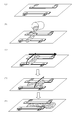
- FIG. 1 the schematic diagram for demonstrating the method of scraping application
- spacers are stacked in two rows on a PET film with a release agent so as to have an appropriate thickness, and then attached with an adhesive tape (FIG. 1 (A)).
- An appropriate amount of the composition for an adhesive film is poured onto a PET film with a release agent (FIG. 1B).
- a slide glass is placed on the spacer, and the adhesive film composition is scraped and applied (FIGS. 1C to 1E).
- the obtained adhesive film was cured under the conditions of 180 ° C. ⁇ 60 minutes and 0.1 MPa using a vacuum press.
- the cured adhesive film was cut into 10 ⁇ 10 mm to prepare a test piece for measuring thermal conductivity.
- the thermal conductivity of the prepared test piece for measuring thermal conductivity was measured with a thermal conductivity meter (Xe flash analyzer, model number: LFA447 Nanoflash) manufactured by NETZSCH. Tables 1 and 2 show the measurement results of thermal conductivity.
- a copper foil having one surface roughened was prepared. Copper foil was bonded to both surfaces of the adhesive film obtained in the same manner as in the evaluation of thermal conductivity with the roughened surface inside. Using a vacuum press machine, thermocompression bonding was performed under the conditions of 180 ° C. ⁇ 60 minutes and 0.1 MPa, and cured. This cured body was cut into a width of 10 mm to prepare a sample for peel strength measurement.
- the obtained adhesive film composition is placed on a 50 ⁇ m thick PET film with a release agent so that the width is 20 cm and the film thickness after drying is 30 to 200 ⁇ m. And applied.
- the applied adhesive film composition was dried at 80 ° C. for 20 minutes.
- This film was wound up on a reel having a diameter of 50 mm and a width of 40 cm, and film formability was evaluated. “5” if it does not break even when folded, “4” if it breaks partially when folded, “3” if it breaks when folded, “2” if it becomes a film but easily breaks, The case where it was not possible to use it was set to “1”. Tables 1 and 2 show the film formability results.
- Comparative Example 1 using a naphthalene type epoxy resin instead of an aminophenol type epoxy resin had a low thermal conductivity.
- the comparative example 2 which used the naphthalene type polyfunctional epoxy resin instead of the aminophenol type epoxy resin also had low thermal conductivity.
- the comparative example 3 which used the bisphenol A type epoxy resin instead of the aminophenol type epoxy resin also had low heat conductivity.
- Comparative Example 4 in which the component (B) was too small relative to the component (A) the composition for an adhesive film could not be formed into a film, and the thermal conductivity and peel strength could not be measured.
- the resin composition of the present invention is excellent in thermal conductivity, adhesiveness and film moldability, and in particular, can provide a resin composition excellent in thermal conductivity after curing.
Landscapes
- Chemical & Material Sciences (AREA)
- Organic Chemistry (AREA)
- Health & Medical Sciences (AREA)
- Chemical Kinetics & Catalysis (AREA)
- Medicinal Chemistry (AREA)
- Polymers & Plastics (AREA)
- Adhesives Or Adhesive Processes (AREA)
- Compositions Of Macromolecular Compounds (AREA)
- Engineering & Computer Science (AREA)
- Materials Engineering (AREA)
- Adhesive Tapes (AREA)
- Epoxy Resins (AREA)
Abstract
熱伝導性、接着性、フィルム成形性に優れる樹脂組成物、特に、硬化後に熱伝導性に優れる樹脂組成物を提供することである。 (A)アミノフェノール型エポキシ樹脂、(B)フェノキシ樹脂および熱可塑性エラストマーからなる群より選択される少なくとも1種、ならびに(C)高熱伝導性無機フィラーを含み、(A)成分1質量部に対して、(B)成分が0.5~5質量部であることを特徴とする、樹脂組成物である。(B)成分のガラス転移温度が、50℃未満であると、好ましい。
Description
本発明は、樹脂組成物、接着フィルム、および半導体装置に関し、特に、放熱性に優れ、信頼性の高い半導体装置を形成可能な樹脂組成物、および接着フィルム、ならびにこの樹脂組成物、接着フィルムにより製造される半導体装置に関する。
近年、モジュールや電子部品の高機能化、高密度化に伴い、モジュールや電子部品などの発熱体から発生する熱量が大きくなってきている。これらの発熱体からの熱は、基板等に伝えられ、放熱されている。この熱伝導を効率よく行うため、発熱体と基板との間の接着剤には、高熱伝導率のものが用いられている。また、ハンドリングのよさから、接着剤の代わりに高熱伝導の接着フィルムが用いられている。
ここで、接着フィルムの熱伝導が良好でないと、モジュールや電子部品を組み込んだ半導体装置に熱が蓄積され、半導体装置の故障を誘発してしまう、という問題がある。したがって、高熱伝導率のフィルムの開発が、各社で進められている。
上述の接着フィルムには、熱伝導性だけでなく、絶縁性、耐熱性及び接続信頼性(接着強度)が要求される。熱伝導性については、接着フィルム中に、高熱伝導性のフィラーを大量に使用すれば向上させることができるが、フィラー充填量の増加に伴って、接着フィルム中の樹脂成分量が相対的に減少するため、所望の接着強度を得るのが困難になる、という問題がある。なお、このフィラー充填量の増加に伴う接着強度低下の問題は、高熱伝導の接着フィルムに限らず、例えば、低熱膨張率化の観点から組成物にフィラーを充填する際にも生じるものである。
高熱伝導性を指向するエポキシ樹脂として、フィルム成形・塗布等のプロセスに適用するのに十分な製膜性、伸び性を有し、熱伝導性、耐熱性、可撓性などの諸物性にも優れたエポキシ樹脂としてビフェニル骨格を有するエポキシ樹脂(特許文献1)、メソゲン基を導入しているにも関わらず、製造が容易であり、有機溶剤への溶解性に優れ、強靭性、熱伝導率性に優れた硬化物を与えるエポキシ樹脂(特許文献2)が開示されている。
しかしながら、上述のエポキシ樹脂の熱伝導率以上の熱伝導率を有するエポキシ樹脂が、求められている。本発明は、上記事情に鑑みなされたものであり、本発明の目的は、熱伝導性、接着性、フィルム成形性に優れる樹脂組成物、特に、硬化後に熱伝導性に優れる樹脂組成物を提供することである。
本発明は、以下の構成を有することによって上記問題を解決した樹脂組成物、接着フィルム、半導体装置に関する。
〔1〕(A)アミノフェノール型エポキシ樹脂、(B)フェノキシ樹脂および熱可塑性エラストマーからなる群より選択される少なくとも1種、ならびに(C)高熱伝導性無機フィラーを含み、(A)成分1質量部に対して、(B)成分が0.5~5質量部であることを特徴とする、樹脂組成物。
〔2〕(A)成分が、下記化学式(1)で示される、上記〔1〕記載の樹脂組成物。
〔1〕(A)アミノフェノール型エポキシ樹脂、(B)フェノキシ樹脂および熱可塑性エラストマーからなる群より選択される少なくとも1種、ならびに(C)高熱伝導性無機フィラーを含み、(A)成分1質量部に対して、(B)成分が0.5~5質量部であることを特徴とする、樹脂組成物。
〔2〕(A)成分が、下記化学式(1)で示される、上記〔1〕記載の樹脂組成物。

〔3〕(B)成分のガラス転移温度が、50℃未満である、上記〔1〕または〔2〕記載の樹脂組成物。
〔4〕(C)成分が、MgO、Al2O3、AlN、BN、ダイヤモンドフィラー、ZnO、およびSiCからなる群より選択される少なくとも1種である、上記〔1〕~〔3〕のいずれか記載の樹脂組成物。
〔5〕上記〔1〕~〔4〕のいずれか記載の樹脂組成物から形成される、接着フィルム。
〔6〕上記〔5〕記載の接着フィルムの硬化体を使用した、半導体装置。
〔4〕(C)成分が、MgO、Al2O3、AlN、BN、ダイヤモンドフィラー、ZnO、およびSiCからなる群より選択される少なくとも1種である、上記〔1〕~〔3〕のいずれか記載の樹脂組成物。
〔5〕上記〔1〕~〔4〕のいずれか記載の樹脂組成物から形成される、接着フィルム。
〔6〕上記〔5〕記載の接着フィルムの硬化体を使用した、半導体装置。
本発明〔1〕によれば、熱伝導性、接着性、フィルム成形性に優れる樹脂組成物、特に、硬化後に熱伝導性に優れる樹脂組成物を提供することができる。
本発明〔5〕によれば、熱伝導性、接着性に優れ、特に、硬化後に熱伝導性に優れる接着フィルムを提供することができる。本発明〔6〕によれば、熱伝導性、接着性、熱伝導性に優れる接着フィルムの硬化体により、高信頼性の半導体装置を提供することができる。
本発明の樹脂組成物は、(A)アミノフェノール型エポキシ樹脂、(B)フェノキシ樹脂および熱可塑性エラストマーからなる群より選択される少なくとも1種、ならびに(C)高熱伝導性無機フィラーを含み、(A)成分1質量部に対して、(B)成分が0.5~5質量部であることを特徴とする。ここで、(C)高熱伝導性無機フィラーとは、5W/m・K以上の無機フィラーをいう。
(A)成分は、硬化後の樹脂組成物に、高熱伝導率性を付与する。本発明における(A)成分のアミノフェノール型エポキシ樹脂とは、各種のアミノフェノール類を公知の方法でエポキシ化したものである。アミノフェノール類の例としては、2-アミノフェノール、3-アミノフェノール、4-アミノフェノール、2-アミノ-m-クレゾール、2-アミノ-p-クレゾール、3-アミノ-o-クレゾール、4-アミノ-m-クレゾール、6-アミノ-m-クレゾールなどのアミノフェノール、アミノクレゾール類などが挙げられるが、これらに限定されるものではない。
(A)成分は、下記化学式(1):
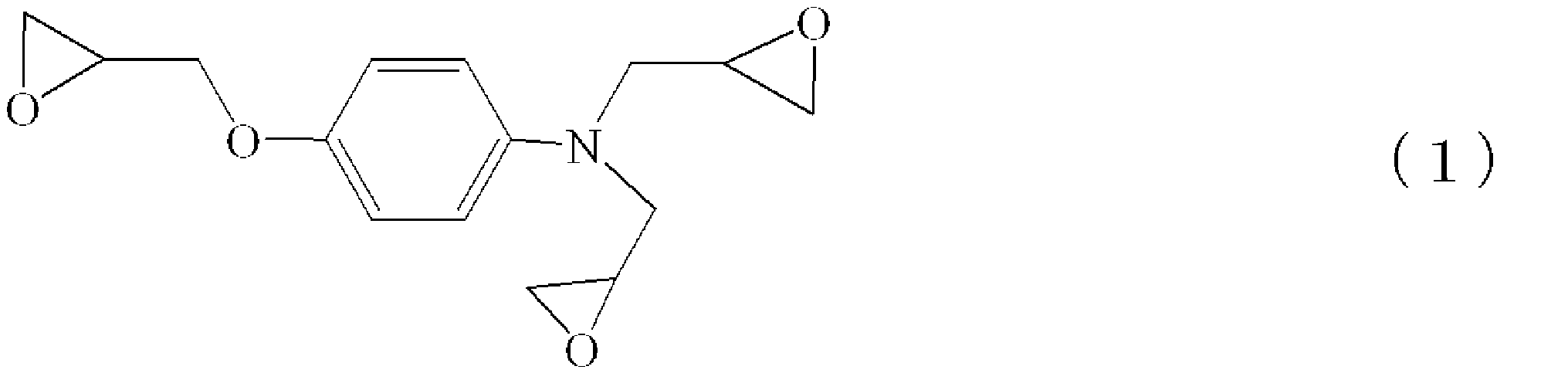
で示される、アミノフェノール型エポキシ樹脂が、硬化後の樹脂組成物を高熱伝導性にするため、好ましい。(A)成分の市販品としては、三菱化学製アミノフェノール型エポキシ樹脂(品名:630)が挙げられる。(A)成分は、単独でも2種以上を併用してもよい。
(B)成分は、樹脂組成物にフィルム成形性を付与する。(B)成分のフェノキシ樹脂は、特に限定されるものではなく、ビスフェノールA骨格、ビスフェノールF骨格、ビスフェノールS骨格、ビスフェノールアセトフェノン骨格、ノボラック骨格、ビフェニル骨格、フルオレン骨格、ジシクロペンタジエン骨格、ノルボルネン骨格、ナフタレン骨格、アントラセン骨格、アダマンタン骨格、テルペン骨格、トリメチルシクロヘキサン骨格から選択される1種以上の骨格を有するものが、挙げられる。(B)成分のフェノキシ樹脂の市販品としては、三菱化学製可とう性フェノキシ樹脂(品名:YL7178、ガラス転移温度:15℃)が挙げられる。
(B)成分の熱可塑性エラストマーとしては、ウレタンゴム、アクリルゴム、シリコーンゴム、ビニルアルキルエーテルゴム、ポリビニルアルコールゴム、ポリビニルピロリドンゴム、ポリアクリルアミドゴム、セルロースゴム、天然ゴム、ブタジエンゴム、クロロプレンゴム、スチレン・ブタジエンゴム(SBR)、アクリロニトリル・ブタジエンゴム(NBR)、スチレン・エチレン・ブタジエン・スチレンゴム、スチレン・イソプレン・スチレンゴム、スチレン・イソブチレンゴム、イソプレンゴム、ポリイソブチレンゴム、ブチルゴム、(メタ)アクリル酸アルキルエステルを含むモノマーの重合により得られる合成アクリルゴム、スチレン-ブタジエンブロック共重合体(SBS)、スチレン-エチレン/ブチレン-スチレンブロック共重合体(SEBS)、スチレン-イソプレン-スチレンブロック共重合体(SIS)、ポリブタジエン(PB)、スチレン-(エチレン-エチレン/プロピレン)-スチレンブロック共重合体(SEEPS)、エチレン-不飽和カルボン酸共重合体(例えば、エチレン-アクリル酸共重合体、エチレン-メタクリル酸共重合体など)、エチレン-不飽和カルボン酸エステル共重合体(例えば、エチレン-エチルアクリレート共重合体、エチレン-エチルメタクリレート共重合体など)、並びにこれらの無水カルボン酸変性物(例えば無水マレイン酸変性物)からなる群から選ばれる少なくとも1種が挙げられる。(B)成分の熱可塑性エラストマーの市販品としては、ナガセケムテックス製アクリル酸エステル共重合体(品名:SG790、ガラス転移温度:-32℃)が挙げられる。(B)成分は、単独でも2種以上を併用してもよい。
また、(B)成分は、樹脂組成物のフィルム成形性、硬化後の樹脂組成物に適度な柔軟性を持たせるため、ガラス転移温度(Tg)が50℃未満である、と好ましい。さらに、樹脂組成物のフィルム成形性、接着性の観点から、(B)成分は、ガラス転移温度(Tg)が50℃未満のフェノキシ樹脂であることが、より好ましい。
(C)成分としては、熱伝導率が、5W/m・K以上であれば、絶縁性を保持する観点から、一般的な無機フィラーを使用することができる。(C)成分は、熱伝導率、絶縁性および熱膨張係数の点から、MgO、Al2O3、AlN、BN、ダイヤモンドフィラー、ZnO、およびSiCからなる群より選択される少なくとも1種以上の無機フィラーであると、好ましい。なお、ZnOおよびSiCには、必要に応じて絶縁処理をしてもよい。各材料の熱伝導率測定結果の一例としては(単位は、W/m・K)、MgOは37、Al2O3は30、AlNは200、BNは30、ダイヤモンドは2000、ZnOは54、SiCは90である。(C)成分の市販品としては、堺化学工業製酸化マグネシウム粉末(品名:SMO-5、SMO-1、SMO-02、SMO-2)、昭和電工製アルミナ(Al2O3)粉末(品名:CBA09S)、電気化学工業製アルミナ(Al2O3)粉末(品名:DAW-03、ASFP-20)が挙げられる。
(C)成分の平均粒径(粒状でない場合は、その平均最大径)は、特に限定されないが、0.05~50μmであることが、樹脂組成物中に(C)成分を均一に分散させるうえで好ましい。0.05μm未満だと、樹脂組成物の粘度が上昇して、成形性が悪化するおそれがある。50μm超だと、樹脂組成物中に(C)成分を均一に分散させることが困難になるおそれがある。ここで、(C)成分の平均粒径は、動的光散乱式ナノトラック粒度分析計により測定する。(C)成分は、単独でも2種以上を併用してもよい。
(A)成分は、樹脂組成物(溶剤を除く):100質量部に対して、1.5~15質量部であると好ましく、2~10質量部であると、より好ましい。
(B)成分は、樹脂組成物のフィルム成形性、硬化後の樹脂組成物の熱伝導率、耐熱性の観点から、(A)成分1質量部に対して、0.5~5質量部である。(B)成分が、(A)成分1質量部に対して、0.5質量部未満では、樹脂組成物をフィルム成形できなくなってしまい、5質量部を超えると、硬化後の樹脂組成物の熱伝導率が低くなってしまう。また、(A)と(B)の合計は、樹脂組成物のフィルム成形性、接着性、硬化後の樹脂組成物の熱伝導率の観点から樹脂組成物(溶剤を除く):100質量部に対して、4~20質量部であると好ましい。
(C)成分は、樹脂組成物の接着性、硬化後の樹脂組成物の絶縁性、および熱膨張係数の観点から、樹脂組成物(溶剤を除く):100質量部に対して、40~95質量部であると好ましい。(C)成分が、95質量部を超えると、樹脂組成物の接着力が低下し易い。一方、(C)成分が、40質量部未満であると、高熱伝導性無機フィラーの熱伝導率が高くても、硬化後の樹脂組成物の熱伝導が不十分であるおそれがある。
樹脂組成物は、さらに、(D)硬化物を含む、と好ましい。(D)成分としては、フェノール系硬化剤、酸無水物系硬化剤、アミン系硬化剤、イミダゾール系硬化剤、カルボン酸ジヒドラジド硬化剤等が挙げられ、フェノール系硬化剤、アミン系硬化剤、酸無水物系硬化剤およびイミダゾール系硬化剤からなる群より選択される少なくとも1種であると好ましい。また、樹脂組成物の接着性の観点から、フェノール系硬化剤がより好ましく、また、樹脂組成物の流動性、接着性の観点から、酸無水物系硬化剤がより好ましい。樹脂組成物の保存安定性の観点からは、イミダゾール系硬化剤がより好ましい。
フェノール系硬化剤としては、フェノールノボラック、クレゾールノボラック等が挙げられ、フェノールノボラックが好ましい。また、フェノール系硬化剤は、酸無水物系硬化剤、アミン系硬化剤、イミダゾール系硬化剤等の他の硬化剤より、硬化速度が遅いので、他の硬化剤を使用して、樹脂組成物の硬化速度が速くなり過ぎる場合には、フェノール系硬化剤を併用して、樹脂組成物の硬化速度を遅延する目的で使用することができる。
酸無水物としては、テトラヒドロ無水フタル酸、ヘキサヒドロ無水フタル酸、メチルテトラヒドロ無水フタル酸、メチルヘキサヒドロ無水フタル酸、メチルナジック酸無水物、水素化メチルナジック酸無水物、トリアルキルテトラヒドロ無水フタル酸、メチルシクロヘキセンテトラカルボン酸二無水物、無水フタル酸、無水トリメリット酸、無水ピロメリット酸、ベンゾフェノンテトラカルボン酸二無水物、エチレングリコールビスアンヒドロトリメリテート、グリセリンビス(アンヒドロトリメリテート)モノアセテート、ドデセニル無水コハク酸、脂肪族二塩基酸ポリ無水物、クロレンド酸無水物、メチルブテニルテトラヒドロフタル酸無水物、アルキル化テトラヒドロフタル酸無水物、メチルハイミック酸無水物、アルケニル基で置換されたコハク酸無水物、グルタル酸無水物等が挙げられ、メチルブテニルテトラヒドロフタル酸無水物が好ましい。
アミン系硬化剤としては、鎖状脂肪族アミン、環状脂肪族アミン、脂肪芳香族アミン、芳香族アミン等が挙げられ、芳香族アミンが好ましい。カルボン酸ジヒドラジド硬化剤としては、アジピン酸ジヒドラジド、イソフタル酸ジヒドラジド、セバチン酸ジヒドラジド、ドデカン酸ジヒドラジド等が挙げられ、アジピン酸ジヒドラジドが好ましい。
イミダゾール系硬化剤としては、マイクロカプセル化されたイミダゾール化合物硬化剤、アミンアダクト型硬化剤が、樹脂組成物の保存安定性の観点から好ましく、液状ビスフェノールA型等の液状エポキシ樹脂中に分散された、マイクロカプセル化イミダゾール化合物硬化剤が、樹脂組成物の作業性、硬化速度、保存安定性の点からより好ましい。イミダゾール硬化剤としては、2-メチルイミダゾール、2-ウンデシルイミダゾール、2-ヘプタデシルイミダゾール、2-エチル-4-メチルイミダゾール、2-フェニルイミダゾール、2-フェニル-4-メチルイミダゾール、2,4-ジアミノ-6-[2’-メチルイミダゾリル-(1’)]エチル-s-トリアジン、2-フェニル-4,5-ジヒドロキシメチルイミダゾール、2-フェニル-4-メチル-5-ヒドロキシメチルイミダゾール、2,3-ジヒドロ-1H-ピロロ[1,2-a]ベンズイミダゾール等を挙げることができ、2,4-ジアミノ-6-[2’-メチルイミダゾリル-(1’)]エチル-s-トリアジン、2,4-ジアミノ-6-[2’-ウンデシルイミダゾリル-(1)]-エチル-s-トリアジン、2,4-ジアミノ-6-[2’-エチル-4’-メチルイミダゾリル-(1’)]-エチル-s-トリアジン等が、樹脂組成物の硬化速度、作業性、耐湿性の観点から好ましい。
(D)成分の市販品としては、明和化成製フェノール硬化剤(品名:MEH8000、MEH8005)、三菱化学製酸無水物(グレード:YH306、YH307)、日立化成工業製3 or 4-メチル-ヘキサヒドロ無水フタル酸(品名:HN-5500)、日本化薬製アミン硬化剤(品名:カヤハードA-A)、日本ファインケム製アジピン酸ジヒドラジド(品名:ADH)、旭化成イーマテリアルズ製マイクロカプセル化イミダゾール化合物硬化剤(品名:HX3722、HX3742、HX3932HP、HX3941HP)、味の素ファインテクノ製アミンアダクト型硬化剤(品名:PN-40J)、四国化成工業製2-エチル-4-メチルイミダゾール(品名:2E4MZ)等が挙げられるが、(B)成分は、これら品名に限定されるものではない。(D)成分は、単独でも2種以上を併用してもよい。
(D)成分は、樹脂組成物の保存安定性、硬化性の観点から、樹脂組成物(溶剤を除く):100質量部に対して、0.1~5質量部であると好ましい。
なお、樹脂組成物は、本発明の効果を損なわない範囲で、カップリング剤、粘着性付与剤、消泡剤、流動調整剤、成膜補助剤、分散剤等の添加剤や、有機溶剤を含むことができる。
有機溶剤としては、芳香族系溶剤、例えばトルエン、キシレン等、ケトン系溶剤、例えばメチルエチルケトン、メチルイソブチルケトン等が挙げられる。有機溶剤は、単独でも、2種以上を組み合わせて用いてもよい。また、有機溶剤の使用量は、特に限定されないが、固形分が20~50質量%となるように使用することが好ましい。樹脂組成物の作業性の点から、樹脂組成物は、200~3000mPa・sの粘度の範囲であることが好ましい。粘度は、E型粘度計を用いて、回転数10rpm、25℃で測定した値とする。
〔接着フィルム〕
上述の樹脂組成物は、接着フィルムの形成に、適している。(A)~(C)成分等を含む原料を、有機溶剤に溶解又は分散等させることにより、樹脂組成物を得ることができる。これらの原料の溶解又は分散等の装置としては、特に限定されるものではないが、撹拌、加熱装置を備えたライカイ機、3本ロールミル、ボールミル、プラネタリーミキサー、ビーズミル等を使用することができる。また、これら装置を適宜組み合わせて使用してもよい。
上述の樹脂組成物は、接着フィルムの形成に、適している。(A)~(C)成分等を含む原料を、有機溶剤に溶解又は分散等させることにより、樹脂組成物を得ることができる。これらの原料の溶解又は分散等の装置としては、特に限定されるものではないが、撹拌、加熱装置を備えたライカイ機、3本ロールミル、ボールミル、プラネタリーミキサー、ビーズミル等を使用することができる。また、これら装置を適宜組み合わせて使用してもよい。
接着フィルムは、上述の樹脂組成物を、所望の支持体に塗布した後、乾燥することにより得られる。支持体は、特に限定されず、銅、アルミニウム等の金属箔、ポリエステル樹脂、ポリエチレン樹脂、ポリエチレンテレフタレート樹脂等の有機フィルム等が挙げられる。支持体はシリコーン系化合物等で離型処理されていてもよい。
樹脂組成物を支持体に塗布する方法は、特に限定されないが、薄膜化・膜厚制御の点からはマイクログラビア法、スロットダイ法、ドクターブレード法が好ましい。スロットダイ法により、熱硬化後の厚さが10~300μmになる接着フィルムを得ることができる。
乾燥条件は、樹脂組成物に使用される有機溶剤の種類や量、塗布の厚み等に応じて、適宜、設定することができ、例えば、50~120℃で、1~30分程度とすることができる。このようにして得られた接着フィルムは、良好な保存安定性を有する。なお、接着フィルムは、所望のタイミングで、支持体から剥離することができる。
接着フィルムは、例えば、130~200℃で、30~180分間、熱硬化させて、被接着物を接着することができる。発熱体である被接着物と、受熱体である被接着物とを接着する場合、硬化した接着フィルムは、発熱体である被接着物からの熱を受熱体である被接着物側へ逃がし、受熱体である被接着物側で放熱させる伝熱の役割を果たす。さらに、硬化した接着フィルムは、発熱体である被接着物と受熱体である被接着物との間の熱膨張率の差に起因する応力を緩和する役割を果たす。
接着フィルムの厚さは、好ましくは10μm以上300μm以下、より好ましくは10μm以上100μm以下、更に好ましくは10μm以上50μm以下である。10μm未満では所望する絶縁性を得られなくなるおそれがある。300μmを超えると、発熱する被接着物の放熱を十分にできなくなるおそれがある。接着フィルムの厚さが薄くなるに従って、発熱体である被接着物と受熱体である被接着物との距離が短くなるので、効率的な熱伝導の観点から、接着フィルムの厚さは薄い方が好ましい。
また、硬化した接着フィルムは、熱伝導率が2W/m・K以上であるとより好ましい。また、硬化した接着フィルムの熱伝導率が2W/m・K未満の場合には、発熱体からの受熱器への伝熱が不十分となるおそれがある。硬化した接着フィルムの体積抵抗率と熱伝導率は、(C)成分の種類と含有量によって、制御することができる。
硬化した接着フィルムのピール強度は、5N/cmを超えることが好ましい。硬化した接着フィルムのピール強度が、5N/cmを超えると、接着フィルムの硬化体を使用した、半導体装置の信頼性を高めることができる。
硬化した接着フィルムは、体積抵抗率が1×10¹⁰Ω・cm以上であると、好ましい。硬化した接着フィルムの体積抵抗率が1×10¹⁰Ω・cm未満の場合には、半導体装置に要求される絶縁性を満足できないおそれがある。
〔半導体装置〕
本発明の半導体装置は、上述の接着フィルムの硬化体を使用する。熱伝導性、接着強度に優れた接着フィルムの硬化体により、高信頼性の半導体装置を提供することができる。半導体装置としては、モジュールや電子部品などの発熱体と、基板などの受熱体とを、接着フィルムの硬化物で接着したものや、発熱体からの熱を受熱した基板の熱と、この基板から更に受熱する放熱板などとを接着フィルムの硬化物で接着したものが、挙げられる。
本発明の半導体装置は、上述の接着フィルムの硬化体を使用する。熱伝導性、接着強度に優れた接着フィルムの硬化体により、高信頼性の半導体装置を提供することができる。半導体装置としては、モジュールや電子部品などの発熱体と、基板などの受熱体とを、接着フィルムの硬化物で接着したものや、発熱体からの熱を受熱した基板の熱と、この基板から更に受熱する放熱板などとを接着フィルムの硬化物で接着したものが、挙げられる。
本発明について、実施例により説明するが、本発明はこれらに限定されるものではない。なお、以下の実施例において、部、%はことわりのない限り、質量部、質量%を示す。
〔実施例1~12、比較例1~4〕
表1と表2に示す配合で、(A)成分、(B)成分、適量のトルエンを計量配合した後、それらを80℃に加温された反応釜に投入し、回転数150rpmで回転させながら、常圧混合を3時間行い、クリヤーを作製した。作製したクリヤーに、(C)成分、(D)成分、その他の成分を加え、プラネタリーミキサーにより分散し、接着フィルム用樹脂組成物を作製した。
表1と表2に示す配合で、(A)成分、(B)成分、適量のトルエンを計量配合した後、それらを80℃に加温された反応釜に投入し、回転数150rpmで回転させながら、常圧混合を3時間行い、クリヤーを作製した。作製したクリヤーに、(C)成分、(D)成分、その他の成分を加え、プラネタリーミキサーにより分散し、接着フィルム用樹脂組成物を作製した。
〔評価方法〕
1.熱伝導率の測定
得られた接着フィルム用樹脂組成物を、離型剤を施した50μm厚のPETフィルム上に、乾燥後の膜厚が200~400μmになるように掻き取り塗布した。図1に、掻き取り塗布の方法を説明するための模式図を示す。まず、離型剤付きPETフィルム上に、適切な厚さとなるように、2列にスペーサーを重ねた後、粘着テープで貼付する(図1(A))。離型剤付きPETフィルム上に、接着フィルム用組成物を適量注ぐ(図1(B))。スライドグラスをスペーサー上に置き、接着フィルム用組成物を掻き取って塗布する(図1(C)~(E))。次に、塗布した接着フィルム用組成物を、十分乾燥した後、得られた接着フィルムを、真空プレス機を用いて、180℃×60分、0.1MPaの条件で硬化させた。硬化させた接着フィルムを、10×10mmに裁断し、熱伝導率測定用試験片を作製した。作製した熱伝導率測定用試験片の熱伝導率を、NETZSCH社製熱伝導率計(Xeフラッシュアナライザー、型番:LFA447Nanoflash)で測定した。表1と表2に、熱伝導率の測定結果を示す。
1.熱伝導率の測定
得られた接着フィルム用樹脂組成物を、離型剤を施した50μm厚のPETフィルム上に、乾燥後の膜厚が200~400μmになるように掻き取り塗布した。図1に、掻き取り塗布の方法を説明するための模式図を示す。まず、離型剤付きPETフィルム上に、適切な厚さとなるように、2列にスペーサーを重ねた後、粘着テープで貼付する(図1(A))。離型剤付きPETフィルム上に、接着フィルム用組成物を適量注ぐ(図1(B))。スライドグラスをスペーサー上に置き、接着フィルム用組成物を掻き取って塗布する(図1(C)~(E))。次に、塗布した接着フィルム用組成物を、十分乾燥した後、得られた接着フィルムを、真空プレス機を用いて、180℃×60分、0.1MPaの条件で硬化させた。硬化させた接着フィルムを、10×10mmに裁断し、熱伝導率測定用試験片を作製した。作製した熱伝導率測定用試験片の熱伝導率を、NETZSCH社製熱伝導率計(Xeフラッシュアナライザー、型番:LFA447Nanoflash)で測定した。表1と表2に、熱伝導率の測定結果を示す。
2.ピール強度の測定
片面を粗化した銅箔を準備した。熱伝導率の評価の時と同様にして得られた接着フィルムの両面に、粗化面を内側にして銅箔を貼りあわせた。真空プレス機を用いて、180℃×60分、0.1MPaの条件で熱圧着し、硬化させた。この硬化体を10mm幅にカットし、ピール強度測定用試料を作製した。作成したピール強度測定用試料を、島津製作所社製オートグラフ(型番:ASG-J-5kNJ)で引きはがし、ピール強度を測定した。測定結果について、各N=5の平均値を計算した。表1と表2に、ピール強度の結果を示す。
片面を粗化した銅箔を準備した。熱伝導率の評価の時と同様にして得られた接着フィルムの両面に、粗化面を内側にして銅箔を貼りあわせた。真空プレス機を用いて、180℃×60分、0.1MPaの条件で熱圧着し、硬化させた。この硬化体を10mm幅にカットし、ピール強度測定用試料を作製した。作成したピール強度測定用試料を、島津製作所社製オートグラフ(型番:ASG-J-5kNJ)で引きはがし、ピール強度を測定した。測定結果について、各N=5の平均値を計算した。表1と表2に、ピール強度の結果を示す。
3.フィルム成形性
得られた接着フィルム用組成物を、離型剤を施した50μm厚のPETフィルム上に、幅が20cmで、乾燥後の膜厚が30~200μmになるように、塗布機を用いて塗布した。塗布した接着フィルム用組成物を、80℃で20分間乾燥した。このフィルムを、50mmφ、40cm幅のリールに巻き取り、フィルム成形性を評価した。折り曲げても割れない場合を「5」、折り曲げると一部が割れてしまう場合を「4」、折り曲げると割れてしまう場合を「3」、フィルムになるが割れやすい場合を「2」、フィルムにならず使用できない場合を「1」とした。表1と表2に、フィルム成形性の結果を示す。
得られた接着フィルム用組成物を、離型剤を施した50μm厚のPETフィルム上に、幅が20cmで、乾燥後の膜厚が30~200μmになるように、塗布機を用いて塗布した。塗布した接着フィルム用組成物を、80℃で20分間乾燥した。このフィルムを、50mmφ、40cm幅のリールに巻き取り、フィルム成形性を評価した。折り曲げても割れない場合を「5」、折り曲げると一部が割れてしまう場合を「4」、折り曲げると割れてしまう場合を「3」、フィルムになるが割れやすい場合を「2」、フィルムにならず使用できない場合を「1」とした。表1と表2に、フィルム成形性の結果を示す。

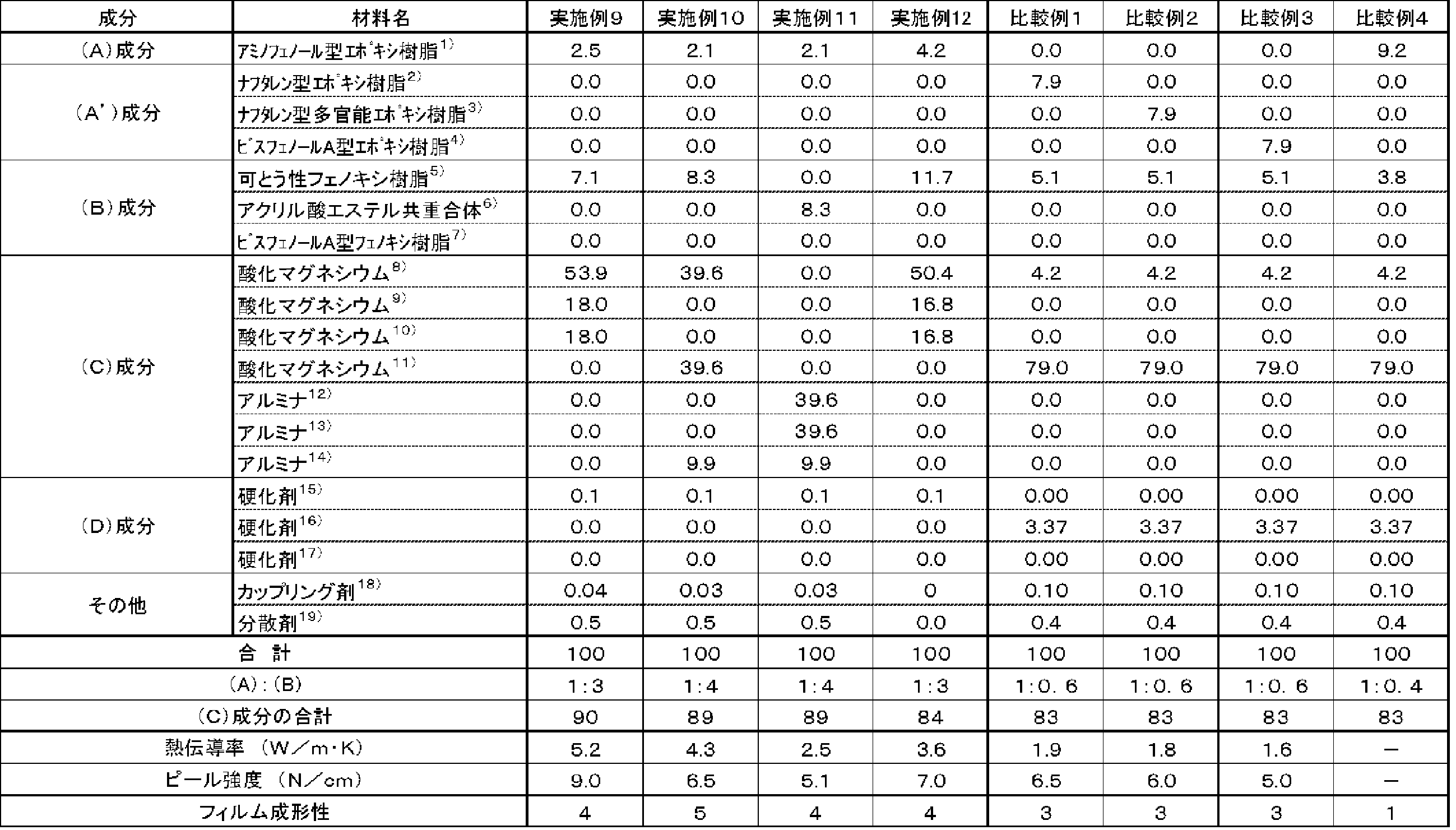
表1、2からわかるように、実施例1~12のすべてにおいて、熱伝導率、ピール強度、フィルム成形性のすべての結果が良好であった。これに対して、アミノフェノール型エポキシ樹脂の代わりにナフタレン型エポキシ樹脂を用いた比較例1は、熱伝導率が低かった。アミノフェノール型エポキシ樹脂の代わりにナフタレン型多官能エポキシ樹脂を用いた比較例2も、熱伝導率が低かった。アミノフェノール型エポキシ樹脂の代わりにビスフェノールA型エポキシ樹脂を用いた比較例3も、熱伝導率が低かった。(B)成分が(A)成分に対して少なすぎる比較例4は、接着フィルム用組成物をフィルムに成形することができず、熱伝導率、ピール強度を測定することができなかった。
本発明の樹脂組成物は、熱伝導性、接着性、フィルム成形性に優れ、特に、硬化後に熱伝導性に優れる樹脂組成物を提供することができる。
Claims (6)
- (A)アミノフェノール型エポキシ樹脂、(B)フェノキシ樹脂および熱可塑性エラストマーからなる群より選択される少なくとも1種、ならびに(C)高熱伝導性無機フィラーを含み、(A)成分1質量部に対して、(B)成分が0.5~5質量部であることを特徴とする、樹脂組成物。
- (A)成分が、下記化学式(1)で示される、請求項1記載の樹脂組成物。

- (B)成分のガラス転移温度が、50℃未満である、請求項1または2記載の樹脂組成物。
- (C)成分が、MgO、Al2O3、AlN、BN、ダイヤモンドフィラー、ZnO、およびSiCからなる群より選択される少なくとも1種である、請求項1~3のいずれか1項記載の樹脂組成物。
- 請求項1~4のいずれか1項記載の樹脂組成物から形成される、接着フィルム。
- 請求項5記載の接着フィルムの硬化体を使用した、半導体装置。
Priority Applications (2)
| Application Number | Priority Date | Filing Date | Title |
|---|---|---|---|
| CN201580012034.5A CN106103530B (zh) | 2014-03-31 | 2015-03-30 | 树脂组合物、粘接膜和半导体装置 |
| KR1020167029585A KR102076888B1 (ko) | 2014-03-31 | 2015-03-30 | 수지 조성물, 접착 필름, 및 반도체 장치 |
Applications Claiming Priority (2)
| Application Number | Priority Date | Filing Date | Title |
|---|---|---|---|
| JP2014-071145 | 2014-03-31 | ||
| JP2014071145A JP2015193687A (ja) | 2014-03-31 | 2014-03-31 | 樹脂組成物、接着フィルム、および半導体装置 |
Publications (1)
| Publication Number | Publication Date |
|---|---|
| WO2015152134A1 true WO2015152134A1 (ja) | 2015-10-08 |
Family
ID=54240457
Family Applications (1)
| Application Number | Title | Priority Date | Filing Date |
|---|---|---|---|
| PCT/JP2015/059873 Ceased WO2015152134A1 (ja) | 2014-03-31 | 2015-03-30 | 樹脂組成物、接着フィルム、および半導体装置 |
Country Status (5)
| Country | Link |
|---|---|
| JP (1) | JP2015193687A (ja) |
| KR (1) | KR102076888B1 (ja) |
| CN (1) | CN106103530B (ja) |
| TW (1) | TWI694126B (ja) |
| WO (1) | WO2015152134A1 (ja) |
Cited By (2)
| Publication number | Priority date | Publication date | Assignee | Title |
|---|---|---|---|---|
| CN108641650A (zh) * | 2018-04-24 | 2018-10-12 | 湖南省方正达电子科技有限公司 | 一种用于led线路的环氧树脂胶粘剂及其制备方法 |
| CN111876111A (zh) * | 2020-07-29 | 2020-11-03 | 武汉市三选科技有限公司 | 一种高导热率的底部填充胶及其制备方法 |
Families Citing this family (4)
| Publication number | Priority date | Publication date | Assignee | Title |
|---|---|---|---|---|
| JP6615150B2 (ja) * | 2017-05-01 | 2019-12-04 | 古河電気工業株式会社 | 接着フィルム、半導体ウェハ加工用テープ、半導体パッケージおよびその製造方法 |
| JP6934637B2 (ja) * | 2017-06-08 | 2021-09-15 | パナソニックIpマネジメント株式会社 | 樹脂組成物、プリプレグ、金属張積層板、プリント配線板、及び金属張積層板の製造方法 |
| CN112823188B (zh) * | 2018-11-20 | 2023-08-11 | 太阳控股株式会社 | 高耐电压散热绝缘性树脂组合物和使用其的电子部件 |
| KR20250142945A (ko) * | 2019-09-30 | 2025-09-30 | 가부시끼가이샤 레조낙 | 반도체용 접착제, 반도체용 접착제 시트, 및 반도체 장치의 제조 방법 |
Citations (4)
| Publication number | Priority date | Publication date | Assignee | Title |
|---|---|---|---|---|
| JPH0782392A (ja) * | 1993-06-30 | 1995-03-28 | Nippon Oil Co Ltd | 複合材料用プリプレグおよび管状複合材料成形体の製造方法 |
| JP2005187508A (ja) * | 2003-12-24 | 2005-07-14 | Sumitomo Bakelite Co Ltd | 半導体用接着フィルムおよび半導体装置 |
| JP2011168672A (ja) * | 2010-02-17 | 2011-09-01 | Sekisui Chem Co Ltd | 絶縁シート |
| JP2012079880A (ja) * | 2010-09-30 | 2012-04-19 | Sumitomo Bakelite Co Ltd | 接着剤、多層回路基板、半導体用部品および半導体装置 |
Family Cites Families (2)
| Publication number | Priority date | Publication date | Assignee | Title |
|---|---|---|---|---|
| JP5348740B2 (ja) | 2008-06-23 | 2013-11-20 | 日本化薬株式会社 | エポキシ樹脂、エポキシ樹脂組成物、およびその硬化物 |
| JP5737129B2 (ja) | 2010-10-18 | 2015-06-17 | 三菱化学株式会社 | エポキシ樹脂、エポキシ樹脂組成物および硬化物 |
-
2014
- 2014-03-31 JP JP2014071145A patent/JP2015193687A/ja active Pending
-
2015
- 2015-03-30 KR KR1020167029585A patent/KR102076888B1/ko active Active
- 2015-03-30 CN CN201580012034.5A patent/CN106103530B/zh active Active
- 2015-03-30 WO PCT/JP2015/059873 patent/WO2015152134A1/ja not_active Ceased
- 2015-03-31 TW TW104110416A patent/TWI694126B/zh active
Patent Citations (4)
| Publication number | Priority date | Publication date | Assignee | Title |
|---|---|---|---|---|
| JPH0782392A (ja) * | 1993-06-30 | 1995-03-28 | Nippon Oil Co Ltd | 複合材料用プリプレグおよび管状複合材料成形体の製造方法 |
| JP2005187508A (ja) * | 2003-12-24 | 2005-07-14 | Sumitomo Bakelite Co Ltd | 半導体用接着フィルムおよび半導体装置 |
| JP2011168672A (ja) * | 2010-02-17 | 2011-09-01 | Sekisui Chem Co Ltd | 絶縁シート |
| JP2012079880A (ja) * | 2010-09-30 | 2012-04-19 | Sumitomo Bakelite Co Ltd | 接着剤、多層回路基板、半導体用部品および半導体装置 |
Cited By (3)
| Publication number | Priority date | Publication date | Assignee | Title |
|---|---|---|---|---|
| CN108641650A (zh) * | 2018-04-24 | 2018-10-12 | 湖南省方正达电子科技有限公司 | 一种用于led线路的环氧树脂胶粘剂及其制备方法 |
| CN111876111A (zh) * | 2020-07-29 | 2020-11-03 | 武汉市三选科技有限公司 | 一种高导热率的底部填充胶及其制备方法 |
| CN111876111B (zh) * | 2020-07-29 | 2022-03-22 | 武汉市三选科技有限公司 | 一种高导热率的底部填充胶及其制备方法 |
Also Published As
| Publication number | Publication date |
|---|---|
| CN106103530A (zh) | 2016-11-09 |
| TW201546222A (zh) | 2015-12-16 |
| CN106103530B (zh) | 2018-10-02 |
| KR20160140776A (ko) | 2016-12-07 |
| KR102076888B1 (ko) | 2020-02-12 |
| TWI694126B (zh) | 2020-05-21 |
| JP2015193687A (ja) | 2015-11-05 |
Similar Documents
| Publication | Publication Date | Title |
|---|---|---|
| CN106103530B (zh) | 树脂组合物、粘接膜和半导体装置 | |
| JPWO2013145961A1 (ja) | 硬化性放熱組成物 | |
| JP2013007028A (ja) | 封止用シートおよび電子部品装置 | |
| JP2009517498A (ja) | 異方性の導電性接着剤組成物 | |
| JP5534682B2 (ja) | 電子部品用熱硬化性接着剤及びこの接着剤を用いた電子部品内蔵基板の製造方法 | |
| JP2008297429A (ja) | 接着剤組成物、接着剤シートおよび接着剤つき銅箔 | |
| JP6106405B2 (ja) | 半導体装置 | |
| JP2017149910A (ja) | 熱伝導性接着剤組成物、熱伝導性接着剤シートおよび積層体の製造方法 | |
| JP5760702B2 (ja) | 電子機器用接着剤組成物および電子機器用接着剤シート | |
| JP2017019900A (ja) | 接着剤組成物、接着フィルム、樹脂付き金属箔及び金属ベース基板 | |
| JP6912030B2 (ja) | 樹脂組成物、接着フィルム、および半導体装置 | |
| KR20150130367A (ko) | 장치, 접착제용 조성물, 접착 시트 | |
| KR102187491B1 (ko) | 필름용 수지 조성물, 절연 필름 및 반도체 장치 | |
| JP6579886B2 (ja) | プリント配線基板、および半導体装置 | |
| JP2009235402A (ja) | 接着フィルム | |
| JP2003193016A (ja) | 高耐熱高放熱接着フィルム | |
| TWI663195B (zh) | 絕緣薄膜,及半導體裝置 | |
| JP6715033B2 (ja) | 熱伝導性接着剤組成物、熱伝導性接着剤シートおよび積層体の製造方法 | |
| JP2017045934A (ja) | 接着フィルム | |
| KR20120044199A (ko) | 전자부품용 접착 조성물 및 전자부품용 접착 테이프 | |
| JP6316610B2 (ja) | 混成集積回路基板の製造方法およびそれを用いた混成集積回路基板 | |
| JP6441023B2 (ja) | 樹脂組成物及び放熱性硬化物 | |
| JP2015145489A (ja) | 熱接着シート及び物品 | |
| JP2008144140A (ja) | 接着成形品、その製造方法及び半導体装置 |
Legal Events
| Date | Code | Title | Description |
|---|---|---|---|
| 121 | Ep: the epo has been informed by wipo that ep was designated in this application |
Ref document number: 15773693 Country of ref document: EP Kind code of ref document: A1 |
|
| NENP | Non-entry into the national phase | ||
| ENP | Entry into the national phase |
Ref document number: 20167029585 Country of ref document: KR Kind code of ref document: A |
|
| 122 | Ep: pct application non-entry in european phase |
Ref document number: 15773693 Country of ref document: EP Kind code of ref document: A1 |