WO2015147238A1 - 乳様のなめらかさやコクを付与する組成物 - Google Patents
乳様のなめらかさやコクを付与する組成物 Download PDFInfo
- Publication number
- WO2015147238A1 WO2015147238A1 PCT/JP2015/059546 JP2015059546W WO2015147238A1 WO 2015147238 A1 WO2015147238 A1 WO 2015147238A1 JP 2015059546 W JP2015059546 W JP 2015059546W WO 2015147238 A1 WO2015147238 A1 WO 2015147238A1
- Authority
- WO
- WIPO (PCT)
- Prior art keywords
- whey protein
- vegetable oil
- complex
- milk
- fat
- Prior art date
- Legal status (The legal status is an assumption and is not a legal conclusion. Google has not performed a legal analysis and makes no representation as to the accuracy of the status listed.)
- Ceased
Links
Images

Classifications
-
- A—HUMAN NECESSITIES
- A23—FOODS OR FOODSTUFFS; TREATMENT THEREOF, NOT COVERED BY OTHER CLASSES
- A23C—DAIRY PRODUCTS, e.g. MILK, BUTTER OR CHEESE; MILK OR CHEESE SUBSTITUTES; PREPARATION THEREOF
- A23C21/00—Whey; Whey preparations
- A23C21/04—Whey; Whey preparations containing non-milk components as source of fats or proteins
-
- A—HUMAN NECESSITIES
- A23—FOODS OR FOODSTUFFS; TREATMENT THEREOF, NOT COVERED BY OTHER CLASSES
- A23D—EDIBLE OILS OR FATS, e.g. MARGARINES, SHORTENINGS OR COOKING OILS
- A23D7/00—Edible oil or fat compositions containing an aqueous phase, e.g. margarines
- A23D7/005—Edible oil or fat compositions containing an aqueous phase, e.g. margarines characterised by ingredients other than fatty acid triglycerides
- A23D7/0053—Compositions other than spreads
-
- A—HUMAN NECESSITIES
- A23—FOODS OR FOODSTUFFS; TREATMENT THEREOF, NOT COVERED BY OTHER CLASSES
- A23D—EDIBLE OILS OR FATS, e.g. MARGARINES, SHORTENINGS OR COOKING OILS
- A23D7/00—Edible oil or fat compositions containing an aqueous phase, e.g. margarines
- A23D7/005—Edible oil or fat compositions containing an aqueous phase, e.g. margarines characterised by ingredients other than fatty acid triglycerides
- A23D7/0056—Spread compositions
-
- A—HUMAN NECESSITIES
- A23—FOODS OR FOODSTUFFS; TREATMENT THEREOF, NOT COVERED BY OTHER CLASSES
- A23L—FOODS, FOODSTUFFS OR NON-ALCOHOLIC BEVERAGES, NOT OTHERWISE PROVIDED FOR; PREPARATION OR TREATMENT THEREOF
- A23L23/00—Soups; Sauces; Preparation or treatment thereof
-
- A—HUMAN NECESSITIES
- A23—FOODS OR FOODSTUFFS; TREATMENT THEREOF, NOT COVERED BY OTHER CLASSES
- A23L—FOODS, FOODSTUFFS OR NON-ALCOHOLIC BEVERAGES, NOT OTHERWISE PROVIDED FOR; PREPARATION OR TREATMENT THEREOF
- A23L9/00—Puddings; Cream substitutes; Preparation or treatment thereof
- A23L9/10—Puddings; Dry powder puddings
-
- A—HUMAN NECESSITIES
- A23—FOODS OR FOODSTUFFS; TREATMENT THEREOF, NOT COVERED BY OTHER CLASSES
- A23G—COCOA; COCOA PRODUCTS, e.g. CHOCOLATE; SUBSTITUTES FOR COCOA OR COCOA PRODUCTS; CONFECTIONERY; CHEWING GUM; ICE-CREAM; PREPARATION THEREOF
- A23G3/00—Sweetmeats; Confectionery; Marzipan; Coated or filled products
- A23G3/34—Sweetmeats, confectionery or marzipan; Processes for the preparation thereof
- A23G3/36—Sweetmeats, confectionery or marzipan; Processes for the preparation thereof characterised by the composition containing organic or inorganic compounds
-
- A—HUMAN NECESSITIES
- A23—FOODS OR FOODSTUFFS; TREATMENT THEREOF, NOT COVERED BY OTHER CLASSES
- A23G—COCOA; COCOA PRODUCTS, e.g. CHOCOLATE; SUBSTITUTES FOR COCOA OR COCOA PRODUCTS; CONFECTIONERY; CHEWING GUM; ICE-CREAM; PREPARATION THEREOF
- A23G9/00—Frozen sweets, e.g. ice confectionery, ice-cream; Mixtures therefor
- A23G9/32—Frozen sweets, e.g. ice confectionery, ice-cream; Mixtures therefor characterised by the composition containing organic or inorganic compounds
-
- A—HUMAN NECESSITIES
- A23—FOODS OR FOODSTUFFS; TREATMENT THEREOF, NOT COVERED BY OTHER CLASSES
- A23V—INDEXING SCHEME RELATING TO FOODS, FOODSTUFFS OR NON-ALCOHOLIC BEVERAGES AND LACTIC OR PROPIONIC ACID BACTERIA USED IN FOODSTUFFS OR FOOD PREPARATION
- A23V2002/00—Food compositions, function of food ingredients or processes for food or foodstuffs
Definitions
- the present invention relates to a composition that imparts milky smoothness and richness, and specifically to a lipid-protein complex composed of vegetable oil and whey protein.
- Milk is used to give the soup smooth and cloudy, and the homogenized milk is dispersed with milk protein (mainly casein) attached around the milk fat (non-patented) Reference 1).
- milk protein mainly casein
- the milk fat raw material lacks a milk fat flavor, and powdered fats and oils are used as an alternative to milk fat.
- powdered fats and oils do not give a milky fat-like smoothness or richness, although they give oily feeling.
- Non-patent Document 1 and Patent Document 1 adsorbing milk protein (mainly casein) to fat globules of vegetable oils and fats, by imparting a cream-like flavor
- Patent Document 2 adsorbing milk protein (mainly casein) to fat globules of vegetable oils and fats, by imparting a cream-like flavor
- Patent Document 3 powdered fats and oils have been developed that attach casein and whey protein to vegetable oils and give a milk-like flavor
- milk fat cream with excellent emulsification stability and good whipping properties and a method for producing the same have been developed through a raw milk homogenization process in which raw milk is homogenized, and the mass of casein relative to whey protein in the fat globule membrane A milk fat cream having a ratio of a certain value or less is disclosed (Patent Document 4).
- the fat particles contained in raw milk are micronized, and the first raw milk (with a fat globule peak in the range of 0.4 ⁇ m to 0.6 ⁇ m) and the second raw milk (range of 1.0 ⁇ m to 1.4 ⁇ m)
- an emulsion having a small fat globule diameter and an emulsion having a large fat globule diameter at an arbitrary ratio it has 1 to 2 fat globule peaks in a fat globule diameter range of 0.1 to 1.0 ⁇ m.
- a method for producing emulsified fat having 1 or 2 fat globule peaks in the range of 1.5 to 2.5 ⁇ m fat globule diameter is known (Patent Document 2).
- a technology is known that provides a fresh cream with a rich flavor, improved storage stability and improved whipping properties by mixing fresh creams having a median diameter of 2.6-4.0 ⁇ m and 0.5-2.5 ⁇ m (Patent Document 6). ).
- An object of the present invention is to provide an oil / fat product made from vegetable oils and fats, which provides milky smoothness and richness, and a method for producing the same.
- the present inventors have surprisingly found that a complex of vegetable oil and whey protein is surprisingly a new food material for imparting smoothness and richness equivalent to milk (raw milk). As a result, the present invention has been completed.
- the present invention is as follows.
- [1] A vegetable oil-whey protein complex formed by adsorbing whey protein on the surface of fat globules of vegetable oil.
- [2] The complex according to [1], wherein the vegetable oil is palm oil.
- [3] The composite according to [1] or [2], which is solid or powdery.
- [4] The composite according to [1] or [2], which is emulsified in water.
- Vegetable oil / fat-whey protein complex obtained by contacting fat globules of vegetable oil / fat with whey protein in an aqueous solvent at a weight ratio of vegetable oil / fat: whey protein of 1: 0.002-2.5 body.
- a method for producing a vegetable oil / fat-whey protein complex comprising a step of bringing a whey protein into contact with fat globules of the vegetable oil / fat in an aqueous solvent.
- the vegetable oil-whey protein complex of the present invention can impart smoothness and richness to dairy products in addition to the original flavor. Applicable foods are not limited to dairy products, and can easily impart flavor and texture to foods other than dairy products.
- the vegetable oil / whey protein complex and the composition containing the same of the present invention are stable and have excellent storage stability as compared with milk, and are therefore excellent in stable supply of foodstuffs.
- Vegetable fat / whey protein complex The vegetable fat / whey protein complex of the present invention (hereinafter sometimes simply referred to as complex) is formed by adsorbing whey protein on the surface of fat globules of vegetable fat / oil. .
- vegetable oils and fats are plant-derived oils and fats excluding animal fats including milk fat.
- vegetable oils and fats are palm oil, palm oil, palm kernel oil, corn oil, soybean oil, cottonseed oil, rice oil, safflower oil, sesame oil, olive oil, cocoa butter, Rapeseed oil is a suitable example. These vegetable fats and oils may be used alone or in combination. Palm oil is preferable because of easy handling.
- the fat globule is a spherical substance emulsified with vegetable oil.
- the fats and oils may be used as the vegetable fats and oils, or non-emulsified vegetable fats and oils may be emulsified to form fat globules.
- the fat globules may contain an emulsifier.
- emulsifier examples include glycerin fatty acid ester, glycerin organic acid fatty acid ester, sucrose fatty acid ester, propylene glycol fatty acid ester, sorbitan fatty acid ester, polyglycerin fatty acid ester, polyglycerin condensed ricinoleic acid ester, lecithin, gum arabic, starch and the like.
- whey protein refers to a protein obtained by removing casein from milk protein, and may be classified as whey protein.
- main protein of whey protein include lactalbumin and lactoglobulin.
- whey protein, whey protein and whey powder are used synonymously unless otherwise specified.
- whey protein those commercially available as whey protein can be used, and as a commercial product, whey protein may be 25% or more, and components other than whey protein such as lactose and ash May be included.
- the complex of the present invention is composed of a fat globule of vegetable oil and fat and whey protein, and has a structure in which whey protein is adsorbed on the surface of the fat globule.
- the structure of the vegetable oil / whey protein complex can be confirmed by observation with an electron microscope.
- the size of the vegetable oil / whey protein complex is not particularly limited, and an average particle diameter range of 0.1 ⁇ m to several hundred ⁇ m is exemplified.
- the average particle size of the vegetable oil / whey protein complex can be measured using a laser diffraction particle size distribution analyzer (SALD-3000S (SHIMADZU) or the like) and can be expressed as a median size.
- the size of the composite of the present invention can be expressed by a particle size distribution in addition to the average particle size.
- the particle size distribution of the composite of the present invention satisfies the following requirements.
- the particle size distribution in the present invention can be obtained by measuring using a laser diffraction particle size distribution measuring apparatus. i) A peak is present in the range of (A): 0.1 ⁇ m to 1 ⁇ m and (B): 1.0 ⁇ m to 10 ⁇ m. That is, two peaks are shown (see, for example, FIG. 1). ii) In particular, a composite having a particle size distribution in the range (B) is more effective.
- the complex of the present invention is preferably a vegetable oil-whey protein complex having a peak in the range (B) of 1.0 ⁇ m or more and 10 ⁇ m or less in the particle size distribution.
- the complex of the present invention further comprises a vegetable oil-whey protein complex having a peak in the range (A) of 0.1 ⁇ m to 1 ⁇ m. preferable.
- the method for measuring the particle size distribution of the composite of the present invention is obtained by laser diffraction particle size distribution measurement. Specifically, using a laser diffraction particle size distribution analyzer (Shimadzu Corporation, SALD-2200), the measurement conditions are refractive index 1.6-0.50i, solvent: water, and the average value after four measurements. And
- the complex of the present invention is obtained by bringing vegetable oil and fat into contact with whey protein in an aqueous solvent. Therefore, the composite of the present invention may be in an emulsified state in water.
- the composite of the present invention can be used by adding an appropriate amount at the production stage of the food, can be used by adding an appropriate amount to the manufactured food, or added at the time of eating the prepared food There is no particular limitation.
- the complex of the present invention is obtained by bringing vegetable oil and whey protein into contact with each other in an aqueous solvent. If necessary, the complex is then subjected to a drying step to form a solid or powder. be able to.
- the composite of the present invention in solid or powder form is convenient when mixed with a solid food material. In addition, handling is easy at the stage of distribution and storage.
- the ratio between the vegetable oil and the whey protein constituting the complex of the present invention cannot be generally described because the surface area to be adsorbed differs depending on the average particle size of the fat globules, but the whey protein is not constant in the plant fat globule membrane. When adsorbed at a rate, it becomes smooth and rich. When the ratio exceeds a certain level, the body becomes weaker. For example, when the ratio of vegetable fat / oil to whey protein is 1: 0.002 to 0.23 by weight ratio of vegetable fat / fat: whey protein, the amount of whey protein adsorbed on the plant fat globule membrane is small, giving a weak body. And it is suitable when you want to give a light touch.
- the whey protein covers the surface of the plant fat globule membrane, so that it is most effective for the purpose of imparting smoothness and richness. Conversely, if there is more whey protein that covers the fat globule membrane surface (weight ratio of vegetable oil and whey protein is more than 1: 0.43), the amount of whey protein that exists alone increases, and a certain smoothness is achieved. It is thought that the effect is less likely to be felt because the body becomes weaker while imparting the thickness. In fact, even if the whey protein alone is added to the soup, the richness of the soup is reduced without adding the richness as when the complex of the present invention is added.
- the ratio of vegetable oil and whey protein in the complex is determined by the weight of the vegetable oil and fat used as the raw material and the weight of the whey protein in the complex (the weight of the protein in the raw material and the surface of the fat globule of the vegetable oil and fat.
- the weight of the protein released in the aqueous solvent can be obtained from a known protein quantification method (for example, Kjeldahl method, combustion method, etc., and calculated from the difference).
- the complex of the present invention can be obtained by contacting fat globules of vegetable fats and whey proteins in an aqueous solvent at a weight ratio of 1: 0.002 to 2.5 in the ratio of vegetable fats and whey proteins. .
- the complex of the present invention is preferably formed by mixing fat globules of vegetable oil and fat and whey protein in water at a ratio of vegetable oil and fat to whey protein of 1: 0.002 to 2.5 by weight.
- the complex can be provided as it is, that is, as a vegetable oil-whey protein complex emulsified in water.
- a vegetable oil-whey protein complex emulsified in water By subjecting the vegetable oil-whey protein complex emulsified in water to a known concentration or drying step, it can be provided as a solid or powdery vegetable oil-whey protein complex.
- the composite of the present invention may be in the form of a composition in combination with other components usually used as food ingredients.
- the complex of the present invention or the composition containing the complex is useful as an additive for imparting flavor or texture to food.
- the food is a food or milk material in which milk has been used, it is useful as an additive for imparting milky smoothness and richness to the food.
- Milky smoothness and richness are flavors and textures derived from homogenized milk fat produced by milk (raw milk) itself or foods added with milk (raw milk).
- the milky smoothness and richness in the present invention refers to a flavor and texture that feels like milk (raw milk) is contained in the mouth, unlike the flavor and texture derived from the raw vegetable oil.
- the presence or absence of milky smoothness or richness can be determined by a sensory test by a specialized panelist.
- the smoothness of the milk can be determined by the evaluation of the fact that there is no roughness, the fineness of the particles / texture, and the good taste.
- the richness can be determined by evaluating the thickness of the medium to aftertaste (weight of fat feeling, spread, body feeling), richness of the content (solid feeling of milk protein, density feeling), and sustainability of flavor. .
- the ratio of the complex contained in the composition of the present invention is not particularly limited as long as the object can be achieved. Usually, 0.001 to 99.999% by weight is exemplified, and 50 to 99.999% by weight is preferable because of easy handling.
- the optional components contained in the composition of the present invention are not particularly limited as long as the purpose of imparting milky smoothness and richness can be achieved, and starch, sugar, thickener, stabilizer, flavor, coloring Materials, antioxidants, pH adjusters and the like.
- the amount of these optional components is not particularly limited as long as the object of the present invention can be achieved.
- the composite of the present invention can be used in combination with a fragrance.
- a fragrance an aroma component of milk is preferable, and lactones such as ⁇ -nonalactone, ⁇ -decalactone, ⁇ -tetradecalactone, ⁇ -dodecalactone, ⁇ -dodecalactone, ⁇ -hexalactone, ⁇ -butyrolactone, 1- Ketones such as octene-one, 2-hexanone, 2-pentanone, nonanone, furaneol, maltol, carboxylic acids such as octanoic acid, nonanoic acid, decanoic acid, butyric acid, caproic acid, propionic acid, hexanal, butanal, heptanol, heptenal Aldehydes such as nonenal, 2,4-decadienal, 2,4-nonadienal, methional, 3-methylbutanoic acid and furfural, and sul
- composition of the present invention can contain one or more of these fragrances in combination. Moreover, you may add these fragrance
- the complex of the present invention may be used in combination with a milk material.
- the amount of the milk material to be used is not particularly limited as long as the object of the present invention can be achieved.
- the milk material include whole milk powder, skim milk powder, milk protein, butter, fresh cream, condensed milk, milk, milk drink, and dairy products.
- the composition of the present invention can contain one or more of these milk materials in combination. Moreover, you may add these milk materials to a foodstuff separately from the composite_body
- the timing of addition to the food may be at the same time as the complex of the present invention, before or after the complex of the present invention is added.
- Step (1) emulsifying vegetable oil / fat
- a known emulsifier and an emulsifying method are used before the following step (1).
- the emulsification method include a homogenizer, a homomixer, a colloid mill, and an ultrasonic disperser, and homogenization treatment by heating and pressurization, but is not limited thereto.
- a homogenization treatment is performed.
- a method known per se may be used.
- the aqueous solvent and the powdered vegetable oil may be stirred and mixed until they are uniformly dissolved or dispersed.
- Step of contacting whey protein and fat globules of vegetable oil and fat in an aqueous solvent water is given as a representative example, and as long as the object of the present invention can be achieved, a pH adjusting agent, a preservative and the like are used. May be included.
- the contact condition between the whey protein and the fat globules of the vegetable fat in the aqueous solvent is that the emulsified vegetable fat is dissolved in the aqueous solvent, and then the whey protein is dissolved and contacted by a known stirring or mixing means. At this time, it is desirable that casein is not substantially present in the aqueous solvent.
- Casein is more adsorbable to fat globules than whey protein, so when vegetable fat and oil fat spheres and whey protein are brought into contact with each other in the presence of casein, a complex in which casein preferentially adsorbs is formed. This is because the composite of the present invention may be difficult to obtain.
- stirring or mixing conditions Any known per se can be used.
- the mixing ratio of whey protein to vegetable oil is not unambiguous because the surface area to be adsorbed differs depending on the average particle size of fat globules of vegetable oil, but it is mixed at a ratio that adsorbs to part or all of the fat sphere surface. Is preferred.
- the weight ratio of whey protein / vegetable oil / fat is exemplified to be 0.002 to 2.5, preferably 0.20 to 0.55.
- the temperature and contact time at the time of contact can be appropriately set according to the purpose.
- the temperature is exemplified by 0 to 60 ° C., and the contact time may be such that the whey protein can be kept dissolved.
- the composite of the present invention is formed in an aqueous solvent.
- the formed complex can be added to food as it is to give a milky flavor and texture. Moreover, it can provide as a composition which adds the above-mentioned arbitrary components and provides milky smoothness and richness.
- the complex of the present invention can be made solid by a known drying method. .
- the drying method include spray drying, freeze drying, and vacuum drying.
- the composite of the present invention has a relatively large particle size in the above range (B), but stability is maintained even after the drying step, and oil separation or the like does not occur.
- the composite of the present invention in a solid or powder form can be added to food as it is to give a milky flavor and texture. Moreover, it can provide as a composition which adds the above-mentioned arbitrary components and provides milky smoothness and richness.
- the composite or composition of the present invention can be used as a substitute for milk in foods that have conventionally used milk.
- white sauce sauce
- stew, gratin potage soup and cream soup using white sauce
- fermented milk foods such as cheese and yogurt
- processed milk such as low-fat milk and non-fat milk
- Fillings such as pudding, desserts such as pudding, bavaroa and ice cream
- beverages such as coffee, cocoa and tea
- smoothness of milk by adding in the process of manufacturing bread, confectionery and other processed foods or at the time of eating
- a sheath body can be suitably provided.
- the complex or composition of the present invention can be suitably imparted with milky smoothness and richness by adding it to the milk material during the processing or manufacturing process or at the time of eating.
- the milk material include whole milk powder, skim milk powder, milk protein, butter, fresh cream, condensed milk, milk, milk drink, and dairy products.
- the complex or composition of the present invention can be added and used as a new seasoning for foods that do not originally use milk.
- foods include various foods excluding the above-mentioned foods, and smoothness and richness can be suitably imparted by adding them during the food production process or at the time of eating.
- the added food may be imparted with effects such as enhancement of original flavor, sustainability, and odor masking.
- the amount added to the food can be appropriately set according to the desired flavor and texture.
- the dry weight of the complex of the present invention with respect to food is exemplified by 0.05 to 30% by weight.
- Whey protein 100% whey protein ingredient (MEGGLE JAPAN)
- Milk protein concentrate without whey protein: 100% skim milk ingredient (MEGGLE JAPAN)
- Non-fat dry milk containing casein: 100% non-fat dry milk ingredient (Yotsuba Milk Industry Co., Ltd.)
- Milk protein without whey protein: Using products containing 8.7% milk protein (Wakodo Co., Ltd.)
- the raw material composition blended according to the composition of Table 1 is added as powder and mixed (indicated as “powder” in the table), and 10 ml of water is added in advance and uniformly dissolved or dispersed using a mudler. Were mixed by hand until mixed (indicated in the table as “solution”).
- milk protein concentrates other than whey protein, skim milk powder and milk protein contain casein, so that when a vegetable oil-protein complex is formed, casein is preferentially adsorbed on fat globules of vegetable oil. It is thought that there is.
- casein when whey protein is combined with milk protein concentrate, skim milk powder or milk protein to form a vegetable oil-protein complex, casein has a higher proportion of hydrophobic amino acids than whey protein. Therefore, it is easy to adsorb to fats and oils, and the protein component in the obtained vegetable fats and oils-protein complex is considered to be predominantly casein. It has been clarified that the vegetable oil-protein complex containing such casein predominantly has less milky smoothness and richness than the vegetable oil-whey protein complex.
- the vegetable oil and whey protein are included in the food as raw materials and materials in advance, but also the condition that the emulsified vegetable oil (fat globule), whey protein, and other protein components are not substantially present.
- a vegetable oil-whey protein complex is formed, and it is thought that milky smoothness and richness can be imparted.
- Experimental Example 2 Examination of the mixing ratio of whey protein and vegetable fats and oils 10 ml of water was added to the blended vegetable fats and whey proteins used in Experimental Example 1 according to the composition shown in Table 2, and uniformly dissolved or dispersed using a mudler. The mixture was stirred by hand until a vegetable oil / whey protein complex was formed.
- Commercial powder soup Korean soup (registered trademark) cup soup corn cream (Ajinomoto), 17.6 g) was dissolved in 150 mL of hot water, and the complex obtained as described above (100 mg / 10 mL aqueous solution) was added.
- the corn cream soup was prepared by adding the vegetable oil-whey protein complex.
- As a control a corn cream soup with no added vegetable oil-whey protein complex was also prepared.
- the obtained vegetable fat / whey protein complex has an effect of imparting milky flavor and texture.
- whey protein has the effect of imparting smoothness and richness like milk by forming a complex with vegetable oil even in a small amount, and the ratio of whey protein to vegetable oil 1 exceeds 2.5 It was found that the fat globule surface of vegetable oils and fats became supersaturated and free whey protein increased, and conversely, the flavor and texture tended to decrease.
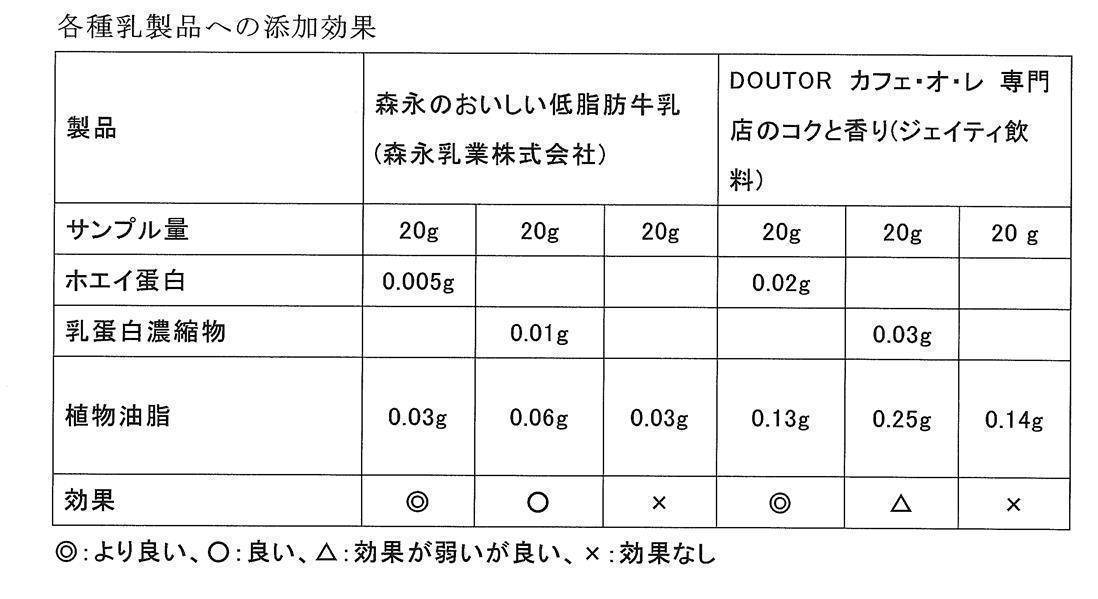
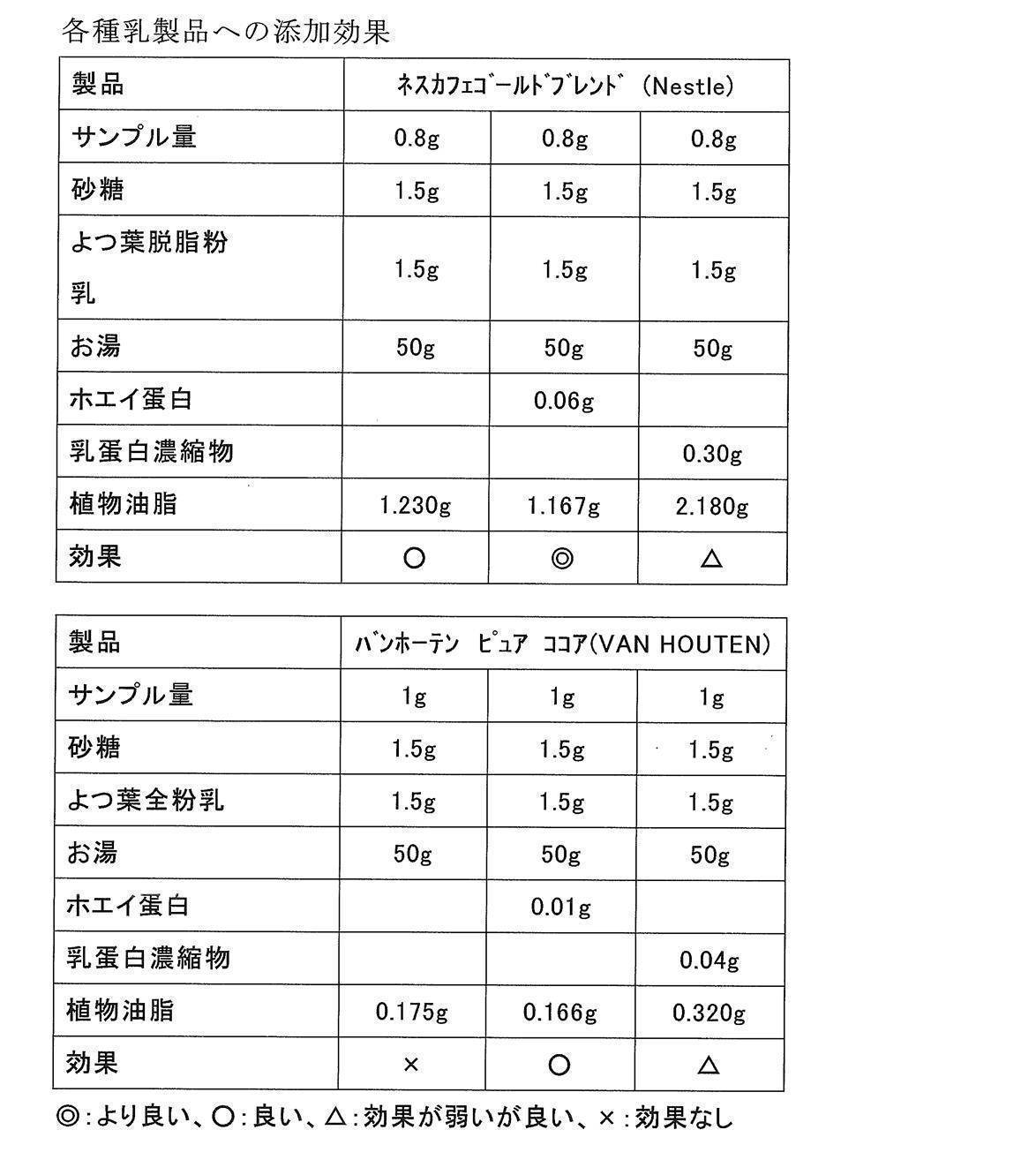
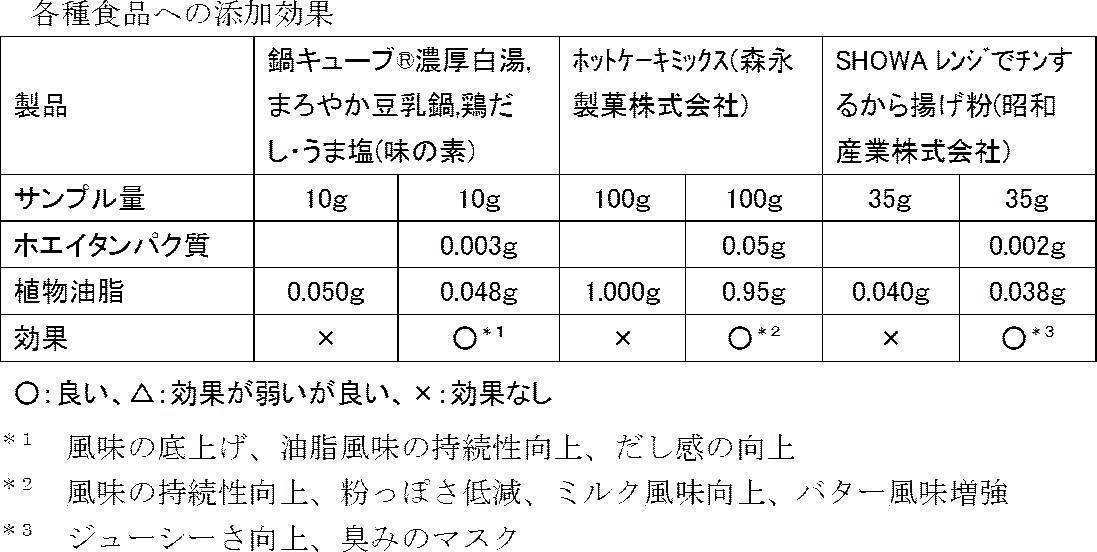
- Experimental Example 3 Effect of Addition of Vegetable Oil / Whey Protein Complex Samples mixed in the ratio of whey protein and vegetable oil / fat, which had good effects in Experimental Example 2, were added to various dairy products and foods to obtain milky flavor and food. The feeling imparting effect was examined. The addition conditions and results are shown in Table 3.
- the vegetable oil / whey protein complex of the present invention is more preferable to various dairy products in addition to the milk flavor and texture of the dairy products. It was found that it can give a texture. From Tables 3-4 and 3-5, it was found that the vegetable oil-fat-whey protein complex of the present invention can maintain or enhance the flavor possessed by various foods.
- Sample preparation method An optimum amount of powdered oil and fat and whey protein was added to water, and the mixture was stirred by hand until the powder was dissolved using a mudler to prepare a vegetable oil and whey protein complex.
- the obtained vegetable oil-whey protein complex was dried with a spray dryer. The results are shown in FIG.
- the vegetable oil-whey protein complex of the present invention has a particle size distribution in which peaks are present in the range of A: 0.1 ⁇ m to 1 ⁇ m and B: 1.0 ⁇ m to 10 ⁇ m. It was.
- the above sample was separated by a filter (Millipore, 0.45 ⁇ m sample pretreatment millex), and a filter-filtered complex having only a particle size distribution in the range (A) was extracted. Moreover, the composite_body
- the single addition of the composite having only the particle size distribution in the range (B) includes the case where the composite having the particle size distribution in the range (A) coexists with the composite having the particle size distribution in the range (B).
- the effect was recognized although it was weak compared with.
- the fat globule having the particle size distribution in the range (A) and the complex having the particle size distribution in the range (B) were mixed, the effect of addition was observed to be weak. Therefore, even if it is prepared so that only the fat globule diameter is the same, milky smoothness and richness cannot be imparted, and it is important to form a complex of whey protein and vegetable oil.
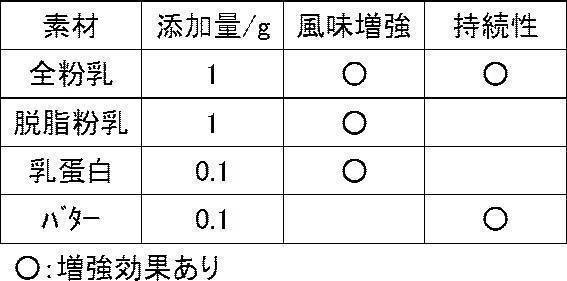
- Experimental Example 5 Effect of Addition of Vegetable Oil / Whey Protein Complex to Milk Material Various samples were mixed using the ratio (0.05: 1) of whey protein and vegetable oil / fat, which had good effects in Experimental Example 2. The amount shown in Table 5 was added to 1 g of milk material, and the effect of addition to the milk material was examined. The flavor enhancement was evaluated for the presence or absence of an increase in the milk protein flavor, and the sustainability was evaluated for the persistence of the fat and oil flavor. The results are shown in Table 5.
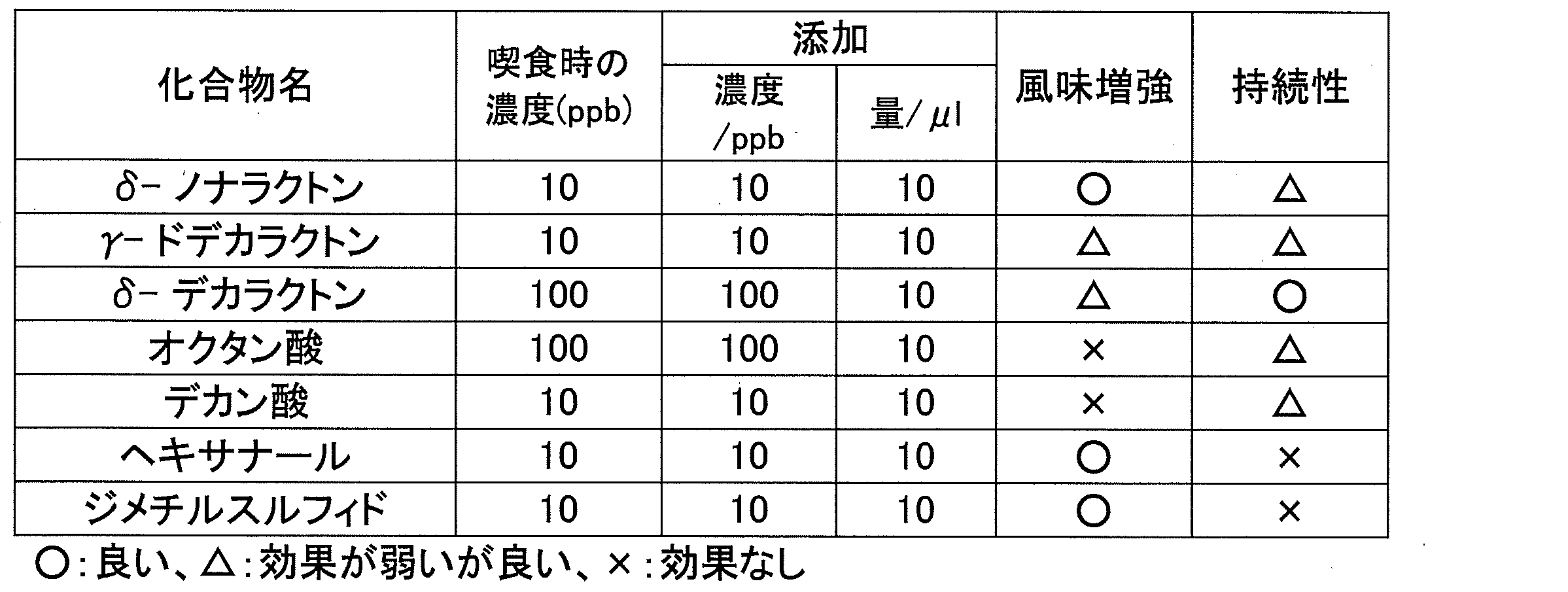
- the compounds listed in Table 6 are fragrances known as milk aroma components (Patent Office Known and Conventional Techniques [Technical Classification] 3-1-2 Manufacturing / Formulation / Food p472-477; DAForss ( 1969) Flavors of dairy products: A review of recent advances Journal of DAIRY SCIENCE, 52 (6), 832-840; K. Adhikari etc. (2006) Flavor threshold as affected by inter ci Studies 21 626-643), it was possible to further enhance or sustain the flavor of dairy products by combining the complex of the present invention and these flavors.
- the vegetable oil-whey protein complex of the present invention is useful in the food field, and can be applied to food fields other than dairy products while improving the quality of dairy products.
- the vegetable oil / whey protein complex and the composition containing the same of the present invention are stable and have excellent storage stability as compared with milk, and are therefore excellent in stable supply of foodstuffs.
Landscapes
- Chemical & Material Sciences (AREA)
- Polymers & Plastics (AREA)
- Life Sciences & Earth Sciences (AREA)
- Engineering & Computer Science (AREA)
- Food Science & Technology (AREA)
- Nutrition Science (AREA)
- Health & Medical Sciences (AREA)
- Oil, Petroleum & Natural Gas (AREA)
- Inorganic Chemistry (AREA)
- Dairy Products (AREA)
- Edible Oils And Fats (AREA)
- Seasonings (AREA)
- General Preparation And Processing Of Foods (AREA)
- Confectionery (AREA)
Abstract
Description
例えば、生乳に含まれる脂肪粒子を微粒子化処理して、第一の生乳(0.4μm以上0.6μm以下の範囲に脂肪球のピークがある)および第二の生乳(1.0μm以上1.4μm以下の範囲に脂肪球のピークがある)の2種の粒子径分布を有する生乳を調製し、その後混合する工程を含む、乳性飲料の製造方法、風味改善方法または脂肪粒子分布性の改善方法が知られている(特許文献5)。
また、小さな脂肪球径を有する乳化液と大きな脂肪球径を有する乳化液とを任意の割合で混合することにより、0.1~1.0μmの脂肪球径範囲に1ないし2の脂肪球ピークを有し、1.5~2.5μmの脂肪球径の範囲に1ないし2の脂肪球ピークを有する乳化脂肪の製造方法が知られている(特許文献2)。
さらに、メジアン径2.6-4.0μmと0.5-2.5μmのフレッシュクリームを混合することで、風味豊かで保存安定性・ホイップ物性の改善されたフレッシュクリームを提供する技術が知られている(特許文献6)。
〔1〕 植物油脂の脂肪球の表面にホエイタンパク質が吸着してなる、植物油脂-ホエイタンパク質複合体。
〔2〕 植物油脂がパーム油である、〔1〕に記載の複合体。
〔3〕 固形または粉末状である、〔1〕または〔2〕に記載の複合体。
〔4〕 水に乳化した状態である、〔1〕または〔2〕に記載の複合体。
〔5〕 水性溶媒中で植物油脂の脂肪球とホエイタンパク質とを、植物油脂:ホエイタンパク質が重量比で、1:0.002~2.5で接触させて得られる、植物油脂-ホエイタンパク質複合体。
〔6〕 植物油脂がパーム油である、〔5〕に記載の複合体。
〔7〕 固形または粉末状である、〔5〕または〔6〕に記載の複合体。
〔8〕 水に乳化した状態である、〔5〕または〔6〕に記載の複合体。
〔9〕 粒子径分布が、1.0μm以上10μm以下の範囲に1つのピークを有する、〔1〕~〔8〕のいずれかに記載の複合体。
〔10〕 さらに0.1μm以上1μm以下の範囲に1つのピークを有する、〔9〕に記載の複合体。
〔11〕 〔1〕~〔10〕のいずれかに記載の複合体を含有する組成物。
〔12〕 さらに、香料および乳素材からなる群より選ばれる少なくとも1種を含有する、〔11〕に記載の組成物。
〔13〕 水性溶媒中でホエイタンパク質と植物油脂の脂肪球とを接触させる工程を含む、植物油脂-ホエイタンパク質複合体の製造方法。
〔14〕 植物油脂とホエイタンパク質の割合(重量比)が1:0.002~2.5である、〔13〕に記載の製造方法。
〔15〕 接触工程前に、植物油脂を乳化する工程をさらに含む、〔13〕または〔14〕に記載の製造方法。
〔16〕 〔1〕~〔10〕のいずれかに記載の複合体または〔11〕もしくは〔12〕に記載の組成物を添加した食品。
〔17〕 食品に対する複合体の乾燥重量としての添加量が0.05~30重量%である、〔16〕に記載の食品。
〔18〕〔1〕~〔10〕のいずれかに記載の複合体または〔11〕に記載の組成物を食品に添加する工程を含む、食品への風味または食感の付与方法。
〔19〕 さらに、香料および乳素材からなる群より選ばれる少なくとも1種を前記食品に添加する工程を含む、〔18〕に記載の付与方法。
〔20〕 〔12〕に記載の組成物を食品に添加する工程を含む、食品への風味または食感の付与方法。
〔21〕 食品に対する複合体の乾燥重量としての添加量が0.05~30重量%である、〔19〕または〔20〕に記載の付与方法。
本発明の植物油脂-ホエイタンパク質複合体(以下、単に複合体と省略する場合がある)は、植物油脂の脂肪球の表面にホエイタンパク質が吸着してなるものである。
本発明においてホエイタンパク質としては、ホエイタンパク質として市販されているものを使用することもでき、市販品としてはホエイタンパク質が25%以上のものであればよく、乳糖、灰分等のホエイタンパク質以外の成分を含んでいてもよい。
i)(A):0.1μm以上1μm以下の範囲および(B):1.0μm以上10μm以下の範囲にピークが存在する。すなわち、2つのピークを示す(例えば、図1を参照)。
ii)特に、範囲(B)の粒子径分布を有する複合体がより効果を有する。したがって、目的に応じて、範囲(B)の粒子径を有する複合体のみを使用することもできる。
iii)脂肪球の粒子径分布が、範囲(A)にピークを有し、範囲(B)にピークを有したとしても、本発明の効果は認められず、植物油脂の脂肪球とホエイタンパク質が共存して本発明の複合体となり、かつ、上記i)の粒子径分布を有する場合に効果がある。
iv)範囲(A)に粒子径分布のピークを有する複合体と、範囲(B)に粒子径分布のピークを有する複合体とを、別々の水性溶媒中で作製し、その後それらを混合した場合の効果と、同一の水性溶媒中で上記i)の粒子径分布を有する複合体を作製した場合の効果とでは、同一の水性溶媒中で作製した場合の方が、効果が高い傾向がある。
複合体中の植物油脂とホエイタンパク質の比率は、原料として用いた植物油脂の重量と、複合体中のホエイタンパク質の重量(原料中のタンパク質の重量と、植物油脂の脂肪球の表面に吸着されずに水性溶媒中に遊離しているタンパク質の重量とを公知のタンパク質の定量法(例えば、ケルダール法、燃焼法等)により求め、その差から計算する)とから求めることができる。
本発明の複合体は、食品原料として通常用いられるその他の成分と組合せて、組成物の形態としてもよい。本発明の複合体または当該複合体を含有する組成物は、食品に対する風味または食感を付与する添加物として有用である。特に、食品が、従来より牛乳が使用されていた食品または乳素材の場合、食品に対する乳様のなめらかさやコクを付与する添加物として有用である。乳様のなめらかさやコクとは、牛乳(生乳)そのもの、または牛乳(生乳)を添加した食品が奏するホモジナイズされた乳脂肪に由来する風味および食感である。本発明における乳様のなめらかさやコクとは、原料の植物油脂に由来する風味および食感とは異なり、牛乳(生乳)を口中に含んだように感じられる風味および食感をいう。乳様のなめらかさまたはコクの有無は、専門のパネラーによる官能試験により決定することができる。具体的には、乳様のなめらかさは、ざらつきがないこと、粒子・肌理の細かいこと、口当たりの良さの評価により決定することができる。コクとは、中味~後味の厚み(脂肪感の重さ、広がり、ボディー感)、中味の濃厚さ(乳タンパク質の固形感、密度感)、風味の持続性、の評価により決定することができる。
(0)植物油脂を乳化する工程
植物油脂が乳化植物油脂でない場合、例えば、粉末でない植物油脂の場合は、下記工程(1)の前に、公知の乳化剤および乳化方法を用いて、植物油脂の脂肪球を生成させる。乳化方法の例として、ホモジナイザー、ホモミキサー、コロイドミル、超音波分散器を用い、加温および加圧での均質化処理があげられるが、これに限定されるものではない。本発明においては、粒子径分布が(A):0.1μm以上1μm以下の範囲および(B):1.0μm以上10μm以下の範囲にピークが存在する複合体とするためには、均質化処理は、自体公知の方法を用いればよい。
植物油脂として粉末植物油脂を用いる場合には、水性溶媒と粉末植物油脂とを均一に溶解あるいは分散するまで撹拌して混合すればよい。
水性溶媒としては、水が代表例としてあげられ、本発明の目的を達成できる限り、pH調整剤、保存剤等を含んでいてもよい。
水性溶媒中でホエイタンパク質と植物油脂の脂肪球との接触条件は、水性溶媒に乳化した植物油脂を溶解させ、次いで、ホエイタンパク質を溶解し、公知の撹拌または混合手段により接触させる。このとき、水性溶媒中には、実質的にカゼインが存在しないことが望ましい。カゼインは、ホエイタンパク質よりも脂肪球に対する吸着性が高いので、カゼインが共存する条件下で植物油脂の脂肪球とホエイタンパク質とを接触させた場合に、カゼインが優勢に吸着した複合体が生成し、本発明の複合体が得られにくくなる可能性があるからである。
本発明において、粒子径分布が(A):0.1μm以上1μm以下の範囲および(B):1.0μm以上10μm以下の範囲にピークが存在する複合体とするためには、撹拌または混合条件は、自体公知のものを用いることができる。
植物油脂に対するホエイタンパク質の混合比は、植物油脂の脂肪球の平均粒径によって吸着する表面積が異なるので一概には言えないが、脂肪球の表面の一部ないし全部に吸着する割合で混合することが好ましい。例えば、ホエイタンパク質/植物油脂の重量比として、0.002~2.5が例示され、好ましくは0.20~0.55である。
本発明の複合体を固形または粉末状で提供する場合は、公知の乾燥方法により固体とすることができる。乾燥方法としては、噴霧乾燥、凍結乾燥、真空乾燥などがあげられる。本発明の複合体は、上記範囲(B)の比較的大きな粒子径を有するが、乾燥工程を経ても安定性が保たれ、油分離などが生じない。
固形または粉末状の本発明の複合体は、そのまま食品に添加して乳様風味や食感の付与することができる。また、上記した任意の成分を添加して、乳様のなめらかさやコクを付与する組成物として提供することができる。
本発明の複合体または組成物は、従来より牛乳が使用されていた食品に、牛乳の代替品として用いることができる。特に、ホワイトソース;ホワイトソースを使用したシチュー、グラタン、ポタージュスープ、クリームスープ等のスープ類;チーズ、ヨーグルト等の発酵乳食品;低脂肪乳、無脂肪乳等の加工乳;カスタードクリームやフラワーペースト等のフィリング類;プリン、ババロア、アイスクリーム等のデザート類;コーヒー、ココア、紅茶等の飲料;パン・菓子その他の加工食品の製造過程で、あるいは、喫食時に添加することで、乳様のなめらかさやコクを好適に付与することができる。
植物油脂(粉末乳化油脂、味の素ゼネラルフーヅ株式会社より購入した乳蛋白類を含まず、植物油脂を用いて作られた一般的な粉末油脂)と乳由来タンパク質を表1のように配合した。使用した3種の粉末油脂の平均粒子径は、218.645μm、264.0217μmおよび313.707μmであった。
使用した乳由来タンパク質は、下記の通りである。
ホエイタンパク質:ホエイタンパク質100%の原料(MEGGLE JAPAN)
乳蛋白濃縮物(ホエイタンパク質不含):脱脂乳100%の原料(MEGGLE JAPAN)
脱脂粉乳(カゼイン含有):脱脂粉乳100%の原料(よつ葉乳業株式会社)
乳蛋白(ホエイタンパク質不含):乳蛋白を8.7%含む商品を使用(和光堂株式会社)
表1の組成に従って配合した原料組成物を、粉のまま添加して混合したもの(表中、「粉」と表記)と、あらかじめ水10mlを添加してマドラーを用いて均一に溶解あるいは分散するまで手で撹拌し、混合したもの(表中、「溶液」と表記)を調製した。原料が液体であるものについては、溶液の条件下でのみ混合した。
市販の粉末スープ(Knorr(登録商標)カップスープコーンクリーム(Ajinomoto)、17.6g)を150mLの熱湯で溶解し、さらに上記のようにして得られた混合物(粉末の場合は、100mg、溶液の場合は、100mg/10mL水溶液)を添加して撹拌し、コーンクリームスープを調製した。

一方、ホエイタンパク質と植物油脂を粉末の状態で混合して食品に添加しても、食品中の様々な成分の共存により、植物油脂-ホエイタンパク質複合体を形成させることが実質的に困難であるので、乳様のなめらかさやコクを付与することができなかったものと考えられる。
また、ホエイタンパク質以外の乳蛋白濃縮物、脱脂粉乳および乳蛋白は、カゼインを含有することにより、植物油脂-タンパク質複合体を形成した場合に、カゼインが優勢に植物油脂の脂肪球に吸着していると考えられる。さらに、ホエイタンパク質と、乳蛋白濃縮物、脱脂粉乳または乳蛋白とを組合せて用いて植物油脂-タンパク質複合体を形成させた場合は、ホエイタンパク質よりもカゼインの方が疎水性アミノ酸の割合が多いので油脂に吸着しやすく、得られる植物油脂-タンパク質複合体中の蛋白質成分は、やはりカゼインが優勢であると考えられる。このようなカゼインを優勢に含む植物油脂-タンパク質複合体は、植物油脂-ホエイタンパク質複合体に比べて、乳様のなめらかさやコクが弱いことが明らかとなった。
したがって、食品中に原料や素材として植物油脂とホエイタンパク質とが予め含まれているだけではなく、乳化した植物油脂(脂肪球)とホエイタンパク質と、他のタンパク質成分等が実質的に存在しない条件下で接触することで、植物油脂-ホエイタンパク質複合体が形成され、乳様のなめらかさやコクを付与することができると考えられる。
実験例1で用いた植物油脂とホエイタンパク質を表2の組成に従って配合したものに、水10mlを添加し、マドラーを用いて均一に溶解あるいは分散するまで手で撹拌して混合し、植物油脂-ホエイタンパク質複合体を形成させた。
市販の粉末スープ(Knorr(登録商標)カップスープコーンクリーム(Ajinomoto)、17.6g)を150mLの熱湯で溶解し、さらに上記のようにして得られた複合体(100mg/10mL水溶液)を添加して撹拌し、植物油脂-ホエイタンパク質複合体を添加したコーンクリームスープを調製した。対照として、植物油脂-ホエイタンパク質複合体を無添加のコーンクリームスープも調製した。

実験例2で効果が良好であったホエイタンパク質と植物油脂の比率で混合したサンプルを様々な乳製品および食品に添加し、乳様風味や食感の付与効果を調べた。添加条件および結果を表3に示す。


実験例2で効果が良好であったホエイタンパク質と植物油脂の比率で混合したサンプルを用いて、植物油脂-ホエイタンパク質複合体の粒子径を検討した。
≪分析方法≫
装置名:レーザー回折式粒度分布測定装置(SALD-2200(SHIMADZU))
分析方法:サンプルを水に溶解した後、分析を行った。屈折率1.6-0.50iとし、4回測定した後の平均値を測定値とした。
サンプル作製方法:
水に粉末油脂とホエイタンパク質を最適量添加し、マドラーを使って粉が溶けるまで手で撹拌し、植物油脂-ホエイタンパク質複合体を調製した。得られた植物油脂-ホエイタンパク質複合体を、噴霧乾燥機にて乾燥させた。
結果を図1に示す。図1より、本発明の植物油脂-ホエイタンパク質複合体は、A:0.1μm以上1μm以下の範囲およびB:1.0μm以上10μm以下の範囲にピークが存在する粒子径分布を有することがわかった。
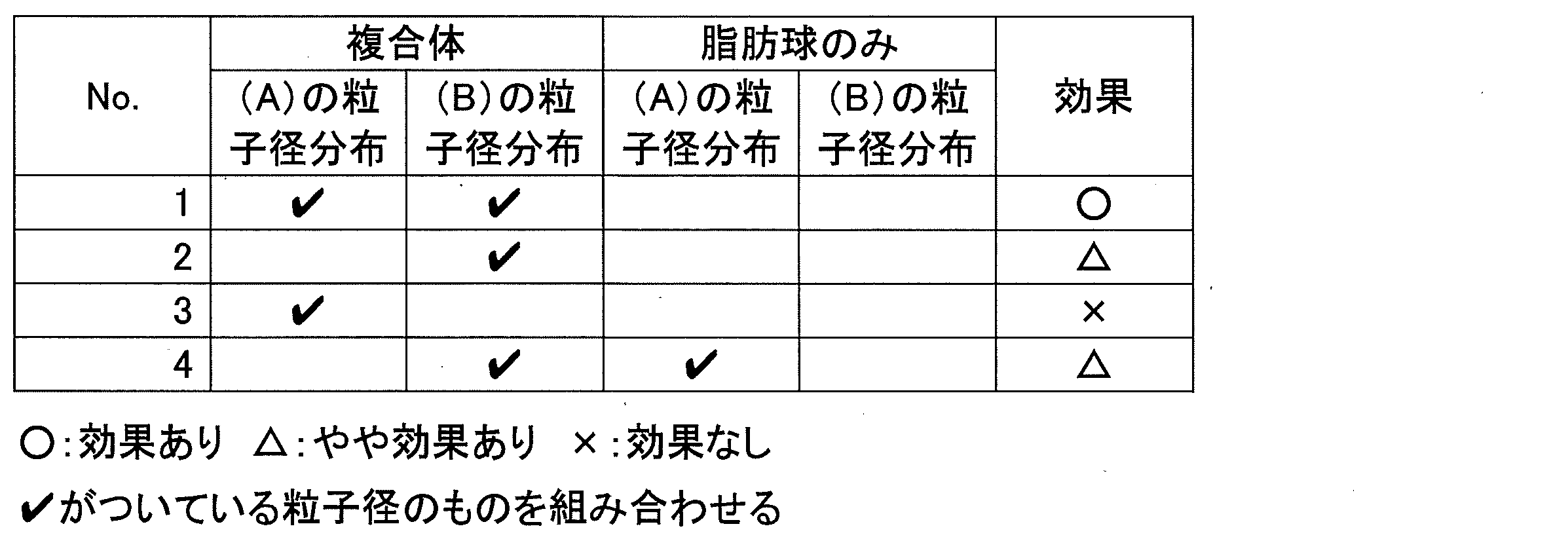
したがって、脂肪球径のみが同じになるように調製しても、乳様のなめらかさやコクを付与することはできず、ホエイ蛋白と植物油脂との複合体を形成させることが重要である。
実験例2で効果が良好であったホエイ蛋白と植物油脂の比率(0.05:1)で混合したサンプルを用いて、各種乳素材1gに対して表5に示す量を添加し、乳素材への添加効果を検討した。風味増強は乳タンパク質風味の底上げの有無を、持続性は油脂の風味の持続性を評価した。結果を表5に示す。
実験例2で効果が良好であったホエイ蛋白と植物油脂の比率(0.05:1)で混合したサンプル2gと、全粉乳6gをお湯150gに溶かした溶液10mlに対して、下記香料を添加したときの効果を確認した。香料はいずれもシグマアルドリッチ社製のものを用いた。結果を表6に示す。
Claims (21)
- 植物油脂の脂肪球の表面にホエイタンパク質が吸着してなる、植物油脂-ホエイタンパク質複合体。
- 植物油脂がパーム油である、請求項1に記載の複合体。
- 固形または粉末状である、請求項1または2に記載の複合体。
- 水に乳化した状態である、請求項1または2に記載の複合体。
- 水性溶媒中で植物油脂の脂肪球とホエイタンパク質とを、植物油脂:ホエイタンパク質が重量比で、1:0.002~2.5で接触させて得られる、植物油脂-ホエイタンパク質複合体。
- 植物油脂がパーム油である、請求項5に記載の複合体。
- 固形または粉末状である、請求項5または6に記載の複合体。
- 水に乳化した状態である、請求項5または6に記載の複合体。
- 粒子径分布が、1.0μm以上10μm以下の範囲に1つのピークを有する、請求項1~8のいずれか1項に記載の複合体。
- さらに0.1μm以上1μm以下の範囲に1つのピークを有する、請求項9に記載の複合体。
- 請求項1~10のいずれか1項に記載の複合体を含有する組成物。
- さらに、香料および乳素材からなる群より選ばれる少なくとも1種を含有する、請求項11に記載の組成物。
- 水性溶媒中でホエイタンパク質と植物油脂の脂肪球とを接触させる工程を含む、植物油脂-ホエイタンパク質複合体の製造方法。
- 植物油脂とホエイタンパク質の割合(重量比)が1:0.002~2.5である、請求項13に記載の製造方法。
- 接触工程前に、植物油脂を乳化する工程をさらに含む、請求項13または14に記載の製造方法。
- 請求項1~10のいずれか1項に記載の複合体または請求項11もしくは12に記載の組成物を添加した食品。
- 食品に対する複合体の乾燥重量としての添加量が0.05~30重量%である、請求項16に記載の食品。
- 請求項1~10のいずれか1項に記載の複合体または請求項11に記載の組成物を食品に添加する工程を含む、食品への風味または食感の付与方法。
- さらに、香料および乳素材からなる群より選ばれる少なくとも1種を前記食品に添加する工程を含む、請求項18に記載の付与方法。
- 請求項12に記載の組成物を食品に添加する工程を含む、食品への風味または食感の付与方法。
- 食品に対する複合体の乾燥重量としての添加量が0.05~30重量%である、請求項19または20に記載の付与方法。
Priority Applications (3)
| Application Number | Priority Date | Filing Date | Title |
|---|---|---|---|
| JP2016510516A JP6593323B2 (ja) | 2014-03-27 | 2015-03-27 | 乳様のなめらかさやコクを付与する組成物 |
| KR1020167029856A KR102442739B1 (ko) | 2014-03-27 | 2015-03-27 | 밀크와 같은 부드러움이나 깊은 맛을 부여하는 조성물 |
| BR112016022020-0A BR112016022020B1 (pt) | 2014-03-27 | 2015-03-27 | Complexo de óleo vegetal e proteína de soro de leite, composição, métodos para produzir um complexo de óleo vegetal e proteína de soro de leite e para conceder um sabor ou uma textura a um alimento, e, alimento |
Applications Claiming Priority (2)
| Application Number | Priority Date | Filing Date | Title |
|---|---|---|---|
| JP2014066237 | 2014-03-27 | ||
| JP2014-066237 | 2014-03-27 |
Publications (1)
| Publication Number | Publication Date |
|---|---|
| WO2015147238A1 true WO2015147238A1 (ja) | 2015-10-01 |
Family
ID=54195742
Family Applications (1)
| Application Number | Title | Priority Date | Filing Date |
|---|---|---|---|
| PCT/JP2015/059546 Ceased WO2015147238A1 (ja) | 2014-03-27 | 2015-03-27 | 乳様のなめらかさやコクを付与する組成物 |
Country Status (5)
| Country | Link |
|---|---|
| JP (1) | JP6593323B2 (ja) |
| KR (1) | KR102442739B1 (ja) |
| BR (1) | BR112016022020B1 (ja) |
| TW (1) | TWI675620B (ja) |
| WO (1) | WO2015147238A1 (ja) |
Cited By (1)
| Publication number | Priority date | Publication date | Assignee | Title |
|---|---|---|---|---|
| JP2023146896A (ja) * | 2022-03-29 | 2023-10-12 | 雪印メグミルク株式会社 | 油脂組成物 |
Families Citing this family (3)
| Publication number | Priority date | Publication date | Assignee | Title |
|---|---|---|---|---|
| CN120549217A (zh) * | 2019-07-12 | 2025-08-29 | 森永乳业株式会社 | 浓厚感赋予用组合物 |
| JP2021185807A (ja) * | 2020-05-28 | 2021-12-13 | オルト株式会社 | 高タンパク質食品及びその製造方法 |
| WO2022210754A1 (ja) * | 2021-03-30 | 2022-10-06 | 不二製油グループ本社株式会社 | 乳化食品製造用タンパク質含有油脂乳化組成物 |
Citations (7)
| Publication number | Priority date | Publication date | Assignee | Title |
|---|---|---|---|---|
| JPS61268141A (ja) * | 1985-03-19 | 1986-11-27 | ソシエテ デ プロデユイ ネツスル ソシエテ アノニム | ゲル化食品の製造法 |
| JPS6439939A (en) * | 1987-08-06 | 1989-02-10 | Ajinomoto General Foods Inc | Fat-containing composition and production thereof |
| JPH04228051A (ja) * | 1990-02-05 | 1992-08-18 | Pfizer Inc | 低カロリー脂肪代替物 |
| JPH09201159A (ja) * | 1996-01-23 | 1997-08-05 | Riken Vitamin Co Ltd | 粉末乳化剤組成物 |
| JP2000139346A (ja) * | 1998-09-02 | 2000-05-23 | Asahi Denka Kogyo Kk | 水中油型乳化組成物 |
| JP2001149009A (ja) * | 1999-11-29 | 2001-06-05 | Miyoshi Oil & Fat Co Ltd | パン類用つや出し剤 |
| JP2009278896A (ja) * | 2008-05-21 | 2009-12-03 | Miyoshi Oil & Fat Co Ltd | 牛乳様粉末油脂 |
Family Cites Families (6)
| Publication number | Priority date | Publication date | Assignee | Title |
|---|---|---|---|---|
| JP3103494B2 (ja) * | 1995-06-16 | 2000-10-30 | 鐘淵化学工業株式会社 | 食品用油脂乳化組成物及びその製造方法 |
| JP3765630B2 (ja) | 1996-10-30 | 2006-04-12 | 味の素ゼネラルフーヅ株式会社 | 乳製品様の風味を持つ乳化脂肪の製造方法 |
| JP2009254353A (ja) | 2008-03-19 | 2009-11-05 | Kaneka Corp | 新規フレッシュクリームおよびその製造方法 |
| WO2012026476A1 (ja) | 2010-08-25 | 2012-03-01 | 株式会社明治 | 風味と物性の良い乳性飲料およびその製造方法 |
| JP5982779B2 (ja) | 2011-10-26 | 2016-08-31 | 株式会社カネカ | 濃縮乳様水中油型乳化油脂組成物 |
| JP5946662B2 (ja) | 2012-03-15 | 2016-07-06 | 雪印メグミルク株式会社 | 乳脂肪クリーム及びその製造方法 |
-
2015
- 2015-03-27 KR KR1020167029856A patent/KR102442739B1/ko active Active
- 2015-03-27 TW TW104110072A patent/TWI675620B/zh active
- 2015-03-27 BR BR112016022020-0A patent/BR112016022020B1/pt active IP Right Grant
- 2015-03-27 WO PCT/JP2015/059546 patent/WO2015147238A1/ja not_active Ceased
- 2015-03-27 JP JP2016510516A patent/JP6593323B2/ja active Active
Patent Citations (7)
| Publication number | Priority date | Publication date | Assignee | Title |
|---|---|---|---|---|
| JPS61268141A (ja) * | 1985-03-19 | 1986-11-27 | ソシエテ デ プロデユイ ネツスル ソシエテ アノニム | ゲル化食品の製造法 |
| JPS6439939A (en) * | 1987-08-06 | 1989-02-10 | Ajinomoto General Foods Inc | Fat-containing composition and production thereof |
| JPH04228051A (ja) * | 1990-02-05 | 1992-08-18 | Pfizer Inc | 低カロリー脂肪代替物 |
| JPH09201159A (ja) * | 1996-01-23 | 1997-08-05 | Riken Vitamin Co Ltd | 粉末乳化剤組成物 |
| JP2000139346A (ja) * | 1998-09-02 | 2000-05-23 | Asahi Denka Kogyo Kk | 水中油型乳化組成物 |
| JP2001149009A (ja) * | 1999-11-29 | 2001-06-05 | Miyoshi Oil & Fat Co Ltd | パン類用つや出し剤 |
| JP2009278896A (ja) * | 2008-05-21 | 2009-12-03 | Miyoshi Oil & Fat Co Ltd | 牛乳様粉末油脂 |
Cited By (1)
| Publication number | Priority date | Publication date | Assignee | Title |
|---|---|---|---|---|
| JP2023146896A (ja) * | 2022-03-29 | 2023-10-12 | 雪印メグミルク株式会社 | 油脂組成物 |
Also Published As
| Publication number | Publication date |
|---|---|
| JPWO2015147238A1 (ja) | 2017-04-13 |
| BR112016022020B1 (pt) | 2021-08-24 |
| BR112016022020A2 (pt) | 2017-08-15 |
| TW201601636A (zh) | 2016-01-16 |
| TWI675620B (zh) | 2019-11-01 |
| JP6593323B2 (ja) | 2019-10-23 |
| KR102442739B1 (ko) | 2022-09-14 |
| KR20160138224A (ko) | 2016-12-02 |
Similar Documents
| Publication | Publication Date | Title |
|---|---|---|
| Ye et al. | Evaluation of processed cheese fortified with fish oil emulsion | |
| Li et al. | Utilization of thermal-denatured whey protein isolate-milk fat emulsion gel microparticles as stabilizers and fat replacers in low-fat yogurt | |
| Taherian et al. | Ability of whey protein isolate and/or fish gelatin to inhibit physical separation and lipid oxidation in fish oil-in-water beverage emulsion | |
| Relkin et al. | Effect of fat nature and aroma compound hydrophobicity on flavor release from complex food emulsions | |
| JP2019504881A (ja) | 製品アナログ又はそのようなアナログの成分及びその製造方法 | |
| CN102458139A (zh) | 水包油乳液的浓缩的奶油状至固体并干燥的组合物、其生产方法及其在生产感官特点和营养生理学方面改进的食品中的应用 | |
| JP2022173548A (ja) | 水中油型乳化組成物、及び該水中油型乳化組成物の製造方法 | |
| JP6593323B2 (ja) | 乳様のなめらかさやコクを付与する組成物 | |
| JP2024103758A (ja) | 生クリーム風味を付与する方法 | |
| AU2002351809B2 (en) | Water continuous acidified food product | |
| Farbod et al. | Effects of storage time on compositional, micro-structural, rheological and sensory properties of low fat Iranian UF-Feta cheese fortified with fish oil or fish oil powder | |
| Zakidou et al. | Aqueous sesame seed extracts: Study of their foaming potential for the preparation of cappuccino-type coffee beverages | |
| Sulieman et al. | Physicochemical and sensory properties of traditionally and laboratory made ghee (Samin) of the Sudan | |
| JP4750738B2 (ja) | 濃縮乳タイプ乳化物およびそれを用いたミルク入り飲料 | |
| Zare et al. | Alginate/whey protein isolate-based emulgel as an alternative margarine replacer in processed cheese: Impact on rheological, mechanical, nutritional, and sensory characteristics | |
| DK2749172T3 (en) | Reconstituted milk product comprising solids of sweet buttermilk | |
| KR102582681B1 (ko) | 유화 조성물 조제용 프레믹스 및 이를 이용한 조성물 | |
| JP2009278896A (ja) | 牛乳様粉末油脂 | |
| JPH08170A (ja) | 油脂乳化組成物及びその製造方法 | |
| JP7106829B2 (ja) | マウスコーティング感増強剤 | |
| Kumar et al. | Storage studies of flaxseed oil encapsulated by buttermilk solids | |
| WO2022195566A1 (en) | Dairy and meat analogues containing euglena-derived components | |
| JP4865268B2 (ja) | 乳化安定性の評価方法及び乳化剤の評価方法 | |
| JP6784857B1 (ja) | 植物油脂組成物及びそれを含有する容器詰め飲料 | |
| JPH05236896A (ja) | 水中油型乳化物の製造法 |
Legal Events
| Date | Code | Title | Description |
|---|---|---|---|
| 121 | Ep: the epo has been informed by wipo that ep was designated in this application |
Ref document number: 15768229 Country of ref document: EP Kind code of ref document: A1 |
|
| ENP | Entry into the national phase |
Ref document number: 2016510516 Country of ref document: JP Kind code of ref document: A |
|
| NENP | Non-entry into the national phase |
Ref country code: DE |
|
| ENP | Entry into the national phase |
Ref document number: 20167029856 Country of ref document: KR Kind code of ref document: A |
|
| REG | Reference to national code |
Ref country code: BR Ref legal event code: B01A Ref document number: 112016022020 Country of ref document: BR |
|
| 122 | Ep: pct application non-entry in european phase |
Ref document number: 15768229 Country of ref document: EP Kind code of ref document: A1 |
|
| ENP | Entry into the national phase |
Ref document number: 112016022020 Country of ref document: BR Kind code of ref document: A2 Effective date: 20160923 |