WO2015141194A1 - 非水電解質二次電池用正極及び非水電解質二次電池 - Google Patents
非水電解質二次電池用正極及び非水電解質二次電池 Download PDFInfo
- Publication number
- WO2015141194A1 WO2015141194A1 PCT/JP2015/001377 JP2015001377W WO2015141194A1 WO 2015141194 A1 WO2015141194 A1 WO 2015141194A1 JP 2015001377 W JP2015001377 W JP 2015001377W WO 2015141194 A1 WO2015141194 A1 WO 2015141194A1
- Authority
- WO
- WIPO (PCT)
- Prior art keywords
- lithium
- positive electrode
- battery
- transition metal
- electrolyte secondary
- Prior art date
- Legal status (The legal status is an assumption and is not a legal conclusion. Google has not performed a legal analysis and makes no representation as to the accuracy of the status listed.)
- Ceased
Links
Images
Classifications
-
- H—ELECTRICITY
- H01—ELECTRIC ELEMENTS
- H01M—PROCESSES OR MEANS, e.g. BATTERIES, FOR THE DIRECT CONVERSION OF CHEMICAL ENERGY INTO ELECTRICAL ENERGY
- H01M4/00—Electrodes
- H01M4/02—Electrodes composed of, or comprising, active material
- H01M4/36—Selection of substances as active materials, active masses, active liquids
- H01M4/48—Selection of substances as active materials, active masses, active liquids of inorganic oxides or hydroxides
- H01M4/50—Selection of substances as active materials, active masses, active liquids of inorganic oxides or hydroxides of manganese
- H01M4/505—Selection of substances as active materials, active masses, active liquids of inorganic oxides or hydroxides of manganese of mixed oxides or hydroxides containing manganese for inserting or intercalating light metals, e.g. LiMn2O4 or LiMn2OxFy
-
- H—ELECTRICITY
- H01—ELECTRIC ELEMENTS
- H01M—PROCESSES OR MEANS, e.g. BATTERIES, FOR THE DIRECT CONVERSION OF CHEMICAL ENERGY INTO ELECTRICAL ENERGY
- H01M10/00—Secondary cells; Manufacture thereof
- H01M10/05—Accumulators with non-aqueous electrolyte
- H01M10/052—Li-accumulators
- H01M10/0525—Rocking-chair batteries, i.e. batteries with lithium insertion or intercalation in both electrodes; Lithium-ion batteries
-
- H—ELECTRICITY
- H01—ELECTRIC ELEMENTS
- H01M—PROCESSES OR MEANS, e.g. BATTERIES, FOR THE DIRECT CONVERSION OF CHEMICAL ENERGY INTO ELECTRICAL ENERGY
- H01M4/00—Electrodes
- H01M4/02—Electrodes composed of, or comprising, active material
- H01M4/13—Electrodes for accumulators with non-aqueous electrolyte, e.g. for lithium-accumulators; Processes of manufacture thereof
- H01M4/131—Electrodes based on mixed oxides or hydroxides, or on mixtures of oxides or hydroxides, e.g. LiCoOx
-
- H—ELECTRICITY
- H01—ELECTRIC ELEMENTS
- H01M—PROCESSES OR MEANS, e.g. BATTERIES, FOR THE DIRECT CONVERSION OF CHEMICAL ENERGY INTO ELECTRICAL ENERGY
- H01M4/00—Electrodes
- H01M4/02—Electrodes composed of, or comprising, active material
- H01M4/36—Selection of substances as active materials, active masses, active liquids
- H01M4/362—Composites
- H01M4/364—Composites as mixtures
-
- H—ELECTRICITY
- H01—ELECTRIC ELEMENTS
- H01M—PROCESSES OR MEANS, e.g. BATTERIES, FOR THE DIRECT CONVERSION OF CHEMICAL ENERGY INTO ELECTRICAL ENERGY
- H01M4/00—Electrodes
- H01M4/02—Electrodes composed of, or comprising, active material
- H01M4/36—Selection of substances as active materials, active masses, active liquids
- H01M4/362—Composites
- H01M4/366—Composites as layered products
-
- H—ELECTRICITY
- H01—ELECTRIC ELEMENTS
- H01M—PROCESSES OR MEANS, e.g. BATTERIES, FOR THE DIRECT CONVERSION OF CHEMICAL ENERGY INTO ELECTRICAL ENERGY
- H01M4/00—Electrodes
- H01M4/02—Electrodes composed of, or comprising, active material
- H01M4/36—Selection of substances as active materials, active masses, active liquids
- H01M4/48—Selection of substances as active materials, active masses, active liquids of inorganic oxides or hydroxides
- H01M4/52—Selection of substances as active materials, active masses, active liquids of inorganic oxides or hydroxides of nickel, cobalt or iron
- H01M4/525—Selection of substances as active materials, active masses, active liquids of inorganic oxides or hydroxides of nickel, cobalt or iron of mixed oxides or hydroxides containing iron, cobalt or nickel for inserting or intercalating light metals, e.g. LiNiO2, LiCoO2 or LiCoOxFy
-
- H—ELECTRICITY
- H01—ELECTRIC ELEMENTS
- H01M—PROCESSES OR MEANS, e.g. BATTERIES, FOR THE DIRECT CONVERSION OF CHEMICAL ENERGY INTO ELECTRICAL ENERGY
- H01M4/00—Electrodes
- H01M4/02—Electrodes composed of, or comprising, active material
- H01M4/36—Selection of substances as active materials, active masses, active liquids
- H01M4/58—Selection of substances as active materials, active masses, active liquids of inorganic compounds other than oxides or hydroxides, e.g. sulfides, selenides, tellurides, halogenides or LiCoFy; of polyanionic structures, e.g. phosphates, silicates or borates
- H01M4/5825—Oxygenated metallic salts or polyanionic structures, e.g. borates, phosphates, silicates, olivines
-
- H—ELECTRICITY
- H01—ELECTRIC ELEMENTS
- H01M—PROCESSES OR MEANS, e.g. BATTERIES, FOR THE DIRECT CONVERSION OF CHEMICAL ENERGY INTO ELECTRICAL ENERGY
- H01M4/00—Electrodes
- H01M4/02—Electrodes composed of, or comprising, active material
- H01M4/62—Selection of inactive substances as ingredients for active masses, e.g. binders, fillers
-
- H—ELECTRICITY
- H01—ELECTRIC ELEMENTS
- H01M—PROCESSES OR MEANS, e.g. BATTERIES, FOR THE DIRECT CONVERSION OF CHEMICAL ENERGY INTO ELECTRICAL ENERGY
- H01M10/00—Secondary cells; Manufacture thereof
- H01M10/05—Accumulators with non-aqueous electrolyte
- H01M10/052—Li-accumulators
-
- H—ELECTRICITY
- H01—ELECTRIC ELEMENTS
- H01M—PROCESSES OR MEANS, e.g. BATTERIES, FOR THE DIRECT CONVERSION OF CHEMICAL ENERGY INTO ELECTRICAL ENERGY
- H01M4/00—Electrodes
- H01M4/02—Electrodes composed of, or comprising, active material
- H01M2004/026—Electrodes composed of, or comprising, active material characterised by the polarity
- H01M2004/028—Positive electrodes
-
- H—ELECTRICITY
- H01—ELECTRIC ELEMENTS
- H01M—PROCESSES OR MEANS, e.g. BATTERIES, FOR THE DIRECT CONVERSION OF CHEMICAL ENERGY INTO ELECTRICAL ENERGY
- H01M4/00—Electrodes
- H01M4/02—Electrodes composed of, or comprising, active material
- H01M4/04—Processes of manufacture in general
- H01M4/0402—Methods of deposition of the material
- H01M4/0404—Methods of deposition of the material by coating on electrode collectors
-
- H—ELECTRICITY
- H01—ELECTRIC ELEMENTS
- H01M—PROCESSES OR MEANS, e.g. BATTERIES, FOR THE DIRECT CONVERSION OF CHEMICAL ENERGY INTO ELECTRICAL ENERGY
- H01M4/00—Electrodes
- H01M4/02—Electrodes composed of, or comprising, active material
- H01M4/04—Processes of manufacture in general
- H01M4/043—Processes of manufacture in general involving compressing or compaction
- H01M4/0435—Rolling or calendering
-
- H—ELECTRICITY
- H01—ELECTRIC ELEMENTS
- H01M—PROCESSES OR MEANS, e.g. BATTERIES, FOR THE DIRECT CONVERSION OF CHEMICAL ENERGY INTO ELECTRICAL ENERGY
- H01M4/00—Electrodes
- H01M4/02—Electrodes composed of, or comprising, active material
- H01M4/13—Electrodes for accumulators with non-aqueous electrolyte, e.g. for lithium-accumulators; Processes of manufacture thereof
- H01M4/139—Processes of manufacture
- H01M4/1391—Processes of manufacture of electrodes based on mixed oxides or hydroxides, or on mixtures of oxides or hydroxides, e.g. LiCoOx
-
- H—ELECTRICITY
- H01—ELECTRIC ELEMENTS
- H01M—PROCESSES OR MEANS, e.g. BATTERIES, FOR THE DIRECT CONVERSION OF CHEMICAL ENERGY INTO ELECTRICAL ENERGY
- H01M4/00—Electrodes
- H01M4/02—Electrodes composed of, or comprising, active material
- H01M4/62—Selection of inactive substances as ingredients for active masses, e.g. binders, fillers
- H01M4/621—Binders
- H01M4/622—Binders being polymers
- H01M4/623—Binders being polymers fluorinated polymers
-
- H—ELECTRICITY
- H01—ELECTRIC ELEMENTS
- H01M—PROCESSES OR MEANS, e.g. BATTERIES, FOR THE DIRECT CONVERSION OF CHEMICAL ENERGY INTO ELECTRICAL ENERGY
- H01M4/00—Electrodes
- H01M4/02—Electrodes composed of, or comprising, active material
- H01M4/62—Selection of inactive substances as ingredients for active masses, e.g. binders, fillers
- H01M4/624—Electric conductive fillers
- H01M4/625—Carbon or graphite
-
- H—ELECTRICITY
- H01—ELECTRIC ELEMENTS
- H01M—PROCESSES OR MEANS, e.g. BATTERIES, FOR THE DIRECT CONVERSION OF CHEMICAL ENERGY INTO ELECTRICAL ENERGY
- H01M4/00—Electrodes
- H01M4/02—Electrodes composed of, or comprising, active material
- H01M4/64—Carriers or collectors
- H01M4/66—Selection of materials
- H01M4/661—Metal or alloys, e.g. alloy coatings
-
- Y—GENERAL TAGGING OF NEW TECHNOLOGICAL DEVELOPMENTS; GENERAL TAGGING OF CROSS-SECTIONAL TECHNOLOGIES SPANNING OVER SEVERAL SECTIONS OF THE IPC; TECHNICAL SUBJECTS COVERED BY FORMER USPC CROSS-REFERENCE ART COLLECTIONS [XRACs] AND DIGESTS
- Y02—TECHNOLOGIES OR APPLICATIONS FOR MITIGATION OR ADAPTATION AGAINST CLIMATE CHANGE
- Y02E—REDUCTION OF GREENHOUSE GAS [GHG] EMISSIONS, RELATED TO ENERGY GENERATION, TRANSMISSION OR DISTRIBUTION
- Y02E60/00—Enabling technologies; Technologies with a potential or indirect contribution to GHG emissions mitigation
- Y02E60/10—Energy storage using batteries
Definitions
- the present invention relates to a positive electrode for a nonaqueous electrolyte secondary battery and a nonaqueous electrolyte secondary battery.
- a non-aqueous electrolyte secondary battery that performs charge / discharge by moving lithium ions between the positive and negative electrodes along with charge / discharge has a high energy density and a high capacity. Widely used as a drive power source.
- non-aqueous electrolyte secondary batteries have attracted attention as power sources for power tools, electric vehicles (EV), hybrid electric vehicles (HEV, PHEV), etc., and further expansion of applications is expected.
- a power source is required to have a high capacity so that it can be used for a long time and to improve output characteristics when a large current is repeatedly charged and discharged in a relatively short time.
- it is indispensable to achieve high capacity while maintaining output characteristics with large current charge / discharge.
- Patent Document 1 high capacity and charge / discharge efficiency are achieved by applying a boric acid compound to a positive electrode active material containing lithium and at least one of nickel and cobalt and performing heat treatment. It has been shown that improvements can be realized.
- Patent Document 2 shows that the cycle characteristics are improved by dissolving tungsten in a lithium-containing transition metal composite oxide and adding boron.
- the object is to provide a positive electrode for a nonaqueous electrolyte secondary battery and a nonaqueous electrolyte secondary battery in which a decrease in initial efficiency is suppressed even when a positive electrode active material or a positive electrode exposed to the atmosphere is used. It is to provide a positive electrode active material for use.
- a positive electrode for a non-aqueous electrolyte secondary battery comprising a lithium-containing transition metal oxide, wherein the positive electrode for a non-aqueous electrolyte secondary battery includes a tungsten compound and a boron compound.
- a positive electrode for a non-aqueous electrolyte secondary battery includes a lithium-containing transition metal oxide, a tungsten compound attached to the surface of the lithium-containing transition metal oxide, and a lithium-containing transition metal. And a boron compound adhering to the surface of the oxide.
- a positive electrode for a nonaqueous electrolyte secondary battery and a nonaqueous electrolyte secondary battery in which a decrease in initial efficiency is suppressed even when a positive electrode active material or a positive electrode exposed to the atmosphere is used.
- a positive electrode for a nonaqueous electrolyte secondary battery which is an example of an embodiment of the present invention, includes a lithium-containing transition metal oxide, a tungsten compound, and a boron compound.
- the positive electrode is preferably composed of a positive electrode current collector and a positive electrode mixture layer formed on the positive electrode current collector.
- a positive electrode current collector for example, a conductive thin film, particularly a metal foil or alloy foil that is stable in the potential range of the positive electrode such as aluminum, or a film having a metal surface layer such as aluminum is used.
- the positive electrode mixture layer preferably contains a binder and a conductive agent in addition to the positive electrode active material particles.
- LiOH generation reaction (specifically, moisture present on the surface of the lithium-containing transition metal oxide), which is the cause of characteristic deterioration due to atmospheric exposure due to the presence of the tungsten compound present in the vicinity of the surface of the lithium-containing transition metal oxide.
- Lithium-containing transition metal oxide reacts, and a substitution reaction between Li and hydrogen in the surface layer of the lithium-containing transition metal oxide occurs, whereby Li is extracted from the lithium-containing transition metal oxide to produce LiOH. Since the reaction) is suppressed, deterioration of the initial charge / discharge characteristics due to exposure to the atmosphere, that is, the charge / discharge efficiency decreases when charging / discharging after exposure to the atmosphere, can be reduced.
- exposure to the air means that the positive electrode active material and the positive electrode are exposed to normal air rather than a dehumidified state as in a dry atmosphere (dew point temperature of ⁇ 30 ° C. or lower).
- the presence of the boron compound contained in the positive electrode reduces the surface energy of the lithium-containing transition metal oxide and can suppress the adsorption of moisture present in the atmosphere to the lithium-containing transition metal oxide. .
- This action is an interaction obtained when the boron compound coexists with the tungsten compound, and is considered not to be obtained when the boron compound does not coexist with the tungsten compound.
- the amount of water used for the LiOH generation reaction is reduced due to the suppression of moisture adsorption on the lithium-containing transition metal oxide, the LiOH generation is a cause of characteristic deterioration due to atmospheric exposure. The reaction can be further suppressed, whereby the deterioration of the initial charge / discharge characteristics due to atmospheric exposure can be further reduced.
- the positive electrode active material particles are preferably those in which a tungsten compound and a boron compound are further adhered to the surface of the lithium-containing transition metal oxide.
- nickel manganese compounds, nickel cobalt manganese compounds, nickel cobalt compounds, nickel cobalt aluminum compounds can be used, and particularly as nickel cobalt lithium manganate, nickel, cobalt and manganese can be used.
- a compound containing at least nickel it is more preferable to use a compound having a higher proportion of nickel than cobalt or manganese, and the molar amount of the entire transition metal is set to 1. It is particularly preferable that the difference in molar ratio between nickel and manganese is 0.2 or more. These may be used alone or in combination.
- the lithium-containing transition metal oxide may further contain other additive elements.
- additive elements include magnesium (Mg), aluminum (Al), titanium (Ti), chromium (Cr), iron (Fe), copper (Cu), zinc (Zn), niobium (Nb), molybdenum (Mo ), Tantalum (Ta), zirconium (Zr), tin (Sn), sodium (Na), potassium (K), barium (Ba), strontium (Sr), calcium (Ca) and the like.
- lithium-containing transition metal oxide examples include particles having an average particle diameter of 2 to 30 ⁇ m, and the particles may be in the form of secondary particles in which primary particles of 100 nm to 10 ⁇ m are bonded.
- the tungsten compound contained in the positive electrode is not particularly limited, but tungsten oxide, lithium tungstate, sodium tungstate, potassium tungstate, barium tungstate, calcium tungstate, magnesium tungstate, cobalt tungstate, tungsten bromide , Tungsten chloride, tungsten carbide, etc., and a mixture of two or more of these can also be used. Further, from the viewpoint of preventing impurities other than lithium and tungsten from being contained in the positive electrode active material, it is preferable to use an oxide containing tungsten such as tungsten oxide or lithium tungstate. Among these, WO 3 , which is hexavalent in which the oxidation number of tungsten in the tungsten compound is the most stable, It is more preferable to use Li 2 WO 4 or the like.
- the state in which the positive electrode contains a tungsten compound is a state in which the tungsten compound is present in the vicinity of the surface of the positive electrode active material particles made of a lithium-containing transition metal oxide, and is preferably scattered and attached to the surface. It is a state, and more preferably, it is a state where the surface is uniformly scattered and adhered. In such a state, the effect of suppressing the LiOH generation reaction can be sufficiently suppressed over the entire surface of the lithium-containing transition metal oxide particles.
- the amount of tungsten mixed is small, the above-described effects of tungsten cannot be sufficiently obtained.
- the amount of tungsten is too large, the surface of the lithium-containing transition metal oxide is caused by the tungsten compound.
- the amount of the tungsten compound in the positive electrode active material is 0.05 mol% or more and 3.00 mol in terms of tungsten element with respect to the total amount of the transition metal of the lithium-containing transition metal oxide. % Or less, more preferably 0.10 mol% or more and 2.00 mol% or less, still more preferably 0.20 mol% or more and 1.50 mol% or less.
- a tungsten compound is added in a step of kneading a conductive agent and a binder in addition to a method of mechanically mixing a lithium-containing transition metal oxide and a tungsten compound in advance. The method of doing is mentioned.
- the particle size of the tungsten compound particles is preferably smaller than the particle size of the lithium-containing transition metal oxide, and particularly preferably smaller than 1 ⁇ 4. If the tungsten compound is larger than the lithium-containing transition metal composite oxide, the contact area with the lithium-containing transition metal oxide becomes small, and the effect may not be sufficiently exhibited.
- the boron compound contained in the positive electrode is not particularly limited, but is preferably boric acid, lithium borate, lithium metaborate, or lithium tetraborate, and among these, lithium metaborate is particularly preferable. .
- these boron compounds are used, the effect of suppressing reduction in initial charge / discharge efficiency due to atmospheric exposure is further exhibited.
- the ratio of the boron compound in the positive electrode active material is preferably 0.05 mol% or more and 3.00 mol% or less, more preferably 0, in terms of boron element, with respect to the total amount of transition metal of the lithium-containing transition metal oxide. .10 mol% or more and 2.00 mol% or less, more preferably 0.20 mol% or more and 1.50 mol% or less.
- the ratio is less than 0.05 mol%, the effect of the tungsten compound and the boron compound cannot be sufficiently obtained, and the characteristic deterioration due to atmospheric exposure of the electrode plate may not be suppressed.
- the ratio exceeds 3.00 mol%, the amount of the positive electrode active material is reduced by that amount, so that the positive electrode capacity is reduced.
- a boron compound is added in a step of kneading a conductive agent and a binder in addition to a method in which a lithium-containing transition metal oxide and a boron compound are mixed and adhered in advance. The method of doing is mentioned.
- the particle size of the boron compound particles is preferably smaller than the particle size of the lithium-containing transition metal oxide, and particularly preferably smaller than 1 ⁇ 4. If the boron compound is larger than the lithium-containing transition metal composite oxide, the contact area with the lithium-containing transition metal oxide becomes small, and the effect may not be sufficiently exhibited.
- the boron compound only needs to be present in the vicinity of the tungsten compound.
- the effect of the boron compound and the tungsten compound can be obtained. That is, the boron compound may adhere to the particle surface of the lithium-containing transition metal oxide, or may exist in the vicinity of the tungsten compound in the positive electrode without adhering to the surface.
- the synergistic effect of the boron compound and the tungsten compound is increased when the boron compound is preliminarily mixed with the lithium-containing transition metal oxide, for example, to adhere more selectively to the particle surface of the lithium-containing transition metal oxide, preferable.
- the above-described positive electrode active material can be further mixed with another positive electrode active material.
- the other positive electrode active material to be mixed is not particularly limited as long as it is a compound that can reversibly insert and desorb lithium.
- lithium ions can be inserted and desorbed while maintaining a stable crystal structure.
- a layered structure, a spinel structure, a olivine structure, or the like can be used.
- the positive electrode active materials may be of the same particle diameter or of different particle diameters. Also good.
- binder examples include fluorine-based polymers and rubber-based polymers.
- PTFE polytetrafluoroethylene
- PVdF polyvinylidene fluoride
- examples include coalescence. These may be used alone or in combination of two or more.
- the binder may be used in combination with a thickener such as carboxymethyl cellulose (CMC) or polyethylene oxide (PEO).
- Examples of the conductive agent include carbon materials such as carbon black, acetylene black, ketjen black, and graphite as carbon materials. These may be used alone or in combination of two or more.
- a positive electrode active material for a non-aqueous electrolyte secondary battery which is an example of an embodiment of the present invention includes a lithium-containing transition metal oxide, a tungsten compound attached to the surface of the lithium-containing transition metal oxide, and the lithium-containing And a boron compound adhering to the surface of the transition metal oxide.
- a conventionally used negative electrode can be used.
- a negative electrode active material and a binder are mixed with water or an appropriate solvent, applied to the negative electrode current collector, dried, and rolled. Can be obtained.
- the negative electrode current collector it is preferable to use a conductive thin film, particularly a metal foil or alloy foil that is stable in the potential range of the negative electrode such as copper, a film having a metal surface layer such as copper, or the like.
- the binder PTFE or the like can be used as in the case of the positive electrode, but it is preferable to use a styrene-butadiene copolymer (SBR) or a modified body thereof.
- SBR styrene-butadiene copolymer
- the binder may be used in combination with a thickener such as CMC.
- the negative electrode active material is not particularly limited as long as it can reversibly occlude and release lithium ions.
- a carbon material, a metal or alloy material alloyed with lithium such as Si or Sn, or metal oxide A thing etc. can be used. These may be used alone or in admixture of two or more, and are a combination of a negative electrode active material selected from a carbon material, a metal alloyed with lithium, an alloy material or a metal oxide. Also good.
- Nonaqueous electrolyte As the nonaqueous electrolyte solvent, conventionally used cyclic carbonates such as ethylene carbonate, propylene carbonate, butylene carbonate, vinylene carbonate, and chain carbonates such as dimethyl carbonate, methyl ethyl carbonate, and diethyl carbonate may be used. it can. In particular, it is preferable to use a mixed solvent of a cyclic carbonate and a chain carbonate as a non-aqueous solvent having a high lithium ion conductivity in terms of high dielectric constant, low viscosity, and low melting point. Further, the volume ratio of the cyclic carbonate to the chain carbonate in the mixed solvent is preferably regulated in the range of 2: 8 to 5: 5.
- esters such as methyl acetate, ethyl acetate, propyl acetate, methyl propionate, ethyl propionate and ⁇ -butyrolactone; compounds containing sulfone groups such as propane sultone; 1,2-dimethoxyethane, 1,2- Compounds containing ethers such as diethoxyethane, tetrahydrofuran, 1,3-dioxane, 1,4-dioxane, 2-methyltetrahydrofuran; butyronitrile, valeronitrile, n-heptanenitrile, succinonitrile, glutaronitrile, adiponitrile, pimelonitrile , 1,2,3-propanetricarbonitrile, compounds containing nitriles such as 1,3,5-pentanetricarbonitrile; compounds containing amides such as dimethylformamide, etc. can be used together with the above-mentioned solvents, These
- solutes can be used as the solute of the non-aqueous electrolyte, for example, LiPF 6 , LiBF 4 , LiCF 3 SO 3 , LiN (FSO 2 ) 2 , LiN which are fluorine-containing lithium salts.
- (CF 3 SO 2 ) 2 LiN (C 2 F 5 SO 2 ) 2 , LiN (CF 3 SO 2 ) (C 4 F 9 SO 2 ), LiC (C 2 F 5 SO 2 ) 3 , LiAsF 6, etc.
- LiPF 6 LiBF 4 , LiCF 3 SO 3 , LiN (FSO 2 ) 2 , LiN which are fluorine-containing lithium salts.
- (CF 3 SO 2 ) 2 LiN (C 2 F 5 SO 2 ) 2 , LiN (CF 3 SO 2 ) (C 4 F 9 SO 2 ), LiC (C 2 F 5 SO 2 ) 3 , LiAsF 6, etc.
- lithium salt other than fluorine-containing lithium salt [lithium salt containing one or more elements in P, B, O, S, N, Cl (for example, LiPO 2 F 2 etc.)] You may use what added.
- lithium salts having the oxalato complex as an anion examples include LiBOB [lithium-bisoxalate borate], Li [B (C 2 O 4 ) F 2 ], Li [P (C 2 O 4 ) F 4 ], Li [P (C 2 O 4 ) 2 F 2 ] can be mentioned.
- LiBOB lithium-bisoxalate borate
- Li [B (C 2 O 4 ) F 2 ] Li [P (C 2 O 4 ) F 4 ]
- Li [P (C 2 O 4 ) 2 F 2 ] can be mentioned.
- the said solute may be used independently and may be used in mixture of 2 or more types.
- separator As a separator, the separator conventionally used can be used. For example, a separator made of polypropylene or polyethylene, a multilayer separator of polypropylene-polyethylene, or a separator whose surface is coated with a resin such as an aramid resin can be used.
- the layer which consists of an inorganic filler conventionally used can be formed in the interface of a positive electrode and a separator, or the interface of a negative electrode and a separator.
- the filler it is possible to use oxides or phosphate compounds using titanium, aluminum, silicon, magnesium, etc., which have been used conventionally, or those whose surfaces are treated with hydroxide or the like.
- the filler layer may be formed by directly applying a filler-containing slurry to the positive electrode, negative electrode, or separator, or by attaching a filler-formed sheet to the positive electrode, negative electrode, or separator. Can do. (Experimental example)
- a positive electrode active material was prepared by mixing the positive electrode active material particles made of Li 1.02 [Ni 0.69 Co 0.19 Mn 0.098 ] O 2 with tungsten oxide and lithium metaborate at a predetermined ratio.
- the amount of tungsten and boron in the positive electrode active material thus prepared is 0.5 mo with respect to the total amount of transition metals of the lithium-containing transition metal oxide, respectively. 1%.
- the positive electrode mixture slurry is applied to both surfaces of a positive electrode current collector made of an aluminum foil, dried, and then rolled with a rolling roller, and a current collector tab made of aluminum is further attached.
- a positive electrode plate having a positive electrode mixture layer formed on both sides of the electric body was produced.
- the obtained positive electrode plate was observed with a scanning electron microscope (SEM).
- SEM scanning electron microscope
- tungsten oxide having an average particle diameter of 150 nm and lithium metaborate having an average particle diameter of 500 nm were formed on the surface of the lithium-containing transition metal oxide. It was confirmed that it adheres to. However, some of them are included in the positive electrode without adhering to the positive electrode active material particles because tungsten oxide and lithium metaborate may be peeled off from the surface of the positive electrode active material particles in the step of mixing the conductive agent and the binder. Sometimes it is. Moreover, it was confirmed that the lithium metaborate is attached to the tungsten compound or exists in the vicinity of the tungsten compound.
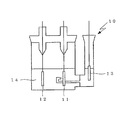
- the positive electrode produced as described above is used as the working electrode 11, while metallic lithium is used for the counter electrode 12 and the reference electrode 13 serving as the negative electrode, and ethylene is used as the non-aqueous electrolyte 14.
- LiPF 6 was dissolved to a concentration of 1 mol / l in a mixed solvent in which carbonate, methyl ethyl carbonate, and dimethyl carbonate were mixed at a volume ratio of 3: 3: 4, and 1% by mass of vinylene carbonate was further dissolved.
- a three-electrode test cell was prepared using this.
- the battery thus produced is hereinafter referred to as battery A1.
- Example 2 In the production of the positive electrode active material in Experimental Example 1, the above Experimental Example 1 except that lithium metaborate was not mixed with the positive electrode active material particles made of Li 1.02 [Ni 0.69 Co 0.19 Mn 0.098 ] O 2. In the same manner as described above, the three-electrode test cell of Experimental Example 2 was produced. The battery thus produced is hereinafter referred to as battery A2.
- a battery (battery) using a positive electrode plate exposed to the air in the same manner as the battery A2, except that after the rolling with a rolling roller and the air exposure was performed under the above-described conditions. B2) was produced.
- Example 3 In the production of the positive electrode active material in Experimental Example 1, except that tungsten oxide was not mixed with the positive electrode active material particles made of Li 1.02 [Ni 0.69 Co 0.19 Mn 0.098 ] O 2 , the same as in Experimental Example 1 above. In the same manner as in the case, a three-electrode test cell of Experimental Example 3 was produced. The battery thus produced is hereinafter referred to as battery A3.
- a battery (battery) using a positive electrode plate exposed to the air in the same manner as the battery A3, except that after being rolled by a rolling roller and exposed to the air under the above-described conditions. B3) was produced.
- Example 4 In preparation of the positive electrode active material in Experimental Example 1, except that tungsten oxide and lithium metaborate were not mixed with the positive electrode active material particles made of Li 1.02 [Ni 0.69 Co 0.19 Mn 0.098 ] O 2 described above. In the same manner as in Experimental Example 1, a three-electrode test cell of Experimental Example 4 was produced. The battery thus produced is hereinafter referred to as battery A4.
- a battery (battery) using a positive electrode plate exposed to the air in the same manner as the battery A4, except that after being rolled by a rolling roller and exposed to the air under the above-described conditions. B4) was produced.
- the charge / discharge under the above conditions was defined as one cycle, and the initial charge / discharge efficiency of the first cycle was determined from the measured charge capacity value and the measured discharge capacity based on the following formula (1).
- Initial charge / discharge efficiency (%) discharge capacity / charge capacity ⁇ 100 (1)
- the LiOH generation reaction specifically, the cause of characteristic deterioration due to atmospheric exposure is caused by tungsten oxide (specifically, Lithium-containing transition metal oxide reacts with moisture present on the surface of the lithium-containing transition metal oxide and reacts with lithium in the surface layer of the lithium-containing transition metal oxide. Since the progress of the reaction in which Li is extracted from the metal oxide and LiOH is generated), the charge / discharge efficiency is reduced when charging / discharging after exposure to the atmosphere. I think it can be done.
- the above-described interaction between the boron compound and the tungsten compound is an effect exhibited by the boron compound when the boron compound and the tungsten compound coexist, and is not exhibited when the boron compound is present alone. Conceivable.
- Example 5 The nickel-cobalt-manganese composite, lithium hydroxide, nickel-cobalt-manganese composite oxide, and tungsten oxide (WO 3 ) used in Experimental Example 1 were mixed with lithium, nickel-cobalt-manganese as a transition metal as a whole, and moles of tungsten.
- this lithium nickel cobalt manganese composite oxide has a change in lattice volume as compared with a lithium nickel cobalt manganese composite oxide made of Li 1.02 [Ni 0.69 Co 0.19 Mn 0.098 ] O 2 not containing tungsten. It was confirmed that tungsten was dissolved in the crystal.
- a battery (battery) using a positive electrode plate exposed to the air in the same manner as the battery 5 except that the positive electrode plate was rolled with a rolling roller and then exposed to the atmosphere under the above-described conditions. B5) was produced.
- Example 6 A battery was produced in the same manner as the battery A1 except that lithium tetraborate was used instead of lithium metaborate as the boron compound in the production of the positive electrode active material in Experimental Example 1. The battery thus produced is hereinafter referred to as battery A6.
- the positive electrode plate when producing the positive electrode plate, the positive electrode plate exposed to the atmosphere corresponding to the battery A6 in the same manner as the battery A5, except that after being rolled by a rolling roller and exposed to the atmosphere under the above-described conditions. A battery using this (battery B6) was produced.
- Example 7 A battery was produced in the same manner as the battery A3 except that lithium tetraborate was used instead of lithium metaborate as the boron compound in the production of the positive electrode active material in Experimental Example 3. The battery thus produced is hereinafter referred to as battery A7.
- the positive electrode plate when producing the positive electrode plate, the positive electrode plate exposed to the atmosphere corresponding to the battery A7 in the same manner as the battery A7, except that the positive electrode plate was rolled with a rolling roller and then exposed to the atmosphere under the above-described conditions. A battery using this (battery B7) was produced.
- the characteristic deterioration index due to exposure was calculated in the same manner as in the first experimental example. The results are summarized in Table 3 below together with the results of the batteries of Experimental Examples 1 and 3.
- the battery of Experimental Example 6 using a lithium-containing transition metal oxide in which lithium tetraborate is attached to a part of the surface instead of lithium metaborate is the battery of Experimental Example 6.
- the battery of Experimental Example 7 in which the tungsten compound corresponding to the above is not attached the characteristic deterioration index due to exposure is greatly reduced.
- a positive electrode for a partial nonaqueous electrolyte secondary battery according to one aspect of the present invention and a nonaqueous electrolyte secondary battery using the same are, for example, a driving power source for a mobile information terminal such as a mobile phone, a notebook computer, a smartphone, and a tablet terminal.
- a mobile information terminal such as a mobile phone, a notebook computer, a smartphone, and a tablet terminal.
- it can be applied to applications that require high energy density.
- it can be expected to be used for high-power applications such as electric vehicles (EV), hybrid electric vehicles (HEV, PHEV) and electric tools.
- EV electric vehicles
- HEV hybrid electric vehicles
- PHEV PHEV
Landscapes
- Chemical & Material Sciences (AREA)
- Chemical Kinetics & Catalysis (AREA)
- Electrochemistry (AREA)
- General Chemical & Material Sciences (AREA)
- Composite Materials (AREA)
- Inorganic Chemistry (AREA)
- Engineering & Computer Science (AREA)
- Materials Engineering (AREA)
- Crystallography & Structural Chemistry (AREA)
- Manufacturing & Machinery (AREA)
- Battery Electrode And Active Subsutance (AREA)
- Secondary Cells (AREA)
Abstract
Description
Li2WO4などを用いることがより好ましい。
そのような状態では、上記LiOH生成反応の抑制効果がリチウム含有遷移金属酸化物粒子の表面全体において十分に抑制することができる。ここで、混合したタングステンの量が少ないと、タングステンによる上記のような作用効果が十分に得られなくなる一方、タングステンの量が多くなりすぎると、タングステン化合物によって、リチウム含有遷移金属酸化物の表面が広く覆われる(被覆部位が多くなり過ぎる)ため、電池の充放電特性が低下する。このため、本発明の正極活物質においては、正極活物質中におけるタングステン化合物の量はリチウム含有遷移金属酸化物の遷移金属の総量に対して、タングステン元素換算で0.05mol%以上、3.00mol%以下にすることが好ましく、より好ましくは0.10mol%以上、2.00mol%以下、さらに好ましくは0.20mol%以上、1.50mol%以下である。
負極としては、従来から用いられてきた負極を用いることができ、例えば、負極活物質と、結着剤とを水あるいは適当な溶媒で混合し、負極集電体に塗布し、乾燥し、圧延することにより得られる。負極集電体には、導電性を有する薄膜体、特に銅などの負極の電位範囲で安定な金属箔や合金箔、銅などの金属表層を有するフィルム等を用いることが好適である。結着剤としては、正極の場合と同様にPTFE等を用いることもできるが、スチレンーブタジエン共重合体(SBR)又はこの変性体等を用いることが好ましい。結着剤は、CMC等の増粘剤と併用されてもよい。
非水電解質の溶媒としては、従来から使用されている、エチレンカーボネート、プロピレンカーボネート、ブチレンカーボネート、ビニレンカーボネート等の環状カーボネートや、ジメチルカーボネート、メチルエチルカーボネート、ジエチルカーボネート等の鎖状カーボネートを用いることができる。特に、高誘電率、低粘度、低融点の観点でリチウムイオン伝導度の高い非水系溶媒として、環状カーボネートと鎖状カーボネートとの混合溶媒を用いることが好ましい。また、この混合溶媒における環状カーボネートと鎖状カーボネートとの体積比は、2:8~5:5の範囲に規制することが好ましい。
なお、上記溶質は、単独で用いてもよいし、2種以上を混合して用いてもよい。
セパレータとしては、従来から用いられてきたセパレータを用いることができる。例えば、ポリプロピレン製やポリエチレン製のセパレータ、ポリプロピレン-ポリエチレンの多層セパレータや、セパレータの表面にアラミド系の樹脂等の樹脂が塗布されたものを用いることができる。
(実験例)
〔第1実験例〕
[正極活物質の作製]
まず、共沈により得られた[Ni0.70Co0.20Mn0.10](OH)2で表されるニッケルコバルトマンガン複合水酸化物を500℃で焼成して、ニッケルコバルトマンガン複合酸化物を得た。次に、水酸化リチウムと、上記で得たニッケルコバルトマンガン複合酸化物とを、リチウムと、遷移金属全体とのモル比が1.05:1になるように、石川式らいかい乳鉢にて混合した。その後、この混合物を空気雰囲気中にて900℃で10時間焼成し、粉砕することにより、平均二次粒子径が約18μmのLi1.02[Ni0.69Co0.19Mn0.098]O2で表されるリチウムニッケルマンガンコバルト複合酸化物を得た。
l%だった。
上記正極活物質粒子に導電剤としてのカーボンブラックと、結着剤としてのポリフッ化ビニリデンを溶解させたN-メチル-2-ピロリドン溶液とを、正極活物質粒子と導電剤と結着剤との質量比が95:2.5:2.5となるように秤量し、これらを混練して正極合剤スラリーを調製した。
正極極板を作製する際に、圧延ローラーにより圧延した後、以下の条件で大気曝露を行ったこと以外は、上記電池A1と同様にして大気曝露した正極極板を用いた電池(電池B1)を作製した。
・大気曝露条件
温度30℃、湿度50%の恒温恒湿槽に15日静置
実験例1における正極活物質の作製において、上記のLi1.02[Ni0.69Co0.19Mn0.098]O2からなる正極活物質粒子に対してメタホウ酸リチウムを混合させなかった以外は、上記の実験例1の場合と同様にして、実験例2の三電極式試験セルを作製した。このようにして作製した電池を、以下、電池A2と称する。
実験例1における正極活物質の作製において、上記のLi1.02[Ni0.69Co0.19Mn0.098]O2からなる正極活物質粒子に対して酸化タングステンを混合させなかった以外は、上記の実験例1の場合と同様にして、実験例3の三電極式試験セルを作製した。このようにして作製した電池を、以下、電池A3と称する。
実験例1における正極活物質の作製において、上記のLi1.02[Ni0.69Co0.19Mn0.098]O2からなる正極活物質粒子に対して酸化タングステン、メタホウ酸リチウムを混合させなかった以外は、上記の実験例1の場合と同様にして、実験例4の三電極式試験セルを作製した。このようにして作製した電池を、以下、電池A4と称する。
上述の条件で大気曝露をしていない正極極板を用いて作製された電池A1~A4、及び電池A1~A4において上述の条件で大気曝露をした正極極板を用いて作製された電池B1~電池B4を用いて、下記の充放電試験を行い、各々の電池の初期充放電効率を測定した。
・1サイクル目の充電条件
25℃の温度条件下において、0.2mA/cm2の電流密度で4.3V(vs.Li/Li+)まで定電流充電を行い、4.3V(vs.Li/Li+)の定電圧で電流密度が0.04mA/cm2になるまで定電圧充電を行った。
・1サイクル目の放電条件
25℃の温度条件下において、0.2mA/cm2の電流密度で2.5V(vs.Li/Li+)まで定電流放電を行った。
・休止
上記充電と放電との間の休止間隔は5分間とした。
初期充放電効率(%)=放電容量/充電容量×100 ・・・(1)
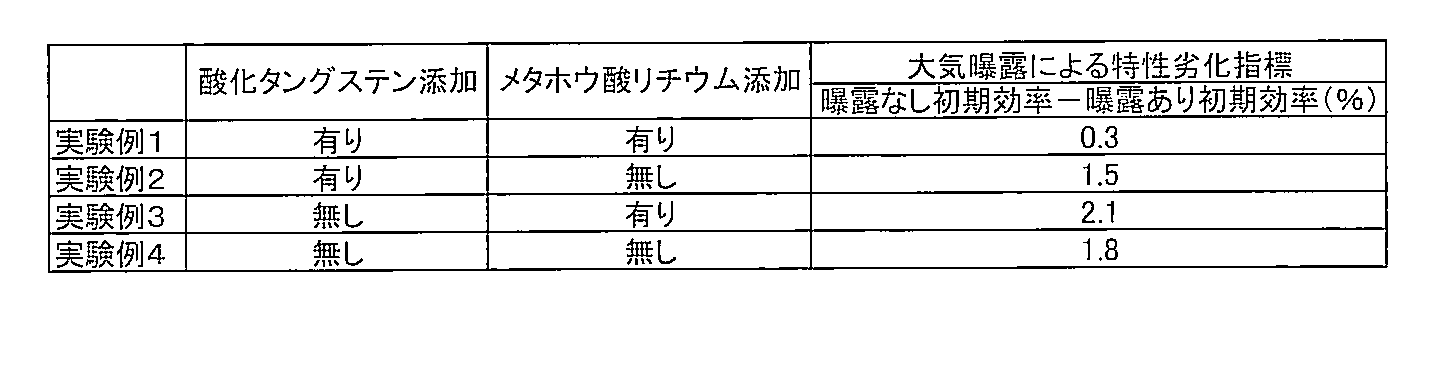
上記で求めた初期充放電効率のうち、大気曝露なし(大気曝露していない正極極板使用時)の初期充放電効率を「曝露なし初期効率」とし、大気曝露あり(大気曝露した正極極板使用時)の初期充放電効率を「曝露あり初期効率」とし、下記に示す式(2)に基づき、対応する電池の曝露なし初期効率と曝露あり初期効率の差から曝露による特性劣化指標を算出した。
曝露による特性劣化指標=(曝露なし初期効率)-(曝露あり初期効率) ・・・(2)
その結果を纏めて下記表1に示した。
〔第2実験例〕
実験例1で用いたニッケルコバルトマンガン複合物と水酸化リチウムとニッケルコバルトマンガン複合酸化物と、酸化タングステン(WO3)とを、リチウムと、遷移金属全体としてのニッケルコバルトマンガンと、タングステンとのモル比が1.02:1:0.005になるように、石川式らいかい乳鉢にて混合し焼成した以外は、上記の実験例1の場合と同様にして、実験例5の三電極式試験セルを作製した。このようにして作製した電池を、以下、電池A5と称する。尚、このリチウムニッケルコバルトマンガン複合酸化物は、タングステンを含まないLi1.02[Ni0.69Co0.19Mn0.098]O2からなるリチウムニッケルコバルトマンガン複合酸化物と比較して格子体積が変化していることより、タングステンは結晶内部に固溶されていることを確認した。
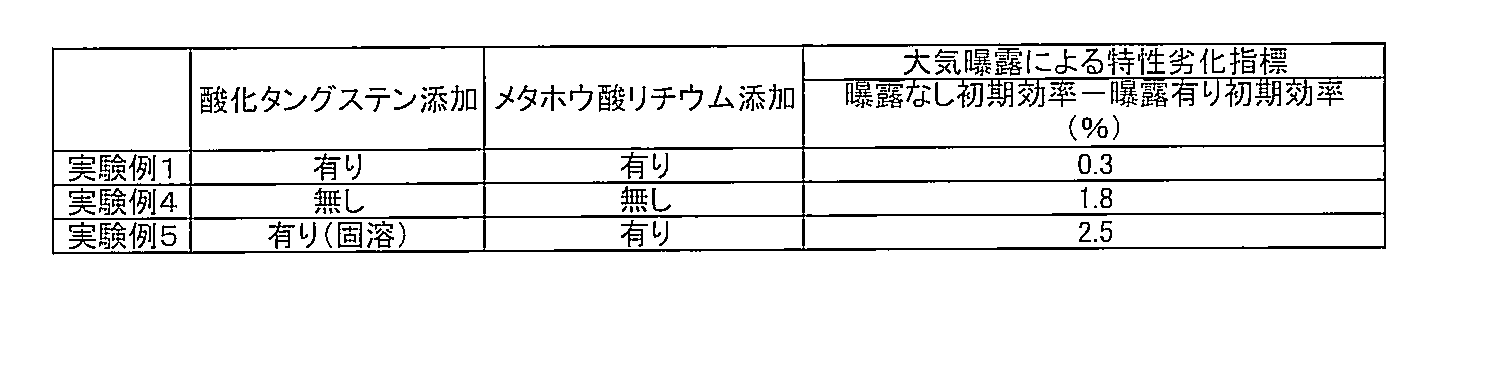
また、上記表2の結果からわかるように、酸化タングステンを水酸化リチウムと遷移金属酸化物と共にリチウム含有遷移金属酸化物を作製する際に混合した実験例5の電池は、酸化タングステンとメタホウ酸リチウムの両方がリチウム含有遷移金属化合物の表面に付着していない実験例4の電池と比べて大気曝露による初期充放電特性の劣化も促進していることがわかる。これは、水酸化リチウムと遷移金属酸化物を焼成する際に、タングステン酸化物が存在することで、水酸化リチウムと遷移金属酸化物の反応性が低下して、LiOHが増加したためと考えられる。また、タングステンがリチウム含有遷移金属酸化物の結晶構造中に固溶しているため、ホウ素化合物とタングステン化合物の相互作用も作用せず、LiOHが生成する反応を抑制できなかったため、大気曝露による初期充放電特性の劣化が抑制されなかったと考えられる。
〔第3実験例〕
実験例1における正極活物質の作製においてホウ素化合物としてメタホウ酸リチウムの代わりに、四ホウ酸リチウムを用いたこと以外は、上記電池A1と同様にして電池を作製した。このようにして作製した電池を、以下、電池A6と称する。
実験例3における正極活物質の作製においてホウ素化合物としてメタホウ酸リチウムの代わりに、四ホウ酸リチウムを用いたこと以外は、上記電池A3と同様にして電池を作製した。このようにして作製した電池を、以下、電池A7と称する。

11…作用極(正極)
12…対極(負極)
13…参照極
14…非水電解液
Claims (6)
- リチウム含有遷移金属酸化物を備えた非水電解質二次電池用正極であって、該非水電解質二次電池用正極に、タングステン化合物及びホウ素化合物を含む、非水電解質二次電池用正極。
- 前記タングステン化合物及びホウ素化合物が、前記リチウム含有遷移金属酸化物の表面の少なくとも一部に付着している、請求項1に記載の非水電解質二次電池用正極。
- 前記タングステン化合物が、タングステンを含む酸化物である、請求項1又は請求項2に記載の非水電解質二次電池用正極。
- 前記ホウ素化合物が、ホウ酸、ホウ酸リチウム、メタホウ酸リチウム、四ホウ酸リチウムから選ばれた少なくとも1つである、請求項1~3のいずれか1項に記載の非水電解質二次電池用正極。
- 前記リチウム含有遷移金属酸化物粒子中の遷移金属元素が少なくともニッケルを含む、請求項1~4のいずれか1項に記載の非水電解質二次電池用正極。
- 請求項1~5のいずれか1項に記載の非水電解質二次電池用正極を用いた非水電解質二次電池。
Priority Applications (3)
| Application Number | Priority Date | Filing Date | Title |
|---|---|---|---|
| CN201580015206.4A CN106104860B (zh) | 2014-03-20 | 2015-03-12 | 非水电解质二次电池用正极以及非水电解质二次电池 |
| US15/125,881 US10454107B2 (en) | 2014-03-20 | 2015-03-12 | Positive electrode for nonaqueous electrolyte secondary battery and nonaqueous electrolyte secondary battery |
| JP2016508524A JP6572882B2 (ja) | 2014-03-20 | 2015-03-12 | 非水電解質二次電池用正極及び非水電解質二次電池 |
Applications Claiming Priority (2)
| Application Number | Priority Date | Filing Date | Title |
|---|---|---|---|
| JP2014-057473 | 2014-03-20 | ||
| JP2014057473 | 2014-03-20 |
Publications (1)
| Publication Number | Publication Date |
|---|---|
| WO2015141194A1 true WO2015141194A1 (ja) | 2015-09-24 |
Family
ID=54144178
Family Applications (1)
| Application Number | Title | Priority Date | Filing Date |
|---|---|---|---|
| PCT/JP2015/001377 Ceased WO2015141194A1 (ja) | 2014-03-20 | 2015-03-12 | 非水電解質二次電池用正極及び非水電解質二次電池 |
Country Status (4)
| Country | Link |
|---|---|
| US (1) | US10454107B2 (ja) |
| JP (1) | JP6572882B2 (ja) |
| CN (1) | CN106104860B (ja) |
| WO (1) | WO2015141194A1 (ja) |
Cited By (2)
| Publication number | Priority date | Publication date | Assignee | Title |
|---|---|---|---|---|
| JP2018533157A (ja) * | 2015-11-30 | 2018-11-08 | エルジー・ケム・リミテッド | 二次電池用正極活物質およびそれを含む二次電池 |
| JP2024520028A (ja) * | 2021-05-27 | 2024-05-21 | ユミコア | 充電式リチウムイオン電池用の正極活物質としてのリチウムニッケル系複合酸化物 |
Families Citing this family (6)
| Publication number | Priority date | Publication date | Assignee | Title |
|---|---|---|---|---|
| JP6799829B2 (ja) * | 2016-03-30 | 2020-12-16 | パナソニックIpマネジメント株式会社 | 非水電解質二次電池用正極活物質、非水電解質二次電池用正極活物質の製造方法、及び非水電解質二次電池 |
| KR102176633B1 (ko) | 2017-02-28 | 2020-11-09 | 주식회사 엘지화학 | 리튬 이차전지용 양극 활물질, 그 제조방법 및 이를 포함하는 리튬 이차전지 |
| WO2018160023A1 (ko) | 2017-02-28 | 2018-09-07 | 주식회사 엘지화학 | 리튬 이차전지용 양극 활물질, 그 제조방법 및 이를 포함하는 리튬 이차전지 |
| EP3932871A4 (en) * | 2019-02-27 | 2022-05-04 | Panasonic Intellectual Property Management Co., Ltd. | METHOD FOR THE PRODUCTION OF ACTIVE MATERIAL OF POSITIVE ELECTRODE FOR SECONDARY BATTERY WITH NON-AQUEOUS ELECTROLYTE |
| CN116648797B (zh) * | 2020-12-02 | 2026-04-28 | 国立大学法人东京科学大学 | 锂系固体电解质、无机固体电解质、锂系固体电解质的制造方法、修饰正极活性物质、修饰负极活性物质、全固态二次电池、全固态二次电池用电极片、固体电解质片、全固态二次电池用电极 |
| CN119725430B (zh) * | 2024-11-26 | 2026-04-03 | 河北大学 | 一种锌离子电池锰基正极材料及其制备方法和应用 |
Citations (4)
| Publication number | Priority date | Publication date | Assignee | Title |
|---|---|---|---|---|
| JP2000011996A (ja) * | 1998-06-25 | 2000-01-14 | Shin Kobe Electric Mach Co Ltd | 非水電解液二次電池 |
| JP2011216214A (ja) * | 2010-03-31 | 2011-10-27 | Nichia Corp | 非水電解質二次電池用正極活物質及び非水電解質二次電池 |
| JP2014022329A (ja) * | 2012-07-23 | 2014-02-03 | Toyota Motor Corp | 非水電解液二次電池 |
| JP2014035963A (ja) * | 2012-08-10 | 2014-02-24 | Fuji Heavy Ind Ltd | 正極材料リチウムイオン蓄電デバイス、及びその製造方法 |
Family Cites Families (13)
| Publication number | Priority date | Publication date | Assignee | Title |
|---|---|---|---|---|
| US7138209B2 (en) * | 2000-10-09 | 2006-11-21 | Samsung Sdi Co., Ltd. | Positive active material for rechargeable lithium battery and method of preparing same |
| JP5034136B2 (ja) * | 2000-11-14 | 2012-09-26 | 株式会社Gsユアサ | 非水電解質二次電池用正極活物質およびそれを用いた非水電解質二次電池 |
| JP2005251716A (ja) * | 2004-02-05 | 2005-09-15 | Nichia Chem Ind Ltd | 非水電解質二次電池用正極活物質、非水電解質二次電池用正極合剤および非水電解質二次電池 |
| JP5092292B2 (ja) * | 2006-07-03 | 2012-12-05 | ソニー株式会社 | 正極活物質およびその製造方法、並びに非水電解質二次電池 |
| JP5082307B2 (ja) * | 2006-07-03 | 2012-11-28 | ソニー株式会社 | 正極活物質およびその製造方法、並びに非水電解質二次電池 |
| EP2337125A1 (en) * | 2006-12-26 | 2011-06-22 | Mitsubishi Chemical Corporation | Lithium transition metal based compound powder and method for manufacturing the same |
| CN102769130A (zh) * | 2007-09-04 | 2012-11-07 | 三菱化学株式会社 | 锂过渡金属类化合物粉末 |
| JP5515211B2 (ja) | 2007-12-14 | 2014-06-11 | ソニー株式会社 | 正極活物質の製造方法 |
| JP5382061B2 (ja) * | 2010-06-22 | 2014-01-08 | 日亜化学工業株式会社 | 非水電解液二次電池用正極組成物及び該正極組成物を用いた正極スラリー |
| CN102779991A (zh) | 2011-05-10 | 2012-11-14 | 日本化学工业株式会社 | 锂二次电池用正极活性物质粉体、其制造方法及锂二次电池 |
| JP2013137947A (ja) * | 2011-12-28 | 2013-07-11 | Panasonic Corp | リチウムイオン二次電池およびリチウムイオン二次電池用正極活物質の製造方法 |
| JP6286855B2 (ja) | 2012-04-18 | 2018-03-07 | 日亜化学工業株式会社 | 非水電解液二次電池用正極組成物 |
| JP6524651B2 (ja) * | 2013-12-13 | 2019-06-05 | 日亜化学工業株式会社 | 非水電解液二次電池用正極活物質及びその製造方法 |
-
2015
- 2015-03-12 WO PCT/JP2015/001377 patent/WO2015141194A1/ja not_active Ceased
- 2015-03-12 US US15/125,881 patent/US10454107B2/en active Active
- 2015-03-12 CN CN201580015206.4A patent/CN106104860B/zh active Active
- 2015-03-12 JP JP2016508524A patent/JP6572882B2/ja active Active
Patent Citations (4)
| Publication number | Priority date | Publication date | Assignee | Title |
|---|---|---|---|---|
| JP2000011996A (ja) * | 1998-06-25 | 2000-01-14 | Shin Kobe Electric Mach Co Ltd | 非水電解液二次電池 |
| JP2011216214A (ja) * | 2010-03-31 | 2011-10-27 | Nichia Corp | 非水電解質二次電池用正極活物質及び非水電解質二次電池 |
| JP2014022329A (ja) * | 2012-07-23 | 2014-02-03 | Toyota Motor Corp | 非水電解液二次電池 |
| JP2014035963A (ja) * | 2012-08-10 | 2014-02-24 | Fuji Heavy Ind Ltd | 正極材料リチウムイオン蓄電デバイス、及びその製造方法 |
Cited By (5)
| Publication number | Priority date | Publication date | Assignee | Title |
|---|---|---|---|---|
| JP2018533157A (ja) * | 2015-11-30 | 2018-11-08 | エルジー・ケム・リミテッド | 二次電池用正極活物質およびそれを含む二次電池 |
| US10439216B2 (en) | 2015-11-30 | 2019-10-08 | Lg Chem, Ltd. | Positive electrode active material for secondary battery, and secondary battery including the same |
| US10910641B2 (en) | 2015-11-30 | 2021-02-02 | Lg Chem, Ltd. | Positive electrode active material for secondary battery, and secondary battery including the same |
| JP2024520028A (ja) * | 2021-05-27 | 2024-05-21 | ユミコア | 充電式リチウムイオン電池用の正極活物質としてのリチウムニッケル系複合酸化物 |
| JP7799710B2 (ja) | 2021-05-27 | 2026-01-15 | ユミコア | 充電式リチウムイオン電池用の正極活物質としてのリチウムニッケル系複合酸化物 |
Also Published As
| Publication number | Publication date |
|---|---|
| CN106104860A (zh) | 2016-11-09 |
| US10454107B2 (en) | 2019-10-22 |
| JP6572882B2 (ja) | 2019-09-11 |
| CN106104860B (zh) | 2018-11-30 |
| JPWO2015141194A1 (ja) | 2017-04-06 |
| US20170005333A1 (en) | 2017-01-05 |
Similar Documents
| Publication | Publication Date | Title |
|---|---|---|
| JP6572882B2 (ja) | 非水電解質二次電池用正極及び非水電解質二次電池 | |
| JP6724784B2 (ja) | 非水電解質二次電池 | |
| JP6447620B2 (ja) | 非水電解質二次電池用正極活物質 | |
| JP6443339B2 (ja) | 非水電解質二次電池用正極 | |
| JP6610552B2 (ja) | 非水電解質二次電池用正極及びそれを用いた非水電解質二次電池 | |
| JP6614149B2 (ja) | 非水電解質二次電池用正極及び非水電解質二次電池 | |
| JP6493409B2 (ja) | 非水電解質二次電池 | |
| JP2015115106A (ja) | 導電組成物、正極、およびリチウムイオン二次電池。 | |
| JP6627758B2 (ja) | 非水電解質二次電池用正極及びそれを用いた非水電解質二次電池 | |
| US10553856B2 (en) | Nonaqueous electrolyte secondary battery | |
| WO2016121350A1 (ja) | 非水電解質二次電池用正極及び非水電解質二次電池 | |
| WO2016067522A1 (ja) | 非水電解質二次電池 | |
| JP2017126488A (ja) | 非水電解液二次電池用非水電解液及び非水電解液二次電池 | |
| JP2016103468A (ja) | 非水電解質二次電池 | |
| WO2013146115A1 (ja) | 非水電解液二次電池用正極活物質及び当該正極活物質を用いた非水電解液二次電池 | |
| JP2014146518A (ja) | 非水電解質二次電池用非水電解質 | |
| WO2015098054A1 (ja) | 非水電解質二次電池用正極活物質及びそれを用いた非水電解質二次電池 | |
| JP2015064977A (ja) | 非水電解質二次電池用の正極、非水電解質二次電池の正極用合材および非水電解質二次電池 | |
| JP2017126489A (ja) | 非水電解液二次電池用非水電解液及び非水電解液二次電池 |
Legal Events
| Date | Code | Title | Description |
|---|---|---|---|
| 121 | Ep: the epo has been informed by wipo that ep was designated in this application |
Ref document number: 15764256 Country of ref document: EP Kind code of ref document: A1 |
|
| ENP | Entry into the national phase |
Ref document number: 2016508524 Country of ref document: JP Kind code of ref document: A |
|
| WWE | Wipo information: entry into national phase |
Ref document number: 15125881 Country of ref document: US |
|
| NENP | Non-entry into the national phase |
Ref country code: DE |
|
| 122 | Ep: pct application non-entry in european phase |
Ref document number: 15764256 Country of ref document: EP Kind code of ref document: A1 |