WO2015092885A1 - 歯磨剤 - Google Patents
歯磨剤 Download PDFInfo
- Publication number
- WO2015092885A1 WO2015092885A1 PCT/JP2013/083926 JP2013083926W WO2015092885A1 WO 2015092885 A1 WO2015092885 A1 WO 2015092885A1 JP 2013083926 W JP2013083926 W JP 2013083926W WO 2015092885 A1 WO2015092885 A1 WO 2015092885A1
- Authority
- WO
- WIPO (PCT)
- Prior art keywords
- granule
- less
- dentifrice
- granules
- particle size
- Prior art date
- Legal status (The legal status is an assumption and is not a legal conclusion. Google has not performed a legal analysis and makes no representation as to the accuracy of the status listed.)
- Ceased
Links
Images


Classifications
-
- A—HUMAN NECESSITIES
- A61—MEDICAL OR VETERINARY SCIENCE; HYGIENE
- A61K—PREPARATIONS FOR MEDICAL, DENTAL OR TOILETRY PURPOSES
- A61K8/00—Cosmetics or similar toiletry preparations
- A61K8/02—Cosmetics or similar toiletry preparations characterised by special physical form
- A61K8/0241—Containing particulates characterized by their shape and/or structure
-
- A—HUMAN NECESSITIES
- A61—MEDICAL OR VETERINARY SCIENCE; HYGIENE
- A61K—PREPARATIONS FOR MEDICAL, DENTAL OR TOILETRY PURPOSES
- A61K8/00—Cosmetics or similar toiletry preparations
- A61K8/18—Cosmetics or similar toiletry preparations characterised by the composition
- A61K8/19—Cosmetics or similar toiletry preparations characterised by the composition containing inorganic ingredients
-
- A—HUMAN NECESSITIES
- A61—MEDICAL OR VETERINARY SCIENCE; HYGIENE
- A61K—PREPARATIONS FOR MEDICAL, DENTAL OR TOILETRY PURPOSES
- A61K8/00—Cosmetics or similar toiletry preparations
- A61K8/18—Cosmetics or similar toiletry preparations characterised by the composition
- A61K8/19—Cosmetics or similar toiletry preparations characterised by the composition containing inorganic ingredients
- A61K8/25—Silicon; Compounds thereof
-
- A—HUMAN NECESSITIES
- A61—MEDICAL OR VETERINARY SCIENCE; HYGIENE
- A61K—PREPARATIONS FOR MEDICAL, DENTAL OR TOILETRY PURPOSES
- A61K8/00—Cosmetics or similar toiletry preparations
- A61K8/18—Cosmetics or similar toiletry preparations characterised by the composition
- A61K8/19—Cosmetics or similar toiletry preparations characterised by the composition containing inorganic ingredients
- A61K8/27—Zinc; Compounds thereof
-
- A—HUMAN NECESSITIES
- A61—MEDICAL OR VETERINARY SCIENCE; HYGIENE
- A61K—PREPARATIONS FOR MEDICAL, DENTAL OR TOILETRY PURPOSES
- A61K8/00—Cosmetics or similar toiletry preparations
- A61K8/18—Cosmetics or similar toiletry preparations characterised by the composition
- A61K8/19—Cosmetics or similar toiletry preparations characterised by the composition containing inorganic ingredients
- A61K8/29—Titanium; Compounds thereof
-
- A—HUMAN NECESSITIES
- A61—MEDICAL OR VETERINARY SCIENCE; HYGIENE
- A61Q—SPECIFIC USE OF COSMETICS OR SIMILAR TOILETRY PREPARATIONS
- A61Q11/00—Preparations for care of the teeth, of the oral cavity or of dentures; Dentifrices, e.g. toothpastes; Mouth rinses
-
- A—HUMAN NECESSITIES
- A61—MEDICAL OR VETERINARY SCIENCE; HYGIENE
- A61K—PREPARATIONS FOR MEDICAL, DENTAL OR TOILETRY PURPOSES
- A61K2800/00—Properties of cosmetic compositions or active ingredients thereof or formulation aids used therein and process related aspects
- A61K2800/40—Chemical, physico-chemical or functional or structural properties of particular ingredients
- A61K2800/41—Particular ingredients further characterized by their size
- A61K2800/412—Microsized, i.e. having sizes between 0.1 and 100 microns
Definitions
- the present invention relates to a dentifrice.
- dentifrices containing granules that can effectively remove dental plaque that causes tooth decay and periodontal disease and can feel the effect are known.
- These granules are substantially spherical agglomerated particles so as not to damage the enamel and gums on the tooth surface, and contain functional materials such as drugs, enzymes, and abrasives. There are things that aim at the visual effect.
- water-soluble binders such as methylcellulose and carboxymethylcellulose and water-insoluble organic binders such as wax are known.
- a dentifrice containing granules obtained by binding a water-insoluble powder material such as zeolite with a water-insoluble inorganic binder such as colloidal silica is also known (see Patent Document 1).
- a dentifrice containing silica granules having a high deformation rate which is produced by a specific process using an anhydrous silicic acid by a wet method (gel method) is also known (see Patent Document 2).
- the present invention is a dentifrice comprising a granule containing a water-insoluble powder material (A) and an inorganic binder (B),
- the average value of the ratio (S A / S S ) is 0.5 or more and 0.9 or less
- the disintegration strength of the granule after blending is 1 gf / piece or more and 20 gf / piece or less .
- the present invention is a dentifrice comprising a granule containing a water-insoluble powder material (A) and an inorganic binder (B),
- the following granules (a) to (d) in the particle size distribution by laser diffraction / scattering particle size distribution measurement (A) Granules having a particle size of 50 ⁇ m or more and less than 100 ⁇ m (b) Granules having a particle size of 100 ⁇ m or more and less than 150 ⁇ m (c) Granules having a particle size of 150 ⁇ m or more and less than 200 ⁇ m (d) Among granules having a particle size of 200 ⁇ m or more and less than 250 ⁇ m
- the volume ratio (b / c) of the amount of granules (b) to the amount of granules (c) is 0.7 or more and 1.2 or less, and the volume ratio (d /
- the granule of Patent Document 2 has a high deformation rate and excellent granule feeling, but with a small load when using a soft toothbrush considering a reduction in the load on the gums, various concave and convex portions on the tooth surface There is room for improvement in order to sufficiently remove the dirt adhering to the surface. Therefore, there is a need for a dentifrice granule that easily penetrates into the concave portion of the tooth surface. If the dentifrice is formulated with such a granule, it is necessary to use a soft toothbrush that reduces the burden on the gums. Even with a small load, it can be expected that the ability to remove plaque and dirt will increase.
- the present inventors have made various studies, and as long as the dentifrice is composed of granules having a specific shape or a specific particle size distribution and having a specific disintegration strength, these granules interact. However, the present inventors have found that high plaque removal ability or dirt removal ability is exhibited even with a small load when using a soft toothbrush that easily penetrates into minute concave portions of teeth.
- a specific granule that has a specific shape or a specific particle size distribution and has a specific disintegration strength and disintegrates when a load is applied is blended.
- the granule penetrates into minute recesses of 150 ⁇ m or less such as tooth frequency, mesial lip groove, central ridge and centrifugal lip groove, etc. It is possible to sufficiently remove dirt such as plaque and colored dirt. Therefore, even when a soft bristle toothbrush is used, the load can be effectively transmitted to the fine recesses, and high dirt removal ability can be exhibited.
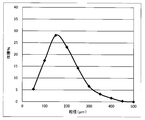
- Laser diffraction / scattering particle size distribution of pre-blend granules B ′ used to obtain the blended granules present in the dentifrice of Example 2 and post-blend granules B present in the dentifrice of Example 2 It is a graph which shows the particle size distribution by a measurement. 2 is a SEM photograph of post-formulation granule B present in the dentifrice of Example 2. It is a graph which shows the particle size distribution by the laser diffraction / scattering type particle size distribution measurement of the granule F after mixing
- the dentifrice of the present invention is formed by blending granules having a specific shape or a specific particle size distribution and having a specific disintegration strength.
- the blended granule present in the dentifrice is a granule containing the water-insoluble powder material (A) and the inorganic binder (B), and is hereinafter also referred to as “post-blend granule”.
- post-blend granule since the post-combination granule is present in the dentifrice, the granule to be blended in the dentifrice is hereinafter also referred to as “pre-blend granule”.
- water-insoluble powder material (A) those usually used for tooth abrasives are preferable, and specifically, inorganic materials are preferable.
- water-insoluble means that the amount dissolved in 100 g of water (20 ° C.) is 1 g or less.
- the granules after compounding present in the dentifrice are given a specific shape or a specific particle size distribution which will be described later, and a low load is applied as in the case of using a soft toothbrush.
- a soft toothbrush it is light from the viewpoint that it can exhibit high dirt removing ability, can remove dirt such as plaque and colored dirt sufficiently, and can improve the smooth feel and dirt removal feeling on the tooth surface.
- One or more selected from calcium carbonate, heavy calcium carbonate, zeolite, and silica are preferable, one or two selected from light calcium carbonate and heavy calcium carbonate are more preferable, and heavy calcium carbonate is further preferable.
- the smooth touch means that when the tooth surface is touched with the tongue, it is possible to smoothly slide the tongue on the surface of the tooth without obtaining a touch of plaque or dirt.
- Feeling is the feeling of dirt removal, which means that the tooth surface is smooth and feels free of dirt.
- the average particle size of the water-insoluble powder material (A) is preferably 0.1 ⁇ m or more, more preferably 0.5 ⁇ m or more, and still more preferably 0.8 ⁇ m or more, from the viewpoint of removing plaque or dirt after granule disintegration. It is 8 ⁇ m or more, and more preferably 1 ⁇ m or more. Moreover, from a viewpoint of reducing a foreign material feeling, Preferably it is 20 micrometers or less, More preferably, it is 15 micrometers or less, More preferably, it is 10 micrometers or less, More preferably, it is 5 micrometers or less.
- the average particle size of the water-insoluble powder material (A) is preferably 0.1 to 20 ⁇ m, more preferably 0.5 to 15 ⁇ m, still more preferably 0.8 to 10 ⁇ m, and still more preferably. Is 1 to 5 ⁇ m.
- the average particle size can be measured by the method described in the examples.
- the content of the water-insoluble powder material (A) is preferably 60% by mass or more in a dry state in the granule after blending from the viewpoint of realizing a gradually disintegrating behavior and enhancing the polishing power. Is 70% by mass or more, more preferably 80% by mass or more, and still more preferably 82% by mass or more.
- the content of the water-insoluble powder material (A) is preferably 98% by mass or less, more preferably 96% by mass or less in a dry state in the granule after blending from the viewpoint of suppressing damage to teeth. Preferably it is 90 mass% or less.
- the content of the water-insoluble powder material (A) is preferably 60 to 98% by weight, more preferably 70 to 96% by weight, and still more preferably 80 to 96% in the dry state in the granule after blending. % By mass, and more preferably 82 to 90% by mass.
- the inorganic binder (B) contained in the compounded granule present in the dentifrice of the present invention binds to the water-insoluble powder material (A) while having voids in the compounded granule, It can be removed sufficiently, and has the effect of improving the smooth feel and dirt removal on the tooth surface.
- the inorganic binder (B) include one or more selected from a water-soluble inorganic binder and a water-insoluble inorganic binder.
- Specific examples of the water-soluble inorganic binder include one or more selected from sodium silicate, polyacrylic acid, processed cellulose, polyvinyl pyrrolidone, silicone, and the like, and sodium silicate is preferable.
- the water-insoluble inorganic binder include one or more selected from colloidal silica, magnesium aluminate metasilicate, synthetic aluminum silicate, calcium silicate, alumina sol, and the like, and colloidal silica is preferable.
- a water-soluble inorganic binder is included from a viewpoint of exhibiting the effect of this invention satisfactorily, and it is more preferable that sodium silicate is included.
- the foam quality, foaming and feel of the granules are further improved, and the smooth feel on the tooth surface and A feeling of dirt removal can be enhanced.
- Such sodium silicates include sodium metasilicate (Na 2 SiO 3 ), sodium orthosilicate (Na 4 SiO 4 ), sodium disilicate (Na 2 Si 2 O 5 ), sodium tetrasilicate (Na 2 Si 4 O 9 ), and The 1 type (s) or 2 or more types chosen from those hydrates are mentioned.
- Sodium silicate is generally represented by the molecular formula Na 2 O.nSiO 2 .mH 2 O.
- the coefficient n molecular ratio of SiO 2 to Na 2 O
- molar ratio can be represented by the following formula (I).
- Molar ratio mass ratio (SiO 2 mass% / Na 2 O mass%) ⁇ (Molecular weight of Na 2 O / Molecular weight of SiO 2 ) (I)
- sodium silicate water silicates of various molar ratios can be used in addition to sodium silicate Nos. 1, 2 and 3 described in JIS K1408. Among them, sodium silicate 3 is more preferable.
- the molar ratio (coefficient n) is preferably 2.0 or more, more preferably 2.4 or more, further preferably 2.8 or more, and further preferably 3.0 or more. It is preferably 4.0 or less, more preferably 3.5 or less, still more preferably 3.4 or less, and even more preferably 3.3 or less.
- the molar ratio (coefficient n) is preferably 2.0 to 4.0, more preferably 2.4 to 3.5, still more preferably 2.8 to 3.4. More preferably, it is 3.0 to 3.3.
- One or two contents selected from sodium silicate (solid content) and colloidal silica in the inorganic binder (B) contained in the post-blend granule present in the dentifrice of the present invention are used as an inorganic binder.
- it is preferably 60% by mass or more, more preferably 80% by mass or more, and further preferably 90% by mass or more in the component (B).
- the amount is preferably 100% by mass or less.
- the amount of sodium silicate (solid content) and colloidal silica in the inorganic binder (B) is the amount excluding moisture after drying the blended granule extracted from the dentifrice at 90 ° C. or higher. is there.
- the content of the component (B), which is one or two kinds selected from sodium silicate (solid content) and colloidal silica in the granule after blending present in the dentifrice of the present invention, is determined by the dry state of the granule and in the water. From the viewpoint of moderate disintegration strength, stability in dentifrice, and the viewpoint of realizing a gradually disintegrating behavior, it is preferably 1% by mass or more, more preferably 2% in the dry state in the granule after blending. % Or more, more preferably 5% by mass or more, and still more preferably 10% by mass or more.
- the content of sodium silicate in the compounded granule present in the dentifrice of the present invention is preferably 30% by mass or less, more preferably 20% by mass or less, in the compounded granule from the viewpoint of increasing the yield. More preferably, it is 18 mass% or less.
- the content of sodium silicate in the granule after blending present in the dentifrice of the present invention is preferably 1 to 30% by mass, more preferably 2 to 20% by mass, and further preferably 5 to 18%. % By mass, more preferably 10 to 18% by mass.
- the mass ratio of the inorganic binder (B) to the water-insoluble powder material (A) is water
- it is preferably 0.02 or more, more preferably 0.05 or more, and still more preferably 0. 0.08 or more.
- the mass ratio is preferably 0.5 or less, more preferably 0.3 or less, and further preferably 0.18 or less.
- the mass ratio is preferably 0.02 to 0.5, more preferably 0.05 to 0.3, and still more preferably 0.08 to 0.18.
- content in case the said component (B) contains sodium silicate is a solid content conversion value.
- the compounded granules present in the dentifrice of the present invention improve the physical properties of gradually disintegrating by strengthening the network structure formed by water-soluble silicate or colloidal silica from the viewpoint of imparting a plaque formation inhibitory effect.
- the content of the component (C) is preferably 0.2% by mass or more in the dry state in the granule after blending from the viewpoint of improving the plaque formation inhibitory effect and gradually disintegrating physical properties, more preferably 0. 0.5% by mass or more, and more preferably 0.8% by mass or more.
- the content of the component (C) is from the viewpoint of suppressing the disintegration strength from becoming excessively high, from the viewpoint of improving foaming and foam quality of the dentifrice blended with the granule after blending, and from the viewpoint of suppressing the metallic taste.
- the granule after blending it is preferably 5% by mass or less, more preferably 3% by mass or less, and further preferably 2% by mass or less in a dry state.
- the content of the component (C) is preferably 0.2 to 5% by mass, more preferably 0.5 to 3% by mass in the dry state in the granule after blending, more preferably 0.5 to 3% by mass. 8 to 2% by mass.
- the mass ratio (C / B) of the component (C) and the component (B) in the granule after blending is a viewpoint that realizes an appropriate disintegration strength, and a viewpoint that improves foaming and foam quality of the dentifrice in which the granule after blending exists. From the viewpoint of the cleaning performance of recesses of various sizes on the tooth surface, it is preferably 0.02 or more, more preferably 0.05 or more, still more preferably 0.08 or more, preferably 1 It is below, More preferably, it is 0.5 or less, More preferably, it is 0.3 or less, More preferably, it is 0.2 or less.
- the mass ratio (C / B) of the component (C) to the component (B) in the granule after blending is preferably 0.02 to 1, more preferably 0.05 to 0.5, It is preferably 0.08 to 0.3, and more preferably 0.08 to 0.2.
- the post-combination granules present in the dentifrice of the present invention can contain organic fibers, medicinal components, colorants and the like in addition to the above components, as long as the effects of the present invention are not impaired. .
- Other components other than the above components may be used alone or in combination of two or more.
- the compounded granule present in the dentifrice of the present invention has a unique shape, and the area of the projection surface (S A ) of the granule and the maximum passing diameter (D L ) on the projection surface are defined as the diameter.
- the average value of the ratio (S A / S S ) to the area (S S ) of the circumscribed circle is 0.5 or more and 0.9 or less.
- the area of the projected surface of the granule after blending in the present invention was left on the sieve after an aqueous solution of a dentifrice diluted to 10% by mass with purified water was washed with purified water using a JISZ8801-1 standard 150 ⁇ m sieve.
- the value measured using the granule which dried the granule for 1 day at room temperature (25 degreeC) is meant.
- the projected surface of the granule after blending means the surface photographed using KEENCE VH-5500 (magnification 100 times), and the photographed digital image is analyzed using the analysis software (WinROOF (Mitani Corporation)).
- the ratio (S A / S S ) between the area (S A ) on the projection plane and the area (S S ) of the circumscribed circle whose diameter is the maximum passing diameter (D L ) on the projection plane is obtained, and the other direction
- the average value of S A / S S is calculated based on the projection surface from the above or the projection surface using other post-blend granules, and thus the circumscribed diameter having the maximum passing diameter (D L ) as the diameter on the projection surface
- the average value of S A / S S obtained from the area of the circle (S S ) and the area of the projection surface (S A ) becomes a value closer to 1 as the granules are spherical.
- the formulation after granules present in, such S a Since the area (S S ) of the circumscribed circle whose average value of / S S is thus the maximum passing diameter (D L ) on the projection surface is 0.5 or more and 0.9 or less, it is not a spherical granule.
- it is an irregular shape that is an irregular shape with a plurality of irregularities on the surface, that is, an irregularly shaped granule, and the granule after blending of the present invention is crushed or partially chipped before blending.
- the post-combination granule present in the dentifrice of the present invention has such a unique shape, so that when the load is applied with a toothbrush or the like even in the oral cavity, the load is concentrated on the convex portion, so that it collapses. It is easy, and it is thought that it gradually collapses starting from such a convex part.
- each post-combination granule present in the dentifrice of the present invention is formed by agglomerating primary particles to form intermediate particles, which are further agglomerated to form voids in the granules. It is considered that the particles are dispersed moderately and collapse from the intermediate particles protruding on the surface as the load is applied.
- blending which exists in the dentifrice of this invention is a granule obtained by mixing at the time of manufacture of a dentifrice, after mix
- the granule after blending does not collapse at once due to the load of the toothbrush, during brushing, Granules gradually collapse, and while these collide with the tooth surface, they penetrate into minute recesses such as the frequency band of the tooth, effectively transmitting the load from the toothbrush, and removing plaque or dirt Can be sufficiently exerted, and the smooth feel on the surface of the teeth and the feeling of removal of dirt can be improved.
- a soft bristle the taper bristle which the cross-sectional area of the hair tip of a bristle becomes small gradually is mentioned, for example. Such a taper bristle has a soft touch due to its thin tip, and has a property that a hair tip easily enters a gap between teeth.
- the average value of the ratio (D L / D S ) of the maximum delivery diameter (D L ) and the minimum delivery diameter (D S ) on the projection surface of the granule after blending is a behavior of gradually disintegrating into irregular shaped granules From the viewpoint of effectively exhibiting a load, even a toothbrush having a soft bristle is preferably 1.2 or more, more preferably 1.3 or more, and even more preferably 1.4 or more. It is.
- the average value of the ratio (D L / D S ) between the maximum delivery diameter (D L ) and the minimum delivery diameter (D S ) on the projection surface of the granule after blending exhibits an appropriate disintegration and the load from the toothbrush Is preferably 1.8 or less, more preferably 1.7 or less, and even more preferably 1.65 or less. Further, the average value of the ratio (D L / D S ) between the maximum delivery diameter (D L ) and the minimum delivery diameter (D S ) on the projection surface of the granule after blending is preferably 1.2 to 1.8. More preferably 1.3 to 1.7, still more preferably 1.4 to 1.65.
- the blended granules present in the dentifrice of the present invention also have a unique particle size distribution.
- the following granules (a) to (a) to (c) in the particle size distribution by laser diffraction / scattering particle size distribution measurement are used.
- the volume ratio (b / c) of the amount of granules (b) to the amount of granules (c) is 0.7 or more and 1.2 or less, and the volume ratio (d / c) of granules (d) to granules (c) ) Is 0.2 or more and 1 or less, the volume ratio (b / d) of the amount of the granule (b) to the amount of the granule (d) is greater than 1 and 5 or less, and the granule after blending of the
- the granule (b) is comparable to the granule (c). Since the volume ratio (d / c) is in the above range and the granule (b / d) is greater than 1 and 5 or less, the granule (b) (D) present in greater amounts.
- the granules from the toothbrush are effectively transmitted while these granules are gradually entangled and disintegrate and penetrate into minute recesses such as the frequency of the teeth.
- the plaque or dirt removing performance can be sufficiently exerted, and the feeling that the tooth surface is smooth and smooth and the feeling that the dirt is removed can be improved.
- the post-blend granules present in the dentifrice of the present invention mean those having a particle size of 50 ⁇ m or more determined by laser diffraction / scattering particle size distribution measurement.
- the blending after granules present in the dentifrices of the present invention is the above as irregular granules, the particle size obtained by a laser diffraction / scattering particle size distribution measurement, the maximum distance across the diameter (D L ) And the minimum passing diameter (D S ).
- the volume ratio (b / c) of the amount of granules (b) to the amount of granules (c) in the particle size distribution measured by laser diffraction / scattering particle size distribution is Effectively penetrates into the fine recesses, more preferably into the recesses with a width of 150 ⁇ m or less, and exhibits a smooth feeling on the tooth surface after dentifrice, while exhibiting a gradual disintegration behavior. From the viewpoint, it is 0.7 or more, preferably 0.75 or more, and more preferably 0.8 or more.
- the volume ratio (b / c) of the amount of granules (b) to the amount of granules (c) in the particle size distribution measured by laser diffraction / scattering particle size distribution is From the viewpoint of allowing the granules (b) to gradually disintegrate while being entangled with the granules (c) and to have granules with various shapes, it is 1.2 or less, preferably 1.1 or less, more preferably Is 1.0 or less, more preferably 0.95 or less.
- the volume ratio (b / c) of the amount of the granule (b) and the amount of the granule (c) in the particle size distribution by laser diffraction / scattering particle size distribution measurement ) Is 0.7 or more and 1.2 or less, preferably 0.75 or more and 1.1 or less, more preferably 0.8 or more and 1.0 or less, and still more preferably 0.8 or more. 0.95 or less.
- the volume ratio (d / c) of the amount of granules (d) to the amount of granules (c) in the particle size distribution measured by laser diffraction / scattering particle size distribution is: From the viewpoint of allowing the granules (d) that easily transmit the stress load of the bristle of the toothbrush to entangle with the granules (b) and the granules (c), and gradually disintegrate to have granules with various shapes. It is above, Preferably it is 0.25 or more, More preferably, it is 0.3 or more.
- the volume ratio (d / c) of the amount of granules (d) to the amount of granules (c) in the particle size distribution measured by laser diffraction / scattering particle size distribution is: From the viewpoint of allowing the granules (b) and granules (c) to effectively penetrate into the fine recesses by the granules (d), it is 1 or less, preferably 0.9 or less, more preferably 0.85 or less. More preferably, it is 0.8 or less.
- the volume ratio (d / c) of the amount of the granule (d) and the amount of the granule (c) in the particle size distribution measured by laser diffraction / scattering particle size distribution measurement. ) Is 0.2 or more and 1 or less, preferably 0.25 or more and 0.9 or less, more preferably 0.25 or more and 0.85 or less, and further preferably 0.3 or more and 0.8 or less. It is as follows.
- the volume ratio (b / d) of the amount of granules (b) to the amount of granules (d) in the particle size distribution measured by laser diffraction / scattering particle size distribution is:
- the particle size distribution of the granule after blending contains more granule (b) than the granule (d), with the content of the granule (c) as the center, and the bristle of the toothbrush on the tooth surface, which is difficult to reach, into the tooth.
- the volume ratio (b / d) of the amount of the granule (b) and the amount of the granule (d) in the particle size distribution by laser diffraction / scattering type particle size distribution measurement is as follows.
- the volume ratio (b / d) of the amount of the granule (b) and the amount of the granule (d) in the particle size distribution by laser diffraction / scattering particle size distribution measurement ) Is greater than 1 and 5 or less, preferably 1.1 to 4, more preferably 1.2 to 2.8.
- the particle size distribution of the post-combination granule present in the dentifrice of the present invention and the pre-combination granule described below is based on laser diffraction / scattering particle size distribution measurement, and the post-combination granule present in the dentifrice In the case of a pre-compound granule to be measured with an aqueous solution in which the dentifrice is diluted to 10% by mass with ion-exchanged water, the aqueous solution diluted to 5% by mass with ion-exchanged water in the case of a granule before blending. Use to measure.
- an aqueous solution obtained by diluting a dentifrice containing granules after blending to 10% by mass with ion exchange water is mixed with a mixer (ROTARY MIXER).
- NPC-20 manufactured by NISSIN is used to disperse the granules under conditions of 75 rotations / minute, horizontal rotation, and 2 hours.
- an aqueous solution obtained by diluting the dispersed dentifrice containing the blended granules (or an aqueous solution in which the blended granules are dispersed) is stored at room temperature (25 ° C.) for 1 day.
- the aqueous solution after storage is again dispersed for 10 minutes by the mixer, and then the aqueous solution is used to measure a refractive index of 1 with a laser diffraction / scattering particle size distribution analyzer (Partica LA-950V2, manufactured by HORIBA). .58, measured under conditions of circulation speed (scale: 5), stirring speed (scale: 5).
- the amount of the granule (c) in the particle size distribution measured by laser diffraction / scattering particle size distribution is 15 vol% or more and 55 vol% or less in the granule after blending. is there.
- the amount of the granule (c) is the fineness of the width of the tooth surface less than 200 ⁇ m while being intertwined with other granules during brushing with a toothbrush in terms of the dirt removal performance of the recess having a width of 150 ⁇ m or less on the tooth surface.
- the amount of the granule (c) is 15% by volume or more and 55% by volume or less in the granule after blending, preferably 20 to 50% by volume, more preferably 23 to 45% by volume, It is preferably 23 to 40% by volume.
- the amount of granules (c) is the largest among the granules (a) to (d), or the granules (c) and the granules (b) are substantially the same. Due to the presence of such a large amount, there are many granules in the dentifrice that penetrate into the recesses with a width of less than 200 ⁇ m that are difficult for the toothbrush bristle to reach.
- the total amount of the granule (b) and the granule (c) is preferably 30% by volume or more, more preferably 30% by volume or more in the granule after blending, from the viewpoint of high dirt removal performance in a fine recess that is difficult for the toothbrush bristle to reach. It is 35 volume% or more, More preferably, it is 40 volume% or more, More preferably, it is 50 volume% or more.
- the total amount of granule (b) and granule (c) is sufficient to transmit the stress due to the bristle of the toothbrush to the granules (a) to (c), and even when a toothbrush having a soft bristle is used, the width is 200 ⁇ m.
- the total amount of granules (b) and granules (c) is preferably 30 to 85% by volume, more preferably 35 to 80% by volume, and further preferably 40 to 80% by volume in the granule after blending. %, And more preferably 50 to 75% by volume.
- the total amount of the granule (a) and granule (b), the granule (c) and the granule ( The volume ratio ((a + b) / (c + d)) to the total amount of d) is such that, even in a toothbrush having a soft bristle, the brushing stress due to the toothbrush is transmitted to small granules of 200 ⁇ m or less and the width is 200 ⁇ m or less.
- the granule after blending is preferably 0.5 or more, more preferably Is 0.6 or more, more preferably 0.65 or more, preferably 1 or less, more preferably 0.9 or less, and still more preferably 0.85 or less.
- the volume ratio ((a + b) / (c + d)) of the total amount of the granules (a) and granules (b) and the total amount of the granules (c) and granules (d) is preferably 0.5 to 1. More preferably, it is 0.6 to 0.9, and further preferably 0.65 to 0.85.
- the granule after blending of the present invention may further contain a granule (e) having a particle size distribution of 250 ⁇ m or more and less than 350 ⁇ m as measured by laser diffraction / scattering particle size distribution measurement.
- the volume ratio ((a + b) / e) of the total amount of granules (a) and granules (b) to the amount of granules (e) in the granules after blending is the cleaning performance of the granules (a) to (d). From the viewpoint of improving, it is preferably larger than 1, more preferably 1.1 or more, further preferably 1.2 or more, still more preferably 1.3 or more, preferably 20 or less. More preferably, it is 18 or less.
- the volume ratio ((a + b) / e) of the total amount of the granules (a) and granules (b) and the amount of the granules (e) is preferably more than 1 and 20 or less, more preferably 1.1. -20, more preferably 1.2-18, and even more preferably 1.3-18.
- the amount of the granule (a) in the particle size distribution measured by laser diffraction / scattering particle size distribution is interposed between the granules having a larger particle size than the granule (a). From the viewpoint of ensuring the behavior of gradually disintegrating, and from the viewpoint of improving the plaque removal performance by allowing a large amount of the blended granules to enter the fine recesses on the tooth surface, preferably 3 volumes in the blended granules.
- the amount of the granule (b) in the particle size distribution measured by laser diffraction / scattering type particle size distribution is intertwined well with the granule (a), while the granule (b)
- it is preferably at least 12% by volume, more preferably at least 15% by volume, Preferably it is 20 volume% or more, Preferably it is 50 volume% or less, More preferably, it is 40 volume% or less, More preferably, it is 35 volume% or less.
- the amount of the granule (d) in the particle size distribution measured by laser diffraction / scattering particle size distribution is determined based on the stress of the bristle of the toothbrush (g) to granule (c) From the viewpoint of ensuring the behavior of gradually disintegrating by being intertwined with these granules while being transmitted to ()), it is preferably 5% by volume or more, more preferably 10% by volume or more in the granule after blending. More preferably, it is 12% by volume or more, preferably 25% by volume or less, more preferably 22% by volume or less, and still more preferably 20% by volume or less.
- the amount of the granule (e) in the particle size distribution by laser diffraction / scattering particle size distribution measurement is the cleaning performance of the granules (a) to (d).
- it is preferably more than 0% by volume, more preferably 1% by volume or more, still more preferably 2% by volume or more, preferably 25% by volume or less, more preferably in the granule after blending. Is 20% by volume or less, more preferably 18% by volume or less.
- the amount of the granule having a particle size of 350 ⁇ m or more in the particle size distribution measured by laser diffraction / scattering particle size distribution is preferably 0 volume in the post-combination granule. %, Or more than 0% by volume and 35% by volume or less, more preferably 15% by volume or less, still more preferably 10% by volume or less, and even more preferably 5% by volume or less.
- the amount of the granule having a particle size of 350 ⁇ m or more is preferably 10% by volume or more in the pre-combination granule, more preferably It is 15 volume% or more, More preferably, it is 20 volume% or more, Preferably it is 35 volume% or less.
- the blended granules present in the dentifrice of the present invention preferably have a change in particle size distribution due to a part of the granules being chipped or broken in the mixing step after blending the granules with the dentifrice.
- a toothbrush was used while providing a feel that the granule can be satisfactorily palpated in the oral cavity when using the dentifrice. It is thought that it breaks down by brushing, and easily penetrates into minute recesses on the tooth surface.
- the average particle diameter r ( ⁇ m) of the blended granules present in the dentifrice of the present invention is preferably 75 ⁇ m or more, more preferably 100 ⁇ m or more, and further preferably 125 ⁇ m, from the viewpoint of having sufficient polishing power. From the viewpoint of suppressing the foreign body sensation in the oral cavity, the thickness is preferably 250 ⁇ m or less, more preferably 220 ⁇ m or less, still more preferably 210 ⁇ m or less, and even more preferably 180 ⁇ m or less.
- the average particle diameter r ( ⁇ m) of the blended granules present in the dentifrice of the present invention is preferably 75 to 250 ⁇ m, more preferably 100 to 220 ⁇ m, still more preferably 125 to 210 ⁇ m. More preferably, it is 125 to 180 ⁇ m.
- the average particle diameter r of the blended granule is a volume average particle diameter, and is a median diameter in a particle size distribution in a granule having a particle diameter of 50 ⁇ m or more as measured by laser diffraction / scattering particle diameter distribution measurement.
- the disintegration strength of the post-blending granule having a specific shape or a specific particle size distribution present in the dentifrice of the present invention is 1 gf / piece or more and 20 gf / piece or less. By having such disintegration strength, it is possible to gradually disintegrate by an irregular shape when a load is applied with a toothbrush or the like, while not causing a sense of foreign matter in the mouth, and even to a fine recess. Granules can enter to sufficiently remove dirt such as plaque and colored stains.
- the disintegration strength of the granule after blending is a toothbrush with a soft bristle due to the interaction with the specific shape or specific particle size distribution of the granule after blending, from the viewpoint of enhancing the dirt removal performance while showing the behavior of gradually disintegrating From the viewpoint that the granule after blending gradually penetrates into the fine concave portion while gradually disintegrating due to the stress of the toothbrush, it is 1 gf / piece or more, preferably 2 gf / piece or more, more preferably 3 gf / piece or more. .
- the disintegration strength of the granule after the blending is 20 gf / piece or less from the viewpoint of imparting appropriate disintegration even by applying a low load when using a soft toothbrush or the like, and from the viewpoint of reducing the feeling of foreign matter,
- the amount is preferably 15 gf / piece or less, more preferably 10 gf / piece or less, and still more preferably 8 gf / piece or less, from the viewpoint of improving foaming and foam quality of the dentifrice containing granules after blending.
- the disintegration strength of the granules is 1 gf / piece or more and 20 gf / piece or less, preferably 2 to 15 gf / piece, more preferably 3 to 10 gf / piece, and further preferably 3 to 8 gf / piece. It is.
- the disintegration strength of the granule after blending used in the present invention is a value measured in a wet state, and 10 to 20 granules after blending are taken out from the dentifrice, and a compression tester (Shimadzu Corporation, MCTM-500) was used to measure the load when each granule having a particle size (180 to 200 ⁇ m) was compressed and collapsed at a load rate of 1.51 gf / sec.
- the disintegration strength in the wet state and the disintegration strength in the dry state are the same value.
- the inorganic binder of component (B) is an aqueous solution (hereinafter referred to as “inorganic binder aqueous solution”), and the water-insoluble powder of component (A)
- the granules formed by mixing with the material and preferably adding the inorganic binder aqueous solution to the component (A) are used as pre-blend granules, which are blended in the dentifrice.
- a sodium silicate aqueous solution can be used as the sodium silicate, and the content of sodium silicate (solid content) in the sodium silicate aqueous solution is the disintegration characteristics of the granules and the productivity of the granules.
- the sodium silicate aqueous solution it is preferably 20% by mass or more, more preferably 30% by mass or more, more preferably 35% by mass or more, and from the viewpoint of suppressing coarse particles, preferably 65%. It is not more than mass%, more preferably 60 mass%.
- the sodium silicate (solid content) in sodium silicate aqueous solution can be calculated
- the mass ratio of component (A) to aqueous inorganic binder solution (A / inorganic binder aqueous solution) is approximately 10 to 1, preferably 8 to 5. Since it can granulate satisfactorily, the inorganic binder aqueous solution is preferably prepared by diluting the inorganic binder containing sodium silicate of component (B) with 3 times or less of water. Further, it may be mixed with the water-insoluble powder material of component (A) without being diluted with water, and preferably an aqueous inorganic binder solution may be added to component (A) to form granules before blending. Such an aqueous inorganic binder solution is desirably added to the water-insoluble powder material of component (A) at a moderate rate from the viewpoint of agglomerating and forming granules while effectively forming voids.
- the addition rate of the inorganic binder aqueous solution is preferably 35 parts by mass or less, more preferably 20 parts by mass / min with respect to 100 parts by mass of the water-insoluble powder material (A). Or less, more preferably 10 parts by mass or less, preferably 0.5 parts by mass or more, more preferably 0.8 parts by mass or more, and further preferably 1 part by mass. / Min or more.
- the above range is suitable when using sodium silicate No. 1, 2 or 3 described in JIS K1408.
- the addition rate of the inorganic binder aqueous solution is preferably 0.5 to 35 parts by mass, more preferably 0.8 to 20 parts by mass with respect to 100 parts by mass of the water-insoluble powder material (A). %, More preferably 1 to 10% by mass.
- the addition rate of sodium silicate (solid content) is preferably 19 parts by mass or less, and more preferably with respect to 100 parts by mass of the water-insoluble powder material (A). 11 parts by mass / min or less, more preferably 5.5 parts by mass / min or less, preferably 0.1 parts by mass / min or more, more preferably 0.2 parts by mass / min or more, More preferably, it is 0.3 mass part / min or more.
- the addition rate of the sodium silicate (solid content) is preferably 0.1 to 19 parts by mass / min, more preferably 0.2 to 11% by mass with respect to 100 parts by mass of the water-insoluble powder material. More preferably, it is 0.3 to 5.5% by mass.
- an aqueous solution of the component (B) inorganic binder aqueous solution
- the component (C) are added to the component (A) to form a pre-combination granule for obtaining a post-combination granule.
- a granule having a specific particle size distribution used in the present invention by obtaining a pre-combination granule having a broad particle size distribution over a wide range. It is possible to obtain a post-blend granule that exhibits the above-described characteristics and exhibits a gradually disintegrating behavior.
- a container rotating granulator to produce pre-mixing granules for obtaining post-mixing granules by the rolling granulation method as described above.
- the container rotating granulator include a drum granulator and a bread granulator.
- the drum granulator is not particularly limited as long as the drum-shaped cylinder rotates and performs processing. Besides a drum granulator that is horizontally or slightly inclined, a conical drum granulator, a multi-stage conical drum granulator, or the like can be used. These apparatuses may be either batch type or continuous type.
- a multi-fluid nozzle is a nozzle that mixes and atomizes a liquid and atomizing gas (air, nitrogen, etc.) through an independent channel to the vicinity of the nozzle tip.
- a nozzle, a three-fluid nozzle, a four-fluid nozzle, etc. can be mentioned.
- the temperature of the aqueous inorganic binder solution when supplying the aqueous inorganic binder solution using a multi-fluid nozzle is preferably 5 ° C. or higher, more preferably 10 ° C. or higher, from the viewpoint of stability during addition. Is 50 ° C. or lower, more preferably 30 ° C. or lower.
- the temperature of the aqueous inorganic binder solution when supplying the aqueous inorganic binder solution using a multi-fluid nozzle is preferably 5 to 50 ° C., and more preferably 10 to 30 ° C.
- the production process for obtaining pre-blend granules is preferably container-rotating granulation of component (A) water-insoluble powder material and component (C) binding aid. And mixing into a component (A) and a component (C) (preferably a mixture of the component (A) and the component (C)) using a multi-fluid nozzle. It is more preferable to provide a step of supplying an inorganic binder aqueous solution.
- pre-mixing granules for obtaining the obtained post-mixing granules from the viewpoint of ensuring the stability of the post-mixing granules.
- drying include shelf drying, fluidized bed drying, reduced pressure drying, and microwave drying. Of these, shelf drying and fluidized bed drying are preferable from the viewpoint of equipment.
- the drying temperature is preferably 60 ° C. or higher, more preferably 70 ° C. or higher, and further preferably 80 ° C. or higher from the viewpoint of heat load. Further, it is preferably 200 ° C. or lower, more preferably 150 ° C. or lower, further preferably 110 ° C., and still more preferably 90 ° C. or lower.
- the drying temperature is preferably 60 to 200 ° C., more preferably 70 to 150 ° C., further preferably 80 to 110 ° C., and still more preferably 80 to 90 ° C.
- the drying time is preferably 10 minutes or more, more preferably 20 minutes or more, still more preferably 30 minutes or more, preferably 24 hours or less, more preferably 20 hours or less, still more preferably 5 hours or less.
- the drying time is preferably 10 minutes to 24 hours, more preferably 20 minutes to 20 hours, and further preferably 30 minutes to 5 hours.
- the following granules (b ′) to (e-1 ′) in the particle size distribution by laser diffraction / scattering particle size distribution measurement (B ′) Granules with a particle size of 100 ⁇ m or more and less than 150 ⁇ m (c ′) Granules with a particle size of 150 ⁇ m or more and less than 200 ⁇ m (d ′) Granules with a particle size of 200 ⁇ m or more and less than 250 ⁇ m (e-1 ′) Particle sizes of 250 ⁇ m or more
- the volume ratio (b ′ / c ′) of the amount of granules (b ′) to the amount of granules (c ′) is preferably 0.6 or more and 1.25 or less, and the granules (
- the granule having a particle size in the range of 100 ⁇ m or more and less than 300 ⁇ m has a broad peak that is present in almost the same amount, and by blending this, the unique shape as described above is obtained.
- the blended granules having a unique particle size distribution can be present in the dentifrice.
- the pre-mixing granule is a granule before blending with the dentifrice for obtaining the post-blending granule present in the dentifrice of the present invention, and is obtained by laser diffraction / scattering particle size distribution measurement.
- a diameter of 50 ⁇ m or more is meant.
- the particle size obtained by laser diffraction / scattering particle size distribution measurement is considered to be a value approximately approximate to the average value of the maximum delivery diameter (D L ′) and the minimum delivery diameter (D S ′).
- the volume ratio (b ′ / c ′) of the amount of granule (b ′) to the amount of granule (c ′) in the particle size distribution by laser diffraction / scattering particle size distribution measurement (b ′ / c ′) From the viewpoint of setting the volume ratio (b / c) of the amount of the granule (b) and the amount of the granule (c) to a desired value, it is preferably 0.6 or more, more preferably 0.75 or more, More preferably, it is 0.8 or more.
- the volume ratio (b ′ / c ′) of the amount of granule (b ′) to the amount of granule (c ′) in the particle size distribution measured by laser diffraction / scattering particle size distribution (b ′ / c ′) is From the viewpoint of effectively imparting the behavior of gradually decaying, it is preferably 1.25 or less, more preferably 1.15 or less, and even more preferably 1.05 or less.
- the volume ratio (b ′ / c ′) of the amount of the granule (b ′) and the amount of the granule (c ′) in the particle size distribution by laser diffraction / scattering particle size distribution measurement is preferably It is 0.6 or more and 1.25 or less, more preferably 0.75 to 1.15, and further preferably 0.8 to 1.05.
- the volume ratio (d ′ / c ′) of the amount of granule (d ′) to the amount of granule (c ′) in the particle size distribution by laser diffraction / scattering particle size distribution measurement (d ′ / c ′) From the viewpoint of setting the volume ratio (d / c) of the amount of granules (d) and the amount of granules (c) to a desired value, it is preferably 0.7 or more, more preferably 0.8 or more, More preferably, it is 0.85 or more.
- the volume ratio (d ′ / c ′) of the amount of granule (d ′) to the amount of granule (c ′) in the particle size distribution by laser diffraction / scattering particle size distribution measurement (d ′ / c ′) From the viewpoint of effectively imparting the gradually decaying behavior, it is preferably 1.2 or less, more preferably 1.15 or less, and still more preferably 1.05 or less.
- the volume ratio (d ′ / c ′) of the amount of the granule (d ′) and the amount of the granule (c ′) in the particle size distribution by laser diffraction / scattering particle size distribution measurement is preferably It is 0.7 or more and 1.2 or less, more preferably 0.8 to 1.15, and further preferably 0.85 to 1.05.
- the volume ratio (e-1 ′ / c ′) of the amount of the granule (e-1 ′) and the amount of the granule (c ′) in the particle size distribution measured by laser diffraction / scattering particle size distribution is From the viewpoint of easily obtaining granules after blending having a gradually disintegrating behavior, it is preferably 0.4 or more, more preferably 0.5 or more, still more preferably 0.6 or more, and further Preferably it is 0.7 or more.
- the volume ratio (e-1 ′ / c ′) of the amount of the granule (e-1 ′) and the amount of the granule (c ′) in the particle size distribution measured by laser diffraction / scattering particle size distribution is From the viewpoint of effectively imparting a gradually disintegrating behavior to the granule after blending, it is preferably 1.1 or less, more preferably 1 or less.
- the volume ratio (e-1 ′ / c ′) of the amount of granule (e-1 ′) and the amount of granule (c ′) in the particle size distribution measured by laser diffraction / scattering particle size distribution measurement Is preferably 0.4 or more and 1.1 or less, more preferably 0.5 to 1.1, still more preferably 0.6 to 1, and still more preferably 0.7 to 1. .
- (a ′) the amount of granule (granule (a ′)) having a particle size of 50 ⁇ m or more and less than 100 ⁇ m and granule (c ′) in the particle size distribution measured by laser diffraction / scattering particle size distribution measurement
- the volume ratio (a ′ / c ′) of the amount is preferably 0.2 or more, more preferably 0.3 or more, from the viewpoint of easily obtaining a post-blend granule having a gradually disintegrating behavior.
- the amount of (a ′) granules (granule (a ′)) and the amount of granules (c ′) having a particle size of 50 ⁇ m or more and less than 100 ⁇ m in the particle size distribution measured by laser diffraction / scattering particle size distribution The volume ratio of (a ′ / c ′) is preferably 1.2 or less, more preferably from the viewpoint of obtaining a post-blend granule that has a gradually disintegrating behavior and can effectively penetrate into fine recesses. Is 1 or less.
- the amount (a ′) of the granule (granule (a ′)) having a particle size of 50 ⁇ m or more and less than 150 ⁇ m and the granule (b ′) as measured by laser diffraction / scattering particle size distribution measurement is preferably 0.2 to 1.2, more preferably 0.3 to 1.
- the amount of the granule (a ′) in the particle size distribution measured by laser diffraction / scattering particle size distribution is entangled well with the granule (a) and granule (b) in the granule after blending, and gradually disintegrates. From the viewpoint of ensuring the above behavior, it is preferably 3 to 20% by volume, more preferably 5 to 18% by volume, and further preferably 7 to 15% by volume in the granule before blending.
- the amount of the granule (c ′) in the particle size distribution measured by laser diffraction / scattering type particle size distribution is determined so that the granule (c) is present in a desired amount in the granule after blending, and the granule (a)
- it is preferably 5 to 30% by volume, more preferably 8 to 25% by volume in the granules before blending, Preferably, it is 10 to 20% by volume.
- the amount of (e-2 ′) granule (granule (e-2 ′)) having a particle size distribution of 300 ⁇ m or more and less than 550 ⁇ m as measured by laser diffraction / scattering particle size distribution The volume ratio (e-2 ′ / b ′) of the amount of (b) is preferably 0.3 or more, more preferably from the viewpoint of easily obtaining post-blend granules having a gradually disintegrating behavior. 4 or more.
- the volume ratio (e-2 ′ / b ′) of the amount of the granule (e-2 ′) and the amount of the granule (b ′) in the particle size distribution measured by laser diffraction / scattering particle size distribution is From the viewpoint of obtaining a granule after blending that has a gradually disintegrating behavior and can effectively penetrate into fine recesses, it is preferably 1 or less, more preferably 0.95 or less.
- the volume ratio (e-2 ′ / b ′) of the amount of the granule (e-2 ′) and the amount of the granule (b ′) in the particle size distribution measured by laser diffraction / scattering particle size distribution Is preferably 0.3 to 1, more preferably 0.4 to 0.95.
- the amount of the granule (e-2 ′) in the particle size distribution measured by laser diffraction / scattering type particle size distribution is determined so that the granules (a) and granules (b) are entangled well in the granule after blending. From the viewpoint of securing the behavior of breaking down, it is preferably 2 to 15% by volume, more preferably 5 to 12% by volume, and further preferably 7 to 12% by volume in the granule before blending.
- the amount of granules having a particle size of 350 ⁇ m or more in the particle size distribution measured by laser diffraction / scattering particle size distribution in the pre-combination granule is preferably 5 to 50% by volume in the pre-combination granule.
- the amount is preferably 10 to 45% by volume, more preferably 15 to 42% by volume.
- the average particle diameter r ′ ( ⁇ m) of the granule before blending is preferably 50 ⁇ m or more, more preferably 75 ⁇ m or more, and further preferably 100 ⁇ m or more, from the viewpoint of having sufficient polishing power. From the viewpoint of suppressing the feeling of foreign matter, it is preferably 500 ⁇ m or less, more preferably 450 ⁇ m or less, and still more preferably 400 ⁇ m or less.
- the average particle diameter r ′ ( ⁇ m) of the granule before blending is preferably 50 to 500 ⁇ m, more preferably 75 to 450 ⁇ m, and further preferably 100 to 400 ⁇ m.
- the average particle diameter r ′ of the granule before blending is a volume average particle diameter, and is a median diameter in a particle size distribution in a granule having a particle diameter of 50 ⁇ m or more measured by laser diffraction / scattering particle diameter distribution measurement.
- the disintegration strength of the pre-combination granule is preferably 1 gf / piece or more, more preferably from the viewpoint of ensuring a gradually disintegrating behavior and high dirt removal performance in the post-combination granule present in the dentifrice of the present invention. It is 2 gf / piece or more, more preferably 3 gf / piece or more.
- the disintegration strength of the pre-combination granule has a viewpoint of imparting appropriate disintegration even when applied with a low load when using a soft toothbrush or the like in the post-combination granule present in the dentifrice of the present invention, and a foreign body feeling.
- the disintegration strength of the granules is preferably 1 gf / piece or more and 20 gf / piece or less, preferably 2 to 15 gf / piece, more preferably 3 to 10 gf / piece, further preferably 3 to 8 gf. / Piece.
- the disintegration strength of the granule before blending used in the present invention is a value when measured in a wet state, and is obtained by the same method as the disintegration strength of the granule after blending.
- the disintegration strength in the wet state and the disintegration strength in the dry state are the same value.
- the average value of ') is preferably 0.5 or more, more preferably 0.6 or more, and still more preferably, from the viewpoint of imparting a gradually disintegrating behavior to the granules after blending obtained by the granules before blending. 0.65 or more.
- the average value of ') is preferably 0.9 or less, more preferably from the viewpoint of expressing moderate disintegration in the post-blending granules obtained from the pre-blending granules and effectively transmitting the load from the toothbrush. 0.85 or less.
- the area of the projection surface (S A ′), the maximum passing diameter (D L ′), the area of the circumscribed circle having this diameter (S S ′), and the ratio (S A ′ / S S ′) in the granule before blending is a value determined by the same method as that for the granule after blending.
- the average value of the ratio (D L ′ / D S ′) between the maximum delivery diameter (D L ′) and the minimum delivery diameter (D S ′) on the projection surface of the granule before blending is indefinite depending on the granule before blending. From the viewpoint of obtaining a granule after blending that exhibits a behavior that gradually collapses, it is preferably 1.2 or more, more preferably 1.3 or more, and even more preferably 1.5 or more.
- the average value of the ratio (D L ′ / D S ′) between the maximum delivery diameter (D L ′) and the minimum delivery diameter (D S ′) on the projection surface of the pre-combination granule is after blending obtained by the pre-combination granule From the standpoint of effectively transmitting the load from the toothbrush with an appropriate disintegration of the granules, the granule is preferably 2 or less, more preferably 1.8 or less, and even more preferably 1.75 or less.
- the average value of the ratio (D L ′ / D S ′) between the maximum diameter (D L ′) and the minimum diameter (D S ′) on the projection surface of the granule before blending is preferably 1.2 to 2, more preferably 1.3 to 1.8, and still more preferably 1.5 to 1.75.
- the amount of the post-combination granule present in the dentifrice of the present invention obtained by using the pre-combination granule increases the effect of removing plaque or dirt by sufficiently exerting the disintegration behavior of the granule, and has a feeling of use.
- the dentifrice of the present invention is preferably 1% by mass or more, more preferably 3% by mass or more, and further preferably 5% by mass or more.
- the amount of the granule after compounding present in the dentifrice of the present invention is the same as that in the dentifrice of the present invention from the viewpoint of exerting the plaque or dirt removing effect without feeling a foreign body and without damaging the tooth enamel.
- the amount of the granule after compounding present in the dentifrice of the present invention is preferably 1 to 50% by mass, more preferably 3 to 30% by mass, and still more preferably in the dentifrice of the present invention.
- the content is 5 to 25% by mass, and more preferably 5 to 20% by mass.
- the pre-combination granule is dentifrice. It is preferable to mix
- the stirring speed for stirring the dentifrice after adding the pre-blend granules to the dentifrice depends on the stirrer and the stirring time, but 10 rpm or more It is preferable to stir at a stirring speed of 20 rpm or more, more preferably stirring at a stirring speed of 250 rpm or less, stirring at a stirring speed of 10 rpm to 250 rpm, and stirring speed of 20 rpm to 250 pm. It is more preferable to stir with.
- a universal mixing stirrer 5XDMV-10-r, manufactured by Dalton
- a paddle mixer TK paddle mixer 2SL-10, Special Equipment Co., Ltd.
- the rotation speed of rotation is preferably 40 to 230 rpm, more preferably 90 to 200 rpm
- the rotation speed of revolution is It is preferably 20 to 110 pm, more preferably 35 to 75 rpm.
- the paddle stirring speed is preferably 10 to 70 rpm
- the turbine stirring speed is preferably 20 to 90 rpm.
- the stirring time is preferably 5 minutes to 90 minutes, more preferably 10 minutes to 60 minutes.
- the process of stirring this dentifrice after adding the granule before a mixing
- the pre-combination granule having a broad particle size distribution contains many granules having a particle size of 100 to 200 ⁇ m and has a particle size distribution containing many particle sizes smaller than the peak particle size of the particle size distribution. Granules can be obtained.
- the dentifrice of the present invention comprises the above component (A) and component (B), and if necessary, a granule containing component (C) or component (D), and is present in the dentifrice.
- a surfactant is further added from the viewpoint of ensuring a high cleaning effect by the synergistic effect of foaming. It is preferable to do. As a result, it is possible to provide good foaming and to maintain the foaming, and to sufficiently remove plaque or dirt up to a narrow area such as a gap between teeth. It is possible to enhance the feeling of use by imparting a feeling of slipping on the tooth surface in the oral cavity after using the above dentifrice.
- an anionic surfactant As the surfactant, an anionic surfactant, a nonionic surfactant, or a zwitterionic surfactant can be used.
- anionic surfactants include alkyl sulfates such as sodium lauryl sulfate and sodium myristyl sulfate; N-acyl sarcosine salts such as sodium N-lauroyl sarcosine and sodium N-myristoyl sarcosine; N-palmitoyl glutamic acid Examples thereof include N-acyl glutamates such as sodium, sodium N-methyl-N-acyl taurate, sodium N-methyl-N-acylalanine, sodium ⁇ -olefin sulfonate, sodium dioctyl sulfosuccinate and the like.
- an anionic surfactant an anionic surfactant is preferable from the viewpoint of providing good foamability and a feeling of use, and an alkyl sulfate such as sodium la
- the blending amount of the surfactant is preferably 0.2% by mass or more in the dentifrice of the present invention from the viewpoint of providing a good flavor while ensuring good foaming and enhancing the cleaning effect and feeling of use. More preferably, it is 0.3% by mass or more, and further preferably 0.5% by mass or more.
- the compounding quantity of surfactant is preferably 2.0 mass% or less in the dentifrice of this invention from a viewpoint which suppresses that a flavor is impaired, More preferably, it is 1.7 mass% or less. More preferably, it is 1.5 mass% or less.
- the blending amount of the surfactant is preferably 0.2 to 2.0% by mass, more preferably 0.3 to 1.7% by mass, and still more preferably in the dentifrice of the present invention. 0.5 to 1.5% by mass.
- the mass ratio of the above-mentioned compounded granule and the surfactant is preferably 0.5 to 250, more preferably 2 to 100, and further 4 to 40. Is preferred.
- the amount of the anionic surfactant is preferably 0.2% by mass or more in the dentifrice of the present invention from the viewpoint of providing a good flavor while enhancing the foaming property, the cleaning effect and the feeling of use. Preferably it is 0.3 mass% or more, More preferably, it is 0.5 mass% or more. Further, the amount of the anionic surfactant is preferably 2.5% by mass or less, more preferably 2.0% by mass or less, in the dentifrice of the present invention, from the viewpoint of suppressing the loss of flavor. And more preferably 1.7% by mass. Furthermore, the amount of the anionic surfactant is preferably 0.2 to 2.5% by mass, more preferably 0.3 to 2.0% by mass, and still more preferably in the dentifrice of the present invention.
- the blending amount of the alkyl sulfate is preferably 0.2% by mass or more, more preferably in the dentifrice of the present invention, from the viewpoint of providing a good flavor while enhancing the foaming, cleaning effect and feeling of use. Is 0.3 mass% or more, more preferably 0.5 mass% or more.
- the blending amount of the alkyl sulfate is preferably 2.5% by mass or less, more preferably 2.0% by mass or less, in the dentifrice of the present invention from the viewpoint of suppressing the loss of flavor. More preferably, it is 1.7 mass% or less.
- the blending amount of the alkyl sulfate is preferably 0.2 to 2.5% by mass, more preferably 0.3 to 2.0% by mass, and still more preferably in the dentifrice of the present invention. 0.5 to 1.7% by mass.
- the dentifrice of the present invention preferably further contains a binder.
- the binder include sodium carboxymethyl cellulose, sodium polyacrylate, hydroxyethyl cellulose, montmorillonite, xanthan gum, carrageenan, sodium alginate, guar gum, pectin and the like, and one or more selected from these may be used.
- the dentifrice is preferably a toothpaste, and more preferably one or more selected from sodium carboxymethylcellulose, xanthan gum, and carrageenan.
- the compounding amount of the binder in the dentifrice of the present invention is effectively diffused in the oral cavity while dissolving and dispersing the above components, effectively exerting the plaque or dirt removal effect by the granule after compounding that gradually disintegrates, Can improve the smooth feel on the surface of the teeth and the feeling of soiling, and provides good foaming due to the synergistic effect with the surfactant, and good in dentifrice due to the synergistic effect of the granules and the surfactant
- the dentifrice of the present invention is preferably 0.1% by mass or more, more preferably 0.5% by mass or more, and further preferably 0.7% by mass or more.
- the dentifrice of the present invention is 3 mass% or less, More preferably, it is 2 mass% or less, More preferably, it is 1.8 mass% or less.
- the compounding amount of the binder in the dentifrice of the present invention is preferably 0.1 to 3% by mass, more preferably 0.5 to 2% by mass in the dentifrice of the present invention. Preferably, it is 0.7 to 1.8% by mass.
- the mass ratio of the above-mentioned compounded granule and the binder (the compounded granule / binding agent) is effectively diffused in the oral cavity while dissolving and dispersing the above components, and gradually disintegrates.
- the dentifrice of the present invention preferably further contains a thickening silica in addition to the above binder from the viewpoint of improving storage stability and feel in the oral cavity.
- Thickening silica refers to silica having an oil absorption of 200 to 400 mL / 100 g, and is different from abrasive silica having an oil absorption of 50 to 150 mL / 100 g.
- the amount of oil absorption indicates the amount of oil that can be supported by silica, and the measurement method is specified by the method based on JISK5101-13-2 (established in 2004), and is specified by the amount of oil that is absorbed in the boiled sea bream. To do.
- the blending amount of the thickening silica in the dentifrice of the present invention is preferably 1% by mass or more, more preferably 2% by mass or more, and further preferably 3% by mass or more in the dentifrice of the present invention. , Preferably it is 15 mass% or less, More preferably, it is 10 mass% or less.
- the blending amount of the thickening silica in the dentifrice of the present invention is preferably 1 to 15% by mass, more preferably 2 to 10% by mass, and further preferably 3 to 10% by mass.
- the dentifrice of the present invention may further contain a wetting agent.
- a wetting agent include one or more selected from sorbitol, glycerin, propylene glycol, 1,3-butylene glycol, ethylene glycol, polyethylene glycol, polypropylene glycol, xylitol, maltitol, lactitol, erythritol, and the like.
- the dentifrice of the present invention is preferably 5% by mass or more, more preferably 10% by mass or more, and further preferably 15% by mass or more. Preferably it is 60 mass% or less, More preferably, it is 50 mass% or less, More preferably, it is 40 mass% or less. Further, the blending amount of the wetting agent in the dentifrice of the present invention is preferably 5 to 60% by mass, more preferably 10 to 50% by mass, and further preferably 15 to 40% in the dentifrice of the present invention. % By mass.
- the dentifrice of the present invention may further contain water.
- the water content in the dentifrice of the present invention is effectively diffused in the oral cavity while dissolving and dispersing the above components, effectively exerting the plaque or dirt removal effect by the gradually disintegrating granules, and is loaded by a soft toothbrush or the like.
- it is preferably 3% by mass or more, more preferably 5% by mass or more, from the viewpoint of exhibiting high dirt removing ability even at a low load, and providing good foaming in combination with the surfactant. More preferably, it is 7% by mass or more, preferably 50% by mass or less, more preferably 45% by mass or less, and further preferably 40% by mass or less.
- the water content in the dentifrice of the present invention is preferably 3 to 50% by mass in the dentifrice of the present invention from the viewpoint of providing good solubility and dispersibility, and plaque or dirt removal ability. More preferred is 5 to 45% by mass, and further more preferred is 7 to 40% by mass.
- the moisture content is the total amount of the blended moisture content and the moisture content in other blended components, and these can be calculated from each blended amount by calculation.
- Karl Fischer moisture It can be measured with a meter.
- a trace moisture measuring device Hiranuma Sangyo Co., Ltd.
- the ratio of the granule after blending and the water content is 0.02 from the viewpoint of providing good solubility and dispersibility and ability to remove plaque or dirt.
- the dentifrice of the present invention preferably contains a pH adjuster.
- pH adjusters include phosphoric acid and salts thereof (sodium phosphate such as disodium hydrogen phosphate and sodium dihydrogen phosphate), citric acid, and the like from the viewpoint of improving the flavor and preventing harm of the present invention.
- the dentifrice of the present invention preferably contains phosphoric acid selected from disodium hydrogen phosphate and sodium dihydrogen phosphate and salts thereof as a pH adjuster.
- the blending amount of the pH adjuster is not particularly limited as long as the desired pH is obtained, but is preferably 0.01 to 5% by mass, more preferably 0.1 to 3% by mass in the dentifrice of the present invention. is there.
- the pH of the dentifrice of the present invention is preferably more than 7, more preferably 7.5 or more, further preferably 7.8 or more, preferably 11 or less, more preferably 10 or less. Yes, more preferably 9.5 or less.
- the pH of the dentifrice of the present invention means a value measured at 25 ° C. when diluted to 10 mass% with water using a pH electrode.
- the dentifrice of the present invention can contain other components other than those described above, such as abrasives, excipients, sweeteners, preservatives, fragrances, medicinal components, colorants, and other commonly used components.
- abrasives such as abrasives, excipients, sweeteners, preservatives, fragrances, medicinal components, colorants, and other commonly used components.
- the other components described above may be used alone or in combination of two or more.
- a dentifrice comprising a granule containing a water-insoluble powder material (A) and an inorganic binder (B),
- a dentifrice comprising a granule containing a water-insoluble powder material (A) and an inorganic binder (B)
- the average value of the ratio (S A / S S ) is 0.5 or more and 0.9 or less
- the disintegration strength of the granule after blending is 1 gf / piece or more and 20 gf / piece or less.
- the ratio (D L / D S ) of the maximum diameter (D L ) and the minimum diameter (D S ) on the projection plane of the granule in the granule after blending present in the dentifrice The average value is preferably 1.8 or less, more preferably 1.7 or less, still more preferably 1.65 or less, preferably 1.2 or more, more preferably 1.3 or more.
- the average value of S S ) is preferably 0.6 or more, more preferably 0.65 or more, still more preferably 0.7 or more, preferably 0.85 or less, more preferably The dentifrice of [1] or [2] above, which is 0.82 or less.
- a dentifrice comprising granules containing a water-insoluble powder material (A) and an inorganic binder (B), In the granule after blending present in the dentifrice, the following granules (a) to (d) in the particle size distribution by laser diffraction / scattering particle size distribution measurement: (A) Granules having a particle size of 50 ⁇ m or more and less than 100 ⁇ m (b) Granules having a particle size of 100 ⁇ m or more and less than 150 ⁇ m (c) Granules having a particle size of 150 ⁇ m or more and less than 200 ⁇ m (d) Among granules having a particle size of 200 ⁇ m or more and less than 250 ⁇ m
- the volume ratio (b / c) of the amount of granules (b) to the amount of granules (c) is 0.7 or more and 1.2 or less, and the volume ratio (d / c) of gran
- the volume ratio (b / c) of the amount of the granule (b) and the amount of the granule (c) in the particle size distribution by laser diffraction / scattering particle size distribution measurement is preferably 0.75 or more, more preferably 0.8 or more, preferably 1.1 or less, more preferably 1.0 or less, and further preferably 0.95 or less. Dentifrice.
- the volume ratio (d / c) of the amount of the granule (d) to the amount of the granule (c) in the particle size distribution measured by laser diffraction / scattering particle size distribution is preferably [4] or above, which is 0.25 or more, more preferably 0.3 or more, preferably 0.9 or less, more preferably 0.85 or less, and further preferably 0.8 or less. [5] dentifrice.
- the volume ratio (b / d) of the amount of the granule (b) to the amount of the granule (d) in the particle size distribution measured by laser diffraction / scattering particle size distribution is preferably The dentifrice according to any one of the above [4] to [6], which is 1.1 or more, more preferably 1.2 or more, preferably 4 or less, more preferably 2.8 or less.
- the amount of the granule (c) in the particle size distribution by laser diffraction / scattering particle size distribution measurement is preferably 20% by volume or more, more preferably 23% by volume or more.
- the total amount of the granule (b) and the granule (c) is preferably 30% by volume or more, more preferably 35% by volume or more, and further preferably 40% by volume.
- the total amount of the granule (a) and the granule (b) in the particle size distribution by laser diffraction / scattering particle size distribution measurement, and the granule (c) and the granule (d) is preferably 0.5 or more, more preferably 0.6 or more, further preferably 0.65 or more, preferably 1 or less.
- volume ratio of the total amount of granules (a) and granules (b) to the amount of granules (e) in the particle size distribution by laser diffraction / scattering particle size distribution measurement in the blended granules ( (A + b) / e) is preferably larger than 1, more preferably 1.1 or more, further preferably 1.2 or more, still more preferably 1.3 or more, preferably 20 or less.
- the amount of the granule (a) in the particle size distribution by laser diffraction / scattering particle size distribution measurement is preferably 3% by volume or more, more preferably 5% by volume or more. More preferably, it is 7% by volume or more, preferably 15% by volume or less, more preferably 12% by volume or less, and further preferably 10% by volume or less. Or 1 dentifrice.
- the amount of the granule (b) in the particle size distribution by laser diffraction / scattering particle size distribution measurement is preferably 12% by volume or more, more preferably 15% by volume or more.
- the amount of the granule (d) in the particle size distribution by laser diffraction / scattering particle size distribution measurement is preferably 5% by volume or more, more preferably 10% by volume or more. More preferably, it is 12% by volume or more, preferably 25% by volume or less, more preferably 22% by volume or less, and further preferably 20% by volume or less. Or 1 dentifrice.
- the blended granule contains a granule (e) having a particle size distribution of 250 ⁇ m or more and less than 350 ⁇ m as measured by laser diffraction / scattering particle size distribution, and the amount of the granule (e) is preferably More than 0 volume%, More preferably, it is 1 volume% or more, More preferably, it is 2 volume% or more, Preferably it is 25 volume% or less, More preferably, it is 20 volume% or less, More preferably, it is 18 volume % Of the above-mentioned [4] to [14].
- the disintegration strength of the granule after blending is preferably 2 gf / piece or more, more preferably 3 gf / piece or more, preferably 15 gf / piece or less, more preferably 10 gf / piece or less.
- the content of the water-insoluble powder material (A) in the granule after blending is preferably 60% by mass or more, more preferably 70% by mass or more, and further preferably 80% by mass in a dry state.
- the water-insoluble powder material (A) is preferably one or more selected from heavy calcium carbonate, light calcium carbonate, zeolite, and silica, and more preferably heavy calcium carbonate.
- the content of the component (B) which is one or two kinds selected from sodium silicate (solid content) and colloidal silica is preferably 1% by mass or more in a dry state in the granule after blending.
- the blended granule preferably contains one or more binding aids (C) selected from calcium silicate, magnesium oxide, titanium oxide and zinc oxide, and further contains the component (C).
- the content is preferably 0.2% by mass or more in a dry state, more preferably 0.5% by mass or more, further preferably 0.8% by mass or more, and preferably 5% by mass or less.
- the amount of the granule after blending is preferably 1% by mass or more, more preferably 3% by mass or more, further preferably 5% by mass or more, and preferably 50% by mass or less. More preferably, the dentifrice is any one of the above [1] to [21], which is 30% by mass or less, and more preferably 20% by mass or less.
- the granule after blending is preferably obtained by a tumbling granulation method, and preferably after adding the granule before blending, the dentifrice is stirred at a stirring speed of 10 rpm to 250 rpm.
- the volume ratio (b ′ / c ′) of the amount of granules (b ′) to the amount of granules (c ′) is preferably 0.6 or more and 1.25 or less, and the granules (d The volume ratio (d '/ c
- the disintegration strength of the granule before blending is preferably 1 gf / piece or more, more preferably 2 gf / piece or more, further preferably 3 gf / piece or more, preferably 20 gf / piece or less.
- the compounding quantity of each component shows the whole quantity (mass%) of each component which exists in a dentifrice.
- each physical property value was measured by the following method.
- ⁇ 1 Measuring method of average particle diameter of water-insoluble powder >> The average particle size of the water-insoluble powder was measured with a laser diffraction / scattering particle size distribution analyzer (LA-920, manufactured by HORIBA), solvent: ion-exchanged water, refractive index: 1.2, circulation rate (scale: 4), The measurement was performed under the condition of stirring speed (scale: 3).
- LA-920 laser diffraction / scattering particle size distribution analyzer
- solvent ion-exchanged water
- refractive index 1.2
- circulation rate scale: 4
- ⁇ 3 Measurement method of particle size distribution and average particle size of pre-blend granule >> It measured using the aqueous solution which diluted the granule before mixing to 5 mass% with ion-exchange water.
- An aqueous solution obtained by diluting the granule before blending to 5% by mass with ion-exchanged water was dispersed with a mixer (ROTARY MIXER NPC-20, manufactured by NISSIN) at 75 rpm / horizontal rotation for 2 hours. .
- the aqueous solution in which the granules were dispersed was stored at room temperature (25 ° C.) for 1 day.
- aqueous solution after storage was again dispersed for 10 minutes by the mixer, and then the aqueous solution was used to measure a refractive index of 1 with a laser diffraction / scattering particle size distribution analyzer (Partica LA-950V2, manufactured by HORIBA). .58, circulation rate (scale: 5), stirring speed (scale: 5).
- ion-exchange water was used as a solvent.
- the area of the projection surface (S A ), the maximum passing diameter (D L ), and the minimum passing diameter (D S ) are measured using a KEENCE VH-5500 (100 ⁇ magnification), and the taken digital image Using an analysis software (WinROOF (Mitani Corporation)), an area (S A ), a maximum passing diameter (D L ), and a minimum passing diameter (D S ) on one projection plane of each granule were obtained. by averaging the data of 5-10 granules obtained by measuring the area in an projection plane of each granule (S a), the maximum distance across the diameter (D L), and the minimum distance across the diameter (D S).
- ⁇ 5 Measuring method of particle size distribution, average particle size and amount of post-mixing granules present in dentifrice >>
- the amount of granules (a) to (e) ((a ′) to (e ′) in each particle size range (from the particle size distribution measured by a laser diffraction / scattering particle distribution measuring device ( Specifically, for each particle size range measured by laser diffraction, the content of each particle size range is multiplied by the ratio of the particle size range to obtain granules (a) to (e).
- the amount of granules having a particle size of 45 ⁇ m or more and less than 51 ⁇ m is 0.2% by volume
- the amount of granules having a particle size of 51 ⁇ m or more but less than 101 ⁇ m is 7.5% by volume by laser diffraction
- the calculation result is 7.4 vol%.
- Examples 1 to 10, Comparative Example 1 In accordance with the formulation shown in Table 3, each component was added together with the obtained pre-combination granules A ′ to F ′, and a revolving stirring speed of 75 rpm was used with a universal mixing device (5XDMVV10-r, manufactured by Dalton). The mixture was stirred at a speed of 200 rpm for 10 minutes to obtain a dentifrice containing post-mixing granules A to F obtained from pre-mixing granules A ′ to F ′. Subsequently, each dentifrice was used and each evaluation was performed according to the following method. The results are shown in Table 3.
- Table 4 shows the particle size distribution of the blended granules A to F present in each dentifrice
- FIG. 1 shows a graph of the particle size distribution of the blended granules B present in the dentifrice of Example 1.
- a photograph of SEM electron microscope: Hitachi S-4800
- FIG. Furthermore, the graph of the particle size distribution of the granule F after mixing
- a concavo-convex model was prepared in which a straight groove having a width of 100 ⁇ m and a depth of 100 ⁇ m having a corner of 90 ° C. was provided in parallel at intervals of 620 ⁇ m on stainless steel having a length of 15 mm ⁇ width of 15 mm ⁇ thickness of 3 mm.
- the aforementioned uneven model is fitted into a 15 mm ⁇ 15 mm ⁇ 3 mm square recess provided in the center of an aluminum plate (30 mm ⁇ 80 mm ⁇ 5 mm), each dentifrice 2 g, toothbrush (Deep Clean Compact, manufactured by Kao), brushing conditions: A load of 200 g, a speed of 80 rpm, an amplitude of 30 mm, 1 minute, a brushing direction: a brushing test was performed in a direction parallel to the groove direction of the uneven model. It should be noted that a scraping recess for facilitating taking out the uneven model is provided outside the square at the corner of the recess of the square of the aluminum plate.
- the soil removal area with respect to the entire evaluation area was calculated as the soil removal rate (%) by the following formula (1).
- the area of the colored region is the area of the region where coloring due to the pseudo-fouling substance was detected when photographed with a digital camera, and the region where the toothbrush was wiped out in that region was used as the evaluation region.
- Dirt removal rate (%) (dirt removal area / total evaluation area) ⁇ 100 (1) Note that the crayon rubbed into the concave portion of the test plate is a flat surface that is wiped off with only a toothbrush, and if a predetermined load is applied, the crayon falls and the surface of the test plate is exposed. In the shooting with a digital camera, a flash was used and a polarizing filter was used to remove the surface reflected light.
Landscapes
- Health & Medical Sciences (AREA)
- Life Sciences & Earth Sciences (AREA)
- Animal Behavior & Ethology (AREA)
- General Health & Medical Sciences (AREA)
- Public Health (AREA)
- Veterinary Medicine (AREA)
- Birds (AREA)
- Epidemiology (AREA)
- Chemical & Material Sciences (AREA)
- Inorganic Chemistry (AREA)
- Oral & Maxillofacial Surgery (AREA)
- Cosmetics (AREA)
Abstract
Description
該歯磨剤中に存在する配合された後の顆粒において、該顆粒の投影面の面積(SA)と、該投影面における最大差し渡し径(DL)を直径とする外接円の面積(SS)との比(SA/SS)の平均値が0.5以上0.9以下であり、かつ配合された後の顆粒の崩壊強度が1gf/個以上20gf/個以下である歯磨剤に関する。
また、本発明は、水不溶性粉末材料(A)、及び無機結合剤(B)を含有する顆粒が配合されてなる歯磨剤であって、
該歯磨剤中に存在する配合された後の顆粒において、レーザ回折/散乱式粒子径分布測定による粒度分布での次の顆粒(a)~(d):
(a)粒径が50μm以上100μm未満の顆粒
(b)粒径が100μm以上150μm未満の顆粒
(c)粒径が150μm以上200μm未満の顆粒
(d)粒径が200μm以上250μm未満の顆粒
のうち、顆粒(b)の量と顆粒(c)の量の体積比(b/c)が0.7以上1.2以下であり、顆粒(d)と顆粒(c)の体積比(d/c)が0.2以上1以下であり、顆粒(b)の量と顆粒(d)の量の体積比(b/d)が1より大きく5以下であり、配合された後の顆粒中における顆粒(c)の量が15体積%以上55体積%以下であり、かつ配合された後の顆粒の崩壊強度が1gf/個以上20gf/個以下である歯磨剤に関する。
本発明の歯磨剤は、特異な形状或いは特異な粒度分布を有し、かつ特定の崩壊強度を有する顆粒が配合されてなる。かかる歯磨剤中に存在する配合された後の顆粒は、水不溶性粉末材料(A)、及び無機結合剤(B)を含有する顆粒であり、以下「配合後顆粒」とも称する。一方、歯磨剤中にかかる配合後顆粒を存在させるため、歯磨剤に配合する顆粒は、以下「配合前顆粒」とも称する。
なお、平均粒子径は、実施例記載の方法により測定することができる。
珪酸ナトリウムは、一般にNa2O・nSiO2・mH2Oの分子式で表される。係数n(Na2Oに対するSiO2の分子比)はモル比と呼ばれ、下記式(I)で表すことができる。
モル比=質量比(SiO2質量%/Na2O質量%)×(Na2Oの分子量/SiO2の分子量)・・・(I)
珪酸ナトリウムとしては、通常、JIS K1408に記載の珪酸ソーダ1号、2号、3号の他、種々のモル比の水ガラスを使用することができるが、なかでも珪酸ソーダ3号がさらに好ましい。
上記成分以外の他の成分は、1種単独で用いてもよく、2種以上組み合せて用いてもよい。
(a)粒径が50μm以上100μm未満の顆粒
(b)粒径が100μm以上150μm未満の顆粒
(c)粒径が150μm以上200μm未満の顆粒
(d)粒径が200μm以上250μm未満の顆粒
のうち、顆粒(b)の量と顆粒(c)の量の体積比(b/c)が0.7以上1.2以下であり、顆粒(d)と顆粒(c)の体積比(d/c)が0.2以上1以下であり、顆粒(b)の量と顆粒(d)の量の体積比(b/d)が1より大きく5以下であり、かつ顆粒(c)の配合後顆粒中における含有量が15体積%以上55体積%以下である。
すなわち、顆粒(a)と顆粒(b)との間でこれらの量の体積比(b/c)が上記範囲であることにより、顆粒(c)に対して、顆粒(b)が同程度の量で歯磨剤中の存在するのに対して、上記体積比(d/c)が上記範囲にあり、かつ顆粒(b/d)が1より大きく5以下であるため、顆粒(b)は顆粒(d)より多い量で存在する。従って、粒径100μm以上200μm未満の顆粒である(b)及び(c)が多量に存在し、粒径200μm以上の顆粒(d)が適度な量で存在するため、直径が約200μmの歯ブラシのブリッスルからの応力を伝達しやすい顆粒(d)が適度に存在しつつ、歯ブラシのブリッスルでは入りこみにくい歯の表面の周波条のような微細な凹部に入りこみやすい顆粒(b)及び顆粒(c)が多く存在することとなる。これにより、ブラッシングによる歯ブラシの負荷が与えられるにつれて、これらの顆粒が絡み合いながら徐々に崩壊しつつ、歯の周波条のような微細な凹部に侵入しながら、歯ブラシからの顆粒を効果的に伝達して、歯垢又は汚れ除去性能を十分に発揮させることができ、歯の表面がなめらかでつるつるした感触や、汚れが落ちた感触を向上させることができると考えられる。
なお、配合後顆粒の平均粒子径rは、体積平均粒径であって、レーザ回折/散乱式粒子径分布測定による粒径が50μm以上の顆粒における粒度分布でのメジアン径である。
なお、本発明で用いる配合後顆粒の崩壊強度とは、湿潤状態で測定したときの値であって、歯磨剤中から10個~20個の配合後顆粒を取り出し、圧縮試験機(島津製作所、MCTM-500)を用いて、粒径(180~200μm)の顆粒を荷重速度1.51gf/秒で圧縮して崩壊したときの荷重を顆粒ごとに測定し、求めた平均値である。なお、本発明で用いる配合後顆粒において、湿潤状態における崩壊強度と乾燥状態における崩壊強度とは同じ値である。
乾燥時間は、好ましくは10分以上であり、より好ましくは20分以上であり、さらに好ましくは30分以上であり、好ましくは24時間以下であり、より好ましくは20時間以下であり、さらに好ましくは5時間以下である。そして、乾燥時間は、好ましくは10分~24時間であり、より好ましくは20分~20時間であり、さらに好ましくは30分~5時間である。
(b’)粒径が100μm以上150μm未満の顆粒
(c’)粒径が150μm以上200μm未満の顆粒
(d’)粒径が200μm以上250μm未満の顆粒
(e-1’)粒径が250μm以上300μm未満の顆粒
のうち、顆粒(b’)の量と顆粒(c’)の量の体積比(b’/c’)は、好ましくは0.6以上1.25以下であり、顆粒(d’)の量と顆粒(c’)の量の体積比(d’/c’)は、好ましくは0.7以上1.2以下であり、顆粒(e-1’)の量と顆粒(c’)の量の体積比(e-1’/c’)は、好ましくは0.4以上1.1以下である。すなわち、配合前顆粒において、粒径が100μm以上300μm未満の範囲の顆粒が概ね同程度の量で存在するブロードなピークを有することになり、これを配合することによって、上記のような特異な形状或いは特異な粒度分布を有する配合後顆粒を歯磨剤中に存在させることができる。
なお、配合前顆粒の平均粒子径r’は、体積平均粒径であって、レーザ回折/散乱式粒子径分布測定による粒径が50μm以上の顆粒における粒度分布でのメジアン径である。
なお、本発明で用いる配合前顆粒の崩壊強度とは、湿潤状態で測定したときの値であって、配合後顆粒の崩壊強度と同様の方法により求められる。また、配合前顆粒において、湿潤状態における崩壊強度と乾燥状態における崩壊強度とは同じ値である。
本発明の歯磨剤の製造方法において、配合前顆粒を添加した後、該歯磨剤を撹拌する工程を備えることが好ましい。かかる工程を備えることによって、ブロードな粒度分布を有する配合前顆粒が粒径100~200μmの顆粒を多く含み、かつ粒度分布のピークの粒径よりも小さい粒径を多く含む粒度分布を有する配合後顆粒を得ることができる。
上記の他の成分は、1種単独で用いてもよく、2種以上組み合わせて用いてもよい。
[1]水不溶性粉末材料(A)、及び無機結合剤(B)を含有する顆粒が配合されてなる歯磨剤であって、
該歯磨剤中に存在する配合された後の顆粒において、該顆粒の投影面の面積(SA)と、該投影面における最大差し渡し径(DL)を直径とする外接円の面積(SS)との比(SA/SS)の平均値が0.5以上0.9以下であり、かつ配合された後の顆粒の崩壊強度が1gf/個以上20gf/個以下である歯磨剤。
[2]歯磨剤中に存在する配合された後の顆粒において、該顆粒の投影面における最大差し渡し径(DL)と、最小差し渡し径(DS)との比(DL/DS)の平均値が、好ましくは1.8以下であり、より好ましくは1.7以下であり、さらに好ましくは1.65以下であり、好ましくは1.2以上であり、より好ましくは1.3以上であり、さらに好ましくは1.4以上である上記[1]の歯磨剤。
[3]配合された後の顆粒の投影面の面積(SA)と、該投影面における最大差し渡し径(DL)を直径とする外接円の面積(SS)との比(SA/SS)の平均値が、好ましくは0.6以上であり、より好ましくは0.65以上であり、よりさらに好ましくは0.7以上であり、好ましくは0.85以下であり、より好ましくは0.82以下である上記[1]又は[2]の歯磨剤。
該歯磨剤中に存在する配合された後の顆粒において、レーザ回折/散乱式粒子径分布測定による粒度分布での次の顆粒(a)~(d):
(a)粒径が50μm以上100μm未満の顆粒
(b)粒径が100μm以上150μm未満の顆粒
(c)粒径が150μm以上200μm未満の顆粒
(d)粒径が200μm以上250μm未満の顆粒
のうち、顆粒(b)の量と顆粒(c)の量の体積比(b/c)が0.7以上1.2以下であり、顆粒(d)と顆粒(c)の体積比(d/c)が0.2以上1以下であり、顆粒(b)の量と顆粒(d)の量の体積比(b/d)が1より大きく5以下であり、配合された後の顆粒中における顆粒(c)の量が15体積%以上55体積%以下であり、かつ配合された後の顆粒の崩壊強度が1gf/個以上20gf/個以下である歯磨剤。
[5]配合された後の顆粒において、レーザ回折/散乱式粒子径分布測定による粒度分布での顆粒(b)の量と顆粒(c)の量の体積比(b/c)が、好ましくは0.75以上であり、より好ましくは0.8以上であり、好ましくは1.1以下であり、より好ましくは1.0以下であり、さらに好ましくは0.95以下である上記[4]の歯磨剤。
[6]配合された後の顆粒において、レーザ回折/散乱式粒子径分布測定による粒度分布での顆粒(d)の量と顆粒(c)の量の体積比(d/c)が、好ましくは0.25以上であり、より好ましくは0.3以上であり、好ましくは0.9以下であり、より好ましくは0.85以下であり、さらに好ましくは0.8以下である上記[4]又は[5]の歯磨剤。
[7]配合された後の顆粒において、レーザ回折/散乱式粒子径分布測定による粒度分布での顆粒(b)の量と顆粒(d)の量の体積比(b/d)が、好ましくは1.1以上であり、より好ましくは1.2以上であり、好ましくは4以下であり、より好ましくは2.8以下である上記[4]~[6]いずれか1の歯磨剤。
[9]配合された後の顆粒において、顆粒(b)と顆粒(c)の合計量が、好ましくは30体積%以上であり、より好ましくは35体積%以上であり、さらに好ましくは40体積%以上であり、よりさらに好ましくは50体積%以上であり、好ましくは85体積%以下であり、より好ましくは80体積%以下であり、さらに好ましくは75体積%以下である上記[4]~[8]いずれか1の歯磨剤。
[10]配合された後の顆粒において、レーザ回折/散乱式粒子径分布測定による粒度分布での、顆粒(a)及び顆粒(b)の合計量と、顆粒(c)及び顆粒(d)の合計量との体積比((a+b)/(c+d))が、好ましくは0.5以上であり、より好ましくは0.6以上であり、さらに好ましくは0.65以上であり、好ましくは1以下であり、より好ましくは0.9以下であり、さらに好ましくは0.85以下である上記[4]~[9]いずれか1の歯磨剤。
[12]配合された後の顆粒において、レーザ回折/散乱式粒子径分布測定による粒度分布での、顆粒(a)の量が、好ましくは3体積%以上であり、より好ましくは5体積%以上であり、さらに好ましくは7体積%以上であり、好ましくは15体積%以下であり、より好ましくは12体積%以下であり、さらに好ましくは10体積%以下である上記[4]~[11]いずれか1の歯磨剤。
[13]配合された後の顆粒において、レーザ回折/散乱式粒子径分布測定による粒度分布での、顆粒(b)の量が、好ましくは12体積%以上であり、より好ましくは15体積%以上であり、さらに好ましくは20体積%以上であり、好ましくは50体積%以下であり、より好ましくは40体積%以下であり、さらに好ましくは35体積%以下である上記[4]~[12]いずれか1の歯磨剤。
[14]配合された後の顆粒において、レーザ回折/散乱式粒子径分布測定による粒度分布での、顆粒(d)の量が、好ましくは5体積%以上であり、より好ましくは10体積%以上であり、さらに好ましくは12体積%以上であり、好ましくは25体積%以下であり、より好ましくは22体積%以下であり、さらに好ましくは20体積%以下である上記[4]~[13]いずれか1の歯磨剤。
[15]配合された後の顆粒において、レーザ回折/散乱式粒子径分布測定による粒度分布での粒径250μm以上350μm未満の顆粒(e)を含有し、顆粒(e)の量が、好ましくは0体積%より多く、より好ましくは1体積%以上であり、さらに好ましくは2体積%以上であり、好ましくは25体積%以下であり、より好ましくは20体積%以下であり、さらに好ましくは18体積%以下である上記[4]~[14]いずれか1の歯磨剤。
[17]配合された後の顆粒における水不溶性粉末材料(A)の含有量が、乾燥状態で好ましくは60質量%以上であり、より好ましくは70質量%以上であり、さらに好ましくは80質量%以上であり、またさらに好ましくは82質量%以上であり、好ましくは98質量%以下であり、より好ましくは96質量%以下であり、さらに好ましくは90質量%以下である上記[1]~[16]いずれか1の歯磨剤。
[18]水不溶性粉末材料(A)が、好ましくは重質炭酸カルシウム、軽質炭酸カルシウム、ゼオライト、及びシリカからから選ばれる1種又は2種以上であり、より好ましくは重質炭酸カルシウムである上記[1]~[17]のいずれか1の歯磨剤。
[19]無機結合剤(B)が珪酸ナトリウム及びコロイダルシリカから選ばれる1種又は2種を含み、配合された後の顆粒に含有される無機結合剤(B)中の珪酸ナトリウム(固形分)及びコロイダルシリカから選ばれる1種又は2種の含有量が、好ましくは60質量%以上であり、より好ましくは80質量%以上であり、さらに好ましくは90質量%以上であり、好ましくは100質量%以下である上記[1]~[18]いずれか1の歯磨剤。
[20]珪酸ナトリウム(固形分)及びコロイダルシリカから選ばれる1種又は2種である成分(B)の含有量は、配合後顆粒中に、乾燥状態で好ましくは1質量%以上であり、より好ましくは2質量%以上であり、さらに好ましくは5質量%以上であり、またさらに好ましくは10質量%以上であり、好ましくは30質量%以下であり、より好ましくは20質量%以下であり、さらに好ましくは18質量%以下である上記[1]~[19]いずれか1の歯磨剤。
[21]配合された後の顆粒が、好ましくは珪酸カルシウム、酸化マグネシウム、酸化チタン及び酸化亜鉛から選ばれる1種又は2種以上の結合助剤(C)を含有し、さらに成分(C)の含有量は、乾燥状態で好ましくは0.2質量%以上であり、より好ましくは0.5質量%以上であり、さらに好ましくは0.8質量%以上であり、好ましくは5質量%以下であり、より好ましくは3質量%以下であり、さらに好ましくは2質量%以下であり、よりさらに好ましくは1.2質量%以下である上記[1]~[20]いずれか1の歯磨剤。
[23]配合された後の顆粒が、好ましくは転動造粒法により得られるものであり、また好ましくは配合される前の顆粒を添加した後、歯磨剤を撹拌速度10rpm以上250rpm以下で撹拌して得られるものである上記[1]~[22]いずれか1の歯磨剤。
[24]好ましくは粘結剤を含有し、より好ましくはカルボキシメチルセルロースナトリウム、キサンタンガム、及びカラギーナンから選ばれる1種又は2種以上の粘結剤を含有する[1]~[23]いずれか1の歯磨剤。
(b’)粒径が100μm以上150μm未満の顆粒
(c’)粒径が150μm以上200μm未満の顆粒
(d’)粒径が200μm以上250μm未満の顆粒
(e-1’)粒径が250μm以上300μm未満の顆粒
のうち、顆粒(b’)の量と顆粒(c’)の量の体積比(b’/c’)が、好ましくは0.6以上1.25以下であり、顆粒(d’)の量と顆粒(c’)の量の体積比(d’/c’)が、好ましくは0.7以上1.2以下であり、顆粒(e-1’)の量と顆粒(c’)の量の体積比(e-1’/c’)が、好ましくは0.4以上1.1以下である上記[1]~[24]いずれか1の歯磨剤。
[26]配合される前の顆粒の崩壊強度が、好ましくは1gf/個以上であり、より好ましくは2gf/個以上であり、さらに好ましくは3gf/個以上であり、好ましくは20gf/個以下であり、より好ましくは15gf/個以下であり、さらに好ましくは10gf/個以下である上記[25]の歯磨剤。
[27]上記[1]~[26]いずれか1の歯磨剤の製造方法であって、粘結剤を配合した後、顆粒を添加する工程、及び顆粒が添加された歯磨剤を撹拌速度10rpm以上250rpm以下で撹拌する工程を備える歯磨剤の製造方法。
水不溶性粉末の平均粒子径はレーザ回折/散乱式粒度分布測定装置(LA-920、HORIBA社製)にて、溶媒:イオン交換水、屈折率:1.2、循環速度(目盛:4)、撹拌速度(目盛:3)の条件で測定した。
試料2.5gをスポイトを用いてアルミ製の直径11.5cmの容器上に1滴が直径5~10mm程度の液滴となるよう(液滴同士が極力重ならないよう)に滴下散布し、その後、赤外線水分計(株式会社ケット科学研究所製、FD240)を用い、湿量基準水分測定モードにて温度105℃、Autoの条件(測定値の変化量が、30秒間で0.05%以内になったときを最終測定値とみなして測定を終了)で測定した揮発自由水分を除くことで算出した。
配合前顆粒をイオン交換水により5質量%に希釈した水溶液を用いて測定した。配合前顆粒をイオン交換水により5質量%に希釈した水溶液を、ミキサー(ROTARY MIXER NPC-20、NISSIN社製)により、75回転/分、水平方向回転、2時間の条件で顆粒を分散させた。次いで、顆粒を分散した水溶液を、室温(25℃)で1日保存した。かかる保存後の水溶液を、再度上記ミキサーにより10分間分散させた後、当該水溶液を用いて、レーザ回折/散乱式粒度分布測定装置(Partica LA-950V2、HORIBA社製)にて、屈折率:1.58、循環速度(目盛:5)、撹拌速度(目盛:5)の条件で測定した。なお、溶媒としてはイオン交換水を用いた。
(i)配合後顆粒の投影面の面積は、精製水により10質量%に希釈した歯磨剤の水溶液をJISZ8801―1規格の150μmの篩を用いて精製水により洗浄した後、篩上に残った顆粒を室温(25℃)にて1日乾燥させた顆粒を用いて測定した。
(ii)投影面の面積(SA)、最大差し渡し径(DL)及び最小差し渡し径(DS)の測定は、KEENCE VH―5500(倍率100倍)を用いて撮影し、撮影したデジタル画像を解析ソフトウェア(WinROOF(三谷商事(株))を用いて、個々の顆粒の一投影面における面積(SA)、最大差し渡し径(DL)、最小差渡し径(DS)を得た。測定により得られた5~10個の顆粒のデータを平均して、各顆粒の一投影面における面積(SA)、最大差し渡し径(DL)、最小差渡し径(DS)とした。これらのデータをもとに、さらに顆粒の一投影面における面積(SA)と、最大差し渡し径(DL)を直径とする外接円の面積(SS)との比(SA/SS)、最大差し渡し径(DL)と最小差し渡し径(Ds)との比(DL/Ds)を求めた。
(i)測定用の水溶液中の顆粒の分散処理:歯磨剤をイオン交換水により10質量%に希釈した水溶液を、ミキサー(ROTARY MIXER NPC-20、NISSIN社製)により、75回転/分、水平方向回転、2時間の条件で顆粒を分散させた。次いで、分散後の歯磨剤を希釈して得た水溶液を、室温(25℃)で1日保存した。かかる保存後の水溶液を、再度上記ミキサーにより10分間分散させた後にレーザ回折/散乱式粒子径分布装置にかけた。
《4》の(i)と同様の方法にしたがって顆粒を抽出した。
(ii)粒度分布、平均粒子径及び量の測定:得られた粉体及び配合後顆粒を、レーザ回折/散乱式粒子径分布測定装置(Partica LA-950V2、HORIBA社製)を用いて、屈折率:1.58、循環速度(目盛:5)、撹拌速度(目盛:5)の条件で測定した。溶媒としてはイオン交換水を用いた。
なお、本発明において、レーザ回折/散乱式粒子分布測定装置により測定された粒度分布から、各粒径の範囲の顆粒(a)~(e)((a’)~(e’)の量(体積%)を計算した。具体的には、レーザ回折により測定された各粒径の範囲について、各粒径の範囲の含有量を粒径範囲の比率をかけて顆粒(a)~(e)の量を計算した。例えば、レーザ回折による、粒径45μm以上51μm未満の顆粒が0.2体積%、51μm以上101μm未満の顆粒が7.5体積%、である場合には、顆粒(a)の含有量は、0.2体積%×1/(51―45)+7.5体積%×(100―51)/(101-51)であり、計算結果は7.4体積%となる。
表1に示す含有量の顆粒となるよう、重質炭酸カルシウム(株式会社カルファイン製、商品名:ACE-25、平均粒子径約3μm)と各種結合助剤(C)との混合物を邪魔板を有した75Lドラム型造粒機(φ40cm×L60cm)に投入し、ドラム回転数30r.p.m/フルード数0.2/ドラム角度12.6°の条件で混合しながら珪酸ナトリウム(富士化学工業株式会社製、商品名:3号珪酸ソーダ:Na2・3SiO2溶液、固形分38.5%、3倍量以下の水にて希釈、25℃)を外部混合型二流体ノズル1個(株式会社アトマックス製)を用いて噴霧添加し造粒した。なお、バッチサイズは8kgである。珪酸ナトリウム水溶液の添加速度は、3.3ml/分であった。
珪酸ナトリウム水溶液噴霧後、1分間混合を継続した後、ドラム型造粒機から排出し、電気式棚乾燥機を用いて80℃で90分間乾燥した後、配合前顆粒A’~F’を得た。
各配合前顆粒A’~F’の粒度分布を表2に示すとともに、配合前顆粒B’の粒度分布のグラフを図1に示す。
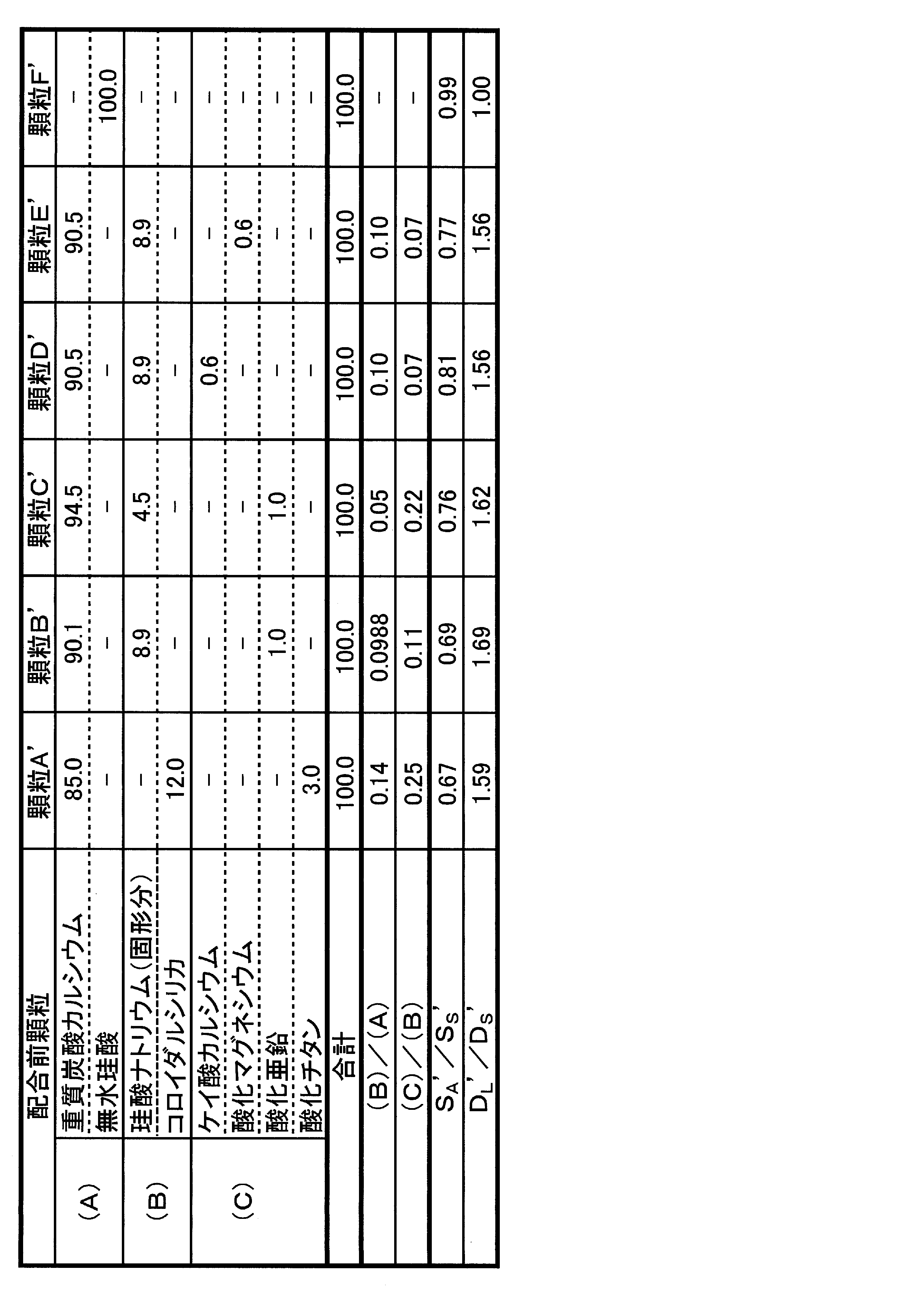

表3に示す処方にしたがって、得られた配合前顆粒A’~F’とともに各成分を添加し、万能混合装置(5XDMVV10-r、ダルトン社製)を用いて公転の撹拌速度75rpm、自転の撹拌速度200rpmにて10分間撹拌して、各々配合前顆粒A’~F’から得られた配合後顆粒A~Fが存在する歯磨剤を得た。
次いで、各歯磨剤を用い、下記方法にしたがって各評価を行った。
結果を表3に示す。
また、各歯磨剤に存在する配合後顆粒A~Fの粒度分布を表4に示し、実施例1の歯磨剤に存在する配合後顆粒Bの粒度分布のグラフを図1に示し、かかる顆粒BのSEM(電子顕微鏡:日立S-4800)の写真を図2に示す。さらに、比較例1の歯磨剤に存在する配合後顆粒Fの粒度分布のグラフを図3に示す。
以下の凹凸モデル及び汚れモデルを用い、以下の方法にしたがってブラッシング試験を行い、汚れ除去率を算出した。結果を表3に示す。
縦15mm×横15mm×厚さ3mmのステンレス鋼に、角が90℃の直線状の幅100μm、深さ100μmの溝を620μm間隔で平行に設けた凹凸モデルを用意した。
汚れモデルとして、赤のクレヨン(Pentel社製、CRAYON RED)を用い、上記凹凸モデルの溝の全体に擦り込んで充填し、凹凸モデルの表面に突出した汚れモデルや表面に付着した汚れモデルをヘラの水平面を、凹凸モデルの表面に沿ってスライドさせることで除去した。
前述の凹凸モデルをアルミ板(30mm×80mm×5mm)の中央に設けた15mm×15mm×3mmの正方形の凹部に嵌め込み、各歯磨剤2g、歯ブラシ(ディープクリーン コンパクト、花王製)、刷掃条件:荷重200g、速度80rpm、振幅30mm、1分間、刷掃方向:凹凸モデルの溝の方向に平行な方向、ブラッシング試験を行った。なお、アルミ板の正方形の前記凹部の角には、凹凸モデルを取り出し容易にする掻き出し用凹部が正方形の外側に設けられている。
ブラッシング後、凹凸モデルをアルミ板から取り出し、水洗い後、凹凸モデルの表面に付着した歯磨剤は、凹凸モデルの表面を紙(PPC用紙A4サイズ、コクヨ)に押し付けながらスライドさせることで除去した。
ブラッシング前の凹凸モデル及び歯磨剤を除去した凹凸モデルをデジタルカメラで撮影し、ブラッシング前の凹凸モデルにおいてクレヨンにより着色している領域の面積を着色領域面積(mm2)とした。また、着色領域において歯ブラシによりブラッシングされた領域の面積を評価領域面積(mm2)とし、かかる評価領域においてクレヨンが落ちて凹部の底面が露出した(白くなった)部分の面積(mm2)を汚れ除去面積とした。次いで、評価領域面積全体に対する汚れ除去面積を、下記式(1)により汚れ除去率(%)として算出した。なお、着色領域面積は、デジタルカメラで撮影した際に、疑似汚れ物質による着色が検知された領域の面積であり、その領域において歯ブラシが刷掃した領域を評価領域とした。
汚れ除去率(%)=(汚れ除去面積/評価領域面積全体)×100 ・・・(1)
なお、試験板の凹部に擦り込んだクレヨンは、平坦な面で歯ブラシのみで刷掃した場合でも、所定の荷重をかければクレヨンが落ちて試験板の面が露出するものである。また、デジタルカメラによる撮影では、フラッシュを用い、表面反射光を除くため偏光フィルターを用いた。
実施例1~10及び比較例1で得られた各種歯磨剤1gにより、歯ブラシ(チェック スタンダード、花王製)を用いてブラッシングし、下記に示す基準にしたがって泡立ち、泡質(泡の細かさ)、歯磨き中の泡持続性、歯磨初期の顆粒感、歯磨き直後のつるつる感、歯磨き中の顆粒感の持続性の評価を行い、泡立ち、泡質、歯磨き初期の顆粒感、歯磨き直後のつるつる感については1~5の5段階による評価を行った。これを5名のパネラーについて行い、得られた結果からその平均値を求めた。
なお、上記評価のうち、歯磨き中の泡持続性、歯磨き中の顆粒感の持続性については、5名のパネラーのうち、持続すると答えた人数をカウントした。結果を表2に示す。
5:非常によく泡立つ
4:よく泡立つ
3:泡立つ
2:泡立ちにくい
1:泡立たない
5:泡が非常にきめ細かいと感じる
4:泡がきめ細かいと感じる
3:泡が少し細かいと感じる
2:泡が少し荒いと感じる
1:泡が荒いと感じる
5:適度な顆粒の存在感を感じる
4:顆粒の存在感を感じる
3:顆粒の存在感が少ない
2:顆粒の存在感が極めて少ない
1:顆粒の存在を全く感じない
歯磨き直後(水で歯磨剤を漱いだ後)の歯面に舌をすべらせたときの感触。
5:非常に滑らかであり、汚れの存在を感じない
4:滑らかであり、汚れの存在は殆ど感じない
3:少し滑らかであるが、僅かに汚れの存在を感じる
2:少し凹凸が認められ、少し汚れの存在を感じる
1:歯の表面に汚れによる凹凸の存在を感じる

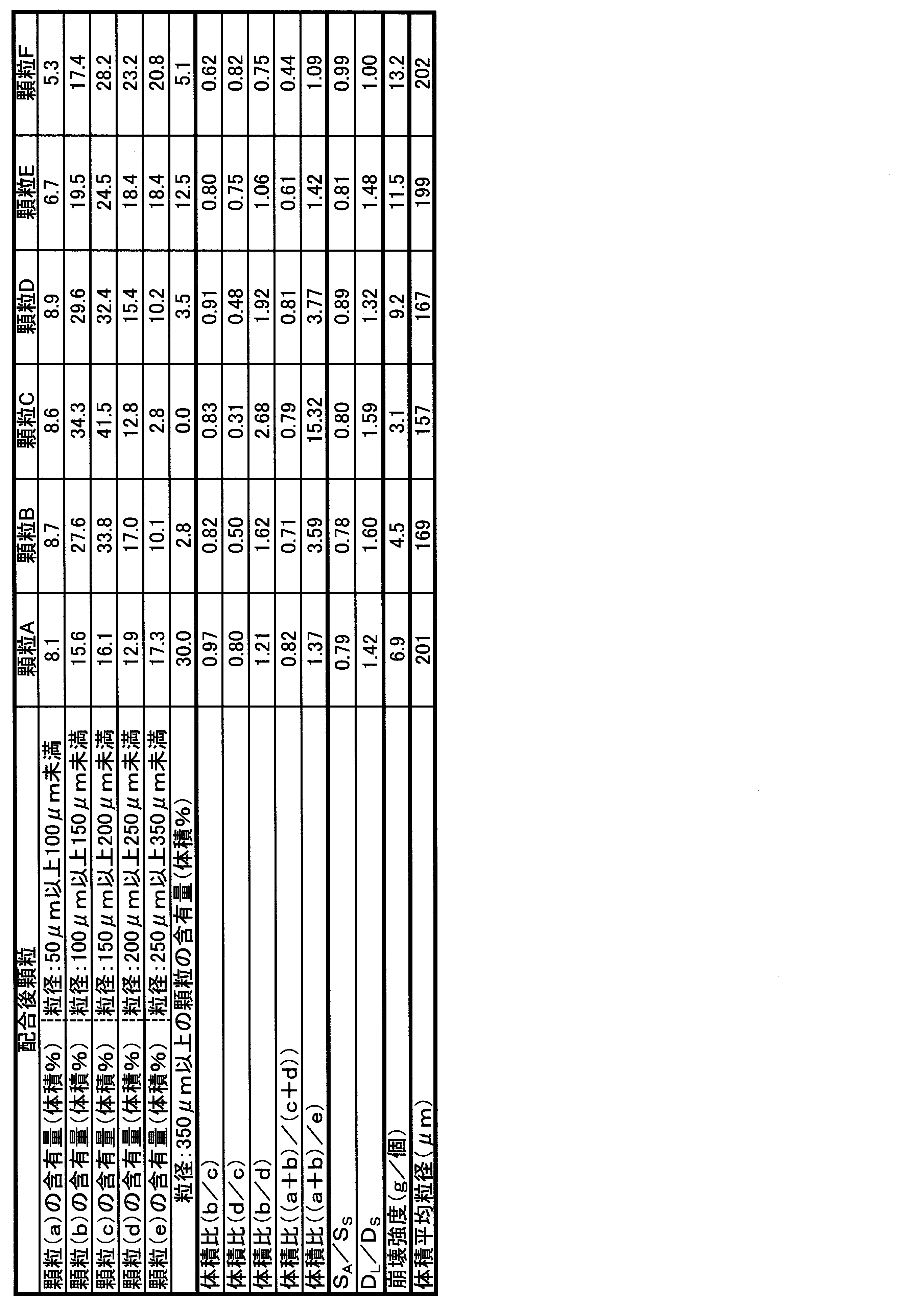
Y:配合後顆粒Bの粒度分布
Claims (11)
- 水不溶性粉末材料(A)、及び無機結合剤(B)を含有する顆粒が配合されてなる歯磨剤であって、
該歯磨剤中に存在する配合された後の顆粒において、該顆粒の投影面の面積(SA)と、該投影面における最大差し渡し径(DL)を直径とする外接円の面積(SS)との比(SA/SS)の平均値が0.5以上0.9以下であり、かつ配合された後の顆粒の崩壊強度が1gf/個以上20gf/個以下である歯磨剤。 - 歯磨剤中に存在する配合された後の顆粒において、該顆粒の投影面における最大差し渡し径(DL)と、最小差し渡し径(DS)との比(DL/DS)の平均値が、1.2以上1.8以下である請求項1に記載の歯磨剤。
- 水不溶性粉末材料(A)、及び無機結合剤(B)を含有する顆粒が配合されてなる歯磨剤であって、
該歯磨剤中に存在する配合された後の顆粒において、レーザ回折/散乱式粒子径分布測定による粒度分布での次の顆粒(a)~(d):
(a)粒径が50μm以上100μm未満の顆粒
(b)粒径が100μm以上150μm未満の顆粒
(c)粒径が150μm以上200μm未満の顆粒
(d)粒径が200μm以上250μm未満の顆粒
のうち、顆粒(b)の量と顆粒(c)の量の体積比(b/c)が0.7以上1.2以下であり、顆粒(d)と顆粒(c)の体積比(d/c)が0.2以上1以下であり、顆粒(b)の量と顆粒(d)の量の体積比(b/d)が1より大きく5以下であり、配合された後の顆粒中における顆粒(c)の量が15体積%以上55体積%以下であり、かつ配合された後の顆粒の崩壊強度が1gf/個以上20gf/個以下である歯磨剤。 - 歯磨剤中に存在する配合された後の顆粒において、レーザ回折/散乱式粒子径分布測定による粒度分布での顆粒(a)と顆粒(b)の合計量と次の顆粒(e):
(e)粒径が250μm以上350μm未満の顆粒
の量の体積比((a+b)/e)が、1より大きく20以下である請求項3に記載の歯磨剤。 - 歯磨剤中に存在する配合された後の顆粒において、レーザ回折/散乱式粒子径分布測定による粒度分布での顆粒(a)及び顆粒(b)の合計量と顆粒(c)及び顆粒(d)の合計量との体積比((a+b)/(c+d))が、0.5以上であり1以下である請求項3又は4に記載の歯磨剤。
- 歯磨剤中に存在する配合された後の顆粒の量が、1質量%以上50質量%以下である請求項1~5のいずれか1項に記載の歯磨剤。
- 歯磨剤中に存在する配合された後の顆粒が、転動造粒法により得られるものである請求項1~6のいずれか1項に記載の歯磨剤。
- 歯磨剤中に存在する配合された後の顆粒が、珪酸カルシウム、酸化マグネシウム、酸化チタン及び酸化亜鉛から選ばれる1種又は2種以上の結合助剤(C)を含有する請求項1~7のいずれか1項に記載の歯磨剤。
- 歯磨剤中に存在する配合された後の顆粒において、成分(C)と成分(B)の質量比(C/B)が0.02以上1以下である請求項8に記載の歯磨剤。
- 歯磨剤中に存在する配合された後の顆粒を得るための、歯磨剤に添加して用いる配合される前の顆粒において、レーザ回折/散乱式粒子径分布測定による粒度分布での次の顆粒(b’)~(d’):
次の顆粒(b’)~(e-1’):
(b’)粒径が100μm以上150μm未満の顆粒
(c’)粒径が150μm以上200μm未満の顆粒
(d’)粒径が200μm以上250μm未満の顆粒
(e-1’)粒径が250μm以上300μm未満の顆粒
のうち、顆粒(b’)の量と顆粒(c’)の量の体積比(b’/c’)が0.6以上1.25以下であり、顆粒(d’)の量と顆粒(c’)の量の体積比(d’/c’)が0.7以上1.2以下であり、顆粒(e-1’)の量と顆粒(c’)の量の体積比(e-1’/c’)が0.4以上1.1以下であり、かつ配合される前の顆粒の崩壊強度が1gf/個以上20gf/個以下である請求項1~9のいずれか1項に記載の歯磨剤。 - 歯磨剤中に存在する配合された後の顆粒が、配合される前の顆粒を添加した後、歯磨剤を撹拌速度10rpm以上250rpm以下で撹拌して得られるものである請求項1~10のいずれか1項に記載の歯磨剤。
Priority Applications (4)
| Application Number | Priority Date | Filing Date | Title |
|---|---|---|---|
| RU2016128828A RU2681077C1 (ru) | 2013-12-18 | 2013-12-18 | Средство для чистки зубов |
| JP2015553277A JP6324412B2 (ja) | 2013-12-18 | 2013-12-18 | 歯磨剤 |
| PCT/JP2013/083926 WO2015092885A1 (ja) | 2013-12-18 | 2013-12-18 | 歯磨剤 |
| CN201380081774.5A CN105828781B (zh) | 2013-12-18 | 2013-12-18 | 洁齿剂 |
Applications Claiming Priority (1)
| Application Number | Priority Date | Filing Date | Title |
|---|---|---|---|
| PCT/JP2013/083926 WO2015092885A1 (ja) | 2013-12-18 | 2013-12-18 | 歯磨剤 |
Publications (1)
| Publication Number | Publication Date |
|---|---|
| WO2015092885A1 true WO2015092885A1 (ja) | 2015-06-25 |
Family
ID=53402280
Family Applications (1)
| Application Number | Title | Priority Date | Filing Date |
|---|---|---|---|
| PCT/JP2013/083926 Ceased WO2015092885A1 (ja) | 2013-12-18 | 2013-12-18 | 歯磨剤 |
Country Status (4)
| Country | Link |
|---|---|
| JP (1) | JP6324412B2 (ja) |
| CN (1) | CN105828781B (ja) |
| RU (1) | RU2681077C1 (ja) |
| WO (1) | WO2015092885A1 (ja) |
Cited By (1)
| Publication number | Priority date | Publication date | Assignee | Title |
|---|---|---|---|---|
| JP2015117206A (ja) * | 2013-12-18 | 2015-06-25 | 花王株式会社 | 歯磨組成物 |
Families Citing this family (2)
| Publication number | Priority date | Publication date | Assignee | Title |
|---|---|---|---|---|
| JP6772906B2 (ja) * | 2017-03-09 | 2020-10-21 | ライオン株式会社 | 歯磨剤組成物 |
| CN110057823B (zh) * | 2019-05-23 | 2021-10-22 | 南京大学(苏州)高新技术研究院 | 一种岩土体崩解测试装置与分析方法 |
Citations (7)
| Publication number | Priority date | Publication date | Assignee | Title |
|---|---|---|---|---|
| JPH01299211A (ja) * | 1988-05-25 | 1989-12-04 | Kao Corp | 歯磨剤 |
| JPH08169813A (ja) * | 1994-10-18 | 1996-07-02 | Kao Corp | 歯磨組成物 |
| JP2002226347A (ja) * | 2001-02-06 | 2002-08-14 | Maruo Calcium Co Ltd | 歯磨用顆粒剤及びその製造方法 |
| JP2002275041A (ja) * | 2001-03-14 | 2002-09-25 | Kao Corp | 歯磨剤 |
| JP2002348223A (ja) * | 2001-05-23 | 2002-12-04 | Kobayashi Pharmaceut Co Ltd | 歯磨組成物 |
| JP2009120476A (ja) * | 2007-10-23 | 2009-06-04 | Fuji Chem Ind Co Ltd | リン酸水素カルシウムからなる球状粒子 |
| JP2014001186A (ja) * | 2012-06-20 | 2014-01-09 | Kao Corp | 歯磨剤用顆粒の製造方法 |
Family Cites Families (3)
| Publication number | Priority date | Publication date | Assignee | Title |
|---|---|---|---|---|
| US4871396A (en) * | 1986-11-25 | 1989-10-03 | Kao Corporation | Granular composition and dentifrice containing the same |
| ES2442253T3 (es) * | 2007-02-23 | 2014-02-10 | The Procter & Gamble Company | Composiciones orales de polifosfato |
| CN101439005B (zh) * | 2007-11-21 | 2013-01-02 | 花王株式会社 | 刷牙剂 |
-
2013
- 2013-12-18 CN CN201380081774.5A patent/CN105828781B/zh active Active
- 2013-12-18 JP JP2015553277A patent/JP6324412B2/ja active Active
- 2013-12-18 RU RU2016128828A patent/RU2681077C1/ru active
- 2013-12-18 WO PCT/JP2013/083926 patent/WO2015092885A1/ja not_active Ceased
Patent Citations (7)
| Publication number | Priority date | Publication date | Assignee | Title |
|---|---|---|---|---|
| JPH01299211A (ja) * | 1988-05-25 | 1989-12-04 | Kao Corp | 歯磨剤 |
| JPH08169813A (ja) * | 1994-10-18 | 1996-07-02 | Kao Corp | 歯磨組成物 |
| JP2002226347A (ja) * | 2001-02-06 | 2002-08-14 | Maruo Calcium Co Ltd | 歯磨用顆粒剤及びその製造方法 |
| JP2002275041A (ja) * | 2001-03-14 | 2002-09-25 | Kao Corp | 歯磨剤 |
| JP2002348223A (ja) * | 2001-05-23 | 2002-12-04 | Kobayashi Pharmaceut Co Ltd | 歯磨組成物 |
| JP2009120476A (ja) * | 2007-10-23 | 2009-06-04 | Fuji Chem Ind Co Ltd | リン酸水素カルシウムからなる球状粒子 |
| JP2014001186A (ja) * | 2012-06-20 | 2014-01-09 | Kao Corp | 歯磨剤用顆粒の製造方法 |
Cited By (1)
| Publication number | Priority date | Publication date | Assignee | Title |
|---|---|---|---|---|
| JP2015117206A (ja) * | 2013-12-18 | 2015-06-25 | 花王株式会社 | 歯磨組成物 |
Also Published As
| Publication number | Publication date |
|---|---|
| CN105828781A (zh) | 2016-08-03 |
| RU2016128828A (ru) | 2018-01-23 |
| JPWO2015092885A1 (ja) | 2017-03-16 |
| RU2681077C1 (ru) | 2019-03-04 |
| JP6324412B2 (ja) | 2018-05-16 |
| CN105828781B (zh) | 2019-06-14 |
Similar Documents
| Publication | Publication Date | Title |
|---|---|---|
| JP6371054B2 (ja) | 歯磨組成物 | |
| CN101405218A (zh) | 通过高剪切条件下产品形态控制制备的高清洁性二氧化硅材料 | |
| JPH0621053B2 (ja) | 歯磨剤 | |
| CN101405055A (zh) | 用于洁齿的高清洁性、低磨损、高亮度二氧化硅材料 | |
| JP6324412B2 (ja) | 歯磨剤 | |
| JP5651304B2 (ja) | 歯磨剤用顆粒 | |
| JP5689674B2 (ja) | 歯磨剤用顆粒の製造方法 | |
| JP6387288B2 (ja) | 歯磨剤用顆粒 | |
| JP6267507B2 (ja) | 歯磨組成物 | |
| JP3170250B2 (ja) | 歯磨剤組成物 | |
| JP2002226347A (ja) | 歯磨用顆粒剤及びその製造方法 | |
| JP6118073B2 (ja) | 歯磨剤用顆粒及びこれを含有する歯磨剤 | |
| JP6006499B2 (ja) | 歯磨剤 | |
| JP6807729B2 (ja) | 歯磨剤用顆粒及びこれを含有する歯磨剤組成物 | |
| CN104394833B (zh) | 洁牙剂用颗粒的制造方法 | |
| JP6006501B2 (ja) | 歯磨剤 | |
| TWI633894B (zh) | Dentifrice | |
| JP5426128B2 (ja) | 歯磨剤用顆粒の製造方法 | |
| JP6567270B2 (ja) | 歯磨剤 | |
| JP5698903B2 (ja) | 歯磨用顆粒の製造方法 | |
| JP6006500B2 (ja) | 歯磨剤 | |
| JP6948838B2 (ja) | 歯磨剤組成物 | |
| CN101439005B (zh) | 刷牙剂 | |
| JP6368639B2 (ja) | 歯磨剤用顆粒の製造方法 | |
| JP2015124164A (ja) | 歯磨剤組成物 |
Legal Events
| Date | Code | Title | Description |
|---|---|---|---|
| 121 | Ep: the epo has been informed by wipo that ep was designated in this application |
Ref document number: 13899854 Country of ref document: EP Kind code of ref document: A1 |
|
| ENP | Entry into the national phase |
Ref document number: 2015553277 Country of ref document: JP Kind code of ref document: A |
|
| WWE | Wipo information: entry into national phase |
Ref document number: IDP00201604089 Country of ref document: ID |
|
| NENP | Non-entry into the national phase |
Ref country code: DE |
|
| ENP | Entry into the national phase |
Ref document number: 2016128828 Country of ref document: RU Kind code of ref document: A |
|
| 122 | Ep: pct application non-entry in european phase |
Ref document number: 13899854 Country of ref document: EP Kind code of ref document: A1 |