WO2015083788A1 - スピネル型リチウムコバルトマンガン含有複合酸化物 - Google Patents
スピネル型リチウムコバルトマンガン含有複合酸化物 Download PDFInfo
- Publication number
- WO2015083788A1 WO2015083788A1 PCT/JP2014/082104 JP2014082104W WO2015083788A1 WO 2015083788 A1 WO2015083788 A1 WO 2015083788A1 JP 2014082104 W JP2014082104 W JP 2014082104W WO 2015083788 A1 WO2015083788 A1 WO 2015083788A1
- Authority
- WO
- WIPO (PCT)
- Prior art keywords
- spinel
- type lithium
- composite oxide
- cobalt manganese
- lithium cobalt
- Prior art date
- Legal status (The legal status is an assumption and is not a legal conclusion. Google has not performed a legal analysis and makes no representation as to the accuracy of the status listed.)
- Ceased
Links
Classifications
-
- H—ELECTRICITY
- H01—ELECTRIC ELEMENTS
- H01M—PROCESSES OR MEANS, e.g. BATTERIES, FOR THE DIRECT CONVERSION OF CHEMICAL ENERGY INTO ELECTRICAL ENERGY
- H01M4/00—Electrodes
- H01M4/02—Electrodes composed of, or comprising, active material
- H01M4/36—Selection of substances as active materials, active masses, active liquids
- H01M4/48—Selection of substances as active materials, active masses, active liquids of inorganic oxides or hydroxides
- H01M4/52—Selection of substances as active materials, active masses, active liquids of inorganic oxides or hydroxides of nickel, cobalt or iron
- H01M4/525—Selection of substances as active materials, active masses, active liquids of inorganic oxides or hydroxides of nickel, cobalt or iron of mixed oxides or hydroxides containing iron, cobalt or nickel for inserting or intercalating light metals, e.g. LiNiO2, LiCoO2 or LiCoOxFy
-
- C—CHEMISTRY; METALLURGY
- C01—INORGANIC CHEMISTRY
- C01G—COMPOUNDS CONTAINING METALS NOT COVERED BY SUBCLASSES C01D OR C01F
- C01G51/00—Compounds of cobalt
- C01G51/40—Complex oxides containing cobalt and at least one other metal element
- C01G51/42—Complex oxides containing cobalt and at least one other metal element containing alkali metals, e.g. LiCoO2
- C01G51/44—Complex oxides containing cobalt and at least one other metal element containing alkali metals, e.g. LiCoO2 containing manganese
- C01G51/54—Complex oxides containing cobalt and at least one other metal element containing alkali metals, e.g. LiCoO2 containing manganese of the type (Mn2O4)-, e.g. Li(CoxMn2-x)O4 or Li(MyCoxMn2-x-y)O4
-
- C—CHEMISTRY; METALLURGY
- C01—INORGANIC CHEMISTRY
- C01G—COMPOUNDS CONTAINING METALS NOT COVERED BY SUBCLASSES C01D OR C01F
- C01G53/00—Compounds of nickel
- C01G53/40—Complex oxides containing nickel and at least one other metal element
- C01G53/42—Complex oxides containing nickel and at least one other metal element containing alkali metals, e.g. LiNiO2
- C01G53/44—Complex oxides containing nickel and at least one other metal element containing alkali metals, e.g. LiNiO2 containing manganese
- C01G53/54—Complex oxides containing nickel and at least one other metal element containing alkali metals, e.g. LiNiO2 containing manganese of the type (Mn2O4)-, e.g. Li(NixMn2-x)O4 or Li(MyNixMn2-x-y)O4
-
- C—CHEMISTRY; METALLURGY
- C01—INORGANIC CHEMISTRY
- C01G—COMPOUNDS CONTAINING METALS NOT COVERED BY SUBCLASSES C01D OR C01F
- C01G53/00—Compounds of nickel
- C01G53/80—Compounds containing nickel, with or without oxygen or hydrogen, and containing one or more other elements
- C01G53/82—Compounds containing nickel, with or without oxygen or hydrogen, and containing two or more other elements
-
- H—ELECTRICITY
- H01—ELECTRIC ELEMENTS
- H01M—PROCESSES OR MEANS, e.g. BATTERIES, FOR THE DIRECT CONVERSION OF CHEMICAL ENERGY INTO ELECTRICAL ENERGY
- H01M10/00—Secondary cells; Manufacture thereof
- H01M10/05—Accumulators with non-aqueous electrolyte
- H01M10/052—Li-accumulators
- H01M10/0525—Rocking-chair batteries, i.e. batteries with lithium insertion or intercalation in both electrodes; Lithium-ion batteries
-
- H—ELECTRICITY
- H01—ELECTRIC ELEMENTS
- H01M—PROCESSES OR MEANS, e.g. BATTERIES, FOR THE DIRECT CONVERSION OF CHEMICAL ENERGY INTO ELECTRICAL ENERGY
- H01M4/00—Electrodes
- H01M4/02—Electrodes composed of, or comprising, active material
- H01M4/13—Electrodes for accumulators with non-aqueous electrolyte, e.g. for lithium-accumulators; Processes of manufacture thereof
- H01M4/131—Electrodes based on mixed oxides or hydroxides, or on mixtures of oxides or hydroxides, e.g. LiCoOx
-
- H—ELECTRICITY
- H01—ELECTRIC ELEMENTS
- H01M—PROCESSES OR MEANS, e.g. BATTERIES, FOR THE DIRECT CONVERSION OF CHEMICAL ENERGY INTO ELECTRICAL ENERGY
- H01M4/00—Electrodes
- H01M4/02—Electrodes composed of, or comprising, active material
- H01M4/36—Selection of substances as active materials, active masses, active liquids
- H01M4/48—Selection of substances as active materials, active masses, active liquids of inorganic oxides or hydroxides
- H01M4/50—Selection of substances as active materials, active masses, active liquids of inorganic oxides or hydroxides of manganese
- H01M4/505—Selection of substances as active materials, active masses, active liquids of inorganic oxides or hydroxides of manganese of mixed oxides or hydroxides containing manganese for inserting or intercalating light metals, e.g. LiMn2O4 or LiMn2OxFy
-
- H—ELECTRICITY
- H01—ELECTRIC ELEMENTS
- H01M—PROCESSES OR MEANS, e.g. BATTERIES, FOR THE DIRECT CONVERSION OF CHEMICAL ENERGY INTO ELECTRICAL ENERGY
- H01M4/00—Electrodes
- H01M4/02—Electrodes composed of, or comprising, active material
- H01M4/36—Selection of substances as active materials, active masses, active liquids
- H01M4/48—Selection of substances as active materials, active masses, active liquids of inorganic oxides or hydroxides
- H01M4/52—Selection of substances as active materials, active masses, active liquids of inorganic oxides or hydroxides of nickel, cobalt or iron
- H01M4/523—Selection of substances as active materials, active masses, active liquids of inorganic oxides or hydroxides of nickel, cobalt or iron for non-aqueous cells
-
- C—CHEMISTRY; METALLURGY
- C01—INORGANIC CHEMISTRY
- C01P—INDEXING SCHEME RELATING TO STRUCTURAL AND PHYSICAL ASPECTS OF SOLID INORGANIC COMPOUNDS
- C01P2002/00—Crystal-structural characteristics
- C01P2002/30—Three-dimensional structures
- C01P2002/32—Three-dimensional structures spinel-type (AB2O4)
-
- C—CHEMISTRY; METALLURGY
- C01—INORGANIC CHEMISTRY
- C01P—INDEXING SCHEME RELATING TO STRUCTURAL AND PHYSICAL ASPECTS OF SOLID INORGANIC COMPOUNDS
- C01P2002/00—Crystal-structural characteristics
- C01P2002/60—Compounds characterised by their crystallite size
-
- C—CHEMISTRY; METALLURGY
- C01—INORGANIC CHEMISTRY
- C01P—INDEXING SCHEME RELATING TO STRUCTURAL AND PHYSICAL ASPECTS OF SOLID INORGANIC COMPOUNDS
- C01P2004/00—Particle morphology
- C01P2004/51—Particles with a specific particle size distribution
-
- C—CHEMISTRY; METALLURGY
- C01—INORGANIC CHEMISTRY
- C01P—INDEXING SCHEME RELATING TO STRUCTURAL AND PHYSICAL ASPECTS OF SOLID INORGANIC COMPOUNDS
- C01P2004/00—Particle morphology
- C01P2004/60—Particles characterised by their size
- C01P2004/61—Micrometer sized, i.e. from 1-100 micrometer
-
- C—CHEMISTRY; METALLURGY
- C01—INORGANIC CHEMISTRY
- C01P—INDEXING SCHEME RELATING TO STRUCTURAL AND PHYSICAL ASPECTS OF SOLID INORGANIC COMPOUNDS
- C01P2004/00—Particle morphology
- C01P2004/60—Particles characterised by their size
- C01P2004/64—Nanometer sized, i.e. from 1-100 nanometer
-
- C—CHEMISTRY; METALLURGY
- C01—INORGANIC CHEMISTRY
- C01P—INDEXING SCHEME RELATING TO STRUCTURAL AND PHYSICAL ASPECTS OF SOLID INORGANIC COMPOUNDS
- C01P2006/00—Physical properties of inorganic compounds
- C01P2006/12—Surface area
-
- C—CHEMISTRY; METALLURGY
- C01—INORGANIC CHEMISTRY
- C01P—INDEXING SCHEME RELATING TO STRUCTURAL AND PHYSICAL ASPECTS OF SOLID INORGANIC COMPOUNDS
- C01P2006/00—Physical properties of inorganic compounds
- C01P2006/40—Electric properties
-
- H—ELECTRICITY
- H01—ELECTRIC ELEMENTS
- H01M—PROCESSES OR MEANS, e.g. BATTERIES, FOR THE DIRECT CONVERSION OF CHEMICAL ENERGY INTO ELECTRICAL ENERGY
- H01M4/00—Electrodes
- H01M4/02—Electrodes composed of, or comprising, active material
- H01M2004/026—Electrodes composed of, or comprising, active material characterised by the polarity
- H01M2004/028—Positive electrodes
-
- H—ELECTRICITY
- H01—ELECTRIC ELEMENTS
- H01M—PROCESSES OR MEANS, e.g. BATTERIES, FOR THE DIRECT CONVERSION OF CHEMICAL ENERGY INTO ELECTRICAL ENERGY
- H01M2220/00—Batteries for particular applications
- H01M2220/20—Batteries in motive systems, e.g. vehicle, ship, plane
-
- H—ELECTRICITY
- H01—ELECTRIC ELEMENTS
- H01M—PROCESSES OR MEANS, e.g. BATTERIES, FOR THE DIRECT CONVERSION OF CHEMICAL ENERGY INTO ELECTRICAL ENERGY
- H01M2220/00—Batteries for particular applications
- H01M2220/30—Batteries in portable systems, e.g. mobile phone, laptop
-
- Y—GENERAL TAGGING OF NEW TECHNOLOGICAL DEVELOPMENTS; GENERAL TAGGING OF CROSS-SECTIONAL TECHNOLOGIES SPANNING OVER SEVERAL SECTIONS OF THE IPC; TECHNICAL SUBJECTS COVERED BY FORMER USPC CROSS-REFERENCE ART COLLECTIONS [XRACs] AND DIGESTS
- Y02—TECHNOLOGIES OR APPLICATIONS FOR MITIGATION OR ADAPTATION AGAINST CLIMATE CHANGE
- Y02E—REDUCTION OF GREENHOUSE GAS [GHG] EMISSIONS, RELATED TO ENERGY GENERATION, TRANSMISSION OR DISTRIBUTION
- Y02E60/00—Enabling technologies; Technologies with a potential or indirect contribution to GHG emissions mitigation
- Y02E60/10—Energy storage using batteries
Definitions
- the present invention relates to a spinel-type lithium cobalt manganese-containing composite oxide that can be suitably used as a positive electrode active material for a lithium secondary battery.
- the present invention relates to a spinel-type lithium cobalt manganese-containing composite oxide that can have an operating potential of 4.5 V or more at a metal Li reference potential.
- Lithium secondary batteries have features such as high energy density and long life. For this reason, lithium secondary batteries are widely used as power sources for home appliances such as video cameras, portable electronic devices such as notebook computers and mobile phones, and power tools such as power tools. (EV) and hybrid electric vehicles (HEV) are also used for large batteries.
- EV electric and hybrid electric vehicles (HEV) are also used for large batteries.
- Examples of the positive electrode active material for this type of lithium secondary battery include lithium transition metal oxides such as LiCoO 2 , LiNiO 2 and LiMnO 2 having a layer structure, and manganese such as LiMn 2 O 4 and LiNi 0.5 Mn 1.5 O 4.
- a spinel-type lithium manganese-containing composite oxide having a spinel structure (Fd-3m) is known.
- LiCoO 2 lithium transition metal oxide
- Patent Document 1 as a positive electrode active material of a lithium secondary battery exhibiting a 5V class electromotive force, high capacity obtained by adding spinel-type lithium manganese composite oxide with chromium as an essential additive component and further adding nickel or cobalt.
- a spinel type lithium manganese composite oxide positive electrode active material is disclosed.
- Patent Document 2 discloses a spinel crystal LiMn 2-yz Ni y M z O 4 that charges and discharges at a potential of 4.5 V or more with respect to Li metal (where M: Fe, Co, Ti, V , Mg, Zn, Ga, Nb, Mo, Cu, at least one selected from the group consisting of 0.25 ⁇ y ⁇ 0.6, 0 ⁇ z ⁇ 0.1) is disclosed.
- Patent Document 3 discloses Li a (M x Mn 2 ⁇ xy A y ) O 4 (wherein, as a positive electrode material for a high energy density lithium ion secondary battery having a high voltage of 4.5 V or higher with respect to Li, 0.4 ⁇ x, 0 ⁇ y, x + y ⁇ 2, 0 ⁇ a ⁇ 1.2 M is selected from the group consisting of Ni, Co, Fe, Cr and Cu, and is at least one or more containing Ni A includes at least one metal element selected from Si and Ti, provided that when A includes only Ti, the value of the ratio y of A is 0.1 ⁇ y. )) Is disclosed.
- the general formula: Li z Co 1-xy Mg x M y O 2 is represented, and the element M included in the general formula is composed of Al, Ti, Sr, Mn, Ni, and Ca.
- X, y, and z included in the general formula are at least one selected from the group (i) 0 ⁇ z ⁇ 1.03, (b) 0.005 ⁇ x ⁇ 0.1, and ( C) Satisfying 0.001 ⁇ y ⁇ 0.03, and the composite oxide has a crystal structure belonging to a hexagonal system in an overcharge region having a potential exceeding 4.25 V with respect to metal Li.
- a positive electrode active material for a nonaqueous electrolyte secondary battery in which the maximum value of the oxygen generation peak in the gas chromatograph mass spectrometry measurement of the composite oxide in the overcharge region is in the range of 330 to 370 ° C. is disclosed.
- Co-based 5V class spinel a spinel-type lithium cobalt manganese composite oxide
- the present invention relates to a spinel type lithium cobalt manganese composite oxide in which a part of Mn sites in LiMn 2 O 4 is substituted with a metal element mainly composed of Co, and operates at a metal Li reference potential of 4.5 V or more. It is intended to provide a new spinel-type lithium manganese-containing composite oxide that not only has a potential but can further expand a capacity region of 5.0 V or more and can also increase the energy density.
- the present invention has a crystal structure belonging to the space group Fd-3m, and is represented by the general formula [Li x (Co y Mn 3-xy ) O 4- ⁇ ] (where 0.90 ⁇ x ⁇ 1.15, 0 .75 ⁇ y ⁇ 1.25), or the general formula [Li x (Co y M z Mn 3 ⁇ x ⁇ yz ) O 4 ⁇ ] (where 0.90 ⁇ x ⁇ 1.15, 0.90 ⁇ y ⁇ 1.25, 0 ⁇ z ⁇ 0.3, where M is Ni, or Ni and Mg, Ti, Al, Ba, Cr, Fe, Mo, W, Zr, Y and Nb A spinel-type lithium cobalt manganese-containing composite oxide represented by a combination of one or two or more elements selected from the group consisting of: a crystallite size measured by a Rietveld method using a fundamental method; The spin rate is 100 nm to 200 nm, the Li—O interatomic distance is 1.80 to 2
- the spinel-type lithium cobalt manganese-containing composite oxide proposed by the present invention has an operating potential of 4.5 V or more by defining the crystallite size, the interatomic distance of Li—O, and the strain. Further, the capacity range of 5.0 V or more could be expanded, and the energy density could be increased. Therefore, the spinel-type lithium cobalt manganese-containing composite oxide proposed by the present invention can be suitably used as a positive electrode active material for various lithium batteries.
- the spinel-type lithium cobalt manganese-containing composite oxide (hereinafter referred to as “the present spinel”) according to an example of this embodiment is a lithium cobalt manganese-containing composite oxide having a crystal structure belonging to the space group Fd-3m.
- the present spinel having a size of 100 nm to 200 nm, an Li—O interatomic distance of 1.80 to 2.00 mm, and a strain of 0.20 to 0.50 as measured by a Rietveld method using a fundamental method Type lithium cobalt manganese-containing composite oxide.
- the present inventor found that in the Co-based 5V class spinel known in the past, particles or crystals were too small, so that they easily react with the electrolyte during charging, and the structure collapses, resulting in a sudden drop in voltage during discharge. I guessed there was. Therefore, in this spinel, it has been confirmed that when the crystallite size, the inter-atomic distance of Li—O, and the strain are defined within a predetermined range, a rapid voltage drop during discharge can be prevented. Based on such knowledge, the present inventor has conceived the present invention.
- the spinel may be a lithium cobalt manganese-containing composite oxide represented by the general formula (1) ⁇ [Li x (Co y Mn 3-xy ) O 4- ⁇ ].
- x may be 0.90 to 1.15, particularly 0.95 or more and 1.14 or less, and more preferably 1.00 or more and 1.13 or less. Even more preferred.
- y may be 0.75 to 1.25, particularly 0.76 or more and 1.15 or less, and more preferably 0.77 or more or 1.05 or less. Even more preferred.
- the spinel may also be a lithium cobalt manganese-containing composite oxide represented by the general formula (2)... [Li x (Co y M z Mn 3 -x y z ) O 4- ⁇ ].
- Co is a relatively expensive metal
- the lithium cobalt manganese-containing composite oxide represented by the above general formula (1) was examined as to whether the amount of Co could be reduced while maintaining the effect. As a result, if the lithium cobalt manganese-containing composite oxide represented by the general formula (2) is used, the same effect as that of the lithium cobalt manganese-containing composite oxide represented by the general formula (1) is maintained. It has been found that the amount can be reduced.
- “x” may be 0.90 to 1.15, particularly 0.95 or more and 1.14 or less, and more preferably 1.00 or more and 1.13 or less. Even more preferred.
- “y” may be 0.90 to 1.25, especially 0.91 or more and 1.24 or less, more preferably 0.92 or more and 1.23 or less. Even more preferred.
- “z” may be greater than 0 and less than or equal to 0.3, more preferably greater than 0 or less than or equal to 0.29, more particularly greater than or equal to 0 or 0.28, More preferably, it is larger than 0 or 0.27 or less.
- M is Ni or selected from the group consisting of Ni and Mg, Ti, Al, Ba, Cr, Fe, Mo, W, Zr, Y, and Nb. What is necessary is just a combination with 1 type, or 2 or more types of elements.
- this spinel may contain other components.
- other elements may be contained as long as they are 0.5% by mass or less. This is because an amount of this level is considered to have little effect on the performance of the spinel.
- inter-atomic distance of Li-O In this spinel, it is important that the inter-atomic distance of Li—O measured by the Rietveld method using the fundamental method is 1.80 mm to 2.00 mm, particularly 1.800 mm to 2.000 mm. In particular, it is preferably 1.830 mm or more or 1.950 mm or less, and particularly preferably 1.850 mm or more or 1.900 mm or less.
- the raw material mixing ratio, firing conditions, etc. may be adjusted. However, it is not limited to that method.
- the strain measured by the Rietveld method using the fundamental method is less than 0.50.
- it is preferably less than 0.500, particularly preferably 0.100 or more or 0.495 or less, and particularly preferably 0.200 or more or 0.490 or less, and more preferably 0.400 or less.
- the firing conditions, the heat treatment (annealing) conditions, the crushing conditions, etc. may be adjusted. However, it is not limited to that method.
- the crystallite size is preferably 100 nm to 200 nm, particularly preferably 105 nm or more and 190 nm or less, particularly 110 nm or more and 180 nm or less, and more preferably 120 nm or more.
- firing conditions for example, firing conditions, heat treatment (annealing) conditions, crushing conditions, and the like may be adjusted.
- heat treatment annealing
- crushing conditions and the like
- crystallite means the largest group that can be regarded as a single crystal, and can be obtained by XRD measurement and Rietveld analysis.
- the crystal structure is stabilized against the expansion and contraction of the crystal structure accompanying Li insertion / extraction during charge / discharge. Therefore, in this spinel, the Li—O distance, strain, and crystallite size are all adjusted to the above ranges to stabilize the crystal structure, to have an operating potential of 4.5 V or more, and 5.
- the capacity region of 0 V or more can be expanded, and the energy density can be increased.
- the spinel-type lithium cobalt manganese in the initial state is measured. It is possible to determine the Li—O distance and the crystallite size of the contained composite oxide.
- the battery was disassembled and the spinel-type lithium cobalt manganese-containing composite oxide was taken out, and then the counter electrode lithium
- a composite oxide containing spinel-type lithium cobalt manganese with a discharge to 3.0 V was prepared, sealed in a polyethylene bag in an argon atmosphere, and an XRD diffraction angle 2 ⁇ measurement range of 30 to 120 ° with a Li-O distance. And the crystallite size may be measured.
- the reason for measurement at 30 ° or more is that the content is less than 30% in the region where the diffraction peak of the conductive material and the binder is present, and the diffraction intensity of the spinel type lithium cobalt manganese-containing composite oxide is affected. This is to avoid this effect.
- This spinel preferably has a D50 based on a volume-based particle size distribution measured by a laser diffraction / scattering particle size distribution measuring method of 5 ⁇ m to 20 ⁇ m, more preferably 7 ⁇ m or more or 17 ⁇ m or less, and more preferably 10 ⁇ m or more or 15 ⁇ m or less.
- the thickness is particularly preferably 14 ⁇ m or less.
- the specific surface area of the spinel from the viewpoint of reactivity with the electrolytic solution is preferably from 1.0m 2 /g ⁇ 5.0m 2 / g, among others 3.5 m 2 / g or less, preferably 3.2 m 2 / G or less is more preferable.
- the amount of gas generated increases as the specific surface area increases.
- the present spinel is characterized in that the amount of gas generation can be remarkably suppressed despite having a specific surface area comparable to that of a conventional manganese-based spinel type lithium transition metal oxide.
- the firing conditions temperature, time, atmosphere, etc.
- the crushing strength after firing the crusher rotation speed, etc.
- etc. may be adjusted. However, it is not limited to these methods.
- This spinel is prepared by mixing, for example, a lithium raw material, a manganese raw material and a cobalt raw material, and further, if necessary, a raw material for the M element of the above general formula (2), granulating and drying, if necessary, firing, and if necessary Classification may be performed, and heat treatment (annealing) may be performed as necessary, and classification may be performed as necessary.
- the lithium raw material is not particularly limited.
- lithium hydroxide salts, carbonates and nitrates are preferred.
- the manganese raw material is not particularly limited.
- manganese carbonate, manganese nitrate, manganese chloride, manganese dioxide and the like can be used, and among these, manganese carbonate and manganese dioxide are preferable.
- electrolytic manganese dioxide obtained by an electrolytic method is particularly preferable.
- the cobalt raw material is not particularly limited.
- basic cobalt carbonate, cobalt nitrate, cobalt chloride, cobalt oxyhydroxide, cobalt hydroxide, cobalt oxide, hydrous cobalt oxide, etc. can be used, among which basic cobalt carbonate, cobalt hydroxide, cobalt oxide, oxy water Cobalt oxide and hydrous cobalt oxide are preferred.
- M element carbonate, nitrate, chloride, oxyhydroxide, hydroxide, etc. of M element can be used.
- a boron compound may be added to the raw material, mixed, wet pulverized, granulated and dried, and fired.
- a boron compound and firing it is possible to promote the sintering of fine particles in which crystal particles of the spinel-type lithium cobalt manganese-containing composite oxide are aggregated, and to form dense aggregated fine particles (secondary particles). (Tap density) can be increased.
- the formation and growth of spinel-type lithium cobalt manganese-containing composite oxide crystals can be promoted, so that the crystallite size of the spinel-type lithium cobalt manganese-containing composite oxide can be increased and the number of interfaces in the primary particles can be reduced. It is possible to reduce and increase the discharge capacity at high load discharge.
- boric acid or lithium borate is preferably used as the boron compound.
- examples of lithium borate include lithium metaborate (LiBO 2 ), lithium tetraborate (Li 2 B 4 O 7 ), lithium pentaborate (LiB 5 O 8 ), and lithium perborate (Li 2 B 2 O 5 ).
- lithium tetraborate (Li 2 B 4 O 7 ) is particularly preferable. This B element does not dissolve in the spinel but has a function of promoting the sintering of the spinel in the firing process.
- the boron compound is added in an amount of more than 0% by mass and not more than 0.3% by mass of the composite oxide containing spinel-type lithium cobalt manganese as the boron (B) element, particularly 0.0001 to 0.2% by mass. It is preferable to adjust in the range of 01 to 0.18% by mass, of which 0.05 to 0.16% by mass.
- the method of mixing the raw materials is not particularly limited as long as it can be uniformly mixed.
- the respective raw materials may be added simultaneously or in an appropriate order using a known mixer such as a mixer, and mixed by stirring in a wet or dry manner.
- a liquid medium such as water or a dispersant
- wet mixing it is preferable to add a liquid medium such as water or a dispersant to wet mix to form a slurry, and the obtained slurry is pulverized with a wet pulverizer.
- the raw materials mixed as described above may be fired as they are, but may be granulated to a predetermined size and fired.
- the granulation method may be wet or dry as long as the various raw materials pulverized in the previous step are dispersed in the granulated particles without being separated, and the extrusion granulation method, rolling granulation method, fluidized granulation method, A mixed granulation method, a spray drying granulation method, a pressure molding granulation method, or a flake granulation method using a roll or the like may be used.
- wet granulation it is necessary to sufficiently dry before firing.
- a drying method it may be dried by a known drying method such as a spray heat drying method, a hot air drying method, a vacuum drying method, a freeze drying method, etc.
- the spray heat drying method is preferable.
- the spray heat drying method is preferably performed using a heat spray dryer (spray dryer).
- Firing is performed in a firing furnace in an air atmosphere, an oxygen gas atmosphere, an atmosphere in which the oxygen partial pressure is adjusted, a carbon dioxide gas atmosphere, or other atmosphere, at a temperature rising rate of 50 to 200 ° C./hr.
- the temperature is raised at a temperature of 700 to 950 ° C. (: means a temperature when a thermocouple is brought into contact with the fired product in the firing furnace) and is fired to hold for 0.5 to 300 hours. Is preferred.
- baking with a boron compound it can bake in a temperature range lower than the above-mentioned baking temperature. This is because the sintering can be promoted by the addition of the boron compound.
- the firing temperature in order to adjust the crystallite size to 100 nm to 200 nm, it is more preferable to adjust the firing temperature in a range higher than 800 ° C.
- the firing temperature is 800 to 950 ° C., particularly higher than 800 ° C. and more than 950 ° C. It is preferable to adjust to a low temperature region. The reason is considered that if the crystallite size becomes too large, the Li diffusion distance in the crystal becomes longer.
- the kind of baking furnace is not specifically limited. For example, it can be fired using a rotary kiln, a stationary furnace, or other firing furnace.
- the inter-atomic distance of Li-O can be changed by adjusting the shape of the firing container, the ratio of the amount of firing raw material to the opening area (open area) of the firing container, so that it falls within a predetermined range. It is preferable to adjust these.
- the firing rate of the firing temperature may affect the inter-atomic distance of Li—O.
- the temperature rises abruptly carbon dioxide gas from the thermal decomposition of lithium carbonate escapes from a specific location, the reaction becomes non-uniform, and the desired inter-atomic distance of Li—O cannot be obtained. Is preferred.
- heat treatment is preferably performed as necessary.
- a condition for the heat treatment for example, it is placed in an environment of 500 ° C. to 800 ° C., preferably 650 ° C. or higher or 800 ° C. or lower in an air atmosphere for 0.5 to 300 hours so that oxygen can be easily incorporated. Is preferred.
- the classification after calcination has the technical significance of adjusting the particle size distribution of the agglomerated powder and removing foreign substances, and it is preferable to classify the powder into an average particle diameter (D50) in the range of 1 to 75 ⁇ m.
- D50 average particle diameter
- this spinel Unlike the conventional spinel-type lithium manganese-containing composite oxide, this spinel has an operating potential of 4.5 V or more at the metal Li reference potential, and can expand the capacity range of 5.0 V or more. Energy density can be increased. Therefore, after the spinel is crushed and classified as necessary, other positive electrode active material, for example, lithium manganese oxide having a layer structure, or spinel type lithium manganate different from the present spinel as necessary Can be used effectively as a positive electrode active material for various lithium batteries.
- other positive electrode active material for example, lithium manganese oxide having a layer structure, or spinel type lithium manganate different from the present spinel as necessary Can be used effectively as a positive electrode active material for various lithium batteries.
- the spinel when used as a positive electrode active material for various lithium batteries, for example, the spinel, a conductive material made of carbon black or the like, and a binder made of Teflon (registered trademark) binder or the like are mixed. Thus, a positive electrode mixture can be produced.
- a positive electrode mixture is used for the positive electrode, a material that can occlude and desorb lithium such as lithium or carbon is used for the negative electrode, and a lithium salt such as lithium hexafluorophosphate (LiPF 6 ) is used for the non-aqueous electrolyte.
- a lithium battery can be formed by using a material in which is dissolved in a mixed solvent such as ethylene carbonate-dimethyl carbonate.
- Lithium batteries configured in this way are, for example, notebook computers, mobile phones, cordless phones, video movies, LCD TVs, electric shavers, portable radios, headphone stereos, backup power supplies, memory cards and other electronic devices, pacemakers, hearing aids It can be used as a drive power source for medical equipment such as electric vehicles.
- mobile phones that require excellent cycle characteristics
- portable computers such as PDAs (personal digital assistants) and notebook computers
- electric vehicles including hybrid vehicles
- power sources for driving power storage etc. It is valid.
- Example 1 Lithium carbonate, electrolytic manganese dioxide (containing 0.03% by mass of Mg, TG loss during heating at 200 ° C. to 400 ° C .: 3.0%) and cobalt oxyhydroxide (CoO (OH)) are prepared as shown in Table 1.
- water was added, mixed and stirred to prepare a slurry having a solid content concentration of 50 wt%.
- a polycarboxylic acid ammonium salt SN Dispersant 5468 manufactured by San Nopco Co., Ltd.
- a pulverized slurry was obtained.
- the obtained pulverized slurry was granulated and dried using a thermal spray dryer (spray dryer, i-8 manufactured by Okawahara Chemical Co., Ltd.) to obtain granulated powder.
- a rotating disk was used for spraying, and granulation drying was performed by adjusting the temperature so that the rotation speed was 30000 rpm, the slurry supply amount was 24 kg / hr, and the outlet temperature of the drying tower was 100 ° C.
- the obtained granulated powder is filled in a 20 cm ⁇ 20 cm ⁇ 11.5 cm size mortar, and 850 ° C. (product temperature) at a heating rate of 1.33 ° C./min in an air atmosphere using a stationary electric furnace.
- the temperature was raised to 1 hour and maintained for 24 hours, and then cooled to room temperature at a temperature drop rate of 1.33 ° C./min.
- the temperature was raised to 700 ° C. (product temperature) at a temperature rising rate of 1.33 ° C./min in an air atmosphere and held for 12 hours. Cooled to room temperature in min.
- the mixture was crushed with an orientation mill, classified with a sieve having an opening of 53 ⁇ m, and the sieved product was collected to obtain a spinel-type lithium cobalt manganese-containing composite oxide (sample).
- the index (Rwp) indicating the degree of agreement between the Li—O and Me—O interatomic distances (“Li—O” and “Me—O”), crystallite size, strain, observed intensity and calculated intensity of the obtained sample.
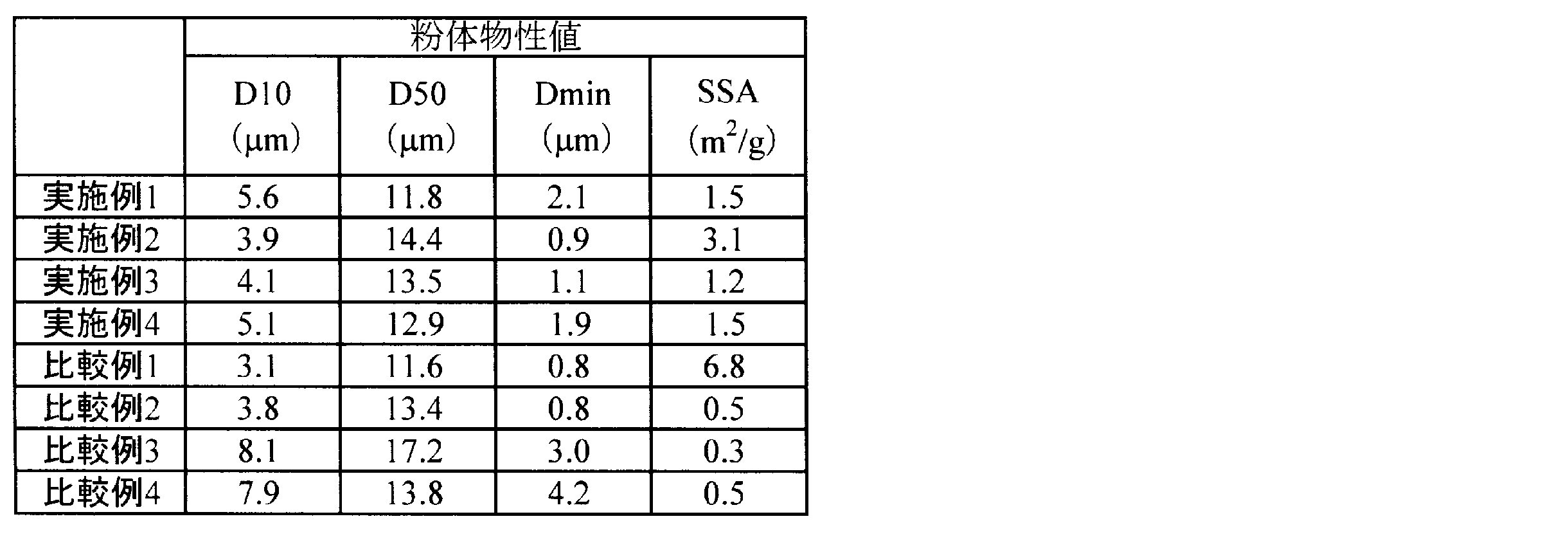
- Tables 2 and 3 show indices (GOF), D10, D50, Dmin, and specific surface area (SSA) representing the validity of the fitting.
- Table 4 shows the results of the charge capacity, discharge capacity, charge / discharge efficiency, post-charge open circuit voltage, discharge 5.5-5.0 V region ratio, and discharge 5.5-4.7 V region ratio ( The same applies to the remaining examples and comparative examples).
- “Me” of Me—O is a metal element existing at the 16d site, and is composed of Co, Mn, M element, and excess Li in this spinel.
- Example 2 A spinel-type lithium cobalt manganese-containing composite oxide (sample) was obtained in the same manner as in Example 1, except that the preparation composition, firing temperature, firing time, and heat treatment (annealing) time were changed as shown in Table 1.
- Example 3 A spinel-type lithium cobalt manganese-containing composite oxide (sample) was obtained in the same manner as in Example 1 except that the charged composition was changed as shown in Table 1.
- Example 4 Spinel as in Example 1 except that nickel hydroxide is mixed as a raw material in addition to the raw material used in Example 1, and the charge composition, firing conditions, and heat treatment (annealing) conditions are changed to the conditions shown in Table 1.
- Type lithium cobalt manganese-containing composite oxide (sample) was obtained.
- Example 1 A spinel-type lithium cobalt manganese-containing composite oxide (sample) was obtained in the same manner as in Example 1 except that the firing temperature, time, and preparation composition were changed as shown in Table 1 and heat treatment (annealing) was not performed. .
- Example 2 The spinel-type lithium cobalt manganese-containing composite oxide (sample) was changed in the same manner as in Example 1 except that the firing temperature, firing time and preparation composition were changed as shown in Table 1 and heat treatment (annealing) was not performed. Obtained.
- a pulverized slurry was obtained.
- the obtained pulverized slurry was granulated and dried using a thermal spray dryer (spray dryer, OC-16 manufactured by Okawahara Chemical Co., Ltd.) to obtain granulated powder.
- a rotating disk was used for spraying, and granulation drying was performed by adjusting the temperature so that the rotation speed was 24,000 rpm, the slurry supply amount was 24 kg / hr, and the outlet temperature of the drying tower was 100 ° C.
- the obtained granulated powder is baked in an air atmosphere using a static electric furnace so that the temperature is maintained at 950 ° C. (product temperature) for 35 hours. Then, heat treatment (annealing) was performed so that 700 ° C. (product temperature) was maintained for 35 hours. Next, the mixture was crushed with an orient mill, classified with a sieve having an opening of 53 ⁇ m, and the sieve was collected to obtain a spinel-type lithium cobalt manganese-containing composite oxide (sample).
- Example 4 A spinel type lithium cobalt manganese-containing composite oxide (sample) was obtained in the same manner as in Example 4 except that the charged composition was changed to the composition shown in Table 1.
- the Rietveld method using the fundamental method is a method of refining the crystal structure parameters from the diffraction intensity obtained by powder X-ray diffraction or the like. This method assumes a crystal structure model and refines various parameters of the crystal structure so that an X-ray diffraction pattern derived from the structure and a measured X-ray diffraction pattern coincide as much as possible.
- the crystal structure is attributed to a cubic crystal of the space group Fd-3m (Origin Choice 2), Li is present in the 8a site, Mn and Co are present in the 16d site, M element in some embodiments, excess Li Assuming that the x is present and O is occupied at the 32e site, the oxygen seat occupancy and the atomic displacement parameter Beq. Are fixed as 1, and the oxygen fraction coordinates are variables, as shown in the table. The calculation was repeated until convergence was achieved with indicators Rwp ⁇ 8.0 and GOF ⁇ 2.0 indicating the degree of coincidence between the observed intensity and the calculated intensity. The crystallite size and strain were analyzed using Gaussian functions.
- Detector PSD Detector Type: VANTEC-1 High Voltage: 5585V Discr. Lower Level: 0.35V Discr. Window Width: 0.15V Grid Lower Level: 0.075V Grid Window Width: 0.524V Flood Field Correction: Disabled Primary radius: 250mm Secondary radius: 250mm Receiving slit width: 0.1436626mm Divergence angle: 0.3 ° Filament Length: 12mm Sample Length: 25mm Receiving Slit Length: 12mm Primary Sollers: 2.623 ° Secondary Sollers: 2.623 ° Lorentzian, 1 / Cos: 0.004933548Th
- the specific surface area (SSA) of the spinel-type lithium manganese cobalt-containing composite oxide powder (sample) obtained in Examples and Comparative Examples was measured as follows. First, 0.5 g of a sample (powder) is weighed in a glass cell for a flow method gas adsorption specific surface area measuring device MONOSORB LOOP (“Product Name MS-18” manufactured by Yuasa Ionics Co., Ltd.), and the MONOSORB LOOP pretreatment In the apparatus, the inside of the glass cell was replaced with nitrogen gas for 5 minutes at a gas amount of 30 mL / min, and then heat treatment (annealing) was performed at 250 ° C. for 10 minutes in the nitrogen gas atmosphere. Then, the sample (powder) was measured by the BET single point method using the MONOSORB LOOP. The adsorbed gas at the time of measurement was a mixed gas of 30% nitrogen: 70% helium.
- the water-soluble solvent used in the measurement was passed through a 60 ⁇ m filter, the solvent refractive index was 1.33, the particle permeability was transmissive, the particle refractive index was 2.46, the shape was non-spherical, and the measurement range was 0.133. ⁇ 704.0 ⁇ m, measurement time was 30 seconds, and average values measured twice were D10, D50, and Dmin.
- Li battery evaluation was performed by the following method.
- LiPF 6 was mixed in a carbonate-based mixed solvent between the positive electrode and the negative electrode.
- a separator porous polyethylene film impregnated with an electrolytic solution dissolved so as to be 1 mol / L was placed to prepare a 2032 type coin battery.
- the percentage of the 5.5-5.0V region and the percentage of the 5.5-4.7V region are the two high voltage regions of the total discharge capacity from the open circuit voltage to 3V. It can be used as an index indicating the high voltage energy supply capability.
- the spinel has a crystallite size of 100 nm to 200 nm
- Li—O interatomic distance measured by the Rietveld method using the fundamental method is 1.80 to 2.00 mm
- distortion is 0. .20 to 0.50 has an operating potential of 4.5 V or more, and can further expand the capacity region of 5.0 V or more, thereby increasing the energy density. It was also found that the capacity region showing a stable voltage in the region of 5.0 V or higher can be expanded.
Landscapes
- Chemical & Material Sciences (AREA)
- Inorganic Chemistry (AREA)
- Organic Chemistry (AREA)
- Chemical Kinetics & Catalysis (AREA)
- Electrochemistry (AREA)
- General Chemical & Material Sciences (AREA)
- Engineering & Computer Science (AREA)
- Materials Engineering (AREA)
- Manufacturing & Machinery (AREA)
- Battery Electrode And Active Subsutance (AREA)
- Inorganic Compounds Of Heavy Metals (AREA)
Abstract
Description
本実施形態の一例に係るスピネル型リチウムコバルトマンガン含有複合酸化物(以下「本スピネル」と称する)は、空間群Fd-3mに属する結晶構造を有するリチウムコバルトマンガン含有複合酸化物であり、結晶子サイズが100nm~200nmであり、ファンダメンタル法を用いたリートベルト法で測定されるLi-Oの原子間距離が1.80Å~2.00Åであり、歪みが0.20~0.50であるスピネル型リチウムコバルトマンガン含有複合酸化物である。
本スピネルは、一般式(1)・・[Lix(CoyMn3-x-y)O4-δ]で示されるリチウムコバルトマンガン含有複合酸化物であればよい。
上記式(1)において、「y」は、0.75~1.25であればよく、中でも0.76以上或いは1.15以下、その中でも0.77以上或いは1.05以下であるのがより一層好ましい。
Coは比較的高価な金属であるため、上記の一般式(1)で示されるリチウムコバルトマンガン含有複合酸化物に関し、効果を維持しつつCo量を低減することができないか検討した。その結果、上記の一般式(2)で示されるリチウムコバルトマンガン含有複合酸化物であれば、上記の一般式(1)で示されるリチウムコバルトマンガン含有複合酸化物と同様の効果を維持しつつCo量を低減できることが分かった。
上記式(2)において、「y」は、0.90~1.25であればよく、中でも0.91以上或いは1.24以下、その中でも0.92以上或いは1.23以下であるのがより一層好ましい。
上記式(2)において、「z」は、0よりも大きく0.3以下であればよく、中でも0よりも大きく或いは0.29以下、その中でも0より大きく以上或いは0.28、さらにその中でも0より大きく或いは0.27以下であるのがより一層好ましい。
本スピネルにおいては、ファンダメンタル法を用いたリートベルト法で測定されるLi-Oの原子間距離は、1.80Å~2.00Åであることが重要であり、中でも1.800Å~2.000Åであるのが好ましく、特に1.830Å以上或いは1.950Å以下であるのが好ましく、中でも特に1.850Å以上或いは1.900Å以下であるのが好ましい。
本スピネルにおいては、ファンダメンタル法を用いたリートベルト法で測定される歪みが0.50未満であることが重要である。中でも0.500未満であるのが好ましく、特に0.100以上或いは0.495以下であるのが好ましく、中でも特に0.200以上或いは0.490以下、さらに0.400以下であるのがより好ましい。
本スピネルにおいて、当該結晶子サイズは100nm~200nmであるのが好ましく、特に105nm以上或いは190nm以下であるのが好ましく、中でも特に110nm以上或いは180nm以下、その中でもさらに120nm以上であるのが好ましい。
また、本スピネルにおいて、上記歪みが0.50未満であれば、歪みが十分に小さくて結晶構造が安定になる。そのため、充放電に伴うLiの挿入・脱離による結晶構造の膨張収縮に耐え得るのに十分な結晶構造を有することになる。
さらに、本スピネルにおいて、結晶子サイズが100nm~200nmであれば、結晶の大きさが適度に大きくて結晶構造が安定である。そのため、充放電時のLi挿入・脱離に伴う結晶構造の膨張収縮に対して結晶構造が安定することになる。
したがって、本スピネルにおいて、Li-O距離、歪み及び結晶子サイズを、いずれも上記範囲に調整することで、結晶構造が安定になり、4.5V以上の作動電位を有し、且つ、5.0V以上の容量域を拡大することもでき、エネルギー密度を高めることもできる。
充放電後のスピネル型リチウムコバルトマンガン含有複合酸化物のLi-O間距離及び結晶子サイズを測定するには、電池を解体してスピネル型リチウムコバルトマンガン含有複合酸化物を取り出した後、対極リチウム相当で3.0Vまで放電した状態のスピネル型リチウムコバルトマンガン含有複合酸化物を作製し、アルゴン雰囲気でポリエチレン袋に封入して、XRDの回折角2θ測定範囲30~120°でLi-O間距離及び結晶子サイズを測定すればよい。この際、30°以上で測定する理由は、30%未満であると、導電材、結着剤の回折ピークがある領域に存在し、スピネル型リチウムコバルトマンガン含有複合酸化物の回折強度に影響があるため、この影響を避けるためである。
本スピネルは、レーザー回折散乱式粒度分布測定法により測定して得られる体積基準粒度分布によるD50が、5μm~20μmであるのが好ましく、中でも7μm以上或いは17μm以下、その中でも10μm以上或いは15μm以下、その中でも特に14μm以下であるのが特に好ましい。
このように本スピネルのD50を上記範囲に調整するには、焼成条件(温度、時間、雰囲気など)や焼成後の解砕強度(解砕機回転数など)などを調整すればよい。但し、これらの方法に限定するものではない。
本スピネルの比表面積は、電解液との反応性の観点から、1.0m2/g~5.0m2/gであるのが好ましく、中でも3.5m2/g以下、中でも3.2m2/g以下であるのがさらに好ましい。
一般的に、比表面積が大きくなればガス発生量も大きくなるのが技術常識である。ところが、本スピネルは、従来のマンガン系スピネル型リチウム遷移金属酸化物と同程度の比表面積を有しているにもかかわらず、ガス発生量を顕著に抑えることができる点に特徴がある。
本スピネルの比表面積を上記範囲に調整するには、焼成条件(温度、時間、雰囲気など)や焼成後の解砕強度(解砕機回転数など)などを調整すればよい。但し、これらの方法に限定するものではない。
次に、本スピネルの製造方法の一例について説明する。
コバルト原料としては、特に限定するものではない。例えば塩基性炭酸コバルト、硝酸コバルト、塩化コバルト、オキシ水酸化コバルト、水酸化コバルト、酸化コバルト、含水酸化コバルトなどを用いることができ、中でも、塩基性炭酸コバルト、水酸化コバルト、酸化コバルト、オキシ水酸化コバルト、含水酸化コバルトが好ましい。
M元素の原料としては、M元素の炭酸塩、硝酸塩、塩化物、オキシ水酸化塩、水酸化物などを用いることができる。
ホウ素化合物を添加して焼成することで、スピネル型リチウムコバルトマンガン含有複合酸化物の結晶粒子が集合した微粒子の焼結を促進でき、緻密な凝集微粒子(二次粒子)を形成できるため、充填密度(タップ密度)を高めることができる。同時に、スピネル型リチウムコバルトマンガン含有複合酸化物の結晶の生成および成長を促進できるため、スピネル型リチウムコバルトマンガン含有複合酸化物の結晶子サイズを大きくすることができ、一次粒子内の界面の数を減らして高負荷放電での放電容量を高めることができる。
ホウ素化合物の添加量は、ホウ素(B)元素としてスピネル型リチウムコバルトマンガン含有複合酸化物の0質量%より多く且つ0.3質量%以下、特に0.0001~0.2質量%、中でも0.01~0.18質量%、その中でも0.05~0.16質量%の範囲で調整するのが好ましい。
造粒方法は、前工程で粉砕された各種原料が分離せずに造粒粒子内で分散していれば湿式でも乾式でもよく、押し出し造粒法、転動造粒法、流動造粒法、混合造粒法、噴霧乾燥造粒法、加圧成型造粒法、或いはロール等を用いたフレーク造粒法でもよい。但し、湿式造粒した場合には、焼成前に充分に乾燥させることが必要である。乾燥方法としては、噴霧熱乾燥法、熱風乾燥法、真空乾燥法、フリーズドライ法などの公知の乾燥方法によって乾燥させればよく、中でも噴霧熱乾燥法が好ましい。噴霧熱乾燥法は、熱噴霧乾燥機(スプレードライヤー)を用いて行なうのが好ましい。熱噴霧乾燥機(スプレードライヤー)を用いて造粒することにより、粒度分布をよりシャープにすることができるばかりか、丸く凝集してなる凝集粒子(二次粒子)を含むように調製することができる。
この際、結晶子サイズを100nm~200nmに調整するためには、焼成温度を800℃より高い範囲で調整するのがより好ましい。しかし、焼成温度を950℃より高くし過ぎると急激に結晶子サイズが大きくなり、結果として好ましい電池性能が得られなくなるため、焼成温度は800~950℃、特に800℃より高温でかつ950℃より低温の領域に調整するのが好ましい。その理由は、結晶子サイズが大きくなりすぎると、結晶内のLi拡散距離が長くなるためではないかと考えられる。
焼成容器の形状、焼成容器の開口面積(開放面積)に対する焼成原料の充填量の割合などを調節することで、Li-Oの原子間距離を変化させることができるため、所定範囲に入るようにこれらを調整するのが好ましい。
熱処理(アニール)の条件としては、例えば大気雰囲気において500℃~800℃、好ましくは650℃以上或いは800℃以下の環境下に0.5~300時間置いて、酸素を取り込み易くするようにするのが好ましい。
本スピネルは、従来のスピネル型リチウムマンガン含有複合酸化物とは異なり、金属Li基準電位で4.5V以上の作動電位を有し、且つ、5.0V以上の容量域を拡大することができ、エネルギー密度を高めることができる。
よって、本スピネルは、必要に応じて解砕・分級した後、必要に応じて他の正極活物質材料、例えば層構造を呈するリチウムマンガン酸化物や、本スピネルとは別のスピネル型マンガン酸リチウムなどを混合して、各種リチウム電池の正極活物質として有効に利用することができる。
具体的には、本スピネルを各種リチウム電池の正極活物質として利用する場合、例えば、本スピネルと、カーボンブラック等からなる導電材と、テフロン(登録商標)バインダー等からなる結着剤とを混合して正極合剤を製造することができる。そしてそのような正極合剤を正極に用い、負極にはリチウムまたはカーボン等のリチウムを吸蔵、脱蔵できる材料を用い、非水系電解質には六フッ化リン酸リチウム(LiPF6)等のリチウム塩をエチレンカーボネート-ジメチルカーボネート等の混合溶媒に溶解したものを用いてリチウム電池を構成することができる。
本明細書において「X~Y」(X,Yは任意の数字)と表現する場合、特にことわらない限り「X以上Y以下」の意と共に、「好ましくはXより大きい」或いは「好ましくはYより小さい」の意も包含する。
また、「X以上」(Xは任意の数字)或いは「Y以下」(Yは任意の数字)と表現した場合、「Xより大きいことが好ましい」或いは「Y未満であることが好ましい」旨の意図も包含する。
炭酸リチウム、電解二酸化マンガン(Mg0.03質量%含有、200℃-400℃加熱時のTG減量:3.0%)及びオキシ水酸化コバルト(CoO(OH))を、表1の仕込み組成となるように秤量し、水を加えて混合攪拌して固形分濃度50wt%のスラリーを調製した。
得られたスラリー(原料粉500g)に、分散剤としてポリカルボン酸アンモニウム塩(サンノプコ(株)製 SNディスパーサント5468)を前記スラリー固形分の5wt%添加し、湿式粉砕機で1300rpm、20分間粉砕して粉砕スラリーを得た。
得られた粉砕スラリーを、熱噴霧乾燥機(スプレードライヤー、大川原化工機(株)製i‐8)を用いて造粒乾燥させて造粒粉を得た。この際、噴霧には回転ディスクを用い、回転数30000rpm、スラリー供給量24kg/hr、乾燥塔の出口温度100℃となるように温度を調節して造粒乾燥を行なった。
なお、Me-Oの「Me」は、16dサイトに存在する金属元素であり、本スピネルではCo、Mn、M元素及び、過剰なLiから構成される。
仕込み組成、焼成温度、焼成時間及び熱処理(アニール)時間を、表1に示すように変更した以外は、実施例1と同様にスピネル型リチウムコバルトマンガン含有複合酸化物(サンプル)を得た。
仕込み組成を表1に示すように変更した以外は、実施例1と同様にスピネル型リチウムコバルトマンガン含有複合酸化物(サンプル)を得た。
実施例1に用いた原料に加えて水酸化ニッケルを原料として混合し、仕込み組成、焼成条件及び熱処理(アニール)条件を、表1に示す条件に変更した以外は、実施例1と同様にスピネル型リチウムコバルトマンガン含有複合酸化物(サンプル)を得た。
焼成温度および時間、仕込み組成を表1に示すように変更すると共に、熱処理(アニール)を行わなかった以外は、実施例1と同様にスピネル型リチウムコバルトマンガン含有複合酸化物(サンプル)を得た。
焼成温度及び焼成時間、仕込み組成を、表1に示すように変更すると共に、熱処理(アニール)を行わなかった以外は、実施例1と同様にスピネル型リチウムコバルトマンガン含有複合酸化物(サンプル)を得た。
炭酸リチウム、電解二酸化マンガン(Mg0.03質量%含有、200℃-400℃加熱時のTG減量:3.0%)及び水酸化ニッケルを、表1の仕込み組成となるように秤量し、水を加えて混合攪拌して固形分濃度10wt%のスラリーを調製した。
得られたスラリー(原料粉500g)に、分散剤としてポリカルボン酸アンモニウム塩(サンノプコ(株)製 SNディスパーサント5468)を前記スラリー固形分の5wt%添加し、湿式粉砕機で1300rpm、20分間粉砕して粉砕スラリーを得た。
得られた粉砕スラリーを、熱噴霧乾燥機(スプレードライヤー、大川原化工機(株)製OC‐16)を用いて造粒乾燥させて造粒粉を得た。この際、噴霧には回転ディスクを用い、回転数24000rpm、スラリー供給量24kg/hr、乾燥塔の出口温度100℃となるように温度を調節して造粒乾燥を行なった。
仕込み組成を表1に示した組成に変更した以外は、実施例4と同様にスピネル型リチウムコバルトマンガン含有複合酸化物(サンプル)を得た。
実施例及び比較例で得られたスピネル型リチウムコバルトマンガン含有複合酸化物粉末(サンプル)の各種物性値を次のように測定した。
実施例・比較例で得たスピネル型リチウムコバルトマンガン含有複合酸化物粉末(サンプル)の各元素量を、誘導結合プラズマ(ICP)発光分光分析により測定し、分析値を表2に記載した。
実施例及び比較例で得られたスピネル型リチウムコバルトマンガン含有複合酸化物粉末(サンプル)について、Li-O及びMe-Oの原子間距離及び結晶子サイズを、次に説明するファンダメンタル法を用いたリートベルト法により測定した。
なお、結晶構造は、空間群Fd-3m (Origin Choice2)の立方晶に帰属され、その8aサイトにLiが存在し、16dサイトにMn及びCoと、実施例によってはM元素と、過剰なLi分xとが存在し、32eサイトはOが占有していると仮定し、酸素の席占有率及び原子変位パラメータBeq.を1と固定し、酸素の分率座標を変数として、表に示す通り観測強度と計算強度の一致の程度を表す指標Rwp<8.0、GOF<2.0を目安に収束するまで繰り返し計算を行った。
結晶子サイズおよび歪はガウス関数を用い解析を行った。
Detector:PSD
Detector Type:VANTEC-1
High Voltage:5585V
Discr. Lower Level:0.35V
Discr. Window Width:0.15V
Grid Lower Level:0.075V
Grid Window Width:0.524V
Flood Field Correction:Disabled
Primary radius:250mm
Secondary radius:250mm
Receiving Slit width:0.1436626mm
Divergence angle:0.3°
Filament Length:12mm
Sample Length:25mm
Receiving Slit Length:12mm
Primary Sollers:2.623°
Secondary Sollers:2.623°
Lorentzian,1/Cos:0.004933548Th
実施例及び比較例で得られたスピネル型リチウムマンガンコバルト含有複合酸化物粉末(サンプル)の比表面積(SSA)を次のようにして測定した。
先ず、サンプル(粉体)0.5gを流動方式ガス吸着法比表面積測定装置MONOSORB LOOP(ユアサアイオニクス株式会社製「製品名MS‐18」)用ガラスセルに秤量し、前記MONOSORB LOOP用前処理装置にて、30mL/minのガス量にて5分間窒素ガスでガラスセル内を置換した後、前記窒素ガス雰囲気中で250℃10分間、熱処理(アニール)を行った。その後、前記MONOSORB LOOPを用い、サンプル(粉体)をBET一点法にて測定した。
なお、測定時の吸着ガスは、窒素30%:ヘリウム70%の混合ガスを用いた。
実施例及び比較例で得られたスピネル型リチウムコバルトマンガン含有複合酸化物粉末(サンプル)について、レーザー回折粒子径分布測定装置用自動試料供給機(日機装株式会社製「Microtrac SDC」)を用い、サンプル(粉体)を水溶性溶媒に投入し、40%の流速中、40Wの超音波を360秒間照射した後、日機装株式会社製レーザー回折粒度分布測定機「MT3000II」を用いて粒度分布を測定し、得られた体積基準粒度分布のチャートからD10、D50、Dminを測定した。
なお、測定の際の水溶性溶媒は60μmのフィルターを通し、溶媒屈折率を1.33、粒子透過性条件を透過、粒子屈折率2.46、形状を非球形とし、測定レンジを0.133~704.0μm、測定時間を30秒とし、2回測定した平均値をD10、D50、Dminとした。
(電池の作製)
Li電池評価は以下の方法で行った。
上記で作製したコイン電池を始めに、温度20℃にて、5.4V~3.0Vまでの充電と放電のサイクルを2サイクル行った(活性化)後、0.2mAで5.4Vまで充電を行い3サイクル目の充電容量を測定した。なお、充電容量は正極中の正極活物質量当たりの容量(mAh/g)で表した。
(充電容量の測定)で実施した3サイクル目の充電の後、放電電流を0.2mAで3.0Vまでの放電を行い、放電容量を測定した。
なお、放電容量は正極中の正極活物質量当たりの容量(mAh/g)で表した。
充電容量と放電容量から下記の式で充放電効率(%)を算出した。
(放電容量/充電容量)×100
上記で作製したコイン電池を始めに、温度20℃にて、2サイクル活性化を行った後、3サイクル目の充電容量を0.2mAで5.4Vまで充電を行い、5.4Vまで到達後、開回路とし、10分間待機させた。その10分後の電圧値が、表4に記した充電後開回路電圧の値である。
開回路電圧から3.0Vまでの放電容量を測定した。放電容量は正極中の正極活物質量当たりの容量(mAh/g)で表した。なお、開回路電圧は5.5~5.0Vの間に存在する。
そして、表4に示すように、開回路電圧から4.7Vまでの領域(「5.5-4.7V」と称する)の放電容量又は開回路電圧から5.0Vまでの領域(「5.5-5.0V」と称する)の放電容量を求め、各領域の放電容量を上記のように測定した開回路電圧から3.0Vまでの領域の放電容量(「5.5-3.0V」と称する)で除して(×100)、それぞれ5.5-5.0V領域の割合(%)又は5.5-4.7V領域の割合(%)を算出した。
なお、5.5-5.0V領域の割合(%)及び5.5-4.7V領域の割合(%)は、開回路電圧から3Vまでの全放電容量のうち、前記2つの高電圧領域の放電容量割合の意味であり、高電圧のエネルギー供給能力を示す指標とすることができる。

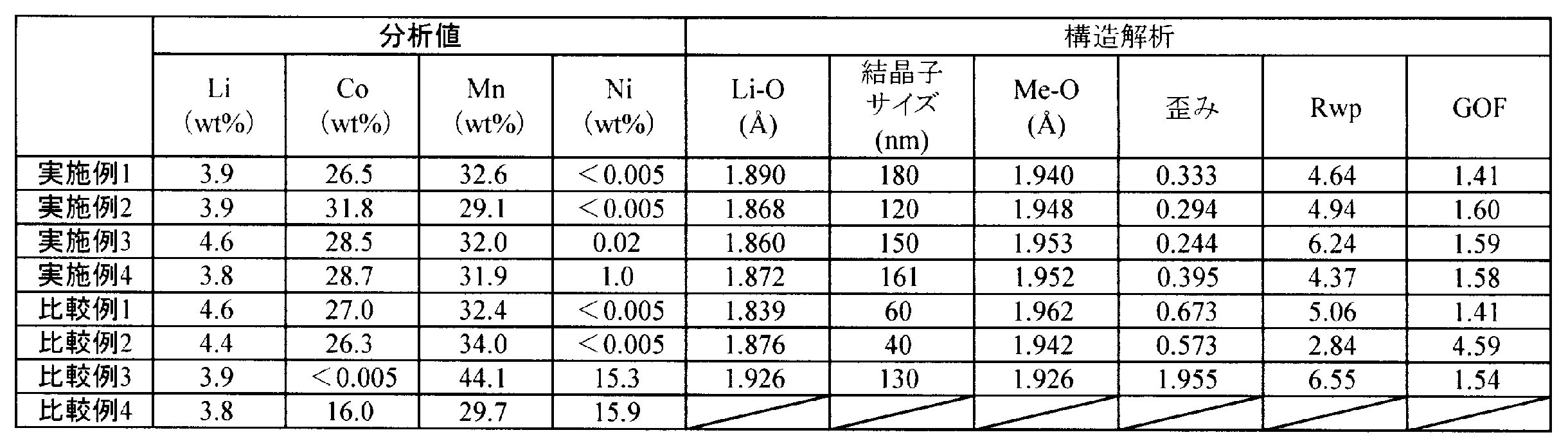
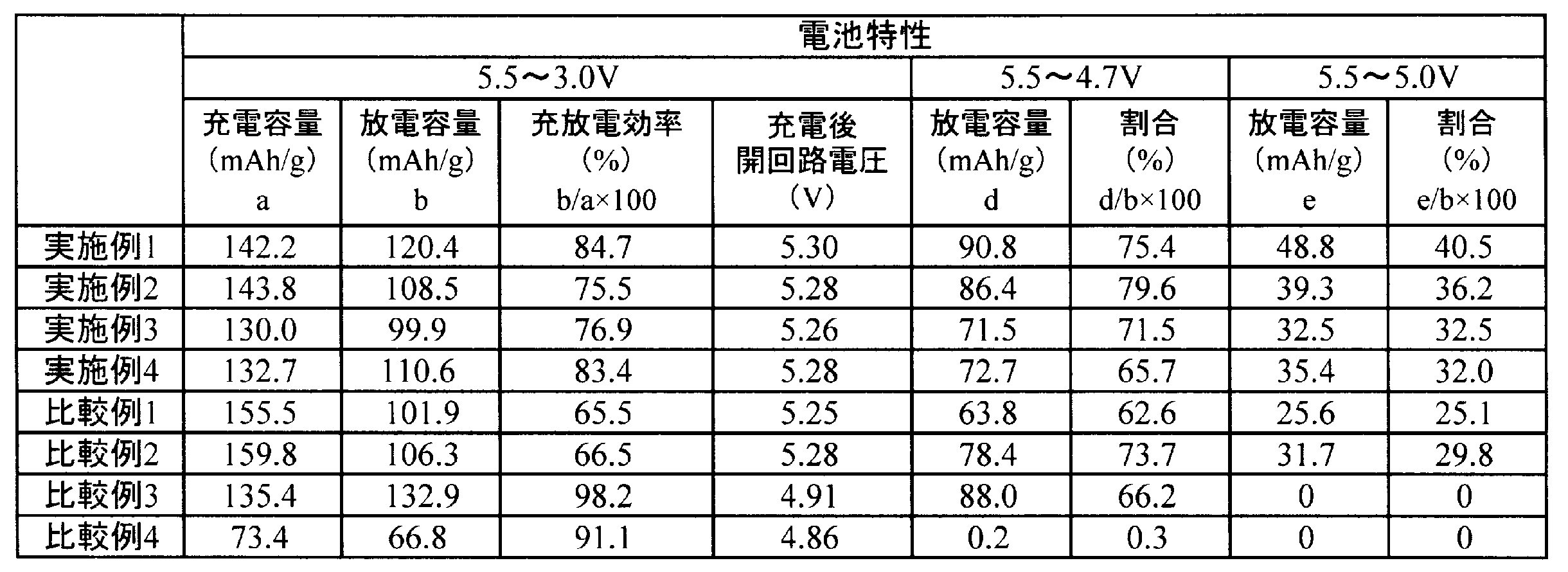
このように、本スピネルの結晶子サイズが100nm~200nmであり、ファンダメンタル法を用いたリートベルト法で測定されるLi-Oの原子間距離が1.80Å~2.00Åであり、歪みが0.20~0.50であれば、4.5V以上の作動電位を有し、さらには5.0V以上の容量域を拡大することもでき、エネルギー密度を高めることができることが分かった。
また、5.0V以上の領域で安定した電圧を示す容量域を拡大できることも分かった。
また、Ni、Co、Mnと価数が近いMg、Ti、Al、Ba、Cr、Fe、Mo、W、Zr、Y及びNbなどの元素でも、16dサイトへの元素置換が可能であると推測され、構造安定性、つまり寿命特性に効果があると推定できる。よって、Co及びNiとともに、これらの元素でMnの一部を置換しても、Mnの一部をCoで置換した場合と同様に、Co量を低減しつつ所定の効果を得られることは確実であると考えることができる。
Claims (4)
- 空間群Fd-3mに属する結晶構造を有し、一般式[Lix(CoyMn3-x-y)O4-δ](式中、0.90≦x≦1.15、0.75≦y≦1.25)で示されるスピネル型リチウムコバルトマンガン含有複合酸化物であって、ファンダメンタル法を用いたリートベルト法で測定される結晶子サイズが100nm~200nmであり、Li-Oの原子間距離が1.80Å~2.00Åであり、歪みが0.20~0.50であるスピネル型リチウムコバルトマンガン含有複合酸化物。
- 空間群Fd-3mに属する結晶構造を有し、一般式[Lix(CoyMzMn3-x-y-z)O4-δ](式中、0.90≦x≦1.15、0.90≦y≦1.25、0<z≦0.3、式中MはNi、又は、NiとMg、Ti、Al、Ba、Cr、Fe、Mo、W、Zr、Y及びNbからなる群から選ばれた1種又は2種以上の元素との組み合わせ)で示されるスピネル型リチウムコバルトマンガン含有複合酸化物であって、ファンダメンタル法を用いたリートベルト法で測定される結晶子サイズが100nm~200nmであり、Li-Oの原子間距離が1.80Å~2.00Åであり、歪みが0.20~0.50であるスピネル型リチウムコバルトマンガン含有複合酸化物。
- 前記スピネル型リチウムコバルトマンガン含有複合酸化物は、金属Li基準電位で4.5V以上の作動電位を有することを特徴とする、請求項1又は2に記載のスピネル型リチウムコバルトマンガン含有複合酸化物。
- 請求項1~3の何れかに記載されたスピネル型リチウムコバルトマンガン含有複合酸化物を正極活物質として備えたリチウム二次電池。
Priority Applications (4)
| Application Number | Priority Date | Filing Date | Title |
|---|---|---|---|
| KR1020167004368A KR101613861B1 (ko) | 2013-12-04 | 2014-12-04 | 스피넬형 리튬코발트망간 함유 복합 산화물 |
| JP2015527387A JP5813277B1 (ja) | 2013-12-04 | 2014-12-04 | スピネル型リチウムコバルトマンガン含有複合酸化物 |
| US15/100,354 US9786914B2 (en) | 2013-12-04 | 2014-12-04 | Spinel-type lithium cobalt manganese-containing complex oxide |
| GB1611268.2A GB2536166B (en) | 2013-12-04 | 2014-12-04 | Spinel-type lithium cobalt manganese-containing complex oxide |
Applications Claiming Priority (2)
| Application Number | Priority Date | Filing Date | Title |
|---|---|---|---|
| JP2013-251403 | 2013-12-04 | ||
| JP2013251403 | 2013-12-04 |
Publications (1)
| Publication Number | Publication Date |
|---|---|
| WO2015083788A1 true WO2015083788A1 (ja) | 2015-06-11 |
Family
ID=53273536
Family Applications (1)
| Application Number | Title | Priority Date | Filing Date |
|---|---|---|---|
| PCT/JP2014/082104 Ceased WO2015083788A1 (ja) | 2013-12-04 | 2014-12-04 | スピネル型リチウムコバルトマンガン含有複合酸化物 |
Country Status (5)
| Country | Link |
|---|---|
| US (1) | US9786914B2 (ja) |
| JP (1) | JP5813277B1 (ja) |
| KR (1) | KR101613861B1 (ja) |
| GB (2) | GB2536166B (ja) |
| WO (1) | WO2015083788A1 (ja) |
Cited By (5)
| Publication number | Priority date | Publication date | Assignee | Title |
|---|---|---|---|---|
| JP2018129140A (ja) * | 2017-02-07 | 2018-08-16 | 日立金属株式会社 | リチウムイオン二次電池用正極活物質の製造方法 |
| JP2019106261A (ja) * | 2017-12-11 | 2019-06-27 | トヨタ自動車株式会社 | リチウムイオン電池用正極活物質及びその製造方法、リチウムイオン電池、並びに、リチウムイオン電池システム |
| JP2020023424A (ja) * | 2018-07-27 | 2020-02-13 | 東ソー株式会社 | コバルト−マンガン系複合酸化物及びその製造方法、並びにその用途 |
| JP2020070205A (ja) * | 2018-10-30 | 2020-05-07 | 東ソー株式会社 | リチウム−コバルト−マンガン系複合酸化物及びこれを含むリチウム二次電池 |
| JP2023002647A (ja) * | 2016-09-21 | 2023-01-10 | ビーエーエスエフ ソシエタス・ヨーロピア | 二官能性ホスホン酸シリルエステルを含む電気化学セル |
Families Citing this family (3)
| Publication number | Priority date | Publication date | Assignee | Title |
|---|---|---|---|---|
| JP6174145B2 (ja) * | 2013-11-22 | 2017-08-02 | 三井金属鉱業株式会社 | スピネル型リチウム金属複合酸化物 |
| GB201704017D0 (en) | 2017-03-14 | 2017-04-26 | Univ Surrey | Catalysts for the reforming of gaseous mixtures |
| WO2024168990A1 (zh) * | 2023-02-13 | 2024-08-22 | 广东邦普循环科技有限公司 | 一种锂钴复合氧化物及其制备方法和应用 |
Citations (8)
| Publication number | Priority date | Publication date | Assignee | Title |
|---|---|---|---|---|
| JP2000154022A (ja) * | 1998-11-18 | 2000-06-06 | Tosoh Corp | 新規リチウムマンガン複合酸化物及びその製造方法並びにその用途 |
| JP2006134852A (ja) * | 2004-11-04 | 2006-05-25 | Kyoo-Sun Han | 自己混合共融法を利用した高出力リチウム2次電池用の結晶質ナノ微粒子正極活物質の製造方法 |
| WO2009054436A1 (ja) * | 2007-10-23 | 2009-04-30 | Mitsui Mining & Smelting Co., Ltd. | スピネル型リチウム遷移金属酸化物 |
| WO2012008480A1 (ja) * | 2010-07-16 | 2012-01-19 | 三井金属鉱業株式会社 | スピネル型リチウム遷移金属酸化物及びリチウム電池用正極活物質材料 |
| JP2012036085A (ja) * | 2011-09-20 | 2012-02-23 | Tosoh Corp | 新規リチウムマンガン複合酸化物及びその製造方法並びにその用途 |
| WO2012118117A1 (ja) * | 2011-03-02 | 2012-09-07 | 三井金属鉱業株式会社 | スピネル型リチウムマンガン系複合酸化物 |
| JP2013051104A (ja) * | 2011-08-31 | 2013-03-14 | Toda Kogyo Corp | チタン酸リチウム粒子粉末、非水電解質二次電池用負極活物質粒子粉末並びに非水電解質二次電池 |
| WO2013115390A1 (ja) * | 2012-02-01 | 2013-08-08 | 日産自動車株式会社 | 固溶体リチウム含有遷移金属酸化物、非水電解質二次電池用正極及び非水電解質二次電池 |
Family Cites Families (7)
| Publication number | Priority date | Publication date | Assignee | Title |
|---|---|---|---|---|
| JPH0773962A (ja) | 1993-09-02 | 1995-03-17 | Daifuku Co Ltd | 誘導加熱設備 |
| JP3813001B2 (ja) | 1997-08-29 | 2006-08-23 | 旭化成エレクトロニクス株式会社 | 非水系二次電池 |
| JP3634694B2 (ja) | 1998-12-18 | 2005-03-30 | 三洋電機株式会社 | リチウム二次電池 |
| JP4325167B2 (ja) | 2001-10-18 | 2009-09-02 | 日本電気株式会社 | 非水電解液二次電池用電極材料 |
| JP4271448B2 (ja) | 2003-01-16 | 2009-06-03 | パナソニック株式会社 | 非水電解質二次電池用正極活物質 |
| US7211237B2 (en) * | 2003-11-26 | 2007-05-01 | 3M Innovative Properties Company | Solid state synthesis of lithium ion battery cathode material |
| KR101228115B1 (ko) * | 2010-10-01 | 2013-02-01 | 한양대학교 산학협력단 | 양극, 그 제조방법 및 이를 채용한 리튬전지 |
-
2014
- 2014-12-04 KR KR1020167004368A patent/KR101613861B1/ko active Active
- 2014-12-04 US US15/100,354 patent/US9786914B2/en active Active
- 2014-12-04 GB GB1611268.2A patent/GB2536166B/en active Active
- 2014-12-04 WO PCT/JP2014/082104 patent/WO2015083788A1/ja not_active Ceased
- 2014-12-04 JP JP2015527387A patent/JP5813277B1/ja active Active
-
2017
- 2017-07-20 GB GB1711666.6A patent/GB2549666A/en not_active Withdrawn
Patent Citations (8)
| Publication number | Priority date | Publication date | Assignee | Title |
|---|---|---|---|---|
| JP2000154022A (ja) * | 1998-11-18 | 2000-06-06 | Tosoh Corp | 新規リチウムマンガン複合酸化物及びその製造方法並びにその用途 |
| JP2006134852A (ja) * | 2004-11-04 | 2006-05-25 | Kyoo-Sun Han | 自己混合共融法を利用した高出力リチウム2次電池用の結晶質ナノ微粒子正極活物質の製造方法 |
| WO2009054436A1 (ja) * | 2007-10-23 | 2009-04-30 | Mitsui Mining & Smelting Co., Ltd. | スピネル型リチウム遷移金属酸化物 |
| WO2012008480A1 (ja) * | 2010-07-16 | 2012-01-19 | 三井金属鉱業株式会社 | スピネル型リチウム遷移金属酸化物及びリチウム電池用正極活物質材料 |
| WO2012118117A1 (ja) * | 2011-03-02 | 2012-09-07 | 三井金属鉱業株式会社 | スピネル型リチウムマンガン系複合酸化物 |
| JP2013051104A (ja) * | 2011-08-31 | 2013-03-14 | Toda Kogyo Corp | チタン酸リチウム粒子粉末、非水電解質二次電池用負極活物質粒子粉末並びに非水電解質二次電池 |
| JP2012036085A (ja) * | 2011-09-20 | 2012-02-23 | Tosoh Corp | 新規リチウムマンガン複合酸化物及びその製造方法並びにその用途 |
| WO2013115390A1 (ja) * | 2012-02-01 | 2013-08-08 | 日産自動車株式会社 | 固溶体リチウム含有遷移金属酸化物、非水電解質二次電池用正極及び非水電解質二次電池 |
Cited By (7)
| Publication number | Priority date | Publication date | Assignee | Title |
|---|---|---|---|---|
| JP2023002647A (ja) * | 2016-09-21 | 2023-01-10 | ビーエーエスエフ ソシエタス・ヨーロピア | 二官能性ホスホン酸シリルエステルを含む電気化学セル |
| JP2018129140A (ja) * | 2017-02-07 | 2018-08-16 | 日立金属株式会社 | リチウムイオン二次電池用正極活物質の製造方法 |
| JP2019106261A (ja) * | 2017-12-11 | 2019-06-27 | トヨタ自動車株式会社 | リチウムイオン電池用正極活物質及びその製造方法、リチウムイオン電池、並びに、リチウムイオン電池システム |
| JP2020023424A (ja) * | 2018-07-27 | 2020-02-13 | 東ソー株式会社 | コバルト−マンガン系複合酸化物及びその製造方法、並びにその用途 |
| JP7206808B2 (ja) | 2018-07-27 | 2023-01-18 | 東ソー株式会社 | コバルト-マンガン系複合酸化物及びその製造方法、並びにその用途 |
| JP2020070205A (ja) * | 2018-10-30 | 2020-05-07 | 東ソー株式会社 | リチウム−コバルト−マンガン系複合酸化物及びこれを含むリチウム二次電池 |
| JP7192397B2 (ja) | 2018-10-30 | 2022-12-20 | 東ソー株式会社 | リチウム-コバルト-マンガン系複合酸化物及びこれを含むリチウム二次電池 |
Also Published As
| Publication number | Publication date |
|---|---|
| GB201711666D0 (en) | 2017-09-06 |
| GB2536166A (en) | 2016-09-07 |
| US20160301072A1 (en) | 2016-10-13 |
| GB2549666A (en) | 2017-10-25 |
| JPWO2015083788A1 (ja) | 2017-03-16 |
| JP5813277B1 (ja) | 2015-11-17 |
| US9786914B2 (en) | 2017-10-10 |
| GB2536166B (en) | 2018-03-07 |
| KR20160028483A (ko) | 2016-03-11 |
| GB201611268D0 (en) | 2016-08-10 |
| KR101613861B1 (ko) | 2016-04-20 |
Similar Documents
| Publication | Publication Date | Title |
|---|---|---|
| JP5308581B2 (ja) | スピネル型リチウムマンガン系複合酸化物 | |
| JP5572268B1 (ja) | スピネル型リチウムマンガンニッケル含有複合酸化物 | |
| JP5809772B2 (ja) | リチウム過剰型層状リチウム金属複合酸化物の製造方法 | |
| JP5523637B2 (ja) | マンガン系スピネル型リチウム遷移金属酸化物 | |
| JP5813277B1 (ja) | スピネル型リチウムコバルトマンガン含有複合酸化物 | |
| EP3351510B1 (en) | Spinel type lithium nickel manganese-containing composite oxide | |
| JP4939670B2 (ja) | スピネル型リチウム遷移金属酸化物及びリチウム電池用正極活物質材料 | |
| WO2015037737A1 (ja) | リチウムイオン電池用正極材料 | |
| JP5828989B2 (ja) | リチウム二次電池用正極活物質 | |
| JP5635217B2 (ja) | スピネル型リチウムマンガン含有複合酸化物 | |
| JP5898373B2 (ja) | リチウム二次電池用正極活物質 | |
| JP6649369B2 (ja) | 5v級スピネル型リチウムマンガン含有複合酸化物の製造方法 |
Legal Events
| Date | Code | Title | Description |
|---|---|---|---|
| ENP | Entry into the national phase |
Ref document number: 2015527387 Country of ref document: JP Kind code of ref document: A |
|
| 121 | Ep: the epo has been informed by wipo that ep was designated in this application |
Ref document number: 14867478 Country of ref document: EP Kind code of ref document: A1 |
|
| ENP | Entry into the national phase |
Ref document number: 20167004368 Country of ref document: KR Kind code of ref document: A |
|
| WWE | Wipo information: entry into national phase |
Ref document number: 15100354 Country of ref document: US |
|
| NENP | Non-entry into the national phase |
Ref country code: DE |
|
| ENP | Entry into the national phase |
Ref document number: 201611268 Country of ref document: GB Kind code of ref document: A Free format text: PCT FILING DATE = 20141204 |
|
| 122 | Ep: pct application non-entry in european phase |
Ref document number: 14867478 Country of ref document: EP Kind code of ref document: A1 |