WO2015019934A1 - 着色感光性樹脂組成物、硬化膜、カラーフィルタ、カラーフィルタの製造方法、固体撮像素子および画像表示装置 - Google Patents
着色感光性樹脂組成物、硬化膜、カラーフィルタ、カラーフィルタの製造方法、固体撮像素子および画像表示装置 Download PDFInfo
- Publication number
- WO2015019934A1 WO2015019934A1 PCT/JP2014/070194 JP2014070194W WO2015019934A1 WO 2015019934 A1 WO2015019934 A1 WO 2015019934A1 JP 2014070194 W JP2014070194 W JP 2014070194W WO 2015019934 A1 WO2015019934 A1 WO 2015019934A1
- Authority
- WO
- WIPO (PCT)
- Prior art keywords
- group
- pigment
- colored photosensitive
- compound
- general formula
- Prior art date
- Legal status (The legal status is an assumption and is not a legal conclusion. Google has not performed a legal analysis and makes no representation as to the accuracy of the status listed.)
- Ceased
Links
- WYEROMQEGJZHCB-GHVJWSGMSA-N CC(C(C(Nc(cc1N2)ccc1NC2=O)=O)/N=N/c1ccc(C)cc1)=O Chemical compound CC(C(C(Nc(cc1N2)ccc1NC2=O)=O)/N=N/c1ccc(C)cc1)=O WYEROMQEGJZHCB-GHVJWSGMSA-N 0.000 description 1
- OGKNWJYCAHNRPU-UHFFFAOYSA-N CC(C(C)=O)C(Nc(cc(c(Cl)c1)OC)c1OC)=O Chemical compound CC(C(C)=O)C(Nc(cc(c(Cl)c1)OC)c1OC)=O OGKNWJYCAHNRPU-UHFFFAOYSA-N 0.000 description 1
- KORZHCVMVIRBCM-UHFFFAOYSA-N CC(C(C)=O)C(Nc(cc1N2)ccc1NC2=O)=O Chemical compound CC(C(C)=O)C(Nc(cc1N2)ccc1NC2=O)=O KORZHCVMVIRBCM-UHFFFAOYSA-N 0.000 description 1
- XVVHKWJOMSYZPD-UHFFFAOYSA-N CC(C(Nc(cc1N2)ccc1NC2=O)=O)C#N Chemical compound CC(C(Nc(cc1N2)ccc1NC2=O)=O)C#N XVVHKWJOMSYZPD-UHFFFAOYSA-N 0.000 description 1
- OKLKWSLUFNEBDC-UHFFFAOYSA-N CC(C(c1ccccc1)=O)C(Nc(cc1)cc(N2)c1NC2=O)=O Chemical compound CC(C(c1ccccc1)=O)C(Nc(cc1)cc(N2)c1NC2=O)=O OKLKWSLUFNEBDC-UHFFFAOYSA-N 0.000 description 1
- DEADIIXHELIWKB-UHFFFAOYSA-N CC(C(c1ccccc1)=O)C(Nc1ccccc1)=O Chemical compound CC(C(c1ccccc1)=O)C(Nc1ccccc1)=O DEADIIXHELIWKB-UHFFFAOYSA-N 0.000 description 1
- XNZJIECTWUBCJT-JQOKOOLQSA-N CCN(CC)CCCNc1nc(NCCCN(CC)CC)nc(Nc(cc2)ccc2/N=N/C(C(C)=O)C(Nc(cc2N3)ccc2NC3=O)=O)n1 Chemical compound CCN(CC)CCCNc1nc(NCCCN(CC)CC)nc(Nc(cc2)ccc2/N=N/C(C(C)=O)C(Nc(cc2N3)ccc2NC3=O)=O)n1 XNZJIECTWUBCJT-JQOKOOLQSA-N 0.000 description 1
- TXWSZJSDZKWQAU-UHFFFAOYSA-N Cc(cc1C(c2c3)=O)ccc1Nc2cc1c3Nc2ccc(C)cc2C1=O Chemical compound Cc(cc1C(c2c3)=O)ccc1Nc2cc1c3Nc2ccc(C)cc2C1=O TXWSZJSDZKWQAU-UHFFFAOYSA-N 0.000 description 1
- CBCKQZAAMUWICA-UHFFFAOYSA-N Nc(cc1)ccc1N Chemical compound Nc(cc1)ccc1N CBCKQZAAMUWICA-UHFFFAOYSA-N 0.000 description 1
- KNMQFBWXSICVQC-UHFFFAOYSA-N Nc1ccc(-c(c(C(c2c3cccc2)=O)c2C3=O)ccc2N)c(C(c2c3cccc2)=O)c1C3=O Chemical compound Nc1ccc(-c(c(C(c2c3cccc2)=O)c2C3=O)ccc2N)c(C(c2c3cccc2)=O)c1C3=O KNMQFBWXSICVQC-UHFFFAOYSA-N 0.000 description 1
- KHUFHLFHOQVFGB-UHFFFAOYSA-N Nc1cccc(C(c2ccccc22)=O)c1C2=O Chemical compound Nc1cccc(C(c2ccccc22)=O)c1C2=O KHUFHLFHOQVFGB-UHFFFAOYSA-N 0.000 description 1
- UWHBZLMSPZBZHY-UHFFFAOYSA-N O=C(C1=C(c2ccccc2)N2)NC(c3ccccc3)=C1C2=O Chemical compound O=C(C1=C(c2ccccc2)N2)NC(c3ccccc3)=C1C2=O UWHBZLMSPZBZHY-UHFFFAOYSA-N 0.000 description 1
Images
Classifications
-
- G—PHYSICS
- G03—PHOTOGRAPHY; CINEMATOGRAPHY; ANALOGOUS TECHNIQUES USING WAVES OTHER THAN OPTICAL WAVES; ELECTROGRAPHY; HOLOGRAPHY
- G03F—PHOTOMECHANICAL PRODUCTION OF TEXTURED OR PATTERNED SURFACES, e.g. FOR PRINTING, FOR PROCESSING OF SEMICONDUCTOR DEVICES; MATERIALS THEREFOR; ORIGINALS THEREFOR; APPARATUS SPECIALLY ADAPTED THEREFOR
- G03F7/00—Photomechanical, e.g. photolithographic, production of textured or patterned surfaces, e.g. printing surfaces; Materials therefor, e.g. comprising photoresists; Apparatus specially adapted therefor
- G03F7/004—Photosensitive materials
- G03F7/027—Non-macromolecular photopolymerisable compounds having carbon-to-carbon double bonds, e.g. ethylenic compounds
- G03F7/032—Non-macromolecular photopolymerisable compounds having carbon-to-carbon double bonds, e.g. ethylenic compounds with binders
- G03F7/033—Non-macromolecular photopolymerisable compounds having carbon-to-carbon double bonds, e.g. ethylenic compounds with binders the binders being polymers obtained by reactions only involving carbon-to-carbon unsaturated bonds, e.g. vinyl polymers
-
- C—CHEMISTRY; METALLURGY
- C09—DYES; PAINTS; POLISHES; NATURAL RESINS; ADHESIVES; COMPOSITIONS NOT OTHERWISE PROVIDED FOR; APPLICATIONS OF MATERIALS NOT OTHERWISE PROVIDED FOR
- C09B—ORGANIC DYES OR CLOSELY-RELATED COMPOUNDS FOR PRODUCING DYES, e.g. PIGMENTS; MORDANTS; LAKES
- C09B1/00—Dyes with anthracene nucleus not condensed with any other ring
- C09B1/16—Amino-anthraquinones
- C09B1/20—Preparation from starting materials already containing the anthracene nucleus
- C09B1/206—Dyes with amino groups substituted by heterocyclic radicals
-
- C—CHEMISTRY; METALLURGY
- C09—DYES; PAINTS; POLISHES; NATURAL RESINS; ADHESIVES; COMPOSITIONS NOT OTHERWISE PROVIDED FOR; APPLICATIONS OF MATERIALS NOT OTHERWISE PROVIDED FOR
- C09B—ORGANIC DYES OR CLOSELY-RELATED COMPOUNDS FOR PRODUCING DYES, e.g. PIGMENTS; MORDANTS; LAKES
- C09B29/00—Monoazo dyes prepared by diazotising and coupling
- C09B29/02—Monoazo dyes prepared by diazotising and coupling from diazotised o-amino-hydroxy compounds
-
- C—CHEMISTRY; METALLURGY
- C09—DYES; PAINTS; POLISHES; NATURAL RESINS; ADHESIVES; COMPOSITIONS NOT OTHERWISE PROVIDED FOR; APPLICATIONS OF MATERIALS NOT OTHERWISE PROVIDED FOR
- C09B—ORGANIC DYES OR CLOSELY-RELATED COMPOUNDS FOR PRODUCING DYES, e.g. PIGMENTS; MORDANTS; LAKES
- C09B29/00—Monoazo dyes prepared by diazotising and coupling
- C09B29/32—Monoazo dyes prepared by diazotising and coupling from coupling components containing a reactive methylene group
- C09B29/33—Aceto- or benzoylacetylarylides
- C09B29/335—Aceto- or benzoylacetylarylides free of acid groups
-
- C—CHEMISTRY; METALLURGY
- C09—DYES; PAINTS; POLISHES; NATURAL RESINS; ADHESIVES; COMPOSITIONS NOT OTHERWISE PROVIDED FOR; APPLICATIONS OF MATERIALS NOT OTHERWISE PROVIDED FOR
- C09B—ORGANIC DYES OR CLOSELY-RELATED COMPOUNDS FOR PRODUCING DYES, e.g. PIGMENTS; MORDANTS; LAKES
- C09B29/00—Monoazo dyes prepared by diazotising and coupling
- C09B29/34—Monoazo dyes prepared by diazotising and coupling from other coupling components
- C09B29/36—Monoazo dyes prepared by diazotising and coupling from other coupling components from heterocyclic compounds
- C09B29/3604—Monoazo dyes prepared by diazotising and coupling from other coupling components from heterocyclic compounds containing only a nitrogen as heteroatom
- C09B29/3647—Monoazo dyes prepared by diazotising and coupling from other coupling components from heterocyclic compounds containing only a nitrogen as heteroatom containing a five-membered ring with two nitrogen atoms as heteroatoms
- C09B29/3652—Monoazo dyes prepared by diazotising and coupling from other coupling components from heterocyclic compounds containing only a nitrogen as heteroatom containing a five-membered ring with two nitrogen atoms as heteroatoms containing a 1,2-diazoles or hydrogenated 1,2-diazoles
-
- C—CHEMISTRY; METALLURGY
- C09—DYES; PAINTS; POLISHES; NATURAL RESINS; ADHESIVES; COMPOSITIONS NOT OTHERWISE PROVIDED FOR; APPLICATIONS OF MATERIALS NOT OTHERWISE PROVIDED FOR
- C09B—ORGANIC DYES OR CLOSELY-RELATED COMPOUNDS FOR PRODUCING DYES, e.g. PIGMENTS; MORDANTS; LAKES
- C09B48/00—Quinacridones
-
- C—CHEMISTRY; METALLURGY
- C09—DYES; PAINTS; POLISHES; NATURAL RESINS; ADHESIVES; COMPOSITIONS NOT OTHERWISE PROVIDED FOR; APPLICATIONS OF MATERIALS NOT OTHERWISE PROVIDED FOR
- C09B—ORGANIC DYES OR CLOSELY-RELATED COMPOUNDS FOR PRODUCING DYES, e.g. PIGMENTS; MORDANTS; LAKES
- C09B57/00—Other synthetic dyes of known constitution
- C09B57/004—Diketopyrrolopyrrole dyes
-
- G—PHYSICS
- G02—OPTICS
- G02B—OPTICAL ELEMENTS, SYSTEMS OR APPARATUS
- G02B5/00—Optical elements other than lenses
- G02B5/20—Filters
- G02B5/22—Absorbing filters
- G02B5/223—Absorbing filters containing organic substances, e.g. dyes, inks or pigments
-
- G—PHYSICS
- G03—PHOTOGRAPHY; CINEMATOGRAPHY; ANALOGOUS TECHNIQUES USING WAVES OTHER THAN OPTICAL WAVES; ELECTROGRAPHY; HOLOGRAPHY
- G03F—PHOTOMECHANICAL PRODUCTION OF TEXTURED OR PATTERNED SURFACES, e.g. FOR PRINTING, FOR PROCESSING OF SEMICONDUCTOR DEVICES; MATERIALS THEREFOR; ORIGINALS THEREFOR; APPARATUS SPECIALLY ADAPTED THEREFOR
- G03F7/00—Photomechanical, e.g. photolithographic, production of textured or patterned surfaces, e.g. printing surfaces; Materials therefor, e.g. comprising photoresists; Apparatus specially adapted therefor
- G03F7/0005—Production of optical devices or components in so far as characterised by the lithographic processes or materials used therefor
- G03F7/0007—Filters, e.g. additive colour filters; Components for display devices
-
- G—PHYSICS
- G03—PHOTOGRAPHY; CINEMATOGRAPHY; ANALOGOUS TECHNIQUES USING WAVES OTHER THAN OPTICAL WAVES; ELECTROGRAPHY; HOLOGRAPHY
- G03F—PHOTOMECHANICAL PRODUCTION OF TEXTURED OR PATTERNED SURFACES, e.g. FOR PRINTING, FOR PROCESSING OF SEMICONDUCTOR DEVICES; MATERIALS THEREFOR; ORIGINALS THEREFOR; APPARATUS SPECIALLY ADAPTED THEREFOR
- G03F7/00—Photomechanical, e.g. photolithographic, production of textured or patterned surfaces, e.g. printing surfaces; Materials therefor, e.g. comprising photoresists; Apparatus specially adapted therefor
- G03F7/004—Photosensitive materials
- G03F7/027—Non-macromolecular photopolymerisable compounds having carbon-to-carbon double bonds, e.g. ethylenic compounds
-
- G—PHYSICS
- G03—PHOTOGRAPHY; CINEMATOGRAPHY; ANALOGOUS TECHNIQUES USING WAVES OTHER THAN OPTICAL WAVES; ELECTROGRAPHY; HOLOGRAPHY
- G03F—PHOTOMECHANICAL PRODUCTION OF TEXTURED OR PATTERNED SURFACES, e.g. FOR PRINTING, FOR PROCESSING OF SEMICONDUCTOR DEVICES; MATERIALS THEREFOR; ORIGINALS THEREFOR; APPARATUS SPECIALLY ADAPTED THEREFOR
- G03F7/00—Photomechanical, e.g. photolithographic, production of textured or patterned surfaces, e.g. printing surfaces; Materials therefor, e.g. comprising photoresists; Apparatus specially adapted therefor
- G03F7/004—Photosensitive materials
- G03F7/038—Macromolecular compounds which are rendered insoluble or differentially wettable
- G03F7/0388—Macromolecular compounds which are rendered insoluble or differentially wettable with ethylenic or acetylenic bands in the side chains of the photopolymer
-
- G—PHYSICS
- G03—PHOTOGRAPHY; CINEMATOGRAPHY; ANALOGOUS TECHNIQUES USING WAVES OTHER THAN OPTICAL WAVES; ELECTROGRAPHY; HOLOGRAPHY
- G03F—PHOTOMECHANICAL PRODUCTION OF TEXTURED OR PATTERNED SURFACES, e.g. FOR PRINTING, FOR PROCESSING OF SEMICONDUCTOR DEVICES; MATERIALS THEREFOR; ORIGINALS THEREFOR; APPARATUS SPECIALLY ADAPTED THEREFOR
- G03F7/00—Photomechanical, e.g. photolithographic, production of textured or patterned surfaces, e.g. printing surfaces; Materials therefor, e.g. comprising photoresists; Apparatus specially adapted therefor
- G03F7/004—Photosensitive materials
- G03F7/09—Photosensitive materials characterised by structural details, e.g. supports, auxiliary layers
- G03F7/105—Photosensitive materials characterised by structural details, e.g. supports, auxiliary layers having substances, e.g. indicators, for forming visible images
-
- G—PHYSICS
- G02—OPTICS
- G02B—OPTICAL ELEMENTS, SYSTEMS OR APPARATUS
- G02B5/00—Optical elements other than lenses
- G02B5/20—Filters
- G02B5/201—Filters in the form of arrays
Definitions
- the present invention relates to a colored photosensitive resin composition suitable for producing a color filter used for a liquid crystal display element (LCD), a solid-state imaging element (CCD, CMOS, etc.), and a colored region produced by the above composition.
- the present invention relates to a color filter having a color filter, a solid-state imaging device having the color filter, and an image display device such as an organic LED liquid crystal display device.
- the colorant used in the color filter is commonly required to have the following characteristics. In other words, it has optical characteristics that are favorable for color reproducibility, optical scattering such as light scattering that causes a decrease in contrast of a liquid crystal display, and unevenness in optical density that causes color unevenness and roughness of a solid-state imaging device. There is a need for a high degree of fastness, such as heat resistance, light resistance, moisture resistance, and the like, a large molar extinction coefficient, and a thin film. For this reason, it is common to use a pigment as a colorant.
- a color filter used in a liquid crystal display device LCD
- a solid-state imaging device CCD, CMOS, etc.
- an organic LED liquid crystal display device following the step of applying a colored photosensitive resin composition on a substrate,
- a pattern exposure step and a development step using an alkali developer are performed.
- the holding is performed for several days before the exposure / development step is performed.
- Such placement after application is generally referred to as PCD (Post Coating Delay).
- PCD Post Coating Delay
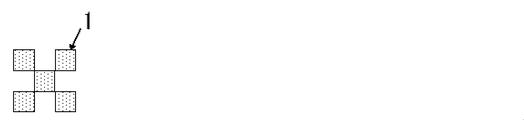
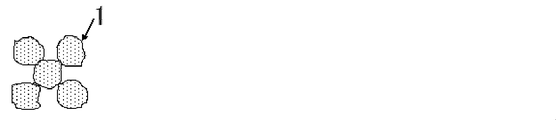
- FIG. 1 is a schematic view of a colored pattern 1 formed when the colored photosensitive resin composition is applied on a substrate and then immediately exposed and developed, and observed from above the substrate.
- the coloring pattern is formed in a rectangular shape.
- the colored photosensitive resin composition is required to retain such a rectangular pattern even after PCD.
- the colored pattern 1 after PCD may be greatly collapsed.
- Patent Document 1 and Patent Document 2 describe a photosensitive coloring composition containing a resin containing an acrylic monomer having a specific structure as a copolymerization component.
- Patent Document 3 and Patent Document 4 describe pigment compositions containing a triazine ring-containing basic compound having a specific structure and a phosphoric acid dispersant having a specific structure.
- Patent Document 1 and Patent Document 2 describe that a colored composition having excellent dispersion stability can be obtained by using a resin having an acrylic monomer having a specific structure as a copolymerization component. There was room for further improvement in terms of color unevenness and roughness over time. This is because, in the colored photosensitive resin composition as described in Patent Document 1 and Patent Document 2, adsorption of the dispersion resin to the pigment particles is unstable, This is presumably because the dispersion resin adsorbed on the pigment particle surface was detached from the pigment particle surface. For this reason, it is presumed that the pigment particles cause secondary agglomeration in the process of aging the composition for a long time, the pigment particle size becomes coarse, and the roughness of the color filter after the aging is deteriorated.
- Patent Document 3 and Patent Document 4 describe that a pigment composition excellent in dispersion stability and the like can be obtained by using a triazine ring-containing basic compound having a specific structure and a phosphoric acid dispersant having a specific structure. Has been. However, Patent Documents 3 and 4 still have room for further improvement in terms of color unevenness (zara) when used as a color filter, stability over time, and pattern formation after PCD.
- zara color unevenness
- the present invention solves such a problem, and uses a colored photosensitive resin composition excellent in color unevenness, roughness stability over time, and pattern formation after PCD, and the colored photosensitive resin composition described above.
- the present invention relates to a cured film, a color filter, a method for manufacturing a color filter, a solid-state imaging device, and an image display device.
- the present inventors have found that the above-described problems can be solved by using a predetermined phosphoric acid dispersant and a predetermined resin binder. Specifically, the above problem has been solved by the following means ⁇ 1>, preferably ⁇ 2> to ⁇ 17>.
- R 3 represents a polyester structure having a number average molecular weight of 400 to 30,000, y represents 1 or 2, and when y is 2, a plurality of R 3 may be the same or different May be;
- R 4 represents a hydrogen atom or a methyl group
- R 5 represents an alkylene group having 2 or 3 carbon atoms
- R 6 represents a hydrogen atom or a benzene ring which may contain a benzene ring.
- n represents an integer of 1 to 15; When n is 2 or more, the plurality of R 5 may be the same or different from each other.
- the (A) pigment is selected from the group consisting of a red pigment, a green pigment, and a yellow pigment.
- the polyester structure represented by R 3 is a polyester structure obtained by ring-opening polymerization of two or more different lactone monomers.
- the content of the resin obtained by copolymerizing the compound (x) represented by the general formula (IV) and the compound (y) having an ethylenically unsaturated double bond is the above (A).
- the colored photosensitive resin composition according to any one of ⁇ 1> to ⁇ 7>, which is 5 to 80 parts by mass with respect to 100 parts by mass of the pigment.
- the colored photosensitive resin composition has dispersed therein the (A) pigment, the (B) basic dye derivative, and the (C) phosphoric acid dispersant represented by the general formula (II). And (D) a compound obtained by copolymerizing a compound (x) represented by the general formula (IV) and a compound (y) having an ethylenically unsaturated double bond, ⁇ 8>
- the colored photosensitive resin composition according to any one of the above.
- ⁇ 10> The colored photosensitive resin composition according to any one of ⁇ 1> to ⁇ 9>, which is used for forming a colored region of a color filter.
- ⁇ 11> A cured film obtained by curing the colored photosensitive resin composition according to any one of ⁇ 1> to ⁇ 10>.
- ⁇ 12> A step of forming a colored photosensitive composition layer by applying the colored photosensitive resin composition according to any one of ⁇ 1> to ⁇ 10> on a support, and the above colored photosensitive composition layer.
- a method for producing a color filter comprising a step of exposing in a pattern and a step of developing and removing unexposed portions to form a colored pattern.
- ⁇ 13> a step of applying the colored photosensitive resin composition according to any one of ⁇ 1> to ⁇ 10> on a support to form a colored photosensitive composition layer; Forming a photoresist layer on the colored photosensitive composition layer,
- a method for producing a color filter comprising: a step of patterning the photoresist layer by exposure and development to obtain a resist pattern; and a step of dry etching the colored photosensitive composition layer using the resist pattern as an etching mask.
- ⁇ 15> A color filter manufactured by the method for manufacturing a color filter according to ⁇ 12> or ⁇ 13>.
- ⁇ 16> A solid-state imaging device having the color filter according to ⁇ 14> or ⁇ 15>.
- An image display device having the color filter according to ⁇ 14> or ⁇ 15>.
- a colored photosensitive resin composition having excellent color unevenness (zara) and stability over time, and pattern formation after PCD, and a cured film and a color filter using the colored photosensitive resin composition It has become possible to provide a method for manufacturing a color filter, a solid-state imaging device, and an image display device.
- the organic EL element in the present invention refers to an organic electroluminescence element.
- the total solid content refers to the total mass of components excluding the solvent from the total composition of the colored photosensitive resin composition.
- the description which does not describe substitution and unsubstituted includes the thing which has a substituent with the thing which does not have a substituent.
- the “alkyl group” includes not only an alkyl group having no substituent (unsubstituted alkyl group) but also an alkyl group having a substituent (substituted alkyl group).
- “radiation” in the present specification means, for example, an emission line spectrum of a mercury lamp, far ultraviolet rays represented by excimer laser, extreme ultraviolet rays (EUV light), X-rays, electron beams, and the like. In the present invention, light means actinic rays or radiation.
- exposure in this specification is not only exposure with far-ultraviolet rays such as mercury lamps and excimer lasers, X-rays, EUV light, but also drawing with particle beams such as electron beams and ion beams. Are also included in the exposure.
- (meth) acrylate represents both and / or acrylate and methacrylate
- (meth) acryl represents both and / or acryl and “(meth) acrylic”
- "Acryloyl” represents both and / or acryloyl and methacryloyl.
- “monomer” and “monomer” are synonymous.
- the monomer in this specification is distinguished from an oligomer and a polymer, and refers to a compound having a weight average molecular weight of 2,000 or less.
- the polymerizable compound means a compound having a polymerizable functional group, and may be a monomer or a polymer.
- the polymerizable functional group refers to a group that participates in a polymerization reaction.
- the weight average molecular weight and the number average molecular weight can be determined by gel permeation chromatography (GPC).
- Me in the chemical formula represents a methyl group
- Et represents an ethyl group
- Pr represents a propyl group
- Bu represents a butyl group
- Ph represents a phenyl group
- the term “process” is not limited to an independent process, and is included in the term if the intended action of the process is achieved even when it cannot be clearly distinguished from other processes. .
- the present invention has been made in view of the above situation, and an object thereof is to provide a coloring composition having excellent color characteristics.
- a weight average molecular weight and a number average molecular weight are defined as a polystyrene conversion value by GPC measurement.
- the weight average molecular weight (Mw) and the number average molecular weight (Mn) are, for example, HLC-8220 (manufactured by Tosoh Corporation), and TSKgel Super AWM-H (manufactured by Tosoh Corporation, 6) as a column.
- 0.0 mm ID ⁇ 15.0 cm can be determined by using a 10 mmol / L lithium bromide NMP (N-methylpyrrolidinone) solution as the eluent.
- the colored photosensitive resin composition of the present invention (hereinafter sometimes referred to as “the composition of the present invention” or “colored composition”) is composed of (A) a pigment, (B) a basic dye derivative, and (C) the following general A phosphoric acid dispersant represented by formula (II), (D) a compound (x) represented by the following general formula (IV) and a compound (y) having an ethylenically unsaturated double bond; And (E) a photopolymerization initiator, and (F) a polymerizable compound.
- R 3 represents a polyester structure having a number average molecular weight of 400 to 30,000, and y represents 1 or 2.
- R 4 represents a hydrogen atom or a methyl group
- R 5 represents an alkylene group having 2 or 3 carbon atoms
- R 6 represents a hydrogen atom or a benzene ring which may contain a benzene ring.
- 20 represents an alkyl group
- n represents an integer of 1 to 15.
- the plurality of R 5 may be the same or different from each other.
- the color unevenness (zara), the stability over time, and the pattern forming property after PCD are excellent.
- the reason why such an effect of the present invention can be obtained is not clear, but the following reason is estimated.
- (D) a compound (x) represented by the general formula (IV), and a compound (y) having an ethylenically unsaturated double bond When used in combination with a resin obtained by copolymerization, (C) the phosphoric acid dispersant represented by the general formula (II) strongly adsorbs the dispersing agent to the pigment particles, and the roughness of the composition increases with time.
- (D) a resin obtained by copolymerizing the compound (x) represented by the general formula (IV) and the compound (y) having an ethylenically unsaturated double bond functions as a compatibilizing agent, It is presumed that the constituent components were prevented from causing phase separation in the process of leaving (PCD) after coating. As a result, the present invention is considered to be excellent in color unevenness (roughness) and roughness over time, and further in pattern formation after PCD.
- the composition of the present invention will be described in detail.
- the composition of the present invention has (A) a pigment.
- the pigment used in the present invention is preferably selected from the group consisting of a red pigment, a green pigment and a yellow pigment, and various conventionally known inorganic pigments or organic pigments can be used.
- the pigment preferably has a high transmittance.
- inorganic pigments include metal compounds represented by metal oxides, metal complex salts, and the like.
- black pigments such as carbon black and titanium black, iron, cobalt, aluminum, cadmium, lead, copper
- metal oxides such as titanium, magnesium, chromium, zinc and antimony, and composite oxides of the above metals.
- organic pigment for example, C. I. Pigment yellow 11,24,31,53,83,93,99,108,109,110,138,139,147,150,151,154,155,167,180,185,199; C. I. Pigment orange 36, 38, 43, 71; C. I. Pigment red 81,105,122,149,150,155,171,175,176,177,209,220,224,242,254,255,264,270; C. I. Pigment violet 19, 23, 32, 39; C. I. Pigment Blue 1, 2, 15, 15: 1, 15: 3, 15: 6, 16, 22, 60, 66; C. I. Pigment green 7, 36, 37, 58; C. I. Pigment brown 25, 28; C. I. Pigment black 1; and the like.
- organic pigments can be used alone or in various combinations in order to adjust the spectrum and increase the color purity. Specific examples of the above combinations are shown below.
- a red pigment an anthraquinone pigment, a perylene pigment, a diketopyrrolopyrrole pigment alone or at least one of them, a disazo yellow pigment, an isoindoline yellow pigment, a quinophthalone yellow pigment or a perylene red pigment , Etc.
- an anthraquinone pigment C.I. I. Pigment red 177
- perylene pigments include C.I. I. Pigment red 155, C.I. I.
- Pigment Red 224, and diketopyrrolopyrrole pigments include C.I. I. Pigment Red 254, and C.I. I. Mixing with Pigment Yellow 139 is preferred.
- the mass ratio of the red pigment to the yellow pigment is preferably 100: 5 to 100: 50. When the ratio is 100: 4 or less, it is difficult to suppress the light transmittance from 400 nm to 500 nm. When the ratio is 100: 51 or more, the main wavelength tends to be closer to the short wavelength, and the color resolution may not be improved. In particular, the mass ratio is optimally in the range of 100: 10 to 100: 30. In the case of a combination of red pigments, it can be adjusted in accordance with the required spectrum.
- a halogenated phthalocyanine pigment can be used alone, or a mixture thereof with a disazo yellow pigment, a quinophthalone yellow pigment, an azomethine yellow pigment, or an isoindoline yellow pigment can be used.
- a disazo yellow pigment e.g., a quinophthalone yellow pigment, an azomethine yellow pigment, or an isoindoline yellow pigment
- C.I. I. Pigment Green 7, 36, 37, 58 and C.I. I. Pigment yellow 83 e. I. Pigment yellow 138, C.I. I. Pigment yellow 139, C.I. I. Pigment yellow 150, C.I. I. Pigment yellow 180 or C.I. I. Mixing with Pigment Yellow 185 is preferred.
- the mass ratio of green pigment to yellow pigment is preferably 100: 5 to 100: 150.
- the mass ratio is particularly preferably in the range of 100: 30 to 100: 120.
- a phthalocyanine pigment can be used alone, or a mixture of this with a dioxazine purple pigment can be used.
- C.I. I. Pigment blue 15: 6 and C.I. I. Mixing with pigment violet 23 is preferred.
- the mass ratio of the blue pigment to the violet pigment is preferably 100: 0 to 100: 100, more preferably 100: 10 or less.
- the black pigment carbon, titanium black, iron oxide, titanium oxide alone or a mixture thereof is used.
- a combination of carbon and titanium black is preferred, and the mass ratio of carbon to titanium black in that case is preferably in the range of 100: 0 to 100: 60.
- G represents a hydrogen atom, an aliphatic group, an aryl group, or a heterocyclic group
- R 1 represents an amino group, an aliphatic oxy group, or an aliphatic group that may have a substituent.
- R 2 represents a substituent.
- A represents a heterocyclic ring having at least one atom selected from a nitrogen atom, an oxygen atom, and a sulfur atom.
- m represents an integer of 0 to 5
- General formula (A2) does not have an ionic hydrophilic group.
- A preferably represents any one of the following general formulas (A-1) to (A-32).
- R 51 to R 59 each independently represent a hydrogen atom or a substituent, and adjacent substituents are bonded to each other to form a 5- to 6-membered ring. May be. * Represents a bonding position with the azo group of the general formula (A2).
- the azo pigment By having a specific structure represented by the general formula (A2), the azo pigment exhibits excellent characteristics in color characteristics such as coloring power and hue, and also has excellent durability such as light resistance and ozone resistance. Characteristics can be shown. For example, a red pattern of a color filter formed using the colored composition of the present invention containing an azo pigment represented by the general formula (A2) exhibits better spectral characteristics as red.
- “spectral characteristics favorable as red” refers to at least one of the following properties, for example. The spectral characteristics satisfying all the following three properties are particularly excellent.
- the transmittance curve rises sharply in the wavelength region of 540 nm or more.
- the substituent in the present invention may be any group that can be substituted, for example, an aliphatic group, an aryl group, a heterocyclic group, an acyl group, an acyloxy group, an acylamino group, an aliphatic oxy group, an aryloxy group, a heterocyclic ring.
- the aliphatic group represented by G may have a substituent and may be saturated or unsaturated.
- Preferred examples of the substituent that the aliphatic group represented by G may have include a hydroxy group, an aliphatic oxy group, a carbamoyl group, an aliphatic oxycarbonyl group, an aliphatic thio group, an amino group, and an aliphatic amino group.
- the aliphatic group represented by G is preferably an aliphatic group having 1 to 8 carbon atoms in total, more preferably an alkyl group having 1 to 6 carbon atoms in total, such as methyl, ethyl, cyclohexyl, etc. Can be mentioned.
- the aryl group represented by G may be condensed, may have a substituent, and may be substituted.
- preferred substituents include nitro groups, halogen atoms, aliphatic oxy groups, carbamoyl groups, aliphatic oxycarbonyl groups, aliphatic thio groups, amino groups, An aliphatic amino group, an acylamino group, and a carbamoylamino group;
- the aryl group represented by G is preferably an aryl group having 6 to 12 carbon atoms, more preferably an aryl group having 6 to 10 carbon atoms in total, such as phenyl, 4-nitrophenyl, 4-acetylamino. Phenyl, 4-methanesulfonylphenyl and the like.
- the heterocyclic group represented by G may have a substituent, may be saturated or unsaturated, and may be condensed.
- the group that may be substituted may be any group as long as it is a group that can be substituted with the groups described in the above-mentioned substituent group.
- Preferred substituents include halogen atoms, hydroxy groups, aliphatic oxy groups, carbamoyl groups, An aliphatic oxycarbonyl group, an aliphatic thio group, an amino group, an aliphatic amino group, an acylamino group, and a carbamoylamino group;
- the heterocyclic group represented by G is preferably a heterocyclic group bonded with carbon atoms having 2 to 12 carbon atoms in total, and more preferably 5 to 6 having 2 to 10 carbon atoms bonded with carbon atoms.
- a membered heterocycle such as 2-tetrahydrofuryl, 2-pyrimidyl and the like.
- G is preferably a hydrogen atom. This is because it is easy to form an intramolecular hydrogen bond or an intramolecular cross hydrogen bond.
- the amino group represented by R 1 may have a substituent, and the group which may be substituted may be any of the groups described in the above-mentioned substituent group, and may be substituted. Any substituent may be used, and preferred examples of the substituent include an aliphatic group, an aryl group, and a heterocyclic group. These substituents may further have a substituent, and the substituent is preferably a substituent having an aliphatic group, a hydroxy group, an amide bond, an ether bond, an oxycarbonyl bond, a thioether bond, and the like.
- a substituent having a bond between a hetero atom and a hydrogen atom is more preferable from the viewpoint of facilitating intermolecular interaction such as intermolecular hydrogen bonding.
- the amino group represented by R 1 is preferably an unsubstituted amino group, an alkylamino group having 1 to 10 carbon atoms in total, a dialkylamino group having 2 to 10 carbon atoms in total (a dialkyl group is bonded to each other, and 5 An arylamino group having 6 to 12 carbon atoms in total, a saturated or unsaturated heterocyclic amino group having 2 to 12 carbon atoms in total.
- an unsubstituted amino group an alkylamino group having 1 to 8 carbon atoms in total, a dialkylamino group having 2 to 8 carbon atoms in total, an arylamino group having 6 to 10 carbon atoms in total, Heterocyclic amino group having 2 to 12 carbon atoms which may be saturated or unsaturated, such as methylamino, N, N-dimethylamino, N-phenylamino, N- (2-pyrimidyl) Amino and the like. More preferred are an arylamino group having 6 to 13 carbon atoms in total and a heterocyclic amino group having 2 to 12 carbon atoms which may be saturated or unsaturated.
- R 1 is an arylamino group
- the substituent on the aryl group preferably has a substituent at the para position from the bonding position with the amino group, and most preferably has a substituent only at the para position.
- the substituent may be any group that can be substituted with the group described in the above-mentioned substituent group, and is preferably a fatty acid having 1 to 7 carbon atoms in total, more preferably 1 to 4 carbon atoms in total.
- a ureido group having 1 to 4 carbon atoms in total for example, ureido, N-methylureido, N, N-dimethylureido, N-4-pyridylureido, N-phenylureido, etc.
- a heterocyclic group condensed with an aryl group having 1 to 7 carbon atoms in total for example, imidazolone), a hydroxy group, an aliphatic thio group having 1 to 7 carbon atoms in total, more preferably 1 to 4 carbon atoms in total;
- acylamino groups having 2 to 7 total carbon atoms, more preferably 2 to 4 total carbon atoms for example, acetamino, propionylamino, Pivaloylamino, benzoy
- An acyl group having 2 to 7 acyl atoms more preferably an acyl group having 2 to 4 carbon atoms in total, and examples thereof include acetyl, propanoyl, benzoyl, 3-pyridinecarbonyl, and the like.
- the substituent on the aryl group of the arylamino group is substituted from the bonding position with the amino group to the para position, the substituent is located at the end of the molecule, so intermolecular interactions such as intermolecular hydrogen bonding are likely to occur. Because of this, the hue becomes sharper.
- the substituent on the aryl group further has a substituent
- a substituent having an aliphatic group, a hydroxy group, an amide bond, an ether bond, an oxycarbonyl bond, a thioether bond or the like is preferable, and a bond between a hetero atom and a hydrogen atom is formed.
- the substituent which it has is more preferable from the viewpoint of facilitating intermolecular interaction such as intermolecular hydrogen bonding.
- R 1 is a heterocyclic amino group
- the substituent may be any group that can be substituted with the group described in the above-mentioned substituent group, and preferably the same substituent as in the case of the arylamino group.
- substituent on the heterocyclic group further has a substituent
- a substituent having an aliphatic group, a hydroxy group, an amide bond, an ether bond, an oxycarbonyl bond, a thioether bond, or the like is preferable.
- a substituent having a hydrogen atom bond is more preferable from the viewpoint of facilitating intermolecular interaction such as intermolecular hydrogen bonding.
- R 1 is an arylamino group or a heterocyclic amino group
- substituents when R 1 is an arylamino group or a heterocyclic amino group include an aliphatic group, an aliphatic oxy group, a halogen atom, a carbamoyl group, a heterocyclic ring condensed with an aryl group, and an aliphatic oxycarbonyl group It is. More preferably, the substituent is an aliphatic group having 1 to 4 carbon atoms, an aliphatic oxy group having 1 to 4 carbon atoms, a halogen atom, a nitro group, a carbamoyl group having 1 to 4 carbon atoms, or a total carbon atom. An aliphatic oxycarbonyl group having 2 to 4 atoms.
- the aliphatic oxy group represented by R 1 may have a substituent, and the substituent is any of the groups described in the above-mentioned substituent group and can be substituted. Of these, preferred substituents are a hydroxy group, an aliphatic oxy group, a carbamoyl group, an aliphatic oxycarbonyl group, an aliphatic thio group, an amino group, an aliphatic amino group, an acylamino group, and a carbamoylamino group.
- the aliphatic oxy group for R 1 is preferably an alkoxy group having 1 to 8 carbon atoms in total, more preferably an alkoxy group having 1 to 4 carbon atoms in total, such as methoxy, ethoxy, (t) -Butoxy, methoxyethoxy, carbamoylmethoxy and the like.
- the aliphatic group represented by R 1 may have a substituent, and the substituent may be any group as long as it is a group described in the above-mentioned substituent group and can be substituted.
- Preferred substituents are a hydroxy group, an aliphatic oxy group, a carbamoyl group, an aliphatic oxycarbonyl group, an aliphatic thio group, an amino group, an aliphatic amino group, an acylamino group, and a carbamoylamino group.
- the aliphatic group for R 1 is preferably an alkyl group having 1 to 8 carbon atoms, and more preferably an alkyl group having 1 to 4 carbon atoms.
- the aryl group represented by R 1 may have a substituent, and the substituent may be any group as long as it is a group described in the above-mentioned substituent section and can be substituted.
- substituents include an aliphatic group, an aliphatic oxy group, a halogen atom, a carbamoyl group, a heterocyclic ring condensed with an aryl group, and an aliphatic oxycarbonyl group.
- the aryl group for R 1 is preferably an aryl group having 6 to 12 carbon atoms, and more preferably an aryl group having 6 to 10 carbon atoms.
- phenyl, 4-methylphenyl, 3- Examples include chlorophenyl.
- the heterocyclic group represented by R 1 may be a saturated heterocyclic ring or an unsaturated heterocyclic group, and may have a substituent.
- substituents include the substituents described above. Any group can be used as long as it is a group that can be substituted, and preferred substituents include aliphatic groups, aliphatic oxy groups, carbamoyl groups, heterocycles condensed with hetero groups, and aliphatic oxy groups. It is a carbonyl group.
- the heterocyclic group of R 1 is preferably a heterocyclic group having 2 to 10 carbon atoms in total, more preferably a 5- to 6-membered non-aromatic group bonded by a nitrogen atom having 2 to 8 carbon atoms in total.
- a heterocyclic group for example, 1-piperidyl, 4-morpholinyl, 1-quinoyl, 2-pyrimidyl, 4-pyridyl and the like;
- R 1 is preferably an amino group, an aliphatic oxy group, or a 5- to 6-membered non-aromatic heterocyclic group bonded by a nitrogen atom, more preferably an amino group, an aliphatic oxy group, or still more preferably. Is an amino group. R 1 is preferably an amino group.
- the substituent represented by R 2 may be any group as long as it is a group that can be substituted with the groups described in the above-mentioned substituent group, and is preferably an aliphatic group, an aryl group, a heterocyclic group, an aliphatic oxycarbonyl group.
- substituents further have a substituent
- a substituent having an aliphatic group, a hydroxy group, an amide bond, an ether bond, an oxycarbonyl bond, a thioether bond, or the like is preferable, and a substituent having a heteroatom-hydrogen atom bond is preferable.
- the group is more preferable from the viewpoint of facilitating intermolecular interaction such as intermolecular hydrogen bonding.
- n is preferably 1 or 2.
- the aliphatic group represented by R 2 may have a substituent, may be saturated or unsaturated, and the group that may be substituted includes the above-mentioned substituent group. Any group can be used as long as it is a substitutable group.
- the aliphatic group for R 2 is preferably an alkyl group having 1 to 8 carbon atoms in total, more preferably an alkyl group having 1 to 6 carbon atoms in total, such as methyl, ethyl, i-propyl, cyclohexyl, Examples include t-butyl.
- the aryl group represented by R 2 may have a substituent, and the group that may be substituted is any group that can be substituted with the groups described in the above-mentioned substituents section. Good.
- the aryl group for R 2 is preferably an aryl group having 6 to 12 carbon atoms in total, more preferably an aryl group having 6 to 10 carbon atoms in total, such as phenyl, 3-methoxyphenyl, 4-carbamoylphenyl. Etc.
- the heterocyclic group represented by R 2 may have a substituent, may be saturated or unsaturated, may be condensed, and may be substituted. Can be any group as long as it is a group that can be substituted with the groups described in the above-mentioned substituent group.
- the heterocyclic group for R 2 is preferably a heterocyclic group having 2 to 16 carbon atoms in total, more preferably a 5 to 6-membered heterocyclic group having 2 to 12 carbon atoms in total, such as 1- Examples include pyrrolidinyl, 4-morpholinyl, 2-pyridyl, 1-pyrrolyl, 1-imidazolyl, 1-benzoimidazolyl and the like.
- the aliphatic oxycarbonyl group represented by R 2 may have a substituent, may be saturated or unsaturated, and the group that may be substituted includes the above-described substituents Any group can be used as long as it is a substitutable group among the groups described in the section.
- the aliphatic oxycarbonyl group for R 2 is preferably an alkoxycarbonyl group having 1 to 8 carbon atoms in total, more preferably an alkoxycarbonyl group having 1 to 6 carbon atoms in total, such as methoxycarbonyl, i-propyl Examples include oxycarbonyl, carbamoylmethoxycarbonyl and the like.
- the carbamoyl group represented by R 2 may have a substituent, and as the group that may be substituted, any group can be used as long as it is a group that can be substituted with the groups described in the above-mentioned substituent group. Of these, an aliphatic group, an aryl group, a heterocyclic group and the like are preferable.
- the carbamoyl group for R 2 is preferably a carbamoyl group, an alkylcarbamoyl group having 2 to 9 carbon atoms in total, a dialkylcarbamoyl group having 3 to 10 carbon atoms in total, an arylcarbamoyl group having 7 to 13 carbon atoms in total, or a total carbon atom.
- a heterocyclic carbamoyl group having 3 to 12 atoms more preferably a carbamoyl group, an alkylcarbamoyl group having 2 to 7 carbon atoms, a dialkylcarbamoyl group having 3 to 6 carbon atoms, and 7 to 11 carbon atoms.
- the acylamino group represented by R 2 may have a substituent, may be aliphatic, aromatic, heterocyclic, or may be substituted. Can be any group as long as it is a group that can be substituted with the groups described in the above-mentioned substituent group.
- the acylamino group for R 2 is preferably an acylamino group having 2 to 12 carbon atoms in total, more preferably an acylamino group having 1 to 8 carbon atoms in total, and still more preferably an alkyl having 1 to 8 carbon atoms in total.
- Examples of the carbonylamino group include acetylamino, benzoylamino, 2-pyridinecarbonylamino, propanoylamino and the like.
- the sulfonamide group represented by R 2 may have a substituent, and may be aliphatic, aromatic, or heterocyclic. As the group which may be substituted, any group may be used as long as it is a group which can be substituted with the groups described in the above-mentioned substituent group.
- the sulfonamido group of R 2 is preferably a sulfonamido group having 1 to 12 carbon atoms in total, more preferably a sulfonamido group having 1 to 8 carbon atoms in total, and still more preferably 1 to 1 carbon atoms in total. 8 alkylsulfonamide groups such as methanesulfonamide, benzenesulfonamide, 2-pyridinesulfonamide and the like.
- the carbamoylamino group represented by R 2 may have a substituent, and as the group that may be substituted, any group can be used as long as it is a group that can be substituted with the groups described in the above-mentioned substituents section. Of these, an aliphatic group, an aryl group, a heterocyclic group and the like are preferable.
- the carbamoylamino group for R 2 is preferably a carbamoylamino group, an alkylcarbamoylamino group having 2 to 9 carbon atoms in total, a dialkylcarbamoylamino group having 3 to 10 carbon atoms in total, or an arylcarbamoyl having 7 to 13 carbon atoms in total.
- An amino group a heterocyclic carbamoylamino group having 3 to 12 carbon atoms in total, more preferably a carbamoylamino group, an alkylcarbamoylamino group having 2 to 7 carbon atoms in total, and a dialkylcarbamoylamino group having 3 to 6 carbon atoms in total.
- the sulfamoyl group represented by R 2 may have a substituent, and the group that may be substituted may be any group as long as it can be substituted with the groups described in the above-mentioned substituent group. Of these, an aliphatic group, an aryl group, a heterocyclic group and the like are preferable.
- the sulfamoyl group for R 2 is preferably a sulfamoyl group, an alkylsulfamoyl group having 1 to 9 carbon atoms in total, a dialkylsulfamoyl group having 2 to 10 carbon atoms in total, an arylsulfamo group having 7 to 13 carbon atoms in total.
- the aliphatic oxy group represented by R 2 may have a substituent, may be saturated or unsaturated, and may be substituted. Any group can be used as long as it is a substitutable group.
- the aliphatic oxy group for R 2 is preferably an alkoxy group having 1 to 8 carbon atoms in total, more preferably an alkoxy group having 1 to 6 carbon atoms in total, such as methoxy, ethoxy, i-propyloxy, Examples include cyclohexyloxy and methoxyethoxy.
- the aliphatic thio group represented by R 2 may have a substituent, may be saturated or unsaturated, and may be substituted. Any group can be used as long as it is a substitutable group.
- the aliphatic thio group for R 2 is preferably an alkylthio group having 1 to 8 carbon atoms in total, more preferably an alkylthio group having 1 to 6 carbon atoms in total, such as methylthio, ethylthio, carbamoylmethylthio, t- Examples include butylthio.
- the halogen atom represented by R 2 is preferably a fluorine atom, a chlorine atom, or a bromine atom, and more preferably a chlorine atom.
- R 2 is preferably an aliphatic oxycarbonyl group or a carbamoyl group.
- m is preferably 0 or 1, and more preferably 0.
- the sites represented by the general formulas (A-1) to (A-32) preferably have 2 to 15 total carbon atoms, and more preferably 2 to 12 total carbon atoms.
- the substituent represented by R 51 to R 54 may be any group as long as it is a group that can be substituted with the groups described in the above-mentioned substituent group.
- an aliphatic group, an aryl group, a heterocyclic group, an aliphatic oxycarbonyl group, a carbamoyl group, an acylamino group, a sulfonamide group, an aliphatic oxy group, an aliphatic thio group, cyano More preferably an aliphatic group, an aliphatic oxycarbonyl group, a carbamoyl group, an aliphatic oxy group, a cyano group, or the like.
- R 51 to R 54 are a hydrogen atom, aliphatic group, aryl group, heterocyclic group, aliphatic oxycarbonyl group, carbamoyl group, acylamino group, sulfonamido group, aliphatic oxy group, aliphatic group.
- a thio group, a cyano group, and the like are preferable, and a hydrogen atom, an aliphatic group, an aliphatic oxycarbonyl group, a carbamoyl group, an aliphatic oxy group, and a cyano group are more preferable.
- the substituent represented by R 55 may be any group as long as it is a group that can be substituted with the groups described in the above-mentioned substituent group.
- the substituent for R 55 is preferably an aliphatic group, an aryl group, a heterocyclic group or the like, more preferably an aromatic group, an aryl group, or an aromatic group containing a nitrogen atom adjacent to the bonding site with the nitrogen atom.
- R 55 is preferably an aliphatic group, an aryl group, or a heterocyclic group, and an aromatic group containing an aromatic group, aryl group, or aromatic group containing a nitrogen atom adjacent to the binding site with the nitrogen atom.
- the group is more preferably a 5- to 6-membered heterocyclic group, and more preferably an aromatic 5- to 6-membered heterocyclic group containing a nitrogen atom adjacent to the binding site with the nitrogen atom.
- R 55 is an aromatic 5- to 6-membered heterocyclic group containing a nitrogen atom adjacent to the binding site with the nitrogen atom, so that not only the intermolecular interaction of the dye molecule but also the intramolecular interaction is firmly formed.
- the aromatic 5- to 6-membered heterocyclic group containing a nitrogen atom adjacent to the binding site with the nitrogen atom may have a substituent
- the group which may be substituted any group may be used as long as it is a group which can be substituted with the groups described in the above-mentioned substituent group.
- Preferred substituents are a hydroxy group, an aliphatic oxy group, a carbamoyl group, an aliphatic oxycarbonyl group, an aliphatic thio group, an amino group, an aliphatic amino group, an acylamino group, and a carbamoylamino group, which is a saturated heterocyclic ring. It may be an unsaturated heterocyclic ring or a condensed heterocyclic ring, and preferably has an aromatic 5 to 5 containing a nitrogen atom adjacent to the binding site with the nitrogen atom having 2 to 12 carbon atoms in total.
- 2-thiazolyl, 2-benzothiazolyl, 2-oxazolyl, 2-benzoxazolyl, 2-pyridyl, 2-pyrazinyl, 3-pyridazinyl, 2-pyrimidinyl, 4-pyrimidinyl, 2-imidazolyl, 2-benzimidazolyl, 2-triazinyl and the like, and these heterocyclic groups may have a tautomeric structure together with a substituent.
- the aryl group preferable as R 55 may have a substituent, and the group which may be substituted may be substituted with the group described in the above-mentioned substituent group.
- substituents are hydroxy group, nitro group, aliphatic group, aliphatic oxy group, carbamoyl group, aliphatic oxycarbonyl group, aliphatic thio group, amino group, aliphatic amino group An acylamino group and a carbamoylamino group.
- the aryl group of R 55 is preferably an aryl group having 6 to 12 carbon atoms in total, more preferably an aryl group having 6 to 10 carbon atoms in total, such as phenyl, 3-methoxyphenyl, 4-carbamoylphenyl.
- the phenyl group is preferable.
- the aliphatic group preferable as R 55 may have a substituent, and the group which may be substituted includes the group described in the above-mentioned substituent group.
- any possible group may be used, and preferred substituents include a hydroxy group, a nitro group, an aliphatic oxy group, a carbamoyl group, an aliphatic oxycarbonyl group, an aliphatic thio group, an amino group, an aliphatic amino group, and an acylamino group.
- the aliphatic group of R 55 is preferably an alkyl group having 1 to 6 carbon atoms in total, more preferably an aliphatic group having 1 to 4 carbon atoms in total, such as methyl, ethyl, methoxyethyl, carbamoylmethyl. And a methyl group is preferable.
- R 55 is preferably any one of the following (Y-1) to (Y-13), and is a 6-membered ring in order to make it easy to form an intramolecular hydrogen bond structure.
- Any of the following (Y-1) to (Y-6) is more preferable, and any of the following (Y-1), (Y-3), (Y-4), (Y-6) Some cases are more preferable, and the following cases (Y-1) or (Y-4) are particularly preferable.
- * In the general formulas (Y-1) to (Y-13) represents a bonding site with the N atom of the pyrazole ring.
- Y 1 to Y 11 each represents a hydrogen atom or a substituent.
- G 11 in G 11 represents a nonmetallic atom group that can form a 5- to 6-membered heterocycle, and the heterocycle represented by G 11 may be unsubstituted or substituted.
- the ring may be monocyclic or condensed.
- Formulas (Y-1) to (Y-13) may have a tautomer structure together with a substituent.
- any group can be used as long as it is a group that can be substituted with the groups described in the above-mentioned substituent group.
- substituent for Y 1 to Y 11 an aliphatic group, aryl group, heterocyclic group, aliphatic oxycarbonyl group, carbamoyl group, acylamino group, sulfonamido group, aliphatic oxy group, aliphatic thio group, cyano More preferably an aliphatic group, an aliphatic oxy group, an aliphatic thio group, a cyano group, or the like.
- Y 1 to Y 11 two adjacent substituents may form a 5- to 6-membered ring.
- Y 1 to Y 11 are hydrogen atoms, aliphatic groups, aryl groups, heterocyclic groups, aliphatic oxycarbonyl groups, carbamoyl groups, acylamino groups, sulfonamido groups, aliphatic oxy groups, aliphatic groups in terms of the effects of the present invention.
- a thio group, a cyano group, and the like are preferable, and a hydrogen atom, an aliphatic group, an aliphatic oxycarbonyl group, a carbamoyl group, an aliphatic oxy group, and a cyano group are more preferable.
- a in the general formula (A2) is preferably a 5-membered heterocyclic ring from the viewpoint of hue, more preferably a nitrogen-containing or sulfur-containing 5-membered heterocyclic ring.
- a 5-membered heterocycle containing 2 or more atoms is more preferred.
- the substituent represented by R 56 to R 57 and R 59 may be any group as long as it can be substituted with the groups described in the above-mentioned substituent group.
- a substituent for R 56 to R 57 and R 59 an aliphatic group, an aryl group, a heterocyclic group, an aliphatic oxycarbonyl group, a carbamoyl group, an acylamino group, a sulfonamide group, an aliphatic oxy group, an aliphatic thio group are preferable.
- R 56 to R 57 and R 59 are aliphatic groups, aryl groups, heterocyclic groups, aliphatic oxycarbonyl groups, carbamoyl groups, acylamino groups, sulfonamido groups, aliphatic oxy groups, aliphatic groups.
- the group is preferably an aliphatic thio group, a cyano group, or the like, and more preferably an aliphatic group, an aliphatic oxy group, an aliphatic thio group, or a cyano group.
- R 58 may be any group as long as it is a group that can be substituted with the groups described in the above-mentioned substituent group.
- R 58 is preferably a heterocyclic group or an electron-withdrawing group having Hammett's substituent constant ⁇ p value of 0.2 or more, and ⁇ p value of 0.3 or more. It is preferably an attractive group.
- the upper limit is an electron withdrawing group having a ⁇ p value of 1.0 or less.
- R 58 which is an electron-attracting group having a ⁇ p value of 0.2 or more include acyl group, acyloxy group, carbamoyl group, alkyloxycarbonyl group, aryloxycarbonyl group, cyano group, nitro group, dialkylphosphonic group Group, diarylphosphono group, diarylphosphinyl group, alkylsulfinyl group, arylsulfinyl group, alkylsulfonyl group, arylsulfonyl group, sulfonyloxy group, acylthio group, sulfamoyl group, thiocyanate group, thiocarbonyl group, alkyl halide Groups, halogenated alkoxy groups, halogenated aryloxy groups, halogenated alkylamino groups, halogenated alkylthio groups, aryl groups substituted with other electron-withdrawing groups having a ⁇ p value of 0.20
- R 58 is preferably (Y-1) to (Y-13) as described above, and a 6-membered ring having the following structure in order to easily form an intramolecular hydrogen bond structure: Any of (Y-1) to (Y-6) is more preferable, and any of (Y-1), (Y-3), (Y-4), and (Y-6) above The case of (Y-1) or (Y-4) is particularly preferred.
- heterocyclic rings (A-1) to (A-32) listed as A in the general formula (A2) if the atom adjacent to the carbon atom bonded to the azo group is a heteroatom, the light fastness The heat fastness tends to be high, and it is preferable to use a pigment having such a structural feature for a color filter because a color filter exhibiting high contrast can be obtained.
- the azo pigment represented by the general formula (A2) is a saturated heterocyclic group in which G is a hydrogen atom and R 1 is bonded with an amino group or a nitrogen atom, and m Is 0 or 1, and m is 1, R 2 is an aliphatic oxycarbonyl group, carbamoyl group, or aliphatic oxy group, and A is (A-1), (A-10) Any one of (A-17), (A-20) to (A-23), (A-27), (A-28), (A-30) to (A-32), and n Is preferably 1 or 2.
- R 1 is an amino group or a saturated heterocyclic group bonded with a nitrogen atom
- m is 0 or 1
- R 2 Is an aliphatic oxycarbonyl group, carbamoyl group, or aliphatic oxy group
- A is (A-1), (A-10), (A-11), (A-13) to (A-17) ), (A-20), (A-22) to (A-23), (A-27), (A-28), (A-30) to (A-32), This is a case where n is 1 or 2.
- G is a hydrogen atom
- R 1 is an amino group or a saturated heterocyclic group bonded with a nitrogen atom
- m is 0, and A is (A-10), (A -11), (A-13) to (A-17), (A-20), (A-22) to (A-23), (A-27), (A-28), (A-30) ) To (A-32), where n is 1 or 2.
- G is a hydrogen atom
- R 1 is an amino group
- m is 0, and A is (A-16) to (A-17), (A-20), ( A-28) or (A-32) wherein n is 1 or 2 is particularly preferred
- G is a hydrogen atom
- R 1 is an amino group
- m is 0. In this case, A is (A-16) and n is 1 or 2.
- the azo pigment represented by the general formula (A2) is more preferably an azo pigment represented by the following general formula (A3).
- the azo pigment represented by the general formula (A3) forms a cross-hydrogen bond between Z or R 55 and the hydroxy group of the naphthalene ring and the azo group to improve the planarity of the pigment structure, and the intramolecular and intermolecular interactions. As a result, light fastness, heat fastness, solvent resistance and the like are greatly improved.
- R 21 , R 22 , R 55 , R 59 , m, and n are R 1 , R 2 , R 55 , R 59 , m, and n defined in General Formula (A2), respectively. It is synonymous with n.
- General formula (A3) does not have an ionic hydrophilic group.
- Examples of the substituent having a Hammett ⁇ p value represented by Z of 0.2 or more include the groups described in the description of R 58 in the general formula (A2).
- R 21 , R 22 , R 55 , R 59 , m, and n of the azo pigment represented by the general formula (A3) are R 1 , R 2 , R 55 , Same as R 59 , m, and n.
- Z is preferably an acyl group, a carbamoyl group, an alkyloxycarbonyl group, a cyano group, an alkylsulfonyl group, or a sulfamoyl group, more preferably a carbamoyl group, an alkyloxycarbonyl group, or a cyano group. Particularly preferred is the group.
- R 21 is an amino group which may have a substituent
- m is 0 or 1
- m is In the case of 1
- R 22 is an aliphatic oxycarbonyl group, carbamoyl group, or aliphatic oxy group
- R 55 is an aromatic 5- to 6-membered heterocyclic group containing a nitrogen atom adjacent to the binding site
- R 59 is a hydrogen atom or an aliphatic group
- Z is an acyl group, a carbamoyl group, an alkyloxycarbonyl group, a cyano group, an alkylsulfonyl group, or a sulfamoyl group
- n is 1 or 2
- R 21 is an amino group that may have a substituent, m is 0, and R 55 is any one of (Y-1) to (Y-13) , R 59 is a hydrogen atom or an aliphatic group, Z is a carbamoyl group, an alkyloxycarbonyl group, or a cyano group, and n is 1 or 2. More preferably, R 21 is an amino group which may have a substituent, m is 0, and R 55 is any one of (Y-1) to (Y-6) , R 59 is a hydrogen atom or an aliphatic group, Z is a carbamoyl group, an alkyloxycarbonyl group, or a cyano group, and n is 1 or 2.
- R 21 is an amino group which may have a substituent, m is 0, and R 55 is (Y-1), (Y-4), or (Y-6).
- R 59 is a hydrogen atom, Z is a cyano group, and n is 1 or 2.
- the azo pigment represented by the general formula (A2) or the general formula (A3) preferably has “total carbon number / number of azo groups” of 40 or less, and 30 or less. It is more preferable. In terms of the effects of the present invention, the azo pigment represented by the general formula (A2) or the general formula (A3) preferably has “molecular weight / number of azo groups” of 700 or less. In view of the effect of the present invention, the azo pigment represented by the general formula (A2) or the general formula (A3) is preferably not substituted with an ionic substituent such as a sulfo group or a carboxy group.
- the azo compound represented by the general formula (A2) is, in other embodiments, A is (A-1) to (A-9), (A-11) to (A-13), (A-17) ), (A-20) to (A-23), (A-27), (A-28), (A-30) to (A-32), preferably (A-11) to (A A-13), (A-17), (A-20) to (A-23), (A-27), (A-28), (A-30) to (A-32) More preferably, (A-17), (A-20), (A-22) to (A-23), (A-27), (A-28), (A-31), (A-32) More preferably, (A-20), (A-28), and (A-32) are more preferable, and (A-20) is particularly preferable. More preferably, R 56 in (A-20) is R 59 .
- the present invention includes in its scope tautomers of the azo pigments represented by formula (A2) or formula (A3).
- the general formula (A2) or the general formula (A3) is shown in the form of an extreme structural formula among several tautomers that can be taken in terms of chemical structure, but is a tautomer other than the described structure. It may be used as a mixture containing a plurality of tautomers.
- the azo pigment represented by the general formula (A2) may be an azo-hydrazone tautomer represented by the following general formula (A1 ′).
- the present invention includes within its scope the pigment represented by the following general formula (A1 ′), which is a tautomer of the azo pigment represented by the general formula (A2).
- G, R 1 , R 2 , m, n, and A have the same meanings as G, R 1 , R 2 , m, and n in General Formula (A2), respectively.
- azo pigments represented by the general formula (A2) examples of particularly preferred azo pigments as described above include azo pigments represented by the following general formulas (A4-1) to (A4-4). Can be mentioned.
- the azo pigment represented by the general formula (A2) is preferably an azo pigment represented by the following general formulas (A4-1) to (A4-4).
- R 1, R 2, m, and n are generally R 1 in formula (A2), R 2, m , and n synonymous .
- X represents a carbon atom or a nitrogen atom
- Ax forms an aromatic 5- to 6-membered heterocyclic group with X and an adjacent carbon atom
- Bx forms an aromatic 5- to 6-membered heterocyclic group with an adjacent carbon atom
- Yx represents what the heterocyclic group formed together with the nitrogen atom and adjacent carbon atom, the appropriate one of the heterocyclic groups defined R 55 in the general formula (A2).
- R 23 represents a substituent corresponding to a group obtained by removing the carbonyl group from the corresponding substituent among the substituents such as R 51 , R 54 , R 57 , and R 58 defined in the general formula (A2).
- R ′ 1 represents a corresponding substituent obtained by removing —NH— from the amino group of R 1 defined by formula (A2).
- the azo pigment represented by formula (A2) preferably has a substituent that forms an intramolecular hydrogen bond or an intramolecular cross-hydrogen bond. It is more preferable to have at least one substituent that forms an intramolecular hydrogen bond, and it is particularly preferable to have at least one substituent that forms an intramolecular cross-hydrogen bond.
- Factors in which this structure is preferable include, as represented by the general formulas (A4-1) to (A4-4), a nitrogen atom constituting a heterocyclic group contained in the azo pigment structure, a hydrogen atom of the hydroxy group of the naphthalene substituent, and Oxygen atom, nitrogen atom of azo group or its tautomer hydrazone group, carbonyl group substituted for azo component contained in azo pigment structure, hydrogen atom and oxygen atom of hydroxy group of naphthalene substituent, and azo It is mentioned that the nitrogen atom of the hydrazone group which is a group or a tautomer thereof easily forms a cross-hydrogen bond in the molecule.
- the planarity of the molecule is increased, the intramolecular / intermolecular interaction is further improved, and the crystallinity of the azo pigments represented by the general formulas (A4-1) to (A4-4) is increased ( It is more preferable because it is easy to form a higher order structure), and the required performance as a pigment is greatly improved in light fastness, heat stability, wet heat stability, water resistance, gas resistance and / or solvent resistance.
- the azo pigment represented by the general formula (A2) is preferably a pigment represented by the general formula (A3) or (A4-1) to (A4-4). ), (A4-1) or (A4-2) is more preferred, and azo pigments represented by formula (A3) are particularly preferred.
- azo pigment used in the present invention for example, compounds described in paragraphs 0094 to 0116 of JP2011-162760A can be referred to, and the contents thereof are incorporated in the present specification.
- the pigment in the present invention is selected from the following general formula (1A), general formula (1B), and quinophthalone compounds represented by the general formula (1C) (hereinafter sometimes referred to as “specific quinophthalone compounds”). It is also possible to use one or more pigments. By using a quinophthalone compound, it has high brightness and a high contrast ratio, excellent coloring power, and excellent effects for reducing the viscosity of the colored composition for color filters.
- R 14 to R 28 , R 29 to R 43 , and R 44 to R 60 are each independently a hydrogen atom, a halogen atom, or an alkyl which may have a substituent.
- R 14 to R 28 , R 29 to R 43 , and R 44 to R 60 are each independently a hydrogen atom, a halogen atom, or an alkyl which may have a substituent.
- examples of the halogen atom include fluorine, chlorine, bromine, and iodine.
- alkyl group which may have a substituent examples include methyl, ethyl, propyl, isopropyl, butyl, isobutyl, tert-butyl, neopentyl, n-hexyl, and n-octyl.
- stearyl group linear or branched alkyl group such as 2-ethylhexyl group, trichloromethyl group, trifluoromethyl group, 2,2,2-trifluoroethyl group, 2,2-dibromoethyl group, 2,2,3,3-tetrafluoropropyl group, 2-ethoxyethyl group, 2-butoxyethyl group, 2-nitropropyl group, benzyl group, 4-methylbenzyl group, 4-tert-butylbenzyl group, 4- Examples thereof include an alkyl group having a substituent such as a methoxybenzyl group, a 4-nitrobenzyl group, and a 2,4-dichlorobenzyl group.
- alkoxy groups having a substituent such as a benzyloxy group.
- examples of the aryl group which may have a substituent include an aryl group such as a phenyl group, a naphthyl group, an anthranyl group, a p-methylphenyl group, a p-bromophenyl group, a p-nitrophenyl group, a p- Methoxyphenyl group, 2,4-dichlorophenyl group, pentafluorophenyl group, 2-aminophenyl group, 2-methyl-4-chlorophenyl group, 4-hydroxy-1-naphthyl group, 6-methyl-2-naphthyl group, 4 , 5,8-trichloro-2-naphthyl group, anthraquinonyl group, 2-aminoanthraquinonyl group and the like aryl groups having a substituent.
- an aryl group such as a phenyl group, a naphthyl group, an anthranyl
- Examples of acidic groups include —SO 3 H and —COOH.
- Examples of monovalent to trivalent metal salts of these acidic groups include sodium salts, potassium salts, magnesium salts, calcium salts, iron salts, and aluminum salts. Etc.
- alkyl ammonium salt of acidic group quaternary alkyl such as ammonium salt of long-chain monoalkylamine such as octylamine, laurylamine, stearylamine, palmityltrimethylammonium, dilauryldimethylammonium, distearyldimethylammonium salt, etc. An ammonium salt is mentioned.
- R 14 to R 28 , R 29 to R 43 , and R 44 to R 60 in the general formulas (1A) to (1C) are hydrogen atoms or halogen atoms. From the viewpoint of making it more preferable.
- quinophthalone compound examples include the following quinophthalone compounds (a) to (r), but the present invention is not limited thereto.
- a phthalocyanine dye represented by the following general formula (1) (hereinafter sometimes referred to as “specific phthalocyanine dye”) can also be used.
- a 1 to A 16 are each independently a hydrogen atom, a halogen atom, a nitro group, an alkyl group which may have a substituent, or an aryl group which may have a substituent.
- R 1 and R 2 are each independently hydrogen atom, hydroxy group, an optionally substituted alkyl group, an optionally substituted aryl group, or an -OR 3, and R 1 R 2 may be bonded to each other to form a ring.
- R 3 is an alkyl group which may have a substituent, or an aryl group which may have a substituent.
- a diketopyrrolopyrrole pigment represented by the following formula (2) can also be used.
- a and B are each independently a hydrogen atom, a fluorine atom, an iodine atom, a cyano group, an alkyl group having 1 to 12 carbon atoms, an optionally substituted phenyl group,- CF 3 , —OR 1 , —SR 2 , —N (R 3 ) R 4 , —COOR 5 , —CONH 2 , —CONHR 6 , —CON (R 7 ) R 8 , —SO 2 NH 2 , —SO 2 NHR 9 or —SO 2 N (R 10 ) R 11 , wherein R 1 to R 11 are each independently an alkyl group having 1 to 12 carbon atoms, an optionally substituted phenyl group, Or an aralkyl group which may have a substituent, provided that A and B do not simultaneously become hydrogen
- the formula (2-1), the formula (2-2), the formula (2-3), the formula (2) -4) is preferable from the viewpoints of brightness, contrast, and crystal precipitation suppression effect.
- R 6 to R 8 in the formulas (2-3) and (2-4) are an alkyl group having 4 or more carbon atoms, or a phenyl group which may have a substituent. From the point of view, it is preferable.
- R 6 to R 8 are each independently an alkyl group having 1 to 12 carbon atoms or an optionally substituted phenyl group. .
- the primary particle size of the pigment is preferably 100 nm or less from the viewpoint of color unevenness and contrast, and is preferably 5 nm or more from the viewpoint of dispersion stability.
- the primary particle size of the pigment is more preferably 5 to 75 nm, further preferably 5 to 55 nm, and particularly preferably 5 to 35 nm.
- the specific dispersion resin according to the present invention can exhibit particularly good effects in combination with a pigment having a primary particle size in the range of 5 to 35 nm.
- the primary particle size of the pigment can be measured by a known method such as an electron microscope.
- the pigment is preferably a pigment selected from anthraquinone pigments, diketopyrrolopyrrole pigments, phthalocyanine pigments, quinophthalone pigments, isoindoline pigments, azomethine pigments, and dioxazine pigments.
- Pigment yellow 139,185 isoindoline pigment
- C.I. I. Pigment yellow 150 azomethine pigment
- C.I. I. Pigment violet 23 a dioxazine pigment
- the composition of this invention may contain well-known dyes other than (A) pigment.
- dyes other than (A) pigment For example, JP-A-64-90403, JP-A-64-91102, JP-A-1-94301, JP-A-6-11614, Tokuho 2592207, U.S. Pat. No. 4,808,501, U.S. Pat. No. 5, U.S. Pat. No.
- the chemical structure includes pyrazole azo, pyromethene, anilinoazo, triphenylmethane, anthraquinone, benzylidene, oxonol, pyrazolotriazole azo, pyridone azo, cyanine, phenothiazine, pyrrolopyrazole azomethine, etc.
- Dyes can be used.
- a dye multimer may be used as the dye. Examples of the dye multimer include compounds described in JP2011-213925A and JP2013-041097A.
- the content of the pigment in the composition of the present invention is preferably 10% by mass to 70% by mass, more preferably 20%, based on all components (solid content) excluding the solvent contained in the colored photosensitive resin composition.
- the mass is from 60% by mass to 60% by mass, and more preferably from 30% by mass to 60% by mass. Only one kind of pigment may be contained in the composition of the present invention, or two or more kinds thereof may be contained. When two or more types are included, the total amount is preferably within the above range.
- the composition of the present invention has (B) a basic dye derivative.
- the basic dye derivative is a compound having a structure in which a part of the pigment is substituted with a basic group.
- pigments for constituting basic dye derivatives quinoline pigments, benzimidazolone pigments, isoindoline pigments, diketopyrrolopyrrole pigments, azo pigments, phthalocyanine pigments, anthraquinone pigments, quinacridone pigments , Dioxazine pigments, perinone pigments, perylene pigments, thioindigo pigments, isoindolinone pigments, quinophthalone pigments, selenium pigments, metal complex pigments, and the like.
- the basic dye derivative is preferably a quinoline-based, benzimidazolone-based, or isoindoline-based basic dye derivative, and more preferably a benzimidazolone-based basic dye derivative.
- the basic group possessed by the basic dye derivative is preferably an amino group.
- the basic dye derivative is preferably a dye derivative represented by the following general formula (P1) or general formula (I).
- A represents a component capable of forming an azo pigment together with XY.
- A can be arbitrarily selected as long as it is a compound capable of coupling with a diazonium compound to form an azo pigment. Specific examples of A above are shown below, but the present invention is not limited to these specific examples.
- X is selected from a single bond (meaning that Y is directly connected to —N ⁇ N—) or a divalent linking group represented by the following structural formula. Represents a group.
- Y represents a group represented by the following general formula (P2).
- Z represents a lower alkylene group.
- Z is represented as — (CH 2 ) b —, wherein the above b represents an integer of 1 to 5, preferably 2 or 3.
- —NR 2 represents a lower alkylamino group or a 5- to 6-membered saturated heterocyclic ring containing a nitrogen atom.
- —NR 2 represents a lower alkylamino group, it is represented as —N (C n H 2n + 1 ) 2, and n represents an integer of 1 to 4, preferably 1 or 2.
- —NR 2 represents a 5- to 6-membered saturated heterocycle containing a nitrogen atom, a heterocycle represented by the following structural formula is preferable.
- Z and —NR 2 may each have a lower alkyl group or an alkoxy group as a substituent.
- a represents 1 or 2, preferably 2.
- Dye represents an n-valent organic dye residue
- X represents a single bond, —CONH—Y 2 —, —SO 2 NH—Y 2 —, or —CH 2 NHCOCH 2 NH—Y 2 —.
- Y 2 represents an optionally substituted alkylene group or arylene group
- Y 1 represents —NH— or —O—
- Z represents a hydroxyl group when n represents 1
- n represents an integer of 2 to 4 hydroxyl case each represent an alkoxy group or a group of the following formula (III)
- R 1 or R 2 are each represents an alkyl group optionally having a substituent
- R 1 and R 2 May combine with each other to form a heterocycle containing a nitrogen atom.
- m represents an integer of 1 to 6
- n represents an integer of 1 to 4.
- n 2 or more, the plurality of X, Y 1 , R 1 , and R 2 may be the same or different.
- Y 3 represents —NH— or —O—.
- R 1 and R 2 each represents an alkyl group which may have a substituent, and R 1 and R 2 may be bonded to each other to form a heterocyclic ring containing a nitrogen atom.
- m represents an integer of 1 to 6.
- Dye represents an n-valent organic dye residue.
- the organic dye residue include a chromogenic group in the pigment as described above, a similar structure, or a partial structure.
- a skeleton having an azo group a skeleton having a urea structure, a skeleton having an amide structure
- Examples include a structure containing one or more partial structures selected from a skeleton having a cyclic amide structure, an aromatic ring having a heteroatom-containing 5-membered ring, and an aromatic ring having a heteroatom-containing 6-membered ring, and Dye Is a substituent containing these organic dye residues.
- the dye preferably has a pigment mother nucleus structure, or a pigment mother nucleus structure and an aromatic ring, a nitrogen-containing aromatic ring, an oxygen-containing aromatic ring, or a sulfur-containing aromatic ring, and the amino group has a pigment mother nucleus structure, an aromatic ring It is bonded directly or through a linking group to any of the ring, nitrogen-containing aromatic ring, oxygen-containing aromatic ring and sulfur-containing aromatic ring.
- quinoline residue benzimidazolone residue, isoindoline residue, diketopyrrolopyrrole residue, azo residue, phthalocyanine residue, anthraquinone residue, quinacridone residue , Dioxazine residues, perinone residues, perylene residues, thioindigo residues, isoindolinone residues, quinophthalone residues, selenium residues, metal complex residues and the like.
- organic dye residue represented by Dye include a copper phthalocyanine residue and the following organic dye residues.
- * represents a binding site with X in the general formula (I).
- monoazo dyes having a benzimidazolone skeleton are preferable.
- X represents a single bond, —CONH—Y 2 —, —SO 2 NH—Y 2 — or —CH 2 NHCOCH 2 NH—Y 2 —, and preferably a single bond.
- Y 2 represents an alkylene group or an arylene group which may have a substituent.
- the alkylene group is preferably an alkylene group having 1 to 10 carbon atoms, more preferably an alkylene group having 1 to 6 carbon atoms, and still more preferably an alkylene group having 1 to 3 carbon atoms. Specific examples include a methylene group, an ethylene group, a propylene group, a butylene group, a pentylene group, and a hexylene group.
- the alkylene group may have a substituent, and examples of the substituent include the groups described in the section of the substituent.
- the arylene group is preferably an arylene group having 6 to 20 carbon atoms, and more preferably an arylene group having 6 to 10 carbon atoms. Specific examples include a phenylene group, a naphthylene group, and an anthracenylene group.
- the alkylene group and the arylene group may have a substituent, and examples of the substituent include the groups described in the section of the substituent.
- Y 1 represents —NH— or —O—, preferably —NH—.
- R 1 and R 2 each represents an alkyl group which may have a substituent, and R 1 and R 2 may be bonded to each other to form a heterocyclic ring containing a nitrogen atom.
- the alkyl group is preferably an alkyl group having 1 to 10 carbon atoms, and more preferably an alkyl group having 1 to 6 carbon atoms. Specific examples include a methyl group, an ethyl group, a propyl group, an isopropyl group, a butyl group, an isobutyl group, a tert-butyl group, a neopentyl group, an n-hexyl group, and an n-octyl group.
- the alkyl group may have a substituent, and examples of the substituent include the groups described above in the section of the substituent.
- R 1 and R 2 preferably represent an alkyl group which may have the same substituent.
- n represents an integer of 1 to 6, preferably 1 to 4, and more preferably 1 to 3.
- n represents an integer of 1 to 4, preferably 1 to 3, and more preferably 1 or 2.
- Z is a hydroxyl group, an alkoxy group, a group represented by the above general formula (III), or —NH—X—Dye (where X is the same as X in the general formula (I)) when n represents 1.
- n represents an integer of 2 to 4, each represents a hydroxyl group, an alkoxy group, or a group represented by the above general formula (III).
- Z is preferably a group represented by the above general formula (III) or —NH—X-Dye, and more preferably a group represented by the above general formula (III).
- Z is preferably a group represented by the above general formula (III).
- Y 3 represents —NH— or —O—, preferably —NH—.
- Y 3 preferably represents the same group as Y 1 in formula (I).
- R 1 and R 2 are in the formula (III), represents an optionally substituted alkyl group has the same meaning as R 1 and R 2 in formula (I), and preferred ranges are also the same .
- R 1 and R 2 in the general formula (III) preferably represent an alkyl group which may have the same substituent.
- R ⁇ 1 > and R ⁇ 2 > in general formula (III) represent the alkyl group which may have the same substituent as R ⁇ 1 > and R ⁇ 2 > in general formula (I).
- M represents an integer of 1 to 6, preferably 1 to 4, and more preferably 1 to 3.
- m preferably represents the same integer as m in formula (I).
- the content of the basic dye derivative (B) in the present invention is preferably 0.5% by mass or more and 40% by mass or less, and preferably 1% by mass or more and 15% by mass or less with respect to the total solid content. More preferred. Moreover, it is preferable that content of (B) basic pigment derivative is 0.5 mass part or more and 50 mass parts or less with respect to 100 mass parts of (A) pigment, and 1 mass part or more and 25 mass parts or less. It is more preferable that Only 1 type may be contained in the composition of this invention, and 2 or more types may be contained for the basic pigment derivative. When two or more types are included, the total amount is preferably within the above range.
- the composition of the present invention has (C) a phosphoric acid-based dispersant represented by the general formula (II).
- the dispersant is strongly adsorbed to the pigment particles, and it becomes possible to suppress the deterioration of the roughness accompanying the aging of the composition.
- the component (C) is poorly compatible with other components, and the roughness over time is slightly large. Although the pattern formability after PCD was very poor, in the present invention, this point is solved by using it together with the component (D).
- R 3 represents a polyester structure having a number average molecular weight of 400 to 30,000, and y represents 1 or 2. When y is 2, the plurality of R 3 may be the same or different.
- R 3 represents a polyester structure having a number average molecular weight of 400 to 30,000, and when y is 2, the plurality of R 3 may be the same or different.
- the number average molecular weight of the polyester structure is more preferably 1900 to 10000, still more preferably 400 to 3000, and particularly preferably 2000 to 3000. If it is less than 400, it cannot be used because it lacks pigment dispersibility.
- polyester structure examples include polyester structures having a polyester group obtained by ring-opening polymerization of a lactone monomer, a styrene group, an acryloyl group, a cyanoacryloyl group, a methacryloyl group, a vinyl ether group, and the like. The resulting polyester group is preferred.
- R 3 may be a single type of phosphate ester, or a plurality of types of phosphate esters composed of different R 3 may be used.
- R 3 of the phosphoric acid-based dispersant represented by the general formula (II) has a polyester structure having a number average molecular weight of 400 to 10,000 because the pigment dispersibility is good. More preferably, it is 400 to 3000. Further, when the phosphoric acid dispersant R 3 represented by the general formula (II) has a polyester structure obtained by ring-opening polymerization of two or more different lactone monomers, the effect of the present invention is improved. Very preferred.
- R 3 of the phosphoric acid dispersant represented by the general formula (II) is preferably represented by the following general formula (11).
- Formula (11) R 12 —O—R 13 — (O—R 14 ) S (In the formula, R 12 represents an alkylene group, R 13 represents a trihydric or higher polyhydric alcohol structure, R 14 represents an acryloyl group, a cyanoacryloyl group, or a methacryloyl group, and s represents 2 or more.)
- R 12 is preferably an alkylene group having 8 or less carbon atoms. Further, from the viewpoint of pigment dispersibility, s is preferably 2 or more. In this case, R 14 may use different groups. s is more preferably 2 to 5, and 2 is particularly preferable.
- Examples of the trihydric or higher polyhydric alcohol used in R 13 include glycerin, propyl alcohol, pentaerythritol, and dipentaerythritol. Particularly preferred are trivalent to hexavalent ones.
- the acid value of the phosphoric acid dispersant is preferably 10 to 300 mgKOH / g, more preferably 30 to 200 mgKOH / g, and further preferably 40 to 150 mgKOH / g.
- the phosphoric acid dispersant can be produced by a known method.
- the description in paragraphs 0037 to 0051 of JP-A-2007-231107 can be referred to, and the contents thereof are incorporated herein.
- the content of the phosphoric acid dispersant in the composition of the present invention is preferably 1 to 30% by mass, more preferably 2 to 20% by mass, and further preferably 4 to 15% by mass with respect to the total solid content. It is. Further, the content of (C) the phosphoric acid dispersant is preferably 5 to 60 parts by mass, more preferably 9 to 40 parts by mass with respect to 100 parts by mass of the (A) pigment. Only 1 type of phosphoric acid type dispersing agent may be contained in the composition of this invention, and may be contained 2 or more types. When two or more types are included, the total amount is preferably within the above range. In addition to the above, other dispersants may be included, and dispersants described in JP-A-2013-073104, 0338 to 0333 may also be included, the contents of which are incorporated herein.
- composition of the present invention comprises (D) a resin obtained by copolymerizing a compound (x) represented by the general formula (IV) and a compound (y) having an ethylenically unsaturated double bond (hereinafter referred to as a specific resin binder). Also called).
- a resin obtained by copolymerizing a compound (x) represented by the general formula (IV) and a compound (y) having an ethylenically unsaturated double bond hereinafter referred to as a specific resin binder. Also called).
- the component (D) worked as a so-called dispersant.
- (D) component acts as a compatibilizing agent. The reason for this is estimated as follows.
- the component (C) (phosphoric acid dispersant) of the present invention easily aggregates and crystallizes the polyester residues, and other components (for example, (E) polymerization initiator and (F) constituting the composition). There was a tendency that only the component (C) aggregated and crystallized due to phase separation from the polymerizable compound.
- the sterically bulky aromatic ring moiety contained in the component (D) Enters the polyester residue part of the component (C) and prevents aggregation and crystallization of the polyester residues, and as a result, the effect of suppressing the phase separation of the component (C) is inferred. Is done.
- R 4 represents a hydrogen atom or a methyl group
- R 5 represents an alkylene group having 2 or 3 carbon atoms
- R 6 represents a hydrogen atom or a benzene ring which may contain a benzene ring.
- 20 represents an alkyl group
- n represents an integer of 1 to 15. When n is 2 or more, the plurality of R 5 may be the same or different.
- R 6 represents a hydrogen atom or an alkyl group having 1 to 20 carbon atoms which may contain a benzene ring.
- the alkyl group represented by R 6 is an alkyl group having 1 to 20 carbon atoms, preferably an alkyl group having 1 to 10 carbon atoms.
- Examples of the alkyl group represented by R 6 include a methyl group, an ethyl group, a propyl group, a butyl group, a pentyl group, a hexyl group, a heptyl group, an octyl group, a nonyl group, and a decyl group.
- alkyl group containing a benzene ring represented by R 6 examples include 1-phenylethyl group, 1-phenylpropoxy group, 1-phenylbutyl group, 1-phenylpentyl group, 1-phenylhexyl group, 1-phenylheptyl group. Group, 1-phenyloctyl group, 1-phenylnonyl group, 1-phenyldecyl group, benzyl group, 2-phenyl (iso) propyl group and the like. Of these, a benzyl group and a 2-phenyl (iso) propyl group are preferable.
- Compound (x) includes phenol ethylene oxide (EO) modified (meth) acrylate, paracumylphenol EO or propylene oxide (PO) modified (meth) acrylate, nonylphenol EO modified (meth) acrylate, nonylphenol PO modified (Meth) acrylate etc. are mentioned.
- EO or PO-modified (meth) acrylate of paracumylphenol is particularly preferable for sufficiently obtaining a function as a compatibilizing agent for the resin (D).
- (meth) acrylic acid methyl (meth) acrylate, ethyl (meth) acrylate, (iso) propyl (meth) acrylate, (iso) butyl (meth) Acrylate, (iso) pentyl (meth) acrylate, 2-hydroxyethyl (meth) acrylate, 2-hydroxypropyl (meth) acrylate, benzyl (meth) acrylate, cyclohexyl (meth) acrylate, glycidyl (meth) acrylate, isobornyl (meth) ) Acrylate, acid phosphooxyethyl (meth) acrylate, acid phosphooxypropyl (meth) acrylate, 3-chloro-2-acid phosphooxyethyl (meth) acrylate, acid phosphooxypolyethylene glycol Roh (meth) acrylate.
- the ratio of the compound (x) in the (D) resin is 0.1 to 50% by mass, more preferably 10 to 35% by mass.
- the proportion of the compound (x) is less than 10% by mass, the effect of the resin (D) as a compatibilizer is lowered, and when it is less than 0.1% by mass, the effect of the resin (D) as a compatibilizer is further increased. Since it falls, it is not preferable.
- the amount is more than 35% by mass, the hydrophobicity increases, and the developability of the colored photosensitive resin composition may be lowered or a residue may be caused. Compatibility with other components in the composition may be significantly reduced, and precipitation of monomers and photopolymerization initiators may occur.
- the weight average molecular weight (Mw) of the (D) resin (copolymer) in the present invention is preferably 5000 to 100,000, more preferably 10,000 to 50,000.
- the ethylenic double bond is introduce
- a reactive functional group such as a hydroxyl group
- the functional group that reacts with the reactive functional group such as glycidyl (meth) acrylate and 2- (meth) acryloyloxyisocyanate and an ethylenic group.
- An ethylenic double bond is introduced into the side chain by reacting a compound having a saturated group.
- the resin can be produced by a known method.
- the description in paragraphs 0041 to 0045 of JP-A No. 2004-101728 can be referred to, and the contents thereof are incorporated herein.
- the content of the resin (D) in the composition of the present invention is preferably 1 to 50% by mass, more preferably 3 to 40% by mass, and further preferably 5 to 30% by mass with respect to the total solid content. is there.
- the content of the (D) resin is preferably 5 to 80 parts by mass, and more preferably 10 to 70 parts by mass with respect to 100 parts by mass of the (A) pigment.
- (D) resin functions effectively as a compatibilizer, not as a dispersant.
- the effect of the present invention is excellent.
- (D) 1 type of resin may be contained in the composition of this invention, and may be contained 2 or more types. When two or more types are included, the total amount is preferably within the above range.
- the composition of this invention contains a photoinitiator from a viewpoint of the further sensitivity improvement.
- the photopolymerization initiator is not particularly limited as long as it has the ability to initiate polymerization of a polymerizable compound described later, and can be appropriately selected from known photopolymerization initiators. For example, those having photosensitivity to visible light from the ultraviolet region are preferable. Further, it may be an activator that generates some action with a photoexcited sensitizer and generates an active radical, or may be an initiator that initiates cationic polymerization according to the type of monomer.
- the photopolymerization initiator preferably contains at least one compound having a molecular extinction coefficient of at least about 50 within a range of about 300 nm to 800 nm (more preferably 330 nm to 500 nm).
- Examples of the photopolymerization initiator include halogenated hydrocarbon derivatives (for example, those having a triazine skeleton, those having an oxadiazole skeleton, etc.), acylphosphine compounds such as acylphosphine oxide, hexaarylbiimidazole, oxime.
- Examples include oxime compounds such as derivatives, organic peroxides, thio compounds, ketone compounds, aromatic onium salts, ketoxime ethers, aminoacetophenone compounds, and hydroxyacetophenones.
- trihalomethyltriazine compounds trihalomethyltriazine compounds, benzyldimethylketal compounds, ⁇ -hydroxyketone compounds, ⁇ -aminoketone compounds, acylphosphine compounds, phosphine oxide compounds, metallocene compounds, oxime compounds, triarylimidazole dimers, oniums
- compounds selected from the group consisting of compounds, benzothiazole compounds, benzophenone compounds, acetophenone compounds and derivatives thereof, cyclopentadiene-benzene-iron complexes and salts thereof, halomethyloxadiazole compounds, and 3-aryl substituted coumarin compounds are preferred.
- a commercially available product can be used as the trihalomethyltriazine compound, for example, TAZ-107 (manufactured by Midori Chemical Co., Ltd.) can also be used.
- TAZ-107 manufactured by Midori Chemical Co., Ltd.
- an oxime compound as the photopolymerization initiator.
- stepper exposure is used for curing exposure, but this exposure machine may be damaged by halogen, and the amount of photopolymerization initiator added must be kept low. Therefore, in view of these points, it is most preferable to use an oxime compound as the photopolymerization initiator (E) to form a fine pattern such as a solid-state imaging device.
- hydroxyacetophenone compounds As the photopolymerization initiator, hydroxyacetophenone compounds, aminoacetophenone compounds, and acylphosphine compounds can also be suitably used. More specifically, for example, aminoacetophenone initiators described in JP-A-10-291969 and acylphosphine oxide initiators described in Japanese Patent No. 4225898 can also be used.
- hydroxyacetophenone-based initiator IRGACURE-184, DAROCUR-1173, IRGACURE-500, IRGACURE-2959, IRGACURE-127 (trade names: all manufactured by BASF) can be used.
- aminoacetophenone-based initiator commercially available products IRGACURE-907, IRGACURE-369, IRGACURE-379, IRGACURE-OXE379 (trade names: all manufactured by BASF) can be used.
- aminoacetophenone-based initiator compounds described in JP-A-2009-191179 whose absorption wavelength is matched with a long wave light source of 365 nm or 405 nm can also be used.
- acylphosphine initiator commercially available products such as IRGACURE-819 and DAROCUR-TPO (trade names: both manufactured by BASF) can be used.
- More preferred examples of the photopolymerization initiator include oxime compounds.
- Specific examples of the oxime compound include compounds described in JP-A No. 2001-233842, compounds described in JP-A No. 2000-80068, and compounds described in JP-A No. 2006-342166.
- Examples of the oxime compound include J.M. C. S. Perkin II (1979) pp. 1653-1660), J.M. C. S. Perkin II (1979) pp. 156-162, Journal of Photopolymer Science and Technology (1995), pp. 156-162. 202-232, compounds described in JP-A No. 2000-66385, compounds described in JP-A Nos. 2000-80068, JP-T 2004-534797, JP-A No.
- IRGACURE-OXE01 manufactured by BASF
- IRGACURE-OXE02 manufactured by BASF
- TR-PBG-304 manufactured by Changzhou Powerful New Materials Co., Ltd.
- oxime compound such as an oxime derivative suitably used as a photopolymerization initiator in the present invention
- the compounds described in paragraphs 0080 to 0116 of JP2013-077009A can be referred to, and the contents thereof are described in the present specification. Incorporated into.
- the oxime compound has a maximum absorption wavelength in a wavelength region of 350 nm to 500 nm, preferably has an absorption wavelength in a wavelength region of 360 nm to 480 nm, and particularly preferably has a high absorbance at 365 nm and 455 nm.
- the molar extinction coefficient at 365 nm or 405 nm of the oxime compound is preferably 1,000 to 300,000, more preferably 2,000 to 300,000, and more preferably 5,000 to 200,000 from the viewpoint of sensitivity. 000 is particularly preferred.
- the molar extinction coefficient of the compound can be measured by using a known method. Specifically, for example, in an ultraviolet-visible spectrophotometer (Varian Inc., Cary-5 spcphotometer), an ethyl acetate solvent is used. It is preferable to measure at a concentration of 0.01 g / L.
- the photopolymerization initiator used in the present invention may be used in combination of two or more as required.
- the content of (E) the photopolymerization initiator is 0.1% by mass or more and 50% by mass or less based on the total solid content of the composition. More preferably, it is 0.5 mass% or more and 30 mass% or less, More preferably, it is 1 mass% or more and 20 mass% or less. Within this range, better sensitivity and pattern formability can be obtained.
- the composition of the present invention contains (F) a polymerizable compound.
- a polymerizable compound known polymerizable compounds that can be cross-linked by radicals, acids, and heat can be used, and examples thereof include polymerizable compounds containing an ethylenically unsaturated bond, cyclic ether (epoxy, oxetane), methylol and the like.
- the polymerizable compound is preferably selected from compounds having at least one terminal ethylenically unsaturated bond, preferably two or more, from the viewpoint of sensitivity. Among them, a polyfunctional polymerizable compound having 4 or more functional groups is preferable, and a polyfunctional polymerizable compound having 5 or more functional groups is more preferable.
- Such a group of compounds is widely known in the above-mentioned industrial field, and these can be used without particular limitation in the present invention. These may be in any chemical form such as, for example, monomers, prepolymers, ie dimers, trimers and oligomers or mixtures thereof and oligomers thereof.
- the polymeric compound in this invention may be used individually by 1 type, and may use 2 or more types together.
- examples of monomers and prepolymers thereof include unsaturated carboxylic acids (for example, acrylic acid, methacrylic acid, itaconic acid, crotonic acid, isocrotonic acid, maleic acid, etc.), esters thereof, amides, And multimers thereof, preferably esters of unsaturated carboxylic acids and aliphatic polyhydric alcohol compounds, amides of unsaturated carboxylic acids and aliphatic polyhydric amine compounds, and multimers thereof. is there.
- unsaturated carboxylic acids for example, acrylic acid, methacrylic acid, itaconic acid, crotonic acid, isocrotonic acid, maleic acid, etc.
- esters thereof for example, acrylic acid, methacrylic acid, itaconic acid, crotonic acid, isocrotonic acid, maleic acid, etc.
- esters thereof for example, acrylic acid, methacrylic acid, itaconic acid, crotonic acid, isocrotonic acid, maleic acid, etc.
- reaction products of monofunctional or polyfunctional isocyanates or epoxies with unsaturated carboxylic acid esters or amides having a nucleophilic substituent such as hydroxy group, amino group, mercapto group, monofunctional or polyfunctional are also preferably used.
- an addition reaction product of an unsaturated carboxylic acid ester or amide having an electrophilic substituent such as an isocyanate group or an epoxy group with a monofunctional or polyfunctional alcohol, amine, or thiol, and a halogen group A substitution reaction product of an unsaturated carboxylic acid ester or amide having a detachable substituent such as a tosyloxy group and a monofunctional or polyfunctional alcohol, amine or thiol is also suitable.
- compounds described in paragraphs [0095] to [0108] of JP-A-2009-288705 can be preferably used in the present invention.
- a compound having an ethylenically unsaturated group having at least one addition-polymerizable ethylene group and having a boiling point of 100 ° C. or higher under normal pressure is also preferable.
- the compound described in paragraph 0124 of JP2013-077009A can be referred to, and the contents thereof are incorporated in the present specification.
- radical polymerizable monomers represented by general formulas (MO-1) to (MO-5) described in paragraphs 0126 to 0129 of JP2013-077009A can be referred to, and the contents thereof are described in the present specification. Incorporated into.
- dipentaerythritol triacrylate (KAYARAD D-330 as a commercial product; manufactured by Nippon Kayaku Co., Ltd.), dipentaerythritol tetraacrylate (as a commercial product, KAYARAD D-320; Nippon Kayaku) Dipentaerythritol penta (meth) acrylate (commercially available) KAYARAD D-310 (commercially available product), dipentaerythritol hexa (meth) acrylate (commercially available KAYARAD DPHA; Nippon Kayaku Co., Ltd.)
- a structure manufactured by A-DPH-12E (manufactured by Shin-Nakamura Chemical Co., Ltd.) and these (meth) acryloyl groups via ethylene glycol and propylene glycol residues are preferred.
- These oligomer types can also be used.
- Preferred embodiments of the polymerizable compound are shown below.
- the polymerizable compound is a polyfunctional monomer and may have an acid group such as a carboxy group, a sulfonic acid group, or a phosphoric acid group. If the ethylenic compound has an unreacted carboxy group as in the case of a mixture as described above, this can be used as it is. Non-aromatic carboxylic acid anhydrides may be reacted to introduce acid groups.
- non-aromatic carboxylic acid anhydride examples include tetrahydrophthalic anhydride, alkylated tetrahydrophthalic anhydride, hexahydrophthalic anhydride, alkylated hexahydrophthalic anhydride, succinic anhydride, anhydrous Maleic acid is mentioned.
- the monomer having an acid group is an ester of an aliphatic polyhydroxy compound and an unsaturated carboxylic acid, and a non-aromatic carboxylic acid anhydride is reacted with an unreacted hydroxy group of the aliphatic polyhydroxy compound.
- a polyfunctional monomer having an acid group is preferable, and in this ester, the aliphatic polyhydroxy compound is pentaerythritol and / or dipentaerythritol.
- Examples of commercially available products include M-510 and M-520 as polybasic acid-modified acrylic oligomers manufactured by Toagosei Co., Ltd.
- a preferable acid value of the polyfunctional monomer having an acid group is 0.1 mgKOH / g to 40 mgKOH / g, and particularly preferably 5 mgKOH / g to 30 mgKOH / g.
- the acid value of the polyfunctional monomer is too low, the developing dissolution properties are lowered, and if it is too high, the production and handling are difficult, the photopolymerization performance is lowered, and the curability such as the surface smoothness of the pixel is deteriorated. Accordingly, when two or more polyfunctional monomers having different acid groups are used in combination, or when a polyfunctional monomer having no acid group is used in combination, the acid groups as the entire polyfunctional monomer should be adjusted so as to fall within the above range. Is preferred.
- polyfunctional monomer having a caprolactone structure is not particularly limited as long as it has a caprolactone structure in the molecule.
- Examples of such commercially available polymerizable compounds include SR-494, a tetrafunctional acrylate having 4 ethyleneoxy chains manufactured by Sartomer, and 6 having 6 pentyleneoxy chains manufactured by Nippon Kayaku Co., Ltd.
- Examples thereof include DPCA-60, which is a functional acrylate, and TPA-330, which is a trifunctional acrylate having three isobutyleneoxy chains.
- Examples of the polymerizable compound include urethane acrylates as described in JP-B-48-41708, JP-A-51-37193, JP-B-2-32293, and JP-B-2-16765. Also suitable are urethane compounds having an ethylene oxide skeleton as described in JP-B-58-49860, JP-B-56-17654, JP-B-62-39417, and JP-B-62-39418. Further, as the polymerizable compound, addition polymerization having an amino structure or a sulfide structure in the molecule described in JP-A-63-277653, JP-A-63-260909, and JP-A-1-105238 is described.
- curable compounds By using curable compounds, it is possible to obtain a curable composition having an extremely excellent photosensitive speed.
- Commercially available products of the above polymerizable compounds include urethane oligomers UAS-10, UAB-140 (manufactured by Sanyo Kokusaku Pulp Co., Ltd.), UA-7200 ”(manufactured by Shin-Nakamura Chemical Co., Ltd., DPHA-40H (manufactured by Nippon Kayaku Co., Ltd.), UA -306H, UA-306T, UA-306I, AH-600, T-600, AI-600 (manufactured by Kyoeisha), trimethylolpropane triacrylate (commercially available products are A-TMPT; Shin-Nakamura Chemical Co., Ltd.), etc. Can be mentioned.
- cyclic ether examples include those having an epoxy group such as bisphenol A type epoxy resin, JER-827, JER-828, JER-834, JER-1001, JER-1002, JER-1003.
- JER-1055, JER-1007, JER-1009, JER-1010 manufactured by Japan Epoxy Resin Co., Ltd.
- EPICLON 860, EPICLON 1050, EPICLON 1051, EPICLON 1055 manufactured by DIC Corporation
- bisphenol F As type epoxy resins, JER-806, JER-807, JER-4004, JER-4005, JER-4007, JER-4010 (above, manufactured by Japan Epoxy Resins Co., Ltd.), EPICLON83 EPICLON 835 (above, manufactured by DIC Corporation), LCE-21, RE-602S (above, manufactured by Nippon Kayaku Co., Ltd.), etc., and phenol novolac type epoxy resins such as JER-152, JER-154, JER -157S70, JER-157S65 (above, manufactured by Japan Epoxy Resin Co., Ltd.), EPICLON N-740, EPICLON N-770,
- the details of usage methods can be arbitrarily set according to the final performance design of the colored photosensitive resin composition.
- a structure having a high unsaturated group content per molecule is preferable, and in many cases, a bifunctional or higher functionality is preferable.
- those having three or more functional groups are preferable, and further, different functional groups / different polymerizable groups (for example, acrylic ester, methacrylate ester, styrene). It is also effective to adjust both sensitivity and strength by using a compound of a vinyl compound or a vinyl ether compound).
- the developability of the colored photosensitive resin composition can be adjusted, and an excellent pattern forming ability can be obtained.
- the selection of the polymerizable compound is also possible with respect to the compatibility and dispersibility with other components (for example, a photopolymerization initiator, a dispersion, an alkali-soluble resin, etc.) contained in the colored photosensitive resin composition.
- the method of use is an important factor. For example, compatibility may be improved by using a low-purity compound or using two or more kinds in combination.
- a specific structure may be selected from the viewpoint of improving adhesion to a hard surface such as a support.
- the content of the polymerizable compound (F) in the composition of the present invention is preferably from 0.1% by mass to 90% by mass, preferably from 1.0% by mass to the total solid content in the colored photosensitive resin composition. 50% by mass is more preferable, and 2.0% by mass to 30% by mass is particularly preferable.
- composition of the present invention is a range that does not impair the effects of the present invention, and (G) a resin having a polymerizable double bond in the side chain, an organic solvent, a crosslinking agent, etc. May be included.
- a resin having a polymerizable double bond in the side chain (hereinafter also referred to as “(G) resin”) may be contained. (G) By further containing a resin having a polymerizable double bond in the side chain, the composition of the present invention can be cured more effectively.
- the polymerizable double bond is preferably (meth) acrylate.
- the resin having a polymerizable double bond in the side chain is not particularly limited as long as it has a polymerizable double bond in the side chain, but the polymerizable monomer having 2 to 6 hydroxyl groups (p) And a copolymer (a) with other polymerizable monomer (q), a resin obtained by reacting a functional group capable of reacting with a hydroxyl group and a compound (b) having an ethylenically unsaturated double bond Is preferred.
- the polymerizable monomer having 2 to 6 hydroxyl groups constituting the resin having a polymerizable double bond in the side chain (p) has 2 to 6 hydroxyl groups and an ethylenically unsaturated double bond.
- a monomer represented by the following general formula (1) can be used.
- General formula (1) (Wherein R 1 and R 4 each represent a hydrogen atom or an optionally substituted alkyl group having 1 to 5 carbon atoms, R 2 represents an alkylene group having 1 to 4 carbon atoms, and R 3 represents 1 carbon atom) Represents an alkylene group of 1 to 4 or a single bond, and n represents an integer of 2 to 6.
- Examples of the monomer represented by the general formula (1) include monoesters of polyhydric alcohols having an ethylenically unsaturated double bond, and glycerol mono (meth) acrylate is preferred.
- the other polymerizable monomer (q) is a polymerizable monomer copolymerizable with the polymerizable monomer (p) having 2 to 6 hydroxyl groups.
- Esters N-vinylpyrrolidone; styrene and its derivatives, styrenes such as ⁇ -methylstyrene; acrylamides such as (meth) acrylamide, methylol (meth) acrylamide, alkoxymethylol (meth) acrylamide, and diacetone (meth) acrylamide; Examples include (meth) acrylonitrile, other vinyl compounds such as ethylene, propylene, butylene, vinyl chloride, and vinyl acetate, and macromonomers such as polymethyl methacrylate macromonomer and polystyrene macromonomer. These monomers can be used individually by 1 type or in mixture of 2 or more types.
- the copolymerization ratio of the polymerizable monomer (p) having 2 to 6 hydroxyl groups and the other polymerizable monomer (q) is preferably 5 to 95% by mass: 95 to 5% by mass, 70% by mass: More preferably, it is 70 to 30% by mass.
- the copolymerization ratio of the polymerizable monomer (p) is less than 5% by mass, the number of ethylenically unsaturated double bonds that can be introduced is small, and the double bond equivalent (double bond equivalent defined by the following formula) The numerical value becomes large and sufficient sensitivity cannot be obtained.
- the copolymerization ratio of the polymerizable monomer (p) exceeds 95% by mass, it becomes possible to introduce many ethylenically unsaturated double bonds, but the ratio of the polymerizable monomer (q) becomes low. It is difficult to maintain physical properties such as dispersion stability, solubility, and chemical resistance.
- a copolymer (a) of a polymerizable monomer (p) having 2 to 6 hydroxyl groups and another polymerizable monomer (q) can be produced by a known method. No. 156930, paragraph 0013 can be referred to, the contents of which are incorporated herein.
- the resin having a polymerizable double bond in the side chain is obtained by reacting the copolymer (a) with a functional group capable of reacting with a hydroxyl group and a compound (b) having an ethylenically unsaturated double bond. Is obtained.
- the functional group capable of reacting with a hydroxyl group of the compound (b) having a functional group capable of reacting with a hydroxyl group and an ethylenically unsaturated double bond include an isocyanate group and a carboxy group. Groups are preferred.
- Specific examples of the compound having an isocyanate group and an ethylenically unsaturated double bond include 2-acryloylethyl isocyanate and 2-methacryloylethyl isocyanate.
- Specific examples of the compound having a carboxy group and an ethylenically unsaturated double bond include acrylic acid, methacrylic acid, and maleic anhydride.
- the amount of ethylenically unsaturated double bonds introduced into the copolymer (a) via a hydroxyl group is indicated by the “double bond equivalent” of the resulting resin.
- the double bond equivalent of the (G) resin is preferably 200 to 2,000, and more preferably 300 to 900.
- the weight average molecular weight (Mw) of the resin (G) is preferably 2000 to 200000, more preferably 5000 to 50000, from the viewpoint of good dispersibility of the composition of the present invention.
- the reaction between the copolymer (a) and the compound (b) having a functional group capable of reacting with a hydroxyl group and an ethylenically unsaturated double bond can be carried out by a known method, for example, JP-A-2005-156930. Reference can be made to the description of paragraph 0016 of the publication, the contents of which are incorporated herein.
- the content of the resin having a polymerizable double bond in the side chain (G) in the composition of the present invention is preferably from 0.1 to 50% by mass, more preferably from 0.3 to 40%, based on the total solid content. % By mass, more preferably 0.5 to 30% by mass.
- (G) 1 type of resin which has a polymerizable double bond in a side chain may be contained in the composition of this invention, and may be contained 2 or more types. When two or more types are included, the total amount is preferably within the above range.
- composition of the present invention may further contain an alkali-soluble resin as a binder.
- component contained in the composition of this invention as an dispersing agent component is not contained in alkali-soluble resin here.
- the alkali-soluble resin is a linear organic polymer, and promotes at least one alkali-solubility in a molecule (preferably a molecule having an acrylic copolymer or a styrene copolymer as a main chain). It can be suitably selected from alkali-soluble resins having a group. From the viewpoint of heat resistance, polyhydroxystyrene resins, polysiloxane resins, acrylic resins, acrylamide resins, and acryl / acrylamide copolymer resins are preferable. From the viewpoint of development control, acrylic resins and acrylamide resins are preferable. Resins and acrylic / acrylamide copolymer resins are preferred.
- alkali-soluble resin for example, an alkali-soluble resin described in paragraphs 0179 to 0208 of JP2013-077009A can be referred to, and the contents thereof are incorporated herein.
- the acid value of the alkali-soluble resin is preferably 30 mgKOH / g to 200 mgKOH / g, more preferably 50 mgKOH / g to 150 mgKOH / g, and most preferably 70 mgKOH / g to 120 mgKOH / g.
- the weight average molecular weight (Mw) of the alkali-soluble resin is preferably 2,000 to 50,000, more preferably 5,000 to 30,000, and most preferably 7,000 to 20,000.
- the content of the alkali-soluble resin in the coloring composition is preferably 1% by mass to 15% by mass, more preferably based on the total solid content of the coloring composition. Is 2% by mass to 12% by mass, and particularly preferably 3% by mass to 10% by mass.
- the composition of the present invention may contain only one kind of alkali-soluble resin, or may contain two or more kinds. When two or more types are included, the total amount is preferably within the above range.
- the composition of the present invention may contain an organic solvent.
- the organic solvent is basically not particularly limited as long as the solubility of each component and the coating property of the colored photosensitive resin composition are satisfied, but in particular, the solubility and coating of ultraviolet absorbers, alkali-soluble resins and dispersants, etc. Is preferably selected in consideration of safety and safety.
- One type of organic solvent may be sufficient and two or more types may be contained.
- organic solvents examples include esters such as ethyl acetate, n-butyl acetate, isobutyl acetate, amyl formate, isoamyl acetate, butyl propionate, isopropyl butyrate, ethyl butyrate, butyl butyrate, methyl lactate, ethyl lactate, and oxyacetic acid.
- esters such as ethyl acetate, n-butyl acetate, isobutyl acetate, amyl formate, isoamyl acetate, butyl propionate, isopropyl butyrate, ethyl butyrate, butyl butyrate, methyl lactate, ethyl lactate, and oxyacetic acid.
- Alkyl eg, methyl oxyacetate, ethyl oxyacetate, butyl oxyacetate (eg, methyl methoxyacetate, ethyl methoxyacetate, butyl methoxyacetate, methyl ethoxyacetate, ethyl ethoxyacetate)
- 3-oxypropionic acid alkyl esters Examples: methyl 3-oxypropionate, ethyl 3-oxypropionate etc.
- 2-Oxypropio Acid alkyl esters eg, methyl 2-oxypropionate, ethyl 2-oxypropionate, propyl 2-oxypropionate, etc.
- organic solvents are preferably mixed in two or more types from the viewpoints of solubility of the ultraviolet absorber and the alkali-soluble resin, improvement of the coated surface, and the like.
- It is a mixed solution composed of two or more selected from carbitol acetate, butyl carbitol acetate, propylene glycol methyl ether, and propylene glycol methyl ether acetate.
- the content of the organic solvent in the composition is preferably such that the total solid concentration of the composition is 5% by mass to 80% by mass from the viewpoint of applicability, and is further 5% by mass to 60% by mass. 10% by mass to 50% by mass is particularly preferable.
- the crosslinking agent is not particularly limited as long as the film can be cured by a crosslinking reaction.
- at least selected from (a) an epoxy resin, (b) a methylol group, an alkoxymethyl group, and an acyloxymethyl group.
- the blending amount of the crosslinking agent is not particularly defined, but is preferably 2 to 30% by mass, more preferably 3 to 20% by mass, based on the total solid content of the composition. preferable.
- the composition of the present invention may contain only one type of cross-linking agent, or may contain two or more types. When two or more types are included, the total amount is preferably within the above range.
- -Polymerization inhibitor- In the composition of the present invention, it is desirable to add a small amount of a polymerization inhibitor in order to prevent unnecessary thermal polymerization of the polymerizable compound during the production or storage of the composition.
- the polymerization inhibitor that can be used in the present invention include hydroquinone, p-methoxyphenol, di-tert-butyl-p-cresol, pyrogallol, tert-butylcatechol, benzoquinone, 4,4′-thiobis (3-methyl-6- tert-butylphenol), 2,2′-methylenebis (4-methyl-6-tert-butylphenol), N-nitrosophenylhydroxyamine primary cerium salt and the like.
- the addition amount of the polymerization inhibitor is preferably about 0.01% by mass to about 5% by mass with respect to the mass of the whole composition.
- the composition of the present invention may contain only one type of polymerization inhibitor, or may contain two or more types. When two or more types are included, the total amount is preferably within the above range.
- ком ⁇ онент (C) ком ⁇ онент (D)
- component (D) ком ⁇ онент (D)
- the effect of the present invention that is excellent in PCD resistance can be more effectively exhibited.
- the following mechanism is presumed as the reason. That is, the reason why the composition of the present invention is excellent in PCD resistance is, as described above, the sterically bulky aromatic ring moiety contained in the component (D) (the compound (x) represented by the general formula (IV)) (Ph-R 6 part) enters the polyester residue part of component (C) and prevents polyester residues from aggregating and crystallizing, resulting in phase separation of component (C).
- a surfactant effect acts between the three-dimensionally bulky aromatic ring part contained in the component (D) and the polyester residue part of the component (C), and the three-dimensional structure of the component (D). It is presumed that the bulky part smoothly enters the polyester residue part of the component (C).
- various surfactants such as a fluorine-based surfactant, a nonionic surfactant, a cationic surfactant, an anionic surfactant, and a silicone-based surfactant can be used.
- the composition of the present invention contains a fluorosurfactant
- the liquid properties (particularly fluidity) when prepared as a coating liquid are further improved. Sex can be improved more. That is, when a film is formed using a coating liquid to which a composition containing a fluorosurfactant is applied, the wettability to the coated surface is reduced by reducing the interfacial tension between the coated surface and the coating liquid. Is improved, and the coating property to the coated surface is improved. For this reason, even when a thin film of about several ⁇ m is formed with a small amount of liquid, it is effective in that it is possible to more suitably form a film having a uniform thickness with small thickness unevenness.
- the fluorine content in the fluorosurfactant is preferably 3% by mass to 40% by mass, more preferably 5% by mass to 30% by mass, and particularly preferably 7% by mass to 25% by mass.
- a fluorine-based surfactant having a fluorine content within this range is effective in terms of uniformity of coating film thickness and liquid-saving properties, and has good solubility in the composition.
- fluorosurfactant examples include Megafac F171, F172, F173, F176, F176, F177, F141, F142, F143, F144, R30, F437, F475, F479, F482, F554, F780, F780, F781 (above DIC Corporation), Florard FC430, FC431, FC171 (above, Sumitomo 3M Limited), Surflon S-382, SC-101, SC-103, SC-104, SC-105, SC1068, SC-381, SC-383, S393, KH-40 (above, manufactured by Asahi Glass Co., Ltd.) and the like.
- nonionic surfactant examples include glycerol, trimethylolpropane, trimethylolethane, and ethoxylates and propoxylates thereof (for example, glycerol propoxylate, glycerol ethoxylate, etc.), polyoxyethylene lauryl ether, polyoxyethylene Stearyl ether, polyoxyethylene oleyl ether, polyoxyethylene octylphenyl ether, polyoxyethylene nonylphenyl ether, polyethylene glycol dilaurate, polyethylene glycol distearate, sorbitan fatty acid ester (Pluronic L10, L31, L61, L62 manufactured by BASF, 10R5, 17R2, 25R2, Tetronic 304, 701, 704, 901, 904, 150R1) Solsperse 20000 (Lubrizol Japan Co., Ltd.), and the like.
- cationic surfactant examples include phthalocyanine derivatives (trade name: EFKA-745, manufactured by Morishita Sangyo Co., Ltd.), organosiloxane polymer KP341 (manufactured by Shin-Etsu Chemical Co., Ltd.), (meth) acrylic acid ( Co) polymer polyflow no. 75, no. 90, no. 95 (manufactured by Kyoeisha Chemical Co., Ltd.) and W001 (manufactured by Yusho Co., Ltd.).
- phthalocyanine derivatives trade name: EFKA-745, manufactured by Morishita Sangyo Co., Ltd.
- organosiloxane polymer KP341 manufactured by Shin-Etsu Chemical Co., Ltd.
- (meth) acrylic acid ( Co) polymer polyflow no. 75, no. 90, no. 95 manufactured by Kyoeisha Chemical Co., Ltd.
- W001 manufactured by Yusho Co., Ltd.
- anionic surfactants include W004, W005, W017 (manufactured by Yusho Co., Ltd.) and the like.
- silicone surfactant examples include “Toray Silicone DC3PA”, “Toray Silicone SH7PA”, “Toray Silicone DC11PA”, “Tore Silicone SH21PA”, “Tore Silicone SH28PA”, “Toray Silicone” manufactured by Toray Dow Corning Co., Ltd.
- the addition amount of the surfactant is preferably 0.001% by mass to 2.0% by mass, more preferably 0.001% by mass with respect to the total mass of the composition. 005 mass% to 1.0 mass%.
- the composition of the present invention may contain only one type of surfactant or two or more types of surfactant. When two or more types are included, the total amount is preferably within the above range.
- additives for example, fillers, adhesion promoters, antioxidants, ultraviolet absorbers, anti-aggregation agents, and the like can be blended with the composition of the present invention as necessary.
- these additives include those described in paragraphs 0155 to 0156 of JP-A No. 2004-295116.
- the composition of the present invention may contain a sensitizer and a light stabilizer described in paragraph 0078 of JP-A No. 2004-295116, and a thermal polymerization inhibitor described in paragraph 0081 of the same publication.
- the following compounds are preferably used as the ultraviolet absorber.
- Organic carboxylic acid, organic carboxylic anhydride-- may contain an organic carboxylic acid having a molecular weight of 1000 or less and / or an organic carboxylic acid anhydride.
- Specific examples of the organic carboxylic acid compound include aliphatic carboxylic acids and aromatic carboxylic acids.
- aliphatic carboxylic acids include monocarboxylic acids such as formic acid, acetic acid, propionic acid, butyric acid, valeric acid, pivalic acid, caproic acid, glycolic acid, acrylic acid, methacrylic acid, oxalic acid, malonic acid, succinic acid, Examples thereof include dicarboxylic acids such as glutaric acid, adipic acid, pimelic acid, cyclohexanedicarboxylic acid, cyclohexenedicarboxylic acid, itaconic acid, citraconic acid, maleic acid and fumaric acid, and tricarboxylic acids such as tricarbaryl acid and aconitic acid.
- monocarboxylic acids such as formic acid, acetic acid, propionic acid, butyric acid, valeric acid, pivalic acid, caproic acid, glycolic acid, acrylic acid, methacrylic acid, oxalic acid, malonic acid, succinic acid
- aromatic carboxylic acid examples include carboxylic acids in which a carboxy group is directly bonded to a phenyl group such as benzoic acid and phthalic acid, and carboxylic acids in which a carboxy group is bonded to the phenyl group through a carbon bond.
- carboxylic acids in which a carboxy group is directly bonded to a phenyl group such as benzoic acid and phthalic acid
- carboxylic acids in which a carboxy group is bonded to the phenyl group through a carbon bond.
- those having a molecular weight of 600 or less, particularly those having a molecular weight of 50 to 500, specifically maleic acid, malonic acid, succinic acid, and itaconic acid are preferred.
- organic carboxylic acid anhydrides include aliphatic carboxylic acid anhydrides and aromatic carboxylic acid anhydrides. Specific examples include acetic anhydride, trichloroacetic anhydride, trifluoroacetic anhydride, and tetrahydrophthalic anhydride. Succinic anhydride, maleic anhydride, citraconic anhydride, itaconic anhydride, glutaric anhydride, 1,2-cyclohexene dicarboxylic anhydride, n-octadecyl succinic anhydride, 5-norbornene-2,3-dicarboxylic anhydride, etc. An aliphatic carboxylic acid anhydride is mentioned.
- aromatic carboxylic acid anhydride examples include phthalic anhydride, trimellitic anhydride, pyromellitic anhydride, and naphthalic anhydride. Of these, those having a molecular weight of 600 or less, particularly those having a molecular weight of 50 to 500, specifically maleic anhydride, succinic anhydride, citraconic anhydride, and itaconic anhydride are preferred.
- the amount of these organic carboxylic acid and / or organic carboxylic acid anhydride is usually 0.01 to 10 mass in the total solid content. %, Preferably 0.03 to 5% by mass, more preferably 0.05 to 3% by mass.
- the composition of the present invention is prepared by mixing the aforementioned components.
- the components constituting the composition may be combined at once, or may be sequentially combined after each component is dissolved and dispersed in a solvent.
- the composition may be prepared by dissolving and dispersing all components in a solvent at the same time. If necessary, each component may be suitably used as two or more solutions / dispersions at the time of use (at the time of application). ) May be mixed to prepare a composition.
- (A) a pigment, (B) a basic dye derivative, and (C) a phosphoric acid dispersant represented by the general formula (II) are dispersed, and then (D) the general formula (IV) It is preferable to blend a resin obtained by copolymerizing the compound (x) represented by () and the compound (y) having an ethylenically unsaturated double bond.
- the composition prepared as described above is preferably subjected to use after being filtered using a filter having a pore size of about 0.01 ⁇ m to 3.0 ⁇ m, more preferably about 0.05 ⁇ m to 0.5 ⁇ m. be able to.
- the composition of the present invention can form a cured film having excellent heat resistance and color characteristics, it is suitably used for forming a color pattern (colored photosensitive composition layer) of a color filter.
- the composition of the present invention is preferably used for forming a colored pattern such as a color filter used in a solid-state imaging device (for example, CCD, CMOS, etc.) or an image display device such as a liquid crystal display device (LCD). it can.
- a color filter for a solid-state imaging device such as a CCD and a CMOS can be suitably used as a production application.
- the colored photosensitive resin composition of the present invention is applied onto a support to form a colored photosensitive composition layer (hereinafter also referred to as “colored composition layer”).
- a composition layer forming step; an exposure step of exposing the colored composition layer in a pattern; and a pattern forming step of developing and removing an unexposed portion to form a colored pattern can be suitably applied to the formation of a colored pattern (pixel) included in a color filter.
- the support for forming a pattern by the pattern forming method of the present invention is not particularly limited as long as it is a support applicable to pattern formation in addition to a plate-like material such as a substrate.
- the method for producing a color filter of the present invention applies the pattern forming method of the present invention, and includes a step of forming a colored pattern on a support using the pattern forming method of the present invention. That is, the method for producing a color filter of the present invention applies the pattern forming method of the present invention, and forms the colored photosensitive composition layer by applying the colored photosensitive composition of the present invention on a support. It includes a step, a step of exposing the colored photosensitive composition layer in a pattern, and a step of developing and removing the unexposed portion to form a colored pattern. Furthermore, you may provide the process (prebaking process) of baking a colored composition layer, and the process (post-baking process) of baking the developed coloring pattern as needed.
- the colored photosensitive composition layer is formed on the support by applying the composition of the present invention.
- a solid-state imaging device in which an imaging element (light-receiving element) such as a CCD (Charge Coupled Device) or a CMOS (Complementary Metal-Oxide Semiconductor) is provided on a substrate (for example, a silicon substrate).
- An element substrate can be used.
- the colored pattern in the present invention may be formed on the imaging element forming surface side (front surface) of the solid-state imaging element substrate, or may be formed on the imaging element non-forming surface side (back surface).
- a light shielding film may be provided between the colored patterns in the solid-state image sensor or on the back surface of the substrate for the solid-state image sensor.
- an undercoat layer may be provided on the support for improving adhesion with the upper layer, preventing diffusion of substances, or flattening the substrate surface.
- composition of the present invention on the support, various coating methods such as slit coating, ink jet method, spin coating, cast coating, roll coating, screen printing method and the like can be applied.
- the colored photosensitive composition layer coated on the support can be dried (prebaked) at a temperature of 50 ° C. to 140 ° C. for 10 seconds to 300 seconds using a hot plate, oven, or the like.
- the colored photosensitive composition layer formed in the colored photosensitive composition layer forming step is subjected to pattern exposure through a mask having a predetermined mask pattern using an exposure apparatus such as a stepper, for example. Thereby, a cured film is obtained.
- an exposure apparatus such as a stepper, for example.
- a cured film is obtained.
- radiation (light) that can be used for exposure ultraviolet rays such as g-line and i-line are particularly preferable (particularly preferably i-line).
- Irradiation dose is more preferably 30mJ / cm 2 ⁇ 1500mJ / cm 2 is preferably 50mJ / cm 2 ⁇ 1000mJ / cm 2, and most preferably 80mJ / cm 2 ⁇ 500mJ / cm 2.
- the thickness of the cured film is preferably 1.0 ⁇ m or less, more preferably 0.1 ⁇ m to 0.9 ⁇ m, and further preferably 0.2 ⁇ m to 0.8 ⁇ m. It is preferable to set the film thickness to 1.0 ⁇ m or less because high resolution and high adhesion can be obtained.
- a cured film having a thin film thickness of 0.7 ⁇ m or less can also be suitably formed, and the obtained cured film is developed in a pattern forming process described later, thereby forming a thin film.
- the coloring pattern excellent in developability, surface roughness suppression, and pattern shape can be obtained.
- the colored photosensitive composition layer of the light non-irradiated portion in the exposure step is eluted in the alkaline aqueous solution, and only the photocured portion remains.
- the developer is preferably an organic alkali developer that does not cause damage to the underlying image sensor or circuit.
- the development temperature is usually 20 ° C. to 30 ° C., and the development time is conventionally 20 seconds to 90 seconds. In order to remove the residue more, in recent years, it may be carried out for 120 seconds to 180 seconds. Furthermore, in order to further improve residue removability, the process of shaking off the developer every 60 seconds and further supplying a new developer may be repeated several times.
- alkaline agent used in the developer examples include ammonia water, ethylamine, diethylamine, dimethylethanolamine, tetramethylammonium hydroxide, tetraethylammonium hydroxide, tetrapropylammonium hydroxide, tetrabutylammonium hydroxide, benzyltrimethylammonium hydroxide.
- Organic alkaline compounds such as choline, pyrrole, piperidine, 1,8-diazabicyclo- [5,4,0] -7-undecene, and the concentration of these alkaline agents is 0.001 to 10% by mass
- An alkaline aqueous solution diluted with pure water so as to be preferably 0.01% by mass to 1% by mass is preferably used as the developer.
- an inorganic alkali may be used for the developer, and as the inorganic alkali, for example, sodium hydroxide, potassium hydroxide, sodium carbonate, sodium hydrogencarbonate, sodium oxalate, sodium metaoxalate and the like are preferable.
- a developer composed of such an alkaline aqueous solution it is generally washed (rinsed) with pure water after development.
- post-bake heat treatment after drying. If a multicolor coloring pattern is to be formed, a cured film can be produced by sequentially repeating the above steps for each color. Thereby, a color filter is obtained.
- the post-baking is a heat treatment after development for complete curing, and a heat curing treatment is usually performed at 100 ° C. to 240 ° C., preferably 200 ° C. to 240 ° C.
- This post-bake treatment is performed continuously or batchwise using a heating means such as a hot plate, a convection oven (hot air circulation dryer), a high-frequency heater, or the like so that the coating film after development is in the above-described condition. be able to.
- Step of Forming Photoresist Layer, Step of Obtaining Resist Pattern, and Step of Dry Etching can be performed using an etching gas with the patterned photoresist layer as a mask.
- a positive or negative radiation sensitive composition is applied onto the colored layer and dried to form a photoresist layer.
- a mode in which heat treatment after exposure (PEB) and heat treatment after development (post-bake treatment) are desirable.
- the photoresist for example, a positive type radiation sensitive composition is used.
- the positive-type radiation-sensitive composition includes a positive-type photoresist that is sensitive to radiation such as ultraviolet rays (g-rays, h-rays, i-rays), deep ultraviolet rays including excimer lasers, electron beams, ion beams, and X-rays.
- a positive resist composition suitable for use can be used.
- the radiation g-line, h-line and i-line are preferable, and i-line is particularly preferable.
- a composition containing a quinonediazide compound and an alkali-soluble resin is preferable.
- a positive radiation-sensitive composition containing a quinonediazide compound and an alkali-soluble resin indicates that a quinonediazide group is decomposed by light irradiation with a wavelength of 500 nm or less to produce a carboxy group, resulting in becoming alkali-soluble from an alkali-insoluble state. It is what you use. Since this positive photoresist has remarkably excellent resolution, it is used for manufacturing integrated circuits such as ICs and LSIs.
- the quinonediazide compound include a naphthoquinonediazide compound.
- Examples of commercially available products include FHi622BC (manufactured by FUJIFILM Electronics Materials).
- the thickness of the photoresist layer is preferably from 0.1 to 3 ⁇ m, preferably from 0.2 to 2.5 ⁇ m, and more preferably from 0.3 to 2 ⁇ m.
- the formation of the photoresist layer by coating can be suitably performed using the coating method for the colored layer described above.
- a resist pattern (patterned photoresist layer) provided with a group of resist through holes is formed.
- the formation of the resist pattern is not particularly limited, and can be performed by appropriately optimizing a conventionally known photolithography technique.
- a resist through hole group in the photoresist layer By providing a resist through hole group in the photoresist layer by exposure and development, a resist pattern as an etching mask used in the next etching is provided on the colored layer.
- the exposure of the photoresist layer is performed by exposing the positive-type or negative-type radiation-sensitive composition with g-line, h-line, i-line, etc., preferably i-line, through a predetermined mask pattern. Can do. After the exposure, the photoresist is removed in accordance with a region where a colored pattern is to be formed by developing with a developer.
- any developer can be used as long as it dissolves the exposed portion of the positive resist and the uncured portion of the negative resist without affecting the colored layer containing the colorant.
- Combinations of solvents and alkaline aqueous solutions can be used.
- an alkaline aqueous solution prepared by dissolving an alkaline compound so as to have a concentration of 0.001 to 10% by mass, preferably 0.01 to 5% by mass is suitable.
- alkaline compounds include sodium hydroxide, potassium hydroxide, sodium carbonate, sodium oxalate, sodium metasuccinate, aqueous ammonia, ethylamine, diethylamine, dimethylethanolamine, tetramethylammonium hydroxide, tetraethylammonium hydroxide, choline, Examples include pyrrole, piperidine, 1,8-diazabicyclo [5.4.0] -7-undecene.
- alkaline aqueous solution is used as a developing solution, generally a washing process is performed with water after development.
- the resist pattern as an etching mask, patterning is performed by dry etching so that a through hole group is formed in the colored layer. Thereby, a colored pattern is formed.
- the through hole group is provided in a checkered pattern in the colored layer. Therefore, the first colored pattern in which the through hole group is provided in the colored layer has a plurality of square-shaped first colored pixels in a checkered pattern.
- Dry etching is preferably performed in the following manner from the viewpoint of forming a pattern cross section closer to a rectangle and reducing damage to the support.
- a mixed gas of fluorine-based gas and oxygen gas (O 2 ) a first stage etching is performed to a region (depth) where the support is not exposed, and a nitrogen gas ( N 2 ) and oxygen gas (O 2 ), and a second stage etching is preferably performed to the vicinity of the region (depth) where the support is exposed, and over-etching is performed after the support is exposed.
- N 2 nitrogen gas
- O 2 oxygen gas
- a second stage etching is preferably performed to the vicinity of the region (depth) where the support is exposed
- over-etching is performed after the support is exposed.
- the form containing these is preferable.
- Dry etching is performed by obtaining etching conditions in advance by the following method.
- (1) The etching rate (nm / min) in the first stage etching and the etching rate (nm / min) in the second stage etching are calculated respectively.
- (2) The time for etching the desired thickness in the first stage etching and the time for etching the desired thickness in the second stage etching are respectively calculated.
- (3) The first stage etching is performed according to the etching time calculated in (2) above.
- the second stage etching is performed according to the etching time calculated in (2) above. Alternatively, the etching time may be determined by endpoint detection, and the second stage etching may be performed according to the determined etching time.
- Overetching time is calculated with respect to the total time of (3) and (4) above, and overetching is performed.
- the mixed gas used in the first stage etching step preferably contains a fluorine-based gas and an oxygen gas (O 2 ) from the viewpoint of processing the organic material that is the film to be etched into a rectangular shape.
- the first stage etching process can avoid damage to the support body by etching to a region where the support body is not exposed.
- the second etching step and the over-etching step are performed in the first etching step after etching to a region where the support is not exposed by the mixed gas of fluorine-based gas and oxygen gas. From the viewpoint of avoidance, it is preferable to perform the etching process using a mixed gas of nitrogen gas and oxygen gas.
- the ratio between the etching amount in the first stage etching process and the etching amount in the second stage etching process is preferably in the range of more than 0% and not more than 50%. 10 to 20% is more preferable.
- the etching amount is an amount calculated from the difference between the remaining film thickness to be etched and the film thickness before etching.
- the etching preferably includes an over-etching process.
- the overetching process is preferably performed by setting an overetching ratio. Moreover, it is preferable to calculate the overetching ratio from the etching process time to be performed first.
- the over-etching ratio can be arbitrarily set, but it is preferably 30% or less of the etching processing time in the etching process, and preferably 5 to 25% from the viewpoint of etching resistance of the photoresist and maintaining the rectangularity of the pattern to be etched. Is more preferable, and 10 to 15% is particularly preferable.
- the resist pattern that is, etching mask
- the removal of the resist pattern preferably includes a step of applying a stripping solution or a solvent on the resist pattern so that the resist pattern can be removed, and a step of removing the resist pattern using cleaning water.
- Examples of the step of applying a stripping solution or solvent on the resist pattern so that the resist pattern can be removed include, for example, a step of applying a stripping solution or solvent on at least the resist pattern and stagnating for a predetermined time to perform paddle development Can be mentioned.
- time to make stripping solution or a solvent stagnant It is preferable that it is several dozen seconds to several minutes.
- examples of the step of removing the resist pattern using the cleaning water include a step of removing the resist pattern by spraying the cleaning water onto the resist pattern from a spray type or shower type spray nozzle.
- the washing water pure water can be preferably used.
- examples of the injection nozzle include an injection nozzle in which the entire support is included in the injection range, and an injection nozzle that is a movable injection nozzle and in which the movable range includes the entire support. When the spray nozzle is movable, the resist pattern is more effectively removed by moving the support pattern from the center of the support to the end of the support more than twice during the process of removing the resist pattern and spraying the cleaning water. be able to.
- the stripping solution generally contains an organic solvent, but may further contain an inorganic solvent.
- organic solvents include 1) hydrocarbon compounds, 2) halogenated hydrocarbon compounds, 3) alcohol compounds, 4) ether or acetal compounds, 5) ketones or aldehyde compounds, and 6) ester compounds.
- the stripping solution preferably contains a nitrogen-containing compound, and more preferably contains an acyclic nitrogen-containing compound and a cyclic nitrogen-containing compound.
- the acyclic nitrogen-containing compound is preferably an acyclic nitrogen-containing compound having a hydroxyl group.
- Specific examples include monoisopropanolamine, diisopropanolamine, triisopropanolamine, N-ethylethanolamine, N, N-dibutylethanolamine, N-butylethanolamine, monoethanolamine, diethanolamine, and triethanolamine.
- they are monoethanolamine, diethanolamine, and triethanolamine, and more preferably monoethanolamine (H 2 NCH 2 CH 2 OH).
- cyclic nitrogen-containing compounds include isoquinoline, imidazole, N-ethylmorpholine, ⁇ -caprolactam, quinoline, 1,3-dimethyl-2-imidazolidinone, ⁇ -picoline, ⁇ -picoline, ⁇ -picoline, 2- Preferred examples include pipecoline, 3-pipecoline, 4-pipecoline, piperazine, piperidine, pyrazine, pyridine, pyrrolidine, N-methyl-2-pyrrolidone, N-phenylmorpholine, 2,4-lutidine, and 2,6-lutidine.
- NMP N-methyl-2-pyrrolidone
- NMP N-methyl-2-pyrrolidone
- the stripping solution preferably contains an acyclic nitrogen-containing compound and a cyclic nitrogen-containing compound.
- acyclic nitrogen-containing compound at least one selected from monoethanolamine, diethanolamine, and triethanolamine, and cyclic
- the nitrogen-containing compound preferably includes at least one selected from N-methyl-2-pyrrolidone and N-ethylmorpholine, and more preferably includes monoethanolamine and N-methyl-2-pyrrolidone.
- a deposit means an etching product deposited and deposited on the side wall of a colored layer.
- the content of the non-cyclic nitrogen-containing compound is 9 parts by weight or more and 11 parts by weight or less with respect to 100 parts by weight of the stripping solution, and the content of the cyclic nitrogen-containing compound is 100 parts by weight of the stripping solution. On the other hand, what is 65 to 70 mass parts is desirable. Further, the stripping solution is preferably obtained by diluting a mixture of an acyclic nitrogen-containing compound and a cyclic nitrogen-containing compound with pure water.
- the manufacturing method of this invention may have a well-known process as a manufacturing method of the color filter for solid-state image sensors as a process other than the above as needed.
- a curing step of curing the formed colored pattern by heating and / or exposure may be included as necessary.
- the composition according to the present invention when used, for example, clogging of a nozzle or a piping part of a coating apparatus discharge part, contamination due to adhesion, sedimentation, or drying of a colored composition or pigment in the coating machine may occur. . Therefore, in order to efficiently clean the contamination caused by the composition of the present invention, it is preferable to use the solvent related to the present composition as the cleaning liquid.
- the solvent related to the present composition as the cleaning liquid.
- JP-A-7-128867, JP-A-7-146562, JP-A-8-278737, JP-A-2000-273370, JP-A-2006-85140, JP-A-2006-291191 The cleaning liquids described in JP2007-2101A, JP2007-2102A, JP2007-281523A, etc.
- alkylene glycol monoalkyl ether carboxylates and alkylene glycol monoalkyl ethers are preferred.
- These solvents may be used alone or in combination of two or more. When mixing 2 or more types, it is preferable to mix the solvent which has a hydroxyl group, and the solvent which does not have a hydroxyl group.
- the mass ratio of the solvent having a hydroxyl group and the solvent having no hydroxyl group is from 1/99 to 99/1, preferably from 10/90 to 90/10, more preferably from 20/80 to 80/20.
- the ratio is particularly preferably 60/40.
- a surfactant related to the present composition described above may be added to the cleaning liquid.
- the color filter of the present invention uses the composition of the present invention, the exposure can be performed with excellent exposure margin, and the formed colored pattern (colored pixel) is excellent in pattern shape, and the pattern surface is rough and developed. Since the residue in the portion is suppressed, the color characteristics are excellent.
- the color filter of the present invention can be suitably used for a solid-state imaging device such as a CCD or CMOS, and is particularly suitable for a CCD or CMOS having a high resolution exceeding 1 million pixels.
- the color filter for a solid-state imaging device of the present invention can be used as a color filter disposed between, for example, a light receiving portion of each pixel constituting a CCD or CMOS and a microlens for condensing light.
- the size (pattern width) of the colored pattern (colored pixel) is preferably 2.5 ⁇ m or less, more preferably 2.0 ⁇ m or less, and particularly preferably 1.7 ⁇ m or less.
- the solid-state imaging device of the present invention includes the above-described color filter of the present invention.
- the configuration of the solid-state imaging device of the present invention is a configuration provided with the color filter in the present invention, and is not particularly limited as long as it is a configuration that functions as a solid-state imaging device. .
- a transfer electrode made of a plurality of photodiodes and polysilicon constituting a light receiving area of a solid-state imaging device (CCD image sensor, CMOS image sensor, etc.) is provided on a support, and the photodiode and the transfer electrode are provided on the support.
- light collecting means for example, a microlens, etc., the same shall apply hereinafter
- the color filter of the present invention can be used not only for the solid-state imaging device but also for image display devices such as liquid crystal display devices and organic EL display devices, and is particularly suitable for use in liquid crystal display devices.
- the liquid crystal display device provided with the color filter of the present invention can display a high-quality image with a good display image color and excellent display characteristics.
- display devices For the definition of display devices and details of each display device, refer to, for example, “Electronic Display Device (Akio Sasaki, Kogyo Kenkyukai, 1990)”, “Display Device (Junsho Ibuki, Industrial Books Co., Ltd.) Issued in the first year).
- the liquid crystal display device is described, for example, in “Next-generation liquid crystal display technology (edited by Tatsuo Uchida, Industrial Research Co., Ltd., published in 1994)”.
- the liquid crystal display device to which the present invention can be applied is not particularly limited, and can be applied to, for example, various types of liquid crystal display devices described in the “next generation liquid crystal display technology”.
- the color filter of the present invention may be used in a color TFT liquid crystal display device.
- the color TFT liquid crystal display device is described in, for example, “Color TFT liquid crystal display (issued in 1996 by Kyoritsu Publishing Co., Ltd.)”.
- the present invention is applied to a liquid crystal display device with a wide viewing angle, such as a horizontal electric field driving method such as IPS and a pixel division method such as MVA, STN, TN, VA, OCS, FFS, and R-OCB. it can.
- the color filter in the present invention can be used for a bright and high-definition COA (Color-filter On Array) system.
- COA Color-filter On Array
- the required characteristics for the color filter layer require the required characteristics for the interlayer insulating film, that is, the low dielectric constant and the resistance to the stripping solution, in addition to the normal required characteristics as described above.
- the color filter of the present invention since a dye multimer excellent in hue is used, the color purity, light transmittance, etc. are good and the color pattern (pixel) is excellent in hue, so the resolution is high and the long-term durability is excellent.
- a COA type liquid crystal display device can be provided.
- a resin film may be provided on the color filter layer.
- the liquid crystal display device provided with the color filter of the present invention includes various members such as an electrode substrate, a polarizing film, a retardation film, a backlight, a spacer, and a viewing angle guarantee film.
- the color filter of the present invention can be applied to a liquid crystal display device composed of these known members.
- these components for example, “'94 Liquid Crystal Display Peripheral Materials / Chemicals Market (Kentaro Shima CMC 1994)”, “2003 Liquid Crystal Related Markets Current Status and Future Prospects (Volume 2)” Fuji Chimera Research Institute, Ltd., published in 2003) ”.
- backlights SID meeting Digest 1380 (2005) (A. Konno et.al), Monthly Display December 2005, pages 18-24 (Yasuhiro Shima), pages 25-30 (Takaaki Yagi), etc. Are listed.
- the color filter according to the present invention When the color filter according to the present invention is used in a liquid crystal display device, a high contrast can be realized when combined with a conventionally known three-wavelength tube of a cold cathode tube, and further, red, green and blue LED light sources (RGB-LED).
- RGB-LED red, green and blue LED light sources
- the disappearance of the lactone monomer was confirmed by 1 H-NMR.
- the reaction solution was cooled to room temperature, mixed with 8.45 g of polyphosphoric acid having an orthophosphoric acid content of 116%, gradually heated, heated and stirred at 80 ° C. for 6 hours, R in the general formula (II)
- the acid value of the obtained phosphoric acid dispersant was 166.
- red pigment dispersion composition A mixture having the following composition was uniformly stirred and mixed, and then mixed and dispersed for 3 hours by a bead mill to prepare a red pigment dispersion composition (Ra).
- Diketopyrrolopyrrole red pigment CI Pigment Red254
- Isoindoline yellow pigment CI Pigment Yellow 139
- B-1 1.5 parts by mass
- Phosphoric acid dispersant C-1
- D-1) 1.2 parts by mass
- Resin binder D-1) 5.3 parts by mass (Non-volatile content) 80.0 parts by mass of propylene glycol monomethyl ether acetate (PGMEA)
- red pigment dispersion compositions (Rb) to (Rp) were prepared in the same manner as the preparation of the red pigment dispersion composition (Ra) described above except that the composition was changed to the composition shown in Table 2 below. ) Was prepared.
- each symbol means the following compound.
- PR254 diketopyrrolopyrrole red pigment (CI Pigment Red254)
- PY139 Isoindoline yellow pigment (CI Pigment Yellow 139)
- PR177 ... anthraquinone red pigment (CI Pigment Red177)
- PR122 quinacridone red pigment (CI Pigment Red122) PO71 ... diketopyrrolopyrrole orange pigment (CI Pigment Orange 71)
- Red-a azo red pigment Red-a having the following structural formula
- Green pigment dispersion composition A mixture having the following composition was uniformly stirred and mixed, and then mixed and dispersed by a bead mill for 3 hours to prepare a green pigment dispersion composition (Ga).
- Halogenated copper phthalocyanine green pigment CI Pigment Green 36
- Isoindoline-based yellow pigment CI Pigment Yellow 139
- Pigment derivative represented by the following chemical formula B-1) 2.0 parts by mass Phosphoric acid dispersant (C-1) 1.6 parts by mass Resin binder (D-1) 6.9 parts by mass (Non-volatile content)
- Phosphoric acid dispersant C-1
- Resin binder D-1) 6.9 parts by mass (Non-volatile content)
- PEGMA Propylene glycol monomethyl ether acetate
- Green pigment dispersion compositions (Gb) to (Go) were prepared in the same manner as in the preparation of the green pigment dispersion composition (Ga) except that the composition was changed to the composition shown in Table 3 below. Was prepared.
- each symbol means the following compound.
- PG7 Chlorinated copper phthalocyanine green pigment (CI Pigment Green 7)
- PG36 Copper halide phthalocyanine green pigment (CI Pigment Green 36)
- PG58 zinc halide phthalocyanine green pigment (CI Pigment Green 58)
- PY139 Isoindoline yellow pigment (CI Pigment Yellow 139) PY150 ... Nickel azo yellow pigment (CI Pigment Yellow 150) PY185 ... Isoindoline yellow pigment (CI Pigment Yellow 185)
- ⁇ Preparation of yellow pigment dispersion composition> A mixture having the following composition was uniformly stirred and mixed, and then mixed and dispersed for 3 hours by a bead mill to prepare a yellow pigment dispersion composition (Ya).
- Isoindoline yellow pigment (CI Pigment Yellow 139) 14.2 parts by mass Pigment derivative represented by the following chemical formula (B-1) 1.6 parts by mass Phosphoric acid dispersant (C-1) 3.5 parts by mass Resin binder (D-1) 5.7 parts by mass (Non-volatile content) Propylene glycol monomethyl ether acetate (PGMEA) 58.0 parts by mass Cyclohexanone 17.0 parts by mass
- ⁇ Preparation of blue pigment dispersion composition> A mixture having the following composition was uniformly stirred and mixed, and then mixed and dispersed for 3 hours by a bead mill to prepare a blue pigment dispersion composition (Ba). Copper phthalocyanine blue pigment (CI Pigment Blue 15: 6) 8.4 parts by mass Dioxazine-based purple pigment (CI Pigment Violet 23) 4.3 parts by mass Pigment derivative represented by the following chemical formula (B-6) 1.3 parts by mass Phosphoric acid dispersant (C-1) 2.1 parts by mass Resin binder (D-1) 3.5 parts by mass (Non-volatile content) Propylene glycol monomethyl ether acetate (PGMEA) 50.7 parts by mass Cyclohexanone 29.7 parts by mass
- Blue pigment dispersion compositions (Bb) to (Bg) were prepared in the same manner as the preparation of the blue pigment dispersion composition (Ba) except that the composition was changed to the composition shown in Table 4 below. Was prepared.
- each symbol means the following compound.
- PB15: 6 Copper phthalocyanine-based blue pigment (CI Pigment Blue 15: 6) PV23 ... dioxazine-based purple pigment (CI Pigment Violet 23)
- red photosensitive resin composition (RR-a) was prepared by uniformly stirring and mixing a mixture having the following composition.
- Red pigment dispersion composition (Ra) 50.0 parts by mass
- Resin binder 1 2.6 parts by mass (as 40% by mass resin solution)
- Photopolymerization initiator (E-1) 0.3 parts by mass
- Ethylenically unsaturated compound (F-1) 0.7 parts by mass
- Fluorine-based surfactant 4.2 parts by mass (propylene glycol monomethyl ether having a nonvolatile content of 1% by mass)
- p-Methoxyphenol 0.0003 parts by mass Propylene glycol monomethyl ether acetate (PGMEA) 42.2 parts by mass
- Photopolymerization initiator (E-1) 1.2-octanedione, 1- [4- (phenylthio)-, 2- (O-benzoyloxime)] (manufactured by BASF, IRGACURE OXE01)
- Ethylenically unsaturated compound (F-1) Dipentaerythritol hexaacrylate modified with ethylene oxide (manufactured by Shin-Nakamura Chemical Co., Ltd., NK ester A-DPH-12E)
- Fluorosurfactant (Dainippon Ink Co., Ltd., MegaFuck F-781F)
- the red photosensitive resin compositions (RR-b) to (RR-) were prepared in the same manner as the preparation of the red photosensitive resin composition (RR-a) except that the composition was changed to the composition shown in Table 5 below. v) was prepared.
- the red photosensitive resin compositions (RR-a) to (RR-v) obtained above are dried to have a film thickness of 0.6 ⁇ m on the undercoat layer of the glass substrate with an undercoat layer obtained in (2) above.
- Two substrates were prepared using a spin coater and pre-baked at 100 ° C. for 120 seconds.
- One of the above substrates was prepared by using an i-line stepper exposure apparatus FPA-i5 + (manufactured by Canon Inc.) immediately after the application of the red photosensitive resin composition.
- the mask was irradiated with an optimal exposure amount to form a checkered pattern having a side length of 1.1 ⁇ m.
- A The shape of the colored pattern after PCD does not change at all compared to the shape of the colored pattern without PCD.
- B There is no problem with the shape of the colored pattern after PCD, but there is no problem.
- C Color after PCD The shape of the pattern is broken and there is a problem
- D The shape of the colored pattern after PCD is greatly broken.
- the red photosensitive resin compositions (RR-a) to (RR-v) obtained above were applied onto a glass substrate using a spin coater so that the film thickness after drying was 0.6 ⁇ m, and 100 ° C. And pre-baking for 120 seconds to obtain a colored coating film 1. Further, after the red photosensitive resin compositions (RR-a) to (RR-v) obtained as described above are aged for 6 months at room temperature, the film thickness after drying on the glass substrate becomes 0.6 ⁇ m. As described above, coating was performed using a spin coater and prebaked at 100 ° C. for 120 seconds to obtain a colored coating film 2.
- Each colored coating obtained was placed between the observation lens and the light source of the optical microscope, irradiated with light toward the observation lens, and transmitted through an optical microscope in which a digital camera with a magnification of 1000 was installed. The light state was observed.
- the digital camera installed in the optical microscope is equipped with a CCD with 1.28 million pixels, and the surface of the colored coating film in the transmitted light state was photographed with the digital camera.
- the photographed image was stored as digitally converted data (digital image) in an 8-bit bitmap format.
- the colored coating surface was photographed for 20 arbitrarily selected areas.
- the digitally converted data was digitized and stored as a density distribution of 256 gradations in which the luminance of each of the three primary colors RGB was 0 to 255.
- the stored digital image was divided into a grid shape so that one grid size corresponds to 0.5 ⁇ m square on the actual substrate, and the luminance in one section was averaged.
- the total number of sections in one area was 636416. For all the sections in each region, an arbitrary luminance and the average luminance of all adjacent sections adjacent to it were measured.
- a section having a difference of 5 or more from the average brightness of adjacent sections was recognized as a significant difference section, and the average total number of significant difference sections in all regions was calculated.
- the average total number of textures of the colored coating film 1 is the value of the texture immediately after preparation
- the average total number of textures of the colored film 2 is the value of the texture after 6 months of room temperature, and further 6 months from the value of the texture immediately after preparation. Table 5 below shows the rate of increase in the texture over time.
- Photopolymerization initiator (E-2) Etanone, 1- [9-ethyl-6- (2-methylbenzoyl) -9H-carbazol-3-yl]-, 1- (0-acetyloxime) (manufactured by BASF) , IRGACURE OXE02)
- Photopolymerization initiator (E-3) 2- (dimethylamino) -2-[(4-methylphenyl) methyl] -1- [4- (4-morpholinyl) phenyl] -1-butanone (manufactured by BASF, IRGACURE 379)
- UV absorber Compound of the following structural formula
- the red photosensitive resin compositions (RR-r) and (RR-t) of Comparative Example 1 and Comparative Example 3 are (C) phosphorus which is an essential component in the composition of the present invention. Although it contains an acid-based dispersant, (D) it does not contain a resin having a specific structure, so that it is greatly inferior in pattern formation after PCD, and it has been found that the increase in zara over time is somewhat large.
- the red photosensitive resin compositions (RR-s) and (RR-u) of Comparative Examples 2 and 4 contain (D) a resin having a specific structure, which is an essential component in the composition of the present invention.
- the red photosensitive resin composition (RR-a) of the present invention shown in Example 1 is an essential component for the composition of the present invention (C) a phosphoric acid dispersant, and (D) It has been found that since a resin having a specific structure is contained, an increase in the roughness over time is suppressed, and the pattern formability after PCD is greatly improved.
- Example 5 using the pigment dispersion composition (Rc) '' in which the content of the resin having a specific structure exceeds 80 parts by mass with respect to 100 parts by mass of the pigment (A) Although the increase rate and the pattern forming property after PCD were superior to those of the comparative examples, it was found that they were slightly inferior to the other examples.
- Example 4 As shown in Example 4, (A) a pigment, (B) a basic dye derivative, and (C) a phosphoric acid-based dispersant are dispersed to obtain a red pigment dispersion composition, and then (D) a resin is blended
- a pigment As shown in Example 4, (A) a pigment, (B) a basic dye derivative, and (C) a phosphoric acid-based dispersant are dispersed to obtain a red pigment dispersion composition, and then (D) a resin is blended
- D a resin is blended
- Green pigment dispersion composition (Ga) 50.7 parts by mass Resin binder 1 4.7 parts by mass (as 40% by mass resin solution) 0.5 parts by mass of the photopolymerization initiator (E-1) 4.9 parts by mass of the ethylenically unsaturated compound (F-1) Fluorosurfactant (Megafac F-781F, manufactured by Dainippon Ink & Chemicals, Inc.) 4.2 parts by mass (as a propylene glycol monomethyl ether acetate solution having a nonvolatile content of 1% by mass) Ultraviolet absorber (the above-mentioned compound) 0.3 part by mass p-methoxyphenol 0.0003 part by mass Propylene glycol monomethyl ether acetate (PGMEA) 34.7 parts by mass
- the green photosensitive resin compositions (GR-b) to (GR-u) were prepared in the same manner as in the preparation of the green photosensitive resin composition (GR-a) except that the content of the composition was changed to that shown in Table 6. Was prepared.
- the green photosensitive resin compositions (GR-r) and (GR-t) of Comparative Examples 5 and 7 are essential components in the composition of the present invention. Although it contains a dispersant, (D) it does not contain a resin having a specific structure, it is greatly inferior in pattern formation after PCD, and the time-dependent increase in roughness is also somewhat large.
- the green photosensitive resin compositions (GR-s) and (GR-u) of Comparative Examples 6 and 8 contain (D) a resin binder having a specific structure, which is an essential component in the composition of the present invention.
- the green photosensitive resin composition (GR-a) of the present invention shown in Example 21 is an essential component for the composition of the present invention (C) a phosphoric acid-based dispersant, and (D) It has been found that since a resin having a specific structure is contained, an increase in the roughness over time is suppressed, and the pattern formability after PCD is greatly improved.
- Example 26 to 39 in which the resin (G-1) having a polymerizable double bond in the side chain was used as the (G) resin binder, the increase rate of zara was further suppressed. It was found that Examples 32 and 39 using the phosphoric acid dispersant (C-3) were superior in pattern formation after PCD than the examples using other phosphoric acid dispersants.
- Example 25 using the pigment dispersion composition (Gc) ′′ in which the content of the resin (D) exceeds 80 parts by mass with respect to 100 parts by mass of the (A) pigment, Although the pattern formability after PCD was better than that of the comparative example, it was found that it was slightly inferior to the other examples.
- Example 24 As shown in Example 24, after (A) a pigment, (B) a basic dye derivative, and (C) a phosphoric acid dispersant are dispersed, (D) a resin is blended to obtain a colored photosensitive resin composition. It was found that the increase in zara over time was further suppressed by the preparation, and the pattern forming property after PCD was further improved.
- a blue photosensitive resin composition (BR-a) was prepared by uniformly stirring and mixing a mixture having the following composition.
- Blue pigment dispersion composition (Ba) 54.9 parts by mass Resin binder 1 2.7 parts by mass (as 40% by mass resin solution) 1.4 parts by weight of the photopolymerization initiator (E-1) 2.8 parts by weight of the ethylenically unsaturated compound (F-1) Fluorosurfactant (manufactured by Dainippon Ink Co., Ltd., Megafac F-781F) 4.2 parts by mass (as a propylene glycol monomethyl ether acetate solution having a nonvolatile content of 1% by mass) p-Methoxyphenol 0.0003 parts by mass Propylene glycol monomethyl ether acetate (PGMEA) 34.0 parts by mass
- the blue photosensitive resin compositions (BR-b) to (BR-) were prepared in the same manner as in the preparation of the blue photosensitive resin composition (BR-a) except that the contents of the composition were changed to those shown in Table 7 below. m) was adjusted.
- the blue photosensitive resin composition (BR-1) of Comparative Example 9 contains (C) a phosphoric acid dispersant, which is an essential component in the composition of the present invention. ) Since a resin binder having a specific structure is not included, the pattern formability after PCD is greatly inferior, and the time-dependent increase in roughness is slightly large.
- the blue photosensitive resin composition (BR-m) of Comparative Example 10 contains (D) a resin having a specific structure, which is an essential component in the composition of the present invention, but (C) a phosphoric acid dispersant. Since it does not contain, the increase with time is very large, and there is room for improvement in pattern formation after PCD.
- the blue photosensitive resin composition (BR-a) of the present invention shown in Example 40 is an essential component for the composition of the present invention (C) a phosphoric acid dispersant, and (D) Since the resin binder having a specific structure is included, increase in roughness after 6 months at room temperature is suppressed, and it can be seen that the pattern formability after PCD is greatly improved. Further, it was also found that the increase rate of zara was further suppressed in Examples 45 to 52 using the resin (G-1) having a polymerizable double bond in the side chain as the (G) resin binder.
- Example 43 It was found that Examples 43 and 51 using the phosphoric acid dispersant (C-3) were superior in pattern formation after PCD than the examples using other phosphoric acid dispersants.
- Example 44 using the pigment dispersion composition (Rc) '' in which the content of the resin (D) exceeds 80 parts by mass with respect to 100 parts by mass of the (A) pigment, Although the pattern formability after PCD was better than that of the comparative example, it was found that it was slightly inferior to the other examples.
- (A) a pigment, (B) a basic dye derivative, and (C) a phosphoric acid dispersant are dispersed, and then (D) a resin is blended to obtain a colored photosensitive resin composition. It was found that the increase in zara over time was further suppressed by the preparation, and the pattern forming property after PCD was further improved.
- a colored photosensitive resin was similarly prepared except that (B) the basic dye derivative was replaced with an equivalent amount of Compound 7 (transcribed below) described in paragraph 0223 of JP2011-162760A.
- a composition was prepared. When pattern formation property of the obtained colored photosensitive resin composition was evaluated, it was confirmed that a good pattern could be formed.
Landscapes
- Physics & Mathematics (AREA)
- Chemical & Material Sciences (AREA)
- General Physics & Mathematics (AREA)
- Organic Chemistry (AREA)
- Spectroscopy & Molecular Physics (AREA)
- Optics & Photonics (AREA)
- Chemical Kinetics & Catalysis (AREA)
- Structural Engineering (AREA)
- Architecture (AREA)
- Engineering & Computer Science (AREA)
- Materials For Photolithography (AREA)
- Optical Filters (AREA)
- Nonlinear Science (AREA)
- Addition Polymer Or Copolymer, Post-Treatments, Or Chemical Modifications (AREA)
- Mathematical Physics (AREA)
- Crystallography & Structural Chemistry (AREA)
Abstract
Description
これらのディスプレイや光学素子のキーデバイスとしてカラーフィルタが使用されており、更なる高画質化の要求とともにコストダウンへの要求が高まっている。このようなカラーフィルタは、通常、赤(R)、緑(G)、および青(B)の3原色の着色パターンを備えており、表示デバイスや撮像素子において、通過する光を3原色へ分画する役割を果たしている。
即ち、色再現性上好ましい分光特性を有すること、液晶ディスプレイのコントラスト低下の原因である光散乱や固体撮像素子の色ムラ・ザラツキ感の原因となる光学濃度の不均一性といった光学的な乱れがないこと、使用される環境条件下における堅牢性、例えば、耐熱性、耐光性、耐湿性等が良好であること、モル吸光係数が大きく薄膜化が可能なこと、等が必要とされている。
このため、着色剤としては顔料を用いることが一般的である。
しかし、着色感光性樹脂組成物の種類によっては、図2に示すように、PCD後の着色パターン1が大きく崩れてしまう場合があった。
また、特許文献3および特許文献4には、特定構造のトリアジン環含有塩基性化合物と特定構造のリン酸系分散剤を含有する顔料組成物が記載されている。
具体的には、下記手段<1>により、好ましくは、<2>~<17>により、上記課題は解決された。
<1>(A)顔料、(B)塩基性色素誘導体、(C)下記一般式(II)で表されるリン酸系分散剤、(D)下記一般式(IV)で表される化合物(x)とエチレン性不飽和二重結合を有する化合物(y)を共重合してなる樹脂、(E)光重合開始剤、および(F)重合性化合物を含有する着色感光性樹脂組成物;
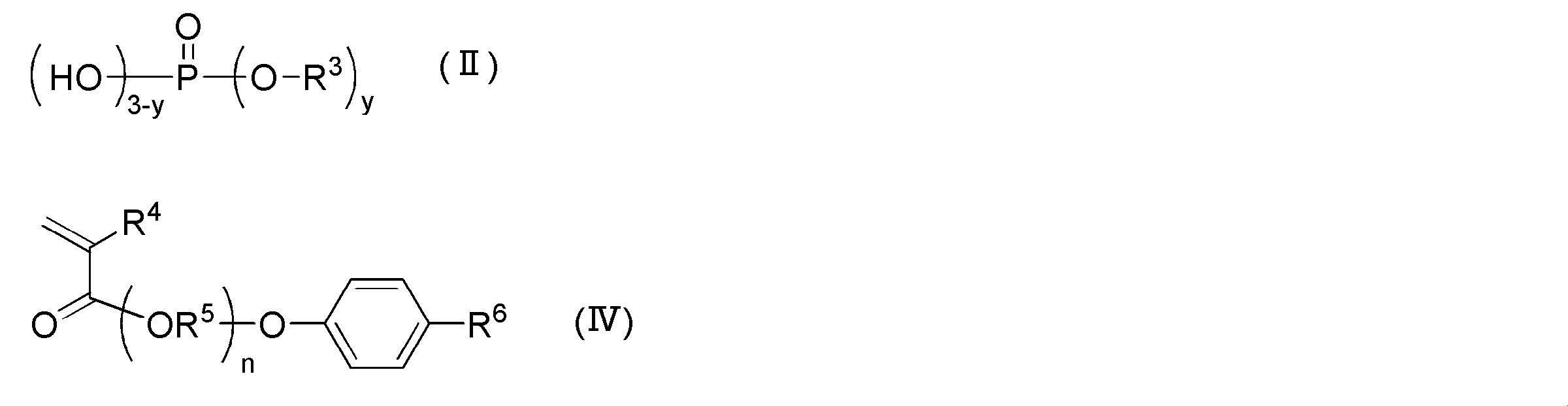
一般式(IV)中、R4は水素原子またはメチル基を表し、R5は炭素数2または3のアルキレン基を表し、R6は水素原子またはベンゼン環を含んでいても良い炭素数1~20のアルキル基を表し、nは1~15の整数を表す;
nが2以上の場合、複数のR5は、それぞれ、同一であってもよく、異なっていてもよい。
<2>上記(B)塩基性色素誘導体が、アミノ基を有する化合物である、<1>に記載の着色感光性樹脂組成物。
<3>上記(A)顔料が、赤色顔料、緑色顔料および黄色顔料からなる群から選ばれる、<1>または<2>に記載の着色感光性樹脂組成物。
<4>上記一般式(II)中、上記R3で表されるポリエステル構造の数平均分子量が1900~10000である、<1>~<3>のいずれかに記載の着色感光性樹脂組成物。
<5>上記一般式(II)中、上記R3で表されるポリエステル構造が2種以上の異なるラクトンモノマーを開環重合して得られるポリエステル構造である、<1>~<4>のいずれかに記載の着色感光性樹脂組成物。
<6>さらに、(G)側鎖に重合性二重結合を有する樹脂を含む、<1>~<5>のいずれかに記載の着色感光性樹脂組成物。
<7>上記(G)側鎖に重合性二重結合を有する樹脂が、2~6の水酸基を有する重合性モノマー(p)と、他の重合性モノマー(q)との共重合体(a)に、水酸基と反応可能な官能基とエチレン性不飽和二重結合を有する化合物(b)を反応させてなる樹脂である、<6>に記載の着色感光性樹脂組成物。
<8>上記(D)一般式(IV)で表される化合物(x)とエチレン性不飽和二重結合を有する化合物(y)を共重合してなる樹脂の含有量が、上記(A)顔料100質量部に対して5~80質量部である、<1>~<7>のいずれかに記載の着色感光性樹脂組成物。
<9>上記着色感光性樹脂組成物が、上記(A)顔料、上記(B)塩基性色素誘導体、および上記(C)一般式(II)で表されるリン酸系分散剤を分散させた後、上記(D)一般式(IV)で表される化合物(x)とエチレン性不飽和二重結合を有する化合物(y)を共重合してなる樹脂を配合してなる、<1>~<8>のいずれかに記載の着色感光性樹脂組成物。
<10>カラーフィルタの着色領域形成に用いられる<1>~<9>のいずれかに記載の着色感光性樹脂組成物。
<11><1>~<10>のいずれかに記載の着色感光性樹脂組成物を硬化してなる硬化膜。
<12><1>~<10>のいずれかに記載の着色感光性樹脂組成物を支持体上に適用して着色感光性組成物層を形成する工程と、上記着色感光性組成物層をパターン状に露光する工程と、未露光部を現像除去して着色パターンを形成する工程とを含むカラーフィルタの製造方法。
<13><1>~<10>のいずれかに記載の着色感光性樹脂組成物を支持体上に適用して着色感光性組成物層を形成する工程、
上記着色感光性組成物層上にフォトレジスト層を形成する工程、
露光および現像することにより上記フォトレジスト層をパターニングしてレジストパターンを得る工程、および
上記レジストパターンをエッチングマスクとして上記着色感光性組成物層をドライエッチングする工程を含む、カラーフィルタの製造方法。
<14><11>に記載の硬化膜を有するカラーフィルタ。
<15><12>または<13>に記載のカラーフィルタの製造方法によって製造したカラーフィルタ。
<16><14>または<15>に記載のカラーフィルタを有する固体撮像素子。
<17><14>または<15>に記載のカラーフィルタを有する画像表示装置。
本明細書において、全固形分とは、着色感光性樹脂組成物の全組成から溶剤を除いた成分の総質量をいう。
また、本明細書中における「放射線」とは、例えば、水銀灯の輝線スペクトル、エキシマレーザーに代表される遠紫外線、極紫外線(EUV光)、X線、電子線等を意味する。また、本発明において光とは、活性光線または放射線を意味する。本明細書中における「露光」とは、特に断らない限り、水銀灯、エキシマレーザーに代表される遠紫外線、X線、EUV光などによる露光のみならず、電子線、イオンビーム等の粒子線による描画も露光に含める。
また、本明細書において、“単量体”と“モノマー”とは同義である。本明細書における単量体は、オリゴマーおよびポリマーと区別され、重量平均分子量が2,000以下の化合物をいう。本明細書において、重合性化合物とは、重合性官能基を有する化合物のことをいい、単量体であっても、ポリマーであってもよい。重合性官能基とは、重合反応に関与する基を言う。
重量平均分子量および数平均分子量は、ゲルパーミエーションクロマトグラフィー(GPC)により求めることができる。
本発明は、上記の状況に鑑みてなされたものであり、色特性に優れたな着色組成物を提供することを目的とする。
本明細書において、重量平均分子量および数平均分子量は、GPC測定によるポリスチレン換算値として定義される。本明細書において、重量平均分子量(Mw)及び数平均分子量(Mn)は、例えば、HLC-8220(東ソー(株)製)を用い、カラムとしてTSKgel Super AWM―H(東ソー(株)製、6.0mmID×15.0cmを、溶離液として10mmol/L リチウムブロミドNMP(N-メチルピロリジノン)溶液を用いることによって求めることができる。
本発明の着色感光性樹脂組成物(以下、「本発明の組成物」、「着色組成物」ということがある)は、(A)顔料、(B)塩基性色素誘導体、(C)下記一般式(II)で表されるリン酸系分散剤、(D)下記一般式(IV)で表される化合物(x)とエチレン性不飽和二重結合を有する化合物(y)を共重合してなる樹脂、(E)光重合開始剤、および(F)重合性化合物を含有することを特徴とする。
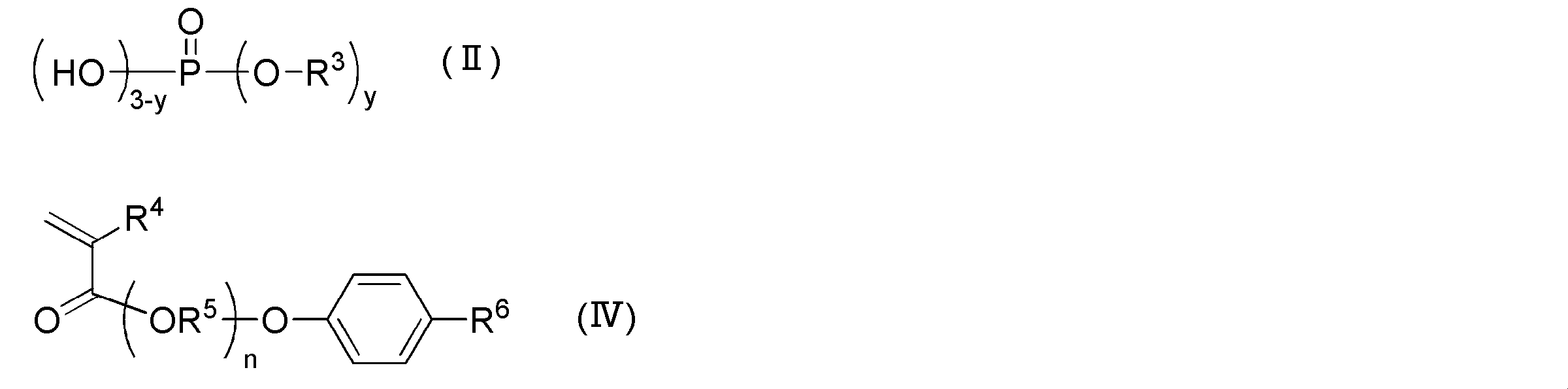
一般式(IV)中、R4は水素原子またはメチル基を表し、R5は炭素数2または3のアルキレン基を表し、R6は水素原子またはベンゼン環を含んでいても良い炭素数1~20のアルキル基を表し、nは1~15の整数を表す。nが2以上の場合、複数のR5は、それぞれ、同一であってもよく、異なっていてもよい。
(C)一般式(II)で表されるリン酸系分散剤と、(D)一般式(IV)で表される化合物(x)とエチレン性不飽和二重結合を有する化合物(y)を共重合してなる樹脂とを併用すると、(C)一般式(II)で表されるリン酸系分散剤は、顔料粒子に対して分散剤が強力に吸着し、組成物の経時に伴うザラの悪化を抑制する効果が得られたものと推定される。また、(D)一般式(IV)で表される化合物(x)とエチレン性不飽和二重結合を有する化合物(y)を共重合してなる樹脂が相溶化剤として機能し、組成物を構成する各成分が塗布後の引き置き(PCD)過程で相分離を起こすのが抑制されたためと推定される。これにより、本発明は、色ムラ(ザラ)やザラツキの経時安定性、さらにPCD後のパターン形成性に優れるようになると考えられる。
以下、本発明の組成物について詳細に説明する。
本発明の組成物は、(A)顔料を有する。本発明で使用する顔料としては、赤色顔料、緑色顔料および黄色顔料からなる群から選ばれることが好ましく、従来公知の種々の無機顔料または有機顔料を用いることができる。上記顔料としては、高透過率であることが好ましい。
C.I.ピグメントイエロー11,24,31,53,83,93,99,108,109,110,138,139,147,150,151,154,155,167,180,185,199,;
C.I.ピグメントオレンジ36,38,43,71;
C.I.ピグメントレッド81,105,122,149,150,155,171,175,176,177,209,220,224,242,254,255,264,270;
C.I.ピグメントバイオレット19,23,32,39;
C.I.ピグメントブルー1,2,15,15:1,15:3,15:6,16,22,60,66;
C.I.ピグメントグリーン7,36,37,58;
C.I.ピグメントブラウン25,28;
C.I.ピグメントブラック1;等を挙げることができる。
C.I.ピグメントオレンジ36,71,
C.I.ピグメントレッド122,150,171,175,177,209,224,242,254,255,264,
C.I.ピグメントバイオレット19,23,32,
C.I.ピグメントブルー15:1,15:3,15:6,16,22,60,66,
C.I.ピグメントグリーン7,36,37,58;
C.I.ピグメントブラック1
一般式(A2)
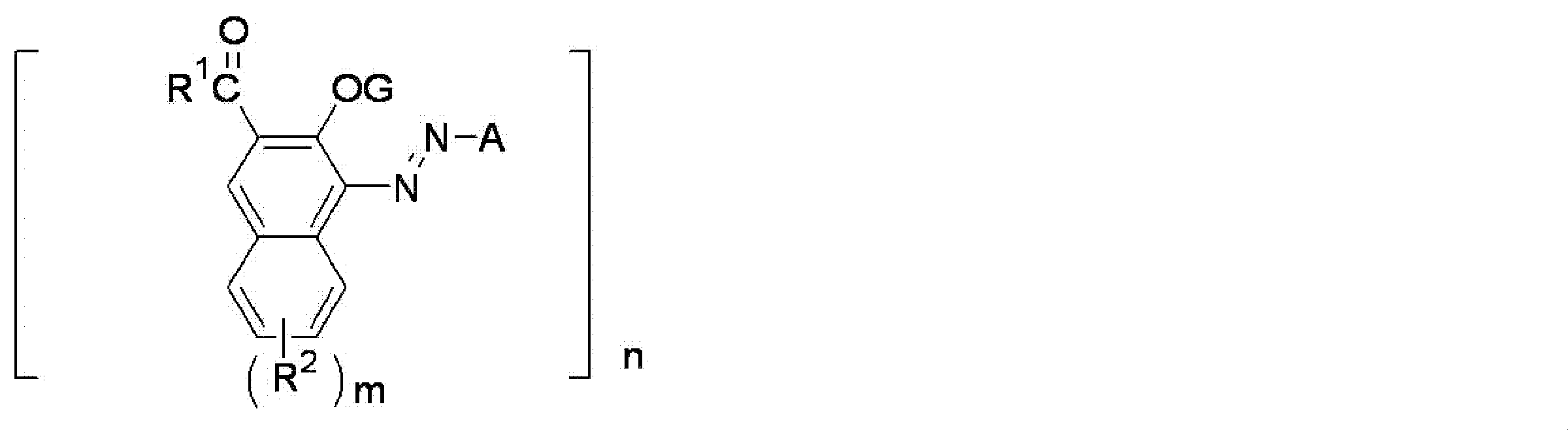
Aは、窒素原子、酸素原子および硫黄原子から選択される少なくとも1つ以上の原子を有する複素環を表す。
mは0~5の整数を表し、nは1~4の整数を表す。
n=2の場合は、R1、R2、AまたはGを介した2量体を表す。
n=3の場合はR1、R2、AまたはGを介した3量体を表す。
n=4の場合はR1、R2、AまたはGを介した4量体を表す。
一般式(A2)がイオン性親水性基を有することはない。
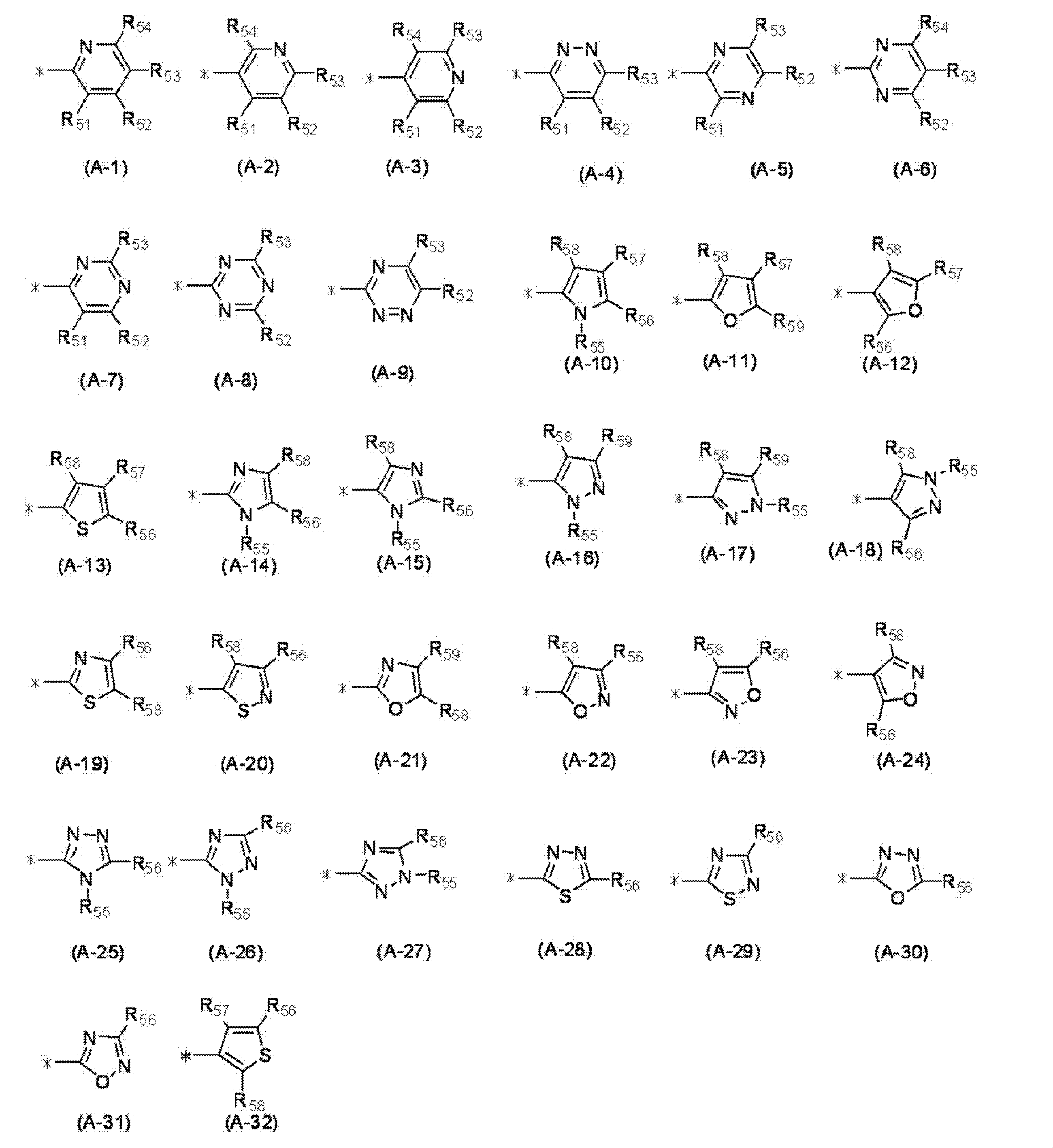
・650nm~750nmの波長領域における透過率が高い。
・540nm以上の波長領域において、透過率曲線がシャープに立ち上がる。
・540nm未満の波長領域(特に、350nm~400nm)における透過率が低い。
Gで表される脂肪族基が有していてもよい好ましい置換基としては、ヒドロキシ基、脂肪族オキシ基、カルバモイル基、脂肪族オキシカルボニル基、脂肪族チオ基、アミノ基、脂肪族アミノ基、アシルアミノ基、カルバモイルアミノ基である。
Gで表される脂肪族基として、好ましくは総炭素原子数1~8の脂肪族基であり、より好ましくは総炭素原子数1~6のアルキル基であり、例えばメチル、エチル、シクロヘキシル等が挙げられる。
Gとして好ましくは、水素原子である。これは分子内水素結合又は分子内交差水素結合を形成しやすくなるためである。
これらの置換基は、更に置換基を有していてもよく、その置換基としては、脂肪族基、ヒドロキシ基、アミド結合、エーテル結合、オキシカルボニル結合、チオエーテル結合等を有する置換基が好ましく、ヘテロ原子と水素原子の結合を有する置換基が、分子間水素結合等の分子間相互作用をし易くする観点でより好ましい。
R1で表されるアミノ基として、好ましくは無置換のアミノ基、総炭素原子数1~10のアルキルアミノ基、総炭素原子数2~10のジアルキルアミノ基(ジアルキル基が互いに結合し、5~6員環を形成していても良い)、総炭素原子数6~12のアリールアミノ基、総炭素原子数2~12の飽和であっても、不飽和であってもよいヘテロ環アミノ基であり、より好ましくは、無置換のアミノ基、総炭素原子数1~8のアルキルアミノ基、総炭素原子数2~8のジアルキルアミノ基、総炭素原子数6~10のアリールアミノ基、総炭素原子数2~12の飽和であっても、不飽和であってもよいヘテロ環アミノ基であり、例えばメチルアミノ、N,N-ジメチルアミノ、N-フェニルアミノ、N-(2-ピリミジル)アミノ等が挙げられる。
更に好ましくは、総炭素原子数6~13のアリールアミノ基及び総炭素原子数2~12の飽和であっても、不飽和であってもよいヘテロ環アミノ基である。
R1がアリールアミノ基の場合、アリール基上の置換基が、アミノ基との結合位置からパラ位に置換基を有する場合が好ましく、パラ位にのみ置換基を有する場合が最も好ましい。その置換基としては、前述の置換基の項で述べた基で置換可能な基であればなんでも良く、好ましくは、総炭素原子数1~7、より好ましくは総炭素原子数1~4の脂肪族基(例えばメチル、エチル、アリル、(i)-プロピル、(t)-ブチル等)、総炭素原子数1~7の脂肪族オキシ基(例えばメトキシ、エトキシ、(i)-プロピルオキシ、アリルオキシ等)、ハロゲン原子(例えばフッ素、塩素、臭素等)、総炭素原子数1~7のカルバモイル基(例えばカルバモイル、N-フェニルカルバモイル、N-メチルカルバモイル等)、総炭素原子数1~7、より好ましくは総炭素原子数1~4のウレイド基(例えばウレイド、N-メチルウレイド、N,N-ジメチルウレイド、N-4-ピリジルウレイド、N-フェニルウレイド等)、ニトロ基、総炭素原子数1~7のアリール基と縮環したヘテロ環(例えばイミダゾロン)、ヒドロキシ基、総炭素原子数1~7、より好ましくは総炭素原子数1~4の脂肪族チオ基(例えばメチルチオ、エチルチオ、(i)-プロピルチオ、アリルチオ、(t)-ブチルチオ等)、総炭素原子数2~7、より好ましくは総炭素原子数2~4のアシルアミノ基(例えばアセトアミノ、プロピオニルアミノ、ピバロイルアミノ、ベンゾイルアミノ等)、総炭素原子数2~7、より好ましくは総炭素原子数2~4の脂肪族オキシカルボニルアミノ基(例えばメトキシカルボニルアミノ、プロピルオキシカルボニルアミノ等)、総炭素原子数2~7、より好ましくは総炭素原子数2~4の脂肪族オキシカルボニル基(例えばメトキシカルボニル、エトキシカルボニル等)、総炭素原子数2~7、より好ましくは総炭素原子数2~4のアシル基(脂肪族カルボニル基であっても、アリールカルボニル基であっても、ヘテロ環カルボニル基であってもよく、置換基を有していてもよく、置換してもよい基としては、前述の置換基の項で述べた基で、置換可能な基であれば何でもよい。好ましくは総炭素原子数2~7のアシル基であり、より好ましくは総炭素原子数2~4のアシル基であり、例えばアセチル、プロパノイル、ベンゾイル、3-ピリジンカルボニル等が挙げられる。)等が挙げられる。
アリールアミノ基のアリール基上の置換基が、アミノ基との結合位置からパラ位に置換した場合、置換基が分子の末端にあるために、分子間水素結合等の分子間相互作用をし易く、そのために色相がシャープになる。アリール基上の置換基が更に置換基を有する場合は、脂肪族基、ヒドロキシ基、アミド結合、エーテル結合、オキシカルボニル結合、チオエーテル結合等を有する置換基が好ましく、ヘテロ原子と水素原子の結合を有する置換基が、分子間水素結合等の分子間相互作用をし易くする観点でより好ましい。
R1がヘテロ環アミノ基の場合、その置換基としては、前述の置換基の項で述べた基で置換可能な基であればなんでも良く、好ましくは、上記アリールアミノ基の場合と同じ置換基が好ましいが、ヘテロ環基上の置換基が更に置換基を有する場合は、脂肪族基、ヒドロキシ基、アミド結合、エーテル結合、オキシカルボニル結合、チオエーテル結合等を有する置換基が好ましく、ヘテロ原子と水素原子の結合を有する置換基が、分子間水素結合等の分子間相互作用をし易くする観点でより好ましい。
R1として好ましくは、アミノ基の場合である。
これらの置換基が更に置換基を有する場合は、脂肪族基、ヒドロキシ基、アミド結合、エーテル結合、オキシカルボニル結合、チオエーテル結合等を有する置換基が好ましく、ヘテロ原子と水素原子の結合を有する置換基が、分子間水素結合等の分子間相互作用をし易くする観点でより好ましい。
nは1又は2である場合が好ましい。
本発明の効果の点で、R55として好ましい、窒素原子との結合部位の隣接位に窒素原子を含有する芳香族5~6員ヘテロ環基としては、置換基を有していてもよく、置換してもよい基としては、前述の置換基の項で述べた基で、置換可能な基であれば何でもよい。好ましい置換基としては、ヒドロキシ基、脂肪族オキシ基、カルバモイル基、脂肪族オキシカルボニル基、脂肪族チオ基、アミノ基、脂肪族アミノ基、アシルアミノ基、カルバモイルアミノ基であり、飽和ヘテロ環であっても不飽和ヘテロ環であっても、縮環ヘテロ環であってもよく、好ましくは総炭素原子数2~12の窒素原子との結合部位の隣接位に窒素原子を含有する芳香族5~6員ヘテロ環基であり、より好ましくは総炭素原子数2~10の窒素原子との結合部位の隣接位に窒素原子を含有する芳香族5~6員ヘテロ環基である。例えば、2-チアゾリル、2-ベンゾチアゾリル、2-オキサゾリル、2-ベンゾオキサゾリル、2-ピリジル、2-ピラジニル、3-ピリダジニル、2-ピリミジニル、4-ピリミジニル、2-イミダゾリル、2-ベンズイミダゾリル、2-トリアジニル等が挙げられ、これらのヘテロ環基は置換基と共に互変異性体構造であってもよい。
本発明の効果の点で、R55として好ましい脂肪族基としては、置換基を有していてもよく、置換してもよい基としては、前述の置換基の項で述べた基で、置換可能な基であれば何でもよく、好ましい置換基としては、ヒドロキシ基、ニトロ基、脂肪族オキシ基、カルバモイル基、脂肪族オキシカルボニル基、脂肪族チオ基、アミノ基、脂肪族アミノ基、アシルアミノ基、カルバモイルアミノ基である。R55の脂肪族基として、好ましくは総炭素原子数1~6のアルキル基であり、より好ましくは総炭素原子数1~4の脂肪族基であり、例えばメチル、エチル、メトキシエチル、カルバモイルメチル等が挙げられ、メチル基が好ましい。
におけるG11は5~6員ヘテロ環を構成する事ができる非金属原子群を表し、G11で表されるヘテロ環は無置換であっても、置換基を有していてもよく、ヘテロ環は単環であっても縮環していてもよい。式(Y-1)~(Y-13)は置換基と共に互変異性体構造であってもよい。
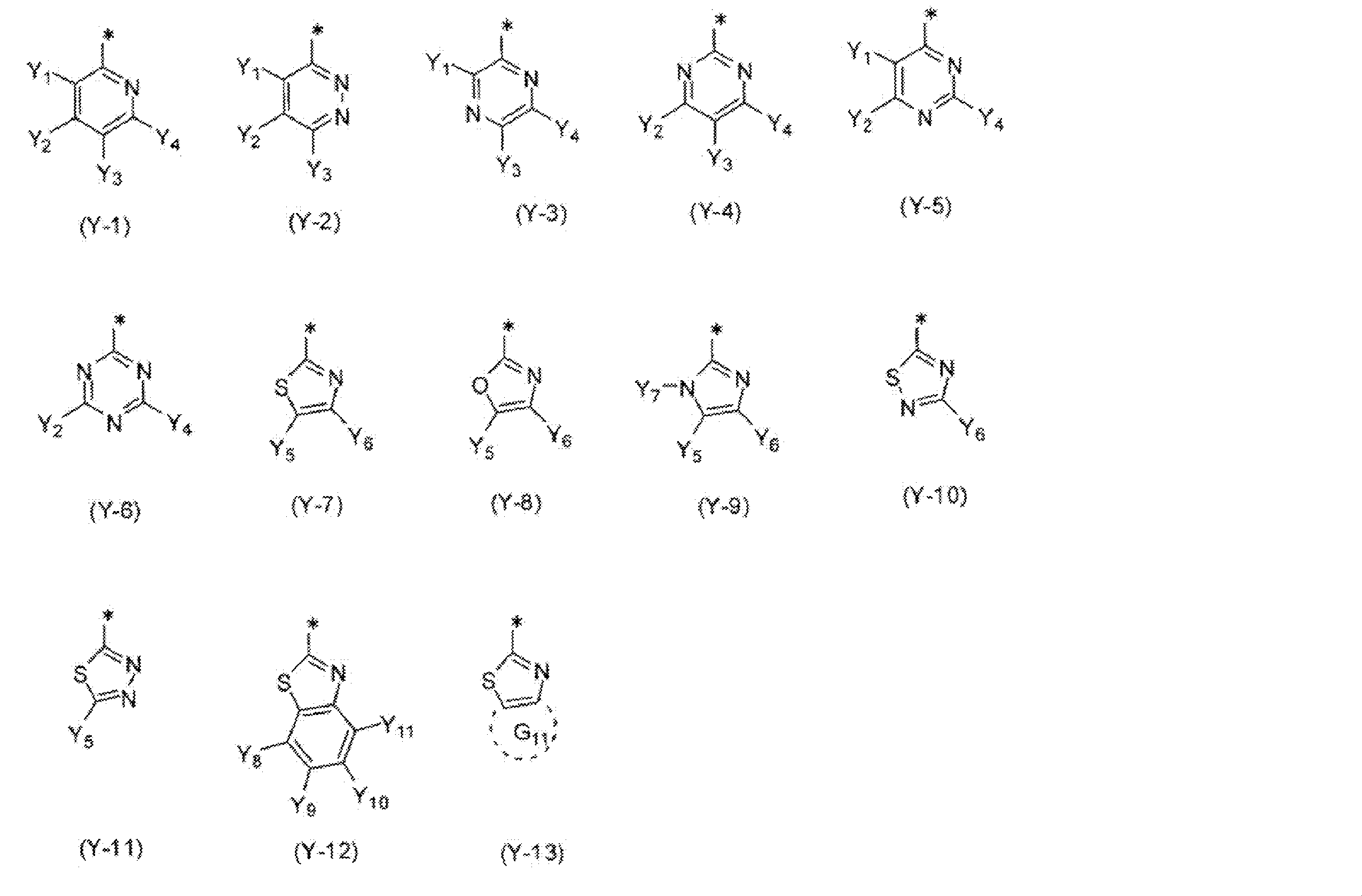
本発明の効果の点でY1~Y11は水素原子、脂肪族基、アリール基、ヘテロ環基、脂肪族オキシカルボニル基、カルバモイル基、アシルアミノ基、スルホンアミド基、脂肪族オキシ基、脂肪族チオ基、シアノ基等である場合が好ましく、水素原子、脂肪族基、脂肪族オキシカルボニル基、カルバモイル基、脂肪族オキシ基、シアノ基である場合はより好ましい。
本発明の効果の点で、一般式(A2)中のAは、色相の点から5員環ヘテロ環である場合が好ましく、含窒素あるいは含硫黄5員ヘテロ環である場合がより好ましく、ヘテロ原子を2個以上含有する5員ヘテロ環である場合は更に好ましい。
また、本発明の効果の点で、R58として、上記(Y-1)~(Y-13)である場合も好ましく、分子内水素結合構造をとり易い構造にするために6員環の下記(Y-1)~(Y-6)のいずれかである場合がより好ましく、上記(Y-1)、(Y-3)、(Y-4)、(Y-6)のいずれかである場合が更に好ましく、上記(Y-1)、又は(Y-4)である場合が特に好ましい。
一般式(A2)中のAとして挙げられた(A-1)~(A-32)の複素環の中でも、アゾ基に結合する炭素原子に隣接する原子がヘテロ原子であれば、光堅牢性、熱堅牢性が高くなる傾向があり、このような構造的特徴を有する顔料をカラーフィルタに用いることで、高いコントラストを示すカラーフィルタを得ることができるため好ましい。
より好ましくは、Gが水素原子であって、R1がアミノ基、又は窒素原子で結合した飽和ヘテロ環基であって、mが0又は1であって、mが1の場合は、R2が脂肪族オキシカルボニル基、カルバモイル基、又は脂肪族オキシ基であって、Aが、(A-1)、(A-10)、(A-11)、(A-13)~(A-17)、(A-20)、(A-22)~(A-23)、(A-27)、(A-28)、(A-30)~(A-32)のいずれかであって、nが1又は2である場合である。
さらに好ましくは、Gが水素原子であって、R1がアミノ基、又は窒素原子で結合した飽和ヘテロ環基であって、mが0であって、Aが、(A-10)、(A-11)、(A-13)~(A-17)、(A-20)、(A-22)~(A-23)、(A-27)、(A-28)、(A-30)~(A-32)のいずれかであって、nが1又は2である場合である。
特に好ましくは、Gが水素原子であって、R1がアミノ基であって、mが0であって、Aが、(A-16)~(A-17)、(A-20)、(A-28)、(A-32)のいずれかであって、nが1又は2である場合が特に好ましく、Gが水素原子であって、R1がアミノ基であって、mが0であって、Aが(A-16)であってnが1又は2である場合である。
一般式(A3)で表されるアゾ顔料は、ZあるいはR55とナフタレン環のヒドロキシ基と、アゾ基で交叉水素結合を形成し、顔料構造の平面性を上げ、分子内、分子間相互作用が強くなり、その結果、光堅牢性、熱堅牢性、耐溶剤性等が大幅に向上するため好ましい。
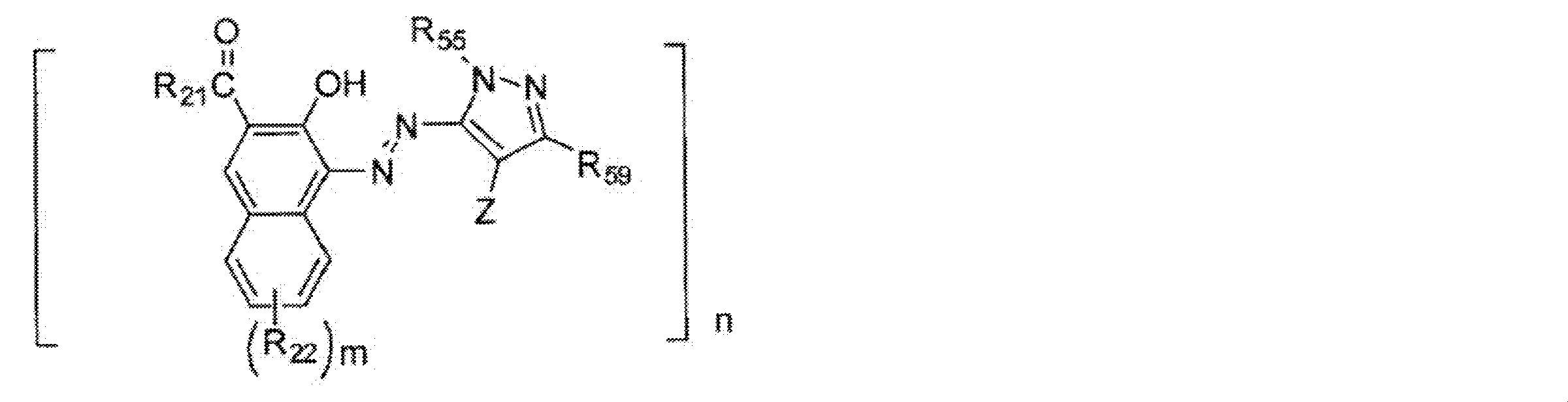
本発明の効果の点で、Zとしては、アシル基、カルバモイル基、アルキルオキシカルボニル基、シアノ基、アルキルスルホニル基、スルファモイル基が好ましく、カルバモイル基、アルキルオキシカルボニル基、シアノ基がより好ましく、シアノ基である場合が特に好ましい。
より好ましくは、R21が置換基を有していてもよいアミノ基であって、mが0であって、R55が、(Y-1)~(Y-13)のいずれかであって、R59が水素原子又は脂肪族基であって、Zがカルバモイル基、アルキルオキシカルボニル基、又はシアノ基であって、nが1又は2である場合である。
さらに好ましくは、R21が置換基を有していてもよいアミノ基であって、mが0であって、R55が、(Y-1)~(Y-6)のいずれかであって、R59が水素原子又は脂肪族基であって、Zがカルバモイル基、アルキルオキシカルボニル基、又はシアノ基であって、nが1又は2である場合である。
特に好ましくは、R21が置換基を有していてもよいアミノ基であって、mが0であって、R55が、(Y-1)、(Y-4)、又は(Y-6)であって、R59が水素原子であって、Zがシアノ基であって、nが1又は2である場合である。
例えば、一般式(A2)で表されるアゾ顔料には、下記一般式(A1’)で表されるアゾ-ヒドラゾンの互変異性体が考えられる。
本発明は、一般式(A2)で表されるアゾ顔料の互変異性体である以下の一般式(A1’)で表される顔料もその範囲に含むものである。

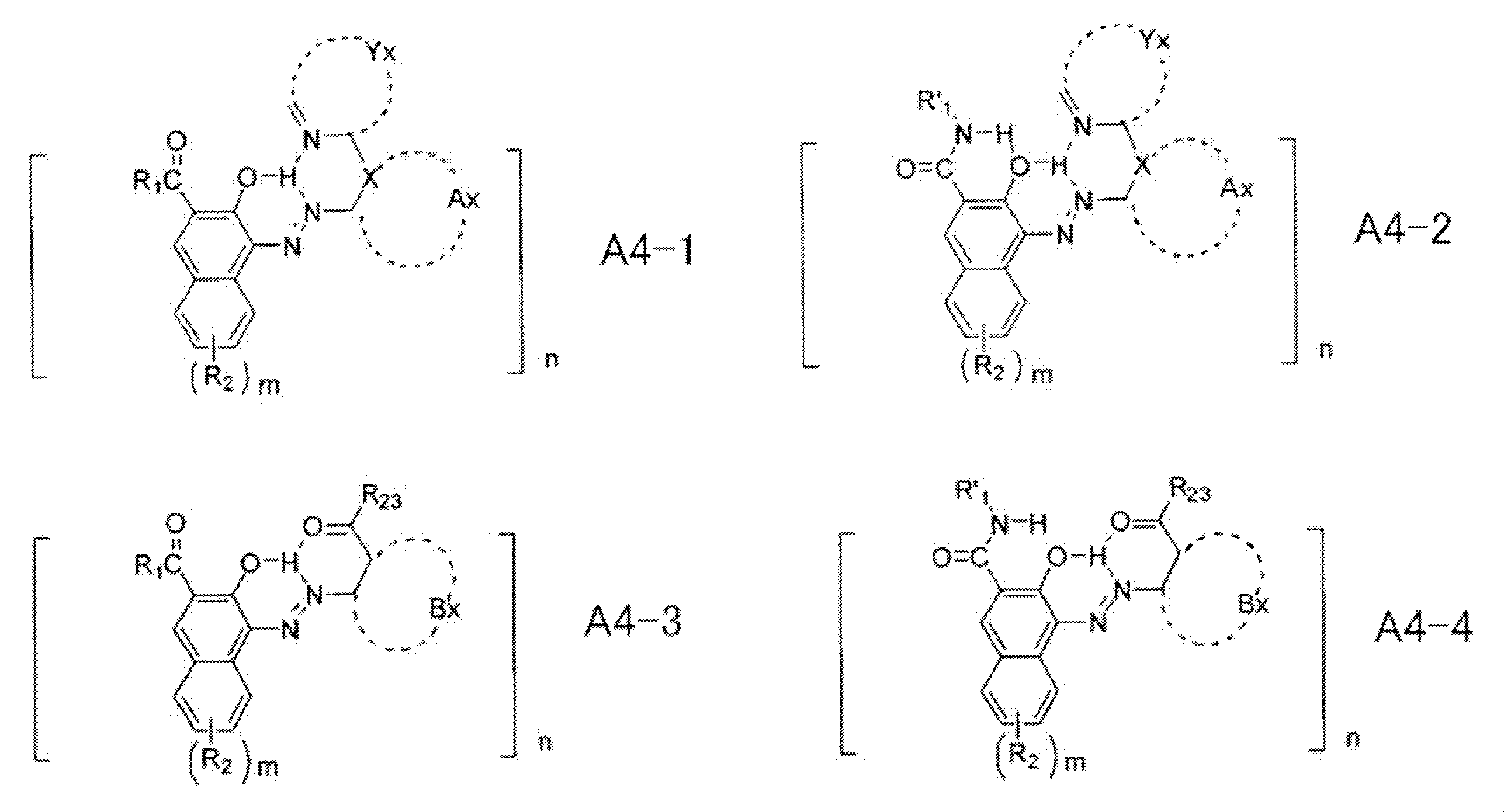
また、本発明において、一般式(A2)で表されるアゾ顔料は、分子内水素結合又は分子内交叉水素結合を形成する置換基を有することが好ましい。少なくとも1個以上の分子内水素結合を形成する置換基を有することがより好ましく、少なくとも1個以上の分子内交叉水素結合を形成する置換基を有することが特に好ましい。
その結果、分子の平面性が高まり、更に分子内・分子間相互作用が向上し、一般式(A4-1)~一般式(A4-4)で表されるアゾ顔料の結晶性が高くなり(高次構造を形成し易くなり)、顔料としての要求性能である、光堅牢性、熱安定性、湿熱安定性、耐水性、耐ガス性及び又は耐溶剤性が大幅に向上するため、更に好ましい例となる。
この観点からも、一般式(A2)で表されるアゾ顔料は、一般式(A3)、(A4-1)~(A4-4)で表される顔料であることが好ましく、一般式(A3)、(A4-1)又は(A4-2)で表される顔料がより好ましく、一般式(A3)で表されるアゾ顔料が特に好ましい。

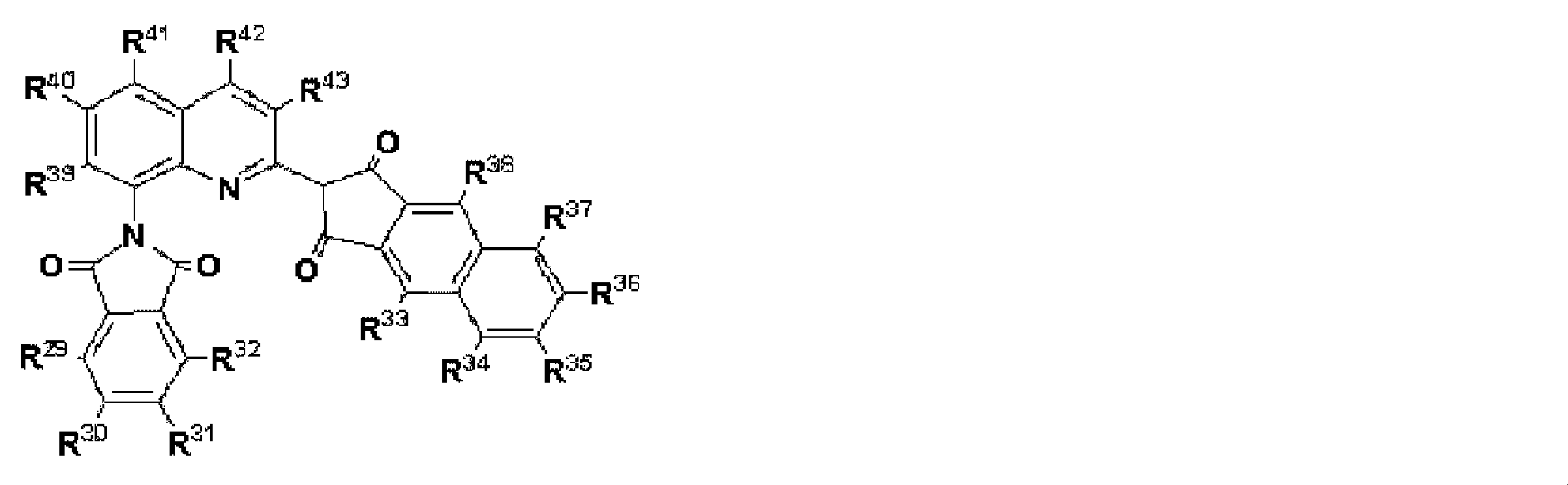


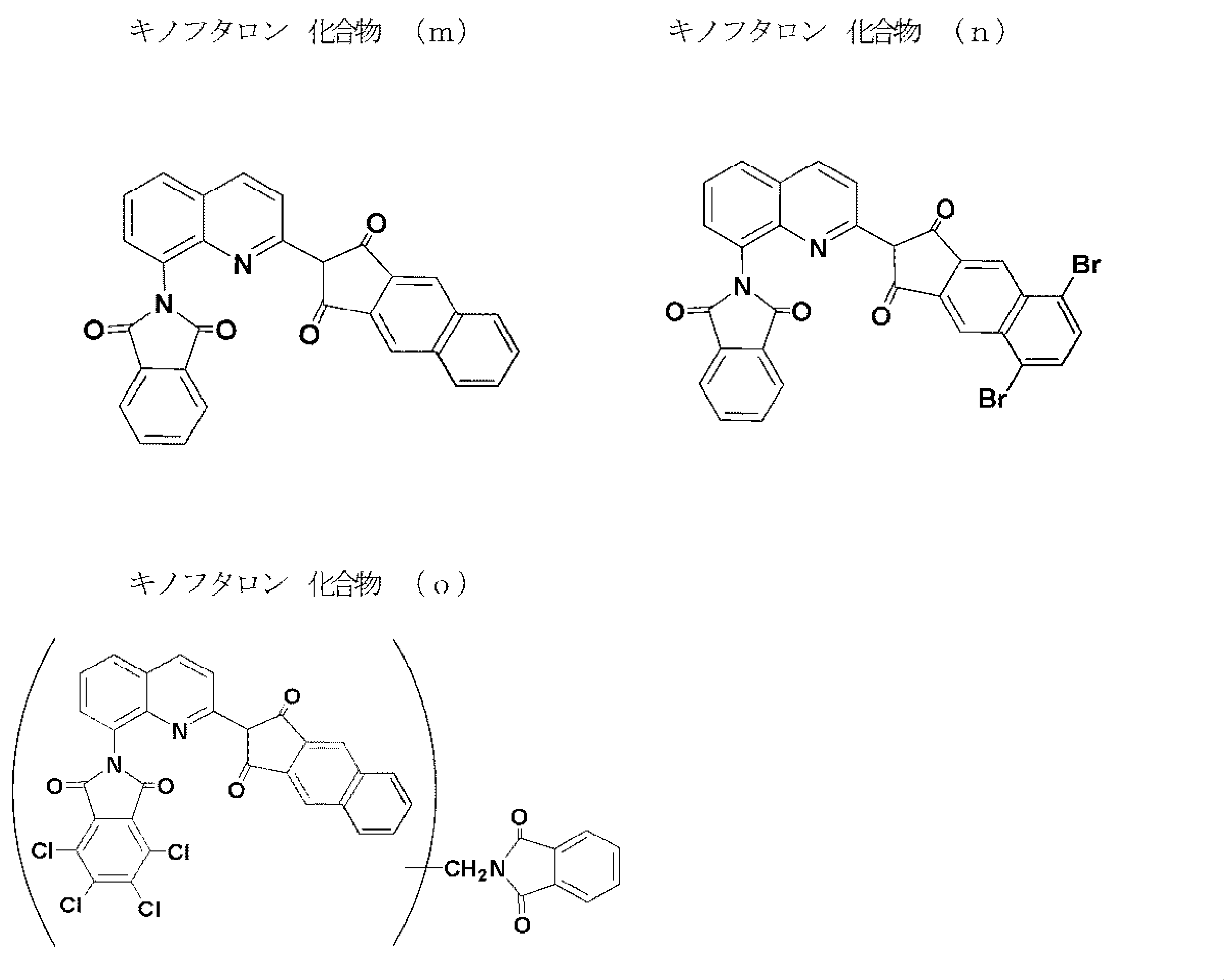
一般式(1)

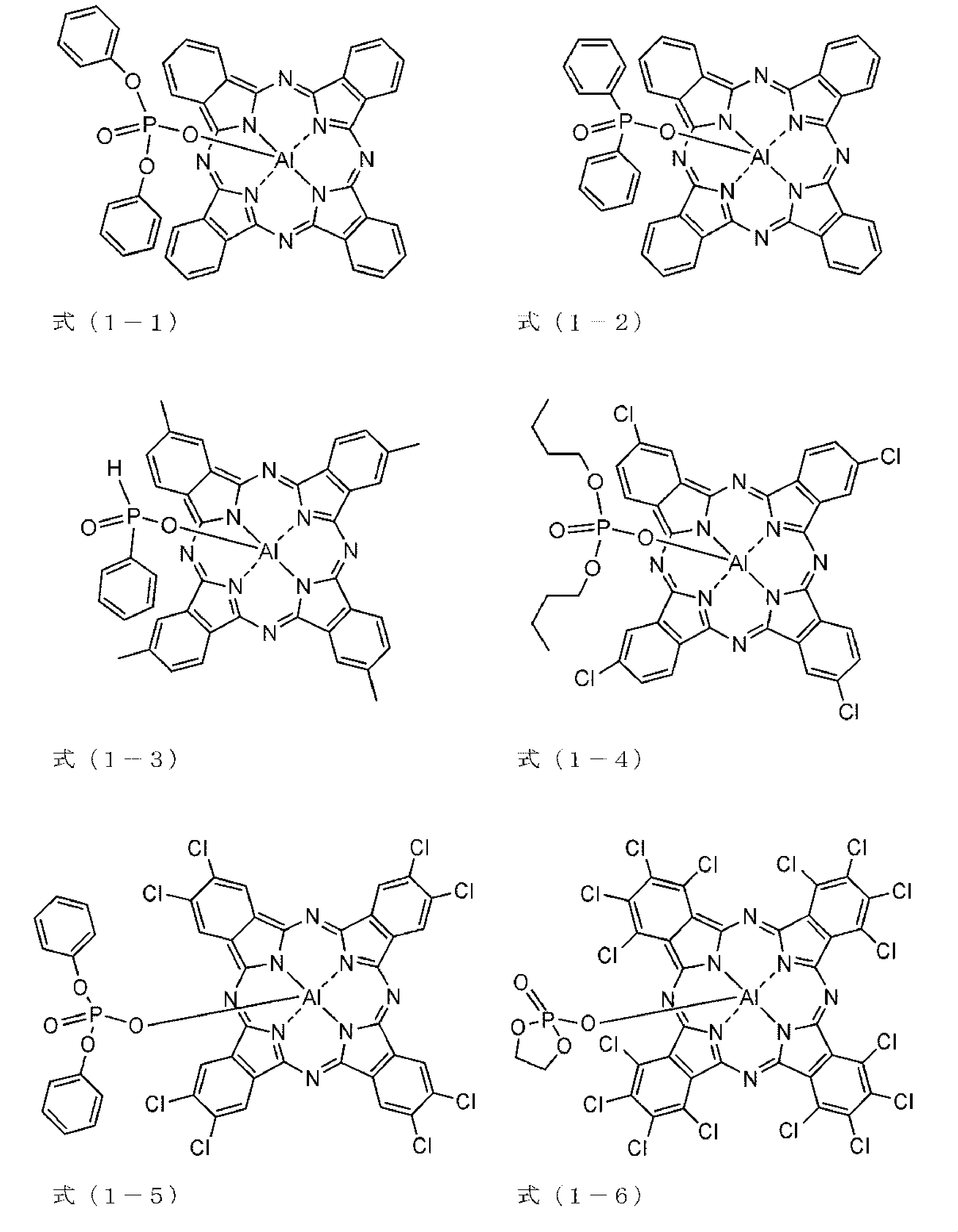


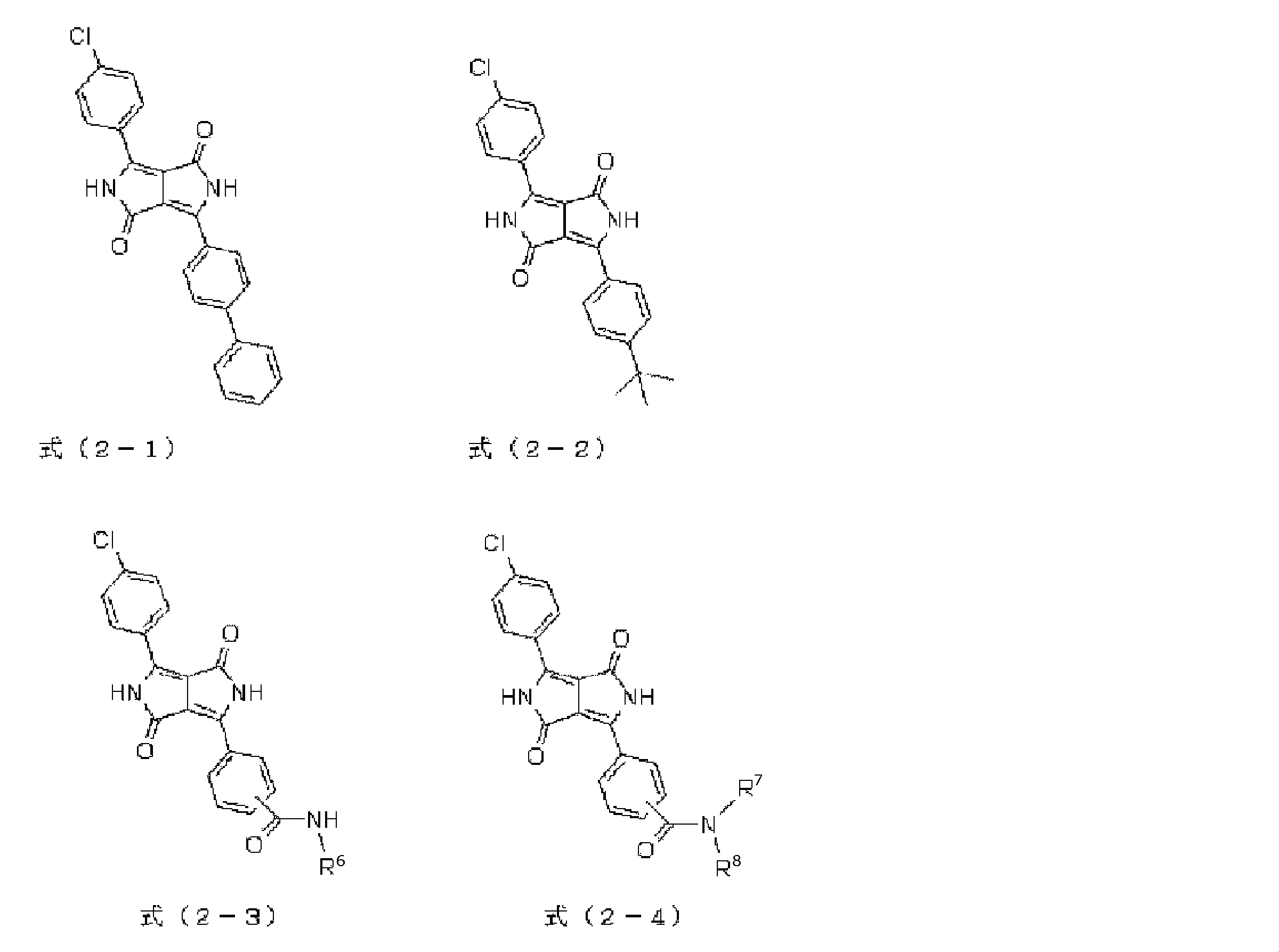


顔料の一次粒子サイズは、電子顕微鏡等の公知の方法で測定することができる。
また、本発明の組成物は、(A)顔料以外の公知の染料を含んでいてもよい。例えば特開昭64-90403号公報、特開昭64-91102号公報、特開平1-94301号公報、特開平6-11614号公報、特登2592207号、米国特許4808501号明細書、米国特許5667920号明細書、米国特許505950号明細書、特開平5-333207号公報、特開平6-35183号公報、特開平6-51115号公報、特開平6-194828号公報等に開示されている色素を使用できる。化学構造としては、ピラゾールアゾ系、ピロメテン系、アニリノアゾ系、トリフェニルメタン系、アントラキノン系、ベンジリデン系、オキソノール系、ピラゾロトリアゾールアゾ系、ピリドンアゾ系、シアニン系、フェノチアジン系、ピロロピラゾールアゾメチン系等の染料を使用できる。
また、染料としては色素多量体を用いてもよい。色素多量体としては、特開2011-213925号公報、特開2013-041097号公報に記載されている化合物が挙げられる。
顔料は、本発明の組成物中に1種のみ含まれていても良いし、2種以上含まれていても良い。2種類以上含む場合は、その合計量が上記範囲となることが好ましい。
本発明の組成物は、(B)塩基性色素誘導体を有する。塩基性色素誘導体としては、顔料の一部分を、塩基性基で置換した構造を有する化合物である。
塩基性色素誘導体としては、キノリン系、ベンズイミダゾロン系、イソインドリン系の塩基性色素誘導体が好ましく、ベンズイミダゾロン系の塩基性色素誘導体がさらに好ましい。
塩基性色素誘導体が有する塩基性基としては、アミノ基が好ましい。
中でも、塩基性色素誘導体としては、下記一般式(P1)または一般式(I)で表される色素誘導体であることが好ましい。

一般式(P1)中、Aは、X-Yとともにアゾ顔料を形成しうる成分を表す。上記Aは、ジアゾニウム化合物とカップリングしてアゾ顔料を形成しうる化合物であれば、任意に選択することができる。以下に、上記Aの具体例を示すが、本発明はこれらの具体例に何ら限定されるものではない。
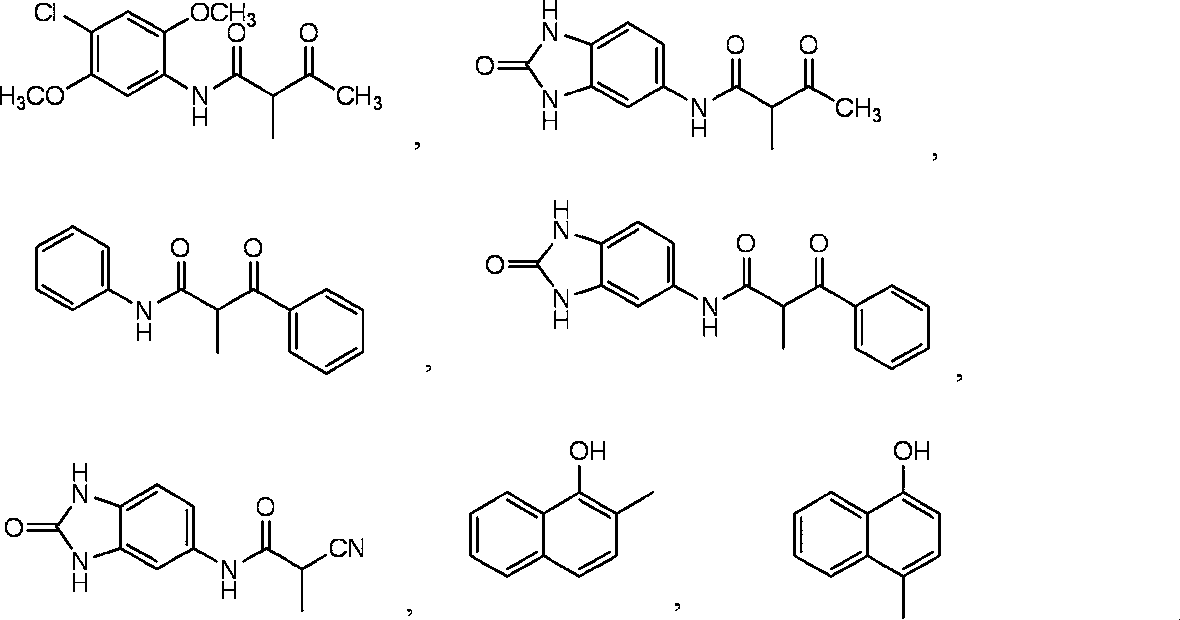
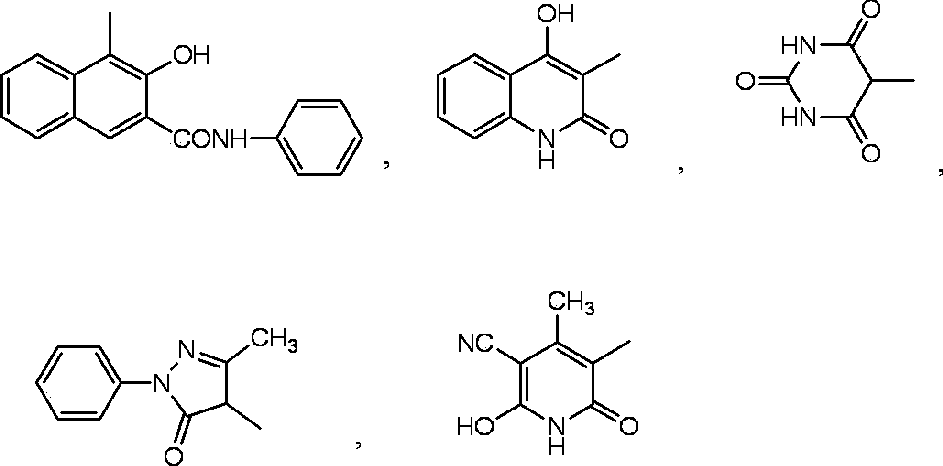
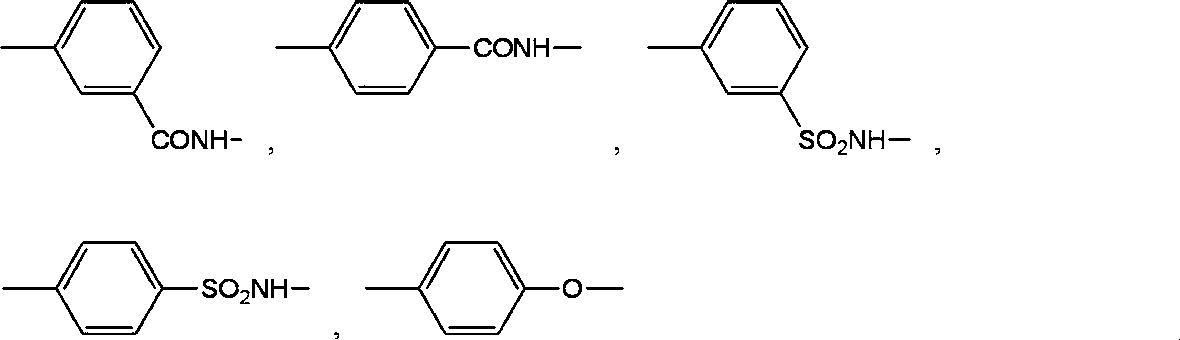



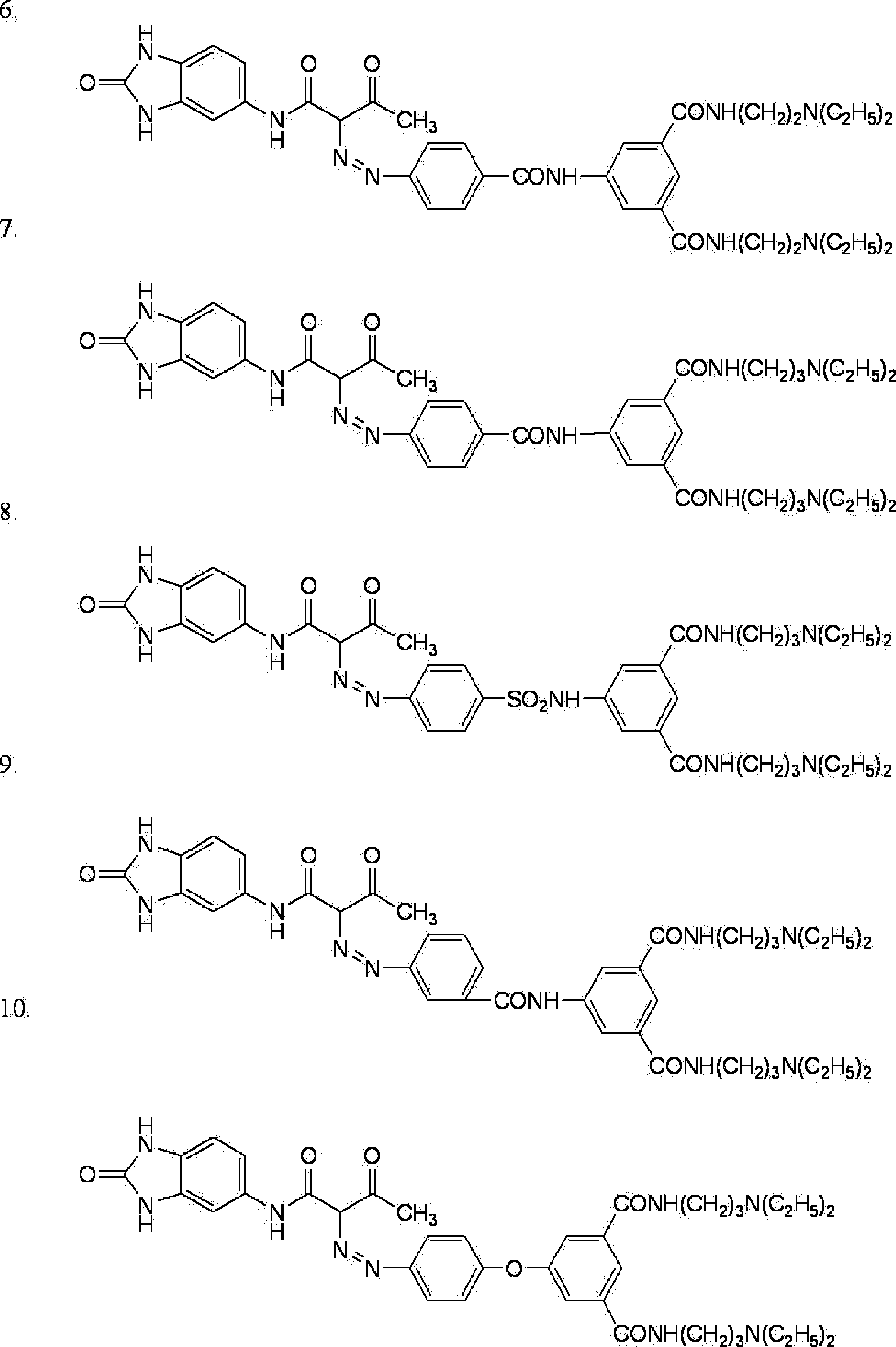
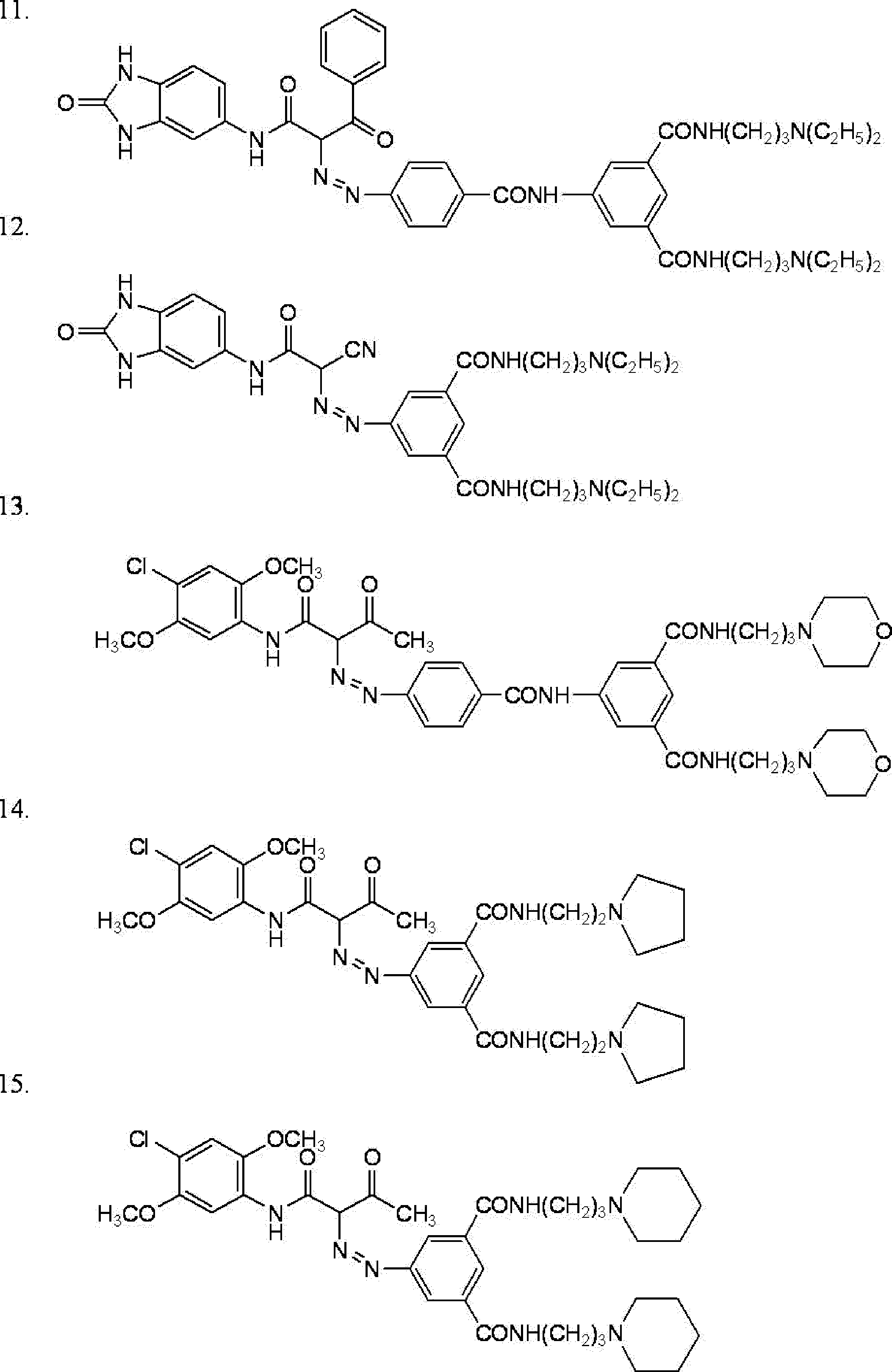
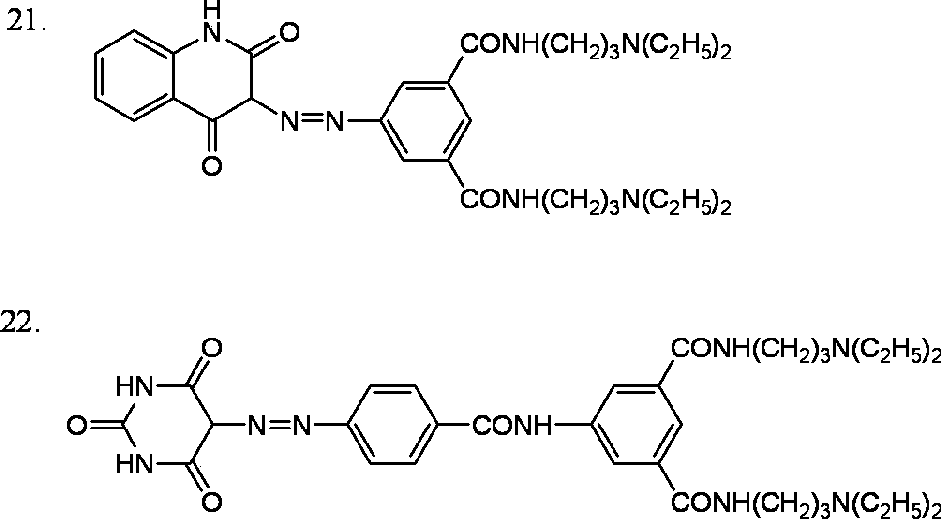


Dyeとしては、好ましくは顔料母核構造、又は顔料母核構造と芳香環、或いは含窒素芳香環、或いは含酸素芳香環、或いは含硫黄芳香環を有し、アミノ基は顔料母核構造、芳香環、含窒素芳香環、含酸素芳香環、含硫黄芳香環のいずれかに直接或いは連結基により結合されている。具体的には、キノリン系残基、ベンズイミダゾロン系残基、イソインドリン系残基、ジケトピロロピロール系残基、アゾ系残基、フタロシアニン系残基、アントラキノン系残基、キナクリドン系残基、ジオキサジン系残基、ペリノン系残基、ペリレン系残基、チオインジゴ系残基、イソインドリノン系残基、キノフタロン系残基、スレン系残基、金属錯体系残基等が挙げられる。


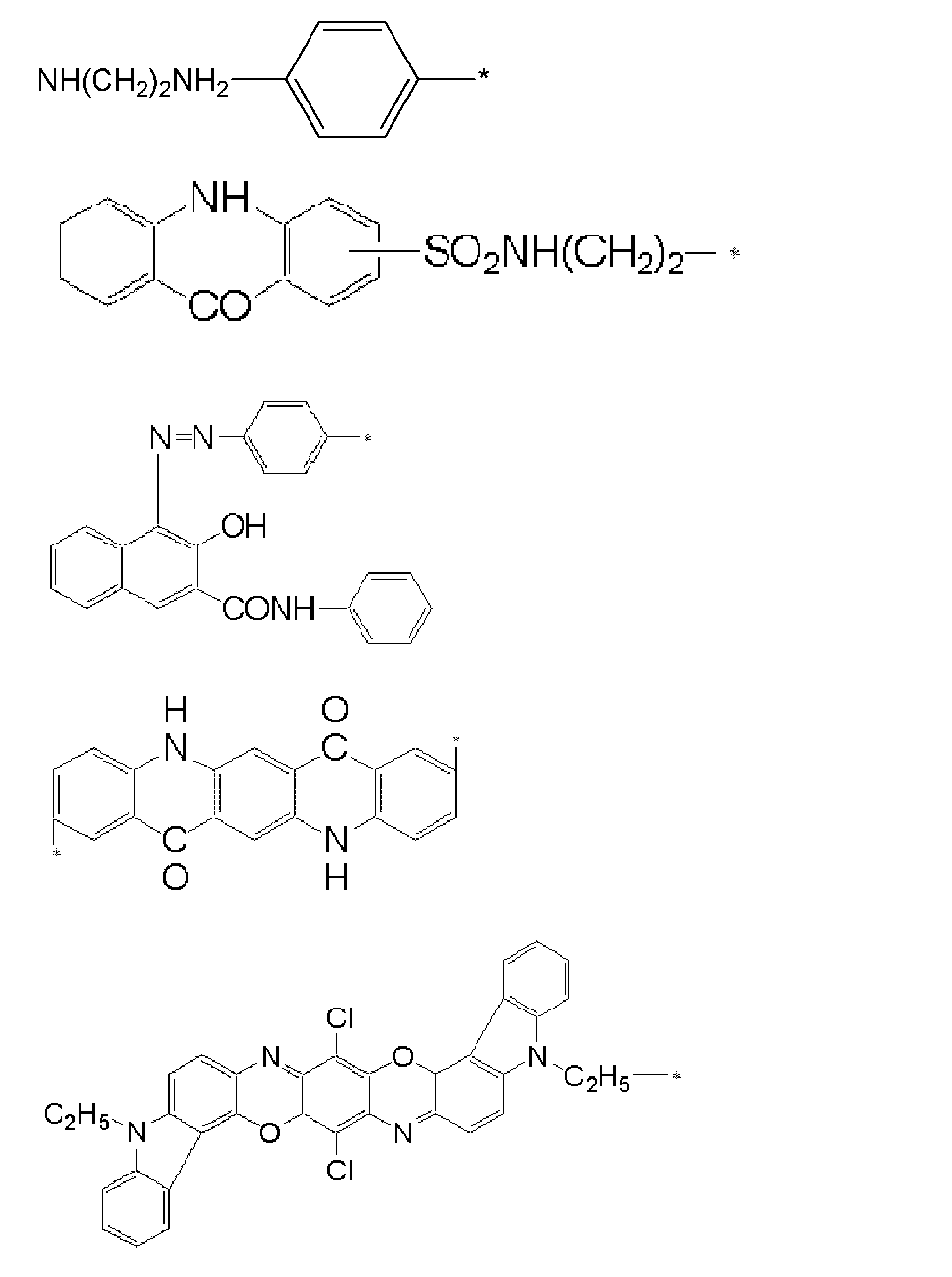
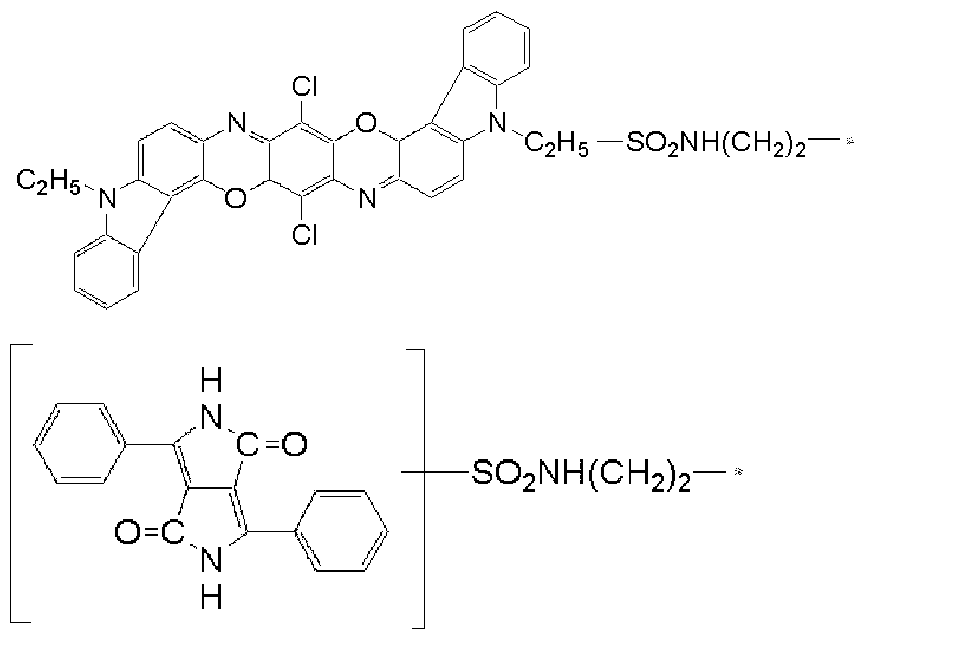
Y2は置換基を有していても良いアルキレン基またはアリーレン基を表す。上記アルキレン基としては、炭素数1~10のアルキレン基が好ましく、炭素数1~6のアルキレン基がより好ましく、炭素数1~3のアルキレン基がさらに好ましい。具体的には、メチレン基、エチレン基、プロピレン基、ブチレン基、ペンチレン基、ヘキシレン基などが挙げられる。アルキレン基は、置換基を有していてもよく、置換基としては、上記置換基の項で述べた基が挙げられる。
上記アリーレン基としては、炭素数6~20のアリーレン基が好ましく、炭素数6~10のアリーレン基がより好ましい。具体的には、フェニレン基、ナフチレン基、アントラセニレン基などが挙げられる。
アルキレン基およびアリーレン基は、置換基を有していてもよく、置換基としては、上記置換基の項で述べた基が挙げられる。
上記アルキル基としては、炭素数1~10のアルキル基が好ましく、炭素数1~6のアルキル基がより好ましい。具体的には、メチル基、エチル基、プロピル基、イソプロピル基、ブチル基、イソブチル基、tert-ブチル基、ネオペンチル基、n-へキシル基、n-オクチル基等が挙げられる。アルキル基は、置換基を有していてもよく、置換基としては、上記置換基の項で述べた基が挙げられる。
R1およびR2は同一の置換基を有していてもよいアルキル基を表すことが好ましい。
nは1~4の整数を表し、1~3が好ましく、1または2がより好ましい。
nが1を表す場合、Zは、上記一般式(III)で表される基、または-NH-X-Dyeが好ましく、上記一般式(III)で表される基であることがより好ましい。
nが2~4の整数を表す場合、Zは、上記一般式(III)で表される基であることが好ましい。

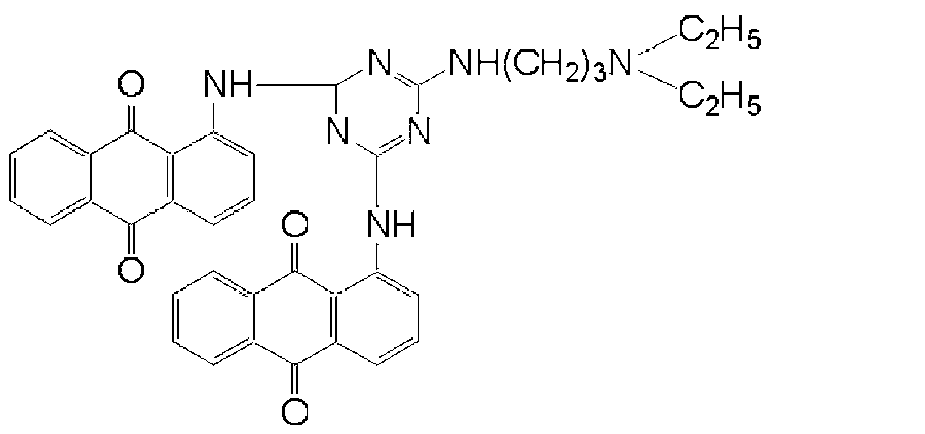
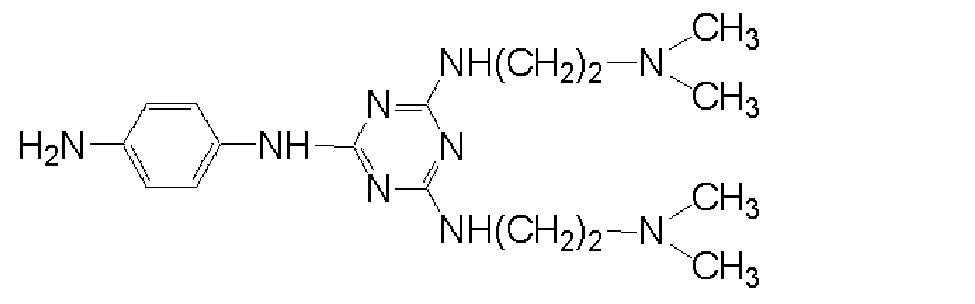
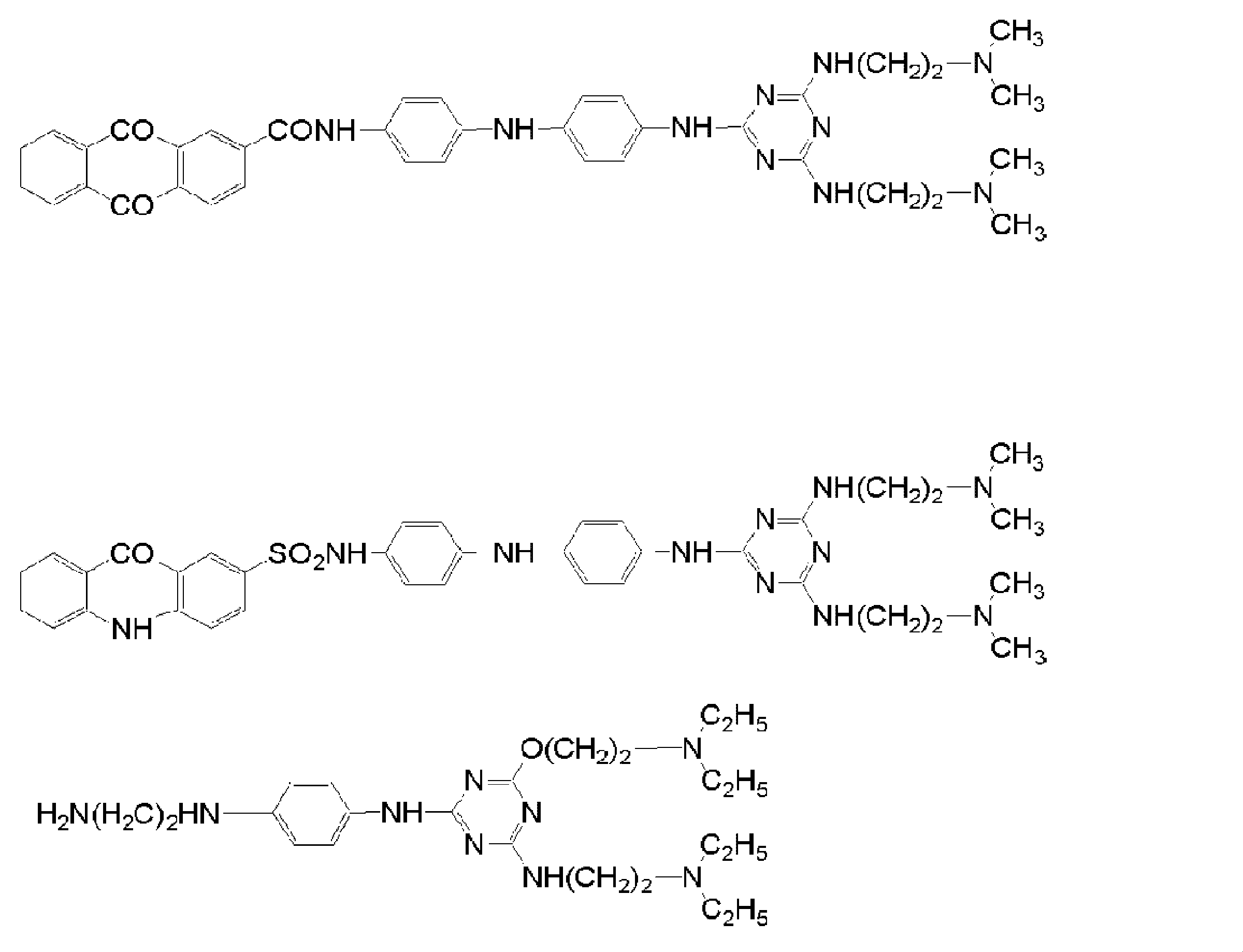
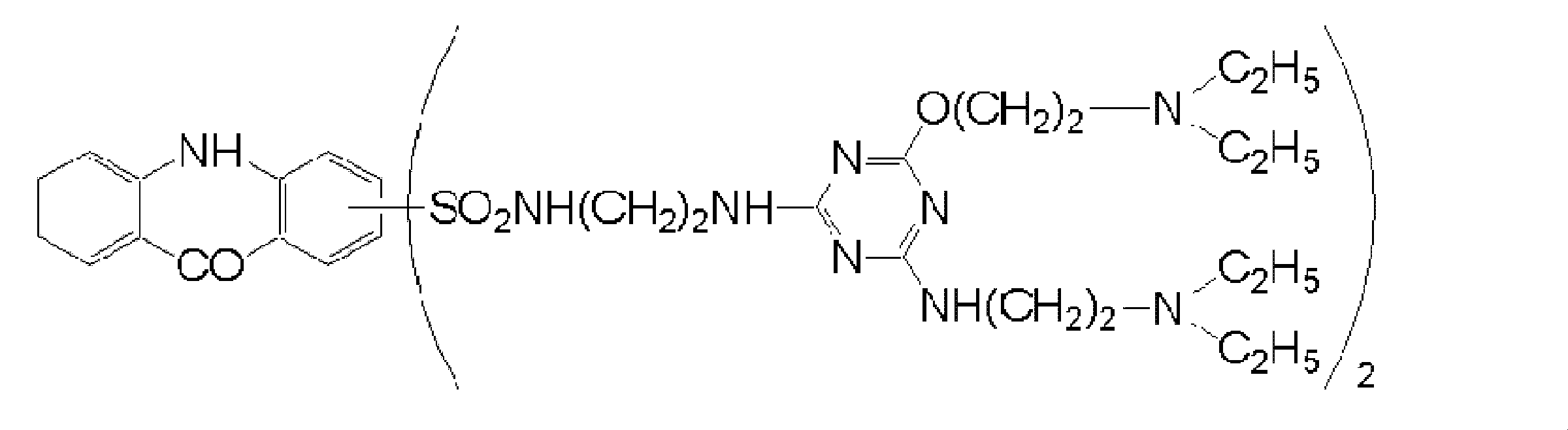

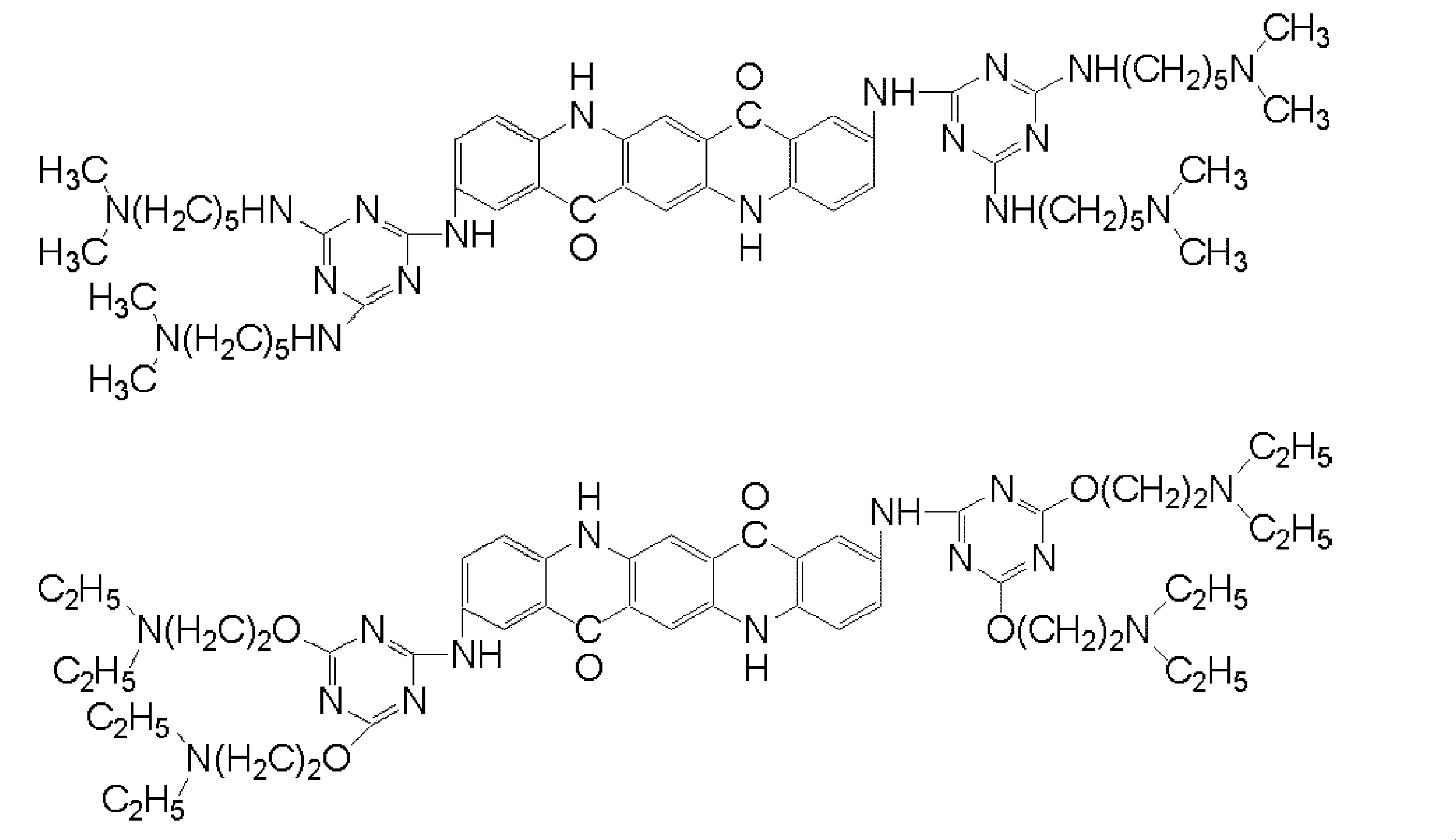

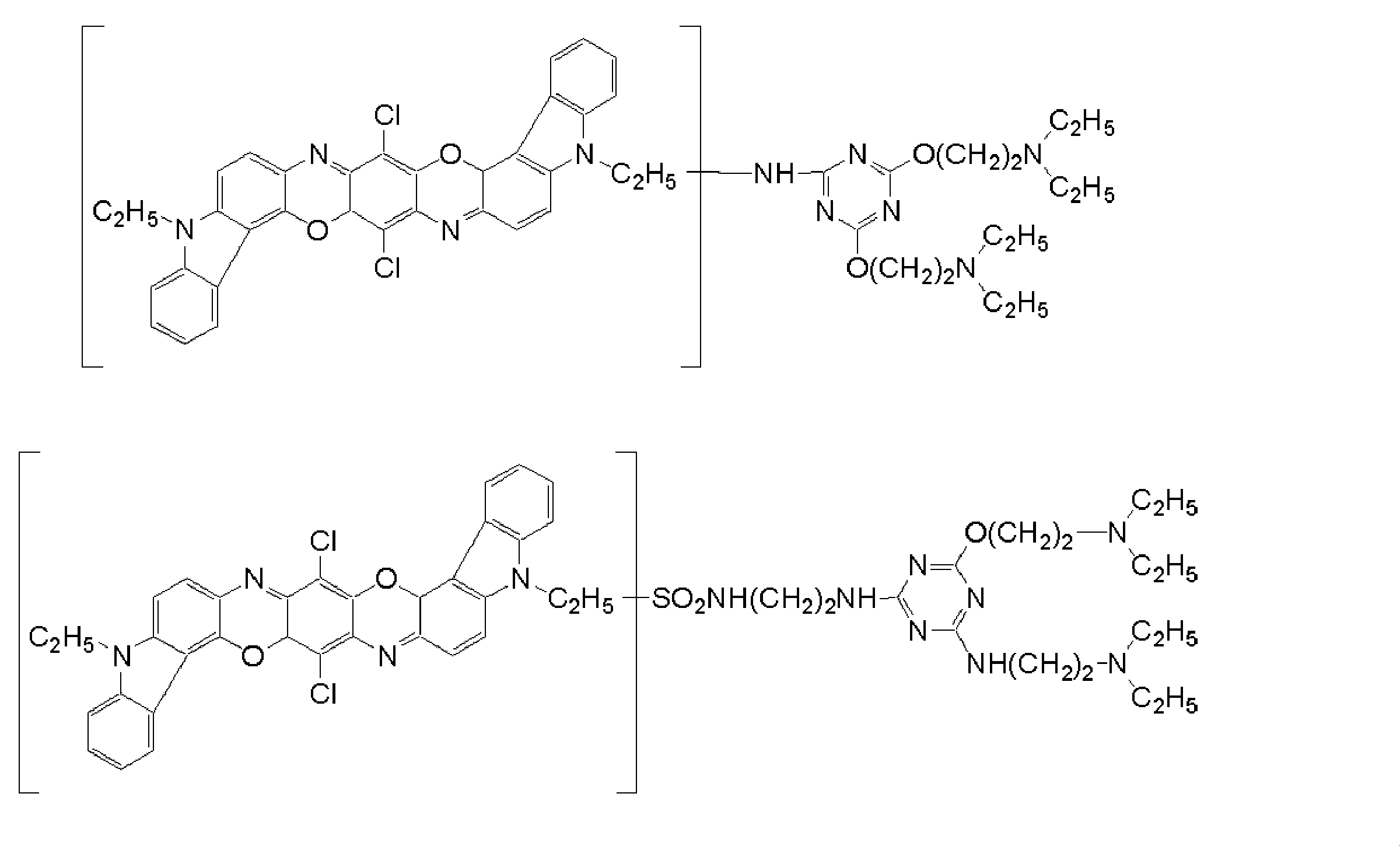
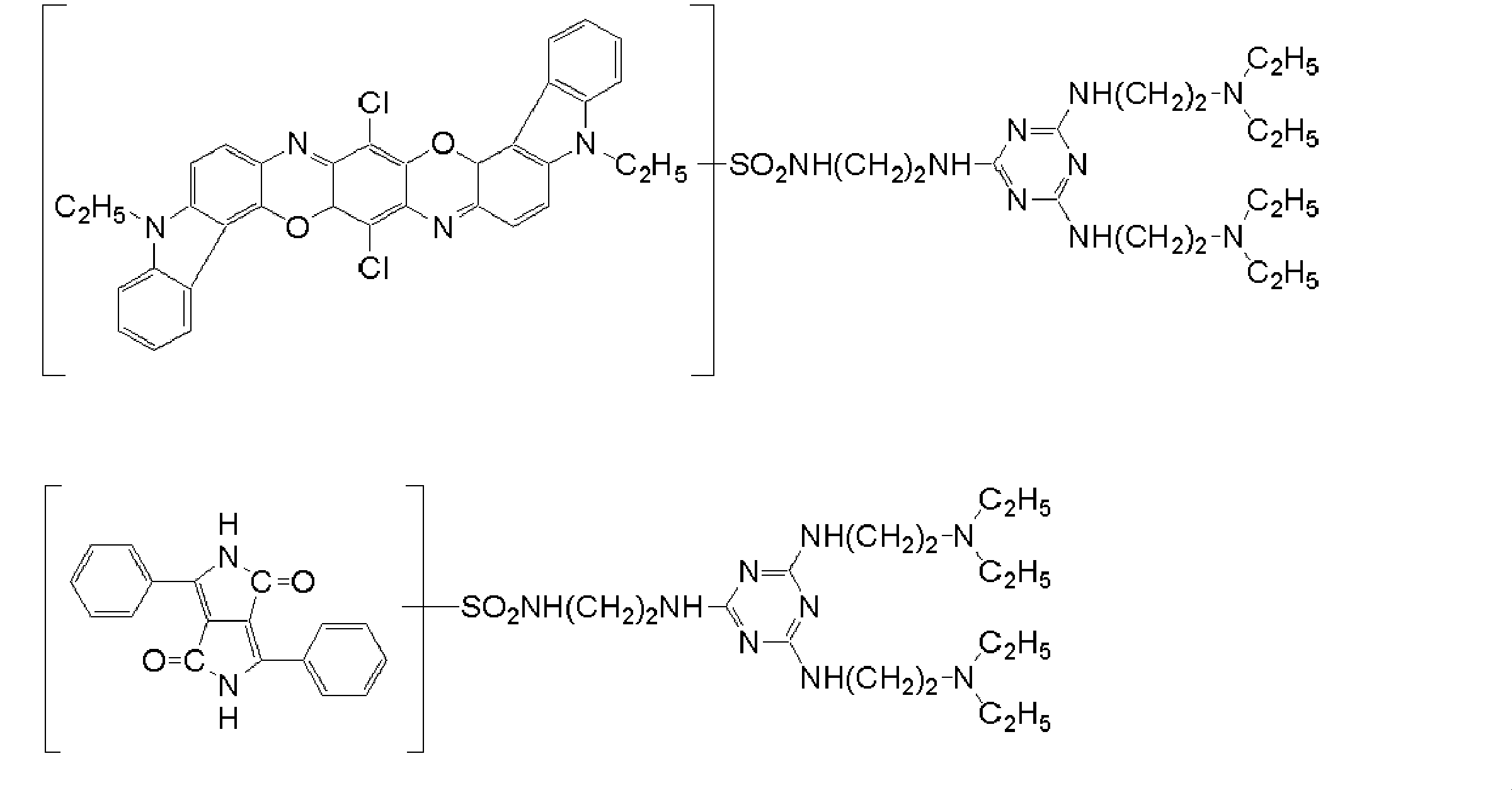
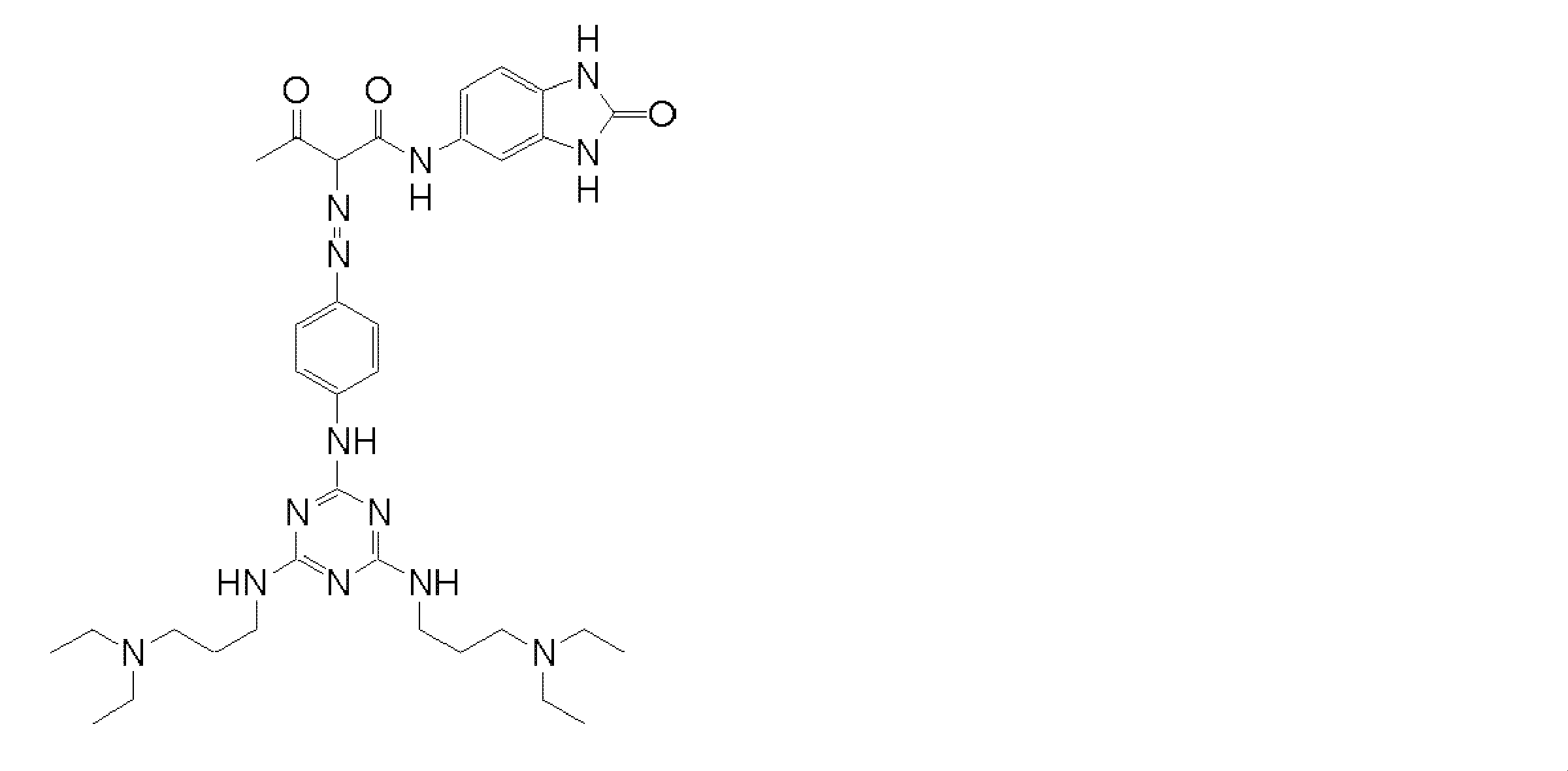
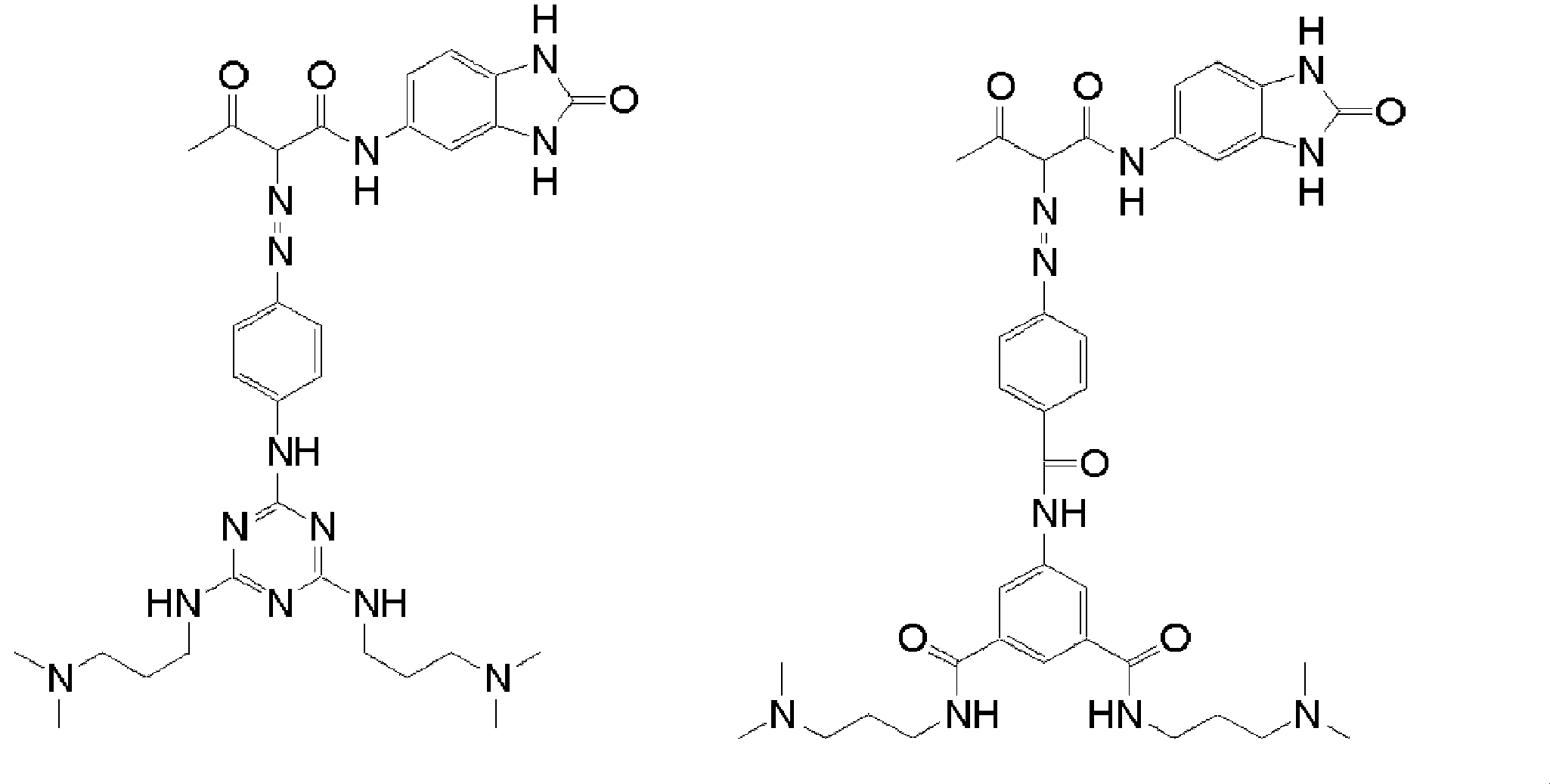
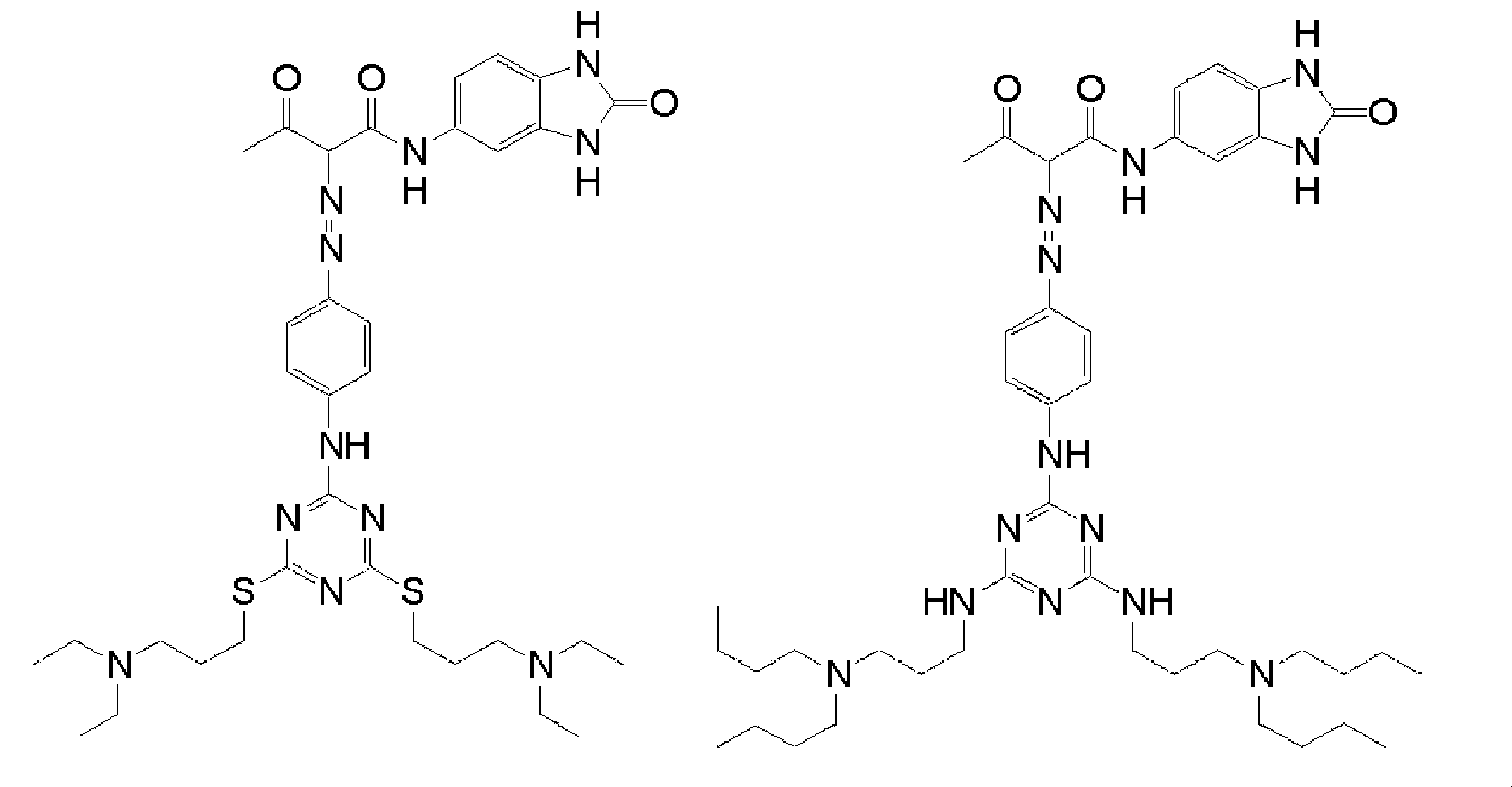
また、(B)塩基性色素誘導体の含有量は、(A)顔料の100質量部に対して、0.5質量部以上50質量部以下であることが好ましく、1質量部以上25質量部以下であることがより好ましい。
塩基性色素誘導体は、本発明の組成物中に1種のみ含まれていても良いし、2種以上含まれていても良い。2種類以上含む場合は、その合計量が上記範囲となることが好ましい。
本発明の組成物は、(C)一般式(II)で表されるリン酸系分散剤を有する。上記リン酸系分散剤を含有させることで、顔料粒子に対して分散剤が強力に吸着し、組成物の経時に伴うザラの悪化を抑制することが可能となる。また、特許文献3および特許文献4に記載の顔料組成物をそのまま着色感光性樹脂組成物に用いた場合、(C)成分は他の成分との相溶性が悪く、経時のザラがやや大きく、PCD後のパターン形成性が非常に悪かったが、本発明では、(D)成分と併用することにより、この点を解消している。

一般式(II)で示されるリン酸エステルはy=1のリン酸系分散剤とy=2のリン酸系分散剤との存在比が100:0~100:30であると、顔料分散性が良好になり好ましい。
更に、一般式(II)で示されるリン酸系分散剤のR3が、2種以上の異なるラクトンモノマーを開環重合して得られるポリエステル構造であると、本発明の効果に優れるようになり、非常に好ましい。
一般式(11)
R12-O-R13-(O-R14)S
(式中、R12はアルキレン基、R13は3価以上の多価アルコール構造を表し、R14はアクリロイル基、シアノアクリロイル基、メタクリロイル基を表し、sは2以上を表す。)
また、(C)リン酸系分散剤の含有量は、(A)顔料の100質量部に対して、5~60質量部であることが好ましく、9~40質量部であることがより好ましい。
リン酸系分散剤は、本発明の組成物中に1種のみ含まれていても良いし、2種以上含まれていても良い。2種類以上含む場合は、その合計量が上記範囲となることが好ましい。
上記のほか、他の分散剤を含んでいても良く、特開2013-073104号公報の0338~0333に記載の分散剤も含んでいても良く、これらの内容は本願明細書に組み込まれる。
本発明の組成物は、(D)一般式(IV)で表される化合物(x)とエチレン性不飽和二重結合を有する化合物(y)を共重合してなる樹脂(以下、特定樹脂バインダーともいう)を含む。特許文献1や特許文献2では、(D)成分はいわゆる分散剤として働いていた。これに対し、本願発明では、(D)成分は、相溶化剤として働く。この理由は以下のように推定される。すなわち、本発明の(C)成分(リン酸系分散剤)はそのポリエステル残基同士が凝集・結晶化しやすく、組成物を構成する他の成分(例えば、(E)重合開始剤や(F)重合性化合物など)と相分離して(C)成分だけが凝集し結晶化してしまう傾向があった。ここに(D)成分を添加すると、(D)成分に含まれる立体的に嵩高い芳香環部位(一般式(IV)で表される化合物(x)の-Ph-R6で表される部分)が(C)成分のポリエステル残基部分に入り込んでポリエステル残基同士の凝集・結晶化を防止し、結果として(C)成分が相分離するのを抑制する効果を発揮しているものと推察される。
また、上記特許文献3や特許文献4に記載されている顔料組成物をそのまま着色感光性樹脂組成物に用いた場合、上述のとおり、(C)リン酸系分散剤が組成物を構成する他の成分と相分離する傾向があったが、本発明では、(D)成分を配合することにより、この点を解消し、組成物を構成する各成分が塗布後の引き置き(PCD)過程で相分離を起こすことを効果的に抑制できる。

R6で表されるベンゼン環を含むアルキル基としては、1-フェニルエチル基、1-フェニルプロプル基、1-フェニルブチル基、1-フェニルペンチル基、1-フェニルヘキシル基、1-フェニルヘプチル基、1-フェニルオクチル基、1-フェニルノニル基、1-フェニルデシル基、ベンジル基、2-フェニル(イソ)プロピル基等を挙げることができる。
これらの中でも、ベンジル基、2-フェニル(イソ)プロピル基が好ましい。
また、(D)樹脂の含有量は、(A)顔料の100質量部に対して、5~80質量部であることが好ましく、10~70質量部であることがより好ましい。(D)樹脂の含有量を(A)顔料100質量部に対して5~80質量部とすることで、(D)樹脂が分散剤としての機能ではなく、相溶化剤として効果的に機能し、本発明の効果に優れるようになる。
(D)樹脂は、本発明の組成物中に1種のみ含まれていても良いし、2種以上含まれていても良い。2種類以上含む場合は、その合計量が上記範囲となることが好ましい。
本発明の組成物は、さらなる感度向上の観点から光重合開始剤を含有する。
上記光重合開始剤としては、後述する重合性化合物の重合を開始する能力を有する限り、特に制限はなく、公知の光重合開始剤の中から適宜選択することができる。例えば、紫外線領域から可視の光線に対して感光性を有するものが好ましい。また、光励起された増感剤と何らかの作用を生じ、活性ラジカルを生成する活性剤であってもよく、モノマーの種類に応じてカチオン重合を開始させるような開始剤であってもよい。
また、上記光重合開始剤は、約300nm~800nm(330nm~500nmがより好ましい。)の範囲内に少なくとも約50の分子吸光係数を有する化合物を、少なくとも1種含有していることが好ましい。
特に、本発明の組成物を固体撮像素子が備えるカラーフィルタの作製に使用する場合には、微細なパターンをシャープな形状で形成する必要があるために、硬化性とともに未露光部に残渣がなく現像されることが重要である。このような観点からは、光重合開始剤としてはオキシム化合物を使用することが特に好ましい。特に、固体撮像素子において微細なパターンを形成する場合、硬化用露光にステッパー露光を用いるが、この露光機はハロゲンにより損傷される場合があり、光重合開始剤の添加量も低く抑える必要があるため、これらの点を考慮すれば、固体撮像素子の如き微細パターンを形成するには(E)光重合開始剤としては、オキシム化合物を用いるのが最も好ましい。
ヒドロキシアセトフェノン系開始剤としては、IRGACURE-184、DAROCUR-1173、IRGACURE-500、IRGACURE-2959,IRGACURE-127(商品名:いずれもBASF社製)を用いることができる。アミノアセトフェノン系開始剤としては、市販品であるIRGACURE-907、IRGACURE-369、および、IRGACURE-379、IRGACURE-OXE379(商品名:いずれもBASF社製)を用いることができる。アミノアセトフェノン系開始剤として、365nmまたは405nm等の長波光源に吸収波長がマッチングされた特開2009-191179公報に記載の化合物も用いることができる。また、アシルホスフィン系開始剤としては市販品であるIRGACURE-819やDAROCUR-TPO(商品名:いずれもBASF社製)を用いることができる。
市販品ではIRGACURE-OXE01(BASF社製)、IRGACURE-OXE02(BASF社製)、TR-PBG-304(常州強力新材料有限公司社製)も好適に用いられる。
化合物のモル吸光係数は、公知の方法を用いて測定することができるが、具体的には、例えば、紫外可視分光光度計(Varian社製Carry-5 spctrophotometer)にて、酢酸エチル溶媒を用い、0.01g/Lの濃度で測定することが好ましい。
本発明の組成物は、(F)重合性化合物を含有する。本発明では、ラジカル、酸、熱により架橋可能な公知の重合性化合物を用いることができ、例えば、エチレン性不飽和結合、環状エーテル(エポキシ、オキセタン)、メチロール等を含む重合性化合物が挙げられる。(F)重合性化合物は、感度の観点から、末端エチレン性不飽和結合を少なくとも1個、好ましくは2個以上有する化合物から好適に選ばれる。中でも、4官能以上の多官能重合性化合物が好ましく、5官能以上の多官能重合性化合物がさらに好ましい。
これらの具体的な化合物としては、特開2009-288705号公報の段落番号〔0095〕~〔0108〕に記載されている化合物を本発明においても好適に用いることができる。
酸基を有する多官能モノマーの好ましい酸価としては、0.1mgKOH/g~40mgKOH/gであり、特に好ましくは5mgKOH/g~30mgKOH/gである。多官能モノマーの酸価が低すぎると現像溶解特性が落ち、高すぎると製造や取扱いが困難になり光重合性能が落ち、画素の表面平滑性等の硬化性が劣るものとなる。従って、異なる酸基の多官能モノマーを2種以上併用する場合、或いは酸基を有しない多官能モノマーを併用する場合、全体の多官能モノマーとしての酸基が上記範囲に入るように調整することが好ましい。
カプロラクトン構造を有する多官能性単量体としては、その分子内にカプロラクトン構造を有する限り特に限定されるものではないが、例えば、トリメチロールエタン、ジトリメチロールエタン、トリメチロールプロパン、ジトリメチロールプロパン、ペンタエリスリトール、ジペンタエリスリトール、トリペンタエリスリトール、グリセリン、ジグリセロール、トリメチロールメラミン等の多価アルコールと、(メタ)アクリル酸およびε-カプロラクトンをエステル化することにより得られる、ε-カプロラクトン変性多官能(メタ)アクリレートを挙げることができる。なかでも特開2013-077009号公報段落0135~0153に記載の化合物を参酌でき、この内容は本明細書に組み込まれる。
上記重合性化合物の市販品としては、ウレタンオリゴマーUAS-10、UAB-140(山陽国策パルプ社製)、UA-7200」(新中村化学社製、DPHA-40H(日本化薬社製)、UA-306H、UA-306T、UA-306I、AH-600、T-600、AI-600(共栄社製)、トリメチロールプロパントリアクリレート(市販品としてはA-TMPT;新中村化学社製)、などが挙げられる。
また、着色感光性樹脂組成物に含有される他の成分(例えば、光重合開始剤、被分散体、アルカリ可溶性樹脂等)との相溶性、分散性に対しても、重合性化合物の選択・使用法は重要な要因であり、例えば、低純度化合物の使用や2種以上の併用により相溶性を向上させうることがある。また、支持体などの硬質表面との密着性を向上させる観点で特定の構造を選択することもあり得る。
本発明の組成物は、上述の各成分に加えて、本発明の効果を損なわない範囲で、さらに、(G)側鎖に重合性二重結合を有する樹脂、有機溶剤、架橋剤などの他の成分を含んでいてもよい。
本発明では、さらに、必要に応じて(G)側鎖に重合性二重結合を有する樹脂(以下、「(G)樹脂」ともいう。)を含有させてもよい。(G)側鎖に重合性二重結合を有する樹脂をさらに含有させることで、本発明の組成物をより効果的に硬化させることが可能となる。重合性二重結合は、(メタ)アクリレートが好ましい。

上記一般式(1)で示されるモノマーとしては、エチレン性不飽和二重結合を有する多価アルコールのモノエステルなどが挙げられるが、好ましいのはグリセロールモノ(メタ)アクリレートである。
イソシアネート基及びエチレン性不飽和二重結合を有する化合物として具体的には、2-アクリロイルエチルイソシアネート、2-メタクリロイルエチルイソシアネート等が挙げられる。また、カルボキシ基及びエチレン性不飽和二重結合を有する化合物として具体的には、アクリル酸、メタクリル酸、無水マレイン酸が挙げられる。
[二重結合当量]=[繰り返し構成単位の分子量]/[繰り返し構成単位中の二重結合の数]
本発明における(G)樹脂の二重結合当量は200~2,000であることが好ましく、300~900であることがより好ましい。(G)樹脂の二重結合当量が200未満の場合は、エチレン性不飽和二重結合を導入させる重合性モノマー(p)の比率が高くなり、諸特性を維持するのに十分な量の重合性モノマー(q)を共重合させることができない。2,000を越える場合は、エチレン性不飽和二重結合の数が少ないため十分な感度を得ることができない。
また、上記(G)樹脂の重量平均分子量(Mw)は、本発明の組成物の分散性が良好な点から、好ましくは2000~200000、より好ましくは5000~50000である。
(G)側鎖に重合性二重結合を有する樹脂は、本発明の組成物中に1種のみ含まれていても良いし、2種以上含まれていても良い。2種類以上含む場合は、その合計量が上記範囲となることが好ましい。
本発明の組成物は、さらに、バインダーとしてアルカリ可溶性樹脂を含有していてもよい。なお、ここでいうアルカリ可溶性樹脂には、分散剤成分として本発明の組成物に含有される成分は含まれない。
さらに、特開2012-32767号公報に記載の段落番号0029~0063に記載の共重合体(B)および実施例で用いられているアルカリ可溶性樹脂、特開2012-208474号公報の段落番号0088~0098に記載のバインダー樹脂および実施例で用いられているバインダー樹脂、特開2012-137531号公報の段落番号0022~0032に記載のバインダー樹脂および実施例で用いられているバインダー樹脂、特開2013-024934号公報の段落番号0132~0143に記載のバインダー樹脂および実施例で用いられているバインダー樹脂、特開2011-242752号公報の段落番号0092~0098および実施例で用いられているバインダー樹脂、特開2012-032770号公報の段落番号0030~0072の記載のバインダー樹脂を用いること好ましい。これらの内容は本願明細書に組み込まれる。
また、アルカリ可溶性樹脂の重量平均分子量(Mw)としては、2,000~50,000が好ましく、5,000~30,000がさらに好ましく、7,000~20,000が最も好ましい。
本発明の組成物は、アルカリ可溶性樹脂を、1種類のみを含んでいてもよいし、2種類以上含んでいてもよい。2種類以上含む場合は、その合計量が上記範囲となることが好ましい。
本発明の組成物は、有機溶剤を含有してもよい。
有機溶剤は、各成分の溶解性や着色感光性樹脂組成物の塗布性を満足すれば基本的には特に制限はないが、特に紫外線吸収剤、アルカリ可溶性樹脂や分散剤等の溶解性、塗布性、安全性を考慮して選ばれることが好ましい。有機溶剤は1種類でもよいし、2種類以上含まれていても良い。
本発明の組成物に補足的に架橋剤を用い、組成物を硬化させてなる硬化膜の硬度をより高めることもできる。
架橋剤としては、架橋反応により膜硬化を行なえるものであれば、特に限定はなく、例えば、(a)エポキシ樹脂、(b)メチロール基、アルコキシメチル基、およびアシロキシメチル基から選ばれる少なくとも1つの置換基で置換された、メラミン化合物、グアナミン化合物、グリコールウリル化合物またはウレア化合物、(c)メチロール基、アルコキシメチル基、およびアシロキシメチル基から選ばれる少なくとも1つの置換基で置換された、フェノール化合物、ナフトール化合物またはヒドロキシアントラセン化合物、が挙げられる。中でも、多官能エポキシ樹脂が好ましい。
架橋剤の具体例などの詳細については、特開2004-295116号公報の段落0134~0147の記載を参照することができる。
本発明の組成物中に架橋剤を含有する場合、架橋剤の配合量は、特に定めるものではないが、組成物の全固形分の2~30質量%が好ましく、3~20質量%がより好ましい。
本発明の組成物は、架橋剤を、1種類のみを含んでいてもよいし、2種類以上含んでいてもよい。2種類以上含む場合は、その合計量が上記範囲となることが好ましい。
本発明の組成物においては、上記組成物の製造中または保存中において、重合性化合物の不要な熱重合を阻止するために、少量の重合禁止剤を添加することが望ましい。
本発明に用いうる重合禁止剤としては、ハイドロキノン、p-メトキシフェノール、ジ-tert-ブチル-p-クレゾール、ピロガロール、tert-ブチルカテコール、ベンゾキノン、4,4’-チオビス(3-メチル-6-tert-ブチルフェノール)、2,2’-メチレンビス(4-メチル-6-tert-ブチルフェノール)、N-ニトロソフェニルヒドロキシアミン第一セリウム塩等が挙げられる。
本発明の組成物中に重合禁止剤を含有する場合、重合禁止剤の添加量は、全組成物の質量に対して、約0.01質量%~約5質量%が好ましい。
本発明の組成物は、重合禁止剤を、1種類のみを含んでいてもよいし、2種類以上含んでいてもよい。2種類以上含む場合は、その合計量が上記範囲となることが好ましい。
本発明の組成物には、塗布性をより向上させる観点から、各種の界面活性剤を添加してもよい。本発明では、界面活性剤を配合する事により、上記(C)成分と(D)成分を併合した場合に、PCD耐性に優れるという本発明の効果をより効果的に発揮することができる。この理由として、以下のようなメカニズムが推定される。すなわち、本発明の組成物がPCD耐性に優れる理由としては上記したとおり、(D)成分に含まれる立体的に嵩高い芳香環部位(一般式(IV)で表される化合物(x)の-Ph-R6で表される部分)が(C)成分のポリエステル残基部分に入り込んでポリエステル残基同士が凝集・結晶化するのを防止する役割を果たし、結果として(C)成分の相分離が抑制されるためと考えられる。ここに界面活性剤が加わると、(D)成分に含まれる立体的に嵩高い芳香環部位と(C)成分のポリエステル残基部分との間に界面活性効果が働き、(D)成分の立体的に嵩高い部位が(C)成分のポリエステル残基部分に入り込むのがスムーズになるためと推察される。
界面活性剤としては、フッ素系界面活性剤、ノニオン系界面活性剤、カチオン系界面活性剤、アニオン系界面活性剤、シリコーン系界面活性剤などの各種界面活性剤を使用できる。
即ち、フッ素系界面活性剤を含有する組成物を適用した塗布液を用いて膜形成する場合においては、被塗布面と塗布液との界面張力を低下させることにより、被塗布面への濡れ性が改善され、被塗布面への塗布性が向上する。このため、少量の液量で数μm程度の薄膜を形成した場合であっても、厚みムラの小さい均一厚の膜形成をより好適に行える点で有効である。
界面活性剤は、1種のみを用いてもよいし、2種類以上を組み合わせてもよい。
本発明の組成物に界面活性剤を含有する場合、界面活性剤の添加量は、組成物の全質量に対して、0.001質量%~2.0質量%が好ましく、より好ましくは0.005質量%~1.0質量%である。
本発明の組成物は、界面活性剤を、1種類のみを含んでいてもよいし、2種類以上含んでいてもよい。2種類以上含む場合は、その合計量が上記範囲となることが好ましい。
本発明の組成物には、必要に応じて、各種添加物、例えば、充填剤、密着促進剤、酸化防止剤、紫外線吸収剤、凝集防止剤等を配合することができる。これらの添加物としては、特開2004-295116号公報の段落0155~0156に記載のものを挙げることができる。
本発明の組成物においては、特開2004-295116号公報の段落0078に記載の増感剤や光安定剤、同公報の段落0081に記載の熱重合防止剤を含有することができる。
紫外線吸収剤としては、具体的に以下の化合物を用いることが好ましい。
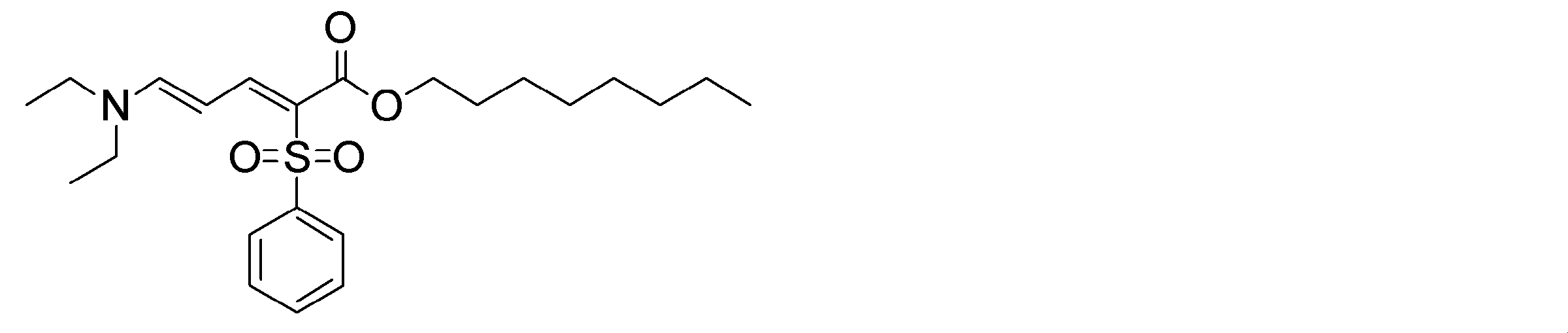
本発明の組成物は、分子量1000以下の有機カルボン酸、および/または有機カルボン酸無水物を含有していてもよい。
有機カルボン酸化合物としては、具体的には、脂肪族カルボン酸または芳香族カルボン酸が挙げられる。脂肪族カルボン酸としては、例えば、ギ酸、酢酸、プロピオン酸、酪酸、吉草酸、ピバル酸、カプロン酸、グリコール酸、アクリル酸、メタクリル酸等のモノカルボン酸、シュウ酸、マロン酸、コハク酸、グルタル酸、アジピン酸、ピメリン酸、シクロヘキサンジカルボン酸、シクロヘキセンジカルボン酸、イタコン酸、シトラコン酸、マレイン酸、フマル酸等のジカルボン酸、トリカルバリル酸、アコニット酸等のトリカルボン酸等が挙げられる。また、芳香族カルボン酸としては、例えば、安息香酸、フタル酸等のフェニル基に直接カルボキシ基が結合したカルボン酸、およびフェニル基から炭素結合を介してカルボキシ基が結合したカルボン酸類が挙げられる。これらの中では、特に分子量600以下、とりわけ分子量50~500のもの、具体的には、例えば、マレイン酸、マロン酸、コハク酸、イタコン酸が好ましい。
これら分子量1000以下の有機カルボン酸、および/または有機カルボン酸無水物を添加することによって、高いパターン密着性を保ちながら、組成物の未溶解物の残存をより一層低減することが可能である。
本発明の組成物は、前述の成分を混合することで調製される。
なお、組成物の調製に際しては、組成物を構成する各成分を一括配合してもよいし、各成分を溶剤に溶解・分散した後に逐次配合してもよい。また、配合する際の投入順序や作業条件は特に制約を受けない。例えば、全成分を同時に溶剤に溶解・分散して組成物を調製してもよいし、必要に応じては、各成分を適宜2つ以上の溶液・分散液としておいて、使用時(塗布時)にこれらを混合して組成物として調製してもよい。
中でも、本発明では、(A)顔料、(B)塩基性色素誘導体、および(C)一般式(II)で表されるリン酸系分散剤を分散させた後、(D)一般式(IV)で表される化合物(x)とエチレン性不飽和二重結合を有する化合物(y)を共重合してなる樹脂を配合させることが好ましい。
上記のようにして調製された組成物は、好ましくは、孔径0.01μm~3.0μm、より好ましくは孔径0.05μm~0.5μm程度のフィルタなどを用いて濾別した後、使用に供することができる。
次に、本発明における硬化膜、パターン形成方法およびカラーフィルタについて、詳述する。
本発明のパターン形成方法は、カラーフィルタが有する着色パターン(画素)の形成に好適に適用することができる。
即ち、本発明のカラーフィルタの製造方法は、本発明のパターン形成方法を適用するものであり、本発明の着色感光性成物を支持体上に適用して着色感光性組成物層を形成する工程と、上記着色感光性組成物層をパターン状に露光する工程と、未露光部を現像除去して着色パターンを形成する工程と、を含むことを特徴とする。
さらに、必要に応じて、着色組成物層をベークする工程(プリベーク工程)、および、現像された着色パターンをベークする工程(ポストベーク工程)を設けてもよい。以下、これらの工程をあわせて、パターン形成工程ということがある。
本発明のカラーフィルタは、上記製造方法により好適に得ることができる。
以下、固体撮像素子用カラーフィルタを単に「カラーフィルタ」ということがある。
着色感光性組成物層を形成する工程では、支持体上に、本発明の組成物を適用して着色感光性組成物層を形成する。
本発明における着色パターンは、固体撮像素子用基板の撮像素子形成面側(おもて面)に形成されてもよいし、撮像素子非形成面側(裏面)に形成されてもよい。
固体撮像素子における着色パターンの間や、固体撮像素子用基板の裏面には、遮光膜が設けられていてもよい。
また、支持体上には、必要により、上部の層との密着改良、物質の拡散防止或いは基板表面の平坦化のために下塗り層を設けてもよい。
-露光工程-
露光工程では、着色感光性組成物層形成工程において形成された着色感光性組成物層を、例えば、ステッパー等の露光装置を用い、所定のマスクパターンを有するマスクを介してパターン露光する。これにより、硬化膜が得られる。
露光に際して用いることができる放射線(光)としては、特に、g線、i線等の紫外線が好ましく(特に好ましくはi線)用いられる。照射量(露光量)は30mJ/cm2~1500mJ/cm2が好ましく50mJ/cm2~1000mJ/cm2がより好ましく、80mJ/cm2~500mJ/cm2が最も好ましい。
膜厚を、1.0μm以下とすることにより、高解像性、高密着性を得られるため、好ましい。
また、本工程においては、0.7μm以下の薄い膜厚を有する硬化膜も好適に形成することができ、得られた硬化膜を、後述するパターン形成工程にて現像処理することで、薄膜でありながらも、現像性、表面荒れ抑制、およびパターン形状に優れた着色パターンを得ることができる。
次いでアルカリ現像処理を行うことにより、露光工程における光未照射部分の着色感光性組成物層がアルカリ水溶液に溶出し、光硬化した部分だけが残る。
現像液としては、下地の撮像素子や回路などにダメージを起さない、有機アルカリ現像液が望ましい。現像温度としては通常20℃~30℃であり、現像時間は、従来20秒~90秒であった。より残渣を除去するため、近年では120秒~180秒実施する場合もある。さらには、より残渣除去性を向上するため、現像液を60秒ごとに振り切り、さらに新たに現像液を供給する工程を数回繰り返す場合もある。
なお、現像液には無機アルカリを用いてもよく、無機アルカリとしては、例えば、水酸化ナトリウム、水酸化カリウム、炭酸ナトリウム、炭酸水素ナトリウム、硅酸ナトリウム、メタ硅酸ナトリウムなどが好ましい。
なお、このようなアルカリ性水溶液からなる現像液を使用した場合には、一般に現像後純水で洗浄(リンス)する。
ポストベークは、硬化を完全なものとするための現像後の加熱処理であり、通常100℃~240℃、好ましくは200℃~240℃の熱硬化処理を行う。
このポストベーク処理は、現像後の塗布膜を、上記条件になるようにホットプレートやコンベクションオーブン(熱風循環式乾燥機)、高周波加熱機等の加熱手段を用いて、連続式あるいはバッチ式で行うことができる。
ドライエッチングは、パターニングされたフォトレジスト層をマスクとしてエッチングガスを用いて行うことができる。具体的には、着色層上にポジ型またはネガ型の感放射線性組成物を塗布し、これを乾燥させることによりフォトレジスト層を形成する。フォトレジスト層の形成においては、さらにプリベーク処理を施すことが好ましい。特に、フォトレジスト層の形成プロセスとしては、露光後の加熱処理(PEB)、現像後の加熱処理(ポストベーク処理)を実施する形態が望ましい。
具体的には、ポジ型の感放射線性組成物として、キノンジアジド化合物およびアルカリ可溶性樹脂を含有する組成物が好ましい。キノンジアジド化合物およびアルカリ可溶性樹脂を含有するポジ型の感放射線性組成物は、500nm以下の波長の光照射によりキノンジアジド基が分解してカルボキシ基を生じ、結果としてアルカリ不溶状態からアルカリ可溶性になることを利用するものである。このポジ型フォトレジストは解像力が著しく優れているので、ICやLSI等の集積回路の作製に用いられている。キノンジアジド化合物としては、ナフトキノンジアジド化合物が挙げられる。市販品としては例えばFHi622BC」(富士フイルムエレクトロニクスマテリアルズ社製)などが挙げられる。
フッ素系ガスと酸素ガス(O2)との混合ガスを用い、支持体が露出しない領域(深さ)までエッチングを行なう第1段階のエッチングと、この第1段階のエッチングの後に、窒素ガス(N2)と酸素ガス(O2)との混合ガスを用い、好ましくは支持体が露出する領域(深さ)付近までエッチングを行なう第2段階のエッチングと、支持体が露出した後に行なうオーバーエッチングとを含む形態が好ましい。以下、ドライエッチングの具体的手法、並びに第1段階のエッチング、第2段階のエッチング、およびオーバーエッチングについて説明する。
(1)第1段階のエッチングにおけるエッチングレート(nm/min)と、第2段階のエッチングにおけるエッチングレート(nm/min)とをそれぞれ算出する。(2)第1段階のエッチングで所望の厚さをエッチングする時間と、第2段階のエッチングで所望の厚さをエッチングする時間とをそれぞれ算出する。(3)上記(2)で算出したエッチング時間に従って第1段階のエッチングを実施する。(4)上記(2)で算出したエッチング時間に従って第2段階のエッチングを実施する。あるいはエンドポイント検出でエッチング時間を決定し、決定したエッチング時間に従って第2段階のエッチングを実施してもよい。(5)上記(3)、(4)の合計時間に対してオーバーエッチング時間を算出し、オーバーエッチングを実施する。
上記のうち、アルキレングリコールモノアルキルエーテルカルボキシレートおよびアルキレングリコールモノアルキルエーテルが好ましい。
これら溶媒は、単独で用いても2種以上を混合して用いてもよい。2種以上を混合する場合、水酸基を有する溶剤と水酸基を有しない溶剤とを混合することが好ましい。水酸基を有する溶剤と水酸基を有しない溶剤との質量比は、1/99~99/1、好ましくは10/90~90/10、さらに好ましくは20/80~80/20である。プロピレングリコールモノメチルエーテルアセテート(PGMEA)とプロピレングリコールモノメチルエーテル(PGME)の混合溶剤で、その比率が60/40であることが特に好ましい。なお、汚染物に対する洗浄液の浸透性を向上させるために、洗浄液には前掲の本組成物に関する界面活性剤を添加してもよい。
本発明のカラーフィルタは、CCD、CMOS等の固体撮像素子に好適に用いることができ、特に100万画素を超えるような高解像度のCCDやCMOS等に好適である。本発明の固体撮像素子用カラーフィルタは、例えば、CCDまたはCMOSを構成する各画素の受光部と、集光するためのマイクロレンズと、の間に配置されるカラーフィルタとして用いることができる。
また、着色パターン(着色画素)のサイズ(パターン幅)としては、2.5μm以下が好ましく、2.0μm以下がより好ましく、1.7μm以下が特に好ましい。
本発明の固体撮像素子は、既述の本発明のカラーフィルタを備える。本発明の固体撮像素子の構成としては、本発明におけるカラーフィルタが備えられた構成であり、固体撮像素子として機能する構成であれば特に限定はないが、例えば、以下のような構成が挙げられる。
さらに、上記デバイス保護層上であってカラーフィルタの下(支持体に近い側)に集光手段(例えば、マイクロレンズ等。以下同じ)を有する構成や、カラーフィルタ上に集光手段を有する構成等であってもよい。
本発明のカラーフィルタは、上記固体撮像素子のみならず、液晶表示装置や有機EL表示装置などの、画像表示装置に用いることができ、特に液晶表示装置の用途に好適である。本発明のカラーフィルタを備えた液晶表示装置は、表示画像の色合いが良好で表示特性に優れた高画質画像を表示することができる。
また、本発明におけるカラーフィルタは、明るく高精細なCOA(Color-filter On Array)方式にも供することが可能である。COA方式の液晶表示装置にあっては、カラーフィルタ層に対する要求特性は、前述のような通常の要求特性に加えて、層間絶縁膜に対する要求特性、すなわち低誘電率および剥離液耐性が必要とされることがある。本発明のカラーフィルタにおいては、色相に優れた染料多量体を用いることから、色純度、光透過性などが良好で着色パターン(画素)の色合いに優れるので、解像度が高く長期耐久性に優れたCOA方式の液晶表示装置を提供することができる。なお、低誘電率の要求特性を満足するためには、カラーフィルタ層の上に樹脂被膜を設けてもよい。
これらの画像表示方式については、例えば、「EL、PDP、LCDディスプレイ-技術と市場の最新動向-(東レリサーチセンター調査研究部門 2001年発行)」の43ページなどに記載されている。
バックライトに関しては、SID meeting Digest 1380(2005)(A.Konno et.al)や、月刊ディスプレイ 2005年12月号の18~24ページ(島 康裕)、同25~30ページ(八木隆明)などに記載されている。
(合成例1)
三口丸底フラスコに冷却管、窒素ガス導入管、撹拌機を取り付けた反応容器に、ラウリルアルコール18.6g(ナカライテスク株式会社製)、ε-カプロラクトンモノマー57.1g(和光純薬株式会社製)、テトラブチルチタネート0.06g(東京化成株式会社製)を仕込み、反応容器内を窒素ガスで置換した後、120℃で3時間、加熱攪拌した。ラクトンモノマーの消失を1H-NMRで確認した。反応溶液を室温まで冷却した後、オルトリン酸換算含有量116%ポリリン酸8.45gと混合し、徐々に昇温し、80℃で6時間、加熱攪拌して、一般式(II)中のR3の数平均分子量が760、y=1とy=2の存在比が100:12のリン酸系分散剤(C-1)を得た。得られたリン酸系分散剤の酸価は166であった。
使用するモノアルコールの種類・仕込み量、および使用するラクトンモノマーの種類・仕込み量を下記表1に示すとおりに変えた以外は上記合成例1と同様の方法で、リン酸系分散剤(C-2)~(C-4)を得た。

(合成例5)
セパラブル四口フラスコに、温度計、冷却管、窒素ガス導入管、攪拌装置を取り付けた反応容器に、プロピレングリコールモノメチルエーテルアセテートを入れ、反応容器に窒素ガスを導入しながら80℃に加熱して、同温度で滴下管よりベンジルメタクリレート123.3g、メタクリル酸17.2g、パラクミルフェノールエチレンオキサイド変性アクリレート(東亞合成株式会社製「アロニックスM110」)31.0g、アゾビスイソブチロニトリル10.0gの混合物を2時間かけて滴下し、重合反応を行った。
得られた樹脂溶液を室温まで冷却した後、約3gサンプリングして180℃20分間加熱乾燥して不揮発分を測定し、先に合成した樹脂溶液に不揮発分が40質量%となるようにプロピレングリコールアセテートを添加して、樹脂バインダー(D-1)の溶液を得た。
(合成例6)
セパラブル四口フラスコに、温度計、冷却管、窒素ガス導入管、攪拌装置を取り付けた反応容器に、プロピレングリコールモノメチルエーテルアセテートを入れ、反応容器に窒素ガスを導入しながら100℃に加熱して、同温度で滴下管よりベンジルメタクリレート123.3g、メタクリル酸25.8g、アゾビスイソブチロニトリル10.0gの混合物を1時間かけて滴下して重合反応を行った。
得られた樹脂溶液を室温まで冷却した後、約3gサンプリングして180℃20分間加熱乾燥して不揮発分を測定し、先に合成した樹脂溶液に不揮発分が40質量%となるようにプロピレングリコールアセテートを添加して、樹脂バインダー1の溶液を得た。
(合成例7)
セパラブル四口フラスコに、温度計、冷却管、窒素ガス導入管、攪拌装置を取り付けた反応容器に、プロピレングリコールモノメチルエーテルアセテートを入れ、反応容器に窒素ガスを導入しながら80℃に加熱して、同温度で滴下管よりベンジルメタクリレート123.3g、メタクリル酸17.2g、グリセロールモノメタクリレート14.6g、アゾビスイソブチロニトリル10.0gの混合物を2時間かけて滴下し、重合反応を行った。
得られた樹脂溶液に対して、2-メタクリロイルエチルイソシアネート(昭和電工株式会社製「カレンズMOI」)23.3g、ラウリン酸ジブチル錫0.3g、シクロヘキサノン90gの混合物を70℃で3時間かけて滴下した。
得られた樹脂溶液を室温まで冷却した後、約3gサンプリングして180℃20分間加熱乾燥して不揮発分を測定し、先に合成した樹脂溶液に不揮発分が40質量%となるようにプロピレングリコールアセテートを添加して、樹脂バインダー(G-1)の溶液を得た。
下記の組成の混合物を均一に攪拌混合した後、ビーズミルにより3時間混合・分散して赤色顔料分散組成物(R-a)を調製した。
ジケトピロロピロール系赤色顔料(C.I.Pigment Red254)
8.3質量部
イソインドリン系黄色顔料(C.I.Pigment Yellow139)
3.7質量部
下記化学式(B-1)で表される色素誘導体 1.5質量部
リン酸系分散剤(C-1) 1.2質量部
樹脂バインダー(D-1) 5.3質量部(不揮発分)
プロピレングリコールモノメチルエーテルアセテート(PGMEA)80.0質量部

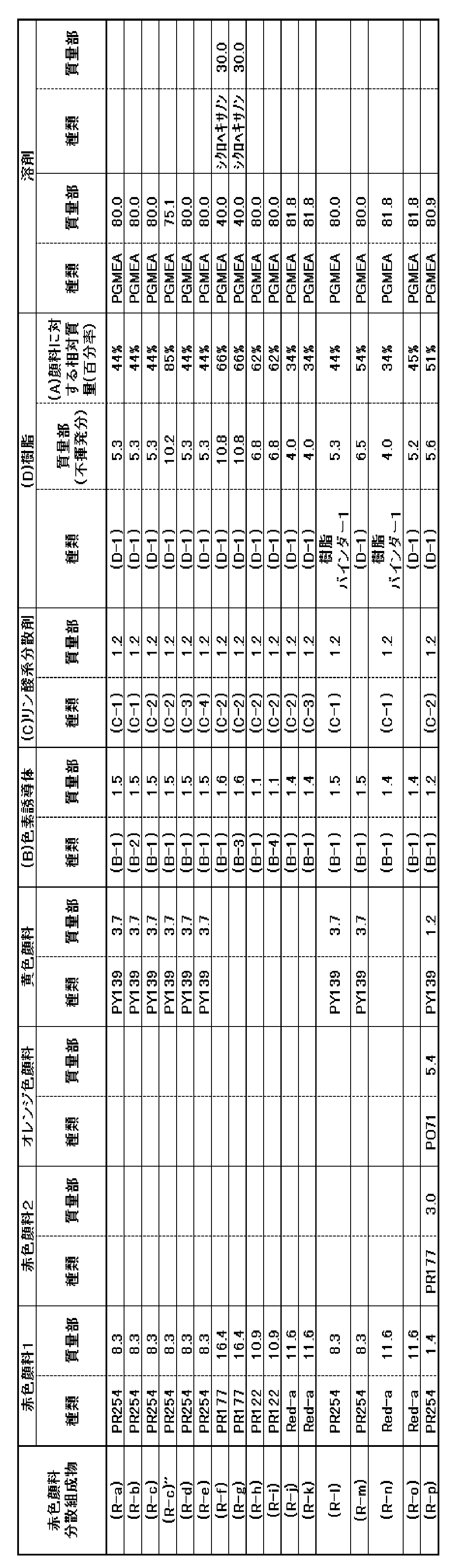
PR254…ジケトピロロピロール系赤色顔料(C.I.Pigment Red254)
PY139…イソインドリン系黄色顔料(C.I.Pigment Yellow139)
PR177…アントラキノン系赤色顔料(C.I.Pigment Red177)
PR122…キナクリドン系赤色顔料(C.I.Pigment Red122)
PO71…ジケトピロロピロール系オレンジ色顔料(C.I.Pigment Orange71)
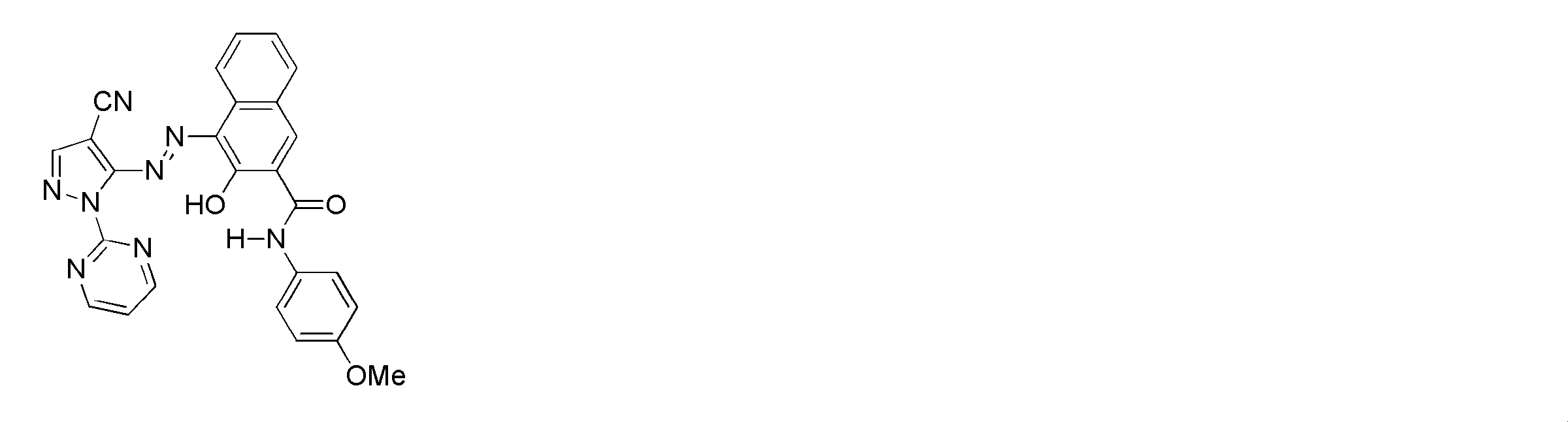

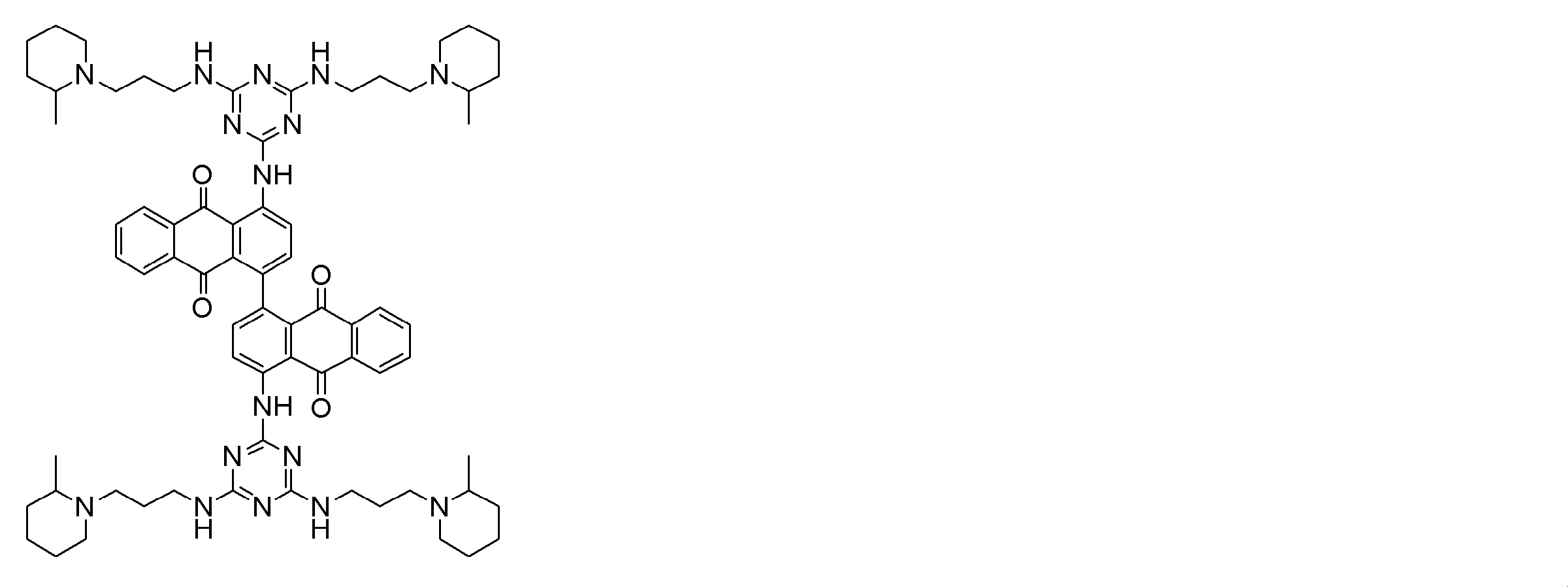

下記の組成の混合物を均一に攪拌混合した後、ビーズミルにより3時間混合・分散して緑色顔料分散組成物(G-a)を調製した。
ハロゲン化銅フタロシアニン系緑色顔料(C.I.Pigment Green36)
11.4質量部
イソインドリン系黄色顔料(C.I.Pigment Yellow139)
3.4質量部
下記化学式(B-1)で表される色素誘導体 2.0質量部
リン酸系分散剤(C-1) 1.6質量部
樹脂バインダー(D-1) 6.9質量部(不揮発分)
プロピレングリコールモノメチルエーテルアセテート(PGMEA)
50.7質量部
シクロヘキサノン 24.0質量部

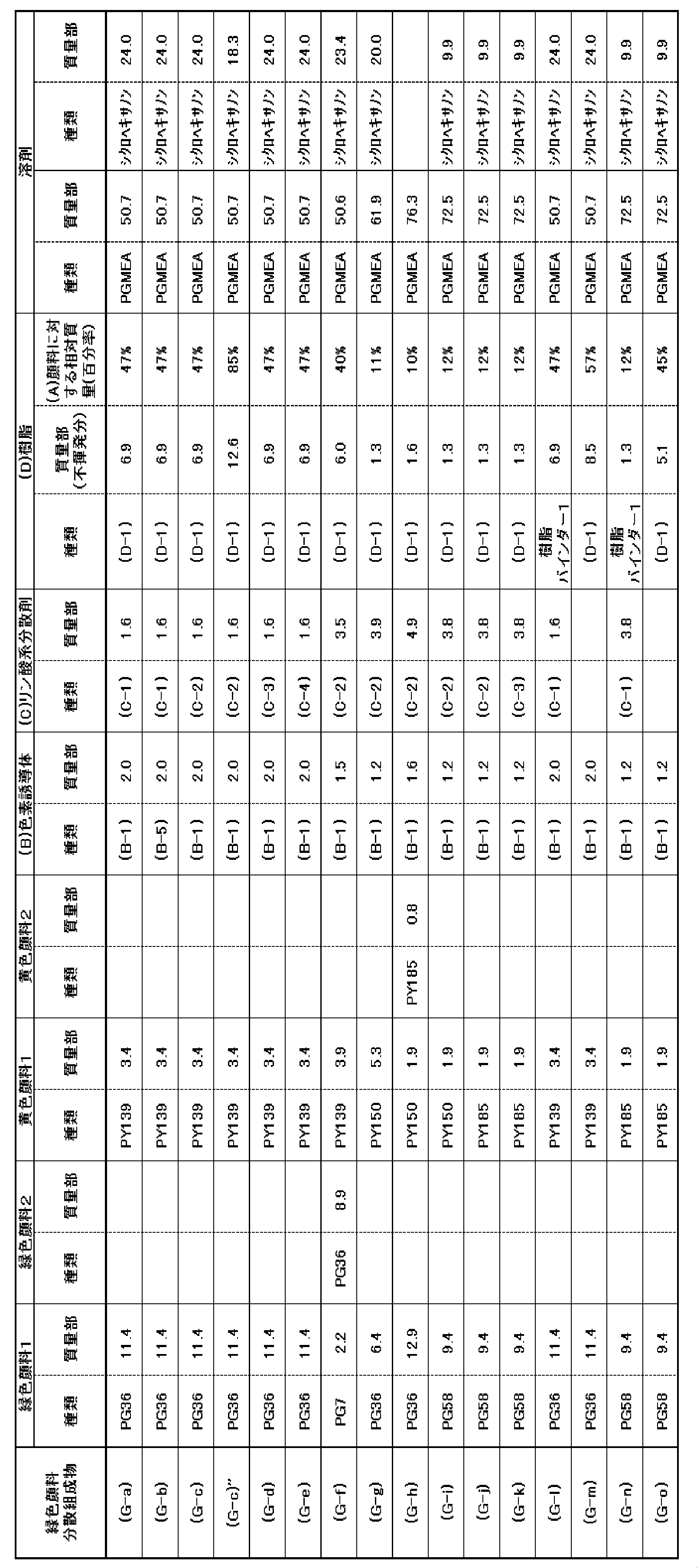
PG7…塩素化銅フタロシアニン系緑色顔料(C.I.Pigment Green7)
PG36…ハロゲン化銅フタロシアニン系緑色顔料(C.I.Pigment Green36)
PG58…ハロゲン化亜鉛フタロシアニン系緑色顔料(C.I.Pigment Green58)
PY139…イソインドリン系黄色顔料(C.I.Pigment Yellow139)
PY150…ニッケルアゾ系黄色顔料(C.I.Pigment Yellow150)PY185…イソインドリン系黄色顔料(C.I.Pigment Yellow185)
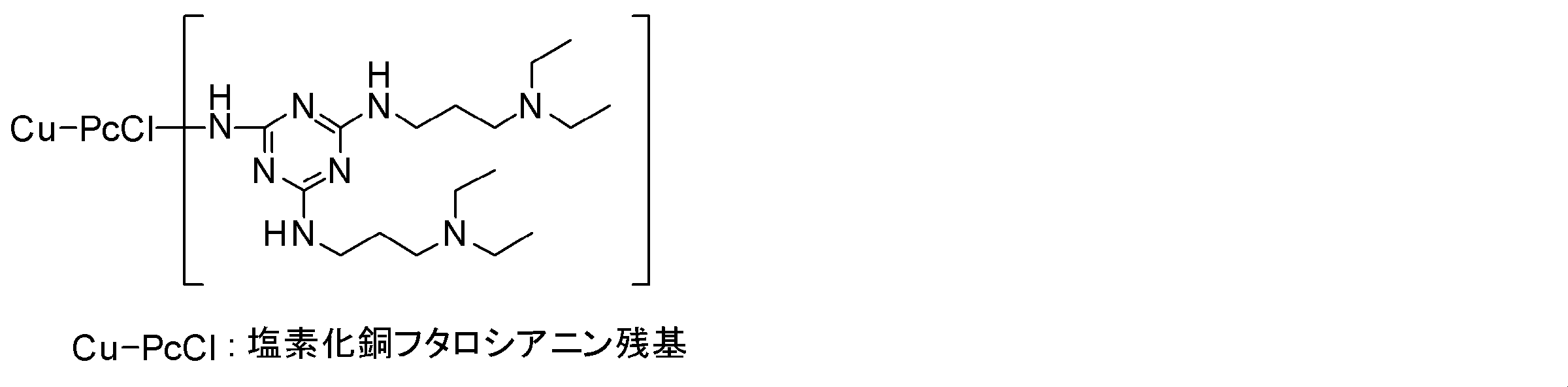
下記の組成の混合物を均一に攪拌混合した後、ビーズミルにより3時間混合・分散して黄色顔料分散組成物(Y-a)を調製した。
イソインドリン系黄色顔料(C.I.Pigment Yellow139)
14.2質量部
下記化学式(B-1)で表される色素誘導体 1.6質量部
リン酸系分散剤(C-1) 3.5質量部
樹脂バインダー(D-1) 5.7質量部(不揮発分)
プロピレングリコールモノメチルエーテルアセテート(PGMEA)
58.0質量部
シクロヘキサノン 17.0質量部

下記の組成の混合物を均一に攪拌混合した後、ビーズミルにより3時間混合・分散して青色顔料分散組成物(B-a)を調製した。
銅フタロシアニン系青色顔料(C.I.Pigment Blue15:6)
8.4質量部
ジオキサジン系紫色顔料(C.I.Pigment Violet23)
4.3質量部
下記化学式(B-6)で表される色素誘導体 1.3質量部
リン酸系分散剤(C-1) 2.1質量部
樹脂バインダー(D-1) 3.5質量部(不揮発分)
プロピレングリコールモノメチルエーテルアセテート(PGMEA)
50.7質量部
シクロヘキサノン 29.7質量部
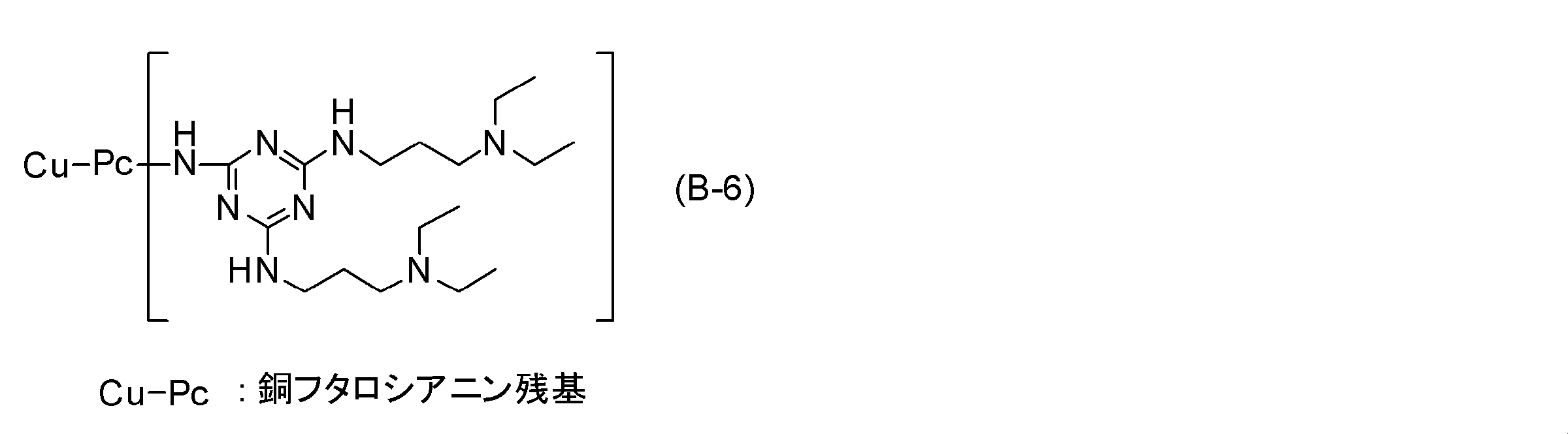

PB15:6…銅フタロシアニン系青色顔料(C.I.Pigment Blue15:6)
PV23…ジオキサジン系紫色顔料(C.I.Pigment Violet23)

下記の組成の混合物を均一に攪拌混合して、赤色感光性樹脂組成物(RR-a)を調製した。
赤色顔料分散組成物(R-a) 50.0質量部
樹脂バインダー1 2.6質量部(40質量%樹脂溶液として)
光重合開始剤(E-1) 0.3質量部
エチレン性不飽和化合物(F-1) 0.7質量部
フッ素系界面活性剤 4.2質量部(不揮発分1質量%のプロピレングリコールモノメチルエーテルアセテート溶液として)
p-メトキシフェノール 0.0003質量部
プロピレングリコールモノメチルエーテルアセテート(PGMEA)
42.2質量部
エチレン性不飽和化合物(F-1):ジペンタエリスリトールヘキサアクリレートのエチレンオキシド変性品(新中村化学工業株式会社製、NKエステル A-DPH-12E)
フッ素系界面活性剤:(大日本インキ株式会社製、メガファックF-781F)
(PCD後のパターン形成性の評価)
(1)透明レジスト溶液Aの調製(ネガ型)
下記の成分を混合して溶解し、透明レジスト溶液Aを調製した。
・プロピレングリコールモノメチルエーテルアセテート 5.20部
・シクロヘキサノン 52.60部
・バインダー 30.50部
(メタクリル酸ベンジル/メタクリル酸/メタクリル酸-2-ヒドロキシエチル共重合体モル比=60:20:20、平均分子量30200(ポリスチレン換算)、41%シクロヘキサノン溶液)
・ジペンタエリスリトールヘキサアクリレート 10.20部
・重合禁止剤(p-メトキシフェノール) 0.006部
・フッ素系界面活性剤(DIC(株)、F-475) 0.80部
・光重合開始剤:4-ベンズオキソラン-2,6-ビス(トリクロロメチル)-s-トリアジン(みどり化学(株)、TAZ-107) 0.58部
ガラス基板(コーニング1737)を0.5%NaOH水で超音波洗浄した後、水洗、脱水ベーク(200℃/20分)を行った。次いで、上記(1)で得た透明レジスト溶液Aを、洗浄したガラス基板上に乾燥後の膜厚が2μmになるようにスピンコーターを用いて塗布し、220℃で1時間加熱乾燥させて下塗り層を形成することにより、下塗り層付ガラス基板を調製した。
上記で得た赤色感光性樹脂組成物(RR-a)~(RR-v)を、上記(2)で得た下塗り層付ガラス基板の下塗り層の上に乾燥後の膜厚が0.6μmになるようにスピンコーターを用いて塗布し、100℃で120秒間プリベークした基板を2枚用意した。
上記基板のうちの片方は、赤色感光性樹脂組成物の塗布後直ちにi線ステッパー露光装置FPA-i5+(キヤノン(株)製)を使用して、塗布膜に365nmの波長で線幅1.1μmのマスクを通して、一辺の長さが1.1μmの市松模様パターンが形成される最適な露光量で照射した。露光後、現像液CD-2000(富士フイルムエレクトロニクスマテリアルズ(株)製)を使用して、25℃40秒間の条件で現像した。その後、流水で30秒間リンスした後、スプレー乾燥し、着色パターンを得た。
次いで、上記基板のうちのもう片方は、赤色感光性樹脂組成物の塗布後、室温のクリーンルーム内で72時間引き置いた(PCD)後、上記と同様の方法で着色パターンを得た。
このようにして得られた2種の着色パターンをSEMで観察し、塗布後直ち(PCD無し)に露光・現像を行って得られた着色パターンと、PCD後に露光・現像を行って得られた着色パターンとの形状を比較し、以下の基準で評価した。
A:PCD後の着色パターンの形状が、PCD無しの着色パターンの形状と比べて全く変化していない
B:PCD後の着色パターンの形状に多少変化が見られるが問題無い
C:PCD後の着色パターンの形状が崩れており問題がある
D:PCD後の着色パターンの形状が大きく崩れている
このPCD評価結果をまとめて下記表5に示す。
上記で得た赤色感光性樹脂組成物(RR-a)~(RR-v)を、ガラス基板上に乾燥後の膜厚が0.6μmになるようにスピンコーターを用いて塗布し、100℃で120秒間プリベークして着色塗膜1を得た。
また、上記要領で得た赤色感光性樹脂組成物(RR-a)~(RR-v)を室温で6ヶ月間経時させた後、ガラス基板上に乾燥後の膜厚が0.6μmになるようにスピンコーターを用いて塗布し、100℃で120秒間プリベークして着色塗膜2を得た。
得られた各着色塗膜を光学顕微鏡の観測レンズと光源との間に設置して光を観測レンズに向けて照射し、倍率が1000倍のデジタルカメラが設置された光学顕微鏡を用いてその透過光状態を観察した。光学顕微鏡に設置されたデジタルカメラには128万画素のCCDが搭載されており、上記デジタルカメラで透過光状態にある着色塗膜表面を撮影した。撮影画像は8ビットのビットマップ形式でデジタル変換したデータ(デジタル画像)として保存した。
なお、着色塗膜表面の撮影は任意に選択した20の領域に対して行った。また、デジタル変換したデータは、撮影画像をRGBの3原色それぞれの輝度を0~255までの256階調の濃度分布として数値化して保存した。
次いで、保存されたデジタル画像について、1つの格子サイズが実基板上の0.5μm四方に相当するように、格子状に区分し、一つの区画内での輝度を平均化した。本実施例においては、128万画素のデジタルカメラで光学1000倍の画像を撮影したため、実基板上の0.5μmは撮影画像上の0.5mmとなり、ディスプレイ上における画像サイズが452mm×352mmであったことから、一つの領域における総区画数は636416個であった。
各領域の全区画について、任意の1区画とそれに隣接する全ての隣接区画の平均輝度とを計測した。隣接区画の平均輝度との差が5以上の区画を有意差区画と認定し、全領域の有意差区画の平均総数を算出した。この数値が小さいほど、隣接する区画との濃度差が小さく、ザラが少なく、カラーフィルタとしての特性に優れる事を表す。
着色塗膜1のザラの平均総数を調製直後のザラの値として、着色塗膜2のザラの平均総数を室温6ヶ月経時後のザラの値として、さらに調製直後のザラの値から室温6ヶ月経時後にかけてのザラの増大率を下記表5に示す。
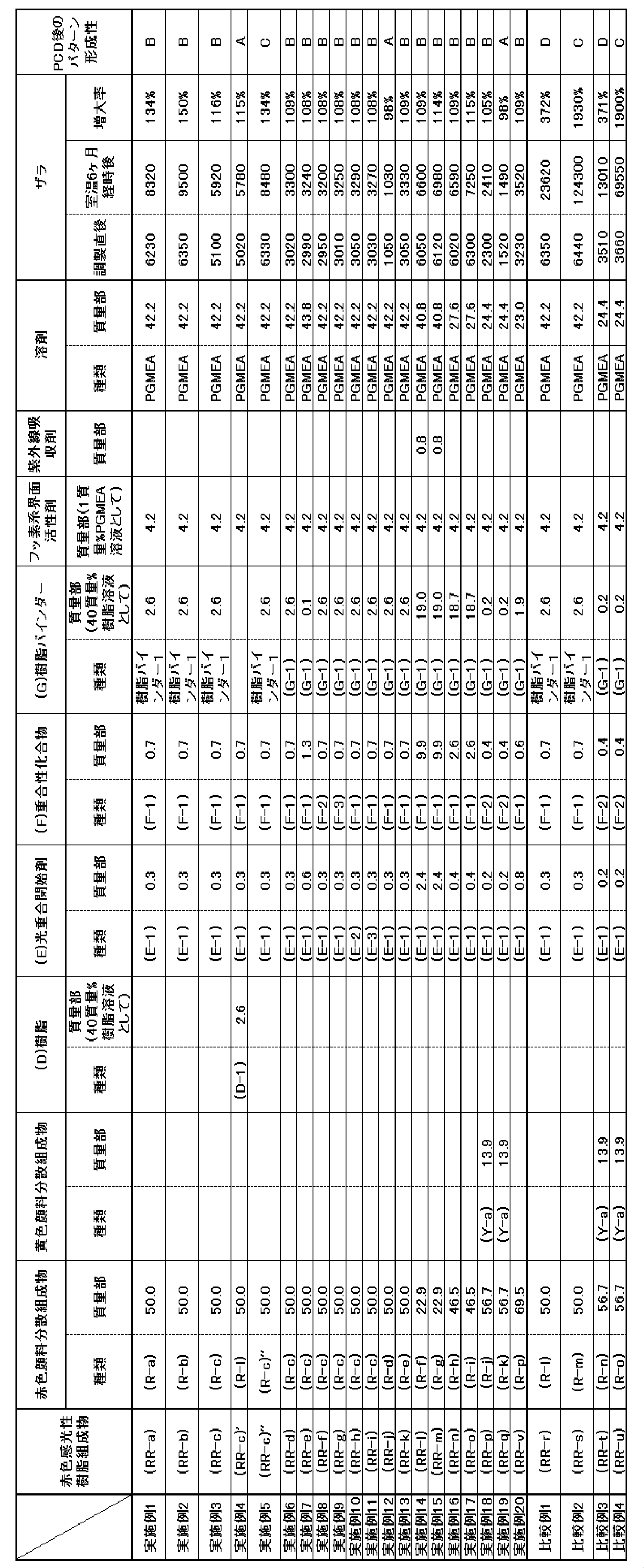
光重合開始剤(E-2):エタノン,1-[9-エチル-6-(2-メチルベンゾイル)-9H-カルバゾール-3-イル]-,1-(0-アセチルオキシム) (BASF社製、IRGACURE OXE02)
光重合開始剤(E-3):2-(ジメチルアミノ)-2-[(4-メチルフェニル)メチル]-1-[4-(4-モルホリニル)フェニル]-1-ブタノン(BASF社製、IRGACURE 379)
エチレン性不飽和化合物(F-2):ジペンタエリスリトールヘキサアクリレートとジペンタエリスリトールペンタアクリレートの混合物(日本化薬株式会社製、KAYARAD DPHA)
エチレン性不飽和化合物(F-3):トリメチロールプロパントリアクリレート(新中村化学工業株式会社製、A-TMPT)
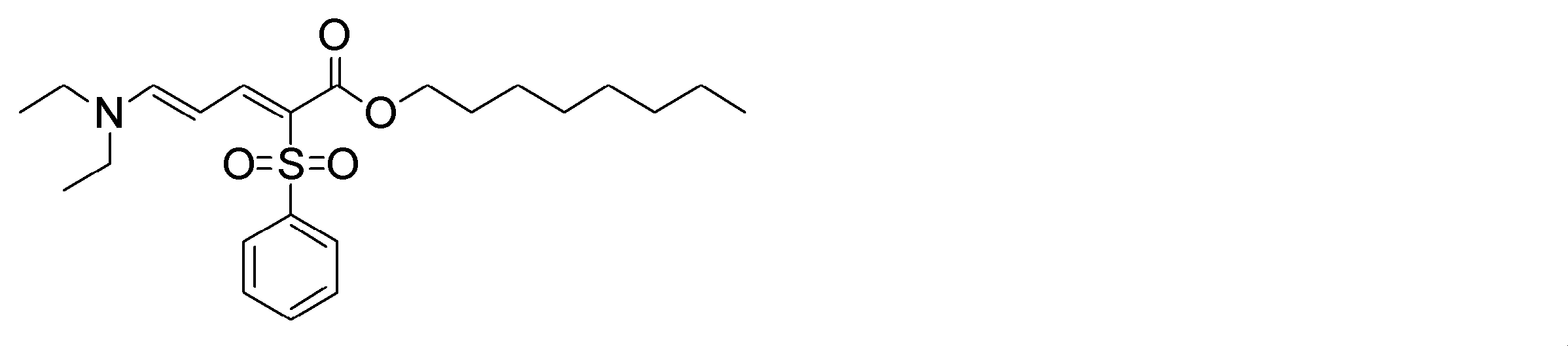
これらに対し、例えば実施例1に示す本発明の赤色感光性樹脂組成物(RR-a)は、本発明の組成物に必須の成分である(C)リン酸系分散剤、さらに(D)特定構造の樹脂を含むため、ザラ経時増大が抑えられ、PCD後のパターン形成性が大幅に改善されていることが分かった。
また、(G)樹脂バインダーとして、側鎖に重合性二重結合を有する樹脂(G-1)を用いた実施例6~20は、ザラの増大率がより抑制されていることもわかった。
リン酸系分散剤(C-3)を用いた実施例12、19は、他のリン酸系分散剤を用いた実施例よりもPCD後のパターン形成性に優れることが分かった。
(D)特定構造の樹脂の含有量が、(A)顔料100質量部に対して80質量部を超えている顔料分散組成物(R-c)’’を用いた実施例5は、ザラの増大率およびPCD後のパターン形成性が比較例よりは優れるものの、他の実施例と比較してやや劣ることが分かった。
実施例4に示すように、(A)顔料、(B)塩基性色素誘導体、および(C)リン酸系分散剤を分散させて赤色顔料分散組成物を得た後に、(D)樹脂を配合させて赤色感光性樹脂組成物を調製することで、ザラ経時増大がより抑えられ、PCD後のパターン形成性がより改善されていることが分かった。
下記の組成の混合物を均一に攪拌混合して、緑色感光性樹脂組成物(GR-a)を調製した。
緑色顔料分散組成物(G-a) 50.7質量部
樹脂バインダー1 4.7質量部(40質量%樹脂溶液として)
上記光重合開始剤(E-1) 0.5質量部
上記エチレン性不飽和化合物(F-1) 4.9質量部
フッ素系界面活性剤(大日本インキ株式会社製、メガファックF-781F)
4.2質量部(不揮発分1質量%のプロピレングリコールモノメチルエーテルアセテート溶液として)
紫外線吸収剤(上記の化合物) 0.3質量部
p-メトキシフェノール 0.0003質量部
プロピレングリコールモノメチルエーテルアセテート(PGMEA)
34.7質量部

これらに対し、例えば実施例21に示す本発明の緑色感光性樹脂組成物(GR-a)は、本発明の組成物に必須の成分である(C)リン酸系分散剤、さらに(D)特定構造の樹脂を含むため、ザラ経時増大が抑えられ、PCD後のパターン形成性が大幅に改善されていることが分かった。
また、(G)樹脂バインダーとして、側鎖に重合性二重結合を有する樹脂(G-1)を用いた実施例26~39は、ザラの増大率がより抑制されていることも分かった。
リン酸系分散剤(C-3)を用いた実施例32、39は、他のリン酸系分散剤を用いた実施例よりもPCD後のパターン形成性に優れることが分かった。
(D)樹脂の含有量が、(A)顔料100質量部に対して80質量部を超えている顔料分散組成物(G-c)’’を用いた実施例25は、ザラの増大率およびPCD後のパターン形成性が比較例よりは優れるものの、他の実施例と比較してやや劣ることが分かった。
実施例24に示すように、(A)顔料、(B)塩基性色素誘導体、および(C)リン酸系分散剤を分散させた後に(D)樹脂を配合させて着色感光性樹脂組成物を調製することで、ザラ経時増大がより抑えられ、PCD後のパターン形成性がより改善されていることが分かった。
下記の組成の混合物を均一に攪拌混合して、青色感光性樹脂組成物(BR-a)を調製した。
青色顔料分散組成物(B-a) 54.9質量部
樹脂バインダー1 2.7質量部(40質量%樹脂溶液として)
上記光重合開始剤(E-1) 1.4質量部
上記エチレン性不飽和化合物(F-1) 2.8質量部
フッ素系界面活性剤(大日本インキ株式会社製、メガファックF-781F)
4.2質量部(不揮発分1質量%のプロピレングリコールモノメチルエーテルアセテート溶液として)
p-メトキシフェノール 0.0003質量部
プロピレングリコールモノメチルエーテルアセテート(PGMEA)
34.0質量部
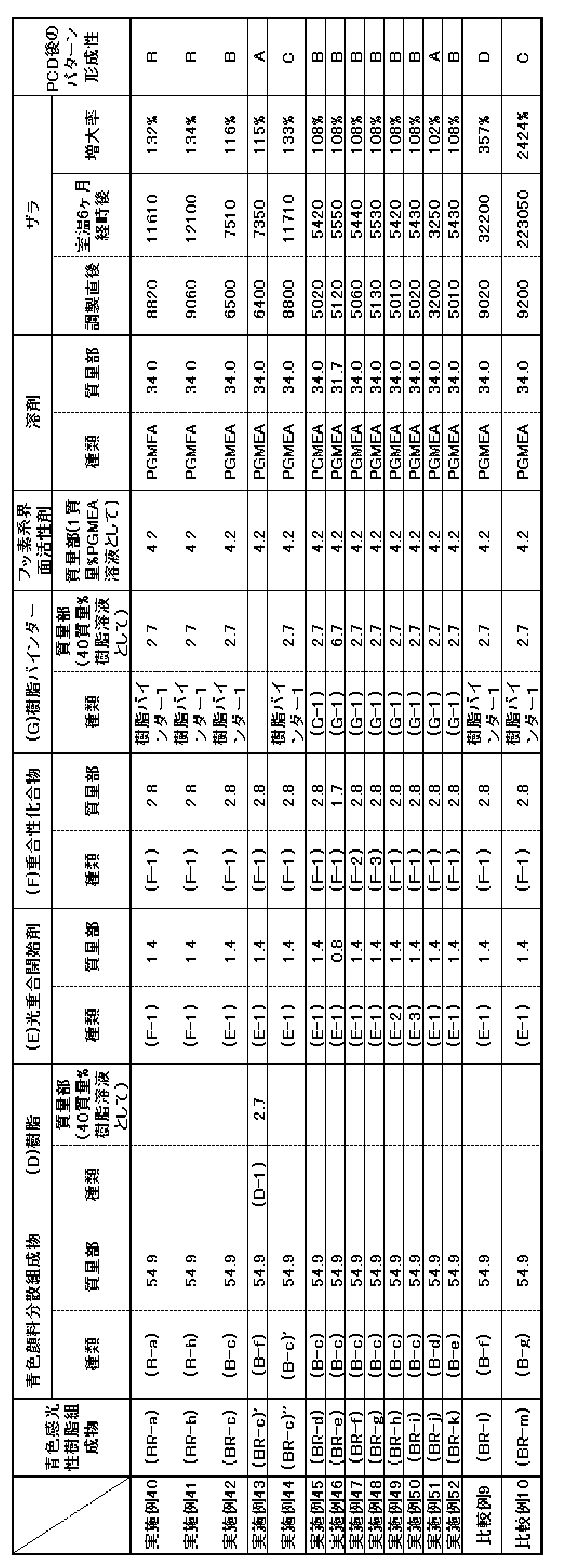
これらに対し、例えば実施例40に示す本発明の青色感光性樹脂組成物(BR-a)は、本発明の組成物に必須の成分である(C)リン酸系分散剤、さらに(D)特定構造の樹脂バインダーを含むため、室温6ヶ月経時後のザラ増大が抑えられ、PCD後のパターン形成性が大幅に改善されている事が判る。
また、(G)樹脂バインダーとして、側鎖に重合性二重結合を有する樹脂(G-1)を用いた実施例45~52は、ザラの増大率がより抑制されていることも分かった。
リン酸系分散剤(C-3)を用いた実施例43、51は、他のリン酸系分散剤を用いた実施例よりもPCD後のパターン形成性に優れることが分かった。
(D)樹脂の含有量が、(A)顔料100質量部に対して80質量部を超えている顔料分散組成物(R-c)’’を用いた実施例44は、ザラの増大率およびPCD後のパターン形成性が比較例よりは優れるものの、他の実施例と比較してやや劣ることが分かった。
実施例43に示すように、(A)顔料、(B)塩基性色素誘導体、および(C)リン酸系分散剤を分散させた後に(D)樹脂を配合させて着色感光性樹脂組成物を調製することで、ザラ経時増大がより抑えられ、PCD後のパターン形成性がより改善されていることが分かった。
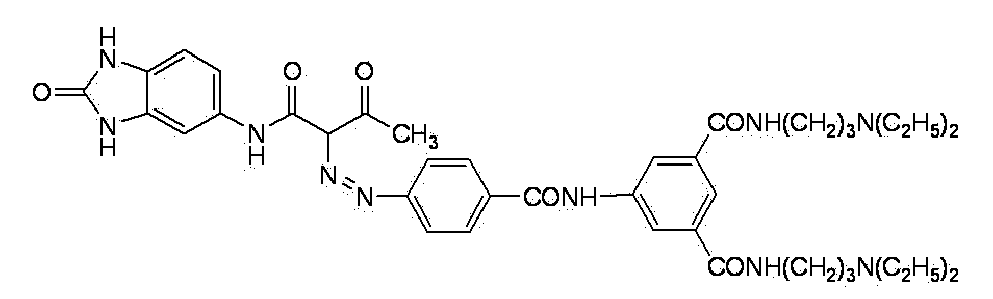
Claims (17)
- (A)顔料、(B)塩基性色素誘導体、(C)下記一般式(II)で表されるリン酸系分散剤、(D)下記一般式(IV)で表される化合物(x)とエチレン性不飽和二重結合を有する化合物(y)を共重合してなる樹脂、(E)光重合開始剤、および(F)重合性化合物を含有する着色感光性樹脂組成物;
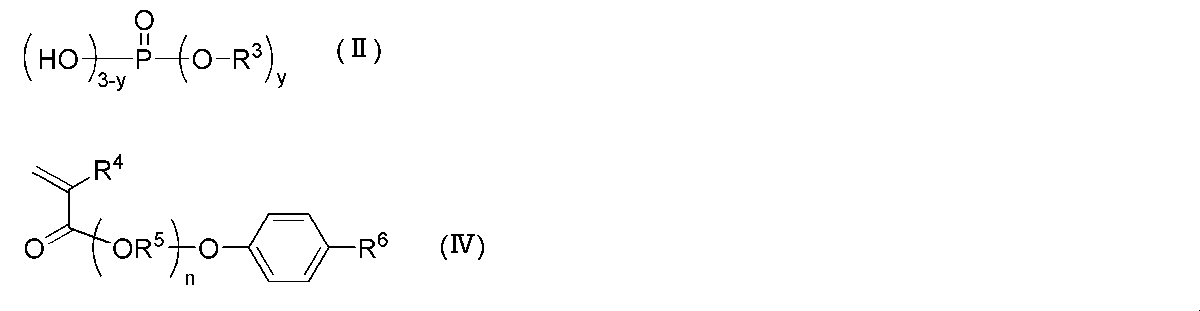
yが2の場合、複数のR3は、それぞれ、同一であっても異なっていてもよい;
一般式(IV)中、R4は水素原子またはメチル基を表し、R5は炭素数2または3のアルキレン基を表し、R6は水素原子またはベンゼン環を含んでいても良い炭素数1~20のアルキル基を表し、nは1~15の整数を表す;
nが2以上の場合、複数のR5は、それぞれ、同一であってもよく、異なっていてもよい。 - 前記(B)塩基性色素誘導体が、アミノ基を有する化合物である、請求項1に記載の着色感光性樹脂組成物。
- 前記(A)顔料が、赤色顔料、緑色顔料および黄色顔料からなる群から選ばれる、請求項1または2に記載の着色感光性樹脂組成物。
- 前記一般式(II)中、前記R3で表されるポリエステル構造の数平均分子量が1900~10000である、請求項1~3のいずれか1項に記載の着色感光性樹脂組成物。
- 前記一般式(II)中、前記R3で表されるポリエステル構造が2種以上の異なるラクトンモノマーを開環重合して得られるポリエステル構造である、請求項1~4のいずれか1項に記載の着色感光性樹脂組成物。
- さらに、(G)側鎖に重合性二重結合を有する樹脂を含む、請求項1~5のいずれか1項に記載の着色感光性樹脂組成物。
- 前記(G)側鎖に重合性二重結合を有する樹脂が、2~6の水酸基を有する重合性モノマー(p)と、他の重合性モノマー(q)との共重合体(a)に、水酸基と反応可能な官能基とエチレン性不飽和二重結合を有する化合物(b)を反応させてなる樹脂である、請求項6に記載の着色感光性樹脂組成物。
- 前記(D)一般式(IV)で表される化合物(x)とエチレン性不飽和二重結合を有する化合物(y)を共重合してなる樹脂の含有量が、前記(A)顔料100質量部に対して5~80質量部である、請求項1~7のいずれか1項に記載の着色感光性樹脂組成物。
- 前記着色感光性樹脂組成物が、前記(A)顔料、前記(B)塩基性色素誘導体、および前記(C)一般式(II)で表されるリン酸系分散剤を分散させた後、前記(D)一般式(IV)で表される化合物(x)とエチレン性不飽和二重結合を有する化合物(y)を共重合してなる樹脂を配合してなる、請求項1~8のいずれか1項に記載の着色感光性樹脂組成物。
- カラーフィルタの着色領域形成に用いられる請求項1~9のいずれか1項に記載の着色感光性樹脂組成物。
- 請求項1~10のいずれか1項に記載の着色感光性樹脂組成物を硬化してなる硬化膜。
- 請求項1~10のいずれか1項に記載の着色感光性樹脂組成物を支持体上に適用して着色感光性組成物層を形成する工程と、前記着色感光性組成物層をパターン状に露光する工程と、未露光部を現像除去して着色パターンを形成する工程とを含むカラーフィルタの製造方法。
- 請求項1~10のいずれか1項に記載の着色感光性樹脂組成物を支持体上に適用して着色感光性組成物層を形成する工程、
前記着色感光性組成物層上にフォトレジスト層を形成する工程、
露光および現像することにより前記フォトレジスト層をパターニングしてレジストパターンを得る工程、および
前記レジストパターンをエッチングマスクとして前記着色感光性組成物層をドライエッチングする工程を含む、カラーフィルタの製造方法。 - 請求項11に記載の硬化膜を有するカラーフィルタ。
- 請求項12または13に記載のカラーフィルタの製造方法によって製造したカラーフィルタ。
- 請求項14または15に記載のカラーフィルタを有する固体撮像素子。
- 請求項14または15に記載のカラーフィルタを有する画像表示装置。
Priority Applications (2)
| Application Number | Priority Date | Filing Date | Title |
|---|---|---|---|
| KR1020167000860A KR101821235B1 (ko) | 2013-08-05 | 2014-07-31 | 착색 감광성 수지 조성물, 경화막, 컬러 필터, 컬러 필터의 제조 방법, 고체 촬상 소자 및 화상 표시 장치 |
| CN201480030200.XA CN105283806B (zh) | 2013-08-05 | 2014-07-31 | 着色感光性树脂组合物、硬化膜、彩色滤光片及其制造方法、固体摄像元件及图像显示装置 |
Applications Claiming Priority (2)
| Application Number | Priority Date | Filing Date | Title |
|---|---|---|---|
| JP2013162160 | 2013-08-05 | ||
| JP2013-162160 | 2013-08-05 |
Publications (1)
| Publication Number | Publication Date |
|---|---|
| WO2015019934A1 true WO2015019934A1 (ja) | 2015-02-12 |
Family
ID=52461270
Family Applications (1)
| Application Number | Title | Priority Date | Filing Date |
|---|---|---|---|
| PCT/JP2014/070194 Ceased WO2015019934A1 (ja) | 2013-08-05 | 2014-07-31 | 着色感光性樹脂組成物、硬化膜、カラーフィルタ、カラーフィルタの製造方法、固体撮像素子および画像表示装置 |
Country Status (5)
| Country | Link |
|---|---|
| JP (1) | JP6106639B2 (ja) |
| KR (1) | KR101821235B1 (ja) |
| CN (1) | CN105283806B (ja) |
| TW (1) | TWI592752B (ja) |
| WO (1) | WO2015019934A1 (ja) |
Cited By (1)
| Publication number | Priority date | Publication date | Assignee | Title |
|---|---|---|---|---|
| TWI695224B (zh) * | 2015-08-31 | 2020-06-01 | 日商富士軟片股份有限公司 | 感光性組成物、硬化膜的製造方法、液晶顯示裝置的製造方法、有機電激發光顯示裝置的製造方法以及觸控面板的製造方法 |
Families Citing this family (6)
| Publication number | Priority date | Publication date | Assignee | Title |
|---|---|---|---|---|
| TWI830588B (zh) * | 2016-08-01 | 2024-01-21 | 日商富士軟片股份有限公司 | 感光性樹脂組成物、硬化膜、積層體、硬化膜的製造方法、積層體的製造方法及半導體元件 |
| WO2018173524A1 (ja) | 2017-03-24 | 2018-09-27 | 富士フイルム株式会社 | 着色組成物、顔料分散液、顔料分散液の製造方法、硬化膜、カラーフィルタ、固体撮像素子および画像表示装置 |
| JP2019113612A (ja) * | 2017-12-21 | 2019-07-11 | 東洋インキScホールディングス株式会社 | カラーフィルタ用着色組成物、及びカラーフィルタ |
| WO2019230539A1 (ja) * | 2018-05-31 | 2019-12-05 | 東洋インキScホールディングス株式会社 | 着色組成物、および固体撮像素子用カラーフィルタの製造方法 |
| CN112578635A (zh) * | 2019-09-30 | 2021-03-30 | 日铁化学材料株式会社 | 黑阻剂用感光性树脂组合物及其制造方法、遮光膜、彩色滤光片、触控面板、及显示装置 |
| KR102903359B1 (ko) * | 2020-10-21 | 2025-12-26 | 후지필름 가부시키가이샤 | 수지 조성물, 막의 제조 방법, 광학 필터의 제조 방법, 고체 촬상 소자의 제조 방법 및 화상 표시 장치의 제조 방법 |
Citations (6)
| Publication number | Priority date | Publication date | Assignee | Title |
|---|---|---|---|---|
| JP2007322949A (ja) * | 2006-06-05 | 2007-12-13 | Toyo Ink Mfg Co Ltd | カラーフィルタ用着色樹脂組成物およびカラーフィルタ |
| JP2011053710A (ja) * | 2010-11-25 | 2011-03-17 | Toyo Ink Mfg Co Ltd | カラーフィルタ用着色組成物 |
| JP2011145663A (ja) * | 2009-12-18 | 2011-07-28 | Fujifilm Corp | 遮光性硬化性組成物、ウエハレベルレンズ、及び遮光性カラーフィルタ |
| JP2012215865A (ja) * | 2011-03-29 | 2012-11-08 | Toyo Ink Sc Holdings Co Ltd | カラーフィルタ用赤色着色組成物及びカラーフィルタ |
| JP2013125265A (ja) * | 2011-12-16 | 2013-06-24 | Toyo Ink Sc Holdings Co Ltd | カラーフィルタ用赤色着色組成物及びカラーフィルタ |
| JP2014202774A (ja) * | 2013-04-01 | 2014-10-27 | 東洋インキScホールディングス株式会社 | カラーフィルタ用着色組成物、およびカラーフィルタ |
Family Cites Families (9)
| Publication number | Priority date | Publication date | Assignee | Title |
|---|---|---|---|---|
| JP4461681B2 (ja) * | 2002-01-29 | 2010-05-12 | 東洋インキ製造株式会社 | カラーフィルタ用着色組成物およびカラーフィルタ |
| JP4133137B2 (ja) * | 2002-09-06 | 2008-08-13 | 東洋インキ製造株式会社 | 感光性着色組成物 |
| JP2004347915A (ja) * | 2003-05-23 | 2004-12-09 | Toyo Ink Mfg Co Ltd | カラーフィルタ用着色組成物およびカラーフィルタ |
| JP4351519B2 (ja) * | 2003-11-26 | 2009-10-28 | 東洋インキ製造株式会社 | 感光性組成物およびカラーフィルタ |
| JP2007171853A (ja) * | 2005-12-26 | 2007-07-05 | Toyo Ink Mfg Co Ltd | カラーフィルタ用着色組成物およびカラーフィルタ |
| JP4802746B2 (ja) | 2006-02-08 | 2011-10-26 | 凸版印刷株式会社 | 感光性着色組成物およびカラーフィルタ |
| JP4655963B2 (ja) | 2006-02-28 | 2011-03-23 | 東洋インキ製造株式会社 | 顔料組成物、顔料分散体およびインキ |
| JP4678316B2 (ja) | 2006-02-28 | 2011-04-27 | 東洋インキ製造株式会社 | 顔料組成物、顔料分散体およびインキ |
| JP5094378B2 (ja) * | 2007-02-14 | 2012-12-12 | 富士フイルム株式会社 | 固体撮像素子用カラーフィルタ及びその製造方法、並びに固体撮像素子 |
-
2014
- 2014-07-29 JP JP2014153705A patent/JP6106639B2/ja active Active
- 2014-07-31 WO PCT/JP2014/070194 patent/WO2015019934A1/ja not_active Ceased
- 2014-07-31 CN CN201480030200.XA patent/CN105283806B/zh active Active
- 2014-07-31 KR KR1020167000860A patent/KR101821235B1/ko active Active
- 2014-08-05 TW TW103126674A patent/TWI592752B/zh active
Patent Citations (6)
| Publication number | Priority date | Publication date | Assignee | Title |
|---|---|---|---|---|
| JP2007322949A (ja) * | 2006-06-05 | 2007-12-13 | Toyo Ink Mfg Co Ltd | カラーフィルタ用着色樹脂組成物およびカラーフィルタ |
| JP2011145663A (ja) * | 2009-12-18 | 2011-07-28 | Fujifilm Corp | 遮光性硬化性組成物、ウエハレベルレンズ、及び遮光性カラーフィルタ |
| JP2011053710A (ja) * | 2010-11-25 | 2011-03-17 | Toyo Ink Mfg Co Ltd | カラーフィルタ用着色組成物 |
| JP2012215865A (ja) * | 2011-03-29 | 2012-11-08 | Toyo Ink Sc Holdings Co Ltd | カラーフィルタ用赤色着色組成物及びカラーフィルタ |
| JP2013125265A (ja) * | 2011-12-16 | 2013-06-24 | Toyo Ink Sc Holdings Co Ltd | カラーフィルタ用赤色着色組成物及びカラーフィルタ |
| JP2014202774A (ja) * | 2013-04-01 | 2014-10-27 | 東洋インキScホールディングス株式会社 | カラーフィルタ用着色組成物、およびカラーフィルタ |
Cited By (1)
| Publication number | Priority date | Publication date | Assignee | Title |
|---|---|---|---|---|
| TWI695224B (zh) * | 2015-08-31 | 2020-06-01 | 日商富士軟片股份有限公司 | 感光性組成物、硬化膜的製造方法、液晶顯示裝置的製造方法、有機電激發光顯示裝置的製造方法以及觸控面板的製造方法 |
Also Published As
| Publication number | Publication date |
|---|---|
| CN105283806A (zh) | 2016-01-27 |
| TW201506544A (zh) | 2015-02-16 |
| KR101821235B1 (ko) | 2018-01-23 |
| JP2015052779A (ja) | 2015-03-19 |
| TWI592752B (zh) | 2017-07-21 |
| JP6106639B2 (ja) | 2017-04-05 |
| KR20160019541A (ko) | 2016-02-19 |
| CN105283806B (zh) | 2019-11-12 |
Similar Documents
| Publication | Publication Date | Title |
|---|---|---|
| JP6106638B2 (ja) | 着色感光性樹脂組成物、硬化膜、カラーフィルタ、カラーフィルタの製造方法、固体撮像素子および画像表示装置 | |
| JP6721578B2 (ja) | 赤外線吸収組成物、赤外線カットフィルタ、積層体、パターン形成方法、および固体撮像素子 | |
| JP6162165B2 (ja) | 着色組成物、硬化膜、カラーフィルタ、カラーフィルタの製造方法、固体撮像素子、画像表示装置、有機エレクトロルミネッセンス素子、色素および色素の製造方法 | |
| KR101669027B1 (ko) | 안료 분산물, 착색 경화성 조성물, 컬러필터 및 그 제조방법 | |
| JP6159309B2 (ja) | 着色組成物、硬化膜、カラーフィルタ、カラーフィルタの製造方法、固体撮像素子および画像表示装置 | |
| JP6339208B2 (ja) | 着色組成物、硬化膜、カラーフィルタ、カラーフィルタの製造方法、固体撮像素子、および画像表示装置 | |
| JP6106639B2 (ja) | 着色感光性樹脂組成物、硬化膜、カラーフィルタ、カラーフィルタの製造方法、固体撮像素子および画像表示装置 | |
| WO2015016243A1 (ja) | 着色組成物、硬化膜、カラーフィルタ、カラーフィルタの製造方法、固体撮像素子および画像表示装置 | |
| JP6307164B2 (ja) | 顔料分散液、顔料分散液の製造方法、着色組成物、硬化膜、カラーフィルタ、カラーフィルタの製造方法、固体撮像素子、画像表示装置および組成物 | |
| WO2016031574A1 (ja) | 組成物、硬化膜、パターン形成方法、カラーフィルタ、カラーフィルタの製造方法、固体撮像素子および画像表示装置 | |
| WO2015016242A1 (ja) | 着色組成物、硬化膜、カラーフィルタ、カラーフィルタの製造方法、固体撮像素子および画像表示装置 | |
| WO2015079911A1 (ja) | 着色感光性樹脂組成物、硬化膜、パターン、カラーフィルタ、カラーフィルタの製造方法、固体撮像素子および画像表示装置 | |
| KR102152047B1 (ko) | 착색 조성물, 컬러 필터, 패턴 형성 방법, 고체 촬상 소자, 화상 표시 장치 및 색소 다량체 | |
| WO2016203890A1 (ja) | 硬化性組成物、硬化性組成物の製造方法、膜、赤外線カットフィルタ、赤外線透過フィルタ、パターン形成方法および装置 | |
| WO2015016241A1 (ja) | 着色組成物、硬化膜、カラーフィルタ、カラーフィルタの製造方法、固体撮像素子および画像表示装置 | |
| JP7016879B2 (ja) | 着色組成物、膜の製造方法、カラーフィルタの製造方法、固体撮像素子の製造方法および画像表示装置の製造方法 | |
| JPWO2019077913A1 (ja) | 着色組成物、膜、カラーフィルタ、固体撮像素子および画像表示装置 | |
| WO2015115413A1 (ja) | 着色組成物、パターン形成方法、カラーフィルタの製造方法、カラーフィルタ、固体撮像素子、画像表示装置および着色組成物の製造方法 |
Legal Events
| Date | Code | Title | Description |
|---|---|---|---|
| WWE | Wipo information: entry into national phase |
Ref document number: 201480030200.X Country of ref document: CN |
|
| 121 | Ep: the epo has been informed by wipo that ep was designated in this application |
Ref document number: 14834215 Country of ref document: EP Kind code of ref document: A1 |
|
| ENP | Entry into the national phase |
Ref document number: 20167000860 Country of ref document: KR Kind code of ref document: A |
|
| NENP | Non-entry into the national phase |
Ref country code: DE |
|
| 122 | Ep: pct application non-entry in european phase |
Ref document number: 14834215 Country of ref document: EP Kind code of ref document: A1 |