WO2015016256A1 - 錠剤 - Google Patents
錠剤 Download PDFInfo
- Publication number
- WO2015016256A1 WO2015016256A1 PCT/JP2014/070047 JP2014070047W WO2015016256A1 WO 2015016256 A1 WO2015016256 A1 WO 2015016256A1 JP 2014070047 W JP2014070047 W JP 2014070047W WO 2015016256 A1 WO2015016256 A1 WO 2015016256A1
- Authority
- WO
- WIPO (PCT)
- Prior art keywords
- tablet
- particle group
- mass
- component
- particle
- Prior art date
- Legal status (The legal status is an assumption and is not a legal conclusion. Google has not performed a legal analysis and makes no representation as to the accuracy of the status listed.)
- Ceased
Links
Classifications
-
- A—HUMAN NECESSITIES
- A61—MEDICAL OR VETERINARY SCIENCE; HYGIENE
- A61K—PREPARATIONS FOR MEDICAL, DENTAL OR TOILETRY PURPOSES
- A61K9/00—Medicinal preparations characterised by special physical form
- A61K9/20—Pills, tablets, discs, rods
- A61K9/2072—Pills, tablets, discs, rods characterised by shape, structure or size; Tablets with holes, special break lines or identification marks; Partially coated tablets; Disintegrating flat shaped forms
- A61K9/2077—Tablets comprising drug-containing microparticles in a substantial amount of supporting matrix; Multiparticulate tablets
-
- A—HUMAN NECESSITIES
- A61—MEDICAL OR VETERINARY SCIENCE; HYGIENE
- A61P—SPECIFIC THERAPEUTIC ACTIVITY OF CHEMICAL COMPOUNDS OR MEDICINAL PREPARATIONS
- A61P29/00—Non-central analgesic, antipyretic or antiinflammatory agents, e.g. antirheumatic agents; Non-steroidal antiinflammatory drugs [NSAID]
Definitions
- the present invention relates to a tablet.
- This application claims priority on July 30, 2013 based on Japanese Patent Application No. 2013-157823 for which it applied to Japan, and uses the content here.
- the dispersibility of the drug in the stomach after taking is one of the important factors affecting the bioavailability of the drug.
- the drug is a poorly water-soluble drug
- the poorly water-soluble drug is more likely to aggregate in a polar solution than the water-soluble drug, and the transition from the stomach to the intestine is considered to be delayed.
- a poorly water-soluble drug often aggregates once, it is often difficult to redissolve in the solution. Therefore, in a preparation containing a poorly water-soluble drug, the quality of the dispersibility of the drug greatly affects the bioavailability of the drug. . Therefore, improving the dispersibility of a drug in a preparation containing a poorly water-soluble drug is important for increasing the bioavailability of the drug.
- Patent Documents 1 and 2 disclose formulations that improve the dispersibility of drugs.
- Patent Document 1 discloses a dispersion containing a non-steroidal anti-inflammatory drug such as naproxen.
- Patent Document 1 shows that when a hygroscopic sugar and sodium lauryl sulfate are used in combination, the redispersibility of the drug is synergistically high.
- Patent Document 2 discloses a nanoparticle composition containing an active drug having low solubility.
- Patent Document 2 when nanoparticle composition containing active drug particles having a polymer surface stabilizer such as polyvinylpyrrolidone (PVP) adsorbed on the surface thereof, dioctyl sodium sulfosuccinate (DOSS) is contained, It has been shown that the dispersibility of the active drug is excellent.
- PVP polyvinylpyrrolidone
- DOSS dioctyl sodium sulfosuccinate
- an object of this invention is to provide the tablet with which the dispersibility of the poorly water-soluble drug was improved more.
- the tablet of the present invention comprises a particle group (A) containing a particle group of a poorly water-soluble drug, and at least one particle group (B) selected from a carbonate particle group and a bicarbonate particle group. It is characterized by including.
- the average particle size of the particle group of the poorly water-soluble drug is less than 10 ⁇ m.
- a tablet containing a poorly water-soluble drug that exhibits good dispersibility can be provided.
- the tablet of the present invention is a particle group (a1) of a poorly water-soluble drug (also referred to herein as “(a1) component”.
- “(A1) component” refers to the component itself of the particle group (a1)).
- a particle group (A) also referred to simply as “particle group (A)” in this specification
- a carbonate particle group and a hydrogen carbonate particle group containing a carbonate particle group and a hydrogen carbonate particle group.
- B also simply referred to as “particle group (B)” in this specification.
- the average particle size of the poorly water-soluble drug particle group is preferably less than 10 ⁇ m.
- the tablet includes an optional component such as a surfactant (C), a water-soluble excipient (D) or a disintegrant (E) (in this specification, , Also referred to as “pharmaceutically acceptable carrier”).
- a surfactant C
- D water-soluble excipient
- E disintegrant
- One aspect of the tablet of the present invention includes a particle group (A) and a particle group (B), and the particle group (A) includes a plurality of particles (A ′) including particles (a1 ′) of a poorly water-soluble drug.
- the particle group (B) is composed of a plurality of at least one kind of particles (B ′) selected from carbonate particles and hydrogen carbonate particles.
- the hardly water-soluble drug particle group (a1) is composed of a plurality of the hardly water-soluble drug particles (a1 ′), and the particle group (a1) has an average particle size of less than 10 ⁇ m. preferable.
- One side of the average particle diameter of the particle group (a1) is 0.01 ⁇ m or more and less than 10 ⁇ m, and the other side is 0.1 ⁇ m or more and 2 ⁇ m or less.
- Another aspect of the tablet of the present invention includes the particle group (A) and the particle group (B), and constitutes a plurality of particles (A ′) and the particle group (B) constituting the particle group (A).
- Each of the plurality of particles (B ′) having a discontinuous interface (also referred to as an interface in the present specification) with other particles or components is a tablet.
- Another aspect of the tablet of the present invention includes the particle group (A) and the particle group (B), and the particle group (A) and the particle group (B) are compression molded (in this specification, “compression molding”). "Is sometimes referred to as” tablet ").
- a pharmaceutically acceptable carrier such as E) is a compressed tablet.
- Another aspect of the tablet of the present invention is a tablet having a tablet hardness of 3 kgf to 15 kgf, another aspect is a tablet having a tablet hardness of 4 kgf to 12 kgf, and still another aspect is a tablet hardness. Is a tablet of 6 kgf to 7 kgf.
- the tablet hardness can be measured using a tablet hardness measuring device PTB-301 (manufactured by Pharma Test).
- a tablet hardness measuring device PTB-301 manufactured by Pharma Test.
- Another aspect of the tablet of the present invention is a tablet in which a plurality of particles (a1 ′) constituting the poorly water-soluble drug particle group (a1) are contained while maintaining the particle diameter before compression molding.
- the dispersion ratio of the poorly water-soluble drug 10 minutes after the addition of the tablet to the gastric model solution is 40% or more, preferably 60% or more, more preferably 80% or more, and still more preferably 90%. It is the tablet which is above.
- Yet another aspect of the tablet of the present invention is a tablet having a dispersion reduction value of 0 to 10%, more preferably 0 to 7%, and 0 to 3%.
- the dispersion rate reduction value is a value obtained by subtracting the dispersion rate after 30 minutes from the dispersion rate after 10 minutes from the addition of the tablet to the stomach model solution in the dispersibility evaluation test. The dispersibility evaluation test will be described later.
- the particle group (A) is a particle group containing a particle group (a1) of a poorly water-soluble drug.
- the particle group (A) includes a water-soluble binder (a2) (also referred to herein as “component (a2)”), a water-soluble compound particle group (a3) (present)
- component (a3) also referred to as “component (a3)”
- surfactant (C) an optional component usually used in a pharmaceutical formulation (also referred to herein as “pharmaceutically acceptable carrier”). It can be included.
- the particle group (A) is composed of a plurality of particles (A ′) including particles (a1 ′) of poorly water-soluble drugs.
- the particle group (A) includes, in addition to the poorly water-soluble drug particles (a1 ′), optionally, a water-soluble binder (a2), water-soluble compound particles (a3 ′), an interface. It is composed of a plurality of particles (A ′) containing an active agent (C) or a pharmaceutically acceptable carrier.
- the poorly water-soluble drug particles (a1 ′) and the particles (B ′) are allowed to coexist in the same granule (also referred to as particles), that is, the poorly water-soluble drug component and the carbonate or hydrogencarbonate are contained in the same granule.
- the particles (B ′) react with the particles (a1 ′) to make the particles (a1 ′) unstable, or change the physical properties of the powder to adhere to the container or apparatus during production. It may cause. For this reason, it is preferable that the poorly water-soluble drug component and the carbonate or bicarbonate are not allowed to coexist in the same granule (also referred to as particle).
- the particle group (A) contains the component (a1).
- the hardly water-soluble drug particle group (a1) is composed of a plurality of the hardly water-soluble drug particles (a1 ′).
- the description and illustration of the particle group (a1), that is, the component (a1) are also applied to each particle of the plurality of particles (a1 ′) constituting the particle group (a1) unless otherwise specified.
- a poorly water-soluble drug refers to a drug having a solubility in water at 20 ° C. of 0 to 13 mg / mL.
- the poorly water-soluble drug is preferably a drug having a solubility in water at 20 ° C.
- the method for measuring solubility is a test according to the 16th Japanese Pharmacopoeia. Specifically, when a drug is put into water at 20 ° C. and shaken strongly every 5 minutes for 30 seconds, the ratio of the mass of the drug dissolved within 30 minutes to the volume of water is measured.
- the kind of poorly water-soluble drug used for the component (a1) is not particularly limited.
- Non-steroidal anti-inflammatory drugs such as ketoprofen, mefenamic, meclofenamic, and piroxicam; hypnotics and sedatives such as nitrazepam, triazolam, phenobarbital, amibarbital, allylisopropylpropyrea, phenytoin, primidone, clonazepam, carbamazepine, valpro Antiepileptics such as acids; Antidepressants such as meclizine hydrochloride and dimenhydrinate; Psychiatric and neurological agents such as haloperidol, chlordiazepoxide, diazebam and sulpiride; Antispasmodic agents such as digoxin; Ar
- the volume average particle size of the component (a1) (sometimes referred to simply as “average particle size” in this specification) is the laser diffraction / scattering particle size distribution analyzer “LA-920” (( Measured before mixing with other particles by the manual flow cell measurement method or after the pulverization step.
- the average particle size of the component (a1) is preferably less than 10 ⁇ m, more preferably 5 ⁇ m or less, and even more preferably 2 ⁇ m or less. Moreover, 0.01 micrometer or more is preferable, More preferably, it is 0.1 micrometer or more.
- the average particle diameter of the component (a1) is preferably 0.01 ⁇ m or more and less than 10 ⁇ m, more preferably 0.1 ⁇ m or more and 5 ⁇ m or less, further preferably 0.1 ⁇ m or more and 2 ⁇ m or less, and further more preferably 0.2 ⁇ m or more and 2 ⁇ m or less. preferable.
- the average particle size of the component (a1) means the average particle size before mixing with other particles or after the pulverization step, but the particles giving the average particle size (a1 ′) The particle diameter of at least some of the particles is maintained even after tableting.
- the plurality of particles (a1 ′) constituting the hardly water-soluble drug particle group (a1) have an interface with other particles or components in the tablet of the present invention.
- the peristaltic movement of the stomach after taking a tablet has individual differences in time, intensity, frequency and duration until the peristaltic movement is started. Even if the drug is quickly dispersed, the above-described factors vary, and the time until the drug moves to the intestine is delayed. If the drug re-aggregates and precipitates during that time, the amount and rate of drug transfer to the intestine will decrease, leading to a decrease in effectiveness.
- the dispersibility of the component (a1) is less than or equal to the above upper limit value, the dispersibility can be further improved, and the dispersed state is maintained even 30 minutes after dispersion, so that stable even if the gastric peristalsis varies.
- the medicinal effect is obtained.
- grains of (a1) component cannot aggregate easily, and the further improvement of the dispersibility of a poorly water-soluble drug can be aimed at.
- the blending amount of the component (a1) in the particle group (A) is preferably 5 to 90% by mass, more preferably 10 to 80% by mass, still more preferably 20%, based on the total mass of the particle group (A). -70% by mass.
- the blending amount of the particles (a1 ′) in each particle of the plurality of particles (A ′) constituting the particle group (A) is based on the mass of each particle (A ′). 5 to 90% by mass is preferable, more preferably 10 to 80% by mass, still more preferably 20 to 70% by mass, and still more preferably 47.8 to 66.2% by mass.
- the blending amount of the component (a1) in the tablet is preferably 0.25 to 81% by mass, more preferably 2 to 72% by mass, and further preferably 4 to 56% by mass with respect to the total mass of one tablet. It is even more preferably 8.8 to 18.8% by mass.
- the blending amount of the component (a1) in one tablet is the total of the components (a1) used in the manufacture of all the tablets with respect to the mass of all the tablets manufactured in one manufacture. Expressed as a percentage of mass.
- the particle group (A) may contain a component (a2).
- the component (a2) is a water-soluble binder and is blended as a binder for the component (a1).
- each of the plurality of particles (A ′) constituting the particle group (A) may contain a component (a2).
- the component (a2) include polyvinyl pyrrolidone, polyethylene glycol, polyvinyl alcohol, methyl cellulose, hypromellose, hydroxyethyl cellulose, hydroxypropyl cellulose and the like. Among these, hydroxypropyl cellulose and methyl cellulose are preferable for improving the wettability of the component (a1) and further improving dispersibility.
- the wettability is the affinity of the solid surface for the liquid and is evaluated by the contact angle.
- the wettability in the present invention indicates affinity for water.
- the blending amount of the component (a2) in the particle group (A) is preferably 0.2 to 30% by mass, more preferably 0.8 to 10% by mass with respect to the total mass of the particle group (A). 5 to 5% by mass is even more preferable, and 2.0 to 4.0% by mass is most preferable.
- the blending amount of the component (a2) in each particle of the plurality of particles (A ′) constituting the particle group (A) is 0 with respect to the mass of each particle (A ′). 0.2 to 30% by mass is preferable, 0.8 to 10% by mass is more preferable, 1.5 to 5.0% by mass is even more preferable, and 2.0 to 4.0% by mass is most preferable.
- the tablet is provided with sufficient hardness and wettability to improve dispersibility, and if it is not more than the upper limit value, the powder adheres to the device during granulation or tableting.
- the blending amount of the component (a2) in the tablet is preferably 0.01 to 27% by mass, more preferably 0.04 to 9% by mass, and 0.075 to 4.5% by mass based on the total mass of one tablet. Is more preferable, and 0.10 to 1.3% by mass is most preferable.
- the tablet is provided with sufficient hardness and wettability to improve dispersibility, and if it is not more than the upper limit value, the powder adheres to the device during granulation or tableting. Reduce.
- the blending amount of the component (a2) in one tablet is the total amount of the component (a2) used in the production of all the tablets with respect to the mass of all the tablets produced in one production. Expressed as a percentage of mass.
- the particle group (A) may contain a component (a3).
- the component (a3) is a water-soluble compound particle group.
- the water-soluble compound particle group (a3) is composed of one or more of the water-soluble compound particles (a3 ′).
- the description and illustration of the particle group (a3), that is, the component (a3) are also applied to each particle of the plurality of particles (a3 ′) constituting the particle group (a3) unless otherwise specified.
- the component (a1) may be present in the particle group (A) in a state of adhering to the surface of the particle (a3 ′) constituting the component (a3), or (a3) in the particle group (A).
- each particle of the plurality of particles (A ′) constituting the particle group (A) has one or more particles (a2) as a binder on the surface of the particle (a3 ′) ( a1 ′) containing particles attached.
- each particle of the plurality of particles (A ′) constituting the particle group (A) includes one or more particles (a3 ′) and one or more particles (a1 ′). Includes particles aggregated with each other.
- each particle of the plurality of particles (A ′) constituting the particle group (A) includes one or more dispersed particles (a3 ′) and one or more particles (a1). ') And.
- each particle of the plurality of particles (A ′) constituting the particle group (A) is one or more particles using the component (a2) as a binder on the surface of the particle (a3 ′). Particles to which (a1 ′) is attached; particles in which one or more particles (a3 ′) and one or more particles (a1 ′) are aggregated together; and one or more particles (a3 ′) in which they are dispersed And at least one particle selected from the group consisting of one or two or more particles (a1 ′), and the particles may be mixed in the particles (A ′).
- the water-soluble compound used for the component (a3) is a substance having a solubility in water at 20 ° C. of greater than 13 mg / mL.
- examples include mannitol, lactose or hydrates thereof, sugars such as sucrose and fructose, sugar alcohols such as erythritol, xylitol, and sorbitol, inorganic salts such as anhydrous potassium dihydrogen phosphate, sodium chloride, and potassium chloride.
- a water-soluble active agent such as acetaminophen, anhydrous caffeine or a hydrate thereof may be used. Of these, mannitol and acetaminophen are preferable.
- the blending amount of the component (a3) in the particle group (A) is preferably 10 to 90% by mass, more preferably 20 to 70% by mass, and more preferably 30 to 50% by mass with respect to the total mass of the particle group (A). More preferably, 34.7 to 47.8% by mass is even more preferable.
- the blending amount of the particles (a3 ′) in each particle of the plurality of particles (A ′) constituting the particle group (A) is based on the mass of each particle (A ′). 10 to 90% by mass is preferable, 20 to 70% by mass is more preferable, 30 to 50% by mass is further preferable, and 34.7 to 47.8% by mass is even more preferable.
- the compounding amount of the component (a3) is not less than the lower limit, the wettability of the tablet can be improved and the dispersibility can be improved. Moreover, if it is below the said upper limit, since the compounding quantity of additives other than a drug can be reduced, the dosage per time can be reduced and taking property becomes favorable.
- the blending amount of the component (a3) in the tablet is preferably 0.5 to 81% by mass, more preferably 1 to 63% by mass, still more preferably 1.5 to 45% by mass, based on the total mass of one tablet. 2.7 to 18.5% by mass is even more preferable. If the compounding amount of the component (a3) is not less than the lower limit, the wettability of the tablet can be improved and the dispersibility can be improved.
- the blending amount of the component (a3) in one tablet is the total amount of the component (a3) used in the production of all the tablets with respect to the mass of all the tablets produced in one production. Expressed as a percentage of mass.
- the average particle size of the component (a3) is preferably 5 to 500 ⁇ m, more preferably 10 to 300 ⁇ m. If it is at least the lower limit value, the fluidity of the powder will be good and handling at the time of production will be improved, and if it is not more than the upper limit value, the dispersibility will be good and the particle size after granulation will be improved. It is difficult for coarsening to occur.
- the average particle diameter (volume average particle diameter) of the component (a3) is determined using a laser diffraction / scattering method using a laser diffraction / scattering particle size distribution analyzer “LA-920” (manufactured by Horiba, Ltd.). Measure before mixing with.
- the average particle size of the component (a3) means an average particle size before mixing with other components, but at least one of the particles (a3 ′) giving the average particle size.
- the particle diameter of the part of the particles is maintained even after tableting.
- the plurality of particles (a3 ′) constituting the particle group (a3) of the water-soluble compound have an interface with other particles or components in the tablet of the present invention. ing.
- Mass ratio of component (a2) to component (a3) By containing the particle group (A) and the particle group (B) in the tablet of the present invention, a tablet having sufficiently good dispersibility of the poorly water-soluble drug can be obtained, but (a2) with respect to the component (a2) ) By adjusting the blending ratio of the components (a2 / a3 ratio), it is possible to obtain a tablet with a better dispersibility of the poorly water-soluble drug.
- the a2 / a3 ratio is a mass ratio represented by the formula “(a2) component / (a3) component”.
- the a2 / a3 ratio is preferably 0.0001 or more and less than 0.33, more preferably 0.015 or more and less than 0.23, still more preferably 0.03 or more and less than 0.12, and 0.0462 to 0.1154 or less. Even more preferred.
- the a2 / a3 ratio is represented by the total mass of the water-soluble binder / the total mass of the water-soluble compound in one tablet, and the a2 / a3 ratio is 0.0001 or more and 0.00. It is preferably less than 33, more preferably from 0.015 to less than 0.23, even more preferably from 0.03 to less than 0.12, and even more preferably from 0.0462 to 0.1154. If it is more than the said lower limit, sufficient hardness can be given to a tablet, and if it is less than the said upper limit, adhesion of the powder to an apparatus will be reduced.
- the average particle size (volume average particle size) of the particle group (A) is determined by laser diffraction / scattering using a laser diffraction / scattering particle size distribution analyzer “LA-920” (manufactured by Horiba, Ltd.). Measure before mixing with other ingredients by the method.
- the average particle size of the particle group (A) is preferably less than 800 ⁇ m, more preferably 700 ⁇ m or less, and still more preferably 600 ⁇ m or less. Moreover, 1 micrometer or more is preferable, More preferably, it is 10 micrometers or more.
- the average particle size of the particle group (A) is preferably 1 ⁇ m or more and less than 800 ⁇ m, more preferably 10 ⁇ m or more and 700 ⁇ m or less, and further preferably 10 ⁇ m or more and 600 ⁇ m or less.
- the average particle size of the particle group (A) means an average particle size before tableting, but at least some of the particles (A ′) that give the average particle size. The particle size is maintained even after tableting.
- the plurality of particles (A ′) constituting the particle group (A) have an interface with other particles or components in the tablet of the present invention.
- the particle group (A) may contain the component (a1).
- the particle group (A) may be, for example, an aggregate in which the component (a1) is mixed with one or more arbitrary components selected from the component (a2), the component (a3), and the component (C).
- the particle group (A) may be an aggregate of the component (a1) attached to the surface of the component (a3) or the like. Furthermore, it may be an aggregate in which one or more optional components selected from the group consisting of the component (a2) and the component (C) are attached to the surface of the component (a3) and the like in addition to the component (a1).
- each particle of the plurality of particles (A ′) constituting the particle group (A) is configured to include one or more particles (a1 ′).
- each particle of the plurality of particles (A ′) constituting the particle group (A) is a mixture of particles (a1 ′), (a2) component, particles (a3 ′) and ( C) At least one component or particle selected from the group consisting of components is included.
- each particle of the plurality of particles (A ′) constituting the particle group (A) is a particle in which one or more particles (a1 ′) are attached to the surface of the particle (a3 ′). It is comprised so that it may contain.
- each particle of the plurality of particles (A ′) constituting the particle group (A) has one or more particles (a1 ′) attached to the surface of the particle (a3 ′). Furthermore, it is configured to include particles to which at least one component selected from the group consisting of the component (a2), the particles (a3 ′) and the component (C) or particles are attached, as desired.
- the blending amount of the particle group (A) in the tablet is preferably 5 to 90% by mass, more preferably 20 to 80% by mass with respect to the total mass of one tablet. If the amount is not less than the lower limit, the amount of additives other than drugs can be reduced, so that the dose per dose can be reduced, and the dosage is good. The dispersibility of the soluble drug can be further improved.
- the compounding amount of the particle group (A) in one tablet is the particle group (A) used for the production of all the tablets with respect to the mass of all the tablets produced in one production. It is expressed as a percentage of the total mass.
- the particle group (B) is at least one particle group selected from a carbonate particle group and a hydrogen carbonate particle group.
- the particle group (B) mainly functions as a dispersant by reacting with gastric acid and generating carbon dioxide gas.
- the particle group (B) is composed of a plurality of carbonate or hydrogen carbonate particles (B ′).
- the description and illustration of the particle group (B) are also applied to each particle of the plurality of particles (B ′) constituting the particle group (B) unless otherwise specified.
- Carbonate, bicarbonate examples of the carbonate used in the present invention include metal carbonates such as potassium carbonate, sodium carbonate, magnesium carbonate, and calcium carbonate. Of these, sodium carbonate is preferable.
- Examples of the hydrogen carbonate used in the present invention include metal hydrogen carbonates such as sodium hydrogen carbonate and potassium hydrogen carbonate, hydrogen carbonates other than metal hydrogen carbonate such as ammonium hydrogen carbonate, and the like. Of the carbonates and bicarbonates, bicarbonates are more preferred in order to further improve the dispersibility of the poorly water-soluble drug. In order for carbonates to react with gastric acid to produce carbon dioxide, two molecules of hydrogen ions are required for one molecule of carbonate, but one molecule of bicarbonate is one molecule of one molecule of bicarbonate.
- the particle group (B) can contain one or more of these carbonates and bicarbonates.
- the average particle diameter (volume average particle diameter) of the particle group (B) can be determined by using a laser diffraction / scattering particle size distribution measuring device “LA-920” (manufactured by Horiba, Ltd.) by using a laser diffraction / scattering method. Measure before mixing with ingredients.
- the average particle size of the particle group (B) is preferably 10 to 800 ⁇ m, more preferably 30 to 600 ⁇ m, and still more preferably 50 to 300 ⁇ m.
- the average particle size of the particle group (B) means an average particle size before tableting, but at least some of the particles (B ′) that give the average particle size. The particle size is maintained even after tableting.
- the plurality of particles (B ′) constituting the particle group (B) have an interface with other particles or components in the tablet of the present invention.
- the blending amount of the particle group (B) in the tablet is not particularly limited.
- 0.1 mass% or more is preferable with respect to the total mass of one tablet, More preferably, it is 2 mass% or more, More preferably, it is 5 mass% or more. If the lower limit is exceeded, the dispersibility of the poorly water-soluble drug can be further improved.
- 85 mass% or less is preferable with respect to the total mass of one tablet, More preferably, it is 40 mass% or less, More preferably, it is 20 mass% or less. is there.
- the blending amount of the particles (B) in the tablet is preferably 0.1% by mass or more and 85% by mass or less, more preferably 2% by mass or more and 40% by mass or less with respect to the total mass of one tablet, and 5% by mass or more. 20 mass% or less is further more preferable, and 8.4 mass% or more and 14.3 mass% or less are the most preferable.
- the particle group (B) is often hard particles, that is, the compression molding property is not good, and therefore, when the particle group (B) is made into a tablet, it is difficult to obtain hardness. Moreover, when the particle group (B) is contained in a large amount, the stability of the drug may be deteriorated.
- the compounding amount of the particle group (B) in one tablet is the particle group (B) used for the production of all the tablets with respect to the mass of all the tablets produced in one production. It is expressed as a percentage of the total mass.
- the mass ratio (B / A ratio) of the particle group (B) to the particle group (A) represented by “particle group (B) / particle group (A)” is preferably 0.001 or more, and more preferably. Is 0.06 or more, more preferably 0.15 or more.
- the mass ratio (B / A ratio) is preferably 0.001 to 8.5, more preferably 0.06 to 1.2, still more preferably 0.15 to 0.65, and 0.221. More preferably, it is 0.459 or less.
- the B / A ratio is represented by the total mass of components constituting the particle group (B) / total mass of components constituting the particle group (A) in one tablet, and the B The / A ratio is preferably 0.001 or more and 8.5 or less, more preferably 0.06 or more and 1.2 or less, and further preferably 0.15 or more and 0.65 or less.
- the B / A ratio in one tablet is the mass of all particle groups (B) used in one production and the mass of all particle groups (A) used in one production. It is expressed by the ratio of If it is more than the said lower limit, the further improvement of a dispersibility can be aimed at. In addition, if the amount is less than the above upper limit, the amount of additives other than drugs can be reduced, so the dose per dose can be reduced, so that the dosage is good and the above disadvantages are avoided. It's easy to do.
- the tablet of the present invention may contain other raw materials, for example, a surfactant (C), a water-soluble excipient (D), a disintegrant (in addition to the above-described particle group (A) and particle group (B).
- a surfactant C
- D water-soluble excipient
- D disintegrant
- an optional component also referred to as a pharmaceutically acceptable carrier
- a binder such as a lubricant, a fragrance, and a corrigent (such as a sweetener and a sour agent)
- a corrigent such as a sweetener and a sour agent
- a surfactant (C) In order to improve the wettability of the component (a1), a surfactant (C) (also referred to as “component (C)” in this specification) may be further included. (C) By mix
- Examples of the component (C) include anionic surfactants, cationic surfactants, nonionic surfactants, and amphoteric surfactants.
- Anionic surfactants include alkyl sulfates such as sodium lauryl sulfate, alkyl ether sulfates, alkyl ether carboxylates, N-acyl sarcosine salts, N-acyl glutamates, N-acyl-N-methyl ⁇ -alanines N-acyl amino acid salts such as salt, alkyl polyoxyethylene sulfate, ⁇ -olefin sulfonate, N-acyl-N-methyl taurate, alkyl sulfosuccinate, alkyl phosphate, polyoxyethylene alkyl ether phosphorus Examples include acid salts.
- Nonionic surfactants include polyoxyethylene (2) alkyl ether, polyoxyethylene (9) alkyl ether, polyoxyethylene (21) alkyl ether, polyoxyethylene (25) alkyl ether, polyoxyethylene (5) alkyl.
- Phenyl ether polyoxyethylene (10) alkylphenyl ether, polyoxyethylene (15) alkylphenyl ether, polyoxyethylene (10) polyoxypropylene (4) alkyl ether, polyoxyethylene (40) castor oil, polyoxyethylene (60) castor oil, polyoxyethylene (80) castor oil, polyoxyethylene (40) hydrogenated castor oil, polyoxyethylene (60) hydrogenated castor oil, polyoxyethylene (80) hydrogenated castor oil, polyoxyethylene Nglycerin fatty acid ester, polyglycerin fatty acid ester, sorbitan fatty acid ester, polyoxyethylene (10) sorbitan fatty acid ester, polyoxyethylene (20) sorbitan fatty acid ester, polyoxyethylene (30) sorbit fatty acid ester, polyoxyethylene (40) Sorbit fatty acid ester, polyoxyethylene (60) sorbite fatty acid ester, polyoxyethylene (10) sterol, polyoxyethylene (20) sterol, polyoxyethylene (30) sterol
- parenthesis in the description of the nonionic activator of the said illustration represents the average addition mole number of ethylene oxide (EO).
- EO ethylene oxide
- an anionic surfactant is preferable.
- sodium lauryl sulfate is preferable in order to produce good wettability with the drug.
- the dispersibility of the poorly water-soluble drug can be improved.
- the component (C) may be mixed with the particle group (A) and tableted to obtain a tablet, or may be contained in the particles (A ′) constituting the particle group (A).
- the amount of the component (C) in the particle group (A) is 0.1 to 50% by mass with respect to the total mass of the particle group (A). Preferably, it is 0.5 to 25% by mass.
- the amount of component (C) in the tablet is preferably 0.005 to 45% by mass, more preferably 0.025 to 22.5% by mass, based on the total mass of one tablet.
- WHEREIN The compounding quantity of (C) component in each particle
- the compounding amount of the component (C) in each particle of the plurality of particles (A ′) constituting the particle group (A) is all the particle groups (A) manufactured by one manufacturing. It is represented by the ratio of the total mass of the component (C) used for the production of all the particle groups (A) to the mass of.
- the blending amount of the component (C) in one tablet is the total amount of the component (C) used in the production of all the tablets with respect to the mass of all the tablets produced in one production. Expressed as a percentage of mass.
- the amount of the component (C) in the tablet excluding the component (C) in the particle group (A) is 0.1. ⁇ 20% by weight is preferred.
- the component (C) may be added to each particle of the plurality of particles (A ′) constituting the particle group (A), and the outside of each particle of the particle (A ′). Or may be blended so as to coexist with each particle of the particles (A ′) and the outside thereof.
- the component (C) is blended outside the particles of the particles (A ′)
- the blending amount of the component (C) existing outside the particles of the particles (A ′) is based on the total mass of one tablet. 0.1 to 20% by mass is preferable. If it is in the said range, favorable wettability will be produced with a poorly water-soluble drug, and the dispersibility can be further improved.
- the average particle size of (C) is preferably 1 to 300 ⁇ m. If it is at least the lower limit, the fluidity of the powder is good and the effect that the handleability is good is obtained, and if it is within the upper limit, it causes better wettability to the poorly water-soluble drug, Dispersibility can be further improved.
- the average particle size (volume average particle size) of the particle group (C) can be determined by using a laser diffraction / scattering particle size distribution measuring device “LA-920” (manufactured by Horiba, Ltd.) and other methods by laser diffraction / scattering method. Measure before mixing with ingredients.
- the average particle size of the particles of the component (C) means the average particle size before tableting, but gives the average particle size.
- the particle diameter of at least some of the particles of the component (C) is maintained even after tableting.
- the particles of the component (C) have an interface with other particles or components in the tablet of the present invention.
- the water-soluble excipient refers to a substance having a solubility in water at 20 ° C. of greater than 13 mg / mL.
- the water-soluble excipient preferably has a solubility in water at 20 ° C. of more than 33 mg / mL, more preferably a substance of more than 100 mg / mL.
- Examples include lactose or hydrates thereof, sugars such as sucrose and fructose, sugar alcohols such as mannitol, erythritol, xylitol, and sorbitol, inorganic substances such as anhydrous potassium dihydrogen phosphate, sodium chloride, and potassium chloride. .
- saccharides and sugar alcohols are preferable, and lactose or a hydrate thereof, erythritol, and mannitol are more preferable. If the component (D) is contained in the tablet of the present invention, the wettability of the tablet can be improved and the dispersibility of the poorly water-soluble drug can be further improved.
- the blending amount of the component (D) in the tablet (excluding the component (a3) in the particle group (A)) is preferably 5 to 70% by mass, more preferably 10 to 65% by mass.
- the component (D) is blended outside each particle of the particle (A ′).
- the blending amount of the component (D) existing outside each particle (A ′) is preferably 5 to 70% by mass, more preferably 10 to 65% by mass with respect to the total mass of one tablet. It is.
- the blending amount of the component (D) in one tablet is the mass of the component (D) used for manufacturing all the tablets with respect to the mass of all tablets manufactured in one manufacturing. It is expressed as a percentage.
- component (E) examples include carmellose, carmellose calcium, carmellose sodium, croscarmellose sodium, carboxymethylcellulose calcium, low-substituted hydroxypropylcellulose, partial ⁇ Modified starch, carboxymethyl starch sodium and the like can be used. Of these, low-substituted hydroxypropylcellulose and crospovidone are preferred. If (E) component is included in the tablet of this invention, the disintegration property of a tablet will increase and the further improvement of the dispersibility of a poorly water-soluble drug can be aimed at.
- the blending amount of the component (E) in the tablet is preferably 0.5 to 10% by mass, more preferably 1 to 8% by mass, and further preferably 2 to 6% by mass with respect to the total mass of one tablet. . If it is in the said range, the disintegration property of a tablet can further be improved and the further improvement of the dispersibility of a poorly water-soluble drug can be aimed at.
- the blending amount of the component (E) in one tablet is the mass of the component (E) used for the production of all the tablets with respect to the mass of all the tablets produced in one production. It is expressed as a percentage.
- binder crystalline cellulose, anhydrous calcium hydrogen phosphate, hydroxypropyl cellulose, polovinylpyrrolidone, or the like can be used.
- lubricant for example, magnesium stearate, calcium stearate, polyethylene glycol, talc, stearic acid, sucrose fatty acid ester and the like can be used. Among these, magnesium stearate is preferable.
- fragrance for example, menthol, limonene, plant essential oil (mint oil, mint oil, lychee oil, orange oil, lemon oil, etc.) can be used.
- sweetener for example, saccharin sodium, aspartame, stevia, dipotassium glycyrrhizinate, acesulfame potassium, thaumatin, sucralose and the like can be used.
- acidulant for example, citric acid, tartaric acid, malic acid, succinic acid, fumaric acid, lactic acid, or a salt thereof can be used.
- the tablet production method of the present invention comprises a granulation step and a tableting step.
- a granulation process is a process of producing a particle group (A).
- a particle group containing the component (a1) is obtained.
- a dispersion containing the component (a1) (adding optional components as necessary) is prepared, and then using a fluidized bed granulator “MP-01” (manufactured by POWREC Co., Ltd.) This dispersion can be sprayed on the component (a3) such as mannitol to perform granulation.
- the commercial product of the component (a1) may be dispersed in the solution as it is to obtain a dispersion.
- a dispersion containing the component (a1) a dispersion in which a poorly water-soluble drug is dispersed may be processed with a bead mill and pulverized until a desired average particle size is obtained.
- pulverizing the dispersion with a bead mill general beads can be used.
- beads made of zirconia, polystyrene, polyurethane, glass, and stainless steel can be used, and beads having a bead diameter of 0.015 ⁇ m to 20 mm can be used.
- the optional component may be added to the dispersion in advance, or may be added by spraying as a spray liquid during granulation.
- the component (C) is preferably added as a spray liquid during granulation from the viewpoint of further increasing the dispersibility of the poorly water-soluble drug.
- the average particle size of the component (a3) coated with the dispersion is preferably 5 to 500 ⁇ m, more preferably 10 to 300 ⁇ m.
- the fluidity of the powder will be good and handling at the time of production will be improved, and if it is not more than the upper limit value, the dispersibility will be good and the particle size after granulation will be improved. Coarseness is less likely to occur.
- Spraying the dispersion containing the component (a1) is performed until the content of the component (a1) in the particle group (A) is 5 to 90% by mass with respect to the total mass of the particle group (A). More preferably, it is carried out until it becomes 10 to 80% by mass, more preferably 20 to 70% by mass. If the amount is not less than the lower limit, the amount of additives other than drugs can be reduced, and the dose per dose can be reduced. Moreover, if it is below the said upper limit, the coarsening of a granulated particle can be reduced.
- the particle group (A) prepared in the granulation step, the particle group (B), and, if necessary, optional components such as the components (C) to (E) are mixed to obtain a mixed powder It is the process of obtaining.
- the component (C) can also be included in the particle group (A) in the granulation step.
- the particle group (A), the particle group (B), and, if desired, the component (D) , (E) can also be mixed.
- the dispersibility of the poorly water-soluble drug can be further improved.
- a commonly used mixer can be used.
- Examples of the mixer include a Boule container mixer (manufactured by Kotobuki Industries Co., Ltd.), a V-type mixer (manufactured by Dalton Co., Ltd.), a ribbon mixer (manufactured by Dalton Co., Ltd.), and the like. All components can be charged into a mixing container and mixed, or after mixing some components, other components can be added and mixed sequentially.
- the tableting step is a step of tableting the mixed powder produced in the mixing step to obtain a tablet.
- the tablet of the present invention can be produced by tableting using a rotary tableting machine such as Libra (manufactured by Kikusui Seisakusho), type L-41 (manufactured by Hata Seisakusho), or the like.
- the tableting step can be performed by compression molding 50 to 1500 mg, more preferably 150 to 500 mg of the mixed powder produced in the mixing step.
- the tableting pressure in the compression molding is 400 to 1800 kgf, more preferably 600 to 1400 kgf.
- the tablets to be produced may be coated with a coating agent as necessary for the purpose of improving stability or the like.
- a coating agent As a device used for coating, a general device can be used. For example, pan-type coating equipment such as a high coater (manufactured by Freund Sangyo Co., Ltd.) and an aqua coater (manufactured by Freund Sangyo Co., Ltd.) can be used.
- the coating agent it is preferable to select a coating agent that does not significantly impair the dispersibility of the poorly water-soluble drug (a1) in the body, which is the effect of the present invention. Among them, it is more preferable to select a hydrophilic polymer compound, a saccharide, or the like. preferable.
- celluloses such as hydroxypropylcellulose, hydroxypropylmethylcellulose, low-substituted hydroxypropylcellulose, hydroxymethylcellulose, methylcellulose, ethylcellulose; gum arabic, carboxyvinyl polymer, polyvinylpyrrolidone, crospovidone, polyvinyl alcohol, polyacrylic acid Hydrophilic polymer compounds such as sugar (granulated sugar), lactose, maltose, xylose, lactose and hydrates thereof, starch syrup, isomerized sugar, oligosaccharide, sucrose, trehalose, reduced starch saccharified product (reduced starch degradation product) ), Sugars such as palatinit, sorbitol, lactitol, erythritol, xylitol, reduced starch saccharified product, maltitol, mannitol and the like.
- coating agents may be used individually by 1 type, and may be used in combination of 2 or more type.
- the amount of the coating agent used is preferably about 0.1 to 20 parts by mass with respect to 100 parts by mass of the tablet.
- the present invention since it contains the particle group (A) and the particle group (B), it is possible to provide a tablet containing a poorly water-soluble drug that exhibits good dispersibility.
- Examples of the tablet of the present invention include a tablet in which the component (a1) is ibuprofen and the component constituting the particle group (B) is sodium hydrocarbon.
- the compounding amount of the component (a1) in the tablet is 4 to 56% by mass relative to the total mass of one tablet
- the compounding amount of the component (a2) in the tablet is 0.075 to 4.5% by mass with respect to the total mass of one tablet
- the amount of component (a3) in the tablet is 1.4 to 45% by mass with respect to the total mass of one tablet
- a tablet in which the blending amount of the component (C) in the tablet is 0.025 to 22.5% by mass relative to the total mass of one tablet can be mentioned.
- the compounding amount of the component (a1) in the tablet is 4 to 56% by mass with respect to the total mass of one tablet
- the compounding amount of the component (a2) in the tablet is based on the total mass of one tablet, 0.075 to 4.5% by mass
- the compounding amount of component (a3) in the tablet is 1.4 to 45% by mass with respect to the total mass of one tablet
- compounding of component (C) in the tablet The amount is 0.025 to 22.5% by mass with respect to the total mass of one tablet
- the blending amount of the particle group (B) in the tablet is 5 to 20% by mass with respect to the total mass of one tablet.
- the sum total of the said compounding quantity does not exceed 100 mass%.
- the mass ratio (B / A ratio) of the particle group (B) to the particle group (A) is from 0.15 to 0.65, and the component (a2) relative to the component (a3)
- the tablet whose mass ratio (a2 / a3 ratio) is 0.03 or more and less than 0.12 can be mentioned.
- the tablet of the present invention include a tablet having a water-insoluble drug dispersion of 60% or more, more preferably 80% or more 10 minutes after adding the tablet to the gastric model solution.
- examples of the tablet of the present invention include tablets having a dispersion rate reduction value of 0 to 10%, more preferably 0 to 7%, and 0 to 3%.
- Dispersibility evaluation test Dispersibility evaluation was performed using a paddle dissolution tester (Toyama Sangyo Co., Ltd.). Add 2 tablets to 333 mL of stomach model solution (adjust sodium chloride 6.8 mmol / L, hydrochloric acid 16.3 mmol / L, adjust pH to 1.8) so that the stirring blades of the paddle are sufficiently hidden. Stir at 20 rpm. A part of the gastric model solution was collected and transferred to a vial so as to contain the dispersed poorly water-soluble drug 10 minutes and 30 minutes after the addition of 2 tablets to the gastric model solution.
- a gastric model solution transferred to a vial was dissolved in a poorly water-soluble drug such as ibuprofen dispersed by adding acetonitrile and acetic acid.
- the dispersed poorly water-soluble drug means a drug that is not dissolved in the stomach model solution but is suspended or dispersed in the solution, but the solution used for calculating the dispersion rate is dissolved in the stomach model solution. Drugs that are being used are also included.
- the solution was filtered through a 0.45 ⁇ m filter, and the amount of poorly water-soluble drug was measured by high performance liquid chromatography. From the measurement result of the high performance liquid chromatography, the amount of the poorly water-soluble drug dispersed from the tablet in the stomach model solution was calculated backward.
- the dispersion ratio of the drug for 10 minutes and 30 minutes after the addition of the tablet is determined by determining the ratio (%) of the mass of the poorly water-soluble drug dispersed from the tablet when the mass of the poorly water-soluble drug in the added tablet is 100%. Was calculated.
- the dispersion ratio is sufficiently high if it is 40% or more 10 minutes after the addition of the tablet. Further, it can be said that it is remarkably high if it is 60% or more, more remarkably higher if it is 80% or more, and extremely remarkably high if it is 90% or more. Further, a value (%) (hereinafter referred to as “dispersion rate lowering value”) calculated by “(dispersion rate of drug 10 minutes after addition of tablet) ⁇ (dispersion rate of drug 30 minutes after addition of tablet)”. If it is small, the stability of the dispersibility of the drug is high. For example, if the dispersion rate lowering value is 10% or less, the stability of dispersibility is sufficiently high, and if it is 7% or less, the stability of dispersibility is remarkably high. It can be said that the stability of is extremely remarkably high.
- Example 1 to 10 and Comparative Example 1 "Production of ibuprofen-containing particles"
- the above “ibuprofen 25” was used as it was as the particle group (A).
- the average particle size of the dried particles was measured by a laser diffraction / scattering method using a laser diffraction / scattering particle size distribution measuring device “LS230 type” (manufactured by Beckman Coulter). As a result, the average particle diameter of the ibuprofen 25 was 25 ⁇ m.
- the particle group (A) in Examples 3 to 10 and Comparative Example 1 was prepared as follows. 680 mL of water was put into a container equipped with a stirrer, and stirring was started. Here, 14 g of hydroxypropylcellulose (component (a2)) “HPC-SSL” was dissolved, and then 300 g of ibuprofen was added and dispersed. This dispersion was treated with a bead mill “UAM015” (Koto Kogyo Co., Ltd.) to obtain a dispersion of ibuprofen particle group (component (a1)).
- the average particle diameter of the particles in the dispersion was measured by a manual flow cell measurement method using a laser diffraction / scattering particle size distribution measuring device “LA-920” (manufactured by Horiba, Ltd.). went.
- the average particle diameter of the component (a1) in the dispersion was 0.5 ⁇ m.
- 14 g of sodium lauryl sulfate “SLS” corresponding to component (C) was dissolved.
- powder mannitol “Pairitol 50C” (component (a3)) having an average particle size of 50 ⁇ m is charged into a fluidized bed granulator “MP-01” (Paulec Co., Ltd.), and air at 50 ° C. is supplied to the powder. I let my body flow. A dispersion in which the SLS was dissolved was sprayed on the powder to perform granulation (granulation step). After spraying the dispersion until the ibuprofen content in the granulated product reaches 60% by mass, the granulated product is dried until the exhaust temperature reaches 35 ° C., and particles corresponding to the particle group (A) of the present invention A group was obtained. The average particle diameter of the obtained particle group (A) was 200 ⁇ m. The measurement of the average particle diameter was performed in the same manner as the measurement of the average particle diameter of the dried particle group described above.
- sodium bicarbonate “sodium bicarbonate KF” having an average particle diameter of 120 ⁇ m was used as the particle group (B).
- the measurement of the average particle diameter was performed in the same manner as the measurement of the average particle diameter of the dried particle group described above.
- Table 1 shows the results of dispersibility evaluation tests conducted using the tablets of Examples 1 to 10 and Comparative Example 1.
- the tablet of Comparative Example 1 not containing sodium hydrogen carbonate had an ibuprofen dispersion rate of 28% for 10 minutes after the addition of the tablet.
- the tablets of Examples 1 to 10 containing sodium bicarbonate showed a high dispersion rate of 62% or more.
- Example 11 to 13 potassium hydrogen carbonate (average particle size 130 ⁇ m), sodium carbonate (average particle size 100 ⁇ m) or calcium carbonate (average particle size 110 ⁇ m) is used in place of sodium hydrogen carbonate in Example 6 above. Except for the above, tablets were obtained in the same manner as in Example 6. The measurement of the average particle diameter was performed in the same manner as the measurement of the average particle diameter of the dried particle group described above. Table 2 shows the results of a dispersibility evaluation test conducted using the tablets of Examples 6 and 11 to 13 for 10 minutes after the addition of the tablets. In addition, the content rate (%) of each component shown in the parenthesis in Table 2 means mass%.
- Example 14 to 19 tablets were obtained in the same manner as in Example 6 except that the average particle size of ibuprofen shown in Table 3 was used.
- Table 3 shows the results of the dispersibility evaluation test conducted using the tablets of Examples 6 and 14 to 19 for 10 minutes and 30 minutes after the addition of the tablets.
- the tablets of Examples 6 and 14 to 19 containing ibuprofen particles and hydrogen carbonate particles in the tablets had an ibuprofen dispersion ratio of 83% or more for 10 minutes after the addition of the tablets.
- the dispersion was significantly higher than that of Example 1 (28%).
- the dispersion rate reduction value was 10% or less, and it was also found that the stability of dispersibility was high.
- Example 20 to 24 tablets were obtained in the same manner as in Example 6 except that the average particle size of sodium bicarbonate shown in Table 4 was used.
- Example 20 sodium bicarbonate “sodium bicarbonate KP” having an average particle size of 40 ⁇ m was used. The measurement of the average particle diameter was performed in the same manner as the measurement of the average particle diameter of the dried particle group described above.
- the sodium hydrogen carbonate used in Examples 21 to 24 was produced by the following method. 1 kg of sodium bicarbonate “sodium bicarbonate KF” having an average particle size of 120 ⁇ m was put into a stirring granulator (High Speed Mixer FS-10 (manufactured by Fukae Pautech Co., Ltd.).
- the ibuprofen dispersion ratio of 10 minutes after the tablet addition was 92% or more, and Example 22 of 500 ⁇ m was 85% and 720 ⁇ m Example 23 was 72%, and Example 24 of 960 ⁇ m was 58%.
- the dispersibility of ibuprofen was higher than that of Comparative Example 1 (28%) not containing sodium bicarbonate.
- Example 25 to 28 tablets were prepared in the same manner as in Example 6 except that the amount of charged powder was adjusted so that the composition shown in Table 5 was obtained.
- the particle diameter of component (a1) after bead milling in Examples 25 to 28 was measured in the same manner as in Example 6. As a result, all were 0.5 ⁇ m.
- the average particle size of the particle group (A) was 210 ⁇ m in Example 25, 220 ⁇ m in Example 26, 215 ⁇ m in Example 27, and 209 ⁇ m in Example 28. These average particle diameters were measured in the same manner as the above-described measurement of the average particle diameter of the dried particles.
- Table 5 shows the results of the dispersibility evaluation test conducted using the tablets of Examples 6 and 25 to 28 for 10 minutes and 30 minutes after the addition of the tablets.
- the ibuprofen dispersion rate after 10 minutes from the addition of the tablets was 92% or more.
- the ibuprofen dispersion rate after 10 minutes from the addition of the tablets was 92% or more.
- the ibuprofen dispersion rate after 10 minutes from the addition of the tablet was 84% or more.
- the ibuprofen dispersion rate after 10 minutes from the tablet addition was as high as 76%.
- the ibuprofen dispersion ratio after 10 minutes from the addition of the tablet was 82% or more. It was.
- the ibuprofen dispersion rate after 10 minutes from the addition of the tablet was 72% or more.
- Example 34 and 35 For Examples 34 and 35, the amount of charged powder was adjusted so that the composition shown in Table 7 was obtained, and tablets were prepared in the same manner as in Example 6 except that a different poorly water-soluble drug (a1) component was used.
- a1 component As the poorly water-soluble drug (a1) component, etodolac was used in Example 34, and allylisopropylacetylurea was used in Example 35.
- the particle diameter of the component (a1) after pulverizing the beads of Examples 34 and 35 was measured in the same manner as in Example 6, both were 0.5 ⁇ m.
- the average particle size of the particle group (A) was 211 ⁇ m in Example 34 and 225 ⁇ m in Example 35. These average particle diameters were measured in the same manner as the above-described measurement of the average particle diameter of the dried particles.
- Table 7 shows the results of the dispersibility evaluation test conducted using the tablets of Examples 34 and 35 for 10 minutes and 30 minutes after the addition of the tablets.
- the dispersion ratio of the poorly water-soluble drug 10 minutes after the addition of the tablet was 62% or more.
- a tablet containing a poorly water-soluble drug that exhibits good dispersibility can be provided. Therefore, the present invention can be suitably used for “tablets” and is extremely important in industry.
Landscapes
- Health & Medical Sciences (AREA)
- Life Sciences & Earth Sciences (AREA)
- Public Health (AREA)
- Veterinary Medicine (AREA)
- Medicinal Chemistry (AREA)
- Pharmacology & Pharmacy (AREA)
- Chemical & Material Sciences (AREA)
- Animal Behavior & Ethology (AREA)
- General Health & Medical Sciences (AREA)
- Epidemiology (AREA)
- Bioinformatics & Cheminformatics (AREA)
- Engineering & Computer Science (AREA)
- Pain & Pain Management (AREA)
- Rheumatology (AREA)
- Chemical Kinetics & Catalysis (AREA)
- General Chemical & Material Sciences (AREA)
- Nuclear Medicine, Radiotherapy & Molecular Imaging (AREA)
- Organic Chemistry (AREA)
- Medicinal Preparation (AREA)
- Acyclic And Carbocyclic Compounds In Medicinal Compositions (AREA)
- Biophysics (AREA)
- Molecular Biology (AREA)
Abstract
Description
本願は、2013年7月30日に、日本に出願された特願2013-157823号に基づき優先権を主張し、その内容をここに援用する。
したがって、水難溶性薬物を含有する製剤において、薬物の分散性を向上させることは、薬物の生体利用率を高めるために重要である。
特許文献1には、ナプロキセン等の非ステロイド性抗炎症薬物を含む分散体が開示されている。特許文献1には、吸湿性糖とラウリル硫酸ナトリウムとを組合せて使用した場合には、薬物の再分散性が相乗的に高かったことが示されている。
特許文献2には、溶解度が低い活性薬物を含むナノ粒子組成物が開示されている。特許文献2には、ポリビニルピロリドン(PVP)などの重合体表面安定化剤を表面に吸着させた活性薬物粒子を含有するナノ粒子組成物に、スルホコハク酸ジオクチルナトリウム(DOSS)を含ませると、前記活性薬物の分散性が優れたものとなることが示されている。
そこで、本発明は、水難溶性薬物の分散性がより高められた錠剤を提供することを目的とする。
好ましくは、前記水難溶性薬物の粒子群の平均粒子径が、10μm未満である。
本発明の錠剤は、水難溶性薬物の粒子群(a1)(本明細書では、「(a1)成分」とも称する。また、「(a1)成分」は、粒子群(a1)の成分それ自体を示すこともある。)を含有する粒子群(A)(本明細書では、単に「粒子群(A)」とも称する。)と、炭酸塩の粒子群及び炭酸水素塩の粒子群から選択される少なくとも1種の粒子群(B)(本明細書では、単に「粒子群(B)」とも称する。)とを含むものである。
また、前記水難溶性薬物の粒子群の平均粒子径は、10μm未満であることが好ましい。
また、前記錠剤は、粒子群(A)、粒子群(B)の他、界面活性剤(C)、水溶性賦形剤(D)又は崩壊剤(E)等の任意成分(本明細書では、「薬学的に許容され得る担体」ともいう)を含んでもよい。
本発明の錠剤の1つの側面は、粒子群(A)及び粒子群(B)を含み、前記粒子群(A)は、水難溶性薬物の粒子(a1’)を含む粒子(A’)の複数で構成されており、前記粒子群(B)は、炭酸塩の粒子及び炭酸水素塩の粒子から選択される少なくとも1種の粒子(B’)の複数で構成されている。
また、前記水難溶性薬物の粒子群(a1)は、前記水難溶性薬物の粒子(a1’)の複数で構成されており、前記粒子群(a1)の平均粒子径は、10μm未満であることが好ましい。
前記粒子群(a1)の平均粒子径の1つの側面は、0.01μm以上10μm未満であり、別の側面は、0.1μm以上2μm以下である。
本発明の錠剤の別の側面は、前記粒子群(A)及び前記粒子群(B)を含み、前記粒子群(A)を構成する複数の粒子(A’)及び粒子群(B)を構成する複数の粒子(B’)が、それぞれ、他の粒子又は成分との間に不連続な境界面(本明細書では、界面ともいう)を有している錠剤である。
本発明の錠剤の別の側面は、前記粒子群(A)及び前記粒子群(B)を含み、前記粒子群(A)及び粒子群(B)が圧縮成型(本明細書では、「圧縮成型」を「打錠」と称する場合がある)された錠剤である。
本発明の錠剤の別の側面は、前記粒子群(A)及び前記粒子群(B)に加えて、所望により、界面活性剤(C)、水溶性賦形剤(D)又は崩壊剤(E)等の薬学的に許容され得る担体を含み、前記粒子群(A)及び粒子群(B)、並びに所望により含まれる界面活性剤(C)、水溶性賦形剤(D)又は崩壊剤(E)等の薬学的に許容され得る担体が圧縮成型された錠剤である。
本発明の錠剤の別の側面は、錠剤硬度が3kgf以上15kgf以下である錠剤であり、また別の側面は、錠剤硬度が4kgf以上12kgf以下である錠剤であり、更に別の側面は、錠剤硬度が6kgf以上7kgf以下である錠剤である。
本明細書では、錠剤硬度は、錠剤硬度測定器 PTB-301(ファーマテスト社製)を用いて測定することができる。
本発明の錠剤の別の側面は、前記水難溶性薬物の粒子群(a1)を構成する複数の粒子(a1’)が、圧縮成型前の粒子径が維持されて含まれている錠剤である。
本発明の錠剤の別の側面は、胃モデル液に錠剤添加後10分後の水難溶性薬物の分散率が40%以上、好ましくは60%以上、より好ましくは80%以上、更に好ましくは90%以上である錠剤である。
本発明の錠剤の更に別の側面は、分散率低下値が0~10%、より好ましくは0~7%、0~3%の錠剤である。分散率低下値は、分散性評価試験において胃モデル液に錠剤を添加してから10分後の分散率から30分後の分散率を差し引いた値である。分散性評価試験については後述する。
粒子群(A)は、水難溶性薬物の粒子群(a1)を含有する粒子群である。
また、粒子群(A)は、(a1)成分の他、水溶性結合剤(a2)(本明細書では、「(a2)成分」とも称する。)、水溶性化合物粒子群(a3)(本明細書では、「(a3)成分」とも称する。)、界面活性剤(C)、通常、医薬製剤に用いられる任意成分(本明細書では、「薬学的に許容され得る担体」ともいう)を含有させることができる。
本発明の1つの側面において、前記粒子群(A)は、水難溶性薬物の粒子(a1’)を含む粒子(A’)の複数で構成されている。
本発明の別の側面において、前記粒子群(A)は、水難溶性薬物の粒子(a1’)に加えて、所望により、水溶性結合剤(a2)、水溶性化合物粒子(a3’)、界面活性剤(C)又は薬学的に許容され得る担体を含む粒子(A’)の複数で構成されている。
なお、水難溶性薬物の粒子(a1’)と、粒子(B’)とを同一顆粒(粒子ともいう)中に共存させると、すなわち水難溶性薬物の成分と炭酸塩又は炭酸水素塩とを同一顆粒中に共存させると、粒子(B’)が粒子(a1’)と反応することで、粒子(a1’)を不安定にしたり、粉体の物性を変化させ製造時に容器や装置への付着を引き起こしたりすることがある。そのため、水難溶性薬物の成分と炭酸塩又は炭酸水素塩を同一顆粒(粒子ともいう)中に共存させないのが好ましい。
粒子群(A)は、(a1)成分を含有する。
本発明の1つの側面において、前記水難溶性薬物の粒子群(a1)は、前記水難溶性薬物の粒子(a1’)の複数で構成されている。本明細書では、粒子群(a1)、すなわち、(a1)成分についての説明及び例示は、特に断りのない限り、粒子群(a1)を構成する複数の粒子(a1’)の各粒子にも適用される。
本明細書で水難溶性薬物とは、20℃の水に対する溶解度が0~13mg/mLの薬物を言う。水難溶性薬物は、20℃の水に対する溶解度が0~10mg/mLである薬物が好ましく、0~5mg/mLがさらに好ましく、0~1mg/mLがより好ましく、0~0.35mg/mLが最も好ましい。
本明細書において、溶解度の測定方法は第16局日本薬局方に準じた試験である。具体的には、20℃の水に薬物を入れ、5分ごとに強く30秒間振り混ぜた場合、水の体積に対する、30分以内に溶ける薬物の質量の割合を測定する。
(a1)成分に用いられる水難溶性薬物としては、その種類は特に限定されず、例えば、イブプロフェン、アスピリン、ナプロキセン、ケトプロフェン、インドメタシン、ブフェキサマック、ジクロフェナック、アルクロフェナック、エトドラック、フルルビプロフェン、ケトプロフェン、メフェナミック、メクロフェナミック、ピロキシカム等の非ステロイド抗炎症剤;ニトラゼパム、トリアゾラム、フェノバルビタ-ル、アミバルビタ-ル、アリルイソプロピリアセチル尿素等の催眠・鎮静剤;フェニトイン、プリミドン、クロナゼパム、カルバマゼピン、バルプロ酸等の抗てんかん剤;塩酸メクリジン、ジメンヒドリナート等の鎮うん剤;ハロペリドール、クロルジアゼポキシド、ジアゼバム、スルピリド等の精神神経用剤;アトロピン等の鎮けい剤;ジゴキシン等の強心剤;ピンドロール、ジソピラミド等の不整脈剤;ヒドロクロロチアジド、スピロノラクトン、トリアムテレン、フロセミド、ブメタニド等の利尿剤;塩酸プラゾシン等の抗高血圧剤;硝酸イソソルビド、ニフェジピン、ジピリダモール等の冠血管拡張剤;ノスカピン、ツロプテロール、トラニラスト等の鎮咳剤;塩酸ブロムヘキシン等の去痰剤;エリスロマイシン、ジョサマイシン、クロラムフェニコール、リファンピシン、グリセオフルビン等の抗生物質;フマル酸クレマスチン等の抗ヒスタミン剤;デキサメタゾン、ベタメタゾン、プレドニソロン、ダナゾール、酢酸クロルマジノン等のステロイド剤;ビタミンA類、葉酸(ビタミンM類)等のビタミン剤;ファモチジン、メトクロプラミド、オメプラゾール、トレピブトン、スクラルファート等の消化器系疾患治療剤;クロフィブラート、メルカプトプリン、メトトレキサート、メシル酸ジヒドロエルゴタミン、水酸化アルミニウム、合成ヒドロタルサイト、酸化マグネシウム、水酸化マグネシウム等が挙げられる。非ステロイド抗炎症剤は、本発明による効果が特に顕著に得られ、中でもイブプロフェンがより顕著に得られる。
(a1)成分において、水難溶性薬物は1種を単独で用いてもよく、2種以上を組み合わせて用いてもよい。
(a1)成分の平均粒子径は、10μm未満が好ましく、より好ましくは5μm以下であり、さらに好ましくは2μm以下である。また、0.01μm以上が好ましく、より好ましくは0.1μm以上である。すなわち、(a1)成分の平均粒子径は、0.01μm以上10μm未満が好ましく、0.1μm以上5μm以下がより好ましく、0.1μm以上2μm以下がさらに好ましく、0.2μm以上2μm以下がさらにより好ましい。
本発明の1つの側面において、前記(a1)成分の平均粒子径は、他の粒子と混合する前、もしくは粉砕工程後の平均粒子径を意味するが、前記平均粒子径を与える粒子(a1’)の少なくとも一部の粒子の粒子径は、打錠後においても維持されている。
本発明の別の側面において、前記水難溶性薬物の粒子群(a1)を構成する複数の粒子(a1’)は、本発明の錠剤中で、他の粒子又は成分との間に界面を有している。
錠剤服用後における胃の蠕動運動には、蠕動運動を開始するまでの時間、強度、頻度及び持続時間に個人差がある。薬物が速やかに分散したとしても、上述の因子にばらつきが生じることで、薬物が腸へ移行するまでの時間が遅れてしまう。その間に薬物の再凝集が起こり沈殿してしまうと、薬物の腸への移行量及び速度が低下し、さらには有効性の低下につながる。(a1)成分の平均粒子径が前記上限値以下であれば、分散性のさらなる向上が図れ、分散後30分においても分散状態が維持されるため、胃の蠕動運動にばらつきが生じても安定した薬効が得られる。また、前記下限値以上であれば、(a1)成分の粒子同士が凝集しにくく、水難溶性薬物の分散性のさらなる向上が図れる。
本発明の1つの側面において、前記粒子群(A)を構成する複数の粒子(A’)の各粒子における粒子(a1’)の配合量は、各粒子(A’)の質量に対して、5~90質量%が好ましく、より好ましくは10~80質量%であり、さらに好ましくは20~70質量%であり、さらにより好ましくは47.8~66.2質量%である。
前記下限値以上であれば、薬物以外の添加剤の配合量を減らせるため、1回当りの服用量を減らすことができ、服用性が良好になり、また、前記上限値以下であれば、水難溶性薬物の分散性のさらなる向上が図れる。
錠剤における(a1)成分の配合量は、錠剤1つの総質量に対して、0.25~81質量%が好ましく、より好ましくは2~72質量%であり、さらに好ましくは4~56質量%であり、さらにより好ましくは8.8~18.8質量%である。
前記下限値以上であれば、薬物以外の添加剤の配合量を減らせるため、1回当りの服用量を減らすことができ、服用性が良好になり、また、前記上限値以下であれば、水難溶性薬物の分散性のさらなる向上が図れる。
本発明の1つの側面において、1つの錠剤における(a1)成分の配合量は、1回の製造で製造した全ての錠剤の質量に対する、その全ての錠剤の製造に用いた(a1)成分の総質量の割合で表される。
粒子群(A)は、(a2)成分を含有してもよい。(a2)成分は、水溶性結合剤であり、(a1)成分のバインダーとして配合される。
本発明の1つの側面において、粒子群(A)を構成する複数の粒子(A’)は、それぞれ、(a2)成分を含有してもよい。
(a2)成分としては、ポリビニルピロリドン、ポリエチレングリコール、ポリビニルアルコール、メチルセルロース、ヒプロメロース、ヒドロキシエチルセルロース、ヒドロキシプロピルセルロース等が挙げられる。
中でも、(a1)成分の濡れ性を向上させ、より分散性を向上させるためには、ヒドロキシプロピルセルロース、メチルセルロースが好ましい。濡れ性とは、固体表面の液体に対する親和性であり、接触角にて評価される。本発明における濡れ性とは水に対する親和性を示す。
本発明の1つの側面において、前記粒子群(A)を構成する複数の粒子(A’)の各粒子における(a2)成分の配合量は、各粒子(A’)の質量に対して、0.2~30質量%が好ましく、0.8~10質量%がより好ましく、1.5~5.0質量%がさらにより好ましく、2.0~4.0質量%が最も好ましい。
前記下限値以上であれば、錠剤に十分な硬度と濡れ性を与え分散性を向上させ、また、前記上限値以下であれば、造粒時または打錠時における粉体の装置への付着を軽減する。
錠剤における(a2)成分の配合量は、錠剤1つの総質量に対して、0.01~27質量%が好ましく、0.04~9質量%がより好ましく、0.075~4.5質量%がさらにより好ましく、0.10~1.3質量%が最も好ましい。
前記下限値以上であれば、錠剤に十分な硬度と濡れ性を与え分散性を向上させ、また、前記上限値以下であれば、造粒時または打錠時における粉体の装置への付着を軽減する。
本発明の1つの側面において、1つの錠剤における(a2)成分の配合量は、1回の製造で製造した全ての錠剤の質量に対する、その全ての錠剤の製造に用いた(a2)成分の総質量の割合で表される。
粒子群(A)は、(a3)成分を含有してもよい。(a3)成分は、水溶性化合物粒子群である。
本発明の1つの側面において、前記水溶性化合物の粒子群(a3)は、前記水溶性化合物の粒子(a3’)の1つまたは複数で構成されている。本明細書では、粒子群(a3)、すなわち、(a3)成分についての説明及び例示は、特に断りのない限り、粒子群(a3)を構成する複数の粒子(a3’)の各粒子にも適用される。
(a1)成分は、(a3)成分を構成する粒子(a3’)の表面に付着した状態で、粒子群(A)中に存在してもよいし、粒子群(A)中に(a3)成分と混在してもよい。
本発明の1つの側面において、粒子群(A)を構成する複数の粒子(A’)の各粒子は、粒子(a3’)の表面に(a2)成分をバインダーとして1又は2以上の粒子(a1’)が付着した粒子を含む。
本発明の別の側面において、粒子群(A)を構成する複数の粒子(A’)の各粒子は、1又は2以上の粒子(a3’)と、1又は2以上の粒子(a1’)とが互いに凝集した粒子を含む。
本発明の別の側面において、粒子群(A)を構成する複数の粒子(A’)の各粒子は、分散した1又は2以上の粒子(a3’)と、1又は2以上の粒子(a1’)とを含む。
本発明の更に別の側面において、粒子群(A)を構成する複数の粒子(A’)の各粒子は、粒子(a3’)の表面に(a2)成分をバインダーとして1又は2以上の粒子(a1’)が付着した粒子;1又は2以上の粒子(a3’)と、1又は2以上の粒子(a1’)とが互いに凝集した粒子;及び分散した1又は2以上の粒子(a3’)と、1又は2以上の粒子(a1’)からなる群より選択される少なくとも1つの粒子を含み、前記粒子は粒子(A’)中に混在していてもよい。
本発明の1つの側面において、前記粒子群(A)を構成する複数の粒子(A’)の各粒子における粒子(a3’)の配合量は、各粒子(A’)の質量に対して、10~90質量%が好ましく、20~70質量%がより好ましく、30~50質量%が更に好ましく、34.7~47.8質量%がさらにより好ましい。
(a3)成分の配合量が前記下限値以上であれば、錠剤の濡れ性が改善され分散性を向上させることができる。また、前記上限値以下であれば、薬物以外の添加剤の配合量を減らせるため、1回当りの服用量を減らすことができ、服用性が良好になる。
錠剤における(a3)成分の配合量は、錠剤1つの総質量に対して、0.5~81質量%が好ましく、1~63質量%がより好ましく、1.5~45質量%が更に好ましく、2.7~18.5質量%がさらにより好ましい。
(a3)成分の配合量が前記下限値以上であれば、錠剤の濡れ性が改善され分散性を向上させることができる。また、前記上限値以下であれば、薬物以外の添加剤の配合量を減らせるため、1回当りの服用量を減らすことができ、服用性が良好になる。
本発明の1つの側面において、1つの錠剤における(a3)成分の配合量は、1回の製造で製造した全ての錠剤の質量に対する、その全ての錠剤の製造に用いた(a3)成分の総質量の割合で表される。
前記下限値以上であれば、粉体の流動性が良好になり製造時のハンドリング性が向上し、また、前記上限値以下であれば、分散性が良好になり、造粒後の粒子径の粗大化が起こりにくい。
(a3)成分の平均粒子径(体積平均粒子径)は、レーザー回折・散乱粒度分布測定装置「LA-920」((株)堀場製作所製)を用いて、レーザー回折・散乱法により他の成分と混合する前に測定する。
本発明の1つの側面において、前記(a3)成分の平均粒子径は、他の成分と混合する前の平均粒子径を意味するが、前記平均粒子径を与える各粒子(a3’)の少なくとも一部の粒子の粒子径は、打錠後においても維持されている。
本発明の別の側面において、前記水溶性化合物の粒子群(a3)を構成する複数の粒子(a3’)は、本発明の錠剤中で、他の粒子又は成分との間に界面を有している。
本発明における錠剤に、粒子群(A)と粒子群(B)とを含有させることにより、水難溶性薬物の分散性が充分に良好な錠剤を得ることができるが、(a3)成分に対する(a2)成分の配合比(a2/a3比)を調整することにより、水難溶性薬物の分散性がさらに良好な錠剤を得ることができる。
a2/a3比は、式「(a2)成分/(a3)成分」で表される質量比である。a2/a3比は、0.0001以上0.33未満が好ましく、0.015以上0.23未満がより好ましく、0.03以上0.12未満がさらに好ましく、0.0462~0.1154以下がさらにより好ましい。
本発明の1つの側面において、a2/a3比は、1つの錠剤における、水溶性結合剤の総質量/水溶性化合物の総質量で表され、前記a2/a3比は、0.0001以上0.33未満が好ましく、0.015以上0.23未満がより好ましく、0.03以上0.12未満がさらに好ましく、0.0462~0.1154以下がさらにより好ましい。
前記下限値以上であれば、錠剤に十分な硬度を与えることができ、また、前記上限値未満であれば、装置への粉体の付着が軽減される。
本発明において、粒子群(A)の平均粒子径(体積平均粒子径)は、レーザー回折・散乱粒度分布測定装置「LA-920」((株)堀場製作所製)を用いて、レーザー回折・散乱法により他の成分と混合する前に測定する。
粒子群(A)の平均粒子径は、800μm未満が好ましく、より好ましくは700μm以下であり、さらに好ましくは600μm以下である。また、1μm以上が好ましく、より好ましくは10μm以上である。すなわち、粒子群(A)の平均粒子径は、1μm以上800μm未満が好ましく、10μm以上700μm以下がより好ましく、10μm以上600μm以下がさらに好ましい。
本発明の1つの側面において、前記粒子群(A)の平均粒子径は、打錠前の平均粒子径を意味するが、前記平均粒子径を与える各粒子(A’)の少なくとも一部の粒子の粒子径は、打錠後においても維持されている。
本発明の別の側面において、前記粒子群(A)を構成する複数の粒子(A’)は、本発明の錠剤中で、他の粒子又は成分との間に界面を有している。
粒子群(A)としては、(a1)成分を含有していればよい。粒子群(A)は、例えば、(a1)成分が、(a2)成分、(a3)成分、(C)成分から選ばれる1種以上の任意成分と混在している集合体でもよい。また、粒子群(A)は、(a3)成分等の表面に(a1)成分が付着したものの集合体でもよい。さらに、(a3)成分等の表面に(a1)成分に加えて、(a2)成分及び(C)成分からなる群より選ばれる1種以上の任意成分が付着したものの集合体でもよい。
本発明の1つの側面において、粒子群(A)を構成する複数の粒子(A’)の各粒子は、1又は2以上の粒子(a1’)を含むように構成されている。
本発明の別の側面において、粒子群(A)を構成する複数の粒子(A’)の各粒子は、混在する、粒子(a1’)と、(a2)成分、粒子(a3’)及び(C)成分からなる群より選択される少なくとも1種の成分又は粒子とを含むように構成されている。
本発明の別の側面において、粒子群(A)を構成する複数の粒子(A’)の各粒子は、粒子(a3’)の表面に1又は2以上の粒子(a1’)が付着した粒子を含むように構成されている。
本発明の更に別の側面において、粒子群(A)を構成する複数の粒子(A’)の各粒子は、粒子(a3’)の表面に、1又は2以上の粒子(a1’)を付着させ、更に、所望により、(a2)成分、粒子(a3’)及び(C)成分からなる群より選択される少なくとも1種の成分又は粒子を付着させた粒子を含むように構成されている。
錠剤中における粒子群(A)の配合量は、錠剤1つの総質量に対して、5~90質量%が好ましく、より好ましくは20~80質量%である。
前記下限値以上であれば薬物以外の添加剤の配合量を減らせるため、1回当りの服用量を減らすことができ、服用性が良好になり、また、前記上限値以下であれば、水難溶性薬物の分散性のさらなる向上を図れる。
本発明の1つの側面において、1つの錠剤における粒子群(A)の配合量は、1回の製造で製造した全ての錠剤の質量に対する、その全ての錠剤の製造に用いた粒子群(A)の総質量の割合で表される。
粒子群(B)は、炭酸塩の粒子群及び炭酸水素塩の粒子群から選択される少なくとも1種の粒子群である。粒子群(B)は、主に、胃酸と反応し炭酸ガスを発生させることで、分散剤として機能する。
本発明の1つの側面において、粒子群(B)は、炭酸塩又は炭酸水素塩の粒子(B’)の複数で構成されている。
本明細書では、粒子群(B)についての説明及び例示は、特に断りのない限り、粒子群(B)を構成する複数の粒子(B’)の各粒子にも適用される。
本発明に用いられる炭酸塩としては、炭酸カリウム、炭酸ナトリウム、炭酸マグネシウム、炭酸カルシウム等の金属炭酸塩が挙げられる。中でも、炭酸ナトリウムが好ましい。
本発明に用いられる炭酸水素塩としては、炭酸水素ナトリウム、炭酸水素カリウム等の金属炭酸水素塩、炭酸水素アンモニウム等の金属炭酸水素塩以外の炭酸水素塩等が挙げられる。
炭酸塩と炭酸水素塩のうち、水難溶性薬物の分散性のさらなる向上を図るためには、炭酸水素塩がより好ましい。炭酸塩が胃酸と反応して炭酸ガスを生成するためには、1分子の炭酸塩に対し2分子の水素イオンが必要であるが、炭酸水素塩は1分子の炭酸水素塩に対し1分子の水素イオンで炭酸ガスを生成することができるからである。
中でも、炭酸水素ナトリウム、炭酸水素カリウムが好ましい。これらのうち、吸湿性が低い炭酸水素ナトリウムがより好ましい。
粒子群(B)には、これら炭酸塩、炭酸水素塩のうち1種以上を含ませることができる。
粒子群(B)の平均粒子径(体積平均粒子径)は、レーザー回折・散乱粒度分布測定装置「LA-920」((株)堀場製作所製)を用いて、レーザー回折・散乱法により他の成分と混合する前に測定する。
粒子群(B)の平均粒子径は、10~800μmが好ましく、30~600μmがより好ましく、さらに好ましくは50~300μmである。10μm以上であれば、製造時に発塵せず、30μm以上であれば、流動性が良好になり、50μm以上であれば、さらに流動性が向上し、製造時のハンドリング性が良好になる。また、800μm以下であれば、さらなる分散性の向上が図れる。
本発明の1つの側面において、前記粒子群(B)の平均粒子径は、打錠前の平均粒子径を意味するが、前記平均粒子径を与える各粒子(B’)の少なくとも一部の粒子の粒子径は、打錠後においても維持されている。
本発明の別の側面において、前記粒子群(B)を構成する複数の粒子(B’)は、本発明の錠剤中で、他の粒子又は成分との間に界面を有している。
錠剤中の粒子群(B)の配合量は、特に制限されない。粒子群(B)の配合量としては、錠剤1つの総質量に対して、0.1質量%以上が好ましく、より好ましくは2質量%以上であり、さらに好ましくは5質量%以上である。前記下限値以上とすれば、水難溶性薬物の分散性のさらなる向上が図れる。
また、錠剤中の粒子群(B)の配合量としては、錠剤1つの総質量に対して、85質量%以下が好ましく、より好ましくは40質量%以下であり、さらに好ましくは20質量%以下である。
錠剤中の粒子(B)の配合量は、錠剤1つの総質量に対して、0.1質量%以上85質量%以下が好ましく、2質量%以上40質量%以下がより好ましく、5質量%以上20質量%以下がさらに好ましく、8.4質量%以上14.3質量%以下が最も好ましい。
粒子群(B)は、一般的に硬い粒子であることが多く、すなわち圧縮成型性が良くないため、粒子群(B)を錠剤にすると硬度が出にくい。また、粒子群(B)が多量に含まれると、薬物の安定性を悪化させることがある。粒子群(B)は、アルカリ物質であるため、苦味や塩味といった不快な味を有する。したがって、前記上限値以下であれば、これらのような不利益を回避しやすい。
本発明の1つの側面において、1つの錠剤における粒子群(B)の配合量は、1回の製造で製造した全ての錠剤の質量に対する、その全ての錠剤の製造に用いた粒子群(B)の総質量の割合で表される。
また、「粒子群(B)/粒子群(A)」で表される粒子群(B)の粒子群(A)に対する質量比(B/A比)は、0.001以上が好ましく、より好ましくは0.06以上であり、さらに好ましくは0.15以上である。前記質量比としては8.5以下が好ましく、より好ましくは1.2以下であり、さらに好ましくは0.65以下である。
すなわち、質量比(B/A比)は、0.001以上8.5以下が好ましく、0.06以上1.2以下がより好ましく、0.15以上0.65以下がさらに好ましく、0.221以上0.459以下がさらにより好ましい。
本発明の1つの側面において、B/A比は、1つの錠剤における、粒子群(B)を構成する成分の総質量/粒子群(A)を構成する成分の総質量で表され、前記B/A比は、0.001以上8.5以下が好ましく、0.06以上1.2以下がより好ましく、0.15以上0.65以下がさらに好ましい。
本発明の別の側面において、1つの錠剤におけるB/A比は、1回の製造で用いる全ての粒子群(B)の質量と1回の製造で用いる全ての粒子群(A)の質量との比で表される。
前記下限値以上であれば、分散性のさらなる向上が図れる。また、前記上限値以下であれば、薬物以外の添加剤の配合量を減らせるため、1回当りの服用量を減らすことができるため、服用性が良好となるほか、上述の不利益を回避しやすい。
本発明の錠剤は、上述の粒子群(A)と粒子群(B)以外に、所望により、その他の原料、例えば、界面活性剤(C)、水溶性賦形剤(D)、崩壊剤(E)、結合剤、滑沢剤、香料、矯味剤(甘味料、酸味料など)等の任意成分(薬学的に許容され得る担体ともいう)を含んでもよい。
(a1)成分の濡れ性を向上させるために、さらに界面活性剤(C)(本明細書では、「(C)成分」とも称する。)を含んでもよい。(C)成分が配合されることで、本発明の効果である水難溶性薬物の分散性のさらなる向上を図ることができる。
アニオン性界面活性剤としては、ラウリル硫酸ナトリウム等のアルキル硫酸エステル塩、アルキルエーテル硫酸塩、アルキルエーテルカルボン酸塩、N-アシルサルコシン塩、N-アシルグルタミン酸塩、N-アシル-N-メチルβアラニン塩等のN-アシルアミノ酸塩、硫酸アルキルポリオキシエチレン塩、α-オレフィンスルホン酸塩、N-アシル-N-メチルタウリン酸塩、アルキルスルホコハク酸塩、リン酸アルキル塩、ポリオキシエチレンアルキルエーテルリン酸塩等が挙げられる。
カチオン性界面活性剤としては、N-アシルアミノエチルジエチルアミン塩、N-アシルグアニジン塩、アルキルトリメチルアンモニウム塩、ジアルキルジメチルアンモニウム塩、アルキルベンジルジメチルアンモニウム塩等が挙げられる。
ノニオン界面活性剤としては、ポリオキシエチレン(2)アルキルエーテル、ポリオキシエチレン(9)アルキルエーテル、ポリオキシエチレン(21)アルキルエーテル、ポリオキシエチレン(25)アルキルエーテル、ポリオキシエチレン(5)アルキルフェニルエーテル、ポリオキシエチレン(10)アルキルフェニルエーテル、ポリオキシエチレン(15)アルキルフェニルエーテル、ポリオキシエチレン(10)ポリオキシプロピレン(4)アルキルエーテル、ポリオキシエチレン(40)ヒマシ油、ポリオキシエチレン(60)ヒマシ油、ポリオキシエチレン(80)ヒマシ油、ポリオキシエチレン(40)硬化ヒマシ油、ポリオキシエチレン(60)硬化ヒマシ油、ポリオキシエチレン(80)硬化ヒマシ油、ポリオキシエチレングリセリン脂肪酸エステル、ポリグリセリン脂肪酸エステル、ソルビタン脂肪酸エステル、ポリオキシエチレン(10)ソルビタン脂肪酸エステル、ポリオキシエチレン(20)ソルビタン脂肪酸エステル、ポリオキシエチレン(30)ソルビット脂肪酸エステル、ポリオキシエチレン(40)ソルビット脂肪酸エステル、ポリオキシエチレン(60)ソルビット脂肪酸エステル、ポリオキシエチレン(10)ステロール、ポリオキシエチレン(20)ステロール、ポリオキシエチレン(30)ステロール、水素添加ステロール、ポリエチレングリコール(1)脂肪酸エステル、ポリエチレングリコール(2)脂肪酸エステル、ポリエチレングリコール(4)脂肪酸エステル、ポリエチレングリコール(10)脂肪酸エステル、ポリエチレングリコール(25)脂肪酸エステル、ポリエチレングリコール(40)脂肪酸エステル、ポリオキシエチレンラノリン、ポリオキシエチレンラノリンアルコール、ポリオキシエチレン(6)ミツロウ誘導体、ポリオキシエチレン(20)ミツロウ誘導体、ポリオキシエチレン(5)アルキルアミン、ポリオキシエチレン(10)アルキルアミン、ポリオキシエチレン(15)アルキルアミン、ポリオキシエチレン(5)脂肪酸アミド、ポリオキシエチレン(10)脂肪酸アミド、ポリオキシエチレン(15)脂肪酸アミド、アルキルジエタノールアミン、アルキルグルコシド、アルキルマルトシド、アルキルポリグルコシド、ショ糖脂肪酸エステル、メチルグルコシドエステル、メチルグルカミド等が挙げられる。
なお、上記例示のノニオン活性剤の表記における括弧内の数値は、エチレンオキサイド(EO)の平均付加モル数を表す。
中でも、アニオン性界面活性剤が好ましい。
また、前記アニオン性界面活性剤の中でも、薬物により良好な濡れ性を生じさせるためには、ラウリル硫酸ナトリウムが好ましい。
本発明の1つの側面において、粒子群(A)を構成する複数の粒子(A’)の各粒子における(C)成分の配合量は、各粒子(A’)の質量に対して、0.1~50質量%が好ましく、より好ましくは0.5~25質量%である。
前記範囲内であれば、水難溶性薬物により良好な濡れ性を生じさせ、分散性のさらなる向上を図ることができる。
本発明の別の側面において、粒子群(A)を構成する複数の粒子(A’)の各粒子における(C)成分の配合量は、1回の製造で製造した全ての粒子群(A)の質量に対する、その全ての粒子群(A)の製造に用いた(C)成分の総質量の割合で表される。
本発明の別の側面において、1つの錠剤における(C)成分の配合量は、1回の製造で製造した全ての錠剤の質量に対する、その全ての錠剤の製造に用いた(C)成分の総質量の割合で表される。
本発明の1つの側面において、前記(C)成分は、粒子群(A)を構成する複数の粒子(A’)の各粒子に配合してもよく、粒子(A’)の各粒子の外部に配合してもよく、粒子(A’)の各粒子及びそれらの外部に併存するように配合してもよい。粒子(A’)の各粒子の外部に(C)成分を配合させる場合、粒子(A’)の各粒子の外部に存在する(C)成分の配合量は、錠剤1つの総質量に対して、0.1~20質量%が好ましい。
前記範囲内であれば、水難溶性薬物により良好な濡れ性を生じさせ、分散性のさらなる向上を図ることができる。
前記下限値以上であれば、粉体の流動性が良く、ハンドリング性が良好になるという効果が得られ、また、前記上限値以内であれば、水難溶性薬物により良好な濡れ性を生じさせ、分散性のさらなる向上を図ることができる。
粒子群(C)の平均粒子径(体積平均粒子径)は、レーザー回折・散乱粒度分布測定装置「LA-920」((株)堀場製作所製)を用いて、レーザー回折・散乱法により他の成分と混合する前に測定する。
本発明の1つの側面において、(C)成分を粉体として添加する場合、前記(C)成分の粒子の平均粒子径は、打錠前の平均粒子径を意味するが、前記平均粒子径を与える前記(C)成分の各粒子の少なくとも一部の粒子の粒子径は、打錠後においても維持されている。
本発明の別の側面において、前記(C)成分の粒子は、本発明の錠剤中で、他の粒子又は成分との間に界面を有している。
水溶性賦形剤(本明細書では、「(D)成分」という。)としては、20℃の水に対する溶解度が13mg/mLより大きい物質のことを言う。水溶性賦形剤は、20℃の水に対する溶解度が33mg/mLより大きいものが好ましく、100mg/mLより大きい物質がさらに好ましい。例えば、乳糖又はその水和物、ショ糖、果糖等の糖類、マンニトール、エリスリトール、キシリトール、ソルビトール等の糖アルコール類、無水リン酸二水素カリウム、塩化ナトリウム、塩化カリウム等の無機物質等が挙げられる。中でも、糖類、糖アルコール類が好ましく、より好ましくは乳糖又はその水和物、エリスリトール、マンニトールである。
本発明の錠剤に(D)成分を含ませれば、錠剤の濡れ性を向上させ、水難溶性薬物の分散性のさらなる向上を図ることができる。
錠剤中の(D)成分(粒子群(A)中の(a3)成分を除く)の配合量は、5~70質量%が好ましく、より好ましくは10~65質量%である。
本発明の1つの側面において、前記(D)成分は、粒子(A’)の各粒子の外部に配合される。この場合、粒子(A’)の各粒子の外部に存在する(D)成分の配合量は、錠剤1つの総質量に対して、5~70質量%が好ましく、より好ましくは10~65質量%である。
前記下限値以上であれば水難溶性薬物の分散性のさらなる向上を図ることができ、また、前記上限値以下であれば薬物以外の添加剤の配合量を減らせるため、1回当りの服用量を減らすことができ、服用性が良好になる。
本発明の1つの側面において、1つの錠剤における(D)成分の配合量は、1回の製造で製造した全ての錠剤の質量に対する、その全ての錠剤の製造に用いた(D)成分の質量の割合で表される。
崩壊剤(本明細書では、「(E)成分」という。)としては、例えば、カルメロース、カルメロースカルシウム、カルメロースナトリウム、クロスカルメロースナトリウム、カルボキシメチルセルロースカルシウム、低置換度ヒドロキシプロピルセルロース、部分α化デンプン、カルボキシメチルスターチナトリウム等を用いることができる。中でも、低置換度ヒドロキシプロピルセルロース、クロスポピドンが好ましい。
本発明の錠剤に(E)成分を含ませれば、錠剤の崩壊性が高まり、水難溶性薬物の分散性のさらなる向上を図ることができる。
錠剤中の(E)成分の配合量は、錠剤1つの総質量に対して、0.5~10質量%が好ましく、より好ましくは1~8質量%、さらに好ましくは2~6質量%である。
前記範囲内であれば、錠剤の崩壊性をさらに高めることができ、水難溶性薬物の分散性のさらなる向上を図ることができる。
本発明の1つの側面において、1つの錠剤における(E)成分の配合量は、1回の製造で製造した全ての錠剤の質量に対する、その全ての錠剤の製造に用いた(E)成分の質量の割合で表される。
結合剤としては、結晶セルロース、無水リン酸水素カルシウム、ヒドロキシプロピルセルロース、ポロビニルピロリドン等を用いることができる。
滑沢剤としては、例えばステアリン酸マグネシウム、ステアリン酸カルシウム、ポリエチレングリコール、タルク、ステアリン酸、ショ糖脂肪酸エステル等を用いることができる。中でも、ステアリン酸マグネシウムが好ましい。
香料としては、例えば、メントール、リモネン、植物精油(ハッカ油、ミント油、ライチ油、オレンジ油、レモン油など)等を用いることができる。
甘味料としては、例えばサッカリンナトリウム、アスパルテーム、ステビア、グリチルリチン酸二カリウム、アセスルファムカリウム、ソーマチン、スクラロース等を用いることができる。
酸味料としては、例えば、クエン酸、酒石酸、リンゴ酸、コハク酸、フマル酸、乳酸又はそれらの塩等を用いることができる。
本発明の錠剤の製造方法は、造粒工程と打錠工程とを備える。
造粒工程は、粒子群(A)を作製する工程である。
本発明の造粒工程としては、(a1)成分を含有する粒子群が得られればよい。
例えば、(a1)成分を含む分散液(必要に応じて任意成分を添加する。)を作製し、次いで、流動層造粒機「MP-01」((株)パウレック製)を使用して、マンニトール等の(a3)成分に、この分散液を噴霧し、造粒を行うことができる。
(a1)成分を含む分散液としては、所望の平均粒子径の(a1)成分の市販品があれば、(a1)成分の市販品をそのまま溶液に分散させて分散液としてもよい。(a1)成分を含む分散液としては、水難溶性薬物を分散させた分散液をビーズミルで処理し、所望の平均粒子径になるまで粉砕したものを用いてもよい。ビーズミルで分散液を粉砕する場合は、一般的なビーズを用いることができる。例えば、ジルコニア、ポリスチレン、ポリウレタンやガラス、ステンレスを素材としたビーズを用いることができ、ビーズ径としては0.015μm~20mmのビーズを用いることができる。
また、任意成分は、分散液にあらかじめ添加してもよいし、造粒時に噴霧液として噴霧して添加してもよい。特に、(C)成分については、水難溶性薬物の分散性を更に高くする観点から、造粒時に噴霧液として噴霧して添加するのが好ましい。
分散液でコーティングされる(a3)成分の平均粒子径は、5~500μmが好ましく、10~300μmがより好ましい。前記下限値以上であれば、粉体の流動性が良好になり製造時のハンドリング性が向上し、また、前記上限値以下であれば、分散性が良好になり、造粒後の粒子径の粗大化が起こりにくくなる。
(a1)成分を含む分散液の噴霧は、粒子群(A)中の(a1)成分の含有量が、粒子群(A)の総質量に対して、5~90質量%となるまで行うのが好ましく、より好ましくは10~80質量%、さらに好ましくは20~70質量%になるまで行う。
前記下限値以上であれば、薬物以外の添加剤の配合量を減らせるため、1回当りの服用量を減らすことができるため、服用性が良好になる。また、前記上限値以下であれば、造粒粒子の粗大化を軽減することができる。
混合工程は、上記造粒工程で作製した粒子群(A)と、粒子群(B)と、必要に応じて、(C)~(E)成分等の任意成分とを混合し、混合粉体を得る工程である。
なお、(C)成分は、上記造粒工程で粒子群(A)に含ませることもでき、混合工程において、粒子群(A)と、粒子群(B)と、所望により、(D)成分、(E)成分と共に混合することもできる。いずれでも、水難溶性薬物の分散性のさらなる向上が図れる。
混合には、一般的に用いられる混合機を用いることができる。混合機としては、例えば、ボーレコンテナミキサー(寿工業(株)製)や、V型混合機(ダルトン(株)製)、リボンミキサー(ダルトン(株)製)等が挙げられる。
全成分を混合容器に投入し混合することもできるし、一部の成分を混合した後、さらに他の成分を、逐次投入し混合することもできる。
打錠工程は、上記混合工程で作製した混合粉体を、打錠し、錠剤を得る工程である。
本発明の錠剤は、一例として、リブラ(菊水製作所製)、L-41型(畑鐵工所製)などのロータリー式の打錠機等を用いて打錠することにより製造することができる。
本発明の1つの側面において、前記打錠工程は、上記混合工程で作製した混合粉体の50~1500mg、より好ましくは150~500mgずつを圧縮成型することにより行うことができる。
本発明の1つの別の側面において、前記圧縮成型における打錠圧は400~1800kgf、より好ましくは600~1400kgfである。
製造される錠剤に対して、その後、安定性の向上等を目的として、必要に応じてコーティング剤によりコーティング処理を施してもよい。
コーティングに用いる機器としては一般的なものを用いることができる。例えば、ハイコーター(フロイント産業(株)製)、アクアコーター(フロイント産業(株)製)等のパン型コーティング機器を用いることができる。
コーティング剤としては、本発明の効果である体内における水難溶性薬物(a1)の分散性を著しく損なわないものを選択することが好ましく、なかでも親水性高分子化合物や糖類などを選択することがより好ましい。具体的には、ヒドロキシプロピルセルロース、ヒドロキシプロピルメチルセルロース、低置換度ヒドロキシプロピルセルロース、ヒドロキシメチルセルロース、メチルセルロース、エチルセルロース等のセルロース類;アラビアゴム、カルボキシビニルポリマー、ポリビニルピロリドン、クロスポビドン、ポリビニルアルコール、ポリアクリル酸等の親水性高分子化合物、砂糖(グラニュー糖等)、乳糖、麦芽糖、キシロース、乳糖及びその水和物、水飴、異性化糖類、オリゴ糖、スクロース、トレハロース、還元澱粉糖化物(還元澱粉分解物)等の糖類、パラチニット,ソルビトール,ラクチトール,エリスリトール,キシリトール,還元澱粉糖化物,マルチトール,マンニトール等の糖アルコール等が挙げられる。また、分散性を著しく損なわなければOpadry(日本カラコン合同会社製)等の市販のプレミックス品を用いてもよい。
これらのコーティング剤は、1種を単独で用いてもよく、2種以上を組み合わせて用いてもよい。
コーティング剤の使用量は、錠剤100質量部に対し、0.1~20質量部程度とすることが好ましい。
また、本発明の錠剤としては、例えば、錠剤における(a1)成分の配合量が、錠剤1つの総質量に対して、4~56質量%であり、錠剤における(a2)成分の配合量が、錠剤1つの総質量に対して、0.075~4.5質量%であり、錠剤における(a3)成分の配合量が、錠剤1つの総質量に対して、1.4~45質量%であり、錠剤における(C)成分の配合量が、錠剤1つの総質量に対して、0.025~22.5質量%である錠剤を挙げることができる。また、錠剤における(a1)成分の配合量が、錠剤1つの総質量に対して、4~56質量%であり、錠剤における(a2)成分の配合量が、錠剤1つの総質量に対して、0.075~4.5質量%であり、錠剤における(a3)成分の配合量が、錠剤1つの総質量に対して、1.4~45質量%であり、錠剤における(C)成分の配合量が、錠剤1つの総質量に対して、0.025~22.5質量%であり、錠剤における粒子群(B)の配合量が、錠剤1つの総質量に対して、5~20質量%である錠剤を挙げることができる。ただし、上記配合量の総和は、100質量%を超えない。
本発明の錠剤としては、例えば、粒子群(B)の粒子群(A)に対する質量比(B/A比)が0.15以上0.65以下であり、(a3)成分に対する(a2)成分の質量比(a2/a3比)が0.03以上0.12未満である錠剤をあげることができる。
本発明の錠剤としては、例えば、胃モデル液に錠剤を添加後10分後の水難溶性薬物の分散率が60%以上、より好ましくは80%以上の錠剤を挙げることができる。
本発明の錠剤としては、例えば、分散率低下値が0~10%、より好ましくは0~7%、0~3%の錠剤を挙げることができる。
本実施例で用いた、主な材料を以下に示す。
・イブプロフェン「イブプロフェン25」(BASF社製)
・ヒドロキシプロピルセルロース「HPC-SSL」(日本曹達(株)製)
・マンニトール「ペアリトール50C」(ロケット 社製)
・マンニトール「ペアリトール200SD」(ロケット社製)
・炭酸水素ナトリウム「重炭酸ナトリウムKF」(旭硝子(株)製)
・炭酸水素ナトリウム「重炭酸ナトリウムKP」(旭硝子(株)製)
・炭酸水素カリウム「炭酸水素カリウム」(和光純薬工業(株)製)
・炭酸ナトリウム「炭酸ナトリウム」(和光純薬工業(株)製)
・炭酸カルシウム「炭酸カルシウム」(旭硝子(株)製)
・ラウリル硫酸ナトリウム「SLS」(日光ケミカルズ(株)製)
・クロスポビドン「Kollidon CL-SF」(BASF社製)
・ステアリン酸マグネシウム「ステアリン酸マグネシウム」(太平化学産業(株)製)
・アセトアミノフェン「ピレチノール」(岩城製薬(株)製)
・アリルイソプロピルアセチル尿素「アリプロナール コンゴー」(金剛化学(株)製)
・エトドラク「Etodlac micronized」(LONZA 製)
パドル溶出試験器(富山産業(株))を用いて、分散性評価を実施した。
パドルの攪拌翼が十分に隠れる程度の胃モデル液(塩化ナトリウム6.8mmol/L、塩酸16.3mmol/Lとし、pHを1.8に調製)333mLに錠剤2錠を添加し、パドル回転速度20rpmで攪拌した。
錠剤2錠を、胃モデル液に添加してから10分後及び30分後に、分散した水難溶性薬物を含むように、胃モデル液の一部を採取してバイアル瓶に移した。バイアル瓶に移した胃モデル液にアセトニトリル、酢酸を添加して分散した水難溶性薬物、例えばイブプロフェン等を溶解した。なお、前記分散した水難溶性薬物とは、胃モデル液に溶解せずに液中に浮遊・分散している薬物を意味するが、分散率の算出に用いた溶液には、胃モデル液に溶解している薬物も含まれる。
溶解後、0.45μmのフィルターでろ過し、高速液体クロマトグラフィで水難溶性薬物の量を測定した。この高速液体クロマトグラフィの測定結果から、錠剤から胃モデル液に分散した水難溶性薬物の量を逆算した。
錠剤添加後10分及び30分の薬物の分散率は、添加した錠剤中の水難溶性薬物の質量を100%とした場合の、前記錠剤から分散した水難溶性薬物の質量の割合(%)を求めることにより算出した。
また、「(錠剤添加後10分の薬物の分散率)-(錠剤添加後30分の薬物の分散率)」により算出される値(%)(以下、「分散率低下値」という。)が小さければ、薬物の分散性の安定性が高い。例えば、分散率低下値が10%以下であれば、分散性の安定性が充分に高く、7%以下であれば、分散性の安定性が顕著に高く、3%以下であれば、分散性の安定性が極めて顕著に高いといえる。
「イブプロフェン含有粒子群の製造」
実施例1及び2では、粒子群(A)として、上記「イブプロフェン25」をそのまま用いた。
本実施例において、乾燥した粒子群の平均粒子径の測定は、レーザー回折・散乱粒度分布測定装置「LS230型」(ベックマン・コールター社製)を用いて、レーザー回折・散乱法により行った。
その結果、前記イブプロフェン25の平均粒子径は、25μmであった。
攪拌機付きの容器に水680mLを入れ、攪拌を開始した。ここに、ヒドロキシプロピルセルロース((a2)成分)「HPC-SSL」14gを溶解し、次いで、イブプロフェン300gを投入し、分散させた。この分散液をビーズミル「UAM015」(寿工業(株))で処理し、イブプロフェン粒子群((a1)成分)の分散液を得た。
本実施例において、分散液中の粒子群の平均粒子径の測定は、レーザー回折・散乱式粒度分布測定装置「LA-920」((株)堀場製作所製)を用いて、マニュアルフローセル測定法により行った。
その結果、分散液中の(a1)成分の平均粒子径は、0.5μmであった。
上記イブプロフェン粒子群の分散液に、(C)成分に相当するラウリル硫酸ナトリウム「SLS」14gを溶解させた。
造粒物中のイブプロフェン含有量が60質量%になるまで分散液を噴霧した後、排気温度が35℃になるまで造粒物を乾燥して、本発明の粒子群(A)に相当する粒子群を得た。
得られた粒子群(A)の平均粒子径は、200μmであった。前記平均粒子径の測定は、上述の乾燥した粒子群の平均粒子径の測定と同様に行った。
混合機(「ボーレコンテナミキサーLM20」寿工業(株)製、コンテナ「MC20」寿工業(株)製)に、1錠あたりの組成が表1に示す配合割合になるように、粒子群(A)、粒子群(B)及び任意成分を投入した。投入した粉体の総量は約2kgとした。任意成分のマンニトール、クロスポピドン、ステアリン酸マグネシウムには、それぞれ、上記の「ペアリトール200SD」、「Kollidon CL-SF」、「ステアリン酸マグネシウム」を用いた。投入後、回転数21rpmで20分間混合を行い、混合粉体を得た(混合工程)。
上記混合粉体から、ロータリー式打錠機「コレクト12HUK」((株)菊水製作所製))単発打錠機を用いて、錠剤硬度が6~7kgfとなるように打錠圧を調製し、約10mm径の錠剤を得た(打錠工程)。

実施例11~13については、上記実施例6における炭酸水素ナトリウムに替えて、それぞれ炭酸水素カリウム(平均粒子径130μm)、炭酸ナトリウム(平均粒子径100μm)又は炭酸カルシウム(平均粒子径110μm)を用いる以外は、上記実施例6と同様に錠剤を得た。前記平均粒子径の測定は、上述の乾燥した粒子群の平均粒子径の測定と同様に行った。
実施例6,11~13の錠剤を用いて行った、錠剤添加後10分の分散性評価試験の結果を、表2に示す。なお、表2のかっこ内に示した各成分の含有割合(%)は、質量%を意味する。
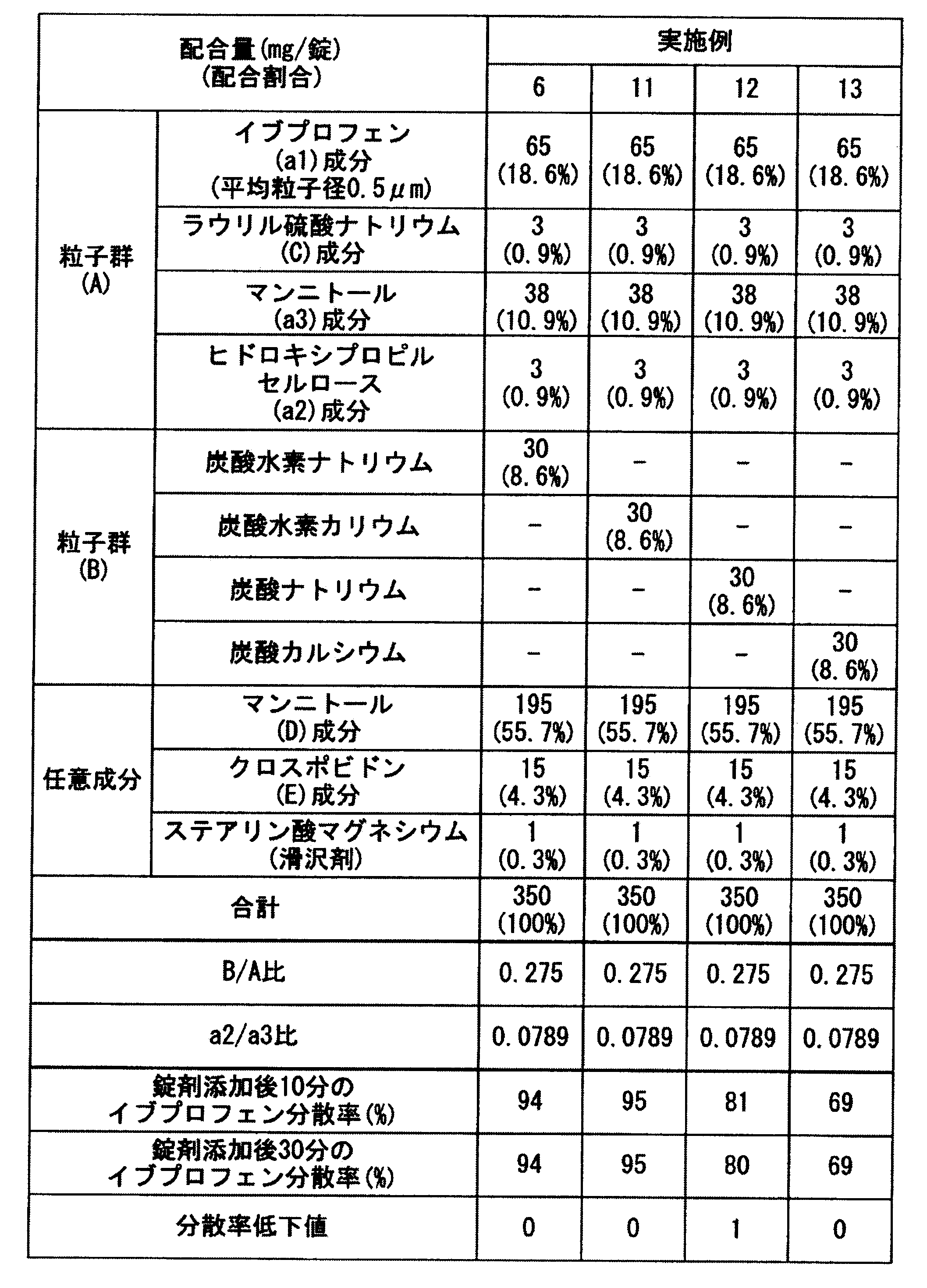
また、炭酸水素塩を用いた錠剤は、炭酸塩に比べて、薬物の分散率がより高いことも分かった。
実施例14~19については、表3に示すイブプロフェンの平均粒子径とする以外は、上記実施例6と同様に錠剤を得た。

特に、イブプロフェンの粒子径が10μm未満である実施例6,14~18は、分散率低下値が10%以下であり、分散性の安定性が高いことも分かった。
実施例20~24については、表4に示す炭酸水素ナトリウムの平均粒子径とする以外は、上記実施例6と同様に錠剤を得た。
実施例20については、平均粒子径が40μmの炭酸水素ナトリウム「重炭酸ナトリウムKP」を用いた。前記平均粒子径の測定は、上述の乾燥した粒子群の平均粒子径の測定と同様に行った。
実施例21~24で用いた炭酸水素ナトリウムは、以下に示す方法によって作製した。
平均粒子径120μmの炭酸水素ナトリウム「重炭酸ナトリウムKF」1kgを攪拌造粒機(ハイスピードミキサFS-10(深江パウテック(株)製)に投入した。水50gを添加し、アジテーター回転数300rpm、チョッパー回転数1500rpmにて攪拌、造粒した。容器内の粉体を回収し恒温層にて乾燥した。乾燥した粉体を篩にて粒径によって分類し、表4に示す平均粒子径の炭酸水素ナトリウムを得た。平均粒子径の測定は、上述の乾燥した粒子群の平均粒子径の測定と同様に行った。
実施例6、20~24の錠剤を用いて行った、錠剤添加後10分及び30分の分散性評価試験の結果を、表4に示す。
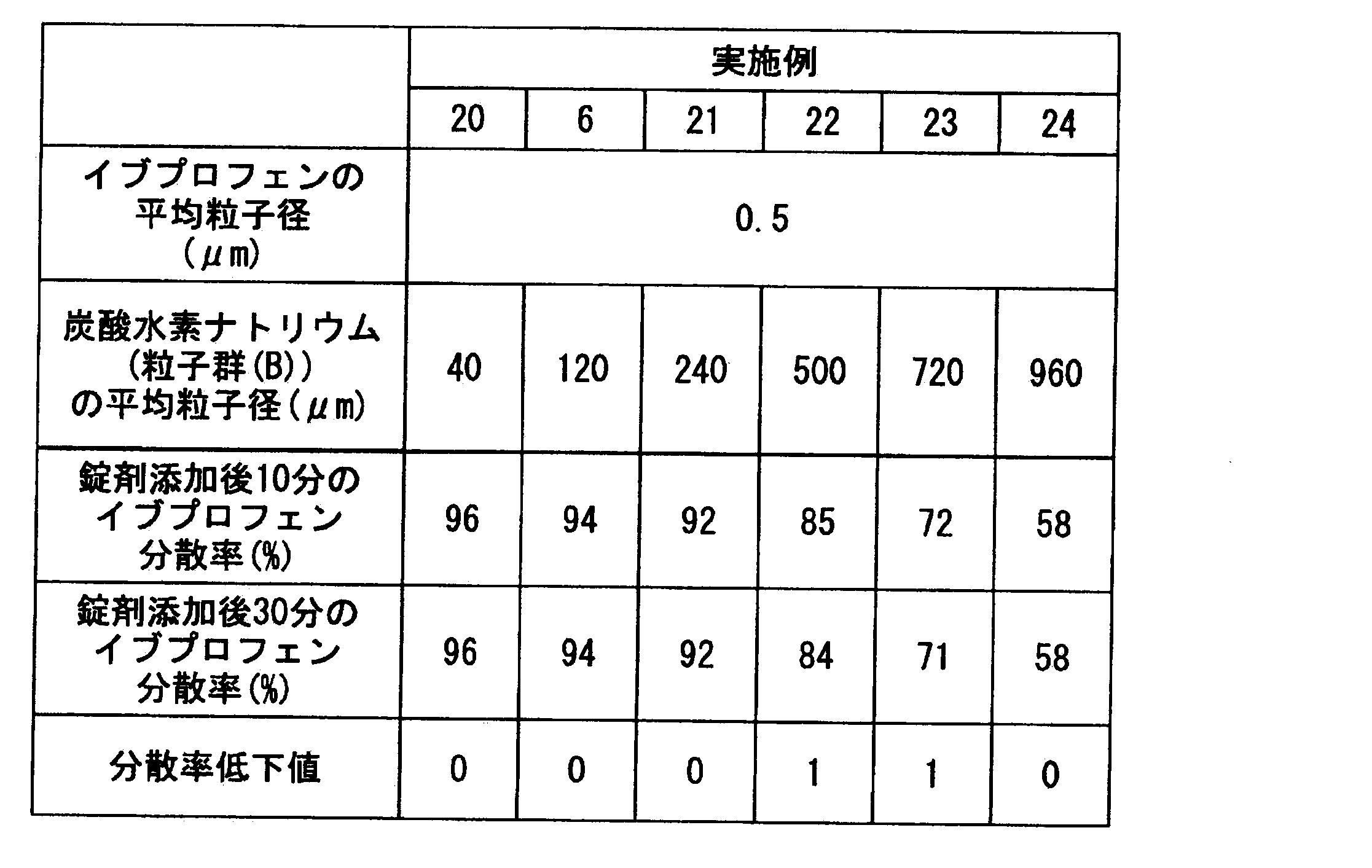
実施例25~28については、表5に示す組成となるように仕込み粉体量を調整した以外は実施例6と同様に錠剤を作製した。実施例25~28のビーズミル粉砕後の(a1)成分の粒子径を実施例6と同様に測定したところ、 いずれも0.5μmであった。また粒子群(A)の平均粒子径は実施例25が210μm、実施例26が220μm、実施例27が215μm、実施例28が209μmであった。これらの平均粒子径の測定は、上述の乾燥した粒子の平均粒子径の測定と同様に行った。
実施例6、25~28の錠剤を用いて行った、錠剤添加後10分及び30分の分散性評価試験の結果を、表5に示す。
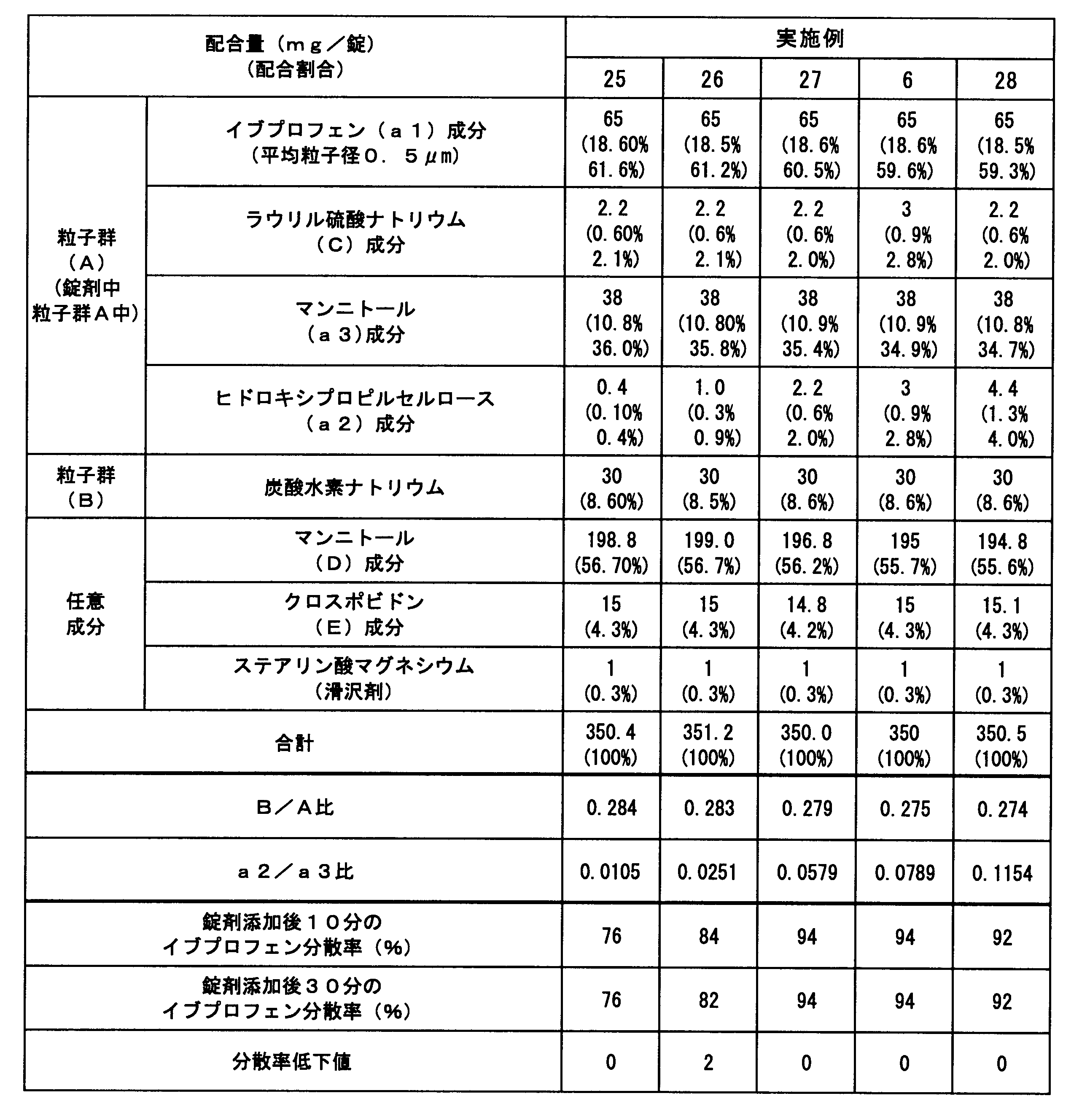
実施例29~33については、表6に示す組成となるように仕込み粉体量を調整し、実施例6と同様に錠剤を作製した。実施例29~33のビーズミル粉砕後の(a1)成分の粒子径を実施例6と同様に測定したところ、いずれも0.5μmであった。また粒子群(A)の平均粒子径は実施例29が211μm、実施例30が212μm、実施例31が215μm、実施例32が205μm、実施例33が201μmであった。これらの平均粒子径の測定は、上述の乾燥した粒子の平均粒子径の測定と同様に行った。
実施例29~33の錠剤を用いて行った、錠剤添加後10分及び30分の分散性評価試験の結果を、表6に示す。

また、(a3)成分に対する(a2)成分の配合比が0.03以上0.12未満である実施例30~33の錠剤では、錠剤添加後10分後のイブプロフェン分散率が82%以上であった。(a3)成分に対する(a2)成分の配合比が0.0001以上0.33未満である実施例29の錠剤では、錠剤添加後10分後のイブプロフェン分散率が72%以上であった。
実施例34、35については、表7に示す組成となるように仕込み粉体量を調整し、異なる水難溶性薬物(a1)成分を用いた以外は実施例6と同様に錠剤を作製した。水難溶性薬物(a1)成分としては、実施例34ではエトドラクを、実施例35ではアリルイソプロピルアセチル尿素を用いた。実施例34、35のビーズミル粉砕後の(a1)成分の粒子径を実施例6と同様に測定したところ、いずれも0.5μmであった。また粒子群(A)の平均粒子径は実施例34が211μm、実施例35が225μmであった。これらの平均粒子径の測定は、上述の乾燥した粒子の平均粒子径の測定と同様に行った。
実施例34、35の錠剤を用いて行った、錠剤添加後10分及び30分の分散性評価試験の結果を、表7に示す。
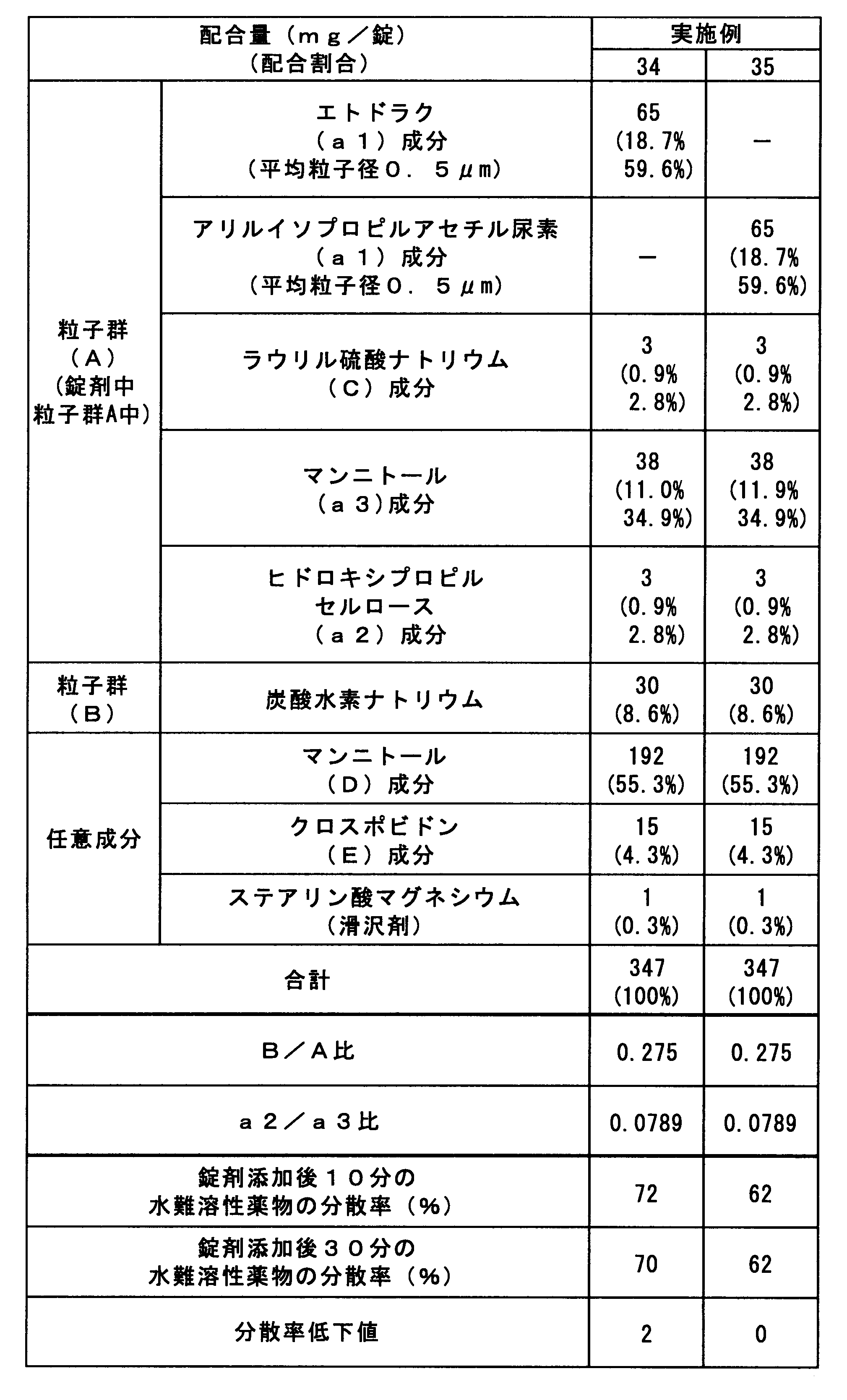
これらの結果から、錠剤に水難溶性薬物の粒子群を含有する粒子群と、炭酸塩の粒子群又は炭酸水素塩の粒子群とを組合せて含ませれば、水難溶性薬物の分散性が良好な製剤を得ることができることを理解できる。
また、粒子群(A)中に含まれる水難溶性薬物の粒子群の平均粒子径を10μm未満とすれば、水難溶性薬物の分散性と、前記水難溶性薬物の分散性の安定性が特に良好になる。
Claims (10)
- 水難溶性薬物の粒子群を含有する粒子群(A)と、
炭酸塩の粒子群及び炭酸水素塩の粒子群から選択される少なくとも1種の粒子群(B)と、
を含む錠剤。 - 前記粒子群(A)中に含まれる水難溶性薬物の粒子群の平均粒子径が、0.01~10μm未満であることを特徴とする、請求項1に記載の錠剤。
- 前記粒子群(B)の平均粒子径が、10μm以上800μm以下であることを特徴とする、請求項1又は2に記載の錠剤。
- 前記粒子群(A)中に含まれる水難溶性薬物の配合量が、前記粒子群(A)の総質量に対し、5~90質量%である請求項1~3のいずれか1項に記載の錠剤。
- 前記錠剤に含まれる粒子群(B)の配合量が、錠剤1つの総質量に対して、0.1~85質量%である請求項1~4のいずれか1項に記載の錠剤。
- 前記粒子群(B)の前記粒子群(A)に対する質量比が0.001以上8.5以下である請求項1~5のいずれか1項に記載の錠剤。
- 前記粒子群(A)は水溶性結合剤(a2)、水溶性化合物粒子群(a3)、及び界面活性剤(C)を含む粒子であって、錠剤における(a2)成分の配合量が、錠剤1つの総質量に対して、0.01~27質量%であり、錠剤における(a3)成分の配合量が、錠剤1つの総質量に対して、0.5~81質量%であり、錠剤における(C)成分の配合量が、錠剤1つの総質量に対して、0.005~45質量%であって、前記各成分の配合量の総和が100質量%を超えない、請求項1~6のいずれか1項に記載の錠剤。
- 前記(a3)成分に対する前記(a2)成分の質量比が0.0001以上0.33未満である請求項7に記載の錠剤。
- 前記粒子群(A)は、前記水溶性化合物粒子群(a3)の表面に、水溶性結合剤(a2)をバインダーとして前記水難溶性薬物(a1)と前記界面活性剤(C)が付着していることを特徴とする請求項7又は8に記載の錠剤。
- 胃モデル液に錠剤添加後10分後の水難溶性薬物の分散率が60%以上である請求項1~9のいずれか1項に記載の錠剤。
Priority Applications (2)
| Application Number | Priority Date | Filing Date | Title |
|---|---|---|---|
| JP2015529590A JP6304896B2 (ja) | 2013-07-30 | 2014-07-30 | 錠剤 |
| KR1020157022575A KR101890649B1 (ko) | 2013-07-30 | 2014-07-30 | 정제 |
Applications Claiming Priority (2)
| Application Number | Priority Date | Filing Date | Title |
|---|---|---|---|
| JP2013157823 | 2013-07-30 | ||
| JP2013-157823 | 2013-07-30 |
Publications (1)
| Publication Number | Publication Date |
|---|---|
| WO2015016256A1 true WO2015016256A1 (ja) | 2015-02-05 |
Family
ID=52431786
Family Applications (1)
| Application Number | Title | Priority Date | Filing Date |
|---|---|---|---|
| PCT/JP2014/070047 Ceased WO2015016256A1 (ja) | 2013-07-30 | 2014-07-30 | 錠剤 |
Country Status (3)
| Country | Link |
|---|---|
| JP (1) | JP6304896B2 (ja) |
| KR (1) | KR101890649B1 (ja) |
| WO (1) | WO2015016256A1 (ja) |
Cited By (3)
| Publication number | Priority date | Publication date | Assignee | Title |
|---|---|---|---|---|
| WO2018124062A1 (ja) * | 2016-12-26 | 2018-07-05 | 塩野義製薬株式会社 | 含量均一性を改善した製剤の製造方法 |
| JP2019167319A (ja) * | 2018-03-26 | 2019-10-03 | 株式会社親広産業 | 糖消費促進剤 |
| JP2023175743A (ja) * | 2018-06-29 | 2023-12-12 | 中外製薬株式会社 | 難溶性の塩基性薬剤を含有する医薬組成物 |
Citations (11)
| Publication number | Priority date | Publication date | Assignee | Title |
|---|---|---|---|---|
| JPS63190822A (ja) * | 1987-01-13 | 1988-08-08 | ファルミデア・エス.アール.エル. | 連続的時間で活性物質を放出できる薬剤用途に対するタブレット |
| JPH07101855A (ja) * | 1993-06-21 | 1995-04-18 | Zambon Group Spa | 鎮痛作用を有する薬剤組成物 |
| JP2000507922A (ja) * | 1996-02-21 | 2000-06-27 | ザ ブーツ カンパニー ピーエルシー | イブプロフェンの剤型 |
| WO2002043704A1 (fr) * | 2000-12-01 | 2002-06-06 | Kyowa Hakko Kogyo Co., Ltd. | Composition a solubilite ou absorbabilite orale amelioree |
| JP2004500358A (ja) * | 1999-12-08 | 2004-01-08 | ファルマシア コーポレイション | バイオアベイラビリティーが増加した固体状態のセレコキシブ |
| JP2006328000A (ja) * | 2005-05-27 | 2006-12-07 | Ss Pharmaceut Co Ltd | 経口投与用製剤 |
| JP2008504307A (ja) * | 2004-06-29 | 2008-02-14 | ニコメド ダンマルク アンパーツゼルスカブ | 水不溶性薬剤の速放性医薬組成物の製造と、本発明の方法で得られた医薬組成物 |
| JP2008515802A (ja) * | 2004-09-30 | 2008-05-15 | スコラー ファーマ,インコーポレイティド | 修飾放出イブプロフェン剤形 |
| JP2008534477A (ja) * | 2005-03-22 | 2008-08-28 | ロザン ファルマ ゲゼルシャフトミットベシュレンクテルハフツンク | 可溶化イブプロフェン |
| JP2011528712A (ja) * | 2008-07-21 | 2011-11-24 | アルベマール・コーポレーシヨン | 高含量イブプロフェンナトリウム顆粒、その調製、および非発泡性固体剤形を調製する際のその使用 |
| JP2014129238A (ja) * | 2012-12-28 | 2014-07-10 | Lion Corp | エトドラク含有固形製剤 |
Family Cites Families (3)
| Publication number | Priority date | Publication date | Assignee | Title |
|---|---|---|---|---|
| DE69905380T2 (de) * | 1998-09-10 | 2003-11-27 | Nycomed Danmark A/S, Roskilde | Pharmazeutische zusammensetzungen mit schneller freisetzung von wirkstoffen |
| US6316029B1 (en) * | 2000-05-18 | 2001-11-13 | Flak Pharma International, Ltd. | Rapidly disintegrating solid oral dosage form |
| JP2010536798A (ja) * | 2007-08-17 | 2010-12-02 | テバ ファーマシューティカル インダストリーズ リミティド | 難溶性薬物の生体利用率を制御するための方法及び組成物 |
-
2014
- 2014-07-30 WO PCT/JP2014/070047 patent/WO2015016256A1/ja not_active Ceased
- 2014-07-30 KR KR1020157022575A patent/KR101890649B1/ko not_active Expired - Fee Related
- 2014-07-30 JP JP2015529590A patent/JP6304896B2/ja active Active
Patent Citations (11)
| Publication number | Priority date | Publication date | Assignee | Title |
|---|---|---|---|---|
| JPS63190822A (ja) * | 1987-01-13 | 1988-08-08 | ファルミデア・エス.アール.エル. | 連続的時間で活性物質を放出できる薬剤用途に対するタブレット |
| JPH07101855A (ja) * | 1993-06-21 | 1995-04-18 | Zambon Group Spa | 鎮痛作用を有する薬剤組成物 |
| JP2000507922A (ja) * | 1996-02-21 | 2000-06-27 | ザ ブーツ カンパニー ピーエルシー | イブプロフェンの剤型 |
| JP2004500358A (ja) * | 1999-12-08 | 2004-01-08 | ファルマシア コーポレイション | バイオアベイラビリティーが増加した固体状態のセレコキシブ |
| WO2002043704A1 (fr) * | 2000-12-01 | 2002-06-06 | Kyowa Hakko Kogyo Co., Ltd. | Composition a solubilite ou absorbabilite orale amelioree |
| JP2008504307A (ja) * | 2004-06-29 | 2008-02-14 | ニコメド ダンマルク アンパーツゼルスカブ | 水不溶性薬剤の速放性医薬組成物の製造と、本発明の方法で得られた医薬組成物 |
| JP2008515802A (ja) * | 2004-09-30 | 2008-05-15 | スコラー ファーマ,インコーポレイティド | 修飾放出イブプロフェン剤形 |
| JP2008534477A (ja) * | 2005-03-22 | 2008-08-28 | ロザン ファルマ ゲゼルシャフトミットベシュレンクテルハフツンク | 可溶化イブプロフェン |
| JP2006328000A (ja) * | 2005-05-27 | 2006-12-07 | Ss Pharmaceut Co Ltd | 経口投与用製剤 |
| JP2011528712A (ja) * | 2008-07-21 | 2011-11-24 | アルベマール・コーポレーシヨン | 高含量イブプロフェンナトリウム顆粒、その調製、および非発泡性固体剤形を調製する際のその使用 |
| JP2014129238A (ja) * | 2012-12-28 | 2014-07-10 | Lion Corp | エトドラク含有固形製剤 |
Cited By (10)
| Publication number | Priority date | Publication date | Assignee | Title |
|---|---|---|---|---|
| WO2018124062A1 (ja) * | 2016-12-26 | 2018-07-05 | 塩野義製薬株式会社 | 含量均一性を改善した製剤の製造方法 |
| JPWO2018124062A1 (ja) * | 2016-12-26 | 2019-10-31 | 塩野義製薬株式会社 | 含量均一性を改善した製剤の製造方法 |
| US11135217B2 (en) | 2016-12-26 | 2021-10-05 | Shionogi & Co., Ltd. | Manufacturing process of formulation having improved content uniformity |
| JP7076171B2 (ja) | 2016-12-26 | 2022-05-27 | 塩野義製薬株式会社 | 含量均一性を改善した製剤の製造方法 |
| JP2022082720A (ja) * | 2016-12-26 | 2022-06-02 | 塩野義製薬株式会社 | 含量均一性を改善した製剤の製造方法 |
| JP7272738B2 (ja) | 2016-12-26 | 2023-05-12 | 塩野義製薬株式会社 | 含量均一性を改善した製剤の製造方法 |
| JP2019167319A (ja) * | 2018-03-26 | 2019-10-03 | 株式会社親広産業 | 糖消費促進剤 |
| JP2023175743A (ja) * | 2018-06-29 | 2023-12-12 | 中外製薬株式会社 | 難溶性の塩基性薬剤を含有する医薬組成物 |
| JP7648698B2 (ja) | 2018-06-29 | 2025-03-18 | 中外製薬株式会社 | 難溶性の塩基性薬剤を含有する医薬組成物 |
| US12564594B2 (en) | 2018-06-29 | 2026-03-03 | Chugai Seiyaku Kabushiki Kaisha | Pharmaceutical composition containing 9-ethyl-6, 6-dimethyl-8-(4-morpholin-4-yl-piperidin-1-yl)-11-oxo-6, 11-dihydro-5H-benzo[b]carbazole-3-carbonitrile |
Also Published As
| Publication number | Publication date |
|---|---|
| JP6304896B2 (ja) | 2018-04-04 |
| KR20160037829A (ko) | 2016-04-06 |
| KR101890649B1 (ko) | 2018-09-28 |
| JPWO2015016256A1 (ja) | 2017-03-02 |
Similar Documents
| Publication | Publication Date | Title |
|---|---|---|
| JP7642148B2 (ja) | 新たな医薬組成物 | |
| KR101380088B1 (ko) | 약학 조성물 | |
| JP5401327B2 (ja) | 溶出性の改善された錠剤 | |
| JPWO2008149894A1 (ja) | セルロース系微小核粒子及びその製造方法 | |
| JP4065902B2 (ja) | 造粒粒子、錠剤、及び造粒粒子の製造方法 | |
| JP5974469B2 (ja) | 錠剤の製造方法 | |
| JP2007314529A (ja) | 造粒粒子、錠剤、及び造粒粒子の製造方法 | |
| JP6304896B2 (ja) | 錠剤 | |
| TW202011950A (zh) | 含安定劑之醫藥品的固體製劑 | |
| JP6440317B2 (ja) | 内服固形錠剤 | |
| JP6418878B2 (ja) | 経口投与用錠剤 | |
| CN114786653B (zh) | 具有光滑表面的薄膜包衣片剂 | |
| JP7109255B2 (ja) | 粉砕物の製造方法及び錠剤の製造方法 | |
| JP6292788B2 (ja) | 錠剤及び錠剤の製造方法 | |
| JP6532153B2 (ja) | 内服用錠剤 | |
| WO2011040195A1 (ja) | 不快味マスキング粒子及びこれを含有する経口製剤 | |
| JP2011037767A (ja) | 薬物および噴霧乾燥粒子を含有する口腔内速崩壊錠 | |
| JP2017132716A (ja) | 錠剤の製造方法 | |
| JP3934150B1 (ja) | 固形製剤および製剤組成物 | |
| JP2025090538A (ja) | 造粒物及び前記造粒物を含む錠剤の製造方法 | |
| CA2709624A1 (en) | Immediate release dosage form of bosentan and process of manufacturing such | |
| JP2025081930A (ja) | 錠剤、造粒粒子、造粒粒子の製造方法及び錠剤の製造方法 | |
| JP6051059B2 (ja) | エトドラク含有粒子及びエトドラク含有固形製剤 | |
| JP2003300874A (ja) | 塩酸プソイドエフェドリン含有固形製剤 | |
| JP2005023058A (ja) | 咀嚼型医薬製剤用薬物粒子及びその製造方法、並びに薬物粒子を含有する咀嚼型医薬固形製剤及びその製造方法 |
Legal Events
| Date | Code | Title | Description |
|---|---|---|---|
| 121 | Ep: the epo has been informed by wipo that ep was designated in this application |
Ref document number: 14832910 Country of ref document: EP Kind code of ref document: A1 |
|
| ENP | Entry into the national phase |
Ref document number: 2015529590 Country of ref document: JP Kind code of ref document: A |
|
| ENP | Entry into the national phase |
Ref document number: 20157022575 Country of ref document: KR Kind code of ref document: A |
|
| NENP | Non-entry into the national phase |
Ref country code: DE |
|
| 122 | Ep: pct application non-entry in european phase |
Ref document number: 14832910 Country of ref document: EP Kind code of ref document: A1 |