WO2014203797A1 - エポキシ樹脂組成物及びその硬化物、プリプレグ、並びに繊維強化複合材料 - Google Patents
エポキシ樹脂組成物及びその硬化物、プリプレグ、並びに繊維強化複合材料 Download PDFInfo
- Publication number
- WO2014203797A1 WO2014203797A1 PCT/JP2014/065585 JP2014065585W WO2014203797A1 WO 2014203797 A1 WO2014203797 A1 WO 2014203797A1 JP 2014065585 W JP2014065585 W JP 2014065585W WO 2014203797 A1 WO2014203797 A1 WO 2014203797A1
- Authority
- WO
- WIPO (PCT)
- Prior art keywords
- resin composition
- epoxy resin
- compound
- group
- polyvinyl acetal
- Prior art date
- Legal status (The legal status is an assumption and is not a legal conclusion. Google has not performed a legal analysis and makes no representation as to the accuracy of the status listed.)
- Ceased
Links
- 0 CCC(C=*)(C(*O[C@@](*)(C=CC)N)=O)OC(C)(C)* Chemical compound CCC(C=*)(C(*O[C@@](*)(C=CC)N)=O)OC(C)(C)* 0.000 description 1
Classifications
-
- C—CHEMISTRY; METALLURGY
- C08—ORGANIC MACROMOLECULAR COMPOUNDS; THEIR PREPARATION OR CHEMICAL WORKING-UP; COMPOSITIONS BASED THEREON
- C08L—COMPOSITIONS OF MACROMOLECULAR COMPOUNDS
- C08L63/00—Compositions of epoxy resins; Compositions of derivatives of epoxy resins
-
- C—CHEMISTRY; METALLURGY
- C08—ORGANIC MACROMOLECULAR COMPOUNDS; THEIR PREPARATION OR CHEMICAL WORKING-UP; COMPOSITIONS BASED THEREON
- C08J—WORKING-UP; GENERAL PROCESSES OF COMPOUNDING; AFTER-TREATMENT NOT COVERED BY SUBCLASSES C08B, C08C, C08F, C08G or C08H
- C08J5/00—Manufacture of articles or shaped materials containing macromolecular substances
- C08J5/24—Impregnating materials with prepolymers which can be polymerised in situ, e.g. manufacture of prepregs
-
- C—CHEMISTRY; METALLURGY
- C08—ORGANIC MACROMOLECULAR COMPOUNDS; THEIR PREPARATION OR CHEMICAL WORKING-UP; COMPOSITIONS BASED THEREON
- C08J—WORKING-UP; GENERAL PROCESSES OF COMPOUNDING; AFTER-TREATMENT NOT COVERED BY SUBCLASSES C08B, C08C, C08F, C08G or C08H
- C08J2363/00—Characterised by the use of epoxy resins; Derivatives of epoxy resins
-
- C—CHEMISTRY; METALLURGY
- C08—ORGANIC MACROMOLECULAR COMPOUNDS; THEIR PREPARATION OR CHEMICAL WORKING-UP; COMPOSITIONS BASED THEREON
- C08J—WORKING-UP; GENERAL PROCESSES OF COMPOUNDING; AFTER-TREATMENT NOT COVERED BY SUBCLASSES C08B, C08C, C08F, C08G or C08H
- C08J2429/00—Characterised by the use of homopolymers or copolymers of compounds having one or more unsaturated aliphatic radicals, each having only one carbon-to-carbon double bond, and at least one being terminated by an alcohol, ether, aldehydo, ketonic, acetal, or ketal radical; Hydrolysed polymers of esters of unsaturated alcohols with saturated carboxylic acids; Derivatives of such polymer
- C08J2429/14—Homopolymers or copolymers of acetals or ketals obtained by polymerisation of unsaturated acetals or ketals or by after-treatment of polymers of unsaturated alcohols
Definitions
- the present invention relates to an epoxy resin composition and a cured product thereof, a prepreg obtained by impregnating or coating a reinforcing fiber with the epoxy resin composition, and a fiber-reinforced composite material obtained by curing the prepreg.
- epoxy resin compositions containing epoxy compounds have been widely used for a wide variety of applications such as adhesives and structural materials.
- development of a fiber-reinforced composite material obtained by further reinforcing a cured product obtained by curing the epoxy resin composition with reinforcing fibers such as carbon fibers has been energetically advanced.
- the above fiber reinforced composite material utilizes its light weight and tough properties, for example, automobile parts, civil engineering and building equipment, wind power blades, sports equipment, aircraft, ships, robots, cable materials, high pressure tanks, etc. Application as various components is expected.
- Examples of the epoxy resin composition for forming the fiber reinforced composite material include, as a base material resin, bisphenol A type epoxy resin (bisphenol A diglycidyl ether), a curing agent, and a reactive diluent for epoxy resin.
- An epoxy resin composition or the like is known (see Patent Document 1).
- an epoxy resin composition containing an epoxy compound having a glycidyl group, such as a bisphenol A type epoxy resin needs to be heated at a high temperature for a long time in order to be cured, which is problematic in terms of the productivity of the fiber-reinforced composite material. Had. Furthermore, the cured product obtained by curing the epoxy resin composition has low heat resistance and low mechanical strength such as low elongation (tensile elongation at break). From the viewpoint of mechanical properties of the fiber-reinforced composite material Had a problem.
- epoxy resin compositions for forming fiber reinforced composite materials can be applied to a variety of molding methods, from liquid to solid, and in the case of liquids from low viscosity to high. It is required that the desired properties and viscosity can be easily controlled, such as those having a viscosity.
- the object of the present invention is to easily control the properties and viscosity, can be cured at a low temperature in a short time, has excellent mechanical properties such as high tensile elongation at break, and has high heat resistance. It is providing the epoxy resin composition which can form, and its hardened
- the present inventor has an epoxy resin composition containing a specific epoxy compound, a specific compound having a hydroxyl group, and a polyvinyl formal resin, and the control of properties and viscosity is easy. It was found that it can be cured at a low temperature and in a short time, and by further curing, a cured product having excellent mechanical properties such as high tensile fracture elongation and high heat resistance can be formed, and the present invention has been completed. I let you.
- the present invention relates to an alicyclic epoxy compound (A), at least one compound (B) selected from the group consisting of a lactone addition compound (B1) having a hydroxyl group and a polycarbonate polyol (B2), and polyvinyl acetal.
- An epoxy resin composition comprising a resin (C) is provided.
- the epoxy resin composition is provided in which the content of the compound (B) is 5 to 60 parts by weight with respect to 100 parts by weight of the alicyclic epoxy compound (A).
- the above epoxy resin composition which is a resin composition for fiber reinforced composite materials.
- the present invention also provides a cured product obtained by curing the above epoxy resin composition.
- the present invention also provides a prepreg obtained by impregnating or coating the above-mentioned epoxy resin composition on reinforcing fibers.
- the present invention also provides a fiber-reinforced composite material obtained by curing the prepreg.
- the present invention relates to the following.
- the epoxy resin composition characterized by including this.
- the alicyclic epoxy compound (A) is (i) a compound having an epoxy group composed of two adjacent carbon atoms and oxygen atoms constituting the alicyclic ring, and (ii) an epoxy group on the alicyclic ring.
- the epoxy resin composition according to [1] which is at least one selected from the group consisting of compounds directly bonded by a single bond.
- a compound in which an epoxy group is directly bonded to the alicyclic ring by a single bond is a compound represented by the following formula (II): [wherein R ′ is a p-valent in the structural formula Is an organic group (organic residue) formed by removing p hydroxyl groups (—OH) from the alcohol, and p and n each represent a natural number. ]
- the epoxy resin composition according to any one of [2] to [4].
- the ratio of the alicyclic epoxy compound (A) to the total amount (100% by weight) of the alicyclic epoxy compound (A), the compound (B), and the polyvinyl acetal resin (C) is 25 to 95% by weight.
- the epoxy resin composition according to any one of [1] to [6].
- the lactone addition compound (B1) having a hydroxyl group has a structure in which two or more lactone units are repeatedly directly bonded (polymerized), and the number of repeating lactone units (degree of polymerization) in the structure is 2 to 20 [ [1] The epoxy resin composition according to any one of [9]. [11] The epoxy resin composition according to any one of [1] to [10], wherein the lactone addition compound (B1) having a hydroxyl group has 2 to 10 hydroxyl groups in the molecule (total number). .
- a lactone addition compound (B1) having a hydroxyl group is a compound represented by the following formula (1): [wherein r represents an integer of 1 to 20; R 1 represents an organic group (organic residue) formed by removing r hydroxyl groups from a compound [R 1 (OH) r ] having r hydroxyl groups in the molecule in the structural formula. q represents an integer of 0 to 10. R 2 represents an alkylene group. ] The epoxy resin composition according to any one of [1] to [11]. [13] The epoxy resin composition according to any one of [1] to [12], wherein the number (total number) of hydroxyl groups in the polycarbonate polyol (B2) is 2 to 10.
- the polyvinyl acetal resin (C) is a structural unit represented by the following formula (i) [in the formula (i), R 11 is a hydrogen atom or an alkyl group having 1 to 5 carbon atoms.
- the epoxy resin composition according to [19] which is a polyvinyl acetal resin (C2) containing a structural unit represented by formulas (i) to (iii) as an essential structural unit and having a carboxyl group in the molecule.
- the total content (total content) of the structural units represented by the formulas (i) to (iii) in the polyvinyl acetal resin (C1) is the total structural unit (100% by weight) constituting the polyvinyl acetal resin (C1). %)), The epoxy resin composition according to [20].
- the content (content) of the structural unit represented by the formula (i) in the polyvinyl acetal resin (C1) is based on the total structural units (100 mol%) constituting the polyvinyl acetal resin (C1).
- the content (content) of the structural unit represented by the formula (ii) in the polyvinyl acetal resin (C1) is based on the total structural units (100 mol%) constituting the polyvinyl acetal resin (C1).
- the content (content) of the structural unit represented by the formula (iii) in the polyvinyl acetal resin (C1) is based on the total structural units (100 mol%) constituting the polyvinyl acetal resin (C1).
- the polyvinyl acetal resin (C2) is a structural unit represented by the following formula (vi) in addition to the structural units represented by the formulas (i) to (iii) [in the formula (vi), R 12 represents Represents a hydrogen atom or an alkyl group having 1 to 5 carbon atoms.
- the content (content) of the structural unit represented by the formula (ii) in the polyvinyl acetal resin (C2) is based on the total structural units (100 mol%) constituting the polyvinyl acetal resin (C2).
- the content (content) of the structural unit represented by the formula (iii) in the polyvinyl acetal resin (C2) is based on the total structural units (100 mol%) constituting the polyvinyl acetal resin (C2).
- the content (content) of the structural unit represented by the formula (vi) in the polyvinyl acetal resin (C2) is based on the total structural units (100 mol%) constituting the polyvinyl acetal resin (C2).
- the epoxy resin composition of the present invention Since the epoxy resin composition of the present invention has the above-described configuration, it can be cured at a low temperature and in a short time, and the properties and viscosity can be easily controlled. Furthermore, by curing the epoxy resin composition of the present invention, a cured product having excellent mechanical properties such as high tensile elongation at break and having high heat resistance can be formed with high productivity. Moreover, the fiber reinforced composite material excellent in productivity, heat resistance, and toughness can be obtained by hardening the prepreg obtained by coating or impregnating the reinforcing fiber with the epoxy resin composition of the present invention.
- the epoxy resin composition (curable epoxy resin composition) of the present invention is at least one selected from the group consisting of an alicyclic epoxy compound (A), a lactone addition compound (B1) having a hydroxyl group, and a polycarbonate polyol (B2). It is a resin composition containing the seed compound (B) and the polyvinyl acetal resin (C) as essential components.
- the epoxy resin composition of the present invention may contain other components such as a curing catalyst (D) described later.
- the alicyclic epoxy compound (A) in the epoxy resin composition of the present invention is a compound having at least an alicyclic (aliphatic hydrocarbon ring) structure and an epoxy group in the molecule (in one molecule).
- an epoxy group composed of two adjacent carbon atoms and oxygen atoms constituting the alicyclic ring when referred to as “alicyclic epoxy group”
- a compound in which an epoxy group is directly bonded to the alicyclic ring with a single bond when referred to as “alicyclic epoxy group”.
- the compound having an epoxy group (alicyclic epoxy group) composed of two adjacent carbon atoms and oxygen atoms constituting the alicyclic ring (i) is arbitrarily selected from known or commonly used compounds. Can be used. Especially, as said alicyclic epoxy group, a cyclohexene oxide group is preferable.
- a cyclohexene oxide group is used as the compound having an epoxy group (alicyclic epoxy group) composed of two adjacent carbon atoms and oxygen atoms constituting the alicyclic ring (i).
- a compound (alicyclic epoxy compound) represented by the following formula (I) is preferable.
- X represents a single bond or a linking group (a divalent group having one or more atoms).
- the linking group include divalent hydrocarbon groups, alkenylene groups in which part or all of carbon-carbon double bonds are epoxidized, carbonyl groups, ether bonds, ester bonds, carbonate groups, amide groups, and the like. And a group in which a plurality of are connected.
- Examples of the compound in which X in the above formula (I) is a single bond include 3,4,3 ′, 4′-diepoxybicyclohexane and the like.
- Examples of the divalent hydrocarbon group include a linear or branched alkylene group having 1 to 18 carbon atoms and a divalent alicyclic hydrocarbon group.
- Examples of the linear or branched alkylene group having 1 to 18 carbon atoms include a methylene group, a methylmethylene group, a dimethylmethylene group, an ethylene group, a propylene group, and a trimethylene group.
- divalent alicyclic hydrocarbon group examples include 1,2-cyclopentylene group, 1,3-cyclopentylene group, cyclopentylidene group, 1,2-cyclohexylene group, 1,3-cyclopentylene group, And divalent cycloalkylene groups (including cycloalkylidene groups) such as cyclohexylene group, 1,4-cyclohexylene group, and cyclohexylidene group.
- alkenylene group in the alkenylene group in which part or all of the carbon-carbon double bond is epoxidized include, for example, vinylene group, propenylene group, 1-butenylene group And straight-chain or branched alkenylene groups having 2 to 8 carbon atoms such as 2-butenylene group, butadienylene group, pentenylene group, hexenylene group, heptenylene group and octenylene group.
- the epoxidized alkenylene group is preferably an alkenylene group in which all of the carbon-carbon double bonds are epoxidized, more preferably 2 to 4 carbon atoms in which all of the carbon-carbon double bonds are epoxidized. Alkenylene group.
- the linking group X is particularly preferably a linking group containing an oxygen atom, specifically, —CO—, —O—CO—O—, —COO—, —O—, —CONH—, epoxidation.
- Representative examples of the alicyclic epoxy compounds represented by the above formula (I) include compounds represented by the following formulas (I-1) to (I-10), bis (3,4-epoxycyclohexylmethyl) ) Ether, 1,2-bis (3,4-epoxycyclohexane-1-yl) ethane, 1,2-epoxy-1,2-bis (3,4-epoxycyclohexane-1-yl) ethane, 2,2 -Bis (3,4-epoxycyclohexane-1-yl) propane and the like.
- l and m each represents an integer of 1 to 30.
- R in the following formula (I-5) is an alkylene group having 1 to 8 carbon atoms, and is a methylene group, ethylene group, propylene group, isopropylene group, butylene group, isobutylene group, s-butylene group, pentylene group, hexylene.
- linear or branched alkylene groups such as a group, heptylene group, and octylene group.
- linear or branched alkylene groups having 1 to 3 carbon atoms such as a methylene group, an ethylene group, a propylene group, and an isopropylene group are preferable.
- N1 to n6 in the following formulas (I-9) and (I-10) each represents an integer of 1 to 30.
- Examples of the compound (ii) in which the epoxy group is directly bonded to the alicyclic ring with a single bond include compounds represented by the following formula (II).
- R ′ is an organic group (organic residue) formed by removing p hydroxyl groups (—OH) from a p-valent alcohol in the structural formula, and p and n each represent a natural number.
- the p-valent alcohol [R ′ (OH) p ] include polyhydric alcohols such as 2,2-bis (hydroxymethyl) -1-butanol (such as alcohols having 1 to 15 carbon atoms) described later And compounds having r hydroxyl groups.
- p is preferably 1 to 6, and n is preferably 1 to 30.
- n in each group in () (inside the outer parenthesis) may be the same or different.
- the alicyclic epoxy compound (A) can be used alone or in combination of two or more.
- the alicyclic epoxy compound (A) for example, commercially available products such as trade names “Celoxide 2021P” and “Celoxide 2081” (manufactured by Daicel Corporation) may be used.
- Examples of the alicyclic epoxy compound (A) include compounds represented by the above formula (I-1) [3,4-epoxycyclohexylmethyl (3,4-epoxy) cyclohexanecarboxylate; for example, trade name “Celoxide 2021P”. (Daicel Co., Ltd.) etc. are particularly preferred.
- the content (blending amount) of the alicyclic epoxy compound (A) in the epoxy resin composition of the present invention is not particularly limited, but is preferably 25 to 95% by weight with respect to the epoxy resin composition (100% by weight). More preferably, it is 35 to 85% by weight, still more preferably 45 to 80% by weight.
- the ratio of the alicyclic epoxy compound (A) to the total amount (100% by weight) of the alicyclic epoxy compound (A), the compound (B), and the polyvinyl acetal resin (C) is: Although not particularly limited, it is preferably 25 to 95% by weight, more preferably 35 to 85% by weight, and still more preferably 45 to 80% by weight.
- the ratio of the alicyclic epoxy compound (A) is 25% by weight or more, the curability of the epoxy resin composition tends to be further improved, and the heat resistance of the cured product tends to be further improved.
- the ratio of the alicyclic epoxy compound (A) is 95% by weight or less, the mechanical properties tend to be improved, for example, the tensile strength at break of the cured product is increased.
- the compound (B) in the epoxy resin composition of the present invention is at least one compound selected from the group consisting of a lactone addition compound (B1) having a hydroxyl group and a polycarbonate polyol (B2).
- a lactone addition compound (B1) having a hydroxyl group and a polycarbonate polyol (B2).
- the epoxy resin composition of the present invention contains the compound (B) as an essential component, the mechanical strength of the cured product tends to be improved, for example, the tensile elongation at break is increased.
- the lactone addition compound (B1) having a hydroxyl group is a structural unit having one or more hydroxyl groups in the molecule and formed by a ring-opening addition reaction (including ring-opening addition polymerization) of a lactone compound (lactone).
- lactone compound include known and commonly used lactone compounds and are not particularly limited, and examples thereof include 4- to 10-membered ring lactone compounds such as ⁇ -butyrolactone, ⁇ -valerolactone, and ⁇ -caprolactone.
- ⁇ -caprolactone is preferable as the lactone compound. That is, as the lactone addition compound (B1) having a hydroxyl group, a structural unit having one or more hydroxyl groups in the molecule and formed by a ring-opening addition reaction (including ring-opening addition polymerization) of ⁇ -caprolactone.
- a compound ( ⁇ -caprolactone addition compound) having at least [—C (O) — (CH 2 ) 5 —O—] in the molecule is preferred.
- the lactone addition compound (B1) having a hydroxyl group may have only one kind of the lactone unit, or may have two or more kinds.
- the number (total number) of lactone units in the molecule of the lactone addition compound (B1) having a hydroxyl group is not particularly limited as long as it is 1 or more, but 2 or more (for example, 2 to 40) is preferable. Further, when the lactone addition compound (B1) having a hydroxyl group has a structure in which two or more lactone units are repeatedly directly bonded (polymerized), the number of repeating lactone units (degree of polymerization) in the structure is not particularly limited. ⁇ 20 are preferred. Moreover, the addition form of the lactone unit in the said structure is not specifically limited, A random type may be sufficient and a block type may be sufficient.
- the number (total number) of hydroxyl groups in the molecule of the lactone addition compound (B1) having a hydroxyl group is not particularly limited as long as it is 1 or more, but is preferably 2 or more (for example, 2 to 10), more preferably. Is 2-4.
- the lactone addition compound (B1) having a hydroxyl group is not particularly limited.
- the lactone compound in the presence of a compound (initiator) having one or more hydroxyl groups in the molecule, the lactone compound is subjected to a ring-opening addition reaction (also known as ring-opening addition polymerization). To be included).
- Examples of the compound having one or more hydroxyl groups in the molecule include aliphatic alcohols such as methanol, ethanol, propanol, butanol, pentanol, hexanol and octanol; aromatic alcohols such as benzyl alcohol; ethylene glycol, diethylene glycol, Triethylene glycol, polyethylene glycol, propylene glycol, dipropylene glycol, 1,3-butanediol, 1,4-butanediol, pentanediol, methylpentanediol, 2,4-diethylpentanediol, 1,6-hexanediol, 2-ethyl-1,3-hexanediol, neopentyl glycol, neopentyl glycol ester, cyclohexanedimethanol, glycerin, diglycerin, polyglycerin, Polyhydric alcohols such as l
- Phenols polyvinyl alcohol, polyvinyl acetate partial hydrolyzate, starch, acrylic Cellulose polymers such as all, styrene-allyl alcohol copolymer resin, polyester polyol, polycaprolactone polyol, polypropylene polyol, polytetramethylene glycol, polycarbonate polyol, polybutadiene having a hydroxyl group, cellulose, cellulose acetate, cellulose acetate butyrate, and hydroxyethyl cellulose Examples thereof include oligomers or polymers having a hydroxyl group.
- the lactone addition compound (B1) having a hydroxyl group includes a lactone addition compound having two or more hydroxyl groups in the molecule (particularly, ⁇ -caprolactone addition).
- Compound and more preferably, a lactone addition compound having two or more structures having a hydroxyl group at the end of the lactone unit (that is, —C (O) —R L —OH) in the molecule.
- the ring-opening addition reaction of the lactone compound can be carried out by a known or conventional method, and is not particularly limited.
- the lactone compound is stirred and mixed in the presence of an initiator while heating as necessary. Can be implemented.
- the usage-amount (preparation amount) of an initiator and a lactone compound can be suitably adjusted according to the molecular weight etc. of the target lactone adduct, and is not specifically limited.
- a known or conventional catalyst such as tetrabutyl titanate, tetraisopropyl titanate, tetraethyl titanate, dibutyltin oxide, dibutyltin laurate, tin octylate, stannous chloride is used as necessary.
- a catalyst can be suitably selected according to the kind of initiator, a lactone compound, reaction conditions, etc., and is not specifically limited.
- Polycarbonate polyol (B2) is a compound having two or more hydroxyl groups in the molecule and at least a carbonate skeleton in the molecule.
- Polycarbonate polyol (B2) can be prepared by the same phosgene method as in the usual method for producing carbonate polyol, or a carbonate exchange reaction using dialkyl carbonate or diphenyl carbonate such as dimethyl carbonate and diethyl carbonate (Japanese Patent Laid-Open Nos. 62-187725 and 2). -175721, JP-A-2-49025, JP-A-3-220233, JP-A-3-252420, etc.). Since the carbonate bond is difficult to undergo thermal decomposition, the cured product of the resin composition containing the polycarbonate polyol (B2) tends to exhibit excellent stability even under high temperature and high humidity.
- the polyol used in the carbonate exchange reaction together with the dialkyl carbonate includes 1,6-hexanediol, ethylene glycol, diethylene glycol, 1,3-propanediol, 1,4-butanediol, 1,3-butanediol, 2,3- Butanediol, 1,5-pentanediol, 3-methyl-1,5-pentanediol, 1,4-cyclohexanedimethanol, 1,12-dodecanediol, butadiene diol, neopentyl glycol, tetramethylene glycol, propylene glycol, Examples include dipropylene glycol.
- the number (total number) of hydroxyl groups in the polycarbonate polyol (B2) is not particularly limited as long as it is 2 or more, but is preferably 2 to 10, more preferably 2 to 4.
- examples of the compound (B) include a compound represented by the following formula (1) and a compound represented by the following formula (2).
- r represents an integer of 1 to 20. r is preferably an integer of 2 to 4.
- R 1 is an organic group (organic residue) formed by removing r hydroxyl groups from a compound [R 1 (OH) r ] having r hydroxyl groups in the molecule in the structural formula. Indicates. Examples of the organic group include an organic group formed by removing r hydroxyl groups from a compound having one or more (r groups) hydroxyl groups in the above-described molecule in the structural formula.
- q means the number of repetitions of the structure (lactone unit) in parentheses with q, and represents an integer of 0 to 10. However, the total number of q in Formula (1) is an integer of 1 or more. In addition, when r is an integer greater than or equal to 2, several q may be the same and may differ.
- R 2 in the formula (1) represents an alkylene group, and has, for example, methylene group, methylmethylene group, dimethylmethylene group, ethylene group, propylene group, trimethylene group, tetramethylene group, pentamethylene group, etc. -18 linear or branched alkylene groups.
- R 2 a pentamethylene group is preferable.
- R ⁇ 2 > exists in Formula (1), these may be the same and may differ.
- the addition form of the structure (lactone unit) in parentheses to which q is attached is not particularly limited, and may be a random type or a block type.
- s represents an integer of 2 to 50.
- R 3 in formula (2) is the same or different and represents an alkylene group, and examples thereof are the same as those for R 2 in formula (1).
- subjected s may be the same, and may differ.
- the addition form of the structure in the parentheses to which s is attached is not particularly limited, and may be a random type or a block type.
- the hydroxyl value of the compound (B) is not particularly limited, but is preferably 10 to 800 mgKOH / g, more preferably 50 to 600 mgKOH / g. By setting the hydroxyl value to 10 mgKOH / g or more, the heat resistance of the cured product tends to be further improved. On the other hand, when the hydroxyl value is 800 mgKOH / g or less, the mechanical properties of the cured product tend to be further improved.
- the hydroxyl value of the compound (B) can be measured according to JIS K0070.
- the molecular weight of the compound (B) is not particularly limited, but is preferably 200 to 10000, more preferably 300 to 3000. By setting the molecular weight to 200 or more, there is a tendency that the effects of lowering the elastic modulus and improving the bending strength can be enjoyed more efficiently. On the other hand, when the molecular weight is 10,000 or less, the heat resistance and mechanical strength of the cured product tend to be further improved. In addition, the molecular weight of a compound (B) can be measured as a molecular weight of standard polystyrene conversion by gel permeation chromatography.
- Compound (B) may be liquid at 25 ° C. or may be solid.
- the viscosity (25 ° C.) is not particularly limited, but is preferably 100 to 25000 mPa ⁇ s, more preferably 500 to 10000 mPa ⁇ s.
- the compound (B) can be used alone or in combination of two or more.
- the compound (B) for example, trade names “Placcel 205”, “Placcel 205U”, “Placcel L205AL”, “Placcel 208”, “Placcel 210”, “Placcel 210N”, “Placcel 212”, “Placcel” L212AL, Plaxel 220, Plaxel 220N, Plaxel 220NP1, Plaxel L220AL, Plaxel 230, Plaxel 230N, Plaxel 240, Plaxel 303, Plaxel 305, Plaxel "308", "Placcel 312", “Placcel L320AL”, “Placcel 405D", "Placcel CD205", “Placcel CD210", “Placcel CD220”, “Placcel CD205PL”, “Placcel C” "205HL”, “Plaxel CD210PL”, “Plaxel CD210HL”, “Plaxel CD220PL
- the content (blending amount) of the compound (B) in the epoxy resin composition of the present invention is not particularly limited, but is preferably 5 to 60 parts by weight with respect to 100 parts by weight of the alicyclic epoxy compound (A).
- the amount is preferably 10 to 60 parts by weight, more preferably 15 to 55 parts by weight, and particularly preferably 20 to 50 parts by weight.
- the polyvinyl acetal resin (C) in the epoxy resin composition of the present invention is obtained by reacting a polyvinyl alcohol resin containing at least a structural unit corresponding to vinyl alcohol (sometimes referred to as “vinyl alcohol structural unit”) with an aldehyde, It is a compound (polymer) containing one or two or more structures in which adjacent vinyl alcohol structural units in the polyvinyl alcohol resin are acetalized.
- the epoxy resin composition of the present invention contains the polyvinyl acetal resin (C) as an essential component, and in particular, while maintaining excellent mechanical strength of the cured product such as high tensile breaking elongation, the glass transition temperature and the thermal decomposition temperature. Tends to improve the heat resistance of the cured product. Furthermore, the property and viscosity of the epoxy resin composition can be easily controlled by selecting the molecular weight of the polyvinyl acetal resin (C).
- Examples of the polyvinyl acetal resin (C) include known or conventional polyvinyl acetal resins, and are not particularly limited.
- the structural unit represented by the following formula (i) the structural unit represented by the following formula (ii)
- a polyvinyl acetal resin containing a structural unit represented by the following formula (iii) as an essential structural unit More specifically, examples of the polyvinyl acetal resin (C) include polyvinyl formal resins in which R 11 in the following formula (i) is a hydrogen atom.
- the structural unit represented by the above formula (i) is a structural unit having an acetal moiety, and can be formed, for example, by a reaction between a continuous (adjacent) vinyl alcohol structural unit and an aldehyde (R 11 —CHO).
- R 11 in the structural unit represented by the formula (i) is an arbitrary group or atom, and examples thereof include a hydrogen atom, an alkyl group, an alkoxy group, and an aryl group.
- R 11 in the structural unit represented by the formula (i) is a bulky group (for example, a hydrocarbon group having a large number of carbon atoms)
- the softening point of the polyvinyl acetal resin (C) tends to decrease.
- the epoxy resin composition containing the polyvinyl acetal resin (C) having a low softening point may have a viscosity that is greatly reduced at a high temperature and the resin may flow too much.
- the polyvinyl acetal resin (C) in which R 11 is a bulky group has high solubility in a solvent, but on the other hand, tends to be inferior in chemical resistance.
- R 11 in the formula (i) is preferably a hydrogen atom or an alkyl group having 1 to 5 carbon atoms, more preferably a hydrogen atom or an alkyl group having 1 to 3 carbon atoms.
- alkyl group having 1 to 5 carbon atoms examples include linear or branched alkyl groups having 1 to 5 carbon atoms such as a methyl group, an ethyl group, a propyl group, and an isopropyl group.
- the structural unit represented by the above formula (ii) is a structural unit corresponding to vinyl acetate
- the structural unit represented by the above formula (iii) is a structural unit corresponding to vinyl alcohol.
- the structural unit corresponding to vinyl acetate is formed by polymerization of vinyl acetate
- the structural unit corresponding to vinyl alcohol is formed by saponifying the structural unit corresponding to vinyl acetate.
- the polyvinyl acetal resin (C) includes structural units represented by formulas (i) to (iii) (a structural unit represented by formula (i), a structural unit represented by formula (ii), and a formula (iii) It may have a structural unit other than the structural unit represented by Examples of such a structural unit include a structural unit represented by the following formula (iv) (intermolecular acetal unit) and a structural unit represented by the following formula (v) (hemiacetal unit).
- R 11 in formula (iv) and formula (v) is the same as that in formula (i).
- polyvinyl acetal resin (C) for example, a polyvinyl acetal containing a structural unit represented by formulas (i) to (iii) as an essential structural unit and having no carboxyl group in the molecule.
- Resin sometimes referred to as “polyvinyl acetal resin (C1)”
- Resin may be referred to as “polyvinyl acetal resin (C2)”) and the like.
- the total content (total content) of the structural units represented by the above formulas (i) to (iii) in the polyvinyl acetal resin (C1) is not particularly limited, but all the structural units constituting the polyvinyl acetal resin (C1) 80 to 100% by weight is preferable with respect to (100% by weight).
- the structural units represented by the formulas (i) to (iii) may be regularly arranged or randomly arranged. That is, the polyvinyl acetal resin (C1) may be a block copolymer, an alternating copolymer or the like, or a random copolymer. Among them, it is preferable that they are arranged at random.
- content (content rate) of the structural unit represented by Formula (i) in polyvinyl acetal resin (C1) is not specifically limited, With respect to all the structural units (100 mol%) which comprise polyvinyl acetal resin (C1). Therefore, 50 to 80 mol% is preferable. When the content of the structural unit represented by the formula (i) is 50 mol% or more, the chemical resistance, flexibility, wear resistance, and mechanical strength of the polyvinyl acetal resin (C1) tend to be further improved. There is. On the other hand, making the structural unit represented by formula (i) higher than 80 mol% tends to be difficult in production.
- the structural unit represented by the formula (i) in the polyvinyl acetal resin (C1) is formed by acetalizing a vinyl alcohol structural unit existing continuously (adjacent) in the molecular chain in the polyvinyl alcohol resin.
- discontinuous vinyl alcohol structural units cannot be acetalized, and as a result, it is difficult to make the content of the structural unit represented by the formula (i) higher than 80 mol%.
- content (content rate) of the structural unit represented by Formula (ii) in polyvinyl acetal resin (C1) is not specifically limited, With respect to all the structural units (100 mol%) which comprise polyvinyl acetal resin (C1).
- the content is preferably 0.1 to 49.9 mol%, more preferably 1 to 30 mol%.
- the amount of the structural unit represented by the formula (i) can be relatively increased, and the polyvinyl acetal resin ( The chemical resistance, flexibility, wear resistance, and mechanical strength of C1) are further improved, and the expected performance tends to be exhibited more easily.
- content (content rate) of the structural unit represented by Formula (iii) in polyvinyl acetal resin (C1) is not specifically limited, With respect to all the structural units (100 mol%) which comprise polyvinyl acetal resin (C1).
- the content is preferably 0.1 to 49.9 mol%, more preferably 1 to 30 mol%.
- the structural unit represented by the formula (ii) and the formula (iii) are used. Since the structural unit is in an equilibrium relationship, the content of the structural unit represented by the formula (iii) is usually 0.1 mol% or more.
- each structural unit for example, structural units represented by formulas (i) to (iii)
- the content of each structural unit (for example, structural units represented by formulas (i) to (iii)) in the polyvinyl acetal resin (C1) can be measured according to JIS K6729.
- the polyvinyl acetal resin (C2) is a polyvinyl acetal resin having a carboxyl group in the molecule.
- the polyvinyl acetal resin (C2) for example, in addition to the structural units represented by the above formulas (i) to (iii), a polyvinyl acetal resin containing a structural unit represented by the following formula (vi) (by copolymerization) And a polyvinyl acetal resin having a carboxyl group introduced therein (sometimes referred to as a “carboxyl group-introduced polyvinyl acetal resin”).
- R 12 represents a hydrogen atom or an alkyl group having 1 to 5 carbon atoms.
- alkyl group having 1 to 5 carbon atoms include linear or branched alkyl groups having 1 to 5 carbon atoms such as a methyl group, an ethyl group, a propyl group, and an isopropyl group.
- Structural units represented by formulas (i) to (iii) and (vi) in the polyvinyl acetal resin (C2) (constituent units represented by formulas (i) to (iii) and a structure represented by formula (vi))
- the total content (total content) of the units is not particularly limited, but is preferably 80 to 100% by weight with respect to all the structural units (100% by weight) constituting the polyvinyl acetal resin (C2).
- the polyvinyl acetal resin (C2) may further contain other structural units such as the structural unit represented by the above formula (iv) and the structural unit represented by the formula (v).
- the structural units represented by the formulas (i) to (iii) and (vi) may be arranged with regularity or may be arranged randomly. That is, the polyvinyl acetal resin (C2) may be a block copolymer, an alternating copolymer or the like, or a random copolymer. Among them, it is preferable that they are arranged at random.
- content (content rate) of the structural unit represented by Formula (i) in polyvinyl acetal resin (C2) is not specifically limited, With respect to all the structural units (100 mol%) which comprise polyvinyl acetal resin (C2). Therefore, 49.9 to 80 mol% is preferable. By setting the content of the structural unit represented by formula (i) to 49.9 mol% or more, the chemical resistance, flexibility, wear resistance, and mechanical strength of the polyvinyl acetal resin (C2) are further improved. Tend to. On the other hand, making the structural unit represented by formula (i) higher than 80 mol% tends to be difficult in production.
- the structural unit represented by the formula (i) in the polyvinyl acetal resin (C2) is formed by acetalizing a vinyl alcohol structural unit existing continuously (adjacent) in the molecular chain in the polyvinyl alcohol resin.
- discontinuous vinyl alcohol structural units cannot be acetalized, and as a result, it is difficult to make the content of the structural unit represented by the formula (i) higher than 80 mol%.
- content (content rate) of the structural unit represented by Formula (ii) in polyvinyl acetal resin (C2) is not specifically limited, With respect to all the structural units (100 mol%) which comprise polyvinyl acetal resin (C2).
- the content is preferably 0.1 to 49.9 mol%, more preferably 1 to 30 mol%.
- the amount of the structural unit represented by the formula (i) can be relatively increased, and the polyvinyl acetal resin ( The chemical resistance, flexibility, wear resistance, and mechanical strength of C2) tend to be further improved, and the expected performance tends to be exhibited more easily.
- content (content rate) of the structural unit represented by Formula (iii) in polyvinyl acetal resin (C2) is not specifically limited, With respect to all the structural units (100 mol%) which comprise polyvinyl acetal resin (C2).
- the content is preferably 0.1 to 49.9 mol%, more preferably 1 to 30 mol%.
- content (content rate) of the structural unit represented by Formula (vi) in polyvinyl acetal resin (C2) is not specifically limited, With respect to all the structural units (100 mol%) which comprise polyvinyl acetal resin (C2).
- the content is preferably 0.1 to 49.9 mol%, more preferably 1 to 30 mol%.
- the amount of the structural unit represented by the formula (i) can be relatively increased, and a polyvinyl acetal resin ( The chemical resistance, flexibility, wear resistance, and mechanical strength of C2) tend to be further improved, and the expected performance tends to be exhibited more easily.
- Each content of each structural unit (for example, structural units represented by formulas (i) to (iii) and (vi)) in the polyvinyl acetal resin (C2) can be measured according to JIS K6729.
- the weight average molecular weight of the polyvinyl acetal resin (C) is not particularly limited, but is preferably 40,000 to 140,000, more preferably 40,000 to 80,000.
- the weight average molecular weight is 40000 or more, the moldability of the epoxy resin composition is further improved, and the bending strength and tensile strength of the cured product and the fiber-reinforced composite material tend to be further improved.
- the weight average molecular weight is 140000 or less, workability is ensured without excessively increasing the viscosity of the epoxy resin composition while ensuring sufficient solubility in the alicyclic epoxy compound (A) and the like. There is a tendency to improve.
- the polyvinyl acetal resin (C) can be used alone or in combination of two or more.
- the polyvinyl acetal resin (C) include, for example, trade names “VINYREC PVF-K”, “VINYREC PVF-L”, “VINYREC PVF-H”, “VINYREC PVF-E”, “VINYREC C” (above, Commercial products such as JNC Co., Ltd.) can also be used.
- the content (blending amount) of the polyvinyl acetal resin (C) in the epoxy resin composition of the present invention can be appropriately adjusted according to the desired properties and viscosity of the epoxy resin composition, and is not particularly limited.
- the amount is preferably 1 to 40 parts by weight, more preferably 1 to 30 parts by weight, and still more preferably 1 to 20 parts by weight with respect to 100 parts by weight of the cyclic epoxy compound (A).
- the viscosity of the epoxy resin composition can be controlled to an appropriate range, so that the width of the molding method to which the epoxy resin composition can be applied is expanded.
- the mechanical strength of the cured product and the fiber-reinforced composite material tends to be further improved.
- the epoxy resin composition can be made into a liquid, and furthermore, the viscosity can be controlled to an appropriate range, so that it can be applied. There is a tendency for the width of the molding method to expand.
- the epoxy resin composition of the present invention may further contain a curing catalyst (D).
- the curing catalyst (D) in the epoxy resin composition of the present invention functions to cure the epoxy resin composition by initiating and / or accelerating a curing reaction (polymerization reaction) such as the alicyclic epoxy compound (A). It is a compound that has.
- the curing catalyst (D) is not particularly limited.
- a cationic polymerization initiator photocation polymerization initiator, thermal cation polymerization, which initiates polymerization by generating cationic species by applying light irradiation or heat treatment). Initiators, etc.
- Lewis acid / amine complexes Bronsted acid salts, imidazoles and the like.
- Examples of the photocationic polymerization initiator as the curing catalyst (D) include hexafluoroantimonate salts, pentafluorohydroxyantimonate salts, hexafluorophosphate salts, hexafluoroarsenate salts, and more specifically.
- triarylsulfonium hexafluorophosphate eg, p-phenylthiophenyldiphenylsulfonium hexafluorophosphate
- sulfonium salts such as triarylsulfonium hexafluoroantimonate (particularly, triarylsulfonium salts)
- diaryl iodonium hexafluorophosphate Diaryl iodonium hexafluoroantimonate, bis (dodecylphenyl) iodonium tetrakis (pentafluorophenyl) borate
- iodonium salts such as donium [4- (4-methylphenyl-2-methylpropyl) phenyl] hexafluorophosphate
- phosphonium salts such as tetrafluorophosphonium hexafluorophosphate
- pyridinium salts such as N-hexy
- cationic photopolymerization initiator examples include, for example, trade names “UVACURE 1590” (manufactured by Daicel Cytec Co., Ltd.); trade names “CD-1010”, “CD-1011”, “CD-1012” (above, the United States). Sartomer); trade name “Irgacure 264” (manufactured by BASF); trade name “CIT-1682” (manufactured by Nippon Soda Co., Ltd.); trade name “PHOTOINITIATOR 2074” (manufactured by Rhodia Japan) It can also be preferably used.
- thermal cationic polymerization initiator as the curing catalyst (D) include aryldiazonium salts, aryliodonium salts, arylsulfonium salts, allene-ion complexes, etc., and trade names “PP-33”, “CP-66”.
- thermal cationic polymerization initiator a compound of a chelate compound of a metal such as aluminum or titanium and acetoacetic acid or diketones and a silanol such as triphenylsilanol, or a metal such as aluminum or titanium and acetoacetic acid or diketone
- a compound of a chelate compound with a phenol and a phenol such as bisphenol S.
- a known or commonly used Lewis acid / amine complex-based curing catalyst can be used, and is not particularly limited.
- a known or commonly used Lewis acid / amine complex-based curing catalyst can be used, and is not particularly limited.
- Bronsted acid salts as the curing catalyst (D), known or commonly used Bronsted acid salts can be used, and are not particularly limited.
- imidazole as the curing catalyst (D), known or commonly used imidazoles can be used, and are not particularly limited.
- the curing catalyst (D) can be used singly or in combination of two or more.
- the content (blending amount) of the curing catalyst (D) in the epoxy resin composition of the present invention is not particularly limited, but is a cationic curable compound (for example, alicyclic epoxy compound (A)) contained in the epoxy resin composition. Is preferably 0.01 to 15 parts by weight, more preferably 0.01 to 12 parts by weight, still more preferably 0.05 to 10 parts by weight, and particularly preferably 0.05 to 8 parts by weight with respect to 100 parts by weight as a whole. Part.
- the curing catalyst (D) within the above range, the curing rate of the epoxy resin composition is increased, and the balance between the heat resistance and the transparency of the cured product tends to be improved.
- the epoxy resin composition of the present invention may further contain a curing agent (E) (for example, instead of the curing catalyst (D)).
- the curing agent (E) in the epoxy resin composition of the present invention is a compound having a function of curing the epoxy resin composition by reacting with the alicyclic epoxy compound (A) or the like.
- a known or conventional curing agent can be used as a curing agent for epoxy resin, and is not particularly limited.
- acid anhydrides (acid anhydride curing agents), amines ( Amine curing agents), polyamide resins, imidazoles (imidazole curing agents), polymercaptans (polymercaptan curing agents), phenols (phenolic curing agents), polycarboxylic acids, dicyandiamides, organic acid hydrazides, etc.
- acid anhydrides (acid anhydride curing agents)
- amines Amine curing agents
- polyamide resins imidazoles (imidazole curing agents)
- polymercaptans polymercaptan curing agents
- phenols phenolic curing agents
- polycarboxylic acids dicyandiamides
- organic acid hydrazides etc.
- acid anhydrides as the curing agent (E), known or commonly used acid anhydride-based curing agents can be used, and are not particularly limited.
- methyltetrahydrophthalic anhydride Acids (4-methyltetrahydrophthalic anhydride, 3-methyltetrahydrophthalic anhydride, etc.
- methylhexahydrophthalic anhydride (4-methylhexahydrophthalic anhydride, 3-methylhexahydrophthalic anhydride, etc.
- dodecenyl anhydride Acid methylendomethylenetetrahydrophthalic anhydride, phthalic anhydride, maleic anhydride, tetrahydrophthalic anhydride, hexahydrophthalic anhydride, methylcyclohexene dicarboxylic anhydride, pyromellitic anhydride, trimellitic anhydride, benzophenone tetracarboxylic anhydride Products, n
- acid anhydrides for example, methyltetrahydrophthalic anhydride, methylhexahydrophthalic anhydride, dodecenyl succinic anhydride, methylendomethylenetetrahydrophthalic anhydride, etc.
- acid anhydride that is solid at 25 ° C. for example, can be dissolved in a liquid acid anhydride at 25 ° C. to form a liquid mixture, and as a curing agent (E) in the epoxy resin composition of the present invention. There is a tendency that the handleability of is improved.
- saturated monocyclic hydrocarbon dicarboxylic acid anhydrides (including those in which a substituent such as an alkyl group is bonded to the ring) are preferable from the viewpoint of heat resistance and transparency of the cured product.
- amines as the curing agent (E), known or conventional amine-based curing agents can be used, and are not particularly limited.
- phenols phenolic curing agent
- curing agent (E) known or commonly used phenolic curing agents can be used, and are not particularly limited.
- novolac type phenol resins cresol type novolac resins
- cresol type novolac resins examples include paraxylylene-modified phenol resins, aralkyl resins such as paraxylylene / metaxylylene-modified phenol resins, terpene-modified phenol resins, dicyclopentadiene-modified phenol resins, and triphenol propane.
- polyamide resin as the curing agent (E) examples include a polyamide resin having one or both of a primary amino group and a secondary amino group in the molecule.
- imidazole (imidazole curing agent) as the curing agent (E) a known or commonly used imidazole curing agent can be used, and is not particularly limited.
- Examples of the polymercaptans (polymercaptan-based curing agent) as the curing agent (E) include liquid polymercaptan and polysulfide resin.
- polycarboxylic acids examples include adipic acid, sebacic acid, terephthalic acid, trimellitic acid, carboxyl group-containing polyester, and the like.
- curing agent (E) can also be used individually by 1 type, and can also be used in combination of 2 or more type.
- a commercial item can also be used as a hardening
- acid anhydride-based curing agents include trade names “Licacid MH-700”, “Licacid MH-700F” (manufactured by Shin Nippon Rika Co., Ltd.); trade name “HN-5500” (Hitachi) Kasei Kogyo Co., Ltd.).
- the content (blending amount) of the curing agent (E) in the epoxy resin composition of the present invention is not particularly limited, but is 50 to 200 with respect to 100 parts by weight of the total amount of the cationic curable compound contained in the epoxy resin composition. Part by weight is preferred, more preferably 80 to 150 parts by weight. More specifically, when acid anhydrides are used as the curing agent (E), cationic polymerization in all cationic polymerizable compounds (for example, compounds having an epoxy group) contained in the epoxy resin composition of the present invention. It is preferably used at a ratio of 0.5 to 1.5 equivalents per equivalent of a group (for example, epoxy group).
- the curing accelerator (F) is a compound having a function of accelerating the reaction rate when a cationic curable compound (particularly a compound having an epoxy group) reacts with the curing agent (E).
- a known or conventional curing accelerator can be used as the curing accelerator (F).
- 1,8-diazabicyclo [5.4.0] undecene-7 DBU or a salt thereof (for example, phenol) Salt, octylate, p-toluenesulfonate, formate, tetraphenylborate, etc.); 1,5-diazabicyclo [4.3.0] nonene-5 (DBN) or a salt thereof (eg, phenol salt, Octylate, p-toluenesulfonate, formate, tetraphenylborate, etc.); tertiary such as benzyldimethylamine, 2,4,6-tris (dimethylaminomethyl) phenol, N, N-dimethylcyclohexylamine Amines; imidazoles such as 2-ethyl-4-methylimidazole and 1-cyanoethyl-2-ethyl-4-methylimidazole; Acid esters; phosphines such as triphenylphosphine
- the content (blending amount) of the curing accelerator (F) in the epoxy resin composition of the present invention is not particularly limited, but is 0.1% relative to 100 parts by weight of the total amount of the cationic curable compound contained in the epoxy resin composition.
- the amount is preferably 01 to 5 parts by weight, more preferably 0.03 to 3 parts by weight, still more preferably 0.03 to 2 parts by weight.
- the epoxy resin composition of the present invention may contain various additives within a range not impairing the effects of the present invention.
- a compound having a hydroxyl group such as ethylene glycol, diethylene glycol, propylene glycol, or glycerin
- the reaction can be allowed to proceed slowly.
- Other silane coupling agents such as silicone-based and fluorine-based antifoaming agents, leveling agents, ⁇ -glycidoxypropyltrimethoxysilane and 3-mercaptopropyltrimethoxysilane as long as the viscosity and transparency are not impaired.
- Surfactants such as silica and alumina, flame retardants, colorants, antioxidants, ultraviolet absorbers, ion adsorbers, pigments, phosphors (eg, YAG phosphor fine particles, silicate phosphors)
- Conventional additives such as fine inorganic particles such as fine particles), release agents, solvents (for example, ⁇ -butyrolactone, etc.), thickeners, stabilizers, and the like can be used.
- the epoxy resin composition of the present invention may further contain a compound having one or more oxetanyl groups in the molecule (sometimes referred to as “oxetane compound”).
- oxetane compound a compound having one or more oxetanyl groups in the molecule
- various effects such as an effect of increasing the curing rate, an effect of increasing the conversion rate and the degree of polymerization, and an effect of improving the heat resistance and breaking strength of the cured product tend to be obtained.
- the oxetane compound may be a known or commonly used oxetane compound, and is not particularly limited.
- the epoxy resin composition of the present invention is not particularly limited, but can be prepared by stirring and mixing each of the above-described components as necessary.
- the epoxy resin composition of the present invention can be used as a one-component composition in which each component is mixed in advance, for example, two or more components prepared separately are used before use. It can also be used as a multi-component (for example, two-component) composition used by mixing at a predetermined ratio.
- the stirring / mixing method is not particularly limited, and for example, known or conventional stirring / mixing means such as various mixers such as a dissolver and a homogenizer, a kneader, a roll, a bead mill, and a self-revolving stirrer can be used. Further, after stirring and mixing, defoaming may be performed under vacuum.
- the epoxy resin composition of the present invention is preferably liquid at 25 ° C.
- the viscosity (25 ° C.) of the epoxy resin composition of the present invention is not particularly limited, but is preferably less than 25000 Pa ⁇ s, more preferably less than 10,000 Pa ⁇ s, still more preferably 500 to 50000 mPa ⁇ s, and particularly preferably 2000 to 30000 mPa. -S.
- the range of applicable molding methods tends to be expanded.
- the epoxy resin composition of the present invention is preferably liquid at 30 ° C.
- the viscosity (30 ° C.) of the epoxy resin composition of the present invention is not particularly limited, but is preferably less than 10,000 Pa ⁇ s, more preferably 500 to 50000 mPa ⁇ s, and further preferably 2000 to 30000 mPa ⁇ s. By setting the viscosity at 30 ° C. to less than 10,000 Pa ⁇ s, the range of applicable molding methods tends to be expanded.
- the viscosity of the epoxy resin composition at 30 ° C. and 25 ° C.
- the epoxy resin composition of the present invention is solid at 25 ° C. or solid at 30 ° C., for example, a cured product or a cured product by a molding method (for example, transfer molding method) in which heat is applied to melt A molded body of a fiber reinforced composite material can be obtained.
- the epoxy resin composition of the present invention can be easily controlled in properties and viscosity, can be cured at a low temperature in a short time, and is further heat resistant by curing the epoxy resin composition.
- Resin composition for forming a composite material (fiber reinforced composite material) of the cured product and reinforcing fibers (resin composition for fiber reinforced composite materials) Can be preferably used.
- a prepreg obtained by impregnating or coating a reinforcing fiber with the epoxy resin composition of the present invention (sometimes referred to as “the prepreg of the present invention”), a fiber-reinforced composite material (“ May be referred to as “the fiber-reinforced composite material of the present invention”). Since the fiber-reinforced composite material of the present invention has the above configuration, it is excellent in productivity, heat resistance, and toughness.
- reinforcing fiber known or commonly used reinforcing fiber can be used, and is not particularly limited.
- carbon fiber, glass fiber, aramid fiber, boron fiber, graphite fiber, silicon carbide fiber, high-strength polyethylene fiber examples thereof include tungsten carbide fibers and polyparaphenylene benzoxazole fibers (PBO fibers).
- the carbon fiber include polyacrylonitrile (PAN) -based carbon fiber, pitch-based carbon fiber, and vapor-grown carbon fiber.
- PAN polyacrylonitrile
- carbon fibers, glass fibers, and aramid fibers are preferable from the viewpoint of mechanical properties (toughness and the like), and carbon fibers are particularly preferable.
- the epoxy resin composition of the present invention can be preferably used particularly as a resin composition (resin composition for carbon fiber reinforced composite material) for forming a carbon fiber reinforced composite material.
- the said reinforced fiber can also be used individually by 1 type, and can also be used in combination of 2 or more type.
- the form of the reinforcing fiber is not particularly limited, and examples thereof include a filament (long fiber) form, a tow form, a unidirectional material form in which tows are arranged in one direction, a woven form, and a non-woven form. It is done.
- reinforced fiber fabrics include stitches that prevent unraveling sheets that are aligned in one direction, such as plain weave, twill weave, satin weave, or non-crimp fabric, or sheets that are laminated at different angles. Stitched sheets and the like.
- the content of reinforcing fiber in the prepreg of the present invention is not particularly limited and can be adjusted as appropriate.
- the method for impregnating or coating the reinforcing fiber with the epoxy resin composition of the present invention is not particularly limited, and can be carried out by an impregnation or coating method in a known or commonly used prepreg manufacturing method.
- the prepreg of the present invention is obtained by impregnating or coating the reinforcing resin with the epoxy resin composition of the present invention, and further performing heating, active energy ray irradiation, etc.
- the fiber-reinforced composite material of the present invention can be obtained by curing the prepreg of the present invention, and its production method is not particularly limited, but known or conventional methods such as a hand layup method, It can be produced by a prepreg method, RTM method, SMC molding method, pultrusion method, filament winding method, spray-up method, pultrusion method and the like. That is, as the fiber reinforced composite material of the present invention, a material molded by the prepreg method, a material molded by the RTM method, a material molded by the SMC molding method (for example, C-SMC; Carbon-fiber-reinforced Sheet Molding Compound).
- the fiber-reinforced composite material of the present invention can be used as a material for various structures, and is not particularly limited.
- the fiber-reinforced composite material of the present invention can also be preferably used as a constituent material for high-pressure tanks such as hydrogen tanks and liquefied natural gas (LNG) tanks.
- LNG liquefied natural gas
- Example 1 As shown in Table 1, 100 parts by weight of an alicyclic epoxy compound (trade name “Celoxide 2021P”, manufactured by Daicel Corporation), polyester polyol (trade name “Placcel 305”, polycaprolactone triol, manufactured by Daicel Corporation) 30 parts by weight, 7 parts by weight of polyvinyl acetal resin (trade name “Vinylec C”, manufactured by JNC Corporation), and 1 part by weight of thickening inhibitor (trade name “ADK STAB PEP-36”, manufactured by ADEKA Corporation) Stir into a flask, mix by heating and stirring at 100 ° C.
- an alicyclic epoxy compound trade name “Celoxide 2021P”, manufactured by Daicel Corporation
- polyester polyol trade name “Placcel 305”, polycaprolactone triol, manufactured by Daicel Corporation
- 7 parts by weight of polyvinyl acetal resin trade name “Vinylec C”, manufactured by JNC Corporation
- thickening inhibitor trade name “ADK STAB PEP-
- Examples 2 to 9, Comparative Examples 1 to 3 An epoxy resin composition was prepared in the same manner as in Example 1 except that the constituent components and blending ratio of the epoxy resin composition were changed as shown in Table 1. Next, the cured product was prepared by putting the epoxy resin composition obtained above into a molding die (a casting mold having a thickness of 4 mm and 0.5 mm) and heating under the curing conditions shown in Table 1. .
- Viscosity change rate (%) ⁇ (V2 ⁇ V1) / V1 ⁇ ⁇ 100
- the epoxy resin compositions obtained in the examples were able to form a cured product by curing at a low temperature in a short time. Moreover, the epoxy resin composition obtained in the Example had a small viscosity change rate and had a long pot life. Furthermore, the cured product of the epoxy resin composition obtained in the examples was excellent in mechanical properties such as tensile properties, and had high heat resistance (glass transition temperature and thermal decomposition temperature). On the other hand, the epoxy resin composition obtained in the comparative example was inferior in each characteristic such as extremely short pot life, low tensile elongation at break and low heat resistance.
- Example and the comparative example is as follows.
- PLACCEL 305 Polycaprolactone triol, manufactured by Daicel Corporation
- PLACCEL 205 Polycaprolactone diol, manufactured by Daicel Corporation
- PLACCEL 405D Polycaprolactone tetraol, manufactured by Daicel Corporation [polyvinyl acetal resin]
- Vinylec C Carboxyl group-introduced polyvinyl formal resin, manufactured by JNC Corporation
- Vinylec PVF-L Polyvinyl formal resin, manufactured by JNC Corporation [Thickening inhibitor]
- ADK STAB PEP-36 Bis (2,6-di-tert-butyl-4-methylphenyl)
- the epoxy resin composition of the present invention can be preferably used as a resin composition for fiber reinforced composite materials.
- a fiber-reinforced composite material can be obtained.
- the fiber-reinforced composite material is, for example, an aircraft fuselage, main wing, tail wing, moving wing, fairing, cowl, door, etc .; spacecraft motor case, main wing, etc .; satellite structure; automobile parts such as automobile chassis; Rail vehicle structure; bicycle structure; ship structure; wind power blade; pressure vessel; fishing rod; tennis racket; golf shaft; robot arm; cable (for example, cable core material, etc.) Can be used.
- the fiber-reinforced composite material of the present invention can also be preferably used as a constituent material for high-pressure tanks such as hydrogen tanks and liquefied natural gas (LNG) tanks.
- LNG liquefied natural gas
Landscapes
- Chemical & Material Sciences (AREA)
- Engineering & Computer Science (AREA)
- Materials Engineering (AREA)
- Health & Medical Sciences (AREA)
- Chemical Kinetics & Catalysis (AREA)
- Medicinal Chemistry (AREA)
- Polymers & Plastics (AREA)
- Organic Chemistry (AREA)
- Manufacturing & Machinery (AREA)
- Epoxy Resins (AREA)
- Compositions Of Macromolecular Compounds (AREA)
Abstract
本発明の目的は、性状及び粘度の制御が容易であり、低温かつ短時間での硬化が可能であって、引張破断伸度が高いなど機械特性に優れ、高い耐熱性を有する硬化物を形成できるエポキシ樹脂組成物及びその硬化物(樹脂硬化物)を提供することにある。 本発明は、脂環式エポキシ化合物(A)、水酸基を有するラクトン付加化合物(B1)及びポリカーボネートポリオール(B2)からなる群より選択される少なくとも1種の化合物(B)、並びに、ポリビニルアセタール樹脂(C)を含むことを特徴とするエポキシ樹脂組成物に関する。
Description
本発明は、エポキシ樹脂組成物及びその硬化物、上記エポキシ樹脂組成物を強化繊維に含浸又は塗工して得られるプリプレグ、並びに該プリプレグを硬化して得られる繊維強化複合材料に関する。本願は、2013年6月19日に日本に出願した特願2013-128160号の優先権を主張し、その内容をここに援用する。
従来、エポキシ化合物を含むエポキシ樹脂組成物(硬化性エポキシ樹脂組成物)は、接着剤や構造材などの多種多様な用途に広く使用されている。近年、上記エポキシ樹脂組成物を硬化させた硬化物をさらに炭素繊維などの強化繊維によって強化することにより得られる、繊維強化複合材料の開発が精力的に進められている。上記繊維強化複合材料は、その軽量である特性及び強靭である特性等を活かし、例えば、自動車部品、土木建築用品、風力発電のブレード、スポーツ用品、航空機、船舶、ロボット、ケーブル材料、高圧タンクなどの各種構成材としての応用が期待されている。
上記繊維強化複合材料を形成するためのエポキシ樹脂組成物としては、例えば、母材樹脂として、ビスフェノールA型エポキシ樹脂(ビスフェノールAジグリシジルエーテル)と硬化剤とエポキシ樹脂用反応性希釈剤とを含むエポキシ樹脂組成物などが知られている(特許文献1参照)。
しかしながら、ビスフェノールA型エポキシ樹脂などのグリシジル基を有するエポキシ化合物を含むエポキシ樹脂組成物は、硬化させるために高温・長時間の加熱が必要であり、繊維強化複合材料の生産性の点で問題を有していた。さらに、上記エポキシ樹脂組成物を硬化させることにより得られる硬化物は、耐熱性が低く、伸び(引張破断伸度)が小さいなど機械強度に劣っており、繊維強化複合材料の機械特性の点で問題を有していた。
さらに、繊維強化複合材料を形成するためのエポキシ樹脂組成物には、多様な成形方法に適用できるようにするため、液体のものから固体のものまで、液体の場合には低粘度のものから高粘度のものまでといったように、所望の性状及び粘度への制御を容易に行うことができることが求められている。
従って、本発明の目的は、性状及び粘度の制御が容易であり、低温かつ短時間での硬化が可能であって、引張破断伸度が高いなど機械特性に優れ、高い耐熱性を有する硬化物を形成できるエポキシ樹脂組成物及びその硬化物(樹脂硬化物)を提供することにある。
さらに、本発明の他の目的は、上記エポキシ樹脂組成物を強化繊維に含浸又は塗工して得られるプリプレグを硬化させることにより得られる、生産性、耐熱性、及び強靭性に優れた繊維強化複合材料を提供することにある。
さらに、本発明の他の目的は、上記エポキシ樹脂組成物を強化繊維に含浸又は塗工して得られるプリプレグを硬化させることにより得られる、生産性、耐熱性、及び強靭性に優れた繊維強化複合材料を提供することにある。
本発明者は、上記課題を解決するため鋭意検討した結果、特定のエポキシ化合物と、水酸基を有する特定の化合物と、ポリビニルホルマール樹脂とを含むエポキシ樹脂組成物が、性状及び粘度の制御が容易であり、低温かつ短時間での硬化が可能であって、さらに硬化させることによって、引張破断伸度が高いなど機械特性に優れ、高い耐熱性を有する硬化物を形成できることを見出し、本発明を完成させた。
すなわち、本発明は、脂環式エポキシ化合物(A)、水酸基を有するラクトン付加化合物(B1)及びポリカーボネートポリオール(B2)からなる群より選択される少なくとも1種の化合物(B)、並びに、ポリビニルアセタール樹脂(C)を含むことを特徴とするエポキシ樹脂組成物を提供する。
さらに、化合物(B)の含有量が、脂環式エポキシ化合物(A)100重量部に対して、5~60重量部である前記のエポキシ樹脂組成物を提供する。
さらに、硬化触媒(D)を含む前記のエポキシ樹脂組成物を提供する。
さらに、繊維強化複合材料用樹脂組成物である前記のエポキシ樹脂組成物を提供する。
また、本発明は、前記のエポキシ樹脂組成物を硬化させることにより得られる硬化物を提供する。
また、本発明は、前記のエポキシ樹脂組成物を強化繊維に含浸又は塗工して得られるプリプレグを提供する。
また、本発明は、前記のプリプレグを硬化させることにより得られる繊維強化複合材料を提供する。
すなわち、本発明は以下に関する。
[1]脂環式エポキシ化合物(A)、水酸基を有するラクトン付加化合物(B1)及びポリカーボネートポリオール(B2)からなる群より選択される少なくとも1種の化合物(B)、並びに、ポリビニルアセタール樹脂(C)を含むことを特徴とするエポキシ樹脂組成物。
[2]脂環式エポキシ化合物(A)が、(i)脂環を構成する隣接する2つの炭素原子と酸素原子とで構成されるエポキシ基を有する化合物、及び(ii)脂環にエポキシ基が直接単結合で結合している化合物からなる群より選択される少なくとも1種である[1]に記載のエポキシ樹脂組成物。
[3](i)脂環を構成する隣接する2つの炭素原子と酸素原子とで構成されるエポキシ基を有する化合物が、シクロヘキセンオキシド基を有する化合物である[2]に記載のエポキシ樹脂組成物。
[4](i)脂環を構成する隣接する2つの炭素原子と酸素原子とで構成されるエポキシ基を有する化合物が、下記式(I)で表される化合物[式(I)中、Xは単結合又は連結基を示す。]である[2]又は[3]に記載のエポキシ樹脂組成物。
[5](ii)脂環にエポキシ基が直接単結合で結合している化合物が、下記式(II)で表される化合物[式(II)中、R′は、構造式上、p価のアルコールからp個の水酸基(-OH)を除いて形成される有機基(有機残基)であり、p、nはそれぞれ自然数を表す。]である[2]~[4]のいずれか1つに記載のエポキシ樹脂組成物。
[6]脂環式エポキシ化合物(A)の含有量(配合量)が、エポキシ樹脂組成物(100重量%)に対して、25~95重量%である[1]~[5]のいずれか1つに記載のエポキシ樹脂組成物。
[7]脂環式エポキシ化合物(A)、化合物(B)、及びポリビニルアセタール樹脂(C)の全量(100重量%)に対する脂環式エポキシ化合物(A)の割合が、25~95重量%である[1]~[6]のいずれか1つに記載のエポキシ樹脂組成物。
[8]水酸基を有するラクトン付加化合物(B1)が、分子内に1個以上の水酸基を有し、かつε-カプロラクトンの開環付加反応(開環付加重合も含まれる)により形成される構造単位[-C(O)-(CH2)5-O-]を分子内に少なくとも有する化合物(ε-カプロラクトン付加化合物)である[1]~[7]のいずれか1つに記載のエポキシ樹脂組成物。
[9]水酸基を有するラクトン付加化合物(B1)が分子内に有するラクトン単位の数(総数)が、2~40個である[1]~[8]のいずれか1つに記載のエポキシ樹脂組成物。
[10]水酸基を有するラクトン付加化合物(B1)が2以上のラクトン単位が繰り返し直接結合(重合)した構造を有し、当該構造におけるラクトン単位の繰り返し数(重合度)が2~20である[1]~[9]のいずれか1つに記載のエポキシ樹脂組成物。
[11]水酸基を有するラクトン付加化合物(B1)が分子内に有する水酸基の数(総数)が、2~10個である[1]~[10]のいずれか1つに記載のエポキシ樹脂組成物。
[12]水酸基を有するラクトン付加化合物(B1)が、下記式(1)で表される化合物[式(1)中、rは1~20の整数を示す。R1は、構造式上、分子内にr個の水酸基を有する化合物[R1(OH)r]からr個の水酸基を除いて形成される有機基(有機残基)を示す。qは0~10の整数を示す。R2は、アルキレン基を示す。]である[1]~[11]のいずれか1つに記載のエポキシ樹脂組成物。
[13]ポリカーボネートポリオール(B2)が分子内に有する水酸基の数(総数)が、2~10個である[1]~[12]のいずれか1つに記載のエポキシ樹脂組成物。
[14]ポリカーボネートポリオール(B2)が、下記式(2)で表される化合物[式(2)中、sは2~50の整数を示す。R3は、同一又は異なって、アルキレン基を示す。]である[1]~[13]のいずれか1つに記載のエポキシ樹脂組成物。
[15]化合物(B)の水酸基価が、10~800mgKOH/gである[1]~[14]のいずれか1つに記載のエポキシ樹脂組成物。
[16]化合物(B)の分子量が、200~10000である[1]~[15]のいずれか1つに記載のエポキシ樹脂組成物。
[17]化合物(B)の粘度(25℃)が、100~25000mPa・sである[1]~[16]のいずれか1つに記載のエポキシ樹脂組成物。
[18]化合物(B)の含有量が、脂環式エポキシ化合物(A)100重量部に対して、5~60重量部である[1]~[17]のいずれか1つに記載のエポキシ樹脂組成物。
[19]ポリビニルアセタール樹脂(C)が、下記式(i)で示される構成単位[式(i)中、R11は、水素原子又は炭素数1~5のアルキル基である。]、下記式(ii)で表される構成単位、及び下記式(iii)で表される構成単位を必須の構成単位として含むポリビニルアセタール樹脂である[1]~[18]のいずれか1つに記載のエポキシ樹脂組成物。
[20]ポリビニルアセタール樹脂(C)が、式(i)~(iii)で表される構成単位を必須の構成単位として含み、かつ分子内にカルボキシル基を有しないポリビニルアセタール樹脂(C1)、又は、式(i)~(iii)で表される構成単位を必須の構成単位として含み、かつ分子内にカルボキシル基を有するポリビニルアセタール樹脂(C2)である[19]に記載のエポキシ樹脂組成物。
[21]ポリビニルアセタール樹脂(C1)における式(i)~(iii)で表される構成単位の総含有量(総含有率)が、ポリビニルアセタール樹脂(C1)を構成する全構成単位(100重量%)に対して、80~100重量%である[20]に記載のエポキシ樹脂組成物。
[22]ポリビニルアセタール樹脂(C1)における式(i)で表される構成単位の含有量(含有率)が、ポリビニルアセタール樹脂(C1)を構成する全構成単位(100モル%)に対して、50~80モル%である[20]又は[21]に記載のエポキシ樹脂組成物。
[23]ポリビニルアセタール樹脂(C1)における式(ii)で表される構成単位の含有量(含有率)が、ポリビニルアセタール樹脂(C1)を構成する全構成単位(100モル%)に対して、0.1~49.9モル%である[20]~[22]のいずれか1つに記載のエポキシ樹脂組成物。
[24]ポリビニルアセタール樹脂(C1)における式(iii)で表される構成単位の含有量(含有率)が、ポリビニルアセタール樹脂(C1)を構成する全構成単位(100モル%)に対して、0.1~49.9モル%である[20]~[23]のいずれか1つに記載のエポキシ樹脂組成物。
[25]ポリビニルアセタール樹脂(C2)が、式(i)~(iii)で表される構成単位に加え、さらに下記式(vi)で表される構成単位[式(vi)中、R12は、水素原子又は炭素数1~5のアルキル基を示す。]を含むポリビニルアセタール樹脂である[20]~[24]のいずれか1つに記載のエポキシ樹脂組成物。
[26]ポリビニルアセタール樹脂(C2)における式(i)~(iii)及び(vi)で表される構成単位(式(i)~(iii)で表される構成単位及び式(vi)で表される構成単位)の総含有量(総含有率)が、ポリビニルアセタール樹脂(C2)を構成する全構成単位(100重量%)に対して、80~100重量%である[20]~[25]のいずれか1つに記載のエポキシ樹脂組成物。
[27]ポリビニルアセタール樹脂(C2)における式(i)で表される構成単位の含有量(含有率)が、ポリビニルアセタール樹脂(C2)を構成する全構成単位(100モル%)に対して、49.9~80モル%である[20]~[26]のいずれか1つに記載のエポキシ樹脂組成物。
[28]ポリビニルアセタール樹脂(C2)における式(ii)で表される構成単位の含有量(含有率)が、ポリビニルアセタール樹脂(C2)を構成する全構成単位(100モル%)に対して、0.1~49.9モル%である[20]~[27]のいずれか1つに記載のエポキシ樹脂組成物。
[29]ポリビニルアセタール樹脂(C2)における式(iii)で表される構成単位の含有量(含有率)が、ポリビニルアセタール樹脂(C2)を構成する全構成単位(100モル%)に対して、0.1~49.9モル%である[20]~[28]のいずれか1つに記載のエポキシ樹脂組成物。
[30]ポリビニルアセタール樹脂(C2)における式(vi)で表される構成単位の含有量(含有率)が、ポリビニルアセタール樹脂(C2)を構成する全構成単位(100モル%)に対して、0.1~49.9モル%である[20]~[29]のいずれか1つに記載のエポキシ樹脂組成物。
[31]ポリビニルアセタール樹脂(C)の重量平均分子量が、40000~140000である[1]~[30]のいずれか1つに記載のエポキシ樹脂組成物。
[32]ポリビニルアセタール樹脂(C)の含有量(配合量)が、脂環式エポキシ化合物(A)100重量部に対して、1~40重量部である[1]~[31]のいずれか1つに記載のエポキシ樹脂組成物。
[33]さらに、硬化触媒(D)を含む[1]~[32]のいずれか1つに記載のエポキシ樹脂組成物。
[34]硬化触媒(D)の含有量(配合量)が、エポキシ樹脂組成物に含まれるカチオン硬化性化合物の全量100重量部に対して、0.01~15重量部である[33]のいずれか1つに記載のエポキシ樹脂組成物。
[35]粘度(25℃)が25000Pa・s未満である[1]~[34]のいずれか1つに記載のエポキシ樹脂組成物。
[36]粘度(30℃)が10000Pa・s未満である[1]~[35]のいずれか1つに記載のエポキシ樹脂組成物。
[37]繊維強化複合材料用樹脂組成物である[1]~[36]のいずれか1つに記載のエポキシ樹脂組成物。
[38][1]~[37]のいずれか1つに記載のエポキシ樹脂組成物を硬化させることにより得られる硬化物。
[39][1]~[37]のいずれか1つに記載のエポキシ樹脂組成物を強化繊維に含浸又は塗工して得られるプリプレグ。
[40]強化繊維が、炭素繊維、ガラス繊維、及びアラミド繊維からなる群より選択される少なくとも1種である[39]に記載のプリプレグ。
[41][39]又は[40]に記載のプリプレグを硬化させることにより得られる繊維強化複合材料。
[1]脂環式エポキシ化合物(A)、水酸基を有するラクトン付加化合物(B1)及びポリカーボネートポリオール(B2)からなる群より選択される少なくとも1種の化合物(B)、並びに、ポリビニルアセタール樹脂(C)を含むことを特徴とするエポキシ樹脂組成物。
[2]脂環式エポキシ化合物(A)が、(i)脂環を構成する隣接する2つの炭素原子と酸素原子とで構成されるエポキシ基を有する化合物、及び(ii)脂環にエポキシ基が直接単結合で結合している化合物からなる群より選択される少なくとも1種である[1]に記載のエポキシ樹脂組成物。
[3](i)脂環を構成する隣接する2つの炭素原子と酸素原子とで構成されるエポキシ基を有する化合物が、シクロヘキセンオキシド基を有する化合物である[2]に記載のエポキシ樹脂組成物。
[4](i)脂環を構成する隣接する2つの炭素原子と酸素原子とで構成されるエポキシ基を有する化合物が、下記式(I)で表される化合物[式(I)中、Xは単結合又は連結基を示す。]である[2]又は[3]に記載のエポキシ樹脂組成物。
[5](ii)脂環にエポキシ基が直接単結合で結合している化合物が、下記式(II)で表される化合物[式(II)中、R′は、構造式上、p価のアルコールからp個の水酸基(-OH)を除いて形成される有機基(有機残基)であり、p、nはそれぞれ自然数を表す。]である[2]~[4]のいずれか1つに記載のエポキシ樹脂組成物。
[6]脂環式エポキシ化合物(A)の含有量(配合量)が、エポキシ樹脂組成物(100重量%)に対して、25~95重量%である[1]~[5]のいずれか1つに記載のエポキシ樹脂組成物。
[7]脂環式エポキシ化合物(A)、化合物(B)、及びポリビニルアセタール樹脂(C)の全量(100重量%)に対する脂環式エポキシ化合物(A)の割合が、25~95重量%である[1]~[6]のいずれか1つに記載のエポキシ樹脂組成物。
[8]水酸基を有するラクトン付加化合物(B1)が、分子内に1個以上の水酸基を有し、かつε-カプロラクトンの開環付加反応(開環付加重合も含まれる)により形成される構造単位[-C(O)-(CH2)5-O-]を分子内に少なくとも有する化合物(ε-カプロラクトン付加化合物)である[1]~[7]のいずれか1つに記載のエポキシ樹脂組成物。
[9]水酸基を有するラクトン付加化合物(B1)が分子内に有するラクトン単位の数(総数)が、2~40個である[1]~[8]のいずれか1つに記載のエポキシ樹脂組成物。
[10]水酸基を有するラクトン付加化合物(B1)が2以上のラクトン単位が繰り返し直接結合(重合)した構造を有し、当該構造におけるラクトン単位の繰り返し数(重合度)が2~20である[1]~[9]のいずれか1つに記載のエポキシ樹脂組成物。
[11]水酸基を有するラクトン付加化合物(B1)が分子内に有する水酸基の数(総数)が、2~10個である[1]~[10]のいずれか1つに記載のエポキシ樹脂組成物。
[12]水酸基を有するラクトン付加化合物(B1)が、下記式(1)で表される化合物[式(1)中、rは1~20の整数を示す。R1は、構造式上、分子内にr個の水酸基を有する化合物[R1(OH)r]からr個の水酸基を除いて形成される有機基(有機残基)を示す。qは0~10の整数を示す。R2は、アルキレン基を示す。]である[1]~[11]のいずれか1つに記載のエポキシ樹脂組成物。
[13]ポリカーボネートポリオール(B2)が分子内に有する水酸基の数(総数)が、2~10個である[1]~[12]のいずれか1つに記載のエポキシ樹脂組成物。
[14]ポリカーボネートポリオール(B2)が、下記式(2)で表される化合物[式(2)中、sは2~50の整数を示す。R3は、同一又は異なって、アルキレン基を示す。]である[1]~[13]のいずれか1つに記載のエポキシ樹脂組成物。
[15]化合物(B)の水酸基価が、10~800mgKOH/gである[1]~[14]のいずれか1つに記載のエポキシ樹脂組成物。
[16]化合物(B)の分子量が、200~10000である[1]~[15]のいずれか1つに記載のエポキシ樹脂組成物。
[17]化合物(B)の粘度(25℃)が、100~25000mPa・sである[1]~[16]のいずれか1つに記載のエポキシ樹脂組成物。
[18]化合物(B)の含有量が、脂環式エポキシ化合物(A)100重量部に対して、5~60重量部である[1]~[17]のいずれか1つに記載のエポキシ樹脂組成物。
[19]ポリビニルアセタール樹脂(C)が、下記式(i)で示される構成単位[式(i)中、R11は、水素原子又は炭素数1~5のアルキル基である。]、下記式(ii)で表される構成単位、及び下記式(iii)で表される構成単位を必須の構成単位として含むポリビニルアセタール樹脂である[1]~[18]のいずれか1つに記載のエポキシ樹脂組成物。
[20]ポリビニルアセタール樹脂(C)が、式(i)~(iii)で表される構成単位を必須の構成単位として含み、かつ分子内にカルボキシル基を有しないポリビニルアセタール樹脂(C1)、又は、式(i)~(iii)で表される構成単位を必須の構成単位として含み、かつ分子内にカルボキシル基を有するポリビニルアセタール樹脂(C2)である[19]に記載のエポキシ樹脂組成物。
[21]ポリビニルアセタール樹脂(C1)における式(i)~(iii)で表される構成単位の総含有量(総含有率)が、ポリビニルアセタール樹脂(C1)を構成する全構成単位(100重量%)に対して、80~100重量%である[20]に記載のエポキシ樹脂組成物。
[22]ポリビニルアセタール樹脂(C1)における式(i)で表される構成単位の含有量(含有率)が、ポリビニルアセタール樹脂(C1)を構成する全構成単位(100モル%)に対して、50~80モル%である[20]又は[21]に記載のエポキシ樹脂組成物。
[23]ポリビニルアセタール樹脂(C1)における式(ii)で表される構成単位の含有量(含有率)が、ポリビニルアセタール樹脂(C1)を構成する全構成単位(100モル%)に対して、0.1~49.9モル%である[20]~[22]のいずれか1つに記載のエポキシ樹脂組成物。
[24]ポリビニルアセタール樹脂(C1)における式(iii)で表される構成単位の含有量(含有率)が、ポリビニルアセタール樹脂(C1)を構成する全構成単位(100モル%)に対して、0.1~49.9モル%である[20]~[23]のいずれか1つに記載のエポキシ樹脂組成物。
[25]ポリビニルアセタール樹脂(C2)が、式(i)~(iii)で表される構成単位に加え、さらに下記式(vi)で表される構成単位[式(vi)中、R12は、水素原子又は炭素数1~5のアルキル基を示す。]を含むポリビニルアセタール樹脂である[20]~[24]のいずれか1つに記載のエポキシ樹脂組成物。
[26]ポリビニルアセタール樹脂(C2)における式(i)~(iii)及び(vi)で表される構成単位(式(i)~(iii)で表される構成単位及び式(vi)で表される構成単位)の総含有量(総含有率)が、ポリビニルアセタール樹脂(C2)を構成する全構成単位(100重量%)に対して、80~100重量%である[20]~[25]のいずれか1つに記載のエポキシ樹脂組成物。
[27]ポリビニルアセタール樹脂(C2)における式(i)で表される構成単位の含有量(含有率)が、ポリビニルアセタール樹脂(C2)を構成する全構成単位(100モル%)に対して、49.9~80モル%である[20]~[26]のいずれか1つに記載のエポキシ樹脂組成物。
[28]ポリビニルアセタール樹脂(C2)における式(ii)で表される構成単位の含有量(含有率)が、ポリビニルアセタール樹脂(C2)を構成する全構成単位(100モル%)に対して、0.1~49.9モル%である[20]~[27]のいずれか1つに記載のエポキシ樹脂組成物。
[29]ポリビニルアセタール樹脂(C2)における式(iii)で表される構成単位の含有量(含有率)が、ポリビニルアセタール樹脂(C2)を構成する全構成単位(100モル%)に対して、0.1~49.9モル%である[20]~[28]のいずれか1つに記載のエポキシ樹脂組成物。
[30]ポリビニルアセタール樹脂(C2)における式(vi)で表される構成単位の含有量(含有率)が、ポリビニルアセタール樹脂(C2)を構成する全構成単位(100モル%)に対して、0.1~49.9モル%である[20]~[29]のいずれか1つに記載のエポキシ樹脂組成物。
[31]ポリビニルアセタール樹脂(C)の重量平均分子量が、40000~140000である[1]~[30]のいずれか1つに記載のエポキシ樹脂組成物。
[32]ポリビニルアセタール樹脂(C)の含有量(配合量)が、脂環式エポキシ化合物(A)100重量部に対して、1~40重量部である[1]~[31]のいずれか1つに記載のエポキシ樹脂組成物。
[33]さらに、硬化触媒(D)を含む[1]~[32]のいずれか1つに記載のエポキシ樹脂組成物。
[34]硬化触媒(D)の含有量(配合量)が、エポキシ樹脂組成物に含まれるカチオン硬化性化合物の全量100重量部に対して、0.01~15重量部である[33]のいずれか1つに記載のエポキシ樹脂組成物。
[35]粘度(25℃)が25000Pa・s未満である[1]~[34]のいずれか1つに記載のエポキシ樹脂組成物。
[36]粘度(30℃)が10000Pa・s未満である[1]~[35]のいずれか1つに記載のエポキシ樹脂組成物。
[37]繊維強化複合材料用樹脂組成物である[1]~[36]のいずれか1つに記載のエポキシ樹脂組成物。
[38][1]~[37]のいずれか1つに記載のエポキシ樹脂組成物を硬化させることにより得られる硬化物。
[39][1]~[37]のいずれか1つに記載のエポキシ樹脂組成物を強化繊維に含浸又は塗工して得られるプリプレグ。
[40]強化繊維が、炭素繊維、ガラス繊維、及びアラミド繊維からなる群より選択される少なくとも1種である[39]に記載のプリプレグ。
[41][39]又は[40]に記載のプリプレグを硬化させることにより得られる繊維強化複合材料。
本発明のエポキシ樹脂組成物は上記構成を有するため、低温かつ短時間での硬化が可能であり、なおかつ性状及び粘度の制御が容易である。さらに、本発明のエポキシ樹脂組成物を硬化させることにより、引張破断伸度が高いなど機械特性に優れ、高い耐熱性を有する硬化物を高い生産性で形成できる。また、本発明のエポキシ樹脂組成物を強化繊維に塗工又は含浸して得られるプリプレグを硬化させることによって、生産性、耐熱性、及び強靭性に優れた繊維強化複合材料を得ることができる。
<エポキシ樹脂組成物>
本発明のエポキシ樹脂組成物(硬化性エポキシ樹脂組成物)は、脂環式エポキシ化合物(A)、水酸基を有するラクトン付加化合物(B1)及びポリカーボネートポリオール(B2)からなる群より選択される少なくとも1種の化合物(B)、並びに、ポリビニルアセタール樹脂(C)を必須成分として含む樹脂組成物である。本発明のエポキシ樹脂組成物は、上記必須成分のほかにも、例えば、後述の硬化触媒(D)などのその他の成分を含んでいてもよい。
本発明のエポキシ樹脂組成物(硬化性エポキシ樹脂組成物)は、脂環式エポキシ化合物(A)、水酸基を有するラクトン付加化合物(B1)及びポリカーボネートポリオール(B2)からなる群より選択される少なくとも1種の化合物(B)、並びに、ポリビニルアセタール樹脂(C)を必須成分として含む樹脂組成物である。本発明のエポキシ樹脂組成物は、上記必須成分のほかにも、例えば、後述の硬化触媒(D)などのその他の成分を含んでいてもよい。
[脂環式エポキシ化合物(A)]
本発明のエポキシ樹脂組成物における脂環式エポキシ化合物(A)は、分子内(一分子中)に脂環(脂肪族炭化水素環)構造とエポキシ基とを少なくとも有する化合物である。脂環式エポキシ化合物(A)としては、具体的には、(i)脂環を構成する隣接する2つの炭素原子と酸素原子とで構成されるエポキシ基(「脂環エポキシ基」と称する場合がある)を有する化合物、(ii)脂環にエポキシ基が直接単結合で結合している化合物などが挙げられる。
本発明のエポキシ樹脂組成物における脂環式エポキシ化合物(A)は、分子内(一分子中)に脂環(脂肪族炭化水素環)構造とエポキシ基とを少なくとも有する化合物である。脂環式エポキシ化合物(A)としては、具体的には、(i)脂環を構成する隣接する2つの炭素原子と酸素原子とで構成されるエポキシ基(「脂環エポキシ基」と称する場合がある)を有する化合物、(ii)脂環にエポキシ基が直接単結合で結合している化合物などが挙げられる。
上述の(i)脂環を構成する隣接する2つの炭素原子と酸素原子とで構成されるエポキシ基(脂環エポキシ基)を有する化合物としては、公知乃至慣用のものの中から任意に選択して使用することができる。中でも、上記脂環エポキシ基としては、シクロヘキセンオキシド基が好ましい。
上述の(i)脂環を構成する隣接する2つの炭素原子と酸素原子とで構成されるエポキシ基(脂環エポキシ基)を有する化合物としては、透明性、耐熱性の観点で、シクロヘキセンオキシド基を有する化合物が好ましく、特に、下記式(I)で表される化合物(脂環式エポキシ化合物)が好ましい。

上記式(I)中、Xは単結合又は連結基(1以上の原子を有する2価の基)を示す。上記連結基としては、例えば、2価の炭化水素基、炭素-炭素二重結合の一部又は全部がエポキシ化されたアルケニレン基、カルボニル基、エーテル結合、エステル結合、カーボネート基、アミド基、これらが複数個連結した基などが挙げられる。
上記式(I)中のXが単結合である化合物としては、3,4,3',4'-ジエポキシビシクロヘキサンなどが挙げられる。
上記2価の炭化水素基としては、炭素数が1~18の直鎖又は分岐鎖状のアルキレン基、2価の脂環式炭化水素基などが挙げられる。炭素数が1~18の直鎖又は分岐鎖状のアルキレン基としては、例えば、メチレン基、メチルメチレン基、ジメチルメチレン基、エチレン基、プロピレン基、トリメチレン基などが挙げられる。上記2価の脂環式炭化水素基としては、例えば、1,2-シクロペンチレン基、1,3-シクロペンチレン基、シクロペンチリデン基、1,2-シクロヘキシレン基、1,3-シクロヘキシレン基、1,4-シクロヘキシレン基、シクロヘキシリデン基などの2価のシクロアルキレン基(シクロアルキリデン基を含む)などが挙げられる。
上記炭素-炭素二重結合の一部又は全部がエポキシ化されたアルケニレン基(「エポキシ化アルケニレン基」と称する場合がある)におけるアルケニレン基としては、例えば、ビニレン基、プロペニレン基、1-ブテニレン基、2-ブテニレン基、ブタジエニレン基、ペンテニレン基、ヘキセニレン基、ヘプテニレン基、オクテニレン基などの炭素数2~8の直鎖又は分岐鎖状のアルケニレン基などが挙げられる。特に、上記エポキシ化アルケニレン基としては、炭素-炭素二重結合の全部がエポキシ化されたアルケニレン基が好ましく、より好ましくは炭素-炭素二重結合の全部がエポキシ化された炭素数2~4のアルケニレン基である。
上記連結基Xとしては、特に、酸素原子を含有する連結基が好ましく、具体的には、-CO-、-O-CO-O-、-COO-、-O-、-CONH-、エポキシ化アルケニレン基;これらの基が複数個連結した基;これらの基の1又は2以上と2価の炭化水素基の1又は2以上とが連結した基などが挙げられる。2価の炭化水素基としては上記で例示したものが挙げられる。
上記式(I)で表される脂環式エポキシ化合物の代表的な例としては、下記式(I-1)~(I-10)で表される化合物、ビス(3,4-エポキシシクロヘキシルメチル)エーテル、1,2-ビス(3,4-エポキシシクロヘキサン-1-イル)エタン、1,2-エポキシ-1,2-ビス(3,4-エポキシシクロヘキサン-1-イル)エタン、2,2-ビス(3,4-エポキシシクロヘキサン-1-イル)プロパンなどが挙げられる。なお、下記式(I-5)、(I-7)中のl、mは、それぞれ1~30の整数を表す。下記式(I-5)中のRは炭素数1~8のアルキレン基であり、メチレン基、エチレン基、プロピレン基、イソプロピレン基、ブチレン基、イソブチレン基、s-ブチレン基、ペンチレン基、ヘキシレン基、ヘプチレン基、オクチレン基などの直鎖又は分岐鎖状のアルキレン基が挙げられる。これらの中でも、メチレン基、エチレン基、プロピレン基、イソプロピレン基などの炭素数1~3の直鎖又は分岐鎖状のアルキレン基が好ましい。下記式(I-9)、(I-10)中のn1~n6は、それぞれ1~30の整数を示す。
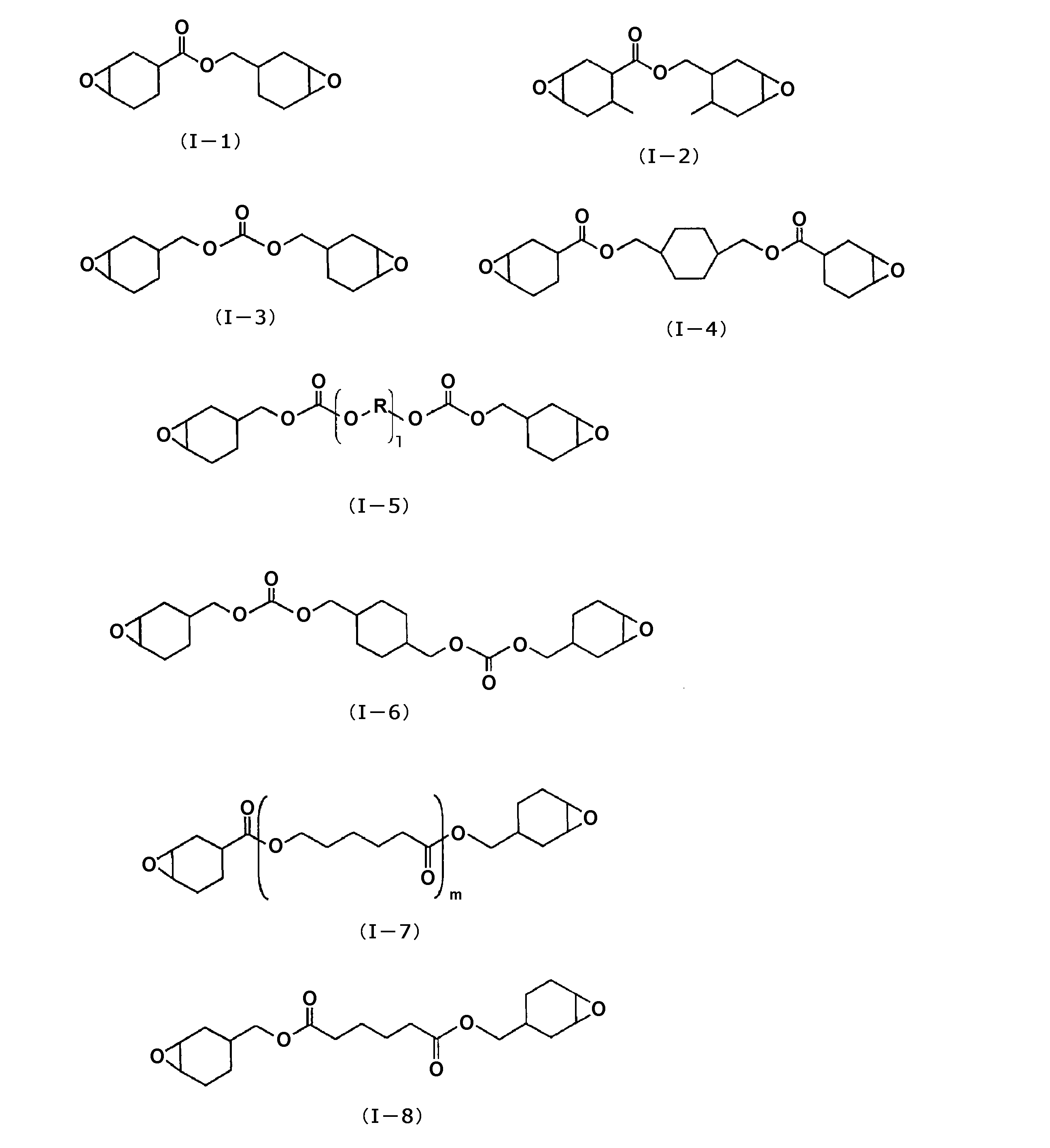
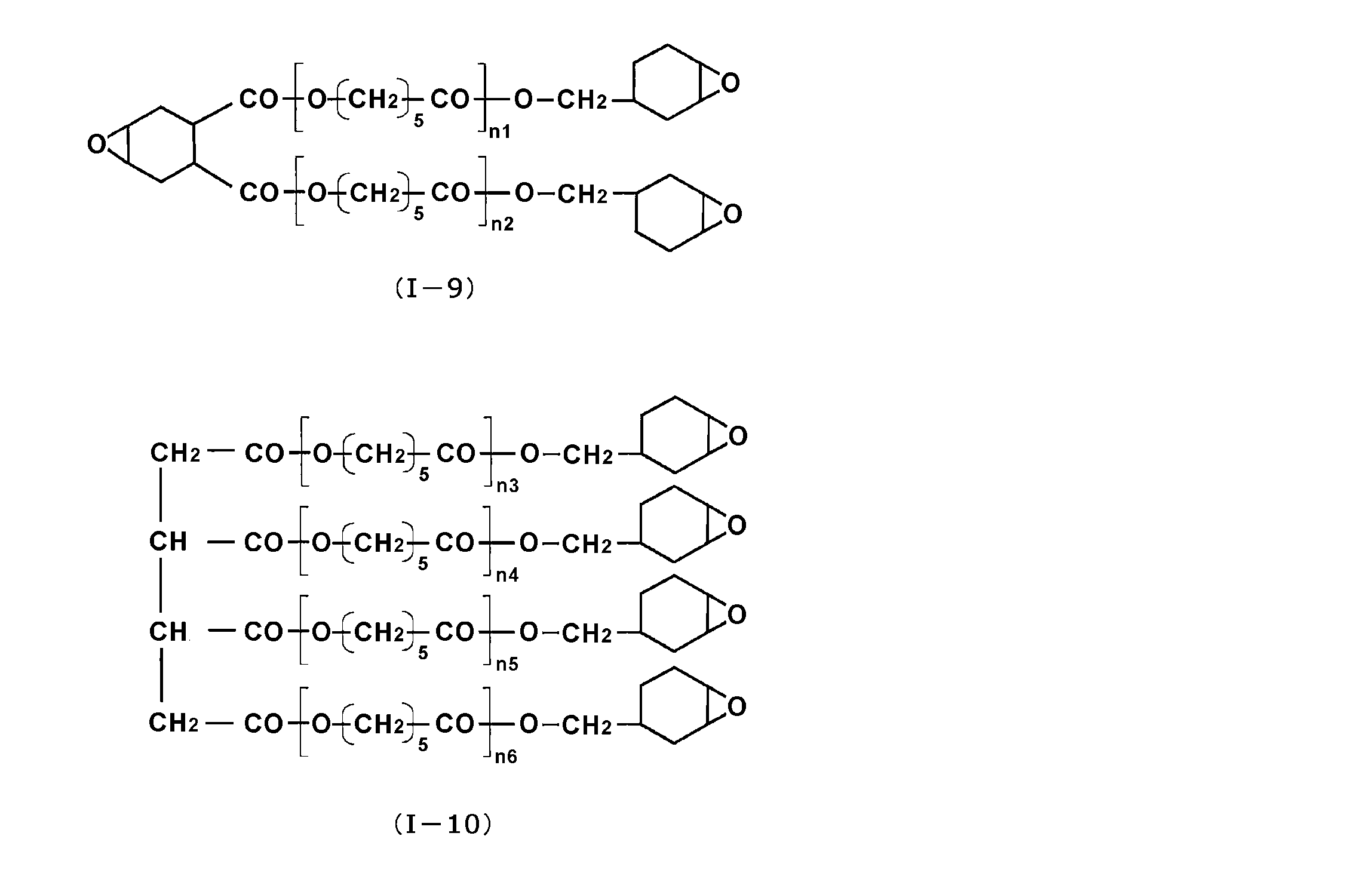
上述の(ii)脂環にエポキシ基が直接単結合で結合している化合物としては、例えば、下記式(II)で表される化合物などが挙げられる。

式(II)中、R′は、構造式上、p価のアルコールからp個の水酸基(-OH)を除いて形成される有機基(有機残基)であり、p、nはそれぞれ自然数を表す。p価のアルコール[R′(OH)p]としては、2,2-ビス(ヒドロキシメチル)-1-ブタノールなどの多価アルコール(炭素数1~15のアルコールなど)などの、後述の分子内にr個の水酸基を有する化合物などが挙げられる。pは1~6が好ましく、nは1~30が好ましい。pが2以上の場合、それぞれの( )内(外側の括弧内)の基におけるnは同一でもよく異なっていてもよい。上記式(II)で表される化合物としては、具体的には、2,2-ビス(ヒドロキシメチル)-1-ブタノールの1,2-エポキシ-4-(2-オキシラニル)シクロヘキサン付加物[例えば、商品名「EHPE3150」((株)ダイセル製)など]などが挙げられる。
本発明のエポキシ樹脂組成物において脂環式エポキシ化合物(A)は、1種を単独で使用することもできるし、2種以上を組み合わせて使用することもできる。また、脂環式エポキシ化合物(A)としては、例えば、商品名「セロキサイド2021P」、「セロキサイド2081」(以上、(株)ダイセル製)などの市販品を使用することもできる。
脂環式エポキシ化合物(A)としては、上記式(I-1)で表される化合物[3,4-エポキシシクロヘキシルメチル(3,4-エポキシ)シクロヘキサンカルボキシレート;例えば、商品名「セロキサイド2021P」((株)ダイセル製)など]が特に好ましい。
本発明のエポキシ樹脂組成物における脂環式エポキシ化合物(A)の含有量(配合量)は、特に限定されないが、エポキシ樹脂組成物(100重量%)に対して、25~95重量%が好ましく、より好ましくは35~85重量%、さらに好ましくは45~80重量%である。脂環式エポキシ化合物(A)の含有量を上記範囲に制御することにより、エポキシ樹脂組成物の硬化性がより高くなったり、硬化物の耐熱性や機械強度がより向上する傾向がある。
本発明のエポキシ樹脂組成物における、脂環式エポキシ化合物(A)、化合物(B)、及びポリビニルアセタール樹脂(C)の全量(100重量%)に対する脂環式エポキシ化合物(A)の割合は、特に限定されないが、25~95重量%が好ましく、より好ましくは35~85重量%、さらに好ましくは45~80重量%である。脂環式エポキシ化合物(A)の割合を25重量%以上とすることにより、エポキシ樹脂組成物の硬化性がより向上したり、硬化物の耐熱性がより向上する傾向がある。一方、脂環式エポキシ化合物(A)の割合を95重量%以下とすることにより、硬化物の引張破断強度が大きくなるなど機械特性がより向上する傾向がある。
[化合物(B)]
本発明のエポキシ樹脂組成物における化合物(B)は、水酸基を有するラクトン付加化合物(B1)及びポリカーボネートポリオール(B2)からなる群より選択される少なくとも1種の化合物である。本発明のエポキシ樹脂組成物が化合物(B)を必須成分として含むことにより、特に、引張破断伸度が高くなるなど硬化物の機械強度が向上する傾向がある。
本発明のエポキシ樹脂組成物における化合物(B)は、水酸基を有するラクトン付加化合物(B1)及びポリカーボネートポリオール(B2)からなる群より選択される少なくとも1種の化合物である。本発明のエポキシ樹脂組成物が化合物(B)を必須成分として含むことにより、特に、引張破断伸度が高くなるなど硬化物の機械強度が向上する傾向がある。
水酸基を有するラクトン付加化合物(B1)は、分子内に1個以上の水酸基を有し、かつラクトン化合物(ラクトン類)の開環付加反応(開環付加重合も含まれる)により形成される構造単位[-C(O)-RL-O-](RLは、アルキレン基を示す)(「ラクトン単位」と称する場合がある)を分子内に少なくとも有する化合物である。上記ラクトン化合物としては、公知乃至慣用のラクトン化合物が挙げられ、特に限定されないが、例えば、γ-ブチロラクトン、δ-バレロラクトン、ε-カプロラクトンなどの4~10員環のラクトン化合物などが挙げられる。中でも、上記ラクトン化合物としては、ε-カプロラクトンが好ましい。即ち、水酸基を有するラクトン付加化合物(B1)としては、分子内に1個以上の水酸基を有し、かつε-カプロラクトンの開環付加反応(開環付加重合も含まれる)により形成される構造単位[-C(O)-(CH2)5-O-]を分子内に少なくとも有する化合物(ε-カプロラクトン付加化合物)が好ましい。なお、水酸基を有するラクトン付加化合物(B1)は、上記ラクトン単位を1種のみ有するものであってもよいし、2種以上有するものであってもよい。
水酸基を有するラクトン付加化合物(B1)が分子内に有するラクトン単位の数(総数)は、1個以上であればよく特に限定されないが、2個以上(例えば、2~40個)が好ましい。また、水酸基を有するラクトン付加化合物(B1)が2以上のラクトン単位が繰り返し直接結合(重合)した構造を有する場合、当該構造におけるラクトン単位の繰り返し数(重合度)は、特に限定されないが、2~20が好ましい。また、上記構造におけるラクトン単位の付加形態は特に限定されず、ランダム型であってもよいし、ブロック型であってもよい。
水酸基を有するラクトン付加化合物(B1)が分子内に有する水酸基の数(総数)は、1個以上であればよく特に限定されないが、2個以上(例えば、2~10個)が好ましく、より好ましくは2~4個である。
水酸基を有するラクトン付加化合物(B1)は、特に限定されないが、例えば、分子内に1個以上の水酸基を有する化合物(開始剤)の存在下、ラクトン化合物を開環付加反応(開環付加重合も含まれる)させることにより得られる。上記分子内に1個以上の水酸基を有する化合物としては、例えば、メタノール、エタノール、プロパノール、ブタノール、ペンタノール、ヘキサノール、オクタノールなどの脂肪族アルコール;ベンジルアルコールなどの芳香族アルコール;エチレングリコール、ジエチレングリコール、トリエチレングリコール、ポリエチレングリコール、プロピレングリコール、ジプロピレングリコール、1,3-ブタンジオール、1,4-ブタンジオール、ペンタンジオール、メチルペンタンジオール、2,4-ジエチルペンタンジオール、1,6-ヘキサンジオール、2-エチル-1,3-ヘキサンジオール、ネオペンチルグリコール、ネオペンチルグリコールエステル、シクロヘキサンジメタノール、グリセリン、ジグリセリン、ポリグリセリン、トリメチロールプロパン、ジトリメチロールプロパン、ペンタエリスリトール、ジペンタエリスリトール、水添ビスフェノールA、水添ビスフェノールF、水添ビスフェノールSなどの多価アルコール;フェノール、ビフェノール、クレゾール、カテコール、ピロガロール、ハイドロキノン、ハイドロキノンモノメチルエーテル、ビスフェノールA、ビスフェノールF、4,4'-ジヒドロキシベンゾフェノン、ビスフェノールS、ビスフェノールAのアルキレンオキサイド付加物、ビスフェノールFのアルキレンオキサイド付加物、ビスフェノールSのアルキレンオキサイド付加物、フェノールノボラック樹脂、クレゾールノボラック樹脂などのフェノール類;ポリビニルアルコール、ポリ酢酸ビニル部分加水分解物、デンプン、アクリルポリオール、スチレン-アリルアルコール共重合樹脂、ポリエステルポリオール、ポリカプロラクトンポリオール、ポリプロピレンポリオール、ポリテトラメチレングリコール、ポリカーボネートポリオール、水酸基を有するポリブタジエン、セルロース、セルロースアセテート、セルロースアセテートブチレート、ヒドロキシエチルセルロースなどのセルロース系ポリマーなどの水酸基を有するオリゴマー又はポリマーなどが挙げられる。特に、脂環式エポキシ化合物(A)との反応性の観点で、水酸基を有するラクトン付加化合物(B1)としては、分子内に2個以上の水酸基を有するラクトン付加化合物(特に、ε-カプロラクトン付加化合物)が好ましく、より好ましくはラクトン単位の末端が水酸基となっている構造(即ち、-C(O)-RL-OH)を分子内に2個以上有するラクトン付加化合物である。
なお、ラクトン化合物の開環付加反応は、公知乃至慣用の方法により実施することができ、特に限定されないが、例えば、開始剤の存在下、必要に応じて加熱しながらラクトン化合物を攪拌混合することによって実施できる。なお、開始剤とラクトン化合物の使用量(仕込み量)は、目的とするラクトン付加物の分子量などに応じて適宜調整可能であり、特に限定されない。また、上記開環付加反応に際しては、必要に応じて、テトラブチルチタネート、テトライソプロピルチタネート、テトラエチルチタネート、ジブチルスズオキシド、ジブチルスズラウレート、オクチル酸スズ、塩化第一スズなどの公知乃至慣用の触媒を使用することもできる。触媒の使用量は、開始剤やラクトン化合物の種類、反応条件等に応じて適宜選択可能であり、特に限定されない。
ポリカーボネートポリオール(B2)は、分子内に2個以上の水酸基を有し、かつカーボネート骨格を分子内に少なくとも有する化合物である。ポリカーボネートポリオール(B2)は、通常のカーボネートポリオールを製造する方法と同じくホスゲン法又は、ジメチルカーボネート、ジエチルカーボネートのようなジアルキルカーボネート若しくはジフェニルカーボネートを用いるカーボネート交換反応(特開昭62-187725、特開平2-175721、特開平2-49025号、特開平3-220233、特開平3-252420号公報など参照)などにより合成される。カーボネート結合は熱分解を受けにくいため、ポリカーボネートポリオール(B2)を含む樹脂組成物の硬化物は、高温高湿下でも優れた安定性を示す傾向がある。
ジアルキルカーボネートと共にカーボネート交換反応で用いられるポリオールとしては、1,6-ヘキサンジオール、エチレングリコール、ジエチレングリコール、1,3-プロパンジオール、1,4-ブタンジオール、1,3-ブタンジオール、2,3-ブタンジオール、1,5-ペンタンジオール、3-メチル-1,5-ペンタンジオール、1,4-シクロヘキサンジメタノール、1,12-ドデカンジオール、ブタジエンジオール、ネオペンチルグリコール、テトラメチレングリコール、プロピレングリコール、ジプロピレングリコールなどが挙げられる。
ポリカーボネートポリオール(B2)が分子内に有する水酸基の数(総数)は、2個以上であればよく特に限定されないが、2~10個が好ましく、より好ましくは2~4個である。
より具体的には、化合物(B)としては、下記式(1)で表される化合物、下記式(2)で表される化合物が挙げられる。


式(1)中、rは、1~20の整数を示す。rとしては、特に2~4の整数が好ましい。式(1)中、R1は、構造式上、分子内にr個の水酸基を有する化合物[R1(OH)r]からr個の水酸基を除いて形成される有機基(有機残基)を示す。上記有機基としては、例えば、構造式上、上述の分子内に1個以上(r個とする)の水酸基を有する化合物からr個の水酸基を除いて形成される有機基などが挙げられる。
式(1)中、qは、qが付された括弧内の構造(ラクトン単位)の繰り返し数を意味し、0~10の整数を示す。但し、式(1)におけるqの総数は、1以上の整数である。なお、rが2以上の整数の場合、複数のqは同一であってもよいし、異なっていてもよい。
式(1)中のR2は、アルキレン基を示し、例えば、メチレン基、メチルメチレン基、ジメチルメチレン基、エチレン基、プロピレン基、トリメチレン基、テトラメチレン基、ペンタメチレン基などの炭素数が1~18の直鎖又は分岐鎖状のアルキレン基などが挙げられる。中でも、R2としては、ペンタメチレン基が好ましい。なお、式(1)中に複数のR2が存在する場合、これらは同一であってもよいし、異なっていてもよい。また、qが付された括弧内の構造(ラクトン単位)の付加形態は、特に限定されず、ランダム型であってもよいし、ブロック型であってもよい。
式(2)中、sは、2~50の整数を示す。式(2)中のR3は、同一又は異なって、アルキレン基を示し、式(1)におけるR2と同様のものが例示される。なお、sが付された括弧内の複数のR3は、同一であってもよいし、異なっていてもよい。また、sが付された括弧内の構造(カーボネート骨格)の付加形態は、特に限定されず、ランダム型であってもよいし、ブロック型であってもよい。
化合物(B)の水酸基価は、特に限定されないが、10~800mgKOH/gが好ましく、より好ましくは50~600mgKOH/gである。水酸基価を10mgKOH/g以上とすることにより、硬化物の耐熱性がより向上する傾向がある。一方、水酸基価を800mgKOH/g以下とすることにより、硬化物の機械特性がより向上する傾向がある。なお、化合物(B)の水酸基価は、JIS K0070に準じて測定することができる。
化合物(B)の分子量は、特に限定されないが、200~10000が好ましく、より好ましくは300~3000である。分子量を200以上とすることにより、低弾性率化、曲げ強度向上の効果をより効率的に享受できる傾向がある。一方、分子量を10000以下とすることにより、硬化物の耐熱性、機械強度がより向上する傾向がある。なお、化合物(B)の分子量は、ゲルパーミエーションクロマトグラフィーによる標準ポリスチレン換算の分子量として測定することができる。
化合物(B)は、25℃で液体であってもよいし、固体であってもよい。化合物(B)が25℃で液体である場合、その粘度(25℃)は、特に限定されないが、100~25000mPa・sが好ましく、より好ましくは500~10000mPa・sである。
本発明のエポキシ樹脂組成物において化合物(B)は、1種を単独で使用することもできるし、2種以上を組み合わせて使用することもできる。また、化合物(B)としては、例えば、商品名「プラクセル205」、「プラクセル205U」、「プラクセルL205AL」、「プラクセル208」、「プラクセル210」、「プラクセル210N」、「プラクセル212」、「プラクセルL212AL」、「プラクセル220」、「プラクセル220N」、「プラクセル220NP1」、「プラクセルL220AL」、「プラクセル230」、「プラクセル230N」、「プラクセル240」、「プラクセル303」、「プラクセル305」、「プラクセル308」、「プラクセル312」、「プラクセルL320AL」、「プラクセル405D」、「プラクセルCD205」、「プラクセルCD210」、「プラクセルCD220」、「プラクセルCD205PL」、「プラクセルCD205HL」、「プラクセルCD210PL」、「プラクセルCD210HL」、「プラクセルCD220PL」、「プラクセルCD220HL」、「プラクセルCD220EC」、「プラクセルCD221T」(以上、(株)ダイセル製);商品名「ETERNACOLL UH-CARB50」、「ETERNACOLL UH-CARB100」、「ETERNACOLL UH-CARB300」、「ETERNACOLL UH-CARB90(1/3)」、「ETERNACOLL UH-CARB90(1/1)」、「ETERNACOLL UH-CARB100」(以上、宇部興産(株)製);商品名「デュラノールT6002」、「デュラノールT5652」、「デュラノールT4672」、「デュラノールT4692」、「デュラノールG3452」(以上、旭化成ケミカルズ(株)製)などの市販品を使用することもできる。
本発明のエポキシ樹脂組成物における化合物(B)の含有量(配合量)は、特に限定されないが、脂環式エポキシ化合物(A)100重量部に対して、5~60重量部が好ましく、より好ましくは10~60重量部、さらに好ましくは15~55重量部、特に好ましくは20~50重量部である。化合物(B)の含有量を5重量部以上とすることにより、硬化物の引張破断強度が高くなり、機械強度がより向上する傾向がある。一方、化合物(B)の含有量を60重量部以下とすることにより、硬化物のガラス転移温度が高く保持され、耐熱性がより向上する傾向がある。
[ポリビニルアセタール樹脂(C)]
本発明のエポキシ樹脂組成物におけるポリビニルアセタール樹脂(C)は、ビニルアルコールに対応する構成単位(「ビニルアルコール構成単位」と称する場合がある)を少なくとも含むポリビニルアルコール樹脂をアルデヒドと反応させて、該ポリビニルアルコール樹脂における隣接するビニルアルコール構成単位がアセタール化された構造を1又は2以上含む化合物(重合体)である。本発明のエポキシ樹脂組成物はポリビニルアセタール樹脂(C)を必須成分として含むことにより、特に、高い引張破断伸度などの硬化物の優れた機械強度が保持されつつ、ガラス転移温度や熱分解温度が高くなるなど硬化物の耐熱性が向上する傾向がある。さらに、ポリビニルアセタール樹脂(C)の分子量を選択することにより、エポキシ樹脂組成物の性状及び粘度を容易に制御することができる。
本発明のエポキシ樹脂組成物におけるポリビニルアセタール樹脂(C)は、ビニルアルコールに対応する構成単位(「ビニルアルコール構成単位」と称する場合がある)を少なくとも含むポリビニルアルコール樹脂をアルデヒドと反応させて、該ポリビニルアルコール樹脂における隣接するビニルアルコール構成単位がアセタール化された構造を1又は2以上含む化合物(重合体)である。本発明のエポキシ樹脂組成物はポリビニルアセタール樹脂(C)を必須成分として含むことにより、特に、高い引張破断伸度などの硬化物の優れた機械強度が保持されつつ、ガラス転移温度や熱分解温度が高くなるなど硬化物の耐熱性が向上する傾向がある。さらに、ポリビニルアセタール樹脂(C)の分子量を選択することにより、エポキシ樹脂組成物の性状及び粘度を容易に制御することができる。
ポリビニルアセタール樹脂(C)としては、公知乃至慣用のポリビニルアセタール樹脂が挙げられ、特に限定されないが、例えば、下記式(i)で示される構成単位、下記式(ii)で表される構成単位、及び下記式(iii)で表される構成単位を必須の構成単位として含むポリビニルアセタール樹脂が挙げられる。ポリビニルアセタール樹脂(C)としては、より具体的には、下記式(i)におけるR11が水素原子であるポリビニルホルマール樹脂などが挙げられる。
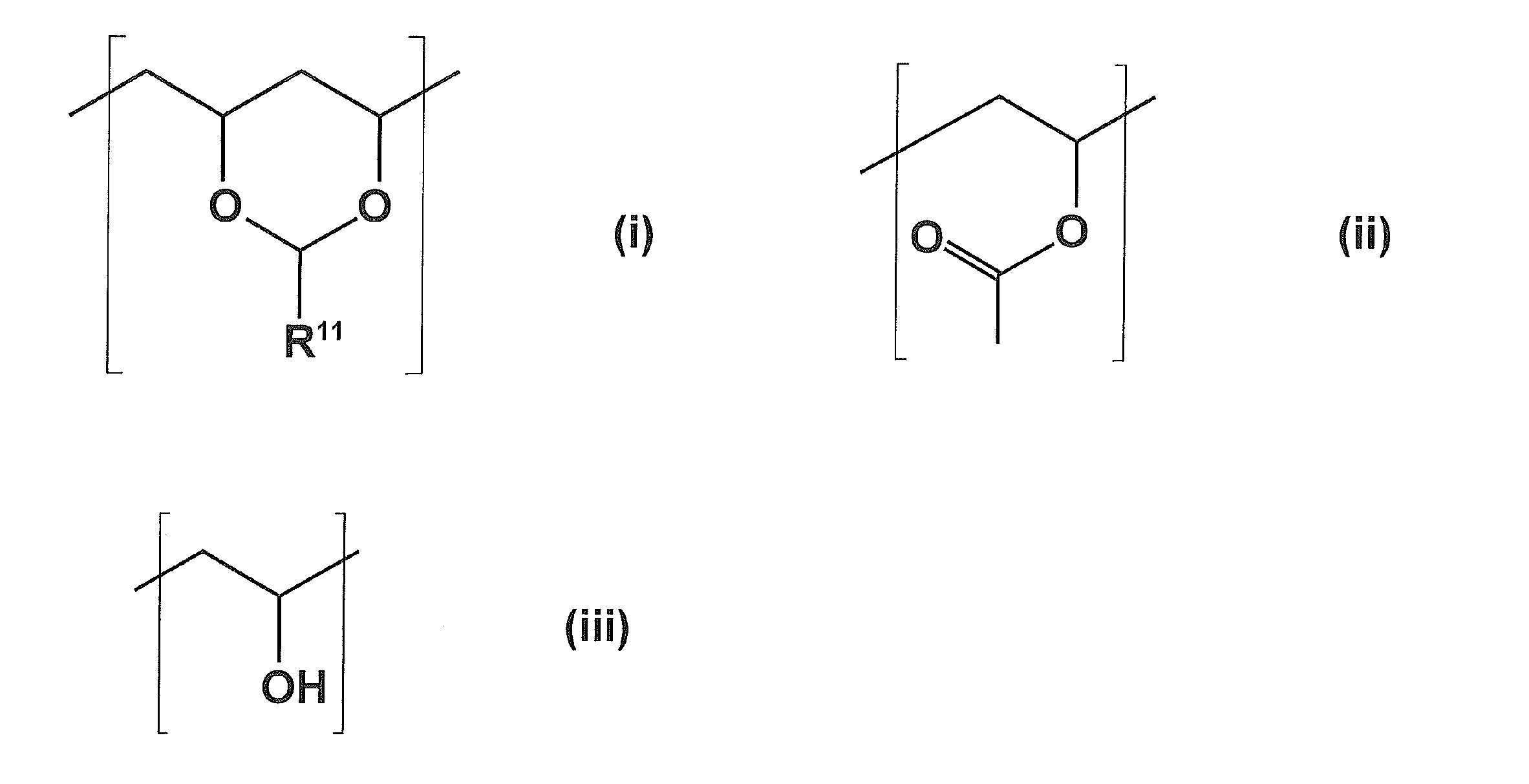
上記式(i)で表される構成単位は、アセタール部位を有する構成単位であって、例えば、連続(隣接)するビニルアルコール構成単位とアルデヒド(R11-CHO)との反応によって形成され得る。式(i)で表される構成単位におけるR11は、任意の基又は原子であって、例えば、水素原子、アルキル基、アルコキシ基、アリール基などが挙げられる。しかしながら、式(i)で表される構成単位におけるR11がバルキーな基(例えば、炭素数が多い炭化水素基など)であると、ポリビニルアセタール樹脂(C)の軟化点が低下する傾向があり、軟化点の低いポリビニルアセタール樹脂(C)を含むエポキシ樹脂組成物は、高温において粘度が大きく低下して樹脂が流れ過ぎてしまう場合がある。また、R11がバルキーな基であるポリビニルアセタール樹脂(C)は、溶媒への溶解性は高いが、一方で耐薬品性に劣る傾向がある。このため、式(i)におけるR11は、水素原子又は炭素数1~5のアルキル基であることが好ましく、より好ましくは水素原子又は炭素数1~3のアルキル基である。炭素数1~5のアルキル基としては、例えば、メチル基、エチル基、プロピル基、イソプロピル基などの炭素数1~5の直鎖又は分岐鎖状のアルキル基などが挙げられる。
上記式(ii)で表される構成単位はビニルアセテートに対応する構成単位であり、上記式(iii)で表される構成単位はビニルアルコールに対応する構成単位である。なお、通常、ビニルアセテートに対応する構成単位はビニルアセテートの重合により形成され、ビニルアルコールに対応する構成単位はビニルアセテートに対応する構成単位をけん化することによって形成される。
ポリビニルアセタール樹脂(C)は、式(i)~(iii)で表される構成単位(式(i)で表される構成単位、式(ii)で表される構成単位、及び式(iii)で表される構成単位)以外の構成単位を有していてもよい。このような構成単位としては、例えば、下記式(iv)で表される構成単位(分子間アセタール単位)や下記式(v)で表される構成単位(ヘミアセタール単位)などが挙げられる。なお、式(iv)、式(v)におけるR11は、式(i)におけるものと同じである。
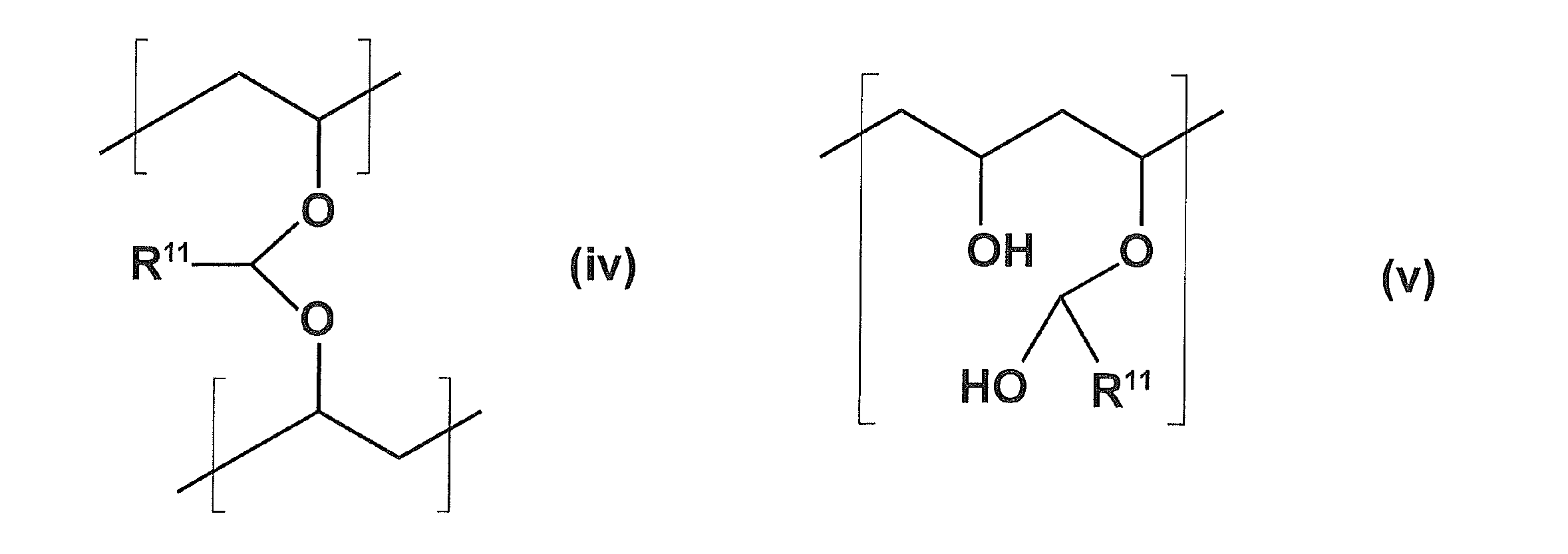
より具体的には、ポリビニルアセタール樹脂(C)としては、例えば、式(i)~(iii)で表される構成単位を必須の構成単位として含み、かつ分子内にカルボキシル基を有しないポリビニルアセタール樹脂(「ポリビニルアセタール樹脂(C1)」と称する場合がある);上記式(i)~(iii)で表される構成単位を必須の構成単位として含み、かつ分子内にカルボキシル基を有するポリビニルアセタール樹脂(「ポリビニルアセタール樹脂(C2)」と称する場合がある)などが挙げられる。
ポリビニルアセタール樹脂(C1)における上記式(i)~(iii)で表される構成単位の総含有量(総含有率)は、特に限定されないが、ポリビニルアセタール樹脂(C1)を構成する全構成単位(100重量%)に対して、80~100重量%が好ましい。
ポリビニルアセタール樹脂(C1)において式(i)~(iii)で表される構成単位は、規則性をもって配列していてもよいし、ランダムに配列していてもよい。即ち、ポリビニルアセタール樹脂(C1)は、ブロック共重合体、交互共重合体等であってもよいし、ランダム共重合体であってもよい。中でも、ランダムに配列していることが好ましい。
ポリビニルアセタール樹脂(C1)における式(i)で表される構成単位の含有量(含有率)は、特に限定されないが、ポリビニルアセタール樹脂(C1)を構成する全構成単位(100モル%)に対して、50~80モル%が好ましい。式(i)で表される構成単位の含有量を50モル%以上とすることにより、ポリビニルアセタール樹脂(C1)の耐薬品性、可撓性、耐摩耗性、機械的強度がより向上する傾向がある。一方、式(i)で表される構成単位を80モル%よりも高くすることは、製造上、困難な傾向がある。即ち、ポリビニルアセタール樹脂(C1)における式(i)で表される構成単位は、ポリビニルアルコール樹脂において分子鎖中に連続(隣接)して存在しているビニルアルコール構成単位をアセタール化することによって形成され得るので、連続していないビニルアルコール構成単位をアセタール化することはできず、結果的に、式(i)で表される構成単位の含有量を80モル%よりも高くすることは困難な傾向がある。
ポリビニルアセタール樹脂(C1)における式(ii)で表される構成単位の含有量(含有率)は、特に限定されないが、ポリビニルアセタール樹脂(C1)を構成する全構成単位(100モル%)に対して、0.1~49.9モル%が好ましく、より好ましくは1~30モル%である。式(ii)で表される構成単位の含有量を0.1モル%以上とすることにより、ポリビニルアセタール樹脂(C1)の溶媒への溶解性や脂環式エポキシ化合物(A)等への溶解性がより向上する傾向がある。一方、式(ii)で表される構成単位の含有量を49.9モル%以下とすることにより、相対的に式(i)で表される構成単位の量を多くでき、ポリビニルアセタール樹脂(C1)の耐薬品性、可撓性、耐摩耗性、機械的強度がより向上し、期待する性能をより発揮させやすくなる傾向がある。
ポリビニルアセタール樹脂(C1)における式(iii)で表される構成単位の含有量(含有率)は、特に限定されないが、ポリビニルアセタール樹脂(C1)を構成する全構成単位(100モル%)に対して、0.1~49.9モル%が好ましく、より好ましくは1~30モル%である。式(iii)で表される構成単位の含有量を49.9モル%以下とすることにより、ポリビニルアセタール樹脂(C1)の溶媒への溶解性や脂環式エポキシ化合物(A)等への溶解性がより向上する傾向がある。なお、ポリビニルアセタール樹脂(C1)の製造において、ポリビニルアルコール樹脂の連続(隣接)するビニルアルコール構成単位をアセタール化する際、式(ii)で表される構成単位と式(iii)で表される構成単位とが平衡関係となるため、通常、式(iii)で表される構成単位の含有量は0.1モル%以上となる。
ポリビニルアセタール樹脂(C1)における各構成単位(例えば、式(i)~(iii)で表される構成単位)のそれぞれの含有量は、JIS K6729に準じて測定することができる。
ポリビニルアセタール樹脂(C2)は、上述のように、分子内にカルボキシル基を有するポリビニルアセタール樹脂である。ポリビニルアセタール樹脂(C2)としては、例えば、上記式(i)~(iii)で表される構成単位に加え、さらに下記式(vi)で表される構成単位を含むポリビニルアセタール樹脂(共重合によりカルボキシル基が導入されたポリビニルアセタール樹脂;「カルボキシル基導入ポリビニルアセタール樹脂」と称する場合がある)が挙げられる。
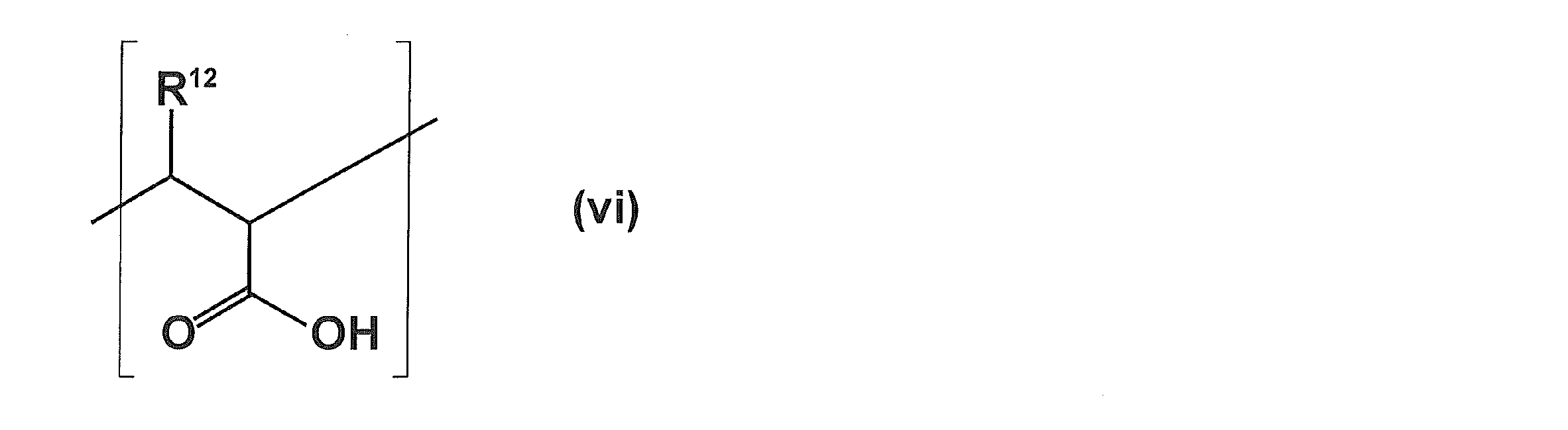
上記式(vi)中、R12は、水素原子又は炭素数1~5のアルキル基を示す。炭素数1~5のアルキル基としては、例えば、メチル基、エチル基、プロピル基、イソプロピル基などの炭素数1~5の直鎖又は分岐鎖状のアルキル基などが挙げられる。
ポリビニルアセタール樹脂(C2)における式(i)~(iii)及び(vi)で表される構成単位(式(i)~(iii)で表される構成単位及び式(vi)で表される構成単位)の総含有量(総含有率)は、特に限定されないが、ポリビニルアセタール樹脂(C2)を構成する全構成単位(100重量%)に対して、80~100重量%が好ましい。ポリビニルアセタール樹脂(C2)は、さらに、例えば、上記式(iv)で表される構成単位や式(v)で表される構成単位等のその他の構成単位を含んでいてもよい。
ポリビニルアセタール樹脂(C2)において式(i)~(iii)及び(vi)で表される構成単位は、規則性をもって配列していてもよいし、ランダムに配列していてもよい。即ち、ポリビニルアセタール樹脂(C2)は、ブロック共重合体、交互共重合体等であってもよいし、ランダム共重合体であってもよい。中でも、ランダムに配列していることが好ましい。
ポリビニルアセタール樹脂(C2)における式(i)で表される構成単位の含有量(含有率)は、特に限定されないが、ポリビニルアセタール樹脂(C2)を構成する全構成単位(100モル%)に対して、49.9~80モル%が好ましい。式(i)で表される構成単位の含有量を49.9モル%以上とすることにより、ポリビニルアセタール樹脂(C2)の耐薬品性、可撓性、耐摩耗性、機械的強度がより向上する傾向がある。一方、式(i)で表される構成単位を80モル%よりも高くすることは、製造上、困難な傾向がある。即ち、ポリビニルアセタール樹脂(C2)における式(i)で表される構成単位は、ポリビニルアルコール樹脂において分子鎖中に連続(隣接)して存在しているビニルアルコール構成単位をアセタール化することによって形成され得るので、連続していないビニルアルコール構成単位をアセタール化することはできず、結果的に、式(i)で表される構成単位の含有量を80モル%よりも高くすることは困難な傾向がある。
ポリビニルアセタール樹脂(C2)における式(ii)で表される構成単位の含有量(含有率)は、特に限定されないが、ポリビニルアセタール樹脂(C2)を構成する全構成単位(100モル%)に対して、0.1~49.9モル%が好ましく、より好ましくは1~30モル%である。式(ii)で表される構成単位の含有量を0.1モル%以上とすることにより、ポリビニルアセタール樹脂(C2)の溶媒への溶解性や脂環式エポキシ化合物(A)等への溶解性がより向上する傾向がある。一方、式(ii)で表される構成単位の含有量を49.9モル%以下とすることにより、相対的に式(i)で表される構成単位の量を多くでき、ポリビニルアセタール樹脂(C2)の耐薬品性、可撓性、耐摩耗性、機械的強度がより向上し、期待する性能をより発揮させやすくなる傾向がある。
ポリビニルアセタール樹脂(C2)における式(iii)で表される構成単位の含有量(含有率)は、特に限定されないが、ポリビニルアセタール樹脂(C2)を構成する全構成単位(100モル%)に対して、0.1~49.9モル%が好ましく、より好ましくは1~30モル%である。式(iii)で表される構成単位の含有量を49.9モル%以下とすることにより、ポリビニルアセタール樹脂(C2)の溶媒への溶解性や脂環式エポキシ化合物(A)等への溶解性がより向上する傾向がある。なお、ポリビニルアセタール樹脂(C2)の製造において、ポリビニルアルコール樹脂の連続(隣接)するポリビニルアルコール鎖をアセタール化する際、式(ii)で表される構成単位と式(iii)で表される構成単位とが平衡関係となるため、通常、式(iii)で表される構成単位の含有量は0.1モル%以上となる。
ポリビニルアセタール樹脂(C2)における式(vi)で表される構成単位の含有量(含有率)は、特に限定されないが、ポリビニルアセタール樹脂(C2)を構成する全構成単位(100モル%)に対して、0.1~49.9モル%が好ましく、より好ましくは1~30モル%である。式(vi)で表される構成単位の含有量を0.1モル%以上とすることにより、繊維強化複合材料における樹脂と強化繊維との密着性(接着性)が向上し、繊維強化複合材料の機械物性がより向上する傾向がある。一方、式(vi)で表される構成単位の含有量を49.9モル%以下とすることにより、相対的に式(i)で表される構成単位の量を多くでき、ポリビニルアセタール樹脂(C2)の耐薬品性、可撓性、耐摩耗性、機械的強度がより向上し、期待する性能をより発揮させやすくなる傾向がある。
ポリビニルアセタール樹脂(C2)における各構成単位(例えば、式(i)~(iii)及び(vi)で表される構成単位)のそれぞれの含有量は、JIS K6729に準じて測定することができる。
ポリビニルアセタール樹脂(C)の重量平均分子量は、特に限定されないが、40000~140000が好ましく、より好ましくは40000~80000である。重量平均分子量を40000以上とすることにより、エポキシ樹脂組成物の成形加工性がより向上し、硬化物や繊維強化複合材料の曲げ強度や引張強度がより向上する傾向がある。一方、重量平均分子量を140000以下とすることにより、脂環式エポキシ化合物(A)等への十分な溶解性を確保しつつ、エポキシ樹脂組成物の粘度を過剰に増大させることなく、作業性がより向上する傾向がある。
本発明のエポキシ樹脂組成物においてポリビニルアセタール樹脂(C)は、1種を単独で使用することもできるし、2種以上を組み合わせて使用することもできる。また、ポリビニルアセタール樹脂(C)としては、例えば、商品名「ビニレックPVF-K」、「ビニレックPVF-L」、「ビニレックPVF-H」、「ビニレックPVF-E」、「ビニレックC」(以上、JNC(株)製)などの市販品を使用することもできる。
本発明のエポキシ樹脂組成物におけるポリビニルアセタール樹脂(C)の含有量(配合量)は、所望するエポキシ樹脂組成物の性状や粘度などに応じて適宜調整することができ、特に限定されないが、脂環式エポキシ化合物(A)100重量部に対して、1~40重量部が好ましく、より好ましくは1~30重量部、さらに好ましくは1~20重量部である。ポリビニルアセタール樹脂(C)の含有量を1重量部以上とすることにより、エポキシ樹脂組成物の粘度を適度な範囲に高く制御できるため、エポキシ樹脂組成物の適用できる成形方法の幅が拡大したり、硬化物や繊維強化複合材料の機械強度がより向上する傾向がある。一方、ポリビニルアセタール樹脂(C)の含有量を40重量部以下とすることにより、エポキシ樹脂組成物を液状とすることができ、さらに、その粘度を適度な範囲に低く制御できるため、適用可能な成形方法の幅が拡大する傾向がある。
[硬化触媒(D)]
本発明のエポキシ樹脂組成物は、さらに、硬化触媒(D)を含んでいてもよい。本発明のエポキシ樹脂組成物における硬化触媒(D)は、脂環式エポキシ化合物(A)等の硬化反応(重合反応)を開始及び/又は促進することにより、エポキシ樹脂組成物を硬化させる働きを有する化合物である。硬化触媒(D)としては、特に限定されないが、例えば、光照射や加熱処理等を施すことによりカチオン種を発生して、重合を開始させるカチオン重合開始剤(光カチオン重合開始剤、熱カチオン重合開始剤等)や、ルイス酸・アミン錯体、ブレンステッド酸塩類、イミダゾール類等が挙げられる。
本発明のエポキシ樹脂組成物は、さらに、硬化触媒(D)を含んでいてもよい。本発明のエポキシ樹脂組成物における硬化触媒(D)は、脂環式エポキシ化合物(A)等の硬化反応(重合反応)を開始及び/又は促進することにより、エポキシ樹脂組成物を硬化させる働きを有する化合物である。硬化触媒(D)としては、特に限定されないが、例えば、光照射や加熱処理等を施すことによりカチオン種を発生して、重合を開始させるカチオン重合開始剤(光カチオン重合開始剤、熱カチオン重合開始剤等)や、ルイス酸・アミン錯体、ブレンステッド酸塩類、イミダゾール類等が挙げられる。
硬化触媒(D)としての光カチオン重合開始剤としては、例えば、ヘキサフルオロアンチモネート塩、ペンタフルオロヒドロキシアンチモネート塩、ヘキサフルオロホスフェート塩、ヘキサフルオロアルセネート塩などが挙げられ、より具体的には、例えば、トリアリールスルホニウムヘキサフルオロホスフェート(例えば、p-フェニルチオフェニルジフェニルスルホニウムヘキサフルオロホスフェート等)、トリアリールスルホニウムヘキサフルオロアンチモネート等のスルホニウム塩(特に、トリアリールスルホニウム塩);ジアリールヨードニウムヘキサフルオロホスフェート、ジアリールヨードニウムヘキサフルオロアンチモネート、ビス(ドデシルフェニル)ヨードニウムテトラキス(ペンタフルオロフェニル)ボレート、ヨードニウム[4-(4-メチルフェニル-2-メチルプロピル)フェニル]ヘキサフルオロホスフェート等のヨードニウム塩;テトラフルオロホスホニウムヘキサフルオロホスフェート等のホスホニウム塩;N-ヘキシルピリジニウムテトラフルオロボレート等のピリジニウム塩等が挙げられる。また、光カチオン重合開始剤としては、例えば、商品名「UVACURE1590」(ダイセル・サイテック(株)製);商品名「CD-1010」、「CD-1011」、「CD-1012」(以上、米国サートマー製);商品名「イルガキュア264」(BASF製);商品名「CIT-1682」(日本曹達(株)製);商品名「PHOTOINITIATOR 2074」(ローディアジャパン(株)製)などの市販品を好ましく使用することもできる。
硬化触媒(D)としての熱カチオン重合開始剤としては、例えば、アリールジアゾニウム塩、アリールヨードニウム塩、アリールスルホニウム塩、アレン-イオン錯体などが挙げられ、商品名「PP-33」、「CP-66」、「CP-77」(以上(株)ADEKA製);商品名「FC-509」(スリーエム製);商品名「UVE1014」(G.E.製);商品名「サンエイド SI-60L」、「サンエイド SI-80L」、「サンエイド SI-100L」、「サンエイド SI-110L」、「サンエイド SI-150L」、「SI-B3」(以上、三新化学工業(株)製);商品名「CG-24-61」(BASF製);商品名「TA-60」、「TA-100」、「TA-120」、「TA-160」(以上、サンアプロ(株)製)などの市販品を好ましく使用することができる。さらに、熱カチオン重合開始剤としては、アルミニウムやチタンなどの金属とアセト酢酸若しくはジケトン類とのキレート化合物とトリフェニルシラノール等のシラノールとの化合物、又は、アルミニウムやチタンなどの金属とアセト酢酸若しくはジケトン類とのキレート化合物とビスフェノールS等のフェノール類との化合物等も挙げられる。
硬化触媒(D)としてのルイス酸・アミン錯体としては、公知乃至慣用のルイス酸・アミン錯体系硬化触媒を使用することができ、特に限定されないが、例えば、BF3・n-ヘキシルアミン、BF3・モノエチルアミン、BF3・ベンジルアミン、BF3・ジエチルアミン、BF3・ピペリジン、BF3・トリエチルアミン、BF3・アニリン、BF4・n-ヘキシルアミン、BF4・モノエチルアミン、BF4・ベンジルアミン、BF4・ジエチルアミン、BF4・ピペリジン、BF4・トリエチルアミン、BF4・アニリン、PF5・エチルアミン、PF5・イソプロピルアミン、PF5・ブチルアミン、PF5・ラウリルアミン、PF5・ベンジルアミン、AsF5・ラウリルアミン等が挙げられる。
硬化触媒(D)としてのブレンステッド酸塩類としては、公知乃至慣用のブレンステッド酸塩類を使用することができ、特に限定されないが、例えば、脂肪族スルホニウム塩、芳香族スルホニウム塩、ヨードニウム塩、ホスホニウム塩等が挙げられる。
硬化触媒(D)としてのイミダゾール類としては、公知乃至慣用のイミダゾール類を使用することができ、特に限定されないが、例えば、2-メチルイミダゾール、2-エチル-4-メチルイミダゾール、2-ウンデシルイミダゾール、2-ヘプタデシルイミダゾール、2-フェニルイミダゾール、1-ベンジル-2-メチルイミダゾール、1-シアノエチル-2-メチルイミダゾール、1-シアノエチル-2-エチル-4-メチルイミダゾール、1-シアノエチル-2-ウンデシルイミダゾール、1-シアノエチル-2-ウンデシルイミダゾリウムトリメリテート、1-シアノエチル-2-フェニルイミダゾリウムトリメリテート、2-メチルイミダゾリウムイソシアヌレート、2-フェニルイミダゾリウムイソシアヌレート、2,4-ジアミノ-6-[2-メチルイミダゾリル-(1)]-エチル-s-トリアジン、2,4-ジアミノ-6-[2-エチル-4-メチルイミダゾリル-(1)]-エチル-s-トリアジンなどが挙げられる。
本発明のエポキシ樹脂組成物において硬化触媒(D)は、1種を単独で使用することもできるし、2種以上を組み合わせて使用することもできる。
本発明のエポキシ樹脂組成物における硬化触媒(D)の含有量(配合量)は、特に限定されないが、エポキシ樹脂組成物に含まれるカチオン硬化性化合物(例えば、脂環式エポキシ化合物(A))の全量100重量部に対して、0.01~15重量部が好ましく、より好ましくは0.01~12重量部、さらに好ましくは0.05~10重量部、特に好ましくは0.05~8重量部である。硬化触媒(D)を上記範囲内で使用することにより、エポキシ樹脂組成物の硬化速度が速くなり、硬化物の耐熱性及び透明性のバランスが向上する傾向がある。
[硬化剤(E)]
本発明のエポキシ樹脂組成物は、さらに(例えば、硬化触媒(D)の代わりに)、硬化剤(E)を含んでいてもよい。本発明のエポキシ樹脂組成物における硬化剤(E)は、脂環式エポキシ化合物(A)等と反応することにより、エポキシ樹脂組成物を硬化させる働きを有する化合物である。硬化剤(E)としては、エポキシ樹脂用硬化剤として公知乃至慣用の硬化剤を使用することができ、特に限定されないが、例えば、酸無水物類(酸無水物系硬化剤)、アミン類(アミン系硬化剤)、ポリアミド樹脂、イミダゾール類(イミダゾール系硬化剤)、ポリメルカプタン類(ポリメルカプタン系硬化剤)、フェノール類(フェノール系硬化剤)、ポリカルボン酸類、ジシアンジアミド類、有機酸ヒドラジド等が挙げられる。
本発明のエポキシ樹脂組成物は、さらに(例えば、硬化触媒(D)の代わりに)、硬化剤(E)を含んでいてもよい。本発明のエポキシ樹脂組成物における硬化剤(E)は、脂環式エポキシ化合物(A)等と反応することにより、エポキシ樹脂組成物を硬化させる働きを有する化合物である。硬化剤(E)としては、エポキシ樹脂用硬化剤として公知乃至慣用の硬化剤を使用することができ、特に限定されないが、例えば、酸無水物類(酸無水物系硬化剤)、アミン類(アミン系硬化剤)、ポリアミド樹脂、イミダゾール類(イミダゾール系硬化剤)、ポリメルカプタン類(ポリメルカプタン系硬化剤)、フェノール類(フェノール系硬化剤)、ポリカルボン酸類、ジシアンジアミド類、有機酸ヒドラジド等が挙げられる。
硬化剤(E)としての酸無水物類(酸無水物系硬化剤)としては、公知乃至慣用の酸無水物系硬化剤を使用することができ、特に限定されないが、例えば、メチルテトラヒドロ無水フタル酸(4-メチルテトラヒドロ無水フタル酸、3-メチルテトラヒドロ無水フタル酸等)、メチルヘキサヒドロ無水フタル酸(4-メチルヘキサヒドロ無水フタル酸、3-メチルヘキサヒドロ無水フタル酸等)、ドデセニル無水コハク酸、メチルエンドメチレンテトラヒドロ無水フタル酸、無水フタル酸、無水マレイン酸、テトラヒドロ無水フタル酸、ヘキサヒドロ無水フタル酸、メチルシクロヘキセンジカルボン酸無水物、無水ピロメリット酸、無水トリメリット酸、ベンゾフェノンテトラカルボン酸無水物、無水ナジック酸、無水メチルナジック酸、水素化メチルナジック酸無水物、4-(4-メチル-3-ペンテニル)テトラヒドロ無水フタル酸、無水コハク酸、無水アジピン酸、無水セバシン酸、無水ドデカン二酸、メチルシクロヘキセンテトラカルボン酸無水物、ビニルエーテル-無水マレイン酸共重合体、アルキルスチレン-無水マレイン酸共重合体などが挙げられる。中でも、取り扱い性の観点で、25℃で液状の酸無水物[例えば、メチルテトラヒドロ無水フタル酸、メチルヘキサヒドロ無水フタル酸、ドデセニル無水コハク酸、メチルエンドメチレンテトラヒドロ無水フタル酸等]が好ましい。一方、25℃で固体状の酸無水物については、例えば、25℃で液状の酸無水物に溶解させて液状の混合物とすることで、本発明のエポキシ樹脂組成物における硬化剤(E)としての取り扱い性が向上する傾向がある。酸無水物系硬化剤としては、硬化物の耐熱性、透明性の観点で、飽和単環炭化水素ジカルボン酸の無水物(環にアルキル基等の置換基が結合したものも含む)が好ましい。
硬化剤(E)としてのアミン類(アミン系硬化剤)としては、公知乃至慣用のアミン系硬化剤を使用することができ、特に限定されないが、例えば、エチレンジアミン、ジエチレントリアミン、トリエチレンテトラミン、テトラエチレンペンタミン、ジプロピレンジアミン、ジエチルアミノプロピルアミン、ポリプロピレントリアミンなどの脂肪族ポリアミン;メンセンジアミン、イソホロンジアミン、ビス(4-アミノ-3-メチルジシクロヘキシル)メタン、ジアミノジシクロヘキシルメタン、ビス(アミノメチル)シクロヘキサン、N-アミノエチルピペラジン、3,9-ビス(3-アミノプロピル)-3,4,8,10-テトラオキサスピロ(5,5)ウンデカンなどの脂環式ポリアミン;m-フェニレンジアミン、p-フェニレンジアミン、トリレン-2,4-ジアミン、トリレン-2,6-ジアミン、メシチレン-2,4-ジアミン、3,5-ジエチルトリレン-2,4-ジアミン、3,5-ジエチルトリレン-2,6-ジアミン等の単核ポリアミン;ビフェニレンジアミン、4,4-ジアミノジフェニルメタン、2,5-ナフチレンジアミン、2,6-ナフチレンジアミンなどの芳香族ポリアミンなどが挙げられる。
硬化剤(E)としてのフェノール類(フェノール系硬化剤)としては、公知乃至慣用のフェノール系硬化剤を使用することができ、特に限定されないが、例えば、ノボラック型フェノール樹脂、クレゾール型ノボラック樹脂、パラキシリレン変性フェノール樹脂、パラキシリレン・メタキシリレン変性フェノール樹脂等のアラルキル樹脂、テルペン変性フェノール樹脂、ジシクロペンタジエン変性フェノール樹脂、トリフェノールプロパンなどが挙げられる。
硬化剤(E)としてのポリアミド樹脂としては、例えば、分子内に第1級アミノ基及び第2級アミノ基のいずれか一方又は両方を有するポリアミド樹脂等が挙げられる。
硬化剤(E)としてのイミダゾール類(イミダゾール系硬化剤)としては、公知乃至慣用のイミダゾール系硬化剤を使用することができ、特に限定されないが、例えば、2-メチルイミダゾール、2-エチル-4-メチルイミダゾール、2-ウンデシルイミダゾール、2-ヘプタデシルイミダゾール、2-フェニルイミダゾール、1-ベンジル-2-メチルイミダゾール、1-シアノエチル-2-メチルイミダゾール、1-シアノエチル-2-エチル-4-メチルイミダゾール、1-シアノエチル-2-ウンデシルイミダゾール、1-シアノエチル-2-ウンデシルイミダゾリウムトリメリテート、1-シアノエチル-2-フェニルイミダゾリウムトリメリテート、2-メチルイミダゾリウムイソシアヌレート、2-フェニルイミダゾリウムイソシアヌレート、2,4-ジアミノ-6-[2-メチルイミダゾリル-(1)]-エチル-s-トリアジン、2,4-ジアミノ-6-[2-エチル-4-メチルイミダゾリル-(1)]-エチル-s-トリアジンなどが挙げられる。
硬化剤(E)としてのポリメルカプタン類(ポリメルカプタン系硬化剤)としては、例えば、液状のポリメルカプタン、ポリスルフィド樹脂等が挙げられる。
硬化剤(E)としてのポリカルボン酸類としては、例えば、アジピン酸、セバシン酸、テレフタル酸、トリメリット酸、カルボキシル基含有ポリエステル等が挙げられる。
中でも、硬化剤(E)としては、硬化物の耐熱性、透明性の観点で、酸無水物類(酸無水物系硬化剤)が好ましい。なお、本発明のエポキシ樹脂組成物において硬化剤(E)は、1種を単独で使用することもできるし、2種以上を組み合わせて使用することもできる。また、硬化剤(E)としては、市販品を使用することもできる。例えば、酸無水物系硬化剤の市販品としては、商品名「リカシッド MH-700」、「リカシッド MH-700F」(以上、新日本理化(株)製);商品名「HN-5500」(日立化成工業(株)製)等が挙げられる。
本発明のエポキシ樹脂組成物における硬化剤(E)の含有量(配合量)は、特に限定されないが、エポキシ樹脂組成物に含まれるカチオン硬化性化合物の全量100重量部に対して、50~200重量部が好ましく、より好ましくは80~150重量部である。より具体的には、硬化剤(E)として酸無水物類を使用する場合、本発明のエポキシ樹脂組成物に含まれる全てのカチオン重合性化合物(例えば、エポキシ基を有する化合物)におけるカチオン重合性基(例えば、エポキシ基)1当量当たり、0.5~1.5当量となる割合で使用することが好ましい。硬化剤(E)の含有量を50重量部以上とすることにより、十分に硬化させることができ、硬化物の強靭性がより向上する傾向がある。一方、硬化剤(E)の含有量を200重量部以下とすることにより、硬化物の着色が抑制され、色相がより向上する傾向がある。
[硬化促進剤(F)]
本発明のエポキシ樹脂組成物は、特に硬化剤(E)を含む場合には、さらに硬化促進剤(F)を含むことが好ましい。硬化促進剤(F)は、カチオン硬化性化合物(特に、エポキシ基を有する化合物)が硬化剤(E)と反応する際に、その反応速度を促進する機能を有する化合物である。硬化促進剤(F)としては、公知乃至慣用の硬化促進剤を使用することができ、例えば、1,8-ジアザビシクロ[5.4.0]ウンデセン-7(DBU)又はその塩(例えば、フェノール塩、オクチル酸塩、p-トルエンスルホン酸塩、ギ酸塩、テトラフェニルボレート塩など);1,5-ジアザビシクロ[4.3.0]ノネン-5(DBN)又はその塩(例えば、フェノール塩、オクチル酸塩、p-トルエンスルホン酸塩、ギ酸塩、テトラフェニルボレート塩など);ベンジルジメチルアミン、2,4,6-トリス(ジメチルアミノメチル)フェノール、N,N-ジメチルシクロヘキシルアミンなどの3級アミン;2-エチル-4-メチルイミダゾール、1-シアノエチル-2-エチル-4-メチルイミダゾールなどのイミダゾール;リン酸エステル;トリフェニルホスフィン、トリス(ジメトキシ)ホスフィンなどのホスフィン類;テトラフェニルホスホニウムテトラ(p-トリル)ボレートなどのホスホニウム化合物;オクチル酸亜鉛、オクチル酸スズ、ステアリン酸亜鉛などの有機金属塩;アルミニウムアセチルアセトン錯体などの金属キレートなどが挙げられる。硬化促進剤(F)は1種を単独で使用することもできるし、2種以上を組み合わせて使用することもできる。
本発明のエポキシ樹脂組成物は、特に硬化剤(E)を含む場合には、さらに硬化促進剤(F)を含むことが好ましい。硬化促進剤(F)は、カチオン硬化性化合物(特に、エポキシ基を有する化合物)が硬化剤(E)と反応する際に、その反応速度を促進する機能を有する化合物である。硬化促進剤(F)としては、公知乃至慣用の硬化促進剤を使用することができ、例えば、1,8-ジアザビシクロ[5.4.0]ウンデセン-7(DBU)又はその塩(例えば、フェノール塩、オクチル酸塩、p-トルエンスルホン酸塩、ギ酸塩、テトラフェニルボレート塩など);1,5-ジアザビシクロ[4.3.0]ノネン-5(DBN)又はその塩(例えば、フェノール塩、オクチル酸塩、p-トルエンスルホン酸塩、ギ酸塩、テトラフェニルボレート塩など);ベンジルジメチルアミン、2,4,6-トリス(ジメチルアミノメチル)フェノール、N,N-ジメチルシクロヘキシルアミンなどの3級アミン;2-エチル-4-メチルイミダゾール、1-シアノエチル-2-エチル-4-メチルイミダゾールなどのイミダゾール;リン酸エステル;トリフェニルホスフィン、トリス(ジメトキシ)ホスフィンなどのホスフィン類;テトラフェニルホスホニウムテトラ(p-トリル)ボレートなどのホスホニウム化合物;オクチル酸亜鉛、オクチル酸スズ、ステアリン酸亜鉛などの有機金属塩;アルミニウムアセチルアセトン錯体などの金属キレートなどが挙げられる。硬化促進剤(F)は1種を単独で使用することもできるし、2種以上を組み合わせて使用することもできる。
また、硬化促進剤(F)としては、商品名「U-CAT SA 506」、「U-CAT SA 102」、「U-CAT 5003」、「U-CAT 18X」、「U-CAT 12XD」(開発品)(以上、サンアプロ(株)製);商品名「TPP-K」、「TPP-MK」(以上、北興化学工業(株)製);商品名「PX-4ET」(日本化学工業(株)製)などの市販品を使用することもできる。
本発明のエポキシ樹脂組成物における硬化促進剤(F)の含有量(配合量)は、特に限定されないが、エポキシ樹脂組成物に含まれるカチオン硬化性化合物の全量100重量部に対して、0.01~5重量部が好ましく、より好ましくは0.03~3重量部、さらに好ましくは0.03~2重量部である。硬化促進剤(F)の含有量を0.01重量部以上とすることにより、十分な硬化促進効果が得られる傾向がある。一方、硬化促進剤(F)の含有量を5重量部以下とすることにより、硬化物の着色が抑制され、色相がより向上する傾向がある。
[添加剤]
本発明のエポキシ樹脂組成物は、上記以外にも、本発明の効果を損なわない範囲内で各種添加剤を含有していてもよい。上記添加剤として、例えば、エチレングリコール、ジエチレングリコール、プロピレングリコール、グリセリンなどの水酸基を有する化合物を含有させると、反応を緩やかに進行させることができる。その他にも、粘度や透明性を損なわない範囲内で、シリコーン系やフッ素系消泡剤、レベリング剤、γ-グリシドキシプロピルトリメトキシシランや3-メルカプトプロピルトリメトキシシランなどのシランカップリング剤、界面活性剤、シリカ、アルミナなどの無機充填剤、難燃剤、着色剤、酸化防止剤、紫外線吸収剤、イオン吸着体、顔料、蛍光体(例えば、YAG系の蛍光体微粒子、シリケート系蛍光体微粒子などの無機蛍光体微粒子など)、離型剤、溶剤(例えば、γ-ブチロラクトンなど)、増粘抑制剤、安定剤などの慣用の添加剤を使用することができる。
本発明のエポキシ樹脂組成物は、上記以外にも、本発明の効果を損なわない範囲内で各種添加剤を含有していてもよい。上記添加剤として、例えば、エチレングリコール、ジエチレングリコール、プロピレングリコール、グリセリンなどの水酸基を有する化合物を含有させると、反応を緩やかに進行させることができる。その他にも、粘度や透明性を損なわない範囲内で、シリコーン系やフッ素系消泡剤、レベリング剤、γ-グリシドキシプロピルトリメトキシシランや3-メルカプトプロピルトリメトキシシランなどのシランカップリング剤、界面活性剤、シリカ、アルミナなどの無機充填剤、難燃剤、着色剤、酸化防止剤、紫外線吸収剤、イオン吸着体、顔料、蛍光体(例えば、YAG系の蛍光体微粒子、シリケート系蛍光体微粒子などの無機蛍光体微粒子など)、離型剤、溶剤(例えば、γ-ブチロラクトンなど)、増粘抑制剤、安定剤などの慣用の添加剤を使用することができる。
本発明のエポキシ樹脂組成物は、さらに、分子内に1個以上のオキセタニル基を有する化合物(「オキセタン化合物」と称する場合がある)を含んでいてもよい。上記オキセタン化合物を含む場合には、硬化速度が速くなる効果、転換率や重合度が高くなる効果、硬化物の耐熱性や破断強度が向上する効果などの各種効果が得られる傾向がある。上記オキセタン化合物としては、公知乃至慣用のオキセタン化合物を使用でき、特に限定されないが、例えば、3,3-ビス(ビニルオキシメチル)オキセタン、3-エチル-3-(2-エチルヘキシルオキシメチル)オキセタン、3-エチル-3-(ヒドロキシメチル)オキセタン、3-エチル-3-[(フェノキシ)メチル]オキセタン、3-エチル-3-(ヘキシルオキシメチル)オキセタン、3-エチル-3-(クロロメチル)オキセタン、3,3-ビス(クロロメチル)オキセタン、ビス{[1-エチル(3-オキセタニル)]メチル}エーテル、4,4'-ビス[(3-エチル-3-オキセタニル)メトキシメチル]ビシクロヘキシル、1,4-ビス[(3-エチル-3-オキセタニル)メトキシメチル]シクロヘキサン、1,4-ビス{〔(3-エチル-3-オキセタニル)メトキシ〕メチル}ベンゼン、3-エチル-3-{〔(3-エチルオキセタン-3-イル)メトキシ〕メチル}オキセタンなどが挙げられる。なお、オキセタン化合物は1種を単独で使用することもできるし、2種以上を組み合わせて使用することもできる。
本発明のエポキシ樹脂組成物は、特に限定されないが、上述の各成分を、必要に応じて加熱した状態で、攪拌して混合することにより調製することができる。なお、本発明のエポキシ樹脂組成物は、各成分があらかじめ混合されたものをそのまま使用する1液系の組成物として使用することもできるし、例えば、別々に調製した2以上の成分を使用前に所定の割合で混合して使用する多液系(例えば、2液系)の組成物として使用することもできる。上記攪拌・混合の方法は、特に限定されず、例えば、ディゾルバー、ホモジナイザーなどの各種ミキサー、ニーダー、ロール、ビーズミル、自公転式撹拌装置などの公知乃至慣用の攪拌・混合手段を使用できる。また、攪拌及び混合後、真空下にて脱泡してもよい。
本発明のエポキシ樹脂組成物は、25℃において液体(液状)であることが好ましい。本発明のエポキシ樹脂組成物の粘度(25℃)は、特に限定されないが、25000Pa・s未満が好ましく、より好ましくは10000Pa・s未満、さらに好ましくは500~50000mPa・s、特に好ましくは2000~30000mPa・sである。25℃における粘度を25000Pa・s未満とすることにより、適用できる成形方法の幅が拡大する傾向がある。
本発明のエポキシ樹脂組成物は、30℃において液体(液状)であることが好ましい。本発明のエポキシ樹脂組成物の粘度(30℃)は、特に限定されないが、10000Pa・s未満が好ましく、より好ましくは500~50000mPa・s、さらに好ましくは2000~30000mPa・sである。30℃における粘度を10000Pa・s未満とすることにより、適用できる成形方法の幅が拡大する傾向がある。なお、エポキシ樹脂組成物の30℃及び25℃における粘度は、例えば、デジタル粘度計(型番「DVU-EII型」、(株)トキメック製)を用いて、ローター:標準1°34′×R24、温度:25℃又は30℃、回転数:0.5~10rpmの条件で測定することができる。なお、本発明のエポキシ樹脂組成物が25℃で固体である場合や30℃で固体である場合には、例えば、熱を加えて溶融させる成形法(例えば、トランスファー成形法など)によって硬化物や繊維強化複合材料の成型体を得ることができる。
<繊維強化複合材料>
本発明のエポキシ樹脂組成物は、上述のように、性状及び粘度の制御が容易であり、低温かつ短時間での硬化が可能であって、さらに、上記エポキシ樹脂組成物を硬化させることにより耐熱性及び機械特性に優れた硬化物が得られるため、特に、該硬化物と強化繊維との複合材料(繊維強化複合材料)を形成するための樹脂組成物(繊維強化複合材料用樹脂組成物)として好ましく使用できる。具体的には、本発明のエポキシ樹脂組成物を強化繊維に含浸又は塗工して得られるプリプレグ(「本発明のプリプレグ」と称する場合がある)を硬化させることによって、繊維強化複合材料(「本発明の繊維強化複合材料」と称する場合がある)を得ることができる。本発明の繊維強化複合材料は、上記構成を有するため、生産性、耐熱性、及び強靭性に優れる。
本発明のエポキシ樹脂組成物は、上述のように、性状及び粘度の制御が容易であり、低温かつ短時間での硬化が可能であって、さらに、上記エポキシ樹脂組成物を硬化させることにより耐熱性及び機械特性に優れた硬化物が得られるため、特に、該硬化物と強化繊維との複合材料(繊維強化複合材料)を形成するための樹脂組成物(繊維強化複合材料用樹脂組成物)として好ましく使用できる。具体的には、本発明のエポキシ樹脂組成物を強化繊維に含浸又は塗工して得られるプリプレグ(「本発明のプリプレグ」と称する場合がある)を硬化させることによって、繊維強化複合材料(「本発明の繊維強化複合材料」と称する場合がある)を得ることができる。本発明の繊維強化複合材料は、上記構成を有するため、生産性、耐熱性、及び強靭性に優れる。
上記強化繊維としては、公知乃至慣用の強化繊維を使用することができ、特に限定されないが、例えば、炭素繊維、ガラス繊維、アラミド繊維、ボロン繊維、黒鉛繊維、炭化珪素繊維、高強度ポリエチレン繊維、タングステンカーバイド繊維、ポリパラフェニレンベンズオキサゾール繊維(PBO繊維)などが挙げられる。上記炭素繊維としては、例えば、ポリアクリロニトリル(PAN)系炭素繊維、ピッチ系炭素繊維、気相成長炭素繊維などが挙げられる。中でも、機械物性(強靭性等)の観点で、炭素繊維、ガラス繊維、アラミド繊維が好ましく、特に好ましくは炭素繊維である。即ち、本発明のエポキシ樹脂組成物は、特に、炭素繊維強化複合材料を形成するための樹脂組成物(炭素繊維強化複合材料用樹脂組成物)として好ましく使用できる。なお、上記強化繊維は、1種を単独で使用することもできるし、2種以上を組み合わせて使用することもできる。
上記強化繊維の形態は、特に限定されず、例えば、フィラメント(長繊維)の形態、トウの形態、トウを一方向に配列させた一方向材の形態、織物の形態、不織布の形態などが挙げられる。強化繊維の織物としては、例えば、平織、綾織、朱子織、又はノンクリンプファブリックに代表される繊維束を一方向に引き揃えたシートや角度を変えて積層したようなシートをほぐれないようにステッチしたステッチングシートなどが挙げられる。
本発明のプリプレグにおける強化繊維の含有量は、特に限定されず、適宜調整可能である。
本発明のエポキシ樹脂組成物を強化繊維に含浸又は塗工する方法は特に限定されず、公知乃至慣用のプリプレグの製造方法における含浸又は塗工の方法により実施することができる。
なお、本発明のプリプレグは、本発明のエポキシ樹脂組成物を強化繊維に含浸又は塗工した後、さらに、加熱や活性エネルギー線照射などを行って、エポキシ樹脂組成物中の化合物(例えば、脂環式エポキシ化合物(A)、水酸基を有するラクトン付加化合物(B1)及びポリカーボネートポリオール(B2)からなる群より選択される少なくとも1種の化合物(B)、並びに、ポリビニルアセタール樹脂(C)など)の一部を反応させたもの(即ち、半硬化させたもの)であってもよい。
本発明の繊維強化複合材料は、上述のように、本発明のプリプレグを硬化させることにより得ることができ、その製造方法は特に限定されないが、公知乃至慣用の方法、例えば、ハンドレイアップ法、プリプレグ法、RTM法、SMC成形法、プルトルージョン法、フィラメントワインディング法、スプレーアップ法、引抜成形法などによって製造できる。即ち、本発明の繊維強化複合材料としては、プリプレグ法により成形された材料、RTM法により成形された材料、SMC成形法により成形された材料(例えば、C-SMC;Carbon-fiber-reinforced Sheet Molding Compound)などが挙げられる。
本発明の繊維強化複合材料は、各種の構造物の材料として使用することができ、特に限定されないが、例えば、航空機の胴体、主翼、尾翼、動翼、フェアリング、カウル、ドアなど;宇宙機のモーターケース、主翼など;人工衛星の構体;自動車のシャシーなどの自動車部品;鉄道車両の構体;自転車の構体;船舶の構体;風力発電のブレード;圧力容器;釣り竿;テニスラケット;ゴルフシャフト;ロボットアーム;ケーブル(例えば、ケーブルの芯材など)などの構造物の材料として好ましく使用することができる。また、本発明の繊維強化複合材料は、例えば、水素タンク、液化天然ガス(LNG)タンクなどの高圧タンクの構成材料としても好ましく使用することができる。
以下に、実施例に基づいて本発明をより詳細に説明するが、本発明はこれらの実施例により限定されるものではない。
実施例1
表1に示すように、脂環式エポキシ化合物(商品名「セロキサイド2021P」、(株)ダイセル製)100重量部、ポリエステルポリオール(商品名「プラクセル305」、ポリカプロラクトントリオール、(株)ダイセル製)30重量部、ポリビニルアセタール樹脂(商品名「ビニレックC」、JNC(株)製)7重量部、及び増粘抑制剤(商品名「アデカスタブPEP-36」、(株)ADEKA製)1重量部をフラスコに張り込み、100℃で2時間加熱攪拌して混ぜ合わせた後、室温に戻し、次いで、硬化触媒(商品名「サンエイド SI-100L」、三新化学工業(株)製)1.00重量部と、安定化剤(商品名「サンエイド SI助剤」、三新化学工業(株)製)0.035重量部とを加え、自転公転型ミキサー(商品名「あわとり練太郎」、(株)シンキー製)を用いて、室温で5分間攪拌しながら混合し、エポキシ樹脂組成物を調製した。得られたエポキシ樹脂組成物の30℃及び25℃における粘度を、上述の方法により測定した。
次に、上記で得たエポキシ樹脂組成物を、成形型(厚さ4mm及び0.5mmの注型用型枠)に入れ、表1に示すように80℃で4時間加熱し、続いて、110℃で2時間加熱することによって、硬化物を調製した。
表1に示すように、脂環式エポキシ化合物(商品名「セロキサイド2021P」、(株)ダイセル製)100重量部、ポリエステルポリオール(商品名「プラクセル305」、ポリカプロラクトントリオール、(株)ダイセル製)30重量部、ポリビニルアセタール樹脂(商品名「ビニレックC」、JNC(株)製)7重量部、及び増粘抑制剤(商品名「アデカスタブPEP-36」、(株)ADEKA製)1重量部をフラスコに張り込み、100℃で2時間加熱攪拌して混ぜ合わせた後、室温に戻し、次いで、硬化触媒(商品名「サンエイド SI-100L」、三新化学工業(株)製)1.00重量部と、安定化剤(商品名「サンエイド SI助剤」、三新化学工業(株)製)0.035重量部とを加え、自転公転型ミキサー(商品名「あわとり練太郎」、(株)シンキー製)を用いて、室温で5分間攪拌しながら混合し、エポキシ樹脂組成物を調製した。得られたエポキシ樹脂組成物の30℃及び25℃における粘度を、上述の方法により測定した。
次に、上記で得たエポキシ樹脂組成物を、成形型(厚さ4mm及び0.5mmの注型用型枠)に入れ、表1に示すように80℃で4時間加熱し、続いて、110℃で2時間加熱することによって、硬化物を調製した。
実施例2~9、比較例1~3
エポキシ樹脂組成物の構成成分及び配合比を表1に示すように変更したこと以外は実施例1と同様にして、エポキシ樹脂組成物を調製した。
次に、上記で得たエポキシ樹脂組成物を、成形型(厚さ4mm及び0.5mmの注型用型枠)に入れ、表1に示す硬化条件で加熱することによって、硬化物を調製した。
エポキシ樹脂組成物の構成成分及び配合比を表1に示すように変更したこと以外は実施例1と同様にして、エポキシ樹脂組成物を調製した。
次に、上記で得たエポキシ樹脂組成物を、成形型(厚さ4mm及び0.5mmの注型用型枠)に入れ、表1に示す硬化条件で加熱することによって、硬化物を調製した。
[評価]
実施例及び比較例で得られた硬化物、及び硬化前のエポキシ樹脂組成物について、下記の評価を実施した。
実施例及び比較例で得られた硬化物、及び硬化前のエポキシ樹脂組成物について、下記の評価を実施した。
(1)引張特性(引張破断強度、引張弾性率、引張破断伸度)
実施例及び比較例で得られた硬化物(厚さ4mm)を加工し、厚さ4mm×幅10mm×長さ80mmのサイズの試験片を作製した。テンシロン万能材料試験機((株)オリエンテック製)を用いて、上記試験片について、JIS K7161の測定方法に準じて、引張試験[引張速度:5mm/min、ロードFS:5kN、チャック間距離(標線間距離):50mm]を行い、硬化物の引張破断強度、引張弾性率、及び引張破断伸度を測定した。結果をそれぞれ、表1の「引張特性」の欄に示す。
実施例及び比較例で得られた硬化物(厚さ4mm)を加工し、厚さ4mm×幅10mm×長さ80mmのサイズの試験片を作製した。テンシロン万能材料試験機((株)オリエンテック製)を用いて、上記試験片について、JIS K7161の測定方法に準じて、引張試験[引張速度:5mm/min、ロードFS:5kN、チャック間距離(標線間距離):50mm]を行い、硬化物の引張破断強度、引張弾性率、及び引張破断伸度を測定した。結果をそれぞれ、表1の「引張特性」の欄に示す。
(2)耐熱性(DMA)
実施例及び比較例で得られた硬化物(厚さ0.5mm)より、厚さ0.5mm×幅8mm×長さ40mmのサイズの試験片を切り出し、動的粘弾性測定装置(DMA)(セイコーインスツルメント(株)製)を用いて、上記試験片の損失正接(tanδ)のピークトップ温度(Tg(tanδ)(ガラス転移温度)、単位:℃)を測定した。なお、測定は、窒素気流下、測定温度範囲:-50~300℃、昇温速度:3℃/分、変形モード:引張モードの条件で実施した。結果を表1の「耐熱性(DMA)」の欄に示す。ガラス転移温度として2つの値が記載されているのは、上記測定においてガラス転移温度を示すピークが2箇所存在したことを示す。
実施例及び比較例で得られた硬化物(厚さ0.5mm)より、厚さ0.5mm×幅8mm×長さ40mmのサイズの試験片を切り出し、動的粘弾性測定装置(DMA)(セイコーインスツルメント(株)製)を用いて、上記試験片の損失正接(tanδ)のピークトップ温度(Tg(tanδ)(ガラス転移温度)、単位:℃)を測定した。なお、測定は、窒素気流下、測定温度範囲:-50~300℃、昇温速度:3℃/分、変形モード:引張モードの条件で実施した。結果を表1の「耐熱性(DMA)」の欄に示す。ガラス転移温度として2つの値が記載されているのは、上記測定においてガラス転移温度を示すピークが2箇所存在したことを示す。
(3)ポットライフ
実施例及び比較例で得られたエポキシ樹脂組成物の25℃における粘度(V1)、及びエポキシ樹脂組成物を23℃で14日間放置した後の25℃における粘度(V2)から、下記式により粘度変化率を計算した。結果を表1の「ポットライフ」の欄に示した。粘度変化率が小さいほど、エポキシ樹脂組成物のポットライフが長いことを意味する。なお、23℃で14日間放置した後の25℃における粘度(V2)が高くなり過ぎて測定できず、粘度変化率を算出できなかった場合は、表1の「ポットライフ」の欄に「測定不可」と記載した。
粘度変化率(%)={(V2-V1)/V1}×100
実施例及び比較例で得られたエポキシ樹脂組成物の25℃における粘度(V1)、及びエポキシ樹脂組成物を23℃で14日間放置した後の25℃における粘度(V2)から、下記式により粘度変化率を計算した。結果を表1の「ポットライフ」の欄に示した。粘度変化率が小さいほど、エポキシ樹脂組成物のポットライフが長いことを意味する。なお、23℃で14日間放置した後の25℃における粘度(V2)が高くなり過ぎて測定できず、粘度変化率を算出できなかった場合は、表1の「ポットライフ」の欄に「測定不可」と記載した。
粘度変化率(%)={(V2-V1)/V1}×100
(4)ゲルタイム
実施例及び比較例で得られたエポキシ樹脂組成物を、ゲルタイムテスター((株)安田精機製作所製)を用いて、ローター:直径φ5×110mm、試験管:外径φ12×90mm、オイル:SRX310(120℃に加温)の条件で測定し、サンプルがゲル化した時間(増粘によりローターを固定しているマグネットが外れた時間)をゲルタイムとした。結果を表1の「ゲルタイム」の欄に示す。
実施例及び比較例で得られたエポキシ樹脂組成物を、ゲルタイムテスター((株)安田精機製作所製)を用いて、ローター:直径φ5×110mm、試験管:外径φ12×90mm、オイル:SRX310(120℃に加温)の条件で測定し、サンプルがゲル化した時間(増粘によりローターを固定しているマグネットが外れた時間)をゲルタイムとした。結果を表1の「ゲルタイム」の欄に示す。

表1に示すように、実施例で得られたエポキシ樹脂組成物は、低温かつ短時間で硬化させることにより硬化物を形成することができた。また、実施例で得られたエポキシ樹脂組成物は粘度変化率が小さく、長いポットライフを有していた。さらに、実施例で得られたエポキシ樹脂組成物の硬化物は、引張特性などの機械特性に優れ、高い耐熱性(ガラス転移温度及び熱分解温度)を有していた。これに対して、比較例で得られたエポキシ樹脂組成物は、ポットライフが極端に短かったり、その硬化物の引張破断伸度が低かったり耐熱性が低い等、各特性に劣っていた。
なお、実施例、比較例で使用した成分は、以下の通りである。
[脂環式エポキシ化合物]
セロキサイド2021P:3,4-エポキシシクロヘキシルメチル(3,4-エポキシ)シクロヘキサンカルボキシレート、(株)ダイセル製
[水酸基を有するラクトン付加化合物(ポリエステルポリオール)]
プラクセル305:ポリカプロラクトントリオール、(株)ダイセル製
プラクセル205:ポリカプロラクトンジオール、(株)ダイセル製
プラクセル405D:ポリカプロラクトンテトラオール、(株)ダイセル製
[ポリビニルアセタール樹脂]
ビニレックC:カルボキシル基導入ポリビニルホルマール樹脂、JNC(株)製
ビニレックPVF-L:ポリビニルホルマール樹脂、JNC(株)製
[増粘抑制剤]
アデカスタブPEP-36:ビス(2,6-ジ-tert-ブチル-4-メチルフェニル)ペンタエリスリトール ジホスファイト、(株)ADEKA製
[硬化触媒]
サンエイド SI-100L:硬化触媒、三新化学工業(株)製
[安定化剤]
サンエイド SI助剤:芳香族化合物、三新化学工業(株)製
[脂環式エポキシ化合物]
セロキサイド2021P:3,4-エポキシシクロヘキシルメチル(3,4-エポキシ)シクロヘキサンカルボキシレート、(株)ダイセル製
[水酸基を有するラクトン付加化合物(ポリエステルポリオール)]
プラクセル305:ポリカプロラクトントリオール、(株)ダイセル製
プラクセル205:ポリカプロラクトンジオール、(株)ダイセル製
プラクセル405D:ポリカプロラクトンテトラオール、(株)ダイセル製
[ポリビニルアセタール樹脂]
ビニレックC:カルボキシル基導入ポリビニルホルマール樹脂、JNC(株)製
ビニレックPVF-L:ポリビニルホルマール樹脂、JNC(株)製
[増粘抑制剤]
アデカスタブPEP-36:ビス(2,6-ジ-tert-ブチル-4-メチルフェニル)ペンタエリスリトール ジホスファイト、(株)ADEKA製
[硬化触媒]
サンエイド SI-100L:硬化触媒、三新化学工業(株)製
[安定化剤]
サンエイド SI助剤:芳香族化合物、三新化学工業(株)製
本発明のエポキシ樹脂組成物は、特に繊維強化複合材料用樹脂組成物として好ましく使用できる。本発明の繊維強化複合材料用樹脂組成物を使用することにより、繊維強化複合材料を得ることができる。該繊維強化複合材料は、例えば、航空機の胴体、主翼、尾翼、動翼、フェアリング、カウル、ドアなど;宇宙機のモーターケース、主翼など;人工衛星の構体;自動車のシャシーなどの自動車部品;鉄道車両の構体;自転車の構体;船舶の構体;風力発電のブレード;圧力容器;釣り竿;テニスラケット;ゴルフシャフト;ロボットアーム;ケーブル(例えば、ケーブルの芯材など)などの構造物の材料として好ましく使用することができる。また、本発明の繊維強化複合材料は、例えば、水素タンク、液化天然ガス(LNG)タンクなどの高圧タンクの構成材料としても好ましく使用することができる。
Claims (7)
- 脂環式エポキシ化合物(A)、水酸基を有するラクトン付加化合物(B1)及びポリカーボネートポリオール(B2)からなる群より選択される少なくとも1種の化合物(B)、並びに、ポリビニルアセタール樹脂(C)を含むことを特徴とするエポキシ樹脂組成物。
- 化合物(B)の含有量が、脂環式エポキシ化合物(A)100重量部に対して、5~60重量部である請求項1に記載のエポキシ樹脂組成物。
- さらに、硬化触媒(D)を含む請求項1又は2に記載のエポキシ樹脂組成物。
- 繊維強化複合材料用樹脂組成物である請求項1~3のいずれか1項に記載のエポキシ樹脂組成物。
- 請求項1~4のいずれか1項に記載のエポキシ樹脂組成物を硬化させることにより得られる硬化物。
- 請求項1~4のいずれか1項に記載のエポキシ樹脂組成物を強化繊維に含浸又は塗工して得られるプリプレグ。
- 請求項6に記載のプリプレグを硬化させることにより得られる繊維強化複合材料。
Applications Claiming Priority (2)
| Application Number | Priority Date | Filing Date | Title |
|---|---|---|---|
| JP2013-128160 | 2013-06-19 | ||
| JP2013128160 | 2013-06-19 |
Publications (1)
| Publication Number | Publication Date |
|---|---|
| WO2014203797A1 true WO2014203797A1 (ja) | 2014-12-24 |
Family
ID=52104533
Family Applications (1)
| Application Number | Title | Priority Date | Filing Date |
|---|---|---|---|
| PCT/JP2014/065585 Ceased WO2014203797A1 (ja) | 2013-06-19 | 2014-06-12 | エポキシ樹脂組成物及びその硬化物、プリプレグ、並びに繊維強化複合材料 |
Country Status (2)
| Country | Link |
|---|---|
| TW (1) | TW201510054A (ja) |
| WO (1) | WO2014203797A1 (ja) |
Cited By (4)
| Publication number | Priority date | Publication date | Assignee | Title |
|---|---|---|---|---|
| WO2019189226A1 (ja) * | 2018-03-28 | 2019-10-03 | 積水化学工業株式会社 | エポキシ樹脂組成物 |
| WO2019202762A1 (ja) * | 2018-04-20 | 2019-10-24 | Jnc株式会社 | プリプレグ、およびそれを用いた繊維強化複合材料 |
| WO2020066592A1 (ja) * | 2018-09-26 | 2020-04-02 | 積水化学工業株式会社 | エポキシ樹脂組成物 |
| JP2022153282A (ja) * | 2021-03-29 | 2022-10-12 | 東レ株式会社 | エポキシ樹脂組成物、表面保護中間基材および繊維強化複合材料中間体 |
Families Citing this family (2)
| Publication number | Priority date | Publication date | Assignee | Title |
|---|---|---|---|---|
| CN107200995A (zh) * | 2016-03-16 | 2017-09-26 | 住友电木株式会社 | 环氧树脂组合物和半导体装置 |
| WO2021117396A1 (ja) * | 2019-12-11 | 2021-06-17 | 株式会社スリーボンド | カチオン硬化性組成物、硬化物および接合体 |
Citations (5)
| Publication number | Priority date | Publication date | Assignee | Title |
|---|---|---|---|---|
| JP2001302823A (ja) * | 2000-04-24 | 2001-10-31 | Nippon Mitsubishi Oil Corp | 繊維強化複合材料用樹脂組成物、プリプレグおよび繊維強化複合材料 |
| JP2007284613A (ja) * | 2006-04-19 | 2007-11-01 | Daicel Chem Ind Ltd | 活性エネルギー線硬化性コーティング剤およびその用途 |
| JP2008189699A (ja) * | 2007-01-31 | 2008-08-21 | Daicel Chem Ind Ltd | 硬化性樹脂組成物及び光導波路 |
| WO2008146386A1 (ja) * | 2007-05-31 | 2008-12-04 | Toray Industries, Inc. | 炭素繊維強化複合材料中間体 |
| JP2012001690A (ja) * | 2010-06-21 | 2012-01-05 | Adeka Corp | 光硬化性樹脂組成物 |
-
2014
- 2014-06-12 WO PCT/JP2014/065585 patent/WO2014203797A1/ja not_active Ceased
- 2014-06-19 TW TW103121130A patent/TW201510054A/zh unknown
Patent Citations (5)
| Publication number | Priority date | Publication date | Assignee | Title |
|---|---|---|---|---|
| JP2001302823A (ja) * | 2000-04-24 | 2001-10-31 | Nippon Mitsubishi Oil Corp | 繊維強化複合材料用樹脂組成物、プリプレグおよび繊維強化複合材料 |
| JP2007284613A (ja) * | 2006-04-19 | 2007-11-01 | Daicel Chem Ind Ltd | 活性エネルギー線硬化性コーティング剤およびその用途 |
| JP2008189699A (ja) * | 2007-01-31 | 2008-08-21 | Daicel Chem Ind Ltd | 硬化性樹脂組成物及び光導波路 |
| WO2008146386A1 (ja) * | 2007-05-31 | 2008-12-04 | Toray Industries, Inc. | 炭素繊維強化複合材料中間体 |
| JP2012001690A (ja) * | 2010-06-21 | 2012-01-05 | Adeka Corp | 光硬化性樹脂組成物 |
Cited By (13)
| Publication number | Priority date | Publication date | Assignee | Title |
|---|---|---|---|---|
| EP3778694A4 (en) * | 2018-03-28 | 2021-12-29 | Sekisui Chemical Co., Ltd. | Epoxy resin composition |
| CN111868137A (zh) * | 2018-03-28 | 2020-10-30 | 积水化学工业株式会社 | 环氧树脂组合物 |
| JPWO2019189226A1 (ja) * | 2018-03-28 | 2021-02-12 | 積水化学工業株式会社 | エポキシ樹脂組成物 |
| WO2019189226A1 (ja) * | 2018-03-28 | 2019-10-03 | 積水化学工業株式会社 | エポキシ樹脂組成物 |
| US11603456B2 (en) | 2018-03-28 | 2023-03-14 | Sekisui Chemical Co., Ltd. | Epoxy resin composition |
| JP7291075B2 (ja) | 2018-03-28 | 2023-06-14 | 積水化学工業株式会社 | エポキシ樹脂組成物 |
| CN111868137B (zh) * | 2018-03-28 | 2023-08-15 | 积水化学工业株式会社 | 环氧树脂组合物 |
| WO2019202762A1 (ja) * | 2018-04-20 | 2019-10-24 | Jnc株式会社 | プリプレグ、およびそれを用いた繊維強化複合材料 |
| WO2020066592A1 (ja) * | 2018-09-26 | 2020-04-02 | 積水化学工業株式会社 | エポキシ樹脂組成物 |
| JPWO2020066592A1 (ja) * | 2018-09-26 | 2021-08-30 | 積水化学工業株式会社 | エポキシ樹脂組成物 |
| JP7402048B2 (ja) | 2018-09-26 | 2023-12-20 | 積水化学工業株式会社 | エポキシ樹脂組成物 |
| US12291632B2 (en) | 2018-09-26 | 2025-05-06 | Sekisui Chemical Co., Ltd. | Epoxy resin composition |
| JP2022153282A (ja) * | 2021-03-29 | 2022-10-12 | 東レ株式会社 | エポキシ樹脂組成物、表面保護中間基材および繊維強化複合材料中間体 |
Also Published As
| Publication number | Publication date |
|---|---|
| TW201510054A (zh) | 2015-03-16 |
Similar Documents
| Publication | Publication Date | Title |
|---|---|---|
| WO2014126253A1 (ja) | エポキシ樹脂組成物及びその硬化物、プリプレグ、並びに繊維強化複合材料 | |
| JP6178797B2 (ja) | 硬化性樹脂組成物及びその硬化物 | |
| SG174631A1 (en) | Curable flame retardant epoxy resin compositions | |
| WO2014203797A1 (ja) | エポキシ樹脂組成物及びその硬化物、プリプレグ、並びに繊維強化複合材料 | |
| JPWO2012102202A1 (ja) | 繊維強化複合材料rtm成形用エポキシ樹脂組成物、繊維強化複合材料およびその製造方法 | |
| KR20180127273A (ko) | 친환경 경화제를 함유하는 에폭시 수지 조성물 및 이의 경화물 | |
| KR20150131015A (ko) | 코어 쉘 고무 및 폴리올을 함유하는 강인화된 에폭시 열경화성 물질 | |
| TW201404796A (zh) | 硬化性樹脂組成物及其硬化物、預浸漬物及纖維強化複合材料 | |
| JP5884304B2 (ja) | 繊維強化複合材料用エポキシ樹脂組成物 | |
| JP5842395B2 (ja) | 繊維強化複合材料用エポキシ樹脂組成物 | |
| US20160122466A1 (en) | Curable epoxy resin composition and cured product thereof, diolefin compound and production method therefor, and production method for diepoxy compound | |
| TW201343734A (zh) | 纖維強化複合材料用樹脂組成物、預浸材及纖維強化複合材料 | |
| WO2015042823A1 (en) | A curable epoxy resin composition | |
| CN115605526B (zh) | 新型环氧树脂和环氧树脂组合物 | |
| TWI805680B (zh) | 固化性環氧樹脂組成物及其固化物 | |
| JP7385983B2 (ja) | 硬化性樹脂組成物及びその硬化物、プリプレグ、並びに繊維強化複合材料 | |
| JPWO2017138268A1 (ja) | 半導体封止用硬化性樹脂組成物、その硬化物、及び半導体装置 | |
| KR20220157117A (ko) | 신규한 글리시딜 산 무수물기반 폴리올 화합물, 이로부터 제조된 개질된 폴리우레탄 공중합체와 이를 포함하는 접착제 조성물 및 이로부터 제조된 경화물 | |
| CN105377938A (zh) | 固化性环氧树脂组合物及其固化物 | |
| CN115605527B (zh) | 环氧树脂和环氧树脂组合物 | |
| JP2025143972A (ja) | エポキシ樹脂組成物、その硬化物、プリプレグ、繊維強化複合材料 |
Legal Events
| Date | Code | Title | Description |
|---|---|---|---|
| 121 | Ep: the epo has been informed by wipo that ep was designated in this application |
Ref document number: 14814110 Country of ref document: EP Kind code of ref document: A1 |
|
| NENP | Non-entry into the national phase |
Ref country code: DE |
|
| 122 | Ep: pct application non-entry in european phase |
Ref document number: 14814110 Country of ref document: EP Kind code of ref document: A1 |
|
| NENP | Non-entry into the national phase |
Ref country code: JP |