WO2014199656A1 - レゾール型フェノール樹脂組成物及び繊維強化複合材料 - Google Patents
レゾール型フェノール樹脂組成物及び繊維強化複合材料 Download PDFInfo
- Publication number
- WO2014199656A1 WO2014199656A1 PCT/JP2014/052744 JP2014052744W WO2014199656A1 WO 2014199656 A1 WO2014199656 A1 WO 2014199656A1 JP 2014052744 W JP2014052744 W JP 2014052744W WO 2014199656 A1 WO2014199656 A1 WO 2014199656A1
- Authority
- WO
- WIPO (PCT)
- Prior art keywords
- resin composition
- resol
- fiber
- water
- resol type
- Prior art date
- Legal status (The legal status is an assumption and is not a legal conclusion. Google has not performed a legal analysis and makes no representation as to the accuracy of the status listed.)
- Ceased
Links
Classifications
-
- C—CHEMISTRY; METALLURGY
- C08—ORGANIC MACROMOLECULAR COMPOUNDS; THEIR PREPARATION OR CHEMICAL WORKING-UP; COMPOSITIONS BASED THEREON
- C08J—WORKING-UP; GENERAL PROCESSES OF COMPOUNDING; AFTER-TREATMENT NOT COVERED BY SUBCLASSES C08B, C08C, C08F, C08G or C08H
- C08J5/00—Manufacture of articles or shaped materials containing macromolecular substances
- C08J5/04—Reinforcing macromolecular compounds with loose or coherent fibrous material
-
- C—CHEMISTRY; METALLURGY
- C08—ORGANIC MACROMOLECULAR COMPOUNDS; THEIR PREPARATION OR CHEMICAL WORKING-UP; COMPOSITIONS BASED THEREON
- C08G—MACROMOLECULAR COMPOUNDS OBTAINED OTHERWISE THAN BY REACTIONS ONLY INVOLVING UNSATURATED CARBON-TO-CARBON BONDS
- C08G8/00—Condensation polymers of aldehydes or ketones with phenols only
- C08G8/04—Condensation polymers of aldehydes or ketones with phenols only of aldehydes
- C08G8/08—Condensation polymers of aldehydes or ketones with phenols only of aldehydes of formaldehyde, e.g. of formaldehyde formed in situ
- C08G8/10—Condensation polymers of aldehydes or ketones with phenols only of aldehydes of formaldehyde, e.g. of formaldehyde formed in situ with phenol
-
- C—CHEMISTRY; METALLURGY
- C08—ORGANIC MACROMOLECULAR COMPOUNDS; THEIR PREPARATION OR CHEMICAL WORKING-UP; COMPOSITIONS BASED THEREON
- C08J—WORKING-UP; GENERAL PROCESSES OF COMPOUNDING; AFTER-TREATMENT NOT COVERED BY SUBCLASSES C08B, C08C, C08F, C08G or C08H
- C08J5/00—Manufacture of articles or shaped materials containing macromolecular substances
- C08J5/04—Reinforcing macromolecular compounds with loose or coherent fibrous material
- C08J5/0405—Reinforcing macromolecular compounds with loose or coherent fibrous material with inorganic fibres
- C08J5/043—Reinforcing macromolecular compounds with loose or coherent fibrous material with inorganic fibres with glass fibres
-
- C—CHEMISTRY; METALLURGY
- C08—ORGANIC MACROMOLECULAR COMPOUNDS; THEIR PREPARATION OR CHEMICAL WORKING-UP; COMPOSITIONS BASED THEREON
- C08L—COMPOSITIONS OF MACROMOLECULAR COMPOUNDS
- C08L61/00—Compositions of condensation polymers of aldehydes or ketones; Compositions of derivatives of such polymers
- C08L61/04—Condensation polymers of aldehydes or ketones with phenols only
- C08L61/06—Condensation polymers of aldehydes or ketones with phenols only of aldehydes with phenols
-
- C—CHEMISTRY; METALLURGY
- C08—ORGANIC MACROMOLECULAR COMPOUNDS; THEIR PREPARATION OR CHEMICAL WORKING-UP; COMPOSITIONS BASED THEREON
- C08J—WORKING-UP; GENERAL PROCESSES OF COMPOUNDING; AFTER-TREATMENT NOT COVERED BY SUBCLASSES C08B, C08C, C08F, C08G or C08H
- C08J2361/00—Characterised by the use of condensation polymers of aldehydes or ketones; Derivatives of such polymers
- C08J2361/04—Condensation polymers of aldehydes or ketones with phenols only
- C08J2361/06—Condensation polymers of aldehydes or ketones with phenols only of aldehydes with phenols
Definitions
- the present invention has a long pot life, can reduce excessive waste of the curable composition, and impregnates and cures the fiber base material to obtain a fiber-reinforced composite material.
- the present invention relates to a thermosetting resin composition that hardly causes swelling on the surface of a reinforced composite material and a fiber reinforced composite material using the same.
- Resole type phenolic resin has excellent heat resistance, adhesiveness, mechanical properties, electrical properties, price advantage, etc. Therefore, resol-type phenolic resins are used as composite materials by adding fillers such as organic and inorganic mats and cloths, powders, thermosetting accelerators, mold release agents, plasticizers, etc. It is used for applications such as parts, ducts, ceiling materials, wall materials, tanks and pipes. In recent years, the above-mentioned excellent properties have been refocused, and resol-type phenol resins are used to produce fiber-reinforced composite materials by impregnating and heat-curing fiber substrates such as glass substrates and carbon nanofibers. . As these fiber-reinforced composite materials, specifically, conductive composites by compounding with carbon nanofibers, fuel cell separators, insulating layers of electric double layer capacitors, and the like have been widely studied.
- a fiber reinforced composite material using a resol type phenol resin is usually a composition in which an organic acid such as paratoluenesulfonic acid is added as a curing catalyst to a resin composition containing a resol type phenol resin, and this is used as a fiber base material.
- an organic acid such as paratoluenesulfonic acid
- a resin composition containing a resol type phenol resin is used as a fiber base material.
- the resin composition is solidified in the supply line unless the entire amount is used within a few minutes to several tens of minutes after the curing catalyst is added. There is a problem.
- a resol type phenol resin composition having a long pot life for example, it contains a resol type phenol resin and an acid, and the resol type phenol resin uses an aldehyde, a phenol and an alkaline substance as a catalyst.
- a resol-type phenol resin composition is disclosed, which is a resol phenol resin obtained by reacting and neutralizing a remaining alkaline substance with an acid having a pKa of 0 or less and an acid having a pKa of 1 or more. (For example, refer to Patent Document 1).
- the resol type phenol resin composition disclosed in Patent Document 1 has a pot life of about 70 minutes after the addition of the curing catalyst.
- Patent Document 1 the resol-type phenolic resin composition disclosed in Patent Document 1 must be prepared on the day of use, and any composition that cannot be used on the day must be discarded. It is regarded as a problem. Therefore, there is a need for a resol type phenolic resin composition having a longer pot life.
- the resol type phenolic resin composition is also required to be aqueous from the viewpoints of the environment and occupational safety and health.
- the water-based resol type phenolic resin composition is gasified by heat applied at the time of curing, so that there is a problem that swelling and deformation of the surface of the obtained fiber composite reinforcing material occur.
- it is necessary to perform special treatment such as curing drying at room temperature for about 24 hours or multi-stage pressing, which deteriorates the production efficiency.
- the problem to be solved by the present invention is a molded article such as a fiber composite reinforced material that has a long pot life, can reduce excess waste of the curable composition, has no blistering on the surface, and has little coloring without deteriorating the production efficiency. It is in providing the resol type phenol resin composition which can provide this.
- the present inventors have set the pH of the composition containing a resol type phenol resin to 7 to 10 so that the composition has good curing and does not require a catalyst or the like. Therefore, the pot life is prolonged, and by adding a solvent having a boiling point higher than that of water, specifically a solvent having a boiling point of 110 to 300 ° C., curing drying at room temperature for about 24 hours.
- the present invention relates to a resol type phenol resin (A) obtained by reacting a phenol compound (a1) and an aldehyde compound (a2) in the presence of an amine catalyst (a3), having a boiling point of 110 to 300 ° C.
- the present invention provides a resol-type phenolic resin composition containing a certain water-soluble solvent (B) and water and having a pH of 7 to 10.
- the present invention also provides a fiber-reinforced composite material obtained by impregnating a fiber substrate with the resol type phenolic resin composition and curing the composition.
- the resol type phenolic resin composition of the present invention is excellent in curability by heat without adding a curing catalyst, and a cured product can be obtained as a one-pack type composition. Therefore, the composition is excellent in pot life.
- a fiber-reinforced composite material with no blistering on the surface is provided without special treatment such as curing drying at room temperature for about 24 hours or multistage pressing. can do.
- the resol-type phenolic resin composition of the present invention can provide a fiber-reinforced composite material with little coloration when cured and with little coloration.
- the resol type phenol resin composition of the present invention comprises a resol type phenol resin (A) obtained by reacting a phenol compound (a1) and an aldehyde compound (a2) in the presence of an amine catalyst (a3), having a boiling point. It contains a water-soluble solvent (B) at 110 to 300 ° C. and water, and has a pH in the range of 7 to 10.
- a resol-type phenol resin is prepared by, for example, reacting a phenol compound (a1) with an aldehyde compound (a2) using an amine catalyst (a3) in an aqueous solvent to form an aqueous solution of the resol-type phenol resin (A). It can be obtained by a method of adding a water-soluble solvent (B) to this.
- the resol type phenol resin (A) used in the present invention is obtained by reacting a phenol compound (a1) and an aldehyde compound (a2) in the presence of an amine catalyst (a3).
- phenol compound (a1) examples include phenol; alkylphenol compounds such as cresol, xylenol, ethylphenol, butylphenol, and octylphenol; polyhydric phenol compounds such as resorcin and catechol; halogenated phenol, phenylphenol, and aminophenol. .
- alkylphenol compounds such as cresol, xylenol, ethylphenol, butylphenol, and octylphenol
- polyhydric phenol compounds such as resorcin and catechol
- halogenated phenol phenylphenol
- aminophenol aminophenol.
- phenol compounds (a1) may be used individually by 1 type, and may use 2 or more types together. Among them, phenol is preferable because a resol type phenol resin excellent in curability and water solubility can be obtained and it is excellent in economy.
- aldehyde compound (a2) for example, formaldehyde such as formaldehyde, paraformaldehyde and trioxane; acetaldehyde and the like are effective, and urotropine can also be used.
- aldehyde compounds (a2) may be used alone or in combination of two or more. Among these, formaldehyde is preferable in terms of performance and economy.
- the amine catalyst (a3) is, for example, a primary amine compound such as ammonia or monoethanolamine; a secondary amine compound such as diethanolamine; a third amine compound such as trimethylamine, triethylamine, triethanolamine, or diazabicycloundecene.
- a class amine compound etc. are mentioned.
- These amine-based catalysts (a3) may be used alone or in combination of two or more. Of these, tertiary amine compounds are preferred, and triethylamine is particularly preferred because of less coloring due to the formation of azomethine groups and easy molecular weight control.
- catalysts (a4) other than the amine catalyst (a3) may be used as long as the effects of the present invention are not impaired.
- Other catalysts (a4) include, for example, alkali metal hydroxides such as sodium hydroxide, lithium hydroxide and potassium hydroxide or hydrates thereof; alkaline earth metal oxides such as calcium, magnesium and barium; Hydroxides; alkaline substances such as sodium carbonate and hexamethylenetetramine are listed. These may be used alone or in combination of two or more.
- the reaction ratio between the phenol compound (a1) and the aldehyde compound (a2) is such that the molar ratio [aldehydes / phenols] of the both is 1.0 / 1.0 to 3.0 / 1 because the reaction proceeds smoothly.
- a range of 0.0 is preferable.
- the addition amount of the amine catalyst (a3) and the other catalyst (a4) is preferably in the range of 0.05 mol to 0.5 mol with respect to 1 mol of the phenol compound (a1). More preferably, it is in the range of 1 to 0.4 mol.
- the reaction of the phenol compound (a1) and the aldehyde compound (a2) can be performed, for example, by reacting for 1 to 12 hours under a temperature condition of 40 to 100 ° C. using water as a solvent.
- the amount of water used is preferably in the range of 20 to 100 parts by mass with respect to 100 parts by mass in total of the phenol compound (a1) and the aldehyde compound (a2).
- the resin solid content may be adjusted as appropriate by concentration operation or addition of water, or the obtained aqueous solution of the resol type phenol resin (A) may be used as it is.
- the amine catalyst (a3) or the other catalyst (a4) is appropriately added as a pH adjuster. Also good.
- the water-soluble solvent (B) used in the present invention has a boiling point of 110 to 300 ° C. By including such a water-soluble solvent (B) having a higher boiling point than water, it is possible to efficiently release a large amount of water vapor generated during curing to the outside of the cured product. In this way, a fiber-reinforced composite material with no swelling is obtained.
- the water-soluble solvent (B) include hydroxyalkyl group-substituted cyclic ethers such as tetrahydrofurfuryl alcohol;
- Ethylene glycol diethylene glycol, triethylene glycol, tetraethylene glycol, propylene glycol, dipropylene glycol, tripropylene glycol, 1,3-butanediol, 1,4-butanediol, 3-methyl-1,3-butanediol, 2 -Methyl-2,4-pentanediol, 3-methyl-1,5-pentanediol, 2-ethyl-1,3-hexanediol, 2,4-diethyl-1,5-pentanediol, glycerin, diglycerin, acetylene Polyhydric alcohols such as diols;
- Monoethers such as ethylene glycol monomethyl ether, propylene glycol monomethyl ether, diethylene glycol monomethyl ether, dipropylene glycol monomethyl ether, diethylene glycol monobutyl ether, ethylene glycol monophenyl ether, triethylene glycol monomethyl ether, tetraethylene glycol monomethyl ether, polyethylene glycol monomethyl ether Alcohols;
- the water-soluble solvent (B) is preferably a solvent having a boiling point of 150 to 300 ° C., and is easily available and excellent in economic efficiency, so that it is one or more selected from the group consisting of ethylene glycol, diethylene glycol, triethylene glycol and propylene glycol.
- a water-soluble solvent is preferable, and diethylene glycol is more preferable.
- the water-soluble solvent (B) is used in an amount of 0.1 to 20 parts by mass in 100 parts by mass of the resol-type phenolic resin composition because it is a resin material that is excellent in drying properties and hardly deteriorates in the properties of the resulting cured product.
- the ratio is preferably in the range of 1 to 15 parts by mass.
- the pH of the resol type phenolic resin composition of the present invention is in the range of 7 to 10, more preferably in the range of 8 to 10 because the composition is more curable and has a long pot life. .
- the pH may be adjusted as appropriate at the time of the aqueous solution of the resol type phenol resin (A), or may be adjusted after the addition of the water-soluble solvent (B).
- Divalent phenols may be added to the resol type phenolic resin composition of the present invention in order to improve curability.
- the divalent phenols include resorcin, catechol, hydroquinone, 2,2-bis (4′-hydroxyphenyl) propane, 1,1′-bis (dihydroxyphenyl) methane, and 1,1′-bis (dihydroxy).
- Naphthyl) methane tetramethylbiphenol, biphenol, hexamethylbiphenol, 1,2-dihydroxynaphthalene, 1,3-dihydroxynaphthalene, 1,4-dihydroxynaphthalene, 1,5-dihydroxynaphthalene, 1,6-dihydroxynaphthalene, 1, , 7-dihydroxynaphthalene, 1,8-dihydroxynaphthalene, 2,3-dihydroxynaphthalene, 2,6-dihydroxynaphthalene, naphthalenediols such as 2,7-dihydroxynaphthalene, and the like.
- the resol type phenolic resin composition of the present invention provides a coupling agent that imparts adhesion to a fiber substrate, a flame retardant that imparts flame retardancy to a fiber reinforced composite material, and a releasability from the mold.
- a mold release agent, etc. can be mix
- Examples of the coupling agent include a silane coupling agent and a titanate coupling agent, and a silane coupling agent is preferable.
- Examples of the silane coupling agent include silane coupling agents having a vinyl group such as vinyltrimethoxysilane and vinyltriethoxysilane; 2- (3,4-epoxycyclohexyl) ethyltrimethoxysilane, 3-glycid Silane coupling agents having an epoxy group such as xylpropylmethyldimethoxysilane, 3-glycidoxypropyltrimethoxysilane, 3-glycidoxypropylmethyldiethoxysilane, 3-glycidoxypropyltriethoxysilane;
- Silane coupling agents having a styryl group such as p-styryltrimethoxysila; 3-methacryloxypropylmethyldimethoxysilane, 3-methacryloxypropyltrimethoxysilane, 3-methacryloxypropylmethyldiethoxysilane, 3-methacryloxy Silane coupling agent having a methacryl group such as propyltriethoxysilane; Silane coupling agent having an acrylic group such as 3-acryloxypropyltrimethoxysilane;
- Silane coupling agents having a ureido group such as 3-ureidopropyltriethoxysilane
- Silane coupling agents having a mercapto group such as 3-mercaptopropylmethyldimethoxysilane and 3-mercaptopropyltrimethoxysilane
- Bis (triethoxy And silane coupling agents having a sulfide group such as (silylpropyl) tetrasulfide
- silane coupling agents having an isocyanate group such as 3-isocyanatopropyltriethoxysilane.
- One type of these coupling agents may be used, or two or more types may be used in combination.
- Examples of the flame retardant include phosphorus such as red phosphorus, triphenyl phosphate, tricresyl phosphate, trixylenyl phosphate, cresyl diphenyl phosphate, xylenyl diphenyl phosphate, resorcinol bisphenyl phosphate, bisphenol A bisdiphenyl phosphate, and the like.
- Examples include acid esters and borate esters.
- One type of these flame retardants may be used, or two or more types may be used in combination.
- release agent examples include silicone oil, stearic acid ester, carnauba wax and the like. One type of these release agents may be used, or two or more types may be used in combination.
- the resol type phenolic resin composition of the present invention is preferably in the range of 60 to 80% by mass of the resin solid content because it is excellent in impregnation into a fiber substrate. Further, the viscosity at 25 ° C. is preferably in the range of 50 to 150 mPa ⁇ s.
- the fiber-reinforced composite material of the present invention is obtained by impregnating a fiber substrate with the resol type phenol resin composition of the present invention and curing it.
- the fiber base material for example, glass fiber, carbon fiber, aramid fiber, boron fiber, alumina fiber, silicon carbide fiber or the like is used, and two or more kinds of these fibers may be mixed and used.
- the form of the fiber base material is not particularly limited, and for example, long fibers aligned in one direction, tows, woven fabrics, mats, knits, braids, short fibers chopped to a length of less than 10 mm, and the like are used.
- long fibers refer to single fibers or fiber bundles that are substantially continuous by 10 mm or more.
- the short fiber is a fiber bundle cut to a length of less than 10 mm.
- the fiber-reinforced composite material of the present invention is usually obtained by impregnating the fiber substrate with the resol-type phenol resin composition of the present invention and heating at 100 to 200 ° C. for 10 minutes to 12 hours.
- curing for example, curing may be performed at a high temperature such as 170 ° C., or curing may be performed at a relatively low temperature of 100 ° C. and then the temperature may be increased to be cured.
- Synthesis example 2 (same as above) Synthesis was performed in the same manner as in Synthesis Example 1 except that the pH was adjusted to 9.6 with a 49% aqueous sodium hydroxide solution after the reaction to obtain 413 g of a water-soluble resol type phenol resin (A2).
- the non-volatile content at 135 ° C. of the water-soluble resol type phenol resin (A2) resin was 72%.
- Example 1 A water-soluble resol-type phenol resin (A) and a water-soluble solvent (B) were blended in the formulation shown in Table 1 to obtain a resol-type phenol resin composition (1) of the present invention.
- the fiber reinforced composite material is manufactured using the resol type phenol resin composition (1), and the bending characteristics are evaluated. went.
- the evaluation method is shown below. The evaluation results are shown in Table 1.
- ⁇ Method for evaluating appearance of cured product The appearance of the cured product was performed by observing the presence or absence of swelling generated during curing and the hue of the cured product. Evaluation of the presence or absence of swelling is performed by drying the test piece of the resol type phenolic resin composition (1) with a constant temperature dryer under conditions of 110 ° C. ⁇ 5 minutes + 170 ° C. ⁇ 10 minutes, and the appearance when the dried test piece is taken out The occurrence of blistering was visually observed. The appearance of the dried test piece with no blisters was marked with ⁇ , the blisters could be confirmed but the diameter was smaller than 1 mm, and those with at least one blister with a diameter of 1 mm or more were marked with ⁇ . Regarding the hue, the degree of coloring of the dried test piece was visually observed. The dried test piece was shown as ⁇ , the red one as ⁇ , and the reddish brown to black as x.
- A1 Water-soluble resol type phenol resin
- A2 Water-soluble resol type phenol resin
- A2 Water-soluble resol type phenolic resin for comparison
- DEG Diethylene glycol
- Additive A Silane coupling agent “KBM-403” (3-glycidoxypropyltrimethoxysilane) manufactured by Shin-Etsu Chemical Co., Ltd.
- Additive B Silane coupling agent “KBE-903” (3-aminopropyltriethoxysilane) manufactured by Shin-Etsu Chemical Co., Ltd.
- Acid curing agent 65% paratrienesulfonic acid aqueous solution
Landscapes
- Chemical & Material Sciences (AREA)
- Organic Chemistry (AREA)
- Health & Medical Sciences (AREA)
- Chemical Kinetics & Catalysis (AREA)
- Medicinal Chemistry (AREA)
- Polymers & Plastics (AREA)
- Engineering & Computer Science (AREA)
- Manufacturing & Machinery (AREA)
- Materials Engineering (AREA)
- Inorganic Chemistry (AREA)
- Reinforced Plastic Materials (AREA)
- Moulding By Coating Moulds (AREA)
- Compositions Of Macromolecular Compounds (AREA)
- Phenolic Resins Or Amino Resins (AREA)
Abstract
ポットライフが長く、余剰な硬化性組成物の廃棄物を削減でき、繊維基材に含侵・硬化させ繊維強化複合材料を得る際に、硬化物が着色しにくく、且つ、繊維強化複合材料の表面にフクレも発生しにくい熱硬化型樹脂組成物とこれを用いた繊維強化複合材料を提供すること。フェノール類(a1)とアルデヒド類(a2)とを、アミン系触媒(a3)の存在下で反応させて得られる水溶性レゾール型フェノール樹脂(A)、沸点が110~300℃である水溶性溶剤(B)及び水を含有し、pHが7~10であることを特徴とするレゾール型フェノール樹脂組成物、前記レゾール型フェノール樹脂組成物を繊維基材に含侵し、硬化させて得られることを特徴とする繊維強化複合材料。
Description
本発明は、ポットライフが長く、余剰な硬化性組成物の廃棄物を削減でき、繊維基材に含侵・硬化させ繊維強化複合材料を得る際に、硬化物が着色しにくく、且つ、繊維強化複合材料の表面にフクレも発生しにくい熱硬化型樹脂組成物とこれを用いた繊維強化複合材料に関する。
レゾール型フェノール樹脂は、その優れた耐熱性、接着性、機械的特性、電気的特性、価格優位性等を有する。その為、レゾール型フェノール樹脂は、有機、無機のマットやクロス、粉末などの充填材や熱硬化性促進剤、離型剤、可塑剤などを添加し複合材料として、車両部品、航空機部品、船舶部品、ダクト、天井材、壁材、タンク、パイプなどの用途に使用されている。また、近年では上記の優れた特性が再注目されレゾール型フェノール樹脂はガラス基材やカーボンナノファイバー等の繊維基材に含浸・加熱硬化させて繊維強化複合材料を製造するのに用いられている。これらの繊維強化複合材料としては、具体的には、カーボンナノファイバーとの複合化による導電性複合材、燃料電池セパレーター、電気二重層キャパシターの絶縁層など、広く検討されている。
レゾール型フェノール樹脂を用いた繊維強化複合材料は、通常、レゾール型フェノール樹脂を含む樹脂組成物にパラトルエンスルホン酸等の有機酸を硬化触媒として添加した組成物としておき、これを繊維基材に含侵させ、硬化させる事により製造される。この製造方法において、硬化触媒の添加によりレゾール型フェノール樹脂の硬化が始まる為、硬化触媒を添加した後は数分から数十分の間に全量使用しなければ樹脂組成物が供給ライン中で固まる等の問題が存在する。
可使時間が長い(ポットライフが長い)レゾール型フェノール樹脂組成物として、例えば、レゾール型フェノール樹脂と酸とを含有し、該レゾール型フェノール樹脂がアルデヒド類とフェノール類とアルカリ性物質とを触媒として反応させて得た後、残留するアルカリ性物質をpKaが0以下の酸とpKaが1以上の酸とを併用して中和されたレゾールフェノール樹脂であるレゾール型フェノール樹脂組成物が開示されている(例えば、特許文献1参照。)。特許文献1で開示されたレゾール型フェノール樹脂組成物は、硬化触媒を添加した後の可使時間が、70分程度ある。しかしながら、前記特許文献1で開示されたレゾール型フェノール樹脂組成物は、使用する当日に調製し、当日中に使いきれなかった組成物は全て廃棄する必要があり、経済性、環境適応性の面から問題視されている。よって、更に可使時間が長いレゾール型フェノール樹脂組成物が求められている。
また、環境への配慮や労働安全衛生的観点から上記レゾール型フェノール樹脂組成物は水性であることも要求されている。しかしながら、水性のレゾール型フェノール樹脂組成物は、溶剤である水が硬化時に加えられる熱によりガス化するため、得られる繊維複合強化材料表面のフクレ、変形が起こる問題がある。前記フクレ、変形を防ぐためには、例えば、室温での24時間程度の養生乾燥や多段階プレスなどの特殊な処置を施す必要があり、製造効率が悪化してしまう。加えて、繊維強化複合材料に対して裁断等の加工を施す際に、加工性を良好とする為に硬化しても着色しないレゾール型フェノール樹脂も求められている。
本発明が解決しようとする課題は、ポットライフが長く、余剰な硬化性組成物の廃棄物を削減でき、製造効率を落とすことなく表面にフクレがなく着色も少ない繊維複合強化材料などの成形物を提供できるレゾール型フェノール樹脂組成物を提供することにある。
本発明者等は上記課題を解決すべく鋭意研究を重ねた結果、レゾール型フェノール樹脂を含む組成物のpHを7~10とすることにより、硬化が良好で、触媒等を必要としない組成物となる為、ポットライフが長くなること、該組成物に水より高い沸点を有する溶剤、具体的には沸点が110~300℃の溶剤を添加することにより、室温での24時間程度の養生乾燥や多段階プレスなどの特殊な処置を施すことなく、フクレ、変形のない繊維複合強化材料等の成形物が得られること、前記レゾール型フェノール樹脂の調製の際に、触媒としてアミン系触媒を用いることにより硬化の際に着色の少ない組成物となること等を見出し、本発明を完成するに至った。
即ち、本発明は、フェノール化合物(a1)とアルデヒド化合物(a2)とを、アミン系触媒(a3)の存在下で反応させて得られるレゾール型フェノール樹脂(A)、沸点が110~300℃である水溶性溶剤(B)、及び水を含有し、pHが7~10の範囲であることを特徴とするレゾール型フェノール樹脂組成物を提供するものである。
また、本発明は、前記レゾール型フェノール樹脂組成物を繊維基材に含侵し、硬化させて得られることを特徴とする繊維強化複合材料を提供するものである。
本発明のレゾール型フェノール樹脂組成物は、硬化触媒を入れずとも熱による硬化性に優れ、一液型の組成物として硬化物を得ることが出来る為、ポットライフに優れる組成物となる。また、本発明のレゾール型フェノール樹脂組成物を用いることにより、室温での24時間程度の養生乾燥や多段階プレスなど、特殊な処置を施すことなく、表面にフクレのない繊維強化複合材料を提供することができる。更に、本発明のレゾール型フェノール樹脂組成物は硬化させる際に発生する着色も少なく、着色の少ない繊維強化複合材料を提供することもできる。
本発明のレゾール型フェノール樹脂組成物は、フェノール化合物(a1)とアルデヒド化合物(a2)とを、アミン系触媒(a3)の存在下で反応させて得られるレゾール型フェノール樹脂(A)、沸点が110~300℃である水溶性溶剤(B)、及び水を含有し、pHが7~10の範囲であることを特徴とする。このようなレゾール型フェノール樹脂は、例えば、水溶媒中、アミン系触媒(a3)を用いてフェノール化合物(a1)とアルデヒド化合物(a2)とを反応させてレゾール型フェノール樹脂(A)の水溶液を得、これに水溶性溶剤(B)を添加する方法により得ることができる。
本発明で用いるレゾール型フェノール樹脂(A)は、フェノール化合物(a1)とアルデヒド化合物(a2)とを、アミン系触媒(a3)の存在下で反応させて得られる。
前記フェノール化合物(a1)は、例えば、フェノール;クレゾール、キシレノール、エチルフェノール、ブチルフェノール、オクチルフェノールなどのアルキルフェノール化合物;レゾルシン、カテコールなどの多価フェノール化合物;ハロゲン化フェノール、フェニルフェノール、アミノフェノール等が挙げられる。これらフェノール化合物(a1)は1種類を単独で使用しても良いし、2種以上を併用しても良い。中でも、硬化性、水溶性に優れるレゾール型フェノール樹脂が得られ、また、経済性にも優れることからフェノールが好ましい。
前記アルデヒド化合物(a2)は、例えば、ホルムアルデヒド、パラホルムアルデヒド、トリオキサン等のホルムアルデヒド;アセトアルデヒド等が有効であり、ウロトロピンも用いることが出来る。これらアルデヒド化合物(a2)は1種類を単独で使用しても良いし、2種以上を併用しても良い。中でも、性能及び経済性の面でホルムアルデヒドが好ましい。
前記アミン系触媒(a3)は、例えば、アンモニア、モノエタノールアミン等の第1級アミン化合物;ジエタノールアミン等の第2級アミン化合物;トリメチルアミン、トリエチルアミン、トリエタノールアミン、ジアザビシクロウンデセン等の第3級アミン化合物等が挙げられる。これらアミン系触媒(a3)は1種類を単独で使用しても良いし、2種以上を併用しても良い。中でも、アゾメチン基の生成による着色が少なことと、分子量制御が容易なことから第3級アミン化合物が好ましく、トリエチルアミンが特に好ましい。
本発明で用いるレゾール型フェノール樹脂(A)の調製においては、本発明の効果を損なわない範囲でアミン系触媒(a3)以外のその他の触媒(a4)を使用しても良い。その他の触媒(a4)は、例えば、水酸化ナトリウム、水酸化リチウム、水酸化カリウム等のアルカリ金属の水酸化物またはその水和物;カルシウム、マグネシウム、バリウム等のアルカリ土類金属の酸化物及び水酸化物;炭酸ナトリウム、ヘキサメチレンテトラミン等のアルカリ性物質等が挙げられる。これらは1種類を単独で使用しても良いし、2種以上を併用しても良い。中でも、その他の触媒(a4)としてアルカリ金属の水酸化物またはその水和物を用いる場合には、より硬化性に優れる水溶性レゾール型フェノール樹脂(A)を調製できることが期待される。これらその他の触媒の使用量は、前記アミン系触媒(a3)の添加量に対し50モル%以下で用いることが好ましい。
フェノール化合物(a1)とアルデヒド化合物(a2)との反応割合は、反応が円滑に進行することから両者のモル比〔アルデヒド類/フェノール類〕が1.0/1.0~3.0/1.0の範囲であることが好ましい。また、前記アミン系触媒(a3)や前記その他の触媒(a4)の添加量は、フェノール化合物(a1)1モルに対して0.05モル~0.5モルの範囲であることが好ましく、0.1~0.4モルの範囲であることがより好ましい。
フェノール化合物(a1)とアルデヒド化合物(a2)との反応は、例えば、水を溶媒として用い、40~100℃の温度条件下、1~12時間反応させることにより行うことができる。水の使用量は、フェノール化合物(a1)とアルデヒド化合物(a2)との合計100質量部に対し、20~100質量部の範囲であることが好ましい。
反応終了後は、適宜濃縮操作や水の追加により樹脂固形分量を調整しても良いし、得られたレゾール型フェノール樹脂(A)の水溶液をそのまま用いても良い。また、最終的に得られるレゾール型フェノール樹脂組成物のpHを7~10の範囲に調整するため、pH調整剤として前記アミン系触媒(a3)や前記その他の触媒(a4)を適宜添加しても良い。
本発明で用いる水溶性溶剤(B)は、沸点が110~300℃である。このような、水と比較して高沸点を有する水溶性溶剤(B)を含有させることにより、硬化の際に大量に発生する水蒸気を効率よく硬化物の外に放出させることができることから、表面にフクレのない繊維強化複合材料が得られる。水溶性溶剤(B)としては、例えば、テトラヒドロフルフリルアルコールのようなヒドロキシアルキル基置換の環状エーテル;
エチレングリコール、ジエチレングリコール、トリエチレングリコール、テトラエチレングリコール、プロピレングリコール、ジプロピレングリコール、トリプロピレングリコール、1,3-ブタンジオール、1,4-ブタンジオール、3-メチル-1,3-ブタンジオール、2-メチル-2,4-ペンタンジオール、3-メチル1,5-ペンタンジオール、2-エチル-1,3-ヘキサンジオール、2,4-ジエチル-1,5-ペンタンジオール、グリセリン、ジグリセリン、アセチレンジオール等の多価アルコール類;
エチレングリコールモノメチルエーテル、プロピレングリコールモノメチルエーテル、ジエチレングリコールモノメチルエーテル、ジプロピレングリコールモノメチルエーテル、ジエチレングリコールモノブチルエーテル、エチレングリコールモノフェニルエーテル、トリエチレングリコールモノメチルエーテル、テトラエチレングリコールモノメチルエーテル、ポリエチレングリコールモノメチルエーテル等のモノエーテルアルコール類;
ジエチレングリコールジメチルエーテル、ジプロピレングリコールジメチルエーテル、ジエチレングリコールエチルメチルエーテル、ジエチレングリコールジエチルエーテル、ジエチレングリコールブチルメチルエーテル、トリプロピレングリコールジメチルエーテル、トリエチレングリコールジメチルエーテル、ジエチレングリコールジブチルエーテル、トリエチレングリコールブチルメチルエーテル、ポリエチレングリコールジメチルエーテル、テトラエチレングリコールジメチルエーテル等のジエーテルグリコール類;
エチレンフリコールモノメチルエーテルアセテート、エチルラクテート等が挙げられる。水溶性溶剤(B)は、沸点が150~300℃の溶剤が好ましく、入手しやすく、経済性にも優れることからエチレングリコール、ジエチレングリコール、トリエチレングリコール及びプロピレングリコールからなる群から選ばれる一種以上の水溶性溶剤が好ましく、ジエチレングリコールがより好ましい。
水溶性溶剤(B)の使用量は、乾燥性に優れ、得られる硬化物の物性が低下しにくい樹脂材料となることから、レゾール型フェノール樹脂組成物100質量部中0.1~20質量部の範囲となる割合であることが好ましく、1~15質量部の範囲であることがより好ましい。
本発明のレゾール型フェノール樹脂組成物のpHは7~10の範囲であり、より硬化性が良好で、且つ、ポットライフの長い組成物となることから8~10の範囲であることがより好ましい。pHの調整は、前述の通り、レゾール型フェノール樹脂(A)水溶液の時点で適宜調整しても良いし、前記水溶性溶剤(B)の添加後に調整しても良い。
本発明のレゾール型フェノール樹脂組成物には、硬化性を向上させる為に2価のフェノール類を加えても良い。2価のフェノール類としては、例えば、レゾルシン、カテコール、ハイドロキノン、2,2-ビス(4’-ヒドロキシフェニル)プロパン、1,1’-ビス(ジヒドロキシフェニル)メタン、1,1’-ビス(ジヒドロキシナフチル)メタン、テトラメチルビフェノール、ビフェノール、ヘキサメチルビフェノール、1,2-ジヒドロキシナフタレン、1,3-ジヒドロキシナフタレン、1,4-ジヒドロキシナフタレン、1,5-ジヒドロキシナフタレン、1,6-ジヒドロキシナフタレン、1,7-ジヒドロキシナフタレン、1,8-ジヒドロキシナフタレン、2,3-ジヒドロキシナフタレン、2,6-ジヒドロキシナフタレン、2,7-ジヒドロキシナフタレン等のナフタレンジオール類等が挙げられる。
本発明のレゾール型フェノール樹脂組成物には、繊維基材との密着性を付与するカップリング剤、繊維強化複合材料に難燃性を付与する難燃剤や、型からの離型性を付与する離型剤、等を本発明の効果を損なわない範囲で配合することができる。
前記カップリング剤としては、例えば、シラン系カップリング剤やチタネート系カップリング剤等が挙げられ、シラン系カップリング剤が好ましい。シラン系カップリング剤としては、例えば、ビニルトリメトキシシラン、ビニルトリエトキシシラン等のビニル基を有するシラン系カップリング剤;2-(3,4-エポキシシクロヘキシル)エチルトリメトキシシラン、3-グリシドキシプロピルメチルジメトキシシラン、3-グリシドキシプロピルトリメトキシシラン、3-グリシドキシプロピルメチルジエトキシシラン、3-グリシドキシプロピルトリエトキシシラン等のエポキシ基を有するシラン系カップリング剤;
p-スチリルトリメトキシシラ等のスチリル基を有するシラン系カップリング剤;3-メタクリロキシプロピルメチルジメトキシシラン、3-メタクリロキシプロピルトリメトキシシラン、3-メタクリロキシプロピルメチルジエトキシシラン、3-メタクリロキシプロピルトリエトキシシラン等のメタクリル基を有するシラン系カップリング剤;3-アクリロキシプロピルトリメトキシシラン等のアクリル基を有するシラン系カップリング剤;
N-(アミノエチル)-3-アミノプロピルメチルジメトキシシラン、N-2-(アミノエチル)-3-アミノプロピルトリメトキシシラン、N-2-(アミノエチル)-3-アミノプロピルトリエトキシシラン、3-アミノプロピルトリメトキシシラン、3-アミノプロピルトリエトキシシラン、3-トリエトキシシリル-N-(1,3-ジメチル-ブチリデン)プロピルアミン、N-フェニル-3-アミノプロピルトリメトキシシラン、N-(ビニルベンジル)-2-アミノエチル-3-アミノプロピルトリメトキシシランの塩酸塩等のアミノ基を有するシラン系カップリング剤;
3-ウレイドプロピルトリエトキシシラン等のウレイド基を有するシラン系カップリング剤;3-メルカプトプロピルメチルジメトキシシラン、3-メルカプトプロピルトリメトキシシラン等のメルカプト基を有するシラン系カップリング剤;ビス(トリエトキシシリルプロピル)テトラスルフィド等のスルフィド基を有するシラン系カップリング剤;3-イソシアネートプロピルトリエトキシシラン等のイソシアネート基を有するシラン系カップリング剤等が挙げられる。これらのカップリング剤は一種類を用いても良いし、2種以上を併用しても良い。
前記難燃剤としては、例えば、赤燐、トリフェニルホスフェート、トリクレジルホスフェート、トリキシレニルホルフェート、クレジルジフェニルホスフェート、キシレニルジフェニルホスフェート、レゾルシノールビスフェニルホスフェート、ビスフェノールAビスジフェニルホスフェート等のリン酸エステルや、ホウ酸エステル等が挙げられる。これらの難燃剤は一種類を用いても良いし、2種以上を併用しても良い。
前記離型剤としては、例えば、シリコンオイル、ステアリン酸エステル、カルナウバワックス等が挙げられる。これらの離型剤は一種類を用いても良いし、2種以上を併用しても良い。
本発明のレゾール型フェノール樹脂組成物は、繊維基材への含浸性に優れることから、樹脂固形分量が60~80質量%の範囲であることが好ましい。また、25℃条件下での粘度が50~150mPa・sの範囲であることが好ましい。
本発明の繊維強化複合材料は、本発明のレゾール型フェノール樹脂組成物を繊維基材に含侵し、硬化させて得られることを特徴とする。繊維基材としては、例えば、ガラス繊維、炭素繊維、アラミド繊維、ボロン繊維、アルミナ繊維、炭化ケイ素繊維等が用いられ、これらの繊維を2種以上混合して用いても構わない。かかる繊維基材の形態は特に限定されるものではなく、たとえば、一方向に引き揃えた長繊維、トウ、織物、マット、ニット、組み紐、10mm未満の長さにチョップした短繊維などが用いられる。ここでいう、長繊維とは、実質的に10mm以上連続な単繊維もしくは繊維束のことを指す。また、短繊維とは、10mm未満の長さに切断された繊維束である。
本発明の繊維強化複合材料は、通常、繊維基材に本発明のレゾール型フェノール樹脂組成物を含侵させた後、100~200℃で10分~12時間加熱させることにより得られる。硬化させる際は、例えば、170℃等の高温で硬化させても良いし、100℃と比較的低温で予め硬化させた後、温度を高温に上げて硬化させても良い。
以下に本発明を具体的な実施例を挙げてより詳細に説明する。例中、断りのない限り、「部」、「%」は質量基準である。
合成例1〔水溶性レゾール型フェノール樹脂(A)の調製〕
冷却管を設置した1000ml4口フラスコにフェノール154g、42%ホルマリン水溶液213g、トリエチルアミン5gを仕込み、70℃のオイルバス中で2時間加熱、攪拌し反応させた。減圧脱水とともに50℃まで降温し、水溶性レゾール型フェノール樹脂(A1)400gを得た。水溶性レゾール型フェノール樹脂(A1)のpHは8.2で、135℃における不揮発分は72%であった。
冷却管を設置した1000ml4口フラスコにフェノール154g、42%ホルマリン水溶液213g、トリエチルアミン5gを仕込み、70℃のオイルバス中で2時間加熱、攪拌し反応させた。減圧脱水とともに50℃まで降温し、水溶性レゾール型フェノール樹脂(A1)400gを得た。水溶性レゾール型フェノール樹脂(A1)のpHは8.2で、135℃における不揮発分は72%であった。
合成例2(同上)
反応後に49%水酸化ナトリウム水溶液でpHを9.6に調整した以外は合成例1と同様にして合成を行い、水溶性レゾール型フェノール樹脂(A2)413gを得た。水溶性レゾール型フェノール樹脂(A2)樹脂の135℃における不揮発分は72%であった。
反応後に49%水酸化ナトリウム水溶液でpHを9.6に調整した以外は合成例1と同様にして合成を行い、水溶性レゾール型フェノール樹脂(A2)413gを得た。水溶性レゾール型フェノール樹脂(A2)樹脂の135℃における不揮発分は72%であった。
合成例3〔比較対照用水溶性レゾール型フェノール樹脂(a)の調製〕
冷却管を設置した1000ml4口フラスコにフェノール154g、42%ホルマリン水溶液213g、48%水酸化カリウム水溶液105gを仕込み、70℃のオイルバス中で2時間加熱、攪拌し反応させた。減圧脱水とともに50℃まで降温し、比較対照用水溶性レゾール型フェノール樹脂(A´1)400gを得た。水溶性レゾール型フェノール樹脂(A´1)のpHは8.9で、135℃における不揮発分は73%であった。
冷却管を設置した1000ml4口フラスコにフェノール154g、42%ホルマリン水溶液213g、48%水酸化カリウム水溶液105gを仕込み、70℃のオイルバス中で2時間加熱、攪拌し反応させた。減圧脱水とともに50℃まで降温し、比較対照用水溶性レゾール型フェノール樹脂(A´1)400gを得た。水溶性レゾール型フェノール樹脂(A´1)のpHは8.9で、135℃における不揮発分は73%であった。
実施例1
第1表に示す配合で水溶性レゾール型フェノール樹脂(A)、水溶性溶剤(B)を配合し、本発明のレゾール型フェノール樹脂組成物(1)を得た。レゾール型フェノール樹脂組成物(1)の硬化性、硬化物の外観、ポットライフを評価すると共に、レゾール型フェノール樹脂組成物(1)を用いて繊維強化複合材料を製造し、曲げ特性の評価を行った。評価方法を下記に示す。また、評価結果を第1表に示す。
第1表に示す配合で水溶性レゾール型フェノール樹脂(A)、水溶性溶剤(B)を配合し、本発明のレゾール型フェノール樹脂組成物(1)を得た。レゾール型フェノール樹脂組成物(1)の硬化性、硬化物の外観、ポットライフを評価すると共に、レゾール型フェノール樹脂組成物(1)を用いて繊維強化複合材料を製造し、曲げ特性の評価を行った。評価方法を下記に示す。また、評価結果を第1表に示す。
<硬化性の評価方法>
JIS K6910 5.14.2ゲル化時間B法に従い、150℃におけるレゾール型フェノール樹脂組成物のゲル化時間を測定した。この時間が短い程、硬化性に優れる。
JIS K6910 5.14.2ゲル化時間B法に従い、150℃におけるレゾール型フェノール樹脂組成物のゲル化時間を測定した。この時間が短い程、硬化性に優れる。
<硬化物外観の評価方法>
硬化物の外観は、硬化時に発生するフクレの有無及び硬化物の色相を観察することにより行った。フクレの有無の評価は、110℃×5分+170℃×10分の条件で恒温乾燥機によるレゾール型フェノール樹脂組成物(1)の試験片の乾燥を行い、乾燥した試験片の取り出し時の外観のフクレ発生を目視で観察した。乾燥した試験片の外観にフクレが全くないものを◎、フクレは確認できるもののその直径は1mmよりも小さいものを○、直径1mm以上のフクレが1個でもあるものを×とした。色相は乾燥した試験片の着色の程度を目視で観察した。乾燥した試験片が黄色であるものを◎、赤色であるものを○、赤褐色~黒色であるものを×とした。
硬化物の外観は、硬化時に発生するフクレの有無及び硬化物の色相を観察することにより行った。フクレの有無の評価は、110℃×5分+170℃×10分の条件で恒温乾燥機によるレゾール型フェノール樹脂組成物(1)の試験片の乾燥を行い、乾燥した試験片の取り出し時の外観のフクレ発生を目視で観察した。乾燥した試験片の外観にフクレが全くないものを◎、フクレは確認できるもののその直径は1mmよりも小さいものを○、直径1mm以上のフクレが1個でもあるものを×とした。色相は乾燥した試験片の着色の程度を目視で観察した。乾燥した試験片が黄色であるものを◎、赤色であるものを○、赤褐色~黒色であるものを×とした。
<ポットライフの評価方法>
100mlビーカーにレゾール型フェノール樹脂組成物を投入した後ガラス棒で撹拌を行った。ビーカー内の組成物が白濁し透明性がなくなった時点までの経過時間を測定し、ポットライフとした。この時間が長い程、ポットライフに優れる。
100mlビーカーにレゾール型フェノール樹脂組成物を投入した後ガラス棒で撹拌を行った。ビーカー内の組成物が白濁し透明性がなくなった時点までの経過時間を測定し、ポットライフとした。この時間が長い程、ポットライフに優れる。
<曲げ特性の評価方法>
ガラス板上に300g/m2目付の150×150mmガラスマット2枚を置き、それぞれのガラスマットにレゾール型フェノール樹脂組成物を650g/m2になるようにローラーで塗布した。110℃×5分+170℃×10分の条件で恒温乾燥機による試験片の乾燥を行った後、得られた硬化物をJIS K7017 A法に従い曲げ特性を測定した。
尚、フクレ試験でフクレが発生したものと硬化条件を揃えるため、曲げ試験に使用するサンプルは48時間室温で養生後、上記条件で乾燥を行いフクレのない試験片を作成した。
ガラス板上に300g/m2目付の150×150mmガラスマット2枚を置き、それぞれのガラスマットにレゾール型フェノール樹脂組成物を650g/m2になるようにローラーで塗布した。110℃×5分+170℃×10分の条件で恒温乾燥機による試験片の乾燥を行った後、得られた硬化物をJIS K7017 A法に従い曲げ特性を測定した。
尚、フクレ試験でフクレが発生したものと硬化条件を揃えるため、曲げ試験に使用するサンプルは48時間室温で養生後、上記条件で乾燥を行いフクレのない試験片を作成した。
実施例2~4及び比較例1~2
第1表及び第2表に示す配合以外は実施例1と同様にしてレゾール型フェノール樹脂組成物2~4及び比較対照用レゾール型フェノール樹脂組成物1´~2´を得た。実施例1と同様の評価を行い、評価結果を第1表及び第2表に示す。
第1表及び第2表に示す配合以外は実施例1と同様にしてレゾール型フェノール樹脂組成物2~4及び比較対照用レゾール型フェノール樹脂組成物1´~2´を得た。実施例1と同様の評価を行い、評価結果を第1表及び第2表に示す。
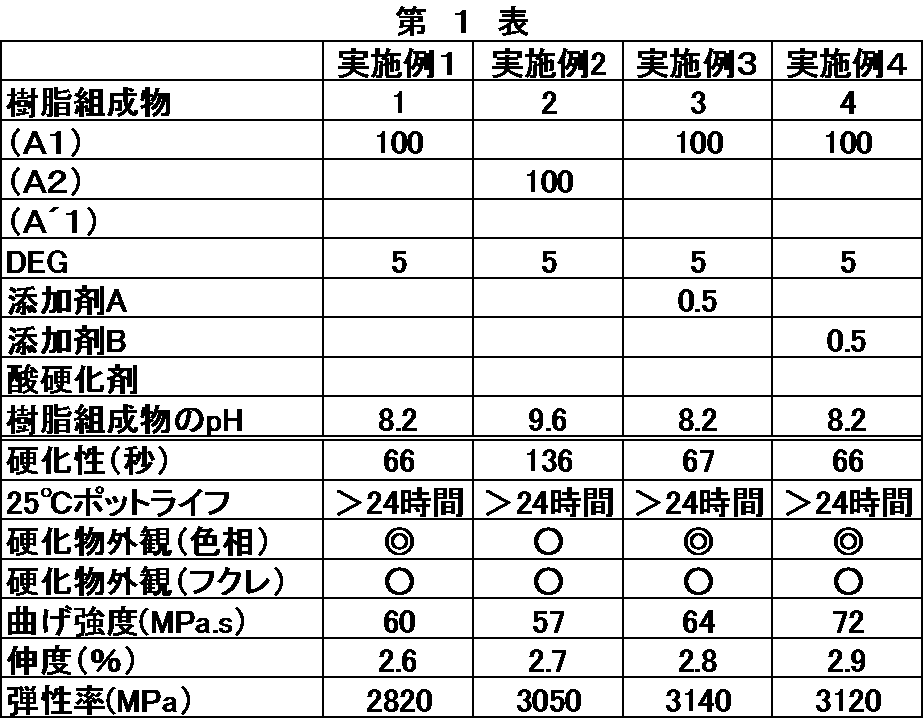
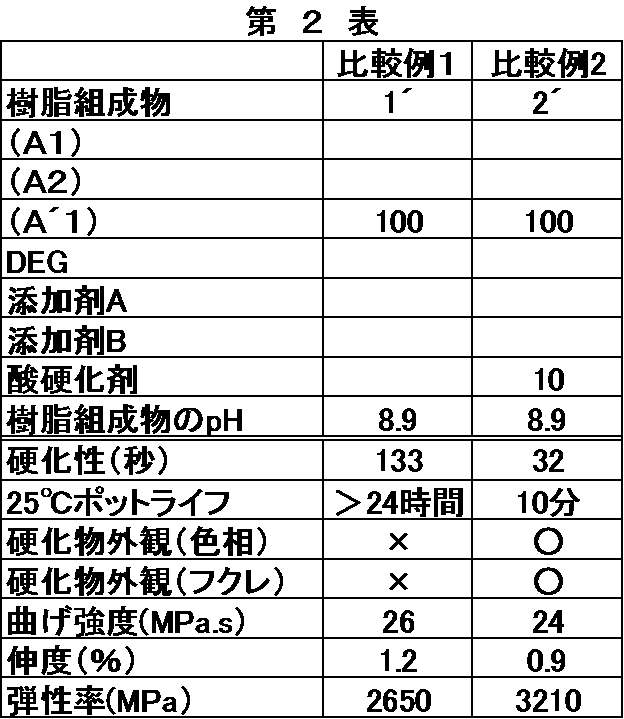
第1表及び第2表の脚注
(A1):水溶性レゾール型フェノール樹脂(A1)
(A2):水溶性レゾール型フェノール樹脂(A2)
(A´1):比較対照用水溶性レゾール型フェノール樹脂(A´1)
DEG:ジエチレングリコール
添加剤A:信越化学工業(株)製シランカップリング剤「KBM-403」(3-グリシドキシプロピルトリメトキシシラン)
添加剤B:信越化学工業(株)製シランカップリング剤「KBE-903」(3-アミノプロピルトリエトキシシラン)
酸硬化剤:65%パラトリエンスルホン酸水溶液
(A1):水溶性レゾール型フェノール樹脂(A1)
(A2):水溶性レゾール型フェノール樹脂(A2)
(A´1):比較対照用水溶性レゾール型フェノール樹脂(A´1)
DEG:ジエチレングリコール
添加剤A:信越化学工業(株)製シランカップリング剤「KBM-403」(3-グリシドキシプロピルトリメトキシシラン)
添加剤B:信越化学工業(株)製シランカップリング剤「KBE-903」(3-アミノプロピルトリエトキシシラン)
酸硬化剤:65%パラトリエンスルホン酸水溶液
Claims (6)
- フェノール化合物(a1)とアルデヒド化合物(a2)とを、アミン系触媒(a3)の存在下で反応させて得られるレゾール型フェノール樹脂(A)、沸点が110~300℃である水溶性溶剤(B)、及び水を含有し、pHが7~10の範囲であることを特徴とするレゾール型フェノール樹脂組成物。
- 前記アミン系触媒(a3)がトリエチルアミンである請求項1記載のレゾール型フェノール樹脂組成物。
- 樹脂固形分量が60~80質量%の範囲である請求項1記載のレゾール型フェノール樹脂組成物。
- 前記水溶性溶剤(B)がエチレングリコール、ジエチレングリコール、トリエチレングリコール及びプロピレングリコールからなる群から選ばれる一種以上の水溶性溶剤である請求項1記載のレゾール型フェノール樹脂組成物。
- 水溶性溶剤(B)の含有量が、レゾール型フェノール樹脂組成物100質量部中0.1~20質量部の範囲である請求項1記載のレゾール型フェノール樹脂組成物。
- 請求項1~4のいずれか1項記載のレゾール型フェノール樹脂組成物を繊維基材に含侵し、硬化させて得られることを特徴とする繊維強化複合材料。
Priority Applications (1)
| Application Number | Priority Date | Filing Date | Title |
|---|---|---|---|
| JP2014532152A JP5761464B2 (ja) | 2013-06-12 | 2014-02-06 | レゾール型フェノール樹脂組成物及び繊維強化複合材料 |
Applications Claiming Priority (2)
| Application Number | Priority Date | Filing Date | Title |
|---|---|---|---|
| JP2013-123709 | 2013-06-12 | ||
| JP2013123709 | 2013-06-12 |
Publications (1)
| Publication Number | Publication Date |
|---|---|
| WO2014199656A1 true WO2014199656A1 (ja) | 2014-12-18 |
Family
ID=52021965
Family Applications (1)
| Application Number | Title | Priority Date | Filing Date |
|---|---|---|---|
| PCT/JP2014/052744 Ceased WO2014199656A1 (ja) | 2013-06-12 | 2014-02-06 | レゾール型フェノール樹脂組成物及び繊維強化複合材料 |
Country Status (3)
| Country | Link |
|---|---|
| JP (1) | JP5761464B2 (ja) |
| TW (1) | TW201446869A (ja) |
| WO (1) | WO2014199656A1 (ja) |
Families Citing this family (1)
| Publication number | Priority date | Publication date | Assignee | Title |
|---|---|---|---|---|
| CN113831486B (zh) * | 2021-10-21 | 2023-03-17 | 上海交通大学 | 一种小粒径酚醛树脂微球的制备方法 |
Citations (9)
| Publication number | Priority date | Publication date | Assignee | Title |
|---|---|---|---|---|
| JPS52112694A (en) * | 1976-03-18 | 1977-09-21 | Mitsubishi Chem Ind Ltd | Manufacture of fibers of films of phenolic resins |
| JPS5426860A (en) * | 1977-07-30 | 1979-02-28 | Matsushita Electric Works Ltd | Production of laminate |
| JPS6116969A (ja) * | 1984-06-15 | 1986-01-24 | バスフ アクチェン ゲゼルシャフト | 被覆剤に適当な結合剤の製造法 |
| JPS61115920A (ja) * | 1984-11-12 | 1986-06-03 | Asahi Organic Chem Ind Co Ltd | 粒子状固形レゾ−ル樹脂組成物の製造方法 |
| JPS6377916A (ja) * | 1986-09-22 | 1988-04-08 | Kansai Paint Co Ltd | レゾ−ル型フエノ−ル樹脂の製造方法 |
| JPH03177057A (ja) * | 1989-12-05 | 1991-08-01 | Hitachi Ltd | 樹脂組成物で被覆した半導体装置 |
| JP2003292556A (ja) * | 2002-03-29 | 2003-10-15 | Dainippon Ink & Chem Inc | 耐火物用結合剤 |
| JP2010138273A (ja) * | 2008-12-11 | 2010-06-24 | Sumitomo Bakelite Co Ltd | 湿式摩擦材用フェノール樹脂組成物及び摩擦材 |
| JP2012072217A (ja) * | 2010-09-28 | 2012-04-12 | Sumitomo Bakelite Co Ltd | フェノール樹脂組成物、及び、断熱材用フェノール樹脂組成物 |
Family Cites Families (2)
| Publication number | Priority date | Publication date | Assignee | Title |
|---|---|---|---|---|
| JPS62240311A (ja) * | 1986-04-11 | 1987-10-21 | Dainippon Ink & Chem Inc | 粉末状レゾ−ル型フエノ−ル樹脂の製造方法 |
| JPH09255745A (ja) * | 1996-03-25 | 1997-09-30 | Sumitomo Bakelite Co Ltd | フェノール樹脂の製造方法 |
-
2014
- 2014-02-06 JP JP2014532152A patent/JP5761464B2/ja active Active
- 2014-02-06 WO PCT/JP2014/052744 patent/WO2014199656A1/ja not_active Ceased
- 2014-03-19 TW TW103110202A patent/TW201446869A/zh unknown
Patent Citations (9)
| Publication number | Priority date | Publication date | Assignee | Title |
|---|---|---|---|---|
| JPS52112694A (en) * | 1976-03-18 | 1977-09-21 | Mitsubishi Chem Ind Ltd | Manufacture of fibers of films of phenolic resins |
| JPS5426860A (en) * | 1977-07-30 | 1979-02-28 | Matsushita Electric Works Ltd | Production of laminate |
| JPS6116969A (ja) * | 1984-06-15 | 1986-01-24 | バスフ アクチェン ゲゼルシャフト | 被覆剤に適当な結合剤の製造法 |
| JPS61115920A (ja) * | 1984-11-12 | 1986-06-03 | Asahi Organic Chem Ind Co Ltd | 粒子状固形レゾ−ル樹脂組成物の製造方法 |
| JPS6377916A (ja) * | 1986-09-22 | 1988-04-08 | Kansai Paint Co Ltd | レゾ−ル型フエノ−ル樹脂の製造方法 |
| JPH03177057A (ja) * | 1989-12-05 | 1991-08-01 | Hitachi Ltd | 樹脂組成物で被覆した半導体装置 |
| JP2003292556A (ja) * | 2002-03-29 | 2003-10-15 | Dainippon Ink & Chem Inc | 耐火物用結合剤 |
| JP2010138273A (ja) * | 2008-12-11 | 2010-06-24 | Sumitomo Bakelite Co Ltd | 湿式摩擦材用フェノール樹脂組成物及び摩擦材 |
| JP2012072217A (ja) * | 2010-09-28 | 2012-04-12 | Sumitomo Bakelite Co Ltd | フェノール樹脂組成物、及び、断熱材用フェノール樹脂組成物 |
Also Published As
| Publication number | Publication date |
|---|---|
| TW201446869A (zh) | 2014-12-16 |
| JP5761464B2 (ja) | 2015-08-12 |
| JPWO2014199656A1 (ja) | 2017-02-23 |
Similar Documents
| Publication | Publication Date | Title |
|---|---|---|
| TWI670318B (zh) | 環氧樹脂組成物、硬化物、纖維強化複合材料、纖維強化樹脂成形品、及纖維強化樹脂成形品之製造方法 | |
| JP5915331B2 (ja) | バイオマス変性フェノール樹脂の製造方法、バイオマス変性フェノール樹脂、バイオマス変性フェノール樹脂組成物及びバイオマス変性フェノール樹脂硬化物 | |
| JP6259770B2 (ja) | 樹脂組成物及びそれを用いて得られる、炭素繊維強化複合材料の前駆体、炭素繊維強化複合材料並びに炭素繊維強化炭素材料 | |
| JPWO2016159218A1 (ja) | レゾール型変性フェノール樹脂組成物、その製造方法および接着剤 | |
| JP5761464B2 (ja) | レゾール型フェノール樹脂組成物及び繊維強化複合材料 | |
| JP2017048349A (ja) | 繊維強化複合材料用ビスフェノールf変性レゾール型フェノール樹脂、樹脂組成物、その硬化物、繊維強化複合材料、繊維強化複合成形品、および繊維強化複合材料用ビスフェノールf変性レゾール型フェノール樹脂の製造方法 | |
| JP2012207099A (ja) | フェノール樹脂成形材料 | |
| JP2014098081A (ja) | 熱硬化型樹脂組成物及び繊維強化複合材料 | |
| JP2011042767A (ja) | ゴム補強用樹脂組成物 | |
| WO2017033632A1 (ja) | エポキシ樹脂組成物及び繊維強化複合材料 | |
| JP2001253924A (ja) | フェノール樹脂組成物 | |
| JP2008222897A (ja) | 摩擦材用フェノール樹脂組成物 | |
| CN114651025B (zh) | 固化性组合物、固化物、纤维增强复合材料、成型品及其制造方法 | |
| JP2017206611A (ja) | フェノール樹脂組成物、その製造方法及び繊維強化複合材料 | |
| WO2021241286A1 (ja) | エポキシ樹脂組成物及びその硬化物 | |
| KR20150066441A (ko) | 페놀 수지 조성물, 열경화성 수지 조성물, 및 경화물 | |
| JP2012067209A (ja) | フェノール樹脂組成物およびその製造方法並びに摩擦材 | |
| JP2009242472A (ja) | 熱硬化性樹脂組成物および熱硬化性樹脂成形材料 | |
| JP4129508B2 (ja) | 耐火物用結合剤 | |
| JP5381573B2 (ja) | 熱硬化性樹脂成形材料 | |
| JP6146110B2 (ja) | 含浸用樹脂組成物及び摩擦材 | |
| TWI682947B (zh) | 酚醛清漆型酚樹脂之製造方法、酚醛清漆型酚樹脂、熱硬化性樹脂組成物及硬化物 | |
| KR20220005481A (ko) | 수지 재료 및 그 제조 방법 | |
| JP2023090173A (ja) | フェノール樹脂組成物の製造方法、成形用樹脂組成物の製造方法、成形品の製造方法およびフェノール樹脂組成物 | |
| JP2023090167A (ja) | 摩擦材用樹脂組成物および摩擦材 |
Legal Events
| Date | Code | Title | Description |
|---|---|---|---|
| ENP | Entry into the national phase |
Ref document number: 2014532152 Country of ref document: JP Kind code of ref document: A |
|
| 121 | Ep: the epo has been informed by wipo that ep was designated in this application |
Ref document number: 14811134 Country of ref document: EP Kind code of ref document: A1 |
|
| NENP | Non-entry into the national phase |
Ref country code: DE |
|
| 122 | Ep: pct application non-entry in european phase |
Ref document number: 14811134 Country of ref document: EP Kind code of ref document: A1 |