WO2014157546A1 - 口腔用組成物 - Google Patents
口腔用組成物 Download PDFInfo
- Publication number
- WO2014157546A1 WO2014157546A1 PCT/JP2014/058939 JP2014058939W WO2014157546A1 WO 2014157546 A1 WO2014157546 A1 WO 2014157546A1 JP 2014058939 W JP2014058939 W JP 2014058939W WO 2014157546 A1 WO2014157546 A1 WO 2014157546A1
- Authority
- WO
- WIPO (PCT)
- Prior art keywords
- oil
- composition
- acid
- component
- mass
- Prior art date
- Legal status (The legal status is an assumption and is not a legal conclusion. Google has not performed a legal analysis and makes no representation as to the accuracy of the status listed.)
- Ceased
Links
Classifications
-
- A—HUMAN NECESSITIES
- A61—MEDICAL OR VETERINARY SCIENCE; HYGIENE
- A61Q—SPECIFIC USE OF COSMETICS OR SIMILAR TOILETRY PREPARATIONS
- A61Q11/00—Preparations for care of the teeth, of the oral cavity or of dentures; Dentifrices, e.g. toothpastes; Mouth rinses
-
- A—HUMAN NECESSITIES
- A61—MEDICAL OR VETERINARY SCIENCE; HYGIENE
- A61K—PREPARATIONS FOR MEDICAL, DENTAL OR TOILETRY PURPOSES
- A61K8/00—Cosmetics or similar toiletry preparations
- A61K8/18—Cosmetics or similar toiletry preparations characterised by the composition
- A61K8/30—Cosmetics or similar toiletry preparations characterised by the composition containing organic compounds
- A61K8/33—Cosmetics or similar toiletry preparations characterised by the composition containing organic compounds containing oxygen
- A61K8/34—Alcohols
- A61K8/347—Phenols
-
- A—HUMAN NECESSITIES
- A61—MEDICAL OR VETERINARY SCIENCE; HYGIENE
- A61K—PREPARATIONS FOR MEDICAL, DENTAL OR TOILETRY PURPOSES
- A61K8/00—Cosmetics or similar toiletry preparations
- A61K8/18—Cosmetics or similar toiletry preparations characterised by the composition
- A61K8/30—Cosmetics or similar toiletry preparations characterised by the composition containing organic compounds
- A61K8/33—Cosmetics or similar toiletry preparations characterised by the composition containing organic compounds containing oxygen
- A61K8/35—Ketones, e.g. benzophenone
-
- A—HUMAN NECESSITIES
- A61—MEDICAL OR VETERINARY SCIENCE; HYGIENE
- A61K—PREPARATIONS FOR MEDICAL, DENTAL OR TOILETRY PURPOSES
- A61K8/00—Cosmetics or similar toiletry preparations
- A61K8/18—Cosmetics or similar toiletry preparations characterised by the composition
- A61K8/30—Cosmetics or similar toiletry preparations characterised by the composition containing organic compounds
- A61K8/49—Cosmetics or similar toiletry preparations characterised by the composition containing organic compounds containing heterocyclic compounds
- A61K8/4906—Cosmetics or similar toiletry preparations characterised by the composition containing organic compounds containing heterocyclic compounds with one nitrogen as the only hetero atom
-
- A—HUMAN NECESSITIES
- A61—MEDICAL OR VETERINARY SCIENCE; HYGIENE
- A61K—PREPARATIONS FOR MEDICAL, DENTAL OR TOILETRY PURPOSES
- A61K8/00—Cosmetics or similar toiletry preparations
- A61K8/18—Cosmetics or similar toiletry preparations characterised by the composition
- A61K8/30—Cosmetics or similar toiletry preparations characterised by the composition containing organic compounds
- A61K8/49—Cosmetics or similar toiletry preparations characterised by the composition containing organic compounds containing heterocyclic compounds
- A61K8/4906—Cosmetics or similar toiletry preparations characterised by the composition containing organic compounds containing heterocyclic compounds with one nitrogen as the only hetero atom
- A61K8/4913—Cosmetics or similar toiletry preparations characterised by the composition containing organic compounds containing heterocyclic compounds with one nitrogen as the only hetero atom having five membered rings, e.g. pyrrolidone carboxylic acid
-
- A—HUMAN NECESSITIES
- A61—MEDICAL OR VETERINARY SCIENCE; HYGIENE
- A61K—PREPARATIONS FOR MEDICAL, DENTAL OR TOILETRY PURPOSES
- A61K8/00—Cosmetics or similar toiletry preparations
- A61K8/18—Cosmetics or similar toiletry preparations characterised by the composition
- A61K8/30—Cosmetics or similar toiletry preparations characterised by the composition containing organic compounds
- A61K8/49—Cosmetics or similar toiletry preparations characterised by the composition containing organic compounds containing heterocyclic compounds
- A61K8/4906—Cosmetics or similar toiletry preparations characterised by the composition containing organic compounds containing heterocyclic compounds with one nitrogen as the only hetero atom
- A61K8/4926—Cosmetics or similar toiletry preparations characterised by the composition containing organic compounds containing heterocyclic compounds with one nitrogen as the only hetero atom having six membered rings
Definitions
- the present invention relates to an oral composition.
- Nonionic antibacterial agents such as isopropylmethylphenol are known as bactericides having a high penetration bactericidal effect on biofilms.
- Patent Document 1 describes that a composition containing isopropylmethylphenol, which is a nonionic antibacterial agent, propylene glycol alginate and a specific nonionic surfactant, can exhibit a bactericidal effect due to isopropylmethylphenol in the oral cavity. Yes.
- an object of the present invention is to provide a composition for oral cavity that is excellent in stability and feeling of use of a nonionic antibacterial agent.
- the present invention provides the following [1] to [3].
- Component (A) One or more selected from the group consisting of pyrrolidone carboxylic acid, 6-oxo-2-piperidinecarboxylic acid, 3- (2-oxo-1-azepanyl) propanoic acid, and salts thereof
- [3] The composition for oral cavity according to [1] or [2], wherein the component (B) is one or more selected from the group consisting of isopropylmethylphenol, thymol, triclosan, and hinokitiol.
- an oral composition which is excellent in stability of a nonionic antibacterial agent and excellent in feeling of use.
- Component (A) is one or more lactam compounds selected from the group consisting of pyrrolidone carboxylic acid, 6-oxo-2-piperidinecarboxylic acid, 3- (2-oxo-1-azepanyl) propanoic acid, and salts thereof It is.
- the lactam compound may be pyrrolidone carboxylate, 6-oxo-2-piperidinecarboxylate or 3- (2-oxo-1-azepanyl) propanoate.
- a salt is not particularly limited as long as it is a pharmacologically acceptable salt.
- pharmacologically acceptable salts include acid addition salts, base addition salts, and amino acid salts.
- inorganic acid salts such as hydrochloride, hydrobromide, sulfate, hydroiodide, nitrate, phosphate; citrate, oxalate, acetate, formate, propion Acid salt, benzoate salt, trifluoroacetate salt, maleate salt, tartrate salt, methanesulfonate salt, benzenesulfonate salt, paratoluenesulfonate salt, etc .
- Inorganic base salts such as salts, copper salts, zinc salts, aluminum salts, ammonium salts
- organic base salts such as triethylammonium salts, triethanolammonium salts, pyridinium salts, diisopropylammonium salts; lysine salts, arginine salts, histidine salts, asparagine And amino acid salts such as acid salts and glutamates.
- water-soluble salts such as
- the lactam compound may be synthesized according to a known scheme or may be a commercially available product.
- Examples of commercially available pyrrolidone carboxylic acid include “AJIDEW A-100 (registered trademark)” sold by Ajinomoto Co., Inc.
- 3- (2-oxo-1-azepanyl) propanoic acid examples include “3- (2-oxoazepan-1-yl) propanoic acid (trade name)” sold by Sigma Aldrich Japan Co., Ltd. Is done.
- the component (A) may be one kind selected from the group consisting of pyrrolidone carboxylic acid, 6-oxo-2-piperidinecarboxylic acid, 3- (2-oxo-1-azepanyl) propanoic acid, and salts thereof. It may be a combination of two or more selected from the group, but preferably contains at least one pyrrolidone carboxylic acid and / or salt thereof, more preferably pyrrolidone carboxylic acid and / or salt thereof. preferable.
- the content of the component (A) in the composition for oral cavity of the present invention is not particularly limited, but the composition for oral cavity can be further improved in the stability of the component (B) and the feeling of use (disgusting taste) can be further improved.
- the content is preferably 0.1% by mass or more, more preferably 0.5% by mass or more, and further preferably 1% by mass or more based on the total amount of the object.
- the upper limit of the content of the component (A) is not particularly limited, but even if the amount is large, the contribution to the effect of improving the stability of the component (B) and the effect of improving the feeling of use (taste) may be limited. Therefore, it is usually 10% by mass or less, and preferably 5% by mass or less.
- the component (A) is preferably 0.1 to 10% by mass, and more preferably 0.5 to 5% by mass.
- (B) component is a nonionic antibacterial agent.
- nonionic antibacterial agents include isopropylmethylphenol, triclosan, hinokitiol, thymol, trichlorocarbanilide, and eugenol. Of these, isopropylmethylphenol, triclosan, hinokitiol, and thymol are preferable.
- the component (B) may be one type of nonionic antibacterial agent or a combination of two or more types of nonionic antibacterial agents.
- content in particular of (B) component in the composition for oral cavity of this invention is not restrict
- the upper limit of content of a component is not specifically limited, Since stability can fully be ensured and a nasty taste can be suppressed more, it is preferable that it is 2 mass% or less, and is 0.5 mass% or less. More preferably.
- the content of the component (B) is preferably 0.001 to 2% by mass, and more preferably 0.01 to 0.5% by mass.
- the ratio (A / B) of the content of the component (A) to the content of the component (B) in the composition of the present invention is not particularly limited, the stability of the component (B) is improved, and the feeling of use (natural taste) ) Can be enhanced, and is preferably 0.1 or more, and more preferably 2 or more.
- the upper limit of A / B is preferably 5,000 or less, more preferably 300 or less, because the biofilm sterilization effect can be sufficiently exerted.
- a / B is preferably 0.1 to 5,000, and more preferably 2 to 300.
- the dosage form and shape of the oral composition of the present invention are not particularly limited.
- the composition for oral cavity of the present invention is a liquid (solution, emulsion, suspension, etc.), semi-solid (gel, cream, paste, etc.), solid (tablet, particulate agent, capsule, film agent, kneaded product, melted product) Solid, waxy solid, elastic solid, etc.) may be prepared.
- the preparation of the composition for oral cavity of the present invention can be used as various products that can be applied to the oral cavity.
- Such products include, for example, dentifrices (toothpaste, liquid dentifrice, liquid dentifrice, powder dentifrice, etc.), mouthwashes, coating agents, patches, fresheners in the mouth, foods (chewing gum, tablet candy, candy, gummi, film , Troches and the like), but not particularly limited.
- the oral composition of the present invention may contain, in addition to the above-mentioned components, known additive components that can be used for the oral composition within a range that does not impair the effects of the present invention.
- additional components include abrasives, binders, thickeners, surfactants, sweeteners, preservatives, fragrances, medicinal ingredients, colorants, brighteners, pH adjusters, solvents, excipients. And can be appropriately selected depending on the dosage form.
- the specific example of an additional component is shown below, the component which the composition for oral cavity of this invention can contain is not restrict
- abrasive examples include silica-based abrasives such as silicic anhydride, crystalline silica, amorphous silica, silica gel, aluminosilicate, zeolite, calcium hydrogen phosphate anhydrous, calcium hydrogen phosphate dihydrate, Examples include calcium pyrophosphate, calcium carbonate, aluminum hydroxide, alumina, magnesium carbonate, tertiary magnesium phosphate, zirconium silicate, tertiary calcium phosphate, hydroxyapatite, tetracalcium phosphate, and synthetic resin-based abrasive.
- silica-based abrasives such as silicic anhydride, crystalline silica, amorphous silica, silica gel, aluminosilicate, zeolite, calcium hydrogen phosphate anhydrous, calcium hydrogen phosphate dihydrate
- Abrasives can be used singly or in combination of two or more.
- the content thereof is preferably 2 to 40% by mass, and more preferably 5 to 20% by mass of the entire composition in the dentifrice.
- the mouthwash it is preferably 0 to 10% by mass, more preferably 0 to 5% by mass, based on the entire composition.
- binder examples include pullulan, gelatin, methyl cellulose, hydroxyethyl cellulose, hydroxypropyl cellulose, sodium carboxymethyl cellulose, carrageenan, sodium alginate, xanthan gum, sodium polyacrylate, gum arabic, guar gum, locust bean gum, polyvinyl alcohol, polyvinyl Examples thereof include organic binders such as pyrrolidone and carboxyvinyl polymer, and inorganic binders such as thickening silica.
- a binder can be used individually by 1 type or in combination of 2 or more types. When the binder is used, its content is usually 0.01 to 15% by mass, preferably 0.01 to 13% by mass, based on the total amount of the oral composition.
- the content of the organic binder is 0.01 to 5% by mass, preferably 0.01 to 3% by mass, based on the total amount of the oral composition, and the content of the inorganic binder is the oral composition. It is 0.1 to 10% by mass with respect to the total amount.
- thickening agent examples include sorbitol, propylene glycol, butylene glycol, glycerin, and polyethylene glycol.
- a thickener can be used individually by 1 type or in combination of 2 or more types. When a thickener is used, the content thereof can be determined within a range not impeding the effects of the present invention, and is usually 1 to 60% by mass with respect to the total amount of the oral composition.
- surfactant examples include an anionic surfactant, a nonionic surfactant, and an amphoteric surfactant.
- anionic surfactant examples include N-acyl amino acid salts, ⁇ -olefin sulfonates, N-acyl sulfonates, alkyl sulfates, and sulfates of glycerin fatty acid esters.
- N-acylamino acid salts, ⁇ -olefin sulfonates, and alkyl sulfates are preferable from the viewpoint of versatility, and lauroyl sarcosine sodium and alkyl chain carbon chain lengths from the viewpoint of foamability and hard water resistance. More preferred are sodium ⁇ -olefin sulfonates having 10 to 16 carbon atoms and sodium lauryl sulfate.
- the salt is preferably an alkali metal salt such as sodium or potassium, more preferably a sodium salt.
- Nonionic surfactants include, for example, polyoxyethylene alkyl ether, polyoxyethylene-polyoxypropylene block copolymer, polyoxyethylene hydrogenated castor oil, polyoxyethylene fatty acid glycerin ester, sucrose fatty acid ester, fatty acid alkylolamide , Glycerin fatty acid ester, and polyglycerin fatty acid ester.
- polyoxyethylene alkyl ether, polyoxyethylene hydrogenated castor oil, fatty acid alkylolamide, and sorbitan fatty acid ester are preferably used.
- the carbon chain length of the alkyl chain is preferably 14 to 18 carbon atoms.
- the polyoxyethylene alkyl ether preferably has an average added mole number of ethylene oxide of 2 to 30.
- the polyoxyethylene hydrogenated castor oil preferably has an average ethylene oxide addition mole number (average addition EO) of 5 to 100.
- the fatty acid alkylolamide preferably has a carbon chain length of 12 to 14 carbon atoms in the alkyl chain.
- the sorbitan fatty acid ester preferably has 12 to 18 carbon atoms in the fatty acid.
- the polyoxyethylene sorbitan fatty acid ester preferably has 16 to 18 carbon atoms in the fatty acid.
- the polyoxyethylene sorbitan fatty acid ester preferably has an average ethylene oxide addition mole number of 10 to 40.
- amphoteric surfactants include betaine-type amphoteric surfactants, amino acid-type amphoteric surfactants, and amine oxides, with betaine-type amphoteric surfactants being preferred.
- betaine-type amphoteric surfactants include alkylbetaine-type amphoteric surfactants, fatty acid amidopropyl betaine-type amphoteric surfactants, and alkylimidazolinium betaine-type amphoteric surfactants.
- alkyldimethylaminoacetic acid betaine such as lauryldimethylaminoacetic acid betaine, 2-alkyl-N-carboxymethyl-N-hydroxyethylimidazolinium betaine, coconut oil fatty acid amidopropyldimethylaminoacetic acid betaine, coconut oil fatty acid Amidopropyl betaine is mentioned.
- Surfactants can be used alone or in combination of two or more. When a surfactant is used, its content is usually 0 to 10% by mass, preferably 0.01 to 5% by mass, based on the total amount of the oral composition.
- sweetening agent examples include saccharin sodium, stevioside, neohesperidin hydrochalcone, glycyrrhizin, perilartine, p-methoxycinnamic aldehyde, thaumatin, palatinose, maltitol, xylitol, and arabitol.
- a sweetener can be used individually by 1 type or in combination of 2 or more types. When a sweetener is used, its content may be appropriately determined within a range not impairing the effects of the present invention.
- preservative examples include paraoxybenzoic acid esters such as sodium benzoate, methylparaben, ethylparaben, and butylparaben, ethylenediaminetetraacetate, sorbic acid, and sorbate.
- a preservative can be used individually by 1 type or in combination of 2 or more types. In the case of using a preservative, the content thereof may be appropriately determined within a range not impairing the effects of the present invention.
- fragrances examples include natural fragrances, synthetic fragrances (single item fragrances, etc.), blended fragrances (oil and fat fragrances (oil-based fragrances), powder fragrances, etc.).
- flavor can be used individually by 1 type or in combination of 2 or more types.
- Natural flavors include, for example, mastic oil, parsley oil, anise oil, eucalyptus oil, winter green oil, cassia oil, menthol oil, spearmint oil, peppermint oil, lemon oil, coriander oil, orange oil, mandarin oil, lime oil , Lavender oil, laurel oil, chamomile oil, cardamom oil, caraway oil, bay oil, lemongrass oil, pine needle oil, neroli oil, rose oil, jasmine oil, Iris concrete, peppermint absolute, rose absolute, orange flower, citrus Oil, mixed fruit oil, strawberry oil, cinnamon oil, clove oil, grape oil, clove oil, thyme oil, sage oil, peppermint oil, rosemary oil, marjoram oil, origanum oil, grapefruit oil, sweetie oil, coconut oil, Down Go absolute, orange flower absolute, capsicum extract, ginger oleoresin, pepper oleoresin, include capsicum oleoresin.
- Single flavors include, for example, carvone, anethole, methyl salicylate, cinnamaldehyde, linalool, linalyl acetate, limonene, menthone, menthyl acetate, pinene, octyl aldehyde, citral, pregon, carbyl acetate, anisaldehyde, ethyl acetate, ethyl butyrate Rate, allylcyclohexanepropionate, methylanthranilate, ethylmethylanthranilate, vanillin, undecalactone ( ⁇ -undecalactone, ⁇ -undecalactone, etc.), hexanal (trans-2-hexenal, etc.), ethi Nonalcohol, propyl alcohol, butanol, isoamyl alcohol, hexenol (cis-3-hexenol, etc.), dimethylsulfide, cyclo
- the single item fragrance may be a cooling agent.
- cooling agents include menthol, N-ethyl-p-menthane-3-carboxamide, N- (ethoxycarbonylmethyl) -3-p-menthane carboxamide, N, 2,3-trimethyl-2-isopropylbutanamide , 3- (L-methoxy) propane-1,2-diol, menthyl lactate (menthyl lactate), monomenthyl succinate, menthone glycerol acetal, 3-l-menthoxypropane-1,2-diol, menthose glycerol ether, spiranthol And monomenthyl succinate.
- the blended fragrance is a fragrance made by blending a single fragrance and / or a natural fragrance.
- Examples include menthol micron, strawberry flavor, apple flavor, banana flavor, pineapple flavor, grape flavor, mango flavor, tropical fruit flavor, butter flavor, milk flavor, yogurt flavor, fruit mix flavor and herbal mint flavor.
- the form of the fragrance is not limited, and any of essential oils, extracts, solids, and powders obtained by spray drying any of these may be used.
- the oral composition usually contains a fragrance material, and the content thereof is preferably in the range of 0.000001 to 1% by mass with respect to the total amount of the oral composition. Further, the total content as a flavoring fragrance using the fragrance material is preferably 0.1 to 2.0% by mass with respect to the total amount of the oral composition.
- the medicinal component examples include the following components: caries preventive agents such as fluoride (for example, sodium fluoride, sodium monofluorophosphate, stannous fluoride), chlorohexidine, cetylpyridinium chloride, benzethonium chloride, Bactericidal or antibacterial agents such as benzalkonium chloride, zinc gluconate and zinc citrate (excluding component (B)); calculus preventive agents such as condensed phosphate and ethane hydroxydiphosphonate; tranexamic acid and glycyrrhizin Anti-inflammatory agents such as dipotassium acid salt, ⁇ -aminocaproic acid, and apricot extract; coating agents such as hydroxyethylcellulose dimethyl diallyl ammonium chloride; Strontium chloride, potassium nitrate, hypersensitivity inhibitors such as aluminum lactate; astringents such as thorium.
- the content may be appropriately set within a pharmaceutically acceptable range for each
- the colorant examples include safflower red pigment, gardenia yellow pigment, gardenia blue pigment, perilla pigment, red potato pigment, red cabbage pigment, carrot pigment, hibiscus pigment, cacao pigment, spirulina blue pigment, and coumarind pigment, Legal pigments such as Red No. 3, Red No. 104, Red No. 105, Red No. 106, Yellow No. 4, Yellow No. 5, Green No. 3, Blue No. 1, etc., riboflavin, copper chlorofin sodium and titanium dioxide. When a colorant is used, the content thereof is preferably 0.00001 to 3% by mass with respect to the total amount of the oral composition.
- the brightener examples include waxes such as shellac, carnauba wax, and candelilla wax, and calcium stearate.
- the content thereof is preferably 0.01 to 5% by mass with respect to the total amount of the oral composition.
- the pH (20 ° C.) of the oral composition of the present invention is usually 5 to 10, preferably 5.5 to 9.
- the pH adjuster include acetic acid, hydrochloric acid, sulfuric acid, nitric acid, citric acid, phosphoric acid, malic acid, gluconic acid, maleic acid, succinic acid, glutamic acid, sodium hydroxide, potassium hydroxide, sodium acetate, sodium carbonate, Acids, alkalis and buffers such as sodium citrate, sodium hydrogen citrate, sodium phosphate, sodium dihydrogen phosphate and the like can be mentioned.
- the content may be appropriately determined within a range not impairing the effects of the present invention.
- the solvent examples include water and lower alcohols having 3 or less carbon atoms such as ethanol and propanol.
- water as a solvent its content is preferably 20 to 95% by mass with respect to the total amount of the oral composition.
- the content is preferably 1 to 30% by mass with respect to the total amount of the oral composition.
- excipients examples include syrup, glucose, fructose, invert sugar, dextrin, and oligosaccharide.
- an excipient is usually added.
- the content thereof may be appropriately determined within a range not impairing the effects of the present invention.
- a mixture A was prepared by mixing and dissolving the following “(i) active ingredient for mixture A” and “(ii) other additive components for mixture A” in purified water.
- a mixture B was prepared by dissolving or dispersing the following “(iii) nonionic antibacterial agent for mixture B” and “(iv) other additive components for mixture B” in propylene glycol. Next, the mixture B was added and mixed into the stirring mixture A to prepare a mixture C.
- the following “(v) additive component for the mixture C” is mixed at room temperature using a 1.5 L kneader (manufactured by Ishiyama Kogakusho) (however, (v) the additive component for the mixture C) (Polyoxyethylene (60) hydrogenated castor oil was heated and dissolved in a 60 ° C. water bath and mixed), depressurized to 4 kPa and defoamed to obtain 1.0 kg (100 parts by mass) of a dentifrice.
- Active ingredients and other additive ingredients blended in Mixtures A, B, and C Active ingredients for mixture A: pyrrolidone carboxylic acid, 6-oxo-2-piperidinecarboxylic acid, 3- (2-oxo-1-azepanyl) propanoic acid (ii) Other additive ingredients for mixture A: 70 Nonionic antibacterial agent for mass% sorbitol, sodium saccharin, sodium fluoride, sodium hydroxide (iii) mixture B: isopropylmethylphenol, triclosan, hinokitiol, other additive components for thymol (iv) mixture B: propylene glycol, Additive components for sodium carboxymethylcellulose (v) mixture C: silicic anhydride, polyoxyethylene (60) hydrogenated castor oil, fragrance
- S -6-Oxo-2-piperidine carboxylic acid (trade name) (molecular weight: 143.14, Sigma Aldrich Japan Co., Ltd.) as 6-oxo-2-piperidinecarboxylic acid; 3- (2-Oxoazepan-1-yl) propanoic acid (trade name) (molecular weight: 185.22, Sigma Aldrich Japan Co., Ltd.) as 3- (2-oxo-1-azepanyl) propanoic acid; Polyvinylpyrrolidone K25 (trade name) (molecular weight: 35,000, Wako Pure Chemical Industries, Ltd.) as polyvinylpyrrolidone; DL-proline (trade name) as proline (mole
- carboxymethylcellulose sodium, sorbit, silicic anhydride, propylene glycol, sodium saccharin, sodium fluoride, sodium hydroxide and purified water were used as cosmetic raw material standards.
- sorbit a 70% aqueous solution (70% sorbitol) was used.
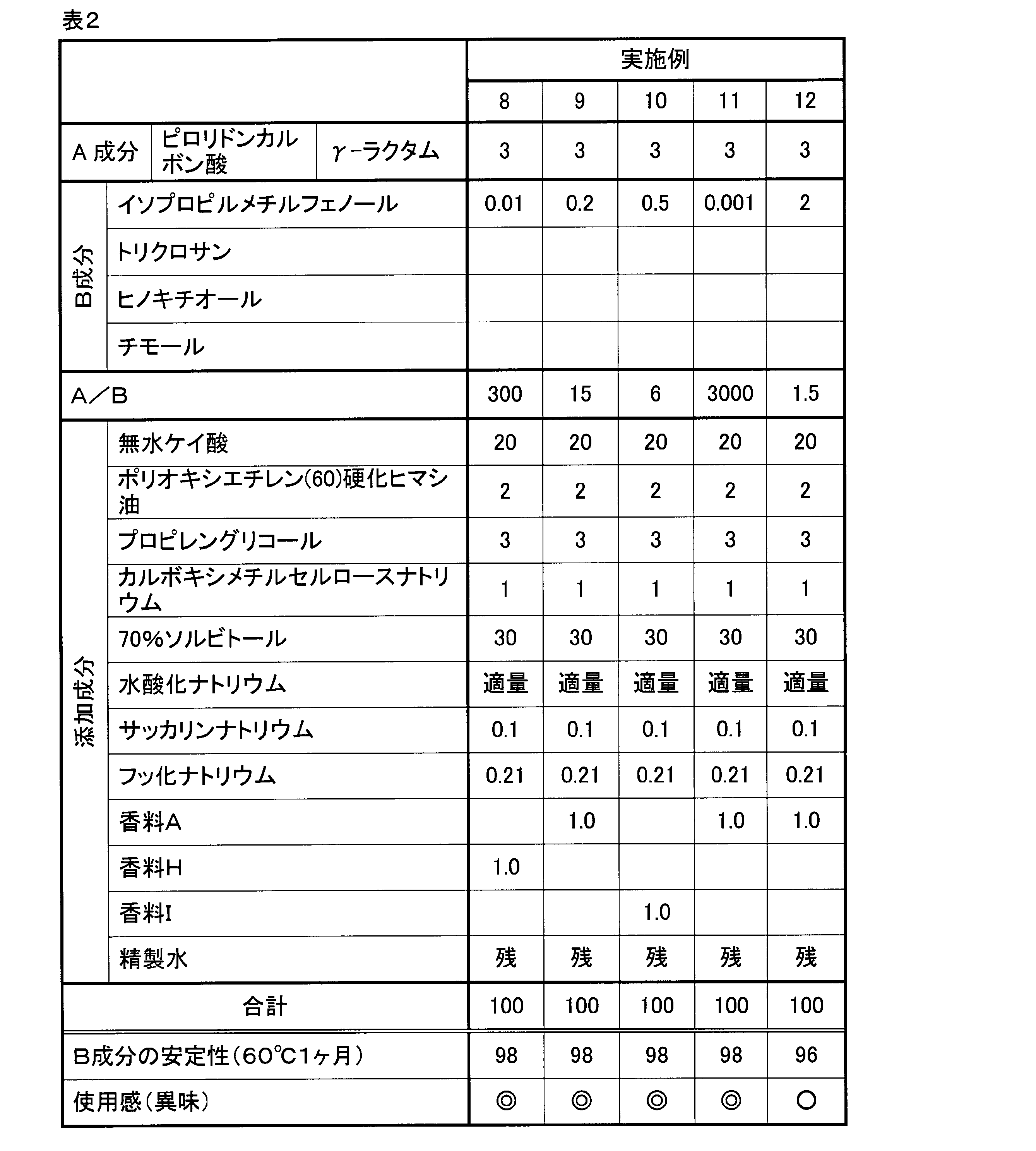
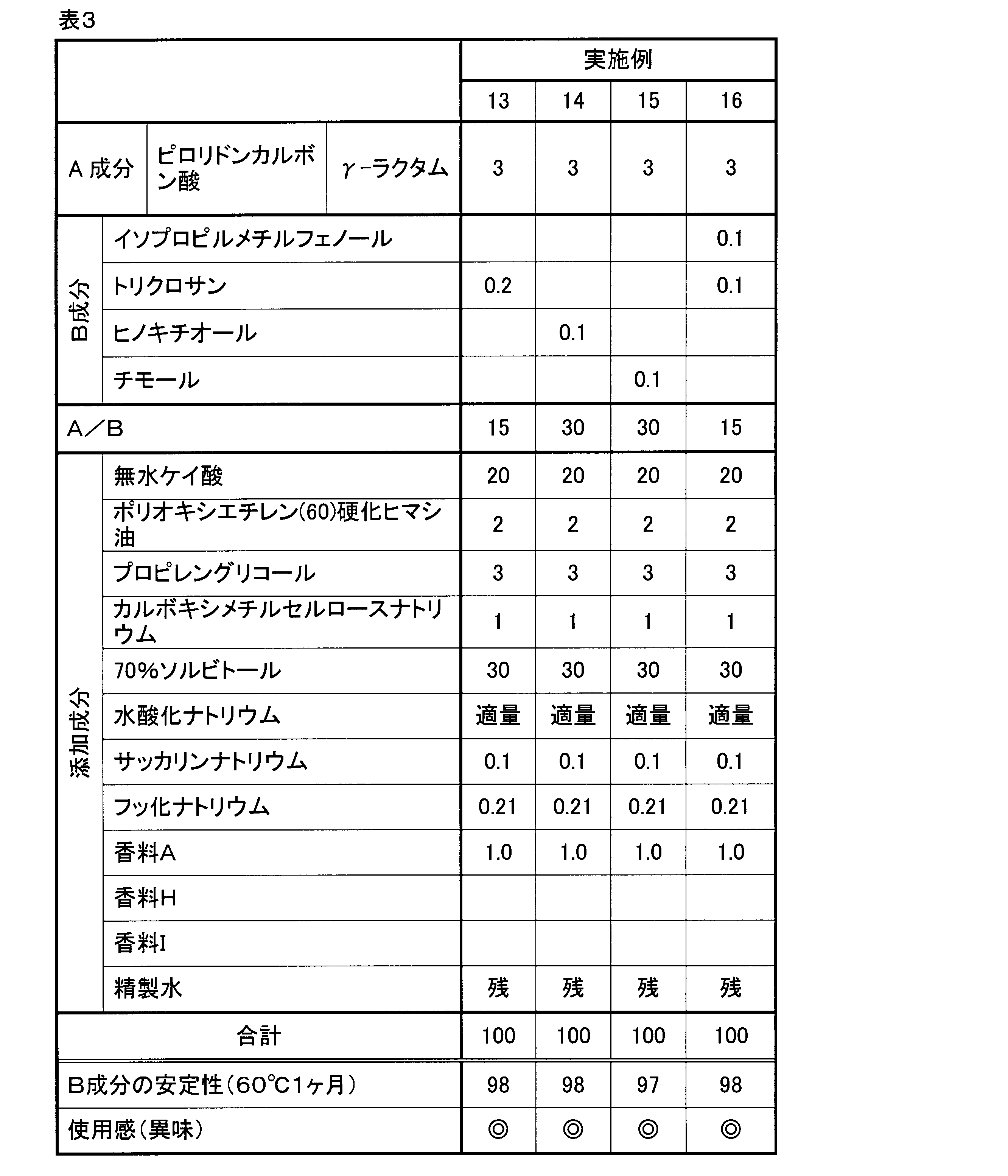
- Tables 1 to 5 show the amount of each component. All the description of compounding quantity is the value converted into purity 100%.
- the amount of water added is a value obtained by adding the amount of water brought in by sorbit.
- Measurement conditions were a column temperature of 45 ° C., an acetonitrile / water / acetic acid mixture (60: 40: 1) as a mobile phase, a flow rate of 1.0 mL / min, and an absolute calibration curve at an ultraviolet absorbance (measurement wavelength: 280 nm). (Tables 1 to 5).
- Residual rate of nonionic antibacterial agent (%) [evaluation sample value (mass%) / initial value (mass%)] ⁇ 100
- Examples 20-23 [Method for preparing test preparation] A mixture A was prepared by mixing and dissolving the following “(i) active ingredient for mixture A” and sodium hydroxide in purified water. On the other hand, after dissolving polyoxyethylene (60) hydrogenated castor oil in propylene glycol heated to 60 ° C., mixture B in which the following “(ii) nonionic antibacterial agent for mixture B” is dissolved or dispersed was prepared. Next, the mixture B was added and mixed into the stirring mixture A to obtain a test preparation. A three-one motor (BL1200, manufactured by HEIDON) was used for stirring. (I) Active ingredient for mixture A: pyrrolidone carboxylic acid (ii) Nonionic antibacterial agent for mixture B: isopropylmethylphenol, triclosan, hinokitiol, thymol
- cosmetic raw material standards were used for other propylene glycol and sodium hydroxide.
- the above four bacterial species were inoculated into a Rotating Disk Reactor (culture tank) containing 3,000 mL of BMM in advance so as to be 1 ⁇ 10 7 cfu / mL (cfu: colony forming units).
- the model biofilm-producing HA carrier was immersed in a BMM culture solution inoculated with bacteria, and cultured at 37 ° C. under anaerobic conditions (5% carbon dioxide gas, 95% nitrogen) for 24 hours. Thereafter, under the same conditions, a BMM culture solution was continuously supplied at a substitution rate of 5 vol% / hour and cultured for 10 days to form a model biofilm with a mixture of four bacterial species on the HA surface.
- This dispersion was serially diluted with PBS buffer, 50 ⁇ L of each diluted solution was smeared on a blood agar plate * 2 containing kanamycin sulfate, and cultured under anaerobic conditions (5% carbon dioxide, 95% nitrogen). The number of grown colonies was counted, and the viable count (cfu / Biofilm) of periodontal disease bacteria (Porphyromonas gingivalis) per HA plate on which the model biofilm was formed was determined.
- the biofilm bactericidal effect of the test preparation was obtained by calculating the bactericidal rate of periodontal disease bacteria with respect to the control (the same as the bactericidal effect test except that the sample was replaced with 2 mL of PBS buffer instead of 2 mL of the composition sample) according to the following formula (2).
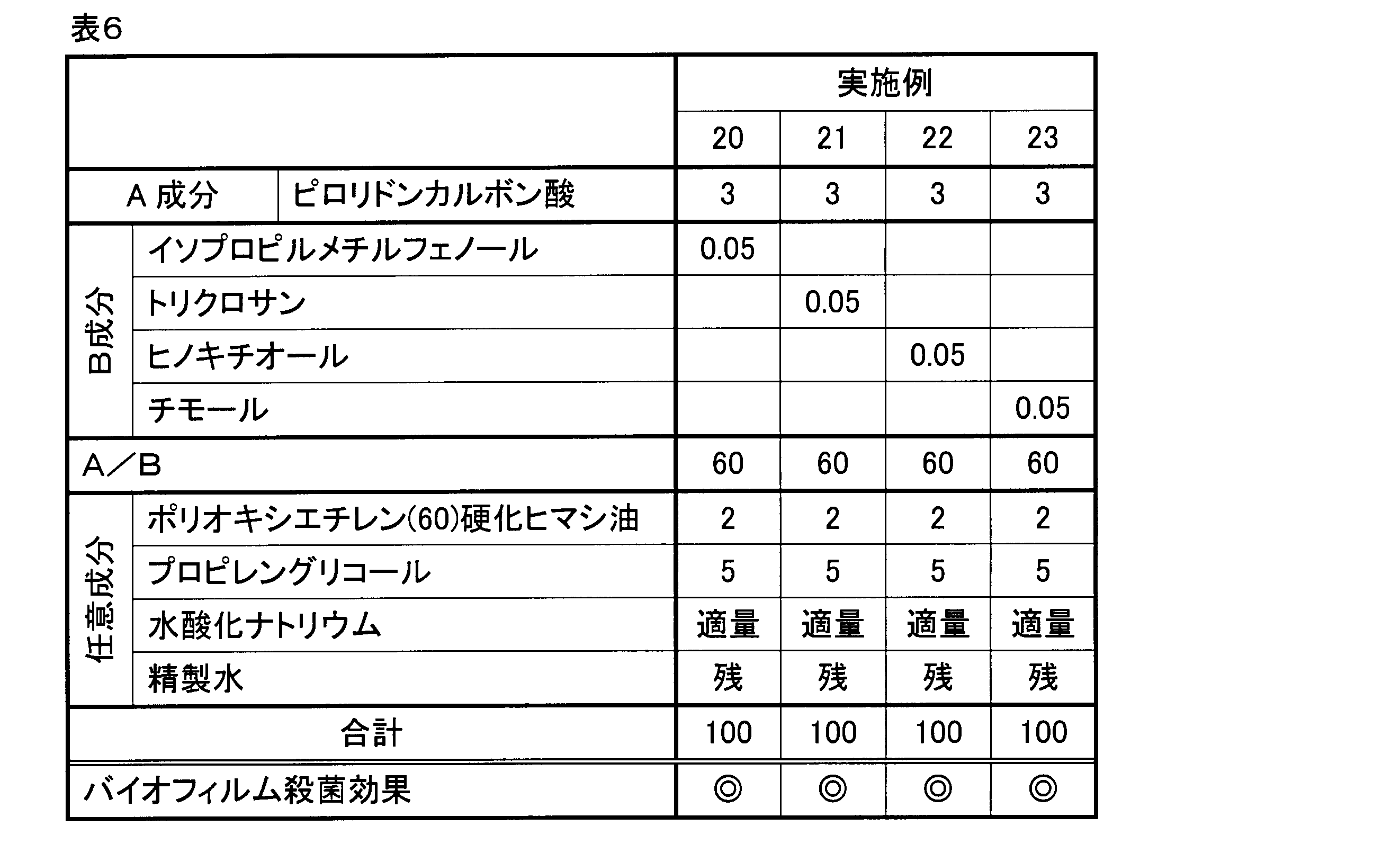
- the biofilm sterilization effect was determined according to the following criteria (Table 6).
- Periodontal Bactericidal Rate Control Periodontal Bacteria Count (cfu / Biofilm) / Test Formulation Periodontal Bacteria Count (cfu / Biofilm)
- Periodic pathogen bactericidal rate is 100 or more
- Periodontal pathogen bactericidal rate is 10 or more and less than 100 Rate is less than 1
- compositions of the examples are superior in both stability and usability compared to the compositions of the comparative examples.
- This result has shown that the composition for oral cavity of this invention is excellent in both the stability in the formulation of a nonionic antibacterial agent, and a usability
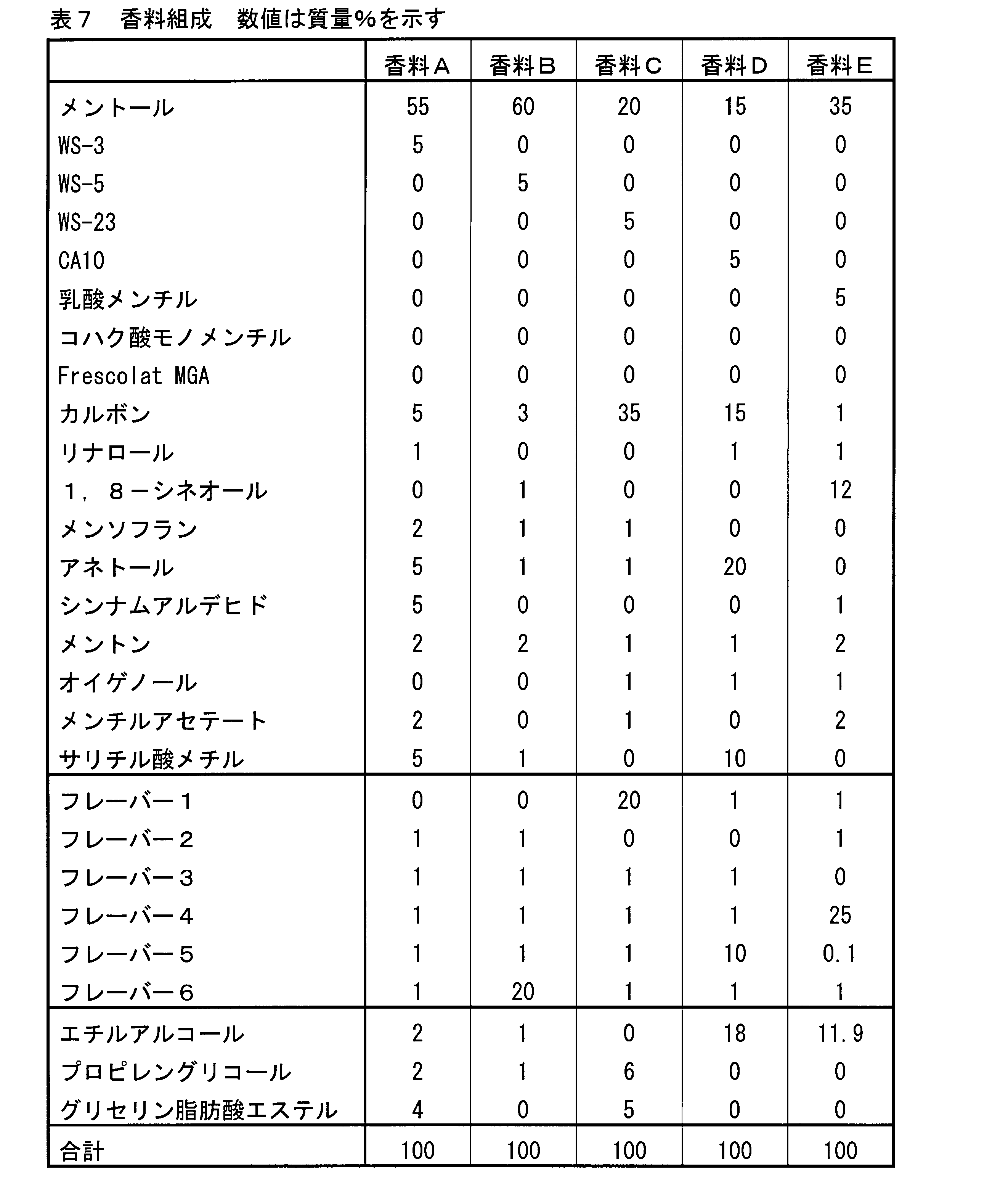
- Table 7 shows the compositions of perfumes A to E in Tables 1 to 6, and Table 8 shows the compositions of perfumes F to I.
- compositions of flavors 1-6 are shown below.
- the manufacturer names of the cooling sensates in the composition of the fragrance are shown below.
- Menthol Takasago International Corporation WS-3: RENESSENZ LLC WS-5: RENESSENZ LLC WS-23: RENESSENZ LLC CA10: Takasago Fragrance Industry Co., Ltd. Lactic acid menthyl: Simrise Co., Ltd. Monomentyl succinate: We Mann Fis Fragrance Co., Ltd. Freshcolt MGA: Simrise Co., Ltd.
Landscapes
- Health & Medical Sciences (AREA)
- Life Sciences & Earth Sciences (AREA)
- Animal Behavior & Ethology (AREA)
- General Health & Medical Sciences (AREA)
- Public Health (AREA)
- Veterinary Medicine (AREA)
- Birds (AREA)
- Epidemiology (AREA)
- Emergency Medicine (AREA)
- Oral & Maxillofacial Surgery (AREA)
- Cosmetics (AREA)
Abstract
Description
[1](A)成分:ピロリドンカルボン酸、6-オキソ-2-ピペリジンカルボン酸、3-(2-オキソ-1-アゼパニル)プロパン酸、及びそれらの塩からなる群から選ばれる1種以上のラクタム化合物と、(B)成分:非イオン性抗菌剤とを含有する口腔用組成物。
[2](A)成分がピロリドンカルボン酸及び/又はその塩である[1]に記載の口腔用組成物。
[3](B)成分がイソプロピルメチルフェノール、チモール、トリクロサン及びヒノキチオールからなる群より選ばれる1種又は2種以上である[1]又は[2]に記載の口腔用組成物。
〔歯磨剤の調製方法〕
精製水中に下記「(i)混合物A用の有効成分」と「(ii)混合物A用のその他の添加成分」を常温で混合溶解させた混合物Aを調製した。一方、プロピレングリコール中に、下記「(iii)混合物B用の非イオン性抗菌剤」と「(iv)混合物B用のその他の添加成分」を常温で溶解又は分散させた混合物Bを調製した。次に、撹拌中の混合物Aの中に混合物Bを添加混合し、混合物Cを調製した。最後に、混合物C中に、下記「(v)混合物C用の添加成分」を、1.5Lニーダー(石山工作所製)を用い常温で混合し(但し(v)混合物C用の添加成分のポリオキシエチレン(60)硬化ヒマシ油は60℃の水浴中で加温溶解して混合した)、4kPaまで減圧し脱泡を行い、歯磨剤1.0kg(100質量部)を得た。
(i)混合物A用の有効成分:ピロリドンカルボン酸、6-オキソ-2-ピペリジンカルボン酸、3-(2-オキソ-1-アゼパニル)プロパン酸
(ii)混合物A用のその他の添加成分:70質量%ソルビトール、サッカリンナトリウム、フッ化ナトリウム、水酸化ナトリウム
(iii)混合物B用の非イオン性抗菌剤:イソプロピルメチルフェノール、トリクロサン、ヒノキチオール、チモール
(iv)混合物B用のその他の添加成分:プロピレングリコール、カルボキシメチルセルロースナトリウム
(v)混合物C用の添加成分:無水ケイ酸、ポリオキシエチレン(60)硬化ヒマシ油、香料
ピロリドンカルボン酸としてのAJIDEW A-100(登録商標)(分子量:129.12、酸性度pKa1=3.5、味の素(株));
6-オキソ-2-ピペリジンカルボン酸としての(S)-6-Oxo-2-piperidine carboxylic acid(商品名)(分子量:143.14、シグマ アルドリッチ ジャパン(株));
3-(2-オキソ-1-アゼパニル)プロパン酸としての3-(2-Oxoazepan-1-yl)propanoic acid(商品名)(分子量:185.22、シグマ アルドリッチ ジャパン(株));
ポリビニルピロリドンとしてのポリビニルピロリドンK25(商品名)(分子量:35,000、和光純薬工業(株));
プロリンとしてのDL-プロリン(商品名)(分子量:115.13、和光純薬工業(株))
イソプロピルメチルフェノール(大阪化成(株));
トリクロサン(チバ・スペシャルティ・ケミカルズ);
ヒノキチオール(和光純薬工業(株));
チモール(和光純薬工業(株));及び
ポリオキシエチレン(60)硬化ヒマシ油としてのHCO-60(日光ケミカルズ(株))。
調製した歯磨剤組成物を歯磨用チューブ容器に充填し、直後の組成物中の非イオン性抗菌剤定量値(質量%)を初期値とし、60℃で1ヶ月保存した後の組成物中に含まれる非イオン性抗菌剤の配合濃度を評価サンプル値(質量%)とし、下記式(1)により残存率を計算し、90%以上の残存率を示すものを安定性に優れるものと判断した。なお、非イオン性抗菌剤の定量は歯磨製剤を10g分取し(チューブから押し出した最初の10gを使用)、60%エタノール溶液で抽出した後、液体クロマトグラフィーで行った。測定条件は、カラム温度45℃、アセトニトリル/水/酢酸混液(60:40:1)を移動相に用い、1.0mL/分の流量で、紫外吸光光度(測定波長280nm)での絶対検量線法により測定した(表1~5)。
試料導入部:AS-950(日本分光(株))
検出器:UV-970(日本分光(株))
記録装置:Chromatocoder21J(システムインスツルメント(株))
カラム恒温槽:CO-966(日本分光(株))
カラム:YMC-Pack ODS-A A-303((株)ワイエムシィ)
非イオン性抗菌剤の残存率(%)=[評価サンプル値(質量%)/初期値(質量%)]×100
10名の被験者に歯磨剤組成物の使用感(異味)についてアンケートを行い、下記評点基準(1~4点)に基づき点数をつけ、10名の点数の平均値から使用感(異味)を評価した(表1~5)。
4点:まったく異味を感じなかった
3点:やや異味を感じるが問題のないレベルであった
2点:異味を感じた
1点:顕著に異味を感じた
◎:平均値3.5点以上
○:平均値3.0点以上3.5点未満
△:平均値2.0点以上3.0点未満
×:平均値2.0点未満
〔試験製剤の調製方法〕
精製水中に下記「(i)混合物A用の有効成分」と水酸化ナトリウムを常温で混合溶解させた混合物Aを調製した。一方、60℃に加熱したプロピレングリコール中に、ポリオキシエチレン(60)硬化ヒマシ油を溶解させた後、下記「(ii)混合物B用の非イオン性抗菌剤」を溶解又は分散させた混合物Bを調製した。次に、撹拌中の混合物Aの中に混合物Bを添加混合し、試験製剤を得た。攪拌にはスリーワンモーター(BL1200、HEIDON社製)を用いた。
(i)混合物A用の有効成分:ピロリドンカルボン酸
(ii)混合物B用の非イオン性抗菌剤:イソプロピルメチルフェノール、トリクロサン、ヒノキチオール、チモール
ピロリドンカルボン酸(γ-ラクタム化合物)としてのAJIDEW A-100(登録商標)(分子量:129.12、酸性度pKa1=3.5、味の素(株));
イソプロピルメチルフェノール(大阪化成(株));
トリクロサン(チバ・スペシャルティ・ケミカルズ);
ヒノキチオール(和光純薬工業(株));
チモール(和光純薬工業(株));及び
ポリオキシエチレン(60)硬化ヒマシ油としてのHCO-60(日光ケミカルズ(株))。
その他プロピレングリコール及び水酸化ナトリウムは化粧品原料基準規格品を用いた。
(1)モデル歯周病原性バイオフィルムの作製方法
直径7mm×厚さ3.5mmのハイドロキシアパタイト(HA)板(HOYA株式会社製)を0.45μmのフィルターでろ過したヒト無刺激唾液に4時間浸漬処理したものをモデルバイオフィルム作製の担体(モデルバイオフィルム作製用HA担体)に用い、培養液は、ベイサルメディウムムチン培養液(BMM)*1を用いた。モデルバイオフィルムを作製するために使用した菌株はAmerican Type Culture Collectionより購入したアクチノマイセス ヴィスコサス(Actinomyces viscosus)ATCC43146、ベイヨネラ パルビュラ(Veillonella parvula)ATCC17745、フゾバクテリウム ヌクレアタム(Fusobacterium nucleatum)ATCC10953、ポルフィロモナス ジンジバリス(Porphyromonas gingivalis)ATCC33277を用いた。前記4菌種を、予めBMM3,000mLを入れたRotating Disk Reactor(培養槽)にそれぞれ1×10⁷cfu/mL(cfu:colony forming units)になるように接種した。前記モデルバイオフィルム作製用HA担体を菌摂取BMM培養液に浸漬し、37℃、嫌気条件下(5%炭酸ガス、95%窒素)で24時間培養した。その後、同条件下、BMM培養液を置換率5vol%/時間の割合で連続的に供給して10日間培養を行い、HA表面に4菌種混合のモデルバイオフィルムを形成させた。
プロテオースペプトン(Becton and Dickinson社製):4g/L
トリプトン(Becton and Dickinson社製):2g/L
イーストエキストラクト(Becton and Dickinson社製):2g/L
ムチン(シグマ アルドリッチ社製):5g/L
ヘミン(シグマ アルドリッチ社製):2.5mg/L
ビタミンK(和光純薬工業(株)製):0.5mg/L
KCl(和光純薬工業(株)製):1g/L
システイン(和光純薬工業(株)製):0.2g/L
蒸留水:残
(全量が1Lになるようにメスアップした。)
モデルバイオフィルムを形成させたHA板は、1枚ずつ24穴マルチプレート(住友ベークライト社製)に移し、表6(実施例20~23)に示す組成のサンプル2mL(/1枚)を加え3分間浸漬し、PBSバッファー(リン酸緩衝生理食塩水、和光純薬工業(株)製)1mLで6回洗浄した後、同バッファー4mLを添加した試験管(直径13mm×100mm)内で超音波処理(200μA、10秒)により分散した。この分散液をPBSバッファーで段階希釈を施し、各希釈液を硫酸カナマイシン含有血液寒天平板*2に50μL塗沫し、嫌気的条件下(5%炭酸ガス、95%窒素)で培養した。生育したコロニー数を計測し、モデルバイオフィルムを形成させたHA板1枚あたりの歯周病細菌(ポルフィロモナス ジンジバリス)の生菌数(cfu/Biofilm)を求めた。
歯周病細菌の殺菌率=コントロールの歯周病細菌数(cfu/Biofilm)/試験製剤の歯周病細菌数(cfu/Biofilm)
◎:歯周病菌の殺菌率が100以上
○:歯周病菌の殺菌率が10以上100未満
△:歯周病菌の殺菌率が1以上10未満
×:歯周病菌の殺菌率が1未満
トリプチケースソイ寒天培地(Becton and Dickinson社製):40g/L
ヘミン(Sigma社製):5mg/L
ビタミンK(和光純薬工業(株)製):1mg/L
硫酸カナマイシン(明治製薬(株)製):200mg/L
蒸留水:残
(全量が1Lになるようにメスアップした。)




<フレーバー1組成>
オレンジ油 1部
ライム油 1部
グレープフルーツ油 1部
スウィーティー油 1部
柚子油 1部
シトラール 1部
エチルアルコール 1部
合計 7部
ユーカリ油 1部
カシア油 1部
クローブ油 1部
セージ油 1部
カルダモン油 1部
コリアンダー油 1部
ローレル油 1部
カモミル油 1部
キャラウェイ油 1部
エチルアルコール 1部
合計 10部
ウィンターグリーン油 1部
マスチック油 1部
ネロリ油 1部
レモングラス油 1部
ローズ油 1部
ローズアブソリュート 1部
マンゴーアブソリュート 1部
イリスコンクリート 1部
オレンジフラワーアブソリュート 1部
エチルアルコール 1部
合計 10部
メンチルラクテート 1部
3-l-メントキシプロパン-1,2-ジオール 1部
メントングリセリンエーテル 1部
スピラントール 1部
モノメンチルサクシネート 1部
リナロールオキサイド 1部
バニリルブチルエーテル 1部
イソプレゴール 1部
トウガラシ抽出物 1部
ジンジャーオレオレジン 1部
ペッパーオレオレジン 1部
カプシカムオレオレジン 1部
エチルアルコール 1部
合計 13部
フラネオール 1部
エチルシクロペンテノロン 1部
シクロテン 1部
2-メチルブチリックアシッド 1部
プロピオニックアシッド 1部
p-メトキシシンナミックアルデヒド 1部
エチルアルコール 1部
合計 7部
シス-3-ヘキセノール 1部
トランス-2-ヘキセナール 1部
エチルブチレート 1部
γ-ウンデカラクトン 1部
δ-ウンデカラクトン 1部
γ-デカラクトン 1部
δ-デカラクトン 1部
γ-ノナラクトン 1部
δ-ノナラクトン 1部
γ-ヘキサラクトン 1部
δ-ヘキサラクトン 1部
イソアミルアセテート 1部
ベンズアルデヒド 1部
ヘキシルアセテート 1部
エチル2-メチルブチレート 1部
ベンジルアルコール 1部
α-テルピネオール 1部
リナリルアセテート 1部
フェニルエチルグリシデート 1部
フェニルエチルアルコール 1部
アリルヘキサノエート 1部
メチルシンナメート 1部
ヨノン 1部
エチルβ-メチルチオプロピオネート 1部
シス-6-ノネノール 1部
キャロン 1部
メチルジャスモネート 1部
エチルアルコール 1部
合計 28部
メントール:高砂香料工業株式会社
WS-3:RENESSENZ LLC
WS-5:RENESSENZ LLC
WS-23:RENESSENZ LLC
CA10:高砂香料工業株式会社
乳酸メンチル:シムライズ株式会社
コハク酸モノメンチル:ヴェ・マン・フィス香料株式会社
Frescolat MGA:シムライズ株式会社
[処方例1] 歯磨剤
ピロリドンカルボン酸 4.0%
トリクロロカルバニリド 0.2%
無水ケイ酸 25.0%
ポリエチレングリコール 3.0%
カルボキシメチルセルロースナトリウム 1.5%
グリセリン 25.0%
ラウリル硫酸ナトリウム 1.0%
サッカリンナトリウム 0.1%
フッ化ナトリウム 0.21%
香料 1.0%
水酸化ナトリウム 適量
精製水 残
ピロリドンカルボン酸 3.0%
オイゲノール 0.2%
キシリトール 3.0%
グリセリン 3.0%
プロピレングリコール 2.0%
エタノール 6.0%
ポリオキシエチレン(60)硬化ヒマシ油 0.5%
香料 0.2%
水酸化ナトリウム 適量
精製水 残
Claims (3)
- (A)成分:ピロリドンカルボン酸、6-オキソ-2-ピペリジンカルボン酸、3-(2-オキソ-1-アゼパニル)プロパン酸、及びそれらの塩からなる群から選ばれる1種以上のラクタム化合物と、
(B)成分:非イオン性抗菌剤と
を含有する口腔用組成物。 - (A)成分がピロリドンカルボン酸及び/又はその塩である請求項1に記載の口腔用組成物。
- (B)成分がイソプロピルメチルフェノール、チモール、トリクロサン及びヒノキチオールからなる群より選ばれる1種又は2種以上である請求項1又は2に記載の口腔用組成物。
Priority Applications (4)
| Application Number | Priority Date | Filing Date | Title |
|---|---|---|---|
| KR1020157025830A KR102164154B1 (ko) | 2013-03-27 | 2014-03-27 | 구강용 조성물 |
| CN201480016718.8A CN105050576B (zh) | 2013-03-27 | 2014-03-27 | 口腔用组合物 |
| JP2015508709A JP6425647B2 (ja) | 2013-03-27 | 2014-03-27 | 口腔用組成物 |
| PH12015502211A PH12015502211B1 (en) | 2013-03-27 | 2015-09-22 | Oral composition |
Applications Claiming Priority (2)
| Application Number | Priority Date | Filing Date | Title |
|---|---|---|---|
| JP2013-067214 | 2013-03-27 | ||
| JP2013067214 | 2013-03-27 |
Publications (1)
| Publication Number | Publication Date |
|---|---|
| WO2014157546A1 true WO2014157546A1 (ja) | 2014-10-02 |
Family
ID=51624504
Family Applications (1)
| Application Number | Title | Priority Date | Filing Date |
|---|---|---|---|
| PCT/JP2014/058939 Ceased WO2014157546A1 (ja) | 2013-03-27 | 2014-03-27 | 口腔用組成物 |
Country Status (6)
| Country | Link |
|---|---|
| JP (1) | JP6425647B2 (ja) |
| KR (1) | KR102164154B1 (ja) |
| CN (1) | CN105050576B (ja) |
| MY (1) | MY180082A (ja) |
| PH (1) | PH12015502211B1 (ja) |
| WO (1) | WO2014157546A1 (ja) |
Cited By (5)
| Publication number | Priority date | Publication date | Assignee | Title |
|---|---|---|---|---|
| JP2015093859A (ja) * | 2013-11-13 | 2015-05-18 | 株式会社マンダム | 化粧料 |
| JP2017081834A (ja) * | 2015-10-23 | 2017-05-18 | ライオン株式会社 | 口腔用組成物 |
| JP2017114823A (ja) * | 2015-12-25 | 2017-06-29 | 日油株式会社 | 濃縮抗菌剤組成物 |
| WO2019107335A1 (ja) * | 2017-11-30 | 2019-06-06 | ライオン株式会社 | 口腔バイオフィルム形成抑制剤及び口腔用組成物 |
| JP2020117451A (ja) * | 2019-01-22 | 2020-08-06 | 花王株式会社 | バイオフィルム分散剤 |
Citations (2)
| Publication number | Priority date | Publication date | Assignee | Title |
|---|---|---|---|---|
| JP2010523551A (ja) * | 2007-04-16 | 2010-07-15 | ザ プロクター アンド ギャンブル カンパニー | 精油又は精油成分の抗菌性混合物を含むパーソナルケア組成物 |
| JP2011132169A (ja) * | 2009-12-24 | 2011-07-07 | Sunstar Inc | 液体口腔用組成物 |
Family Cites Families (3)
| Publication number | Priority date | Publication date | Assignee | Title |
|---|---|---|---|---|
| JP5688882B2 (ja) * | 2008-06-17 | 2015-03-25 | サンスター株式会社 | 液体口腔用組成物 |
| JP2011140454A (ja) * | 2010-01-06 | 2011-07-21 | Sunstar Inc | 口腔用組成物 |
| JP5729252B2 (ja) | 2010-11-30 | 2015-06-03 | ライオン株式会社 | 口腔用組成物 |
-
2014
- 2014-03-27 WO PCT/JP2014/058939 patent/WO2014157546A1/ja not_active Ceased
- 2014-03-27 MY MYPI2015703335A patent/MY180082A/en unknown
- 2014-03-27 CN CN201480016718.8A patent/CN105050576B/zh active Active
- 2014-03-27 KR KR1020157025830A patent/KR102164154B1/ko active Active
- 2014-03-27 JP JP2015508709A patent/JP6425647B2/ja active Active
-
2015
- 2015-09-22 PH PH12015502211A patent/PH12015502211B1/en unknown
Patent Citations (2)
| Publication number | Priority date | Publication date | Assignee | Title |
|---|---|---|---|---|
| JP2010523551A (ja) * | 2007-04-16 | 2010-07-15 | ザ プロクター アンド ギャンブル カンパニー | 精油又は精油成分の抗菌性混合物を含むパーソナルケア組成物 |
| JP2011132169A (ja) * | 2009-12-24 | 2011-07-07 | Sunstar Inc | 液体口腔用組成物 |
Cited By (8)
| Publication number | Priority date | Publication date | Assignee | Title |
|---|---|---|---|---|
| JP2015093859A (ja) * | 2013-11-13 | 2015-05-18 | 株式会社マンダム | 化粧料 |
| JP2017081834A (ja) * | 2015-10-23 | 2017-05-18 | ライオン株式会社 | 口腔用組成物 |
| JP2017114823A (ja) * | 2015-12-25 | 2017-06-29 | 日油株式会社 | 濃縮抗菌剤組成物 |
| WO2019107335A1 (ja) * | 2017-11-30 | 2019-06-06 | ライオン株式会社 | 口腔バイオフィルム形成抑制剤及び口腔用組成物 |
| JPWO2019107335A1 (ja) * | 2017-11-30 | 2020-11-26 | ライオン株式会社 | 口腔バイオフィルム形成抑制剤及び口腔用組成物 |
| JP7167938B2 (ja) | 2017-11-30 | 2022-11-09 | ライオン株式会社 | 口腔バイオフィルム形成抑制剤及び口腔用組成物 |
| JP2020117451A (ja) * | 2019-01-22 | 2020-08-06 | 花王株式会社 | バイオフィルム分散剤 |
| JP7208805B2 (ja) | 2019-01-22 | 2023-01-19 | 花王株式会社 | バイオフィルム分散剤 |
Also Published As
| Publication number | Publication date |
|---|---|
| PH12015502211B1 (en) | 2019-02-22 |
| JP6425647B2 (ja) | 2018-11-21 |
| JPWO2014157546A1 (ja) | 2017-02-16 |
| KR20150136067A (ko) | 2015-12-04 |
| MY180082A (en) | 2020-11-20 |
| PH12015502211A1 (en) | 2016-02-01 |
| KR102164154B1 (ko) | 2020-10-12 |
| CN105050576A (zh) | 2015-11-11 |
| CN105050576B (zh) | 2018-11-16 |
Similar Documents
| Publication | Publication Date | Title |
|---|---|---|
| JP6565994B2 (ja) | 口腔用組成物 | |
| JP6299761B2 (ja) | 口腔バイオフィルム除去剤及び口腔用組成物 | |
| JP6602608B2 (ja) | 口腔用組成物 | |
| JP6100575B2 (ja) | 口腔用組成物 | |
| JP6425648B2 (ja) | 口腔用組成物 | |
| JP2016121089A (ja) | 口腔用組成物 | |
| JP6425647B2 (ja) | 口腔用組成物 | |
| WO2014073490A1 (ja) | 口腔用組成物 | |
| JP6092751B2 (ja) | 歯磨組成物 | |
| JP6193013B2 (ja) | 口腔用組成物 | |
| JP6141722B2 (ja) | 口腔用組成物 | |
| JP5493732B2 (ja) | 口腔用組成物 | |
| JP6440515B2 (ja) | 口腔用組成物 | |
| JP7333751B2 (ja) | ヒト抗菌ペプチド産生促進剤 | |
| JP6105261B2 (ja) | 口腔用組成物 | |
| JP6647008B2 (ja) | 口腔用組成物 | |
| JP6440489B2 (ja) | 口腔用組成物及び口腔用温感剤 | |
| JP2018188427A (ja) | 口腔用組成物 | |
| JP2026031128A (ja) | 口腔用組成物 | |
| JP6854182B2 (ja) | 口腔用組成物 | |
| JP2026031226A (ja) | 口腔用組成物 | |
| JP6007780B2 (ja) | 口腔用組成物及び口腔バイオフィルム除去剤 | |
| CN111479548A (zh) | 口腔用组合物 |
Legal Events
| Date | Code | Title | Description |
|---|---|---|---|
| WWE | Wipo information: entry into national phase |
Ref document number: 201480016718.8 Country of ref document: CN |
|
| 121 | Ep: the epo has been informed by wipo that ep was designated in this application |
Ref document number: 14774676 Country of ref document: EP Kind code of ref document: A1 |
|
| ENP | Entry into the national phase |
Ref document number: 2015508709 Country of ref document: JP Kind code of ref document: A |
|
| ENP | Entry into the national phase |
Ref document number: 20157025830 Country of ref document: KR Kind code of ref document: A |
|
| WWE | Wipo information: entry into national phase |
Ref document number: 12015502211 Country of ref document: PH |
|
| NENP | Non-entry into the national phase |
Ref country code: DE |
|
| WWE | Wipo information: entry into national phase |
Ref document number: IDP00201506931 Country of ref document: ID |
|
| 122 | Ep: pct application non-entry in european phase |
Ref document number: 14774676 Country of ref document: EP Kind code of ref document: A1 |