WO2014142008A1 - 高精細金属パターンの形成方法、高精細金属パターン及び電子部品 - Google Patents
高精細金属パターンの形成方法、高精細金属パターン及び電子部品 Download PDFInfo
- Publication number
- WO2014142008A1 WO2014142008A1 PCT/JP2014/055833 JP2014055833W WO2014142008A1 WO 2014142008 A1 WO2014142008 A1 WO 2014142008A1 JP 2014055833 W JP2014055833 W JP 2014055833W WO 2014142008 A1 WO2014142008 A1 WO 2014142008A1
- Authority
- WO
- WIPO (PCT)
- Prior art keywords
- mass
- resin
- group
- acid
- parts
- Prior art date
- Legal status (The legal status is an assumption and is not a legal conclusion. Google has not performed a legal analysis and makes no representation as to the accuracy of the status listed.)
- Ceased
Links
Images


Classifications
-
- C—CHEMISTRY; METALLURGY
- C23—COATING METALLIC MATERIAL; COATING MATERIAL WITH METALLIC MATERIAL; CHEMICAL SURFACE TREATMENT; DIFFUSION TREATMENT OF METALLIC MATERIAL; COATING BY VACUUM EVAPORATION, BY SPUTTERING, BY ION IMPLANTATION OR BY CHEMICAL VAPOUR DEPOSITION, IN GENERAL; INHIBITING CORROSION OF METALLIC MATERIAL OR INCRUSTATION IN GENERAL
- C23C—COATING METALLIC MATERIAL; COATING MATERIAL WITH METALLIC MATERIAL; SURFACE TREATMENT OF METALLIC MATERIAL BY DIFFUSION INTO THE SURFACE, BY CHEMICAL CONVERSION OR SUBSTITUTION; COATING BY VACUUM EVAPORATION, BY SPUTTERING, BY ION IMPLANTATION OR BY CHEMICAL VAPOUR DEPOSITION, IN GENERAL
- C23C18/00—Chemical coating by decomposition of either liquid compounds or solutions of the coating forming compounds, without leaving reaction products of surface material in the coating; Contact plating
- C23C18/16—Chemical coating by decomposition of either liquid compounds or solutions of the coating forming compounds, without leaving reaction products of surface material in the coating; Contact plating by reduction or substitution, e.g. electroless plating
- C23C18/18—Pretreatment of the material to be coated
- C23C18/20—Pretreatment of the material to be coated of organic surfaces, e.g. resins
- C23C18/28—Sensitising or activating
- C23C18/30—Activating or accelerating or sensitising with palladium or other noble metal
-
- H—ELECTRICITY
- H05—ELECTRIC TECHNIQUES NOT OTHERWISE PROVIDED FOR
- H05K—PRINTED CIRCUITS; CASINGS OR CONSTRUCTIONAL DETAILS OF ELECTRIC APPARATUS; MANUFACTURE OF ASSEMBLAGES OF ELECTRICAL COMPONENTS
- H05K1/00—Printed circuits
- H05K1/02—Details
-
- H—ELECTRICITY
- H05—ELECTRIC TECHNIQUES NOT OTHERWISE PROVIDED FOR
- H05K—PRINTED CIRCUITS; CASINGS OR CONSTRUCTIONAL DETAILS OF ELECTRIC APPARATUS; MANUFACTURE OF ASSEMBLAGES OF ELECTRICAL COMPONENTS
- H05K3/00—Apparatus or processes for manufacturing printed circuits
- H05K3/10—Apparatus or processes for manufacturing printed circuits in which conductive material is applied to the insulating support in such a manner as to form the desired conductive pattern
- H05K3/18—Apparatus or processes for manufacturing printed circuits in which conductive material is applied to the insulating support in such a manner as to form the desired conductive pattern using precipitation techniques to apply the conductive material
- H05K3/181—Apparatus or processes for manufacturing printed circuits in which conductive material is applied to the insulating support in such a manner as to form the desired conductive pattern using precipitation techniques to apply the conductive material by electroless plating
- H05K3/182—Apparatus or processes for manufacturing printed circuits in which conductive material is applied to the insulating support in such a manner as to form the desired conductive pattern using precipitation techniques to apply the conductive material by electroless plating characterised by the patterning method
-
- H—ELECTRICITY
- H05—ELECTRIC TECHNIQUES NOT OTHERWISE PROVIDED FOR
- H05K—PRINTED CIRCUITS; CASINGS OR CONSTRUCTIONAL DETAILS OF ELECTRIC APPARATUS; MANUFACTURE OF ASSEMBLAGES OF ELECTRICAL COMPONENTS
- H05K2203/00—Indexing scheme relating to apparatus or processes for manufacturing printed circuits covered by H05K3/00
- H05K2203/01—Tools for processing; Objects used during processing
- H05K2203/0104—Tools for processing; Objects used during processing for patterning or coating
- H05K2203/0108—Male die used for patterning, punching or transferring
-
- H—ELECTRICITY
- H05—ELECTRIC TECHNIQUES NOT OTHERWISE PROVIDED FOR
- H05K—PRINTED CIRCUITS; CASINGS OR CONSTRUCTIONAL DETAILS OF ELECTRIC APPARATUS; MANUFACTURE OF ASSEMBLAGES OF ELECTRICAL COMPONENTS
- H05K2203/00—Indexing scheme relating to apparatus or processes for manufacturing printed circuits covered by H05K3/00
- H05K2203/07—Treatments involving liquids, e.g. plating, rinsing
- H05K2203/0703—Plating
- H05K2203/0709—Catalytic ink or adhesive for electroless plating
-
- H—ELECTRICITY
- H05—ELECTRIC TECHNIQUES NOT OTHERWISE PROVIDED FOR
- H05K—PRINTED CIRCUITS; CASINGS OR CONSTRUCTIONAL DETAILS OF ELECTRIC APPARATUS; MANUFACTURE OF ASSEMBLAGES OF ELECTRICAL COMPONENTS
- H05K2203/00—Indexing scheme relating to apparatus or processes for manufacturing printed circuits covered by H05K3/00
- H05K2203/09—Treatments involving charged particles
- H05K2203/095—Plasma, e.g. for treating a substrate to improve adhesion with a conductor or for cleaning holes
- H05K2203/097—Corona discharge
-
- H—ELECTRICITY
- H05—ELECTRIC TECHNIQUES NOT OTHERWISE PROVIDED FOR
- H05K—PRINTED CIRCUITS; CASINGS OR CONSTRUCTIONAL DETAILS OF ELECTRIC APPARATUS; MANUFACTURE OF ASSEMBLAGES OF ELECTRICAL COMPONENTS
- H05K3/00—Apparatus or processes for manufacturing printed circuits
- H05K3/10—Apparatus or processes for manufacturing printed circuits in which conductive material is applied to the insulating support in such a manner as to form the desired conductive pattern
- H05K3/20—Apparatus or processes for manufacturing printed circuits in which conductive material is applied to the insulating support in such a manner as to form the desired conductive pattern by affixing prefabricated conductor pattern
- H05K3/207—Apparatus or processes for manufacturing printed circuits in which conductive material is applied to the insulating support in such a manner as to form the desired conductive pattern by affixing prefabricated conductor pattern using a prefabricated paste pattern, ink pattern or powder pattern
Definitions
- the present invention relates to a method for forming a high-definition metal pattern including a plating nucleus ink printing process and an electrolytic plating process on a plating nucleus pattern, the pattern, and an electronic component including the pattern.
- a fusion technique of a printing process and a plating process for example, a conductive ink containing a conductive substance such as silver on the surface of the support
- a plating nucleus pattern is formed by applying and firing a plating nucleating agent, and then plating the surface of the plating nucleus pattern, thereby forming a plating layer on the surface of the plating nucleus pattern). It has attracted attention (see, for example, Patent Documents 1, 2, and 3).
- the cross-sectional shape of the metal pattern reflects the cross-sectional shape of the plating nucleus pattern, for example, when a plating process is performed on a plating nucleus pattern with unevenness, the metal pattern surface also corresponds to the unevenness of the plating nucleus pattern. It becomes a shape.
- a plating nucleus pattern is formed by screen printing in which undulations due to meshes are generated, undulations are generated on the surface of the metal pattern, resulting in a crumpled or coffee stain-like cross-sectional shape.
- the plating nucleus pattern is formed by IJ printing, the metal pattern also has a cross-sectional shape of a scallop shape or a coffee stain shape.
- various problems may be caused by film thickness unevenness in the metal pattern.
- the laminate including the plating nucleus pattern is required to have excellent adhesion at each interface between the substrate to be printed, the plating nucleus pattern, and the plating nucleus pattern. No laminate has yet been found.
- JP-A-60-246695 JP 2005-286158 A Japanese Patent No. 2009-123791
- the problem to be solved by the present invention is to provide a method for forming a high-definition metal pattern having an excellent pattern cross-sectional shape by a combined technique of a printing process and a plating process, and a lamination including a plating nucleus pattern.
- An object of the present invention is to provide a high-definition metal pattern that can be suitably used as a high-precision electronic component by providing excellent adhesion to each interface of the body, and a method for manufacturing the same.
- the inventors have formed a pattern by printing a plating nucleus pattern on a specific resin layer by a letterpress reverse printing method, and then performing electroplating on the plating, thereby performing plating.
- the interlaminar adhesion of the laminate including the core pattern is good, and a good pattern cross-sectional shape comparable to the photolithography method and a high-definition metal pattern can be obtained, and the present invention has been completed. .
- the present invention comprises (1) applying a resin composition (a) containing a urethane resin (a1) or vinyl resin (a2) having a weight average molecular weight of 5,000 or more and a medium (a3) on a substrate.
- a high-definition metal pattern forming method characterized by comprising: (3) a step of forming a metal; and (3) a step of depositing a metal on the plating core pattern formed in step (2) by an electroless plating method.
- a high-definition metal pattern and an electronic component including the high-definition metal pattern are provided.
- the method of the present invention by patterning the plating nucleus ink by letterpress reverse printing, metal deposition by plating treatment on the plating nucleus pattern, a good pattern cross-sectional shape comparable to the photolithography method, a metal pattern having fineness, It can be obtained simply and with high productivity.
- a resin composition (a) containing a urethane resin (a1) or vinyl resin (a2) having a weight average molecular weight of 5,000 or more and a medium (a3) is applied on a substrate. It is a process of forming a receiving layer (A).
- a transfer target in the second step by later letterpress reverse printing can be obtained.
- the substrate used in the first step is not particularly limited.
- An insulating support made of the above, a porous insulating support made of these, and the like can be used.
- a base material made of synthetic fibers such as polyester fibers, polyamide fibers, and aramid fibers, natural fibers such as cotton and hemp can be used as the substrate.
- the fibers may be processed in advance.
- the substrate generally used is a substrate made of polyimide resin, polyethylene terephthalate, polyethylene naphthalate, glass, cellulose nanofiber, or the like, which is often used as a support when forming a metal pattern of an electronic component or the like. It is preferable.
- a substrate that is relatively flexible and capable of being bent as the substrate in order to give the metal pattern flexibility and obtain a final product that can be bent.
- a film or sheet-like substrate formed by uniaxial stretching or the like it is preferable to use a film or sheet-like substrate formed by uniaxial stretching or the like.
- a polyethylene terephthalate film, a polyimide film, a polyethylene naphthalate film, or the like is preferably used.
- the substrate it is preferable to use a substrate having a thickness of about 1 ⁇ m to 200 ⁇ m from the viewpoint of realizing a lightweight and thinned final product such as a metal pattern to be obtained and an electronic component obtained by using the metal pattern.
- the resin composition (a) on the above-mentioned substrate to form the receiving layer (A).
- this receiving layer (A) on the substrate, it is possible to prevent delamination between the base material and the plating core pattern, etc. by the chemicals used in the subsequent process, particularly the electroless plating process, and reliability. It is possible to obtain a high metal pattern.
- the resin composition (a) contains a urethane resin (a1) or vinyl resin (a2) having a weight average molecular weight of 5,000 or more and a medium (a3) for dispersing or dissolving the resin.
- the coating film (receiving layer) obtained by applying the resin composition (a) onto the substrate has the above-mentioned medium when the ink containing particles (b1) serving as plating nuclei described later comes into contact with the surface. Is absorbed, and particles serving as plating nuclei are supported on the surface.
- a laminated structure composed of a plating nucleus pattern and a receiving layer is formed through a process such as heating. Thereby, it is possible to obtain a metal pattern having excellent adhesiveness at a level that does not cause peeling over time at the interface between the plating nucleus pattern and the receiving layer.
- the resin composition (a) used in the present invention is a resin composition containing a urethane resin (a1) or a vinyl resin (a2) and a medium (a3). Additives can be included.
- urethane resin (a1) examples include a urethane resin having a polyether structure, a urethane resin having a polycarbonate structure, a urethane resin having an aliphatic polyester structure, and an acrylic resin as the vinyl resin (a2).
- the urethane resin (a1) and the vinyl resin (a2) can be used in combination.
- the composite resin particle comprised by the shell layer which consists of urethane resin (a1) and the core layer which consists of vinyl resin (a2) it is preferable from a viewpoint which adhesiveness etc. improve more.
- the composition (a) should contain a total mass of the urethane resin (a1) and the vinyl resin (a2) in the range of 10% by mass to 70% by mass. However, it is preferable from the viewpoint of maintaining ease of application and the like, and it is more preferable to use a material containing 10% by mass to 50% by mass.
- organic solvent for example, toluene, ethyl acetate, methyl ethyl ketone and the like can be used.
- aqueous medium include water, organic solvents miscible with water, and mixtures thereof.
- organic solvent miscible with water examples include alcohols such as methanol, ethanol, n-propanol, isopropanol, ethyl carbitol, ethyl cellosolve, and butyl cellosolve; ketones such as acetone and methyl ethyl ketone; and polymers such as ethylene glycol, diethylene glycol, and propylene glycol.
- alcohols such as methanol, ethanol, n-propanol, isopropanol, ethyl carbitol, ethyl cellosolve, and butyl cellosolve
- ketones such as acetone and methyl ethyl ketone
- polymers such as ethylene glycol, diethylene glycol, and propylene glycol.
- alkylene glycols alkyl ethers of polyalkylene glycols
- lactams such as N-methyl-2-pyrrolidone.
- the medium (a3) in the composition (a) used in the present invention only water may be used, or a mixture of water and an organic solvent miscible with water may be used, and only an organic solvent miscible with water is used. May be used. From the viewpoint of safety and load on the environment, water alone or a mixture of water and an organic solvent miscible with water is preferable, and only water is particularly preferable.
- a resin having a hydrophilic group for the urethane resin (a1) or the vinyl resin (a2) can stabilize the water dispersion of the composition (a). It is preferable for improving the property and storage stability.
- hydrophilic group examples include an anionic group, a cationic group, and a nonionic group, and an anionic group is more preferable.
- anionic group for example, a carboxyl group, a carboxylate group, a sulfonic acid group, a sulfonate group and the like can be used, and among them, a carboxylate group formed by neutralizing a part or all with a basic compound or It is preferable to use a sulfonate group in order to impart good water dispersibility to the resin.
- Examples of basic compounds that can be used for neutralizing the anionic group include ammonia; organic amines such as triethylamine, pyridine, and morpholine; alkanolamines such as monoethanolamine; metal base compounds such as sodium, potassium, lithium, and calcium. Is mentioned.
- organic amines such as triethylamine, pyridine, and morpholine
- alkanolamines such as monoethanolamine
- metal base compounds such as sodium, potassium, lithium, and calcium. Is mentioned.
- the metal salt compound may inhibit plating precipitation, it is preferable to use the ammonia, organic amine, or alkanolamine as the basic compound.
- the carboxylate group or the sulfonate group are present in the range of 50 mmol / kg to 2,000 mmol / kg with respect to the whole resin, so that the resin has good water dispersion stability. It is preferable for imparting properties.
- a tertiary amino group can be used, for example.
- the acid that can be used when neutralizing part or all of the tertiary amino group include organic acids such as acetic acid, propionic acid, lactic acid, and maleic acid; sulfones such as sulfonic acid and methanesulfonic acid. Acid; and inorganic acids such as hydrochloric acid, sulfuric acid, orthophosphoric acid, orthophosphorous acid and the like can be used.
- organic acids such as acetic acid, propionic acid, lactic acid, maleic acid, or the like because chlorine or sulfur may hinder plating precipitation.
- nonionic group examples include polyoxyalkylene groups such as polyoxyethylene group, polyoxypropylene group, polyoxybutylene group, poly (oxyethylene-oxypropylene) group, and polyoxyethylene-polyoxypropylene group. Can be used. Among these, it is preferable to use a polyoxyalkylene group having an oxyethylene unit in order to further improve the hydrophilicity.
- urethane resin (a1) a urethane resin obtained by reacting a polyol, a polyisocyanate, and, if necessary, a chain extender can be used.
- a urethane resin having a polyether structure a urethane resin having a polycarbonate structure, or a urethane resin having an aliphatic polyester structure.
- the polyether structure, the polycarbonate structure, and the aliphatic polyester structure are structures derived from a polyol used for producing the urethane resin. Specifically, it is preferable to use the urethane resin having a polyether structure containing a polyether polyol described later as a polyol used for the production thereof. Moreover, it is preferable that the urethane resin which has the said polycarbonate structure uses what contains the polycarbonate polyol mentioned later as the said polyol. Moreover, it is preferable to use what contains the aliphatic polyester polyol mentioned later as the said polyol as the urethane resin which has the said aliphatic polyester structure.
- polyether polyol As the polyol that can be used for the production of the urethane resin (a1), polyether polyol, polycarbonate polyol, aliphatic polyester polyol, and the like can be used as described above. Moreover, as said polyol, another polyol can be combined and used as needed.
- polyether polyol for example, one obtained by addition polymerization of alkylene oxide using one or more compounds having two or more active hydrogen atoms as an initiator can be used.
- the initiator examples include ethylene glycol, diethylene glycol, triethylene glycol, propylene glycol, trimethylene glycol, 1,3-butanediol, 1,4-butanediol, 1,6-hexanediol, neopentyl glycol, glycerin, Trimethylolethane, trimethylolpropane and the like can be used.
- alkylene oxide for example, ethylene oxide, propylene oxide, butylene oxide, styrene oxide, epichlorohydrin, tetrahydrofuran and the like can be used.
- polycarbonate polyol for example, those obtained by reacting a carbonate with a polyol, or those obtained by reacting phosgene with bisphenol A or the like can be used.
- carbonate ester methyl carbonate, dimethyl carbonate, ethyl carbonate, diethyl carbonate, cyclocarbonate, diphenyl carbonate and the like can be used.
- polyol that can react with the carbonate ester examples include ethylene glycol, diethylene glycol, triethylene glycol, 1,2-propylene glycol, 1,3-propylene glycol, dipropylene glycol, 1,4-butanediol, 1,3-Butanediol, 1,2-butanediol, 2,3-butanediol, 1,5-pentanediol, 1,5-hexanediol, 2,5-hexanediol, 1,6-hexanediol, 1,7-heptane Diol, 1,8-octanediol, 1,9-nonanediol, 1,10-decanediol, 1,11-undecanediol, 1,12-dodecanediol, 3-methyl-1,5-pentanediol, 2- Ethyl-1,3-hexanediol, 2-methyl-1,3-
- aliphatic polyester polyol examples include aliphatic polyester polyols obtained by esterification of low molecular weight polyols and polycarboxylic acids; ring-opening polymerization reactions of cyclic ester compounds such as ⁇ -caprolactone and ⁇ -butyrolactone. Thus obtained aliphatic polyesters and copolymerized polyesters thereof can be used.
- Examples of the low molecular weight polyol that can be used in the production of the polyester polyol include ethylene glycol, 1,2-propanediol, 1,3-butanediol, 1,4-butanediol, 1,6-hexanediol, 3- Methyl-1,5-pentanediol, neopentyl glycol, diethylene glycol, dipropylene glycol, glycerin, trimethylolpropane, 1,4-cyclohexanedimethanol, etc. can be used alone or in combination of two or more.
- 1,2-propanediol, 1,3-butanediol or 1,4-butanediol and 3-methyl-1,5-pentanediol or neopentyl glycol are preferably used in combination.
- polycarboxylic acid examples include succinic acid, adipic acid, sebacic acid, dodecanedicarboxylic acid, azelaic acid, anhydrides or esterified products thereof, and aliphatic polycarboxylic acids such as adipic acid are used. It is preferable to do.
- the polyether polyol, polycarbonate polyol, and aliphatic polyester polyol preferably have a number average molecular weight of 500 to 4,000, more preferably 500 to 2,000.
- polyol that can be used for the production of the urethane resin (a1) other polyols can be used in combination with the above-described ones as necessary.
- Examples of the other polyol include ethylene glycol, 1,2-propanediol, 1,3-butanediol, 1,4-butanediol, 3-methyl-1,5-pentanediol, 1,6-hexanediol, 1,4-cyclohexanedimethanol, neopentyl glycol, diethylene glycol, dipropylene glycol, glycerin, trimethylolpropane, acrylic polyol in which a hydroxyl group is introduced into an acrylic copolymer, polybutadiene polyol, hydrogenated polybutadiene polyol, ethylene-vinyl acetate copolymer A partially saponified product of the coal can be used as appropriate.
- a polyol having a hydrophilic group As the urethane resin (a1), it is preferable to use a polyol having a hydrophilic group as the other polyol.
- polyol having a hydrophilic group examples include a polyol having a carboxyl group such as 2,2-dimethylolpropionic acid, 2,2-dimethylolbutanoic acid and 2,2-dimethylolvaleric acid; 5-sulfoisophthalic acid, Polyols having a sulfonic acid group such as sulfoterephthalic acid, 4-sulfophthalic acid, and 5 [4-sulfophenoxy] isophthalic acid can be used.
- polyol having a hydrophilic group a polyester polyol having a hydrophilic group obtained by reacting the above-described polyol having a low molecular weight hydrophilic group with various polycarboxylic acids such as adipic acid is used. You can also
- the polyol having a hydrophilic group is preferably used in the range of 0.1% by mass to 10% by mass with respect to the total amount of polyol used for the production of the urethane resin (a1).
- polyisocyanate examples include 4,4′-diphenylmethane diisocyanate, 2,4′-diphenylmethane diisocyanate, carbodiimide-modified diphenylmethane diisocyanate, crude diphenylmethane diisocyanate, phenylene diisocyanate, tolylene diisocyanate, naphthalene diisocyanate, and the like.
- Polyisocyanates having the following aromatic structures aliphatic polyisocyanates such as hexamethylene diisocyanate, lysine diisocyanate, cyclohexane diisocyanate, isophorone diisocyanate, dicyclohexylmethane diisocyanate, xylylene diisocyanate, tetramethylxylylene diisocyanate, or polyisocyanates having an aliphatic cyclic structure It is possible to use the door. Among these, it is preferable to use a polyisocyanate having an aliphatic cyclic structure.
- chain extender that can be used when producing the urethane resin
- polyamine, hydrazine compounds, and other compounds having active hydrogen atoms can be used.
- polyamine examples include ethylenediamine, 1,2-propanediamine, 1,6-hexamethylenediamine, piperazine, 2,5-dimethylpiperazine, isophoronediamine, 4,4'-dicyclohexylmethanediamine, 3,3'- Diamines such as dimethyl-4,4′-dicyclohexylmethanediamine, 1,4-cyclohexanediamine; N-hydroxymethylaminoethylamine, N-hydroxyethylaminoethylamine, N-hydroxypropylaminopropylamine, N-ethylaminoethylamine, N -Methylaminopropylamine, diethylenetriamine, dipropylenetriamine, triethylenetetramine, etc. can be used, preferably ethylenediamine.
- hydrazine compound examples include hydrazine, N, N′-dimethylhydrazine, 1,6-hexamethylenebishydrazine, succinic acid dihydrazide, adipic acid dihydrazide, glutaric acid dihydrazide, sebacic acid dihydrazide, isophthalic acid dihydrazide, ⁇ -semicarbazide propion.
- Acid hydrazide, 3-semicarbazide-propyl-carbazate, semicarbazide-3-semicarbazide methyl-3,5,5-trimethylcyclohexane can be used.
- Examples of the other active hydrogen-containing compounds include ethylene glycol, diethylene recall, triethylene glycol, propylene glycol, 1,3-propanediol, 1,3-butanediol, 1,4-butanediol, hexamethylene glycol, Glycols such as saccharose, methylene glycol, glycerin, sorbitol; phenols such as bisphenol A, 4,4′-dihydroxydiphenyl, 4,4′-dihydroxydiphenyl ether, 4,4′-dihydroxydiphenylsulfone, hydrogenated bisphenol A, hydroquinone, Water or the like can be used.
- the chain extender is preferably used, for example, in such a range that the equivalent ratio between the amino group of the polyamine and the isocyanate group is 1.9 or less (equivalent ratio), and 0.3 to 1 (equivalent ratio) It is more preferable to use in the range.
- the urethane resin (a1) is produced, for example, by reacting the polyol, the polyisocyanate, and, if necessary, the chain extender by a conventionally known method in the absence of a solvent or in the presence of an organic solvent. can do.
- the reaction between the polyol and the polyisocyanate is in consideration of safety with careful attention to sudden exotherm and foaming, and preferably at a reaction temperature of 50 ° C. to 120 ° C., more preferably 80 ° C. to 100 ° C.
- the polyol and the polyisocyanate can be mixed by batch feeding, or sequentially supplied by a method such as dropping one of them to the other and reacting for approximately 1 to 15 hours.
- An aqueous dispersion of the urethane resin (a1) that can be used as the composition (a) is obtained by reacting the polyol, the polyisocyanate, and, if necessary, the chain extender by the method described above. (A1) is produced, and if necessary, after neutralizing a part or all of hydrophilic groups such as anionic groups of the urethane resin (a1), it is obtained from the composition (a). It can be produced by mixing with an aqueous medium used as a solvent.
- a urethane prepolymer having an isocyanate group at the terminal is produced, and if necessary, the anionic group possessed by the urethane prepolymer.
- Used as the composition (a) by neutralizing some or all of the hydrophilic groups, etc., and then mixing it with the aqueous medium and extending the chain with the chain extender as necessary.
- a urethane resin aqueous dispersion in which a possible urethane resin (a1) is dispersed or dissolved in an aqueous medium can be produced.
- the reaction between the polyisocyanate and the polyol is preferably performed, for example, in a range where the equivalent ratio of the isocyanate group of the polyisocyanate and the hydroxyl group of the polyol [isocyanate group / hydroxyl group] is 0.9 to 2.
- an organic solvent can be used as a solvent.
- organic solvent examples include ketones such as acetone and methyl ethyl ketone; ethers such as tetrahydrofuran and dioxane; acetic esters such as ethyl acetate and butyl acetate; nitriles such as acetonitrile; amides such as dimethylformamide and N-methylpyrrolidone. Use or two or more can be used.
- urethane resin (a1) in forming the plating nucleus pattern excellent in the said adhesiveness, it is essential that a weight average molecular weight is 5,000 or more, and it is preferable that it is 500,000 or less, It is more preferable to use one having a viscosity of 000 to 100,000.
- the functional group to be introduced into the urethane resin (a1) is selected according to the functional group of the protective agent contained in the ink to be used.
- the urethane resin is generally used.
- the polyol that can be used when producing (a1) include a method of using a polyol having the functional group.
- a method of using a polyol having a keto group as the polyol may be used.
- a method of using a polyol having an epoxy group can be used as the polyol used when the urethane resin (a1) is produced.
- an isocyanate group or a blocked isocyanate group is introduced as the functional group, for example, when the urethane resin (a1) is produced by reacting the polyol and the polyisocyanate, the isocyanate group is adjusted to remain. And a method of blocking the isocyanate group with a blocking agent such as methyl ethyl ketone oxime.
- the urethane resin (a1) contains 50 mmol / kg to 5,000 mmol of functional groups capable of crosslinking reaction with the reactive functional groups in the protective agent contained in the ink (b) with respect to the entire urethane resin (a1). / Kg is preferable.
- the urethane resin (a1) may have a crosslinkable functional group such as an alkoxysilyl group, a silanol group, a hydroxyl group, and an amino group, in addition to the functional group.
- the crosslinkable functional group is suitable for forming a plating nucleus pattern having excellent durability by forming a crosslinked structure in the receiving layer (A) carrying the plating nucleus ink.
- the alkoxysilyl group and silanol group can be introduced into the urethane resin (a1) by using ⁇ -aminopropyltriethoxysilane or the like when the urethane resin (a1) is produced.
- urethane resin (a1) when an electroless plating process described later is performed, a primer resin layer from a support due to the influence of a plating agent made of a strong alkali or a strong acidic substance used in the plating process, and It is preferable to use a urethane resin having an aliphatic cyclic structure from the viewpoint of imparting excellent durability at a level that can prevent peeling of the plating nucleus pattern.
- Examples of the aliphatic cyclic structure include a cyclobutyl group, a cyclopentyl group, a cyclohexyl group, a cycloheptyl group, a cyclooctyl group, a propylcyclohexyl group, a tricyclo [5,2,1,0,2,6] decyl group, and a bicyclo [4]. , 3,0] -nonyl group, tricyclo [5,3,1,1] dodecyl group, propyltricyclo [5,3,1,1] dodecyl group, norbornene group, isobornyl group, dicyclopentanyl group, adamantyl Groups and the like. Of these, a cyclohexyl group, a norbornene group, an isobornyl group, or an adamantyl group is preferable for obtaining a plating nucleus pattern with excellent durability.
- the aliphatic cyclic structure as described above is obtained by using a polyisocyanate having an aliphatic cyclic structure or a polyol having an aliphatic cyclic structure as the polyisocyanate or polyol used for the production of the urethane resin (a1). Can be introduced into the urethane resin (a1). Among them, it is preferable to use a urethane resin having an aliphatic cyclic structure derived from a polyol having an aliphatic cyclic structure, and a polyisocyanate having an aliphatic cyclic structure and a fat derived from a polyol having an aliphatic cyclic structure.
- a urethane resin having an alicyclic structure in order to greatly improve the adhesion of the receiving layer (A) to the various base materials.
- the aliphatic cyclic structure is preferably contained in the urethane resin in a range of 2,000 mmol / kg to 5,500 mmol / kg with respect to the total amount of the urethane resin (a1), and more preferably 3,000 mmol / kg to Using a resin having an aliphatic cyclic structure of 5,000 mmol / kg prevents adhesion of the resin to the base material, in particular, prevents the receiving layer from peeling off from the base material in the plating process, and is durable It is more preferable in improving the property.
- a monomer polymer having a polymerizable unsaturated double bond can be used.
- polyethylene, polypropylene, polybutadiene, ethylene-propylene copolymer, natural rubber, synthetic isopropylene rubber, ethylene-vinyl acetate copolymer, acrylic resin, and the like can be used.
- an acrylic resin is used in that it is easy to introduce a functional group capable of crosslinking with the organic compound. Is preferred.
- acrylic resin a polymer or copolymer obtained by polymerizing a (meth) acrylic monomer can be used.
- a (meth) acryl monomer points out any one or both of an acrylic monomer and a methacryl monomer.
- (Meth) acrylic acid refers to one or both of acrylic acid and methacrylic acid
- (meth) acrylate refers to one or both of acrylate and methacrylate.
- Examples of the (meth) acrylic monomer include methyl (meth) acrylate, ethyl (meth) acrylate, n-butyl (meth) acrylate, i-butyl (meth) acrylate, and (meth) acrylic acid t.
- the methyl methacrylate is 10 to 70% by mass and the alkyl having 2 to 12 carbon atoms. It is preferably obtained by polymerizing a vinyl monomer mixture containing 10 to 50% by mass of a (meth) acrylic acid alkyl ester having a group.
- the polymerizable unsaturated double Examples of the monomer having a bond include a method of using a monomer having a functional group.
- a method using a monomer having a keto group such as diacetone acrylamide can be used.
- an acid group or an acid anhydride group is introduced as the functional group, for example, acrylic acid, methacrylic acid, ⁇ -carboxyethyl (meth) acrylate, 2- (meth) acryloylpropionic acid, crotonic acid, itacone Acid, maleic acid, fumaric acid, itaconic acid half ester, maleic acid half ester, maleic anhydride, itaconic anhydride, citraconic anhydride, ⁇ - (meth) acryloyloxyethyl hydrogen succinate, citraconic acid, citraconic acid half ester, Examples thereof include a method using a monomer having a carboxyl group such as citraconic anhydride or an anhydride thereof.
- an isocyanate group or a blocked isocyanate group as the functional group, for example, it has an isocyanate group such as (meth) acryloyl isocyanate, (meth) acryloyl isocyanate ethyl, or phenol or methyl ethyl ketoxime adduct thereof. Examples thereof include a method using a monomer or a blocked product thereof.
- acrylic resin those having a crosslinkable functional group such as an amide group, a hydroxyl group, an amino group, a silyl group, an aziridinyl group, an oxazoline group, a cyclopentenyl group can be used as necessary.
- a crosslinkable functional group such as an amide group, a hydroxyl group, an amino group, a silyl group, an aziridinyl group, an oxazoline group, a cyclopentenyl group can be used as necessary.
- Examples of monomers that can be used when introducing the crosslinkable functional group into the vinyl resin (a2) such as the acrylic resin include (meth) acrylamide, 2-hydroxyethyl (meth) acrylate, (meth) 2-hydroxypropyl acrylate, 2-hydroxybutyl (meth) acrylate, 4-hydroxybutyl (meth) acrylate, 6-hydroxyhexyl (meth) acrylate, (4-hydroxymethylcyclohexyl) methyl (meth) acrylate , Vinyl monomers having hydroxyl groups such as glycerol (meth) acrylate, polyethylene glycol (meth) acrylate, N-hydroxyethyl (meth) acrylamide: aminoethyl (meth) acrylate, dimethylaminoethyl (meth) acrylate , (Meth) acrylic acid N-monoalkylaminoalkyl, (meth Vinyl monomers having amino groups such as N, N-dialkylaminoalkyl acrylate;
- vinyl resin (a2) when producing the vinyl resin (a2), together with the (meth) acrylic monomer and the like, vinyl acetate, vinyl propionate, vinyl butyrate, vinyl versatate, methyl vinyl ether, ethyl vinyl ether, propyl vinyl ether, Butyl vinyl ether, amyl vinyl ether, hexyl vinyl ether, (meth) acrylonitrile, styrene, ⁇ -methylstyrene, vinyl toluene, vinyl anisole, ⁇ -halostyrene, vinyl naphthalene, divinyl styrene, isoprene, chloroprene, butadiene, ethylene, tetrafluoroethylene, fluorine Vinylidene chloride, N-vinylpyrrolidone, polyethylene glycol mono (meth) acrylate, glycerol mono (meth) acrylate, vinyl sulfonic acid, styrene sulfo
- the vinyl resin (a2) such as the acrylic resin can be produced by polymerizing a mixture of monomers having a polymerizable unsaturated double bond by a conventionally known method. In producing a plating nucleus pattern having excellent properties, it is preferable to apply an emulsion polymerization method.
- emulsion polymerization method for example, water, a mixture of monomers having a polymerizable unsaturated double bond, a polymerization initiator, and a chain transfer agent, an emulsifier, a dispersion stabilizer, and the like are reacted as necessary.
- a pre-emulsion method or the like in which a mixture of a monomer, an emulsifier, and the like mixed in advance is dropped into a reaction vessel and polymerized can be applied.
- the reaction temperature of the emulsion polymerization method varies depending on the monomer having a polymerizable unsaturated double bond such as a (meth) acrylic monomer to be used and the kind of the polymerization initiator. It is preferably about 1 hour to 10 hours.
- polymerization initiator examples include persulfates such as potassium persulfate, sodium persulfate, and ammonium persulfate, peroxides such as benzoyl peroxide, cumene hydroperoxide, and t-butyl hydroperoxide, hydrogen peroxide, and the like. Can be used. Although radical polymerization may be performed using only the above-described peroxide, the peroxide and metal salts such as ascorbic acid, erythorbic acid, sodium erythorbate, formaldehyde sulfoxylate, sodium thiosulfate, sodium bisulfite, A reducing agent such as ferric chloride may be used in combination. Further, as the polymerization initiator, an azo initiator such as 4,4′-azobis (4-cyanovaleric acid), 2,2′-azobis (2-amidinopropane) dihydrochloride can be used. is there
- Examples of the emulsifier that can be used for the production of the vinyl resin (a2) such as acrylic resin include anionic surfactants, nonionic surfactants, cationic surfactants, and zwitterionic surfactants. It is done.
- anionic surfactant examples include sulfates of higher alcohols and salts thereof, alkylbenzene sulfonates, polyoxyethylene alkylphenyl sulfonates, polyoxyethylene alkyl diphenyl ether sulfonates, and polyoxyethylene alkyl ethers.
- Sulfuric acid half ester salts, alkyl diphenyl ether disulfonates, succinic acid dialkyl ester sulfonates, and the like can be used.
- “Latemul E-118B” sodium sulfate of polyoxyethylene alkyl ether manufactured by Kao Corporation) Salt
- nonionic surfactant examples include polyoxyethylene alkyl ether, polyoxyethylene alkylphenyl ether, polyoxyethylene diphenyl ether, polyoxyethylene-polyoxypropylene block copolymer, and acetylenic diol surfactant. Can be used.
- cationic surfactant for example, an alkylammonium salt can be used.
- zwitterionic surfactant for example, alkyl (amido) betaine, alkyldimethylamine oxide and the like can be used.
- emulsifier in addition to the above-mentioned surfactant, a fluorosurfactant, a silicone surfactant, and an emulsifier having a polymerizable unsaturated group generally called “reactive emulsifier” in the molecule are used. You can also.
- Examples of the reactive emulsifier include “Latemul S-180” (manufactured by Kao Corporation, a reactive surfactant having a sulfonic acid group and a salt thereof), “Eleminol JS-2, RS-30” (Sanyo Chemical Industries).
- chain transfer agent that can be used for the production of vinyl resin (a2) such as acrylic resin
- lauryl mercaptan can be used, and polymerizable unsaturated double bond containing the (meth) acrylic monomer. It is preferably used in the range of 0% by mass to 1% by mass, and more preferably in the range of 0% by mass to 0.5% by mass with respect to the total amount of the monomer mixture having the above.
- the vinyl resin (a2) When the vinyl resin (a2) is used as the resin in the composition (a) without using the urethane resin (a1), the vinyl having a weight average molecular weight of 100,000 or more and an acid value of 10 to 80 It is preferable to use one obtained by dispersing a resin in an aqueous medium, and if necessary, it may contain one or more components (z) selected from the group consisting of a water-soluble resin and a filler. It is preferable that the composition is blended so that the content of the component (z) is 0% by mass to 15% by mass with respect to the total amount of the resin (a2).
- the acid value is preferably in the range of 10 to 75, more preferably in the range of 15 to 70, and more preferably in the range of 25 to 70, from the viewpoint of imparting even better heat and heat resistance. Further preferred is a range of 35 to 70.
- the upper limit value of the weight average molecular weight of the vinyl resin used for the adjustment by such a method is not particularly limited, but is preferably approximately 10 million or less, and preferably 5 million or less. From the viewpoint of securing the printability of b).
- the weight average molecular weight of the vinyl resin can be usually measured by gel permeation chromatography (GPC method) using 80 mg of the vinyl resin and 20 ml of tetrahydrofuran mixed and stirred for 12 hours as a measurement sample.
- GPC method gel permeation chromatography
- Tosoh Corporation high performance liquid chromatograph HLC-8220 type, Tosoh Corporation TSKgelGMH XL ⁇ 4 column, eluent tetrahydrofuran as a eluent, RI detector as a detector can be used. .
- the molecular weight of the vinyl resin exceeds about 1,000,000, it may be difficult to measure the molecular weight of the vinyl resin by a general molecular weight measurement method using the GPC method or the like.
- the resin whose residue was confirmed on the membrane filter was judged to be a vinyl resin having a weight average molecular weight exceeding 1 million.
- the vinyl resin can be dispersed in an aqueous medium, but a part of the vinyl resin may be dissolved in the aqueous medium.
- the vinyl resin having an acid group can be easily obtained by using a vinyl monomer having an acid group in the range of 0.2% by mass to 15% by mass with respect to the total amount of the vinyl monomer mixture. It is preferably used in the range of 1.5% by mass to 12% by mass, more preferably in the range of 3.5% by mass to 11% by mass, and in the range of more than 5% by mass and 11% by mass or less. More preferably.
- a predetermined amount of the vinyl monomer having an acid group good water dispersion stability, moist heat resistance and the like can be imparted to the resulting vinyl resin.
- the vinyl monomer used in the production of the vinyl resin is used.
- the total mass ratio of the vinyl monomer having an acid group and the vinyl monomer having an amide group with respect to the total amount of the body mixture is preferably more than 5 mass% and 40 mass% or less, more preferably 6 It is used within a range of from mass% to 35 mass%.
- composition (a) it is possible to use a composition in which a urethane resin (a1) and a vinyl resin (a2) form composite resin particles and are dispersed in an aqueous medium.
- the composite resin particles include those in which a part or all of the vinyl resin (a2) is contained in the resin particles formed by the urethane resin (a1).
- the composite resin particles are preferably core-shell type composite resin particles composed of the vinyl resin as the core layer and the urethane resin having the hydrophilic group as the shell layer.
- the urethane resin when the vinyl resin (a2) is more hydrophilic than the urethane resin (a1), the urethane resin is formed in the resin particles formed by the vinyl resin (a2). A part or all of the resin (a1) may be included to form composite resin particles.
- the urethane resin (a1) and the vinyl resin (a2) may form a covalent bond, but preferably do not form a bond.
- the core-shell type composite resin particles it is preferable to use a urethane-acrylic composite resin in which the vinyl resin (a2) is an acrylic resin.
- the composite resin particles preferably have an average particle diameter in the range of 5 nm to 100 nm from the viewpoint of maintaining good water dispersion stability.
- the average particle diameter here refers to an average particle diameter on a volume basis measured by a dynamic light scattering method, as will be described later in Examples.
- the same resin as the urethane resin (a1) can be used.
- the polyol polyisocyanate and chain extender that can be used in the production of the urethane resin (a1)
- the polyol and polyisocyanate exemplified as those that can be used in the production of the urethane resin (a1).
- the same chain extender can be used.
- the same method as the method for introducing the functional groups into the urethane resin (a1) is used. Can be adopted.
- a urethane resin having an aliphatic cyclic structure is used as the urethane resin constituting the composite resin particle, it is preferable to use a polyol having an aliphatic cyclic structure as the polyol, and an aliphatic ring as the polyisocyanate. Preference is given to using polyisocyanates having the formula structure. By using these, an aliphatic cyclic structure can be introduced into the urethane resin.
- polyol having an aliphatic cyclic structure examples include 1,4-cyclohexanedimethanol, cyclobutanediol, cyclopentanediol, 1,4-cyclohexanediol, cycloheptanediol, cyclooctanediol, cyclohexanedimethanol, tricyclo [5 , 2,1,0,2,6] decanedimethanol, bicyclo [4,3,0] -nonanediol, dicyclohexanediol, tricyclo [5,3,1,1] dodecanediol, bicyclo [4,3, 0] nonanedimethanol, tricyclo [5,3,1,1] dodecanediethanol, spiro [3,4] octanediol, butylcyclohexanediol, 1,1'-bicyclohexylidenediol, s
- polyol having an aliphatic cyclic structure in addition to those described above, those obtained by reacting an aliphatic cyclic structure-containing polycarboxylic acid and an aliphatic polyol can be used.
- Examples of the aliphatic cyclic structure polycarboxylic acid include 1,3-cyclopentanedicarboxylic acid, 1,2-cyclohexanedicarboxylic acid, 1,3-cyclohexanedicarboxylic acid, 1,4-cyclohexanedicarboxylic acid, and anhydrides thereof.
- an esterified product can be used, and among them, it is preferable to use a polycarboxylic acid having an aliphatic cyclic structure such as 1,2-cyclohexanedicarboxylic acid or 1,4-cyclohexanedicarboxylic acid.
- polyols that can be used in the esterification reaction with the aliphatic cyclic structure polycarboxylic acid include 1,6-hexanediol, ethylene glycol, diethylene glycol, triethylene glycol, 1,2-propylene glycol, , 3-propylene glycol, dipropylene glycol, 1,4-butanediol, 1,3-butanediol, 1,2-butanediol, 2,3-butanediol, 1,5-pentanediol, 1,5-hexane Diol, 2,5-hexanediol, 1,6-hexanediol, 1,7-heptanediol, 1,8-octanediol, 1,9-nonanediol, 1,10-decanediol, neopentyl glycol, 3- Methyl-1,5-pentanediol, 2-methyl-1,3-propy
- polystyrene resin for example, a polycarbonate polyol having an aliphatic cyclic structure can be used.
- polycarbonate polyol having an aliphatic cyclic structure for example, those obtained by reacting the polyol having a low molecular weight aliphatic cyclic structure with dimethyl carbonate, phosgene or the like can be used.
- polycarbonate polyol having an aliphatic cyclic structure a polycarbonate polyol having an aliphatic cyclic structure having a number average molecular weight of 800 to 3,000 is preferably used, and a number average molecular weight of 800 to 2,000 is preferably used. It is more preferable to use what has.
- polyether polyol As the polyol having an aliphatic cyclic structure, for example, an aliphatic cyclic structure polyether polyol can be used.
- the polyether polyol having an aliphatic cyclic structure include those obtained by addition polymerization of an alkylene oxide such as ethylene oxide and propylene oxide using, for example, the polyol having a low molecular weight aliphatic cyclic structure as an initiator. Can be used.
- polyisocyanate which has an aliphatic cyclic structure which can be used for manufacture of the urethane resin which comprises the said composite resin particle the aliphatic cyclic structure illustrated as what is possible for manufacture of the said urethane resin (a1) is shown. The thing similar to the polyisocyanate which it has can be used.
- the hydrophilic group is introduced into the urethane resin constituting the composite resin particle, the same polyol as the polyol having the hydrophilic group exemplified as being usable when the urethane resin (a1) is produced. Things can be used.
- the one having a glass transition temperature of 10 ° C. to 70 ° C. can be used to improve the adhesion with the particles (b1) serving as plating nuclei contained in the ink (b). It is preferably used for further improving and further improving the plating precipitation of the resulting plating nucleus pattern.
- the glass transition temperature of the said vinyl resin is a value determined by calculation mainly based on the composition of the vinyl monomer used for manufacture of this vinyl resin.
- the coating film which is the precursor of the said receiving layer can be formed, adhesiveness with the particle
- the upper limit of the weight average molecular weight of the vinyl resin constituting the composite resin particles is not particularly limited, but is preferably about 10 million or less, and preferably 5 million or less.
- the vinyl resin constituting the composite resin particle may have various functional groups as necessary, and examples of the functional group include an amide group, a hydroxyl group, a glycidyl group, an amino group, a silyl group, and an aziridinyl group.
- Crosslinkable functional groups such as isocyanate group, oxazoline group, cyclopentenyl group, allyl group, carboxyl group, and acetoacetyl group.
- the same resin as the vinyl resin (a2) can be used.
- the monomer having a polymerizable unsaturated double bond that can be used in the production of the vinyl resin (a2) include vinyl monomers exemplified as those that can be used in the production of the vinyl resin (a2).
- a monomer, preferably the same as the (meth) acrylic monomer, can be used.
- transducing a functional group into the said vinyl resin (a2) is employable.
- the composite resin particles include, for example, a step of producing an aqueous dispersion of a urethane resin by reacting the polyisocyanate, a polyol and, if necessary, a chain extender and dispersing in water, and in the aqueous dispersion It can be produced by a step of polymerizing a monomer such as a (meth) acrylic monomer to produce a vinyl resin.
- a urethane resin is obtained by reacting the polyisocyanate with a polyol in the absence of a solvent or an organic solvent or in the presence of a reactive diluent such as a (meth) acryl monomer, Neutralize some or all of the hydrophilic groups of the urethane resin with a basic compound if necessary, and if necessary, react with a chain extender and disperse it in an aqueous medium. To produce an aqueous dispersion of urethane resin.
- a reactive diluent such as a (meth) acryl monomer
- the monomer such as the (meth) acrylic monomer is supplied into the aqueous dispersion of the urethane resin obtained above, and the vinyl monomer is radically polymerized in the urethane resin particles.
- Manufacturing when the urethane resin is produced in the presence of a vinyl monomer, a monomer such as the (meth) acrylic monomer is supplied by supplying a polymerization initiator after the urethane resin is produced. The polymer is radical polymerized to produce a vinyl resin.
- a resin composition in which composite resin particles in which part or all of a vinyl resin is contained in urethane resin particles can be used as a resin contained in the composition (a) is dispersed in an aqueous medium can be produced. it can.
- a normal organic solvent such as methyl ethyl ketone, N-methylpyrrolidone, acetone or dipropylene glycol dimethyl ether, a reactive diluent
- a monomer such as a (meth) acrylic monomer that can be used in the production of the vinyl resin as the reactive diluent can eliminate the solvent removal step, thereby improving the production efficiency.
- the composition (a) may contain other various compounds, resins and the like.
- the particles (b1) which will be described later as plating nuclei, are protected with an organic compound, it is possible to use a compound or resin having a functional group capable of crosslinking reaction with this organic compound in combination with the receiving layer (A) and the plating nuclei. From the viewpoint of contributing to improvement in adhesion with the pattern (B), it is preferable.
- the functional group is an isocyanate group
- a polyphenylene such as tolylene diisocyanate, hydrogenated tolylene diisocyanate, triphenylmethane triisocyanate, methylenebis (4-phenylmethane) triisocyanate, isophorone diisocyanate, hexamethylene diisocyanate, xylylene diisocyanate Isocyanates, nurate-type polyisocyanates obtained using them, adducts composed of them with trimethylolpropane, and the like can be used.
- a hexamethylene diisocyanate nurate an adduct of hexamethylene diisocyanate and trimethylolpropane, an adduct of tolylene diisocyanate and trimethylolpropane, or an adduct of xylylene diisocyanate and trimethylolpropane.
- the compound in which the functional group is an isocyanate group
- a compound in which a part or all of the isocyanate group is sealed with a blocking agent can be used.
- the blocking agent examples include phenol, cresol, 2-hydroxypyridine, butyl cellosolve, propylene glycol monomethyl ether, benzyl alcohol, methanol, ethanol, n-butanol, isobutanol, dimethyl malonate, diethyl malonate, methyl acetoacetate, Ethyl acetoacetate, acetylacetone, butyl mercaptan, dodecyl mercaptan, acetanilide, acetic acid amide, ⁇ -caprolactam, ⁇ -valerolactam, ⁇ -butyrolactam, succinimide, maleic imide, imidazole, 2-methylimidazole, urea, thiourea, Ethyleneurea, formamide oxime, acetoald oxime, acetone oxime, methyl ethyl ketone oxime, methyl isobutyl ketoxime, cyclohex Non'
- Elastolon BN-69 (Daiichi Kogyo Seiyaku Co., Ltd.) or the like can be used as a water-dispersed commercial product.
- Examples of the compound in which the functional group is an epoxy group include ethylene glycol diglycidyl ether, propylene glycol diglycidyl ether, hexamethylene glycol diglycidyl ether, cyclohexanediol diglycidyl ether, glycerin diglycidyl ether, glycerin triglycidyl ether, Polyglycidyl ethers of aliphatic polyhydric alcohols such as trimethylolpropane triglycidyl ether and pentaerythritol tetraglycidyl ether; polyalkylene glycol polys such as polyethylene glycol diglycidyl ether, polypropylene glycol diglycidyl ether and polytetramethylene glycol diglycidyl ether Glycidyl ether; 1,3-bis (N, N'-diglycidyl a Polyglycidylamines such as noethyl) cyclo
- polyglycidylamines such as 1,3-bis (N, N′-diglycidylaminoethyl) cyclohexane and polyglycidyl ethers of aliphatic polyhydric alcohols such as glycerin diglycidyl ether.
- the functional group is an epoxy group, for example, ⁇ -glycidoxypropyltrimethoxysilane, ⁇ -glycidoxypropyltriethoxysilane, ⁇ -glycidoxypropylmethyldimethoxysilane, ⁇ -glycidoxypropylmethyldiethoxysilane, ⁇ - (3,4-epoxycyclohexyl) ethyltrimethoxysilane, ⁇ - (3,4-epoxycyclohexyl) ethyltriethoxysilane, ⁇ - (3,4-epoxycyclohexyl) ) Silane compounds having a glycidyl group such as ethylmethyldiethoxysilane or ⁇ -glycidoxypropyltriisopropenyloxysilane can also be used.
- a glycidyl group such as ethylmethyldiethoxysilane or ⁇ -glycidoxypropyltri
- Examples of the compound in which the functional group is a vinyl group include (poly) ethylene glycol di (meth) acrylate, (poly) propylene glycol di (meth) acrylate, (poly) butylene glycol di (meth) acrylate, (poly ) Neopentyl glycol di (meth) acrylate, N, N'-methylenebis (meth) acrylamide, trimethylolpropane triacrylate, pentaerythritol triacrylate, trimethylolpropane EO addition triacrylate, glycerin PO addition triacrylate, trisacryloyloxyethyl Phosphate, pentaerythritol tetraacrylate, tricyclodecane dimethanol diacrylate, dipentaerythritol hexaacrylate, ditrimethylolpropane Tiger acrylate, a polyfunctional vinyl monomer such as pentaerythritol tetraacrylate may be
- Examples of the compound in which the functional group is a carboxyl group or a carboxyl anhydride group include oxalic acid, tartaric acid, succinic acid, malic acid, maleic acid, fumaric acid, phthalic acid, sebacic acid, dodecanedioic acid, eicosadioic acid, Dibasic acids such as isodocosadienic acid, isodocosanedioic acid, isoeicosadienedioic acid, butyloctanedioic acid, dialkoxycarbonylisodocosadienedioic acid and partially neutralized salts thereof, citric acid, aconitic acid, etc.
- Basic acids and partially neutralized salts thereof acrylic acid, methacrylic acid, ⁇ -carboxyethyl (meth) acrylate, 2- (meth) acryloylpropionic acid, crotonic acid, itaconic acid, maleic acid, fumaric acid, itaconic acid half ester , Vinyl monomers having a carboxylic acid group such as maleic acid half ester, maleic anhydride, anhydrous Monomers having a carboxylic anhydride group, such as taconic acid, citraconic anhydride, ⁇ - (meth) acryloyloxyethyl hydrogen succinate, citraconic acid, citraconic acid half ester, carboxyl group-containing vinyl monomers such as citraconic anhydride At least one monomer selected from the body can be used.
- Examples of the compound in which the functional group is an N-alkylol group include mono- or polymethylol melamine obtained by adding 1 to 6 mol of formaldehyde to 1 mol of melamine, trimethoxymethylol melamine, tributoxymethylol melamine, Etherified products of (poly) methylol melamine such as hexamethoxymethylol melamine (the degree of etherification is arbitrary), urea-formaldehyde-methanol condensate, urea-melamine-formaldehyde-methanol condensate, poly N- (alkoxy) methylol (meth) Formaldehyde adducts of acrylamide and poly (meth) acrylamide can be used.
- the composition (a) is a range that does not impair the effects of the present invention, and includes a crosslinking agent (a4), a pH adjuster, a film forming aid, a leveling agent, a thickener, a water repellent, as necessary. You may contain an antifoamer, a pigment, organic, an inorganic filler, etc.
- the crosslinker (a4) can react with a crosslinkable functional group in the resin, and is, for example, a metal chelate compound, a polyamine compound, an aziridine compound, a metal salt compound, the isocyanate compound, and the like at about 25 ° C.
- a thermal crosslinking agent (a4-1) capable of reacting at a relatively low temperature of ⁇ 100 ° C. to form a crosslinked structure, a melamine compound, the epoxy compound, an oxazoline compound, a carbodiimide compound, and the blocked isocyanate compound
- a thermal crosslinking agent (a4-2) that can react at a relatively high temperature of approximately 100 ° C.
- crosslinking agent (a4) can react with the above-mentioned urethane resin (a1), vinyl resin (a2), and composite resin particle, you may react with some of them.
- the composition (a) containing the thermal crosslinking agent (a4-1) for example, it is applied to the substrate surface, dried at a relatively low temperature, and then the plating nucleus and Ink (b) containing the particles (b1) to be formed is subjected to letterpress reverse printing, and then heated at a temperature of less than 100 ° C. to form a cross-linked structure.
- the plating nucleus pattern (B) having a remarkably excellent durability that can prevent the loss of the particles (b1) can be formed.
- the composition (a) containing the thermal crosslinking agent (a4-2) for example, it is applied to the surface of the substrate, and the temperature is from room temperature (25 ° C.) to less than about 100 ° C. After drying at a low temperature, a coating film having no cross-linked structure is produced, and then the surface of the ink (b) is reverse-printed on the surface, and then heated at a temperature of, for example, 150 ° C or higher, preferably 200 ° C or higher.
- the plating core has excellent durability at a level that does not cause peeling of the particles (b1) serving as the plating nucleus over a long period of time, regardless of the influence of heat or external force.
- Pattern (B) can be obtained.
- a substrate made of polyethylene terephthalate or the like that is relatively weak against heat it is preferable to heat at a temperature of approximately 150 ° C. or less, preferably 120 ° C. or less, from the viewpoint of preventing deformation of the substrate. Better. In such a case, it is preferable to use the thermal crosslinking agent (a4-1) as the crosslinking agent, not the thermal crosslinking agent (a4-2).
- Examples of the metal chelate compound that can be used for the thermal crosslinking agent (a4-1) include acetylacetone, which is a polyvalent metal such as aluminum, iron, copper, zinc, tin, titanium, nickel, antimony, magnesium, vanadium, chromium, and zirconium. Coordination compounds, acetoacetate coordination compounds and the like can be used, and it is preferable to use acetylacetone aluminum which is an acetylacetone coordination compound of aluminum.
- polyamine compounds that can be used in the thermal crosslinking agent (a4-1) include tertiary amines such as triethylenediamine, polyment NK-100PM, NK-200PM (aminoethylated acrylic polymer manufactured by Nippon Shokubai Co., Ltd.). ) Can also be used.
- aziridine compound that can be used in the thermal crosslinking agent (a4-1) examples include 2,2-bishydroxymethylbutanol-tris [3- (1-aziridinyl) propionate], 1,6-hexamethylenediethylene urea. Diphenylmethane-bis-4,4′-N, N′-diethyleneurea and the like can be used.
- Examples of the metal salt compound that can be used as the crosslinking agent (a4-1) include aluminum sulfate, aluminum alum, aluminum sulfite, aluminum thiosulfate, polyaluminum chloride, aluminum nitrate nonahydrate, and aluminum chloride hexahydrate.
- Water-soluble metal salts such as aluminum-containing compounds such as titanium tetrachloride, tetraisopropyl titanate, titanium acetylacetonate, and titanium lactate can be used.
- Examples of the melamine compound that can be used in the thermal crosslinking agent (a4-2) include hexamethoxymethyl melamine, hexaethoxymethyl melamine, hexapropoxymethyl melamine, hexabutoxymethyl melamine, hexapentyloxymethyl melamine, and hexahexyl.
- Oxymethyl melamine or a mixed etherified melamine obtained by combining these two types can be used.
- trimethoxymethyl melamine and hexamethoxymethyl melamine are preferably used.
- becamine M-3, APM, J-101 (manufactured by DIC Corporation) and the like can be used.
- the melamine compound can form a crosslinked structure by a self-crosslinking reaction.
- a catalyst such as an organic amine salt may be used to promote the self-crosslinking reaction.
- catalyst ACX, 376 etc. can be used.
- the catalyst is preferably in the range of approximately 0.01% by mass to 10% by mass with respect to the total amount of the melamine compound.
- Examples of the oxazoline compound that can be used in the thermal crosslinking agent (a4-2) include 2,2′-bis- (2-oxazoline), 2,2′-methylene-bis- (2-oxazoline), 2 , 2'-ethylene-bis- (2-oxazoline), 2,2'-trimethylene-bis- (2-oxazoline), 2,2'-tetramethylene-bis- (2-oxazoline), 2,2'- Hexamethylene-bis- (2-oxazoline), 2,2'-octamethylene-bis- (2-oxazoline), 2,2'-ethylene-bis- (4,4'-dimethyl-2-oxazoline), 2 , 2'-p-phenylene-bis- (2-oxazoline), 2,2'-m-phenylene-bis- (2-oxazoline), 2,2'-m-phenylene-bis- (4,4'- Dimethyl-2-oxa Phosphorus), bis - (2-oxazolinyl sulfon
- oxazoline compound for example, an oxazoline group-containing polymer obtained by polymerizing a combination of the following addition polymerizable oxazoline and other monomers as required may be used.
- Examples of the addition polymerizable oxazoline include 2-vinyl-2-oxazoline, 2-vinyl-4-methyl-2-oxazoline, 2-vinyl-5-methyl-2-oxazoline, 2-isopropenyl-2-oxazoline. , 2-isopropenyl-4-methyl-2-oxazoline, 2-isopropenyl-5-methyl-2-oxazoline, 2-isopropenyl-5-ethyl-2-oxazoline, etc., alone or in combination Can do. Of these, the use of 2-isopropenyl-2-oxazoline is preferred because it is easily available industrially.
- Examples of the carbodiimide compound that can be used for the thermal crosslinking agent (a4-2) include poly [phenylenebis (dimethylmethylene) carbodiimide], poly (methyl-1,3-phenylenecarbodiimide), and the like.
- Commercially available products include Carbodilite V-01, V-02, V-03, V-04, V-05, V-06 (manufactured by Nisshinbo Holdings Co., Ltd.), UCARLINK XL-29SE, XL-29MP (manufactured by Union Carbide Co., Ltd.) ) Etc. can be used.
- the cross-linking agent (a4) varies depending on the type and the like, it is usually used in the range of 0.01% by mass to 60% by mass with respect to 100 parts by mass of the total mass of the resin contained in the composition (a). It is preferable to use in the range of 0.1% by mass to 10% by mass, and it is preferable to use in the range of 0.1% by mass to 5% by mass with excellent adhesion and the durability. This is preferable because an excellent plating nucleus pattern (B) can be formed.
- Polyvinyl alcohol, polyvinyl pyrrolidone and the like typified by water-soluble resins are used exclusively for the purpose of imparting coating properties to aqueous coating solutions.
- the resin layer for the aqueous coating solution is not sufficiently adaptable to the solvent-based coating solution, and generally causes problems such as “missing” and unevenness in coating properties.
- the resin composition (a) used in the present invention does not use a water-soluble resin such as the polyvinyl alcohol, or can be applied to both a water-based coating solution and a solvent-based coating solution even if the amount is minimal.
- the solvent contained in the ink (b) does not contain water, a mixed solvent of water and a water-soluble organic solvent, or water. Even when any organic solvent is used, the receiving layer (A) exhibiting excellent coating properties can be formed.
- a water-soluble resin it is preferably used in an amount of 15% by mass or less, based on the total amount of the urethane resin (a1) and the vinyl resin (a2), and is 0% by mass to 10% by mass. More preferably, it is more preferably 0% by mass to 5% by mass, and particularly preferably 0% by mass to 0.5% by mass.
- fillers such as silica, alumina, and starch are usually used in a large amount when forming a microporous type receiving layer. Further, when a swelling type receiving layer is formed, it may be used in a small amount for the purpose of imparting blocking resistance to the receiving layer.
- the resin composition (a) used in the present invention water, a mixed solvent of water and a water-soluble organic solvent, water is used even if the filler such as silica is not used or the amount is minimum.
- the ink (b) using any organic solvent not included as a solvent a receiving layer capable of ensuring excellent coating properties without causing “missing” or unevenness can be formed. it can.
- the content of the filler is the same as that of the urethane resin (a1). It is preferably used in an amount of 15% by mass or less, based on the total amount with the vinyl resin (a2), preferably 0% by mass to 10% by mass, and particularly preferably 0% by mass to 0.5% by mass. It is preferable that the usage-amount of the said filler exists in the said range also from a viewpoint of preventing the fall of the adhesiveness to flexible substrates, such as a film.
- the method for applying the resin composition (a) to the substrate surface is not particularly limited as long as the receiving layer (A) is properly formed, and various printing / coating techniques may be performed as necessary. May be appropriately selected according to the shape, size, degree of flexibility, etc. of the substrate to be used, specifically, gravure method, offset method, relief printing method, relief printing inversion method, screen method, microcontact method, reverse method, Air coater method, blade coater method, air knife coater method, squeeze coater method, impregnation coater method, transfer roll coater method, kiss coater method, cast coater method, spray coater method, ink jet method, die method, spin coater method, bar coater method And a dip coating method.
- the method of drying the coating film after applying the resin composition (a) on the substrate is not particularly limited, but when the substrate is a single film, sheet, or plate. In addition to natural drying at the coating site, it can be carried out in a dryer such as an air blower or a constant temperature dryer. Moreover, when the said base material is a roll sheet, drying can be performed by moving a roll sheet continuously within the installed non-heating or heating space following the said printing and application
- the drying temperature may be set to a temperature that can volatilize the medium (a3) constituting the resin composition (a) and does not adversely affect the substrate that is the support.
- the thermal crosslinking agent (a4-1) when used, it is preferably dried at a temperature of approximately 25 ° C. to less than 100 ° C., and when the thermal crosslinking agent (a4-2) is used. Is preferably about 100 ° C. or higher, preferably about 120 ° C. to 300 ° C.
- the thermal crosslinking agent (a4-2) is used and a crosslinked structure is to be formed after printing the ink (b), it is at a relatively low temperature of room temperature (25 ° C.) to about 100 ° C. It is preferable to dry and adjust so as not to form a crosslinked structure before printing.
- the layer thickness of the receiving layer (A) formed on the substrate surface may be adjusted depending on the type and thickness of the substrate, taking into account the amount of solvent contained in the ink (b) described below, From the viewpoint of maintaining various characteristics of the substrate, the film thickness after drying is desirably 300 ⁇ m or less, and more preferably 20 ⁇ m or less. Further, when the substrate is a film-like substrate having a thickness of 50 ⁇ m or less, the thickness is preferably 1 ⁇ m or less, more preferably 10 nm to 500 nm.
- the receiving layer (A) obtained above is appropriately dissolved in a solvent contained in the ink (b) described later, and absorbs the solvent to thereby become particles (b1) that serve as plating nuclei contained in the ink (b). Since this is a swelling type receiving layer capable of fixing with high accuracy, it is possible to contribute to obtaining a plating nucleus pattern (B) having no blur. Further, by using the receiving layer (A), it is possible to form a transparent resin layer as compared with a conventionally known porous type receiving layer.
- the ink (b) (hereinafter abbreviated as plating core ink) containing particles (b1) which are plating nuclei used in the present invention is received on the substrate formed as described above by the letterpress reverse printing method described later. It is an ink using the layer (A) as a transfer target.
- the particles (b1) serving as the plating nuclei for example, gold (Au), silver (Ag), copper (Cu), nickel (Ni), zinc (Zn), aluminum (Al), iron (Fe), platinum ( Metal particles such as Pt), palladium (Pd), tin (Sn), chromium (Cr), lead (Pb), and alloys of these metals such as palladium alloys (Ag / Pd) and core-shell particles; zinc oxide (ZnO), In addition to conductive metal oxide particles such as indium tin oxide (ITO) and indium zinc oxide (IZO), if necessary; metal complexes such as silver carboxylate and silver carboxylate, silver oxide (Ag 2) O) and other thermally decomposable compounds that thermally decompose upon firing at 200 ° C. or lower to give a conductive metal; conductive polymer particles such as polyethylene dioxythiophene / polystyrene sulfonic acid (PEDOT / PSS) It may comprise.
- silver and / or copper particles that is, nanosilver particles, nanocopper silver particles, silver-copper alloy nanoparticles, and core-shell particles having silver and / or copper as a core have good plating depositability. It can be obtained and is preferable.
- the particle (b1) serving as the plating nucleus is preferably stabilized by protecting the particle (b1) with an organic compound from the viewpoint that the size is preferably in the order of nanometers.
- organic compound that can be used as a protective agent for the particles (b1) serving as the plating nucleus various dispersants and compounds known as surfactants can be used.
- surfactants for example, amine-based polymers such as polyethyleneimine and polyvinylpyrrolidone.
- Dispersants, and hydrocarbon-based polymer dispersants having a carboxylic acid group in the molecule such as polyacrylic acid and carboxymethylcellulose, polyethylene glycol, alkylthiol, polyvinyl alcohol, styrene-maleic acid copolymer, olefin-maleic acid
- a polymer or a polymer dispersant having a polar group such as a copolymer or a copolymer having a polyethyleneimine moiety and a polyethylene oxide moiety in one molecule, can be used.
- These mixtures and copolymers are generally used, but considering the adhesiveness with the receiving layer (A), the urethane resin (a1) and vinyl resin (a) in the receiving layer (A) are used.
- a2) preferably an organic compound containing a functional group reactive with the functional group contained in the composite resin particle, and a basic nitrogen such as an imino group, primary amino group, secondary amino group, etc.
- An organic compound containing atoms is preferable from the viewpoint of excellent performance balance such as storage stability of the ink (b) and adhesion to the receiving layer (A).
- the plating core ink may contain various binder resins. Specific examples include natural rubber, olefin resins, polyethers such as polyethylene oxide and polypropylene oxide, unsaturated polyester resins, acrylic resins, phenols. Resins, melamine resins, benzoguanamine resins, epoxy resins, urethane resins, vinyl polyester resins, petroleum resins, rosin resins, silicone resins, polyvinyl alcohol, vinyl chloride, vinyl acetate, vinyl chloride vinyl acetate copolymers, etc. Examples thereof include resins, cellulosic resins, natural polysaccharides and the like.
- the organic compound used as a protective agent for the particles (b1) serving as the plating nuclei and the optionally added binder component are plated nuclei from the viewpoint of improving metal deposition by electroless plating from the plating nucleation pattern (B). It is preferable that it is 15 mass% or less with respect to the total mass of the particle
- the plating core ink preferably contains a surface energy adjusting agent in order to improve printing by the letterpress reverse printing method.
- a fluorine-based surface energy adjusting agent and / or a silicone-based surface energy adjusting agent can be preferably used.
- the fluorine-based surface energy adjusting agent for example, Megafac series from DIC Corporation or Novec series from 3M Corporation can be applied.
- a fluorinated surface energy regulator made of a fluorinated (meth) acrylic polymer manufactured by DIC Corporation can be suitably applied.
- BYK series from Big Chemie Japan can be suitably used as the silicone-based surface energy adjusting agent.
- the fluorine-based surface energy modifier is a combined use of a fluorine-based surface energy modifier and a water-compatible silicone-based surface energy modifier. By using both of them, it is possible to suppress fine ink repellency on the release surface of the blanket with a smaller addition amount to the ink.
- the mixing ratio of the fluorine-based surface energy adjusting agent and the silicone-based surface energy adjusting agent is not particularly limited, but the mixing ratio of the fluorine-based surface energy adjusting agent / silicone-based surface energy adjusting agent is 1/1 to 1 / 0.1. An effective effect can be obtained.
- These surface energy modifiers are added in an amount of 0.05 to 5 in the total ink (b) from the viewpoint of preventing ink repelling on the blanket, uniformity of the coating film, and plating deposition of the ink coating film after firing. It is used in the range of 0.0% by mass, preferably 0.1 to 0.5% by mass.
- the plating core ink preferably adjusts the surface energy at 25 ° C. of the plating core ink to 25 mN / m or less by adding the above-described surface energy adjusting agent. As a result, the smoothness of the ink coating applied to the liquid repellent release surface of the blanket is improved, and a more uniform coating can be obtained.
- the release surface may be subjected to ozone UV or ozone plasma treatment for the purpose of suppressing fine repellency of ink on the release surface of the blanket.
- a release agent can be added to the plating core ink in the present invention as needed for the purpose of improving the image pattern formation and pattern transfer properties.
- Preferred examples of the release agent include silicone oils such as KF96 series manufactured by Shin-Etsu Chemical and SH28 manufactured by Toray Dow Corning (both are trade names).
- low molecular weight silicone molecular weight of about 148 to 2220
- silicone oil examples include silicones having a dynamic viscosity at 25 ° C. of 20 mm 2 / s or less of KF96 series manufactured by Shin-Etsu Chemical.
- the content of the release agent is 0.05 to 5.0% by mass, preferably 0.1 to 1.0% by mass in the total ink (b).
- alkylamines such as diethylamine, triethylamine, diisopropylamine, mono Ethanolamines such as ethanolamine, diethanolamine, triethanolamine, various ammonium carbonates, various ammonium carbamates, formic acid, acetic acid, propionic acid, nitric acid, phosphoric acid, hydrogen peroxide, amine compounds such as amine nitrate, inorganic acids, An organic acid or the like may be added.
- alkylamines such as diethylamine, triethylamine, diisopropylamine
- mono Ethanolamines such as ethanolamine, diethanolamine, triethanolamine
- various ammonium carbonates such as ethanolamine, diethanolamine, triethanolamine
- various ammonium carbamates formic acid, acetic acid, propionic acid, nitric acid, phosphoric acid, hydrogen peroxide
- amine compounds such as amine nitrate, inorganic acids, An organic acid or
- the dispersion solvent that can be applied to the plating core ink is not particularly limited as long as the applied particles (b1) can be stably dispersed alone or in a mixture.
- these solvents include alcohols such as water, methanol, ethanol, butyl alcohol, isopropyl alcohol, methoxybutanol, and tertiary butanol; polyhydric alcohols such as ethylene glycol, propylene glycol, diethylene glycol, and glycerin; ethyl acetate, methyl acetate, acetic acid Esters such as propyl, isopropyl acetate, isobutyl acetate, methoxybutyl acetate, and ethyl lactate; and carbonates such as dimethyl carbonate, dimethyl carbonate, and propylene carbonate; ethers such as isopropyl ether, dioxane, methyl tertiary butyl ether, and tetrahydrofuran; ace
- the solvent may contain a blanket release surface swelling solvent.
- a blanket release surface swelling solvent In letterpress reversal printing, it is first required to form a uniform ink thin film without defects on the smooth surface and the liquid repellent release surface of the blanket. At this time, if a fine repellency is generated, a pattern defect occurs.
- the blanket release surface swelling solvent content in the total solvent is preferably 5 to 70%, more preferably 20 to 50% on a mass basis.
- the blanket swellable liquid mentioned here is a solvent having a rubber weight increase rate of 10% or more, more preferably 20% or more when the silicone rubber is immersed in a solvent for 15 minutes, for example, when silicone rubber is used on the blanket release surface.
- these solvents include dimethyl carbonate, diethyl carbonate, isopropyl acetate, npropyl acetate, butyl acetate, methoxybutyl acetate, dioxane, isopropyl alcohol, methyl monoglyme, ethyl monoglyme, methyl diglyme, ethyl diglyme, and dipropylene.
- Glycol dimethyl ether, propylene glycol n-butyl ether, propylene glycol n-propyl ether, propylene glycol monomethyl ether acetate and the like can be suitably used.
- FIG. 1 (a) A plating core ink is applied on the release surface of the blanket (FIG. 1-2) to form a uniform ink film (FIG. 1-1), and is dried to a state where a pattern can be formed by a relief printing plate.
- dry air may be blown onto the ink film surface to shorten the drying time. If the ink is insufficiently dried, image blurring, bending, and dimensional change (shrinkage) occur in the next process (pattern forming process by punching plate), and the shape of the punching plate cannot be accurately reproduced.
- the ink film can be formed.
- the wet film thickness of the ink to be applied is preferably adjusted to 0.1 ⁇ m to 1 ⁇ m from the viewpoint of the subsequent fine pattern formability and drying property.
- liquid repellent rubber is used as a material for forming the blanket release surface.
- silicone elastomers such as vinyl silicone rubber and fluorinated silicone rubber, various fluororesin elastomers, ethylene propylene rubber, olefin elastomers and the like are used.
- silicone elastomers and fluorine elastomers can be suitably used because of their excellent liquid repellency and excellent pattern releasability.
- silicone elastomers have moderate liquid repellency, solvent resistance, and solvent swell, and are particularly excellent as rubbers for release surfaces of blankets.
- a material lined with a sponge such as urethane foam can be suitably used to make the pressure on the printing surface uniform.
- FIG. 1 (Pattern forming process by punching plate) FIG. 1 (b) Then, a relief plate (FIG. 1-3) having a negative pattern of a required plating nucleus pattern is lightly pressed against the ink film and then released to remove the pattern in contact with the relief portion of the punch plate. This forms a plating nucleus pattern on the blanket release surface. It is important to make the contact with the ink film surface on the blanket of the punching plate as light as possible. Excessive contact pressure causes excessive deformation of the rubber that forms the release surface of the blanket, causing pattern defects (per bottom) due to contact with the concave portions of the release plate of the ink film, and deterioration of pattern position accuracy due to blanket deformation. It is not preferable.
- the material of the release plate there are no particular limitations on the material of the release plate as long as the ink film can be removed from the blanket release surface.
- various metals such as glass, silicon, and stainless steel, and various resins (photoresist materials) are used. it can.
- the processing method for these relief plates There is no limitation on the processing method for these relief plates, and an optimum method for the material, pattern accuracy, relief plate depth, etc. can be selected.
- a processing method such as wet etching or dry etching can be applied.
- metal wet etching, electroforming, sandblasting, etc. can be applied.
- processing methods such as photolithography etching, laser drawing, and focused ion beam drawing can be suitably applied.
- FIG. 1 (Transfer process) FIG. 1 (c) The plating nucleus pattern formed on the blanket release surface is lightly pressed against the transfer target (FIG. 1-4), which is the substrate on which the receiving layer (A) is formed, and the pattern is completely transferred.
- the formed plating core pattern is dried and / or sintered by a general ink baking method.
- a general ink heating and baking method for example, hot-air oven baking, infrared radiation baking, light baking using a xenon lamp, plasma baking, electromagnetic wave baking, or the like can be applied.
- the pattern transfer mechanism of the relief printing method in the present invention for example, a method of bringing a blanket and a blanket into contact with each other by a parallel lithographic method, or a method of rolling and bringing a blanket wound around a roll onto a flat plate
- a method of forming a punched plate on the roll side and rolling and contacting a flat blanket, a method of forming a blanket and a punched plate on a roll and bringing them into contact with each other can be applied.
- a metal pattern is formed by depositing a metal on the surface of the plating nucleus pattern (B) formed by the above method by an electroless plating method.
- the electroless plating treatment method for example, deposits a metal such as copper contained in the electroless plating solution by bringing the electroless plating solution into contact with the particles (b1) which are plating nuclei constituting the plating nucleus pattern. And forming an electroless plating layer (coating) made of a metal film.
- a material containing a conductive material made of a metal such as copper, nickel, chromium, cobalt, tin, a reducing agent, and a solvent such as an aqueous medium or an organic solvent may be used. it can.
- reducing agent for example, dimethylaminoborane, hypophosphorous acid, sodium hypophosphite, dimethylamine borane, hydrazine, formaldehyde, sodium borohydride, phenols and the like can be used.
- monocarboxylic acids such as acetic acid and formic acid
- dicarboxylic acids such as malonic acid, succinic acid, adipic acid, maleic acid, fumaric acid
- malic acid lactic acid, glycolic acid Hydroxycarboxylic acids such as gluconic acid and citric acid
- amino acids such as glycine, alanine, iminodiacetic acid, arginine, aspartic acid and glutamic acid
- aminopolyesters such as iminodiacetic acid, nitrilotriacetic acid, ethylenediaminediacetic acid, ethylenediaminetetraacetic acid
- complexing agents such as organic acids such as carboxylic acids, soluble salts of these organic acids (sodium salts, potassium salts, ammonium salts, etc.), amines such as ethylenediamine, diethylenetriamine, and triethylenetetramine.
- the temperature of the electroless plating such as acetic acid and formic acid
- the metal pattern obtained by the above method can provide exceptional durability without causing peeling between layers, interlayer electrodes of multilayer ceramic capacitors (MLCC), chip-on-film (COF) bonding, etc. It can be suitably used for applications that require durability, such as micro-bumps used in the above.
- MLCC multilayer ceramic capacitors
- COF chip-on-film
- the precipitate was dissolved in 100 ml of chloroform and reprecipitated again by adding a mixed solvent of 150 ml of ethyl acetate and 450 ml of hexane. This was filtered and dried under reduced pressure. Each peak was assigned by 1 H-NMR spectrum (2.3 to 2.7 ppm: ethylene of branched PEI, 3.3 ppm: methyl group at the PEG end, 3.6 ppm: EG chain of PEG), PEG-branched PEI It was confirmed that the compound had a structure. The yield was 99%.
- a mixed solvent of 200 ml of isopropyl alcohol and 200 ml of hexane was added to the dispersion liquid after completion of the reaction obtained above and stirred for 2 minutes, followed by centrifugal concentration at 3000 rpm for 5 minutes.
- a mixed solvent of 50 ml of isopropyl alcohol and 50 ml of hexane was added to the precipitate and stirred for 2 minutes, followed by centrifugal concentration at 3000 rpm for 5 minutes.
- 20 g of water was further added to the precipitate, followed by stirring for 2 minutes, and the organic solvent was removed under reduced pressure to obtain a silver nanoparticle paste. Water was added thereto to obtain an aqueous dispersion having a solid content of about 70%.
- the obtained dispersion was sampled, and the peak of the plasmon absorption spectrum was observed at 400 nm by the visible absorption spectrum measurement of the diluted solution, and the production of silver nanoparticles was confirmed. Moreover, spherical silver nanoparticles (average particle diameter: 17.5 nm) were confirmed by TEM observation. As a result of measuring the silver content in the solid using TG-DTA, it was 97.2%.
- Ink for letterpress reverse printing (b-1) comprising silver nanoparticles as particles serving as plating nuclei by blending 0.1% of the agent), ethanol 74.6%, and glycerin 0.8%. ) was prepared.
- plating core ink (b ′) for IJ printing 43% of the aqueous dispersion of silver nanoparticles protected with an organic compound having a solid content of about 70% obtained above, and 0.1% of KF-351A (silicone surface energy regulator made by Shin-Etsu Silicone)
- a plating core ink (b ′) for IJ printing was prepared by blending 18% ethanol, 27% 1,3-butylene glycol, 10% glycerin, and 2% distilled water.
- Synthesis Example 1 ⁇ Synthesis of Urethane Resin (a1-1)> 100 parts by mass of polyester polyol (polyester obtained by reacting 1,4-cyclohexanedimethanol, neopentyl glycol and adipic acid in a nitrogen-substituted container equipped with a thermometer, nitrogen gas introduction tube and stirrer Polyol, hydroxyl group equivalent 1000 g / equivalent), 17.4 parts by mass of 2,2-dimethylolpropionic acid, 21.7 parts by mass of 1,4-cyclohexanedimethanol and 106.2 parts by mass of dicyclohexylmethane diisocyanate, and 178 parts by mass of methyl ethyl ketone.
- polyester polyol polyester obtained by reacting 1,4-cyclohexanedimethanol, neopentyl glycol and adipic acid in a nitrogen-substituted container equipped with a thermometer, nitrogen gas introduction tube and stirrer Polyo
- an organic solvent solution of a urethane prepolymer having an isocyanate group at the terminal was obtained.
- 44.7 parts by mass of pentaerythritol triacrylate is mixed with the organic solvent solution of the urethane prepolymer, and the urethane prepolymer and pentaerythritol triacrylate are reacted to form a urethane having a vinyl group and a carboxyl group.
- An organic solvent solution of the resin was obtained.
- urethane resin 14.8 parts by mass of triethylamine is added to the organic solvent solution of the urethane resin to neutralize part or all of the carboxyl groups of the urethane resin, and further 380 parts by mass of water is added and sufficiently stirred.
- An aqueous dispersion of urethane resin was obtained.
- 8.8 parts by mass of a 25% by mass ethylenediamine aqueous solution is added to the aqueous dispersion, and the particulate polyurethane resin is chain-extended by stirring, followed by aging and desolvation, whereby a solid content concentration of 30 is obtained.
- An aqueous dispersion of mass% urethane resin (a1-1) was obtained.
- the urethane resin (a1-1) obtained here had an acid value of 30 and a weight average molecular weight of 82,000.
- Synthesis Example 2 ⁇ Synthesis of urethane resin (a1-2)> 100 parts by mass of polyester polyol (polyester obtained by reacting 1,4-cyclohexanedimethanol, neopentyl glycol and adipic acid in a nitrogen-substituted container equipped with a thermometer, nitrogen gas introduction tube and stirrer Polyol, hydroxyl group equivalent 1000 g / equivalent), 17.4 parts by mass of 2,2-dimethylolpropionic acid, 21.7 parts by mass of 1,4-cyclohexanedimethanol and 106.2 parts by mass of dicyclohexylmethane diisocyanate, and 178 parts by mass of methyl ethyl ketone.
- polyester polyol polyester obtained by reacting 1,4-cyclohexanedimethanol, neopentyl glycol and adipic acid in a nitrogen-substituted container equipped with a thermometer, nitrogen gas introduction tube and stirrer Polyol,
- an organic solvent solution of a urethane prepolymer having an isocyanate group at the molecular end was obtained.
- 13.3 parts by mass of triethylamine is added to the organic solvent solution of the urethane prepolymer to neutralize part or all of the carboxyl groups of the urethane resin, and 277 parts by mass of water is further added and sufficiently stirred.
- an aqueous dispersion of a urethane resin having a carboxyl group was obtained.
- urethane resin (a1-2) 8 parts by mass of a 25% by mass ethylenediamine aqueous solution is added to the aqueous dispersion, followed by stirring to chain-extend the particulate polyurethane resin, followed by aging / desolving, so that the solid content concentration is 30% by mass.
- An aqueous dispersion of urethane resin (a1-2) was obtained.
- the urethane resin (a1-2) obtained here had an acid value of 30 and a weight average molecular weight of 55,000.
- Synthesis Example 3 ⁇ Synthesis of urethane resin (a1-3)>
- 100 parts by mass of polyether polyol (hydroxyl equivalent: 1000 g / equivalent) with bisphenol A added with propylene oxide and 1,4-cyclohexanedimethanol 21.6 parts by mass and 66.8 parts by mass of dicyclohexylmethane diisocyanate were mixed and reacted in 178 parts by mass of methyl ethyl ketone to obtain an organic solvent solution of a urethane prepolymer having an isocyanate group at the terminal.
- methyl ethyl ketone oxime is mixed in the organic solvent solution of the urethane prepolymer, and the urethane prepolymer and methyl ethyl ketone oxime are reacted to form a urethane resin (a1-3) having a blocked isocyanate group.
- An organic solvent solution was obtained.
- Synthesis Example 4 ⁇ Synthesis of vinyl resin (a2-1)>
- a reaction vessel equipped with a stirrer, reflux condenser, nitrogen inlet tube, thermometer, and dropping funnel 115 parts by mass of deionized water and 4 parts by mass of Latemul E-118B (Kao Corporation: active ingredient 25% by mass) are placed. The temperature was raised to 75 ° C. while blowing nitrogen.
- a part (5 parts by mass) of a monomer pre-emulsion obtained by mixing 4 parts by mass of KH-1025 (Daiichi Kogyo Seiyaku Co., Ltd .: active ingredient 25% by mass) and 15 parts by mass of deionized water was added.
- 0.1 part by mass of potassium persulfate was added, and polymerization was performed for 60 minutes while maintaining the temperature in the reaction vessel at 75 ° C.
- the remaining monomer pre-emulsion 114 parts by mass
- 30 parts by mass of an aqueous solution of potassium persulfate active ingredient 1.0% by mass
- the mixture was stirred at the same temperature for 60 minutes.
- the temperature in the reaction vessel was cooled to 40 ° C., and aqueous ammonia (10% by mass of active ingredient) was used so that the pH of the aqueous dispersion in the reaction vessel was 8.5.
- deionized water was used so that the non-volatile content was 20% by mass, followed by filtration through a 200 mesh filter cloth to obtain an aqueous dispersion of a vinyl resin (a2-1) having a carboxyl group.
- Synthesis Example 5 ⁇ Synthesis of vinyl resin (a2-2)>
- a reaction vessel equipped with a stirrer, a reflux condenser, a nitrogen inlet tube, a thermometer, and a dropping funnel 115 parts by mass of deionized water and 4 parts by mass of Latemul E-118B (produced by Kao Corporation: active ingredient 25% by mass).
- the temperature was raised to 75 ° C. while blowing nitrogen.
- the reaction vessel contains 46 parts by weight of methyl methacrylate, 45 parts by weight of n-butyl acrylate, 2 parts by weight of methacrylic acid, 5 parts by weight of 2-hydroxyethyl methacrylate and 2 parts by weight of N-methylolacrylamide.
- Synthesis Example 6 Synthesis of vinyl resin (a2-3)>
- a reaction vessel equipped with a stirrer, reflux condenser, nitrogen inlet tube, thermometer, and dropping funnel 115 parts by mass of deionized water and 4 parts by mass of Latemul E-118B (Kao Corporation: active ingredient 25% by mass) are placed. The temperature was raised to 75 ° C. while blowing nitrogen.
- Synthesis Example 7 ⁇ Synthesis of vinyl resin (a2-4)>
- a reaction vessel equipped with a stirrer, reflux condenser, nitrogen inlet tube, thermometer, and dropping funnel 48 parts by mass of methyl methacrylate, 43 parts by mass of n-butyl acrylate, 5 parts by mass of 2-hydroxyethyl methacrylate and “Karenz MOI-BM” (made by Showa Denko KK, blocked isocyanate group-containing vinyl monomer)
- a vinyl monomer mixture containing 4 parts by mass and 400 parts by mass of ethyl acetate are mixed and stirred under a nitrogen atmosphere.
- Synthesis Example 8 ⁇ Synthesis of vinyl resin (a2-5)>
- a reaction vessel equipped with a stirrer, reflux condenser, nitrogen inlet tube, thermometer, and dropping funnel 48 parts by mass of methyl methacrylate, 43 parts by mass of n-butyl acrylate, 5 parts by mass of 2-hydroxyethyl methacrylate and A vinyl monomer mixture containing 4 parts by mass of glycidyl methacrylate and 400 parts by mass of ethyl acetate are mixed and heated to 50 ° C. with stirring under a nitrogen atmosphere.
- Synthesis Example 9 ⁇ Synthesis of vinyl resin (a2-6)>
- a reaction vessel equipped with a stirrer, reflux condenser, nitrogen inlet tube, thermometer, and dropping funnel 48 parts by mass of methyl methacrylate, 45 parts by mass of n-butyl acrylate, 5 parts by mass of 2-hydroxyethyl methacrylate and A vinyl monomer mixture containing 2 parts by weight of maleic anhydride and 400 parts by weight of ethyl acetate are mixed and heated to 50 ° C. with stirring under a nitrogen atmosphere.
- 2,2′-azobis (2 -Methylbutyronitrile) was charged in an amount of 2 parts by mass and allowed to react for 24 hours, whereby 500 parts by mass of a mixture containing a vinyl polymer having a carboxylic anhydride group and a weight average molecular weight of 400,000, and ethyl acetate (nonvolatile content 20% by mass) ) Of vinyl resin (a2-6) in ethyl acetate was obtained.
- Synthesis Example 10 ⁇ Synthesis of Composite Resin Particle 1 of Urethane Resin and Vinyl Resin> 100 parts by mass of polyester polyol (polyester obtained by reacting 1,4-cyclohexanedimethanol, neopentyl glycol and adipic acid in a nitrogen-substituted container equipped with a thermometer, nitrogen gas introduction tube and stirrer Polyol, hydroxyl group equivalent 1000 g / equivalent), 17.4 parts by mass of 2,2-dimethylolpropionic acid, 21.7 parts by mass of 1,4-cyclohexanedimethanol and 106.2 parts by mass of dicyclohexylmethane diisocyanate, and 178 parts by mass of methyl ethyl ketone.
- polyester polyol polyester obtained by reacting 1,4-cyclohexanedimethanol, neopentyl glycol and adipic acid in a nitrogen-substituted container equipped with a thermometer, nitrogen gas introduction tube
- an organic solvent solution of a urethane prepolymer having an isocyanate group at the molecular end was obtained.
- 13.3 parts by mass of triethylamine is added to the organic solvent solution of the urethane prepolymer to neutralize part or all of the carboxyl groups of the urethane resin, and 277 parts by mass of water is further added and sufficiently stirred.
- an aqueous dispersion of a urethane resin having a carboxyl group was obtained.
- aqueous dispersion of urethane resin was obtained.
- the urethane resin obtained here had an acid value of 30 and a weight average molecular weight of 55,000.
- a monomer mixture containing parts and 20 parts by mass of an aqueous ammonium persulfate solution (concentration: 0.5% by mass) were dropped from separate dropping funnels over 120 minutes while maintaining the reaction vessel temperature at 80 ⁇ 2 ° C. Polymerized. After completion of the dropwise addition, the mixture was stirred at the same temperature for 60 minutes, then the temperature in the reaction vessel was cooled to 40 ° C., and then deionized water was used so that the non-volatile content was 20% by mass. By filtering with a cloth, an aqueous dispersion of composite resin particles 1 constituted by the shell layer made of the urethane resin and the core layer made of a vinyl polymer having a carboxyl group was obtained.
- Synthesis Example 11 ⁇ Synthesis of Composite Resin Particle 2 of Urethane Resin and Vinyl Resin> 100 parts by mass of polyester polyol (polyester obtained by reacting 1,4-cyclohexanedimethanol, neopentyl glycol and adipic acid in a nitrogen-substituted container equipped with a thermometer, nitrogen gas introduction tube and stirrer Polyol, hydroxyl group equivalent 1000 g / equivalent), 17.4 parts by mass of 2,2-dimethylolpropionic acid, 21.7 parts by mass of 1,4-cyclohexanedimethanol and 106.2 parts by mass of dicyclohexylmethane diisocyanate, and 178 parts by mass of methyl ethyl ketone.
- polyester polyol polyester obtained by reacting 1,4-cyclohexanedimethanol, neopentyl glycol and adipic acid in a nitrogen-substituted container equipped with a thermometer, nitrogen gas introduction tube
- an organic solvent solution of a urethane prepolymer having an isocyanate group at the molecular end was obtained.
- 13.3 parts by mass of triethylamine is added to the organic solvent solution of the urethane prepolymer to neutralize part or all of the carboxyl groups of the urethane resin, and 277 parts by mass of water is further added and sufficiently stirred.
- an aqueous dispersion of a urethane resin having a carboxyl group was obtained.
- aqueous dispersion of urethane resin was obtained.
- the urethane resin obtained here had an acid value of 30 and a weight average molecular weight of 55,000.
- Synthesis Example 12 ⁇ Synthesis of Composite Resin Particle 3 of Urethane Resin and Vinyl Resin> 100 parts by mass of polyester polyol (polyester obtained by reacting 1,4-cyclohexanedimethanol, neopentyl glycol and adipic acid in a nitrogen-substituted container equipped with a thermometer, nitrogen gas introduction tube and stirrer Polyol, hydroxyl group equivalent 1000 g / equivalent), 17.4 parts by mass of 2,2-dimethylolpropionic acid, 21.7 parts by mass of 1,4-cyclohexanedimethanol and 106.2 parts by mass of dicyclohexylmethane diisocyanate, and 178 parts by mass of methyl ethyl ketone.
- polyester polyol polyester obtained by reacting 1,4-cyclohexanedimethanol, neopentyl glycol and adipic acid in a nitrogen-substituted container equipped with a thermometer, nitrogen gas introduction tube
- an organic solvent solution of a urethane prepolymer having an isocyanate group at the molecular end was obtained.
- 13.3 parts by mass of triethylamine is added to the organic solvent solution of the urethane prepolymer to neutralize part or all of the carboxyl groups of the urethane resin, and 277 parts by mass of water is further added and sufficiently stirred.
- an aqueous dispersion of a urethane resin having a carboxyl group was obtained.
- aqueous dispersion of urethane resin was obtained.
- the urethane resin obtained here had an acid value of 30 and a weight average molecular weight of 55,000.
- a monomer mixture containing 10 parts by weight of diacetone acrylamide and 20 parts by weight of an aqueous ammonium persulfate solution (concentration: 0.5% by weight) were kept in a separate dropping funnel, and the temperature in the reaction vessel was kept at 80 ⁇ 2 ° C. While dropping, polymerization was carried out over 120 minutes. After completion of the dropwise addition, the mixture was stirred at the same temperature for 60 minutes, then the temperature in the reaction vessel was cooled to 40 ° C., and then deionized water was used so that the non-volatile content was 20% by mass.
- an aqueous dispersion of composite resin particles 3 composed of a shell layer made of the urethane resin and a core layer made of a vinyl polymer having a carboxyl group and a keto group was obtained.
- Synthesis Example 13 ⁇ Synthesis of Composite Resin Particle 4 of Urethane Resin and Vinyl Resin> 100 parts by mass of polyester polyol (polyester obtained by reacting 1,4-cyclohexanedimethanol, neopentyl glycol and adipic acid in a nitrogen-substituted container equipped with a thermometer, nitrogen gas introduction tube and stirrer Polyol, hydroxyl group equivalent 1000 g / equivalent), 17.4 parts by mass of 2,2-dimethylolpropionic acid, 21.7 parts by mass of 1,4-cyclohexanedimethanol and 106.2 parts by mass of dicyclohexylmethane diisocyanate, and 178 parts by mass of methyl ethyl ketone.
- polyester polyol polyester obtained by reacting 1,4-cyclohexanedimethanol, neopentyl glycol and adipic acid in a nitrogen-substituted container equipped with a thermometer, nitrogen gas introduction tube
- an organic solvent solution of a urethane prepolymer having an isocyanate group at the molecular end was obtained.
- 13.3 parts by mass of triethylamine is added to the organic solvent solution of the urethane prepolymer to neutralize part or all of the carboxyl groups of the urethane resin, and 277 parts by mass of water is further added and sufficiently stirred.
- an aqueous dispersion of a urethane resin having a carboxyl group was obtained.
- aqueous dispersion of urethane resin was obtained.
- the urethane resin obtained here had an acid value of 30 and a weight average molecular weight of 55,000.
- polyester polyol polyester polyol obtained by reacting 1,4-cyclohexanedimethanol, neopentyl glycol and adipic acid
- the content of the aliphatic cyclic structure in the polyester polyol is 1426 parts by mass, 1,426 mmol / kg, hydroxyl group equivalent 1000 g / equivalent), 17.6 parts by mass of 2,2-dimethylolpropionic acid, 21,4-cyclohexanedimethanol 21.
- aqueous dispersion of mass% urethane resin was obtained.
- the urethane resin obtained here had an acid value of 30, an aliphatic cyclic structure content calculated from the raw material ratio of 4452 mmol / kg, and a weight average molecular weight of 53,000.
- a monomer mixture consisting of 20.0 parts by weight of butoxymethylacrylamide and 20 parts by weight of an aqueous ammonium persulfate solution (concentration: 0.5% by weight) were kept from separate dropping funnels while maintaining the temperature in the reaction vessel at 80 ⁇ 2 ° C.
- the reaction vessel is cooled to 40 ° C., then deionized water is used so that the non-volatile content becomes 20.0% by mass, and then filtered through a 200 mesh filter cloth.
- An aqueous dispersion of composite resin particles 5 was obtained.
- polyester polyol polyester polyol obtained by reacting 1,4-cyclohexanedimethanol, neopentyl glycol and adipic acid
- the content of the aliphatic cyclic structure in the polyester polyol is 1426 parts by mass, 1,426 mmol / kg, hydroxyl group equivalent 1000 g / equivalent), 17.6 parts by mass of 2,2-dimethylolpropionic acid, 21,4-cyclohexanedimethanol 21.
- aqueous dispersion of mass% urethane resin was obtained.
- the urethane resin obtained here had an acid value of 30, an aliphatic cyclic structure content calculated from the raw material ratio of 4452 mmol / kg, and a weight average molecular weight of 53,000.
- the mixture was stirred at the same temperature for 60 minutes to obtain an aqueous dispersion of composite resin particles composed of the shell layer made of the urethane resin and the core layer made of the vinyl polymer.
- the reaction vessel is cooled to 40 ° C., then deionized water is used so that the non-volatile content becomes 20.0% by mass, and then filtered through a 200 mesh filter cloth. An aqueous dispersion of composite resin particles 6 was obtained.
- the dry film thickness of the composition obtained in Synthesis Examples 1 to 15 is 0.1 ⁇ m on the surface of the substrate (base material) made of polyimide film (Kapton 200H manufactured by Toray DuPont Co., Ltd.). Then, a receiving layer (A) was formed on the surface of the substrate to be printed (base material) by drying using a hot air dryer.
- a plating core ink for reversal printing (b-1), a glass punch having a line-shaped concave portion (negative pattern) of about 20 ⁇ m, and a line-shaped plating core having a line width of about 20 ⁇ m according to the following letterpress reverse printing procedure
- a pattern was prepared on a polyimide film with a receiving layer.
- the ink is uniformly applied to the silicone smooth surface, which is the release surface of the blanket, with a slit coater so that the wet film thickness is about 2 ⁇ m, and left for 1 minute (standby time)
- the glass relief printing plate with a negative pattern as a release plate was lightly touched to the ink application surface on the blanket and then released to remove the ink, thereby forming a line-shaped image line having a line width of about 20 ⁇ m on the blanket.
- the ink was cut off by the punching plate, and an image line having a sharp edge was formed.
- the ink pattern formed on the blanket was pressed against a polyimide film with a receiving layer to be printed, transferred, and dried at 150 ° C. for 1 hour to obtain a plating core ink pattern.
- AP-T01 manufactured by Sekisui Chemical Co., Ltd., atmospheric pressure plasma processing apparatus, gas: air (oxygen concentration about 21% by mass), flow rate: 20 l / min, output: 150 W, processing time. For 5 seconds).
- the corona discharge-treated layer is immersed in a catalyst bath (OPCSALM / OPC-80 manufactured by Okuno Pharmaceutical Co., Ltd.) for 5 minutes, and then washed with water.
- a catalyst bath OPCSALM / OPC-80 manufactured by Okuno Pharmaceutical Co., Ltd.
- an accelerator bath adjusted to 25 ° C. (OPC-555 manufactured by Okuno Seiyaku Kogyo Co., Ltd.) for 5 minutes and washing with water
- an electroless copper plating bath adjusted to 30 ° C. (Akatsuki ATS Ad Copper manufactured by Okuno Pharmaceutical Industries, Ltd.)
- washed with water to form a plating layer washed with water to form a plating layer.
- Metal patterns were obtained in the same manner as in Examples 1 to 15 except that the plating core ink for reverse printing (b-2) was used instead of the plating core ink for reverse printing (b-1).
- Comparative Examples 1-15 The composition obtained in Synthesis Examples 1 to 15 is applied to the surface of a printing material made of a polyimide film (Kapton 200H manufactured by Toray DuPont Co., Ltd.) using a spin coater so that the dry film thickness becomes 0.1 ⁇ m.
- the receiving layer was formed on the surface of the substrate by applying and then drying using a hot air dryer.
- the plating core ink (b ′) for IJ printing is printed using an inkjet printer (inkjet test machine EB150 manufactured by Konica Minolta IJ Co., Ltd., evaluation printer head KM512M), and then dried at 150 ° C. for 1 hour.
- inkjet printer inkjet test machine EB150 manufactured by Konica Minolta IJ Co., Ltd., evaluation printer head KM512M
- a line-shaped plating nucleus pattern having a line width of about 100 ⁇ m was produced on the polyimide film with a receiving layer.
- AP-T01 manufactured by Sekisui Chemical Co., Ltd., atmospheric pressure plasma processing apparatus, gas: air (oxygen concentration about 21% by mass), flow rate: 20 l / min, output: 150 W, processing time. For 5 seconds).
- the corona discharge-treated layer is immersed in a catalyst bath (OPCSALM / OPC-80 manufactured by Okuno Pharmaceutical Co., Ltd.) for 5 minutes, and then washed with water.
- a catalyst bath OPCSALM / OPC-80 manufactured by Okuno Pharmaceutical Co., Ltd.
- an accelerator bath adjusted to 25 ° C. (OPC-555 manufactured by Okuno Seiyaku Kogyo Co., Ltd.) for 5 minutes and washing with water
- an electroless copper plating bath adjusted to 30 ° C. (Akatsuki ATS Ad Copper manufactured by Okuno Pharmaceutical Industries, Ltd.)
- washed with water to form a plating layer washed with water to form a plating layer.
- Comparative Example 16 An attempt was made to form a metal pattern by the same method as in Examples 1 to 15 except that no receiving layer was used.
- Comparative Example 17 An attempt was made to form a metal pattern by the same method as in Examples 16 to 17 except that the receiving layer was not used.
- a cellophane pressure-sensitive adhesive tape (manufactured by Nichiban Co., Ltd., CT405AP-24, 24 mm) was pressure-bonded to the surface of the plating core pattern with a finger, and then the cellophane pressure-sensitive adhesive tape was peeled off at 90 degrees with respect to the surface of the plating core pattern. The adhesive surface of the peeled cellophane adhesive tape was visually observed, and the adhesiveness was evaluated based on the presence or absence of the adhering matter.
- A indicates that no plating nucleus pattern was adhered to the adhesive surface of the peeled cellophane adhesive tape, and the plating nucleus was within 3% of the area where the plating nucleus pattern and the adhesive tape were in contact with each other.
- “B” indicates that the pattern peels off from the receiving layer and adheres to the adhesive surface of the adhesive tape, and the plating nucleus pattern in the range of 3% or more and less than 30% with respect to the area where the plating nucleus pattern and the adhesive tape are in contact with each other Peeling from the receiving layer and adhering to the adhesive surface of the adhesive tape is “C”, and the plating nucleus pattern in a range of 30% or more is peeled from the receiving layer with respect to the area where the plating nucleus pattern and the adhesive tape are in contact with each other. What adhered to the adhesive tape was evaluated as "D".
- the high-definition metal pattern formed by the pattern forming method of the present invention can be used for applications such as an interlayer electrode of a multilayer ceramic capacitor (MLCC), a micro bump used for bonding a chip-on-film (COF), and the like. .
- MLCC multilayer ceramic capacitor
- COF chip-on-film
Landscapes
- Engineering & Computer Science (AREA)
- Chemical & Material Sciences (AREA)
- Microelectronics & Electronic Packaging (AREA)
- Manufacturing & Machinery (AREA)
- Materials Engineering (AREA)
- Chemical Kinetics & Catalysis (AREA)
- General Chemical & Material Sciences (AREA)
- Mechanical Engineering (AREA)
- Metallurgy (AREA)
- Organic Chemistry (AREA)
- Manufacturing Of Printed Wiring (AREA)
- Inks, Pencil-Leads, Or Crayons (AREA)
- Chemically Coating (AREA)
- Laminated Bodies (AREA)
Abstract
Description
本発明で用いる樹脂組成物(a)は、ウレタン樹脂(a1)又はビニル樹脂(a2)、及び、媒体(a3)を含有する樹脂組成物であることを特徴とし、更に必要に応じてその他の添加剤を含有させることができる。
前記3級アミノ基の一部または全てを中和する際に使用することができる酸としては、例えば、酢酸、プロピオン酸、乳酸、マレイン酸等の有機酸;スルホン酸、メタンスルホン酸等のスルホン酸;及び、塩酸、硫酸、オルトリン酸、オルト亜リン酸等の無機酸等を使用することができる。めっき核パターン等を形成する際には、塩素や硫黄がめっき析出性等を阻害しうる場合があるため、酢酸、プロピオン酸、乳酸またはマレイン酸等を使用することが好ましい。
本発明に用いるめっき核となる粒子(b1)を含有するインク(b)(以下、めっき核インクと略記する。)は、後述する凸版反転印刷法にて、前述で形成された基板上の受理層(A)を被転写体として用いるインクである。
以下、図1を用い凸版反転印刷によりめっき核パターンを形成の基本工程を示す。
ブランケット(図1-2)の離形面上にめっき核インクを塗布して均一なインク膜(図1-1)を形成し、凸版によるパターン形成が可能な状態まで適度に乾燥させる。この際雰囲気温度、湿度を制御し、乾燥条件をコントロールすることが好ましい。さらに乾燥時間の短縮のためドライ空気をインク膜面に吹きかけてもよい。インクが乾燥不足であると、次工程(抜き版によるパターン形成工程)にて、画線のニジミ、曲がり、寸法変化(収縮)が発生し、抜き版の形状を正確に再現できない。反対に過度のインク乾燥を施した場合、画線直線性が低下し、最悪の場合、インクがブランケットに強く密着し、抜き版による不要パターンを取り除くことが困難となる。当然であるが、その後のブランケットより被転写体へ画線パターンの転写不可能となるブランケット上へのインク膜の形成方法に制限は無く、例えばスリットコート、バーコート、スピンコートで所定の膜厚のインク膜を形成することができる。塗布するインクのウェット膜厚は0.1μm~1μmで調整するのが、その後の微細パターン形成性、乾燥性の観点から好ましい。ブランケット離形面を形成する材質は一般に撥液性のゴムが使用される。例えばビニルシリコーンゴム、フッ素化シリコーンゴム等のシリコーン系エラストマー、各種フッ素樹脂系エラストマー、エチレンプロピレンゴム、オレフィン系エラストマーなどが用いられる。中でもシリコーン系エラストマーおよびフッ素系エラストマーは撥液性がすぐれ、パターンの離形性に優れることから好適に使用できる。特にシリコーン系エラストマーは適度の撥液性、耐溶剤性、溶剤膨潤性を有しておりブランケットの離形面用ゴムとして特に優れている。ブランケットの構造にも特に制限はないが、印刷面の圧力の均一化のためウレタンフォーム等のスポンジで裏打ちされたものが好適に使用できる。
次いで、必要とするめっき核パターンのネガパターンを有する凸版(図1-3)を上記インク膜に軽く押し当て次いで離すことにより抜き版の凸部と接触するパターンを取り除く。これによりめっき核パターンをブランケット離形面上に形成する。抜き版のブランケット上のインク膜面への接触はできるだけ軽くすることが肝要である。過剰な接触圧は、ブランケットの離形面を形成するゴムの過剰な変形を引き起こし、インク膜の抜き版の凹部への接触によるパターン欠陥(底当たり)、ブランケット変形によるパターン位置精度低下を引き起こすために好ましくない。
ブランケット離形面上に形成しためっき核パターンを前述で作成した、受理層(A)が形成された基板である被転写体(図1-4)に軽く押し当て該パターンを全転写する。
前記無電解めっき液を使用する際の前記無電解めっき液の温度は、概ね20℃~98℃の範囲であることが好ましい。
[トシル化ポリエチレングリコールの合成]
クロロホルム150mlに片末端メトキシ化ポリエチレングリコール(以下、PEGM)〔数平均分子量(Mn)5000〕(アルドリッチ社製)150g〔30mmol〕とピリジン24g(300mmol)とを混合した溶液と、トシルクロライド29g(150mmol)とクロロホルム30mlとを均一に混合した溶液をそれぞれ調製した。
上記1-1で得られたトシル化ポリエチレングリコール23.2g(4.5mmol)と、分岐状ポリエチレンイミン(日本触媒株式会社製、エポミン SP200)15.0g(1.5mmol)をジメチルアセトアミド(以下、DMA)180mlに溶解後、炭酸カリウム0.12gを加え、窒素雰囲気下、100℃で6時間反応させた。反応終了後、固形残渣を除去し、酢酸エチル150mlとヘキサン450mlの混合溶媒を加え、沈殿物を得た。該沈殿物をクロロホルム100mlに溶解し、再度酢酸エチル150mlとヘキサン450mlの混合溶媒を加えて再沈させた。これをろ過し、減圧下で乾燥した。1H-NMRスペクトルにより各ピークの帰属を行い(2.3~2.7ppm:分岐PEIのエチレン、3.3ppm:PEG末端のメチル基、3.6ppm:PEGのEG鎖)、PEG-分岐PEI構造を有する化合物であることを確認した。収率は99%であった。
前記で得られた、固形分約70%水分散体を24%、F-555(DIC株式会社社製フッ素系表面エネルギー調整剤)を0.5%、BYK333(ビッグケミー社製シリコーン系表面エネルギー調整剤)を0.1%、エタノールを74.6%、グリセリンを0.8%、を配合することにより、銀ナノ粒子をめっき核となる粒子とする、凸版反転印刷用のインク(b-1)を調製した。
前記で得られた、固形分約70%の有機化合物で保護されてなる銀ナノ粒子の水分散体を43%、KF-351A(信越シリコーン社製シリコーン系表面エネルギー調整剤)を0.1%、エタノールを18%、1,3-ブチレングリコールを27%、グリセリンを10%、蒸留水を2%、を配合することにより、IJ印刷用めっき核インク(b’)を調製した。
日本ペイント株式会社製ナノ銀分散体ファインスフェアSVE102(固形分約30%)を48%、メガファックF-555(DIC株式会社製フッ素系表面エネルギー調整剤)を1.1%、KF96-1cs(信越シリコーン社製シリコーン系離型剤)を0.2%、エタノールを30.2%、酢酸イソプロピルを20%、プロピレンカーボネートを0.5%、を配合することにより、銀ナノ粒子をめっき核となる粒子とする凸版反転印刷用のインク(b-2)を調製した。
温度計、窒素ガス導入管、攪拌器を備えた窒素置換された容器中で、ポリエステルポリオール100質量部(1,4-シクロヘキサンジメタノールとネオペンチルグリコールとアジピン酸とを反応させて得られたポリエステルポリオール、水酸基当量1000g/当量)と2,2―ジメチロールプロピオン酸17.4質量部と1,4-シクロヘキサンジメタノール21.7質量部とジシクロヘキシルメタンジイソシアネート106.2質量部とを、メチルエチルケトン178質量部中で混合し反応させることによって、末端にイソシアネート基を有するウレタンプレポリマーの有機溶剤溶液を得た。次いで、前記ウレタンプレポリマーの有機溶剤溶液に、ペンタエリスリトールトリアクリレート44.7質量部を混合し、前記ウレタンプレポリマーとペンタエリスリトールトリアクリレートとを反応させることで、ビニル基とカルボキシル基とを有するウレタン樹脂の有機溶剤溶液を得た。次いで、前記ウレタン樹脂の有機溶剤溶液にトリエチルアミンを14.8質量部加えることで前記ウレタン樹脂が有するカルボキシル基の一部または全部を中和し、さらに水380質量部を加え十分に攪拌することによりウレタン樹脂の水分散液を得た。次いで、前記水分散液に、25質量%のエチレンジアミン水溶液を8.8質量部加え、攪拌することによって、粒子状のポリウレタン樹脂を鎖伸長させ、次いでエージング・脱溶剤することによって、固形分濃度30質量%のウレタン樹脂(a1-1)の水分散液を得た。ここで得られたウレタン樹脂(a1-1)は、酸価が30、重量平均分子量が82,000であった。
温度計、窒素ガス導入管、攪拌器を備えた窒素置換された容器中で、ポリエステルポリオール100質量部(1,4-シクロヘキサンジメタノールとネオペンチルグリコールとアジピン酸とを反応させて得られたポリエステルポリオール、水酸基当量1000g/当量)と2,2―ジメチロールプロピオン酸17.4質量部と1,4-シクロヘキサンジメタノール21.7質量部とジシクロヘキシルメタンジイソシアネート106.2質量部とを、メチルエチルケトン178質量部中で混合し反応させることによって、分子末端にイソシアネート基を有するウレタンプレポリマーの有機溶剤溶液を得た。次いで、前記ウレタンプレポリマーの有機溶剤溶液にトリエチルアミンを13.3質量部加えることで前記ウレタン樹脂が有するカルボキシル基の一部または全部を中和し、さらに水277質量部を加え十分に攪拌することにより、カルボキシル基を有するウレタン樹脂の水分散液を得た。次いで、前記水分散液に、25質量%のエチレンジアミン水溶液を8質量部加え、攪拌することによって、粒子状のポリウレタン樹脂を鎖伸長させ、次いでエージング・脱溶剤することによって、固形分濃度30質量%のウレタン樹脂(a1-2)の水分散液を得た。ここで得られたウレタン樹脂(a1-2)は、酸価が30、重量平均分子量が55,000であった。
温度計、窒素ガス導入管、攪拌器を備えた窒素置換された容器中で、ビスフェノールAにプロピレンオキサイドが付加したポリエーテルポリオール(水酸基当量1000g/当量)100質量部と1,4-シクロヘキサンジメタノール21.6質量部とジシクロヘキシルメタンジイソシアネート66.8質量部とを、メチルエチルケトン178質量部中に混合し反応させることによって、末端にイソシアネート基を有するウレタンプレポリマーの有機溶剤溶液を得た。次いで、前記ウレタンプレポリマーの有機溶剤溶液に、メチルエチルケトンオキシム9.6質量部を混合し、前記ウレタンプレポリマーとメチルエチルケトンオキシムとを反応させることで、ブロックイソシアネート基を有するウレタン樹脂(a1-3)の有機溶剤溶液を得た。
撹拌機、還流冷却管、窒素導入管、温度計、滴下漏斗を備えた反応容器に脱イオン水115質量部、ラテムルE-118B(花王株式会社製:有効成分25質量%)4質量部を入れ、窒素を吹き込みながら75℃まで昇温した。撹拌下、反応容器中に、メタクリル酸メチル48質量部、アクリル酸n-ブチル45質量部、メタクリル酸2質量部及びメタクリル酸2-ヒドロキシエチル5質量部を含有するビニル単量体混合物と、アクアロンKH-1025(第一工業製薬株式会社製:有効成分25質量%)4質量部と脱イオン水15質量部とを混合して得られたモノマープレエマルジョンの一部(5質量部)を添加し、続いて過硫酸カリウム0.1質量部を添加し、反応容器内温度を75℃に保ちながら60分間で重合させた。次いで、反応容器内の温度を75℃に保ちながら、残りのモノマープレエマルジョン(114質量部)と、過硫酸カリウムの水溶液(有効成分1.0質量%)30質量部とを、各々別の滴下漏斗を使用して、180分間かけて滴下した。滴下終了後、同温度にて60分間撹拌した。前記反応容器内の温度を40℃に冷却し、反応容器中の水分散体のpHが8.5になるようにアンモニア水(有効成分10質量%)を使用した。次いで、不揮発分が20質量%になるように脱イオン水を使用した後、200メッシュ濾布で濾過することによって、カルボキシル基を有するビニル樹脂(a2-1)の水分散体を得た。
撹拌機、還流冷却管、窒素導入管、温度計、滴下漏斗を備えた反応容器に、脱イオン水115質量部、ラテムルE-118B(花王株式会社製:有効成分25質量%)4質量部を入れ、窒素を吹き込みながら75℃まで昇温した。撹拌下、反応容器中に、メタクリル酸メチル46質量部、アクリル酸n-ブチル45質量部、メタクリル酸2質量部、メタクリル酸2-ヒドロキシエチル5質量部及びN-メチロールアクリルアミド2質量部を含有するビニル単量体混合物と、アクアロンKH-1025(第一工業製薬株式会社製:有効成分25質量%)4質量部と脱イオン水15質量部とを混合して得られたモノマープレエマルジョンの一部(5質量部)を添加し、続いて過硫酸カリウム0.1質量部を添加し、反応容器内温度を75℃に保ちながら60分間で重合させた。次いで、反応容器内の温度を75℃に保ちながら、残りのモノマープレエマルジョン(114質量部)と、過硫酸カリウムの水溶液(有効成分1.0質量%)30質量部とを、各々別の滴下漏斗を使用して、180分間かけて滴下した。滴下終了後、同温度にて60分間撹拌した。前記反応容器内の温度を40℃に冷却し、反応容器中の水分散体のpHが8.5になるようにアンモニア水(有効成分10質量%)を使用した。次いで、不揮発分が20質量%になるように脱イオン水を使用した後、200メッシュ濾布で濾過することによって、カルボキシル基及びN-メチロールアクリルアミド基を有するビニル樹脂(a2-2)の水分散体を得た。
撹拌機、還流冷却管、窒素導入管、温度計、滴下漏斗を備えた反応容器に脱イオン水115質量部、ラテムルE-118B(花王株式会社製:有効成分25質量%)4質量部を入れ、窒素を吹き込みながら75℃まで昇温した。撹拌下、反応容器中に、メタクリル酸メチル46質量部、アクリル酸n-ブチル43質量部、メタクリル酸2質量部、メタクリル酸2-ヒドロキシエチル5質量部及びジアセトンアクリルアミド4質量部を含有するビニル単量体混合物と、アクアロンKH-1025(第一工業製薬株式会社製:有効成分25質量%)4質量部と脱イオン水15質量部とを混合して得られたモノマープレエマルジョンの一部(5質量部)を添加し、続いて過硫酸カリウム0.1質量部を添加し、反応容器内温度を75℃に保ちながら60分間で重合させた。次いで、反応容器内の温度を75℃に保ちながら、残りのモノマープレエマルジョン(114質量部)と、過硫酸カリウムの水溶液(有効成分1.0質量%)30質量部とを、各々別の滴下漏斗を使用して、180分間かけて滴下した。滴下終了後、同温度にて60分間撹拌した。前記反応容器内の温度を40℃に冷却し、反応容器中の水分散体のpHが8.5になるようにアンモニア水(有効成分10質量%)を使用した。次いで、不揮発分が20質量%になるように脱イオン水を使用した後、200メッシュ濾布で濾過することによって、カルボキシル基とケト基を有するビニル樹脂(a2-3)の水分散体を得た。
撹拌機、還流冷却管、窒素導入管、温度計、滴下漏斗を備えた反応容器中に、メタクリル酸メチル48質量部、アクリル酸n-ブチル43質量部、メタクリル酸2-ヒドロキシエチル5質量部及び「カレンズMOI-BM」(昭和電工株式会社製、ブロックイソシアネート基含有ビニル単量体)4質量部を含有するビニル単量体混合物と、酢酸エチル400質量部とを混合し、窒素雰囲気下で撹拌しながら50℃まで昇温し、その後、2、2’-アゾビス(2-メチルブチロニトリル)を2質量部仕込み、24時間反応させることによって、ブロックイソシアネート基を有する重量平均分子量40万のビニル重合体と酢酸エチルとを含有する混合物500質量部(不揮発分20質量%)のビニル樹脂(a2-4)の酢酸エチル溶液を得た。
撹拌機、還流冷却管、窒素導入管、温度計、滴下漏斗を備えた反応容器中に、メタクリル酸メチル48質量部、アクリル酸n-ブチル43質量部、メタクリル酸2-ヒドロキシエチル5質量部及びメタクリル酸グリシジル4質量部を含有するビニル単量体混合物と、酢酸エチル400質量部とを混合し、窒素雰囲気下で撹拌しながら50℃まで昇温し、その後、2、2’-アゾビス(2-メチルブチロニトリル)を2質量部仕込み、24時間反応させることによって、グリシジル基を有する重量平均分子量40万のビニル重合体と酢酸エチルとを含有する混合物500質量部(不揮発分20質量%)のビニル樹脂(a2-5)の酢酸エチル溶液を得た。
撹拌機、還流冷却管、窒素導入管、温度計、滴下漏斗を備えた反応容器中に、メタクリル酸メチル48質量部、アクリル酸n-ブチル45質量部、メタクリル酸2-ヒドロキシエチル5質量部及び無水マレイン酸2質量部を含有するビニル単量体混合物と、酢酸エチル400質量部とを混合し、窒素雰囲気下で撹拌しながら50℃まで昇温し、その後、2、2’-アゾビス(2-メチルブチロニトリル)を2質量部仕込み、24時間反応させることによって、無水カルボン酸基を有する重量平均分子量40万のビニル重合体と酢酸エチルとを含む混合物500質量部(不揮発分20質量%)のビニル樹脂(a2-6)の酢酸エチル溶液を得た。
温度計、窒素ガス導入管、攪拌器を備えた窒素置換された容器中で、ポリエステルポリオール100質量部(1,4-シクロヘキサンジメタノールとネオペンチルグリコールとアジピン酸とを反応させて得られたポリエステルポリオール、水酸基当量1000g/当量)と2,2―ジメチロールプロピオン酸17.4質量部と1,4-シクロヘキサンジメタノール21.7質量部とジシクロヘキシルメタンジイソシアネート106.2質量部とを、メチルエチルケトン178質量部中で混合し反応させることによって、分子末端にイソシアネート基を有するウレタンプレポリマーの有機溶剤溶液を得た。次いで、前記ウレタンプレポリマーの有機溶剤溶液にトリエチルアミンを13.3質量部加えることで前記ウレタン樹脂が有するカルボキシル基の一部または全部を中和し、さらに水277質量部を加え十分に攪拌することにより、カルボキシル基を有するウレタン樹脂の水分散液を得た。次いで、前記水分散液に、25質量%のエチレンジアミン水溶液を8質量部加え、攪拌することによって、粒子状のポリウレタン樹脂を鎖伸長させ、次いでエージング・脱溶剤することによって、固形分濃度30質量%のウレタン樹脂の水分散液を得た。ここで得られたウレタン樹脂は、酸価が30、重量平均分子量が55,000であった。
温度計、窒素ガス導入管、攪拌器を備えた窒素置換された容器中で、ポリエステルポリオール100質量部(1,4-シクロヘキサンジメタノールとネオペンチルグリコールとアジピン酸とを反応させて得られたポリエステルポリオール、水酸基当量1000g/当量)と2,2―ジメチロールプロピオン酸17.4質量部と1,4-シクロヘキサンジメタノール21.7質量部とジシクロヘキシルメタンジイソシアネート106.2質量部とを、メチルエチルケトン178質量部中で混合し反応させることによって、分子末端にイソシアネート基を有するウレタンプレポリマーの有機溶剤溶液を得た。次いで、前記ウレタンプレポリマーの有機溶剤溶液にトリエチルアミンを13.3質量部加えることで前記ウレタン樹脂が有するカルボキシル基の一部または全部を中和し、さらに水277質量部を加え十分に攪拌することにより、カルボキシル基を有するウレタン樹脂の水分散液を得た。次いで、前記水分散液に、25質量%のエチレンジアミン水溶液を8質量部加え、攪拌することによって、粒子状のポリウレタン樹脂を鎖伸長させ、次いでエージング・脱溶剤することによって、固形分濃度30質量%のウレタン樹脂の水分散液を得た。ここで得られたウレタン樹脂は、酸価が30、重量平均分子量が55,000であった。
温度計、窒素ガス導入管、攪拌器を備えた窒素置換された容器中で、ポリエステルポリオール100質量部(1,4-シクロヘキサンジメタノールとネオペンチルグリコールとアジピン酸とを反応させて得られたポリエステルポリオール、水酸基当量1000g/当量)と2,2―ジメチロールプロピオン酸17.4質量部と1,4-シクロヘキサンジメタノール21.7質量部とジシクロヘキシルメタンジイソシアネート106.2質量部とを、メチルエチルケトン178質量部中で混合し反応させることによって、分子末端にイソシアネート基を有するウレタンプレポリマーの有機溶剤溶液を得た。次いで、前記ウレタンプレポリマーの有機溶剤溶液にトリエチルアミンを13.3質量部加えることで前記ウレタン樹脂が有するカルボキシル基の一部または全部を中和し、さらに水277質量部を加え十分に攪拌することにより、カルボキシル基を有するウレタン樹脂の水分散液を得た。次いで、前記水分散液に、25質量%のエチレンジアミン水溶液を8質量部加え、攪拌することによって、粒子状のポリウレタン樹脂を鎖伸長させ、次いでエージング・脱溶剤することによって、固形分濃度30質量%のウレタン樹脂の水分散液を得た。ここで得られたウレタン樹脂は、酸価が30、重量平均分子量が55,000であった。
温度計、窒素ガス導入管、攪拌器を備えた窒素置換された容器中で、ポリエステルポリオール100質量部(1,4-シクロヘキサンジメタノールとネオペンチルグリコールとアジピン酸とを反応させて得られたポリエステルポリオール、水酸基当量1000g/当量)と2,2―ジメチロールプロピオン酸17.4質量部と1,4-シクロヘキサンジメタノール21.7質量部とジシクロヘキシルメタンジイソシアネート106.2質量部とを、メチルエチルケトン178質量部中で混合し反応させることによって、分子末端にイソシアネート基を有するウレタンプレポリマーの有機溶剤溶液を得た。次いで、前記ウレタンプレポリマーの有機溶剤溶液にトリエチルアミンを13.3質量部加えることで前記ウレタン樹脂が有するカルボキシル基の一部または全部を中和し、さらに水277質量部を加え十分に攪拌することにより、カルボキシル基を有するウレタン樹脂の水分散液を得た。次いで、前記水分散液に、25質量%のエチレンジアミン水溶液を8質量部加え、攪拌することによって、粒子状のポリウレタン樹脂を鎖伸長させ、次いでエージング・脱溶剤することによって、固形分濃度30質量%のウレタン樹脂の水分散液を得た。ここで得られたウレタン樹脂は、酸価が30、重量平均分子量が55,000であった。
温度計、窒素ガス導入管、攪拌器を備えた窒素置換された容器中で、ポリエステルポリオール(1,4-シクロヘキサンジメタノールとネオペンチルグリコールとアジピン酸とを反応させて得られたポリエステルポリオール、前記ポリエステルポリオール中の脂肪族環式構造含有量は1426mmol/kg、水酸基当量1000g/当量)を100質量部、2,2―ジメチロールプロピオン酸17.6質量部、1,4-シクロヘキサンジメタノール21.7質量部、ジシクロヘキシルメタンジイソシアネート106.2質量部を、メチルエチルケトン178質量部の混合溶剤中で反応させることによって、分子末端にイソシアネート基を有するウレタンプレポリマーの有機溶剤溶液を得た。次いで、前記ウレタン樹脂の有機溶剤溶液にトリエチルアミンを13.3質量部加えることで、前記ウレタン樹脂が有するカルボキシル基の一部または全部を中和し、さらに水380質量部を加え十分に攪拌することにより、脂肪族環式構造とカルボキシル基とを有するウレタン樹脂の水性分散液を得た。次いで、前記水性分散液に、25質量%のエチレンジアミン水溶液を8.8質量部加え、攪拌することによって、粒子状のポリウレタン樹脂を鎖伸長させ、次いでエージング・脱溶剤することによって、固形分濃度30質量%のウレタン樹脂の水性分散液を得た。ここで得られたウレタン樹脂は、酸価が30、仕込み原料比から算出した脂肪族環式構造含有量が4452mmol/kg、重量平均分子量が53000であった。
前記反応容器内の温度を40℃に冷却し、ついで、不揮発分が20.0質量%になるように脱イオン水を使用した後、200メッシュ濾布で濾過することによって、本発明で使用する複合樹脂粒子5の水分散体を得た。
温度計、窒素ガス導入管、攪拌器を備えた窒素置換された容器中で、ポリエステルポリオール(1,4-シクロヘキサンジメタノールとネオペンチルグリコールとアジピン酸とを反応させて得られたポリエステルポリオール、前記ポリエステルポリオール中の脂肪族環式構造含有量は1426mmol/kg、水酸基当量1000g/当量)を100質量部、2,2―ジメチロールプロピオン酸17.6質量部、1,4-シクロヘキサンジメタノール21.7質量部、ジシクロヘキシルメタンジイソシアネート106.2質量部を、メチルエチルケトン178質量部の混合溶剤中で反応させることによって、分子末端にイソシアネート基を有するウレタンプレポリマーの有機溶剤溶液を得た。次いで、前記ウレタン樹脂の有機溶剤溶液にトリエチルアミンを13.3質量部加えることで、前記ウレタン樹脂が有するカルボキシル基の一部または全部を中和し、さらに水380質量部を加え十分に攪拌することにより、脂肪族環式構造とカルボキシル基とを有するウレタン樹脂の水性分散液を得た。次いで、前記水性分散液に、25質量%のエチレンジアミン水溶液を8.8質量部加え、攪拌することによって、粒子状のポリウレタン樹脂を鎖伸長させ、次いでエージング・脱溶剤することによって、固形分濃度30質量%のウレタン樹脂の水性分散液を得た。ここで得られたウレタン樹脂は、酸価が30、仕込み原料比から算出した脂肪族環式構造含有量が4452mmol/kg、重量平均分子量が53000であった。
ポリイミドフィルム(東レ・デュポン株式会社製Kapton200H)からなる被印刷体(基材)表面に、前記合成例1~15で得られた組成物をスピンコーターを用いて、その乾燥膜厚が0.1μmとなるように塗布し、次いで、熱風乾燥機を用いて乾燥することによって、前記被印刷体(基材)表面に受理層(A)を形成した。
合成例14及び15で得られた組成物をスピンコーターを用いて、実施例1~15と同様にして、その乾燥膜厚が0.1μmとなるように塗布し、次いで、熱風乾燥機を用いて乾燥することによって、前記被印刷体表面に受理層を形成した。
ポリイミドフィルム(東レ・デュポン株式会社製Kapton200H)からなる被印刷体表面に、前記合成例1~15で得られた組成物をスピンコーターを用いて、その乾燥膜厚が0.1μmとなるように塗布し、次いで、熱風乾燥機を用いて乾燥することによって、前記被印刷体表面に受理層を形成した。
受理層を用いない以外は、実施例1~15と同様の方法により、金属パターンの形成を試みた。
受理層を用いない以外は、実施例16~17と同様の方法により、金属パターンの形成を試みた。
めっき核パターンの表面にセロハン粘着テープ(ニチバン株式会社製,CT405AP-24,24mm)を指で圧着した後、前記セロハン粘着テープを、前記めっき核パターンの表面に対して90度方向に剥離した。剥離したセロハン粘着テープの粘着面を目視で観察し、その付着物の有無に基づいて前記密着性を評価した。
得られた金属パターンの断面形状を光干渉顕微鏡(菱化システム(株)製、マイクロマップ)により観察した。金属パターンの断面形状が平坦であったものを「○」、前記金属パターンの断面形状が凹型(コーヒーリング状)、もしくは凸型(蒲鉾型)であったものを「×」と評価した。
前記で得た金属パターンを構成するめっき層が外側となるように180度折り曲げた後、元の状態に戻した。その際、金属パターンの剥離を目視で確認できなかったものを「A」、金属パターンのごく一部が剥離したものを「B」、金属パターンの一部が剥離したものを「C」、前記めっき工程の途中で、めっき核パターンの一部が受理層から剥離したものを「D」と評価した。

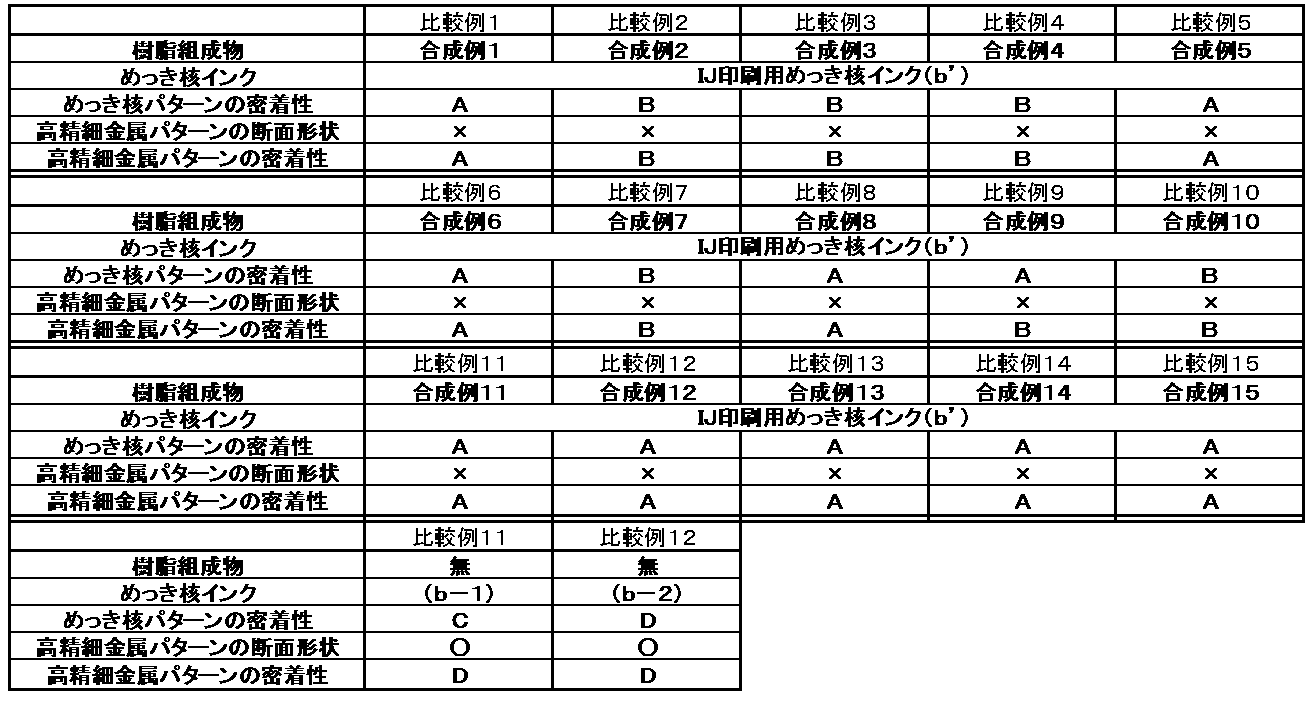
2:ブランケット
3:抜き版
4:被転写体
Claims (10)
- (1)基板上に、重量平均分子量5千以上のウレタン樹脂(a1)又はビニル樹脂(a2)と、媒体(a3)とを含む樹脂組成物(a)を塗布してなる受理層(A)を形成する工程、
(2)めっき核となる粒子(b1)を含有するインク(b)を凸版反転印刷法にて印刷し、受理層(A)上にめっき核パターン(B)を形成する工程、
(3)工程(2)で形成しためっき核パターン(B)上へ無電解めっき法により金属を析出させる工程、
を有することを特徴とする高精細金属パターン形成方法。 - 前記ウレタン樹脂(a1)が全量に対して2,000mmol/kg~5,500mmol/kgの脂肪族環式構造と、親水基とを有するものである請求項1記載の高精細金属パターン形成方法。
- 前記ビニル樹脂(a2)が、メタクリル酸メチル10~70質量%と、炭素原子数2~12のアルキル基を有する(メタ)アクリル酸アルキルエステル10~50質量%を含有するビニル単量体混合物を重合して得られるものである請求項1記載の高精細金属パターン形成方法。
- 前記樹脂組成物(a)が、ウレタン樹脂(a1)からなるシェル層と、ビニル樹脂(a2)からなるコア層によって構成される複合樹脂粒子を含有するものである請求項1~3の何れか1項記載の高精細金属パターン形成方法。
- めっき核となる粒子(b1)が体積平均粒子径(Mv)が2~100nmの金属ナノ粒子であって、当該金属ナノ粒子が塩基性窒素原子を含有する有機化合物で保護されて前記インク(b)中の分散されているものである請求項1~4の何れか1項記載の高精細金属パターン形成方法。
- 前記樹脂組成物(a)中のウレタン樹脂(a1)又はビニル樹脂(a2)中に、金属ナノ粒子を保護している塩基性窒素原子を含有する有機化合物と架橋反応できる官能基を有している請求項5記載の高精細金属パターン形成方法。
- 前記インク(b)中に更に、フッ素系表面エネルギー調整剤、及び/又はシリコン系表面エネルギー調整剤を含有する請求項1~6の何れか1項記載の高精細金属パターン形成方法。
- 前記凸版反転印刷法が、
(i)ブランケットの撥液表面上に均一なインク膜を形成し、
(ii)該インク膜面に凸版を押圧して該凸版に接触する部分のインクをブランケット上から除去したのち、
(iii)ブランケット上に残ったインクを被印刷体に転写し、目的とするパターンを形成する印刷法である請求項1~7の何れか1項記載の高精細金属パターン形成方法。 - 請求項1~8の何れか1項記載のパターン形成方法により形成されることを特徴とする高精細金属パターン。
- 請求項9記載の高精細金属パターンを含むことを特徴とする電子部品。
Priority Applications (5)
| Application Number | Priority Date | Filing Date | Title |
|---|---|---|---|
| CN201480002136.4A CN104583455B (zh) | 2013-03-12 | 2014-03-06 | 高精细金属图案的形成方法、高精细金属图案及电子构件 |
| DE112014001262.9T DE112014001262T5 (de) | 2013-03-12 | 2014-03-06 | Verfahren zum Bilden eines hochauflösenden Metallmusters, hochauflösendes Metallmuster und elektronische Komponente |
| KR1020147034491A KR102097385B1 (ko) | 2013-03-12 | 2014-03-06 | 고정밀 금속 패턴의 형성 방법, 고정밀 금속 패턴 및 전자 부품 |
| US14/441,605 US9629253B2 (en) | 2013-03-12 | 2014-03-06 | Method for forming high-definition metal pattern, high-definition metal pattern, and electronic component |
| JP2014533719A JP5652687B1 (ja) | 2013-03-12 | 2014-03-06 | 高精細金属パターンの形成方法、高精細金属パターン及び電子部品 |
Applications Claiming Priority (2)
| Application Number | Priority Date | Filing Date | Title |
|---|---|---|---|
| JP2013-049043 | 2013-03-12 | ||
| JP2013049043 | 2013-03-12 |
Publications (1)
| Publication Number | Publication Date |
|---|---|
| WO2014142008A1 true WO2014142008A1 (ja) | 2014-09-18 |
Family
ID=51536671
Family Applications (1)
| Application Number | Title | Priority Date | Filing Date |
|---|---|---|---|
| PCT/JP2014/055833 Ceased WO2014142008A1 (ja) | 2013-03-12 | 2014-03-06 | 高精細金属パターンの形成方法、高精細金属パターン及び電子部品 |
Country Status (7)
| Country | Link |
|---|---|
| US (1) | US9629253B2 (ja) |
| JP (1) | JP5652687B1 (ja) |
| KR (1) | KR102097385B1 (ja) |
| CN (1) | CN104583455B (ja) |
| DE (1) | DE112014001262T5 (ja) |
| TW (1) | TWI498452B (ja) |
| WO (1) | WO2014142008A1 (ja) |
Cited By (5)
| Publication number | Priority date | Publication date | Assignee | Title |
|---|---|---|---|---|
| JP2017218664A (ja) * | 2016-06-10 | 2017-12-14 | 株式会社C−Ink | めっき下地用の組成物及びそれによるめっき下地 |
| JP2018090881A (ja) * | 2016-12-07 | 2018-06-14 | アキレス株式会社 | 不織布めっき物 |
| JP2018094538A (ja) * | 2016-12-16 | 2018-06-21 | コニカミノルタ株式会社 | 細線パターン形成方法及び細線パターン形成装置 |
| WO2020129649A1 (ja) * | 2018-12-21 | 2020-06-25 | 日産化学株式会社 | 高分子及び金属微粒子を含む無電解めっき下地剤 |
| WO2022019087A1 (ja) * | 2020-07-22 | 2022-01-27 | 株式会社村田製作所 | 印刷土台 |
Families Citing this family (3)
| Publication number | Priority date | Publication date | Assignee | Title |
|---|---|---|---|---|
| US12331210B2 (en) | 2014-10-21 | 2025-06-17 | Oreltech Ltd. | Composition for forming a patterned metal film on a substrate |
| WO2016064860A2 (en) | 2014-10-21 | 2016-04-28 | Oreltech Ltd. | Composition for forming a patterned metal film on a substrate |
| WO2022070535A1 (ja) * | 2020-09-29 | 2022-04-07 | 富士フイルム株式会社 | 水分散物及び画像記録方法 |
Citations (2)
| Publication number | Priority date | Publication date | Assignee | Title |
|---|---|---|---|---|
| WO2013015056A1 (ja) * | 2011-07-22 | 2013-01-31 | Dic株式会社 | 導電性パターン及びその製造方法 |
| JP5177607B1 (ja) * | 2011-09-09 | 2013-04-03 | Dic株式会社 | 受容層形成用樹脂組成物ならびにそれを用いて得られる受容基材、印刷物、導電性パターン及び電気回路 |
Family Cites Families (11)
| Publication number | Priority date | Publication date | Assignee | Title |
|---|---|---|---|---|
| JPS60246695A (ja) | 1984-05-22 | 1985-12-06 | 松下電器産業株式会社 | 印刷配線板の製造方法 |
| JP4124025B2 (ja) * | 2003-05-26 | 2008-07-23 | トッパン・フォームズ株式会社 | 絶縁性を有するインクジェットインク受容層上に導電性インクジェットインクを用いて形成された導電回路を有するシート |
| JP2005286158A (ja) | 2004-03-30 | 2005-10-13 | Seiko Epson Corp | パターン形成方法、電子デバイス及びその製造方法並びに電子機器 |
| JP5079396B2 (ja) * | 2007-03-30 | 2012-11-21 | 富士フイルム株式会社 | 導電性物質吸着性樹脂フイルム、導電性物質吸着性樹脂フイルムの製造方法、それを用いた金属層付き樹脂フイルム、及び、金属層付き樹脂フイルムの製造方法 |
| JP5060250B2 (ja) | 2007-11-13 | 2012-10-31 | セーレン株式会社 | 導電性細線の形成方法 |
| CN101796149B (zh) * | 2008-05-26 | 2012-10-10 | Dic株式会社 | 涂布剂及其制备方法 |
| JP5474097B2 (ja) * | 2009-02-06 | 2014-04-16 | エルジー・ケム・リミテッド | タッチスクリーンおよびその製造方法 |
| KR101322755B1 (ko) * | 2009-11-27 | 2013-10-29 | 디아이씨 가부시끼가이샤 | 볼록판 반전 인쇄용 잉크 조성물, 인쇄물, 및 컬러 필터 |
| US8366971B2 (en) * | 2010-04-02 | 2013-02-05 | Xerox Corporation | Additive for robust metal ink formulations |
| US20120177821A1 (en) * | 2010-07-20 | 2012-07-12 | Rohm And Haas Electronic Materials Llc | Composition of nanoparticles |
| KR20120014500A (ko) * | 2010-08-09 | 2012-02-17 | 삼성전자주식회사 | 탈착판, 탈착판의 제조방법, 및 롤프린팅 방식으로 형성된 패턴 |
-
2014
- 2014-03-06 US US14/441,605 patent/US9629253B2/en active Active
- 2014-03-06 KR KR1020147034491A patent/KR102097385B1/ko not_active Expired - Fee Related
- 2014-03-06 DE DE112014001262.9T patent/DE112014001262T5/de not_active Ceased
- 2014-03-06 WO PCT/JP2014/055833 patent/WO2014142008A1/ja not_active Ceased
- 2014-03-06 CN CN201480002136.4A patent/CN104583455B/zh not_active Expired - Fee Related
- 2014-03-06 JP JP2014533719A patent/JP5652687B1/ja active Active
- 2014-03-11 TW TW103108507A patent/TWI498452B/zh active
Patent Citations (2)
| Publication number | Priority date | Publication date | Assignee | Title |
|---|---|---|---|---|
| WO2013015056A1 (ja) * | 2011-07-22 | 2013-01-31 | Dic株式会社 | 導電性パターン及びその製造方法 |
| JP5177607B1 (ja) * | 2011-09-09 | 2013-04-03 | Dic株式会社 | 受容層形成用樹脂組成物ならびにそれを用いて得られる受容基材、印刷物、導電性パターン及び電気回路 |
Cited By (10)
| Publication number | Priority date | Publication date | Assignee | Title |
|---|---|---|---|---|
| JP2017218664A (ja) * | 2016-06-10 | 2017-12-14 | 株式会社C−Ink | めっき下地用の組成物及びそれによるめっき下地 |
| JP2018090881A (ja) * | 2016-12-07 | 2018-06-14 | アキレス株式会社 | 不織布めっき物 |
| JP2018094538A (ja) * | 2016-12-16 | 2018-06-21 | コニカミノルタ株式会社 | 細線パターン形成方法及び細線パターン形成装置 |
| WO2020129649A1 (ja) * | 2018-12-21 | 2020-06-25 | 日産化学株式会社 | 高分子及び金属微粒子を含む無電解めっき下地剤 |
| JPWO2020129649A1 (ja) * | 2018-12-21 | 2021-11-04 | 日産化学株式会社 | 高分子及び金属微粒子を含む無電解めっき下地剤 |
| JP7401856B2 (ja) | 2018-12-21 | 2023-12-20 | 日産化学株式会社 | 高分子及び金属微粒子を含む無電解めっき下地剤 |
| WO2022019087A1 (ja) * | 2020-07-22 | 2022-01-27 | 株式会社村田製作所 | 印刷土台 |
| JPWO2022019087A1 (ja) * | 2020-07-22 | 2022-01-27 | ||
| JP7464127B2 (ja) | 2020-07-22 | 2024-04-09 | 株式会社村田製作所 | 印刷土台 |
| US12522743B2 (en) | 2020-07-22 | 2026-01-13 | Murata Manufacturing Co., Ltd. | Printing foundation |
Also Published As
| Publication number | Publication date |
|---|---|
| JPWO2014142008A1 (ja) | 2017-02-16 |
| DE112014001262T5 (de) | 2015-12-17 |
| KR20150130899A (ko) | 2015-11-24 |
| TWI498452B (zh) | 2015-09-01 |
| KR102097385B1 (ko) | 2020-04-06 |
| JP5652687B1 (ja) | 2015-01-14 |
| CN104583455A (zh) | 2015-04-29 |
| CN104583455B (zh) | 2018-05-25 |
| US20150289383A1 (en) | 2015-10-08 |
| TW201447037A (zh) | 2014-12-16 |
| US9629253B2 (en) | 2017-04-18 |
Similar Documents
| Publication | Publication Date | Title |
|---|---|---|
| JP5733481B2 (ja) | 導電性高精細パターンの形成方法、導電性高精細パターン及び電気回路 | |
| JP5652687B1 (ja) | 高精細金属パターンの形成方法、高精細金属パターン及び電子部品 | |
| JP5177607B1 (ja) | 受容層形成用樹脂組成物ならびにそれを用いて得られる受容基材、印刷物、導電性パターン及び電気回路 | |
| JP5382279B1 (ja) | 導電性パターン、電気回路、電磁波シールド、及び、導電性パターンの製造方法 | |
| JP5713223B2 (ja) | 積層体、導電性パターン及び積層体の製造方法 | |
| JP5696825B2 (ja) | 積層体、導電性パターン、電気回路及び積層体の製造方法 | |
| JP6103161B2 (ja) | 導電性パターン、電子回路及び電磁波シールド | |
| JPWO2013179965A1 (ja) | 導電性パターン、導電回路及び導電性パターンの製造方法 | |
| JPWO2013172229A1 (ja) | 導電性パターン、導電回路及び導電性パターンの製造方法 | |
| JP6160863B2 (ja) | 導電性パターン及び導電回路 | |
| CN111868302A (zh) | 包含高分子和金属微粒的非电解镀基底剂 |
Legal Events
| Date | Code | Title | Description |
|---|---|---|---|
| ENP | Entry into the national phase |
Ref document number: 2014533719 Country of ref document: JP Kind code of ref document: A |
|
| 121 | Ep: the epo has been informed by wipo that ep was designated in this application |
Ref document number: 14762870 Country of ref document: EP Kind code of ref document: A1 |
|
| ENP | Entry into the national phase |
Ref document number: 20147034491 Country of ref document: KR Kind code of ref document: A |
|
| WWE | Wipo information: entry into national phase |
Ref document number: 14441605 Country of ref document: US |
|
| WWE | Wipo information: entry into national phase |
Ref document number: 112014001262 Country of ref document: DE Ref document number: 1120140012629 Country of ref document: DE |
|
| 122 | Ep: pct application non-entry in european phase |
Ref document number: 14762870 Country of ref document: EP Kind code of ref document: A1 |