WO2014103822A1 - 逆浸透膜の阻止率向上方法、阻止率向上処理剤及び逆浸透膜 - Google Patents
逆浸透膜の阻止率向上方法、阻止率向上処理剤及び逆浸透膜 Download PDFInfo
- Publication number
- WO2014103822A1 WO2014103822A1 PCT/JP2013/083850 JP2013083850W WO2014103822A1 WO 2014103822 A1 WO2014103822 A1 WO 2014103822A1 JP 2013083850 W JP2013083850 W JP 2013083850W WO 2014103822 A1 WO2014103822 A1 WO 2014103822A1
- Authority
- WO
- WIPO (PCT)
- Prior art keywords
- reverse osmosis
- osmosis membrane
- improving
- aqueous solution
- membrane
- Prior art date
- Legal status (The legal status is an assumption and is not a legal conclusion. Google has not performed a legal analysis and makes no representation as to the accuracy of the status listed.)
- Ceased
Links
Images


Classifications
-
- B—PERFORMING OPERATIONS; TRANSPORTING
- B01—PHYSICAL OR CHEMICAL PROCESSES OR APPARATUS IN GENERAL
- B01D—SEPARATION
- B01D65/00—Accessories or auxiliary operations, in general, for separation processes or apparatus using semi-permeable membranes
- B01D65/10—Testing of membranes or membrane apparatus; Detecting or repairing leaks
- B01D65/106—Repairing membrane apparatus or modules
- B01D65/108—Repairing membranes
-
- B—PERFORMING OPERATIONS; TRANSPORTING
- B01—PHYSICAL OR CHEMICAL PROCESSES OR APPARATUS IN GENERAL
- B01D—SEPARATION
- B01D61/00—Processes of separation using semi-permeable membranes, e.g. dialysis, osmosis or ultrafiltration; Apparatus, accessories or auxiliary operations specially adapted therefor
- B01D61/02—Reverse osmosis; Hyperfiltration ; Nanofiltration
- B01D61/025—Reverse osmosis; Hyperfiltration
-
- B—PERFORMING OPERATIONS; TRANSPORTING
- B01—PHYSICAL OR CHEMICAL PROCESSES OR APPARATUS IN GENERAL
- B01D—SEPARATION
- B01D67/00—Processes specially adapted for manufacturing semi-permeable membranes for separation processes or apparatus
- B01D67/0081—After-treatment of organic or inorganic membranes
- B01D67/0088—Physical treatment with compounds, e.g. swelling, coating or impregnation
-
- C—CHEMISTRY; METALLURGY
- C02—TREATMENT OF WATER, WASTE WATER, SEWAGE, OR SLUDGE
- C02F—TREATMENT OF WATER, WASTE WATER, SEWAGE, OR SLUDGE
- C02F1/00—Treatment of water, waste water, or sewage
- C02F1/44—Treatment of water, waste water, or sewage by dialysis, osmosis or reverse osmosis
- C02F1/441—Treatment of water, waste water, or sewage by dialysis, osmosis or reverse osmosis by reverse osmosis
-
- C—CHEMISTRY; METALLURGY
- C08—ORGANIC MACROMOLECULAR COMPOUNDS; THEIR PREPARATION OR CHEMICAL WORKING-UP; COMPOSITIONS BASED THEREON
- C08K—Use of inorganic or non-macromolecular organic substances as compounding ingredients
- C08K5/00—Use of organic ingredients
- C08K5/04—Oxygen-containing compounds
- C08K5/13—Phenols; Phenolates
- C08K5/134—Phenols containing ester groups
- C08K5/1345—Carboxylic esters of phenolcarboxylic acids
-
- C—CHEMISTRY; METALLURGY
- C08—ORGANIC MACROMOLECULAR COMPOUNDS; THEIR PREPARATION OR CHEMICAL WORKING-UP; COMPOSITIONS BASED THEREON
- C08K—Use of inorganic or non-macromolecular organic substances as compounding ingredients
- C08K5/00—Use of organic ingredients
- C08K5/16—Nitrogen-containing compounds
- C08K5/20—Carboxylic acid amides
-
- C—CHEMISTRY; METALLURGY
- C08—ORGANIC MACROMOLECULAR COMPOUNDS; THEIR PREPARATION OR CHEMICAL WORKING-UP; COMPOSITIONS BASED THEREON
- C08K—Use of inorganic or non-macromolecular organic substances as compounding ingredients
- C08K5/00—Use of organic ingredients
- C08K5/16—Nitrogen-containing compounds
- C08K5/29—Compounds containing one or more carbon-to-nitrogen double bonds
- C08K5/31—Guanidine; Derivatives thereof
-
- C—CHEMISTRY; METALLURGY
- C09—DYES; PAINTS; POLISHES; NATURAL RESINS; ADHESIVES; COMPOSITIONS NOT OTHERWISE PROVIDED FOR; APPLICATIONS OF MATERIALS NOT OTHERWISE PROVIDED FOR
- C09D—COATING COMPOSITIONS, e.g. PAINTS, VARNISHES OR LACQUERS; FILLING PASTES; CHEMICAL PAINT OR INK REMOVERS; INKS; CORRECTING FLUIDS; WOODSTAINS; PASTES OR SOLIDS FOR COLOURING OR PRINTING; USE OF MATERIALS THEREFOR
- C09D129/00—Coating compositions based on homopolymers or copolymers of compounds having one or more unsaturated aliphatic radicals, each having only one carbon-to-carbon double bond, and at least one being terminated by an alcohol, ether, aldehydo, ketonic, acetal, or ketal radical; Coating compositions based on hydrolysed polymers of esters of unsaturated alcohols with saturated carboxylic acids; Coating compositions based on derivatives of such polymers
- C09D129/02—Homopolymers or copolymers of unsaturated alcohols
- C09D129/04—Polyvinyl alcohol; Partially hydrolysed homopolymers or copolymers of esters of unsaturated alcohols with saturated carboxylic acids
-
- C—CHEMISTRY; METALLURGY
- C02—TREATMENT OF WATER, WASTE WATER, SEWAGE, OR SLUDGE
- C02F—TREATMENT OF WATER, WASTE WATER, SEWAGE, OR SLUDGE
- C02F2101/00—Nature of the contaminant
- C02F2101/30—Organic compounds
-
- C—CHEMISTRY; METALLURGY
- C02—TREATMENT OF WATER, WASTE WATER, SEWAGE, OR SLUDGE
- C02F—TREATMENT OF WATER, WASTE WATER, SEWAGE, OR SLUDGE
- C02F2103/00—Nature of the water, waste water, sewage or sludge to be treated
- C02F2103/02—Non-contaminated water, e.g. for industrial water supply
- C02F2103/04—Non-contaminated water, e.g. for industrial water supply for obtaining ultra-pure water
-
- C—CHEMISTRY; METALLURGY
- C02—TREATMENT OF WATER, WASTE WATER, SEWAGE, OR SLUDGE
- C02F—TREATMENT OF WATER, WASTE WATER, SEWAGE, OR SLUDGE
- C02F2103/00—Nature of the water, waste water, sewage or sludge to be treated
- C02F2103/08—Seawater, e.g. for desalination
-
- C—CHEMISTRY; METALLURGY
- C02—TREATMENT OF WATER, WASTE WATER, SEWAGE, OR SLUDGE
- C02F—TREATMENT OF WATER, WASTE WATER, SEWAGE, OR SLUDGE
- C02F2103/00—Nature of the water, waste water, sewage or sludge to be treated
- C02F2103/34—Nature of the water, waste water, sewage or sludge to be treated from industrial activities not provided for in groups C02F2103/12 - C02F2103/32
- C02F2103/346—Nature of the water, waste water, sewage or sludge to be treated from industrial activities not provided for in groups C02F2103/12 - C02F2103/32 from semiconductor processing, e.g. waste water from polishing of wafers
-
- C—CHEMISTRY; METALLURGY
- C02—TREATMENT OF WATER, WASTE WATER, SEWAGE, OR SLUDGE
- C02F—TREATMENT OF WATER, WASTE WATER, SEWAGE, OR SLUDGE
- C02F2209/00—Controlling or monitoring parameters in water treatment
- C02F2209/001—Upstream control, i.e. monitoring for predictive control
-
- C—CHEMISTRY; METALLURGY
- C02—TREATMENT OF WATER, WASTE WATER, SEWAGE, OR SLUDGE
- C02F—TREATMENT OF WATER, WASTE WATER, SEWAGE, OR SLUDGE
- C02F2209/00—Controlling or monitoring parameters in water treatment
- C02F2209/20—Total organic carbon [TOC]
Definitions
- the present invention relates to a method for improving the blocking rate (desalting rate) of a reverse osmosis membrane (RO membrane), and more particularly to a method for repairing a deteriorated RO membrane and effectively improving the blocking rate.
- the present invention also relates to an RO membrane that has been subjected to a rejection improvement process by this RO membrane rejection improvement method, and a rejection improvement agent used in this method.
- RO membranes are used in ultrapure water production plants, wastewater collection plants, seawater desalination plants, and the like, and most of organic substances and inorganic substances in water can be removed by treatment with RO membranes.
- the RO membrane is affected by the oxidizing and reducing substances present in the water, acid / alkali cleaning, aging deterioration, etc., and the rejection rate gradually decreases, and the required permeate (treated water) water quality is reduced. It may not be obtained.
- the removal performance may deteriorate due to an unexpected trouble, and the RO membrane rejection rate itself as a product may not reach the required level.
- Chlorine is a strong oxidant. If residual chlorine is supplied to the RO membrane without sufficiently reducing and removing it, the RO and the RO membrane come into contact with each other and the RO membrane deteriorates.
- Patent Document 1 In order to decompose residual chlorine, a reducing agent such as sodium bisulfite may be added, but in a reducing environment where sodium bisulfite is added excessively, heavy metals such as Cu, Co, Mn, and Fe When it coexists, the film deteriorates.
- Non-patent Document 2 Method for improving the rejection by attaching an anionic or cationic ionic polymer compound to the membrane surface.
- Patent Document 3 A method for improving the rejection of nanofiltration membranes and RO membranes by attaching a compound having a polyalkylene glycol chain to the membrane surface (Patent Document 3)
- Method of improving the desalination rate by attaching tannic acid or the like to the deteriorated membrane (Non-patent Document 2)
- the present invention provides a RO membrane rejection rate improving method with improved removal performance (rejection rate) stability and flux stability (sustainability of contamination resistance), and a rejection rate improving treatment agent therefor. With the goal.
- Another object of the present invention is to provide an RO membrane that has been subjected to a rejection improvement process by such a RO membrane rejection improvement method.
- the present inventors believe that by adsorbing or coating a specific polymer on the polyphenol used in the rejection improvement process, peeling of the polyphenol from the film can be prevented, and the stability of the removal performance is increased. It was.
- modified polyvinyl alcohol having an ionic group, a polyalkylene oxide chain, etc. uses modified polyvinyl alcohol because of its high adsorptivity to the RO membrane. That is, a carboxyl group and an amino group exist on the surface of a general RO membrane, but the reactivity between these functional groups and ionic groups is high, and the polyalkylene oxide chain has a high adsorptivity to the membrane. Therefore, it is considered that a modified polyvinyl alcohol having an ionic group, a polyalkylene oxide chain, or the like can obtain higher stability than general polyvinyl alcohol.
- the polymer polysaccharide Since the polymer polysaccharide has a thickening action that increases the viscosity of the aqueous solution as its physical properties, the adsorption stability of the polyphenol, which is a component for improving the blocking rate of the RO membrane, is enhanced by this thickening action.
- Polyamino acids have cationic and anionic properties, and it is considered that the effect of enhancing the adsorptivity can be obtained by interaction with carboxyl groups and amino groups existing on the RO membrane surface, and further with polyphenols.
- the present invention has been achieved on the basis of such knowledge, and the gist thereof is as follows.
- the reverse osmosis membrane blocking rate improving method having a step of passing an aqueous solution containing polyphenol through the reverse osmosis membrane, one or more selected from the group consisting of modified polyvinyl alcohol, polymeric polysaccharide and polyamino acid
- a method for improving the rejection of a reverse osmosis membrane comprising a step of passing an aqueous solution containing two or more kinds through a reverse osmosis membrane.
- an aqueous solution containing polyphenol and an organic compound having an amino group having a molecular weight of 1000 or less is passed through a reverse osmosis membrane, and then selected from the group consisting of modified polyvinyl alcohol, polymeric polysaccharide and polyamino acid
- a method for improving the rejection of a reverse osmosis membrane characterized by passing an aqueous solution containing one or more of the above.
- the aqueous solution containing one or more selected from the group consisting of modified polyvinyl alcohol, polymer polysaccharide and polyamino acid contains polyphenol and an organic compound having an amino group having a molecular weight of 1000 or less.
- the modified polyvinyl alcohol is a cation-modified polyvinyl alcohol having a cationic group as a modifying group, an anion-modified polyvinyl alcohol having an anionic group as a modifying group, and a modified polyvinyl alcohol having a polyalkylene oxide chain.
- a method for improving the rejection of a reverse osmosis membrane which is one or more selected from the group consisting of:
- the high molecular polysaccharide is one or more selected from the group consisting of xanthan gum, guar gum, carboxymethylcellulose and salts thereof, alginic acid and salts thereof, and chitosan.
- a method for improving the rejection of a reverse osmosis membrane is one or more selected from the group consisting of xanthan gum, guar gum, carboxymethylcellulose and salts thereof, alginic acid and salts thereof, and chitosan.
- a method for improving the rejection of a reverse osmosis membrane which is in the range of 1 to 5.
- a method for improving the rejection of a reverse osmosis membrane, wherein the organic compound having an amino group having a molecular weight of 1000 or less is [arginine and / or aspartame] in [5].
- a treatment agent for improving the inhibition rate of a reverse osmosis membrane comprising polyphenol and one or more selected from the group consisting of modified polyvinyl alcohol, polymer polysaccharide and polyamino acid.
- one or more selected from the group consisting of polyphenols, modified polyvinyl alcohol, high molecular polysaccharides, and polyamino acids may be referred to as “second inhibition rate improving components”.
- the RO membrane can be efficiently recovered, and the removal performance (rejection rate) stability and flux stability (persistence of contamination resistance) can be recovered. ) Can be a further improved RO membrane.
- the polyphenol 22 is coated and the adsorption state is stabilized by the interaction of the second blocking rate improving component 23 with the RO membrane 21 and / or the polyphenol 22. Can do.
- the low molecular weight amino compound 24 When the low molecular weight amino compound 24 is used in combination, as shown in FIG. 1C, the low molecular weight amino compound 24 repairs the deteriorated portion of the RO film 21, and the blocking rate can be improved effectively.
- the RO membrane rejection rate improving method of the present invention includes polyphenol (hereinafter sometimes referred to as “first rejection rate improving component”), modified polyvinyl alcohol, which is a second rejection rate improving component, and a polymer.
- first rejection rate improving component polyphenol
- modified polyvinyl alcohol which is a second rejection rate improving component
- polymer 1 type or 2 types or more chosen from the group which consists of a polysaccharide and a polyamino acid are used together (Hereinafter, a 1st rejection rate improvement component and a 2nd rejection rate improvement component are simply referred to as "a rejection rate improvement component.” ”, More preferably an organic compound having an amino group with a molecular weight of 1000 or less (low molecular weight amino compound) is used in combination.
- the RO membrane is a liquid separation membrane that permeates the solvent and blocks the solute when a pressure higher than the osmotic pressure difference between the solutions through the membrane is applied to the high concentration side.
- the membrane structure of the RO membrane include polymer membranes such as asymmetric membranes and composite membranes.
- the RO membrane material subjected to the rejection improvement process includes, for example, aromatic polyamides, aliphatic polyamides, polyamide materials such as composite materials thereof, and cellulose materials such as cellulose acetate. Can be mentioned.
- polyamide RO membranes having an aromatic polyamide as a dense layer can be mentioned, but polyamide nanofiltration membranes may also be targeted. That is, the RO membrane to be treated in the present invention is a broad RO membrane containing a nanofiltration membrane.
- the present invention is particularly preferably applied to an RO membrane that generates a carboxyl group by breaking a CN bond due to deterioration.
- the desalination rate of the RO membrane before the rejection improvement process is 90% or less, it is suitable for applying the method of the present invention.
- the RO membrane module type is not particularly limited, and examples thereof include a tubular membrane module, a planar membrane module, a spiral membrane module, and a hollow fiber membrane module.
- the polyphenol used in the present invention is preferably a polyphenol having a molecular weight of 500 or more, particularly a molecular weight of 500 to 500,000, particularly a molecular weight of 500 to 50,000 in terms of effectively covering and fixing the RO membrane surface.
- examples thereof include tannic acid, lignin, and lignin derivatives.
- examples of tannic acid include tannic acid such as pentaploid, gallic, quebracho and mimosa. These polyphenols may be used alone or in combination of two or more.
- the second blocking rate improving component only one of the following modified polyvinyl alcohol, high molecular polysaccharide and polyamino acid may be used, or two or more of these may be used in combination.
- the modified polyvinyl alcohol is composed of a vinyl alcohol unit and a unit to which a modifying group is bonded, and optionally further includes a vinyl acetate unit.
- the mole fraction of the unit to which the modifying group is bonded in the modified polyvinyl alcohol is preferably 0.1 to 50 mol%, more preferably 0.3 to 40 mol%, and particularly preferably 0.5 to 30 mol%. preferable. If the molar fraction of the unit to which the modifying group is bonded is lower than this range, the effect of improving the adsorptivity to the RO membrane by introducing the modifying group cannot be sufficiently obtained. In addition, the mole fraction of the vinyl alcohol unit is reduced, and the effect of improving the rejection is reduced.
- the molar fraction of the vinyl alcohol unit in the modified polyvinyl alcohol is preferably 50 to 99.9 mol%, more preferably 60 to 99.7 mol%, and particularly preferably 70 to 99.5 mol%. If the molar fraction of the vinyl alcohol unit is less than this range, the number of hydroxyl groups in the modified polyvinyl alcohol will decrease, and a sufficient blocking rate improvement effect will not be obtained. There is a possibility that the molar fraction of the unit being reduced decreases and the effect of improving the adsorptivity to the RO membrane by introducing the modifying group cannot be sufficiently obtained.
- the mole fraction of vinyl acetate units in the modified polyvinyl alcohol is preferably 0 to 20 mol%, more preferably 0 to 10 mol%, and particularly preferably 0 to 5 mol%.
- Saponification degree is an index indicating the properties of polyvinyl alcohol.
- the saponification degree is obtained by dividing the molar fraction of the vinyl alcohol unit by the sum of the molar fractions of the vinyl alcohol unit and the vinyl acetate unit.
- the degree of saponification of the modified polyvinyl alcohol in the present invention is preferably 80% or more, particularly 85% or more, particularly 95% or more. When the degree of saponification is less than 80%, the number of hydroxyl groups is small, the hydrophilicity is lowered, and there is a tendency that a sufficient inhibition rate improving effect and flux stability cannot be obtained.
- the degree of polymerization of the modified polyvinyl alcohol that is, the number of units is not particularly limited, but is preferably 20 to 20,000. If the degree of polymerization is too low, the adsorptivity to the membrane is deteriorated, and if the degree of polymerization is too high, the decrease in the flux of the RO membrane due to the inhibition rate improvement treatment is increased, which is not preferable.
- the modified group of the modified polyvinyl alcohol preferably contains one or both of an ionic group, a polyalkylene oxide group (a group having a polyoxyalkylene oxide chain).
- a modified polyvinyl alcohol having a quaternary ammonium group is selected, interaction with a carboxyl group or polyphenol on the RO membrane surface can be expected.
- the polyethylene glycol chain is adsorbed on the polyamide RO membrane, so that interaction with the RO membrane can be expected.
- the cationic polyvinyl alcohol having a cationic group as a modifying group is preferably, for example, one produced by copolymerizing a vinyl ester such as vinyl acetate and a cationic monomer and then hydrolyzing (saponifying) it.
- Examples of cationic monomers include monomers having —NH 2 , —NHR, —NRR ′, —NH 3 + , —NH 2 R, —NHRR ′ + , —NRR′R ′′ + (R, R ′, R ′ 'Each represents a hydrocarbon residue.), Specifically, diallyldimethylammonium salt, acrylates and methacrylates having an ammonium group, N-substituted methacrylamide, vinylpyridine, vinylpyridine quaternary ammonium salt, vinylimidazole Etc.
- cationic polyvinyl alcohol Commercially available products of cationic polyvinyl alcohol include “C-506”, “CM-318” (above, manufactured by Kuraray Co., Ltd.), and “Gosefimer K-210” (above, manufactured by Nippon Synthetic Chemical Industry Co., Ltd.). It is done.
- anionic group of the anionic polyvinyl alcohol having an anionic group as a modifying group examples include a carboxyl group, a sulfonic acid group, and a phosphoric acid group. Acid groups are preferred.
- an unsaturated basic acid, an unsaturated dibasic acid, an anhydride thereof, or an anhydride thereof that can be copolymerized with a vinyl ester such as vinyl acetate is used.
- examples thereof include a method for saponifying a copolymer obtained by copolymerizing an ester or a salt, for example, acrylic acid, methacrylic acid, crotonic acid, maleic acid, fumaric acid, itaconic acid, maleic anhydride, itaconic anhydride and the like.
- the carboxyl group-modified polyvinyl alcohol can also be obtained by saponifying the above vinyl ester and a copolymer such as acrylonitrile, methacrylonitrile, acrylamide, methacrylamide.
- Examples of the graft polymerization method include a method in which acrylonitrile, acrylamide or the like is graft-polymerized on a polyvinyl ester such as polyvinyl alcohol or polyvinyl acetate and then saponified.
- a polyvinyl ester such as polyvinyl alcohol or polyvinyl acetate and then saponified.
- a method of chemical reaction of polyvinyl alcohol single esterification in which polyvinyl alcohol is reacted with a dibasic acid such as maleic acid, fumaric acid, phthalic acid, malonic acid, succinic acid, oxalic acid, adipic acid, or an anhydride thereof.
- a carboxyl group can also be introduced into polyvinyl alcohol by reaction.
- a sulfonic acid group-modified polyvinyl alcohol can be obtained by copolymerization of an ester or salt with vinyl acetate and then saponification.
- anionic polyvinyl alcohols include “KL-118”, “KL-318”, “KM-118”, “KM-618”, “SK-5102” (manufactured by Kuraray Co., Ltd.), “Gosenal” “T-330”, “Gocenal T-330H”, “Gocsenal T-350”, “Goselan L-3266”, “Goselan L-0301”, “Goselan L-0302”, “Goselan CKS-50” (and above, Japan) Synthetic chemical industry) etc. are illustrated.
- the polyalkylene oxide chain of the modified polyvinyl alcohol having a polyalkylene oxide chain is preferably a polyalkylene oxide chain having 2 to 4 carbon atoms of an alkylene group such as polyethylene oxide, polypropylene oxide, polybutylene oxide, and the like. Most preferred.
- the number of repeating alkylene oxides is preferably 2 to 300, more preferably 10 to 100. If the number of repetitions is too small, the effect of improving the adsorptivity to the RO membrane by the polyalkylene oxide chain cannot be sufficiently obtained, and if it is too large, the decrease in the flux of the RO membrane due to the inhibition rate improvement treatment becomes large. It is not preferable.
- Such a modified polyvinyl alcohol having a polyalkylene oxide chain can be obtained by a known synthesis method.
- Commercial products such as “Ecomati WO-320N” and “Ecomati WO-320R” manufactured by Nippon Synthetic Chemical Industry can also be used.
- a method for synthesizing a modified polyvinyl alcohol having a polyalkylene oxide chain a method in which a monomer having a polyalkylene oxide chain is polymerized with vinyl acetate, and then a part or all of vinyl acetate is saponified to give vinyl alcohol is preferable.
- other synthesis methods may be used.
- Examples of the monomer having a polyalkylene oxide chain include polyethylene oxide monovinyl ether, polypropylene oxide monovinyl ether, polyethylene oxide monoallyl ether, polyethylene glycol monomethacrylate, polyethylene glycol monoacrylate, polypropylene glycol monomethacrylate, polypropylene glycol monoacrylate, Polyethylene glycol-polypropylene glycol monomethacrylate, polyethylene glycol-polypropylene glycol monoacrylate, poly (ethylene glycol-tetramethylene glycol) monomethacrylate, poly (ethylene glycol-tetramethylene glycol) monoacrylate, poly (ethylene glycol-propylene Recall) monomethacrylate, methoxy polyethylene glycol - and polypropylene glycol monoacrylate and the like. These may be used alone or in combination of two or more.
- a high molecular weight polysaccharide having a molecular weight of 10,000 or more, particularly used as a food additive, can be preferably used.
- the molecular weight of the high molecular polysaccharide there is no particular upper limit on the molecular weight of the high molecular polysaccharide, and any polymer that exhibits water solubility can be used.
- Examples of such high molecular polysaccharides include xanthan gum (molecular weight: 2 million or more), guar gum (molecular weight: 200 to 300,000), carboxymethyl cellulose and its salt (molecular weight: 50,000 or more), alginic acid and its salt (molecular weight). : 10,000 or more), chitosan (molecular weight: 10,000 or more), and the like.
- These high molecular polysaccharides are usually used as thickeners and show good adsorptivity to the RO membrane. That is, for example, when an aqueous solution of xanthan gum 1 mg / L was passed through an aromatic polyamide RO membrane (ES20) manufactured by Nitto Denko Corporation at 0.75 MPa, the permeation flux was 0.9 m 3 / ( m 2 ⁇ day) to 0.5 m 3 / (m 2 ⁇ day). This can be said to be because the permeability of xanthan gum to the RO membrane is high and the permeation flux of the membrane was lowered.
- ES20 aromatic polyamide RO membrane
- polymer polysaccharides may be used alone or in combination of two or more.
- polyamino acids polylysine, polyglycine, polyglutamic acid, etc., which are polymers of one amino acid with a molecular weight of 1,000 or more and 1,000,000 or less, can be used, and polymers of two or more amino acids are also used. Can do.
- polylysine, polyarginine and polyhistidine which are polymers of basic amino acids can be suitably used.
- polylysine is preferable because it has a strong electrostatic interaction with polyphenols, and can be used in combination with polyphenols to obtain a high blocking rate improving treatment effect.
- These polyamino acids may be used alone or in combination of two or more.
- the blocking rate improving treatment may be performed using an organic compound having a molecular weight of 1000 or less (low molecular weight amino compound).
- the compound in combination the effect of improving the rejection rate can be further enhanced.
- the low molecular weight amino compound those having a molecular weight of 1,000 or less, particularly those having a molecular weight of less than 500, for example, a molecular weight of 70 to 300 are preferable in terms of the effect of repairing the deteriorated portion of the RO membrane.
- a molecular weight of 70 to 300 are preferable in terms of the effect of repairing the deteriorated portion of the RO membrane.
- One kind of these low molecular weight amino compounds may be used, or two or more kinds may be used, but the work becomes complicated as the number of kinds increases.
- Aromatic amino compounds those having a benzene skeleton and an amino group such as aniline (molecular weight: 93), diaminobenzene (molecular weight: 108), etc.
- Aromatic aminocarboxylic acid compounds for example, benzene skeletons such as 3,5-diaminobenzoic acid, 3,4-diaminobenzoic acid (molecular weight: 152), 2,4,6-triaminobenzoic acid (molecular weight: 167) and 2 Having at least one amino group and fewer carboxyl groups than the number of amino groups
- Aliphatic amino acids For example, a straight-chain hydrocarbon group having about 1 to 20 carbon atoms such as methylamine (molecular weight: 31), ethylamine (molecular weight: 45), octylamine (molecular weight: 129) and one or more amino groups And a branched carbon hydrogen group having about 1 to 20 carbon atoms such as aminopentane (molecular weight: 87), 2-methyl-1,8-octanediamine (molecular weight: 143) and one or more amino groups.
- a straight-chain hydrocarbon group having about 1 to 20 carbon atoms such as methylamine (molecular weight: 31), ethylamine (molecular weight: 45), octylamine (molecular weight: 129) and one or more amino groups
- a branched carbon hydrogen group having about 1 to 20 carbon atoms such as aminopentane (molecular weight: 87), 2-methyl-1,8-octanediamine (molecular weight:
- Aliphatic amino alcohol for example, a linear or branched hydrocarbon group having 1 to 20 carbon atoms such as 4-amino-2-methyl-1-butanol (molecular weight: 103) having an amino group and a hydroxyl group
- Heterocyclic amino compound a compound having a heterocyclic ring and an amino group such as tetrahydrofurfurylamine (molecular weight: 101)
- Amino acid compounds basic amino acid compounds such as arginine (molecular weight: 174) and lysine (molecular weight: 146), amino acid compounds having an amide group such as asparagine (molecular weight: 132) and glutamine (molecular weight: 146), glycine (molecular weight: 75) and phenylalanine (molecular weight: 165)
- Ethylenediamines Polyethyleneamines such as ethylenediamine (molecular weight: 60), diethylenetriamine (molecular weight: 103), triethylenetetramine (molecular weight: 146), tetraethylenepentamine (molecular weight: 189), pentaethylenehexamine (molecular weight: 232)
- aspartame molecular weight: 294
- carnosine molecular weight: 226)
- N ⁇ - (L-tyrosyl) -L-arginine molecular weight: 336)
- pyrimidine-2,4,5,6-tetraamine molecular weight 140
- These low molecular weight amino compounds are highly soluble in water and can pass through the RO membrane as stable water-soluble, react with the carboxyl group of the membrane, bind to the RO membrane, form an insoluble salt, Holes caused by membrane degradation can be blocked.
- the concentration of the polyphenol, the second blocking ratio improving component, and the low molecular weight amino compound in the aqueous solution when only one of them is contained, the concentration thereof, and these Is included, the total concentration is preferably 1.0 to 5,000 mg / L, and more preferably 1.0 to 2,000 mg / L. If this concentration is too low, a long-term treatment is required, which is not preferable. On the other hand, if this concentration is too high, the number of compounds that adsorb in multiple layers on the surface of the film and do not reach the deteriorated portion increases, resulting in poor repair efficiency.
- the total to the RO membrane is calculated by the concentration in the aqueous solution and the amount of the aqueous solution that passes through the RO membrane.
- the weight ratio of polyphenol to the second rejection ratio improving component is such that the ratio of polyphenol: second rejection ratio improving component is 1: 0.1 to 5, particularly 1: 0.1 to 2. It is preferable to use for.
- the rejection improvement process according to the present invention is preferably performed by circulating an aqueous solution containing a rejection improvement component in the cleaning apparatus as it is after the RO membrane is cleaned.
- the water passage order of the polyphenol, the second blocking rate improving component and the low molecular weight amino compound to the RO membrane is particularly
- these may be added to one aqueous solution and the rejection improvement process may be performed using one type of aqueous solution, or these may be passed through the RO membrane as separate aqueous solutions.
- the second blocking rate improving component is coated with polyphenol or a low molecular weight amino compound to increase the adsorption stability thereof. If the rate-improving component is adsorbed on the RO membrane prior to polyphenol or a low molecular weight amino compound, the adsorption of the polyphenol or low molecular weight amino compound to the RO membrane may be inhibited, which is not preferable.
- the following modes are mentioned as a specific water flow order.
- (1) The aqueous solution containing the polyphenol and the second inhibition rate improving component is passed through the RO membrane.
- the aqueous solution containing the second inhibition rate improving component is passed through the RO membrane.
- (4) The aqueous solution containing the polyphenol, the second blocking rate improving component, and the low molecular weight amino compound is passed through the RO membrane.
- the aqueous solution containing the polyphenol and the low molecular weight amino compound is passed through the RO membrane, and then the aqueous solution containing the second inhibition rate improving component is passed through the RO membrane.
- the rejection improvement process according to the present invention may be a process of sequentially adding chemicals such as polyphenol and a second rejection improvement component to the supply water or circulating water to the RO membrane, and the RO membrane for each rejection improvement component. It may be carried out by replacing the supply water or circulating water to the water.
- the water pressure (inlet pressure) during the rejection improvement process is preferably 0.1 to 0.5 MPa.
- the permeation flux during the rejection improvement process is related to pressure, water temperature, membrane shape, etc., but is preferably 0.1 to 1.0 m 3 / (m 2 ⁇ day). The reason for this is that, as described above, if it is excessively high, there is a problem that the adsorption to a portion where the RO membrane is not deteriorated.
- the treatment time is not particularly limited as long as it is 1 hour or more, but it is preferably 1 hour or more and 48 hours or less. If the treatment time is less than 1 hour, the treatment may be terminated without sufficient fixing property of the rejection rate improving component being obtained, and the rejection rate improving component attached to the RO film may be peeled off, which is preferable. Absent.
- the temperature (water temperature) during the treatment is preferably 10 to 35 ° C. If the water temperature is too low, the amount of permeated water is reduced, and the contact efficiency between the blocking rate improving component and the RO membrane is deteriorated. If the water temperature becomes too high, problems such as denaturation of the membrane material may occur.
- Water for blocking rate improvement treated water that passes through the RO membrane for blocking rate improvement treatment includes tracer, inorganic electrolyte such as sodium chloride (NaCl), neutral organic substances such as isopropyl alcohol and glucose, and low molecular weight polymers such as polymaleic acid.
- inorganic electrolyte such as sodium chloride (NaCl)
- neutral organic substances such as isopropyl alcohol and glucose
- low molecular weight polymers such as polymaleic acid.
- the treatment rate improvement treatment according to the present invention is performed in a state where the water to be treated is passed for a long time or the permeation flux is reduced due to membrane contamination, the treatment according to the present invention is performed after chemical cleaning.
- a rate improvement process it is not the limitation.
- Examples of chemical cleaning agents include acid acids, mineral acids such as hydrochloric acid, nitric acid, and sulfuric acid, and organic acids such as citric acid and oxalic acid.
- Examples of the alkali cleaning include sodium hydroxide and potassium hydroxide. In general, the pH is about 2 for acid cleaning and about 12 for alkali cleaning.
- the RO membrane treated by the method of the present invention is a water treatment for recovering / reusing wastewater containing high or low concentration TOC discharged in the electronic device manufacturing field, semiconductor manufacturing field, and other various industrial fields, or It is effectively applied to the production of ultrapure water from industrial water and city water and water treatment in other fields.
- the treated water to be treated is not particularly limited, but can be suitably used for organic substance-containing water.
- TOC 0.01 to 100 mg / L, preferably about 0.1 to 30 mg / L. It is suitably used for the treatment of organic substance-containing water.
- Examples of such organic substance-containing water include, but are not limited to, wastewater from electronic device manufacturing factories, transportation machinery manufacturing factories, organic synthesis factories, printing plate making / painting factories, or the primary treatment water thereof. .
- the flat membrane test apparatus shown in FIG. 2 is used, and a deteriorated RO membrane is attached and the rejection rate improving treated water is passed, and then a NaCl aqueous solution for performance evaluation is passed. Evaluation was performed.
- This flat membrane test apparatus is provided with a flat membrane cell 2 at an intermediate position in the height direction of a cylindrical container 1 having a bottom and a lid, and the inside of the container is divided into a raw water chamber 1A and a permeated water chamber 1B, and the container 1 is divided into a stirrer.
- water to be treated is supplied to the raw water chamber 1 ⁇ / b> A via the pipe 11 by the pump 4, and the stirrer 5 in the container 1 is rotated to stir the raw water chamber 1 ⁇ / b> A so that the permeated water passes through the permeated water.
- the concentrated water is taken out from the raw water chamber 1A through the pipe 13.
- the concentrated water outlet pipe 13 is provided with a pressure gauge 6 and an opening / closing valve 7.
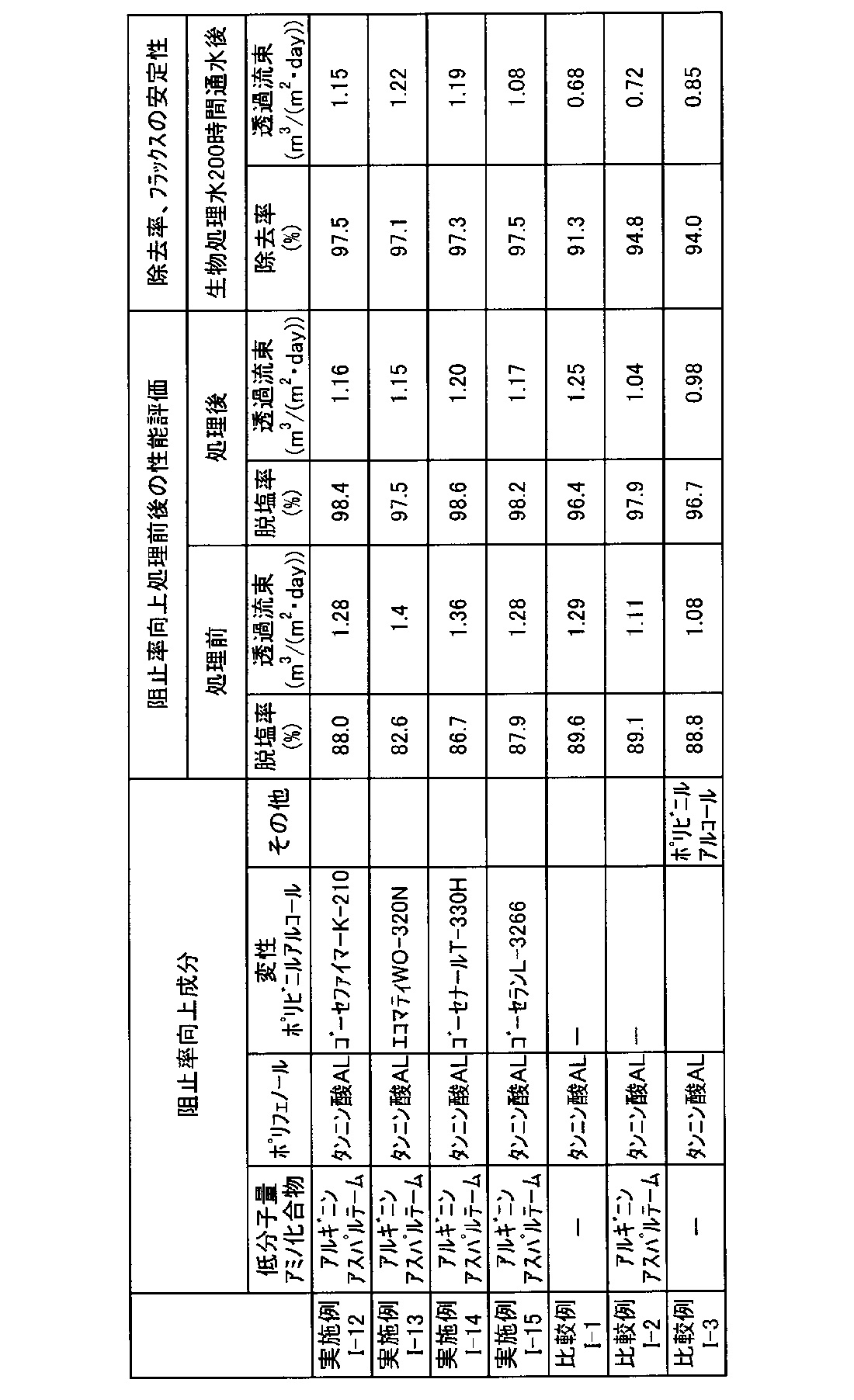
- Example I-1 Nitto Denko's aromatic polyamide ultra-low pressure RO membrane “ES20” was subjected to chlorine degradation under the following degradation conditions, and then arginine (manufactured by Ajinomoto, molecular weight: 174) and aspartame (manufactured by Ajinomoto, molecular weight: 294) as low molecular weight amino compounds.
- the performance evaluation with the following NaCl aqueous solution was performed before and after the blocking rate improvement treatment.
- 30 ppm of “IK-110” manufactured by Kurita Kogyo Co., Ltd. was added as a slime control agent to the biological treatment water of the waste water recovery equipment at Kurita Development Center.
- the obtained solution was passed as raw water under the following conditions, and the removal rate and the stability of the permeation flux were verified when water was passed for a certain period.
- ⁇ Deterioration conditions An aqueous solution (pH 7.0) of sodium hypochlorite 100 ppm was passed for 24 hours at an inlet pressure of 0.75 MPa and a water temperature of 25 ° C.
- ⁇ Prevention rate improvement processing conditions Component concentration for improving each rejection rate: 100 mg / L Inlet pressure: 0.2 MPa Permeation flux: 0.3 m 3 / (m 2 ⁇ day) Water temperature: 25 ° C
- Example I-2 Except for changing the modified polyvinyl alcohol to “Ekomati WO-320N” (modified polyvinyl alcohol having a polyalkylene oxide chain), the same blocking rate improvement treatment as in Example I-1 was carried out to evaluate the performance and stability.
- Example I-3 Except that the modified polyvinyl alcohol was changed to “GOHSENAL T-330H” (carboxyl group-modified polyvinyl alcohol), the same blocking rate improvement treatment was performed as in Example I-1, and the performance and stability were evaluated.
- Example I-4 Except that the modified polyvinyl alcohol was changed to “Goselan L-3266” (sulfonic acid group-modified polyvinyl alcohol), the same blocking rate improvement treatment as in Example I-1 was performed, and the performance and stability were evaluated.
- Examples I-5 to 8 Except that the low molecular weight amino compound was changed to only arginine, the blocking rate improvement treatment was performed in the same manner as in Examples I-1 to 4 to evaluate the performance and stability.
- Example I-9 The blocking rate improving treatment was performed in the same manner as in Example I-1 except that the blocking rate improving treatment was performed without using the low molecular weight amino compound, and the performance and stability were evaluated.
- Example I-10 Except that the modified polyvinyl alcohol was changed to “Ecomati WO-320N”, the same blocking rate improvement treatment as in Example I-9 was performed, and the performance and stability were evaluated.
- Example I-11 Except for the combined use of “Ekomati WO-320N” and “Gosephimer K-210” as the modified polyvinyl alcohol, the same blocking rate improvement treatment as in Example I-9 was performed, and the performance and stability were evaluated.
- Examples I-12 to 15 The performance and stability were evaluated in the same manner as in Examples I-1 to 4 except that an aqueous solution containing all of the low molecular weight amino compound, polyphenol and modified polyvinyl alcohol was passed for 4 hours. did.
- Example I-1 The blocking rate improvement treatment was performed only with polyphenol, and the blocking rate improvement treatment was performed in the same manner as in Example I-1 except that the low molecular weight amino compound and the modified polyvinyl alcohol were not used, and the performance and stability were evaluated.
- Example I-2 Except for not using the modified polyvinyl alcohol, the same blocking rate improvement treatment as in Example I-1 was performed, and the performance and stability were evaluated.
- Example I-3 Improved blocking rate as in Example I-1 except that low molecular weight amino compound was not used and polyvinyl alcohol (average polymerization degree 2,000, saponification degree 99%, manufactured by Kishida Chemical Co.) was used instead of modified polyvinyl alcohol. Processing was performed and performance and stability were evaluated.
- polyvinyl alcohol average polymerization degree 2,000, saponification degree 99%, manufactured by Kishida Chemical Co.
- Desalination rate [%] (1 ⁇ permeate conductivity [mS / m] / concentrate conductivity [mS / m]) ⁇ 100
- Removal rate [%] (1—TOC [mg / L] of permeate / TOC [mg / L] of concentrate) ⁇ 100
- Examples and comparative examples using high molecular polysaccharides or polyamino acids as the second inhibition rate improving component were used as the deteriorated films subjected to the rejection improvement process.
- Degraded membrane Aromatic polyamide ultra-low pressure RO membrane “ES20” (original membrane) manufactured by Nitto Denko Corporation was accelerated and deteriorated by immersing it in an aqueous solution containing sodium hypochlorite (free chlorine 100 mg / L) for 24 hours. .
- arginine manufactured by Ajinomoto
- aspartame manufactured by Ajinomoto
- tannic acid manufactured by Fuji Chemical Industry, dietary tannic acid AL, molecular weight of 500 or more
- xanthan gum "Bisfect XA” manufactured by Sanei Pharmaceutical Trading, Molecular weight over 1 million (LC-OCD, converted to dextran when using HW65s)
- guar gum (“Guarcoal F50” manufactured by Sanei Pharmaceutical Co., Ltd., molecular weight over 1 million (converted to dextran when using LC-OCD, HW65s)
- sodium alginate made by Kimika
- Kimika Argin I-3 molecular weight of 1 million or more (LC-OCD, converted to dextran using HW65s)
- carboxymethylcellulose (“CMC1240” manufactured by Daicel Finechem, molecular weight of approximately 380,000 (manufacturer)
- CMC1240 manufactured by Daicel Finechem, molecular weight of approximately
- Aqueous solution A 50 mg / L arginine aqueous solution
- Aqueous solution B 50 mg / L arginine, 50 mg / L aspartame
- Aqueous solution C 50 mg / L tannic acid aqueous solution
- Aqueous solution D 50 mg / L arginine, 50 mg / L aspartame 50 mg / L tannic acid aqueous solution
- Aqueous solution E 50 mg / L xanthan gum aqueous solution
- Aqueous solution F 50 mg / L arginine, 50 mg / L aspartame, 50 mg / L tannic acid, 50 mg / L xanthan gum aqueous solution
- Aqueous solution G 50 mg / L guar gum aqueous solution
- Aqueous solution H 50 mg / L sodium alginate aqueous solution
- Aqueous solution I 50 mg / L carboxymethylcellulose aqueous solution
- Aqueous solution I 50
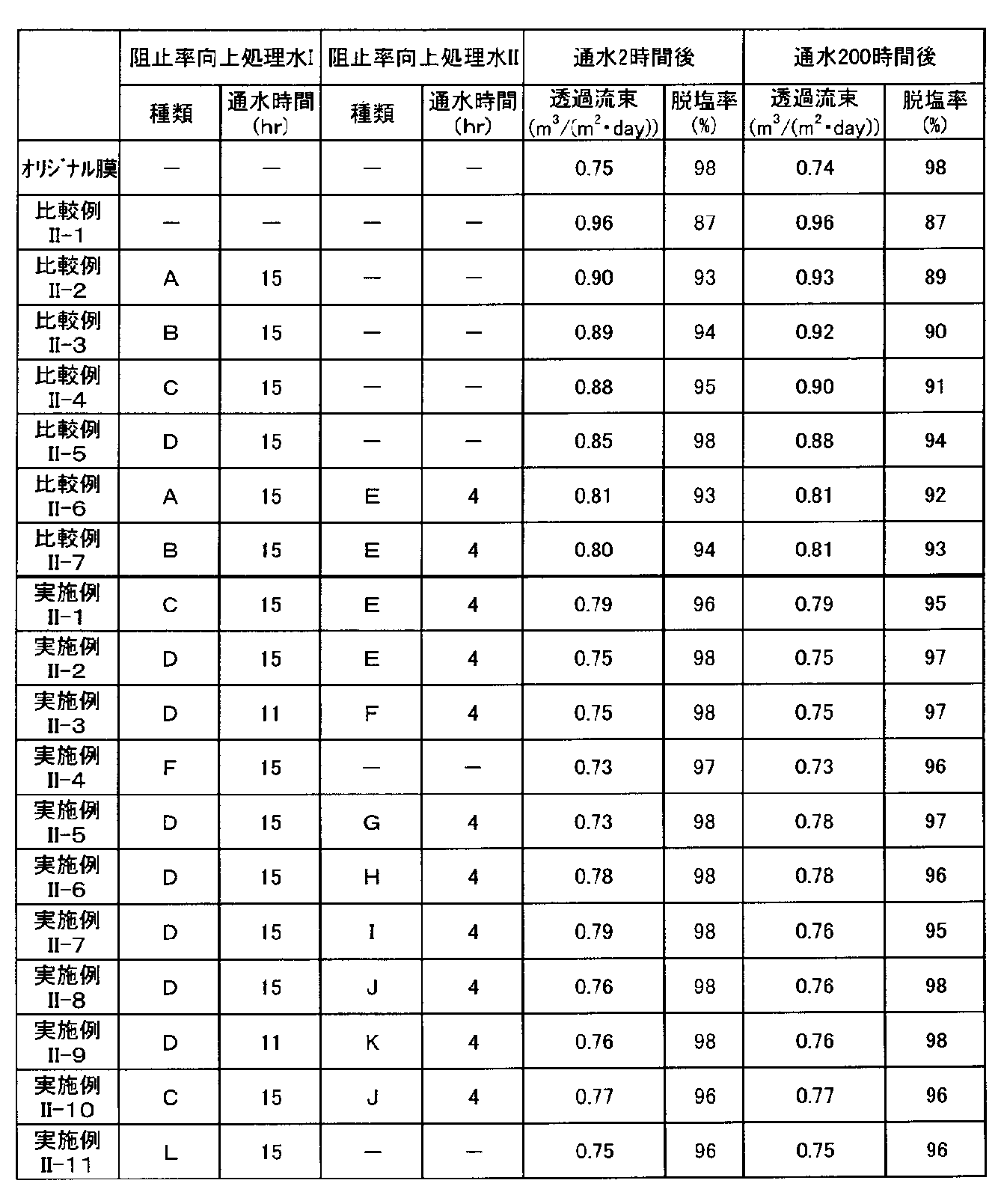
- Examples II to 1 to 11, Comparative Examples II-1 to 5 In Examples II-1 to 3, II-5 to 10 and Comparative Examples II-6 and 7, after passing through the deteriorated membrane the treated water I shown in Table 3 for the time shown in Table 3, The rejection rate improved treated water II shown in Table 3 was passed for the time shown in Table 3, and then performance evaluation was performed.
- Comparative Example II-1 the performance of the deteriorated film was evaluated without performing the rejection improvement process.
- the RO membrane subjected to the blocking rate improvement treatment of the present invention is excellent in removal performance (blocking rate) stability and flux stability (persistence of contamination resistance).
Landscapes
- Chemical & Material Sciences (AREA)
- Chemical Kinetics & Catalysis (AREA)
- Organic Chemistry (AREA)
- Engineering & Computer Science (AREA)
- Health & Medical Sciences (AREA)
- Medicinal Chemistry (AREA)
- Polymers & Plastics (AREA)
- Life Sciences & Earth Sciences (AREA)
- Water Supply & Treatment (AREA)
- Inorganic Chemistry (AREA)
- Manufacturing & Machinery (AREA)
- Hydrology & Water Resources (AREA)
- Environmental & Geological Engineering (AREA)
- Materials Engineering (AREA)
- Wood Science & Technology (AREA)
- Nanotechnology (AREA)
- Separation Using Semi-Permeable Membranes (AREA)
Abstract
Description
(1) アニオン又はカチオンのイオン性高分子化合物を膜表面に付着させることにより、阻止率を向上させる方法(特許文献2)
(2) ポリアルキレングリコール鎖を有する化合物を膜表面に付着させることにより、ナノ濾過膜やRO膜の阻止率を向上させる方法(特許文献3)
(3) タンニン酸などを劣化膜に付着させて脱塩率を改善させる方法(非特許文献2)
RO膜は、膜を介する溶液間の浸透圧差以上の圧力を高濃度側にかけると、溶媒を透過させ、溶質を阻止する液体分離膜である。RO膜の膜構造としては、非対称膜、複合膜などの高分子膜などを挙げることができる。本発明において、阻止率向上処理に供されるRO膜の素材としては、例えば、芳香族系ポリアミド、脂肪族系ポリアミド、これらの複合材などのポリアミド系素材、酢酸セルロースなどのセルロース系素材などを挙げることができる。これらの中で、芳香族ポリアミドを緻密層とするポリアミド系RO膜が挙げられるが、ポリアミド系のナノ濾過膜を対象としてもかまわない。すなわち、本発明で処理対象とするRO膜はナノ濾過膜を含有する広義のRO膜である。
本発明において用いるポリフェノールとしては、RO膜表面を効果的に被覆し、且つ定着する点において、分子量500以上、特に分子量500~500,000、とりわけ分子量500~50,000のポリフェノールが好ましく、例えば、タンニン酸、リグニン、リグニン誘導体などを挙げることができる。タンニン酸としては、五倍子、没食子、ケブラチョ、ミモザなどのタンニン酸を挙げることができる。これらのポリフェノールは、1種を単独で用いてもよく、2種以上を併用してもよい。
第2の阻止率向上成分としては、以下の変性ポリビニルアルコール、高分子多糖類及びポリアミノ酸のうちの1種のみを用いてもよく、これらの2種以上を組み合わせて用いてもよい。
変性ポリビニルアルコールはビニルアルコールユニットと変性基が結合しているユニットとで構成され、場合により更に酢酸ビニルユニットを含む。
高分子多糖類としては、特に食品添加物として使用される、分子量1万以上の高分子多糖類であって、RO膜に対する吸着性の高いものを好ましく用いることができる。高分子多糖類の分子量の上限は特になく、水溶性を示すものであれば使用できる。このような高分子多糖類としては、例えば、キサンタンガム(分子量:200万以上)、グアーガム(分子量:20~30万)、カルボキシメチルセルロース及びその塩(分子量:5万以上)、アルギン酸及びその塩(分子量:1万以上)、キトサン(分子量:1万以上)などを挙げることができる。
ポリアミノ酸としては、分子量1000以上、100万以下で、1種のアミノ酸の重合物であるポリリジン、ポリグリシン、ポリグルタミン酸などを用いることができ、また、2種以上のアミノ酸の重合物も用いることができる。特に塩基性アミノ酸の重合物であるポリリジン、ポリアルギニン、ポリヒスチジンを好適に用いることができる。特に、ポリリジンはポリフェノールとの静電的相互作用が強く、ポリフェノールとの併用で高い阻止率向上処理効果を得ることができ、好ましい。これらのポリアミノ酸は、1種を単独で用いてもよく、2種以上を併用してもよい。
本発明においては、ポリフェノール及び第2の阻止率向上成分の他、更に分子量1000以下のアミノ基を有する有機化合物(低分子量アミノ化合物)を用いて阻止率向上処理を行ってもよく、低分子量アミノ化合物を併用することにより、より一層阻止率向上効果を高めることができる。
本発明において、ポリフェノールや第2の阻止率向上成分、更に上記低分子量アミノ化合物の水溶液中の濃度については、これらのうちの1種のみが含まれている場合は、その濃度として、また、これらの2種以上が含まれている場合はその合計の濃度として、1.0~5,000mg/L、特に1.0~2,000mg/Lとすることが好ましい。この濃度が低すぎると長期間の処理が必要になり、好ましくない。また、この濃度が高すぎると、膜の表面で多層的に吸着し、劣化部位に到達しない化合物が増え、補修効率が悪くなる。
本発明による阻止率向上処理に先立って、RO膜の洗浄処理を行うことが好ましい。本発明による阻止率向上処理は、RO膜の洗浄後、そのまま洗浄装置で阻止率向上成分を含む水溶液を循環させて行うことが好ましい。
(1) ポリフェノールと第2の阻止率向上成分とを含む水溶液をRO膜に通水する。
(2) ポリフェノールを含む水溶液をRO膜に通水した後第2の阻止率向上成分を含む水溶液をRO膜に通水する。
(3) ポリフェノールを含む水溶液をRO膜に通水した後、ポリフェノールと第2の阻止率向上成分を含む水溶液をRO膜に通水する。
(4) ポリフェノールと第2の阻止率向上成分と低分子量アミノ化合物とを含む水溶液をRO膜に通水する。
(5) ポリフェノールと低分子量アミノ化合物とを含む水溶液をRO膜に通水した後第2の阻止率向上成分を含む水溶液をRO膜に通水する。
(6) ポリフェノールと低分子量アミノ化合物とを含む水溶液をRO膜に通水した後、ポリフェノールと低分子量アミノ化合物と第2の阻止率向上成分を含む水溶液をRO膜に通水する。
[実施例I-1]
日東電工社製芳香族ポリアミド系超低圧RO膜「ES20」を以下の劣化条件で塩素劣化させた後、低分子量アミノ化合物としてアルギニン(味の素製、分子量:174)とアスパルテーム(味の素製、分子量:294)を用い、ポリフェノールとしてタンニン酸AL(富士化学工業製、分子量500以上)を、変性ポリビニルアルコールとして、カチオン変性ポリビニルアルコール「ゴーセファイマーK-210」(日本合成化学工業製)を用いて、以下の条件で阻止率向上処理を行った。各阻止率向上成分の添加順序と通水時間としては、アルギニン、アスパルテーム、タンニン酸ALを混合した水溶液を3時間通水した後、その水溶液にゴーセファイマーK-210を追加し、1時間処理を行った。
次亜塩素酸ナトリウム100ppmの水溶液(pH7.0)を入口圧力0.75MPa、水温25℃で24時間通水した。
各々の阻止率向上のための成分濃度:100mg/L
入口圧力:0.2MPa
透過流束:0.3m3/(m2・day)
水温:25℃
NaCl濃度:500mg/L
入口圧力:0.75MPa
水温:25℃
pH:6.5~7.0
水温:25℃
pH:6.5~7.0
回収率:80%、
通水時間:200時間
変性ポリビニルアルコールを「エコマティWO-320N」(ポリアルキレンオキサイド鎖を有する変性ポリビニルアルコール)に変更した以外は、実施例I-1と同様の阻止率向上処理を行い、性能、安定性を評価した。
変性ポリビニルアルコールを「ゴーセナールT-330H」(カルボキシル基変性ポリビニルアルコール)に変更した以外は実施例I-1と同様の阻止率向上処理を行い、性能、安定性を評価した。
変性ポリビニルアルコールを「ゴーセランL-3266」(スルホン酸基変性ポリビニルアルコール)に変更した以外は実施例I-1と同様の阻止率向上処理を行い、性能、安定性を評価した。
低分子量アミノ化合物をアルギニンのみに変更した以外はそれぞれ実施例I-1~4と同様の阻止率向上処理を行い、性能、安定性を評価した。
低分子量アミノ化合物を使用せずに阻止率向上処理を行った点以外は実施例I-1と同様の阻止率向上処理を行い、性能、安定性を評価した。
変性ポリビニルアルコールを「エコマティWO-320N」に変更した以外は実施例I-9と同様の阻止率向上処理を行い、性能、安定性を評価した。
変性ポリビニルアルコールとして「エコマティWO-320N」と「ゴーセファイマーK-210」を併用した以外は、実施例I-9と同様の阻止率向上処理を行い、性能、安定性を評価した。
低分子量アミノ化合物とポリフェノールと変性ポリビニルアルコールとをすべて混合した水溶液を4時間通水したこと以外は、それぞれ実施例I-1~4と同様の阻止率向上処理を行い、性能、安定性を評価した。
ポリフェノールのみで阻止率向上処理を行い、低分子量アミノ化合物と変性ポリビニルアルコールを用いない以外は実施例I-1と同様の阻止率向上処理を行い、性能、安定性を評価した。
変性ポリビニルアルコールを使用しない以外は実施例I-1と同様の阻止率向上処理を行い、性能、安定性を評価した。
低分子量アミノ化合物を使用せず、変性ポリビニルアルコールの代わりにポリビニルアルコール(平均重合度2,000、けん化度99%、キシダ化学製)を使用した以外は実施例I-1と同様の阻止率向上処理を行い、性能、安定性を評価した。
透過流束[m3/(m2・day)]=透過水量[m3/day]/膜面積[m2]×温度換算係数[-]
脱塩率[%]=(1-透過液の導電率[mS/m]/濃縮液の導電率[mS/m])×100
除去率[%]=(1-透過液のTOC[mg/L]/濃縮液のTOC[mg/L])×100

以下の実施例及び比較例では、阻止率向上処理に供する劣化膜としては、以下のものを用いた。
劣化膜:日東電工社製芳香族ポリアミド系超低圧RO膜「ES20」(オリジナル膜)を、次亜塩素酸ナトリウム(遊離塩素100mg/L)を含む水溶液に24時間浸漬して加速劣化させたもの。
水溶液A:50mg/Lアルギニン水溶液
水溶液B:50mg/Lアルギニン、50mg/Lアスパルテーム
水溶液
水溶液C:50mg/Lタンニン酸水溶液
水溶液D:50mg/Lアルギニン、50mg/Lアスパルテーム、
50mg/Lタンニン酸水溶液
水溶液E:50mg/Lキサンタンガム水溶液
水溶液F:50mg/Lアルギニン、50mg/Lアスパルテーム、
50mg/Lタンニン酸、50mg/Lキサンタンガム
水溶液
水溶液G:50mg/Lグアーガム水溶液
水溶液H:50mg/Lアルギン酸ナトリウム水溶液
水溶液I:50mg/Lカルボキシメチルセルロース水溶液
水溶液J:50mg/Lポリリジン水溶液
水溶液K:50mg/Lアルギニン、50mg/Lアスパルテーム、
50mg/Lタンニン酸、50mg/Lポリリジン
水溶液(凝集を避けるため塩酸でpH3.5に調整)
水溶液L:50mg/Lタンニン酸、50mg/Lポリリジン
水溶液(凝集を避けるため塩酸でpH3.5に調整)
実施例II-1~3、II-5~10及び比較例II-6,7においては、劣化膜に表3に示す阻止率向上処理水Iを表3に示す時間通水した後、表3に示す阻止率向上処理水IIを表3に示す時間通水し、その後性能評価を行った。
本出願は、2012年12月28日付で出願された日本特許出願2012-287663に基づいており、その全体が引用により援用される。
1A 原水室
1B 透過水室
2 平膜セル
3 スターラー
21 RO膜
22 ポリフェノール
23 第2の阻止率向上成分
24 低分子量アミノ化合物
Claims (19)
- ポリフェノールを含む水溶液を逆浸透膜に通水する工程を有する逆浸透膜の阻止率向上方法において、更に、変性ポリビニルアルコール、高分子多糖類及びポリアミノ酸よりなる群から選ばれる1種又は2種以上を含む水溶液を逆浸透膜に通水する工程を有することを特徴とする逆浸透膜の阻止率向上方法。
- 請求項1において、ポリフェノールと、変性ポリビニルアルコール、高分子多糖類及びポリアミノ酸よりなる群から選ばれる1種又は2種以上とを含む水溶液を逆浸透膜に通水することを特徴とする逆浸透膜の阻止率向上方法。
- 請求項1において、ポリフェノールを含む水溶液を逆浸透膜に通水した後、変性ポリビニルアルコール、高分子多糖類及びポリアミノ酸よりなる群から選ばれる1種又は2種以上を含む水溶液を逆浸透膜に通水することを特徴とする逆浸透膜の阻止率向上方法。
- 請求項3において、変性ポリビニルアルコール、高分子多糖類及びポリアミノ酸よりなる群から選ばれる1種又は2種以上を含む水溶液が、ポリフェノールを含むことを特徴とする逆浸透膜の阻止率向上方法。
- 請求項1ないし4のいずれか1項において、更に、分子量1000以下のアミノ基を有する有機化合物を含む水溶液を逆浸透膜に通水する工程を有することを特徴とする逆浸透膜の阻止率向上方法。
- 請求項5において、ポリフェノールと、変性ポリビニルアルコール、高分子多糖類及びポリアミノ酸よりなる群から選ばれる1種又は2種以上と、分子量1000以下のアミノ基を有する有機化合物とを含む水溶液を逆浸透膜に通水することを特徴とする逆浸透膜の阻止率向上方法。
- 請求項5において、ポリフェノールと分子量1000以下のアミノ基を有する有機化合物とを含む水溶液を逆浸透膜に通水した後、変性ポリビニルアルコール、高分子多糖類及びポリアミノ酸よりなる群から選ばれる1種又は2種以上を含む水溶液を通水することを特徴とする逆浸透膜の阻止率向上方法。
- 請求項7において、変性ポリビニルアルコール、高分子多糖類及びポリアミノ酸よりなる群から選ばれる1種又は2種以上を含む水溶液が、ポリフェノールと分子量1000以下のアミノ基を有する有機化合物を含むことを特徴とする逆浸透膜の阻止率向上方法。
- 請求項1において、前記ポリフェノールがタンニン酸であることを特徴とする逆浸透膜の阻止率向上方法。
- 請求項1において、前記ポリアミノ酸がポリリジンであることを特徴とする逆浸透膜の阻止率向上方法。
- 請求項1において、変性ポリビニルアルコールが、変性基としてカチオン性基を有するカチオン変性ポリビニルアルコール、変性基としてアニオン性基を有するアニオン変性ポリビニルアルコール、およびポリアルキレンオキサイド鎖を有する変性ポリビニルアルコールよりなる群から選ばれる1種又は2種以上であることを特徴とする逆浸透膜の阻止率向上方法。
- 請求項1において、高分子多糖類が、キサンタンガム、グアーガム、カルボキシメチルセルロース及びその塩、アルギン酸及びその塩、並びにキトサンよりなる群から選ばれる1種又は2種以上であることを特徴とする逆浸透膜の阻止率向上方法。
- 請求項1において、水溶液中の濃度と逆浸透膜に通水する水溶液量とで算出される、ポリフェノールと、変性ポリビニルアルコール、高分子多糖類及びポリアミノ酸よりなる群から選ばれる1種又は2種以上との逆浸透膜への合計の供給量が、重量比で、ポリフェノール:変性ポリビニルアルコール、高分子多糖類及びポリアミノ酸よりなる群から選ばれる1種又は2種以上=1:0.1~5の範囲であることを特徴とする逆浸透膜の阻止率向上方法。
- 請求項5において、分子量1000以下のアミノ基を有する有機化合物がアルギニン及び/又はアスパルテームであることを特徴とする逆浸透膜の阻止率向上方法。
- 請求項5において、水溶液中の濃度と逆浸透膜に通水する水溶液量とで算出される、ポリフェノールと分子量1000以下のアミノ基を有する有機化合物との逆浸透膜への合計の供給量が、重量比で、ポリフェノール:分子量1000以下のアミノ基を有する有機化合物=1:0~2の範囲あることを特徴とする逆浸透膜の阻止率向上方法。
- 請求項1において、前記通水時の圧力が0.1~0.5MPaで、透過流束が0.1~1.0m3/(m2・day)であることを特徴とする逆浸透膜の阻止率向上方法。
- 請求項1ないし16のいずれか1項に記載の阻止率向上方法によって処理された逆浸透膜。
- ポリフェノールと、変性ポリビニルアルコール、高分子多糖類及びポリアミノ酸よりなる群から選ばれる1種又は2種以上とを含むことを特徴とする逆浸透膜の阻止率向上処理剤。
- 請求項18において、更に分子量1000以下のアミノ基を有する有機化合物を含むことを特徴とする逆浸透膜の阻止率向上処理剤。
Priority Applications (4)
| Application Number | Priority Date | Filing Date | Title |
|---|---|---|---|
| ES201590070A ES2546703B2 (es) | 2012-12-28 | 2013-12-18 | Procedimiento para la mejora de la tasa de rechazo de membranas de osmosis inversa, agente para la mejora de la tasa de rechazo y membrana de osmosis inversa |
| US14/649,790 US10046280B2 (en) | 2012-12-28 | 2013-12-18 | Method for improving rejection rate of reverse osmosis membrane |
| CN201380068872.5A CN104884152B (zh) | 2012-12-28 | 2013-12-18 | 逆渗透膜的阻止率提高方法、阻止率提高处理剂及逆渗透膜 |
| SA515360694A SA515360694B1 (ar) | 2012-12-28 | 2015-06-28 | طريقة لتحسين معدل الطرد لغشاء تناضح عكسي، وعامل لتحسين معدل الطرد، وغشاء تناضح عكسي |
Applications Claiming Priority (2)
| Application Number | Priority Date | Filing Date | Title |
|---|---|---|---|
| JP2012-287663 | 2012-12-28 | ||
| JP2012287663A JP6251953B2 (ja) | 2012-12-28 | 2012-12-28 | 逆浸透膜の阻止率向上方法 |
Publications (1)
| Publication Number | Publication Date |
|---|---|
| WO2014103822A1 true WO2014103822A1 (ja) | 2014-07-03 |
Family
ID=51020909
Family Applications (1)
| Application Number | Title | Priority Date | Filing Date |
|---|---|---|---|
| PCT/JP2013/083850 Ceased WO2014103822A1 (ja) | 2012-12-28 | 2013-12-18 | 逆浸透膜の阻止率向上方法、阻止率向上処理剤及び逆浸透膜 |
Country Status (7)
| Country | Link |
|---|---|
| US (1) | US10046280B2 (ja) |
| JP (1) | JP6251953B2 (ja) |
| CN (1) | CN104884152B (ja) |
| ES (1) | ES2546703B2 (ja) |
| SA (1) | SA515360694B1 (ja) |
| TW (1) | TWI607797B (ja) |
| WO (1) | WO2014103822A1 (ja) |
Cited By (4)
| Publication number | Priority date | Publication date | Assignee | Title |
|---|---|---|---|---|
| CN107530637A (zh) * | 2015-05-20 | 2018-01-02 | 栗田工业株式会社 | 反渗透膜的清洁剂、清洁液以及清洁方法 |
| US10532327B2 (en) * | 2015-07-20 | 2020-01-14 | Ecolab Usa Inc. | Methods of conditioning membranes |
| WO2023276781A1 (ja) * | 2021-06-30 | 2023-01-05 | 三菱重工業株式会社 | 逆浸透膜の脱塩性能回復方法及び逆浸透膜の脱塩性能回復装置 |
| US12036513B2 (en) | 2019-10-24 | 2024-07-16 | Mitsubishi Heavy Industries, Ltd. | Desalination performance restoration agent for cellulose acetate membrane and desalination performance restoration method for cellulose acetate membrane |
Families Citing this family (18)
| Publication number | Priority date | Publication date | Assignee | Title |
|---|---|---|---|---|
| ES2906437T3 (es) * | 2015-01-09 | 2022-04-18 | Toray Industries | Método para mejorar el rendimiento de inhibición de membrana semipermeable |
| JPWO2016111370A1 (ja) * | 2015-01-09 | 2017-10-19 | 東レ株式会社 | 水処理方法 |
| JP6747926B2 (ja) * | 2015-09-30 | 2020-08-26 | 日東電工株式会社 | スパイラル型分離膜エレメントの製造方法 |
| WO2018042060A1 (de) * | 2016-09-05 | 2018-03-08 | Drei Lilien Pvg Gmbh & Co. Kg | Offenporige membran mit innerem raumdurchspannendem polymerem strukturnetzwerk zur elektrophoretischen stoffselektiven separation sowie verfahren zu deren herstellung und anwendung |
| JP6780427B2 (ja) * | 2016-10-06 | 2020-11-04 | 東洋紡株式会社 | 分離膜モジュールの再生方法 |
| CN109289551B (zh) * | 2017-07-25 | 2021-12-21 | 中国石油化工股份有限公司 | 反渗透膜及其制备方法和应用 |
| JP7115239B2 (ja) * | 2018-11-12 | 2022-08-09 | 株式会社島津テクノリサーチ | 分析装置及び該分析装置に用いられる濃縮装置 |
| CN109499383A (zh) * | 2018-11-22 | 2019-03-22 | 唐山钢铁集团有限责任公司 | 一种ro膜修补剂及修补方法 |
| CN112870990B (zh) * | 2021-01-11 | 2023-01-31 | 中化(宁波)润沃膜科技有限公司 | 一种抗菌耐污染反渗透复合膜及其制备方法 |
| CN113559720B (zh) * | 2021-07-12 | 2022-08-05 | 武汉理工大学 | 拥有仿肝素改性涂层的聚醚砜血液透析膜及其制备方法、应用 |
| US11502323B1 (en) | 2022-05-09 | 2022-11-15 | Rahul S Nana | Reverse electrodialysis cell and methods of use thereof |
| US11502322B1 (en) | 2022-05-09 | 2022-11-15 | Rahul S Nana | Reverse electrodialysis cell with heat pump |
| US12040517B2 (en) | 2022-11-15 | 2024-07-16 | Rahul S. Nana | Reverse electrodialysis or pressure-retarded osmosis cell and methods of use thereof |
| JP2025538227A (ja) | 2022-11-15 | 2025-11-26 | エス ナナ,ラフル | 逆電気透析または圧力遅延浸透セルおよびその使用方法 |
| US11855324B1 (en) | 2022-11-15 | 2023-12-26 | Rahul S. Nana | Reverse electrodialysis or pressure-retarded osmosis cell with heat pump |
| CN117018866B (zh) * | 2023-08-29 | 2026-03-24 | 北京工业大学 | 一种用于低分子量有机物筛分的纳滤膜及其制备方法 |
| JP2026030367A (ja) * | 2024-08-08 | 2026-02-20 | 三菱重工業株式会社 | ポリアミド膜用の脱塩性能回復剤、ポリアミド膜の脱塩性能回復方法、及びポリアミド膜の脱塩性能向上方法 |
| CN118954707B (zh) * | 2024-10-14 | 2025-01-24 | 成都之和环保科技有限公司 | 倒序反渗透高倍浓缩工艺 |
Citations (9)
| Publication number | Priority date | Publication date | Assignee | Title |
|---|---|---|---|---|
| JPS553866A (en) * | 1978-06-26 | 1980-01-11 | Toyobo Co Ltd | Reforming method of semipermeable membrane |
| JPH03278817A (ja) * | 1990-03-27 | 1991-12-10 | Snow Brand Milk Prod Co Ltd | 膜分離工程の前処理法 |
| JPH07185280A (ja) * | 1993-12-27 | 1995-07-25 | Kanegafuchi Chem Ind Co Ltd | 親水性ポリスルホン膜およびその製法 |
| JP2001149759A (ja) * | 1999-11-30 | 2001-06-05 | Toray Ind Inc | 逆浸透分離装置、それを用いた造水方法 |
| JP2009056406A (ja) * | 2007-08-31 | 2009-03-19 | Kurita Water Ind Ltd | 透過膜の阻止率向上方法、阻止率向上透過膜および透過膜装置 |
| US20100133172A1 (en) * | 2008-12-01 | 2010-06-03 | Qun Song | Fouling resistant coating for membrane surfaces |
| US20120080058A1 (en) * | 2010-10-04 | 2012-04-05 | Saudi Arabian Oil Company | Application of Rejection Enhancing Agents (REAs) that do not have Cloud Point Limitations on Desalination Membranes |
| JP2012187468A (ja) * | 2011-03-09 | 2012-10-04 | Kurita Water Ind Ltd | 透過膜の阻止率向上方法、阻止率向上処理剤及び透過膜 |
| JP2012250192A (ja) * | 2011-06-03 | 2012-12-20 | Nitto Denko Corp | 複合半透膜及びその製造方法 |
Family Cites Families (11)
| Publication number | Priority date | Publication date | Assignee | Title |
|---|---|---|---|---|
| US4765897A (en) * | 1986-04-28 | 1988-08-23 | The Dow Chemical Company | Polyamide membranes useful for water softening |
| JP3212129B2 (ja) * | 1992-03-11 | 2001-09-25 | ダイセル化学工業株式会社 | 新規複合分離膜およびそれを用いた排水の処理方法 |
| JP3399636B2 (ja) | 1994-05-16 | 2003-04-21 | 日東電工株式会社 | 逆浸透膜モジュ−ルによる海水淡水化での海水の前処理方法 |
| SG181175A1 (en) * | 2003-02-25 | 2012-06-28 | Kurita Water Ind Ltd | Detergent for washing selectively permeable membrane and method for washing |
| JP2005329334A (ja) * | 2004-05-20 | 2005-12-02 | Kurita Water Ind Ltd | 水処理方法及び水処理装置 |
| JP2006102624A (ja) * | 2004-10-05 | 2006-04-20 | Nitto Denko Corp | 逆浸透膜及びその製造方法 |
| JP4868108B2 (ja) | 2004-10-18 | 2012-02-01 | 栗田工業株式会社 | 透過膜の阻止率向上剤、阻止率向上方法、透過膜及び水処理方法 |
| JP5151152B2 (ja) * | 2006-03-29 | 2013-02-27 | 栗田工業株式会社 | ナノろ過膜又は逆浸透膜の阻止率向上剤、阻止率向上方法、ナノろ過膜又は逆浸透膜、水処理方法、及び、水処理装置 |
| JP2009022886A (ja) * | 2007-07-19 | 2009-02-05 | Kurita Water Ind Ltd | 透過膜の阻止率向上方法、阻止率向上透過膜、透過膜処理方法および装置 |
| CN102695555B (zh) | 2009-09-29 | 2015-11-25 | 栗田工业株式会社 | 提高透过膜阻止率的方法及透过膜 |
| JP5772083B2 (ja) | 2011-03-09 | 2015-09-02 | 栗田工業株式会社 | 逆浸透膜の阻止率向上方法、阻止率向上処理剤及び逆浸透膜 |
-
2012
- 2012-12-28 JP JP2012287663A patent/JP6251953B2/ja active Active
-
2013
- 2013-12-18 ES ES201590070A patent/ES2546703B2/es not_active Expired - Fee Related
- 2013-12-18 CN CN201380068872.5A patent/CN104884152B/zh active Active
- 2013-12-18 US US14/649,790 patent/US10046280B2/en active Active
- 2013-12-18 WO PCT/JP2013/083850 patent/WO2014103822A1/ja not_active Ceased
- 2013-12-24 TW TW102147966A patent/TWI607797B/zh not_active IP Right Cessation
-
2015
- 2015-06-28 SA SA515360694A patent/SA515360694B1/ar unknown
Patent Citations (9)
| Publication number | Priority date | Publication date | Assignee | Title |
|---|---|---|---|---|
| JPS553866A (en) * | 1978-06-26 | 1980-01-11 | Toyobo Co Ltd | Reforming method of semipermeable membrane |
| JPH03278817A (ja) * | 1990-03-27 | 1991-12-10 | Snow Brand Milk Prod Co Ltd | 膜分離工程の前処理法 |
| JPH07185280A (ja) * | 1993-12-27 | 1995-07-25 | Kanegafuchi Chem Ind Co Ltd | 親水性ポリスルホン膜およびその製法 |
| JP2001149759A (ja) * | 1999-11-30 | 2001-06-05 | Toray Ind Inc | 逆浸透分離装置、それを用いた造水方法 |
| JP2009056406A (ja) * | 2007-08-31 | 2009-03-19 | Kurita Water Ind Ltd | 透過膜の阻止率向上方法、阻止率向上透過膜および透過膜装置 |
| US20100133172A1 (en) * | 2008-12-01 | 2010-06-03 | Qun Song | Fouling resistant coating for membrane surfaces |
| US20120080058A1 (en) * | 2010-10-04 | 2012-04-05 | Saudi Arabian Oil Company | Application of Rejection Enhancing Agents (REAs) that do not have Cloud Point Limitations on Desalination Membranes |
| JP2012187468A (ja) * | 2011-03-09 | 2012-10-04 | Kurita Water Ind Ltd | 透過膜の阻止率向上方法、阻止率向上処理剤及び透過膜 |
| JP2012250192A (ja) * | 2011-06-03 | 2012-12-20 | Nitto Denko Corp | 複合半透膜及びその製造方法 |
Cited By (11)
| Publication number | Priority date | Publication date | Assignee | Title |
|---|---|---|---|---|
| CN107530637A (zh) * | 2015-05-20 | 2018-01-02 | 栗田工业株式会社 | 反渗透膜的清洁剂、清洁液以及清洁方法 |
| KR20180008502A (ko) * | 2015-05-20 | 2018-01-24 | 쿠리타 고교 가부시키가이샤 | 역침투막의 세정제, 세정액, 및 세정 방법 |
| EP3299081A4 (en) * | 2015-05-20 | 2019-01-23 | Kurita Water Industries Ltd. | REVERSE OSMOSEMBRANE CLEANER, CLEANING SOLUTION AND CLEANING PROCEDURE |
| AU2016263761B2 (en) * | 2015-05-20 | 2020-02-20 | Kurita Water Industries Ltd. | Reverse osmosis membrane cleaner, cleaning solution, and cleaning method |
| KR102293103B1 (ko) | 2015-05-20 | 2021-08-23 | 쿠리타 고교 가부시키가이샤 | 역침투막의 세정제, 세정액, 및 세정 방법 |
| IL255360B (en) * | 2015-05-20 | 2021-10-31 | Kurita Water Ind Ltd | Agent, liquid, and method for cleaning reverse osmosis membrane |
| US10532327B2 (en) * | 2015-07-20 | 2020-01-14 | Ecolab Usa Inc. | Methods of conditioning membranes |
| US12036513B2 (en) | 2019-10-24 | 2024-07-16 | Mitsubishi Heavy Industries, Ltd. | Desalination performance restoration agent for cellulose acetate membrane and desalination performance restoration method for cellulose acetate membrane |
| WO2023276781A1 (ja) * | 2021-06-30 | 2023-01-05 | 三菱重工業株式会社 | 逆浸透膜の脱塩性能回復方法及び逆浸透膜の脱塩性能回復装置 |
| JP2023006398A (ja) * | 2021-06-30 | 2023-01-18 | 三菱重工業株式会社 | 逆浸透膜の脱塩性能回復方法 |
| JP7254309B2 (ja) | 2021-06-30 | 2023-04-10 | 三菱重工業株式会社 | 逆浸透膜の脱塩性能回復方法 |
Also Published As
| Publication number | Publication date |
|---|---|
| CN104884152B (zh) | 2017-10-13 |
| US10046280B2 (en) | 2018-08-14 |
| TWI607797B (zh) | 2017-12-11 |
| JP2014128760A (ja) | 2014-07-10 |
| TW201440880A (zh) | 2014-11-01 |
| ES2546703A2 (es) | 2015-09-25 |
| SA515360694B1 (ar) | 2018-05-24 |
| US20150306545A1 (en) | 2015-10-29 |
| CN104884152A (zh) | 2015-09-02 |
| JP6251953B2 (ja) | 2017-12-27 |
| ES2546703R1 (es) | 2016-01-11 |
| ES2546703B2 (es) | 2016-10-07 |
Similar Documents
| Publication | Publication Date | Title |
|---|---|---|
| JP6251953B2 (ja) | 逆浸透膜の阻止率向上方法 | |
| Liu et al. | Crosslinked layer-by-layer polyelectrolyte nanofiltration hollow fiber membrane for low-pressure water softening with the presence of SO42− in feed water | |
| JP5633517B2 (ja) | 透過膜の阻止率向上方法及び透過膜 | |
| CN103429324B (zh) | 逆渗透膜的阻止率提高方法、阻止率提高处理剂及逆渗透膜 | |
| TW200819399A (en) | Method of heavy metal removal from industrial wastewater using submerged ultrafiltration or microfiltration membranes | |
| JP2015097990A (ja) | 逆浸透膜の阻止率向上方法、逆浸透膜、及び水処理方法 | |
| JP5914973B2 (ja) | 透過膜の阻止率向上方法及び阻止率向上処理剤 | |
| JP5772083B2 (ja) | 逆浸透膜の阻止率向上方法、阻止率向上処理剤及び逆浸透膜 | |
| AU2013247863B2 (en) | Agent and method for improving blocking rate of reverse osmosis membrane, and reverse osmosis membrane | |
| US10532328B2 (en) | Polyaniline-based chlorine resistant hydrophilic filtration membranes | |
| JP5018306B2 (ja) | 透過膜の阻止率向上方法、透過膜処理方法および装置 | |
| JP5929296B2 (ja) | 逆浸透膜の阻止率向上方法 | |
| JP2014050783A (ja) | 逆浸透膜の阻止率向上方法 | |
| MAIDAULA | COMB-SHAPED AMPHIPHILIC POLYMERS FOR MEMBRANE FOULING TREATMENT | |
| WO2014107523A2 (en) | Chlorine-tolerant polyamide derivatives for preparing biofouling-resistant reverse osmosis membranes and membranes made therefrom |
Legal Events
| Date | Code | Title | Description |
|---|---|---|---|
| 121 | Ep: the epo has been informed by wipo that ep was designated in this application |
Ref document number: 13866709 Country of ref document: EP Kind code of ref document: A1 |
|
| WWE | Wipo information: entry into national phase |
Ref document number: 14649790 Country of ref document: US |
|
| WWE | Wipo information: entry into national phase |
Ref document number: P201590070 Country of ref document: ES |
|
| NENP | Non-entry into the national phase |
Ref country code: DE |
|
| 122 | Ep: pct application non-entry in european phase |
Ref document number: 13866709 Country of ref document: EP Kind code of ref document: A1 |