WO2014061341A1 - 生分解性高分子化合物 - Google Patents
生分解性高分子化合物 Download PDFInfo
- Publication number
- WO2014061341A1 WO2014061341A1 PCT/JP2013/071903 JP2013071903W WO2014061341A1 WO 2014061341 A1 WO2014061341 A1 WO 2014061341A1 JP 2013071903 W JP2013071903 W JP 2013071903W WO 2014061341 A1 WO2014061341 A1 WO 2014061341A1
- Authority
- WO
- WIPO (PCT)
- Prior art keywords
- lactic acid
- branched polymer
- caprolactone
- caprolactone copolymer
- same
- Prior art date
- Legal status (The legal status is an assumption and is not a legal conclusion. Google has not performed a legal analysis and makes no representation as to the accuracy of the status listed.)
- Ceased
Links
Classifications
-
- C—CHEMISTRY; METALLURGY
- C08—ORGANIC MACROMOLECULAR COMPOUNDS; THEIR PREPARATION OR CHEMICAL WORKING-UP; COMPOSITIONS BASED THEREON
- C08G—MACROMOLECULAR COMPOUNDS OBTAINED OTHERWISE THAN BY REACTIONS ONLY INVOLVING UNSATURATED CARBON-TO-CARBON BONDS
- C08G63/00—Macromolecular compounds obtained by reactions forming a carboxylic ester link in the main chain of the macromolecule
- C08G63/02—Polyesters derived from hydroxycarboxylic acids or from polycarboxylic acids and polyhydroxy compounds
- C08G63/06—Polyesters derived from hydroxycarboxylic acids or from polycarboxylic acids and polyhydroxy compounds derived from hydroxycarboxylic acids
- C08G63/08—Lactones or lactides
-
- A—HUMAN NECESSITIES
- A61—MEDICAL OR VETERINARY SCIENCE; HYGIENE
- A61L—METHODS OR APPARATUS FOR STERILISING MATERIALS OR OBJECTS IN GENERAL; DISINFECTION, STERILISATION OR DEODORISATION OF AIR; CHEMICAL ASPECTS OF BANDAGES, DRESSINGS, ABSORBENT PADS OR SURGICAL ARTICLES; MATERIALS FOR BANDAGES, DRESSINGS, ABSORBENT PADS OR SURGICAL ARTICLES
- A61L27/00—Materials for grafts or prostheses or for coating grafts or prostheses
-
- A—HUMAN NECESSITIES
- A61—MEDICAL OR VETERINARY SCIENCE; HYGIENE
- A61L—METHODS OR APPARATUS FOR STERILISING MATERIALS OR OBJECTS IN GENERAL; DISINFECTION, STERILISATION OR DEODORISATION OF AIR; CHEMICAL ASPECTS OF BANDAGES, DRESSINGS, ABSORBENT PADS OR SURGICAL ARTICLES; MATERIALS FOR BANDAGES, DRESSINGS, ABSORBENT PADS OR SURGICAL ARTICLES
- A61L27/00—Materials for grafts or prostheses or for coating grafts or prostheses
- A61L27/14—Macromolecular materials
- A61L27/18—Macromolecular materials obtained otherwise than by reactions only involving carbon-to-carbon unsaturated bonds
-
- C—CHEMISTRY; METALLURGY
- C08—ORGANIC MACROMOLECULAR COMPOUNDS; THEIR PREPARATION OR CHEMICAL WORKING-UP; COMPOSITIONS BASED THEREON
- C08L—COMPOSITIONS OF MACROMOLECULAR COMPOUNDS
- C08L67/00—Compositions of polyesters obtained by reactions forming a carboxylic ester link in the main chain; Compositions of derivatives of such polymers
- C08L67/04—Polyesters derived from hydroxycarboxylic acids, e.g. lactones
-
- C—CHEMISTRY; METALLURGY
- C08—ORGANIC MACROMOLECULAR COMPOUNDS; THEIR PREPARATION OR CHEMICAL WORKING-UP; COMPOSITIONS BASED THEREON
- C08L—COMPOSITIONS OF MACROMOLECULAR COMPOUNDS
- C08L101/00—Compositions of unspecified macromolecular compounds
- C08L101/16—Compositions of unspecified macromolecular compounds the macromolecular compounds being biodegradable
Definitions
- the present invention relates to a branched polymer having excellent flexibility and biodegradability, and a method for producing the branched polymer.
- a medical implant composed of a biodegradable material is decomposed and absorbed after a certain period even if it is applied to an affected part in a living body, so it is not necessary to take it out after healing, and the burden on the patient can be greatly reduced. Since such a medical implant is indwelled in a living body for a long period of time, mechanical characteristics equivalent to those of tissues and organs in the living body are required.
- the medical implant has mechanical properties different from those of living tissue, it will continue to give physical stimulation to surrounding tissue that comes into contact with the tissue when placed in the living body. There is a risk of causing an inflammatory reaction.
- a medical implant is used to supplement the dura mater or blood vessel, distortion occurs at the anastomosis between the dura mater or blood vessel of the living body and the medical implant. There are concerns about problems such as breaking of the stitched portion. Therefore, development of a material having flexibility equivalent to that of a living tissue or organ and capable of being rapidly decomposed and absorbed after being left in the living body for a certain period is expected.
- Examples of resins that are decomposed and absorbed in vivo include lactic acid- ⁇ -caprolactone copolymers, which are widely used in the medical field. Lactic acid- ⁇ -caprolactone copolymer retains its initial molecular weight in a living body for a certain period of time, and then rapidly hydrolyzes and absorbs, so that it exhibits excellent degradation behavior as a medical implant material.
- a method of performing a ring-opening polymerization reaction by changing the polymerization temperature has been generally employed.
- Patent Document 1 describes a method for producing a lactic acid- ⁇ -caprolactone copolymer with a reaction temperature exceeding 130 ° C.
- a reaction temperature exceeding 130 ° C.
- the main object of the present invention is to provide a branched polymer having excellent flexibility and biodegradability and a method for producing the branched polymer.
- a branched polymer having at least three arm parts made of a lactic acid- ⁇ -caprolactone copolymer and having a weight average molecular weight of 150,000 or more
- a film composed of a star-shaped polymer is excellent in flexibility, and can be provided with a property of being rapidly decomposed and absorbed in a living body after a certain period of time.
- the present invention has been completed by further studies based on such knowledge.
- this invention provides the biodegradable polymer compound of the aspect hung up below, and its manufacturing method.
- Item 1. A branched polymer having at least three arm portions made of a lactic acid- ⁇ -caprolactone copolymer and having a weight average molecular weight of 150,000 or more.
- Item 2. Item 2. The branched polymer according to Item 1, wherein the branched polymer is a star polymer having a core portion and at least three arm portions made of a lactic acid- ⁇ -caprolactone copolymer extending from the core portion.
- n1 to n4 are the same or different and each represents an integer of 0 to 4
- x1 to x4 are the same or different and represent 0 or 1
- R1 to R4 are the same or different and lactic acid - ⁇ -caprolactone copolymer or a hydrogen atom, and at least three of R1 to R4 represent a lactic acid- ⁇ -caprolactone copolymer.
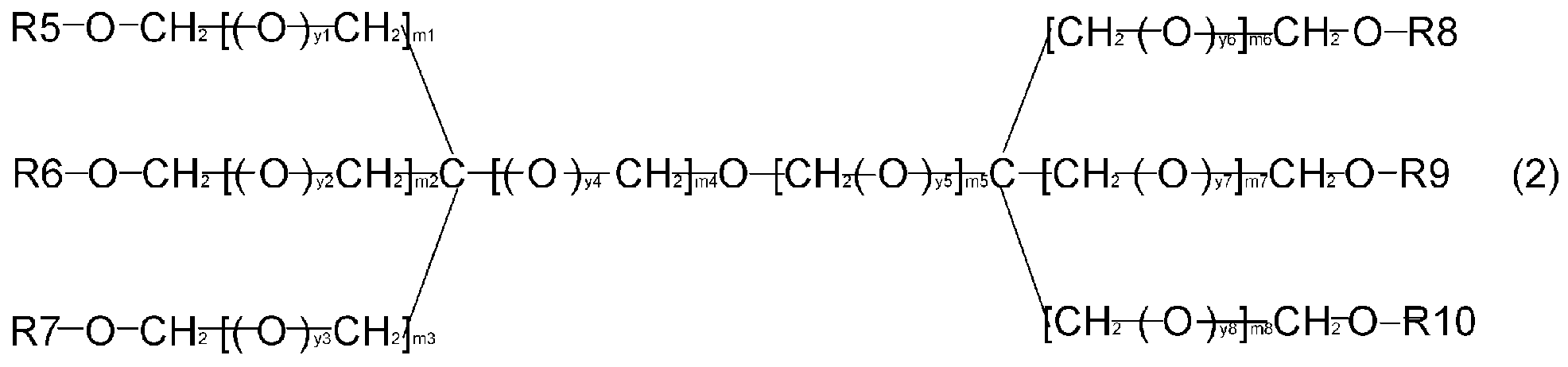
- m1 to m8 are the same or different and represent an integer of 0 to 4
- y1 to y8 are the same or different and represent 0 or 1
- R5 to R10 are the same or different, Lactic acid- ⁇ -caprolactone copolymer or a hydrogen atom, and at least three of R5 to R10 represent a lactic acid- ⁇ -caprolactone copolymer.
- Item 5 An arm portion comprising a lactic acid- ⁇ -caprolactone copolymer obtained by ring-opening polymerization of lactide and ⁇ -caprolactone in the presence of a trihydric or higher polyhydric alcohol at a reaction temperature of 130 ° C. or lower.
- Item 6. A medical material comprising the branched polymer according to any one of Items 1 to 5.
- Item 7. The medical material according to Item 6, wherein the medical material is at least one medical implant selected from the group consisting of an artificial dura mater, an artificial blood vessel, a cartilage base material, and an adhesion prevention membrane.
- Item 6. Use of the branched polymer according to any one of Items 1 to 5 for producing a medical material.
- the branched polymer of the present invention has both excellent flexibility and in vivo decomposition and absorption.
- the branched polymer of the present invention maintains the same in vivo degradation behavior as that of linear lactic acid- ⁇ -caprolactone, which is generally used as a medical material. Since it has excellent flexibility that could not be realized with a functional polymer compound, it is particularly suitable as a material for medical implants that require flexibility such as an artificial dura mater or an artificial blood vessel.
- a branched polymer having the above characteristics can be efficiently prepared.
- Branched polymer The branched polymer of the present invention has a branched structure having three or more arm portions made of a lactic acid- ⁇ -caprolactone copolymer.
- the number of arm portions made of a lactic acid- ⁇ -caprolactone copolymer may be 3 or more, preferably 3 to 10, more preferably 4 to 8, particularly preferably 4 to 6. Is mentioned.
- lactic acid is any of L-lactic acid, D-lactic acid, or a mixture of L-lactic acid and D-lactic acid.
- L-lactic acid is preferable.
- the lactic acid- ⁇ -caprolactone copolymer constituting the arm portion may be any of an alternating copolymer, a block copolymer, and a random copolymer, but is preferably a random copolymer.
- the molar ratio of lactic acid / ⁇ -caprolactone in the lactic acid- ⁇ -caprolactone copolymer constituting the arm portion is, for example, 35/65 to 65/35, preferably 40/60 to 60 / 40, more preferably 45/55 to 55/45.
- the three or more arms in the branched polymer of the present invention may be composed of lactic acid- ⁇ -caprolactone copolymers having the same composition, or composed of lactic acid- ⁇ -caprolactone copolymers having different compositions. May be.
- the weight average molecular weight per lactic acid- ⁇ -caprolactone copolymer constituting the arm part is particularly limited as long as the weight average molecular weight of the entire branched polymer described later can be satisfied.
- examples include 30,000 to 100,000, preferably 31,000 to 90,000, and more preferably 32,000 to 75,000.
- the weight average molecular weight is a value measured by gel permeation chromatography using linear polystyrene as a standard substance.
- the three or more arms in the branched polymer of the present invention may have the same weight average molecular weight or may have different weight average molecular weights.
- the weight average molecular weight of the branched polymer of the present invention is 150,000 or more, preferably 160,000 to 500,000, more preferably 190,000 to 450,000.
- the weight average molecular weight is a value measured by gel permeation chromatography using linear polystyrene as a standard substance (GPC: specific conditions are described in Examples described later).
- the structure of the branched polymer of the present invention is limited to a branched polymer having three or more arm portions made of a lactic acid- ⁇ -caprolactone copolymer, and these arm portions are connected to the core portion.
- a star shape a comb shape, an H shape, a bottle brush shape, a starburst shape, and the like may be used.
- the branched polymer structure of the present invention preferably includes a star shape.
- the structure of the core part in the branched polymer of the present invention is not particularly limited, and may be appropriately designed according to the structure of the branched polymer.
- a residue of a trihydric or higher polyhydric alcohol or a residue of a trivalent or higher polyvalent amine can be mentioned.
- the core of the branched polymer is composed of a trihydric or higher polyhydric alcohol residue, the hydroxyl group of the polyhydric alcohol is an ester bond with the carboxyl group of the lactic acid- ⁇ -caprolactone copolymer constituting the arm. It becomes the structure connected by.
- the compound constituting the core in the branched polymer include pentaerythritol, dipentaerythritol, tripentaerythritol, glycerin, diglycerin, triglycerin, sorbitol, poly (vinyl alcohol), and poly (hydroxyethyl methacrylate). ), Poly (hydroxypropyl methacrylate); monosaccharides such as glucose, galactose, mannose and fructose; and trihydric or higher polyhydric alcohols such as disaccharides such as lactose, sucrose and maltose.
- Specific examples of the trivalent or higher polyvalent amine include triethylenetetramine, polyoxyethylenetriamine, diethylenetriamine, tetraethylenepentamine, pentaethylenehexamine, and triaminopropane.
- a pentaerythritol residue or a star polymer having a dipentaerythritol residue as a core that is, each hydroxyl group of pentaerythritol or dipentaerythritol is used as a polymerization initiation point
- lactide and Examples thereof include a star polymer having a structure in which a carboxyl group of a lactic acid- ⁇ -caprolactone copolymer constituting an arm portion is connected to a hydroxyl group of a core portion by an ester bond, which is obtained by performing ring-opening polymerization of ⁇ -caprolactone.
- branched polymer a star polymer represented by the following general formula (1) or (2) is exemplified.
- n1 to n4 are the same or different and represent an integer of 0 to 4.
- n1 to n4 are preferably integers of 0 to 2, and more preferably 0.
- x1 to x4 are the same or different and represent 0 or 1. x1 to x4 are preferably 0.
- R1 to R4 are the same or different and represent a lactic acid- ⁇ -caprolactone copolymer or a hydrogen atom, and at least three of R1 to R4 are a lactic acid- ⁇ -caprolactone copolymer. Indicates.
- Preferable examples of the star polymer represented by the general formula (1) include those in which all of R1 to R4 are lactic acid- ⁇ -caprolactone copolymers.
- the at least three lactic acid- ⁇ -caprolactone copolymers constituting R1 to R4 may have the same molecular weight or may have different molecular weights.
- the molecular weight of at least three lactic acid- ⁇ -caprolactone copolymers constituting R1 to R4, the types of optical isomers of lactic acid that is a component of the copolymer, and the like are as described above.
- the lactic acid- ⁇ -caprolactone copolymer constituting R1 to R4 is linked by forming an ester bond with the oxygen atom in the general formula (1).
- m1 to m8 are the same or different and represent an integer of 0 to 4.
- m1 to m3 and m6 to m8 are preferably integers of 0 to 2, more preferably 0.
- m4 and m5 are preferably integers of 1 to 3, and more preferably 1.
- y1 to y8 are the same or different and represent 0 or 1. Y1 to y8 are preferably 0.
- R5 to R10 are the same or different and represent a lactic acid- ⁇ -caprolactone copolymer or a hydrogen atom, and at least three of R5 to R10 are lactic acid- ⁇ -caprolactone copolymers. Indicates.
- the star polymer represented by the general formula (1) at least 4 of R5 to R10 are preferably lactic acid- ⁇ -caprolactone copolymers, and at least 5 are lactic acid- ⁇ -caprolactone copolymers. Are more preferable, and all of these are lactic acid- ⁇ -caprolactone copolymers.
- the at least three lactic acid- ⁇ -caprolactone copolymers constituting R5 to R10 may have the same molecular weight or may have different molecular weights.
- the molecular weight of at least three lactic acid- ⁇ -caprolactone copolymers constituting R5 to R10, the types of optical isomers of lactic acid that is a constituent component of the copolymer, and the like are as described above.
- the lactic acid- ⁇ -caprolactone copolymer constituting R5 to R10 is linked by forming an ester bond with the oxygen atom in the general formula (1).
- the branched polymer of the present invention is a ring-opening polymerization of lactide and ⁇ -caprolactone using a hydroxyl group of a compound constituting the core portion as a polymerization starting point when a trihydric or higher polyhydric alcohol is used as the core portion.
- a trivalent or higher polyvalent amine as the core part
- a lactic acid- ⁇ -caprolactone copolymer having a reactive functional group such as a carboxyl group at one end is prepared in advance, and then the core part is constituted. You may prepare by making it couple
- a method of preparing a branched polymer by ring-opening polymerization is a preferred example.
- a method for obtaining a branched polymer by ring-opening polymerization of lactide and ⁇ -caprolactone preferably includes a step of performing ring-opening polymerization of lactide and ⁇ -caprolactone in the presence of a polyhydric alcohol having three or more valences, and a reaction Examples thereof include a method characterized in that the temperature is 130 ° C. or lower.
- the lactic acid- ⁇ -caprolactone copolymer and the trihydric or higher polyhydric alcohol are as described above.
- a conventionally known catalyst can also be used.
- the catalyst used for the ring-opening polymerization of lactide and ⁇ -caprolactone include, for example, tin 2-ethylhexanoate, tin (II) octylate, triphenyltin acetate, tin oxide, dibutyltin oxide, tin oxalate, tin chloride
- metal catalysts such as dibutyltin dilaurate, thorium ethoxide, potassium tert-butoxide, triethylaluminum, tetrabutyl titanate, and bismuth, and organic base catalysts such as organic onium salts.
- a metal catalyst containing tin is preferable, and more specifically, tin 2-ethylhexanoate is a preferable example.
- the amount of the catalyst used in the production method of the present invention is not particularly limited as long as it can catalyze the ring-opening polymerization reaction of lactic acid and ⁇ -caprolactone, but in the case of a metal catalyst, it is 30 to 30 in terms of metal. More specifically, for example, when tin 2-ethylhexanoate is used, it is 50 to 130 ppm, preferably 70 to 110 ppm in terms of tin. In the case of an organic base catalyst, 0.1 to 2.0 mol% is exemplified with respect to the monomer.
- the reaction temperature at the time of ring-opening polymerization is 130 ° C. or lower, preferably 90 to 130 ° C., more preferably 120 to 130 ° C.
- the atmosphere during the ring-opening polymerization is not particularly limited, but it may be performed under reduced pressure or vacuum, or may be performed under an inert gas atmosphere such as nitrogen gas or argon gas.
- the prepared branched polymer may be further subjected to treatments such as pulverization, purification, washing, and drying according to a conventionally known method.
- a washing solvent capable of removing the catalyst.
- a solvent composed of an organic acid and an alcohol can be suitably used, and more specifically, a mixture of acetic acid and isopropanol can be mentioned.
- the mixing ratio of acetic acid and isopropanol may be in the range where the branched polymer is not dissolved, and the mixing ratio of acetic acid / isopropanol is preferably 15/85 to 35/65 (volume / volume).
- the washing solvent may be 1 L or more with respect to 1 kg of the branched polymer, and preferably 1 L to 5 L.
- the number of times of replacement of the cleaning solution may be changed until the metal catalyst is less than 1 ppm, and examples thereof include 5 to 10 times.
- the branched polymer of the present invention has excellent biodegradability and absorbability similar to those of conventional linear lactic acid- ⁇ -caprolactone copolymers, and also has flexibility equivalent to that of living tissue. It is. Therefore, such a biodegradable polymer compound is suitably used as a medical material. That is, this invention provides the medical material containing the said biodegradable high molecular compound, especially a medical implant.
- the medical material containing the branched polymer of the present invention may be composed only of the branched polymer, but may contain other biodegradable absorbable polymers as necessary.
- the other biodegradable absorbable polymers include polylactic acid, lactic acid-glycolic acid copolymer, polyglycolic acid, lactic acid- ⁇ -caprolactone copolymer, glycolic acid- ⁇ -caprolactone copolymer, lactic acid- Examples include glycolic acid- ⁇ -caprolactone terpolymer, polydioxanone, and the like.
- the content thereof is not particularly limited, for example, per 100 parts by weight of the medical material.
- the biodegradable and absorbable polymer (other than the branched polymer) is 0 to 90 parts by weight, preferably 0 to 70 parts by weight, and more preferably 0 to 50 parts by weight.
- the shape of the medical material containing the branched polymer of the present invention is not particularly limited, and examples thereof include a sheet, a film, a patch, a tube, a foam, a fiber structure, and a mesh plate. Furthermore, the medical material may contain a cell growth factor, a growth factor, an antibacterial agent, an antibiotic, or the like, if necessary, and may be surface-coated with these substances. Moreover, as a preferable aspect of a medical material, a medical implant is mentioned, for example. Specific examples of medical implants include artificial dura mater, artificial blood vessel, cartilage base material, anti-adhesion membrane, etc. Among them, artificial dura mater and artificial blood vessel are required to have excellent flexibility.
- the branched polymer of the present invention is preferably used. That is, the medical implant formed using the branched polymer of the present invention is used in a patient having a disease requiring transplantation or insertion of an artificial dura mater, an artificial blood vessel, a cartilage base material, an anti-adhesion membrane, or the like. Used by inserting into.
- the preparation of the medical material can be performed by a known method generally employed in the technical field using the branched polymer of the present invention as a material.
- the branched polymer and, if necessary, other biodegradable absorbable polymers are dissolved in a known solvent to form a polymer solution, which is cast and dried. be able to. Further, it may be processed by melt molding to obtain a film. If it is a tube-shaped medical material, it is dissolved in a known solvent to form a polymer solution, poured into a mold, dried by a known method such as air drying or freeze-drying, or processed by melt molding, or a tube-shaped medical material You may get.
- the medical material containing the branched polymer of the present invention has excellent flexibility, and there is a concern about damage to surrounding tissues or breakage of an anastomosis with living tissues even when left in vivo for a long time. There is no need to do.
- the flexibility of the medical material containing the branched polymer of the present invention varies depending on the amount of other biodegradable absorbable polymer contained, but a cast film (thickness 100 ⁇ m, consisting of only the branched polymer of the present invention).
- the initial elastic modulus in the case of 80 mm ⁇ 10 mm) is 10 to 70 MPa, preferably 20 to 60 MPa.
- the maximum point stress measured under the same conditions is 5 to 40 MPa, preferably 10 to 30 MPa.
- the flexibility of the medical material can be evaluated using a universal tensile tester (Shimadzu Corporation EZ-Graph) under conditions of a distance between chucks of 15 mm and a tensile speed of 10 mm / min.
- the medical material prepared using the branched polymer of the present invention as a material has a property of being rapidly decomposed after a certain period of time after being embedded in a living body.
- the degradation characteristics of the medical material vary depending on the amount of other biodegradable absorbable polymer contained, but when the medical material is composed of only the branched polymer of the present invention, a phosphate buffer (PBS).
- PBS phosphate buffer
- the residual molecular weight when immersed in ( ⁇ ), pH 7.4)) at 37 ° C. for 30 days is usually 70% or less, preferably 0 to 60%, more preferably 0 to 55%.
- the residual molecular weight ratio (%) is a value calculated according to the following formula.
- PE-500 lactic acid- ⁇ -caprolactone copolymer
- a rotary pulverizer having a mesh size of 3 mm
- a mixed solvent of acetic acid / isopropanol volume ratio: 20/80
- the polymer was subjected to a washing treatment (washing was performed 9 times at a ratio of 500 ml of the mixed solvent to 100 g of the branched polymer) to obtain a branched polymer PE-500.
- the obtained lactic acid- ⁇ -caprolactone copolymer (hereinafter referred to as DPE-500) was pulverized by a rotary pulverizer having a mesh size of 3 mm, and then an acetic acid / isopropanol mixed solvent was used in the same manner as in Synthesis Example 1.
- a branched polymer DPE-500 was obtained by subjecting to a washing treatment.
- the obtained linear polymer PLCL was analyzed by GPC under the same conditions as in Synthesis Example 1. As a result, the weight average molecular weight of the linear polymer PLCL obtained in Comparative Synthesis Example 1 was 170000.
- the casting films prepared from the branched polymers obtained in Synthesis Examples 1 and 2 show the same decomposition behavior as the linear PLCL in Comparative Synthesis Example 1, and are conventionally used. It was shown that it can be used for the same application as a medical material containing linear PLCL as a constituent component.
- the casting film prepared using the biodegradable polymer compound obtained in Synthesis Examples 1 and 2 has a high initial elastic modulus and a property of being rapidly decomposed after a certain period of time.
- it has been confirmed that it can be suitably used as a material for a medical implant that requires flexibility such as an artificial dura mater or an artificial blood vessel.
Landscapes
- Health & Medical Sciences (AREA)
- Chemical & Material Sciences (AREA)
- Medicinal Chemistry (AREA)
- Chemical Kinetics & Catalysis (AREA)
- Organic Chemistry (AREA)
- Polymers & Plastics (AREA)
- Oral & Maxillofacial Surgery (AREA)
- Life Sciences & Earth Sciences (AREA)
- Animal Behavior & Ethology (AREA)
- General Health & Medical Sciences (AREA)
- Public Health (AREA)
- Veterinary Medicine (AREA)
- Epidemiology (AREA)
- Transplantation (AREA)
- Dermatology (AREA)
- Materials For Medical Uses (AREA)
- Polyesters Or Polycarbonates (AREA)
- Compositions Of Macromolecular Compounds (AREA)
- Biological Depolymerization Polymers (AREA)
Abstract
Description
項1.乳酸-ε-カプロラクトン共重合体からなるアーム部を少なくとも3つ有し、且つ重量平均分子量が15万以上である、分岐状ポリマー。
項2.前記分岐状ポリマーが、コア部と、該コア部から伸びる乳酸-ε-カプロラクトン共重合体からなるアーム部を少なくとも3つ有する星型ポリマーである、項1に記載の分岐状ポリマー。
項3.ペンタエリスリトール残基又はジペンタエリスリトール残基をコア部として有し、ペンタエリスリトール又はジペンタエリスリトールの水酸基とアーム部を構成する乳酸-ε-カプロラクトン共重合体のカルボキシル基がエステル結合により連結している構造を有する星形ポリマーである、項1又は2に記載の分岐状ポリマー。
項4.下記一般式(1)又は(2)で示される化合物である、項1~3のいずれかに記載の分岐状ポリマー。


項5.130℃以下の反応温度において、3価以上の多価アルコールの存在下でラクチドとε-カプロラクトンの開環重合を行うことにより得られ、乳酸-ε-カプロラクトン共重合体からなるアーム部を少なくとも3つ有し、且つ重量平均分子量が15万以上である分岐状ポリマー。
項6.項1~5のいずれかに記載の分岐状ポリマーを含む、医療用材料。
項7.前記医療用材料が、人工硬膜、人工血管、軟骨用基材及び癒着防止膜からなる群より選択される少なくとも1種の医療用インプラントである、項6に記載の医療用材料。
項8.乳酸-ε-カプロラクトン共重合体からなるアーム部を少なくとも3つ有し、且つ重量平均分子量が15万以上である分岐状ポリマーの製造方法であって、
3価以上の多価アルコールの存在下でラクチドとε-カプロラクトンの開環重合を行う工程を含み、
且つ反応温度が130℃以下である、前記製造方法。
項9.医療用材料の製造のための、項1~5のいずれかに記載の分岐状ポリマーの使用。
項10.医療用インプラントの移植が求められる疾患を有する患者を治療する方法であって、当該疾患部位に、項1~5のいずれかに記載の分岐状ポリマーを含む医療用インプラントを挿入する工程を含む、治療方法。
本発明の分岐状ポリマーは、乳酸-ε-カプロラクトン共重合体からなるアーム部を3つ以上有する分岐状の構造を備えるものである。当該分岐状ポリマーにおいて、乳酸-ε-カプロラクトン共重合体からなるアーム部の数については、3以上であればよいが、好ましくは3~10、更に好ましくは4~8、特に好ましくは4~6が挙げられる。
また、本発明の分岐状ポリマーにおいて、アーム部を構成する乳酸-ε-カプロラクトン共重合体1本当たりの重量平均分子量としては、後述する分岐状ポリマー全体の重量平均分子量を充足できることを限度として特に制限されないが、例えば3万~10万、好ましくは3.1万~9万、更に好ましくは3.2万~7.5万が挙げられる。ここで、重量平均分子量はゲルパーミエーションクロマトグラフィーにて直鎖ポリスチレンを標準物質として用いて計測される値である。また、本発明の分岐状ポリマーにおける3以上のアーム部は、重量平均分子量が各々同一であってもよく、また重量平均分子量が各々異なっていてもよい。


本発明の分岐状ポリマーは、コア部として3価以上の多価アルコールを使用する場合、コア部を構成する化合物の水酸基を重合開始点として利用し、ラクチドとε-カプロラクトンの開環重合により調製することができる。また、コア部として3価以上の多価アミンを使用する場合には、予め片末端にカルボキシル基等の反応性官能基を有する乳酸‐ε-カプロラクトン共重合体を調製し、その後コア部を構成する化合物の水酸基やアミノ基等とのカップリング反応によって結合させることにより調製してもよい。本発明においては、反応効率が高いことから、開環重合により分岐状ポリマーを調製する方法が好適な例として挙げられる。
本発明の分岐状ポリマーは従来の直鎖状乳酸-ε-カプロラクトン共重合体と同様の優れた生体内分解吸収性を有し、更に生体組織等と同等の柔軟性を合わせ持つものである。従って、このような生分解性高分子化合物は、医療用材料として好適に利用される。即ち、本発明は、当該生分解性高分子化合物を含む医療用材料、特に医療用インプラントを提供する。

[合成例1]
L-ラクチド334.8g(2.325mol)とε-カプロラクトン257.4g(2.325mol)、2-エチルヘキサン酸スズ300ppmおよびペンタエリスリトール500ppmをセパラブルフラスコに入れ、減圧乾燥した後窒素雰囲気下において130℃で7日間重合した。得られた乳酸-ε-カプロラクトン共重合体(以下PE-500と記載)をメッシュサイズ3mmの回転式粉砕機にて粉砕し、その後、酢酸/イソプロパノール(容量比:20/80)混合溶媒を用いた洗浄処理(分岐状ポリマー100gに対して混合溶媒500mlの割合で9回洗浄)に供して、分岐状ポリマーPE-500を得た。
L-ラクチド334.8g(2.325mol)とε-カプロラクトン257.4g(2.325mol)、2-エチルヘキサン酸スズ300ppmおよびジペンタエリスリトール500ppmをセパラブルフラスコに入れ、減圧乾燥した後窒素雰囲気下において130℃で7日間重合した。得られた乳酸-ε-カプロラクトン共重合体(以下DPE-500と記載)をメッシュサイズ3mmの回転式粉砕機にて粉砕し、その後、前記合成例1と同様に酢酸/イソプロパノール混合溶媒を用いた洗浄処理に供して、分岐状ポリマーDPE-500を得た。
L-ラクチド334.8g(2.325mol)とε-カプロラクトン257.4g(2.325mol)、2-エチルヘキサン酸スズ300ppmをセパラブルフラスコに入れ、減圧乾燥した後窒素雰囲気下において130℃、7日間重合した。得られた乳酸-ε-カプロラクトン共重合体(以下PLCLと記載)をメッシュサイズ3mmの回転式粉砕機にて粉砕し、その後、前記合成例1と同様に酢酸/イソプロパノール混合溶媒を用いて洗浄処理に供して、直鎖状ポリマーPLCLを得た。
合成例1、合成例2及び比較合成例1で得られたポリマーを用いて、4重量%の割合で各ポリマーを含有する1,4-ジオキサン溶液を調製した。各溶液を水平台の上にキャストし、20℃にて24時間ドラフト内で風乾した。最終的に厚み100μm程度のキャストフィルムを得た。
上記で得られたキャストフィルムを80mm×10mmの短冊状に切断し、初期弾性率を測定してキャストフィルムの柔軟性を評価した。柔軟性については0.5N~1.5Nの間の初期弾性率により評価した。また、同じキャストフィルムについて最大点応力を測定し、強度を評価した。なお、初期弾性率が低く、最大点応力が大きい材料ほど、柔軟で破断しにくいことを指す。引張強度は、万能引張試験機(島津製作所 EZ-Graph)を用いて、チャック間距離15mm、引張速度10mm/minの条件で測定した。結果を下表1に示す。

合成例1、2又は比較合成例1で合成されたポリマーを用いて調製されたキャストフィルムを80mm×10mmの短冊状に切断し、37℃のPBS(-)(pH7.4)に1、2、4又は8週間浸漬した。所定期間経過後、GPCにて重量平均分子量を測定し、初期の重量平均分子量に対して、浸漬後のポリマーの重量平均分子量の低下した割合をポリマー分子量の低下率(%)として算出し、加水分解性を評価した。結果を下表2に示す。

Claims (10)
- 乳酸-ε-カプロラクトン共重合体からなるアーム部を少なくとも3つ有し、且つ重量平均分子量が15万以上である、分岐状ポリマー。
- 前記分岐状ポリマーが、コア部と、該コア部から伸びる乳酸-ε-カプロラクトン共重合体からなるアーム部を少なくとも3つ有する星型ポリマーである、請求項1に記載の分岐状ポリマー。
- ペンタエリスリトール残基又はジペンタエリスリトール残基をコア部として有し、ペンタエリスリトール又はジペンタエリスリトールの水酸基とアーム部を構成する乳酸-ε-カプロラクトン共重合体のカルボキシル基がエステル結合により連結している構造を有する星形ポリマーである、請求項1又は2に記載の分岐状ポリマー。
- 下記一般式(1)又は(2)で示される化合物である、請求項1~3のいずれかに記載の分岐状ポリマー。

- 130℃以下の反応温度において、3価以上の多価アルコールの存在下でラクチドとε-カプロラクトンの開環重合を行うことにより得られ、乳酸-ε-カプロラクトン共重合体からなるアーム部を少なくとも3つ有し、且つ重量平均分子量が15万以上である分岐状ポリマー。
- 請求項1~5のいずれかに記載の分岐状ポリマーを含む、医療用材料。
- 前記医療用材料が、人工硬膜、人工血管、軟骨用基材及び癒着防止膜からなる群より選択される少なくとも1種の医療用インプラントである、請求項6に記載の医療用材料。
- 乳酸-ε-カプロラクトン共重合体からなるアーム部を少なくとも3つ有し、且つ重量平均分子量が15万以上である分岐状ポリマーの製造方法であって、
3価以上の多価アルコールの存在下でラクチドとε-カプロラクトンの開環重合を行う工程を含み、
且つ反応温度が130℃以下である、前記製造方法。 - 医療用材料の製造のための、項1~5のいずれかに記載の分岐状ポリマーの使用。
- 医療用インプラントの移植が求められる疾患を有する患者を治療する方法であって、当該疾患部位に、項1~5のいずれかに記載の分岐状ポリマーを含む医療用インプラントを挿入する工程を含む、治療方法。
Priority Applications (4)
| Application Number | Priority Date | Filing Date | Title |
|---|---|---|---|
| CN201380048240.2A CN104640904B (zh) | 2012-10-18 | 2013-08-14 | 生物分解性高分子化合物 |
| JP2014541984A JP6017580B2 (ja) | 2012-10-18 | 2013-08-14 | 生分解性高分子化合物 |
| DE112013005054.4T DE112013005054T5 (de) | 2012-10-18 | 2013-08-14 | Biologisch abbaubare Polymerverbindung |
| US14/427,950 US20150240028A1 (en) | 2012-10-18 | 2013-08-14 | Biodegradable polymer compound |
Applications Claiming Priority (2)
| Application Number | Priority Date | Filing Date | Title |
|---|---|---|---|
| JP2012230987 | 2012-10-18 | ||
| JP2012-230987 | 2012-10-18 |
Publications (1)
| Publication Number | Publication Date |
|---|---|
| WO2014061341A1 true WO2014061341A1 (ja) | 2014-04-24 |
Family
ID=50487918
Family Applications (1)
| Application Number | Title | Priority Date | Filing Date |
|---|---|---|---|
| PCT/JP2013/071903 Ceased WO2014061341A1 (ja) | 2012-10-18 | 2013-08-14 | 生分解性高分子化合物 |
Country Status (5)
| Country | Link |
|---|---|
| US (1) | US20150240028A1 (ja) |
| JP (1) | JP6017580B2 (ja) |
| CN (1) | CN104640904B (ja) |
| DE (1) | DE112013005054T5 (ja) |
| WO (1) | WO2014061341A1 (ja) |
Cited By (4)
| Publication number | Priority date | Publication date | Assignee | Title |
|---|---|---|---|---|
| WO2020090965A1 (ja) * | 2018-10-31 | 2020-05-07 | 国立大学法人大阪大学 | 歯科治療用組成物 |
| JP2021193159A (ja) * | 2020-06-08 | 2021-12-23 | 東レ株式会社 | ポリエステルコポリマー |
| JP2023058335A (ja) * | 2021-10-13 | 2023-04-25 | 学校法人 関西大学 | 分岐型生分解性ポリエステル及びその利用 |
| JP2024544601A (ja) * | 2021-11-23 | 2024-12-03 | ティーエムディー ラブ カンパニー,リミテッド | 6-arm構造の化合物を含む形状記憶高分子およびその用途 |
Families Citing this family (1)
| Publication number | Priority date | Publication date | Assignee | Title |
|---|---|---|---|---|
| CN109651603A (zh) * | 2019-01-23 | 2019-04-19 | 北京诺康达医药科技股份有限公司 | 可控生物降解共聚物材料及其制备方法及其应用 |
Citations (4)
| Publication number | Priority date | Publication date | Assignee | Title |
|---|---|---|---|---|
| JPH0616799A (ja) * | 1992-02-19 | 1994-01-25 | Sagami Chem Res Center | ポリエステル系多官能性マクロモノマー、ゲルおよび温度変化に応答する薬物放出制御材料 |
| JP2003277423A (ja) * | 2002-03-22 | 2003-10-02 | Foundation For The Promotion Of Industrial Science | 生体吸収性多孔質担体の製造方法 |
| JP2008517718A (ja) * | 2004-10-29 | 2008-05-29 | アボット カーディオヴァスキュラー システムズ インコーポレイテッド | 生体吸収性星型ポリマーを含む埋め込み型用具及び製造方法 |
| WO2010135433A1 (en) * | 2009-05-20 | 2010-11-25 | Arsenal Medical, Inc. | Medical implant |
Family Cites Families (5)
| Publication number | Priority date | Publication date | Assignee | Title |
|---|---|---|---|---|
| US7371444B2 (en) * | 1998-11-13 | 2008-05-13 | Daicel Chemical Industries, Inc. | Aliphatic copolyester resin, a preparation method, an aliphatic polyester resin composition, uses thereof, a coating composition, a particle-state composition for agriculture and gardening coated by degradable layer |
| US6794485B2 (en) * | 2000-10-27 | 2004-09-21 | Poly-Med, Inc. | Amorphous polymeric polyaxial initiators and compliant crystalline copolymers therefrom |
| JP4629217B2 (ja) * | 2000-12-12 | 2011-02-09 | リケンテクノス株式会社 | 制電性ポリ乳酸系樹脂組成物 |
| JP2006022282A (ja) * | 2004-07-09 | 2006-01-26 | Regulus Co Ltd | 導電性樹脂組成物および導電性樹脂成形物 |
| WO2009069558A1 (ja) * | 2007-11-29 | 2009-06-04 | Gunze Limited | 医療用インプラント用ラクチド/ε-カプロラクトン共重合体、医療用インプラント用ラクチド/ε-カプロラクトン共重合体の製造方法、医療用インプラント及び人工硬膜 |
-
2013
- 2013-08-14 CN CN201380048240.2A patent/CN104640904B/zh not_active Expired - Fee Related
- 2013-08-14 DE DE112013005054.4T patent/DE112013005054T5/de not_active Withdrawn
- 2013-08-14 WO PCT/JP2013/071903 patent/WO2014061341A1/ja not_active Ceased
- 2013-08-14 US US14/427,950 patent/US20150240028A1/en not_active Abandoned
- 2013-08-14 JP JP2014541984A patent/JP6017580B2/ja not_active Expired - Fee Related
Patent Citations (4)
| Publication number | Priority date | Publication date | Assignee | Title |
|---|---|---|---|---|
| JPH0616799A (ja) * | 1992-02-19 | 1994-01-25 | Sagami Chem Res Center | ポリエステル系多官能性マクロモノマー、ゲルおよび温度変化に応答する薬物放出制御材料 |
| JP2003277423A (ja) * | 2002-03-22 | 2003-10-02 | Foundation For The Promotion Of Industrial Science | 生体吸収性多孔質担体の製造方法 |
| JP2008517718A (ja) * | 2004-10-29 | 2008-05-29 | アボット カーディオヴァスキュラー システムズ インコーポレイテッド | 生体吸収性星型ポリマーを含む埋め込み型用具及び製造方法 |
| WO2010135433A1 (en) * | 2009-05-20 | 2010-11-25 | Arsenal Medical, Inc. | Medical implant |
Non-Patent Citations (2)
| Title |
|---|
| MARCIN SOBCZAK: "Synthesis and Structural Analysis of Polyester Prodrugs of Norfloxacin", MOLECULES, vol. 13, 18 January 2008 (2008-01-18), pages 96 - 106 * |
| YAKAI FENG ET AL.: "Synthesis and characterization of biodegradable, amorphous, soft IPNs with shape- memory effect", POLYM. ADV. TECHNOL., vol. 23, 14 February 2011 (2011-02-14), pages 382 - 388 * |
Cited By (7)
| Publication number | Priority date | Publication date | Assignee | Title |
|---|---|---|---|---|
| WO2020090965A1 (ja) * | 2018-10-31 | 2020-05-07 | 国立大学法人大阪大学 | 歯科治療用組成物 |
| JP2021193159A (ja) * | 2020-06-08 | 2021-12-23 | 東レ株式会社 | ポリエステルコポリマー |
| JP7512695B2 (ja) | 2020-06-08 | 2024-07-09 | 東レ株式会社 | ポリエステルコポリマー |
| JP2023058335A (ja) * | 2021-10-13 | 2023-04-25 | 学校法人 関西大学 | 分岐型生分解性ポリエステル及びその利用 |
| JP7782797B2 (ja) | 2021-10-13 | 2025-12-09 | 学校法人 関西大学 | 分岐型生分解性ポリエステル及びその利用 |
| JP2024544601A (ja) * | 2021-11-23 | 2024-12-03 | ティーエムディー ラブ カンパニー,リミテッド | 6-arm構造の化合物を含む形状記憶高分子およびその用途 |
| JP7730217B2 (ja) | 2021-11-23 | 2025-08-27 | ティーエムディー ラブ カンパニー,リミテッド | 6-arm構造の化合物を含む形状記憶高分子およびその用途 |
Also Published As
| Publication number | Publication date |
|---|---|
| CN104640904A (zh) | 2015-05-20 |
| CN104640904B (zh) | 2017-05-24 |
| US20150240028A1 (en) | 2015-08-27 |
| JPWO2014061341A1 (ja) | 2016-09-05 |
| DE112013005054T5 (de) | 2015-08-13 |
| JP6017580B2 (ja) | 2016-11-02 |
Similar Documents
| Publication | Publication Date | Title |
|---|---|---|
| TWI412384B (zh) | 可吸收性聚醚酯及其於製備藥用植入體之用途 | |
| DK2859887T3 (en) | BIODEGRADABLE PHASE Separated, SEGMENTED MULTIBLOCK COPOLYMERS AND RELEASE OF BIOLOGICALLY ACTIVE POLYPEPTIDES | |
| JP3526856B2 (ja) | 生分解性ポリラクチド、ポリグリコリドまたはラクチド・グリコリド共重合体/ポリε−カプロラクトンマルチブロック共重合体およびその製造方法 | |
| JP6017580B2 (ja) | 生分解性高分子化合物 | |
| KR100408458B1 (ko) | 생분해성 글리콜라이드/ε-카프로락톤 공중합체로부터 제조된 조직공학용 다공성 지지체 | |
| CN101864069B (zh) | 一种生物降解性水凝胶及其合成方法 | |
| JP6291363B2 (ja) | 生分解性分岐状ポリマー | |
| CN109651603A (zh) | 可控生物降解共聚物材料及其制备方法及其应用 | |
| ES2465570T3 (es) | Materiales poliméricos híbridos para aplicaciones médicas y preparación de los mismos | |
| JP5258189B2 (ja) | 柔軟性生分解性ポリマー | |
| CN102631713B (zh) | 一种可降解的术后防粘连膜及其制备方法 | |
| JP2009132769A (ja) | 医療用インプラント用ラクチド/ε−カプロラクトン共重合体 | |
| KR100517097B1 (ko) | 생분해성 락타이드/ε-카프로락톤 공중합체로부터 제조된 조직공학용 다공성 지지체 | |
| CN101899146B (zh) | 一种基于哌嗪嵌段端羟基聚酯类材料及其制备方法 | |
| JP2002234934A (ja) | 反応性置換基を有する生分解性重合体 | |
| JPWO2013183442A1 (ja) | 骨接合材 | |
| JP4804102B2 (ja) | 反応性置換基を有する生分解性重合体 | |
| CN107320771A (zh) | 一种pfoe水响应形状记忆组织工程支架及其制备方法 | |
| KR100795214B1 (ko) | 온도 민감성 졸-젤 전이 폴리(에틸렌글리콜)/폴리(카보네이트) 블록 공중합체 및 이의 제조방법 | |
| CN120550190A (zh) | 一种复合材料、抗炎多孔再生修复支架及其制备方法和应用 | |
| JP2013067709A (ja) | ヒアルロン酸修飾物 | |
| Woodard | Degradable PCL-PLLA Semi-interpenetrating Network (Semi-IPN) Shape Memory Polymer (SMP) Scaffolds for Cranial Bone Defect Repair |
Legal Events
| Date | Code | Title | Description |
|---|---|---|---|
| 121 | Ep: the epo has been informed by wipo that ep was designated in this application |
Ref document number: 13846571 Country of ref document: EP Kind code of ref document: A1 |
|
| ENP | Entry into the national phase |
Ref document number: 2014541984 Country of ref document: JP Kind code of ref document: A |
|
| WWE | Wipo information: entry into national phase |
Ref document number: 14427950 Country of ref document: US |
|
| WWE | Wipo information: entry into national phase |
Ref document number: 1120130050544 Country of ref document: DE Ref document number: 112013005054 Country of ref document: DE |
|
| 122 | Ep: pct application non-entry in european phase |
Ref document number: 13846571 Country of ref document: EP Kind code of ref document: A1 |